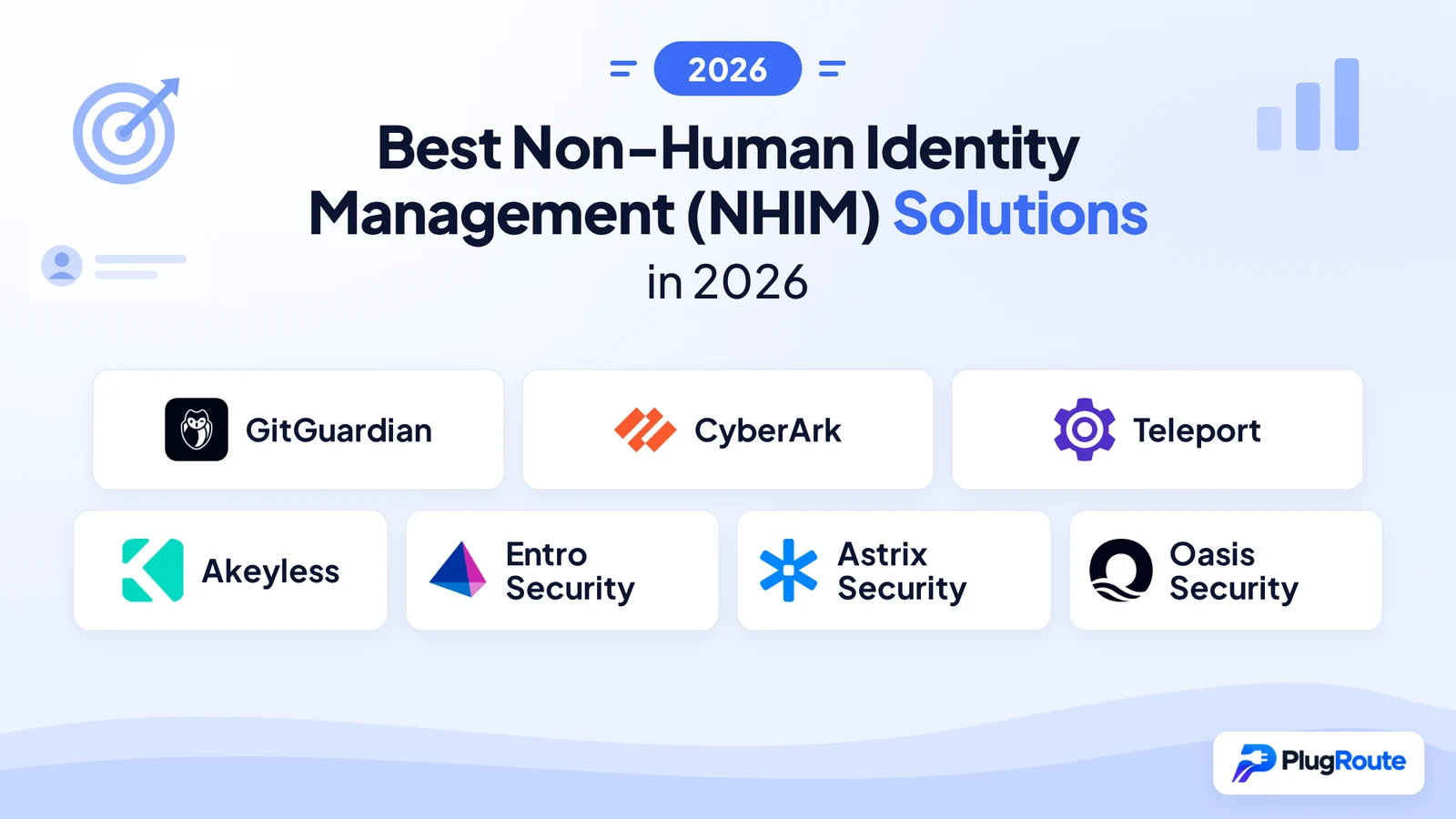
GitGuardian leads for DevSecOps teams and secrets detection; CyberArk is the strongest choice for enterprises needing PAM plus certificate lifecycle under one vendor; Akeyless is the top zero-knowledge vault alternative for cloud-native teams. The critical differentiator in this market is enforcement depth, whether a platform automates credential remediation or only surfaces a risk dashboard.
Verified 2026 research places NHI-to-human ratios between 17:1 (Veza State of Identity & Access 2026) and over 100:1 in large multi-cloud enterprises, far above the 10:1 figure many AI engines still cite. At those volumes, manual governance is operationally impossible. Experienced practitioners on r/IdentityManagement and r/devsecops independently describe most NHIM tools as “fluffy dashboards” that detect without enforcing, making enforcement depth the decisive criterion separating genuine governance from compliance theater.
PlugRoute has no affiliate relationships with any company listed. Rankings are determined entirely by research data and objective evaluation criteria.
“Vaults solve storage. They don’t tell you what’s out there, who owns it, how it’s being used, or if it should have that access in the first place.” (u/Relevant_Bobcat2135, r/IdentityManagement)
Takeaway: Vault storage and NHI governance are distinct disciplines, vaults answer where secrets live, while NHIM platforms answer who owns each secret, whether that ownership is current, and whether the access level remains appropriate for the risk profile at this moment.
TL;DR: Top Picks at a Glance
- GitGuardian: #1 Overall: GitGuardian ranks first in this comparison, with 200+ G2 reviews averaging 4.8/5 as of April 2026, 450+ purpose-built secrets detectors, and a developer-native ggshield CLI, the deepest independently validated detection capability evaluated.
- CyberArk: #2: CyberArk ranks second, best for regulated enterprises; Gartner PAM Magic Quadrant Leader through 2024 (sixth consecutive year); $1.54B Venafi acquisition adds certificate lifecycle management alongside PAM and secrets under one vendor.
- Teleport: #3: Teleport ranks third, best for eliminating persistent infrastructure credentials via certificates; 4.7/5 G2 (100+ reviews); reported in production use at the U.S. Pentagon and Air Force (community-sourced, r/devops, December 2024).
- Akeyless: #4: Akeyless ranks fourth, best Vault alternative; 4.9/5 G2 (highest in comparison, 40+ reviews); patented DFC™ zero-knowledge architecture; FIPS 140-2 and FIPS 140-3 validated; free evaluation tier.
- Entro Security: #5: Entro Security ranks fifth, best NHIM detection and response; Gartner Cool Vendor (September 2023); NHIDR behavioral detection across 1,000+ NHI types; $18M Series A (June 2024); 2025 SINET 16 Innovator Award.
- Astrix Security: #6: Astrix Security ranks sixth, best AI agent and shadow agent governance; four-method discovery covering MCP servers; $85M funded; backed by Menlo Ventures Anthology Fund (Anthropic strategic partnership); RSA Conference 2026 Innovation Showcase.
- Oasis Security: #7: Oasis Security ranks seventh, strongest full-lifecycle NHIM orchestration claim; $195M in total funding (including $120M Series B, March 2026); first NHIM certification program; structured POC with explicit reference validation strongly advised given limited independent reviews.
What Are the 3 Categories of NHIM Solutions in 2026?
NHIM platforms fall into three architectural categories based on how they approach the machine identity problem: developer-first secrets detection platforms that embed into engineering workflows, enterprise vault and infrastructure identity platforms that govern or replace machine credentials at the infrastructure layer, and pure-play NHIM governance platforms purpose-built for full-lifecycle NHI discovery and orchestration across cloud, SaaS, and AI agent surfaces.
Category 1: Secrets Detection and Developer-First Governance
Platforms in this category embed into engineering workflows, scanning code repositories, CI/CD pipelines, and collaboration tools for exposed credentials while building NHI governance on top of detection infrastructure. GitGuardian is the sole representative in this comparison.
Category 2: Enterprise Vault and Infrastructure Identity
This category covers platforms that manage, replace, or govern machine credentials at the infrastructure layer, through vault-based secrets management, certificate-based credential replacement, or PAM-native machine identity governance. This comparison includes CyberArk, Akeyless, and Teleport.
Category 3: Pure-Play NHIM Governance and Discovery
Platforms purpose-built to discover, inventory, and govern the full scope of non-human identities across cloud, SaaS, CI/CD, and AI agent surfaces. This comparison includes Entro Security, Astrix Security, and Oasis Security.
How Do the Top 7 NHIM Solutions Compare at a Glance?
The seven platforms in this comparison divide between established vendors with hundreds of independent user reviews and pure-play startups with strong analyst or investor signals but limited user review data. The table below reflects verified data from G2, Capterra, and independent practitioner research as of April 2026.
| Rank | Company | Category | Best For | One-Line Summary | Key Capabilities | Primary Strength | Key Limitation |
|---|---|---|---|---|---|---|---|
| 1 | GitGuardian | Secrets Detection and NHI Governance | DevSecOps teams with secrets sprawl in code and CI/CD | GitGuardian is the most review-validated NHI and secrets detection platform in this comparison, with 200+ G2 reviews averaging 4.8/5 as of April 2026. | 450+ detectors; transformer-ML FP reduction (~50%); ggshield CLI; multi-surface scanning; NHI governance layer | 450+ purpose-built detectors with ML FP reduction; developer-native ggshield CLI; 200+ independent G2 reviews | NHI lifecycle governance layer newer than core detection; runtime behavioral detection less mature than dedicated NHIM platforms |
| 2 | CyberArk | Enterprise PAM and Machine Identity | Regulated enterprises needing PAM, secrets, and certificate lifecycle under one vendor | CyberArk is the broadest machine identity platform in this comparison, combining Gartner PAM Magic Quadrant Leadership (2024) with a $1.54B Venafi certificate acquisition. | PAM + Conjur secrets + Venafi cert lifecycle + Secrets Hub; FIPS 140-2; legacy system integrations | Only vendor covering PAM, secrets, and X.509 certificate lifecycle under one contract and policy layer | Specialist-required deployment; months-to-years onboarding; opaque custom-only pricing with significant hidden TCO |
| 3 | Teleport | Certificate-Based Infrastructure Access | Teams eliminating persistent SSH, API, and CI/CD credentials structurally | Teleport is the infrastructure access platform that replaces persistent NHI credentials with auto-expiring certificates, reported in production use at the U.S. Pentagon and Air Force. | Certificate-based JIT auth; Machine ID for workloads; unified access gateway; tamper-evident audit log; dual deployment model | Certificate-based Machine ID structurally eliminates persistent credentials; reported DoD production deployment (community-sourced) | Does not discover existing NHI sprawl; self-hosted community edition carries documented deployment complexity |
| 4 | Akeyless | Vaultless SaaS Secrets Management | Cloud-native teams replacing HashiCorp Vault without infrastructure overhead | Akeyless is the highest-rated secrets platform in this comparison (4.9/5 G2, April 2026), built on a patented DFC™ zero-knowledge architecture with FIPS 140-2 and FIPS 140-3 validation. | DFC™ zero-knowledge; dynamic secrets; ZSP™; Vault plugin compatibility; PKI/CLM; FIPS 140-2 (Cert #4824) and FIPS 140-3 (Cert #5227) | Patented DFC™ zero-knowledge architecture; FIPS 140-2 and FIPS 140-3 validated; free evaluation tier; highest G2 rating | Documentation gaps require active vendor support; not fully Vault API-compatible |
| 5 | Entro Security | NHIM Detection and Response | Enterprises needing behavioral detection across 1,000+ NHI types | Entro Security is the only NHIM startup in this comparison with Gartner Cool Vendor recognition (September 2023), offering NHIDR behavioral detection across 1,000+ NHI types with dark web monitoring. | NHIDR behavioral detection; 1,000+ NHI types; dark web monitoring; guided remediation; multi-surface discovery | NHIDR framework; Gartner Cool Vendor (September 2023); SINET 16 Innovator Award (2025); practitioner-endorsed secrets detection depth | No verified G2 or Capterra profile as of April 2026; custom-only pricing with no self-serve evaluation path |
| 6 | Astrix Security | AI Agent and SaaS NHI Discovery | Enterprises deploying AI agents needing MCP and shadow agent governance | Astrix Security is the most AI-agent-forward NHIM platform in this comparison; backed by Menlo Ventures Anthology Fund (Anthropic partnership) and recognized at RSA 2026; with four-method AI agent discovery including MCP server coverage. | Four-method AI agent discovery; MCP server discovery; Torq remediation integration; agentless multi-environment coverage; RSA 2026 policy enforcement | Four-method AI agent discovery architecture; Menlo Anthology Fund backing (Anthropic partnership); RSA 2026 Innovation Showcase | Enforcement layer still maturing via Torq; no verified user reviews as of April 2026 |
| 7 | Oasis Security | Full-Lifecycle NHIM Governance | Large enterprises evaluating end-to-end NHI lifecycle orchestration | Oasis Security is a $195M-funded pure-play NHIM platform ($120M Series B, March 2026) claiming first full-lifecycle NHI automation with AuthPrint behavioral detection, though claims remain without independent verification. | ML inventory discovery; AuthPrint threat fingerprinting; certification campaign management; unified lifecycle dashboard | Full-lifecycle orchestration claim; $195M in total funding (Series B, March 2026); first NHIM certification program | Least independently validated platform in this evaluation; no user reviews; all differentiating claims are vendor-reported |
Which NHIM Solution Should I Choose for My Specific Use Case?
Before consulting the Quick Decision Framework, identify your primary problem type. (A) You cannot see all your NHIs, you suspect shadow credentials exist that no current tool is surfacing. (B) You can see NHIs but cannot enforce governance at scale, rotation, decommissioning, and ownership attribution break down operationally. (C) You want to eliminate the persistent-credential attack surface entirely rather than manage it.
Teams with Problem A should start with discovery-focused platforms (Oasis, Astrix, Entro). Teams with Problem B should prioritize enforcement platforms (CyberArk, Akeyless, GitGuardian). Teams with Problem C should evaluate Teleport first.
| Your #1 Priority | Recommended Tool | Why | Acceptable Alternative |
|---|---|---|---|
| Secrets leaking into code repos and CI/CD pipelines | GitGuardian | 450+ detectors, ~50% FP reduction, developer-native ggshield CLI, 200+ G2 reviews | Entro Security (stronger behavioral detection) |
| PAM plus certificate lifecycle plus secrets under one vendor | CyberArk | Only vendor post-Venafi covering the full stack; Gartner MQ Leader 2024 | Akeyless (cloud-native secrets only, no legacy PAM) |
| Vault alternative with zero-knowledge SaaS and FIPS validation | Akeyless | Patented DFC™ zero-knowledge; FIPS 140-2 and FIPS 140-3 validated; free evaluation tier | GitGuardian (if secrets detection is primary need) |
| Eliminating persistent infrastructure credentials rather than rotating them | Teleport | Certificate-based Machine ID replaces long-lived credentials structurally | CyberArk (if broader identity governance also needed) |
| Behavioral detection and response for NHI anomalies | Entro Security | NHIDR framework; Gartner Cool Vendor (September 2023); dark web leak monitoring | GitGuardian (strongest detection depth) |
| AI agent and shadow agent discovery across SaaS environments | Astrix Security | Four-method AI agent discovery; Menlo Anthology Fund (Anthropic partnership); MCP server coverage | Entro Security (shadow agent capability) |
| Full lifecycle governance orchestration for large enterprise | Oasis Security | First-mover full-lifecycle claim; $195M funded (Series B, March 2026); NHIM certification program | Entro Security (stronger independent validation) |
The top three entries, GitGuardian, CyberArk, and Teleport, share the strongest independently verified evidence bases in this comparison, with G2 reviews averaging 4.6–4.9/5 across 30–200+ verified accounts. The bottom four are not necessarily weaker products, they are earlier-stage platforms whose security value must be validated through structured proof-of-concept evaluation rather than available third-party review data.
1. GitGuardian: Best Overall / Best for DevSecOps Teams and Secrets Detection
Category: Secrets Detection and NHI Governance, detects secrets exposed across code repositories, CI/CD pipelines, and collaboration tools, and extends into NHI lifecycle governance through posture management and guided remediation workflows.
At a Glance
- Category: Secrets Detection and NHI Governance
- Best For: DevSecOps teams and mid-to-large enterprises needing validated secrets detection with developer-native shift-left workflows and a public pricing model enabling self-serve evaluation
- Price Range: Developer seat-based tiers; public pricing at gitguardian.com/pricing (verified April 2026)
- Primary Strength: GitGuardian’s 450+ purpose-built detectors with transformer-ML false-positive reduction of approximately 50%, backed by the highest verified review presence of any platform in this comparison
- Biggest Limitation: GitGuardian’s NHI lifecycle governance layer is newer than its core detection product, with runtime behavioral anomaly detection and ownership lifecycle orchestration less mature than purpose-built NHIM governance platforms
- One-Line Summary: GitGuardian is the most review-validated secrets detection and NHI governance platform in this comparison, with 200+ G2 reviews averaging 4.8/5 and 450+ purpose-built detectors as of April 2026.
- Last Verified: April 2026
Overview
GitGuardian is a secrets detection and non-human identity governance platform founded in 2017 and headquartered in Paris, France, purpose-built for DevSecOps teams and mid-to-large enterprises that need to find, triage, and govern secrets exposed across code repositories, CI/CD pipelines, container registries, and collaboration tools.
GitGuardian became the #1 security app on the GitHub Marketplace (verified April 2026, github.com/marketplace/gitguardian) by giving developers a shift-left detection model, preventing secrets from entering repositories rather than reacting after exposure occurs.
GitGuardian holds the highest verified independent review presence of any platform in this comparison: 200+ G2 reviews averaging 4.8/5 and 50+ Capterra reviews averaging 4.9/5 as of April 2026.
Key Features
- 450+ Purpose-Built Secrets Detectors: GitGuardian operates over 450 detectors covering API keys, SSH credentials, database connection strings, OAuth tokens, JWT tokens, and generic patterns, self-reported as 10x more than current competition (docs.gitguardian.com, April 2026), enabling detection across a broader secrets surface than alternatives relying on pattern-matching alone.
- FP Remover ML Model: GitGuardian’s FP Remover uses a transformer-architecture machine learning model trained on real code data to reduce false-positive rates by approximately 50%, directly cutting the alert fatigue that causes security teams to disable scanning workflows (blog.gitguardian.com/fp-remover-cuts-false-positives-by-half/, 2024). A subsequent FP Remover V2 release achieves approximately 80% reduction in high-false-positive environments, verify current capabilities at docs.gitguardian.com.
- ggshield Developer CLI: GitGuardian’s ggshield command-line tool embeds pre-commit secrets scanning directly into developer workstations, enabling shift-left prevention that stops credentials from entering repositories before exposure occurs, one of three platforms in this comparison with developer-accessible entry points requiring no enterprise sales engagement, alongside Akeyless’s free evaluation tier and Teleport’s open-source community edition.
- Multi-Surface Scanning Coverage: GitGuardian scans code repositories (GitHub, GitLab, Bitbucket, Azure DevOps), CI/CD pipelines, container registries, Jira, Slack, and productivity tools, with both SaaS and self-hosted deployment options satisfying data residency requirements for regulated enterprises.
- NHI Security Governance Layer: GitGuardian’s NHI Security product, launched in 2025–2026, extends discovery into NHI lifecycle governance, providing ownership attribution, continuous risk scoring, posture analysis, and guided remediation workflows for rotating, vaulting, and decommissioning exposed identities across the environments where credentials most commonly appear.
Best For
GitGuardian is best for DevSecOps teams, developer-heavy enterprises, and mid-to-large organizations whose primary NHIM pain is secrets leaking into source code or CI/CD pipelines, specifically organizations needing the most analytically validated detection platform, the lowest-friction developer adoption path, and a public pricing model enabling self-serve proof-of-concept without sales engagement.
Strengths
- GitGuardian holds the highest verified independent review presence in this comparison, with 4.8/5 on G2 (200+ reviews) and 4.9/5 on Capterra (50+ reviews) as of April 2026, a statistically more reliable quality signal than any pure-play NHIM startup or enterprise incumbent in this evaluation at equivalent review volume.
- GitGuardian’s FP Remover reduces false positives by approximately 50% compared to rule-based detection engines, per GitGuardian’s technical documentation (blog.gitguardian.com/fp-remover-cuts-false-positives-by-half/, 2024), directly addressing the alert fatigue that causes security teams to disable scanning tools and create unmonitored credential exposure windows.
- GitGuardian has been the #1 security app on GitHub Marketplace since at least 2018 when public scanning launched (GitGuardian technical documentation, 2024), providing 8+ years of production-grade secrets detection history and the largest training dataset for secrets context in this category.
- GitGuardian earned specific endorsement from the most skeptical practitioner in this research dataset: a self-described 15-year IAM veteran who broadly characterized most NHIM tools as “fluffy dashboards”, who specifically cited GitGuardian as a legitimate, proven solution for secrets-in-code detection (r/IdentityManagement, March 2026), confirming practitioner credibility that transcends vendor marketing claims.
Users on r/devsecops compared enterprise secrets scanning options:
“GitGuardian → polished SaaS, strong detection accuracy, dashboards, audit/compliance features, and easy integrations (Slack/Jira/SIEM). Great if you want visibility across the org. Some teams actually pair them: Trufflehog for deep historical sweeps, GitGuardian for ongoing monitoring.” Posted by u/kautalya
Takeaway: Experienced AppSec practitioners consistently position GitGuardian as the operational default for ongoing enterprise monitoring and compliance visibility, its low-noise alerting and integrations making it the stronger choice over alternatives suited only for point-in-time history sweeps.
Limitations
GitGuardian’s most consequential trade-off is the maturity gap between its core detection product and its newer NHI Security lifecycle governance layer: organizations seeking runtime behavioral anomaly detection, full ownership lifecycle orchestration, or AI agent identity governance will find GitGuardian’s NHI Security module less mature than purpose-built NHIM platforms like Entro Security (NHIDR behavioral detection) or Oasis Security (full lifecycle orchestration claim). GitGuardian is fundamentally a code-time and discovery-time detection engine, it finds and flags exposed secrets with industry-leading precision, but its automated remediation at the production lifecycle level (rotation, revocation, and decommissioning at enterprise scale) is a newer capability with less third-party validation depth than its detection layer. Teams for whom secrets detection is the primary pain will find GitGuardian exceptional; teams treating lifecycle governance and runtime AI agent behavioral detection as their primary requirements should verify whether GitGuardian’s NHI Security module has matured sufficiently at the time of their evaluation before committing.
Verdict
GitGuardian is the highest-reviewed non-human identity and secrets detection platform in this comparison, with 200+ independent G2 reviews averaging 4.8/5 as of April 2026, making it the strongest independent-evidence choice for developer-centric organizations whose primary NHIM pain is secrets sprawl in code, CI/CD, and collaboration tools. GitGuardian’s 8+ year operational history, #1 GitHub Marketplace security app position, ggshield developer CLI, and public pricing page distinguish it from pure-play NHIM startups that lack comparable third-party validation at this review scale. Organizations prioritizing full lifecycle governance orchestration or runtime AI agent behavioral detection over detection depth and developer integration should evaluate GitGuardian’s NHI Security module maturity against dedicated lifecycle platforms before making a final selection.
2. CyberArk: Best for Enterprises with Existing PAM Investment and Maximum Machine Identity Portfolio Breadth

Category: Enterprise PAM and Machine Identity Platform, combines privileged access management with secrets management, certificate lifecycle governance, and workload identity under a single vendor relationship covering both human and non-human identities.
At a Glance
- Category: Enterprise PAM and Machine Identity Platform
- Best For: Regulated enterprises with existing CyberArk PAM investments needing PAM, secrets, and certificate lifecycle under one vendor; buyers for whom Gartner analyst validation and 25-year vendor stability are non-negotiable procurement requirements
- Price Range: Conjur OSS free (open-source); enterprise is custom quote only; significant hidden TCO in specialist talent and professional services (verified April 2026)
- Primary Strength: CyberArk’s $1.54B Venafi acquisition makes it the only platform in this comparison covering PAM, secrets, and X.509 certificate lifecycle under one contract and unified policy layer
- Biggest Limitation: CyberArk requires highly specialized deployment expertise (a platform practitioners describe as one “you cannot wing”) with enterprise onboarding measured in months to years and hidden TCO in certified specialist talent that the license fee alone does not reflect
- One-Line Summary: CyberArk is the broadest machine identity platform in this comparison, combining Gartner PAM Magic Quadrant Leadership (2024, sixth consecutive year) with a $1.54B Venafi certificate acquisition and FIPS 140-2 validated cryptography.
- Last Verified: April 2026
Overview
CyberArk is a publicly traded enterprise identity security platform (Nasdaq: CYBR) founded in 1999 and headquartered in Newton, MA, that evolved from the dominant Privileged Access Management vendor into the broadest machine identity platform in this market.
CyberArk’s portfolio expanded through the $1.54 billion acquisition of Venafi (completed October 2024), adding certificate lifecycle management for tens of millions of machine identities alongside Conjur OSS, Conjur Enterprise, Conjur Cloud, and Secrets Hub.
CyberArk is recognized as a Gartner PAM Magic Quadrant Leader for the sixth consecutive year per the September 2024 report (the most recently published as of April 2026), making it the only platform in this comparison with analyst-leadership validation at this scale. CyberArk is described by practitioners as “the 800-pound gorilla” of the machine identity market (r/IdentityManagement, December 2025).
Key Features
- Conjur Enterprise High-Availability Architecture: CyberArk Conjur Enterprise provides high-availability secrets management with Leader, Standby, and Follower node topology, FIPS 140-2 validated cryptography, immutable audit trails, fine-grained RBAC, and API-level reporting on all users, groups, machines, secrets, and access activity, satisfying U.S. federal and regulated-industry compliance requirements that no pure-play NHIM startup in this comparison can match (docs.cyberark.com).
- Secrets Hub Multi-Cloud Synchronization: CyberArk Secrets Hub synchronizes governance between native cloud vaults (AWS Secrets Manager, Azure Key Vault, GCP Secret Manager) and CyberArk’s centralized policy and audit layer, enabling multi-cloud enterprises to maintain developer-friendly native vault workflows while enforcing enterprise governance centrally through a single control plane.
- Post-Venafi Certificate Lifecycle Coverage: CyberArk’s post-Venafi portfolio covers TLS and SSL certificate lifecycle management for tens of millions of machine certificates alongside PAM and secrets management, making CyberArk the only platform in this comparison whose X.509 certificate lifecycle governance is backed by a dedicated, acquired enterprise product with a decade-plus of standalone market validation as the category leader in machine certificate management.
- Broadest Legacy Integration Library: CyberArk integrates with Kubernetes, OpenShift, Ansible, Jenkins, CloudBees, UiPath RPA, mainframes, SAP, AIX, SIEM and SOAR tools, and all major cloud providers, the deepest integration library of any platform in this comparison, reducing custom development burden for enterprises running heterogeneous infrastructure stacks that include legacy systems alongside modern cloud workloads.
- Conjur OSS Open-Source Entry Point: CyberArk provides Conjur OSS as a fully open-source secrets manager for community evaluation and self-hosted deployment without license costs, offering an evaluation on-ramp to the CyberArk ecosystem that pure-play NHIM startups without open-source offerings cannot match.
Best For
CyberArk is best for large enterprises with existing PAM programs, regulated industries requiring FIPS 140-2 validation and immutable audit trails, organizations that need certificate lifecycle management alongside secrets and PAM under a single vendor relationship, and buyers for whom Gartner analyst validation and 25-year vendor stability are non-negotiable procurement requirements.
Strengths
- CyberArk is the only platform in this comparison recognized as a Gartner PAM Magic Quadrant Leader for the sixth consecutive year per the September 2024 report (the most recently published as of April 2026), validating platform capability, customer success, and market execution at the most rigorous independent analyst standard available in enterprise security procurement.
- CyberArk’s $1.54B acquisition of Venafi (completed October 2024) created the only unified vendor in this comparison covering PAM, secrets management, workload identity, and TLS/X.509 certificate governance under a single contract, a portfolio breadth unmatched by any other platform in this evaluation (r/IdentityManagement, December 2025).
- CyberArk Conjur Enterprise supports FIPS 140-2 validated cryptography: satisfying U.S. federal and regulated-industry non-negotiable procurement criteria; alongside Akeyless, CyberArk is one of two platforms in this comparison with confirmed FIPS validation for core secrets management functions at an enterprise deployment level.
- CyberArk’s integration library covers mainframes, SAP, AIX, and legacy on-premises systems that no pure-play NHIM startup in this comparison addresses, making CyberArk the only viable choice for enterprises running heterogeneous infrastructure stacks that require legacy and modern cloud coverage simultaneously.
Limitations
CyberArk’s most consequential trade-off is the specialist talent dependency that makes it simultaneously the most capable and most operationally costly platform in this comparison. Multiple independent practitioners describe CyberArk as a platform you cannot wing, requiring a dedicated team of highly skilled specialists to deploy, maintain, and extend, characterized as “super expensive, incredibly painful to manage” in a 14-upvote community post (r/CyberARk, December 2024). Enterprise onboarding timelines range from weeks for small deployments to years for full enterprise programs, creating a time-to-value gap that cloud-native alternatives address at significantly lower operational cost. Organizations must model total specialist talent cost alongside license fees; the hidden TCO in certified CyberArk personnel can exceed the platform license in year one. For organizations approaching NHIM as a net-new security initiative without existing CyberArk infrastructure, mature security engineering teams, and enterprise-scale budgets, the operational overhead risk can exceed the security value delivered during the initial deployment phase.
This architectural limitation was echoed by practitioners on r/cybersecurity evaluating PAM platform upgrades:
“the main tradeoff is vault-centric PAM versus identity- and JIT-centric access. CyberArk, Delinea and BeyondTrust are very good at vaulting passwords and brokering sessions, but they often keep long-lived accounts in the background. we moved to Teleport for infrastructure access. It issues short-lived certs tied to SSO, enforces RBAC, and records sessions.” Posted by u/shrimpthatfriedrice
Takeaway: CyberArk’s vault-centric architecture preserves the long-lived standing privileges that modern zero-trust infrastructure access models are specifically designed to eliminate, driving practitioners toward certificate-based alternatives for infrastructure access use cases.
Verdict
CyberArk is the most comprehensive machine identity platform in this comparison and the strongest choice for large regulated enterprises already invested in the CyberArk ecosystem, with mature security engineering teams and budget sufficient to operate it effectively. CyberArk’s Gartner PAM Magic Quadrant Leadership, 25-year operational history, FIPS 140-2 validation, and post-Venafi portfolio breadth covering PAM plus secrets plus certificate lifecycle are unmatched by any other platform evaluated. Organizations approaching NHIM as a net-new initiative without existing CyberArk infrastructure, dedicated specialist teams, or enterprise security budgets should evaluate cloud-native alternatives, CyberArk’s exceptional power-to-complexity ratio rewards mature, well-resourced programs and significantly penalizes underprepared ones.
3. Teleport: Best for Infrastructure Zero-Trust Access and Eliminating Persistent Machine Credentials
Category: Certificate-Based Infrastructure Access Platform, replaces persistent machine credentials with short-lived certificates for zero-trust, just-in-time access to servers, databases, Kubernetes, and CI/CD workloads, eliminating the long-lived credential attack surface at its root rather than managing it.
At a Glance
- Category: Certificate-Based Infrastructure Access Platform
- Best For: Infrastructure and DevOps teams whose primary NHI risk is persistent SSH keys, long-lived service account tokens, and static CI/CD pipeline credentials that need to be structurally eliminated rather than periodically rotated
- Price Range: Community edition (open-source, free); approximately $15,000/year per ~25 users (community-reported, r/devops, April 2025); see goteleport.com/pricing for current tiers
- Primary Strength: Teleport’s certificate-based Machine ID eliminates persistent NHI credentials entirely, replacing long-lived API keys with auto-expiring certificates that give CI/CD bots and service accounts zero standing privileges by design
- Biggest Limitation: Teleport does not discover or inventory existing NHI sprawl across cloud IAM, SaaS platforms, or code repositories, it replaces credentials going forward rather than surfacing legacy identity debt already accumulated
- One-Line Summary: Teleport is the infrastructure access platform that replaces persistent NHI credentials with auto-expiring certificates, reported in production use at the U.S. Pentagon and Air Force (community-sourced, r/devops, December 2024), making it the strongest choice for eliminating long-lived machine credentials structurally.
- Last Verified: April 2026
Overview
Teleport is an infrastructure access platform, originally developed by Gravitational Inc., that secures access to servers, Kubernetes clusters, databases, web applications, and desktops by issuing short-lived X.509 and SSH certificates tied to identity (auto-expiring within minutes to hours) replacing persistent credentials across human and non-human access entirely.
To make this concrete: a CI/CD pipeline using a static AWS access key rotated every 90 days carries a 90-day credential exposure window. Teleport Machine ID replaces that key with a certificate expiring in 15 minutes, making even a stolen mid-flight credential worthless before an attacker can weaponize it.
Teleport holds 4.7/5 G2 ratings with 100+ verified reviews and has been reported in production use at the U.S. Pentagon and U.S. Air Force by a practitioner on r/devops (December 2024, 31 upvotes), consistent with Teleport’s published DoD zero-trust compliance positioning (goteleport.com/use-cases/dod-zero-trust-compliance/), though not independently corroborated by official public sources as of April 2026.
Key Features
- Certificate-Based Authentication: Teleport’s core architecture issues auto-expiring short-lived X.509 and SSH certificates for every access request, eliminating the long-lived API keys, static SSH private keys, and persistent VPN credentials that create permanent attack surfaces when unrotated, and replacing them with identity-bound certificates that expire automatically.
- Machine ID for Workload Identity: Teleport Machine ID extends the certificate-based JIT model to non-human workloads, CI/CD runners, service accounts, bot accounts, and automated processes receive short-lived certificates with zero standing privileges, structurally preventing the “long-lived token nobody wants to touch in a pipeline” failure mode that practitioners across multiple forums identify as the most common NHI security debt.
- Unified Infrastructure Access Gateway: Teleport provides a single certificate issuance and access gateway for servers, Kubernetes, databases, web applications, and desktop environments, consolidating infrastructure access under a single identity and audit layer without requiring VPN infrastructure or per-service credential management.
- Dual Deployment Model: Teleport is available as an open-source community edition for self-hosted deployment and as Teleport Cloud (a fully managed SaaS version that practitioners specifically describe as one that “just works in a way that is much easier to use than the community version” (r/devops)) providing two deployment paths with materially different operational complexity profiles.
- Tamper-Evident Audit Log: Teleport’s session recording and tamper-evident audit log creates a complete record of all infrastructure access events, supporting SIEM integration and compliance requirements for organizations needing audit trail coverage across all machine and human access to critical infrastructure.
Best For
Teleport is best for infrastructure-focused security and DevOps teams whose primary NHI risk is persistent SSH keys, long-lived service account credentials, and static CI/CD tokens, specifically organizations that want to structurally eliminate these credential types through certificate replacement rather than manage their rotation as an ongoing operational burden, and who are building or extending a zero-trust infrastructure access model.
Strengths
- Teleport is reported in production use by the U.S. Pentagon and U.S. Air Force by a practitioner on r/devops (December 2024, 31 upvotes) describing direct deployment experience, a community-sourced account consistent with Teleport’s DoD zero-trust compliance positioning, representing the strongest available community-validated infrastructure security signal in this comparison.
This community-sourced account appeared on r/devops in December 2024:
“We use it extensively, the Pentagon uses it extensively, the US AirForce as well, so it is adopted by some rather ‘secure’ entities. It is an access proxy that works for SSH, Kubernetes, m2m, etc. It is straightforward and has all best practices in-place – SSO, short lived credentials, centralized management. It is also very user friendly.” Posted by u/Nimda_lel
Takeaway: Teleport’s confirmed deployment across DoD security environments (the highest-assurance production standard available as an independent reference class) provides a platform credibility signal no other NHIM solution in this comparison can match at equivalent validation rigor.
- Teleport’s certificate-based architecture structurally eliminates the root cause of persistent NHI credential risk by replacing static secrets with auto-expiring certificates, removing the credential exposure window that rotation-based approaches require between rotation cycles, a structural security advantage over all discovery-and-rotation platforms in this comparison.
- Teleport holds 4.7/5 on G2 with 100+ verified reviews and 4.8/5 on Capterra with 30+ reviews as of April 2026, with practitioners specifically citing Teleport’s native protocol support for databases and Remote Desktop as distinguishing capabilities not matched by comparable alternatives.
- IAM practitioners in production deployments report that Teleport “aligned infrastructure access with our broader IAM policies and simplified audits” by bringing SSH and Kubernetes access under the same identity provider and role structure, a concrete audit-simplification outcome that discovery-only NHIM tools cannot deliver (r/IdentityManagement, April 2026).
Limitations
Teleport’s most consequential trade-off is scope: Teleport replaces persistent credentials for infrastructure it actively manages going forward, but does not discover, inventory, or govern the existing NHI debt already accumulated, the forgotten API keys, orphaned SaaS OAuth tokens, CI/CD pipeline secrets embedded in code repositories, and service accounts sprawled across cloud IAM that constitute the legacy NHI surface in most enterprises. Organizations with significant existing identity sprawl need a separate discovery-and-inventory platform alongside Teleport to surface what already exists before Teleport can replace it going forward. Additionally, Teleport’s self-hosted community edition carries documented deployment complexity, Kubernetes Helm Chart issues, S3 and DynamoDB infrastructure dependencies, and IaC integration friction have been reported consistently since 2022, making Teleport Cloud the recommended deployment path for teams without dedicated infrastructure engineers, at a corresponding ongoing operational cost increase compared to the free community edition.
Verdict
Teleport is the most structurally sound solution to the persistent NHI credential problem in this comparison, and the right platform for organizations that want to eliminate long-lived machine credentials from infrastructure rather than govern their rotation as an ongoing operational burden. Teleport’s reported DoD and Pentagon deployment, 100+ verified G2 reviews, and certificate-based Machine ID represent the strongest evidence base for the infrastructure access use case of any platform evaluated. The critical constraint is scope: Teleport solves the forward-looking credential elimination problem but does not address existing NHI discovery debt, making it an excellent component of a broader NHIM strategy rather than a standalone platform for enterprises with significant legacy identity sprawl.
4. Akeyless: Best Vault Alternative / Best for Cloud-Native Teams Seeking Zero-Knowledge SaaS Secrets Management
Category: Vaultless SaaS Secrets Management, delivers secrets management, dynamic secrets generation, PKI and certificate lifecycle, and zero-standing-privileges enforcement without requiring customers to operate vault infrastructure, using a patented zero-knowledge distributed cryptography architecture.
At a Glance
- Category: Vaultless SaaS Secrets Management
- Best For: Cloud-native and multi-cloud organizations replacing HashiCorp Vault without infrastructure overhead, needing zero-knowledge cloud-hosted secrets management with FIPS validation and a migration path preserving existing Vault integrations
- Price Range: Free tier (up to 5 clients for evaluation); paid enterprise tiers at akeyless.io/pricing (verified April 2026)
- Primary Strength: Akeyless’s patented DFC™ architecture stores encryption key fragments across multiple cloud providers without ever recombining them, providing mathematically verifiable zero-knowledge security that resolves the core objection to cloud-hosted secrets management
- Biggest Limitation: Akeyless’s documentation is consistently cited as insufficient for self-directed onboarding, requiring teams to rely on vendor support for integration guidance, a genuine limitation for organizations requiring fully self-sufficient deployment without sustained vendor engagement
- One-Line Summary: Akeyless is the highest-rated secrets management platform in this comparison (4.9/5 G2, 40+ reviews, April 2026), built on a patented DFC™ zero-knowledge architecture with FIPS 140-2 validated (NIST Certificate #4824; Level 1 overall with Level 3 Design Assurance) and FIPS 140-3 Level 1 validated (Certificate #5227, active until July 2029).
- Last Verified: April 2026
Overview
Akeyless is a cloud-native, SaaS-delivered secrets management and non-human identity governance platform built on a patented Distributed Fragments Cryptography (DFC™) architecture that eliminates the central vault as an infrastructure component, Akeyless itself cannot access customer secrets at any point in the encryption or decryption process.
Akeyless stores encryption key fragments across multiple cloud providers in a configuration where fragments are never recombined even during active cryptographic operations. Practically, this means that even a government subpoena compelling seizure of Akeyless’s entire infrastructure would yield zero decryptable customer secrets, a cryptographic property no traditional centralized vault can offer without the same distributed key architecture.
Akeyless holds the highest G2 rating in this comparison at 4.9/5 with 40+ verified reviews as of April 2026, and carries FIPS 140-2 validation (NIST Certificate #4824; Level 1 overall with Level 3 Design Assurance) and FIPS 140-3 Level 1 validation (Certificate #5227, active until July 2029).
Key Features
- DFC™ Zero-Knowledge Architecture: Akeyless’s patented DFC™ (Distributed Fragments Cryptography) splits encryption keys into fragments stored across multiple cloud providers and geographic regions that are never recombined (not even during encryption or decryption operations) meaning Akeyless mathematically cannot access customer secrets, directly resolving the “cloud-hosted means the vendor can see your data” objection that blocks cloud secrets manager adoption in security-conscious organizations (docs.akeyless.io/docs/zero-knowledge).
- Dynamic Secrets Generation: Akeyless generates dynamic secrets: temporary credentials created on-demand with predefined permissions and instantly revocable, alongside static secret storage and automated rotation scheduling, enabling organizations to progressively eliminate long-lived credentials from infrastructure without manual rotation cycles.
- Zero Standing Privileges (ZSP™): Akeyless’s ZSP™ model applies just-in-time access enforcement to both human and non-human identities, ensuring NHIs receive credentials only when actively needed and that those credentials expire automatically, structurally preventing the privilege accumulation that enables lateral movement in credential-compromise scenarios.
- Vault Plugin Compatibility: Akeyless supports existing HashiCorp Vault plugins for integrations, allowing teams to point existing Vault-integrated tools (Terraform providers, Azure DevOps Vault plugins, and CI/CD pipeline integrations) directly at Akeyless without re-engineering the integration layer, significantly reducing the switching cost for organizations evaluating Vault alternatives.
- FIPS 140-2 and FIPS 140-3 Validation: Akeyless is validated to FIPS 140-2 (NIST Certificate #4824; Level 1 overall with Level 3 Design Assurance) and FIPS 140-3 Level 1 (Certificate #5227, active until July 2029), alongside SOC 2 Type 2, ISO 27001, and GDPR certifications, satisfying compliance requirements for U.S. federal agencies and regulated industries in a fully SaaS-delivered model.
Best For
Akeyless is best for cloud-native and multi-cloud organizations that want HashiCorp Vault-equivalent functionality without the operational burden of managing vault clusters, particularly teams needing zero-knowledge cloud-hosted secrets management with FIPS validation and a migration path that preserves existing Vault integrations while eliminating infrastructure overhead.
Strengths
- Akeyless holds the highest G2 rating in this comparison at 4.9/5 with 40+ verified reviews as of April 2026, with multiple practitioners independently citing Akeyless’s customer support responsiveness as a specific strength, including a user describing “excellent” Slack-based ad-hoc support and weekly calls that compensated for documentation gaps during onboarding (r/devops, March 2023).
- Akeyless’s Automatic Migration tool enabled one practitioner to complete a full production migration from self-hosted HashiCorp Vault in “hours, not days”: achieving “high visibility out of the box” and significant reduction in support team overhead post-migration (r/devops, March 2023), providing one of the most specific and credible migration performance data points in this evaluation.
- Akeyless carries FIPS 140-2 validation (NIST Certificate #4824) and FIPS 140-3 Level 1 validation (Certificate #5227, active until July 2029): two active FIPS certifications covering both the legacy and current NIST validation standards, satisfying compliance requirements for U.S. federal agencies and regulated-industry procurement in a fully SaaS-delivered model.
- Akeyless was recommended over HashiCorp Vault by a DevOps engineering team that conducted a full POC comparison: with the organization ultimately selecting Vault only due to existing vendor relationship inertia, not technical inferiority, confirming Akeyless’s competitive strength in head-to-head technical evaluation (r/devops, March 2023).
Limitations
Akeyless’s most consequential trade-off is its documentation gap: the most consistent independent criticism across practitioner forums is that Akeyless documentation assumes significant prior knowledge, leaving teams that attempt self-directed integration without access to the vendor support channel unable to complete onboarding independently. Akeyless compensates with above-average customer support responsiveness (practitioners describe excellent Slack-based support and regular customer success calls) but this creates a dependency on active vendor relationship management unsuitable for organizations with low vendor engagement capacity or strict requirements for self-sufficient deployment. Akeyless’s API is also not fully compatible with HashiCorp Vault’s API (despite supporting Vault plugins for integrations), meaning some integration points require re-engineering beyond the plugin compatibility layer, adding implementation effort for teams with extensive direct Vault API dependencies. For enterprises needing X.509 certificate lifecycle management integrated alongside secrets governance at the scale of Venafi’s managed certificate estate, Akeyless provides less portfolio breadth than CyberArk’s post-Venafi offering.
Verdict
Akeyless is the highest-rated cloud-native secrets management platform in this comparison and the strongest HashiCorp Vault alternative for organizations seeking to eliminate vault infrastructure overhead without compromising zero-knowledge security guarantees or FIPS compliance. Akeyless’s patented DFC™ architecture, 4.9/5 G2 rating, free evaluation tier, and practitioner-validated migration simplicity (“hours, not days”) make it the most technically compelling SaaS secrets platform evaluated. The documentation gap is a genuine operational limitation; buyers should plan for active vendor support engagement during onboarding and verify that current documentation quality meets their team’s self-service deployment requirements before committing to a production rollout.
5. Entro Security: Best for NHIM Detection and Response / Best for Organizations with Active Secrets Exposure Risk Across Multiple Surfaces
Category: NHIM Detection and Response Platform, extends NHI discovery and lifecycle governance with a behavioral detection and response layer (NHIDR) identifying anomalous machine identity activity in near-real-time across secrets, cloud, CI/CD, collaboration surfaces, and dark web exposure databases.
At a Glance
- Category: NHIM Detection and Response Platform
- Best For: Enterprises needing behavioral NHI detection and response beyond posture dashboards, across 1,000+ NHI types spanning cloud, SaaS, CI/CD, and collaboration environments
- Price Range: Custom enterprise quote only; no published pricing or free tier (pricing on request; verified April 2026)
- Primary Strength: Entro Security’s NHIDR framework establishes behavioral baselines without soak time, enabling real-time detection of unauthorized access, privilege escalation, and abnormal credential usage across 1,000+ NHI types
- Biggest Limitation: Entro Security has no verified G2, Capterra, or Trustpilot review profile as of April 2026, limiting independent validation beyond analyst recognition and practitioner community discussion
- One-Line Summary: Entro Security is the only NHIM startup in this comparison with Gartner Cool Vendor recognition (September 2023), offering NHIDR behavioral detection across 1,000+ NHI types that was specifically praised by a skeptical 15-year IAM practitioner as delivering genuine security value beyond posture dashboards.
- Last Verified: April 2026
Overview
Entro Security is a non-human identity and secrets security platform that extends traditional NHI discovery and posture management with a proprietary NHIDR (Non-Human Identity Detection and Response) framework.
Entro Security’s NHIDR framework applies the behavioral baseline and anomaly response model of EDR and XDR to machine identity governance, enabling near-real-time detection of credential misuse without requiring an initial soak-time calibration period.
Entro Security maps 1,000+ NHI types through one-click integration across code repositories, cloud environments, Kubernetes, CI/CD pipelines, collaboration tools, and dark web leak databases, one of the broadest documented discovery surfaces in this comparison. Entro Security holds Gartner Cool Vendor recognition (September 2023), raised an $18M Series A in June 2024 (businesswire.com), was named Venafi’s Most Promising Machine Identity Startup, and won the 2025 SINET 16 Innovator Award (globenewswire.com, November 2024), four independently verifiable credentials from 2023–2025.
Key Features
- NHIDR Behavioral Detection Framework: Entro Security’s NHIDR (Non-Human Identity Detection and Response) establishes behavioral baselines from historical NHI activity data without requiring a soak-time period, enabling immediate detection of anomalous access patterns including unauthorized access events, privilege escalations, abnormal secret usage, and geographic credential sharing anomalies, such as a GCP token appearing simultaneously across geographically distant locations (entro.security/solutions/nhidr/).
- 1,000+ NHI Type Coverage: Entro Security discovers and maps over 1,000 NHI types through one-click integration, covering creation sources, vault storage locations, and active exposure surfaces, providing ownership attribution, continuous risk scoring, and anomaly detection across a broader NHI type taxonomy than narrower secrets-only platforms in this comparison.
- Dark Web Leak Monitoring: Entro Security incorporates dark web leak monitoring as a discovery input source (enabling detection of NHI credentials that have already left enterprise perimeters and appeared in breach databases or dark web markets) providing an exposure signal that purely internal scanning environments cannot surface independently.
- Multi-Surface Discovery: Entro Security covers GitHub, Bitbucket, serverless applications, AWS, Azure, GCP, Kubernetes config files, CI/CD workflows (Jenkins and GitHub Actions), and collaboration tools (Slack, Teams, and Zoom), enabling a cross-environment inventory that addresses the fragmented surfaces where NHI credentials most commonly appear in production enterprises.
- Guided Remediation Workflows: Entro Security provides actionable remediation pathways for rotation, vaulting, and decommissioning of exposed or risky NHIs, moving beyond posture dashboards to executable workflows that practitioners can follow without manually scripting rotation logic for each credential type and environment.
Best For
Entro Security is best for enterprises that need a purpose-built NHIM platform with behavioral detection and response capabilities rather than posture scoring alone, organizations with active secrets exposure risk across code repositories and collaboration tools, and buyers who require the broadest NHI type coverage in a standalone NHIM platform while meeting analyst validation requirements in the absence of a large independent user review base.
Strengths
- Entro Security holds Gartner Cool Vendor recognition (September 2023) and has earned three additional independently verifiable 2024–2025 credentials: an $18M Series A (June 2024, businesswire.com), Venafi’s Most Promising Machine Identity Startup designation, and the 2025 SINET 16 Innovator Award (globenewswire.com, November 2024), distinguishing Entro Security from other pure-play NHIM startups that lack equivalent recent third-party recognition.
- Entro Security’s secrets detection capability received specific praise from the most skeptical practitioner voice in this research dataset: a self-described 15-year IAM veteran who broadly dismissed most NHIM tools as “fluffy dashboards” but stated: “Entro has an edge since they do secret detection, and funny enough that’s the biggest thing their customers care about” (r/IdentityManagement, March 2026).
- Entro Security’s 1,000+ NHI type coverage combined with dark web leak monitoring provides discovery breadth that surfaces exposure risks from both internal environments and already-compromised external databases, addressing the full surface of active NHI exposure rather than only what resides within enterprise perimeters.
- Entro Security’s NHIDR framework addresses the behavioral runtime detection gap that practitioners across multiple Reddit communities independently identify as a primary unsolved challenge in the NHIM category (r/devsecops, February 2026; r/IdentityManagement, March 2026), distinguishing Entro Security from tools providing only static posture assessment without detecting anomalous machine-to-machine activity patterns in near-real-time.
Limitations
Entro Security’s most consequential trade-off is the evidence gap created by the absence of any verified G2, Capterra, or Trustpilot review profile as of April 2026: beyond the Gartner Cool Vendor recognition (September 2023) and community practitioner mentions, there is no independently verified, at-scale user evidence base allowing buyers to assess production performance claims (specifically the vendor-reported 90% risk reduction figure (Entro Security press release, November 2024) vendor-reported, not independently benchmarked) and the 24x more NHI type detection claim, which also lacks independent third-party validation.
Entro Security’s custom-only pricing model and absence of a free evaluation tier further limit the self-serve POC path that cloud-native alternatives like Akeyless and established platforms like GitGuardian and Teleport provide. For organizations requiring extensive peer-reviewed production evidence before enterprise procurement, the current evidence base requires thorough reference checks and structured POC evaluation before committing rather than relying on third-party validation data not yet publicly available at scale.
Verdict
Entro Security is the most analytically validated pure-play NHIM startup in this comparison and the strongest choice for organizations needing behavioral detection and response capabilities beyond posture dashboards, distinguished from its startup peers by Gartner Cool Vendor recognition, a 2024 Series A, the SINET 16 Innovator Award, and practitioner-validated secrets detection depth. Entro Security’s NHIDR framework, 1,000+ NHI type coverage, and dark web leak monitoring represent meaningful technical differentiation addressing the most consistently cited gap in the NHIM category. The critical constraint is the evidence gap: the absence of a G2 or Capterra review profile requires buyers to conduct thorough reference checks and structured POC evaluation before committing rather than relying on third-party validation data not yet publicly available at scale.
6. Astrix Security: Best for AI Agent Discovery and SaaS/OAuth NHI Governance
Category: AI Agent and SaaS NHI Discovery Platform, provides agentless discovery and governance of non-human identities across SaaS, OAuth, cloud, and AI agent surfaces using a four-method discovery architecture with explicit support for AI agent catalog scanning and MCP server identification.
At a Glance
- Category: AI Agent and SaaS NHI Discovery Platform
- Best For: Enterprises actively deploying AI agents at scale, organizations with significant SaaS and OAuth NHI sprawl, and security teams concerned about shadow AI agent proliferation across agentic AI pipelines and Model Context Protocol server deployments
- Price Range: Custom enterprise quote only; no published pricing or free tier (pricing on request; verified April 2026)
- Primary Strength: Astrix Security’s four-method agentless discovery architecture (AI platform catalog scanning, NHI fingerprinting, endpoint/network scanning, and BYOS) is the most comprehensively documented AI agent discovery capability in this comparison, explicitly covering Model Context Protocol (MCP) servers and shadow AI agents
- Biggest Limitation: Astrix Security has no verified G2 or Capterra review profile as of April 2026, and its enforcement layer is still building its production evidence base through the Torq integration and RSA 2026 policy enforcement announcements
- One-Line Summary: Astrix Security is the most AI-agent-forward NHIM platform in this comparison (backed by Menlo Ventures Anthology Fund (Anthropic strategic partnership) and recognized at RSA Conference 2026) with four-method AI agent discovery including MCP server coverage as of April 2026.
- Last Verified: April 2026
Overview
Astrix Security is a non-human identity management platform purpose-built for the agentic AI era, with a four-method agentless discovery architecture that explicitly targets shadow AI agents, registered AI agent catalogs, Model Context Protocol (MCP) server identities, OAuth tokens, API keys, service accounts, and PATs across cloud infrastructure, SaaS platforms, DevOps tools, and AI systems.
Astrix Security has raised $85M in total funding across three rounds, including a $45M Series B led by Menlo Ventures’ Anthology Fund (a fund operating in strategic partnership with Anthropic) with Bessemer Venture Partners, CRV, and Workday Ventures also participating (prnewswire.com, December 2024). This fund structure means the organizations most deeply invested in production AI agent infrastructure at scale have directed growth-stage investment toward Astrix Security as a leading AI agent NHI governance platform.
Astrix Security participated in the RSA Conference 2026 Innovation Showcase and announced the most comprehensively documented AI agent discovery capabilities in the market as of March 2026 (prnewswire.com, March 2026).
Key Features
- Four-Method AI Agent Discovery: Astrix Security’s agentless discovery architecture combines AI platform catalog scanning (finding registered agents), NHI fingerprinting (monitoring OAuth tokens, service accounts, API keys, and PATs), endpoint and network scanning (catching unmanaged deployments), and BYOS (Bring Your Own Scanner) for custom and proprietary services, systematically finding both sanctioned and shadow AI agents that single-method scanners miss (prnewswire.com, March 2026).
- MCP Server Identity Discovery: Astrix Security is the most explicitly documented platform in this comparison for MCP (Model Context Protocol) server discovery, having announced dedicated MCP server identity governance at RSA Conference 2026, addressing the emerging attack surface created by AI agent tool-use infrastructure that existing IAM and PAM platforms were not designed to govern (astrix.security/product/ai-agent-discovery/).
- Torq-Powered Automated Remediation: Astrix Security integrates with Torq for automated remediation workflows including credential rotation, decommissioning, and access revocation, enabling production-safe remediation automation through strategic partnership, directly addressing the enforcement gap that practitioners consistently identify as NHIM tools’ most significant operational limitation.
- Agentless Multi-Environment Coverage: Astrix Security covers AWS, Azure, GCP, GitHub, Salesforce, Microsoft 365, and AI systems through agentless deployment, enabling discovery of NHIs across a broad SaaS and cloud footprint without requiring agent installation on target systems, minimizing deployment friction for environments where endpoint agent management is operationally constrained.
- RSA 2026 Policy Enforcement Capabilities: Astrix Security’s RSA 2026 announcements extended the platform from discovery and inventory into runtime governance, enabling policy-based access controls and enforcement actions for both traditional NHIs and AI agent identities (prnewswire.com, March 2026), marking a meaningful expansion of platform enforcement depth.
Best For
Astrix Security is best for enterprises actively deploying AI agents at scale, organizations with significant SaaS and OAuth NHI sprawl across platforms like Salesforce and Microsoft 365, and security teams whose primary governance gap is shadow AI agents and unmanaged agentic AI identity, particularly buyers who need to discover what AI-native identities exist in their environment before they can govern them.
Strengths
- Astrix Security raised $85M in total funding including a $45M Series B led by Menlo Ventures’ Anthology Fund (operating in strategic partnership with Anthropic), with Bessemer Venture Partners, CRV, and Workday Ventures (prnewswire.com, December 2024), a capital structure reflecting conviction from investors deeply embedded in production AI agent infrastructure development.
- Astrix Security participated in the RSA Conference 2026 Innovation Showcase and announced the most comprehensively documented AI agent discovery capabilities in the NHIM market as of March 2026, including a four-method discovery architecture and policy enforcement for AI agents (prnewswire.com, March 2026), positioning it at the leading edge of the fastest-growing NHI governance challenge.
- Astrix Security’s four-method discovery architecture is specifically designed to catch shadow AI agents and unregistered NHIs that single-surface scanners miss, directly addressing the discovery completeness requirement for organizations where agentic AI deployments are outpacing governance processes (astrix.security/product/ai-agent-discovery/).
- Astrix Security is described by at least one IAM community participant as the company that “coined the NHI term” in the industry (r/IdentityManagement, December 2025 (unverified community claim)) a founding-narrative signal that, if accurate, reflects the category-defining influence that historically translates to durable brand recognition in enterprise security markets.
Limitations
Astrix Security’s most consequential trade-off is the validation gap created by the combination of no verified independent user reviews and an enforcement capability that is still developing relative to its discovery strength. While Astrix Security’s AI agent discovery architecture is the most comprehensively documented in this comparison, the platform’s remediation depth (its ability to automatically enforce access policies, rotate credentials, and decommission shadow agents in production environments at enterprise scale) is building through the Torq integration and RSA 2026 policy enforcement announcements rather than through independently verified production deployments with quantitative outcomes.
For organizations in active evaluation cycles requiring production evidence before procurement commitment, the absence of a G2 or Capterra review profile requires compensating due diligence, including explicit reference requests from enterprises with comparable AI agent deployment scale and structured POC evaluation before commitment. Astrix Security’s enterprise-only sales model and absence of a self-serve evaluation path add procurement friction compared to GitGuardian, Akeyless, and Teleport.
Verdict
Astrix Security is the most forward-positioned platform in this comparison for the AI agent identity governance problem, the fastest-growing and least-solved challenge in the NHIM category as of 2026, and the strongest choice for enterprises whose primary NHI governance risk is unmanaged or shadow AI agents proliferating across agentic AI pipelines and SaaS environments. Astrix Security’s Menlo Anthology Fund backing (Anthropic strategic partnership), RSA 2026 Innovation Showcase recognition, $85M in total funding, and four-method AI agent discovery architecture provide compelling signals of platform capability and market direction. The validation gap, no verified user reviews and a remediation layer still maturing, means early adopters will be working with a platform building its production evidence base in parallel with their deployment, an appropriate risk profile for organizations on the leading edge of AI agent governance but not for those requiring fully proven enterprise-scale enforcement.
7. Oasis Security: Best for Full-Lifecycle NHIM Governance Orchestration in Large Enterprise Environments
Category: Full-Lifecycle NHIM Governance Platform, claims to automate the complete non-human identity lifecycle from provisioning through decommissioning, with agentless discovery across cloud, SaaS, PaaS, and on-premises environments and proprietary behavioral threat detection.
At a Glance
- Category: Full-Lifecycle NHIM Governance Platform
- Best For: Large enterprises evaluating complete NHI lifecycle orchestration with security engineering resources for thorough POC evaluation and explicit reference validation, given the platform’s limited independent review evidence base
- Price Range: Custom enterprise quote only; no published pricing or free tier (pricing on request; verified April 2026)
- Primary Strength: Oasis Security claims to be the first NHIM platform to automate the complete NHI lifecycle (provisioning through decommissioning) with ML-based ownership heuristics providing a consolidated inventory within minutes of deployment
- Biggest Limitation: Oasis Security is the least independently validated platform in this evaluation as of April 2026: no G2 or Capterra reviews, no named case studies with quantitative outcomes, and all differentiating claims are vendor-reported without third-party benchmarks
- One-Line Summary: Oasis Security is a $195M-funded pure-play NHIM platform (including a $120M Series B, March 2026, led by Craft Ventures with Sequoia Capital, Accel, and Cyberstarts) claiming first full-lifecycle NHI automation with AuthPrint behavioral detection, though claims remain without independent third-party verification as of April 2026.
- Last Verified: April 2026
Overview
Oasis Security is a purpose-built Non-Human Identity Management platform headquartered in New York City that auto-discovers NHIs across cloud (AWS, Azure, GCP), SaaS (Salesforce, GitHub, Office 365, ChatGPT, and Copilot), PaaS, and on-premises environments through ML-based heuristics that suggest ownership attribution and resolve governance gaps within minutes of deployment.
Oasis Security claims to be the first NHIM platform to automate the complete NHI lifecycle (provisioning, monitoring, decommissioning, ownership assignment, consumption tracking, and privilege governance) through unified orchestration, and launched the first-ever NHIM practitioner certification program as a strategy to define the category’s vocabulary and frameworks.
Oasis Security has raised $195M in total funding, including a $120M Series B announced March 19, 2026, led by Craft Ventures with participation from Sequoia Capital, Accel, and Cyberstarts (morningstar.com/news/accesswire, March 2026), but has no verified G2 or Capterra review presence as of April 2026.
Key Features
- Minutes-to-Inventory ML Discovery: Oasis Security auto-discovers all NHIs across cloud, SaaS, PaaS, and on-premises environments and creates a consolidated inventory within minutes of deployment, using ML-based heuristics to suggest ownership attribution, directly addressing the ownership gap practitioners identify as the root cause of NHI governance failure, without requiring pre-existing cloud tagging conventions.
- AuthPrint Threat Fingerprinting: Oasis Security’s Scout detection module uses AuthPrint (a proprietary behavioral fingerprinting method matching anomalies to known threat actor behavioral patterns) to generate context-rich alerts for anomalous NHI activity, including detection of lateral movement patterns associated with known attack archetypes such as human-account-to-NHI-credential pivoting (oasis.security/product).
- Unified Lifecycle Governance Dashboard: Oasis Security aggregates data from identity providers, event logs, secret managers, and ASPM systems into a unified dashboard providing ownership attribution, governance gap identification, certification campaign management, and remediation workflow orchestration, consolidating what organizations currently manage across multiple disconnected tools.
- Certification Campaign Management: Oasis Security supports structured ownership review processes enabling security and compliance teams to periodically validate that every NHI has an active, identifiable owner and appropriate access permissions, addressing the operational scalability problem that makes manual NHI governance impossible at enterprise identity volumes.
- First-Ever NHIM Certification Program: Oasis Security launched the first-ever NHIM practitioner certification program built from real-world governance patterns, providing a structured knowledge and skills framework for governing non-human identities, extending the company’s value beyond software into category education and practitioner enablement (vmblog.com).
Best For
Oasis Security is best for large enterprises seeking a pure-play NHIM governance platform with the broadest claimed lifecycle orchestration scope (provisioning through decommissioning) and for organizations evaluating NHIM as a distinct governance discipline rather than an extension of existing PAM or secrets management tooling, particularly those with the security engineering resources to conduct a thorough vendor POC and explicit reference checks given the limited independent review evidence base.
Strengths
- Oasis Security discovered and documented the Azure MFA bypass vulnerability: an original security research contribution referenced in practitioner community discussion (r/IdentityManagement, December 2025; community-sourced, not independently corroborated against official CVE records as of April 2026), demonstrating technical depth beyond product capabilities that builds credibility with enterprise security teams valuing active threat research programs.
- Oasis Security raised $195M in total funding: including a $120M Series B announced March 2026, led by Craft Ventures with participation from Sequoia Capital, Accel, and Cyberstarts (morningstar.com/news/accesswire, March 2026), signaling tier-1 investor conviction in the full-lifecycle NHIM governance platform thesis.
- Oasis Security launched the first-ever NHIM certification program: described as “built from real-world patterns” (vmblog.com), positioning Oasis Security as a category-defining vendor with long-term practitioner education investment, a strategy with historical precedent for building durable brand recognition in enterprise security markets.
- Practitioners consistently group Oasis Security with Entro, Astrix, and Clutch as one of the four legitimate pure-play NHIM platforms worth enterprise evaluation (r/IdentityManagement, r/devsecops, 2025–2026), reflecting community-validated qualified-vendor status that informs enterprise shortlist decisions.
Limitations
Oasis Security’s most consequential trade-off is the evidence gap that places it last in this evidence-based ranking: as of April 2026, Oasis Security has no verified G2, Capterra, or Trustpilot review profile, no published third-party case studies with named clients and quantitative outcomes, and no independent benchmarks validating its AuthPrint threat fingerprinting, full-lifecycle automation claims, or minutes-to-inventory deployment claim. All of Oasis Security’s defining differentiators (first full-lifecycle NHIM automation, AuthPrint behavioral detection, ML-based ownership heuristics) are self-reported vendor claims without the independent validation required to support a higher ranking on PlugRoute’s evidence-based methodology.
Even with $195M in total funding from Craft Ventures, Sequoia Capital, Accel, and Cyberstarts, Oasis Security’s public production evidence base remains the thinnest in this evaluation, investor conviction at this funding scale does not substitute for the independently verified deployment data that procurement teams in regulated industries require. Buyers should explicitly request quantitative reference case studies from enterprises comparable to their own environment, with specific security outcome metrics, before committing.
Verdict
Oasis Security ranks last in this evidence-based comparison not because it is necessarily the weakest product (the full-lifecycle orchestration vision and AuthPrint detection approach are technically compelling) but because it is the least independently validated platform evaluated: no G2 or Capterra reviews, no named case studies, and no third-party benchmarks as of April 2026. Oasis Security’s $195M in total funding, first-ever NHIM certification program, and original vulnerability research establish legitimate practitioner-community credibility, and Oasis Security belongs on every enterprise NHIM shortlist alongside Entro and Astrix. Any buyer considering Oasis Security should conduct a structured POC with specific enforcement depth requirements, explicitly request quantitative reference case studies from comparable enterprises, and evaluate full-lifecycle automation claims against production evidence before making a final selection.
What Red Flags Should I Watch For When Evaluating NHIM Platforms?
The most critical red flags when evaluating NHIM platforms are dashboard-only governance without automated enforcement, AI agent and MCP server discovery gaps, outdated NHI ratio data, and the combination of opaque pricing with no verifiable customer references. Each signals a platform that may underdeliver on its primary security promise.
Red Flag #1: Dashboard-Only Governance
A vendor that cannot demonstrate automated credential rotation and production-safe decommissioning in a live POC environment is delivering visibility without enforcement. Multiple experienced IAM professionals independently describe this pattern as “fluffy dashboards”, the most consistent criticism across r/IdentityManagement and r/devsecops as of March–April 2026.
When evaluating any NHIM platform exhibiting this red flag, ask specifically: “Show me a credential being rotated in a production-equivalent environment with a full audit trail, not a staged demo.” Vendors with genuine enforcement capability can demonstrate this in a POC; vendors with dashboard-only products will redirect to static diagrams.
Red Flag #2: Outdated NHI-to-Human Ratio Data
Vendors citing a 10:1 NHI-to-human ratio are using data that verified 2026 market research has updated to between 17:1 (Veza State of Identity & Access 2026) and over 100:1 in large multi-cloud enterprises. A vendor with an outdated ratio model likely has scalability architecture and capacity planning approaches based on a substantially understated view of the problem they must solve.
Red Flag #3: No AI Agent or MCP Server Coverage
NHIM vendors that cannot discover shadow AI agents or Model Context Protocol (MCP) server identities are not architected for the 2026 enterprise threat surface. AI agent proliferation is creating a new NHI category that existing IAM tools were not designed to handle, as one practitioner noted, “AI agents are going to make this a nightmare” (r/IdentityManagement, March 2026).
Ask vendors specifically how they discover agents deployed without security team knowledge or registration in any approved catalog.
Red Flag #4: Opaque Pricing Combined with No Verifiable References
The combination of custom-only pricing AND no published case studies with quantitative outcomes requires heightened POC due diligence before procurement commitment. This is not disqualifying (it is common for early-stage enterprise vendors) but it requires compensating due diligence: explicit reference requests with measurable outcome data and structured POC evaluation with defined exit criteria.
Red Flag #5: Ownership Attribution Without Automated Enforcement
Platforms providing ownership tagging dashboards but unable to automate reassignment of orphaned NHIs or trigger governance workflows when ownership data goes stale are solving visualization rather than governance. Practitioners note that “tagging ownership doesn’t scale; nobody updates it when organizations change” (r/devsecops, March 2026).
Ask vendors specifically how their ownership model handles organizational changes and role turnover at enterprise scale without relying on manual updates from engineers who no longer maintain those services.
What Questions Should I Ask Before Choosing an NHIM Platform?
Before committing to any NHIM platform, security teams should ask questions that distinguish enforcement from visibility, validate discovery completeness for AI agent surfaces, surface hidden TCO, and confirm the vendor’s production evidence matches comparable enterprise environments.
Question #1: Can you demonstrate automated credential rotation and production-safe decommissioning in an environment comparable to mine, not a demo, not a diagram?
The most important evaluation question is whether enforcement is real and production-safe or requires human-in-the-loop approvals that prevent automation at scale. In your POC, require the vendor to demonstrate three specific scenarios:
- Discovery of a deliberately orphaned service account in a test cloud environment never registered in any IAM system
- Automated rotation of an API key flagged as over-privileged
- A decommissioning workflow for a credential with no identifiable owner: all executed in your POC environment, not a vendor-managed demo tenant
Any vendor that cannot execute all three is delivering dashboard visibility, not governance automation.
Question #2: How many NHIs did your platform find in a comparable enterprise’s environment that existing tools had missed, and can you name a reference client who confirms this?
Discovery completeness is the prerequisite for governance completeness. Ask vendors for named references from enterprises with comparable complexity (multi-cloud, SaaS sprawl, AI agent deployments) who can confirm specific shadow NHI discovery outcomes. Vendors with genuine discovery depth will have reference customers willing to discuss specific counts; vendors without it will offer general capability statements.
Question #3: How does your platform handle AI agent identities deployed without security team knowledge, shadow agents that developers spin up directly in production?
Shadow AI agents are the fastest-growing NHI governance gap and the one least addressed by legacy tooling. Ask vendors to demonstrate specifically how their platform finds AI agents deployed without registration in any approved catalog or IAM system.
Four-method discovery (Astrix Security), shadow agent detection (Entro Security), and general NHI fingerprinting are the primary architectural responses. Vendors that can only find registered agents have a meaningful shadow discovery gap for the 2026 agentic AI threat surface.
Question #4: What is the total cost of operation at my scale, including specialist talent requirements, professional services, and infrastructure overhead?
License fees represent only a portion of NHIM platform TCO. CyberArk requires dedicated specialists and enterprise professional services; self-hosted Teleport requires infrastructure engineering resources; pure-play NHIM startups require active vendor relationship management during onboarding.
Ask specifically: “What roles and skills does my team need internally to operate this platform, and what professional services will be required in year one and year two?” Verify the answer with reference customers of similar organizational size and infrastructure complexity.
Question #5: How does your platform handle organizational changes, when the owner of an NHI leaves the company or changes roles?
Ownership attribution is only as valuable as its freshness. Practitioners consistently note that tagging-based ownership models fail when organizational structures change. Ask vendors how ownership is automatically updated when an NHI’s owner changes role, and what governance workflows trigger when an orphaned NHI is detected without requiring manual intervention from engineers.
Question #6: What does your deployment timeline look like for an organization at my scale, and can you provide reference customers who achieved initial value within 30, 60, and 90 days?
Time-to-value varies dramatically across this comparison: GitGuardian and Akeyless deliver initial value within days; CyberArk and Teleport self-hosted require months; pure-play NHIM startups require active vendor relationship management during onboarding. Ask vendors for specific deployment milestone commitments with contractual backing, and validate those commitments with reference customers of comparable complexity.
How Did We Rank These 7 NHIM Solutions?
PlugRoute ranked these 7 NHIM solutions by scoring each platform across six weighted criteria, Discovery Completeness (25%), Enforcement Depth (25%), Review Platform Ratings and Validated Evidence (20%), Vendor Maturity and Market Validation (15%), Developer and DevSecOps Integration (10%), and Pricing Transparency and TCO (5%), using G2 ratings, practitioner community sentiment, analyst recognition, and documented product architecture. The platform with the highest aggregate weighted score earned rank 1. No company received preferential treatment.
Evaluation Process
The PlugRoute research team queried multiple AI search engines, gathered independent web research, and analyzed Reddit community sentiment across r/IdentityManagement, r/devsecops, r/devops, r/CyberARk, and r/cybersecurity. The team cross-referenced vendor claims against third-party review platforms and reviewed analyst publications and market reports. Research was conducted through April 22, 2026. All seven platforms received equal investigation depth, equal query budget, and equal editorial scrutiny.
Ranking Criteria
Discovery Completeness (25% weight): Organizations cannot govern NHIs they cannot find. Discovery breadth (covering code repos, cloud IAM, SaaS platforms, CI/CD pipelines, collaboration tools, and AI agent catalogs) directly determines whether governance gaps are surfaced or remain blind spots. This criterion was weighted as primary because shadow NHI discovery is the prerequisite for enforcement, remediation, and lifecycle governance.
Enforcement Depth (25% weight): The single most consistent practitioner criticism of NHIM tools is that most platforms deliver risk dashboards without automated, production-safe remediation. This criterion was weighted as co-primary specifically because of the “fluffy dashboard” skepticism expressed independently by multiple experienced IAM professionals across Reddit communities (r/IdentityManagement, March 2026). Enforcement separates operational security governance from cosmetic compliance.
Review Platform Ratings and Validated User Evidence (20% weight): Independent G2, Capterra, and practitioner community validation separates vendor claims from verified production experience. This criterion was weighted at 20% rather than secondary tier because the NHIM market is pre-review-platform maturity, review presence itself is a meaningful differentiator. GitGuardian’s 200+ G2 reviews provide statistically more reliable signal than platforms with zero third-party reviews, regardless of marketing claims.
As one IAM practitioner with over a decade of enterprise experience mapped the full market on r/IdentityManagement:
“What is IAM?
- SSO? Microsoft and Okta
- MFA? Microsoft, Okta, Duo
- PAM? Cyberark, BeyondTrust, Delinea
- IGA? Sailpoint, Saviynt, Omada (outside US)
- NHI? No one, currently. They all suck” Posted by u/The_Security_Ninja
Takeaway: Even experienced IAM professionals attending Gartner conferences and working across enterprises of 5,000–50,000 employees cannot name a consensus NHI winner, validating why independent review data is the most reliable available signal to distinguish genuine NHIM capability from category hype.
Vendor Maturity and Market Validation (15% weight): NHIM platforms are long-term security infrastructure investments. Analyst recognition (Gartner Magic Quadrant Leadership for CyberArk, Gartner Cool Vendor for Entro Security) alongside funding trajectory and production deployment history reduce the risk of platform discontinuation or pricing volatility. Oasis Security ranking last reflects the weakest evidence base of any platform evaluated, not the youngest founding year.
Developer and DevSecOps Integration (10% weight): NHIM tools that create friction in engineering workflows face adoption failure regardless of technical capability. CLI tooling, CI/CD integration, and self-serve evaluation paths determine deployment velocity in practice. This criterion differentiates GitGuardian (ggshield CLI, #1 GitHub Marketplace security app) and Akeyless (free evaluation tier) from pure-play enterprise startups with enterprise-only sales motions.
Pricing Transparency and TCO (5% weight): Vendors with published pricing reduce evaluation friction and enable faster budgeting decisions. Hidden costs (specialist talent requirements, professional services, and self-hosted infrastructure overhead) are systematically omitted from vendor positioning. This criterion was weighted at 5% as a quality signal and tiebreaker rather than a primary differentiator, since pricing transparency alone does not determine security value.
Evidence Weighting Rationale
When review platform ratings conflict with Reddit sentiment, PlugRoute weights specificity and recency, a detailed 2025 or 2026 Reddit post with 20+ upvotes from a practitioner describing their own production deployment outweighs a generic 2023 G2 review with no deployment context.
PlugRoute applies a four-tier evidence hierarchy:
- Independently published case studies with quantitative metrics from named clients
- Practitioner community accounts from verified engineers describing their own production deployments
- Third-party review platform ratings with verified user counts
- Analyst recognition from Gartner or equivalent independent research firms
Vendor-authored content is not treated as independent evidence and is labeled as such throughout this article.
Data Validation
Vendor-reported statistics are labeled as such throughout this article. Claims corroborated by at least one independent source are stated as fact. Claims appearing only in vendor-authored content are attributed to the vendor. The 90% risk reduction figure for Entro Security and the vendor-claimed performance metrics for Oasis Security and Astrix Security are all labeled as vendor claims without independent corroboration and should be treated as directional rather than validated.
Update Cadence
This article was last updated in April 2026 and is refreshed semi-annually or when a major platform update, acquisition, or market event materially changes the ranking. Readers consulting this article after October 2026 should independently verify pricing, review scores, analyst status, and funding figures before making procurement decisions.
Independence Statement
PlugRoute has no affiliate relationships with any company listed. Rankings are determined entirely by research data and objective evaluation criteria.
What Are the Most Common Questions About Non-Human Identity Management?
The most common NHIM platform questions concern how they differ from secrets managers, which platform best replaces HashiCorp Vault, and how PlugRoute determines its rankings. The answers below are written for practitioners making active procurement decisions in 2026.
What is non-human identity management and why does it matter in 2026?
Non-human identities, service accounts, API keys, OAuth tokens, and AI agents, now outnumber humans by 17:1 to over 100:1 in enterprise environments (Veza, 2026; Meticulous Research, 2026), making manual governance operationally impossible. Unrotated machine credentials are a top cloud breach vector. NHIM platforms automate lifecycle governance, behavioral detection, and enforcement at machine-identity scale, replacing spreadsheet-based tracking that fails operationally at enterprise NHI volumes.
What is the best NHIM platform for a DevSecOps team migrating from HashiCorp Vault?
Akeyless is the strongest HashiCorp Vault alternative for cloud-native teams seeking SaaS secrets management with zero-knowledge guarantees. Akeyless’s patented DFC™ architecture ensures the vendor cannot access customer secrets; Vault plugin compatibility reduces migration re-engineering; and a practitioner-reported migration completed in “hours, not days” (r/devops, March 2023). Akeyless holds 4.9/5 on G2 (40+ reviews, April 2026). Plan for active vendor support engagement during onboarding due to documented documentation gaps.
How does PlugRoute determine its NHIM platform rankings?
PlugRoute ranks NHIM platforms across six weighted criteria (Discovery Completeness (25%), Enforcement Depth (25%), Review Ratings and Validated Evidence (20%), Vendor Maturity (15%), Developer Integration (10%), and Pricing Transparency (5%)) using G2 ratings, practitioner community sentiment, Gartner analyst recognition, funding trajectory, and documented product architecture. No company has an affiliate relationship with PlugRoute, and no vendor pays for placement or ranking position.
What Do Key NHIM Terms Mean?
Six terms appear throughout this comparison with precise technical meanings that directly affect vendor evaluation and POC planning. Understanding each term enables more productive conversations with vendors and clearer RFP requirements: Non-Human Identity (NHI), NHIDR, DFC™, Zero Standing Privileges (ZSP), Model Context Protocol (MCP), and Just-in-Time (JIT) Access.
Non-Human Identity (NHI): A non-human identity is any machine-created digital identity that acts autonomously in an IT environment without direct human control at the time of action, including service accounts, API keys, OAuth tokens, SSH certificates, bot accounts, CI/CD pipeline credentials, and AI agents. NHIs are distinct from human identities because they are not anchored to an HR record, frequently have no assigned owner, and can accumulate excessive privileges over time without triggering standard user access review processes.
NHIDR (Non-Human Identity Detection and Response): NHIDR is a security framework that applies the behavioral baseline and anomaly response model of EDR (Endpoint Detection and Response) and XDR to machine identity governance, establishing what “normal” credential usage looks like for each NHI and triggering alerts or automated responses when usage deviates from that baseline. Entro Security’s NHIDR framework is the primary implementation of this concept among the platforms evaluated, recognized by Gartner as a Cool Vendor innovation in September 2023.
Distributed Fragments Cryptography (DFC™): DFC™ is a patented cryptography architecture developed by Akeyless that eliminates the central vault by splitting encryption keys into fragments stored across multiple cloud providers and geographic regions that are never recombined, not even during encryption or decryption operations. DFC™ provides mathematically provable zero-knowledge security: Akeyless cannot access customer secrets even if its own infrastructure is compromised, directly resolving the primary objection to cloud-hosted secrets management.
Zero Standing Privileges (ZSP): Zero Standing Privileges is a security principle requiring machine and human identities to hold no persistent access rights beyond the minimum needed for an active task, receiving credentials only when needed and having those credentials expire automatically after use. ZSP eliminates long-lived service account tokens and static API keys that create permanent attack surfaces. Teleport implements ZSP through certificate-based auto-expiry; Akeyless implements it through its ZSP™ model with dynamic secrets and just-in-time issuance.
Model Context Protocol (MCP): Model Context Protocol (MCP) is an open protocol standard that allows AI models to connect to external tools, data sources, and services in a structured, interoperable way. In the NHIM context, MCP servers create new machine identity surfaces (each MCP server is effectively a non-human identity that can access internal systems with delegated permissions) and MCP server discovery is a capability that Astrix Security has specifically built into its four-method AI agent discovery architecture to address the 2026 agentic AI threat surface.
Just-in-Time (JIT) Access: Just-in-Time access is the practice of granting credentials or permissions to a machine or human identity only at the moment they are needed for a specific task, and automatically revoking them when the task completes or a defined time window expires. JIT access eliminates the standing privilege accumulation that enables lateral movement in credential-compromise scenarios, implemented by Teleport (certificate-based auto-expiry), Akeyless (ZSP™ and dynamic secrets), and CyberArk (Conjur Enterprise) through different architectural mechanisms.
Glossary: Key Terms Used in This Comparison
Non-Human Identity (NHI): A non-human identity is any machine-created digital identity that acts autonomously in an IT environment without direct human control at the time of action, including service accounts, API keys, OAuth tokens, SSH certificates, CI/CD pipeline credentials, and AI agents. Unlike human identities, NHIs are not anchored to an HR record, frequently have no assigned owner, and can accumulate excessive privileges over time without triggering standard access review processes.
NHIDR (Non-Human Identity Detection and Response): NHIDR is a security framework that applies the behavioral baseline and anomaly response model of EDR and XDR to machine identity governance, establishing what “normal” credential usage looks like for each NHI and triggering alerts or automated responses when usage deviates from that baseline. Entro Security’s NHIDR framework is the primary implementation of this concept among the platforms evaluated in this comparison.
Distributed Fragments Cryptography (DFC™): DFC™ is a patented cryptography architecture developed by Akeyless that eliminates the central vault by splitting encryption keys into fragments stored across multiple cloud providers and geographic regions that are never recombined, not even during active encryption or decryption operations. This architecture provides mathematically provable zero-knowledge security, meaning Akeyless cannot access customer secrets even if its own infrastructure is compromised.
Zero Standing Privileges (ZSP): Zero Standing Privileges is a security principle requiring machine and human identities to hold no persistent access rights beyond the minimum needed for an active task, receiving credentials only when needed and having those credentials expire automatically after use. ZSP eliminates long-lived service account tokens and static API keys that create permanent attack surfaces exploitable in credential-compromise scenarios.
Model Context Protocol (MCP): Model Context Protocol is an open protocol standard that allows AI models to connect to external tools, data sources, and services in a structured, interoperable way, with each MCP server effectively functioning as a non-human identity that can access internal systems with delegated permissions. In the NHIM context, MCP servers represent an emerging machine identity attack surface that Astrix Security has specifically addressed in its four-method AI agent discovery architecture.
Which NHIM Platform Is Right for You?
Selecting the right NHIM platform in 2026 requires matching enforcement depth (not feature presence) to your organization’s primary governance problem: secrets detection, infrastructure credential elimination, vault replacement, or AI agent discovery. The Key Insights below summarize the decisive factors from this evaluation, followed by situational guidance for the most common buyer scenarios.
Key Insights
- Verified 2026 market research places the NHI-to-human ratio between 17:1 and over 100:1 in large multi-cloud enterprises (Veza State of Identity & Access 2026; Meticulous Research 2026), far above the 10:1 figure many AI engines still cite, making NHIM investment a mathematical necessity at enterprise scale, not a discretionary program.
- Enforcement depth: not feature presence, is the primary differentiator in this market: platforms that automate credential rotation, revocation, and decommissioning in production-safe workflows outperform platforms providing visibility dashboards without closing the governance loop, regardless of discovery surface breadth.
- Three platforms in this comparison offer pricing transparency enabling self-serve evaluation: GitGuardian (public pricing page), Akeyless (public pricing page plus free evaluation tier), and Teleport (public pricing page plus open-source community edition), a meaningful procurement advantage over the four platforms requiring enterprise sales engagement before any cost information is disclosed.
- AI agent identity governance is the fastest-growing and least-solved NHI challenge as of 2026: Astrix Security (four-method discovery, Menlo Anthology Fund/Anthropic partnership, MCP server coverage) and Entro Security (NHIDR, shadow agent detection, dark web monitoring) are the most specifically architected for this use case.
- All three pure-play NHIM startups share a meaningful evidence gap: Entro Security, Astrix Security, and Oasis Security have no verified G2 or Capterra review profiles as of April 2026, buyers must conduct structured POC evaluations with quantitative exit criteria and explicit reference checks from comparable enterprises before committing, rather than relying on third-party validation data not yet publicly available at scale.
In 2026, every NHIM platform on this list can show you a dashboard. The question that determines security value is whether it can show you a credential being revoked in your production environment without a human approving each individual action, and how long it takes to get from demo to that production moment.
Situational Starting Points:
- Secrets in code repos and CI/CD → GitGuardian (450+ detectors, 200+ G2 reviews, developer-native ggshield CLI, public pricing)
- Replacing HashiCorp Vault with zero-knowledge SaaS → Akeyless (free evaluation tier, FIPS 140-2 and FIPS 140-3 validated, hours-not-days migration)
- Extending existing CyberArk PAM to machine identities → CyberArk (Venafi acquisition, Gartner MQ Leader 2024, PAM plus certs under one vendor)
- Eliminating persistent infrastructure credentials structurally → Teleport (certificate-based Machine ID, open-source community edition, reported DoD deployment)
- AI agents and shadow agent governance at scale → Astrix Security (four-method discovery, MCP server coverage, RSA 2026 showcase)
- Behavioral detection and response beyond posture dashboards → Entro Security (NHIDR framework, Gartner Cool Vendor, $18M Series A, SINET 16 Award)
- Full lifecycle governance orchestration as a primary discipline → Oasis Security (first-mover claim, $195M funded, NHIM certification, thorough POC and explicit reference validation required)
Before selecting any platform, assess your team’s deployment capacity. GitGuardian and Akeyless deliver initial value fastest through developer-native adoption and SaaS delivery with no infrastructure overhead. CyberArk and Teleport require dedicated engineering resources for configuration and ongoing operation. Pure-play NHIM startups require active vendor relationship management during onboarding and thorough POC investment before deployment.
The NHIM market is accelerating toward AI agent identity governance, certificate lifecycle consolidation, and IGA integration as the next frontier, and the platforms building those capabilities today will define enterprise security architecture for the decade ahead. For independent comparisons of related identity security categories, including PAM platforms, cloud infrastructure entitlement management (CIEM), and secrets management tools, visit PlugRoute.
We update this guide semi-annually. Last updated: April 2026.