Wiz AI-SPM is the highest-rated agentless AI-SPM platform (4.7/5.0 G2, 774+ reviews, Q1 2026), best for unified multi-cloud posture. Palo Alto Networks Prisma Cloud delivers the deepest ML model scanning via its 2025 Protect AI acquisition, best for full-lifecycle coverage. Orca Security leads for regulated industries requiring self-hosted deployment. Matching architectural category to threat model (not vendor feature lists) determines fit.
Security teams face compounding risk: 62% of organizations have at least one AI package with a known vulnerability deployed in cloud environments (Orca Security 2025 State of Cloud Security Report), and shadow AI adds an average $670,000 to breach costs (IBM 2025 Cost of a Data Breach Report, Ponemon Institute). Unmonitored AI models can degrade security posture by up to 40% within six months (Practical DevSecOps AI Security Statistics 2026). The seven platforms evaluated span the full architectural range (from agentless CNAPP modules to dedicated ML model scanners and LLM prompt security layers) and are ranked on evidence, not vendor relationships.
PlugRoute has no affiliate relationships with any company listed in this article. Rankings are determined entirely by research data and objective evaluation criteria.
TL;DR: Top AI-SPM Picks at a Glance
- For unified agentless AI posture: Wiz AI-SPM (4.7/5.0 G2, Q1 2026) leads for multi-cloud environments; Orca Security is the top choice for regulated industries requiring in-account or self-hosted deployment.
- For full ML model lifecycle security: Palo Alto Networks Prisma Cloud delivers 35+ format model scanning and 3,000+ pre-built compliance policies via its 2025 Protect AI acquisition.
- For runtime detection and SaaS governance: Sysdig leads for Kubernetes AI workload behavioral detection; Securiti AI (now a Veeam subsidiary) leads for SaaS copilot governance and EU AI Act compliance automation.
- For specialized AI model and LLM security: HiddenLayer leads for proprietary MLOps model integrity with IP-safe MLDR; Lakera Guard leads for LLM prompt security and is the only platform with a free developer evaluation tier.
What Are the Four Architectural Categories of AI-SPM Tools?
AI-SPM tools divide into four distinct architectural categories. Identifying which category matches your threat model and infrastructure is the most important decision in this evaluation, and the step most AI engine responses and comparison guides skip entirely.
Category 1: CNAPP-Native AI-SPM
Wiz AI-SPM and Orca Security use agentless cloud-API scanning to inventory AI assets alongside cloud infrastructure without deploying agents into workloads. These platforms deliver the broadest posture coverage with the lowest deployment friction but differ in deployment flexibility, stopped-workload coverage, and self-hosted options.
Category 2: Full-Lifecycle AI Security Platforms
Palo Alto Networks Prisma Cloud combines CNAPP-native posture management with ML model supply chain scanning, LLM runtime protection, and pre-built regulatory compliance policies, delivering the broadest coverage depth at the cost of the highest configuration complexity and total cost of ownership.
Category 3: Runtime-First AI Workload Security
Sysdig uses eBPF kernel-level monitoring and CNCF-graduated Falco (graduated February 2024) to catch active exploitation in containerized AI workloads in real time, achieving behavioral detection depth that agentless posture platforms structurally cannot replicate, but requiring Kubernetes-native infrastructure.
Category 4: Specialized AI Security Platforms
Three platforms address specific AI threat layers:
- Data+AI Governance (Securiti AI, now a Veeam subsidiary): data intelligence-native AI governance, SaaS AI copilot security for Microsoft 365 Copilot and Salesforce Einstein, and EU AI Act compliance automation through a proprietary Data Command Graph.
- Dedicated AI/ML Security (HiddenLayer): MLDR using anonymized feature vectors, adversarial attack detection, and model supply chain scanning for 30+ model formats without exposing model weights externally.
- LLM Prompt Security (Lakera Guard): real-time API-based prompt injection detection and output sanitization, achieving 92.5% detection accuracy on the independent PINT Benchmark (May 2025).
The most critical procurement insight for Category 4: dedicated AI security tools address threat layers that CNAPP-native AI-SPM modules are not architecturally designed to cover. Lakera Guard and Wiz AI-SPM are complementary layers, not competing products, and many enterprises deploying LLM-powered applications on cloud infrastructure require tools from both categories simultaneously.
How Do the 7 Best AI-SPM Tools Compare?
| Rank | Company | Category | Best For | One-Line Summary | Deployment Model | Primary Strength | Key Limitation |
|---|---|---|---|---|---|---|---|
| 1 | Wiz AI-SPM | CNAPP-Native AI-SPM | Unified multi-cloud AI asset posture, agentless | Wiz AI-SPM is the highest-rated agentless AI-SPM platform (4.7/5.0 G2, 774+ reviews, Q1 2026), providing AI-BOM inventory, Security Graph attack path correlation, and MCP agentic connection visibility; now a Google subsidiary following the March 2026 acquisition (verified April 2026). | Agentless SaaS only | Wiz AI-SPM provides the broadest agentless AI asset discovery with Security Graph attack path correlation across AWS, Azure, GCP, and Kubernetes. | Wiz AI-SPM has no self-hosted deployment option, is only available as a Wiz CNAPP add-on, and introduces vendor independence considerations as a Google subsidiary since March 2026. |
| 2 | Palo Alto Networks Prisma Cloud | Full-Lifecycle AI Security Platform | Deepest ML model scanning + compliance automation | Palo Alto Networks Prisma Cloud is a Gartner Magic Quadrant CNAPP Leader delivering ML model scanning for 35+ formats via its 2025 Protect AI acquisition, Huntr threat intelligence from 17,000+ AI/ML security researchers, and 3,000+ pre-built compliance policies (verified April 2026). | Agent-based + agentless hybrid | Palo Alto Networks Prisma Cloud provides the deepest full-lifecycle AI security of any CNAPP platform, combining 35+ format model scanning, Huntr threat intelligence, and 3,000+ pre-built compliance policies. | Palo Alto Networks Prisma Cloud carries console fragmentation from four acquisitions, approximately 0.5GB RAM Defender agent overhead per workload, and credit-based pricing that scales unpredictably as AI deployments grow. |
| 3 | Orca Security | CNAPP-Native AI-SPM | Regulated industries; stopped/idle workload coverage | Orca Security is the only agentless CNAPP in this evaluation offering SaaS, In-Account, and Self-Hosted deployment, using patented SideScanning to inventory 50+ AI model types including stopped and idle workloads (verified April 2026). | SaaS, In-Account, Self-Hosted | Orca Security provides stopped and idle AI workload coverage through patented SideScanning technology and is the only agentless CNAPP in this evaluation with a three-configuration deployment model. | Orca Security’s workload-based billing scales unpredictably in GPU-intensive AI environments, and SideScanning is fundamentally snapshot-based, providing limited real-time behavioral detection compared to eBPF-based platforms. |
| 4 | Sysdig | Runtime-First AI Workload Security | Real-time behavioral detection for Kubernetes AI workloads | Sysdig is the runtime-first AI workload security platform built on CNCF-graduated Falco (February 2024), providing eBPF kernel-level behavioral detection used by Fortune 500 organizations to catch active threats in containerized AI workloads in real time (verified April 2026). | Agent-based (eBPF) | Sysdig delivers the deepest real-time AI workload behavioral detection through eBPF monitoring via CNCF-graduated Falco, and uniquely enables open-source evaluation of the core detection engine before commercial commitment. | Sysdig’s eBPF architecture is optimized for containerized Kubernetes environments, provides limited value for VM-based or SaaS-embedded AI deployments, and requires agent deployment on every protected workload. |
| 5 | Securiti AI | Data+AI Governance Platform | SaaS copilot governance + EU AI Act compliance | Securiti AI is the only evaluated platform with purpose-built SaaS AI copilot governance for Microsoft 365 Copilot and Salesforce Einstein; acquired by Veeam for $1.725B (December 2025) and now a Veeam product line with EU AI Act, GDPR, and CCPA compliance automation (verified April 2026). | SaaS; multi-cloud hybrid | Securiti AI is the only evaluated platform providing purpose-built governance for SaaS AI copilots including Microsoft 365 Copilot and Salesforce Einstein, with the deepest EU AI Act and GDPR compliance automation of any platform evaluated. | Securiti AI’s PrivacyOps heritage makes it compliance-governance-oriented rather than threat-detection-oriented; buyers should verify AI governance roadmap independence within Veeam’s data backup-focused portfolio following the December 2025 acquisition. |
| 6 | HiddenLayer | Dedicated AI/ML Security Platform | Proprietary MLOps model integrity + adversarial ML | HiddenLayer is the only dedicated AI/ML security platform evaluated, scanning 30+ model formats using anonymized feature vectors; validated by Microsoft’s use of HiddenLayer’s | |||
| Model Scanner for Azure AI catalog verification, with Agentic Runtime Security launched March 2026 (verified April 2026). | SaaS API (local client + cloud) | HiddenLayer provides IP-safe MLDR using anonymized feature vectors that never expose actual model weights, validated by Microsoft’s Azure AI catalog model scanning partnership. | HiddenLayer has no public G2 or Capterra review presence as of Q1 2026, is early-stage ($56M total funding, founded 2022), and provides no CNAPP cloud posture management, requiring a two-vendor relationship for full AI-SPM coverage. | ||||
| 7 | Lakera Guard | LLM Prompt Security Platform | LLM application prompt injection and output safety | Lakera Guard is a real-time LLM security API achieving a 92.5% prompt injection detection rate on the independent PINT Benchmark (May 2025); the highest verified score among all evaluated systems; with Dropbox Fortune 500 validation and the only free developer tier in this analysis (verified April 2026). | SaaS API (OpenAI-compatible) | Lakera Guard holds the highest verified PINT Benchmark prompt injection detection rate (92.5%, May 2025), outperforming AWS Bedrock Guardrails (87.8%) and Azure AI Prompt Shield (86.7%), with the only free developer evaluation tier in this analysis. | Lakera Guard addresses only the prompt and output security layer; providing no cloud posture management, AI asset inventory, model supply chain scanning, shadow AI discovery, or IAM governance; and requires a CNAPP-native platform for full-spectrum AI-SPM coverage. |
Which AI-SPM Tool Should I Choose for My Use Case?
| If Your Primary Need Is… | Best Tool | Why | Architectural Category |
|---|---|---|---|
| Unified agentless cloud and AI posture at scale | Wiz AI-SPM | Wiz AI-SPM holds the highest G2 rating in the category (4.7/5.0, 774+ reviews, Q1 2026) and provides the broadest agentless AI-BOM with Security Graph attack path correlation across AWS, Azure, GCP, and Kubernetes. | CNAPP-Native AI-SPM |
| Full ML model lifecycle security and deepest compliance | Prisma Cloud | Palo Alto Networks Prisma Cloud scans 35+ model formats via Protect AI (2025, reported at $500–700M acquisition) and delivers 3,000+ pre-built compliance policies with Huntr threat intelligence from 17,000+ AI/ML security researchers. | Full-Lifecycle AI Security |
| Regulated industry self-hosted or in-account deployment | Orca Security | Orca Security is the only agentless CNAPP in this evaluation offering SaaS, In-Account, and Self-Hosted deployment configurations, and covers stopped and idle AI workloads that API-scanning tools miss. | CNAPP-Native AI-SPM |
| Real-time runtime Kubernetes AI workload detection | Sysdig | Sysdig delivers eBPF kernel-level behavioral detection via CNCF-graduated Falco (February 2024), with an open-source evaluation path before commercial commitment that no other platform in this analysis offers. | Runtime-First AI Workload Security |
| SaaS copilot governance and EU AI Act compliance | Securiti AI | Securiti AI is the only platform in this evaluation governing Microsoft 365 Copilot and Salesforce Einstein, with automated EU AI Act, GDPR, and CCPA compliance evidence generation through TRiSM playbooks. | Data+AI Governance Platform |
| Proprietary MLOps model integrity and adversarial ML | HiddenLayer | HiddenLayer’s MLDR analyzes model behavior using anonymized feature vectors that never expose model weights, validated by Microsoft’s Azure AI catalog model scanning partnership announced May 2024. | Dedicated AI/ML Security |
| LLM application prompt security with developer free tier | Lakera Guard | Lakera Guard achieves the highest verified PINT Benchmark prompt injection detection rate (92.5%, May 2025), outperforming AWS Bedrock Guardrails (87.8%) and Azure AI Prompt Shield (86.7%), with the only free developer evaluation tier in this analysis. | LLM Prompt Security Platform |
Not sure where to start? Begin with Question #1 in the Evaluation Questions section below. Your answer to “Does this platform need to cover cloud models, SaaS copilots, agentic AI, or all three?” eliminates at least half the tools in this list before your first vendor call.
1. Wiz AI-SPM: Best Overall AI-SPM: Agentless CNAPP-Native Platform with Security Graph
Category: CNAPP-Native AI-SPM, agentless cloud-native application protection platform with integrated AI asset discovery, Security Graph risk correlation, shadow AI detection, and MCP agentic connection visibility across multi-cloud environments.
At a Glance
- Category: CNAPP-Native AI-SPM
- Best For: Enterprise security teams managing large multi-cloud AI deployments who need agentless asset discovery, contextual attack path analysis, and unified cloud and AI posture in a single platform without agent deployment overhead
- Price Range: Custom enterprise pricing; Wiz AI-SPM is a Wiz CNAPP add-on with no standalone purchase option; G2 data indicates enterprise contracts range from tens to hundreds of thousands of dollars annually, tiered by cloud resource count (2026)
- Primary Strength: Wiz AI-SPM holds the highest independently verified G2 rating in the CNAPP category (4.7/5.0 across 774+ reviews, Q1 2026) and provides the broadest agentless AI asset discovery through an AI-BOM, Security Graph attack path correlation, and MCP connection visibility for agentic AI
- Biggest Limitation: Wiz AI-SPM is available only as a Wiz CNAPP add-on with no self-hosted or in-account deployment option; as a Google subsidiary since March 2026, Wiz AI-SPM also introduces vendor independence considerations for organizations requiring multi-cloud-neutral security tooling
- One-Line Summary: Wiz AI-SPM is the highest-rated agentless AI Security Posture Management platform in the CNAPP category (4.7/5.0 G2, 774+ reviews, Q1 2026), providing AI-BOM inventory, Security Graph attack path correlation, and MCP connection visibility for agentic AI across AWS, Azure, GCP, and Kubernetes, now a Google subsidiary following the March 2026 acquisition (verified April 2026).
- Last Verified: April 2026
Overview
Wiz AI-SPM is an agentless AI Security Posture Management module integrated within the Wiz Cloud-Native Application Protection Platform, built for enterprise security teams managing AI models, ML pipelines, and AI agents across AWS, Azure, GCP, and Kubernetes without deploying agents into cloud workloads. Wiz AI-SPM generates an AI-BOM (AI Bill of Materials) covering managed AI services and correlates AI asset risks through a Security Graph that maps attack paths from model vulnerabilities through IAM misconfigurations to sensitive data exposure.
Wiz AI-SPM includes MCP (Model Context Protocol) connection visibility for agentic AI deployments (announced in 2025–2026) addressing lateral movement risks from compromised AI agents pivoting across enterprise tool ecosystems. Founded in 2020 by four former Microsoft Azure security executives, Wiz was acquired by Google for $32 billion in March 2026 and now operates as a Google subsidiary, with Gartner Magic Quadrant Leader status confirming enterprise-scale credibility prior to and following the acquisition.
Key Features
- AI-BOM (AI Bill of Materials): Wiz AI-SPM automatically inventories all AI services, models, SDKs, and libraries across cloud environments (including AWS SageMaker, Amazon Bedrock, Azure OpenAI, and TensorFlow Hub) covering shadow AI introduced by developers without formal approval, agentlessly and without runtime agent deployment.
- Security Graph for AI Assets: Wiz AI-SPM maps AI agents, models, training data, identities, workloads, and cloud infrastructure into a unified risk graph that exposes attack paths and blast radius aligned with OWASP LLM Top 10 threat vectors including prompt injection and model tampering.
- DSPM Integration for AI Training Data: Wiz AI-SPM automatically detects PII, secrets, and intellectual property inside AI training datasets, vector stores, and model artifacts, mapping which models can access specific sensitive data repositories to support EU AI Act data lineage documentation requirements.
- AI Supply Chain Security: Wiz AI-SPM scans third-party models from Hugging Face and open-source repositories for malicious code, embedded backdoors, and known vulnerabilities via IaC scanning and configuration drift detection before models reach production (Wiz model scanning blog, 2025–2026).
- MCP Connection Visibility: Wiz AI-SPM provides visibility into Model Context Protocol (MCP) connections (the emerging standard for AI agent tool integrations) giving security teams insight into how AI agents connect to external tools and data sources to detect lateral movement risks in agentic deployments (announced 2025–2026).
Best For
Wiz AI-SPM is best for enterprise security teams at organizations already using or evaluating the Wiz CNAPP platform who need unified cloud and AI posture management agentlessly. Wiz AI-SPM is particularly well suited for environments where contextual attack path analysis across cloud, identity, and AI assets is operationally more valuable than deep ML model scanning or self-hosted deployment flexibility.
Pricing
Wiz does not publish public pricing as of April 2026. Wiz AI-SPM cannot be purchased as a standalone product, Wiz AI-SPM is an add-on to the core Wiz CNAPP platform. G2 data indicates enterprise contracts range from tens of thousands to hundreds of thousands annually, tiered by cloud resource count. Community feedback notes the platform can be cost-prohibitive for organizations with limited cloud footprint seeking AI-SPM without a full CNAPP relationship.
Strengths
- Wiz AI-SPM holds the highest independently verified G2 rating in the CNAPP category at 4.7/5.0 across 774+ reviews as of Q1 2026, the largest verified review volume of any platform in this evaluation, providing the strongest independent signal of real-world operational satisfaction available.
- Wiz AI-SPM’s MCP (Model Context Protocol) connection visibility, announced in 2025–2026, addresses the agentic AI attack surface ahead of most CNAPP-category competitors, specifically lateral movement risks from compromised AI agents pivoting across enterprise tool ecosystems via MCP connections.
- Wiz was founded in 2020 by four former Microsoft Azure security executives and was acquired by Google for $32 billion in March 2026 (tech-insider.org, 2026), with prior strategic acquisitions of Gem Security (detection) and Dazz (automated remediation) strengthening the AI-SPM detection and response pipeline.
- Wiz AI-SPM’s DSPM integration creates an auditable AI data lineage trail: mapping model access to sensitive training repositories, that directly supports EU AI Act Article documentation requirements and NIST AI RMF data governance controls without requiring separate tooling.
Limitations
- Platform Lock-In: Wiz AI-SPM’s most consequential trade-off is its exclusive bundling with the core Wiz CNAPP platform, organizations without an existing Wiz relationship face substantial CNAPP licensing costs before AI-SPM becomes accessible, making Wiz AI-SPM the highest total-cost entry point for organizations starting fresh.
- No Self-Hosted Deployment: Wiz AI-SPM offers no self-hosted or in-account deployment option, a hard disqualifier for regulated industries (financial services, healthcare, government) with data sovereignty mandates that prohibit sending workload data to a third-party SaaS platform.
- Google Subsidiary Consideration: Wiz AI-SPM now operates as a Google subsidiary following the March 2026 acquisition, organizations with multi-cloud neutrality requirements, Google Cloud competitive sensitivities, or concerns about long-term product independence from Google Cloud’s competitive interests should weigh this acquisition context during procurement.
- Configuration-Layer Primary: Wiz AI-SPM operates primarily at the configuration and posture layer, the Security Graph provides contextual attack path analysis, but Wiz AI-SPM does not match Sysdig’s real-time eBPF behavioral detection depth for catching active exploitation mid-inference, nor HiddenLayer’s adversarial ML detection depth for organizations with proprietary models.
Verdict
Wiz AI-SPM is the highest-rated AI Security Posture Management platform in the CNAPP category, earning 4.7/5.0 across 774+ independent G2 reviews as of Q1 2026, with Gartner Magic Quadrant Leader status validating enterprise maturity at scale. Wiz AI-SPM delivers the broadest agentless AI asset discovery and most comprehensive attack path correlation through its Security Graph, making it the strongest default choice for organizations seeking unified cloud and AI posture management in a single platform. Organizations requiring self-hosted deployment for regulated industry compliance, deep ML model scanning, or vendor-agnostic multi-cloud tooling independent of Google Cloud should evaluate Orca Security or Palo Alto Networks Prisma Cloud as architectural alternatives.
2. Palo Alto Networks Prisma Cloud: Best for Full-Lifecycle AI Security: Deepest ML Model Scanning and Compliance Policy Library Post-Protect AI Acquisition
Category: Full-Lifecycle AI Security Platform, enterprise CNAPP platform covering AI asset posture, ML model supply chain scanning for 35+ formats, LLM runtime security, and pre-built regulatory compliance automation from code to production.
At a Glance
- Category: Full-Lifecycle AI Security Platform
- Best For: Large enterprises already invested in the Palo Alto Networks ecosystem requiring the deepest ML model supply chain scanning, LLM runtime prompt monitoring, and the largest pre-built regulatory compliance policy library available in a single vendor relationship
- Price Range: Custom enterprise pricing via credit-based consumption model; credits purchased in bundles and consumed per module enabled; consistently cited as among the highest TCO in the CNAPP category by enterprise buyers and analysts; no public rate card (2026)
- Primary Strength: Palo Alto Networks Prisma Cloud delivers the deepest full-lifecycle AI security of any CNAPP-native platform in this evaluation, combining ML model scanning for 35+ formats from the 2025 Protect AI acquisition with 3,000+ pre-built compliance policies and real-time LLM runtime prompt monitoring in a single Gartner Magic Quadrant Leader platform
- Biggest Limitation: Palo Alto Networks Prisma Cloud was assembled from four acquisitions (RedLock, Twistlock, PureSec, and Protect AI) and reviewers consistently report console fragmentation, a steep learning curve, and Defender agent overhead of approximately 0.5GB RAM per workload as the platform’s most significant operational burdens
- One-Line Summary: Palo Alto Networks Prisma Cloud is a Gartner Magic Quadrant Leader in CNAPP delivering full-lifecycle AI security through its 2025 Protect AI acquisition, ML model scanning for 35+ formats, live threat intelligence from 17,000+ AI/ML security researchers via Huntr, and 3,000+ pre-built compliance policies spanning EU AI Act, NIST AI RMF, and GDPR (verified April 2026).
- Last Verified: April 2026
Overview
Palo Alto Networks Prisma Cloud is a Gartner Magic Quadrant Leader in Cloud-Native Application Protection Platforms (CNAPP) delivering AI Security Posture Management spanning AI asset discovery, model supply chain integrity verification, training data security, and real-time LLM runtime protection, with full-lifecycle coverage from code development through production inference. Following the 2025 acquisition of Protect AI, reported at $500–700 million (GeekWire, 2025), above Protect AI’s $108.5 million total funding raised, Prisma Cloud incorporates ML model scanning for 35+ formats and the Huntr bug bounty community of 17,000+ AI/ML security researchers.
Palo Alto Networks Prisma Cloud was assembled from the acquisitions of RedLock (2018), Twistlock (~$410M, 2019), PureSec (2019), and Protect AI (2025). This breadth delivers the most complete full-lifecycle AI security coverage of any CNAPP platform evaluated, at the cost of the UI fragmentation and configuration complexity that multi-acquisition platforms inherit.
Key Features
- Continuous AI Asset Discovery with AI Lineage Tracing: Palo Alto Networks Prisma Cloud performs continuous AI asset discovery across hybrid multicloud environments, mapping the full AI application stack through lineage tracing that documents the supply chain of every deployed model, identifying third-party components, training data sources, and runtime dependencies throughout the AI application lifecycle.
- 35+ Format ML Model Scanning: Palo Alto Networks Prisma Cloud’s model scanning (from the 2025 Protect AI acquisition) scans PyTorch, TensorFlow, ONNX, GGUF, Safetensors, Keras, and Pickle formats for embedded malware, serialization attacks, supply chain poisoning, and backdoors before models reach production, validated across Hugging Face and public model repositories.
- AI Runtime Security: Palo Alto Networks Prisma Cloud’s AI Runtime Security module monitors LLM interactions in real time, scanning prompts, data retrieval operations, and model outputs for prompt injection, unauthorized data access, PII leakage in model responses, and abnormal activity throughout the inference lifecycle.
- 3,000+ Pre-Built Compliance Policies: Palo Alto Networks Prisma Cloud’s policy library spans EU AI Act, NIST AI RMF, GDPR, SOC 2, and HIPAA, powered by WildFire threat intelligence from Palo Alto Networks’ Unit 42 research organization, enabling regulatory compliance posture assessment without extensive custom policy authoring.
- Huntr Bug Bounty Community: Palo Alto Networks Prisma Cloud integrates the Huntr community of 17,000+ AI/ML security researchers who continuously scan Hugging Face and other model repositories for new vulnerabilities, creating a live threat intelligence pipeline that feeds fresh AI-specific vulnerability signals into model scanning and posture assessments (Protect AI acquisition, 2025).
Best For
Palo Alto Networks Prisma Cloud is best for large enterprises already invested in the Palo Alto Networks security platform ecosystem, particularly organizations requiring the deepest ML model supply chain security, automated compliance evidence generation for EU AI Act or NIST AI RMF, and LLM runtime protection spanning the full AI development and deployment lifecycle within a single vendor relationship.
Pricing
Palo Alto Networks Prisma Cloud uses a credit-based consumption pricing model as of April 2026. Credits are purchased in bundles and consumed as modules (CSPM, CWPP, CIEM, DSPM, AI-SPM, AI Runtime Security) are enabled across cloud resources. No public pricing is available. Enterprise buyers and analysts consistently characterize Prisma Cloud’s TCO as among the highest in the CNAPP category. Security teams should request itemized credit consumption estimates for AI-SPM-specific modules during procurement to prevent mid-contract cost surprises as AI deployments scale.
Strengths
- In 2025, Palo Alto Networks acquired Protect AI in a deal reported at $500–700 million (GeekWire, 2025), adding ML model scanning for 35+ formats and the Huntr bug bounty community of 17,000+ AI/ML security researchers continuously identifying vulnerabilities in public model repositories, a live threat intelligence pipeline that no other evaluated CNAPP vendor currently replicates.
- Palo Alto Networks Prisma Cloud holds Gartner Magic Quadrant Leader status in Cloud-Native Application Protection Platforms, recognized for completeness of vision and ability to execute at enterprise scale, the strongest independent analyst validation signal among all 7 evaluated platforms.
- Palo Alto Networks Prisma Cloud’s 3,000+ pre-built security policies cover EU AI Act, NIST AI RMF, GDPR, SOC 2, and HIPAA (powered by WildFire threat intelligence from Palo Alto Networks’ Unit 42 research organization) delivering the deepest pre-built compliance automation depth of any platform evaluated (verified April 2026).
- Palo Alto Networks Prisma Cloud monitors AI data pipelines end-to-end, detecting overprivileged compute instances, misconfigured models, insecure plugin designs, and model compromise vectors throughout the full AI lifecycle, enabling a single-vendor code-to-cloud AI security strategy that reduces point-solution fragmentation.
Limitations
- Console Fragmentation: Palo Alto Networks Prisma Cloud’s most consequential trade-off is the operational complexity resulting from four acquisitions (RedLock, Twistlock, PureSec, and Protect AI) producing a console that reviewers on Gartner Peer Insights consistently describe as fragmented, with different UX paradigms across modules that remain incompletely unified as of Q1 2026.
- Agent Overhead: Palo Alto Networks Prisma Cloud Defenders consume approximately 0.5GB RAM per protected workload, a meaningful infrastructure overhead in high-density AI container environments where hundreds of inference containers each require an agent, adding costs beyond licensing (Orca Security competitive analysis, 2026).
- Pricing Unpredictability: Palo Alto Networks Prisma Cloud’s credit-based consumption model introduces budget unpredictability as organizations scale AI deployments or enable additional modules mid-contract, frequently requiring professional services engagement and compounding an already-high total cost of ownership.
- Protect AI Integration Lag: Palo Alto Networks Prisma Cloud’s integration of Protect AI capabilities into Prisma AIRS was still in progress as of Q1 2026, meaning some ML security features may not yet be fully accessible through the unified Prisma Cloud console, creating potential availability gaps during the integration period.
Verdict
Palo Alto Networks Prisma Cloud is the most comprehensive full-lifecycle AI security platform evaluated, combining the deepest ML model scanning (35+ formats via Protect AI), live threat intelligence from 17,000+ AI/ML security researchers via Huntr, and 3,000+ pre-built compliance policies in a single Gartner Magic Quadrant Leader platform. Palo Alto Networks Prisma Cloud is the strongest choice for large enterprises requiring full code-to-cloud AI security coverage within a single vendor relationship, particularly those with existing Palo Alto Networks investments. Organizations prioritizing deployment simplicity, lower TCO, or self-hosted options should weigh Prisma Cloud’s operational overhead against Wiz AI-SPM’s deployment simplicity and 4.7/5.0 verified user satisfaction rating.
3. Orca Security: Best Agentless AI-SPM for Regulated Industries: SideScanning Covers Stopped Workloads with Self-Hosted Deployment Available
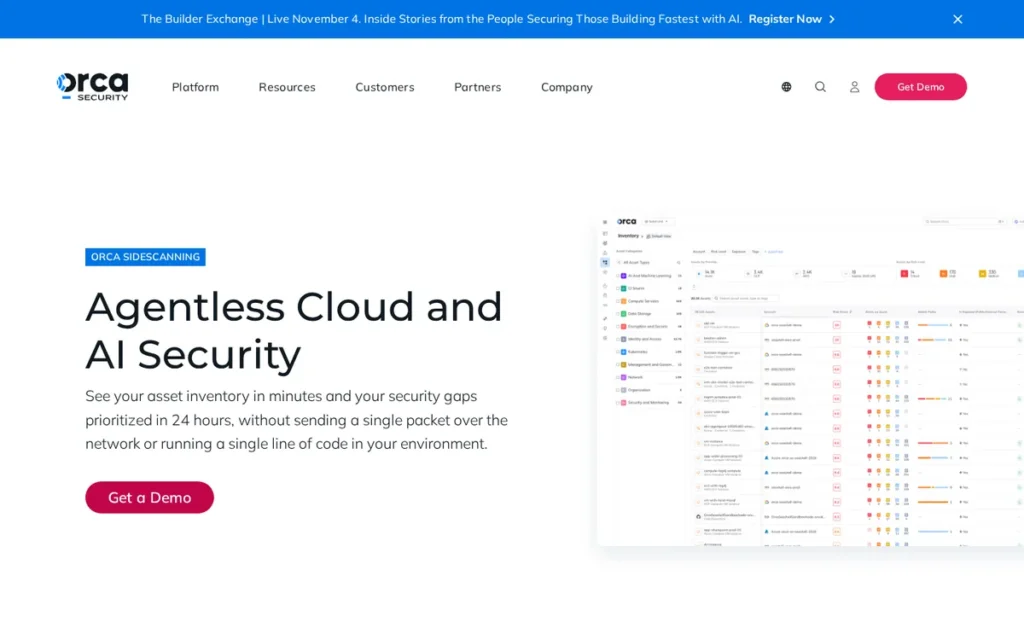
Category: Agentless AI-SPM, cloud security posture management platform using patented out-of-band SideScanning technology to inventory and assess AI model risks without agents, including stopped and offline workloads, across multi-cloud environments.
At a Glance
- Category: Agentless AI-SPM
- Best For: Regulated industries (financial services, healthcare, government) requiring in-account or self-hosted CNAPP deployment for data sovereignty, and lean security teams managing large cloud footprints with stopped or idle AI workloads that agent-based tools cannot reach
- Price Range: Custom enterprise pricing; workload-based billing with no public rate card; community feedback consistently characterizes pricing as difficult to predict in GPU-intensive AI environments where training clusters, inference endpoints, and development workloads each count as billable units (2026)
- Primary Strength: Orca Security’s patented SideScanning covers stopped and idle AI workloads that both agentless API-scanning platforms and agent-based platforms miss, combined with three deployment configurations (SaaS, In-Account, Self-Hosted) that accommodate regulated industry data sovereignty requirements no other agentless CNAPP in this evaluation offers
- Biggest Limitation: Orca Security’s SideScanning approach is fundamentally snapshot-based, while Orca Security added real-time AI usage log analysis in 2025, the platform does not match live kernel-level eBPF behavioral detection for catching active threats that execute and complete within the scan interval
- One-Line Summary: Orca Security is the only agentless AI-SPM platform in this evaluation offering SaaS, In-Account, and Self-Hosted deployment, using patented SideScanning to inventory 50+ AI model types including stopped and idle workloads, with its 2025 State of Cloud Security Report finding 62% of organizations have AI packages with known vulnerabilities deployed in cloud environments (verified April 2026).
- Last Verified: April 2026
Overview
Orca Security is an agentless Cloud-Native Application Protection Platform (CNAPP) delivering AI Security Posture Management through its patented SideScanning™ technology, an out-of-band approach reading cloud workload block storage snapshots to inventory and assess AI models, including stopped and offline instances that agentless API-scanning tools and agent-based platforms both fail to cover. Orca Security covers 50+ AI model and software package types with dynamic risk scoring that adjusts based on access restrictions, exploitation impact, and sensitive data context, reducing the alert fatigue that plagues fixed-severity configuration scanners.
Founded in 2019 by former Check Point Software executives with $632 million in total funding, Orca Security provides three deployment configurations (SaaS, In-Account, and Self-Hosted) making it the primary agentless AI-SPM choice for regulated industries with data sovereignty mandates that prohibit third-party SaaS data processing.
Key Features
- Patented SideScanning™ Technology: Orca Security reads cloud workload block storage snapshots out-of-band (outside the live workload runtime) to inventory AI models, software packages, and configurations across all workloads including stopped, idle, and offline instances that neither API-scanning nor agent-based tools can assess without active workloads running.
- Dynamic AI Model Risk Scoring: Orca Security automatically adjusts each AI model’s priority score based on access restrictions, exploitation impact, attack complexity, and contextual relationships to sensitive data, re-scoring when environment conditions change to reduce fixed-severity alert storms and analyst triage time.
- Three Deployment Configurations: Orca Security offers full-SaaS, In-Account (data processed within the customer’s own cloud account), and Self-Hosted deployments, providing the broadest deployment flexibility of any agentless CNAPP in this evaluation, directly accommodating financial services, healthcare, and government data sovereignty requirements.
- Real-Time AI Usage Log Analysis: Orca Security extended AI-SPM to include real-time AI usage log analysis and runtime risk assessment in 2025, combining snapshot-based posture management with operational telemetry about active model behavior to detect anomalous usage patterns indicating potential exploitation (Orca Security Runtime AI Security blog, 2025).
- Integrated AI Chatbot: Orca Security’s AI Chatbot allows analysts to query the full AI asset inventory and risk data using natural language, enabling teams without advanced querying skills to rapidly identify exposed AI models and misconfigured training pipelines without writing complex queries (BusinessWire, June 2025).
Best For
Orca Security is best for regulated industry organizations, financial services, healthcare, and government entities, that require in-account or self-hosted CNAPP deployment for data sovereignty compliance. Orca Security is also the strongest agentless fit for lean security teams managing large cloud environments with intermittently-running AI training workloads, GPU clusters that are offline between training runs, where stopped-workload coverage is a critical gap in competing agentless platforms.
Pricing
Orca Security does not publish public pricing as of April 2026. Orca Security’s pricing is workload-based and custom-quoted per enterprise. Community feedback consistently characterizes the workload-based model as difficult to predict in GPU-intensive AI environments where training clusters, inference endpoints, and development workloads each count as separate billable units. Organizations evaluating Orca Security should request explicit workload count scenarios for AI GPU infrastructure separately from general cloud workload counts, as AI training clusters can significantly inflate costs relative to initial procurement estimates.
Strengths
- Orca Security’s 2025 State of Cloud Security Report: drawn from analyzing real customer cloud environments between January and May 2025, found that 62% of organizations have at least one AI package with a known vulnerability deployed in production, and that exposed AI service access keys in code repositories represent a critical shadow AI risk vector (Orca Security, 2025).
- Orca Security’s patented SideScanning technology, developed in 2019 before Wiz’s 2020 founding, covers stopped and idle AI workloads that agentless API-scanning platforms and agent-based platforms both miss, a critical coverage gap in environments with intermittently-running GPU training clusters that are offline between training runs.
- Orca Security’s three deployment configurations: SaaS, In-Account, and Self-Hosted, provide the broadest deployment flexibility of any agentless CNAPP in this evaluation, making Orca Security the only agentless platform accommodating regulated industries with hard data sovereignty requirements that prohibit third-party SaaS data processing.
- Orca Security added real-time AI usage log analysis in 2025, partially closing the historical snapshot-only runtime detection gap by incorporating active model behavior telemetry, enabling detection of anomalous model usage patterns that purely posture-based scanning would miss until the next scan cycle (Orca Security Runtime AI Security blog, 2025).
Limitations
- Workload-Based Pricing Unpredictability: Orca Security’s most consequential trade-off is its workload-based billing structure, community feedback consistently describes pricing as prone to unexpected inflation in GPU-intensive AI environments where training clusters, inference endpoints, and development workloads each count as billable units, making accurate procurement budgeting challenging at AI infrastructure scale.
- Snapshot-First Detection Gap: Orca Security’s SideScanning approach is fundamentally snapshot-based, while the 2025 addition of real-time AI usage log analysis partially closes the runtime detection gap, Orca Security does not match the live kernel-level behavioral detection of eBPF platforms like Sysdig for detecting threats that execute and complete between snapshot intervals.
- Narrower AI-Specific Threat Depth vs. Prisma Cloud: Orca Security covers AI posture and configuration risks comprehensively but does not match Palo Alto Networks Prisma Cloud’s dedicated ML model scanning for 35+ formats or the Huntr threat intelligence community depth for organizations whose primary concern is model supply chain integrity.
Verdict
Orca Security is the strongest agentless AI-SPM choice for regulated industries and organizations managing diverse AI workload states, uniquely combining patented SideScanning that covers stopped and idle AI workloads with the only three-configuration deployment model (SaaS, In-Account, Self-Hosted) among agentless CNAPPs evaluated. Orca Security’s proprietary 2025 State of Cloud Security Report provides the most credible independent data on cloud AI vulnerability exposure rates from any vendor in this category, offering enterprise buyers a concrete risk benchmark for procurement justification. Organizations primarily concerned with real-time runtime threat detection should compare Orca Security against Sysdig, and those with AI infrastructure workload counts predictable enough to forecast costs should evaluate Orca Security as the strongest agentless fit for regulated cloud environments.
4. Sysdig: Best Runtime-First AI Workload Security: eBPF Behavioral Detection with CNCF-Graduated Falco
Category: Runtime-First AI Workload Security, eBPF kernel-level behavioral monitoring platform using CNCF-graduated Falco (graduated February 2024) for real-time threat detection in containerized and Kubernetes-native AI workload environments.
At a Glance
- Category: Runtime-First AI Workload Security
- Best For: DevSecOps teams with Kubernetes-native AI infrastructure who require real-time behavioral threat detection at the kernel level, where catching active exploitation in containerized AI workloads is a higher operational priority than broad configuration posture coverage
- Price Range: Custom enterprise pricing; agent-based architecture adds deployment infrastructure and compute overhead costs beyond licensing that scale with container density; no public rate card (2026)
- Primary Strength: Sysdig delivers the deepest real-time AI workload behavioral detection of any evaluated platform through eBPF kernel-level monitoring via CNCF-graduated Falco, catching active exploitation and lateral movement in containerized AI workloads at the moment of occurrence rather than at the next configuration scan interval
- Biggest Limitation: Sysdig’s eBPF and Falco architecture is optimized for containerized Kubernetes environments and requires agent deployment on each protected workload, making Sysdig a poor fit for organizations with traditional VM-based or SaaS-embedded AI deployments, with agent management overhead that compounds significantly in high-density AI container environments
- One-Line Summary: Sysdig is the runtime-first AI workload security platform built on CNCF-graduated Falco (graduated February 2024), providing eBPF kernel-level behavioral detection to catch active threats in containerized AI workloads in real time, with Sysdig Sage delivering agentic AI-powered security analysis for operationally lean security teams (verified April 2026).
- Last Verified: April 2026
Overview
Sysdig is a runtime-first cloud-native security platform delivering AI workload security through eBPF (extended Berkeley Packet Filter) kernel-level monitoring and CNCF-graduated Falco, the open-source behavioral threat detection engine Sysdig created in 2016 that graduated from the Cloud Native Computing Foundation on February 29, 2024, and is used by Fortune 500 organizations for cloud-native threat detection (Sysdig company materials, 2026). Sysdig’s AI workload security identifies running AI packages, exposed GPU infrastructure, ML pipelines, and LLM deployments and correlates posture findings with live runtime telemetry through the Cloud Attack Graph to surface only threats actively loaded and exploitable in production.
Founded in 2013 by Loris Degioanni (co-creator of Wireshark, the world’s most widely-used network protocol analyzer) Sysdig has raised approximately $744 million in total venture funding at a $2.5 billion valuation (Series G, December 2021) and remains pre-IPO as of April 2026.
Key Features
- eBPF Kernel-Level Monitoring: Sysdig uses eBPF to capture live system call data from AI workloads, detecting active exploitation, lateral movement, anomalous behavior, and unauthorized data access in real time as events occur rather than at the next scheduled configuration scan interval, per the Sysdig AI workload security documentation.
- CNCF-Graduated Falco Runtime Detection: Sysdig’s AI workload security is built on Falco (a CNCF-graduated open-source runtime threat detection engine (graduated February 29, 2024)) enabling security teams to evaluate the core detection engine independently before commercial licensing commitment and access the Falco community’s continuously expanding AI-specific detection rules.
- Sysdig Sage Agentic Security Analyst: Sysdig Sage allows security teams to query AI workload risk posture using natural language, generate threat summaries, trace attack paths, and automate guided remediation, reducing analyst-hours required to govern complex containerized AI environments (Sysdig blog, 2026; CIO.com, 2026).
- Cloud Attack Graph with In-Use Vulnerability Prioritization: Sysdig’s Cloud Attack Graph correlates cloud API data, configurations, identities, and live runtime activity, surfacing only vulnerabilities actively loaded in running AI workloads, not all theoretical configuration findings, measurably reducing false positive alert volumes and analyst triage time.
- Falco Feeds: Sysdig provides continuously updated expert-authored Falco detection rules for distributed AI architectures as a commercial value-add to the open-source engine, delivering curated AI threat intelligence without requiring organizations to maintain custom rule libraries (Sysdig Falco Feeds press release, 2026).
Best For
Sysdig is best for DevSecOps teams at organizations with Kubernetes-native AI infrastructure where catching threats in real time is the primary security requirement. Sysdig is particularly well suited for environments deploying AI inference containers at scale, for teams that value open-source Falco evaluation before commercial commitment, and for organizations where alert fatigue from configuration-only scanning is an established operational problem that runtime behavioral enrichment can address.
Pricing
Sysdig does not publish public pricing as of April 2026. Enterprise contracts are custom-quoted based on workload count and container density. Sysdig’s agent-based architecture means each protected workload requires a deployed Sysdig agent, adding deployment infrastructure costs, operational management overhead, and compute resource consumption beyond the base license. For organizations with thousands of AI inference containers, agent management at scale represents a meaningful additional TCO component that pure agentless alternatives eliminate. Organizations should request workload-count-based pricing tiers and agent resource consumption estimates for their specific AI container density during procurement.
Strengths
- Falco: the CNCF-graduated open-source runtime threat detection engine created by Sysdig in 2016 and graduated by CNCF on February 29, 2024, is used by Fortune 500 organizations for cloud-native threat detection (Sysdig company materials, 2026), providing the strongest open-source community validation of any underlying detection technology in this evaluation, with a pre-commitment evaluation path that no other platform offers.
- Sysdig’s eBPF kernel-level monitoring delivers live system call visibility for AI workloads that configuration-scanning platforms structurally cannot replicate, directly addressing the risk that unmonitored AI models can degrade security posture by up to 40% within six months by enabling detection of active threats within the scan interval (Practical DevSecOps AI Security Statistics 2026).
- Sysdig Sage is one of the first deployed agentic AI security analyst implementations in the cloud security category, enabling natural language AI workload security queries, automated threat summaries, and guided remediation workflows that reduce analyst-hours required to govern complex containerized AI environments at scale (Sysdig blog, 2026).
- Sysdig’s Cloud Attack Graph surfaces only AI workload vulnerabilities actively loaded and exploitable in production (correlating cloud APIs, identities, configurations, and live runtime activity) reducing analyst triage time compared to platforms that flag all detected configurations regardless of runtime exploitability.
Limitations
- Kubernetes Dependency: Sysdig’s most consequential trade-off is its fundamental dependency on containerized Kubernetes environments, Sysdig’s eBPF architecture delivers exceptional behavioral detection depth for containerized AI workloads but provides limited value for organizations deploying AI models on traditional VMs, serverless functions, or SaaS-embedded AI tools entirely outside the Kubernetes workload model.
- Agent Deployment Overhead: Sysdig requires agent deployment across all protected workloads at scale, deploying, maintaining, and monitoring Sysdig agents across thousands of inference containers requires dedicated engineering effort that pure agentless platforms eliminate, creating operational overhead that compounds in high-density AI container environments.
- Falco Rule Tuning Complexity: Sysdig’s Falco rule tuning requires specialized expertise, incorrectly configured detection rules produce false positive volumes that undermine the in-use vulnerability prioritization advantage, and organizations without in-house Falco expertise typically require professional services to reach operational tuning maturity (AccuKnox alternatives analysis, 2026).
- Narrower Compliance Automation: Sysdig’s pre-built compliance policy breadth is narrower than CNAPP-native platforms with large policy libraries, compliance-driven procurement may need supplementary tooling for automated regulatory evidence generation beyond what Falco-based behavioral detection rules provide for EU AI Act or NIST AI RMF requirements.
Verdict
Sysdig is the strongest runtime-first AI workload security choice for DevSecOps teams operating Kubernetes-native AI infrastructure, delivering eBPF behavioral detection depth through CNCF-graduated Falco that agentless posture platforms structurally cannot match, and uniquely enabling open-source evaluation of the core detection engine before commercial platform commitment. Sysdig is the recommended tool when catching active exploitation in real time is the primary security requirement and when the existing AI infrastructure is containerized. Organizations with VM-based or SaaS-embedded AI deployments, or those prioritizing compliance automation depth over runtime detection, should evaluate Wiz AI-SPM or Palo Alto Networks Prisma Cloud as better architectural fits.
5. Securiti AI: Best for Data+AI Governance Convergence: SaaS Copilot Security and EU AI Act Compliance Automation
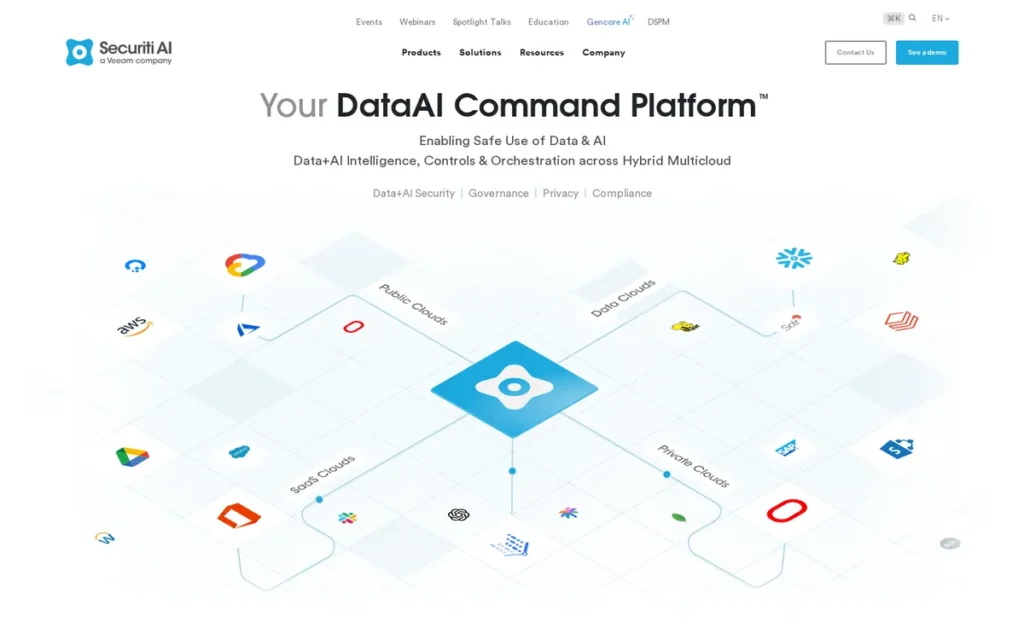
Category: Data+AI Governance Platform, unified data intelligence and AI security governance platform using a proprietary Data Command Graph to manage AI model risk within the context of data access, entitlements, and regulatory obligations across hybrid multicloud and SaaS environments; acquired by Veeam for $1.725 billion (December 2025).
At a Glance
- Category: Data+AI Governance Platform
- Best For: Privacy-led enterprises: EU/UK-based, financial services, healthcare, governing Microsoft 365 Copilot, Salesforce Einstein, or other SaaS-embedded AI tools alongside cloud AI deployments, where EU AI Act, GDPR, or CCPA compliance automation is the primary AI security investment driver
- Price Range: Custom enterprise pricing only; no public rate card; Securiti AI now operates as a Veeam subsidiary (acquired December 2025); professional services typically required for integration configuration across the broad SaaS and cloud connector matrix (2026)
- Primary Strength: Securiti AI is the only evaluated platform with purpose-built SaaS AI copilot governance covering Microsoft 365 Copilot and Salesforce Einstein (addressing a blind spot in all infrastructure-focused AI-SPM platforms) combined with the deepest EU AI Act, GDPR, and CCPA compliance automation through TRiSM playbooks and breach notification workflows
- Biggest Limitation: Securiti AI’s PrivacyOps origins make the platform compliance and governance-oriented rather than threat-detection-oriented; as a Veeam subsidiary since December 2025, buyers should verify that Securiti AI’s AI governance roadmap receives continued investment as a distinct product priority within Veeam’s data backup and recovery-focused portfolio
- One-Line Summary: Securiti AI is a Data+AI Governance Platform uniquely combining SaaS AI copilot security for Microsoft 365 Copilot and Salesforce Einstein with EU AI Act, GDPR, and CCPA compliance automation through a proprietary Data Command Graph, acquired by Veeam for $1.725 billion (December 2025) and now operating as a Veeam product line (verified April 2026).
- Last Verified: April 2026
Overview
Securiti AI is a Data+AI Governance Platform delivering AI Security Posture Management through its proprietary Data Command Graph, a unified intelligence layer mapping contextual relationships between data assets, AI models, user entitlements, regulatory obligations, and business processes across hybrid multicloud and SaaS environments simultaneously. Securiti AI uniquely addresses the SaaS AI copilot governance gap left by cloud infrastructure-focused AI-SPM tools, providing purpose-built security for Microsoft 365 Copilot, Salesforce Einstein, and other SaaS-embedded AI agents through granular least-privilege access controls, dynamic data masking, and overprivileged access remediation.
Founded in 2019 by Rehan Jalil (former CEO of Elastica, acquired by Symantec for approximately $280 million in 2015) Securiti AI raised $155 million in total funding before being acquired by Veeam for $1.725 billion (closed December 11, 2025). Securiti AI now operates as a Veeam product line; Rehan Jalil serves as President of Security and AI at Veeam.
Key Features
- Data Command Graph: Securiti AI’s proprietary Data Command Graph maps contextual relationships between data assets, AI models, user entitlements, regulations, and business processes simultaneously, enabling AI model risk assessment in the context of what sensitive data the model can access, what regulations govern that data, and what the business impact of unauthorized exposure would be, rather than assessing configurations in isolation.
- SaaS AI Copilot Governance: Securiti AI provides purpose-built governance for SaaS AI copilots including Microsoft 365 Copilot, Salesforce Einstein, and other SaaS-embedded AI tools, enforcing granular least-privilege access controls, dynamic data masking, and overprivileged access remediation for employees interacting with AI agents that have access to enterprise SaaS data.
- LLM Firewall with RAG Pipeline Security: Securiti AI’s LLM Firewall provides context-aware controls across the full GenAI pipeline (monitoring prompts, RAG data retrieval operations, and model responses) blocking unauthorized data access, sanitizing inputs, and enforcing compliance policies throughout both the retrieval and response generation stages.
- TRiSM Compliance Automation: Securiti AI automates compliance evidence generation for EU AI Act, NIST AI RMF, OWASP LLM Top 10, GDPR, CCPA, and HIPAA through a TRiSM (Trust, Risk, and Security Management) playbook featuring automated risk assessment, AI model classification, breach management, and regulatory penalty estimation, aligned to Gartner’s AI governance methodology.
- Agent Commander within the Veeam Platform: Securiti AI’s Agent Commander: integrated within the Veeam platform following the December 2025 acquisition, enables enterprises to safely scale AI agent deployments with governance controls, data access policies, and security monitoring for autonomous agents operating across multi-cloud and SaaS environments.
Best For
Securiti AI is best for privacy-led organizations (particularly EU/UK-headquartered enterprises, financial services firms, and healthcare organizations) where compliance automation for EU AI Act, GDPR, and CCPA is the primary AI security investment driver. Securiti AI is also the strongest choice for organizations managing Microsoft 365 Copilot or Salesforce Einstein deployments where SaaS AI governance and data overprivilege remediation represent the highest-priority risk surface.
Pricing
Securiti AI does not publish public pricing as of April 2026. Securiti AI now operates as a Veeam subsidiary with enterprise-only custom contract structures. Professional services engagement is typically required during onboarding for integration configuration across the broad SaaS and cloud connector matrix, extending total cost of ownership beyond licensing. Organizations evaluating Securiti AI should factor implementation services into budget planning and request clear estimates for connector configuration time across their specific SaaS and cloud environment footprint.
Strengths
- Securiti AI is the only platform evaluated providing purpose-built governance for SaaS AI copilots including Microsoft 365 Copilot and Salesforce Einstein, addressing a governance blind spot at a time when 56% of organizations report employees uploading sensitive data to unauthorized SaaS AI tools, with shadow AI adding an average $670,000 to breach costs (IBM 2025 Cost of a Data Breach Report, Ponemon Institute).
- Securiti AI’s TRiSM playbook maps directly to Gartner’s AI governance methodology (making Securiti AI’s compliance approach immediately legible to GRC teams and CISOs operating within Gartner frameworks) with automated controls spanning EU AI Act, NIST AI RMF, GDPR, CCPA, HIPAA, and OWASP LLM Top 10 in a single integrated governance platform.
- Securiti AI was founded by Rehan Jalil, former CEO of Elastica: acquired by Symantec for approximately $280 million in 2015, giving the platform deep roots in cloud access and SaaS data governance, and was acquired by Veeam for $1.725 billion (December 2025), providing enterprise-grade vendor stability and Veeam’s data resilience infrastructure behind the product roadmap.
- Securiti AI’s LLM Firewall addresses RAG pipeline security at both the retrieval and response generation stages, protecting against malicious prompts that extract sensitive documents from connected knowledge bases, a threat vector that post-retrieval output monitoring tools address only partially.
Limitations
- Compliance-First, Threat-Detection-Secondary: Securiti AI’s most consequential trade-off is that its platform DNA is compliance and data governance-oriented rather than threat-detection-oriented, organizations whose primary AI security mandate is catching active exploitation in real time will find Securiti AI best as a complementary governance layer alongside a threat-detection-primary platform rather than a standalone AI security solution.
- Veeam Acquisition Roadmap Risk: Securiti AI’s December 2025 acquisition by Veeam introduces a roadmap dependency consideration, buyers evaluating Securiti AI in April 2026 are selecting a recently-integrated Veeam product line, and should verify that Securiti AI’s AI governance capabilities (Data Command Graph, LLM Firewall, SaaS copilot governance) receive continued investment as distinct product priorities within Veeam’s data backup and recovery-focused portfolio.
- Implementation Complexity: Securiti AI’s broad integration footprint: thousands of SaaS and cloud connectors, is a coverage strength but a complexity factor for implementation, with professional services typically required for full environment integration that meaningfully extends time-to-value beyond what infrastructure-focused AI-SPM platforms require.
Verdict
Securiti AI is the strongest choice for compliance-led and privacy-led AI security governance programs, uniquely combining SaaS AI copilot governance for Microsoft 365 Copilot and Salesforce Einstein with the deepest regulatory compliance automation spanning EU AI Act, GDPR, CCPA, NIST AI RMF, and HIPAA, in a Data Command Graph architecture that assesses AI model risk within the context of the data it accesses. Securiti AI is the recommended platform for EU/UK-headquartered enterprises with active EU AI Act compliance timelines and for organizations where the CISO and Chief Privacy Officer share AI governance accountability. Security architects whose primary mandate is real-time AI threat detection should evaluate Wiz AI-SPM or Sysdig as primary platforms and consider Securiti AI as a complementary governance layer.
6. HiddenLayer: Best Dedicated AI/ML Model Security Platform: MLDR, Adversarial Detection, and Agentic Runtime Security
Category: Dedicated AI/ML Security Platform, the only platform in this evaluation purpose-built exclusively for AI and machine learning model security, providing MLDR, model supply chain scanning for 30+ formats, adversarial attack detection, and agentic runtime security without broader CNAPP cloud posture capabilities.
At a Glance
- Category: Dedicated AI/ML Security Platform
- Best For: Organizations with proprietary AI models or active MLOps pipelines requiring enterprise-grade model integrity protection, adversarial ML detection, and AI supply chain security, particularly where exposing actual model weights to a third-party scanner is a competitive IP or contractual concern
- Price Range: Custom enterprise pricing only; no self-service or SMB tier; no public rate card; free Community Model Scan available for public repository model scanning without enterprise licensing (2026)
- Primary Strength: HiddenLayer is the only dedicated AI/ML security platform in this evaluation, providing MLDR aligned with MITRE ATLAS that analyzes model behavior using anonymized feature vectors (never accessing actual model weights) validated at production scale by Microsoft’s use of HiddenLayer’s Model Scanner to scan third-party and open-source models in the Azure AI catalog before customer access
- Biggest Limitation: HiddenLayer has no public G2 or Capterra review presence as of Q1 2026, carries higher vendor longevity risk for multi-year procurement decisions ($56M total funding, founded 2022), and provides no CNAPP cloud posture management, requiring a two-vendor relationship to cover both AI model security and cloud infrastructure security posture
- One-Line Summary: HiddenLayer is the only dedicated AI/ML security platform evaluated, scanning 30+ model formats for adversarial attacks using anonymized feature vectors that protect model IP, validated by Microsoft’s Azure AI catalog model scanning partnership (May 2024) and strengthened by the March 2026 launch of Agentic Runtime Security for purpose-built autonomous agent threat detection (verified April 2026).
- Last Verified: April 2026
Overview
HiddenLayer is the only platform in this evaluation purpose-built exclusively as an AI and machine learning security platform (not a CNAPP module or DSPM extension) providing MLDR (Machine Learning Detection and Response) via a lightweight local client that sends anonymized feature vectors to a cloud API for threat analysis, protecting proprietary model IP by never exposing actual model weights to a third-party system. HiddenLayer’s AISec Platform scans 30+ model formats including PyTorch, TensorFlow, ONNX, GGUF, Safetensors, Keras, and Pickle for embedded malware, supply chain poisoning, backdoors, and tampering before deployment.
In March 2026, HiddenLayer launched Agentic Runtime Security providing real-time visibility into autonomous AI agent sessions and detection of complex multi-step prompt injection chains. Founded in 2022 by Chris Sestito and Tanner Burns and backed by Microsoft’s M12 corporate venture fund in a $50 million Series A (September 2023), HiddenLayer has approximately $56 million in total funding and is validated at production scale through Microsoft’s use of HiddenLayer’s Model Scanner for Azure AI catalog model verification (HiddenLayer/Microsoft announcement, May 2024).
Key Features
- MLDR (Machine Learning Detection and Response): HiddenLayer’s MLDR provides real-time adversarial ML detection via a lightweight local client that sends anonymized feature vectors to a cloud API, protecting proprietary model IP by never transmitting actual model weights to third parties, while detecting evasion attacks, model inversion, and adversarial inputs aligned with the MITRE ATLAS adversarial ML threat framework.
- 30+ Format Model Scanner: HiddenLayer’s Model Scanner scans PyTorch, TensorFlow, ONNX, GGUF, Safetensors, Keras, and Pickle formats for embedded malware, serialization attacks (including Pickle-based exploits), supply chain poisoning, backdoors, and known vulnerabilities, functioning as purpose-built antivirus for AI models, validated by Microsoft’s Azure AI catalog integration (May 2024).
- Agentic Runtime Security: HiddenLayer’s Agentic Runtime Security: launched March 2026, provides real-time visibility into autonomous AI agent sessions and tool calls, threat hunting across multi-step agent executions, detection of complex prompt injection chains targeting tool-calling agents, and policy enforcement including data redaction mid-execution (HiddenLayer PR Newswire, March 26, 2026).
- AI SBOM/AIBOM Generation: HiddenLayer’s AI Bill of Materials in AISec Platform 2.0 provides automated discovery, vulnerability tracking, and threat intelligence for all AI components, models, and dependencies, generating auditable model provenance documentation supporting EU AI Act Article transparency requirements and NIST AI RMF governance controls.
- Free Community Model Scan: HiddenLayer enables security and developer teams to scan public repository models from Hugging Face and other sources without enterprise licensing, providing accessible model safety validation for organizations beginning AI supply chain security practices before enterprise procurement commitment.
Best For
HiddenLayer is best for organizations with proprietary AI models and active MLOps pipelines where protecting model IP while detecting adversarial ML attacks is the primary security requirement, particularly financial services, healthcare, and defense organizations whose AI models constitute core intellectual property. HiddenLayer is also well suited for security teams building model supply chain governance into CI/CD pipelines for models sourced from public repositories like Hugging Face.
Pricing
HiddenLayer does not publish public pricing as of April 2026. HiddenLayer is enterprise-focused with custom contract pricing and no SMB or self-service tier. Professional services for adversarial training, red team engagements, and model security assessments are available as add-ons. HiddenLayer’s free Community Model Scan for public repository models provides a no-cost evaluation path before licensing discussions. Organizations requiring MLDR, Agentic Runtime Security, or AI SBOM/AIBOM capabilities must engage HiddenLayer’s enterprise sales process.
Strengths
- Microsoft uses HiddenLayer’s Model Scanner to scan third-party and open-source models in the Azure AI catalog for cybersecurity vulnerabilities, malware, and tampering before making them available to Azure customers globally, a production-scale validation that represents the strongest third-party enterprise proof of core product capability of any vendor in this evaluation (HiddenLayer/Microsoft announcement, May 2024).
- HiddenLayer’s March 2026 research found that 1 in 8 AI security breaches involves AI agents, and HiddenLayer simultaneously launched Agentic Runtime Security (one of the first purpose-built agentic security architectures in the market) providing real-time agent session visibility, complex multi-step prompt injection chain detection, and mid-execution data redaction enforcement (HiddenLayer PR Newswire, March 26, 2026).
- HiddenLayer’s MLDR methodology uses anonymized feature vectors that analyze model behavior patterns without ever accessing actual model weights, the only IP-protective scanning approach in this evaluation for organizations with proprietary models that cannot expose weight files to external scanning services due to competitive sensitivity or contractual restrictions.
- HiddenLayer is aligned with the MITRE ATLAS adversarial ML threat framework used by US government agencies and defense contractors, and submitted a formal response to NIST’s AI Executive Order 14110 RFI, establishing institutional credibility with regulated industry and government procurement committees (NIST AI EO 14110 RFI, HiddenLayer submission, 2024).
Limitations
- Early-Stage Vendor Risk: HiddenLayer’s most consequential trade-off is its early-stage enterprise positioning, with no verified G2 or Capterra review profile as of Q1 2026, approximately $56 million in total funding, and a 2022 founding date, HiddenLayer carries materially higher vendor longevity risk for long-term procurement decisions compared to CNAPP-native platforms with hundreds of millions to billions in funding. The Microsoft M12 investment and Azure AI catalog partnership partially mitigate this risk through strategic alignment but do not eliminate acquisition, pivot, or discontinuation risk over a 5-year platform relationship.
- No CNAPP Coverage: HiddenLayer’s AISec Platform covers AI model security and agentic runtime detection but provides no broader cloud security posture management, HiddenLayer functions as a specialized layer complementing rather than replacing a CNAPP platform, requiring organizations to maintain two vendor relationships to cover both cloud infrastructure security posture and AI model integrity.
- Enterprise-Only Entry Point: HiddenLayer’s absence of a self-service or SMB tier means the minimum viable entry point may be cost-prohibitive for mid-market organizations, limiting pre-sales evaluation to vendor-assisted proof of concept engagements rather than self-directed assessment.
Verdict
HiddenLayer is the strongest dedicated AI/ML model security platform evaluated, and the only tool in this analysis purpose-built exclusively for AI security rather than extending CNAPP capabilities to cover AI assets. HiddenLayer’s Microsoft Azure AI catalog partnership validates its Model Scanner at production scale, the March 2026 Agentic Runtime Security launch positions it as an early leader in purpose-built agentic detection, and the MLDR feature vector approach protects model IP in a way no competing scanner in this evaluation replicates. HiddenLayer is the recommended choice for organizations with proprietary AI models requiring IP-safe adversarial ML detection and for MLOps teams building model supply chain security into CI/CD pipelines, provided the organization can manage HiddenLayer alongside an existing CNAPP platform and accept the vendor longevity considerations of an early-stage specialized platform.
7. Lakera Guard: Best LLM Prompt Security Layer: Gandalf Dataset Moat, Developer Free Tier, and PINT Benchmark Validation
Category: LLM Prompt Security Platform, real-time API-based security layer purpose-built for detecting and blocking prompt injection, jailbreaks, and sensitive data leakage in LLM-powered applications and AI agents at the prompt and output layer.
At a Glance
- Category: LLM Prompt Security Platform
- Best For: AI engineering teams and application security teams building LLM-powered applications who need drop-in prompt injection detection and output sanitization with sub-50ms latency, particularly where prompt injection is an active real-time attack vector in production customer-facing or internal AI applications
- Price Range: Free developer tier via platform.lakera.ai for basic integration and testing; custom enterprise pricing for production volumes, on-premises deployment, and dedicated support; no public enterprise rate card (2026)
- Primary Strength: Lakera Guard achieves the highest verified prompt injection detection rate of any evaluated system, 92.5% on the independent PINT Benchmark (May 2025), outperforming AWS Bedrock Guardrails (87.8%) and Azure AI Prompt Shield (86.7%), trained on the Gandalf adversarial dataset from 1 million+ red-team participants and validated by Dropbox Fortune 500 deployment
- Biggest Limitation: Lakera Guard addresses only the prompt and output security layer of the AI attack surface (providing no cloud posture management, AI asset inventory, model supply chain scanning, shadow AI discovery, or IAM governance) making Lakera Guard a specialized complement to rather than a replacement for full-spectrum AI-SPM posture platforms
- One-Line Summary: Lakera Guard is a real-time LLM security API achieving the highest verified PINT Benchmark prompt injection detection rate (92.5%, May 2025) among all evaluated systems (trained on the Gandalf adversarial dataset from 1 million+ red-team participants) with Dropbox Fortune 500 validation and the only free developer evaluation tier in this analysis (verified April 2026).
- Last Verified: April 2026
Overview
Lakera Guard is a real-time API-based security layer for LLM and GenAI applications that detects and blocks prompt injection attacks, jailbreaks, PII and sensitive data leakage, harmful content generation, and abnormal AI agent behavior, operating as an OpenAI-compatible API endpoint with sub-50ms latency and less than 0.5% false positive rate that integrates into existing AI application architectures without measurable user experience degradation. Lakera Guard’s core technical advantage is the Gandalf adversarial training dataset, Lakera reports that its public Gandalf red-team challenge has attracted 1 million+ global participants generating 80 million+ adversarial prompts, creating a self-reinforcing detection corpus where enterprise detection capability improves continuously as new attack patterns emerge at consumer scale.
Founded in approximately 2022 and headquartered in Zurich, Switzerland, with CTO Mateo Rojas-Carulla (formerly Google DeepMind), Lakera raised a $20 million Series A in 2024, holds a Dropbox Fortune 500 customer validation, and provides the only free developer evaluation tier of any platform in this analysis.
Key Features
- 92.5% PINT Benchmark Detection Rate: Lakera Guard achieves a 92.5% prompt injection detection rate on the independent PINT Benchmark (Prompt INjection Test, GitHub leaderboard, May 2025) across 100+ languages, the highest verified score among all evaluated detection systems, outperforming AWS Bedrock Guardrails (87.8%) and Azure AI Prompt Shield (86.7%), with sub-50ms API latency and less than 0.5% false positive rate.
- Gandalf Adversarial Dataset: Lakera Guard is trained on the Gandalf red-team dataset (Lakera reports 80 million+ adversarial prompts from 1 million+ global participants) creating a self-reinforcing detection corpus that continuously updates enterprise protection as new attack patterns are discovered through public red-team activity at consumer scale.
- Per-Project Configurable Security Policies: Lakera Guard provides per-project configurable security policies allowing organizations with multiple AI applications to apply different risk tolerance levels, blocking behaviors, and logging configurations independently, enabling a customer service chatbot and an internal developer copilot to operate under independently calibrated security policies simultaneously.
- AI Agent Behavior Monitoring: Lakera Guard monitors AI agent behavior in real time (flagging anomalies in tool calls, unusual URL requests, and abnormal workflow patterns) extending core prompt security into the agentic runtime layer to detect prompt injections targeting tool-calling agents rather than only direct user-to-LLM interactions.
- OWASP LLM Top 10 Coverage: Lakera Guard covers OWASP LLM Top 10 threat categories at the prompt and output layer (including LLM01 (Prompt Injection), LLM02 (Insecure Output Handling), and agent-specific threats including Excessive Agency and Tool Call monitoring) with detailed payload inspection and compliance logging for all security findings.
Best For
Lakera Guard is best for AI engineering teams and application security teams building LLM-powered applications (customer service chatbots, internal copilots, developer tools, analytics assistants) where prompt injection and sensitive data leakage are active real-time attack vectors. Lakera Guard is particularly well suited for organizations where developer-accessible integration via a free tier, an OpenAI-compatible API, and sub-50ms latency is a primary operational requirement for embedding security into existing AI application architectures.
Pricing
Lakera offers a free developer tier via platform.lakera.ai as of April 2026, the only no-cost evaluation path among all 7 platforms evaluated. Commercial enterprise plans cover higher request volumes, custom policy configurations, on-premises deployment, and dedicated support, with no public pricing listed for enterprise tiers. Lakera Guard’s developer-led model enables engineering teams to integrate and evaluate the free tier during AI application development before converting to enterprise plans at production deployment.
Strengths
- Lakera Guard achieves a 92.5% prompt injection detection rate on the PINT Benchmark (Prompt INjection Test, GitHub leaderboard, May 2025), the highest verified score among all evaluated detection systems, outperforming AWS Bedrock Guardrails (87.8%) and Azure AI Prompt Shield (86.7%) by approximately 5 percentage points. At 1 million monthly prompt interactions, this margin represents roughly 46,000 additional attacks detected compared to the nearest major-cloud alternative.
- Lakera Guard’s prompt injection detection performance is independently validated by the PINT Benchmark (an independent academic evaluation) providing third-party corroboration beyond vendor-reported metrics, with demonstrated performance against both direct and indirect prompt injection attack patterns.
- Dropbox: a Fortune 500 company with significant PII handling obligations across its file-sharing and collaboration platform, publicly uses Lakera Guard to safeguard LLM-powered application features and protect user data in AI services, validating production-grade performance at enterprise scale under active data privacy requirements.
- Lakera was co-founded by CTO Mateo Rojas-Carulla (formerly Google DeepMind): embedding frontier LLM safety research expertise directly into the platform’s detection model architecture, with Swiss/EU founding heritage providing native EU AI Act compliance awareness contextualizing Lakera Guard’s OWASP LLM Top 10 and data protection policy coverage.
Limitations
- Scope Limitation: Prompt Layer Only: Lakera Guard’s most consequential trade-off is scope, Lakera Guard secures only the prompt and output layer of the AI attack surface, providing no cloud security posture management, AI asset inventory, ML model supply chain scanning, infrastructure misconfiguration detection, shadow AI discovery, or IAM governance, requiring enterprises to pair Lakera Guard with a CNAPP-native AI-SPM platform to cover the infrastructure and configuration layers.
- Two-Vendor Integration Overhead: Enterprises requiring full-spectrum AI Security Posture Management must pair Lakera Guard with a CNAPP-native platform, creating integration overhead and dual vendor management that single-platform solutions eliminate. Buyers should evaluate whether Lakera Guard’s PINT Benchmark detection rate advantage over CNAPP-bundled LLM security modules justifies the additional vendor relationship for their specific application security requirements.
- Early-Stage Company Scale: Lakera’s company scale: $20 million Series A, approximately 2022-founded, no public G2 review presence, carries vendor longevity risk for enterprise procurement decisions requiring multi-year platform relationships, though the Dropbox deployment and Google DeepMind-pedigreed technical leadership partially mitigate this concern.
Verdict
Lakera Guard is the strongest LLM prompt security layer evaluated, delivering the highest verified PINT Benchmark prompt injection detection rate (92.5%, May 2025) among all evaluated systems, outperforming AWS Bedrock Guardrails and Azure AI Prompt Shield, with Dropbox enterprise validation and the only free developer evaluation tier in this analysis. Lakera Guard is the recommended choice for AI engineering teams building LLM-powered applications where prompt injection and output sanitization are the primary security requirements. Enterprises requiring full AI-SPM posture management, including cloud AI asset inventory, model supply chain scanning, shadow AI discovery, or infrastructure misconfiguration detection, should deploy Lakera Guard as a specialized prompt security complement to a CNAPP-native AI-SPM platform rather than as a standalone enterprise AI security solution.
What Red Flags Should I Watch For When Evaluating AI-SPM Tools?
The five most consequential AI-SPM procurement red flags are: compliance alignment claims without automated evidence generation, agentless coverage gaps for stopped and idle AI workloads, AI-SPM available only as a paid CNAPP add-on, workload-based pricing that inflates unpredictably at GPU infrastructure scale, and missing real-time agentic AI runtime detection. Each warrants a direct vendor question before an RFP is issued.
Red Flag #1: Compliance Alignment Claims vs. Compliance Automation Evidence
Vendors claiming “EU AI Act support” or “NIST AI RMF alignment” frequently mean advisory framework documentation rather than automated evidence generation. The procurement-critical distinction is whether the platform generates audit-ready compliance reports automatically, or whether the security team still manually collects evidence. Palo Alto Networks Prisma Cloud’s 3,000+ pre-built automated policies represent one end of this spectrum; platforms offering framework reference guides without exportable audit evidence represent the other.
Red Flag #2: Agentless Coverage Gaps for Stopped and Idle AI Workloads
Most agentless AI-SPM platforms scan live cloud workloads via API, and miss stopped, idle, or intermittently-running AI training workloads entirely. Orca Security’s 2025 State of Cloud Security Report found 62% of organizations have AI packages with known vulnerabilities deployed in cloud environments. If AI training clusters run on-demand and are offline between training jobs, verify that candidate platforms cover workloads that are not running at the moment of the scan.
Red Flag #3: AI-SPM as CNAPP Add-On vs. Standalone Capability
For several major platforms, AI-SPM is an add-on module to a full CNAPP license rather than a purchasable standalone product. An organization evaluating Wiz AI-SPM or Palo Alto Networks Prisma Cloud AI-SPM is evaluating a full CNAPP platform (with corresponding pricing, onboarding complexity, and platform lock-in) even if the stated goal is only AI asset security. Verify licensing structure and minimum viable contract scope in the first procurement conversation.
Red Flag #4: Pricing Model Opacity and Workload-Based Cost Scaling
All 7 evaluated platforms use custom enterprise pricing with no public rate cards. The specific risk in AI-intensive environments is workload-based pricing that inflates unexpectedly as GPU training clusters, inference endpoints, and development workloads each count as separate billable units. Community feedback on Orca Security consistently flags workload-based pricing as difficult to forecast for AI GPU environments specifically. Always request explicit workload count scenarios for AI infrastructure, not just general cloud resource counts.
Red Flag #5: Missing Agentic AI Runtime Detection Coverage
Most AI-SPM platforms address AI agent security at the configuration and posture layer (checking whether agent deployments are correctly configured) rather than providing real-time behavioral monitoring of live agent sessions, tool calls, and multi-step execution chains. HiddenLayer’s March 2026 research found that 1 in 8 AI security breaches involves AI agents (HiddenLayer PR Newswire, March 2026). For organizations deploying autonomous AI agents at scale, verify whether candidate platforms provide live agentic runtime detection or only static configuration assessment.
What Questions Should I Ask Before Choosing an AI-SPM Tool?
Five questions eliminate the most common AI-SPM procurement mismatches: Does the platform cover cloud models, SaaS copilots, and agentic AI, not just cloud infrastructure? Is detection agentless posture scanning or real-time runtime behavioral monitoring? Does it automate compliance evidence or only claim framework alignment? Is self-hosted deployment available for regulated industries? How does pricing scale with AI workload growth? Use the answers to map each vendor to the four architectural categories defined at the start of this article before entering any evaluation.
Question #1: Does This Platform Cover My Entire AI Attack Surface: Cloud Models, SaaS Copilots, and Agentic AI Workflows?
Most infrastructure-focused AI-SPM platforms cover cloud-deployed AI models but have zero visibility into SaaS-embedded AI copilots like Microsoft 365 Copilot or Salesforce Einstein. Agentic AI workflows spanning endpoints, browsers, and third-party tool integrations represent a third largely uncovered layer. Require vendors to demonstrate specific coverage for each layer present in your environment, not aggregate claims about “AI security.”
Question #2: Is This Tool Providing Agentless Configuration Posture Scanning or Real-Time Runtime Behavioral Detection, and Do I Need Both?
Configuration posture scanning (agentless CNAPP platforms) and real-time behavioral detection (eBPF-based platforms like Sysdig) address different threat windows. Configuration scanning catches misconfigurations before exploitation; runtime detection catches active exploitation as it executes. Unmonitored AI models can degrade security posture by up to 40% within six months (Practical DevSecOps AI Security Statistics 2026), if catching active attacks in containerized AI inference is the primary concern, runtime detection is the non-negotiable architectural requirement.
Question #3: Does This Tool Automate Compliance Evidence Generation, or Does It Only Claim Advisory Framework Alignment?
Ask vendors to demonstrate a specific automated evidence export for EU AI Act Article 9 (risk management documentation) or NIST AI RMF Govern 1.0. Platforms with genuine automation produce exportable audit evidence in that demonstration. Platforms with advisory alignment produce framework mapping documents that still require manual evidence collection. This distinction directly determines whether the platform reduces GRC team workload or creates additional documentation overhead.
Question #4: What Deployment Models Are Available, and Is Self-Hosted or In-Account Deployment Offered for Regulated Industry Requirements?
For financial services, healthcare, and government organizations, full-SaaS platforms that process workload data in a third-party environment may be procurement-blocked before any feature evaluation begins. Among the 7 evaluated platforms, only Orca Security offers SaaS, In-Account, and Self-Hosted deployment for an agentless CNAPP. Confirm deployment architecture compatibility with data sovereignty requirements in the first vendor conversation, not after a 90-day evaluation.
Question #5: What Is the Pricing Model Structure, and How Does Cost Scale as AI Infrastructure Grows?
None of the 7 evaluated platforms publish public pricing. Request three workload scenarios from every vendor: current environment cost, 2x AI workload growth cost, and 5x AI workload growth cost. For workload-based pricing models, ask explicitly whether GPU training instances, inference endpoints, and development workloads are each counted separately, the difference between per-project and per-workload billing can produce dramatically different cost trajectories in AI-intensive environments.
How Did We Rank These 7 AI-SPM Tools?
All 7 AI-SPM tools in this evaluation were ranked using six equally-applied criteria: AI-specific threat coverage depth, review platform ratings and analyst recognition, deployment flexibility and enterprise integration, compliance framework automation depth, vendor maturity and financial stability, and pricing model accessibility. Primary criteria carried higher weight than secondary criteria. No vendor received preferential treatment, and no affiliate relationships influenced any assessment.
Vendor Status as of April 2026: Two vendors completed material ownership changes during or shortly before this article’s publication window. Wiz AI-SPM was acquired by Google for $32 billion (March 2026). Securiti AI was acquired by Veeam for $1.725 billion (December 2025). Both acquisitions are disclosed in each entry’s Limitations section. Buyers should verify roadmap continuity with each vendor directly.
Evaluation Process
The research process followed four sequential steps applied identically to all 7 platforms:
- AI Engine Query Analysis: Multiple AI search engines were queried using the target prompts listed in this article to identify which platforms LLMs currently recommend and which they omit or mischaracterize.
- Independent Web Research: Product documentation, third-party analyst reports (Gartner, Forrester, IDC), G2 review profiles, named enterprise customer case studies, and vendor announcement press releases were collected and cross-referenced for each platform.
- Community Sentiment Review: Reddit research experienced persistent connection timeouts throughout this research session, producing no usable Reddit community data. Community signals were supplemented by G2 review patterns and published analyst comparisons. This limitation is transparently disclosed.
- Vendor Claim Verification: Vendor-reported statistics are labeled as such throughout this article. Only claims corroborated by at least one independent source (G2 reviews, analyst reports, third-party benchmarks, or enterprise customer documentation) are stated as confirmed fact.
Ranking Criteria
Primary Criteria (higher weight):
C1, AI-Specific Threat Coverage Depth: Coverage breadth and technical depth determine whether a tool reduces the AI attack surface or provides configuration theater. Assessed by cataloguing AI-specific threat categories covered, prompt injection, model tampering, supply chain poisoning, shadow AI, agentic runtime exploitation, RAG pipeline data exfiltration, and distinguishing configuration-layer posture from real-time runtime behavioral detection.
C2: Review Platform Ratings and Analyst Recognition: Enterprise buyers require external validation before procurement. G2 ratings and review volume, Gartner Magic Quadrant placement, CNCF graduation, and verified named enterprise customer references provide independent signals of real-world operational satisfaction.
C3: Deployment Flexibility and Enterprise Integration: Regulated industries face data sovereignty requirements that eliminate full-SaaS platforms. DevSecOps teams require CI/CD pipeline integration. Assessed by agentless, agent-based, and hybrid deployment options; in-account and self-hosted configurations; and native cloud and SaaS integrations.
Secondary Criteria (supporting weight):
C4: Compliance Framework Automation Depth: The critical distinction is automated compliance evidence generation versus advisory framework alignment claims, a difference that directly determines GRC team workload reduction and audit defensibility. Assessed by pre-built policy count, automated evidence export capability, and AI SBOM/AIBOM generation support.
C5: Vendor Maturity and Financial Stability: AI-SPM is a young category with early-stage vendors. Enterprise procurement requires confidence in 3-to-5-year platform relationships. Assessed by total funding, founding team credentials, hyperscaler partnerships, and acquisition history.
C6: Pricing Model Accessibility and Value Transparency: All 7 platforms use custom enterprise pricing, but meaningful differentiation exists in free evaluation tiers, pricing model predictability, and TCO signals. Assessed by free tier availability, pricing model structure, and community feedback on cost scaling.
Evidence Weighting
When sources conflicted, specificity and recency were prioritized over volume. A dated, specific 2025–2026 G2 review describing a concrete operational experience outweighs a generic 2023 analyst mention. Independent benchmark data (PINT Benchmark for Lakera Guard; Gartner Magic Quadrant for Wiz and Prisma Cloud) was weighted above vendor-reported metrics.
A notable correction applied in this evaluation: Lakera Guard’s detection rate is stated as 92.5% (PINT Benchmark leaderboard, GitHub, May 2025) rather than the 98% figure appearing in some secondary sources. The 92.5% figure is directly confirmed by the PINT Benchmark’s own published leaderboard and represents the highest verified score among all evaluated detection systems on that benchmark. On PlugRoute, a single dated benchmark result with a named independent source outweighs a repeatedly-cited vendor figure without independent corroboration.
Data Validation
Vendor-reported statistics are labeled throughout this article. Pricing information is based on G2 community data and published analyst commentary, no direct pricing was obtained from vendors, and all pricing guidance should be verified directly with vendors at time of procurement.
Update Cadence
This article was last updated in April 2026. PlugRoute reviews major AI-SPM articles on a semi-annual cycle, with point updates when significant category changes occur, such as acquisitions, major product launches, or significant G2 rating shifts. Vendor acquisition disclosures (Wiz/Google March 2026; Securiti AI/Veeam December 2025) were researched and added during the final editorial review of this article in April 2026.
Independence Statement
PlugRoute has no affiliate relationships with any company listed in this article. Rankings are determined entirely by research data and objective evaluation criteria.
Frequently Asked Questions About AI-SPM Tools
What Is the Difference Between AI-SPM and CNAPP?
AI-SPM (AI Security Posture Management) focuses exclusively on AI-specific risks (model tampering, training data exposure, prompt injection, and shadow AI) while CNAPP (Cloud-Native Application Protection Platform) covers the broader cloud security surface including workloads, containers, identities, and code. Most CNAPP platforms now include AI-SPM as an add-on module, but dedicated AI tools like HiddenLayer and Lakera Guard provide deeper AI-specific coverage for model behavior, adversarial threats, and prompt security than CNAPP AI-SPM add-ons currently deliver.
Which AI-SPM Tools Support Regulated Industries That Cannot Use SaaS-Only Platforms?
Among the 7 platforms evaluated, Orca Security is the only agentless CNAPP offering three deployment configurations (SaaS, In-Account, and Self-Hosted) making it the primary recommendation for regulated industries with data sovereignty requirements. Palo Alto Networks Prisma Cloud accommodates regulated environments through enterprise deployment options. Wiz AI-SPM, HiddenLayer, Lakera Guard, and Securiti AI are primarily SaaS-delivered; confirm deployment architecture compatibility with data sovereignty requirements before entering any extended evaluation.
How Does PlugRoute Determine Its AI-SPM Tool Rankings?
PlugRoute ranks AI-SPM tools using a transparent six-criterion methodology covering AI-specific threat coverage depth, review platform ratings and analyst recognition, deployment flexibility, compliance framework automation depth, vendor maturity, and pricing model accessibility. All 7 tools are evaluated with equal analytical depth using identical criteria. Scores are based exclusively on independently verifiable data, G2 ratings, Gartner placements, named customer references, and third-party benchmarks. PlugRoute has no affiliate relationships with any evaluated vendor.
Glossary: Key Terms Used in This Comparison
AI-BOM (AI Bill of Materials): An AI-BOM is an automated inventory of all AI components in a cloud environment (including models, SDKs, libraries, training data sources, and third-party dependencies) analogous to a software SBOM but applied specifically to AI artifacts. AI-BOMs support EU AI Act Article transparency requirements, NIST AI RMF governance documentation, and AI supply chain security governance programs.
MLDR (Machine Learning Detection and Response): MLDR is a security discipline designed to detect and respond to adversarial attacks against AI and ML models, including model evasion, model inversion, data poisoning, and backdoor exploitation. MLDR platforms analyze model behavior patterns in real time to identify manipulation that does not involve traditional software vulnerabilities, operating at the model inference layer rather than the network or infrastructure layer.
eBPF (Extended Berkeley Packet Filter): eBPF is a Linux kernel technology that enables programs to run securely in the operating system kernel without modifying kernel source code or loading kernel modules. In cloud security, eBPF is used by platforms like Sysdig to capture live system call data from containerized AI workloads, enabling real-time behavioral threat detection without the installation friction or performance overhead of traditional kernel modules.
Prompt Injection: Prompt injection is an attack against LLM-powered applications where an attacker crafts malicious inputs that override or manipulate the model’s intended instructions, causing unauthorized actions, sensitive data exposure, or safety control bypass. Direct prompt injection targets user-to-LLM inputs; indirect prompt injection embeds malicious instructions in data sources (documents, web pages, or tool outputs) that an AI agent retrieves and processes during task execution.
MCP (Model Context Protocol): MCP is an emerging standard for connecting AI agents to external tools, data sources, and APIs during agentic task execution. MCP connections create a lateral movement attack surface, a compromised AI agent with broad MCP permissions can pivot across enterprise tool ecosystems to access unauthorized data or execute actions beyond its intended scope. Wiz AI-SPM added MCP connection visibility in 2025–2026 to address this emerging agentic attack vector.
Which AI-SPM Tool Is Right for You?
Wiz AI-SPM is the strongest default choice for agentless multi-cloud AI posture management; Palo Alto Networks Prisma Cloud for full ML model lifecycle security and compliance depth; Orca Security for regulated industries needing self-hosted deployment; Sysdig for real-time Kubernetes AI workload detection; Securiti AI for SaaS copilot governance and EU AI Act compliance; HiddenLayer for proprietary MLOps model integrity with IP-safe adversarial ML detection; and Lakera Guard for LLM application prompt security with a free developer entry point.
Key Insights
- Wiz AI-SPM is the strongest default choice for enterprises seeking unified agentless cloud and AI posture management in a single platform, earning 4.7/5.0 across 774+ G2 reviews (Q1 2026), the highest verified rating in the evaluated category, now operating as a Google subsidiary following the March 2026 acquisition, which introduces vendor independence considerations for multi-cloud-neutral procurement.
- Palo Alto Networks Prisma Cloud is the strongest choice for organizations requiring the deepest full-lifecycle AI security (ML model scanning for 35+ formats, Huntr threat intelligence from 17,000+ AI/ML researchers, and 3,000+ pre-built compliance policies) particularly within existing Palo Alto Networks relationships where the platform leverages established licenses and integrations.
- Orca Security is the only agentless AI-SPM platform in this evaluation offering SaaS, In-Account, and Self-Hosted deployment configurations, making it the clear architectural fit for regulated industries with data sovereignty mandates and for environments with stopped or idle AI training workloads that other platforms miss.
- Sysdig is the strongest choice when real-time behavioral detection of active threats in containerized AI workloads is the primary security requirement, with CNCF-graduated Falco (February 2024) providing the unique open-source evaluation path before commercial platform commitment that no other evaluated platform offers.
- Securiti AI is the only evaluated platform governing SaaS AI copilots including Microsoft 365 Copilot and Salesforce Einstein (the recommended choice for EU/UK-headquartered enterprises with active EU AI Act compliance timelines) now operating as a Veeam product line following the December 2025 acquisition, which buyers should evaluate for roadmap continuity.
- HiddenLayer is the recommended choice for organizations with proprietary AI models requiring IP-safe adversarial ML detection (uniquely using anonymized feature vectors so model weights are never exposed externally) validated by Microsoft’s Azure AI catalog model scanning partnership and strengthened by Agentic Runtime Security launched March 2026.
- Lakera Guard is the strongest LLM prompt security layer evaluated, achieving the highest verified PINT Benchmark detection rate (92.5%, May 2025) among all evaluated systems, and is the only platform in this analysis with a free developer evaluation tier, best suited as a specialized prompt security complement to a CNAPP-native AI-SPM platform.
Organizations entering AI-SPM evaluation for the first time should begin with the four-category architectural framework in this article (matching CNAPP-Native, Runtime-First, or Specialized platform types to their infrastructure profile) before evaluating individual vendors. The most common evaluation mistake is comparing vendors across categories as if they are solving identical problems: Lakera Guard and Wiz AI-SPM are complementary layers addressing different threat surfaces, not competing products.
Organizations with existing CNAPP investments should evaluate their current vendor’s AI-SPM module first, Wiz AI-SPM for existing Wiz customers, Prisma Cloud AI-SPM for existing Palo Alto Networks customers, before sourcing a separate AI-SPM platform. The two material ownership changes in this review, Wiz’s acquisition by Google (March 2026) and Securiti AI’s acquisition by Veeam (December 2025), are the most consequential vendor landscape developments of Q1 2026 and should factor into any multi-year procurement decision for either platform.
For independent enterprise security tool evaluations covering AI governance, CNAPP, and cloud security posture management, explore the full PlugRoute research library. We update this guide on a semi-annual cycle. Last updated: April 2026.