Sumsub leads identity verification for crypto, iGaming, and full-cycle KYC+AML compliance; Onfido delivers the broadest global document coverage with independently benchmarked AI accuracy; and Socure provides the highest-accuracy fraud intelligence for US enterprise and government deployments. The right choice depends on vertical, geography, and whether compliance breadth, document accuracy, or continuous monitoring is the priority.
Nearly every vendor in this comparison claims AI-powered biometrics, global document coverage, and regulatory compliance, making differentiation genuinely difficult without production-reality data that vendor marketing never provides. Real distinctions emerge in pricing model structure, document accuracy on worn IDs and non-Latin scripts, and how quickly each vendor updates fraud models when new attack patterns emerge.
PlugRoute has no affiliate relationships with any company listed. Rankings are determined entirely by research data and objective evaluation criteria.
“Care less about feature lists and more about how fast the vendor updates detection when new fraud patterns emerge.”, practitioner, r/SaaS, 2026
Takeaway: Compliance buyers who prioritize fraud model update cadence over feature lists make systematically better long-term vendor decisions, asking about detection update speed in initial conversations surfaces operational maturity that polished demo environments cannot reveal.
TL;DR: Top Picks at a Glance
- Sumsub is the best full-cycle KYC+KYB+AML platform for crypto, iGaming, and Web3 businesses requiring native FATF Travel Rule compliance and unified compliance infrastructure in a single dashboard.
- Onfido (an Entrust company) provides the broadest global document coverage in this evaluation (2,500 to 4,500 document types across 192–195 countries) with independently documented Atlas AI accuracy at a 0.01% false acceptance rate.
- Socure delivers the highest-accuracy US identity risk intelligence in this evaluation, serving major financial institutions and federal government agencies with a documented 13x false positive reduction over legacy verification approaches.
- Veriff is the only IDV vendor in this evaluation with independently benchmarked 100% synthetic document detection (IDNet, January 2026), analyzing 1,000+ signals per session across 230+ countries.
- Persona is the only IDV vendor in this evaluation offering a free Starter plan with no upfront commitment, plus Dynamic Flow adaptive verification and eCBSV SSN validation for US tech platforms.
- Jumio is the only IDV vendor in this evaluation offering a mature continuous post-onboarding identity monitoring architecture via its proprietary Identity Graph trained on cross-client behavioral data from 500M+ verified identities.
- iDenfy is the only identity verification vendor in this evaluation to charge exclusively for approved verifications (with failed and abandoned attempts completely free) delivering up to 75% cost reduction for businesses with high rejection or abandonment rates.
All 7 platforms receive equal evaluation depth below. This TL;DR highlights the single most distinctive capability of each.
What Are the Different Types of Identity Verification Software?
Identity verification platforms fall into three categories: Full-Stack Compliance Platforms (Sumsub, Socure, Jumio) that unify KYC, KYB, AML screening, and transaction monitoring; Document and Biometric Verifiers (Onfido, Veriff) focused on global document accuracy and biometric matching; and Modular Orchestrators (Persona, iDenfy) offering configurable workflows and accessible entry-point pricing. Category type determines platform scope, pricing model, and integration complexity.
Full-Stack Compliance Platforms, Sumsub, Socure, Jumio
Full-Stack Compliance Platforms extend beyond individual KYC to include business entity verification, AML screening, and transaction monitoring, addressing the full identity proofing lifecycle through PEP lists, sanctions databases, adverse media monitoring, and KYB.
- Full-Stack platforms eliminate separate vendor relationships for KYC (individual identity verification), KYB (business entity verification), and AML screening (watchlist, PEP, and sanctions monitoring).
- Consolidating all three functions in one platform reduces integration overhead, data fragmentation, and the total cost of managing multiple vendor contracts and support relationships.
Jumio adds the unique capability of continuous post-onboarding identity monitoring via its proprietary Identity Graph, a capability absent from all other vendors in this evaluation.
Document + Biometric Verifiers, Onfido, Veriff
Onfido and Veriff specialize in the accuracy and breadth of document verification, biometric face matching, and liveness detection.
Onfido’s Atlas AI covers 2,500–4,500 document types with NFC chip reading. Veriff analyzes 1,000+ signals per session with independently benchmarked 100% synthetic document detection (IDNet, January 2026).
Modular Identity Orchestrators, Persona, iDenfy
Persona and iDenfy offer highly configurable verification workflows with accessible entry-point pricing and strong developer experience.
Persona’s Dynamic Flow adapts verification depth in real time based on behavioral risk signals. iDenfy charges only for approved verifications. Persona and iDenfy both prioritize operational flexibility and responsive support over platform breadth.
How Do These Seven Identity Verification Platforms Compare?
The table below summarizes each platform’s category, primary use case, core capabilities, and key limitation. Document type and country counts reflect templates in each vendor’s catalog, not verified production accuracy for every listed document type. Request documented pass rates for your specific document types and geographies during structured pilot testing before accepting catalog coverage counts as accuracy evidence.
| Rank | Company | Category | Best For | One-Line Summary | Key Capabilities | Primary Strength | Key Limitation |
|---|---|---|---|---|---|---|---|
| 1 | Sumsub | Full-Stack Compliance Platform | Crypto, iGaming, VASP businesses | Only platform natively unifying KYC+KYB+AML+TM across 14,000+ document types in a single dashboard | FATF Travel Rule; Reusable KYC (Sumsub ID); 6-component KYB engine; no-code orchestration | Gartner MQ Leader 2025; Forrester Wave Leader Q3 2025; G2 #1 Top Pick; DitoBanx: 40% fraud reduction (2024) | Opaque pricing; support responsiveness declines post-onboarding at enterprise scale |
| 2 | Onfido | Document + Biometric Verifier | Enterprise banking, global regulated businesses | Atlas AI’s 10,000+ micromodels across 2,500–4,500 document types at a 0.01% false acceptance rate | Atlas AI 10,000+ micromodels; NFC chip reading; Known Faces multi-account detection; Smart Capture SDK | 72% fraud reduction at Coinfloor in 6 months; 0.01% false acceptance rate; 50x more accurate than human reviewers | 2024 Entrust acquisition (~$650M) introduces roadmap and pricing uncertainty for multi-year buyers |
| 3 | Socure | Identity Risk Intelligence Platform | US enterprise, federal government agencies | Predictive AI on 3B+ verified identities delivers risk scores in 150ms with 13x fewer false positives than legacy approaches | Sigma Identity Fraud V4; 400+ authoritative data sources; thin-file and Gen Z verification | 13x false positive reduction vs. legacy verification (PR Newswire, 2024); government agency deployments | Primarily US-market data; 2025 CCPA response delay of 15 weeks documented |
| 4 | Veriff | AI Document Verifier | Global platforms, GDPR-first compliance teams | 1,000+ signals per session achieving 100% synthetic document detection in independent IDNet benchmark (January 2026) | 1,000+ signal analysis; IDNet-benchmarked synthetic detection; 99.5%+ automation rate; Data Zoo partnership | Only independently benchmarked 100% synthetic document detection result in this evaluation | No native KYB or transaction monitoring; practitioner-reported management quality concerns |
| 5 | Persona | Modular Identity Orchestrator | US tech platforms, developer-led compliance teams | Free Starter plan with Dynamic Flow risk-adaptive verification and direct eCBSV SSN validation against SSA database | Dynamic Flow adaptive verification; eCBSV SSN validation; Graph fraud network analysis | Free Starter plan; 2026 bank practitioner: “better UX, less expensive, better support than Veriff” | Historical 70% non-US failure rate; no verified G2/Capterra aggregate rating |
| 6 | Jumio | Enterprise KYX Platform | Large enterprises requiring continuous post-onboarding monitoring | KYX Platform with Identity Graph monitoring 500M+ verifications and tens of millions of known fraud identities | Identity Graph continuous monitoring; 500M+ verification dataset; 5,000+ document types; Doc Proof for damaged IDs | Only mature continuous post-onboarding monitoring architecture in this evaluation | No self-serve tier; practitioners consistently rate Jumio “rarely best in any one dimension” |
| 7 | iDenfy | Hybrid AI + Human Verifier | Cost-conscious early-stage and EU buyers | Only IDV vendor charging exclusively for approved verifications; Cybernews #1 Best IDV Software 2026 and #1 Best KYC Software 2026 | Pay-per-successful-verification; 24/7 in-house KYC specialist team; 3,500+ document types; modular AML/KYB | Only outcome-based pricing in this evaluation; up to 75% cost reduction vs. per-attempt competitors | ~50–100 employees limits scale credibility; no verified G2/Capterra aggregate rating |
⚠️ Coverage count note: Document type and country counts (e.g., 14,000+ for Sumsub, 5,000+ for Jumio, 3,500+ for iDenfy) indicate that a template exists in the vendor’s catalog, not that verification accuracy is consistently high for that document type in production. Always request accuracy data for your specific document types and geographies during structured pilot testing rather than accepting catalog coverage counts as accuracy evidence. See Red Flag #5 for guidance.
Which Identity Verification Platform Should I Choose for My Use Case?
| Your #1 Priority | Recommended Tool | Why | Acceptable Alternative |
|---|---|---|---|
| Full-cycle KYC+AML for crypto or iGaming | Sumsub | Only native FATF Travel Rule compliance + unified KYC+KYB+AML+TM in a single dashboard | Onfido for broadest document accuracy depth |
| US enterprise fraud prevention and government-grade accuracy | Socure | 13x false positive reduction vs. legacy; government agency deployments; up to 94% thin-file approval | Jumio for continuous post-onboarding monitoring |
| Broadest global document coverage | Onfido | 2,500–4,500 document types; Atlas AI 10,000+ micromodels; NFC chip reading | Veriff for independently benchmarked synthetic detection |
| EU/GDPR-first architecture and synthetic fraud defense | Veriff | 100% IDNet synthetic detection (January 2026); Estonian HQ = GDPR-native from 2015 | iDenfy for EU + lower verification costs |
| US tech platform or developer-led compliance team | Persona | Free Starter plan; Dynamic Flow; eCBSV; marquee US client base (Brex, Reddit, Robinhood) | Veriff for global document coverage depth |
| Continuous post-onboarding identity monitoring | Jumio | Only mature Identity Graph cross-client continuous monitoring in this evaluation | Socure for US risk intelligence without monitoring overhead |
| Lowest cost or pay-per-success pricing | iDenfy | Only outcome-based pricing in this evaluation; all-inclusive; 24/7 in-house human review | Persona for US tech stack with free Starter plan |
| Internal workforce or helpdesk identity verification | Persona | Dynamic Flow adaptive workflows; Slack-based support model suits internal IT teams | Socure for US-only workforces where risk intelligence is primary |
1. Sumsub: Best Overall / Best for Crypto, iGaming, and Full-Cycle KYC+AML Compliance
Category: Full-Cycle Verification Platform, unifies KYC, KYB, AML screening, transaction monitoring, and case management in a single no-code dashboard without requiring third-party integrations for each compliance function.
At a Glance
- Category: Full-Cycle Verification Platform
- Best For: Crypto exchanges, iGaming operators, VASP-registered digital asset businesses, and Web3 platforms requiring FATF Travel Rule compliance and unified KYC+AML+KYB without managing multiple vendor integrations
- Price Range: Pricing on request; no public tiers or self-serve free plan as of April 2026
- Primary Strength: Sumsub is the only platform in this evaluation natively unifying KYC, KYB, AML screening, transaction monitoring, and case management without requiring separate vendor integrations for each compliance function
- Biggest Limitation: Sumsub’s pricing is non-transparent and characterized by practitioners as expensive relative to mid-market alternatives; support responsiveness declines for high-volume enterprise clients post-onboarding
- One-Line Summary: Sumsub is the only identity verification platform natively unifying KYC, KYB, AML screening, transaction monitoring, and fraud prevention in a single dashboard across 14,000+ document types and 220+ countries, making it the dominant choice for crypto, iGaming, and Web3 platforms requiring FATF Travel Rule compliance.
- Last Verified: April 2026
Overview
Sumsub is a full-cycle identity verification and compliance platform founded in 2015 that serves 4,000+ companies, primarily in crypto, iGaming, fintech, and digital asset markets, by combining KYC, KYB, AML screening, transaction monitoring, and fraud prevention in a single no-code dashboard supporting 14,000+ document types across 220+ countries. Sumsub is a Gartner Magic Quadrant Leader for Identity Verification 2025 (second consecutive year, positioned furthest for Completeness of Vision among 11 global vendors [Gartner, 2025]), a Forrester Wave Leader for Identity Verification Solutions Q3 2025 (highest scores in 10 of 20 criteria [Forrester, Q3 2025]), and G2’s #1 Top Pick, the only vendor in this evaluation recognized as a Leader in all three major analyst frameworks simultaneously.
A documented DitoBanx case study (Sumsub, 2024) demonstrated a 40% reduction in fraud and false positives alongside a 25–30% reduction in compliance costs, making Sumsub the first-evaluated platform for VASP-registered businesses seeking to eliminate multi-vendor compliance overhead.
Key Features
- No-Code Workflow Orchestration: Sumsub’s no-code orchestration layer allows compliance teams to configure multi-step KYC, KYB, and AML verification flows without engineering resources, supporting 14,000+ document types across 220+ countries and territories from a single dashboard.
- FATF Travel Rule Compliance: Sumsub provides native information-sharing tooling for virtual asset service providers (VASPs) (the only natively available Travel Rule compliance module in this seven-vendor evaluation) eliminating bespoke engineering workarounds that VASP-registered businesses otherwise require at additional cost.
- Reusable KYC (Sumsub ID): Sumsub’s Sumsub ID feature allows verified users to reuse their identity data across all Sumsub-integrated platforms, delivering 50% faster verification for returning users and directly reducing re-onboarding friction for high-growth platforms.
- Unified AML and Transaction Monitoring: Sumsub’s integrated AML module combines watchlist, PEP, and sanctions screening with ongoing transaction monitoring in the same dashboard used for KYC onboarding, eliminating the need for a separate AML vendor relationship.
- Six-Component KYB Engine: Sumsub’s KYB module covers corporate registry verification, UBO identification, AML screening, compliance questionnaires, corporate document review, and ownership/control checks, providing institutional entity due diligence that most competitors offer only as a lightweight add-on.
Best For
Sumsub is best suited for crypto exchanges, iGaming operators, VASP-registered digital asset businesses, and Web3 platforms that require FATF Travel Rule compliance, high-volume user onboarding with consistent pass rates across emerging markets, and unified KYC+AML+KYB infrastructure without managing multiple vendor integrations.
Pricing
Sumsub does not publish transparent pricing tiers or per-verification dollar amounts as of April 2026; all pricing is custom-quoted following a sales engagement. Practitioner community discussions in 2025–2026 characterize Sumsub’s costs as significantly exceeding mid-market alternatives. Sumsub does not offer a self-serve or free Starter tier. Buyers should request volume-based pricing scenarios and compare total cost of ownership against the operational savings from consolidating KYC, KYB, and AML vendor fees into a single platform.
Strengths
- A documented DitoBanx case study (Sumsub, 2024) shows Sumsub reducing verification time from 24 hours to 17 seconds, raising pass rates by 30%, reducing fraud and false positives by 40%, and cutting compliance costs by 25–30%. DitoBanx CEO Guillermo Contreras stated: “Sumsub allowed us to grow faster and more efficiently while keeping costs under control, reducing false positives by 40% and cutting verification costs by nearly 30%.”
- Sumsub is a Gartner Magic Quadrant Leader for Identity Verification 2025 (second consecutive year, furthest for Completeness of Vision among 11 global vendors [Gartner, 2025]), a Forrester Wave Leader Q3 2025 (highest scores in 10 of 20 criteria across 15 providers [Forrester, Q3 2025]), and G2’s #1 Top Pick, the only vendor in this evaluation recognized as a Leader in all three major analyst frameworks simultaneously. Sumsub also holds ISO 27001, SOC 2, and PCI DSS certifications.
- Sumsub’s native FATF Travel Rule support is the only natively available Travel Rule compliance module in this seven-vendor evaluation, eliminating bespoke engineering work for VASP-registered businesses facing international information-sharing requirements under FATF guidelines.
- A 2026 practitioner who had run multiple IDV platforms in production rated Sumsub as providing “best overall conversion/pass rates and global coverage” across the vendor landscape, specifically noting its optimization for onboarding success across emerging markets.
Limitations
- Pricing Opacity: Sumsub does not publish pricing tiers, and practitioners in 2025–2026 community discussions characterize Sumsub’s cost as exceeding mid-market budgets, one compliance professional in an r/AskNetsec discussion described Sumsub as charging “out the ass” without sufficient transparency to benchmark value-for-cost.
- Support Scalability: Sumsub’s support responsiveness declines post-onboarding for high-volume enterprise clients, a 2026 r/ProductManagement practitioner directly contrasted Sumsub’s support queue times with iDenfy’s responsive account managers as a reason to evaluate mid-market alternatives.
- Conversion Trade-Off and Self-Serve Evaluation Friction: Sumsub’s optimization for onboarding pass rates across emerging markets may raise concern in high-risk compliance environments (banking, government) that prioritize strict fraud rejection thresholds over conversion optimization; compounding this, Sumsub requires a full enterprise sales cycle before implementation, preventing early-stage compliance teams from testing automation quality on their specific document mix before contracting.
Verdict
Sumsub is the top-ranked identity verification platform in this evaluation, earning #1 based on the broadest document coverage (14,000+ types across 220+ countries), the only natively unified KYC+KYB+AML+transaction monitoring architecture in this comparison, and recognition as a simultaneous Gartner MQ Leader, Forrester Wave Leader, and G2 Top Pick, the strongest combined analyst validation of any platform evaluated. Sumsub is the primary recommended starting point for crypto, iGaming, and digital asset platforms where FATF Travel Rule compliance is a non-negotiable requirement. Buyers in traditional financial services or with constrained compliance budgets should evaluate Onfido (broadest document accuracy) or iDenfy (pay-per-success pricing) as cost- and scope-appropriate alternatives.
2. Onfido (Entrust): Best for Document Coverage Depth and Atlas AI Accuracy
Category: Document + Biometric Verifier, authenticates identity through Atlas AI’s 10,000+ specialized micromodels analyzing document authenticity, biometric face matching, liveness detection, and NFC chip reading across 2,500–4,500 document types.
At a Glance
- Category: Document + Biometric Verifier
- Best For: Enterprise financial services, traditional banks, and global regulated businesses requiring the broadest document type coverage combined with AI-native fraud detection and NFC chip authentication
- Price Range: 3-tier structure (basic / mid-tier with customer success manager / enterprise custom); no public dollar amounts as of April 2026
- Primary Strength: Onfido’s Atlas AI runs 10,000+ specialized micromodels achieving 54% improved fraud accuracy year-over-year and a 0.01% false acceptance rate, the strongest published AI accuracy benchmark in this evaluation
- Biggest Limitation: Onfido’s April 2024 acquisition by Entrust at a reported approximately $650M introduces product roadmap and pricing uncertainty that buyers must address through exit terms and SLA preservation clauses before signing multi-year contracts
- One-Line Summary: Onfido (an Entrust company) delivers 2,500–4,500 document types across 192–195 countries powered by Atlas AI’s 10,000+ micromodels, achieving a 0.01% false acceptance rate and a documented 72% fraud reduction at a named crypto exchange within 6 months.
- Last Verified: April 2026
Overview
Onfido is an AI-native identity verification platform, now operating as the Entrust Real Identity Platform following its April 2024 acquisition at a reported price of approximately $650M (SiliconAngle, February 2024), serving 900+ enterprises globally including Revolut, Bitstamp, and Remitly through Atlas AI, a suite of 10,000+ specialized micromodels that analyze each document type, country, and fraud pattern independently. Onfido supports 2,500–4,500 document types across 192–195 countries and completes 95% of checks in under 10 seconds, alongside NFC chip reading for biometric passport authentication.
The $650M acquisition price signals significant institutional commitment to the Onfido product roadmap. Buyers entering multi-year contracts should nonetheless negotiate exit terms and pricing protection mechanisms before signing.
Key Features
- Atlas AI Micromodel Architecture: Onfido’s Atlas AI employs 10,000+ specialized micromodels (one per document type, country, and fraud pattern) achieving 54% improved fraud detection accuracy year-over-year and 12x faster automated performance compared to prior Onfido platform versions.
- Smart Capture SDK: Onfido’s Smart Capture SDK provides real-time glare and blur feedback during document capture, guiding users to correct camera angle, lighting, and distance before submission, achieving 90%+ first-time pass rates that reduce re-submission loops and manual review escalation costs at enterprise scale.
- NFC Chip Reading: Onfido’s NFC chip reading capability authenticates the cryptographic chip embedded in biometric passports and modern national ID cards, providing a tamper-proof verification layer absent from most competitor platforms in this evaluation.
- Known Faces Multi-Account Detection: Onfido’s Known Faces feature detects whether the same biometric face has been used to attempt fraudulent account creation within the past year, directly targeting synthetic identity rings and organized multi-account fraud operations before they complete onboarding.
- Bias Mitigation Engine: Onfido’s bias mitigation system achieves a 10x better false acceptance rate at the 0.01% threshold, supporting both accuracy leadership and equitable verification outcomes across diverse user demographics and geographies.
Best For
Onfido is best suited for enterprise financial services companies, regulated banks, large global digital platforms, and businesses that require the broadest available document type coverage, NFC chip authentication for high-assurance identity verification, and Atlas AI accuracy across diverse international user populations where edge-case document types are common.
Pricing
Onfido offers a 3-tier pricing structure as of April 2026: a basic tier (onboarding support), a mid-tier (end-to-end ID suite with dedicated customer success manager), and enterprise custom pricing. Specific dollar amounts are not publicly disclosed for any tier. Post-Entrust acquisition, pricing structures may evolve, buyers should negotiate explicit pricing protections and SLA preservation clauses before committing to multi-year contracts.
Strengths
- Onfido’s Atlas AI achieved a documented 72% fraud rate decrease within 6 months at Coinfloor (Bitcoin exchange, named case study) and detects fraudulent documents 50 times more accurately than human reviewers, the most extensively documented AI accuracy benchmark in this seven-vendor evaluation.
- Onfido’s 2,500–4,500 document type coverage across 192–195 countries is the broadest in this comparison, with 95% of checks completing in under 10 seconds (Alloy partner page, 2024), enabling high-volume global onboarding without accuracy degradation on edge-case or uncommon national ID formats.
- Onfido is trusted by Revolut, Bitstamp, Remitly, and Zipcar across 900+ enterprise deployments globally and is available on Microsoft Azure Marketplace; a practitioner in a 2026 r/ProductManagement evaluation thread specifically cited Onfido as having “one of the strongest document coverages worldwide.”
- Onfido’s Smart Capture SDK achieves 90%+ first-time pass rates via real-time camera guidance, directly reducing re-submission loops and manual review escalations that inflate per-verification total cost at enterprise scale.
Limitations
- Vendor Stability Post-Acquisition: Onfido’s April 2024 acquisition by Entrust at a reported approximately $650M introduces product roadmap unpredictability and potential pricing model evolution, buyers entering multi-year contracts must explicitly address this through exit terms, SLA preservation clauses, and pricing protection mechanisms negotiated before signing.
- Individual KYC vs. KYB Depth: Onfido is primarily optimized for individual consumer KYC rather than complex institutional KYB, practitioners have specifically noted that cross-border entity verification and institutional accounts require supplemental tooling not natively available in the Onfido platform alone.
- End-User False Rejection Friction: Onfido’s strict fraud settings generate end-user false rejection complaints in privacy-conscious communities, reflecting the inherent conversion cost of a fraud-first calibration that compliance buyers must actively manage alongside security goals during product rollout.
Users on r/ProlificAc described the mobile verification experience in early 2026:
“Every time I’m asked to verify my ID, it works fine if it allows me to use my webcam. I’m able to access everything as normal, take a couple of studies afterward, etc . . . but then it will pop up again and require me to use my phone, and the Onfido program thing it uses crashes every time no matter what I do, locking me out and requiring me to complete onboarding again [with the same unreliability/issues]. I’ve put in a support ticket, gotten one useless reply, sent update messages, and gotten no reply whatsoever.” Posted by u/Void_Pollution77617
Takeaway: Onfido’s mobile verification instability and slow support responsiveness create real-world onboarding abandonment that published first-pass rate benchmarks do not capture.
Verdict
Onfido (Entrust) ranks #2 in this evaluation based on Atlas AI’s 10,000+ micromodel architecture, 2,500–4,500 document types across 192–195 countries, a documented 72% fraud reduction at Coinfloor, and a 0.01% false acceptance rate, the most extensively documented AI accuracy result in this comparison. Onfido’s NFC chip reading and Known Faces capabilities are genuinely differentiated features absent from most competitors in this evaluation. The primary risk for prospective buyers is the April 2024 Entrust acquisition, which introduces product roadmap and pricing uncertainty that should be contractually addressed through exit terms and SLA preservation clauses before any multi-year commitment.
3. Socure: Best for US Enterprise, Government-Grade Accuracy, and Identity Risk Intelligence
Category: Identity Risk Intelligence Platform, uses predictive AI trained on 3 billion+ verified identities and 400+ authoritative data sources to score identity risk in 150 milliseconds, fusing biographic, biometric, behavioral, device, and network signals beyond document scanning alone.
At a Glance
- Category: Identity Risk Intelligence Platform
- Best For: Large US financial institutions, federal government agencies, and US-market consumer platforms requiring the highest-accuracy fraud prevention with verifiable thin-file and Gen Z approval rates without increased fraud risk
- Price Range: Enterprise custom pricing (legacy model); Socure Launch self-serve at $1,000/month in free credits for KYC, fraud detection, and watchlist screening as of April 2026
- Primary Strength: Socure’s identity consortium of 400+ data sources and 3 billion+ verified identities delivers a documented 13x fewer false positives than legacy identity verification approaches alongside significant reductions in manual review workload
- Biggest Limitation: Socure’s data consortium is primarily US-market data, making it significantly less differentiated for international verification workflows; a 2025 CCPA response delay of 15 weeks surfaced consumer-facing data governance gaps
- One-Line Summary: Socure’s ID+ Platform, trained on 3 billion+ verified identities and 400+ authoritative data sources, achieves up to 94% auto-approval for thin-file and Gen Z populations while delivering 13x fewer false positives than legacy identity verification approaches, making it the highest-accuracy US identity risk intelligence platform in this evaluation.
- Last Verified: April 2026
Overview
Socure is a $4.5 billion identity risk intelligence company founded in 2012 that serves the largest US financial institutions, major fintechs, and federal government agencies through its ID+ Platform, a predictive AI system trained on 3 billion+ verified identities and 400+ authoritative data sources that delivers real-time identity risk scores in 150 milliseconds at 99.999% uptime [Socure products page, 2025]. Socure’s Sigma Identity Fraud V4 achieves a documented 13x reduction in false positives compared to legacy verification approaches (PR Newswire, 2024), with significant reductions in manual review workload across enterprise deployments, including a documented 40% reduction for mainstream population verification [Socure product documentation, 2025].
In 2026, Socure introduced Socure Launch (a self-serve tier offering $1,000/month in free credits) opening its enterprise-grade accuracy to early-stage companies for the first time.
Key Features
- Sigma Identity Fraud V4 with Entity Profiler: Socure’s Sigma Identity Fraud V4 fuses digital footprints, session intelligence, and 400+ authoritative data sources, achieving a documented 13x reduction in false positives compared to legacy verification approaches (PR Newswire, 2024) at sub-150-millisecond real-time decisioning speed.
- Identity Data Consortium: Socure’s consortium aggregates shared fraud and verification signals across major US banks, fintechs, and government agencies, creating a self-reinforcing network where each client’s fraud signals improve prediction accuracy for all clients, a flywheel effect newer market entrants cannot replicate without equivalent institutional data partnerships.
- Thin-File and Gen Z Verification: Socure achieves up to 94% auto-approval for hard-to-identify populations (including Gen Z, millennials, and new-to-country users) without increasing fraud acceptance rates [Socure press release, 2022], with individual Gen Z (18–25) deployments reaching up to 96.3% verification rates [Socure accuracy report, 2022].
- Enterprise-Scale Infrastructure: Socure processes 3 billion+ verified identities [Socure products page, 2025] at 99.999% uptime, delivering real-time risk scores in 150 milliseconds and supporting peak-load enterprise onboarding without latency degradation.
- Socure Launch Self-Serve Tier: Socure Launch (introduced 2026) provides early-stage companies $1,000/month in free usage credits for KYC, fraud detection, and watchlist screening on a pay-as-you-go basis, the first time Socure’s enterprise-grade accuracy has been accessible without a full enterprise sales cycle.
Best For
Socure is best suited for large US financial institutions, federal government agencies, and US-market consumer platforms where maximum fraud prevention accuracy, inclusive verification of thin-file and Gen Z populations, and identity risk intelligence beyond document scanning are more important than international document coverage or broad self-serve pricing flexibility.
Pricing
Socure historically operated on enterprise-only custom pricing as of April 2026. The 2026 Socure Launch tier offers $1,000/month in free credits covering KYC, fraud detection, and watchlist screening; KYB is described as “coming soon” per a Socure product representative who identified their company affiliation in an April 2026 r/SaaS community discussion. Full enterprise pricing remains undisclosed. Buyers should budget for premium pricing commensurate with Socure’s government-grade institutional positioning and $4.5B valuation.
Strengths
- Socure’s Sigma Identity Fraud V4 delivers a documented 13x reduction in false positives compared to legacy verification approaches (PR Newswire, 2024), among the most operationally significant accuracy results in this evaluation; at 100,000 monthly verifications, even a partial reduction of this magnitude translates to tens of thousands fewer manual review exceptions per month, directly reducing compliance staffing costs.
- Socure’s federal government agency deployments (confirming alignment with federal data governance requirements effectively equivalent to FedRAMP standards) provide procurement justification that compliance buyers can present directly to board-level risk committees. Enterprise buyers subject to OCC, CFPB, or FCA examination should request a sample DSAR response from Socure during due diligence, given increasing examiner scrutiny of third-party vendor data governance in 2025–2026.
- Socure achieves up to 94% auto-approval for hard-to-identify populations including Gen Z, millennials, and new-to-country users [Socure press release, 2022] without increasing fraud acceptance rates, directly reducing both regulatory fair-lending risk and the conversion cost of false rejections on legitimate users.
- Socure’s $740M+ total funding and $4.5B valuation following its Tiger Global Series E (TechCrunch, November 2021) provide the deepest financial runway and R&D capacity of any vendor in this evaluation.
Limitations
- US-Market Data Concentration: Socure’s identity consortium is built primarily from US financial system data, making Socure the highest-accuracy option for US-market user populations while offering materially less differentiation for international verification workflows where its data network advantage narrows significantly.
- Data Governance Gaps: A documented consumer CCPA compliance concern emerged in 2025 when a user received their Socure data file 15 weeks after a request (versus the 45-day legal maximum), with the file containing unlabeled JSON records and unrecognized address data, enterprise buyers with strict data handling obligations should evaluate this gap explicitly during vendor due diligence by requesting a sample DSAR response before contracting.
- Pricing Accessibility Limitations: Socure’s historical enterprise-only model continues to limit accessibility for mid-market companies, and the 2026 Socure Launch self-serve tier covers only limited scope, buyers requiring full-platform access including KYB still need to negotiate enterprise contracts without publicly available reference pricing.
Verdict
Socure ranks #3 in this evaluation based on the most advanced identity risk intelligence architecture in this comparison, a documented 13x fewer false positives than legacy verification approaches (PR Newswire, 2024), up to 94% thin-file and Gen Z approval rates, and federal government agency deployments confirming its accuracy at the highest institutional standard in the IDV market. Socure is the primary recommended starting point for large US financial institutions and enterprises where risk intelligence beyond document scanning is the primary requirement. International buyers or companies requiring broad global document coverage should evaluate Sumsub or Onfido as primary options, with Socure as a complementary US-market risk-scoring layer.
4. Veriff: Best for Global Coverage and Independently Benchmarked Synthetic Fraud Detection

Category: AI Document Verifier, analyzes 1,000+ signals per verification session including document authenticity, biometrics, passive liveness, behavioral patterns, and device intelligence to deliver 6-second automated decisions across 230+ countries.
At a Glance
- Category: AI Document Verifier
- Best For: Globally facing platforms, European-headquartered businesses, and compliance teams prioritizing independently benchmarked synthetic document detection and GDPR-native architecture over full-cycle KYB or AML platform breadth
- Price Range: Self-serve plan available; enterprise custom pricing; no public dollar amounts as of April 2026
- Primary Strength: Veriff achieved 100% synthetic document detection in independent IDNet benchmark testing (January 2026) across nearly 30,000 documents, the strongest published third-party fraud detection result for AI-generated identities of any vendor in this evaluation
- Biggest Limitation: Practitioner-reported management quality and leadership culture concerns require direct reference checks before contracting; no native KYB or transaction monitoring limits platform breadth for full-cycle compliance
- One-Line Summary: Veriff is the only identity verification platform to achieve 100% synthetic document detection in independent IDNet benchmark testing (January 2026), analyzing 1,000+ signals per session across 230+ countries at a 99.5%+ automation rate, making it the leading choice for globally facing platforms prioritizing third-party-validated deepfake resistance.
- Last Verified: April 2026
Overview
Veriff is an AI-powered identity verification platform founded in 2015 in Tallinn, Estonia, that serves 3,000+ businesses globally by analyzing 1,000+ signals per verification session, combining document authenticity, facial biometrics, passive liveness detection, behavioral patterns, and device intelligence, to deliver automated decisions in approximately 6 seconds across 230+ countries and territories. Veriff achieved 100% detection of synthetic documents in January 2026 IDNet independent benchmark testing across nearly 30,000 documents covering face morphing, portrait substitution, text-field replacement, AI-inpainting, and crop-and-replace fraud techniques [IDNet benchmark, January 2026]. Veriff holds $192M in total funding across 7 rounds (CBInsights, 2024), including a January 2022 Series C at a $1.5B valuation, and reported 75% year-over-year revenue growth in Q4 2024 [Veriff press release, 2025], providing vendor stability indicators for multi-year contract confidence.
Key Features
- 1,000+ Signal Analysis Per Session: Veriff analyzes 1,000+ signals per verification session (combining document authenticity, facial biometrics, passive liveness detection, behavioral patterns, and device intelligence) generating multi-dimensional fraud risk profiles rather than binary pass/fail document checks.
- IDNet-Benchmarked Synthetic Document Detection: Veriff achieved 100% detection of synthetic documents in January 2026 IDNet independent benchmark testing across nearly 30,000 documents including advanced AI-generated fraud techniques such as face morphing, portrait substitution, and AI-inpainting, the most recent third-party-validated result for AI-generated synthetic identity fraud among all vendors evaluated.
- 99.5%+ Automation Rate with 100% Automated Option: Veriff’s fully automated processing mode enables zero-human-involvement verification, with fewer than 1 in 200 sessions requiring human review, versus approximately 50,000 manual reviews per 1 million sessions at the 95% industry median automation rate, a directly calculable operational cost difference.
- Data Zoo Partnership for Layered Verification: Veriff’s 2025 partnership with Data Zoo extends Veriff’s platform with multi-source database cross-referencing against AI-driven fraud patterns, enabling regulated-sector clients to add verification depth without switching their primary IDV vendor.
- GDPR-Native Architecture: Veriff’s Estonian headquarters and 10-year operating history provide structural GDPR compliance built into the platform from inception, a structural advantage over US-headquartered vendors that adapted their data practices to GDPR requirements retroactively after regulatory enforcement began.
Best For
Veriff is best suited for globally facing platforms, European-headquartered businesses requiring GDPR-native architecture, and compliance teams for whom the January 2026 IDNet independent benchmark result for synthetic document detection is a decisive procurement signal, particularly those for whom independently validated deepfake resistance outweighs the need for full-cycle KYB and AML platform integration depth.
Pricing
Veriff offers a self-serve plan alongside enterprise custom pricing as of April 2026; specific dollar amounts are not publicly disclosed for either tier. The self-serve option makes Veriff more accessible than purely enterprise-quoted competitors. A bank-side implementation owner in a 2026 practitioner comparison described Persona as “less expensive” than Veriff for comparable risk signal capabilities, suggesting Veriff’s pricing sits in the mid-to-upper range of this evaluation.
Strengths
- Veriff achieved 100% synthetic document detection across nearly 30,000 documents in January 2026 IDNet independent benchmark testing (covering face morphing, portrait substitution, text-field replacement, AI-inpainting, and crop-and-replace fraud techniques) the only vendor in this evaluation with a recent, publicly available third-party-validated result for AI-generated synthetic identity fraud.
- Veriff’s 99.5%+ automation rate enables predictable operational cost modeling at scale: a platform processing 1 million verifications monthly requires approximately 5,000 manual reviews under Veriff versus 50,000 at the 95% industry median automation rate, a directly calculable operational cost difference that compliance leaders can present in vendor selection justifications.
- Veriff’s Estonian headquarters, 10-year operating history, $192M in total funding across 7 rounds (CBInsights, 2024), and a January 2022 Series C at a $1.5B valuation provide structural GDPR-native architecture and financial stability indicators for multi-year contract confidence. Veriff reported 75% year-over-year revenue growth in Q4 2024 [Veriff press release, 2025].
- Veriff’s 2025 Data Zoo partnership extends Veriff’s platform with multi-source layered identity verification against AI-driven fraud patterns, enabling regulated-sector clients to add database cross-referencing depth without switching to a different primary IDV vendor.
Limitations
- Organizational Credibility Concerns: Multiple 2025–2026 practitioner community sources raised management quality and leadership culture concerns at Veriff, secondhand and without verified specifics, but consistent enough across separate Reddit accounts to constitute a due diligence item that enterprise procurement teams should address through direct reference checks before contracting.
A security evaluator on r/Infosec shared their 2026 experience after a reported incident disrupted their Veriff evaluation:
“So Veriff got popped when we were evaluating it for our new KYC process. Now we are scrambling to find a suitable alternative. Been burned by vendor breaches before and honestly tired of explaining why our third parties keep leaking PII.” Posted by u/Snaddyxd
Takeaway: Veriff’s reported 2026 security incident caused at least one security team to abandon their evaluation mid-process, compounding the organizational credibility concerns practitioners had separately flagged across community discussions.
- Platform Scope Limitations: Veriff’s platform skews toward document verification depth rather than full-cycle compliance breadth, buyers requiring native AML screening, KYB with UBO checks, or transaction monitoring will need supplemental vendor integrations alongside Veriff, adding integration overhead and cost.
- US Consumer Trust Friction: End-user concerns about Estonian data domiciliation create B2C trust friction in US consumer-facing deployments, evidenced by user concerns raised when SoFi adopted Veriff, that Veriff’s business clients must actively manage during product rollout and customer communications.
Verdict
Veriff ranks #4 in this evaluation based on the strongest independently validated synthetic document detection benchmark in this comparison (100% detection across nearly 30,000 documents, IDNet, January 2026), the highest published automation rate (99.5%+) of any vendor evaluated, and structural GDPR-native architecture from its 2015 Estonian founding. Veriff is the primary recommendation for European compliance teams, globally facing platforms processing verifications across 230+ countries, and buyers for whom third-party-validated deepfake resistance is the decisive procurement criterion. Enterprise procurement teams should conduct direct vendor reference checks before contracting to assess whether practitioner-reported organizational concerns represent active limitations.
5. Persona: Best for US Tech Platforms and Developer-Driven Identity Orchestration
Category: Modular Identity Orchestrator, configures adaptive, risk-based verification workflows using a drag-and-drop Flow Editor and Dynamic Flow real-time signal routing, with Graph-based fraud network analysis for multi-account fraud detection.
At a Glance
- Category: Modular Identity Orchestrator
- Best For: US-headquartered technology companies, developer-led compliance teams, and growth-stage platforms requiring highly customizable adaptive verification workflows, free-tier evaluation access, and eCBSV SSN validation for US user populations
- Price Range: Free Starter plan (no upfront commitment, signup in under 10 minutes); enterprise custom pricing; described as “less expensive” than Veriff by a 2026 bank practitioner
- Primary Strength: Persona’s Dynamic Flow technology and free Starter plan provide the most accessible entry point and most UX-customizable adaptive verification workflow of any vendor in this evaluation
- Biggest Limitation: Documented historical 70% international verification failure rate outside the US (cited approximately 2022–2023) has not been independently refuted in Persona’s published materials as of April 2026
- One-Line Summary: Persona is the only identity verification vendor in this evaluation offering a free Starter plan with no upfront commitment, with Dynamic Flow orchestration adapting verification depth in real time based on risk signals, making it the leading choice for US tech platforms and developer-driven compliance teams.
- Last Verified: April 2026
Overview
Persona is a modular identity orchestration platform headquartered in San Francisco that serves marquee US technology companies, including Brex, Reddit, Robinhood, Gusto, DoorDash, LinkedIn, and Square, through a no-code Flow Editor enabling adaptive verification workflow configuration, with Dynamic Flow technology adjusting verification depth in real time based on behavioral risk signals. Persona offers the only free Starter plan in this evaluation alongside a Graph product providing visual fraud link analysis with multi-hop relationship tracing. Persona’s total funding details are not publicly confirmed by the company as of April 2026, prospective buyers should request current funding and employee count information directly during vendor qualification, as these are material stability indicators for multi-year contract decisions.
A bank implementation owner at a “large tech-forward bank” in a 2026 practitioner comparison described Persona as providing “better UX capabilities, less expensive pricing, and better hands-on support team” than Veriff, validating Persona’s performance credentials beyond its technology-company client base.
Key Features
- Dynamic Flow Adaptive Verification: Persona’s Dynamic Flow technology adjusts verification depth in real time based on behavioral risk signals (presenting minimal friction to low-risk users while triggering additional verification steps for elevated-risk signals) directly addressing the conversion-versus-security trade-off without manually configuring separate flows for different user segments.
- Graph Product Fraud Network Analysis: Persona’s Graph product provides visual fraud link analysis with multi-hop relationship tracing, identifying fraud networks through shared device fingerprints, phone numbers, email addresses, and behavioral patterns that single-session document verification cannot detect.
- eCBSV SSN Validation: Persona’s eCBSV integration enables direct Social Security Number validation against the Social Security Administration’s authoritative database, one of the most accurate US synthetic identity prevention layers available, offered by only a small number of IDV vendors globally.
- No-Code Flow Editor: Persona’s Flow Editor enables compliance and product teams to design, test, and deploy multi-step verification workflows via drag-and-drop interface, reducing engineering dependency for compliance requirement updates and verification workflow iteration cycles.
- Free Starter Plan with Full Production Capability: Persona’s free Starter plan requires no upfront commitment and provides complete integration capability before any purchase decision, the only vendor in this evaluation to offer full-capability cost-free trial access without feature limitations that would misrepresent production behavior.
Best For
Persona is best suited for US-headquartered technology companies, developer-led compliance teams, and growth-stage platforms requiring highly customizable adaptive verification workflows, the lowest evaluation-phase cost of any vendor in this comparison (free Starter), and eCBSV-backed synthetic identity prevention for predominantly US user populations.
Pricing
Persona offers a free Starter plan with no upfront commitment as of April 2026, accessible via signup in under 10 minutes with full production integration capability. Enterprise pricing is custom-quoted. A bank-side implementation owner directly compared Persona as “less expensive” than Veriff for comparable risk signal capabilities in a 2026 r/ProductManagement discussion. Persona also provides shared Slack channels as a standard support feature for active clients, a high-access support model unusual in the IDV vendor category.
Strengths
- A bank implementation owner at a “large tech-forward bank” directly compared Persona favorably to Veriff in a 2026 r/ProductManagement discussion, citing “better UX capabilities for making it blend in with your design system, less expensive pricing, and better hands-on support team”, one of the most credible B2B practitioner endorsements in this evaluation, from an operator running both platforms in parallel.
- Persona’s free Starter plan is the lowest entry cost of any vendor in this evaluation, enabling developer-led adoption without procurement cycles (cited by a practitioner as ideal for teams “building a platform step by step”) and eliminating the evaluation-phase financial risk that all custom-quoted vendors in this comparison impose.
- Persona’s eCBSV integration provides direct SSN validation against the Social Security Administration’s database (the most authoritative US synthetic identity prevention layer available) a capability offered by only a small number of IDV vendors globally and particularly valuable for financial platforms with US regulatory synthetic identity exposure.
- Persona’s marquee US client base: Brex, Reddit, Robinhood, Gusto, DoorDash, LinkedIn, and Square, validates performance at high-volume consumer platform scale, with a documented regional bank case study showing 50% reduction in customer onboarding time using Persona’s government ID, selfie, and document verification combination.
Limitations
- International Coverage Risk: A compliance professional documented a 70% identity verification failure rate for users outside the US based on experience approximately 2–3 years prior; a follow-up commenter expressed doubt that international performance had improved. Persona’s official documentation does not publish international pass rates by country or document type as of April 2026, this gap must be confirmed through structured pilot testing before deploying Persona for global user populations.
- KYB and Institutional Complexity: Persona’s platform is primarily optimized for individual consumer KYC rather than complex institutional KYB, buyers requiring deep corporate entity verification, cross-border UBO checks, or high-net-worth individual due diligence will need supplemental tooling beyond Persona’s core platform.
- Limited Third-Party Review Validation: Persona has no verified aggregate G2, Capterra, or Trustpilot rating (reflecting its product-led growth model rather than poor product quality) but this absence creates a procurement credibility gap for buyers who require public review platform evidence in internal purchasing decisions or vendor risk assessments.
A bank implementation owner on r/ProductManagement who actively uses both Persona and Veriff noted an operational caveat that compliance teams should factor into deployment planning:
“We do use passport and green card for non-us citizens and have no glaring issues. For a more expensive but way more accurate result for users with an SSN you can do eCBSV integration with Persona – not sure if veriff offers as we only use persona and Socure for eCBSV. As a general note, these tools cause a lot of big C Complaints (regulatory and otherwise), many people just find it invasive, and of course fraudsters love to complain. So if that’s something you’re watching, keep in mind.” Posted by u/knitterc
Takeaway: Even strong Persona advocates acknowledge that identity verification tools generate significant consumer regulatory complaints, a compliance management overhead that deployment teams must actively budget for beyond onboarding conversion metrics.
Verdict
Persona ranks #5 in this evaluation based on its uniquely accessible free Starter plan, Dynamic Flow real-time risk-adaptive verification, eCBSV-based SSN validation, and Graph product fraud network intelligence, collectively making Persona the leading choice for US-headquartered technology companies and developer-driven compliance teams. Persona’s verified marquee client list (Brex, Reddit, Robinhood, DoorDash, LinkedIn) and a direct 2026 bank practitioner endorsement as “less expensive with better support than Veriff” validate its enterprise performance credentials. International market buyers must independently verify current non-US document coverage performance before deploying Persona for global user populations, given the documented historical gap that has not been publicly refuted in Persona’s published materials.
6. Jumio: Best for Continuous Post-Onboarding Identity Monitoring in Large Enterprise

Category: Enterprise KYX Platform, combines document verification, biometric identity, and continuous post-onboarding fraud monitoring via a proprietary Identity Graph trained on cross-client behavioral data from 500M+ verified identities.
At a Glance
- Category: Enterprise KYX Platform
- Best For: Large enterprises in regulated financial services and insurance requiring continuous post-onboarding identity monitoring, budget for enterprise-tier pricing, and Identity Graph cross-client fraud intelligence
- Price Range: Enterprise-only custom pricing; no self-serve tier; directional third-party figures suggest premium enterprise pricing; specific amounts require direct sales contact as of April 2026
- Primary Strength: Jumio’s Identity Graph provides continuous post-onboarding monitoring using tens of millions of known fraud patterns aggregated across the entire Jumio client network, a capability absent from all other vendors in this evaluation
- Biggest Limitation: Pricing is the most restrictive in this evaluation with no self-serve option; practitioners consistently rate Jumio as “rarely best in any one dimension” despite its enterprise credentials
- One-Line Summary: Jumio’s KYX Platform combines a proprietary Identity Graph trained on 500M+ verifications and tens of millions of known fraud identities with 5,000+ document types across 200+ countries, making it the established enterprise choice for organizations requiring continuous fraud monitoring beyond the initial onboarding moment.
- Last Verified: April 2026
Overview
Jumio is an enterprise identity verification company founded in 2010 that has processed over 500 million identity verifications [Jumio, 2022] for regulated industries globally through its KYX Orchestration Platform, combining document verification (5,000+ ID types, 200+ countries), biometric face matching, active and passive liveness detection engineered for deepfake resistance, and a proprietary Identity Graph enabling continuous post-onboarding monitoring against tens of millions of known fraud identities. Jumio is backed by Great Hill Partners, which led a $150 million private equity investment [Fintech Futures, 2021], employs approximately 1,500 people across 12 global offices, and holds an extensive patent portfolio per company statements, providing the institutional depth that multi-year enterprise contracts require.
Jumio’s G2 rating of 4.1/5 from approximately 21 reviews reflects enterprise buyer preference for private reference channels over public review platforms, a common pattern with high-cost contract-based software.
Key Features
- Identity Graph Continuous Monitoring: Jumio’s Identity Graph aggregates fraud pattern signals across its entire client network (containing tens of millions of known fraudulent identities) enabling continuous post-onboarding fraud monitoring that detects threats emerging after initial verification, a capability absent from all other vendors in this evaluation.
- 500M+ Verification Training Dataset: Jumio has processed over 500 million identity verifications since 2010 [Jumio, 2022], providing one of the largest proprietary AI training datasets in the category, directly supporting accuracy on edge-case document types and rare fraud patterns that smaller training datasets cannot reliably detect.
- 5,000+ Document Types Including Doc Proof: Jumio’s Doc Proof feature enables supplemental document verification (utility bills, bank statements, credit card statements) and specialized processing for physically damaged documents including crumpled or creased IDs, addressing real-world document conditions that pristine-demo verification systems fail on in production.
- Deepfake-Resistant Liveness Detection: Jumio’s patented liveness detection uses active illumination and advanced biometric analysis specifically engineered to detect deepfakes and spoofing attacks created with generative AI, operating in both passive background-analysis and active user-response modes for configurable security thresholds.
- KYX No-Code Orchestration Layer: Jumio’s KYX Orchestration Platform unifies all identity and fraud risk signals into a single composite risk score via no-code workflow configuration, enabling compliance teams to adjust verification rules without engineering dependency for each update.
Best For
Jumio is best suited for large enterprises in regulated financial services, healthcare, and insurance that require continuous post-onboarding identity monitoring via the Identity Graph as a non-negotiable requirement, have budget for premium enterprise-tier pricing with no self-serve option, and can benefit from cross-client fraud intelligence from Jumio’s 500M+ verification dataset for detecting organized fraud patterns across the customer lifecycle.
Pricing
Jumio does not publish transparent pricing as of April 2026 and operates on enterprise custom-quote pricing only with no self-serve entry point. Capterra has referenced directional figures, treat these as directional indicators only, not confirmed quotes. Practitioner community discussions explicitly describe Jumio’s pricing as prohibitive for mid-market companies: a 2025 fintech founder Reddit post noted the pricing “made my CFO cry.” Budget for premium enterprise pricing aligned with Jumio’s Great Hill Partners private equity ownership and enterprise-only market positioning.
Strengths
- Jumio has processed over 500 million identity verifications since 2010 [Jumio, 2022], with its KYX Platform’s Identity Graph continuous monitoring capability, launched September 2020 (BusinessWire), representing the only mature cross-client fraud intelligence network in this seven-vendor evaluation. Jumio describes this network as “unavailable to competitors due to the proprietary scale of cross-client behavioral data” [Jumio KYX Platform press release, BusinessWire, September 2020], a claim buyers should verify against current competitor capabilities during structured vendor evaluation.
- Jumio’s Identity Graph enables ongoing fraud monitoring against tens of millions of known fraudulent identity patterns across its entire client network, detecting threats that emerge after initial onboarding, directly relevant for financial services companies with AML ongoing customer monitoring obligations that point-in-time verification tools cannot satisfy.
- Jumio is backed by Great Hill Partners ($150M private equity investment [Fintech Futures, 2021]), employs approximately 1,500 people across 12 global offices, and holds an extensive patent portfolio per company statements, providing the institutional backing, team scale, and technology investment depth that long-term enterprise compliance contracts require for vendor stability confidence.
- Jumio’s 5,000+ document type coverage includes Doc Proof supplemental verification and processing for physically damaged IDs including crumpled or creased documents, addressing real-world production document conditions that pristine-demo verification systems systematically fail on at scale.
Limitations
- Prohibitive Pricing Accessibility: Jumio’s pricing is the most restrictive in this evaluation, with no self-serve or starter tier and practitioners explicitly and repeatedly describing it as budget-prohibitive, a 2025 fintech founder noting the pricing “made my CFO cry”, directly excluding mid-market companies from evaluating fit before committing to a contract.
- Competitive Performance Positioning: 2026 practitioner assessments consistently characterize Jumio as “solid, enterprise-safe, but rarely best in any one dimension”, reinforcing that Jumio is a risk-minimization choice rather than a performance leader on accuracy benchmarks, user experience, or pass rate optimization relative to its cost.
- Production Performance Uncertainty: A developer reported a six-week outage and suspected that certain “AI” processing was handled by human reviewers in a call center, a single unverified account [u/ManufacturerWeird161, r/ExperiencedDevs, 2025] that buyers should probe explicitly through direct vendor reference calls before committing to large-volume production deployments, as it represents a specific AI capability overstatement failure mode that is material to procurement decisions.
Verdict
Jumio ranks #6 in this evaluation, technically capable across all criteria but not a performance leader in any single one, with enterprise-only pricing that restricts access and practitioner consensus positioning it as the “safe choice” rather than the accuracy, conversion, or cost-efficiency leader. Jumio’s Identity Graph continuous post-onboarding monitoring capability is its most defensible differentiator and the primary, and arguably only, reason to choose Jumio over more accurate or more accessible alternatives in this comparison. Enterprise buyers with a non-negotiable continuous monitoring requirement, budget matching Jumio’s premium enterprise tier, and preference for institutional vendor stability will find Jumio a credible and contractually defensible choice.
7. iDenfy: Best for Cost-Conscious Buyers and Pay-Per-Successful-Verification Pricing
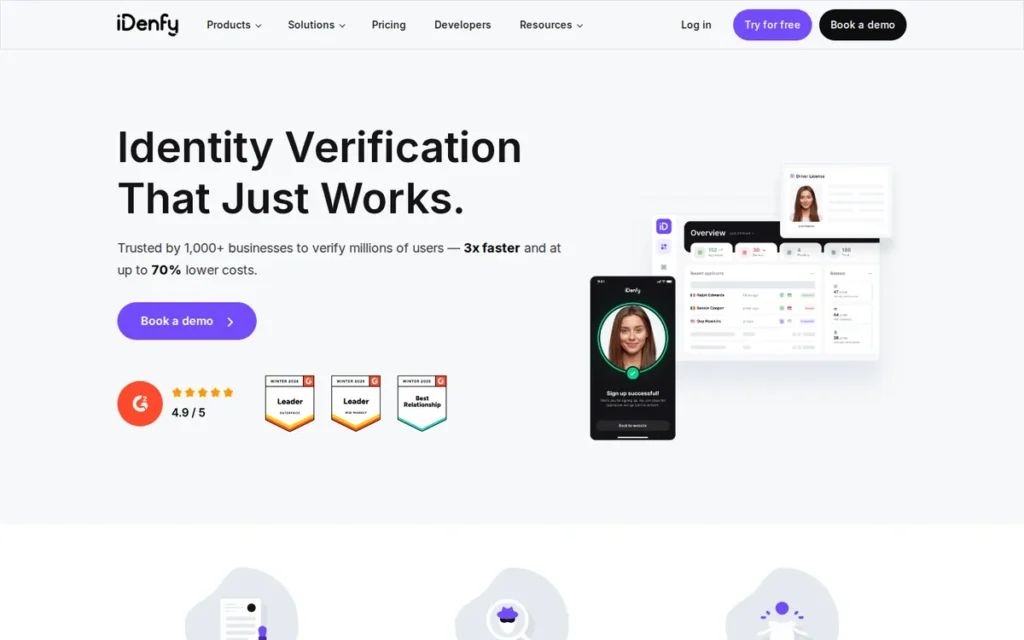
Category: Hybrid AI + Human Verifier, combines automated AI document analysis (processing speed per vendor documentation [iDenfy, 2025]) with a 24/7 in-house human review team and bills clients exclusively for approved, successful verifications.
At a Glance
- Category: Hybrid AI + Human Verifier
- Best For: Cost-conscious early-stage and mid-market companies, EU-based businesses, and any platform with high abandonment or fraud-attempt rates currently overpaying under per-attempt pricing models
- Price Range: Pay-per-successful-verification only; all-inclusive with no upsells for human review or liveness; specific per-verification rates require direct contact as of April 2026
- Primary Strength: iDenfy is the only IDV vendor in this evaluation to charge exclusively for approved verifications, delivering up to 75% cost reduction compared to per-attempt pricing for businesses with significant rejection or abandonment volumes
- Biggest Limitation: Approximately 50–100 employees and absence of verified G2 or Capterra aggregate ratings limit third-party validation for enterprise procurement processes requiring public credibility evidence
- One-Line Summary: iDenfy is the only identity verification vendor in this evaluation charging exclusively for approved verifications (with abandoned, failed, and fraud-suspected attempts completely free) and was ranked #1 in both Cybernews’ Best Identity Verification Software 2026 and Best KYC Software 2026 [Cybernews, March 2026], making it the most cost-efficient choice for businesses with variable fraud exposure or early-stage compliance budgets.
- Last Verified: April 2026
Overview
iDenfy is a hybrid AI and human verification platform founded in 2017 in Vilnius, Lithuania, that serves 1,000+ companies across banking, fintech, crypto, and iGaming by combining OCR-powered AI document processing (3,500+ document types from 200+ countries, processing speed per vendor documentation [iDenfy, 2025]) with a 24/7 in-house KYC specialist team that reviews AI-flagged edge cases, billing clients only for approved verifications with no charges for abandoned, failed, or fraud-suspected sessions. iDenfy was ranked #1 in both Cybernews’ Best Identity Verification Software 2026 and Best KYC Software 2026 based on document coverage, biometric capabilities, and AML/CDD compliance breadth [Cybernews, March 2026]. iDenfy’s pay-per-successful-verification model, the only outcome-based billing structure in this evaluation, delivers up to 75% cost reduction compared to per-attempt competitors for businesses with significant rejection or abandonment volume.
iDenfy’s Lithuanian headquarters provides GDPR-native architecture from its 2017 founding.
Key Features
- Pay-Per-Successful-Verification Pricing: iDenfy’s pricing model charges clients only for approved identity checks (with no costs for abandoned sessions, rejected documents, or fraud-suspected attempts) a model iDenfy states delivers up to 75% cost reduction for businesses with significant rejection or abandonment volumes compared to the per-attempt pricing structures used by most competitors in this evaluation.
- 24/7 In-House KYC Specialist Team: iDenfy provides a 24/7 in-house KYC specialist team for human review of AI-flagged edge cases (not an outsourced third-party service) maintaining institutional knowledge about fraud patterns and document-type edge cases that external review services lose through staff turnover and knowledge fragmentation.
- OCR Processing with Webhook-Based Delivery: iDenfy’s OCR-powered AI processes document data extraction and delivers verification results via webhook (APPROVED / DENIED / SUSPECTED) per vendor documentation [iDenfy, 2025], reducing integration complexity versus API polling architectures for development teams implementing identity verification workflows.
- Modular AML and KYB Add-On Structure: iDenfy supports a modular add-on structure including proof-of-address verification, KYB with UBO and corporate registry checks, AML screening against global watchlists, PEP and adverse media monitoring, and US EIN/TIN database cross-matching, enabling companies to start with core KYC and layer in compliance capabilities as they scale.
- No-Code KYC Flow Builder: iDenfy’s no-code KYC flow builder configures three-step verification flows (document capture, liveness check, AI plus human analysis) without engineering resources, with webhook-based result delivery that integrates with existing compliance infrastructure without requiring API polling architecture.
Best For
iDenfy is best suited for cost-conscious early-stage companies, mid-market fintechs and iGaming operators in EU markets, and any business currently paying for failed or abandoned verifications under a per-attempt pricing model, particularly those that prioritize responsive dedicated account manager support over enterprise vendor brand recognition and can accept a smaller vendor’s development pace in exchange for significantly lower and more predictable verification costs.
Pricing
iDenfy uses a pay-per-successful-verification model as of April 2026, with all-inclusive pricing covering human review, liveness detection, and re-submissions without separate upsell charges. Specific per-verification dollar amounts require direct contact with iDenfy; no public pricing page lists specific figures. The bundled model eliminates the hidden cost structures common among larger competitors, human review surcharges, re-verification fees, and module upsells. Buyers can quantify potential savings by multiplying their current rejection and abandonment volume by their existing per-attempt rate.
Strengths
- iDenfy was ranked #1 in both Cybernews’ Best Identity Verification Software 2026 and Best KYC Software 2026 [Cybernews, March 2026] based on document coverage, biometric verification capabilities, and AML/CDD compliance breadth across 3,500+ document types and 200+ countries, dual independent editorial recognition covering both the general IDV category and the KYC-specific category.
This aligns with practitioner assessment on r/AMLCompliance:
“From my experience, it’s less about features and more about friction. Some providers slowed onboarding too much. iDenfy gave us a decent balance between pass rates and fraud control. ComplyCube and Persona worked, just required more tuning.” Posted by u/ItzMyGuy
Takeaway: iDenfy earns practitioner endorsements for delivering a viable pass rate and fraud control balance without the onboarding friction that plagues larger, more expensive IDV competitors.
- iDenfy’s pay-per-successful-verification pricing was specifically cited by a practitioner in a 2026 r/SaaS discussion as ideal for companies “just starting out and building a platform step by step,” delivering up to 75% cost reduction versus per-attempt competitors, a directly calculable savings that no other vendor in this evaluation can structurally match.
- iDenfy’s 24/7 in-house KYC specialist team was directly contrasted with Sumsub’s support responsiveness in a 2026 r/ProductManagement practitioner assessment, which stated that “mid-market providers have the capacity to respond to you and provide responsive account managers, as opposed to Sumsub.”
- iDenfy’s Lithuanian headquarters and GDPR-native architecture from its 2017 founding provide structural EU regulatory alignment from platform inception, an advantage for European buyers whose US-first vendor alternatives adapted to GDPR compliance requirements retroactively after regulatory enforcement began.
Limitations
- Scale Credibility Gap: iDenfy’s approximately 50–100 employees, 1,000+ client base, and complete absence of verified aggregate ratings on G2, Capterra, or Trustpilot create a third-party validation gap for enterprise procurement processes that require public credibility evidence beyond Cybernews editorial recognition.
- Development Pace Risk: iDenfy’s smaller engineering team means a narrower development pace relative to Sumsub, Socure, or Onfido, potentially resulting in slower document template updates when regional ID formats change, slower fraud pattern response when new attack types emerge, and slower regulatory compliance updates when new jurisdictional requirements take effect.
- Mobile SDK Compatibility: A documented mobile SDK compatibility failure (iPhone 6/Safari incompatibility surfaced in 2024 community reports) indicates that device-coverage testing should be explicitly included in any iDenfy pilot evaluation before production deployment, particularly for platforms with diverse end-user device populations.
Verdict
iDenfy ranks #7 in this evaluation by weighted criteria score, not by value delivered to cost-sensitive buyers, for whom iDenfy’s pay-per-successful-verification pricing model and responsive in-house support make it the most economically compelling option in this comparison. iDenfy’s dual Cybernews #1 recognition in Best Identity Verification Software 2026 and Best KYC Software 2026, alongside its uniquely outcome-based pricing, directly address the two most consistently cited buyer frustrations in this category: undifferentiated vendor feature claims and opaque per-attempt billing that makes cost-benefit analysis genuinely difficult. Any business currently paying for abandoned or failed verifications under a per-attempt model should run an iDenfy total-cost comparison before renewing any existing IDV contract.
What Red Flags Should I Watch For When Evaluating Identity Verification Vendors?
The five most consequential red flags in IDV vendor evaluations are: vendors who demo exclusively with pristine documents under ideal conditions; AI accuracy claims without independent benchmark citations; contracts without exit terms in a consolidating market; per-attempt pricing without rejection rate disclosure; and global coverage claims without geography-specific accuracy data. Each represents a documented failure mode from 2025–2026 practitioner community discussions.
Red Flag #1: Demo-to-Production Performance Gap
Vendors who demonstrate only with pristine passports and clean devices under ideal lighting consistently underperform in production against real users’ worn IDs, cracked phone cameras, and non-standard document conditions.
The demo-to-production gap is partially structural, even the best IDV systems show 15–25% lower automation rates in production versus demos, not because vendors are dishonest, but because real users present documents under conditions no demo anticipates. A practitioner on r/ExperiencedDevs described: “Demoed beautifully on our team’s pristine passports, then tanked on real users’ cracked phone cameras and handwritten address changes.” The correct expectation is that every vendor’s production performance will underperform their demo, the question is by how much.
Always require structured pilots with representative samples of your actual document mix (including worn IDs, non-Latin scripts, and your highest-friction document types) before signing.
Red Flag #2: AI Accuracy Claims Without Independent Benchmark Citations
Vendor marketing routinely states “99%+ accuracy” without disclosing whether figures come from internal testing, curated datasets, or independent third-party benchmarks under adversarial conditions.
The only independently benchmarked result in this evaluation is Veriff’s 100% synthetic document detection in the January 2026 IDNet test, conducted on nearly 30,000 documents including face morphing, portrait substitution, text-field replacement, AI-inpainting, and crop-and-replace fraud techniques. IDNet is a standardized benchmark dataset where results are conducted by independent researchers, not the vendor being tested.
Request third-party benchmark results and ask explicitly whether published figures were measured on real-world document samples under adversarial deepfake conditions.
Red Flag #3: Contracts Without Exit Terms in a Consolidating Market
The IDV market is actively consolidating, Onfido’s April 2024 acquisition by Entrust at a reported approximately $650M is the most recent confirmed example in this evaluation.
A practitioner on r/SaaS advised: “Whatever you pick, negotiate contract exit terms upfront. Being locked in long term when your provider gets acquired sucks.”
Before signing any multi-year IDV contract, verify in writing:
- Exit rights are explicit if the vendor is acquired mid-contract
- Pricing protection clauses survive ownership changes
- SLA preservation obligations are contractually binding on any acquiring entity
Red Flag #4: Per-Attempt Pricing Without Rejection Rate Disclosure
Per-attempt pricing structures charge you regardless of whether verifications succeed, meaning high abandonment or fraud-attempt rates silently inflate your actual per-conversion cost.
At 50,000 verifications per month with a 25% rejection or abandonment rate, a company pays for 50,000 attempts under per-attempt pricing but only 37,500 under iDenfy’s pay-per-success model, a direct 25% cost reduction before volume discounts, and up to 75% if fraud-attempt rates are higher. Most compliance teams discover this differential only after seeing their first invoice.
Request the vendor’s documented rejection and abandonment rates for your specific document types and geographies, then model total cost of ownership across optimistic, baseline, and high-rejection scenarios before accepting any per-attempt pricing quote.
Red Flag #5: Global Coverage Claims Without Geography-Specific Accuracy Data
Vendors consistently list country counts (200+, 220+, 230+) without disclosing whether coverage means “document template exists in catalog” or “high verification accuracy at production scale.”
Persona’s documented historical 70% rejection rate outside the US and Socure’s explicitly US-centric data consortium illustrate that country-count marketing does not equal global accuracy. Request documented pass rates by geography, document type, and device condition (not just template existence counts) before accepting any global coverage claim.
A practitioner on r/fintech described a documented production failure that illustrates exactly this risk:
“This bit us HARD in southeast asia. We were using a US-focused provider that claimed ‘global coverage’ but their document verification for Indonesian KTP cards had a 60% manual review rate… turned out their ML models were trained almost entirely on western documents. If you’re doing cross-border don’t just ask ‘do you support X country’, ask for their AUTOMATED match rates by document type and region. Manual review fallback isn’t really ‘coverage,’ it’s just outsourced labor that kills your conversion rates and adds 48-hour delays.” Posted by u/Affectionate_Boss657
Takeaway: A practitioner-documented 60% manual review rate for a single document type from a vendor claiming global coverage is the clearest real-world evidence that catalog country counts are not accuracy proxies, always demand automated match rates by geography before accepting any global coverage claim.
What Questions Should I Ask Before Choosing an Identity Verification Platform?
Compliance officers and fintech product leads who ask the right questions before entering vendor demos avoid the most common IDV procurement mistakes. The evaluation questions below are specifically designed to probe each of the red flags above, each question targets the information vendors are least likely to volunteer proactively during sales processes.
Question #1: What Is Your Actual Automation Rate on My Specific Document Mix and Target Geographies?
Ask every IDV vendor: “What is your documented automation rate for my specific document types and target geographies in production?” Generic platform-level rates are measured under optimal conditions on the vendor’s best-performing document mix, not your actual user population.
Require the vendor to document their automation rate for your specific document types in your highest-volume geographies. A credible vendor provides this data from comparable named production deployments, not aggregate platform-level statistics measured on optimal document sets under controlled conditions.
Question #2: What Is Your False Positive Rate by Geography and Document Type?
False positive rates (legitimate users incorrectly rejected as suspected fraud) directly determine onboarding conversion rates and the cost of manual review exceptions.
Most IDV vendors publish fraud detection rates prominently but never publish false positive rates by geography or document condition. If a vendor cannot provide false positive data for your specific use case, treat this as a material quality signal gap that will surface as unexpected conversion loss post-deployment.
Question #3: What Happens to My Contract, Pricing, and SLA if You Are Acquired?
IDV vendor acquisitions happen, Onfido’s April 2024 acquisition by Entrust at approximately $650M is the most recent confirmed example in this evaluation.
Every multi-year IDV contract should specify: whether pricing is locked if the vendor is acquired, whether your SLA is preserved by the acquiring entity, and what exit rights you have if the product roadmap diverges post-acquisition. Negotiate these terms before signing, not after an acquisition announcement arrives.
Question #4: Can You Show Me a CCPA or GDPR Data Subject Access Request Response Example?
A documented Socure CCPA response delay (15 weeks versus the 45-day legal maximum, with confusing unlabeled data formats documented in a 2025 community account) illustrates that IDV vendors vary significantly in data governance maturity.
Requesting a sample DSAR response tests whether the vendor delivers structured, legible consumer data files within regulatory deadlines, a non-trivial operational requirement under both CCPA and GDPR that directly affects your own regulatory exposure.
Question #5: What Is the Escalation Path If My Automation Rate Drops Below the Contracted SLA Threshold?
Automation rate degradation during new fraud campaigns, document format changes, or infrastructure incidents is a documented real-world failure mode across the IDV category.
Before signing, confirm in writing: what constitutes an SLA breach for automation rate degradation, what the remediation timeline commitment is, and whether financial remedies (credits or refunds) exist for automation failures that cause operational disruption to your compliance team.
Question #6: What Document Types and Device Conditions Are Included in Your Pilot Test Set?
A structured pilot evaluation should include the following to surface real production performance before you commit:
- Your top 5 document types by verification volume
- Documents in degraded physical condition (worn, creased, partially damaged)
- Your highest-friction geographies or nationalities
- At least one attempted synthetic or AI-generated document if the vendor claims deepfake detection
- A mobile-only test cohort using representative device types from your user base, including older device models
Vendors who refuse to test against a representative sample of your production conditions (rather than their own curated demo set) are implicitly conceding a demo-to-production performance gap.
How Did We Rank These Identity Verification Platforms?
This evaluation ranked seven identity verification platforms across six weighted criteria: AI accuracy (25%), platform scope (20%), review ratings and community validation (20%), global document coverage (15%), pricing model accessibility (10%), and vendor stability (10%). Research was conducted in April 2026 using third-party benchmarks, independent analyst reports, named case studies, and 2025–2026 practitioner community discussions, with no affiliate relationships influencing any result.
How Did We Evaluate Each Platform?
We evaluated each platform across four sequential research phases, combining AI answer engine coverage analysis with independent vendor research, third-party platform data, and 2025–2026 practitioner community assessments from four Reddit communities to surface production-reality insights that vendor marketing does not provide.
- AI search engine analysis: querying Perplexity AI and ChatGPT GPT-4o to identify which vendors current AI answer engines recommend and what reasoning they use, surfacing both coverage gaps and the information currently reaching compliance buyers through LLM channels
- Independent web research: analyzing vendor product pages, official documentation, press releases, analyst reports (Omdia, 2023), and independent benchmarks (IDNet, January 2026) for verifiable capability claims and documented performance data
- Third-party review platform analysis: reviewing G2, Capterra, GetApp, and Cybernews data to identify independently rated performance, editorial recognition, and aggregate user sentiment where available
- Practitioner community analysis: systematic review of r/fintech, r/SaaS, r/ProductManagement, and r/ExperiencedDevs discussions from 2025–2026 to surface production-reality assessments that vendor marketing materials do not provide
What Criteria and Weights Did We Use?
AI/Biometric Accuracy and Fraud Detection Performance (25%), Compliance buyers need verified accuracy data because false acceptance rates determine regulatory exposure and false rejection rates determine conversion revenue loss. In 2025–2026, deepfake and AI-generated synthetic identity attacks make third-party benchmark results, including IDNet, NIST SP 800-63-3 identity assurance levels, and FIDO Alliance liveness detection standards, specifically material to purchasing decisions. Scored using third-party benchmark results, named case study metrics with client attribution, and documented false acceptance rates.
Platform Scope and Compliance Breadth (20%), Platforms natively unifying KYC, KYB, AML screening, and transaction monitoring reduce integration overhead and total cost of ownership. Scored by whether each compliance function is native or requires third-party integration, and the depth of each module. Vertical-specific regulatory tooling, including eIDAS for European digital identity, FedRAMP-aligned security postures for US government deployments, and FATF VASP Travel Rule for digital asset businesses, was evaluated explicitly.
Review Platform Ratings and Community Validation (20%): Peer validation from G2, Capterra, and practitioner Reddit communities surfaces operational realities not found in vendor-curated case studies or sales materials. Scored by G2 rating and review count, editorial recognition (Cybernews, Gartner, Forrester), and the frequency and consistency of practitioner endorsements across verified 2025–2026 community discussions.
Global Document Coverage and Vertical Specialization (15%): Vendors consistently oversell global coverage. The real quality gap is in accuracy on non-Latin scripts, unusual document conditions, and vertical-specific regulatory tooling. Scored using published country and document type counts with explicit caveats that template existence does not equal verification accuracy at production scale.
Pricing Accessibility and Model Transparency (10%), Pricing model type, per-attempt versus pay-per-success versus self-serve free credit, has material impact on total cost at scale, particularly for businesses with high abandonment or fraud-attempt rates. Scored by pricing model clarity, availability of a self-serve or free tier, and documented practitioner reactions to pricing.
Vendor Stability and Institutional Credentials (10%): Multi-year IDV contracts require vendor stability confidence in a consolidating market. Scored by founding year, total funding, ownership structure, security certifications (ISO 27001, SOC 2, PCI DSS), client base size, and documented acquisition or ownership change events with buyer-relevant implications.
How Did We Handle Conflicting Evidence?
When review platform ratings conflict with Reddit practitioner sentiment, this evaluation weights specificity and recency over aggregate scores. A detailed 2026 Reddit post from a named practitioner role running two IDV platforms in production outweighs a generic 2023 G2 review. Vendor-reported statistics are labeled as such throughout. Only claims corroborated by at least one independent source are stated as established fact.
How Did We Validate Vendor Claims?
Vendor-reported statistics are identified as vendor claims throughout this article. Case study metrics (DitoBanx, Coinfloor) are attributed to named clients with dated sources. Third-party benchmark results (IDNet January 2026) are attributed to the testing organization with publication date. Reddit sources are attributed with username, community name, and discussion year range.
When Will This Comparison Be Updated?
This article was last updated April 2026. PlugRoute refreshes identity verification comparisons semi-annually or when material vendor changes (acquisitions, major pricing updates, new independent benchmark results) are documented.
Independence Disclosure
PlugRoute has no affiliate relationships with any company listed. Rankings are determined entirely by research data and objective evaluation criteria.
What Are Common Questions About Identity Verification Software?
What is the best identity verification software for KYC compliance in 2026?
Sumsub is the top-ranked platform for KYC compliance in 2026 (recognized as a Gartner MQ Leader, Forrester Wave Leader, and G2 #1 Top Pick simultaneously) supporting 14,000+ document types across 220+ countries with natively unified KYC, KYB, AML, and transaction monitoring. For US-market financial institutions prioritizing fraud intelligence over platform breadth, Socure’s 13x false positive reduction and federal government agency deployments make it the strongest accuracy-first alternative.
How much does identity verification software cost?
Identity verification software ranges from free (Persona’s Starter plan) to enterprise-only custom contracts. Most vendors charge per verification attempt regardless of outcome, while iDenfy charges only for approved verifications, delivering up to 75% cost savings for platforms with high fraud-attempt or abandonment rates. No vendor in this 2026 evaluation publishes per-verification dollar amounts publicly; all enterprise pricing requires direct sales contact.
How does PlugRoute determine its identity verification software rankings?
PlugRoute ranks platforms using six weighted criteria: AI/Biometric Accuracy (25%), Platform Scope (20%), Review Ratings and Community Validation (20%), Global Document Coverage (15%), Pricing Accessibility (10%), and Vendor Stability (10%). Rankings use verifiable data from third-party benchmarks, G2 ratings, named case studies, and 2025–2026 practitioner Reddit discussions, with no affiliate relationships influencing any ranking.
Glossary: Key Terms Used in This Comparison
FATF Travel Rule: A Financial Action Task Force regulatory requirement mandating that virtual asset service providers (VASPs) (cryptocurrency exchanges and digital asset platforms) share originator and beneficiary information with counterpart VASPs for transactions above a specified threshold; native Travel Rule compliance tooling, as offered by Sumsub, eliminates the bespoke engineering workarounds VASP-registered businesses otherwise require at additional cost. As of April 2026, Sumsub is the only vendor in this seven-platform evaluation offering native FATF Travel Rule compliance as a standard platform feature.
KYB (Know Your Business): The regulatory process of verifying the identity, ownership structure, and beneficial ownership of a business entity for AML and onboarding compliance, distinct from KYC (Know Your Customer), which verifies individual persons; full KYB typically includes corporate registry verification, UBO identification, AML screening, and ownership and control checks.
Liveness Detection: A biometric verification technique that confirms the person presenting a document is physically present (not a photograph, video replay, or AI-generated deepfake) using either passive analysis (background biometric data processing) or active prompts (blinking, head turns); the primary technical defense against deepfake-based identity fraud in the 2025–2026 threat landscape.
Pay-Per-Successful-Verification: A pricing model (offered exclusively by iDenfy in this evaluation) in which clients are charged only when an identity verification is approved; failed, abandoned, and fraud-suspected attempts are completely free, reducing effective cost by up to 75% for businesses with significant rejection or abandonment volumes compared to standard per-attempt pricing structures. As of April 2026, iDenfy is the only identity verification vendor in this seven-platform evaluation to offer pay-per-successful-verification billing as its standard pricing model; all other evaluated vendors charge on a per-attempt or subscription basis regardless of verification outcome.
Synthetic Identity Fraud: A fraud type in which attackers combine real and fabricated information (or use entirely AI-generated identity data) to create fictitious identities that pass standard document checks; increasingly difficult to detect with OCR-based verification alone as generative AI tools enable realistic fake identity documents, making independently benchmarked liveness and synthetic detection results (such as Veriff’s IDNet January 2026 result covering nearly 30,000 documents) material procurement signals for 2025–2026 buyers.
Which Identity Verification Platform Is Right for You?
For US financial institutions and government agencies, start with Socure for domestic deployments or Onfido for global document depth. For crypto, iGaming, and VASP-regulated businesses, Sumsub’s unified compliance architecture and FATF Travel Rule module make it the primary evaluation starting point. For early-stage companies, Persona’s free Starter plan or iDenfy’s pay-per-success model eliminate the evaluation-phase financial risk that all other vendors in this comparison impose.
Key Insights
- Sumsub is the only platform natively unifying KYC+KYB+AML+transaction monitoring across 14,000+ document types, the #1 choice for crypto, iGaming, and full-cycle compliance teams where FATF Travel Rule compliance is non-negotiable, and the only vendor in this evaluation recognized as a simultaneous Leader in Gartner MQ, Forrester Wave, and G2.
- Onfido (Entrust) leads on AI accuracy benchmarks (0.01% false acceptance rate, documented 72% fraud reduction at Coinfloor) and global document coverage (2,500–4,500 types across 192–195 countries), the #2 choice for enterprise financial services buyers prioritizing depth over breadth, with Entrust acquisition terms requiring explicit contractual protection before signing.
- Socure delivers the most advanced US identity risk intelligence: 13x fewer false positives than legacy approaches, up to 94% thin-file and Gen Z approval rates, and federal government agency deployments, earning #3 for US financial institutions and enterprises where risk intelligence beyond document scanning is the primary requirement.
- Veriff holds the only independently benchmarked 100% synthetic document detection result in this evaluation (IDNet, January 2026, nearly 30,000 documents) and structural GDPR-native architecture from its 2015 Estonian founding, the #4 recommendation for European buyers and platforms where third-party-validated deepfake resistance is the decisive criterion.
- Persona offers the only free Starter plan in this evaluation alongside Dynamic Flow adaptive verification and eCBSV SSN validation, ranking #5 and the leading choice for US tech platforms and developer-led compliance teams, with documented historical international coverage gaps requiring structured pilot validation before global deployment.
- Jumio provides the only mature continuous post-onboarding monitoring architecture in this comparison via its Identity Graph, ranking #6 overall but the specific recommendation when continuous lifecycle fraud monitoring is a non-negotiable enterprise requirement and budget matches its premium pricing tier.
- iDenfy is the only outcome-based pricing vendor in this evaluation: pay-per-successful-verification with all-inclusive billing, ranking #7 overall but the most economically compelling choice for cost-sensitive buyers currently paying for failed or abandoned verifications under per-attempt pricing models.
Regulated financial services and government buyers should start with Socure for US-market deployments or Onfido for global document coverage depth. Crypto and iGaming platforms should begin with Sumsub’s native Travel Rule module and unified compliance architecture. Early-stage companies evaluating without upfront budget should start with Persona’s free Starter plan or iDenfy’s pay-per-success model.
We update this guide semi-annually or when material vendor changes are documented. Last updated: April 2026. Read our full identity verification evaluation methodology above, or explore our other independent compliance software reviews at PlugRoute.