Cognigy is the best conversational AI agent platform for enterprise contact centers with the strongest documented deployments at scale, Yellow.ai leads for global omnichannel automation across 35+ channels and 135+ languages, and Retell AI is the top choice for voice-first AI agents. The right platform depends on your channel priorities, technical resources, deployment model, and budget, not on which vendor markets the loudest.
The market has exploded with platforms all claiming “agentic AI” capabilities while varying dramatically in production readiness, pricing transparency, and real-world accuracy. The conversational AI market is projected to grow from approximately $14–19 billion in 2025 to $41–50 billion by 2030 (Grand View Research, MarketsandMarkets, 2025), making platform selection an increasingly high-stakes decision.
As one user on r/startups described:
“I’ve been tinkering with a RAG-based chatbot that gives answers from our internal help docs. It will give the correct answer 9 out of 10 times. Sometimes the answers are exceptionally good but every now and then it will hallucinate. Myself and my colleagues will know which answers are hallucinations but my external users (clients) will not. Which makes the chatbot basically useless except for internal use and with a massive disclaimer that the answers are suspect and need to be checked.” Posted by u/Buddy_Useful
Takeaway: Even well-configured conversational AI platforms hallucinate often enough to be unreliable for customer-facing use without robust accuracy safeguards, making platform selection a make-or-break decision.
PlugRoute has no affiliate relationships with any company listed. Rankings are determined entirely by research data and objective evaluation criteria.
TL;DR: Top Picks at a Glance
- Cognigy earns the top spot for enterprise contact centers with named deployments at Lufthansa Group and Openreach.
- Yellow.ai delivers the widest omnichannel reach at 35+ channels and 135+ languages for global enterprises.
- Retell AI is the most production-ready voice AI platform in this evaluation, validated across thousands of live calls.
- Google Dialogflow offers the most transparent per-request pricing starting at $0.002 for developer teams on Google Cloud.
What Are the Main Categories of Conversational AI Agent Platforms?
Conversational AI agent platforms fall into three broad categories: enterprise-scale orchestrators designed for high-volume contact centers, specialist platforms purpose-built for specific channels like voice or SaaS support, and ecosystem-embedded builders tightly coupled to cloud providers like Google, Microsoft, or IBM. Your category match depends on whether you need breadth, depth, or ecosystem alignment.
Enterprise Orchestrators deploy autonomous AI agents across multiple channels at massive scale with compliance controls:
Specialist Platforms excel in specific use cases, voice conversations, SaaS customer support, or developer-controlled custom builds:
- Retell AI: Voice AI specialist
- Intercom Fin AI Agent: SaaS customer support specialist
- Google Dialogflow: Developer framework for custom agents
Ecosystem-Embedded Builders integrate deeply with a specific cloud or enterprise platform, trading portability for native data access:
- Microsoft Copilot Studio, Microsoft 365 ecosystem
- IBM watsonx Assistant: Hybrid/on-premises enterprise environments
The most common mistake in conversational AI evaluation is comparing enterprise orchestrators against specialist platforms, they solve fundamentally different problems at different price points.
How Do the Top Conversational AI Agent Platforms Compare at a Glance?
| Rank | Company | Category | Best For | One-Line Summary | Key Capabilities | Primary Strength | Key Limitation |
|---|---|---|---|---|---|---|---|
| 1 | Cognigy | Enterprise Orchestrator | Large enterprise contact centers (10K+ agents) | Cognigy is an enterprise-grade agentic AI platform combining LLM reasoning with rule-based automation to deploy autonomous agents across voice and chat at scale. | Nexus Engine, Agent Copilot Whisper, MCP integration, 100+ languages, 25K concurrent interactions | Only platform with named enterprise deployments showing quantified automation at scale | No public pricing; enterprise-only accessibility |
| 2 | Yellow.ai | Omnichannel Automation | Global enterprises across 35+ channels and 135+ languages | Yellow.ai deploys AI agents across 35+ channels and 135+ languages with a proprietary VoiceX engine for unified global customer engagement. | VoiceX voice engine, 35+ channels, 150+ templates, multi-LLM architecture, DynamicNLP | Widest channel (35+) and language (135+) coverage of any platform evaluated | Aggressive marketing claims draw documented practitioner skepticism |
| 3 | Retell AI | Voice AI Specialist | Voice agents for sales and support calls | Retell AI builds production-grade voice agents with leading turn-taking quality, transparent per-minute pricing, and SOC 2/HIPAA compliance. | Proprietary turn-taking model, ~800ms latency, carrier reputation management, OpenAI feature | Strongest practitioner endorsement for production voice quality across live parallel tests | Voice-first specialist with limited chat/messaging capabilities |
| 4 | Google Dialogflow | Developer Framework | Technical teams on Google Cloud | Google Dialogflow is a developer-centric framework offering ES for simple agents and CX for complex multi-turn flows with transparent per-request pricing. | Dual editions (ES/CX), visual Flow Builder, Playbooks, Google Cloud-native NLU | Most transparent and cost-effective per-request pricing in the evaluation | Requires developer expertise; inaccessible to non-technical teams |
| 5 | Intercom (Fin AI Agent) | AI Customer Service Agent | SaaS companies with structured knowledge bases | Intercom Fin AI Agent resolves support queries autonomously at $0.99 per resolution, built on Intercom’s established SaaS messaging platform. | $0.99/resolution pricing, AI Copilot, AI Analyst, 45+ languages, unified inbox | Industry-first outcome-based pricing model aligning cost with value | Documented hallucinations, resolution-counting inflation, knowledge base lock-in |
| 6 | IBM watsonx Assistant | Hybrid Enterprise Assistant | Regulated industries with on-prem requirements | IBM watsonx Assistant deploys across on-premises, hybrid, and multi-cloud environments with RAG-powered search for regulated industries. | On-prem via Cloud Pak for Data, RAG, Watson Orchestrate, GDPR compliance | Only platform in this evaluation offering genuine on-premises and multi-cloud deployment | Mixed community sentiment; capability competitiveness questioned versus newer platforms |
| 7 | Microsoft Copilot Studio | Ecosystem Agent Builder | Microsoft 365-centric organizations | Microsoft Copilot Studio builds conversational agents grounded in Microsoft Graph data with deep Teams and SharePoint integration. | 1,400+ connectors, GPT-5 support, Microsoft Graph grounding, autonomous agents | Deepest native Microsoft 365 integration of any conversational AI platform | Overwhelmingly negative user feedback on platform maturity and bugs |
Which Conversational AI Platform Should I Choose for My Use Case?
| Your #1 Priority | Recommended Tool | Why | Acceptable Alternative |
|---|---|---|---|
| Enterprise contact center (10K+ agents) | Cognigy | Named deployments at Lufthansa Group and Openreach; analyst-endorsed agentic architecture | Yellow.ai |
| Global omnichannel (multi-market) | Yellow.ai | 35+ channels, 135+ languages, purpose-built VoiceX engine | Cognigy |
| Voice-first (sales/support calls) | Retell AI | Top-rated turn-taking quality; production-proven across 5K+ weekly call minutes | Yellow.ai (VoiceX) |
| Developer team (Google Cloud) | Google Dialogflow | Transparent per-request pricing; maximum architectural control | Retell AI (for voice) |
| SaaS customer support | Intercom Fin | Established platform; outcome-based pricing aligns cost with value | Google Dialogflow CX |
| Regulated/hybrid deployment | IBM watsonx Assistant | Only platform in this evaluation with on-prem, hybrid, and multi-cloud deployment | Cognigy |
| Microsoft 365 internal agents | Microsoft Copilot Studio | Unmatched Microsoft Graph grounding and Teams integration | IBM watsonx Assistant |
If you only have time to evaluate two platforms, pick the one matching your top priority above and the acceptable alternative beside it.
1. Cognigy: Best Overall for Enterprise Contact Centers
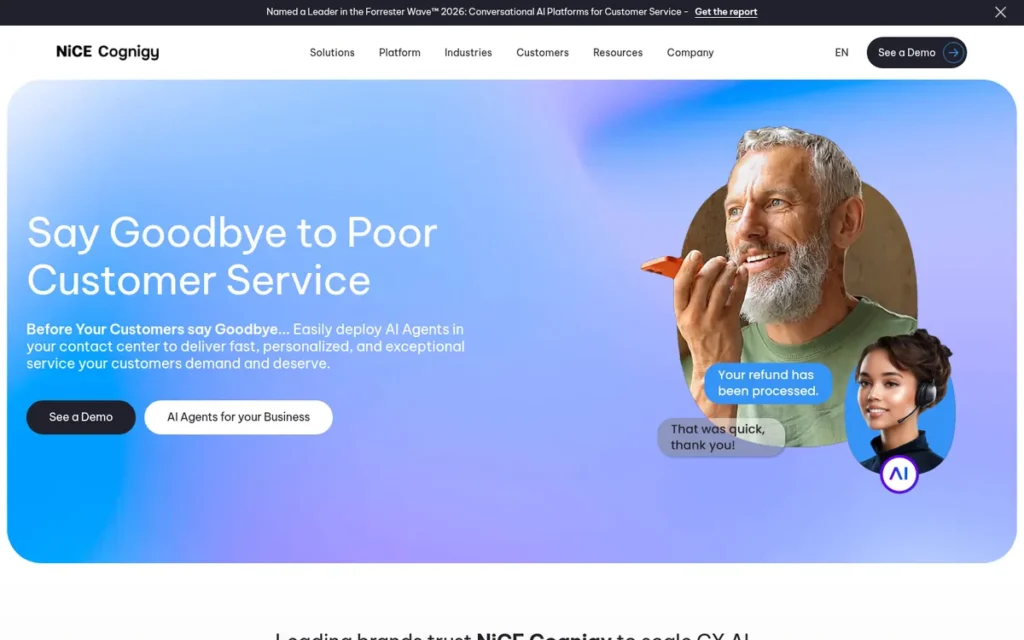
Category: Enterprise Orchestrator, orchestrates autonomous AI agents across enterprise systems and channels at scale, combining LLM reasoning with rule-based automation.
At a Glance
- Category: Enterprise Orchestrator
- Best For: Large enterprise contact centers (10,000+ agents) needing multi-channel AI automation
- Price Range: Enterprise custom pricing (contact sales required)
- Primary Strength: Cognigy is the only platform in this evaluation with named enterprise deployments showing quantified automation metrics at scale
- Biggest Limitation: Cognigy requires direct sales engagement with no public pricing or self-serve tier
- One-Line Summary: Cognigy is an enterprise-grade agentic AI platform that combines LLM reasoning with rule-based automation to deploy autonomous customer service agents across voice and chat at scale.
- Last Verified: April 2026
Overview
Cognigy is an enterprise-grade conversational AI platform built for large organizations that need to deploy autonomous AI agents across voice, chat, and digital channels at scale while maintaining control through hybrid LLM-and-rule-based automation. Cognigy differentiates through its Nexus Engine architecture, which integrates multiple AI layers (memory, knowledge, tools, and business rules) for what the company calls “controlled autonomy.”
Cognigy was acquired by NICE (Nasdaq: NICE) in September 2025 for approximately $955 million (BusinessWire, September 2025), giving Cognigy enterprise-scale backing and access to the broader NICE CX portfolio.
Key Features
- Nexus Engine Multi-Layer Architecture: Cognigy integrates LLMs with enterprise-specific elements including memory, knowledge bases, tools, and business rules for multi-layered AI reasoning that balances autonomy with compliance.
- Agent Copilot Whisper: Cognigy provides real-time assistance that feeds contextual suggestions to human agents during live conversations, enabling seamless AI-to-human handoffs.
- Progressive Reasoning: Cognigy supports complex customer query decomposition into sub-steps in real-time without disrupting the conversation flow.
- 100+ Prebuilt Omnichannel Connectors: Cognigy offers connectors spanning WhatsApp, Slack, phone, web, and native integrations with CCaaS, CRM, and case management systems.
- MCP Integration: Cognigy integrates with Model Context Protocol for AI-to-AI operations, enabling agents to coordinate across enterprise systems autonomously.
Best For
Cognigy is best suited for large enterprise contact centers (particularly in insurance, telecommunications, automotive, and aviation) that process high volumes of customer interactions across multiple channels and languages and need genuine agentic AI with enterprise compliance controls.
Pricing
Cognigy does not publish pricing publicly and requires direct sales engagement for custom enterprise quotes. Cognigy’s enterprise-only pricing model is standard among top-tier platforms but creates friction for mid-market buyers running initial cost comparisons. No free tier is publicly available. (Pricing verified April 2026.)
Strengths
- Cognigy powers conversational AI at Lufthansa Group, where 16+ AI virtual agents handle 16 million interactions yearly with peaks of 375,000 per day, as documented in Cognigy’s published customer success stories and confirmed via the NICE acquisition press release (NICE, September 2025).
- Cognigy presented enterprise results including work with Generali (analyzing 100,000 call recordings, identifying 150 intents, targeting 65% customer service automation) and Openreach/BT Group (proactive AI agent across 15 million customer journeys), as reported by Opus Research at Nexus 2026 (March 2026).
- Cognigy received dual analyst endorsement in 2026: Frost & Sullivan (2026) declared agentic AI has “crossed the chasm” citing Cognigy’s integrative model, and Opus Research identified Cognigy’s MCP readiness as a “competitive moat.”
- Cognigy’s hybrid Nexus Engine architecture uniquely combines LLM reasoning with deterministic rule-based automation, providing the “controlled autonomy” that enterprise compliance teams require, a genuine differentiator versus platforms relying on LLMs alone.
This aligns with community sentiment on r/customerexperience:
“I would reckon 1 important piece to include in this comparison is that with the $955M acquisition of NiCE Cognigy in August 2025, NiCE has staked a claim to owning the agentic AI stack outright. No other vendor in this comparison can offer a truly native, front-to-back agentic AI platform built for the enterprise. Depending on how AI focused the current scope of your evaluation is, could be a differentiator.” Posted by u/albinoozzy
Takeaway: Cognigy’s NICE acquisition positions it as the only CCaaS vendor with a fully native agentic AI stack, a structural advantage recognized by enterprise evaluators, not just analysts.
Limitations
- Enterprise-Only Accessibility: Cognigy’s most consequential trade-off is its enterprise-only reach, with no public pricing, no self-serve free tier, and platform complexity calibrated for large contact center operations, Cognigy effectively prices out mid-market organizations with simpler needs.
Users on r/customerexperience noted:
“I agree the acquisition was an important move for them. That said, Cognigy likely won’t be a one-size-fits-all solution for every organization. Implementation costs can be very high, and some customers require pre-built integrations that only certain conversational AI platforms currently support.” Posted by u/Intelication
Takeaway: Cognigy’s implementation costs and integration requirements can disqualify it for organizations outside its enterprise sweet spot, mid-market buyers with specific pre-built integration needs should verify compatibility early.
- NICE Ecosystem Lock-In: Cognigy’s acquisition by NICE adds enterprise scale but introduces potential vendor lock-in for organizations not already in the NICE ecosystem.
- Limited Community Validation: Cognigy has minimal organic community discussion on platforms like Reddit, typical for enterprise B2B tools but making independent user validation harder for buyers conducting due diligence outside analyst reports.
Verdict
Cognigy has the strongest documented enterprise deployment evidence of any platform in this evaluation, combining named customer results at Lufthansa Group and Openreach with dual analyst endorsement and a uniquely hybrid LLM-plus-rules architecture. Organizations running large, multi-channel contact centers in regulated industries will find Cognigy’s controlled autonomy approach and NICE-backed infrastructure the most mature option available. However, teams without enterprise budgets or existing NICE relationships should look to more accessible alternatives below.
2. Yellow.ai: Best for Global Omnichannel Automation
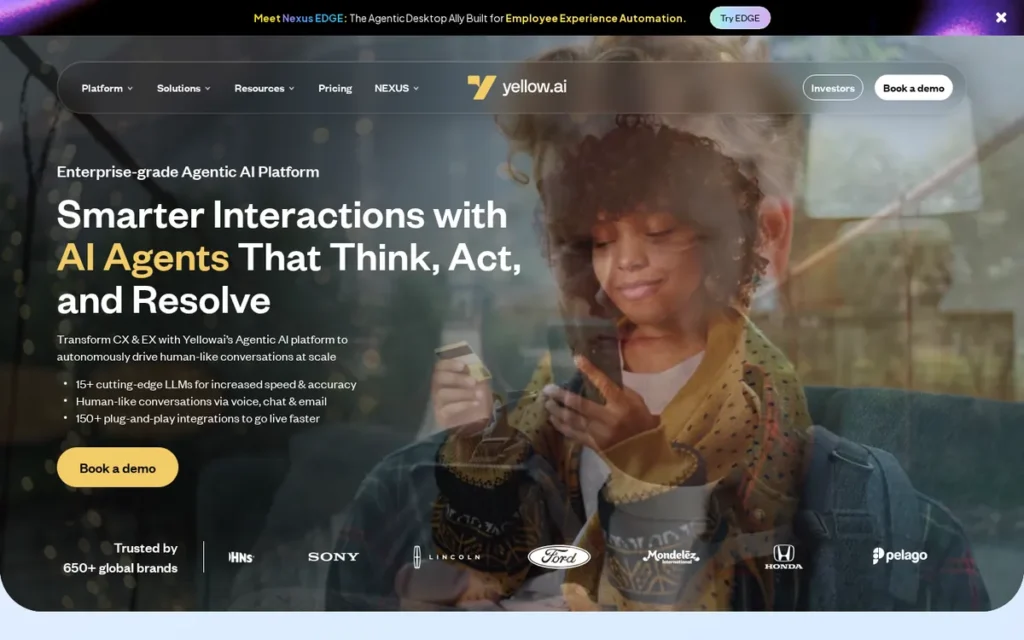
Category: Omnichannel Automation Platform, automates customer interactions across 35+ digital, social, voice, and messaging channels with AI-powered agents.
At a Glance
- Category: Omnichannel Automation Platform
- Best For: Global enterprises needing AI-powered engagement across 35+ channels and 135+ languages
- Price Range: Enterprise custom pricing (contact sales required)
- Primary Strength: Yellow.ai offers the widest channel (35+) and language (135+) coverage of any platform evaluated
- Biggest Limitation: Yellow.ai’s aggressive marketing claims have drawn documented skepticism from enterprise professionals
- One-Line Summary: Yellow.ai is a global omnichannel conversational AI platform deploying AI agents across 35+ channels and 135+ languages with a proprietary VoiceX engine for unified international customer engagement.
- Last Verified: April 2026
Overview
Yellow.ai is a multinational conversational AI platform that deploys AI-powered agents across 35+ digital channels and 135+ languages, combining chat automation with a proprietary VoiceX voice engine for enterprises that need unified global customer engagement. Yellow.ai differentiates through sheer channel and language breadth, no other platform in this evaluation matches Yellow.ai’s omnichannel reach.
Yellow.ai was founded in 2016 (originally Yellow Messenger) and has grown to serve 1,300+ brands while earning Challenger status in the 2025 Gartner Magic Quadrant for Conversational AI Platforms (Gartner, 2025).
Key Features
- 35+ Channel Deployment: Yellow.ai deploys AI agents across WhatsApp, Facebook Messenger, Instagram, Telegram, web chat, IVR, email, Slack, Microsoft Teams, and ServiceNow, unifying customer interactions in a single platform.
- Proprietary VoiceX Engine: Yellow.ai delivers voice AI at approximately 1.5-second latency with human-like conversational cues including back-channeling, multi-turn context retention, and alphanumeric handling.
- No-Code Bot Studio: Yellow.ai provides a drag-and-drop interface with 50+ node types and 150+ pre-built templates for constructing customer journeys without coding.
- DynamicNLP Zero-Shot Learning: Yellow.ai’s DynamicNLP is pre-trained on billions of real-world conversations, claiming to reduce NLP training from months to minutes.
- Multi-LLM Architecture: Yellow.ai integrates 15+ large language models continuously trained on 16 billion+ conversations annually.
Best For
Yellow.ai is best suited for global enterprises (particularly in retail, BFSI, and telecommunications) that need to deploy conversational AI across dozens of digital channels and markets simultaneously, with both voice and chat capabilities in 135+ languages.
Pricing
Yellow.ai does not publish pricing publicly and requires direct sales engagement for enterprise quotes. One third-party review described Yellow.ai as “Not the Cheapest But Probably The Best,” suggesting premium positioning (AI Software Match, 2025). No public free tier is available for evaluation. (Pricing verified April 2026.)
Strengths
- Yellow.ai was named a Challenger in the 2025 Gartner Magic Quadrant for Conversational AI Platforms (Gartner, 2025), providing independent analyst validation of Yellow.ai’s enterprise-readiness and competitive positioning among top global platforms.
- Yellow.ai’s VoiceX engine received specific endorsement from Everest Group Practice Director Anubhav Das, who praised Yellow.ai’s VoiceX as a market-leading platform for overcoming voice AI limitations via LLMs (as reported by Yellow.ai citing Everest Group, 2025).
- Yellow.ai supports 135+ languages with real-time translation, making Yellow.ai the broadest multilingual platform in this evaluation, a critical capability for multinational deployments.
- Yellow.ai’s 35+ channel coverage is the widest of any platform evaluated, enabling unified customer engagement across social, messaging, voice, email, and enterprise collaboration tools.
Limitations
- Marketing-vs-Reality Credibility Gap: Yellow.ai’s headline claim of “90% automation in 30 days” drew sharp criticism from enterprise professionals on Reddit, with one veteran calling it “complete bullshit” and noting that “the timeframe to even standardize what can/should be automated for large enterprises takes longer than that” (u/hopelesslysarcastic, r/singularity, 2023).
“It’s customer service systems only… they just have a specialized chat model, which is great at communicating with people.”, [deleted user], r/singularity
Takeaway: Yellow.ai’s 90% automation claim applies to customer service query deflection specifically, not full enterprise workflow automation.
- Unverified Accuracy Claims: Yellow.ai’s claim of approximately 0% hallucination rates has drawn skepticism, and no independent verification of this figure was available in research sources.
- Opaque Pricing: Yellow.ai requires direct sales engagement with no published rate card, making cost comparison difficult for teams evaluating multiple platforms simultaneously.
Verdict
Yellow.ai is the strongest platform in this evaluation for organizations that need conversational AI deployed across the most channels and languages simultaneously, combining genuine omnichannel breadth with a purpose-built voice engine that most competitors lack. Yellow.ai’s Gartner Challenger status and Everest Group endorsement validate enterprise-readiness. However, buyers should approach Yellow.ai’s headline automation and accuracy claims with scrutiny, requesting specific customer references and pilot results rather than accepting marketing metrics at face value.
3. Retell AI: Best for Voice AI Agents
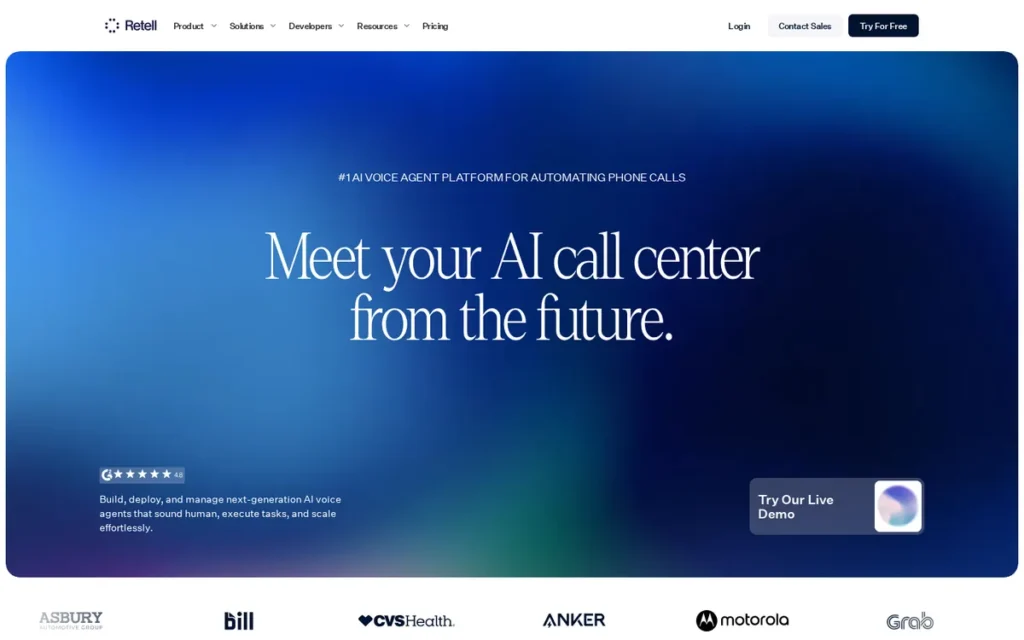
Category: Voice AI Specialist, purpose-built for natural, low-latency voice conversations at production scale across inbound and outbound calling.
At a Glance
- Category: Voice AI Specialist
- Best For: Teams deploying AI voice agents for inbound support or outbound sales calls
- Price Range: $0.07–$0.31/min (pay-as-you-go); Enterprise from $8,000/month
- Primary Strength: Retell AI’s proprietary turn-taking model delivers the most natural voice quality in this evaluation, validated by practitioners across thousands of live calls
- Biggest Limitation: Retell AI is a voice-first specialist with limited chat and messaging capabilities
- One-Line Summary: Retell AI is a developer-focused voice AI platform building production-grade conversational agents for calling with leading turn-taking quality, transparent per-minute pricing, and SOC 2/HIPAA compliance.
- Last Verified: April 2026
Overview
Retell AI is a developer-focused platform for building conversational AI voice agents that deliver human-like phone interactions with approximately 600–800 millisecond latency, purpose-built for teams that need production-ready voice quality for customer support and sales calls. Retell AI differentiates through a proprietary turn-taking model that handles barge-in (interruptions) more naturally than any competitor in practitioner head-to-head tests, combined with the most transparent pricing model in this evaluation.
Retell AI was founded in 2023, has been featured by OpenAI in a published customer story OpenAI, 2024, and holds SOC 2 Type 1/2, HIPAA, and GDPR certifications.
Key Features
- Proprietary Turn-Taking Model: Retell AI enables natural interruption handling during voice conversations, creating what practitioners describe as an agent that “listens while speaking”, a critical quality differentiator for production calls.
- Multi-Carrier Telephony: Retell AI supports real-time voice streaming via WebSocket API with inbound and outbound calling through Twilio, Telnyx, Vonage, or a built-in carrier, with carrier reputation management that reduces spam flagging.
- Flexible LLM Integration: Retell AI supports GPT-4o, Claude 3, and custom models, allowing teams to optimize for quality, cost, or domain specificity.
- Post-Call Intelligence: Retell AI includes auto-sync knowledge base for real-time updates, batch calling, warm transfers, IVR/DTMF navigation, and post-call analysis with transcripts, summaries, and latency metrics.
- Component-Level Pricing Transparency: Retell AI itemizes voice engine, LLM, and telephony costs separately so teams can optimize each layer independently.
Best For
Retell AI is best suited for development teams building AI-powered phone agents for customer support hotlines, outbound sales campaigns, appointment scheduling, or any use case where voice conversation quality and natural turn-taking directly impact outcomes and customer perception.
Pricing
Retell AI publishes transparent, component-based pricing:
- Voice engine: $0.07–$0.08/minute
- LLM processing: $0.003–$0.06/minute
- Telephony: $0.015/minute
- Total: $0.07–$0.31/minute depending on configuration
Retell AI includes $10–60 in free credits, 20 concurrent calls, and 10 free knowledge bases. Enterprise plans start at approximately $8,000/month with per-minute rates as low as $0.05. (Pricing verified April 2026.)
Strengths
- Retell AI received the strongest practitioner endorsement in this evaluation: a Reddit user processing 5,000+ minutes of live calls weekly across parallel tests of Bland, Vapi, and Retell concluded that Retell AI is “the only one that feels production-ready right now,” citing superior barge-in handling and carrier reputation (u/AfternoonSame2626, r/ProductivityApps, 2024).
- Retell AI demonstrated a measurable ~20% improvement in outbound answer rates compared to competitors, attributed to better carrier reputation management that reduces spam flagging (u/AfternoonSame2626, r/ProductivityApps, 2024).
- Retell AI has been featured by OpenAI in a published customer story OpenAI, 2024, indicating technical validation and operational integration with OpenAI’s models.
- Retell AI offers the most transparent pricing in this evaluation, with component-level per-minute breakdowns publicly available, a direct contrast to the opaque enterprise quotes of most competitors.
Limitations
- Voice-First Specialization: Retell AI is a voice-first platform with secondary SMS and chat capabilities, making Retell AI insufficient as a standalone solution for organizations needing unified automation across chat, social media, email, and voice.
“If you are building a toy, use Bland. If you are a hardcore dev who wants to suffer, use Vapi. If you want to actually sell something to real humans who get annoyed easily, Retell AI is the only one that feels ‘production-ready’ right now.”, u/AfternoonSame2626, r/ProductivityApps
Takeaway: Retell AI dominates voice production-readiness but is not a general-purpose conversational AI platform, teams needing chat should look elsewhere.
- Smaller Track Record: Retell AI was founded in 2023 (TechCrunch, May 2024), giving Retell AI a smaller customer base and less independent review data than established enterprise competitors.
- Per-Minute Cost Accumulation: Retell AI’s per-minute pricing, while transparent, can accumulate quickly for high-volume calling operations, startup users note being “more conscious about spending” (Oden Blog, 2025).
Verdict
Retell AI is the most production-ready voice AI platform in this evaluation, delivering turn-taking quality and conversation naturalness that no other platform in this evaluation matches for phone-based interactions. Retell AI’s transparent per-minute pricing and OpenAI feature add to its appeal for development teams building voice agents. Organizations whose primary need is voice (not chat) should evaluate Retell AI first, while those needing full omnichannel coverage should consider Retell AI as a voice complement to a broader platform.
4. Google Dialogflow: Best for Developer Teams on Google Cloud
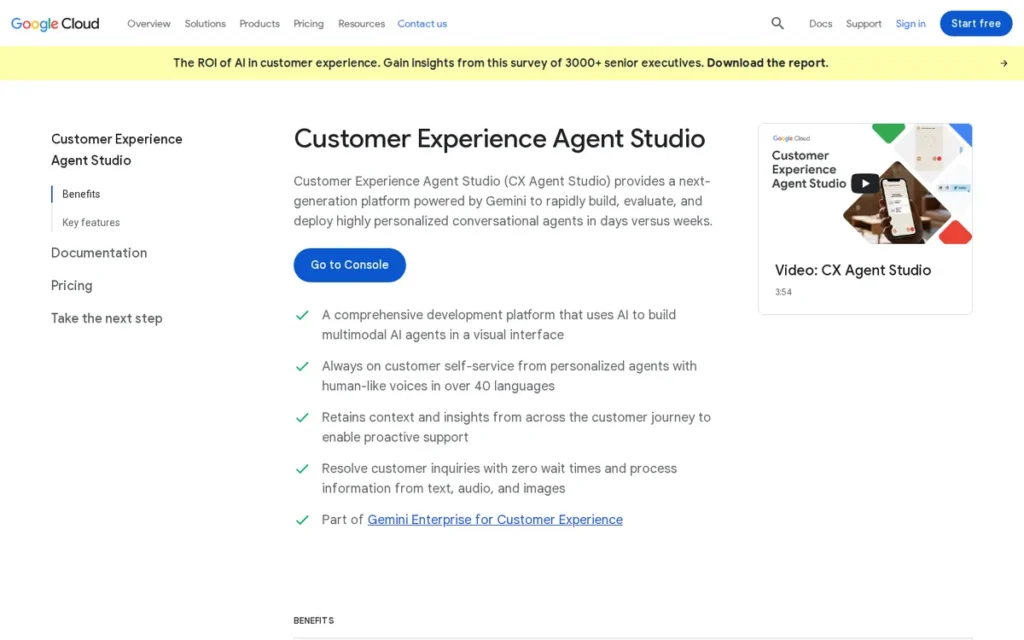
Category: Developer Framework, provides APIs, SDKs, and visual flow tools for building custom conversational agents within Google Cloud.
At a Glance
- Category: Developer Framework
- Best For: Technical teams on Google Cloud needing maximum control with transparent pricing
- Price Range: ES: $0.002/text request; CX: $0.007/text request, $0.06/audio minute
- Primary Strength: Google Dialogflow offers the most transparent and cost-effective per-request pricing in this evaluation with fully public rate cards
- Biggest Limitation: Google Dialogflow requires developer expertise, making it inaccessible to non-technical CX teams
- One-Line Summary: Google Dialogflow is a developer-centric conversational AI framework offering ES for simple agents and CX for complex multi-turn flows with transparent per-request pricing and Google Cloud-native NLU.
- Last Verified: April 2026
Overview
Google Dialogflow is a developer-centric conversational AI framework within Google Cloud that provides APIs and visual tools for building custom chat and voice agents, available in two editions, Essentials (ES) for simpler use cases and Customer Experience (CX) for complex, multi-turn conversational designs modeled as finite state machines. Google Dialogflow differentiates through the most transparent pricing in the enterprise conversational AI category and native integration with Google’s continuously advancing speech, NLU, and generative AI models.
Google Dialogflow originated as API.ai, acquired by Google in 2016, and has evolved to include generative AI capabilities through Playbooks and data stores as of 2025–2026. Google Dialogflow also powers conversational interfaces for Google Assistant, serving as an implicit large-scale deployment reference.
Key Features
- Visual Flow Builder (CX): Google Dialogflow CX models conversations as finite state machines with pages, flows, and state handlers, supporting up to 100 agents per project for complex, multi-turn designs.
- Low-Cost Entry Point (ES): Google Dialogflow ES offers a simpler intent-and-context architecture with pricing as low as $0.002 per text request, the lowest entry point in this evaluation.
- Text and Telephony Integrations: Google Dialogflow supports Genesys, Avaya, Voximplant, and AudioCodes, with advanced speech settings in CX for end-of-speech sensitivity and DTMF handling.
- Generative AI Evolution: Google Dialogflow’s newer Conversational Agents capabilities include Playbooks with data stores, generative fallbacks, and search agent data, evolving beyond rule-based into generative AI territory.
- Google Cloud Ecosystem: Google Dialogflow integrates natively with Google Assistant, Slack, Facebook Messenger, and Line, leveraging Google’s infrastructure for scalability.
Best For
Google Dialogflow is best suited for development teams that want maximum control over conversational agent architecture, need transparent per-request pricing without enterprise sales friction, and are already invested in or willing to commit to the Google Cloud ecosystem.
Pricing
Google Dialogflow publishes fully transparent, pay-per-use pricing with no mandatory sales calls:
- Dialogflow ES: $0.002/text request; $0.0065/15-second audio input
- Dialogflow CX: $0.007/text request; $0.06/audio minute
Google Dialogflow CX is approximately 2.5–3x more expensive than ES but provides significantly more advanced capabilities. A free tier is available for initial evaluation. No per-seat or subscription commitments required. (Google Cloud Pricing, 2026.)
Strengths
- Google Dialogflow has been continuously developed since Google’s acquisition of API.ai in 2016, making Google Dialogflow one of the longest-running and most iteratively refined conversational AI frameworks, now evolving into generative AI with Playbooks and data store integration as of 2025–2026.
- Google Dialogflow offers the most transparent pricing model in this evaluation alongside Retell AI, with fully public per-request rates and no mandatory sales engagement, a direct advantage over enterprise platforms requiring custom quotes.
- Google Dialogflow CX’s finite state machine architecture with reusable intents decoupled from fulfillment gives developers among the most precise control over conversation design of any platform evaluated.
- Google Dialogflow benefits from native access to Google’s continuously advancing speech recognition, NLU, and generative AI models, providing a foundation that improves with Google’s broader AI research investment.
Limitations
- Developer Dependency: Google Dialogflow requires engineering expertise for effective implementation, and non-technical CX teams cannot build or modify agents without developer support. Reddit users consistently position Google Dialogflow as “the developer’s platform”, powerful for technical teams but unsuitable for business-user-managed flows (r/webdev, 2021).
- Google Cloud Lock-In: Google Dialogflow is tightly coupled to Google Cloud infrastructure, creating ecosystem lock-in for organizations operating in multi-cloud or non-Google environments, with no on-premises or hybrid deployment option.
Users on r/googlecloud shared their experience:
“Huge enterprises. This is one corner of a product in a large platform, and general Google Cloud expertise usually doesn’t cover these dark corners. I’d find a purpose built solution before rolling your own on GCP.” Posted by u/sah0605
Takeaway: Google Dialogflow and its CCAI ecosystem require specialized expertise that general Google Cloud teams rarely possess, organizations without dedicated conversational AI engineers risk costly implementation failures.
- No Public Case Studies: Google Dialogflow lacks publicly available named enterprise case studies with quantified results, making it harder for buyers to assess real-world impact compared to Cognigy or Yellow.ai.
Verdict
Google Dialogflow is the strongest platform in this evaluation for technical teams that prioritize transparent pricing, maximum architectural control, and Google Cloud-native capabilities over no-code accessibility or vendor-managed deployment. Google Dialogflow’s dual-edition architecture provides a clear upgrade path from simple to complex agents, and Google Dialogflow’s pricing model is the most predictable in this evaluation. However, organizations without dedicated engineering resources or those committed to non-Google cloud infrastructure should prioritize other platforms.
5. Intercom (Fin AI Agent): Best for SaaS Customer Support
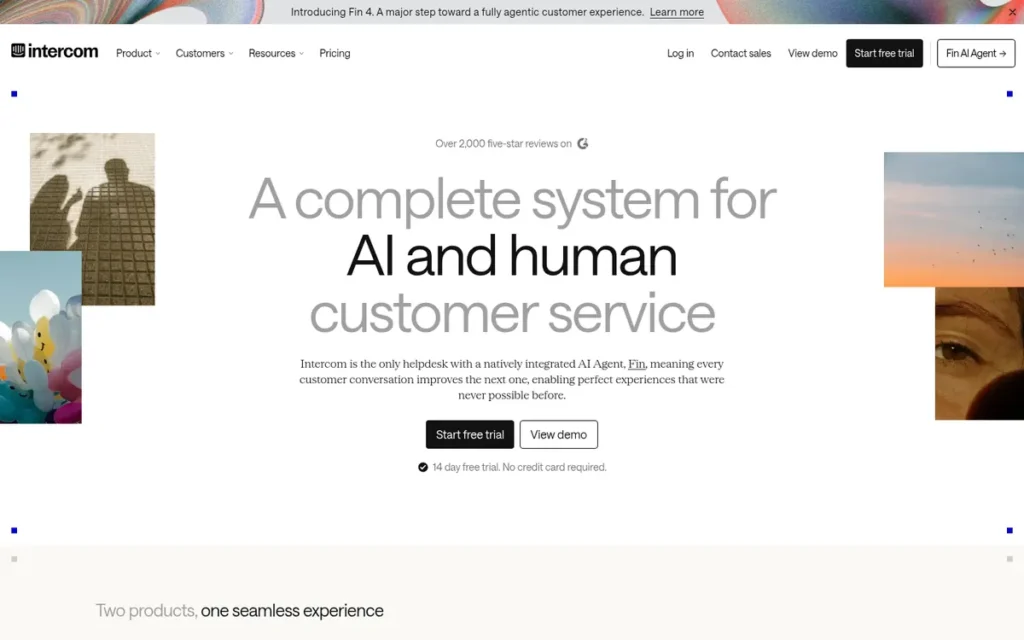
Category: AI Customer Service Agent, resolves customer support queries autonomously across chat, email, and messaging channels for SaaS and digital businesses.
At a Glance
- Category: AI Customer Service Agent
- Best For: SaaS companies with well-structured knowledge bases seeking AI-first support automation
- Price Range: $0.99 per AI resolution (plus base platform subscription)
- Primary Strength: Intercom’s outcome-based pricing ($0.99/resolution) uniquely ties costs to successful outcomes rather than seat counts
- Biggest Limitation: Intercom Fin has generated documented complaints of hallucinations, resolution-counting inflation, and knowledge base lock-in
- One-Line Summary: Intercom Fin AI Agent resolves support queries autonomously across chat, email, and messaging at $0.99 per resolution, built on Intercom’s established SaaS messaging platform.
- Last Verified: April 2026
Overview
Intercom Fin AI Agent is a purpose-built customer service AI that resolves support queries autonomously across live chat, email, tickets, phone, WhatsApp, SMS, and social media, priced at $0.99 per successful resolution rather than per seat or per message. Intercom differentiates through its three-pillar AI approach (Fin AI Agent for autonomous resolution, AI Copilot for real-time human agent assistance, and AI Analyst for support team insights) layered onto one of the most established customer messaging platforms in SaaS (founded 2011).
Intercom’s transition from customer messaging tool to AI-first service platform has been both ambitious and polarizing, generating some of the strongest user sentiment (both positive and negative) in this evaluation.
Key Features
- $0.99/Resolution Pricing: Intercom charges only when Fin successfully handles a query without human handoff, with annual resolution buckets and non-penalizing overages.
- AI Copilot: Intercom provides real-time human agent assistance during complex conversations, surfacing contextual suggestions and relevant knowledge base articles.
- AI Analyst: Intercom generates insights and recommendations for support leaders, identifying trends, resolution patterns, and team performance metrics.
- 45+ Language Support: Intercom Fin AI Agent operates across 45+ languages with real-time translation.
- Unified Inbox: Intercom consolidates customer interactions from chat, email, phone, WhatsApp, SMS, and social media into a single AI-powered workflow.
Best For
Intercom Fin AI Agent is best suited for SaaS companies that have well-maintained, centralized knowledge bases within Intercom’s ecosystem and want to automate routine support queries with outcome-aligned pricing, provided they carefully monitor resolution counting and cost trajectories.
Pricing
Intercom charges $0.99 per Fin AI resolution on top of the base platform subscription. Annual resolution buckets help manage costs. However, practitioners have documented unexpected cost increases (one user reported bills jumping from $3,000 to $8,500) because simple questions count as resolutions even when the customer closes the chat without confirmation (Kommunicate, 2025). (Pricing verified April 2026.)
Strengths
- Intercom launched the industry’s first major outcome-based AI pricing model ($0.99/resolution) in 2023, a structural innovation recognized by Chargebee (2024) as aligning vendor incentives with customer value delivery.
- Intercom reports that Fin handles over one million customer issues weekly across Intercom’s customer base as of 2025, demonstrating real-world automation scale even as quality consistency varies by configuration (GTM Newsletter, 2025).
- Intercom’s three-pillar AI approach (Agent + Copilot + Analyst) addresses the full customer service workflow rather than just automated deflection.
- Intercom supports 45+ languages with real-time translation and multi-channel deployment across chat, email, phone, WhatsApp, SMS, and social media.
Limitations
- Hallucination Frequency: Intercom Fin AI Agent has generated persistent hallucination complaints, with one user managing 300,000 monthly active users stating Fin “hallucinates all the time” despite access to 100,000 past conversations and hundreds of documentation pages (u/apt_13, r/CustomerSuccess, 2024).
“Pricing: $1 per resolved conversation sounds reasonable… until you realize that simple, repetitive questions like ‘How do I change my avatar?’ end up being more expensive than human support.”, u/RazTerr, r/SaaS
Takeaway: Intercom Fin’s per-resolution model can cost more than human support for simple, high-volume queries, run cost modeling with your actual ticket mix before committing.
- Resolution-Counting Inflation: Intercom Fin counts a query as resolved if the customer closes the chat without requesting a human, even if the answer was unhelpful, making Intercom’s $0.99/resolution model less predictable than it appears.
- Knowledge Base Lock-In: Intercom Fin works best when knowledge lives natively in Intercom’s articles, creating friction for organizations with distributed knowledge across Google Docs, Confluence, and Notion (u/Lee-Fields-Questions, r/SaaS, 2025).
Verdict
Intercom Fin AI Agent is the most established AI customer service tool for SaaS companies in this evaluation, offering an innovative outcome-based pricing model and a comprehensive AI suite that extends beyond chatbot deflection. However, prospective buyers should conduct thorough pilots with their specific knowledge base before committing, as practitioner reports suggest Intercom Fin performs significantly better in some configurations than others. Cost predictability requires careful monitoring of resolution-counting behavior.
6. IBM watsonx Assistant: Best for Regulated Industries Requiring Hybrid Deployment
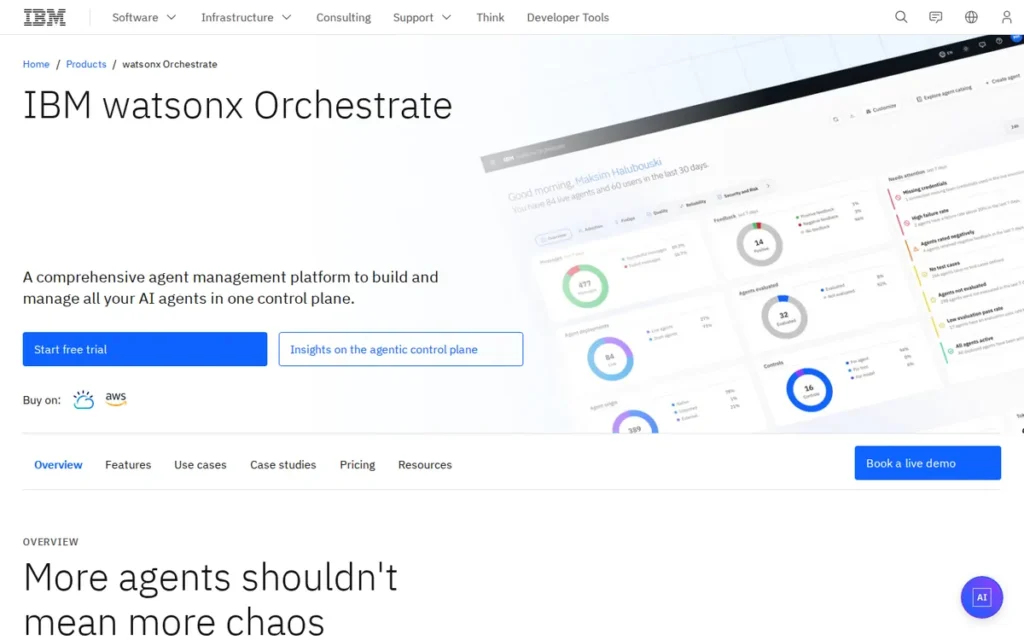
Category: Hybrid Enterprise Assistant, deploys conversational AI across on-premises, private cloud, hybrid, and multi-cloud environments for organizations with strict data sovereignty requirements.
At a Glance
- Category: Hybrid Enterprise Assistant
- Best For: Regulated enterprises in banking, healthcare, and government needing on-prem or hybrid deployment
- Price Range: Lite: Free; Plus: ~$140/month (1,000 MAUs); Enterprise: Custom
- Primary Strength: IBM watsonx Assistant is the only platform in this evaluation offering genuine on-premises and multi-cloud deployment across IBM Cloud, AWS, Azure, and Google Cloud
- Biggest Limitation: IBM watsonx Assistant has drawn significant criticism from within the IBM community itself regarding capability competitiveness
- One-Line Summary: IBM watsonx Assistant deploys conversational AI across on-premises, hybrid, and multi-cloud environments with RAG-powered knowledge search and compliance-grade security for regulated industries.
- Last Verified: April 2026
Overview
IBM watsonx Assistant is an enterprise conversational AI platform that supports deployment across on-premises, private cloud, hybrid, and multi-cloud environments (a deployment flexibility unmatched by any other platform in this evaluation) with NLU, RAG-powered conversational search, and compliance-grade security for regulated industries. IBM watsonx Assistant differentiates through deployment model versatility and security-first architecture, making IBM watsonx Assistant the default choice for organizations where data cannot leave specific geographic or infrastructure boundaries.
IBM watsonx Assistant traces its lineage to the Watson AI system that won Jeopardy! in 2011 and currently supports on-premises deployment via IBM Cloud Pak for Data (v4.6+), with active investment in hybrid capabilities confirmed by the May 2025 Red Hat Ansible Lightspeed update.
Key Features
- Multi-Cloud and On-Premises Deployment: IBM watsonx Assistant supports IBM Cloud, AWS, Azure, Google Cloud, private cloud, and on-premises infrastructure via Cloud Pak for Data, the only platform in this evaluation with this level of deployment flexibility.
- RAG-Powered Conversational Search: IBM watsonx Assistant combines LLMs with enterprise knowledge bases using Retrieval Augmented Generation for grounded, contextual responses.
- Low-Code Skills Studio: IBM watsonx Assistant includes a graphical workflow builder for designing conversation flows without extensive coding.
- Enterprise Ecosystem Integration: IBM watsonx Assistant integrates with IBM Watson Discovery, Watson Orchestrate, Salesforce, SAP, Microsoft Teams, and enterprise backends.
- Multilingual NLU: IBM watsonx Assistant supports 13–20+ languages with auto-detection, sentiment analysis, intent recognition, and entity extraction.
Best For
IBM watsonx Assistant is best suited for large regulated enterprises (particularly in banking, healthcare, government, and insurance) that have non-negotiable requirements for on-premises or hybrid deployment, data residency control, and compliance certifications, and are willing to accept higher implementation complexity in exchange for deployment sovereignty.
Pricing
IBM watsonx Assistant offers a Lite (free) tier for evaluation, a Plus tier reported at approximately $140/month for 1,000 monthly active users, and an Enterprise tier with custom pricing. Watson Orchestrate additions may increase total costs. Exact current pricing should be verified directly with IBM. (Pricing verified April 2026.)
Strengths
- IBM watsonx Assistant is the only platform in this evaluation offering verified on-premises, private cloud, hybrid, and multi-cloud deployment across all major cloud providers (IBM Cloud, AWS, Azure, Google Cloud) via Cloud Pak for Data (v4.6+), as documented in the IBM Cloud product catalog, critical for organizations with data sovereignty mandates.
- IBM watsonx Assistant’s lineage traces to the Watson AI system that won Jeopardy! in 2011, giving IBM watsonx Assistant the longest continuous AI development history of any platform evaluated, though current capabilities should be assessed on present merits.
- IBM watsonx Assistant provides enterprise compliance certifications including GDPR, data encryption, and residency control with processing capacity of thousands of queries per second.
- IBM watsonx Assistant’s integration with Watson Orchestrate extends the platform beyond conversational AI into multi-step workflow automation across enterprise systems.
Limitations
- Capability Perception Gap: IBM watsonx Assistant has drawn notable criticism from within the IBM community itself, with one Reddit user describing IBM watsonx Assistant as “the useless C Suite Executive of available options, all talk, no walk,” though defenders note IBM watsonx Assistant is “actually quite powerful” for B2B enterprise models (r/IBM, 2024).
“Before LLMs, Watson Assistant worked really well to build intent & search-based no-code chatbots. However, intent-based chatbots were difficult to scale across different domains.”, u/Kooky-Psychology-151, r/IBM
Takeaway: IBM watsonx Assistant was strong in the pre-LLM era but faces scaling challenges in the generative AI landscape, evaluate current capabilities, not historical reputation.
- Platform Transition Uncertainty: IBM watsonx Assistant is in active transition (with Watson Assistant potentially merging with Watson Orchestrate) creating uncertainty about long-term product direction (r/IBM, 2025).
- No Public Case Studies: IBM watsonx Assistant has no named enterprise case studies with quantified results publicly available for this evaluation, limiting evidence-based assessment of real-world impact.
Verdict
IBM watsonx Assistant is the only platform in this evaluation offering on-premises or hybrid conversational AI deployment with enterprise-grade data sovereignty, a requirement that eliminates every other platform evaluated here. For regulated industries with strict infrastructure constraints, IBM watsonx Assistant’s deployment flexibility is a decisive advantage. However, organizations without mandatory on-premises requirements should evaluate whether IBM watsonx Assistant’s current capabilities justify the implementation complexity when more agile, cloud-native alternatives are available.
7. Microsoft Copilot Studio: Best for Microsoft 365 Internal Agents
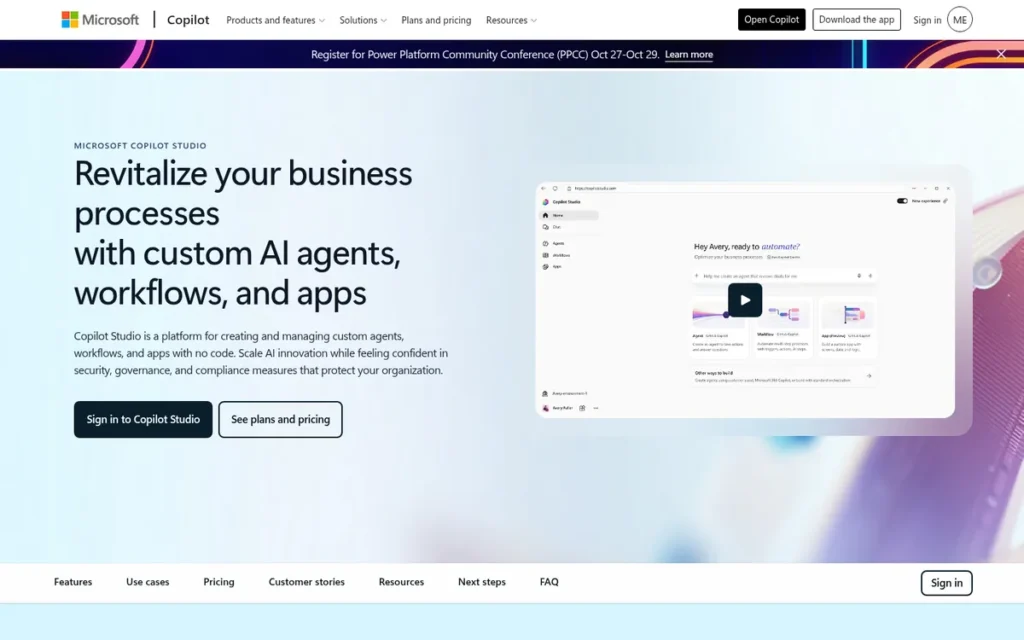
Category: Ecosystem Agent Builder, builds conversational agents within the Microsoft 365 and Power Platform ecosystem for internal and customer-facing use cases.
At a Glance
- Category: Ecosystem Agent Builder
- Best For: Microsoft 365-committed organizations needing internal AI agents grounded in Microsoft Graph data
- Price Range: Consumption-based Copilot Credits (Microsoft 365 Copilot license required); exact per-message costs not confirmed
- Primary Strength: Microsoft Copilot Studio provides the deepest native Microsoft 365 integration of any conversational AI platform
- Biggest Limitation: Microsoft Copilot Studio has drawn overwhelmingly negative feedback on platform maturity, bugs, and production-readiness
- One-Line Summary: Microsoft Copilot Studio is a low-code agent builder within the Microsoft 365 ecosystem creating conversational agents grounded in Microsoft Graph data, with deep Teams and SharePoint integration but documented maturity concerns.
- Last Verified: April 2026
Overview
Microsoft Copilot Studio is a low-code/no-code platform for building conversational AI agents within the Microsoft 365 and Power Platform ecosystem, enabling organizations to create agents grounded in Microsoft Graph data (emails, files, OneNote, calendar) and publish them to Teams, SharePoint, BizChat, and external channels. Microsoft Copilot Studio differentiates through unmatched Microsoft 365 integration and access to 1,400+ system connectors, making Microsoft Copilot Studio the natural choice for internal-facing agent use cases within Microsoft-centric organizations.
Microsoft Copilot Studio evolved from Power Virtual Agents and reached autonomous agent general availability in March 2025, with GPT-5 integration added in November 2025 Microsoft Learn, 2025.
Key Features
- Microsoft Graph Grounding: Microsoft Copilot Studio grounds agents in organizational emails, files, OneNote, and calendar data without requiring custom API integrations.
- 1,400+ System Connectors: Microsoft Copilot Studio provides connectors via Power Platform, Microsoft Graph, and Model Context Protocol (MCP) for cross-system agent operations.
- Multi-Model Choice: Microsoft Copilot Studio supports GPT-5 Chat and Anthropic models with deep reasoning capabilities and agent evaluation tools.
- Autonomous Agents (GA March 2025): Microsoft Copilot Studio enables agents that monitor events, execute tasks without user prompting, and connect to other agents.
- Agent Builder: Microsoft Copilot Studio includes in-app creation within Microsoft 365 applications with one-click upgrade to the full Studio environment.
Best For
Microsoft Copilot Studio is best suited for IT departments at organizations deeply invested in Microsoft 365 that need internal-facing AI agents for employee self-service, knowledge retrieval, and workflow automation within Teams and SharePoint, provided they have realistic expectations about current platform maturity.
Pricing
Microsoft Copilot Studio uses consumption-based Copilot Credits, available as pay-as-you-go or prepaid packs. A Microsoft 365 Copilot license is required as the base. Exact per-message costs are not publicly confirmed, and understanding included features versus credit-required features is not straightforward HSO Blog, 2025. (Pricing verified April 2026.)
Strengths
- Microsoft Copilot Studio integrated GPT-5 Chat in November 2025 and Anthropic models with multi-model choice, making Microsoft Copilot Studio one of the first enterprise platforms to offer next-generation LLM capabilities Microsoft Learn, 2025.
- Microsoft Copilot Studio’s 1,400+ system connectors through Power Platform and Microsoft Graph provide the widest integration surface within the Microsoft ecosystem of any platform evaluated.
- Microsoft Copilot Studio reached autonomous agent general availability in March 2025, enabling event-driven agents that execute tasks proactively, an early mover milestone in the enterprise agent builder category.
- Microsoft Copilot Studio provides the deepest Microsoft 365 grounding in this evaluation, allowing agents to access and act on organizational data natively.
Limitations
- Platform Immaturity: Microsoft Copilot Studio’s most consequential trade-off is its documented production-readiness gap. Reddit practitioners describe Microsoft Copilot Studio as “released too early” and “full of bugs,” with users finding unresolvable technical issues. Microsoft Copilot Studio has no verified G2 or Capterra ratings and no named enterprise case studies with quantified results, compounding this documented maturity gap (r/copilotstudio, 2025).
“My experience is there are better alternatives out there… I wouldn’t use it for anything serious.”, u/I_HEART_MICROSOFT, r/copilotstudio
Takeaway: Even users sympathetic to Microsoft acknowledge Microsoft Copilot Studio is not production-ready for serious deployments in its current state.
- Marketing-vs-Reality Gap: Microsoft Copilot Studio’s marketing claim of “easily and quickly create your own agent” is accurate only for extremely basic use cases, with non-trivial implementations requiring significant IT knowledge (r/copilotstudio, 2025).
- Pricing Complexity: Microsoft Copilot Studio’s Copilot Credits consumption model adds budget planning friction, with unclear boundaries between base-license features and credit-required capabilities.
Verdict
Microsoft Copilot Studio is the only platform in this evaluation offering conversational agents natively grounded in Microsoft 365 data and published within Teams and SharePoint, no other platform matches this ecosystem integration. However, Microsoft Copilot Studio is the least mature platform in this evaluation based on documented user experience, and organizations should approach Microsoft Copilot Studio with realistic expectations about current bugs and limited non-basic use case readiness. Buyers choosing Microsoft Copilot Studio are betting on Microsoft’s investment trajectory rather than current production reliability.
What Red Flags Should I Watch For When Evaluating Conversational AI Agents?
The five most reliable red flags when evaluating conversational AI platforms are: unverified automation percentage claims, resolution-counting inflation, no-code marketing that requires coding, zero-hallucination claims without independent verification, and opaque pricing with mandatory sales calls. These emerged consistently across Reddit discussions, review platforms, and independent analysis.
Red Flag #1: Automation Percentage Claims Without Named Case Studies
Platforms claiming “90%+ automation in 30 days” without providing named customer references with verifiable metrics are almost certainly overstating results. Enterprise automation professionals on Reddit have documented that even standardizing what can be automated takes longer than 30 days at large organizations.
Red Flag #2: Resolution-Counting Inflation
Outcome-based pricing models can inflate success metrics by counting interactions as “resolved” when the customer simply closes the chat without escalating, regardless of whether the answer was helpful. Practitioners report this creates unpredictable costs and misleading resolution rates.
When Intercom Fin counts a chat closure as a resolution (even if the customer got no useful answer) it reveals a broader truth: in conversational AI, how success is defined matters as much as whether it’s achieved. Ask every vendor: what counts as a successful interaction, and who decides?
Red Flag #3: No-Code Marketing vs. Coding Reality
Platforms marketed as “no-code” or “easily create agents” that require developer expertise for any non-basic implementation represent a consistent gap between positioning and reality. Multiple platforms in this evaluation have documented complaints about this disconnect.
Every platform in this evaluation offers a visual builder. None of them deliver production-grade agents without technical involvement for non-trivial use cases. The real question isn’t whether a platform is no-code, it’s how much code your specific implementation will require.
Red Flag #4: Zero-Hallucination Claims
Platforms claiming 0% or near-zero hallucination rates without independent verification should be treated with skepticism. No conversational AI platform has been independently verified to produce hallucination-free responses across all query types.
Red Flag #5: Opaque Pricing with Mandatory Sales Calls
Platforms that refuse to publish any pricing information force buyers into sales engagements before they can build a business case. While enterprise custom pricing is standard for large deployments, the complete absence of indicative pricing ranges signals either high costs or pricing that varies by buyer leverage.
“If I can’t find pricing information on a company’s web site, I know I can’t afford their product!”, u/ChristianGeek, r/webdev
Takeaway: Pricing transparency is a top buyer priority, platforms without public rate cards lose trust before evaluation begins.
What Questions Should I Ask Before Choosing a Conversational AI Platform?
Before choosing a conversational AI platform, ask vendors these five questions: how they define a “resolution,” whether they can provide named case studies with quantified results, what happens to your data if you switch, what technical skills are truly required beyond templates, and how they handle AI hallucination with debugging visibility.
Question #1: What percentage of queries does your AI agent resolve without human intervention, and how do you define a “resolution”?
Resolution definition is the single most important pricing and performance variable. Ask for the specific criteria that trigger a counted resolution, and whether customer abandonment (closing the chat without escalating) counts as resolved.
Question #2: Can I see a named customer case study with quantified results in my industry?
Generic customer logos are not evidence. Request named deployments with specific metrics (automation rates, cost savings, deployment timelines) in a comparable industry and at a comparable scale to your organization.
Question #3: What happens to my data and configurations if I decide to switch platforms?
Vendor lock-in takes many forms:
- Proprietary knowledge base formats
- Ecosystem dependencies
- Non-exportable conversation histories
Understand data portability, export capabilities, and whether your investment is recoverable.
Question #4: What technical skills does my team need to build, maintain, and iterate on agents beyond basic templates?
Ask for an honest assessment of the skills gap between template-based setup and production-grade deployment. Request examples of what is achievable without coding versus what requires engineering involvement.
Question #5: How does your platform handle AI hallucination, and what debugging visibility do I have into AI reasoning?
Ask for specific hallucination safeguard mechanisms:
- RAG (Retrieval Augmented Generation)
- Knowledge grounding
- Hybrid rule systems
Request user-facing debugging tools and examples of how the platform handles queries outside its knowledge base. Platforms that deflect this question may lack robust accuracy controls.
How Did We Rank These Conversational AI Agent Platforms?
These rankings reflect weighted scoring across six objective criteria applied equally to all seven platforms, using evidence from independent analyst reports, review platforms, community discussions, official documentation, and AI search engine responses. Rankings are determined by data, not vendor relationships, sponsorship, or form submission order.
Evaluation Process
PlugRoute evaluated each platform through a multi-source research methodology designed to surface both vendor-reported capabilities and unfiltered practitioner experiences:
- Queried multiple AI search engines (ChatGPT, Perplexity) with the same prompts to identify which platforms LLMs currently recommend and what information gaps exist
- Gathered independent web research from analyst firms (Gartner, Frost & Sullivan, Opus Research, Everest Group), review aggregators, and product documentation
- Analyzed Reddit community sentiment across relevant subreddits (r/SaaS, r/CustomerSuccess, r/copilotstudio, r/IBM, r/ProductivityApps, r/singularity)
- Cross-referenced vendor marketing claims against practitioner-reported experiences to identify credibility gaps
Ranking Criteria
Production Readiness & Documented Results (Primary): why it matters: Enterprise buyers need platforms proven at scale in live environments, not just impressive in demos. Named customer deployments with quantified outcomes are the strongest signal of platform maturity.
Omnichannel & Deployment Flexibility (Primary): why it matters: Organizations deploying across voice, chat, social, email, and messaging need unified experiences. Deployment model flexibility (cloud, on-prem, hybrid) determines whether regulated industries can adopt.
Accuracy & Hallucination Safeguards (Primary): why it matters: AI-generated responses that fabricate information damage customer trust and create liability. Platforms need verifiable accuracy controls, not just marketing claims.
Review Platform Ratings & Community Sentiment (Primary): why it matters: Aggregated user reviews and organic community discussions provide the most unfiltered view of platform strengths and weaknesses, free from vendor marketing influence.
Pricing Transparency & Value Predictability (Secondary): why it matters: Buyers building business cases need predictable costs. Opaque pricing and unexpected bill spikes are top frustrations reported by practitioners.
Realistic Ease of Implementation (Secondary): why it matters: The gap between “no-code” marketing and actual implementation requirements is a documented frustration across the category.
Evidence Weighting
When review platform ratings conflict with Reddit sentiment, PlugRoute weights specificity and recency. A detailed 2025 Reddit post from a practitioner processing thousands of interactions weekly outweighs a generic, undated G2 review. Primary criteria carry more weight than secondary criteria in the final ranking.
Data Validation
Vendor-reported statistics are labeled as such throughout the article. Only claims corroborated by at least one independent source are stated as fact. Where marketing claims have been publicly challenged by practitioners (e.g., Yellow.ai’s “90% automation in 30 days,” Microsoft Copilot Studio’s “easy agent creation”), both the claim and the challenge are presented.
Update Cadence
This article was last updated in April 2026. PlugRoute refreshes rankings quarterly or when significant product updates, pricing changes, or new analyst reports are published.
Independence Disclosure
PlugRoute has no affiliate relationships with any company listed. Rankings are determined entirely by research data and objective evaluation criteria.
Frequently Asked Questions
What is the best conversational AI platform for enterprise customer support in 2026?
Cognigy is the best conversational AI platform for enterprise customer support in 2026 based on named deployments at Lufthansa Group and Openreach, dual analyst endorsement from Frost & Sullivan and Opus Research, and a hybrid LLM-plus-rules architecture. Yellow.ai is the strongest alternative for organizations prioritizing global omnichannel reach across 35+ channels and 135+ languages.
How much does conversational AI agent software cost?
Conversational AI agent software costs range from free evaluation tiers to $8,000+/month for enterprise plans, with per-interaction models varying widely:
- Google Dialogflow ES: $0.002 per text request (lowest entry point)
- Google Dialogflow CX: $0.007 per text request
- Retell AI: $0.07–$0.31 per voice minute (component-based)
- Intercom Fin: $0.99 per AI resolution (outcome-based)
- IBM watsonx Assistant: Free tier available; Plus from ~$140/month
- Cognigy and Yellow.ai: Enterprise custom pricing (contact sales)
- Microsoft Copilot Studio: Consumption-based credits (per-unit costs not publicly confirmed)
How does PlugRoute determine rankings?
PlugRoute determines rankings through weighted scoring across six criteria using evidence from analyst reports, review platforms, Reddit discussions, and AI search engine responses, with zero affiliate relationships influencing results. The six criteria are:
- Production Readiness & Documented Results (Primary)
- Omnichannel & Deployment Flexibility (Primary)
- Accuracy & Hallucination Safeguards (Primary)
- Review Platform Ratings & Community Sentiment (Primary)
- Pricing Transparency & Value Predictability (Secondary)
- Realistic Ease of Implementation (Secondary)
What Do the Key Terms in This Comparison Mean?
Agentic AI: A category of artificial intelligence that can autonomously reason through multi-step tasks, make decisions, and take actions within enterprise systems without requiring explicit step-by-step instructions from a human, distinct from traditional chatbots that follow predefined conversational flows.
Turn-Taking Model: The AI mechanism that governs when a voice agent speaks, listens, and handles interruptions (barge-in) during a phone conversation. Turn-taking quality directly determines whether a voice AI sounds natural or robotic to callers.
RAG (Retrieval Augmented Generation): A technique that grounds LLM-generated responses in a specific knowledge base by first retrieving relevant documents, then generating an answer based on that retrieved context, reducing hallucination by anchoring responses in verified source material.
Resolution-Based Pricing: A billing model where the vendor charges per successfully resolved customer query (as defined by the vendor’s criteria) rather than per seat, per message, or per minute. Resolution definition and counting methodology significantly impact cost predictability.
MCP (Model Context Protocol): An open protocol that enables AI agents and models to communicate with each other and with external data sources in a standardized way, allowing multi-agent orchestration across enterprise systems without custom integration code.
Glossary: Key Terms Used in This Comparison
Agentic AI: A category of artificial intelligence that can autonomously reason through multi-step tasks, make decisions, and take actions within enterprise systems without requiring explicit step-by-step instructions, distinct from traditional chatbots that follow predefined conversational flows.
RAG (Retrieval Augmented Generation): A technique that grounds LLM-generated responses in a specific knowledge base by first retrieving relevant documents, then generating an answer based on that retrieved context, reducing hallucination by anchoring responses in verified source material.
Turn-Taking Model: The AI mechanism that governs when a voice agent speaks, listens, and handles interruptions (barge-in) during a phone conversation. Turn-taking quality directly determines whether a voice AI sounds natural or robotic to callers.
MCP (Model Context Protocol): An open protocol that enables AI agents and models to communicate with each other and with external data sources in a standardized way, allowing multi-agent orchestration across enterprise systems without custom integration code.
Resolution-Based Pricing: A billing model where the vendor charges per successfully resolved customer query rather than per seat, per message, or per minute. Resolution definition and counting methodology significantly impact cost predictability.
Which Conversational AI Platform Is Right for You?
The right conversational AI platform depends on your primary use case: Cognigy for enterprise contact centers, Yellow.ai for global omnichannel, Retell AI for voice, Dialogflow for developer teams, Intercom for SaaS support, IBM watsonx for regulated on-premises deployment, and Microsoft Copilot Studio for Microsoft 365 internal agents.
Key Insights
- Cognigy has the strongest documented enterprise deployment evidence in this evaluation, with named case studies at Lufthansa Group and Openreach and dual analyst endorsement from Frost & Sullivan and Opus Research in 2026.
- Yellow.ai offers the widest channel (35+) and language (135+) coverage for global deployments, but buyers should pressure-test Yellow.ai’s marketing claims against pilot results.
- Retell AI delivers the most production-ready voice AI experience based on practitioner parallel testing across thousands of live calls, with the most transparent pricing model.
- Google Dialogflow provides the most cost-effective and transparent per-request pricing for developer teams committed to Google Cloud.
- Intercom Fin AI Agent offers innovative outcome-based pricing for SaaS support but requires careful cost monitoring and knowledge base optimization to avoid documented pitfalls.
- IBM watsonx Assistant is the only platform in this evaluation supporting on-premises and hybrid deployment, a decisive advantage for regulated industries with data sovereignty mandates.
- Microsoft Copilot Studio provides unmatched Microsoft 365 integration but is the least mature platform in this evaluation, with documented bugs and production-readiness concerns.
The conversational AI market in 2026 rewards specificity over breadth: the platforms that score highest in this evaluation are those with the clearest use-case focus and the most verifiable production evidence, not those with the longest feature lists.
If you need proven enterprise scale with compliance controls, start your evaluation with Cognigy. If global omnichannel reach is your priority, Yellow.ai’s channel and language breadth is unmatched. Voice-first teams should pilot Retell AI before evaluating broader platforms.
For developer teams on Google Cloud, Dialogflow offers the best value. SaaS companies should consider Intercom Fin with active cost monitoring. Regulated industries with on-prem requirements have one option in this evaluation: IBM watsonx. Microsoft-centric organizations can explore Copilot Studio while accepting maturity trade-offs.
Before committing to any platform, request a 30-day pilot using your actual knowledge base, real customer queries, and production call volumes, demo environments consistently overperform live deployments in conversational AI.
We update this guide quarterly. Last updated: April 2026.
For more independent, data-driven SaaS reviews, visit PlugRoute.