LogicGate Risk Cloud leads the 2026 ERM software market as the only Forrester Wave™ Leader in the evaluated set, rated 4.7/5.0 on G2. MetricStream follows for the deepest agentic AI and regulatory coverage in large regulated enterprises. Riskonnect ranks third as the only platform natively unifying insurable risk management with enterprise GRC. All seven platforms use quote-only pricing.
CROs evaluating integrated risk management and GRC platforms face a market where rankings vary significantly across sources and no vendor publishes pricing tiers. Implementation timelines for platforms like MetricStream and Archer IRM are measured in months (not weeks) while buyers are forced into 4–6 parallel vendor sales cycles just to form baseline cost comparisons.
The ERM software market reached $6.00 billion in 2025, growing at 14.8% annually through 2030 (MarketsandMarkets, 2025). Professional services costs are growing faster (18.12% CAGR) than software licensing (16.55% CAGR), confirming that total cost of ownership routinely exceeds the license fee at the most complex platforms (Mordor Intelligence, 2025).
PlugRoute has no affiliate relationships with any company listed. Rankings are determined entirely by research data and objective evaluation criteria.
“No matter what tool you pick, none of them can fix a screwed up process.” Posted by u/bitslammer, r/cybersecurity
Takeaway: The ERM software category’s most experienced practitioners agree: platform selection is secondary to process clarity. This article addresses both.
TL;DR: Top Picks at a Glance
- Best Overall (No-Code + Forrester-Validated): LogicGate Risk Cloud: G2 4.7/5.0 (highest in set), only Forrester Wave™ Leader evaluated, Spark AI platform-wide at no extra cost.
- Best for Large Regulated Enterprise (AI Depth): MetricStream: April 2026 agentic AI with AI Trust Framework, DORA and Basel III/IV compliance support.
- Best for Insurance + GRC Convergence: Riskonnect: only platform unifying RMIS and enterprise GRC; Forrester Consulting TEI documents 280% three-year ROI.
- Best for Operational Resilience (DORA + Salesforce): Fusion Risk Management: four industry award wins (2023–2024), Salesforce-native dependency mapping, G2 4.6/5.0.
What Are the 3 Categories of ERM Software?
Enterprise risk management software falls into three architectural categories: Configurable Enterprise Platforms (Archer IRM, MetricStream), requiring dedicated administrators or developers; No-Code SaaS Platforms (LogicGate Risk Cloud, Resolver), enabling business user configuration without IT dependency; and Ecosystem-Bound Specialist Platforms (Fusion Risk Management, OneTrust, Riskonnect), delivering deep capability within a specific architectural or compliance-domain context.
Category 1: Configurable Enterprise Platforms
Archer IRM and MetricStream deliver maximum capability (15+ solution modules (Archer IRM) and unified multi-domain GRC with agentic AI (MetricStream)) but require dedicated administrators, systems integrators, or full-time GRC developers to realize that depth.
- Implementation timelines typically span 6–12 months with professional services costs that routinely equal or exceed first-year software licensing
- Suitable for: Very large enterprises with mature GRC programs, named Archer administrators or MetricStream-certified teams on staff, and multi-year budget commitments
- Not suitable for: Organizations that need productive risk management within one fiscal quarter, or those without dedicated GRC technical staff
Category 2: No-Code SaaS Platforms
LogicGate Risk Cloud and Resolver enable business users (not IT developers) to configure risk workflows, automated forms, and reporting structures without developer involvement.
- Important caveat: No-code does not mean no-effort. LogicGate Risk Cloud’s initial configuration phase (risk taxonomy design, workflow logic, and approval routing) typically requires 4–12 weeks with a dedicated GRC program manager, regardless of the drag-and-drop interface.
- Suitable for: Mid-to-large enterprises transitioning from spreadsheets, organizations without dedicated IT GRC developers, teams prioritizing user adoption over maximum customization
Category 3: Ecosystem-Bound Specialist Platforms
Fusion Risk Management, OneTrust, and Riskonnect each deliver independently validated depth in a specific domain:
- Fusion Risk Management: Salesforce-native operational resilience and DORA compliance
- OneTrust: privacy-first multi-jurisdiction compliance and AI governance
- Riskonnect: insurable risk programs (RMIS) combined with enterprise GRC
Self-Assessment Before Evaluating Any Platform
Before entering vendor conversations, answer these three questions:
- Is there a named internal GRC program manager who will own implementation and ongoing administration?
- Is your organization’s risk taxonomy defined: do you know what categories of risk you manage and how they relate?
- Does executive leadership have multi-year budget and timeline sponsorship confirmed?
If any answer is no, platform selection should pause until it is yes.
2026 ERM Platform Comparison: All 7 Platforms at a Glance
| Rank | Platform | Category | Best For | One-Line Summary | Key Capabilities | Primary Strength | Key Limitation |
|---|---|---|---|---|---|---|---|
| #1 | LogicGate Risk Cloud | No-Code GRC Platform | Mid-to-large enterprises seeking Forrester-validated no-code ERM with AI included | LogicGate Risk Cloud is the Forrester Wave™-validated, no-code ERM platform rated G2 4.7/5.0 with Spark AI platform-wide at no extra cost and Open FAIR™ Monte Carlo quantification | No-code graph database; Spark AI (Autofill, Automated Evidence Testing); 80+ integrations; Open FAIR™ Monte Carlo; unlimited framework auto-updates | Only Forrester Wave™ Leader (Q4 2023) among all seven evaluated platforms; highest scores in 8 Forrester criteria including user experience and pricing flexibility | Initial configuration requires 4–12 weeks with dedicated GRC program manager; no-code does not eliminate setup burden |
| #2 | MetricStream | Enterprise GRC Platform | Large regulated multinationals with mature GRC teams and multi-entity compliance needs | MetricStream is the enterprise GRC platform with the most advanced agentic AI (April 2026 M7 platform, AI Trust Framework) and deepest regulatory alignment including DORA and Basel III/IV | ConnectedGRC shared data model; April 2026 agentic AI; AI Trust Framework; Compliance.ai for DORA/Basel III/IV; LLM Model Gateway; Monte Carlo simulation | April 2026 M7 agentic AI with AI Trust Framework; most recently verified and most specifically documented AI implementation among evaluated ERM platforms | Complex bespoke implementation (6–12 months); $150,000–$500,000+ annually (estimate); requires mature GRC teams and multi-year executive sponsorship |
| #3 | Riskonnect | Integrated Risk Management (IRM) Platform | Organizations managing both GRC and insurable risk programs from one architecture | Riskonnect is the only enterprise risk platform to natively unify RMIS with GRC and ERM, backed by a Forrester Consulting TEI study documenting 280% three-year ROI | RMIS + GRC convergence; real-time KRI monitoring with automated threshold alerts; Monte Carlo simulation; API integrations for live finance/HR/incident feeds | Only evaluated platform combining RMIS with GRC in a single architecture; Forrester Consulting TEI study documents $1.7M labor savings and $758.5K in penalty reduction | No confirmed Forrester Wave or Gartner Magic Quadrant placement in available 2025–2026 public sources; AI capabilities less specifically documented than MetricStream or LogicGate Risk Cloud |
| #4 | OneTrust | Compliance and Privacy-Integrated GRC Platform | Global organizations where GDPR, DORA, EU AI Act, and multi-jurisdiction compliance are the primary risk drivers | OneTrust is the IDC MarketScape 2025 GRC Leader covering 50+ frameworks across 300+ jurisdictions with 200+ integrations and a dedicated AI Governance module for NIST AI RMF and EU AI Act | 50+ frameworks, 300+ jurisdictions, 200+ integrations; IDC MarketScape 2025 Leader; AI Governance module (NIST AI RMF, EU AI Act, ISO 42001); shared evidence framework; UK G-Cloud certified | IDC MarketScape 2025 Worldwide GRC Software Leader; broadest regulatory and jurisdiction coverage of any evaluated platform | Risk register module weaker than dedicated ERM platforms per practitioner consensus; requires dedicated administrator; scalability limitations for large enterprise ERM |
| #5 | Fusion Risk Management | Operational Resilience Platform | Salesforce-embedded regulated financial institutions requiring DORA compliance and operational resilience dependency mapping | Fusion Risk Management is the Salesforce-native operational resilience platform with four industry award wins (2023–2024), G2 4.6/5.0, and the most sophisticated cascading dependency mapping in the evaluated set | Salesforce-native architecture; cascading dependency mapping; DORA compliance; document-to-structured-data AI; scenario simulation; Business Continuity + TPRM + ERM integrated | Four confirmed industry award wins: Risk Technology Awards 2023 x2 (Op Risk Scenarios, third consecutive year; Third-Party Risk); RegTech Insight USA 2023; CIR 2024 | Salesforce-native architecture adds ~$30,000/year for non-Salesforce organizations; administrators require relational database expertise; ~400 organizations documented customer base |
| #6 | Resolver | ERM and Incident Management Platform | Mid-to-large enterprises transitioning from spreadsheets to formalized ISO 31000 or COSO ERM programs | Resolver is the ERM and incident management platform with the fastest documented time-to-productivity; named CCO testimonial: 2-hour training, 10-minute onboarding; and out-of-box ISO 31000 and COSO ERM alignment | Native incident-to-risk feedback loop; ISO 31000 and COSO ERM out-of-box; SIG vendor assessments; embedded AI for risk gap identification; 1,000+ global clients | Named CCO testimonial: 2-hour training-to-productivity, 10-minute new employee onboarding; most specific time-to-productivity claim in the evaluated set | Positioned above basic PM tools but below enterprise-complexity platforms for serious integration; no confirmed Forrester Wave or Gartner placement; AI least specifically documented in set |
| #7 | Archer IRM | Configurable IRM Platform | Very large enterprises (100,000+ employees) with dedicated Archer administrators and complex multi-domain IRM requirements | Archer IRM holds the most modular IRM architecture (15+ apps) with the lowest G2 rating (3.6/5.0, May 2026); appropriate only for organizations with dedicated Archer technical teams and large enterprise budgets | 15+ purpose-built solution apps; AI-powered control prioritization by financial impact; NIST-aligned app packs; RSA Security heritage; documented 80,000-employee deployment | Most modular IRM architecture in the evaluated set with RSA Security heritage credibility in regulated financial services and government | G2 3.6/5.0; lowest in set, 1.1 points below category leader; requires full-time Archer developers; consultant lock-in; dated UI; no confirmed Forrester Wave or Gartner placement |
Quick Decision Framework
| Your #1 Priority | Recommended Tool | Why | Acceptable Alternative |
|---|---|---|---|
| Forrester-validated no-code ERM with AI included, no developer dependency | LogicGate Risk Cloud (#1) | Only Forrester Wave™ Leader in the set (Q4 2023); G2 4.7/5.0 (highest); Spark AI platform-wide at no extra cost; no IT developer required for configuration | Resolver (#6) if fastest deployment speed is the top priority over financial quantification |
| Deepest agentic AI and regulatory coverage for large regulated enterprise | MetricStream (#2) | April 2026 agentic AI with AI Trust Framework; Compliance.ai for automated DORA and Basel III/IV monitoring; ConnectedGRC shared data model across 6 GRC domains | Riskonnect (#3) for organizations also managing insurable risk programs |
| Managing both insurance programs (RMIS) and enterprise GRC from one architecture | Riskonnect (#3) | Only evaluated platform natively combining RMIS with GRC; Forrester Consulting TEI documents 280% three-year ROI with $1.7M labor savings | No direct alternative; this is a unique architectural capability in the evaluated set |
| Global compliance-first: GDPR, EU AI Act, DORA, and multi-jurisdiction regulatory alignment | OneTrust (#4) | IDC MarketScape 2025 GRC Leader; 50+ frameworks, 300+ jurisdictions, 200+ integrations; dedicated AI Governance module for NIST AI RMF and EU AI Act | MetricStream (#2) for organizations that also need deep agentic AI and automated regulatory change monitoring |
| Salesforce-embedded regulated institution requiring DORA operational resilience | Fusion Risk Management (#5) | Only Salesforce-native ERM platform; four industry award wins (2023–2024); dependency mapping for DORA; ~$93K/year baseline (third-party estimate, CheckThat.ai, May 2026) | MetricStream (#2) for non-Salesforce organizations with similar DORA requirements |
| Fastest deployment and highest user adoption, ISO 31000/COSO out-of-box | Resolver (#6) | Named CCO testimonial: 2-hour training, 10-minute onboarding; Grow Financial credit union case study (30-dept centralization); ISO 31000 and COSO ERM without custom configuration | LogicGate Risk Cloud (#1) if financial quantification (Open FAIR™ Monte Carlo) is needed |
| Very large enterprise (100,000+ employees) with dedicated Archer administrators already on staff | Archer IRM (#7) | 15+ purpose-built solution apps; RSA Security heritage; documented 80,000-employee deployment | MetricStream (#2); if starting fresh without existing Archer investment or dedicated Archer staff |
Immediately Rule Out:
- Rule out Archer IRM if you do not have a full-time Archer-certified administrator confirmed and available before contract signing.
- Rule out Fusion Risk Management if your organization does not run Salesforce and cannot budget approximately $30,000/year for Salesforce AppExchange licensing on top of platform costs.
- Rule out MetricStream if you need productive risk management within six months of contract signing and lack a dedicated GRC implementation team.
- Rule out OneTrust as your primary ERM platform if operational risk management (not data privacy and compliance) is your program’s primary driver.
#1. LogicGate Risk Cloud: Best Overall for Mid-to-Large Enterprise: Forrester Wave™ Leader with No-Code ERM and Platform-Wide AI
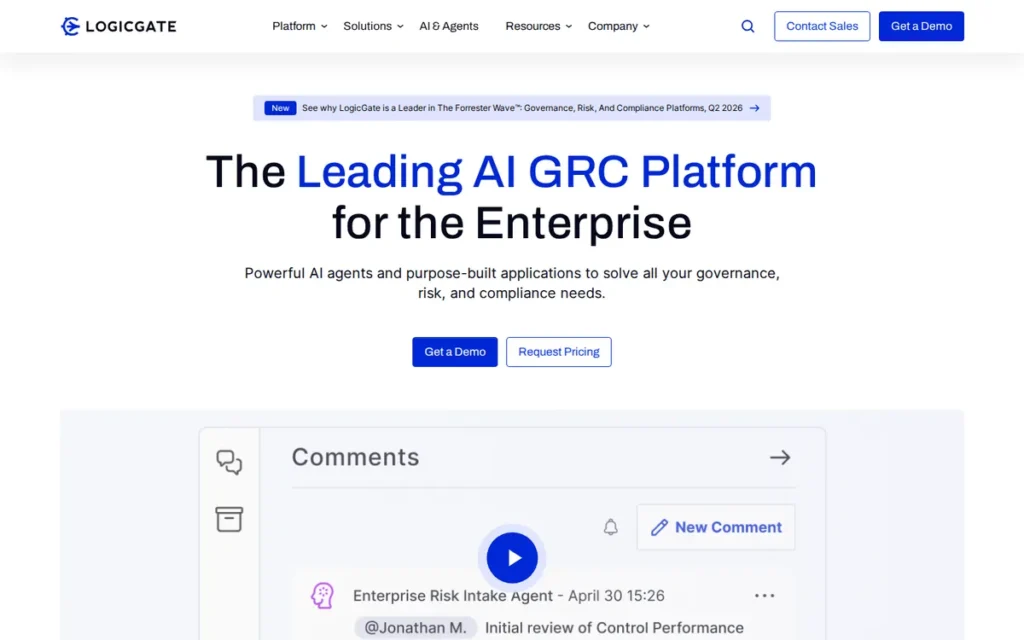
Category: No-Code GRC Platform, a no-code, graph-database ERM platform enabling business users to configure risk workflows, automate evidence collection, and quantify risk in financial terms without IT or developer dependency.
At a Glance
- Category: No-Code GRC Platform
- Best For: Mid-to-large enterprises seeking Forrester Wave-validated ERM with rapid no-code configuration, platform-wide AI automation, and financial risk quantification, particularly organizations transitioning from Archer IRM or building a first formalized ERM program without a dedicated IT development team
- Price Range: Pricing on request (modular subscription; Spark AI features included at no extra cost per available sources; contact LogicGate Risk Cloud directly for current pricing, verified May 2026)
- Primary Strength: LogicGate Risk Cloud is the only Forrester Wave™ Leader among all seven evaluated ERM platforms (Q4 2023), rated 4.7/5.0 on G2 (the highest in the evaluated set) with Spark AI automation included platform-wide at no additional licensing cost and Open FAIR™ Monte Carlo financial risk quantification.
- Biggest Limitation: LogicGate Risk Cloud’s no-code flexibility requires a dedicated GRC program manager to design risk taxonomies, workflow logic, and reporting architecture before the platform becomes productive, organizations deploying without defined processes and internal ownership risk an expensive, underutilized configuration.
- One-Line Summary: LogicGate Risk Cloud is the Forrester Wave™-validated, no-code ERM platform rated G2 4.7/5.0 (highest in the evaluated set) that enables mid-to-large enterprises to build, link, and automate risk workflows without developer dependency, with Spark AI (Forrester: “user experience is second to none,” Q4 2023) and Open FAIR™ Monte Carlo quantification included at no additional licensing cost.
- Last Verified: May 2026
Overview
LogicGate Risk Cloud is a no-code GRC platform serving mid-to-large enterprises without IT developer dependency, rated 4.7/5.0 on G2, the highest in the evaluated set, and named a Leader in the Forrester Wave™: Governance, Risk, and Compliance (GRC) Platforms, Q4 2023, as the only evaluated platform to hold this independent analyst designation. LogicGate Risk Cloud received the highest possible scores in eight specific Forrester criteria, including user experience, workflow automation, policy management, content delivery, and pricing flexibility, with Forrester documenting that its “user experience is second to none” based on reference customer ratings. LogicGate Risk Cloud’s defining differentiators are its no-code graph database architecture and Spark AI suite, both available platform-wide without separate licensing, enabling GRC business owners, not IT departments, to configure and evolve risk programs independently.
Key Features
- No-Code Graph Database: LogicGate Risk Cloud’s graph database architecture enables risk managers, compliance leads, and audit teams to build custom workflows, forms, and automation rules using a visual drag-and-drop builder, with no IT department or developer involvement required, making workflow changes accessible to GRC business owners rather than queued for IT resources.
- Spark AI (Platform-Wide, No Extra Cost): LogicGate Risk Cloud includes Spark AI across the entire platform at no additional licensing cost as of May 2026, delivering Autofill to eliminate manual data entry, Automated Evidence Testing, Reporting Insights that surface compliance gaps, and a Text Assistant for drafting policies and control descriptions, without requiring a separate AI module purchase.
- Risk Cloud Quantify® (Open FAIR™ Monte Carlo): LogicGate Risk Cloud’s Risk Cloud Quantify® module integrates the Open FAIR™ Model and Monte Carlo simulations to translate qualitative risk ratings into financial exposure ranges, enabling CROs to communicate enterprise risk to boards and executives in dollar terms rather than color-coded heat maps.
- 80+ Enterprise Integrations: LogicGate Risk Cloud connects to 80+ enterprise systems through RESTful API, SCIM 2.0 user provisioning, Jira, Snowflake, Workday, and SIEM platform integrations, with cross-module data linking that unifies ERM, cyber risk, third-party risk, audit, and compliance data in a single connected graph.
- Unlimited Pre-Mapped Framework Content with Auto-Updates: LogicGate Risk Cloud provides unlimited access to pre-mapped compliance frameworks including HITRUST, the Secure Controls Framework, ISO, and NIST standards, with automated content updates each time a framework releases a new version, eliminating the manual re-mapping burden for compliance teams managing multiple overlapping frameworks.
Best For
LogicGate Risk Cloud is best for mid-to-large enterprises that need a Forrester-validated ERM platform with rapid time-to-value, have a designated GRC program manager to lead initial configuration, and want AI-powered automation and financial risk quantification included without premium add-on licensing. LogicGate Risk Cloud is particularly well suited for organizations currently running Archer IRM who are evaluating no-code alternatives that eliminate developer dependency while maintaining enterprise-grade depth.
Strengths
- LogicGate Risk Cloud was named a Leader in the Forrester Wave™: Governance, Risk, and Compliance (GRC) Platforms, Q4 2023 (the only platform among the seven evaluated to hold this confirmed designation) with Forrester documenting that LogicGate Risk Cloud’s “user experience is second to none,” having received the highest possible scores in eight criteria including user experience, workflow automation, policy management, and pricing flexibility, with reference customers rating it highest compared to all other evaluated vendors (Forrester Wave™ GRC Platforms, Q4 2023).
- LogicGate Risk Cloud earned a G2 rating of 4.7/5.0 as of May 2026: the highest among all seven evaluated platforms, and received a 9/10 rating from independent third-party reviewer Sprinto, which assessed LogicGate Risk Cloud as a “central hub for GRC” with particular strength in flexible workflows, quantitative risk modeling, and integrations.
- LogicGate Risk Cloud includes Spark AI capabilities across the entire platform at no additional licensing cost as of May 2026 (including Automated Evidence Testing, Autofill for data entry elimination, and Reporting Insights) positioning LogicGate Risk Cloud favorably against competitors that license AI automation as a premium add-on tier, with Forrester documenting that LogicGate dedicates a larger revenue percentage to innovation than most GRC platform peers.
- LogicGate Risk Cloud’s documented real-world migration from Archer IRM (u/Abject-Emphasis937, r/cybersecurity, 2024) demonstrates viability as an upgrade path for organizations re-evaluating developer-dependent legacy GRC platforms, with the practitioner citing LogicGate Risk Cloud as a more accessible alternative for their enterprise use case.
Limitations
LogicGate Risk Cloud’s most consequential trade-off is that “no-code” does not mean “no effort”: the platform’s flexibility requires a dedicated GRC program manager to design risk taxonomies, workflow logic, and reporting architecture before the system delivers any risk management value. The initial configuration phase typically requires 4–12 weeks of dedicated workflow design and taxonomy definition regardless of the drag-and-drop interface. Secondary limitations include:
- Admin Setup Burden: Sprinto’s independent review (verified May 2026) and Complyjet user analysis both document a steep initial setup burden, organizations that lack a named GRC program owner before deployment consistently under-utilize the platform’s configurability.
Users evaluating no-code GRC platforms in r/cybersecurity observed:
“The issue I’ve seen with some of the new tools is that they are trying to solve the difficulty with GRC by providing a template. If by luck that template matches the needs and goals of the org then that’s great, but many of them are a ‘my way or the highway’ kind of model and don’t offer much flexibility. We have soothing like 42 legal entities that make up the parent company and the needs and workflow for those aren’t all the same.” Posted by u/bitslammer
Takeaway: No-code GRC platforms that rely on pre-built templates expose their limits at multi-entity organizations with 40+ legal entities or highly non-standard workflow requirements, LogicGate Risk Cloud’s graph-database flexibility reduces but does not eliminate this structural constraint.
- Manual Reporting Configuration: Despite no-code workflow building, reporting structure design in LogicGate Risk Cloud requires manual configuration, reporting capabilities are only as strong as the taxonomy and data model built during initial setup.
- Process Prerequisite: The practitioner who made the documented Archer-to-LogicGate Risk Cloud migration noted: “the tool is secondary to having good processes defined” (u/Abject-Emphasis937, r/cybersecurity, 2024), applying most directly to LogicGate Risk Cloud, where configurability amplifies both well-defined and poorly defined processes equally.
Takeaway: LogicGate Risk Cloud rewards organizations with process clarity and dedicated GRC program ownership; it produces expensive complexity for organizations that deploy before defining their risk taxonomy.
Verdict
LogicGate Risk Cloud is the highest-rated ERM platform on G2 (4.7/5.0, May 2026) and the only confirmed Forrester Wave™ Leader among major ERM platforms evaluated in 2025–2026, making it the strongest independently validated choice for mid-to-large enterprises prioritizing no-code configurability, high-adoption deployment, and AI-included automation without developer dependency. LogicGate Risk Cloud’s Spark AI platform-wide inclusion at no extra cost and Open FAIR™ Monte Carlo financial quantification capability deliver genuine workflow differentiation against platforms licensing AI as premium add-ons. LogicGate Risk Cloud rewards organizations with a named GRC program manager and well-defined risk processes, organizations without these foundations should address process maturity before selecting any platform in this list.
#2. MetricStream: Best for Regulated Large Enterprise: Most Advanced AI-Powered GRC with Deepest Regulatory Alignment
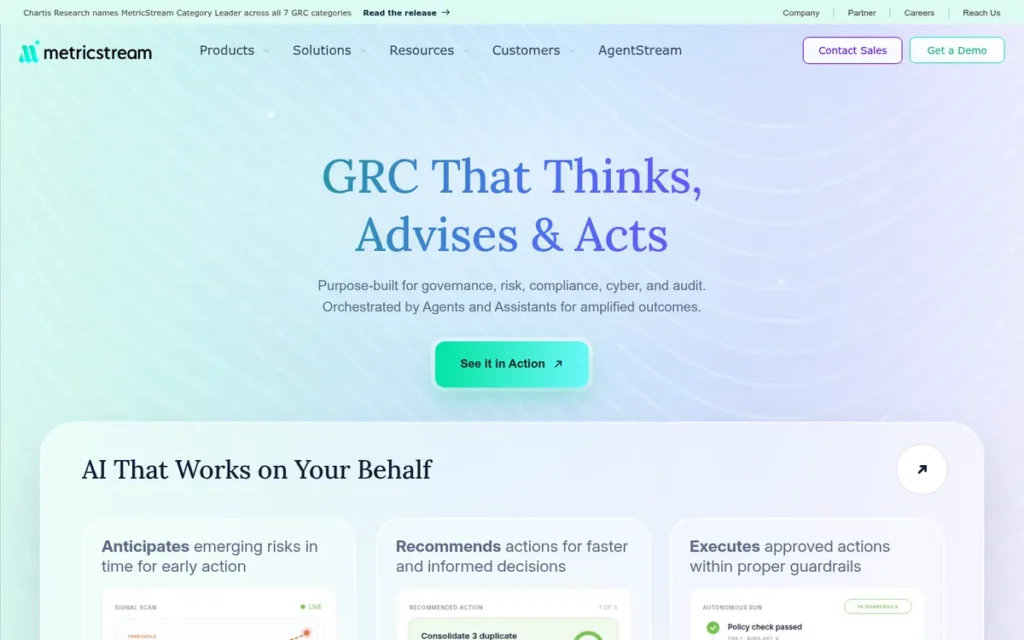
Category: Enterprise GRC Platform, a large-enterprise GRC platform unifying risk management, compliance, audit, cybersecurity, third-party risk, and ESG in a single shared-data-model architecture with April 2026 agentic AI capabilities and documented DORA and Basel III/IV regulatory support.
At a Glance
- Category: Enterprise GRC Platform
- Best For: Large, regulated multinationals in financial services, healthcare, or technology with mature GRC teams, complex multi-entity compliance requirements (DORA, Basel III/IV, SOX, GDPR), and organizational capacity to support a 6–12 month implementation with ongoing professional services
- Price Range: $150,000–$500,000+ annually (industry analyst estimate range: verify directly with MetricStream; no specific dollar amounts publicly disclosed as of May 2026)
- Primary Strength: MetricStream’s April 2026 M7 agentic AI platform delivers automated risk assessments, evidence gathering, and regulatory summarization governed by an AI Trust Framework that prevents customer data from training foundation models, the most advanced and most recently verified AI implementation among evaluated ERM platforms.
- Biggest Limitation: MetricStream requires complex, bespoke implementations typically spanning 6–12 months with significant professional services investment, making it unsuitable for organizations without dedicated GRC teams, multi-year implementation budgets, and sustained executive sponsorship.
- One-Line Summary: MetricStream is the enterprise GRC platform with the most advanced agentic AI capabilities (April 2026 M7 platform with AI Trust Framework), the deepest documented regulatory alignment including DORA and Basel III/IV, and an independent GRC 20/20 Research validation, purpose-built for large, regulated organizations with mature GRC programs and multi-year implementation budgets.
- Last Verified: May 2026
Overview
MetricStream is the enterprise GRC platform serving large, regulated multinationals with mature GRC programs, complex multi-entity compliance requirements, and dedicated implementation teams, built on a ConnectedGRC architecture that unifies risk, compliance, audit, cybersecurity, third-party risk, and ESG in a single shared data model. MetricStream’s April 2026 M7 platform release introduced agentic AI automation, an AI Trust Framework explicitly preventing customer data from training foundation models, and an LLM Model Gateway, the most recently verified and most specifically documented AI-for-GRC implementation in the evaluated set (MetricStream official blog, April 2026). MetricStream’s central trade-off is direct: ConnectedGRC depth requires a 6–12 month implementation timeline and $150,000–$500,000+ in annual investment, making MetricStream the right choice specifically for organizations where regulatory alignment and agentic AI depth justify the total cost of ownership.
Key Features
- ConnectedGRC Shared Data Model: MetricStream’s ConnectedGRC platform unifies risk management, compliance, audit, cybersecurity, third-party risk, and ESG in a single shared data model with many-to-many mappings between risks, assets, controls, and processes, eliminating the GRC information siloes that characterize multi-tool approaches at complex, multi-entity enterprises.
- April 2026 Agentic AI and AI Trust Framework: MetricStream’s M7 AI platform (April 2026 enhancements) deploys agentic AI to automate risk assessments, evidence gathering, and compliance actions, governed by an AI Trust Framework that prevents customer data from training foundation models and provides auditable AI decision trails for regulated industry deployment (MetricStream official blog, April 2026).
- Compliance.ai Regulatory Monitoring Integration: MetricStream integrates with Compliance.ai to deliver automated regulatory change monitoring and control mapping across Basel III/IV, DORA, GDPR, and other financial and data privacy regulations, automatically surfacing new requirements and mapping them to internal controls without manual compliance team intervention.
- LLM Model Gateway and Regulatory Summarization: MetricStream’s LLM Model Gateway (April 2026) enables governed access to large language models for GRC workflows including regulatory text summarization, AI-powered control narrative generation, and automated red-flag detection across risk and compliance datasets, with human oversight requirements and auditability built into every workflow.
- Monte Carlo Simulation and Quantitative Risk Analysis: MetricStream supports Monte Carlo simulation for quantitative risk analysis alongside AI-driven control recommendations, enabling CROs to communicate risk exposure in financial terms for board and executive reporting beyond qualitative heat maps alone.
Best For
MetricStream is best for large, regulated enterprises in financial services, healthcare, or technology with annual GRC program budgets exceeding $150,000, dedicated GRC teams capable of sustaining a 6–12 month implementation, and multi-entity compliance obligations spanning DORA, Basel III/IV, SOX, GDPR, and ESG disclosure mandates. MetricStream delivers maximum value to organizations where ConnectedGRC’s regulatory depth and agentic AI capabilities justify the implementation investment and ongoing total cost of ownership.
Strengths
- Independent analyst Michael Rasmussen of GRC 20/20 Research: a recognized independent GRC analyst firm, documented based on customer interactions that MetricStream customers achieved “an integrated and connected view of GRC information, reporting, and processes with a single source of truth… improving visibility while also eliminating the overhead of manual processes,” providing one of the few verified third-party assessments from a named independent analyst in the ERM software category (GRC 20/20 Research, 2024–2025).
- MetricStream released its most significant AI platform enhancements in April 2026, including agentic AI for automated risk assessments and evidence gathering, an AI Trust Framework preventing customer data from training foundation models, LLM Model Gateway for governed LLM access, and automated red-flag identification, making MetricStream the most recently and specifically documented AI-for-GRC platform among evaluated vendors at time of research (MetricStream official blog, April 2026).
- MetricStream holds documented support for DORA (Digital Operational Resilience Act, effective January 2025), with Compliance.ai integration for automated regulatory monitoring across multiple jurisdictions, and native framework coverage spanning COSO, Basel III/IV, SOX, and GDPR, the deepest and most specifically documented multi-framework regulatory alignment of any evaluated platform.
- Verified enterprise reviewers on Gartner Peer Insights rated MetricStream’s comprehensive GRC capability highly, and third-party analysis cites a Forrester study documenting 133% ROI from MetricStream’s AI GRC platform with payback under six months (briefglance.com citing Forrester, May 2026, secondary source; verify against the original Forrester report before use in procurement).
Limitations
MetricStream’s most consequential trade-off is that its ConnectedGRC architecture delivers the market’s most comprehensive enterprise-scale GRC capability, but at an implementation cost and operational overhead that makes it genuinely unsuitable for organizations without mature GRC programs, dedicated administrative capacity, and multi-year deployment budgets.
Users in r/ITManagers with hands-on GRC platform experience shared their view:
“I wouldn’t call them the big 5. OneTrust, MetricStream, Prevalent, Riskonnect, and Fusion are probably the big 5. Stay way from MetricStream. Prevalent could be used. Auditboard is great especially connected with Compliance. Onetrust requires a great deal of customization which is where they make their money.” Posted by u/TopSec1
Takeaway: MetricStream’s reputation for complexity generates active “avoid” recommendations from practitioners evaluating it for mid-market use cases, confirming its viability is confined to the organizational tier where scale and GRC program maturity genuinely match the platform’s demands.
Secondary limitations include:
- Implementation Complexity and Services TCO: MetricStream implementations are described across multiple 2026 comparison sources as “bespoke, complex… needing significant planning” with timelines of 6–12 months and professional services costs that routinely match or exceed first-year software licensing.
- Cultural and Process Readiness Required: The practitioner warning “the culture of a company dictates what is feasible in terms of GRC processes and tooling, if you start by looking at the features of a tool you will spend a lot and risk gaining no traction in an organisation and the tool will become a burden rather than something useful” (u/reticlefries2, r/cybersecurity, 2024) applies most acutely to MetricStream’s feature-heavy architecture.
Takeaway: MetricStream’s capability is proportional to the organizational readiness required to realize it, purchasing MetricStream before reaching that readiness generates expensive underutilization.
- Not No-Code: MetricStream’s platform is not designed for business user self-configuration and requires GRC practitioners with technical backgrounds and ongoing training investment to operate and evolve effectively.
- Conditional ROI: Third-party-cited Forrester analysis of 133% ROI assumes successful deployment by a mature team with sustained executive sponsorship, the same preconditions that make MetricStream viable in the first place, making the ROI claim conditional rather than baseline-guaranteed.
Verdict
MetricStream is the most AI-advanced enterprise GRC platform available in 2026, combining April 2026 agentic AI automation, an AI Trust Framework with auditable decision trails, documented DORA and Basel III/IV compliance support, and an independent GRC 20/20 Research validation, making it the top-ranked choice for large, regulated multinationals with mature GRC programs and multi-year implementation budgets. MetricStream’s depth comes with well-documented implementation complexity (6–12 months, $150,000–$500,000+ annually), making it the right choice specifically for organizations where regulatory alignment and agentic AI depth justify the total cost of ownership. Organizations without a named, dedicated GRC implementation team confirmed before contract signing should evaluate LogicGate Risk Cloud or Resolver first.
#3. Riskonnect: Best for Insurance-Integrated Enterprise Risk: Only Platform Unifying RMIS and GRC in a Single Architecture
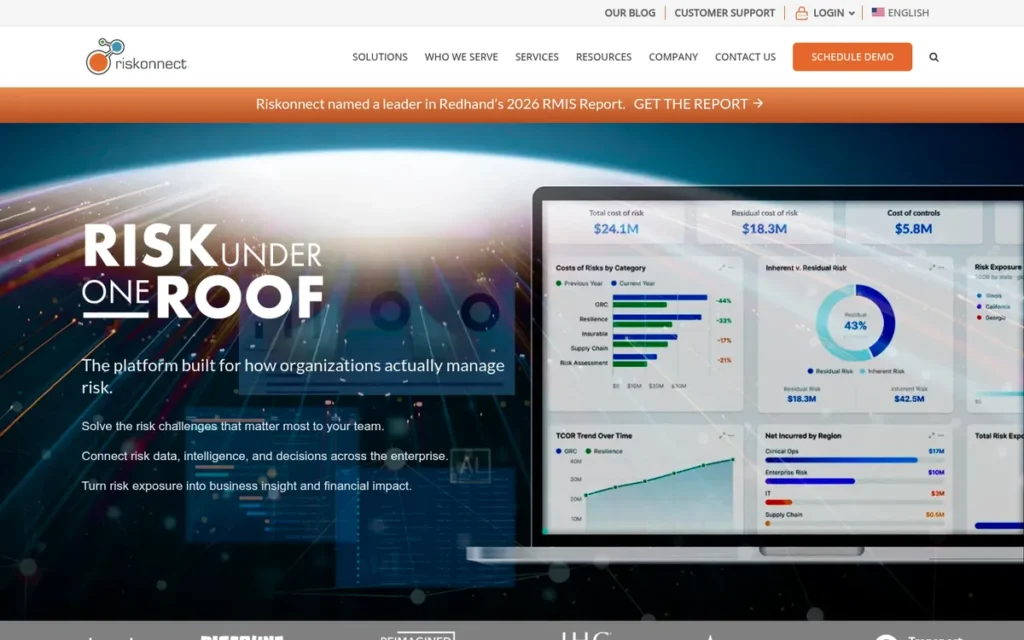
Category: Integrated Risk Management (IRM) Platform (a unified platform merging insurable risk management (RMIS: claims, workers’ compensation, property/casualty) with GRC functions including ERM, audit, compliance, and third-party risk) uniquely serving organizations whose risk function oversees both insurance programs and enterprise governance risk.
At a Glance
- Category: Integrated Risk Management (IRM) Platform
- Best For: Mid-to-large enterprises and global organizations where the risk management function is accountable for both GRC/ERM responsibilities AND insurable risk programs (workers’ compensation, property/casualty, health and safety claims), particularly those in finance, healthcare, retail, manufacturing, and insurance
- Price Range: Pricing on request (quote-only; enterprise custom pricing: contact Riskonnect directly; no public tiers or dollar amounts disclosed as of May 2026)
- Primary Strength: Riskonnect is the only enterprise risk platform in the evaluated set to natively unify insurable risk management (RMIS) with GRC and ERM functions in a single architecture, supported by a Forrester Consulting Total Economic Impact™ study documenting 280% three-year ROI, including $1.7 million in labor cost savings, $758,500 in reduced incident penalties, and $164,000 in TPRM improvements.
- Biggest Limitation: Riskonnect does not hold a confirmed Forrester Wave or Gartner Magic Quadrant placement in available 2025–2026 public research, and its AI capabilities are less specifically documented than MetricStream’s April 2026 agentic AI or LogicGate Risk Cloud’s Spark AI, limiting independent analyst validation for enterprises that use analyst quadrant reports as vendor pre-qualification criteria.
- One-Line Summary: Riskonnect is the only enterprise risk management platform to natively unify insurable risk management (RMIS) with GRC and ERM in a single architecture, backed by a Forrester Consulting TEI study documenting 280% three-year ROI ($1.7M labor savings, $758.5K in penalty reduction, $164K in TPRM improvements) and OCEG GRC Capability Model recognition.
- Last Verified: May 2026
Overview
Riskonnect is the only enterprise IRM platform to natively merge insurable risk management, including workers’ compensation claims, property/casualty programs, and health and safety tracking, with GRC functions such as audit, compliance, policy management, third-party risk, and ERM in a single unified architecture. Riskonnect serves a global enterprise customer base (vendor-stated: 900+ organizations across six continents, verify directly with Riskonnect for current figures, May 2026) with OCEG GRC Capability Model recognition and a Forrester Consulting Total Economic Impact™ study documenting 280% three-year ROI based on a U.S. financial services firm implementation. Riskonnect’s key trade-off for procurement teams is the absence of a confirmed Forrester Wave or Gartner Magic Quadrant placement in available 2025–2026 public sources, which may present a gap for enterprises with formal analyst quadrant pre-qualification requirements.
Key Features
- RMIS and GRC Convergence (Unique in the Evaluated Set): Riskonnect natively merges insurable risk management (including workers’ compensation claims, property/casualty programs, and health and safety incident tracking) with GRC functions (audit, compliance, policy management, third-party risk, and ERM) in a single unified architecture, eliminating data siloes that occur when insurance risk and enterprise risk live in separate systems requiring manual reconciliation.
- Real-Time KRI Monitoring with Automated Threshold Alerts: Riskonnect provides real-time Key Risk Indicator monitoring with automated threshold alerts and escalation rules, connecting live data feeds from finance, HR, incident management, and operational systems via API integrations, enabling risk teams to transition from manual KRI aggregation to automated, continuous risk posture visibility.
- Monte Carlo Simulation and AI-Driven Control Recommendations: Riskonnect supports Monte Carlo simulation and AI-driven control recommendations within its ERM module, enabling quantitative risk modeling and automated prioritization of control actions based on risk exposure thresholds rather than manual risk ranking.
- Personalized Stakeholder Dashboards and Industry Templates: Riskonnect delivers personalized dashboards for every stakeholder level (from frontline risk owners through the board) with preconfigured forms, industry-specific templates, and pre-built workflows designed to accelerate deployment across financial services, healthcare, retail, manufacturing, and insurance.
- OCEG GRC Capability Model Alignment: Riskonnect holds OCEG GRC Capability Model alignment from the Open Compliance and Ethics Group (the primary standards body for GRC frameworks globally) providing standards-body framework recognition for enterprise procurement processes requiring third-party credentialing beyond G2 ratings (OCEG partner directory, verified May 2026).
Best For
Riskonnect is best for mid-to-large enterprises where the risk management function is accountable for both strategic and operational GRC programs AND insurable risk management, organizations where the same team manages workers’ compensation claims, property insurance programs, health and safety incidents, and enterprise risk governance simultaneously. Riskonnect is particularly well suited to organizations in insurance, healthcare, finance, or manufacturing that require industry-specific templates and a large global peer customer reference base.
Strengths
- A Forrester Consulting Total Economic Impact™ study (commissioned by Riskonnect, based on a U.S. financial services firm implementation) documents a 280% three-year ROI including $1.7 million in labor cost savings equivalent to 6 FTEs, $758,500 in reduced incident-related penalties from real-time risk monitoring, and $164,000 in TPRM workflow automation improvements, upgrading the evidence tier from vendor-self-reported to commissioned third-party financial analysis (Forrester Consulting TEI study, cited May 2026). Note: as a commissioned study rather than an independently initiated analyst report, readers should weigh this evidence in that context.
- Riskonnect holds OCEG GRC Capability Model alignment from the Open Compliance and Ethics Group and serves a global enterprise customer base that the company describes as 900+ organizations across six continents (vendor-stated, verify directly with Riskonnect for current figures, May 2026), representing one of the most extensive enterprise customer bases described in the evaluated set.
- Riskonnect ranked first in 7 of 10 reviewed 2026 ERM software roundup articles, including TrackerNetworks’ 2026 Buyer’s Guide and Centraleyes analysis (the highest editorial frequency ranking of any evaluated platform) reflecting broad editorial consensus across multiple independent review sources.
- Riskonnect’s unique RMIS and GRC convergence serves a specific organizational need no other evaluated platform addresses: risk managers accountable for both insurable risk programs and GRC governance functions from a single data model, making Riskonnect the only viable option for this organizational profile regardless of competitor capabilities in other dimensions.
Limitations
Riskonnect’s most consequential trade-off is that its consistent #1 editorial ranking across 2026 roundup lists is not supported by confirmed placement in Forrester Wave or Gartner Magic Quadrant reports in publicly available 2025–2026 research, a significant gap for procurement teams at enterprises that use analyst firm placements as vendor pre-qualification criteria before committing to formal RFP processes. Secondary limitations include:
- Commissioned TEI vs. Independent Analyst Quadrant: The Forrester Consulting TEI study documenting 280% ROI is meaningful evidence, but a commissioned study fulfills a different procurement standard than an independently authored Forrester Wave or Gartner Magic Quadrant placement, procurement teams with formal analyst-quadrant requirements should note this distinction explicitly.
- AI Documentation Depth: Riskonnect’s AI capabilities (Monte Carlo simulation, AI-driven control recommendations) are less specifically documented in available public sources than MetricStream’s April 2026 agentic AI suite or LogicGate Risk Cloud’s named Spark AI features, limiting independent AI capability evaluation without a direct vendor briefing.
- Community Forum Presence: Riskonnect receives fewer direct practitioner community discussions than Archer IRM or OneTrust in r/cybersecurity threads, though the characterization “tailors functionality to specific industries” (u/FondantIndividual935, r/cybersecurity, November 2024) is consistent with its insurance-heritage positioning and suggests the platform operates primarily in enterprise procurement channels.
Takeaway: Riskonnect is the only viable platform for organizations requiring RMIS and GRC convergence, but procurement teams with formal analyst quadrant pre-qualification requirements must factor the absence of confirmed quadrant placements into their evaluation process.
Verdict
Riskonnect is the only enterprise risk management platform to natively unify insurable risk management (RMIS) with GRC and ERM in a single architecture, serving a global enterprise customer base with OCEG-recognized capability and real-time KRI monitoring, making it uniquely suited to organizations whose risk managers oversee both insurance programs and enterprise governance risk from a single platform. Riskonnect’s Forrester Consulting TEI-validated 280% three-year ROI provides meaningful financial evidence for procurement business cases, and its #1 editorial frequency in 2026 roundups reflects broad editorial consensus among independent reviewers. Procurement teams at enterprises with formal Forrester Wave or Gartner Magic Quadrant pre-qualification requirements should explicitly evaluate the absence of confirmed quadrant placements as a procurement risk factor alongside Riskonnect’s unique architectural strengths.
#4. OneTrust: Best for Privacy-First and Global Compliance-Driven Organizations: IDC MarketScape 2025 Leader with Widest Regulatory Coverage
Category: Compliance and Privacy-Integrated GRC Platform, a GRC platform built on a privacy and data governance foundation extending to enterprise risk management, third-party risk, IT risk, and AI governance, covering 50+ compliance frameworks across 300+ jurisdictions with 200+ integrations and named a Leader in the IDC MarketScape: Worldwide GRC Software 2025 Vendor Assessment.
At a Glance
- Category: Compliance and Privacy-Integrated GRC Platform
- Best For: Global organizations: particularly EU-based or EU-regulated enterprises, where data privacy, GDPR, DORA compliance, and multi-jurisdiction regulatory alignment are the primary risk program drivers, and where the same team oversees privacy, third-party risk, AI governance, and IT risk from a single platform
- Price Range: Pricing on request (newer flat-price model per community sources; historically per-module pricing generated community criticism; contact OneTrust for current pricing, no specific dollar amounts publicly disclosed as of May 2026)
- Primary Strength: OneTrust was named a Leader in the IDC MarketScape: Worldwide GRC Software 2025 Vendor Assessment (evaluators stating OneTrust “has the ability to manage virtually all organizational risk, audit, and privacy control programs under one platform”) and covers 50+ compliance frameworks across 300+ jurisdictions with 200+ pre-built integrations, the broadest regulatory scope of any evaluated platform (IDC, 2025).
- Biggest Limitation: OneTrust’s risk register module is specifically cited by practitioners as weaker than dedicated ERM platforms, the tool requires a dedicated administrator, and multiple community sources flag scalability limitations for large enterprise ERM deployments, reflecting its privacy-management heritage more than a ground-up enterprise risk architecture.
- One-Line Summary: OneTrust is the IDC MarketScape 2025 GRC Leader covering 50+ compliance frameworks across 300+ jurisdictions with 200+ integrations and a dedicated AI Governance module for NIST AI RMF and EU AI Act compliance, making it the top choice for global, compliance-first organizations, with the trade-off that its risk register is weaker than dedicated ERM platforms and the tool requires a dedicated administrator.
- Last Verified: May 2026
Overview
OneTrust is the compliance and privacy-integrated GRC platform for global organizations where data privacy, GDPR, and multi-jurisdiction compliance are the primary risk drivers, founded in 2016 by CEO Kabir Barday with GDPR-timing strategic positioning, and named a Leader in the IDC MarketScape: Worldwide GRC Software 2025 Vendor Assessment, with evaluators noting that OneTrust “has the ability to manage virtually all organizational risk, audit, and privacy control programs under one platform” (IDC, 2025). OneTrust covers 50+ compliance frameworks across 300+ jurisdictions with 200+ pre-built integrations, and launched a dedicated AI Governance solution in 2023 with NIST AI RMF, EU AI Act, OECD AI Principles, and ISO 42001 templates, the earliest dedicated AI governance module among evaluated platforms. OneTrust’s documented trade-off is that its privacy-management heritage produces a GRC platform where the risk register component is weaker than dedicated ERM alternatives, and the tool requires a dedicated administrator to operate effectively.
Key Features
- Broadest Regulatory and Jurisdiction Coverage (50+ Frameworks, 300+ Jurisdictions, 200+ Integrations): OneTrust provides compliance coverage across 50+ frameworks and 300+ jurisdictions through a proprietary shared evidence framework (with dedicated support for GDPR, DORA, CCPA, HIPAA, SOX, and emerging global privacy and data regulations) the highest documented regulatory and jurisdiction breadth among all seven evaluated ERM platforms (OneTrust Tech Risk and Compliance product page, verified May 2026).
- AI Governance Module (NIST AI RMF, EU AI Act, ISO 42001): OneTrust’s AI Governance solution (launched 2023, expanded through 2025–2026) enables organizations to inventory, assess, and monitor AI model risks (including bias, privacy, ethical, and operational risks) with pre-built templates for NIST AI RMF, OECD AI Principles, EU AI Act compliance, and ISO 42001, integrated with MLOps pipelines for continuous AI model monitoring.
- Automated Risk Flagging and First-Line Assessment Workflows: OneTrust’s ERM module includes automated risk flagging based on custom scoring models, first-line assessment workflows for business unit risk owners, risk registers, and AI-driven dashboards providing continuous risk posture visibility, with a shared evidence framework enabling reuse of compliance evidence across multiple regulatory frameworks without duplicating documentation.
- 200+ Pre-Built Integrations for Enterprise Connectivity: OneTrust delivers 200+ pre-built integrations for connecting risk data from security tools, HR systems, procurement platforms, and SaaS applications, one of the highest integration counts in the evaluated set for organizations seeking a single source of truth across distributed enterprise environments.
- IDC MarketScape 2025 Leader and UK G-Cloud Certification: OneTrust was named a Leader in the IDC MarketScape: Worldwide GRC Software 2025 Vendor Assessment and holds a UK G-Cloud Framework listing confirming it meets public sector cloud procurement standards, providing dual-track validation of platform breadth and public-sector procurement readiness (IDC MarketScape, 2025; UK Digital Marketplace, verified May 2026).
Best For
OneTrust is best for global organizations (particularly EU-based or EU-regulated enterprises) where data privacy, GDPR compliance, and multi-jurisdiction regulatory alignment are the primary risk management priorities, and where the same team oversees privacy, third-party risk, AI governance, and IT risk from a single platform. OneTrust is particularly well positioned for organizations facing EU AI Act compliance obligations in 2025–2026, given its dedicated AI governance module pre-mapped to NIST AI RMF and OECD AI Principles with MLOps pipeline integration.
Strengths
- OneTrust was named a Leader in the IDC MarketScape: Worldwide GRC Software 2025 Vendor Assessment, with evaluators stating that “OneTrust has the ability to manage virtually all organizational risk, audit, and privacy control programs under one platform” (IDC MarketScape, 2025), a confirmed independent analyst firm placement directly comparable in editorial value to LogicGate Risk Cloud’s Forrester Wave Q4 2023 designation.
- OneTrust launched its AI Governance solution in 2023: among the earliest enterprise GRC platforms to offer dedicated AI model risk management, and expanded through 2025–2026 with real-time bias and drift monitoring integrated with MLOps pipelines, EU AI Act compliance workflows, and LLM Model Gateway, positioning OneTrust as the most mature dedicated AI governance platform in the evaluated set for organizations facing EU AI Act enforcement obligations (OneTrust AI Governance product page; PR Newswire, 2023).
- OneTrust covers 50+ compliance frameworks across 300+ jurisdictions with 200+ pre-built integrations and holds a UK G-Cloud Framework listing (the highest documented regulatory and jurisdiction coverage of any evaluated platform, verified against the UK Digital Marketplace G-Cloud service listing (May 2026)) confirming procurement-readiness for UK public sector and regulated organizations.
- Practitioner u/meapet (r/cybersecurity, 2024 documented GRC evaluation) assessed OneTrust as “mature in its platform, easy to understand the flow from Policy to controls to evidence,” specifically selecting it for policy-controls-evidence workflow maturity, third-party risk integration capability, and organizational scalability over time.
This aligns with community sentiment on r/cybersecurity:
“I chose OneTrust for my business because it is mature in its platform- its easy to understand the flow from Policy to controls to evidence, has a 3rd party risk component, and integrations that make my evidence generation easier. Its risk register component isn’t the greatest, and there’s room for improvement, but they do listen and improve when you have meetings with them. Another reason I chose them over other solutions was the ability to grow with them- in the future if my company needs a privacy add on, or an enterprise risk add-on they have those available and easy to add to our account.” Posted by u/meapet
Takeaway: OneTrust earns the strongest practitioner praise for its policy-to-controls-to-evidence compliance workflow, the area where its privacy-heritage architecture is most fully realized and the clearest signal that OneTrust is best suited to compliance-first programs.
Limitations
OneTrust’s most consequential trade-off is that its privacy-management heritage produces a GRC platform where the risk register component is weaker than dedicated ERM alternatives (specifically noted by practitioner u/meapet (r/cybersecurity, 2024) as “not the greatest”) and the platform’s scalability for large enterprise ERM is flagged by multiple community sources as a limitation. Secondary limitations include:
- Dedicated Administrator Requirement: Practitioner u/afroq1 (r/cybersecurity, 2024) documented the need to “bug their customer support to do anything,” with OneTrust requiring a dedicated administrator for setup and ongoing configuration, representing ongoing operational cost beyond software licensing.
Users on r/cybersecurity noted:
“OneTrust should be good, but it’s not. In the most random ways! You need a dedicated admin to set up and bug their customer support to do anything.” Posted by u/afroq1
Takeaway: Budget dedicated administrator headcount into any OneTrust procurement, this is an ongoing operational role, not occasional IT support.
- Large Enterprise ERM Scalability: Multiple community sources flag OneTrust’s scalability for large enterprise ERM deployments: “probably doesn’t scale for large companies” (u/arunsivadasan, r/cybersecurity, 2024), reflecting an architectural boundary for organizations with very complex, multi-entity ERM requirements beyond compliance management.
- IDC Leader Does Not Equal Risk Register Depth: OneTrust’s IDC MarketScape 2025 Leader designation validates overall platform breadth and strategy, not risk register depth or enterprise ERM scalability specifically. The practitioner-documented risk register weakness is an architectural characteristic that analyst evaluations at the platform-strategy level are not designed to surface.
- AI Governance Architecture Consideration: A competitor analysis (Credo AI competitive blog (competitor source; conflict of interest applies) characterizes OneTrust’s AI governance features as less suited to dynamic AI lifecycles than AI-native platforms) an architectural concern partially corroborated by the privacy-heritage limitation documented across community sources, and worth evaluating directly during any demo focused on AI governance workflows.
Verdict
OneTrust is the GRC platform with the broadest regulatory and jurisdiction coverage (50+ frameworks, 300+ jurisdictions, 200+ pre-built integrations), the IDC MarketScape 2025 Worldwide GRC Software Leader designation, and the most mature dedicated AI Governance module among evaluated platforms, making it the top-ranked choice for global, compliance-first organizations with EU AI Act, GDPR, and DORA obligations. OneTrust’s breadth comes with documented trade-offs: a weaker risk register than dedicated ERM platforms, admin overhead, and scalability questions for large enterprise ERM programs that go beyond compliance management. OneTrust is the right choice for organizations where compliance and privacy are the primary risk program drivers, organizations whose primary need is operational risk management, insurance risk, or incident-integrated ERM should evaluate higher-ranked platforms.
#5. Fusion Risk Management: Best for Operational Resilience and Business Continuity: Salesforce-Native with Four Industry Award Wins and DORA-Specific Depth
Category: Operational Resilience Platform, a Salesforce-native enterprise risk and operational resilience platform specializing in dependency mapping, business continuity management, IT disaster recovery, and DORA compliance support, purpose-built for regulated financial services, healthcare, and manufacturing organizations already operating on Salesforce.
At a Glance
- Category: Operational Resilience Platform
- Best For: Regulated financial services institutions (banking, insurance), healthcare systems, and manufacturing enterprises that run Salesforce as their operational backbone, require DORA compliance support or OCC Heightened Standards, and need cascading dependency mapping to demonstrate interconnected risk pathways to regulators and boards
- Price Range: ~$93,000/year baseline for comprehensive deployment (third-party estimate, CheckThat.ai, May 2026); additional ~$30,000/year Salesforce AppExchange license required for non-Salesforce organizations; verify directly with Fusion Risk Management for current pricing
- Primary Strength: Fusion Risk Management holds four confirmed industry award wins across 2023–2024: Risk Technology Awards 2023, Op Risk Scenarios Product of the Year (third consecutive year, also won 2021 and 2022) and Third-Party Risk Product of the Year; RegTech Insight Awards USA 2023, Best Solution for Operational Resilience; CIR Risk Management Awards 2024, Specialist Company of the Year (Fusion Risk Management press releases, verified May 2026).
- Biggest Limitation: Fusion Risk Management’s Salesforce-native architecture adds approximately $30,000/year for non-Salesforce organizations, administrators require strong relational database understanding per named G2 reviewer, and the operational resilience specialization may underdeliver for organizations whose primary ERM priority is financial risk quantification rather than BCM and DORA.
- One-Line Summary: Fusion Risk Management is the Salesforce-native operational resilience platform with four confirmed industry award wins (2023–2024), G2 4.6/5.0 (second highest in the set), documented DORA compliance support, and cascading dependency mapping serving Salesforce-embedded regulated enterprises, with the trade-off that non-Salesforce organizations must budget approximately $30,000/year in additional Salesforce AppExchange licensing.
- Last Verified: May 2026
Overview
Fusion Risk Management is the Salesforce-native operational resilience and ERM platform founded in 2006 in Chicago, the oldest purpose-built operational resilience software company in the evaluated set, targeting regulated financial services, healthcare, and manufacturing organizations already operating on Salesforce, and backed by Vista Equity Partners institutional capital. Fusion Risk Management holds four confirmed industry award wins across 2023–2024, earned a G2 rating of 4.6/5.0 (second highest in the evaluated set), and reports clients including Fidelity Investments and Fannie Mae (per third-party aggregator CheckThat.ai, verify directly with Fusion Risk Management, as Fusion’s official documentation references 400+ organizations without naming specific clients). Fusion Risk Management’s fundamental trade-off is that its Salesforce-native architecture delivers exceptional integration value for Salesforce-embedded organizations but adds approximately $30,000/year in Salesforce AppExchange licensing for non-Salesforce buyers.
Key Features
- Cascading Dependency Mapping (DORA-Aligned): Fusion Risk Management’s dependency mapping engine connects risks across people, processes, places, systems, and vendors in a single visual architecture, enabling organizations to trace how a single vendor failure or system outage cascades across the enterprise, providing the operational resilience impact analysis required by DORA for EU financial institutions.
- Salesforce-Native Architecture (150,000+ Ecosystem Connections): Fusion Risk Management is built natively on Salesforce, inheriting Salesforce’s enterprise security model, permissions framework, mobile-first experience, and AppExchange ecosystem, enabling seamless data integration for organizations already running Salesforce without API bridging complexity.
- Document-to-Structured-Data AI Transformation: Fusion Risk Management’s AI capabilities transform unstructured documents (policies, procedures, vendor contracts) into structured risk data by automatically identifying services, systems, and suppliers within document text, reducing the manual data-entry burden of operational resilience planning that typically requires weeks of analyst time.
- Integrated Operational Resilience Suite: Fusion Risk Management integrates Enterprise Risk Management, Business Continuity, IT Disaster Recovery, Crisis and Incident Management, and Third-Party Risk into a single connected platform with scenario simulation capabilities based on real operating models and historical disruption event data.
- Dual-Track Third-Party Validation (Salesforce AppExchange + OCEG): Fusion Risk Management holds Salesforce AppExchange certification (confirming completion of Salesforce’s security review and technical standards compliance) and OCEG recognition for integrated risk and resilience programs, providing dual-track validation for enterprise procurement teams requiring both technical security and framework-body credentialing (verified May 2026).
Best For
Fusion Risk Management is best for regulated financial services institutions (banking, insurance, credit), healthcare systems, and manufacturing enterprises that already run Salesforce as a core enterprise system, face DORA, OCC Heightened Standards, or Federal Reserve operational resilience requirements, and need cascading dependency mapping to demonstrate interconnected risk pathways to regulators and boards. Fusion Risk Management delivers maximum value when the Salesforce integration dividend and Risk Technology Award-validated operational resilience depth outweigh the additional Salesforce licensing costs for non-Salesforce organizations.
Strengths
- Fusion Risk Management holds four confirmed industry award wins across 2023–2024: Risk Technology Awards 2023, Op Risk Scenarios Product of the Year (third consecutive year, having also won in 2021 and 2022) and Third-Party Risk Product of the Year; RegTech Insight Awards USA 2023, Best Solution for Operational Resilience; CIR Risk Management Awards 2024, Specialist Company of the Year, the strongest industry-specific award record in the evaluated set and the only platform with multiple consecutive wins in an operational resilience-specific award category (Fusion Risk Management official press releases, verified May 2026).
- Fusion Risk Management earned a G2 rating of 4.6/5.0 as of May 2026: the second highest in the evaluated set, with third-party analysis (CheckThat.ai, May 2026) citing interactive dashboards assessed as more accessible than Archer IRM’s and overall usability rated favorably versus SAP GRC, Oracle, and Protecht in independent comparison.
- Fusion Risk Management was founded in 2006 in Chicago, predating the 2008 financial crisis that elevated regulatory attention to operational resilience, and is backed by Vista Equity Partners, providing institutional financial stability and access to growth capital across a large portfolio network of potential enterprise customers.
- Fusion Risk Management’s Aureon case study documents the platform enabling data-driven risk prioritization by consistently ranking high-risk items across locations, giving leadership “a very clear picture” of risks for prioritized action and replacing subjective priority-setting with structured data-based analysis (Fusion Risk Management Aureon Case Study, publicly available).
Limitations
Fusion Risk Management’s most consequential trade-off is that its Salesforce-native architecture creates a structural licensing dependency, organizations not already embedded in Salesforce must budget approximately $30,000/year for Salesforce AppExchange licensing inaddition to the ~$93,000/year platform baseline (third-party estimate, CheckThat.ai, May 2026), making Fusion Risk Management meaningfully more expensive for non-Salesforce buyers than the platform price alone suggests. Secondary limitations include:
- Relational Database Administration Expertise Required: G2 reviewer Greg Dodson (Sr. Director of Operational Risk and Strategy, Coca-Cola Consolidated) documented that “administrators must have a strong understanding of how relational databases work to be successful administering the system”, a technical expertise barrier for organizations without in-house Salesforce administration capability.
- Ad Hoc Customization Fragility: An additional G2 reviewer documented that “straying from out-of-box solutions can lead to breaks in data and flows with any ad hoc changes,” adding implementation fragility risk for highly customized Fusion Risk Management deployments.
- Operational Resilience Specialization Trade-Off: Fusion Risk Management’s BCM and DORA focus delivers maximum value for operational resilience programs, but may underdeliver for organizations whose primary ERM priorities are financial risk quantification, compliance management, or strategic risk rather than business continuity.
- Customer Base Scale: Fusion Risk Management serves approximately 400 organizations per available sources (May 2026), a smaller documented customer base than Resolver (1,000+) or Riskonnect (vendor-stated 900+), which may limit peer reference customer availability from specific industries during procurement.
Takeaway: Non-Salesforce organizations evaluating Fusion Risk Management must calculate the ~$30,000/year Salesforce AppExchange licensing into their total cost of ownership before any pricing comparison, a $93,000/year platform becomes ~$123,000/year for non-Salesforce buyers.
Verdict
Fusion Risk Management is the Salesforce-native operational resilience platform with four confirmed industry award wins across 2023–2024, G2 4.6/5.0 (second highest in the set), documented DORA compliance support, and reported clients including Fidelity Investments and Fannie Mae (per third-party aggregator (verify directly with Fusion Risk Management)) making it the top-ranked choice for regulated financial institutions and Salesforce-embedded enterprises where operational resilience, dependency mapping, and business continuity management are board-level priorities. Fusion Risk Management’s Salesforce-native advantage and constraint are inseparable: for Salesforce-embedded organizations, the integration dividend is immediate; for non-Salesforce organizations, the additional ~$30,000/year must be explicitly calculated. Organizations requiring relational database administration expertise on staff and those whose primary ERM priority is financial risk quantification should evaluate higher-ranked platforms before selecting Fusion Risk Management.
#6. Resolver: Best for Rapid Deployment and Incident-Risk Integration: Fastest Documented Time-to-Value in the Evaluated Set
Category: ERM and Incident Management Platform, an enterprise risk management platform with natively integrated incident management where security events and operational incidents automatically update risk register scores and ERM assessments, aligned out-of-the-box with ISO 31000 and COSO ERM without custom configuration.
At a Glance
- Category: ERM and Incident Management Platform
- Best For: Mid-to-large enterprises prioritizing fast ERM deployment and high user adoption over maximum platform complexity, organizations transitioning from spreadsheet-based risk management to a formalized ISO 31000 or COSO program, and financial services organizations (credit unions, banks, insurance) where the Grow Financial case study provides an industry benchmark
- Price Range: Pricing on request (quote-only; practitioner community positions Resolver as more financially accessible than Archer IRM or MetricStream; contact Resolver directly for current pricing, May 2026)
- Primary Strength: Resolver delivers the fastest documented time-to-productivity in the evaluated set (named CCO Mark Pawelek’s testimonial confirming 2-hour training-to-productivity and 10-minute new employee onboarding) combined with a confirmed Grow Financial credit union case study (30-department risk centralization, VP Chase Clelland) and out-of-box ISO 31000 and COSO ERM alignment.
- Biggest Limitation: Resolver’s rapid-deployment positioning reflects a platform optimized for organizations moving beyond spreadsheets (not for highly customized multi-entity enterprise GRC architectures) with practitioners explicitly positioning it above basic project management tools but below platforms like LogicGate Risk Cloud for “serious integration.”
- One-Line Summary: Resolver is the ERM and incident management platform with the most specific publicly available deployment result in the evaluated set, named CCO testimonial documenting 2-hour training-to-productivity and 10-minute onboarding, a confirmed Grow Financial credit union case study across 30 departments, and out-of-box ISO 31000 and COSO ERM alignment, making it the top choice for organizations prioritizing fast deployment and high user adoption.
- Last Verified: May 2026
Overview
Resolver is the ERM and incident management platform with the fastest time-to-value in the evaluated set, serving 1,000+ global clients with out-of-box ISO 31000 and COSO ERM alignment without requiring custom framework mapping during implementation. Resolver’s documented Grow Financial case study, a regulated US credit union with 25 locations and 200,000 members, demonstrates ERM centralization across 30 departments, transforming risk management from a compliance exercise into a key organizational decision-making tool, as documented by VP Chase Clelland (Resolver Grow Financial Case Study, verified May 2026). Resolver’s community-documented positioning places it above basic project management tools but below enterprise-complexity platforms like LogicGate Risk Cloud for organizations requiring “serious integration”, making it the clearest choice for organizations moving from spreadsheet-based ERM to a formalized program without requiring a multi-year implementation commitment.
Key Features
- Native Incident-to-Risk Feedback Loop: Resolver provides a native incident-to-risk feedback loop where operational incident data, security events, and vendor risk assessments automatically update enterprise risk register scores, creating a continuously self-updating risk posture without manual data reconciliation between incident management and ERM systems.
- Out-of-Box ISO 31000 and COSO ERM Alignment: Resolver aligns with ISO 31000 and COSO ERM frameworks out-of-the-box (without requiring custom framework mapping during implementation) enabling organizations to deploy a standards-compliant ERM program from day one and reducing configuration work that typically delays time-to-value at more complex platforms.
- SIG Framework Vendor Risk Assessments: Resolver’s vendor risk management module uses Standardized Information Gathering (SIG) framework assessments for third-party risk evaluation, providing a structured, industry-recognized methodology for supply chain risk programs in financial services and other regulated industries.
- Embedded AI for Risk Coverage and Prioritization: Resolver’s embedded AI capabilities identify risk coverage gaps across the enterprise risk portfolio, prioritize risk actions based on severity and control effectiveness, and optimize resilience workflows, integrated directly within the platform’s automated risk and incident workflows without requiring a separately configured AI module.
- Named CCO Testimonial and Documented Rapid Onboarding: Resolver serves 1,000+ global organizations with Chief Compliance Officer Mark Pawelek providing a named testimonial documenting 2-hour training-to-productivity and 10-minute new employee onboarding as the platform’s adoption performance benchmarks, the most specific and attributable time-to-productivity claim of any evaluated platform (Resolver main website, verified May 2026).
Best For
Resolver is best for mid-to-large enterprises transitioning from spreadsheet-based or siloed risk management to a formalized ERM program, organizations that prioritize user adoption and time-to-value over maximum configuration depth, and financial services organizations (credit unions, banks, insurance companies) where the Grow Financial case study provides an industry-relevant benchmark. Organizations requiring advanced Monte Carlo financial quantification, complex multi-entity risk consolidation, or deep custom GRC architectures should evaluate higher-ranked platforms alongside Resolver.
Strengths
- Resolver’s documented Grow Financial case study, a regulated US credit union with 25 locations and 200,000 members, demonstrates ERM centralization across 30 departments, transforming risk management into a key organizational decision-making tool, with VP Chase Clelland documenting rapid organizational risk visibility (Resolver Grow Financial Case Study, verified May 2026). Resolver separately reports aggregate platform performance metrics: a 50% increase in risk visibility and 95% time saved on executive reporting across its customer base, vendor-reported aggregate claims to verify with reference customers during procurement (Resolver GRC software main page, May 2026).
- Chief Compliance Officer Mark Pawelek (named, titled executive) provided a documented testimonial stating that Resolver adoption was “painless,” with self-explanatory data-driven forms reducing training time to two hours and new employee onboarding to approximately 10 minutes, the most specific and attributable time-to-productivity claim of any evaluated platform (Resolver main website, verified May 2026).
- Resolver provides out-of-box ISO 31000 and COSO ERM framework alignment alongside SIG framework vendor assessments (enabling standards-compliant ERM programs without custom framework configuration during implementation) directly addressing the deployment speed pain point that practitioners consistently identify as the primary ERM platform frustration in community discussions.
- Resolver’s incident-to-risk native feedback loop creates a closed-loop risk management cycle where operational events automatically propagate to risk register updates, addressing one of the most common integration failures in enterprise risk programs where incident data and risk data live in disconnected systems requiring manual aggregation and introducing reporting lag.
Limitations
Resolver’s most consequential trade-off is that its rapid-deployment positioning reflects a platform optimized for organizations building their first formalized ERM program or transitioning from spreadsheets, not a platform designed for the highly customized multi-entity GRC architectures, advanced financial quantification modeling, or complex multi-domain integration requirements of the largest enterprise deployments. Secondary limitations include:
- Integration Ceiling: Practitioners in r/projectmanagement (March 2025) explicitly positioned Resolver above basic PM tools but below platforms like LogicGate Risk Cloud for “serious integration”, organizations requiring advanced multi-system GRC integration architectures may outgrow Resolver.
Takeaway: Resolver occupies a deliberate and valuable market position (more structured than spreadsheets, less demanding than enterprise-complexity platforms) making it the clearest choice for organizations that want formalized ERM without a multi-year implementation commitment.
- No Confirmed Analyst Placement: Resolver does not hold a confirmed Forrester Wave or Gartner Magic Quadrant placement in available 2025–2026 sources, a procurement consideration for enterprises with formal analyst quadrant pre-qualification requirements.
- AI Documentation Depth: Resolver’s AI capabilities are less specifically named and documented in public sources than MetricStream (agentic AI), LogicGate Risk Cloud (Spark AI with named features), or Fusion Risk Management (document-to-structured-data transformation), limiting independent AI capability evaluation without a direct vendor briefing.
- Ownership Verification: Community references to a possible acquisition by Kroll remain unconfirmed as of May 2026, verify directly with Resolver for current ownership and corporate structure during procurement due diligence.
Verdict
Resolver is the ERM and incident management platform with the most specific publicly available deployment result in the evaluated set (a confirmed 30-department risk centralization at Grow Financial (VP Chase Clelland, verified May 2026) and a named CCO testimonial documenting 2-hour training-to-productivity) combined with out-of-box ISO 31000 and COSO ERM alignment and native incident-to-risk integration, making it the top choice for organizations prioritizing fast deployment and high user adoption. Resolver is the right choice specifically for organizations moving from spreadsheet-based ERM to a formalized program, those in financial services where the credit union case study provides industry validation, and those who prioritize adoption rates over maximum configurability depth. Organizations requiring enterprise-scale customization, advanced financial quantification (Open FAIR™ Monte Carlo), or complex multi-entity GRC architectures should evaluate higher-ranked platforms in this list before selecting Resolver.
#7. Archer IRM: Most Configurable Enterprise IRM: Appropriate Only for Mature GRC Organizations with Dedicated Technical Teams
Category: Configurable IRM Platform, a highly modular, configuration-intensive integrated risk management platform serving large enterprises with mature GRC programs and dedicated technical teams, providing 15+ purpose-built solution apps but requiring full-time Archer administrators or developer resources to realize its configurable depth.
At a Glance
- Category: Configurable IRM Platform
- Best For: Very large enterprises (80,000+ employees, 50+ country operations) with mature GRC programs, dedicated Archer administrators or retained systems integrators confirmed on staff before contract signing, complex multi-domain risk requirements, and large enterprise budgets
- Price Range: ~$55,000/year baseline for basic enterprise suites (third-party competitive estimate, SmartSuite, May 2026, verify directly with Archer IRM; community characterizes Archer IRM as appropriate only for “a large company with a large budget and complex infosec requirements”)
- Primary Strength: Archer IRM provides the most modular enterprise IRM architecture in the evaluated set (15+ purpose-built solution apps) with documented deployment at 80,000+ employee organizations across 50+ countries, making it the broadest-capability platform for very large, complex enterprises whose multi-domain risk requirements genuinely require deep configurability.
- Biggest Limitation: Archer IRM requires dedicated full-time Archer developers or administrators to realize its capabilities (a structural dependency practitioners describe as “complete dog shit if you don’t have full time Archer developers” (u/Create_Your_User, r/cybersecurity)) contributing to the lowest G2 rating (3.6/5.0, verified May 2026) among all seven evaluated platforms.
- One-Line Summary: Archer IRM holds the most modular IRM architecture (15+ solution apps) in the evaluated set with RSA Security heritage and documented 80,000-employee deployment, but carries the lowest G2 rating (3.6/5.0, verified May 2026, the lowest in the set by 1.1 points) and the most extensively documented community criticism for developer dependency, consultant lock-in, and dated UI, making it appropriate only for mature GRC organizations with dedicated Archer technical teams.
- Last Verified: May 2026
Overview
Archer IRM is the most configurable enterprise IRM platform in the evaluated set, with 15+ purpose-built solution apps and documented deployment at 80,000-employee global organizations across approximately 50 countries, and holds a G2 rating of 3.6/5.0 (the lowest of all seven evaluated platforms, 1.1 points below LogicGate Risk Cloud’s category-leading 4.7/5.0, verified May 2026). Archer IRM is described by practitioners as “the SAP of GRC tools”, capturing both its dominant penetration in very large enterprises and the high complexity, high cost, and significant administrator overhead that define the operational experience. Archer IRM’s central paradox is documented by both its critics and defenders: its configurable ceiling is genuine, but realizing it requires full-time developer resources that most organizations evaluating ERM platforms do not have at time of purchase.
Key Features
- 15+ Purpose-Built Solution Apps (Most Modular Architecture in the Set): Archer IRM provides 15+ purpose-built solution apps, including Risk Catalog, Enterprise Risk Management, Loss Event Management, Key Indicator Management, Operational Risk Management, Business Resiliency, ESG, IT Controls Assurance, Third-Party Vendor Assessments, and Cyber Incident Response, the most modular IRM architecture in the evaluated set for organizations requiring specialized capability across multiple risk domains simultaneously.
- AI-Powered Control Prioritization by Financial Impact: Archer IRM’s AI-powered analytics quantify risk exposure across domains, surface early warning signals, and prioritize controls by financial impact, enabling GRC teams to present risk data in dollar terms for CFO and board audiences rather than qualitative heat map formats alone.
- NIST-Aligned App Packs for Emerging Risk Domains: Archer IRM offers NIST-aligned plug-and-play app packs for AI risk management, privacy risk, and cyber risk, enabling regulated organizations to extend their IRM program to emerging risk domains without rebuilding foundational architecture from scratch.
- Multi-Framework Coverage with RSA Heritage: Archer IRM’s configurable framework coverage includes ISO 31000, COSO, NIST CSF, NIST AI RMF, and financial services regulatory standards (inherited from its RSA Security heritage) with extensive support for regulated industries including financial services, critical infrastructure, and government.
- Documented 80,000-Employee Global Deployment: Archer IRM has documented enterprise deployment at organizations with 80,000+ employees operating across approximately 50 countries (practitioner-documented, r/cybersecurity, November 2024), providing a reference architecture for the most complex, multi-entity, multi-jurisdiction IRM requirements at a scale that smaller platforms in this list have not publicly documented.
Best For
Archer IRM is best for very large enterprises (typically organizations with 100,000+ employees) with mature, multi-year GRC programs, dedicated Archer-certified administrators confirmed on staff before contract signing, complex simultaneous requirements across ERM, operational risk, cyber risk, ESG, and TPRM, and large multi-year platform investment commitments. For organizations without in-house Archer expertise or a dedicated GRC technical team, any higher-ranked platform in this list will deliver better outcomes at lower total cost of ownership.
Strengths
- Archer IRM has documented deployment at an organization of approximately 80,000 employees operating across ~50 countries (r/cybersecurity practitioner, November 2024), with practitioner u/NorthernPossibility providing a counterbalancing community assessment: “I love Archer, but it’s a beast of a tool that is only realistic for a more mature GRC org with dedicated staff to work on it, when it’s working as intended… it can’t be beat” (r/cybersecurity), confirming that for the specific organizational profile where Archer IRM is appropriate, its capability ceiling is genuine.
Takeaway: Archer IRM’s defenders confirm its configurable ceiling is genuine, but the prerequisite of dedicated staff and mature GRC program design is as important as the software itself, and few organizations meet both conditions at time of purchase.
- Archer IRM’s RSA Security heritage provides deep institutional credibility in regulated financial services, government, and defense procurement processes, sectors where the RSA brand carries established trust and where Archer IRM’s framework coverage across ISO 31000, COSO, NIST CSF, and NIST AI RMF maps directly to regulatory requirements these industries must demonstrate alignment with.
- Archer IRM’s AI-powered next-generation risk experience introduces financial impact prioritization of controls (translating GRC data into business impact terms for CFO-level risk conversations) alongside NIST-aligned AI risk and privacy risk app packs for organizations managing AI governance requirements under NIST AI RMF.
- Archer IRM’s 15+ purpose-built solution modules provide the broadest modular IRM architecture in the evaluated set, enabling very large enterprises to configure exactly the solution scope required across ERM, operational risk, cyber risk, ESG, TPRM, audit, and business resiliency, addressing complex, non-standard multi-domain risk programs that may not fit the pre-structured templates of lower-complexity platforms.
Limitations
Archer IRM’s most consequential trade-off is the developer dependency structural problem: the platform’s configurable depth requires dedicated full-time Archer administrators or development teams that practitioners describe as “complete dog shit if you don’t have full time Archer developers” (u/Create_Your_User, r/cybersecurity) and a “two-box solution (you open the box with the software, then you open the next box containing 100 Accenture integration folks” (u/lawtechie, r/cybersecurity)) representing a hidden total cost of ownership that exceeds software licensing costs at many organizations.
Takeaway: Archer IRM’s total cost of ownership must include dedicated administrator headcount or Accenture-scale consulting, organizations that calculate only the software license quote will systematically underestimate their actual investment.
This community view on the Archer IRM trajectory was corroborated in r/cybersecurity in November 2024:
“I am not a fan of Archer. It’s useful if you have a whole team to build it out and dedicated to to maintenance… but I’d put it as a strict legacy and probably dieing tool. Smaller to medium orgs just cannot support it, effectively, sadly.” Posted by u/DiskOriginal7093
Takeaway: Archer IRM’s practitioner community increasingly characterizes it as a legacy platform in structural decline, appropriate only for the narrow organizational profile where dedicated teams, large budgets, and complex multi-domain requirements all coincide.
Secondary limitations include:
- G2 3.6/5.0, Lowest in the Evaluated Set by Significant Margin: Archer IRM’s G2 rating of 3.6/5.0 (verified May 2026) is the lowest among all seven evaluated platforms, 1.1 points below LogicGate Risk Cloud’s category-leading 4.7/5.0, reflecting accumulated end-user frustration with developer dependency, dated UI, and operational overhead rather than minor dissatisfaction.
- Dated User Interface: Archer IRM’s UI is characterized by multiple independent practitioners as “so old and clunky” and “NOT baby’s first GRC tool” (r/cybersecurity), with consistent community documentation that Archer IRM’s UI modernization has not kept pace with no-code competitors.
- Substantive Minority View on Product Trajectory: Practitioner u/pm_sweater_kittens characterized Archer IRM as “the last gasps of a product that hasn’t kept up with industry nor technology” (r/cybersecurity), a substantive minority view counterbalanced by defenders, but representing a real risk perception that procurement teams should surface explicitly with Archer IRM during evaluation.
- No Confirmed Analyst Placement: Archer IRM does not hold a confirmed Forrester Wave or Gartner Magic Quadrant placement in available 2025–2026 public sources despite its scale of enterprise deployments, a procurement consideration for organizations using analyst quadrant placement as a vendor gatekeeping criterion.
Verdict
Archer IRM holds the most modular IRM architecture in the evaluated set with 15+ purpose-built solution apps and documented deployment at 80,000-employee global organizations, but carries the lowest G2 rating (3.6/5.0, verified May 2026) and the most extensively documented community criticism for developer dependency, consultant lock-in, and dated UI, making it the right choice only for mature GRC organizations with dedicated Archer technical teams, large enterprise budgets, and complex multi-domain requirements that justify the operational overhead. Archer IRM’s supporters genuinely praise its depth when properly resourced, and RSA Security heritage provides real regulated-industry credibility. The clearest decision rule: Archer IRM is the right platform for organizations that already have a full-time Archer-certified administrator confirmed on staff before signing, and the wrong platform for every organization that does not.
What Red Flags Should I Watch For When Evaluating ERM Software?
Six red flags consistently appear in enterprise ERM software evaluations: developer-dependent platforms marketed as “configurable,” AI features priced as premium add-ons, implementation timelines measured in months, ecosystem pricing dependencies not calculated in total cost, quote-only pricing across all vendors, and (most costly) purchasing platform licenses before internal risk processes are defined.
Red Flag #1: No Published Pricing Across Any Platform
Every one of the seven evaluated ERM platforms uses quote-only pricing as of May 2026. This forces CROs into 4–6 parallel vendor sales cycles just to establish baseline cost comparisons, the most universally cited procurement frustration in the ERM software category. Request written pricing ranges from all finalists simultaneously at the start of the RFP process, not after 30-minute product demos.
Red Flag #2: Developer-Dependent Platforms Marketed as “Configurable”
“Configurable” does not mean “configurable by business users.” Archer IRM requires full-time dedicated Archer developers or administrators, practitioners describe it as “complete dog shit if you don’t have full time Archer developers” (u/Create_Your_User, r/cybersecurity). If a vendor uses “configurable” without specifying who does the configuring, ask explicitly: “Can our GRC program manager configure workflows without IT involvement?”
Red Flag #3: AI Features Sold as Premium Add-Ons
Some ERM platforms license AI capabilities as premium add-on tiers above the base platform price, adding meaningfully to total cost of ownership comparisons. LogicGate Risk Cloud’s Spark AI is included platform-wide at no extra cost as of May 2026. Before signing any contract, ask: “Is AI included in the base platform or in a separate licensing tier? What is the annual price difference?”
Red Flag #4: Implementation Timelines Measured in Months
MetricStream and Archer IRM implementations typically span 6–12 months with professional services costs that routinely equal or exceed first-year software licensing. Market data confirms services costs are growing faster (18.12% CAGR) than ERM software itself (16.55% CAGR) (Mordor Intelligence, 2025). A realistic total cost of ownership for MetricStream or Archer IRM must budget at minimum an equal amount in year-one professional services beyond any software license quote.
Red Flag #5: Buying Platform Before Defining Processes
Practitioner community consensus (corroborated across multiple independent r/cybersecurity discussions (2024–2025)) holds that most ERM software failures are attributable to process maturity gaps rather than platform capability limitations. “No matter what tool you pick, none of them can fix a screwed up process” (u/bitslammer, r/cybersecurity). Purchasing before defining risk taxonomy, ownership, escalation paths, and reporting requirements consistently produces expensive shelfware.
A practitioner with firsthand experience across LogicGate, MetricStream, and several other enterprise GRC platforms articulated this directly in r/grc:
“I’m not saying tools are bad. I use them. I’ve worked across Drata, Vanta, AuditBoard, ServiceNow, LogicGate, MetricStream, and many others in my tenure. Automation and continuous monitoring are genuinely important for program maturity. But the tool is infrastructure. It is not the strategy, and it is definitely not the expertise.” Posted by u/faith_nuer_llc
Takeaway: Practitioners who have used LogicGate Risk Cloud, MetricStream, and the broader ERM software category at enterprise scale consistently frame platform selection as infrastructure, strategy and internal GRC expertise must be established before tool procurement begins, not after.
Red Flag #6: Ecosystem-Dependent Pricing Not Calculated in Full Stack
Fusion Risk Management’s Salesforce-native architecture requires approximately $30,000/year in Salesforce AppExchange licensing for non-Salesforce organizations, a cost that regularly surprises procurement teams focused on the ERM platform quote without calculating the full required software stack. When any platform lists ecosystem dependencies (Salesforce, ServiceNow, SAP), add the full annual cost of those dependencies to your total cost comparison before shortlisting.
What Questions Should I Ask Before Choosing ERM Software?
The most critical pre-selection questions address process readiness, organizational resources, pricing transparency, and total cost of ownership, not feature checklists. Asking these questions early eliminates poor-fit platforms before they consume significant procurement time.
Question #1: Do We Have a Named GRC Program Manager Who Will Own This Platform?
No ERM software platform compensates for the absence of an internal owner. LogicGate Risk Cloud, Archer IRM, OneTrust, and MetricStream all require dedicated administrators, and even rapid-deployment platforms like Resolver perform better with a named internal champion. Confirm this role before entering vendor conversations.
Question #2: Is Our Risk Taxonomy Defined Before We Buy?
Before evaluating platforms, confirm your organization can answer: What categories of risk do we manage? How do risks relate to controls, processes, and business objectives? LogicGate Risk Cloud’s no-code configurability produces either clarity or chaos depending on the quality of the risk taxonomy you configure into it.
Question #3: What Is the All-In Annual Cost, Including Services, Admin, and Ecosystem Dependencies?
Request a written all-in cost estimate including software licensing, implementation services, ongoing administration headcount equivalent, and any required ecosystem licenses. Archer IRM’s software license is only the starting point, add dedicated administrator headcount or consultant costs to any comparison.
Question #4: How Long Until Risk Management Is Actually Operational?
“Implementation complete” and “risk management is operational” are different milestones. Ask: When will the first risk register be live? When will the first risk assessment workflow run without IT support? Resolver’s 2-hour training threshold and LogicGate Risk Cloud’s 4–12 week configuration phase represent meaningfully different answers.
Question #5: Which Frameworks Are Supported Out-of-the-Box vs. Requiring Custom Configuration?
Resolver and OneTrust offer the most frameworks out-of-the-box with minimal custom mapping. MetricStream and Archer IRM support the widest framework libraries but require configuration investment to activate each one. Ask specifically about COSO ERM, ISO 31000, DORA, SOX, GDPR, and Basel III/IV alignment, and whether framework content auto-updates when new versions are released.
Question #6: Is AI Included in the Base Platform or Priced Separately?
Confirm explicitly: is AI a platform-wide feature at no additional cost (LogicGate Risk Cloud’s Spark AI), a module in the base platform (MetricStream M7 AI), or a premium add-on tier? AI pricing differences significantly affect total cost of ownership calculations for multi-year platform commitments.
Question #7: Request a Self-Selected Reference Customer List of 10–15 and Choose 3 Yourself
Request a list of 10–15 reference customers from each finalist vendor and choose 3 yourself, rather than accepting the vendor-curated list. Vendor-selected references represent peak satisfaction, not typical implementation outcomes. Ask reference customers specifically: What was your actual time-to-productivity? What would you do differently? Who in your organization owns platform administration?
How Did We Rank These 7 ERM Platforms?
These seven ERM platforms were ranked by scoring each against six weighted criteria applied identically to all entries: third-party analyst validation, G2 and practitioner review ratings, deployment speed and operational efficiency, and platform breadth and multi-risk coverage (all primary weight); plus AI and automation maturity and regulatory framework alignment (secondary weight). LogicGate Risk Cloud scored highest across combined criteria.
Evaluation Process
Research was conducted in May 2026 across G2 enterprise ERM category ratings (verified), Gartner Peer Insights, Forrester Wave™ GRC Platforms Q4 2023, IDC MarketScape Worldwide GRC Software 2025, GRC 20/20 Research (Michael Rasmussen), Reddit r/cybersecurity and r/projectmanagement community discussions (2024–2025), vendor official product documentation and press releases, independent third-party analysis (Sprinto, CheckThat.ai, SmartSuite), and industry award records. LLM baseline responses (GPT-4o, Perplexity) were used for gap analysis only, not as ranking inputs.
Ranking Criteria Applied to All Seven Platforms
- Third-Party Analyst Validation (primary weight): Confirmed Forrester Wave, IDC MarketScape, or Gartner placements; named industry award wins with year; OCEG, UK G-Cloud, or Salesforce AppExchange recognition; named independent analyst assessments. Volume and recency of independent validation weighted more heavily than editorial roundup frequency, which may reflect undisclosed commercial relationships.
- Review Platform Ratings and Practitioner Community Sentiment (primary weight): G2 aggregate star rating verified May 2026; Gartner Peer Insights ratings where confirmed; Reddit r/cybersecurity and r/projectmanagement community sentiment weighted by specificity, corroboration across multiple users, and presence of both praise and criticism. Platforms with frequent, specific, corroborated negative community commentary receive lower scores even if their G2 aggregate remains moderate.
- Deployment Speed and Operational Efficiency (primary weight): No-code or low-code configuration capability enabling business users (not IT); documented implementation timeline ranges; administrator dependency level; practitioner-documented training burden and time-to-productivity. Platforms requiring full-time dedicated developers receive a significant penalty on this criterion.
- Platform Breadth and Multi-Risk Coverage (primary weight): Number and depth of risk domains covered natively in a unified architecture; integration count and quality; cross-module data linking capability. Platforms with unified shared data models score higher than platforms with siloed modules requiring separate synchronization.
- AI and Automation Maturity (secondary weight): Specific AI feature documentation beyond marketing language; whether AI is included in base platform pricing or requires premium licensing; AI Trust Framework or governance safeguards for regulated industries; financial quantification capabilities (Monte Carlo, Open FAIR™); recency of documented AI enhancements.
- Regulatory Framework Alignment (secondary weight): Documented coverage of COSO, ISO 31000, SOX, GDPR, DORA, Basel III/IV, and EU AI Act; automated regulatory change monitoring; number of pre-mapped frameworks available out-of-the-box; auto-update capability for framework version changes.
Evidence Weighting Rationale
When sources conflict, independent analyst placements (Forrester, IDC) and corroborated practitioner community accounts carry more weight than vendor-produced materials. Single reviewer citations from Gartner Peer Insights are labeled as such and not treated as aggregate ratings. Vendor-commissioned studies such as Forrester Consulting TEI reports are labeled as commissioned research and weighted accordingly. Unverified vendor claims are noted as vendor-stated pending independent confirmation.
Data Validation
All G2 ratings were verified via Perplexity research queries in May 2026. Critical corrections during validation:
- Archer IRM’s G2 rating confirmed at 3.6/5.0: not 4.3/5.0 as widely cited elsewhere. This correction is confirmed and material.
- The Resolver Grow Financial “50% incident response” figure was confirmed as a vendor-aggregate metric, not a case-study-specific outcome, this article presents the confirmed case study outcome (30-department risk centralization) and labels the 50% metric as a vendor-reported aggregate claim.
- Riskonnect’s 280% ROI confirmed as originating from a Forrester Consulting Total Economic Impact™ study, not vendor self-reporting, upgraded accordingly throughout.
- OneTrust’s IDC MarketScape 2025 Worldwide GRC Software Leader designation was identified during data validation and incorporated into this article in full.
Update Cadence
We update this guide quarterly. Last updated: May 2026.
PlugRoute has no affiliate relationships with any company listed. Rankings are determined entirely by research data and objective evaluation criteria.
Frequently Asked Questions
How does PlugRoute determine ERM software rankings?
PlugRoute ranks ERM platforms by scoring each against six criteria applied identically to all seven entries: third-party analyst validation (Forrester Wave, IDC MarketScape, industry awards), G2 ratings and practitioner community sentiment, deployment speed, platform breadth, AI maturity, and regulatory alignment. No affiliate relationships exist with any listed company, rankings reflect evidence scores, not commercial relationships.
How much does enterprise risk management software cost in 2026?
All seven evaluated ERM platforms use quote-only pricing as of May 2026. Third-party estimates range from approximately $55,000/year for Archer IRM basic suites (SmartSuite, May 2026) to approximately $93,000/year plus ~$30,000/year in Salesforce licensing for Fusion Risk Management. Large enterprise MetricStream deployments are estimated at $150,000–$500,000+ annually. Verify all figures directly with vendors before procurement.
What is the difference between LogicGate Risk Cloud and Archer IRM?
LogicGate Risk Cloud and Archer IRM represent opposite ERM architectures: LogicGate Risk Cloud uses a no-code graph database enabling business user configuration, rated G2 4.7/5.0 and Forrester Wave™ Leader (Q4 2023). Archer IRM requires full-time dedicated administrators or developers, rated G2 3.6/5.0 (the lowest in the evaluated set) and is appropriate only for organizations with certified Archer staff already on payroll before contract signing.
Glossary: Key Terms Used in This Comparison
Integrated Risk Management (IRM): An approach that connects risk management functions across GRC, operational risk, cybersecurity, third-party risk, and (in Riskonnect’s case) insurable risk management under a unified data model, replacing siloed point-solution risk tools with a single source of truth for enterprise-wide risk posture.
Key Risk Indicators (KRIs): Quantitative metrics that signal changes in an organization’s risk exposure, monitored in real time by platforms such as Riskonnect and MetricStream to trigger automated escalation alerts when thresholds are breached, replacing periodic manual risk reviews with continuous automated monitoring.
DORA (Digital Operational Resilience Act): EU regulation effective January 2025 requiring financial institutions to demonstrate digital operational resilience through tested ICT risk management, incident reporting, and third-party dependency management. Fusion Risk Management, MetricStream, and OneTrust provide documented DORA compliance support as of May 2026.
Open FAIR™ Model: The Open Factor Analysis of Information Risk model, an international standard for quantifying information and operational risk in financial terms. LogicGate Risk Cloud’s Risk Cloud Quantify® integrates Open FAIR™ with Monte Carlo simulation to translate qualitative ERM ratings into dollar-value risk exposure ranges for board-level reporting.
No-Code GRC Platform: An enterprise risk management platform that enables business users (not IT developers or coders) to configure risk workflows, assessment forms, escalation rules, and reporting structures using visual drag-and-drop builders. LogicGate Risk Cloud and Resolver are the no-code representatives in this evaluation; the category is architecturally distinct from “configurable” platforms like Archer IRM, which require dedicated technical staff for configuration.
Which ERM Software Platform Is Right for Your Organization?
For large regulated enterprises with mature GRC teams needing deepest AI and compliance coverage: MetricStream. For mid-to-large enterprises seeking Forrester-validated no-code ERM with AI included: LogicGate Risk Cloud. For Salesforce-embedded financial institutions needing DORA compliance: Fusion Risk Management. For organizations managing both insurance programs and GRC from one platform: Riskonnect. For compliance-first global organizations: OneTrust.
Key Insights
- LogicGate Risk Cloud is the only confirmed Forrester Wave™ Leader and the highest-rated ERM platform on G2 (4.7/5.0, May 2026) among all seven evaluated platforms, the strongest combination of independent analyst validation and user-reported satisfaction in the evaluated set.
- All seven evaluated ERM platforms use quote-only pricing as of May 2026, forcing parallel vendor sales cycles before any cost comparison is possible, the pricing intelligence in this article represents the most transparent available in a fully opaque market.
- OneTrust and Fusion Risk Management are absent from all LLM-generated ERM comparison content despite OneTrust’s IDC MarketScape 2025 GRC Leader designation and Fusion Risk Management’s G2 4.6/5.0 rating (second highest) with four confirmed industry award wins, their full-depth inclusion in this article is one of its primary differentiating editorial decisions.
- Archer IRM holds a G2 rating of 3.6/5.0 (verified May 2026): not 4.3/5.0 as widely misreported elsewhere, and carries the most extensively documented community criticism for developer dependency, consultant lock-in, and dated UI among all evaluated platforms.
- The most common ERM implementation failure documented across multiple independent r/cybersecurity practitioner discussions is purchasing before defining processes, every dollar saved by choosing a no-code platform is lost if the platform is deployed without a defined risk taxonomy and named internal GRC program owner.
- Professional services costs are growing faster (18.12% CAGR) than ERM software licensing (16.55% CAGR), confirming that implementation TCO exceeds licensing at MetricStream and Archer IRM for most organizations (Mordor Intelligence, 2025).
For Large, Regulated Enterprises
MetricStream is the top choice for organizations where AI depth, regulatory alignment (DORA, Basel III/IV, SOX), and ConnectedGRC’s multi-entity architecture justify a $150,000–$500,000+ annual commitment and 6–12 month implementation timeline. Riskonnect is the right alternative for organizations whose risk function also manages insurable risk programs. Fusion Risk Management is the right choice for Salesforce-embedded regulated institutions where DORA compliance and dependency mapping are board-level priorities.
For Mid-to-Large Enterprises and Organizations Transitioning from Spreadsheets
LogicGate Risk Cloud is the strongest choice: Forrester-validated, highest G2 rating, Spark AI platform-wide at no extra cost, and no developer dependency. Resolver is the right choice for organizations that need the fastest possible deployment with the lowest adoption barrier, its 2-hour training threshold is the most defensible time-to-productivity claim in the evaluated market.
Your Next Step
Identify which of the three architectural tiers (Configurable Enterprise / No-Code SaaS / Ecosystem-Bound Specialist) matches your organizational resource model, then evaluate only the 2–3 platforms within that tier. Most ERM software selection failures stem from evaluating too many options without an organizational filter applied first.
We update this guide quarterly. Last updated: May 2026. For additional independent GRC software comparisons and our ERM evaluation checklist, visit PlugRoute.