SafetyCulture leads for field safety inspections with published pricing and a named construction outcome; Procore leads for unified general contractor project management and embedded risk; Autodesk Construction Cloud leads for BIM-intensive design-to-field programs. The critical trade-off: selecting the wrong category of contractor risk management tool costs more than selecting the wrong vendor within the right category.
This category divides into four structurally distinct tool types, field safety platforms, construction management suites, prequalification networks, and enterprise GRC platforms. No single platform in this comparison addresses all four category needs. A significant share of contractors do not freely choose ISNetworld, Avetta, or Veriforce, their hiring clients mandate those registrations. Most mid-size and large organizations require two or three platforms simultaneously.
PlugRoute has no affiliate relationships with any company listed here; rankings are determined entirely by research data and objective evaluation criteria.
“I only GROSS $35,000 a year from the Client requiring ISN review, [and they want $4,500].”, Capterra reviewer, ISNetworld (contractor-side)
Takeaway: Contractor frustration with prequalification registration fees reflects the coercive economics of mandatory network participation, not product quality deficiencies.
TL;DR: Top Picks at a Glance
- SafetyCulture is the best overall choice for field-level contractor safety management, combining mobile inspection workflows, a functional free tier, and the strongest independent review profile in this comparison across G2, Capterra, and Google Play.
- Procore is the strongest option for mid-to-large general contractors who need risk, safety, and project management unified in a single platform with an Analytics Risk Report spanning 30+ pre-built financial, schedule, and safety indicators.
- Autodesk Construction Cloud is best for BIM-intensive programs where specification compliance, design coordination, and design-to-field document traceability are the primary risk exposures.
- Avetta is the top-ranked supply chain risk network in this comparison, operating the world’s largest contractor compliance marketplace with 130,000+ contractors and G2 Leader status across eight categories as of Winter 2026.
What Are the Four Categories of Contractor Risk Management Tools?
Contractor risk management software divides into four structurally distinct categories determined by your primary risk exposure, not by feature lists. Selecting the right category eliminates most evaluation work; selecting the wrong category produces the costliest procurement failure mode in this market.
- Field Safety Tools (SafetyCulture): Mobile-first platforms for frontline hazard capture, digital inspections, corrective actions, and incident reporting, designed for field workers and site supervisors who need offline-capable documentation on active jobsites.
- Construction Management Suites (Procore, Autodesk Construction Cloud): Unified platforms embedding risk, safety, and compliance within project management, document control, and cost workflows, designed for GC project teams managing full project lifecycles.
- Prequalification Networks (Avetta, Veriforce, ISNetworld): Two-sided marketplace platforms where enterprise hiring clients and contractors connect through shared compliance registries for contractor vetting, safety program grading, and COI verification, often mandatory for contractors in covered sectors rather than voluntarily chosen.
- Enterprise GRC Platforms (Riskonnect): Enterprise-wide integrated risk management suites spanning ERM, RMIS, third-party risk, and business continuity, designed for corporate risk governance functions, not construction project teams.
Most buyers at mid-size and large organizations will need platforms from two or three categories simultaneously, a field safety tool, a construction management suite, and at least one prequalification network.
How Do the Top Contractor Risk Management Platforms Compare?
| Rank | Company | Category | Best For | One-Line Summary | Key Capabilities | Primary Strength | Key Limitation |
|---|---|---|---|---|---|---|---|
| 1 | SafetyCulture | Field Safety Tool | Field hazard capture, inspections, corrective actions; any firm size | Only platform with named construction outcome (181 Fremont Street, 2.5M LTI-free hours) and fully published pricing ($24/user/month, 2026) | Mobile inspections, corrective actions, offline sync, safety training, cross-site analytics | Independently documented construction safety outcome + transparent pricing at all tiers | No contractor prequalification or COI tracking |
| 2 | Procore | Construction Management Suite | Mid-to-large GCs needing risk, safety, and project management unified | 4,207 G2 reviews at 4.6/5.0; Analytics Risk Report with 30+ pre-built indicators across financial, schedule, and safety | Analytics Risk Report, subcontractor management, safety module, 400+ integrations, unlimited-user ACV licensing | Broadest construction ecosystem (400+ integrations; 1.6M users) with embedded risk intelligence | Fully opaque pricing; binary open/closed workflow states; steep learning curve |
| 3 | Autodesk Construction Cloud | BIM-Integrated Construction Suite | BIM-intensive programs where specification compliance is primary risk | AutoSpecs auto-generates submittal logs from specifications; 4,000+ G2 reviews at 4.4/5.0; $6.13B FY2025 revenue | AutoSpecs, Build module issues tracking, EC3 carbon integration, BIM-to-field audit trail, centralized Docs | Closed-loop design-to-field compliance traceability unique in this comparison | Steep learning curve; no standalone prequalification; fully opaque enterprise pricing |
| 4 | Avetta | Supply Chain Risk Network | Large enterprise owner-operators with hundreds of contractors globally | World’s largest prequalification network (130,000+ contractors); G2 Leader in 8 categories, Winter 2026 | Prequalification, COI verification, ESG scoring, financial screening, cyber risk, supplier analytics | ESG, financial, and cyber risk unified with prequalification in a single platform | Capterra 1.6/5.0 from 59 contractor-side reviewers; unexpected connection charges |
| 5 | Veriforce | Energy Sector Prequalification Network | Pipeline operators with federal PHMSA OQ compliance obligations | Only platform tracking individual worker PHMSA OQ under 49 CFR; 1.5M individually tracked workers; DISA integration July 28, 2025 | OQ module (49 CFR Parts 192 and 195), DISA integration, predictive analytics, worker-level compliance monitoring | First documented integration combining prequalification + drug/background screening (DISA, July 28, 2025) | G2 rating of 4.8 from only 2 reviews (statistically unreliable); poor support documented on Serchen |
| 6 | ISNetworld | Industrial Prequalification Network | Contractors in oil and gas and petrochemical with client-mandated registration | RAVS grades contractor safety programs A/B/F against 7 OSHA-priority categories; 85,000+ contractors, 850+ hiring clients (ISNetworld, May 2025) | RAVS grading, TRIR/DART/EMR verification, RAVS 360 SIF assessments, mobile app | More user-friendly than Avetta and Veriforce per G2 comparative reviewers; OSHA-aligned defensible grading | ~$4,500/yr documented cost for small contractors; Trustpilot 2.9/5.0 |
| 7 | Riskonnect | Enterprise GRC Platform | Large corporations needing construction risk within ERM, RMIS, and BCM | ERM + RMIS + TPRM + BCM in one platform; 4.3/5.0 from 171 G2 reviews | ERM risk registers/heat maps, TPRM, RMIS, operational risk, BCM (Castellan), contractor onboarding | Only platform connecting construction contractor risk to board-level enterprise governance | Buyer-persona mismatch for construction project teams; G2 cites “inadequate reporting” and “limited customization” |
Which Contractor Risk Management Tool Should I Choose for My Use Case?
| Your #1 Priority | Recommended Tool | Why | Acceptable Alternative |
|---|---|---|---|
| Field hazard capture and inspection documentation | SafetyCulture | Only platform with published pricing at all tiers ($24/user/month) and a named construction outcome (181 Fremont Street, 2.5M LTI-free hours, Level 10 Construction) | Procore (if already embedded in GC ecosystem) |
| Unified GC project management with embedded risk | Procore | Most statistically reliable review base (4,207 G2 reviews at 4.6/5.0); Analytics Risk Report with 30+ risk indicators | Autodesk Construction Cloud (if BIM-centric) |
| BIM coordination and specification compliance risk | Autodesk Construction Cloud | AutoSpecs generates submittal logs from specifications; closed-loop design-to-field traceability unique in this category | Procore (stronger field safety module; weaker design-origin traceability) |
| Enterprise supply chain risk across 100+ contractors | Avetta | World’s largest prequalification network (130,000+ contractors); G2 Leader in 8 categories, Winter 2026 | ISNetworld (for North American industrial sectors) |
| Pipeline/energy sector PHMSA OQ compliance | Veriforce | Only platform with worker-level OQ tracking under 49 CFR Parts 192 and 195; DISA integration (July 28, 2025) | ISNetworld (for company-level compliance alongside individual OQ) |
| Oil and gas / petrochemical client requirement | ISNetworld | RAVS grading against 7 OSHA-priority categories; 85,000+ contractors, 850+ hiring clients (May 2025) | Avetta (where hiring clients accept both networks) |
| Construction risk within enterprise ERM/RMIS/BCM | Riskonnect | Only platform connecting construction contractor risk to board-level governance | None in this comparison; no direct substitute for enterprise GRC scope |
Multi-Platform Stack Note: Most mid-size and large GCs and owner-operators will require two or three platforms simultaneously, a field safety tool (SafetyCulture), a project management suite (Procore or ACC), and at least one prequalification network registration (ISNetworld, Avetta, or Veriforce) determined by hiring clients’ requirements. Budget and evaluate accordingly; no single platform eliminates all three needs.
Why Do Some Platforms Have Conflicting Review Scores? Avetta carries a 1.6/5.0 on Capterra and a 4.7/5.0 on FeaturedCustomers simultaneously, both scores are accurate for different audiences. Capterra reflects contractors required to pay mandatory registration fees; FeaturedCustomers reflects enterprise hiring clients who benefit from the network without bearing the cost burden. ISNetworld and Veriforce follow the same pattern. Weight the score that reflects whichever side of the marketplace you occupy.
1. SafetyCulture: Best Overall for Field Safety and Inspection Workflows
Category: Field Safety Tool, mobile-first platform for frontline hazard capture, digital inspections, corrective action tracking, and safety training delivery across connected and offline jobsite environments.
At a Glance
- Category: Field Safety Tool
- Best For: GCs and owner-operators whose primary risk exposure is frontline field safety, inspection documentation, and corrective action tracking across connected and offline jobsites
- Price Range: Free (up to 10 users, 5 active inspection templates); $24/user/month (Premium, billed annually); Enterprise on request (2026, self-published by SafetyCulture)
- Primary Strength: SafetyCulture delivers the only independently documented construction safety outcome in this comparison, 2.5 million LTI-free man-hours on the 181 Fremont Street tower in San Francisco (Level 10 Construction), alongside a Forrester-reported 60% reduction in inspection reporting time
- Biggest Limitation: SafetyCulture offers no contractor prequalification, COI verification, or enterprise GRC capabilities, making it insufficient as a standalone risk platform for firms whose primary exposure is subcontractor compliance rather than field inspection
- One-Line Summary: SafetyCulture is the highest-rated mobile field safety platform in this comparison, holding 4.6/5.0 on both G2 (462 reviews) and Capterra (354 reviews) and 4.5/5.0 across 22,800+ Google Play reviews, with an independently confirmed construction safety outcome of 2.5 million LTI-free man-hours at 181 Fremont Street in San Francisco and a Forrester-reported 60% reduction in inspection reporting time
- Last Verified: June 2026
Overview
SafetyCulture is a mobile-first field operations and safety platform built for frontline workers and site supervisors who need to capture hazards, run digital inspections, and close corrective actions in real time (including from offline jobsite environments) serving 70,000+ organizations across 85+ countries and logging over 1 billion checks annually.
SafetyCulture expanded from its origins as the iAuditor mobile inspection app, headquartered in Surry Hills, New South Wales, Australia, into a full operations platform with incident reporting, asset management, training modules, and cross-site analytics dashboards that allow safety directors to benchmark performance across multiple active jobsites.
SafetyCulture is best suited to construction firms, owner-operators, and specialty contractors who need auditable field safety evidence and scalable inspection infrastructure, but SafetyCulture does not replace dedicated prequalification networks or enterprise GRC platforms for firms whose primary compliance obligation is subcontractor vetting.
Key Features
- Offline-Capable Mobile Inspections: SafetyCulture provides fully offline-capable mobile inspection forms with automatic cloud sync when connectivity restores, enabling uninterrupted hazard documentation on remote, underground, or signal-limited jobsites where other platforms fail to capture data in real time.
- Corrective Action Tracking: SafetyCulture’s corrective action module allows field workers to assign, track, and close hazard items directly from a mobile device with photo evidence capture and timestamped audit trails, creating the documented compliance trail that insurers and regulatory bodies require during post-incident review.
- Cross-Site Performance Analytics: SafetyCulture delivers site-level performance analytics including inspection completion heatmaps and cross-site benchmarking dashboards, enabling risk officers to identify which projects are lagging on safety program execution before incidents occur rather than after.
- Integrated Safety Training: SafetyCulture’s training module delivers approximately 85,000 safety lessons daily across its global user base, allowing contractors to verify worker competency records within the same platform used for field inspections, eliminating the training-documentation gap that arises when learning and inspection systems operate separately.
- Customizable Form Builder: SafetyCulture’s form builder and template library support OSHA-aligned inspection formats, job safety analyses, toolbox talks, and permit-to-work workflows, reducing the form-creation burden for safety directors deploying new risk programs across multiple jobsites simultaneously.
Best For
SafetyCulture is best for mid-size general contractors, owner-operators, and specialty subcontractors who need to systematize frontline hazard identification, inspection documentation, and corrective action evidence, particularly organizations managing multiple active jobsites where field teams require a simple, mobile-first interface that functions without reliable internet connectivity and produces audit-ready records for insurer or regulatory review.
Pricing
SafetyCulture publishes its pricing openly, the only platform in this comparison to do so at all tiers as of 2026. The Free plan supports up to 10 team members and 5 active inspection templates simultaneously, sufficient for piloting but constraining for organizations running more than 5 concurrent inspection programs (SafetyCulture pricing page, March 2025; G2, 2025–2026). Premium costs $24 per user per month (annual billing) and includes advanced analytics, unlimited data history, integrations, permissions management, and advanced training. Enterprise pricing is available on request with SSO and 24/7 dedicated support. Organizations with 200+ users should model annual per-user costs against Procore’s ACV-based pricing before committing, as the two models converge at scale.
Strengths
- Level 10 Construction achieved 2.5 million man-hours without a lost-time injury on the 181 Fremont Street tower in San Francisco using SafetyCulture’s daily inspection and hazard reporting workflows (independently confirmed by For Construction Pros (industry publication)) and subsequently extended that record to 7 million work hours without a lost-time injury as of 2021 (PR Newswire, 2021), the only named, independently identifiable construction safety case study with documented quantified metrics across all seven platforms in this comparison.
- A Forrester Total Economic Impact study commissioned by SafetyCulture reported a 60% reduction in inspection reporting time across its customer base (cited on safetyculture.com/construction, verified June 2026); the study should be treated as a vendor-commissioned finding rather than an independently replicated result, and SafetyCulture’s sustained 4.6/5.0 from 462 G2 reviews corroborates its operational efficiency at scale.
- SafetyCulture holds consistent 4.6/5.0 ratings on both G2 (462 verified reviews, June 2026) and Capterra (354 verified reviews, June 2026), plus 4.5/5.0 on Google Play from 22,800+ field-user reviews, making SafetyCulture the only platform in this comparison whose scores cannot be attributed to two-sided market distortion, since all reviewers are direct platform users rather than mandated network participants.
- SafetyCulture’s Free plan for up to 10 team members is the only genuinely zero-cost entry point in this comparison, enabling small specialty subcontractors to build basic inspection and corrective action documentation without incurring the mandatory registration fees charged by ISNetworld, Avetta, and Veriforce.
Limitations
- Prequalification Gap: SafetyCulture’s most consequential limitation for the contractor risk management use case is the complete absence of contractor prequalification, COI verification, and insurance compliance tracking, meaning any firm whose primary risk exposure centers on subcontractor vetting must deploy SafetyCulture alongside a dedicated prequalification network, not as a replacement for one.
- Approval Routing Constraints: SafetyCulture’s workflow model is primarily one-directional with limited advanced approval routing, which creates friction for multi-step exception workflows (COI waivers, safety plan deviations, inspection non-conformances) that typically require sequential sign-off from site superintendent, project manager, and risk officer; teams with complex approval chains will need to manage those escalations outside the platform (Fluix comparative review, verified June 2026).
Users on r/SafetyProfessionals shared their peer assessment of SafetyCulture among inspection platforms:
“SafetyCulture (iAuditor) is the market leader here. Good template library, scoring, corrective actions, analytics dashboard. Gets expensive…” Posted by u/kiwi1327
Takeaway: Safety professionals independently confirm SafetyCulture’s market leadership on inspection workflows, while flagging that per-user pricing becomes a real constraint as team size grows, aligning with the platform’s documented Free plan template caps and upfront licensing structure.
- Free Plan Template Cap and Licensing Structure: SafetyCulture’s Free plan restricts teams to 5 active inspection templates simultaneously, a constraint limiting practical utility for organizations managing multiple concurrent inspection programs without upgrading to Premium (G2 SafetyCulture pricing page, 2025–2026); Capterra reviewers also cite an upfront user licensing model requiring payment for all users at once rather than scaling month-to-month, a cash flow consideration for contractors who staff seasonally.
Verdict
SafetyCulture is the only platform in this comparison with both an independently verifiable named construction safety outcome, 2.5 million LTI-free man-hours on the 181 Fremont Street project in San Francisco, and fully self-published pricing at all tiers, making it the strongest evidence-to-value proposition in the contractor risk management software category for voluntary platform selection.
SafetyCulture earns the #1 ranking for construction operations managers and safety directors who need a scalable, mobile-first system to capture field hazards, run inspections, and close corrective actions with audit-ready documentation at a price point accessible to firms of any size. SafetyCulture is not a prequalification network and must not be evaluated as a substitute for ISNetworld, Avetta, or Veriforce in sectors where those registrations are client-mandated, the appropriate architecture for most large GCs is SafetyCulture for field safety alongside a dedicated prequalification platform for subcontractor vetting.
2. Procore: Best for Mid-to-Large General Contractors Wanting Unified Project Management and Embedded Risk
Category: Construction Management Suite, unified project management platform with embedded risk, safety, document control, quality, and financial risk modules purpose-built for general contractor operations.
At a Glance
- Category: Construction Management Suite
- Best For: Mid-to-large general contractors and owner-operators who want risk, safety, document control, and project management unified in a single platform rather than managed across separate siloed tools
- Price Range: Pricing on request; ACV-based model: third-party analyses suggest approximately 0.08–0.20% of Annual Construction Volume depending on module selection and contract terms (2026, third-party estimate; no public rate card)
- Primary Strength: Procore consolidates 30+ pre-built risk indicators across financial, schedule, and safety domains into a single Analytics Risk Report, backed by 4,207 G2 reviews at 4.6/5.0, the most statistically reliable peer-validation dataset of any construction risk platform in this comparison
- Biggest Limitation: Procore’s pricing is fully opaque with no self-published rates, its workflow states are binary (open or closed only), and platform complexity creates a documented steep learning curve that can undermine field-level adoption of safety and risk modules
- One-Line Summary: Procore is the most widely adopted construction management platform in this comparison, with 1.6 million users, 4,207 G2 reviews at 4.6/5.0, and an Analytics Risk Report consolidating 30+ pre-built financial, schedule, and safety risk indicators, making it the strongest construction-specific option for general contractors who need risk management embedded within project execution rather than maintained as a separate siloed tool
- Last Verified: June 2026
Overview
Procore is a unified construction operating system for general contractors and owner-operators that embeds risk management directly within project management, document control, cost management, and quality and safety workflows, serving 1.6 million users across more than 1 million construction projects worldwide since its founding in Carpinteria, California in 2002 (NYSE: PCOR).
Procore’s risk capabilities center on the Analytics Risk Report, which consolidates 30+ pre-built indicators across financial, schedule, and safety domains into a single portfolio-level early-warning dashboard, enabling the shift from reactive incident reporting to proactive risk monitoring (Procore Support, Analytics Docs, verified June 2026).
Procore’s primary limitations are pricing opacity (ACV-based with no published rates, requiring a sales engagement for any cost estimate) and binary workflow states that constrain multi-stage approval processes for risk programs requiring intermediate review steps beyond a simple open or closed designation.
Key Features
- Analytics Risk Report: Procore’s Analytics Risk Report aggregates 30+ pre-built risk indicators across financial, schedule, and safety domains, giving project teams a single consolidated dashboard with early-warning signals across their entire portfolio rather than requiring manual data compilation from separate systems.
- Subcontractor Management: Procore’s subcontractor management module supports prequalification documentation, compliance certificate tracking, and bidding workflows through its BuildingConnected integration, enabling general contractors to initiate subcontractor risk management at the bid stage within the same platform used for project execution.
- Mobile Safety Module: Procore’s safety module provides mobile incident reporting, toolbox talk documentation, jobsite inspection records, and corrective action tracking, with data accessible by field workers from iOS and Android devices regardless of whether the project team is office-based or distributed across multiple sites.
- Unlimited-User Licensing: Procore’s unlimited-user licensing model ties cost to Annual Construction Volume rather than per-seat count, allowing all team members (including subcontractors granted limited access) to participate without incremental per-user cost, reducing a common financial barrier to full-ecosystem adoption.
- 400+ Third-Party Integrations: Procore’s 400+ third-party integrations span ERP systems including Sage, Vista, and QuickBooks, as well as BIM platforms, scheduling tools, and financial systems, directly addressing the data silo pain point between risk, project, and financial workflows that the target audience consistently identifies as a core operational problem.
Best For
Procore is best for mid-to-large general contractors already invested in the Procore ecosystem (or planning to adopt it as their primary construction management platform) who want risk, safety, and compliance data unified within the same system used for RFIs, submittals, cost management, and scheduling, and whose team and subcontractor base is large enough to benefit from the unlimited-user licensing model.
Pricing
Procore does not publish pricing publicly and uses an Annual Construction Volume model where all team members receive unlimited access at a rate tied to annual construction volume. Third-party analyses from multiple 2025–2026 sources suggest approximately 0.08–0.20% of ACV depending on module selection and contract terms, a firm managing $50M annually would pay roughly $40,000–$100,000 per year at this range. Buyers must engage Procore’s sales team and disclose ACV to receive a quote. Mid-size GCs should model ACV-based total cost against SafetyCulture’s per-user Premium pricing before committing, particularly if the primary use case is field safety rather than full project management integration. As of June 2026.
Strengths
- Procore’s G2 Spring 2021 benchmark data showed 97% of reviewers rating it 4 or 5 stars and 93% reporting satisfaction with support (Procore blog, citing G2 Spring 2021); Procore’s sustained 4.6/5.0 from 4,207 G2 reviews in 2026 indicates these high-satisfaction benchmarks have persisted over five years, providing the most statistically reliable peer-validation profile of any construction risk platform in this comparison.
- Procore’s 1.6 million-user network creates a documented network lock-in effect distinct from feature superiority: Reddit r/ConstructionManagers discussions (2023–2025) reveal that many GCs maintain Procore not because of platform dominance alone but because their subcontractors and owners are already registered, making the switching cost a de facto competitive moat that compounds the platform’s value for existing users.
- Procore’s 400+ third-party integrations span ERP systems, BIM platforms, scheduling tools, and financial software, directly addressing the data silo pain point the target audience identifies as a primary operational problem, risk data connects to cost, schedule, and design information in a single audit trail rather than in parallel systems requiring manual reconciliation.
- Procore’s construction-specific depth: Analytics Risk Report, RFI tracking, submittal workflows, cost management, and BuildingConnected bid management, is purpose-built for GC operations in a way that horizontal safety platforms like SafetyCulture and enterprise GRC suites like Riskonnect cannot replicate without significant customization investment.
Limitations
- Binary Workflow States: Procore’s most consequential limitation for risk workflow flexibility is its binary submission state model (items in Procore are either open or closed, with no intermediate review stages) a constraint documented in Reddit r/ConstructionManagers discussions (2023–2025) that forces teams with multi-step approval requirements to manage intermediate states outside the platform through workarounds, undermining the audit trail integrity the platform is supposed to provide.
- Pricing Opacity: Procore’s pricing opacity is a structural barrier for SMBs attempting budget qualification without a sales call: unlike SafetyCulture’s openly published $24/user/month Premium rate, Procore requires ACV disclosure and a full sales engagement before any cost estimate is available, effectively removing Procore from self-serve evaluations for small and mid-size contractors who need to qualify the platform against a fixed budget before investing in a demonstration.
- Steep Learning Curve and Field Adoption Risk: Procore’s documented complexity (cited in Reddit r/ConstructionManagers discussions and G2 reviews) creates real adoption risk for field safety and risk modules; site superintendents and subcontractor foremen who cannot easily navigate Procore’s safety workflows bypass documented channels in favor of paper or informal methods, creating exactly the audit trail gaps the platform is supposed to eliminate, and no GC should treat Procore implementation as self-serve without a structured 3–6 month onboarding investment.
A r/ConstructionManagers user described the platform’s operational friction in real time:
“I sit in defeat after trying for 2.5 hours to print the reports I need for tomorrow’s meeting. This is now happening nearly as often as not.” Posted by u/aamq71
Takeaway: Procore’s reporting workflow failures (when they recur under time pressure) produce exactly the documentation gaps that a construction risk platform is supposed to prevent, undermining the audit-trail value proposition for project teams that depend on reliable output before client meetings.
Verdict
Procore is the strongest construction-specific platform for general contractors who need risk, safety, and project management unified in a single system and who operate at the scale where unlimited-user ACV pricing is advantageous and where the network effect of an established subcontractor and owner ecosystem compounds the platform’s value beyond its feature set alone.
Procore earns its #2 ranking through the most statistically reliable review profile in this comparison (4,207 G2 reviews at 4.6/5.0) and a uniquely broad integration ecosystem, offset by fully opaque pricing, binary workflow state limitations, and the absence of independently documented construction safety case study outcomes. Buyers already embedded in the Procore ecosystem will find it difficult to replace; buyers evaluating Procore as a net-new investment should model ACV-based costs carefully, assess binary workflow compatibility, and budget for a 3–6 month structured onboarding period before full field adoption.
3. Autodesk Construction Cloud: Best for BIM-Intensive Programs Where Specification Compliance Is the Primary Risk
Category: BIM-Integrated Construction Suite, unified cloud platform connecting design, document control, and field execution with specification compliance and coordination risk workflows for large, BIM-intensive construction programs.
At a Glance
- Category: BIM-Integrated Construction Suite
- Best For: Owner-operators and large GCs managing design-to-field risk on BIM-intensive projects where specification compliance, document control, and design coordination are primary risk exposures, not appropriate as a standalone field safety or contractor prequalification tool
- Price Range: Pricing on request; enterprise quote-based with module bundles (Build, Docs, Takeoff, AutoSpecs); multi-year commitments are standard; consistently described as expensive by verified reviewers (2026, no public rate card)
- Primary Strength: Autodesk Construction Cloud’s AutoSpecs module automatically generates submittal logs from specification analysis, and its Build module traces specification changes through submittals to field issues and corrective actions, creating a closed-loop design-to-field compliance trail no other platform in this comparison replicates
- Biggest Limitation: Autodesk Construction Cloud has a significant learning curve documented across G2 and YouTube reviews, no standalone contractor prequalification capability, and fully opaque enterprise pricing, making it a poor fit for field-safety-first buyers, SMBs, or organizations needing fast, low-friction deployment
- One-Line Summary: Autodesk Construction Cloud holds 4,000+ G2 reviews at 4.4/5.0 G2, 2025 and its AutoSpecs module provides automatic specification compliance submittal log generation, a design-phase risk capability no other platform in this comparison offers, making it the strongest choice for BIM-intensive programs where specification traceability and design coordination are the dominant risk domains
- Last Verified: June 2026
Overview
Autodesk Construction Cloud is a unified cloud platform connecting design, planning, field execution, and operations workflows for medium-to-large construction projects heavily reliant on BIM, offered by Autodesk (NASDAQ: ADSK, $6.13B in FY2025 revenue per Autodesk investor relations, fiscal year 2025) and launched in 2020 by consolidating BIM 360, PlanGrid, and BuildingConnected into modules including Build, Docs, Takeoff, and AutoSpecs.
Autodesk Construction Cloud’s risk management value centers on design-to-field traceability: AutoSpecs automatically generates submittal requirement logs from project specifications, reducing specification compliance risk at the source before it becomes a field issue, while Build connects specification changes to RFIs, field issues, and corrective actions in a closed audit loop (Autodesk product documentation, 2025; ATG USA 30 New Features recap, 2025).
Autodesk Construction Cloud is not suited for buyers whose primary risk exposure is contractor prequalification, COI tracking, or frontline hazard capture from non-BIM environments, those needs are better served by ISNetworld and Avetta for prequalification or SafetyCulture for field inspection.
Key Features
- AutoSpecs Submittal Log Generation: Autodesk Construction Cloud’s AutoSpecs module automatically analyzes project specifications to generate complete submittal requirement logs, identifying missing submittal items before they create downstream compliance gaps, RFIs, or scope change orders that would otherwise surface only during active construction (per Autodesk product documentation; not yet independently corroborated in public user review databases as of June 2026).
- Build Module Issue Tracking: Autodesk Construction Cloud’s Build module provides issues tracking, RFIs, quality and safety inspection forms, and corrective action management with full timestamped audit trails, enabling field teams to document and close risk items within the same platform used for design coordination.
- EC3 Embodied Carbon Integration: Autodesk Construction Cloud’s Takeoff module integrates with EC3 to calculate embodied carbon from material selections, enabling sustainability risk quantification directly within the quantity take-off workflow for projects with ESG-linked reporting or public sector carbon disclosure requirements (Autodesk product updates, 2025).
- BIM-to-Field Audit Trail: Autodesk Construction Cloud connects design data: BIM models, specifications, and drawings, to field execution data including RFIs, submittals, issues, and change orders in a single searchable audit trail, allowing risk officers to trace a field non-conformance back to a design decision or specification ambiguity without switching between systems.
- Centralized Document Control: Autodesk Construction Cloud’s Docs module provides centralized document control with granular access permissions, complete version history, and hyperlinked drawing references, reducing the document management risk that contributes to rework, scope disputes, and compliance audit failures on large multi-stakeholder programs.
Best For
Autodesk Construction Cloud is best for owner-operators, large general contractors, and engineering and construction teams managing large, BIM-intensive programs where specification compliance, design coordination, and document control are the dominant risk categories, particularly firms already using Autodesk design tools such as Revit or Civil 3D who want a connected build-side platform rather than maintaining a separate risk management tool alongside their design environment.
Pricing
Autodesk Construction Cloud does not publish a public price sheet for its Build, Docs, Takeoff, or AutoSpecs modules. Pricing is enterprise quote-based, varies by module bundle, user count, and project scale, and typically involves multi-year contractual commitments. Verified G2 and YouTube reviewers consistently describe Autodesk Construction Cloud as expensive. Buyers should request a bundled quote accounting for all required modules, as AutoSpecs and Build are priced separately from Docs and Takeoff, and module-level pricing can diverge significantly from initial sales estimates. As of June 2026.
Strengths
- Autodesk Construction Cloud was named #1 by G2 users in the connected construction category (Autodesk Construction Cloud official LinkedIn account, 2024) and holds 4,000+ G2 reviews at 4.4/5.0 G2, 2025, the highest review volume of any platform in this comparison, providing strong statistical confidence in the aggregate rating despite individual criticisms around learning curve and pricing complexity.
- Autodesk Construction Cloud’s AutoSpecs capability addresses a costly and documented risk: specification compliance gaps that generate missing submittal requirements are typically caught only when RFIs or change orders surface during active construction, AutoSpecs catches them at specification review before they generate field-level cost and schedule exposure (Autodesk official product documentation; ATG USA 30 New Features recap, 2025).
- Autodesk Construction Cloud’s EC3 embodied carbon integration in its Takeoff module provides sustainability risk quantification within the construction workflow itself, directly relevant to public sector clients with net-zero commitments and large developers with ESG-linked financing that requires embodied carbon disclosure at the subcontractor materials level (Autodesk product updates, 2025).
- Autodesk (NASDAQ: ADSK) reported $6.13B in FY2025 revenue (Autodesk investor relations, fiscal year 2025), providing R&D investment capacity to sustain platform development and compliance coverage at a scale that smaller vendors cannot match, a relevant consideration for buyers evaluating long-term vendor stability in a capital program context where multi-year platform commitments are standard.
Limitations
- Steep Learning Curve and Field Adoption Risk: Autodesk Construction Cloud’s most consequential limitation is its steep learning curve, documented consistently across G2 reviews and YouTube comparative evaluations as one of the highest in the construction management software category, site superintendents and subcontractor foremen who cannot easily navigate the safety and quality modules will bypass the documented system in favor of paper or informal methods, creating exactly the documentation gaps that a compliance and audit risk program is designed to prevent.
- No Standalone Prequalification: Autodesk Construction Cloud’s lack of standalone contractor prequalification capabilities means firms must maintain separate registrations on ISNetworld, Avetta, or Veriforce alongside Autodesk Construction Cloud, adding meaningfully to total compliance technology stack cost and making Autodesk Construction Cloud one component of a multi-platform risk infrastructure rather than a standalone solution.
- Pricing Opacity and Module Complexity: Autodesk Construction Cloud’s enterprise pricing opacity removes it from consideration for SMBs doing self-serve budget qualification, and its module-by-module bundling creates cost complexity that buyers frequently underestimate in initial procurement estimates, a structural disadvantage relative to SafetyCulture’s fully published rate card.
Verdict
Autodesk Construction Cloud is the strongest platform in this comparison for owner-operators and large GCs where BIM coordination, specification compliance, and design-to-field traceability are the central risk concerns, its AutoSpecs and Build modules create a closed-loop risk trail from specification to corrective action that no other platform in this comparison replicates.
Autodesk Construction Cloud earns its #3 ranking through the highest aggregate review volume (4,000+ G2 reviews at 4.4/5.0) and a unique design-phase risk capability, offset by a documented steep learning curve, fully opaque enterprise pricing, and the absence of contractor prequalification, limitations that make Autodesk Construction Cloud the wrong primary choice for firms whose risk program centers on subcontractor vetting or frontline field safety rather than design coordination and specification compliance.
4. Avetta: Best for Large Enterprise Owner-Operators Managing Supply Chain Risk Across Hundreds of Contractors
Category: Supply Chain Risk Network, two-sided marketplace platform connecting enterprise hiring clients with contractors and suppliers through unified prequalification, ESG scoring, financial viability screening, and cybersecurity risk assessment.
At a Glance
- Category: Supply Chain Risk Network
- Best For: Large enterprise owner-operators and industrial companies managing supply chain risk across hundreds or thousands of contractors in multiple sectors, not optimized for contractor-side self-service buyers or small subcontractors
- Price Range: Pricing on request for both hiring clients and contractors; contractor fees vary by company size and client connections; unexpected connection charges are documented as a source of unpredictable annual cost (2026, no public rate card)
- Primary Strength: Avetta operates the world’s largest supply chain risk management network with 130,000+ contractors across 85+ industries and earned G2 Leader status across eight categories in Winter 2026, including Supplier Relationship Management, Environmental Health and Safety, ESG Reporting, and Contractor Management
- Biggest Limitation: Avetta’s pricing model places the cost burden primarily on contractors, who report unexpected connection charges and disproportionate fees, reflected in a Capterra score of 1.6/5.0 from 59 contractor-side reviewers alongside a 4.7/5.0 FeaturedCustomers score from enterprise hiring-client case studies
- One-Line Summary: Avetta is the world’s largest supply chain risk management network with 130,000+ contractors across 85+ industries and G2 Leader status across eight categories as of Winter 2026, but its contractor-side Capterra score of 1.6/5.0 (59 reviews) and Reddit r/SafetyProfessionals threads titled “Avetta is shady” (2025) reveal a two-sided market where enterprise hiring clients rate the platform highly while contractors required to pay for mandatory registration frequently do not
- Last Verified: June 2026
Overview
Avetta is the world’s largest supply chain risk management network, connecting 130,000+ contractors and suppliers with enterprise hiring clients across construction, energy, facilities, manufacturing, mining, and telecom through the Avetta One platform, which unifies prequalification, ESG and sustainability scoring, financial viability screening, cybersecurity risk assessment, and safety and sustainability audits in a single dashboard view.
Avetta One earned G2 Leader status across eight categories in Winter 2026 (including Supplier Relationship Management, Environmental Health and Safety, ESG Reporting, Governance Risk and Compliance, and Contractor Management) validating Avetta’s expansion beyond traditional prequalification into comprehensive supply chain risk governance (Avetta Blog, G2 Winter 2026 Reports).
Avetta operates as a two-sided marketplace: enterprise hiring clients who mandate contractor registration rate the platform very highly for compliance visibility and network scale, while contractors required to pay for registration report a significantly more challenging experience, producing dramatically divergent review scores that reflect which side of the marketplace the reviewer occupies.
Key Features
- Unified Supply Chain Risk Dashboard: Avetta One’s platform combines contractor prequalification, certificate of insurance (COI) verification and expiration tracking, ESG and sustainability maturity scoring, financial viability screening, and cybersecurity risk assessment in a single consolidated view, eliminating the need for separate compliance tools across multiple supply chain risk domains for enterprise owner-operators managing hundreds or thousands of contractors.
- Proactive Supplier Analytics: Avetta’s Supplier Analytics dashboards accelerate supplier onboarding by providing hiring clients with real-time completion status, compliance variances, and upcoming required actions across their entire contractor network, enabling proactive compliance gap resolution before contractors arrive on site rather than discovering deficiencies after engagement has begun (Avetta press release, advanced safety AI and ESG features announcement, 2024).
- ESG Sustainability Maturity Scoring: Avetta’s ESG sustainability maturity scoring and on-site audit capabilities allow owner-operators to assess contractor-level sustainability performance against supply chain carbon and governance requirements, addressing the emerging requirement from public sector clients and ESG-committed developers for supply chain sustainability disclosure that traditional prequalification document-collection platforms do not support.
- Three-Layer Safety Audit: Avetta’s safety audit program spans paper-based safety program review, practice evaluation, and on-site field audits, providing three layers of contractor safety verification that create a more comprehensive assessment record than document collection alone.
- Cybersecurity Risk Assessment: Avetta’s cybersecurity risk assessment module extends supply chain risk screening beyond safety and compliance to digital security exposure, addressing OT and IT risk governance obligations that critical infrastructure and industrial sector hiring clients face under expanding cybersecurity regulatory requirements.
Best For
Avetta is best for large enterprise owner-operators, industrial companies, and facilities management organizations that mandate registration from hundreds or thousands of contractors across multiple sectors and need a unified supply chain risk view spanning safety, ESG, financial, and cyber risk, not for small or mid-size contractors evaluating a voluntary compliance technology investment, who will find the mandatory fee structure disproportionate to the operational value they receive.
Pricing
Avetta does not publish a standard public pricing page. Pricing is quote-based for both hiring clients and contractors. Contractors pay annual subscription fees to maintain their compliance profile and remain visible to the hiring-client network. Reddit r/SafetyProfessionals discussions indicate contractor fees vary by company size and number of client connections, and that unwanted connection requests (initiated by hiring clients the contractor did not approach) can add unexpected costs to the annual bill. Contractors evaluating Avetta registration should request a complete fee schedule including connection charge mechanics before accepting registration terms. As of June 2026.
Strengths
- Avetta earned G2 Leader status across eight categories simultaneously in Winter 2026 (including Supplier Relationship Management, Environmental Health and Safety, ESG Reporting, Governance Risk and Compliance, and Contractor Management) a multi-category leadership position that independently validates Avetta’s breadth of coverage across the supply chain risk governance domain (Avetta Blog, G2 Winter 2026 Reports).
- Avetta earned G2 Fall 2025 badges for Easiest Setup, Fastest Implementation, and Most Implementable in specific categories, recognitions that directly address contractor-side onboarding complaints reflected in the Capterra score, signaling Avetta has made meaningful improvements to implementation friction (Avetta Blog, G2 Fall 2025 Reports).
- Avetta operates the world’s largest supply chain risk management network with 130,000+ contractors and suppliers across 85+ industries, providing enterprise hiring clients with the broadest contractor compliance data pool of any prequalification network in this comparison and creating network effects that grow more valuable with each new hiring client and contractor that joins (Avetta press release, Avetta One platform announcement).
- Avetta’s integrated ESG sustainability maturity scoring addresses an emerging mandatory requirement: owner-operators with net-zero commitments and public sector clients with embodied carbon disclosure mandates are increasingly requiring contractor-level ESG assessments that traditional prequalification document-collection platforms do not support (Avetta ESG Sustainability Solutions microsite, 2025–2026).
Limitations
- Structural Cost Burden on Contractors: Avetta’s most consequential limitation is a structural business model issue rather than a product quality failure, the platform places the cost burden primarily on contractors and suppliers, who report unexpected connection charges, disproportionate annual fees, and invoicing for solicitations from hiring clients they did not initiate, all of which contribute to a Capterra score of 1.6/5.0 from 59 contractor-side reviewers and Reddit r/SafetyProfessionals threads titled “Avetta is shady” (2025) and “Tired of Avetta’s business practices.”
Users on r/SafetyProfessionals documented exactly what that billing looks like in practice:
“In my view, Avetta ranks as the least favorable option among the group, primarily because of their aggressive billing tactics. In contrast, with ISN, your bill remains stable without frequent alterations due to added connections. For instance, one of my clients faced a yearly charge of $20,000 from Avetta. We held off on payment until four clients were taken off the invoice, which resulted in only a $1,000 reduction, two of those connections were labeled as ‘free,’ a claim I find utterly ridiculous. I’m currently reviewing the billing history to substantiate my position.” Posted by u/RiffRaff028
Takeaway: Avetta’s per-connection billing model creates year-over-year cost unpredictability that no standard contractor budget process can anticipate without a full fee-schedule audit negotiated before accepting any network connection.
- Two-Sided Review Divergence: The extreme divergence between a 1.6/5.0 Capterra score (contractor-side, 59 reviews) and a 4.7/5.0 FeaturedCustomers score (enterprise hiring-client case studies) from the same platform illustrates the two-sided market dynamic clearly, enterprise hiring clients benefit from the network without bearing the per-contractor cost burden, while contractors who must pay recurring mandatory fees consistently rate the experience negatively; the Avetta score that matters is determined entirely by which side of the marketplace you occupy.
- Scope Limitation for Field Operations: Avetta’s capabilities do not extend to field safety inspection workflows, project risk management, or jobsite execution, making Avetta one component of a multi-platform risk stack for any organization that also needs field-level safety documentation, meaning total annual cost compounds with the addition of complementary tools.
Verdict
Avetta is the highest-rated and most broadly recognized supply chain risk management network in this comparison by G2 (Leader in eight categories, Winter 2026) and by network scale (130,000+ contractors across 85+ industries), making it the strongest prequalification network choice for enterprise owner-operators and large industrial companies who need prequalification, ESG, financial, and cyber risk managed across hundreds or thousands of contractors in a unified platform.
Avetta earns its #4 ranking below the construction management suites because its network-model value does not address field safety, project risk, or design coordination workflows, and because its bimodal review profile (1.6/5.0 contractor-side versus 4.7/5.0 hiring-client-side) requires careful interpretation: contractors being required to register should negotiate a complete connection fee schedule before committing rather than treating Avetta as a voluntary product selection evaluated on merit.
5. Veriforce: Best for Pipeline Operators Requiring Federal PHMSA Operator Qualification Compliance

Category: Energy Sector Prequalification Network, contractor and individual worker compliance platform specializing in pipeline, utility, and energy sector qualification requirements, including federal PHMSA Operator Qualification tracking under 49 CFR regulations.
At a Glance
- Category: Energy Sector Prequalification Network
- Best For: Pipeline operators, utility companies, and energy sector owner-operators who must verify individual worker compliance with federal PHMSA Operator Qualification requirements under 49 CFR, not appropriate as a primary risk platform for general construction firms outside the energy and pipeline sector
- Price Range: Approximately $500–$5,000+ annually per contractor company, varying by company size and OSHA 300A employee count (2026 estimate via SubcontractorAudit.com and CascadeQMS; pricing on request from vendor)
- Primary Strength: Veriforce is the only platform in this comparison offering individual worker-level PHMSA Operator Qualification tracking under federal 49 CFR regulations (Parts 192 and 195), serving 1.5 million individually tracked workers across 25,000+ contractor companies, and its July 28, 2025 integration with DISA Global Solutions, the only Consumer Reporting Agency with a direct Veriforce integration, combines prequalification with drug testing, background screening, and occupational health screening in a single unified compliance workflow
- Biggest Limitation: Veriforce’s G2 rating of 4.8/5.0 is based on only two reviews and is statistically unreliable; Serchen review aggregates document poor customer support and ignored complaints; and the platform’s deep energy and pipeline sector focus makes it inappropriate as a primary risk management solution for general construction firms without PHMSA OQ compliance obligations
- One-Line Summary: Veriforce is the leading energy and pipeline contractor compliance network, uniquely offering individual worker-level PHMSA Operator Qualification verification under 49 CFR Parts 192 and 195 across 1.5 million tracked workers and 25,000+ contractor companies, and its July 28, 2025 integration with DISA Global Solutions (the only Consumer Reporting Agency with a direct Veriforce integration) combines contractor prequalification with drug testing and background screening in a single compliance workflow for the first time in this platform category (Veriforce press release, July 2025)
- Last Verified: June 2026
Overview
Veriforce is a contractor compliance and individual workforce qualification platform founded in 1993 and headquartered in The Woodlands, Texas, that serves 350+ hiring clients in pipeline, energy, utility, and industrial sectors, uniquely offering worker-level PHMSA Operator Qualification verification under 49 CFR federal regulations alongside company-level contractor prequalification, safety program review, and insurance compliance tracking across 1.5 million individually tracked workers at 25,000+ contractor companies (Veriforce vendor-reported figures; not independently confirmed in available research as of June 2026).
Veriforce’s defining differentiation from ISNetworld and Avetta is its granularity: where those platforms verify that a contractor organization holds compliant credentials, Veriforce also verifies that specific individual workers deployed to a site are federally qualified under PHMSA 49 CFR Parts 192 and 195 to perform covered pipeline tasks, a distinction with direct legal significance for gas and hazardous liquid pipeline operators facing regulatory enforcement under PHMSA’s operator qualification rules.
Veriforce should be evaluated primarily by pipeline operators, utilities, and energy sector owner-operators with 49 CFR compliance obligations; general construction firms without PHMSA OQ requirements will not benefit from Veriforce’s core differentiation and will encounter documented customer support limitations without the compliance necessity that justifies them.
Key Features
- PHMSA Operator Qualification Module: Veriforce’s OQ module verifies individual worker competency against federal PHMSA 49 CFR Part 192 (natural gas pipelines) and 49 CFR Part 195 (hazardous liquid pipelines) covered task requirements, enabling pipeline operators to document that specific workers (not just contractor companies) are currently qualified before they perform covered operations on regulated facilities.
- DISA Integration (July 28, 2025): Veriforce’s integration with DISA Global Solutions (the only Consumer Reporting Agency with a direct Veriforce integration) combines contractor prequalification verification with drug testing, background screening, and occupational health screening in a single unified compliance workflow, eliminating the parallel administrative burden of managing these intersecting requirements across separate platforms (PR Newswire, July 28, 2025).
- Predictive Risk Analytics: Veriforce’s predictive risk analytics model reports 92% accuracy in forecasting whether a specific contractor employee will be involved in a recordable incident within the next 30 days, Veriforce references a Receiver Operating Characteristic curve assessment with a self-described Grade A result, but the full validation dataset, false-positive rate, and class balance are not publicly disclosed; treat this as a vendor-reported statistic pending independent peer-reviewed validation.
- Worker-Level Compliance Monitoring: Veriforce tracks safety program documentation, certificates of insurance, safety training records, and individual worker qualification certificates at both the company and worker level, with automated expiration alerts before upcoming renewal deadlines create site access violations or regulatory gaps.
- 350+ Hiring Client Network: Veriforce’s network of 350+ hiring clients and 25,000+ contractor companies enables hiring clients to verify not only that a contractor organization is prequalified, but that the specific individuals scheduled to arrive on site hold current qualifications for their assigned task categories under the hiring client’s program requirements.
Best For
Veriforce is best for pipeline operators, natural gas utilities, and energy sector owner-operators subject to PHMSA Operator Qualification requirements under 49 CFR who need a platform that verifies individual worker-level qualification alongside company-level prequalification, and for energy sector contractors whose hiring clients specifically require Veriforce registration as a condition of vendor engagement.
Pricing
Veriforce does not publish a standard public pricing page. Third-party review analysis from SubcontractorAudit.com and CascadeQMS indicates contractor fees range from approximately $500 to $5,000+ annually, varying by company size and OSHA 300A worker count. Community discussions suggest billing scales with employee hours per OSHA 300A records, meaning fees automatically grow with workforce expansion. Contractors should request a complete fee schedule including headcount scaling mechanics before committing, and should verify whether simultaneous registrations on Veriforce plus ISNetworld or Avetta are required by primary hiring clients, as the multi-platform cost stack is a documented pain point. As of June 2026.
Strengths
- Veriforce’s July 28, 2025 strategic integration with DISA Global Solutions represents the first documented integration in this comparison category combining contractor prequalification with drug testing, background screening, and occupational health screening in a single workflow, DISA is the only Consumer Reporting Agency with a direct Veriforce integration, directly addressing the documented pain point of managing parallel federal compliance requirements across separate administrative systems (PR Newswire, July 28, 2025).
- Veriforce is the only platform in this comparison with worker-level PHMSA Operator Qualification tracking under 49 CFR federal regulations (Parts 192 and 195), a capability that is not optional for pipeline operators covered by PHMSA’s OQ rules, and which ISNetworld and Avetta cannot provide as substitutes regardless of their prequalification scope or network scale (Veriforce platform positioning page; 1.5 million tracked workers, vendor-reported).
- Veriforce holds FeaturedCustomers ratings of 4.8/5.0 from 883 reference ratings, weighted toward energy sector hiring-client case studies that validate the platform’s effectiveness for the specific buyer profile and compliance context it is optimized to serve (FeaturedCustomers, Veriforce vendor page, verified June 2026).
- Veriforce’s founding history in energy sector contractor compliance since 1993 (company history, LinkedIn) gives the platform deep regulatory expertise in PHMSA, DOT,and related federal pipeline standards that newer entrants to the contractor management software market cannot replicate, expertise embedded in the OQ module design and in hiring-client network relationships with major pipeline operators.
Limitations
- Unreliable Public Review Base and Support Concerns: Veriforce’s most consequential limitation for buyers relying on peer validation is the absence of statistically meaningful independent review data, the G2 rating of 4.8/5.0 rests on only two reviews and cannot be treated as meaningful peer validation regardless of the score, while Serchen review aggregates independently document a pattern of poor customer support including ignored complaints and slow responsiveness; for a compliance platform where time-sensitive grade disputes can disqualify a contractor from work at a critical commercial moment, poor support responsiveness is a direct commercial risk, not a minor inconvenience.
- Internal Culture Concerns: Veriforce’s Glassdoor employee rating of 3.1/5.0 from 116 reviews signals internal culture challenges that may affect product investment quality and support responsiveness over time, a corroborating signal alongside the Serchen support complaints that buyers should weigh when evaluating platform reliability for high-stakes compliance workflows.
- Narrow Sector Relevance: Veriforce is predominantly relevant to energy, pipeline, and utility sector buyers, construction firms without PHMSA OQ obligations will not benefit from Veriforce’s defining differentiation, and its smaller contractor count (25,000+, vendor-reported) and hiring-client count (350+) compared to ISNetworld (85,000+/850+, May 2025) and Avetta (130,000+) means it offers narrower network breadth for general industrial prequalification use cases outside the energy sector.
Verdict
Veriforce is the only platform in this comparison offering individual worker-level PHMSA Operator Qualification tracking under federal 49 CFR regulations, making it the required compliance platform for pipeline operators and energy sector owner-operators with federal OQ obligations, regardless of which other risk management tools they prefer.
Veriforce earns its #5 ranking because its niche specialization in energy and pipeline OQ compliance is genuinely differentiated and legally significant for its target sector, but documented customer support concerns from Serchen review aggregates, a statistically unreliable public review base (G2 rating from only two reviews), and deep sector specificity make Veriforce an inappropriate recommended primary platform for general construction firms evaluating this software category without PHMSA compliance obligations.
6. ISNetworld: Best for Contractors in Oil and Gas and Petrochemical Where Client Registration Is Non-Negotiable
Category: Industrial Prequalification Network, contractor safety program grading and compliance documentation network for oil and gas, petrochemical, manufacturing, utilities, and heavy industrial hiring clients in North America.
At a Glance
- Category: Industrial Prequalification Network
- Best For: Contractors in oil and gas, petrochemical, manufacturing, and utilities sectors whose hiring clients require ISNetworld registration, and hiring clients in those sectors needing a standardized, OSHA-aligned contractor safety program grading tool
- Price Range: Annual fee plus one-time setup; documented at approximately $4,500+/year for small contractors with a single ISNetworld-requiring client; scales with employee hours for larger firms (2026 estimate from Capterra and G2 reviewer disclosures; pricing on request from vendor)
- Primary Strength: ISNetworld’s RAVS system grades contractor safety programs A, B, or F against seven OSHA-priority categories, providing hiring clients with a standardized, defensible compliance signal that accounts for 30–40% of a contractor’s total compliance grade, a mechanism that document-collection-only platforms cannot replicate
- Biggest Limitation: ISNetworld’s cost structure disproportionately burdens small contractors (documented at approximately $4,500 per year for a contractor grossing $35,000 from a single ISNetworld-requiring client (nearly 13% of annual engagement revenue)) and its Trustpilot score of 2.9/5.0 reflects pervasive contractor-side frustration with mandatory participation fees
- One-Line Summary: ISNetworld is North America’s dominant industrial contractor prequalification network, connecting 85,000+ active contractors with 850+ hiring clients (ISNetworld, May 2025) through its RAVS grading system that assigns A, B, or F scores against seven OSHA-priority safety program categories, but its Trustpilot score of 2.9/5.0 and documented pricing burden approaching 13% of annual revenue for some small contractors reflect the structural tension of a two-sided marketplace where participation is commercially obligatory rather than voluntarily chosen
- Last Verified: June 2026
Overview
ISNetworld is North America’s dominant contractor prequalification network, connecting 85,000+ active contractors with 850+ hiring clients across oil and gas, petrochemical, manufacturing, utilities, and telecom (ISNetworld, May 2025 reporting) through the proprietary RAVS grading system, which evaluates contractor safety programs against seven OSHA-priority categories and assigns A, B, or F grades that account for 30–40% of a contractor’s total compliance score alongside verified TRIR, DART, and EMR metrics from OSHA 300A summaries.
ISNetworld’s 850+ hiring clients include refineries, chemical plants, pipeline operators, and utilities for whom ISNetworld registration is a non-negotiable vendor qualification requirement that contractors cannot decline without forfeiting commercial access Occupros ISNetworld Setup Guide, 2025. ISNetworld is headquartered in Dallas, Texas, and its product evolution includes RAVS 360 assessments targeting Serious Injury and Fatality prevention elements.
ISNetworld is not a voluntary technology selection for most contractors in covered sectors, it is commercial infrastructure that North American oil and gas hiring clients have built into the vendor qualification process, as essential and non-negotiable as maintaining a workers’ compensation policy.
Key Features
- RAVS Safety Program Grading: ISNetworld’s RAVS system evaluates contractor safety programs across seven OSHA-priority categories (Hazard Communication, Respiratory Protection, Lockout Tagout, Fall Protection, Emergency Action and Fire Prevention, Electrical Safety, and Incident Investigation and Reporting) assigning A, B, or F grades that create a standardized, legally-aligned quality signal for hiring clients making defensible contractor selection decisions.
- Safety Performance Metric Verification: ISNetworld collects and verifies contractor TRIR, DART, and EMR metrics against OSHA 300A summaries and workers’ compensation documentation, with these safety performance statistics accounting for 30–50% of a contractor’s total compliance grade alongside the RAVS safety program quality score (CascadeQMS seven-RAVS compliance guide, 2025–2026).
- RAVS 360 SIF Assessments: ISNetworld’s RAVS 360 assessments extend beyond minimum OSHA compliance review to evaluate Serious Injury and Fatality prevention program elements specifically, providing hiring clients focused on catastrophic incident prevention with a deeper evaluation framework than standard recordable-rate metrics alone (ISNetworld Blog, RAVS 360 milestone announcement).
- 85,000+ Contractor Network: ISNetworld’s compliance database covers 85,000+ active contractors and 850+ hiring clients in North America as of May 2025 (ISNetworld, May 2025 reporting), enabling consistent and comparable vendor selection documentation across an entire industrial hiring-client network without requiring each client to independently develop and maintain its own contractor vetting methodology.
- Mobile Application Access: ISNetworld’s mobile application provides contractors with compliance status visibility and documentation upload tools, with G2 comparative reviewers noting ISNetworld is more user-friendly than Avetta and Veriforce, a relative advantage for small contractors managing compliance across multiple mandatory prequalification platforms simultaneously (G2 ISNetworld reviews, pros and cons section).
Best For
ISNetworld is best for contractors who are required by their hiring clients to maintain ISNetworld registration (particularly those working in North American oil and gas, petrochemical, manufacturing, or utilities sectors where ISNetworld is structurally embedded in the vendor qualification process) and for hiring clients in those sectors who need a standardized, OSHA-aligned safety program grading tool rather than unverified document collection.
Pricing
ISNetworld does not publish standard pricing publicly. Fees include an annual subscription plus a one-time setup fee, scaled by company size based on employee work hours. A Capterra reviewer disclosed paying approximately $4,500 per year while grossing $35,000 annually from the single client requiring ISNetworld, approximately 13% of that engagement’s revenue as compliance overhead. When maintaining ISNetworld alongside required Avetta and Veriforce registrations, G2 reviewers disclose cumulative annual fees of $7,000 or more, a total mandatory prequalification infrastructure cost independent of any voluntary technology investment. Contractors should request the complete fee schedule before registration. As of June 2026.
Strengths
- ISNetworld’s RAVS grading methodology evaluates contractor safety programs against seven OSHA-priority categories (including HazCom, Respiratory Protection, LOTO, Fall Protection, and Incident Investigation) assigning A, B, or F grades that align directly with OSHA’s highest construction enforcement priorities and create a defensible documented basis for contractor selection in regulatory inspections and litigation (Occupros ISNetworld Setup Guide; WorkforceComplianceSafety RAVS FAQ; CascadeQMS seven-RAVS guide, verified 2025–2026).
- ISNetworld connects 85,000+ active contractors with 850+ hiring clients in North America’s most stringent safety compliance sectors (ISNetworld, May 2025 reporting), meaning ISNetworld registration is a commercial necessity for contractors pursuing work in oil and gas, petrochemical, manufacturing, and utilities, regardless of independent technology platform preferences.
- ISNetworld’s RAVS 360 milestone extends safety program evaluation to specifically target Serious Injury and Fatality prevention program elements, positioning ISNetworld as a leading-indicator fatality prevention tool for hiring clients focused on catastrophic risk reduction, not just lagging-indicator recordable rate compliance (ISNetworld Blog, RAVS 360 milestone announcement).
- G2 comparative review data indicates ISNetworld is considered more user-friendly than Avetta and Veriforce by contractors maintaining simultaneous registrations across multiple platforms, a relative usability advantage that meaningfully reduces administrative burden for small contractors managing multi-network compliance requirements on limited staff resources (G2 ISNetworld reviews, pros and cons section).
Limitations
- Disproportionate Cost Burden: ISNetworld’s most consequential limitation is a pricing model that disproportionately burdens small contractors relative to the commercial value they derive, a Capterra reviewer documented paying approximately $4,500 per year on $35,000 in annual gross revenue from the single ISNetworld-requiring client (nearly 13% of that engagement’s revenue as compliance overhead before any profit calculation), and a G2 reviewer summarized the dynamic directly: “None, it’s a client requirement and if you don’t pay you can’t work.”
- Community Resistance: The 2025 Reddit r/SafetyProfessionals thread titled “ISNetworld break the chain” reflects active safety professional search for structural alternatives to the mandatory prequalification network ecosystem rather than optimization within it, a signal of sustained frustration beyond typical platform criticism, indicating that the community’s relationship with ISNetworld is one of coercion rather than preference.
The thread’s author shared the experience that prompted the post:
“I experienced this myself, receiving them at 3 AM on a Sunday, which felt like my phone was trying to vibrate through multiple layers of my home. This situation serves as a reminder that ISN prioritizes profits over safety and the relationships between clients and contractors. The same goes for all compliance platforms.” Posted by u/Minatious, r/SafetyProfessionals
Takeaway: ISNetworld’s aggressive renewal escalation campaign (documented by safety professionals as intrusive enough to wake contractors at 3 AM) converts what should be a compliance partnership into a coercive pressure dynamic that damages the contractor-client relationships the platform ostensibly exists to support.
- Narrow Prequalification Scope: ISNetworld’s capabilities are strictly limited to prequalification compliance and do not extend to field safety inspection workflows, project risk management, or enterprise GRC, meaning contractors who need comprehensive risk management must maintain ISNetworld registration alongside additional tools, compounding the total annual compliance technology stack cost further.
Verdict
ISNetworld is the non-negotiable prequalification platform for contractors working in North American oil and gas, petrochemical, manufacturing, and utilities sectors, where its 850+ hiring clients mandate registration and where the RAVS grading system provides the defensible, OSHA-aligned contractor selection documentation those clients require for regulatory and litigation risk management.
ISNetworld earns its #6 ranking because mandatory-participation dynamics, disproportionate cost burden on small contractors, and narrow prequalification scope limit its value proposition to a specific sector subset of the target audience, contractors in those sectors should treat ISNetworld registration as a necessary cost of doing business and budget accordingly, not as a technology investment to be evaluated on merit against voluntary alternatives.
7. Riskonnect: Best for Enterprise Corporations Connecting Construction Risk to Board-Level ERM and RMIS
Category: Enterprise GRC Platform, integrated risk management suite spanning ERM, RMIS, third-party risk, operational risk, and business continuity designed for corporate risk governance functions managing risk across multiple organizational domains.
At a Glance
- Category: Enterprise GRC Platform
- Best For: Large corporations with dedicated risk management functions that need construction and contractor risk data to connect to board-level ERM, insurance and claims management, and business continuity frameworks, not appropriate as a primary tool for construction project teams, safety directors, or operations managers
- Price Range: Pricing on request; fully opaque; enterprise tier expected to range from $50,000–$500,000+ annually based on enterprise IRM software category benchmarks from analyst research (2026; no reviewer-disclosed figures confirmed in available research as of June 2026)
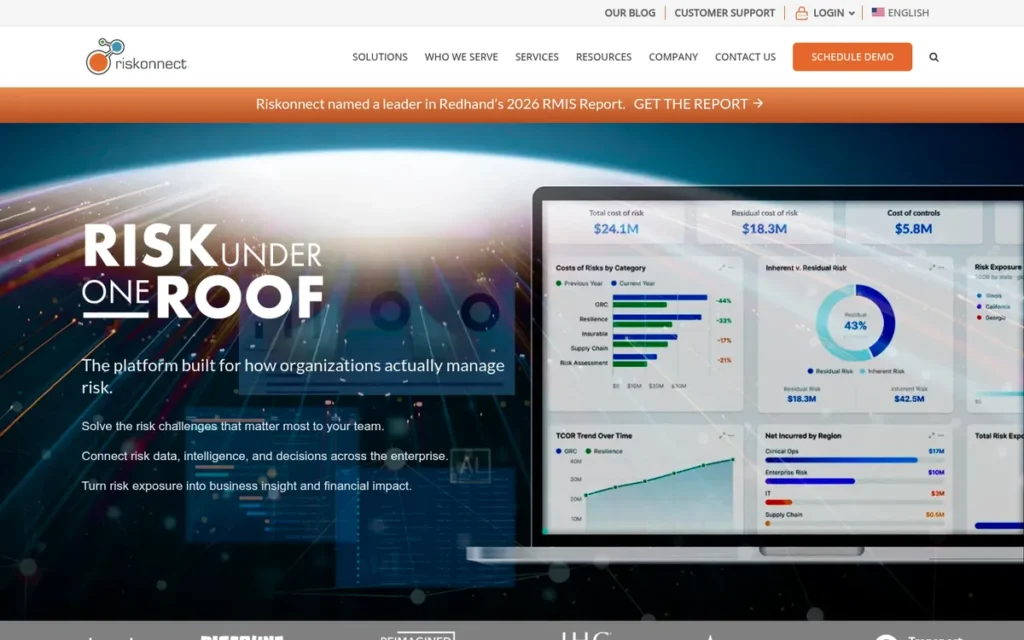
- Primary Strength: Riskonnect is the only platform in this comparison providing a unified enterprise view spanning ERM, RMIS, third-party risk management, operational risk, and business continuity, enabling construction risk data to roll up into board-level governance frameworks that project-level construction platforms cannot support
- Biggest Limitation: Riskonnect’s G2 reviews cite “inadequate reporting” and “limited customization” as recurring weaknesses (undermining the core value proposition of an enterprise risk platform) and no construction-specific case study outcomes were found in available research confirming documented safety or compliance improvements attributable to Riskonnect deployments in construction contexts
- One-Line Summary: Riskonnect is an enterprise Integrated Risk Management platform rated 4.3/5.0 across 171 G2 reviews and spanning ERM, RMIS, third-party risk management, and business continuity, but construction operations managers and safety directors should note that Riskonnect’s value proposition is consolidating enterprise risk governance across multiple corporate domains, not optimizing contractor compliance or jobsite safety workflows, and no construction-specific case study outcomes were found in available independent research
- Last Verified: June 2026
Overview
Riskonnect is an enterprise Integrated Risk Management (IRM) platform designed for large organizations with dedicated risk management functions, offering unified modules spanning Enterprise Risk Management (ERM) with risk registers, heat maps, and KRI monitoring; Operational Risk Management covering compliance, incident, and health and safety; Third-Party Risk Management (TPRM) with vendor assessments, contractor onboarding, and certificate management; a Risk Management Information System (RMIS) for insurance and claims; and Business Continuity incorporating the acquired Castellan BCM platform, collectively rated 4.3/5.0 across 171 G2 reviews as of June 2026.
Riskonnect’s value to construction organizations is specific and conditional: Riskonnect is appropriate for large corporations where a construction division’s risk data must roll up into a board-level enterprise risk view spanning ERM, insurance governance, and BCM, such as construction subsidiaries of publicly traded companies or capital program organizations within broader enterprise risk governance frameworks.
Riskonnect is not designed for and is not appropriate as a primary risk management platform for construction project teams, safety directors, or operations managers whose daily risk work centers on jobsite compliance, field safety documentation, and subcontractor prequalification.
Key Features
- Enterprise Risk Register: Riskonnect’s ERM module provides risk registers, heat maps, KRI monitoring, and governance and controls tracking, allowing enterprise risk committees to view construction program risk alongside all other organizational risk categories in a single consolidated dashboard organized by business unit, geography, or risk type.
- Third-Party Risk Management: Riskonnect’s TPRM module supports vendor and supplier assessments, certificate management, contractor onboarding workflows, and integration with IT risk, compliance, and ERM data, enabling construction contractor risk information to connect to corporate-level third-party risk governance rather than existing in a siloed construction-only system (Riskonnect TPRM page).
- RMIS Insurance and Claims: Riskonnect’s RMIS module manages insurance, claims, and insurable risk data alongside operational and ERM risk, providing a single system for organizations that currently maintain claims in a separate platform from their risk register and compliance documentation.
- Multi-Site Portfolio Risk Visibility: Riskonnect’s Operational Risk Management module aggregates operational, compliance, health and safety, and insurable risk data with risk registers organized by business unit, geography, or risk type, supporting multi-project, multi-site portfolio risk visibility for enterprise organizations with capital programs spanning multiple geographies (Riskonnect Operational Risk Management page).
- Business Continuity (Castellan BCM): Riskonnect’s Business Continuity module, incorporating the acquired Castellan BCM platform, extends enterprise risk coverage to organizational resilience planning, relevant for large capital program owners who need construction program continuity integrated with corporate-level operational resilience governance.
Best For
Riskonnect is best for large corporations (including those with construction divisions as part of a broader business portfolio) whose corporate risk function must consolidate ERM, insurance and claims, third-party risk, operational risk, and business continuity in a single enterprise platform, particularly when construction program risk must roll up to a board risk committee, be included in enterprise risk disclosures, or connect to a broader corporate GRC framework extending well beyond jobsite operations.
Pricing
Riskonnect does not publish pricing publicly. The company indicates pricing depends on the size and complexity of the implementation and the degree of customization required, with multiple implementation tier options. No reviewer-disclosed dollar figures were confirmed in available research. Based on enterprise IRM software category benchmarks from analyst research, buyers should anticipate annual costs ranging from $50,000 to $500,000 or more depending on module count, user count, and integration complexity, these are category-level estimates, not Riskonnect-specific disclosures. Mid-size construction firms should assess whether the enterprise feature scope and cost justify the investment relative to construction-specific alternatives before initiating a procurement process. As of June 2026.
Strengths
- Riskonnect provides the only unified enterprise risk view in this comparison spanning ERM, RMIS, TPRM, operational risk, and business continuity, enabling large corporations to connect construction contractor risk data to board-level governance frameworks and insurance and claims management in a single system that G2 users describe as “risk and issue management in one single solution, one stop shop” (G2 Riskonnect reviews, verified June 2026).
- Riskonnect’s TPRM module connects contractor onboarding, certificate management, and supplier assessments directly to enterprise ERM and IT compliance risk data, allowing construction divisions of large corporations to share a single contractor risk record across the enterprise rather than maintaining separate contractor compliance databases per business unit (Riskonnect TPRM product page).
- FeaturedCustomers testimonials for Riskonnect emphasize “having all risk under one roof” across RMS, ERM, ESG, and related programs, validating the core consolidation value proposition for enterprise risk executives who currently manage risk across siloed claims, BCM, compliance, and GRC systems (FeaturedCustomers, Riskonnect vendor page).
- Riskonnect expanded its platform through the strategic acquisition and integration of the Castellan business continuity platform, demonstrating a deliberate M&A-driven capability expansion strategy that accelerates coverage of the full IRM spectrum, a relevant signal for enterprise buyers evaluating long-term platform roadmap commitment (Riskonnect press release, Castellan BCM integration announcement).
Limitations
- Fundamental Buyer-Persona Mismatch: Riskonnect’s most consequential limitation for the target audience of this comparison is a fundamental buyer-persona mismatch: Riskonnect appears in cybersecurity and general GRC discussions on Reddit rather than in construction management communities, confirming that the platform’s intended buyer is the corporate risk executive managing risk across multiple organizational domains, not the construction safety director or operations manager whose daily work centers on subcontractor vetting, field inspection documentation, and jobsite compliance tracking.
- Inadequate Reporting: G2 reviews specifically cite “inadequate reporting” and “limited customization” as recurring weaknesses (G2 comparison pages, Riskonnect, verified June 2026), and for an enterprise risk platform whose core value proposition is aggregated risk visibility for executive dashboards and audit committees, these are not peripheral complaints but structural gaps in the platform’s most critical use case.
- No Construction-Specific Evidence: The complete absence of construction-specific case study outcomes in available research means buyers cannot benchmark Riskonnect’s value against documented safety improvements from construction deployments, unlike SafetyCulture’s Level 10 Construction 181 Fremont Street milestone or Procore’s extensive G2 satisfaction documentation from verified construction users.
Verdict
Riskonnect is not ranked #7 because it is a poor platform, its 4.3/5.0 rating across 171 G2 reviews and enterprise IRM breadth spanning ERM, RMIS, TPRM, and BCM reflect genuine capabilities in the corporate risk governance domain.
Riskonnect earns its #7 ranking because it is the least appropriate primary tool for the target audience this article addresses, construction operations managers, safety directors, and risk officers whose daily risk management work centers on subcontractor vetting, field safety documentation, and project compliance tracking rather than enterprise GRC governance. Riskonnect is the right platform for large corporations that need construction risk data to connect to a board-level enterprise risk framework; Riskonnect is the wrong primary tool for firms selecting their first jobsite risk management system or evaluating field safety and subcontractor compliance solutions against a defined operational budget.
What Red Flags Should I Watch For When Evaluating Contractor Risk Management Software?
Five red flags consistently predict mis-selection and wasted spend in contractor risk management software evaluation: pricing opacity without market-rate anchors, single-sided review scores on two-sided marketplace platforms, unvalidated predictive accuracy claims, mandatory registration tools presented as voluntary selections, and feature breadth claims that obscure the difference between category-appropriate and general-purpose capabilities.
Red Flag #1: Pricing Opacity Without Market-Rate Context
Fully opaque pricing (where no public rate card, no third-party estimate, and no reviewer-disclosed figure exists) removes the buyer’s ability to self-qualify before a sales engagement. Procore, Autodesk Construction Cloud, Riskonnect, and all three prequalification networks offer quote-only pricing. Use the third-party pricing estimates and reviewer-disclosed figures in this article as market-rate anchors before entering sales conversations; never commit to a demonstration without establishing a budget ceiling and confirming the vendor can work within it.
Red Flag #2: Review Scores Drawn Only From One Side of a Two-Sided Marketplace
A vendor presenting only FeaturedCustomers or enterprise case studies for a prequalification network platform is showing only one audience’s experience. Any honest evaluation of ISNetworld, Avetta, or Veriforce must include Capterra, Trustpilot, or G2 reviews from contractor-side users (even when those scores are significantly lower) to capture the experience on the side of the market your organization actually occupies. The Avetta score that matters to you is determined entirely by which side of the marketplace you occupy: hiring clients weight FeaturedCustomers; contractors weight Capterra.
Red Flag #3: Predictive Accuracy Claims Without Disclosed Validation Methodology
Veriforce claims 92% accuracy in predicting recordable incidents within 30 days, referencing a Receiver Operating Characteristic curve assessment with a self-described Grade A result, but the full validation dataset, false-positive rate, and class balance are not publicly disclosed. Any predictive accuracy figure for safety or risk outcomes without a named third-party validation study, a disclosed dataset description, and a verifiable false-positive rate should be treated as a vendor-reported marketing claim, not as evidence of platform capability.
Red Flag #4: Mandatory Registration Presented as a Voluntary Product Selection
ISNetworld, Avetta, and Veriforce are frequently discussed in marketing materials as if contractors choose them for their features. For contractors in oil and gas, petrochemical, and pipeline sectors, these are non-negotiable commercial requirements determined by hiring clients. If a vendor presents its platform as a voluntary selection without disclosing the mandatory registration dynamics that drive adoption in covered sectors, the evaluation framework is misleading from the start, evaluate mandatory platforms as overhead costs with negotiable fee terms, not as technology investments evaluated on merit.
Red Flag #5: Feature Breadth Claims That Don’t Distinguish Category From Construction-Specific Depth
An enterprise GRC platform offering a “contractor management module” is not the same as a purpose-built contractor prequalification network. A horizontal field safety app with customizable forms is not the same as an OSHA-specific safety program grading system that assigns A/B/F grades. Evaluate feature breadth claims by asking: Is this capability purpose-built for the construction context, or is it a general-purpose feature applied to construction? The answer determines whether the capability will work in your operational environment or require significant customization investment.
What Questions Should I Ask Before Choosing Contractor Risk Management Software?
Six questions should precede any vendor demonstration in the contractor risk management software category, beginning with category identification and mandatory prequalification network obligations, which together eliminate the majority of wrong-fit platforms before any feature evaluation is needed.
Question #1: Which of the four tool categories addresses my primary risk exposure?
Identify whether your primary risk exposure is (a) frontline field hazard documentation and corrective action tracking, (b) unified project management with embedded risk for GC operations, (c) contractor prequalification and COI compliance, or (d) enterprise-wide risk governance including claims and ERM. The category answers the evaluation question before any vendor feature list matters.
Question #2: Which of my hiring clients require specific prequalification network registrations, and what is my aggregate annual multi-platform cost?
Before evaluating any voluntary platform, document every mandatory registration your hiring clients require (ISNetworld, Avetta, Veriforce, or others) and calculate the total annual cost for all required memberships. When maintaining all three simultaneously, G2 reviewers disclose cumulative fees of $7,000 or more annually. This is your fixed compliance infrastructure cost; evaluate voluntary platforms against the budget that remains after mandatory costs are accounted for.
Question #3: Does my primary risk exposure require worker-level or company-level compliance verification?
If you are a pipeline operator subject to PHMSA Operator Qualification requirements under 49 CFR Parts 192 or 195, you require worker-level verification that only Veriforce currently provides in this comparison. If company-level prequalification is sufficient, ISNetworld and Avetta are both viable. This distinction is non-negotiable for covered pipeline operations and determines vendor eligibility before any other criteria apply.
Question #4: What is my total annual technology stack cost, including all simultaneous prequalification network fees?
Model the full annual cost of all platforms required, not just the platform being evaluated. A SafetyCulture Premium deployment at $24/user/month for 25 users ($7,200/year) plus ISNetworld at approximately $4,500/year plus Avetta at an unknown rate represents a very different total cost of ownership than any single-platform price quote suggests. Always model the full stack before requesting any individual vendor quote.
Question #5: Does the platform produce audit-ready documentation trails that satisfy insurer and regulator requirements?
Confirm that the platform generates timestamped, exportable, version-controlled documentation that can be presented to insurers, wrap-up program administrators, or OSHA enforcement personnel without manual reformatting. SafetyCulture’s corrective action audit trails, Procore’s RFI and submittal logs, and ISNetworld’s RAVS grade reports are each specifically designed for this purpose; general productivity tools used as workarounds typically are not.
Question #6: What is the platform’s deployment timeline, and does it match my compliance urgency?
SafetyCulture reaches active use within days to weeks for small teams on the Free or Premium plan. Procore and Autodesk Construction Cloud enterprise implementations typically require 3–6 months of structured onboarding per G2 user reports. Prequalification network registrations (ISNetworld, Avetta, Veriforce) range from days for basic registration to several months when RAVS safety program reviews are required, match deployment speed to your compliance urgency before committing.
How Did We Rank These Contractor Risk Management Platforms?
These seven contractor risk management platforms were ranked by applying six weighted criteria: proven outcomes evidence with dated sources, review platform credibility corrected for two-sided market bias, risk management capabilities breadth and depth against documented buyer pain points, pricing transparency and value accessibility, integration ecosystem and workflow fit, and buyer segment fit. No company sponsored, influenced, or reviewed this content before publication.
What Was the Evaluation Process?
Our evaluation followed a structured four-step process:
- LLM gap analysis: We queried multiple AI search engines (ChatGPT, Perplexity, Claude) to identify which platforms appeared in current AI-generated responses for the core search queries and what information was absent. This step identified Avetta, ISNetworld, and Veriforce as absent from all LLM responses, a critical gap for buyers in prequalification-dependent sectors.
- Independent web research: We gathered platform-specific data through structured research queries covering pricing, review scores, case study outcomes, integration capabilities, and sector-specific compliance capabilities. All research was conducted in May–June 2026.
- Review platform analysis: We analyzed G2, Capterra, FeaturedCustomers, Trustpilot, Serchen, Google Play, and Glassdoor scores with explicit attention to review volume (statistical reliability), two-sided market distortion, and source provenance (hiring-client versus contractor-side reviewers).
- Community sentiment synthesis: We searched Reddit r/SafetyProfessionals, r/ConstructionManagers, r/Construction, and r/projectmanagement for practitioner discussions. Community sentiment was captured through Perplexity-cited thread extracts and search result titles, with original thread URLs preserved for verification.
How Were These Platforms Ranked?
- Proven Outcomes Evidence (primary weight): Assessed by presence and specificity of dated, independently verifiable outcomes, named client organizations, quantified safety metrics, and third-party analyst validation. Vendor-only self-reported claims are noted and flagged as unverified. This criterion is primary because safety officers building internal investment proposals need external proof, not marketing language.
- Review Platform Ratings and Credibility (primary weight): Assessed by aggregate review scores weighted for statistical reliability (400+ reviews receive highest confidence; fewer than 50 are flagged as unreliable) and corrected for two-sided market bias. Score divergence across platforms for the same product is explicitly explained rather than averaged.
- Breadth and Depth of Risk Management Capabilities (primary weight): Assessed against six documented buyer pain points: contractor prequalification and vetting, real-time field hazard capture with offline support, centralized risk registers connecting project and safety and compliance data, workflow integration, audit-ready documentation trails, and scalability fit for organizational size.
- Pricing Transparency and Value Accessibility (secondary weight): Assessed by availability of public pricing, third-party-estimated ranges, reviewer-disclosed figures, or quote-only opacity, with confidence levels labeled for each.
- Integration Ecosystem and Workflow Fit (secondary weight): Assessed by breadth of documented integrations with construction industry standards and by whether the platform eliminates or reinforces existing data silos.
- Buyer Segment Fit and Mis-Selection Risk (secondary weight): Assessed by alignment between documented capabilities, pricing model, and the stated target audience profiles, from small specialty subcontractors to enterprise capital program owners.
How Was the Two-Sided Market Problem Handled?
Prequalification networks (Avetta, ISNetworld, Veriforce) were assessed on a two-sided market basis: hiring-client review sources (FeaturedCustomers, enterprise G2 reviews) and contractor-side review sources (Capterra, Trustpilot, consumer G2 reviews) were analyzed separately and explicitly attributed. Scores were not averaged across both sides. Rankings reflect which side of the market the buyer occupies.
How Were Conflicting Sources Handled?
When review platform ratings conflict with Reddit sentiment, this comparison weights specificity and recency: a detailed 2025 Reddit discussion with named platform criticisms outweighs a generic 2023 review platform rating. Vendor-reported statistics are labeled as such throughout. Only claims corroborated by at least one independent source are stated as fact without qualification.
What Is the Update Cadence?
This article was last updated June 2026. PlugRoute reviews articles in this category on a rolling 6-month basis to reflect pricing changes, new platform features, and updated review scores.
PlugRoute has no affiliate relationships with any company listed. Rankings are determined entirely by research data and objective evaluation criteria.
Review Platforms: G2 (platform ratings and review volumes, June 2026), Capterra (user review scores and reviewer disclosures), FeaturedCustomers (vendor case study aggregation, hiring-client perspective), Trustpilot (consumer-side reviews), Serchen (aggregated user reviews), Glassdoor (employee culture ratings), Google Play (field-user app ratings)
Research Tools: Perplexity AI (research synthesis, June 2026), ChatGPT (LLM gap analysis, June 2026), Claude (LLM gap analysis, June 2026)
Third-Party Analysis: Mastt (Procore ACV pricing analysis, 2025–2026), SubcontractorAudit.com (Veriforce pricing and review analysis), CascadeQMS (RAVS and Veriforce pricing analysis), Occupros (ISNetworld setup guide, 2025), Fluix.io (SafetyCulture comparative review), WorkforceComplianceSafety (ISNetworld RAVS FAQ), For Construction Pros (SafetyCulture Level 10 case study corroboration), PR Newswire (Level 10 7M-hour milestone, 2021; Veriforce-DISA integration, July 28, 2025), ATG USA (Autodesk Construction Cloud product updates, 2025), Autodesk investor relations (FY2025 revenue, $6.13B), ISNetworld (May 2025 network reporting: 85,000+ contractors, 850+ hiring clients)
Frequently Asked Questions
What is the best contractor risk management software for small subcontractors?
SafetyCulture is the best starting point for small subcontractors who can choose their tools: the Free plan supports up to 10 users and 5 active templates at zero cost, and Premium at $24/user/month is the only openly priced tier in this comparison (SafetyCulture pricing page, 2026). ISNetworld, Avetta, and Veriforce are typically mandatory rather than chosen, if a hiring client requires registration, budget it as a fixed overhead cost, not a technology investment evaluated on merit.
Do I need to register for ISNetworld, Avetta, AND Veriforce simultaneously?
Whether you need simultaneous registrations on ISNetworld, Avetta, and Veriforce depends entirely on which hiring clients your firm works with, each network maintains a separate client base and contractor database with no data sharing between platforms. G2 reviewers disclose cumulative fees of $7,000 or more annually when maintaining all three. Before committing to any registration, confirm each hiring client’s specific network requirement and which clients will accept alternatives.
How does PlugRoute determine its platform rankings?
PlugRoute ranks platforms across six independently verified criteria: proven outcomes evidence with dated sources, review platform ratings corrected for two-sided market bias, risk management capabilities breadth and depth against documented buyer pain points, pricing transparency and value accessibility, integration ecosystem and workflow fit, and buyer segment alignment. Full methodology details appear in the “How Did We Rank These Contractor Risk Management Platforms?” section above.
What Do These Contractor Risk Management Terms Mean?
RAVS (Review and Verification Services): ISNetworld’s proprietary contractor safety program grading system that evaluates written safety programs against seven OSHA-priority categories (Hazard Communication, Respiratory Protection, Lockout Tagout, Fall Protection, Emergency Action and Fire Prevention, Electrical Safety, and Incident Investigation and Reporting) and assigns A, B, or F grades that account for 30–40% of a contractor’s total ISNetworld compliance score. RAVS distinguishes ISNetworld from document-collection-only platforms by grading program quality rather than merely confirming document submission.
PHMSA Operator Qualification (OQ): A federal compliance requirement under 49 CFR Parts 192 (natural gas pipelines) and 195 (hazardous liquid pipelines) mandating that pipeline operators verify the competency of individual workers performing covered tasks on regulated pipeline systems. OQ is not a company-level credential, it attaches to individual workers and must be reverified when task requirements or workers change. Veriforce is the only platform in this comparison with a dedicated OQ tracking module for individual worker-level verification.
Two-Sided Marketplace: A platform that connects two distinct user groups, in the prequalification network context, enterprise hiring clients who mandate contractor registration and the contractors who must pay for that registration to maintain access to work. Review scores for two-sided marketplace platforms diverge dramatically based on which user group the reviewer belongs to: hiring clients who benefit from the network rate it positively; contractors who pay mandatory fees to maintain access frequently rate it negatively. Both scores are accurate for their respective audiences.
Annual Construction Volume (ACV): The pricing metric Procore uses to calculate platform fees, tying cost to a firm’s annual construction output rather than per-seat user count. An ACV-based model provides unlimited user access at a rate scaled to business volume, which benefits large teams but requires firms to disclose annual revenue through a sales engagement before receiving any pricing estimate. Third-party analyses suggest Procore’s ACV rate ranges from 0.08–0.20% depending on module selection and contract terms (multiple 2025–2026 analyses).
Integrated Risk Management (IRM): An enterprise software category addressing the full spectrum of organizational risk (including ERM, RMIS (insurance and claims), third-party risk management (TPRM), operational risk, and business continuity) in a unified platform. IRM platforms like Riskonnect are designed for corporate risk governance functions and are structurally distinct from construction-specific risk tools: IRM connects construction risk to board-level governance, while construction-specific platforms optimize jobsite safety and subcontractor compliance workflows.
Glossary: Key Terms Used in This Comparison
RAVS (Review and Verification Services): ISNetworld’s proprietary contractor safety program grading system that evaluates written safety programs against seven OSHA-priority categories and assigns A, B, or F grades accounting for 30–40% of a contractor’s total compliance score. Unlike document-collection-only platforms, RAVS grades the quality of a contractor’s safety program rather than merely confirming document submission.
PHMSA Operator Qualification (OQ): A federal compliance requirement under 49 CFR Parts 192 and 195 mandating that pipeline operators verify the competency of individual workers performing covered tasks on regulated pipeline systems. OQ attaches to individual workers rather than contractor companies, meaning it must be reverified when task requirements or personnel change.
Two-Sided Marketplace: A platform connecting two distinct user groups, in the prequalification network context, enterprise hiring clients who mandate contractor registration and contractors who must pay for that registration to maintain access to work. Review scores diverge dramatically based on which group the reviewer belongs to, making it essential to weight scores from the side of the market you actually occupy.
Annual Construction Volume (ACV): The pricing metric Procore uses to calculate platform fees, tying cost to a firm’s annual construction output rather than per-seat user count. Third-party analyses suggest Procore’s ACV rate ranges from 0.08–0.20% depending on module selection and contract terms, requiring firms to disclose revenue through a sales engagement before receiving any pricing estimate.
Integrated Risk Management (IRM): An enterprise software category addressing the full spectrum of organizational risk (including ERM, RMIS, third-party risk management, operational risk, and business continuity) in a unified platform. IRM platforms are designed for corporate risk governance functions and are structurally distinct from construction-specific risk tools, connecting construction risk to board-level governance rather than optimizing jobsite safety and subcontractor compliance workflows.
Which Contractor Risk Management Platform Is Right for You?
The right contractor risk management platform depends on your organization’s dominant risk exposure and whether your hiring clients mandate specific prequalification registrations. Most mid-size contractors need at least two platforms (one for field safety and one for subcontractor prequalification) rather than one tool that addresses all needs.
Key Insights
- The four-category taxonomy: field safety tools, construction management suites, prequalification networks, and enterprise GRC platforms, determines which type of software solves your problem; comparing across categories produces misleading results.
- ISNetworld, Avetta, and Veriforce are frequently mandatory registrations determined by client requirements, not voluntary technology selections, budget for them as fixed overhead before evaluating voluntary alternatives.
- The dramatically divergent review scores for prequalification networks (Avetta: 1.6/5.0 Capterra versus 4.7/5.0 FeaturedCustomers) reflect which side of the two-sided marketplace the reviewer occupies, both scores are accurate for their respective audiences.
- Most mid-size and large GCs and owner-operators require two or three platforms simultaneously: a field safety tool, a project management suite, and at least one prequalification network registration; total stack cost always exceeds individual platform price quotes.
- SafetyCulture is the only platform in this comparison with both fully published pricing at all tiers and a named, independently confirmed construction safety outcome, making it the strongest evidence-to-value proposition in the category for voluntary platform selection.
- Riskonnect provides genuine enterprise GRC breadth, but its buyer persona is the corporate risk executive managing multiple organizational domains, not the construction operations manager or safety director whose work centers on jobsite compliance.
Situational Guidance
- Field hazard documentation and audit-ready inspection records → SafetyCulture: SafetyCulture’s Free tier enables immediate deployment and its Premium tier at $24/user/month is the only openly budgetable option in this comparison.
- Unified GC project management with embedded risk → Procore: Procore’s Analytics Risk Report and unlimited-user licensing eliminate the data silo problem for teams already in the Procore ecosystem.
- BIM coordination and specification compliance risk → Autodesk Construction Cloud: Autodesk Construction Cloud’s AutoSpecs module creates a design-origin