Osano leads for compliance accountability with what appears to be the only $500,000 no-fines guarantee among the seven CMPs reviewed here, serving 30% of the Fortune 500 and 45,000+ SMBs (CEO-stated, 2025). Usercentrics earned the #1 CMP recognition in the CMP subcategory of G2’s 2026 Best Software Awards for programmatic advertising teams. iubenda is best for SMBs and developers needing attorney-maintained, automatically updating legal compliance documentation.
Most CMP comparison content is produced by sites with undisclosed affiliate relationships. This systematic bias explains why iubenda, an IAB TCF v2.3-certified platform with support quality rated above Usercentrics in direct practitioner comparisons, is entirely absent from AI-generated CMP lists, while platforms with greater PR investment dominate recommendations.
PlugRoute has no affiliate relationships with any company listed. Rankings are determined entirely by research data and objective evaluation criteria.
“I’ve implemented, fixed, and maintained a lot of different consent management platforms. [Cookiebot is] straightforward and effective. OneTrust is, sadly, the gold standard. UserCentrics is a decent competitor though.” (u/DigitalStefan, r/webdev, 2026)
Takeaway: An experienced multi-platform implementer confirms OneTrust’s market dominance reflects incumbent status, not practitioner preference, the gap this independent, evidence-based ranking is designed to resolve.
TL;DR: Top Picks at a Glance
- Osano is best for compliance accountability across SMB to enterprise: the only CMP in this comparison offering a $500,000 no-fines guarantee (conditions apply) and traffic-based pricing for multi-domain organizations.
- Usercentrics, recognized as #1 Consent Management Platform in the CMP subcategory of G2’s 2026 Best Software Awards, is best for programmatic advertising teams requiring IAB TCF v2.3 and Google Consent Mode Gold Partner certification.
- iubenda is best for SMBs and developers needing attorney-maintained, automatically updating compliance documentation across GDPR, CCPA, and 10+ regulations, and holds IAB TCF v2.3 certification updated February 2026.
- OneTrust is appropriate only for large enterprises with $25,000+/year compliance budgets and dedicated privacy engineering teams, practitioner community consensus does not recommend OneTrust for SMBs or startups.
What Are the Categories of Consent Management Platforms?
The seven consent management platforms in this comparison divide into three functional tiers: SMB-Focused CMPs built for transparent pricing and rapid deployment, Mid-Market and Enterprise CMPs with deeper analytics and compliance architecture, and a Full-Suite Privacy Governance Platform. Choosing the wrong tier is the most common CMP evaluation mistake, resulting in overpaying for unused enterprise features or outgrowing SMB tools as regulatory exposure grows.
SMB-Focused CMPs: Cookiebot, iubenda, consentmanager
These platforms prioritize rapid deployment, self-serve pricing, and practical compliance for organizations without dedicated privacy engineering staff.
- Cookiebot leads on pricing transparency: the only SMB CMP in this comparison with fully self-serve per-domain tiers from free to ~€90/month, enabling cost evaluation with no sales engagement.
- iubenda leads on legal documentation quality: the only platform in this comparison where privacy policy content is drafted and continuously updated by qualified attorneys rather than by the customer.
- consentmanager leads on consent rate optimization at the SMB tier: its algorithmically optimized A/B testing automatically serves the highest-converting banner design without requiring manual statistical analysis.
Mid-Market and Enterprise CMPs: Osano, Usercentrics, Didomi
These platforms serve growth-stage through enterprise organizations with deeper analytics, multi-device coverage, and advanced compliance architecture. Mid-market CMPs increasingly connect to server-side tagging infrastructure to reduce client-side performance impact on Core Web Vitals and extend into preference management to collect first-party data consent signals that outlast third-party cookie deprecation.
- Osano leads on compliance accountability: the only platform offering a $500,000 no-fines guarantee (conditions apply) and structural dark-pattern prevention through built-in UX guardrails.
- Usercentrics leads on programmatic advertising optimization: #1 in the CMP subcategory of G2’s 2026 Best Software Awards, Google Consent Mode Gold Partner, and IAB TCF v2.3 certified.
- Didomi leads on enterprise publisher requirements: ISO 27001-certified, Unity SDK for gaming, and expanded by the July 2025 Sourcepoint acquisition to 1,700+ combined customers globally.
Full-Suite Privacy Governance Platform: OneTrust
OneTrust is the only platform in this comparison functioning as a complete privacy operations suite, combining consent management with data discovery, DSAR automation, AI governance, and Snowflake integration, at enterprise-only pricing reflecting that scope.
How Do All 7 Consent Management Platforms Compare at a Glance?
The table below compares all seven consent management platforms across nine dimensions, rank, company, category, best-for audience, billing model, one-line summary, key capabilities, primary strength, and key limitation. Billing model is included as a standalone column because it determines total cost of ownership more decisively than any other single factor for multi-site operators, with per-domain billing creating compounding costs that session-based and traffic-based alternatives eliminate.
| Rank | Company | Category | Best For | Billing Model | One-Line Summary | Key Capabilities | Primary Strength | Key Limitation |
|---|---|---|---|---|---|---|---|---|
| #1 | Osano | Privacy-Integrated CMP | Multi-domain organizations needing documented compliance accountability | Traffic-based (not per-domain) | Osano combines a $500,000 no-fines guarantee (conditions apply), structural dark-pattern prevention, and traffic-based pricing proven across 30% of the Fortune 500 and 45,000+ SMBs (CEO-stated, 2025). | $500K no-fines guarantee; UX guardrails; DSAR automation; 163-criteria vendor risk monitoring; GPC auto-detection | Only CMP in this comparison offering a documented $500,000 compliance guarantee; conditions apply; verify void terms at osano.com/pledge | More initial configuration than plug-and-play competitors; documented data reporting tool integration gaps |
| #2 | Usercentrics | Enterprise CMP | Mid-market to enterprise teams with programmatic advertising dependencies | Session-based (per user session volume) | Usercentrics was recognized as #1 Consent Management Platform in the CMP subcategory of G2’s 2026 Best Software Awards, holds Google Consent Mode Gold Partner status and IAB TCF v2.3 certification, and processes 8.8 billion user consents monthly. | G2 2026 CMP subcategory #1; IAB TCF v2.3; Google Gold Partner; multi-device (web, iOS, Android, CTV); A/B testing; 4.3/5 G2 rating; 99%+ retention | #1 in the CMP subcategory of G2’s 2026 Best Software Awards; most recent independent peer recognition in this comparison | Session-based billing creates unpredictable overage costs for high-traffic or seasonally volatile sites |
| #3 | iubenda | Legal-First CMP | SMBs, developers, and international app operators needing attorney-maintained compliance documentation | Tiered flat rate (not per-domain or per-session) | iubenda is an Italian-founded legal compliance platform with IAB TCF v2.3 certification (updated February 2026, verifiable at iabeurope.eu/cmp-list/), attorney-maintained 2,400+ clause library, and support quality rated above Usercentrics in direct practitioner comparisons. | 2,400+ attorney-maintained clauses; auto-jurisdiction adaptation; IAB TCF v2.3 (Feb 2026); Consent Database audit trail; 27 languages; Google Consent Mode v2 Advanced | Attorney-maintained 2,400+ clause library that auto-updates as regulations change; the only platform providing legal-expert-drafted compliance content | Limited enterprise-grade analytics, A/B testing, and programmatic advertising integrations |
| #4 | Cookiebot | Automated SMB CMP | Single-site SMBs and agencies needing automated scanning with transparent pricing | Per-domain (each domain/subdomain billed separately) | Cookiebot is the most pricing-transparent CMP in this comparison, with fully public per-domain tiers from free to ~€90/month; but its automated scanner has documented production cases of contaminating Google Analytics with artificial crawler traffic. | Automated scanner (13,000+ cookie database); transparent pricing (free to ~€90/month); Google Consent Mode v2; IAB TCF v2.2; 47 languages; agency dashboard | Most pricing-transparent CMP in this comparison; fully self-serve pricing with no sales engagement required | Automated crawler generates artificial traffic documented in multiple production deployments to contaminate Google Analytics |
| #5 | Didomi | Publisher CMP | Enterprise publishers, media companies, and gaming organizations | Enterprise custom (no published model) | Didomi is an ISO 27001-certified consent platform founded in Paris in 2017; its July 2025 acquisition of Sourcepoint created a combined entity serving 1,700+ customers globally; one of the largest enterprise publisher CMP consolidations of 2025. | ISO 27001; Google CMP Partner (Sept 2022); IAB GPP; Unity SDK (gaming); Preference Center; GPC auto-detection; 1,700+ customers post-Sourcepoint | ISO 27001-certified; one of the first Google CMP Partners (September 2022); Sourcepoint acquisition (July 2025) expanded North American publisher footprint | Enterprise-only custom pricing; excludes SMBs and organizations without dedicated procurement budgets |
| #6 | consentmanager | Algorithmically Optimized CMP | SMBs and agencies wanting automated consent rate optimization with multi-site pricing | Views-based (monthly page views across included sites) | consentmanager is a European consent management platform with algorithmically optimized automatic A/B testing for consent rate improvement and transparent views-based pricing at €59/month for up to 3 sites; the most technically advanced optimization at the SMB price tier in this comparison. | Algorithmically optimized A/B testing; €59/month (3 sites, 1M views); 10 crawls/day; staging environment; IAB TCF v2.2; DSR tools; whistleblowing | Algorithmically optimized automatic A/B testing analyzing banner performance by browser, device, location, and time of day; most advanced SMB optimization in this comparison | No independently verified G2 or Capterra aggregate rating confirmed from non-vendor sources |
| #7 | OneTrust | Privacy Governance Platform | Large enterprises with dedicated privacy engineering teams and $25,000+/year budgets | Enterprise negotiated (no published tiers) | OneTrust is the most feature-complete privacy governance platform in 2026, but its high configurability without built-in guardrails creates compliance risk; the CPPA’s 2025 prosecution of asymmetrical consent design patterns illustrates the enforcement landscape for misconfigured implementations. | Full privacy suite (consent + data discovery + DSAR + AI governance); 250 languages; CTV/OTT; Snowflake integration; A/B testing | Only platform with a complete privacy governance suite covering consent, data discovery, DSAR automation, AI governance, and Snowflake integration | High configurability without built-in dark-pattern guardrails creates compliance risk for teams lacking privacy engineering expertise; $4.5 billion valuation signals enterprise-only pricing |
Quick Decision Framework: Which CMP Fits Your Situation?
Which CMP fits your situation depends on how many domains you manage, your privacy-law obligations, and your budget tier. The table below maps eight buyer profiles (from freelancer to enterprise publisher) to a specific recommended platform, starting price, and acceptable alternative.
| Buyer Profile | Recommended Platform | Why | Starting Price | Acceptable Alternative |
|---|---|---|---|---|
| Freelancer / Single Site | Cookiebot | Lowest entry cost, transparent pricing, free tier, Google Consent Mode v2 | Free; paid from ~€9/month/domain (published, cookiebot.com/us/pricing/, April 2026) | iubenda free/starter tier |
| SMB (2–10 Sites, Moderate Traffic) | consentmanager | Views-based multi-site pricing; algorithmically optimized A/B testing; broader compliance suite | €59/month for 3 sites and 1M views (published, consentmanager.net/en/pricing/, April 2026) | iubenda for legal-documentation priority |
| Developer-First Organization | iubenda | Attorney-maintained legal content, minimal configuration, IAB TCF v2.3 certified (Feb 2026) | Free/starter tier available; verify at iubenda.com/en/pricing (April 2026) | Cookiebot free tier |
| Growth-Stage Startup (Sub-$1M ARR) | Osano | Traffic-based pricing, $500K no-fines guarantee (conditions apply), compliance built into code | ~$199/month (community-verified, multiple r/webdev users, April 2026; verify at osano.com/plans) | consentmanager Essential tier |
| Digital Agency (Multi-Client Sites) | consentmanager | Views-based pricing avoids per-domain cost multiplication; Professional tier covers 20 sites | €59/month (3 sites); €219/month (20 sites) (published, April 2026) | Osano ~$199/month traffic-based |
| Mid-Market Publisher / Ad-Tech | Usercentrics | IAB TCF v2.3, Google Gold Partner, revenue-enablement analytics, multi-device coverage | ~€7/month/domain minimum (verify at usercentrics.com/pricing/, April 2026) | Didomi for publisher-specific requirements |
| Enterprise (Full Privacy Governance) | OneTrust | Only true full-suite platform: consent + data discovery + DSAR + AI governance + Snowflake | Custom enterprise quotes only; community estimates $25,000+/year (r/webdev, 2026) | Osano for consent-only enterprise needs |
| Enterprise Publisher / Media / Gaming | Didomi | ISO 27001, Sourcepoint acquisition (July 2025, 1,700+ customers), Unity SDK for gaming | Custom enterprise quotes only (contact didomi.io) | Usercentrics for web/app/CTV publisher needs |
1. Osano: Best Overall: Best for Compliance Accountability Across SMB to Enterprise
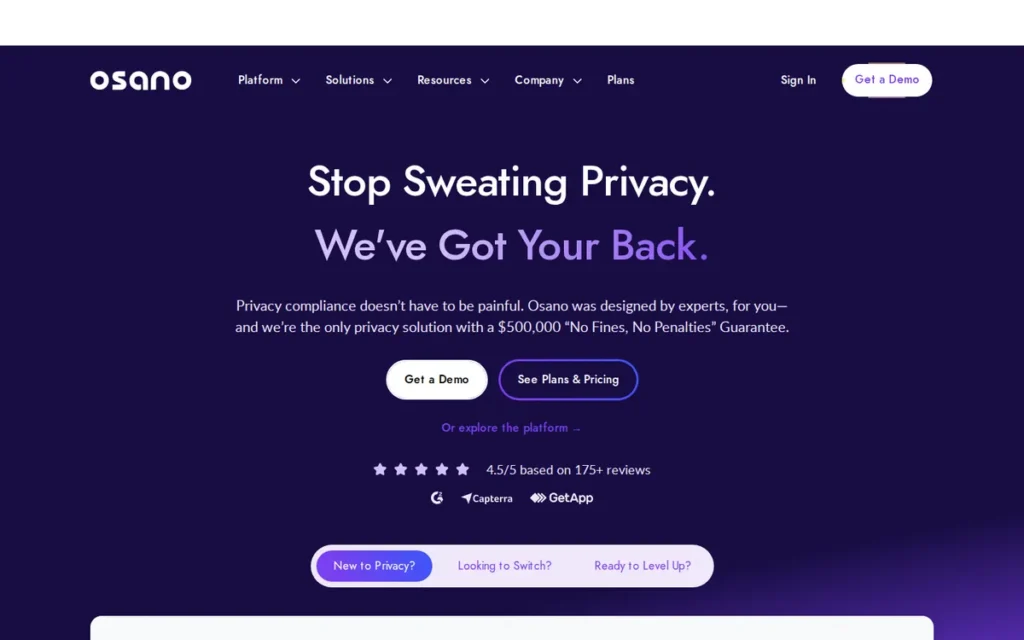
Category: Privacy-Integrated CMP, consent management with built-in DSAR automation, vendor risk monitoring, and a $500,000 no-fines compliance guarantee (conditions apply) that structurally prevents non-compliant banner configurations through enforced UX guardrails.
At a Glance
- Category: Privacy-Integrated CMP
- Best For: Multi-domain organizations needing documented compliance accountability without a dedicated privacy engineering team
- Price Range: ~$199/month (community-verified, multiple r/webdev users, April 2026); traffic-based billing; verify at osano.com/plans
- Primary Strength: Osano offers what appears to be the only $500,000 no-fines compliance guarantee among the seven CMPs reviewed here, a public commitment (osano.com/pledge, September 2021) backed by a zero-customer-fine record since 2018 (CEO-stated, r/GoogleTagManager, 2025, conditions apply)
- Biggest Limitation: More initial configuration than plug-and-play competitors; documented data reporting tool integration gaps; the guarantee is voided by unauthorized platform customization including button or text changes without Osano’s prior approval
- One-Line Summary: Osano combines a $500,000 no-fines compliance guarantee (conditions apply), structural dark-pattern prevention, and traffic-based pricing proven across 30% of the Fortune 500 and 45,000+ SMBs (CEO-stated, 2025).
- Last Verified: April 2026
Overview
Osano is a unified privacy management platform founded in Austin, Texas in 2018 that combines consent banner management with DSAR automation, vendor risk monitoring, and structurally enforced dark-pattern prevention. Osano is the broadest-scope, compliance-accountable CMP option for organizations from growth-stage startups through Fortune 500 enterprises as of 2026.
Osano differentiates from every other platform in this comparison through built-in UX guardrails that structurally prevent non-compliant banner configurations and a documented $500,000 no-fines guarantee backed by a zero-customer-fine record since founding, as publicly stated by the CEO (u/thatguyinline, r/GoogleTagManager, 2025; not independently verified through regulatory databases as of April 2026).
Key Features
- Dark-Pattern Prevention Guardrails: Osano enforces UX guardrails built directly into its banner configuration workflow, structurally blocking organizations from creating non-compliant designs (such as asymmetrical accept/reject button sizing, pre-ticked consent checkboxes, or confusing toggle interfaces) without requiring specialized privacy law expertise from the configuring user.
- DSAR Automation: Osano’s Data Subject Access Request module includes one-click request forms, jurisdiction-based routing, identity verification, and automated deletion processing, extending Osano’s compliance coverage beyond cookie consent banners to full data rights management across GDPR, CCPA, and multiple US state privacy requirements.
- 163-Criteria Vendor Risk Monitoring: Osano’s vendor risk monitoring module evaluates third-party vendors against 163 privacy criteria with ongoing fourth-party monitoring, providing enterprise procurement teams with automated supply-chain privacy accountability that no other platform in this comparison offers at equivalent depth.
- GPC Auto-Detection: Osano automatically detects and honors Global Privacy Control (GPC) browser signals as automatic opt-out at the architecture level, satisfying Colorado’s Universal Opt-Out Mechanism and Connecticut’s GPC compliance requirement without requiring any manual banner interaction from users.
- Traffic-Based Billing: Osano uses traffic-based pricing rather than per-domain billing, making Osano structurally cost-efficient for multi-domain operators, agencies, and enterprises where per-domain models from competitors compound costs to multiples of the Osano equivalent.
Best For
Osano is best suited for growth-stage startups (sub-$1M ARR) that need compliance accountability without an in-house privacy team, for mid-market organizations managing multiple brand domains where per-domain pricing models become cost-prohibitive, and for risk-averse compliance officers who need a platform that stands behind its compliance claims with documented financial accountability.
Pricing
Osano is community-validated at approximately $199/month by multiple independent Reddit users describing GDPR and CCPA compliance at early-stage scale (r/webdev, April 2026). One compliance professional estimated Osano at “$500–$2K/year” for startup plans (r/webdev, 2026). Traffic-based billing means costs scale with site traffic rather than domain count, a structural advantage for multi-site organizations.
The $500,000 guarantee applies only to paying customers on qualifying plans who implement all Osano products per documentation. The guarantee is voided by unauthorized platform customization, including changes to button sizes, text, or colors without Osano’s prior approval (osano.com/pledge, April 2026). Verify current plans and guarantee contractual terms in writing at osano.com/plans before treating the guarantee as your compliance safety net.
Strengths
- Documented $500,000 Compliance Guarantee: Osano’s $500,000 no-fines guarantee is a confirmed public commitment (osano.com/pledge, September 2021), backed by a zero-customer-fine record since 2018 as publicly stated by the CEO (u/thatguyinline, r/GoogleTagManager, 2025 (not independently verified through regulatory databases as of April 2026)) a claim that, if accurate, is unmatched by any other platform in this comparison.
- Dual-Market Proven Scale: Osano simultaneously serves 30% of the Fortune 500 and 45,000+ small businesses, processing billions of consent popups monthly (CEO-stated, u/thatguyinline, r/GoogleTagManager, 2025), dual-market scale validating Osano’s ability to serve both lean startups and enterprise compliance teams from a single product architecture.
- Independent Practitioner Endorsements: Multiple independent practitioners with direct Osano experience endorse the platform in Reddit communities (2025–2026): u/Legitimate_Key8501 confirmed Osano “handles GDPR and CCPA adequately for early stage” at ~$199/month; u/jdbrew confirmed Osano was “significantly better” than OneTrust after direct comparison; u/DigitalStefan described Osano as “quite nice”, all from users with comparative platform experience (r/webdev, 2025–2026).
Limitations
- Configuration Complexity: Osano requires more initial setup than plug-and-play alternatives, experienced multi-platform implementer u/DigitalStefan (r/webdev, 2026) described Osano as “quite nice, but not the easiest to set up,” placing its configuration overhead above Cookiebot and CookieYes for organizations needing rapid deployment with minimal technical involvement.
- MarTech Integration Gaps: At least one documented user (u/jdbrew, r/webdev, 2025) switched away from Osano after discovering integration gaps with data reporting tools (ultimately migrating to a third platform) indicating organizations with complex MarTech data pipelines should validate Osano’s specific integrations against their existing stack before committing.
- Sales Promise Delivery: Some sales-process expectations documented by u/jdbrew (r/webdev, 2025) did not fully materialize post-sale, buyers should confirm specific feature commitments in writing before purchasing rather than relying on verbal sales representations.
- Guarantee Void Conditions: Osano’s $500,000 guarantee has material conditions not disclosed in vendor marketing: it is voided by any unauthorized customization including changes to button sizes, text, or colors without Osano’s prior approval, and applies only to paying customers on qualifying plans who implement all Osano products per documentation (osano.com/pledge, April 2026). Organizations planning custom banner designs should verify those modifications are authorized under guarantee terms before treating the guarantee as their compliance safety net.
Verdict
Osano is the only consent management platform in this comparison offering a documented $500,000 no-fines compliance guarantee (backed by a CEO-stated zero-customer-fine record from 2018 through 2026) combined with structural dark-pattern prevention and traffic-based pricing proven across both Fortune 500 enterprises and 45,000+ small businesses. Organizations with complex data reporting tool integrations should validate compatibility before purchasing. For most compliance-motivated buyers from startup through mid-market, Osano delivers the strongest combination of compliance accountability, accessible pricing, and evidence-backed results.
2. Usercentrics: Best for Mid-Market to Enterprise: G2’s 2026 #1 CMP for Revenue-Optimized Multi-Device Consent
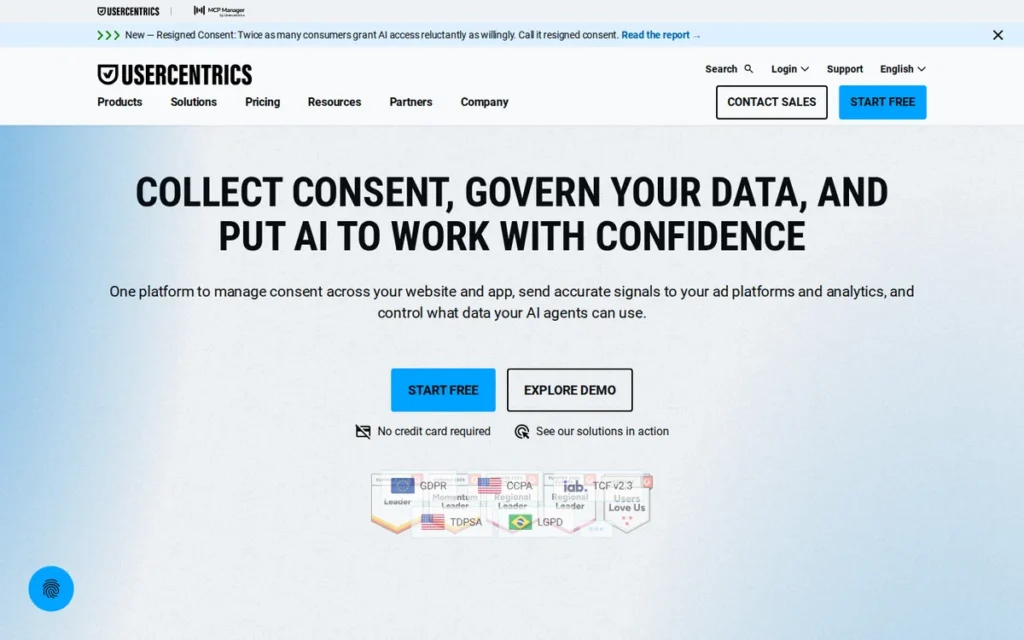
Category: Enterprise CMP, multi-device consent management with revenue-optimized analytics, Google Consent Mode Gold Partner certification, and IAB TCF v2.3, the most current TCF specification in this comparison.
At a Glance
- Category: Enterprise CMP
- Best For: Mid-market to enterprise organizations with programmatic advertising dependencies requiring IAB TCF v2.3 and Google Consent Mode v2 Gold certification across web, iOS, Android, and CTV
- Price Range: Session-based; starts ~€7/month/domain minimum; enterprise pricing available; verify at usercentrics.com/pricing
- Primary Strength: Usercentrics was recognized as the #1 Consent Management Platform in the CMP subcategory of G2’s 2026 Best Software Awards (February 2026), holds Google Consent Mode Gold Partner status and IAB TCF v2.3 certification, processes 8.8 billion user consents monthly, and maintains a 99%+ customer retention rate (usercentrics.com/press, 2026)
- Biggest Limitation: Session-based billing creates unpredictable overage costs for high-traffic or seasonally volatile sites; post-sale support quality documented as inferior to smaller competitor iubenda in direct practitioner comparisons
- One-Line Summary: Usercentrics was recognized as the #1 Consent Management Platform in the CMP subcategory of G2’s 2026 Best Software Awards, holds Google Consent Mode Gold Partner status and IAB TCF v2.3 certification, and serves 2.3 million websites and apps across 195 countries.
- Last Verified: April 2026
Overview
Usercentrics is a Munich-based enterprise consent management platform recognized as the #1 Consent Management Platform in the CMP subcategory of G2’s 2026 Best Software Awards (February 2026, documented at usercentrics.com/press), the most recent independent industry validation of any platform in this comparison. Usercentrics serves 2.3 million websites and apps across 195 countries as the parent company of Cookiebot (reviewed separately at Rank 4).
Usercentrics holds Google Consent Mode Gold Partner status, IAB TCF v2.3 certification (the most current in this comparison), and covers web, iOS, Android, and CTV channels from a single Consent Hub dashboard. Usercentrics is the only platform in this comparison to explicitly frame consent management as a revenue-enablement investment rather than a compliance cost.
Key Features
- Multi-Device Consent Hub: Usercentrics provides consent management covering websites, iOS apps, Android apps, and Connected TV (CTV) environments from a single Consent Hub dashboard, enabling unified consent lifecycle management across an organization’s full digital property portfolio without requiring separate CMP deployments per channel.
- IAB TCF v2.3 and Google Gold Partner: Usercentrics holds Google Consent Mode Gold Partner certification (the highest tier of Google’s CMP program) and supports IAB TCF v2.3 (the most current TCF specification in this comparison), ensuring full programmatic advertising signal compliance for EU publishers dependent on Google’s ad technology stack.
- Revenue-Enablement Analytics: Usercentrics’ A/B testing and real-time analytics module frames consent rate optimization as a direct revenue function, providing data to improve the proportion of users granting marketing consent, which directly improves ad targeting data recovery for Google Ads, programmatic campaigns, and attribution models.
- Geo-Targeting Across 195 Countries: Usercentrics’ geo-targeting engine automatically serves regulation-appropriate consent flows based on visitor IP location (GDPR opt-in for EU visitors, CCPA opt-out for California visitors, and configurable flows for other jurisdictions) across all 195 countries in Usercentrics’ deployment footprint.
- Bulk Editing and API Integration: Usercentrics’ multi-domain bulk editing, data export API, and real-time consent synchronization via webhooks reduce administrative overhead for enterprises managing large digital property portfolios and downstream data infrastructure requiring consent signal enforcement.
Best For
Usercentrics is best suited for mid-market and enterprise organizations with programmatic advertising revenue dependencies requiring IAB TCF v2.3 compliance and Google Consent Mode v2 at Gold certification level. Usercentrics is particularly well-matched for organizations managing multi-device consent environments spanning web, mobile apps, and CTV where unified Consent Hub management reduces fragmentation and compliance gaps.
Pricing
Usercentrics uses session-based pricing (costs scale per number of user sessions rather than per domain) creating unpredictable overage costs for sites with traffic spikes or seasonal volatility. Multiple independent practitioners document this as a source of billing surprises (r/CCPA, 2025–2026).
Starting pricing is approximately €7/month/domain at minimum scale; enterprise custom pricing is available for high-volume deployments. The free tier is available under the Cookiebot brand (1 domain, 50 subpages). Verify current session-tier structure and overage rates directly at usercentrics.com/pricing before budgeting for high-traffic or seasonally volatile sites.
Strengths
- G2 2026 Best Software Award: CMP Subcategory: Usercentrics was recognized as the #1 Consent Management Platform in the CMP subcategory of G2’s 2026 Best Software Awards in February 2026 (5th in the broader Best Data Privacy Software Products ranking, the highest CMP placement in that cycle; documented at usercentrics.com/press/usercentrics-no-1-cmp-g2-2026-awards/), reflecting strong aggregate satisfaction across thousands of verified reviews, with a G2 rating of 4.3/5 and a 99%+ customer retention rate (usercentrics.com/press, 2026).
- Largest Verified Deployment Footprint: Usercentrics and its subsidiary Cookiebot collectively serve 2.3 million websites and apps across 195 countries as of 2026 (Elevar/Usercentrics deployment documentation), the largest verified deployment footprint of any platform in this comparison by combined site count, sustaining ongoing Google CMP Partner certification and regulatory update investment.
- Most Current TCF Certification: Usercentrics holds Google Consent Mode Gold Partner certification and IAB TCF v2.3, ensuring full compatibility with EU programmatic advertising infrastructure at the most current TCF version in this comparison, ahead of Cookiebot and Didomi (both at v2.2).
Limitations
- Session-Based Billing Overages: Usercentrics’ session-based billing is its most documented operational pain point, a site experiencing a 15x traffic spike in a single month could face a 15x billing multiple for that period; organizations with seasonal volatility or viral content exposure should request contractual overage caps during negotiation and model worst-case session volumes before committing (r/CCPA, 2025–2026).
- Support Quality Gap: Usercentrics’ support quality was directly rated as inferior to smaller competitor iubenda in a head-to-head practitioner comparison (u/Techie_Girl_1990, r/CCPA, 2026), and the platform is described as having “complexity for non-technical users” in self-serve setup, suggesting implementation support costs for organizations without dedicated privacy or MarTech engineering staff.
- Implementation Overhead: Organizations without dedicated privacy or marketing operations staff should budget for external implementation support, as Usercentrics’ self-serve setup complexity is a recurring theme in independent practitioner discussions across 2025–2026, consistent with, though less extreme than, the pattern documented at OneTrust.
Verdict
Usercentrics is the G2-validated #1 Consent Management Platform in the CMP subcategory for 2026, holding the most current IAB TCF certification, the highest Google CMP certification tier, and the largest combined deployment footprint of any platform in this comparison. Usercentrics’ revenue-enablement positioning is uniquely compelling for advertising-dependent organizations, reframing consent infrastructure as a monetizable investment. Organizations should model session-based billing carefully against expected traffic volumes to avoid overage surprises, and should budget for implementation support if they lack dedicated privacy engineering staff, but for mid-market and enterprise teams with programmatic advertising dependencies, Usercentrics delivers the strongest combination of compliance currency and peer-validated user satisfaction.
3. iubenda: Best for SMBs and Developers: Attorney-Maintained Legal Compliance with Minimal Configuration
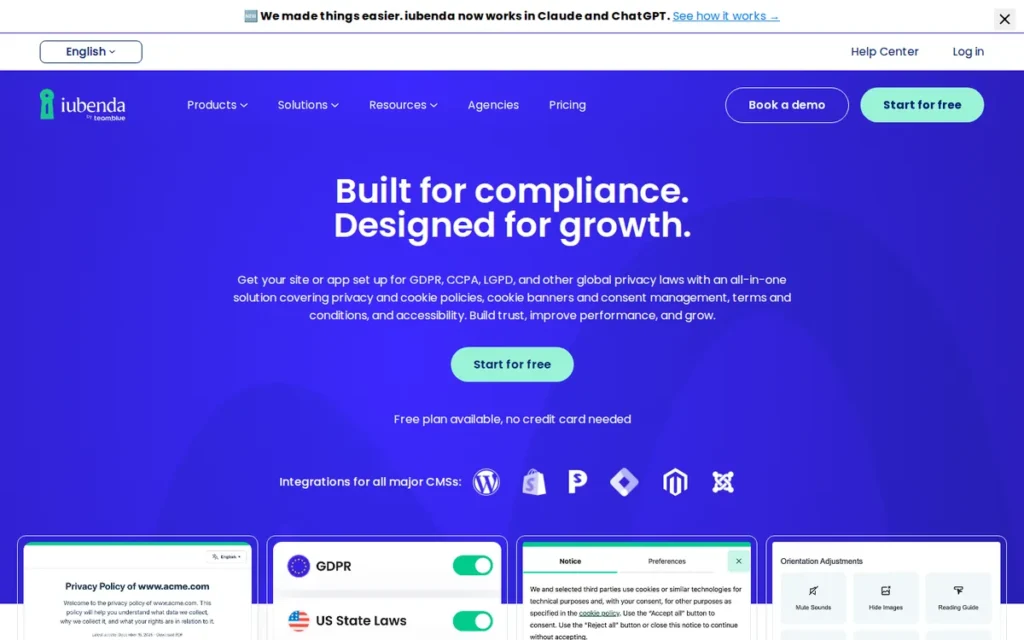
Category: Legal-First CMP, attorney-maintained compliance documentation platform covering consent banners, privacy policies, and terms and conditions, where all policy content is drafted and continuously updated by qualified legal experts rather than by the customer.
At a Glance
- Category: Legal-First CMP
- Best For: SMBs, freelancers, developers, and international app operators needing attorney-maintained, auto-updating compliance across GDPR, CCPA, and 10+ regulations
- Price Range: Free/starter tier available: exact paid tiers not independently confirmed as of April 2026; verify at iubenda.com/en/pricing
- Primary Strength: iubenda provides an attorney-maintained 2,400+ clause library that auto-updates as regulations change, holds IAB TCF v2.3 certification updated February 2026 (verifiable at iabeurope.eu/cmp-list/), and earned higher support quality ratings than Usercentrics in direct practitioner comparisons
- Biggest Limitation: Limited enterprise-grade analytics, A/B testing, and programmatic advertising integrations vs. mid-market competitors; exact paid pricing tiers were not publicly confirmed in independent research as of April 2026
- One-Line Summary: iubenda is an Italian-founded legal compliance platform with IAB TCF v2.3 certification (updated February 2026, verifiable at iabeurope.eu/cmp-list/), an attorney-maintained 2,400+ clause library covering 10+ regulations, and support quality rated above Usercentrics in direct practitioner comparisons.
- Last Verified: April 2026
Overview
iubenda is an Italian-founded all-in-one legal compliance platform that combines a Cookie Law consent management solution with an attorney-maintained privacy and cookie policy generator covering 2,400+ regulatory clauses across 10+ privacy frameworks. iubenda is the only platform in this comparison where the legal content of compliance documentation is drafted and continuously updated by qualified legal experts rather than by the customer.
iubenda holds IAB TCF v2.3 registration as of February 2026 (per iubenda.com/en/blog/transitioning-to-iabs-tcf-2-3-what-you-need-to-know/, verifiable at iabeurope.eu/cmp-list/ by searching for iubenda in the public registry). iubenda’s v2.3 certification places it at the same TCF compliance level as Usercentrics, and ahead of Cookiebot and Didomi (both still at v2.2 in this comparison).
Key Features
- Attorney-Maintained Clause Library: iubenda’s attorney-maintained library covers 2,400+ regulatory clauses across GDPR, CCPA/CPRA, UK-GDPR, LGPD, POPIA, nFADP, PECR, CalOPPA, ePrivacy, and US state privacy laws, and auto-updates those clauses as regulations change, eliminating the need for customers to monitor legal developments or hire counsel to revise policies independently.
- Auto-Jurisdiction Adaptation: iubenda automatically adapts consent flow type based on visitor location (delivering GDPR-compliant opt-in for EU and UK visitors, CCPA opt-out for California visitors, and jurisdiction-appropriate flows for other regions) confirmed by multiple independent practitioners to work correctly out of the box without per-jurisdiction manual configuration (r/webdev, 2025–2026).
- Consent Database with Audit Trail: iubenda’s Consent Database records each user’s consent with a full audit trail including timestamps, the specific consent version presented at collection time, and synchronization with legal document versions, generating proof-of-consent documentation specifically suitable for DPA investigations and regulatory audits as required by GDPR.
- IAB TCF v2.3 and Google Consent Mode v2 Advanced: iubenda is registered as an IAB TCF v2.3 certified CMP as of February 2026 (verifiable at iabeurope.eu/cmp-list/, search for iubenda in the publicly accessible registry) and integrates with Google Consent Mode v2 in Advanced mode, which preserves greater Google Analytics conversion modeling for users who decline consent compared to Basic mode.
- Superior Support Quality: iubenda’s support quality was directly rated above Usercentrics in a practitioner comparison (u/Techie_Girl_1990, r/CCPA, 2026), and the platform is consistently described as “super simple, quick, easy and compliant” by developers in r/webdev (2025–2026), suggesting a customer service responsiveness advantage over larger platform competitors.
Best For
iubenda is best suited for SMBs, freelancers, and developers who need a complete, legally sound compliance solution that works correctly across multiple jurisdictions without requiring legal expertise or ongoing regulatory monitoring. iubenda is also well-matched for international app operators who need combined GDPR, CCPA, and multi-regulation coverage from a single platform whose legal documentation is attorney-backed rather than self-authored.
Pricing
iubenda offers tiered pricing including a free or starter tier. Exact tier pricing in USD/EUR was not independently confirmed in research as of April 2026, verify directly at iubenda.com/en/pricing before purchase decisions.
Community discussions position iubenda as an affordable SMB option comparable in price category to Cookiebot, grouped as “quick and easy” budget-tier alternatives to OneTrust by multiple independent r/webdev practitioners (2025–2026). The absence of a fully transparent self-serve pricing page introduces more evaluation friction than Cookiebot’s published per-domain tiers.
Strengths
- IAB TCF v2.3 Certification (Updated February 2026): iubenda updated its IAB TCF certification to v2.3 in February 2026 (per iubenda.com/en/blog/transitioning-to-iabs-tcf-2-3-what-you-need-to-know/), placing iubenda at the same TCF compliance level as Usercentrics and ahead of Cookiebot and Didomi (both at v2.2), independently verifiable at iabeurope.eu/cmp-list/ by searching for iubenda in the public CMP registry.
- Support Quality Outperforming Larger Competitors: iubenda’s support quality was directly rated superior to Usercentrics in a head-to-head practitioner comparison by u/Techie_Girl_1990 (r/CCPA, 2026), and multiple r/webdev users in 2025–2026 independently described iubenda as “super simple, quick, easy and compliant” (u/Fit_Technology_4249), suggesting a responsiveness advantage over competitors with significantly greater organizational scale.
- Italian Founding and GDPR Enforcement Proximity: iubenda’s Italian founding places it in one of Europe’s most actively enforced GDPR jurisdictions (Italy’s Garante Privacy has issued landmark GDPR enforcement actions against major technology platforms including Google, Meta, and TikTok) creating direct regulatory pressure that informs iubenda’s product development in ways distinct from less-scrutinized jurisdictions.
Users on r/webdev noted:
“I used CookieYes on a few projects too. It works fine for simple setups. On a couple newer sites I moved to iubenda and honestly I’ve been happier with them. The setup process was cleaner, and handling consent, blocking and policies in one place saved time.” Posted by u/j_webops
Takeaway: Developers who move to iubenda from simpler single-purpose CMPs consistently report that its integrated consent, policy, and cookie blocking in one platform reduces configuration overhead, validating iubenda’s positioning as the most efficient all-in-one compliance solution for developer-led teams.
Limitations
- Limited Enterprise Feature Depth: iubenda’s feature set is purposefully focused on legal documentation and basic consent management rather than enterprise analytics, algorithmic A/B testing, or advanced programmatic advertising integrations, meaning organizations with complex MarTech dependencies or multi-brand programmatic operations will outgrow iubenda’s capabilities as scale increases.
- Absent Advanced CMP Capabilities: iubenda does not offer the preference center management, cross-domain consent synchronization, or publisher-focused analytics that mid-market platforms like Usercentrics or Didomi provide, making iubenda less suitable for organizations with significant programmatic advertising revenue dependencies or multi-channel consent architectures.
- Pricing Transparency Gap: iubenda’s exact paid pricing tiers were not publicly confirmed in independent research as of April 2026, introducing evaluation friction compared to Cookiebot’s fully transparent self-serve pricing model where full cost can be evaluated without any vendor contact, adding uncertainty for budget-constrained buyers who need to model total cost of ownership before engaging a vendor.
Verdict
iubenda is the legal-expert answer to CMP selection for SMBs and developers who need complete, jurisdiction-adaptive compliance without the technical overhead of enterprise platforms or the legal risk of maintaining policy content themselves. iubenda’s IAB TCF v2.3 certification (updated February 2026) is independently verifiable at iabeurope.eu/cmp-list/, its support quality outperforms larger competitors in direct practitioner comparisons, and its attorney-maintained clause library addresses the compliance maintenance burden most buyers underestimate when selecting a CMP. Organizations outgrowing iubenda’s analytics and integration capabilities will find natural migration paths to Usercentrics or Osano, but for SMBs and developer-led teams, iubenda provides the highest combination of legal rigor, ease of deployment, and verified support quality in this comparison.
4. Cookiebot: Best for Pricing Transparency: Best for Single-Site SMBs and Agencies Needing Automated Cookie Scanning
Category: Automated SMB CMP, scan-and-block consent management for single sites and agencies, with the most transparent publicly published pricing in the 2026 CMP market.
At a Glance
- Category: Automated SMB CMP
- Best For: Single-site operators, SMBs, WordPress/WooCommerce owners, and digital agencies needing automated scanning with no-sales-call pricing evaluation
- Price Range: Free (1 domain, 50 subpages); paid from ~€9/month/domain up to ~€90/month; see cookiebot.com/us/pricing
- Primary Strength: Cookiebot is the most pricing-transparent CMP in this comparison, fully public per-domain tiers from free to ~€90/month with no sales engagement required, enabling complete cost evaluation without contacting any vendor
- Biggest Limitation: Cookiebot’s automated crawler generates artificial traffic documented in multiple independent production deployments to contaminate Google Analytics data; Cookiebot’s own support documentation confirms this and provides IP exclusion steps as a remediation path
- One-Line Summary: Cookiebot is the most pricing-transparent CMP in the 2026 market, offering fully public per-domain tiers from free to ~€90/month with Google Consent Mode v2 Advanced certification and 47-language support, but its automated scanner has documented production cases of contaminating Google Analytics with artificial crawler traffic.
- Last Verified: April 2026
Overview
Cookiebot is a Danish-founded automated consent management platform, now owned by Usercentrics, specializing in automated monthly cookie scanning across a database of 13,000+ known trackers to auto-categorize and block non-essential scripts until user consent is provided. Cookiebot is the category’s leading “set-and-forget” CMP for single-site operators and agencies who need Google Consent Mode v2 compliance at a fully transparent, publicly published price point.
Cookiebot serves as the SMB-facing brand in the Usercentrics product family, with the combined Cookiebot and Usercentrics deployment base spanning 2.3 million websites and apps across 195 countries (Elevar/Usercentrics documentation, 2026).
Key Features
- 13,000+ Cookie Database Auto-Scanning: Cookiebot’s automated scanner crawls websites monthly against a repository of 13,000+ known cookies and trackers (including pixels and fingerprinting scripts) and auto-categorizes detected technologies into four GDPR-compliant consent groups (Necessary, Preferences, Statistics, Marketing) without requiring manual cookie identification from the site operator.
- Google Consent Mode v2 Certification: Cookiebot is a Google-certified CMP Partner with full Google Consent Mode v2 support in both Basic and Advanced modes, enabling Google Analytics 4 and Google Ads to continue operating in restricted or conversion-modeled mode when user consent is declined, satisfying the EU mandate effective March 2024.
- 47-Language Geo-Targeting: Cookiebot’s geo-targeting engine automatically adjusts consent banner type based on visitor IP address (serving opt-in consent flows for EU visitors under GDPR, opt-out flows for California under CCPA, and configurable flows for other regions) across 47 supported languages with automatic browser-language detection on premium plans.
- Agency Manager Dashboard: Cookiebot’s agency manager dashboard allows switching between multiple client domains from a centralized interface (described in G2 reviews as making it “easy to switch to clients and their setups”) an operational advantage for digital agencies managing consent compliance across multiple client properties.
- IAB TCF v2.2 and Cross-Domain Consent: Cookiebot supports IAB TCF v2.2 for programmatic advertising compliance and provides cross-domain consent synchronization on premium plans, enabling consistent consent states across multi-domain properties without requiring users to re-consent on each separate domain.
Best For
Cookiebot is best suited for single-site SMBs, WordPress and WooCommerce site owners, and digital agencies managing small to mid-sized client portfolios who need verified Google Consent Mode v2 compliance, transparent pricing they can evaluate without a sales call, and automated cookie categorization without manual technical configuration, particularly for EU-based advertisers dependent on Google Ads and GA4.
Pricing
Cookiebot publishes fully self-serve pricing at cookiebot.com/us/pricing: Free tier (€0, 1 domain, 50 subpages, manual scans, basic banner, 1 language, 1-month consent expiration); paid tiers scale by subpage count per domain from approximately €7–9/month (starter) to ~€15/month (350 subpages), ~€30/month (3,500 subpages), ~€50/month (7,000 subpages), and ~€90/month (Extra Large). All premium plans include full customization, geo-targeting, multi-language, Google Consent Mode v2, and IAB TCF v2.2.
Per-domain billing means each domain and subdomain is billed separately. A concrete agency cost calculation: 25 client domains at ~€30/month each equals ~€750/month (€9,000/year) on Cookiebot vs. consentmanager’s Professional tier at €219/month for 20 sites, a 71% reduction for the same portfolio scale. Verify current pricing at cookiebot.com/us/pricing (April 2026).
Strengths
- Largest Deployment Ecosystem: Cookiebot is part of the Usercentrics product family, which collectively serves 2.3 million websites and apps across 195 countries as of 2026 (Elevar/Usercentrics deployment documentation), an install base sustaining Cookiebot’s Google CMP Partner certification, funding ongoing regulatory update investment from the Usercentrics parent, and validating proven global compliance delivery at scale.
- “Straightforward and Effective” Multi-Platform Endorsement: Experienced multi-platform CMP implementer u/DigitalStefan (r/webdev, 2026) (who explicitly noted having “implemented, fixed, and maintained a lot of different consent management platforms”) described Cookiebot specifically as “straightforward and effective,” an endorsement carrying substantially more signal than single-platform reviews because it reflects direct comparative CMP category experience.
- Self-Serve Pricing Transparency: Cookiebot’s fully transparent, publicly published per-domain pricing at cookiebot.com/us/pricing requires no sales call, no pricing inquiry, and no enterprise negotiation, enabling SMBs and agencies to model full cost scenarios independently and addressing the CMP category’s most consistently cited buyer friction point.
This aligns with community sentiment on r/PPC:
“I personally prefer cookiebot since from my experience works best in conjunction with GTM. I am certified in consent management from Usercentrics and have deployed so many cookie banners on my clients’ website from various publishers when V2 rolled out. Cookiebot is just easier to deal with.” Posted by u/bodhisattvass
Takeaway: A Usercentrics-certified consent management practitioner who has deployed banners across multiple publisher clients still rates Cookiebot as the simpler implementation choice for GTM-integrated Consent Mode v2 deployments, reinforcing Cookiebot’s positioning as the lowest-friction certified option for agency-scale work.
Limitations
- Scanner-Induced Analytics Contamination: Cookiebot’s automated crawler, its core technical differentiator, generates artificial traffic spikes that contaminate Google Analytics data; Cookiebot’s own support documentation confirms this issue and provides 11 specific IP addresses for GA4 admin exclusion filtering (support.cookiebot.com, 2025), however, multiple users report the filtering process is non-trivial (u/InfamousResearcher32: “ruined my web traffic”; u/hunnymunch: “stuck for months not being able to filter” scanner traffic despite following Cookiebot’s own documentation, both r/woocommerce, 2025), and Cookiebot states it is working with Google toward automatic exclusion without resolution as of early 2026.
- Auto-Blocking False Positives: Cookiebot’s auto-blocking logic produced false positives that broke legitimate analytics event tracking in at least one documented production deployment (u/Bartfeels24, r/webdev, 2026: “started blocking legitimate analytics events for us after the first update so we ended up ripping most of it out”), a failure mode specific to Cookiebot’s active-crawling methodology that does not affect CMPs using tag-based blocking.
- Billing and Support Concerns: A G2 review raises billing transparency concerns about auto-renewal practices (“hidden fees… they won’t refund”), and customer service quality is rated poorly in multiple independent sources, concerning for a platform whose entire value proposition is regulatory compliance.
- Per-Domain Cost Compounding: Cookiebot’s per-domain billing model multiplies costs for agencies and multi-site operators, each domain and subdomain is billed separately, making Cookiebot structurally more expensive than views-based (consentmanager) or traffic-based (Osano) alternatives for organizations managing more than five to ten domains simultaneously.
Verdict
Cookiebot delivers the most transparent pricing in the consent management category (fully public per-domain tiers from free to ~€90/month with no sales process required) combined with Google Consent Mode v2 certification, IAB TCF v2.2, and the most accessible free tier among certified platforms. Cookiebot’s “straightforward and effective” implementation experience (per experienced multi-platform implementers) makes it the lowest-friction entry point for SMBs, EU-dependent advertisers, and agencies needing rapid deployment. Organizations relying on Google Analytics as a primary measurement tool should configure the 11 provided IP exclusion addresses in GA4 within the first billing period and monitor for scanner-date traffic spikes monthly; those managing more than 10 client domains should model per-domain billing at full portfolio scale against views-based and traffic-based alternatives before committing.
5. Didomi: Best for Enterprise Publishers: ISO 27001-Certified Global Consent for Multi-Channel Media Organizations
Category: Publisher CMP, ISO 27001-certified consent and preference management platform built for high-traffic media organizations, publishers, and ad-tech-dependent enterprises with multi-channel and global compliance requirements.
At a Glance
- Category: Publisher CMP
- Best For: Enterprise publishers, media companies, global brands, and gaming organizations with ISO 27001 requirements and multi-channel consent needs
- Price Range: Enterprise custom quotes only: no published pricing; contact didomi.io, SMBs should evaluate Cookiebot, iubenda, or consentmanager instead
- Primary Strength: Didomi is ISO 27001-certified, one of the first Google CMP Partners (September 2022), and its July 2025 acquisition of Sourcepoint created a combined entity serving 1,700+ customers globally with virtually no client roster overlap
- Biggest Limitation: Enterprise-only custom pricing with no self-serve entry tier excludes all organizations without dedicated procurement budgets; the Sourcepoint integration is planned over approximately two years (AdExchanger, July 2025), introducing transition complexity
- One-Line Summary: Didomi is an ISO 27001-certified consent management platform founded in Paris in 2017; its July 2025 acquisition of Sourcepoint created a combined entity serving 1,700+ customers globally, positioning Didomi as one of the largest enterprise publisher CMP providers across North America and Europe.
- Last Verified: April 2026
Overview
Didomi is a Paris-founded enterprise consent and preference management platform established in 2017, making Didomi one of the first CMPs built from the ground up under the GDPR era. Didomi offers multi-channel consent management across web, mobile apps, email, CTV, and gaming via Unity SDK, backed by ISO 27001 certification, Google CMP Partner status, and IAB TCF v2.2 compliance.
Didomi’s July 2025 acquisition of Sourcepoint, a major US-based publisher CMP competitor backed by Marlin Equity Partners, expanded the combined entity to 1,700+ customers globally with virtually no client roster overlap (Didomi had approximately 1,500 European and Canadian customers; Sourcepoint had 200+ US, UK, and German enterprise customers, AdExchanger, July 2025). The integration is planned over approximately two years to minimize client disruption, with a fully unified platform expected no earlier than mid-2027.
Key Features
- Centralized Preference Center: Didomi’s Preference Center allows users to view, modify, and revoke consent from a centralized hub with cross-device and cross-domain synchronization, enabling organizations to provide a consistent privacy management experience across all brand touchpoints regardless of the channel through which consent was originally collected.
- GPC Auto-Detection at Architecture Level: Didomi automatically detects and honors Global Privacy Control (GPC) browser signals as automatic opt-out at the platform architecture level, satisfying Colorado’s Universal Opt-Out Mechanism and Connecticut’s GPC compliance requirement structurally, without requiring user banner interaction or additional site operator configuration.
- IAB GPP for US State Privacy Signals: Didomi supports IAB GPP (Global Privacy Platform) for standardized US state privacy signal handling (the IAB’s unified consent signal framework for the programmatic advertising supply chain) enabling Didomi to serve as a compliant upstream consent signal source for downstream ad tech infrastructure.
- Unity SDK for Gaming: Didomi’s Unity SDK provides consent management specifically designed for gaming environments, making Didomi the only platform in this comparison with documented, purpose-built consent capabilities for mobile game publishers and game developers dependent on in-game advertising or user behavior analytics.
- ISO 27001 Certification: Didomi holds ISO 27001 certification: an independently audited information security management standard, addressing enterprise procurement requirements for supply chain data security due diligence that G2 review ratings alone cannot satisfy, distinguishing Didomi from the majority of CMPs in this comparison with no equivalent independent security audit credential.
Best For
Didomi is best suited for enterprise publishers, media companies, and global brands that require ISO 27001-certified consent infrastructure across multiple channels (web, mobile, CTV, gaming), depend on IAB TCF v2.2 and IAB GPP compliance for programmatic advertising revenue, and have the procurement budget for a custom enterprise contract. Didomi is particularly relevant post-Sourcepoint acquisition for North American media organizations already in the Sourcepoint ecosystem.
Pricing
Didomi does not publish pricing and requires a custom enterprise quote for all deployments. No self-serve or publicly accessible entry tiers exist as of April 2026. Independent comparison sources consistently describe Didomi as enterprise-only with no pricing accessible to SMBs or startups without formal procurement processes (Nixon Digital CMP Comparison 2026; Enzuzo Best CMPs, 2026).
Organizations should plan for implementation resource costs beyond the platform license fee and note that the Sourcepoint integration timeline (~two years from July 2025) means current customers will operate on parallel infrastructure during the transition period. Verify current pricing at didomi.io (April 2026).
Strengths
- ISO 27001 and Early Google CMP Partner: Didomi holds ISO 27001 certification (making Didomi one of only two platforms in this comparison (alongside OneTrust) with a formal, third-party-audited security credential) and was one of the first platforms certified as a Google CMP Partner in September 2022 (didomi.io/blog), reflecting technical readiness ahead of the March 2024 Google Consent Mode v2 EU mandate.
- Transformative Sourcepoint Acquisition: Didomi’s July 2025 acquisition of Sourcepoint, backed by Marlin Equity Partners, expanded the combined entity to 1,700+ customers globally with virtually no client roster overlap (AdExchanger, July 2025), positioning Didomi as the dominant consent platform for the enterprise publisher segment across both North American and European markets.
- G2 4.6/5 Rating and 2025 Ranking: Didomi self-reports a G2 rating of 4.6/5 across approximately 110 reviews (G2.com, 2025–2026, sourced from Didomi’s competitive blog; requires independent G2 verification), and ranked #5 in G2’s Best Data Privacy Software Products in 2025 (didomi.io/blog/g2-data-privacy-ranking-2025), the highest publisher-focused CMP in that ranking.
Limitations
- Enterprise-Only Access Barrier: Didomi’s complete absence of self-serve pricing, trial access, or entry-level tiers creates an absolute barrier to entry for SMBs and any organization without a formal procurement process, buyers cannot evaluate Didomi against competitors without initiating a sales engagement and disclosing organizational details.
- Post-Merger Integration Timeline: Didomi’s Sourcepoint integration is planned over approximately two years (AdExchanger, July 2025), meaning customers purchasing in 2025–2026 should expect parallel infrastructure operation and potential service delivery variability during the transition period rather than an immediately unified product experience.
- Self-Reported Review Data: Didomi’s G2 rating of 4.6/5 across ~110 reviews is sourced from Didomi’s own competitive blog post rather than independently scraped G2 data, requiring direct G2 verification at G2.com before using this figure as a purchase decision signal, as vendor-reported review metrics can reflect selective or outdated data.
- Implementation Complexity: Didomi’s implementation complexity and learning curve are documented as higher than mid-market alternatives (Nixon Digital CMP Comparison 2026), requiring dedicated technical resources that organizations without privacy engineering staff may struggle to sustain post-deployment without ongoing vendor support.
Verdict
Didomi is the strongest purpose-built publisher CMP in this comparison for enterprise media organizations, global brands, and gaming publishers requiring ISO 27001-certified, multi-channel consent infrastructure with IAB GPP compliance and structural GPC signal auto-detection. The July 2025 Sourcepoint acquisition meaningfully strengthens Didomi’s North American publisher capabilities and positions it as the dominant consent platform for the enterprise publisher segment. Didomi’s complete absence of SMB-accessible pricing or self-serve entry options makes it unsuitable for any organization outside the enterprise tier, and its self-reported G2 ratings should be independently verified at G2.com before use as a purchase criterion.
6. consentmanager: Best for Automated Consent Optimization: Algorithmically Optimized Consent Rate Improvement with Transparent Multi-Site Pricing
Category: Algorithmically Optimized CMP, European consent management platform with automated banner optimization and transparent views-based pricing for SMBs and agencies managing multiple sites.
At a Glance
- Category: Algorithmically Optimized CMP
- Best For: SMBs and digital agencies managing 2–10 sites wanting automated consent rate optimization and multi-site views-based pricing that avoids per-domain cost multiplication
- Price Range: Free (limited); Starter at €23/month (1 site, 100,000 views, no A/B testing); Essential at €59/month (3 sites, 1M views, A/B testing included); Professional at €219/month (20 sites, 10M views); see consentmanager.net/en/pricing, 14-day free trial, no credit card required
- Primary Strength: consentmanager’s algorithmically optimized automatic A/B testing engine analyzes banner performance by browser type, device, geographic location, and time of day, then automatically serves the highest-converting design variant, the most technically advanced consent optimization available at the SMB price tier in this comparison
- Biggest Limitation: No independently verified G2 or Capterra aggregate rating confirmed from non-vendor sources; company-reported 100,000+ website install base vs. BuiltWith-detected ~39,000 live installations (trends.builtwith.com, 2026)
- One-Line Summary: consentmanager is a European consent management platform with algorithmically optimized automatic A/B testing for consent rate improvement and transparent views-based pricing at €59/month for up to 3 sites, the most technically advanced optimization architecture available at the SMB price tier in the 2026 CMP market.
- Last Verified: April 2026
Overview
consentmanager is a German-founded consent management platform serving 100,000+ websites (self-reported, consentmanager.net/en/pricing/, April 2026; BuiltWith independently detects approximately 39,000 live installations, trends.builtwith.com, 2026) that combines IAB TCF v2.2 certification, Google Consent Mode v2, and IAB GPP with an algorithmically optimized automatic A/B testing engine. consentmanager describes this system as machine learning-powered in its platform documentation (help.consentmanager.net), independent technical verification of the specific methodology is not available from third-party sources as of April 2026.
consentmanager publishes fully transparent views-based pricing at €59/month for up to 3 sites and 1 million monthly views, representing the only transparent multi-site pricing model in this comparison and eliminating the per-domain cost compounding that Cookiebot creates for agencies.
Key Features
- Algorithmically Optimized A/B Testing: consentmanager’s automated optimization engine rotates multiple banner design variants among site visitors, analyzes performance data by browser type, device type, geographic location, and time of day, then automatically routes each visitor to the highest-performing design for their segment, consentmanager describes this system as machine learning-powered in its platform documentation; independent technical verification of the methodology is not available from third-party sources as of April 2026 (help.consentmanager.net/books/cmp/page/working-with-ab-testing-and-optimization).
- Views-Based Multi-Site Pricing: consentmanager’s Essential tier charges by total monthly page views across up to 3 websites or apps (€59/month for 1 million views), eliminating the per-domain cost compounding that occurs with Cookiebot’s billing model for agencies and multi-site operators managing multiple client properties.
- Staging Environment: consentmanager provides a staging environment allowing organizations to test banner changes in a pre-production environment before going live, a developer workflow safety feature uncommon at the SMB CMP price tier that reduces the production misconfiguration risk documented at other platforms.
- 10 Cookie Crawls Per Day: consentmanager runs up to 10 cookie crawls per day on the Essential tier, compared to Cookiebot’s standard monthly scanning, providing more current cookie detection for websites with frequently changing third-party technology stacks or dynamic tag management environments.
- Bundled Compliance Suite: consentmanager includes a privacy policy generator, whistleblowing tools, and data subject rights management at the Essential tier (€59/month), extending compliance coverage beyond cookie consent to a broader suite at a price point where most competitors offer consent banners only.
Best For
consentmanager is best suited for SMBs and digital agencies in European markets managing 2–10 sites who need algorithmically optimized consent rate improvement beyond basic banner compliance, views-based multi-site pricing that does not multiply by domain count, and a broader compliance suite (including DSR tools and whistleblowing) without the enterprise pricing of OneTrust or Didomi.
Pricing
consentmanager publishes fully transparent pricing at consentmanager.net/en/pricing:
- Free tier: Limited features; no cost
- Starter tier: €23/month for 1 site and 100,000 monthly views: no A/B testing (available on request; verify directly before purchase as this tier may not appear on the primary pricing page)
- Essential tier: €59/month for up to 3 sites and 1 million monthly views; additional views at €0.05 per 1,000; includes algorithmically optimized A/B testing, IAB TCF, DSR tools, and whistleblowing
- Professional tier: €219/month for up to 20 sites and 10 million monthly views, suited for agencies managing larger client portfolios
A 14-day free trial is available with no credit card required. Verify current pricing and overage billing structure at consentmanager.net/en/pricing (April 2026).
Strengths
- Most Technically Advanced SMB Optimization: consentmanager’s algorithmically optimized A/B testing is documented at help.consentmanager.net, where the system analyzes banner variant performance by browser type, device type, geographic location, and time of day and automatically routes visitors to the highest-performing design for their segment, the most technically sophisticated consent optimization architecture at the €59/month SMB price point in this comparison as of 2026 (per platform documentation; independent technical verification of the methodology is not available from third-party sources).
- 100,000+ Website Install Base: consentmanager reports 100,000+ websites served (consentmanager.net/en/pricing/, April 2026); BuiltWith independently detects approximately 39,000 live installations (trends.builtwith.com, 2026), a discrepancy likely reflecting historical vs. active installation counting; both figures confirm meaningful adoption for a European-focused platform, corroborated by an agency practitioner on r/woocommerce who described consentmanager as “widely used by our clients.”
- Bundled Compliance Suite Value: consentmanager’s inclusion of whistleblowing tools, data subject rights management, and a privacy policy generator at the €59/month Essential tier extends compliance scope significantly beyond what pure consent banner platforms include at comparable price points, providing total cost of ownership advantages for SMBs currently managing separate point solutions for each compliance requirement.
Limitations
- Limited Independent Review Validation: consentmanager’s primary limitation for buyers is the absence of independently verified aggregate review platform data (no G2 or Capterra aggregate rating was confirmed from independent sources during this research cycle) making it structurally harder to validate product quality claims through peer comparison than for OneTrust, Usercentrics, Didomi, or Cookiebot before committing.
- Install Base Ambiguity: consentmanager reports 100,000+ websites while BuiltWith independently detects approximately 39,000 live installations (trends.builtwith.com, 2026), a discrepancy of more than 60% between company-stated and independently detected figures that buyers conducting long-term vendor stability assessments should factor into procurement due diligence.
- Auto-Blocking Configuration Risk: At least one WooCommerce practitioner noted that both Cookiebot and consentmanager can cause “videos being blank and gateways not working” when auto-blocking logic intercepts embedded media and payment scripts before consent (r/woocommerce), a configuration issue requiring careful whitelisting of payment processors and media embeds post-deployment that demands technical attention from the deploying organization.
- Limited Brand Recognition Outside Europe: consentmanager’s brand recognition outside European markets is significantly lower than category leaders, which may complicate vendor due diligence in North American procurement processes or global enterprise security assessments where recognizable brand names reduce procurement friction.
Verdict
consentmanager delivers the most technically advanced consent rate optimization architecture at the SMB price tier in this comparison, with algorithmically optimized automatic A/B testing that removes the manual analysis burden, and views-based pricing that is structurally more favorable than per-domain billing for multi-site organizations. consentmanager’s 14-day free trial without a credit card requirement enables no-commitment evaluation that many competitors do not offer. Its primary limitation is limited independent review platform presence, buyers should address this through direct trial and community due diligence; the platform’s European market depth, agency-channel adoption, and transparent pricing ladder suggest reliable delivery when properly configured.
7. OneTrust: Best for Full-Suite Privacy Governance: Enterprises with Dedicated Privacy Engineering Teams and $25,000+/Year Budgets
Category: Privacy Governance Platform (enterprise consent management embedded in a full privacy operations suite covering data discovery, DSAR automation, AI governance, and data mapping) the only true full-suite platform in this comparison.
At a Glance
- Category: Privacy Governance Platform
- Best For: Large enterprises with dedicated privacy engineering teams and $25,000+/year compliance budgets requiring consolidated privacy governance across consent, data discovery, DSAR, and AI governance
- Price Range: Custom enterprise quotes only; community estimates $25,000–$50,000+/year (r/webdev, 2026); contact onetrust.com; most recent confirmed valuation $4.5 billion (July 2023 growth round, research.contrary.com, April 2026)
- Primary Strength: OneTrust is the only platform in this comparison offering a complete privacy governance suite covering consent management, data discovery, DSAR automation, AI governance, and Snowflake integration, supporting 250 languages and CTV/OTT environments including Apple TV and Roku
- Biggest Limitation: High configurability without built-in dark-pattern guardrails creates compliance risk for teams lacking privacy engineering expertise; dominant practitioner community negative sentiment documented across four subreddits over multiple years; complete pricing opacity; mobile SDK documented as severely problematic for developers
- One-Line Summary: OneTrust is the most feature-complete privacy governance platform in 2026, but its high configurability without built-in guardrails requires dedicated privacy engineering expertise, the CPPA’s March 2025 prosecution of asymmetrical consent design patterns demonstrates the enforcement consequences of configuration errors at the enterprise level.
- Last Verified: April 2026
Overview
OneTrust is an Atlanta-founded enterprise Trust Intelligence Platform with a most recent confirmed valuation of $4.5 billion (July 2023 growth round, per research.contrary.com and forgeglobal.com; November 2025 reports indicate OneTrust was exploring a potential private equity sale at an unconfirmed updated valuation, theinformation.com, November 2025). OneTrust extends far beyond cookie consent to encompass privacy management workflows, data discovery and classification, DSAR automation, Responsible AI governance, and Snowflake data warehouse integration.
OneTrust supports 250 languages and CTV/OTT consent including Apple TV and Roku. OneTrust is described by experienced privacy professionals as the market’s “gold standard” in enterprise deployments, yet is simultaneously the platform most consistently cited by practitioners for post-sale support degradation, excessive configuration complexity, and configurability-driven compliance risk.
Key Features
- Multi-Channel Consent with Snowflake Integration: OneTrust’s consent management covers websites, mobile apps, and OTT/CTV channels including Apple TV and Roku, with purpose-based consent collection, real-time API and webhook synchronization, A/B testing, patented cookie and SDK scanning, and Snowflake integration for consent signal enforcement directly within data warehouse environments, the only CMP in this comparison with data warehouse-native consent enforcement.
- Data Discovery and Classification: OneTrust’s Data Discovery module automatically scans databases, file shares, and cloud systems to classify personal data across an organization’s entire infrastructure, extending privacy governance beyond the consent collection layer to enable organizations to document what personal data they hold and where, as required by DSAR responses and GDPR Article 30 Records of Processing Activities.
- DSAR Lifecycle Automation: OneTrust’s DSAR automation manages the full lifecycle of data subject rights requests across GDPR, CCPA, and other frameworks, including submission, identity verification, routing to data owners, deletion workflows, and regulatory deadline tracking, with one documented customer case study reporting $195,000 in annual savings from platform consolidation (OneTrust platform resources, onetrust.com/platform/, verify publication year directly, as undated case studies may reflect outdated pricing structures).
- Responsible AI Governance: OneTrust’s Responsible AI governance module addresses the emerging compliance requirement for organizations developing or deploying AI systems to document, assess, and manage data privacy implications, a capability absent from all other six platforms in this comparison.
- 250-Language Global Coverage: OneTrust supports 250 languages and Global Privacy Control browser signal recognition, with automatic detection of changes in EU ePrivacy Directive requirements, a regulatory monitoring investment supported by OneTrust’s organizational scale that smaller CMPs cannot match.
Best For
OneTrust is best suited for large enterprises with dedicated privacy engineering teams, annual compliance budgets of $25,000 or more, and genuine multi-module requirements spanning consent management, DSAR automation, data discovery, and AI governance simultaneously. OneTrust’s ROI case is the documented elimination of multiple privacy point solution contracts, as illustrated by one customer’s $195,000 annual savings from platform consolidation.
Pricing
OneTrust does not publish pricing and requires enterprise sales engagement for all quotes. Community estimates across multiple Reddit discussions in 2025–2026 suggest full-feature enterprise deployments starting at $25,000/year. One compliance professional cited a “$25K quote” even for early-stage startups (r/webdev, 2026).
OneTrust’s most recent confirmed valuation is $4.5 billion from a July 2023 growth round (research.contrary.com, forgeglobal.com, April 2026), a figure signaling enterprise SaaS pricing expectations incompatible with most organizations in the stated audience. Community consensus across r/webdev, r/gdpr, and r/GoogleTagManager is broadly consistent: practitioners actively advise startups and SMBs to evaluate alternatives before entering the OneTrust sales process. The documented exception, u/Arviragus (r/gdpr, 20+ years privacy experience), explicitly attributes their positive OneTrust experience to significant setup investment and deep expertise. Contact OneTrust at onetrust.com for current pricing (April 2026).
Strengths
- $195,000 Annual Savings Case Study: One documented OneTrust customer case study reports $195,000 in annual cost savings from consolidating multiple privacy management tools, consent management, data mapping, DSAR, and risk, into a single OneTrust contract (OneTrust platform resources, onetrust.com/platform/), the only quantified ROI figure from a named customer implementation among all seven platforms in this comparison, establishing a concrete economic rationale for platform consolidation at enterprise scale.
- 250-Language and CTV/OTT Breadth: OneTrust is the only platform in this comparison supporting 250 languages and CTV/OTT consent management across Apple TV and Roku, capabilities required by global media companies and streaming service operators whose compliance requirements exceed what any other platform here can serve from a single contract.
- Positive Experience for Expert Teams: Privacy professional u/Arviragus (r/gdpr, 20+ years of experience) described OneTrust as “the first tool I’ve ever actually championed in all that time” and confirmed it “delivers what it sells”, a credible counterpoint to the dominant negative community narrative, and a clear signal that OneTrust’s outcomes are strongly correlated with implementation expertise rather than inherent platform quality.
Limitations
- Configurability-Driven Compliance Risk: OneTrust’s high configurability enables non-compliant consent flows when deployed without dedicated privacy engineering expertise, privacy professional u/Chongulator (r/gdpr) noted that “OneTrust’s cookie management tool is frequently configured in confusing or sometimes even deceptive way,” and the CPPA’s March 12, 2025 enforcement action against Honda Motor Co. ($632,500 fine) for asymmetrical choice structures that made opting out harder than opting in, excessive personal information requirements for privacy rights requests, and missing ad tech contracts (CPPA enforcement order, cppa.ca.gov/announcements/2025/20250312.html) illustrates the CPPA’s willingness to prosecute precisely these configuration failures, practitioners on r/GoogleTagManager connected this case to CMP selection decisions, though the CPPA enforcement order does not name a specific CMP vendor.
- Dominant Negative Community Sentiment: OneTrust’s community sentiment across r/webdev, r/gdpr, r/androiddev, and r/GoogleTagManager is the most consistently negative of all seven platforms (practitioners describe OneTrust as “needlessly complicated,” “more like an unfinished product,” “sales team first with nearly zero post-sale contact” (u/jdbrew, r/webdev, 2025)) patterns documented across multiple subreddits and years suggesting structural organizational issues rather than isolated implementation failures.
Users on r/cipp shared their experience:
“Have run global privacy at two F500 companies and a couple well known, large internet platforms doing compliance, data inventory, DSAR and other functions at scale. OneTrust customer several times over as well as some of the competition. If you’re doing a high volume of DSAR, 10-100k plus/yr, you’ll know what tools to buy, where OneTrust falls apart and when it’s time to roll your own, but 9 times out of 10 Id rather have an ambitious privacy analyst skilled with excel or Google sheets and some good email templates in the can.” Posted by u/jrandomslacker
Takeaway: Multi-organization OneTrust users with F500-scale privacy experience identify specific volume thresholds where the platform’s automation degrades, confirming that OneTrust’s value proposition is contingent on having operational infrastructure sophisticated enough to sustain it, and that human expertise frequently outperforms the platform’s automation for teams that lack that infrastructure.
- Complete Pricing Opacity: OneTrust’s complete absence of public pricing forces all buyers into enterprise sales conversations before they can evaluate fit or model cost, systematically advantaging OneTrust’s sales team over buyers, and creating the vendor lock-in risk that u/Chongulator (r/gdpr) described as “going for lock-in with their whole suite rather than solving my problems individually.”
- Mobile SDK Developer Experience: OneTrust’s mobile SDK is documented as a separate, severe pain point distinct from desktop web consent, u/rio258k (r/androiddev, 2025) described OneTrust as “a scam for product managers” in the context of mobile consent management, representing an independent dimension of implementation risk for organizations managing native app consent across Android and iOS platforms.
Verdict
OneTrust is the most feature-complete privacy governance platform in this comparison and the appropriate choice specifically for large enterprises consolidating multiple privacy point solutions, the documented $195,000 annual savings case study establishes a real ROI rationale when used by experienced teams managing multiple governance modules simultaneously. OneTrust ranks #7 not because it lacks features, it has the broadest feature set reviewed, but because its evidence profile across pricing transparency, support quality, and compliance risk architecture scores lowest when evaluated against the same six criteria applied equally to all seven platforms. Organizations under $25,000/year compliance budgets or without dedicated privacy engineering staff should evaluate Osano, Usercentrics, or iubenda before engaging with OneTrust’s sales process.
What Red Flags Should I Watch For When Evaluating a Consent Management Platform?
Six red flags indicate a consent management platform may increase compliance risk rather than reduce it: no published pricing, high configurability without dark-pattern guardrails, scanner-induced analytics contamination, session-based billing with uncapped overages, post-sale support degradation, and zero compliance accountability commitment. Any platform triggering multiple flags warrants additional due diligence before purchase.
Red Flag #1: Complete Pricing Opacity (OneTrust, Didomi)
Any CMP that refuses to publish any pricing (even a starting range or billing model description) systematically advantages its own sales team over buyer decision-making. OneTrust and Didomi require sales engagement for all quotes, and community-reported pricing suggests costs many buyers cannot sustain.
If a vendor requires a sales call before disclosing price ranges, budget a minimum of $15,000–$25,000/year for enterprise entry before engaging (community estimates, r/webdev, 2026).
Red Flag #2: Configurability Without Guardrails, What the CPPA Prosecutes
The California Privacy Protection Agency fined Honda Motor Co. $632,500 on March 12, 2025, for non-compliant privacy practices including asymmetrical choice structures that made opting out harder than opting in, excessive personal information requirements for privacy rights requests, and missing required ad tech contracts (CPPA enforcement order, cppa.ca.gov/announcements/2025/20250312.html). The CPPA enforcement order does not name a specific CMP vendor, practitioner communities on r/GoogleTagManager cite this case in CMP selection discussions.
The practical difference between guardrailed and unguardrailed CMP configuration: on Osano, a user attempting to set the reject button to a smaller font size than the accept button encounters a platform-level block, that non-compliant design cannot be saved or published. On a fully configurable platform, that same asymmetrical design publishes with no platform-level warning. Asymmetrical choice structures, making opting out harder than opting in, are precisely the violation type the CPPA prosecuted in the Honda enforcement action. Platforms with structural UX guardrails (Osano) prevent this class of configuration error by design.
Red Flag #3: Scanner-Induced Analytics Contamination (Cookiebot)
Cookiebot’s automated monthly crawler (its core technical differentiator) generates artificial traffic spikes that contaminate Google Analytics data. Cookiebot’s own support documentation confirms this issue and provides 11 specific IP addresses for GA4 exclusion filtering (support.cookiebot.com, 2025).
Multiple independent Reddit users documented this pattern in production environments: u/InfamousResearcher32 reported the scanner “ruined my web traffic” and u/hunnymunch reported being “stuck for months not being able to filter” the scanner traffic despite following Cookiebot’s own documentation (both r/woocommerce, 2025). Organizations for whom Google Analytics is a primary measurement tool should treat this as a material deployment risk, configure the 11 provided IP exclusion addresses in GA4 within the first billing period.
Red Flag #4: Session-Based Billing Overages (Usercentrics)
Usercentrics’ session-based pricing creates unpredictable overage charges when traffic spikes occur unexpectedly. A practical scenario: a mid-sized e-commerce site normally processing 100,000 sessions per month experiences a viral feature driving 1.5 million sessions in a single month, a 15x traffic event. Under per-domain pricing (Cookiebot), the monthly fee is unchanged. Under session-based billing (Usercentrics), that 15x traffic spike could generate a 15x cost multiple for that billing month.
Organizations with seasonal volatility, viral content exposure, or high-traffic events should model worst-case session volumes against Usercentrics’ overage rates before committing, and should request contractual overage caps during negotiation.
Red Flag #5: Post-Sale Support Degradation
Multiple platforms (most prominently OneTrust, but also Usercentrics) are documented for a pattern of robust pre-sale engagement followed by declining post-sale support access. u/jdbrew (r/webdev, 2025) described OneTrust as having “nearly zero contact” after contract signing. u/Techie_Girl_1990 (r/CCPA, 2026) documented Usercentrics’ support as inferior to smaller competitor iubenda in direct comparison.
Buyers should request documented SLA terms for post-sale support response times before signing any CMP contract, and should speak with a reference customer who has used vendor support after contract signing, not only during the sales process.
Red Flag #6: Absence of Any Compliance Accountability Commitment
Six of the seven platforms in this comparison offer no financial accountability tied to compliance outcomes. Only Osano provides a documented $500,000 no-fines guarantee (conditions apply, verify void terms at osano.com/pledge before treating this as your compliance safety net).
For organizations where a regulatory fine would be materially damaging, evaluating platforms that stand behind their compliance claims financially reduces risk transfer exposure that purely configurable platforms leave entirely with the buyer.
What Questions Should I Ask Before Choosing a Consent Management Platform?
These six evaluation questions identify the gaps vendor marketing rarely addresses and that emerge as the most consequential post-purchase surprises in practitioner community discussions from 2025–2026. Every compliance officer, developer, and IT decision-maker evaluating a CMP should have documented answers to all six before signing any contract, vendors who deflect specific questions should be treated as higher-risk options.
Question #1: Does this CMP support all regulations I am currently subject to, including IAB TCF version, GPC browser signals, and any US state laws beyond GDPR and CCPA?
Ask your vendor to specify the exact IAB TCF version certified (v2.2 or v2.3), whether GPC browser signals are honored automatically at the architecture level or require manual configuration, and which specific US state privacy laws (Colorado UOOM, Connecticut GPC, Virginia CDPA) are built into the platform’s logic rather than left to user configuration. Usercentrics and iubenda currently hold v2.3, the most current TCF version in this comparison; Osano and Didomi both provide structural GPC auto-detection.
Question #2: Can I see full pricing without a sales call, and what triggers a billing tier upgrade?
If a vendor cannot provide a starting price range and the billing model (per-domain, session-based, traffic-based, views-based) without a sales conversation, factor in pricing opacity risk and the likelihood of aggressive upsell pressure post-sale. Only Cookiebot and consentmanager publish complete self-serve pricing among the seven platforms in this comparison. For platforms requiring custom quotes (OneTrust, Didomi), budget at least $25,000/year based on community-validated estimates (r/webdev, 2026).
Question #3: Does this platform structurally prevent non-compliant banner configurations, or does it leave all compliance decisions to my configuration choices?
Ask specifically whether the platform has built-in guardrails preventing dark-pattern configurations (such as asymmetrical accept/reject button sizing, confusing toggle language, or pre-ticked consent checkboxes) and whether those guardrails can be overridden by the configuring user. Osano is the only platform in this comparison with structural UX guardrails that prevent non-compliant configurations by design. The CPPA’s March 2025 prosecution of Honda Motor Co. for asymmetrical opt-out structures illustrates the enforcement consequences of configuration errors that guardrailed platforms prevent architecturally.
Question #4: What happens to my stored consent records if I switch platforms?
Your consent database, records of every user’s consent choice with timestamps, is a compliance-critical asset. Ask vendors: Can you export your consent database in a portable format? What is the data retention period after contract termination? Will records remain accessible for DPA investigations if you switch providers mid-year? iubenda’s Consent Database is explicitly designed for DPA audit readiness; other platforms vary significantly in export capability and post-termination data access, verify these terms in writing before signing any contract.
Question #5: Does the platform honor Global Privacy Control (GPC) browser signals automatically, or does it require manual configuration?
Colorado’s Universal Opt-Out Mechanism and Connecticut’s regulations require websites to honor GPC browser signals as automatic opt-out, distinguishing between structural auto-detection (Osano, Didomi) and optional configuration requiring manual activation. Ask vendors to show you where GPC detection is enforced in their architecture, not just whether GPC is supported. The difference between structural enforcement and optional configuration is the difference between inherent compliance and configuration-dependent compliance.
Question #6: What is your post-sale support SLA, and can I speak with a reference customer who has used support after contract signing?
Post-sale support degradation is one of the two most common post-purchase complaints in practitioner communities (alongside session-based billing surprises). Request documented SLA terms for post-sale support response times before signing any CMP contract. Speaking directly with a reference customer who has used vendor support after contract signing (rather than during the sales process) is the most reliable way to validate support quality promises before committing.
How Did We Rank These Consent Management Platforms?
The seven platforms were ranked by applying six weighted criteria to independently sourced data, prioritizing evidence that is traceable, verifiable, and dated over vendor marketing claims or AI-generated summaries that may reflect PR investment rather than practitioner reality. The evaluation process involved four parallel workstreams: AI engine gap analysis, independent web research, practitioner community sentiment analysis, and certification verification.
What Was the Evaluation Process?
Four parallel workstreams were conducted simultaneously:
- AI Engine Query Analysis: Perplexity and ChatGPT were queried with the core search terms listed at the top of this article to identify which platforms receive LLM recommendation coverage and which are systematically absent, creating a gap analysis that informed independent research depth allocation.
- Independent Web Research: Technical specifications, certifications, pricing pages, and case study data were gathered directly from each vendor’s published materials and cross-referenced against independent sources including iabeurope.eu, cppa.ca.gov, research.contrary.com, enzuzo.com, and G2.com.
- Practitioner Community Sentiment Analysis: Reddit communities r/gdpr, r/webdev, r/GoogleTagManager, r/woocommerce, r/CCPA, and r/androiddev were analyzed for practitioner discussions (2025–2026 prioritized), weighting multi-platform implementer testimony, recurring complaint patterns, and direct head-to-head comparisons more heavily than single-platform user reviews.
- Certification Verification: IAB TCF certification claims were cross-referenced against the iabeurope.eu/cmp-list/ registry; Google CMP Partner tiers were verified against Google’s program documentation; ISO 27001 and financial claims were verified through independent financial databases.
As one practitioner on r/webdev described the challenge that makes this practitioner sentiment workstream necessary:
“To expand on this confusion, everyone understands that cookie consent is a thing, but no one understands what we’re supposed to do about it. So it’s easier for decision makers to delegate all those tough questions to a library that claims to have solutions, without investigating too much what the implications of those solutions are. It’s easier for web engineers to install the libraries the non-technical decision makers tell us to install, than it is to pick at that scab. It’s a shitshow from top to bottom.” Posted by u/EarhackerWasBanned
Takeaway: CMP selection is widely understood to be necessary but poorly understood in practice, a systemic gap between perceived compliance and actual evaluation rigor that independent, evidence-based rankings are specifically designed to address.
What Were the Six Ranking Criteria?
- C1: Verified Compliance Coverage and Certifications (25%): IAB TCF certification version (v2.2 vs. v2.3), Google CMP Partner tier (Standard vs. Gold), ISO 27001 status, GPC auto-detection capability, and breadth of supported regulatory frameworks. This criterion matters because unverifiable compliance claims create direct legal exposure, independently verifiable credentials allow buyers to confirm platform claims without relying on vendor self-reporting.
- C2: Practitioner Review Evidence (20%): G2 and Capterra aggregate ratings where independently confirmed, and unprompted practitioner community discussions from Reddit 2025–2026. This criterion matters because vendor case studies are structurally biased, community sentiment from multi-platform implementers is the closest available signal to unfiltered user experience.
- C3: Pricing Transparency and Total Cost of Ownership (20%): Whether pricing is fully self-serve vs. requiring sales engagement, billing model clarity, community-validated price anchors, and documented billing failure modes. This criterion matters because pricing opacity systematically advantages vendor sales teams and prevents accurate TCO modeling.
- C4: Feature Breadth and Platform Scope (15%): Core CMP capabilities plus extended compliance modules (DSR automation, preference management, vendor risk monitoring), technical optimization depth, and IAB TCF version currency. This criterion matters because a platform’s scope determines whether it eliminates adjacent point solutions or creates compliance sprawl.
- C5: Implementation Experience and Support Quality (10%): Documented setup complexity from multi-platform implementers, post-sale support quality patterns in practitioner communities, and CEO/team direct community engagement. This criterion matters because setup complexity and support responsiveness are the two criteria most correlated with negative post-purchase reviews.
- C6: Compliance Risk Architecture (10%): Presence of UX guardrails preventing non-compliant configurations, financial compliance guarantees with documented terms, verifiable zero-fine customer track records, and audit trail documentation quality. This criterion matters because high configurability without guardrails is itself a compliance risk, the CPPA’s March 2025 prosecution of asymmetrical consent design patterns illustrates the enforcement landscape for misconfigured implementations.
How Is Conflicting Evidence Weighted?
Specificity and recency outweigh aggregate ratings in this ranking methodology. A detailed 2025–2026 practitioner community post from an identified multi-platform CMP implementer carries more evidentiary weight than a generic 2023 G2 review from a single-platform user. Vendor-reported statistics are labeled as such throughout this article. Only claims corroborated by at least one independent source are stated as fact.
How Are Vendor Claims Validated?
Vendor-reported statistics are labeled throughout this article. Community-validated pricing for platforms without public pricing (Osano) is attributed explicitly with Reddit subreddit, username, and year, accompanied by a “verify directly before purchasing” caveat in every instance. The Honda CPPA fine is documented with its primary independent source (cppa.ca.gov/announcements/2025/20250312.html, March 2025). The Didomi G2 rating, for example, is explicitly noted as sourced from Didomi’s own competitive blog and flagged as requiring direct G2 verification. Typical CMP evaluation timelines: freelancers and single-site operators can select and implement a CMP in under one day using Cookiebot’s free tier or iubenda’s guided setup; SMBs should plan 1–2 weeks to evaluate 2–3 options using available free trials; enterprise buyers should plan 2–3 months for due diligence, security review, integration testing, and contract negotiation.
What Is the Update Cadence?
This article was last updated April 2026. PlugRoute refreshes CMP rankings quarterly to account for regulatory changes (new US state privacy laws, IAB TCF version updates), pricing model changes, and shifts in practitioner community sentiment. All pricing figures in this article should be independently verified at each vendor’s website before purchase decisions.
PlugRoute has no affiliate relationships with any company listed. Rankings are determined entirely by research data and objective evaluation criteria.
What Are the Most Common Questions About Consent Management Platforms?
These three questions cover the highest-priority decision blockers for organizations evaluating consent management platforms in 2026, including which platforms are best for small businesses, whether any CMP offers a compliance guarantee, and how PlugRoute determines rankings without affiliate relationships. Each answer is a standalone direct response requiring no additional article context to be actionable.
What is the best consent management platform for a small business website in 2026?
For single-site SMBs, Cookiebot (free to ~€9/month) and iubenda (free starter tier) are the strongest 2026 starting points, both hold IAB TCF certification and integrate with Google Consent Mode v2 with minimal configuration. For multi-site SMBs (2–5 sites), consentmanager (€59/month) eliminates per-domain cost compounding. For compliance-risk-averse organizations at any scale, Osano (~$199/month) provides the only financial compliance guarantee in this comparison (conditions apply).
Does any consent management platform offer a compliance guarantee?
Osano is the only consent management platform in this comparison offering a documented $500,000 no-fines compliance guarantee, backed by a zero-customer-fine record since 2018 (CEO-stated, r/GoogleTagManager, 2025; not independently verified through regulatory databases as of April 2026). No other platform here offers any financial accountability commitment tied to compliance outcomes. Request Osano’s contractual guarantee void conditions in writing before relying on it as your compliance safety net (osano.com/pledge, April 2026).
How does PlugRoute determine its consent management platform rankings?
PlugRoute ranks CMPs across six weighted criteria: verified compliance certifications (25%), practitioner review evidence from G2, Capterra, and Reddit (20%), pricing transparency and total cost of ownership (20%), feature breadth (15%), implementation and support quality (10%), and compliance risk architecture including dark-pattern guardrails (10%). All non-published pricing is community-validated from named Reddit sources with subreddit and year attribution. See the methodology section above for full evaluation process details.
What Do Key Consent Management Platform Terms Mean?
IAB TCF (Transparency & Consent Framework): The IAB TCF is an industry-standard technical specification developed by IAB Europe that defines how consent signals for digital advertising are captured, stored, and transmitted across the programmatic advertising supply chain. CMPs must be formally registered and certified by IAB Europe to be IAB TCF-compliant; the registry is publicly searchable at iabeurope.eu/cmp-list/. The current version is v2.3 (2026), platforms certified at v2.3 (Usercentrics, iubenda as of February 2026) have more current programmatic advertising compliance signaling than platforms at v2.2 (Cookiebot, Didomi). Version currency and certification status for any registered CMP are independently verifiable at iabeurope.eu/cmp-list/.
Google Consent Mode v2: Google Consent Mode v2 is a technical framework that adjusts the behavior of Google tags, including Google Analytics 4 and Google Ads, based on user consent signals from a CMP, enabling conversion modeling and anonymized analytics even when users decline consent. Google made Consent Mode v2 mandatory for EU-based advertisers using Google’s ad technology in March 2024, making CMP compatibility a table-stakes requirement for any organization running Google advertising campaigns in the EU. Google CMP Partner certification has two tiers, Standard and Gold, with Usercentrics holding Gold (the highest tier) in this comparison.
Global Privacy Control (GPC): Global Privacy Control is a browser-level technical signal communicating a user’s universal opt-out preference for the sale or sharing of personal data. Colorado’s Universal Opt-Out Mechanism (UOOM) and Connecticut’s privacy regulations legally require websites to honor GPC signals as automatic opt-out as of 2024–2025, making a CMP’s ability to structurally auto-detect GPC (Osano, Didomi) vs. requiring manual activation a material US state compliance distinction. Buyers should ask vendors specifically whether GPC is enforced at the architecture level or left to configuration.
DSAR (Data Subject Access Request): A DSAR is a formal request by an individual to exercise privacy rights under GDPR, CCPA, or other frameworks, including the right to access, correct, delete, or restrict the processing of their personal data. CMPs with integrated DSAR automation (Osano, OneTrust) enable organizations to receive, route, verify, and fulfill these requests within legally mandated response windows without manual case management. Organizations without DSAR automation face significant regulatory deadline risk as US state privacy law enforcement increases through 2026.
Dark Pattern (CMP Context): In the context of consent management, a dark pattern is a user interface design that manipulates visitors into accepting cookies or data processing when they did not clearly intend to do so, examples include asymmetrical accept/reject button sizing (making accept more prominent than reject), burying opt-out options behind multiple navigation layers, or pre-ticked consent checkboxes. The CPPA’s March 2025 enforcement action against Honda Motor Co. for asymmetrical opt-out structures (cppa.ca.gov, March 2025) demonstrates that regulators actively prosecute dark-pattern consent designs. CMPs with structural guardrails (Osano) prevent these configurations at the platform level; fully configurable platforms leave all banner design decisions to the deploying organization.
Glossary: Key Terms Used in This Comparison
IAB TCF (Transparency & Consent Framework): A technical specification developed by IAB Europe that standardizes how consent signals for digital advertising are captured, stored, and transmitted across the programmatic advertising supply chain. CMPs must be formally certified by IAB Europe to be IAB TCF-compliant, with certification status independently verifiable at iabeurope.eu/cmp-list/; the current version is v2.3.
Google Consent Mode v2: A technical framework that adjusts the behavior of Google tags (including Google Analytics 4 and Google Ads) based on user consent signals, enabling conversion modeling and anonymized analytics even when users decline consent. Google made Consent Mode v2 mandatory for EU-based advertisers using Google’s ad technology in March 2024, making CMP compatibility a baseline requirement for organizations running Google advertising campaigns in the EU.
Global Privacy Control (GPC): A browser-level technical signal that communicates a user’s universal opt-out preference for the sale or sharing of personal data. Colorado’s Universal Opt-Out Mechanism and Connecticut’s privacy regulations legally require websites to honor GPC signals as automatic opt-out, making a CMP’s structural auto-detection of GPC (versus requiring manual configuration) a material US state compliance distinction.
Dark Pattern (CMP Context): A user interface design that manipulates visitors into accepting cookies or data processing when they did not clearly intend to do so, such as asymmetrical accept/reject button sizing, pre-ticked consent checkboxes, or multi-layer opt-out navigation. The CPPA’s March 2025 enforcement action against Honda Motor Co. for asymmetrical opt-out structures demonstrates that regulators actively prosecute dark-pattern consent designs.
DSAR (Data Subject Access Request): A formal request by an individual to exercise privacy rights under GDPR, CCPA, or other frameworks, including the right to access, correct, delete, or restrict the processing of their personal data. CMPs with integrated DSAR automation enable organizations to receive, route, verify, and fulfill these requests within legally mandated response windows without manual case management.
Which Consent Management Platform Is Right for You?
The right consent management platform depends on three variables: your organization’s size, the geographic scope of your privacy-law obligations, and whether your primary need is compliance certainty or consent-rate optimization. The guidance below maps each scenario to a specific platform recommendation backed by the evidence in this analysis.
Key Insights
- Osano is the only platform in this comparison to offer a $500,000 no-fines compliance guarantee (conditions apply; zero-customer-fine record since 2018 CEO-stated via r/GoogleTagManager, 2025, not independently verified), making it the strongest choice for compliance-risk-averse organizations from startup through mid-market where a regulatory fine would be materially damaging.
- Usercentrics was recognized as #1 in the CMP subcategory of G2’s 2026 Best Software Awards (February 2026), holds IAB TCF v2.3 (the most current TCF version in this comparison) and is the strongest choice for mid-market and enterprise teams with programmatic advertising revenue dependencies.
- iubenda is entirely absent from AI-generated CMP comparisons despite holding IAB TCF v2.3 certification (updated February 2026, verifiable at iabeurope.eu/cmp-list/), attorney-maintained legal documentation unavailable from any other platform, and documented superior support quality over Usercentrics in direct practitioner comparisons.
- Cookiebot’s per-domain billing model compounds rapidly at agency scale: a concrete calculation: 25 client domains at ~€30/month each equals ~€750/month (€9,000/year) vs. consentmanager’s Professional tier at €219/month for 20 sites, operators managing more than 10 client domains should model total portfolio cost against views-based and traffic-based alternatives before committing.
- OneTrust ranks #7 in this independent analysis not because it lacks features, but because its pricing opacity, configurability-driven compliance risk (the CPPA’s March 2025 prosecution of asymmetrical consent design patterns illustrates the enforcement landscape), dominant practitioner negative sentiment across four subreddits, and mobile SDK failures produce the weakest evidence-based value profile for most buyers evaluating consent management today.
- Didomi is the strongest choice specifically for enterprise publishers and media organizations post-Sourcepoint acquisition (July 2025, 1,700+ combined customers globally), but its enterprise-only pricing structure makes it inaccessible to any organization without a formal procurement process and dedicated compliance budget.
- consentmanager offers the most technically advanced consent rate optimization at the SMB price tier (algorithmically optimized automatic A/B testing), a genuine differentiator for agencies and multi-site operators who want to improve consent rates without hiring a dedicated optimization analyst.
- For organizations under $25,000/year compliance budgets, entering the OneTrust sales process is not recommended based on practitioner community consensus, practitioners across r/webdev, r/gdpr, and r/GoogleTagManager (2025–2026) actively redirect pre-Series B organizations toward Cookiebot, iubenda, Osano, or consentmanager.
For startups and SMBs, starting with a free or low-cost CMP is not a compliance compromise:
- Budget-constrained entry: iubenda or Cookiebot: both are IAB TCF-certified, Google Consent Mode v2-compatible, and legally defensible for single-domain EU operations.
- Compliance accountability priority: Osano (~$199/month): $500,000 compliance guarantee (conditions apply; verify void terms before relying on it) and structural dark-pattern prevention.
- Multi-site optimization priority: consentmanager (€59/month for 3 sites): algorithmically optimized A/B testing and views-based pricing that does not compound by domain count.
The compliance risk is not in starting small, it is in staying on an inadequate platform as domain count, traffic volume, or regulatory exposure grows without annual reassessment.
For enterprises, the decision turns on scope of requirements. Organizations needing only cookie consent at enterprise scale should evaluate Usercentrics (G2’s 2026 CMP subcategory #1) or Didomi (for publisher environments). Only organizations with documented requirements spanning consent management and data discovery, DSAR automation, and AI governance should engage OneTrust, and even then, should verify contractual support SLAs, budget for dedicated privacy engineering staff, and understand that OneTrust’s outcomes are strongly correlated with deep implementation expertise.
If you are currently using any CMP not covered here, the most important immediate step is auditing your banner configuration against the CPPA’s published CCPA compliance guidelines (cppa.ca.gov), applicable to any platform regardless of which tool you eventually choose.
Privacy regulations are changing faster than any CMP can guarantee permanent compliance. Review your CMP selection against new regulatory requirements at least quarterly. We update this guide quarterly. Last updated: April 2026.
For additional independent privacy tool reviews, methodology documentation, and quarterly CMP pricing updates, visit PlugRoute.