Gainsight Customer Success is the strongest enterprise CS platform for organizations with dedicated CS Ops resources, validated by 2025 Gartner Magic Quadrant Leadership. ChurnZero earns the #1 G2 user satisfaction score among mid-market SaaS teams, and Planhat leads for multi-product scale-up environments. The defining trade-off in this category is platform depth versus operational deployability.
Customer churn accelerates when CS teams lack early warning signals, centralized account health visibility, and scalable lifecycle workflows. The most expensive mistake in this category is choosing a platform too complex for your team’s current CS Ops maturity, or too lightweight for your account complexity. Either mismatch drives adoption failure that costs more in wasted spend than the platform’s annual license fee.
PlugRoute has no affiliate relationships with any company listed in this article; rankings are determined solely by evidence-based editorial criteria.
“Don’t invest in a CRM like this unless you have a dedicated Admin that is knowledgeable with SFDC integrations and understands how data flows. These tools can be a lifesaver or a nightmare depending on how they are set up.” Posted by u/Laiylania, r/CustomerSuccess (12 upvotes)
Takeaway: CS platform ROI is determined by implementation quality and team readiness before platform features. Resolve data quality issues and confirm admin capacity before selecting any platform in this comparison.
What Are the Top Customer Success Platforms at a Glance?
- Gainsight Customer Success is the deepest enterprise CS suite in this comparison: recognized as a 2025 Gartner Magic Quadrant Leader, requiring a dedicated certified admin and substantial budget to operationalize its full capabilities.
- ChurnZero holds the #1 G2 Spring 2026 satisfaction score (96/100) among all customer success platforms and offers five named AI agents (Harbinger, Beacon, Echo, Recap, and Scribe) plus native in-app messaging, making it the top-rated mid-market SaaS retention platform in this comparison.
- Planhat offers the most flexible data model in the mid-market CS category, with native customer collaboration portals and GDPR-native European architecture, making it the strongest platform for SaaS teams managing multi-product or complex account structures.
- Vitally is a G2 4.5/5.0-rated customer success platform combining a Notion-like documentation workspace with 70+ bidirectional integrations and a modern UI, best suited for SaaS teams where CSM daily adoption is the primary ROI driver.
- Totango offers SuccessBLOCs modular playbooks for faster enterprise implementation time-to-value following its February 2024 Catalyst merger, evaluate the post-merger product roadmap carefully before committing to a multi-year contract.
- Custify delivers one of the fastest implementation timelines in this comparison for B2B SaaS SMB teams, supported by dedicated Technical Account Management onboarding and Capterra dimension ratings of 4.8/5.0 for Task Management (per Capterra listing, May 2026).
- Churn360 provides the essential CS toolkit: health scoring, playbooks, and NPS surveys, at the most accessible starting price in this comparison, designed for early-stage SaaS teams under five CSMs; limited third-party review volume requires direct buyer reference-checking before purchase.
What Are the Three Core Categories of Customer Success Platforms?
Customer success platforms divide into three distinct tiers based on operational depth, implementation complexity, and target team size. Understanding which tier fits your organization prevents costly mismatches between platform capability and team readiness.
Enterprise Platforms, Gainsight, Totango
These platforms function as full post-sales operating systems with broad module coverage, multi-signal AI, and governance tools designed for large CS Ops teams. Both justify their complexity with unmatched depth, but both require months of configuration and a dedicated admin resource before generating reliable value.
Modern Mid-Market Platforms, ChurnZero, Planhat, Vitally
These platforms are purpose-built for SaaS subscription businesses with 3–50 CSMs, balancing configurability with usability and offering strong integration ecosystems. They support CSM productivity, QBR automation, and digital customer success motions (automated lifecycle programs, health score triggers, and low-touch account management) that allow smaller CS Ops teams to manage larger account bases without linear headcount growth.
SMB and Entry-Level Platforms, Custify, Churn360
These accessible platforms are designed for teams formalizing their first CS function. Both offer fast implementation timelines and are priced for growth-stage budgets. The trade-off is reduced analytical depth, fewer integrations, and limited enterprise governance, capabilities both platforms sacrifice for speed, simplicity, and onboarding support quality.
A CS platform is a signal amplifier, not a signal creator. Teams with clean CRM data, tracked product usage events, and defined health score criteria will see measurably greater value from any platform in this comparison than teams without those foundations, who risk building unreliable health scores and triggering automated plays at the wrong time.
A platform right-sized for your team’s current CS maturity (not your growth aspiration) generates faster, more reliable ROI than any enterprise suite deployed ahead of your operational readiness.
How Do All 7 Customer Success Platforms Compare at a Glance?
| Rank | Company | Category | Best For | One-Line Summary | Key Capabilities | Primary Strength | Key Limitation |
|---|---|---|---|---|---|---|---|
| 1 | Gainsight | Enterprise Suite | Enterprise SaaS teams with dedicated CS Ops staff and a certified admin resource | Gainsight Customer Success is recognized as a 2025 Gartner Magic Quadrant Leader, offering the broadest enterprise CS operating system in this comparison. | Unified Customer 360, multi-signal AI that auto-executes actions from real-time health score changes, and native product analytics via Gainsight PX. | Unmatched suite breadth combining CS operations, native product analytics (PX), community management, and revenue intelligence in a single platform | Requires a certified dedicated admin; implementation takes months; highest cost in category |
| 2 | ChurnZero | Modern Mid-Market | Mid-market SaaS subscription businesses with 3–30 CSMs where CSM adoption and vendor support quality are priorities | ChurnZero holds the #1 G2 Spring 2026 satisfaction score (96/100) among all customer success platforms, with five named AI agents and native in-app messaging. | Five named AI agents (Harbinger, Beacon, Echo, Recap, Scribe), native in-app messaging, and Plays automation triggered by health score or product usage events. | #1 G2 satisfaction rating (96/100); five purpose-built AI agents; in-app messaging for direct user engagement | Salesforce field mapping requires vendor support for changes; analytics depth trails Gainsight and Planhat |
| 3 | Planhat | Scale-Up Platform | Multi-product SaaS teams with complex data structures and European or GDPR-sensitive buyers | Planhat delivers the most flexible data model and native customer collaboration portals in the mid-market CS category, with GDPR-native European architecture. | Highly flexible custom data model supporting multi-product structures, native customer collaboration portals, and API-first connectors to Salesforce, HubSpot, Snowflake, and Mixpanel. | Most flexible data model in this comparison; native customer portals; GDPR-native European data architecture | Steep setup curve requiring CS Ops investment; dashboards rated weaker than peers; UI described as unintuitive without deliberate build-out |
| 4 | Vitally | Modern Mid-Market | Modern SaaS teams with 3–30 CSMs prioritizing UI quality, CSM adoption, and documentation workflows | Vitally is a G2 4.5/5.0-rated platform combining a Notion-like documentation workspace, 70+ bidirectional integrations, and flexible health scoring in the most consistently praised UI in the mid-market CS category. | Notion-like documentation workspace (Vitally Docs), customer-facing Hubs, and 70+ bidirectional integrations with real-time health scoring and AI Copilot. | Consistently top-rated UI quality among mid-market CS platforms, with G2 4.5/5.0 and Best Results recognition through at least Winter 2024 | Filtering logic is overcomplicated for routine tasks; outcomes heavily dependent on implementation quality; reported renewal price escalation |
| 5 | Totango | Enterprise / Post-Merger | Enterprise teams wanting modular prebuilt playbooks to reduce CS configuration time | Totango merged with Catalyst in February 2024 to create a unified customer growth platform, with SuccessBLOCs providing faster time-to-value than build-from-scratch configurations. | SuccessBLOCs modular prebuilt playbooks for onboarding, renewal, expansion, and risk; Spark AI for CSM prioritization; and dynamic customer segmentation. | SuccessBLOCs modular playbooks reduce configuration time; 15-year category history and enterprise customer roster | Post-merger roadmap uncertainty; UI widely cited as outdated and slow; documented pricing sticker shock for mid-scale companies |
| 6 | Custify | SMB Platform | B2B SaaS SMB teams with 1–10 CSMs building their first formal CS function | Custify delivers health scoring, lifecycle automation, and CustifyAI churn prediction with a Capterra 4.8/5.0 Task Management rating and one of the fastest implementation paths in this comparison. | Real-time health scoring, CustifyAI churn prediction and sentiment analysis, lifecycle automation playbooks, and dedicated Technical Account Management onboarding. | Highly praised implementation support and dedicated Technical AM onboarding model; Capterra 4.8/5.0 Task Management (per Capterra, May 2026) | Fewer integrations than enterprise peers; limited scalability for teams managing 500+ accounts or multi-product structures |
| 7 | Churn360 | Entry-Level | Early-stage SaaS teams under 5 CSMs on constrained budgets with a HubSpot CRM stack | Churn360, a product of Kovai.co, provides 360-degree customer views, health scoring, playbooks, and NPS surveys at the most accessible starting price in this comparison. | 360-degree customer view consolidating CRM, helpdesk, and billing data; configurable health scores; playbook automation; and HubSpot-native integration. | Most accessible entry price (~$199–399/month per directory listings); HubSpot-native integration; core CS toolkit coverage without enterprise overhead | Founded in 2020; limited verified review volume; Kovai.co parent company relationship not disclosed on primary website; pricing data inconsistent across directories |
Which Customer Success Platform Should I Choose for My Use Case?
| Your #1 Priority | Recommended Tool | Why | Acceptable Alternative |
|---|---|---|---|
| Enterprise breadth + analyst validation | Gainsight | Recognized as a 2025 Gartner MQ Leader; native PX + CS + community in a single product; multi-signal AI that auto-executes actions | Planhat is an acceptable alternative for teams needing data model flexibility without Gainsight’s implementation overhead and certified admin requirement. |
| Mid-market usability + satisfaction | ChurnZero | #1 G2 Satisfaction Spring 2026 (96/100); five named AI agents; native in-app messaging; exceptional vendor support | Vitally is an acceptable alternative offering a more modern UI and self-service Salesforce integration with a G2 4.5/5.0 rating. |
| Multi-product data complexity | Planhat | Most flexible data model in category; native customer portals; API-first custom connectors; GDPR-native architecture | ChurnZero is an acceptable alternative if multi-product complexity is moderate and in-app messaging is a higher priority than data model customization. |
| Modern UX + fast configuration | Vitally | G2 4.5/5.0 + Best Results recognition; 70+ bidirectional integrations; Notion-like Docs workspace | Planhat is an acceptable alternative for teams needing greater data model control at the cost of a steeper learning curve. |
| Modular enterprise time-to-value | Totango | SuccessBLOCs prebuilt playbooks reduce blank-canvas configuration time; 15-year category history | ChurnZero is an acceptable alternative offering a more modern interface and significantly higher G2 user satisfaction scores. |
| SMB simplicity + onboarding support | Custify | Capterra 4.8/5.0 Task Management (per Capterra, May 2026); fastest implementation; dedicated Technical AM onboarding model | Churn360 is an acceptable alternative for teams where budget is the primary constraint and HubSpot is the primary CRM. |
| Lowest budget entry point | Churn360 | Starting ~$199–399/month per directory listings; HubSpot-native integration; core CS toolkit for teams under 5 CSMs | Custify is an acceptable alternative offering a more mature product, stronger community presence, and better-documented integrations at a slightly higher estimated price. |
What Are the 7 Best Customer Success Platforms in 2026?
The same platform can simultaneously be “the best tool I’ve ever used” and “a glorified Google doc”, both descriptions apply to platforms in this comparison, in the same 12-month period on r/CustomerSuccess. The difference is not the platform. It is the deliberateness of the implementation.
How to use these entries: Read the At-a-Glance block and Verdict first for a rapid assessment. Use Strengths and Limitations for deeper diligence. The Best For line in each At-a-Glance block is the fastest self-qualification filter, if your team does not match the Best For description, that platform is unlikely to be your optimal fit regardless of its feature set.
1. Gainsight Customer Success: Best Enterprise Customer Success Platform
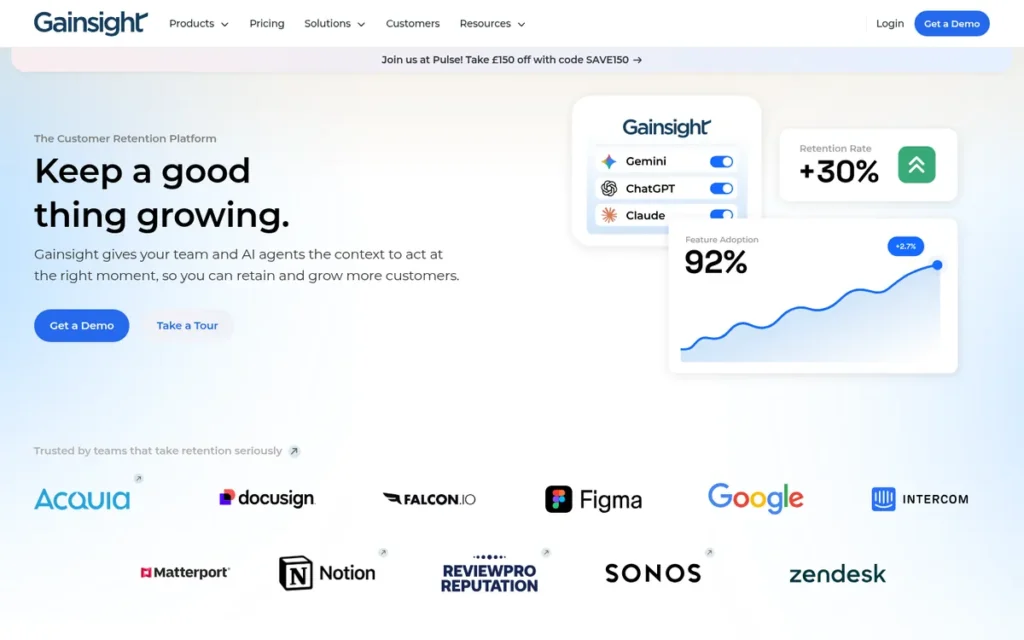
Category: Enterprise Suite, the broadest post-sales operating system in this comparison, spanning CS operations, product experience, community management, and revenue intelligence.
At a Glance
- Category: Enterprise Suite
- Best For: Enterprise SaaS organizations with 50+ CSMs, a dedicated CS Operations function, a certified admin, and substantial implementation budget
- Price Range: Custom enterprise pricing; Essentials and Enterprise packaging tiers available; no public rate card; third-party sources consistently position Gainsight as among the highest-cost platforms in this comparison (Avoma, 2026)
- Primary Strength: Gainsight’s suite uniquely combines CS operations, native product analytics (Gainsight PX), community management, and AI-driven revenue intelligence in a single platform, no other platform in this comparison matches this scope without third-party tooling
- Biggest Limitation: Requires a certified dedicated administrator; implementation timelines routinely span months; the platform delivers no reliable value without adequate CS Ops resources and clean underlying data
- One-Line Summary: Gainsight Customer Success is recognized as a 2025 Gartner Magic Quadrant Leader (highest on Ability to Execute and furthest on Completeness of Vision) offering unmatched enterprise suite breadth for organizations with the resources to operationalize it.
- Last Verified: May 2026
Overview
Gainsight Customer Success is the platform that created the customer success discipline as a formal business function, founded in 2009 and recognized as a 2025 Gartner Magic Quadrant Leader for Customer Success Management Platforms for the second consecutive year. Gainsight Customer Success positions itself not as a CS task manager but as a “broader post-sales operating system,” integrating CS operations, Product Experience (Gainsight PX), community, digital programs, education, and revenue workflows in a single platform.
No other platform in this comparison matches Gainsight’s suite completeness across CS operations, native product analytics, community management, and revenue intelligence, a distinction that justifies the enterprise price premium for organizations with the resources to operationalize it. Gainsight Customer Success is backed by Vista Equity Partners and serves enterprise customers including Adobe, Box, DocuSign, HP, Nutanix, and Workday.
Key Features
- Customer 360: Gainsight consolidates account data across CRM, support, billing, and product usage into a unified health view, enabling CSMs to identify churn risk and expansion signals in one workspace without context-switching between multiple systems.
- Multi-Signal AI Intelligence: Gainsight’s AI reads patterns across customer conversations, support interactions, stakeholder engagement, and product usage to predict risk and opportunity, automatically triggering workflow actions from real-time health scores, rather than merely displaying scores for manual CSM review.
- Gainsight PX (Product Analytics): Gainsight natively embeds in-app guidance and product analytics, eliminating the need for a separate Pendo or Amplitude integration, a genuine differentiator that every other platform in this comparison requires third-party tooling to replicate.
- Journey Orchestrator: Gainsight automates personalized digital customer journeys at scale, enabling CS teams to engage thousands of accounts with tailored lifecycle touchpoints without requiring per-account manual CSM effort.
- Revenue Optimization and Renewal Center: Gainsight’s AI-powered expansion and risk analysis surfaces renewal risk and upsell opportunities up to 90 days earlier than manual review, connecting CS activity directly to measurable ARR outcomes.
Best For
Gainsight Customer Success is best for enterprise SaaS organizations with dedicated CS Operations staff, a certified Gainsight admin resource, and sufficient implementation budget, particularly those where native product analytics, community management, and CS workflows must live in a single platform, or where Gartner analyst validation is a buying committee requirement.
Strengths
- Gartner MQ Leadership: Gainsight Customer Success was named a Leader in the 2025 Gartner Magic Quadrant for Customer Success Management Platforms for the second consecutive year, positioned highest on Ability to Execute and furthest on Completeness of Vision, the most significant independent analyst recognition available in the CS platform category.
- Unmatched Suite Breadth: Gainsight Customer Success uniquely combines CS operations, native product analytics (Gainsight PX), community management, and revenue intelligence in a single platform, no other platform in this comparison offers this scope without requiring multiple third-party integrations to achieve equivalent coverage.
- Enterprise Logo Validation: Gainsight’s verified customer roster includes Adobe, Box, DocuSign, HP, and Workday, organizations whose IT and procurement standards validate the platform’s enterprise-grade security, scalability, and integration depth for large-scale deployment.
- AI Action Depth: Gainsight’s multi-signal AI automates action execution: not just score display, by reading patterns across conversations, support activity, stakeholder engagement, and product usage simultaneously, representing a meaningfully deeper AI integration than display-only features found in smaller platforms.
Limitations
- Admin Dependency: Gainsight Customer Success requires a certified, dedicated administrator to operationalize, the r/CustomerSuccess consensus is that teams without CS Ops resources should not attempt Gainsight, with practitioners independently describing the platform as “a lifesaver or a nightmare depending on how they are set up” (u/Laiylania, r/CustomerSuccess; u/True-Difference-7208, r/CustomerSuccess).
Users on r/CustomerSuccess shared their experience with Gainsight:
“As an IC/end user, I’ve only used Gainsight from the prospective list. I’ve used it at two different companies and both experiences have left me frustrated. It’s very manual and the Success Plan’s organizational structure is absurd – it’s too similar to, yet simultaneously different from, the day-to-day CTA feature.” Posted by u/larissaeh
Takeaway: CSMs who have used Gainsight at multiple companies report that its manual workflows and structural inconsistencies make daily use more burdensome than productive, confirming that the platform’s complexity burden extends beyond the setup phase and into front-line CSM experience.
- Implementation Timeline: Gainsight Customer Success implementations routinely span months before generating reliable health scores or playbook value, creating adoption risk and delayed ROI for teams that cannot sustain a long configuration runway before seeing measurable results.
- Pricing Opacity: Gainsight provides no public pricing data whatsoever, requiring full enterprise sales engagement before any cost benchmark is available, third-party sources consistently position Gainsight as among the most expensive platforms in this comparison (Avoma, 2026).
- Performance at Scale: Independent G2 review analysis and competitor research document slow load times with large account datasets as a structural limitation for enterprise teams managing thousands of simultaneous accounts, a concern for organizations at the upper end of Gainsight’s target market (Vitally comparative analysis, 2025).
Verdict
Gainsight Customer Success is the definitive enterprise CS platform for organizations with the resources, team maturity, and budget to implement it. Gainsight’s 2025 Gartner MQ Leadership, unmatched suite breadth including native Gainsight PX, and multi-signal AI that auto-executes actions represent a capability gap over every other platform in this comparison. The decisive question is not whether Gainsight is powerful enough, it is whether your organization has the certified admin, CS Ops maturity, and implementation runway to realize that power. For enterprise teams that do, Gainsight Customer Success is the benchmark. For teams that do not, the complexity will cost more than it delivers.
Decision rule: If your organization has a dedicated CS Ops admin, clean CRM data, and a six-figure CS platform budget, evaluate Gainsight first. If any of those three conditions is absent, evaluate ChurnZero or Planhat before investing in Gainsight’s complexity.
2. ChurnZero: Best Customer Success Platform for Mid-Market SaaS
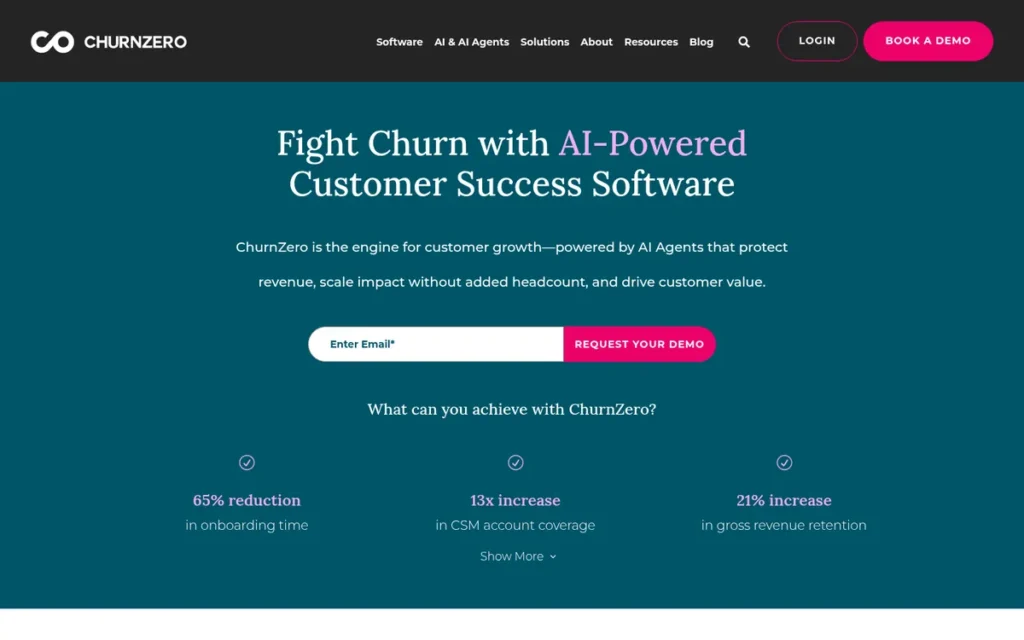
Category: Modern Mid-Market Platform, purpose-built for SaaS subscription retention with five named AI agents and native in-app messaging.
At a Glance
- Category: Modern Mid-Market Platform
- Best For: Mid-market SaaS subscription businesses with 3–30 CSMs where CSM adoption rates and vendor support quality are strategic priorities
- Price Range: Custom sales-led pricing; no public rate card; no free tier; third-party sources describe ChurnZero pricing as potentially prohibitive for early-growth businesses (Startupik, 2026)
- Primary Strength: ChurnZero holds the #1 G2 Spring 2026 satisfaction score (96/100) among all CS platforms, with five named AI agents and native in-app messaging capability
- Biggest Limitation: Salesforce field mapping requires vendor support involvement for changes; analytics flexibility trails Gainsight and Planhat; full value is conditional on clean product usage data
- One-Line Summary: ChurnZero is the #1-rated customer success platform by G2 user satisfaction in the Spring 2026 Grid Report (96/100), delivering five named AI agents, native in-app messaging, and purpose-built SaaS subscription retention workflows for mid-market businesses.
- Last Verified: May 2026
Overview
ChurnZero is a customer success platform for subscription businesses, focused on reducing churn, increasing expansion revenue, and improving customer health by unifying product usage, CRM, support, and engagement data in one platform. Founded in 2015 and headquartered in Washington, D.C., ChurnZero claims the #1 satisfaction score among customer success platforms in the G2 Spring 2026 Grid Report, with a 96/100 overall satisfaction score, 89 NPS, and 94% likelihood-to-recommend rating. ChurnZero is led by co-founder and CEO You Mon Tsang.
Unlike Gainsight’s “post-sales operating system” positioning, ChurnZero focuses specifically on SaaS subscription retention workflows, making it easier to implement and more focused in scope for mid-market teams without dedicated CS Ops resources.
Key Features
- Five Named AI Agents: ChurnZero provides five purpose-built AI agents: Harbinger (early relationship risk detection), Beacon (buying intent identification), Echo (unstructured feedback summarization), Recap (meeting summaries and follow-ups), and Scribe (AI-assisted contextual reply drafting), representing a more credible, independently verifiable AI strategy than broad “AI-powered” claims (ChurnZero press release, churnzero.com/press-release/churnzero-reveals-agentic-ai-teammates/).
- In-App Messaging: ChurnZero enables CS teams to reach users directly inside the customer’s product, a differentiated capability among mid-market platforms that allows lifecycle communication without relying solely on email outreach, reducing the reliance on open-rate-dependent campaigns.
- Plays and Playbooks Automation: ChurnZero’s Plays engine automates lifecycle workflows triggered by health score changes, product usage events, or time-based conditions, consistently described as “a game-changer” by practitioners who have clean underlying data and defined health score models before implementation.
- Health Scoring with Unlimited Segmentation: ChurnZero aggregates usage, engagement, support, and account metrics into configurable customer health scores with virtually unlimited segmentation capabilities, per verified user testimony on r/CustomerSuccess (u/Gateline129).
- Pendo Integration: ChurnZero integrates with Pendo so product usage events flow directly into ChurnZero account profiles, triggering automated plays from real-time in-product behavior and enabling proactive churn intervention before manual account review would have surfaced the warning signal.
Best For
ChurnZero is best for mid-market SaaS subscription businesses with defined Salesforce or HubSpot CRM processes where reducing churn and scaling automated lifecycle workflows are the primary CS objectives, and where CSM daily adoption rates and vendor partnership quality matter as much as analytical depth.
Strengths
- #1 G2 Satisfaction Score: ChurnZero leads the G2 Spring 2026 Grid Report with an overall satisfaction score of 96/100, a Net Promoter Score of 89, and a 94% likelihood-to-recommend rating, in customer success software specifically, user satisfaction scores predict platform ROI more reliably than feature breadth, because a CS platform only prevents churn when CSMs actively use it every day.
- Vendor Support Quality: ChurnZero’s customer success team receives consistent, specific praise across TrustRadius and Oliv.ai review summaries (2026), multiple practitioners describe ChurnZero as “a real partner, not just a vendor,” a differentiated support experience compared to enterprise-tier competitors.
- Purpose-Built Mid-Market Fit: ChurnZero’s focused scope on SaaS subscription retention means its health scoring models, automation templates, and playbook workflows are pre-optimized for the mid-market subscription motion, teams implement to a defined framework rather than configuring from a blank canvas.
- Faster Initial Deployment: Verified reviews on TrustRadius and Oliv.ai (2026) consistently cite ChurnZero’s faster initial deployment compared to enterprise-tier competitors as a meaningful operational advantage for mid-market teams without extended implementation runways.
Limitations
- Salesforce Integration Brittleness: ChurnZero’s Salesforce field mapping is not fully self-serviceable, a Series C CS manager reported that “small CRM changes often broke things” and required vendor support involvement every time SFDC field mapping needed adjustment (u/osnap88, r/CustomerSuccess), creating ongoing operational friction for CS Ops teams managing evolving CRM builds.
- Analytics Depth Gap: ChurnZero’s reporting and analytics flexibility trails Gainsight and Planhat, Oliv.ai (2026) specifically flags “limited analytics flexibility requiring support team involvement for changes” as a documented and recurring user frustration across reviews.
- Data Dependency Risk: ChurnZero’s plays and health scores lose reliability when the underlying product usage data integration is incomplete, one verified practitioner reported that incomplete product sync rendered “engagement metrics and churn score inaccurate and useless” (u/Sulla-proconsul, r/CustomerSuccess, 8 upvotes), reflecting the platform’s sensitivity to upstream data quality.
- Non-Salesforce Integration Depth: ChurnZero’s strongest integrations are with Salesforce and HubSpot, teams operating outside these CRM ecosystems should explicitly validate integration reliability for their specific stack before committing to a multi-year contract.
Verdict
ChurnZero is the strongest choice for mid-market SaaS teams who want the highest-rated CS platform by user satisfaction without Gainsight’s enterprise complexity. ChurnZero’s #1 G2 Spring 2026 satisfaction score of 96/100, five named AI agents, native in-app messaging, and exceptional vendor support quality make it the benchmark for mid-market subscription retention, provided Salesforce field mapping complexity is scoped before contract signing and product usage data is clean before onboarding begins.
Decision rule: Choose ChurnZero for a mid-market SaaS team when user adoption rates, vendor partnership quality, and purpose-built AI agents are primary decision criteria, and when Salesforce CRM field mapping complexity is manageable with vendor support involvement when needed.
3. Planhat: Best Customer Success Platform for Scale-Up and Multi-Product Teams

Category: Scale-Up Platform, highly flexible revenue-plus-CS platform with native customer portals, API-first data model, and GDPR-native European architecture.
At a Glance
- Category: Scale-Up Platform
- Best For: Scale-up SaaS teams managing multi-product environments, complex account hierarchies, or GDPR-sensitive European deployments
- Price Range: Sales-led pricing; described as more transparent than enterprise peers; pricier than Vitally and Custify; specific amounts require direct vendor engagement
- Primary Strength: Planhat’s flexible data model and native Customer Portals enable multi-product CS complexity and customer-facing collaboration that no other mid-market platform in this comparison matches natively
- Biggest Limitation: Steep setup curve requiring CS Ops investment; dashboard capabilities rated weaker than peers; UI described as unintuitive without deliberate build-out
- One-Line Summary: Planhat delivers the most flexible data model and native customer collaboration portals in the mid-market CS category, purpose-built for scale-up SaaS teams managing multi-product or complex account structures with GDPR-native European architecture.
- Last Verified: May 2026
Overview
Planhat is a flexible revenue-plus-customer success platform built for SaaS teams managing multi-product or complex account structures, combining customer health data, lifecycle workflows, customer-facing collaboration portals, and post-sale revenue intelligence in a single platform with a highly configurable data model. Founded in 2014 by Niklas Skog in Stockholm, Sweden, Planhat is currently led by CEO Kaveh Rostampor (planhat.com/about) and is the leading European-origin CS platform in this comparison.
G2’s editorial content identifies Planhat as “among the best-rated client success software for tech enterprises looking to track QBRs, renewals, and growth signals in one place.” Planhat’s Stockholm headquarters and European data infrastructure make it a natural fit for GDPR-sensitive buyers and European-headquartered companies.
Key Features
- Flexible Data Model: Planhat’s data architecture adapts to multi-product, multi-region, and complex account structures that more rigid platforms cannot accommodate, one verified Planhat CS Ops practitioner described building a custom Planhat usage alert triggered when customer activity exceeds two standard deviations of a 30-day trailing average in under one hour (u/Dekkars, r/CustomerSuccess).
- Customer Portals: Planhat provides customer-facing collaboration spaces where CS teams share success plans, reports, and playbooks with customers in a branded workspace, a native capability that most mid-market competitors require third-party tools or custom development to approximate (Planhat support documentation).
- Revenue Analytics: Planhat’s post-sale revenue intelligence surfaces expansion opportunities and churn forecasts, connecting CS activity directly to ARR outcomes without requiring a separate BI tool for post-sale revenue analysis.
- API-First Custom Connectors: Planhat’s well-documented API enables custom integrations built directly inside the platform with Salesforce, HubSpot, Snowflake, Mixpanel, and Freshdesk, supporting complex data pipelines that single-schema mid-market platforms cannot accommodate without external tooling.
- GDPR-Native European Architecture: Planhat’s Stockholm headquarters and European data infrastructure provide a structural compliance advantage for GDPR-sensitive buyers and EU-headquartered organizations that US-headquartered competitors require additional compliance investment to match.
Best For
Planhat is best for scale-up and enterprise-adjacent SaaS companies managing five or more products, complex account hierarchies, or multi-region customer bases, particularly technically sophisticated CS teams with CS Ops capacity to leverage Planhat’s data model depth and configuration flexibility.
Strengths
- Multi-Product Data Excellence: A verified buyer who evaluated Vitally, ChurnZero, and Planhat before selecting Planhat cited “product capabilities and customization out of this world” and praised Planhat’s pre-purchase data mapping process for five products with usage data distributed across multiple systems (u/Al_Goreskin, r/CustomerSuccess).
- CS Ops Power: Planhat’s API quality and in-platform custom connector capability enable bespoke health score logic that competitors do not offer natively for multi-product environments, “I work in CS Ops and there isn’t much I can’t do in Planhat” (u/Dekkars, r/CustomerSuccess).
- Customer Portal Differentiation: Planhat’s native Customer Portals provide customer-facing collaboration spaces that most mid-market competitors require Notion, Google Docs, or custom development to approximate, a structural differentiator for CS teams running formal QBR and success plan workflows with customers.
- GDPR-Native European Architecture: Planhat’s Stockholm headquarters and European data infrastructure provide a structural compliance advantage for GDPR-sensitive buyers and EU-headquartered organizations that US-headquartered competitors cannot match without additional compliance investment.
Limitations
- Setup Complexity: Planhat’s flexible data model is both its superpower and its primary adoption risk, Custify’s competitive analysis (2026) acknowledges Planhat is “slightly difficult to learn and use,” and the platform’s full value is explicitly conditional on a CS Ops investment to configure the data model correctly before go-live.
Users on r/CustomerSuccess noted:
“I implemented and used PH from 2021-2023 at the startup where I was VP of CS. They have come a long way. My biggest pet peeve was not really their fault; we had a weird subscription management setup that didn’t integrate well with their product and made it really difficult to forecast churn and expansion effectively. We ended up using SF for expansion forecasting (+ excel) and having to download all our ARR data from PH into excel to manually do churn forecasting.” Posted by u/Goodkhaleesi
Takeaway: Planhat’s revenue forecasting capabilities can break down for teams with non-standard subscription architectures, forcing manual Salesforce and spreadsheet workarounds that undercut the platform’s post-sale revenue intelligence value proposition.
- Dashboard Weakness: Despite Planhat’s overall platform strength, its dashboards are consistently cited as a weak point by power users, “the only gripe we have is that dashboards are meh” (u/Dekkars, r/CustomerSuccess), reflecting a gap between Planhat’s data capability and its native visualization layer.
- UI Intuitiveness: A current Planhat user described the interface as “not intuitive AT ALL, searching for things that should be easy to find” (u/CrimsonCrayon, r/CustomerSuccess), reflecting the usability cost of a highly configurable data model that requires deliberate build-out before it becomes coherent for daily CSM use.
- Price Premium vs. Mid-Market Alternatives: Planhat is more expensive than Vitally and Custify, a meaningful trade-off for teams that do not require multi-product data model flexibility and would be paying for capabilities that exceed their current account complexity level.
Verdict
Planhat is the strongest platform for scale-up SaaS teams where multi-product data complexity is the primary operational constraint. Planhat’s flexible data model, native Customer Portals, and API-first integration architecture provide capabilities that ChurnZero and Vitally do not offer natively for multi-product environments, though both can approximate some of those capabilities through third-party integrations and custom development.
Decision rule: Choose Planhat when managing five or more products with usage data distributed across multiple systems, or when a GDPR-native European vendor is a compliance requirement. For single-product SaaS teams, evaluate Vitally first, where the UI advantage and faster implementation may outweigh Planhat’s data model depth.
4. Vitally: Best Modern Customer Success Platform for UX and Configurability
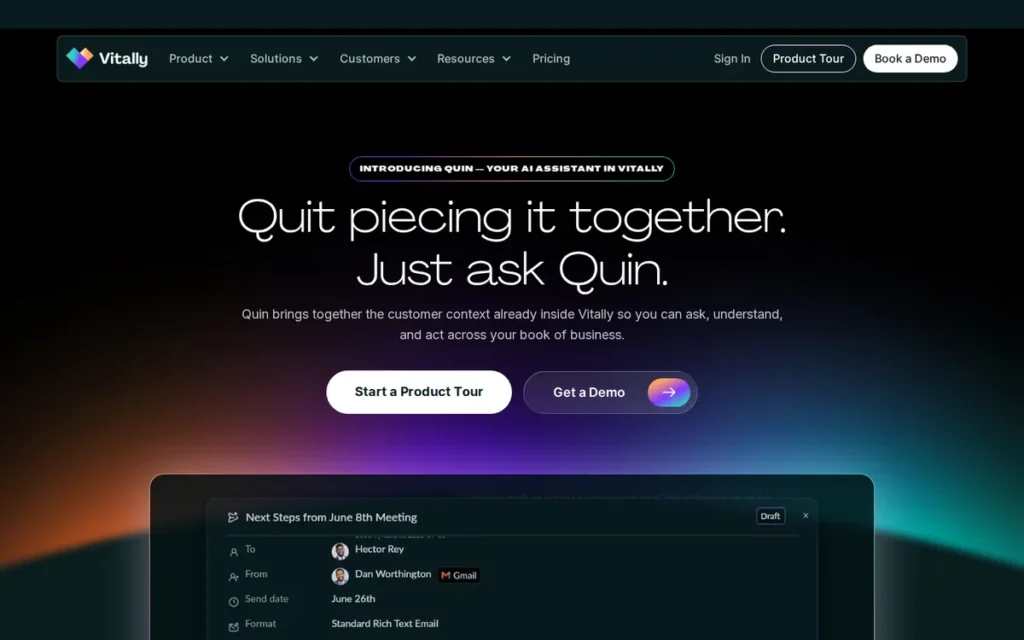
Category: Modern Mid-Market Platform, Notion-like documentation workspace with health scoring, 70+ bidirectional integrations, and G2 Best Results recognition.
At a Glance
- Category: Modern Mid-Market Platform
- Best For: Modern SaaS teams with 3–30 CSMs prioritizing UI quality, CSM adoption rates, and CS documentation workflows
- Price Range: Sales-led; “simple and flexible pricing” (per Vitally); no public rate card; reported renewal price escalation in years 2–3 (r/CustomerSuccess)
- Primary Strength: Consistently top-rated UI quality among mid-market CS platforms, with a G2 rating of 4.5/5.0 and Best Results recognition through at least Winter 2024
- Biggest Limitation: Filtering logic is overcomplicated for routine tasks; outcomes heavily dependent on implementation quality; reported renewal price escalation without contractual caps
- One-Line Summary: Vitally is a G2 4.5/5.0-rated customer success platform combining a Notion-like documentation workspace, 70+ bidirectional integrations, and flexible health scoring in the most consistently praised UI in the mid-market CS category, backed by a $30M Series B led by Next47.
- Last Verified: May 2026
Overview
Vitally is a G2 4.5/5.0-rated customer success platform combining a Notion-like documentation workspace (Vitally Docs), customer-facing collaboration Hubs, and 70+ bidirectional integrations in a modern interface that consistently outperforms legacy CS platforms on user satisfaction metrics. Founded in 2017 in New York and backed by a $30M Series B led by Next47 (with participation from Andreessen Horowitz (a16z), which had led the earlier Series A) Vitally has earned G2 Best Results recognition through at least Winter 2024 (GlobeNewswire, February 2023).
Vitally’s competitive positioning is explicitly against the complexity and rigidity of older CS platforms, with a product architecture placing Notion-like documentation and customer collaboration workspaces at the center of daily CSM workflows.
Key Features
- Vitally Docs: Vitally’s Notion-like documentation system enables CS teams to build reusable templates, success plans, and account playbooks that can be replicated across customer accounts, a structural differentiator from platforms that treat CS documentation as a secondary module rather than a core workspace.
- Hubs (Customer Collaboration Spaces): Vitally provides customer-facing workspaces where CSMs and customers collaborate on success plans, implementation progress, and shared KPIs, similar in concept to Planhat’s Customer Portals, providing a native alternative to ad-hoc Google Docs or Notion workspaces.
- 70+ Bidirectional Integrations: Vitally’s integration ecosystem covers over 70 tools with bidirectional sync, meaning data flows both into Vitally and back into Salesforce, HubSpot, and other systems, a meaningful CS Ops advantage for teams building multi-directional data pipelines without manual field updates.
- Flexible Health Scoring: Vitally provides multi-signal, configurable health scores described by a Series C CS manager who switched from ChurnZero as “infinitely more user configurable” and “more intuitive” than comparable features in ChurnZero (u/osnap88, r/CustomerSuccess, 6 upvotes).
- AI Copilot: Vitally provides an AI Copilot for CS workflows; Vitally’s AI maturity documentation is less granular than ChurnZero’s five specifically named agents (Harbinger (risk), Beacon (buying intent), Echo (feedback), Recap (summaries), and Scribe (drafts)) making direct AI capability comparison challenging from published materials alone.
Best For
Vitally is best for modern SaaS teams with 3–30 CSMs where UI quality and CSM adoption rates are strategic priorities, particularly teams migrating from legacy platforms like Totango or ChurnZero who want faster configuration and stronger Salesforce integration self-service capability.
Strengths
- G2 Best Results Recognition: Vitally has earned G2 Best Results recognition through at least Winter 2024, with an overall rating of 4.5/5.0, a score based on user-reported outcomes rather than feature checklists, placing Vitally among the highest-rated platforms in this comparison by validated user satisfaction.
- Superior UI vs. Mid-Market Peers: A Series C CS manager who switched from ChurnZero to Vitally described the platform as “much slicker UI, infinitely more user configurable, more intuitive health scoring, sharper CS support”, noting the ability to “handle a lot of config on my own without bothering my ops team” (u/osnap88, r/CustomerSuccess, 6 upvotes).
- VC-Backed Product Investment: Next47-Led Series B: Vitally’s $30M Series B led by Next47 (with a16z participation) provides R&D runway and market validation that smaller SMB competitors in this comparison lack, users consistently describe Vitally as pushing “new features a lot more frequently” than legacy enterprise platforms (u/osnap88, r/CustomerSuccess).
- Vendor CS Support: Vitally’s own customer success team receives specific, named praise across multiple r/CustomerSuccess threads, an unusual level of vendor support satisfaction that mirrors ChurnZero’s community reputation and is a meaningful predictor of CSM adoption rates post-implementation.
Limitations
- Filtering Logic Complexity: A multi-year Vitally user described “the filtering logic for many of the features” as “way overcomplicated” for routine tasks, expressing that they had “settled for what it can do vs. what I want it to do” after 2–3 years of active use (u/meatsmoker5, r/CustomerSuccess).
- Implementation-Dependent Outcomes: Vitally’s flexible Docs-based approach can become “a glorified Google doc” if not strategically configured to guide CSM behavior, Vitally receives both enthusiastic praise and dismissal in r/CustomerSuccess threads depending entirely on the quality and deliberateness of the implementation (u/bizarro289, r/CustomerSuccess, 8 upvotes).
This aligns with community sentiment on r/CustomerSuccess:
“We are a team of 15 CSMs internationally. We use Vitally which is pretty decent. It does offer a lot. However, there is a TON of manual work which is tough to reinforce. Esp when there are both CSM and AMs working on account. We already have it integrated, so i don’t understand why manual work is still there. For example: the status updates. If the CS were to not update anything, the managers would not know anything that is going on.” Posted by u/Fine-List6942
Takeaway: Vitally teams at meaningful CSM scale report that integration depth alone does not eliminate manual account update burdens (particularly when multiple roles share account ownership) confirming that platform value is conditional on deliberate process design, not just data connectivity.
- Renewal Pricing Risk: Reported renewal price escalation: “they like to double the price in the second or third year” (r/CustomerSuccess), creates a material budgeting risk that buyers should address by negotiating contractual multi-year pricing caps or written renewal increase limits before signing.
- Learning Curve for Advanced Features: Vitally carries a documented learning curve for workflow customization and advanced configuration, users who do not invest in structured implementation report the platform as unintuitive rather than empowering, with the “settling” sentiment from long-term users indicating unresolved UX gaps in high-frequency daily tasks.
Verdict
Vitally is the strongest choice for SaaS teams where CSM adoption and UI quality are the deciding factors in platform ROI. Vitally’s G2 4.5/5.0 rating, Notion-like documentation architecture, and 70+ bidirectional integration ecosystem represent a genuine step change in day-to-day CS workspace quality versus legacy competitors. The critical implementation decision is whether your team will invest in deliberate platform configuration upfront, Vitally’s full value is only realized when the platform is purposefully built out, not treated as a self-configuring tool.
Decision rule: Choose Vitally for a modern SaaS team when CSM adoption rates and documentation quality are your primary success metrics, and when your team is willing to invest structured configuration time before launch. Negotiate renewal pricing caps contractually before signing any multi-year agreement.
5. Totango: Best Customer Success Platform for Modular Enterprise Quick-Start
Category: Enterprise / Post-Merger Platform, modular SuccessBLOCs architecture with Spark AI; merged with Catalyst in February 2024, now led by co-CEOs Alistair Rennie and Edward Chiu.
At a Glance
- Category: Enterprise / Post-Merger Platform
- Best For: Enterprise SaaS organizations needing prebuilt CS playbooks to reduce implementation time and willing to validate post-merger roadmap clarity before committing
- Price Range: Custom enterprise pricing; $50K+ quotes reported for mid-scale organizations classified as “Enterprise” by Totango (u/kevinleejones, r/CustomerSuccess); Community/Trial tier available in limited form, verify current scope and upgrade conditions directly
- Primary Strength: Totango’s SuccessBLOCs provide prebuilt, modular playbooks for onboarding, renewal, expansion, and risk, reducing configuration time versus Gainsight’s blank-canvas approach for teams with defined CS motions
- Biggest Limitation: Outdated UI; post-merger roadmap uncertainty actively driving replacement evaluations; documented performance issues including page freezing; pricing sticker shock for mid-scale organizations
- One-Line Summary: Totango is a customer success platform with 15 years of category history, unified with Catalyst in February 2024 into a combined customer growth platform, offering SuccessBLOCs modular playbooks for faster enterprise time-to-value, though post-merger roadmap clarity and UI modernization remain active buyer evaluation concerns.
- Last Verified: May 2026
Overview
Totango is a customer success platform with 15 years of category history, unified with Catalyst in February 2024 to form a combined customer growth platform now led by co-CEOs Alistair Rennie and Edward Chiu (PR Newswire, February 2024). Totango’s SuccessBLOCs architecture provides modular, prebuilt success playbooks for onboarding, renewal, expansion, and churn risk management, offering faster time-to-value than building from a blank canvas.
Totango was founded in 2010 by Guy Nirpaz and is headquartered in Redwood City, California, backed by Great Hill Partners. Verified customers include Higher Logic, Waystar, and Extreme Networks.
Key Features
- SuccessBLOCs: Totango provides modular, prebuilt success playbooks for the core CS lifecycle stages (onboarding, renewal, expansion, and churn risk) reducing initial configuration time compared to build-from-scratch platforms like Gainsight or Planhat, where CS teams start from an entirely blank template canvas.
- Spark AI: Totango’s Spark AI layer synthesizes customer data and prioritizes CSM actions, though Totango’s AI use cases are documented less granularly than ChurnZero’s five named agents, making direct comparative AI evaluation challenging from publicly available materials.
- Segments: Totango enables dynamic customer segmentation by lifecycle stage, behavioral patterns, and usage signals, allowing CS teams to tailor outreach by customer cohort rather than managing accounts one by one.
- Touchpoints: Totango logs customer interaction history across channels, providing CSMs with a longitudinal view of account engagement that supports renewal conversations and health score contextualization over time.
- Campaigns: Totango’s automated customer outreach tools enable CS teams to scale low-touch communication programs across large account bases without requiring manual per-account CSM effort for each outreach cycle.
Best For
Totango is best for enterprise SaaS organizations that need prebuilt playbooks to reduce implementation time and are willing to invest in evaluating whether the merged Totango-Catalyst product roadmap aligns with their growth trajectory, particularly teams with a dedicated CS Ops function who can verify post-merger product direction before committing to a multi-year contract.
Strengths
- SuccessBLOCs Time-to-Value: Totango’s prebuilt, modular SuccessBLOCs reduce the blank-canvas configuration burden that makes Gainsight implementations stretch into months, for teams with defined CS motions, these templates provide meaningful initial time-to-value acceleration over build-from-scratch alternatives.
- Category Pioneer Depth: Totango’s 15-year product history (founded 2010) means its core CS functionality (segmentation, health scoring, and workflow automation) has been refined through more customer feedback cycles than newer entrants in this comparison, providing a mature functional baseline for enterprise CS operations.
- Community/Trial Edition: Totango has historically offered a Community/Trial edition with limited features, confirmed by founder Guy Nirpaz on Reddit (u/guynirpaz, r/CustomerSuccess), verify current availability, feature scope, and upgrade conditions directly before including this in budget planning.
- Enterprise Customer Roster: Totango’s verified customer base includes Higher Logic, Waystar, and Extreme Networks, organizations whose CS complexity validates Totango’s enterprise-grade capability when properly implemented with dedicated CS Ops resources.
Limitations
- Outdated UI: Totango’s interface is consistently described as “clunky” and outdated across G2 reviews and Capterra, a current user described it as “awful” with “normal issues with freezing requiring a page refresh” (u/aceofpentaclesx, r/CustomerSuccess, 7 upvotes), and UI-related complaints directly correlate with lower CSM adoption rates in post-implementation reviews across this category.
Users on r/CustomerSuccess shared their frustration:
“Our team is still rolling out Totango and it’s made all processes longer by 5+clicks. Integrations are clunky af. Would NOT recommend and I wish our director would switch to anything else or just revert to our regular CRM.” Posted by u/mindfulnmoody
Takeaway: Teams actively deploying Totango report that the platform increases process friction rather than reducing it, with clunky integrations and multi-click workflows degrading CSM adoption from the earliest stages of rollout.
- Post-Merger Roadmap Uncertainty: Totango’s February 2024 Catalyst merger has generated active buyer concern about product direction, a team actively replacing Totango cited “concerns about their development roadmap, lots of glitches, and it’s not evolving as our business is scaling” (u/Recent_Weekend_7666, r/CustomerSuccess).
- Pricing Complexity and Sticker Shock: Totango’s enterprise pricing categorization has produced significant cost surprises, a mid-scale Canadian B2B SaaS startup received a $50,000 USD quote plus a 20% setup fee after being classified as “Enterprise” users, far exceeding their expectations (u/kevinleejones, r/CustomerSuccess).
- Limited Reporting Flexibility: Common criticisms across G2 and Capterra include limited reporting flexibility requiring support team involvement for analytics customization, a structural limitation that frustrates CS Ops teams who require self-service reporting to track diverse account health metrics and board-level customer success KPIs.
Verdict
Totango’s 15-year category history, SuccessBLOCs architecture, and enterprise customer roster demonstrate a genuinely capable platform, but Totango’s ranking is constrained by a UI that trails modern competitors, post-merger roadmap uncertainty that is actively driving replacement evaluations visible in r/CustomerSuccess, and a pricing model with documented sticker shock. Teams evaluating Totango in 2026 should request written post-Catalyst merger roadmap timelines, UI modernization evidence, and customer references from implementations completed after February 2024 before committing.
Decision rule: Choose Totango when SuccessBLOCs’ modular playbook head-start is worth the UI and roadmap trade-off, and when your team has the diligence capacity to validate post-merger product direction before signing a multi-year contract.
6. Custify: Best Customer Success Platform for SMB and Startup Simplicity
Category: SMB Platform, fast-to-implement health scoring and lifecycle automation with CustifyAI churn prediction and dedicated Technical Account Management onboarding.
At a Glance
- Category: SMB Platform
- Best For: B2B SaaS SMB teams with 1–10 CSMs building their first formal customer success function
- Price Range: Estimated $199–499/month for growth/pro tiers; setup fees estimated at $1,000–5,000; contact Custify for verified current pricing (Successifier, 2026; CX Lead, 2026)
- Primary Strength: Highly praised implementation support and dedicated Technical Account Management onboarding, validated by multiple direct buyer comparison accounts on r/CustomerSuccess; Capterra 4.8/5.0 Task Management (per Capterra listing, May 2026)
- Biggest Limitation: Fewer integrations than enterprise peers; limited scalability for teams managing 500+ accounts or multi-product structures; smaller installed base reduces available peer references
- One-Line Summary: Custify is a B2B SaaS SMB customer success platform delivering health scoring, lifecycle automation, and CustifyAI churn prediction with one of the fastest implementation paths in this comparison, supported by dedicated Technical Account Management onboarding.
- Last Verified: May 2026
Overview
Custify is a customer success platform for B2B SaaS SMB and mid-market teams, founded in 2018 by Philipp Wolf and headquartered in Bucharest, Romania. Custify is positioned explicitly against the over-engineering problem, it targets CS teams that find Gainsight, ChurnZero, or Totango too complex for their current scale, offering health scoring, lifecycle automation, and playbooks with a fast implementation path and superior onboarding support.
Capterra dimension-level ratings include Task Management: 4.8/5.0, Reporting/Analytics: 4.8/5.0, and Health Score: 4.6/5.0 (per Capterra listing, accessed May 2026; capterra.com/p/190125/Custify/). Custify’s CustifyAI layer adds churn prediction, sentiment analysis, and instant AI-generated account summaries to its core feature set.
Key Features
- Real-Time Health Scoring: Custify aggregates usage, support, and satisfaction signals into immediately actionable health scores, Capterra rates Custify’s Health Score at 4.6/5.0 across 28 reviews (per Capterra listing, May 2026), validating its core value proposition for SMB-scale implementations where simplicity and speed of insight matter most.
- CustifyAI: Custify’s AI layer includes churn prediction, sentiment analysis, automated summarization, and instant AI-generated answers about customer accounts (positioning Custify above basic health-scoring tools in a category where more than 50% of companies now integrate AI into CS workflows (Custify Customer Success Statistics, 2025) custify.com/blog/customer-success-statistics/).
- Lifecycle Management: Custify covers the full customer lifecycle from onboarding through renewal, with automation templates that small CS teams can deploy without dedicated CS Ops resources, a key differentiator from enterprise-tier platforms that require months of configuration before producing working lifecycle workflows.
- Dedicated Technical Account Management: Custify provides a Technical AM in addition to a standard CSM as part of onboarding, a support model that competitors at similar price points do not offer, creating a concrete onboarding quality advantage that multiple verified buyers cite as their deciding purchase differentiator.
- HubSpot and Salesforce Integration: Custify is listed in the HubSpot App Marketplace, and a verified user who migrated from Gainsight to Custify confirms the Salesforce and Slack integrations “work really well” for practical daily operations (u/Ronin4Doom, r/CustomerSuccess).
Best For
Custify is best for B2B SaaS teams with 1–10 CSMs building their first formal customer success function, particularly those migrating from spreadsheets or lightweight CRM-based CS tracking who need health scoring and lifecycle automation without a 3–6 month implementation runway.
Strengths
- Highly Praised Onboarding Support: Averified buyer who compared Gainsight, Vitally, and Custify before purchasing cited Custify’s “unlimited calls and a Technical AM, on top of the CSM” versus Vitally’s “1x zoom call and video materials” as the deciding differentiator (u/VStrim, r/CustomerSuccess), a concrete support quality gap validated in a direct head-to-head buyer evaluation.
This aligns with recent community sentiment on r/CustomerSuccess:
“I’d say that the most important thing to look at for this kind of platform is the quality of support rather than picking based on a list of features (I’m not even mentioning all the buzzword features you see going around rn). We went with Custify because they put a lot into the onboarding phase, we had like 3-4 calls to make sure everything was set up properly. On the product side, we tried a few and they all felt pretty similar to me.” Posted by u/ConnectEggs
Takeaway: Recent Custify buyers confirm that onboarding support quality (not feature differentiation) is the decisive purchase factor, with multiple structured setup calls distinguishing Custify from feature-comparable alternatives evaluated head-to-head.
- Capterra Task Management 4.8/5.0: Custify’s Capterra dimension-level ratings include Task Management at 4.8/5.0 across 46 reviews and Reporting/Analytics at 4.8/5.0 across 45 reviews (per Capterra listing, accessed May 2026), strong validated evidence of day-to-day operational excellence for SMB CS teams.
- Right-Sized Complexity: A verified user who migrated from Gainsight to Custify confirmed the transition because Gainsight was “a bit too complex for my team size”, validating Custify’s positioning as the appropriate-complexity option for teams right-sizing their CS tooling to actual operational capacity (u/Ronin4Doom, r/CustomerSuccess).
- Fast Implementation: Multiple verified buyers independently describe Custify as easy to implement with a great onboarding experience, a critical differentiator for SMB teams without the CS Ops resources or budget to sustain a months-long enterprise-style deployment before seeing value.
Limitations
- Integration Ecosystem Gaps: Custify offers fewer integrations than Gainsight, ChurnZero, or Planhat, Velaris (2026) specifically flags this as a structural limitation, and the depth and reliability of existing integrations is less tested at enterprise scale than in more mature platforms with larger installed bases.
- Enterprise Scalability Ceiling: Custify’s SMB-first product philosophy raises credible questions about enterprise governance depth, support capacity at scale, and roadmap investment velocity relative to VC-backed competitors with significantly larger engineering organizations, teams expecting to manage 500+ accounts or multi-product structures should validate Custify’s scalability roadmap directly with the vendor.
- Limited Analytics Depth: Custify’s analytics capabilities trail enterprise-tier competitors and some mid-market alternatives, email reporting is specifically noted as an improvement area (“could have better reporting and dashboard”) by daily users (u/NicoleC5, r/CustomerSuccess).
- Small Community for Reference: Custify’s smaller installed base means fewer community case studies, peer references, and implementation guides than more established platforms, a practical consideration for teams who rely on community knowledge when troubleshooting platform issues or evaluating edge-case use coverage.
Verdict
Custify is the strongest choice for B2B SaaS SMB teams building their first formal customer success function who need a right-sized platform, fast implementation, and hands-on onboarding support without enterprise pricing. Custify’s Capterra 4.8/5.0 Task Management rating (per Capterra, May 2026), CustifyAI churn prediction layer, and dedicated Technical AM onboarding model represent a genuinely differentiated value proposition in its price range. The relevant buyer question is whether Custify’s integration ecosystem and analytics depth will remain sufficient as the team and account base approach mid-market scale.
Decision rule: Choose Custify when team size is 1–10 CSMs, fast implementation is a priority, and current account complexity is below 200 accounts, then re-evaluate Planhat, Vitally, or ChurnZero when the account base exceeds that threshold.
7. Churn360: Best Budget Entry-Level Customer Success Platform
Category: Entry-Level Platform, accessible health scoring, playbooks, and NPS for early-stage SaaS teams on constrained budgets, as a product of Kovai.co.
At a Glance
- Category: Entry-Level Platform
- Best For: Early-stage SaaS teams under 5 CSMs on constrained budgets with a HubSpot-based CRM stack
- Price Range: Standard plan from ~$199 per HubSpot Marketplace; ~$399/month per Software Advice; pricing inconsistency between directories requires direct vendor verification before budgeting
- Primary Strength: Churn360 provides the essential CS toolkit: 360-degree customer views, health scoring, playbooks, NPS, and HubSpot-native integration, at the most accessible starting price in this comparison
- Biggest Limitation: Founded in 2020; limited verified review volume; Kovai.co parent company relationship not disclosed on primary website; pricing data inconsistent across directories; minimal r/CustomerSuccess community presence
- One-Line Summary: Churn360, a product of Kovai.co, delivers a 360-degree customer view, health scoring, playbooks, and NPS surveys with HubSpot-native integration at the most accessible starting price in this comparison, purpose-built for early-stage SaaS teams under 5 CSMs formalizing their first CS function.
- Last Verified: May 2026
Overview
Churn360 is a customer success platform founded in 2020 and headquartered in the UK, providing core CS toolkit coverage, 360-degree customer views, health scoring, playbook automation, NPS surveys, and customer journey mapping, at a price point below the established mid-market platforms. Churn360 is a product of Kovai.co per its HubSpot Marketplace listing, an independent company not affiliated with Freshworks, buyers should verify Kovai.co’s product investment priorities, engineering team size, and long-term commitment to Churn360 as part of vendor due diligence.
At five years old, Churn360 is the youngest platform in this comparison and competes on accessibility and essential feature coverage rather than analytical depth or AI sophistication.
Key Features
- 360-Degree Customer View: Churn360 consolidates CRM, helpdesk, billing, and product usage data into a single customer profile, eliminating the manual context-switching that prevents proactive CS work on spreadsheet-based systems, the primary value proposition for teams migrating from manual tracking.
- Customer Health Scores: Churn360 provides configurable health scoring based on consolidated customer signals, covering the essential health visibility that is the core value proposition for teams migrating from spreadsheets to their first dedicated CS platform.
- Playbooks and Automation: Churn360’s automation layer enables CS teams to build triggered workflows for onboarding, renewal, and churn risk, delivering the lifecycle automation capability that mid-market buyers expect without the configuration complexity of enterprise-tier platforms.
- NPS Survey Integration: Churn360 includes native NPS surveying, enabling CS teams to gather customer sentiment data in the same platform where health scores and playbooks live, a meaningful operational simplification for teams avoiding multiple tool contexts.
- HubSpot-Native Integration: Churn360’s listing in the HubSpot App Marketplace provides a lower-friction deployment path for HubSpot-based teams compared to Salesforce-native competitors in this comparison.
Best For
Churn360 is best for early-stage SaaS teams with 1–5 CSMs, constrained budgets, and a HubSpot-based CRM stack who need the fundamental CS toolkit (health scoring, playbooks, and NPS) without the budget or complexity requirements of established mid-market platforms.
Strengths
- Most Accessible Entry Price: Churn360’s starting price of approximately $199–399/month (per directory sources including HubSpot Marketplace and Software Advice) is the most accessible confirmed price point in this comparison for a platform covering the core CS toolkit, health scoring, playbooks, NPS, and journey mapping.
- HubSpot-Native Integration: Churn360’s HubSpot Marketplace listing provides a pre-built, lower-friction integration path for the large portion of early-stage SaaS companies running HubSpot as their primary CRM.
- Essential CS Toolkit Coverage: Churn360’s feature set covers the documented essentials (360-degree view, health scoring, playbooks, NPS, and segmentation) that teams migrating from spreadsheets need on day one, without overpaying for enterprise analytics, AI agents, or customer portals they will not use at this scale.
- Entry-Level Pricing Transparency: Unlike most enterprise and mid-market competitors in this comparison who publish no public pricing data, Churn360 offers partial pricing visibility through third-party directory listings, giving budget-constrained buyers at least a starting benchmark before requiring full sales engagement.
Limitations
- Immature Product: Churn360’s 2020 founding means it competes for renewals against platforms with 10–15 years of product refinement, a meaningful consideration for roadmap confidence and feature depth longevity, particularly for teams whose CS complexity will grow significantly after initial deployment.
- Limited Review Volume: Churn360 has limited verified review volume on G2 and Capterra compared to every other platform in this comparison, making independent validation of user satisfaction significantly harder and signaling lower market penetration than established competitors (TrustRadius, 2026; Velaris, 2026).
- Minimal Community Presence: Churn360 is rarely mentioned in r/CustomerSuccess discussions where Gainsight, ChurnZero, Vitally, Planhat, and Custify appear frequently, the near-absence of organic community discussion makes independent peer reference-checking nearly impossible and signals limited community adoption relative to comparable platforms.
- Parent Company Transparency: Churn360 operates as a product of Kovai.co (per HubSpot Marketplace listing), but this relationship is not disclosed on Churn360’s primary website, buyers cannot assess Kovai.co’s product portfolio priorities, support infrastructure, or roadmap commitment to Churn360 without direct vendor inquiry, creating an information asymmetry that more mature standalone platforms do not have.
Verdict
Churn360 is the right starting point for truly early-stage SaaS teams who need the essential CS toolkit without the budget or complexity requirements of mid-market platforms. Churn360’s accessible price point, HubSpot-native integration, and core feature coverage make it a credible first CS platform for teams migrating from spreadsheets. The honest limitation is that Churn360’s five-year product age, Kovai.co parent company structure, limited review volume, and minimal community presence create meaningful uncertainty about long-term platform quality, uncertainty that available 2026 peer reference data alone cannot resolve.
Decision rule: Choose Churn360 as a first CS platform when budget is the binding constraint, your team has under 5 CSMs, and HubSpot is your primary CRM, then plan to evaluate Custify or Vitally before your first contract renewal as CS maturity grows.
What Red Flags Should I Watch For When Evaluating Customer Success Software?
Seven documented red flags signal elevated adoption risk during customer success platform evaluations: vague AI claims without specific documented use cases, complete pricing opacity with no disclosed range, non-self-serviceable CRM field mapping, overoptimistic implementation timelines, unqualified health score accuracy claims, post-merger roadmap vagueness, and renewal pricing without contractual rate caps. Each is sourced from verified practitioner accounts on r/CustomerSuccess (49,222 subscribers as of May 2026).
Red Flag #1: AI Claims Without Specificity
Any CS platform that claims “AI-powered” features without documenting specific use cases, data inputs, or named agent functionality should be treated skeptically. The r/CustomerSuccess community consensus as of May 2026 is to “look less at the AI label and more at whether they unify real customer context across Salesforce, Slack, Jira, and support history” (u/South-Opening-9720, r/CustomerSuccess, May 2026, 6 upvotes). Demand a demo using your actual customer data, not a curated demo environment.
Red Flag #2: No Self-Service Pricing Information
Every platform in this comparison uses sales-led pricing, but when a vendor refuses to provide even an approximate pricing range after initial engagement, it signals either pricing instability or a negotiation strategy that disadvantages buyers. Gainsight and Totango’s complete pricing opacity means buyers cannot benchmark costs without entering a full enterprise sales cycle. Budget for initial quotes that may run 2–3x higher than expectations.
Red Flag #3: Integration Claims Without Field Mapping Detail
A vendor that says “we integrate with Salesforce” without specifying whether field mapping is self-serviceable, bidirectional, or requires support involvement is omitting the most operationally critical integration detail. ChurnZero’s documented SFDC field mapping brittleness (u/osnap88, r/CustomerSuccess) illustrates how a genuine integration can still create significant ongoing operational friction. Ask specifically: “Can my CS Ops team update CRM field mappings without raising a support ticket?”
Red Flag #4: Implementation Timeline Optimism
Vendors consistently underestimate implementation timelines during sales cycles. Gainsight implementations routinely span months before generating reliable value; mid-market platforms like Planhat and Vitally require dedicated CS Ops investment before full capabilities are operational. Any vendor quoting under 30 days to full enterprise deployment warrants immediate reference-checking with customers who completed a full implementation at comparable team size and data complexity.
Red Flag #5: Health Score Accuracy Overpromise
Health scores are the core value proposition of every platform in this comparison, and the community’s most consistently flagged concern. “Health scores are great but also notoriously flawed, constantly in progress… they are not super reliable for many” (u/EPP1C, r/CustomerSuccess). Any vendor claiming their health scores are “out of the box accurate” without data quality prerequisites is oversimplifying. Ask how the platform handles missing data, incomplete product usage signals, and health score calibration methodology.
Red Flag #6: Post-Merger Roadmap Vagueness
Totango’s February 2024 Catalyst merger is still being integrated as of mid-2026, with multiple active buyers citing “roadmap glitches” and directional uncertainty as reasons for platform replacement. When evaluating any recently merged or acquired CS platform, demand a specific written product roadmap with committed delivery dates, not marketing language about “combining the best of both platforms.”
Red Flag #7: Renewal Pricing Without Contractual Protection
Reported renewal price escalation in this category, “they like to double the price in the second or third year” for Vitally (r/CustomerSuccess), is a systemic SaaS platform risk. Before signing any annual contract, negotiate multi-year pricing caps or confirm in writing the maximum allowable renewal price increase percentage.
What Questions Should I Ask Before Choosing a Customer Success Platform?
Question #1: What is our actual data readiness before we deploy?
Customer success platforms amplify existing data quality, they do not fix bad data. Before evaluating any platform, audit whether CRM records are clean, product usage events are actively tracked, and account hierarchy matches how your CS team actually works. “CZ is only as good as the data it’s being fed” (u/hedgiebetts, r/CustomerSuccess) applies equally to every platform in this comparison. Teams that deploy a CS platform before resolving data quality issues will build unreliable health scores from day one.
Question #2: Do we have a dedicated admin or CS Ops resource?
Enterprise-tier platforms (Gainsight, Planhat, Totango) and even mid-market platforms like ChurnZero and Vitally require dedicated configuration and ongoing administration to generate their documented value. Ask your team: who owns this platform day-to-day? If the answer is “our CSMs will figure it out,” plan for reduced adoption and delayed value realization. Budget for at least one dedicated CS Ops or admin resource before evaluating platforms whose full value is configuration-dependent.
Question #3: What is the total cost of ownership, not just the license fee?
Platform pricing consistently underrepresents total cost across this category. Before finalizing budget, account for:
- Setup and onboarding fees (Custify: estimated $1,000–5,000)
- Integration development hours for non-standard connectors
- Admin time to maintain CRM field mappings through system changes
- Per-CSM training costs and onboarding time
- Renewal price trajectory, particularly for Vitally
For enterprise platforms like Gainsight, a dedicated certified admin’s annual salary should be included in the total cost of ownership calculation.
Question #4: Can we speak with three reference customers who completed a full implementation?
The gap between demo performance and post-implementation reality is the most documented failure mode in CS platform evaluations. Request references from customers who have been on the platform for at least 12 months, have a similar team size and account complexity, and can speak to specific measurable outcomes, not just feature satisfaction. Ask references directly: “What did the vendor promise in the sales cycle that didn’t match post-implementation reality?”
Question #5: How does the platform handle missing data in health scoring?
Every platform in this comparison will encounter accounts with missing product usage data, incomplete CRM records, or stale support interactions. Ask each vendor: “What happens to a health score when product usage data stops flowing for 30 days, is the account flagged, defaulted to a prior score, or excluded from the dashboard?” The answer reveals whether the platform has mature data quality handling or will silently produce misleading health scores for under-tracked accounts.
Question #6: What is the self-service capability for CRM field mapping changes?
Salesforce and HubSpot field mappings evolve regularly in growing SaaS organizations. Ask each vendor: “Can our CS Ops team update CRM field mappings without raising a support ticket?” ChurnZero’s documented SFDC field mapping brittleness (u/osnap88, r/CustomerSuccess) illustrates how an integration limitation becomes an ongoing operational tax on CS Ops team bandwidth. The correct answer should be fully self-service with documented change logs accessible to the CS Ops team.
How Did We Rank These Customer Success Platforms?
These customer success platform rankings apply seven criteria across all seven platforms: independent analyst recognition (Gartner MQ, G2 Grid, Capterra), user review ratings weighted by volume and recency, practitioner sentiment from r/CustomerSuccess, pricing transparency, integration reliability, AI feature substance versus marketing claims, and implementation complexity relative to target team maturity. No company paid for placement; no affiliate relationships exist; no vendor reviewed their entry before publication.
Evaluation Process
The research pipeline followed four sequential steps:
- Platform discovery: Identifying the most-evaluated CS platforms in buyer community discussions on r/CustomerSuccess (49,222 subscribers as of May 2026), LLM recommendation queries, and analyst category definitions.
- Parallel primary research: Querying Perplexity for independently sourced data on each platform’s features, positioning, pricing signals, third-party recognition, and factual credentials, including founder names, funding history, and merger status. Material corrections identified during verification (including Planhat’s correct founder Niklas Skog and Vitally’s Series B lead investor Next47) were applied before publication.
- Independent review platform analysis: Gathering rating data from G2, Capterra, and TrustRadius with specific attention to dimension-level ratings and review recency, plus direct verification of specific award and ranking claims against primary source documents.
- Reddit community sentiment analysis: Systematically reviewing r/CustomerSuccess threads from 2024–2026 to capture practitioner-level experience including implementation failure modes, pricing sticker shock, and integration reliability that vendor marketing does not surface.
All seven platforms received equal research depth, the same number of queries, the same categories of investigation, and the same editorial scrutiny applied to every claim.
Ranking Criteria
Each platform was evaluated on the following criteria, weighted for their practical impact on buyer outcomes:
- Independent Analyst Recognition: Gartner Magic Quadrant, G2 Grid leadership, and Capterra positions, because these represent structured third-party validation with documented methodology and are among the most credible signals of platform maturity.
- Review Platform Ratings and Volume: G2 and Capterra overall and dimension-level scores, weighted for review count (higher volume = more reliable signal), because they provide the most standardized cross-platform comparison available.
- Real-World User Sentiment: Upvote-weighted community discussion from r/CustomerSuccess, because practitioners describe implementation realities and failure modes that vendor marketing suppresses.
- Pricing Transparency and Value: Whether pricing information is discoverable before sales engagement, because pricing opacity directly harms buyers’ ability to benchmark costs and budget confidently.
- Data Quality and Integration Reliability: How each platform handles Salesforce/HubSpot integration, product usage data connectivity, and missing data in health scoring, because these are the primary operational failure modes documented in buyer reviews.
- AI Feature Substance vs. Marketing: Whether AI capabilities have documented, specific use cases (ChurnZero’s five named agents: Harbinger, Beacon, Echo, Recap, Scribe) or represent broad labeling without defined agent-level functionality.
- Implementation Complexity vs. Team Maturity Fit: Whether the platform’s configuration demands match the CS Ops capacity of its target buyer, because mismatch is the most documented cause of CS platform non-renewal across this category.
Evidence Weighting
When review platform ratings conflicted with Reddit community sentiment, specificity and recency were the tie-breakers. Specific failure mode descriptions from named practitioners with documented upvote counts were weighted more heavily than generic praise language in undated reviews, because specificity and recency are the strongest available proxies for current, real-world platform performance.
Vendor-reported statistics (e.g., ChurnZero’s self-reported #1 G2 satisfaction claim) were included only when they could be traced to a verifiable third-party source. In ChurnZero’s case, the G2 Spring 2026 Grid Report was documented directly via ChurnZero’s comparison page with specific numerical scores (96/100 overall, 89 NPS, 94% likelihood to recommend).
Data Validation
Vendor-reported statistics are labeled as such in the text. Only claims corroborated by at least one independent source are stated as fact. When pricing data was unavailable or conflicting (as with Churn360’s $199 vs. $399 discrepancy across directories), the conflict is disclosed rather than resolved by selecting one figure. Credentials and awards that did not appear in verified research sources were omitted rather than inferred.
This guide covers dedicated customer success platforms, tools purpose-built for CS health scoring and lifecycle workflows. CRM-native CS modules (Salesforce Customer 360, HubSpot Service Hub) and support-first tools (Zendesk, Intercom) are evaluated in separate PlugRoute comparisons.
Update Cadence
This article was researched and published in May 2026. PlugRoute reviews are refreshed when material platform changes (pricing updates, acquisitions, major product releases, or significant shifts in community sentiment) are identified. Readers evaluating platforms more than six months after the “Last Verified” date on any entry should independently verify current pricing, review scores, and product capabilities before finalizing vendor evaluation.
Independence Statement
PlugRoute has no affiliate relationships, referral fee agreements, or commercial relationships with any company listed in this article. Rankings are determined solely by the criteria and evidence described above.
Frequently Asked Questions
How Does PlugRoute Determine Its Customer Success Software Rankings?
PlugRoute ranks customer success platforms using a structured, multi-source methodology combining independent analyst data (Gartner MQ, G2, Capterra), practitioner sentiment from r/CustomerSuccess, verified pricing signals, integration reliability documentation, and AI feature substance assessment. No company pays for placement, and no affiliate relationships influence rankings. Full methodology is in the “How Did We Rank These Customer Success Platforms?” section above.
Which Customer Success Platform Is Best for a Small SaaS Team Under 50 Customers?
For SaaS teams under 50 customers with 1–3 CSMs, Custify or Churn360 are the most appropriate starting points. Both offer essential health scoring, playbooks, and NPS at accessible price points without the enterprise complexity that Gainsight, ChurnZero, or Planhat require. Custify leads on implementation support quality and product maturity; Churn360 offers the lowest documented entry price for HubSpot-centric teams.
Should I Choose Gainsight or ChurnZero for a Mid-Market SaaS Company?
For mid-market SaaS, ChurnZero is the stronger default recommendation in 2026. ChurnZero holds the #1 G2 Spring 2026 satisfaction score (96/100), delivers five named AI agents, and is purpose-built for subscription retention, without Gainsight’s certified admin requirement. Gainsight is the better choice when native product analytics (Gainsight PX) or Gartner analyst validation are explicit buying committee requirements.
What Key Terms Should I Know When Evaluating Customer Success Software?
Customer Health Score: A composite metric that aggregates signals from product usage, support activity, CRM engagement, billing status, and customer satisfaction surveys to produce a single score representing an account’s churn risk or expansion likelihood. Customer health scores are the core value proposition of every platform in this comparison, though practitioners consistently note they are “notoriously flawed” without high-quality, consistent data inputs, making data quality a prerequisite, not a platform feature.
SuccessBLOCs: Totango’s proprietary term for modular, prebuilt customer success playbooks covering core lifecycle stages including onboarding, renewal, expansion, and churn risk management. SuccessBLOCs reduce initial configuration time by providing a structured starting template rather than requiring teams to build all automations from a blank canvas, accelerating Totango’s enterprise time-to-value compared to build-from-scratch platforms.
CS Ops (Customer Success Operations): The function within a CS organization responsible for platform administration, data integration, health score model design, workflow automation, and reporting infrastructure. CS Ops is the enabling function that unlocks the full value of enterprise-tier CS platforms like Gainsight, Planhat, and ChurnZero, and its absence is the most commonly cited reason for CS platform implementation failure across this comparison.
Playbooks (Plays): Automated CS workflow templates that trigger specific CSM actions, outreach sequences, or escalation protocols based on defined conditions, such as a health score drop, a renewal date approaching, or a product usage threshold breach. Playbooks are the primary mechanism by which CS platforms scale CSM capacity beyond manual, account-by-account management of renewal risk and expansion opportunity.
Net Revenue Retention (NRR): A metric measuring the percentage of recurring revenue retained from existing customers over a defined period, including expansion revenue from upsells and cross-sells minus churn and contraction. NRR above 100% indicates a customer base growing in value without new customer acquisition, it is the primary financial outcome that customer success platform investments are designed to protect and improve.
Glossary: Key Terms Used in This Comparison
Customer Health Score: A composite metric that aggregates signals from product usage, support activity, CRM engagement, billing status, and customer satisfaction surveys to produce a single score representing an account’s churn risk or expansion likelihood. Health scores are the core value proposition of every platform in this comparison, though practitioners consistently note they are unreliable without high-quality, consistent data inputs.
CS Ops (Customer Success Operations): The function within a CS organization responsible for platform administration, data integration, health score model design, workflow automation, and reporting infrastructure. CS Ops is the enabling function that unlocks the full value of enterprise-tier platforms like Gainsight, Planhat, and ChurnZero, and its absence is the most commonly cited reason for CS platform implementation failure.
Playbooks (Plays): Automated CS workflow templates that trigger specific CSM actions, outreach sequences, or escalation protocols based on defined conditions, such as a health score drop, a renewal date approaching, or a product usage threshold breach. Playbooks are the primary mechanism by which CS platforms scale CSM capacity beyond manual, account-by-account management of renewal risk and expansion opportunity.
SuccessBLOCs: Totango’s proprietary term for modular, prebuilt customer success playbooks covering core lifecycle stages including onboarding, renewal, expansion, and churn risk management. SuccessBLOCs reduce initial configuration time by providing a structured starting template rather than requiring teams to build all automations from a blank canvas.
Net Revenue Retention (NRR): A metric measuring the percentage of recurring revenue retained from existing customers over a defined period, including expansion revenue from upsells and cross-sells minus churn and contraction. NRR above 100% indicates a customer base growing in value without new customer acquisition, it is the primary financial outcome that customer success platform investments are designed to protect and improve.
Which Customer Success Software Is Right for You?
Key Insights
- Gainsight Customer Success is the definitive choice for enterprises with CS Ops resources and budget (validated by 2025 Gartner MQ Leadership and unmatched suite breadth including native product analytics) but its certified admin requirement and implementation complexity make it inaccessible for teams without dedicated CS Ops staff.
- ChurnZero’s #1 G2 Spring 2026 satisfaction score (96/100), five named AI agents (Harbinger, Beacon, Echo, Recap, Scribe), and native in-app messaging make it the strongest mid-market platform for SaaS subscription businesses where CSM adoption and vendor support quality are primary decision drivers.
- Planhat’s flexible data model and native Customer Portals provide capabilities that ChurnZero and Vitally do not offer natively for multi-product environments, but those capabilities are conditional on CS Ops investment to configure, and teams without that resource should start with Vitally or ChurnZero.
- Custify and Churn360 serve genuinely different segments: Custify wins on implementation support quality, product maturity, and CustifyAI depth; Churn360 wins on entry price accessibility for HubSpot-centric teams under 5 CSMs with budget as the binding constraint.
The central decision framework for this category is team maturity before platform power. The most sophisticated platform available is never the right choice if your organization lacks the data quality, CS Ops resources, and implementation runway to operationalize it.
If you need enterprise breadth and analyst validation with a dedicated CS Ops team, evaluate Gainsight first. If you need the highest-satisfaction mid-market platform with purpose-built AI agents and in-app messaging, start with ChurnZero. If multi-product data complexity is your primary constraint, Planhat’s flexible data model justifies its price premium. For SMB teams building their first formal CS function, Custify’s onboarding support model and implementation speed provide the lowest-risk entry point.
We update this guide quarterly. Last updated: May 2026. For up-to-date, independently verified comparisons of CS platforms, SaaS tooling, and adjacent revenue technologies, return to PlugRoute. No affiliate relationships. No sponsored placements. Evidence first.