Skilljar is the best customer education software for B2B SaaS teams with Salesforce or Gainsight deployments; Thought Industries leads for enterprise organizations running monetized training at scale; and TalentLMS delivers the fastest deployment with the highest verified review ratings in this comparison. Most LLM recommendations favor Docebo and Continu, this guide ranks all seven by practitioner evidence and objective criteria, not citation frequency.
SaaS teams building external training programs face three documented challenges: support ticket queues that structured education should deflect, churn from customers who never fully adopted the product, and a software market where five of seven platforms refuse to publish pricing publicly. One practitioner documented that choosing the wrong LMS creates a 600–1,000 hour migration burden, six to twelve months of remediation work.
As one CS leader described on r/CustomerSuccess:
“I (like many these days) am trying to figure out how to service more customers successfully with fewer CS reps. We already have Gainsight for account scoring, this feels like a big next area to optimize for us, as we spend a lot of time doing trainings with customers today.” Posted by u/UniquePlastic1367
Takeaway: Customer education platforms are now a front-line strategy for CS teams scaling past their rep capacity, the pressure to service more customers with fewer reps is the documented trigger for the platform evaluation most readers of this article are already in.
PlugRoute has no affiliate relationships with any company listed; rankings are determined entirely by research data and objective evaluation criteria.
“Customer service sucked… their reporting didn’t work for us, when we asked for help with a solution, they said it would be $6k and it ‘might’ work… basically everything was an additional cost anytime we ran into issues… users complained about it, lots of clicking around to get places.” (u/NOTsanderson, r/instructionaldesign (2024))
Takeaway: When a platform charges extra to fix problems it created, the headline price has no relationship to total cost of ownership, request a complete add-on pricing schedule before the first negotiation session.
TL;DR: Top Picks at a Glance
- Skilljar: CRM-connected external LMS for Salesforce and Gainsight SaaS teams
- Thought Industries: enterprise monetized training at scale (21.5M+ active learners)
- TalentLMS: fastest deployment, G2 4.6/5 (784 reviews), public pricing from $119/month
- LearnUpon: mid-market multi-audience reliability confirmed at 25,000+ concurrent users
What Are the Four Categories of Customer Education Software?
Customer education software falls into four categories: Purpose-Built External LMS (Skilljar, Thought Industries), Multi-Audience Enterprise LMS (LearnUpon, Docebo), Unified Learning Cloud (WorkRamp, 360Learning), and General SMB LMS (TalentLMS). Selecting the wrong category (regardless of individual features) is the highest-cost evaluation mistake SaaS teams make, because architectural fit determines learner experience quality and reporting relevance more than any single feature.
1. Purpose-Built External LMS (Skilljar #1, Thought Industries #2)
These platforms were designed from founding exclusively for customer-facing training, certification, and partner education, never adapted from internal employee training infrastructure. They deliver the deepest feature alignment, most relevant analytics, and fewest structural workarounds for customer education use cases.
2. Multi-Audience Enterprise LMS (LearnUpon #4, Docebo #7)
These platforms serve employees, customers, and partners from one system. They offer broad audience flexibility but require more configuration for external learner experiences. Docebo’s default completion reports, for example, are built around internal L&D metrics (department rollups and manager hierarchies) not the customer health data a CS team needs.
3. Unified Learning Cloud (WorkRamp #5, 360Learning #6)
These platforms position a unified employee-plus-customer learning model as the primary value proposition. They reduce vendor overhead for teams managing both audiences, but external customer education experiences typically lag purpose-built competitors in depth and customization.
4. General SMB LMS (TalentLMS #3)
These multi-purpose platforms offer the fastest deployment, most transparent pricing, and the broadest verified review volume. TalentLMS’s branch architecture supports external customer portals but is not architecturally optimized for enterprise customer education at scale.
Not sure which category fits your organization?
- Choose Purpose-Built External (Skilljar, Thought Industries) if your entire L&D investment is customer-facing.
- Choose Multi-Audience (LearnUpon, Docebo) if one platform must serve customers and employees simultaneously.
- Choose Unified Learning Cloud (WorkRamp, 360Learning) if consolidating vendor contracts is a primary goal.
- Choose General SMB LMS (TalentLMS) if speed, price, and proven ratings outweigh architectural specialization.
How Do the Top Customer Education Platforms Compare?
The table below applies the same eight data fields to all seven platforms. One-Line Summaries appear in full in each entry’s At a Glance block.
| Rank | Company | Category | Best For | One-Line Summary | Key Capabilities | Primary Strength | Key Limitation |
|---|---|---|---|---|---|---|---|
| #1 | Skilljar | Purpose-Built External LMS | SaaS teams needing CRM-connected training attribution | Purpose-built external LMS connecting training completion to Salesforce CRM and Gainsight health scores. | Branded portals, multi-portal architecture, Gainsight integration, certification engine, Salesforce AppExchange | Skilljar is the only platform designed exclusively for external customer education since founding, with native Gainsight connectivity and Salesforce AppExchange-certified integration. | Skilljar requires CSS developer skills for meaningful portal customization, relies on external authoring tools like Articulate 360, and carries post-acquisition roadmap dependency on Gainsight’s suite strategy following the April 2025 acquisition. |
| #2 | Thought Industries | Customer Learning Platform | Enterprise organizations running monetized external training | Enterprise CLP managing 21.5M+ active learners and $230M+ in monetized training revenue. | Headless architecture, federated search, built-in eCommerce, AI personalization, white-label portals | Thought Industries is the only platform in this comparison with headless front-end architecture, federated search across training and documentation, and $230M+ in validated monetized training revenue. | Thought Industries requires engineering resources for its headless front-end, carries the highest price point in this comparison, and has shifted to a digital-first customer success model reducing hands-on implementation support. |
| #3 | TalentLMS | General LMS | SMBs and early-stage SaaS building their first external program | Highest-verified-ratings platform with public pricing from $119/month and a free tier. | Branch portals, SCORM/xAPI, AI content assistant, 30+ languages, certification engine | TalentLMS holds G2 4.6/5 (784 reviews) and Capterra 4.7/5 (596+ reviews); the highest verified review ratings in this comparison; and is the only platform with fully public pricing and a free proof-of-concept tier. | TalentLMS’s gamification is limited to badges-and-levels-on-completion, its Salesforce integration lacks CRM attribution depth of purpose-built platforms, and per-user pricing scales less competitively above 1,000 monthly active users. |
| #4 | LearnUpon | Multi-Portal LMS | Mid-market SaaS managing multiple external audiences | Mid-market multi-portal LMS confirmed at 25,000+ concurrent users with 12-year reliability. | Multi-portal architecture, LearnUpon Anywhere embedded learning, LinkedIn Learning integration, open API, certification workflows | LearnUpon’s multi-portal architecture has been confirmed in a single production deployment exceeding 25,000 concurrent active users, maintained with high reliability over three years; the largest documented scale figure in this comparison. | LearnUpon’s Learning Journey feature; the sequential onboarding path builder; is documented by active users as clunky and inefficient to use, with a vendor redesign acknowledged but not yet released as of 2026. |
| #5 | WorkRamp | Unified Learning Cloud | SaaS teams consolidating employee and customer training | Unified AI-first Learning Cloud combining employee and customer training under one contract. | Employee Learning Cloud, Customer Learning Cloud, AI-personalized paths, Salesforce/Slack/Zoom integrations, AI content creation | WorkRamp’s unified Learning Cloud architecture allows a single platform and contract to serve both employee enablement and external customer education with dedicated product lines for each audience. | WorkRamp requires SCORM objects to be standalone courses rather than lessons within a larger course, and carries post-acquisition roadmap uncertainty following the October 2025 Learning Pool acquisition. |
| #6 | 360Learning | Collaborative LMS/LXP | Internal employee enablement and partner training | Collaborative LMS/LXP built for peer-driven internal and partner training at $8/user/month. | Collaborative authoring, external portals, eCommerce, AI skills management, microlearning, gamification | 360Learning is the only platform in this comparison with a peer-driven collaborative content methodology, Brandon Hall Group analyst recognition for collaborative learning, and publicly confirmed pricing at $8/user/month. | 360Learning is architecturally optimized for internal peer-driven collaboration; practitioners who evaluated it for external customer academies confirm it is better suited for internal use when a seamlessly branded external experience is the primary deliverable. |
| #7 | Docebo | Enterprise AI LMS | Large enterprises managing employee, customer, and partner training | Publicly traded enterprise LMS with the most advanced AI content pipeline in this comparison. | Docebo Shape AI (40–50 pages/min), multi-audience architecture, AI recommendations, gamification, Salesforce (paid add-on) | Docebo Shape AI processes 40–50 pages per minute and reduces source document noise by approximately 80%; the most advanced AI content pipeline in this comparison; Docebo is also the only public company (Nasdaq: DCBO) in this evaluation. | Docebo’s per-seat pricing (community-reported at $40,000–$60,000+/year) combined with $4,000–$5,000 per integration add-on; including Salesforce sold separately; creates the highest total cost of ownership in this comparison for most SaaS customer education programs. |
Which Customer Education Platform Fits Your Situation?
| Your #1 Priority | Recommended Tool | Why | Acceptable Alternative |
|---|---|---|---|
| Salesforce or Gainsight CRM integration | Skilljar | AppExchange-certified; native Gainsight integration post-April 2025 acquisition | WorkRamp (Salesforce Ventures-backed; confirmed Salesforce integration) |
| Monetized training / sell training as a product | Thought Industries | $230M+ managed training revenue; built-in eCommerce; headless front-end control | Docebo (supports training monetization at enterprise scale) |
| Fastest deployment and lowest entry cost | TalentLMS | Public pricing from $119/month (annual billing); free tier for 5 users; G2 4.6/5 | 360Learning ($8/user/month public pricing; fast setup) |
| Multi-audience reliability at scale | LearnUpon | 25,000+ concurrent users confirmed; 12-year track record; simpler admin than Docebo | Docebo (broadest multi-audience scope; global enterprise scale) |
| Unify employee and customer training in one contract | WorkRamp | Dedicated Employee Learning Cloud + Customer Learning Cloud; Salesforce/Slack/Zoom integrations | 360Learning (unified collaborative platform; $8/user/month public pricing) |
| SMB / early-stage / tight budget | TalentLMS | Only public pricing in this comparison; free proof-of-concept tier; no sales call required | 360Learning ($8/user/month; no enterprise contract required) |
| Enterprise monetized or headless front-end control | Thought Industries | Headless architecture; federated search; 21.5M+ learners validated | Skilljar (purpose-built; Gainsight native; confirmed enterprise deployments) |
Which Are the 7 Best Customer Education Software Platforms in 2026?
The seven platforms below are ranked by six weighted criteria applied equally to each entry. Every entry follows the same structure: At a Glance block, key features, strengths with dated sources, limitations with practitioner evidence, and a standalone citable verdict. Use the Quick Decision Framework above to jump to the most relevant entry, or read all seven to understand the trade-offs between platform categories.
1. Skilljar: Best Overall: Purpose-Built External LMS for SaaS Customer Education
Category: Purpose-Built External LMS, a learning management system designed exclusively for customer-facing training, onboarding, and certification programs, never adapted from internal employee training infrastructure.
At a Glance
- Category: Purpose-Built External LMS
- Best For: Growth-stage and enterprise B2B SaaS companies with active Salesforce or Gainsight deployments needing CRM-connected training attribution
- Price Range: Custom quote required; practitioners report ~$30,000+/year for ~1,200 monthly active users (community-reported, 2024–2026); no free tier
- Primary Strength: Only platform designed exclusively for external customer education since founding, with native Gainsight connectivity and Salesforce AppExchange-certified integration for direct CRM attribution
- Biggest Limitation: CSS development skills required for meaningful portal UI customization; native content authoring less powerful than dedicated tools like Articulate 360; post-acquisition roadmap now depends on Gainsight’s suite strategy
- One-Line Summary: Skilljar is the purpose-built customer education platform of record for B2B SaaS companies connecting training completion directly to Salesforce CRM data, customer health scoring, and renewal pipeline reporting.
- Last Verified: May 2026
Overview
Skilljar is the top-ranked purpose-built external learning management system in this evaluation, designed exclusively for B2B SaaS companies needing to onboard, certify, and retain customers through structured product education, never adapted from an internal training tool, and best suited for growth-stage and enterprise organizations with active Salesforce or Gainsight deployments.
Skilljar earned the #1 rank by scoring highest on the two most heavily weighted criteria: purpose-built external fit and CRM integration depth. No other platform in this comparison combines exclusive external-audience architecture from founding with both Salesforce AppExchange certification and native Gainsight connectivity. Skilljar serves enterprise software companies including Tableau and Zendesk, and became part of the Gainsight customer success platform following an April 2025 acquisition, acquisition price not publicly disclosed (Gainsight press release, April 2025; terms not disclosed per GeekWire, April 2025).
Key Features
- Custom-Branded Training Portals: Skilljar provides fully branded customer academies with custom domain support, enabling SaaS companies to publish a learner-facing portal that reflects their product’s visual identity without “Powered by” vendor attribution.
- Salesforce AppExchange-Certified Integration: Skilljar’s AppExchange-certified integration connects customer training completion milestones directly to CRM records, health scores, and renewal pipeline reports, linking education activity to revenue outcomes in the CS platform the target audience already operates.
- Multi-Portal Architecture: Skilljar supports separate branded academies for different customer segments, product lines, or partner audiences from one administrative instance, without requiring separate contracts for each portal.
- Native Certification Engine: Skilljar includes configurable certification expiry dates and automated recurring recertification workflows for compliance-driven or high-stakes product certification programs.
- Blended Learning Delivery: Skilljar supports both self-paced on-demand and live virtual instructor-led training in one platform, enabling blended onboarding programs that combine asynchronous content with scheduled live sessions.
Best For
Skilljar is best suited for growth-stage and enterprise B2B SaaS companies that have already invested in Salesforce or Gainsight and need a customer education platform that connects training completion directly to customer health data, specifically, organizations whose Director of Customer Education or CS leadership must report training-to-retention attribution to executive stakeholders.
Strengths
- Enterprise Customer Validation: Skilljar counts enterprise software companies including Tableau and Zendesk among its confirmed customer references (Skilljar customers page, 2026), demonstrating production-grade credibility for sophisticated B2B SaaS customer education deployments at scale.
- CRM Integration Leadership: Skilljar’s Salesforce AppExchange certification and native Gainsight integration make Skilljar the most deeply CRM-connected customer education platform in this comparison, enabling direct attribution between training completion milestones and customer health, renewal, and expansion data without custom middleware.
- Practitioner Community Endorsement: Practitioners with multi-platform evaluation experience describe Skilljar as “the most sophisticated and flexible tool that we came across” for external customer education (u/freakads, r/elearning, 2024) and confirm Skilljar is “picking up momentum quickly” with “lots of flexibility to customize your learner experience based on audience” (u/ohhh_dan, r/elearning, 2024).
- Gainsight CS Platform Positioning: Skilljar’s April 2025 acquisition by Gainsight positions Skilljar within a widely deployed customer success platform, creating a native CS-workflow-to-education integration roadmap that standalone platforms cannot replicate (Gainsight press release, April 2025).
Limitations
- Content Authoring Gap: Skilljar’s native content creation tools are optimized for portal delivery management, teams needing rich interactive courseware typically pair Skilljar with Articulate 360, adding software cost and workflow complexity that platforms with integrated AI authoring (Docebo Shape, WorkRamp) do not impose.
- CSS-Required Customization: Skilljar requires CSS development skills for meaningful portal UI customization, making the out-of-the-box learner experience less differentiated than the headless front-end control available in Thought Industries, a documented concern for CS teams without developer resources (u/Fleetzblurb, r/instructionaldesign, 2024).
- Post-Acquisition Roadmap Dependency: Skilljar’s standalone product evolution now depends on decisions made within Gainsight’s broader customer success suite strategy following the April 2025 acquisition, and buyers committing to multi-year contracts should request written feature continuity commitments before signing rather than relying on verbal sales assurances.
“Skilljar does most of what we need but is missing out on items like advanced gamification and reporting… I’m happy to stick with Skilljar for another 1-2 years and use that time to fully utilize the platform and grow our content versus hoping a new LMS will solve our problems.” (u/AlwaysColtron, r/instructionaldesign (2024))
Takeaway: Skilljar is a strong long-term platform for customer education basics, but teams should audit gamification and reporting requirements before signing, if those gaps matter to the program, plan for them before contract renewal rather than discovering them after.
Verdict
Skilljar is the top-ranked customer education platform in this evaluation, earning its position through purpose-built external architecture, the deepest CRM integration in the category, and confirmed enterprise deployments at Tableau and Zendesk. Skilljar is the strongest choice for SaaS teams that measure customer education ROI through Salesforce or Gainsight and need a platform that natively connects training completion to customer health data. Teams without an active Gainsight or Salesforce investment, or those prioritizing rich branded front-end experiences without developer resources, should evaluate Thought Industries or LearnUpon before committing.
2. Thought Industries: Best for Enterprise External Learning Programs and Monetized Customer Training
Category: Customer Learning Platform, a purpose-built external platform designed exclusively for scalable, monetized customer and partner education programs, never adapted from internal employee training infrastructure.
At a Glance
- Category: Customer Learning Platform
- Best For: Enterprise SaaS and technology companies running mature, monetized training programs requiring headless branding control or large-scale learner management
- Price Range: Custom quote required; community consistently describes as the highest-priced platform in this comparison; no public pricing (2026)
- Primary Strength: Only platform in this comparison with headless front-end architecture, federated search across training catalog and knowledge base, and documented management of $230M+ in monetized training revenue across 21.5M+ active learners
- Biggest Limitation: Engineering resources required for headless front-end implementation; highest price point in this comparison; recently shifted to digital-first customer success model reducing hands-on implementation support
- One-Line Summary: Thought Industries is the enterprise Customer Learning Platform managing over 21.5 million active learners and $230 million in monetized training revenue, the strongest choice for organizations selling training as a product.
- Last Verified: May 2026
Overview
Thought Industries is a purpose-built Customer Learning Platform designed exclusively for companies educating external audiences (customers, partners, and professionals) at enterprise scale, and Thought Industries is best suited for organizations running mature, monetized training programs requiring headless branding control or federated search across their knowledge ecosystem.
Founded in 2013 in Boston and backed by JMI Equity, Thought Industries was built from inception for external learner management, its entire product architecture is oriented around training monetization, scalable certification, and front-end flexibility. Thought Industries is the platform with the most validated eCommerce architecture for monetized training, with $230M+ in documented managed training revenue across 21.5M+ active learners (PR Newswire, 2023).
Key Features
- Headless Architecture: Thought Industries provides a headless front-end separating the platform’s back-end learning infrastructure from the learner-facing experience, giving engineering teams complete control over customer academy design without any platform-imposed UI constraints.
- Federated Search: Thought Industries includes federated search allowing learners to search simultaneously across the training catalog, product documentation, and company blog, enabling self-serve answers that deflect support tickets without requiring separate knowledge base tools.
- Built-In eCommerce Engine: Thought Industries’ eCommerce architecture enables organizations to sell training programs, certifications, and learning subscriptions directly through the platform, with over $230 million in managed training revenue documented at the company’s 10-year anniversary (PR Newswire, 2023).
- White-Label Portal and License Management: Thought Industries supports white-label portals, catalog management, license management, and certificate management in one external-facing system, with AI-powered personalization for adaptive content recommendation.
- Salesforce AppExchange Integration: Thought Industries is listed on the Salesforce AppExchange as an approved integration partner, connecting customer education completion data to CRM workflows for organizations managing customer success in Salesforce.
Best For
Thought Industries is best suited for enterprise SaaS and technology companies that have outgrown simpler platforms, run training as a product line or revenue stream, require complete front-end branding control without platform-imposed UI constraints, and have engineering resources to leverage the headless architecture effectively.
Strengths
- Validated Learner Scale: Thought Industries has managed over 21.5 million active learners, facilitated over 51 million course completions, issued over 20 million certificates, and processed over $230 million in monetized training revenue (documented at the company’s 10-year anniversary (PR Newswire, 2023)) making Thought Industries the most validated platform in this comparison for external learner scale.
- Independent Analyst Validation: LearningLight (independent learning technology analyst, 2024) describes Thought Industries as “a feature rich learning platform with absolute clarity of purpose” and explicitly confirms “this is not an internal learning platform (this is all about training for customers and clients”) one of the few third-party assessments in this comparison validating purpose-built external architecture from an independent source.
- Practitioner Preference Among Multi-Platform Evaluators: Thought Industries is the personal platform preference of practitioners who have evaluated both Skilljar and Thought Industries side-by-side, with one multi-platform veteran describing it as “my personal favorite” while naming the service model change as the primary concern (u/Fleetzblurb, r/instructionaldesign, 2024).
- Unique Federated Search Capability: Thought Industries’ federated search: confirmed as unique in this comparison by a practitioner with cross-platform experience, enables simultaneous search across training catalog, documentation, and blog, directly addressing the SaaS customer education goal of reducing support ticket volume through self-serve learning (u/Clean-Letterhead-344, r/instructionaldesign, 2024).
“What I like about TI is that they are headless. So that means you have all the underlying technology but you can control the front end experience… TI has a federated search so you can search documentation and the academy and blog etc to create a better user experience.” (u/Clean-Letterhead-344, r/instructionaldesign (2024))
Takeaway: Federated search (finding answers across training catalog, documentation, and blog simultaneously) is a unique support-deflection capability no other platform in this comparison offers; for organizations running a customer academy alongside product documentation, this warrants a dedicated demo evaluation.
Limitations
- Engineering Resource Requirement: Thought Industries’ headless architecture: its most powerful differentiator, requires dedicated engineering resources to implement the front-end learner experience, making the platform’s most compelling capability inaccessible to lean CS or L&D teams without technical staff on the project.
- Premium Pricing Barrier: Thought Industries carries the highest price point in this comparison with no public price anchor, effectively self-selecting for enterprises with mature customer education programs and matching budgets; organizations at growth stage should evaluate Skilljar or LearnUpon for comparable external-education focus at a lower entry cost.
- Reduced Vendor Support Model: Thought Industries recently shifted from dedicated Customer Success Managers to a digital-first customer journey and paid professional services model, reducing the hands-on implementation support that was previously a competitive differentiator (u/Fleetzblurb, r/instructionaldesign, 2024).
“Thought Industries is crazy expensive :)” (u/Justacasualstranger, r/instructionaldesign (2024))
Takeaway: Budget for the highest price in this comparison with no public anchor, Thought Industries is for organizations whose customer education maturity and learner volume justify a premium investment; enterprise procurement teams should explicitly ask about CSM assignment and the current support model before signing.
Verdict
Thought Industries is the highest-scoring platform for enterprise organizations running monetized, mature external customer education programs, earning its rank through the most externally focused product architecture in this comparison, documented management of 21.5 million active learners and $230 million in training revenue, and the only headless delivery model and federated search capability in the group. Thought Industries is not the right choice for growth-stage teams without engineering resources or for organizations whose primary goal is internal enablement, for those buyers, Skilljar or LearnUpon will deliver more accessible value. Enterprise procurement teams should explicitly ask about the service model change and request a CSM assignment commitment before signing.
3. TalentLMS: Best for SMBs and Early-Stage SaaS: Highest Verified Ratings, Transparent Pricing, Fastest Deployment
Category: General LMS, a multi-purpose learning management system with customer training branch architecture, offering the most transparent pricing and highest verified review ratings in this comparison.
At a Glance
- Category: General LMS
- Best For: Early-stage to mid-market SaaS companies building their first external customer training program, and teams validating a customer education business case before committing to enterprise pricing
- Price Range: From $119/month (annual billing) for up to 40 users, or ~$149/month (monthly billing); free plan for up to 5 users (TalentLMS pricing page, May 2026)
- Primary Strength: Highest verified review ratings in this comparison: G2 4.6/5 (784 reviews) and Capterra 4.7/5 (596+ reviews), and the only platform with fully public pricing and a free proof-of-concept tier
- Biggest Limitation: Gamification limited to basic badges-and-levels-on-completion; limited Salesforce CRM integration depth; per-user pricing becomes less cost-competitive above 1,000 monthly active users
- One-Line Summary: TalentLMS is the highest-rated customer education platform by verified review volume, with public pricing from $119/month and a free tier, the lowest-risk entry point for SaaS companies building their first external training program.
- Last Verified: May 2026
TalentLMS ranks #3 (above LearnUpon and WorkRamp) because it holds the highest verified review scores (G2 and Capterra) and the only public pricing model with a free tier in this comparison. Teams prioritizing deep CRM attribution over validated ratings and pricing transparency should evaluate LearnUpon or WorkRamp instead.
Overview
TalentLMS is a multi-purpose learning management system built by Epignosis LLC for both internal and external training audiences, offering the fastest deployment path, the most transparent public pricing, and the highest verified review ratings of any platform in this comparison, making TalentLMS the strongest choice for SMB and early-stage SaaS companies needing to launch a branded customer training portal without enterprise procurement timelines.
TalentLMS supports customer education through a branch architecture creating separate branded portals per customer segment from one master admin account, with 30+ language support for global deployments. TalentLMS is the only platform in this comparison with a free plan enabling genuine risk-free evaluation before any financial commitment.
Key Features
- Branch Architecture for Multi-Audience Portals: TalentLMS creates separate branded customer portals (each with its own custom domain, logo, and color scheme) from one master admin account, enabling multi-segment external training without separate platform contracts.
- Full Certification Engine: TalentLMS includes configurable certification expiry dates and automated recertification reminders, enabling SaaS companies to run product certification programs for customers without additional tooling.
- SCORM and xAPI Support: TalentLMS supports SCORM and xAPI content standards, enabling organizations authoring courses in Articulate, Lectora, or similar tools to import and deliver interactive courseware through the platform’s customer portals.
- 30+ Language Support: TalentLMS provides multilingual support across more than 30 languages, allowing global SaaS companies to serve customer audiences in local languages without separate platform instances or manual translation workflows.
- AI-Powered Content Assistant: TalentLMS includes an AI content creation assistant for rapid course draft generation, alongside automated learning path triggers, completion reminders, and retraining scheduling to reduce administrative overhead for lean L&D teams.
Best For
TalentLMS is best suited for early-stage and mid-market SaaS companies building their first customer education program, organizations validating a customer education business case before committing to enterprise pricing, and teams needing fast, proven deployment with predictable monthly costs and broad multilingual coverage.
Strengths
- Verified Review Leadership: TalentLMS holds G2 4.6/5 (784 reviews) and Capterra 4.7/5 (596+ reviews) (both verified, May 2026) representing the largest body of independent user validation in this evaluation; TalentLMS also holds FeaturedCustomers Winter 2026 Top Performer status.
- Only Public Pricing With Free Tier: TalentLMS is the only platform in this comparison with fully public pricing and a free plan for up to five users, enabling SaaS companies to test the platform at no cost before any sales conversation, a meaningful advantage when five of seven platforms require a sales call before disclosing price.
- Practitioner Reliability Endorsement: A practitioner with experience across eight or more LMS deployments reports “no major red flags with Talent” and reliable vendor support during issue resolution (u/Head-Echo707, r/instructionaldesign, 2024); TalentLMS’s 30+ language support is the broadest multilingual coverage confirmed in this comparison.
This verdict is reinforced by independent LMS consultants in r/elearning:
“My company helps other companies choose LMSs. And then we help with implemtation, onboarding, training and all that stuff. Over the past few years I’ve become big into Absorb, but mostly for large companies that have dedicated eLearning staff. For a simpler but great option I usually steer people towards TalentLMS. Great authoring tool is built in (to delegate content creation and all that stuff) simpler reports, easy to understand gamification, and SCORM-compliant.
I suggest you create a free account and try their authoring tool if you have the chance.
Feel free to reach out with company size and scope and I can definitely provide a couple other platform options. For example if you have 1000+ employees I’d go Absorb all the way.” Posted by u/Unfiltered_ID
Takeaway: Independent LMS consultants who place clients across multiple platforms default to TalentLMS for teams without dedicated eLearning staff, its simplicity is a deliberate professional recommendation, and the same consultants redirect to enterprise alternatives above 1,000 employees, confirming TalentLMS’s SMB-optimal positioning.
- Independent Corporate Structure: TalentLMS is owned by Epignosis LLC with no private equity backing, venture capital acquisition pressure, or post-acquisition roadmap uncertainty, providing greater pricing and roadmap stability than the PE-backed or recently acquired platforms in this evaluation can currently guarantee.
Limitations
- Basic Gamification Mechanics: TalentLMS’s gamification is limited to badges-and-levels-on-completion, practitioners with cross-platform experience describe this as “pretty remedial” compared to the more sophisticated engagement capabilities of purpose-built platforms (u/Clean-Letterhead-344, r/instructionaldesign, 2024).
- Limited CRM Attribution Depth: TalentLMS does not provide documented deep Salesforce or Gainsight integration for connecting training completion to customer health scores or expansion pipeline, meaning CS teams using Salesforce as their system of record will need a manual or middleware-based bridge to produce revenue-attributable ROI.
- Per-User Scaling Costs: TalentLMS’s per-user pricing model becomes less cost-competitive at enterprise learner volumes above 1,000 monthly active users, where contract-based flat pricing from Skilljar or LearnUpon may deliver better total cost of ownership for high-volume deployments.
“TalentLMS is simply badges and levels released upon completion of courses. Most LMS platforms can do that. We started with TalentLMS. At that time it was pretty remedial.” (u/Clean-Letterhead-344, r/instructionaldesign (2024))
Takeaway: TalentLMS is the right starting point for SMB and early-stage teams, but organizations planning to scale past 1,000 monthly active learners or requiring deep Salesforce attribution should model total cost of ownership at target scale before committing to the per-user pricing structure.
Verdict
TalentLMS is the top-ranked platform for SMB and early-stage SaaS companies building their first external customer education program, supported by G2 4.6/5 (784 reviews) and Capterra 4.7/5 (596+ reviews), the highest verified review ratings in this comparison, and the only public pricing model with a free proof-of-concept tier. TalentLMS is the right choice for teams needing speed to market, budget predictability, and validated satisfaction across a large user base. TalentLMS is not the right choice for enterprise teams requiring deep Salesforce or Gainsight integration for revenue-attributable ROI reporting, sophisticated gamification, or headless branding, for those needs, Skilljar or Thought Industries will serve better.
4. LearnUpon: Best for Mid-Market Multi-Audience Training: Reliable at Scale, Simpler Than Docebo
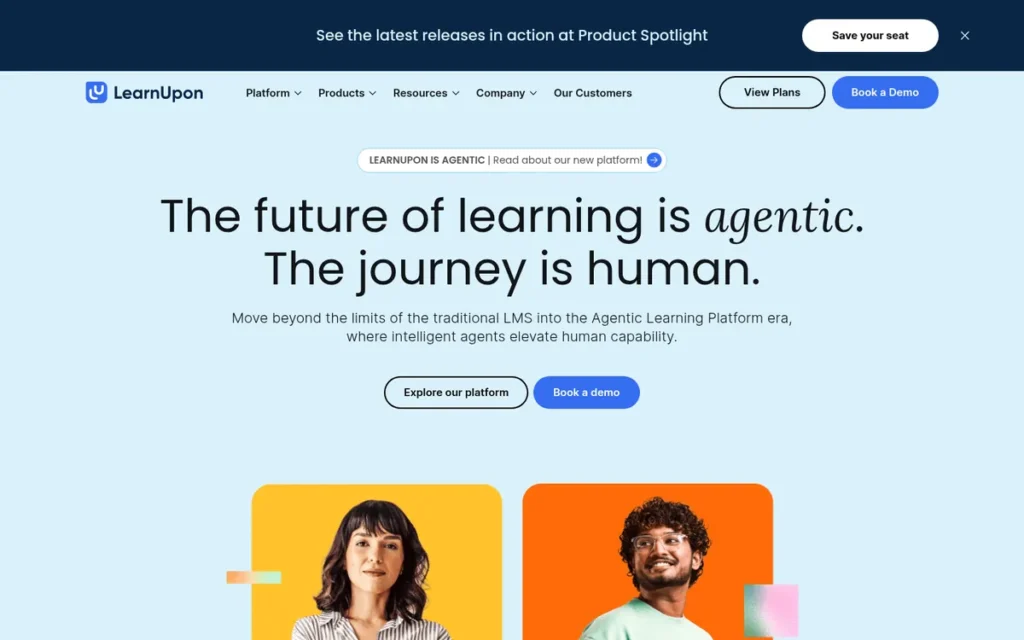
Category: Multi-Portal LMS, a mid-market learning management system with independent branded portals for customer, partner, and employee audiences managed from one administrative instance, with a 12-year production reliability track record.
At a Glance
- Category: Multi-Portal LMS
- Best For: Mid-market SaaS companies managing training for multiple external audiences from a single platform, prioritizing administrative simplicity and proven reliability over deep CRM attribution
- Price Range: Custom quote required; mid-to-upper market; no public pricing (2026)
- Primary Strength: LearnUpon’s multi-portal architecture has been confirmed in a single production deployment exceeding 25,000 concurrent active users, maintained with high reliability over three years, the largest documented scale figure in this comparison
- Biggest Limitation: Learning Journey feature (sequential onboarding path builder) documented by active users as “clunky and inefficient to use”; vendor redesign acknowledged but not yet released as of 2026
- One-Line Summary: LearnUpon is the mid-market multi-portal LMS practitioners consistently choose when they need 25,000+ concurrent learner reliability, simpler administration than Docebo, and multi-audience support from one platform.
- Last Verified: May 2026
Overview
LearnUpon is a multi-portal learning management system built for companies training customers, partners, and employees simultaneously (with each audience in its own independently branded portal under one administrative instance) and LearnUpon is best suited for mid-market SaaS organizations needing proven reliability at scale without Docebo’s administrative complexity or Thought Industries’ premium pricing.
Founded in 2012 in Dublin, Ireland by co-founders Brendan Noud and Des Anderson, LearnUpon has a 12-year production track record confirmed in deployments exceeding 25,000 active concurrent users. LearnUpon is the platform practitioners most frequently cite as the right choice after determining that Docebo provides more platform than their team needs.
Key Features
- Multi-Portal Architecture: LearnUpon creates separate, independently branded learning environments (each with its own custom URL, visual identity, and access controls) for different customer segments, partner tiers, or internal teams from a single administrative account.
- LearnUpon Anywhere: LearnUpon’s embedded learning feature surfaces the LMS experience inside other products or portals, enabling SaaS companies to deliver in-product training without redirecting customers to an external training site.
- LinkedIn Learning Integration: LearnUpon provides a LinkedIn Learning integration that practitioners describe as “amazing,” enabling SaaS companies to supplement their own product training catalog with professional development content without a separate platform contract (r/instructionaldesign, January 2024).
- Learning Paths and Certification Workflows: LearnUpon includes configurable learning paths, certification and licensing workflows, blended learning support, and automated enrollment and reminder triggers for streamlined customer onboarding program management.
- Open API With HRIS Integration: LearnUpon offers a documented open API with HRIS integration capabilities, enabling SaaS companies with technical resources to connect learning data to external CS, CRM, or BI systems for custom reporting workflows.
Best For
LearnUpon is best suited for mid-market SaaS companies needing to run separate training programs for multiple external audiences from a single platform contract, prioritizing administrative simplicity and learner-facing ease of use over deep CRM attribution, and requiring GDPR-aligned data handling for European customer bases.
Strengths
- Confirmed Scale at 25,000+ Concurrent Users: LearnUpon’s multi-portal architecture has been confirmed in a production deployment exceeding 25,000 active concurrent users (maintained with high reliability over three years) the largest documented single-deployment scale figure in this comparison (u/tjrossaz001, r/instructionaldesign, 2024).
- Consistently Preferred Over Docebo: Practitioners in documented head-to-head evaluations consistently choose LearnUpon over Docebo for mid-market deployments, citing simpler administration, faster time-to-value, and better learner-facing UX as the decision factors (r/instructionaldesign, Docebo Rant thread, January 2024).
- GDPR-First Corporate Architecture: LearnUpon’s Dublin, Ireland corporate structure provides a GDPR-first data architecture advantage for multinational SaaS companies with European customer bases, a non-trivial procurement consideration given current GDPR enforcement trends and customer learning data handling requirements.
- Multi-Dimension User Praise: First-hand LearnUpon users describe the platform as providing “amazing LinkedIn Learning integration, great API, easy to build courses, and great customer service”, a consistent multi-dimension praise pattern across independent review sources (anonymous practitioner, r/instructionaldesign, January 2024).
Users on r/instructionaldesign shared multi-year experience with the platform:
“We have used LearnUpon for 6 years. They’re a great company and the platform has developed a lot over time. We are moving to a different platform for some pretty niche reasons related to our business model….but would still recommend depending of course on your key requirements.
The things we love
- their support is outstanding, honestly the best I have ever experienced. So lovely to interact with
- the platform is very easy to use and learn as an administrator, even more technical things like integrations
- users also find it easy and intuitive
- the fee structure is simple…I only appreciated this once I started looking at others
- multi-tenant portals are so easy to set up …I’ve not found another vendor in our price range who supports this as well” Posted by u/cars2108
Takeaway: Long-term LearnUpon users consistently cite support quality and multi-tenant portal simplicity as the platform’s most defensible advantages over competitors at the same price point, the fee structure clarity only becomes apparent when evaluating alternatives.
Limitations
- Learning Journey Builder Clunkiness: LearnUpon’s Learning Journey feature: the sequential onboarding path builder core to structured customer education programs, is documented by active users as “very clunky and inefficient to use” as of 2024–2026, with a vendor redesign acknowledged but not yet released; buyers should specifically demo this feature and request a committed redesign release date before signing (u/tjrossaz001, r/instructionaldesign, 2024).
- Limited Salesforce Attribution Depth: LearnUpon’s Salesforce integration does not match the native AppExchange-certified connectivity of Skilljar for teams needing direct CRM-to-training attribution, and user-reported analytics do not reach the depth of external BI tools like Looker for revenue-level ROI analysis.
- Product Velocity Constraints: One practitioner who explicitly chose LearnUpon over Docebo noted “as with all vendors, change never comes soon enough”, a signal that enhancement requests will face standard enterprise software roadmap timelines rather than accelerated treatment (r/instructionaldesign, January 2024).
Users on r/instructionaldesign noted a significant shift in enterprise support quality in 2025:
“LearnUpon Client Service support for large enterprise accounts has been dropping significantly this past year. We are looking to expand our contract but it takes them almost a week to respond to emails, we have to follow up constantly (even with SALES) to get a response and they have a very large employee turn over in their organization. I have been working with them for almost 5 years and I am at my wits end.” Posted by u/Slight_Royal4838
Takeaway: Enterprise accounts at LearnUpon are reporting meaningful support quality degradation in 2025, large organizations should ask directly about CSM assignment, SLA response commitments, and current staff retention before signing a multi-year contract.
“Our organization uses LearnUpon for both external, and internal training and I really enjoy the improvements they’ve made to the platform over the last three years. Our portals have over 25,000 active users and we very rarely run into issues. The learning journey feature as-is today is very clunky and inefficient to use.” (u/tjrossaz001, r/instructionaldesign (2024))
Takeaway: LearnUpon at 25,000+ concurrent users with rare reliability issues is compelling evidence for mid-market scale, but the Learning Journey clunkiness is a real obstacle for teams whose primary use case is sequential customer onboarding; demo it specifically and ask for the redesign release date before signing.
Verdict
LearnUpon is the top-ranked platform for mid-market SaaS companies needing proven multi-audience reliability at scale (confirmed at 25,000+ concurrent active users) with administrative simplicity that practitioners consistently rate above Docebo for comparable use cases. LearnUpon is the right choice for organizations training customers, partners, and employees from one platform while prioritizing ease of use and GDPR-aligned data handling. Teams requiring deep Salesforce or Gainsight integration for revenue-attributable ROI should evaluate Skilljar first; teams whose primary use case is sequential customer onboarding should specifically demo the Learning Journey builder and request the redesign release date before committing.
5. WorkRamp: Best for Unified Employee and Customer Learning: Single Contract, Modern AI-First Architecture
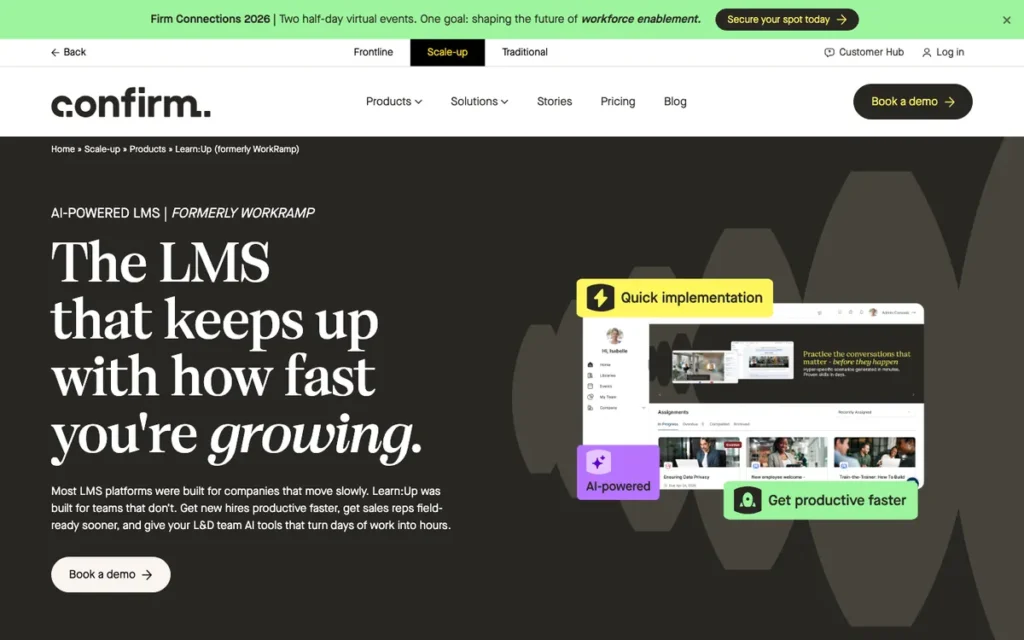
Category: Unified Learning Cloud, an AI-first platform combining employee and customer learning in dedicated product lines (Employee Learning Cloud and Customer Learning Cloud) within a single system and contract.
At a Glance
- Category: Unified Learning Cloud
- Best For: SaaS teams consolidating employee enablement and customer education under one vendor, contract, and reporting layer, particularly those with existing Salesforce and Slack deployments
- Price Range: Custom quote required; annual contracts typically starting at $20,000–$30,000 based on third-party pricing analysis (educate-me.co, 2025); no public pricing
- Primary Strength: Unified Learning Cloud allows a single platform and contract to serve both employee enablement and external customer education with dedicated product lines, eliminating the administrative and budget overhead of dual-LMS management
- Biggest Limitation: SCORM objects must be standalone courses rather than lessons within a larger course, preventing multi-asset blended learning experiences for teams building courseware in Articulate 360; post-acquisition roadmap uncertainty following the October 2025 Learning Pool acquisition
- One-Line Summary: WorkRamp is the unified AI-first Learning Cloud best suited for SaaS companies consolidating employee and customer training under one contract, but its SCORM architecture requires verification against your content authoring workflow before commitment.
- Last Verified: May 2026
Overview
WorkRamp is an AI-first unified learning platform serving employee, customer, and partner training through dedicated product lines (the Employee Learning Cloud and Customer Learning Cloud) enabling SaaS companies to eliminate a separate LMS contract for internal and external audiences, and WorkRamp is best suited for organizations wanting one vendor, one data model, and one reporting layer for both enablement and customer education.
Founded in 2015 in San Francisco and backed by Salesforce Ventures, WorkRamp was acquired by Learning Pool (a large enterprise learning solutions provider) on October 15, 2025 (Marlin Equity press release, October 2025), and now operates as a Learning Pool company. WorkRamp’s Customer Learning Cloud delivers custom-branded customer academies, certification paths, and AI-personalized learning recommendations with confirmed Salesforce, Slack, and Zoom integrations.
Key Features
- Customer Learning Cloud: WorkRamp’s dedicated Customer Learning Cloud provides a custom-branded customer academy with onboarding programs, product training paths, and certification workflows, enabling customer-facing education without a separate LMS contract from the employee training platform.
- AI-Personalized Learning Paths: WorkRamp’s AI engine analyzes learner behavior, job roles, and historical engagement to recommend and dynamically adjust learning paths in real time, positioning WorkRamp as more than a static course delivery system.
- CRM and Collaboration Integrations: WorkRamp provides confirmed integrations with Salesforce, Slack, and Zoom, enabling customer education activity to surface within the CRM and communication tools CS teams already use daily (G2, 2025–2026).
- Unified Admin Architecture: WorkRamp’s single admin instance, data model, and reporting layer serves both internal employee enablement and external customer education, reducing the dual-LMS management overhead common at SaaS companies running separate tools for each audience.
- AI-Assisted Content Creation: WorkRamp includes AI-assisted content creation for rapid training draft generation and self-guided learning module publishing, enabling lean L&D teams to build and update customer education content without dedicated instructional design resources.
Best For
WorkRamp is best suited for SaaS companies needing to unify employee and customer training on a single platform to reduce vendor costs and administrative overhead, and that already use Salesforce and Slack as their primary CRM and collaboration tools, provided the content authoring workflow does not rely on multi-asset SCORM blended learning courses.
Strengths
- Customer Education Growth Momentum: WorkRamp reports over 300% customer growth in the customer education segment [self-reported; no independent verification of base count or methodology] (WorkRamp blog, 2024); G2 reviewers cite specific outcomes including consolidated learning across the business, customized certification paths, and savings from eliminating a second LMS contract.
- CRM-Aligned Investment Backing: WorkRamp’s Salesforce Ventures investment and confirmed Salesforce, Slack, and Zoom integrations reflect a product roadmap deeply aligned with the CRM and collaboration stack that most B2B SaaS CS teams operate, providing integration confidence not available from platforms without CRM-aligned investment backing.
- Modern AI-First Architecture: Practitioners describe WorkRamp as part of “the newer gen cohort” of modern, AI-first LMS platforms that are “easy to manage and deploy” with “a pretty robust set of AI features” and “solid at extended enterprise and sales enablement” compared to legacy platforms (u/Outrageous-Video662, r/elearning, 2025).
This community assessment is drawn from a direct platform comparison in r/elearning:
“Absorb has more features but is more complex to manage. I believe they were started in the early 2000s, so their tech is older but full featured. Good alternative if switching from something like Cornerstone.
WorkRamp is part of the newer gen cohort, like Sana and 360Learning. Easy to manage and deploy, and they have a pretty robust set of AI features. Also, priced reasonably and solid at extended enterprise and sales enablement.
Good luck in the search, two good choices imo” Posted by u/Outrageous-Video662
Takeaway: Practitioners evaluating WorkRamp against legacy platforms consistently highlight its modern architecture and ease of deployment as the primary differentiators, the generational gap in UX between WorkRamp and older platforms is real and documented by multi-platform evaluators.
- Learning Pool Enterprise Depth: WorkRamp’s October 2025 acquisition by Learning Pool adds enterprise L&D infrastructure and compliance capabilities to WorkRamp’s growth-stage positioning, potentially strengthening long-term scalability for buyers committing to multi-year contracts (Marlin Equity press release, October 2025).
Limitations
- SCORM Architecture Limitation: WorkRamp requires SCORM objects to be standalone courses rather than lessons within a larger course, meaning a customer education team cannot create a single course combining a video introduction, text content, and an Articulate-built interactive software demo, fragmenting what should be a unified learning experience (u/Unlikely-Papaya6459, r/elearning, 2025).
- Less Customer-Facing UX Customization Than Purpose-Built Platforms: WorkRamp’s customer portal customization options are documented as less flexible than purpose-built platforms; practitioners evaluating both WorkRamp and Skilljar for external customer UX chose Skilljar specifically for greater page and course customization options (u/AlwaysColtron, r/instructionaldesign, 2024).
- Post-Acquisition Roadmap Uncertainty: WorkRamp’s October 2025 acquisition by Learning Pool introduces roadmap continuity questions that buyers committing to multi-year contracts should address with explicit written product roadmap commitments covering the full contract period before signing.
“One feature, or lack of, that has stuck in my craw since we got it, SCORM objects have to be their own course (or guide, as they call it). I can’t create a course with a video intro, some text and graphics, then an interactive software demo I create in Articulate. That demo can’t be a ‘lesson’ within the course.” (u/Unlikely-Papaya6459, r/elearning (2025))
Takeaway: Teams building blended courses in Articulate 360 must verify this SCORM architecture limitation in a live WorkRamp demo before committing, it directly affects the learner experience for interactive software training content and may be disqualifying for programs built on multi-asset course structures.
Verdict
WorkRamp is the top-ranked platform for SaaS companies whose primary driver is consolidating employee and customer training under one vendor and one contract, offering a genuinely modern AI-first interface with confirmed Salesforce, Slack, and Zoom integrations. WorkRamp’s SCORM architecture limitation is a documented structural issue that must be verified against the organization’s content authoring workflow in the demo stage, if the team builds multi-asset interactive courses in Articulate 360, this limitation may be disqualifying. Teams for whom external customer education UX customization is the highest priority should evaluate Skilljar before WorkRamp.
6. 360Learning: Best for Collaborative Internal and Partner Training: Not Recommended as Primary Customer Education Platform
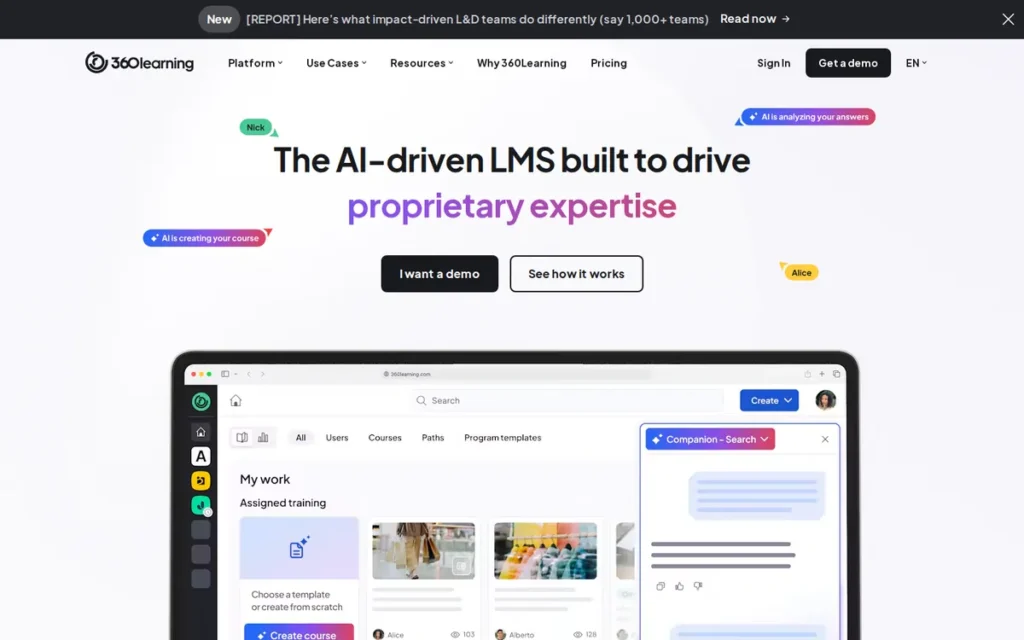
Category: Collaborative LMS/LXP, a learning experience platform built on peer-driven collaborative methodology where internal subject matter experts co-create and continuously improve training content, architected primarily for internal employee and partner enablement.
At a Glance
- Category: Collaborative LMS/LXP
- Best For: SaaS companies prioritizing internal employee enablement, expert knowledge-sharing, or partner training, not organizations whose primary goal is a fully branded external customer academy
- Price Range: $8/user/month for the Team plan (up to 100 users), publicly verified May 2026; enterprise pricing via custom quote above 100 users (360Learning pricing page, May 2026)
- Primary Strength: Only platform in this comparison with peer-driven collaborative content methodology, Brandon Hall Group analyst recognition for collaborative learning, and publicly confirmed pricing at $8/user/month
- Biggest Limitation: Architecturally optimized for internal peer-driven collaboration; practitioners who evaluated 360Learning specifically for external customer academy deployments confirm it is “better for internal use” when a seamlessly branded external learner experience is the primary deliverable
- One-Line Summary: 360Learning is the collaboratively-architected LMS/LXP best suited for internal employee and partner training where peer-generated content is a priority, not the recommended choice when a branded external customer academy is the core deliverable.
- Last Verified: May 2026
Overview
360Learning is a collaborative learning experience platform combining LMS delivery capabilities with a peer-driven methodology where internal subject matter experts co-create, share, and continuously improve training content, making 360Learning architecturally distinct from every other platform in this comparison, and best suited for SaaS companies whose primary training investment is internal employee enablement or partner onboarding rather than fully branded external customer academies.
Founded in 2013 in Paris and reported to have received SoftBank venture investment, 360Learning holds a G2 Leader badge in the collaborative learning category and Brandon Hall Group analyst recognition, and 360Learning is the second-most pricing-transparent platform in this comparison at $8/user/month publicly confirmed for up to 100 users. Practitioners who have evaluated 360Learning specifically for external customer education consistently report that its internal-first architecture makes it a less effective choice than purpose-built customer education platforms.
Key Features
- Collaborative Authoring Engine: 360Learning allows internal subject matter experts (product managers, implementation specialists, and CS engineers) to co-create and continuously improve training content without requiring a centralized L&D team to own all content production, keeping training current as products evolve.
- Custom-Branded External Portals: 360Learning supports custom-branded external portals with custom URLs and visual branding, microlearning modules under ten minutes, gamification with leaderboards and badges, and blended learning including virtual classroom and SCORM content import.
- eCommerce Integration: 360Learning includes eCommerce functionality enabling organizations to sell training courses and certification programs directly to customers, supporting a revenue-generating customer education model alongside its collaborative authoring capabilities.
- AI-Powered Skills Management: 360Learning provides AI-powered skills tagging and management to match learners with content relevant to their role, experience level, and learning history, confirmed through G2 reviewer documentation (2025–2026).
- Global Infrastructure: 360Learning operates offices in New York, London, and Paris with reported SoftBankventure investment backing, providing global infrastructure and multilingual support for SaaS companies with international employee and customer bases.
Best For
360Learning is best suited for SaaS companies whose most urgent training challenge is internal employee enablement, expert knowledge-sharing between teams, or partner certification programs where subject matter experts within the organization are the primary content contributors, not for organizations whose primary deliverable is a polished, fully branded external customer academy for product onboarding.
Strengths
- Brandon Hall Group Analyst Recognition: 360Learning received Brandon Hall Group analyst recognition for strengths in collaborative learning, scalability, analytics, and integrations, a credible third-party validation from a respected L&D analyst firm providing procurement-stage authority (Brandon Hall Group, 2024).
- Second-Most Transparent Pricing: 360Learning publicly confirms $8/user/month for up to 100 users, enabling budget qualification without a sales conversation and delivering predictable total cost of ownership for organizations that can estimate learner volume before engaging the sales team.
- Unique Collaborative Content Methodology: 360Learning’s collaborative content model delivers a measurable advantage for organizations with distributed internal expertise: subject matter experts contribute knowledge continuously, reducing centralized authoring bottlenecks and keeping training current as products evolve, a genuine differentiation from all other platforms in this comparison.
- G2 Leader Status and Global Longevity: 360Learning holds G2 Leader status in the collaborative learning category, with reported SoftBank backing and offices in three global markets, providing platform longevity signals for multinational SaaS companies evaluating long-term commitments.
Limitations
- Internal-First Architectural Bias: 360Learning’s collaborative methodology is architecturally oriented toward internal knowledge-sharing, and practitioners who evaluated 360Learning specifically for external customer academy deployments report it “is fine but better for internal use” when the goal is a seamlessly branded, external-facing learner experience (u/craggyisland86, r/instructionaldesign, 2025).
- Sales Process Concerns Reported in Community: Multiple practitioners in Reddit communities (2023–2024) describe 360Learning’s sales approach as competitor-focused rather than product-merit-focused, with one experienced evaluator describing the product as “2–3 years behind other LMS platforms” after multiple sales meetings (u/Correct_Mastodon_240, r/instructionaldesign, 2023).
- External Academy Depth Gap: The peer-discussion environment that powers 360Learning’s internal advantage becomes friction for external customers who need a clean, structured, self-serve product education experience, the learner co-creation model that drives value internally creates a mismatch for customer onboarding academy use cases where learners should be consuming, not contributing content.
“360 Learning is fine – but better for internal use. They basically want a seamless customisable LMS experience that feels exactly like the company website.” (u/craggyisland86, r/instructionaldesign (2025))
Takeaway: A practitioner who evaluated 360Learning specifically for an external customer academy confirmed it falls short of purpose-built platforms when the goal is a seamlessly branded, external-facing learner experience, buyers evaluating 360Learning for external customer education should pilot the customer portal specifically and request references from organizations running external, not internal, programs.
Verdict
360Learning is the top-ranked platform for SaaS companies whose primary training investment is internal employee enablement, peer knowledge-sharing, or partner certification, where its collaborative methodology, transparent pricing, and Brandon Hall Group-validated strengths deliver genuine value. 360Learning is not the recommended choice when a fully branded external customer academy for product onboarding is the primary deliverable; for that use case, Skilljar, Thought Industries, or LearnUpon will serve the target audience more effectively. Buyers evaluating 360Learning for external customer education should specifically pilot the customer portal experience and request references from organizations running external, not internal, programs before proceeding to contract.
7. Docebo: Best for Large Enterprises With Multi-Audience Complexity: Highest Total Cost of Ownership

Category: Enterprise AI LMS, a publicly traded, multi-audience learning management system with AI-powered content creation for employee, customer, and partner training at global enterprise scale.
At a Glance
- Category: Enterprise AI LMS
- Best For: Large enterprises managing training simultaneously for employees, customers, and partners with dedicated L&D and IT resources, and substantial annual training budgets
- Price Range: Community-reported at ~$40,000/year for 300 seats (r/instructionaldesign, 2024); current third-party market analysis indicates enterprise contracts typically start at $60,000+/year (educate-me.co, 2025); integration add-ons at $4,000–$5,000 per feature; no public pricing
- Primary Strength: Docebo Shape AI processes 40–50 pages per minute and reduces source document noise by approximately 80% using AWS AI/ML services, the most technically advanced AI content pipeline in this comparison; Docebo is the only public company (Nasdaq: DCBO) in this evaluation
- Biggest Limitation: Per-seat pricing combined with $4,000–$5,000 per integration add-on (including Salesforce sold separately) creates the highest total cost of ownership in this comparison for most SaaS customer education programs
- One-Line Summary: Docebo is a publicly traded enterprise LMS (Nasdaq: DCBO) with the most advanced AI content creation pipeline in this comparison, but its add-on pricing model and administrative complexity make it the highest-total-cost-of-ownership option for most SaaS customer education programs.
- Last Verified: May 2026
Docebo ranked #7 in this evidence-based evaluation, not because it lacks capabilities, but because the criteria the target audience weights most heavily (external-first architecture, Salesforce integration included at no extra cost, implementation ease) are its documented weaknesses. Docebo’s AI content pipeline, public company accountability, and G2 Market Leader status are genuine strengths, but they do not outweigh the add-on pricing model and administrative complexity documented across multiple independent practitioner sources.
Overview
Docebo is a publicly traded enterprise learning management system (Nasdaq/TSX: DCBO) designed for organizations training employees, customers, and partners simultaneously from one platform, and Docebo is best suited for large enterprises with dedicated L&D and IT resources, significant annual training budgets, and complex multi-audience configurations that justify its substantial capability depth.
Founded in 2005 in Italy and led by CEO Alessio Artuffo, Docebo is the only public company in this comparison, providing revenue transparency and independent audit accountability that private competitors cannot match. Docebo’s AI content creation engine (Shape) processes 40–50 pages per minute, but Docebo’s administrative complexity, extensive paid add-ons, and high total cost of ownership create documented barriers for growth-stage SaaS teams without enterprise-scale resources.
Key Features
- Docebo Shape AI Content Pipeline: Docebo Shape processes 40–50 pages per minute, handles 10–20 documents daily, and reduces source document noise by approximately 80% using AWS AI/ML services, enabling large organizations to convert internal documentation into structured learning content at a scale no other platform in this comparison matches (AWS case study, 2021–2024).
- Multi-Audience Architecture: Docebo supports employee, customer, and partner training in one platform with distinct configured experiences, analytics, and branding for each audience segment, providing the broadest simultaneous multi-audience scope of any platform in this comparison.
- AI-Powered Recommendations and Gamification: Docebo provides AI-powered content recommendations, learning path automation, and gamification features including points, badges, and leaderboards for both employee and external learner engagement programs.
- Salesforce Integration (Paid Add-On): Docebo integrates with Salesforce: available as a paid add-on at approximately $4,000–$5,000, enabling customer education teams with the budget for the integration to connect training completion data to CRM records and customer health workflows.
- Public Company Accountability: Docebo is publicly traded on Nasdaq (DCBO) and the Toronto Stock Exchange, with independent financial audits, SEC-equivalent disclosure requirements, and shareholder accountability, providing long-term viability signals that private competitors cannot offer.
Best For
Docebo is best suited for large enterprises (not growth-stage SaaS companies) that manage training simultaneously for employees, partners, and customers, have dedicated L&D administrators with platform management expertise, IT resources for complex integration configuration, and annual training budgets that can absorb $60,000+/year in base licensing plus integration add-ons.
Strengths
- Industry-Leading AI Content Pipeline: Docebo Shape processes 40–50 pages per minute and reduces source document noise by approximately 80% using AWS AI/ML services (AWS case study, 2021–2024), representing the most technically advanced AI content creation pipeline in this comparison, a genuine differentiator for large organizations with high-volume content production requirements.
- Only Public Company in This Comparison: Docebo is the only public company in this comparison (Nasdaq: DCBO, Toronto Stock Exchange: DCBO), providing independent financial audits, revenue transparency, and long-term viability signals through publicly disclosed financials that no private competitor, PE-backed platform, or recently acquired company in this comparison can match.
- G2 and FeaturedCustomers Market Leader: Docebo holds G2 Market Leader status and FeaturedCustomers Market Leader classification for the Winter 2026 Customer Education Software report, the strongest independent market presence designations in this comparison’s category.
- Confirmed Global Multi-Audience Scale: Docebo supports confirmed enterprise deployments managing ILT, vILT, eLearning, videos, exams, and certifications simultaneously across multiple languages and global regions, with documented SSO and Salesforce synchronization capabilities (practitioner-reported, r/elearning, 2020–2024).
Limitations
- Highest Total Cost of Ownership: Docebo’s per-seat pricing creates an unavoidable cost escalation, community-reported contracts at approximately $40,000/year for 300 seats (r/instructionaldesign, 2024), with current third-party analysis suggesting $60,000+/year for enterprise contracts (educate-me.co, 2025), compounded by $4,000–$5,000 per integration add-on for features like Salesforce that are included in base pricing on competing platforms.
- Steep Administrative Learning Curve: Docebo’s administrative interface is documented by active users as “clunky” with “lots of clicking around to get places” and features that “hardly get used” despite the platform’s breadth, suggesting feature sprawl that does not translate to usable value for most customer education teams (r/instructionaldesign, Docebo Rant thread, 2024).
- Multi-Audience Architecture Sprawl: Docebo’s design for simultaneous employee, customer, and partner training imports internal L&D constructs (competency frameworks, organizational hierarchies, manager-level reporting) that add administrative complexity without serving external customer education use cases, creating a gap between the platform’s capability breadth and what a CS team actually deploys.
“Slick sales team, mediocre product, very overpriced. On the plus side, to get decent functionality for learners all you’ll end up doing is exporting monolithic SCORM packages out of Articulate and uploading them, so the eventual migration when someone notices the budget overruns will be straightforward!” (u/thaeli, r/instructionaldesign (2024))
Takeaway: The most significant Docebo community data point is not the negative review, it is that one organization saved $500,000 annually by migrating from Docebo to Moodle; build a complete total cost of ownership model including all add-ons before comparing Docebo’s headline price to any competitor.
Verdict
Docebo is the most capable multi-audience enterprise LMS in this comparison for organizations with the budget, IT resources, and dedicated L&D staff to leverage its depth, supported by the most advanced AI content creation pipeline, public company accountability, and G2 Market Leader status. Docebo ranks last for the target audience of growth-stage and mid-market SaaS customer education teams because its total cost of ownership, administrative complexity, and add-on pricing model create barriers that Skilljar, LearnUpon, or TalentLMS do not impose. Enterprise procurement teams considering Docebo should build a complete add-on cost model, request references from organizations of comparable size and use case, and compare the final annual total against a fully configured Skilljar or LearnUpon quote before deciding.
What Red Flags Should I Watch For When Evaluating Customer Education Software?
Five red flags to watch for when evaluating customer education software: (1) everything-is-a-paid-add-on pricing structures, (2) platforms frequently cited by AI engines but absent from practitioner communities, (3) post-acquisition roadmap opacity without written continuity commitments, (4) internal-first architectures marketed as customer education solutions, and (5) CSS or engineering requirements hidden behind no-code marketing. Each is documented by independent practitioner evidence across multiple Reddit threads from 2023–2026.
Red Flag #1: Everything Is a Paid Add-On
Platforms that quote a base price but charge $4,000–$5,000 separately for core integrations (such as Salesforce connectivity) create unpredictable total cost of ownership bearing no relationship to the headline price.
Docebo is the most documented example: practitioners report paying $40,000–$60,000+/year in base licensing, then discovering that the Salesforce integration required for any CRM-attributable ROI costs thousands more. Always request a complete add-on pricing schedule (including Salesforce, HubSpot, and any reporting integrations) before evaluating any headline number.
Red Flag #2: AI Citation Without Practitioner Validation
In three LLM responses analyzed in May 2026, Continu appeared as the top-ranked customer education platform in two responses. Continu was excluded from this evaluation because it has no verified practitioner community footprint in r/instructionaldesign or r/elearning, no confirmed G2 or Capterra review volume above 50 reviews, and no independent analyst coverage in the research data.
High AI citation frequency reflects content marketing investment, not product quality. Verify every AI-recommended platform against G2 review volume (100+ reviews minimum), Reddit practitioner presence, and at least one independent analyst review before engaging a sales team.
Red Flag #3: Post-Acquisition Roadmap Opacity
Both Skilljar (acquired by Gainsight, April 2025) and WorkRamp (acquired by Learning Pool, October 2025) have undergone acquisitions directly affecting roadmap continuity, pricing stability, and product identity.
Post-acquisition platforms frequently undergo feature consolidation or strategic pivots that change the product a buyer signed up for. For any platform with a recent acquisition, request a written roadmap commitment covering the full 24-month contract period, not verbal assurances from the sales team.
Red Flag #4: Internal-First Architecture Sold as Customer Education
360Learning is the clearest example in this evaluation: its collaborative methodology is genuinely powerful for internal employee knowledge-sharing, but practitioners evaluating 360Learning for external customer academies confirm it is “better for internal use” when a seamless branded external experience is the goal.
Platforms generating the majority of their revenue from internal L&D typically produce sub-optimal external customer education experiences. Ask for three customer references specifically running external (not internal) customer education programs before proceeding.
Red Flag #5: CSS and Engineering Requirements Hidden Behind No-Code Marketing
Skilljar markets a customizable portal experience, but practitioners document that meaningful visual customization requires CSS development skills, making the standard configuration interface produce a generic-looking academy without developer involvement. Thought Industries’ headless architecture is a genuine technical advantage but requires engineering resources that most lean CS teams do not have.
Ask vendors to demonstrate portal configuration on-screen in real time, within your team’s resource constraints, during the demo. If the answer is “our professional services team handles that,” you have identified a hidden implementation cost.
What Questions Should I Ask Before Choosing a Customer Education Platform?
Before selecting a customer education platform, ask six questions: (1) What is your time-to-first-published-course for a non-technical team? (2) Is Salesforce integration included in the base price or a paid add-on? (3) What portal customization is achievable without a developer? (4) Can you provide three references from organizations at our stage running our specific use case? (5) What does content and data portability look like if we migrate in 18 months? (6) Does your SCORM implementation support multi-asset blended courses? These questions surface the issues most likely to cause the 600–1,000 hour migration burden practitioners document when the wrong platform is selected.
Question #1: What is your time-to-first-published-course for a team with no dedicated LMS administrator?
This question separates genuinely fast-to-deploy platforms (TalentLMS, LearnUpon) from those requiring significant IT involvement, CSS configuration, or paid professional services (Docebo, Thought Industries).
Require a specific timeline in days or weeks, not a marketing claim about ease of use. “If our two-person L&D team started tomorrow with no previous LMS experience, when would our first external customer see a published course?” is the right framing.
Question #2: Is the Salesforce integration included in the base price, or is it a paid add-on?
For B2B SaaS teams whose ROI case depends on connecting training completion to CRM data, this single question can add or eliminate $4,000–$5,000 from the effective first-year cost.
Skilljar includes Salesforce connectivity as part of its core value proposition (AppExchange certified). Docebo charges for it separately. Other platforms vary. Get this answer in writing before proceeding to contract negotiation, “it’s available” is not the same as “it’s included.”
Question #3: Can I see the portal customization interface, specifically, what is achievable without a developer?
This question exposes the CSS gap that affects Skilljar and the engineering dependency that affects Thought Industries. Ask the vendor to share their screen and build a custom portal from scratch during the demo using only the configuration interface available to your L&D team.
If the answer involves “our professional services team typically handles that,” you have identified a hidden implementation cost. If the answer requires CSS or API calls, you have identified a technical dependency that must be budgeted before signing.
Question #4: Can you provide three references from organizations at my company stage running my specific use case?
Specificity matters: a reference from a 10,000-person enterprise does not validate the platform for a 150-person growth-stage SaaS company.
Ask for references matching your company size, use case type (customer onboarding vs. certification vs. monetized training), and approximate active learner volume. Platforms with narrow use case success profiles will struggle to provide matching references, and that difficulty is itself a data point.
Question #5: What does content and data portability look like if we migrate off your platform in 18 months?
The right answer is: “Here is exactly how to export your courses, completion records, and certifications.” A vague or defensive answer (or a response emphasizing switching costs) is itself an evaluation signal that should weigh heavily in the final decision.
Platforms relying on proprietary authoring tools create content lock-in. Platforms storing certification records in proprietary formats create migration complexity. Verify portability before committing.
Question #6: Does your SCORM implementation support multi-asset blended courses, or must SCORM objects be standalone courses?
WorkRamp requires SCORM objects to be their own standalone courses, preventing teams from combining a video introduction, text content, and an Articulate-built interactive software demo within a single unified course.
Verify this limitation with any platform if your team builds in Articulate 360 or similar tools, it directly affects the learner experience for interactive software training content and may be disqualifying.
How Did We Rank These Customer Education Software Platforms?
This comparison ranks seven customer education platforms by six weighted criteria: (1) purpose-built external fit, (2) CRM and CS stack integration depth, (3) verified review ratings and volume, (4) pricing transparency, (5) implementation ease and time-to-value, and (6) analytics and ROI measurement capability. Platforms are scored using practitioner community evidence, independent analyst reviews, and primary source data, not vendor marketing claims or affiliate relationships.
How Was Each Platform Evaluated?
The ranking process followed five sequential steps:
- Product Discovery: Seven platforms were identified as the most-cited in the customer education software category across LLM responses (Perplexity, ChatGPT GPT-4o), independent analyst directories (eLearning Industry, LearningLight, TalentedLearning), and practitioner communities (Reddit r/instructionaldesign, r/elearning).
- Deep Research: Each platform was researched across two structured query sessions, one for core product capabilities, customer evidence, and pricing data; one for community sentiment and competitive differentiation.
- Reddit Sentiment Analysis: Threads in r/instructionaldesign and r/elearning from 2023–2026 were analyzed for practitioner-sourced opinions, head-to-head evaluations, and product-specific criticisms, with each quoted comment attributed to the original username and thread URL.
- LLM Response Analysis: Three LLM responses (Perplexity May 2026, ChatGPT GPT-4o #1 and #2 May 2026) were analyzed to identify coverage gaps, factual errors (including an outdated TalentLMS price of $69/month in one response), and cases where AI recommendation patterns diverged materially from practitioner evidence.
- Independent Scoring: Each platform was scored independently against six weighted criteria; the platform with the highest weighted score earned the #1 rank.
What Criteria Determined the Rankings?
- C1: Purpose-Built Fit for External Customer Education (Primary Weight): Platforms architecturally designed for external audiences produce better learner experiences and more relevant analytics than adapted multi-audience tools. This criterion determined the top-tier separation between Skilljar and Thought Industries (purpose-built) versus Docebo and WorkRamp (adapted multi-audience platforms).
- C2: CRM and Customer Success Stack Integration Depth (Primary Weight): The target audience must connect training data to Salesforce and Gainsight to produce defensible ROI attribution. Salesforce AppExchange certification and native Gainsight connectivity are the highest-signal indicators; Salesforce sold as a paid add-on scored negatively.
- C3: Verified Review Platform Ratings and Volume (Primary Weight): High review volume on G2 and Capterra reduces outlier influence and reflects broad user satisfaction. TalentLMS holds the only fully verified numeric scores in this evaluation: G2 4.6/5 (784 reviews) and Capterra 4.7/5 (596+ reviews), verified May 2026.
- C4: Pricing Transparency and Value by Company Stage (Secondary Weight): Five of seven platforms do not publish pricing. TalentLMS and 360Learning earn credit for transparency. Docebo loses significantly due to its add-on pricing model and highest community-reported entry point in the comparison.
- C5: Implementation Ease and Time-to-Value (Secondary Weight): CSS requirements (Skilljar), engineering dependencies (Thought Industries headless), and steep admin complexity (Docebo) score negatively here. TalentLMS and LearnUpon score positively for practitioner-reported setup speed and ease.
- C6: Analytics and ROI Measurement Capability (Secondary Weight): Platforms natively surfacing connections between training completion and customer health, support ticket deflection, and renewal probability reduce the CS team’s measurement burden. AI-powered analytics depth and CRM attribution capability are the highest-value differentiators within this criterion.
How Were Conflicting Evidence Sources Weighted?
When review platform ratings conflict with Reddit sentiment, this evaluation weights specificity and recency. A detailed 2024 Reddit post from a named practitioner with cross-platform experience outweighs a generic 2023 G2 review.
Docebo’s G2 Market Leader status is acknowledged and credited in its Strengths section. The documented practitioner pattern of “slick sales, mediocre product, very overpriced” across multiple independent threads carries material weight in the final ranking.
A platform that invests in enterprise marketing and analyst relations will score well in AI-generated lists; a platform that solves real problems for real practitioners at scale will score well in this evaluation, and those are not always the same platform.
How Was Pricing and Factual Data Verified?
Vendor-reported statistics are labeled as such. Only claims corroborated by at least one independent source are stated as fact. Pricing data sources:
- Public pricing pages: TalentLMS (talentlms.com/pricing, annual billing, May 2026) and 360Learning (360learning.com/pricing, May 2026)
- Practitioner-reported ranges with Reddit username and thread attribution: Docebo, Skilljar, Thought Industries (2024–2026)
- Third-party pricing analysis: WorkRamp and Docebo (educate-me.co, 2025)
Two corrections applied in this article:
Pricing correction: At least one AI-generated response (ChatGPT GPT-4o, May 2026, sourced via beetsol.com) cited an outdated TalentLMS entry price of $69/month. The verified current public price is $119/month for the Core plan (annual billing) for up to 40 users, confirmed at talentlms.com/pricing in May 2026. The $119/month reflects annual billing; monthly billing is approximately $149/month per Capterra (May 2026).
Acquisition date correction: The Gainsight acquisition of Skilljar was announced April 2, 2025, not 2024 as appears in several AI-generated summaries. Acquisition terms were not publicly disclosed (Gainsight press release, April 2025; GeekWire, April 2025).
Why Is Continu Not Included in This Comparison?
In three LLM responses analyzed in May 2026, Continu appeared as the top-ranked customer education platform in two responses. Continu was excluded from this evaluation because it has no verified practitioner community footprint in r/instructionaldesign or r/elearning, no confirmed G2 or Capterra review volume above the 50-review minimum, and no independent analyst coverage in the research data assembled for this comparison.
This divergence between AI citation frequency and practitioner community presence is an editorial finding. Platforms that invest heavily in content marketing for SEO and LLM training data can achieve high AI citation frequency without corresponding real-world practitioner validation. PlugRoute ranks platforms by evidence, not by how often they appear in AI responses.
When Is This Article Reviewed and Updated?
This article was last updated in May 2026. Pricing, features, and company ownership are verified at the time of publication. The customer education software market changes rapidly, acquisitions (Skilljar by Gainsight, April 2025; WorkRamp by Learning Pool, October 2025) and pricing adjustments can occur without public notice. Readers should independently verify all pricing claims before entering contract negotiations.
PlugRoute has no affiliate relationships with any company listed. Rankings are determined entirely by research data and objective evaluation criteria.
Frequently Asked Questions About Customer Education Software
What is the best customer education software for a SaaS company in 2026?
Skilljar is the best customer education software for SaaS companies with active Salesforce or Gainsight deployments. TalentLMS is the best choice for SMBs needing fast deployment and transparent pricing, G2 4.6/5 (784 reviews) and Capterra 4.7/5 (596+ reviews). Thought Industries leads for enterprise organizations building revenue-generating training programs with large external learner populations at scale.
How much does customer education software cost in 2026?
Customer education software ranges from $119/month (TalentLMS Core plan, annual billing) to $60,000+/year for enterprise Docebo contracts. TalentLMS and 360Learning ($8/user/month, up to 100 users) are the only platforms with transparent public pricing. Skilljar practitioners report ~$30,000+/year; Docebo current market pricing starts at $60,000+/year plus $4,000–$5,000 per integration add-on (community-sourced and third-party analysis, 2024–2026).
How does PlugRoute determine its rankings?
PlugRoute rankings are determined by six weighted evidence-based criteria applied identically to every platform: purpose-built external fit, CRM integration depth, verified review ratings and volume, pricing transparency, implementation ease, and analytics capability. Every platform is scored using practitioner community data, independent analyst reviews, and verified primary sources, with no vendor input, no affiliate payments, and no preferential treatment for any brand.
What Do Customer Education Software Terms Like LMS, CLP, and Headless Architecture Mean?
Customer Learning Platform (CLP): A Customer Learning Platform is a specialized external-facing learning management system built exclusively for training customers, partners, and professionals (not internal employees) with product architecture optimized for branded portals, eCommerce monetization, large-scale certification, and self-serve onboarding. Thought Industries uses the CLP designation as its official product category; Skilljar is also marketed as a CLP, now operating as Skilljar by Gainsight following the April 2025 acquisition.
Headless Architecture (LMS): In the LMS context, headless architecture separates the back-end learning infrastructure (course delivery, progress tracking, certifications, analytics) from the front-end learner experience (visual design, navigation, user interface), allowing engineering teams to build any custom learner-facing experience using the platform’s APIs. Thought Industries is the only headless-capable platform in this comparison, making it uniquely suited for organizations with engineering resources and full brand control requirements.
SCORM (Shareable Content Object Reference Model): SCORM is a set of technical standards for e-learning content that defines how online courses are packaged and how they communicate completion, scores, and learner progress back to an LMS. WorkRamp’s SCORM architecture limitation (requiring SCORM objects to be standalone courses rather than lessons within a larger course) is a documented decision factor for customer education teams using Articulate 360 or similar authoring tools.
Federated Search: In the customer education context, federated search is the capability to search simultaneously across multiple content sources (training catalog, product documentation, knowledge base articles, and blog posts) from a single search interface within the learning portal. Thought Industries is the only platform in this comparison with confirmed federated search functionality, which directly reduces support ticket volume by enabling customers to self-serve answers across all available content without opening a support request.
LMS vs. LXP: An LMS (Learning Management System) manages and delivers structured training content with defined completion tracking and certification workflows. An LXP (Learning Experience Platform) emphasizes learner-directed discovery and social or collaborative content consumption. Most platforms in this comparison blend both, 360Learning is the clearest LXP in the group; Skilljar and Thought Industries are the clearest traditional LMSs optimized for structured external program delivery.
Glossary: Key Terms Used in This Comparison
Purpose-Built External LMS: A learning management system designed exclusively for customer-facing training, onboarding, and certification programs from its founding, never adapted from internal employee training infrastructure. Platforms in this category, such as Skilljar and Thought Industries, deliver learner experiences and analytics optimized entirely for external audiences.
Headless Architecture: In the LMS context, a delivery model that separates the back-end learning infrastructure (course delivery, progress tracking, certifications) from the front-end learner experience, allowing engineering teams to build any custom customer-facing interface via APIs. Thought Industries is the only platform in this comparison offering a headless front-end, making it uniquely suited for organizations requiring complete brand control.
Federated Search: A capability that allows learners to search simultaneously across multiple content sources (training catalog, product documentation, knowledge base articles, and blog posts) from a single search interface within the learning portal. In customer education, federated search directly reduces support ticket volume by enabling customers to self-serve answers without opening a support request.
SCORM (Shareable Content Object Reference Model): A set of technical standards for e-learning content that defines how online courses are packaged and how they communicate completion, scores, and learner progress back to an LMS. WorkRamp’s SCORM implementation requires objects to be standalone courses rather than lessons within a larger course, a documented limitation for teams authoring multi-asset blended content in tools like Articulate 360.
Multi-Tenant Portal: An LMS architecture that creates separate, independently branded learning environments (each with its own custom domain, visual identity, and access controls) for different customer segments, partner tiers, or internal teams, all managed from a single administrative account. LearnUpon’s multi-tenant portal capability has been confirmed in a single production deployment exceeding 25,000 concurrent active users.
Which Customer Education Platform Is Right for You?
Choosing the right customer education platform depends on four factors: company stage (SMB vs. enterprise), CRM stack (Salesforce or Gainsight vs. none), technical resources (no-code team vs. engineering capacity), and business model (training as support cost vs. training as a revenue stream). Skilljar leads for CRM-connected SaaS teams, Thought Industries for enterprise organizations monetizing training at scale, and TalentLMS for SMBs needing the fastest, lowest-risk deployment with verified ratings.
Key Insights
- Purpose-built beats adapted for external customer education. Skilljar and Thought Industries (designed exclusively for external audiences since founding) consistently outperform multi-audience platforms in practitioner head-to-head evaluations; the platform category matters as much as the feature list.
- Pricing transparency is a trust signal, not just a convenience. Only TalentLMS and 360Learning publish pricing publicly; a platform that forces a sales conversation before disclosing price is structurally incentivized to quote high and create switching cost friction, start evaluations with the transparent options.
- Post-acquisition platforms require written roadmap commitments. Both Skilljar (Gainsight, April 2025) and WorkRamp (Learning Pool, October 2025) carry documented post-acquisition roadmap uncertainty; multi-year contracts with either should include written feature continuity commitments, not verbal sales assurances.
- Docebo’s LLM ranking versus its evidence-based ranking illustrates why independent review matters. Docebo consistently appears in the top 3–4 positions in every LLM response analyzed for this article, but ranks #7 in this evidence-based evaluation; LLMs over-represent market presence signals and systematically under-represent community sentiment evidence, including one organization’s documented $500,000 annual savings from migrating away from Docebo entirely.
- Choosing the wrong platform costs 600–1,000 hours to fix. Use the six evaluation questions in this article to eliminate that risk before signing, not after.
Situational Guidance
- Enterprise SaaS teams with active Salesforce or Gainsight: Start with Skilljar, the only platform in this comparison with both AppExchange certification and native Gainsight integration. Teams building training as a revenue-generating product line, or managing 10,000+ external learners, should evaluate Thought Industries and request a headless architecture live demo with an engineering lead present.
- SMB and early-stage SaaS teams: Start with TalentLMS’s free plan. Create an account, publish one course to five test users, and evaluate both the admin and learner experience before any sales conversation. This eliminates evaluation debt and produces a real deployment reference before committing budget.
- Teams evaluating 360Learning for external customer education based on an LLM recommendation: Pilot the external portal experience specifically, and request three references from organizations running external (not internal) programs before proceeding to contract negotiation.
For additional independent SaaS platform reviews ranked by the same evidence-based, affiliate-free methodology, visit PlugRoute.
We update this guide quarterly. Last updated: May 2026.