Elastic leads for regulated industries requiring verified on-premises deployment. Glean leads for large cloud-native enterprises seeking AI-native workplace search. GoSearch delivers the best value for mid-market teams priced out of Glean. Deployment model and budget narrow this field faster than any feature comparison, these seven platforms solve categorically different problems.
Knowledge workers lose an estimated 3+ hours daily app-hopping across fragmented SaaS tools. Three structural problems drive enterprise search procurement complexity:
- Pricing opacity blocks budget approval: four of seven platforms require a sales call before any pricing information is shared.
- Compliance mandates eliminate cloud-only platforms from regulated industry shortlists before features are assessed.
- The build-versus-buy question remains live for IT teams with existing Elasticsearch capacity evaluating whether managed platforms justify their premium.
Users on r/engineering described the compounding effect of platform sprawl firsthand:
“We’ve had a lot of turnover in the last few years and each new manager wants to use a different system. As a result we have documentation in Google drive, Confluence, Slack, Discourse, Jira, Product board, Asana, Greenlight Guru, and Enzyme. It’s a huge mess.” Posted by u/bobbaddeley
Takeaway: Enterprise knowledge management sprawl (where each new manager mandates a different system) is the foundational procurement pain that unified enterprise search platforms exist to resolve.
PlugRoute has no affiliate relationships with any company listed in this article. Rankings are determined entirely by research data and objective evaluation criteria applied equally to all platforms.
“Building such a system is a money pit, you won’t be able to handle the conversion, NLP and document permissions at scale while maintaining all the connectors. That work never really ends.” (u/sb4906, r/LlamaIndex, 2025)
Takeaway: Practitioners who have built and sold custom enterprise search infrastructure at scale warn that connector maintenance, permissions handling, NLP processing, and data synchronization become persistent cost centers, the exact functions that commercial platforms absorb in exchange for their subscription pricing.
TL;DR: Top Picks at a Glance
- Elastic (Elasticsearch) is the only platform in this evaluation with verified on-premises AI semantic search via ELSER without external API dependencies, the default starting point for regulated industries and air-gapped environments where data sovereignty is non-negotiable.
- Glean is the leading fully managed AI workplace search platform for large cloud-native enterprises, deploying an Enterprise Graph across 100+ app connectors, with a community-verified minimum commitment of approximately $50,000–$90,000 per year.
- GoSearch is the most accessible full-featured Glean alternative, offering published $20/user/month Pro pricing with no minimum user commitment, 100+ connectors, and a hybrid federated architecture that keeps sensitive data out of central indexes.
- Coveo is the multi-vertical AI search platform for enterprises needing a single vendor spanning workplace, ecommerce, and customer service search, TSX-listed (CVO), 12+ self-learning ML models, and confirmed deployed at Fortune 50 scale.
- AlphaSense is the AI market intelligence platform for finance and strategy professionals combining internal document search with a proprietary library of financial filings, earnings transcripts, and broker research, validated by $500M ARR as of October 2025 (Forbes and PR Newswire).
- Guru is the card-based knowledge management platform delivering verified answers inside Slack, Teams, and Salesforce via automated Knowledge Agents governance, the best-fit structured knowledge solution for sales and support teams at published $5–$10/user/month.
- Algolia is the API-first search and discovery platform used by Stripe, Twitch, and Zendesk to power customer-facing digital product search with sub-100ms global response times and a 99.999% uptime SLA, purpose-built for engineering teams building external search, not internal workplace knowledge management.
The enterprise search market’s defining split in 2026 is not AI versus no AI, nearly every platform now claims AI search. The split is cloud-only versus deployable-anywhere, and for regulated industries, that distinction eliminates six of seven platforms in this evaluation before a single feature is compared.
What Are the Main Categories of Enterprise Search Software?
Enterprise search software divides into three functional categories in this evaluation: Search Infrastructure Platforms (Elastic, Algolia), AI Workplace Search Platforms (Glean, GoSearch, Coveo), and Specialized AI Platforms built for specific buyer profiles, AlphaSense for finance professionals and Guru for knowledge governance. Category fit is a prerequisite filter before any feature comparison begins.
Category 1: Search Infrastructure Platforms are developer-first, highly configurable engines that technical teams deploy and maintain to build production-grade search, available as fully self-managed or managed cloud services.
- Elastic / Elasticsearch (#1): open-source, developer-extensible search engine with verified on-premises AI semantic search via ELSER, available as fully self-managed (free) or managed Elastic Cloud, with unified support for enterprise search, security analytics, and IT observability
- Algolia (#7): API-first search and discovery platform with sub-100ms global performance via Distributed Search Network, purpose-built for customer-facing digital products including ecommerce and documentation portals
Category 2: AI Workplace Search Platforms are managed, AI-native platforms with pre-built connectors for internal enterprise knowledge discovery across 50–100+ connected SaaS applications, requiring minimal engineering after initial deployment.
- Glean (#2): managed, cloud-only AI workplace search built by ex-Google engineers with an Enterprise Graph personalization model and 100+ pre-built connectors for Microsoft 365 and Google Workspace environments
- GoSearch (#3): hybrid indexing and federated live-query AI workplace search with BYO-LLM flexibility and published $20/user/month Pro pricing, with no minimum user commitment
- Coveo (#4): multi-vertical AI search platform unifying workplace, ecommerce, and customer service search with 12+ self-learning ML models and Automatic Relevance Tuning
Category 3: Specialized AI Platforms are purpose-built tools optimized for specific buyer profiles that general-purpose enterprise search cannot fully serve.
- AlphaSense (#5): AI market intelligence platform for finance, strategy, and investment professionals combining internal document search with a proprietary external content library including filings, transcripts, and broker research
- Guru (#6): card-based AI knowledge management platform delivering verified answers in-workflow for sales, customer success, and support teams via automated Knowledge Agents governance
How Do the Top Enterprise Search Platforms Compare at a Glance?
| Rank | Company | Category | Best For | One-Line Summary | Key Capabilities | Primary Strength | Key Limitation |
|---|---|---|---|---|---|---|---|
| #1 | Elastic | Search Infrastructure | Regulated industries; engineering teams | Elastic is the open-source enterprise search platform uniquely combining verified on-premises AI semantic search via ELSER, independently confirmed review scores, and $1.483B FY2025 revenue; the default for data-sovereign and air-gapped environments. | ELSER semantic search; hybrid BM25 + vector; ELK stack unification; ECE on-premises orchestration; Kibana AI Assistant | On-premises AI semantic search without external API dependencies | Developer-intensive; no pre-built SaaS workplace connectors at scale |
| #2 | Glean | AI Workplace Search | Large cloud-native enterprises (150+ users) | Glean is the AI workplace search platform built by ex-Google engineers on Enterprise Graph technology delivering personalized RAG-powered answers and agentic workflows across 100+ connected applications. | Enterprise Graph; 100+ pre-built connectors; RAG-based generative answering; agentic AI workflows; single-tenant Google Cloud deployment | Enterprise Graph personalization depth; unified coverage for Microsoft 365 and Google Workspace | Cloud-only; estimated $50,000–$90,000/year minimum; no verified G2 aggregate score |
| #3 | GoSearch | AI Workplace Search | Mid-market teams; Glean budget alternatives | GoSearch is the mid-market AI enterprise search platform with 100+ connectors, hybrid federated architecture, and BYO-LLM at a published $20/user/month with no minimum user commitment. | 100+ connectors; hybrid federated architecture; BYO-LLM (GPT-4/5, Claude); GoAI agentic assistant; native GoLinks integration | Published pricing transparency; federated privacy architecture; BYO-LLM flexibility | Limited third-party validation; self-reported compliance certifications unverified at research date |
| #4 | Coveo | Multi-Vertical AI Search | Enterprises needing workplace + ecommerce + service search | Coveo is the TSX-listed multi-vertical AI search platform unifying workplace, ecommerce, and customer service search via 12+ self-learning ML models and RAG-based generative answering. | 12+ ML models; ART self-learning relevance; Relevance Generative Answering; 55+ indexable sources; Conversational Product Discovery (March 2026) | 12+ out-of-box ML models; verified multi-vertical unification for complex enterprise deployments | Cloud-only; premium pricing (~3x Algolia for ecommerce-only); no verified G2 aggregate score |
| #5 | AlphaSense | Market Intelligence | Finance, strategy, investment professionals | AlphaSense is the AI market intelligence platform combining internal document search with a proprietary library of financial filings, transcripts, and broker research; validated by $500M ARR (Forbes, October 2025). | Domain-tuned financial NLP; Smart Summaries; Tegus expert call library; Generative Search; SharePoint/Box/Drive integrations | Proprietary financial content library + domain-tuned NLP with no comparable alternative in this evaluation | $14,500–$60,000/seat/year; finance use case only; cloud-only |
| #6 | Guru | Knowledge Management | Sales and support teams at SaaS companies | Guru is the AI knowledge management platform delivering verified card-based answers in Slack, Teams, and Salesforce via automated Knowledge Agents governance; solving knowledge rot at $5–$10/user/month. | Card-based knowledge architecture; Knowledge Agents governance; Chrome extension; Slack/Teams/Salesforce delivery; semantic AI search | Knowledge Agents automated governance; path-of-work delivery that eliminates context-switching | Not full-stack enterprise search for unstructured data at petabyte scale |
| #7 | Algolia | Search and Discovery API | Ecommerce; developer-built digital product search | Algolia is the API-first search and discovery platform powering Stripe, Twitch, and Zendesk with sub-100ms global response times, 99.999% uptime via DSN, and NeuralSearch hybrid semantic search. | DSN global full-index replication; NeuralSearch hybrid keyword + vector; Merchandising Studio; 99.999% uptime SLA; ecommerce platform integrations | Sub-100ms DSN global performance; 99.999% uptime SLA for mission-critical ecommerce deployments | Not designed for internal workplace search; cloud-only; no self-hosting option |
Which Enterprise Search Platform Should I Choose for My Use Case?
| Your #1 Priority | Recommended Tool | Why | Acceptable Alternative |
|---|---|---|---|
| Regulated industry or on-premises deployment | Elastic | Only platform with verified on-premises AI semantic search without external API calls | OpenSearch (AWS fork) for fully open-source option |
| Large enterprise cloud-native workplace AI search | Glean | Enterprise Graph + 100+ connectors + agentic AI at enterprise scale | Coveo if multi-vertical use case applies |
| Mid-market team or Glean budget alternative | GoSearch | Published $20/user/month; 100+ connectors; BYO-LLM; no user minimum | Guru if structured knowledge governance is the core need |
| Unified workplace + ecommerce + service search | Coveo | Multi-vertical architecture; 12+ ML models; TSX-listed financial stability | Glean (workplace) + Algolia (ecommerce) as two-vendor approach |
| Finance, strategy, or investment research | AlphaSense | Proprietary financial content library + domain-tuned NLP; no comparable alternative in this list | Bloomberg Terminal for quantitative data priority |
| Sales and support team knowledge governance | Guru | Card-based architecture; Knowledge Agents governance; in-workflow delivery in Slack/Teams/Salesforce | GoSearch if cross-app discovery is also required |
| Customer-facing ecommerce or digital product search | Algolia | Sub-100ms DSN; NeuralSearch; 99.999% uptime at ~30% of Coveo pricing | Coveo if deep behavioral personalization is the priority |
| Existing Elasticsearch capacity; evaluating build vs. buy | Elastic (managed Cloud tiers) | Elastic Cloud adds SLA and ML features without rebuilding; evaluate GoSearch or Glean for the connector and governance layer | GoSearch for a managed connector layer on top of existing Elasticsearch infrastructure |
How Does Each Enterprise Search Platform Perform?
The platform ranked #1 in this evaluation is not the platform most commonly recommended by AI assistants or cited first in vendor comparison posts. Elastic ranks #1 because it is the only platform clearing all six evaluation criteria simultaneously, including the deployment model requirement that eliminates every other platform for regulated industry evaluations before feature comparison begins.
Organizations without regulated industry constraints should use the Quick Decision Framework above to identify their starting point. Each platform entry below opens with a direct answer identifying who the platform is for.
1. Elastic (Elasticsearch): Best for Infrastructure-First Organizations and Regulated Industry Deployments
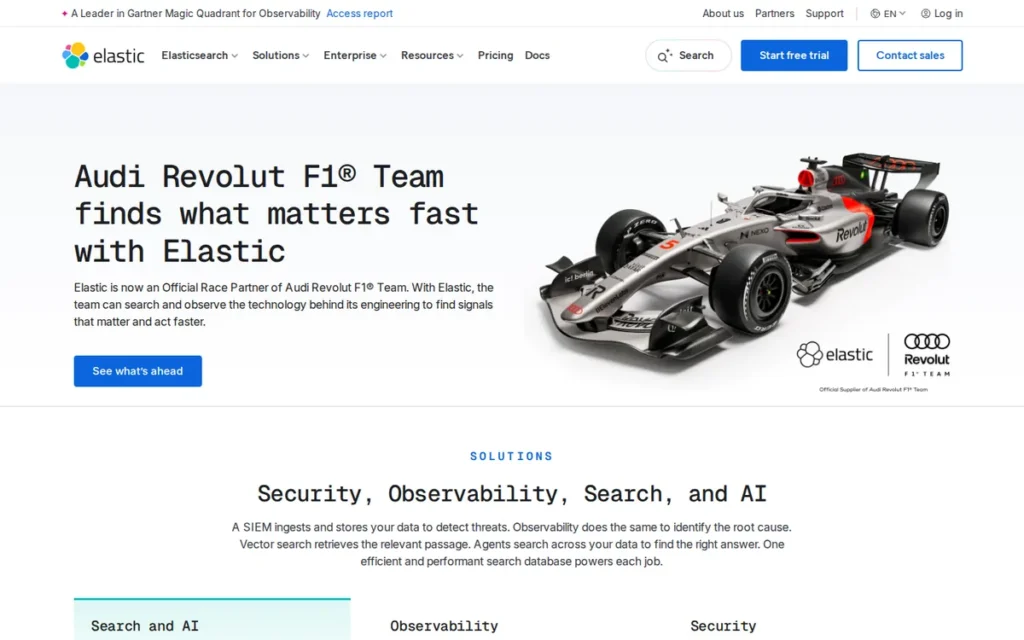
Category: Search Infrastructure Platform, an open-source, developer-extensible engine powering enterprise search, security analytics, and IT observability from a single deployable stack, available as a managed cloud service or fully self-managed on-premises deployment with complete AI feature parity.
At a Glance
- Category: Search Infrastructure Platform
- Best For: Regulated industry IT teams and engineering-led organizations needing on-premises or air-gapped AI search without routing data through external APIs
- Price Range: Free (open-source self-managed); Cloud Starter $0 dev/test; Growth ~$95/GB/month + compute; Enterprise ~$185/GB/month + compute with 99.99% SLA; ECE on-premises orchestration on request (~$10,000/month, community-estimated)
- Primary Strength: Elastic’s ELSER: the only air-gap-capable AI semantic search in this evaluation, operating natively within Elasticsearch without external API dependencies
- Biggest Limitation: Elastic requires dedicated DevOps engineering expertise to configure and maintain at production scale; no pre-built SaaS workplace connectors at the breadth of managed alternatives
- One-Line Summary: Elastic (Elasticsearch) is the open-source enterprise search and analytics platform uniquely combining verified on-premises deployment, AI-powered semantic search via ELSER without external API dependencies, G2 4.5/5 from 290+ independently verified reviews, and $1.483B FY2025 revenue, the highest-scoring platform in this evaluation for regulated industries and engineering-first organizations.
- Last Verified: May 2026
Overview
Elastic (Elasticsearch) is the open-source enterprise search and analytics platform built on Apache Lucene, deployed by engineering-led organizations from mid-market to Fortune 500 that require full infrastructure control and a unified platform spanning search, security analytics (SIEM), and IT observability. Elastic holds a G2 rating of 4.5/5 based on 290+ independently verified reviews for Elasticsearch, and 4.4/5 across 506+ reviews for all Elastic products combined, as of May 2026 (G2.com).
Elastic N.V. is NYSE-listed (ESTC) and reported $1.483B in FY2025 total revenue (up 17% year-over-year) per Elastic’s Form 10-K filed with the SEC and BusinessWire earnings release (May 2025). FY2026 revenue guidance projects $1.655B–$1.67B, making Elastic the most financially transparent vendor in this comparison by a significant margin. Elastic’s 2021 license change from Apache 2.0 to Elastic License 2.0 created a permanent fork with the AWS OpenSearch project; organizations must assess this split before deployment commitments.
Key Features
- ELSER Semantic Search: Elastic’s ELSER (Elastic Learned Sparse EncodeR) model enables production-grade semantic search natively within Elasticsearch without routing enterprise data through external embedding APIs, making Elastic the only platform in this evaluation with verified AI-powered semantic search capability in air-gapped or data-sovereignty-constrained environments as of May 2026, per Elastic product documentation, 2025 and Peerbits, 2025.
- Hybrid Search (BM25 + Vector): Elastic combines BM25 keyword matching with vector and semantic search in a single query pipeline, enabling organizations to balance traditional lexical precision with AI-driven conceptual understanding without managing separate search indexes or running multiple query pipelines simultaneously.
- ELK Stack Unification: Elastic’s ELK stack: Elasticsearch, Logstash, Kibana, and Beats, creates a unified data pipeline from ingestion through visualization, allowing a single vendor to serve enterprise search, SIEM security analytics, and IT observability simultaneously and reducing vendor sprawl across infrastructure domains.
- Elastic Cloud Enterprise (ECE): Elastic’s ECE provides on-premises orchestration of Elastic clusters at scale, enabling organizations to deliver Elastic-as-a-service within their own data centers while retaining cloud-like management workflows, upgrade tooling, and operational visibility.
- AI Assistant in Kibana: Elastic’s AI Assistant enables natural language interaction with enterprise data (including security event investigation, log analysis, and search management) reducing the expertise barrier for business analysts and security teams who need search access without deep engineering involvement.
Best For
Elastic is best for engineering-led organizations and IT teams in regulated industries (healthcare, financial services, government, and defense) that require verified on-premises or air-gapped deployment and need AI semantic search that does not route data through external cloud services. Elastic is equally well-suited to organizations already running the ELK stack for security analytics or observability who want to consolidate enterprise search on the same infrastructure.
Pricing
Elastic offers a free open-source self-managed deployment with no feature ceiling for organizations managing their own infrastructure, the only zero-cost genuine entry point in this evaluation. The managed Elastic Cloud service starts at $0 for a 1GB development environment, scales to approximately $95/GB/month for Growth tier (plus compute), and approximately $185/GB/month for Enterprise tier with 99.99% SLA and ML features including ELSER. Annual committed-use discounts of up to 40% are available.
On-premises Enterprise orchestration (Elastic Cloud Enterprise) is custom-priced; community sources estimate starting costs around $10,000/month (community-verified, not vendor-confirmed). Elastic’s usage-based model (per GB stored and queried plus compute) can produce cost unpredictability at high data ingestion volumes; model expected data volumes before committing. Pricing verified against elastic.co/pricing, May 2026.
Strengths
- At-Scale Enterprise Performance: Elastic infrastructure has been deployed at major enterprises including Netflix, eBay, Walmart, and Uber for large-scale search, security analytics, and observability workloads. Specific cited outcomes (including latency reductions, productivity improvements, and infrastructure savings) are sourced from independent third-party analysis by Knowi, 2024–2025 and Canonical, 2025; these specific performance figures have not been independently confirmed by Elastic, Netflix, eBay, Walmart, or Uber directly and should be treated as analyst estimates rather than verified case study results.
- Strongest Verified Review Scores: Elastic holds a G2 rating of 4.5/5 based on 290+ independently verified reviews for Elasticsearch (the highest independently confirmed rating by score among platforms with verified review counts in this evaluation) and a Capterra rating of 4.6/5 from 850+ independently verified reviews, as of May 2026.
- NYSE Financial Transparency: Elastic N.V. (NYSE: ESTC) reported $1.483B in FY2025 total revenue, up 17% year-over-year, with FY2026 guidance projecting $1.655B–$1.67B, per BusinessWire earnings release (May 2025) and Elastic’s Form 10-K. Elastic’s public company status provides financial transparency and procurement confidence that no private vendor in this comparison can match.
Limitations
- Engineering and Operational Overhead: Elastic’s most consequential trade-off is the expertise requirement, the platform’s power scales directly with technical depth, and organizations without dedicated search infrastructure engineers face significant configuration, tuning, connector maintenance, permissions management, and NLP processing overhead that managed alternatives like Glean and GoSearch eliminate entirely. Community evidence from u/sb4906, r/LlamaIndex, 2025 confirms that custom Elasticsearch-based search implementations become persistent cost centers at scale, the exact functions that commercial platforms absorb in exchange for their subscription pricing.
Users on r/kubernetes who have run Elasticsearch as a primary production system described the infrastructure demands directly:
“I’ve done this, including for two years where ES was, essentially, our primary product… A random noisy app will chew up compute, memory, and disk, leading to instability… ES scales well, up to about thirty nodes. For larger datasets than that, logical/application sharding is generally more performant. If your business is successful enough to have that problem, you’ll benefit from a dedicated, experienced data engineer who will have better advice than anything I can offer.” Posted by u/StephanXX
Takeaway: Production-grade Elasticsearch deployments at enterprise scale require dedicated data engineering ownership, the same specialized expertise that managed AI search platforms like Glean and GoSearch are priced to eliminate.
- No Pre-Built SaaS Workplace Connectors: Elastic does not provide pre-built SaaS workplace connectors at the breadth of Glean (100+) or GoSearch (100+), requiring custom connector development for the long tail of SaaS applications in most enterprise stacks, extending time-to-value for non-infrastructure search use cases significantly beyond managed alternatives.
- Ecosystem Fork Risk: Elastic’s 2021 licensing change from Apache 2.0 to Elastic License 2.0, analyzed by Xebia, 2025, created a permanent split with the AWS OpenSearch fork, organizations building on Elasticsearch must evaluate exit strategy and data portability against this fully open-source alternative before committing to multi-year Elastic infrastructure investments.
Verdict
Elastic (Elasticsearch) is the highest-scoring enterprise search platform in this evaluation because it uniquely combines verified on-premises and air-gapped deployment, AI-native semantic search via ELSER without external API dependencies, the strongest independently confirmed review scores among evaluated platforms (G2 4.5/5 from 290+ Elasticsearch reviews; Capterra 4.6/5 from 850+ reviews), and the most financially transparent vendor profile (NYSE: ESTC, $1.483B FY2025 revenue). Elastic is the rational default for regulated industries and engineering-first organizations where data sovereignty and infrastructure control are non-negotiable. Organizations without dedicated infrastructure engineering resources should evaluate Glean (#2) for large enterprise workplace search or GoSearch (#3) for mid-market value, both of which trade infrastructure control for faster time-to-value.
2. Glean: Best AI-Native Workplace Search for Large Cloud-Native Enterprises
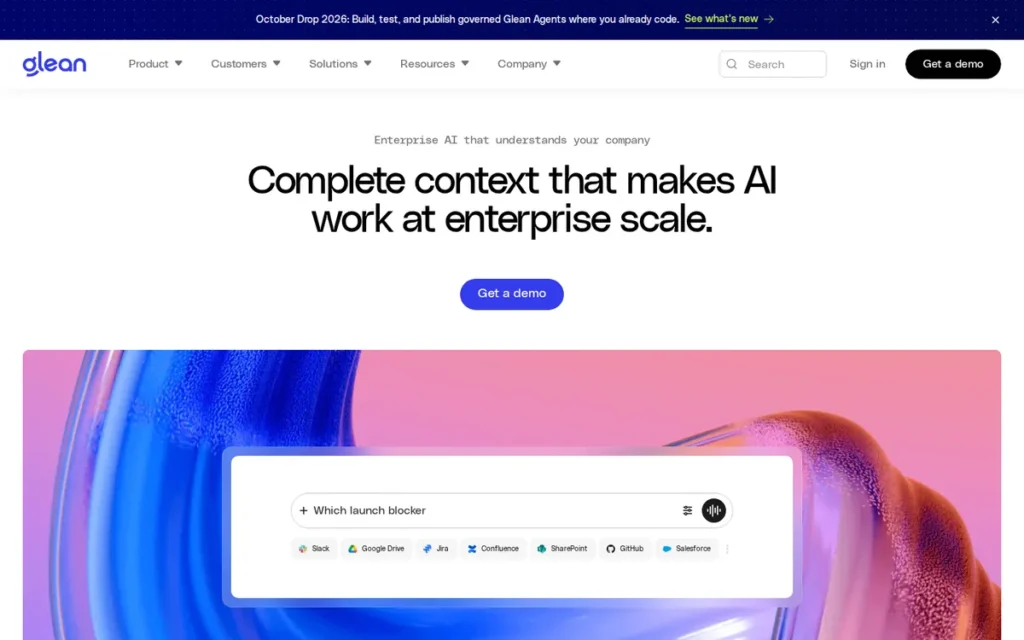
Category: AI Workplace Search, a cloud-native platform that builds a continuously updated knowledge graph across 100+ connected enterprise applications and delivers AI-generated answers, personalized search results, and agentic workflows to employees via natural language.
At a Glance
- Category: AI Workplace Search
- Best For: Large cloud-native enterprises (typically 150+ employees) needing fully managed AI workplace search with Enterprise Graph personalization and agentic AI workflow capabilities
- Price Range: ~$45–$50/user/month (community-verified, not vendor-confirmed); minimum commitment estimated at 100–150 users ($50,000–$90,000/year floor); implementation and onboarding fees additional; custom pricing via sales only
- Primary Strength: Glean’s Enterprise Graph: a continuously updated machine-learning knowledge graph built by ex-Google engineers that maps organizational relationships, context, and activity patterns across 100+ connected applications
- Biggest Limitation: Cloud-only with no on-premises option; estimated $50,000–$90,000/year minimum commitment; no verified G2 or Capterra aggregate review score at research date
- One-Line Summary: Glean is the AI workplace search platform built by ex-Google search engineers on Enterprise Graph technology connecting 100+ enterprise applications with personalized RAG-powered answers and agentic workflows, the leading fully managed AI search solution for large cloud-native enterprises willing to invest at the premium tier.
- Last Verified: May 2026
Overview
Glean is an AI-native enterprise search and work AI platform designed for large organizations needing unified knowledge discovery across 100+ connected SaaS applications, including Slack, Microsoft Teams, Google Workspace, Microsoft 365, Jira, and code repositories, with generative AI answers and agentic workflows built on Google Cloud infrastructure by a founding team of ex-Google search engineers. Glean’s core technical differentiator is its Enterprise Graph, a continuously updated machine-learning knowledge graph that maps relationships between people, projects, processes, and data to deliver personalized search results that improve automatically as the system learns each organization’s unique knowledge patterns.
Glean’s single-tenant private deployment on Google Cloud (Vertex AI, BigQuery, Cloud Dataflow) ensures enterprise data never co-mingles with other customers’ data, supporting security requirements that multi-tenant SaaS alternatives cannot satisfy. Confirmed enterprise deployments include Duolingo and Grammarly (both recognized for engineering rigor) per Glean blog, 2025.
Key Features
- Enterprise Graph: Glean’s Enterprise Graph builds and continuously refines a proprietary knowledge graph from signals including document popularity, department affinity, and individual workflow patterns, per SiliconAngle, September 2025, enabling search results that improve in contextual relevance over time as the system learns organizational language and work patterns specific to each company.
- 100+ Pre-Built Connectors: Glean integrates with 100+ pre-built SaaS connectors covering all major productivity suites, communication platforms, project management tools, code repositories, and CRM systems, providing a single AI search interface across both Microsoft 365 and Google Workspace environments simultaneously, per Glean product documentation, 2025.
- RAG-Based Generative Answering: Glean implements RAG natively within its AI Assistant, grounding generative answers in actual enterprise content rather than general web knowledge, reducing hallucination risk for internal knowledge queries and providing source-traceable answers that compliance-conscious organizations can audit.
- Agentic AI Workflows: Glean’s third-generation AI Assistant supports multi-step agentic tasks (automated research compilation, cross-system data synthesis, and workflow trigger execution) extending Glean beyond information retrieval into AI-driven work automation, per Glean blog, 2025.
- Single-Tenant Private Deployment: Glean’s single-tenant architecture on Google Cloud isolates each enterprise customer’s data in a dedicated environment, supporting security policies that prohibit shared multi-tenant data storage and enabling compliance with data isolation requirements for organizations that cannot use on-premises infrastructure.
Best For
Glean is best for large enterprises with 150+ employees running cloud-native tech stacks that need the strongest available fully managed AI workplace search platform. Glean is the right choice for organizations prepared to invest $50,000–$90,000/year or more for a no-code-required managed solution that prioritizes Enterprise Graph personalization depth and agentic AI capability over deployment flexibility or pricing accessibility.
Pricing
Glean does not publish pricing publicly. Community-sourced data from r/LlamaIndex, October 2025 and independent pricing analyses (Eesel.ai, 2025; GoSearch pricing blog, 2025) (all community-verified, not vendor-confirmed) indicates pricing of approximately $45–$50/user/month, with minimum commitments ranging from 100 to 150 users across sources, creating an estimated annual floor of $50,000–$90,000.
Implementation and onboarding fees are additional costs, specifically flagged in community discussions as frequently overlooked in initial budget modeling. Glean also offers an Enterprise Flex pricing model combining per-user licensing with pooled AI credits. All Glean pricing figures are community-verified, not vendor-confirmed; verify directly with Glean sales and request a full first-year total cost estimate before budget approval. Pricing data sourced from community discussions, May 2026.
Strengths
- Enterprise Graph Technology: Glean’s Enterprise Graph: independently described by SiliconAngle, September 2025 as a machine-learning knowledge graph dynamically mapping relationships between people, projects, processes, data, and activities, incorporates personal graphs for individual task inference and organizational graphs for department-level relevance, building a continuously improving knowledge model unique to each organization.
- Named Enterprise Deployments: Glean is confirmed deployed at Duolingo and Grammarly for unified knowledge search across Slack and Jira, per Glean blog, 2025, both companies recognized for engineering rigor, providing credible reference signals for organizations in similar cloud-native, product-led environments.
This aligns with community sentiment on r/techsales, where a practitioner at a large SaaS enterprise described their deployment experience:
“The actual product is pretty amazing. We just added it at HubSpot. Im consistently blown away by it, only been a few months. Could dramatically change how we onboard new reps and sales enablement. It’d be a fun product to sell.” Posted by u/robinson604
Takeaway: Glean users at large cloud-native enterprises like HubSpot consistently describe the platform as a step-change improvement over Microsoft Copilot for sales onboarding and cross-app knowledge discovery.
- Ex-Google Engineering Pedigree: Glean’s founding team of ex-Google search engineers, documented at Glean’s About page, 2025, provides demonstrable technical depth in knowledge graph construction, semantic relevance modeling, and large-scale search infrastructure, a differentiated founding credential absent from all other commercial enterprise search vendors in this comparison.
Limitations
- Cloud-Only Deployment Exclusivity: Glean’s most consequential trade-off is its cloud-only architecture, Glean has no on-premises or self-hosted option, categorically excluding it from organizations with strict data residency, air-gap, or national sovereignty requirements that represent enterprise search’s largest and most urgent regulated-industry buyer segment.
- Minimum Commitment Barrier: Glean’s minimum commitment: typically 100–150 users across independent sources (community-verified, May 2026), creates an estimated annual floor of $50,000–$90,000 before implementation fees, making Glean inaccessible to mid-market organizations below those thresholds. GoSearch offers comparable connector breadth and agentic AI at $20/user/month with no minimum user commitment.
- No Verified Public Review Score: Glean’s absence of a verified G2 or Capterra aggregate review score (unusual for an enterprise SaaS vendor of its claimed market position) requires procurement leads to rely entirely on analyst briefings and direct customer references when building internal business cases, rather than aggregated third-party review evidence.
Verdict
Glean is the leading fully managed AI workplace search platform for large cloud-native enterprises, its Enterprise Graph, 100+ pre-built connectors, and agentic AI capabilities represent the most complete single-vendor solution for organizations prioritizing AI-native knowledge discovery at scale over deployment flexibility. Glean’s cloud-only architecture, $50,000–$90,000/year minimum commitment floor, and absence of verified public review scores disqualify it for regulated industries, mid-market buyers, and procurement teams requiring aggregated third-party evidence. Large enterprises clearing all three of those gates will find no managed alternative currently matching Glean’s personalization depth.
3. GoSearch: Best Value AI Enterprise Search for Mid-Market Teams and Glean Alternatives
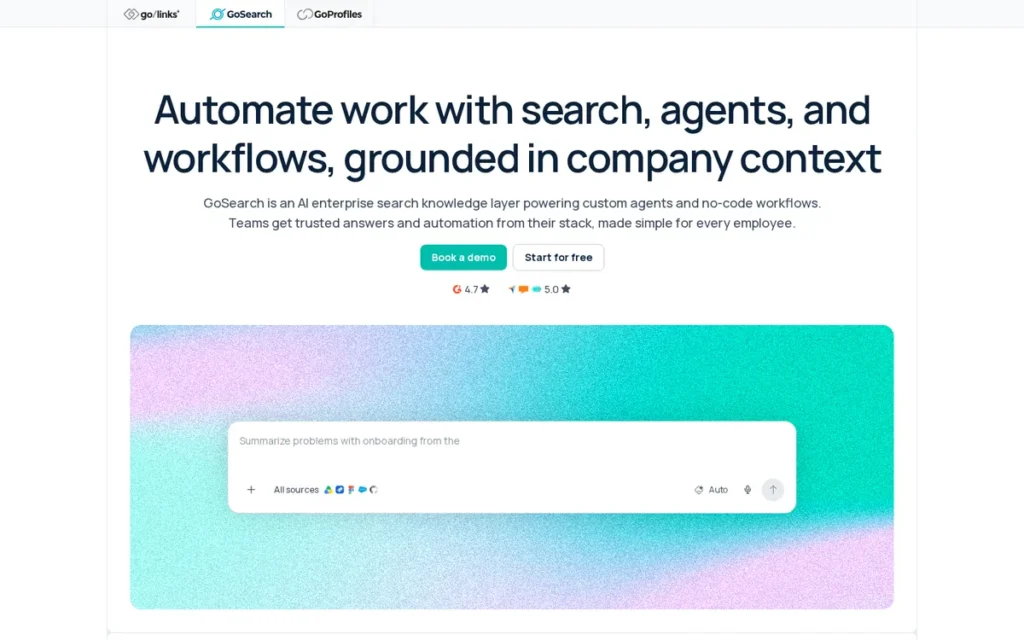
Category: AI Workplace Search, a cloud-native platform with hybrid centralized indexing and federated live-query architecture that surfaces enterprise knowledge across 100+ connected applications via AI-powered conversational search, agentic workflows, and Bring-Your-Own-LLM flexibility.
At a Glance
- Category: AI Workplace Search
- Best For: Mid-market teams (50–500 employees) evaluating Glean alternatives; enterprises with BYO-LLM requirements; organizations with data privacy requirements suited by federated live querying of sensitive content
- Price Range: Free (single user); Pro $20/user/month (published); Enterprise custom; no minimum user commitment on published tiers
- Primary Strength: GoSearch’s hybrid federated architecture combined with BYO-LLM at a published $20/user/month, the most price-accessible full-featured AI workplace search platform in this evaluation
- Biggest Limitation: Limited independently verified third-party case studies; self-reported compliance certifications without independent audit confirmation at research date
- One-Line Summary: GoSearch is the AI enterprise search platform: built by the GoLinks team, combining 100+ connectors, hybrid federated architecture with zero data retention for sensitive queries, and Bring-Your-Own-LLM flexibility at a published $20/user/month with no minimum commitment, making it the most accessible full-featured Glean alternative for mid-market organizations.
- Last Verified: May 2026
Overview
GoSearch is an AI-powered agentic enterprise search platform built by the GoLinks team that combines centralized indexing of shared organizational knowledge with real-time federated querying of personal and sensitive data, a hybrid architecture enabling comprehensive cross-app search across 100+ workplace tools while addressing data privacy requirements that prevent full central indexing. GoSearch is the most actively evaluated alternative to Glean for mid-market teams priced out of Glean’s minimum commitment, as confirmed in buyer discussions on r/LlamaIndex, October 2025.
GoSearch supports Bring-Your-Own-LLM configuration (GPT-4/5, Claude, and others), allowing organizations to leverage existing enterprise AI agreements rather than accepting a vendor-mandated AI layer, and includes GoAI, a conversational AI assistant capable of multi-step agentic workflows, report generation, and artifact creation. GoSearch’s published pricing of $20/user/month Pro with no minimum user commitment positions GoSearch as the most price-accessible full-featured AI workplace search platform in this evaluation.
Key Features
- Hybrid Federated Architecture: GoSearch indexes shared organizational knowledge centrally for fast retrieval while live-querying personal inboxes, calendars, and sensitive documents via federated connectors at search time, with zero data retention for those live queries, meaning private data never enters GoSearch’s central indexes, per GoSearch product documentation, 2025.
- Bring-Your-Own-LLM (BYO-LLM): GoSearch allows administrators to configure the platform to use GPT-4/5, Claude, or other enterprise AI models, enabling organizations to leverage existing AI contracts and control AI costs independently of search platform licensing. For organizations with existing Azure OpenAI Service or Anthropic Claude enterprise contracts, BYO-LLM eliminates a second AI licensing layer and reduces total cost of ownership, per GoSearch new features blog, 2025.
- 100+ Workplace Connectors: GoSearch connects to 100+ workplace tools including Google Workspace, Microsoft 365, Slack, Notion, Confluence, Jira, Asana, CRM systems, and cloud storage via pre-built connectors with permission-aware access control inherited from source systems, per GoSearch FAQs, 2025.
- GoAI Agentic Assistant: GoSearch’s GoAI assistant supports multi-step agentic workflows that generate reports, synthesize cross-app research findings, and create output artifacts from search results, extending GoSearch beyond information retrieval into AI-driven workflow automation at a price point significantly below Glean.
- Native GoLinks Integration: GoSearch integrates natively with GoLinks enterprise link management, providing a unified enterprise link plus search layer for organizations already using GoLinks and reducing adoption friction via instant knowledge access through vanity URLs alongside AI search.
Best For
GoSearch is best for mid-market organizations (50–500 employees) seeking Glean-comparable AI workplace search without Glean’s minimum commitment barrier. GoSearch is also well-suited to enterprises with data privacy requirements suited by federated live querying (where sensitive data must not be centrally indexed) and to IT teams that want to leverage existing enterprise AI model agreements via BYO-LLM rather than accepting a vendor-mandated proprietary AI layer.
Pricing
GoSearch publishes pricing publicly: Free (single user, basic access), Pro at $20/user/month (AI search, 100+ connectors, GoAI agentic assistant), and Enterprise at custom pricing for hybrid deployment, SSO, and advanced security governance. No minimum user commitment is required on published tiers. Community discussion from r/LlamaIndex, October 2025 (community-verified, not vendor-confirmed) describes GoSearch as approximately half of Glean’s ~$45–$50/user/month, with the rationale that federated search and zero LLM data retention reduce data management infrastructure costs.
GoSearch’s free tier enables genuine evaluation before any procurement commitment. Organizations in regulated industries must independently verify compliance certifications, request GoSearch’s SOC 2 Type II audit report and HIPAA BAA directly before any regulated industry deployment. Pricing verified at gosearch.ai, May 2026.
Strengths
- Published Pricing Transparency: GoSearch’s $20/user/month Pro pricing with no minimum user commitment and a free evaluation tier, documented at GoSearch enterprise search pricing guide, 2025, makes GoSearch the most procurement-accessible full-featured AI workplace search platform in this evaluation, in a category where Glean, Coveo, and AlphaSense all require sales engagement before any pricing information is available.
- BYO-LLM Flexibility: GoSearch’s Bring-Your-Own-LLM capability: confirmed by GoSearch new features blog, 2025 as allowing toggle between GPT-4/5, Claude, and other enterprise AI models, is the only platform in this evaluation offering LLM flexibility as a native published product feature rather than a custom integration requiring separate vendor negotiation.
- Federated Privacy Architecture: GoSearch’s hybrid federated approach was explained by GoSearch’s official account on r/CustomerSuccess, May 2025 as directly addressing “keeping every source synced, handling permissions, and maintaining accuracy as things change”, while protecting sensitive data from central indexing exposure via zero-retention live querying at search time.
Limitations
- Limited Enterprise Validation: GoSearch’s most consequential trade-off is relative immaturity in third-party validation, as of May 2026, no independently verified G2 aggregate review score and no named, publicly quantified customer case studies were confirmed in research, making it significantly harder for procurement leads to build third-party-evidenced business cases compared to Elastic (290+ G2 reviews; 850+ Capterra reviews) or Glean’s established enterprise reference base.
- Self-Reported Compliance Certifications: GoSearch claims SOC 2 Type II, HIPAA, GDPR, and CCPA compliance per GoSearch product pages, 2025, but no independent certification audit confirmation was found in research, treating these as confirmed rather than claimed during regulated industry due diligence is a meaningful procurement risk that requires direct verification through GoSearch’s trust center.
- Organizational Transparency: GoSearch’s founding history, funding details, and employee count are not publicly disclosed, making long-term strategic stability harder to assess than NYSE-listed Elastic, TSX-listed Coveo, or heavily funded AlphaSense ($1.4B raised, per Bloomberg, March 2026), a consideration in multi-year enterprise procurement decisions.
Verdict
GoSearch is the best-value full-featured AI enterprise search platform for mid-market organizations needing Glean-comparable capability, 100+ connectors, RAG-powered answers, agentic workflows, and hybrid federated privacy architecture, without Glean’s minimum commitment or pricing opacity. GoSearch’s federated architecture directly addresses data privacy requirements that pure-indexing cloud platforms cannot satisfy, and its BYO-LLM flexibility is a meaningful differentiator for organizations with existing enterprise AI agreements. The platform’s limited third-party validation and self-reported compliance certifications require additional due diligence before regulated industry deployment, request independent audit evidence before any procurement commitment.
4. Coveo: Best Multi-Vertical AI Platform for Complex Enterprises Needing Unified Workplace, Ecommerce, and Service Search
Category: Multi-Vertical AI Search Platform, a cloud-native AI search and relevance platform that unifies workplace knowledge search, ecommerce product discovery, and customer service search in a single enterprise deployment with 12+ self-learning ML models and RAG-based generative answering grounded in enterprise content.
At a Glance
- Category: Multi-Vertical AI Search Platform
- Best For: Large enterprises needing a single AI search platform spanning workplace, ecommerce, and customer service simultaneously, particularly in retail, SaaS, financial services, and technology
- Price Range: Custom enterprise pricing (not publicly disclosed); community data indicates approximately 3x Algolia for ecommerce-only use (community-verified, not vendor-confirmed)
- Primary Strength: Coveo’s 12+ out-of-box ML models and Automatic Relevance Tuning across workplace, ecommerce, and service in one platform, uniquely suited to multi-vertical enterprise deployments
- Biggest Limitation: Premium pricing only justified when multi-vertical deployment is genuine; cloud-only; no verified G2 aggregate score at research date
- One-Line Summary: Coveo is the TSX-listed multi-vertical AI search and relevance platform for enterprises needing a single vendor spanning workplace knowledge, ecommerce product discovery, and customer service search, powered by 12+ self-learning ML models, Automatic Relevance Tuning, and RAG-based generative answering grounded in enterprise content.
- Last Verified: May 2026
Overview
Coveo is an AI-powered enterprise search and relevance platform that unifies three distinct use case verticals in a single platform:
- Workplace knowledge search: surfacing internal documentation, policies, and institutional knowledge for employee productivity
- Customer service search: enabling self-service resolution and agent-assist workflows across support channels
- Ecommerce product discovery: personalized product recommendations and conversational commerce for digital retail
Coveo indexes content from 55+ sources and applies 12+ out-of-box ML models to continuously improve relevance without manual administrator tuning. Coveo is publicly traded on the Toronto Stock Exchange (ticker: CVO), headquartered in Quebec City, Canada.
Coveo launched Conversational Product Discovery in March 2026, per PR Newswire, 2026, reflecting continued active AI investment. Dell is a confirmed enterprise customer, validating Coveo’s ability to handle Fortune 50-scale deployments, per Coveo r/IAmA AMA, 2021.
Key Features
- Automatic Relevance Tuning (ART): Coveo’s ART model analyzes user search and click behavior across workplace, ecommerce, and service contexts to automatically boost top-performing content for each query pattern, handling ambiguous terms, typos, and implicit synonyms without requiring search administrators to manually configure relevance rules, per Coveo documentation, 2025.
- Relevance Generative Answering: Coveo’s RAG-based generative answering provides AI answers grounded in trusted enterprise content (not open-web knowledge) with a dedicated answer area in search results and conversational refinement via agentic orchestration, directly addressing enterprise concerns about AI hallucination in search responses, per PR Newswire, March 2026.
- 12+ Out-of-Box ML Models: Coveo deploys 12+ configurable ML models including User Profile, User Stitching, Content Recommendations, Dynamic Navigation Experience, and Product Recommendations, enabling cross-session behavioral personalization materially deeper than most workplace-only or ecommerce-only alternatives, per Coveo documentation, 2025.
- 55+ Indexable Sources: Coveo indexes content from 55+ sources spanning workplace applications, ecommerce catalogs, CRM systems, support knowledge bases, and documentation platforms, enabling a single search platform to serve internal employees and external customers simultaneously without separate vendor contracts.
- Conversational Product Discovery: Coveo launched Conversational Product Discovery in March 2026, per PR Newswire, 2026, enabling natural language product search with contextual follow-up capability in ecommerce environments and positioning Coveo at the frontier of AI-native shopping experience technology for retail enterprise customers.
Best For
Coveo is best for large enterprises (particularly in retail, SaaS, financial services, and technology) that require a single AI search platform serving both employee workplace knowledge discovery and customer-facing ecommerce or service search simultaneously. Coveo’s premium is justified when multi-vertical platform unification delivers measurable operational efficiency over deploying separate best-of-breed solutions for each use case.
Pricing
Coveo does not publish standard pricing publicly. A community buyer in August 2025 (r/LlamaIndex) chose Algolia over Coveo for ecommerce search at approximately 30% of Coveo’s quoted price, community-verified, not vendor-confirmed. Contract sizes for Global 500 deployments are estimated in the hundreds of thousands of dollars annually based on Coveo’s publicly traded revenue profile.
Organizations should model multi-use-case ROI (combining workplace, ecommerce, and service search savings) to assess whether the premium over single-function alternatives is justified. Verify directly with Coveo before any procurement commitment. Pricing data sourced from community discussions and market analysis, May 2026.
Strengths
- TSX-Listed Financial Accountability: Coveo is a publicly traded company on the Toronto Stock Exchange (ticker: CVO) with institutional investor accountability, quarterly financial reporting obligations, and organizational stability signals that no private-company competitor in this evaluation can match, a procurement confidence criterion confirmed as important to enterprise IT decision-makers in Coveo’s public r/IAmA AMA, 2021.
- Fortune 50 Enterprise Customer: Dell: a Fortune 50 company with global multi-geography, multi-language, and high-volume search requirements, is a confirmed Coveo enterprise customer, validated by Coveo’s own technical leadership in a public r/IAmA forum, 2021, providing a credible reference for organizations of comparable scale and complexity.
- Active AI Product Investment: Coveo’s March 2026 launch of Conversational Product Discovery, per PR Newswire, 2026, demonstrates continued AI investment at the frontier of ecommerce search, validating roadmap credibility for buyers evaluating long-term vendor relationships in a rapidly evolving category.
Limitations
- Multi-Vertical Justification Required: Coveo’s most consequential trade-off is cost-to-use-case fit, the platform’s premium is only justified when an organization genuinely needs workplace, ecommerce, and service search from a single vendor. Community evidence shows buyers choosing Algolia at approximately 30% of Coveo’s price when ecommerce-only search is the requirement (r/LlamaIndex, August 2025).
- Content Quality Dependency: Coveo’s own Lead Solution Architect publicly identified the most common implementation failure mode: “Indexing bad or repetitive content, even with ML and all the relevance tuning in the world, if the data set is not good, results aren’t great” (r/IAmA, 2021), confirming that Coveo’s 12+ ML models require well-governed underlying content to deliver expected results.
- Cloud-Only Architecture: Coveo’s cloud-only deployment eliminates it from evaluations requiring on-premises or air-gapped infrastructure, sharing the same structural limitation as Glean, and the absence of a verified G2 aggregate score at research date reduces available third-party procurement evidence compared to Elastic’s 290+ verified G2 reviews.
Verdict
Coveo is the strongest AI search platform for complex enterprises genuinely needing a single vendor spanning workplace, ecommerce, and customer service search simultaneously, its 12+ out-of-box ML models, Automatic Relevance Tuning, RAG-based generative answering, and TSX public company accountability position it as a durable choice for Global 500 organizations where multi-vertical search unification delivers measurable operational efficiency. Coveo’s premium pricing is only justified when the multi-vertical use case is real; organizations with a single-use-case need should evaluate Glean or GoSearch for workplace search, or Algolia for ecommerce search, at materially lower cost.
5. AlphaSense: Best for Finance, Strategy, and Investment Research Teams

Category: Market Intelligence Platform, a specialized AI-powered research environment combining internal enterprise document search with a proprietary external library of financial filings, earnings transcripts, broker research reports, and expert call transcripts, purpose-built for finance and strategy professionals.
At a Glance
- Category: Market Intelligence Platform
- Best For: Investment banking, private equity, corporate strategy, competitive intelligence, and financial research professionals at institutions where deal analysis and market intelligence justify $14,500–$60,000/seat/year
- Price Range: ~$14,500–$60,000/seat/year (community-verified, not vendor-confirmed); enterprise deals $100,000+/year; no published standard tiers; pricing on request only
- Primary Strength: AlphaSense’s proprietary financial content library: SEC filings, earnings transcripts, broker research, expert calls, in a single domain-tuned AI search environment with no comparable alternative in this evaluation
- Biggest Limitation: $14,500–$60,000/seat/year is categorically inaccessible for general enterprise knowledge workers; cloud-only; designed exclusively for finance use cases
- One-Line Summary: AlphaSense is the AI market intelligence platform for finance and strategy professionals combining internal document search with a proprietary library of financial filings, earnings transcripts, broker research, and expert calls, validated by $500M ARR (Forbes and PR Newswire, October 2025) and ranked #8 on CNBC’s 2025 Disruptor 50 list.
- Last Verified: May 2026
Overview
AlphaSense is an AI-powered market intelligence and enterprise search platform built specifically for finance, strategy, investment, and competitive intelligence professionals who need a single AI-searchable environment spanning both internal documents (via SharePoint, Box, Google Drive, and Egnyte integrations) and a proprietary external content library. AlphaSense’s proprietary library includes SEC filings, earnings call transcripts, broker research reports, expert call transcripts (added via the 2023 Tegus acquisition), company press releases, and regulatory filings.
AlphaSense was founded in 2011 in Helsinki, Finland, has raised $1.4B in total funding at a $4B+ unicorn valuation per Bloomberg, March 2026, and reached $500M in Annual Recurring Revenue as of October 2025, per Forbes, October 2025 and AlphaSense press release, October 2025. AlphaSense serves 6,500+ customers including 88% of S&P 100 companies, and was ranked #8 on CNBC’s 2025 Disruptor 50 list and named to the Forbes 2025 Cloud 100 (top 25), per AlphaSense press release and PR Newswire, October 2025.
Key Features
- Domain-Tuned Financial NLP: AlphaSense’s NLP model is trained on financial and corporate language patterns, handling financial synonyms such that searching “TAM” returns results for “market size” and processing thematic signals with accuracy calibrated to investment research that general-purpose LLMs cannot consistently match, per AlphaSense market intelligence platform, 2025.
- Smart Summaries: AlphaSense’s Smart Summaries generates instant, cited AI summarizations of earnings transcripts, analyst research reports, SWOT analyses, and merger proxies with follow-up question capability, enabling multi-turn research refinement while maintaining document context and full source traceability.
- Tegus Expert Call Library: AlphaSense’s 2023 Tegus acquisition added a large expert call transcript library, enabling cross-referencing of primary qualitative intelligence from industry practitioners with public filings, broker research, and earnings data in a single AI-searchable environment unavailable on any other evaluated platform.
- Generative Search: AlphaSense’s Generative Search combines NLP semantic matching with a proprietary relevancy algorithm across both internal documents and the external financial content library, enabling researchers to synthesize organization-specific internal analysis with external market intelligence in a single query workflow.
- Internal Document Integrations: AlphaSense integrates with SharePoint, Box, Google Drive, and Egnyte for internal document search, combining proprietary financial content depth with organization-specific research in a unified AI interface that surfaces both internal and external intelligence simultaneously, per AlphaSense enterprise platform, 2025.
Best For
AlphaSense is best for investment banking, private equity, hedge fund, corporate strategy, and competitive intelligence professionals at financial services institutions and large corporations. AlphaSense is the right choice where the proprietary content library (broker research, earnings transcripts, expert calls, regulatory filings) provides materially faster and more complete research than assembling the same sources independently, and where $14,500–$60,000/seat/year pricing is justified by deal frequency and research volume.
Pricing
AlphaSense does not publish standard pricing. Community-sourced data from r/private_equity, 2025 and r/fintech, 2025 indicates approximately $14,500/user/year for financial services access, ranging to $60,000/user/year for higher content tiers, with enterprise deals reaching $100,000+ annually, all community-verified, not vendor-confirmed. Multiple community voices position this pricing competitively with Bloomberg Terminal subscriptions for institutional financial professionals.
For general enterprise knowledge workers who are not investment or strategy professionals, AlphaSense’s pricing is categorically inaccessible, Glean, GoSearch, or Guru should be evaluated instead. Verify directly with AlphaSense before any procurement commitment. Pricing data sourced from community discussions, May 2026.
Strengths
- $500M ARR Milestone and Customer Scale: AlphaSense reached $500M in Annual Recurring Revenue as of October 2025 (serving 6,500+ customers including 88% of S&P 100 companies) per AlphaSense press release, October 2025 and confirmed independently by PR Newswire, October 2025. AlphaSense doubled ARR in a recent growth period, validating sustained institutional market demand at scale.
Users on r/private_equity with direct platform experience offered a balanced assessment:
“I love it! The usability for targeted search is very helpful. Definitely prefer it over factset. Only gripe is that it hasn’t been too helpful for private companies” Posted by u/bought_high_sold_low
Takeaway: Finance professionals consistently rank AlphaSense above FactSet for qualitative targeted search while identifying private company coverage as the product’s most consequential data gap.
- Third-Party Analyst Recognition: AlphaSense was ranked #8 on CNBC’s 2025 Disruptor 50 list and named to the Forbes 2025 Cloud 100 (top 25), per AlphaSense press release and PR Newswire (October 2025), two independently evaluated rankings from named third-party organizations providing external validation beyond self-reported marketing.
- Tegus Acquisition Advantage: AlphaSense’s 2023 Tegus acquisition created a uniquely integrated qualitative and quantitative research environment combining expert network call transcripts with public filings, broker research, and earnings data in a single AI-searchable platform, a content depth combination no evaluated competitor currently replicates, per AlphaSense platform documentation, 2025.
Limitations
- Specialization Versus General Applicability: AlphaSense’s most consequential trade-off is domain specificity, the platform’s financial NLP, proprietary content library, and $14,500–$60,000/seat/year pricing are calibrated for institutional financial professionals, representing the wrong tool for general enterprise knowledge workers who need Slack search, Confluence discovery, or cross-app workplace knowledge retrieval at the same organization.
This cost-to-value tension is consistently reflected in community feedback on r/private_equity:
“It was helpful for searching-analyzing public filings & earning transcripts. It’s a highly searchable database of publicly available information. That said – I didn’t find the cost worth the squeeze” Posted by u/Shirleyfunke483
Takeaway: AlphaSense’s cost-to-value ratio is validated primarily by upper-middle-market and large-cap deal professionals, lower-middle-market PE practitioners consistently find the subscription cost difficult to justify relative to available alternatives.
- Free AI Competition Pressure: Multiple r/private_equity community members, 2025 noted that capable free AI tools are increasingly replicating AlphaSense’s outputs for public company research tasks, raising a credible long-term pricing sustainability question as general-purpose AI models continue improving on publicly available financial data.
- Private Company Coverage Gap: AlphaSense has limited depth on private company data (a material gap for PE firms focused on private market transactions) and community users consistently flag the steep learning curve and high result volume requiring manual query refinement, per r/private_equity, 2025.
Verdict
AlphaSense is the strongest AI market intelligence platform for financial services and corporate strategy professionals evaluated in this comparison, no other platform reviewed here combines internal document search with the proprietary depth of SEC filings, earnings transcripts, broker research, and expert call transcripts in a single domain-tuned AI search environment, and its $500M ARR milestone (Forbes and PR Newswire, October 2025) confirms that institutional buyers validate this value proposition at scale. IT decision-makers selecting internal knowledge discovery infrastructure for broad employee populations should evaluate Elastic, Glean, GoSearch, or Coveo; financial services CIOs and research technology leaders evaluating intelligence tools for analyst teams should place AlphaSense at the top of their shortlist.
6. Guru: Best Knowledge Management Platform for Sales and Support Teams
Category: Knowledge Management Platform, a structured card-based knowledge system with in-workflow delivery via browser extension and chat integrations, AI-powered content governance through automated Knowledge Agents, and verification workflows designed to maintain a reliable single source of truth for customer-facing teams.
At a Glance
- Category: Knowledge Management Platform
- Best For: Sales, support, and customer success teams at SaaS and technology companies (50–2,000 employees) needing verified in-workflow answers inside Slack, Teams, and Salesforce during live customer interactions
- Price Range: Starter ~$5/user/month; Builder ~$10/user/month (published, market research estimates, verify at getguru.com); Enterprise custom with 99.99% uptime SLA; free trial available
- Primary Strength: Guru’s Knowledge Agents: the only native automated content governance and verification workflow in this evaluation, specifically designed to prevent knowledge rot in curated knowledge bases
- Biggest Limitation: Guru is structured knowledge management for curated card-based content, not full-stack enterprise search for unstructured data across petabytes of SaaS applications at scale
- One-Line Summary: Guru is the AI-powered knowledge management platform delivering verified, card-based answers to sales and support teams inside Slack, Teams, and Salesforce via automated Knowledge Agents governance, the best-fit structured knowledge solution for customer-facing teams at a published $5–$10/user/month.
- Last Verified: May 2026
Overview
Guru is an AI-powered knowledge management platform that organizes organizational knowledge into modular, verified knowledge cards, each covering a single topic, policy, process, or answer, and delivers those cards proactively to employees inside the tools they already use, including Chrome, Slack, Microsoft Teams, and Salesforce. Guru’s design premise is that enterprise knowledge becomes unreliable when it is unverified, and Guru’s Knowledge Agents system automates the governance workflow that keeps knowledge cards accurate through expiration rules, user feedback signals, and expert assignment routing.
Founded in 2015 by Rick Nucci (previously at Salesforce) with $60M+ in disclosed institutional funding from investors including Thrive Capital (Series B lead), Emergence Capital, FirstMark Capital, and Slack Fund, per Guru’s Series B announcement, 2018, Guru has a 10-year operating history focused on structured knowledge governance for customer-facing teams. Guru is widely described by knowledge management practitioners as a single source of truth solution for sales, support, and customer success organizations.
Key Features
- Card-Based Knowledge Architecture: Guru organizes information into modular cards covering single topics (scripts, checklists, product definitions, policy updates, objection responses) with rich media support, internal linking, and mandatory expert assignment, directly preventing the documentation sprawl and reliability degradation common in unstructured Confluence and Notion deployments, per Guru features documentation, 2025.
- AI-Powered Knowledge Agents: Guru’s Knowledge Agents automatically monitor card health using expiration rules, user feedback signals, and usage analytics (flagging outdated content for expert review and archiving unverified cards) creating a self-maintaining knowledge base that improves accuracy over time without requiring manual governance overhead from administrators, per Guru Knowledge Agents documentation, 2025.
- In-Workflow Delivery: Guru’s Chrome browser extension and integrations with Slack, Microsoft Teams, and Salesforce surface verified answers within the tools employees already use, delivering knowledge in the flow of work rather than requiring context-switching to a dedicated search portal, a delivery model particularly effective for customer-facing teams handling live interactions.
- Semantic AI Search: Guru’s semantic AI search enables natural language queries across knowledge cards, retrieving relevant content based on meaning rather than exact keyword matching, reducing search friction for employees who cannot recall the precise terminology required by traditional keyword search systems.
- Enterprise Governance Controls: Guru’s Enterprise plan includes SSO, advanced analytics, API access, 99.99% uptime SLA, and dedicated customer success support, providing the governance and reliability infrastructure required for organization-wide deployment beyond team-level use cases, per Guru enterprise documentation, 2025.
Best For
Guru is best for sales, customer success, and support teams at SaaS and technology companies that need instant access to verified, current answers during live customer interactions. Guru is also well-suited for IT leaders managing organizations where existing wiki or Confluence documentation has become sprawling, outdated, and untrusted, a knowledge governance problem that search-first platforms do not directly address.
Pricing
Guru publishes pricing publicly: Starter approximately $5/user/month for basic knowledge cards and search; Builder approximately $10/user/month including Knowledge Agents, verification workflows, advanced analytics, and full AI features; and Enterprise at custom pricing with 99.99% uptime SLA and dedicated customer success. These are market research estimates as of May 2026, verify current tiers at getguru.com before procurement. A free trial is available with no minimum user commitment. Guru’s published pricing model makes it the most accessible structured knowledge management option in this evaluation.
Strengths
- Organizational Maturity and Confirmed Funding: Guru has operated as a focused knowledge management platform for 10 years as of 2025, with $60M+ in disclosed institutional funding from investors including Thrive Capital (Series B lead), Emergence Capital, and FirstMark Capital, confirmed from Guru’s Series B announcement, 2018, providing organizational stability signals meaningfully stronger than newer market entrants like GoSearch.
- Knowledge Agents Governance Layer: Guru’s Knowledge Agents for automated content verification (routing flagged and outdated knowledge cards to expert reviewers via expiration rules and usage analytics) is the only native governance workflow in this evaluation designed specifically to maintain knowledge accuracy at scale, directly addressing the “knowledge rot” problem universally confirmed by Coveo’s own Lead Solution Architect: “if the data set is not good, results aren’t great” (r/IAmA, 2021).
Users on r/technicalwriting who evaluated Guru as a solution for documentation freshness described what draws teams to its governance model:
“I’ve been looking into https://www.getguru.com/ to try and solve this same problem. Basically, the main attraction is that it integrates with chatting programs where everyone communicates (Slack or MS Teams), and has an explicit ‘this article is verified’ sticker. The idea is that you have a curator but you force SMEs to own the documentation, and they get reminders to check up on it. Basically helping you establish a structure to keep documentation from going stale. It also encourages a shorter format, like sticky notes or index cards, which makes people to pay attention to what they’re documenting.” Posted by u/write_n_wrong
Takeaway: Technical writers evaluating knowledge governance tools specifically cite Guru’s expert-assignment reminders and article-verification mechanics as the structural difference between documentation that stays current and wikis that silently decay.
- Path-of-Work Delivery: Guru’s model of surfacing verified answers inside Chrome, Slack, Teams, and Salesforce without context-switching directly addresses the productivity loss from application-hopping that the target audience cites as a primary pain point, a delivery architecture fundamentally distinct from the search-interface-first approach of every other platform in this evaluation.
Limitations
- Scope Limitation vs. Full Enterprise Search: Guru’s most consequential trade-off is architectural scope, Guru is a structured knowledge management system for curated, card-based content, not a full-stack enterprise search engine for unstructured data at scale. Organizations needing cross-app discovery across Slack message history, Google Drive documents, and code repositories simultaneously will find Guru a governance complement rather than a replacement for platforms like Glean, GoSearch, or Elastic.
- Atlassian Rovo Competitive Threat: A practitioner on r/CustomerSuccess, 2025 noted that Atlassian Rovo (integrating natively into Confluence and Jira that many Guru target customers already pay for) competes directly in in-tool knowledge delivery with “no real training needed as long as the information sources are cleaned up,” creating competitive pressure from an installed-base incumbent that cannot be dismissed.
- Cloud-Only Deployment Constraints: Guru’s cloud-only deployment and narrower integration breadth compared to Glean and GoSearch limit its addressable market in regulated industries and complex multi-stack enterprise environments where data residency requirements or broad SaaS connector coverage are non-negotiable.
Verdict
Guru is the best-in-class knowledge management platform for sales and support teams needing verified, in-workflow answers during live customer interactions, its card-based architecture, Knowledge Agents governance layer, and path-of-work delivery model solve a structured knowledge accuracy problem that general-purpose enterprise search platforms do not directly address. Guru is not a replacement for enterprise-wide AI search across unstructured data: IT decision-makers evaluating full cross-app discovery infrastructure should evaluate Elastic, Glean, or GoSearch for primary search capability, and consider Guru as a knowledge governance complement for curated content that those platforms surface alongside unstructured data.
7. Algolia: Best Customer-Facing Search and Discovery Platform for Developer-Built Digital Products
Category: Search and Discovery API, an API-first, developer-integrated search platform purpose-built for customer-facing digital products (ecommerce, documentation portals, SaaS applications) with sub-100ms global performance via a Distributed Search Network and hybrid NeuralSearch for semantic product and content discovery.
At a Glance
- Category: Search and Discovery API
- Best For: Engineering and product teams building customer-facing search into ecommerce, SaaS, or media digital products requiring sub-100ms global performance and 99.999% uptime
- Price Range: Free dev tier; consumption-based Search Units; approximately 30% of Coveo pricing for ecommerce search (community-verified, not vendor-confirmed)
- Primary Strength: Algolia’s Distributed Search Network delivers consistent sub-100ms global response times with a verified 99.999% five-nines uptime SLA, performance and reliability no other evaluated platform matches for customer-facing search
- Biggest Limitation: Cloud-only with no self-hosting; designed for customer-facing product search, not internal enterprise knowledge management; valuation declined to approximately $919M as of August 2024 (below unicorn threshold)
- One-Line Summary: Algolia is the API-first search and discovery platform used by Stripe, Twitch, and Zendesk to power customer-facing search with sub-100ms global response times, 99.999% uptime via DSN, and NeuralSearch hybrid semantic search, purpose-built for engineering teams building external digital product search, not for internal enterprise knowledge management.
- Last Verified: May 2026
Overview
Algolia is an API-first search and discovery platform purpose-built for customer-facing digital products (including ecommerce sites, SaaS application search, documentation portals, and content discovery) delivering consistent sub-100ms query response times via its proprietary Distributed Search Network (DSN) that fully replicates search indexes and data across globally distributed data centers rather than relying on caching. Founded in 2012 in Paris, France by Nicolas Dessaigne and Julien Lemoine, Algolia has raised approximately $336M in total funding across 8 rounds and reached a peak valuation of $2.25B at its 2021 Series D.
The most recent publicly documented valuation is approximately $919M as of August 2024, per Premier Alts secondary market data, 2024, below the $1B unicorn threshold, a financial trajectory procurement teams should factor into multi-year contract assessments. Algolia employs approximately 800 people and counts Stripe, Twitch, Lacoste, Zendesk, Slack, and NBCUniversal among confirmed customers. Algolia’s 2024 acquisition of Search.io added NeuralSearch capability, combining traditional keyword matching with vector and semantic search in a single API call.
Key Features
- Distributed Search Network (DSN): Algolia’s DSN fully replicates search engines and data (not just caches) across globally distributed data centers, routing each query to the nearest location and delivering consistent sub-100ms response times regardless of user geography, a performance architecture absent from all other platforms in this evaluation, per Algolia support documentation, 2025.
- NeuralSearch (Hybrid Semantic + Keyword): Algolia’s NeuralSearch, built on the 2024 Search.io acquisition, combines BM25 keyword matching with vector and semantic search in a single API call (enabling semantic understanding such that searching “warm clothes” returns “sweaters” without exact keyword match) per Meilisearch comparative review, 2025 and AmericanEagle analysis, 2025.
- Merchandising Studio: Algolia’s Merchandising Studio provides a no-code dashboard for business users to configure product promotions, A/B test search variants, apply personalization profiles, and manage search campaigns, enabling marketing and merchandising teams to tune digital product discovery independently without engineering resources.
- 99.999% Five-Nines Uptime SLA: Algolia’s five-nines uptime SLA: backed by DSN geographic redundancy representing less than 5.26 minutes of downtime annually, provides mission-critical reliability for ecommerce deployments where search unavailability translates directly to revenue loss.
- Ecommerce Platform Integrations: Algolia integrates with major ecommerce platforms including Shopify, Magento, and Salesforce Commerce Cloud, as well as front-end frameworks and CMS platforms via pre-built libraries and comprehensive API documentation, enabling rapid deployment for engineering teams building customer-facing search.
Best For
Algolia is best for product engineering teams and ecommerce organizations building customer-facing search into digital products where sub-100ms response times, five-nines uptime, NeuralSearch semantic capability, and non-technical Merchandising Studio self-service are requirements. Algolia is particularly well-suited when search cost efficiency matters relative to Coveo, which community buyers report at approximately 3x Algolia’s pricing for equivalent ecommerce search functionality.
Pricing
Algolia uses consumption-based pricing measured in Search Units (SUs) rather than per-user fees. A free tier is available for development and testing. Specific tier prices for current published plans were not independently confirmed in research at publication time. Community buyer data from r/LlamaIndex, August 2025 positions Algolia at approximately 30% of Coveo’s cost for equivalent ecommerce search functionality, community-verified, not vendor-confirmed.
Algolia’s consumption-based model can produce cost unpredictability for high-volume applications without usage forecasting. No self-hosted deployment option is available; organizations with data residency requirements should evaluate Elastic instead. Verify current pricing at algolia.com before procurement. Pricing data sourced from community discussions and review platform analysis, May 2026.
Strengths
- Blue-Chip Customer Validation: Algolia’s confirmed enterprise customer roster (Stripe, Twitch, Lacoste, Zendesk, Slack, and NBCUniversal) represents some of the highest-traffic, most demanding customer-facing search environments in digital commerce and SaaS, providing credible production-scale validation of the DSN architecture’s performance claims at scale, per market research synthesis (2025).
- $336M in Institutional Funding and Enterprise Pedigree: Algolia has raised approximately $336M in total funding across 8 rounds, demonstrating sustained institutional investor support for the platform’s market position in customer-facing search infrastructure, per Premier Alts, 2024 and Texau company profiles, 2025.
- NeuralSearch Semantic Advancement: Algolia’s 2024 NeuralSearch acquisition addressed the platform’s most material historical limitation (pure keyword search) by adding hybrid vector and semantic search in a single API call, placing Algolia’s semantic capability competitively alongside Elastic’s ELSER model at the performance standards Algolia’s DSN architecture delivers, per Meilisearch comparative review, 2025 and AmericanEagle analysis, 2025.
Limitations
- Internal Workplace Search Mismatch: Algolia’s most consequential trade-off is architectural purpose mismatch for internal enterprise knowledge search, Algolia is designed for customer-facing digital products and has no pre-built workplace connectors for Slack, Confluence, Notion, or Google Drive in the sense that Glean, GoSearch, or Guru provide. Community reviewers characterize Algolia as “great for docs and site search but limited for actual support conversations” and as “a search platform with ‘ask AI’ bolted on” (r/OnlineMarketing, February 2026).
- No Self-Hosting Option: Algolia’s cloud-only architecture with no self-hosting option categorically excludes it from regulated industry evaluations with data sovereignty or residency mandates, organizations in healthcare, government, or financial services with those requirements should evaluate Elastic’s on-premises capability instead.
- Personalization Depth Trade-Off: A real buyer who selected Algolia over Coveo for ecommerce search described Algolia as “not good on personalization side but search is fine” (r/LlamaIndex, August 2025), making Algolia the right choice when search quality and cost efficiency outweigh behavioral personalization depth, but an incomplete solution when personalization revenue uplift is the primary objective.
- Valuation Decline Since Peak: Algolia’s most recent publicly documented valuation of approximately $919M as of August 2024 (below the $1B unicorn threshold) represents a significant decline from its 2021 Series D peak of $2.25B, per Premier Alts secondary market data, August 2024. Procurement teams should factor this financial trajectory into multi-year contract assessments and vendor stability evaluations.
Verdict
Algolia is the API-first search and discovery platform for engineering teams building customer-facing search into digital products, its Distributed Search Network, 99.999% uptime SLA, NeuralSearch hybrid semantic capability, and Merchandising Studio represent a purpose-built architecture that no general-purpose enterprise knowledge search platform in this evaluation matches for external-facing use cases. IT decision-makers selecting internal workplace knowledge discovery infrastructure should evaluate Elastic, Glean, or GoSearch. Ecommerce architects and engineering teams building customer-facing search should evaluate Algolia alongside Coveo, with Algolia offering equivalent search quality at approximately 30% of Coveo’s cost when deep behavioral personalization is not the primary requirement.
What Red Flags Should I Watch For When Evaluating Enterprise Search Platforms?
Five red flags appear consistently in enterprise search procurement: no published pricing, no self-hosting option for regulated data, missing independently verified third-party review scores, compliance certifications stated without accessible audit evidence, and AI answers without source citation. A sixth flag (vendor stability claims using outdated peak valuations) is documented from Algolia’s case. Each flag is validated by community buyer experiences across r/LlamaIndex, r/CustomerSuccess, r/OnlineMarketing, and r/private_equity (2025).
Red Flag #1: No Published Pricing
Four of the seven platforms in this evaluation (Glean, Coveo, AlphaSense, and GoSearch Enterprise) require sales engagement before any pricing information is available. Community data consistently reveals that this opacity conceals minimum user commitments, implementation fees, and onboarding costs that materially impact total first-year budget.
Action: Require community-validated pricing benchmarks before entering any vendor sales cycle to set realistic budget expectations and avoid cost surprises post-contract.
Red Flag #2: No Self-Hosting Option for Regulated Data
Cloud-only SaaS platforms (Glean, Coveo, GoSearch, AlphaSense, Guru, and Algolia) are ineligible for most regulated industry deployments requiring air-gapped infrastructure, national data sovereignty, or on-premises processing. Organizations in healthcare, government, or defense should confirm their specific compliance requirements with legal and security teams before any platform evaluation begins.
Action: Confirm deployment model compatibility as the first filter in any enterprise search evaluation, before assessing features, pricing, or vendor reputation.
Red Flag #3: Missing Verified Third-Party Review Scores
Glean and Coveo both lack verified G2 or Capterra aggregate review scores at the time of this research, unusual for enterprise SaaS vendors of their claimed market scale. Procurement leads building internal business cases should not accept vendor-provided case studies as a substitute for aggregated third-party review evidence.
Action: Request Gartner Peer Insights data, analyst reports, or a structured reference customer call program before executive approval.
Red Flag #4: Compliance Certifications Stated But Audit Evidence Not Available
GoSearch claims SOC 2 Type II, HIPAA, GDPR, and CCPA compliance, but no independent certification audit confirmation was found during this research. Self-reported compliance labels without accessible audit documentation are a meaningful due diligence gap for regulated industry procurement.
Action: Always request the actual SOC 2 Type II audit report, HIPAA BAA, and GDPR Data Processing Agreement before signing any contract in a regulated environment.
Red Flag #5: AI Answers Without Source Citation or Traceability
Multiple r/CustomerSuccess practitioners (2025) noted that AI-generated search answers require expert oversight in customer-facing use cases, an incorrect answer damages customer trust and creates liability exposure in regulated industries. Platforms that cannot provide document-traceable, source-cited AI outputs should not be deployed in regulated or customer-facing contexts.
Action: Require a live demonstration of source citation capability and test the platform with known edge cases before any procurement commitment.
Red Flag #6: Vendor Stability Claims Using Outdated Peak Valuations
Vendor-presented organizational stability claims may use outdated peak valuations rather than current figures. Algolia’s 2021 peak valuation of $2.25B declined to approximately $919M as of August 2024 (below unicorn status) while some vendor presentations may still reference the historical peak. Relying on peak valuation figures to assess current organizational stability can materially misrepresent vendor health.
Action: For any vendor without public financial reporting (NYSE, TSX, or equivalent), request independently verified recent funding data and current valuation from secondary market sources before signing multi-year contracts.
What Questions Should I Ask Before Choosing Enterprise Search Software?
Six questions should be asked before any enterprise search platform evaluation begins: What is our deployment model requirement? How many users will we license and does that clear vendor minimums? What compliance certifications do we require with audit evidence? Do we need internal or customer-facing search (or both)? What is our true first-year budget including implementation fees? Do we have the engineering resources for a developer-first platform? Each question below eliminates incompatible vendors before features are assessed, reducing a 6-month evaluation cycle to weeks.
Question #1: What Is Our Primary Deployment Requirement, Cloud, On-Premises, Hybrid, or Air-Gapped?
Confirming deployment model is the essential first filter. Among the seven platforms reviewed in this evaluation, only Elastic provides verified on-premises and air-gapped AI semantic search via ELSER without routing data through external embedding APIs, a capability uniquely relevant to environments where cloud connectivity to AI services is prohibited. This single question eliminates most platforms for regulated industries before any feature comparison begins.
Question #2: How Many Users Will We License at Launch, and Does That Clear Vendor Minimum Commitments?
Glean’s community-verified minimum of 100–150 users creates an estimated $50,000–$90,000/year floor. Organizations deploying to fewer users are automatically priced out regardless of per-user budget preference. Identify minimum commitment requirements from every vendor before entering any evaluation, GoSearch’s published pricing carries no minimum user commitment, providing a meaningful alternative for smaller or budget-constrained deployments.
Question #3: What Is Our Compliance Certification Requirement, and Which Vendors Have Independent Audit Evidence?
Self-reported compliance labels without accessible audit documentation are a due diligence gap. Request SOC 2 Type II audit reports, HIPAA BAAs, and GDPR DPAs directly from all shortlisted vendors before any commitment, and distinguish clearly between “compliant” (self-reported by the vendor) and “certified” (independently audited by a third-party assessor).
Question #4: Do We Need Internal Workplace Search, Customer-Facing Product Search, or Both?
Internal workplace search (surfacing Slack, Confluence, Google Drive, and email) is the core design purpose for Glean, GoSearch, Coveo, Guru, and Elastic. Customer-facing product and content search is Algolia’s primary design purpose. Conflating these use cases creates shortlists where no single option optimally serves the actual requirement, wasting evaluation cycles on categorically unsuited platforms.
Question #5: What Is Our Total First-Year Budget Including Implementation and Onboarding Fees?
Per-user licensing rates are incomplete budget models. Community data identifies implementation and onboarding fees as overlooked costs specifically in Glean evaluations, and Elastic’s self-managed path includes engineering staffing costs that represent real operational budget requirements beyond licensing fees. Calculate total cost of ownership including all first-year costs before beginning vendor comparison.
Question #6: Do We Have the Engineering Resources to Operate a Developer-First Platform, or Do We Need a Fully Managed Solution?
Elastic and Algolia are developer-first platforms requiring infrastructure engineering expertise to configure, tune, and maintain at production scale. Glean, GoSearch, Coveo, and Guru are managed SaaS platforms requiring minimal ongoing technical operations. This question determines which category is viable before feature evaluation begins, an organization without search infrastructure engineering capacity should not evaluate Elastic as a primary option without a clear DevOps resource plan.
How Did We Rank These Enterprise Search Platforms?
Rankings in this evaluation are determined by weighted scoring across six criteria, deployment flexibility and security architecture, AI capability depth, connector ecosystem breadth, review platform credibility, pricing transparency, and use case fit for enterprise IT decision-makers, applied identically to all seven platforms. No platform was pre-assigned a position. Evidence for each criterion score is documented in each platform entry above.
A platform that scores perfectly on AI capability but cannot deploy in a regulated environment scores lower overall than a platform that scores moderately on AI but clears all six criteria. Deployment model is not one criterion among equals, it is a prerequisite filter.
How Did the Evaluation Process Work?
We queried multiple AI search engines to identify coverage gaps and existing AI-generated recommendations, then gathered independent web research from vendor documentation, third-party review platforms, analyst publications, and community forums. Reddit sentiment was analyzed across seven communities, r/LlamaIndex, r/CustomerSuccess, r/OnlineMarketing, r/private_equity, r/fintech, r/IAmA, and r/BlackberryAI, for real buyer decision narratives, with named posts and direct quotes attributed to specific users and threads. Vendor claims were cross-referenced against independent sources before inclusion as stated facts. AI-generated responses were used only to identify coverage gaps, not as primary research sources.
How Is Each Platform Scored?
All six criteria were assessed for every platform. Primary-weight criteria carry higher importance in the final score.
- Deployment Flexibility and Security Architecture (Primary Weight): We verified whether each platform supports verified on-premises or air-gapped deployment with full AI feature parity, assessed single-tenant versus multi-tenant architecture, evaluated permission-aware search handling, and analyzed documented compliance certifications against independent audit evidence, not self-reported marketing claims.
- AI Capability Depth (Primary Weight): We assessed each platform’s native AI stack at three levels, Level 1 (semantic or vector search only), Level 2 (RAG-based generative answering grounded in enterprise content), and Level 3 (agentic AI capable of multi-step tasks and workflow automation). Evidence sourced from vendor product documentation, independent technical analyses, and community reports of real production deployments.
- Connector Ecosystem and Integration Breadth (Primary Weight): We documented pre-built connector count and category diversity, the freshness and synchronization model (centrally indexed versus federated live-querying), and the permission-awareness architecture (whether source-system ACLs are respected and enforced in real time), sourced from vendor documentation and independent community evaluations.
- Review Platform Credibility and Enterprise Validation (Secondary Weight): We assessed independently verified G2 and Capterra scores with review volume noted, named enterprise customer case studies with quantified metrics, analyst ranking placements with citation dates, and financial transparency indicators, public company status, disclosed funding rounds, and confirmed ARR milestones from named sources. Self-reported marketing claims were noted but not scored as independent evidence.
- Pricing Transparency and Value (Secondary Weight): We scored on whether pricing tiers are publicly published, availability of a free evaluation path, community-validated pricing intelligence with named attribution, minimum commitment requirements, and hidden cost signals including implementation fees, onboarding fees, and compute-over-base charges.
- Use Case Fit for the Core Target Audience (Secondary Weight): We assessed each platform’s primary design purpose against the target audience’s core need for internal workplace knowledge discovery across fragmented SaaS environments. Platforms optimized for other use cases scored lower on fit, with explicit caveats in each entry that they may be the correct choice for their designed segment.
How Is Conflicting Evidence Weighted?
When review platform ratings conflict with Reddit community sentiment, we weight specificity and recency, a detailed 2025 Reddit thread with named buyer decisions and quantified price comparisons outweighs a generic aggregated review from 2022. Vendor-reported statistics are labeled as such throughout. Named enterprise customers with quantified outcomes carry more weight than unattributed case study claims.
How Are Vendor Claims Validated?
Only claims corroborated by at least one independent source are stated as facts. Community-sourced pricing figures are labeled “community-verified, not vendor-confirmed” in every entry’s Pricing section, accompanied by a direct recommendation to verify with the vendor before procurement. Credentials, rankings, and third-party recognitions are cited with year and source URL where research data provided one.
How Often Is This Article Updated?
This article was researched and written in May 2026. PlugRoute reviews enterprise software comparisons on a rolling 12-month cycle, with material updates triggered by significant pricing changes, product launches, acquisition events, or editorial feedback submitted via the data correction form on PlugRoute. We update this guide quarterly. Last updated: May 2026.
Independence Disclosure
PlugRoute has no affiliate relationships with any company listed in this article. Rankings are determined entirely by research data and objective evaluation criteria applied equally to all platforms. Because PlugRoute has no commercial relationships with any vendor reviewed, this article was written without input or review from any of the seven companies, no vendor has seen or approved this content prior to publication.
What Do Enterprise Buyers Ask Most About Enterprise Search Software?
What Is the Best Enterprise Search Software for Regulated Industries in 2026?
Elastic (Elasticsearch) is the best enterprise search software for regulated industries in 2026. Elastic is the only platform in this evaluation offering verified on-premises and air-gapped deployment with full AI semantic search capability via its ELSER model (without routing data through external APIs) satisfying strict data sovereignty, HIPAA, and government infrastructure mandates that cloud-only platforms cannot address regardless of their AI capabilities.
How Much Does Enterprise Search Software Cost in 2026?
Enterprise search software pricing ranges from free (Elastic’s open-source tier; GoSearch’s free single-user tier) to $60,000/seat/year (AlphaSense for financial services professionals). Mid-range managed platforms cost between $5 and $50 per user per month:
- Guru: approximately $5–$10/user/month (published pricing, Starter and Builder tiers)
- GoSearch Pro: $20/user/month (published pricing, no minimum user commitment)
- Glean: approximately $45–$50/user/month with an estimated 100–150 user minimum (community-verified, not vendor-confirmed)
Coveo and AlphaSense require direct vendor contact for pricing.
How Does PlugRoute Determine Its Enterprise Search Rankings?
PlugRoute ranks enterprise search platforms using six equally applied criteria (deployment flexibility, AI capability depth, connector ecosystem breadth, review platform credibility, pricing transparency, and use case fit) scored from independently verified G2 and Capterra reviews, community-sourced Reddit discussions with named attribution, vendor documentation, and confirmed financial disclosures. No platform receives preferential treatment; no affiliate relationships exist with any listed vendor.
What Do Key Enterprise Search Terms Mean?
Retrieval Augmented Generation (RAG): RAG is an AI architecture that combines information retrieval with generative language model responses (first retrieving relevant documents from a verified corpus such as an enterprise’s internal knowledge base, then using those retrieved documents as grounding context for an AI-generated answer) reducing hallucination risk by anchoring AI responses in trusted source material rather than general training data.
ELSER (Elastic Learned Sparse EncodeR): ELSER is Elastic’s proprietary open sparse vector model for semantic search that operates natively within Elasticsearch without requiring data to be sent to external embedding APIs, enabling AI-powered semantic search in air-gapped, disconnected, or data-sovereignty-constrained environments where cloud-based embedding services are categorically ineligible.
Federated Search: Federated search is an architecture in which a search platform queries multiple data sources simultaneously at search time (rather than indexing all data into a central repository) allowing real-time retrieval from personal, sensitive, or frequently changing data without storing that data in the search platform’s own infrastructure, as implemented by GoSearch’s hybrid centralized-plus-federated architecture.
Knowledge Rot: Knowledge rot is the progressive degradation of internal documentation accuracy over time in wiki-based or unstructured knowledge systems (occurring when content is created and never updated or archived as processes, products, or policies change) producing a knowledge base where employees cannot trust search results to be current, a problem Guru’s Knowledge Agents governance workflow is specifically designed to prevent.
Agentic AI Search: Agentic AI search refers to search platform capabilities that extend beyond information retrieval into multi-step autonomous task execution (such as compiling a research report, synthesizing data across multiple connected applications, or triggering a downstream workflow) transforming the search interface from a passive retrieval tool into an active AI workflow orchestrator, as implemented by Glean’s third-generation AI Assistant and GoSearch’s GoAI.
Glossary: Key Terms Used in This Comparison
Retrieval Augmented Generation (RAG): An AI architecture that first retrieves relevant documents from a verified corpus (such as an enterprise’s internal knowledge base) and then uses those retrieved documents as grounding context for an AI-generated answer, reducing hallucination risk by anchoring responses in trusted source material rather than general training data.
ELSER (Elastic Learned Sparse EncodeR): Elastic’s proprietary sparse vector model for semantic search that operates natively within Elasticsearch without sending data to external embedding APIs, enabling AI-powered semantic search in air-gapped or data-sovereignty-constrained environments where cloud-based embedding services are ineligible.
Federated Search: An architecture in which a search platform queries multiple data sources simultaneously at search time (rather than indexing all content into a central repository) allowing real-time retrieval from personal, sensitive, or frequently changing data without storing that data in the search platform’s own infrastructure.
Knowledge Rot: The progressive degradation of internal documentation accuracy over time in wiki-based or unstructured knowledge systems, occurring when content is created but never updated or archived as processes, products, or policies change, producing a knowledge base where employees cannot trust search results to be current.
Agentic AI Search: Search platform capabilities that extend beyond passive information retrieval into multi-step autonomous task execution (such as compiling research reports, synthesizing data across multiple connected applications, or triggering downstream workflows) transforming the search interface into an active AI workflow orchestrator.
Which Enterprise Search Platform Is Right for You?
Key Insights
- Elastic (Elasticsearch) is the only platform in this evaluation offering verified on-premises AI semantic search without external API dependencies, the rational default for regulated industries where data sovereignty is non-negotiable, supported by G2 4.5/5 (290+ Elasticsearch reviews), Capterra 4.6/5 (850+ reviews), and $1.483B FY2025 revenue (NYSE: ESTC).
- Glean is the strongest fully managed AI workplace search platform for large cloud-native enterprises willing to invest $50,000–$90,000/year, with Enterprise Graph personalization depth and 100+ connectors, and is categorically unsuitable for regulated industries, mid-market budgets, and organizations requiring any form of on-premises deployment.
- GoSearch is the best-value AI workplace search platform for mid-market teams priced out of Glean, offering comparable connector breadth, hybrid federated privacy architecture, and BYO-LLM flexibility at a published $20/user/month with no minimum user commitment.
- Coveo is the rational choice only for large enterprises genuinely needing a single platform spanning workplace, ecommerce, and customer service search, organizations with a single-use-case need will pay approximately 3x more than necessary relative to Algolia (for ecommerce) or Glean (for workplace) alternatives.
- AlphaSense is the strongest AI market intelligence platform for financial services and corporate strategy professionals evaluated in this comparison (validated by $500M ARR (Forbes and PR Newswire, October 2025) and 6,500+ customers including 88% of S&P 100) and is categorically unsuitable as a general enterprise knowledge search platform for broad employee populations.
- Guru is the best-in-class knowledge management platform for sales and support teams needing verified, governance-enforced answers delivered inside Slack, Teams, and Salesforce, a knowledge governance complement to enterprise search, not a replacement for full-stack cross-app discovery.
- Algolia is the API-first search and discovery platform for engineering teams building customer-facing digital product search with sub-100ms global performance and 99.999% uptime, purpose-built for external use cases, with approximately $336M in total funding and a 2021 peak valuation of $2.25B that has since declined to approximately $919M as of August 2024.
For large enterprises in regulated industries (healthcare, financial services, government, defense) Elastic is the only platform clearing the deployment model requirement before feature evaluation begins. Organizations evaluating Glean, GoSearch, or Coveo should confirm that cloud-only architecture disqualifies all three from air-gapped and national sovereignty evaluations regardless of AI capability depth.
For mid-to-large cloud-native organizations evaluating internal workplace knowledge discovery, the decision narrows to three platforms:
- Glean for organizations with 150+ users, strong AI personalization requirements, and budget above $50,000–$90,000/year
- GoSearch for teams below that threshold or with BYO-LLM requirements or federated privacy needs
- Coveo where multi-vertical search unification across workplace plus ecommerce or service is a genuine operational need, not a single-use-case convenience
Guru serves as a knowledge governance complement in all three scenarios for sales and support teams with a knowledge rot problem. AlphaSense serves financial services and strategy teams with a separate, parallel procurement track.
For independent SaaS platform research and data correction submissions, visit PlugRoute. We update this guide quarterly. Last updated: May 2026.