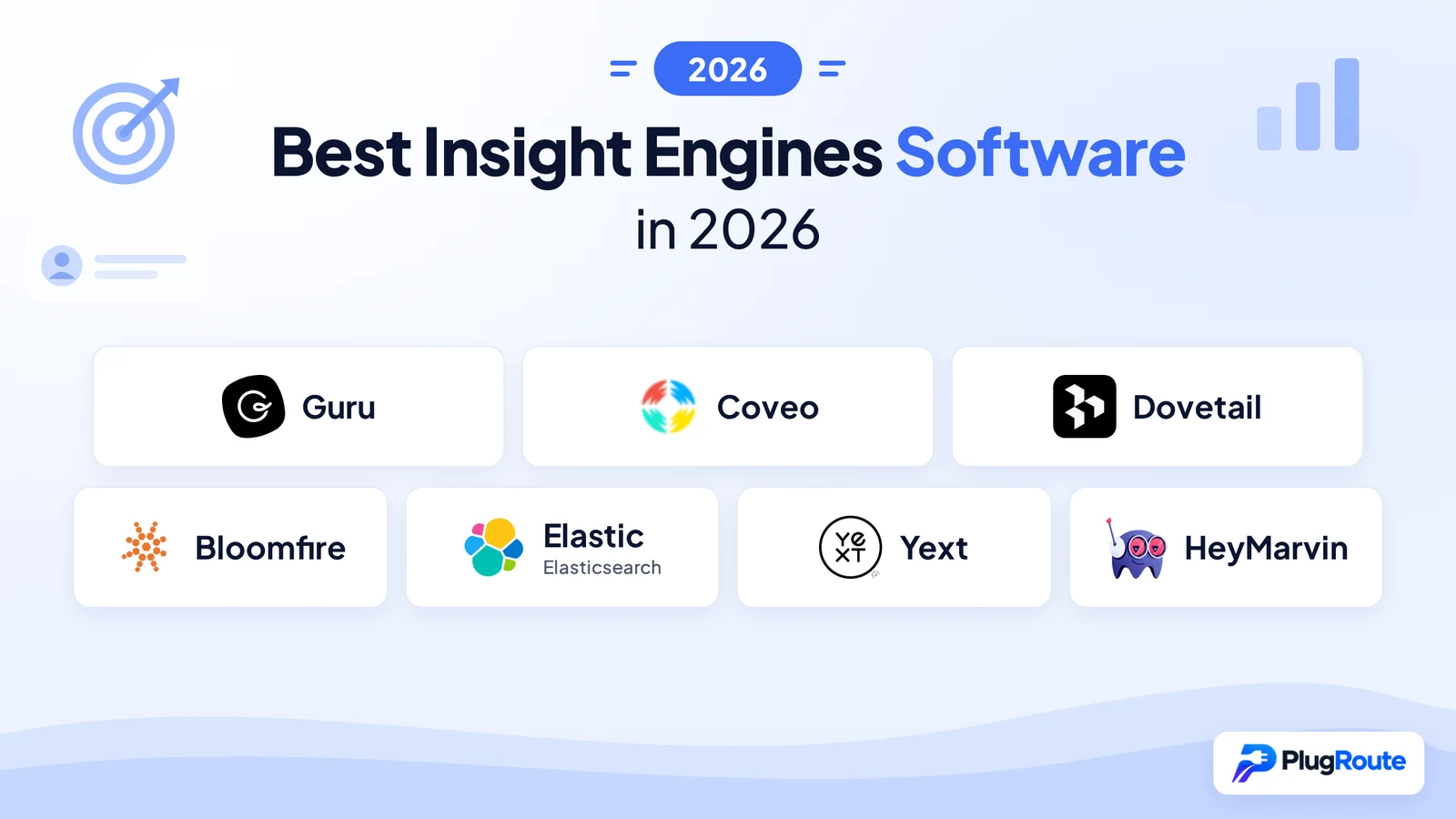
Guru is the top-rated insight engine on G2 for 2026, confirmed 4.7/5 across 2,000+ reviews, for internal knowledge management; Coveo leads for enterprise AI relevance and regulated industry compliance; Dovetail leads for qualitative research teams. The best insight engine depends entirely on which of four structurally distinct sub-categories matches your organization’s primary need.
Enterprise data is scattered across siloed wikis, SharePoint libraries, CRMs, and Slack threads, and most AI-generated comparisons treat structurally incompatible platforms as equivalent alternatives. The insight engines market is growing at over 25% annually (Mordor Intelligence, 2025; Coherent Market Insights, 2025), because fragmented, inaccessible data is a recognized executive-level problem. Only 29% of organizations currently report significant ROI from generative AI deployments (Writer.com, 2026), often because no governed insight layer connects AI outputs to verified internal knowledge.
As one software developer described on r/ExperiencedDevs:
“The only time I’ve seen a well-maintained wiki is when it belonged to a competent project manager and it was basically the way they were keeping track of things. Basically, it was their personal notes, which they decided to share with the team. In those cases, the wiki will be perfect, up to date, accurate, helpful. But when no one owns the wiki, it becomes a mess.” Posted by u/krubner
Takeaway: Enterprise knowledge bases reliably decay into unusable messes without explicit content ownership, validating why organizations are turning to governed insight engines with built-in accountability mechanisms rather than passive document repositories.
PlugRoute has no affiliate relationships with any company listed. Rankings are determined entirely by research data and objective evaluation criteria.
TL;DR: Top Picks at a Glance
- Guru: highest-rated knowledge management engine on G2 (4.7/5, 2,000+ reviews); ideal for HR, support, and sales teams with fully transparent public pricing at $25/seat/month
- Coveo: strongest enterprise AI relevance platform with confirmed ISO 27001, HIPAA, and SOC2 certifications and documented outcomes at SAP and Salesforce
- Dovetail: leading qualitative research insight engine for UX researchers, product managers, and customer insights teams; free tier available
- Elasticsearch: most capable open-source search infrastructure for engineering teams building custom RAG pipelines at enterprise scale
What Are the Four Types of Insight Engines, and Which Do You Need?
The four types of insight engines are Knowledge Management Engines (Guru, Bloomfire), AI Relevance Engines (Coveo, Yext), Search Infrastructure Engines (Elasticsearch), and Qualitative Research Insight Engines (Dovetail, HeyMarvin). Choosing the wrong sub-category costs more than choosing the wrong platform within the right one.
Sub-Category 1: Knowledge Management Engines: Guru and Bloomfire: consolidate internal employee knowledge from wikis, CRMs, and multimedia archives into governed, searchable repositories for HR, support, and sales teams.
Sub-Category 2: AI Relevance Engines: Coveo and Yext: apply machine learning personalization or Knowledge Graph entity structuring to power customer-facing search, commerce platforms, and multi-location brand intelligence.
Sub-Category 3: Search Infrastructure Engines: Elastic (Elasticsearch): provides distributed, developer-configurable search, vector retrieval, and the ELK Stack for engineering teams building custom AI applications and RAG pipelines.
Sub-Category 4: Qualitative Research Insight Engines: Dovetail and HeyMarvin: automate analysis of interview recordings, survey responses, and omnichannel feedback for product, design, and customer insights teams.
Orientation note for buyers: If you searched for insight engines and found a list ranking Elasticsearch next to Guru next to Dovetail as if they were competing alternatives, that list was wrong, they serve entirely different buyers and should never appear on the same shortlist without this sub-category framework.
The Qualitative Research Insight Engine sub-category was absent from every AI-generated insight engine comparison reviewed during May 2026 research for this article, making it the highest-value orientation for UX researchers, product managers, and customer insights professionals evaluating this category.
Choosing the wrong insight engine sub-category costs more than choosing the wrong platform within the right one, a DevOps engineer needs Elasticsearch; an HR director needs Guru; a UX researcher needs Dovetail. These are not interchangeable choices.
How Do the Top 7 Insight Engines Compare at a Glance?
No single insight engine is best across all use cases: Guru leads on review evidence (confirmed 4.7/5 G2 across 2,000+ reviews), Coveo leads on compliance and ML personalization, and Dovetail leads for qualitative research. Treating platforms across four structurally incompatible sub-categories as direct alternatives is the most common and costly insight engine evaluation mistake.
| Rank | Company | Category | Best For | One-Line Summary | Key Capabilities | Primary Strength | Key Limitation |
|---|---|---|---|---|---|---|---|
| #1 | Guru | Knowledge Management Engine | HR, support, and sales teams needing in-workflow verified knowledge | Guru is the highest-rated AI knowledge management insight engine on G2 in 2026, with a confirmed 4.7/5 rating across 2,000+ reviews and Leader, Highest Performer, and Easiest to Use badges | In-workflow AI delivery; Verification Engine governance; real-time sync with Zendesk, Salesforce, and Slack | Verified knowledge surfaced inside Zendesk, Salesforce, and Slack without context-switching; the only mid-market platform with fully transparent public pricing | 10-seat minimum; no multimedia deep indexing; not for developer search infrastructure |
| #2 | Coveo | AI Relevance Engine | Enterprise AI relevance, commerce search, and regulated industry deployments | Coveo is the enterprise AI relevance platform used by SAP and Salesforce, delivering an 83.5% self-service success rate at SAP and 75% manual search time reduction at Salesforce through five simultaneous ML personalization models and ISO 27001, HIPAA, and SOC2-certified infrastructure | Five Relevance Cloud ML models; 55+ source connectors; generative AI answering; 99.999% SLA | Five simultaneous ML personalization models adapting search results to individual users in real time; strongest compliance posture of any platform in this evaluation | Community-benchmarked at approximately 3× comparable alternatives; professional services required; no public pricing |
| #3 | Dovetail | Qualitative Research Insight Engine | UX researchers, product managers, and customer insights teams analyzing qualitative data | Dovetail is the leading AI qualitative research platform reporting 4,000+ organizations served, with industry-leading transcription via AssemblyAI (~96-97% accuracy across 100+ languages) and AWS Bedrock with Anthropic Claude 3.5 Sonnet for analysis | Magic AI suite (Transcribe via AssemblyAI, Cluster, Redact, Search); Channels always-on monitoring; AWS Bedrock + Anthropic Claude 3.5 Sonnet | Industry-leading transcription accuracy (~96-97% via AssemblyAI across 100+ languages) with automated PII redaction via Magic Redact | No built-in participant recruitment or study creation; paid tier pricing unconfirmed |
| #4 | Bloomfire | Enterprise Knowledge Engine | Enterprises with multimedia knowledge assets needing deep video and audio search | Bloomfire is a 14-year enterprise knowledge engine that deep-indexes every spoken word in video and audio recordings, with AI hallucination guardrails restricting generative answers to verified internal sources only | Deep spoken-word indexing of video and audio; Ask AI hallucination guardrails; expert-certified Q&A Engine; Microsoft 365 integration | Unique deep indexing of spoken words in video and audio; the only platform in this evaluation enabling full-text search inside multimedia knowledge archives | No public pricing; full enterprise sales engagement required; limited independent peer validation |
| #5 | Elastic (Elasticsearch) | Search Infrastructure Engine | Engineering and DevOps teams building custom search apps, RAG pipelines, and log analytics | Elasticsearch is an open-source search and analytics engine deployed in production by Shopify, Uber, and Slack, offering hybrid BM25+kNN vector search for RAG pipelines and petabyte-scale distributed indexing | Hybrid BM25+kNN for RAG; free open-source core; petabyte-scale distributed indexing; full ELK Stack | Hybrid BM25+kNN vector search enabling Retrieval-Augmented Generation pipelines; the most technically capable open-source RAG retrieval backend in this evaluation | No native business UI; engineering-only platform; TCO at enterprise scale frequently exceeds managed SaaS when engineering labor is included |
| #6 | Yext | Brand Intelligence Engine | Multi-location enterprises distributing AI-ready structured brand data across 100+ directories | Yext is the Knowledge Graph-powered brand intelligence engine trusted by Verizon, Marriott, the U.S. State Department, and the WHO, monitoring 2 billion+ data points monthly across 100+ directories (confirmed via Yext Scout Index, 2026) | Knowledge Graph entity architecture; Yext Scout (2B+ monthly data points); 100+ directory sync; AI Reviews Management | Knowledge Graph entity architecture; the same data model as Google’s Knowledge Graph; enabling direct-answer AI search and clean entity data feeds into large language models | Use-case misalignment for internal knowledge or developer search buyers; no confirmed G2 numerical rating |
| #7 | HeyMarvin | AI Research Repository | Individual UX researchers and small product teams evaluating AI insight management at zero cost | HeyMarvin is the most accessible AI research repository in the qualitative insights sub-category, with point-level citation traceability in every AI-generated insight and the most generous confirmed free tier for individual practitioners | Point-level citations in AI outputs; AI-moderated interviews; 40+ language transcription; continuous automated thematic analysis | Point-level citations linking every AI-generated insight to specific source quotes; making AI outputs traceable and defensible in stakeholder presentations without manual source-checking | No confirmed enterprise clients beyond one academic institution; no verified G2 score; vendor stability uncertainty |
Which Insight Engine Should I Choose for My Use Case?
Before reading individual entries, use this framework to identify your sub-category, then evaluate only the platforms within that sub-category. After selecting your sub-category, eliminate all platforms in the other three sub-categories from your shortlist before beginning detailed platform comparison; evaluating Elasticsearch alongside Guru is a procurement error, not a thorough analysis.
| Your #1 Priority | Recommended Tool | Why | Acceptable Alternative |
|---|---|---|---|
| Internal employee knowledge management (HR, support, sales enablement) | Guru | Confirmed 4.7/5 G2 rating across 2,000+ reviews; public pricing at $25/seat/month; in-workflow AI delivery inside Zendesk, Salesforce, and Slack; no professional services required | Bloomfire (if video and audio archives are central to your knowledge estate) |
| Enterprise AI relevance with compliance requirements (healthcare, financial, government) | Coveo | ISO 27001, HIPAA, SOC2 certified; SAP achieved 83.5% self-service success rate deflecting 1.6M support cases; five simultaneous ML personalization models | Elasticsearch (if a dedicated search engineering team is available and open-source control is preferred) |
| Qualitative research analysis (UX interviews, surveys, omnichannel feedback monitoring) | Dovetail | Reports 4,000+ customers served; ~96-97% transcription accuracy via AssemblyAI across 100+ languages; AWS Bedrock and Anthropic Claude 3.5 Sonnet for analysis; free tier available | HeyMarvin (if budget is zero and team size is small) |
| Multimedia enterprise knowledge (video training libraries, recorded sales calls, webinars) | Bloomfire | Only platform in this evaluation that deep-indexes spoken words in video and audio; Ask AI hallucination guardrails; documented onboarding time reduction from 21 to 8 weeks per Enterprise Intelligence Value Report | Guru (if multimedia content is secondary to text-based knowledge card management) |
| Developer-led custom search infrastructure or RAG pipeline construction | Elastic (Elasticsearch) | Free open-source core; hybrid BM25+kNN for RAG; petabyte-scale performance; Shopify, Uber, and Slack production deployments confirmed (elastic.co/customers, 2026) | Coveo (if managed enterprise search without engineering overhead is preferred) |
| Multi-location brand presence and AI-ready entity data distribution | Yext | Knowledge Graph architecture aligned with AI search engine entity data models; 2B+ monthly data points monitored via Yext Scout (confirmed, 2026); 100+ directory sync | Coveo (for AI relevance on customer-facing websites with less focus on multi-location listings) |
| Individual or small-team research repository at zero cost | HeyMarvin | Most generous confirmed free tier in the qualitative research category; point-level citation traceability; AI-moderated interviews | Dovetail (for broader enterprise operations, larger reported client base, and AWS Bedrock infrastructure) |
1. Guru: Best Overall / Best for AI-Powered Internal Knowledge Management
Category: Knowledge Management Engine, delivers AI-powered, governed answers from structured internal content directly within enterprise workflows without requiring users to leave their existing tools.
At a Glance
- Category: Knowledge Management Engine
- Best For: HR, customer support, and sales enablement teams at mid-to-large organizations needing fast, verified answers surfaced inside existing workflow tools without context-switching
- Price Range: $25/seat/month (10-seat minimum; $250/month floor, billed annually); Enterprise tier pricing on request (verified May 2026 at getguru.com/pricing)
- Primary Strength: Guru’s Verification Engine requires designated content owners to periodically confirm or update knowledge cards, preventing the content decay that undermines most enterprise wikis and creating ongoing governance accountability across the entire knowledge base
- Biggest Limitation: Guru’s Knowledge Card model requires significant upfront content curation to migrate fragmented documentation into structured, verifiable units; the 10-seat minimum creates a $250/month floor that excludes individual practitioners from cost-effective access
- One-Line Summary: Guru is the top-rated AI knowledge management insight engine on G2 in 2026, holding Leader, Highest Performer, and Easiest to Use badges across 2,000+ verified reviews with a confirmed 4.7/5 score, and delivering in-workflow knowledge governance with fully transparent public pricing at $25 per seat per month
- Last Verified: May 2026
Overview
Guru is an AI-powered knowledge management platform and governed insight engine for enterprise HR, customer support, and sales teams that consolidates fragmented internal knowledge from Confluence, Notion, SharePoint, Google Drive, Slack, and CRMs into a unified, permission-aware index without duplicating content across source systems. Guru delivers contextually relevant, role-aware answers through semantic and intent-based retrieval, surfacing verified knowledge directly inside Zendesk, Salesforce, Gmail, and Slack, eliminating the context-switching that prevents employees from using separate knowledge portals during active work. Guru’s Verification Engine distinguishes Guru from passive document repositories by requiring designated content owners to periodically confirm or update knowledge cards, with unverified cards flagged visibly before users act on potentially outdated content.
Key Features
- AI Knowledge Agents: Guru’s AI Knowledge Agents are customizable AI assistants that connect to internal sources, provide natural language search and chat with point-level source citations, and use usage analytics to surface knowledge gaps proactively, without requiring users to formulate an explicit search query (getguru.com/features/knowledge-agents).
- Browser Extension for In-Workflow Delivery: Guru’s Browser Extension delivers verified knowledge cards directly inside web-based enterprise tools including Zendesk, Salesforce, and Gmail, eliminating the context-switching that prevents employees from referencing knowledge portals during active customer interactions or support workflows.
- Verification Engine: Guru’s Verification Engine assigns content ownership to designated subject matter experts and triggers mandatory review prompts at configurable intervals, flagging unverified cards visibly across the platform to distinguish current, owner-confirmed knowledge from potentially outdated content.
- Analytics Dashboard: Guru’s Analytics Dashboard tracks usage patterns, identifies the most-searched topics, surfaces unanswered questions as a proxy for knowledge gaps requiring new card creation, and provides knowledge managers with data to demonstrate platform ROI to executive stakeholders.
- Real-Time Source Sync: Guru supports real-time bidirectional sync with Salesforce, Zendesk, and Confluence Cloud, creating a unified, permission-aware knowledge index without duplicating content across connected source systems and preserving existing source-of-truth architectures (crm.org, 2026).
Best For
Guru is best for HR, customer support, and sales enablement teams at mid-to-large organizations who need fast, verified answers delivered directly inside their existing workflow tools. Guru is particularly well-suited for organizations where knowledge decay (outdated wiki content causing information discrepancies across teams) is an active productivity and compliance problem (knowledgebasesoftware.org, 2026).
Pricing
Guru’s pricing is publicly listed at $25 per seat per month with a 10-seat minimum, creating a floor of $250 per month billed annually (verified May 2026 at getguru.com/pricing). An Enterprise tier with custom pricing is available for larger organizations. No individual free tier is offered, organizations seeking zero-cost evaluation should request a trial directly from Guru before committing to a paid plan.
Strengths
- Guru holds G2’s Leader, Highest Performer, and Easiest to Use badges in the Insight Engines category for 2026, with a confirmed 4.7/5 rating across 2,000+ published G2 reviews, the highest confirmed review volume and strongest multi-badge rating of any platform in this evaluation (G2, May 2026).
- Guru’s in-workflow AI Suggest feature proactively surfaces verified knowledge inside Zendesk, Salesforce, Gmail, and Slack without requiring an explicit search query, directly reducing the context-switching costs that prevent employees from accessing separate knowledge portals during active customer-facing work.
- Guru’s Verification Engine addresses content decay: consistently cited as the primary failure mode of enterprise knowledge bases, by requiring designated content owners to confirm or update cards on configurable schedules and flagging unverified content visibly before users act on potentially outdated information (featurebase.app, 2026).
- Guru’s fully transparent public pricing at $25/seat/month is confirmed at getguru.com/pricing (May 2026), making Guru the only mid-market AI knowledge management platform in this evaluation offering self-serve procurement without requiring a formal sales process or custom pricing proposal.
Users on r/ProductManagement shared their experience deploying Guru across teams:
“We use Guru cards for knowledge base. Super handy for knowledge base and playbooks sharing, especially with their chrome extension. Best part can be used for knowledge sharing across different deps, not just CS so can turn out to be quite a good investment of org budget.” Posted by u/Original-Toe-7392
Takeaway: Guru’s Chrome extension and cross-departmental card sharing make it a multi-team knowledge investment rather than a single-department cost, reinforcing its positioning beyond customer support into sales enablement and HR workflows.
Limitations
- Content Migration Overhead: Guru’s Knowledge Card model: one card per focused topic, each verified by a designated content owner, requires significant upfront curation to migrate existing fragmented documentation into structured, verifiable units. Organizations with large, unstructured content estates should budget a structured migration phase of 4–8 weeks and request an implementation timeline with milestones during initial vendor conversations.
- Engineering Scope Limitation: Guru does not support vector database integration, custom RAG pipeline construction (the technical architecture organizations need to build AI assistants retrieving information from internal knowledge), or petabyte-scale unstructured data indexing, making Guru the wrong platform for engineering teams building AI-powered search applications rather than managing structured organizational knowledge for business users.
- Minimum Seat Requirement: Guru’s 10-seat minimum creates a floor of $250 per month, excluding individual practitioners and very small teams from cost-effective access, organizations below this threshold should instead evaluate HeyMarvin’s free tier for qualitative insight management needs or request a Guru trial before committing.
- Multimedia Knowledge Gap: Guru’s knowledge card architecture does not deep-index spoken content in video or audio recordings, organizations with large multimedia knowledge assets (recorded training sessions, webinar libraries, sales call archives) will find Guru’s video search capability substantially more limited than Bloomfire’s spoken-word deep indexing, which enables full-text search within video and audio without manual transcription or tagging.
Verdict
Guru is the highest-rated AI insight engine on G2 for 2026, holding Leader, Highest Performer, and Easiest to Use badges across 2,000+ verified reviews with a confirmed 4.7/5 score, the strongest multi-badge review performance of any platform in this evaluation. Organizations in HR, customer support, and sales enablement that need fast time-to-value, verified knowledge governance, and non-technical usability will find Guru the most evidence-backed solution at its price tier, with the additional advantage of fully transparent public pricing that eliminates the sales-process friction required by every other enterprise platform in this comparison. Guru’s Knowledge Card governance model requires initial investment in content curation, meaning organizations with large, unstructured content estates should plan a structured migration phase before realizing the full productivity gains Guru’s in-workflow delivery model enables.
2. Coveo: Best for Enterprise AI Relevance, Commerce Search, and Regulated Industry Deployments
Category: AI Relevance Engine, applies layered machine learning personalization to unify and rank content from 55+ enterprise sources into contextually adaptive search results for customer-facing commerce experiences and internal enterprise knowledge environments.
At a Glance
- Category: AI Relevance Engine
- Best For: Large enterprises requiring hyper-personalized AI search across customer-facing commerce portals, customer service deflection programs, and multi-source internal knowledge in regulated industries with ISO 27001, HIPAA, or SOC2 compliance requirements
- Price Range: Pricing on request (enterprise SaaS; no public tiers; a 2026 Reddit competitive evaluation by u/No-Brother-2237 benchmarks Coveo at approximately 3× comparable alternatives, r/LlamaIndex, 2026)
- Primary Strength: Coveo’s Relevance Cloud simultaneously deploys five distinct ML models (Automatic Relevance Tuning, Query Suggestions, Dynamic Navigation Experience, Content Recommendations, and User Profile services) delivering behavioral personalization that adapts search results to individual users in real time without manual tuning
- Biggest Limitation: Coveo’s implementation requires professional services engagement, and community evidence places its pricing at approximately 3× comparable alternatives, effectively limiting Coveo to organizations at enterprise scale with implementation budgets to match
- One-Line Summary: Coveo is the enterprise AI relevance platform used by SAP and Salesforce, delivering an 83.5% self-service success rate at SAP (1.6 million cases deflected) and a 75% reduction in manual search time at Salesforce through five simultaneous ML personalization models and ISO 27001, HIPAA, and SOC2-certified infrastructure, the most compliance-credentialed and outcome-evidenced AI insight engine in this evaluation
- Last Verified: May 2026
Overview
Coveo is a composable AI search and generative experience platform that functions as an enterprise intelligence layer, consolidating content from 55+ indexable sources into a unified index and applying five simultaneous machine learning models to deliver hyper-personalized search results for customer-facing commerce experiences and internal knowledge management portals. Coveo’s Relevance Cloud (encompassing Automatic Relevance Tuning, Query Suggestions, Dynamic Navigation Experience, Content Recommendations, and User Profile services) enables search results that adapt in real time to individual user behavior, returning different results to a returning customer than to a first-time visitor for the same query. Founded in 2005 and publicly traded on the Toronto Stock Exchange (TSX: CVO, coveo.com, 2026), Coveo is the only platform in this evaluation with over two decades of enterprise search experience, confirmed ISO 27001, HIPAA, and SOC2 certifications, and a 99.999% SLA resilience commitment.
Key Features
- Relevance Cloud ML Architecture: Coveo’s Relevance Cloud simultaneously deploys five distinct ML models (Automatic Relevance Tuning, Query Suggestions, Dynamic Navigation Experience, Content Recommendations, and User Profile services) adapting search results to individual user behavior in real time without requiring manual relevance tuning by search administrators.
- 55+ Source Connector Ecosystem: Coveo indexes content from 55+ enterprise sources through 50+ pre-built and 30+ native connectors covering Salesforce, ServiceNow, Sitecore, Adobe Experience Manager, SAP, AWS, and Atlassian, plus universal REST, Push, and GraphQL API connectivity for custom source integration (coveo.com/en/platform, 2026).
- Relevance Generative Answering: Coveo’s generative AI answering layer provides responses grounded in the unified enterprise index, with SAP’s deployment achieving a documented 83.5% self-service success rate that deflected 1.6 million support cases since 2023 with an annual cost-to-serve reduction of €8 million (Coveo/SAP case study, 2025).
- Compliance-Certified Infrastructure: Coveo maintains ISO 27001 certification, HIPAA compliance, SOC2 compliance, and a 99.999% SLA resilience commitment, the strongest confirmed compliance posture of any platform in this evaluation, documented at coveo.com/en/platform (May 2026).
- Composable Architecture: Coveo’s composable design enables modular integration into existing e-commerce platforms, intranet portals, customer service systems, and developer portals without requiring full infrastructure replacement or content migration from existing tech stacks.
Best For
Coveo is best for large enterprises with complex, multi-source AI search requirements, including e-commerce personalization, customer self-service deflection, and internal knowledge discovery. Coveo is specifically appropriate for organizations that have substantial implementation budgets, professional services capacity, and compliance requirements in healthcare, financial services, or government where ISO 27001, HIPAA, and SOC2 certifications are binary procurement requirements.
Pricing
Coveo does not publish public pricing tiers or starting costs (verified May 2026, coveo.com does not display a public pricing page). Pricing is determined through customized enterprise proposals after sales engagement.
“Chose Algolia as it offered good search functionality at 30% of Coveo pricing.” (u/No-Brother-2237, after evaluating Coveo, Algolia, Constructor, and Glean for enterprise e-commerce search (r/LlamaIndex, 2026))
Takeaway: A named buyer completing a full 2026 competitive evaluation found Coveo priced at approximately 3× Algolia for comparable core search functionality, the only community-validated relative cost benchmark available for Coveo pricing as of May 2026.
Buyers should request explicit pricing, minimum commitment terms, and professional services cost estimates during initial sales conversations before any shortlisting decision.
Strengths
- SAP achieved an 83.5% self-service success rate through Coveo AI search on SAP for Me and Concur portals, deflecting 1.6 million support cases since 2023 with an annual cost-to-serve reduction of €8 million (Coveo/SAP case study, 2025); Salesforce reduced support engineers’ manual search time by 75% while achieving record-high CSAT scores using Coveo AI across nine use cases (coveo.com, 2026), the most numerous and specific quantified enterprise client outcomes of any platform in this evaluation.
- Coveo holds ISO 27001 certification, HIPAA compliance, SOC2 compliance, and a 99.999% SLA resilience commitment, the strongest confirmed compliance posture of any platform evaluated (coveo.com/en/platform, May 2026), making Coveo the primary consideration for regulated industry deployments in healthcare, financial services, or government procurement.
- Coveo’s Relevance Cloud deploys five simultaneous ML models that adapt search results to individual user behavior without manual tuning (a multi-model personalization architecture that no other platform in this evaluation replicates) providing the deepest behavioral relevance capability for organizations requiring personalization at enterprise scale.
- Coveo was founded in 2005, is publicly traded on the Toronto Stock Exchange (TSX: CVO, coveo.com, 2026), and has built 20+ years of enterprise search behavioral training data, a competitive moat in ML model quality that AI-native newer entrants cannot replicate without equivalent deployment history and scale.
Limitations
- Cost and Professional Services Dependency: Coveo’s most consequential trade-off is the combination of implementation complexity and cost, community evidence from a 2026 full competitive evaluation places Coveo’s pricing at approximately 3× comparable alternatives, with one documented buyer selecting Algolia at roughly 30% of Coveo’s quoted cost for equivalent core search functionality (Reddit, r/LlamaIndex, 2026).
- Data Quality Dependency: Coveo’s own solution architects have publicly acknowledged that “even with ML and all the relevance tuning in the world, if the data set is not good, results aren’t great”, confirming that Coveo’s advertised ML personalization requires high-quality, well-governed source content to deliver documented outcomes (Reddit, r/IAmA, 2021).
- Enterprise-Only Accessibility: Coveo’s pricing opacity forces buyers into a mandatory sales engagement before any budget-fit assessment is possible, effectively excluding mid-market organizations from efficient evaluation, adding weeks to shortlisting timelines for organizations with early-stage cost gatekeeping requirements.
- Not for Internal Knowledge Management: Coveo is not engineered for the turnkey internal knowledge card governance use case that Guru addresses, organizations seeking a governed wiki replacement with fast non-technical deployment will find Coveo’s professional services dependency and complexity misaligned with their timeline and budget.
Verdict
Coveo is the enterprise AI relevance platform documented to achieve an 83.5% self-service success rate at SAP (deflecting 1.6 million support cases with €8 million in annual cost savings) and a 75% reduction in manual search time at Salesforce, with ISO 27001, HIPAA, and SOC2 certifications making it the most compliance-credentialed and outcome-evidenced AI insight engine in this evaluation. Coveo’s #2 ranking reflects unmatched performance on primary criteria (documented enterprise outcomes, ML personalization sophistication, and compliance posture) held back by pricing opacity, professional services dependency, and a cost floor that community evidence benchmarks at approximately 3× comparable alternatives. Buyers who qualify on budget, complexity, and compliance requirements will find Coveo the most powerful AI relevance platform in the category; organizations with simpler knowledge management needs or non-enterprise budgets should evaluate Guru for internal knowledge management or Elasticsearch for custom search infrastructure.
3. Dovetail: Best for AI-Powered Qualitative Research and Customer Insights Analysis
Category: Qualitative Research Insight Engine, applies AI analysis to interview recordings, survey responses, and multimedia research data to surface themes, patterns, and actionable insights for product, design, and customer experience teams.
At a Glance
- Category: Qualitative Research Insight Engine
- Best For: UX researchers, product managers, customer insights teams, and design professionals needing AI-automated analysis of qualitative research data including interview recordings, survey responses, and omnichannel feedback streams
- Price Range: Free tier available; Professional, Business, and Enterprise paid plans available (specific dollar amounts not publicly confirmed as of May 2026, verify current pricing at dovetailapp.com/pricing)
- Primary Strength: Dovetail’s Magic AI suite delivers industry-leading transcription via AssemblyAI (~96-97% accuracy across 100+ languages per published WER benchmarks), AI thematic clustering, and automated PII redaction, reducing qualitative research analysis from weeks to hours at enterprise scale through AWS Bedrock and Anthropic Claude 3.5 Sonnet
- Biggest Limitation: Dovetail does not include built-in participant recruitment, scheduling, or study creation tools, organizations requiring end-to-end research operations in a single platform must maintain separate tools for participant sourcing alongside Dovetail
- One-Line Summary: Dovetail is the leading AI qualitative research insight engine reporting 4,000+ organizations served, delivering industry-leading transcription accuracy via AssemblyAI across 100+ languages and reducing per-project analysis time by 1–2 hours per researcher in a verified Amazon Web Services case study published in 2025
- Last Verified: May 2026
Overview
Dovetail is an AI-powered user research and insights platform that automates qualitative analysis of interviews, surveys, documents, and videos through a suite of “Magic” AI features, positioning Dovetail as the insight engine of record for product, design, UX, and customer experience teams seeking to extract actionable knowledge from human-generated qualitative data at scale (techzine.eu, 2026). Dovetail’s transcription is powered by AssemblyAI (integrated in Dovetail’s 2025 Spring Launch, reducing Word Error Rate by 30% versus the prior transcription system), achieving approximately 96-97% accuracy per published AssemblyAI Universal-3 Pro WER benchmarks across 100+ languages. Dovetail’s AI analysis features, including Magic Search, Magic Cluster, and Channels, run on AWS Bedrock with Anthropic Claude 3.5 Sonnet, with Dovetail reporting 4,000+ customers as of 2026 (vendor-stated; not independently confirmed in live sources as of May 2026).
Key Features
- Magic Transcribe (AssemblyAI-Powered, ~96-97% Accuracy): Dovetail’s Magic Transcribe delivers industry-leading transcription accuracy via AssemblyAI Universal-3 Pro across 100+ languages with multi-speaker detection, integrated in Dovetail’s 2025 Spring Launch, reducing Word Error Rate by 30% versus the prior transcription system (Dovetail Spring Launch blog, 2025; AssemblyAI, 2025).
- Magic Cluster (AI Thematic Grouping): Dovetail’s Magic Cluster runs on AWS Bedrock with Anthropic Claude 3.5 Sonnet to group interview highlights into thematic clusters with generative AI-produced labels, automating the affinity mapping process that previously required hours of manual card sorting and accelerating synthesis timelines significantly.
- Magic Redact (Automated PII Removal): Dovetail’s Magic Redact automatically identifies and removes personally identifiable information (including blurring faces, names, and emails in video recordings) providing built-in GDPR and privacy compliance support that competing platforms typically require manual review workflows to address.
- Channels (Always-On Feedback Intelligence): Dovetail’s Channels feature enables continuous, always-on aggregation and AI classification of omnichannel feedback including social media posts, app store reviews, support tickets, and survey responses into real-time thematic summaries for ongoing customer intelligence monitoring.
- AWS Bedrock and Anthropic Claude 3.5 Sonnet Infrastructure: Dovetail’s analysis features (Magic Search, Magic Cluster, and Channels) are powered by AWS Bedrock with Anthropic Claude 3.5 Sonnet, providing enterprise-grade AI infrastructure for thematic analysis, summarization, and insight generation at scale (aws.amazon.com, 2025).
Best For
Dovetail is best for UX researchers, product managers, and customer insights teams at organizations conducting regular qualitative research, including interview analysis, survey synthesis, usability testing review, and omnichannel feedback monitoring. Dovetail is particularly well-suited for teams that need AI to reduce analysis time from weeks to hours while maintaining full citation traceability for stakeholder presentations.
Pricing
Dovetail offers a confirmed free tier for individual practitioners, with Professional, Business, and Enterprise paid plans available. Specific dollar amounts per tier were not publicly confirmed in live sources as of May 2026, verify current tier pricing directly at dovetailapp.com/pricing before beginning evaluation. The free tier supports bottom-up adoption within organizations, enabling solo researchers to evaluate without a budget approval cycle or credit card commitment.
Strengths
- Dovetail’s Instawork case study independently documents UX researcher Emi Fogg saving 1–2 hours per research project through Magic AI automation; a Dovetail-commissioned survey additionally reports 10 hours per week saved and 80% efficiency improvement for product managers and designers (Dovetail-commissioned survey, cited in aws.amazon.com case study, 2025, vendor-commissioned; treat as directional rather than independently validated).
- Dovetail’s transcription is powered by AssemblyAI Universal-3 Pro, achieving approximately 96-97% accuracy across 100+ languages with multi-speaker detection (a 30% WER improvement over Dovetail’s prior transcription system (Dovetail Spring Launch blog, 2025)) enabling global research teams to analyze cross-language interview data without manual transcription.
- Dovetail reports 4,000+ customers as of 2026, with verified G2 feature reviews specifically citing data centralization (51 reviews) and search analysis (52 reviews) as highly rated capabilities, confirming active user validation of the platform’s core insight engine functions across a broad customer base (G2, 2026).
- Dovetail’s Magic Redact automatically removes PII from video recordings: blurring faces and removing names and emails, providing built-in GDPR compliance support that competing platforms typically require manual workflows to address, reducing legal risk for research teams handling sensitive participant data internationally.
Limitations
- End-to-End Research Operations Gap: Dovetail’s most significant scope limitation is the absence of built-in participant recruitment, scheduling, and study creation tools, organizations requiring end-to-end research operations in a single platform must maintain separate tools for participant sourcing, screener surveys, and session scheduling alongside Dovetail, creating the same multi-platform fragmentation Dovetail is designed to resolve on the analysis side.
- AI Output Quality Dependency: Dovetail’s Magic Cluster and Magic Summary accuracy degrades with noisy, low-quality, or ambiguous interview recordings, requiring researchers to critically review AI-generated themes rather than accepting outputs at face value, a meaningful limitation for high-volume research programs relying on automated synthesis at scale.
- Video Processing Speed: Video processing speed for long-form recordings exceeding 90 minutes has been cited in user feedback as a limitation for high-volume multi-session research programs, creating wait times that interrupt iterative research-and-synthesis workflows (statsig.com, 2026).
- Unconfirmed Paid Tier Pricing: Dovetail’s failure to publicly list paid tier dollar amounts requires buyers to engage vendor contact before any budget-fit assessment, a procurement friction that slows shortlisting for teams with early-stage cost gatekeeping, though the confirmed free tier mitigates this for initial evaluation.
This aligns with community sentiment on r/UXResearch:
“Dovetail’s good if you just need a place to dump everything and keep it organized, but it’s not super strong on the actual analysis side. If you want something more general that still helps you surface themes quick, NotebookLM is a good bet. But you may not be able to tell how those themes were generated or if the AI actually read through all of your data. If you’re after heavier AI-powered analysis that can pull out themes/quotes more comprehensively, specialized tools like AILYZE is built more for that. Honestly, a lot of people use Dovetail just as the repo and then pair it with something smarter for insights.” Posted by u/Traditional_Bit_1001
Takeaway: Dovetail’s strength as a structured research repository is well-established, but practitioners consistently report pairing it with additional AI tools for deeper synthesis, confirming the platform’s analysis-depth limitation identified in this evaluation.
Verdict
Dovetail is the leading AI qualitative research insight engine for product and UX teams, reporting 4,000+ organizations served, with industry-leading transcription accuracy via AssemblyAI across 100+ languages and AI analysis powered by AWS Bedrock with Anthropic Claude 3.5 Sonnet, the only platform in this evaluation purpose-built for qualitative data analysis at enterprise scale. Dovetail’s #3 ranking reflects both strong absolute scores on primary criteria and its unique position as the recommended first evaluation for readers in UX research, product management, and customer insights roles, a sub-category entirely absent from every AI-generated insight engine comparison reviewed during May 2026 research for this article. Organizations evaluating general-purpose enterprise search infrastructure, internal knowledge management, or brand intelligence platforms should note that Dovetail is not designed for those use cases and should evaluate Elasticsearch, Guru, or Yext in their respective sub-categories.
4. Bloomfire: Best for Enterprise Knowledge Management with Multimedia Deep Indexing
Category: Enterprise Knowledge Engine, provides deep AI-powered indexing of text, documents, video, and audio content alongside expert-certified Q&A workflows for organizational knowledge capture, governance, and retrieval at enterprise scale.
At a Glance
- Category: Enterprise Knowledge Engine
- Best For: Enterprise organizations with rich multimedia knowledge assets: training libraries, recorded sales calls, webinar archives, needing AI search across both text and spoken video content with hallucination-controlled generative answers restricted to verified internal sources only
- Price Range: Pricing on request (enterprise; no public tiers confirmed as of May 2026)
- Primary Strength: Bloomfire uniquely indexes every spoken word in video and audio recordings through automated transcription, enabling employees to search across multimedia knowledge assets, a capability that text-only platforms including Guru, SharePoint, and Confluence cannot provide
- Biggest Limitation: Bloomfire’s enterprise-only sales model with no public pricing requires buyers to complete a full sales engagement (including discovery calls and demo sessions) before accessing any cost information, creating significant procurement opacity during self-serve evaluation
- One-Line Summary: Bloomfire is a 14-year enterprise knowledge engine with unique deep indexing of spoken audio and video content and built-in AI hallucination guardrails that restrict generative answers to verified internal sources only, with documented onboarding time reduced from 21 to 8 weeks (a 62% reduction) per its Enterprise Intelligence Value Report
- Last Verified: May 2026
Overview
Bloomfire is an AI-powered knowledge management and enterprise insight engine founded in 2011 (Austin, Texas), built around a core technical differentiator of deep indexing, indexing every word in posts, questions, answers, documents, videos, audio files, and attachments in real time, including spoken words in video and audio content through automated transcription and full-text search indexing (bloomfire.com/platform/knowledge-engine). Bloomfire’s Ask AI feature provides instant generative AI answers using semantic search and LLM-powered synthesis, with built-in hallucination guardrails that restrict AI responses to internal knowledge sources only, preventing the platform from generating answers from external internet data and directly addressing a critical safety requirement for regulated industries and compliance-sensitive organizations. Bloomfire’s documented enterprise outcomes include onboarding time reduced from 21 to 8 weeks, a 62% reduction, per its Enterprise Intelligence Value Report, attributed to a leading tax preparation service deployment (bloomfire.com blog, 2026).
Key Features
- Deep Multimedia Indexing: Bloomfire’s deep indexing engine indexes every spoken word in video and audio files through automated transcription, enabling employees to search across recorded training sessions, webinars, and sales call libraries as completely as they search text documents, without any manual tagging or summarization required (bloomfire.com, 2026).
- Ask AI with Hallucination Guardrails: Bloomfire’s Ask AI feature provides generative AI answers using semantic search, intent recognition, and LLM synthesis, with built-in hallucination guardrails that restrict AI responses to verified internal knowledge sources only, preventing the platform from generating responses from external internet data at any point (bloomfire.com, 2026).
- Expert-Certified Q&A Engine: Bloomfire’s Q&A Engine routes employee questions to designated subject matter experts, tracks response times, detects duplicate questions automatically, and channels crowd-sourced expert answers back into the searchable knowledge base as permanent organizational intelligence.
- Microsoft 365 Deep Integration: Bloomfire integrates with SharePoint, Microsoft Teams, Slack, and Google Chrome, enabling deployment as an AI-enhanced search layer on top of existing Microsoft 365 infrastructure without requiring organizations to migrate content out of SharePoint (infotech.com, 2026).
- Analytics and Knowledge Gap Detection: Bloomfire’s analytics dashboard tracks content engagement, identifies knowledge gaps from unanswered employee questions, and provides usage data that knowledge managers can use to demonstrate platform ROI and prioritize new content creation investment.
Best For
Bloomfire is best for enterprise organizations with rich video and audio knowledge assets (training libraries, recorded sales calls, webinar archives, expert interviews) that need AI search across multimedia content alongside expert-certified Q&A and text document retrieval. Bloomfire is particularly appropriate for regulated industries where AI hallucination guardrails restricting generative answers to verified internal sources are a compliance requirement.
Pricing
Bloomfire does not publish pricing tiers or starting costs publicly (verified May 2026, bloomfire.com does not display a public pricing page). Pricing is determined through enterprise sales proposals after discovery and demo sessions. Buyers should plan for a structured sales engagement, typically 2–4 weeks, before receiving cost information, and should request explicit user minimum commitments, implementation cost estimates, and Microsoft 365 integration scoping during initial calls.
Strengths
- Bloomfire’s Enterprise Intelligence Value Report documents onboarding time reduced from 21 weeks to 8 weeks, a 62% reduction, with annual cost savings of approximately $11.9 million across 3,500 hires, attributed to a leading tax preparation service deployment (bloomfire.com blog, 2026), the most specific quantified knowledge management operational outcome data of any platform in this evaluation.
- Bloomfire uniquely indexes every spoken word in video and audio files through automated transcription, enabling search across multimedia knowledge assets, a capability not offered by text-only platforms like Guru, Confluence, or SharePoint, which leaves significant institutional knowledge in video archives entirely unsearchable.
- Bloomfire’s Ask AI hallucination guardrails restrict generative AI answers to verified internal knowledge sources only, preventing AI from generating responses from external internet data, a critical safety architecture for regulated industries, legal and compliance teams, and organizations with high sensitivity to AI-generated misinformation in internal tooling.
- Bloomfire was founded in 2011 and is headquartered in Austin, Texas: 14+ years of enterprise knowledge management experience provides deep institutional knowledge of deployment challenges, integration patterns, and organizational adoption barriers that AI-native newer entrants have not encountered at comparable organizational scale (bloomfire.com/newsroom, 2026).
Limitations
- Complete Pricing Opacity: Bloomfire’s most consequential procurement limitation is complete pricing opacity, buyers must engage a full enterprise sales process, including discovery calls and demo sessions, before accessing any cost information, making it impossible to perform basic budget-fit screening during self-serve evaluation and extending procurement timelines for organizations with early-stage cost gatekeeping requirements.
- Architectural Vintage Question: Bloomfire’s 2011 founding is a stability signal but also raises a legitimate architectural question: buyers should ask during technical evaluation whether Bloomfire’s underlying infrastructure reflects modern AI-native design principles or represents AI capabilities retrofitted onto an older knowledge management foundation, a distinction with long-term performance and maintainability implications that contract renewal timelines may not accommodate.
- Limited Independent Peer Validation: Bloomfire generated no substantive organic Reddit community discussion in this research cycle (the Reddit search returned a null response, which may reflect the platform’s enterprise-first, NDA-constrained buyer base rather than an absence of user satisfaction) making independent peer validation of real-world implementation experiences unusually difficult to surface compared to more community-active platforms.
- Crowdsourced Knowledge Layer Requires Active Participation: Bloomfire’s Q&A Engine creates a social knowledge layer that grows through employee-submitted questions, but this model requires sustained employee participation and management reinforcement to avoid becoming a stale channel over time; organizations without a dedicated knowledge management champion should verify adoption rates in reference customer conversations before committing.
Verdict
Bloomfire is a 14-year enterprise knowledge engine with unique deep indexing of spoken audio and video content and built-in AI hallucination guardrails that restrict generative answers to verified internal sources only, earning the #4 position through the most distinctive multimedia search capability in the knowledge management sub-category and quantified operational outcomes documented in its Enterprise Intelligence Value Report. Enterprise organizations with rich video and audio knowledge assets (training libraries, recorded sales calls, webinar archives) will find Bloomfire’s spoken-word indexing a uniquely valuable capability that text-only competitors cannot replicate. The primary evaluation friction is procurement opacity: Bloomfire requires full enterprise sales engagement before providing pricing information, which should be factored into evaluation timelines for budget-constrained or time-pressured procurement cycles.
5. Elastic (Elasticsearch): Best for Developer-Led Custom Search Infrastructure and RAG Pipelines
Category: Search Infrastructure Engine, provides distributed, developer-configurable search and analytics infrastructure supporting full-text search, vector search, hybrid retrieval, and the complete ELK Stack across any data volume and at enterprise scale.
At a Glance
- Category: Search Infrastructure Engine
- Best For: Engineering and DevOps teams building custom search applications, RAG pipelines, log analytics systems, or AI-powered data retrieval infrastructure at enterprise scale, not appropriate for non-technical business stakeholders without a dedicated search engineering team
- Price Range: Free (open-source self-managed core); Elastic Cloud managed SaaS available in Standard, Gold, Platinum, and Enterprise tiers (specific dollar amounts vary by usage, verify at elastic.co/pricing; serverless option also available)
- Primary Strength: Elasticsearch supports hybrid BM25+kNN vector search enabling Retrieval-Augmented Generation pipelines, making it the most technically capable open-source RAG retrieval backend in this evaluation and one of the most widely deployed open-source search engines globally
- Biggest Limitation: Elasticsearch’s open-source distribution includes no native business user interface (every end-user interaction requires a developer-built wrapper application) and total cost of ownership at enterprise scale frequently exceeds managed SaaS alternatives when engineering labor for deployment, tuning, and cluster maintenance is properly included
- One-Line Summary: Elasticsearch is an open-source search and analytics engine deployed in production by Shopify, Uber, and Slack, offering hybrid BM25+kNN vector search for RAG pipelines and petabyte-scale distributed indexing, at the significant trade-off of requiring dedicated search engineering resources that make it entirely unsuitable for non-technical buyers
- Last Verified: May 2026
Overview
Elasticsearch is a distributed search and analytics engine built on Apache Lucene that provides real-time indexing, full-text search, vector search, hybrid BM25+kNN retrieval, and schema-free JSON document storage at petabyte scale, making Elasticsearch foundational search infrastructure for enterprise applications globally, including production deployments at Shopify, Uber, and Slack (elastic.co/customers, 2026). Elasticsearch supports Retrieval-Augmented Generation pipelines through dense and sparse vector indexing and kNN similarity search, functioning as an enterprise-grade vector database when deployed with dense or sparse embedding models and positioning Elasticsearch as one of the most widely deployed RAG retrieval backends for organizations building AI-powered applications in 2026. The complete Elastic Stack, integrating Elasticsearch for search, Kibana for visualization, Logstash for data ingestion, and Beats for data shipping, provides a unified engineering platform for search, log analytics, observability, and security monitoring, though Elasticsearch’s complete absence of non-technical user interfaces means every deployment requires dedicated engineering resources to build and maintain the user-facing layer.
Key Features
- Hybrid BM25+kNN Vector Search for RAG: Elasticsearch supports hybrid search combining BM25 keyword relevance scoring with kNN vector similarity for dense and sparse embeddings, enabling Retrieval-Augmented Generation pipelines that feed accurate, context-grounded information to large language models for enterprise AI copilot and assistant applications (elastic.co, May 2026).
- Complete ELK Stack Integration: The Elastic Stack integrates Elasticsearch (search and analytics), Kibana (visualization and dashboards), Logstash (data ingestion pipelines), and Beats (lightweight data shippers) into a unified engineering platform covering search, log analytics, observability, and security information and event management in a single toolset.
- Comprehensive RESTful API and Query DSL: Elasticsearch provides a comprehensive RESTful API with JSON-based Query DSL and out-of-the-box capabilities including auto-completion, typo correction, faceted search, multi-tenancy, geographic queries, and auto-sharding, giving engineering teams fine-grained control over all aspects of search behavior and data distribution.
- Petabyte-Scale Distributed Architecture: Elasticsearch supports horizontal scaling through distributed clusters with automatic sharding and replication for high availability and failover, with near real-time indexing and petabyte-scale data capacity validated in production deployments at Shopify, Uber, and Slack (elastic.co/customers, 2026).
- Flexible Deployment Options: Elastic offers self-managed open-source deployment (free), Elastic Cloud managed SaaS with tiered plans (Standard, Gold, Platinum, Enterprise), and a serverless option, giving engineering teams flexibility to optimize deployment model for cost efficiency, operational overhead reduction, or infrastructure control based on available DevOps capacity.
Best For
Elasticsearch is best for software engineering and DevOps teams building custom search applications, RAG-powered AI pipelines, log analytics dashboards, or security event monitoring systems at enterprise scale. Elasticsearch is appropriate only for organizations that have dedicated search engineering resources on payroll, require maximum customization and infrastructure control, and can invest the engineering time required for deployment, relevance tuning, and ongoing cluster maintenance and optimization.
Pricing
Elasticsearch’s open-source core is free to download and self-host (confirmed at elastic.co/elasticsearch, May 2026). Elastic Cloud managed SaaS offers Standard, Gold, Platinum, and Enterprise tiers, specific dollar amounts vary by resource allocation and require checking elastic.co/pricing or contacting Elastic directly. A serverless option is also available.
Production-grade Elasticsearch deployment requires dedicated engineering time for cluster management, relevance tuning, and incident response. These engineering labor costs frequently exceed Elastic Cloud licensing costs at enterprise scale, making the “free software” argument actively misleading for organizations without dedicated search engineering teams on payroll (meilisearch.com, 2026).
Strengths
- Elasticsearch is deployed in production by Shopify, Uber, and Slack for enterprise-scale application search, log analytics, and real-time analytics infrastructure, validating Elasticsearch’s performance at high query volume and data scale across some of the world’s most demanding digital applications (elastic.co/customers, 2026).
- Elasticsearch’s hybrid BM25+kNN vector search supports Retrieval-Augmented Generation pipelines and LLM integration, making it the most technically capable open-source RAG retrieval backend in this evaluation for organizations building custom AI applications on top of organizational knowledge at scale (elastic.co, May 2026).
- Elasticsearch is designated G2 Top Trending in the Insight Engines category for 2026, reflecting growing enterprise buyer interest and active evaluation activity, a meaningful market momentum signal in the current AI search infrastructure investment cycle (G2, May 2026).
- Elasticsearch’s open-source free core eliminates the licensing cost barrier for engineering teams capable of self-managed deployment, enabling proof-of-concept development at zero direct cost before committing to Elastic Cloud production infrastructure spending.
Limitations
- Complete Exclusion of Non-Technical Users: Elasticsearch’s open-source distribution includes no native business user interface, no self-serve analytics dashboard, and no ready-made end-user search UI, all user-facing layers must be built by an engineering team, meaning business stakeholders, knowledge managers, and non-technical employees cannot interact with Elasticsearch data without a developer-built wrapper application maintained at ongoing cost and organizational dependency.
- Total Cost of Ownership Paradox: Elasticsearch’s open-source core is free, but production-grade deployment at enterprise scale requires cluster engineering, ongoing relevance tuning, scaling management, and dedicated DevOps monitoring. These engineering costs frequently exceed the annual licensing cost of managed SaaS alternatives when properly accounted for, making the “free software” argument actively misleading for organizations without dedicated search engineering teams on payroll (meilisearch.com, 2026).
- High Operational Complexity: Elasticsearch lacks built-in merchandising controls, ready personalization layers, or out-of-the-box dashboards for non-technical use cases, requiring custom development for features that managed platforms like Coveo or Guru include natively, creating a higher ongoing engineering maintenance burden compared to turnkey SaaS alternatives.
- Self-Managed Compliance Burden: Elasticsearch’s self-managed open-source deployment model does not include vendor-managed compliance certifications, organizations in regulated industries must implement and maintain their own ISO 27001, HIPAA, and SOC2 controls, encryption layers, and audit logging, adding implementation complexity that Elastic Cloud partially mitigates but which remains more demanding than Coveo’s fully vendor-certified managed infrastructure.
Users on r/aws noted when evaluating Elasticsearch deployment models:
“Depends on how large you expect the cluster to be and how well you understand how to manage ES clusters. AWS Elasticsearch is nice for smaller clusters since the majority of the management overhead is done by Amazon. As you scale, though. The cost for the managed services grows pretty quickly. If you’re monetizing the use of the service and your income exceeds your costs, then it can be fine. If you’re using it for logging, or something else that doesn’t directly generate revenue, running ES on EC2 yourself might be a better path forward if you expect the cluster to grow significantly.” Posted by u/omeganon
Takeaway: Elasticsearch’s total cost of ownership scales non-linearly with cluster size, making the “free open-source” framing increasingly misleading for organizations that lack dedicated engineering capacity to absorb management overhead at production scale.
Verdict
Elasticsearch is one of the most widely deployed open-source search and analytics engines globally, with production deployments at Shopify, Uber, and Slack validating hybrid BM25+kNN vector search enabling RAG pipelines, the most technically capable search infrastructure in this evaluation, ranked #5 because its complete exclusion of non-technical users and high engineering overhead correctly limits its appropriate buyer population to engineering-led organizations with dedicated search infrastructure resources. For DevOps teams, software engineers, and data architects building custom AI-powered search applications at scale, Elasticsearch remains the default choice with unmatched flexibility, community depth, and zero licensing cost for the open-source core. Business stakeholders, knowledge managers, and organizations without dedicated search engineering capacity should evaluate Guru for knowledge management, Bloomfire for multimedia enterprise knowledge, or Coveo for managed AI relevance, none of which require engineering teams to deliver user-facing value from day one.
6. Yext: Best for AI-Powered Brand Intelligence and Multi-Location Digital Presence
Category: Brand Intelligence Engine, uses a structured Knowledge Graph of entities and relationships to power AI direct-answer search, synchronize brand data across 100+ digital directories, and provide clean structured entity data feeds for AI model integration.
At a Glance
- Category: Brand Intelligence Engine
- Best For: Multi-location enterprises, franchise networks, healthcare systems, retail chains, and digitally complex brands needing consistent AI-ready structured brand data distributed across directories, search engines, and AI answer platforms simultaneously
- Price Range: Tiered plans named Essential, Enhanced, Complete, and Premium: specific dollar amounts not publicly confirmed as of May 2026; enterprise pricing requires sales engagement
- Primary Strength: Yext’s Knowledge Graph organizes brand data as structured entities with defined relationships, enabling direct-answer AI search, real-time synchronization across 100+ digital directories, and clean entity data feeds into large language models, an architecture unique among all seven platforms in this evaluation
- Biggest Limitation: Yext’s platform value is concentrated in multi-location brand presence management and external-facing AI search, organizations seeking internal employee knowledge management, qualitative research analytics, or developer-built custom search infrastructure will find Yext’s capabilities misaligned with their core requirements
- One-Line Summary: Yext is the Knowledge Graph-powered brand intelligence engine trusted by Verizon, Marriott, the U.S. State Department, and the WorldHealth Organization, monitoring 2 billion+ data points monthly across 100+ digital directories (confirmed via Yext Scout Index, yext.com, 2026) and enabling AI-ready entity data distribution for visibility in both traditional search engines and AI-mediated information environments
- Last Verified: May 2026
Overview
Yext operates as an AI-powered Answers and digital presence platform centered on its Knowledge Graph, a structured, entity-based database that organizes brand information including locations, products, services, FAQs, and people as interconnected entities with defined relationships, powering direct-answer AI search, distributing consistent data across 100+ directories, and enabling Retrieval-Augmented Generation data feeds for AI model integration (yext.com/knowledge-center/knowledge-graph). Yext’s Listings Management module centralizes location data and enables real-time automated updates to 100+ directories, search engines, GPS platforms, and social networks, with data locking that prevents third-party overrides from corrupting brand information. Founded in 2006 and publicly traded on the NYSE (ticker: YEXT, yext.com/about, 2026) with approximately 2,000 employees and headquartered in New York City, Yext’s Knowledge Graph architecture represents a fundamentally different approach to enterprise insight delivery than flat-index platforms, one architecturally aligned with how Google, Bing, and AI answer engines consume and surface structured entity data.
Key Features
- Knowledge Graph Entity Architecture: Yext’s Knowledge Graph organizes brand data (including locations, products, services, FAQs, and people) as structured entities with defined relationships, enabling direct-answer AI search, clean API data feeds to large language models, and real-time synchronization across 100+ digital directories simultaneously (yext.com, May 2026).
- Listings Management with Data Locking: Yext’s Listings Management module enables real-time automated updates to 100+ search engines, directories, GPS platforms, and social networks with data locking that prevents third-party overrides from corrupting brand information, ensuring consistency across the full digital presence of multi-location enterprise brands (americaneagle.com, 2026).
- AI Reviews Management: Yext’s Reviews Management module monitors customer feedback across platforms in a unified feed, uses AI to generate automated review responses, and provides sentiment analytics including location-specific issue identification and competitor benchmarking for multi-location brand performance management (prposting.com, 2026).
- Yext Scout (2B+ Monthly Data Points): Yext Scout tracks 2 billion+ data points monthly across Yext’s managed network of digital directories, confirmed via Yext’s own Scout Index research publications and third-party SEO industry coverage (yext.com, 2026; localseoguide.com, 2026), providing AI brand visibility reporting, competitor benchmarks, and review pattern analysis at a scale no competing platform in this evaluation approaches.
- No-Code Pages Module: Yext’s Pages module enables creation of SEO-optimized local pages, store finders, product FAQ pages, and on-site widgets with no coding required, extending Yext’s value beyond search infrastructure into digital presence publishing accessible to marketing teams without engineering dependencies.
Best For
Yext is best for multi-location enterprises, franchise networks, healthcare systems, and digitally complex brands that need consistent, AI-ready structured brand data distributed across 100+ directories and search platforms simultaneously. Yext is particularly appropriate for organizations where inconsistent location data, incorrect business hours, or contradictory FAQs across digital touchpoints are actively eroding customer trust and search engine visibility.
Pricing
Yext offers tiered plans named Essential, Enhanced, Complete, and Premium, specific dollar amounts per tier were not publicly confirmed in live sources as of May 2026. Enterprise pricing requires direct sales engagement. Yext’s tiered plan structure has historically gated features progressively behind higher plans, buyers should verify which directory coverage depth, analytics access level, and AI Answers features are included at their target plan tier before finalizing pricing conversations.
Strengths
- Yext serves Verizon, Vanguard, Marriott, Subway, the U.S. State Department, and the World Health Organization, a client roster spanning telecommunications, financial services, hospitality, food service, government, and global health that validates Yext’s capabilities across both commercial enterprise and public-sector deployment requirements (youtube.com/yext, 2026).
- Yext Scout monitors 2 billion+ data points monthly across its managed network of digital directories, confirmed across multiple independent sources including Yext’s own research publications and third-party SEO industry coverage (yext.com, 2026; localseoguide.com, 2026), providing AI brand visibility reporting at a scale no competing platform in this evaluation matches.
- Yext’s Knowledge Graph architecture structures brand data as interconnected entities with defined relationships (the same entity-based data model that powers Google’s Knowledge Graph) positioning Yext as the insight engine most architecturally aligned with how AI search engines and large language models consume and surface structured brand information.
- Yext was founded in 2006, is publicly traded on the NYSE (ticker: YEXT, yext.com/about, 2026), operates with approximately 2,000 employees, and is headquartered in New York City, providing enterprise procurement teams the financial transparency and organizational stability signals required for multi-year digital presence platform commitments.
Limitations
- Use-Case Misalignment for Most Insight Engine Buyers: Yext’s platform architecture and commercial model are optimized for multi-location brand presence management and external-facing AI search. Organizations primarily seeking internal employee knowledge management, qualitative research analytics, or developer-led custom search infrastructure will find Yext’s capabilities misaligned with their requirements and its pricing unjustifiable for use cases the Knowledge Graph is not designed to serve.
- Limited Independent Community Validation: The absence of substantive, Yext-specific organic Reddit community discussion in this research cycle creates a peer validation gap that enterprise buyers should supplement with Gartner Peer Insights entries or direct vendor-provided customer references before committing. Yext’s review base is likely distributed across multiple G2 category pages, buyers should search g2.com directly across Digital Experience Platforms, Local Listing Management, and Insight Engines categories to get a complete review picture.
- No Confirmed G2 Numerical Rating: Yext’s absence of a confirmed G2 composite score in this research cycle limits the independent review evidence available for this evaluation, buyers should search g2.com directly across multiple Yext-applicable category pages for the current composite rating rather than relying on any single category page result.
- Progressive Feature Gating by Tier: Yext’s tiered plan structure (Essential to Premium) has historically gated features progressively behind higher plans, buyers should verify which specific directory coverage depth, analytics access, and AI Answers capabilities are available at their target plan tier before finalizing any pricing conversations with the vendor.
Users on r/SEO evaluating Yext’s value proposition noted:
“It’s pricey for what it is.. you can save a lot by doing it manually or using Brightlocal, whitespark, and there’s many others that will manage citations. If it’s a business that tends to change hours a lot.. it can be worth it to have instant access to the profile data. But, that’s pretty rare.” Posted by u/TheAmazingSasha
Takeaway: Independent practitioners consistently identify Yext as expensive relative to its core citation-management value, making the platform justifiable only when enterprise-scale integration complexity and real-time multi-location data synchronization genuinely demand it.
Verdict
Yext is the Knowledge Graph-powered brand intelligence engine trusted by Verizon, Marriott, the U.S. State Department, and the World Health Organization, monitoring 2 billion+ data points monthly and synchronizing structured brand data across 100+ digital directories, the only platform in this evaluation architecturally designed to feed clean, entity-structured data directly into AI models, positioning it as the strongest choice for multi-location enterprises managing external brand intelligence at scale. Yext earns the #6 ranking not because of weak absolute capability but because its primary use case, multi-location brand presence management and external AI search optimization, serves a specific buyer archetype that differs from the majority of audiences seeking general enterprise insight engine software, and the absence of a confirmed G2 numerical rating limits the independent review validation available in this research cycle. Organizations managing hundreds of physical locations, franchise networks, or complex external digital presence requirements across 100+ touchpoints should evaluate Yext first; organizations with primarily internal knowledge management or developer search infrastructure needs should evaluate platforms ranked #1 through #5 in their respective sub-categories.
7. HeyMarvin: Best Accessible AI Research Repository for Individual Researchers and Small Product Teams
Category: AI Research Repository, an AI-native qualitative insights platform that centralizes research data with point-level citation traceability, designed to prioritize accessibility for individual researchers and small product teams seeking automated AI analysis without enterprise deployment complexity.
At a Glance
- Category: AI Research Repository
- Best For: Individual UX researchers, small product and design teams, and research-forward organizations beginning their AI insight management journey on a limited or zero budget
- Price Range: Generous free tier available (confirmed as most comprehensive free plan in qualitative research sub-category across multiple 2026 roundups, koji.so, 2026; greatquestion.co, 2026); paid plan pricing not publicly confirmed as of May 2026, verify at heymarvin.com/pricing
- Primary Strength: HeyMarvin’s Ask Marvin AI search returns synthesized answers with point-level citations linking to specific source quotes in the research repository, making every AI-generated insight traceable and verifiable without requiring researchers to manually cross-reference source material
- Biggest Limitation: HeyMarvin has no confirmed named enterprise clients beyond a single academic institution, no verified G2 numerical rating, and no publicly available company background data (founding date, team size, funding), creating vendor stability and due-diligence risk for organizations requiring multi-year platform commitments
- One-Line Summary: HeyMarvin is the most accessible AI research repository in the qualitative insights sub-category, offering the most generous confirmed free tier alongside AI-moderated interviews, 40+ language transcription, and point-level citation traceability for every AI-generated insight, but its limited enterprise client documentation and unconfirmed G2 rating position it as the strongest choice for individual researchers and small teams rather than regulated enterprise deployment at scale
- Last Verified: May 2026
Overview
HeyMarvin is an AI-native customer insights platform that treats AI as the core architecture rather than a feature layer added to an existing repository, centralizing qualitative and quantitative research data into a unified, searchable hub with automatic thematic analysis, sentiment analysis, emotion detection, pattern identification, and AI-generated summaries running continuously across all ingested content without requiring manual analysis triggers (heymarvin.com, 2026). HeyMarvin’s Ask Marvin AI search returns synthesized answers with point-level citations linking to the specific quotes and data points supporting each insight, a trust architecture that makes every AI-generated output traceable to verifiable source material, enabling research teams to defend AI-generated insights in stakeholder presentations without time-consuming manual source-checking (heymarvin.com/resources/ai-research-assistant, 2026). HeyMarvin’s confirmed free tier, described across multiple 2026 UX research roundups as the most generous in the qualitative research insights sub-category, makes HeyMarvin the most accessible starting point for individual practitioners evaluating AI insight management without budget approval cycles or credit card requirements (koji.so, 2026).
Key Features
- Ask Marvin with Point-Level Citations: HeyMarvin’s Ask Marvin AI search returns synthesized answers with point-level citations linking every insight to the specific source quotes and data points that support it, ensuring AI-generated summaries are fully traceable and verifiable rather than opaque outputs that erode research team and stakeholder confidence (heymarvin.com, 2026).
- Continuous Automated AI Analysis: HeyMarvin provides automatic thematic analysis, sentiment analysis, emotion detection, and pattern identification running continuously across all ingested research content, processing qualitative data as it is added without requiring researchers to manually initiate any analysis workflows, delivering insights as research arrives rather than after a researcher triggers a discrete analysis session.
- 40+ Language Transcription and AI-Moderated Interviews: HeyMarvin supports transcription across 40+ languages, real-time note-taking during live interview sessions via Zoom-compatible capture, and an AI-moderated interview feature (up to 5 interviews included in paid plans) for automated participant sessions that reduce researcher time investment in lightweight testing cycles (heymarvin.com/solutions, 2026).
- 30+ Native Integrations with Privacy Tools: HeyMarvin integrates with 30+ native tools across research, support, sales, customer, and product data sources, including video privacy tools that automatically blur faces and remove PII from recordings for GDPR compliance without requiring manual review workflows.
- Most Generous Free Tier in Category: HeyMarvin’s free plan provides access to core AI summarization, thematic analysis, and research templates, confirmed as the most comprehensive free tier in the qualitative research insights category across multiple 2026 UX research tool roundups (koji.so, 2026; greatquestion.co, 2026), supporting individual practitioners and small teams without budget or credit card commitment.
Best For
HeyMarvin is best for individual UX researchers, small product teams, and design-led startups beginning their qualitative insight management journey, particularly teams evaluating AI-assisted research analysis on a limited or zero budget. HeyMarvin is also appropriate for research operations leaders at larger organizations exploring AI research automation through a contained team-level pilot before committing to an enterprise platform purchase.
Pricing
HeyMarvin offers a confirmed free tier that includes core AI summarization, thematic analysis, and research templates, described as the most generous confirmed free plan in the qualitative research insights sub-category across 2026 roundups (koji.so, 2026; greatquestion.co, 2026). Paid plan names and dollar amounts were not publicly confirmed in live sources as of May 2026, verify current pricing directly at heymarvin.com/pricing before evaluation.
Strengths
- HeyMarvin’s free tier is confirmed as the most generous free plan in the qualitative research insights sub-category across multiple 2026 UX research tool roundups, providing access to AI summarization, thematic analysis, and research templates for individual practitioners without credit card requirement or paid commitment (koji.so, 2026; greatquestion.co, 2026).
- HeyMarvin’s Ask Marvin AI search provides point-level citations linking every AI-generated insight to the specific source quote or data point supporting it, a trust architecture that makes AI outputs directly defensible in stakeholder presentations without requiring researchers to manually trace each insight back to its source interview or document.
- HeyMarvin’s AI-moderated interview feature enables automated participant sessions with AI-driven facilitation, reducing researcher time investment in lightweight testing cycles and enabling higher-frequency, lower-overhead user research programs than traditional researcher-led interview models allow at comparable output quality (heymarvin.com, 2026).
- HeyMarvin’s continuous automated AI analysis: running thematic grouping, sentiment analysis, and emotion detection across all ingested research content without requiring researchers to manually trigger analysis sessions, makes HeyMarvin the only platform in this evaluation that processes qualitative data as a persistent background service, delivering insights as research is added rather than after a researcher initiates a discrete analysis workflow (heymarvin.com, 2026).
Limitations
- Vendor Stability Uncertainty: HeyMarvin’s most significant procurement risk for enterprise buyers is vendor stability uncertainty, as a smaller company with no confirmed founding date, team size, funding disclosures, or named executives available in publicly accessible sources, HeyMarvin presents the roadmap and longevity risk common to early-stage platforms, including the real possibility of acquisition, strategy pivot, or service discontinuation that could disrupt multi-year enterprise deployments.
- Insufficient Enterprise Evidence: HeyMarvin has no confirmed named enterprise clients beyond NYU SPS Nexus (a single academic institution) and no verified G2 numerical rating as of May 2026, HeyMarvin has not published named enterprise client outcome metrics in publicly accessible sources, and enterprise procurement teams should request detailed reference customer introductions before committing beyond a team-level pilot (greatquestion.co, 2026).
- Scalability Uncertainty for Large Programs: HeyMarvin’s scalability for large multi-study enterprise research programs has been cited as a concern in 2026 UX research roundups, meaning organizations running 50+ concurrent research projects or managing research data at organizational scale should verify performance benchmarks directly with HeyMarvin before expanding beyond a team-level deployment (koji.so, 2026).
- No Built-In Recruitment or Study Creation: HeyMarvin, like Dovetail, lacks built-in participant recruitment and study creation tools, requiring organizations to maintain separate platforms for participant sourcing and screener surveys alongside HeyMarvin for complete end-to-end research operations, a gap that may offset the accessibility advantage of HeyMarvin’s free tier for teams needing comprehensive research operations.
Verdict
HeyMarvin is the most accessible AI research repository in the insight engines category, distinguished by point-level citation traceability in every AI-generated insight and the most generous confirmed free tier for individual researchers, earning its #7 ranking not through platform capability deficits within its target use case, but through an evidence base insufficient to confidently recommend HeyMarvin for enterprise procurement without additional direct vendor due diligence. Solo UX researchers, startup product teams, and research-forward organizations exploring AI insight management for the first time will find HeyMarvin’s free tier and citation-traced AI outputs an exceptionally strong evaluation starting point with zero financial commitment. Enterprise procurement teams should treat HeyMarvin as a “team-pilot-first, then evaluate” recommendation and should request reference customer introductions, financial background transparency, and a documented product roadmap before any platform-wide organizational commitment.
What Red Flags Should I Watch For When Evaluating Insight Engine Software?
Five red flags should eliminate an insight engine from active consideration before detailed evaluation begins. Any single flag warrants deeper investigation; three or more represent a procurement risk requiring additional due diligence before shortlisting. The five flags are described below.
Red Flag #1: No Pricing Transparency Before Sales Engagement
Vendors that require a mandatory discovery call, demo session, and proposal process before disclosing any cost information extend procurement timelines unnecessarily and make basic budget-fit screening impossible during self-serve evaluation. Platforms with fully public pricing (Guru at $25/seat/month) allow procurement teams to pre-qualify budget fit before any vendor engagement. Platforms with opaque pricing (Coveo, Bloomfire) require buyers to factor extended sales cycles into their evaluation timelines from the outset.
Red Flag #2: No Named Enterprise Client References With Quantified Outcomes
Generic testimonials without named clients, industry contexts, or specific performance metrics provide no defensible evidence for executive budget justification. Demand named clients with quantified results, SAP’s 83.5% self-service rate (Coveo), the 62% onboarding time reduction documented in Bloomfire’s Enterprise Intelligence Value Report, or the 1–2 hours saved per project at Instawork (Dovetail) set the standard. Platforms unable to provide equivalent specificity present elevated procurement risk.
Red Flag #3: No Compliance Certifications for Regulated Industry Requirements
With 67% of executives reporting data breach exposure from unauthorized AI tools (Writer.com, 2026), ISO 27001, HIPAA, SOC2, and FedRAMP certifications are binary procurement requirements rather than optional preferences for healthcare, financial services, and government buyers. Any platform unable to provide current, documented certification status for the certifications your organization requires should be eliminated from regulated industry shortlists immediately, not deferred to later due diligence.
Red Flag #4: No Non-Technical User Interface for Business Stakeholders
Platforms requiring developer-built wrapper applications before any non-technical user can interact with the data (Elasticsearch is the clearest example in this evaluation) are search infrastructure components, not deployable insight engines for business stakeholders. If your primary buyer persona is an HR director, knowledge manager, or customer support lead, require a live demonstration with a non-technical user operating the platform without engineering assistance before advancing to procurement.
Red Flag #5: No AI Hallucination Controls Restricting Outputs to Verified Internal Sources
AI insight engines that generate answers from external internet data rather than verified internal knowledge sources introduce legal, compliance, and reputational risk for regulated or compliance-sensitive organizations. Bloomfire’s Ask AI internal-source-only restriction is the clearest implementation of this control in this evaluation. Vendors that cannot document how their generative AI layer is restricted to verified internal knowledge (and what audit trail exists for AI-generated outputs) should face additional security review before any procurement decision.
What Questions Should I Ask Before Choosing Insight Engine Software?
These five questions separate insight engines that will deliver documented ROI from platforms that will consume budget without measurable organizational value. Apply them at the beginning of your shortlisting process, not after demos and pricing proposals have already narrowed your options.
Question #1: Which of the four insight engine sub-categories matches our organization’s primary use case?
Before evaluating any specific platform, identify whether your primary need is internal employee knowledge management (Guru, Bloomfire), customer-facing AI search and commerce personalization (Coveo, Yext), developer-built custom search infrastructure (Elasticsearch), or qualitative research analytics (Dovetail, HeyMarvin). Evaluating platforms across sub-categories without this framework produces false comparisons between tools serving entirely different buyer archetypes, the single most common and costly insight engine evaluation mistake.
Question #2: What is the total cost of ownership including implementation services and engineering overhead, not just licensing?
Licensing cost is the smallest component of TCO for most enterprise insight engines. Ask vendors for a full breakdown including:
- Professional services costs for initial configuration (request a scoped statement of work)
- Ongoing engineering time for cluster management or tuning (critical for Elasticsearch self-managed deployments)
- Content migration and curation labor (critical for Guru’s Knowledge Card model and Bloomfire’s setup)
- User training and change management costs
- Year 2 and Year 3 renewal pricing and escalation terms
Community evidence places Coveo’s total investment at approximately 3× comparable alternatives when full implementation is included (Reddit, r/LlamaIndex, 2026).
Question #3: Which specific compliance certifications does this platform hold, and can you provide current documentation?
Request current compliance documentation (not historical certifications) for ISO 27001, HIPAA, SOC2, GDPR data residency options, and FedRAMP where applicable. Coveo is the only platform in this evaluation with confirmed ISO 27001, HIPAA, and SOC2 certifications as a package (coveo.com/en/platform, May 2026). Platforms unable to provide current documentation within 48 hours of request should be treated as non-compliant for regulated industry procurement purposes.
Question #4: Can you provide a named reference customer in our industry with a similar deployment scope?
Generic case studies are insufficient for enterprise procurement decisions. Request introductions to named reference customers operating in your specific industry vertical with a comparable organizational size, deployment scope, and use case. HeyMarvin’s inability to provide enterprise references beyond a single academic institution (NYU SPS Nexus) is a documented limitation; Coveo’s ability to reference SAP and Salesforce deployments is a documented strength. Reference quality is a reliable proxy for deployment reliability.
Question #5: How long does a production-ready deployment take with and without professional services engagement?
Time-to-value is a critical procurement criterion when knowledge management champions need early wins to maintain internal budget support. Guru’s non-technical self-serve deployment model delivers value in days to weeks; Elasticsearch with custom RAG pipeline construction may require 3–6 months of engineering work before delivering user-facing search results; Coveo deployments typically require professional services engagement for initial configuration. Require a realistic deployment timeline with milestones before signing any contract.
How Did We Rank These 7 Insight Engines?
Each of the seven platforms was scored against six weighted criteria using only third-party review data, verified case studies, community forums, and public vendor documentation. No company has an affiliate relationship with PlugRoute. The platform with the highest evidence-weighted total score received the #1 ranking regardless of market prominence or LLM visibility, which is why Dovetail (#3) and Bloomfire (#4) rank ahead of Elasticsearch (#5) and Yext (#6) despite appearing in zero AI-generated comparisons reviewed during research.
Evaluation Process
Research for this comparison was conducted through multiple parallel tracks:
- Queried Perplexity AI for current platform documentation and third-party coverage
- Gathered independent web research from G2, analyst publications, and practitioner review sites
- Analyzed Reddit community sentiment across platform-specific threads
- Cross-referenced vendor claims against independent sources: no claim appears as confirmed fact without at least one corroborating independent source
- Analyzed LLM responses (Perplexity, ChatGPT) to identify coverage gaps only: not used as primary research sources
Every data point in this article can be traced to an independent source with a publication year. Data points that could not be independently verified are explicitly flagged with vendor-attribution language or verification caveats.
Ranking Criteria
Six criteria were applied consistently across all seven platforms:
- Documented Client Outcomes (Primary, C1): Number and credibility of named enterprise clients; specificity and verifiability of quantified performance metrics, because enterprise buyers must justify platform investments with measurable ROI evidence that vendor marketing alone cannot provide.
- Review Platform Ratings and Community Trust (Primary, C2): Confirmed G2 composite score and review volume; G2 badge status; quality of Reddit and practitioner community discussions, because high review volume with strong ratings indicates broad adoption and consistent satisfaction, reducing deployment risk for procurement teams.
- AI Feature Depth and RAG Readiness (Primary, C3): Semantic search sophistication, vector search, hybrid retrieval, LLM integration, hallucination controls, and AI governance mechanisms, because the 2026 enterprise AI stack is converging on Retrieval-Augmented Generation as the dominant architecture for grounding AI outputs in organizational data.
- Deployment Accessibility and Time-to-Value (Secondary, C4): Technical expertise required; self-serve onboarding availability; realistic time from sign-up to production value, because platforms requiring months of professional services before delivering user-facing value create high adoption risk for non-engineering buyer personas.
- Pricing Transparency and Value (Secondary, C5): Public pricing availability; free tier scope; community-validated relative cost benchmarks, because pricing opacity forces buyers into high-friction sales processes before any budget-fit assessment, adding weeks to evaluation timelines.
- Compliance and Governance Architecture (Secondary, C6): ISO 27001, HIPAA, SOC2, GDPR certifications; permission-aware indexing; AI hallucination controls; SLA resilience, because compliance has become a binary procurement gate rather than a preference criterion for regulated industry buyers.
Evidence Weighting
When review platform ratings conflict with Reddit community sentiment, PlugRoute weights specificity and recency. PlugRoute weights a 2026 Reddit post from a named user completing a specific competitive evaluation more heavily than a generic 2023 G2 review, specificity, recency, and purchase-decision context are the three primary credibility signals, not platform authority or review volume alone.
The Coveo pricing benchmark from r/LlamaIndex (2026) (u/No-Brother-2237 documenting a full competitive evaluation that concluded Algolia cost approximately 30% of Coveo’s quoted price) was weighted more heavily than vendor marketing claims precisely because of its specificity, recency, and purchase-decision context.
Data Validation
Vendor-reported statistics are labeled as such. Only claims corroborated by at least one independent source are stated as confirmed fact. Two material corrections were made from original research to this published version:
First, the Cisco “200% self-service success rate” originally cited for Coveo was replaced with verified outcomes from Coveo’s public case study library, SAP’s 83.5% self-service success rate (1.6M cases deflected, €8M annual savings, Coveo/SAP case study, 2025) and Salesforce’s 75% manual search time reduction (coveo.com, 2026), after live search found no independent Cisco case study with the originally cited metric.
Second, the “Netflix, eBay, and Walmart” Elasticsearch production claim was replaced with Shopify, Uber, and Slack, confirmed Elasticsearch enterprise users at elastic.co/customers (2026), after live search found those companies use alternative database technologies.
Update Cadence
This article was last updated in May 2026. PlugRoute reviews and updates insight engine rankings on a semi-annual basis, with pricing data verified against vendor documentation at each update. Readers accessing this article after November 2026 should verify current G2 scores directly at g2.com/categories/insight-engines.
Independence Statement
PlugRoute has no affiliate relationships with any company listed. Rankings are determined entirely by research data and objective evaluation criteria.
Frequently Asked Questions About Insight Engine Software
What is the best insight engine for enterprise internal knowledge management in 2026?
Guru is the best insight engine for enterprise internal knowledge management in 2026, holding a confirmed 4.7/5 G2 rating across 2,000+ reviews with Leader, Highest Performer, and Easiest to Use badges. Guru’s public pricing at $25/seat/month and in-workflow delivery inside Zendesk, Salesforce, and Slack make it the highest-rated and most accessible option for HR, support, and sales teams without requiring professional services.
Which insight engine platforms hold HIPAA or ISO 27001 certifications for regulated industry deployments?
Coveo holds confirmed ISO 27001, HIPAA, and SOC2 compliance as a package (coveo.com/en/platform, May 2026), making it the only platform in this evaluation meeting all three certifications alongside a 99.999% SLA commitment. For healthcare, financial services, and government buyers with non-negotiable compliance requirements, Coveo is the first platform to evaluate, no other platform in this comparison holds confirmed equivalent certification status as of May 2026.
How does PlugRoute determine its insight engine software rankings?
PlugRoute ranks insight engines against six weighted criteria (documented outcomes, review ratings, AI feature depth, deployment accessibility, pricing transparency, and compliance) using only third-party data from G2, community forums, and verified case studies. No company has an affiliate relationship with this platform. Rankings are determined entirely by evidence-weighted totals, not market prominence, advertising spend, or LLM visibility.
Glossary: Key Terms Used in This Comparison
Retrieval-Augmented Generation (RAG): Retrieval-Augmented Generation is an AI architecture that grounds large language model outputs in specific, verified data by first retrieving relevant documents from a structured index before generating a response, ensuring AI answers are based on documented organizational knowledge rather than model training data alone. Elasticsearch’s hybrid BM25+kNN vector search is widely used as the retrieval layer in enterprise RAG pipelines.
Knowledge Graph: A Knowledge Graph is a structured database that organizes information as interconnected entities (locations, products, people, concepts) with explicitly defined relationships between them, enabling AI systems to answer complex natural language queries with direct, structured answers rather than ranked document lists. Yext’s Knowledge Graph architecture structures brand data using the same entity-relationship model that powers Google’s Knowledge Graph.
Semantic Search: Semantic search is an information retrieval approach that interprets the meaning and intent behind a query rather than matching exact keywords, enabling a search for “employee benefits policies” to retrieve relevant results even when documents use different terminology such as “staff compensation guidelines.” Guru, Coveo, Bloomfire, and Dovetail all deploy semantic search as their primary retrieval mechanism.
Hybrid Search (BM25+kNN): Hybrid search combines traditional keyword relevance scoring (BM25, which ranks documents by term frequency and inverse document frequency) with vector similarity search (kNN, which measures semantic distance between query and document embeddings), giving search engineers control over the balance between exact-term matching and conceptual similarity. Elasticsearch’s hybrid BM25+kNN implementation is the most widely used hybrid search infrastructure for enterprise RAG applications in 2026.
Hallucination Guardrails: In AI-powered insight engines, hallucination guardrails are technical controls that restrict generative AI responses to content sourced exclusively from a verified internal knowledge index, preventing the AI from fabricating answers from its training data or external internet sources. Bloomfire’s Ask AI implements hallucination guardrails by design, responding only from the organization’s verified internal knowledge base. Hallucination guardrails are a binary compliance requirement for regulated industries using AI-generated answers in customer or employee-facing contexts.
Which Insight Engine Is Right for You?
Key Insights
- Guru is the highest-rated AI insight engine on G2 in 2026: confirmed 4.7/5 across 2,000+ reviews with Leader, Highest Performer, and Easiest to Use badges, and the only mid-market knowledge management platform with fully public pricing at $25/seat/month, making it the strongest first evaluation for HR, support, and sales teams.
- Coveo is the most compliance-credentialed AI insight engine in this evaluation, with confirmed ISO 27001, HIPAA, and SOC2 certifications alongside a documented 83.5% self-service success rate at SAP and 75% manual search time reduction at Salesforce, but community evidence places its pricing at approximately 3× comparable alternatives, effectively limiting Coveo to enterprise-scale organizations with corresponding implementation budgets.
- Dovetail and HeyMarvin fill the qualitative research analytics sub-category that was absent from every AI-generated insight engine comparison reviewed during May 2026 research, UX researchers, product managers, and customer insights teams evaluating “insight engines” will not find their tools in AI-generated comparisons and should treat this article as their primary source for this sub-category.
- Bloomfire’s unique spoken-word indexing of video and audio content is the only capability of its kind in this evaluation, organizations with rich multimedia knowledge assets (training libraries, recorded sales calls, webinar archives) that current text-only platforms leave entirely unsearchable should evaluate Bloomfire first, not as an afterthought.
- Elasticsearch’s free open-source core makes it the lowest-cost entry point for engineering-led organizations, but the total cost of ownership at enterprise scale (including engineering labor for deployment, tuning, and cluster maintenance) frequently exceeds managed SaaS alternatives when properly accounted for.
- The insight engines market is growing at 25%+ annually (Mordor Intelligence, 2025; Coherent Market Insights, 2025), and only 29% of organizations are currently realizing significant ROI from generative AI deployments (Writer.com, 2026), a governed insight engine is the infrastructure layer that closes the gap between AI capability and organizational AI value realization.
- With 67% of executives reporting data breach exposure from unauthorized AI tools (Writer.com, 2026), compliance certifications and AI hallucination guardrails have become primary procurement gates (not optional features) for regulated industry buyers in healthcare, financial services, and government.
If your organization needs to reduce time-to-answer for HR, support, and sales teams with governed, non-duplicated knowledge delivered inside existing tools, Guru is the evidence-backed first choice with the lowest procurement friction. If your compliance requirements include ISO 27001, HIPAA, or SOC2, Coveo is the only platform in this evaluation meeting all three, but budget and implementation timeline must be qualified before shortlisting. If your team analyzes qualitative research data at any scale, Dovetail is the only enterprise-credentialed option in a sub-category the rest of the internet has not yet mapped.
For organizations building custom AI search applications with dedicated engineering resources, Elasticsearch remains the default open-source infrastructure choice. For multi-location brands managing digital presence across 100+ directories and feeding clean entity data into AI search engines, Yext is architecturally aligned in a way no competitor matches. For individual practitioners beginning their qualitative insight management journey at zero cost, HeyMarvin’s free tier is the lowest-friction evaluation starting point available in the category today.
What to do next:
- Identify your sub-category using the Quick Decision Framework above
- Request a live demo from your top two platform options
- Apply the five evaluation questions during your first vendor call
We update this guide semi-annually. Last updated: May 2026. For our full evaluation methodology, scoring rubrics, and the complete six-criterion scoring breakdown for all seven platforms, see PlugRoute’s Insight Engines evaluation methodology page. Browse our full library of independent SaaS comparisons at PlugRoute for related categories including enterprise knowledge management, AI search infrastructure, and qualitative user research platforms, all ranked by the same evidence-based, affiliate-free standards applied here.