Appian leads the 2026 Business Activity Monitoring market as the inaugural 2025 Gartner BOAT Magic Quadrant Leader for regulated enterprises; Celonis leads for SAP-heavy process intelligence with automated remediation; and Splunk leads for IT-adjacent monitoring where existing infrastructure already exists. The central trade-off: BAM spans seven distinct architectural categories, and choosing the wrong category costs more than choosing the wrong vendor.
Every search for “business activity monitoring software” returns an inconsistent mix of employee productivity trackers, enterprise messaging middleware, process mining platforms, BPM suites, operational analytics tools, CEP engines, and strategy execution monitors, all grouped under the same label despite serving fundamentally different buyer needs. In practice, a procurement team can spend weeks evaluating a tool that tracks employee screen time rather than SAP purchase order approvals, simply because both share the same keyword. This article resolves that confusion with a 7-category framework and independently ranks the best platform in each category.
PlugRoute has no affiliate relationships with any company listed in this article. Rankings are determined entirely by research data and objective evaluation criteria applied equally to all seven evaluated platforms.
TL;DR: Top Picks at a Glance
- Appian is the inaugural 2025 Gartner BOAT Magic Quadrant Leader: best for regulated enterprises needing BPM-embedded process monitoring with private AI and FedRAMP-eligible infrastructure.
- Celonis holds approximately 322 G2 reviews (~4.6/5, partially confirmed): the highest review count in this evaluation, best for SAP-heavy enterprises needing real-time process intelligence and automated remediation.
- Splunk is now Cisco-backed following a $28 billion acquisition completed in March 2024, best for organizations extending existing Splunk infrastructure into IT-adjacent business monitoring.
- IBM MQ holds 19.3% PeerSpot BAM mindshare: the highest in the category, best for banking and financial services organizations needing guaranteed exactly-once transaction event delivery as a BAM backbone.
- Quantive StrategyAI is the only platform in this evaluation with a published entry price ($9/user/month Teams tier, verified June 2026), best for SMBs and strategy executives monitoring OKRs and strategic KPIs.
What Are the 7 Categories of Business Activity Monitoring Tools?
Business activity monitoring software in 2026 spans seven distinct architectural categories, no single platform serves all seven monitoring layers equally well. Matching your monitoring requirement to the correct architectural category before evaluating specific vendors is the single most consequential decision in the BAM procurement process.
The seven BAM tool categories are:
- BPM-Embedded Monitor (Appian): Monitors business processes and operational KPIs executing within a Business Process Management platform, with monitoring native to the process execution layer rather than bolted on from a separate observability tool.
- Process Intelligence Platform (Celonis): Reconstructs actual business process execution from ERP and enterprise system event logs in real time, identifies bottlenecks and deviations, and triggers automated process remediation via connected adapters.
- Operational Analytics Platform (Splunk): Ingests machine-generated data from across the enterprise IT stack and enables custom business activity monitoring dashboards through search and correlation, the most flexible but most technically demanding option.
- Messaging Backbone (IBM MQ): Provides guaranteed exactly-once transactional event transport between enterprise applications, with queue and channel health monitoring serving as the foundational infrastructure layer that feeds higher-level BAM dashboards.
- Strategy Execution Monitor (Quantive StrategyAI): Tracks organizational OKRs, strategic KPIs, and business goal progress across connected data sources in real time, operates at the strategic layer, not the operational transaction or process layer.
- Complex Event Processor / CEP (Progress Apama): Detects patterns in high-velocity real-time event streams at sub-millisecond latency using temporal business rules, engineered specifically for capital markets, fraud detection, and IoT monitoring.
- Legacy SOA Monitor (Oracle BAM): Provides real-time active dashboards for monitoring Oracle BPEL process execution events exclusively within Oracle SOA Suite and Oracle BPM Suite, applicable only to existing Oracle middleware licensees.
Which category applies to your organization?
Identifying the correct BAM category before evaluating specific vendors eliminates most evaluation effort spent on the wrong platform, a tool that monitors messaging queues (IBM MQ) cannot replace a tool that monitors process KPIs (Appian), regardless of how many features are compared.
- Need to monitor processes running inside your BPM platform? → BPM-Embedded Monitor (Appian)
- Need to see how SAP, Salesforce, or ServiceNow processes actually execute vs. design intent? → Process Intelligence (Celonis)
- Have IT engineers who need flexible multi-source data monitoring? → Operational Analytics (Splunk)
- Need guaranteed transaction event delivery as BAM infrastructure backbone? → Messaging Backbone (IBM MQ)
- Need to track OKRs and strategic KPIs across the organization? → Strategy Execution Monitor (Quantive StrategyAI)
- Need sub-millisecond event pattern detection in capital markets or fraud detection? → CEP (Progress Apama)
- Already license Oracle SOA Suite and need zero-incremental-cost BPEL monitoring? → Legacy SOA Monitor (Oracle BAM)
Important: “Business Activity Monitoring” searches also surface employee productivity and user activity monitoring tools (Teramind, ActivTrak, Hubstaff). Those products track individual computer usage and are a distinct category not evaluated in this article. If employee productivity or insider-risk monitoring is your primary need, see PlugRoute’s separate User Activity Monitoring comparison.
How Do the Top 7 BAM Platforms Compare at a Glance?
Seven BAM platforms represent the 2026 market across seven distinct architectural categories, from messaging backbone (IBM MQ) and complex event processing (Progress Apama) to enterprise process intelligence (Celonis) and BPM-embedded monitoring (Appian). The comparison table below identifies the best-matched platform for each monitoring layer, with key capabilities, primary strengths, and key limitations for direct evaluation.
| Rank | Company | Category | Best For | One-Line Summary | Key Capabilities | Primary Strength | Key Limitation |
|---|---|---|---|---|---|---|---|
| 1 | Appian | BPM-Embedded Monitor | Regulated enterprises needing process automation + native monitoring with private AI | Appian is the inaugural 2025 Gartner BOAT Magic Quadrant Leader that embeds real-time process monitoring natively within its low-code BPM platform, with private AI and FedRAMP-eligible infrastructure for regulated industries. | AI Copilot; Data Fabric (10M rows/record type); Designer Monitor view | Inaugural 2025 Gartner BOAT MQ Leader; private AI architecture; 25-year enterprise track record | Proprietary SAIL framework requires specialist developers; ~$75/user/month Standard-tier (community estimate) |
| 2 | Celonis | Process Intelligence Platform | SAP-heavy enterprises needing real-time process visibility and automated remediation | Celonis is the highest-reviewed process intelligence platform in this evaluation (~322 G2 reviews, ~4.6/5, partially confirmed) that mines real-time execution data, detects deviations with Object-Centric Process Mining, and triggers automated remediation. | OCPM (first-to-market); Action Engine; 300+ pre-built connectors | First-to-market Object-Centric Process Mining; ~322 G2 reviews (highest in evaluation) | $100K–$1M+/year (community estimate); 3–6 month minimum SAP implementation |
| 3 | Splunk | Operational Analytics Platform | Organizations with existing Splunk infrastructure and SPL-experienced IT engineering teams | Splunk, now part of Cisco after a $28B acquisition (March 2024), enables custom BAM dashboards across any machine data source via SPL with a vendor-reported 94% MTTR reduction documented in customer materials. | SPL; IT Service Intelligence (ITSI); Machine Learning Toolkit (MLTK) | Cisco-backed vendor stability ($28B acquisition, March 2024); most flexible multi-source platform | Ingest-based pricing inflates 3–5x at scale; SPL requires IT engineers for business-level dashboards |
| 4 | IBM MQ | Messaging Backbone | Financial services organizations needing guaranteed transaction event delivery as BAM infrastructure | IBM MQ is the highest-mindshare platform in PeerSpot’s BAM category (19.3%, rated 8.6/10) providing guaranteed exactly-once message delivery and 30+ years of reliability for banking and financial services BAM infrastructure. | Exactly-once delivery; Native HA/CRR; AMQP/MQTT/REST/JMS support | 19.3% PeerSpot BAM mindshare (highest in category); 30+ year proven reliability | Infrastructure only; requires separate analytics/dashboarding platform for business-level KPI visibility |
| 5 | Quantive StrategyAI | Strategy Execution Monitor (G2: Agentic AI; BAM, June 2026) | SMBs and strategy executives needing transparent-priced KPI and OKR monitoring | Quantive StrategyAI is the G2 Highest Performer in the Business Activity Monitoring category and the only evaluated platform with published entry pricing at $9/user/month; providing AI-powered strategic KPI monitoring across 170+ integrations. | 170+ integrations; AI-powered OKR recommendations (Wiser partnership); automated check-ins | Only published entry price in this evaluation ($9/user/month Teams tier, verified June 2026) | Monitors strategic KPIs and OKRs only; not transactions, process events, or message-level flows |
| 6 | Progress Apama | Complex Event Processor (CEP) | Capital markets teams and financial fraud detection units needing sub-millisecond CEP | Progress Apama is a complex event processing platform built from Cambridge University algorithmic trading research that provides sub-millisecond event pattern detection using its proprietary Event Processing Language for capital markets and fraud detection. | EPL for temporal event logic; sub-millisecond latency; IoT extension via Cumulocity | Sub-millisecond event pattern detection; purpose-built EPL for complex temporal logic | No G2/Capterra/TrustRadius review presence; proprietary EPL developer scarcity; narrow niche applicability |
| 7 | Oracle BAM | Legacy SOA Monitor | Existing Oracle SOA Suite customers needing zero-incremental-cost BPEL process monitoring | Oracle BAM is a BAM component bundled within Oracle SOA Suite that delivers real-time active dashboards for BPEL process monitoring at zero incremental cost for existing Oracle middleware customers; with inferred maintenance-mode trajectory signals. | Active dashboards (no-refresh); ADF visualization; real-time BPEL event correlation | Zero incremental cost for Oracle SOA Suite customers; native BPEL event correlation | Only 22 G2 reviews; inferred maintenance-mode trajectory from Oracle’s own published guidance; exclusively applicable inside Oracle SOA/BPM ecosystem |
Which BAM Platform Should I Choose for My Use Case?
The right BAM platform depends on which organizational monitoring layer you need (strategic KPIs, business process execution, transactional event flows, or IT-operational analytics) plus your existing technology stack and implementation timeline. The decision framework below maps each monitoring need to the best-fit platform with the most cost-effective alternative.
| Your #1 Priority | Recommended Tool | Why | Acceptable Alternative |
|---|---|---|---|
| Regulated-industry BPM and process monitoring with private AI | Appian | Inaugural 2025 Gartner BOAT MQ Leader; private AI and FedRAMP-eligible architecture; 25-year government and financial services track record | Celonis (for SAP-heavy process intelligence alongside Appian) |
| SAP-heavy process intelligence and automated remediation | Celonis | First-to-market Object-Centric Process Mining; Action Engine automates process correction; ~322 G2 reviews (~4.6/5, partially confirmed) | Appian (if compliance-first BPM is the primary requirement) |
| IT-adjacent BAM with existing Splunk infrastructure | Splunk | Extends existing investment; SPL for custom dashboards; Cisco-backed stability post-$28B acquisition (March 2024) | Appian (if a purpose-built BAM+BPM platform is justified) |
| Guaranteed financial transaction event delivery backbone | IBM MQ | Exactly-once delivery guarantee; 30+ year banking reliability; 19.3% PeerSpot BAM mindshare | Apache Kafka (for cloud-native at-least-once use cases at lower cost) |
| Strategy and KPI monitoring on a transparent published budget | Quantive StrategyAI | Only platform with published entry pricing ($9/user/month Teams tier, verified June 2026); G2 BAM Highest Performer; self-service onboarding | Splunk (if IT infrastructure monitoring is also required) |
| Sub-millisecond CEP for capital markets or fraud detection | Progress Apama | Purpose-built EPL for temporal event logic; sub-ms latency; IoT extension via Cumulocity | Apache Flink (open-source CEP with larger developer ecosystem) |
| Zero-incremental-cost BPEL monitoring within existing Oracle SOA Suite | Oracle BAM | Bundled at no additional cost within Oracle SOA Suite; active dashboards for BPEL events | Splunk (if cross-system operational analytics is also required) |
1. Appian: Best Overall: Enterprise BPM-Embedded BAM for Regulated Organizations
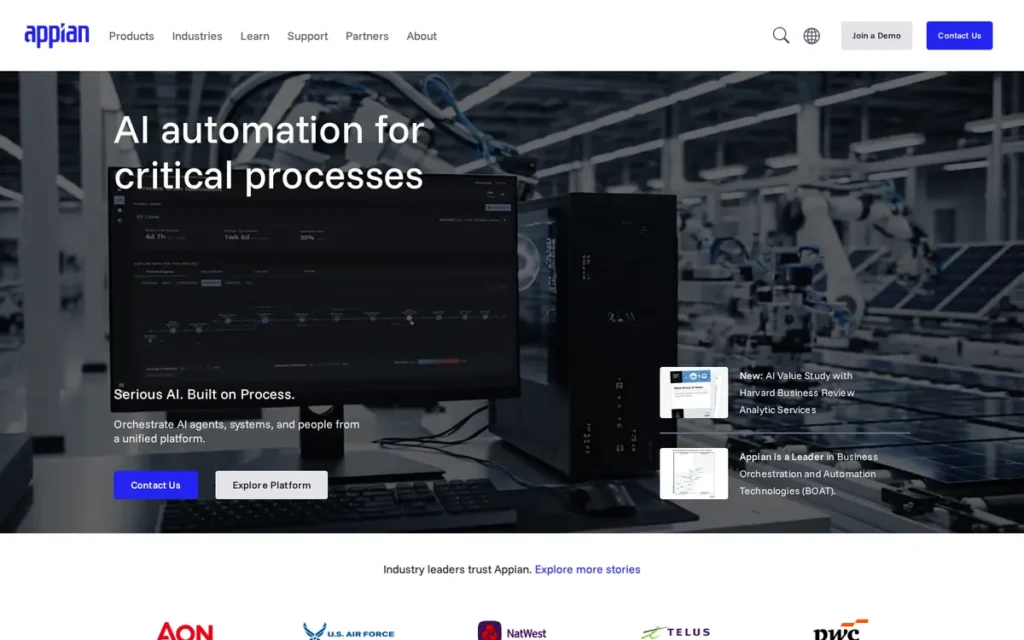
Category: BPM-Embedded Monitor, monitors business processes and operational KPIs executing within the Appian platform itself, augmented by Data Fabric connections to external enterprise data sources for unified operational visibility.
At a Glance
- Category: BPM-Embedded Monitor
- Best For: Enterprises in government, financial services, healthcare, and insurance that need integrated process automation and native business activity monitoring in a single compliance-grade, private-AI platform
- Price Range: ~$75/user/month (Standard-tier full users, community-sourced estimate, unverified by Appian sales); ~$10/user/month for input-only users (community-sourced estimate); Enterprise tier on request
- Primary Strength: Appian is the only platform in this evaluation holding the inaugural 2025 Gartner Magic Quadrant Leader designation in Business Orchestration and Automation Technologies with a private AI architecture purpose-built for regulated-industry compliance
- Biggest Limitation: Appian’s proprietary SAIL UI framework requires specialist developer training that extends implementation timelines and creates long-term dependency on Appian-credentialed developers for monitoring dashboard maintenance
- One-Line Summary: Appian is a 25-year-proven, inaugural 2025 Gartner BOAT Magic Quadrant Leader that embeds real-time process monitoring natively within its low-code BPM platform, with a private AI architecture and FedRAMP-eligible infrastructure designed for government, financial services, and healthcare compliance requirements.
- Last Verified: June 2026
Overview
Appian is a low-code business process management and monitoring platform for enterprises (particularly government, financial services, and healthcare organizations) that need to monitor, automate, and govern complex workflows in a single environment with private AI and compliance-grade security.
Appian’s process KPI dashboards, introduced as drag-and-drop widgets in the Appian 25.1 release (2025), are embedded directly in the BPM execution layer rather than bolted on from a separate observability tool. Appian’s Data Fabric connects to up to 10 million rows per record type from external ERP, CRM, and operational systems. A Designer Monitor view surfaces runtime and design-time application health indicators in real time.
Appian holds the inaugural 2025 Gartner Magic Quadrant Leader designation in Business Orchestration and Automation Technologies (BOAT) (the most directly relevant analyst category for integrated BAM+BPM platforms) confirmed via Appian’s official press release (October 24, 2025) and PR Newswire (October 24, 2025).
Appian has operated continuously since its 1999 founding, trading publicly on NASDAQ (APPN since 2017) with approximately 1,800 employees globally. Appian’s primary enterprise deployment base spans government agencies, defense organizations, financial services, insurance, and regulated industries where private AI compliance and audit-grade process trails are non-negotiable procurement requirements.
Key Features
- Designer Monitor View: Appian’s Designer Monitor view provides real-time health indicators for deployed process applications, surfacing both design-time configuration issues and runtime execution anomalies in live dashboards without requiring a separate observability layer outside the Appian platform.
- Data Fabric (10M Rows Per Record Type): Appian Data Fabric, introduced in the Appian 25.1 release (2025), enables real-time unified operational data visibility by syncing up to 10 million rows per record type from external ERP, CRM, and operational systems, eliminating the need for a separate data warehouse or ETL pipeline before operational KPI monitoring begins.
- AI Copilot for Monitoring Acceleration: Appian AI Copilot uses natural-language inputs to accelerate process application and monitoring dashboard development, enabling business analysts to generate and iterate on process monitoring configurations without writing SAIL code from scratch, documented in the Appian 25.1 platform release (2025).
- Private AI Architecture: Appian’s private AI architecture keeps all enterprise data within the organization’s controlled environment with no exposure to public AI training datasets, a non-negotiable compliance requirement for FedRAMP-eligible government deployments and HIPAA-sensitive healthcare workflow monitoring (Appian AI capabilities page, June 2026).
- Drag-and-Drop Process KPI Dashboard Widgets: Appian’s drag-and-drop process KPI widgets, introduced in Appian 25.1 (2025), allow operations managers to build centralized business performance monitoring views linked directly to live process execution data without requiring specialized Appian engineering support for baseline dashboard configuration.
Best For
Appian is best for enterprise organizations in government, defense, financial services, insurance, and healthcare that need native process monitoring embedded in the same platform orchestrating their business workflows, particularly buyers with private AI compliance requirements, FedRAMP eligibility needs, complex case management with integrated BAM, and the organizational capacity to invest in SAIL development expertise for sustained platform leverage.
Pricing
Appian does not publish a comprehensive price list. Community-sourced estimates and marketplace references (as of June 2026) indicate approximately $75 per user per month for Standard-tier full users and approximately $10 per user per month for input-only users.
These figures are community-sourced estimates unverified by Appian’s sales team. Enterprise-tier features (private AI, dedicated infrastructure, and advanced analytics) are bundled into Enterprise-tier negotiations rather than self-serve plans, meaning mid-market buyers who evaluate at Standard-tier pricing often discover compliance requirements push them into a more expensive tier.
An enterprise deploying Appian to 500 full users at the community-estimated $75/month rate faces approximately $450,000 per year in software licensing alone, before implementation services, integration engineering, and SAIL developer training costs. Readers should request a direct custom quote from Appian sales. Verify current pricing at appian.com. All pricing references: June 2026.
Strengths
- Inaugural 2025 Gartner BOAT Magic Quadrant Leader: Appian holds the Leader designation in the inaugural 2025 Gartner Magic Quadrant for Business Orchestration and Automation Technologies (BOAT) (the most directly relevant analyst category for integrated BAM+BPM platforms) making Appian the only platform in this evaluation with analyst-firm leadership recognition specifically covering business process monitoring and automation (Appian press release, October 24, 2025; PR Newswire, October 24, 2025).
- Hitachi 60% Decision-Making Improvement (Vendor-Reported): Appian’s Hitachi Data Fabric deployment produced a vendor-reported 60% improvement in AI-driven decision-making, according to Appian 2025 World event materials (an Appian-hosted conference presentation, not independently audited) demonstrating the scale of operational intelligence outcomes reported at large-enterprise Appian deployments.
- 25-Year Enterprise Track Record: Appian has been automating and monitoring enterprise processes for 25 years (founded 1999, public on NASDAQ as APPN since 2017) providing the longest verified enterprise deployment track record of any platform in this evaluation, with documented use in government agencies and regulated industries that demand multi-decade vendor reliability.
- Private AI Architecture for Regulated Industries: Appian’s private AI keeps all enterprise data within the organization’s controlled infrastructure with no exposure to public AI training data (Appian AI capabilities page, June 2026), directly addressing the compliance and data sovereignty requirements of federal government, defense, and regulated healthcare and financial services organizations.
Limitations
- SAIL Framework Dependency: Appian’s most consequential trade-off is its proprietary SAIL (Structured Application Interface Language) UI framework, all Appian monitoring dashboards are built in SAIL rather than standard HTML, CSS, or JavaScript, requiring specialized platform training before development teams can build production-grade BAM configurations and creating long-term dependency on Appian-credentialed developers that extends initial implementation timelines beyond typical buyer expectations.
Users on r/Appian described the real-world development gap between Appian’s “low code” positioning and actual project demands:
“I completed a rotation at my workplace as an Appian developer and had to sit for the associate certification exam. It was straightforward. After that, I began working on our applications, and everything turned out to be ‘all code’ even though they were labeled ‘low code.’ The course barely covered APIs and integrations. I managed to work it out, but I was frustrated by how unprepared I felt for real-world Appian development.” Posted by u/worldthroughmywindow
Takeaway: Appian’s “low code” positioning creates a material expectation gap for enterprise developers who discover that production-grade BAM configurations require significantly more code-level expertise than Appian’s certification curriculum prepares them for.
- Cost Architecture and Tier Escalation: Appian’s per-user pricing at the community-estimated ~$75/user/month for full users means an enterprise deploying 500 users faces approximately $450,000/year in licensing before SAIL development, implementation services, and integration costs, and mid-market buyers who evaluate at Standard-tier pricing often discover that compliance requirements (private AI, dedicated infrastructure) push them into Enterprise-tier negotiations, creating post-evaluation cost surprises that should be modeled before procurement (G2 Appian reviews, community-sourced, June 2026).
- Developer Talent Signal: Community discussions in the r/Appian community (thread title identified via Perplexity, June 2026) surface consistent developer concern about SAIL’s proprietary nature limiting career portability, a talent availability signal organizations should factor explicitly into their Appian staffing model before committing to SAIL as a long-term BAM development framework.
Verdict
Appian is the best-validated enterprise BAM platform for regulated industries in this 2026 evaluation, distinguished by its inaugural 2025 Gartner BOAT Magic Quadrant Leader designation and 25 years of large-scale deployments in government, financial services, and healthcare.
Appian ranks above Celonis (which delivers deeper SAP process intelligence) because the inaugural Gartner BOAT Leader designation applies across the broadest regulated-industry audience, Appian’s 25-year compliance track record is unmatched in this evaluation, and Appian’s deployment feasibility extends beyond SAP-heavy environments to the full target audience of IT managers at SMBs through mid-large enterprises.
Appian’s embedded approach gives operations teams real-time process visibility without managing two separate platform licenses, and its Data Fabric layer brings external ERP and CRM data into the same monitoring environment without a separate data warehouse investment.
Organizations that need the deepest compliance posture, FedRAMP eligibility, and a unified BPM+BAM+AI investment will find Appian the strongest overall offering in the 2026 market, provided they plan explicitly for SAIL development resourcing and model total cost of ownership at realistic deployment scale.
2. Celonis: Best for Enterprise Process Intelligence in SAP-Heavy Environments
Category: Process Intelligence Platform, reconstructs actual business process execution from ERP and enterprise system event logs in real time, identifies bottlenecks and deviations from designed process flows, and triggers automated process remediation via the Action Engine across SAP, Salesforce, ServiceNow, and Oracle environments.
At a Glance
- Category: Process Intelligence Platform
- Best For: Large enterprises running SAP, Salesforce, or ServiceNow that need real-time visibility into how their operational processes actually execute (not how they were designed) and the ability to trigger automated process improvements at scale across supply chain, finance, and customer service workflows
- Price Range: Pricing on request; $100,000–$1,000,000+/year for enterprise deployments (community-sourced directional estimate, unverified by Celonis; verify with sales)
- Primary Strength: Celonis delivers first-to-market Object-Centric Process Mining via Process Sphere, with approximately 322 G2 reviews (~4.6/5, partially confirmed, June 2026) (the highest review count in this evaluation) an Action Engine that automates process remediation rather than only diagnosing problems, and 300+ pre-built connectors to SAP and major enterprise systems
- Biggest Limitation: Celonis requires a minimum 3–6 month implementation in SAP-heavy environments and annual licensing starting at a community-estimated $100,000, making it inaccessible for mid-market organizations and those without mature SAP data operations or dedicated process mining expertise
- One-Line Summary: Celonis is the highest-reviewed process intelligence platform in this evaluation (approximately 322 G2 reviews, ~4.6/5, partially confirmed) that mines real-time execution data from ERP and enterprise systems, detects process deviations with Object-Centric Process Mining, and triggers automated remediation through its Action Engine.
- Last Verified: June 2026
Overview
Celonis is a process intelligence platform for large enterprises (especially those running SAP, Salesforce, or ServiceNow) that need to see how their operational processes actually execute across systems (not how they were designed), identify bottlenecks in real time, and trigger automated process improvements through a connected Action Engine.
Celonis’s core technology extracts event-log data from transactional systems to create a real-time digital twin of actual process execution. Object-Centric Process Mining (first-to-market, introduced with Process Sphere, SiliconAngle, November 2025) enables multi-object cross-ERP analysis that traditional single-case BAM tools cannot model.
Celonis serves 1,400+ enterprise customers globally and has accumulated approximately 322 verified reviews on G2 with a rating of approximately 4.6/5 (partially confirmed via independent search, June 2026), the highest review count in this evaluation. Celonis provides 300+ pre-built connectors to SAP, Salesforce, ServiceNow, and Oracle environments.
The Celonis Action Engine triggers automated remediation when process exceptions are detected via native ERP adapters, RPA tools, and workflow automation, moving Celonis from passive monitoring into active process execution management.
Key Features
- Real-Time Process Intelligence Graph: Celonis’s Process Intelligence Graph provides continuous in-flight process observability (monitoring processes as they execute rather than reconstructing history from completed event logs) enabling operations directors to see what is happening in business processes right now, not what happened last quarter.
- Object-Centric Process Mining (OCPM): Celonis Object-Centric Process Mining, available through Process Sphere (first-to-market, SiliconAngle, November 2025), allows a single business event to be analyzed in relation to multiple objects simultaneously, providing cross-object visibility into how SAP purchase orders interact with vendors, invoices, materials, and payment terms that traditional single-case BAM tools cannot model.
- Action Engine for Automated Remediation: Celonis Action Engine moves the platform from passive monitoring to active process intervention by triggering automated remediation via native ERP adapters, RPA tools, and workflow automation when process exceptions exceed defined thresholds, eliminating manual escalation workflows and reducing process-to-resolution time (Celonis EMS announcement).
- 300+ Pre-Built Enterprise Connectors: Celonis provides 300+ pre-built connectors to SAP, Salesforce, ServiceNow, Oracle, and Microsoft enterprise systems, reducing the custom integration engineering burden consistently cited as the most common barrier to BAM deployment at enterprise scale and shortening the initial data extraction phase of implementation.
- Execution Management System (EMS): Celonis’s Execution Management System integrates analytics, strategy planning, automated action flows, and human-in-the-loop task routing in a single platform (Celonis EMS announcement), moving beyond diagnostic dashboards into full process execution management and cross-functional process governance.
Best For
Celonis is best for large enterprises with SAP-heavy ERP environments, mature data operations teams, and active process transformation mandates in supply chain, finance, or customer service operations, where the investment in a 3–6 month minimum implementation and six-figure annual licensing is justified by the demonstrable scale of process inefficiency and the value of real-time automated cross-system process remediation.
Pricing
Celonis does not publish pricing. Community sources and analyst-level discussions (as of June 2026) consistently position Celonis in the $100,000–$1,000,000+ per year range for meaningful enterprise deployments, with pricing varying by deployment scope, module count, data volume, and connector usage.
These are directional estimates from community sources (not vendor-published figures) and must be independently verified with Celonis sales through a custom quote and scenario-based cost model.
Celonis implementation services add significantly to total cost of ownership beyond licensing. SAP-heavy Celonis deployments typically require a minimum 3–6 months before monitoring value is realized, encompassing data extraction infrastructure, object-centric modeling, and change management. Verify current pricing directly with Celonis at celonis.com. All pricing references: June 2026.
Strengths
- Highest Review Volume in This Evaluation (~322 G2 Reviews, ~4.6/5): Celonis has accumulated approximately 322 verified reviews on G2 with a rating of approximately 4.6/5 (partially confirmed via independent search, June 2026) (the highest review volume of any platform in this evaluation) providing the strongest community validation signal and indicating the broadest base of actively engaged enterprise users willing to share comparative feedback.
- Object-Centric Process Mining (First-to-Market): Celonis introduced Object-Centric Process Mining as the first vendor to allow one event to relate to multiple business objects simultaneously (Celonis OCPM blog, 2024; SiliconAngle, November 2025), closing the analytical blind spot in SAP and ERP environments where a single transaction affects dozens of interconnected objects that traditional case-centric BAM tools could not model.
- Action Engine Enables Automated Process Remediation: Celonis Action Engine triggers corrective actions through native ERP adapters and RPA integrations when process exceptions are detected (Celonis EMS announcement), a meaningful evolution beyond the dashboard-reporting model of legacy BAM platforms into genuine process execution management.
- 1,400+ Enterprise Customers Globally: Celonis serves 1,400+ enterprise customers globally (celonis.com, June 2026), including documented deployments in financial services, manufacturing, retail, and logistics, providing prospective buyers with a large reference pool of peer organizations that can validate implementation outcomes in comparable industries.
This aligns with practitioner sentiment on r/processmining:
“Based on my experience, I haven’t encountered any significant drawbacks with Celonis, apart from clients considering it pricey and opting for less effective alternatives. In my opinion, Celonis serves as a comprehensive solution for process mining. It integrates ETL and frontend visualizations in a single platform, features a dedicated query language for process-related inquiries, and the forthcoming AI functionalities look promising as well!” Posted by u/ICEM4N_05
Takeaway: Direct Celonis practitioners describe it as a technically comprehensive process mining platform where price, not capability, is the limiting factor for broader adoption.
Limitations
- Cost and Implementation Complexity: Celonis’s most consequential trade-off is the collision of high cost with long implementation timelines, before any monitoring value is realized, organizations must invest in data extraction infrastructure, object-centric data modeling for their ERP landscape, and change management across disconnected systems, typically 3–6 months minimum in SAP-heavy environments with annual licensing starting at a community-estimated $100,000+ that can scale to seven figures.
Users on r/processmining noted:
“If you look at tools like Celonis they require a tremendous amount of manual work to realize value. It’s extremely expensive and takes a tremendous amount of manual work to make sense of the output.” Posted by u/etcetera0
Takeaway: Enterprise practitioners consistently flag Celonis’s cost-plus-effort double barrier, the platform is expensive to license and demands sustained manual engineering investment before monitoring intelligence becomes actionable.
- Non-SAP Environment Disadvantage: Celonis is disproportionately difficult and expensive for mid-market organizations, non-SAP environments, and teams without dedicated process mining expertise or data engineering resources, the platform’s return on investment is substantially harder to justify when the organization lacks the SAP infrastructure and operational maturity Celonis was built to analyze (Decisions.com Celonis alternatives analysis).
- Top-Down Mandate Risk: Community patterns identified via Reddit r/processmining (thread title identified via Perplexity, June 2026) document a top-down rollout dynamic where Celonis is mandated at the executive level but received skeptically by practitioners responsible for implementation, extending the time-to-value horizon beyond the platform’s technical capabilities when organizational change management is insufficient.
Verdict
Celonis is the most technically advanced SAP-and-ERP-focused process intelligence platform in this 2026 evaluation, the correct choice for SAP-heavy enterprises that can absorb a 3–6 month implementation and six-figure annual investment in exchange for the deepest operational process visibility available, including real-time Object-Centric Process Mining, automated remediation via the Action Engine, and approximately 322 G2 reviews (~4.6/5, partially confirmed) representing the highest community validation in this set.
Celonis ranks #2 rather than #1 because its cost and implementation complexity restrict applicability to a narrow segment of the target audience. Organizations without SAP infrastructure, mid-market budgets, or mature data engineering teams should evaluate Appian, Splunk, or Quantive StrategyAI before committing to the Celonis sales process.
For enterprises that fit the SAP-heavy, process-transformation use case, Celonis delivers process intelligence capabilities no other platform in this evaluation can match at the same depth.
3. Splunk: Best for IT-Adjacent Business Monitoring in Organizations with Existing Splunk Infrastructure
Category: Operational Analytics Platform, ingests machine-generated data (logs, metrics, traces, events) from across the enterprise IT stack and enables custom business activity monitoring through search, correlation, and visualization using its Search Processing Language (SPL) engine, now integrated within Cisco’s security and observability portfolio.
At a Glance
- Category: Operational Analytics Platform
- Best For: Organizations with existing Splunk deployments and IT engineering teams experienced with SPL who want to extend their current monitoring investment into business-level KPI dashboards and IT-adjacent process visibility without purchasing a separate BAM platform
- Price Range: Ingest-based pricing ($/GB/day for Splunk Cloud); no published universal list price; community references suggest list pricing starting around $150–$200/GB/day for some Splunk Cloud tiers before enterprise negotiation (community-sourced estimate, June 2026); costs scale with data volume
- Primary Strength: Splunk provides the most flexible operational data platform in this evaluation (enabling IT and security teams to build custom BAM dashboards across any machine data source using SPL) now backed by Cisco’s $28 billion acquisition completed in March 2024 and global infrastructure network
- Biggest Limitation: Splunk’s ingest-based pricing model creates unpredictable costs that community sources consistently report inflate 3–5x from initial estimates as more event sources are connected for BAM, the exact expansion that BAM deployments are designed to pursue
- One-Line Summary: Splunk, now part of Cisco following a $28 billion acquisition completed in March 2024, is an enterprise operational analytics platform that enables custom business activity monitoring through its Search Processing Language across any machine data source (with a customer-reported 94% MTTR reduction cited in vendor product materials) most appropriate for organizations already using Splunk infrastructure.
- Last Verified: June 2026
Overview
Splunk is an enterprise operational analytics and observability platform, now part of Cisco following a $28 billion acquisition completed in March 2024, that allows IT and security teams to ingest machine data from across their infrastructure and build custom business activity monitoring dashboards using its Search Processing Language (SPL) engine.
Splunk’s BAM-relevant capabilities include SPL for ad-hoc operational analysis without predetermined schema, IT Service Intelligence (ITSI) for service-level health monitoring, a Machine Learning Toolkit (MLTK) for ML-powered anomaly detection, and dynamic-threshold alerting. Splunk product pages cite a customer-reported 94% MTTR reduction in a vendor-selected testimonial from Splunk On-Call materials (Splunk product pages, June 2026; not independently audited).
Splunk is most cost-effective as a BAM platform for organizations already using Splunk for security or IT operations, where extending to business monitoring leverages existing investment. Organizations without existing Splunk infrastructure should compare total cost of ownership against purpose-built BAM alternatives, factoring in SPL engineering resource requirements and the documented 3–5x ingest-cost inflation as monitoring coverage expands.
Key Features
- Search Processing Language (SPL): Splunk’s SPL enables analysts to search, transform, and correlate machine data from any source without predetermined schema requirements, providing the most flexible custom BAM dashboard-building capability of any platform in this evaluation for organizations with SPL-experienced IT engineering teams.
- IT Service Intelligence (ITSI): Splunk ITSI provides service-level health monitoring with multi-level KPI trees, adaptive threshold alerting, and correlation of IT performance events with business-impact indicators (Splunk infrastructure monitoring features), enabling IT-adjacent BAM use cases across SLA management, API health monitoring, and service availability tracking.
- Machine Learning Toolkit (MLTK): Splunk MLTK enables ML-powered anomaly detection and custom predictive analytics that surface operational deviations before fixed thresholds are breached, a proactive BAM capability particularly relevant for fraud pattern detection and supply chain disruption alerting where threshold-based monitoring alone is insufficient.
- Splunk Observability Cloud: Splunk Observability Cloud provides full-stack visibility from infrastructure performance to user experience outcomes (Aziro Splunk Observability analysis), enabling organizations to correlate infrastructure-layer events with business-level KPI impacts in a single monitoring interface.
- Customer-Reported MTTR Reduction: Splunk On-Call product materials cite a customer-reported mean time to acknowledge dropping from four hours to under two minutes (a vendor-selected testimonial documented on Splunk’s product pages (June 2026; not independently audited)) demonstrating the potential operational responsiveness improvement for teams monitoring business-impacting events when SPL expertise is available.
Best For
Splunk is best for organizations that already have Splunk deployed for security or IT operations and want to extend that existing infrastructure investment into business activity monitoring without a separate BAM platform procurement, particularly IT engineering teams and DevOps organizations experienced with SPL who need to monitor IT-adjacent business processes such as SLA compliance, API transaction health, and e-commerce event streams.
Pricing
Splunk does not publish universal pricing. The platform uses an ingest-based model ($/GB of data ingested per day) for Splunk Cloud, with on-premises licensing available as workload-based or CPU-based. Community sources (as of June 2026) reference Splunk Cloud list pricing in the range of $150–$200/GB/day for some configurations before enterprise negotiation, these are community-sourced estimates, not vendor-published figures.
A critical cost warning specifically for Splunk BAM buyers: community sources and practitioner discussions consistently document 3–5x Splunk cost inflation from initial deployment estimates as additional data sources are connected for business monitoring, the exact expansion BAM deployments are designed to pursue. Demand scenario-based cost modeling from Splunk sales covering projected data ingestion volumes at 1x, 3x, and 10x growth before committing to any ingest-based contract.
Community discussions in r/Splunk (thread identified via Perplexity, June 2026) confirm cost/value tension is the dominant ongoing discussion topic among Splunk practitioners. Verify current pricing at splunk.com. All pricing references: June 2026.
Strengths
- Cisco-Backed Vendor Stability ($28B Acquisition, March 2024): Splunk’s Cisco acquisition, completed March 2024 for approximately $28 billion, one of the largest enterprise software acquisitions in history (Cisco Splunk platform materials), provides the strongest individual vendor stability backing of any platform in this evaluation, with Cisco’s 40,000+ global channel partners and combined security, network, and observability portfolio supporting Splunk’s long-term development.
- Customer-Reported 94% MTTR Reduction (Vendor-Selected Testimonial): Splunk On-Call product pages document a customer-reported 94% mean-time-to-acknowledge reduction (from four hours to under two minutes over three years (Splunk product pages, June 2026; vendor-selected testimonial, not independently audited)) indicating the platform’s capacity to accelerate operational responsiveness for teams with the SPL expertise to build and maintain business monitoring dashboards.
- Broadest Cross-Category Review Coverage: Splunk maintains G2 ratings of 4.3–4.5/5.0 across multiple product categories (Security Information and Event Management, IT Operations, and Log Monitoring) with thousands of reviews, providing the largest available base of peer evidence for IT-adjacent operational monitoring use cases of any platform in this evaluation.
Users on r/Splunk shared their assessment of Splunk’s value relative to its cost:
“Splunk is expensive, but it solves expensive problems. I personally think it is the best SIEM in the market right now.” Posted by u/Adventurous-Lion-116
Takeaway: Splunk practitioners who defend its premium cost do so on the basis of operational problem-solving capability, reinforcing the article’s assessment that Splunk is defensible only for organizations with high-stakes monitoring needs and the SPL expertise to extract full platform value.
- ML-Powered Anomaly Detection: Splunk’s Machine Learning Toolkit (MLTK) provides documented ML-powered anomaly detection and pattern recognition for proactive BAM use cases, enabling organizations to surface emerging operational deviations before fixed thresholds are breached for teams with the technical resources to configure custom ML models.
Limitations
- Ingest-Based Pricing Scales Against BAM Expansion: Splunk’s most consequential trade-off is the collision between its ingest-based pricing model and the natural behavior of BAM deployments, connecting more data sources for broader monitoring coverage increases Splunk’s data ingestion volume and cost, creating a scaling penalty that is the inverse of what BAM buyers intend, with community sources documenting consistent 3–5x cost inflation from initial estimates as organizations onboard additional event sources (r/Splunk, identified via Perplexity, June 2026).
- SPL Requires Technical Specialists: Splunk’s Search Processing Language requires IT engineering expertise to build and maintain meaningful BAM dashboards, business analysts and operations directors typically cannot self-serve process monitoring using SPL without dedicated Splunk engineering resources, creating organizational dependency on technical specialists rather than enabling the self-service monitoring that most BAM buyers intend to achieve.
- Primary Market Position Is Not BAM: Splunk’s Gartner leadership designation is in SIEM and Observability (not in BAM or Business Orchestration) meaning buyers using Splunk for business process monitoring are operating the platform outside its primary analyst-recognized use case, without dedicated BAM-specific product development roadmap commitments comparable to Appian or Celonis.
Verdict
Splunk is the right BAM choice for organizations that already have Splunk deployed and have IT engineering teams experienced with SPL, in this context, extending Splunk to BAM use cases leverages existing infrastructure investment and is backed by Cisco’s exceptional vendor stability.
For organizations without existing Splunk infrastructure, the combination of ingest-based pricing with documented 3–5x scaling inflation, SPL expertise requirements for business-level dashboard configuration, and primary positioning in SIEM and Observability rather than BAM makes Splunk a less efficient first-choice BAM investment compared to Appian, Celonis, or Quantive StrategyAI.
Splunk’s Cisco-backed stability and ML anomaly detection capabilities are genuine strengths, the key evaluation question for BAM buyers is whether those strengths justify the cost and technical complexity premium when purpose-built alternatives exist.
4. IBM MQ: Best Messaging Backbone for Financial Transaction Event Integrity Underpinning BAM Architecture
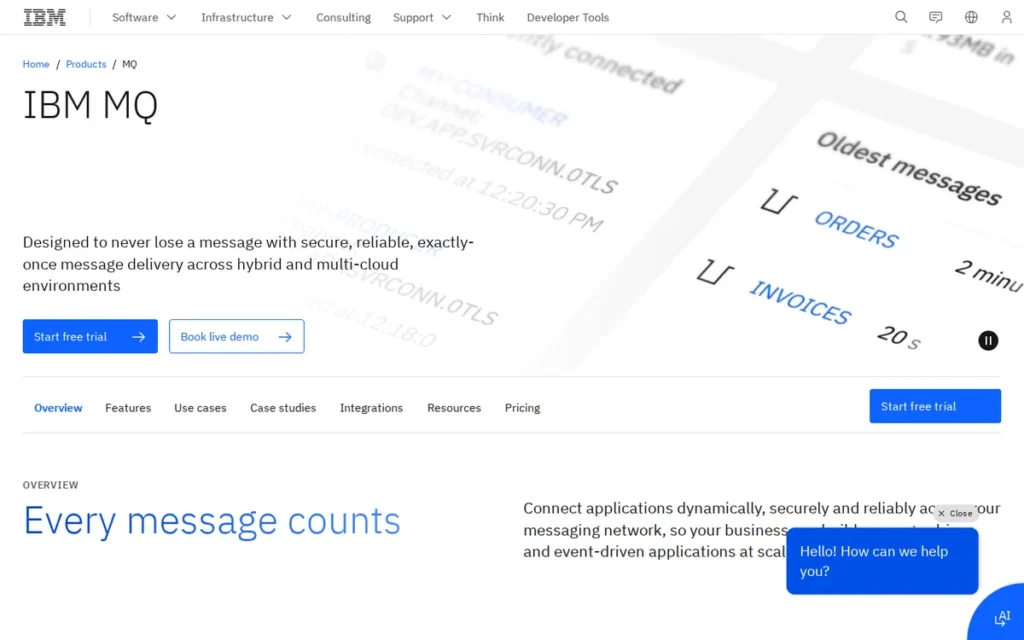
Category: Messaging Backbone, provides guaranteed exactly-once transactional event transport between enterprise applications, with queue depth monitoring, channel state visibility, and operational event generation feeding higher-level BAM dashboards; IBM MQ is the foundational infrastructure layer of a complete BAM architecture, not a standalone BAM dashboard.
At a Glance
- Category: Messaging Backbone
- Best For: Banking, insurance, payments, and telecommunications organizations needing guaranteed exactly-once transactional event delivery and messaging infrastructure integrity as the foundational layer underpinning their business activity monitoring architecture
- Price Range: Pricing on request; estimated $10,000–$50,000+ for on-premises enterprise deployments based on processor/PVU licensing (community-sourced directional estimate, not published by IBM); IBM MQ on IBM Cloud available under pay-as-you-go consumption pricing
- Primary Strength: IBM MQ holds the highest PeerSpot mindshare in the Business Activity Monitoring category (19.3%, rated 8.6/10) and guarantees exactly-once message delivery, the critical differentiator for financial services transaction monitoring where duplicate or missing events create regulatory exposure and false operational alerts
- Biggest Limitation: IBM MQ is messaging infrastructure, not a complete BAM solution, IBM MQ monitors its own queue and channel health and guarantees event transport, but requires a separate dashboarding or analytics platform to deliver the business-level KPI visibility and process performance monitoring that most BAM buyers expect as a primary deliverable
- One-Line Summary: IBM MQ is the highest-mindshare platform in PeerSpot’s Business Activity Monitoring category (19.3%, rated 8.6/10) that provides guaranteed exactly-once message delivery and 30+ years of proven transactional reliability for banking, insurance, and financial services organizations, serving as the event transport backbone rather than a standalone BAM dashboard platform.
- Last Verified: June 2026
Overview
IBM MQ is an enterprise messaging middleware platform, holding the highest mindshare in PeerSpot’s Business Activity Monitoring category (19.3%, rated 8.6/10, June 2026) and providing guaranteed exactly-once message delivery for banking, insurance, and telecommunications organizations that need mission-critical transactional event transport as the infrastructure backbone for business activity monitoring.
IBM MQ originated as MQSeries in 1993, making it the most battle-tested messaging platform in this evaluation by more than three decades. IBM MQ is the infrastructure layer that reliably transports business events between applications, monitors queue depth, put/get rates, channel state, and latency, and generates operational events for downstream BAM dashboards, IBM MQ is not a standalone BAM visualization platform and requires an additional analytics or dashboarding layer to deliver business-level process visibility.
Think of IBM MQ as the plumbing behind the wall, without it, no water reaches the tap, but standing in front of IBM MQ alone does not show you where the water is going or how much is flowing. A second platform (IBM Event Streams, Splunk, or a custom dashboarding layer) is the faucet that makes the flow visible.
IBM MQ is most relevant for organizations processing millions of financial transactions daily in banking, payment processing, and insurance, where exactly-once delivery guarantees and Native High Availability prevent the duplicate or missing events that would trigger false BAM alerts or regulatory violations. IBM MQ supports AMQP, MQTT, REST, and JMS protocols and integrates natively with IBM Cloud Pak for Integration (Wikipedia: IBM MQ).
Key Features
- Exactly-Once Message Delivery: IBM MQ guarantees exactly-once message delivery using persistent storage and transactional integrity, preventing message loss or duplication even during application or network failures (IBM MQ product page), which is the foundational requirement for financial transaction BAM where duplicate event processing triggers false operational alerts, double-counted KPIs, or regulatory compliance violations.
- Native High Availability and Cross-Region Replication: IBM MQ supports Native HA and Cross-Region Replication (CRR) for zero data-loss failover across public cloud, private cloud, and on-premises environments (CQSA IBM MQ documentation), enabling BAM infrastructure to maintain continuous monitoring availability during regional outages without manual intervention or data loss.
- Operational Event Generation for BAM Feeds: IBM MQ generates real-time operational events (queue full, channel stopped, authority failures, latency threshold breaches) that feed downstream BAM dashboards and alerting systems, providing the event stream that operational monitoring platforms consume for business-level process visibility and exception alerting.
- Multi-Protocol Support (AMQP, MQTT, REST, JMS): IBM MQ integrates natively with IBM Cloud Pak for Integration as a unified messaging backbone supporting AMQP, MQTT, REST, and JMS protocols (Wikipedia: IBM MQ), enabling organizations to connect disparate business applications across heterogeneous hybrid-cloud and on-premises environments through a single guaranteed-delivery messaging layer.
- Enterprise-Scale: 300+ Instance Deployments Documented: IBM MQ estates in banking environments are documented at 300+ active instances processing millions of messages and transactions daily (customer review, CQSA IBM MQ documentation, 2025), confirming the platform’s proven horizontal scalability for the large-volume BAM infrastructure deployments common in financial services and telecommunications.
Best For
IBM MQ is best for banking, insurance, payments, and telecommunications organizations that need guaranteed exactly-once transactional event delivery as the infrastructure backbone for business activity monitoring, particularly organizations with existing IBM middleware architecture, integration engineering expertise, and BAM requirements where exactly-once delivery guarantees and Native HA are non-negotiable rather than optional features.
Pricing
IBM MQ does not publish a universal list price. The platform uses a processor-based licensing model (per Processor Value Unit/PVU) for on-premises deployments, with IBM MQ Advanced required as a separate licensing tier for enterprise HA, cross-region replication, and advanced security features. Community sources and market estimates (as of June 2026) cite directional ranges of $10,000–$50,000+ for enterprise on-premises deployments depending on core count, tier, and support level.
IBM MQ on IBM Cloud is available under pay-as-you-go consumption pricing (IBM MQ pricing page). All pricing figures are community-sourced estimates unverified by IBM sales, readers should request complete scenario-based pricing from IBM covering both base MQ licensing and IBM MQ Advanced tier requirements.
Critical caution for IBM MQ BAM buyers: Organizations using IBM MQ for BAM purposes must also budget for a separate visualization or analytics platform on top of MQ licensing. Common options include Splunk (ingest-based, see Splunk entry for pricing guidance), IBM Event Streams (IBM Cloud subscription pricing), and Grafana open-source. Organizations should model this second-layer cost as an additional $15,000–$150,000+ annually depending on data volume and tool selection before finalizing the IBM MQ total cost of ownership comparison against standalone BAM alternatives. Verify current pricing at ibm.com/products/mq. All pricing references: June 2026.
Strengths
- Highest PeerSpot BAM Mindshare (19.3%, Rated 8.6/10): IBM MQ holds 19.3% mindshare in PeerSpot’s Business Activity Monitoring category (June 2026) (the highest of any product in the category) representing the frequency with which enterprise practitioners evaluate IBM MQ when researching BAM infrastructure, making it the most actively considered platform among enterprise technology peers.
- G2 4.3/5.0 with 159 Reviews and ‘Easiest to Use’ Designation: IBM MQ’s G2 rating of 4.3/5.0 with 159 verified reviews includes an “Easiest to Use” designation in the G2 BAM category (June 2026), with sub-scores of Quality of Support 8.3/10, Business Recovery 8.1/10, and Compliance 8.1/10, reflecting consistent practitioner satisfaction across the dimensions most relevant to mission-critical monitoring infrastructure in regulated industries.
- 30+ Year Enterprise Reliability Track Record: IBM MQ has maintained active enterprise deployment and continuous development since its introduction as MQSeries in 1993 (Wikipedia: IBM MQ), over 30 years of proven transactional messaging reliability in banking, insurance, and government back-office environments, representing the longest verified operational track record of any platform in this evaluation.
- Exactly-Once Delivery: Critical Technical Differentiator: IBM MQ’s exactly-once delivery guarantee differentiates it from both RabbitMQ (at-least-once) and Apache Kafka (at-least-once with acknowledgments) (Wikipedia: IBM MQ) for financial transaction monitoring use cases where duplicate event processing creates regulatory risk or double-counted BAM KPIs, a documented technical differentiator supported by independent messaging architecture comparison analyses.
Limitations
- Infrastructure Layer Only: Not a Standalone BAM Platform: IBM MQ’s most consequential trade-off is its fundamental nature as messaging infrastructure rather than a business activity monitoring platform, IBM MQ guarantees reliable event transport and monitors its own queue and channel health, but provides no business-level KPI dashboards, process execution visualization, or operational intelligence interfaces, meaning organizations must budget for a second platform to achieve the process visibility their stakeholders expect, adding cost, integration complexity, and additional failure points to the overall BAM architecture.
- Outdated Management Experience: Practitioner communities consistently report IBM MQ’s management console feels legacy relative to cloud-native monitoring tools (AvadaSoftware IBM MQ administration guide), with steep learning curves for IBM MQ’s proprietary MQI API compared to open-source messaging alternatives and configuration complexity in clustering concepts that modern cloud-native alternatives do not require.
- PVU Licensing Cost Scaling: IBM MQ’s processor-based (PVU) licensing model creates unexpected cost scaling as hardware environments expand, and the IBM MQ Advanced two-tier structure for enterprise HA and cross-region replication capabilities can create unplanned additional licensing costs that buyers should address directly with IBM sales before committing to IBM MQ as a BAM infrastructure foundation.
Verdict
IBM MQ is the technically correct choice for banking, insurance, and financial services organizations that need guaranteed exactly-once transactional event delivery as the infrastructure backbone for business activity monitoring, with the critical caveat that IBM MQ is one layer of a complete BAM stack, not a standalone BAM platform.
IBM MQ requires a separate visualization and analytics layer to deliver the operational dashboards stakeholders expect. For financial services buyers where exactly-once delivery guarantees and 30+ year operational reliability are non-negotiable, IBM MQ’s 19.3% PeerSpot BAM mindshare, G2 “Easiest to Use” designation, and IBM Corporation’s $15B+ software revenue make it the defensible infrastructure standard.
Organizations seeking a complete BAM dashboard solution (rather than the guaranteed event transport layer that feeds one) should evaluate Appian, Celonis, or Splunk alongside or instead of IBM MQ.
5. Quantive StrategyAI: Best for Strategy-Level BAM and the Only Transparent-Pricing Entry Point for SMBs
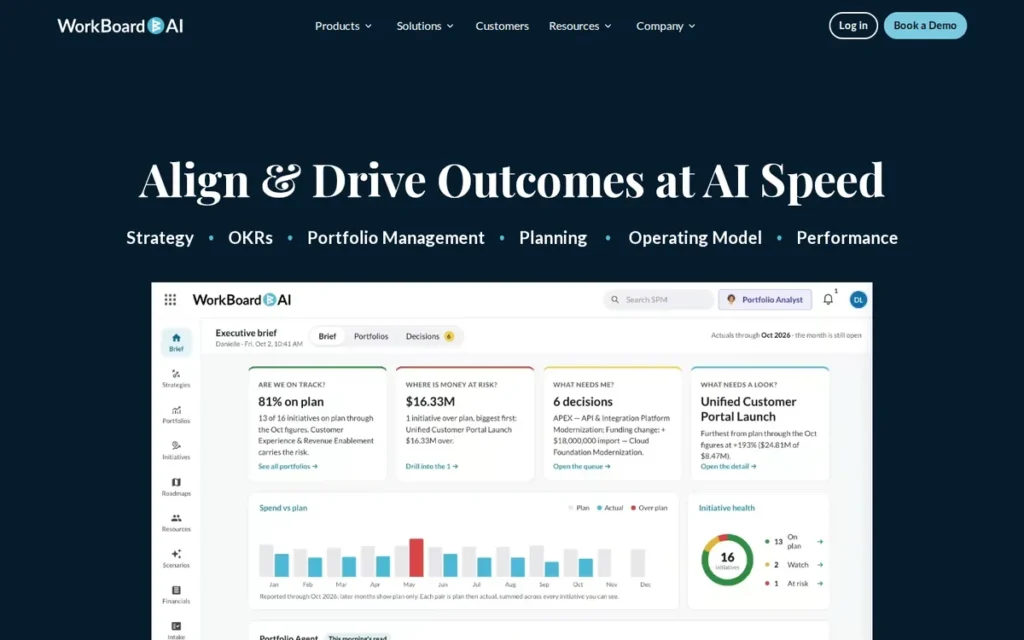
Category: Strategy Execution Monitor, tracks organizational OKRs, strategic KPIs, and business goal progress across connected data sources in real time, replacing periodic strategic review cycles with always-on monitoring of whether the business is executing against its defined strategy.
At a Glance
- Category: Strategy Execution Monitor (G2 subcategory: Agentic AI: Business Activity Monitoring, June 2026)
- Best For: SMBs, departmental teams, PMO offices, strategy executives, and OKR champions needing real-time KPI and goal-progress visibility across Salesforce, Jira, Slack, and 170+ other data sources, with published pricing, immediate self-service deployment, and no specialist implementation requirement
- Price Range: $9/user/month (Teams tier, published pricing, verified June 2026 via FitGap and UK Digital Marketplace); Business and Enterprise tiers pricing on request
- Primary Strength: Quantive StrategyAI is the only platform in this seven-platform evaluation with a published entry-level price ($9/user/month Teams tier, as of June 2026), the G2 “Highest Performer” designation specifically in the Business Activity Monitoring category, and self-service SaaS deployment that delivers monitoring value without specialist implementation resources
- Biggest Limitation: Quantive StrategyAI monitors strategic KPI performance and OKR execution (not transactional business events, message queue health, or process-execution workflows) making it the wrong tool for organizations that need to monitor individual transactions, BPEL process events, or sub-second event patterns rather than organizational goal progress
- One-Line Summary: Quantive StrategyAI is the G2 Highest Performer in the Business Activity Monitoring category and the only evaluated platform with published entry pricing at $9 per user per month, providing AI-powered strategic KPI monitoring and OKR execution tracking across 170+ integrations including Salesforce, Jira, and Slack.
- Last Verified: June 2026
Overview
Quantive StrategyAI is an AI-powered strategy execution and business activity monitoring platform, the only evaluated tool with a published entry price at $9 per user per month (FitGap, June 2026), that helps SMBs through enterprise teams track OKRs, KPIs, and strategic goal progress in real time across 170+ integrated data sources including Salesforce, Jira, Slack, and HubSpot.
Quantive StrategyAI’s “always-on strategy operating model” replaces quarterly strategic reviews with continuous KPI monitoring, automated check-in prompts, and AI-generated strategic recommendations using NLP-based OKR intelligence from its Wiser technology partnership (Wiser tech blog, 2024). The StrategyAI platform launched in February 2024 (BusinessWire) with AI embedded throughout strategic management as a standard feature rather than a premium add-on.
G2 classifies Quantive StrategyAI under the “Agentic AI (Business Activity Monitoring” subcategory as of June 2026) reflecting the platform’s AI-native architecture positioning in the evolving BAM landscape and improving discoverability for AI-adjacent BAM queries.
Quantive StrategyAI operates at the strategic business layer (organizational goals, team alignment, KPI tracking) rather than the operational transaction or process layer. Buyers who need to monitor individual transactions, BPEL workflows, or sub-second event patterns should evaluate Appian, Celonis, IBM MQ, or Progress Apama for those operational monitoring needs.
Key Features
- 170+ Pre-Built Integrations: Quantive StrategyAI’s 170+ pre-built integrations connect directly to Salesforce, Jira, Slack, HubSpot, and major HR and finance systems, enabling real-time KPI dashboards that aggregate business performance data across the organization’s existing tool stack without custom integration engineering or specialist implementation resources.
- AI-Powered OKR Refinement (Wiser Partnership): Quantive StrategyAI provides AI-powered OKR refinement and real-time NLP-based strategic recommendations through its Wiser technology partnership (Wiser tech blog, 2024), automatically suggesting goal adjustments and surfacing execution gaps when performance data signals strategy drift, reducing the manual analytical effort of traditional periodic strategic reviews.
- Automated Check-In Engine: Quantive StrategyAI’s automated check-in engine surfaces progress against OKRs and KPIs continuously, alerting strategy executives and operations directors when business performance deviates from defined targets without requiring manual data gathering, report generation, or scheduled review meetings.
- Published Entry Pricing ($9/User/Month Teams Tier): Quantive StrategyAI’s published $9/user/month Teams pricing enables immediate self-service onboarding without a sales cycle engagement, the fastest procurement-to-deployment path of any platform in this evaluation, making Quantive StrategyAI the only accessible BAM option for SMBs and departmental teams that cannot justify enterprise contract timelines.
- AI-Native February 2024 Platform Launch: Quantive StrategyAI launched in February 2024 as a next-generation AI-native strategy platform (BusinessWire, February 2024), one of the most recently refreshed offerings in this evaluation, with embedded AI throughout strategic management workflows as a standard included feature rather than a premium tier upgrade.
Best For
Quantive StrategyAI is best for SMBs, departmental teams, PMO offices, strategy executives, and OKR champions who need real-time visibility into whether the organization is executing against strategic goals, particularly teams in the 10–500 user range needing published, predictable pricing and immediate self-service deployment without a multi-month implementation project or specialist engineering resources.
Pricing
Quantive StrategyAI is the only platform in this evaluation with publicly published entry-level pricing. The Teams tier is verified at $9/user/month through FitGap pricing data and UK Government Digital Marketplace listings (June 2026). Business and Enterprise tiers are custom-quoted. The UK Digital Marketplace lists equivalent pricing at £9–£40 per user per month across service tiers.
This pricing transparency is Quantive StrategyAI’s most significant practical purchasing advantage, five of seven platforms in this evaluation require sales engagement before any pricing is disclosed.
For buyers with internal approval cycles that require a budget number before a demo can be scheduled (a common requirement in mid-size enterprises) Quantive StrategyAI’s $9/user/month is not just a price point; it is the only path to starting the procurement process without entering a vendor’s lead generation funnel. Readers should verify current pricing at quantive.com directly. All pricing references: June 2026.
Strengths
- G2 “Highest Performer” in BAM Category (Agentic AI Subcategory): Quantive StrategyAI holds the G2 “Highest Performer” designation specifically in the Business Activity Monitoring category, G2 now classifies Quantive StrategyAI under the “Agentic AI, Business Activity Monitoring” subcategory (G2 BAM category, June 2026), a rating reflecting above-average user satisfaction relative to market presence, indicating strong product quality and user experience among the platform’s current actively reviewing customer base.
- Only Published Entry Price in This Evaluation: Quantive StrategyAI’s published Teams pricing at $9/user/month makes it the most price-transparent BAM platform in this evaluation, five of the seven platforms ranked here require sales engagement before any pricing figure is available (FitGap, June 2026), making Quantive StrategyAI’s accessible published pricing a critical practical advantage for buyers who need fast internal budget approval without extended vendor sales cycles.
- AI-Native Platform Launched February 2024: Quantive StrategyAI’s StrategyAI platform, launched in February 2024 (BusinessWire), integrates AI throughout strategic management including NLP-based OKR recommendations via the Wiser technology partnership, positioning Quantive StrategyAI as one of the most AI-native platforms in this evaluation with documented AI integration at the core workflow level from platform launch.
- Fastest Time-to-Value Deployment: Quantive StrategyAI provides the fastest deployment path in this evaluation (SaaS-based self-service onboarding at the Teams tier requires no specialist implementation, no data extraction pipeline, no proprietary language training, and no certification requirement) enabling operational monitoring value within days rather than the weeks-to-months required by Appian, Celonis, or IBM MQ.
Limitations
- Strategic Layer Only: Not Operational or Transaction-Level BAM: Quantive StrategyAI’s most consequential trade-off is monitoring scope, the platform operates at the strategic business layer (tracking OKRs, KPIs, and organizational goal progress) rather than the operational transaction or process-execution layer, making it the wrong tool for organizations that need to monitor individual business transactions, BPEL process execution events, message queue health, or sub-second event patterns.
- Multi-Platform Architecture Required for Full BAM Coverage: Quantive StrategyAI complements rather than replaces the operational BAM tools in this evaluation, organizations deploying Quantive StrategyAI for strategy monitoring will still need Appian, Celonis, IBM MQ, or Splunk for process-level and transaction-level operational visibility, creating a multi-platform cost and integration consideration that buyers should factor into their total monitoring architecture budget.
- Adoption-Dependent ROI: Additional limitations documented in Capterra reviews (Gtmhub/Quantive profile, June 2026) include the following trade-offs that buyers should evaluate before committing:
- Interface learning curve: feature richness creates a training requirement for new users
- OKR adoption: org-wide rollout requires sustained change management, not just platform deployment
- Limited reporting customization on lower pricing tiers
- Check-in discipline: Quantive StrategyAI delivers value only when teams consistently complete goal-update workflows, making human adoption the primary implementation risk rather than technical configuration
Verdict
Quantive StrategyAI is the right BAM choice for organizations that need real-time strategic KPI monitoring and OKR execution tracking, particularly SMBs and departmental teams that need the category’s only published entry pricing ($9/user/month Teams tier, verified June 2026) and immediate self-service deployment without specialist implementation resources or a multi-month vendor sales cycle.
Quantive StrategyAI ranks #5 rather than higher primarily because its monitoring scope is limited to the strategic organizational layer (Quantive StrategyAI cannot monitor operational transactions, process execution events, or message queue health) which restricts its applicability to a narrower subset of BAM buyer needs than Splunk (broader IT-adjacent operational monitoring) or IBM MQ (financial transaction infrastructure).
Quantive StrategyAI’s G2 Highest Performer designation in the BAM category specifically, 170+ pre-built integrations, and AI-native February 2024 platform launch validate its product quality for strategic monitoring use cases. Buyers who need transactional or process-level BAM visibility should evaluate Appian, Celonis, IBM MQ, or Progress Apama for those operational needs, and consider Quantive StrategyAI as a complementary strategic monitoring layer.
6. Progress Apama: Best for Complex Event Processing in Capital Markets, Real-Time Fraud Detection, and IoT Event Monitoring
Category: Complex Event Processor (CEP), detects patterns in high-velocity real-time event streams at sub-millisecond latency using temporal business rules written in its proprietary Event Processing Language (EPL), originally engineered for capital markets algorithmic trading and now applied to financial fraud detection and IoT event monitoring.
At a Glance
- Category: Complex Event Processor (CEP)
- Best For: Capital markets technology teams, quantitative trading operations, financial fraud detection units, and IoT event monitoring teams that require sub-millisecond pattern detection on high-velocity event streams where second-level processing latency is operationally unacceptable
- Price Range: Pricing on request; enterprise-only, custom-quoted (no published pricing available as of June 2026)
- Primary Strength: Progress Apama provides sub-millisecond real-time event pattern detection using a purpose-built Event Processing Language (EPL), the most technically specialized complex event processing capability in this evaluation, engineered from Cambridge University algorithmic trading research for capital markets, fraud detection, and IoT environments where standard monitoring latency is operationally insufficient
- Biggest Limitation: Progress Apama’s proprietary EPL language is rare in the developer market, has no significant presence on mainstream software review platforms (G2, Capterra, TrustRadius), and is purpose-built for a narrow set of high-velocity event use cases, making it inappropriate and difficult to staff for general enterprise business process monitoring outside capital markets and specialized CEP environments
- One-Line Summary: Progress Apama is a complex event processing platform built from Cambridge University algorithmic trading research that provides sub-millisecond event pattern detection using its proprietary Event Processing Language, the most technically specialized tool in this evaluation, purpose-built for capital markets technology teams, real-time fraud detection operations, and IoT event monitoring.
- Last Verified: June 2026
Overview
Progress Apama is a complex event processing (CEP) platform built from Cambridge University algorithmic trading research that detects patterns in high-velocity event streams at sub-millisecond latency, purpose-built for capital markets technology teams, real-time fraud detection operations, and IoT event monitoring rather than general enterprise business process monitoring.
Progress Apama was founded in 1999 by Cambridge University computer scientists John Bates and Giles Fraser, and acquired by Progress Software in 2005 (Information Age). Progress Apama processes event streams using its proprietary Event Processing Language (EPL/MonitorScript, Cumulocity Apama documentation), designed specifically for temporal business logic patterns such as “alert if three failed authorization attempts occur within 60 seconds for the same account.”
Progress has extended Apama into IoT event monitoring via integration with the Cumulocity IoT platform. Progress Apama is the correct evaluation target for organizations in capital markets, financial fraud detection, or high-velocity IoT event monitoring. Organizations seeking general business process monitoring, strategic KPI tracking, or BPM-embedded process visibility should evaluate Appian, Celonis, or Quantive StrategyAI instead.
Key Features
- Sub-Millisecond CEP Engine: Progress Apama’s CEP engine detects event patterns at sub-millisecond latency, enabling real-time business alerting for algorithmic trading anomalies, payment fraud sequences, and IoT device failure cascades that second-level or minute-level monitoring platforms would miss entirely before operational damage occurs.
- Event Processing Language (EPL/MonitorScript): Progress Apama’s EPL, formerly known as MonitorScript (Cumulocity Apama documentation), is a purpose-built domain-specific language for writing complex temporal event logic concisely, enabling monitoring conditions like “alert on three failed authorization attempts within 60 seconds from the same account” that require verbose multi-step workarounds in standard SQL, Apache Kafka Streams, or Splunk SPL (CEP vs. streaming processing analysis, iwringer.wordpress.com, 2015).
- Graphical Dashboard and Event Replay: Progress Apama provides a graphical dashboard layer for event monitoring visualization, event data management for capture and replay, and pre-built analytics adapters to messaging, database, and market data feed sources (Finextra Apama press release), enabling end-to-end CEP deployment without requiring separate visualization infrastructure.
- IoT Extension via Cumulocity Platform: Progress Apama integrates with the Cumulocity IoT platform (Cumulocity Apama documentation), extending its complex event processing capabilities into high-velocity IoT device event streams and providing a strategic growth use case that expands Apama’s applicability beyond capital markets into industrial operations and connected device event management.
- Documented Throughput Improvements: Progress Software documented throughput improvements of up to 2,000% (20x) in Apama event processing performance in a specific platform release from the Apama 4.x era (approximately 2012–2015; Progress Software investor press release), reflecting the engineering priority of maximizing raw processing throughput for high-frequency event environments over ease of use or self-service configuration.
Best For
Progress Apama is best for capital markets technology teams managing algorithmic trading infrastructure, financial services fraud detection units monitoring payment event streams in real time, and IoT operations teams requiring sub-millisecond pattern detection on high-velocity device event data, and is not appropriate for general business process monitoring, strategy KPI execution, employee productivity monitoring, or organizations that cannot staff and retain EPL-experienced developers.
Pricing
Progress Apama does not publish pricing. Progress Apama is sold exclusively through enterprise sales with custom-quoted multi-year contracts. No public SKU table, tier structure, or directional pricing range was available from any publicly indexed source during research (June 2026).
Organizations comparing Progress Apama against open-source CEP alternatives should factor Apama’s enterprise support, EPL-specific expressiveness, and compliance certification posture against the developer availability and ecosystem maturity of managed alternatives. For context, Confluent Cloud (managed Apache Kafka) starts at approximately $0.11/GB of data processed under consumption pricing as of 2026. Apache Flink on managed cloud providers starts below $1/hour for basic streaming workloads, cost reference points that should inform the total cost comparison discussion with Progress Software sales.
Contact Progress Software sales directly at progress.com/apama for pricing. All pricing references: June 2026.
Strengths
- Sub-Millisecond Detection and 20x Throughput Improvement (Historical, Apama 4.x Era): Progress Software documented throughput improvements of up to 2,000% (20x) in a specific Apama 4.x era platform release (approximately 2012–2015; Progress Software investor press release), with sub-millisecond event pattern detection as the foundational platform specification, engineering performance optimization at a level no other platform in this seven-platform evaluation is architecturally designed to target.
- Cambridge University Algorithmic Trading Heritage: Progress Apama was developed from Cambridge University scientific research in algorithmic trading by founders John Bates and Giles Fraser, founded 1999, acquired by Progress Software 2005 (Information Age), providing the most specialized capital-markets CEP engineering heritage of any platform in this evaluation, with sub-millisecond latency specifications that no other evaluated platform targets by architectural design.
- Purpose-Built EPL for Temporal Logic: Progress Apama’s Event Processing Language enables temporal pattern logic (such as detecting three failed authorization attempts within 60 seconds from the same account) that requires multi-step workarounds in Apache Kafka Streams or Splunk SPL (CEP vs. streaming processing analysis, iwringer.wordpress.com, 2015), making Progress Apama technically irreplaceable for organizations whose BAM requirements involve complex time-window event pattern matching at millisecond precision.
- Progress Software Financial Stability (NASDAQ: PRGS): Progress Software reported approximately $725 million in FY2024 annual revenue with ARR growth in subscription products (Progress Software investor relations), providing buyers with a publicly traded vendor with independently verifiable financial stability despite Apama’s niche positioning, reducing the vendor longevity risk common for specialized enterprise platforms.
Limitations
- Proprietary EPL Lock-In With Zero Mainstream Review Presence: Progress Apama’s most consequential trade-off is the combination of proprietary language lock-in and near-zero mainstream community validation, EPL/MonitorScript skills are rare in the global developer market, creating significant staffing and knowledge-transfer challenges compared to open-source streaming alternatives like Apache Flink or Kafka Streams; simultaneously, Progress Apama has no significant presence on G2, Capterra, or TrustRadius, meaning prospective buyers cannot access peer review data, user satisfaction signals, or community-sourced pricing information that are standard evaluation inputs for every other platform in this evaluation.
- Niche Applicability Outside Capital Markets: Progress Apama’s dual limitation (proprietary skill scarcity plus review platform absence) restricts the platform’s practical evaluability to organizations with direct access to capital markets technology references, vendor-managed customer connections, or the Complex Event Processing academic community, making Progress Apama an impractical and unevaluable target for IT managers who depend on independent peer-review platforms for software selection validation.
- Open-Source Alternatives Are Increasingly Viable: Organizations comparing Progress Apama against open-source CEP alternatives must weigh Apama’s enterprise support and specialized EPL expressiveness against the developer availability, ecosystem maturity, and lower total cost of ownership increasingly available from well-funded, cloud-native open-source streaming platforms such as managed Confluent Cloud or Apache Flink on cloud providers, a trade-off analysis that increasingly favors open-source options for general streaming BAM use cases outside capital markets.
Verdict
Progress Apama is the technically correct and purpose-built choice for capital markets, financial fraud detection, and IoT event monitoring organizations that require sub-millisecond complex event processing, capabilities that no other platform in this seven-platform evaluation is architecturally designed to target at the latency levels Progress Apama delivers.
For organizations outside these specialized domains, the combination of proprietary EPL skill requirements, zero mainstream software review presence, complete pricing opacity, and narrow niche applicability makes Progress Apama an impractical and unevaluable target for general enterprise BAM. Those buyers should focus their evaluation on Appian, Celonis, or Splunk.
Capital markets technology teams that fit Apama’s core use case should request direct enterprise customer references from Progress Software sales, as the complete absence of public review data means all validation must come through vendor-managed channels and industry peer networks rather than independent review platforms.
7. Oracle BAM: Best for Existing Oracle SOA Suite Customers Needing Zero-Incremental-Cost BPEL Monitoring
Category: Legacy SOA Monitor, provides real-time active dashboards for monitoring Oracle BPEL process execution events within Oracle SOA Suite and Oracle BPM Suite, available exclusively to organizations licensed for Oracle’s SOA/BPM middleware stack; Oracle BAM is a bundled component, not a standalone purchasable BAM product.
At a Glance
- Category: Legacy SOA Monitor
- Best For: Organizations already licensed for Oracle SOA Suite or Oracle BPM Suite that need zero-incremental-cost real-time BPEL process monitoring without a separate procurement, not applicable to organizations outside the Oracle SOA/BPM ecosystem
- Price Range: $0 incremental for existing Oracle SOA Suite customers; Oracle SOA Suite enterprise licensing on request (processor/PVU-based; estimated $50,000–$100,000+ depending on core count and support tier, community-sourced directional estimate, not published by Oracle)
- Primary Strength: Oracle BAM is the only platform in this evaluation available at zero additional licensing cost to organizations already running Oracle SOA Suite, providing real-time active dashboards for BPEL process execution monitoring as a bundled feature within an existing enterprise middleware license
- Biggest Limitation: Oracle BAM is exclusively applicable within the Oracle SOA/BPEL ecosystem and carries inferred maintenance-mode trajectory signals, Oracle’s own A-Team blog guidance on moving workloads from SOA to Oracle Integration Cloud (OIC) implies strategic development emphasis has shifted away from Oracle BAM, leaving it as a legacy component maintained for existing customers rather than actively evolving for new buyers
- One-Line Summary: Oracle BAM is a business activity monitoring component bundled within Oracle SOA Suite that delivers real-time active dashboards for BPEL process monitoring at zero incremental cost for existing Oracle middleware customers, exclusively applicable within the Oracle ecosystem and carrying inferred maintenance-mode trajectory signals as Oracle’s strategic focus shifts to Oracle Integration Cloud.
- Last Verified: June 2026
Overview
Oracle BAM is a business activity monitoring component embedded within Oracle SOA Suite and Oracle BPM Suite that provides real-time active dashboards for monitoring BPEL process execution, available at zero additional licensing cost for organizations already running Oracle’s SOA middleware stack but exclusively architected for use within that Oracle ecosystem with no applicability outside it.
Oracle BAM’s core capabilities include active dashboards that push real-time process updates without browser refresh, explicitly documented as “not a traditional BI tool” but a purpose-built operational state monitoring system (Oracle SOA Mythbusters community analysis, February 2015), ADF-based visualization supporting tree maps, watch lists, scatter and bubble graphs, and pivot tables, and real-time pattern matching with dynamic thresholds against Oracle BPEL process events.
Oracle BAM is the correct evaluation only for organizations already licensed for Oracle SOA Suite. Organizations not in the Oracle middleware ecosystem should evaluate Appian, Celonis, IBM MQ, Splunk, or Quantive StrategyAI, as Oracle BAM requires Oracle SOA Suite as a prerequisite.
Oracle BAM carries inferred maintenance-mode trajectory signals: Oracle’s own A-Team blog guidance on migrating workloads from SOA to Oracle Integration Cloud (OIC) strongly implies Oracle’s development emphasis has shifted away from legacy Oracle BAM for new deployments, this is an inference from topic focus, not an explicit Oracle product sunset announcement.
Key Features
- Active Dashboards (No Browser Refresh): Oracle BAM’s active dashboards push real-time process monitoring data to browser interfaces without requiring page refresh (Oracle BAM product page), enabling continuous operational state visibility of Oracle BPEL process execution without the scheduled refresh cycles of traditional business intelligence platforms.
- Real-Time Pattern Matching and Dynamic Thresholds: Oracle BAM supports real-time pattern matching, dynamic thresholds, trend analysis, rolling-window computations, and static thresholding for proactive exception detection (Oracle BAM User Guide 12.2.1.x) against Oracle SOA Suite process events, delivering the core BAM alerting capabilities expected by operations teams monitoring Oracle BPEL-orchestrated workflows.
- ADF-Based Advanced Visualization: Oracle BAM’s ADF-based visualization layer supports advanced chart types including tree maps, watch lists, scatter and bubble graphs, and pivot tables (Oracle BAM Dashboard Visualizations Guide), providing richer native dashboard options than basic monitoring tools for Oracle middleware practitioners already familiar with Oracle’s Application Development Framework environment.
- Live BPEL Process Metric Correlation: Oracle BAM captures live BPEL process metrics and correlates Oracle SOA Suite execution events with business KPIs (Oracle SOA Suite 12c White Paper), enabling real-time process performance tracking at the SOA orchestration layer for organizations running Oracle BPEL-based integrations in banking, utilities, and telecommunications.
- Tactical Dashboard Runtime Adjustment: Oracle BAM’s tactical dashboards allow operations teams to interactively change runtime parameters on monitoring views without redeploying dashboard configurations (Oracle BAM User Guide 12.2.1.x), enabling same-session operational adjustments to monitoring filters, threshold levels, and alert criteria during active process monitoring sessions.
Best For
Oracle BAM is best (and only relevant) for organizations already licensed for Oracle SOA Suite or Oracle BPM Suite that want to activate real-time BPEL process event monitoring as a no-additional-cost feature of their existing middleware license, particularly Oracle middleware practitioners in banking, utilities, or telecommunications already running Oracle BPEL-based integration processes who need basic process visibility without a new procurement.
Pricing
Oracle BAM does not carry a standalone published price, it is bundled within Oracle SOA Suite and Oracle BPM Suite at no additional module licensing cost for organizations already holding those licenses. Oracle SOA Suite enterprise licensing is processor/PVU-based and not published publicly; community and market sources (as of June 2026) estimate Oracle SOA Suite enterprise deployments typically starting at $50,000–$100,000+ depending on processor count and support tier. All figures are community-sourced directional estimates unverified by Oracle sales.
Critical caution for Oracle BAM buyers: Organizations not already licensing Oracle SOA Suite should evaluate alternative platforms in this list rather than purchasing Oracle SOA Suite solely to gain Oracle BAM access. The prerequisite middleware licensing cost makes Oracle BAM one of the most expensive options for buyers starting from zero, despite its zero-incremental-cost positioning for existing Oracle customers.
Verify all pricing and licensing requirements directly with Oracle at oracle.com. All pricing references: June 2026.
Strengths
- Zero Incremental Cost for Existing Oracle SOA Suite Customers: Oracle BAM is available at zero incremental licensing cost for organizations already running Oracle SOA Suite or Oracle BPM Suite (Oracle SOA Suite overview, June 2026), the only platform in this evaluation where existing users of the host platform gain BAM capabilities with no additional budget line item, representing the clearest possible ROI case for current Oracle middleware customers who need real-time process monitoring.
- Genuine Real-Time: Not Traditional BI: Oracle BAM provides real-time process monitoring explicitly documented as “not a traditional BI” tool but a purpose-built operational state monitoring system (Oracle SOA Mythbusters community analysis, February 2015), pushing live BPEL process metrics to active dashboards without the manual refresh cycles of scheduled BI reporting, meeting BAM’s core requirement for “what is happening now.”
- Oracle Corporation Vendor Scale: Oracle BAM’s host vendor, Oracle Corporation, reported FY2024 revenue of $52.9 billion with over 164,000 employees (Oracle investor relations), providing enterprise-grade SLA commitments, global professional services infrastructure, and long-term product maintenance guarantees that smaller BAM vendors cannot contractually match for regulated-industry buyers with strict vendor SLA requirements.
- Advanced ADF-Based Visualization Options: Oracle BAM supports advanced ADF-based visualization types including tree maps, watch lists, scatter and bubble graphs, and pivot tables (Oracle BAM Dashboard Visualizations Guide), providing richer native dashboard options than basic monitoring tools for Oracle middleware practitioners already skilled in the Oracle Application Development Framework environment.
Limitations
- Near-Total Ecosystem Lock-In: Oracle BAM’s most consequential trade-off is complete vendor ecosystem dependency, the platform functions exclusively within Oracle SOA Suite and Oracle BPM Suite environments using Oracle ADF for dashboards, WebLogic for application serving, and Oracle BPEL for process execution, creating comprehensive vendor lock-in that makes Oracle BAM entirely irrelevant to any organization not already committed to Oracle’s specific middleware stack.
- Inferred Maintenance-Mode Trajectory: Oracle’s own strategic guidance signals an inferred maintenance-mode trajectory for legacy Oracle BAM, an Oracle A-Team blog document on “moving integration workloads from SOA to Oracle Integration Cloud” strongly implies Oracle’s development emphasis has shifted to OIC for new deployments, positioning Oracle BAM as a component maintained for existing customers rather than actively evolved for buyers making a new multi-year investment (this is an inference from topic focus, not an explicit Oracle product sunset announcement).
- Lowest Review Count in This Evaluation (22 G2 Reviews): Oracle BAM’s trajectory risk is compounded by the lowest verified review count in this evaluation, 22 G2 reviews (G2 BAM category, June 2026), insufficient for robust peer validation, combined with no verified public case studies with quantified business outcomes and no standalone Gartner or PeerSpot coverage as a distinct product, indicating Oracle BAM should be activated as a no-cost available feature by existing Oracle SOA customers, not pursued as a primary BAM investment by organizations making a new platform decision.
Verdict
Oracle BAM is a legitimate zero-cost option exclusively for organizations already licensed for Oracle SOA Suite or Oracle BPM Suite who want to activate real-time BPEL process monitoring without a separate procurement, the zero-incremental-cost value case is the platform’s only compelling differentiator for the target audience, and it is a meaningful one for buyers already inside the Oracle ecosystem.
For any organization not already committed to Oracle’s SOA middleware stack, Oracle BAM’s 22 G2 reviews (the lowest in this evaluation), inferred maintenance-mode trajectory signals from Oracle’s own published A-Team guidance, complete ADF/SOA/BPEL lock-in, and absence from standalone analyst coverage make it the weakest standalone BAM investment of the seven platforms evaluated.
Organizations currently running Oracle SOA Suite should activate Oracle BAM as a no-cost available feature but should also evaluate Celonis, Appian, or Splunk in parallel as their BAM strategy matures and Oracle’s strategic development focus continues its documented shift toward Oracle Integration Cloud.
What Red Flags Should I Watch For When Evaluating Business Activity Monitoring Software?
When evaluating BAM software, five red flags consistently signal high-risk procurement decisions. Identifying these patterns before contract signature prevents the most expensive BAM evaluation mistakes.
The five most common high-risk signals in 2026 BAM procurement are:
- Opaque pricing without scenario modeling
- Insufficient peer review validation (fewer than 50 verified reviews)
- Architecture mismatch for your intended monitoring layer
- Proprietary language lock-in without a developer ecosystem
- Maintenance-mode trajectory signals from the vendor itself
Red Flag #1: Opaque Pricing Without Scenario Modeling
Five of seven evaluated BAM platforms (Appian, Celonis, IBM MQ, Progress Apama, and Oracle BAM) publish no pricing whatsoever, making competitive cost comparison impossible without sales engagement. Before signing any BAM contract, demand scenario-based cost models covering 1x, 3x, and 10x data or user growth.
Specific examples of undisclosed scaling costs that surface after procurement:
- Splunk: community-documented 3–5x cost inflation as event sources are added for BAM monitoring
- Appian: community-estimated ~$450,000/year in licensing for 500 full users at Standard tier, before services and training
Red Flag #2: No Verified Third-Party Review Presence
Platforms with fewer than 50 verified reviews on G2 or Capterra lack the community validation needed to support enterprise purchase justification without vendor-mediated references.
Specific examples in this evaluation:
- Oracle BAM: 22 G2 reviews: insufficient for robust peer validation per this evaluation’s methodology
- Progress Apama: no significant presence on G2, Capterra, or TrustRadius
Red Flag #3: Architecture Mismatch for Your Monitoring Layer
A platform that monitors messaging queues (IBM MQ) cannot replace a platform that monitors process KPIs (Appian), and neither replaces a strategy execution monitor (Quantive StrategyAI). Confirming the architectural category of any BAM candidate before evaluating specific features prevents weeks of evaluation effort spent on a platform that monitors the wrong organizational layer.
Red Flag #4: Proprietary Language Lock-In Without Developer Ecosystem
Appian’s SAIL UI framework and Progress Apama’s EPL are purpose-built proprietary languages with limited developer market availability. Organizations committing to platforms requiring these specialized skills must explicitly model developer hiring, training, and retention costs, and establish contingency plans if Appian-certified or EPL-experienced developers are unavailable or leave the organization mid-project.
Red Flag #5: Maintenance-Mode Trajectory Signals From the Vendor
Oracle’s own A-Team blog guidance recommending migration from Oracle SOA to Oracle Integration Cloud signals that Oracle BAM is not receiving active strategic development investment for new buyers. Before committing to any BAM platform for a multi-year contract, request written confirmation of the vendor’s active product roadmap and development investment commitments specifically for the product being evaluated, not the parent company or portfolio.
What Questions Should I Ask Before Choosing a BAM Platform?
Before selecting a BAM platform, six pre-commitment questions determine which architectural category, pricing model, and implementation timeline fit your organizational context. Answering these questions eliminates the most common BAM procurement mistakes before a vendor’s sales process begins.
Question #1: Which Layer of Business Activity Do You Need to Monitor?
Identify whether your primary need is strategic KPI and OKR execution monitoring (Quantive StrategyAI), business process performance and bottleneck detection (Appian, Celonis), individual transactional event and message flow monitoring (IBM MQ), IT-adjacent operational monitoring (Splunk), or sub-millisecond event pattern detection (Progress Apama). The answer determines which architectural category to evaluate, and eliminates all platforms outside that category before any feature comparison begins.
Question #2: What Is Your Realistic Implementation Timeline and Engineering Bandwidth?
Use this timeline reality check before evaluating any specific vendor:
- Same-day self-service: Quantive StrategyAI (Teams tier, SaaS onboarding)
- Weeks: Splunk (if SPL team exists), IBM MQ (if integration architecture team exists)
- Months (3–6): Appian (SAIL development required), Celonis (SAP data extraction + OCPM modeling required)
- Specialized timeline: Progress Apama (EPL staffing required), Oracle BAM (Oracle SOA Suite prerequisite environment)
Question #3: Does Your Organization Already Run SAP, Oracle SOA Suite, or Existing Splunk Infrastructure?
Existing Oracle SOA Suite licenses make Oracle BAM a zero-incremental-cost option, the only case where activating a BAM platform costs no additional budget. Existing Splunk infrastructure makes extending to BAM dashboards via SPL the most cost-efficient path. SAP ERP infrastructure makes Celonis’s 300+ pre-built SAP connectors uniquely valuable. Platform overlap with existing infrastructure significantly changes the total cost of ownership calculation for three of the seven platforms in this evaluation.
Question #4: Which Compliance Certifications Must Your BAM Platform Support?
Identify specifically whether your organization requires FedRAMP, HIPAA, SOC 2, GDPR, or financial services-specific compliance certifications, and verify whether the vendor provides documented certification evidence or only self-attested claims. Appian’s FedRAMP-eligible cloud infrastructure and private AI architecture are documented; most other platforms in this evaluation have not published equivalent compliance postures for government and regulated-industry procurement processes.
Question #5: Can You Access Specific Pricing Before a Sales Cycle, and What Is Your Three-Year Budget Tolerance?
Request itemized pricing covering base platform licensing, per-user or ingest-based scaling at 3x and 10x growth, implementation services, integration engineering costs, and proprietary-language specialist training. Model total cost of ownership over three years before any contractual commitment. Quantive StrategyAI’s published $9/user/month Teams tier is the only platform in this evaluation where this question can be answered without engaging a sales team first.
Question #6: What Is Your Organization’s Risk Tolerance for Vendor Ecosystem Lock-In?
Oracle BAM requires full commitment to the Oracle SOA/BPEL stack. Progress Apama requires proprietary EPL expertise. Appian requires SAIL development investment. IBM MQ requires ongoing IBM middleware licensing. Each of these lock-in dimensions should be weighted against the organization’s three-to-five-year technology roadmap before a long-term BAM platform commitment is made.
How Did We Rank These 7 Business Activity Monitoring Platforms?
These 7 BAM platforms were ranked using a six-criterion, evidence-based framework applied equally to all evaluated platforms, with scores derived from verified third-party review data, documented product capabilities with named sources and dates, pricing transparency assessments, and vendor financial health indicators, not from vendor marketing submissions, promotional content, or affiliate relationships.
How Did We Evaluate These Platforms?
Our evaluation process included four structured steps:
- AI engine querying: Multiple AI search engines were queried with the target prompts to identify current LLM coverage gaps and existing platform recommendations in AI-generated BAM guidance
- Independent web research: Platform product documentation, press releases, and technical blogs were reviewed for feature capability verification with source attribution
- **Third-
Glossary: Key Terms Used in This Comparison
Object-Centric Process Mining (OCPM): A process intelligence technique that allows a single business event to be analyzed in relation to multiple objects simultaneously (such as a purchase order interacting with vendors, invoices, materials, and payment terms) overcoming the limitation of traditional single-case process mining tools that can only model one object per event trace.
Complex Event Processing (CEP): A method of detecting meaningful patterns, correlations, and sequences across high-velocity real-time event streams at sub-millisecond latency using temporal business rules, engineered for environments such as capital markets algorithmic trading, financial fraud detection, and IoT monitoring where second-level processing latency is operationally unacceptable.
Exactly-Once Delivery: A messaging guarantee that ensures each transactional event is transported and processed precisely one time (neither lost nor duplicated) even during application or network failures, making it the foundational reliability requirement for financial transaction monitoring where duplicate events create regulatory exposure or false BAM alerts.
SAIL (Structured Application Interface Language): Appian’s proprietary UI framework used to build all monitoring dashboards and process application interfaces within the Appian platform, requiring specialist developer training distinct from standard web development skills and creating long-term dependency on Appian-credentialed developers for production-grade BAM configuration.
OKR (Objectives and Key Results): A goal-setting and performance tracking framework in which organizations define high-level strategic objectives paired with measurable key results, enabling strategy execution monitoring platforms to track in real time whether the business is progressing against its defined goals rather than relying on periodic manual reviews.