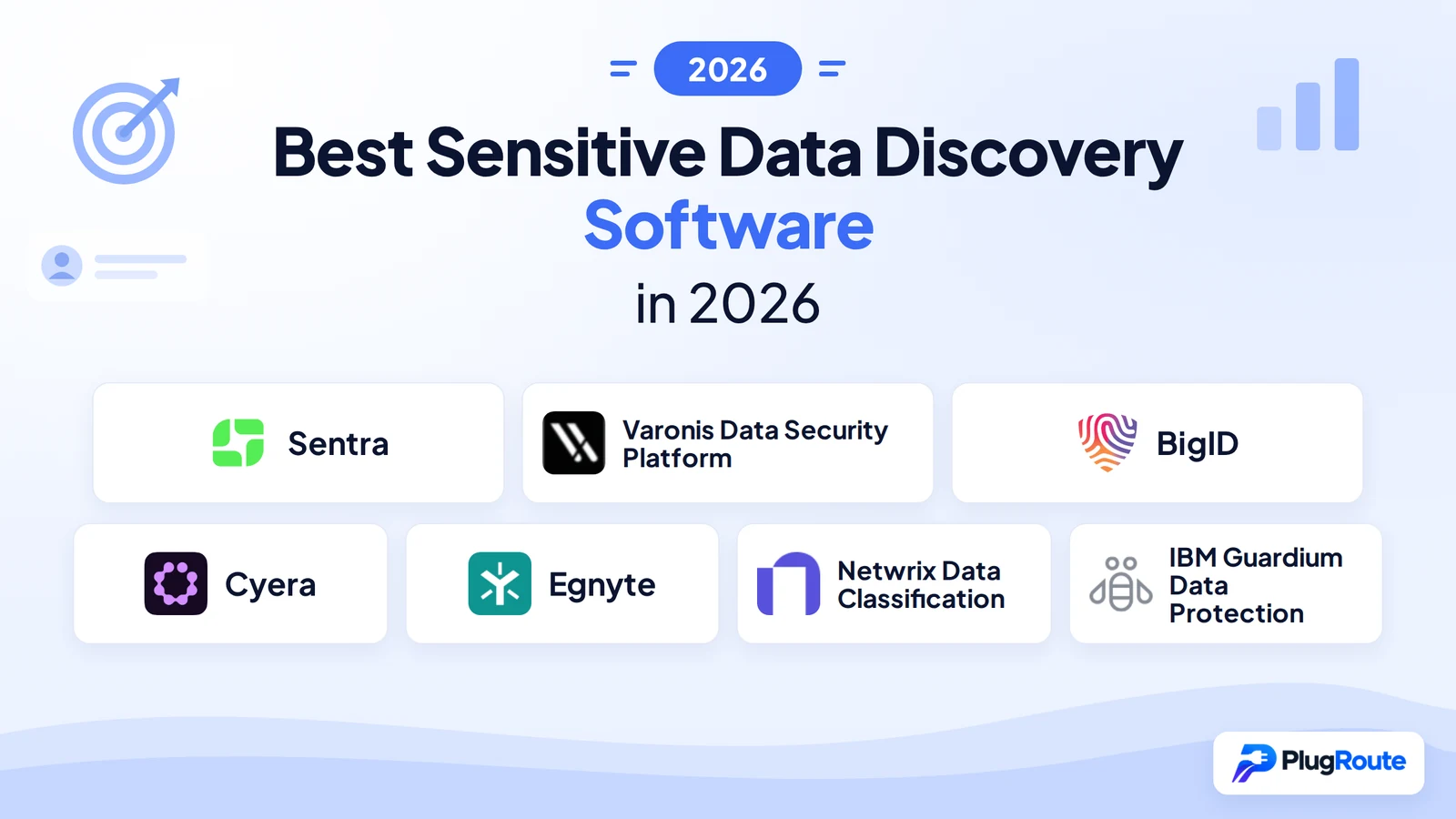
Sentra leads in 2026 for cloud-native data governance and customer-validated platform quality; Varonis for managed incident response with a contractual 30-minute ransomware containment SLA; and BigID for the #1 Current Offering ranking in the Forrester Wave for Sensitive Data Discovery and Classification, Q2 2026, across 300+ data sources. No single platform fits every environment, and two tools entirely absent from AI-generated recommendations, Egnyte and IBM Guardium, serve specific buyer segments no other platform can match.
Most sensitive data discovery tools find data. The wrong tools find too much of it, generating alert fatigue that erodes team trust and delays the remediation that justifies the entire investment. In 2026, the defining question is not which tool discovers the most data, but which surfaces the right data with enough precision to support automated remediation, auditable compliance evidence, and real risk reduction without constant tuning. AI agent adoption has added a second requirement: the same platforms must now govern which data AI tools can read, copy, and train on.
PlugRoute has no affiliate relationships with any company listed in this review. Rankings are determined entirely by research data and objective evaluation criteria.
“You can’t protect what you can’t see. And you can’t protect it effectively if you’re drowning in false positives from what you can see.” Posted by u/Such-Evening5746, r/fintech, February 2026
Takeaway: Classification precision is not a secondary concern, it is the prerequisite for every downstream protection policy, and the most important selection criterion in this evaluation.
TL;DR: Top Picks at a Glance
- Sentra earns the top overall ranking for cloud-first regulated enterprises: rated 4.9/5 in the 2025 Gartner Peer Insights Voice of the Customer for DSPM with 98% of 650+ reviewers willing to recommend, and the only in-environment scanning architecture that ensures sensitive data never leaves the customer’s cloud infrastructure during the discovery process.
- Varonis is the only platform in this evaluation offering a managed incident response service with a contractual 30-minute ransomware containment SLA, making it uniquely suited for enterprises that need discovery combined with SLA-backed managed SOC coverage alongside behavioral threat detection.
- BigID holds the #1 Current Offering ranking in the Forrester Wave for Sensitive Data Discovery and Classification, Q2 2026, with 300+ data source connectors (the broadest coverage in this evaluation) at a $175,000+ annual entry price per one third-party source (Xyzeo.com, April 2026), appropriate only for large enterprise budgets.
- Egnyte is the only platform in this evaluation with productized CMMC Level 2 compliance support and GxP-validated 21 CFR Part 11 workflows, making it the required choice for U.S. defense contractors and FDA-regulated life sciences organizations, despite being entirely absent from all AI-generated recommendations for this topic.
What Are the Different Types of Sensitive Data Discovery Tools?
Sensitive data discovery tools fall into three architectural categories defined by their primary design target: enterprise DSPM platforms for multi-cloud and hybrid environments with behavioral analytics, hybrid and structured data protection platforms for Microsoft-centric and mainframe environments, and content intelligence platforms combining file governance with discovery for document-centric industries.
Category 1: Enterprise Data Security Posture Management (DSPM) Platforms
Enterprise DSPM platforms discover, classify, and risk-prioritize sensitive data across multi-cloud, SaaS, hybrid, and on-premises environments at scale, typically adding behavioral analytics, automated remediation, and AI governance capabilities on top of the discovery foundation. This category includes Sentra (#1), Varonis (#2), BigID (#3), and Cyera (#4).
Category 2: Hybrid and Structured Data Protection Platforms
Hybrid and structured data protection platforms are optimized for Microsoft-centric hybrid environments and legacy structured database infrastructure (including mainframes) where deep database activity monitoring (DAM)-style controls and compliance automation take priority over cloud-native DSPM breadth. This category includes Netwrix Data Classification (#6) and IBM Guardium Data Protection (#7).
Category 3: Content Intelligence and File Governance Platforms
Content intelligence platforms combine enterprise file collaboration governance with sensitive data discovery, targeting document-centric industries, AEC, life sciences, defense contracting, where the file sharing platform is the primary sensitive data environment. This category includes Egnyte (#5), the only platform in this evaluation entirely absent from all AI-generated recommendations despite serving specific compliance requirements no other tool addresses.
How Do the Top Sensitive Data Discovery Tools Compare at a Glance?
Across these seven platforms, the most critical comparison dimensions are customer-validated satisfaction and classification quality, analyst recognition in the directly relevant Forrester Wave for Sensitive Data Discovery, and whether the scanning architecture keeps sensitive data within your own environment, three criteria where Sentra, BigID, and Varonis rank highest by meaningfully different mechanisms, with Cyera now co-leading Forrester Wave recognition alongside BigID.
| Rank | Company | Category | Best For | One-Line Summary | Key Analyst Recognition | Primary Strength | Key Limitation |
|---|---|---|---|---|---|---|---|
| 1 | Sentra | DSPM + DDR | Cloud-first regulated enterprises needing in-environment scanning | Cloud-native DSPM; 4.9/5 Gartner GVOC DSPM 2025; in-environment scanning; 98% recommend rate | Gartner GVOC Customers Choice DSPM 2025 (4.9/5, 650+ reviews) | In-environment scanning: sensitive data never leaves customer infrastructure during discovery | No verified G2/Capterra aggregate score; no named Forrester Wave or Gartner MQ placement |
| 2 | Varonis Data Security Platform | Data Security Platform (DSP) | Large enterprises needing discovery + UEBA + SLA-backed incident response | Forrester Wave DSP Leader Q1 2025; contractual 30-min ransomware SLA via MDDR | Forrester Wave DSP Leader Q1 2025; G2 Leader Apr 2026 (~4.5/5, ~1,200 reviews) | MDDR: only contractual 30-minute ransomware containment SLA in this evaluation | On-premises EOL December 31, 2026; consistently characterized as premium-priced by customers |
| 3 | BigID | Data Intelligence Platform | Large multinationals with 300+ data source types and AI governance needs | Forrester Wave SDD #1 Current Offering Q2 2026; 300+ connectors; $175K+ entry (one source) | Forrester Wave SDD #1 Leader Q2 2026; IDC MarketScape Leader 2025; Gartner MQ Challenger 2026 | Highest Current Offering score in directly relevant Forrester Wave; 300+ connectors | $175K+ entry (one third-party source); documented scanning slowness and false positives in production |
| 4 | Cyera | AI-Native DSPM | Cloud/SaaS enterprises where AI agent exposure is the primary risk | Forrester Wave SDD Leader Q2 2026; highest Strategy score 4.9/5; comprehensive AI control plane | Forrester Wave SDD Leader Q2 2026 (highest Strategy score 4.9/5); SACR 2026 Innovator | Only comprehensive AI security control plane: Browser Shield, AI-SPM, AI Guardian, Cyera MCP | 50 scans/day cap; limited self-service remediation; documented POC failures |
| 5 | Egnyte | Content Intelligence + Discovery | AEC, life sciences, defense contractors needing CMMC Level 2 or 21 CFR Part 11 | ~4.4–4.5/5 on G2 (~1,141 reviews); only CMMC Level 2 + 21 CFR Part 11 platform in evaluation | Forrester Wave Content Security Leader 2025; G2 Easiest to Use + Highest User Adoption Winter 2026 | Only CMMC Level 2 + 21 CFR Part 11 platform; 23,000+ customers; OCR-capable discovery | 10–15% AI alert false positive rate; limited multi-cloud DSPM depth; 4–6 week implementation |
| 6 | Netwrix Data Classification | Data Classification / Hybrid DSPM | Microsoft-centric mid-market needing rapid deployment and DSAR automation | Compound term processing; hours-level deployment; DSAR automation; 1Secure DSPM integration | GetApp 4.8/5 (9 reviews, Apr 2026); no Forrester/Gartner recognition in directly relevant categories | Hours-level deployment; compound term processing reduces false positives beyond regex | Microsoft-centric connectors; no Forrester/Gartner category recognition |
| 7 | IBM Guardium Data Protection | DAM + Structured Data Protection | Financial institutions with mainframe (z/OS, AS/400, IMS) data estates | Only confirmed mainframe-native platform (z/OS, AS/400, IMS) in this evaluation; 20+ years market presence | G2 Leader Apr 2026; 20+ years market presence (est. 2002, IBM acquisition 2013) | Only confirmed mainframe-native platform with z/OS, AS/400, IMS support in this evaluation | High operational burden; “expensive, unreliable” for cloud-native use; QRadar dependency |
Which Sensitive Data Discovery Tool Should I Choose for My Use Case?
The right sensitive data discovery platform depends primarily on environment type and regulatory obligations: Sentra for cloud data sovereignty, Varonis for managed incident response, BigID for 300+ data source coverage and maximum analyst validation, Cyera for AI agent governance, Egnyte for CMMC Level 2 or 21 CFR Part 11, Netwrix for Microsoft-centric mid-market, and IBM Guardium for mainframe infrastructure where no other platform in this evaluation applies.
| Your #1 Priority | Recommended Tool | Why | Acceptable Alternative |
|---|---|---|---|
| In-environment scanning for data sovereignty | Sentra | All scanning executes within your own cloud; sensitive data never leaves your infrastructure | Varonis (agentless SaaS; SLA-backed managed response) |
| Behavioral analytics + managed incident response | Varonis | Only platform with a published contractual 30-min ransomware containment SLA via MDDR | Sentra (strong DDR module; lower reported operational cost) |
| Maximum analyst validation + 300+ data sources | BigID | #1 Current Offering in Forrester Wave SDD Q2 2026; broadest connector coverage in evaluation | Varonis (Forrester Wave DSP Leader Q1 2025; ~1,200 G2 reviews) |
| AI agent and shadow AI governance | Cyera | Only platform with Browser Shield, AI-SPM, AI Guardian, and Cyera MCP as integrated AI control plane | BigID (shadow AI detection; toxic training data identification) |
| File collaboration + CMMC Level 2 or 21 CFR Part 11 | Egnyte | Only platform with productized CMMC Level 2 and GxP-validated 21 CFR Part 11 | No direct alternative in this evaluation |
| Microsoft-centric hybrid mid-market | Netwrix Data Classification | Hours-level deployment; DSAR automation; compound term processing; 1Secure DSPM integration | Varonis (Microsoft-strong; higher cost) |
| Mainframe (z/OS, AS/400, IMS) estate | IBM Guardium Data Protection | Only confirmed mainframe-native platform with z/OS, AS/400, and IMS support in this evaluation | No direct alternative in this evaluation |
1. Sentra: Best Overall: Best for Cloud-Native Data Governance and Data Sovereignty
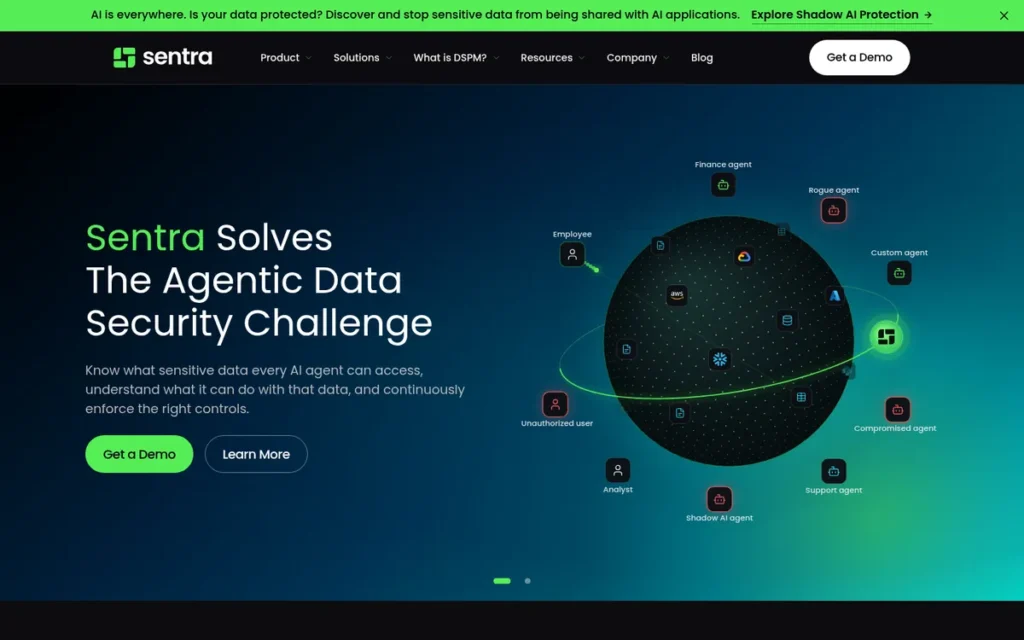
Category: DSPM + Data Detection & Response, discovers and classifies sensitive data across cloud and hybrid environments from within the customer’s own infrastructure, then monitors for real-time anomalies on top of discovered data.
At a Glance
- Category: DSPM + Data Detection & Response (DDR)
- Best For: Cloud-first and regulated enterprises requiring in-environment scanning, customer-validated accuracy, and data sovereignty controls across multi-cloud environments
- Price Range: Pricing on request (custom enterprise; no public pricing available, April 2026)
- Primary Strength: Sentra scans all sensitive data entirely within the customer’s own cloud infrastructure, returning only metadata and findings to the Sentra control plane, the only architecture in this evaluation that fully resolves data sovereignty barriers for regulated industries under GDPR Article 46
- Biggest Limitation: Sentra has no verified aggregate scores on G2 or Capterra as of April 2026, limiting peer-community validation; on-premises coverage relies on asynchronous cloud-side copies that may require independent legal review in the most restrictive data residency jurisdictions; no named Forrester Wave or Gartner MQ placement
- One-Line Summary: Sentra is a cloud-native DSPM and Data Detection & Response platform rated 4.9/5 in the 2025 Gartner Peer Insights Voice of the Customer for DSPM (with 98% of 650+ reviewers willing to recommend) scanning sensitive data entirely within the customer’s own cloud environment, making it the top-ranked platform in this evaluation for regulated financial services and healthcare organizations requiring in-environment processing
- Last Verified: April 2026
Overview
Sentra is a cloud-native Data Security Posture Management (DSPM) and Data Detection & Response (DDR) platform designed for large enterprises and regulated organizations that require customer-validated accuracy and data sovereignty controls across multi-cloud, hybrid, and SaaS environments, processing all data within the customer’s own infrastructure so sensitive content never transits to a third-party system during scanning.
Sentra’s proprietary metadata clustering technology enables the platform to scan 9 petabytes of data in 72 hours, while its LLM-powered classification engine is rated 4.9/5 in the 2025 Gartner Peer Insights Voice of the Customer for Data Security Posture Management, with 98% of 650+ verified reviewers willing to recommend the platform, the highest verified customer satisfaction score among DSPM platforms in this evaluation (PR Newswire, 2025). Sentra’s DataTreks™ capability uniquely maps sensitive data movement across ETL pipelines and copy operations, closing the shadow data blind spot that static point-in-time discovery tools miss entirely.
Key Features
- In-Environment Scanning Architecture: Sentra performs all sensitive data scanning within the customer’s own cloud environment using the customer’s compute resources (returning only metadata and findings to the Sentra control plane) a critical architectural decision that directly resolves data sovereignty requirements under GDPR Article 46 without routing regulated data to third-party infrastructure (Sentra DSPM product page, April 2026).
- DataTreks™ Data Lineage Mapping: Sentra’s DataTreks™ feature maps data lineage across ETL pipelines, data migrations, and copy operations, identifying when sensitive data has traveled from a compliant source to an insecure destination such as a development environment, analytics sandbox, or snapshot store, the origin point of many real-world data exposure incidents (Sentra product page, April 2026).
- LLM-Powered Classification Engine: Sentra’s classification engine uses contextual LLM understanding to handle complex data types including audio, video, PDFs, and custom business data alongside standard PII, PCI, and PHI, achieving greater than 95% classification accuracy per vendor documentation, with a 4.9/5 overall customer satisfaction rating in the 2025 Gartner Peer Insights Voice of the Customer for DSPM as independent corroboration (PR Newswire, 2025).
- Data Detection & Response (DDR) Module: Sentra’s DDR module provides real-time anomaly detection layered on top of static discovery findings, with practitioners specifically endorsing it as a “game changer” that extends DSPM value beyond inventory into continuous monitoring (u/Big-Young-4028, r/cybersecurity, September 2024).
- Petabyte-Scale Metadata Clustering: Sentra’s metadata clustering approach groups petabytes of data into scannable “Data Asset” groups rather than scanning every file individually, enabling Sentra to publish a scanning economics benchmark of approximately $40,000 per 100 petabytes. Note: this figure represents Sentra’s published scanning compute cost benchmark, not a license price; actual pricing requires direct sales engagement (Sentra product page, April 2026).
Best For
Sentra is best for cloud-first and regulated enterprises (particularly in financial services and healthcare) that prioritize customer-validated classification accuracy and data sovereignty over breadth of legacy on-premises integration, and need a fast-deploying DSPM platform (days, not months) that can be validated in a proof-of-concept on real production data without sensitive content leaving the environment.
Pricing
Sentra’s pricing is not publicly disclosed; custom enterprise quotes are required through the official Sentra website (verified April 2026). No per-user, per-asset, or per-TB pricing is available from the official website or verified third-party sources. Sentra’s published scanning economics benchmark (approximately $40,000 per 100 petabytes) is a cost-efficiency claim for the scanning architecture, not a license price. Contact Sentra directly for current pricing.
Strengths
- Sentra is rated 4.9/5 in the 2025 Gartner Peer Insights Voice of the Customer for Data Security Posture Management (with 98% of 650+ verified reviewers willing to recommend the platform) the highest verified independent customer satisfaction rating among DSPM platforms in this evaluation, providing the strongest crowdsourced quality signal available for buyers requiring evidence beyond vendor claims (PR Newswire, 2025).
- Sentra practitioners running the platform in production report 6–10 manageable issues per week without constant tuning, characterizing false positive rates as low enough to sustain alert trust, a direct operational contrast to BigID users in the same Reddit communities who described “drowning in false positives” (u/CookieEmergency7084, r/cybersecurity, December 2024).
- Sentra’s DDR module has received specific independent practitioner endorsements as a “game changer” from multiple r/cybersecurity contributors, confirming the DSPM+DDR integrated approach delivers incremental detection value that discovery-only tools cannot replicate (u/Big-Young-4028 and u/CookieEmergency7084, r/cybersecurity, September 2024).
- Sentra paired with Wiz is the most explicitly community-endorsed DSPM architecture for cloud-first organizations in r/fintech and r/cybersecurity discussions reviewed through April 2026, providing a validated reference architecture rather than a single-vendor recommendation (u/Such-Evening5746, r/fintech, February 2026).
Limitations
- Limited Public Review Footprint: Sentra has no verified aggregate scores on G2 or Capterra as of April 2026 (unlike Varonis (~1,200 G2 reviews) or Egnyte (~1,141 G2 reviews)) meaning buyers cannot triangulate performance evidence from large peer communities and must treat a proof-of-concept on real production data as non-negotiable before committing.
- On-Premises Data Residency Nuance: Sentra’s on-premises coverage is delivered via asynchronous cloud-side copies rather than direct in-environment processing of on-premises data, technically valid, but potentially subject to independent legal review under strict interpretations of GDPR Article 46 in the most restrictive data residency jurisdictions (Sentra hybrid environments blog, April 2026).
- No Named Forrester Wave or Gartner MQ Placement: Sentra does not hold a named position in the Forrester Wave for Sensitive Data Discovery and Classification (Q2 2026) or a published Gartner Magic Quadrant placement, limiting the ability to cite Sentra in analyst-gated procurement processes; buyers in organizations requiring formal Wave or MQ validation should shortlist BigID or Varonis alongside Sentra.
- Pricing Opacity: Sentra’s custom enterprise pricing requires full sales engagement before any budget estimate is obtainable, consistent with the category norm but a friction point for organizations conducting preliminary budget validation before vendor contact.
Verdict
Sentra is the sensitive data discovery platform in this evaluation with the highest verified customer satisfaction score among DSPM platforms, rated 4.9/5 with 98% of 650+ reviewers willing to recommend in the 2025 Gartner Peer Insights Voice of the Customer for DSPM, and the only architecture that ensures sensitive data never leaves the customer’s cloud environment during the discovery process. Sentra’s in-environment scanning directly resolves the data sovereignty barriers that prevent other DSPM platforms from clearing regulated deployment approvals in financial services and healthcare. Organizations requiring a named Forrester Wave or Gartner MQ position for procurement validation should evaluate BigID or Varonis alongside Sentra before selecting a final platform, and a mandatory proof-of-concept on production data is non-negotiable given the limited public review footprint.
2. Varonis Data Security Platform: Best for Unified Data Security with Managed Response

Category: Data Security Platform (DSP), discovers and classifies sensitive data while adding behavioral user analytics, automated remediation, and a managed detection and response service in a unified SaaS-delivered platform.
At a Glance
- Category: Data Security Platform (DSP)
- Best For: Large enterprises with significant Microsoft 365, file server, and multi-cloud exposure that need discovery combined with behavioral threat detection, automated remediation, and optional managed incident response with contractual SLAs
- Price Range: Pricing on request (custom enterprise; widely characterized as premium-tier by current customers, April 2026)
- Primary Strength: Varonis’s Managed Data Detection & Response (MDDR) service is the only offering in this evaluation guaranteeing a contractual 30-minute ransomware containment SLA with 24/7 expert monitoring, reducing the internal SOC burden for organizations that cannot staff dedicated data security operations
- Biggest Limitation: Varonis is ending all on-premises deployment support on December 31, 2026, forcing current on-premises customers onto a mandatory SaaS migration timeline; the platform is consistently characterized as premium-priced by active customers, with cost being the primary driver of competitive replacement evaluations even among satisfied users
- One-Line Summary: Varonis Data Security Platform is a Forrester Wave Data Security Platforms Leader (Q1 2025) and G2 Sensitive Data Discovery Leader (April 2026) that uniquely pairs sensitive data discovery and behavioral anomaly detection with a Managed Data Detection & Response service carrying a contractual 30-minute ransomware containment SLA, but current on-premises customers must plan for mandatory SaaS migration before December 31, 2026
- Last Verified: April 2026
Overview
Varonis Data Security Platform is an AI-powered, SaaS-delivered data security platform designed for mid-to-large enterprises (particularly those running significant Microsoft 365, Active Directory, and multi-cloud environments) that need to combine sensitive data discovery and classification with user behavior analytics, automated remediation, and managed incident response in a single platform.
Recognized as a Leader in the Forrester Wave: Data Security Platforms (Q1 2025) and as a Leader in the G2 Sensitive Data Discovery category (April 2026), Varonis distinguishes itself from pure DSPM competitors by layering real-time behavioral threat detection and a managed response service with SLA-backed incident containment on top of its discovery foundation. Organizations evaluating Varonis for on-premises deployment must note that Varonis is ending on-premises support on December 31, 2026, a confirmed deadline documented by Varonis CEO Yaki Faitelson and Netwrix (April 2026) that is absent from all AI-generated recommendations for this topic.
Key Features
- Managed Data Detection & Response (MDDR): Varonis’s MDDR service provides 24/7 expert monitoring with a contractual 30-minute SLA for ransomware containment and 120-minute SLA for alert response, the only managed response guarantee with documented contractual commitments in this evaluation, directly reducing the internal analyst burden for organizations without dedicated data security SOC capacity (Varonis MDDR page, April 2026).
- Multi-Cloud and Microsoft 365 Coverage: Varonis’s classification engine covers Microsoft 365, Active Directory, Exchange Online, and Windows file servers, extending to AWS, Azure, GCP, and Salesforce, with the CSPM module identifying 600+ risk configurations across the three major cloud providers and native integration into Azure Policy and Wiz (Varonis What’s New, July 2025).
- Automated Remediation Policies: Varonis enables permission right-sizing and quarantine of overexposed sensitive data without requiring manual IT tickets, closing the discovery-to-protection gap that most competing DSPM tools leave as a manual workflow between security and IT operations teams.
- Agentless Database Activity Monitoring (DAM): Varonis supports agentless DAM that is actively displacing legacy tools including Imperva in competitive evaluations, winning on deployment speed, maintenance-free architecture, and elimination of physical appliances relative to agent-based DAM predecessors (u/No_Confection_6652, r/cybersecurity, 2025).
- SlashNext Email Security Integration: Varonis acquired SlashNext in 2025, adding AI-powered email threat detection and OAuth/API threat coverage, extending sensitive data protection into communication channel security for organizations where email is a primary exfiltration vector (Varonis What’s New, September 2025).
Best For
Varonis Data Security Platform is best for large enterprises with deep Microsoft 365, file server, and multi-cloud environments where the security team needs both data discovery and behavioral threat detection in a single platform, particularly organizations that need a contractual incident response SLA to satisfy cyber insurance or board-level security governance requirements and whose internal SOC capacity is insufficient to act on findings without managed response support.
Pricing
Varonis’s pricing is not publicly disclosed; custom enterprise quotes are required through the official Varonis pricing page (verified April 2026). No per-user or per-TB pricing is publicly available. Community discussions consistently characterize Varonis as premium-priced, with one satisfied customer actively evaluating cheaper Azure E5/Defender XDR alternatives primarily due to cost (u/thejohnykat, r/cybersecurity, December 2024). Varonis’s MDDR managed service is priced as an additional layer on top of the core platform license.
Strengths
- Varonis was recognized as a Leader in the Forrester Wave: Data Security Platforms, Q1 2025 and as a Leader in the G2 Sensitive Data Discovery category (April 2026) with an estimated 4.5/5 from approximately 1,200 verified reviews, the only platform in this evaluation with simultaneous Forrester Wave leadership and a large public peer review base exceeding 1,000 reviews.
- Varonis’s MDDR managed service provides a published, contractual 30-minute SLA for ransomware containment and 120-minute SLA for alert response (the only documented contractual incident response commitment in this evaluation) with 24/7 expert monitoring that reduces the internal analyst burden for organizations without dedicated data security operations (Varonis MDDR page, April 2026).
- Practitioners actively replacing legacy DAM tools with Varonis report choosing it specifically for agentless deployment, maintenance-free architecture, and elimination of physical appliances, reducing ongoing operational overhead compared to agent-based alternatives while gaining coverage depth that competing agentless tools lack (u/No_Confection_6652, r/cybersecurity, 2025).
- Varonis received five-star scores in the GigaOm Radar for Data Security Platforms (2023) with specific praise for “simplifying permissions across vendors and least privilege automation”, a documented strength linking discovery findings to actionable permission remediation; note this recognition dates to 2023 and more recent GigaOm evaluations were not verified at time of publication.
Limitations
- On-Premises End-of-Life Deadline: Varonis is ending all on-premises deployment support on December 31, 2026, a confirmed deadline documented by Varonis CEO Yaki Faitelson and Netwrix (April 2026) that creates a mandatory migration imperative for organizations currently running Varonis on-premises, particularly regulated enterprises in financial services or government with hard on-premises processing requirements (Varonis CEO blog; Netwrix, April 2026).
- Cost-Driven Churn Risk: Varonis is consistently characterized as premium-priced by active customers (with one satisfied customer actively evaluating cheaper Azure E5/Defender XDR alternatives primarily due to cost) meaning even organizations where Varonis is delivering value face ongoing pressure to replace it with lower-cost alternatives (u/thejohnykat, r/cybersecurity, December 2024).
- MDDR Pricing on Top of Core License: Varonis’s most distinctive differentiator (the MDDR managed service) is priced as an additional layer beyond the core platform license, meaning buyers who do not intend to use managed response may find the base platform’s cost-to-capability ratio difficult to justify against more focused DSPM alternatives like Sentra.
- Classification Accuracy Not Independently Benchmarked: Varonis’s 99% classification accuracy claim is vendor-stated (Varonis product documentation) and not validated at the same independent level as Sentra’s 4.9/5 Gartner GVOC rating, buyers should conduct a proof-of-concept on their own production data to validate classification performance before committing.
Verdict
Varonis Data Security Platform is the only tool in this evaluation that combines sensitive data discovery, behavioral threat detection, and a managed incident response service with a published contractual 30-minute ransomware containment SLA, making it uniquely suited for enterprises that require managed SOC coverage alongside discovery capability. Varonis’s dual recognition as a Forrester Wave Data Security Platforms Leader (Q1 2025) and G2 Leader (April 2026) provides the institutional validation that enterprise procurement processes require. Organizations currently running Varonis on-premises must treat the December 31, 2026 end-of-life deadline as an immediate migration planning priority, not a future consideration, and buyers who do not need MDDR should evaluate Sentra or Cyera as operationally leaner alternatives.
3. BigID: Best for Enterprise-Scale Multi-Regulation Compliance
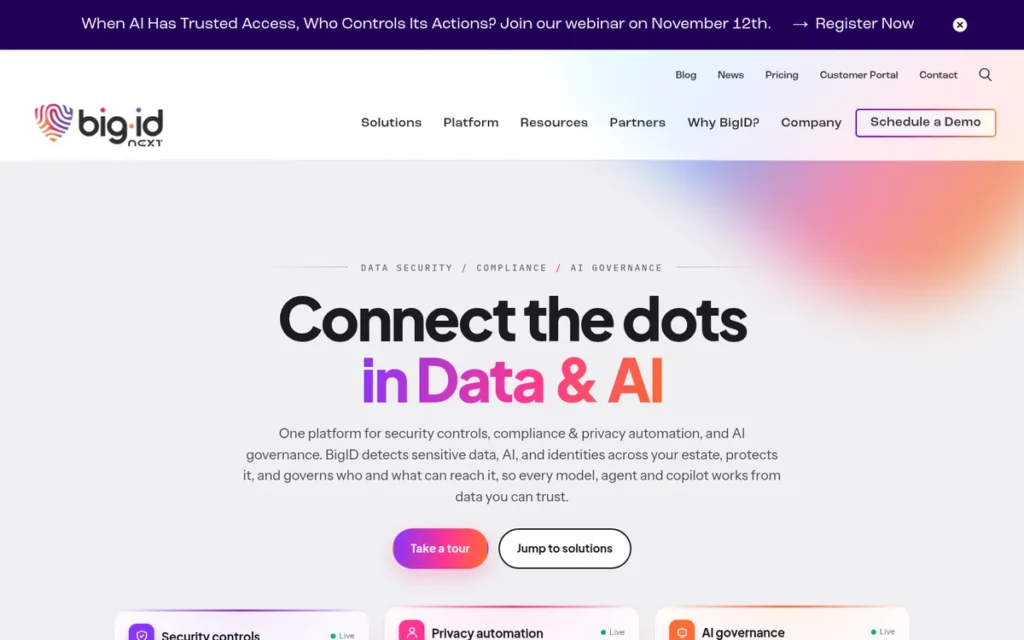
Category: Data Intelligence Platform, provides discovery, classification, privacy automation, security, compliance, and AI governance across 300+ data source types in a multi-module enterprise platform.
At a Glance
- Category: Data Intelligence Platform
- Best For: Large multinationals managing complex multi-regulation compliance programs across 300+ data source types with active AI governance requirements, provided dedicated deployment and management resources are available
- Price Range: $175,000+ per 12-month commitment (entry-level; per one third-party product database, Xyzeo.com, April 2026, confirm with BigID directly)
- Primary Strength: BigID earned the #1 Current Offering position in the Forrester Wave for Sensitive Data Discovery and Classification, Q2 2026 (the most directly relevant analyst category for buyers of this software) with the highest possible scores across 11 evaluation criteria among all evaluated vendors
- Biggest Limitation: BigID’s $175,000+ entry price and weeks-to-months deployment complexity are compounded by real-world practitioner reports of painfully slow scanning, false positive classification of log data as PII, and limited built-in remediation, creating a high-stakes commitment where deployment failure is extremely costly
- One-Line Summary: BigID is the #1 Leader by Current Offering in the 2026 Forrester Wave for Sensitive Data Discovery and Classification (with 300+ connectors, AI-powered classification, and the only productized shadow AI detection and toxic training data identification in this evaluation) but its $175,000+ entry price and documented deployment complexity make it appropriate only for large enterprises with dedicated data security management teams
- Last Verified: April 2026
Overview
BigID is an AI/ML-driven data intelligence platform built for large multinational enterprises that need unified discovery, classification, privacy automation, security, compliance, and AI governance across 300+ data source types (from cloud data lakes and multi-cloud storage to SaaS, on-premises databases, and mainframes) using a four-layer “discovery-in-depth” classification methodology combining ML, NLP, graph analysis, and custom rule engines, with entry pricing starting at $175,000+ annually per one third-party source.
Recognized as the #1 Leader in the Forrester Wave™ for Sensitive Data Discovery and Classification, Q2 2026, with the highest Current Offering score and highest possible marks across 11 evaluation criteria, BigID also holds recognition as an IDC MarketScape Leader (Privacy Operations Technology, 2025) and a Gartner Magic Quadrant Challenger (Data and Analytics Governance, 2026). Note that the Q2 2026 Forrester Wave for Sensitive Data Discovery includes three Leaders: BigID holds the top Current Offering score, while Cyera holds the top Strategy score, buyers should review both entries before selecting based on Wave position alone (PR Newswire, April 2026).
Key Features
- 300+ Data Source Connectors: BigID connects to 300+ data sources across cloud, SaaS, on-premises, mainframes, and petabyte-scale data lakes (the broadest connector coverage in this evaluation) using a four-layer discovery-in-depth approach spanning Snowflake, Databricks, AWS S3, Salesforce, SAP, Oracle, and custom on-premises databases in a single platform (BigID Discovery In-Depth page, April 2026).
- AskBigID™ GPT Natural Language Querying: BigID’s AskBigID™ GPT enables natural language queries across the sensitive data estate (for example, “show me all unencrypted PII shared externally in the last 30 days”) reducing the specialist skills required to extract value from complex multi-source discovery findings and lowering the barrier for non-specialist security analysts.
- Shadow AI Detection and Toxic Training Data Identification: BigID is the only platform in this evaluation with productized shadow AI detection (identifying unauthorized AI tools consuming company data) and toxic training data detection, which flags datasets containing sensitive or legally problematic content that could create AI liability under emerging AI governance frameworks (BigID AI risks blog, 2026).
- Tunable Classifiers: BigID’s tunable classifiers allow organizations to configure precision thresholds to reduce false positive rates to acceptable levels, an important configuration capability given documented practitioner reports of over-classification of log data and non-PII content in real production environments (BigID product pages, April 2026).
- DLP Prism: BigID’s DLP Prism provides context-aware data loss prevention tightly integrated with its classification layer, enabling discovery findings to flow directly into enforcement policies without requiring a separate DLP platform, reducing tool fragmentation in enterprise data security stacks (PR Newswire, April 2026).
Best For
BigID is best for large multinationals with heterogeneous data estates spanning 10 or more data source types, active compliance obligations across multiple regulatory jurisdictions (GDPR, CCPA, HIPAA), and AI governance programs requiring shadow AI detection and toxic training data identification, provided the organization has a dedicated deployment team, a budget well beyond the $175,000+ licensing minimum per one third-party source, and a 3–6 month timeline for platform tuning before reliable classification is achieved.
Pricing
BigID does not publish pricing on its official website. One third-party product database (Xyzeo.com, April 2026) lists paid plans starting from $175,000 per 12-month commitment at entry level, this figure has not been confirmed by a second independent source and buyers should request written itemized pricing from BigID directly. BigID’s modular platform structure means additional modules, privacy automation, AI governance suite, security enforcement, are likely priced separately beyond the base discovery and classification tier. This pricing floor effectively positions BigID as a large-enterprise-only tool.
Strengths
- BigID earned the #1 Leader position by Current Offering in the Forrester Wave™ for Sensitive Data Discovery and Classification, Q2 2026 (the most directly relevant analyst category for buyers of this software) achieving the highest Current Offering score and the highest possible marks across 11 evaluation criteria among all vendors evaluated in the report (PR Newswire, April 2026).
- BigID holds simultaneous recognition across three major analyst frameworks in a 12-month period (Forrester Wave Leader (sensitive data discovery, Q2 2026), IDC MarketScape Leader (privacy operations technology, 2025), and Gartner Magic Quadrant Challenger (data and analytics governance, 2026)) the most extensive cross-framework validation of any platform in this evaluation (BigID blog, April 2026).
- BigID’s 300+ connector count is the broadest in this evaluation by a significant margin, enabling discovery across the full range of modern enterprise data infrastructure in a single platform, critical for multinationals where no two regional environments share the same data architecture (BigID product page, April 2026).
- BigID’s shadow AI detection and toxic training data identification capabilities address the static AI data governance risk surface emerging as a board-level compliance concern, the only platform in this evaluation with both capabilities productized as of April 2026, directly relevant as enterprises accelerate Microsoft Copilot and ChatGPT Enterprise deployments (BigID AI risks blog, 2026).
Limitations
- Real-World Deployment Gap: BigID’s most consequential trade-off is the documented gap between analyst-validated capability and practitioner-reported deployment experience, one r/cybersecurity user who abandoned the platform after implementation described “painfully slow” scanning, drowning in false positives, “no built-in remediation,” and a “clunky” UI (u/cutekekua, r/cybersecurity, November 2024).
- False Positive Classification in Production: BigID classifiers have been documented tagging “random log data as PII” in production environments, a precision failure that generates operational noise and erodes team trust in findings over time, separate from the tunable classifier capability available as a mitigation (u/tuesdaymorningwood, r/ITManagers, November 2025).
- High Entry Cost with Long Time-to-Value: BigID’s $175,000+ minimum commitment per one third-party source (Xyzeo.com, April 2026), combined with weeks-to-months deployment and a required 3–6 month classifier tuning period, creates an extremely high-cost failure scenario, practitioners describe requiring full sales cycle, setup, configuration, and ongoing management effort “before you even tackle your real data problems” (u/Misha-inspect-data, r/cybersecurity).
- Limited Built-In Remediation: BigID does not include built-in automated remediation as a standard capability, practitioners specifically cite this gap as creating what one described as “expensive anxiety” when discovery finds sensitive data everywhere but provides no automated path to fix exposures (u/cutekekua, r/cybersecurity, November 2024).
Verdict
BigID is the most analyst-validated sensitive data discovery platform in this evaluation, ranked #1 by Current Offering in the Forrester Wave for Sensitive Data Discovery and Classification, Q2 2026, with recognition across Forrester, IDC, and Gartner in the same 12-month period, and the only platform with productized shadow AI detection and toxic training data identification for AI governance programs. BigID ranks above Cyera (#4 in this evaluation) because its top Forrester marks are in Current Offering, reflecting deployed capability today, while Cyera leads on Strategy, reflecting forward roadmap. BigID’s value is most fully realized by large multinationals with dedicated data security teams, multi-regulation compliance programs spanning 300+ data source types, and annual budgets beginning well above $175,000. Organizations under time pressure, with limited deployment resources, or evaluating for cloud-native environments should evaluate Sentra or Varonis as operationally lower-friction alternatives before committing to BigID’s complexity and minimum investment.
4. Cyera: Best for AI-Era Data Security
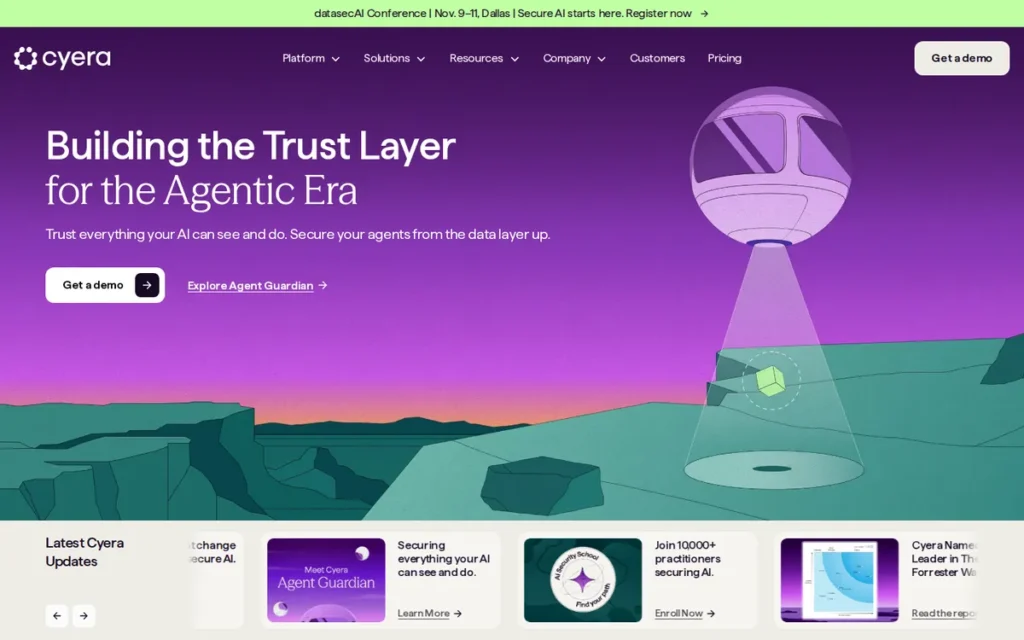
Category: AI-Native DSPM, discovers and classifies sensitive data across cloud and SaaS environments using LLM-based classification, with a dedicated AI security control plane governing shadow AI applications, AI agents, and AI model training data.
At a Glance
- Category: AI-Native DSPM
- Best For: Cloud-first and SaaS-heavy enterprises where AI agent adoption, Microsoft Copilot deployment, or shadow AI exposure is the primary data security concern in 2026
- Price Range: Pricing on request (custom enterprise; company reported ~$100M ARR; premium pricing implied, April 2026)
- Primary Strength: Cyera has the most comprehensive dedicated AI security control plane in this evaluation (including Browser Shield for real-time shadow AI detection, AI-SPM, AI Guardian, and Cyera MCP for AI agent data governance) addressing the 2026 generative AI data exposure surface that traditional DSPM tools cannot reach
- Biggest Limitation: Cyera’s self-service remediation automation is limited: practitioners report needing active vendor engagement to build out remediation workflows post-deployment, and a confirmed hard cap of 50 scans per day constrains continuous discovery in very large cloud environments
- One-Line Summary: Cyera is a Forrester Wave Leader in Sensitive Data Discovery and Classification, Q2 2026, achieving the highest Strategy score (4.9/5) among all evaluated vendors, and the platform with the most comprehensive dedicated AI security control plane (Browser Shield, AI-SPM, AI Guardian, Cyera MCP) for organizations whose primary concern is AI agent and shadow AI data exposure
- Last Verified: April 2026
Overview
Cyera is an AI-native Data Security Posture Management platform designed for cloud-first and SaaS-heavy enterprises, using proprietary large language models based on FLAN T5 and Mistral foundation models (fine-tuned in-house) to classify sensitive data across multi-cloud, SaaS, and on-premises environments with agentless deployment typically achieved in days and a dedicated AI security control plane launched at RSAC 2026.
Cyera is a Leader in the Forrester Wave for Sensitive Data Discovery and Classification, Q2 2026, achieving the highest Strategy score (4.9/5) with perfect 5/5 marks in six of seven strategy criteria including vision, innovation, and roadmap, reflecting the strongest forward-looking product direction in this evaluation, distinct from BigID’s top Current Offering score in the same report. Cyera has grown aggressively via two acquisitions, Trail Security ($162M, confirmed by TechCrunch, October 2024) for DLP capability and Ryft (2026) for AI agent data lake security, reflecting rapid capability-building that practitioners should evaluate carefully during proof-of-concept for integration maturity (CRN, 2026).
Key Features
- FLAN T5 + Mistral Classification Engine: Cyera’s classification engine uses proprietary fine-tuned FLAN T5 and Mistral foundation models (the most specifically verifiable AI architecture claim among platforms in this evaluation) achieving greater than 95% classification precision through a confidence threshold that automatically suppresses findings below that level to reduce false positive noise, though this filter may also suppress coverage-relevant findings for some edge-case data types (Cyera RSAC 2026 blog, April 2026).
- Browser Shield: Cyera’s Browser Shield provides real-time detection and governance of shadow AI applications at the browser interaction level, alerting when employees share sensitive data with unauthorized AI tools at the moment of interaction rather than after the fact, the only browser-level AI governance capability among platforms in this evaluation.
- AI Security Posture Management (AI-SPM): Cyera’s AI-SPM module inventories all AI deployments within the enterprise environment and maps the data risk associated with each AI model’s training data and inference access scope, providing a dedicated governance layer for the AI attack surface that traditional DSPM tools do not address.
- Access Trail: Cyera’s Access Trail monitors every data touchpoint across both human users and AI agents, providing a unified audit log covering the full range of data consumers including automated AI workflows, addressing the audit gap created when AI agents access sensitive data without human-traceable activity (Business Wire, November 2025).
- Omni DLP: Cyera’s Omni DLP unifies data loss prevention enforcement across cloud storage, SaaS applications, and on-premises environments (enabled by the 2024 Trail Security acquisition ($162M, TechCrunch, October 2024)) connecting discovery findings to enforcement policies in a single platform rather than requiring a separate DLP integration (Cyera RSAC 2026 blog, April 2026).
Best For
Cyera is best for cloud-first and SaaS-heavy enterprises where the primary data security concern in 2026 is generative AI adoption, specifically organizations deploying Microsoft Copilot, ChatGPT Enterprise, or custom AI agents that need real-time shadow AI detection, AI agent data access governance, and AI training data risk management alongside foundational sensitive data discovery, and who can tolerate a proof-of-concept phase specifically validating remediation automation depth.
Pricing
Cyera’s pricing is not publicly disclosed; custom enterprise quotes are required (verified April 2026). Community sources indicate the company reported approximately $100M ARR, suggesting large enterprise-only pricing (r/sales, 2026). Cyera’s Trail Security acquisition at $162M and reported unicorn valuation imply premium pricing consistent with other enterprise DSPM platforms. No tier structure or dollar figures are available from the official Cyera website or verified third-party sources.
Strengths
- Cyera is a Leader in the Forrester Wave for Sensitive Data Discovery and Classification, Q2 2026, achieving the highest Strategy score (4.9/5) with perfect 5/5 scores in six of seven strategy criteria including vision, innovation, and roadmap, reflecting the strongest documented forward-looking product direction of any platform in this evaluation (Forrester Wave SDD Q2 2026).
- Cyera has the most comprehensive dedicated AI security control plane in this evaluation as of April 2026 (combining Browser Shield, AI-SPM, AI Guardian, Cyera MCP, and Access Trail in a single productized architecture) addressing the generative AI sensitive data exposure surface that traditional DSPM tools were not designed to govern (Cyera RSAC 2026 blog; Business Wire, November 2025).
- Practitioners who completed successful Cyera deployments confirm fast setup relative to agent-based alternatives (“strong classification which helped a lot, easy to get up and running compared to our previous vendor (Varonis) which was a pain”) providing independent validation of Cyera’s agentless deployment speed advantage (u/Sea_Question6803, r/cybersecurity, June 2025).
- Cyera’s Trail Security acquisition for $162M (TechCrunch, October 2024) added enterprise-grade DLP enforcement to its discovery foundation, and the 2026 Ryft acquisition adds an AI agent data lake, demonstrating product roadmap investment at a scale that signals long-term platform viability for enterprise buyers concerned about startup stability (CRN, 2026).
Limitations
- Remediation Automation Gap: Cyera’s most consequential trade-off is the gap between rapid discovery deployment and remediation maturity, practitioners who deploy Cyera quickly find themselves with findings but limited self-service tools to act on them, with one practitioner reporting they “had to work with their team to build out” remediation automation post-deployment; Cyera’s top Forrester Strategy score suggests roadmap investment is underway, and buyers should request a dated written roadmap commitment (u/Sea_Question6803, r/cybersecurity, June 2025).
- “Data Aggregator” Perception: Multiple independent evaluations characterize Cyera as primarily “a data aggregator and classifier” rather than a full security enforcement platform, a reflection of where cloud-native DSPM tools sit in their maturity curve as of April 2026, and a key reason Cyera ranks #4 despite its Forrester Wave Leader status (u/Hmm_would_bang and u/R1skM4tr1x, r/cybersecurity, May–June 2025).
- Documented Architectural Constraints: Cyera has a confirmed hard cap of 50 scans per day for large deployments (a constraint that could become a bottleneck for organizations running continuous discovery against rapidly changing cloud environments) alongside documented missing integrations with Box and Elasticsearch as of April 2026 (Latio.com, April 2026).
- POC Failure Risk: One documented POC evaluation explicitly failed: with the evaluator describing “too much noise, not enough depth” and selecting Sentra instead, suggesting Cyera’s confidence threshold mechanism may suppress coverage-relevant findings in some production data profiles, which is precisely why a mandatory proof-of-concept on production data is non-negotiable (u/CookieEmergency7084, r/cybersecurity, May 2025).
Verdict
Cyera is a Forrester Wave Leader in Sensitive Data Discovery and Classification, Q2 2026, with the highest Strategy score among all evaluated vendors (and the platform with the most comprehensive dedicated AI security control plane as of April 2026) making it the recommended starting point for cloud-first enterprises whose primary security concern is the uncontrolled data access created by AI agent and Copilot deployment. Cyera ranks #4 in this evaluation despite its Forrester Wave Leader status because its top marks are for Strategy (forward roadmap) rather than Current Offering (deployed capability today), and multiple independent practitioner evaluations document meaningful gaps in remediation automation and coverage completeness that the strategy score does not yet reflect in production. Buyers must conduct a mandatory proof-of-concept on production data specifically testing remediation automation depth and coverage completeness, and should request written roadmap commitments addressing the 50 scans/day constraint and missing Box/Elasticsearch integrations before committing.
5. Egnyte: Best for File-Collaboration-Heavy Organizations
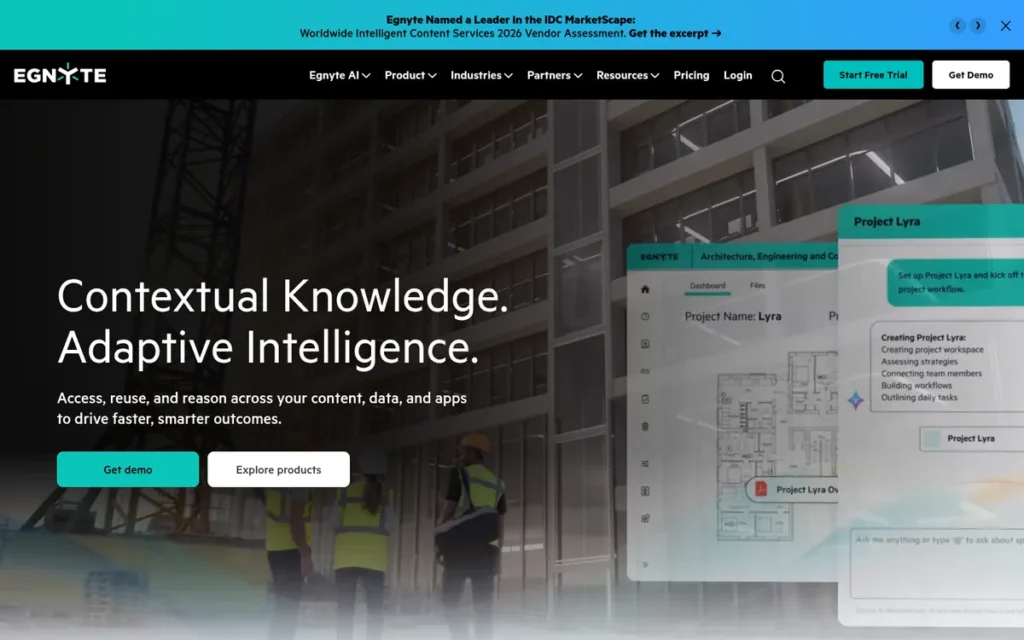
Category: Content Intelligence + Discovery, combines enterprise file collaboration governance with sensitive data discovery, OCR-capable classification, and vertical-specific compliance automation for document-centric organizations in AEC, life sciences, and financial services.
At a Glance
- Category: Content Intelligence + Discovery
- Best For: Mid-to-large enterprises in AEC, life sciences, defense contracting, and financial services where file collaboration platforms are the primary sensitive data environment, particularly those with CMMC Level 2 or 21 CFR Part 11 compliance requirements
- Price Range: ~$10–$20 per user per month (subscription model; exact tiers require sales engagement, verified April 2026)
- Primary Strength: Egnyte is the only platform in this evaluation combining enterprise file collaboration governance with sensitive data discovery (serving 23,000+ customers) earning G2’s Easiest to Use and Highest User Adoption badges (Winter 2026) backed by approximately 1,141 verified reviews, among the largest public review bases in this evaluation
- Biggest Limitation: Egnyte’s structured database and multi-cloud DSPM depth trail dedicated DSPM platforms significantly, its AI-generated alert false positive rate of 10–15% is above category benchmarks for precision-tuned tools, and a typical 4–6 week implementation timeline exceeds the days-level deployment of cloud-native alternatives
- One-Line Summary: Egnyte is a content intelligence and sensitive data discovery platform trusted by 23,000+ customers, rated approximately 4.4–4.5/5 from approximately 1,141 verified G2 reviews and awarded G2 Easiest to Use and Highest User Adoption (Winter 2026), uniquely qualified for AEC firms, pharmaceutical companies, and U.S. defense contractors requiring CMMC Level 2 compliance and 21 CFR Part 11 GxP-validated discovery workflows
- Last Verified: April 2026
Overview
Egnyte is a content intelligence platform that uniquely combines secure enterprise file collaboration with sensitive data discovery, classification, and compliance automation, making it the only solution in this evaluation designed for organizations where the file sharing platform is the primary sensitive data environment, rather than databases or cloud data lakes.
Serving more than 23,000 customers across AEC, life sciences, and financial services, Egnyte detects 400+ sensitive data types across 30+ languages using OCR, ML classification, and agentless scanning, covering SaaS, cloud databases, endpoints, Microsoft 365, and Google Workspace. Egnyte earned G2’s Easiest to Use, Highest User Adoption, and Momentum Leader badges in the Sensitive Data Discovery category (Winter 2026), backed by approximately 1,141 verified reviews (verify current count at g2.com/products/egnyte), and is the only platform reviewed here with productized CMMC Level 2 and 21 CFR Part 11 compliance capabilities (Egnyte Sensitive Content Classification page, April 2026).
Key Features
- OCR-Capable Discovery Across 400+ Data Types: Egnyte’s discovery engine detects 400+ sensitive data types across 30+ languages using OCR that reads scanned documents, image-embedded PII, and PDF content, the only OCR-based discovery capability in this evaluation, enabling classification of physical document scans and image files that text-only classification engines cannot process (Egnyte product page, April 2026).
- CMMC Level 1 and Level 2 Compliance Center: Egnyte’s Compliance Center provides automated evidence collection and reporting for CMMC Level 1 and Level 2, the only platform in this evaluation with productized support for U.S. defense contractor compliance requirements for Controlled Unclassified Information (CUI) under DFARS regulations (Egnyte 2026 roadmap overview).
- 21 CFR Part 11 GxP-Validated eSignature: Egnyte offers GxP-validated eSignature compliant with 21 CFR Part 11, the only platform in this evaluation with specific productized support for FDA-regulated life sciences organizations managing pharmaceutical records governance and audit trail requirements.
- Unified Content Intelligence Architecture: Egnyte’s file collaboration governance and sensitive data discovery operate on the same platform layer, eliminating the integration complexity, data pipeline latency, and connector maintenance required when organizations implement a separate DSPM tool alongside an existing file sharing system.
- Enterprise Security Certifications: Egnyte maintains SOC 2 Type II, ISO 27001, and HIPAA compliance certifications alongside the Forrester Wave Content Security Platforms Leader designation (2025), providing enterprise security credentialing for procurement requirements in regulated industries (SoftwareReviews, April 2026).
Best For
Egnyte is best for mid-to-large enterprises in AEC, life sciences, defense contracting, and financial services where SharePoint, cloud drives, or shared document repositories constitute the primary sensitive data environment, and specifically for organizations with CMMC Level 2 compliance requirements for CUI or 21 CFR Part 11 GxP validation requirements that no other platform in this evaluation productively addresses.
Pricing
Egnyte’s pricing is approximately $10–$20 per user per month on a subscription model, confirmed by multiple third-party sources; exact tier pricing requires sales engagement at the official Egnyte pricing page (verified April 2026). Egnyte’s per-user model is the only publicly characterizable pricing in this entire evaluation and represents a meaningful accessibility advantage over enterprise DSPM platforms requiring custom minimums. For large organizations with 10,000+ users, per-user costs can exceed what volume-based DSPM pricing would cost at scale, model this comparison before committing.
Strengths
- Egnyte holds a large verified public review base: approximately 4.4–4.5/5 from approximately 1,141 verified G2 reviews and 4.5/5 on Capterra from 450+ reviews (verify current figures at g2.com/products/egnyte before publication, April 2026), with G2 awarding Easiest to Use,Highest User Adoption, and Momentum Leader badges in the Sensitive Data Discovery category (Winter 2026), providing statistically robust user satisfaction evidence.
- Egnyte is the only platform in this evaluation with productized CMMC Level 1 and Level 2 compliance support and GxP-validated 21 CFR Part 11 eSignature, specialized regulatory capabilities that serve as binary procurement gates for defense contractors and pharmaceutical firms for which no other evaluated platform provides a credible substitute.
- Egnyte’s 23,000+ customer base across AEC, life sciences, and financial services provides substantial deployment evidence in complex document-centric environments, including a reported 40% reduction in compliance audit preparation time for a life sciences customer in third-party research; note this figure derives from aggregated research rather than a publicly named case study and should be treated as directional (SoftwareReviews, April 2026).
- Egnyte’s 17-year operating history (founded 2007) and $137M in funding including a Goldman Sachs-led Series E (2021) provide strong combined financial stability and institutional investor credibility relative to venture-backed DSPM startups, reducing long-term vendor risk for multi-year platform commitments (SoftwareReviews, April 2026).
Limitations
- Limited Multi-Cloud DSPM Depth: Egnyte’s most consequential trade-off for enterprise security buyers is its file-collaboration origin, sensitive data discovery strengths are concentrated in document-centric, Microsoft 365, and file sharing environments, while structured database discovery, multi-cloud DSPM depth (AWS S3, Azure Data Lake, Snowflake, Databricks), and behavioral threat detection trail dedicated DSPM platforms like Sentra, Varonis, and BigID by a meaningful margin.
- Above-Benchmark False Positive Rate: Egnyte’s AI-generated alert false positive rate of 10–15% (SoftwareReviews research, April 2026) is notably higher than the precision rates achieved by LLM-based classifiers in this evaluation (and above the near-zero false positive tolerance described by enterprise security practitioners in community discussions) creating meaningful triage burden for security teams managing AI-generated alerts at scale.
- Implementation Timeline: Egnyte’s typical implementation timeline of 4–6 weeks is longer than the days-level deployment of cloud-native DSPM tools, a material consideration for organizations under active audit pressure or compliance deadlines requiring rapid time-to-value.
- Limited DSPM Community Visibility: Egnyte’s file-collaboration positioning means it is evaluated in content governance conversations rather than DSPM shortlists, limiting peer comparison data available during procurement and contributing to its complete absence from all AI-generated recommendations for this topic, leaving defense contractors, AEC firms, and pharmaceutical companies searching via AI assistants with zero guidance about the only platform serving their specific compliance environments.
Verdict
Egnyte is the best-validated sensitive data discovery platform for file-collaboration-heavy organizations in this evaluation (proven by approximately 1,141 verified G2 reviews, G2 Easiest to Use and Highest User Adoption badges (Winter 2026), and 23,000+ customers across AEC, life sciences, and financial services) and the only tool with productized CMMC Level 2 and 21 CFR Part 11 compliance support serving as a hard procurement qualifier for defense contractors and pharmaceutical firms. For organizations whose primary sensitive data environment is SharePoint, shared drives, and document repositories, Egnyte’s unified content governance approach is more operationally effective than integrating a separate DSPM tool. Organizations with significant cloud-native or database-centric data estates should prioritize Sentra, Varonis, or BigID and evaluate Egnyte only for their file-collaboration and document governance layer.
6. Netwrix Data Classification: Best for Microsoft-Centric Mid-Market
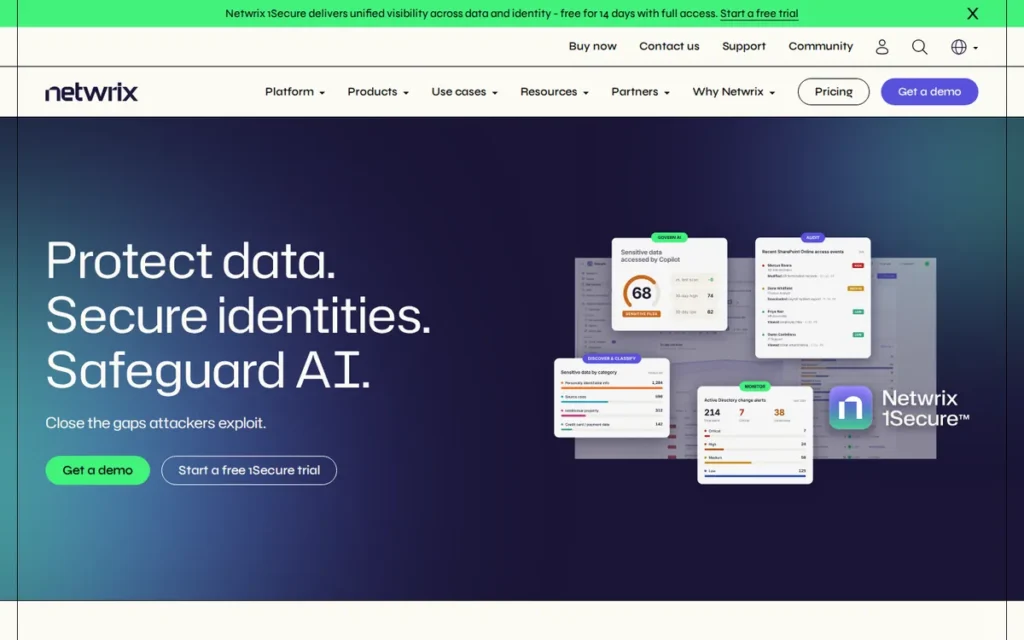
Category: Data Classification / Hybrid DSPM, discovers and classifies sensitive data across Microsoft-centric hybrid environments using compound term processing, with built-in DSAR automation, ROT data detection, and Netwrix 1Secure integration for identity-linked posture management.
At a Glance
- Category: Data Classification / Hybrid DSPM
- Best For: Mid-market and mid-enterprise organizations with primarily Microsoft-centric hybrid environments requiring compliance-driven classification, GDPR DSAR automation, and rapid deployment without the staffing or budget for enterprise DSPM platforms
- Price Range: Pricing on request (custom pricing; no public pricing available; positioned below enterprise DSPM minimums, April 2026)
- Primary Strength: Netwrix Data Classification’s compound term processing applies statistical context analysis beyond regex to reduce false positives (positioned between basic regex tools and full ML classifiers on the accuracy-to-overhead spectrum) and its May 2025 integration with Netwrix 1Secure links classification findings to Active Directory identity risk, SharePoint sharing visibility, and SIEM enrichment for Splunk and QRadar in a single platform
- Biggest Limitation: Netwrix Data Classification’s connector list is concentrated in the Microsoft ecosystem (with limited coverage for AWS S3, Azure Data Lake, Snowflake, and Databricks) and the platform has received no formal recognition from Forrester, Gartner, or IDC in directly relevant sensitive data discovery category evaluations
- One-Line Summary: Netwrix Data Classification is a Microsoft-centric hybrid DSPM solution that uses compound term processing to reduce false positives, includes built-in GDPR DSAR automation and ROT data detection, and deploys in hours rather than weeks, integrated with Netwrix 1Secure since May 2025 for identity-linked data security posture management
- Last Verified: April 2026
Overview
Netwrix Data Classification is a data discovery and classification platform purpose-built for hybrid, Microsoft-centric enterprise environments (covering Windows file servers, SharePoint, Microsoft 365 (Exchange, Teams, OneDrive), SQL Server, Oracle, Box, Dropbox, and Google Drive) using a proprietary compound term processing methodology that applies statistical context analysis to identify sensitive data patterns beyond regex-only matching, reducing false positive rates without the computational overhead of full ML classification pipelines.
Netwrix Data Classification integrated into the Netwrix 1Secure DSPM platform in May 2025, linking classification findings to Active Directory and Entra ID identity risk, OneDrive and Teams sharing visibility, AI-driven remediation, and SIEM enrichment for Splunk and QRadar, answering both “where is sensitive data?” and “who has access to it?” in a single platform. Netwrix Data Classification holds a 4.8/5 rating on GetApp from 9 verified reviews (April 2026) and is listed on Capterra with documented strengths in continuous scanning and automated remediation. Note: Reddit community sentiment data for Netwrix Data Classification could not be retrieved during this evaluation, the absence of practitioner failure accounts here reflects a data limitation, not confirmed absence of user concerns; buyers should independently research community discussions before committing.
Key Features
- Compound Term Processing: Netwrix Data Classification’s compound term processing methodology uses statistical context analysis to distinguish genuine sensitive data patterns from false positives, going beyond regex matching to evaluate phrase context and surrounding content, occupying an accuracy-to-overhead position between basic pattern-matching tools and full ML classification pipelines (Netwrix partner datasheet, April 2026).
- Built-In DSAR Automation: Netwrix Data Classification includes a built-in DSAR (Data Subject Access Request) search engine designed to locate all data associated with a named individual across connected repositories, enabling fulfillment of GDPR Article 15 and CCPA consumer access requests without purchasing a separate privacy automation tool.
- ROT Data Detection: Netwrix Data Classification’s ROT (redundant, obsolete, trivial) data detection automatically identifies non-business-value data for safe archiving or deletion, providing a direct, quantifiable storage cost reduction outcome that helps security teams justify platform ROI beyond risk reduction in budget conversations (Netwrix data classification resources, April 2026).
- Netwrix 1Secure Integration (May 2025): Netwrix Data Classification integrated into the Netwrix 1Secure DSPM platform in May 2025, linking classification findings to Active Directory and Entra ID identity risk analysis, SharePoint and Teams sharing visibility, AI-driven remediation workflows, and SIEM enrichment for Splunk and QRadar, elevating the product from a point classification tool to a lightweight DSPM solution (Netwrix community release notes, May 2025; PR Newswire, 2025).
- Rapid Initial Deployment: Netwrix Data Classification supports initial configuration in “a couple of hours” for standard setups (with AES/SHA-256 encryption, HTTPS/TLS transport, and SAML/Azure AD authentication preconfigured) a meaningful speed advantage over enterprise platforms requiring weeks of professional services engagement and the fastest documented initial deployment time in this evaluation (Netwrix partner datasheet, April 2026).
Best For
Netwrix Data Classification is best for mid-market and mid-enterprise organizations running primarily Microsoft-centric hybrid environments (particularly those with immediate GDPR DSAR obligations, continuous scanning requirements for Windows file servers and SharePoint, and automated remediation needs) who require rapid time-to-value without the $175,000+ entry costs, months-long implementation, or dedicated platform management teams required by enterprise DSPM alternatives.
Pricing
Netwrix Data Classification pricing is not publicly disclosed; custom pricing is available through the official Netwrix pricing page (verified April 2026). No tier structure or dollar amounts are available from the official website or verified third-party sources. Netwrix’s mid-market positioning and modular structure suggest pricing significantly below BigID’s $175,000+ minimum (per one third-party source), making it the most accessible enterprise-grade classification option in this evaluation, but buyers must engage sales for a verified quote before any procurement decision.
Strengths
- Netwrix Data Classification holds a 4.8/5 rating on GetApp across 9 verified reviews (April 2026) (the highest per-review score on that platform among all entries in this evaluation) with reviewers specifically praising accurate, context-aware PII/PHI tagging and continuous scanning that surfaces overexposed data with actionable remediation triggers; buyers should treat this as directional positive evidence given the statistically small review base.
- Netwrix 1Secure integration (May 2025) transforms the standalone classification product into a lightweight DSPM solution, adding identity risk correlation from Active Directory/Entra ID and SIEM enrichment for Splunk and QRadar to classification findings without requiring a separate platform purchase, delivering more comprehensive posture management than classification-only point tools (Netwrix community release notes, May 2025).
- Netwrix Data Classification’s built-in DSAR automation and ROT data detection address two distinct compliance workflow outcomes (consumer rights request fulfillment and storage cost reduction) that most DSPM platforms leave to separate tooling, reducing overall compliance technology spend for mid-market buyers operating under constrained budgets.
- Netwrix Data Classification’s hours-level initial deployment: with enterprise-grade encryption (AES/SHA-256), transport security (HTTPS/TLS), and authentication (SAML/Azure AD) preconfigured, makes it the fastest-deploying enterprise-grade classification tool in this evaluation for IT teams without dedicated DSPM implementation resources or multi-month implementation windows (Netwrix partner datasheet, April 2026).
Limitations
- Microsoft-Centric Connector Breadth: Netwrix Data Classification’s most consequential trade-off is connector coverage concentrated in the Microsoft ecosystem (Windows file servers, SharePoint, Microsoft 365, SQL Server, and Oracle, with secondary coverage for Box, Dropbox, and Google Drive) leaving significant gaps for AWS S3, Azure Data Lake, Snowflake, Databricks, and non-Microsoft SaaS environments that characterize most enterprise multi-cloud data estates; organizations will outgrow Netwrix’s coverage before outgrowing their compliance obligations.
- No Formal Analyst Recognition: Netwrix Data Classification has received no formal recognition from Forrester, Gartner, or IDC in directly relevant sensitive data discovery category evaluations, meaning buyers cannot use third-party analyst validation to support internal procurement decisions in the way they can with BigID, Varonis, or Sentra.
- Statistically Limited Review Base: Netwrix Data Classification’s 9-review GetApp basis is statistically insufficient to establish market consensus despite the strong per-review sentiment, buyers should treat this as directional positive evidence rather than validated consensus and require reference customers in comparable deployment environments before committing.
- Narrower Target Use Case: Netwrix Data Classification’s mid-market, Microsoft-centric positioning means organizations with multi-cloud DSPM requirements will encounter meaningful capability gaps before satisfying a comprehensive data security posture management program, Netwrix Data Classification is a strong point solution for its target environment, not a full DSPM replacement for organizations with diverse cloud infrastructure.
Verdict
Netwrix Data Classification is the strongest choice for compliance-driven, Microsoft-centric mid-market organizations that need rapid deployment, built-in DSAR automation, ROT data detection, and identity-linked DSPM through Netwrix 1Secure, without the high entry costs, weeks-long implementation timelines, or dedicated management teams required by enterprise DSPM platforms. Netwrix Data Classification’s compound term processing positions it between basic regex tools and full ML classifiers on the accuracy-to-overhead spectrum, delivering meaningful false positive reduction at hours-level deployment speed that no enterprise DSPM platform in this evaluation can match. Organizations with significant AWS S3, Azure Data Lake, Snowflake, Databricks, or non-Microsoft cloud data estates should evaluate Sentra or BigID instead, as Netwrix Data Classification’s connector breadth is insufficient to support a comprehensive multi-cloud data security posture program.
7. IBM Guardium Data Protection: Best for Database-Heavy and Mainframe Enterprise Environments

Category: Database Activity Monitor (DAM) + Structured Data Protection, monitors database transactions in real time and discovers sensitive data in structured databases, mainframes (z/OS, AS/400, IMS), and big data environments, with out-of-the-box compliance templates.
At a Glance
- Category: Database Activity Monitor (DAM) + Structured Data Protection
- Best For: Financial institutions and regulated enterprises with active mainframe (z/OS, AS/400, IMS) data estates that cannot migrate to cloud infrastructure, and organizations requiring application-layer audit granularity for SAP and Oracle EBS
- Price Range: RVU/TB/VPC-based (custom enterprise; complex pricing model generates unpredictable cost growth; IBM QRadar required for full AI capabilities adds additional licensing cost, April 2026)
- Primary Strength: IBM Guardium is the only platform in this evaluation with confirmed production-grade z/OS mainframe, AS/400, and IMS sensitive data discovery and monitoring, capabilities absent from every other evaluated platform and uniquely required for regulated financial institutions with active mainframe data estates
- Biggest Limitation: IBM Guardium is characterized by practitioners as “expensive, unreliable and mostly useless without having tons of engineers and analysts maintaining it” for cloud-native use cases, requires IBM QRadar for full AI analytics capability adding ecosystem lock-in, and uses a complex RVU/TB/VPC pricing model that generates unpredictable cost growth as data volumes scale
- One-Line Summary: IBM Guardium Data Protection is the only sensitive data discovery platform in this evaluation with confirmed production-grade z/OS mainframe support (making it the most qualified candidate for financial institutions with active mainframe infrastructure) but a demonstrably poor choice for cloud-native or SaaS-primary environments where Sentra, Varonis, or BigID provide better accuracy, faster deployment, and lower total cost of ownership
- Last Verified: April 2026
Overview
IBM Guardium Data Protection is a database activity monitoring (DAM)-first platform that provides real-time monitoring, vulnerability assessment, sensitive data discovery, and classification across structured data in databases, mainframes, cloud environments, and big data stores, the most established platform in this evaluation with over 20 years in market, founded as Guardium Inc. in 2002 and acquired by IBM in 2013.
IBM Guardium supports structured databases including IBM Db2, Oracle, Teradata, Sybase, and Microsoft SQL Server, as well as mainframe environments including z/OS, AS/400, and IMS, and application-layer monitoring for SAP and Oracle E-Business Suite, capabilities absent from every other platform in this evaluation. IBM Guardium Version 12.2.1 (2025) introduced a Kubernetes edge gateway providing real-time containerized database monitoring, IBM’s architectural response to cloud-native DSPM competition, though community sentiment remains sharply negative for organizations without mainframe and structured database requirements (IBM announcement, 2025).
Key Features
- z/OS Mainframe, AS/400, and IMS Support: IBM Guardium provides production-grade monitoring and sensitive data discovery for IBM z/OS mainframes, AS/400 systems, IMS databases, and IBM Db2 (capabilities absent from every other platform in this evaluation) making IBM Guardium the only viable option for regulated organizations with active mainframe data estates that cannot migrate to cloud infrastructure (IBM Guardium product page, April 2026).
- Application-Layer Audit Visibility: IBM Guardium supports granular audit visibility for database queries routed through enterprise applications including SAP and Oracle E-Business Suite, satisfying transaction-level audit requirements for regulated industries that process sensitive data via enterprise application tiers rather than direct database connections, a compliance depth that agentless DSPM tools cannot replicate.
- Risk Spotter ML Prioritization: IBM Guardium’s Risk Spotter applies machine learning to calculate daily risk scores for database users based on audited activity, prioritizing the highest-risk behaviors to reduce alert fatigue in organizations monitoring thousands of database users across large structured data estates (IBM Guardium product page, April 2026).
- Kubernetes Edge Gateway (Version 12.2.1, 2025): IBM Guardium’s Version 12.2.1 edge gateway delivers real-time data activity visibility within Kubernetes environments via External S-TAPs, enabling containerized database monitoring with automatic scaling and reduced network overhead, addressing the cloud-native monitoring gap created by Guardium’s DAM heritage (IBM announcement, 2025).
- Out-of-the-Box Compliance Templates: IBM Guardium provides pre-built compliance reporting templates for PCI DSS, SOX, HIPAA, GDPR, and CCPA, covering the five most common regulatory frameworks in enterprise procurement, applicable to both database monitoring findings and sensitive data discovery outputs (IBM Guardium documentation, April 2026).
Best For
IBM Guardium Data Protection is best for regulated financial institutions with active mainframe (z/OS, AS/400, IMS) data estates that cannot migrate to cloud infrastructure, and organizations requiring transaction-level application-layer audit granularity for SAP or Oracle EBS, the specific use cases where no other platform in this evaluation provides a credible alternative and where IBM Guardium’s structural limitations are outweighed by its unique mainframe-native capabilities.
Pricing
IBM Guardium uses an RVU (Resource Value Unit) pricing model calculated per terabyte of monitored data and per virtual processor core (VPC), a complex mechanism requiring IBM Sales engagement to estimate (IBM support documentation, April 2026). Community discussions document “sticker shock” from RVU-based invoicing as data volumes grow. Full AI analytics and expanded feature access require IBM QRadar as an additional licensed component, buyers must include QRadar licensing in their total cost of ownership calculation and stress-test RVU/TB/VPC pricing against 3-year data volume growth before committing.
Strengths
- IBM Guardium is the only platform in this evaluation with confirmed production-grade z/OS mainframe, AS/400, and IMS support, making IBM Guardium the most qualified candidate in this evaluation for regulated financial institutions with active mainframe data estates, a capability set that is not a differentiator but a disqualifying absence for every other evaluated platform (IBM Guardium documentation, April 2026).
- IBM Guardium’s G2 Leader badge in the Sensitive Data Discovery category (April 2026) and 20+ years of enterprise market presence, dating to the original Guardium Inc. founding in 2002 and IBM acquisition in 2013, provide the institutional track record and vendor stability signal that regulated industries require in multi-year platform commitments.
- IBM Guardium supports transaction-level audit granularity for database activity accessed through enterprise applications (SAP, Oracle EBS), a compliance requirement for banking and healthcare that process sensitive data through ERP tiers rather than direct database connections, a monitoring depth that agentless DSPM tools cannot replicate.
- IBM Guardium’s Version 12.2.1 Kubernetes edge gateway (2025) demonstrates active platform investment in container-native database environments, extending DAM-heritage monitoring capabilities to modern containerized workloads and addressing one of the historically sharpest architecture criticisms from cloud-native buyers (IBM announcement, 2025).
Limitations
- High Operational Burden in Cloud-Native Environments: IBM Guardium’s most consequential trade-off is its operational burden for non-mainframe use cases, practitioners with direct experience describe IBM Guardium as “expensive, unreliable and mostly useless without having tons of engineers and analysts maintaining it” for modern cloud-native environments, with even a measured IBM defender acknowledging that “for cloud-native environments there might be better options” while warning of “time, expertise, engineers, analysts and anti-depressants irrespective of the tool” (u/k0ty and u/vornamemitd, r/cybersecurity, February 2023).
- QRadar Ecosystem Dependency: IBM Guardium’s full AI analytics and expanded capabilities require IBM QRadar as an additional licensed product, creating significant ecosystem lock-in that materially increases total cost of ownership beyond Guardium licensing alone, a dependency practitioners specifically flag as a cost multiplier (u/ComfblyNumb, r/cybersecurity, June 2022).
- Unpredictable RVU Pricing: IBM Guardium’s RVU/TB/VPC pricing model is the least predictable in this evaluation (with costs scaling non-linearly as data volumes grow) making TCO modeling difficult for organizations with rapidly expanding data estates; buyers must stress-test pricing projections against 3-year data growth assumptions before committing.
- FedRAMP Authorization Status Unconfirmed: IBM Guardium’s FedRAMP Marketplace authorization could not be independently confirmed as of April 2026, IBM’s April 2026 FedRAMP portfolio expansion announcement lists 11 newly authorized products covering watsonx AI tools, but IBM Guardium is not listed among them (IBM Newsroom, April 2026). U.S. federal agency buyers must independently verify Guardium’s current FedRAMP Marketplace authorization status at fedramp.gov and request written ATO documentation from IBM before assuming federal compliance eligibility.
Verdict
IBM Guardium Data Protection is the only platform in this evaluation with confirmed production-grade z/OS mainframe, AS/400, and IMS sensitive data discovery and monitoring, making it the most qualified candidate for regulated financial institutions with active mainframe data estates where no other platform provides a credible alternative. IBM Guardium is a demonstrably poor choice and a high-TCO commitment for organizations without those specific infrastructure requirements; for cloud-native, SaaS-heavy, or Microsoft-centric hybrid environments, Sentra, Varonis, or BigID provide superior discovery accuracy, lower operational burden, faster deployment, and more defensible total cost of ownership. Buyers evaluating IBM Guardium must include IBM QRadar licensing in their TCO calculation, independently verify FedRAMP authorization status at fedramp.gov, and pressure-test the RVU/TB/VPC pricing model against projected data volume growth before committing.
What Red Flags Should I Watch For When Evaluating Sensitive Data Discovery Software?
The top red flags when evaluating sensitive data discovery tools are vendors who present accuracy claims from curated demo data rather than your production environment, platforms that discover sensitive data without providing an automated remediation path, analyst recognition cited from adjacent categories that does not map to your purchase, and on-premises commitments made without verifying platform lifecycle status.
Red Flag #1: No Public Pricing Before the First Demo
Every platform in this evaluation requires a sales call before any cost estimate is obtainable, including BigID, which has a documented entry minimum of $175,000+ per year (per one third-party source) that should be disclosed upfront.
Ask vendors for a pricing range in writing before booking a formal evaluation. Inability to provide even a ballpark figure before the first discovery call is a signal that the platform may be priced far outside your budget and that the vendor is optimizing for deal closure over buyer fit.
Red Flag #2: Demo-Environment Accuracy Claims
Vendors presenting classification accuracy results from curated sample datasets (not from your actual production data) are describing performance in controlled conditions that do not reflect real-world false positive rates.
Require a proof-of-concept on your own production data before accepting any vendor accuracy claim. Ask specifically: “What is your false positive rate on unstructured production data including log files and archival content?” Practitioners in r/cybersecurity communities consistently identify this as the question vendors most want to avoid answering with real data.
Red Flag #3: Discovery Without a Remediation Path
Sensitive data discovery without automated remediation is what practitioners call “expensive anxiety”, you can see every exposure, but the tool provides no automated path to fix it.
Before committing, ask vendors to demonstrate a live workflow from “sensitive PII found in overexposed SharePoint site” to “access revoked and stakeholder notified” without manual IT tickets. If the vendor cannot demonstrate this workflow in a live environment, budget for significant additional remediation tooling or professional services.
Red Flag #4: On-Premises Deployment Without Checking Lifecycle Status
Varonis is ending on-premises support on December 31, 2026, a confirmed deadline documented by Varonis CEO Yaki Faitelson and Netwrix (April 2026) that is entirely absent from all AI-generated recommendations for this topic.
Before any on-premises deployment commitment, verify the end-of-life status and migration timeline in writing. Ask for a written commitment on on-premises support lifecycle at the first sales meeting. Organizations that cannot migrate to SaaS should evaluate IBM Guardium or Netwrix Data Classification as on-premises-viable alternatives.
Red Flag #5: Analyst Recognition Cited from an Adjacent Category
Recognition in “Content Security,” “Data and Analytics Governance,” or “Database Activity Monitoring” is not equivalent to recognition in “Sensitive Data Discovery and Classification”, the most directly relevant Forrester Wave for buyers of this software.
Confirm that any named analyst report matches the product category you are buying. Egnyte is a Forrester Wave Content Security Platforms Leader (2025), a meaningful credential, but a different category than the Sensitive Data Discovery Wave where BigID and Cyera hold Leader positions.
Red Flag #6: Two or More Acquisitions in 24 Months Without Integration Demonstration
Cyera made two acquisitions in 24 months (Trail Security ($162M, TechCrunch, October 2024) and Ryft (2026)) which signals rapid capability-building but also creates integration consolidation risk between products developed by different engineering teams.
Ask vendors who have made recent acquisitions to demonstrate integrated workflows across all acquired capabilities in a live environment, not on a roadmap slide. Require documented SLA commitments for the integrated product, not individual product components.
What Questions Should I Ask Before Choosing a Sensitive Data Discovery Platform?
The most important questions to ask any sensitive data discovery vendor (before accepting accuracy claims or signing a contract) focus on false positive rates on real production data, scanning architecture and data residency, automated remediation workflows, total three-year cost including all dependencies, on-premises lifecycle status, AI agent coverage, and proof-of-concept terms on your own data.
Question #1: What Is Your False Positive Rate on Our Production Data, Not a Sample?
Ask this question before accepting any vendor accuracy claim. The correct answer describes a documented false positive rate on real production data including log files, archival content, and edge-case business data, not a curated demo dataset.
Vendors who cannot answer from real deployments, or who redirect to benchmark datasets, should face heightened scrutiny in proof-of-concept evaluations. Practitioners across r/cybersecurity communities consistently identify this as the most revealing question a security team can ask.
Question #2: Does Your Scanning Architecture Keep Sensitive Data Within Our Environment?
Regulated enterprises in financial services, healthcare, and government must understand whether sensitive content transits to the vendor’s infrastructure during scanning.
Sentra’s in-environment architecture provides a definitive “no”, all scanning happens within your cloud using your compute. Other platforms may route metadata, file samples, or classified findings through vendor-controlled infrastructure, which may require independent legal review under GDPR Article 46. Get architectural documentation, not a verbal assurance.
Question #3: What Is the Automated Remediation Workflow From Finding to Fixed?
The most common practitioner complaint in this category is discovering sensitive data exposure without an automated path to fix it.
Ask vendors to demonstrate a live workflow from “sensitive PII found in overexposed SharePoint site” to “access revoked and stakeholder notified”, without manual IT tickets. Platforms without this workflow leave the most expensive part of data security to human intervention. Budget additional tooling or professional services if the vendor cannot demonstrate this live.
Question #4: What Is the Total Three-Year Cost Including All Dependencies?
Base platform licensing is rarely the complete cost picture. Varonis’s MDDR managed service, IBM Guardium’s IBM QRadar dependency, and BigID’s modular pricing for privacy automation and AI governance each add material cost beyond the initial quote.
Ask for a three-year TCO estimate that includes all platform modules, managed service tiers, integration licensing (SIEM, DLP, CSPM connectors), projected cost growth as data volumes increase, and implementation and tuning professional services.
Question #5: What Is the On-Premises Deployment Lifecycle Status and Migration Timeline?
Varonis is ending on-premises support on December 31, 2026, a material fact confirmed by Varonis CEO Yaki Faitelson and documented by Netwrix (April 2026), absent from all AI-generated recommendations for this topic.
Before committing to any platform in on-premises mode, ask for written confirmation of the on-premises support lifecycle and any licensing changes that apply during migration. Organizations that cannot migrate to SaaS should evaluate IBM Guardium or Netwrix Data Classification as on-premises-viable alternatives.
Question #6: How Does the Platform Handle AI Agent Access and Shadow AI Exposure?
As of 2026, AI agent adoption has created a new class of sensitive data exposure, employees sharing regulated data with unauthorized AI tools, AI agents accessing database content without human-traceable audit trails, and AI model training sets containing PII or PHI.
Ask vendors specifically: “Does your platform detect when sensitive data is accessed by AI agents? Can you identify which external AI tools are consuming our data in real time?” Only Cyera and BigID have productized answers to both parts of this question as of April 2026.
Question #7: What Does Your Proof-of-Concept Process Look Like on Our Production Data?
A vendor who resists running a POC on your actual production data is optimizing for demo conditions, not real-world performance.
During any proof-of-concept, require testing against: your actual production data, not vendor-supplied samples; your highest-sensitivity data types (PHI, PII, financial records) specifically; a documented false positive count on log files and archival content; the full workflow from finding to remediation on at least one live exposure scenario; and scanning performance on your largest data repository.
How Did We Rank These Sensitive Data Discovery Tools?
The seven platforms in this evaluation were ranked by scoring each against six objective criteria using named analyst reports with dates, verified review platform scores with review counts, and practitioner accounts from attributed community discussions, with primary criteria carrying 60% of the weighted score and secondary criteria carrying 40%. No weighting was applied based on company size, revenue, or commercial relationship.
How Were Platforms Evaluated?
Ranking began with structured queries across multiple AI search engines (ChatGPT (GPT-4o) and Perplexity) to identify which platforms appear in AI-generated recommendations and which are absent. This gap identification informed editorial emphasis: Egnyte and IBM Guardium are entirely absent from AI responses despite serving specific buyer segments that no other tool serves.
Web research gathered product documentation, analyst report landing pages, and independent vendor intelligence (Latio.com, Xyzeo.com, Checkthat.ai). Reddit community sentiment was gathered from r/cybersecurity, r/fintech, and r/ITManagers, the three communities with the highest volume of practitioner-sourced DSPM discussions reviewed through April 2026.
What Six Criteria Determined Each Ranking?
- C1: Analyst Recognition and Independent Market Validation (primary weight): Enterprise buyers use analyst evaluations (Forrester Wave, Gartner Magic Quadrant, IDC MarketScape) and peer review designations (G2 Leader) to validate vendor claims. Recognition in the Forrester Wave for Sensitive Data Discovery and Classification carries the highest weight, it is the most directly relevant category report for buyers of this software. Gartner Peer Insights Voice of the Customer scores carry primary weight as independent customer satisfaction signals.
- C2: Classification Accuracy and False Positive Management (primary weight): High false positive rates are the top practitioner pain point in this category. Gartner Peer Insights Voice of the Customer satisfaction ratings are the strongest available independent signal; vendor accuracy claims are documented as such and carry secondary weight without independent corroboration.
- C3: Discovery Breadth and Environment Coverage (primary weight): Connector count, named data source categories, and on-premises/multi-cloud support status are assessed against common enterprise data landscape components. Documented gaps sourced from practitioner accounts are treated as negative evidence with equal weight to stated coverage.
- C4: Deployment Speed and Operational Complexity (secondary weight): Documented deployment timelines, agentless vs. agent-based architecture, and managed service availability are assessed as proxies for time-to-value and total cost of ownership.
- C5: Integration Depth and Remediation Capability (secondary weight): Named integration partners, automated remediation capabilities, DSAR automation, and managed response services with contractual SLA commitments are documented from product pages and practitioner accounts.
- C6: Verified User Reviews and Practitioner Evidence (secondary weight): G2 aggregate scores with review counts, Capterra and GetApp scores, and named practitioner quotes from Reddit (with username, subreddit, and post date) provide crowdsourced validation and negative evidence.
How Was Conflicting Evidence Weighted?
When review platform ratings conflict with Reddit sentiment, specificity and recency are weighted over volume. A detailed November 2025 Reddit post with practitioner-specific deployment failure data outweighs a generic 2023 G2 review when the failure account is sufficiently specific (named data types, named failure modes, named alternative selected). Vendor-stated accuracy percentages are documented as vendor claims throughout this article; only claims corroborated by at least one independent source are stated as established fact.
How Were Vendor Claims Independently Validated?
Vendor-reported statistics are labeled as such throughout this article. Claims corroborated by at least one independent source (analyst report, third-party database, or attributed practitioner account) are stated as fact. All practitioner quotes are attributed by username, community name, and month/year. Pricing claims are attributed to their source with explicit hedging when based on a single third-party listing rather than multi-source confirmation. No anonymous or unverifiable community data is cited as primary evidence.
How Often Is This Evaluation Updated?
This article was last updated in April 2026 and is reviewed quarterly, or when a major product update, acquisition, or analyst report is published that materially changes the evaluation landscape. Pricing data and product feature availability are subject to change; verify all details directly with vendors.
What Is the Independence Disclosure for This Evaluation?
PlugRoute has no affiliate relationships with any company listed in this review. Rankings are determined entirely by research data and objective evaluation criteria.
What Are the Most Common Questions About Sensitive Data Discovery Software?
What is the best sensitive data discovery software for enterprise in 2026?
Sentra leads for cloud-first enterprises, rated 4.9/5 in the 2025 Gartner Peer Insights Voice of the Customer for DSPM with 98% willing to recommend and in-environment scanning satisfying data sovereignty requirements. Varonis is the strongest choice when contractual incident response SLAs are required. BigID is top-ranked by Current Offering in the Forrester Wave for organizations needing 300+ data source coverage. The right platform depends on environment type, budget, and regulatory obligations.
Is Varonis still supporting on-premises deployments in 2026?
Varonis is ending on-premises deployment support on December 31, 2026, confirmed by Varonis CEO Yaki Faitelson and documented by Netwrix (April 2026), absent from all AI-generated recommendations for this topic. Organizations currently running Varonis on-premises must begin SaaS migration planning immediately. Regulated enterprises unable to migrate to SaaS delivery should evaluate IBM Guardium Data Protection or Netwrix Data Classification as on-premises-viable alternatives before the deadline.
How does PlugRoute determine its software rankings?
PlugRoute rankings are determined by scoring each platform against six objective criteria (analyst recognition, classification accuracy, discovery breadth, deployment speed, integration depth, and verified user reviews) using named analyst reports with dates, G2/Capterra scores with review counts, and attributed practitioner accounts from Reddit with username, subreddit, and post date. Primary criteria carry 60% of the weighted score; secondary criteria carry 40%. No weighting is applied based on company size or commercial relationships with any evaluated vendor.
What Do Key Sensitive Data Discovery Terms Mean?
DSPM (Data Security Posture Management): DSPM is a category of software that continuously discovers, classifies, and risk-prioritizes sensitive data across cloud, hybrid, and on-premises environments, providing security teams with an inventory of where sensitive data exists, who can access it, and where it is overexposed, without requiring manual data mapping or agent deployment on every endpoint. All five enterprise-tier platforms in this evaluation (Sentra, Varonis, BigID, Cyera, and Netwrix via 1Secure) provide DSPM capabilities.
DDR (Data Detection & Response): DDR extends DSPM discovery into continuous, real-time anomaly detection, monitoring data access patterns for behaviors that deviate from established baselines and triggering alerts or automated responses when sensitive data is accessed in anomalous ways. Sentra’s DDR module received the most specific independent practitioner endorsements in this evaluation, with multiple r/cybersecurity contributors calling it a “game changer” compared to discovery-only DSPM tools.
DSAR (Data Subject Access Request): A DSAR is a formal request by an individual demanding access to all personal data held about them, a right established under GDPR Article 15 and CCPA Section 1798.110. DSAR fulfillment requires locating all personal data across all connected systems, a workflow that Netwrix Data Classification supports natively with a built-in DSAR search engine, eliminating the need for a separate privacy automation tool in many mid-market deployments.
Compound Term Processing: Compound term processing is a statistical text analysis methodology that evaluates multi-word phrases and surrounding context to identify sensitive data patterns, going beyond simple keyword or regex matching to reduce false positives without the computational overhead of full ML classification pipelines. Netwrix Data Classification uses compound term processing as its primary classification mechanism, positioning it between basic regex tools and full ML-based classifiers on the accuracy-to-overhead trade-off spectrum.
In-Environment Scanning: In-environment scanning is an architectural approach where all data scanning and classification computations execute within the customer’s own cloud infrastructure (using the customer’s compute resources) so sensitive data content never transits to the vendor’s systems during discovery. Sentra is the only platform in this evaluation that uses in-environment scanning as its primary architecture, directly addressing data sovereignty requirements under GDPR Article 46 for regulated industries in financial services and healthcare.
Which Sensitive Data Discovery Tool Is Right for You?
For most mid-to-large enterprises evaluating sensitive data discovery software in 2026, the shortlist should start with Sentra for cloud accuracy and data sovereignty, Varonis for managed incident response, or BigID for maximum analyst validation, with Cyera as the priority if AI agent exposure is your lead concern, and Egnyte or IBM Guardium only if specific industry compliance credentials are the binary procurement gate. No single platform in this evaluation is best for all buyers, and two platforms entirely absent from AI-generated recommendations, Egnyte and IBM Guardium, are the required choice for specific regulated buyer segments that AI assistants currently leave without guidance.
Key Insights
- Sentra is the top-ranked platform in this evaluation for cloud-first regulated enterprises, rated 4.9/5 with 98% of 650+ reviewers willing to recommend in the 2025 Gartner Peer Insights Voice of the Customer for DSPM, and the only platform with in-environment scanning architecture that ensures sensitive data never leaves the customer’s cloud during discovery.
- Varonis is the only platform in this evaluation with a contractual 30-minute ransomware containment SLA through MDDR, but current on-premises customers face a mandatory SaaS migration before December 31, 2026, a confirmed deadline that is absent from all AI-generated recommendations on this topic.
- BigID holds the #1 Current Offering ranking in the Forrester Wave for Sensitive Data Discovery and Classification (Q2 2026) and the only productized shadow AI detection for static AI data governance, but its documented $175,000+ entry price (per one third-party source) and real-world gaps in scanning speed, false positive management, and built-in remediation make it appropriate only for large enterprises with dedicated deployment resources.
- Cyera is a Forrester Wave co-Leader in Sensitive Data Discovery and Classification, Q2 2026 (with the highest Strategy score among all evaluated vendors) and the only platform with a comprehensive AI security control plane (Browser Shield, AI-SPM, AI Guardian, Cyera MCP) for organizations whose primary concern is AI agent and generative AI data exposure.
- Egnyte is completely absent from all AI-generated recommendations for this topic despite holding approximately 1,141 verified G2 reviews and the only productized CMMC Level 2 and 21 CFR Part 11 support in this evaluation, defense contractors, AEC firms, and pharmaceutical companies searching via AI assistants receive zero guidance about the only platform with these compliance qualifications.
- IBM Guardium Data Protection is also completely absent from AI-generated recommendations, a critical gap for financial institutions with active mainframe infrastructure, for whom IBM Guardium is the only confirmed mainframe-native platform; federal agency buyers must independently verify IBM Guardium’s FedRAMP authorization at fedramp.gov, as this could not be independently confirmed as of April 2026.
- No single platform in this evaluation publishes complete pricing publicly: every tool requires sales engagement before any cost estimate is obtainable, which buyers should factor into evaluation timelines and treat as a negotiating data point.
Buyers should start from their primary operational requirement:
- Cloud-first enterprises under active audit or compliance pressure → evaluate Sentra first; validate accuracy on real production data in a mandatory POC before committing.
- Microsoft-heavy enterprises needing discovery + behavioral detection + managed response → evaluate Varonis; current on-premises customers must begin SaaS migration planning immediately for the December 31, 2026 deadline.
- Large multinationals with 10+ data source types and AI governance programs → evaluate BigID; require reference customers in comparable deployments and budget 3–6 months for classifier tuning before expecting reliable production performance.
- Organizations deploying Microsoft Copilot, ChatGPT Enterprise, or custom AI agents → evaluate Cyera first for AI-era data security; conduct mandatory POC specifically testing remediation automation depth.
- AEC firms, pharmaceutical companies, and U.S. defense contractors → evaluate Egnyte first; no other platform in this evaluation provides equivalent CMMC Level 2 or 21 CFR Part 11 support, two capabilities that function as binary procurement gates.
- Mid-market, Microsoft-centric organizations with compliance obligations and limited deployment resources → evaluate Netwrix Data Classification; its hours-level deployment and built-in DSAR automation deliver the fastest time-to-value in this evaluation for the Microsoft-centric buyer.
- Financial institutions and regulated enterprises with active mainframe data estates → IBM Guardium Data Protection is the only confirmed mainframe-native choice; include IBM QRadar in the TCO model, independently verify FedRAMP status at fedramp.gov, and stress-test RVU/TB/VPC pricing against 3-year data growth projections.
We update this guide quarterly. Last updated: April 2026. For ongoing independent research on data security and compliance software (reviewed quarterly and free of affiliate relationships) visit PlugRoute for the full evaluation library.