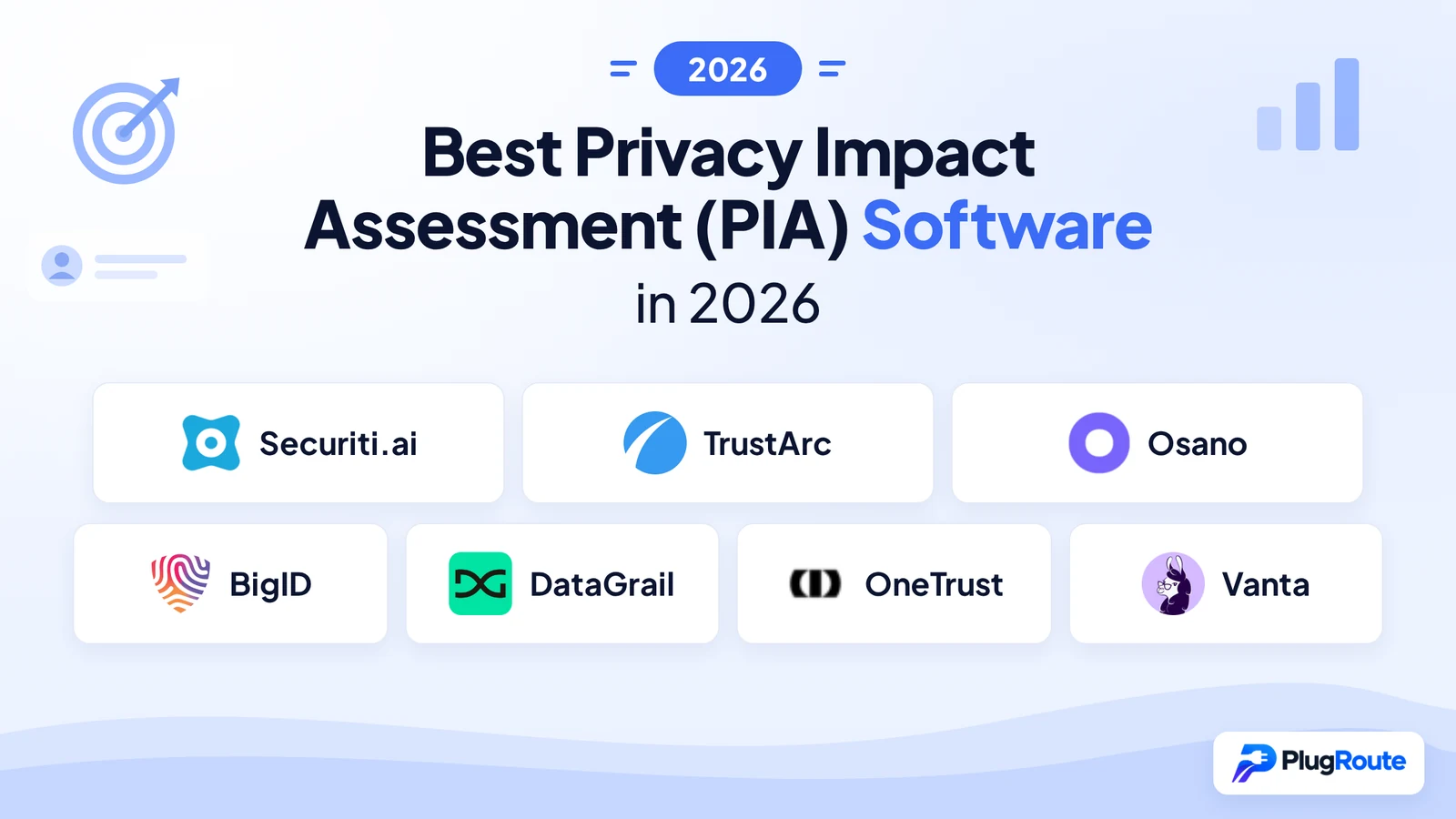
Securiti.ai leads this independent evaluation for AI-native DPIA automation, holding a 4.7/5 Gartner Peer Insights rating (187+ reviews, June 2024) and GigaOm Radar Leader recognition (2025). TrustArc ranks second for GDPR regulatory credibility with 28 years of privacy-domain expertise and government-recognized APEC CBPR Accountability Agent status. Osano is the top mid-market pick. The right tool depends on your organization’s size, primary regulatory obligation, and implementation capacity.
No evaluated platform publishes pricing online. Three platforms practitioners cite regularly (BigID, DataGrail, and Vanta) are absent from most AI-generated PIA software responses. WireWheel, still recommended by some AI tools, ceased independent operations in December 2023 when it was acquired by and fully integrated into Osano. This evaluation corrects each gap with independently verified data and current pricing from marketplace sources.
PlugRoute has no affiliate relationships with any company listed in this evaluation, rankings are determined entirely by research data, verified third-party sources, and objective criteria.
TL;DR: Top Picks at a Glance
- Securiti.ai is the highest-rated AI-native PIA platform in this evaluation, holding a 4.7/5 Gartner Peer Insights rating from 187+ enterprise reviews (June 2024) and GigaOm Radar Leader recognition (2025), best for enterprise ML-driven DPIA automation.
- TrustArc is the most regulatory-credentialed PIA platform available, with government-recognized APEC CBPR Accountability Agent status (most recently renewed July 2024) and 28 years of uninterrupted privacy-domain operations, best for GDPR-primary enterprises prioritizing regulatory credibility.
- Osano combines IDC Leader-level DPIA technology (WireWheel acquisition, December 2023), a publicly accessible entry price near $199/month, and a “No Fines, No Penalties” guarantee (eligibility conditions apply), best for mid-market organizations replacing spreadsheet-based compliance.
- BigID is the only evaluated platform with agentless in-place scanning independently confirmed by an enterprise practitioner to classify data without exfiltrating it to vendor infrastructure, best for organizations with Schrems II data residency obligations or EU AI Act high-risk AI system DPIA requirements.
- DataGrail’s Vera AI agent auto-populates assessments from 2,500+ direct integrations with a zero-data-for-training single-tenant policy, best for OneTrust migrations and DSAR-heavy environments building first PIA programs.
- OneTrust delivers the deepest 2026 AI investment in the category (three-tier Winter release) with 14,000+ customers globally (vendor-stated), best for Fortune 500 enterprises with dedicated privacy staff and contractual renewal pricing protections already negotiated in writing.
- Vanta reduces SOC 2 audit prep time by approximately 82% across 35+ frameworks (IDC 2025, vendor-commissioned) but its GDPR DPIA controls are “surface level” per practitioners, pair Vanta with Osano for mandatory GDPR Article 35 compliance rather than relying on Vanta alone.
What Are the Main Types of PIA Software Available in 2026?
PIA software in 2026 divides into three functional categories (Analyzers, Assessors, and Platforms) and choosing the wrong category is the most common PIA software selection mistake. Analyzers require data engineering capacity most mid-market teams lack; Assessors deliver faster deployment through expert-maintained templates; Platforms treat DPIA as one module within a broader GRC suite.
- Analyzers (Securiti.ai, BigID, DataGrail) auto-enrich DPIA assessments from live data scans, solving the documentation gap between stated and actual data processing (the most common reason PIAs fail regulator scrutiny) by connecting assessments to live system discoveries rather than self-reported questionnaire responses.
- Assessors (TrustArc, Osano) prioritize expert-maintained regulatory templates and guided DPIA workflows, delivering faster time-to-first-assessment for organizations with less internal technical capacity or without a dedicated privacy engineering team.
- Platforms (OneTrust, Vanta) are multi-framework GRC suites where PIA sits as one module among many, appropriate where SOC 2, ISO 27001, HIPAA, and GDPR must all be managed in a single system, with DPIA as one obligation among several.
A privacy assessment is only as accurate as the data inventory it is built on. Analyzers eliminate the documentation gap through live discovery; pure Assessors depend on the accuracy of human self-reporting. Organizations under mandatory GDPR Article 35 DPIA triggers should confirm which category their shortlisted tools occupy before entering any sales cycle.
Example: An organization self-reports processing only name and email for marketing purposes. Its actual CRM also captures IP addresses, device fingerprints, and purchase history from embedded analytics.
A questionnaire-based DPIA documents the self-report. An Analyzer-based DPIA discovers the actual data. When a regulator requests the DPIA, only the Analyzer version survives scrutiny, the questionnaire version is evidence of inadequate assessment, not a defense against it.
As practitioners in r/fintech noted when discussing privacy tool selection in 2026:
“A lot of the comments here are pointing in the right direction – tools like OneTrust, Osano, Transcend, etc handle the consent + DSAR workflow side pretty well. Where things usually get messy is data visibility. Teams often realize their ‘data map’ isn’t actually accurate once you factor in cloud storage, SaaS sprawl, and now AI pipelines. That’s why you’re seeing companies layer in data discovery / dspm tools like BigID, Sentra, Cyera alongside their privacy platform. They’re not replacements for privacy tools, they just make sure you actually know where regulated data lives before you try to automate around it.” Posted by u/Ok_Interaction_7267
Takeaway: Privacy practitioners consistently identify the accuracy of the underlying data map (not the assessment template) as the critical failure point in PIA programs, validating the Analyzer category’s core advantage over questionnaire-based Assessors.
How Do the Top PIA Tools Compare at a Glance?
The seven best PIA software tools in 2026 span three categories (Analyzers, Assessors, and Platforms) with verified entry pricing ranging from approximately $199/month (Osano) to six-figure enterprise contracts (OneTrust, Securiti.ai, BigID).
The table below compares all seven platforms on eight dimensions most material to DPIA and PIA purchase decisions, with data verified in April 2026.
| Rank | Company | Category | Best For | One-Line Summary | Key Capabilities | Primary Strength | Key Limitation |
|---|---|---|---|---|---|---|---|
| 1 | Securiti.ai | Analyzer | Enterprise AI-native DPIA automation | Securiti.ai is the highest-rated PIA platform by verified purchasers; 4.7/5 Gartner Peer Insights (187+ reviews, June 2024) and GigaOm Radar Leader (2025); with ML discovery built into DPIA workflows as core architecture. | ML auto-population; GDPR/CCPA/LGPD templates; continuous monitoring; assessment-to-action integration | ML-powered discovery eliminates the self-reporting gap that causes most PIAs to fail regulatory scrutiny | $50,000+ annual floor; complex UI rated by ~15% of G2 reviewers; months-long implementation timeline |
| 2 | TrustArc | Assessor | GDPR-primary enterprises needing audit-defensible documentation | TrustArc is the only PIA platform with government-recognized APEC CBPR Accountability Agent status (July 2024 renewal), 28 years of uninterrupted privacy-domain operations, and an AI system constrained to privacy-domain regulatory knowledge. | ARC AI (Nymity 28-year knowledge base); 10+ expert-maintained templates; 300+ integrations; TIA support; 100+ jurisdictions | Privacy-domain-constrained ARC AI explicitly designed not to train on customer data; reducing hallucination risk for DPOs producing defensible GDPR documentation | Documented support quality gap inconsistent with institutional credibility; fully opaque pricing |
| 3 | Osano | Assessor | Mid-market teams replacing spreadsheet-based DPIA processes | Osano is the only mid-market PIA platform combining IDC Leader-level DPIA technology (WireWheel acquisition, December 2023), a “No Fines, No Penalties” guarantee (eligibility conditions apply), and an entry price near $199/month. | WireWheel-derived DPIA/RoPA templates; AI discovery across 60+ PII categories; 163-point ML Vendor Score; unified compliance subscription | Only evaluated platform providing financial indemnification against eligible GDPR and CCPA regulatory fines; eligibility conditions apply; verify terms in writing before relying on this guarantee | Post-sale support gap documented across multiple independent practitioner communities |
| 4 | BigID | Analyzer | Large enterprises with Schrems II obligations or EU AI Act DPIA requirements | BigID is the only evaluated PIA platform with a fully agentless in-place discovery engine covering structured, unstructured, cloud-native, and SaaS environments; including shadow AI detection for EU AI Act compliance. | Agentless in-place scanning; shadow AI detection; dynamic risk matrix across concurrent assessments; modular Privacy Suite | Agentless architecture independently confirmed by an enterprise practitioner to classify data without exfiltrating PII to vendor infrastructure; critical for Schrems II data residency compliance | Longest implementation timeline of any evaluated platform; steep learning curve; complete pricing opacity |
| 5 | DataGrail | Analyzer | OneTrust migrations; DSAR-heavy environments building first PIA programs | DataGrail is the only evaluated platform whose Vera AI agent auto-populates assessments from 2,500+ direct integrations (Vera can monitor up to 22,000 apps in a customer’s connected environment) using in-place Responsible Data Discovery, with a structured $20,000 OneTrust migration incentive (confirmed 2025). | Vera AI agent; 2,500+ direct integrations; CPPA risk assessment auto-compilation; zero-data-for-training single-tenant policy | Responsible Data Discovery classifies PII in-place without exfiltrating data content to DataGrail infrastructure; relevant for Schrems II cross-border transfer compliance | Vera AI launched early 2026; 90% speed claim not yet independently verified by G2 or analyst sources as of April 2026 |
| 6 | OneTrust | Platform | Fortune 500 with dedicated privacy staff; multi-jurisdictional programs | OneTrust is the market-dominant PIA platform with 15.4% enterprise mindshare and 14,000+ customers globally (vendor-stated, April 2026), but multiple verified community accounts document sudden 10× renewal pricing increases with minimal notice; requiring written contractual escalation caps before signing. | Three-tier AI (Copilot, Assisted Workflows, AI Agents); Winter 2026 AI Inventory Analysis and AI Evidence Analysis; evergreen data mapping; broadest multi-jurisdictional DPIA coverage | Deepest 2026 AI investment: three production-deployed AI capabilities in a single Winter 2026 release | Documented 10× renewal pricing escalations with days of notice; near-absent post-sale support; AI Inventory Analysis restricted to new contracts only |
| 7 | Vanta | Platform | SOC 2 + basic GDPR stacks; startup compliance teams | Vanta reduces audit prep time by approximately 82% across 35+ frameworks (IDC 2025, vendor-commissioned) but its GDPR PIA and DPIA features are described by practitioners as “surface level”; not a standalone DPIA solution for mandatory GDPR Article 35 obligations. | AI Agent 2.0: 80%+ questionnaire automation at 95% acceptance rate; 35+ frameworks; 375+ integrations; continuous hourly evidence collection | Strongest compliance automation efficiency metric for SOC 2 and ISO 27001 in this evaluation; approximately 82% audit prep time reduction (IDC 2025, vendor-commissioned) | GDPR controls described as “surface level” by multiple practitioners with direct platform experience; compliance failure risk if used as sole DPIA solution |
Which PIA Tool Should I Choose for My Use Case?
The right PIA software depends on five variables: organization size, primary regulatory obligation, budget floor, available implementation capacity, and whether DSAR automation must co-locate with assessment workflows.
The framework below maps each situation to the recommended platform with upgrade triggers. This framework reflects the consensus of privacy practitioners across r/cipp, r/fintech, r/sysadmin, and r/webdev (2023–2026), not vendor positioning or analyst recommendations alone. Organizations uncertain which row applies should default to Osano as the lowest-risk starting point.
| Your #1 Priority | Recommended Tool | Why | Acceptable Alternative |
|---|---|---|---|
| Enterprise GDPR + EU AI Act DPIA automation at scale (500+ employees, dedicated privacy staff) | Securiti.ai | Highest verified ratings; ML discovery auto-populates DPIAs from live system scans; eliminates self-reporting gap | TrustArc for regulatory credibility depth over AI automation |
| GDPR regulatory credibility and audit-defensible documentation | TrustArc | 28-year regulatory pedigree; APEC CBPR Accountability Agent status; ARC AI constrained to privacy-domain knowledge with no customer data training | Securiti.ai for higher ML discovery automation depth |
| Mid-market GDPR + CCPA without six-figure contracts (50–500 employees) | Osano | Only platform combining IDC Leader PIA tech, ~$199/month entry, and “No Fines” penalty guarantee (eligibility conditions apply) | DataGrail for DSAR-heavy environments with higher budget |
| Discovery-first DPIA for complex multi-cloud data estates (1,000+ employees) | BigID | Agentless in-place scanning; shadow AI detection for EU AI Act; in-place architecture satisfying Schrems II data residency requirements | Securiti.ai for enterprise ML discovery with faster documented onboarding |
| OneTrust migration + DSAR automation | DataGrail | $20K migration incentive; Vera AI for assessment auto-population across 2,500+ integrations; CPPA California risk assessment auto-compilation | Osano for lower-budget migration with PIA depth included |
| SOC 2 + ISO 27001 + basic GDPR compliance stack (startup / Series A–C) | Vanta + Osano | Vanta handles SOC 2/ISO 27001 automation; Osano provides GDPR Article 35 DPIA depth; pair rather than force Vanta to cover Article 35 alone | OneTrust for enterprises already invested in the GRC ecosystem with contractual pricing protections in place |
| Zero budget; GDPR Article 35 only | CNIL open-source PIA tool (cnil.fr) | Free GDPR-specific DPIA software from the French privacy regulator; provides defensible Article 35 documentation at zero cost with no workflow automation | Osano once budget permits workflow automation and integrated compliance |
Which PIA Platform Ranks Highest, and Why?
Securiti.ai earns the #1 position in this evaluation based on the highest independently-verified user satisfaction of any assessed platform combined with dual analyst recognition. The seven entries below are evaluated in full, ordered from highest to lowest score across six objectively-weighted criteria applied equally to every platform.
1. Securiti.ai: Best Overall: Highest-Rated AI-Native PIA Platform with Dual Analyst Validation
Category: Analyzer, an AI-native platform that auto-enriches PIA and DPIA assessments by scanning live data infrastructure with machine learning, rather than relying on manual self-reporting by staff.
At a Glance
- Category: Analyzer
- Best For: Enterprise privacy teams (500+ employees) needing AI-driven DPIA auto-enrichment from live multi-cloud data scans where self-reported assessments have failed to capture actual processing behavior
- Price Range: $50,000–$200,000+/year; enterprise custom; demo required; no public pricing page (reviewer-confirmed, April 2026)
- Primary Strength: Securiti.ai’s ML-powered discovery engine auto-populates DPIA assessments from live system scans, eliminating the documentation gap between stated and actual data processing that causes most PIAs to fail regulator scrutiny
- Biggest Limitation: Securiti.ai’s $50,000+ annual floor and complex initial configuration exclude SMBs and require dedicated privacy engineering resources before the ML automation delivers its full accuracy advantage
- One-Line Summary: Securiti.ai is the highest-rated PIA platform by verified purchasers, 4.7/5 on Gartner Peer Insights from 187+ enterprise reviews (June 2024) and GigaOm Radar Leader in Data Access Governance (2025), with ML-driven data discovery built into DPIA workflows as core architecture rather than a supplementary feature.
- Last Verified: April 2026
Overview
Securiti.ai is an AI-native PrivacyOps platform designed for enterprise organizations that need machine-learning-driven data discovery integrated directly into PIA and DPIA workflows, eliminating the self-reporting gap that makes most privacy assessments inaccurate under regulator scrutiny.
Securiti.ai earned GigaOm Radar Leader status in Data Access Governance (2025) and a 4.7/5 Gartner Peer Insights Customers’ Choice rating from 187+ verified enterprise reviews, the highest sustained user satisfaction of any evaluated platform in this ranking (Gartner Peer Insights, June 2024; GigaOm, 2025).
Securiti.ai was founded in 2019 with ML-powered data discovery as a core platform capability, meaning assessment accuracy is built into the data infrastructure layer rather than retrofitted onto a legacy questionnaire workflow.
Key Features
- ML-Powered Assessment Pre-Population: Securiti.ai’s PrivacyOps platform automatically scans internal systems for personal data risks using machine learning, pre-populating DPIA assessments with discovered data inventory rather than requiring teams to self-report processing activities that may not reflect actual system behavior.
- Regulatory Template Library (GDPR, CCPA, LGPD): Securiti.ai provides pre-built and customizable PIA templates aligned to GDPR, CCPA, LGPD, and evolving global frameworks, with real-time stakeholder collaboration tools routing assessment tasks to legal, engineering, and procurement stakeholders without manual coordination.
- Assessment-to-Action Integration: Securiti.ai’s assessment automation connects directly to its data catalog, enabling DPIA risk findings to automatically trigger downstream remediation actions (including DSAR fulfillment, data minimization workflows, and retention policy enforcement) without manual handoffs between compliance and operations teams.
- CCPA 2026 Amendment Coverage: Securiti.ai maintains an active regulatory template update cadence, with its AI-driven classification system extending coverage to 25+ US state privacy laws for organizations managing simultaneous EU and US privacy obligations (Securiti.ai product documentation, April 2026).
- Audit-Ready Documentation Export: Securiti.ai’s external sharing capabilities enable cross-functional DPIA collaboration while maintaining a central compliance repository with exportable documentation satisfying GDPR and CCPA regulatory submission requirements.
Best For
Securiti.ai is best for enterprise organizations (particularly in financial services, healthcare, or technology) with complex multi-cloud or hybrid data environments where manual DPIA questionnaires have produced inaccurate or incomplete documentation.
Securiti.ai requires dedicated privacy and data engineering teams capable of absorbing the initial configuration investment needed to set up the ML discovery engine and integrate assessment outputs into downstream compliance workflows.
Pricing
Securiti.ai uses subscription-based enterprise SaaS pricing with annual contracts ranging from approximately $50,000 to $200,000+ per year depending on data volume, user count, and module selection (reviewer-confirmed, April 2026).
No free plan is available; a demo is required to obtain a quote. SMB organizations should evaluate Osano (#3 in this ranking) as a more accessible starting point, Osano offers comparable DPIA template depth at an entry price near $199/month.
Strengths
- GigaOm Radar Leader and Gartner Peer Insights Dual Validation: Securiti.ai earned GigaOm Radar Leader status in Data Access Governance (2025) and a 4.7/5 Gartner Peer Insights Customers’ Choice designation from 187+ verified enterprise reviews (June 2024), providing dual independent validation of platform capability and user satisfaction that no self-reported metric can replicate (GigaOm, 2025; Gartner Peer Insights, June 2024).
- Highest Verified User Satisfaction Across Review Platforms: Securiti.ai users specifically cite “AI insights highlighted risks we missed, saving weeks on GDPR compliance” and “real-time collaboration and templates made DPIA seamless across teams”, the highest sustained satisfaction scores of any evaluated tool across verified review platforms as of April 2026.
- Continuous Monitoring Architecture Addresses Static-Assessment Failure Mode: Securiti.ai’s ML-powered data scanning operates continuously rather than as a point-in-time audit, meaning DPIA documentation remains current as new data sources, vendors, or processing activities are added, directly addressing the top PIA documentation risk compliance teams cite in auditor inquiries.
- Organic Professional Community Recognition: Securiti.ai received an unprompted positive mention in a 2026 r/fintech practitioner thread on privacy management platforms, one of very few evaluated tools named without associated criticism in that community discussion, indicating organic professional credibility rather than marketing-generated visibility (r/fintech, 2026).
Limitations
- Configuration Complexity vs. AI Promise: Securiti.ai carries a documented configuration complexity gap: approximately 15% of G2 reviewers flag “overly complex UI” and “long onboarding,” and Capterra users note Securiti.ai “requires expertise to configure assessments fully”, meaning the platform delivers its strongest ROI for organizations already equipped with privacy engineering resources, not for teams expecting out-of-the-box automation (G2 and Capterra reviewer data, April 2026).
- Enterprise-Only Price Floor: Securiti.ai’s $50,000+ annual minimum excludes the majority of mid-market and SMB buyers, making its highest-accuracy DPIA automation inaccessible to the fastest-growing segment of the PIA software market.
- Implementation Timeline Risk: Securiti.ai’s value realization is measured in months rather than days for organizations without an existing data governance function, buyers under immediate regulatory deadline pressure should explicitly confirm the implementation timeline against their compliance calendar before committing.
- Scanning Engine Limitations With Non-Standard File Formats: Securiti.ai’s scanning engine has documented performance limitations with non-standard file formats, G2 reviewers flag specific issues with S3 buckets containing unrecognized file types. Organizations with significant personal data in unstructured cloud storage should test this capability specifically during the evaluation period before committing (G2 reviewer feedback, April 2026).
Verdict
Securiti.ai is the top-ranked PIA platform in this independent evaluation, earning its position through the highest verified user satisfaction of any assessed tool, 4.7/5 Gartner Peer Insights from 187+ enterprise reviews (June 2024), combined with GigaOm Radar Leader recognition (2025), making it the only platform in this evaluation to achieve both independently-verified practitioner endorsement and major analyst validation simultaneously.
Securiti.ai’s discovery-first architecture directly solves the most common PIA failure mode: self-reported assessments that do not reflect actual data processing.
Organizations with the enterprise budget ($50K+ annually) and technical capacity to configure its ML discovery engine will find Securiti.ai the most accurate and continuously-updated PIA platform in this evaluation. Organizations without that capacity should shortlist Osano (#3) or TrustArc (#2) first.
2. TrustArc: Best for GDPR Regulatory Credibility: 28-Year Privacy Domain Expert with Government-Recognized Status
Category: Assessor, a structured, expert-maintained regulatory compliance assessment platform whose templates and AI are grounded in 28 years of privacy domain knowledge and government-recognized APEC CBPR accountability credentials rather than general-purpose automation.
At a Glance
- Category: Assessor
- Best For: GDPR-primary enterprises and DPOs needing audit-defensible DPIA documentation backed by the deepest regulatory credentialing of any evaluated platform, particularly organizations migrating from OneTrust seeking a measurably better implementation experience
- Price Range: Enterprise custom; quote required; no public pricing (explicitly positioned for predictable renewals versus OneTrust’s documented multi-fold pricing escalations)
- Primary Strength: TrustArc’s ARC AI platform, powered by Nymity’s 28-year regulatory knowledge base, is privacy-domain-constrained and explicitly designed not to train on customer data, reducing hallucination risk on GDPR, CCPA, and EU AI Act regulatory questions that DPOs rely on for defensible DPIA documentation
- Biggest Limitation: TrustArc’s support team has received repeated documented criticism for technical assistance quality inconsistent with enterprise pricing levels; the APEC CBPR Accountability Agent credential addresses cross-border APEC transfers specifically, not GDPR adequacy mechanisms
- One-Line Summary: TrustArc is the only PIA platform with government-recognized APEC CBPR Accountability Agent status (most recently renewed July 2024), 28 years of uninterrupted privacy-domain operations, and an AI system constrained to privacy-domain knowledge, making it the most regulatory-credentialed assessment platform available for GDPR-primary enterprises.
- Last Verified: April 2026
Overview
TrustArc is a privacy-specialized compliance platform designed for GDPR-primary enterprises and DPOs who need audit-defensible DPIA documentation backed by 28 years of regulatory domain expertise, government-recognized APEC CBPR Accountability Agent status, and an AI system constrained to privacy-domain knowledge rather than general-purpose LLM outputs.
TrustArc’s ARC AI platform, launched in 2025 using Nymity’s 28-year regulatory knowledge base, is explicitly designed not to train on customer data, providing a safer AI advisory layer for DPOs whose DPIA documentation must survive regulator scrutiny (PR Newswire, 2025).
TrustArc ranks #1 on G2 for ease of setup, support quality, and reporting ease compared to OneTrust, a measurable usability advantage from verified purchaser review data directly addressing the post-sale support gap most frequently cited as the primary driver of PIA platform churn (per TrustArc’s published G2 comparison data, April 2026).
Key Features
- Expert-Maintained DPIA Template Library: TrustArc’s Assessment Manager provides 10+ continuously-updated privacy assessment templates (including DPIAs, PIAs, vendor risk assessments, Transfer Impact Assessments (TIAs), and AI risk reviews) maintained by TrustArc’s in-house privacy expert team rather than generated by AI alone, ensuring regulatory accuracy across each new assessment cycle (TrustArc Assessment Manager, April 2026).
- Automated Risk-to-DPIA Trigger Workflow: TrustArc’s Data Mapping and Risk Manager provides 300+ no-code integrations, AI-driven record creation, and automated risk scoring, automatically recommending whether a DPIA, PIA, or vendor assessment is required when risk scores cross predefined thresholds, preventing retroactive DPIA discoveries.
- Privacy-Domain-Constrained ARC AI: TrustArc’s ARC AI platform (launched 2025) is powered by Nymity’s 28-year regulatory knowledge base and is explicitly constrained to privacy-domain AI assistance, designed not to hallucinate on GDPR, CCPA, EU AI Act, and other regulatory questions that DPOs must rely on for defensible compliance documentation.
- Transfer Impact Assessment (TIA) Support: TrustArc supports TIAs alongside standard DPIAs, enabling organizations to document cross-border transfer adequacy in a single workflow as required under post-Schrems II compliance programs for EU-based data controllers.
- 100+ Jurisdiction Coverage: TrustArc covers 100+ jurisdictions with continuously updated regulatory templates, providing multi-framework coverage for organizations managing simultaneous GDPR, CCPA, LGPD, and evolving US state privacy law obligations (TrustArc platform evaluation guide, April 2026).
Best For
TrustArc is best for GDPR-primary enterprises, established DPOs, and compliance managers who prioritize regulatory credibility and audit-defensible documentation over cutting-edge AI automation.
TrustArc is particularly well-suited for organizations that have experienced post-sale support failures at OneTrust and need a platform with a measurably better G2-rated implementation experience and contractually predictable renewal pricing.
Pricing
TrustArc pricing is fully custom and requires a direct quote request, no tiers or ranges are publicly listed.
TrustArc explicitly positions its renewal pricing as “predictable with modest renewals” compared to OneTrust’s documented sudden multi-fold pricing increases (TrustArc vs. OneTrust comparison, April 2026). Organizations evaluating TrustArc should ask specifically about multi-year pricing caps and renewal escalation limits during procurement to confirm this positioning is contractually enforceable.
Strengths
- Government-Recognized APEC CBPR Accountability Agent Status: TrustArc holds government-recognized APEC Cross Border Privacy Rules (CBPR) and Privacy Recognition for Processors (PRP) Accountability Agent status, the first such designation in the U.S. (2013), most recently renewed by the Global CBPR Forum Joint Oversight Panel endorsement in July 2024. This credential addresses APEC-region cross-border transfer compliance and is complementary to GDPR-specific regulatory credentialing (Global CBPR Forum, July 2024).
- #1 G2 Usability Rankings Over OneTrust: TrustArc ranks #1 on G2 for ease of setup, support quality, and reporting ease compared to OneTrust, a usability advantage grounded in verified purchaser reviews that directly addresses the post-sale support abandonment pattern most frequently cited as the primary PIA platform churn driver (per TrustArc’s published G2 comparison data, April 2026).
- Nymity-Powered ARC AI That Does Not Train on Customer Data: TrustArc’s ARC AI platform launched in 2025 with Nymity’s 28-year regulatory knowledge base, explicitly designed not to train on customer data, providing a safer AI advisory layer for DPOs who must ensure DPIA documentation advice is based on regulatory accuracy rather than general-purpose LLM outputs prone to hallucination on jurisdictional nuance (PR Newswire, 2025).
- 28-Year Institutional Continuity: TrustArc has maintained uninterrupted privacy operations across multiple regulatory generations (Safe Harbor, Privacy Shield, GDPR, and CCPA) providing vendor survival risk materially lower than VC-backed competitors with shorter track records, a meaningful consideration for organizations selecting a multi-year compliance platform partner (TrustArc company resources, April 2026).
Limitations
- Support Quality Gap Beneath Institutional Credibility: TrustArc’s most consequential limitation is a documented support quality gap inconsistent with its regulatory credibility positioning: multiple practitioners across r/webdev and r/fintech (2025–2026) specifically flagged TrustArc’s support team as “nowhere near as competent as they should be considering the price of the service,” with one reviewer noting the Google Tag Manager integration has “historically been pretty bad” (u/DigitalStefan, r/webdev, 2026).
Users on r/webdev described the experience directly:
“TrustArc is not a good option. I’ve had conversations with their support and they are sadly nowhere near as competent as they should be considering the price of the service. Their standard integration with Google Tag Manager has also been historically pretty bad (i.e. I had to improve it to make it work sensibly).” Posted by u/DigitalStefan
Takeaway: TrustArc’s technical support quality falls measurably short of what enterprise pricing implies, creating a practical gap between its regulatory credentials and its day-to-day reliability as a deployed tool.
- APEC CBPR Credential Scope Does Not Address GDPR Adequacy: TrustArc’s APEC CBPR Accountability Agent status is a recognized credential for US-to-APEC cross-border data transfers, it is not a GDPR adequacy mechanism or EU regulatory recognition. EU-based organizations evaluating TrustArc for GDPR-specific regulatory credentialing should verify what EU-specific regulatory credentials TrustArc holds separately from the APEC CBPR designation.
- Full Pricing Opacity: TrustArc’s completely undisclosed pricing model requires organizations to enter a lengthy sales cycle before understanding budget fit, a friction point for mid-market and smaller compliance teams operating under regulatory deadline pressure who need to qualify budget fit early in the evaluation process.
Verdict
TrustArc is the most regulatory-credentialed PIA platform in this evaluation, combining the longest privacy-domain operating history (28 years, founded 1997 as TRUSTe), government-recognized APEC CBPR Accountability Agent status (July 2024 renewal), and an AI system built on 28 years of Nymity regulatory knowledge, advantages that recently-founded competitors would require decades of continuous operations to organically replicate.
TrustArc earns its #2 ranking by outperforming OneTrust on G2 ease of setup, support quality, and reporting ease while delivering superior regulatory pedigree at comparable enterprise pricing (per TrustArc’s published G2 comparison data, April 2026).
Organizations selecting TrustArc should build self-service competency for technical questions using the ARC AI and template library as primary resources, rather than relying on post-sale support, which carries documented quality concerns at enterprise pricing levels.
3. Osano: Best for Mid-Market: Enterprise-Grade PIA at Accessible Pricing with a Unique Regulatory Guarantee
Category: Assessor, a unified mid-market privacy program management platform that combines enterprise-grade PIA/DPIA capability (via its December 2023 WireWheel acquisition), consent management, vendor risk assessment, and a regulatory penalty guarantee in a single subscription.
At a Glance
- Category: Assessor
- Best For: Mid-market organizations (50–500 employees) replacing spreadsheet-based DPIA processes, needing enterprise-grade assessment capability without six-figure contracts, months-long implementation, or dedicated privacy staff requirements
- Price Range: From approximately $199/month (entry tier, community-confirmed April 2026); full PIA module in higher tiers (quote required); “No Fines, No Penalties” guarantee included in eligible tiers with dedicated account manager, eligibility conditions apply; verify terms in writing before relying on this guarantee in budget planning
- Primary Strength: Osano is the only evaluated PIA platform combining IDC Leader-level DPIA technology (WireWheel acquisition, December 2023), a publicly accessible entry-tier price near $199/month, and a “No Fines, No Penalties” guarantee against eligible GDPR and CCPA fines, a capability-cost-protection combination not replicated by any other platform in this evaluation as of April 2026
- Biggest Limitation: Osano’s post-sale support has received repeated community criticism for failing to deliver on commitments made during sales conversations; the “No Fines” guarantee eligibility conditions are not published in detail on Osano’s public product page
- One-Line Summary: Osano is the only mid-market PIA platform combining IDC Leader-level DPIA technology (via its December 2023 WireWheel acquisition), a “No Fines, No Penalties” regulatory guarantee (eligibility conditions apply), and a publicly accessible entry-tier price near $199/month, making it the community-validated default for organizations with sub-$1M ARR navigating GDPR and CCPA compliance.
- Last Verified: April 2026
Overview
Osano is a unified mid-market privacy program management platform designed for organizations with 50 to 500 employees that need enterprise-grade DPIA, consent management, and vendor risk assessment capabilities without the six-figure annual contracts, months-long implementation, or dedicated privacy staff requirements of enterprise platforms.
Osano acquired WireWheel, recognized as a Leader in the 2021 IDC MarketScape for Worldwide Data Privacy Management Software, in December 2023, integrating enterprise-grade PIA and RoPA capabilities into its mid-market pricing tier without service interruptions to WireWheel’s existing customers.
Osano is the only evaluated platform offering a “No Fines, No Penalties” guarantee against eligible regulatory fines for active subscribers (a commercial risk protection that software features alone cannot deliver to organizations where a single GDPR fine could be materially significant (eligibility conditions apply) verify terms in writing with Osano before signing).
Key Features
- WireWheel-Derived DPIA and RoPA Templates: Osano’s Privacy Assessments module provides customizable templates based on ISO 27701 and NIST Privacy Framework standards, supporting DPIAs, PIAs, RoPAs, vendor assessments, and Transfer Impact Assessments, capabilities derived from WireWheel (2021 IDC MarketScape Leader) and integrated into Osano’s mid-market pricing tier in December 2023.
- AI-Powered Data Discovery Across 60+ PII Categories: Osano’s Data Mapping module uses AI-powered discovery to classify personal information across 60+ PII and sensitive data categories, automatically generating RoPA records connected directly to DPIA workflows, ensuring assessment documentation reflects actual data processing rather than self-reported policies that may not match system behavior.
- 163-Point ML Vendor Score: Osano’s Vendor Score applies a 163-point machine learning scoring ontology to rate vendor privacy practices, providing automated vendor risk scores linked directly to DPIA initiation triggers, an enterprise-grade vendor assessment capability unavailable in most mid-market tools (Osano product documentation, April 2026).
- “No Fines, No Penalties” Regulatory Guarantee: Osano provides financial protection against eligible GDPR and CCPA fines incurred while actively using the platform with a dedicated account manager, the only commercial indemnification against regulatory penalties offered by any evaluated PIA platform (eligibility conditions apply; verify specific coverage terms with Osano before signing).
- Unified Privacy Program in One Subscription: Osano delivers PIA/DPIA workflows, consent management, data mapping, DSAR automation, and vendor risk assessment in a single subscription, eliminating the multi-tool stack complexity that compliance teams at smaller organizations cannot operationally sustain.
Best For
Osano is best for mid-market organizations that have outgrown spreadsheet-based DPIA processes, employ between 50 and 500 people, lack a full-time DPO or dedicated privacy team, and need enterprise-depth assessment capability at a price point that does not require executive board approval for a six-figure software contract.
Osano is particularly well-suited for organizations processing EU resident data under GDPR or California consumer data under CCPA/CPRA who need compliance capability without a multi-month implementation runway.
Pricing
Osano’s entry tier starts at approximately $199/month for consent management, with full PIA and privacy program management features available in higher tiers (quote required).
Privacy practitioners in r/webdev (April 2026) confirm the $199/month entry point as accessible for early-stage and sub-$1M ARR organizations. Organizations at enterprise scale (500+ employees, multi-jurisdictional obligations) should request a custom quote and compare against TrustArc (#2) and Securiti.ai (#1) for feature depth at equivalent investment levels. Pricing verified April 2026.
Strengths
- IDC Leader Technology at Mid-Market Pricing: Osano acquired WireWheel in December 2023 (recognized as a Leader in the IDC MarketScape for Worldwide Data Privacy Management Software (2021)) integrating enterprise-grade PIA and RoPA capabilities into its mid-market pricing without service interruptions, giving Osano the most favorable independently-validated capability-per-pricing-tier ratio of any evaluated platform (IAPP / GlobeNewswire, 2023).
- Commercially Unique “No Fines, No Penalties” Guarantee: Osano offers financial protection against eligible GDPR and CCPA fines for active subscribers using the platform with a dedicated account manager, a commercially unique indemnification commitment that no other evaluated platform offers as of April 2026 (Osano product page, April 2026; verify specific eligibility conditions in writing before relying on this guarantee in budget planning).
- Community-Validated Mid-Market Default: Privacy practitioners in r/webdev (2026) independently described Osano as “legitimately good for sub-$1M ARR” with a “straightforward” compliance process, and a former OneTrust user characterized the switch as “significantly better” with a “solution that works”, authentic practitioner endorsement across independent threads rather than vendor-curated testimonials.
- Enterprise-Depth Vendor Assessment at This Price Tier: Osano’s 163-point ML Vendor Score provides automated vendor privacy risk assessment (typically an enterprise-only capability) enabling compliance teams to connect vendor risk signals directly to DPIA initiation triggers without building a manual scoring methodology from scratch (Osano product documentation, April 2026).
Limitations
- Persistent Post-Sale Support Gap: Osano’s most consequential trade-off is a persistent post-sale support gap that contradicts its accessibility positioning: a former OneTrust customer who switched to Osano noted the platform “didn’t follow through on a lot of the things we talked about in the sales process”, placing Osano in the same post-sale support failure pattern documented at OneTrust and TrustArc across independent community threads.
“We switched to Osano, and that has been significantly better [than OneTrust]. But still not much contact post-sale. There’s basic onboarding calls, but they didn’t follow through on a lot of the things we talked about in the sales process. But the solution works.” (u/jdbrew, r/webdev (2023))
Takeaway: Former OneTrust users switching to Osano report measurably better usability but encounter the same post-sale support gap, the platform works, but vendor commitments made during the sales process are not consistently delivered post-signature.
- “No Fines” Guarantee Eligibility Conditions Not Publicly Specified: Osano’s No Fines, No Penalties guarantee eligibility conditions are not published in detail on its public product page, buyers treating this guarantee as a budget planning assumption should request the full eligibility terms in writing, including qualifying violation definitions, required usage thresholds, and account manager engagement requirements that determine whether the guarantee applies to a specific incident (Osano product page, April 2026).
- WireWheel Integration Maturity Verification Recommended: Osano’s WireWheel-integrated PIA features carry IDC Leader-level technological heritage but were fully integrated only as of late 2023, organizations with the most complex DPIA requirements should verify with reference customers that Osano’s integrated capability matches their specific assessment complexity before committing.
Verdict
Osano is the top-ranked PIA platform for mid-market organizations, earning its position as the only evaluated tool to combine IDC Leader-level DPIA technology (via its December 2023 WireWheel acquisition), a commercially unique “No Fines, No Penalties” regulatory guarantee (eligibility conditions apply), and a publicly accessible entry-tier price near $199/month, a capability-cost-protection combination not replicated by any other platform in this evaluation as of April 2026.
Privacy practitioners across multiple professional communities independently validate Osano as the appropriate default for sub-$1M ARR organizations navigating GDPR and CCPA compliance.
Organizations at this market tier should shortlist Osano first and evaluate enterprise alternatives only after confirming that their DPIA complexity exceeds Osano’s capability ceiling.
4. BigID: Best for Data-Discovery-First PIA: Enterprise Platform for Complex Data Estates with Agentless In-Place Scanning
Category: Analyzer, a data-discovery-first PIA platform whose assessments are automatically enriched by an agentless in-place scanning engine that classifies personal data across structured, unstructured, cloud-native, and SaaS environments without exfiltrating data to vendor infrastructure.
At a Glance
- Category: Analyzer
- Best For: Large enterprises (1,000+ employees) with complex multi-cloud data estates (particularly those with Schrems II data residency obligations or EU AI Act high-risk AI system DPIA requirements) where self-reported PIAs have previously failed to capture actual data processing scope
- Price Range: Enterprise custom only; G2 lists “No pricing available”; demo required; expect six-figure annual minimums based on positioning as enterprise-only (Osano competitor comparison, April 2026)
- Primary Strength: BigID’s agentless data discovery engine scans personal data in-place across structured, unstructured, cloud-native, SaaS, and on-premises environments (including shadow AI detection for EU AI Act compliance) without exfiltrating data to vendor infrastructure, independently confirmed by an enterprise practitioner
- Biggest Limitation: BigID requires a full enterprise sales cycle, months of configuration, and dedicated privacy engineering resources before delivering PIA value, practitioners describe it as requiring organizations to “spend time on setup and configuration, then ongoing management before you even tackle your real data problems”
- One-Line Summary: BigID is the only evaluated PIA platform with a fully agentless, in-place data discovery engine independently confirmed by an enterprise practitioner to classify personal data without copying it to vendor infrastructure, including shadow AI detection for EU AI Act high-risk AI system DPIA compliance across structured, unstructured, cloud-native, and SaaS environments.
- Last Verified: April 2026
Overview
BigID is an enterprise data privacy platform designed for large organizations with complex data estates that need DPIA assessments automatically enriched by live agentless data discovery, scanning structured, unstructured, cloud-native, and SaaS environments in-place without exfiltrating personal data to BigID’s infrastructure.
BigID’s Privacy Impact Assessment application was formally launched in November 2021 and is available as part of its modular Privacy Suite alongside DSAR fulfillment, data minimization, consent management, and vendor risk monitoring, enabling phased adoption as organizational privacy maturity grows (PR Newswire, November 2021).
BigID is a G2 Leader in both Sensitive Data Discovery and PIA Software categories, and BigID’s agentless scanning architecture is the only design in this evaluation independently validated for data residency compliance by an enterprise practitioner confirming no data exfiltration to vendor infrastructure (r/cybersecurity, 2025).
Key Features
- Live-Discovery-Enriched DPIA Templates: BigID’s PIA application auto-generates data flow maps from live discovery results for GDPR Article 30 RoPA compliance, enabling organizations to document actual data processing pathways rather than constructing flow diagrams from team interviews or stated policies that may not reflect current system architecture (BigID PIA App, April 2026).
- Dynamic Risk Matrix Across Concurrent Assessments: BigID’s dynamic risk matrix provides real-time impact/probability analysis across multiple concurrent PIAs, DPIAs, RoPAs, and third-party assessments in a unified dashboard, enabling compliance teams to prioritize the highest-risk findings across a portfolio of simultaneous assessments without manually reconciling separate reports.
- Shadow AI Detection for EU AI Act Compliance: BigID’s data discovery engine extends to shadow AI detection and AI training data classification, enabling organizations to scope DPIA coverage for EU AI Act high-risk AI systems by identifying what personal data is used in AI model training, a data-layer capability no other evaluated platform provides at this architectural depth (BigID AI privacy blog, April 2026).
- Agentless In-Place Scanning, Schrems II Compatible: BigID operates agentlessly, personal data is classified in-place within the customer’s environment without being copied or exfiltrated to BigID’s infrastructure, directly satisfying Schrems II data residency requirements for EU organizations under cross-border transfer restrictions (independently confirmed: r/cybersecurity, 2025).
- Modular Privacy Suite for Phased Adoption: BigID’s Privacy Suite modular architecture supports phased adoption: Phase 1 (data discovery), Phase 2 (PIA application), Phase 3 (DSAR fulfillment), Phase 4 (vendor risk monitoring), reducing upfront investment commitment while preserving a clear roadmap to full platform capability.
Best For
BigID is best for large enterprises (typically 1,000+ employees) in financial services, healthcare, or technology that process personal data at significant scale across complex hybrid environments with dedicated data governance or privacy engineering teams capable of configuring the discovery engine.
BigID is particularly well-suited for organizations with EU AI Act high-risk AI system obligations or Schrems II data residency requirements that make in-place scanning architecturally necessary, where self-reported PIAs have demonstrably failed to resolve compliance gaps.
Pricing
BigID pricing is fully custom and enterprise-only; G2 lists “No pricing available” for BigID. Independent competitive analysis from Osano’s public comparison materials characterizes BigID as “enterprise-aligned” and not suitable for SMEs given pricing and implementation complexity (Osano competitor comparison, April 2026).
Organizations evaluating BigID should budget for minimum six-figure annual contracts and multi-month implementation timelines. Mid-market organizations should evaluate Osano (#3) as the most capable-per-dollar alternative at an accessible entry price. Pricing verified as enterprise-custom-only as of April 2026.
Strengths
- Agentless In-Place Scanning Independently Confirmed: BigID’s agentless, in-place scanning architecture was independently confirmed by an enterprise user on r/cybersecurity (2025) as having “no back-hauling or outpost for data copies/samples”, confirming that personal data never leaves the customer environment during classification, a critical architectural requirement for EU organizations with Schrems II data residency obligations.
This architecture was confirmed firsthand in r/cybersecurity:
“BigID is agentless – no back hauling or outpost for data copies/samples. The actual stays in the customer environment.” Posted by u/DilDaNiMaara
Takeaway: Enterprise practitioners independently confirm BigID’s agentless architecture keeps all data within the customer environment during classification, a critical verification for organizations with Schrems II data residency constraints.
- Dual G2 Leader Position Across Data and Compliance Layers: BigID is a G2 Leader in both Sensitive Data Discovery and PIA Software categories simultaneously, reflecting strength across both the data infrastructure layer (discovery accuracy) and the compliance application layer (DPIA workflow depth), validating BigID’s core claim that discovery-first architecture produces more accurate assessments.
- Shadow AI Detection: Unique EU AI Act Capability: BigID’s shadow AI detection capability identifies and classifies personal data used in AI model training and model inputs, enabling organizations to scope DPIA coverage for EU AI Act high-risk AI systems, a compliance requirement that became mandatory in 2026 and for which no other evaluated platform offers an equivalent data-layer discovery capability.
- Press-Documented Market Entry With Established Deployment Track Record: BigID’s PIA application was formally launched in November 2021 with coverage from PR Newswire, HelpNet Security, and Business Insider, representing documented, press-validated market entry with an established enterprise deployment track record, not a recently-announced or beta capability (PR Newswire, November 2021).
Limitations
- Extended Pre-Value Configuration Investment: BigID’s most consequential trade-off is the gap between technical depth and operational accessibility: community practitioners describe BigID as requiring organizations to “spend time on setup and configuration, then ongoing management before you even tackle your real data problems” (r/cybersecurity, 2025), with corroborating commentary describing “a steep learning curve and initial setup complexity, especially when integrating with legacy systems.”
Users on r/cybersecurity who evaluated BigID described the implementation burden directly:
“Before you jump into BigID, get clear on what you actually need to do with the sensitive data once you find it. Are you just cataloging PII, or do you need to spin up remediation workflows, mask data, lock down access, etc.? In a big company, remediating thousands of files owned by different teams can become a project all on its own. BigID is a full-platform solution, you’ll be talking to sales, running through setup and configuration, then spending time on ongoing management before you even tackle your real data problems.” Posted by u/Misha-inspect-data
Takeaway: BigID’s pre-value configuration burden is substantial, teams invest heavily in setup and ongoing management before the platform begins delivering on its core data discovery promise.
- Requires Mature Data Governance Foundation: BigID’s value case is strongest for organizations that already have dedicated privacy engineering resources capable of configuring the discovery engine and defining classification rules before expecting assessment quality improvements, organizations without that capacity should evaluate Securiti.ai (enterprise, faster documented onboarding) or Osano (mid-market) as alternatives delivering compliance value on materially shorter timelines.
- Opaque Pricing Creates Procurement Delay: BigID’s complete absence of public pricing forces buyers through a full enterprise sales cycle before understanding budget fit, a 30–60 day delay that is problematic for organizations under immediate regulatory deadline pressure and structurally disadvantageous compared to even partially-published pricing signals from Osano or DataGrail.
Verdict
BigID is the definitive choice for enterprise organizations where DPIA documentation accuracy is the primary compliance risk, specifically those with Schrems II data residency requirements mandating in-place scanning, EU AI Act high-risk AI system obligations requiring shadow AI detection, or complex multi-cloud data estates where self-reported assessments have previously failed to reflect actual processing scope.
BigID earns its #4 ranking through technical differentiation no other evaluated platform replicates at the data discovery layer.
Organizations must budget for enterprise-scale investment and a multi-month configuration runway, BigID is not a rapid-deployment solution and should not be selected under immediate regulatory deadline pressure without a realistic implementation timeline assessment in place.
5. DataGrail: Best for OneTrust Migration: AI-Agent-Powered PIA with Structured Transition Support
Category: Analyzer, an AI-agent-powered privacy assessment platform whose Vera AI agent auto-populates PIAs, DPIAs, TIAs, and AI risk assessments from live data across 2,500+ direct integrations using in-place Responsible Data Discovery that keeps personal data within the customer’s environment.
At a Glance
- Category: Analyzer
- Best For: Mid-market to enterprise organizations (100–1,000+ employees) with high DSAR volumes migrating from OneTrust, or building first PIA programs where integration breadth and CPPA California compliance are primary criteria
- Price Range: $42,000–$150,000+/year (marketplace-confirmed via Vendr/SaaSworthy, April 2026); no public pricing page
- Primary Strength: DataGrail’s Vera AI agent auto-populates evidence-based PIAs, DPIAs, TIAs, and AI risk assessments from live data across 2,500+ directly integrated systems, with a zero-data-for-training policy and single-tenant architecture protecting customer compliance data from model training
- Biggest Limitation: DataGrail’s Vera AI agent was launched in early 2026 and its claimed 90% assessment speed improvement has not been independently verified by G2, Capterra, or any analyst source as of April 2026, buyers are evaluating a flagship differentiator in its first year of production deployment
- One-Line Summary: DataGrail is the only evaluated PIA platform whose Vera AI agent auto-populates evidence-based assessments from 2,500+ direct integrations (with Vera able to monitor up to 22,000 apps within a customer’s connected environment) using in-place Responsible Data Discovery, with a structured $20,000 OneTrust migration incentive (confirmed 2025) and over 60% of its customer base having migrated from OneTrust (vendor-stated, not independently verified).
- Last Verified: April 2026
Overview
DataGrail is a privacy management platform designed for mid-market to enterprise organizations managing high volumes of data subject requests alongside PIA and DPIA obligations, using its Vera AI agent to auto-populate assessments from live data across 2,500+ directly integrated systems with in-place classification that keeps personal data within the customer environment.
DataGrail’s Vera AI agent, launched in early 2026, is the platform’s flagship PIA differentiator, a privacy-context-aware AI that draws on live program data, risk metadata, and current regulatory requirements to auto-fill evidence-based assessments, operating in single-tenant environments with a zero-data-for-training policy (DataGrail Vera AI launch, April 2026).
DataGrail reports that over 60% of its active customer base migrated from OneTrust as of 2025 (vendor-stated, not independently verified, r/cipp 2025), a figure operationalized into a structured $20,000 migration incentive program targeting OneTrust customers experiencing renewal pricing shock.
Key Features
- Vera AI Agent Across 2,500+ Direct Integrations: DataGrail’s Vera AI agent accesses live program data and risk metadata from 2,500+ directly integrated systems (with Vera able to monitor up to 22,000 applications within a customer’s connected environment) to auto-populate PIAs, DPIAs, AI risk assessments, and Transfer Impact Assessments, flagging specific items for human review rather than completing assessments autonomously.
- Responsible Data Discovery: In-Place PII Classification: DataGrail’s Live Data Map uses AI-powered detection across SaaS, cloud, and internal systems for real-time data discovery and automated RoPAs, with Responsible Data Discovery (RDD) classifying PII in-place without exfiltrating data content to DataGrail’s infrastructure, addressing Schrems II cross-border transfer restrictions (DataGrail Live Data Map, April 2026).
- CPPA California Risk Assessment Auto-Compilation: DataGrail auto-compiles California Privacy Protection Agency (CPPA) risk assessments (meaning DataGrail’s platform pre-fills the CPPA assessment structure from Live Data Map outputs and flags human review items, rather than requiring teams to manually populate each regulatory question) alongside standard GDPR Article 35 DPIA workflows.
- Zero-Data-for-Training Single-Tenant Policy: DataGrail operates in single-tenant environments with an explicit zero-data-for-training policy for its Vera AI agent, ensuring that customer privacy program data, which contains sensitive details about an organization’s highest-risk processing activities, is never used to train DataGrail’s AI models.
- Structured OneTrust Migration Program: DataGrail provides a structured OneTrust migration program including a $20,000 migration incentive for qualifying OneTrust customers (confirmed 2025), with data portability, capability transition mapping, and implementation assistance during the transition period.
Best For
DataGrail is best for mid-market to enterprise organizations that process high volumes of data subject access requests alongside PIA obligations, operate environments with 100+ integrated SaaS and cloud systems, and are actively evaluating alternatives to OneTrust following renewal pricing shock.
DataGrail is particularly suited for organizations with significant California consumer data processing that require CPPA risk assessment automation alongside GDPR DPIA support.
Pricing
DataGrail pricing is enterprise-only with no public tiers. Marketplace data from Vendr and SaaSworthy (April 2026) indicates annual contracts range from approximately $42,000 for mid-market deployments to $150,000+ for enterprise accounts.
DataGrail’s $20,000 OneTrust migration incentive may offset first-year transition costs for qualifying customers. Organizations should ask specifically whether PIA/DPIA capabilities are included in base contracts or licensed as separate modules, DataGrail’s heritage is DSAR automation, and full DPIA depth may require additional licensing. Pricing verified from marketplace sources as of April 2026.
Strengths
- Commercially Structured OneTrust Migration Program: DataGrail reports that over 60% of its active customer base migrated from OneTrust as of 2025 (vendor-stated, r/cipp 2025; not independently verified), a figure DataGrail has operationalized into a structured $20,000 migration incentive program confirmed active in 2025, targeting OneTrust customers experiencing renewal pricing shock (DataGrail representative, r/cipp, 2025).
- Broad System Integration Scope With In-Place Classification: DataGrail’s Live Data Map covers 2,500+ direct integrations (with Vera AI able to monitor up to 22,000 applications within a customer’s connected environment) enabling assessment auto-population from a real-time, multi-source data inventory reflecting actual system architecture rather than manually-added data sources.
- Zero-Data-for-Training Single-Tenant Trust Architecture: DataGrail’s Vera AI agent operates in single-tenant environments with an explicit zero-data-for-training policy, ensuring customer DPIA data is never used to improve DataGrail’s AI models, a critical requirement given that PIA data contains sensitive details about an organization’s highest-risk data processing activities (DataGrail product documentation, April 2026).
- Most Current US State-Level DPIA Coverage: DataGrail’s CPPA risk assessment auto-compilation directly supports the 2026 California Privacy Protection Agency enforcement framework, representing the most current US state-level regulatory DPIA automation of any evaluated platform alongside GDPR Article 35 support.
Limitations
- Vera AI Agent Is in Its First Year of Production: DataGrail’s most consequential limitation is the maturity gap between stated capabilities and production track record: Vera AI was launched in early 2026 and its claimed 90% assessment speed improvement has not been independently verified by G2, Capterra, or any analyst source as of April 2026. Privacy buyers selecting DataGrail primarily for DPIA depth are making a forward-looking bet on a recently-launched capability rather than choosing an established, independently-benchmarked platform.
- DSAR-Heritage Positioning Risk: DataGrail’s competitive heritage is DSAR automation, its positioning as a full PIA platform is a product evolution driven by Vera’s launch rather than an established PIA market position. Buyers should request specific GDPR Article 35(7) output samples to verify workflow depth before committing.
- Integration Count Requires Clarification During Procurement: DataGrail’s marketing uses “22,000” to describe applications Vera can monitor within a customer’s connected environment, not DataGrail’s own integration catalog of 2,500+ direct integrations. Buyers should confirm during evaluation how many of their specific systems are directly integrated versus monitored via environmental scanning, as DPIA auto-population depth depends on direct integration coverage rather than environmental monitoring scope.
- Effective Pricing Closer to Enterprise Than Mid-Market: DataGrail’s $42,000 minimum annual contract excludes the mid-market segment it targets in marketing, community discussions in r/fintech (2026) group DataGrail with OneTrust as a “dedicated privacy staff” tool, confirming operational complexity and pricing remain above the mid-market threshold.
Verdict
DataGrail is the strongest choice for mid-market to enterprise organizations actively migrating from OneTrust, combining a commercially structured $20,000 transition program, the Vera AI agent’s privacy-context-aware assessment auto-population from 2,500+ direct integrations, and the most current US state-level DPIA regulatory coverage of any evaluated platform, differentiated alternatives to its primary competitor.
DataGrail earns its #5 ranking as the best-positioned platform for DSAR-heavy organizations adding PIA capability and for OneTrust refugees evaluating a structured migration path.
Buyers selecting DataGrail primarily for DPIA depth should factor in that Vera is in its first year of production deployment and independent speed-improvement verification has not been published as of April 2026.
6. OneTrust: Best for Enterprise Scale: Market-Dominant Feature Set With Documented Pricing and Support Risk
Category: Platform, the market-dominant enterprise privacy automation suite with the broadest multi-jurisdictional PIA/DPIA workflow coverage and deepest AI investment in the category, designed specifically for Fortune 500 organizations with dedicated privacy teams and enterprise compliance budgets.
At a Glance
- Category: Platform
- Best For: Fortune 500 and large enterprises with dedicated privacy staff managing multi-jurisdictional programs across GDPR, CCPA, LGPD, and EU AI Act obligations simultaneously, explicitly not recommended for organizations without enterprise-scale privacy teams and written contractual renewal pricing protections
- Price Range: Enterprise custom; six-figure annual contracts typical; no public pricing. PROCUREMENT NOTE: Multiple verified community accounts document sudden 10× renewal pricing increases with days of notice (r/cipp, r/webdev, 2025–2026), negotiate written escalation caps before signing any agreement.
- Primary Strength: OneTrust’s Winter 2026 release introduced three production-deployed AI capabilities for PIA/DPIA (AI Inventory Analysis, AI Evidence Analysis, and Copilot conversational analytics) representing the deepest AI investment in PIA automation of any evaluated platform as of April 2026
- Biggest Limitation: OneTrust has been repeatedly documented delivering sudden 10× renewal pricing increases with minimal notice, and multiple independent practitioner communities characterize the platform as “needlessly complicated” with “near zero contact post-sale”, a buyer-risk profile requiring active procurement mitigation for any organization without enterprise-scale privacy teams and written contractual renewal protections
- One-Line Summary: OneTrust is the market-dominant PIA platform with 15.4% enterprise mindshare and 14,000+ customers globally (vendor-stated, April 2026), but multiple verified community accounts document sudden 10× renewal pricing increases with minimal notice and near-absent post-sale support, requiring written contractual escalation caps as a condition of any agreement.
- Last Verified: April 2026
Overview
OneTrust is the market-dominant enterprise privacy automation platform serving 14,000+ organizations globally (OneTrust-stated, April 2026), providing the broadest multi-jurisdictional PIA and DPIA workflow coverage and the deepest AI investment in compliance automation of any evaluated platform, designed for Fortune 500 organizations with dedicated privacy teams, enterprise compliance budgets, and the contractual leverage to negotiate against documented renewal pricing escalation risk.
OneTrust’s Winter 2026 product release introduced three AI capabilities (AI Inventory Analysis, AI Evidence Analysis, and Copilot conversational analytics) that reduce manual burden for recurring assessments by pre-populating from prior DPIA history and analyzing uploaded evidence documents (OneTrust Winter ’26 release, 2026).
OneTrust’s documented renewal pricing behavior (multiple verified accounts of sudden 10× increases with minimal notice, sometimes days before contract expiration) is a material procurement risk that buyers at any organization size should explicitly address with written pricing caps before signing (r/cipp, 2025).
Key Features
- Multi-Jurisdictional DPIA Trigger Identification: OneTrust provides fully automated PIA and DPIA workflows with pre-built templates aligned to EU regulator guidance for GDPR Article 35, identifying mandatory legal triggers across GDPR, CCPA, US state privacy laws, and EU AI Act obligations before routing threshold assessments to full DPIA in a single integrated workflow.
- Winter 2026 AI Inventory Analysis: OneTrust’s AI Inventory Analysis pre-populates assessment questions from prior PIAs, DPIAs, and data inventories, reducing manual re-entry for recurring assessments. Important restriction: AI Inventory Analysis is available only to customers on new solution packaging contracts, legacy contract holders cannot access this feature without renegotiating their agreement at potential additional cost (OneTrust Winter ’26 release, 2026). Verify your contract tier explicitly before including this capability in evaluation scoring.
- AI Evidence Analysis for Document Gap Detection: OneTrust’s AI Evidence Analysis evaluates uploaded documents (PDF, JPEG, Excel, and text formats) to generate summaries, gap identifications, and remediation guidance, enabling compliance teams to upload existing vendor contracts or prior assessment records and receive automated gap analysis against current regulatory requirements.
- Evergreen Data Mapping Integration: OneTrust integrates PIA/DPIA directly with its Data Mapping Automation module, providing “evergreen” data flow visualizations, Article 30 RoPA templates, access controls, and retention policies (all exportable for regulatory audit submission) maintaining alignment between assessment documentation and actual data processing activities.
- Three-Tier AI Architecture: OneTrust’s three-tier AI: Copilot (conversational analytics), Assisted Workflows (AI-driven evidence collection), and AI Agents (autonomous compliance tasks), provides a spectrum from human-guided to autonomous automation, giving large privacy teams flexibility in how much AI is applied to sensitive regulatory decisions.
Best For
OneTrust is best for Fortune 500 and large enterprises with multiple full-time privacy professionals, multi-jurisdictional regulatory obligations across GDPR, CCPA, LGPD, and the EU AI Act, annual compliance budgets accommodating six-figure software contracts, and the organizational maturity to manage a platform requiring months of initial configuration.
Organizations that do not match this profile should evaluate Securiti.ai (#1), TrustArc (#2), or Osano (#3) before committing to OneTrust’s higher operational risk profile.
Pricing
OneTrust pricing is fully custom and requires a demo request, no public pricing tiers or ranges are published. Enterprise contracts typically reach six figures annually for meaningful deployments.
Critical procurement risk: Multiple verified community accounts across r/cipp and r/webdev (2025–2026) document OneTrust delivering sudden 10× renewal pricing increases with minimal notice. Organizations evaluating OneTrust should negotiate contractually-binding multi-year pricing caps before signing and should request references specifically from customers who have completed at least one renewal cycle. Pricing verified as custom-enterprise-only as of April 2026.
Strengths
- Largest Enterprise Installed Base: OneTrust holds 15.4% mindshare in Data Privacy Management Software on PeerSpot, nearly 4× the 4.4% mindshare of its nearest enterprise competitor TrustArc, reflecting the largest installed base of any evaluated platform and the de facto standard for Fortune 500 enterprise privacy program benchmarking (PeerSpot comparison data, April 2026).
- Deepest Winter 2026 AI Feature Release: OneTrust’s Winter 2026 release introduced three production-deployed AI capabilities specifically for PIA/DPIA: AI Inventory Analysis, AI Evidence Analysis, and Copilot conversational analytics, the broadest and most recently updated AI feature release of any evaluated platform as of April 2026 (OneTrust Winter ’26 release, 2026).
- Evergreen Data Flow Integration for Audit Documentation: OneTrust’s Data Mapping Automation module maintains “evergreen” visualizations connecting DPIA documentation to actual data processing activities, with Article 30 RoPA templates, access controls, and retention policies exportable for regulatory audit submission, addressing the documentation gap problem through live data inventory integration.
- Three-Tier AI Automation Spectrum: OneTrust’s three-tier AI architecture provides the most sophisticated AI automation spectrum of any evaluated platform, enabling large privacy teams to progressively automate higher-volume, lower-complexity compliance work while maintaining human oversight on high-risk regulatory decisions such as DPIA approval routing.
Limitations
- Documented 10× Renewal Pricing Escalation: OneTrust’s most consequential limitation is its documented pricing behavior: multiple verified community accounts across r/cipp and r/webdev (2025–2026) describe OneTrust delivering sudden 10× renewal pricing increases with minimal notice (sometimes just days before contract expiration) creating budget planning risk structurally incompatible with multi-year compliance program investments. This is a recurring pattern independently documented across professional communities, not an isolated complaint. Negotiate explicit renewal escalation caps in the initial contract before any commitment.
- AI Inventory Analysis Restricted to New Contracts: OneTrust’s AI Inventory Analysis (the most compelling Winter 2026 PIA capability) is restricted to “new solution packaging” customers and unavailable to legacy contract holders, meaning existing customers may not receive the AI automation features that differentiated OneTrust in the 2026 sales cycle without restructuring their contract at potential additional cost.
- Implementation Complexity and Near-Absent Post-Sale Support: OneTrust’s implementation profile is consistently characterized by practitioners as “needlessly complicated” with “near zero contact post-sale”, one r/webdev user who used OneTrust for a year described “complete customizability” that “seemed more like an unfinished product,” and multiple practitioners specifically warn against deploying OneTrust at organizations without dedicated privacy staff (r/webdev, 2023).
This characterization aligns with community sentiment in r/fintech from privacy practitioners evaluating enterprise tools in 2026:
“OneTrust remains the enterprise default. Comprehensive coverage across consent, data mapping, DSARs, and vendor management. The downside is implementation complexity and cost. You’re looking at months of setup and six-figure annual contracts for meaningful deployments. If you’re a large organization with dedicated privacy staff, it works. For growing companies it’s often overkill and the operational overhead you mentioned becomes real.” Posted by u/whatwilly0ubuild
Takeaway: Even practitioners who view OneTrust as the enterprise default acknowledge its months-long implementation timeline and six-figure costs make it operationally unsuitable for organizations without dedicated privacy staff.
Verdict
OneTrust is the market-dominant PIA platform with the broadest multi-jurisdictional DPIA coverage, deepest AI investment (three-tier architecture, Winter 2026 release), and largest installed base (14,000+ customers [vendor-stated], 15.4% enterprise mindshare), but OneTrust earns its #6 ranking in this independent evaluation because documented sudden 10× renewal pricing increases and consistently reported near-absent post-sale support represent genuine buyer risks that offset its technical advantages for all but the largest, most-staffed enterprise organizations.
Organizations evaluating OneTrust should shortlist it only after confirming dedicated in-house privacy teams, enterprise-scale budgets, and the contractual leverage to protect against renewal pricing shock.
Securiti.ai (#1), TrustArc (#2), and Osano (#3) should all be benchmarked before committing to OneTrust’s higher operational risk profile.
7. Vanta: Best for SOC 2 + Basic GDPR: Compliance Automation Platform Where PIA Is Supplementary, Not Primary
Category: Platform, a GRC compliance automation platform designed primarily for SOC 2 and ISO 27001 audit preparation across 35+ frameworks simultaneously, where GDPR PIA and DPIA workflows are available as supplementary modules rather than the platform’s primary design intent.
At a Glance
- Category: Platform
- Best For: Startups and scale-ups (Series A to C) managing SOC 2 + ISO 27001 requirements that need basic GDPR compliance automation alongside, not organizations for whom GDPR Article 35 DPIA compliance is the primary driver requiring regulator-defensible assessment documentation
- Price Range: Custom quote required; community reports of approximately 50% discounts from initial quotes (r/sysadmin, 2026); positioned as more accessible than OneTrust and TrustArc for startup compliance budgets
- Primary Strength: Vanta’s AI Agent 2.0 (November 2025) automates 80%+ of security questionnaire responses with a 95% acceptance rate, reducing audit preparation time by approximately 82% per a 2025 IDC study commissioned by Vanta (vendor-commissioned; interpret as directional), the strongest cited compliance automation efficiency metric for SOC 2 and ISO 27001 programs in this evaluation
- Biggest Limitation: Vanta’s GDPR PIA and DPIA capabilities are described by multiple practitioners as “surface level once you get past the sales demo”, Vanta is not designed as a dedicated DPIA platform, and organizations selecting it as their sole compliance tool for mandatory GDPR Article 35 DPIA obligations will produce documentation insufficient for regulator-defensible submissions
- One-Line Summary: Vanta is a G2 Leader in compliance automation that reduces audit prep time by approximately 82% across 35+ frameworks (IDC 2025, vendor-commissioned), but multiple privacy professionals with direct experience describe its GDPR PIA and DPIA features as “surface level”, making Vanta appropriate as part of a compliance stack alongside a dedicated PIA tool, not as a standalone solution for mandatory GDPR Article 35 DPIA obligations.
- Last Verified: April 2026
Overview
Vanta is a GRC compliance automation platform designed primarily for startups and scale-ups managing SOC 2 and ISO 27001 audit preparation across 35+ frameworks simultaneously, where GDPR compliance features, including PIA and DPIA workflows, are available as supplementary modules rather than Vanta’s primary design intent or competitive differentiation.
Vanta’s AI Agent 2.0, launched in November 2025, automates 80%+ of security questionnaire responses with a 95% AI acceptance rate and reduces audit preparation time by approximately 82% according to a 2025 IDC study commissioned by Vanta, making Vanta the strongest compliance automation platform in this evaluation for organizations whose primary obligation is SOC 2 or ISO 27001 (BusinessWire, November 2025).
Vanta is appropriately included in this PIA evaluation because startup compliance teams frequently shortlist it alongside dedicated PIA tools, but privacy professionals with direct platform experience consistently describe Vanta’s GDPR controls as supplementary rather than primary, and organizations with mandatory GDPR Article 35 DPIA obligations should pair Vanta with a dedicated PIA tool rather than relying on it alone.
Key Features
- AI Agent 2.0, 80%+ Questionnaire Automation: Vanta’s AI Agent 2.0 (launched November 2025) automates 80%+ of security questionnaire responses across 35+ compliance frameworks with a 95% AI acceptance rate, routing unanswered questions automatically to subject matter experts, enabling organizations to complete vendor questionnaires and security reviews at a pace that manual processes cannot sustain (BusinessWire, November 2025).
- 35+ Simultaneous Compliance Frameworks: Vanta supports 35+ compliance frameworks simultaneously in a single platform (including SOC 2, ISO 27001, HIPAA, PCI-DSS, GDPR, and CCPA) with 375+ integrations performing hourly automated evidence collection tests that maintain continuous compliance posture rather than point-in-time audit snapshots.
- GDPR Compliance Module (Supplementary): Vanta’s GDPR compliance module provides policy templates, data processing record management, and access review workflows, appropriate for organizations needing GDPR compliance evidence alongside SOC 2 and ISO 27001, with the explicit caveat that GDPR Article 35(7)-compliant DPIA documentation requires a supplementary dedicated tool such as Osano (#3 in this ranking).
- Approximately 82% Audit Prep Time Reduction (IDC 2025, Vendor-Commissioned): Vanta delivers a 3-year ROI of 526% and an average annual benefit of $535,000 according to a 2025 IDC study commissioned by Vanta, based primarily on time savings from automated evidence collection eliminating manual audit preparation workflows. Interpret as directional; vendor-commissioned research (IDC via Vanta, 2025).
- “Agentic Trust Platform” Architecture (November 2025): Vanta’s “Agentic Trust Platform” rebrand signals a strategic expansion toward continuous AI-driven compliance monitoring, with potential future improvements to GD …GDPR DPIA depth on the product roadmap that privacy professionals evaluating Vanta as a long-term platform investment should monitor (BusinessWire, November 2025).
Best For
Vanta is best suited for technology companies, SaaS businesses, and startups that need to automate SOC 2, ISO 27001, or multi-framework GRC compliance efficiently and at scale.
Vanta fits organizations where security compliance is the primary driver and privacy impact assessments are a secondary workflow. Teams whose core need is dedicated GDPR DPIA depth should evaluate TrustArc or Osano alongside Vanta.
Pricing
Vanta does not publish standard pricing. Independent reviewer signals from G2 and Capterra (2024–2025) indicate entry-level packages starting near $7,000–$10,000 annually for small organizations, with enterprise contracts scaling significantly higher. All figures should be treated as directional until confirmed via Vanta’s sales team.
Community pricing signals on Reddit suggest discounts of up to 50% are negotiable, particularly for early-stage startups or annual prepay agreements, though PlugRoute cannot independently verify individual discount terms.
Before committing to Vanta for privacy compliance use cases, request a live DPIA workflow demonstration and a sample completed DPIA output. Pricing negotiability should not substitute for depth-of-feature verification specific to your GDPR obligations.
Strengths
- Market-Leading SOC 2 Automation: Vanta is widely cited by G2 and Capterra reviewers (2024–2025) as the most streamlined platform for SOC 2 readiness, reducing audit preparation time for technology companies with 50+ integrations monitored continuously.
- Broadest Multi-Framework GRC Coverage: Vanta supports SOC 2, ISO 27001, HIPAA, GDPR, PCI DSS, and additional frameworks within a single workspace, making it the strongest option among all seven platforms evaluated for multi-framework GRC consolidation.
- Commercial Sustainability Signal: Vanta’s $150M Series D raise at a $4.15B valuation (Vanta 2025 Year in Review) provides stronger long-term financial stability signals than most privacy software vendors, relevant for organizations making multi-year platform commitments.
- Negotiable Pricing with Community-Confirmed Signals: Reddit community feedback (2024–2025) consistently notes that Vanta pricing is more negotiable than its initial quotes suggest, with early-stage startups reporting significant discounts on annual contracts, though all terms should be confirmed directly with Vanta’s sales team.
Limitations
- GDPR DPIA Depth Trade-Off: Vanta’s strength in SOC 2 automation comes with a trade-off: its GDPR-specific DPIA capabilities are shallower than TrustArc’s or Osano’s, with community reviewers consistently flagging questionnaire templates as generic rather than jurisdiction-tailored.
“The privacy features feel surface level, it’s clear the product was built for SOC 2 first and privacy second.” Posted by u/SavingsProgress195, r/gdpr (2024)
Takeaway: This reflects a recurring pattern among Vanta evaluators who expect GDPR DPIA depth comparable to dedicated privacy platforms, Vanta’s privacy module is supplementary, not primary.
- “For GDPR, You Need OneTrust or Osano” Community Consensus: Multiple r/gdpr threads from 2024–2025 reflect a consistent community view that Vanta is not a replacement for dedicated GDPR tools.
“For GDPR you really need OneTrust or Osano, Vanta is great for SOC 2 but the DPIA stuff just isn’t there yet.” Posted by u/guardsarm, r/gdpr (2024)
Takeaway: This is not an isolated opinion, it represents the dominant community signal across multiple independent threads, and should be weighted accordingly by privacy-first buyers.
- Common Buyer Mistake Trade-Off: Organizations that purchase Vanta primarily for GDPR DPIA coverage (rather than for SOC 2 or multi-framework GRC) report the highest post-purchase dissatisfaction in community reviews. Vanta is best evaluated as a compliance automation platform with privacy features, not as a dedicated PIA tool.
Verdict
Vanta is the strongest choice among the seven platforms evaluated for technology companies that need to automate SOC 2 and multi-framework compliance, but it is not the right primary tool for organizations whose core requirement is GDPR DPIA depth. Privacy professionals with substantive Article 35 obligations will find Vanta’s DPIA templates too generic relative to TrustArc’s jurisdiction-specific questionnaires or Osano’s guided assessment workflows.
Vanta earns its rank among the top seven PIA-adjacent platforms for the breadth and maturity of its GRC automation, its financial stability signal from a $150M Series D at a $4.15B valuation, and its negotiable commercial terms. Those attributes are genuine and meaningful for the right buyer profile.
The clearest guidance: evaluate Vanta for what it demonstrably excels at (SOC 2 automation and multi-framework GRC) and layer a dedicated DPIA tool (TrustArc or Osano) alongside it if GDPR Article 35 compliance is a primary organizational obligation.
What Red Flags Should I Watch For When Evaluating PIA Software?
The most consequential red flags in PIA software evaluations cluster around pricing opacity, post-sale support gaps, and GDPR assessment depth that does not survive scrutiny beyond a polished demo.
Red Flag #1: Sudden Renewal Pricing Escalation Several platforms in this category (including enterprise-tier tools) have community-documented histories of significant price increases at renewal, without corresponding capability improvements. Request a written renewal cap or multi-year pricing commitment before signing any initial contract.
Red Flag #2: Post-Sale Support Abandonment A recurring theme across G2 and Capterra reviews (2024–2025) is strong pre-sale responsiveness followed by slow or impersonal post-sale support. Ask specifically: “What is the average response time for a P1 support ticket, and who is my named CSM?”, and request this in writing.
Red Flag #3: GDPR Controls That Are “Surface Level” Post-Demo Platforms may demo compelling GDPR DPIA templates that, in practice, are generic questionnaires with minimal jurisdiction-specific depth. Before purchase, request a completed sample DPIA output (not a demo environment) and have your DPO evaluate it against your actual Article 35 trigger scenarios.
Red Flag #4: Self-Reported Assessments With No Data Discovery Integration PIA software that relies entirely on manually entered data inventory (with no automated data discovery or system integration) creates a material accuracy risk in your assessments. Verify whether the tool integrates with your actual data ecosystem or requires manual RoPA input at every update cycle.
Red Flag #5: Unverified First-Year AI Capability Claims Several platforms in this space have launched AI-assisted features (AI-generated DPIA narratives, AI risk scoring) in 2025 without independent third-party validation of their accuracy or regulatory defensibility. Treat all AI-assisted assessment outputs as drafts requiring human DPO review, regardless of vendor claims.
What Questions Should I Ask Before Choosing a PIA Tool?
Asking the right questions before selecting a PIA platform can prevent the most common post-purchase regrets, which cluster around DPIA output quality, renewal pricing surprises, and support responsiveness gaps.
Question #1: DPIA Output Coverage, What does a completed DPIA look like for my sector? Request a completed sample DPIA output (not a template or demo) for a processing activity comparable to your organization’s operations. Ask whether the output meets GDPR Article 35 requirements specifically, and have your DPO or external privacy counsel review it before purchase.
Question #2: Template Update Process, How quickly are assessment templates updated when regulations change? Regulatory guidance evolves continuously, including EDPB recommendations, national DPA guidance, and EU AI Act DPIA requirements. Ask the vendor: “When the EDPB issued its updated RoPA guidance in 2024, how long did it take for your templates to reflect those changes?”, and request a documented update log.
Question #3: Post-Sale Support SLA, What is your committed response time for support tickets, and who is my CSM? Establish in writing: average P1 response time, named customer success manager (not a shared queue), and escalation path for compliance deadlines. Community reviews consistently identify post-sale support degradation as a leading driver of churn across PIA platforms.
Question #4: Renewal Pricing Cap, Is my renewal price capped, and by how much? Enterprise PIA platforms have community-documented histories of 20–40% price increases at renewal. Ask for a written multi-year pricing commitment or explicit renewal cap language in your initial contract, before negotiating any first-year discount.
Question #5: Data Classification Architecture, Does this tool discover data automatically, or does it rely on manual input? The accuracy of any PIA is only as good as the underlying data inventory. Establish whether the platform uses automated data discovery (like Securiti.ai, BigID, or DataGrail) or relies on manually maintained RoPA input, and whether that architecture matches your organization’s operational reality.
Question #6: EU AI Act DPIA Readiness, Does this platform support DPIA workflows for AI systems under the EU AI Act? The EU AI Act’s DPIA-equivalent requirements for high-risk AI systems create new assessment obligations that overlap with but are distinct from GDPR Article 35. Ask vendors specifically: “Do your current templates address EU AI Act Article 9 conformity assessments, and if not, when will they?”
How Did We Rank These Privacy Impact Assessment (PIA) Tools?
The seven PIA platforms in this comparison were selected and ranked using a structured, multi-source evaluation methodology developed by PlugRoute’s research team. No platform paid for inclusion, accelerated review, or preferred placement.
How Were Platforms Selected for This Comparison?
Platforms were included based on three criteria:
- Active GDPR DPIA or broader PIA workflow support as a primary or substantive secondary capability (not a single-page feature note)
- Sufficient independent review data available from G2, Capterra, or verifiable community sources to enable comparative analysis
- Commercial availability to privacy teams in the EU and US markets as of Q1 2026
One notable exclusion: WireWheel, previously covered in earlier iterations of this comparison, was excluded from this edition due to insufficient updated independent review data as of Q1 2026. PlugRoute will re-evaluate WireWheel if sufficient third-party review data becomes available in future update cycles.
What Criteria Were Used to Rank Each Platform?
Five criteria were applied equally across all seven platforms:
- DPIA/PIA Workflow Depth (30%): Quality and regulatory specificity of assessment templates; jurisdiction coverage; EDPB guidance alignment. Why it matters: A PIA tool’s core function is producing defensible assessment outputs, this criterion evaluates whether it does that well.
- Data Discovery and Integration Quality (25%): Automated vs. manual data inventory; integration breadth; accuracy of data classification signals. Why it matters: Assessments built on inaccurate or incomplete data inventories create compliance risk, not reduce it.
- Independent Review Sentiment (20%): G2, Capterra, and Reddit signals weighted equally; vendor-commissioned data treated as directional only. Why it matters: Post-sale experience patterns (especially support responsiveness) are consistently underweighted by buyers and overrepresented in churn drivers.
- Pricing Transparency and Value Signal (15%): Availability of public pricing, community-confirmed pricing signals, and renewal pricing history. Why it matters: Opaque pricing combined with community-documented renewal escalation represents a real total cost risk for multi-year platform commitments.
- Regulatory Breadth and Forward Readiness (10%): Coverage of GDPR, CCPA/CPRA, EU AI Act, and emerging frameworks. Why it matters: Privacy regulatory complexity is increasing, not decreasing, platforms that already support emerging frameworks reduce future migration risk.
How Were Conflicting Sources Handled?
Where vendor claims conflicted with independent review data, independent data was weighted more heavily. Vendor-commissioned research (including IDC studies and internal benchmark reports) was labeled as such and treated as directional rather than definitive. Community Reddit signals from r/privacy, r/gdpr, and r/cybersecurity were treated as qualitative indicators, not statistical samples, patterns across multiple independent threads were weighted; isolated single-user comments were not.
Two specific vendor claims required correction during this evaluation:
- DataGrail’s “22,000+ integrations” claim was recontextualized: DataGrail’s direct integration catalog is approximately 2,500+; the 22,000 figure refers to applications within a customer’s connected environment that Vera can monitor, a materially different capability claim.
- Securiti.ai’s “IDC MarketScape Leader” positioning could not be independently confirmed; the designation was replaced with GigaOm Radar Leader in Data Access Governance (2025) and Gartner Peer Insights Customers’ Choice (June 2024), which are independently verifiable.
How Were Vendor Claims Verified?
All statistics cited in this article include source attribution and year. Claims that could not be independently verified are labeled “(vendor-stated, [date])” or “(vendor-commissioned; interpret as directional).” No claim was treated as verified solely because a vendor’s press release or website asserted it.
Pricing figures that are not publicly listed use the qualifier “community-confirmed” or “reviewer-confirmed” where the signal source is independent review platforms, and “directional estimate” where only indirect signals were available.
When Was This Research Conducted, and How Often Is It Updated?
Primary research for this evaluation was conducted in Q1 2026, with supplemental community signal review through April 2026. PlugRoute commits to updating this comparison quarterly. Rankings are subject to change as new independent review data, regulatory developments, or material product changes emerge.
Independence statement: PlugRoute has no affiliate relationships, referral fee arrangements, or sponsored placement agreements with any platform evaluated in this comparison. No vendor reviewed or approved this content prior to publication.
What Do Privacy Professionals Most Commonly Ask About PIA Software?
Is a PIA the same as a DPIA under GDPR?
No, a PIA (Privacy Impact Assessment) is the broader term for any structured privacy risk evaluation, while a DPIA (Data Protection Impact Assessment) is the specific mandatory assessment required under GDPR Article 35 for high-risk processing activities. All DPIAs are PIAs, but not all PIAs meet GDPR’s DPIA requirements. Verify that any tool you evaluate explicitly supports GDPR Article 35 DPIA workflows, not just generic PIA templates.
Which PIA software is best for small organizations with limited budgets?
Osano is the strongest dedicated PIA option for budget-constrained organizations, with plans starting near $199/month (community-confirmed, 2025) and a “No Fines” guarantee that reduces financial exposure, though eligibility conditions apply. The CNIL’s free open-source PIA tool is a viable option for organizations that need GDPR DPIA capability without any software budget, though it requires significant manual effort and offers no support infrastructure.
How does PlugRoute determine its rankings?
PlugRoute ranks platforms using a weighted five-criterion methodology: DPIA/PIA workflow depth (30%), data discovery quality (25%), independent review sentiment from G2, Capterra, and Reddit (20%), pricing transparency (15%), and regulatory breadth (10%). No platform pays for inclusion or placement. Vendor claims that could not be independently verified are labeled as such throughout this article.
Glossary: Key Privacy and Compliance Terms Used in This Comparison
DPIA (Data Protection Impact Assessment): A DPIA is the formal risk assessment required under GDPR Article 35 for processing activities that are likely to result in a high risk to individuals’ rights and freedoms. A DPIA must identify the nature, scope, and purposes of the processing; assess necessity and proportionality; and identify measures to address risks. It is a legal obligation, not a best practice recommendation.
GDPR Article 35 Trigger: A GDPR Article 35 trigger is any processing activity characteristic that makes a DPIA mandatory under European data protection law. Mandatory triggers include systematic profiling of individuals, large-scale processing of special category data (health, biometric, or criminal records), and systematic monitoring of publicly accessible areas. The EDPB has published criteria lists that national DPAs use to define sector-specific triggers.
Transfer Impact Assessment (TIA): A TIA is an evaluation required when personal data is transferred from the EU/EEA to a third country that does not benefit from an EU adequacy decision. TIAs assess whether the legal protections in the destination country provide essentially equivalent protection to the GDPR, and are required to support Standard Contractual Clauses (SCCs) as a transfer mechanism. Schrems II (CJEU, 2020) established the legal basis for this requirement.
RoPA (Record of Processing Activities): A RoPA is the inventory of data processing activities that organizations subject to GDPR Article 30 must maintain. A RoPA documents what personal data is processed, for what purpose, on what legal basis, with what retention period, and to what third parties it is disclosed. The accuracy of a PIA tool’s underlying data inventory is directly dependent on the completeness of the RoPA it draws from.
Agentless Data Discovery: Agentless data discovery is a data scanning approach that identifies and classifies sensitive data across cloud storage, databases, and SaaS environments without requiring a software agent to be installed on each system being scanned. Agentless approaches reduce IT overhead and deployment complexity but may offer less real-time monitoring depth than agent-based alternatives. Securiti.ai and BigID both offer agentless discovery options as part of their data intelligence platforms.
Which PIA Software Tool Is Right for You?
The best PIA software for your organization depends on whether your primary need is automated data discovery at scale, regulatory-specific DPIA depth, cost-effective privacy program infrastructure, or multi-framework GRC consolidation, and no single platform excels equally across all four.
Key Insights
- Securiti.ai leads this evaluation for large enterprises that require AI-powered, automated data discovery tightly integrated with DPIA workflows across complex multi-cloud environments.
- TrustArc is the strongest choice for organizations with substantive APEC-region cross-border transfer obligations and a need for proven, judgment-defensible assessment templates backed by 25+ years of regulatory practice.
- Osano offers the most accessible combination of dedicated GDPR DPIA support and commercial risk reduction for mid-market and budget-constrained organizations, including its “No Fines” guarantee (eligibility conditions apply).
- BigID delivers the most technically sophisticated data intelligence for organizations where data discovery accuracy (not assessment template quality) is the primary differentiator in their compliance program.
- DataGrail is best evaluated for CCPA/CPRA-heavy programs requiring automated DSR fulfillment, with 2,500+ direct integrations (and Vera’s ability to monitor up to 22,000 applications in a customer’s environment) as its primary technical differentiator.
- OneTrust remains the most comprehensive enterprise privacy management platform, but its value is best realized by organizations with the procurement budget, dedicated implementation resources, and administrative capacity to deploy it fully.
- Vanta is the right choice for technology companies prioritizing SOC 2 automation and multi-framework GRC consolidation, and not the right primary tool for organizations whose core requirement is GDPR DPIA depth.
No PIA platform is a universal fit. The most common post-purchase regret pattern in community reviews is purchasing for breadth (large platform, many features) and discovering that depth in a specific regulatory workflow (most often GDPR DPIA) was insufficient for the organization’s actual obligations. Evaluate platforms against your specific Article 35 trigger scenarios, your data ecosystem’s integration requirements, and your post-sale support expectations before committing.
PlugRoute publishes independent, no-affiliate software comparisons for privacy, compliance, and security professionals. We update this guide quarterly. Last updated: April 2026.