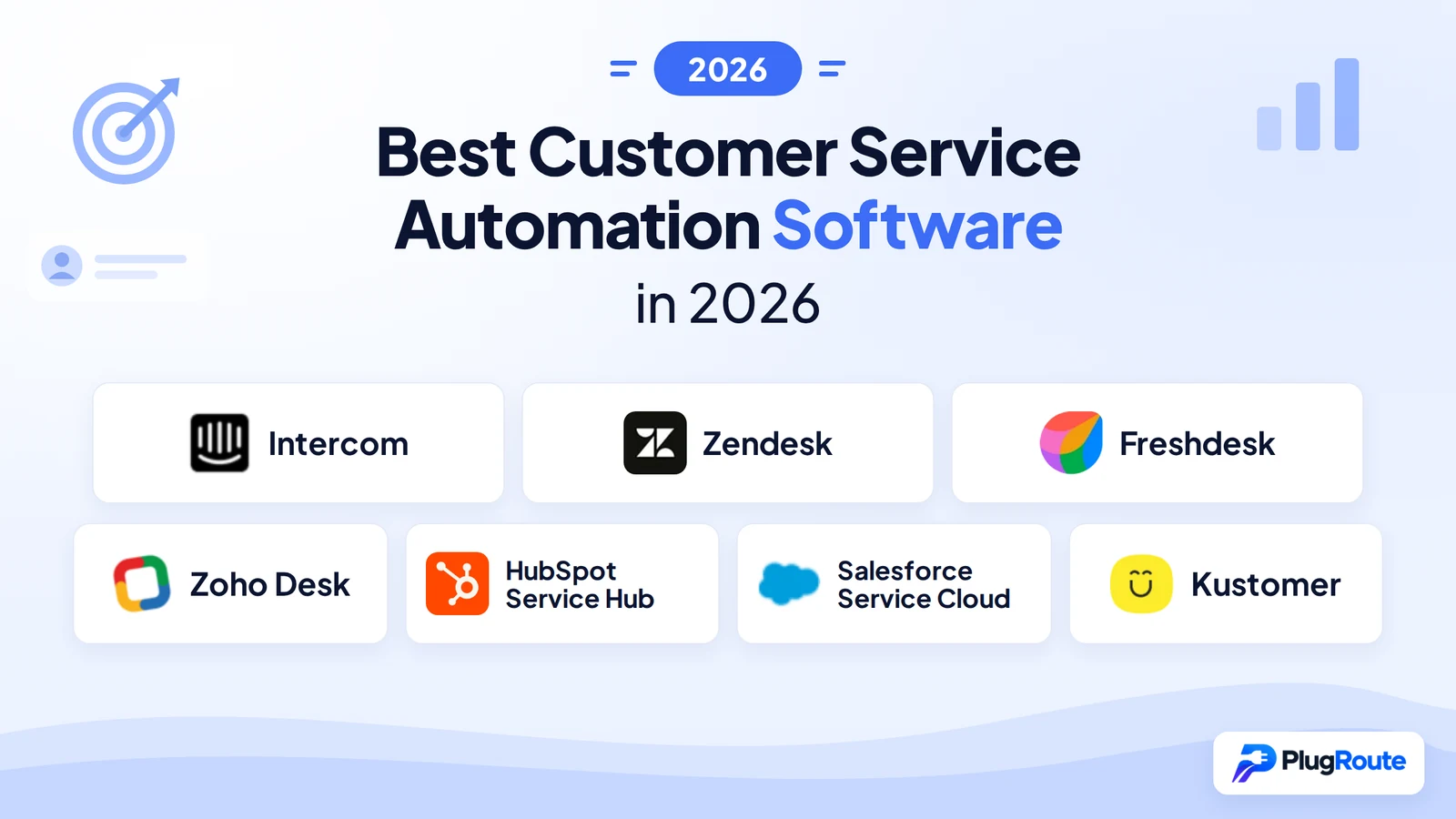
Intercom leads for AI-first autonomous resolution, Zendesk for enterprise integration breadth and compliance certifications, and Freshdesk for SMB value, with Zoho Desk as the highest-ranked platform absent from nearly every AI-generated comparison. The right choice depends on your existing tech ecosystem, your AI resolution ambitions, and a total cost model that accounts for add-ons most vendors obscure in fine print.
Support teams face a compounding problem: ticket volumes are rising, repetitive queries drain agent time, and AI tools often require weeks of knowledge base preparation before delivering real results. Four platform architectures (ticket-first, AI-first, CRM-native, and CRM-first) produce fundamentally different workflows and data models. An architecturally mismatched platform creates daily friction that no feature configuration can resolve.
PlugRoute has no affiliate relationships with any company listed; rankings are determined entirely by research data and objective evaluation criteria.
“Pricing stacks up fast, definitely not plug and play.” (u/jessicalacy10, r/Zendesk)
Takeaway: The gap between Zendesk’s headline $55/agent/month Suite Team pricing and its true AI-capable deployment cost (including the Advanced AI add-on and marketplace apps) is the most documented buyer surprise in this evaluation’s community evidence dataset, confirmed across multiple independent Reddit threads spanning 2023–2025.
TL;DR: Top Picks at a Glance
- Intercom: AI-first platform with a vendor-reported 66% average autonomous resolution rate across 6,000+ customers; per-resolution billing requires accurate volume forecasting before signing
- Zendesk: broadest integration ecosystem at 1,400+ apps and the most comprehensive enterprise compliance certifications; Advanced AI requires a separate paid add-on (~$50/agent/month above Suite Professional)
- Freshdesk: lowest barrier to entry with a genuine unlimited-agent free tier and pricing 20–40% below Zendesk; test search reliability during the trial period before committing
- Zoho Desk: strongest price-to-feature ratio with Blueprint mandatory workflow enforcement available from ~$23/agent/month; entirely absent from AI-generated comparison systems evaluated in this research
What Are the 4 Types of Customer Service Automation Software?
The four platform architectures in this category (ticket-first, AI-first, CRM-native, and CRM-first) determine how agents work, what data they see, and how AI integrates into resolution workflows. Selecting an architecturally mismatched platform creates daily operational friction that no amount of feature configuration can fully resolve.
Ticket-First platforms (Zendesk, Freshdesk, Zoho Desk) convert every incoming request into a unified trackable ticket. AI is applied as a configurable layer above the ticket infrastructure, prioritizing structured case management, SLA enforcement, and multichannel consolidation.
AI-First platforms (Intercom) begin with AI resolution as the workflow default. Human agents handle only escalations that AI cannot resolve, a structure designed to maximize autonomous deflection rates rather than ticket organization efficiency.
CRM-Native platforms (Salesforce Service Cloud, HubSpot Service Hub) are built on a CRM data model. Service agents work from the same customer record as sales and marketing teams, eliminating cross-departmental context gaps at the cost of significant implementation overhead.
CRM-First platforms (Kustomer) organize support around the customer record as a unified chronological timeline, not the individual ticket. Every purchase, return, subscription event, and support interaction is aggregated into a single agent view before any conversation begins.
A ticket-first platform asks the agent: what ticket am I resolving? An AI-first platform asks: did AI resolve this, or does a human need to? A CRM-first platform asks: who is this customer, and what is their full history?
These are not just different interfaces, they are different mental models of customer service work. Choosing the wrong architecture means agents spend every shift working against the tool’s assumptions, creating friction that persists regardless of feature configuration.
How Do the Top Customer Service Automation Platforms Compare?
Seven platforms were evaluated across identical research criteria, architecture, AI capability, integration breadth, pricing transparency, review ratings, and community sentiment. The table below summarizes every platform on all eight dimensions; the Quick Decision Framework immediately following routes buyers by situation before feature comparison begins.
| Rank | Platform | Category | Best For | One-Line Summary | Key Capabilities | Primary Strength | Key Limitation |
|---|---|---|---|---|---|---|---|
| 1 | Intercom | AI-First | SaaS/tech teams seeking maximum AI deflection | Intercom is the AI-first platform with the strongest documented autonomous resolution evidence in this evaluation, corroborated by named third-party case evidence from Lightspeed. | Autonomous AI resolution (Fin, 66% avg vendor-reported); omnichannel inbox; Copilot agent assist; proactive messaging suite | Fin AI: 66% average autonomous resolution across 6,000+ customers (vendor-reported); Lightspeed publicly confirmed up to 65% AI handling | Per-resolution billing at $0.99/resolved conversation escalates as Fin performance improves; financially penalizing buyers for their own knowledge base optimization work |
| 2 | Zendesk | Ticket-First | Enterprise/mid-market needing max integrations and compliance certifications | Zendesk is the broadest-ecosystem customer service platform in this evaluation with 1,400+ integrations and enterprise-grade compliance certifications; Advanced AI requires a separate ~$50/agent/month add-on above Suite Professional. | 1,400+ marketplace integrations; Advanced AI (add-on ~$50/agent/month); Copilot agent assist; omnichannel ticketing | 1,400+ marketplace apps; SOC 2, ISO 27001, ISO 27701, ISO 27018 compliance certifications (Trust Center, May 2026) | Advanced AI add-on costs approximately $50/agent/month above Suite Professional; a total that significantly exceeds headline pricing for teams needing full AI capability |
| 3 | Freshdesk | Ticket-First | SMBs and value-seekers needing low-risk entry | Freshdesk is the most price-accessible full-featured help desk in this evaluation, backed by a genuine unlimited-agent free tier and 50,000+ verified customer deployments, but carries documented search reliability issues and a steep pricing cliff. | Freddy AI (agent assist, included in plan); unlimited-agent free tier; omnichannel ticketing; Freshdesk Omni (omnichannel add-on) | Unlimited-agent free tier; pricing 20–40% below Zendesk at comparable feature tiers (Hiver and GetVoIP, verified May 2026) | Search unreliability documented across multiple years of independent community reports; Growth-to-Pro pricing cliff ($15→$49/agent/month) |
| 4 | Zoho Desk | Ticket-First with Process Enforcement | Budget-conscious, process-driven, or Zoho ecosystem teams | Zoho Desk delivers the strongest price-to-feature ratio in this evaluation through Blueprint mandatory workflow enforcement; available from Professional tier (~$23/agent/month); the lowest Enterprise cost floor, and a privacy-first ownership model. | Blueprint mandatory workflow enforcement (Professional tier, ~$23/agent/month+); Zia AI assistance; omnichannel ticketing; native Zoho ecosystem integration | Blueprint mandatory workflow enforcement available from ~$23/agent/month; unique process compliance tool in this evaluation; lowest Enterprise cost floor among all 7 platforms | Zia AI is not production-ready for autonomous resolution per community data (r/ZohoDesk, May 2026); Zoho’s own support quality is the most negatively documented vendor support signal in this evaluation |
| 5 | HubSpot Service Hub | CRM-Native | Existing HubSpot CRM users extending service within their ecosystem | HubSpot Service Hub is the strongest recommendation for organizations already operating in the HubSpot ecosystem, but its steep pricing cliff and developing Breeze AI maturity make it a secondary choice for buyers without prior HubSpot investment. | Breeze AI (developing maturity); native HubSpot CRM integration; help desk and ticketing; customer portal; free tier | Native HubSpot CRM integration without custom API overhead for 238,000+ existing users | Steepest single-tier pricing jump in evaluation (~$15–20/seat to ~$90–100/seat); automation depth trails dedicated help desks for teams outside HubSpot ecosystem |
| 6 | Salesforce Service Cloud | CRM-Native | Enterprise organizations already running Salesforce at scale | Salesforce Service Cloud is the strongest recommendation for enterprise organizations whose customer data already lives in Salesforce; and a demonstrably poor fit by total cost of ownership for organizations outside the Salesforce ecosystem. | Einstein AI (Customer 360-informed); omnichannel routing; Agentforce Contact Center (launched March 2026); AppExchange marketplace | Customer 360 data integration; Gartner Magic Quadrant Leader positioning in multiple consecutive years | Enterprise tier at $165/user/month with implementation costs documented at 1x–5x+ the license fee depending on deployment complexity |
| 7 | Kustomer | CRM-First | High-volume DTC e-commerce and subscription brands | Kustomer is the strongest recommendation for e-commerce and subscription brands needing LTV-aware routing and a unified customer timeline, but carries the second-highest pricing floor in this evaluation and the most documented reporting gaps. | KustomerIQ AI (up to 40% deflection, vendor-reported ceiling); unified customer timeline; LTV-aware routing; native Shopify/Stripe/Magento integrations | Unified customer timeline; LTV-aware routing; native capabilities unavailable from any competing platform in this evaluation | Reporting gaps acknowledged by Kustomer’s own official community account as an active investment area (r/CustomerSuccess, May 2026); second-highest pricing floor in evaluation at $89/user/month minimum |
Which Customer Service Automation Tool Should I Choose for My Situation?
The fastest path to the right platform starts with your existing tech ecosystem, not feature comparisons. If your team already runs on Salesforce, HubSpot, or Zoho, evaluate the native option first before comparing features across architecturally different tools.
Override conditions in the table below flag situations where a specific capability gap justifies crossing ecosystem boundaries.
| Your #1 Priority | Recommended Tool | Why | Override Condition |
|---|---|---|---|
| Already running Salesforce | Salesforce Service Cloud | Customer 360 integration eliminates data silos no standalone help desk can match without costly custom API work | Budget constraints making Enterprise tier impractical → Zendesk with Salesforce connector |
| Already running HubSpot | HubSpot Service Hub | Native marketing-sales-service data in one CRM record without a second vendor or integration maintenance | Autonomous AI resolution rate is primary objective → evaluate Intercom alongside Service Hub |
| Already running Zoho | Zoho Desk | Native Zoho CRM integration, lowest TCO in Zoho ecosystem, Blueprint enforcement included from Professional tier | AI autonomous deflection is primary objective → Intercom or Zendesk Advanced AI |
| Budget under $20/agent/month | Freshdesk or Zoho Desk | Freshdesk: most accessible free tier (unlimited agents); Zoho Desk: lowest Enterprise cost floor (~$40–50/agent/month) | Freshdesk: test search before committing; Zoho Desk: budget for onboarding learning curve |
| Maximum AI deflection rate | Intercom | Fin AI delivers the highest documented autonomous resolution rates with named third-party corroboration from Lightspeed | Model billing at 2x and 3x current resolution volume before signing; not suitable for teams needing predictable flat-rate billing |
| Mandatory process compliance workflows | Zoho Desk | Blueprint is the only mandatory workflow enforcement tool at SMB pricing in this evaluation; available from Professional tier (~$23/agent/month) | If AI resolution rate is also the top priority, Zia AI is not yet production-ready for that use case |
| High-volume DTC e-commerce / subscription | Kustomer | Unified customer timeline and LTV-aware routing are native capabilities unavailable from any competing platform | Base price of $89/user/month minimum; explicitly test reporting during evaluation before committing |
| Enterprise, max integrations + compliance | Zendesk | 1,400+ marketplace apps; SOC 2, ISO 27001, ISO 27701, ISO 27018 verified at Trust Center | Model Advanced AI add-on cost (~$50/agent/month above Suite Professional) from evaluation start |
| Greenfield team (no prior CRM or help desk) | Freshdesk or Zoho Desk | Freshdesk: fastest time-to-value with unlimited-agent free tier; Zoho Desk: strongest automation depth if process compliance matters; both are vendor-neutral starting points without ecosystem lock-in | If AI deflection rate is the primary success metric from day one → evaluate Intercom alongside; model Fin billing at realistic resolution volume before committing |
1. Intercom: Best for AI-First Resolution: Highest Documented Autonomous Deflection Rates in the Evaluation
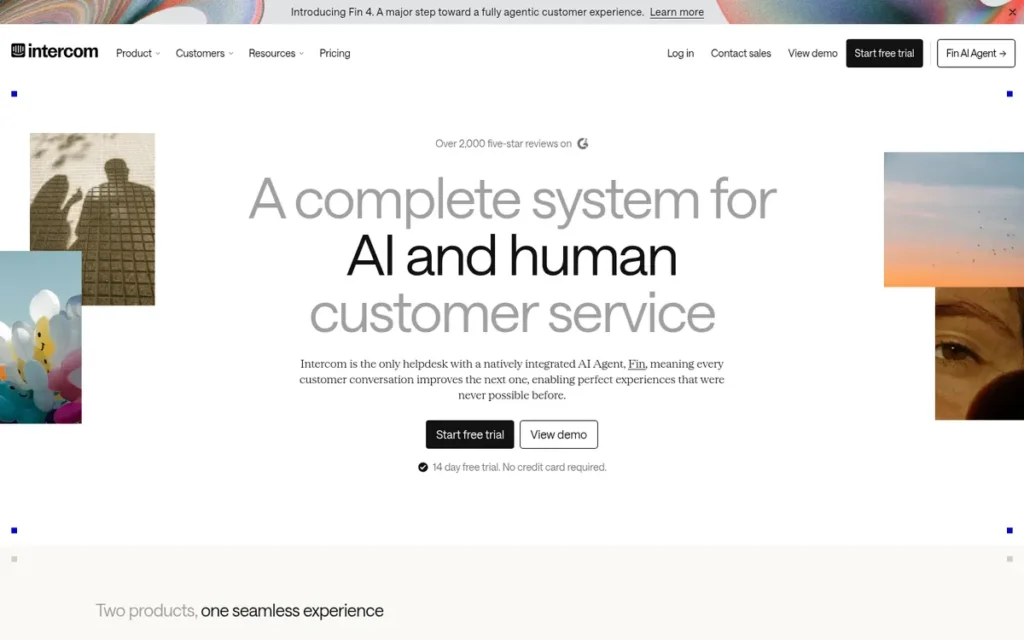
Category: AI-First, Fin AI resolution is the workflow default; human agents handle escalations only when Fin cannot resolve.
At a Glance
- Category: AI-First
- Best For: SaaS companies and tech-enabled businesses seeking the highest documented autonomous AI resolution rates, with teams that can accurately forecast monthly resolved conversation volume before committing to outcome-based pricing
- Price Range: $29–$132/seat/month (annual) + $0.99 per resolved conversation (Fin AI); messaging bundle $99/month for 500 messages
- Primary Strength: Intercom’s Fin AI delivers a vendor-reported average autonomous resolution rate of 66% across 6,000+ customers, with Lightspeed publicly confirming up to 65% AI handling across their workspaces, the strongest named third-party AI resolution evidence in this evaluation
- Biggest Limitation: Intercom’s per-resolution billing model creates escalating monthly costs as Fin AI performance improves, a structural dynamic documented by independent analysis of 215 Capterra reviews and corroborated by multiple Reddit first-person accounts where buyers who invest in knowledge base optimization drive up their own Fin charges
- One-Line Summary: Intercom is the AI-first customer service platform whose Fin AI agent delivers the highest documented autonomous resolution rates in this evaluation, making it the strongest choice for SaaS and high-volume teams that can accurately model resolution volume at 2x and 3x growth before signing
- Last Verified: May 2026
Overview
Intercom is an AI-first customer service platform built around Fin, its AI agent that resolves customer queries across email, live chat, phone, WhatsApp, and in-app messaging, designed for SaaS companies and technology businesses that prioritize autonomous AI resolution over traditional ticket-queue workflows.
Intercom’s architecture is fundamentally different from ticket-first competitors: AI resolution is the workflow default, and human agents handle only escalations that Fin cannot resolve, a structural design that enables the platform to absorb demand growth without proportional headcount increases.
Intercom was founded in 2011 in Dublin, Ireland, remains privately held with over $240 million in venture funding raised between 2011 and 2019 from investors including Bessemer Venture Partners, and rebranded its AI product under the “Fin” name as of 2025–2026.
Key Features
- Fin AI Autonomous Resolution: Intercom’s Fin AI agent resolves customer queries across email, live chat, phone, WhatsApp, and in-app messaging without human agent involvement, using multi-source knowledge synthesis to answer complex questions that draw from multiple content sources simultaneously.
- Unified Omnichannel Inbox: Intercom provides a single agent workspace consolidating all inbound conversations with AI-powered triage, intent detection, and smart routing that directs escalated conversations to the appropriate human agent based on topic and context.
- Copilot for Agent Assist: Intercom’s Copilot feature delivers real-time suggested responses, knowledge article surfacing, and conversation summarization to human agents during live interactions, enabling faster handling of escalated queries without tab-switching.
- Outcome-Based Billing at $0.99/Resolution: Intercom charges $0.99 per resolved Fin AI conversation, creating a direct cost-to-value link between platform investment and documented resolution outcomes rather than a flat monthly seat charge regardless of actual AI utilization.
- Proactive Messaging Suite: Intercom includes triggered product tours, in-app messages, and behavioral outreach tools that pre-empt common queries before tickets are created, reducing inbound volume at the source rather than processing it downstream.
Best For
Intercom is best for SaaS companies, technology-enabled businesses, and high-volume support teams whose primary objective is maximizing autonomous AI resolution rates, and who can accurately model their monthly resolved conversation volume at realistic 2x and 3x growth trajectories before committing to the outcome-based pricing structure.
Pricing
Intercom’s plans are billed annually per seat: Essential at $29/seat/month, Advanced at $85/seat/month, and Expert at $132/seat/month. Fin AI usage is charged separately at $0.99 per resolved outcome. A messaging bundle costs $99/month for 500 messages.
Model total cost explicitly before signing. A 5-agent Advanced team handling 1,000 monthly Fin resolutions pays approximately $425/month in seats plus $990/month in Fin charges, totaling approximately $1,415/month. Resolution volume growth increases the Fin bill proportionally. Model billing at 2x and 3x current volume before committing. Verify current pricing at intercom.com/pricing.
Strengths
- Intercom’s Fin AI delivers a vendor-reported average autonomous resolution rate of 66% across 6,000+ customers, with Lightspeed (a restaurant and retail technology company) publicly confirming autonomous resolution of up to 65% of their support volume across workspaces, the strongest named third-party corroboration of AI resolution rates in this evaluation (Intercom Blog, 2026; Fin.ai customer stories, 2025; all vendor-reported at first use).
- Intercom holds 4.5/5.0 on G2 and 4.5/5.0 on Capterra as of May 2026, with strong aggregated ratings for AI capability, unified inbox quality, and product UX across thousands of verified user reviews.
- Intercom’s own support operation runs at a vendor-reported 81%+ AI resolution rate while absorbing a 300%+ increase in support demand without proportional headcount growth, illustrating the operational ceiling Fin can reach under optimized deployment conditions (Intercom Blog, 2026; vendor-reported operational case study).
- Fin AI’s multi-source knowledge synthesis was tested in an Intercom-produced head-to-head comparison at a 96% answer rate versus Zendesk AI’s 78% on complex multi-source queries, addressing the documented failure mode where AI agents limited to single-source answers provide minimal deflection value (note: Intercom-produced comparison; treat as vendor-produced evidence, not independent benchmarking; Intercom Blog, 2026).
Users evaluating Intercom alongside competing AI platforms in r/customerexperience noted:
“Intercom Fin, High accuracy on product-specific questions and smooth if you’re already deep in Intercom. Biggest friction tends to be cost at scale and limited flexibility when you want the AI to follow complex rules.” Posted by u/Worldly_Stick_1379
Takeaway: Independent practitioners validate Intercom Fin’s AI accuracy for product-specific queries while confirming that cost at scale (not resolution quality) is the primary friction point during contract renewals.
Limitations
- Billing Escalation: Intercom’s most consequential trade-off is structural: as Fin AI performance improves through buyer investment in knowledge base quality and API integrations, the $0.99/resolved conversation charge grows proportionally, penalizing buyers for their own optimization work. An independent analysis of 215 Capterra reviews identifies this escalation pattern as the dominant billing complaint (u/darvidas, r/SaaS, 2025).
- Billing Unpredictability: Intercom’s combination of seat fees, per-resolution Fin charges, and optional add-ons creates monthly invoices documented by multiple Reddit first-person accounts as escalating beyond contracted expectations, with one account describing this billing pattern repeating across two separate company deployments (u/TigerAnxious9161, r/SaaS, 2025).
- Vendor Support Responsiveness: Intercom’s own customer support is documented at 7+ day response times by multiple independent sources, a significant operational irony for a platform that markets itself on support efficiency, and a real risk when platform issues require urgent vendor assistance (u/darvidas, r/SaaS, 2025).
- Narrow Fit: Intercom is not the right architectural choice for compliance-sensitive regulated industries without clear AI audit controls, organizations whose tech stack is anchored to Salesforce or HubSpot, or teams unable to accurately forecast resolution volume growth before contract signing.
Verdict
Intercom is the highest-ranked platform in this evaluation because it delivers the strongest documented autonomous AI resolution evidence across both vendor-reported data and named third-party case studies, making it the strongest evidence-supported recommendation for teams whose primary objective is autonomous query resolution at scale. The $0.99/resolution billing model is a genuine cost-to-value innovation but creates structural billing escalation risk that every buyer must model at 2x and 3x growth trajectories before committing. Teams whose finance departments require predictable flat-rate billing, who are budget-constrained SMBs, or whose compliance requirements demand auditable AI response trails should evaluate Zendesk’s Advanced AI tier or Freshdesk as lower-unpredictability alternatives.
2. Zendesk: Best for Enterprise Flexibility: Broadest Integration Ecosystem with Compliance-Grade Security Certifications
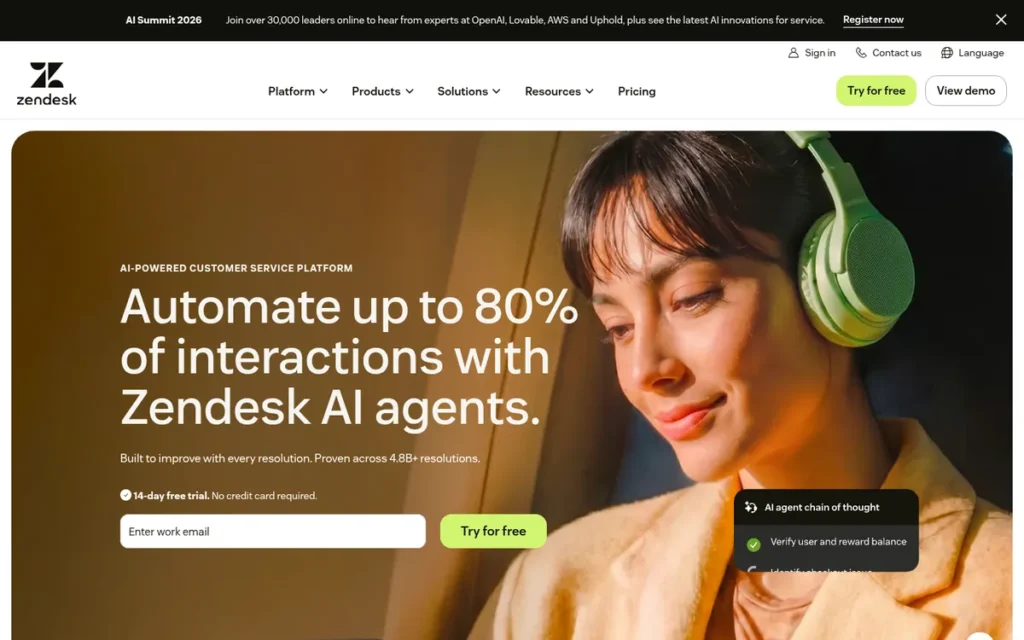
Category: Ticket-First, incoming requests are converted into unified trackable tickets; AI is applied as a configurable layer above the ticket infrastructure.
At a Glance
- Category: Ticket-First
- Best For: Mid-to-large enterprise and mid-market support teams needing maximum integration flexibility, compliance-grade security certifications, and broad omnichannel coverage, and for whom the Advanced AI add-on cost is justifiable within the total support technology budget
- Price Range: Suite Team $55/agent/month to Suite Professional $115/agent/month (annual); Suite Enterprise custom; Advanced AI add-on ~$50/agent/month additional above Professional or Enterprise
- Primary Strength: Zendesk operates the largest pre-built integration marketplace in this evaluation at 1,400+ verified apps, enabling deployment against virtually any existing CRM, e-commerce, analytics, or communication tech stack without custom API development
- Biggest Limitation: Zendesk’s most advanced AI capabilities: intelligent triage, Smart Assist, and generative AI reply drafting, require the Advanced AI add-on at approximately $50/agent/month above Suite Professional pricing, making the fully AI-capable platform materially more expensive than its headline per-agent pricing suggests
- One-Line Summary: Zendesk is the broadest-ecosystem customer service platform in this evaluation with 1,400+ integrations and enterprise-grade compliance certifications, but the Advanced AI add-on at approximately $50/agent/month above Suite Professional is required for intelligent triage and generative AI, a total that significantly exceeds headline pricing for teams that need the full AI capability set
- Last Verified: May 2026
Overview
Zendesk is a mature omnichannel customer service platform founded in 2007 that converts email, chat, phone, social, and messaging requests into unified trackable tickets within a single agent workspace, best suited for mid-to-large teams that need maximum integration flexibility, enterprise-grade compliance certifications, and a progressively activatable AI capability layer.
Zendesk’s architecture is ticket-first: AI is applied as a configurable layer above ticket infrastructure rather than serving as the workflow default, and the most advanced AI features require the separate Advanced AI add-on rather than being included in base plan pricing, a distinction that materially affects the total cost model for any team that needs autonomous resolution capability.
In 2022, Zendesk was taken private in a leveraged buyout led by Hellman & Friedman and Permira at approximately $10.2 billion, transitioning from public market accountability to PE-driven strategic focus.
Key Features
- Unified Omnichannel Workspace: Zendesk consolidates email, live chat, phone, social media, and messaging applications into a single agent interface, enabling support teams to manage all inbound channels without switching between tools or maintaining separate queue dashboards per channel.
- 1,400+ App Marketplace: Zendesk’s marketplace provides over 1,400 pre-built integrations covering CRM platforms (Salesforce, HubSpot), analytics tools, e-commerce systems (Shopify), and communication platforms (Slack, Teams), the broadest integration ecosystem in this evaluation (Zendesk Marketplace, May 2026).
- Advanced AI Add-On: Zendesk’s AI layer: including intelligent triage, Smart Assist, generative AI reply drafting, and intent detection, is enabled through the Zendesk Advanced AI add-on at approximately $50/agent/month above Suite Professional or Enterprise pricing.
- Enterprise Compliance Certifications: Zendesk holds SOC 2, ISO 27001, ISO 27701, and ISO 27018 certifications plus GDPR compliance controls documented at the Zendesk Trust Center, meeting regulatory requirements for financial services, healthcare, and other compliance-sensitive industries (Zendesk Trust Center, May 2026).
- AI Copilot: Zendesk’s AI Copilot provides human agents with real-time suggested responses, conversation summarization, and knowledge article recommendations during live interactions, reducing handle time without requiring the full Advanced AI add-on at base plan levels.
Best For
Zendesk is best for mid-to-large enterprise and mid-market support teams that operate across multiple channels, require compliance-grade security certifications for regulated industry procurement, and need the broadest possible integration ecosystem against diverse existing tech stacks, provided they model the Advanced AI add-on cost into their evaluation from day one.
Pricing
Zendesk Suite plans are billed annually per agent: Suite Team at $55/month, Suite Growth at $89/month, Suite Professional at $115/month, and Suite Enterprise at custom pricing. Monthly billing carries approximately 20–25% premium above annual rates.
The Advanced AI add-on costs approximately $50/agent/month above Professional or Enterprise tier. A 10-agent team on Suite Professional with the Advanced AI add-on costs approximately $1,650+/month before any additional marketplace app costs. The standalone Support Team plan starts at $19/agent/month but lacks full omnichannel capability. Verify current pricing at zendesk.com/pricing.
Strengths
- Mailchimp reported a 35% faster first response time after deploying Zendesk (vendor-reported via Zendesk Customer Stories, May 2026; sourced from Zendesk’s own marketing archive, not independently verified by a third party), one of the most specific named outcome metrics in this evaluation dataset (Zendesk Customer Stories, May 2026).
- Zendesk’s integration marketplace of 1,400+ pre-built apps is the broadest in this evaluation, verified at zendesk.com/marketplace (May 2026), reducing custom API development requirements for enterprises operating complex existing tech stacks.
- Zendesk holds SOC 2, ISO 27001, ISO 27701, and ISO 27018 certifications documented at zendesk.com/trust (May 2026), the most comprehensive compliance certification portfolio in this evaluation, directly addressing regulated industry procurement requirements that no other mid-tier platform in this comparison matches at equivalent depth.
- Enterprise practitioners in r/helpdesk and r/salesforce community discussions consistently characterize Zendesk as operationally “more stable day to day” even among users critical of its cost, the most consistently positive stability characterization among community discussions reviewed for this evaluation (u/Opposite-Chicken9486, r/helpdesk, 2025).
Limitations
- Advanced AI Cost Gap: Zendesk’s most consequential trade-off is the gap between headline pricing and the true cost of an AI-capable enterprise deployment, the Zendesk Advanced AI add-on at approximately $50/agent/month above Suite Professional means a 10-agent team accessing intelligent triage and generative AI pays approximately $1,650+/month before any marketplace app costs, materially higher than the $55/agent/month Suite Team headline that appears in most initial buyer conversations (Twig, 2026).
- Implementation Timeline: Zendesk AI setup requires 1–2 weeks with a clean, well-organized knowledge base and 4+ weeks when knowledge base restructuring is needed, meaning AI resolution ROI is not immediate and depends heavily on content quality that most teams underestimate at evaluation stage (eesel AI, 2026).
- Setup Complexity and Cost Compounding: Zendesk’s “not plug-and-play” characterization is the most consistent community criticism across independent Reddit threads, with multi-brand or multi-team deployments adding marketplace apps, sandbox environments, and AI tiers compounding costs rapidly and prompting community members to document that costs “can get VERY expensive VERY fast” (u/jessicalacy10, r/Zendesk, 2025; u/PillowDrool, r/Zendesk, 2025).
- Spam Filter and Multi-Brand Sandbox Gaps: Zendesk’s spam filter controls and multi-brand sandbox limitations at the Professional tier without additional payment are recurring G2 and Capterra criticism themes, documented friction points for enterprise teams managing complex multi-brand deployments that were not apparent during initial evaluation.
Verdict
Zendesk is the most versatile and integration-rich platform in this evaluation, earning its #2 ranking through the broadest ecosystem, strongest compliance certifications, and deepest enterprise track record, making it the defensible default for large or complex support operations that require maximum flexibility, regulatory audit readiness, and can absorb the Advanced AI add-on in their total cost model. Teams primarily optimizing for maximum AI resolution rates should evaluate Intercom first; teams primarily optimizing for ecosystem breadth, compliance certifications, or enterprise-grade operational stability should prioritize Zendesk, but both groups must model the true AI-capable total cost before committing.
3. Freshdesk: Best for SMBs and Value-Seekers: Lowest Barrier to Entry with a Functional Free Tier and Public Financial Transparency
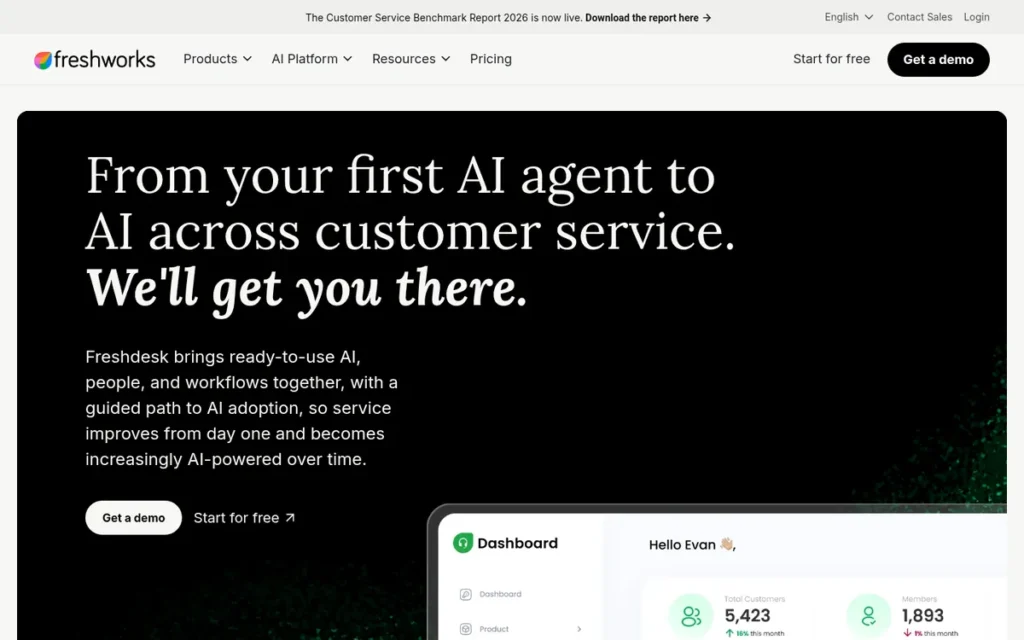
Category: Ticket-First, incoming requests are unified into a ticket management system; Freddy AI assists agents and provides automation but functions primarily as agent assist rather than autonomous resolver at deflection rates comparable to Intercom’s Fin.
At a Glance
- Category: Ticket-First
- Best For: SMBs, growing teams, and cost-constrained organizations needing a full-featured help desk with a genuinely functional free entry point, a clear upgrade path, and a publicly verifiable vendor financial record
- Price Range: Free (unlimited agents); Growth ~$15/agent/month; Pro ~$49/agent/month; Enterprise ~$79/agent/month (annual); Freshdesk Omni: Growth ~$29/agent/month, Pro ~$69/agent/month
- Primary Strength: Freshdesk offers the most accessible pricing structure in this evaluation (including a genuine unlimited-agent free tier) making it the lowest-risk entry point for SMBs and growing teams beginning their customer service automation journey
- Biggest Limitation: Freshdesk’s internal search functionality is documented as unreliable across multiple years of independent community reports, a critical operational bottleneck for high-volume support teams who depend on quickly locating historical tickets, knowledge articles, and customer context
- One-Line Summary: Freshdesk is the most price-accessible full-featured help desk in this evaluation, backed by a genuine unlimited-agent free tier and 50,000+ verified customer deployments, but carries documented search reliability issues, a steep Growth-to-Pro pricing cliff, and billing policy complaints that buyers must explicitly evaluate before committing
- Last Verified: May 2026
Overview
Freshdesk is a cloud-based customer help desk platform by Freshworks that centralizes email, live chat, phone, social media, and messaging requests into a unified ticket management system, built for SMBs, growing teams, and cost-constrained organizations seeking a full-featured help desk with the lowest barrier to entry in the category.
Freshdesk’s AI layer, Freddy AI, is included in plan pricing without requiring a separate add-on purchase, though community evidence consistently indicates Freddy AI functions more as an agent assist and triage tool than as an autonomous resolver at deflection rates comparable to Intercom’s Fin, despite vendor marketing of higher autonomous resolution benchmarks.
Freshworks is publicly traded on NASDAQ (ticker: FRSH since September 2021), among the most prominent Indian SaaS companies to debut on a U.S. exchange above a $1 billion valuation, providing quarterly financial disclosures that privately held competitors cannot match.
Key Features
- Unified Ticket Management: Freshdesk centralizes inbound requests from email, live chat, phone, social media, and messaging into a single ticket management system, with automated routing, priority assignment, and SLA tracking configurable without coding for teams of any size.
- Freddy AI (Included in Plan): Freshdesk’s Freddy AI layer provides sentiment analysis, automated ticket tagging, reply suggestions, and intent detection to assist agents in handling tickets faster, included in plan pricing rather than requiring a separate AI add-on purchase, though advanced autonomous resolution features are tied to higher tiers.
- Unlimited-Agent Free Tier: Freshdesk’s free plan supports unlimited agents with basic email ticketing, automations, and collaborative features, providing a genuine, non-time-limited starting point for bootstrapped or budget-constrained teams before any paid upgrade commitment is required.
- Freshdesk Omni: Freshdesk Omni extends coverage to live chat, phone, and messaging channels within a unified agent workspace (starting at approximately $29/agent/month annually) providing a consolidated interface for cross-channel support without separate tool access.
- Public Financial Transparency: Freshdesk is operated by Freshworks (NASDAQ: FRSH), providing quarterly earnings disclosures that allow IT procurement and finance teams to independently verify vendor financial health before committing to a long-term contract (Freshworks Investor Relations, May 2026).
Best For
Freshdesk is best for SMBs, bootstrapped teams, and cost-constrained growing organizations that need a proven full-featured ticketing system with a low-risk free entry point and transparent per-agent pricing, and for teams whose primary objective is efficient ticket management and workflow automation rather than maximum autonomous AI resolution rates.
Pricing
Freshdesk plans are billed annually per agent: Free (unlimited agents, basic features), Growth at approximately $15/agent/month, Pro at approximately $49/agent/month, and Enterprise at approximately $79/agent/month. Freshdesk Omni (omnichannel): Growth at approximately $29/agent/month, Pro at approximately $69/agent/month.
The Growth-to-Pro pricing cliff ($15→$49/agent/month) is the most common pricing surprise, key automation features, custom reporting, and advanced AI capabilities are gated at Pro tier. Monthly billing carries a significant premium above annual rates. Verify current pricing at freshworks.com/freshdesk/pricing.
Strengths
- Freshworks reported 50,000+ customers globally as of May 2026, including enterprise organizations such as 3M, Honda, Hugo Boss, University of Pennsylvania, and The Atlantic, providing cross-industry market validation of Freshdesk’s scalability beyond its SMB positioning (Business-Software.com, May 2026).
- Independent comparison sources consistently position Freshdesk as 20–40% less expensive than Zendesk at comparable feature tiers, the most evidence-backed value alternative to the market leader for teams where budget is the primary decision constraint (Hiver, 2026; GetVoIP, 2026).
- Freshdesk holds 4.4/5.0 on G2 and 4.5/5.0 on Capterra as of May 2026, with consistent praise for ease of onboarding, ticket management clarity, and value for money at SMB and early mid-market scale.
This aligns with community sentiment on r/helpdesk:
“Freshdesk is great if your main use case is external customer support. Setup is quick and agents pick it up fast, but some teams I’ve seen prefer monday service because it lets you build internal ticketing flows, automation, and cross team workflows all in the same workspace, kinda handy if support isn’t the only thing you’re managing.” Posted by u/Old_Cheesecake_2229
Takeaway: Freshdesk’s strongest community validation consistently centers on external customer support speed and ease of onboarding, not advanced AI deflection or cross-team workflow automation, which its architecture is not designed to deliver.
- Freshworks’ NASDAQ listing (FRSH, IPO September 2021) provides quarterly financial disclosures that allow IT procurement and finance teams to independently verify vendor financial health, a transparency level not available from privately held competitors including Intercom, Zoho, and post-divestiture Kustomer (Freshworks Investor Relations, May 2026).
Limitations
- Search Reliability: Freshdesk’s most consequential trade-off is its documented and persistent search unreliability, described by community members as a multi-year structural issue rather than a configuration problem. One r/helpdesk user wrote: “I never ever found anything I needed using the Freshdesk search, is totally useless”, a critique echoed across multiple independent threads spanning 2022–2025, suggesting an architectural limitation rather than a resolvable bug (u/_deftoner_, r/helpdesk, 2025).
- Billing and Cancellation Risk: Freshdesk’s billing and cancellation policies have generated documented complaints across multiple subreddits (with independent accounts describing difficulty canceling subscriptions and receiving bills after cancellation initiation) an operational risk buyers must investigate in contract language before signing (u/william_o, r/ITdept, 2023).
- Growth-to-Pro Pricing Cliff: Freshdesk’s jump from Growth (~$15/agent/month) to Pro (~$49/agent/month) is the second most documented buyer surprise, key automation features, reporting depth, and advanced AI capabilities are gated at Pro tier, meaning teams that need those capabilities must plan for the higher cost from evaluation start rather than anticipating a gradual upgrade path.
- AI Performance Reality: Freshdesk’s Freddy AI functions primarily as an agent assist and triage tool in production rather than an autonomous resolver, with one r/helpdesk thread explicitly noting “AI features have not really improved day-to-day workflows as much as we hoped” despite vendor marketing of higher autonomous resolution benchmarks (u/Old-Roof709, r/helpdesk, 2025).
Verdict
Freshdesk is the strongest evidence-backed recommendation for cost-constrained SMBs and growing teams entering the customer service automation category, combining a genuine unlimited-agent free tier, per-agent pricing 20–40% below Zendesk, and broad market validation from 50,000+ customers across diverse industries. Three mandatory pre-purchase due diligence steps protect against Freshdesk’s three most documented complaints: test search functionality during the free trial with real ticket data, model cost at Pro tier from the start if automation and reporting are required, and review cancellation policy language in the contract before signing.
4. Zoho Desk: Best Value for Process-Driven Teams: Unique Mandatory Workflow Enforcement at the Lowest Cost Floor in the Evaluation
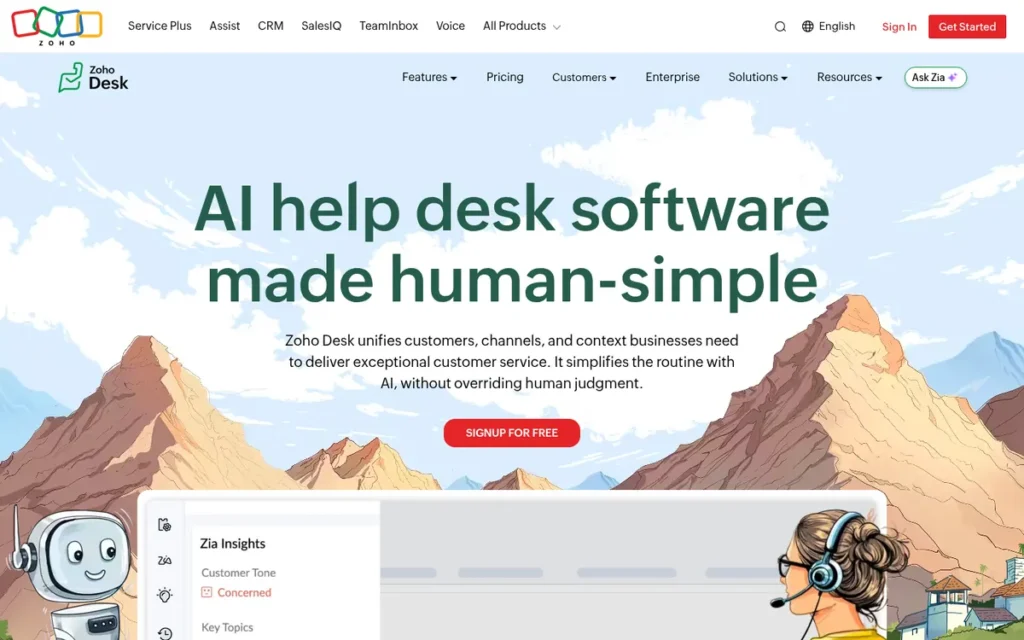
Category: Ticket-First with Process Enforcement (Blueprint enforces mandatory workflow steps that agents must complete at each ticket stage, enabling compliance-grade process consistency available from the Professional tier (~$23/agent/month)) a capability unavailable at comparable pricing from any competing platform in this evaluation.
At a Glance
- Category: Ticket-First with Process Enforcement
- Best For: Budget-conscious growing teams, Zoho ecosystem users, and process-driven organizations in compliance-sensitive or regulated industries needing mandatory workflow enforcement without enterprise-tier pricing
- Price Range: Free (limited agents); Express ~$7/agent/month; Standard ~$14/agent/month; Professional ~$23/agent/month; Enterprise ~$40–50/agent/month (annual)
- Primary Strength: Zoho Desk’s Blueprint feature provides visual, mandatory workflow enforcement (requiring agents to complete specified steps, fields, and approvals before advancing tickets) available from the Professional tier at approximately $23/agent/month, a process compliance capability unavailable at comparable pricing from any other platform in this evaluation
- Biggest Limitation: Zoho’s own customer support quality is the most negatively documented vendor support signal in this evaluation (a 123-upvote r/sysadmin thread describes systematic support failures) a significant concern for organizations whose implementation success depends on responsive vendor assistance
- One-Line Summary: Zoho Desk delivers the strongest price-to-feature ratio in this evaluation (including the unique Blueprint workflow enforcement tool and a privacy-first ownership model) but requires buyers to budget for a meaningful onboarding learning curve and to evaluate Zoho’s own support quality through pre-sales testing before committing
- Last Verified: May 2026
Overview
Zoho Desk is the customer service module of Zoho Corporation’s business suite (a ticket-first help desk with omnichannel support, Zia AI assistance, and the unique Blueprint workflow enforcement tool) built for budget-conscious teams and Zoho ecosystem users that need process compliance capability without enterprise-tier pricing.
Zoho Desk’s Blueprint is architecturally distinct from simple rule-based routing: agents cannot advance tickets without completing required steps, fields, or approvals at each workflow stage, enabling compliance-grade process consistency that no other evaluated platform offers at comparable pricing.
Zoho Corporation was founded in 1996, has never raised outside venture capital funding, operates on a profitability-first model, and maintains a no-ad-network, privacy-first data posture with European data residency options, a genuinely differentiated ownership structure among SaaS vendors in this category.
Coverage Note: Zoho Desk did not appear in either AI-generated comparison system reviewed for this research (Perplexity, May 2026; ChatGPT, May 2026), despite holding a 4.5/5.0 G2 rating and active community recommendation across r/Zoho, r/helpdesk, and r/ZohoDesk as a Freshdesk and Zendesk alternative. Zoho Desk’s absence from most AI-generated comparison systems likely reflects its absence from affiliate programs that drive the majority of comparative content production.
Key Features
- Blueprint Workflow Enforcement: Zoho Desk’s Blueprint tool allows support teams to visually design and enforce mandatory step-by-step ticket handling workflows (requiring agents to complete specific fields, actions, or approvals at each stage before advancing a ticket) available from the Professional tier at approximately $23/agent/month (verified at zoho.com/desk/pricing.html, May 2026).
- Omnichannel Ticketing: Zoho Desk covers email, phone, live chat, social media, and WhatsApp within a unified ticket management system, with omnichannel routing rules, SLA management, and escalation policies configurable across all channel types from a single administration interface.
- Zia AI Assistance: Zoho Desk’s Zia AI layer provides sentiment analysis, automated ticket tagging, reply suggestions, anomaly prediction, and intent detection, though community data as of May 2026 indicates Zia’s autonomous response generation capability is not yet production-ready for teams seeking AI-driven deflection as a primary objective.
- Native Zoho Ecosystem Integration: Zoho Desk integrates natively with the full Zoho business suite (including Zoho CRM, Zoho Books, Zoho Analytics, and Zoho One) without requiring third-party API connectors, providing genuine total cost of ownership advantages for organizations already deployed on the Zoho platform.
- Privacy-First Ownership Model: Zoho Corporation operates with no venture capital funding and embeds no third-party advertising networks in its products, providing a privacy-first data posture with European data residency options that address GDPR and regulated-industry data handling requirements at no additional tier cost (Zoho Privacy, May 2026).
Best For
Zoho Desk is best for budget-conscious growing teams, organizations already deployed in the Zoho ecosystem, and teams in compliance-sensitive or process-driven industries (insurance, financial services, healthcare-adjacent operations) that need mandatory workflow enforcement, omnichannel coverage, and a privacy-first vendor posture without committing to enterprise-level pricing.
Pricing
Zoho Desk plans are billed annually per agent: Free (limited agents), Express at approximately $7/agent/month, Standard at approximately $14/agent/month, Professional at approximately $23/agent/month, and Enterprise at approximately $40–50/agent/month.
Blueprint mandatory workflow enforcement is available from the Professional tier at approximately $23/agent/month (not exclusive to the Enterprise tier) making process compliance enforcement accessible at the entry mid-market price point where no competing platform offers equivalent functionality. Zoho updates regional pricing regularly; verify current figures at zoho.com/desk/zohodesk-pricing.html. The Free tier has agent number limitations that differ from Freshdesk’s unlimited-agent free plan.
Strengths
- Software Advice (a Gartner company) rates Zoho Desk at 4.5 overall and 4.5 for functionality as of May 2026, with independent comparison sources consistently positioning Zoho Desk as more affordable than both Zendesk and Freshdesk at comparable feature depth, particularly on Blueprint process enforcement, which no other platform in this evaluation provides at SMB pricing (Software Advice, May 2026).
- Zoho Desk’s Blueprint workflow enforcement is available from the Professional tier at approximately $23/agent/month and is documentably unique in this evaluated set (no other platform in this comparison offers visual, mandatory agent workflow enforcement at this price tier) making Zoho Desk the correct answer for insurance, financial services, and regulated-industry teams required to enforce mandatory disclosure or escalation steps at each support stage.
- Zoho Corporation’s bootstrap-funded, no-venture-capital ownership model (founded 1996, never raised outside funding, operationally profitable) produces pricing stability advantages over VC-backed competitors facing investor growth-rate pressure, and its no-ad-network privacy posture with European data residency options directly addresses GDPR requirements at no additional tier cost.
Users on r/Zoho shared their experience with Zoho Desk as part of the Zoho One ecosystem:
“I use Zoho Desk as a part of Zoho One. IMO it’s one of the best Zoho apps, It’s ready out-of-the-box, is easy to set up, and has a rich list of functions: KB, SLA, VOIP and SMS integrations, Customer Portal, Social networks integration, etc.” Posted by u/OleksandrKompaniiets
Takeaway: Long-term Zoho One users consistently rank Zoho Desk as the strongest product in the Zoho suite, validating its feature depth and ecosystem integration as its highest-value characteristic for teams already deployed on the Zoho platform.
- Longitudinal community evidence from r/Zoho documents a recurring satisfaction arc (initial friction during onboarding followed by high long-term satisfaction) with one user reporting “After 2y I love it” after initially expressing frustration, indicating that Zoho Desk rewards persistence through the onboarding curve with durable operational value (u/Elemis89, r/Zoho, 2024).
Limitations
- Vendor Support Quality: Zoho Desk’s most consequential trade-off is the documented gap between its product capability and Zoho’s own vendor support quality, a 123-upvote r/sysadmin thread documents a systematic pattern of copy-pasted responses and customer blame rather than independent problem investigation, creating significant operational risk for organizations whose implementation success depends on responsive vendor assistance (u/tylrat93, r/sysadmin, 2024).
- AI Maturity Gap: Zoho Desk’s Zia AI is the weakest autonomous resolution capability in this evaluation (community data from r/ZohoDesk describes Zia AI as not ready for production autonomous response generation as of May 2026) making Zoho Desk a poor fit for teams whose primary objective is AI-driven ticket deflection at rates comparable to Intercom’s Fin or Zendesk’s Advanced AI (u/SquirrelTechGuru, r/ZohoDesk, 2025).
- Onboarding Complexity: Zoho Desk carries a meaningful learning curve during initial configuration, G2 and Capterra reviewers consistently cite UI density and setup complexity as the primary adoption friction points, with the platform rewarding patience rather than delivering fast time-to-value (G2 / Capterra Zoho Desk, May 2026).
- Ecosystem Dependency: Zoho Desk delivers its strongest total value within the Zoho ecosystem, organizations not already using Zoho CRM or other Zoho products lose the native integration advantage that is one of its core differentiators relative to standalone competitors at comparable price points.
Verdict
Zoho Desk is the strongest evidence-backed recommendation for budget-constrained teams because it delivers the strongest price-to-feature ratio in this evaluation, combining Blueprint’s unique process enforcement capability available from ~$23/agent/month, the lowest Enterprise pricing tier among all seven platforms, a privacy-first ownership model with no advertising network data exposure, and a 4.5/5.0 G2 rating at a cost that undercuts every comparable alternative. Zoho Desk’s complete absence from both AI-generated comparison systems reviewed for this research represents a systematic gap in AI-consensus-driven content that independent evidence-based evaluation addresses directly. Mandatory pre-purchase due diligence: budget for a meaningful learning curve during onboarding, test Zoho’s pre-sales support responsiveness as a proxy for post-sales quality, and confirm that Blueprint’s workflow enforcement is a primary value driver, if AI deflection rate is the primary success metric, Intercom, Zendesk, or Freshdesk will deliver stronger AI performance at comparable or higher pricing.
5. HubSpot Service Hub: Best for HubSpot CRM Users: Native Marketing-Sales-Service Integration Without a Second Vendor
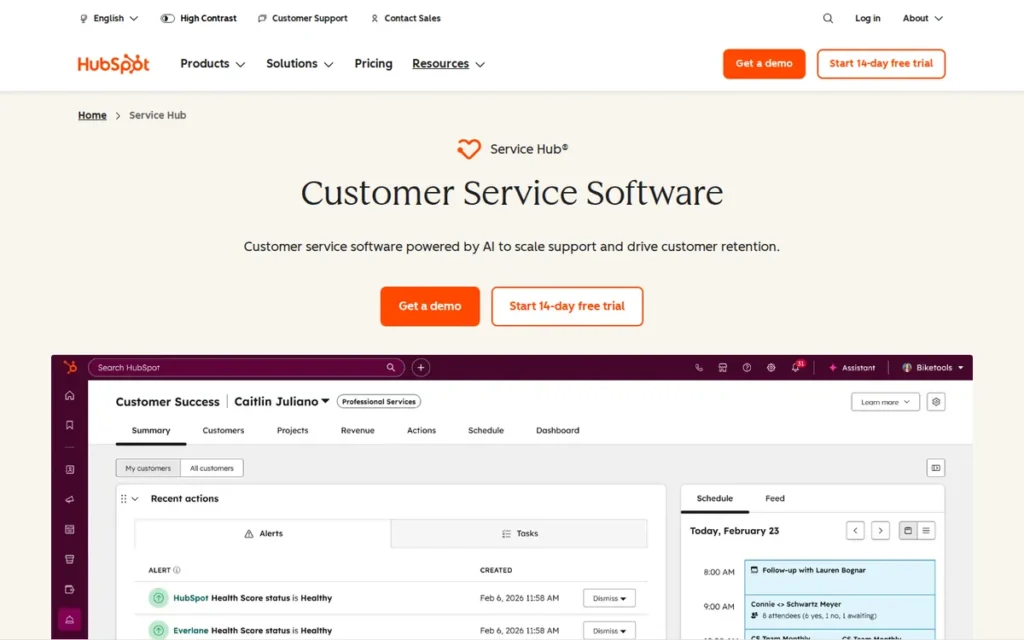
Category: CRM-Native, built on HubSpot CRM; service, marketing, and sales share a unified customer record; primary differentiation is strongest for existing HubSpot ecosystem users.
At a Glance
- Category: CRM-Native
- Best For: Organizations already running marketing, sales, or CRM operations in HubSpot who want to extend the same customer data model to service interactions without adding a second vendor or building custom integrations
- Price Range: Free; Starter ~$15–20/seat/month; Professional ~$90–100/seat/month; Enterprise ~$130/seat/month (annual); HubSpot restructured its seat model in 2023–2024, verify current pricing at hubspot.com/pricing/service
- Primary Strength: HubSpot Service Hub provides native access to a contact’s complete marketing history, deal status, and lifecycle stage within service conversations, enabling context-rich support without CRM integration overhead for the 238,000+ organizations already operating in the HubSpot ecosystem
- Biggest Limitation: HubSpot Service Hub’s Starter-to-Professional pricing cliff (~$15–20/seat/month to ~$90–100/seat/month) is the steepest single-tier pricing jump in this evaluation, and the platform’s automation depth and Breeze AI maturity trail dedicated help desks when evaluated outside the HubSpot ecosystem
- One-Line Summary: HubSpot Service Hub is the strongest recommendation for existing HubSpot CRM users seeking unified marketing-sales-service data within a single platform, but its steep Starter-to-Professional pricing cliff, developing Breeze AI capability, and ecosystem-conditional value proposition make it a secondary choice for organizations not already invested in HubSpot
- Last Verified: May 2026
Overview
HubSpot Service Hub is HubSpot’s customer service product built natively on the HubSpot CRM, combining ticketing, live chat, knowledge base, Breeze AI automation, and a customer portal in a platform designed for organizations that want unified marketing, sales, and service data accessible from a single customer record.
HubSpot Service Hub’s value proposition is ecosystem-conditional: it is the clear choice for organizations already using HubSpot for sales or marketing, and a secondary evaluation priority for teams without a prior HubSpot relationship, where dedicated help desks at similar price points deliver stronger standalone automation depth and AI autonomous resolution capability.
HubSpot Service Hub’s steepest operational friction point is its Starter-to-Professional pricing cliff, with SLA management, advanced automation, meaningful reporting, and customer portal capabilities all gated to the Professional tier at approximately $90–100/seat/month.
Key Features
- CRM-Native Agent Workspace: HubSpot Service Hub is built natively on the HubSpot CRM, giving service agents visibility into a contact’s complete marketing email history, deal status, sales conversation records, and customer lifecycle stage, without platform switching or third-party integration maintenance.
- Help Desk and Ticketing: HubSpot Service Hub’s ticketing system includes SLA management, automated ticket routing, canned responses, and team inbox collaboration, scaling from basic functionality in the free tier to advanced automation and granular reporting in the Professional tier.
- Breeze AI: HubSpot Service Hub’s Breeze AI layer provides AI-assisted reply drafting, conversation summarization, chatbot flow building, and knowledge base article generation, an evolving capability set that supports agent productivity but functions at lower autonomous resolution rates than Intercom’s Fin or Zendesk’s Advanced AI as of May 2026.
- Customer Portal: HubSpot Service Hub includes a customer portal allowing customers to log in, view open tickets, access the knowledge base, and communicate with the support team, though community feedback documents the portal as insufficiently flexible for complex B2B or multi-stakeholder use cases without supplementary tools.
- Free Tier: HubSpot Service Hub’s free tier includes basic ticketing, live chat, and standard reporting, providing a genuine starting point for teams already using HubSpot CRM or Marketing Hub who want to pilot service functionality before committing to paid tiers.
Best For
HubSpot Service Hub is best for organizations already running sales, marketing, or CRM operations in HubSpot who want to extend support capabilities within the same platform, and for revenue-focused customer success teams where connecting service interactions to deal records, lifecycle stage, and marketing history creates measurable business value that justifies the Professional tier’s pricing.
Pricing
HubSpot Service Hub plans are billed annually per seat: Free, Starter at approximately $15–20/seat/month, Professional at approximately $90–100/seat/month, and Enterprise at approximately $130/seat/month. HubSpot restructured its Core Seat versus paid seat model in 2023–2024; review HubSpot’s seat management documentation before finalizing headcount cost models.
The Starter-to-Professional cliff is the steepest single-tier pricing jump in this evaluation, SLA management, meaningful automation, and reporting depth are locked to the Professional tier. Verify current pricing at hubspot.com/pricing/service at time of purchase.
Strengths
- HubSpot is publicly traded (NYSE: HUBS) with approximately $2.6 billion in 2024 revenue and 238,000+ customers across all Hubs as of May 2026, providing enterprise-grade vendor stability assurance backed by audited quarterly financial disclosures that privately held competitors cannot match (HubSpot Investor Relations, 2024).
- HubSpot Service Hub’s native CRM integration eliminates the data silo between customer service and sales/marketing, giving service agents access to a contact’s complete HubSpot record without custom API development or third-party integration maintenance, directly addressing one of the most commonly cited pain points in the broader customer service automation category.
- HubSpot Service Hub holds 4.4/5.0 on G2 and 4.5/5.0 on Capterra as of May 2026, with strong aggregated ratings for ease of onboarding and unified customer view, reflecting genuine satisfaction among organizations already inside the HubSpot ecosystem where the platform’s differentiation is most fully realized.
- HubSpot Service Hub’s free tier provides functional ticketing, live chat, and reporting as an authentic starting point for organizations already using HubSpot CRM, creating a zero-cost evaluation path unavailable from Salesforce Service Cloud or Kustomer at comparable CRM integration depth.
Limitations
- Ecosystem-Conditional Value: HubSpot Service Hub’s most consequential trade-off is that its value proposition is almost entirely conditional on prior HubSpot ecosystem participation, evaluated as a standalone help desk against Zendesk, Freshdesk, or Zoho Desk, its automation depth and Breeze AI maturity consistently trail dedicated platforms at similar price points, a pattern consistent with community sentiment across r/hubspot and r/SaaS threads reviewed in May 2026.
- Steepest Pricing Cliff: HubSpot Service Hub’s jump from Starter (~$15–20/seat/month) to Professional (~$90–100/seat/month) is the steepest single-tier price increase in this evaluation, SLA management, meaningful automation, and reporting depth are Professional-only features that many growing teams discover only after signing at the Starter tier.
- Customer Portal Limitations: HubSpot Service Hub’s customer portal is consistently flagged in community feedback as insufficiently flexible for complex B2B or multi-stakeholder use cases, with users reporting the need for supplementary tools like Softr or custom development to meet portal requirements, adding unexpected cost and complexity (u/Warm_Archer5250, r/hubspot, 2024).
- AI Maturity Gap: HubSpot Service Hub’s Breeze AI supports agent productivity through reply drafting and chatbot flows but delivers lower autonomous resolution rates than Intercom’s Fin or Zendesk’s Advanced AI as of May 2026, making HubSpot Service Hub a poor fit for teams whose primary success metric is AI deflection rate rather than CRM-integrated agent productivity.
Verdict
HubSpot Service Hub is the clear recommendation for organizations already operating in the HubSpot ecosystem, its native CRM integration, unified marketing-sales-service customer record, and publicly verified financial stability make it the strongest CRM-native option for teams where that ecosystem participation already exists and where the Professional tier’s pricing is manageable. For organizations without a prior HubSpot relationship, the ~$90–100/seat/month Professional tier pricing, developing Breeze AI maturity relative to Intercom and Zendesk, and automation depth limitations compared to dedicated help desks at similar costs make HubSpot Service Hub a secondary evaluation priority, in that scenario, Freshdesk, Zendesk, or Zoho Desk will deliver stronger standalone service automation value.
6. Salesforce Service Cloud: Best for Enterprise Salesforce Ecosystems: Deepest CRM Data Integration and Einstein AI for Organizations Already on Salesforce
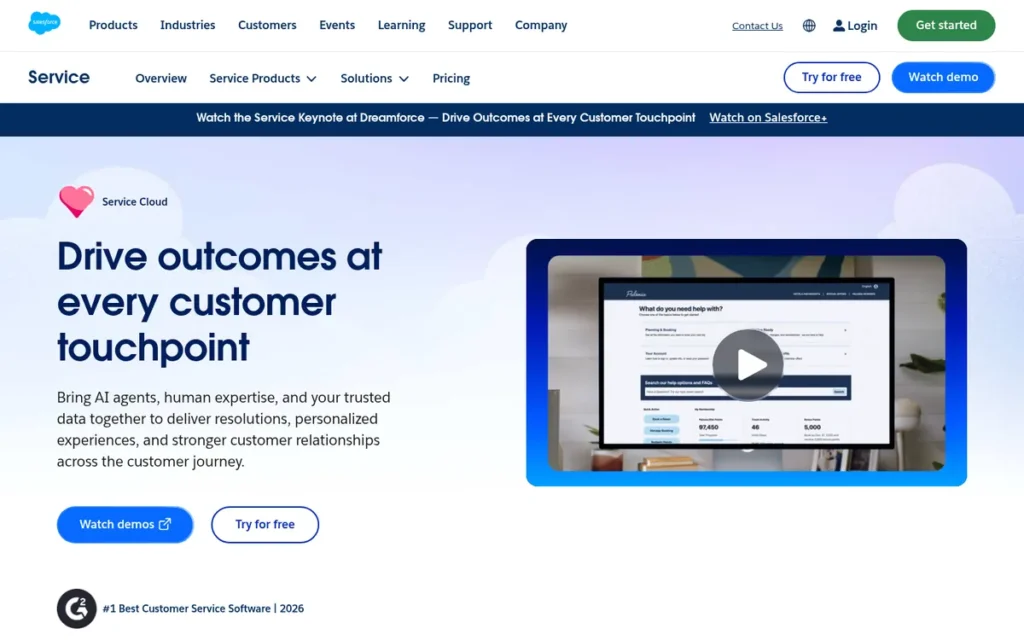
Category: CRM-Native, case management, Einstein AI, and service operations run within the Salesforce platform, sharing customer data natively with Sales Cloud, Marketing Cloud, Slack, and Data Cloud.
At a Glance
- Category: CRM-Native
- Best For: Enterprise organizations already deeply invested in the Salesforce ecosystem (with Sales Cloud, Marketing Cloud, or Data Cloud in production) for whom Customer 360 integration eliminates data silos that standalone help desks cannot resolve without costly custom API development
- Price Range: Starter ~$25/user/month; Professional ~$80/user/month; Enterprise ~$165/user/month; Unlimited ~$330/user/month; Einstein 1 Service ~$500/user/month (annual); total cost of ownership typically 1x–5x+ license cost when implementation, admin, and partner fees are included
- Primary Strength: Salesforce Service Cloud gives enterprise support agents access to the complete Customer 360 record (including sales history, account value, marketing touchpoints, and contract details) within every service conversation, enabling context-informed support that no standalone help desk can replicate without equivalent custom integration investment
- Biggest Limitation: Salesforce Service Cloud carries the highest total cost of ownership in this evaluation (Enterprise tier at $165/user/month with implementation costs documented at 1x–5x+ the license fee depending on deployment complexity) making it appropriate only for organizations where Salesforce ecosystem integration savings justify the premium
- One-Line Summary: Salesforce Service Cloud is the strongest recommendation for enterprise organizations already operating in the Salesforce ecosystem, delivering Customer 360 data integration and Gartner Magic Quadrant-validated capabilities at implementation complexity and total cost of ownership that makes it appropriate only for Salesforce-native buyers
- Last Verified: May 2026
Overview
Salesforce Service Cloud is a CRM-native enterprise customer service platform that unifies case management, Einstein AI, omnichannel routing, knowledge management, and self-service portals within the Salesforce platform, built for enterprise organizations whose customer data already lives in Salesforce and who need service operations integrated with that complete Customer 360 record.
Salesforce Service Cloud’s core differentiator is that service agents work from the same customer record as sales and marketing teams, eliminating departmental context gaps that standalone help desks create and cannot resolve without significant custom integration investment.
Salesforce Service Cloud’s total cost of ownership, with implementation costs documented at 1x–5x+ the license fee depending on deployment complexity, mid-market projects commonly in the $20,000–$100,000 range, and enterprise rollouts reaching $500,000+ when significant customization and data migration are required, makes the platform appropriate specifically for Salesforce-native enterprise organizations.
Key Features
- Customer 360 Integration: Salesforce Service Cloud gives service agents live access to sales history, account value, marketing touchpoints, and contract details within every service conversation, with no custom integration required for organizations already on Salesforce, eliminating the cross-departmental context gap that standalone help desks create by default.
- Einstein AI: Salesforce Service Cloud’s Einstein AI layer provides automated case classification and routing, next-best-action recommendations, generative AI reply drafting, conversational AI bots, case summarization, and predictive scoring, all informed by Salesforce Data Cloud’s unified customer data, enabling contextually rich AI that standalone help desks cannot replicate without equivalent data integration.
- Omni-Channel Routing: Salesforce Service Cloud supports skills-based assignment, capacity management, and real-time queue monitoring, plus native integration with Slack, Experience Cloud for customer self-service portals, and Field Service for on-site operations.
- Agentforce Contact Center: Salesforce Agentforce Contact Center, launched March 2026, unifies telephony, AI agents, and analytics within one Salesforce platform, extending Service Cloud’s native contact center capability to voice-based customer interactions alongside digital and messaging channels.
- AppExchange Marketplace: Salesforce’s AppExchange provides access to thousands of certified third-party application integrations (the second-largest partner marketplace in this evaluation) enabling Salesforce Service Cloud to connect to virtually any enterprise system through both native connectors and certified partner-built integrations.
Best For
Salesforce Service Cloud is best for enterprise organizations already running sales, marketing, or operations in Salesforce (where integration with Customer 360 data, Slack, Sales Cloud, and Marketing Cloud provides ROI that justifies the implementation complexity and premium licensing) and for procurement processes that formally require Gartner Magic Quadrant or Forrester Wave validation as a vendor selection input.
Pricing
Salesforce Service Cloud plans are billed annually per user: Starter at approximately $25/user/month, Professional at approximately $80/user/month, Enterprise at approximately $165/user/month, Unlimited at approximately $330/user/month, and Einstein 1 Service at approximately $500/user/month.
Implementation costs are commonly estimated at 1x–5x+ the annual license cost depending on deployment complexity, with mid-market projects typically in the $20,000–$100,000 range and enterprise rollouts potentially reaching $500,000+ (multiple Salesforce implementation partner estimates, 2024–2025). A 10-agent Enterprise deployment costs approximately $19,800/year in base licensing before implementation partner fees and admin overhead. Salesforce pricing changes regularly, verify at salesforce.com/service/pricing at time of purchase.
Strengths
- Salesforce is publicly traded (NYSE: CRM) with approximately $34 billion in FY2025 revenue and approximately 70,000+ employees (the most financially stable vendor in this evaluation) providing enterprise procurement teams with vendor stability assurance backed by public financial disclosures and a global support infrastructure that smaller competitors cannot match (Salesforce Investor Relations, 2025).
- Salesforce Service Cloud has held Gartner Magic Quadrant Leader positioning in the CRM Customer Engagement Center category in multiple consecutive years, a formal procurement validation signal that is a required input in many enterprise vendor selection processes [verify current year report at gartner.com at time of purchase decision].
- Experienced Salesforce consulting practitioners in r/salesforce document that enterprise companies migrate toward Service Cloud from competing platforms and that migration in the opposite direction is rarely observed (“Coming from the consulting world, I have never seen Service Cloud being switched to Zendesk”) the strongest long-term platform stickiness signal in the evaluation (u/Reddit_Account__c, r/salesforce, 2023).
- Salesforce Service Cloud’s Customer 360 integration provides service agents with live access to the same customer record used by sales and marketing (including account value, deal history, and marketing touchpoints) delivering contextual richness in service interactions that no standalone help desk can replicate without significant custom API integration investment.
Limitations
- Total Cost of Ownership: Salesforce Service Cloud’s most consequential trade-off is its total cost of ownership, at $165/user/month for Enterprise tier with implementation costs documented at 1x–5x+ the license fee depending on deployment complexity, plus ongoing requirements for dedicated certified Salesforce administrators, the full deployment cost is materially higher than licensing tiers communicate for organizations outside the Salesforce ecosystem.
- Admin Dependency: Salesforce Service Cloud requires dedicated certified Salesforce administrators for ongoing configuration, customization, and maintenance, a resource requirement that organizations without existing Salesforce expertise must budget for explicitly and that community evidence consistently identifies as a determinant of whether deployments succeed or struggle post-launch.
- Voice/Telephony Maturity: Salesforce Service Cloud’s telephony component (Service Cloud Voice) has received mixed community reviews (characterized in one r/salesforce thread as less mature than core case management and Einstein AI functions) a limitation specifically relevant for organizations with significant voice support volume (r/salesforce, 2025).
- Ecosystem Prerequisite: Salesforce Service Cloud delivers its differentiated value only for Salesforce-native organizations, for teams without prior Salesforce investment, the Customer 360 advantage does not exist and the platform’s premium pricing and implementation complexity are not offset by integration savings that could justify the choice over lower-cost alternatives.
Verdict
Salesforce Service Cloud earns its #6 ranking not because of product deficiency (its Einstein AI, Customer 360 data model, Agentforce Contact Center launch, and Gartner validation make it the strongest available option for its specific target use case) but because its target use case is narrow: Salesforce Service Cloud is the right answer specifically for enterprise organizations already invested in the Salesforce ecosystem, and a demonstrably poor fit by total cost of ownership and implementation complexity for any organization outside that stack. For Salesforce-native enterprises, no other platform in this evaluation replicates the Customer 360 integration advantage at production depth. For all other buyers, Freshdesk, Zendesk, or Zoho Desk deliver objectively stronger value at a fraction of the implementation cost.
7. Kustomer: Best for High-Volume E-Commerce Brands: Unified Customer Timeline with LTV-Aware Routing Unavailable in Competing Platforms
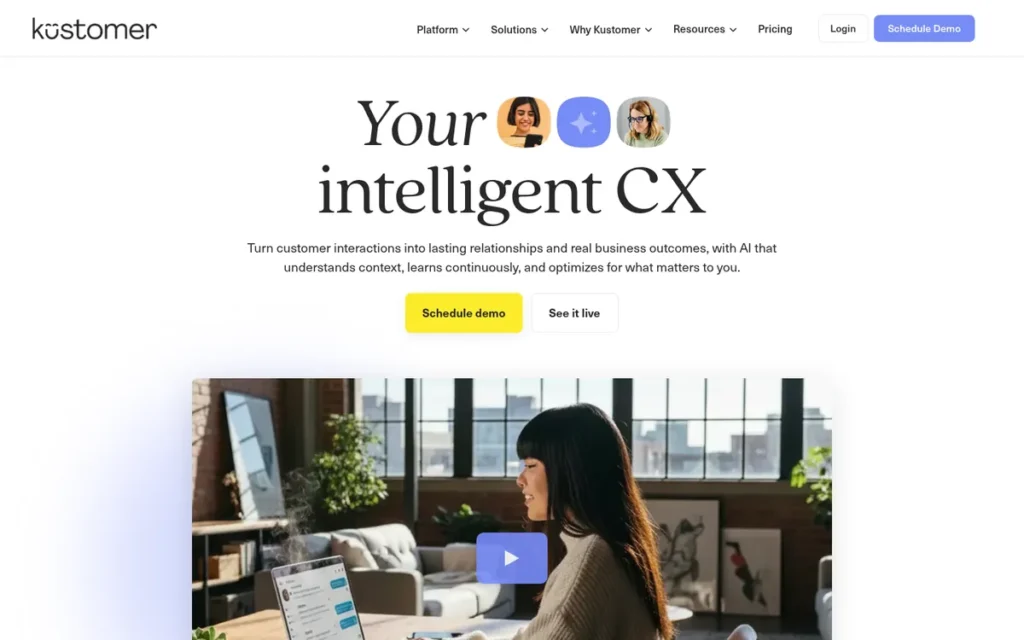
Category: CRM-First, support organized around the customer record (a unified chronological timeline of all transactions, interactions, and lifecycle events), not the individual ticket.
At a Glance
- Category: CRM-First
- Best For: Mid-market and enterprise DTC e-commerce, subscription, and high-transaction brands needing customer-context-rich support with LTV-aware routing, unified customer timeline visibility, and native transactional integrations (Shopify, Stripe, Magento)
- Price Range: Enterprise $89/user/month; Ultimate $139/user/month (annual); AI for Customers +$0.60/engaged conversation; AI for Reps +$40/seat/month
- Primary Strength: Kustomer’s unified customer timeline provides agents with a chronological record of every purchase, return, subscription event, and support interaction before they type a single word, enabling context-rich service that ticket-first platforms cannot replicate without significant custom CRM integration investment
- Biggest Limitation: Kustomer’s reporting and analytics capabilities are the most consistently documented weakness across G2 reviews and Reddit threads, and are explicitly acknowledged by Kustomer’s own official community account as an active investment area as of May 2026
- One-Line Summary: Kustomer is the strongest recommendation for high-volume e-commerce and subscription brands needing LTV-aware routing and a unified customer timeline, but carries the second-highest pricing floor in this evaluation and the most documented reporting gaps, making it appropriate only for brands where customer-context-rich support delivers compounding ROI that justifies the premium
- Last Verified: May 2026
Overview
Kustomer is a CRM-first customer service platform organized around a unified customer timeline (a chronological record aggregating all purchases, returns, subscription events, loyalty data, and support history) built for mid-market and enterprise e-commerce brands that need context-rich, LTV-aware support automation.
Kustomer’s architectural distinction is that the customer record is the organizing unit of the agent workspace, not the individual ticket, agents see a complete chronological view of the customer relationship before beginning any interaction, enabling context-aware responses that ticket-first platforms cannot replicate without extensive custom CRM integration work.
Kustomer was founded in 2015 by Brad Birnbaum and Jeremy Suriel, with Meta’s acquisition announced in November 2020 and formally closed in February 2022 following 15+ months of regulatory review. Meta divested Kustomer in May 2023, with the independent company launching with approximately $60 million in new funding at a reported valuation of approximately $250 million (TechCrunch, May 2023), a significant reduction from the original $1 billion acquisition price that buyers evaluating multi-year contracts should factor into their vendor stability assessment.
Key Features
- Unified Customer Timeline: Kustomer’s platform aggregates all purchase history, order and return events, subscription milestones, loyalty data, marketing touchpoints, and support conversations into a single chronological record, giving agents complete customer context before beginning any interaction without manual CRM lookup or tab-switching between systems.
- LTV-Aware and Loyalty-Tier-Aware Routing: Kustomer’s routing logic can incorporate customer lifetime value and loyalty tier into ticket assignment decisions, enabling organizations to automatically direct high-value customers to senior agents or priority queues based on account data rather than just ticket topic or inbound channel.
- Native E-Commerce Integrations: Kustomer integrates natively with Shopify, Stripe, Magento, Salesforce, and Aircall, enabling agents to process returns, issue credits, look up order history, and trigger transactional actions directly within support conversations without opening external systems.
- KustomerIQ AI: Kustomer’s AI layer supports autonomous customer-facing resolution, AI for Reps with suggested responses and knowledge surfacing, sentiment detection, and context-aware routing, with vendor-reported autonomous deflection of up to 40% of customer inquiries as a deployment ceiling (production rates vary by knowledge base quality and configuration; vendor-reported).
- Omnichannel Coverage: Kustomer covers email, live chat, SMS, voice, social media (Facebook, Instagram, Twitter/X), and WhatsApp within the unified customer timeline, enabling agents to manage all channels from a single interface without losing the customer context that defines Kustomer’s core differentiation.
Best For
Kustomer is best for mid-market and enterprise direct-to-consumer e-commerce brands, subscription businesses, and high-transaction organizations whose support interactions are heavily context-dependent, where knowing a customer’s lifetime value, recent orders, return history, and loyalty status before responding is worth the premium pricing that Kustomer’s CRM-first architecture commands.
Pricing
Kustomer plans are billed annually per user: Enterprise at $89/user/month and Ultimate at $139/user/month. AI for Customers costs $0.60/engaged conversation and AI for Reps costs $40/seat/month, both charged separately from the base seat fee. Alternative conversation-based pricing is available at $0.35/conversation (Enterprise) and $0.50/conversation (Ultimate).
A 10-agent Enterprise team costs $8,900/month base before AI add-ons, the second-highest pricing floor in the evaluation after Salesforce Service Cloud Enterprise. Kustomer is actively repositioning post-divestiture; request current pricing directly as negotiable terms may be available. Verify at kustomer.com/pricing.
Strengths
- Kustomer’s unified customer timeline is documentably unique in this evaluation: no other platform provides a native chronological record of all purchases, returns, subscription events, and support interactions as the organizing principle of the agent workspace, requiring competing platforms to invest significantly in custom Shopify and CRM integration work to surface comparable context (WorkflowAutomation.net, May 2026; Kustomer Blog, 2026).
- Kustomer holds 4.4/5.0 on G2 as of May 2026, with consistent praise for the unified customer view and context-rich agent experience, reflecting validated user satisfaction with the CRM-first architecture differentiator among e-commerce and subscription brand deployments.
Users who migrated to Kustomer from competing enterprise platforms shared their experience on r/ExperiencedDevs:
“Very happy with Kustomer. They’ve been acquired by Meta which later divested. We migrated to it from Zendesk. Very well thought out platform, amazing no-code capabilities to customize based on your needs. We’re serving several hundred K users monthly, multiple languages. Our primary product is mobile app, Android and iOS.” Posted by u/qprio
Takeaway: Kustomer users migrating from Zendesk validate the platform’s architectural depth and no-code customization capability as genuine differentiators that justify the premium pricing for high-volume, multilingual enterprise deployments.
- Kustomer’s native integrations with Shopify, Stripe, and Magento enable agents to process returns, issue credits, and view full order history directly within support conversations, a documented productivity capability for DTC brands where the majority of support volume involves transactional WISMO (Where Is My Order) queries that ticket-first platforms handle less efficiently (Kustomer Blog, 2026).
- Post-divestiture in May 2023, Kustomer has actively released new AI capabilities and enhanced internal workflow tools (including a December 2024 launch of enhanced workflow automation features) with an official community account present in forums directly acknowledging and responding to user feedback, a transparency posture that distinguishes Kustomer from vendors absent from their own community discussions (BusinessWire, December 2024; u/kustomer_official, r/CustomerSuccess, 2025).
Limitations
- Reporting Gap: Kustomer’s most consequential trade-off is the documented gap between its customer-timeline architecture strength and its reporting and analytics capability, Kustomer’s reporting is consistently flagged as the primary weakness across G2 reviews and Reddit threads, and is formally acknowledged by Kustomer’s own official community account as an active investment area, meaning operations teams relying on granular SLA tracking and executive dashboards will find Kustomer’s current reporting insufficient compared to Zendesk’s mature analytics suite (u/tencentblues, r/CustomerSuccess, 2025).
- Premium Pricing: Kustomer’s $89/user/month minimum represents the second-highest pricing floor in this evaluation, and the combination of base seat fees plus per-conversation AI add-ons ($0.60/conversation) can produce total monthly costs that are difficult to justify for non-transactional support environments or organizations without high customer LTV that makes context-rich routing ROI-positive.
- Post-Divestiture Financial Context: Kustomer was spun out in May 2023 with approximately $60 million in new funding at a reported valuation of approximately $250 million (TechCrunch, May 2023) (a significant reduction from the original $1 billion acquisition price) meaning buyers should assess financial runway and roadmap stability directly with the vendor before signing multi-year contracts.
- Limited Community Evidence: Kustomer has the lowest community discussion volume of the seven evaluated platforms, limiting the independent evidence depth available to verify vendor claims and reflecting a smaller active user base that provides fewer peer resources for implementation troubleshooting compared to Zendesk or Freshdesk.
Verdict
Kustomer earns the final position in this evaluation not as a poor platform but as the most narrowly appropriate one, its CRM-first customer timeline and LTV-aware routing are genuine best-in-class capabilities for high-volume e-commerce and subscription brands where customer context richness drives compounding support ROI. For that specific buyer profile, Kustomer warrants serious consideration despite its reporting limitations and premium pricing. For all other buyer profiles, SMBs, non-transactional support environments, teams prioritizing reporting depth or pricing predictability, Freshdesk, Zoho Desk, Intercom, or Zendesk will deliver stronger total value at lower or more predictable cost.
What Red Flags Should I Watch For When Evaluating Customer Service Automation Software?
Five red flags appear repeatedly in post-purchase reviews of customer service automation software: hidden AI add-on pricing tiers, variable per-resolution billing without volume forecasting, poor vendor support quality despite selling support tools, steep pricing cliffs between entry and functional plans, and AI performance that depends on knowledge base quality, not platform capability alone.
Red Flag #1: AI Pricing Hidden Behind Add-On Tiers
Several platforms in this evaluation market AI capabilities prominently without disclosing that the most consequential AI features require a separate paid add-on above base pricing.
Zendesk’s intelligent triage, Smart Assist, and generative AI reply drafting require the Zendesk Advanced AI add-on at approximately $50/agent/month above Suite Professional pricing, a cost that does not appear in the headline per-agent pricing figure buyers typically encounter first in vendor marketing.
Ask every vendor explicitly: “Which specific AI features are included in the base plan tier I am evaluating, and which require a separate add-on or higher tier to activate?”
Red Flag #2: Variable Per-Resolution Billing Without Volume Forecasting
Intercom’s $0.99/resolved conversation charge and Kustomer’s $0.60/engaged conversation fee create billing models where your monthly invoice scales with AI performance improvement, a structural dynamic documented across an independent analysis of 215 Capterra reviews (u/darvidas, r/SaaS, 2025).
Consider this scenario: you spend three weeks organizing your knowledge base and connecting your CRM API to Intercom. Your Fin resolution rate jumps from 45% to 65%. Your next Intercom invoice is 44% higher than the previous month, not because Intercom did anything differently, but because your knowledge base improved. You did the optimization work; the per-resolution charge captured the financial benefit.
Model outcome-based billing at 2x and 3x your current support volume before signing any per-resolution contract. Get a written cost projection from the vendor at both growth scenarios before committing.
Red Flag #3: Vendor Support Quality Irony
Multiple platforms in this evaluation are documented as delivering poor support from their own vendor teams despite selling customer service software as their core product:
- Intercom’s own support response times are documented at 7+ days by multiple independent sources
- Zoho carries a 123-upvote r/sysadmin thread documenting systematic support failures and copy-pasted responses
- Freshdesk’s support quality at growth scale is a recurring theme across community discussions
Test pre-sales support responsiveness as a proxy for post-sales support culture. Send a technical question before signing and measure the response time and quality. Request contractual SLA commitments for vendor support response times before committing to any annual contract.
Red Flag #4: Steep Tier Cliffs Between Entry and Functional Plans
HubSpot Service Hub’s jump from Starter (~$15–20/seat/month) to Professional (~$90–100/seat/month) is the steepest single-tier pricing increase in this evaluation. Freshdesk’s jump from Growth ($15/agent/month) to Pro ($49/agent/month) is the second most documented buyer surprise.
In both cases, critical features (SLA management, advanced automation, and reporting depth) are gated at the higher tier that was not the entry point during initial evaluation.
Map every feature your team requires to its specific pricing tier before evaluating any platform at its entry price.
Red Flag #5: AI Performance Dependent on Knowledge Base Quality, Not Disclosed at Demo Stage
Every AI agent in this evaluation (from Intercom’s Fin to Zendesk’s Advanced AI to Freshdesk’s Freddy AI) performs at vendor-benchmarked resolution rates only when the underlying knowledge base is comprehensive, current, and well-organized.
Vendor demos use optimized knowledge bases that produce higher resolution rates than typical production environments where content is fragmented or outdated.
Ask every vendor: “What is your average AI resolution rate for new customers in their first 30 days before knowledge base optimization?” The platform that performs best in a demo with a curated knowledge base and the platform that performs best with your actual support content are frequently not the same platform.
What Questions Should I Ask Before Choosing Customer Service Automation Software?
Five questions consistently separate buyers who avoid post-purchase regret from those who don’t: total cost per agent including all add-ons and usage fees, realistic AI time-to-value at current knowledge base quality, vendor’s own support responsiveness and contracted SLA commitments, data export rights and cancellation notice windows, and platform architecture alignment with your team’s actual workflow philosophy.
Question #1: What Is My Total Cost Per Agent Per Month at Current Ticket Volume: Including All Add-Ons, Usage Charges, and Annual Versus Monthly Billing Premiums?
Never evaluate a platform on headline per-seat pricing alone. Build a total cost model that includes:
- Base plan at annual billing rates
- All AI add-ons required for your target capability level
- Usage-based charges at current and 2x–3x projected volume
- The annual versus monthly billing premium
- Marketplace app or integration costs your use case requires
Request a written cost model from the vendor covering all these dimensions before signing, and verify it reflects your actual team size and projected ticket volume.
Question #2: What Is the Realistic Time-to-Value for AI Automation at My Current Knowledge Base Quality, and What Preparation Work Is Required Before Your AI Delivers the Stated Resolution Rate?
Zendesk AI setup requires 1–2 weeks with a clean, well-organized knowledge base and 4+ weeks when knowledge base restructuring is needed. Salesforce Service Cloud implementations are measured in months with dedicated admin resources. Every AI platform’s resolution rate depends on knowledge base quality as much as platform capability.
Ask vendors for their average time-to-first-meaningful-deflection for teams with knowledge bases in similar states to yours, and get that estimate in writing before committing to a go-live timeline.
Question #3: How Responsive Is Your Own Support Team, and What SLA Do You Commit to for Support Tickets from My Account Tier?
The platform you deploy to serve your customers will occasionally need support from the vendor that built it. Intercom’s own support is documented at 7+ day response times by multiple independent sources. Zoho’s vendor support quality is the most negatively documented signal in this evaluation.
Test pre-sales support responsiveness as a proxy for post-sales support culture, send a technical question before signing and measure the response time and quality. Then request contractual SLA commitments for vendor support response times before committing.
Question #4: What Are My Data Export Rights and Cancellation Notice Window Requirements Under the Contract I Am Being Asked to Sign?
Data portability limitations affect every platform in this category, switching platforms is consistently described as painful and time-consuming. Multiple Freshdesk community members document being billed after cancellation initiation or being held to strict notice windows they were unaware of.
Review cancellation policy terms, data export rights, and notice period requirements with legal counsel before signing any annual contract, regardless of which platform you select.
Question #5: Does This Platform’s Architecture Match My Team’s Actual Workflow Philosophy, or Will I Be Working Against the Tool’s Design Decisions Every Day?
AI-first architecture assumes AI resolution is the workflow default and human escalation is the exception. Ticket-first architecture assumes structured case management is the primary agent workflow. CRM-native architecture assumes unified customer data is more valuable than specialized service features.
Identify which architecture matches how your team naturally thinks about customer support before comparing features, a misaligned architecture creates friction that no feature configuration can fully resolve.
How Did We Rank These Customer Service Automation Platforms?
Six criteria determine every ranking in this evaluation: AI automation capability and resolution quality (primary, 25%), pricing transparency and total cost of ownership (primary, 20%), platform architecture and workflow fit (primary, 20%), review platform ratings and community sentiment (secondary, 15%), integration breadth and ecosystem compatibility (secondary, 10%), and implementation speed and time-to-value (secondary, 10%). No affiliate relationships influenced any ranking decision.
Evaluation Process
The research pipeline for this evaluation included four steps executed in sequence:
- Product discovery and domain verification: seven platforms identified through review platform frequency analysis, community mention volume across relevant subreddits, and LLM coverage gap analysis to explicitly include platforms absent from AI-generated comparisons
- Parallel entity research: all seven platforms researched simultaneously using identical query templates covering features, pricing, customer case studies, security certifications, and limitations
- Community sentiment collection: Reddit communities searched for independent user discussions, with upvote counts recorded as signal strength indicators across r/Zendesk, r/helpdesk, r/SaaS, r/salesforce, r/Zoho, r/ZohoDesk, r/CustomerSuccess, r/ITdept, r/hubspot, and r/sysadmin
- LLM gap analysis: responses from Perplexity (May 2026) and ChatGPT (May 2026) evaluated to identify which platforms, criteria, and data points are absent from current AI-generated coverage of this topic
Ranking Criteria in Detail
AI Automation Capability and Resolution Quality (Primary, 25%)
The target audience’s primary objective is reducing ticket backlog without proportional headcount growth. AI resolution rate is the most direct measure of this capability. Vendor-reported resolution rate claims are labeled as such at first use. Named third-party case studies receive higher evidence weight than vendor self-reports. Bonus weight is given to independently corroborated claims, Lightspeed’s public Intercom Fin confirmation (up to 65% autonomous resolution across their workspaces) is the strongest single evidence point in this evaluation.
Pricing Transparency and Total Cost of Ownership (Primary, 20%)
Pricing unpredictability and post-purchase cost surprises are the most common complaint across all seven platforms in the research dataset. Assessment covers:
- Published pricing verified at official pricing pages (May 2026) for all 7 platforms
- Documented add-on costs: Zendesk Advanced AI (~$50/agent/month), Intercom per-resolution fee ($0.99), HubSpot seat model complexity
- Per-tier cliff analysis modeled at a realistic 10-agent team size
- Community-documented billing complaints weighted by frequency and specificity across 10 subreddits
- Free tier utility: whether free access provides genuine operational value or primarily functions as an upgrade funnel
- Cancellation policy transparency: documented community complaints about post-cancellation billing and strict notice windows
Platform Architecture and Workflow Fit (Primary, 20%)
Architecture determines how agents work, not just which features are available. Ticket-first, AI-first, CRM-native, and CRM-first architectures produce fundamentally different workflows and data models. Assessment covers architecture corroborated by community workflow descriptions, omnichannel integration quality, agent workspace unification, routing sophistication, and community reports of workflow friction under real-world deployment conditions.
Review Platform Ratings and Community Sentiment (Secondary, 15%)
Assessment covers:
- G2 and Capterra overall scores and dominant sub-dimension ratings (verified May 2026)
- Dominant praise themes identified by frequency and recurrence across independent reviews
- Dominant criticism themes identified by frequency, specificity, and multi-year persistence
- Reddit community sentiment: upvote count and thematic consistency across independent threads
- Vendor support quality: flagged as a separate evaluation factor given the operational irony of poor support from customer service platform vendors
Integration Breadth and Ecosystem Compatibility (Secondary, 10%)
Assessment covers documented marketplace size, native CRM integration quality, e-commerce integration depth (Shopify, Stripe, Magento), communication tool coverage (Slack, Teams, WhatsApp), and ecosystem lock-in risk where documented.
Implementation Speed and Time-to-Value (Secondary, 10%)
Assessment covers documented setup time ranges from third-party reviewers, free tier availability for risk-free evaluation, community reports of onboarding experience, and whether self-serve onboarding is viable without a consultant or implementation partner.
Ecosystem-First Decision Logic
Community intelligence across all ten researched subreddits consistently surfaces one shortcut above all others:
- Salesforce users: evaluate Service Cloud before all alternatives
- HubSpot users: evaluate Service Hub before all alternatives
- Zoho users: evaluate Zoho Desk before all alternatives
- Greenfield teams (no prior CRM or help desk): start with Freshdesk or Zoho Desk as vendor-neutral starting points
The single fastest shortcut in customer service automation software selection: match platform to ecosystem first; evaluate feature gaps second.
What Actually Determines AI Resolution Rate in Production?
Here is what consistently happens in the first 30 days after deploying AI customer service automation: the AI handles easy queries (password resets, hours of operation, return windows) and struggles with anything nuanced. The vendor support team explains that your knowledge base needs to be reorganized.
Modern AI agents use retrieval-augmented generation (RAG), surfacing answers from verified knowledge content rather than generating responses from training data alone. The quality and freshness of that knowledge content directly determines resolution accuracy and hallucination risk.
A well-organized, current knowledge base enables AI agents to produce grounded, traceable responses. A fragmented or outdated knowledge base produces confident but incorrect answers, the primary driver of AI resolution rates underperforming vendor demo benchmarks in production environments.
Before evaluating any platform’s AI capability, audit your knowledge base state and build content preparation time explicitly into your implementation timeline and go-live schedule.
Evidence Weighting
When review platform ratings conflict with Reddit sentiment, this evaluation weights specificity and recency. A detailed 2025 Reddit post with 50+ upvotes describing a specific billing pattern outweighs a generic 2023 G2 review with no operational detail. Vendor-reported statistics are labeled as such at first use. Only claims corroborated by at least one independent source are presented as fact rather than marketing claims. Named third-party case studies receive the highest evidence weight.
Update Cadence
This article was last updated in May 2026. PlugRoute refreshes ranked comparison articles quarterly, with pricing verification at each update cycle.
Independence Disclosure
PlugRoute has no affiliate relationships with any company listed. Rankings are determined entirely by research data and objective evaluation criteria.
Frequently Asked Questions About Customer Service Automation Software
What Is the Best Customer Service Automation Software for Small Businesses in 2026?
Freshdesk and Zoho Desk are the strongest recommendations for small businesses in 2026. Freshdesk offers a genuine unlimited-agent free tier and Growth plan at approximately $15/agent/month. Zoho Desk’s Professional plan at approximately $23/agent/month includes Blueprint workflow enforcement unavailable from any competitor at this price. Test Freshdesk’s search reliability during the trial and evaluate Zoho’s pre-sales support responsiveness before committing.
What Is the Difference Between Zendesk and Intercom for Customer Service Automation?
Zendesk is ticket-first, best for enterprise teams needing maximum integrations and compliance certifications, with Advanced AI requiring a separate ~$50/agent/month add-on above Suite Professional. Intercom is AI-first, Fin AI resolution is the default workflow, best for SaaS and high-volume teams maximizing autonomous deflection, with $0.99/resolved conversation billing that requires accurate volume forecasting before signing.
How Does PlugRoute Determine Its Software Rankings?
PlugRoute ranks platforms across six weighted criteria, AI automation capability (25%), pricing transparency and total cost of ownership (20%), platform architecture fit (20%), review platform ratings and community sentiment (15%), integration breadth (10%), and implementation speed (10%), using exclusively public data, verified review platform ratings, and documented community evidence from ten relevant subreddits, all verified in May 2026. No affiliate relationships exist with any company listed.
What Do the Key Terms in This Customer Service Automation Comparison Mean?
AI Resolution Rate: The percentage of incoming customer queries that an AI agent fully resolves without requiring human agent intervention, the primary measure of autonomous deflection capability in this evaluation. In production, AI resolution rate depends on knowledge base quality and completeness as much as platform AI sophistication; vendor-stated resolution rates are typically measured under optimized conditions and may exceed real-world rates during initial deployment.
Ticket-First Architecture: A support platform design in which every incoming customer request (from any channel) is converted into a trackable ticket before being routed, prioritized, or resolved. Ticket-first platforms organize work around case management workflows; AI is applied as a layer above the ticket infrastructure rather than as the primary resolution mechanism, distinguishing them architecturally from AI-first platforms like Intercom.
Blueprint (Zoho Desk): Zoho Desk’s visual workflow enforcement tool that requires agents to complete mandatory steps, field entries, and approvals at each defined stage before advancing a ticket to the next stage. Blueprint enforces process compliance at the workflow level (agents cannot skip required steps) making it a compliance-grade tool for regulated-industry support operations available from the Professional tier (~$23/agent/month, verified May 2026) at a price point where no competing platform in this evaluation offers equivalent functionality.
Outcome-Based Pricing: A billing model in which the buyer pays per verified resolved customer interaction rather than per seat per month. Intercom’s $0.99/resolved conversation and Kustomer’s $0.60/engaged conversation are the two outcome-based pricing models in this evaluation. Outcome-based pricing creates direct cost-to-value traceability but generates escalating bills as AI performance improves, the primary billing complaint documented in independent reviews of platforms using this model.
Customer 360: Salesforce’s term for a unified customer data record that consolidates information from Sales Cloud, Service Cloud, Marketing Cloud, and other Salesforce products into a single view accessible across departments. For Salesforce Service Cloud users, Customer 360 means service agents see a contact’s complete sales history, account value, and marketing interactions within every support conversation, a contextual advantage that standalone help desks cannot replicate without equivalent custom integration investment.
Glossary: Key Terms Used in This Comparison
Autonomous Resolution Rate: The percentage of incoming customer queries that an AI agent fully resolves without any human agent involvement. In production environments, autonomous resolution rates depend heavily on knowledge base quality and completeness, meaning vendor-stated benchmarks (such as Intercom Fin’s reported 66% average) are typically measured under optimized conditions.
Ticket-First Architecture: A support platform design in which every incoming customer request, regardless of channel, is converted into a structured, trackable ticket before being routed or resolved. AI is applied as a configurable layer above this ticket infrastructure rather than serving as the primary resolution mechanism by default.
Blueprint (Zoho Desk): Zoho Desk’s visual workflow enforcement tool that requires agents to complete mandatory steps, field entries, and approvals at each defined stage before advancing a ticket. Unlike standard routing rules, Blueprint enforces process compliance at the workflow level (agents cannot bypass required steps) making it a compliance-grade capability available from the Professional tier (~$23/agent/month).
Outcome-Based Pricing: A billing model in which buyers pay per verified resolved customer interaction rather than a flat per-seat monthly fee. Intercom’s $0.99/resolved conversation charge is the primary example in this evaluation; this model creates direct cost-to-value traceability but generates escalating invoices as AI performance improves through buyer investment in knowledge base optimization.
Retrieval-Augmented Generation (RAG): An AI architecture in which an AI agent surfaces answers by retrieving content from a verified knowledge base rather than generating responses solely from training data. RAG grounds AI responses in current, organization-specific content, meaning knowledge base quality and freshness directly determine resolution accuracy and hallucination risk in production deployments.
Which Customer Service Automation Tool Is Right for You?
Key Insights
- Intercom leads for AI-first autonomous resolution: model billing at 2x and 3x current volume before signing, as the $0.99/resolution charge escalates proportionally with Fin AI performance improvement driven by your own knowledge base investment.
- Zendesk leads for integration breadth and enterprise compliance certifications: model total cost including the Advanced AI add-on (~$50/agent/month above Suite Professional) from evaluation day one, as headline pricing understates the true AI-capable total by a material margin.
- Freshdesk leads for SMB value: explicitly test search functionality during the free trial with real ticket data, model cost at Pro tier if automation and reporting are needed, and review cancellation policy language in the contract before signing.
- Zoho Desk is the most under-represented platform in AI-generated comparisons: Blueprint process enforcement available from ~$23/agent/month is genuinely unique at its price tier, and Zoho Desk’s complete absence from AI-generated shortlists is a systematic coverage gap that independent evidence-based evaluation addresses directly.
- HubSpot Service Hub and Salesforce Service Cloud are ecosystem-conditional: both are clear wins inside their respective ecosystems and secondary choices for organizations evaluating them without prior HubSpot or Salesforce investment.
- Kustomer is the right answer for high-volume DTC e-commerce and subscription brands: its unified customer timeline and LTV-aware routing are genuine architectural capabilities unavailable natively from any competing platform, but its reporting gaps and $89+/user/month pricing make it inappropriate for general-purpose teams or SMBs.
Switching cost is a consistent reality across every customer service automation platform evaluated in this article, every tool makes platform exit more difficult than platform entry through data portability limitations, multi-year contract structures, or deeply embedded workflow dependencies. Before migrating from an existing platform, request data export in CSV or JSON format, confirm data retention policies after account termination, and verify notice period requirements in the contract with legal counsel before signing.
Knowledge base quality, not platform capability, is the primary variable determining whether AI resolution rates reach vendor-stated benchmarks in production, every platform in this evaluation underperforms its demo rate against fragmented or outdated content. Before investing in any platform upgrade, audit the current state of your knowledge content and build content preparation time into your implementation plan. The platform with the best AI will underperform if the knowledge base feeding it is outdated, incomplete, or poorly organized.
Explore additional independent SaaS comparisons and our full ranking methodology at PlugRoute. We update this guide quarterly. Last updated: May 2026.