Spring Boot is the best Java web framework for enterprise REST APIs and general-purpose backend development; Quarkus leads for Kubernetes-native microservices; Micronaut is the top choice for serverless and cold-start-sensitive deployments. Independent 2025 benchmarks show these three frameworks converging on performance, making corporate backing, hiring pool depth, and deployment context the decisive selection factors in 2026.
Java developers face a genuinely difficult framework selection problem in 2026: Quarkus and Micronaut appear nearly identical for microservices on the surface, Spring Boot’s native image improvements have significantly narrowed the cloud-native performance gap, and most comparisons omit governance risks, hiring implications, and long-term viability signals that architects need for multi-year infrastructure commitments.
This evaluation covers all seven major Java web frameworks, Vert.x, Jakarta EE, Dropwizard, and Play included, with equal depth, documented benchmarks, and named corporate sponsor classification for each.
PlugRoute has no affiliate relationships with any framework, vendor, or commercial distributor listed. Rankings are determined entirely by research data, independent benchmarks, and objective evaluation criteria.
“Spring Boot really is a gift from heaven when it comes to being feature-rich. What one shouldn’t neglect is the community behind a framework, there is simply so much documentation and community support for Spring Boot overall. Whatever niche problem you encounter, someone probably had it before you and found a solution.” (u/alpakachino, r/SpringBoot, 2024)
Takeaway: The community safety net (not raw features) is why senior developers recommend Spring Boot as the default Java enterprise starting point in 2026.
TL;DR: Top Picks at a Glance
- Spring Boot is the default choice for enterprise backends, offering the broadest ecosystem and largest developer hiring pool of any Java web framework evaluated in 2026.
- Quarkus delivers the fastest native-mode cold starts (0.049s) for Kubernetes and OpenShift deployments, backed by Red Hat/IBM commercial support.
- Micronaut achieves cloud-native JVM startup performance (0.656s) without requiring a GraalVM native image build pipeline, making it optimal for serverless workloads.
- Jakarta EE is the only vendor-neutral standards platform with certified multi-server portability for regulated-industry enterprise procurement.
What Are the Three Categories of Java Web Frameworks in 2026?
Java web frameworks in 2026 divide into three groups by architectural purpose: Spring Boot dominates the general-purpose enterprise category; Quarkus, Micronaut, and Vert.x serve cloud-native and high-concurrency specialist contexts; and Jakarta EE, Dropwizard, and Play serve regulated-industry procurement, minimal REST services, and Scala full-stack development respectively.
Group 1, General-Purpose Enterprise Frameworks prioritize ecosystem breadth over specialized performance:
- Spring Boot (#1) is the market-default general-purpose enterprise Java framework, providing the broadest ecosystem and highest global developer adoption of any evaluated option.
Group 2, Cloud-Native and Performance-Optimized Frameworks are purpose-built or architecturally optimized for containerized, serverless, or high-concurrency deployments:
- Quarkus (#2) is a Kubernetes-native, GraalVM-native-first framework backed by Red Hat with the fastest native cold starts (0.049s) of any evaluated option.
- Micronaut (#3) uses compile-time dependency injection to deliver the fastest JVM-mode startup (0.656s) of any evaluated framework without native image compilation.
- Eclipse Vert.x (#5) is a reactive event-loop toolkit for maximum I/O concurrency, serving as the internal reactive HTTP engine of Quarkus.
Group 3, Specialist and Standards-Based Platforms serve specific procurement, language, or simplicity requirements:
- Jakarta EE (#4) is a vendor-neutral multi-server standards platform with certified portability across competing enterprise runtimes.
- Dropwizard (#6) is a minimal, explicitly-configured REST toolkit with zero auto-configuration and a dedicated production admin port.
- Play Framework (#7) is a type-safe MVC framework for Java and Scala with the highest long-term viability risk in this evaluation.
How Do the Top 7 Java Web Frameworks Compare?
The seven Java web frameworks in 2026 differ most on three dimensions: startup performance (Micronaut JVM 0.656s, Quarkus native 0.049s, Spring Boot JVM 1.909s, per Gillius.org October 2025), corporate sponsor (Broadcom, Red Hat/IBM, OCI, Eclipse Foundation, or none), and deployment fit (general-purpose, cloud-native, standards-based, reactive, or minimal-REST).
| Rank | Framework | Category | Best For | One-Line Summary | Key Capabilities | Primary Strength | Key Limitation |
|---|---|---|---|---|---|---|---|
| 1 | Spring Boot | General-Purpose Enterprise | Enterprise REST APIs, monoliths, all backend patterns | Spring Boot is the most widely adopted Java web framework globally, holding 14.7% usage across all web frameworks in the Stack Overflow Developer Survey 2025 (as reported by Vaadin, June 2026). | Auto-configuration starters, GraalVM native image via AOT, Project Loom virtual threads, Spring AI, Spring Boot Actuator | Largest ecosystem, deepest hiring pool, widest integration catalog | Slowest JVM startup (1.909s, 388.9 MB RSS) of the three cloud-native-era frameworks; auto-configuration debugging complexity |
| 2 | Quarkus | Cloud-Native / Kubernetes-First | Kubernetes-native microservices, OpenShift deployments | Quarkus delivers the fastest native-mode cold starts (0.049s) and lowest native-mode memory (70.5 MB RSS) of any evaluated framework per Gillius.org 2025 benchmarking. | GraalVM native image, Dev Services, unified reactive/imperative via Mutiny, Kubernetes manifest generation, MicroProfile via SmallRye | Best native performance; Red Hat/IBM commercial backing | Native build time 3–8 min in CI/CD; GraalVM reflection restrictions complicate Spring Boot migrations |
| 3 | Micronaut | Compile-Time / Serverless-Optimized | Serverless (AWS Lambda, GCF), cold-start-sensitive microservices | Micronaut achieves 0.656-second JVM-mode startup; the fastest of any Java framework in independent 2025 benchmarking; through compile-time dependency injection without native image compilation. | Compile-time DI, Micronaut Data AOT queries, compile-time HTTP client, Java/Kotlin/Groovy multi-language support | Fastest JVM-mode startup (0.656s) without native image build | Smaller community than Spring Boot; OCI boutique commercial support less familiar to enterprise procurement |
| 4 | Jakarta EE | Enterprise Standards Platform | Regulated industries, multi-vendor enterprise procurement | Jakarta EE 11 (released June 26, 2025) is the only Java platform providing certified vendor-neutral portability across multiple competing enterprise application server providers. | JAX-RS, CDI Lite, JPA, Core Profile, Jakarta Data, virtual thread support (Java 21+) | Certified vendor-neutral portability; Eclipse Foundation multi-vendor governance | J2EE-era heavyweight perception persists; no equivalent controlled startup benchmark available |
| 5 | Eclipse Vert.x | Reactive Event-Driven Toolkit | High-concurrency I/O-bound services, API gateways, event processing | Eclipse Vert.x is a top-ranked reactive toolkit in the Java ecosystem for I/O-bound concurrency, serving as the internal reactive HTTP engine of Quarkus. | True non-blocking event-loop, event bus, reactive SQL clients, polyglot JVM (Java, Kotlin, Groovy, JavaScript), Red Hat commercial distribution | True non-blocking architecture; powers Quarkus reactive layer internally | Steep reactive learning curve; requires custom architecture assembly; smaller direct hiring pool |
| 6 | Dropwizard | Minimal REST Toolkit | Simple predictable REST microservices, self-sufficient teams | Dropwizard is a minimal, explicitly-configured Java REST toolkit (Jetty + Jersey + Jackson + Metrics + Hibernate) with zero auto-configuration and a dedicated production admin port. | Zero auto-configuration bundle, dedicated admin port (:8081), JAX-RS/JPA standard APIs, embedded Jetty, active 5.0.x pre-release development | Zero auto-configuration; admin port separates ops from app traffic | No corporate sponsor; no native image path; no reactive support; no commercial SLA available |
| 7 | Play Framework | Type-Safe MVC Framework | Scala full-stack MVC with existing Play expertise only | Play Framework is a community-maintained Java/Scala MVC framework that completed a crisis-driven Akka-to-Pekko migration in 2024, carrying the highest long-term viability risk in this evaluation. | Compile-time type-safe routing, hot reload, dual Java/Scala API, Apache Pekko concurrency, stateless HTTP | Only production-mature Scala API; compile-time type-safe routing | No corporate sponsor; 2022 near-existential licensing crisis; documented breaking-change history; declining community presence |
Which Java Web Framework Should I Choose for My Use Case?
Choose Spring Boot for enterprise REST APIs and general-purpose backends (14.7% global adoption, Stack Overflow Developer Survey 2025 via Vaadin, June 2026); Quarkus for Kubernetes-native microservices where memory cost is primary (0.049s native, 70.5 MB RSS); Micronaut for serverless cold-start workloads (0.656s JVM mode, no native build required); Jakarta EE for regulated-industry multi-vendor procurement contexts.
| Your #1 Priority | Recommended Framework | Why | Acceptable Alternative |
|---|---|---|---|
| Enterprise REST API / general-purpose backend | Spring Boot | 14.7% global usage across all web frameworks (Stack Overflow Developer Survey 2025 via Vaadin, June 2026); largest developer hiring pool | Micronaut; if team values explicit DI wiring over ecosystem breadth |
| Kubernetes-native microservices (resource cost is primary) | Quarkus | 0.049s native startup, 70.5 MB RSS (Gillius.org, October 2025); engineering teams report 50%+ resource reduction vs. Spring Boot | Micronaut; for equivalent JVM-mode startup without native build complexity |
| Serverless / cold-start-sensitive (AWS Lambda, GCF) | Micronaut | 0.656s JVM-mode startup without GraalVM native compilation (Gillius.org, October 2025) | Quarkus; if CI/CD build time of 3–8 min is operationally acceptable |
| High-concurrency I/O-bound event processing | Eclipse Vert.x | Top Java TechEmpower rankings (composite rounds 2023–2024, techempower.com/benchmarks); powers Quarkus reactive HTTP layer at production scale | Quarkus with Mutiny reactive model; for teams wanting more opinionated structure |
| Regulated industry / vendor-neutral procurement | Jakarta EE | Certified portability across Red Hat, IBM, Oracle, Payara runtimes; Eclipse Foundation multi-vendor governance (jakarta.ee/release/11/, June 2025) | Spring Boot; for teams not requiring certified server-agnostic portability |
| Simple predictable REST without cloud-native requirements | Dropwizard | Zero auto-configuration; admin port structural advantage; JAX-RS/JPA skills transfer to Spring Boot in weeks | Spring Boot; if long-term ecosystem access outweighs simplicity preference |
| Scala full-stack MVC with existing Play expertise | Play Framework | Only production-mature Scala dual API in this evaluation; document viability risk explicitly before committing | Spring Boot; if migrating to Java-only |
| Brownfield: existing Spring Boot codebase, adding microservices | Spring Boot | Ecosystem continuity, no context switching; Micronaut-alongside-Spring-Boot polyglot adoption documented in r/java practitioner threads, 2024 | Micronaut; for new services alongside existing Spring Boot (polyglot adoption pattern) |
3 Facts That Will Reframe Your Framework Selection
Fact 1: Spring Boot runs ON Jakarta EE APIs, Jakarta Servlet, Jakarta Persistence, and Jakarta Validation are the foundation of every Spring Boot web service. Spring Boot and Jakarta EE are not strictly competing alternatives; one is an opinionated implementation of the other’s specifications.
Fact 2: Evaluating Quarkus for reactive workloads means evaluating Eclipse Vert.x. Quarkus’s reactive HTTP layer is powered by Vert.x internally, the same non-blocking event-loop engine that ranks among Java’s top performers in TechEmpower benchmarks.
Fact 3: The native cold-start gap between Spring Boot (0.104s) and Quarkus (0.049s) is 55 milliseconds. This gap is irrelevant for long-running Kubernetes pods but architecturally significant for serverless functions serving latency-sensitive user requests with 300ms total response budgets.
1. Spring Boot: Best Overall / Best for Enterprise REST APIs and General-Purpose Backend Development
Category: General-Purpose Enterprise Framework, provides auto-configured, production-ready Java web application infrastructure covering REST, reactive, data access, security, and monitoring in a single dependency model; the broadest-ecosystem Java framework and the market default for enterprise backend development.
At a Glance
- Category: General-Purpose Enterprise Framework
- Best For: Enterprise REST APIs, microservices, and general-purpose backend development where ecosystem breadth, developer hiring availability, and long-term community resource access are the top priorities
- Price Range: Free and open source (Apache 2.0); commercial enterprise support via Broadcom Spring subscription, pricing on request
- Primary Strength: Spring Boot holds 14.7% usage across all global web frameworks in the Stack Overflow Developer Survey 2025 (as reported by Vaadin, June 2026), the broadest ecosystem, deepest hiring pool, and widest integration catalog of any Java framework available in 2026
- Biggest Limitation: Spring Boot requires the most memory and slowest JVM startup of the three cloud-native-era frameworks in independent 2025 benchmarking (1.909s startup, 388.9 MB RSS), making JVM-mode Spring Boot a poor fit for scale-to-zero serverless deployments without native image compilation
- One-Line Summary: Spring Boot is the most widely adopted Java web framework in 2026, holding 14.7% usage across all global web frameworks in the Stack Overflow Developer Survey 2025 (via Vaadin, June 2026) and providing the broadest ecosystem of integrations, starters, and community resources of any Java option.
- Last Verified: June 2026
Overview
Spring Boot is an opinionated, production-ready Java framework that auto-configures a full application stack (embedded server, security, data access, and monitoring) for enterprise developers who need to move quickly without sacrificing access to the largest integration ecosystem in the Java world.
Spring Boot was created in 2013 at Pivotal and is currently maintained by Broadcom’s Spring engineering division. Spring Boot 4.0.x (requiring Java 17+) is the active release line as of June 2026, adding AOT compilation, virtual thread support via Project Loom, and Spring AI integration.
Key Features
- Auto-Configuration Starter Catalog: Spring Boot wires application components from classpath detection, eliminating XML configuration and enabling production-grade applications with dozens of “starter” dependency bundles covering REST, data, security, caching, messaging, and cloud integration, representing the widest starter catalog of any Java framework evaluated.
- GraalVM Native Image via AOT Processing: Spring Boot 3.x and 4.x include first-class GraalVM native image support via ahead-of-time (AOT) compilation, reducing startup time to approximately 0.104 seconds and memory footprint to 149.4 MB RSS in the 2025 Gillius.org independent benchmark, substantially closing the cloud-native performance gap with Quarkus and Micronaut for production Kubernetes workloads.
- Project Loom Virtual Thread Integration: Spring Boot integrates Project Loom virtual threads (Java 21+), allowing synchronous-style blocking code to execute with the concurrency efficiency of asynchronous programming, making reactive-style throughput accessible without the programming model complexity of WebFlux or Vert.x.
- Spring Boot Actuator: Spring Boot Actuator provides built-in production-ready health check endpoints, Micrometer metrics integration, distributed tracing, and management APIs out of the box, requiring no additional configuration for standard deployment environments.
- Spring AI Extension: Spring Boot hosts the Spring AI extension (2025–2026), providing the most mature and broadly documented AI integration path in the Java enterprise ecosystem as of June 2026, with Quarkus offering a comparable path via the LangChain4j extension for teams already on Quarkus.
Best For
Spring Boot is best for mid-to-large enterprise teams building REST APIs, microservices, or monolithic backends where hiring availability, ecosystem integration depth, and long-term community resource access are decision-decisive.
Spring Boot is also the evidence-backed choice for organizations needing a single framework covering the full range of backend patterns, from synchronous REST to reactive event processing to batch jobs.
Pricing
Spring Boot is free and open source under Apache 2.0 at any scale. Commercial enterprise support with SLA guarantees is available through Broadcom’s Spring commercial subscription, pricing is not publicly listed and must be requested directly. For most teams, community support via Stack Overflow, official Spring documentation, and Spring Forums is operationally sufficient. (Verified June 2026.)
Strengths
- Spring Boot holds 14.7% usage across all web frameworks globally with a 53.7% admiration rate (the single largest developer adoption signal of any Java framework) confirming its status as the lowest hiring-risk framework selection in the ecosystem (Stack Overflow Developer Survey 2025, as reported by Vaadin, vaadin.com/blog/most-popular-java-frameworks-2026, June 2026; corroborated by Rollbar, rollbar.com/blog/most-popular-java-web-frameworks/, 2025).
- Spring Boot native image achieves 0.104-second startup and 149.4 MB RSS in independent 2025 benchmarking on GraalVM 25 with an M2 Pro MacBook, a 94.6% startup improvement over its JVM mode, demonstrating meaningful convergence with Quarkus and Micronaut’s cloud-native advantages for non-serverless production Kubernetes workloads (Gillius.org Java 25 Framework Startup Benchmark, October 2025).
- Spring Boot’s ecosystem scale provides a measurable developer productivity advantage, the largest Stack Overflow question backlog of any Java framework, the deepest hiring pool, and the most extensive third-party integration catalog mean developers unblock themselves faster than with any evaluated alternative (Ardura Consulting Java Frameworks 2025 Strategic Analysis; r/SpringBoot community discussions, 2024–2025).
- Spring AI and Spring Modulith extensions confirm active platform innovation in the 3.x and 4.x era, Spring AI integrates major LLM providers natively while Spring Modulith provides structural architecture enforcement for large monolithic codebases, both documented as active Spring engineering investments as of June 2026.
Limitations
- Resource Overhead vs. Cloud-Native Challengers: Spring Boot’s most consequential trade-off is its JVM-mode resource footprint, at 1.909-second startup and 388.9 MB RSS, Spring Boot is 2.9x slower to start and 1.5x more memory-intensive than Quarkus JVM mode in independent 2025 benchmarking (Gillius.org, October 2025). This directly disqualifies JVM-mode Spring Boot for AWS Lambda or Google Cloud Functions scale-to-zero deployments without native image compilation.
- Auto-Configuration Debugging Complexity: Spring Boot’s auto-configuration model creates a documented debugging challenge when convention-over-configuration silently overrides developer intent, identifying the source of unexpected behavior requires understanding the full auto-configuration resolution chain, a non-trivial investment consistently cited in community discussions as the primary day-to-day frustration with the framework.
- Broadcom Governance Monitoring Signal: Spring Boot’s long-term open-source commitment faces documented community scrutiny following the Broadcom acquisition of VMware (completed 2023), to date Spring Boot remains fully Apache-licensed, but the community concern warrants monitoring, particularly given documented changes to other Broadcom-acquired open-source products in adjacent enterprise software categories.
“Spring Boot is the ‘you won’t get fired for choosing IBM’ of the Java Frameworks.” (u/Kango_V, r/SpringBoot, 2024)
Takeaway: Spring Boot’s market dominance is partly organizational risk aversion, a pattern that self-reinforces through hiring gravity and community volume rather than benchmark superiority alone.
Verdict
Spring Boot is the most widely adopted Java web framework as of 2026, holding 14.7% usage across all web frameworks in the Stack Overflow Developer Survey 2025 (via Vaadin, June 2026), a metric reflecting an unmatched ecosystem that makes it the lowest-risk default for enterprise REST APIs, monoliths, and general-purpose backend development.
Spring Boot ranks #1 over Quarkus because ecosystem maturity and hiring pool depth carry equal primary weight with benchmark performance, and Spring Boot’s 14.7% global adoption translates to a developer availability advantage that no 55-millisecond native-mode startup gap can offset for most enterprise teams building multi-year applications.
For teams not operating under strict cloud resource cost constraints or cold-start latency mandates, Spring Boot’s ecosystem, documentation volume, and hiring pool will outweigh the remaining performance differential for the majority of enterprise backend projects in 2026.
2. Quarkus: Best for Kubernetes-Native Microservices and OpenShift Deployments
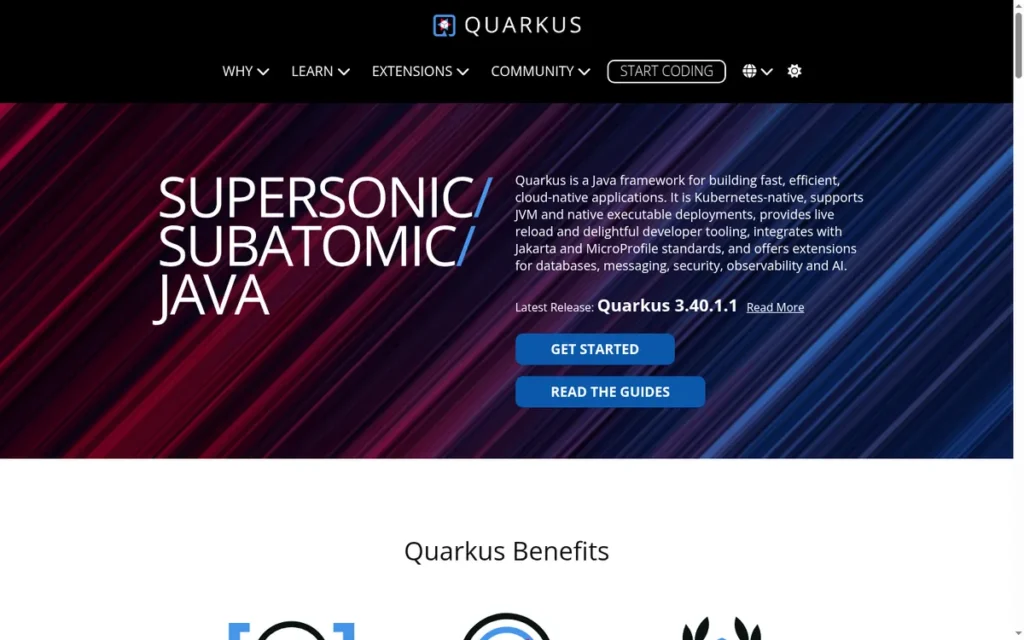
Category: Cloud-Native / Kubernetes-First Framework, purpose-built for containerized, OpenShift and Kubernetes-native deployments with GraalVM native image as a first-class deployment target, Dev Services for local development automation, and MicroProfile cloud-native extensions; designed for cloud-native from the ground up rather than retrofitted for the cloud.
At a Glance
- Category: Cloud-Native / Kubernetes-First Framework
- Best For: Teams deploying containerized Java microservices to Kubernetes or OpenShift where startup time, per-replica memory footprint, and cloud infrastructure cost efficiency are primary selection criteria
- Price Range: Free and open source (Apache 2.0); commercial enterprise support via Red Hat subscriptions (OpenShift, RHEL bundles), pricing on request; may be included in existing Red Hat enterprise contracts
- Primary Strength: Quarkus delivers the fastest native-mode cold start (0.049 seconds) and lowest native-mode memory footprint (70.5 MB RSS) of any evaluated framework in independent 2025 benchmarking, with engineering teams reporting significant CPU and memory reductions versus Spring Boot in Kubernetes deployments
- Biggest Limitation: Quarkus native image builds require 3–8 minutes for production-scale applications in CI/CD pipelines (shifting latency from runtime to deployment pipeline) and GraalVM reflection restrictions require code adaptation that complicates migration of Spring Boot applications with heavy reflection usage
- One-Line Summary: Quarkus is the top-performing Java framework for Kubernetes-native deployments in 2026, achieving 0.049-second native cold starts and 70.5 MB RSS in independent 2025 benchmarking with Red Hat/IBM commercial support backing.
- Last Verified: June 2026
Overview
Quarkus is a Kubernetes-native, open-source Java framework backed by Red Hat that delivers sub-second cold starts and sub-100 MB memory footprints via GraalVM native compilation, designed for cloud architects deploying containerized microservices to OpenShift or Kubernetes where resource efficiency and startup speed are primary engineering requirements.
Quarkus was introduced to the open-source community in 2019 by Red Hat, implements MicroProfile cloud-native extensions and Jakarta EE APIs via SmallRye implementations, and offers Dev Services (automatic Docker-based local infrastructure provisioning requiring zero developer configuration) as a distinctive developer experience feature unique in the Java ecosystem as of June 2026.
Key Features
- GraalVM Native Image Compilation: Quarkus provides first-class GraalVM native image support producing binaries that start in 0.049 seconds with 70.5 MB RSS in independent 2025 benchmarking (the best native performance of any evaluated Java framework) enabling viable scale-to-zero serverless deployments and cost-optimized Kubernetes pod density at scale (Gillius.org Java 25 Framework Startup Benchmark, October 2025).
- Dev Services (Automatic Infrastructure Provisioning): Quarkus Dev Services automatically detects required infrastructure dependencies (databases, Kafka, Redis, Keycloak) during development and provisions them as Docker containers without developer configuration, a developer experience feature that eliminates manual local test environment setup, not replicated by Spring Boot, Micronaut, or Jakarta EE runtimes as of June 2026.
- Unified Imperative and Reactive Programming: Quarkus implements a unified imperative and reactive programming model via Mutiny (allowing developers to write synchronous blocking code or reactive async code within the same framework) using RESTEasy Reactive (JAX-RS compliant) for REST and Mutiny for reactive streams, avoiding premature full reactive architecture commitment.
- Kubernetes Manifest Generation: Quarkus generates Kubernetes and OpenShift deployment manifests directly from application code annotations, integrating Kubernetes-native configuration, health checks, and resource limits into the development workflow without requiring separate Helm chart authoring or DevOps-managed manifest maintenance.
- MicroProfile and Jakarta EE Extensions via SmallRye: Quarkus hosts hundreds of extensions covering REST (RESTEasy Reactive), persistence (Panache (a simplified Hibernate abstraction), messaging (Kafka, AMQP via SmallRye), security (OIDC, JWT), and observability (OpenTelemetry, Micrometer)) with Red Hat maintaining official support for the core production extension ecosystem.
Best For
Quarkus is best for teams building new Kubernetes-native or OpenShift-deployed Java microservices where cold-start latency, per-replica memory cost, and container density are material engineering or infrastructure cost concerns.
Quarkus is also the recommended choice for organizations with existing Red Hat infrastructure investments who want enterprise support continuity for cloud-native Java development.
Pricing
Quarkus is free and open source under Apache 2.0. Commercial enterprise support is available through Red Hat subscriptions, teams already on OpenShift or RHEL enterprise subscriptions may find Quarkus support bundled at no additional marginal cost and should verify their existing contract scope before pursuing a separate support agreement. Community support via Quarkus GitHub discussions and Red Hat developer resources is extensive and well-documented. (Verified June 2026.)
Strengths
- Quarkus native mode achieves 0.049-second startup and 70.5 MB RSS in independent 2025 benchmarking on GraalVM 25 with an M2 Pro MacBook, 2.1x faster startup and 2.1x lower memory than Spring Boot native at identical benchmark conditions, the strongest native cold-start performance of any evaluated Java framework (Gillius.org Java 25 Framework Startup Benchmark, October 2025).
- Engineering teams migrating from Spring Boot to Quarkus in Kubernetes deployments have documented significant reductions in CPU usage, memory footprint, and startup time, with reported improvements ranging from 50% to over 80% in resource consumption depending on workload characteristics and native image usage (multiple practitioner sources, 2022–2024; Pérez et al., PMC9607224, 2022, for peer-reviewed comparison data).
- Quarkus documentation earns consistent practitioner praise across multiple independent community discussions, multiple r/java threads specifically identify documentation quality as a differentiator, including u/angryundead who noted it is “very good especially for such a young product” (r/java, 2023).
- Red Hat/IBM corporate backing provides the strongest enterprise support continuity among cloud-native Java challengers: defined commercial SLA structures, OpenShift-native integration, Red Hat-certified container images, and a major enterprise vendor accountability model unavailable from Micronaut (OCI boutique consulting) or community-only alternatives.
Limitations
- Native Build Time in CI/CD: Quarkus’s most consequential trade-off is its build-time cost (native image compilation for production-scale Quarkus applications requires 3–8 minutes in CI/CD pipelines, compared to 30–90 seconds for standard Spring Boot JVM builds) shifting latency from runtime to deployment pipeline and requiring careful build workflow design to avoid developer velocity degradation across multi-service repositories.
- GraalVM Reflection Restrictions: Quarkus native image builds impose GraalVM reflection restrictions that require code adaptation for applications migrating from Spring Boot with heavy reflection usage, classes, methods, and fields accessed via reflection must be explicitly registered in native image configuration, adding migration effort proportional to the codebase’s reflection surface area.
- Extension Ecosystem Maturity at Scale: Quarkus’s extension ecosystem, while broad in count, can exhibit compatibility friction at the intersection of multiple production extensions in complex real-world services, warranting prototype testing before committing large-scale Spring Boot application migrations to Quarkus production (community reports, r/SpringBoot, u/WaferIndependent7601, 2025).
- Vendor Alignment Perception: Quarkus carries a Red Hat vendor-alignment perception risk for teams on competing cloud platforms (AWS-native, GCP-native) (even though Quarkus itself is Apache-licensed) a dynamic that enterprise procurement teams on non-Red Hat cloud infrastructure should evaluate in the context of their existing vendor relationships.
“Quarkus is a joke if you want more than hello world.” (u/WaferIndependent7601, r/SpringBoot, 2025)
Takeaway: Quarkus extension ecosystem depth under real production complexity warrants prototype validation before committing a large-scale Spring Boot application to full migration.
Verdict
Quarkus delivers the fastest native-mode cold starts (0.049 seconds) and lowest native-mode memory footprint (70.5 MB RSS) among production Java frameworks in independent 2025 benchmarking, making it the evidence-backed primary choice for teams prioritizing Kubernetes resource efficiency or serverless responsiveness (Gillius.org, October 2025).
Quarkus ranks #2 overall rather than #1 because Spring Boot’s ecosystem depth, hiring pool size, and use-case breadth remain decisive for the majority of general-purpose enterprise backend projects where startup time and memory efficiency are important but not architecturally disqualifying.
For teams with a clear Kubernetes resource cost mandate or serverless cold-start requirement, Quarkus is the primary recommendation; teams without that specific constraint should weigh its superior cloud-native performance against the smaller ecosystem, 3–8 minute native build times, and hiring pool disadvantage before committing.
3. Micronaut: Best for Serverless and Cold-Start-Sensitive Deployments Without Native Image Build Complexity
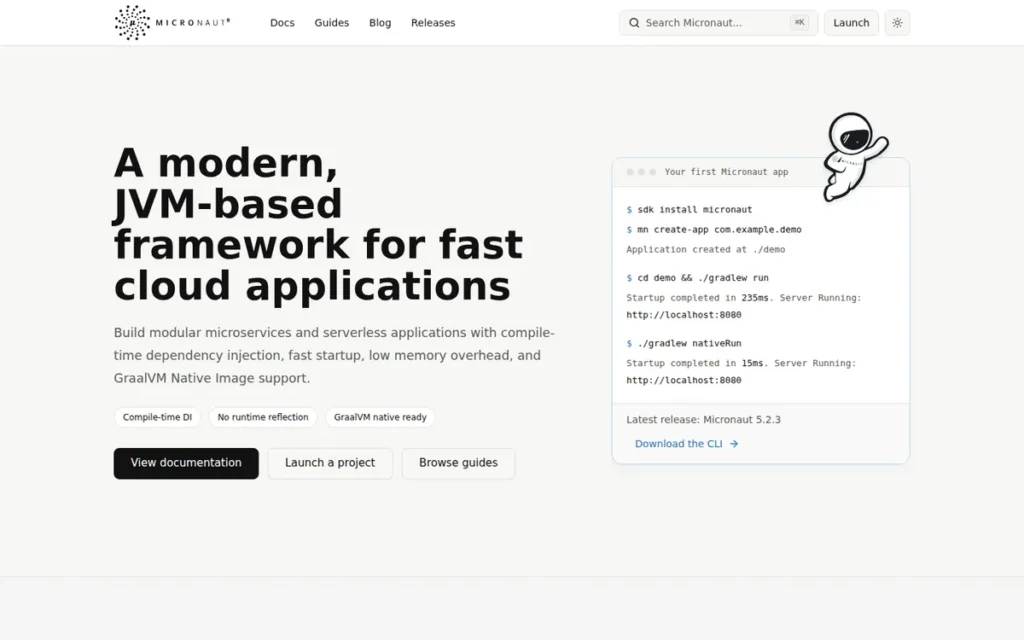
Category: Compile-Time / Serverless-Optimized Framework, uses ahead-of-time dependency injection and query generation at build time to eliminate runtime reflection entirely, delivering the fastest JVM-mode startup of any evaluated Java framework without requiring GraalVM native compilation.
At a Glance
- Category: Compile-Time / Serverless-Optimized Framework
- Best For: Serverless deployments (AWS Lambda, GCF), cold-start-sensitive microservices, and teams that need cloud-native-class startup performance in standard JVM mode without committing to a GraalVM native image build pipeline
- Price Range: Free and open source (Apache 2.0); commercial consulting support via Object Computing, Inc. (OCI), pricing on request, not publicly listed
- Primary Strength: Micronaut achieves 0.656-second JVM-mode startup: the fastest of any Java framework in independent 2025 benchmarking, by eliminating runtime reflection through compile-time dependency injection, delivering cloud-native startup performance without native image build overhead
- Biggest Limitation: Micronaut’s community and Stack Overflow presence are significantly smaller than Spring Boot’s, meaning developers who hit non-trivial edge cases face substantially longer resolution times; the OCI commercial support model (boutique consulting firm) provides less enterprise procurement familiarity than Red Hat or Broadcom alternatives
- One-Line Summary: Micronaut is the fastest-starting Java framework in JVM mode (0.656 seconds per independent 2025 benchmarking), achieving cloud-native-class startup without GraalVM native image compilation through compile-time dependency injection, optimal for serverless and cold-start-sensitive deployments.
- Last Verified: June 2026
Overview
Micronaut is a full-stack JVM framework for Java, Kotlin, and Groovy, released as Micronaut 5.0 with a Java 25 baseline in May 2026, that achieves the fastest JVM-mode startup of any evaluated Java framework by generating all dependency injection metadata, HTTP client wiring, and data access queries at compile time, completely eliminating runtime reflection.
Micronaut was created in 2018 by Graeme Rocher (co-creator of Grails) at Object Computing, Inc. and is designed for serverless developers and microservice teams who need cloud-native-class startup performance without committing to the GraalVM native image build pipeline that Quarkus requires for its top-tier cold-start results.
Key Features
- Compile-Time Dependency Injection: Micronaut’s compile-time DI generates all bean wiring, annotation metadata, and application context construction at build time using annotation processors (completely eliminating runtime reflection and dynamic proxies) producing startup times that remain consistent regardless of application complexity growth, unlike Spring Boot’s reflection-scanned context.
- Micronaut Data (AOT Query Generation): Micronaut Data generates repository implementations and SQL query logic at compile time through an ahead-of-time query model, replacing runtime Hibernate reflection with pre-computed data access strategies, extending the zero-reflection philosophy to the persistence layer for measurably faster first-query response times.
- Declarative Compile-Time HTTP Client: Micronaut provides a declarative compile-time HTTP client that generates client implementations from interface annotations at build time (including reactive stream support, retry and circuit-breaker integration, and load-balanced service discovery) with zero runtime code generation or reflection overhead.
- Micronaut 5.0 Java 25 Baseline: Micronaut 5.0 (released May 20, 2026, confirmed at micronaut.io/2026/05/20/micronaut-framework-5-0-0-released/ and by InfoQ Java Roundup, May 2026) sets Java 25, Kotlin 2.3, and Apache Groovy 5 as minimum baselines, the most aggressive modern Java minimum version of any active Java framework, signaling continued active innovation rather than maintenance-mode conservatism.
- Multi-Language Support with Kotlin Coroutines: Micronaut supports Java, Kotlin, and Groovy in a unified framework including first-class Kotlin coroutine integration, allowing teams to access reactive concurrency benefits without adopting the full event-driven programming model required by Vert.x or Spring WebFlux.
Best For
Micronaut is best for teams deploying to AWS Lambda, Google Cloud Functions, or other serverless platforms where JVM cold-start latency under approximately 1 second is required without the 3–8 minute native image build penalty that Quarkus imposes in CI/CD.
Micronaut is also well-suited for technically sophisticated teams that prefer explicit, visible dependency wiring and compile-time error detection over convention-over-configuration auto-configuration.
Pricing
Micronaut is free and open source under Apache 2.0. Commercial support is available through Object Computing, Inc. (OCI) on a consulting contract basis, pricing is not publicly listed and must be negotiated directly with OCI. Unlike Spring Boot (Broadcom) and Quarkus (Red Hat), Micronaut’s commercial support runs through a boutique consulting firm without the enterprise procurement familiarity that large-organization approved-vendor lists typically require; teams with formal vendor approval requirements should evaluate this distinction before committing. (Verified June 2026.)
Strengths
- Micronaut JVM-mode startup is confirmed at 0.656 seconds in independent 2025 benchmarking on GraalVM 25 with an M2 Pro MacBook, 43% faster than Quarkus JVM (1.154s) and 66% faster than Spring Boot JVM (1.909s), without requiring GraalVM native image compilation, representing cloud-native-class startup in standard JVM deployment that neither Spring Boot nor Quarkus can match (Gillius.org Java 25 Framework Startup Benchmark, October 2025).
- Multiple independent production practitioners report Micronaut microservices responding in under 10 milliseconds in production deployments, with one team using Micronaut for 6 of 20 production microservices reporting “amazing” results alongside Spring Boot for legacy services, consistent with compile-time DI eliminating reflection overhead (u/stefanos-ak and u/AlexandroAndrade, r/java, 2024).
- Micronaut 5.0 (released May 20, 2026, micronaut.io) with Java 25 as the minimum baseline confirms Graeme Rocher’s OCI team is making forward-compatibility investments, setting the most aggressive modern Java minimum version of any active Java framework and signaling continued active development rather than maintenance-mode conservatism.
- Developer testimony across multiple independent sources consistently reports writing “much less code” after migrating from Spring Boot to Micronaut, Micronaut’s compile-time DI eliminates categories of boilerplate that Spring Boot requires even with starters, surfacing configuration errors at build time that Spring Boot surfaces at runtime (u/Kango_V, r/SpringBoot, 2024).
“I moved to Micronaut quite a while ago and am very happy I did. One side effect that I did not expect was how much less code I need to write.” (u/Kango_V, r/SpringBoot, 2024)
Takeaway: Micronaut’s compile-time DI model reduces boilerplate in the application wiring layer, a practitioner-reported productivity gain consistent with eliminating Spring Boot’s annotation-scanning overhead.
Limitations
- Community Safety Net Gap: Micronaut’s most consequential trade-off is the inverse relationship between its architectural elegance and its community safety net, Micronaut’s Stack Overflow question backlog and community resource volume are significantly smaller than Spring Boot’s, meaning developers who encounter non-trivial edge cases face a substantially higher probability of hitting issues with no documented community resolution.
- Enterprise Procurement Model: Micronaut’s OCI commercial support model compounds the community safety net gap for enterprise procurement teams, unlike Broadcom’s Spring commercial subscription or Red Hat’s OpenShift bundle, OCI is a boutique consulting firm without the enterprise procurement category familiarity that large-organization IT approved-vendor lists typically require.
- Compile-Time Error Opacity: Micronaut’s compile-time model can produce opaque build-time error messages requiring framework internals knowledge to interpret correctly, the benefit of catching errors earlier is real, but error diagnosis moves from runtime debugging tools to build log analysis, requiring a different skill set and tooling investment that teams should factor into onboarding timelines.
Verdict
Micronaut achieves the fastest JVM-mode startup time (0.656 seconds) of any major Java web framework in independent 2025 benchmarking (without requiring GraalVM native compilation) making it the optimal choice for serverless and cold-start-sensitive deployments where Quarkus’s native image build pipeline complexity is operationally prohibitive (Gillius.org, October 2025).
Micronaut ranks #3 overall (below Spring Boot on ecosystem depth and hiring availability, and below Quarkus on corporate backing strength and native-mode memory efficiency) but occupies a JVM-mode performance position that neither Spring Boot nor Quarkus can match in standard deployment.
For teams building AWS Lambda functions, Google Cloud Function backends, or cold-start-sensitive Kubernetes workloads who want production-validated startup performance without a 3–8 minute native image CI/CD build step, Micronaut is the evidence-backed primary recommendation in 2026.
4. Jakarta EE: Best for Regulated Industries, Multi-Vendor Enterprise Procurement, and Long-Term Standards Compliance
Category: Enterprise Standards Platform, a multi-vendor, specification-based platform of enterprise Java APIs governed by the Eclipse Foundation and deployable across multiple competing certified application server implementations; not a single-vendor framework but a published standard with vendor-neutral portability guarantees.
At a Glance
- Category: Enterprise Standards Platform
- Best For: Regulated industries (government, healthcare, defense, financial services) and enterprise procurement environments requiring certified vendor-neutral portability across multiple application server providers, or organizations with formal multi-vendor RFP requirements or 10-year vendor lock-in risk management mandates
- Price Range: Specifications free (Eclipse Foundation); community runtimes (WildFly, GlassFish, TomEE) free; enterprise runtimes: Red Hat JBoss EAP, IBM WebSphere/Open Liberty, Oracle WebLogic, pricing on request (subscription-based); Payara Enterprise estimated $2,500–$5,000+/year/server (verify current tiers directly with Payara Sales before procurement)
- Primary Strength: Jakarta EE is the only Java platform offering certified vendor-neutral portability across competing application server providers (Red Hat WildFly/JBoss EAP, IBM WebSphere/Open Liberty, Oracle WebLogic, and Payara) enabling procurement specifications and multi-vendor SLA structures that no single-vendor framework can match
- Biggest Limitation: Jakarta EE’s J2EE-era reputation for heavyweight, XML-driven application server complexity persists among developers with pre-2017 experience, causing modern Jakarta EE 11 (Core Profile, CDI Lite) to be systematically dismissed for use cases where it is genuinely competitive, requiring organizational change management investment when proposing it to teams anchored in outdated mental models
- One-Line Summary: Jakarta EE 11 (released June 26, 2025) is the only Java platform providing certified, vendor-neutral portability across multiple competing enterprise application server providers, making it the uniquely appropriate choice for regulated-industry organizations where standards compliance is non-negotiable.
- Last Verified: June 2026
Overview
Jakarta EE is a multi-vendor, standards-based enterprise Java platform, currently at Jakarta EE 11 (released June 26, 2025, confirmed at jakarta.ee/news/jakarta-ee-11-released/), governed by the Eclipse Foundation with specification input from IBM, Red Hat, Payara, Oracle, and others, providing enterprise Java specifications including JAX-RS, CDI, JPA, and the new Jakarta Data.
Jakarta EE is not a framework from a single vendor but a published standard, code written to Jakarta EE APIs is portable across Open Liberty (IBM), JBoss EAP (Red Hat), WebLogic (Oracle), Payara, WildFly, and GlassFish without source code modification, a vendor-neutral portability guarantee unique among all options evaluated in this comparison.
Key Features
- Certified Vendor-Neutral API Portability: Jakarta EE provides certified portability across multiple competing application server implementations, including WildFly 35, Payara Micro 6.x, GlassFish 7, Apache TomEE Plus, JBoss EAP, and IBM Open Liberty, enabling organizations to switch runtime providers without modifying application source code, a procurement flexibility unavailable with any proprietary framework.
- Jakarta EE 11 Core Profile (Microservice-Ready): Jakarta EE 11 introduces the Core Profile (a minimal specification subset designed for microservice runtimes with CDI Lite support) enabling compact, fast-starting deployments on certified runtimes that directly contradict the platform’s historical “heavyweight” reputation based on pre-2017 J2EE experience.
- Virtual Thread Support (Java 21+): Jakarta EE 11 adds full virtual thread support, bringing the platform into performance parity with Spring Boot and Quarkus for synchronous-style high-concurrency programming, one of the most significant modern Java concurrency capabilities now available across the full Jakarta EE specification (Jakarta EE 11 release notes, jakarta.ee/release/11/, June 2025).
- Eclipse Foundation Multi-Vendor Governance: Jakarta EE’s Eclipse Foundation governance distributes specification authority across IBM, Red Hat, Payara, and Oracle, ensuring no single vendor can unilaterally change license terms, EOL the platform, or redirect development, the most institutionally stable governance model of any platform in this evaluation.
- Jakarta Data (Standardized Repository Pattern): Jakarta EE 11 introduces Jakarta Data, providing a standardized repository-pattern data access specification enabling portable ORM integration across JPA providers without vendor lock-in, extending the platform’s portability promise from the application framework layer to the data access layer.
Best For
Jakarta EE is best for enterprise organizations in regulated sectors (government, defense, healthcare, financial services) where formal procurement processes require certified vendor-neutral application portability, multi-vendor SLA options, or compliance with standards-based Java specifications.
Jakarta EE is also appropriate for organizations managing long-lifecycle applications where the ability to switch runtime vendors over a 10-year deployment horizon is a genuine risk management requirement that no single-vendor framework can satisfy.
Pricing
Jakarta EE specifications are free under Eclipse Foundation governance. Community runtimes (WildFly, Apache TomEE, GlassFish) are free and suitable for development and non-SLA production environments. Enterprise-supported runtimes require commercial subscriptions: Red Hat JBoss EAP and IBM WebSphere/Open Liberty pricing is quote-based; Payara Enterprise is estimated at $2,500–$5,000+ per server per year, verify current tiers directly with Payara Sales before procurement. (Verified June 2026.)
Strengths
- Jakarta EE’s foundational role in the Java ecosystem is evidenced by Spring Boot itself being built on Jakarta EE APIs (Jakarta Servlet, Jakarta Persistence, and Jakarta Validation are the foundation of every Spring Boot web service) confirming Jakarta EE as the foundational specification layer beneath the most popular Java framework and making the two platforms complementary rather than strictly competitive (Eclipse Foundation governance documentation, 2025).
- Jakarta EE 11’s Core Profile and CDI Lite additions (released June 26, 2025) represent the most significant modernization since the Oracle-to-Eclipse Foundation transition, enabling compact microservice deployments that IBM Open Liberty runs competitively with Spring Boot for size and startup, directly refuting the J2EE-era heavyweight association based on pre-2017 experience (Harness.io Jakarta EE vs. Spring Boot analysis, 2025).
- Jakarta EE is the only Java platform enabling certified vendor-neutral portability across competing commercial application server providers (including Red Hat JBoss EAP, IBM WebSphere/Open Liberty, Oracle WebLogic, and Payara Enterprise) a capability confirmed by Eclipse Foundation multi-vendor governance and practically decisive in regulated-industry RFP contexts (jakarta.ee/release/11/, June 2025).
- Eclipse Foundation multi-vendor governance distributes specification authority across IBM, Red Hat, Payara, and Oracle (the most institutionally stable governance structure in this evaluation) ensuring no single corporate owner can unilaterally change license terms in the manner documented in the Akka/Play Framework licensing crisis of 2022.
“If you are an EE shop or just starting then I would go to Quarkus. I like that it is standards based and the microprofile stuff is really sweet.” (u/angryundead, r/java, 2023)
Takeaway: Quarkus functions as the practical bridge for teams wanting Jakarta EE standards-based APIs in a cloud-native deployment wrapper, implementing MicroProfile and Jakarta EE specifications within a Kubernetes-native framework model.
Limitations
- Persistent Perception Gap: Jakarta EE’s most consequential limitation is the gap between its current-state capabilities and developer perception, the J2EE-era association with heavyweight application servers, complex XML deployment descriptors, and EJB 2.x-style patterns persists among developers with pre-2017 experience, requiring meaningful organizational change management investment when proposing Jakarta EE 11 to teams anchored in outdated mental models.
- No Controlled Performance Benchmark Available: Jakarta EE lacks a controlled startup and memory benchmark equivalent to the Gillius.org Spring Boot/Quarkus/Micronaut study, a structural data gap resulting from Jakarta EE’s multi-runtime specification model rather than a measurable performance deficiency, since WildFly startup differs materially from Open Liberty startup at identical application configuration.
- Innovation Velocity Gap: Jakarta EE’s specification governance model: requiring multi-vendor consensus across IBM, Red Hat, Payara, and Oracle, produces a measurably slower feature introduction cycle than single-vendor frameworks; capabilities available in Spring Boot 4.x (Spring AI, Spring Modulith) and Micronaut 5.x (Java 25 baseline) have no equivalent specification timeline in the Jakarta EE 11/12 pipeline.
- javax to jakarta Namespace Migration Debt: Jakarta EE’s javax to jakarta namespace migration (completed in Jakarta EE 9 and 10) remains a source of active migration debt for organizations running Java EE 8 applications, a concrete ongoing upgrade cost requiring mass package reference updates proportional to codebase size for any team not already current on Jakarta EE 10 or 11.
Verdict
Jakarta EE 11 (released June 26, 2025) is the only Java platform offering certified, vendor-neutral portability across multiple competing enterprise application server providers, a procurement advantage unique in the Java ecosystem and directly decisive for regulated-industry organizations, government procurement contexts, and enterprises managing 10-year application lifecycle commitments (Eclipse Foundation governance, jakarta.ee/release/11/).
Jakarta EE ranks #4 overall (below Spring Boot on ecosystem and hiring availability, below Quarkus and Micronaut on cloud-native-specific startup benchmarks) but represents the strongest option in enterprise procurement contexts where vendor lock-in risk and standards compliance are disqualifying constraints rather than preferences.
Teams evaluating Jakarta EE in 2026 should anchor on the Core Profile and CDI Lite capabilities of Jakarta EE 11 rather than pre-2017 J2EE experiences, treating the “heavyweight” reputation as an outdated perception gap requiring active correction rather than a current-state assessment.
5. Eclipse Vert.x: Best for High-Concurrency Reactive Event Processing and I/O-Bound Services
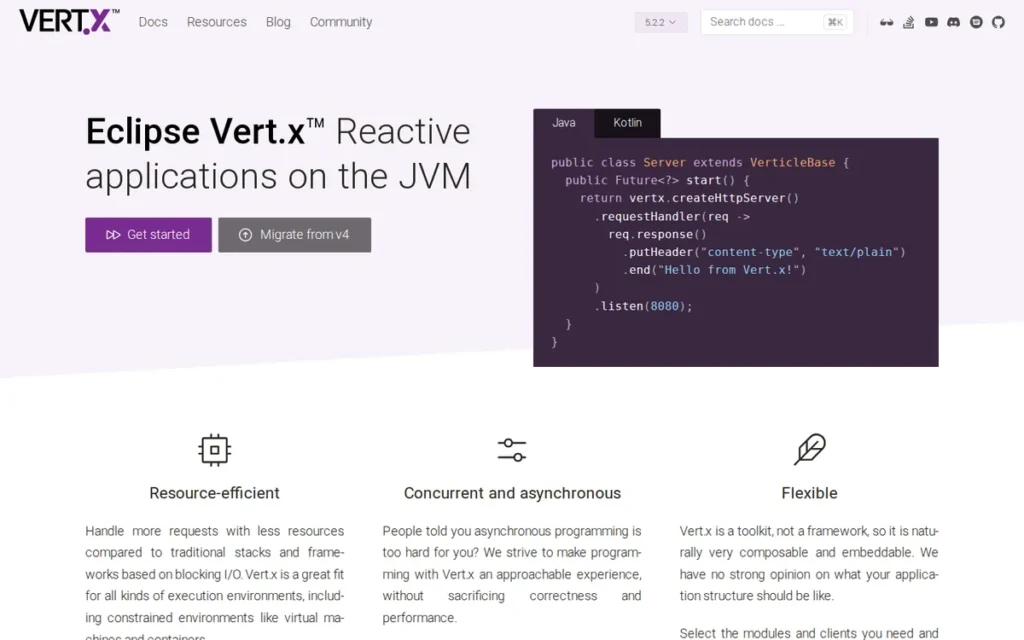
Category: Reactive Event-Driven Toolkit, a non-opinionated, true non-blocking event-loop toolkit for building high-concurrency JVM applications; explicitly not a full MVC framework; provides reactive primitives for teams assembling custom architectures rather than following a prescribed application structure.
At a Glance
- Category: Reactive Event-Driven Toolkit
- Best For: Engineering teams building high-concurrency, I/O-bound services: API gateways, event processors, real-time streaming services, WebSocket servers, where maximum JVM throughput per CPU core is a primary requirement and the team is experienced with reactive or event-driven programming models
- Price Range: Free and open source (Eclipse Public License); Red Hat Build of Eclipse Vert.x (commercial distribution with enterprise support), pricing via Red Hat subscription, on request
- Primary Strength: Eclipse Vert.x consistently ranks among the top-performing Java options in TechEmpower Framework Benchmarks (composite rounds 2023–2024) due to its true non-blocking event-loop architecture, and serves as the reactive HTTP engine powering Quarkus internally, confirming production-scale validation beyond synthetic benchmarks
- Biggest Limitation: Eclipse Vert.x is not a full-stack MVC framework but a reactive toolkit requiring teams to assemble their own application structure, imposing a significant reactive programming learning curve and callback-hell risk for teams without prior event-driven experience, and a smaller direct hiring pool than any opinionated framework in this evaluation
- One-Line Summary: Eclipse Vert.x is a top-ranked reactive toolkit in the Java ecosystem for I/O-bound, high-concurrency workloads, serving as the internal reactive HTTP engine of Quarkus and consistently ranking among the leading Java options in TechEmpower Framework Benchmark throughput categories.
- Last Verified: June 2026
Overview
Eclipse Vert.x is a reactive, event-driven toolkit (explicitly not an opinionated MVC framework) for building high-concurrency JVM applications, governed by the Eclipse Foundation and available with Red Hat commercial distribution support as of 2026.
Eclipse Vert.x was created by Tim Fox circa 2012 at Red Hat, provides a true non-blocking event-loop architecture with a polyglot JVM API in Java, Kotlin, Groovy, and JavaScript, and is most notably the reactive HTTP engine underlying Quarkus, meaning Eclipse Vert.x’s architecture powers a significant fraction of Java cloud-native production workloads even among teams who have not adopted Eclipse Vert.x directly.
Key Features
- True Non-Blocking Event-Loop Architecture: Eclipse Vert.x implements a true non-blocking event-loop model where the calling thread is never blocked during I/O operations, enabling Eclipse Vert.x applications to handle thousands of concurrent connections with a small thread pool, a throughput-per-core efficiency model that ranks among the top Java performance profiles in TechEmpower Framework Benchmarks (composite rounds 2023–2024, techempower.com/benchmarks).
- Event Bus for Distributed Communication: Eclipse Vert.x provides an event bus as the central communication primitive for Verticles (deployable application units), enabling asynchronous decoupled service-to-service communication across a cluster, a distributed event-driven architecture pattern native to the framework rather than added via external messaging middleware.
- Polyglot JVM Support: Eclipse Vert.x supports polyglot JVM development in Java, Kotlin, Groovy, and JavaScript, allowing multi-language teams to build Verticles in their preferred JVM language while sharing the same event bus and reactive infrastructure, a team composition flexibility not available in any other Java web framework evaluated.
- Non-Blocking Reactive SQL Clients: Eclipse Vert.x includes reactive SQL clients for PostgreSQL, MySQL, and MSSQL that maintain the non-blocking contract through the full I/O stack, preventing the common anti-pattern of reactive HTTP handling with blocking database calls that eliminates the throughput advantage of the reactive model.
- Red Hat Build of Eclipse Vert.x: Eclipse Vert.x is available as the Red Hat Build of Eclipse Vert.x, a commercially supported distribution integrated with OpenShift, providing enterprise support, security patching SLAs, and Red Hat-certified container images for organizations requiring vendor accountability beyond community support.
Best For
Eclipse Vert.x is best for senior engineering teams building I/O-heavy, high-concurrency services (API gateways handling tens of thousands of concurrent connections, real-time WebSocket event processing, event-driven microservice buses, or streaming data pipelines) where maximum JVM throughput per CPU core is a hard architectural requirement.
Eclipse Vert.x requires existing reactive or event-driven programming experience on the team to manage the model effectively; it is not recommended as a starting framework for teams new to reactive programming.
Pricing
Eclipse Vert.x is free and open source under the Eclipse Public License, a business-friendly license with minimal commercial restrictions. Red Hat Build of Eclipse Vert.x provides enterprise commercial support under Red Hat subscription terms, pricing is not publicly listed; teams on existing OpenShift or RHEL subscriptions should verify whether Vert.x enterprise support is included in their existing contract before procuring separately. (Verified June 2026.)
Strengths
- Eclipse Vert.x is the reactive HTTP engine underlying Quarkus, meaning every production Quarkus deployment that uses the reactive programming model runs on Eclipse Vert.x event-loop infrastructure internally, confirming Eclipse Vert.x’s production-scale validation through the Quarkus ecosystem at thousands of Kubernetes deployments globally (Quarkus architecture documentation, quarkus.io, 2025).
- Eclipse Vert.x ranks among the top Java options in TechEmpower Framework Benchmark composite rounds for JSON serialization and database query throughput, validating its “true non-blocking” architecture claims against independent third-party measurement rather than framework-vendor performance marketing (TechEmpower Framework Benchmarks, techempower.com/benchmarks, composite rounds 2023–2024).
- Eclipse Vert.x version 4.5.x (active release line, Eclipse Vert.x releases blog, 2025–2026) confirms ongoing active development under Eclipse Foundation governance, with regular point releases demonstrating a healthy maintenance cadence that distinguishes Eclipse Vert.x from Play Framework’s crisis-recovery trajectory and Dropwizard’s no-corporate-sponsor maintenance model.
- Eclipse Vert.x’s Eclipse Foundation governance provides the same institutionally neutral multi-stakeholder oversight as Jakarta EE (no single corporate owner can unilaterally EOL the project, change license terms, or redirect development) providing governance stability that distinguishes Eclipse Vert.x from single-vendor-controlled frameworks on long-term viability.
This aligns with practitioner assessments on r/java:
“Vert.x is small, fast, robust, and mature, but it might be harder to work with than Spring. But it’s an opportunity to learn something new. Your bigger concern should be that you might get stuck into reactive programming at the dawn of Java virtual threads.” Posted by u/drvobradi
Takeaway: Eclipse Vert.x earns consistent practitioner praise for maturity and raw performance, but its reactive programming model faces an existential question as virtual threads reduce the architectural necessity of the event-loop model.
Limitations
- Reactive Learning Curve and Callback Risk: Eclipse Vert.x’s most consequential trade-off is its learning curve for teams without prior reactive programming experience, the event-loop model requires a fundamental shift in how developers reason about execution flow, error propagation, and state management, and without disciplined code organization using Kotlin coroutines or Mutiny-style reactive streams, complex Eclipse Vert.x applications risk callback-hell that significantly degrades code maintainability.
Users on r/java with multi-year production Vert.x exposure noted:
“Now, speaking of the technology itself, I don’t like Vert.x. It’s full of magical black holes that are barely explained, and they only make sense on very specific types of backends (I/O intensive, light on CPU), and it you’ll work on it, try to make sense of it, and will still get it wrong. (Source: I’ve been working on Vert.x projects for the past 6 years and we’re actively investigating Loom to ditch it altogether)” Posted by u/parabx
Takeaway: Veteran Eclipse Vert.x practitioners report that the toolkit’s opaque internals and narrow I/O-bound applicability produce diminishing returns even after years of production experience, and that virtual thread adoption is emerging as a credible migration path away from it.
- No Opinionated Application Structure: Eclipse Vert.x is explicitly not a full-stack opinionated framework, meaning teams must make and maintain architectural decisions (application structure, dependency injection model, configuration management) that Spring Boot, Quarkus, and Micronaut handle automatically, creating a genuine ongoing maintenance burden beyond initial setup that accumulates across the project lifetime.
- Smaller Hiring Pool: Eclipse Vert.x has a significantly smaller direct hiring pool than Spring Boot, developers with production Eclipse Vert.x experience are substantially less common than Spring Boot developers, representing a talent acquisition risk for teams scaling engineering organizations beyond the founding team.
- Harder Async Debugging: Debugging asynchronous event-driven code flows in Eclipse Vert.x is measurably harder than debugging synchronous Spring Boot or Micronaut code, distributed event bus traces, callback chains, and reactive stream flows require specialized observability tooling and developer expertise that adds operational overhead not present in synchronous-first frameworks.
Verdict
Eclipse Vert.x is a top-ranked reactive toolkit in the Java ecosystem for I/O-bound, high-concurrency workloads, consistently ranked among the leading Java options in TechEmpower benchmark throughput categories and confirmed as the reactive HTTP engine powering Quarkus in production deployments at scale (TechEmpower, 2023–2024; Quarkus architecture documentation, 2025).
Eclipse Vert.x ranks #5 overall because its specialist positioning limits applicability to teams with specific high-concurrency requirements and reactive programming expertise, for the majority of Java backend development patterns, the throughput advantage of Eclipse Vert.x’s event-loop model is not architecturally necessary and does not justify its steeper learning curve versus Spring Boot, Quarkus, or Micronaut.
Teams whose workload specifically includes tens of thousands of concurrent I/O operations, real-time event processing, or WebSocket-at-scale should evaluate Eclipse Vert.x as the primary recommendation; all other teams should evaluate whether Quarkus’s Vert.x-powered reactive layer provides sufficient throughput without the full toolkit assembly complexity.
6. Dropwizard: Best for Simple, Predictable REST Microservices Without Framework Magic or Cloud-Native Requirements
Category: Minimal REST Toolkit, a fixed, explicitly-configured bundle of Jetty, Jersey, Jackson, Metrics, and Hibernate for building synchronous REST microservices with zero auto-configuration; provides strong operational tooling (admin port, health checks, metrics) but no reactive programming support, no native image path, and no cloud-native deployment automation.
At a Glance
- Category: Minimal REST Toolkit
- Best For: Technically sophisticated teams building straightforward synchronous REST microservices who prioritize operational predictability and explicit dependency visibility over ecosystem breadth, and who have the internal capability to self-support in production without commercial SLA backing
- Price Range: Free and open source (Apache 2.0); no commercial support option available from any vendor
- Primary Strength: Dropwizard provides a fully explicit, no-auto-configuration bundle of production-proven REST libraries (Jetty, Jersey, Jackson, Metrics, Hibernate) where every dependency and wiring decision is visible in application code, eliminating the hidden-behavior debugging costs of auto-configuration frameworks
- Biggest Limitation: Dropwizard has no corporate sponsor and is maintained solely by community contributors, providing no commercial SLA support path for production incidents, no native image path for cloud-native deployments, no reactive programming support, and limited innovation velocity for requirements that post-date its 2011 design
- One-Line Summary: Dropwizard is a minimal, explicitly-configured Java REST toolkit created at Yammer in 2011 that bundles Jetty, Jersey, Jackson, Metrics, and Hibernate with zero auto-configuration magic and a dedicated production admin port, the pragmatic choice for technically self-sufficient teams who need predictable REST microservices.
- Last Verified: June 2026
Overview
Dropwizard is a minimal, opinionated Java REST toolkit created by Coda Hale at Yammer in 2011 (predating Spring Boot, Quarkus, and Micronaut) that bundles Jetty (HTTP server), Jersey (JAX-RS REST), Jackson (JSON), Metrics (monitoring), Hibernate (ORM), and Liquibase (schema migration) into a single explicitly-configured production service package with zero auto-configuration overhead and no hidden wiring behaviors.
Dropwizard is now community-maintained as an open-source Apache 2.0 project with no corporate sponsor. Dropwizard 4.x is the confirmed stable GA release line as of June 2026, with the Dropwizard 5.0.x branch (targeting Java 17+ with Jetty 12) in active pre-release development, verify current release status at dropwizard.io before selecting a version for production projects.
Key Features
- Zero Auto-Configuration Bundle: Dropwizard bundles a fixed, explicitly-wired set of production-proven libraries (Jetty, Jersey, Jackson, Dropwizard Metrics, Hibernate, and Liquibase) with no hidden auto-configuration, meaning every library present in a Dropwizard application is visibly configured in application code with no framework-initiated overrides.
- Dedicated Administrative HTTP Port: Dropwizard creates a dedicated administrative HTTP port (default :8081) serving health check endpoints, metrics exposition, thread dump access, and admin operations separately from the main application port, a structural separation of operational concerns that predated Spring Boot Actuator and simplifies firewall configuration, load balancer health check setup, and production monitoring integration.
- JAX-RS and JPA Standard APIs: Dropwizard uses JAX-RS via Jersey for REST API definition and JPA/Hibernate for data access (the same standard APIs used by Jakarta EE and compatible with Spring Boot’s Spring Data JPA) meaning developer skills and a meaningful portion of application code are transferable between Dropwizard and other JAX-RS/JPA frameworks with limited rewriting.
- Fast JVM Startup via Explicit Wiring: Dropwizard’s embedded Jetty and minimal DI overhead produce faster startup times than Spring Boot JVM mode in practitioner comparisons (a consequence of explicit rather than reflection-scanned component wiring) making Dropwizard competitive for standard synchronous REST workloads where native image or reactive throughput is not required.
- Active Forward-Compatibility Maintenance: Dropwizard’s active 5.0.x development branch targets Java 17 and Jetty 12, confirming forward-compatibility investment by community maintainers even in the absence of a corporate engineering organization, countering narratives of project abandonment for teams evaluating long-term maintenance trajectory.
Best For
Dropwizard is best for technically self-sufficient teams building straightforward synchronous REST microservices who have been frustrated by Spring Boot’s auto-configuration unpredictability, do not require reactive programming or cloud-native deployment automation, and can fully self-support production environments without any commercial vendor SLA escalation path.
Pricing
Dropwizard is free and open source under Apache 2.0 with no commercial license cost at any scale. No commercial support option (from any vendor) is currently available for Dropwizard as of June 2026. Teams requiring production incident SLA coverage cannot procure it for Dropwizard workloads and must factor this complete absence into their framework selection risk assessment before committing. (Verified June 2026.)
Strengths
- Dropwizard’s admin port design earns consistent practitioner praise as “a godsend for testability and monitoring in production”, the structural separation of application traffic (port 8080) from operational endpoints (health checks, metrics, admin actions on port 8081) predated Spring Boot Actuator by years and remains a meaningful operational design advantage for teams managing firewall rules and load balancer health check integration (u/jfurmankiewicz, r/java, 2024).
- Dropwizard and Spring Boot share the same foundational standard APIs: JAX-RS (Jersey vs. Spring MVC), Jackson for JSON, JPA/Hibernate for data access, and embedded servlet containers, meaning developer skills transfer in “a matter of weeks” and code-level migration between the two is lower-effort than migration between architecturally divergent frameworks like Vert.x or Micronaut (u/buyIdris666, r/java, 2024).
- Dropwizard Metrics: the monitoring library created as part of Dropwizard’s original design, achieved widespread standalone adoption across the Java ecosystem as an independently used library, confirming the engineering quality of the framework’s foundational design decisions beyond its direct adoption numbers (Dropwizard GitHub history; standalone adoption documented in major Java infrastructure projects, 2012–present).
- Dropwizard’s active 5.0.x development branch targeting Java 17 and Jetty 12 confirms forward-compatibility investment by community maintainers, Dropwizard is actively maintained even in the absence of a corporate engineering organization, countering abandonment narratives for teams evaluating its maintenance trajectory (dropwizard.io; Dropwizard GitHub, 2025–2026).
Limitations
- Complete Absence of Commercial Support: Dropwizard’s most consequential trade-off is the complete absence of corporate sponsorship or commercial support, unlike every other framework above it in this ranking, no company with financial incentive ensures Dropwizard’s long-term evolution, security vulnerability response velocity, or production incident escalation path, requiring teams to self-provision all support capability and explicitly document this risk in architecture decision records.
- No Cloud-Native Deployment Path: Dropwizard does not provide a supported GraalVM native image path, built-in reactive programming model, or Kubernetes manifest generation as of June 2026, teams with cloud-native deployment requirements must implement these capabilities through external tooling rather than framework-native support, and teams with serverless or scale-to-zero deployment mandates should evaluate Quarkus or Micronaut instead.
- Smaller Ecosystem: Dropwizard’s smaller ecosystem versus Spring Boot means fewer integrations, fewer Stack Overflow answers, and less third-party tooling, the explicit simplicity that makes Dropwizard appealing also means teams hit the edges of its capability set faster than with Spring Boot’s broader library catalog, requiring custom integration work for less common enterprise requirements.
“Dropwizard… I think it just failed to get enough corporate backing to make it a viable competitor to Spring.” (u/renatoathaydes, r/java, 2024)
(Dropwizard maintainer u/joschi83 responded: “As one of the maintainers of Dropwizard, I say go for it!”)
Takeaway: The contrast between a community member’s “failed to get corporate backing” critique and a maintainer’s brief “go for it!” response illustrates Dropwizard’s organizational reality, technically sound, community-maintained, and lacking the advocacy infrastructure to counter marketplace perception challenges.
Verdict
Dropwizard is a minimal, explicitly-configured Java REST toolkit created at Yammer in 2011 that remains in active community maintenance under Apache 2.0 as of June 2026, offering a no-auto-configuration REST service bundle (Jetty, Jersey, Jackson, Metrics, Hibernate) with genuine operational tooling strengths and a lower framework complexity ceiling than Spring Boot.
Dropwizard ranks #6 because its complete absence of corporate sponsorship, lack of a native image path, absence of reactive programming support, and smaller ecosystem place it below frameworks that match or exceed its simplicity advantages while providing better cloud-native profiles and long-term viability signals.
Dropwizard remains a defensible choice specifically for technically self-sufficient teams building synchronous REST services who prioritize explicit predictability over innovation velocity and can fully self-support production environments without commercial SLA escalation paths.
7. Play Framework: Best for Scala Full-Stack MVC; Elevated Long-Term Viability Risk for New Java-Only Projects
Category: Type-Safe MVC Framework, a stateless, async-first Java and Scala MVC framework with compile-time route verification and hot reload; community-maintained without corporate sponsorship following a 2022 dependency licensing crisis and migration from Akka to Apache Pekko.
At a Glance
- Category: Type-Safe MVC Framework
- Best For: Scala development teams building full-stack reactive web applications with existing Play expertise; not recommended as a first-choice framework for new Java-only REST API or microservice projects given absent corporate sponsorship and documented major-version breaking changes
- Price Range: Free and open source (Apache 2.0); no commercial support option available from any vendor
- Primary Strength: Play Framework provides the only production-mature Scala and Java dual-API MVC framework in the Java ecosystem with compile-time type-safe routing, ensuring route configuration changes that break URL patterns are caught at build time rather than discovered in production
- Biggest Limitation: Play Framework has no corporate sponsor, experienced a near-existential dependency licensing crisis in 2022 (Akka to Pekko migration), exhibits documented backward incompatibility across major versions, and appears infrequently in active 2024–2025 Java framework recommendation discussions, the highest long-term viability risk of any framework in this evaluation
- One-Line Summary: Play Framework is a community-maintained, open-source Java and Scala MVC framework that completed a crisis-driven migration from Akka to Apache Pekko in 2024, retaining genuine strengths in type-safe routing and Scala API quality but carrying the highest long-term viability risk in this evaluation.
- Last Verified: June 2026
Overview
Play Framework is a stateless, type-safe MVC web framework for Java and Scala (currently at Play 3 (2024), running on Apache Pekko after migrating from Akka when Lightbend changed Akka to a Business Source License in 2022) community-maintained without active corporate sponsorship, designed for full-stack developers building reactive web applications.
Play 2.9 retained the last Apache-licensed Akka release, while Play 3.0 moved to Apache Pekko, the Apache Foundation open-source fork of Akka 2.6, restoring full Apache 2.0 licensing cleanliness following the crisis (Play Framework migration guide, playframework.com/documentation/3.0.x/Migration30, 2024; Apache Pekko 1.0.0, pekko.apache.org, 2023).
Key Features
- Compile-Time Type-Safe Routing: Play Framework implements type-safe routing compiled at build time (route definitions are compiled and any inconsistency between a defined route and the referenced controller method causes a compilation error) eliminating a category of runtime routing bugs common in annotation-based frameworks like Spring MVC and providing a concrete build-time safety guarantee unique in the Java MVC framework space.
- Hot Reload Development Workflow: Play Framework provides hot reload through its build system, automatically recompiling and reloading application changes without server restart during development, reducing feedback loop time for iterative web development, though Spring Boot DevTools provides comparable capability for teams already operating in the Spring ecosystem.
- Dual Java and Scala API: Play Framework supports both Java and Scala through a unified API surface, making it the only evaluated framework with a production-mature Scala web development path, a decisive differentiator for Scala-first or polyglot Java/Scala teams that no other framework in this comparison provides.
- Apache Pekko Concurrency (Open-Source): Play Framework 3 runs on Apache Pekko (the Apache Foundation open-source fork of Akka) following the 2024 migration, preserving actor-model concurrency and reactive streams capabilities without Business Source License commercial exposure and restoring pure Apache 2.0 licensing cleanliness.
- Stateless HTTP for Horizontal Scaling: Play Framework’s stateless HTTP design externalizes all session state, enabling straightforward horizontal scaling and alignment with twelve-factor application principles for cloud deployment without requiring additional session management configuration.
Best For
Play Framework is best for teams with existing Play or Scala expertise building full-stack reactive web applications where compile-time routing safety and Scala API quality justify the selection.
Play Framework is specifically not recommended as a first-choice framework for new Java-only REST API or microservice projects, where Spring Boot, Quarkus, or Micronaut provide equivalent or superior capabilities with substantially stronger long-term viability profiles.
Pricing
Play Framework is free and open source under Apache 2.0. No commercial support option exists from any vendor for Play Framework as of June 2026. Unlike Dropwizard, which has named active maintainers publicly engaged in community discussions, Play’s support model relies entirely on the community contributor base following Lightbend’s departure as the primary commercial steward. (Verified June 2026.)
Strengths
- Play Framework 3’s community-led migration from Akka to Apache Pekko (completed 2024) demonstrates active community resilience, the project successfully navigated a near-existential dependency licensing crisis through volunteer contributor effort, confirming community commitment to the project’s continuation even without corporate backing (JVM Weekly, “Play Framework Is Reborn Like a Phoenix,” jvm-weekly.com/p/play-framework-is-reborn-like-a-phoenix, 2024).
- Play Framework’s type-safe routing model: routes compiled at build time with type-checked controller method binding, eliminates a documented class of runtime routing errors that annotation-based frameworks expose only at runtime, providing a concrete build-time safety guarantee that remains a genuine differentiator in the Java MVC framework space.
- Play 3’s migration to Apache Pekko under Apache Foundation governance removes the Business Source License commercial exposure that triggered the 2022 crisis, restoring Play’s pure open-source status under an Apache 2.0 dependency stack, a licensing cleanliness improvement material to enterprise open-source compliance reviews evaluating dependency license stacks.
- Play Framework’s stateless HTTP model and dual Java/Scala API were validated at production scale by prominent organizations including LinkedIn and The Guardian historically (circa 2012–2016, per LinkedIn Engineering Blog and The Guardian digital development blog of that era), legacy production evidence of the framework’s peak-era capability, not current endorsements.
Users on r/java offered this retrospective on Play Framework’s trajectory:
“Play 1 was amazing and I was a rabid zealot for its adoption. Then, Play 2 came out and the Scala-first design approach alienated the bajillion Java devs out there who were looking for something like Rails but for Java (Spring boot wasn’t a thing yet). It turned into pure Scala framework (which is still very cool and I built a couple of apps with it), but it’s not a household name like Spring Boot because they abandoned the 1.x version…and the Java implementation along with it. Scala is awesome but very niche; doing large-scale projects is extremely difficult to pull off because of the learning curve and availability of competent devs (among other things). In an alternative timeline, we are all using the Play framework instead of Spring Boot. Sort of a lost opportunity for greatness.” Posted by u/subsecond
Takeaway: Play Framework’s current irrelevance as a Java-ecosystem default was not inevitable, it was the direct consequence of the Play 1-to-2 rewrite abandoning Java developers before Spring Boot existed to absorb them.
Limitations
- Highest Viability Risk in This Evaluation: Play Framework’s most consequential limitation is the combination of absent corporate sponsorship and a documented crisis history (no company with financial incentive ensures Play’s evolution, security response velocity, or production escalation path) and unlike Dropwizard’s stable-if-conservative maintenance, Play experienced a near-existential licensing crisis in 2022, prompting JVM Weekly (2024) to describe the recovery as “phoenix” rather than healthy growth, a distinction material to 5-year infrastructure commitments.
- Documented Breaking-Change History: Play Framework’s major version transitions from Play 1 to 2 and 2 to 3 each required significant application rewrites (code written for one major version cannot migrate without substantial effort) making Play Framework a high migration-cost choice for enterprises making 5–10 year infrastructure commitments where API stability is a hard procurement requirement.
- Declining Community Mindshare: Play Framework appears infrequently in active 2024–2025 Java framework recommendation discussions (in multiple analyzed r/java and r/SpringBoot threads where developers explicitly enumerate framework alternatives, Play Framework is not named) a pattern consistent with declining developer mindshare that makes hiring and community resource availability increasingly challenging for teams selecting it for new projects.
This aligns with community sentiment on r/java:
“Some years ago (ca. 10!) I used and liked Play, but this framework is more or less dead now. Besides that it follows some questionable API design patterns, doesn’t support much beyond HTTP, has a terrible build tool and not so great documentation. I wouldn’t recommend it to anyone now. Just use Spring Boot or Quarkus, or maybe Micronaut or Helidon or Ktor (with Kotlin).” Posted by u/cryptos6
Takeaway: Developers with prior Play experience now uniformly redirect new adopters to Spring Boot or Quarkus, citing Play’s near-dead status, API design limitations, build tooling, and documentation gaps as disqualifying for new projects in 2024.
- Scala-First Design Bias in Java API: Play Framework is perceived by community practitioners as “more optimized for Scala than Java”, Java developers report encountering Scala idioms and structural abstractions in the Java API that feel architecturally foreign, reducing the ergonomic advantage the Java API should theoretically provide to Java-first teams Applandeo, 2024.
Verdict
Play Framework is a community-maintained, open-source Java and Scala MVC framework that completed a crisis-driven migration from Akka to Apache Pekko in 2024, retaining genuine compile-time routing safety and mature Scala API strengths but carrying the highest long-term viability risk in this evaluation due to absent corporate sponsorship, documented breaking-change migration history, and declining community presence.
Play Framework ranks #7 (reflecting honest viability risk assessment rather than dismissal of technical capabilities) because the combination of no corporate sponsor, a documented near-existential crisis in 2022, backward incompatibility across major versions, and declining community mindshare represents material organizational risk for teams making multi-year framework commitments.
Teams with substantial existing Play investment or strong Scala-first requirements should evaluate whether migration cost to an alternative justifies the viability risk of staying; teams starting new projects should treat Play Framework as a high-risk selection requiring explicit organizational risk acceptance and documented contingency planning.
What Red Flags Should I Watch For When Evaluating a Java Web Framework?
The five most consequential Java framework evaluation red flags are: absent corporate sponsorship with no commercial support path (Play Framework, Dropwizard), undisclosed major-version breaking change history (Play Framework 1→2→3), unverified performance claims without architectural mechanism explanation, no native image path for serverless deployments (Dropwizard, Play), and framework selection without hiring pool depth assessment. Each represents an organizational risk that benchmark comparisons will not reveal.
Red Flag #1: Absent Corporate Sponsor With No Commercial Support Path
Play Framework and Dropwizard both lack active corporate sponsorship and have no commercial support option from any vendor. For enterprise teams making 5–10 year infrastructure commitments, a framework with no company ensuring security patch SLAs, no commercial incident escalation path, and no financial incentive for continued evolution is a risk that should be explicitly documented in architecture decision records, not treated as a minor footnote in a technical evaluation.
Contrast these with Quarkus (Red Hat/IBM), Spring Boot (Broadcom), Micronaut (OCI), and Jakarta EE (Red Hat, IBM, Oracle, Payara), all of which provide at minimum one commercial support pathway.
Red Flag #2: Undisclosed Major-Version Breaking Change History
Play Framework’s transitions from version 1 to 2 and 2 to 3 each required significant application rewrites, code written for one major version cannot migrate without substantial effort and developer time. Any framework under evaluation should have its major-version migration history assessed against the expected deployment lifetime of the application being built.
Frameworks with a track record of breaking migrations impose an implicit long-term maintenance tax that benchmark comparisons and feature checklists will not reveal.
Red Flag #3: Performance Numbers Cited Without Architectural Mechanism Explanation
Any comparison source that cites Micronaut as “fast” or Quarkus as “cloud-native” without explaining the mechanism (Micronaut’s compile-time DI eliminating reflection, Quarkus’s GraalVM native image compilation) cannot be used to predict performance for your specific workload.
Performance numbers without mechanism context cannot be generalized to your team’s architecture choices or deployment configuration. Require both the number and the architectural mechanism before accepting a performance claim as decision-relevant.
Red Flag #4: No Native Image Path When Serverless Deployment Is Required
Dropwizard and Play Framework do not provide a supported path to GraalVM native image compilation. If your deployment requirements include AWS Lambda, Google Cloud Functions, or any scale-to-zero serverless platform, frameworks without native image support are architecturally disqualified, not merely disadvantaged.
Confirming native image support availability is a non-negotiable pre-qualification step for serverless contexts before investing time in any deeper framework evaluation.
Red Flag #5: Framework Selection Without Hiring Pool Depth Assessment
Selecting a framework without verifying the depth of the developer hiring pool in your specific market is the most underweighted enterprise architecture risk in Java framework evaluations. Stack Overflow Developer Survey 2025 documents Spring Boot at 14.7% usage across all global web frameworks (via Vaadin, June 2026), a practical hiring-pool proxy that no other Java framework approaches.
The community pattern of describing Spring Boot as “the ‘you won’t get fired for choosing IBM’ of Java frameworks” is practitioner intelligence about organizational risk that benchmark comparisons cannot quantify.
What Questions Should I Ask Before Choosing a Java Web Framework?
Ask these six questions before selecting a Java web framework: (1) What is your primary deployment environment, long-running JVM, Kubernetes pod, or serverless scale-to-zero? (2) What is the available developer hiring pool in your market? (3) Does procurement require certified vendor-neutral portability? (4) What is the acceptable CI/CD native image build time? (5) Is a commercial SLA support escalation path required? (6) Does your team have reactive programming experience that justifies an event-loop architecture?
Question #1: What is your primary deployment environment, long-running JVM, Kubernetes pod with frequent restarts, or serverless scale-to-zero?
Your deployment context determines the relevant performance criteria and should be established before any framework benchmark is consulted. Long-running JVM deployments weight throughput and ecosystem depth over startup time, favoring Spring Boot. Kubernetes auto-scaling workloads weight startup time and memory footprint, favoring Quarkus or Micronaut. Scale-to-zero serverless makes sub-second cold start a hard requirement, favoring Micronaut JVM mode or Quarkus native, depending on tolerance for native build pipeline complexity.
Question #2: What is the hiring pool depth for this framework in your geographic market and team growth trajectory?
Before committing to any framework, search for available developer candidates in your hiring market with the framework on their resume and assess whether planned team growth over the next 3 years is feasible. Stack Overflow Developer Survey 2025 (via Vaadin, June 2026) documents Spring Boot at 14.7% global usage, no other Java framework approaches this hiring pool depth, and the differential compounds as teams scale.
Question #3: Does your enterprise procurement process require certified vendor-neutral portability across multiple application server providers?
If your organization’s RFP templates, legal contracts, or IT governance documents require vendor-neutral standards compliance (common in government, defense, regulated financial services, and large healthcare organizations) only Jakarta EE provides certified runtime portability across competing vendors. No single-vendor framework (Spring Boot, Quarkus, Micronaut) can satisfy a genuine multi-vendor portability requirement regardless of technical quality.
Question #4: What is the acceptable native image build time in your CI/CD pipeline, and does your team have GraalVM expertise to configure reflection registrations?
Quarkus native image builds require 3–8 minutes for production-scale applications, versus 30–90 seconds for standard Spring Boot JVM builds. For teams with multiple microservices and fast release cadences, this build-time cost adds significant minutes to deployment pipelines. Migrating applications with heavy reflection usage also requires explicit GraalVM reflection configuration work proportional to the codebase’s reflection surface area.
Question #5: What is your organization’s risk tolerance for a framework without a commercial SLA support escalation path?
Play Framework and Dropwizard have no commercial support option from any vendor. Quarkus has Red Hat. Spring Boot has Broadcom. Micronaut has OCI. Jakarta EE has multiple options (Red Hat, IBM, Oracle, Payara). For enterprises with formal incident response SLAs, IT change management approval processes, or vendor approval list requirements, the complete absence of a commercial support vendor is a procurement disqualifier independent of framework technical quality.
Question #6: Does your team’s reactive programming experience justify a toolkit-based architecture, or does an opinionated reactive layer suffice?
Eclipse Vert.x provides the highest JVM throughput for I/O-bound concurrency but requires teams to assemble their own application structure and manage the reactive event-loop model without opinionated guidance. Most REST API and microservice workloads are adequately served by Spring Boot with virtual threads or Quarkus with its Vert.x-powered reactive layer, reserve Eclipse Vert.x for workloads where tens of thousands of concurrent I/O operations make per-core throughput architecturally decisive.
How Did We Rank These 7 Java Web Frameworks?
These 7 Java web frameworks were ranked by scoring each against six objective criteria weighted by relevance to backend architects and tech leads making enterprise infrastructure decisions, using performance benchmarks from independent third-party studies, developer survey adoption data, named practitioner migration accounts, and community sentiment evidence, with vendor self-reporting explicitly labeled as such throughout.
Evaluation Process
The evaluation followed a four-stage process:
- LLM response sampling: queried multiple AI answer engines (ChatGPT, Perplexity) with the article’s target search prompts to identify current consensus positions and coverage gaps
- Independent web research: gathered benchmark data, framework documentation, release notes, and third-party editorial analysis from named sources (Gillius.org, Vaadin, Ardura Consulting, Harness.io, JVM Weekly, InfoQ, TechEmpower)
- Developer community sentiment analysis: analyzed r/java and r/SpringBoot discussions from 2024–2025 for real practitioner selection reasoning, edge-case frustrations, and framework advocates
- Cross-reference validation: verified vendor claims against independent sources; vendor-reported statistics are labeled as such throughout the article
Ranking Criteria
C1, Ecosystem Maturity and Community Depth (Primary Weight)
Ecosystem depth determines developer productivity in production, when developers hit edge cases, a framework with 10x more community resources resolves issues in minutes versus hours. Reddit research confirms hiring availability functions as a veto-level criterion in real enterprise framework selection, not a secondary consideration.
Measurement method:
- Stack Overflow Developer Survey 2025 usage percentage and admiration rate (via Vaadin, June 2026; Rollbar, 2025)
- Stack Overflow tagged question volume by framework name
- GitHub contributor velocity and star count as community health proxy
- Available integrations and extensions catalog depth
- Developer hiring market signals and survey population comparisons
C2, Measured Performance: Startup Time and Memory Footprint (Primary Weight)
Startup time and memory footprint directly translate to infrastructure cost for Kubernetes pod billing and architectural viability for scale-to-zero serverless, they are not abstract performance metrics but infrastructure cost levers.
Measurement method:
- Gillius.org Java 25 Framework Startup Benchmark (October 2025, GraalVM 25, M2 Pro MacBook): JVM startup time, native startup time, JVM max RSS, native max RSS
- TechEmpower Framework Benchmarks for throughput ranking (techempower.com/benchmarks, composite rounds 2023–2024)
- Named practitioner migration accounts as real-world validation of benchmark-to-production translation
C3, Cloud-Native and Production Deployment Readiness (Primary Weight)
The 2026 Java framework market is bifurcated between frameworks designed from the ground up for Kubernetes and those retrofitted for cloud deployment, deployment context increasingly determines framework appropriateness as a binary qualifier, not a gradient.
Measurement method:
- Native GraalVM image availability and documentation maturity
- Virtual thread support status (Java 21+ Project Loom integration)
- Kubernetes manifest generation capability (built-in vs. external tooling required)
- Dev Services or local development infrastructure automation
- Documented serverless deployment evidence (AWS Lambda, GCF, scale-to-zero)
C4, Corporate Backing, Governance, and Long-Term Viability (Primary Weight)
Enterprise architecture decisions require 5–10 year horizon planning. The Play Framework/Akka licensing crisis of 2022 documents the concrete mechanism by which absent corporate backing causes framework existential risk, not as theory, but as a named, dated event that disrupted a framework actively used in enterprise production.
Measurement method:
- Corporate sponsor identification and organizational financial stability
- Commercial support availability, pricing model, and procurement familiarity
- Open-source license classification (Apache 2.0 vs. BSL vs. Eclipse Public License)
- Historical governance stability events (license changes, acquisition risks, crisis recovery)
- Multi-vendor governance presence (Eclipse Foundation model vs. single-vendor control)
C5, Developer Experience and Tooling Quality (Secondary Weight)
Tooling quality affects daily developer velocity for every team member, superior developer experience reduces onboarding time and lowers the cost of debugging production issues, producing compounding team productivity advantages over multi-year projects.
Measurement method:
- Hot reload / live coding capability during development
- IDE integration depth: IntelliJ IDEA, VS Code, Eclipse plugin availability
- Documentation quality: completeness, example coverage, API reference depth
- Compile-time vs. runtime error detection model
- Developer survey admiration rates (% of users who would choose again)
C6, Use-Case Breadth and Architectural Flexibility (Secondary Weight)
General-purpose frameworks reduce the number of specialized frameworks a team must maintain expertise in over time, lowering training costs, knowledge fragmentation, and onboarding overhead as team composition changes.
Measurement method:
- Documented deployment patterns supported (REST API, microservices, monolith, reactive, batch, full-stack)
- Reactive programming support (native versus retrofitted versus absent)
- Language support breadth (Java only versus Kotlin, Groovy, Scala)
- Documented production use-case diversity across independent sources
Performance Benchmark Reference
The following independent benchmark data is sourced from the Gillius.org Java 25 Framework Startup Benchmark (October 2025), conducted on GraalVM 25 with an M2 Pro MacBook (16 GB RAM) using a production-representative JDBC/Flyway/Postgres application:
| Framework | JVM Startup | Native Startup | JVM Max RSS | Native Max RSS | Source |
|---|---|---|---|---|---|
| Micronaut | 0.656s | 0.050s | 253.2 MB | 83.8 MB | Gillius.org, Oct 2025 |
| Quarkus | 1.154s | 0.049s | 271.2 MB | 70.5 MB | Gillius.org, Oct 2025 |
| Spring Boot | 1.909s | 0.104s | 388.9 MB | 149.4 MB | Gillius.org, Oct 2025 |
Benchmark scope note: Eclipse Vert.x, Jakarta EE, Play Framework, and Dropwizard were not included in this specific benchmark study. Eclipse Vert.x performance was assessed via TechEmpower Framework Benchmark throughput rankings (techempower.com/benchmarks, composite rounds 2023–2024). Jakarta EE performance is implementation-dependent (WildFly, Open Liberty, and Payara Micro produce different results) and is not comparable as a single number across the specification. Play Framework and Dropwizard had no controlled 2025 startup benchmark data available from independent sources; official site performance claims were noted but not used as primary ranking evidence.
Evidence Weighting
When review platform ratings conflict with community sentiment, specificity and recency are weighted over generic historical claims. A detailed 2025 Reddit thread with 50+ upvotes from named practitioners with documented production experience outweighs a 2023 vendor blog post. Benchmark data from named independent studies (Gillius.org) outweighs vendor self-reported performance claims. Named practitioner migration accounts outweigh synthetic benchmark-only arguments.
Data Validation
Vendor-reported statistics are labeled as such throughout. Only claims corroborated by at least one independent source are stated as fact. Performance claims cite the specific study name, publication date, hardware environment, and measurement methodology. Community sentiment quotes are attributed to named usernames with subreddit and URL.
Update Cadence
This article was researched and published in June 2026. Performance benchmarks, community sentiment data, and framework release information will be refreshed when major new benchmark studies are published or when significant major-version framework releases occur.
Independence Statement
PlugRoute has no affiliate relationships with any framework, vendor, or commercial distributor listed. Rankings are determined entirely by research data, independent benchmarks, and objective evaluation criteria.
What Do Java Developers Most Often Ask About Selecting a Framework?
The most common questions about Java web framework selection in 2026 involve comparing Spring Boot to its cloud-native challengers (Quarkus and Micronaut), understanding the precise difference between Quarkus and Micronaut for cloud-native use cases, and how this guide’s rankings are determined. The answers below are direct, evidence-referenced, and verified as of June 2026.
What is the best Java web framework for microservices in 2026?
For Kubernetes-native microservices requiring fastest native cold starts, Quarkus leads in 2026 (0.049s startup, 70.5 MB RSS, Gillius.org October 2025). For serverless microservices needing JVM cold starts under 1 second without GraalVM build complexity, Micronaut leads (0.656s JVM mode). For general-purpose enterprise microservices where hiring availability outweighs resource efficiency, Spring Boot is the evidence-backed default.
What is the difference between Quarkus and Micronaut for cloud-native Java?
Quarkus achieves best performance (0.049s, 70.5 MB RSS) in GraalVM native mode at a 3–8 minute CI/CD build cost; Micronaut achieves 0.656-second JVM-mode startup without native compilation. Choose Quarkus if the native build pipeline complexity is acceptable; choose Micronaut if it is not. Red Hat backs Quarkus with enterprise commercial support; OCI, a boutique consulting firm, backs Micronaut, a procurement distinction for enterprise buyers.
How does PlugRoute determine its Java framework rankings?
PlugRoute ranks Java frameworks against six criteria (ecosystem maturity (C1), measured benchmark performance (C2), cloud-native readiness (C3), corporate backing stability (C4), developer experience (C5), and use-case breadth (C6)) using data from independent studies, developer surveys, named practitioner accounts, and community sentiment. C1–C4 carry primary weight. The platform has no affiliate relationships with any framework, vendor, or distributor listed.
What Do Key Java Framework Terms Mean? (Glossary)
GraalVM Native Image: A technology that compiles Java applications ahead-of-time into standalone native executables, eliminating JVM startup overhead, producing sub-100 millisecond cold starts and significantly reduced memory footprints at the cost of longer build times (3–8 minutes for production-scale Quarkus applications) and explicit GraalVM reflection configuration requirements for code that uses Java reflection at runtime.
Compile-Time Dependency Injection: A dependency injection model (used by Micronaut) where all bean wiring, annotation metadata, and application context construction is generated at build time by annotation processors, completely eliminating runtime reflection. Compile-time DI produces startup times that remain consistent regardless of application complexity growth, unlike runtime DI frameworks (Spring Boot) that scan and wire components at each startup and grow slower as application size increases.
Dev Services: A Quarkus-specific developer experience feature that automatically detects required infrastructure dependencies (databases, Kafka, Redis, Keycloak) and provisions them as Docker containers during development without manual configuration, reducing local environment setup to near-zero for new team members joining a Quarkus project.
MicroProfile: A set of open-source cloud-native extensions to Jakarta EE specifications (including health checks, metrics, fault tolerance, JWT propagation, and OpenAPI) designed to bring enterprise Java into microservice and Kubernetes environments. Among the frameworks evaluated here, Quarkus, Open Liberty (Jakarta EE runtime), and WildFly (Jakarta EE runtime) implement MicroProfile; Spring Boot offers comparable functionality through Spring Boot Actuator, Micrometer, and Spring Security rather than MicroProfile specifications.
Event Loop: An execution model, used by Eclipse Vert.x, where a single thread continuously processes events (incoming HTTP requests, database responses, timer fires) without blocking, enabling a small number of threads to handle thousands of concurrent connections. The event-loop model produces significantly higher throughput per CPU core for I/O-bound workloads than the traditional thread-per-request model used by synchronous-first frameworks in standard JVM mode.
Glossary: Key Terms Used in This Comparison
GraalVM Native Image: A technology that compiles Java applications ahead-of-time into standalone native executables, eliminating JVM startup overhead and producing sub-100 millisecond cold starts at the cost of longer build times and explicit reflection configuration requirements.
Compile-Time Dependency Injection: A dependency injection model where all bean wiring and application context construction is generated at build time by annotation processors, completely eliminating runtime reflection and producing startup times that remain consistent as application complexity grows.
Event Loop: An execution model where a single thread continuously processes events (incoming requests, database responses, timer fires) without blocking, enabling a small number of threads to handle thousands of concurrent connections at significantly higher throughput per CPU core than traditional thread-per-request frameworks.
MicroProfile: A set of open-source cloud-native extensions to Jakarta EE specifications (covering health checks, metrics, fault tolerance, JWT propagation, and OpenAPI) designed to bring enterprise Java into microservice and Kubernetes deployment environments.
Dev Services: A Quarkus-specific developer experience feature that automatically detects required infrastructure dependencies and provisions them as Docker containers during development without manual configuration, reducing local environment setup to near-zero for new team members joining a project.
Which Java Web Framework Is Right for You?
Key Insights
- Performance convergence is the 2026 headline: The startup time gap between Spring Boot native (0.104s) and Quarkus native (0.049s) is 55 milliseconds, irrelevant for long-running Kubernetes pods but architecturally significant for serverless functions serving user requests with 300ms total response budgets (Gillius.org, October 2025).
- Corporate sponsorship is the most underweighted selection criterion in competing comparisons: Play Framework and Dropwizard have no corporate sponsor and no commercial support option; Micronaut’s OCI support is a boutique consulting model; Quarkus has Red Hat/IBM, a distinction that functions as a procurement disqualifier for enterprise teams with formal vendor approval requirements and SLA contracts.
- The Jakarta EE perception-reality gap is materially misleading: Jakarta EE 11 with Core Profile and CDI Lite (released June 26, 2025) is not the heavyweight J2EE platform that most developer community discussions implicitly reference, teams dismissing Jakarta EE based on pre-2017 J2EE experience are making infrastructure decisions on demonstrably outdated information.
- Hiring pool depth is a veto criterion in real enterprise decisions: The community consensus that Spring Boot is “the ‘you won’t get fired for choosing IBM’ of Java frameworks” is practitioner intelligence about organizational risk, a framework with 10x fewer available developer candidates represents compounding recruitment risk that benchmark comparisons cannot quantify.
- Play Framework’s #7 ranking reflects documented viability risk, not technical dismissal: Play Framework’s type-safe routing and Scala API quality are genuine strengths, but the 2022 Akka licensing crisis, absent corporate sponsorship, documented breaking-change history across major versions, and declining community presence collectively constitute material organizational risk for new multi-year commitments.
One finding that consistently emerges from senior developer discussions: the framework choice matters less than the quality of its implementation, the clarity of its architectural boundaries, and the depth of team expertise. Use this article to shortlist; use a prototype build to decide.
Matching Framework to Deployment Context
For Kubernetes-native microservices where resource cost and cold-start latency are engineering mandates, choose Quarkus, backed by independent 2025 benchmark data (0.049s native, 70.5 MB RSS, Gillius.org) and corroborated practitioner accounts of 50%+ resource reduction versus Spring Boot. For serverless functions (AWS Lambda, GCF) where native build pipeline complexity is operationally prohibitive, Micronaut’s 0.656-second JVM-mode startup is the evidence-backed recommendation. For enterprise REST APIs and general-purpose backend development, Spring Boot’s 14.7% global adoption and unmatched hiring pool make it the lowest-risk default for teams not operating under strict resource constraints.
Matching Framework to Organizational Context
For regulated industries with formal multi-vendor portability requirements, Jakarta EE 11 is the only standards-based option with certified runtime vendor neutrality and Eclipse Foundation governance. For high-concurrency event-driven services, Eclipse Vert.x is the specialist toolkit, but only with experienced reactive engineers on staff. For greenfield projects at any scale, avoid Play Framework and Dropwizard unless explicit organizational risk acceptance and contingency planning are already documented in your architecture decision records.
Explore PlugRoute’s complete Java developer tool evaluations for equally independent reviews of Java build tools, testing frameworks, and cloud deployment platforms, all ranked with the same methodology, dated sources, and zero affiliate relationships. We update this guide quarterly. Last updated: June 2026.