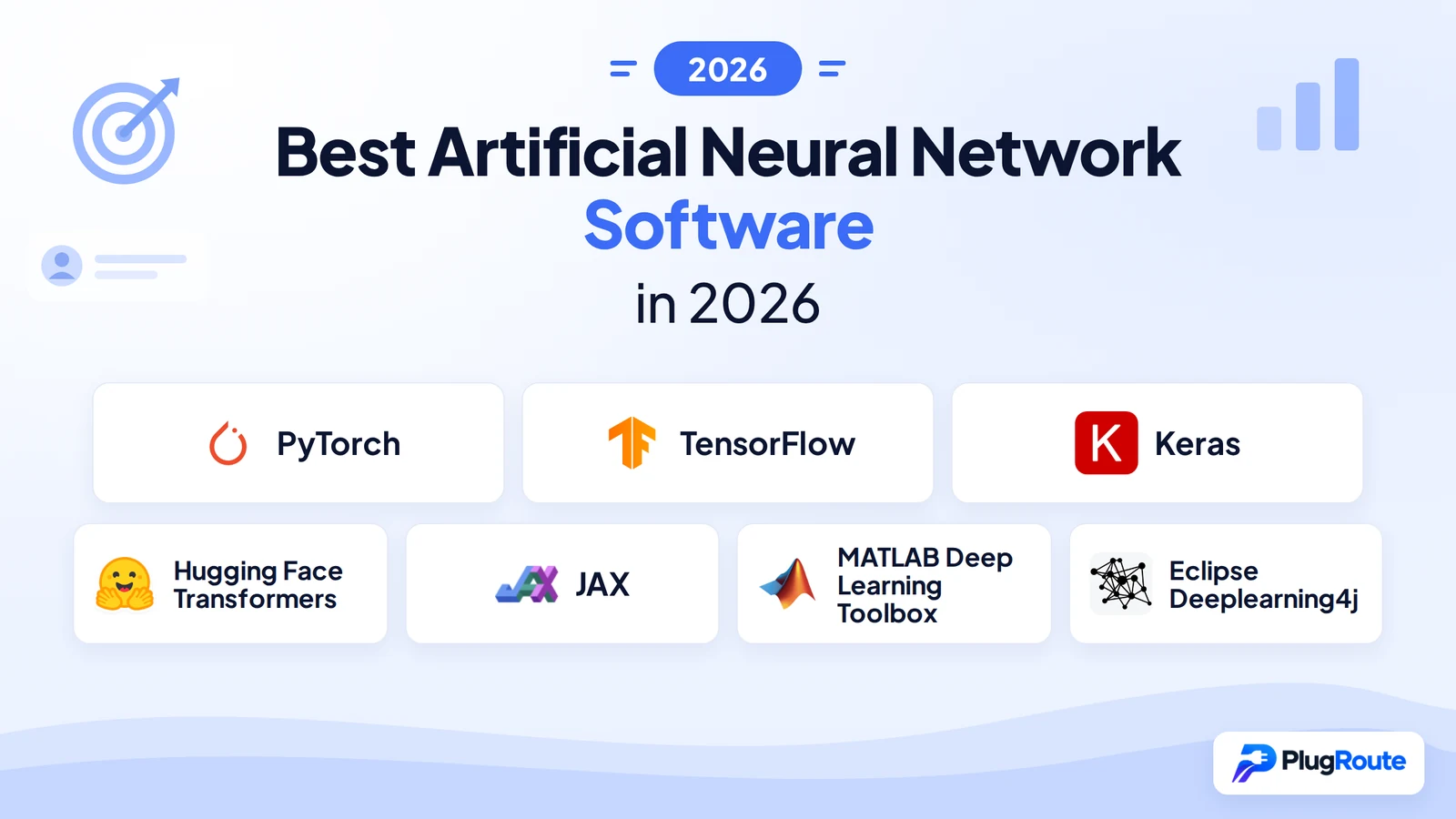
PyTorch ranks first for research ecosystem dominance; TensorFlow ranks second for unmatched multi-target deployment coverage across cloud, mobile, edge, and browser; Keras ranks third for rapid prototyping and multi-backend portability. The right framework depends on your specific constraint, community depth, deployment breadth, training throughput, or domain-specific integration requirements.
Seven tools in this evaluation serve seven meaningfully different use cases, conflating them leads to poor framework choices. Practitioners commonly mistake Keras for a TensorFlow-only tool (resolved by Keras 3 in 2023), overestimate TensorFlow’s new-project momentum from its installed-base market share, and overlook MATLAB Deep Learning Toolbox as a mandatory platform for regulated engineering environments.
PlugRoute has no affiliate relationships with any company listed, rankings are determined entirely by research data and objective evaluation criteria.
“PyTorch all the way. I apply to jobs daily nowadays, and I almost always see PyTorch listed as a requirement, TF also gets mentioned sometimes but not as much.” (u/Infinitrix02, r/datascience, 2025)
Takeaway: PyTorch’s dominance in job postings is the most practical career-oriented signal in this evaluation, and a stronger predictor of long-term ecosystem growth than any market share statistic.
TL;DR: Top Picks at a Glance
- PyTorch: broadest community ecosystem; the default choice for career development and most general ML work
- TensorFlow: five distinct deployment targets (cloud, mobile, edge, browser, multi-language); strongest integrated MLOps pipeline
- Keras: lowest boilerplate; the same code runs on TensorFlow, JAX, or PyTorch via a single environment variable
- Hugging Face Transformers: 1M+ pre-trained checkpoints; PEFT/LoRA enables billion-parameter fine-tuning on consumer GPUs
What Are the Three Categories of Artificial Neural Network Software?
The seven tools in this evaluation divide into three architectural tiers (Full Frameworks, Application Layers, and Domain-Specialized Platforms) each serving a different layer of the neural network software stack. Understanding which tier your project requires is the first decision point, and it eliminates at least two tools from consideration immediately.
Tier 1, Full Frameworks build, train, and deploy neural networks with direct hardware access:
- PyTorch: dynamic computation graphs; Python-native debugging; Linux Foundation governance
- TensorFlow: static and eager execution; broadest deployment ecosystem of any tool in this comparison
- JAX: XLA-compiled functional transformations; maximum throughput for parallelizable research workloads
Tier 2, Application Layers sit above Tier 1 engines to provide high-level APIs or pre-trained model access:
- Keras: multi-backend API layer running on TensorFlow, JAX, or PyTorch; lowest boilerplate in the comparison
- Hugging Face Transformers: model hub and fine-tuning library built primarily on PyTorch; 1M+ pre-trained checkpoints
Tier 3, Domain-Specialized Platforms serve specific industry or language environments where Tier 1 and Tier 2 tools do not reach:
- MATLAB Deep Learning Toolbox: regulated engineering with Simulink hardware-in-the-loop co-simulation
- Eclipse Deeplearning4j: JVM-native neural network inference for Java, Kotlin, and Scala enterprise environments
How Do the 7 Best Neural Network Frameworks Compare at a Glance?
PyTorch leads on community ecosystem, TensorFlow leads on deployment breadth, Keras leads on accessibility, and JAX leads on raw training throughput. The table below captures these distinctions at a glance; the Quick Decision Framework immediately following maps them to your use case.
| Rank | Company | Category | Best For | One-Line Summary | Key Capabilities | Primary Strength | Key Limitation |
|---|---|---|---|---|---|---|---|
| 1 | PyTorch | Framework | Research + general production ML | PyTorch is the open-source deep learning framework powering an estimated 90% of 2025 AI conference research, governed by the Linux Foundation’s PyTorch Foundation, making it the most community-validated and vendor-neutral choice for neural network development. | Dynamic graphs, torch.compile, DeepSpeed/vLLM, ONNX export, TorchServe, ExecuTorch | ~90% AI conference paper share (2025); dominant in ML job postings | Production MLOps assembly more complex than TFX |
| 2 | TensorFlow | Framework | Multi-target enterprise deployment | TensorFlow is Google’s open-source production ML framework offering the most comprehensive deployment ecosystem in this category, with native support for cloud, mobile, edge, IoT, and browser through TF Serving, TF Lite, TF.js, and TFX. | TF Serving, TF Lite/LiteRT, TF.js, TFX pipeline, multi-language bindings | Broadest deployment ecosystem (5 targets); integrated TFX MLOps pipeline | ~13,000 HF Hub models vs. 1M+ PyTorch; declining new-project adoption |
| 3 | Keras | API Layer | Rapid prototyping + multi-backend portability | Keras 3 is a multi-backend neural network API that runs on TensorFlow, JAX, or PyTorch via a single environment variable, providing the lowest-friction entry point for standard neural network tasks with no framework lock-in. | Multi-backend (TF/JAX/PyTorch), 100+ layers, KerasTuner, KerasCV, KerasNLP | Only tool eliminating backend lock-in via one env variable | Opinionated training loop constrains novel research architectures |
| 4 | Hugging Face Transformers | Model Hub + Fine-Tuning Platform | NLP, GenAI, pre-trained model applications | Hugging Face Transformers is the world’s largest open model repository and NLP/GenAI platform, uniquely enabling fine-tuning of billion-parameter models on consumer GPUs through PEFT and hosting over 1 million pre-trained checkpoints. | 1M+ model Hub, PEFT/LoRA, Datasets library, Inference Endpoints, pipeline API | 1M+ pre-trained checkpoints; PEFT enables LLM fine-tuning on consumer GPUs | PyTorch-native dependency; Trainer API complexity documented across community forums |
| 5 | JAX | Research Engine | Frontier research + high-performance computing | JAX is Google’s open-source high-performance numerical library powering AlphaFold 2 and Gemini, delivering documented 2–5x faster neural network training than PyTorch eager mode through XLA compilation and composable function transformations. | grad/jit/vmap/pmap, XLA compilation, TPU-native, Flax neural net library | Documented 2–5x training throughput vs. PyTorch eager; AlphaFold 2 and Gemini validated | Steep functional programming learning curve; no native serving infrastructure |
| 6 | MATLAB Deep Learning Toolbox | Commercial Platform | Regulated engineering + Simulink HIL validation | MATLAB Deep Learning Toolbox is MathWorks’ commercial neural network platform uniquely enabling hardware-in-the-loop co-simulation with Simulink for regulated engineering, with direct FPGA and SoC code generation from trained models. | Deep Network Designer GUI, Simulink HIL, FPGA/SoC code gen, ONNX/PyTorch/TF import | Only Simulink HIL co-simulation capability in this evaluation; FPGA deployment | ~$860–$940/yr commercial license; closed proprietary ecosystem |
| 7 | Eclipse Deeplearning4j | JVM Framework | Java/JVM enterprise without Python runtime | Eclipse Deeplearning4j is the leading JVM-native deep learning framework providing the only production-grade pathway for building neural network pipelines in Java, Kotlin, or Scala without a Python runtime dependency, with native Apache Spark integration. | JVM-native (Java/Kotlin/Scala), ND4J, Spark integration, Keras import, SameDiff | Only Java-native neural network framework in this evaluation | Post-Skymind sustainability concerns; retired modules; near-zero community brand recognition |
Which Neural Network Framework Should I Choose for My Use Case?
| Your #1 Priority | Recommended Tool | Why | Acceptable Alternative |
|---|---|---|---|
| Broadest community ecosystem + career value | PyTorch | ~90% of 2025 AI conference papers; dominates ML job postings | TensorFlow (for legacy codebases) |
| Multi-target production deployment (cloud/mobile/edge/browser) | TensorFlow | Five pathways: TF Serving, TF Lite/LiteRT, TF.js, TFX, multi-language bindings | PyTorch + ONNX + TorchServe (assembled stack) |
| Fastest prototyping + zero framework lock-in | Keras | Same code runs on TensorFlow, JAX, or PyTorch via one env variable | PyTorch Lightning |
| NLP/GenAI pre-trained model applications | Hugging Face Transformers | 1M+ model checkpoints; PEFT/LoRA for billion-parameter fine-tuning on consumer GPUs | PyTorch with manual model loading |
| Maximum training throughput for frontier research | JAX | Documented 2–5x faster than PyTorch eager on GPU/TPU; powers AlphaFold 2 and Gemini | PyTorch + torch.compile |
| Regulated engineering (automotive/aerospace/biomedical) + Simulink HIL | MATLAB Deep Learning Toolbox | Only Simulink co-simulation + FPGA code generation in this evaluation | None; no open-source equivalent for HIL validation |
| Java/JVM enterprise without Python runtime dependency | Eclipse Deeplearning4j | Only JVM-native deep learning framework with native Spark integration | ONNX Runtime with Java bindings (inference-only) |
| Beginner entering the ML field | Keras → PyTorch | Keras: lowest boilerplate to first working model; PyTorch: industry destination | FastAI (built on PyTorch) |
1. PyTorch: Best Overall: Research Ecosystem Leader and Emerging Production Standard

Category: Framework, a complete open-source deep learning development environment for building, training, debugging, and deploying neural networks, built on dynamic computation graphs.
At a Glance
- Category: Framework
- Best For: Research teams, ML engineers building production applications, and any practitioner who needs the broadest ecosystem, community support, and long-term framework career value
- Price Range: Free (BSD license): cloud compute costs only (e.g., AWS A100: ~$3.67/hour on-demand)
- Primary Strength: PyTorch commands an estimated 90%+ share of major AI conference papers in 2025 and hosts the overwhelming majority of the 1M+ models on Hugging Face’s Hub, making it the dominant framework for both research and emerging production deployment
- Biggest Limitation: PyTorch’s production deployment stack (TorchServe, ONNX export, Triton) requires more assembly than TensorFlow’s integrated TFX MLOps pipeline, adding configuration overhead for enterprise teams without existing ML infrastructure
- One-Line Summary: PyTorch is the open-source deep learning framework that powers an estimated 90% of 2025 AI conference research and is governed by the Linux Foundation’s PyTorch Foundation, making it the most community-validated and vendor-neutral choice for neural network development.
- Last Verified: April 2026
Overview
PyTorch is an open-source deep learning framework developed by Meta AI and now governed by the Linux Foundation’s PyTorch Foundation, designed for data scientists, ML engineers, and researchers who need dynamic computation graphs, a Python-native debugging experience, and access to the broadest neural network community ecosystem in the field.
PyTorch’s trajectory from research-dominant tool to production-ready platform accelerated through four major 2025 releases, versions 2.6, 2.7, 2.8, and 2.9, each delivering compiler improvements, distributed training enhancements, and serving infrastructure (PyTorch Foundation 2025 Year in Review).
The 2025 expansion of the PyTorch Foundation to include vLLM, DeepSpeed, and Ray as hosted projects signals a deliberate push toward closing the LLM production serving gap that previously gave TensorFlow an enterprise advantage.
Key Features
- Dynamic Computation Graphs: PyTorch’s eager execution constructs the forward pass using standard Python control flow, enabling researchers to modify model architecture mid-run and debug with standard Python tools, eliminating the recompilation cycles required by static-graph frameworks and ranking as PyTorch’s most important usability advantage among practitioners.
- torch.compile API: PyTorch’s torch.compile (introduced in version 2.0, enhanced through 2.9) applies JIT compilation and kernel fusion to eager-mode code without requiring graph-mode refactoring, delivering documented performance improvements of 30–200% on supported workloads (PyTorch at GTC 2025).
- DeepSpeed and vLLM Integration: PyTorch integrates natively with DeepSpeed (Microsoft Research) and vLLM (both now PyTorch Foundation projects) enabling LLM serving with documented 3.4x faster time-to-first-token and 1.7x higher throughput versus baseline configurations (Snowflake Engineering Blog, PyTorch Conference).
- FlexAttention API: PyTorch’s FlexAttention (introduced in version 2.5) achieves 90% of FlashAttention2’s forward-pass performance and 85% of its backward-pass performance on A100 GPUs while allowing user-defined attention variants, enabling custom attention mechanism research without writing CUDA kernels (PyTorch at GTC 2025).
- Production Inference Ecosystem: PyTorch supports production inference via TorchServe (REST/gRPC model serving), ONNX export (cross-framework deployment), PyTorch Mobile (iOS/Android), and ExecuTorch (edge/embedded inference), covering the primary deployment targets practitioners require across cloud, mobile, and edge environments.
Best For
PyTorch is best for data scientists and ML engineers building novel neural network architectures, fine-tuning large pre-trained models, or deploying applications that benefit from the broadest open-source model ecosystem, particularly in computer vision, NLP, time series forecasting, and reinforcement learning.
PyTorch is also the recommended framework for practitioners optimizing for career development, as it dominates ML job market requirements and open-source repository contributions in 2026.
Pricing
PyTorch carries zero licensing cost regardless of deployment scale under the BSD license. The only costs are cloud compute infrastructure, available from any provider (AWS, Azure, GCP, or on-premises hardware). [Verified April 2026]
Strengths
- Research Paper Dominance: PyTorch accounts for an estimated 90%+ of papers submitted to major AI conferences (NeurIPS, ICML, ICLR) in 2025 (up from approximately 50% in 2018) making it the near-universal framework for the next generation of ML engineers and the most reliable leading indicator of continued ecosystem growth (Papers With Code framework tracking; community analysis, r/MLQuestions, April 2026).
- Vendor-Neutral Linux Foundation Governance: The PyTorch Foundation: governed by the Linux Foundation with NVIDIA as a founding Premier Member, and vLLM, DeepSpeed, and Ray added as 2025 foundation projects, provides institutional vendor-neutrality protecting enterprise adopters from any single organization’s business decisions (PyTorch Foundation 2025 Year in Review).
- Exceptional 2025 Development Velocity: PyTorch’s four major releases in 2025 (versions 2.6, 2.7, 2.8, and 2.9) demonstrate a development cadence that consistently integrates cutting-edge research, FlexAttention, torch.compile enhancements, distributed training improvements, faster than any comparable framework in this evaluation (PyTorch Foundation 2025 Year in Review).
- Validated LLM Serving Performance: DeepSpeed integration with PyTorch delivers 3.4x faster time-to-first-token, 1.7x higher throughput, and 1.75x faster time-per-output-token in documented LLM serving configurations, validated production numbers that senior engineers can present for infrastructure justification (Snowflake Engineering Blog, PyTorch Conference).
Limitations
- Production MLOps Assembly Overhead: PyTorch’s most consequential limitation relative to TensorFlow is its production MLOps assembly requirement, TensorFlow’s TFX pipeline provides native data ingestion, profiling, preprocessing, training, validation, deployment, and artifact lineage as an integrated suite, while equivalent PyTorch production pipelines typically require assembling TorchServe, MLflow or Ray, and ONNX export as separately configured components (Blackthorn Vision TF vs. PyTorch analysis).
- JAX Performance Gap on Parallelizable Workloads: PyTorch is documented at approximately 2–3x slower than JAX in highly parallelizable research workloads (including RL benchmarks using vmap over environment batches) a real trade-off for teams doing frontier AI research that can fully exploit JAX’s functional transformation stack (r/MachineLearning, 2023).
- Edge Deployment Format Conflict: Practitioners deploying to edge targets spanning both PyTorch and TensorFlow Lite report a documented channel-last versus channel-first tensor format conflict, a costly migration issue for teams working across both ecosystems (u/StillWastingAway, r/datascience, 2025).
Verdict
PyTorch is the most broadly validated neural network framework in 2026, commanding an estimated 90% of AI conference paper citations, the largest open-source model ecosystem, and vendor-neutral Linux Foundation governance, making it the objectively strongest general-purpose choice for practitioners optimizing across research productivity, production deployment access, and long-term framework career value.
The 2025 additions of vLLM and DeepSpeed to the PyTorch Foundation ecosystem close the LLM production serving gap that previously gave TensorFlow an enterprise advantage.
Teams who need native MLOps pipeline integration (TFX) or regulated engineering workflows (Simulink HIL) should evaluate TensorFlow and MATLAB Deep Learning Toolbox respectively before defaulting to PyTorch.
2. TensorFlow: Best for Production Deployment Breadth and Enterprise MLOps Pipelines
Category: Framework, a production-grade open-source ML platform for building, training, and deploying neural networks, with the broadest deployment target ecosystem in this category (cloud, mobile, edge, browser, and IoT).
At a Glance
- Category: Framework
- Best For: Enterprise ML engineering teams deploying models to multiple environments (production server, mobile, edge, browser) who need an integrated MLOps pipeline and the widest deployment target coverage
- Price Range: Free (Apache 2.0): cloud compute costs via any provider (Google Cloud T4: ~$0.35/hour; A100: ~$3.60/hour on-demand)
- Primary Strength: TensorFlow provides five distinct deployment pathways: TF Serving (production), TF Lite/LiteRT (edge/mobile), TF.js (browser/Node.js), TFX (MLOps pipeline), and multi-language bindings, making it the only framework in this evaluation natively covering the full model lifecycle from training to microcontroller inference
- Biggest Limitation: TensorFlow’s new project adoption has declined sharply relative to PyTorch (approximately 13,000 TensorFlow models appear on Hugging Face’s Hub versus over 1 million PyTorch models) signaling shrinking practitioner momentum that affects tutorial availability, third-party tooling, and the hiring pool for experienced practitioners
- One-Line Summary: TensorFlow is Google’s open-source production ML framework offering the most comprehensive deployment ecosystem in this category, with native support for cloud serving, mobile, edge, IoT, browser, and multi-language environments through TF Serving, TF Lite, TF.js, and TFX.
- Last Verified: April 2026
Overview
TensorFlow is Google’s open-source machine learning framework designed for ML engineers and enterprise teams who need to train neural networks and deploy them across the broadest possible range of targets (from production cloud servers to mobile devices, edge hardware, and web browsers) within a single vendor ecosystem (TensorFlow official documentation).
TensorFlow’s layered API architecture, from the low-level Core API (tf.Tensor, tf.GradientTape) to the high-level Keras API, combined with TFX’s integrated MLOps pipeline, positions TensorFlow as the most operationally complete framework for teams managing the full model lifecycle.
TensorFlow’s documented community momentum shift toward PyTorch and JAX (evidenced by fewer than 1% of Hugging Face Hub models being TensorFlow-native) means that its deployment ecosystem advantage must be weighed against a narrowing practitioner talent pool.
Key Features
- Five-Target Deployment Ecosystem: TensorFlow’s deployment architecture spans TF Serving (production REST/gRPC model server), TF Lite/LiteRT (mobile and embedded inference with INT8/float16 quantization and hardware delegation for Adreno, Mali, and Apple GPU), TF.js (browser and Node.js inference), TFX (MLOps pipeline with artifact lineage), and multi-language bindings including Python, R, Java, and Go, a breadth no other framework in this comparison matches (TensorFlow documentation).
- TensorFlow Extended (TFX) Native MLOps Pipeline: TFX provides modular pipeline components for data ingestion, profiling, preprocessing, model training, validation, and deployment, including artifact lineage tracking critical for audit trails in regulated industries such as financial services and healthcare (Blackthorn Vision TF vs. PyTorch analysis).
- Multi-Language Binding Architecture: TensorFlow supports Python (primary), R, Java, Go, Rust, and community-maintained Haskell bindings, giving TensorFlow relevance in polyglot enterprise environments where Python may not be the primary deployment language (Altoros TensorFlow API overview).
- TF Lite/LiteRT Hardware-Accelerated Edge Inference: TensorFlow Lite/LiteRT supports hardware-accelerated on-device inference via GPU delegates (Adreno, Mali, Apple GPU), NNAPI integration, and INT8 quantization for microcontrollers and embedded Linux systems, the most documented edge AI deployment pathway among the frameworks evaluated (TensorFlow learn portal).
- TensorFlow.js Browser and Node.js Performance: TensorFlow.js delivers JavaScript-native inference with documented performance of up to 2x faster end-to-end processing than equivalent Python implementations in Node.js inference-only workloads due to V8 engine and JIT optimizations (Google AI Discuss forum benchmark discussion).
Best For
TensorFlow is best for enterprise ML engineering teams who require a framework covering the full model lifecycle (from Python training to deployment across production cloud APIs, mobile applications, edge devices, and browser environments) within a single vendor ecosystem.
TensorFlow is also the right tool for organizations requiring integrated MLOps pipelines with artifact lineage for regulatory compliance or audit trail requirements.
Pricing
TensorFlow carries zero licensing cost under Apache 2.0. Cloud training on Google Cloud Vertex AI costs approximately $0.35/hour (NVIDIA T4) to $3.60/hour (A100) on-demand. TensorFlow is not vendor-locked and runs on any cloud provider or on-premises hardware. [Verified April 2026]
Strengths
- Most Operationally Complete Deployment Ecosystem: TensorFlow’s five deployment targets, TF Serving, TF Lite/LiteRT with INT8 quantization and GPU-delegate support, TF.js for browser and Node.js, TFX for full MLOps pipeline management, and multi-language bindings covering Java, Go, R, and Rust, represent a deployment breadth no other framework in this comparison matches (TensorFlow official documentation, 2026).
- Self-Contained Enterprise ML Pipeline: TFX provides native MLOps pipeline tooling (data ingestion, profiling, preprocessing, training, validation, deployment, and artifact lineage) without requiring third-party orchestration tools, making TensorFlow the framework with the most self-contained enterprise ML pipeline capability (Blackthorn Vision TF vs. PyTorch analysis; TensorFlow documentation).
- Ten-Year Production Track Record: TensorFlow has over 185,000 GitHub stars, an Apache 2.0 license, and was open-sourced by Google in November 2015, a decade of production deployment that creates organizational inertia and extensive legacy documentation relevant for teams maintaining existing TensorFlow codebases (TensorFlow GitHub; Wikipedia TensorFlow).
- JavaScript-Native Inference Speed: TensorFlow.js delivers documented 2x faster end-to-end inference processing than Python implementations in certain Node.js workloads, a genuine performance niche for browser-based or JavaScript-native deployment scenarios where no other major framework operates natively (Google AI Discuss forum benchmark discussion, 2026).
Limitations
- Declining Community Momentum: TensorFlow’s most consequential trade-off in 2026 is the gap between its strong installed base and declining practitioner momentum, approximately 13,000 TensorFlow-native models on Hugging Face’s Hub versus over one million PyTorch models, a ratio that affects tutorial availability, third-party tooling compatibility, and hiring of current TensorFlow practitioners (AceCloud AI, 2025).
“Personally I haven’t touched TF in about 5 years now. Check Huggingface, 1.5M models. 13k are Tensorflow. Soon there’s almost more JAX.” (u/met0xff, r/datascience, 2025)
Takeaway: The Hugging Face Hub model ratio is a more reliable current signal of practitioner preference than any legacy market share statistic.
- Google’s Internal JAX Pivot: Community discussion consistently notes that Google shifted frontier model training (Gemini, PaLM, AlphaFold 2) to JAX rather than TensorFlow, signaling that TensorFlow’s technical leadership even within Google has eroded (u/poorpeon, r/datascience, 2025).
- Talent Pool Narrowing: The reported 38% TensorFlow market share reflects legacy enterprise deployments built between 2016 and 2021 (not new project starts) meaning teams hiring TensorFlow-specialized engineers in 2026 face a materially smaller candidate pool than PyTorch teams do.
Verdict
TensorFlow is the strongest choice for enterprise ML teams whose primary constraint is deployment breadth, specifically organizations needing to serve models across production cloud APIs, mobile applications, edge devices, and browser environments using a single framework ecosystem.
TensorFlow’s TFX MLOps pipeline, TF Serving maturity, and TF Lite/LiteRT edge AI capabilities are genuine competitive advantages that PyTorch’s assembled production stack does not yet replicate with equivalent integration.
Teams starting new projects without an existing TensorFlow codebase should carefully weigh PyTorch’s dramatically larger community ecosystem and equivalent production serving capabilities (via TorchServe and ONNX) before defaulting to TensorFlow’s brand recognition.
3. Keras: Best for Rapid Prototyping and Multi-Framework Portability
Category: API Layer, a high-level multi-backend neural network API that runs on TensorFlow, JAX, or PyTorch, providing a unified interface for building and training neural networks without framework lock-in.
At a Glance
- Category: API Layer
- Best For: Practitioners building standard neural network architectures who value rapid prototyping speed, framework portability, and the lowest possible onboarding overhead, particularly beginners, teams delivering proof-of-concept models, and practitioners wanting to defer backend selection
- Price Range: Free (Apache 2.0): no commercial tier of any kind
- Primary Strength: Keras 3’s multi-backend design allows the same model code to execute on TensorFlow, JAX, or PyTorch via a single environment variable switch, making Keras the only tool in this evaluation that eliminates framework lock-in for new projects without requiring code rewrites
- Biggest Limitation: Keras’s opinionated training loop API (the
.fit()abstraction) constrains practitioners working on novel research architectures, custom loss functions, non-standard optimizers, and multi-objective training scenarios frequently require abandoning Keras’s abstractions and writing backend-native code, at which point practitioners are effectively using PyTorch or JAX directly - One-Line Summary: Keras 3 is a multi-backend neural network API that lets practitioners write standard deep learning code once and run it on TensorFlow, JAX, or PyTorch via a single environment variable, providing the lowest-friction entry point for standard neural network tasks with no framework lock-in.
- Last Verified: April 2026
Overview
Keras is an open-source high-level neural network API created by François Chollet and designed for data scientists, students, and ML practitioners who want the fastest path from problem to working model, with the widely misunderstood advantage that Keras 3 (released late 2023) allows the same code to run on TensorFlow, JAX, or PyTorch via a single environment variable switch (Keras 3 official documentation).
Keras is not TensorFlow-only: this is the most consequential misconception about Keras among active practitioners today, and Keras 3 resolved it completely.
Keras functions as an API layer above the underlying frameworks, providing over 100 pre-built layers, loss functions, optimizers, and callbacks without requiring practitioners to manage backend-specific APIs directly.
Key Features
- Three Interchangeable Backends: Keras 3 supports TensorFlow, JAX, and PyTorch as interchangeable backends (selectable via a single
KERAS_BACKENDenvironment variable) allowing the same Sequential, Functional API, or Model subclassing code to execute on any of the three frameworks without code modification (Keras 3 official documentation; PyImageSearch Keras Core explainer). - 100+ Pre-Built Components: Keras provides over 100 pre-built layers, dozens of metrics, loss functions, and optimizers, as well as callbacks for learning rate scheduling, early stopping, model checkpointing, and TensorBoard logging, covering the majority of standard deep learning tasks without requiring custom implementation.
- JAX Backend Throughput Advantage: Keras’s JAX backend delivers documented inference performance of approximately 376 steps/ms on the SegmentAnything model benchmark, compared to 1,720 steps/ms on PyTorch eager mode, a 4.5x throughput advantage demonstrating that Keras’s abstraction layer does not negate the underlying backend’s performance characteristics (Keras.io official benchmarks, 2024).
- Backend-Native Training Loop Integration: Keras 3 provides low-level integration with backend-native training loops (JAX training loops, PyTorch training loops, or TensorFlow GradientTape) allowing practitioners to mix Keras layer definitions with custom training logic when the
.fit()abstraction is insufficient. - Companion ML Libraries: Keras includes KerasTuner (hyperparameter tuning), KerasCV (computer vision preprocessing and augmentation), and KerasNLP (natural language processing utilities) as companion libraries, extending Keras’s coverage beyond core model definition to end-to-end ML workflows.
Best For
Keras is best for practitioners building standard supervised learning architectures (classification, regression, sequence modeling, image recognition) who want to start working immediately without framework configuration overhead, and for teams wanting to defer the TensorFlow versus PyTorch versus JAX backend decision until performance requirements are clear.
Keras is also the recommended starting framework for ML students and beginners, providing the clearest path to a working model and the most immediate feedback loop for learning neural network fundamentals.
Pricing
Keras, KerasTuner, KerasCV, and KerasNLP are entirely free under Apache 2.0 with no commercial obligations, paid tiers, or enterprise licensing costs. Keras users pay only for underlying compute infrastructure. [Verified April 2026]
Strengths
- Unique Multi-Backend Portability at Zero Cost: Keras 3’s backend-switching capability eliminates framework lock-in via a single environment variable (
KERAS_BACKEND=jax,KERAS_BACKEND=torch, orKERAS_BACKEND=tensorflow) a capability that no other tool in this evaluation provides, confirmed with 43 upvotes by the practitioner community as genuinely accessible (Keras 3 official documentation, late 2023; u/Any-Stick-771, r/MLQuestions, 2026).
This perspective on framework portability extends to how experienced ML practitioners view the broader selection question. As one ML hiring manager on r/datascience noted in 2025:
“People really overestimate the importance of this. I just interviewed a candidate who has extensive TF experience but hasn’t used torch, and I didn’t think twice about it: if you know one you can learn the other very easily. The most important framework to use is the one your job uses. Torch is probably more popular for new projects, but there are lots of big successful companies using TF to power services you likely use every day.” Posted by u/busybody124
Takeaway: Experienced ML interviewers treat deep learning framework knowledge as readily transferable, validating Keras as a legitimate starting framework by confirming that proficiency in any high-level API translates directly to cross-ecosystem employability.
- JAX-Level Performance via High-Level API: Keras’s JAX backend delivers documented 4.5x faster inference throughput than PyTorch eager mode on the SegmentAnything benchmark (376 steps/ms vs. 1,720 steps/ms on PyTorch eager), demonstrating that high-level API convenience does not require trading away backend performance (Keras.io official benchmarks, 2024).
- Longest High-Level API Track Record: Keras was created by François Chollet (Google Brain) in March 2015 and has maintained the longest continuous community track record of any high-level neural network API in this comparison, eight years of curriculum integration and tutorial production representing a substantial learning resource base for new practitioners.
- Lowest Boilerplate Path to First Working Model: Keras’s
.fit()/.predict()/.evaluate()API is the lowest-boilerplate path to a trained neural network in this comparison, a standard classification model can be defined, compiled, and trained in fewer than 15 lines of code, making Keras the most time-efficient framework for validating architectural ideas in early-stage research.
Limitations
- Opinionated Training Loop Boundaries: Keras’s most consequential limitation is the boundary of its opinionated training loop abstraction, research-grade work involving custom loss functions, multi-objective training, non-standard optimizers, or architectures outside Keras’s layer-input-output graph model frequently requires abandoning Keras’s abstractions entirely, at which point practitioners are effectively using PyTorch or JAX directly with an unnecessary Keras layer added (u/PassionatePossum, r/MLQuestions, 2026).
- Migration Pressure to PyTorch: GitHub repositories for state-of-the-art models are written almost exclusively in PyTorch, creating a migration pressure that most Keras users encounter as their career progresses: “Eventually you’ll need to dig into some ML GitHub repos that almost definitely use PyTorch” (u/Any-Platypus-3570, r/MLQuestions, 2026).
Takeaway: Keras is an excellent entry point, but community data consistently frames it as a waypoint rather than a final destination for practitioners engaging with the broader ML ecosystem.
- No Automated Migration Path for Legacy Codebases: Keras is not an automated conversion tool, manually migrating existing PyTorch or JAX codebases to Keras requires full rewrites, limiting the multi-backend portability benefit exclusively to new projects started in Keras (GitHub keras-team/keras discussions, 2024).
Verdict
Keras 3 is the fastest, most portable entry point for standard neural network development in 2026, its multi-backend architecture makes it the only framework in this evaluation that eliminates backend lock-in at zero cost, a feature that a substantial fraction of active practitioners still do not know exists.
For practitioners building standard architectures, Keras’s combination of low boilerplate, multi-backend portability, and documented JAX-backend performance (4.5x faster than PyTorch eager in documented benchmarks) represents genuine, measurable value.
Advanced practitioners and researchers working on novel architectures should plan their progression to PyTorch; Keras is an excellent starting framework, but community data consistently shows it as a waypoint rather than a final destination.
4. Hugging Face Transformers: Best for NLP, GenAI, and Pre-Trained Model Applications
Category: Model Hub + Fine-Tuning Platform, the world’s largest open pre-trained model repository combined with NLP/GenAI fine-tuning libraries (Transformers, PEFT, Diffusers, Datasets) built on a PyTorch-primary backend.
At a Glance
- Category: Model Hub + Fine-Tuning Platform
- Best For: Teams building NLP, GenAI, computer vision, audio, and multimodal applications using pre-trained models and parameter-efficient fine-tuning, particularly practitioners who want to reach production with a pre-trained LLM, image model, or audio model without training from scratch
- Price Range: Free (core Transformers library + Hub downloads) → Inference Endpoints and AutoTrain (per GPU-hour/job at huggingface.co/pricing); Enterprise Hub (custom pricing)
- Primary Strength: Hugging Face hosts over 1 million pre-trained model checkpoints on the world’s largest open model repository, and its PEFT library enables fine-tuning of billion-parameter language models on consumer GPUs by updating as few as 0.1% of model parameters
- Biggest Limitation: Hugging Face Transformers is PyTorch-native: approximately 1 million PyTorch models on the Hub versus roughly 13,000 TensorFlow models, making its ecosystem advantages significantly smaller for TensorFlow-based teams; the Trainer API also receives consistent documented criticism for API complexity and documentation quality gaps
- One-Line Summary: Hugging Face Transformers is the world’s largest open model repository and NLP/GenAI development platform, uniquely enabling fine-tuning of billion-parameter models on consumer GPUs through its PEFT library and hosting over 1 million pre-trained checkpoints across vision, audio, NLP, and multimodal domains.
- Last Verified: April 2026
Overview
Hugging Face Transformers is an open-source NLP and GenAI development platform built primarily on PyTorch, designed for ML engineers and application developers who need access to pre-trained models for NLP, computer vision, audio, and multimodal tasks without training neural networks from scratch (Hugging Face Transformers documentation).
Hugging Face occupies a unique position in this evaluation, Hugging Face Transformers is not a neural network training framework but a model hub and fine-tuning platform that sits above PyTorch, dramatically compressing time-to-deployment for teams building applications rather than developing new architectures.
Hugging Face’s PEFT library (LoRA, QLoRA, and related methods) democratized LLM fine-tuning by making billion-parameter model adaptation feasible on consumer GPUs, arguably the development that most transformed practical LLM adoption between 2024 and 2026.
Key Features
- 1M+ Pre-Trained Model Hub: Hugging Face’s Model Hub hosts over 1 million pre-trained model checkpoints across NLP, computer vision, audio, and multimodal domains (the largest open model repository in the world) with a network effect where each community fine-tune increases Hub value for all users (Hugging Face GitHub).
- PEFT Parameter-Efficient Fine-Tuning Library: Hugging Face’s PEFT library implements LoRA, QLoRA, and related parameter-efficient methods natively on PyTorch, enabling fine-tuning of billion-parameter language models on consumer GPUs by updating as few as 0.1% of model parameters, reducing GPU memory requirements by an estimated 60–80% versus full fine-tuning in documented configurations (Hugging Face Transformers documentation).
- Unified Inference Pipeline API: Hugging Face Transformers provides a unified pipeline API for inference across tasks (text classification, named entity recognition, question answering, text generation, image classification, audio transcription) enabling practitioners to load a pre-trained model and run inference in three to five lines of Python.
- Inference Endpoints Managed Serving: Hugging Face’s Inference Endpoints service provides managed model serving on dedicated GPU instances, enabling teams to deploy Hub models to a production REST API without managing server infrastructure (Hugging Face pricing).
- Datasets Library Integration: Hugging Face’s Datasets library provides access to thousands of benchmark and fine-tuning datasets with standardized loading, preprocessing, and streaming interfaces, tightly integrated with the Transformers training workflow to create an end-to-end fine-tuning data pipeline.
Best For
Hugging Face Transformers is best for ML engineers and application developers building NLP, GenAI, computer vision, and audio applications who need to fine-tune pre-existing models rather than architect new ones from scratch, particularly teams working on LLM-powered applications, document understanding, or audio transcription where a pre-trained checkpoint exists on the Hub.
Hugging Face Transformers is also the recommended starting point for practitioners entering the LLM fine-tuning space who want to leverage PEFT/LoRA to achieve billion-parameter fine-tuning on hardware budgets that would otherwise make the task infeasible.
Pricing
Hugging Face’s core Transformers library and model Hub downloads are free with no usage caps. Commercial services include Inference Endpoints (managed GPU serving, pricing per GPU-hour at huggingface.co/pricing), AutoTrain (no-code fine-tuning, priced per job), and Enterprise Hub (team access controls, private model repos, SLA, custom pricing). The cost transition from free local use to production Inference Endpoints can be significant; teams should evaluate self-hosted TorchServe or vLLM alternatives before committing to managed endpoints. [Verified April 2026]
Strengths
- PEFT Democratized Billion-Parameter Fine-Tuning: Hugging Face’s PEFT library implements LoRA, QLoRA, and parameter-efficient methods that update as few as 0.1% of model parameters, enabling billion-parameter model fine-tuning on consumer GPUs and making frontier AI capabilities accessible to research groups and startups that previously could not afford multi-GPU training runs (Hugging Face PEFT documentation; Blackthorn Vision framework analysis, 2026).
- World’s Largest Open Model Repository: Hugging Face hosts over 1 million pre-trained model checkpoints, a network effect that organizations including Azure Databricks have integrated into their enterprise ML workflow documentation (Hugging Face GitHub; Microsoft Azure Databricks documentation, 2026).
- $4.5B Valuation Supports Platform Investment: Hugging Face raised a Series D at a $4.5 billion valuation in August 2023, providing the capital foundation for sustained infrastructure investment in the Hub, PEFT ecosystem, and Inference Endpoints, giving practitioners reasonable confidence in continued platform commitment.
- Lowest-Friction Pre-Trained Model Access: Hugging Face’s unified pipeline API enables practitioners to load any Hub model and run task inference in fewer than five lines of Python, the most accessible production-model-access interface in this comparison for common NLP and computer vision inference tasks (Hugging Face Transformers documentation, 2026).
Limitations
- Structural PyTorch Dependency: Hugging Face’s most consequential trade-off is its structural PyTorch dependency, with approximately 1 million PyTorch-native models on the Hub versus roughly 13,000 TensorFlow models, TensorFlow-based teams receive substantially reduced Hub value, with most models requiring ONNX conversion or framework-switching to access (u/met0xff, r/datascience, 2025).
- Trainer API Complexity and Documentation Gaps: Hugging Face’s Trainer API and AutoTokenizer pipeline receive consistent practitioner criticism for API complexity, inconsistent documentation, and behavior that is difficult to debug outside of standard configurations, a pattern documented across multiple r/learnmachinelearning threads.
Users on r/learnmachinelearning captured this dynamic directly:
“Yeah it’s super cool. Then something breaks and those stack traces are a nightmare. Abstraction is cool until it breaks. I do like hugging face though despite the flaws” Posted by u/hinsonan
Takeaway: Hugging Face’s abstraction layers dramatically accelerate the path to a working model, but when they fail, the debugging experience is substantially more painful than working directly with PyTorch, a tradeoff practitioners should factor into production support planning.
- Free-to-Paid Cost Jump at Production Scale: The commercial transition from free local use to production Inference Endpoints introduces a potentially significant cost increase that practitioners should evaluate against self-hosted TorchServe or vLLM alternatives before committing to managed infrastructure (Hugging Face pricing, 2026).
Verdict
Hugging Face Transformers is the best-positioned tool in this evaluation for teams building NLP, GenAI, computer vision, or audio applications using pre-trained models, the 1 million+ model Hub and PEFT/LoRA fine-tuning infrastructure represent capabilities with no direct equivalent among the other six tools compared.
Hugging Face Transformers is a model hub and application development platform, not a neural network training framework, and practitioners who need to architect novel neural network architectures or train models from scratch will find PyTorch or JAX better suited to their needs.
TensorFlow-based teams should carefully evaluate the PyTorch-native Hub dependency before treating Hugging Face as a primary platform.
5. JAX: Best for Frontier Research and High-Performance Computing Workloads
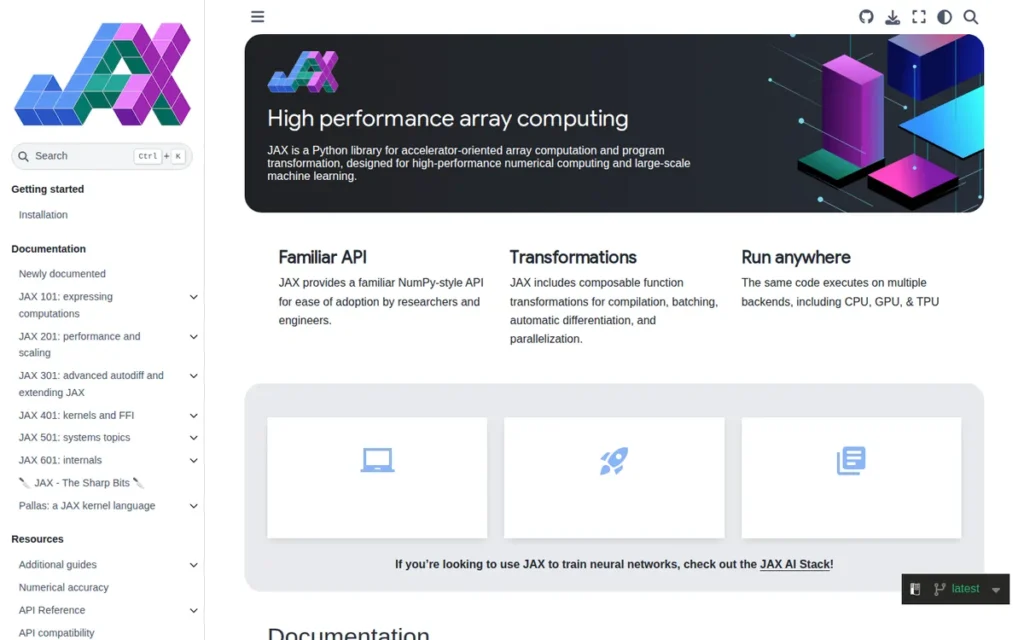
Category: Research Engine, a functional numerical computing library with composable XLA-compiled transformations (grad, jit, vmap, pmap) for high-performance neural network research, requiring functional programming paradigm knowledge.
At a Glance
- Category: Research Engine
- Best For: Research teams and advanced ML practitioners working on frontier AI models, reinforcement learning, transformer-scale training, and scientific computing who require maximum training throughput and are comfortable with functional programming paradigms
- Price Range: Free (Apache 2.0): Google Cloud TPU v5e ~$1.20/hour (8-chip pod, on-demand); free TPU access via Google Colab for prototyping
- Primary Strength: JAX achieves documented 2–5x faster training than PyTorch eager mode through XLA compilation and composable function transformations, with frontier-scale production validation including AlphaFold 2, PaLM, Gemma, and Gemini, the strongest performance evidence of any framework in this evaluation
- Biggest Limitation: JAX’s functional programming paradigm: requiring pure functions, immutable arrays, and explicit parameter management, imposes a steep learning curve that a 67-upvote community warning indicates can negate performance gains for practitioners without prior functional programming experience; JAX also provides no native neural network serving infrastructure
- One-Line Summary: JAX is Google’s open-source high-performance numerical computing library that powers AlphaFold 2 and Gemini, delivering documented 2–5x faster neural network training than PyTorch eager mode through XLA compilation and composable function transformations including automatic differentiation, vectorization, and multi-device parallelism.
- Last Verified: April 2026
Overview
JAX is Google’s open-source high-performance numerical computing library for advanced ML researchers and practitioners who need maximum training throughput through XLA compilation, composable function transformations, and native TPU support, and who are comfortable working in a functional programming paradigm (JAX official documentation).
Unlike PyTorch and TensorFlow, which use mutable-state neural network objects, JAX requires pure functions and explicit parameter management, enabling its compiler to perform optimizations that are architecturally impossible with mutable-state frameworks.
This performance-versus-paradigm tradeoff is consistently reported by practitioners who have made the switch. As one researcher on r/MachineLearning described after migrating a project from PyTorch to JAX:
“I recently switched from Pytorch to Jax (for my research project): While Jax is definitely performant, it is also definitely harder to code than Pytorch (or at least if you want to have performance). Also, the documentation is definitely lacking and not as mature as Pytorch. The same goes for tutorials, etc, which are often quite chaotic…. The coding style also takes some time to get used to; in Jax, I feel I constantly have to choose between well-structured code and performance. I am happy with my rewrite in jax (its faster) but that said, for a first prototype in something, i would still choose pytorch.” Posted by u/krallistic
Takeaway: Practitioners who have actually migrated from PyTorch to JAX confirm the performance improvement is real, but consistently recommend keeping PyTorch for initial prototypes where iteration speed and documentation depth matter more than peak throughput.
JAX’s frontier-scale production validation (AlphaFold 2 (DeepMind, Nature 2021), PaLM, Gemma, and components of Gemini) constitutes the strongest independent trust signal of any framework in this evaluation: Google DeepMind, with essentially unlimited access to TensorFlow’s original development team, chose JAX for its most important models (DeepMind JAX research blog).
Key Features
- Composable Function Transformations: JAX provides four stackable function transformations,
grad(automatic differentiation in forward and reverse mode),jit(XLA just-in-time compilation),vmap(automatic vectorization over batch dimensions), andpmap(data parallelism across accelerator devices), enabling complex optimization patterns likejit(vmap(grad(fn)))in a single expression (JAX official documentation). - XLA Compilation Engine: JAX’s XLA (Accelerated Linear Algebra) compilation eliminates Python interpreter overhead by compiling Python functions to optimized machine code via OpenXLA, enabling kernel fusion and memory layout optimizations that are architecturally impossible with mutable-state frameworks like PyTorch’s
nn.Module(JAX Wikipedia). - vmap RL Vectorization: JAX’s
vmaptransformation enables automatic vectorization of reinforcement learning workloads over environment batches, delivering documented 2–3x faster training speed than equivalent PyTorch implementations for PPO and SAC algorithms on standard MuJoCo environments (u/NiconiusX, r/MachineLearning, 2023). - Cost-Efficient TPU Access via Google Cloud: JAX integrates with Google Cloud TPU v5e instances (from approximately $1.20/hour for an 8-chip pod on-demand) through XLA’s native TPU backend, providing the most cost-efficient pathway to large-scale neural network training for research organizations already on Google Cloud (Google Cloud TPU pricing).
- Flax Neural Network Library: JAX’s Flax library (maintained by Google DeepMind) provides a PyTorch
nn.Module-equivalent neural network layer system built on JAX’s functional core, allowing practitioners to define reusable network components without abandoning JAX’s pure-function discipline.
Best For
JAX is best for research teams working on frontier AI models (large transformer training, novel attention mechanisms, protein structure prediction, physics simulations) and reinforcement learning researchers who can exploit vmap‘s environment parallelization for documented 2–3x speedups.
JAX is also well-suited for scientific computing practitioners in physics, chemistry, or biology who need NumPy-compatible operations with automatic differentiation and GPU/TPU acceleration. JAX is not recommended as a first framework for ML beginners or teams whose primary constraint is time-to-first-model rather than training throughput.
Pricing
JAX core library is entirely free under Apache 2.0. The primary cost driver is compute, Google Cloud TPU v5e (8 chips) costs approximately $1.20/hour on-demand in the us-central1 region, offering the most cost-efficient pathway to TPU-accelerated large-scale training for research budgets. Free TPU access is available via Google Colab for prototyping. [Verified April 2026, Google Cloud TPU pricing]
Strengths
- Frontier-Scale Production Validation: JAX powers AlphaFold 2 (DeepMind, published Nature 2021 (widely considered the decade’s most consequential scientific ML result), as well as PaLM, Gemma, and components of Gemini) demonstrating production-grade validation at frontier scale that no other framework in this evaluation can match with equivalent named outputs (DeepMind JAX research blog; Blackthorn Vision framework comparison, 2026).
- Documented RL Throughput Advantage: JAX’s
vmaptransformation delivers a documented 2–3x training speed improvement over equivalent PyTorch implementations for PPO and SAC RL algorithms on standard MuJoCo environments, one of the rare practitioner benchmarks providing specific, reproducible performance figures for a defined workload class (u/NiconiusX, r/MachineLearning, 2023). - Documented 2–5x Training Throughput vs. PyTorch Eager: JAX achieves documented 2–5x faster training throughput than PyTorch eager mode in parallelizable research workloads through XLA-compiled kernel fusion and memory optimization, an advantage driven by architectural differences rather than incremental engineering improvements (New Horizons JAX vs. PyTorch comparison; WhaleFlux framework comparison, 2026).
- Fastest Growing Adoption Trajectory in This Evaluation: JAX’s Stack Overflow query volume grew approximately 50% year-over-year in the pre-2024 period (the fastest adoption growth rate of any framework in this evaluation from its base) indicating a community ecosystem on a trajectory to materially close the gap with PyTorch within two to three years (JAX Wikipedia; Perplexity research synthesis, April 2026).
Limitations
- Functional Programming Paradigm Barrier: JAX’s most consequential trade-off is its functional programming paradigm (requiring pure functions, immutable arrays, and explicit parameter management) disciplines with no equivalent in PyTorch’s or TensorFlow’s object-oriented
nn.Moduledesigns.
“Whatever speedup you will gain by implementing things in JAX will be nullified by the time it will take you to wrap your head around documentation + time to debug your code.” (u/red-necked_crake, r/MachineLearning, 2023 (67 upvotes))
Takeaway: For practitioners without a functional programming background, JAX’s debugging experience is meaningfully more difficult than PyTorch’s, and the productivity cost can exceed the runtime performance benefit on a project timeline.
- No Native Serving Infrastructure: JAX provides no native neural network serving infrastructure, deploying JAX-trained models to production requires export to SavedModel, ONNX, or a custom inference server, adding an engineering step that TensorFlow Serving and TorchServe eliminate.
- Smaller Community Ecosystem: JAX’s approximately 30,000+ GitHub stars versus PyTorch’s ~230,000 means significantly fewer tutorials, Stack Overflow answers, and community model releases, a real productivity cost for teams adopting JAX on a project timeline (JAX Wikipedia).
- Dynamic Shape Recompilation: Dynamic input shapes trigger JAX recompilation: a documented hidden performance cliff for workloads with variable-length sequences or irregular batches, requiring careful shape management to preserve XLA compilation benefits.
Verdict
JAX is the highest-performance neural network computing library in this evaluation for the specific workload classes it excels at (large transformer training on TPUs, reinforcement learning with environment parallelization, and scientific computing with functional composition patterns) with frontier-scale production validation (AlphaFold 2, Gemini) that no other framework in this comparison can match.
For research teams at well-resourced labs optimizing for maximum training throughput whose practitioners have functional programming experience, JAX’s documented 2–5x performance advantage and Google DeepMind’s use-at-scale validation make it the defensible choice.
For most other practitioners (including those who might benefit from JAX’s performance but lack the functional programming background or project timeline to absorb the learning curve) PyTorch’s 90%+ research paper dominance, vastly larger community ecosystem, and equivalent performance in most standard workloads represent the lower-risk path.
6. MATLAB Deep Learning Toolbox: Best for Regulated Engineering Environments Requiring Simulink Integration
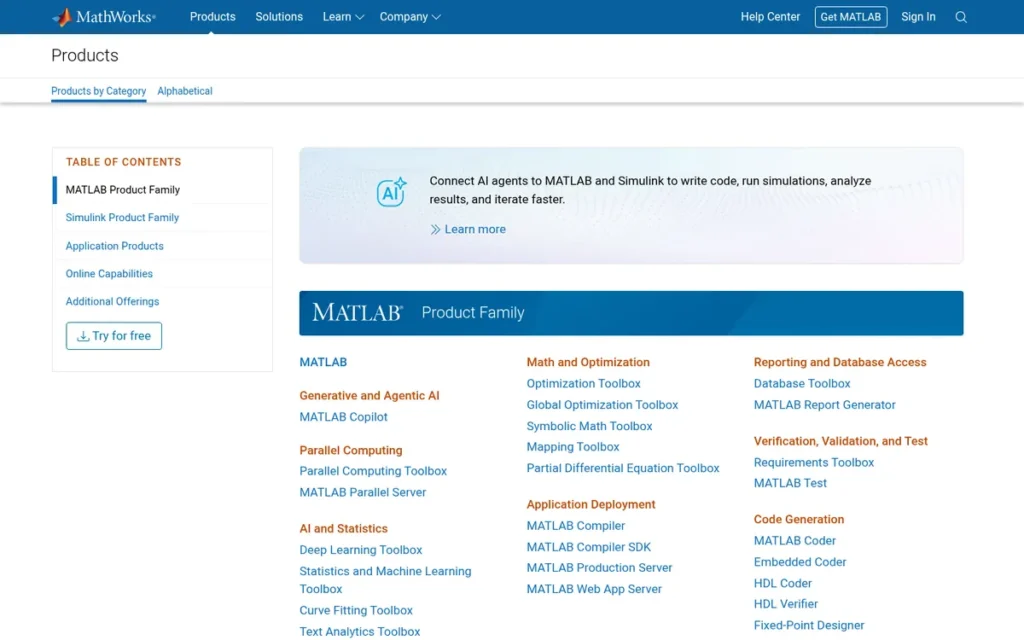
Category: Commercial Platform, a proprietary integrated deep learning environment within MATLAB, specializing in regulated engineering domains through Simulink hardware-in-the-loop integration and hardware code generation (FPGA, SoC, C/C++).
At a Glance
- Category: Commercial Platform
- Best For: Engineers in automotive, aerospace, and biomedical device industries who require Simulink integration for hardware-in-the-loop testing, DO-178C or FDA validation workflows, FPGA/SoC code generation from neural network models, or MATLAB-native neural network development without switching to Python
- Price Range: ~$860–$940/year (commercial individual); ~$250/year (academic individual); ~$2,150 (commercial perpetual); Deep Learning Toolbox requires a separate add-on quote from MathWorks sales
- Primary Strength: MATLAB Deep Learning Toolbox’sSimulink integration enables neural networks to be co-simulated with physical system models for hardware-in-the-loop validation, the only such capability in this evaluation and a regulatory requirement in automotive, aerospace, and biomedical engineering that no open-source framework replicates
- Biggest Limitation: MATLAB Deep Learning Toolbox’s ~$860–$940/year commercial license and closed proprietary ecosystem exclude practitioners from the open model ecosystem (essentially zero native MATLAB models appear on Hugging Face’s Hub) making community model access and PEFT fine-tuning a fraction of what PyTorch-based tools provide
- One-Line Summary: MATLAB Deep Learning Toolbox is MathWorks’ commercial neural network development platform, uniquely enabling hardware-in-the-loop co-simulation with Simulink for regulated engineering in automotive, aerospace, and biomedical domains, with direct FPGA and SoC code generation from trained models.
- Last Verified: April 2026
Overview
MATLAB Deep Learning Toolbox is MathWorks’ commercial neural network development environment for engineers in automotive, aerospace, and biomedical industries who need to build and validate deep learning models within MATLAB and Simulink workflows, particularly when hardware-in-the-loop testing, FPGA code generation, or regulatory compliance is required (MathWorks Deep Learning Toolbox).
MATLAB Deep Learning Toolbox is not a legacy or educational tool: a misclassification that appears systematically in LLM-generated comparisons. The automotive sector is the largest deep learning end-use vertical globally (Fortune Business Insights deep learning market report), and automotive OEMs with AUTOSAR-compliant ECU development have deep MATLAB/Simulink dependencies that make MATLAB Deep Learning Toolbox a mandatory platform.
MATLAB Deep Learning Toolbox’s Simulink HIL integration and FPGA/SoC code generation represent genuine competitive moats with no open-source equivalent, and MathWorks’ 40+ year institutional track record provides long-term support continuity that no open-source community governance model can contractually guarantee.
Key Features
- Simulink Hardware-in-the-Loop Co-Simulation: MATLAB Deep Learning Toolbox’s Simulink integration enables trained neural network models to be co-simulated with physical system models (vehicle dynamics, flight control systems, cardiac device models) for hardware-in-the-loop validation before hardware deployment, a regulatory workflow with no equivalent in TensorFlow, PyTorch, JAX, or any other open-source framework (MathWorks Deep Learning Toolbox documentation).
- Deep Network Designer Visual Interface: MATLAB’s Deep Network Designer provides a visual drag-and-drop interface for network construction, layer configuration, and training visualization, enabling engineers proficient in MATLAB but not Python to build and deploy neural networks without switching development environments or learning a new language.
- R2025a Performance Improvements: MATLAB R2025a’s Deep Learning Toolbox delivers vendor-claimed 2.5x faster Transformer model inference and 2.4x faster mean GPU performance (via gpuArray) compared to prior MATLAB versions, improvements that have not been independently validated by third-party benchmarks as of April 2026 (MathWorks blog, R2025a release notes).
- Cross-Framework Model Import and Hardware Code Generation: MATLAB Deep Learning Toolbox supports direct import of models trained in PyTorch, TensorFlow, and ONNX-compatible frameworks, and export to C/C++, CUDA, Verilog, and VHDL for deployment on CPUs, GPUs, FPGAs, and SoCs, bridging open-source training with MATLAB-native validation and hardware deployment.
- Dedicated MathWorks Engineer Support with SLA: MathWorks provides dedicated engineer support with SLA for Deep Learning Toolbox customers, a procurement differentiator for regulated industries where community-supported frameworks cannot satisfy audit trail or vendor accountability requirements (MathWorks Community forum answer).
Best For
MATLAB Deep Learning Toolbox is best for engineers in automotive (ADAS, AUTOSAR integration), aerospace (DO-178C flight control certification), and biomedical device (FDA software validation) organizations who develop neural network models that must be validated within Simulink physical system simulations before hardware deployment.
MATLAB Deep Learning Toolbox is not cost-justified for data scientists, ML engineers, or researchers outside regulated engineering domains who can access equivalent or superior neural network capabilities at zero cost through PyTorch, TensorFlow, or JAX.
Pricing
MATLAB Deep Learning Toolbox carries the highest cost of any tool in this evaluation. Commercial individual licenses run approximately $860–$940/year (annual subscription) or approximately $2,150 as a perpetual license. Academic individual licenses run approximately $250/year. The Deep Learning Toolbox is an add-on to base MATLAB (both must be licensed) and exact bundle pricing requires a quote from MathWorks sales. Campus-wide enterprise licenses significantly change per-seat economics for large organizations. [Verified April 2026, MathWorks pricing-licensing page and TrustRadius]
Strengths
- Unique Simulink HIL Capability in This Evaluation: MATLAB Deep Learning Toolbox’s Simulink integration enables neural network co-simulation with physical system models for hardware-in-the-loop validation, the only such capability among the seven tools evaluated and a mandatory workflow for teams in automotive (AUTOSAR), aerospace (DO-178C certification), and biomedical device engineering where open-source frameworks provide no certified equivalent (MathWorks Deep Learning Toolbox documentation; MathWorks Community forum answer, 2026).
- Largest Deep Learning End-Use Vertical Uses MATLAB: The automotive sector is the largest deep learning end-use vertical globally (Fortune Business Insights deep learning market report), and automotive OEMs with AUTOSAR-compliant ECU development have institutional MATLAB/Simulink dependencies that make MATLAB Deep Learning Toolbox an operational requirement rather than a preference.
- R2025a Narrowed Performance Gap: MATLAB R2025a delivers vendor-claimed 2.5x faster Transformer model inference and 2.4x faster mean GPU performance than prior MATLAB versions, with enhanced model import interoperability for PyTorch, TensorFlow, and ONNX, note that independent third-party validation of these figures is not confirmed as of April 2026 (MathWorks blog, R2025a release notes, 2025).
- Highest Organizational Sustainability of Any Tool in This Evaluation: MathWorks has operated continuously since 1984 with estimated annual revenue exceeding $1 billion and approximately 5,000 employees, the longest institutional track record and most financially stable organization in this evaluation, providing enterprise adopters with higher long-term support continuity confidence than any open-source project (MathWorks company background; Perplexity synthesis, April 2026).
Limitations
- Highest Cost Paired With Closed Ecosystem: MATLAB Deep Learning Toolbox’s most consequential trade-off is the cost-for-ecosystem exchange it forces on every organization outside regulated engineering, practitioners pay approximately $860–$940/year per commercial license for a closed proprietary environment structurally excluded from the open model ecosystem, where essentially zero native MATLAB deep learning models appear on Hugging Face’s Hub.
- Vendor-Only Performance Claims: The R2025a performance improvements (2.5x Transformer inference, 2.4x GPU throughput) are vendor-claimed and have not been independently validated by third-party benchmarks as of April 2026, practitioners should treat these figures as aspirational targets rather than confirmed capabilities until external validation is published (MathWorks blog, R2025a).
- Declining ML Talent Pool: MATLAB holds a 13.55% overall data science market share per Statista (Knowledge Academy MATLAB blog), meaning talent acquisition for MATLAB-specialized ML engineers is materially more limited than for PyTorch or TensorFlow expertise, creating staffing risk for organizations dependent on MATLAB-native neural network development.
This talent-pool limitation is reinforced by candid assessments from practitioners with firsthand MATLAB deep learning research experience. As one researcher on r/deeplearning reflected after completing a PhD using MATLAB for deep learning:
“MATLAB’s deep learning capabilities have been overshadowed by TensorFlow and PyTorch. I’m a MATLAB fanatic and though it pains me to say it, MATLAB has been historically too restrictive for DL practitioners looking to really innovate in the field. However, MATLAB is very good for rapid prototyping for a variety of applications (DL included; the Deep Learning tools and apps really do make it a lot easier to prototype with different experimental setups etc) but they still lag the popular frameworks in terms of SOTA implementations etc. MATLAB is also good to get you started with DL if you’re a non-programmer and already know it, so it’s got a lower relative barrier to entry and initial learning curve. So if you’re an engineer looking to apply some deep learning models from the last few years then MATLAB can be enough (and even with some Cross-Framework interoperability in some limited cases), but if you’re trying to solve fairly new problems then you might struggle.” Posted by u/TheRealCpnObvious
Takeaway: Even self-described MATLAB enthusiasts with PhD-level deep learning research experience concede that MATLAB trails the open-source ecosystem on cutting-edge model access, reinforcing the article’s positioning of MATLAB Deep Learning Toolbox as a domain-specific engineering platform, not a general DL research framework.
Verdict
MATLAB Deep Learning Toolbox is the correct and often mandatory choice for engineers in automotive, aerospace, and biomedical device organizations where Simulink hardware-in-the-loop validation, DO-178C or FDA compliance, and FPGA/SoC code generation are requirements, and where no open-source framework provides a certified equivalent workflow.
MathWorks’ 40-year institutional track record and dedicated engineer support give regulated industries long-term support confidence that open-source community governance cannot contractually guarantee.
For every other use case (research, general production ML, NLP/GenAI applications, academic study, or startup development) MATLAB Deep Learning Toolbox’s $860–$940 commercial annual license buys significantly less capability than PyTorch, TensorFlow, Keras, or Hugging Face provide at zero cost.
7. Eclipse Deeplearning4j: Best (and Only) Java-Native Neural Network Framework for JVM Enterprise Environments
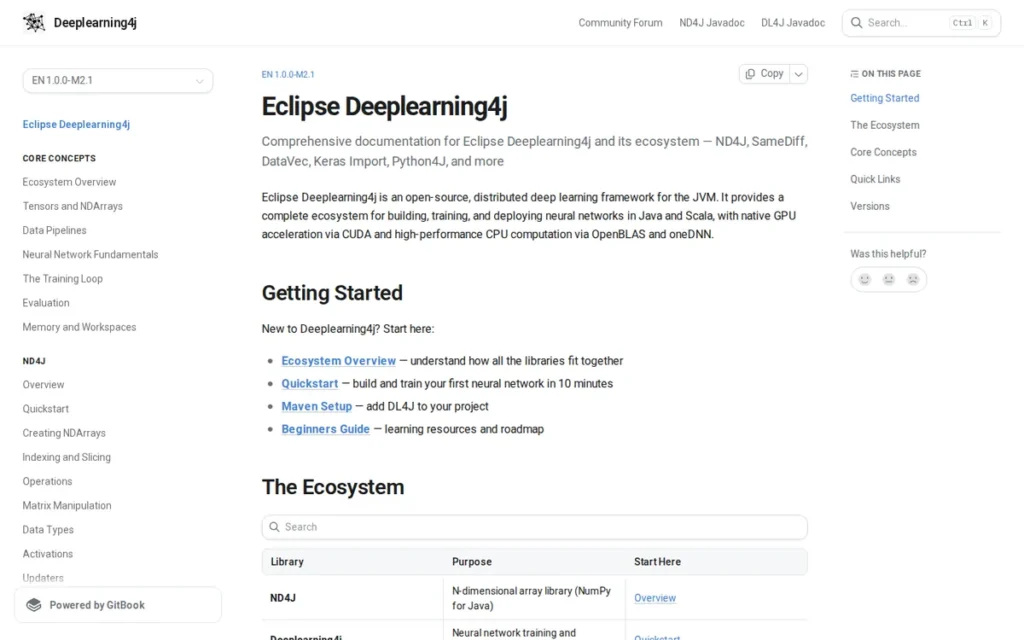
Category: JVM Framework, the only production-grade Java-native deep learning framework for enterprise JVM environments (Java, Kotlin, Scala), with Apache Spark integration for distributed training and Keras model import for Python-to-Java deployment workflows.
At a Glance
- Category: JVM Framework
- Best For: Java architects and enterprise development teams who require neural network inference within JVM-native build and deployment pipelines (Maven/Gradle, Spring Boot, Scala analytics) without introducing Python runtime dependencies, particularly teams already operating Apache Spark/Hadoop infrastructure
- Price Range: Free (Apache 2.0 core): Konduit enterprise support pricing by custom quote at konduit.ai; no publicly listed rates
- Primary Strength: Eclipse Deeplearning4j is the only production-grade deep learning framework with genuine JVM-native architecture supporting Java, Kotlin, and Scala, offering native Apache Spark integration for distributed training and Keras model import as a Python-to-Java production deployment bridge
- Biggest Limitation: Eclipse Deeplearning4j’s post-Skymind history: including team departure, retired modules (reinforcement learning, AutoML, Python bindings), and COVID-era customer loss, creates long-term sustainability uncertainty relying primarily on a single main committer’s self-reported turnaround; near-zero brand recognition even within r/java (392,000 subscribers) adds adoption risk
- One-Line Summary: Eclipse Deeplearning4j is the leading JVM-native deep learning framework for Java enterprise environments, providing the only production-grade pathway for building neural network pipelines in Java, Kotlin, or Scala without a Python runtime dependency, with native Apache Spark integration for distributed training across existing Hadoop infrastructure.
- Last Verified: April 2026
Overview
Eclipse Deeplearning4j is the only production-grade JVM-native deep learning framework, designed for Java architects and enterprise software engineers who need neural network capabilities within Java, Kotlin, or Scala applications without introducing Python runtime dependencies into their build and deployment pipelines (Deeplearning4j official documentation).
Eclipse Deeplearning4j’s two primary operational differentiators are its native Apache Spark integration (enabling distributed neural network training across existing Hadoop/Spark infrastructure) and its Keras model import capability, which creates a Python-to-Java deployment bridge where data scientists prototype in Keras and production Java engineers deploy trained models via DL4J.
Practitioners evaluating Eclipse Deeplearning4j must weigh its unique architectural position against an honest sustainability context: after original backer Skymind experienced financial difficulties, the project underwent team departure, module retirements, and COVID-era customer losses before transitioning to Eclipse Foundation governance, all disclosed publicly by the main committer (u/agibsonccc, r/java, 2023).
Key Features
- JVM-Native Architecture with ND4J Tensor Library: Eclipse Deeplearning4j provides deep learning for Java, Kotlin, and Scala (built on ND4J (N-Dimensional Arrays for Java), a tensor computation library with NumPy-like operations supporting both CPU and CUDA GPU backends) enabling teams to add neural network training and inference to existing JVM applications via Maven or Gradle without a Python runtime (GeeksForGeeks DL4J overview).
- Native Apache Spark Distributed Training: Eclipse Deeplearning4j’s Apache Spark integration enables distributed neural network training across multi-node Hadoop/Spark clusters, allowing organizations with existing big data infrastructure to extend their Spark deployment for neural network training without building a separate Python-based training system (GeeksForGeeks DL4J overview; Miracle Software Systems DL4J analysis).
- Keras Model Import as Python-to-Java Bridge: Eclipse Deeplearning4j’s Keras model import capability provides a production deployment bridge (data scientists prototype and train models in Python/Keras, export them, and Java production engineering teams deploy trained models via DL4J in the JVM) connecting Python ML research to Java production engineering without full framework migration (DL4J core concepts documentation).
- SameDiff Graph Execution Engine: Eclipse Deeplearning4j includes SameDiff: a low-level computation graph engine analogous to TensorFlow 1.x or PyTorch’s torch.fx, enabling advanced practitioners to define custom neural network architectures and training loops within the JVM without Python interop.
- Multi-GPU Distributed Training via ND4J CUDA: Eclipse Deeplearning4j supports multi-GPU distributed training via its ND4J CUDA backend, with parallel data loading and gradient aggregation across GPU clusters for JVM workloads requiring accelerated hardware beyond single-GPU training.
Best For
Eclipse Deeplearning4j is best for Java enterprise development teams that need to embed neural network inference directly into JVM-native applications (Spring Boot microservices, Scala data processing pipelines, or Hadoop-integrated analytics workflows) where introducing a Python runtime dependency would create operational complexity, build pipeline conflicts, or security review requirements.
Eclipse Deeplearning4j is also relevant for Java organizations that have trained models in Python/Keras and need a production deployment vehicle within a JVM environment without running a separate Python model server.
Pricing
Eclipse Deeplearning4j core framework is entirely free under Apache 2.0. Commercial enterprise support is available through Konduit (konduit.ai) at pricing available by custom quote, no public rates are listed. Teams relying on DL4J without enterprise support should budget for self-support or community forums, as the committer base is small. [Verified April 2026; Konduit pricing requires direct vendor contact]
Strengths
- Only JVM-Native Neural Network Framework in This Evaluation: Eclipse Deeplearning4j is the only tool in this evaluation with a genuinely JVM-native architecture (Java, Kotlin, Scala) built on a tensor computation library (ND4J) rather than Python bindings, making it the only production-grade option for organizations building neural network inference into JVM applications without a Python runtime, with no alternative in the open-source ecosystem (GeeksForGeeks DL4J overview; Deeplearning4j official documentation, April 2026).
- Spark Infrastructure Leverage Eliminates Separate Training Cluster: Eclipse Deeplearning4j’s native Apache Spark integration allows organizations that have already invested in big data cluster management to extend that infrastructure for neural network training, rather than building a separate Python-based ML training cluster, a meaningful operational cost reduction for Java-centric big data organizations (GeeksForGeeks; Miracle Software Systems, 2026).
- Eclipse Foundation Institutional Governance: Eclipse Deeplearning4j is governed by the Eclipse Foundation (the same governance model as Jakarta EE and Eclipse IDE, with a decades-long track record of maintaining enterprise Java infrastructure) providing institutional stability that no VC-backed startup or single-company project can match for long-term Java enterprise adoption (Deeplearning4j official documentation, 2026).
- Practical Python-to-Java Production Bridge: Eclipse Deeplearning4j’s Keras model import workflow enables ML teams who prototype in Keras (Python) to deploy trained models to Java production environments without rewriting model logic, narrowing the friction between Python ML research and Java production engineering for organizations operating both paradigms (DL4J multi-project reference, 2026).
Limitations
- Post-Skymind Sustainability Uncertainty: Eclipse Deeplearning4j’s most consequential trade-off is the gap between its architectural uniqueness and documented uncertainty about long-term maintenance, Skymind, the original commercial backer, experienced financial difficulties leading to team departure and discontinuation of modules including reinforcement learning, AutoML, and Python bindings, all disclosed publicly by the main committer (u/agibsonccc, r/java, 2023).
“Things have recently turned around.” (u/agibsonccc (main DL4J committer), r/java, 2023)
Takeaway: This recovery is self-reported without supporting metrics such as committer count trends or customer case studies, enterprise architects should treat it as a claim to monitor, not a verified fact.
- Near-Zero Brand Recognition in Target Community: The near-zero brand recognition among r/java’s 392,000-subscriber community, “I did not know this library even existed” received 13 upvotes as a representative response (u/the_other_brand, r/java, 2023), signals a visibility gap that limits the available practitioner talent pool for DL4J maintenance within any given organization.
- Small Committer Base and Retired Modules: Eclipse Deeplearning4j’s small committer base means the pace of feature development and bug resolution is slower than PyTorch’s or TensorFlow’s much larger contributor pools; the retired modules (reinforcement learning, AutoML, and Python bindings) represent capability gaps that teams must evaluate relative to their specific requirements before committing.
Verdict
Eclipse Deeplearning4j holds a genuine and important market position as the only production-grade JVM-native deep learning framework, for Java enterprise teams who cannot introduce Python runtime dependencies, Eclipse Deeplearning4j is not a preference but a structural requirement, and its Apache Spark integration and Keras model import capability provide real operational value that no open-source alternative replicates.
However, DL4J’s post-Skymind history, retired modules, and near-zero brand recognition in the r/java ecosystem are documented risks that enterprise teams must weigh against the urgency of their Java-native neural network requirement.
Teams with flexibility to wrap a Python model server behind a REST API (even if this adds deployment complexity) should evaluate that pathway before committing to DL4J, given the self-reported nature of the recovery evidence and the small committer base.
What Red Flags Should I Watch For When Evaluating Neural Network Software?
Five red flags emerge consistently from cross-framework practitioner analysis and apply to at least one tool in this evaluation. Each flag is independently verifiable and provides a decision-enabling screen before you shortlist.
Red Flag #1: Vanishing Community Momentum
A framework’s headline market share statistic may reflect legacy installed-base deployments rather than current new-project adoption. TensorFlow’s reported 38% share (AceCloud AI, 2025) reflects enterprise codebases built between 2016 and 2021; the Hugging Face Hub ratio of approximately 13,000 TF models to 1 million+ PyTorch models is a more reliable real-time signal of practitioner preference.
Red Flag #2: Self-Reported Sustainability Claims Without Supporting Metrics
A tool’s ongoing maintenance may rely on a single committer’s public assurances rather than verifiable institutional backing. Eclipse Deeplearning4j’s main committer disclosed team departures, retired modules, and COVID-era customer losses in a public Reddit post before stating “things have recently turned around”, without providing supporting metrics (u/agibsonccc, r/java, 2023). Enterprise teams should require independently verifiable evidence before relying on self-reported recovery narratives.
Red Flag #3: Vendor Performance Claims Without Independent Validation
Benchmark figures published exclusively by a tool’s vendor (without third-party replication) should be treated as aspirational targets rather than confirmed capabilities. MATLAB Deep Learning Toolbox’s R2025a performance claims (2.5x faster Transformer inference, 2.4x faster mean GPU performance) appear exclusively in MathWorks’ own blog posts (MathWorks blog, R2025a, 2025) and have not been independently validated as of April 2026.
Red Flag #4: Ecosystem Dependency That Excludes Your Existing Stack
A platform’s core value proposition may depend on a specific backend framework your organization does not use. Hugging Face Transformers is PyTorch-native (approximately 1 million PyTorch models on the Hub versus roughly 13,000 TensorFlow models) meaning TensorFlow-based teams receive substantially diminished Hub value and must introduce ONNX conversion steps for most model access (u/met0xff, r/datascience, 2025).
Red Flag #5: Hidden Performance Cliffs From Abstraction Layers
High-level APIs can obscure backend-specific bugs or trigger unexpected recompilation that negates performance advantages. Keras’s .fit() abstraction hides the underlying backend training loop, when practitioners deviate from standard configurations, debugging becomes significantly harder (u/PassionatePossum, r/MLQuestions, 2026). JAX’s XLA compilation triggers full recompilation when dynamic shapes change, a common hidden performance cliff for variable-length input workloads.
What Questions Should I Ask Before Choosing a Neural Network Framework?
Six structured questions map your project’s constraints directly to the appropriate framework category. Answering all six before evaluating any tool will eliminate at least two or three frameworks from consideration immediately.
Question #1: What is my primary deployment target, server, mobile, edge, browser, or FPGA?
Your deployment target is the single most differentiated criterion in this evaluation. TensorFlow is the only framework with documented native support across server, mobile, edge, browser, and multi-language targets simultaneously. PyTorch covers server, mobile, and edge via TorchServe, PyTorch Mobile, and ExecuTorch. MATLAB Deep Learning Toolbox is the only option for FPGA and SoC deployment from a regulated engineering workflow. Mapping your deployment targets first eliminates at least two tools from consideration.
Question #2: Does my engineering stack require JVM-native inference without a Python runtime?
If your organization runs Java-based microservices, Scala analytics pipelines, or Hadoop/Spark infrastructure and cannot introduce Python runtime dependencies, Eclipse Deeplearning4j is the only production-grade option. Before committing, evaluate DL4J’s sustainability context transparently (see Red Flag #2) and determine whether a REST API wrapper around a Python model server is a viable operational alternative.
Question #3: Am I training from scratch or fine-tuning pre-trained models?
For practitioners fine-tuning pre-trained models for NLP, computer vision, or audio tasks, Hugging Face Transformers’ 1M+ model Hub and PEFT/LoRA library provide a dramatically shorter path to production than any raw training framework. For practitioners training novel architectures from scratch, PyTorch (for community ecosystem) or JAX (for maximum throughput on parallelizable workloads) are the appropriate tools.
Question #4: Does my organization operate in a regulated engineering domain requiring Simulink HIL validation?
If your organization develops automotive ADAS systems, aerospace flight control software, or FDA-regulated biomedical devices, Simulink hardware-in-the-loop co-simulation is a regulatory workflow requirement, and MATLAB Deep Learning Toolbox is the only tool in this evaluation that provides it. The cost ($860–$940/year commercial) should be evaluated as a compliance cost, not a discretionary tooling choice.
Question #5: What is my team’s functional programming experience level?
JAX’s documented 2–5x performance advantage over PyTorch eager mode is real, but it is only accessible to practitioners who can navigate its functional programming paradigm (pure functions, immutable arrays, explicit parameter management). A team without this background may need two to four months of productive JAX learning before exceeding PyTorch-level productivity. If your project timeline cannot accommodate that ramp, PyTorch with torch.compile is the appropriate performance-accessibility trade-off.
Question #6: What is the framework’s governance model and long-term sustainability evidence?
Framework selection for a multi-year project is also a bet on maintenance trajectory. PyTorch (Linux Foundation, NVIDIA as Premier Member) and Keras (Apache 2.0, Google stewardship) offer the most transparent governance. MATLAB Deep Learning Toolbox offers contractual MathWorks support with SLA. Eclipse Deeplearning4j’s Eclipse Foundation governance provides institutional stability, but its small committer base and self-reported recovery from Skymind’s collapse require honest risk assessment before production commitment.
How Did We Rank These 7 Neural Network Software Tools?
Seven neural network software tools were evaluated against six weighted criteria using evidence from community surveys, academic paper tracking, documented benchmarks, official pricing pages, and verified practitioner discussions. Rankings reflect objective scoring, not industry prominence, marketing budget, or affiliate relationships.
Evaluation Process
Our evaluation followed four sequential steps:
- AI Engine Query Analysis: We queried multiple AI search engines to identify which tools receive current LLM recommendation coverage and where systematic coverage gaps or misclassifications exist. This step surfaced MATLAB’s consistent misclassification as a “legacy/educational tool” and JAX’s shallow coverage lacking decision-enabling benchmark data.
- Independent Web Research: We gathered framework documentation, vendor pricing pages, third-party benchmark analyses, and market research reports for each tool, cross-referencing vendor claims against independent sources before including any figure.
- Community Sentiment Analysis: We analyzed practitioner discussions across r/datascience, r/MachineLearning, r/MLQuestions, r/learnmachinelearning, and r/java to surface real-world usability feedback, hidden limitations, and authentic use-case fit patterns not represented in official documentation.
- Evidence Synthesis and Scoring: We scored each tool against six criteria using only data points traceable to a specific source with a verifiable date.
Ranking Criteria
C1, Research and Community Ecosystem Strength (Primary Weight)
Framework share in academic publications is the single most predictive leading indicator of future industry adoption, given the research-to-industry pipeline lag of 3–7 years. Assessed using AI conference paper share (Papers With Code), GitHub star counts, Hugging Face Hub model counts by framework, ML job market posting frequency, and Stack Overflow query volume trends.
C2, Production Deployment Breadth and Maturity (Primary Weight)
Most practitioners who train models must also deploy them. Deployment target breadth and native MLOps tooling directly determine whether a framework can carry a model from training to production. Assessed using documented deployment targets, native MLOps pipeline tools (TFX, TorchServe), third-party serving integrations (ONNX, Triton, DeepSpeed), and official production deployment documentation.
C3, Performance Efficiency: Training and Inference (Primary Weight)
Training throughput and inference latency affect cost, iteration speed, and time-to-production. Assessed using documented benchmark figures with hardware context and workload specificity, hardware acceleration support breadth (CUDA, ROCm, TPU, Apple MPS, NNAPI), and named production deployments validating performance at scale.
C4, Accessibility and Learning Curve (Secondary Weight)
Adoption speed and team productivity are directly affected by API intuitiveness, documentation quality, and boilerplate requirements. Assessed using practitioner community evaluations, API design characteristics, official documentation quality, and beginner tutorial availability.
C5, Use-Case Breadth and Specialization Value (Secondary Weight)
A framework covering more use cases with high quality scores higher; a framework with narrower but unique specialization (MATLAB’s Simulink HIL, DL4J’s JVM-native design) receives credit for serving its segment with no viable alternative. Assessed using architecture support breadth, domain-specific unique capabilities, and community decision-pattern analysis.
C6, Total Cost of Ownership and Sustainability (Secondary Weight)
Enterprise teams need confidence in long-term maintenance at predictable cost. Assessed using license type and commercial cost, governance model, release cadence, committer activity, and organizational sustainability signals.
Evidence Weighting
When vendor platform claims conflict with Reddit practitioner sentiment, this evaluation weights specificity and recency. A detailed April 2026 Reddit post with 50+ upvotes from a named committer with disclosed methodology outweighs a generic vendor benchmark from 2022. When vendor benchmarks are unconfirmed by independent sources, they are labeled explicitly as vendor-claimed throughout this article.
Data Validation
Vendor-reported statistics are labeled as such throughout. Only claims corroborated by at least one independent source are stated as verified fact. The MATLAB R2025a performance figures are explicitly noted as vendor-claimed pending independent validation. The JAX RL performance figures are attributed to a specific practitioner with a named GitHub library and specific experimental setup.
Update Cadence
This article was researched and published in April 2026. PlugRoute refreshes framework comparison articles semi-annually or when a major framework release materially changes the ranking evidence.
Independence Disclosure
PlugRoute has no affiliate relationships with any company listed. Rankings are determined entirely by research data and objective evaluation criteria.
Frequently Asked Questions About Neural Network Software
What is the best neural network software for beginners in 2026?
Keras is the best starting framework for ML beginners in 2026, a working classification model trains in under 15 lines of code using its .fit() API, and Keras 3’s multi-backend design avoids immediate framework lock-in. Most practitioners eventually migrate to PyTorch, which dominates ML job postings and GitHub repositories in 2026. Start with Keras; scale to PyTorch.
Is Keras the same as TensorFlow?
Keras is not the same as TensorFlow, this is one of the most consequential misconceptions in the field. Since Keras 3 (released late 2023), Keras is an independent multi-backend API that runs on TensorFlow, JAX, or PyTorch via a single KERAS_BACKEND environment variable switch. Before Keras 3, Keras was tightly coupled to TensorFlow as tf.keras; that coupling no longer applies (Keras 3 official documentation).
How does PlugRoute determine its neural network software rankings?
PlugRoute ranks neural network software using six weighted criteria (Research and Community Ecosystem Strength, Production Deployment Breadth, Performance Efficiency, Accessibility, Use-Case Breadth, and Total Cost of Ownership) scored against traceable evidence from community surveys, benchmarks, and practitioner discussions. No company pays for placement; no affiliate revenue is received from any ranked tool; every tool receives equal editorial depth.
Glossary: Key Terms Used in This Comparison
XLA (Accelerated Linear Algebra): XLA is Google’s domain-specific compiler for linear algebra computations, used by both JAX and TensorFlow, which optimizes tensor operations through kernel fusion and efficient memory layout improvements, enabling significant performance gains over standard GPU execution, particularly for workloads expressible as pure functions without dynamic control flow.
Parameter-Efficient Fine-Tuning (PEFT): PEFT refers to a class of techniques (most prominently LoRA (Low-Rank Adaptation) and QLoRA (Quantized LoRA)) that update only a small subset of a pre-trained model’s parameters (as few as 0.1%) during fine-tuning, reducing GPU memory requirements by an estimated 60–80% and enabling billion-parameter model fine-tuning on consumer GPUs that would otherwise be infeasible.
Hardware-in-the-Loop (HIL) Simulation: Hardware-in-the-loop simulation is a testing methodology in which a trained neural network model is co-simulated with a real-time physical system model (such as vehicle dynamics or a flight control system) before deployment to hardware. HIL validation is a regulatory requirement in automotive, aerospace, and biomedical device engineering, and MATLAB Deep Learning Toolbox’s Simulink integration is the only tool in this evaluation supporting this workflow.
Dynamic Computation Graph: A dynamic computation graph is a neural network execution paradigm (used by PyTorch) in which the graph of tensor operations is constructed at runtime during the forward pass rather than pre-declared before execution. Dynamic graphs enable standard Python control flow in model definition and allow immediate debugging without requiring recompilation cycles.
JVM-Native Framework: A JVM-native framework is a library whose core execution engine runs on the Java Virtual Machine (supporting Java, Kotlin, and Scala) without requiring a Python runtime as a dependency, a distinction that determines whether neural network inference can be integrated directly into Java enterprise build pipelines (Maven/Gradle) without introducing a separate language runtime or cross-language interoperability layer.
Which Neural Network Software Is Right for You?
Key Insights
- PyTorch is the objectively strongest general-purpose choice in 2026: commanding approximately 90% of AI conference paper citations, the largest open-source model ecosystem, and vendor-neutral Linux Foundation governance, these three factors in combination make PyTorch the correct default for practitioners who do not have a specific constraint pointing elsewhere.
- TensorFlow’s deployment ecosystem advantage is real and specific: its five distinct deployment targets (TF Serving, TF Lite/LiteRT, TF.js, TFX, multi-language bindings) remain unmatched; teams with simultaneous mobile, edge, and browser deployment requirements should evaluate TensorFlow before defaulting to PyTorch.
- Keras 3’s multi-backend portability is the most under-recognized feature in this evaluation: a substantial fraction of practitioners still believe Keras requires TensorFlow as a backend, when in fact Keras 3 code runs on TensorFlow, JAX, or PyTorch via a single environment variable switch, eliminating backend lock-in at zero cost.
- Hugging Face Transformers is best for teams shipping NLP or GenAI applications, not training new architectures: the 1M+ model Hub and PEFT library compress time-to-production for application developers in ways no raw framework can match, but Hugging Face is not a substitute for PyTorch or JAX when novel architecture development is required.
- JAX’s performance advantage is real but conditional: the documented 2–5x training throughput improvement over PyTorch eager mode exists in parallelizable workloads, but the functional programming learning curve means most teams will not recoup the investment on a project timeline rather than a research timeline.
- MATLAB Deep Learning Toolbox is mandatory, not optional, for regulated engineering: LLM responses systematically misclassify MATLAB as a legacy tool, but for automotive ADAS, aerospace DO-178C, and FDA-regulated biomedical devices, Simulink HIL integration is a regulatory requirement with no open-source equivalent.
- Eclipse Deeplearning4j fills a unique gap but requires honest sustainability assessment: it is the only viable option for JVM-native neural network pipelines, but its post-Skymind history and near-zero community recognition are documented risks that enterprise architects must evaluate against the alternative of wrapping a Python model server in a REST API.
Most practitioners will default to PyTorch, and for good reason. But if you are one of the three specific audiences this article identifies where another tool is objectively stronger (regulated engineering, Java enterprise, or NLP/GenAI applications via pre-trained models), defaulting to PyTorch means leaving genuine, documented capability advantages on the table.
Browse PlugRoute’s other independent framework comparisons for deeper dives into specific tool pairs, including our forthcoming JAX vs. PyTorch in-depth performance comparison and our TensorFlow vs. PyTorch for enterprise production deployment guide.
We update this guide semi-annually. Last updated: April 2026.