PyTorch is the best all-purpose deep learning framework in 2026, used in 85% of published research papers with Linux Foundation multi-vendor governance. Hugging Face leads for LLM fine-tuning via PEFT. TensorFlow excels for enterprise MLOps and edge deployment. The defining 2026 shift: most practitioners fine-tune pre-trained models rather than train from scratch, which changes which tools matter most.
Framework selection carries real consequences, four frameworks that were credible choices before 2023 are now deprecated: Theano (2017), Caffe (post-2018), CNTK (2019), and Apache MXNet (September 2023). This article evaluates seven actively maintained frameworks against six objective criteria anchored to dated sources. Three tools absent from most AI-generated comparisons are covered here: Hugging Face (the primary LLM fine-tuning platform), PaddlePaddle (China’s leading industrial AI framework), and Eclipse Deeplearning4j (the only Java/JVM production option).
PlugRoute has no affiliate relationships with any company listed. Rankings are determined entirely by research data and objective evaluation criteria.
TL;DR: Top Picks at a Glance
- PyTorch is the dominant deep learning framework in 2026, adopted in 85% of published research papers, and the strongest all-purpose choice for researchers and ML engineers who need a single codebase spanning rapid prototyping through production deployment.
- Hugging Face is the world’s largest pre-trained model hub, hosting 2M+ public models, and the essential platform for LLM fine-tuning practitioners using PEFT and LoRA to adapt billion-parameter models on consumer-grade GPUs.
- TensorFlow provides the most complete end-to-end enterprise MLOps pipeline through TFX and the broadest mobile and edge device coverage of any evaluated framework, running on 2.7 billion devices via LiteRT.
- Keras is the lowest-barrier entry point to deep learning in 2026, serving as the primary framework in Andrew Ng’s Coursera Deep Learning Specialization, with Keras 3.x enabling one model codebase to run across TensorFlow, JAX, and PyTorch backends.
What Are the Four Categories of Deep Learning Software in 2026?
Deep learning software in 2026 falls into four distinct categories that serve fundamentally different roles. Understanding these categories prevents the most common selection error: treating Hugging Face as a replacement for PyTorch when the standard 2026 production LLM stack uses PyTorch and Hugging Face together, not as alternatives.
- Training Frameworks (PyTorch, TensorFlow, JAX, PaddlePaddle): provide tensor operations, automatic differentiation, and GPU acceleration for building and training neural networks from scratch or fine-tuning model weights directly.
- Model Hub and Fine-Tuning Platforms (Hugging Face): operate above training frameworks, providing pre-trained model access, PEFT/LoRA/QLoRA tooling, and managed inference infrastructure.
- High-Level APIs (Keras): abstract framework internals to provide the most accessible model-building interface in the evaluated landscape, with Keras 3.x enabling execution on TensorFlow, JAX, or PyTorch as interchangeable backends.
- JVM Frameworks (Eclipse Deeplearning4j): serve Java enterprise environments without requiring any Python runtime in the deployment stack.
Similarly, Keras + PyTorch is a beginner-to-advanced progression, not a side-by-side comparison between equivalent tools.
Which Deep Learning Frameworks Are Still Active in 2026?
Seven deep learning frameworks are actively maintained as of April 2026, while four are confirmed deprecated or retired. Teams evaluating any framework not on this list should verify maintenance status before adoption, building on a deprecated dependency forces costly mid-project migrations that have affected teams four times since 2017.
- Apache MXNet: retired by the Apache Software Foundation following a September 2023 vote, with the GitHub repository officially archived November 2023; teams should migrate to PyTorch.
- Microsoft CNTK: deprecated 2019; teams should migrate to PyTorch or TensorFlow.
- Theano: abandoned 2017 by the Montréal Institute for Learning Algorithms; all users have long since migrated.
- Caffe: largely unmaintained since 2018; no active development from the original Berkeley AI Research team.
Every framework that has been abandoned since 2017 was controlled by a single commercial entity. That pattern is not coincidence, it is a governance risk every 2026 framework selection must explicitly evaluate.
Users on r/learnmachinelearning noted:
“Most of the papers and models pushed to HuggingFace have PyTorch. Also PyTorch it is under its own org now so less influence from one company. JaX is still relying and on mercy of Google and Google is known to get bored easily on projects …” Posted by u/unknown_history_fact
Takeaway: Practitioners factoring long-term framework risk treat multi-vendor governance as a decisive criterion, with single-company control widely recognized as a deprecation warning sign.
All seven frameworks in this article have confirmed 2025 or 2026 releases and active maintainer communities as of April 2026.
How Do the Top Deep Learning Frameworks Compare?
The table below compares all seven frameworks across eight dimensions, category, best-fit use case, one-line summary, key capabilities, primary strength, and key limitation. PyTorch leads for research, Hugging Face for LLM fine-tuning, TensorFlow for enterprise production, and Keras for beginners.
| Rank | Company | Category | Best For | One-Line Summary | Key Capabilities | Primary Strength | Key Limitation |
|---|---|---|---|---|---|---|---|
| 1 | PyTorch | Training Framework | Research, ML engineering, LLM workflows | PyTorch is the dominant deep learning framework in 2026, adopted in 85% of published research papers and backed by Linux Foundation multi-vendor governance | Dynamic graphs, torch.compile, FSDP, multi-vendor hardware support, PyTorch-native ecosystem | Dominant in 85% of 2025 research papers with Linux Foundation multi-vendor governance | More manual MLOps assembly required than TensorFlow’s integrated TFX pipeline |
| 2 | Hugging Face | Model Hub & Fine-Tuning Platform | LLM fine-tuning, pre-trained model access | Hugging Face is the world’s largest model hub in 2026, hosting 2M+ pre-trained models with PEFT tooling enabling billion-parameter LLM fine-tuning on consumer GPUs | Hub (2M+ models), PEFT/LoRA/QLoRA, Accelerate, Inference Endpoints, Hub v1.0 API | 2M+ public models; orders of magnitude more than any competing hub | Not a standalone training framework; requires PyTorch, TensorFlow, or JAX as the computation engine |
| 3 | TensorFlow | Training Framework (Production) | Enterprise MLOps, TPU workloads, mobile/edge | TensorFlow is the leading enterprise production framework in 2026, powering 37–38% of production AI deployments and running on 2.7B edge devices via LiteRT | TFX end-to-end pipeline, native TPU/XLA, LiteRT (2.7B devices), TF.js, TF Hub (~1,300 models) | Most complete end-to-end MLOps pipeline (TFX) and largest edge deployment footprint (LiteRT) | ~15% research paper adoption; state-of-the-art architectures arrive in PyTorch first, creating porting friction |
| 4 | Keras | High-Level API (Multi-Backend) | Beginners, educators, multi-backend portability | Keras is the most accessible deep learning API in 2026, powering Andrew Ng’s Deep Learning Specialization with Keras 3.x supporting TensorFlow, JAX, and PyTorch backends | Multi-backend (TF/JAX/PyTorch), 100+ built-in layers, OpenVINO backend, KerasHub | Lowest cognitive load API; Keras 3.x single-codebase portability across three backends | Abstraction ceiling for custom ops; no native PEFT/LoRA fine-tuning workflow |
| 5 | JAX | Numerical Computing / Research Framework | TPU-scale research, scientific ML, RL at scale | JAX is Google’s high-performance research framework in 2026, delivering 1.3x–4x transformer throughput gains via XLA and powering DeepMind’s AlphaFold and Gemini | grad/jit/vmap/pmap transforms, XLA full-loop compilation, TPU-first design, functional purity | 1.3x–4x transformer throughput gains via XLA; 900x–5,000x+ RL speedup via full training-loop JIT | Steep functional programming learning curve measured in months, not days |
| 6 | PaddlePaddle | Industrial Deep Learning Platform | Chinese industrial AI, hyperscale training, CJK OCR | PaddlePaddle is China’s leading industrial deep learning platform in 2026, with Fleet API enabling 1T+ parameter distributed training verified at Baidu production scale | Fleet API (1T+ params), PaddleOCR, PaddleX 3.3 low-code, CINN compiler, NVIDIA NGC support | Fleet API battle-tested at 1T+ parameter scale on Baidu production infrastructure | English documentation gaps; single-vendor Baidu governance; geopolitical adoption risk for international teams |
| 7 | Eclipse Deeplearning4j | JVM/Java Deep Learning Framework | Java/JVM enterprise, Spark-integrated ML | Eclipse Deeplearning4j is the only production-grade Java/JVM deep learning framework in 2026, providing GPU acceleration via ND4J C++ without any Python runtime dependency | ND4J GPU tensors, Spark/Hadoop integration, ONNX/Keras/PyTorch model import, SameDiff autograd | Only production-grade JVM framework; GPU-accelerated without any Python runtime dependency | Limited native transformer support; smallest community of all seven evaluated frameworks |
Which Deep Learning Tool Should I Choose for My Use Case?
Use this table to identify your starting framework based on the single constraint that eliminates all alternatives first, hardware, programming language, or primary workflow. PyTorch is the right default for most practitioners; the table below maps eight specific contexts to their recommended tool and an acceptable alternative. Validate your selection with the evaluation questions later in this article before committing.
| Your #1 Priority | Recommended Tool | Why | Acceptable Alternative |
|---|---|---|---|
| Research / novel architecture development | PyTorch | 85% of 2025 papers use PyTorch; largest debugging community; new architectures released PyTorch-first | JAX (for TPU-exclusive workloads requiring composable transforms) |
| LLM fine-tuning on pre-trained models | Hugging Face + PyTorch | 2M+ models, PEFT/LoRA/QLoRA, $9/mo Pro tier; the standard 2026 LLM stack | Hugging Face + TensorFlow (if existing TF infrastructure) |
| Enterprise production MLOps (greenfield) | PyTorch + TorchServe | 85% research ecosystem; torch.compile closes production gap; strongest community | TensorFlow + TFX (if fully integrated MLOps automation is non-negotiable) |
| Enterprise production MLOps (existing TF) | TensorFlow + TFX | Protects existing infrastructure; TFX pipeline maturity; 37–38% enterprise production share | PyTorch + TorchServe (for teams willing to invest in migration) |
| Google Cloud TPU training | JAX or TensorFlow | Both have first-party XLA/TPU integration; JAX for research, TensorFlow for production MLOps | PyTorch (improving TPU support via plugin) |
| Deep learning beginner | Keras (then PyTorch) | Lowest cognitive load; primary framework in Andrew Ng’s Coursera Deep Learning Specialization | PyTorch (for beginners with strong CS or functional programming background) |
| Industrial AI in China / CJK text | PaddlePaddle | Fleet API scale; PaddleOCR CJK accuracy; PaddleX 3.3 low-code industrial platform | PyTorch + EasyOCR (if English documentation is required) |
| Java/JVM enterprise (regulated industries) | Eclipse DL4J + ONNX import | Only viable JVM-native option; ONNX bridges Python-trained models to Java production services | Python microservice + gRPC (if Python runtime introduction is feasible) |
What Hardware Does Each Deep Learning Framework Support?
Hardware compatibility is the first elimination criterion when selecting a deep learning framework: a framework without native or experimental support for your accelerator cannot be used without costly infrastructure changes. The table below classifies support as Native, Experimental, Via Plugin, or Not Supported for seven accelerator types across all seven frameworks, verified from official documentation as of April 2026.
| Framework | NVIDIA CUDA | AMD ROCm | Google TPU (XLA) | Apple Silicon MPS | Intel XPU | Edge / Embedded |
|---|---|---|---|---|---|---|
| PyTorch | Native | Native | Via Plugin | Native | Native (2.6) | Via ONNX Export |
| Hugging Face | Via Backend | Via Backend | Via Backend | Via Backend | Via Backend | Via Inference Endpoints |
| TensorFlow | Native | Via Plugin | Native (XLA) | Experimental | Via Plugin | Native (LiteRT) |
| Keras | Via Backend | Via Backend | Via JAX/TF Backend | Via PyTorch Backend | Via OpenVINO | Via OpenVINO Backend |
| JAX | Native (NGC) | Via XLA ROCm | Native (XLA) | Not Supported | Experimental | Not Supported |
| PaddlePaddle | Native (NGC) | Experimental | Experimental | Not Supported | Experimental | Via FastDeploy |
| Eclipse DL4J | Native (CUDA/ND4J) | Not Supported | Not Supported | Not Supported | Not Supported | Via ONNX Export |
Sources: PyTorch 2.6 release notes (pytorch.org/blog/pytorch2-6/, 2026); NVIDIA NGC JAX container (docs.nvidia.com/deeplearning/frameworks/jax-release-notes/overview.html, April 2026); NVIDIA NGC PaddlePaddle container (docs.nvidia.com/deeplearning/frameworks/paddle-paddle-release-notes/index.html, April 2026); Keras multi-backend documentation (keras.io/keras_3/, April 2026).
1. PyTorch: Best Overall: Research, Production, and LLM Workflows
Category: Training Framework, a library providing tensor operations, automatic differentiation, and GPU-accelerated computation for building and training neural networks from scratch or at hyperscale.
At a Glance
- Category: Training Framework
- Best For: Researchers, ML engineers building novel architectures, LLM fine-tuning practitioners, and teams needing a unified research-to-production workflow
- Price Range: Free (BSD-style open-source license); cloud compute billed separately by provider
- Primary Strength: PyTorch commands 85% of deep learning research paper adoption in 2025, plus Linux Foundation multi-vendor governance protecting against single-vendor abandonment
- Biggest Limitation: Production deployment stack requires more manual configuration than TensorFlow’s integrated TFX pipeline, adding engineering overhead for teams without dedicated MLOps resources
- One-Line Summary: PyTorch is the highest-rated deep learning framework in 2026, adopted in 85% of published research papers and backed by Linux Foundation multi-vendor governance that eliminates single-vendor abandonment risk
- Last Verified: April 2026
Overview
PyTorch is an open-source deep learning training framework from Meta AI Research (now governed by the PyTorch Foundation under the Linux Foundation) that uses dynamic computation graphs to enable line-by-line Python execution, native debugger compatibility, and rapid iteration on novel architectures. PyTorch 2.6 (released 2026) extends PyTorch’s production reach to Intel Xeon 6 CPUs with FP16 support, FlexAttention for LLM workloads on x86, and CUTLASS/CK backends for autotuned matrix operations (PyTorch blog, 2026).
PyTorch’s torch.compile system enables single-line conversion of eager-mode research code into production-optimized compiled graphs without requiring practitioners to rewrite or migrate their underlying model code.
Key Features
- Dynamic Computation Graphs: PyTorch executes operations immediately as Python code runs, enabling practitioners to inspect tensor shapes, set breakpoints, and debug with standard Python tools like pdb and PyCharm, no separate graph compilation step is required at any point in the development cycle.
- torch.compile (PyTorch 2.6): PyTorch’s torch.compile system compiles Python operations into optimized kernel graphs via TorchInductor, achieving near-bare-metal GPU utilization with a single-line decorator, eliminating the need to rewrite research code before production deployment (pytorch.org/blog/pytorch2-6/).
- Fully Sharded Data Parallel (FSDP): PyTorch’s FSDP system enables trillion-parameter model training by sharding model weights, gradients, and optimizer states across GPU memory boundaries with minimal code changes relative to single-GPU training loops.
- Multi-Vendor Hardware Support: PyTorch 2.6 delivers native coverage for NVIDIA CUDA, AMD ROCm, Intel XPU (Data Center GPU Max series), and Apple Silicon MPS, enabling cross-platform deployment across multiple accelerator vendors without switching frameworks.
- PyTorch-Native Ecosystem Integration: PyTorch serves as the foundational layer for Hugging Face Transformers, vLLM, DeepSpeed, and Ray (independently maintained libraries each designed for first-class PyTorch compatibility) creating a complete workflow spanning pre-trained model access, large-scale distributed training, and high-throughput LLM inference serving within a unified PyTorch-native ecosystem.
Best For
PyTorch is best for researchers publishing or consuming deep learning literature (where 85% of 2025 papers used PyTorch), ML engineers building novel architectures requiring custom autograd operations, LLM practitioners fine-tuning models through the Hugging Face ecosystem, and teams that want a single framework spanning rapid prototyping through production deployment without a mid-project migration.
Pricing
PyTorch is entirely free under a BSD-style open-source license with no commercial tiers, enterprise licensing fees, or mandatory support subscriptions (verified April 2026). Cloud compute costs (AWS, GCP, Azure, Oracle Cloud) are billed directly by those providers at standard GPU and CPU instance rates; PyTorch itself adds zero software licensing cost to those compute charges.
Strengths
- PyTorch achieved 85% adoption in peer-reviewed deep learning research papers published in 2025 (Papers With Code tracking data, via secondtalent.com, 2026 and rahulkolekar.com, January 2026), a sustained multi-year dominance determining which architectures and pre-trained checkpoints are released as open-source first, creating a compounding advantage that grows each year.
- PyTorch operates under the Linux Foundation’s PyTorch Foundation, with founding corporate members including AWS, Google, Hugging Face, Intel, Meta, Microsoft, and NVIDIA (governance transfer completed 2022), the strongest multi-vendor institutional abandonment protection of any evaluated framework, mirroring the governance model that has sustained the Linux kernel across three decades.
- PyTorch 2.6 (released 2026) introduces FP16 support on Intel Xeon 6 CPUs in both eager and Inductor modes, FlexAttention on x86 for LLM workloads, and AOTInductor for ABI-compatible code generation, extending PyTorch’s verified production performance to multi-vendor hardware beyond NVIDIA GPUs (PyTorch blog, 2026).
- OpenAI reported that switching to PyTorch materially reduced generative AI research iteration time (Altexsoft analysis, 2025, citing OpenAI documentation), with enterprise adopters including Tesla, Amazon, Meta, and Microsoft deploying PyTorch in production AI systems at hyperscaler scale.
Users on r/MachineLearning shared their perspective:
“Tensorflow seems to be very production friendly, and as one of the earliest frameworks for Deep Learning, a lot of code has been written in Tensorflow and is still requiring maintenance. JAX is another alternative used inside Google, but it’s quite low level and hard to use. Pytorch is now the best of both worlds, good for both research and product purposes.” Posted by u/RobbinDeBank
Takeaway: PyTorch’s perceived advantage over TensorFlow and JAX is not just research dominance but the elimination of the research-vs-production trade-off that historically required separate framework stacks.
Limitations
- Production MLOps Assembly: PyTorch’s most consequential trade-off is that its production deployment stack requires more manual configuration than TensorFlow’s opinionated TFX ecosystem, teams without dedicated MLOps engineers face more assembly work to build automated data validation, model analysis, and serving orchestration at production scale.
- torch.compile JIT Overhead: PyTorch’s torch.compile system introduces a 45–90 second initial compilation overhead on first run that can disrupt interactive prototyping workflows before the compiled cache warms, negligible for sustained training jobs, but material for rapid architecture iteration sessions with frequent model changes.
- Non-NVIDIA GPU Maturity Gap: PyTorch’s AMD ROCm and Intel XPU support continues to improve in version 2.6 but remains less mature than NVIDIA CUDA’s first-class status, with documented performance gaps on certain operations noted in the PyTorch 2.6 release notes, requiring additional validation effort before production deployment on non-NVIDIA accelerators.
- Windows Platform Gaps: PyTorch’s Windows support, while improved in 2.6, continues to lag behind Linux in GPU acceleration setup complexity, and several ecosystem tools (including vLLM and certain FSDP configurations) have documented Windows-incompatibility issues that affect practitioners in enterprise environments with Windows-standardized ML workstations.
Verdict
PyTorch is the highest-rated deep learning framework in 2026, leading all seven evaluated tools on research community adoption (85% of 2025 papers, secondtalent.com, 2026), governance robustness (Linux Foundation multi-vendor structure), and ecosystem breadth (foundational layer for Hugging Face, vLLM, DeepSpeed, and Ray). Teams choosing a primary deep learning framework for any context except Java-constrained enterprise environments or TPU-exclusive research should evaluate PyTorch as the default starting point, then assess whether torch.compile’s deployment model meets their MLOps requirements or whether TensorFlow’s TFX pipeline better fits their team’s workflow.
2. Hugging Face: Best for LLM Fine-Tuning, Pre-Trained Model Access, and the 2026 Transfer Learning Paradigm
Category: Model Hub and Fine-Tuning Platform, a platform providing pre-trained model access, parameter-efficient fine-tuning tooling (PEFT/LoRA/QLoRA), and managed inference infrastructure that operates as a layer above training frameworks like PyTorch or TensorFlow.
At a Glance
- Category: Model Hub and Fine-Tuning Platform
- Best For: LLM fine-tuning practitioners, teams accessing pre-trained models, organizations needing collaborative model registries and managed production inference
- Price Range: Free (unlimited public model and dataset access); Pro at $9/month; Enterprise Hub at custom pricing via sales (verified 2025–2026)
- Primary Strength: Hugging Face hosts 2M+ public pre-trained models: orders of magnitude more than TF Hub (~1,300) or PyTorch Hub (~50), combined with PEFT tooling enabling billion-parameter LLM fine-tuning on consumer-grade 24GB GPUs
- Biggest Limitation: Not a standalone training framework: requires PyTorch, TensorFlow, or JAX as the underlying computation engine; practitioners must understand the backend to debug training failures or customize beyond AutoTrain’s capabilities
- One-Line Summary: Hugging Face is the world’s largest pre-trained model hub in 2026, hosting 2M+ public models with PEFT tooling enabling billion-parameter LLM fine-tuning on consumer GPUs and a Hub v1.0 API milestone qualifying it as production-grade ML infrastructure
- Last Verified: April 2026
Overview
Hugging Face is a collaborative AI platform and model hub (founded in 2016, headquartered in New York) that provides the world’s largest repository of pre-trained models (2M+ public checkpoints as of April 2026), parameter-efficient fine-tuning tooling (PEFT, LoRA, QLoRA), and managed production inference infrastructure (Inference Endpoints). Hugging Face operates as a meta-layer above training frameworks like PyTorch and TensorFlow rather than as a standalone training engine.
The huggingface_hub v1.0 library (launched 2026) provides a stable HTTP-first API with an explicit stability commitment and 300+ contributors, qualifying Hugging Face as production-grade ML artifact infrastructure, not only a research convenience (HF Hub v1 blog, 2026).
Key Features
- Hub: 2M+ Pre-Trained Models: Hugging Face Hub hosts 2 million+ public pre-trained models, 500K+ public datasets, and 1 million+ interactive Spaces as of April 2026, with Model Cards providing documentation and safety evaluation metadata that helps practitioners assess checkpoint quality before deployment (HF Hub v1 blog, 2026).
- PEFT Library (LoRA, QLoRA): Hugging Face’s PEFT library implements parameter-efficient fine-tuning techniques including LoRA and QLoRA (enabling 4-bit quantized fine-tuning of billion-parameter models on 24GB consumer GPUs) dramatically lowering hardware cost barriers for LLM domain adaptation without full-parameter retraining.
- Accelerate Library: Hugging Face’s Accelerate provides a single-code-path abstraction for training across single-GPU, multi-GPU, TPU, and distributed cluster environments, enabling practitioners to write training code once and scale to available hardware without framework-specific distributed boilerplate.
- Inference Endpoints: Hugging Face’s Inference Endpoints service provides one-click dedicated deployment of Hub models on managed cloud infrastructure (AWS, GCP, Azure) with configurable hardware, autoscaling, and uptime guarantees, eliminating custom serving infrastructure requirements for most production LLM and computer vision deployments.
- Hub v1.0 API (2026 Milestone): Hugging Face’s huggingface_hub v1.0 library delivers a stable HTTP-first API for programmatic model upload, download, versioning, webhook integration, and repository metadata management, with an explicit API stability commitment that qualifies the Hub as production-grade ML artifact infrastructure (HF Hub v1 blog, 2026).
Best For
Hugging Face is best for ML engineers and data scientists building applications on top of pre-trained language models, vision transformers, or diffusion models who need fine-tuning for domain adaptation without training from scratch, and for organizations that need a collaborative model registry, dataset versioning platform, and managed inference infrastructure accessible at the $9/month Pro tier or via Enterprise Hub contracts.
Pricing
Hugging Face offers a Free tier with unlimited access to all 2M+ public models and datasets and compute-limited Spaces (verified April 2026). The Pro tier costs $9/month and includes priority Spaces compute. Teams and Enterprise Hub plans are priced via sales negotiation and include private model hosting, SSO, compliance features, dedicated support, and advanced security controls. Inference Endpoints pricing is billed per GPU-hour at rates varying by hardware tier, contact Hugging Face directly for current figures (metacto.com pricing guide, 2025).
Strengths
- Hugging Face Hub hosts 2 million+ public pre-trained models as of April 2026, compared to TensorFlow Hub’s approximately 1,300 models and PyTorch Hub’s approximately 50 models (upcloud.com analysis, 2026), a two-orders-of-magnitude gap that makes Hugging Face the most practical starting point for practitioners who need a pre-trained checkpoint rather than training from random initialization.
- Hugging Face self-reports growing to 50,000+ verified organizations by January 2026 (huggingface.co/blog, spring 2026, self-reported); enterprise adoption is confirmed among Fortune 500 companies including eBay, Bloomberg, Intel, and Pfizer, independent sources have not confirmed a specific organizational count or Fortune 500 percentage (fueler.io analysis, 2025).
- The huggingface_hub v1.0 release (2026) delivers an HTTP-first API stability commitment with 300+ contributors, webhooks, streaming APIs, and repository metadata, enabling enterprise teams to build production ML pipelines on Hub APIs without the breaking-change risk that characterized earlier Hub versions (HF Hub v1 blog, 2026).
- Hugging Face secured a $4.5 billion Series D valuation (2023) with strategic investment from Google, Amazon, NVIDIA, Salesforce, Intel, AMD, and IBM (Contrary Research, 2024), an unusual investor consortium of direct competitors signaling that no single cloud provider can afford to allow a rival to own this model hub exclusively.
Limitations
- Not a Standalone Training Framework: Hugging Face’s most consequential trade-off is that practitioners must understand PyTorch (or TensorFlow/JAX) to debug training failures, customize training loops beyond AutoTrain’s capabilities, or optimize performance at the hardware level, making Hugging Face a complement to, not a replacement for, a training framework.
- Hub Signal-to-Noise Challenge: Hugging Face’s 2M+ model catalog includes many untested or low-quality uploads alongside state-of-the-art checkpoints, and identifying production-ready models from community contributions requires ML domain expertise that the Model Card standard does not yet universally enforce (eesel.ai review, 2025).
- Enterprise SLA Limitations: Hugging Face’s community support model for Inference Endpoints may be insufficient for regulated industries requiring guaranteed SLAs, audit logging, and compliance certifications, those use cases require Enterprise Hub contracts with custom terms rather than the free or Pro tiers.
- QLoRA Precision Trade-offs: Teams fine-tuning large models with QLoRA’s 4-bit quantization must validate accuracy against task-specific benchmarks, as quantization introduces precision trade-offs that are not always acceptable for accuracy-sensitive production applications.
This aligns with community sentiment on r/MachineLearning:
“I work with language models and I came to really dislike working with huggingface because I find that it abstracts away too much. I find myself having to look at the source code a lot just to understand what it’s really doing. It really wants you to use its Trainer API which I find is really limiting so as soon as I want to do anything slightly custom, it immediately feels like I’m fighting the library instead of working with it. At least that’s my experience doing research. If you’re a practitioner who doesn’t need to do anything other than what huggingface already provides, it might be alright.” Posted by u/Munzu
Takeaway: Hugging Face’s Trainer API abstraction becomes a liability for research practitioners who need customization, confirming the platform’s best fit is standard fine-tuning workflows rather than custom training loop development.
Verdict
Hugging Face is the most practically relevant AI platform for the largest segment of 2026 ML practitioners, those fine-tuning pre-trained models rather than training from scratch, hosting 2 million+ public models and providing PEFT tooling that makes billion-parameter LLM adaptation accessible on consumer-grade GPUs (HF Hub v1 blog, 2026). Hugging Face ranks above TensorFlow because its 2M+ model ecosystem advantage is decisive for the dominant 2026 workflow, fine-tuning, affecting more practitioners today than TensorFlow’s superior production MLOps pipeline. The standard 2026 production LLM stack is PyTorch plus Hugging Face together; teams framing this as an either/or decision are solving the wrong problem.
3. TensorFlow: Best for Enterprise Production Deployment, TPU Workloads, and Mobile/Edge AI
Category: Training Framework (Production-Grade), a library providing tensor computation, automatic differentiation, and a comprehensive end-to-end MLOps ecosystem spanning training, validation, serving, mobile deployment, and edge inference.
At a Glance
- Category: Training Framework (Production-Grade)
- Best For: Enterprise MLOps teams, Google Cloud TPU users, mobile/edge deployment, and teams with existing TensorFlow production infrastructure
- Price Range: Free (Apache 2.0 license); Google Cloud TPU compute billed at GCP rates separately
- Primary Strength: TensorFlow’s TFX covers data validation through production serving as a unified pipeline; LiteRT runs on 2.7 billion devices, the largest mobile and edge deployment footprint of any evaluated framework
- Biggest Limitation: Only ~15% research paper adoption in 2025: state-of-the-art architectures arrive in PyTorch first, creating porting friction for teams adopting new research
- One-Line Summary: TensorFlow is the leading enterprise production framework in 2026, powering 37–38% of production AI deployments and running on 2.7 billion edge devices via LiteRT, with a TFX MLOps pipeline covering data validation through production serving that no other evaluated framework matches in end-to-end integration depth
- Last Verified: April 2026
Overview
TensorFlow is Google’s open-source deep learning framework in 2026, best known for the most complete end-to-end MLOps ecosystem of any evaluated framework (TFX covers data validation through production serving as a unified opinionated pipeline) and for LiteRT’s 2.7-billion-device mobile and edge deployment footprint. TensorFlow was open-sourced by the Google Brain team in November 2015, with TF 2.x making eager execution the default in 2019.
TensorFlow’s deployment stack reaches from server-side production (TF Serving) to 2.7 billion mobile and embedded devices (LiteRT), to browser and Node.js environments (TF.js), and to Google Cloud TPU hardware with native XLA acceleration that delivers measurable speed and memory efficiency advantages over GPU-only configurations.
Key Features
- TFX (TensorFlow Extended) Pipeline: TensorFlow’s TFX integrates data validation (TFDV), data transformation (TFT), model training, hyperparameter tuning, model analysis (TFMA), and production serving (TF Serving) as a unified, version-controlled MLOps workflow, providing the most opinionated and complete end-to-end stack of any evaluated framework.
- Native TPU Support via XLA: TensorFlow’s native TPU integration via XLA delivers measurable speed improvements and better memory efficiency in large-scale training compared to GPU-only configurations, a 2025 independent framework analysis cites 15–20% improvements (rahulkolekar.com, 2025–2026), though actual gains vary by model architecture and TPU generation.
- LiteRT (TensorFlow Lite Successor): TensorFlow’s LiteRT enables optimized on-device inference on Android, iOS, microcontrollers, and embedded Linux devices, with 2.7 billion deployed devices as of 2026 representing the largest mobile and edge AI deployment footprint in the deep learning landscape (ai.google.dev/edge/litert, 2026).
- TF Hub (~1,300 Models): TensorFlow Hub hosts approximately 1,300 pre-trained and pre-optimized models in standardized SavedModel format, providing ready-to-deploy checkpoints for common computer vision, NLP, and audio tasks with documented fine-tuning workflows integrated into the TF ecosystem.
- TensorFlow.js: TensorFlow’s TF.js uniquely enables browser and Node.js ML inference via a JavaScript API, extending deep learning to client-side web applications without a Python backend, a runtime target no other evaluated framework supports natively.
Best For
TensorFlow is best for enterprise production teams with existing TensorFlow infrastructure seeking the most complete end-to-end MLOps pipeline, for teams deploying on Google Cloud with access to TPU hardware, for applications requiring mobile or embedded deployment via LiteRT, and for regulated industries (healthcare, finance, insurance) where TFX’s data validation and model analysis governance tooling reduces audit and compliance risk.
Pricing
TensorFlow core is free and open-source under the Apache 2.0 license with no commercial licensing requirements (verified April 2026). Google Cloud TPU access is billed through Google Cloud Platform at per-hour rates varying by TPU generation and region, these are infrastructure costs, not TensorFlow software fees. TensorFlow Enterprise support is available through GCP contracts for teams requiring SLA-backed assistance.
Strengths
- TensorFlow powers approximately 37–38% of enterprise production AI deployments as of Q3 2025 (acecloud.ai analysis; secondtalent.com, 2026), reflecting multi-year enterprise investment in TFX pipelines, TF Serving infrastructure, and LiteRT mobile deployments that represent significant sunk capital and operational stability, a real retention force independent of current research trends.
- TensorFlow Lite and LiteRT run on 2.7 billion deployed devices as of 2026 (ai.google.dev/edge/litert; developers.googleblog.com/en/tensorflow-lite-is-now-litert/), the largest mobile and edge AI deployment footprint of any evaluated deep learning framework, critical for teams building consumer applications with on-device inference requirements.
- TensorFlow’s native TPU support via XLA delivers measurable speed and memory efficiency advantages for Google Cloud TPU workloads, independent analysis cites 15–20% improvements over GPU-only configurations (rahulkolekar.com, 2025–2026), providing a hardware-level advantage for Google Cloud users that no other evaluated framework matches through first-party integration.
- TensorFlow’s GitHub repository has approximately 185,000–190,000 stars: the highest raw star count of all seven evaluated frameworks, and TFX’s MLOps stack covering data validation through serving has no direct structural equivalent in integration depth among the frameworks evaluated here.
Users on r/MachineLearning shared their experience:
“I work in edge AI for deployment in products. TFLM is still the most supported and easy to use framework when comes to int8 quantization, operator fusions, and other optimizations for edge deployment. CMSIS-NN interfaces really cleanly with TFLM, which means that for ARM chips you get a 70% speedup for free in my experience(depends on your hardware and network) […] In general, as someone here wrote, if you don’t need the latest layers/techniques, and just want something that works in deployment, especially edge with optimizations and battery efficiency, TF is still the best choice.” Posted by u/SlayahhEUW
Takeaway: Edge AI practitioners with production deployment requirements continue to choose TensorFlow Lite / TFLM over PyTorch alternatives due to its mature quantization tooling and ARM chip integration depth.
Limitations
- Research Ecosystem Gap: TensorFlow’s most consequential trade-off in 2026 is a widening research adoption gap: approximately 85% of deep learning papers use PyTorch, leaving TensorFlow with a minority research share (rahulkolekar.com, 2026), meaning TensorFlow teams must increasingly translate or reimplement PyTorch-native research code when adopting state-of-the-art architectures.
- API Complexity and Keras Split: TensorFlow’s tf.keras versus standalone Keras 3 split has created genuine practitioner confusion about which Keras variant to use with TensorFlow 2.x, and @tf.function graph tracing produces error messages that are more difficult to debug than PyTorch’s eager-mode stack traces.
- Single-Vendor Governance Risk: TensorFlow lacks the multi-vendor Linux Foundation structure that provides PyTorch with institutional abandonment protection, while Google has maintained TensorFlow reliably since 2015, the single-vendor governance structure introduces strategic dependency risk that PyTorch Foundation’s multi-company model explicitly eliminates.
- TF 1.x Legacy Documentation Contamination: TensorFlow’s 2019 TF 1.x-to-2.x breaking change left years of searchable tutorials, Stack Overflow answers, and code examples in deprecated TF 1.x syntax, practitioners new to TensorFlow routinely encounter this legacy content without clear signals that the code is outdated, adding onboarding friction that PyTorch, as a younger framework, does not face at the same scale.
Verdict
TensorFlow is the best-evaluated deep learning framework for enterprise production deployment in 2026, offering the most complete end-to-end MLOps pipeline (TFX), the largest mobile and edge deployment footprint (2.7 billion devices via LiteRT), and native TPU acceleration advantages for Google Cloud workloads (acecloud.ai, Q3 2025). Teams already operating TensorFlow production systems have strong reasons to maintain that investment; greenfield teams choosing between PyTorch and TensorFlow should weigh PyTorch’s 85% research ecosystem advantage against TensorFlow’s more opinionated production toolchain, a decision that hinges on whether the primary bottleneck is research iteration speed or production deployment reliability.
4. Keras: Best for Beginners, Educators, and Multi-Backend Portability
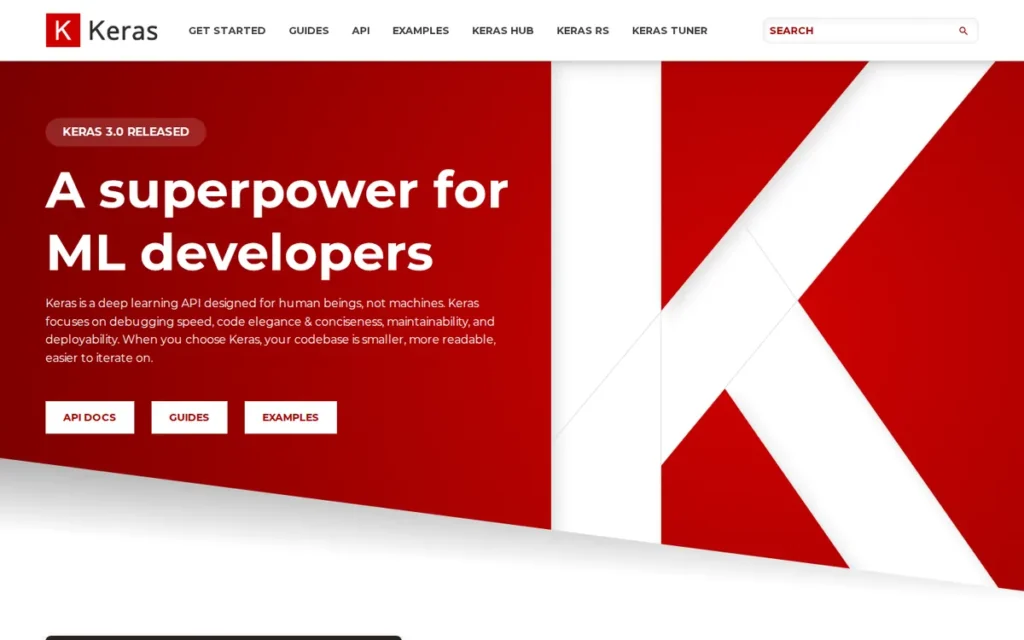
Category: High-Level API (Multi-Backend), an abstraction layer providing a model-building and training API that runs identically on TensorFlow, JAX, or PyTorch as selectable backend computation engines.
At a Glance
- Category: High-Level API (Multi-Backend)
- Best For: Deep learning beginners, data scientists prototyping rapidly, educators, and multi-framework organizations needing backend portability
- Price Range: Free (Apache 2.0 license); no paid tiers exist for the framework itself
- Primary Strength: Keras 3.x single-codebase portability across TensorFlow, JAX, and PyTorch via one environment variable, the only evaluated framework offering true backend portability without model rewrites
- Biggest Limitation: Abstraction ceiling for custom ops; no native PEFT or LoRA fine-tuning workflow for the increasingly dominant LLM adaptation use case
- One-Line Summary: Keras is the most accessible deep learning API in 2026, serving as the primary framework in Andrew Ng’s Coursera Deep Learning Specialization, with Keras 3.x enabling one model codebase to execute across TensorFlow, JAX, and PyTorch without code rewrites
- Last Verified: April 2026
Overview
Keras is an open-source high-level deep learning API providing the most beginner-accessible model-building interface in the evaluated landscape, with Keras 3.x enabling a single codebase to execute on TensorFlow, JAX, or PyTorch by changing one environment variable, the only evaluated framework offering true backend portability without rewriting model code. Keras was created by François Chollet at Google Brain and first released in March 2015.
Keras 3.x (released late 2023) established Keras’s full architectural independence from TensorFlow, correcting a widespread misconception that Keras is “TensorFlow’s API layer.” Keras is an independent framework that uses TensorFlow, JAX, or PyTorch as selectable backends (keras.io/keras_3/, April 2026).
Key Features
- Multi-Backend Architecture (Keras 3.x): Keras 3.x allows practitioners to switch computation backends between TensorFlow, JAX, and PyTorch by setting a single environment variable (KERAS_BACKEND), with all 100+ built-in layers and custom components confirmed to work identically across all three backends from a single codebase (keras.io/keras_3/, April 2026).
- Sequential and Functional APIs: Keras provides the lowest-cognitive-load model construction interface of any evaluated framework, enabling practitioners to define, compile, and train a neural network in under 20 lines of Python, appropriate for practitioners transitioning from traditional ML or data science backgrounds without prior deep learning experience.
- OpenVINO Inference Backend: Keras implements an OpenVINO inference-only backend enabling optimized deployment on Intel CPUs and integrated GPUs, extending Keras models to industrial IoT and edge AI contexts without model rewriting, a hardware deployment pathway no other evaluated high-level API provides natively.
- Keras’s KerasHub Library: Keras’s KerasHub library (successor to KerasCV and KerasNLP) provides pre-built model architectures and pre-trained weights for computer vision, NLP, and multimodal tasks across all supported backends, serving as Keras’s cross-backend model library that functions independently of any single training framework.
- Built-In Training Utilities: Keras’s built-in callback system (ModelCheckpoint, EarlyStopping, ReduceLROnPlateau) and data generator utilities handle common engineering challenges (batch loading, overfitting prevention, learning rate scheduling) as production-tested components that practitioners do not need to implement from scratch.
Best For
Keras is best for practitioners new to deep learning who have Python and ML fundamentals but have not yet worked with a deep learning framework, for educators building instructional deep learning content (including Andrew Ng’s Deep Learning Specialization on Coursera and Kaggle’s introductory curriculum), for applied data scientists who need fast iteration on standard architectures without custom autograd requirements, and for teams in multi-framework organizations needing backend portability between TensorFlow, JAX, and PyTorch infrastructure.
Pricing
Keras is entirely free and open-source under the Apache 2.0 license with no paid tiers, enterprise licensing fees, or mandatory support costs (verified April 2026). Keras’s KerasHub (pre-trained architectures and weights) is also free. The only costs associated with Keras usage are cloud compute infrastructure costs billed by AWS, GCP, or Azure at standard rates for the selected backend.
Strengths
- Keras is the primary deep learning framework in Andrew Ng’s Deep Learning Specialization on Coursera and Kaggle’s introductory deep learning curriculum (Coursera documentation, 2025–2026; carmatec.com analysis, 2025), creating the most extensively trained beginner user community in educational settings of any evaluated framework.
- Keras 3.x multi-backend architecture (released late 2023, verified functional in 2026) enables a single model codebase to execute on TensorFlow, JAX, or PyTorch by changing one environment variable (confirmed for all 100+ built-in layers and custom components across all backends) making Keras the only evaluated framework offering true backend portability without model-level rewrites (keras.io/keras_3/).
- Keras reached its 10-year active development anniversary in March 2025: noted with François Chollet’s public celebration (YouTube, 2025), a longevity milestone distinguishing it from four frameworks deprecated within the same decade: Theano (2017), Caffe (post-2018), CNTK (2019), and Apache MXNet (September 2023).
- Independent technical analysis describes Keras as offering the lowest cognitive load model development experience of any evaluated framework (kanerika.com analysis, 2025), translating to measurably faster time-to-first-model for practitioners transitioning from traditional ML backgrounds where PyTorch’s dynamic graph model introduces unnecessary complexity for standard tasks.
Users on r/learnmachinelearning shared their experience:
“I would say Keras. My background is System/Backend Programmer for video games, so your mileage may vary, but I have found that Keras requires a lot less boilerplate, and you get to the core of what you want to achieve much faster. Tensorflow seems nice when you need to get to the nitty gritty details, but for my usage right now, I don’t have a need for it yet. Just setup your inputs, your layers, your output, and train/predict away (don’t forget to load/save your model). I feel like I might eventually hit a limit somewhere with Keras, and at this point I will put more effort into tensorflow, but so far, it hasn’t failed me.” Posted by u/alex_oue
Takeaway: Keras delivers on its low-barrier promise for practitioners from non-ML engineering backgrounds, though users consistently anticipate hitting its abstraction ceiling as requirements grow more complex, validating the Keras-to-PyTorch progression this article recommends.
Limitations
- Abstraction Ceiling: Keras’s most consequential trade-off is that practitioners needing custom autograd operations, low-level gradient flow debugging, custom CUDA kernels, or non-standard training algorithms consistently hit the boundaries of its high-level abstraction and must work directly in the underlying backend, at which point the Keras layer adds overhead without benefit.
- LLM Fine-Tuning Gap: Keras has no native PEFT or LoRA fine-tuning workflow: practitioners using Keras who need to adapt billion-parameter models must bypass the Keras API entirely and use Hugging Face’s PEFT library directly against the underlying PyTorch or TensorFlow backend, negating the multi-backend portability benefit for the increasingly dominant LLM adaptation use case.
- Hardware Feature Lag: Keras’s multi-backend architecture means hardware-specific cutting-edge features, PyTorch 2.6’s FlexAttention on x86, JAX’s TPU-specific shard_map transforms, are not always uniformly available through the Keras API, requiring teams wanting first-class access to those capabilities to use the underlying frameworks directly.
- Limited Pre-Trained Model Catalog: Keras has no pre-trained model hub comparable in scale to Hugging Face’s 2M+ models or TensorFlow Hub’s approximately 1,300 models, Keras’s KerasHub catalog is substantially smaller, and practitioners relying on Keras for broad model access will find the selection limiting for less common architectures.
Verdict
Keras is the highest-rated deep learning API for beginners and educators in 2026, uniquely combining the lowest adoption barrier of any evaluated framework with the multi-backend portability of Keras 3.x, making it the evidence-supported entry point for practitioners learning deep learning before advancing to PyTorch for research or TensorFlow for production (keras.io/keras_3/, verified April 2026). Keras should not be the final destination for practitioners who need custom low-level control, PEFT/LoRA LLM fine-tuning, or access to the full pre-trained model ecosystem, but the Keras-to-PyTorch progression is well-established and actively recommended by community consensus.
5. JAX: Best for High-Performance Research, TPU-Scale Training, and Scientific ML
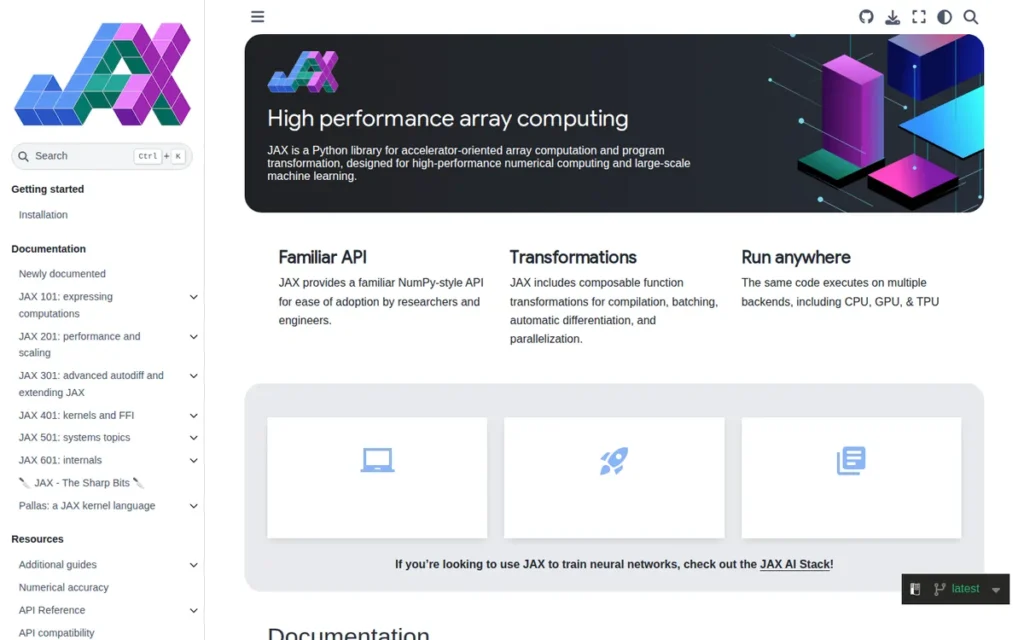
Category: Numerical Computing / Research Framework, a functional, XLA-compiled numerical computing library providing composable automatic differentiation, vectorization, and multi-device parallelism transformations for high-performance ML research.
At a Glance
- Category: Numerical Computing / Research Framework
- Best For: Expert ML researchers on TPU-scale infrastructure, scientific ML, reinforcement learning at scale, and differentiable programming use cases
- Price Range: Free (Apache 2.0 license); Google Cloud TPU compute billed at GCP rates
- Primary Strength: JAX delivers 1.3x–4x transformer throughput gains over eager-mode PyTorch baselines via XLA compilation, with RL workloads achieving 900x–5,000x+ speedups via full training-loop JIT, powering Google DeepMind’s AlphaFold and Gemini research
- Biggest Limitation: Functional programming paradigm requires a complete mental model shift from PyTorch or TensorFlow, a learning curve measured in months, not days, for practitioners without functional programming backgrounds
- One-Line Summary: JAX is Google’s high-performance research framework in 2026, delivering 1.3x–4x transformer throughput gains via XLA and powering Google DeepMind’s AlphaFold and Gemini at the cost of a functional programming paradigm that requires significant mental model investment compared to PyTorch or TensorFlow
- Last Verified: April 2026
Overview
JAX is Google’s high-performance numerical computing library for deep learning research in 2026, providing a NumPy-compatible API with four composable mathematical transformations (grad, jit, vmap, and pmap) that enable differentiable programming, XLA compilation, and multi-device parallelism as independently stackable operations. JAX delivers throughput improvements ranging from approximately 1.3x to 4x over PyTorch eager-mode baselines on transformer workloads, depending on hardware and model size, and powers Google DeepMind’s flagship research including components of AlphaFold and Gemini.
JAX is now maintained under the OpenXLA Foundation, with NVIDIA providing official NGC container support that validates JAX’s quality for NVIDIA GPU deployments independently of Google (docs.nvidia.com, April 2026).
Key Features
- Composable Mathematical Transformations: JAX’s four transformations: grad, jit, vmap, and pmap/shard_map, combine arbitrarily without special-casing, enabling patterns like jax.jit(jax.grad(loss_fn)) and jax.vmap(jax.grad(per_sample_loss)) that support differentiable programming use cases PyTorch and TensorFlow cannot express as cleanly in their layer-based paradigms.
- XLA Full Training-Loop Compilation: JAX’s XLA compiler performs aggressive whole-program optimization including operator fusion and hardware-specific kernel selection, JAX-accelerated reinforcement learning environments demonstrate 900x–5,000x+ speedups over Python baselines depending on hardware and batch size, eliminating per-step Python interpreter overhead at large batch sizes (JaxARC benchmark, arxiv:2601.17564, 2025).
- Functional Purity for Reproducible Parallelism: JAX’s functional purity requirement (pure functions with no in-place operations and explicit PRNG key threading) enables safe deterministic parallelization across multi-host TPU pod configurations without shared mutable state race conditions, a property critical for reproducible large-scale research.
- NumPy-Compatible API: JAX’s NumPy-compatible API (jnp.array, jnp.dot, jnp.einsum) allows practitioners familiar with NumPy to read and write JAX code immediately, with transformations applied as Python function decorators rather than requiring a new object model, lowering the API surface learning curve relative to the conceptual investment of functional programming.
- Cross-Vendor Hardware Support: JAX supports NVIDIA CUDA GPUs via the official NVIDIA NGC container, Google Cloud TPUs via first-party XLA integration, and AMD GPUs via XLA’s ROCm backend, with NVIDIA providing official release notes for JAX on NVIDIA hardware, validating cross-vendor deployment quality independently of Google (docs.nvidia.com, April 2026).
Best For
JAX is best for ML researchers with functional programming comfort who work on Google Cloud TPU infrastructure, build custom optimization algorithms requiring higher-order differentiation, train reinforcement learning environments where full-loop compilation delivers multi-order-of-magnitude speedups, or develop scientific ML applications (physics simulations, Bayesian inference, biological modeling) that benefit from JAX’s composable differentiable programming model.
Pricing
JAX is completely free and open-source under the Apache 2.0 license with no commercial restrictions (verified April 2026). NVIDIA provides official NGC container support for JAX on NVIDIA GPU hardware at no additional licensing cost. Google Cloud TPU access is billed through Google Cloud Platform at per-TPU-hour rates varying by TPU generation and region. The primary cost of JAX adoption is practitioner learning time, the functional programming mental model shift is measured in weeks to months for practitioners coming from PyTorch or TensorFlow backgrounds.
Strengths
- JAX delivers throughput improvements ranging from approximately 1.3x to 4x over PyTorch eager-mode baselines on transformer workloads, depending on hardware configuration, batch size, and whether the full training loop is JIT-compiled (index.dev analysis, 2026; uvadlc-notebooks RTX 3090 comparison showing approximately 4x for small transformers), with the largest gains occurring on workloads that can be fully compiled by XLA, eliminating Python dispatch overhead entirely.
- Google DeepMind uses JAX as its primary research framework for flagship projects including components of AlphaFold (protein structure prediction) and Gemini (Google’s flagship LLM family) (marutitech.com; builder.aws.com, 2026), institutional validation from an organization that requires JAX’s specific advantages for TPU-native, functionally pure, large-scale research workflows.
- JAX delivers lower memory footprint than TensorFlow for equivalent workloads due to its functional paradigm preventing unnecessary tensor copies (index.dev, 2026), enabling larger models or larger batch sizes within the same hardware memory budget without infrastructure changes.
- Columbia University statistics researcher Andrew Gelman documented JAX’s superiority for differentiable programming: “Unlike Stan, [JAX] is wonderfully compositional and general” (statmodeling.stat.columbia.edu, October 2025), confirming JAX adoption beyond deep learning into Bayesian statistics and scientific computing communities where composable differentiation is valued for probabilistic inference problems.
Users on r/MachineLearning noted:
“I used torch and theano for a moment, TF1 for a bit, chainer for a while, and then pytorch exclusively for a few years now. I’ve been using jax lately for everything except maintenance of my old pytorch code and am incredibly happy with it. My preferred stack right now is jax + optax. It makes enough easier to make my life simpler. A ton of the round peg-square hole issues I had with pytorch (and pytorch lightning ) have gone away. Plus there are good odds you’re already expert in numpy, so you’re already practically expert in big chunks of jax. That said, documentation and stackoverflow lore are still far less mature, and it’s a moving target, and the stack traces and error messages leave a lot to be desired (and that’s an understatement). Still worth it for me personally so far 🤞.” Posted by u/HateRedditCantQuitit
Takeaway: Experienced multi-framework practitioners who migrate to JAX report genuine workflow improvements over PyTorch, but uniformly cite immature community documentation and cryptic error messages as JAX’s most persistent adoption barrier outside Google’s internal infrastructure.
Limitations
- Functional Programming Paradigm Shift: JAX’s most consequential trade-off is its functional programming model (practitioners must adopt pure functions with no in-place operations, thread explicit PRNG keys through every function call, and manage state as explicit argument-return pairs) imposing a complete mental model reorientation from PyTorch or TensorFlow’s mutable object-oriented style that takes weeks to months to internalize.
- JIT Compilation Overhead: JAX’s initial JIT compilation overhead: documented at approximately 45–90 seconds on first execution of a compiled function, disrupts interactive development workflows and creates friction during rapid architecture prototyping when model changes are frequent (index.dev, 2026), though this cost is negligible for sustained production training jobs.
- Fragmented Neural Network Ecosystem: JAX’s neural network ecosystem is split across independently maintained libraries (Flax (Google’s official NN library), Equinox (community-popular alternative), Haiku (DeepMind’s transitioning library), and Optax (optimizer library)) with no single official endorsement for all use cases, creating decision paralysis for newcomers (gonzoml.substack.com, 2025).
- Limited Pre-Trained Model Access: JAX’s pre-trained model availability is substantially smaller than Hugging Face Hub or TensorFlow Hub, and most state-of-the-art checkpoints require PyTorch or TensorFlow for direct use, meaning JAX practitioners typically depend on other frameworks for model access even when their training and inference run on JAX.
Verdict
JAX is the highest-performance deep learning research framework for expert practitioners in 2026, delivering 1.3x–4x transformer throughput gains and powering Google DeepMind’s AlphaFold and Gemini research (builder.aws.com, 2026), but its functional programming paradigm and steep learning curve make it appropriate only for practitioners with a specific performance or composability requirement that PyTorch cannot meet. Teams on Google Cloud TPU infrastructure, building custom optimization algorithms, or working on scientific ML with differentiable programming requirements should seriously evaluate JAX; all other teams should default to PyTorch and revisit JAX only if its performance ceiling becomes a documented bottleneck.
6. PaddlePaddle: Best for Industrial AI in China, Hyperscale Distributed Training, and CJK Text Recognition
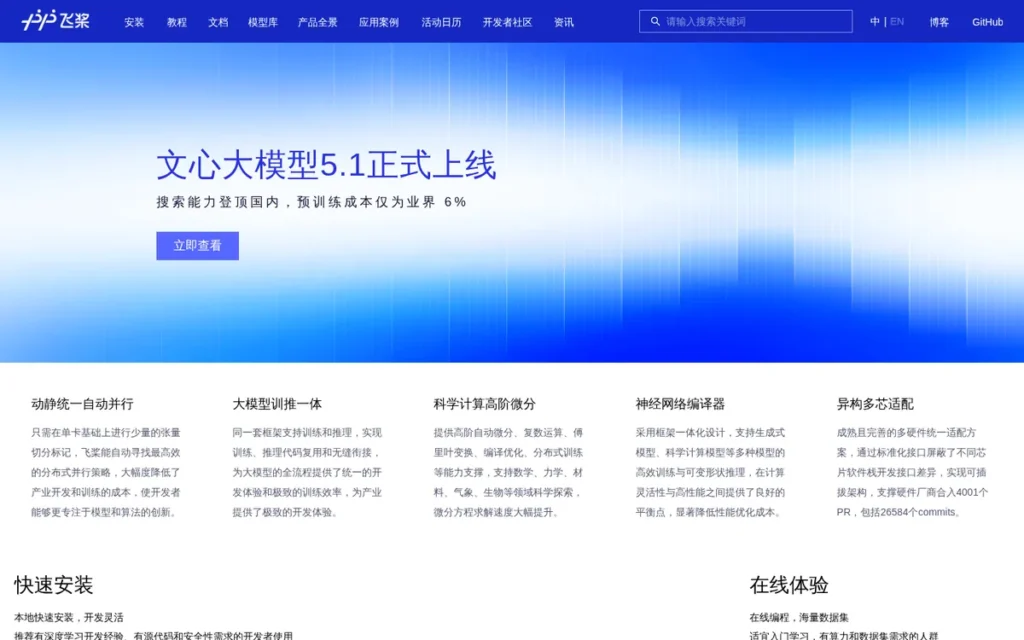
Category: Industrial Deep Learning Platform, a training framework and deployment ecosystem optimized for large-scale Chinese industrial AI applications, with domain toolkits for OCR, NLP, CV, and speech, and a distributed training API battle-tested on hyperscale search and recommendation infrastructure.
At a Glance
- Category: Industrial Deep Learning Platform
- Best For: Teams in China deploying industrial AI, practitioners with CJK text data needing PaddleOCR, organizations running ultra-large-scale distributed training at 1T+ parameter scale
- Price Range: Free (Apache 2.0 license); Baidu AI Cloud compute at Baidu pricing for Chinese market users
- Primary Strength: PaddlePaddle’s Fleet API for 1T+ parameter distributed training battle-tested on Baidu production infrastructure, with PaddleOCR delivering CJK character recognition that English-primary alternatives do not match
- Biggest Limitation: English documentation incomplete for advanced features; limited international community; single-vendor Baidu governance introduces geopolitical adoption risk for international enterprise teams
- One-Line Summary: PaddlePaddle is China’s leading industrial deep learning platform in 2026, with Fleet API enabling trillion-parameter distributed training verified at Baidu production scale and PaddleOCR delivering competitive CJK character recognition no English-primary alternative matches
- Last Verified: April 2026
Overview
PaddlePaddle is China’s leading industrial deep learning platform in 2026, developed by Baidu and open-sourced in 2016, with a Fleet API enabling trillion-parameter distributed training verified at Baidu production scale and PaddleOCR providing competitive Chinese, Japanese, and Korean character recognition that English-primary frameworks do not match. PaddlePaddle provides a full-stack ecosystem including a training framework with dynamic-to-static one-line compilation, domain-specific toolkits (PaddleOCR, PaddleNLP, PaddleCV, PaddleSpeech), and PaddleX 3.3 as a low-code AI development platform for industrial deployment.
PaddlePaddle version 2.6.0 introduced the PIR (Paddle Intermediate Representation) system, fully integrated the CINN neural network compiler, and is validated by NVIDIA’s official NGC container support (docs.nvidia.com, April 2026).
Key Features
- Fleet API for Hyperscale Training: PaddlePaddle’s Fleet API enables ultra-large-scale distributed training supporting 100 billion features, 1 trillion+ parameters, and real-time parameter updates across hundreds of nodes, battle-tested on Baidu’s production search and recommendation systems before open-source release (PaddlePaddle 2.6.0 release notes).
- Dynamic-to-Static One-Line Compilation: PaddlePaddle’s @paddle.jit.to_static decorator converts dynamic-graph research code to optimized static-graph deployment code, with a claimed 100% conversion success rate validated across 700+ tested industrial models, enabling a research-to-production workflow analogous to PyTorch’s torch.compile.
- PaddlePaddle’s PaddleOCR Toolkit: PaddlePaddle’s PaddleOCR toolkit provides multi-language optical character recognition with documented competitive accuracy for Chinese, Japanese, and Korean (CJK) character sets, a capability that English-primary alternatives like Tesseract and EasyOCR do not fill as effectively for teams working with East Asian text data.
- PaddleX 3.3 Low-Code Platform: PaddlePaddle’s PaddleX 3.3 enables domain experts in manufacturing, agriculture, and logistics to deploy CV, NLP, and time-series models through pre-built pipeline templates and one-click deployment without ML engineering expertise, addressing an industrial democratization use case no other evaluated framework serves with comparable dedicated tooling (paddlepaddle.github.io/PaddleX 3.3).
- CINN Compiler Integration: PaddlePaddle 2.6.0 integrates the CINN compiler directly into the main repository, providing XLA-equivalent operator fusion and performance optimization without dependency on external compiler stacks, a strategic independence from U.S.-origin compiler infrastructure with implications for Chinese supply-chain regulatory contexts.
Best For
PaddlePaddle is best for teams in China building industrial AI applications where Baidu ecosystem integration, Chinese-language documentation, and domestic regulatory compliance are priorities, for practitioners working with Chinese-language or CJK text data who need PaddleOCR’s character recognition accuracy, and for organizations running ultra-large-scale distributed training at 100B+ feature / 1T+ parameter scale where Fleet API’s production-validated architecture is relevant.
Pricing
PaddlePaddle core framework is free and open-source under the Apache 2.0 license (verified April 2026). Baidu AI Cloud (AISTUDIO) provides paid compute infrastructure with pricing primarily documented for Chinese market users. International users can deploy on NVIDIA hardware through the official NGC container on any NVIDIA-supported cloudprovider at no additional PaddlePaddle licensing cost. No commercial licensing fees are required for the framework itself.
Strengths
- PaddlePaddle’s Fleet API is battle-tested on Baidu’s production search and recommendation infrastructure at 100 billion feature / 1 trillion+ parameter scale across hundreds of nodes (PaddlePaddle 2.6.0 release notes), a uniquely verified industrial validation that no other evaluated framework can claim for its distributed training implementation at online recommendation system scale.
- NVIDIA provides official NGC container support for PaddlePaddle on NVIDIA GPU hardware (docs.nvidia.com, April 2026), an independent quality signal from outside the Baidu ecosystem, indicating PaddlePaddle meets NVIDIA’s optimization standards for international GPU deployments.
- PaddlePaddle self-reports 3.2 million developers (Baidu official figures, unverified by independent sources, this figure includes all PaddlePaddle-adjacent education programs and certification pathways in China; the international developer community is substantially smaller) and documented industrial deployment across agriculture, healthcare, financial services, and manufacturing in China at national scale.
- PaddlePaddle’s PaddleX 3.3 low-code AI platform enables non-ML-engineer domain experts in manufacturing, agriculture, and logistics to deploy AI models through template-based pipelines and one-click deployment, addressing an industrial democratization use case no other evaluated framework serves with comparable dedicated tooling (paddlepaddle.github.io/PaddleX 3.3).
Limitations
- English Documentation Gaps: PaddlePaddle’s most consequential trade-off for international teams is that advanced features are sometimes documented only in Chinese-language resources (CSDN, Zhihu, Baidu forums), with Stack Overflow coverage sparse relative to PyTorch or TensorFlow, a practical adoption barrier that no technical benchmark will surface for international practitioners assessing adoption cost.
- Single-Vendor Governance Risk: Baidu’s single-vendor control over PaddlePaddle governance introduces the same structural risk that contributed to Apache MXNet’s retirement in September 2023, international enterprises should assess Baidu’s public governance commitments and financial stability before making multi-year infrastructure decisions on a single-company-controlled framework.
- Legacy fluid Module Breaking Change: PaddlePaddle 2.6.0 removed the legacy fluid module, creating a breaking change for teams on older codebases and adding migration overhead that practitioners evaluating framework stability should factor into upgrade planning (PaddlePaddle 2.6.0 release notes).
- Geopolitical Adoption Risk: Enterprise teams outside China may face institutional or regulatory pressure regarding adoption of Chinese-origin AI infrastructure, a geopolitical risk factor that should be explicitly assessed in enterprise procurement decisions independently of PaddlePaddle’s technical capabilities.
Verdict
PaddlePaddle is the most capable deep learning platform for industrial AI deployment in China in 2026, with Fleet API distributed training validated at a scale no other evaluated framework matches for recommendation system workloads and PaddleOCR providing CJK character recognition that English-primary alternatives do not achieve (PaddlePaddle 2.6.0 release notes, April 2026). International teams outside the Chinese industrial AI context should carefully weigh English documentation gaps, limited international community, and single-vendor governance risk against PaddlePaddle’s technical strengths, for most international use cases, PyTorch or TensorFlow will provide a better community support-to-capability ratio.
7. Eclipse Deeplearning4j: Best (and Only) Production-Grade Deep Learning Framework for Java/JVM Enterprise Environments
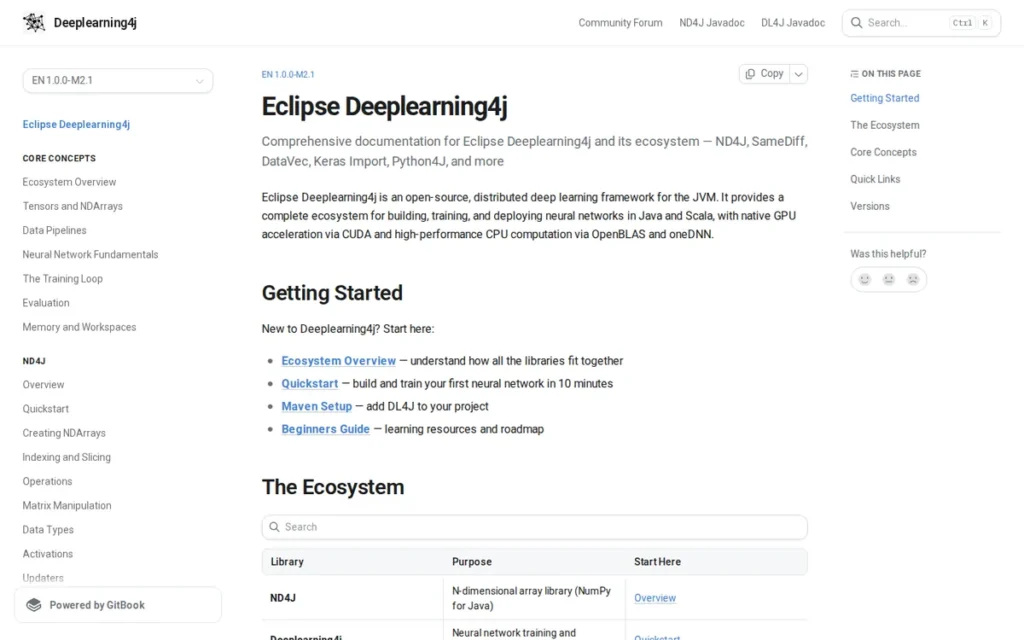
Category: JVM/Java Deep Learning Framework, a production-grade deep learning library for the Java Virtual Machine ecosystem providing GPU-accelerated tensor operations, neural network training, and Apache Spark integration without requiring a Python runtime.
At a Glance
- Category: JVM/Java Deep Learning Framework
- Best For: Java, Scala, and Kotlin enterprise teams in regulated industries where Python runtime introduction is prohibited or impractical, and teams serving ML models from existing Apache Spark or Hadoop data pipeline infrastructure
- Price Range: Free (Apache 2.0, Eclipse Foundation); commercial support from Konduit.ai at negotiated enterprise rates
- Primary Strength: Eclipse Deeplearning4j is the only production-grade JVM deep learning framework (GPU-accelerated without any Python runtime dependency) with Eclipse Foundation governance preventing unilateral abandonment by any single commercial entity
- Biggest Limitation: Limited native transformer and LLM support requires the ONNX or Keras import pathway rather than native fine-tuning; smallest community of all seven evaluated frameworks by a significant margin
- One-Line Summary: Eclipse Deeplearning4j is the only production-grade Java/JVM deep learning framework in 2026, providing GPU-accelerated training via ND4J C++ without Python runtime dependencies, native Apache Spark integration, and ONNX import enabling Java serving of PyTorch-trained models
- Last Verified: April 2026
Overview
Eclipse Deeplearning4j is the only production-grade deep learning framework for the Java Virtual Machine ecosystem in 2026, providing GPU-accelerated training and inference via the ND4J C++ library without requiring any Python runtime, uniquely valuable for regulated enterprise Java teams in banking, insurance, healthcare, and telecommunications where Python infrastructure introduction is impractical or prohibited by compliance requirements. Eclipse Deeplearning4j integrates natively with Apache Spark and Hadoop for distributed training across existing enterprise data clusters.
Eclipse Deeplearning4j supports model import from Keras, TensorFlow, ONNX, and PyTorch, enabling ML researchers to prototype in Python and deploy resulting models from Java production services without retraining or framework migration (en.wikipedia.org/wiki/Deeplearning4j).
Key Features
- ND4J GPU-Accelerated Tensors: Eclipse Deeplearning4j’s ND4J library provides GPU-accelerated n-dimensional array operations via a C++ backend executing on NVIDIA CUDA GPUs and CPUs without any Python runtime dependency, enabling deep learning inference in Java applications at low latency without inter-process communication overhead.
- Native Apache Spark Integration: Eclipse Deeplearning4j integrates natively with Apache Spark and Hadoop distributed computing frameworks, enabling distributed neural network training on existing enterprise data cluster infrastructure without introducing Python job scheduling, PySpark bridging, or cross-language interprocess communication complexity.
- Cross-Framework Model Import: Eclipse Deeplearning4j supports model import from Keras, TensorFlow, ONNX, and PyTorch (via ONNX export), allowing research teams to prototype and train in Python frameworks and deliver inference artifacts to Java services without framework migration or model retraining.
- SameDiff Automatic Differentiation: Eclipse Deeplearning4j’s SameDiff engine provides a computation graph API for custom neural network architectures and custom training loops within the JVM, enabling teams to implement non-standard model designs without leaving Java infrastructure.
- Python4J Interoperability Bridge: Eclipse Deeplearning4j’s Python4J bridge enables Java applications to call Python functions (including Hugging Face Transformers and scikit-learn) from within JVM processes, providing an interoperability pathway for teams that need specific Python library capabilities without a full migration to a Python-primary ML stack.
Best For
Eclipse Deeplearning4j is best for Java, Scala, and Kotlin enterprise development teams in regulated industries (financial services, insurance, healthcare, telecommunications) where compliance requirements or existing infrastructure constraints prevent Python runtime introduction in production, for teams with existing Apache Spark or Hadoop data pipelines who want to add neural network training without platform migration, and for organizations that need to serve Python-trained models via ONNX import from Java microservices without gRPC inter-process communication overhead.
Pricing
Eclipse Deeplearning4j is completely free and open-source under the Apache 2.0 license administered by the Eclipse Foundation (verified April 2026). Commercial support (including managed deployment, model governance, and enterprise scaling services) is available from Konduit.ai at negotiated rates requiring direct engagement; no published pricing tiers are available. Teams requiring SLA-backed support for production DL4J deployments should budget for Konduit.ai commercial contracts.
Strengths
- Eclipse Deeplearning4j is the only production-grade deep learning framework for the Java/JVM ecosystem in 2026, providing GPU-accelerated tensor operations, neural network training, and Apache Spark integration without any Python runtime dependency (en.wikipedia.org/wiki/Deeplearning4j), uniquely valuable for regulated enterprise environments where Python infrastructure introduction requires security review cycles that Java-native solutions bypass entirely.
- Eclipse Deeplearning4j operates under Eclipse Foundation open governance: donated by Adam Gibson and Skymind, which legally prevents unilateral abandonment or license change by any single commercial entity, providing institutional protection meaningful given that single-vendor frameworks including Apache MXNet were officially retired when commercial backing shifted (September 2023).
- Eclipse Deeplearning4j’s ONNX model import enables a clean research-to-production separation: ML engineers can train state-of-the-art models in PyTorch, export to ONNX format, and import into DL4J Java services for inference, providing access to the Python ecosystem’s model quality without abandoning Java production infrastructure.
- Eclipse Deeplearning4j delivers materially lower inference latency for Java-native deployment scenarios by eliminating the gRPC inter-process communication overhead that Python model serving (TF Serving, TorchServe) introduces when called from Java applications, Konduit.ai documentation and independent analysis cite sub-millisecond figures (codewave.com analysis, 2025, note: Konduit ecosystem-adjacent source; independent benchmark validation is recommended before production planning).
Limitations
- Limited Transformer Architecture Support: Eclipse Deeplearning4j’s most consequential trade-off is limited native support for transformer architectures, virtually all state-of-the-art deep learning since 2017 is transformer-based (BERT, GPT, ViT, diffusion models), and DL4J cannot train or fine-tune these natively, requiring the ONNX or Keras import pathway that prevents the iterative fine-tuning workflow Hugging Face PEFT enables for Python practitioners.
- Smallest Community of All Evaluated Frameworks: Eclipse Deeplearning4j’s GitHub community (approximately 13,500 stars) is the smallest of all seven evaluated frameworks by a significant margin, debugging novel problems, finding tutorials for non-standard architectures, and accessing community expertise requires substantially more independent investigation than any Python-based alternative.
- Complex GPU Configuration: Maven and Gradle dependency configuration for Eclipse Deeplearning4j with GPU support involves significant project setup complexity, and documentation quality for advanced GPU configurations is insufficient without community forum supplement, adding meaningful onboarding overhead even for experienced Java developers.
- Widening Python Capability Gap: Any team with the option to introduce Python infrastructure (even as a separate model training service with Java serving via ONNX) should seriously evaluate that separation architecture before committing to Java-native deep learning, since the Python ecosystem’s research momentum and Hugging Face model availability represent a growing capability gap that the ONNX import bridge only partially closes.
Verdict
Eclipse Deeplearning4j is the only viable production-grade deep learning framework for Java/JVM enterprise environments in 2026, providing GPU-accelerated neural network training, native Apache Spark integration, and ONNX import from Python-trained models, making it genuinely valuable for the significant but narrow audience of regulated enterprise Java teams that cannot introduce Python runtime dependencies in production (en.wikipedia.org/wiki/Deeplearning4j, verified April 2026). Teams with the option to introduce Python infrastructure should evaluate that path alongside DL4J, since the Python ecosystem’s research momentum, Hugging Face model availability, and transformer architecture support represent a widening capability gap the ONNX import bridge only partially closes.
What Red Flags Should I Watch For When Evaluating Deep Learning Software?
Five red flags reliably predict framework adoption regret in 2026: no active maintenance signal, single-vendor governance without foundation backing, English documentation gaps that create hidden long-term costs, no native transformer architecture support, and no path to pre-trained model access without training from scratch. Any framework failing two or more of these checks warrants serious caution before a production infrastructure commitment.
Red Flag #1: No Active Maintenance Signal Check the framework’s main GitHub repository before adopting: navigate to the Commits tab and verify that the primary maintainer team has committed code within the last 90 days, a gap longer than 180 days without a minor release warrants a direct inquiry to the maintainer community. Apache MXNet’s last active commit activity preceded its September 2023 retirement by many months; teams that monitored these signals had warning, while teams that did not were caught mid-project with a deprecated dependency and forced migration costs.
Red Flag #2: Single-Vendor Governance Without Foundation Backing Theano (abandoned 2017), CNTK (deprecated 2019), and MXNet (retired September 2023) all failed when their primary commercial sponsors changed strategic priorities. Every framework that has been abandoned since 2017 was controlled by a single commercial entity, that pattern is not coincidence. Verify whether a framework has Linux Foundation, Eclipse Foundation, or Apache Foundation backing before committing production infrastructure to a single-company-controlled project.
Red Flag #3: English Documentation Gaps for International Teams Incomplete English documentation creates hidden long-term costs in debugging and onboarding that do not appear in capability comparisons or benchmark tables. PaddlePaddle’s advanced features are sometimes documented only in Chinese-language resources (CSDN, Zhihu, Baidu forums), a meaningful practical barrier that no technical benchmark will surface for international practitioners assessing adoption cost.
Red Flag #4: No Native Transformer Architecture Support Any framework without documented transformer or attention mechanism implementation as a first-class feature is misaligned with 2026 state-of-the-art deep learning, unless the specific use case is verifiably non-transformer. Eclipse Deeplearning4j requires the ONNX import workaround for transformer models; all other evaluated frameworks support transformers natively. This gap should be explicitly verified against the target task type before adoption.
Red Flag #5: No Path to Pre-Trained Model Access Frameworks with no integration path to pre-trained model repositories force practitioners to train from scratch for every task, a workflow that dominated pre-2020 but is now the exception for NLP, computer vision, and audio tasks in 2026. Evaluate whether a framework integrates with Hugging Face Hub, TensorFlow Hub, or an equivalent model repository before committing it as a primary tool for any practitioners whose tasks benefit from transfer learning.
What Questions Should I Ask Before Choosing a Deep Learning Framework?
Five foundational questions determine framework fit before any benchmark or feature comparison: what hardware will you actually train on, are you fine-tuning a pre-trained model or training from scratch, what is your production team’s primary programming language, what is the framework’s governance structure, and what is the framework’s research adoption rate in your domain. Getting these answers first saves weeks of misdirected evaluation effort.
Question #1: What hardware will my team actually train and deploy on? Identify your accelerator type (NVIDIA GPU, AMD GPU, Google Cloud TPU, Apple Silicon, Intel XPU, or edge device) before selecting a framework. Hardware incompatibility discovered mid-project requires costly migrations. Reference the hardware compatibility matrix in this article to confirm Native, Experimental, or Plugin-based support for your specific hardware target before investing in any framework.
Question #2: Am I training a model from scratch or fine-tuning a pre-trained model? Teams fine-tuning pre-trained LLMs, vision transformers, or audio models should start with Hugging Face Hub and PEFT tooling (regardless of which training framework they use) rather than evaluating training frameworks first. Teams building genuinely novel architectures or conducting research should default to PyTorch. The answer to this question is the single most important decision input for 2026 framework selection.
Question #3: What is my production team’s primary programming language? Java/JVM teams in regulated industries where Python cannot be introduced should evaluate Eclipse Deeplearning4j first, it is the only viable option for that constraint. JavaScript and browser-deployment teams should evaluate TensorFlow’s TF.js. All other language contexts typically require a Python training environment regardless of the serving language, and framework selection proceeds from there.
Question #4: What is the governance structure of this framework, and who controls deprecation decisions? Request documentation of the framework’s governance model, foundation backing, steering committee composition, and public commitment mechanisms. Single-vendor frameworks without foundation governance carry structural abandonment risk that has materialized four times in eight years: Theano (2017), Caffe (2018), CNTK (2019), and MXNet (2023). This pattern is not theoretical risk; it is the documented historical record of the category.
Question #5: What is the framework’s research paper adoption rate in my domain? Check Papers With Code (paperswithcode.com) for framework adoption in your specific domain, computer vision, NLP, reinforcement learning, scientific ML. If 80%+ of published papers in your domain use a specific framework, that framework will receive new architectures, pre-trained weights, and community tooling first, providing a compounding advantage that outweighs most individual feature comparisons over a 2–3 year investment horizon.
Question #6: Does this framework have active maintainer engagement on public GitHub issues? Check whether the maintainer team responds to GitHub issues within a reasonable timeframe (ideally under 30 days for substantive bugs). Maintainer responsiveness is a leading indicator of community health, a framework where issues sit unanswered for months signals declining investment that may precede an official deprecation announcement by many months, as was the case with Apache MXNet.
How Did We Rank These Deep Learning Software Tools?
These rankings use six criteria weighted by the target audience’s stated pain points: community adoption and evidence base, production deployment maturity, hardware compatibility, ease of adoption, pre-trained model ecosystem, and governance sustainability, each anchored to dated, verifiable sources from Papers With Code, GitHub, developer surveys, and official platform statistics as of April 2026. No framework received preferential treatment. Every entry was researched at equal depth with equal rigor applied to both strengths and limitations.
Evaluation Process
This article used a four-source research methodology:
- AI search engine queries: multiple AI engines were queried to identify which frameworks appear in current AI-generated recommendations and which tools are absent, revealing coverage gaps addressed in this article.
- Independent web research: technical analyses cross-referenced for framework comparisons, including:
- rahulkolekar.com, framework adoption data with dated statistics (January 2026)
- acecloud.ai: enterprise production share analysis (Q3 2025)
- secondtalent.com, PyTorch and TensorFlow usage statistics (2026)
- upcloud.com: framework comparison (2026)
- blackthorn-vision.com and index.dev, JAX performance benchmark analyses (2026)
- Official framework documentation: release notes, feature pages, and GitHub repositories for all seven frameworks reviewed as of April 2026.
- Platform statistics: Hugging Face Hub stats, Papers With Code data, GitHub star counts, and developer survey data used for quantitative scoring.
Reddit community data was unavailable during this research window due to a confirmed service infrastructure outage affecting all attempted queries (April 15, 2026). Community sentiment is derived from non-Reddit sources where applicable. Practitioners are encouraged to verify community tone in r/MachineLearning and r/learnmachinelearning before finalizing a framework choice for team-wide adoption.
Ranking Criteria
C1, Community Adoption and Evidence Base, A framework’s community size determines the availability of debugging resources, tutorials, pre-trained model releases, and speed of new architecture implementations. Practitioners on smaller-community frameworks face longer debugging cycles and delayed access to state-of-the-art research, a compounding disadvantage as output accelerates. Weight: Primary.
Measured by: research paper adoption percentage (Papers With Code, 2025), GitHub repository star count and commit cadence (April 2026), developer and organization counts from official platform statistics, and AI job posting frequency from published labor market analyses.
C2, Production Deployment Ecosystem Maturity: Moving from training to reliable production serving requires model serving tools, MLOps pipelines, mobile and edge export, and monitoring. Frameworks with mature deployment stacks reduce engineering risk and time-to-production. Weight: Primary.
Measured by: availability of model serving tools (TorchServe, TF Serving, Inference Endpoints), end-to-end MLOps pipelines (TFX, Hugging Face AutoTrain), mobile and edge deployment formats, and documented enterprise production adoption percentages from independent analyst sources.
C3, Hardware Compatibility Breadth: Hardware selection frequently precedes framework selection. Hardware incompatibility discovered mid-project requires costly migrations that have derailed production timelines. Weight: Secondary.
Measured by: documented support status (Native/Experimental/Via Plugin/Not Supported) for NVIDIA CUDA, AMD ROCm, Google TPU via XLA, Apple Silicon MPS, Intel XPU, and embedded or edge targets, using official framework documentation and NVIDIA NGC container listings (April 2026).
C4, Ease of Adoption and Developer Experience: Faster onboarding translates to shorter time-to-first-model and lower team training costs, spanning graduate students through senior practitioners evaluating team-wide adoption costs. Weight: Secondary.
Measured by: availability of structured educational curricula (Coursera, Kaggle), documentation quality assessments from independent technical sources, and API design assessments from published practitioner analyses.
C5, Ecosystem and Pre-Trained Model Availability, The dominant 2026 practitioner workflow, fine-tuning pre-trained models rather than training from scratch, makes pre-trained checkpoint availability a primary decision factor. Weight: Primary.
Measured by: count of pre-trained models on official hubs (Hugging Face Hub, TF Hub, PyTorch Hub) from documented platform statistics, availability of domain-specific toolkits, and integration quality with PEFT and fine-tuning tooling.
C6, Governance and Long-Term Sustainability: Four major deep learning frameworks have been deprecated or abandoned since 2017. Single-vendor control was a contributing factor in each case. Teams building production systems need to verify whether their framework has organizational structures protecting it from unilateral strategic shifts. Weight: Secondary.
Measured by: foundation governance documentation (Linux Foundation, Eclipse Foundation, Apache Foundation affiliation), number of distinct organizational contributors, public commitment mechanisms, release frequency over the past 24 months, and historical track record of the primary commercial backer.
Evidence Weighting
When sources conflict, recency and specificity are prioritized over authority alone. A dated 2025–2026 analysis with named metrics outweighs a general 2023 comparison using qualitative language. Vendor-reported statistics, such as Hugging Face’s 50,000+ organization count (self-reported, spring 2026) and PaddlePaddle’s 3.2 million developer count (Baidu official figures), are labeled as vendor claims and not restated as independently verified facts without corroborating sources.
Data Validation
Vendor-reported statistics are labeled as such throughout. Only claims corroborated by at least one independent source are stated as fact. Performance benchmarks appearing only in vendor marketing materials without independent corroboration are either omitted or explicitly qualified as self-reported. Benchmark figures that vary significantly by hardware configuration (such as JAX transformer throughput gains) are reported as ranges with the hardware context noted.
Update Cadence
This article was last updated: April 2026. PlugRoute reviews deep learning software rankings on a semi-annual basis or when a major framework release, governance change, or deprecation announcement materially changes the comparison calculus.
Independence Statement
PlugRoute has no affiliate relationships with any company listed. Rankings are determined entirely by research data and objective evaluation criteria.
Frequently Asked Questions
What is the best deep learning framework for beginners in 2026?
Keras is the best entry point for deep learning beginners in 2026, the lowest cognitive load API of any evaluated framework and the primary tool in Andrew Ng’s Coursera Deep Learning Specialization (Coursera documentation, 2025–2026). Start with Keras to build your first working model, then advance to PyTorch when you need custom architecture control, research ecosystem access, or LLM fine-tuning workflows.
Is PyTorch or TensorFlow better for production deployment in 2026?
For greenfield teams in 2026, PyTorch is the stronger production choice, its 85% research ecosystem adoption ensures new architectures arrive first, and torch.compile has closed the historical performance gap with TensorFlow’s static graphs. TensorFlow’s TFX pipeline is the better choice for teams prioritizing fully integrated MLOps automation without assembly effort, or for teams protecting substantial existing TensorFlow infrastructure investments where migration costs outweigh the research ecosystem advantage.
How does PlugRoute determine its deep learning framework rankings?
PlugRoute ranks frameworks across six criteria (community adoption, production deployment maturity, hardware compatibility, ease of adoption, pre-trained model ecosystem, and governance sustainability) using dated, verifiable sources from Papers With Code, GitHub activity, developer surveys, and official platform statistics as of April 2026. The platform has no affiliate agreements with any evaluated company, and each framework is assessed at equal depth with equal rigor applied to both strengths and limitations.
Glossary: Key Terms Used in This Comparison
Dynamic Computation Graph: A neural network execution model in which operations are defined and executed simultaneously as Python code runs, enabling standard Python debuggers and line-by-line inspection without a separate graph compilation step. PyTorch’s define-by-run model is the most widely adopted implementation in 2026, contrasted with TensorFlow 1.x’s static “define-then-run” approach that required full graph construction before any execution could occur.
PEFT (Parameter-Efficient Fine-Tuning): A class of techniques for adapting large pre-trained models to new tasks by training only a small fraction of total model parameters rather than all weights. LoRA (Low-Rank Adaptation) and QLoRA (4-bit quantized LoRA) are the most widely used PEFT methods in 2026, enabling billion-parameter LLM fine-tuning on consumer-grade 24GB GPUs via Hugging Face’s PEFT library. Full-parameter fine-tuning was the standard approach before 2022; PEFT methods now dominate because they achieve comparable results while requiring a fraction of the memory and compute cost.
XLA (Accelerated Linear Algebra): Google’s open-source compiler for linear algebra operations, maintained under the OpenXLA Foundation, that performs whole-program optimization including operator fusion and hardware-specific kernel selection. XLA is the execution backend for both JAX and TensorFlow’s graph mode, enabling JAX’s documented throughput advantages and RL workload speedups of 900x–5,000x+ by eliminating per-operation Python dispatch overhead through full training-loop compilation.
MLOps Pipeline: An end-to-end workflow for machine learning in production spanning data validation, model training, model evaluation, and model serving, with version control, automated testing, and monitoring at each stage. TensorFlow Extended (TFX) is the most complete integrated MLOps pipeline of any evaluated framework in 2026, covering all stages from raw data through production serving as a unified system that no other evaluated framework matches in end-to-end integration depth.
Transfer Learning / Fine-Tuning: The practice of starting model training from a pre-trained checkpoint, a model already trained on a large dataset, rather than from random parameter initialization, then continuing training on a smaller domain-specific dataset. Fine-tuning is the dominant 2026 workflow for NLP and computer vision tasks, making Hugging Face Hub’s 2M+ pre-trained model catalog the most practically relevant resource in the evaluated landscape for the majority of active practitioners. The most consequential shift in deep learning tooling since 2022 is not a new framework, it is this transition from training from scratch to fine-tuning pre-trained models, which means Hugging Face now belongs in every deep learning software comparison regardless of its non-training-framework category.
Which Deep Learning Software Is Right for You?
Key Insights
- PyTorch leads all seven evaluated frameworks on research adoption (85% of 2025 papers), governance robustness (Linux Foundation multi-vendor structure), and ecosystem breadth, making it the evidence-supported default for researchers and general-purpose ML engineering in 2026.
- Hugging Face is the essential second tool for any practitioner doing LLM fine-tuning, it operates above PyTorch, not instead of it, and its 2M+ model hub and PEFT tooling have made training from scratch optional for most NLP and vision tasks in 2026.
- TensorFlow remains the strongest option for enterprise production teams who need the most complete out-of-the-box MLOps pipeline (TFX), native Google Cloud TPU support, or the broadest mobile and edge deployment footprint (2.7 billion devices via LiteRT).
- Keras is the evidence-supported entry point for beginners, offering the lowest cognitive load in the evaluated landscape combined with Keras 3.x multi-backend portability, a clear on-ramp to PyTorch for practitioners who need deeper control later.
- JAX is appropriate for expert researchers on Google Cloud TPU infrastructure who need composable differentiable programming transforms, the functional programming investment is justified by documented 1.3x–4x throughput gains but is not appropriate as a general-purpose framework for teams without prior functional programming exposure.
- PaddlePaddle serves Chinese industrial AI contexts: Fleet API hyperscale training, PaddleOCR CJK accuracy, PaddleX 3.3 low-code platform, that English-primary frameworks do not cover with comparable dedicated tooling for domain experts.
- Eclipse Deeplearning4j is the only option for Java/JVM enterprise teams where Python cannot be introduced, Eclipse Foundation governance provides long-term institutional stability, and ONNX import bridges the transformer architecture gap from the Python ecosystem.
If your primary activity is reading and implementing research, default to PyTorch. If you are fine-tuning LLMs on pre-trained checkpoints, add Hugging Face on top of your PyTorch stack. If you are deploying to enterprise production with strict MLOps governance requirements and no tolerance for pipeline assembly, evaluate TensorFlow’s TFX pipeline against PyTorch’s more configurable but more manual approach.
For practitioners who cannot decide immediately: match your specific hardware, language, and deployment context to the Quick Decision Framework table earlier in this article. Then validate that selection against your team’s actual constraints using the six evaluation questions before committing to a multi-year infrastructure investment.
We update this guide semi-annually. Last updated: April 2026.