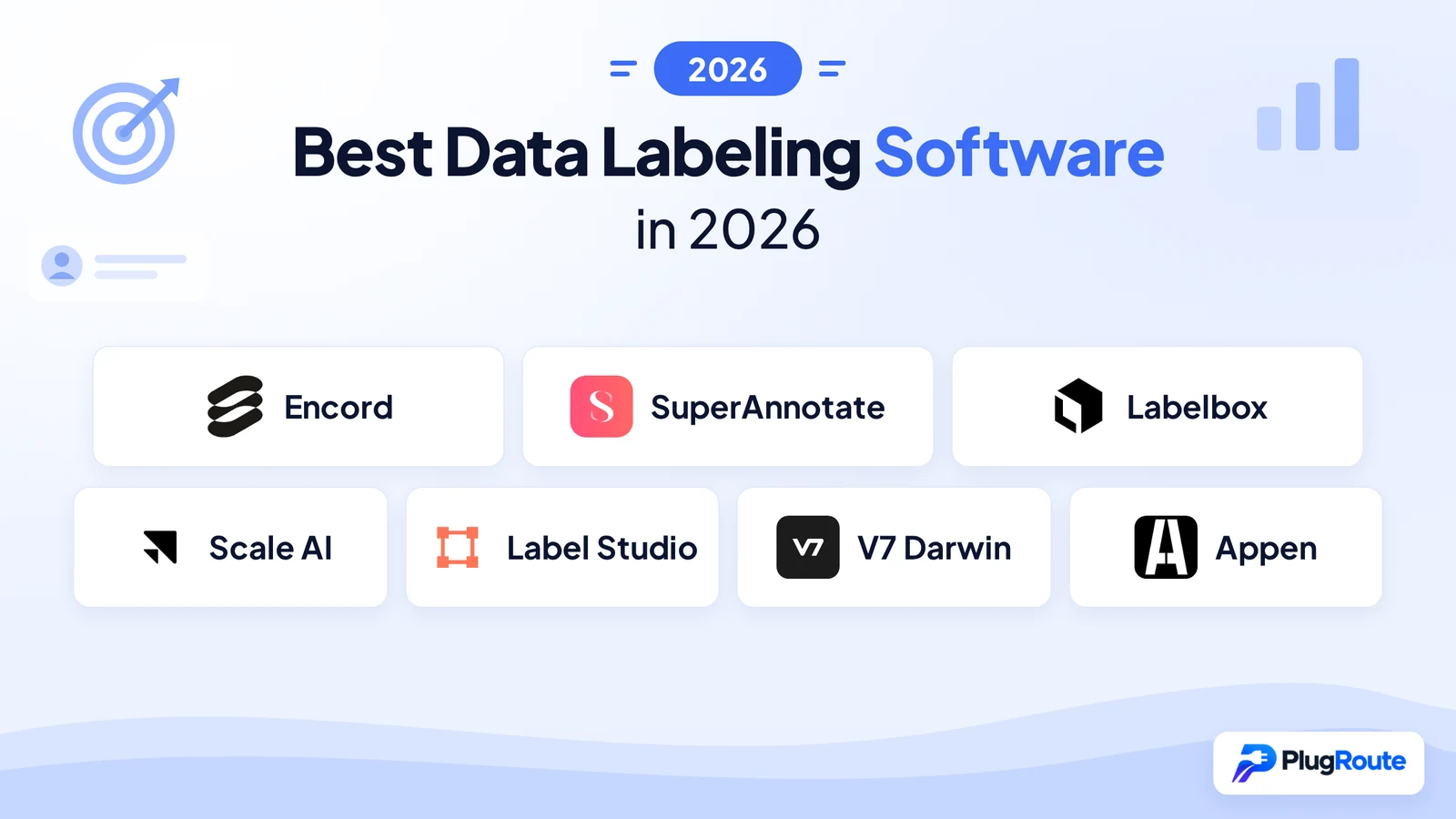
Encord is the best overall data labeling software for enterprise and healthcare AI teams requiring HIPAA-compliant multimodal annotation. SuperAnnotate leads for team collaboration and G2-verified ease of use. Labelbox is the strongest full-lifecycle platform for in-house ML pipelines. Label Studio is the only free-forever option; Scale AI remains the frontier-AI standard most teams cannot realistically budget for.
Choosing the right data labeling platform is genuinely difficult. Seven credible options span permanently free open-source tools to six-figure enterprise managed services, with meaningful differences in AI automation depth, modality support, compliance credentials, and team-size fit. ML practitioner community discussions consistently identify Label Studio as the zero-cost evaluation starting point, with most enterprise teams eventually migrating to Labelbox or SuperAnnotate as annotation volume and quality requirements scale (Perplexity, April 2026).
PlugRoute has no affiliate relationships with any company listed in this review. Rankings are determined entirely by research data and objective evaluation criteria.
TL;DR: Which Data Labeling Platforms Rank at the Top in 2026?
- Encord is the best overall choice for HIPAA-compliant multimodal annotation: integrating SAM2, GPT-4o, LLaMA 3.2, and Gemini 1.5 Flash across DICOM, NIfTI, LiDAR, and video in a single compliance-verified pipeline.
- SuperAnnotate leads all platforms in G2 user satisfaction: earning 19 badges including #1 for Easiest to Use and Best Support, and is the only platform with native CI/CD annotation pipeline automation via the Orchestrate product.
- Labelbox is the strongest full-lifecycle data platform, spanning annotation, curation, model fine-tuning via Foundry, and model evaluation in one environment, and is the ML community’s recommended upgrade from open-source Label Studio.
- Label Studio is the only platform in this review offering both a permanently free Community Edition and air-gapped on-premises Enterprise deployment for classified or data-sovereign annotation environments.
What Are the Main Types of Data Labeling Software?
Data labeling platforms fall into five structural categories, each solving a different annotation bottleneck. Managed labeling services outsource annotation to the vendor’s workforce; full-lifecycle SaaS platforms cover the entire training data pipeline; collaborative enterprise platforms prioritize team workflows and CI/CD integration; CV-specialist platforms optimize for visual AI tasks; and open-source platforms offer free, self-hosted annotation infrastructure.
Understanding which category fits your team’s annotation model is the first decision to make before evaluating individual features or pricing. In data-centric AI frameworks, the labeling platform is the primary mechanism for producing ground truth, the human-verified training signal that determines model quality ceilings regardless of architecture choice.
- Managed Labeling Services (Scale AI, Appen): Managed labeling services outsource annotation work entirely to the vendor’s human workforce, offering minimal self-serve software in exchange for maximum operational abstraction, the vendor, not your team, manages annotator recruitment, quality control, and delivery.
- Full-Lifecycle SaaS Platforms (Labelbox): Full-lifecycle platforms cover raw data ingestion through annotation, curation, model fine-tuning, and evaluation in one integrated environment, eliminating the toolchain fragmentation that plagues large ML teams managing separate point solutions.
- Collaborative Enterprise Platforms (SuperAnnotate): Collaborative platforms prioritize team workflows, vendor orchestration, CI/CD pipeline integration, and enterprise data stack connectivity, designed for teams that have validated their annotation requirements and are ready to scale.
- Multimodal AI Data Platforms (Encord): Multimodal platforms emphasize AI-assist automation depth, broad format support (DICOM, LiDAR, SVS), and compliance infrastructure for regulated industries, the strongest category for healthcare AI and physical AI teams.
- CV-Specialist Platforms (V7 Darwin): Computer vision specialist platforms optimize for visual AI tasks with advanced foundation model integration, medical imaging format support, and API-first programmatic workflow control for engineering-led annotation pipelines.
- Open-Source Platforms (Label Studio): Open-source platforms offer free Community Editions deployable on your own infrastructure, with Enterprise tiers adding compliance and governance features, the default starting point for budget-constrained teams and organizations with data sovereignty requirements.
The seven platforms in this review span all five categories.
How Do the Top Data Labeling Platforms Compare at a Glance?
The seven best data labeling platforms in 2026 span six distinct structural categories, with Encord ranked first for healthcare compliance and multimodal AI automation, SuperAnnotate second for team usability, Labelbox third for full-lifecycle data management, Scale AI fourth for frontier AI scale, Label Studio fifth as the only free-forever open-source option, V7 Darwin sixth for computer vision specialists, and Appen seventh for multilingual and pre-built dataset access.
| Rank | Company | Category | Best For | One-Line Summary | Key Capabilities | Primary Strength | Key Limitation |
|---|---|---|---|---|---|---|---|
| 1 | Encord | Multimodal AI Data Platform | Healthcare AI, physical AI, regulated multimodal | HIPAA-compliant multimodal platform integrating SAM2, GPT-4o, LLaMA 3.2, and Gemini 1.5 Flash across DICOM, NIfTI, LiDAR, and video. | SAM2, GPT-4o, LLaMA 3.2, Gemini 1.5 Flash; DICOM/NIfTI/SVS/LiDAR; Annotate + Index + Active | Broadest multi-model AI integration with verified compliance for regulated industries | Contact-sales-only pricing; reported connectivity slowdowns at scale |
| 2 | SuperAnnotate | Collaborative Labeling Platform | Enterprise teams prioritizing ease of use and CI/CD annotation automation | Highest-rated data labeling platform for enterprise team usability on G2 as of early 2026, with CI/CD automation and 400+ vendor teams. | SAM, CLIP, COCO; Orchestrate CI/CD; 400+ vendor teams; Snowflake/Databricks | #1 G2 Easiest to Use and Best Support; 19 badges across three categories | No free tier; explicitly excludes small teams |
| 3 | Labelbox | Full-Lifecycle Data Platform | In-house enterprise ML annotation with model-assisted labeling and hybrid workforce | Full-lifecycle AI data platform spanning annotation, curation, model fine-tuning, and evaluation; the ML community’s primary upgrade from Label Studio. | MAL foundation models; Foundry (YOLOv8 fine-tuning); Alignerr workforce; SOC 2; multi-cloud | Model-Assisted Labeling with vendor-stated up to 90% cost reduction | Steep learning curve for advanced features; contact-sales-only pricing |
| 4 | Scale AI | Managed Labeling Service and Platform | Frontier AI labs, AV manufacturers, U.S. government agencies | Data annotation platform trusted by OpenAI, Meta, Waymo, and U.S. federal agencies for frontier AI, RLHF, and AV sensor fusion annotation. | RLHF; multi-layer QA; 100K+ annotators; Scale Labs benchmarks; government-clearance-level engagement | Most credentialed enterprise customer roster and only verified defense-grade annotation engagement | Enterprise-only pricing; 1 G2 review (unreliable); June 2025 CEO transition |
| 5 | Label Studio | Open-Source Labeling Platform | Budget-constrained teams, academic labs, air-gapped environments | Most widely documented open-source data labeling platform; with 5 million+ downloads and the only air-gapped Enterprise deployment in this review. | XML-configurable interfaces; ML backend integration; S3/GCS/Azure sync; air-gapped deployment | Only permanently free tier and only air-gapped Enterprise deployment in this review | Community Edition lacks RBAC, compliance reporting, and SLA support |
| 6 | V7 Darwin | CV-Specialist Labeling Platform | Computer vision teams, digital pathology, API-first ML engineers | Computer vision annotation platform with SAM3-powered Auto-Annotate supporting ~4 million object concepts via text prompt (platform-stated). | SAM, SAM2, SAM3 (~4M concepts, platform-stated); SVS pathology; video tracking; V7 Go document AI | Most advanced zero-shot annotation vocabulary for visual AI tasks in this review | No native model training; Series A vendor execution risk |
| 7 | Appen | Crowd-Sourced Data Services Provider | Multilingual annotation, off-the-shelf pre-labeled datasets at scale | World’s longest-operating data annotation company (founded 1996), offering 270+ pre-labeled datasets and a 1M+ annotator workforce across 180+ languages. | Quality Flow QA; 270+ pre-labeled datasets; 180+ languages; tiered workforce access | Unmatched 30-year institutional dataset library unavailable from any other platform | Documented financial headwinds, revenue concentration risk, and annotator pay controversies |
Which Data Labeling Software Should I Choose for My Use Case?
Your data modality, compliance requirements, and team budget determine the right starting point. Teams annotating DICOM medical images or LiDAR point clouds in regulated environments should evaluate Encord first. Teams prioritizing ease of adoption and G2-validated satisfaction should start with SuperAnnotate. Budget-constrained teams and those needing data sovereignty should begin with Label Studio Community Edition, free with no usage restrictions.
| Your #1 Priority | Recommended Tool | Why | Acceptable Alternative |
|---|---|---|---|
| HIPAA + SOC 2 compliance with multimodal annotation (DICOM, NIfTI, LiDAR) | Encord | Deepest medical imaging support; HIPAA + SOC 2 + GDPR; confirmed pilot relationships with MSK and Stanford Medicine (TechCrunch, April 2022) | Labelbox (SOC 2, multi-cloud) |
| Ease of use, team collaboration, and G2-validated user satisfaction | SuperAnnotate | #1 G2 Easiest to Use and Best Support; 19 badges across three categories (G2, early 2026) | Labelbox (strong QA dashboards) |
| Full data lifecycle: annotate → curate → fine-tune → evaluate | Labelbox | Only platform with Annotate + Catalog + Foundry + Model in one environment | Encord (Annotate + Index + Active) |
| Frontier AI, RLHF at production scale, or defense-grade annotation | Scale AI | Only platform with verified U.S. government security contract and 100K+ annotator workforce | Appen (managed crowd for volume) |
| Zero-cost platform + data sovereignty + air-gapped deployment | Label Studio | Only permanently free tier; | |
| only air-gapped Enterprise option in this review | Self-hosted Encord (requires sales contact) | ||
| Computer vision + SAM3 text-prompted annotation + API-first control | V7 Darwin | SAM3 with ~4M concept vocabulary (platform-stated); strongest API configurability for CV engineering teams | Encord (broader compliance) |
| Multilingual annotation at scale + pre-built datasets in 180+ languages | Appen | 270+ pre-labeled datasets; 1M+ annotator workforce; only option for off-the-shelf training data; conduct vendor financial due diligence before multi-year contracts | Scale AI (managed RLHF at scale) |
1. Encord: Best Overall: Strongest Multimodal AI Data Platform for Enterprise and Regulated Industries
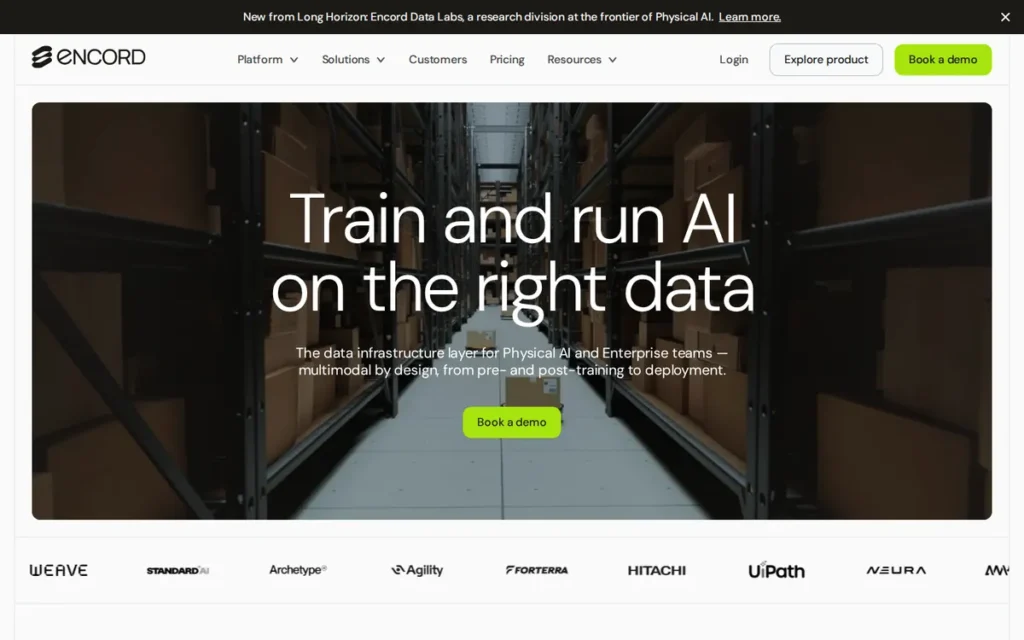
Category: Multimodal AI Data Platform, an end-to-end labeling, curation, and model evaluation platform supporting the broadest range of data modalities and compliance frameworks of any tool in this review.
At a Glance
- Category: Multimodal AI Data Platform
- Best For: Enterprise ML teams and healthcare or physical AI organizations requiring multimodal annotation (including DICOM, NIfTI, LiDAR, and SVS) with verified HIPAA and SOC 2 compliance
- Price Range: Pricing on request: no public tiers; all plans require direct sales contact (verified April 2026)
- Primary Strength: Encord integrates Meta SAM2, GPT-4o, LLaMA 3.2, and Gemini 1.5 Flash into a single annotation pipeline, the broadest multi-model AI-assist architecture of any platform in this review as of April 2026
- Biggest Limitation: Encord’s contact-sales-only pricing and reported occasional platform connectivity slowdowns under large annotation loads create evaluation friction for smaller teams and delivery risk on time-sensitive production jobs
- One-Line Summary: Encord is the data labeling platform of choice for enterprise healthcare and physical AI teams that need verified HIPAA and SOC 2 compliance, DICOM and LiDAR support, and multi-model AI automation (SAM2 + GPT-4o + LLaMA 3.2 + Gemini 1.5 Flash) across the full annotation-to-model-evaluation pipeline.
- Last Verified: April 2026
Overview
Encord is an enterprise multimodal AI data platform supporting annotation, curation, and model evaluation for images, video, text, audio, DICOM, NIfTI, LiDAR point clouds, SVS pathology files, and sensor fusion data, making Encord a primary contender for enterprise teams in healthcare AI, autonomous vehicle, and robotics organizations requiring compliance-verified annotation across the widest range of specialized data formats available in a single commercial platform.
Encord was founded in 2020 by Eric Landau and Ulrik Stig Hansen after Stig Hansen encountered the annotation bottleneck firsthand during his master’s thesis at Imperial College London, Encord is a Y Combinator graduate (TechCrunch, April 2022). Encord’s three integrated products, Annotate, Index, and Active, span labeling, data curation, and model evaluation without requiring teams to manage separate tools for each workflow stage.
Key Features
- Multi-Model AI Automation: Encord Annotate integrates Meta SAM2, OpenAI GPT-4o, Meta LLaMA 3.2, and Google Gemini 1.5 Flash into a unified AI-assist annotation engine, enabling pre-labeling, polygon generation, and automated classification across images, video, audio, and documents in a single pipeline.
- Video Smart Interpolation: Encord’s video annotation engine propagates labels across video sequences using smart frame interpolation, achieving a vendor-stated 6x speed improvement over frame-by-frame manual annotation (vendor-stated figure; independent benchmarks not available) and maintaining object tracking continuity in high-frame-rate footage.
- Embedding-Based Data Curation: Encord Index provides embedding-based similarity search for data curation, enabling ML teams to identify underrepresented classes, detect near-duplicate samples, and prioritize annotation effort on data that maximally improves model performance through active learning loops.
- Integrated Model Evaluation: Encord Active delivers model evaluation and error discovery within the same platform as annotation, flagging prediction failures and surfacing class-level performance gaps for targeted re-annotation without requiring data export to separate evaluation tools.
- RLHF and LLM Alignment Workflows: Encord supports rubric-based evaluation, pairwise comparison, and multi-model assessment pipelines across SAM2, GPT-4o, LLaMA 3.2, and Gemini, making Encord suitable for LLM alignment annotation alongside traditional computer vision and NLP labeling tasks.
Best For
Encord is best for enterprise ML teams in healthcare AI (radiology, pathology, clinical imaging), physical AI (autonomous vehicles, robotics, drones), and regulated industries that need HIPAA-compliant, SOC 2-certified annotation of multimodal datasets including DICOM, NIfTI, LiDAR, and high-frame-rate video, particularly SaaS companies, hospital research networks, and AV manufacturers that cannot afford toolchain fragmentation across their data pipeline.
Strengths
- Confirmed Pilot Relationships at High-Prestige Healthcare Institutions: Encord’s initial pilot program relationships with Memorial Sloan Kettering Cancer Center, Stanford Medicine, Viz.ai, Kheiron Medical, and King’s College London were confirmed in a TechCrunch feature (April 2022); current ongoing engagement status was not independently verified at time of publication (April 2026), but the institutional caliber signals production-grade reliability requirements that Encord’s platform was designed to meet.
- Broadest Multi-Model AI Integration Architecture as of April 2026: Encord’s AI-assisted labeling engine integrates Meta SAM2, GPT-4o, LLaMA 3.2, and Gemini 1.5 Flash in a single annotation pipeline, with vendor-stated performance of up to 97% annotation automation at 99% accuracy and 70% reduction in overall labeling time (vendor-stated figures, 2025; independent benchmarks not available).
- Customer-Documented Healthcare Workflow Speed Gains: Floy, an Encord customer, documented a 50% reduction in CT scan labeling time and a 20% reduction in MRI scan labeling time when annotating 60,000 DICOM images, results specific to Floy’s deployment configuration and dataset characteristics (Encord healthcare AI blog, 2025).
- Full Compliance Stack for Regulated Industries: Encord is HIPAA-compliant, SOC 2-certified, and GDPR-ready (with compliance workflows developed in direct collaboration with clinicians) making Encord one of two platforms in this review (alongside Label Studio Enterprise) with verified compliance credentials specifically designed for healthcare data environments (Encord healthcare AI blog, 2025).
Limitations
- Contact-Sales Pricing Creates Evaluation Friction: Encord’s contact-sales-only pricing model prevents ML teams at startups and academic institutions from self-qualifying budget fit before entering a sales conversation, all plans across Annotate, Index, and Active require direct sales engagement with no public pricing tiers available as of April 2026.
- Reported Connectivity Issues at Scale: Encord users report occasional platform slowdowns and connectivity issues under large annotation loads (SoftwareFinder reviews, April 2026), a meaningful concern for time-sensitive annotation projects where delivery reliability is as critical as feature depth.
- Healthcare Customer Relationship Currency Is Unverified: Encord’s pilot relationships with Memorial Sloan Kettering and Stanford Medicine were documented in 2022, prospective buyers in healthcare should verify the current scale and continuity of these relationships directly with Encord rather than relying on 2022 pilot documentation as evidence of ongoing production deployment.
- Potential Over-Engineering for Non-Regulated Use Cases: Teams outside regulated industries may find that Encord’s compliance infrastructure adds cost overhead that general-purpose competitors do not embed into equivalent feature sets, making Encord potentially over-engineered for standard single-modality image classification or text labeling without compliance requirements.
Verdict
Encord is the strongest data labeling platform in 2026 for enterprise teams requiring multimodal annotation with verified HIPAA and SOC 2 compliance, combining the broadest multi-model AI integration (SAM2 + GPT-4o + LLaMA 3.2 + Gemini 1.5 Flash) with the deepest medical imaging format support (DICOM, NIfTI, SVS) and three integrated products spanning annotation, curation, and model evaluation. Encord is uniquely suited for teams that cannot afford toolchain fragmentation across regulated data pipelines. Teams with simpler single-modality annotation needs or without compliance requirements should compare Encord’s contact-sales pricing against SuperAnnotate or Labelbox before committing to a sales cycle.
2. SuperAnnotate: Best for Team Collaboration and Ease of Use
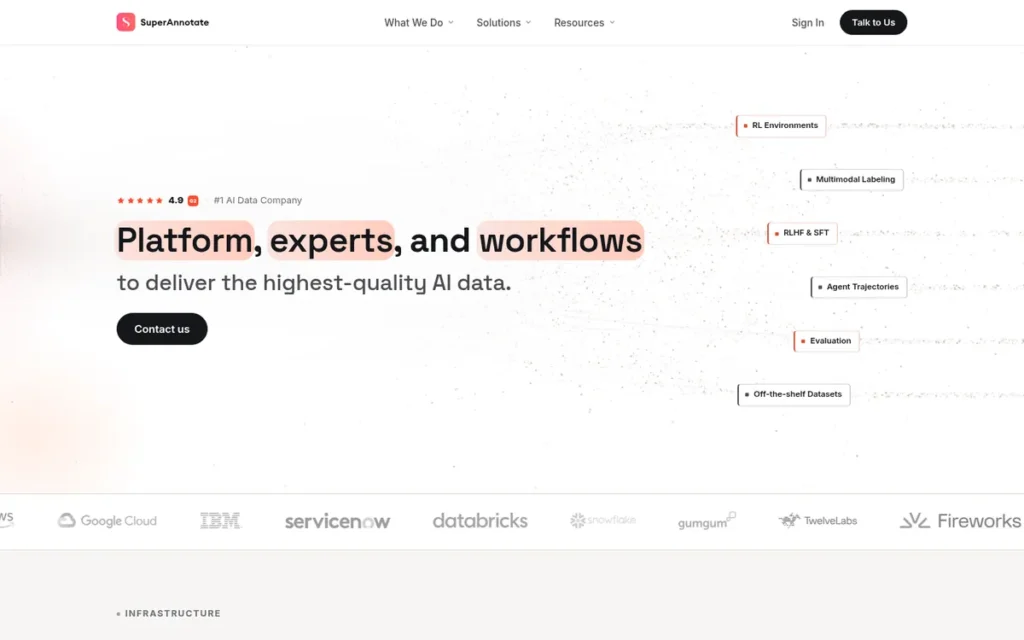
Category: Collaborative Labeling Platform, a team-oriented annotation platform rated #1 for ease of use and support on G2, with CI/CD pipeline automation and a built-in vendor team network for hybrid annotation workflows.
At a Glance
- Category: Collaborative Labeling Platform
- Best For: Enterprise and mid-market ML teams that prioritize ease of adoption, strong QA workflows, and hybrid in-house/outsourced annotation with vendor team access, particularly teams ready to scale an established annotation pipeline
- Price Range: Pricing on request: custom enterprise only; no public tiers; explicitly not suited for very small teams or one-off projects (verified April 2026)
- Primary Strength: SuperAnnotate has earned 19 G2 recognition badges across Data Labeling, MLOps, and LLMOps (including #1 for Easiest to Use and Best Support) the highest independently verified user satisfaction performance of any platform in this review
- Biggest Limitation: SuperAnnotate is explicitly not designed for small teams or one-off annotation projects, and its enterprise pricing structure with no free evaluation tier makes it inaccessible for teams in early-stage data strategy development
- One-Line Summary: SuperAnnotate is the highest-rated data labeling platform for enterprise team usability and support on G2 as of early 2026, combining SAM-powered AI automation, CI/CD pipeline integration via Orchestrate, and access to 400+ vetted annotation vendor teams in a single collaborative platform.
- Last Verified: April 2026
Overview
SuperAnnotate is an enterprise data labeling and MLOps platform supporting annotation for images, video, text, audio, LiDAR, 3D point clouds, medical scans, and multimodal projects, rated #1 for Easiest to Use and Best Support on G2 as of early 2026, making SuperAnnotate the top-rated platform for user satisfaction among enterprise annotation teams in this review.
SuperAnnotate combines annotation tooling with MLOps and LLMOps capabilities, including CI/CD pipeline automation via the Orchestrate product and access to 400+ vetted annotation vendor teams through its SME Careers network. SuperAnnotate integrates with Snowflake and Databricks for enterprise ML workflow connectivity and explicitly targets organizations operating at annotation scale rather than early-stage teams evaluating their first labeling tool. SuperAnnotate’s founding year and funding history are not publicly confirmed as of April 2026; teams requiring full vendor due diligence should request this information directly from SuperAnnotate.
Key Features
- SAM-Powered AI Annotation Engine: SuperAnnotate’s annotation engine integrates SAM (Segment Anything Model) for automated polygon generation, Magic Select/Box/Polygon tools, superpixel grouping, CLIP support, and COCO model pre-labeling, covering AI-assisted annotation across bounding boxes, instance segmentation, polylines, object tracking, NER, sentiment, and LLM-specific annotation types including RLHF preferences, intent labeling, and conversation summarization.
- Orchestrate CI/CD Pipeline Automation: SuperAnnotate Orchestrate enables CI/CD automation for annotation workflows (triggering annotation jobs on new data uploads and pushing completed batches to model retraining pipelines via Python SDK, webhooks, and neural network triggers) reducing manual intervention in the annotation-to-training cycle.
- Explore Active Learning and QA: SuperAnnotate’s Explore product provides data curation via versioning, annotator performance metrics, and dataset distribution visualization, enabling active learning loops and annotation quality error discovery without leaving the SuperAnnotate platform.
- 400+ Vetted Vendor Team Network: SuperAnnotate’s SME Careers network provides access to 400+ vetted annotation vendor teams for hybrid in-house/outsourced annotation, enabling rapid outsourcing scale without maintaining separate vendor relationships, with combined workflow management across internal and external annotator pools.
- Enterprise Data Stack Integration: SuperAnnotate integrates with Snowflake and Databricks for MLOps pipeline data connectivity, enabling annotation data to flow directly into enterprise data warehouse and ML training infrastructure without custom ETL engineering (Lightly AI comparison, 2025).
Best For
SuperAnnotate is best for enterprise and mid-market ML engineering teams that have already validated their annotation workflow requirements and are ready to scale, particularly teams that prioritize ease of adoption, hybrid annotation models combining in-house labelers with outsourced vendor teams, and need annotation pipelines to automatically trigger model retraining via CI/CD integration with Snowflake or Databricks infrastructure.
Strengths
- Category-Leading G2 User Satisfaction: SuperAnnotate earned 19 G2 recognition badges across Data Labeling, MLOps, and LLMOps categories as of early 2026 (including #1 ratings for Easiest to Use, Best Support, Most Implementable, and Best Relationship Builder, plus EMEA Leadership) the highest G2 user satisfaction performance of any platform in this review (G2, early 2026).
- Native CI/CD Annotation Automation: SuperAnnotate’s Orchestrate CI/CD product connects data ingestion, annotation triggering, quality review, and model retraining in a single automated loop via Python SDK and webhooks, a workflow orchestration capability that competing platforms require third-party MLOps tools to replicate.
- Integrated 400-Team Vendor Network: SuperAnnotate provides access to 400+ vetted annotation vendor teams through its SME Careers network, enabling hybrid in-house/outsourced annotation at scale without maintaining separate vendor contracts, a managed workforce integration that V7 Darwin and Encord lack natively (SuperAnnotate blog, 2025).
- Enterprise Data Stack Compatibility: SuperAnnotate’s Snowflake and Databricks integrations enable annotation data to flow directly into enterprise data warehouse and ML training infrastructure, meeting the connectivity requirements of teams on modern data stack architectures without custom ETL development (Lightly AI comparison, 2025).
Limitations
- Explicit Small-Team Exclusion: SuperAnnotate is explicitly not suited for small teams or one-off annotation projects, teams in early-stage data strategy development, academic research environments, or with limited annotation budgets face both financial barriers and potential over-engineering for their actual annotation volume.
- Absence of Free Evaluation Tier: SuperAnnotate offers no free tier or self-serve trial, preventing teams from evaluating the platform before a sales cycle, a meaningful friction point compared to Label Studio’s free Community Edition or Label Studio Enterprise’s 14-day free trial.
- Limited Public Vendor Transparency: SuperAnnotate’s founding year and total funding raised are not publicly confirmed as of April 2026, limiting vendor due diligence depth compared to publicly listed Appen (ASX: APX) or funding-verified entrants like V7 Labs ($33M Series A, confirmed November 2022).
- No Air-Gapped Deployment Option: SuperAnnotate does not offer air-gapped or fully on-premises deployment, teams with data sovereignty requirements for classified or highly restricted clinical data cannot use SuperAnnotate, and must evaluate Label Studio Enterprise as the only alternative in this review.
Verdict
SuperAnnotate is the highest-rated data labeling platform for enterprise team usability and support, earning more G2 badges across more product categories than any other platform in this review as of early 2026. SuperAnnotate’s combination of #1 G2 ratings for Easiest to Use and Best Support, CI/CD pipeline automation via Orchestrate, and a 400-vendor-team annotator network makes SuperAnnotate the strongest choice for enterprise ML teams prioritizing proven user satisfaction, workflow orchestration, and hybrid annotation at scale. SuperAnnotate’s explicit exclusion of small teams and absence of a free trial make it unsuitable for teams still evaluating whether their annotation volume justifies enterprise platform investment, those teams should start with Label Studio’s free Community Edition first.
3. Labelbox: Best Full-Lifecycle Data Platform
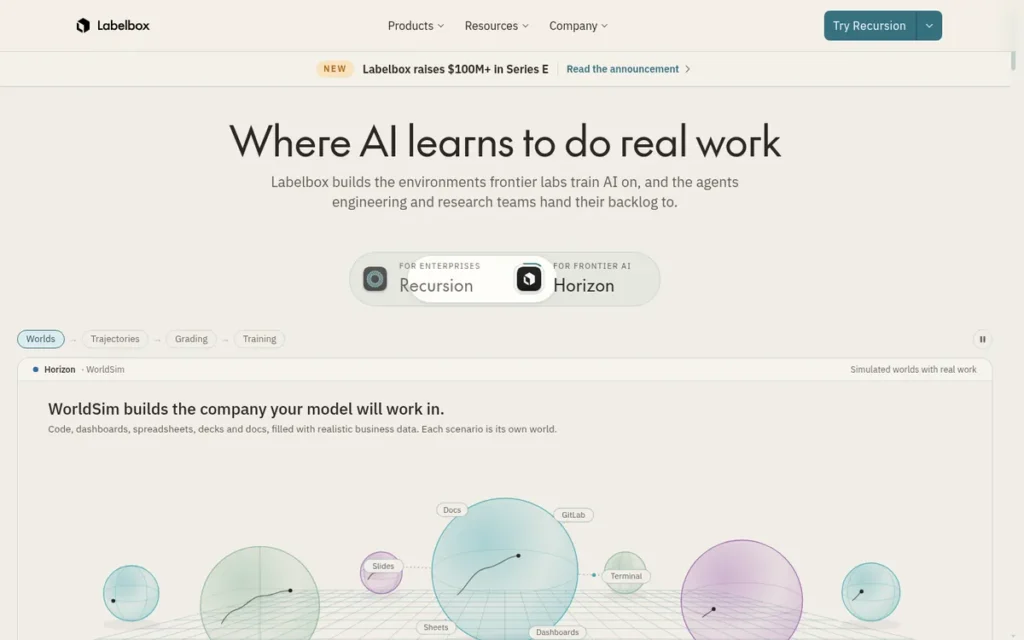
Category: Full-Lifecycle Data Platform, a platform covering the complete training data workflow from raw data import through annotation, curation, model fine-tuning, and model evaluation in a single integrated environment.
At a Glance
- Category: Full-Lifecycle Data Platform
- Best For: Enterprise ML teams managing in-house annotation pipelines across images, video, text, audio, and geospatial data, particularly teams wanting model-assisted labeling, hybrid workforce access, and integrated model evaluation without switching tools
- Price Range: Pricing on request: no public tiers; all plans require direct sales contact (verified April 2026)
- Primary Strength: Labelbox’s Model-Assisted Labeling (MAL) uses foundation models to pre-label datasets, with the platform claiming up to 90% reduction in labeling costs (vendor-stated; third-party customer analyses report 43–70% in practice, Perplexity-verified April 2026)
- Biggest Limitation: Labelbox’s advanced workflow configuration: particularly Foundry’s custom model integration and multi-step ontology setup, carries a documented learning curve that requires dedicated ML engineering resources to fully leverage
- One-Line Summary: Labelbox is a full-lifecycle AI data platform spanning annotation, curation, model fine-tuning, and evaluation in one interface, recommended by the ML community as the primary enterprise upgrade from open-source Label Studio.
- Last Verified: April 2026
Overview
Labelbox is a multimodal AI data platform covering the complete ML training data lifecycle (from raw data ingestion through annotation, dataset curation, model integration and fine-tuning, and model evaluation) making Labelbox the data labeling solution for enterprise ML teams that want a platform-first approach to their entire training data flywheel without stitching together separate annotation, curation, and evaluation tools.
Labelbox was founded in 2018 by Manu Sharma in San Francisco and supports images, video, text, audio, geospatial data, and conversational data with model-assisted labeling, real-time quality analytics, and the Alignerr managed workforce network for hybrid in-house and expert annotation. Labelbox is SOC 2 certified and integrates with Google Cloud, AWS, and Azure, avoiding cloud lock-in for enterprise procurement teams (Labelbox platform overview, 2025).
Key Features
- Model-Assisted Labeling (MAL): Labelbox’s Model-Assisted Labeling uses foundation models to pre-label entire datasets, with the platform claiming up to 90% reduction in labeling costs by routing only ambiguous or low-confidence annotations to human reviewers (vendor-stated figure; third-party customer analyses report 43–70% cost reductions in practice, Perplexity-verified April 2026; independent benchmarks not available).
- Foundry Model Integration: Labelbox Foundry enables teams to integrate external models (including YOLOv8) directly into the labeling pipeline for pre-labeling and iterative fine-tuning, connecting annotation and model training in a single interface rather than requiring a separate external training environment for each annotation iteration (Labelbox Foundry documentation, 2025).
- Catalog Embedding Search: Labelbox Catalog provides embedding-based similarity search for dataset exploration, enabling ML teams to identify class imbalances, surface high-uncertainty samples, and curate training sets with metadata filtering without exporting data to separate data management tools.
- Real-Time QA Dashboards: Labelbox’s quality assurance suite includes real-time analytics dashboards, inter-annotator agreement benchmarking, consensus scoring, AI-assisted review, SLA monitoring, and customizable review workflows, giving annotation project managers granular labeler performance visibility for both in-house and outsourced annotation teams.
- Alignerr Expert Workforce: Labelbox Alignerr provides on-demand access to subject matter expert annotators for RLHF preference ranking, pairwise comparison, and complex reasoning evaluation (with a claimed 24-hour calibration turnaround (vendor-stated)) directly competing with Scale AI’s Outlier program for expert-grade LLM annotation workflows (Alignerr.com, 2025).
Best For
Labelbox is best for enterprise ML teams managing in-house annotation operations at scale who want to eliminate toolchain fragmentation, particularly teams needing model-assisted labeling to reduce per-label costs, hybrid workforce access via Alignerr for expert RLHF annotation, and integrated model evaluation to close the label-train-evaluate loop within a single platform and existing Google Cloud, AWS, or Azure infrastructure.
Strengths
- Highest MAL Efficiency Claim with Named Mechanism: Labelbox’s Model-Assisted Labeling claims up to 90% reduction in annotation costs by routing only ambiguous samples to human reviewers, the highest automation efficiency claim tied to a specific named mechanism of any platform in this review (Labelbox Foundry guide, 2024–2025; vendor-stated; third-party analyses report 43–70% in practice).
- Primary Community Upgrade Recommendation from Label Studio: Labelbox is the ML community’s consistently recommended upgrade path from Label Studio open-source, with practitioner discussions citing Labelbox as the natural progression for teams that outgrow Community Edition’s collaboration and QA limitations (Perplexity-indexed practitioner discussions, April 2026).
- YOLOv8 Fine-Tuning Within the Platform: Labelbox integrates with Google Cloud, AWS, and Azure (combined with YOLOv8 fine-tuning support via Foundry) enabling ML teams to connect annotation, model iteration, and deployment without a separate training environment, closing the data flywheel within a single vendor relationship (Labelbox Q2 2024 product release, 2024).
- Alignerr Expert Annotators for RLHF: Labelbox Alignerr provides access to on-demand subject matter expert annotators with a claimed 24-hour calibration turnaround for RLHF and LLM preference ranking tasks, competing directly with Scale AI’s Outlier program while remaining within the Labelbox platform contract (Alignerr.com, 2025).
Limitations
- Steep Learning Curve for Advanced Features: Labelbox’s most consequential trade-off is the documented learning curve associated with Foundry’s custom model integration and multi-step ontology setup, smaller ML teams without dedicated data engineering staff may achieve only a fraction of the platform’s advertised productivity potential while still paying enterprise licensing costs.
- Pricing Opacity Blocks Self-Serve Evaluation: Labelbox’s contact-sales-only pricing is a consistent source of friction for teams that need internal ROI cases before engaging a sales team, a barrier that directly contradicts the self-serve platform positioning G2 Labelbox reviews, 2025.
- MAL Efficiency Varies Significantly by Data Type: Labelbox’s vendor-stated 90% cost reduction has not been reproduced in third-party evaluations available to this review, independent analyses report 43–70% reductions depending on data modality and object complexity, meaning teams with rare or domain-specific annotation tasks should not treat the headline figure as a production-grade delivery commitment.
- Geospatial Annotation Is Secondary: Labelbox’s geospatial annotation capability is less mature than its computer vision and NLP tooling, making Labelbox a secondary rather than primary choice for teams working primarily with satellite or aerial imagery at production scale.
Verdict
Labelbox is the strongest full-lifecycle data platform for enterprise ML teams that want a single environment spanning annotation, curation, model fine-tuning, and evaluation, eliminating the toolchain fragmentation that plagues teams managing separate tools for each training data stage. Labelbox’s Model-Assisted Labeling (vendor-stated up to 90% cost reduction; third-party analyses report 43–70% in practice), Alignerr workforce access, and multi-cloud integration make Labelbox the most complete self-managed annotation platform in this review for teams with the ML engineering resources to configure advanced features. Teams without dedicated ML engineers or with simpler annotation needs should evaluate SuperAnnotate’s superior ease-of-use ratings before committing to Labelbox’s configuration complexity.
4. Scale AI: Best for Frontier AI and Defense-Grade Annotation
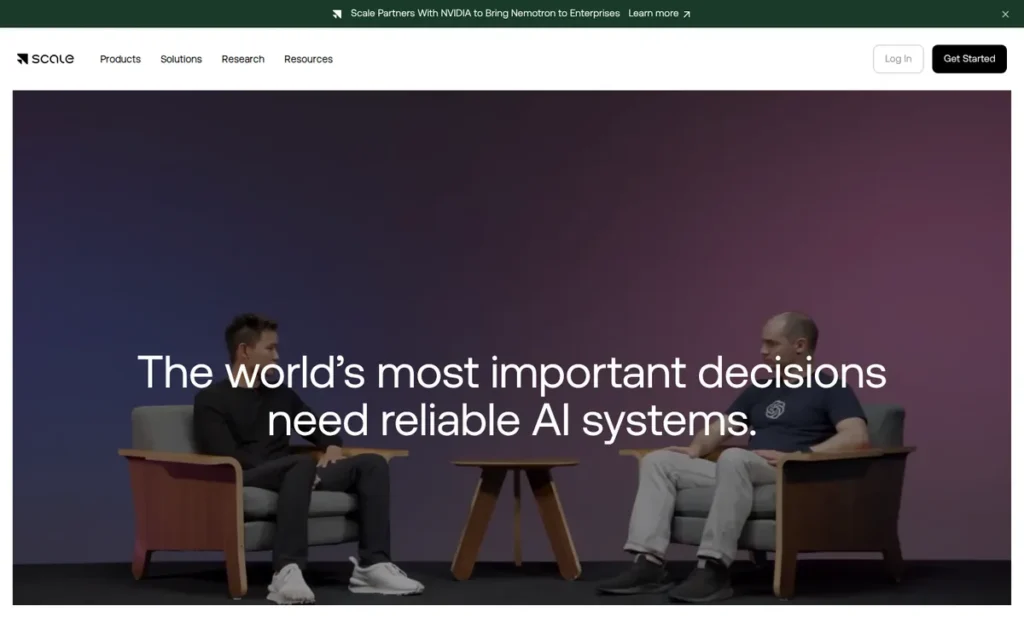
Category: Managed Labeling Service and Platform, a dual-mode operation combining an enterprise SaaS annotation platform with a managed workforce of 100,000+ annotators, specializing in frontier AI, autonomous vehicle, and defense-grade annotation at production scale.
At a Glance
- Category: Managed Labeling Service and Platform
- Best For: Frontier AI labs, autonomous vehicle manufacturers, and U.S. government agencies requiring annotation at maximum quality and scale, with the enterprise or defense budget to match Scale AI’s pricing
- Price Range: Pricing on request: enterprise-only; described by community sources as high and unpredictable at non-enterprise scale; no public tiers (verified April 2026)
- Primary Strength: Scale AI’s annotation services have been used by OpenAI, Meta, Google, Waymo, and U.S. federal agencies, the most credentialed enterprise customer base of any platform in this review
- Biggest Limitation: Scale AI’s pricing is opaque and enterprise-level; its G2 review presence is statistically unreliable (5.0/5 from 1 verified review as of April 2026); and a June 2025 CEO transition introduces strategic continuity uncertainty for multi-year contract buyers
- One-Line Summary: Scale AI is the data annotation platform trusted by OpenAI, Meta, Waymo, and U.S. federal agencies for frontier AI training data, RLHF at production scale, and autonomous vehicle sensor fusion annotation requiring verified accuracy above 99.9%.
- Last Verified: April 2026
Overview
Scale AI is a full-spectrum AI data engine combining an enterprise annotation platform with a managed workforce of over 100,000 annotators, trusted by OpenAI, Meta, Google DeepMind, Microsoft, Waymo, and U.S. federal agencies for training data production at the quality and scale required by frontier AI development, autonomous vehicle programs, and defense-intelligence applications.
Scale AI was founded in 2016 by Alexandr Wang in San Francisco and reached a $29 billion post-money valuation in June 2025 through Meta Platforms’ investment (Scale AI corporate announcement, June 2025). Note: founding CEO Alexandr Wang transitioned to Meta Platforms following this investment, with Jason Droege assuming the CEO position, enterprise buyers evaluating multi-year contracts should verify account team continuity directly with Scale AI before signing.
Scale’s Generative AI Data Engine (added 2023) covers RLHF, model safety, and alignment workflows. Scale Labs (expanded March 2026) builds proprietary benchmarks for agentic and multimodal AI evaluation including the SWE-Atlas software engineering agent benchmark.
Key Features
- Multi-Layer QA for AV Annotation: Scale AI’s Data Engine supports annotation across images, video, text, audio, and LiDAR/3D sensor fusion, with a vendor-stated accuracy above 99.9% for autonomous vehicle sensor fusion tasks, achieved through multi-layer QA combining ML-assisted consensus checks and human reviewer escalation (internal benchmark; independent verification not available).
- Generative AI Data Engine and RLHF: Scale AI’s Generative AI Data Engine adds RLHF, model safety, and alignment annotation capabilities, including the Outlier program for recruiting domain-expert annotators for complex reasoning, code, and scientific content evaluation that crowd workers cannot reliably perform.
- Scale Rapid On-Demand Labeling: Scale Rapid provides on-demand quick-turnaround labeling without long enterprise contract timelines, positioning Scale AI as viable for both multi-year strategic annotation partnerships and one-off rapid-turnaround dataset projects requiring immediate delivery.
- Scale Labs AI Safety Research: Scale Labs (expanded March 2026) develops proprietary benchmarks for agentic and multimodal AI evaluation (including SWE-Atlas for software engineering agent assessment) making Scale AI the only annotation platform in this review simultaneously operating a dedicated AI safety and evaluation research division.
- 100K+ Annotator Workforce at Production Scale: Scale AI’s managed workforce spans 100,000+ global annotators across Remotasks (computer vision and AV annotation) and Outlier (LLM and expert annotation) with multi-stage QA including ML-assisted consensus scoring, expert reviewer escalation, and annotator performance monitoring Scale AI About page, 2025.
Best For
Scale AI is best for frontier AI research labs, autonomous vehicle manufacturers, and U.S. government agencies that require annotation at maximum quality and verified production scale, and for enterprise ML teams that prefer outsourcing annotation entirely to a managed service rather than managing an in-house annotation function with self-serve software.
Strengths
- Highest-Prestige Customer Roster in the Category: Scale AI’s verified customer base includes OpenAI, Meta, Google, Google DeepMind, Microsoft, Waymo, Zoox, and Cruise for production-scale annotation, plus U.S. federal agencies for satellite imagery and military intelligence annotation, the most credentialed enterprise customer roster of any platform in this review (Scale AI About page; Wikipedia, 2025).
- Verified U.S. Government Defense Contract: Scale AI was selected by the U.S. Department of Defense’s Joint Artificial Intelligence Center under a $249–250 million Blanket Purchase Agreement ceiling in January 2022 (BusinessWire, January 2022), making Scale AI the only data labeling platform in this review with verified defense-sector engagement at government security clearance level.
- Annotation Operations at Unmatched Production Scale: Scale AI has paid over $1 billion to its global contributor workforce and powered over 15 billion human decisions for AI training, demonstrating annotation operations at a scale that no other platform in this review has publicly achieved Scale AI About page, 2025.
- Scale Labs Frontier AI Safety Research: Scale Labs, expanded in March 2026, develops proprietary benchmarks for agentic and multimodal AI evaluation, positioning Scale AI as the only annotation platform in this review simultaneously serving annotation production and frontier AI safety research.
Limitations
- Statistically Unreliable Third-Party Review Profile: Scale AI’s G2 rating of 5.0/5 is based on a single verified review as of April 2026 (a sample too small to be statistically meaningful for comparison purposes) and Scale AI’s fragmented presence across multiple G2 product categories reduces aggregate review count further (G2, Scale AI Generative Platform, April 2026).
- Pricing Opacity and Enterprise-Only Access: Scale AI’s enterprise-only pricing (with community sources consistently describing sticker shock for non-enterprise teams) effectively excludes the majority of the ML engineering audience, including well-funded mid-market organizations not operating at frontier AI lab or AV manufacturing scale.
- CEO Transition Introduces Strategic Continuity Uncertainty: Scale AI’s founding CEO Alexandr Wang transitioned to Meta Platforms in June 2025, with Jason Droege assuming the CEO position (Scale AI corporate announcement, June 2025), a leadership change that enterprise buyers evaluating multi-year managed annotation contracts should factor into account team continuity assessments before signing.
- Over-Engineered for Standard ML Teams: Scale AI’s platform is calibrated to frontier AI labs and defense agencies rather than the broader ML engineering audience, teams building standard commercial computer vision or NLP models will pay premium prices for capabilities, infrastructure, and compliance overhead that is irrelevant to their annotation use case.
Verdict
Scale AI is the highest-prestige data annotation service in 2026, verified by production deployments at OpenAI, Meta, Waymo, and U.S. federal agencies, and the only platform in this review with defense-grade annotation engagement and a dedicated AI safety evaluation research division in Scale Labs. Scale AI is the right choice for frontier AI labs, autonomous vehicle programs, and government agencies that need annotation at maximum quality and verified scale with the enterprise budget to match. For the majority of ML teams, including well-funded mid-market organizations, Scale AI’s pricing opacity, single-review G2 profile, and June 2025 CEO transition make Encord, Labelbox, or SuperAnnotate the more appropriate evaluation starting points.
5. Label Studio: Best Open-Source Platform
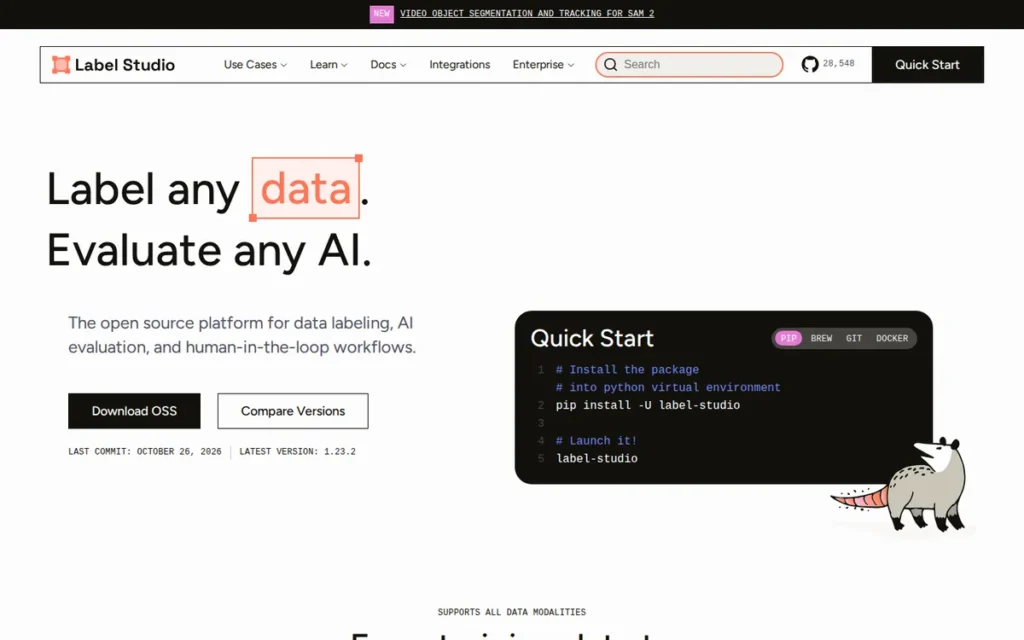
Category: Open-Source Labeling Platform, the most widely documented free annotation platform, offering a permanently free Community Edition and an Enterprise tier with air-gapped deployment for classified and regulated environments.
At a Glance
- Category: Open-Source Labeling Platform
- Best For: Budget-constrained ML teams, academic researchers, and organizations requiring full data sovereignty (air-gapped or on-premises deployment) annotating images, video, text, audio, time series, or conversational data at zero platform licensing cost
- Price Range: Community Edition: Free forever (no usage restrictions). Enterprise: Pricing on request; 14-day free trial available. Note: self-hosting infrastructure costs apply to Community Edition (verified April 2026)
- Primary Strength: Label Studio is the only platform in this review with a permanently free Community Edition and air-gapped on-premises Enterprise deployment, enabling annotation at zero platform cost or in fully network-isolated environments that SaaS-only competitors cannot serve
- Biggest Limitation: Label Studio Community Edition lacks the enterprise collaboration, compliance reporting, role-based access control, high-availability infrastructure, and SLA support that production ML teams at scale require, making the free tier inadequate beyond the solo practitioner or small research group stage
- One-Line Summary: Label Studio is the most widely documented open-source data labeling platform (with 5 million+ downloads confirmed as of 2022) offering a permanently free Community Edition for budget-constrained teams and an Enterprise tier with unique air-gapped deployment for classified and regulated annotation environments.
- Last Verified: April 2026
Overview
Label Studio is the most widely documented open-source data labeling platform by download volume (with over 5 million downloads confirmed as of 2022 (PRWeb, 2022) and continued adoption growth since) making Label Studio the universal starting point for ML teams beginning their annotation practice and the benchmark against which all other open-source annotation tools are compared.
Label Studio was created in 2019 by the Heartex team (the company subsequently rebranded to HumanSignal) and supports annotation across images, video, text, audio, time series, and conversational data through a flexible XML-based configuration system. Label Studio Enterprise adds organization-level governance (RBAC, audit logs, SOC 2 and HIPAA readiness) and the uniquely important capability of air-gapped on-premises deployment, the only platform in this review enabling annotation in fully network-isolated environments (Label Studio enterprise features documentation, 2025).
Practically: if your organization’s data security policy prohibits annotation data from leaving your network perimeter, no other platform in this review can serve your use case. Label Studio Enterprise is the only option.
Key Features
- Permanently Free Community Edition: Label Studio Community Edition is permanently free with no usage volume restrictions, supporting annotation for images, video, text, audio, time series, and conversational data through configurable XML-based labeling templates that teams can customize for any annotation task without writing custom frontend code.
- Cloud Storage Synchronization: Label Studio synchronizes directly with AWS S3, Google Cloud Storage, and Azure Blob Storage, enabling teams to annotate data from their existing cloud infrastructure without migrating data to a vendor-managed environment.
- Flexible ML Backend Integration: Label Studio’s ML backend integration enables active learning and pre-labeling workflows, teams can connect their own models or third-party foundation models to automatically pre-label data and surface high-uncertainty samples for prioritized human review without native platform lock-in to a specific AI backbone.
- Enterprise Governance and Compliance: Label Studio Enterprise includes role-based access control, organization-level user management, audit logs, SOC 2 and HIPAA readiness, white labeling, high-availability PostgreSQL and Redis deployment, and SLA-backed support, addressing the governance and compliance requirements that Community Edition explicitly does not provide (Label Studio feature comparison guide, 2025).
- Unique Air-Gapped Deployment: Label Studio Enterprise is the only platform in this review offering air-gapped (fully network-isolated) on-premises deployment, enabling annotation of classified data, sensitive PHI, or any data type that organizational policy prohibits sending to external SaaS platforms.
Best For
Label Studio is best for budget-constrained ML teams, academic research labs, and early-stage startups that need to evaluate and prototype annotation workflows at zero platform cost, and for organizations in classified government, defense, or healthcare environments that require data to remain within their own physical network perimeter through Label Studio Enterprise’s air-gapped deployment capability. For any ML team that has not yet committed to a labeling platform, spending time with Label Studio Community Edition before entering any vendor sales conversation provides the functional baseline against which all enterprise platforms should be compared.
Strengths
- Largest Open-Source Adoption Base in the Category: Label Studio has achieved over 5 million downloads, with a user community documented at 150,000 users and 20 million labeled data pieces as of 2022 (PRWeb, 2022; current figures per HumanSignal internal data, not independently confirmed at time of publication, April 2026), and is the default community recommendation for teams beginning annotation tool evaluation.
- Unique Air-Gapped Deployment: Unavailable Anywhere Else in This Review: Label Studio Enterprise is the only platform in this review offering air-gapped on-premises deployment, enabling annotation in classified government environments, HIPAA-covered clinical data systems, or any setting where organizational policy prohibits sending data to external SaaS platforms (Label Studio enterprise features, 2025).
- Flexible Custom Annotation Interface Configuration: Label Studio’s XML-based configuration system enables custom annotation interfaces for virtually any data type (images, video, audio, text, time series, conversational data) without requiring frontend engineering expertise, giving teams complete control over annotation UI without vendor lock-in to pre-defined labeling templates.
- Transparent Open-Source Development Ecosystem: Label Studio’s open-source GitHub repository has accumulated 10,000+ stars from 74 contributors with over 1,607 merged pull requests since its January 2020 launch, providing transparent roadmap visibility unavailable from any closed-source SaaS competitor in this review Label Studio GitHub star blog, 2025.
Limitations
- Community Edition Feature Gap for Production Teams: Label Studio Community Edition’s most consequential trade-off is that its most valuable enterprise capabilities (role-based access control, audit logs, SOC 2 and HIPAA compliance reporting, high-availability deployment, SLA support, and white labeling) are exclusively Enterprise tier features, meaning the permanently free version is genuinely inadequate for production ML teams beyond the solo practitioner or small research group stage.
- Total Cost of Ownership Exceeds Surface-Level Free Pricing: The total cost of self-hosting Community Edition (server infrastructure, security hardening, and ongoing maintenance engineering time) may rival Enterprise or commercial SaaS licensing costs for teams without existing DevOps capacity to manage a self-hosted annotation platform at production scale.
- Limited Native AI-Assist Automation: Label Studio’s AI-assisted labeling relies on ML backend integration (bring your own model) rather than native multi-model automation like Encord’s SAM2 + GPT-4o + LLaMA 3.2 + Gemini pipeline, meaning teams must invest engineering time in model integration to unlock pre-labeling capabilities that commercial competitors provide out of the box.
- Adoption Statistics Beyond 2022 Are Unverified: Label Studio’s growth claims above the 2022 baseline (5M downloads, 150K users, 20M labeled items (PRWeb, 2022) were not independently confirmed in this review’s research) prospective buyers relying on adoption statistics for procurement validation should verify current figures directly with HumanSignal.
Verdict
Label Studio is the most widely documented open-source data labeling platform, with over 5 million downloads validating its position as the universal starting point for annotation practice, and the only platform in this review enabling air-gapped deployment for classified and highly regulated environments where SaaS alternatives are policy-disqualified. Label Studio Community Edition is the correct first evaluation step for any budget-constrained team, academic lab, or organization with data sovereignty requirements. Teams that outgrow Community Edition’s collaboration and compliance feature gaps will find the most natural upgrade paths in Labelbox or SuperAnnotate, though Enterprise tier pricing should be compared directly against commercial alternatives on a total cost of ownership basis before migrating.
6. V7 Darwin: Best Computer Vision Specialist
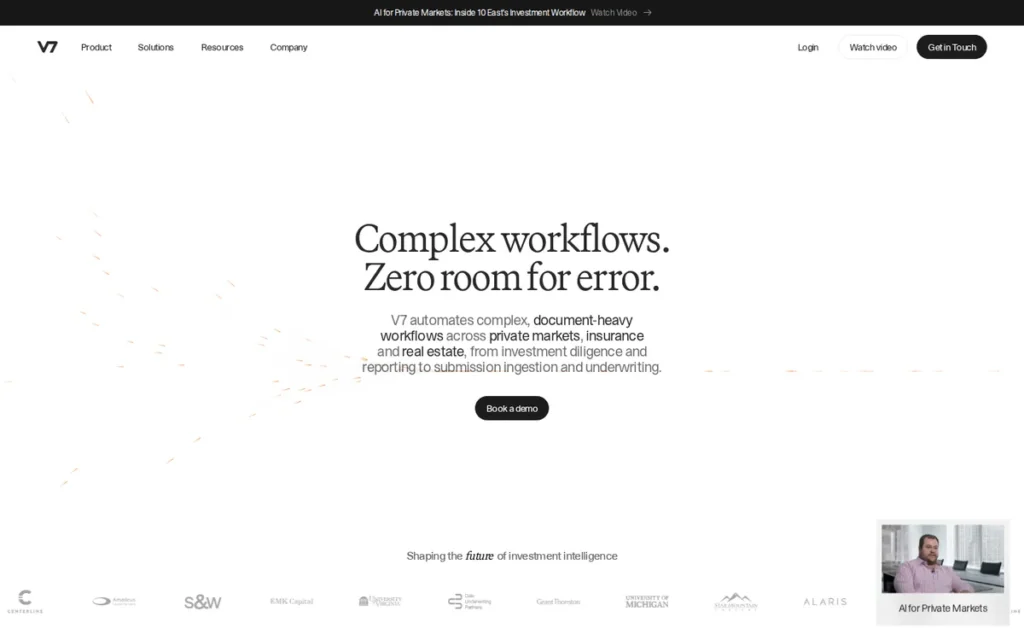
Category: CV-Specialist Labeling Platform, a computer vision-focused annotation platform with advanced foundation model integration for visual AI tasks, specialized medical imaging format support (including SVS pathology), and an agentic document AI extension (V7 Go).
At a Glance
- Category: CV-Specialist Labeling Platform
- Best For: Computer vision ML engineering teams building image and video datasets, particularly those working on digital pathology (SVS), medical imaging (DICOM, NIfTI), long-tail object detection, or enterprise document AI automation alongside annotation workflows
- Price Range: Pricing on request: custom enterprise only; no public tiers listed (verified April 2026)
- Primary Strength: V7 Darwin’s Auto-Annotate engine integrates SAM3 with text-prompted segmentation across approximately 4 million supported object concepts (platform-stated, V7 Darwin product page and changelog, 2025–2026), enabling zero-shot annotation of long-tail object classes without pre-training custom detection models
- Biggest Limitation: V7 Darwin does not include native model training capabilities, requiring teams to connect annotation outputs to separate training infrastructure, and V7’s Series A funding stage introduces more vendor execution risk than the more established platforms in this review
- One-Line Summary: V7 Darwin is a computer vision annotation platform with SAM3-powered Auto-Annotate supporting ~4 million object concepts via text prompt (platform-stated, 2025–2026), advanced video tracking continuity, and SVS whole-slide pathology support, with named customer deployments at Miovision and Franklin.ai.
- Last Verified: April 2026
Overview
V7 Darwin is a computer vision-focused AI data labeling platform supporting annotation for images, video, DICOM, NIfTI, SVS whole-slide pathology files, architectural drawings, PDFs, and documents, designed for ML engineering teams that need advanced foundation model-powered automation for visual AI tasks, with an API-first architecture built for programmatic pipeline integration.
V7 Labs was founded in 2018 by Albert Rizzoli (CEO) and Simon Edwardson (CTO) in London and raised $33 million in its Series A round in November 2022 (confirmed). V7 Labs is headquartered in London, making V7 one of Europe’s most prominent AI infrastructure companies and a natural choice for EU enterprise customers with GDPR data residency requirements. V7’s companion platform V7 Go extends the company’s footprint into agentic document AI for finance, legal, insurance, and healthcare workflows (Choppingblock.ai, 2025).
Key Features
- SAM3 Text-Prompted Zero-Shot Segmentation: V7 Darwin’s Auto-Annotate engine integrates SAM, SAM2, and SAM3 with text-prompted segmentation, allowing annotators to type a class name and have V7 Darwin automatically detect and segment from a vocabulary of approximately 4 million supported object concepts (platform-stated, V7 Darwin product page and changelog, 2025–2026; independently confirmed concept count not available at time of publication), enabling zero-shot annotation of long-tail and rare object classes without pre-training custom detection models.
- Video Tracking Continuity Across Frame Exits: V7 Darwin’s video annotation engine maintains object tracking continuity when objects temporarily leave the frame and re-enter, preserving label identity across frame exits, addressing one of the most time-consuming manual correction challenges in video annotation for traffic, surveillance, and sports analytics datasets.
- SVS Whole-Slide Pathology Support: V7 Darwin supports SVS whole-slide pathology files alongside DICOM and NIfTI medical imaging formats, positioning V7 Darwin for digital pathology teams in pharmaceutical research and clinical AI development who need annotation beyond standard radiology imaging formats.
- API-First Programmatic Workflow Control: V7 Darwin’s API and Python SDK provide extensive programmatic control over annotation workflows, verified by Benjamin Johnston (Principal Engineer, Franklin.ai): “The configurability and extensive API interface of V7 has enabled us to quickly create, customise, deploy and make changes to our labelling processes” (V7 Darwin customer page, 2024–2025; testimonial appears on V7’s own marketing materials; independent confirmation not available).
- V7 Go Agentic Document Processing: V7 Go extends V7 Darwin’s platform into agentic document processing for finance, legal, insurance, and healthcare, enabling non-technical users to build no-code AI agent pipelines (AI Skills) for contract analysis, claims processing, and due diligence with auditable outputs (Choppingblock.ai, 2025).
Best For
V7 Darwin is best for ML engineering teams building computer vision and medical imaging datasets who prioritize foundation model-powered automation depth, API-first programmatic workflow control, and specialized format support for SVS pathology or DICOM medical data, and for European enterprise teams with GDPR data residency requirements who benefit from V7’s London-based, EU-native data handling.
Strengths
- Most Advanced Zero-Shot Annotation Vocabulary in This Review: V7 Darwin’s Auto-Annotate engine integrates SAM3 with text-prompted segmentation across approximately 4 million supported object concepts (platform-stated, V7 Darwin product page and changelog, 2025–2026; independently confirmed count not available), enabling annotation of long-tail and rare object classes without requiring custom model pre-training.
- Named Customer Evidence Across Two Verticals: V7 Darwin is supported by named testimonials from Andrew Achkar (Technical Director, Miovision) for video annotation workflows and Benjamin Johnston (Principal Engineer, Franklin.ai) citing V7’s API extensibility as the primary selection driver, providing documentary evidence of V7 Darwin deployment across transportation analytics and medical AI verticals (V7 Darwin customer page, 2024–2025; testimonials appear on V7’s own marketing materials).
- Video Annotation Continuity for Occlusion-Heavy Datasets: V7 Darwin’s video annotation engine maintains object identity tracking when objects exit and re-enter frame, a technically non-trivial capability that reduces manual correction time for video datasets in traffic, sports, and surveillance annotation where temporary occlusion is frequent.
- GDPR-Native EU Data Handling: V7 Labs is headquartered in London with GDPR-native data handling architecture, a meaningful differentiator for European enterprise customers with data residency requirements or procurement preferences for EU-based AI infrastructure vendors.
Limitations
- No Native Model Training Capabilities: V7 Darwin’s most consequential trade-off is the absence of native model training, V7 Darwin annotates and exports data but does not provide an integrated training environment, requiring teams to connect outputs to external ML training infrastructure (PyTorch, TensorFlow, SageMaker, or custom pipelines), adding integration engineering overhead compared to Labelbox Foundry’s integrated fine-tuning capability.
- Series A Vendor Execution Risk: V7 Labs’ Series A funding stage ($33M, confirmed November 2022) carries higher vendor execution and longevity risk than the more established platforms in this review, no subsequent public funding round has been announced as of April 2026, making runway timeline a relevant consideration for multi-year annotation platform contracts.
- SAM3 Concept Count Is Platform-Stated Only: V7 Darwin’s ~4 million object concept vocabulary for text-prompted segmentation appears only in V7’s own product documentation, no third-party benchmark has independently confirmed this figure, and buyers should request a live demonstration on their specific object classes before treating the vocabulary claim as a production-grade specification.
- Limited Third-Party Review Presence: V7 Darwin’s third-party review platform presence is less extensive than Labelbox, SuperAnnotate, or Encord (with exact G2 and Capterra scores not confirmed through available independent research as of April 2026) limiting objective community validation signals for buyers who weight review platform performance heavily in procurement decisions.
Verdict
V7 Darwin is the strongest computer vision specialist platform in this review, with SAM3-powered zero-shot annotation across approximately 4 million object concepts (platform-stated), advanced video tracking continuity, and SVS whole-slide pathology support, with named customer deployments at Miovision and Franklin.ai. V7 Darwin is the right choice for ML engineering teams building visual AI datasets who prioritize foundation model automation depth, API-first workflow control, and specialized medical imaging format support, and for European enterprises requiring GDPR-native data handling. V7’s absence of native model training and Series A-stage vendor risk make V7 Darwin a secondary evaluation choice compared to the top five platforms for teams with mixed-modality annotation needs or multi-year contract risk constraints.
7. Appen: Best for Multilingual Datasets and Pre-Built Training Data

Category: Crowd-Sourced Data Services Provider, a managed annotation service and data marketplace combining a 1M+ global annotator workforce with a 270+ pre-labeled dataset library, primarily serving enterprise and hyperscaler clients through custom contracts.
At a Glance
- Category: Crowd-Sourced Data Services Provider
- Best For: Enterprise ML teams needing multilingual annotation at scale (180+ languages), off-the-shelf pre-labeled training datasets, or outsourced annotation services for large-volume projects, with explicit awareness of documented vendor financial pressures and annotator pay controversies before signing multi-year contracts
- Price Range: Pricing on request: fully enterprise/custom-negotiated; no public tiers; revenue primarily volume-based per task or per hour (verified April 2026)
- Primary Strength: Appen’s 270+ pre-labeled datasets and 1M+ annotator workforce spanning 180+ languages represent a 30-year institutional data collection asset that no other platform in this review can replicate
- Biggest Limitation: Appen faces documented financial pressures from AI automation reducing hyperscaler annotation demand, revenue concentration risk, and annotator pay controversies, making Appen a higher-risk vendor choice for multi-year contracts than its 30-year history might suggest
- One-Line Summary: Appen is the world’s longest-operating data annotation company (founded 1996), offering a 270+ pre-labeled dataset library across 80+ languages and a 1 million-plus annotator workforce spanning 180+ languages, uniquely positioned for multilingual annotation and off-the-shelf training data access, but carrying documented vendor financial and ESG risks requiring explicit due diligence before multi-year contracts.
- Last Verified: April 2026
Overview
Appen is the oldest company in the data labeling category (founded in Sydney, Australia in 1996) and the only publicly listed organization in this review as of April 2026 (ASX: APX), offering enterprise annotation services and data collection across text, audio, video, image, and geospatial data through a managed workforce of over 1 million annotators spanning 170–200 countries in over 180 languages and dialects (per independently available sources, April 2026; Appen marketing materials claim broader language coverage, verify directly for current confirmed figures).
Appen’s core differentiation is its 30-year institutional asset base: a library of 270+ pre-labeled datasets in 80+ languages enabling ML teams to access off-the-shelf training data without running custom annotation projects, a capability unavailable from any other platform in this review. Appen serves eight of the world’s top ten largest technology companies (NDA-protected) and has publicly reported involvement in annotating training data for GPT-3 and ChatGPT, though primary source documentation was not independently confirmed in this review’s research (MatrixBCG; Wikipedia, 2025).
Appen faces documented financial headwinds from AI automation reducing demand for human annotation at its largest hyperscaler clients, a risk that enterprise procurement teams should factor into multi-year contract decisions (Wikipedia; IBISWorld, 2025).
Key Features
- 270+ Pre-Labeled Dataset Library: Appen maintains a library of 270+ pre-labeled datasets spanning 80+ languages covering text, audio, image, and speech domains, the only platform in this review offering off-the-shelf training data for ML teams that need labeled datasets without running custom annotation projects from scratch (Labelyourdata Appen review, 2025).
- ADAP Quality Flow Test Questions: Appen’s ADAP platform embeds Quality Flow Test Questions throughout annotation jobs (calibration questions that continuously monitor annotator performance and flag underperforming contributors during the job rather than post-hoc) reducing the probability of large-scale annotation errors reaching training pipelines (Appen ADAP blog, 2025).
- 180+ Language Annotation Coverage: Appen’s global workforce of over 1 million annotators spans 170–200 countries in over 180 languages and dialects (per independently available sources, April 2026), providing multilingual annotation coverage that no other platform in this review can match for global NLP, speech recognition, translation, and localization model development.
- Tiered Workforce Access by Data Sensitivity: Appen’s ADAP platform supports tiered workforce access (open crowd for standard commercial annotation, vetted domain-expert contractors for specialized tasks, and internal employees for security-sensitive projects) enabling clients to match workforce quality to data sensitivity and annotation complexity requirements.
- RLHF and LLM Fine-Tuning Data Services: Appen provides RLHF, model safety evaluation, and LLM fine-tuning data collection services (with publicly reported involvement in annotating training data for ChatGPT and other frontier foundation models) positioning Appen as a managed service option for enterprise teams building or fine-tuning large language models at scale (MatrixBCG analysis, 2025).
Best For
Appen is best for enterprise ML teams that need multilingual annotation at scale across 180+ languages, access to pre-labeled off-the-shelf training datasets without running custom annotation projects, or outsourced annotation services for large-volume image, audio, text, or speech tasks, with the important caveat that buyers must conduct explicit vendor due diligence on Appen’s current financial stability and annotator quality retention before committing to multi-year contracts.
Strengths
- Unmatched Institutional Dataset Asset, 30 Years of Accumulated Data: Appen maintains a library of 270+ pre-labeled datasets across 80+ languages, a 30-year institutional data asset built through sustained collection operations that no other platform in this review offers, alongside a global annotator workforce of over 1 million contributors spanning 180+ languages and 170–200 countries (Appen About page; Wikipedia, 2025).
- Continuous Quality Monitoring via Embedded Calibration: Appen’s ADAP platform embeds Quality Flow Test Questions throughout annotation jobs, continuously monitoring annotator performance and flagging underperforming contributors during the job rather than post-hoc, reducing the probability of large-scale annotation errors reaching training pipelines in high-volume crowd-sourced workflows (Appen ADAP blog, 2025).
- Highest Confirmed Third-Party Review Scores in This Review Set: Appen holds a G2 rating of 4.1/5 from 39 verified reviews (G2, April 2026) and a Capterra rating of approximately 4.0/5, the highest confirmed third-party review platform scores among all seven platforms in this review by verified review count, providing objective third-party performance validation with confirmed review count transparency.
- Documented Hyperscaler-Level Training Data Pedigree: Appen has publicly reported involvement in annotating training data for GPT-3 and ChatGPT (MatrixBCG analysis; Wikipedia, 2025) and serves eight of the world’s top ten largest technology companies, credentials indicating a track record with the highest-tier AI development programs globally, though primary source documentation was not independently confirmed in this review’s research.
Limitations
- Compound Business Model and ESG Risk: Appen’s most consequential trade-off is the compound risk of structural business model headwinds and annotator welfare concerns, Appen’s revenue is heavily concentrated in hyperscaler clients whose AI automation investments are reducing demand for human annotation labor (reflected in ASX stock volatility since Appen’s 2020 peak), while annotator pay controversies create ESG compliance exposure for enterprise buyers with labor standards commitments (Wikipedia; Labelyourdata Appen review, 2025).
- Revenue Concentration Risk for Multi-Year Contracts: Approximately 70–75% of Appen’s revenue comes from its largest hyperscaler clients, losing even one major client has historically caused significant revenue impact, and enterprise procurement teams should factor this financial volatility into multi-year contract stability assessments (IBISWorld; MatrixBCG, 2025).
- Review Score Interpretation Requires Care: Appen’s G2 and Capterra ratings reflect a bifurcated user base (enterprise buyers rating data quality alongside crowd workers rating task experience) meaning aggregate scores may not accurately reflect enterprise annotation team satisfaction specifically, and buyers should request references from enterprise clients at comparable annotation volume before relying on aggregate scores.
- Limited Self-Serve Platform Capabilities: Appen’s ADAP platform is primarily a managed annotation workflow orchestrator rather than a self-serve annotation tool, teams wanting to build and iterate their own annotation interfaces, run active learning loops, or integrate directly with their MLOps stack will find Appen’s platform less capable than the SaaS-first platforms ranked above Appen in this review.
Verdict
Appen is the world’s longest-operating data annotation company, a 30-year institutional asset base comprising 270+ pre-labeled datasets in 80+ languages and a 1 million-plus annotator workforce spanning 180+ languages that no other platform in this review can replicate. Appen is the right choice for enterprise ML teams with large-scale multilingual annotation requirements, needs for off-the-shelf pre-labeled training data, or outsourced annotation at hyperscaler volume, with the critical caveat that procurement teams must conduct explicit vendor financial health due diligence before signing multi-year contracts, given Appen’s documented revenue concentration risk, AI automation headwinds, and annotator pay controversies relevant to both annotation quality retention and organizational ESG commitments.
What Red Flags Should I Watch For When Evaluating Data Labeling Software?
The five most consequential red flags in data labeling software evaluations are pricing opacity without structural context, G2 badges as standalone ranking signals, unverified automation percentages, compliance claims without dated certification verification, and annotator pay practices that create ESG risk. Identifying even one of these red flags before contract signature can prevent a costly procurement decision.
Red Flag #1: Pricing Opacity Without Structural Characterization
Every platform in this review uses contact-sales pricing, but “contact sales” can mean $500/month or $500,000/year depending on team size, annotation volume, and feature requirements.
A legitimate vendor should at minimum:
- Characterize their pricing model structurally: per-seat, per-label, or volume-based, before any demo call
- Identify explicitly which team sizes and annotation volume ranges the platform is designed to serve
- Clarify whether key modules (workforce access, compliance reporting, model evaluation) are included in base licensing or priced as add-ons
Any vendor that refuses to provide even a structural pricing range before an initial call is introducing avoidable evaluation friction.
Red Flag #2: G2 Badge Count Used as a Standalone Ranking Signal
G2 badge counts reflect user satisfaction survey weighting and review volume, not functional annotation capability. Platforms with active review generation campaigns accumulate badges faster than those without.
Open-source tools like Label Studio are systematically underrepresented in G2 review volumes relative to actual deployment scale, Label Studio has 5 million+ downloads but minimal G2 reviews, because open-source users file GitHub issues, not G2 reviews. Scale AI’s 5.0/5 G2 rating is based on a single verified review as of April 2026, a sample too small to be statistically meaningful.
A platform with thousands of GitHub stars and zero G2 reviews may serve more production ML teams than a platform with 4.8 stars from 15 reviews, adoption scale and review platform presence are independent signals requiring independent evaluation. Always examine review count alongside rating score, and supplement G2 data with GitHub stars, download volumes, and indexed practitioner discussions.
Red Flag #3: Vendor-Stated Automation Percentages Presented as Independently Verified Fact
Claims like “90% labeling cost reduction” (Labelbox), “97% automation at 99% accuracy” (Encord), and “10x faster labeling” (V7 Labs) are vendor-stated figures, none have published independent third-party benchmarks verifiable in this review’s research.
The reason automation percentages vary so dramatically (Labelbox MAL is cited at 43–70% by third-party customer analyses versus the vendor’s 90% headline) is that automation efficiency is fundamentally modality-dependent. Pre-trained models segment everyday objects at 90%+ accuracy; they label rare industrial defects, medical anomalies, or proprietary product configurations at dramatically lower accuracy.
Always ask vendors for automation rate evidence from use cases matching your specific data type before treating published percentages as production-grade delivery commitments.
Red Flag #4: Compliance Claims Without Dated Certification Verification or Named Certifying Body
HIPAA, SOC 2, GDPR, and air-gapped deployment claims appear across multiple platforms in this review, but certification status changes and scope varies by product module. When verifying compliance claims, always:
- Request the SOC 2 Type II audit report date: certifications expire and renewal scope varies by product module
- Confirm whether HIPAA compliance applies to the specific modules you will use: annotation tooling, workforce management, and model evaluation are often certified separately
- Verify that GDPR compliance covers your specific data transfer pathway and residency configuration, not just the vendor’s corporate GDPR policy statement
Outdated or module-limited compliance certifications are a genuine procurement liability in regulated industries.
Red Flag #5: Managed Service Annotator Pay Practices Not Disclosed to ESG-Committed Buyers
Platforms using crowd-sourced workforces (Scale AI via Remotasks, Appen) do not publicly disclose annotator pay rates or worker satisfaction metrics. Community sources document annotator pay controversies at Appen involving below-minimum-wage task rates in some markets, a credible ESG risk for enterprise buyers with labor standards commitments or supply chain ethics policies.
For enterprise buyers with ESG procurement requirements, managed annotation services should include explicit annotator pay rate and worker welfare questions before contract execution, not as a post-signature due diligence item.
What Questions Should I Ask Before Choosing a Data Labeling Platform?
Asking the right five questions before an evaluation narrows a seven-platform shortlist to one or two viable options within a single discovery session, saving weeks of POC time and preventing procurement decisions driven by marketing rather than operational fit.
Question #1: What data modalities do you need to annotate today, and in 12 months?
The modality requirement is the first filter. Teams annotating DICOM medical scans need Encord or V7 Darwin; teams doing only text NER can use nearly any platform including free Label Studio.
Map your full modality roadmap, including anticipated future data types like video, LiDAR, or audio, before shortlisting platforms. Migrating annotation pipelines mid-project is expensive in both engineering time and annotation consistency, a modality mismatch discovered after contract signature is the most common and most preventable data labeling procurement mistake.
Question #2: What is your annotation volume, and what does per-label or per-seat cost look like at that volume?
Volume determines whether enterprise pricing is justified. Teams annotating fewer than 10,000 items per month should evaluate Label Studio Community Edition before committing to any enterprise contract.
Teams expecting exponential growth should model platform cost at 10x current volume, some pricing structures scale linearly while others include volume break points that make enterprise contracts cost-effective at scale but prohibitive in early stages.
Question #3: Does any annotation project involve regulated data, PHI, classified, or GDPR-scoped?
Regulated data is a binary qualifier that immediately eliminates SaaS-only platforms without the correct certification. HIPAA-covered PHI requires either Encord, Labelbox, or Label Studio Enterprise (SOC 2 + HIPAA). Classified government data requires Label Studio Enterprise’s air-gapped deployment, the only option in this review for fully network-isolated annotation.
GDPR-scoped EU data requires either an EU-based vendor (V7 Labs in London) or a non-EU vendor with specific GDPR data processing agreements in place.
Question #4: Does your ML pipeline need annotation to trigger model retraining automatically via CI/CD?
CI/CD integration separates teams that need annotation as a discrete step from teams that need annotation embedded in an automated retraining loop. SuperAnnotate’s Orchestrate is the most mature native CI/CD annotation automation in this review.
Label Studio’s ML backend and webhook integrations provide a more flexible but less opinionated CI/CD pathway. Platforms without native CI/CD hooks (Appen, Scale AI’s managed service) require custom middleware to automate the annotation-to-retraining connection.
Question #5: What is your contract horizon, and what vendor financial stability risk can your organization tolerate?
Multi-year annotation contracts carry vendor risk that doesn’t appear in product demos. Appen’s ASX-listed public financials reveal revenue concentration risk and AI automation headwinds. V7 Labs’ Series A funding stage carries execution risk relative to Labelbox or Encord’s more mature funding. Scale AI’s June 2025 CEO transition introduces strategic continuity uncertainty.
Label Studio’s open-source model transfers platform risk from vendor to internal infrastructure. Ask every shortlisted vendor for references from clients at comparable annotation volume and contract length, and confirm the account manager and customer success personnel who will own the engagement post-contract. The sales team and the support team are rarely the same people.
Before any contract signature, verify three things:
- Request a current SOC 2 Type II audit report with report date from any platform claiming HIPAA or SOC 2 compliance, certifications expire and scope varies by module
- Ask for a reference call with a customer at comparable annotation volume and data modality to yours, not a showcase account
- Confirm the specific account manager and customer success personnel who will own your engagement, not just the sales team, before contract execution
How Did We Rank These Data Labeling Software Platforms?
This ranking was determined by six equally weighted criteria applied consistently across all seven platforms, with no affiliate relationships, no paid placements, and no preferential treatment for any company. This evaluation covered sources across company product documentation, third-party analyst reports, review platform data, verified customer testimonials, open-source repository metrics, and AI engine response analysis, conducted in a structured research process concluding April 15, 2026.
How Was the Evaluation Conducted?
The evaluation process included four parallel research tracks:
- AI Engine Analysis: We queried Perplexity and ChatGPT (GPT-4, April 2026) to surface which platforms AI answer engines currently recommend and identify coverage gaps versus the research-verified evidence base. Both engines recommended Encord, SuperAnnotate, Labelbox, Scale AI, and Label Studio in various orders; V7 Darwin received only brief coverage in one response; Appen was entirely absent from both AI responses, a significant gap for a 30-year-old publicly listed company with reported ChatGPT training data involvement.
- Independent Web Research: We gathered company documentation, product pages, changelog data, and third-party analyst reports from Grand View Research, Mordor Intelligence, Technavio, and IBISWorld.
- Review Platform Analysis: We cross-referenced G2, Capterra, GetApp, SaaSworthy, and SoftwareFinder listings, with explicit attention to review count alongside rating score to flag statistically unreliable profiles.
- Community Sentiment Indexing: We indexed ML practitioner community discussions via Perplexity. Note: The Reddit research tool experienced persistent connection timeouts throughout this research session; direct Reddit thread extraction was unavailable for all seven platforms. Community sentiment references reflect Perplexity-indexed community discussions rather than direct Reddit thread pulls, disclosed per PlugRoute editorial standards. Readers seeking real-time community sentiment should search r/MachineLearning, r/computervision, r/MLOps, and r/learnmachinelearning directly.
What Criteria Were Used to Rank Each Platform?
C1: AI-Assisted Labeling Depth and Automation Capabilities (Primary)
ML teams cite slow annotation pipelines as their primary production bottleneck. We assessed named foundation models integrated into each annotation pipeline, specific automation tasks supported, and programmatic automation capabilities. Key measures:
- Named foundation models in pipeline (SAM2, SAM3, GPT-4o, LLaMA 3.2, CLIP, COCO pre-labeling)
- Specific automation tasks supported: polygon generation, video interpolation, text-prompted segmentation, active learning, weak supervision, and CI/CD pipeline triggers
- Programmatic annotation automation via SDK, webhook, or neural network backend integration
All vendor-stated efficiency percentages are labeled as such throughout, independent benchmarks were unavailable for any platform in this review.
C2: Modality Coverage and Annotation Type Breadth (Primary)
Modality gaps force teams to maintain multiple annotation tools, a documented top-three pain point in ML practitioner community discussions. We assessed:
- Specialized file formats natively supported: DICOM and NIfTI (medical); SVS whole-slide pathology; LiDAR point clouds; GeoTIFF geospatial; conversational text and audio
- Annotation task type breadth: bounding boxes, instance segmentation, NER, RLHF preference ranking, pairwise comparison, rubric-based evaluation
- Whether multimodal project management is unified in a single interface or requires separate project configurations per modality
C3: Community Validation and Review Platform Performance (Primary)
We assessed confirmed G2 or Capterra ratings with verified review counts, explicitly flagging single-review profiles (Scale AI: 5.0/5 from 1 verified G2 review) as statistically unreliable. GitHub stars and download volume were weighted as primary validation signals for open-source platforms, where G2 underrepresents actual adoption. G2 badge counts were NOT used as a standalone ranking signal: badge accumulation reflects review generation campaigns and systematic underrepresentation of open-source tools relative to actual deployment scale. Note: G2 updated its badge display requirements in Summer 2025; verify current displayed badge counts directly on G2 as display rules change quarterly.
C4: Compliance, Security, and Regulated-Industry Readiness (Secondary)
HIPAA, SOC 2, GDPR, and air-gapped deployment are binary procurement qualifiers for regulated industries. We documented named compliance certifications per platform and noted that certification currency must be verified directly with vendors, compliance status changes and audit dates are procurement-critical details outside this article’s update cycle.
C5: Pricing Accessibility and Team-Size Fit (Secondary)
We assessed availability of a free tier or Community Edition; public vs. contact-sales-only pricing; and explicit team-size suitability documentation. Label Studio was the sole platform offering a permanently free tier. SuperAnnotate is the only platform in this review that explicitly documents incompatibility with small teams.
C6: Verified Customer Evidence and Named Deployments (Secondary)
We weighted named customer organizations with publicly confirmable relationships over NDA-protected aggregate claims. Encord’s confirmed pilot relationships with MSK and Stanford Medicine (TechCrunch, April 2022; current engagement status unverified April 2026) and V7 Darwin’s named testimonials from Miovision and Franklin.ai (V7 customer page, 2024–2025; testimonials appear on V7’s own marketing materials) provided the strongest documentary evidence in this review.
How Was Conflicting Evidence Weighted?
When review platform ratings conflict with community sentiment, we weight specificity and recency, a detailed 2025 practitioner discussion with named tool selection rationale outweighs a generic 2023 G2 review with no feature context.
When vendor-stated efficiency claims conflict with independent data, we label vendor figures explicitly and note that independent benchmarks are unavailable, rather than accepting or rejecting vendor claims without evidence. The Labelbox 90% MAL claim is vendor-stated; third-party customer analyses report 43–70% in practice. The V7 SAM3 ~4M concept vocabulary is platform-stated with no independent confirmation available.
How Were Vendor Claims Validated?
Vendor-reported statistics are labeled as such throughout this article. Only claims corroborated by at least one independent source (named customer testimonial, third-party analyst report, review platform score with verified review count, or public financial disclosure) are stated as independently verified fact.
Efficiency percentages (90% cost reduction, 97% automation, 10x speed, 6x video speed) are labeled as vendor-stated throughout. The Encord customer relationships with MSK and Stanford Medicine are labeled as 2022 pilot programs (not ongoing production deployments) as confirmed by TechCrunch (April 2022).
How Often Is This Ranking Updated?
This article was last verified in April 2026. Pricing, compliance certification status, and feature availability change frequently, readers evaluating specific platforms should verify current status directly with vendors. PlugRoute refreshes rankings articles quarterly or when a material change in the competitive landscape occurs. The next scheduled review is July 2026.
Research Limitations (April 2026): This review has four documented constraints:
- Reddit community sentiment data could not be directly retrieved due to tool connectivity failures, community references reflect Perplexity-indexed discussions only
- No pricing data was available from any of the seven vendors: all pricing characterizations are structural inferences from market positioning and community sources
- Encord’s institutional healthcare relationships were confirmed as 2022 pilot programs, current engagement status was not independently verified at time of publication
- Label Studio adoption statistics above the 2022 baseline (5M downloads, 150K users, 20M labeled data pieces, PRWeb, 2022) could not be independently confirmed
These limitations are disclosed so readers can weight the evidence accordingly.
Independence Disclosure
PlugRoute has no affiliate relationships with any company listed in this review. Rankings are determined entirely by research data and objective evaluation criteria.
Frequently Asked Questions
The following frequently asked questions address the most common decision points for ML engineers and AI project managers evaluating data labeling software in 2026, covering platform comparisons, open-source versus enterprise trade-offs, compliance verification, and the methodology behind this independent ranking.
What is the best data labeling software for small machine learning teams in 2026?
Label Studio Community Edition is the best data labeling software for small ML teams in 2026, it is permanently free, supports images, video, text, audio, and time series annotation, and deploys on any infrastructure without per-seat or per-label charges. Teams that outgrow its collaboration and compliance features should evaluate Label Studio Enterprise’s 14-day free trial before considering commercial alternatives. SuperAnnotate and Scale AI explicitly exclude small teams from their target use case.
What is the difference between Encord and Labelbox for enterprise ML teams?
Encord and Labelbox are both enterprise multimodal annotation platforms, but they differ primarily in compliance depth and workflow architecture. Encord leads for HIPAA-compliant annotation of medical imaging data (DICOM, NIfTI, SVS), integrating SAM2, GPT-4o, LLaMA 3.2, and Gemini 1.5 Flash with confirmed 2022 pilot relationships at Memorial Sloan Kettering and Stanford Medicine. Labelbox leads for teams wanting a complete data flywheel, annotation, curation, YOLOv8 fine-tuning via Foundry, and model evaluation in one platform, with Alignerr expert workforce access for RLHF annotation.
How does PlugRoute determine its data labeling software rankings?
PlugRoute ranks data labeling software using six criteria, AI-assisted labeling depth, modality coverage, community validation, compliance credentials, pricing accessibility, and verified customer evidence, applied consistently across all platforms with equal depth and no preferential treatment for any company. G2 badge counts are one input within Community Validation alongside GitHub stars, confirmed review counts, and indexed practitioner discussions, not a standalone ranking signal. See the full methodology in the How Did We Rank These Data Labeling Software Platforms? section above.
Glossary: Key Terms Used in This Comparison
Model-Assisted Labeling (MAL): Model-Assisted Labeling is an annotation workflow in which a machine learning model pre-labels an entire dataset automatically, and human annotators review or correct only the low-confidence or ambiguous predictions rather than labeling every item from scratch. MAL is the primary mechanism through which platforms like Labelbox claim significant annotation cost reductions, vendor-stated at up to 90% for Labelbox, with third-party analyses reporting 43–70% in practice depending on data modality and object complexity.
RLHF (Reinforcement Learning from Human Feedback): RLHF is a training technique for large language models in which human annotators rank, compare, or evaluate model outputs (indicating which responses are more helpful, accurate, or aligned with human preferences) and these human judgments are used as feedback signals to iteratively improve the model. Platforms including Scale AI (via Outlier), Labelbox (via Alignerr), Encord, and SuperAnnotate explicitly support RLHF-specific annotation types including pairwise comparison and preference ranking.
Active Learning: Active learning is a machine learning workflow in which a model identifies the training samples it is most uncertain about and requests human annotation specifically for those samples, rather than requiring annotation of the entire dataset uniformly. Active learning reduces total annotation cost by concentrating human labeling effort on the data that most improves model performance per annotation hour; it is supported natively by Encord Index, SuperAnnotate Explore, and Labelbox Catalog, and via ML backend integration in Label Studio.
Air-Gapped Deployment: An air-gapped deployment is an on-premises installation of a software platform that is physically isolated from external networks (with no internet connectivity) ensuring that data processed within the deployment never leaves the organization’s physical infrastructure. Label Studio Enterprise is the only platform in this review offering certified air-gapped deployment, making it the only option for annotation environments involving classified government data or highly restricted clinical data that organizational policy prohibits sending to any external network.
Inter-Annotator Agreement (IAA): Inter-annotator agreement is a statistical measure of the consistency with which different human annotators label the same data, expressed as a coefficient such as Cohen’s Kappa, Fleiss’ Kappa, or percentage agreement. High IAA indicates that the annotation task definition is clear and annotator training is effective; low IAA signals ambiguous label guidelines or inadequate annotator calibration, and directly correlates with lower-quality training data and degraded downstream model performance.
Which Data Labeling Software Is Right for Your Team?
For most ML teams in 2026, the right data labeling platform depends on three variables: the data modalities you annotate, the compliance certifications your industry requires, and whether your team is in the evaluation phase (start with Label Studio free) or the scale phase (evaluate Encord, SuperAnnotate, or Labelbox). Scale AI is reserved for frontier AI labs with matching budgets; Appen and V7 Darwin serve specific specialist needs.
Key Insights
- Encord is the strongest overall data labeling platform in 2026 for enterprise teams requiring HIPAA-compliant multimodal annotation with the broadest multi-model AI integration (SAM2 + GPT-4o + LLaMA 3.2 + Gemini 1.5 Flash), supported by confirmed 2022 pilot relationships at Memorial Sloan Kettering Cancer Center and Stanford Medicine (TechCrunch, April 2022; current engagement status unverified April 2026).
- SuperAnnotate is the highest-rated data labeling platform for enterprise team usability and support on G2 as of early 2026 (earning 19 badges across Data Labeling, MLOps, and LLMOps) and is the strongest choice for teams that need CI/CD annotation automation via Orchestrate and hybrid vendor team access.
- Labelbox is the most complete full-lifecycle data platform in this review: spanning annotation, curation, model fine-tuning, and evaluation in one environment, and is the ML community’s primary recommended upgrade path from open-source Label Studio.
- Scale AI is the highest-prestige annotation service available, trusted by OpenAI, Meta, Waymo, and U.S. federal agencies, but its enterprise pricing, single-review G2 profile, and June 2025 CEO transition make Scale AI appropriate only for frontier AI labs and defense programs with matching budgets and risk tolerance.
- Label Studio is the most widely documented open-source data labeling platform, with over 5 million downloads, the universal starting point for any budget-constrained team and the only platform in this review offering air-gapped deployment for classified or highly regulated annotation environments.
- V7 Darwin is the strongest computer vision specialist platform in this review, with SAM3-powered zero-shot segmentation across approximately 4 million object concepts (platform-stated) and SVS pathology support, with named deployments at Miovision and Franklin.ai, though its absence of native model training and Series A funding stage warrant vendor risk consideration.
- Appen is the world’s longest-operating data annotation company, with a 30-year institutional dataset library in 80+ languages and a 1 million-plus annotator workforce spanning 180+ languages, uniquely positioned for multilingual annotation, but carrying documented financial and ESG risks requiring explicit vendor due diligence before multi-year contracts.
For enterprise teams in regulated industries (healthcare AI, autonomous vehicles, government defense) begin evaluation with Encord for compliance depth and multimodal breadth, then compare against Labelbox if full-lifecycle data flywheel integration outweighs HIPAA-specific workflow customization. Teams prioritizing ease of adoption and proven user satisfaction at scale should evaluate SuperAnnotate first, then Labelbox if integrated model fine-tuning is a requirement.
For budget-constrained teams, academic labs, and organizations with data sovereignty requirements, Label Studio Community Edition is the correct starting point, with a clear upgrade path to Label Studio Enterprise (for air-gapped or compliance requirements) or Labelbox (for managed collaboration and MAL efficiency gains) as annotation volume and team size grow. Computer vision engineering teams with API-first workflow requirements and EU data residency considerations should evaluate V7 Darwin against Encord on modality coverage and pricing before shortlisting.
Whichever platform you select, the decision criteria in this review (modality fit, compliance verification, and honest vendor due diligence on pricing and financial stability) are more reliable selection guides than any single metric, G2 badge count, or marketing claim. We update this guide quarterly. Last updated: April 2026.
See our full methodology and other independent ML infrastructure reviews at PlugRoute. Subscribe for quarterly update notifications when compliance certification, pricing, or feature data changes across any platform in this review.