ElevenLabs leads emerging AI software in 2026 for voice and audio production, Cursor for AI-native developer coding, Google NotebookLM for source-grounded research, OpenAI Codex for autonomous development task delegation, Synthesia for enterprise video, Lovable for full-stack app building, and Gamma for rapid presentation creation, each outperforming general-purpose AI within a defined professional context.
The challenge in 2026 is not finding AI tools, it is identifying which are genuinely differentiated versus repackaged general AI, which are production-ready versus experimental, and which match your specific role. This review evaluates seven emerging platforms using verified benchmark data, independent community evidence, and a transparent scoring methodology. It surfaces verified multi-tool workflow combinations that produce stronger outcomes than any single tool alone.
As one user on r/digital_marketing described:
“Honestly, the useful ones are the boring ones, AI for briefs, clustering keywords, ad variations, and workflow automation. The overhyped ones promise ‘full strategy on autopilot.’ AI works best as a co-pilot, not the whole marketing team.” Posted by u/Yapiee_App
Takeaway: The overhype problem in 2026 AI software is category-agnostic, professionals consistently distinguish tools with genuine workflow integration from those that promise autonomous results but require heavy human correction, validating the evidence-based differentiation approach this review applies.
PlugRoute has no affiliate relationships with any company listed. Rankings are determined entirely by research data and objective evaluation criteria.
Which Tools Made the Top 7 and What Do They Do?
- ElevenLabs: 4.7/5 confirmed blind-test voice quality; benchmark AI audio platform for multilingual creators and real-time voice agent developers
- Cursor: AI-native IDE with codebase-wide context indexing; 74.4% real-world PR acceptance rate for professional developers
- Google NotebookLM: source-grounded research assistant with RAG-only architecture; genuinely free, no credit card required
- OpenAI Codex: autonomous coding agent with 79.9% PR acceptance rate; best for platform engineers delegating discrete tasks
- Synthesia: SOC 2 Type II certified enterprise AI video; best for L&D and regulated industry communications at scale
- Lovable: full-stack AI app builder at $25/month Pro; best for non-technical founders building MVPs without code
- Gamma: AI presentation builder at $18/month Pro; best for content-first business professionals prioritizing speed-to-draft
What Are the Five Categories of Emerging AI Software in 2026?
The five categories of emerging AI software in 2026 are Developer Productivity Tools (Cursor for in-IDE coding; OpenAI Codex for autonomous agent execution), Audio AI (ElevenLabs for voice generation), Enterprise AI Video (Synthesia for avatar-based multilingual video), AI Research and Knowledge Management (Google NotebookLM for document analysis), and AI Content and App Creation (Lovable for app building; Gamma for presentations).
Understanding the category framework prevents the most common evaluation mistake: comparing tools that solve fundamentally different problems.
Developer Productivity Tools include Cursor (AI Coding IDE) and OpenAI Codex (Autonomous Coding Agent). Both serve professional developers, but on fundamentally different paradigms.
Using Cursor is like having a skilled colleague completing your sentences as you type. Using OpenAI Codex is like delegating a task to a remote developer and reviewing the completed pull request when it arrives. Neither is better, they serve developers whose bottleneck is different.
Audio AI includes ElevenLabs, the benchmark platform for text-to-speech, voice cloning, and real-time voice agent infrastructure in 70+ languages, serving content creators, developers, and enterprise customers.
Enterprise AI Video includes Synthesia, the SOC 2 Type II certified platform for avatar-based multilingual video production, serving L&D and corporate communications teams.
AI Research and Knowledge Management includes Google NotebookLM, the source-grounded research assistant generating answers exclusively from user-uploaded documents with inline citations.
AI Content and App Creation includes Lovable (full-stack AI app builder) and Gamma (AI presentation builder), both enabling non-developers to produce professional-grade digital content without writing code or designing slides.
Quick Comparison: Top 7 Emerging AI Software Tools in 2026
| Rank | Company | Category | Best For | One-Line Summary | Key Capabilities | Primary Strength | Key Limitation |
|---|---|---|---|---|---|---|---|
| 1 | ElevenLabs | Audio AI Platform | Multilingual audio creators; real-time voice agent developers | ElevenLabs is the benchmark AI audio platform; achieving a 4.7/5 rating in blind listening tests, backed by $500M in February 2026 funding at an $11B valuation; delivering TTS, voice cloning, dubbing, and real-time voice agents across 70+ languages to Fortune 500 companies and independent creators alike | TTS in 70+ languages; voice cloning from 60s audio; dual-model architecture; ElevenAgents; Scribe STT | 4.7/5 blind-test score; the highest independently confirmed voice quality of any AI audio platform in this evaluation (AI Tools Recap, March 2026) | 420ms first-byte latency vs. PlayHT’s 280ms; accent fidelity gaps for non-English voices |
| 2 | Cursor | AI Coding IDE | Professional developers and full-stack engineers on complex codebases | Cursor is the leading AI-native code editor for professional developers; a VS Code fork with codebase-wide context indexing, multi-model flexibility (GPT-4, Claude, Gemini, Grok), and agent-mode autonomous execution; achieving a 74.4% PR acceptance rate on the AIDev real-world benchmark of 7,156 pull requests | Codebase indexing; multi-model support; Agent Mode; ~95% tab-completion (community-reported) | 74.4% PR acceptance on AIDev benchmark of 7,156 real-world pull requests (arXiv:2602.08915, 2026) | Claude context degrades after 30–60 min of continuous sessions; intentionally constrained free tier |
| 3 | Google NotebookLM | AI Research Assistant | Researchers, students, analysts with pre-identified document sets | Google NotebookLM is the leading source-grounded AI research assistant; free to use, powered by Google Gemini with a 1 million token context window and 50 sources per notebook; generating Audio Overviews, slide decks, quizzes, and study guides exclusively from user-uploaded documents with inline source citations | RAG-only architecture; Audio Overviews; Studio Panel with 11+ output formats; 1M token context window | Genuinely free (50 sources, 50 daily chats, no credit card required); RAG-only architecture virtually eliminates hallucination from external knowledge | Cannot search the internet; all sources must be manually uploaded |
| 4 | OpenAI Codex | Autonomous Coding Agent | Platform engineers delegating discrete tasks in GitHub-centric workflows | OpenAI Codex is the highest-performing autonomous AI coding agent by PR acceptance rate; achieving 79.9% on the AIDev benchmark of 7,156 real-world pull requests; executing development tasks asynchronously in isolated cloud sandboxes with parallel multi-agent capability, but requiring a ChatGPT Pro subscription and carrying early-release reliability caveats as of April 2026 | Async sandbox execution; parallel multi-agent capability; native GitHub integration; RL-trained codex-1 model | 79.9% PR acceptance on AIDev benchmark (arXiv:2602.08915, 2026); highest of any evaluated agent; 1.6M weekly users (Fortune, March 2026) | Requires ChatGPT Pro subscription; early-release non-compiling code reports; ~10x slower than IDE alternatives |
| 5 | Synthesia | Enterprise AI Video Platform | Enterprise L&D, HR, and corporate comms in regulated industries | Synthesia is the leading enterprise AI video platform; SOC 2 Type II certified, adopted by 90%+ of Fortune 100 companies as of late 2025, generating avatar videos in 120+ languages from text without cameras or actors; best suited for L&D and compliance content where security certification and multilingual scale outweigh maximum avatar realism | Avatar video in 120–160+ languages; SOC 2 Type II; interactive branching logic and quizzes; Sora 2/Veo 3.1/FLUX.2 integration | SOC 2 Type II certification (audited, not self-reported); 90%+ Fortune 100 adoption as of late 2025; G2: 88% video creation score (2026) | Avatar lip-sync 4.7/5 vs. HeyGen’s near-perfect 5/5; L&D practitioners document substantive pedagogical effectiveness concerns |
| 6 | Lovable | AI App Builder | Non-technical startup founders building full-stack MVPs without code | Lovable is the leading full-stack AI app builder for non-technical founders; generating deployable React + Supabase applications with authentication and database from natural language in approximately 12 minutes; priced at $25/month Pro with publicly listed transparent pricing and Visual Edits that don’t consume AI credits | Full-stack generation (React + Supabase + auth + routing); Visual Edits (no credit cost); one-click deployment; community remix | Full-stack generation from natural language; most transparent published pricing in evaluation at $25/month Pro (verified lovable.dev/pricing, April 2026) | Hard architecture ceiling for complex apps; 12-minute MVP is a prototype, not a production-ready deployment |
| 7 | Gamma | AI Presentation Builder | Business professionals prioritizing speed-to-draft over design polish | Gamma is an AI presentation builder with approximately 50 million claimed users (community-reported estimate, not officially confirmed by Gamma as of April 2026); generating adaptive card-based presentations from natural language at $18/month Pro; that excels at rapid business drafting but requires significant human refinement for design-critical work | Outline-first generation; card-based adaptive format; interactive embeds (Figma, Airtable, Loom); presentation analytics | Outline-first generation workflow; card-based format with interactive embeds unavailable in traditional slide software | AI image hallucination acknowledged by Gamma team (April 2026); Trustpilot 2.0/5 (per Plus.ai aggregation, not independently verified); output requires significant refinement for design-critical use |
Which Emerging AI Tool Should I Choose for My Use Case?
| Your #1 Priority | Recommended Tool | Why | Acceptable Alternative |
|---|---|---|---|
| Highest voice quality for multilingual content | ElevenLabs | 4.7/5 confirmed blind test; 70+ languages; independently confirmed category benchmark status (AI Tools Recap, March 2026) | Murf (~$13/mo) for async-only lower budget; PlayHT for real-time bots requiring sub-300ms latency |
| AI coding with full codebase context | Cursor | 74.4% AIDev PR acceptance; VS Code fork with zero migration friction; multi-model flexibility within a single editor | Windsurf for extended sessions requiring more consistent Claude context stability |
| Research synthesis from specific documents | Google NotebookLM | RAG-only grounding with inline citations; genuinely free; Audio Overviews confirmed as workflow-substituting (Tom’s Guide, 2026) | Perplexity for open-ended internet-search discovery research |
| Autonomous coding task delegation | OpenAI Codex | 79.9% AIDev PR acceptance; highest of any evaluated agent; 1.6M weekly users (Fortune, March 2026); parallel multi-agent execution | Cursor Agent Mode for in-IDE autonomous execution without subscription paywall |
| Enterprise video with security certification | Synthesia | SOC 2 Type II (audited); 90%+ Fortune 100 adoption as of late 2025; interactive branching logic for L&D use cases | HeyGen for higher avatar realism in non-regulated consumer-facing contexts |
| Full-stack MVP without developer resources | Lovable | Only evaluated tool generating React + Supabase backend + auth from natural language; $25/mo transparently published; Visual Edits free | Bolt.new for frontend-focused apps; Replit for developer-adjacent builders |
| Rapid presentation drafting for business use | Gamma | $18/mo Pro unlimited AI generation; outline-first workflow reduces wasted renders; interactive web embeds | Beautiful.ai for more design-controlled output; Tome for narrative-driven documents |
1. ElevenLabs: Best AI Audio Platform for Voice Quality and Creator Reach
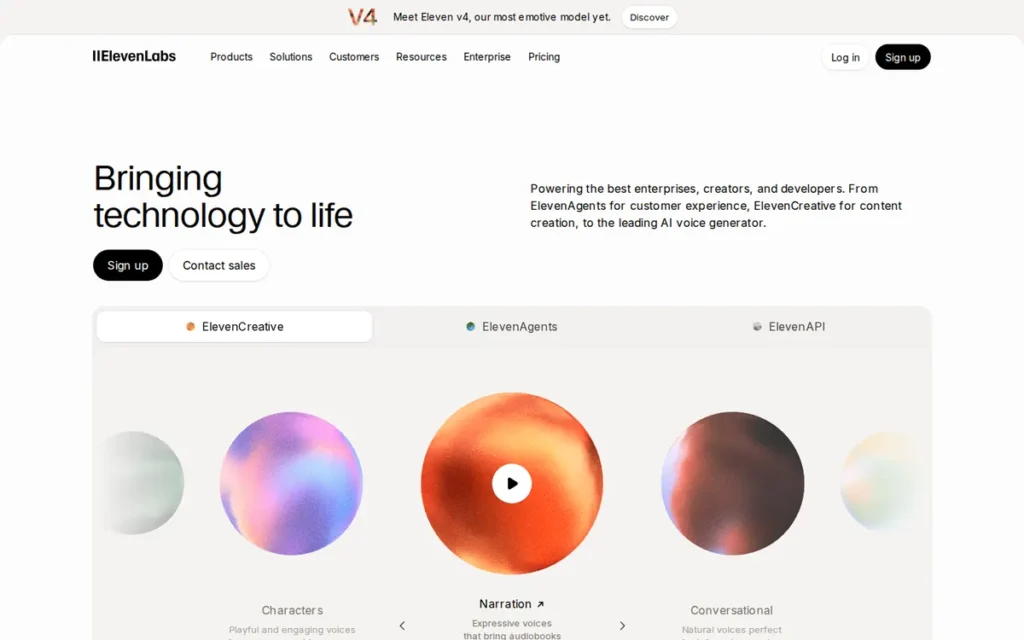
Category: Audio AI Platform, converts text, voice samples, and audio into multilingual, high-fidelity speech, music, and real-time conversational voice agents across 70+ languages.
At a Glance
| Field | Detail |
|---|---|
| Category | Audio AI Platform |
| Best For | Content creators producing multilingual podcasts, audiobooks, and narrations; developers building real-time voice agent applications |
| Price Range | Free (character-limited) + paid tiers starting ~$11/month Creator est.; verify at elevenlabs.io/pricing (April 2026) |
| Primary Strength | ElevenLabs achieves a 4.7/5 rating in blind listening tests; including from listeners who personally knew the original speaker; the highest independently confirmed voice quality score of any AI audio platform in this evaluation (AI Tools Recap, March 2026) |
| Biggest Limitation | ElevenLabs records approximately 420ms first-byte latency versus PlayHT’s 280ms; a 50% speed disadvantage for real-time conversational AI applications where sub-200ms response feels natural |
| One-Line Summary | ElevenLabs is the benchmark AI audio platform; achieving a 4.7/5 rating in blind listening tests, backed by $500 million in February 2026 funding at an $11 billion valuation; delivering text-to-speech, voice cloning, dubbing, and real-time voice agents across 70+ languages to Fortune 500 companies and independent creators alike |
| Last Verified | April 2026 |
Overview
ElevenLabs is a full-stack AI audio platform, founded in 2022, that delivers text-to-speech in 70+ languages, voice cloning from as little as 60 seconds of audio, and real-time speech-to-speech conversion, serving content creators, developers, and Fortune 500 enterprises that need production-grade multilingual voice output at scale.
ElevenLabs raised $500 million at an $11 billion valuation in February 2026 (Series D, led by Sequoia Capital with Andreessen Horowitz and ICONIQ participation), reflecting its position as the independently confirmed benchmark for AI voice quality, a category where competitors are measured against ElevenLabs rather than evaluated independently.
ElevenLabs’ dual-model architecture separates high-expressiveness generation (eleven_v3) from real-time applications (eleven_flash_v2_5 at approximately 75ms generation latency), enabling ElevenLabs to serve two fundamentally different professional markets within a single product.
Key Features
- ElevenLabs generates text-to-speech across 70+ languages with voice cloning from as little as 60 seconds of audio input, enabling rapid multilingual voice content production without studio recording sessions or professional voice actors (ElevenLabs documentation).
- ElevenLabs offers two specialized generation models: eleven_v3 for maximum expressiveness and naturalness, and eleven_flash_v2_5 at approximately 75ms latency, providing dedicated architectures for asynchronous content creation and real-time voice bot applications respectively (ElevenLabs documentation).
- ElevenLabs’ ElevenAgents platform enables developers to build conversational AI voice bots deployable to phone systems and web applications, extending ElevenLabs from a content generation tool into a real-time automated voice interaction infrastructure layer.
- ElevenLabs’ Scribe model provides speech-to-text transcription with character-level timestamps and speaker diarization, making ElevenLabs competitive with enterprise transcription services beyond its core voice generation use case (ElevenLabs platform overview).
- ElevenLabs generates music and sound effects via its generative audio engine, provides AI video dubbing with lip-sync translation in 70+ languages, and includes voice isolation and voice changing, positioning ElevenLabs as a comprehensive audio AI layer for content and developer workflows rather than a single-feature tool (Wikipedia/ElevenLabs).
Best For
ElevenLabs is best for content creators producing multilingual podcasts, audiobooks, and video narrations who require the highest available voice quality, and for developers building real-time voice agent applications who need to benchmark ElevenLabs’ ~420ms latency against their specific response-time requirements before committing at scale.
Pricing
ElevenLabs offers a free tier with character limitations suitable for initial workflow testing.
Independent reviewer estimates (April 2026) place the Creator tier at approximately $11/month for approximately 10,000 words of generation, competitive against Murf (~$13/month) and Resemble AI (~$24/month) at equivalent output volumes (Genesys Growth, 2026; AI Tools Recap, March 2026).
Exact tier pricing was not confirmed from the official pricing page during this research cycle; verify current rates at elevenlabs.io/pricing.
Strengths
- ElevenLabs achieved a 4.7/5 rating in blind listening tests: including from listeners who personally knew the original speaker, across independent benchmark evaluations published in 2026, the highest confirmed voice quality rating of any AI audio platform in this research cycle (AI Tools Recap, March 2026).
- ElevenLabs raised $500 million at an $11 billion valuation in February 2026 (Series D, Sequoia Capital lead), with Fortune 500 company adoption confirmed by independent reviewers, validating institutional confidence in ElevenLabs’ production reliability and commercial trajectory.
- ElevenLabs is described across multiple independent 2026 comparative reviews as “the benchmark” for voice quality (a standard-setting position where competitors are measured against ElevenLabs rather than evaluated independently) as confirmed by Genesys Growth and First Sales IO in 2026.
- ElevenLabs’ product velocity since 2022: advancing from single-feature TTS to a full audio AI stack encompassing Voice Isolator (July 2024), ElevenAgents conversational AI (November 2024), and the Scribe STT model with AI audiobook platform (February 2025), demonstrates sustained platform investment beyond initial feature scope (Wikipedia/ElevenLabs).
Limitations
- Latency Trade-Off for Real-Time Applications: ElevenLabs records approximately 420ms first-byte response time versus PlayHT’s 280ms, a 50% speed disadvantage consequential for conversational AI bots where sub-200ms response feels natural, but imperceptible for asynchronous content creation like podcasts and audiobooks (AI Tools Recap, March 2026). Note: PlayHT 3.0 has also narrowed the voice quality gap as of early 2026, making PlayHT a more credible alternative for latency-sensitive real-time applications than prior comparisons suggested.
- Accent Fidelity Bias: ElevenLabs’ voice cloning model carries documented training data bias toward dominant demographic voices, a developer testing 30 samples reported a middle-aged German-accented voice largely lost its accent in the cloned output, with community observations noting generated voices trend toward English-speaking defaults, a documented limitation for global enterprises requiring authentic multilingual voice representation (r/ElevenLabs, 2023).
- Background Audio Inconsistency: ElevenLabs users have reported occasional background noise and volume inconsistencies in generated audio, particularly for non-native accents and older voices with distinctive raspiness or tonal qualities, a pattern noted in the Genesys Growth review (2026).
“Eleven Labs is, IMHO, by far the leader for instant individual voice cloning. By 12:10, I had created a premium account, uploaded a sample of my voice, and produced fairly indistinguishable Text-to-Speech audio clips from me.” (r/ElevenLabs, developer with 2+ years of AI voice product testing experience, 2023)
Takeaway: ElevenLabs demonstrates the fastest documented time-to-quality in the AI voice category (under 10 minutes from account creation to near-indistinguishable cloned audio) but the same experienced reviewer identified accent fidelity as the primary unresolved gap, providing the most useful evaluator framing in this research cycle.
Verdict
ElevenLabs is the highest independently verified AI voice platform in 2026, achieving a 4.7/5 blind-test rating (the strongest confirmed quality benchmark in the AI audio category) alongside $500 million in February 2026 funding at an $11 billion valuation and confirmed Fortune 500 enterprise adoption.
ElevenLabs ties Cursor at 33 on the weighted scoring matrix but ranks first because it scores 5 on Verified Performance Evidence versus Cursor’s 4, the confirmed 4.7/5 blind test result and February 2026 institutional funding constitute stronger peer-validated evidence than Cursor’s community-reported tab-completion figure.
ElevenLabs leads the category for asynchronous content creation (podcasts, audiobooks, multilingual video narration) where quality is the dominant criterion. Teams evaluating ElevenLabs for real-time conversational AI should explicitly benchmark its ~420ms latency against their response-time requirements and test voice cloning fidelity for non-English accents before committing to production deployment.
2. Cursor: Best AI Coding IDE for Professional Developers and Full-Stack Engineers
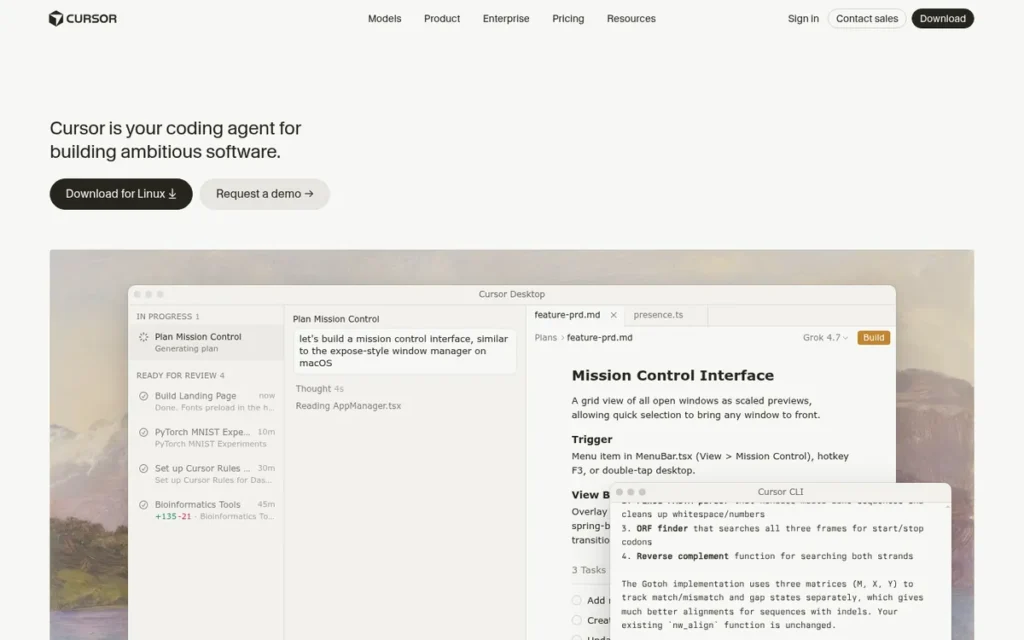
Category: AI Coding IDE, an AI-native code editor integrating multiple frontier AI models directly into the development environment for real-time, multi-file code assistance, refactoring, and autonomous agent-mode execution.
At a Glance
| Field | Detail |
|---|---|
| Category | AI Coding IDE |
| Best For | Professional developers, full-stack engineers, and DevOps teams working on complex, multi-file codebases who want AI with repository-wide context awareness integrated natively into their editor |
| Price Range | Free (intentionally constrained) + Hobby, Pro, Business paid tiers; verify exact pricing at cursor.com/pricing (April 2026) |
| Primary Strength | Cursor achieved a 74.4% PR acceptance rate on the AIDev benchmark of 7,156 real-world GitHub pull requests (arXiv:2602.08915, 2026); second only to OpenAI Codex; with codebase-wide indexing enabling contextually aware AI assistance across entire repositories |
| Biggest Limitation | Cursor’s Claude integration shows documented context degradation after 30–60 minutes of continuous coding sessions, requiring restarts that interrupt extended development workflows; a gap Windsurf’s Cascade AI handles more consistently |
| One-Line Summary | Cursor is the leading AI-native code editor for professional developers; a VS Code fork with codebase-wide context indexing, multi-model flexibility (GPT-4, Claude, Gemini, Grok), and agent-mode autonomous execution; achieving a 74.4% PR acceptance rate on the AIDev real-world benchmark of 7,156 pull requests |
| Last Verified | April 2026 |
Overview
Cursor is an AI-native code editor developed by Anysphere, built as a VS Code fork that integrates multiple frontier AI models, including GPT-4, Claude 3.5/3.7, Gemini 2.0, Grok, and its own cursor-small model, directly into the IDE architecture rather than as a plugin overlay.
Cursor’s architectural distinction from plugin-based tools like GitHub Copilot is codebase indexing, the ability to reference entire repositories contextually so the AI understands where every function, class, and API client lives across dozens of files simultaneously.
Independent developer comparisons published in 2025–2026 consistently rate Cursor as delivering more accurate and contextually relevant results than both Windsurf and GitHub Copilot for complex, multi-file agentic tasks. The AIDev benchmark (arXiv:2602.08915, 2026) places Cursor at 74.4% real-world PR acceptance, second only to OpenAI Codex at 79.9%.
Key Features
- Cursor users in active developer community testing report approximately 95% tab-completion accuracy for multi-line and multi-file code predictions (a community-reported figure, not a controlled benchmark) enabling developers to accept AI suggestions inline across multiple files simultaneously without leaving the editor (Hacker News, thread id:43959710).
- Cursor’s codebase indexing allows the AI to reference entire repositories contextually, answering questions like “Where is the API client defined?” with accurate, file-location-aware responses including bug fixes referencing complete stack traces (UIBakery Blog; Builder.io).
- Cursor’s Agent Mode enables autonomous code execution: the AI writes, tests, and re-runs code iteratively until tests pass without requiring constant human checkpoint approvals, enabling developers to delegate complete feature implementations.
- Cursor supports selection between GPT-4, Claude 3.5/3.7, Gemini 2.0, Grok, and cursor-small within a single editor session, allowing model switching by task type, cost preference, or context window needs without switching tools.
- Cursor is a VS Code fork, meaning all existing VS Code extensions, keyboard shortcuts, themes, and settings transfer immediately, eliminating the migration friction that slows adoption of competing AI-native editors (DataCamp, 2026).
Best For
Cursor is best for professional developers, full-stack engineers, and DevOps teams working on complex, multi-file codebases who want AI that understands repository-wide context rather than file-level suggestion, and are willing to invest time learning agent-mode task delegation in exchange for significantly higher coding productivity.
Pricing
Cursor offers a free tier that demonstrates core capabilities with intentional constraints designed to encourage paid tier upgrades.
Community comparisons describe Cursor’s free tier as designed to showcase capability while being restrictive enough to necessitate upgrading, limiting genuine evaluation of codebase indexing and agent-mode before committing to paid plans (Windows Forum, 2026).
Paid plans include Hobby, Pro, and Business tiers. Exact monthly pricing was not confirmed from the official pricing page during this April 2026 research cycle; verify current rates at cursor.com/pricing.
Strengths
- Cursor achieved a 74.4% PR acceptance rate on the AIDev benchmark dataset (7,156 real-world GitHub pull requests, arXiv preprint 2602.08915, 2026), the second highest of any evaluated AI coding agent, behind only OpenAI Codex at 79.9% and ahead of Claude Code at 72.6% and Devin at 68.0%.
- Builder.io’s independent 2026 comparative analysis concluded that Cursor “consistently delivers more accurate and contextually relevant results” versus both Windsurf and GitHub Copilot, specifically highlighting superiority in auto-generated commit messages, complex refactors, and advanced bug-finding scenarios on large codebases.
- The Pragmatic Engineer blog (2026) (a developer newsletter reaching senior engineers at major technology companies) cited Cursor among the IDEs “that software engineers love,” indicating adoption moving beyond early adopters into mainstream professional engineering teams.
- Cursor’s VS Code fork architecture gives it a structural adoption advantage: developers migrating from VS Code retain all extensions, keyboard shortcuts, and muscle memory, reducing the perceived switching cost to near zero despite Cursor’s fundamental architectural difference from plugin-based AI coding tools (UIBakery Blog).
Limitations
- Context Degradation in Extended Sessions: Cursor’s most consequential documented limitation for power users is context degradation, developer community reports document the Claude integration within Cursor “getting tired” after 30–60 minutes, requiring session restarts that interrupt deep-focus work (Pragmatic Engineer, 2026). Windsurf’s Cascade AI reportedly handles extended-session consistency more reliably, making Windsurf a stronger choice for multi-hour uninterrupted workflows.
This aligns with community sentiment on r/cursor:
“I think for me the biggest difference is just in the context management. If you do ai studio or claude chat or whatever then you know that the model sees 100% of what you put in, and if you put in too much and bloat the context thats on you. But in cursor the middle layer is absolutely ruthless, you can never know what context actually made it to the model. So even next gen of models if used in cursor will probably never solve 100% of the tasks just cus of this” Posted by u/BaysQuorv
Takeaway: Cursor’s context management layer is an independently documented architectural constraint, developers report it creates a hard ceiling on task completion regardless of which underlying model version is running.
- Intentionally Constrained Free Tier: Cursor’s free tier is designed to demonstrate capability while being restrictive enough to necessitate upgrading, limiting the ability to fully evaluate codebase indexing and agent-mode capabilities before committing to a paid subscription, which creates a bait-tier perception among developers seeking genuine pre-purchase evaluation (Windows Forum, 2026).
- Pricing Opacity for Enterprise Buyers: Cursor does not publish confirmed paid tier prices in a format independently verifiable in this research cycle, creating budget predictability friction for enterprise procurement teams who need to forecast AI tool costs before initiating vendor conversations, a gap that reduces procurement confidence compared to tools with fully transparent public pricing.
Verdict
Cursor is the leading AI-native code editor for professional developers in 2026, scoring 74.4% on the AIDev real-world PR acceptance benchmark and rated by multiple independent comparisons as the most contextually accurate AI coding assistant for complex, multi-file codebases.
Cursor ties ElevenLabs at 33 weighted points and ranks second on C1 (Verified Performance Evidence: 4 vs. ElevenLabs’ 5), the AIDev benchmark is strong peer-validated evidence, but the community-reported ~95% tab-completion figure is not a controlled benchmark, a meaningful evidence quality distinction.
Teams who rely on multi-hour uninterrupted coding sessions should explicitly test Claude context stability within Cursor before full adoption, and compare against Windsurf’s Cascade AI for extended-session reliability. To evaluate Cursor: install the free tier, import one active VS Code project, and run the multi-file problem that currently takes you longest, the migration takes minutes and immediately surfaces whether Cursor’s codebase-indexing accuracy meets your requirements.
3. Google NotebookLM: Best Free AI Research Tool for Researchers and Analysts
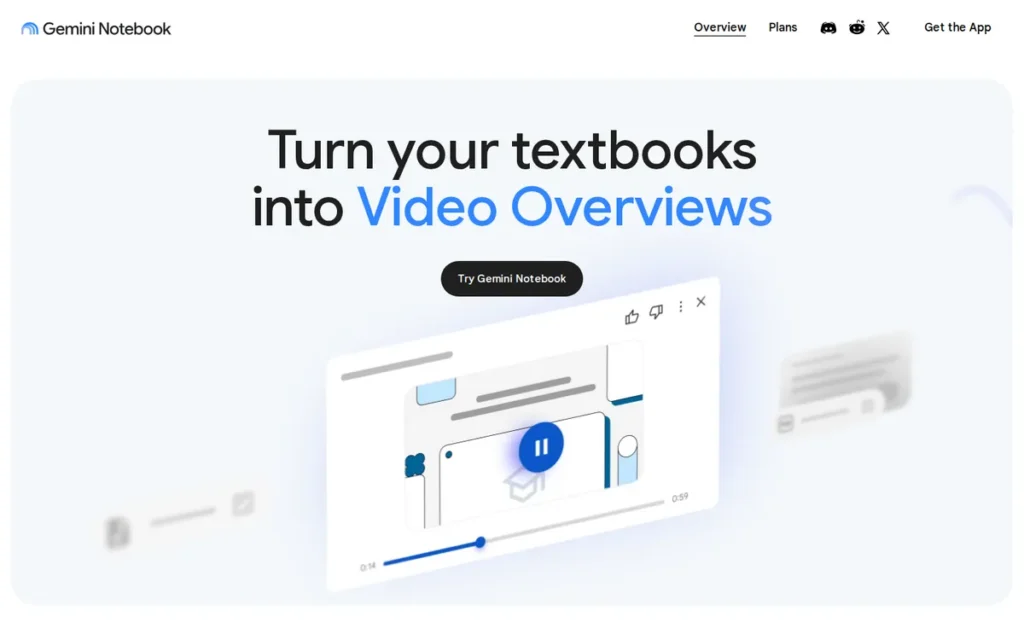
Category: AI Research Assistant, a source-grounded AI tool that generates answers, summaries, and multi-format outputs exclusively from user-uploaded documents using Retrieval-Augmented Generation.
At a Glance
| Field | Detail |
|---|---|
| Category | AI Research Assistant |
| Best For | Researchers, students, analysts, lawyers, and business professionals working with specific, pre-identified document sets who need AI synthesis with verifiable source citations |
| Price Range | Free (50 sources/notebook, 50 daily AI chats; no credit card required) + multiple paid tiers (Plus, Pro, Ultra); verify current pricing at notebooklm.google/plans (April 2026) |
| Primary Strength | Google NotebookLM uses RAG-only architecture that grounds every response exclusively in user-uploaded sources, virtually eliminating hallucination from external AI knowledge contamination; the defining capability for source-attribution-critical workflows |
| Biggest Limitation | Google NotebookLM cannot search the internet; all sources must be manually uploaded before analysis begins, making it unsuitable for open-ended exploratory research where relevant documents have not been pre-identified |
| One-Line Summary | Google NotebookLM is the leading source-grounded AI research assistant; free to use, powered by Google Gemini with a 1 million token context window and 50 sources per notebook; generating podcast-style Audio Overviews, exportable slide decks, quizzes, and study guides exclusively from user-uploaded documents with inline source citations |
| Last Verified | April 2026 |
Overview
Google NotebookLM is a free AI research assistant powered by Google Gemini that uses Retrieval-Augmented Generation (RAG) to generate answers, summaries, and multi-format content exclusively from documents uploaded by the user, including PDFs, Google Docs, Google Slides, YouTube videos, audio files, websites, and images.
Google NotebookLM supports a context window of up to 1 million tokens (500,000 words per source) and provides inline citations for every AI response.
Google NotebookLM’s defining architectural principle is source exclusivity: unlike ChatGPT or Gemini in general mode, Google NotebookLM will only reference materials the user has uploaded, making it uniquely reliable for research, legal review, academic study, and compliance documentation where source provenance must be auditable.
Google NotebookLM’s Studio Panel extends source analysis into output generation (creating Audio Overviews, PPTX-exportable slide decks, mind maps, quizzes, and reports from uploaded materials) effectively replacing several specialized tools within a single source-grounded environment.
Key Features
- Google NotebookLM generates conversational “Audio Overviews”: two-AI-host podcast-style discussions that summarize uploaded document content with accurate source citations, allowing researchers to absorb dense papers, reports, and course materials in audio format, described by independent reviewers as having “shockingly high levels of personality” (Tom’s Guide, 2026).
- Google NotebookLM’s Studio Panel creates 11+ output formats from uploaded sources (including PPTX-exportable slide decks, mind maps, infographics, data tables, quizzes, flashcards, study guides, blog posts, and reports) functioning as a multi-format content generation engine grounded exclusively in user documents (Google Blog, 2025).
- Google NotebookLM supports source types including PDFs, Google Docs, Google Slides, YouTube videos, audio files, URLs, and images within a 1 million token context window per source, enabling large-document research workflows without fragmentation or pagination (DigitalOcean, 2026).
- Google NotebookLM provides inline source citations for every AI response, allowing users to verify exactly which document passage supports each claim, a critical feature for academic integrity, legal review, and compliance documentation workflows.
- Google NotebookLM’s free tier provides 50 sources per notebook and 50 AI chat queries per day at genuinely zero cost (no credit card required) making it one of the few AI tools in this evaluation where the free tier provides substantive professional utility without trial constraints (Google support documentation, April 2026).
Best For
Google NotebookLM is best for researchers, students, legal analysts, and business professionals who regularly work with specific pre-identified document sets and require AI assistance that cites every claim back to its original source, making it particularly strong for academic literature review, competitive intelligence analysis, legal document synthesis, and study guide generation from course materials.
Pricing
Google NotebookLM is genuinely free at the base tier: 50 sources per notebook, 50 daily AI chats, no payment or credit card required (Google support documentation, April 2026).
As of April 2026, multiple paid tiers exist beyond the free tier (including Plus, Pro, and Ultra) with the pricing structure having expanded significantly since late 2025. Exact prices for each tier should be confirmed at notebooklm.google/plans, as the monetization model has grown more complex than earlier Plus-only tiers.
Strengths
- Tom’s Guide published a documented workflow shift in 2026 (titled “I ditched ChatGPT, Perplexity, and Claude for NotebookLM research and didn’t expect these results”) driven by Google NotebookLM’s combination of Fast Research, Deep Research, and source transparency, confirming category-substitution-level value for document-intensive research workflows.
- Google NotebookLM’s Audio Overviews feature became a viral use case in 2024–2025, with users documenting a shift from reading full papers to consuming AI-synthesized audio in podcast format, described by independent reviewers as having “shockingly high levels of personality” with accurate source citations, as reported by Tom’s Guide and DataCamp in 2026.
- Google NotebookLM is backed by Google’s compute infrastructure and Gemini 2.5/3 model access with deep Google Workspace integration, providing enterprise-grade reliability for a free-tier tool and ensuring competitive model quality against leading general-purpose AI assistants.
- Student adoption is habitual and organic: with users describing using Google NotebookLM “religiously before exams” from syllabi and lecture materials, creating a long-term adoption pipeline as students carry the tool into professional roles, a bottom-up enterprise acquisition pattern documented in DataCamp tutorial user comments (2026).
Limitations
- No Internet Search: Source Upload Required: Google NotebookLM’s most consequential architectural limitation is its inability to search the internet, every source must be manually identified and uploaded before any analysis can begin, making Google NotebookLM structurally unsuitable for open-ended or discovery-phase research where relevant documents haven’t been pre-identified (TeacherCool comparative review; BigBull Cloud comparison, 2026). Users who combine Google NotebookLM for closed-document analysis with Perplexity for source discovery report the strongest research outcomes.
- Google Labs Longevity Risk: Google NotebookLM’s Google Labs origin introduces a documented product longevity risk (Google has discontinued multiple Labs projects) that enterprise teams with long procurement cycles should factor into adoption decisions, as the platform could be absorbed into Google Workspace or deprecated without the predictability of a standalone commercial product roadmap.
- Non-Interactive Audio Output: Google NotebookLM’s Audio Overviews generate non-interactive audio that cannot be edited or regenerated with targeted corrections, meaning errors or misemphases in the AI podcast-style output require regenerating the entire overview rather than targeted correction, a friction point for professional research workflows requiring precision.
“The idea is right, but still it is not reliable tbh. NotebookLM is decent but kinda annoying sometimes.” (u/rezayazdanfar, r/NoteTaking, 2024)
Takeaway: Google NotebookLM’s “annoying sometimes” pattern in community feedback refers to occasional refusals to answer questions that appear directly relevant to uploaded sources, a documented edge case, not a core reliability failure, but one worth testing on your specific document types before adopting Google NotebookLM as a critical research workflow.
Verdict
Google NotebookLM is the most accessible free AI research tool among the seven evaluated platforms, requiring no payment, supporting 50 sources and 50 daily AI queries at the free tier, and generating source-cited answers, viral Audio Overviews, exportable slide decks, and study guides from user-uploaded documents.
Google NotebookLM ranks third over OpenAI Codex despite a tied weighted score of 31, because its stronger secondary criteria scores (C4 community sentiment: 4 vs. Codex’s 3; C5 pricing access: 5 vs. Codex’s 2) reflect meaningfully broader accessibility to the full target audience, including non-developer professionals.
Organizations considering Google NotebookLM for enterprise workflows should monitor its Google Labs status and evaluate whether the no-internet-search architectural boundary fits their research use cases before integrating it into critical workflows.
4. OpenAI Codex: Best Autonomous Coding Agent for Platform Engineers
Category: Autonomous Coding Agent, an AI agent that accepts natural language task descriptions and executes software development work asynchronously in isolated cloud sandbox environments, returning completed pull requests without occupying the developer’s IDE.
At a Glance
| Field | Detail |
|---|---|
| Category | Autonomous Coding Agent |
| Best For | Senior developers and platform engineering teams operating in GitHub-centric workflows who want to delegate well-scoped, discrete development tasks to an autonomous agent that returns merge-ready pull requests |
| Price Range | Requires ChatGPT Pro, Enterprise, or Business subscription; no standalone pricing published (verify at openai.com/codex, April 2026) |
| Primary Strength | OpenAI Codex achieved a 79.9% PR acceptance rate on the AIDev benchmark (7,156 real-world GitHub pull requests, arXiv:2602.08915); the highest documented performance of any evaluated autonomous AI coding agent as of 2026 |
| Biggest Limitation | OpenAI Codex requires an existing ChatGPT Pro, Enterprise, or Business subscription with no standalone access; and early-release community reports document non-compiling code outputs and approximately 10x slower execution than IDE-based alternatives |
| One-Line Summary | OpenAI Codex is the highest-performing autonomous AI coding agent by PR acceptance rate; achieving 79.9% on the AIDev benchmark of 7,156 real-world pull requests; executing development tasks asynchronously in isolated cloud sandboxes with parallel multi-agent capability, but requiring a ChatGPT Pro subscription and carrying early-release reliability caveats as of April 2026 |
| Last Verified | April 2026 |
Overview
OpenAI Codex (2025 agent version) is an autonomous AI coding agent powered by the codex-1 model, a derivative of OpenAI’s o3 reasoning model fine-tuned via reinforcement learning on real-world software engineering tasks.
OpenAI Codex accepts natural language development task descriptions, executes them asynchronously in isolated cloud sandbox environments preloaded with the user’s codebase, and returns completed pull requests with test results and change logs.
OpenAI Codex operates on a fundamentally different paradigm from in-IDE AI assistance, rather than augmenting active coding sessions, OpenAI Codex functions as an autonomous engineering delegate that executes well-scoped tasks in parallel without requiring developer attention during execution.
On the AIDev benchmark evaluating 7,156 real-world GitHub pull requests (arXiv:2602.08915, 2026), OpenAI Codex achieved a 79.9% acceptance rate, the highest of any evaluated AI coding agent, ahead of Cursor at 74.4%, Claude Code at 72.6%, and Devin at 68.0%.
Key Features
- OpenAI Codex executes coding tasks asynchronously in isolated cloud sandbox environments preloaded with the user’s full codebase, providing shell access and command-line capability while isolating AI execution from production environments and requiring no IDE interruption (OpenAI official Codex introduction).
- OpenAI Codex supports parallel multi-agent execution, enabling developers to simultaneously assign multiple independent tasks (a new feature, a bug fix, a test suite, and a refactor) to concurrent Codex instances within the same project repository (Dextra Labs, 2026).
- OpenAI Codex integrates natively with GitHub for repository management, pull request creation, linter and type-checker execution, documentation generation, and iterative test cycles, completing the full software engineering workflow from natural language description to merge-ready PR (DevOps.com, 2026).
- OpenAI Codex’s codex-1 model was trained via reinforcement learning specifically on real-world software engineering tasks, optimizing directly for the PR acceptance criteria that human engineers apply in code review, explaining its leading 79.9% acceptance rate on the AIDev benchmark (arXiv:2602.08915, 2026).
- OpenAI Codex supports extensible “agent skills”: workflow scripts for specialized tasks including API integrations and custom tooling, enabling engineering teams to tailor OpenAI Codex’s capabilities to their specific development environment and toolchain (OpenAI Codex skills documentation).
Best For
OpenAI Codex is best for senior developers and platform engineering teams already operating on ChatGPT Pro or Enterprise plans, working in GitHub-centric workflows, who want to delegate discrete and well-scoped development tasks (writing test suites, generating documentation, fixing isolated bugs, performing targeted refactors) to an autonomous agent that returns merge-ready pull requests rather than inline code suggestions.
Pricing
OpenAI Codex launched with access bundled into ChatGPT Pro, Enterprise, and Business subscriptions, no standalone product pricing was published as of April 2026.
Developers must hold a qualifying paid ChatGPT subscription to access OpenAI Codex. Plus and Edu plan access was indicated as a future rollout (OpenAI official Codex introduction).
Verify current access requirements and pricing at openai.com/codex.
Strengths
- OpenAI Codex achieved a 79.9% PR acceptance rate on the AIDev benchmark dataset (7,156 real-world GitHub pull requests, arXiv preprint 2602.08915, 2026), the highest documented PR acceptance rate of any evaluated AI coding agent, providing peer-validated evidence that Codex-generated code meets human engineering review standards at a near-4-in-5 rate.
- OpenAI Codex reached 1.6 million active weekly users since the GPT-5.3-Codex release in early February 2026, with token processing volume increasing 5x over the preceding period (Fortune, March 2026), demonstrating that despite documented early-release reliability concerns, professional adoption of the autonomous coding agent paradigm is accelerating at significant scale.
- OpenAI Codex’s codex-1 model is trained via reinforcement learning on real-world software engineering tasks (a methodologically stronger approach than training on synthetic coding benchmarks) directly explaining the strong PR acceptance performance on production-representative evaluation data (OpenAI official introduction).
- Hacker News developers (thread id:44188839) praised OpenAI Codex for “obsoleting in-tool AI needs through direct repo work,” citing its CLI/TUI interface, GitHub integration, task tracking, and sandbox isolation as enabling a level of autonomous AI delegation unavailable in IDE-embedded tools.
Users on r/vibecoding shared their experience:
“The usage allowances between Claude and Codex are no joke. I was running 2 $20 Claude plans for a while, and I’d get 3 days out of each (sometimes less), but I hit my 5-hour limit in almost every session I ever had. I’ve only hit 1 5-hour limit ever in Codex. I love them both, but Codex makes more sense if your budget is limited. Imo it’s a stronger model anyway, at least for coding and debugging. YMMV” Posted by u/doranbuilds
Takeaway: Developers who have used both Claude Code and OpenAI Codex report Codex as the more sustainable choice for heavy daily coding use (with notably more forgiving rate limits and stronger self-reported performance on debugging tasks) reinforcing its value proposition for engineering teams already embedded in the OpenAI ecosystem.
Limitations
- Subscription Paywall Restricts Independent Access: OpenAI Codex’s most significant practical limitation is its access structure (requiring a ChatGPT Pro, Enterprise, or Business subscription with no standalone pricing) creating a purchasing barrier that excludes developers who do not already use paid ChatGPT tiers and positioning Codex as an add-on for existing OpenAI customers rather than an independently accessible tool (OpenAI official introduction).
- Early-Release Reliability Issues: OpenAI Community forum users documented significant frustrations including Codex generating non-compiling code with malformed HTML
\r\nartifacts, approximately 10x slower execution than IDE-based alternatives like Cursor and GitHub Copilot, and excessive command approval prompts in agent mode (OpenAI Community forum, 2025). The absence of change-preview or undo functionality in an agent that writes directly to repositories is a meaningful safety concern, evaluate sandbox isolation controls and rollback procedures before deploying OpenAI Codex in production contexts. - Task Stratification Gaps vs. Specialized Competitors: OpenAI Codex trails more specialized tools on specific sub-tasks, scoring 28.9% on feature implementation versus Devin’s 41.5%, and 28.3% on bug fixes versus GitHub Copilot’s 41.6%, demonstrating that the leading 79.9% overall PR acceptance rate does not translate to dominance across every coding task type (arXiv:2602.08915, 2026).
Verdict
OpenAI Codex is the highest-performing autonomous AI coding agent by PR acceptance rate as of 2026, achieving 79.9% on the AIDev benchmark of 7,156 real-world pull requests, the strongest peer-validated performance evidence of any coding agent evaluated here.
OpenAI Codex ranks fourth in this evaluation because its ChatGPT Pro paywall restricts the accessible audience and its documented early-release reliability issues (non-compiling outputs, 10x slower execution, missing undo functionality) require teams to factor additional human oversight into workflow planning.
For teams already on ChatGPT Pro or Enterprise who want to explore autonomous development delegation for well-defined engineering tasks, OpenAI Codex represents the strongest performance ceiling available. Monitor OpenAI’s rapid release cadence (GPT-5.2-Codex and GPT-5.3-Codex updates already shipped as of February 2026) as reliability improvements are likely.
5. Synthesia: Best Enterprise AI Video Platform for L&D and Corporate Communications
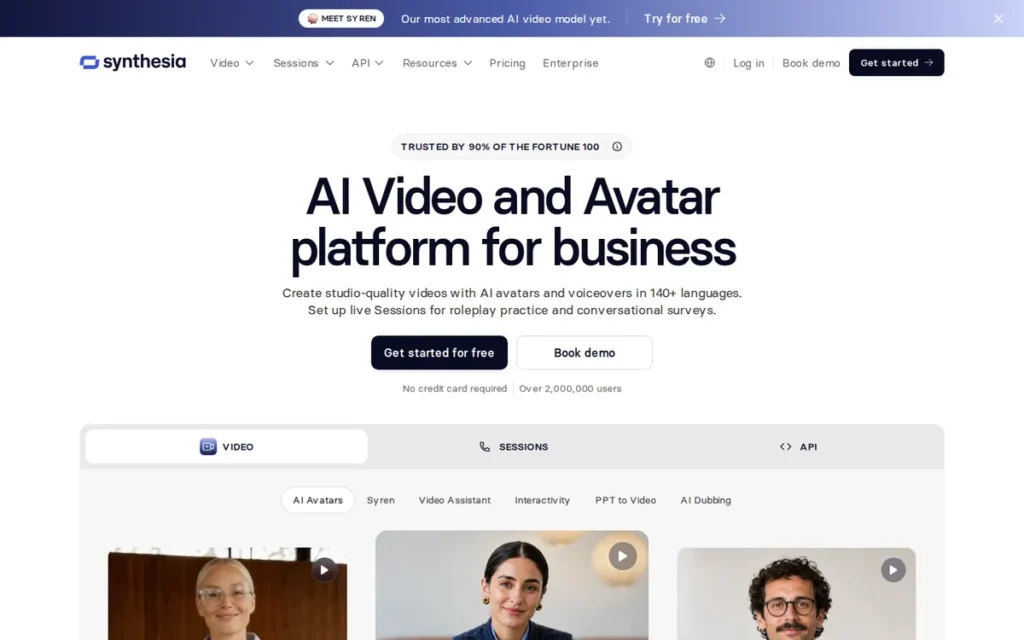
Category: Enterprise AI Video Platform, generates avatar-based professional videos in 120+ languages from text scripts, PDFs, and prompts without cameras, actors, or studios, with enterprise security certifications for regulated industry deployment.
At a Glance
| Field | Detail |
|---|---|
| Category | Enterprise AI Video Platform |
| Best For | Enterprise L&D, HR, and corporate communications teams producing multilingual training, onboarding, and compliance videos at scale; particularly in regulated industries where SOC 2 Type II certification is a procurement prerequisite |
| Price Range | Starter + Creator plans available; Enterprise custom pricing; verify at synthesia.io/pricing (community sources describe as “enterprise-priced”; April 2026) |
| Primary Strength | Synthesia holds SOC 2 Type II compliance certification and claims adoption by more than 90% of Fortune 100 companies for internal communications as of late 2025; the most enterprise-security-validated AI video platform in this evaluation |
| Biggest Limitation | Synthesia’s AI avatars carry a documented 4.7/5 lip-sync accuracy rating versus HeyGen’s near-perfect 5/5, and the instructional design community raises substantive concerns that AI avatar-based training content produces lower learning effectiveness regardless of production quality |
| One-Line Summary | Synthesia is the leading enterprise AI video platform; SOC 2 Type II certified, adopted by 90%+ of Fortune 100 companies as of late 2025, generating avatar videos in 120+ languages from text without cameras or actors; best suited for L&D and compliance content where security certification and multilingual scale outweigh maximum avatar realism |
| Last Verified | April 2026 |
Overview
Synthesia is an enterprise AI video platform, among the earliest commercial AI video avatar platforms (founded 2017), that converts text scripts, PDFs, slide decks, websites, and natural language prompts into professional avatar-based videos.
Synthesia features customizable AI presenters that gesture, maintain eye contact, and speak fluently in 120–160+ languages, without requiring cameras, recording studios, or post-production expertise.
Synthesia claims adoption by more than 50,000 teams and 90%+ of Fortune 100 companies for internal video communications as of late 2025, up from 60% in early 2025. Synthesia holds SOC 2 Type II compliance certification for regulated enterprise deployment.
Synthesia raised $200 million in a Series E round on January 26, 2026 at a $4 billion valuation, led by Google Ventures (GV) with participation from Nvidia’s NVentures, Accel, and Kleiner Perkins.
Key Features
- Synthesia generates avatar-based videos in 120–160+ languages from text scripts, PDFs, slide decks, websites, and natural language prompts (with customizable AI presenters that gesture and maintain eye contact) enabling multilingual video production at scale without cameras, actors, or recording studios (Synthesia.io features page).
- Synthesia holds SOC 2 Type II compliance certification: the audited enterprise security standard required by regulated industries including finance, healthcare, and legal, providing a procurement-ready security credential unavailable in most competing AI video platforms (WaveSpeed comparison, 2026).
- Synthesia supports interactive video features including clickable buttons, branching paths with conditional logic, and embedded knowledge-check quizzes on Creator and Enterprise plans, enabling measurable learning verification within the video format for L&D and compliance use cases (Synthesia interactive features documentation).
- Synthesia has integrated Sora 2, Veo 3.1, and FLUX.2 generative video foundation models for AI-produced backgrounds and scene creation, enabling more cinematic context around avatar presentations in response to criticism about avatar-only output (Synthesia.io official website).
- Synthesia supports real-time team collaboration, shared workspaces, timeline-based editing, and multilingual video player embedding, enabling enterprise-scale video production workflows without individual video editing expertise.
Best For
Synthesia is best for enterprise L&D, HR, and corporate communications teams that need to produce high-volume, multilingual training and compliance videos with audited security standards, particularly in regulated industries (finance, healthcare, legal) where SOC 2 Type II certification is a procurement prerequisite.
Pricing
Synthesia offers a Starter plan and a Creator plan (allowing unlimited videos up to 5 minutes) with Enterprise custom pricing for larger teams.
Exact public pricing for Starter and Creator tiers was not confirmed from the official pricing page during this April 2026 research cycle; community sources consistently describe Synthesia as “quite expensive” and “aimed at enterprises.”
Verify current pricing at synthesia.io/pricing.
Strengths
- Synthesia holds SOC 2 Type II compliance certification: an audited, not self-reported, security standard, and claims adoption by more than 90% of Fortune 100 companies for internal video communications as of late 2025, up from 60% in early 2025, providing the strongest enterprise security credentialing and named adoption evidence of any AI video platform in this research cycle (WaveSpeed comparison, 2026).
- Synthesia scores 88% in video creation, 88% in language support, and 87% in file exporting on verified G2 user reviews (G2 comparative analysis, 2026), reflecting consistent production-grade strength in dimensions most relevant to enterprise L&D and communications teams managing multilingual content at scale.
- Synthesia raised $200 million in a Series E round on January 26, 2026 at a $4 billion valuation, led by Google Ventures (GV), demonstrating sustained institutional investment at enterprise scale and validating confidence in Synthesia’s position as the incumbent enterprise AI video platform.
- Synthesia’s interactive video features: branching paths, conditional logic, and embedded knowledge-check quizzes, differentiate Synthesia from passive video production tools by enabling measurable learning assessment within the video itself, a capability with direct value for enterprise compliance training and onboarding verification.
Limitations
- Avatar Realism Gap vs. HeyGen: Synthesia’s primary documented limitation is avatar realism, independent comparisons rate Synthesia’s avatars as “traditionally synthetic” with a 4.7/5 lip-sync accuracy score versus HeyGen’s near-perfect 5/5 rating, and Synthesia supports 140+ languages versus HeyGen’s 175+, gaps that are consequential for consumer-facing marketing applications where visual authenticity directly influences audience engagement (WaveSpeed HeyGen vs. Synthesia comparison, 2026).
- Pedagogical Effectiveness Concerns from L&D Practitioners: Multiple experienced L&D professionals in r/instructionaldesign describe AI avatar-based training content as “the lowest effort, least engaging, and broadly ineffective learning solution, make it a fake AI talking head and the results get predictably even worse” (u/salparadisewasright, r/instructionaldesign, April 2025). One practitioner noted “IT teams think it’s great because they can create training using it, but very little training is actually happening” (u/Ok_Stomach_6857, r/instructionaldesign, April 2025).
- Undisclosed Tier Pricing: Synthesia does not publicly list exact pricing for its Starter and Creator tiers without requiring sales contact, an operational transparency gap that adds procurement friction for buyers who need to forecast AI tool budgets before initiating vendor conversations.
“Talking head content is the lowest effort, least engaging, and broadly ineffective learning solution. Make it a fake AI talking head and the results get predictably even worse.” (u/salparadisewasright, r/instructionaldesign, April 2025)
Takeaway: This critique targets the training format’s pedagogical validity, not Synthesia’s technical quality, meaning the question for L&D buyers is whether AI avatar video is the right investment for their learning goals before evaluating which platform to use for it.
Verdict
Synthesia is the most enterprise-ready AI video platform in 2026 (SOC 2 Type II certified, with claimed Fortune 100 adoption reaching 90%+ as of late 2025 and G2 scores of 88% in video creation and language support) making it the defensible choice for regulated enterprises where security certification is a procurement prerequisite and multilingual video scale is the primary objective.
Synthesia ranks fifth in this evaluation because its Innovation score trails newer competitors, avatar realism lags HeyGen in direct comparisons, and the instructional design community has raised substantive, documented questions about the learning effectiveness of the avatar-video format itself.
Organizations considering Synthesia for L&D budgets should evaluate not only the tool’s technical capabilities but whether avatar-format training video produces the learning outcomes their investment requires, before committing at enterprise pricing.
6. Lovable: Best AI App Builder for Non-Technical Founders Building Full-Stack MVPs
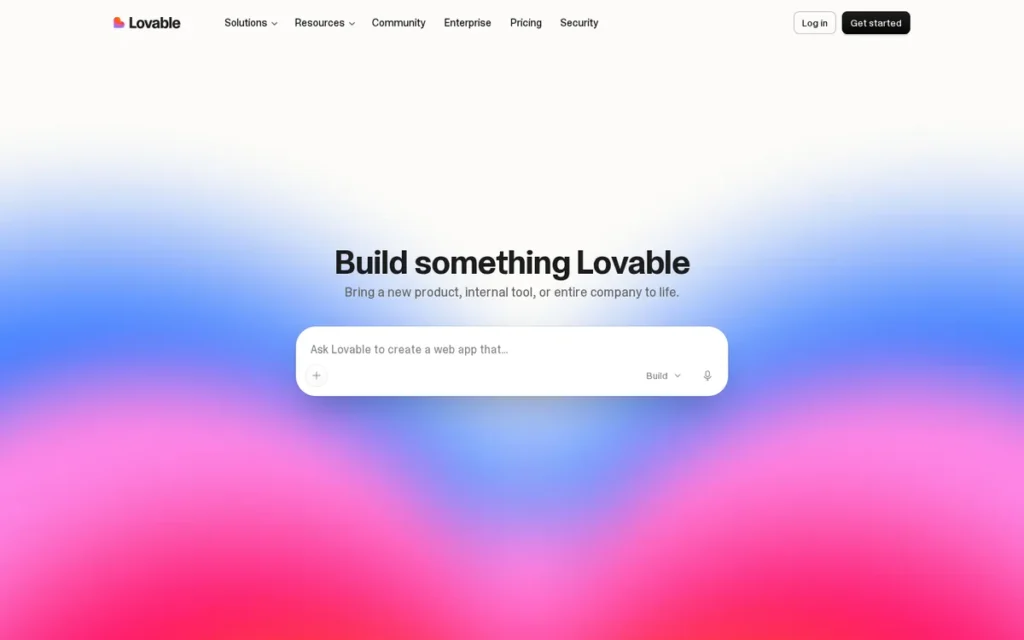
Category: AI App Builder, generates deployable full-stack web applications including React frontend, Supabase backend, database schema, and user authentication from natural language descriptions without requiring code writing.
At a Glance
| Field | Detail |
|---|---|
| Category | AI App Builder |
| Best For | Non-technical startup founders, product managers, and early-stage teams who need to build a functional web application MVP with authentication and database; without developer resources; to validate an idea or demonstrate to investors |
| Price Range | Free (limited) | Pro at $25/month (100 credits/month + 5 daily, unlimited users, credit rollovers) | Business at $50/month; verified at lovable.dev/pricing (April 2026) |
| Primary Strength | Lovable generates a complete full-stack web application; React + Tailwind frontend, Supabase PostgreSQL backend, authentication, and routing; from a natural language description in approximately 12 minutes for a basic MVP, a capability that competitors offering only frontend component generation cannot match |
| Biggest Limitation | Lovable’s opinionated React + Tailwind + Supabase stack creates a hard architecture ceiling for applications requiring custom backend architecture, non-React frameworks, or enterprise-grade scalability; and the 12-minute MVP is a functional prototype, not a production-ready deployment |
| One-Line Summary | Lovable is the leading full-stack AI app builder for non-technical founders; generating deployable React + Supabase applications with authentication and database from natural language in approximately 12 minutes; priced at $25/month Pro with publicly listed transparent pricing and Visual Edits that don’t consume AI credits |
| Last Verified | April 2026 |
Overview
Lovable is an AI-powered full-stack application builder (the leading “vibe coding” platform where non-technical builders describe apps conversationally and AI generates full production architectures) producing editable React + Tailwind + Vite frontend code paired with a Supabase backend including PostgreSQL database schema, user authentication, real-time features, and routing.
Lovable distinguishes itself from frontend-only AI generators like v0, which produces React components requiring separate backend solutions, by generating the complete application stack including data persistence and auth flows.
Lovable’s $25/month Pro plan is the most transparently priced AI tool in this evaluation, with full tier details publicly listed at lovable.dev/pricing without requiring sales contact.
Key Features
- Lovable generates a complete React + Tailwind + Vite frontend paired with a Supabase PostgreSQL backend (including database schema, user authentication, and routing) from a single natural language application description, producing a live, deployable web application rather than isolated frontend components (UIBakery.io, 2026).
- Lovable’s Visual Edits feature enables Figma-like UI modifications: resizing, repositioning, and style adjustments, without consuming AI credits, allowing unlimited design iteration at zero additional cost versus the token-consumption model used by competing AI app builders (Trickle.so review, 2026).
- Lovable generates a live preview application at each iteration step, allowing users to test Lovable’s output in real time during the build process rather than waiting for a complete generation cycle before reviewing results.
- Lovable supports one-click deployment to Lovable hosting with custom domain assignment, or code export to GitHub, VS Code, or Cursor, providing both managed deployment for non-developers and professional development environment handoff for teams that want to continue building with traditional tooling.
- Lovable enables AI-powered feature additions: chatbots, document Q&A, image analysis, sentiment detection, and workflow automation, without API key management, allowing non-technical builders to add AI capabilities to generated applications via natural language configuration (Lovable documentation).
Best For
Lovable is best for non-technical startup founders, product managers, and early-stage teams who need to build a functional, investor-demonstrable web application MVP (including user authentication, database persistence, and core feature set) without developer resources, and who are willing to work within the React + Supabase architecture that Lovable generates by default.
Pricing
Lovable publishes transparent pricing at lovable.dev/pricing (verified April 2026):
- Free tier with limited access
- Pro at $25/month covering 100 credits per month plus 5 daily credits, unlimited users, credit rollovers, and on-demand top-ups
- Business at $50/month with SSO, team workspace, and internal publishing capabilities
- Students and educators verified through Lovable’s program receive a 50% discount; nonprofits receive a 20% discount (verify at lovable.dev/faq/billing/plans, April 2026)
The unlimited-users clause on Pro currently allows team collaboration without per-seat charges, verify this remains in effect at lovable.dev/pricing, as AI tool pricing structures change frequently.
Strengths
- The Vibe Coding Academy 2026 comparison confirmed Lovable as the strongest option for MVPs requiring integrated authentication and databases (noting that competitors including Bolt require manual backend setup and v0 requires entirely separate backend solutions) providing the most specific independent category validation available for Lovable’s full-stack differentiation claim.
- Lovable has achieved a 4.7-star aggregate rating across user review sources (platform unspecified, April 2026), with praise concentrated on build speed, visual output polish, Supabase integration depth, and the Visual Edits credit-free iteration mechanic, indicating strong satisfaction within its core non-technical founder audience (Almcorp guide; Trickle.so review).
- Lovable’s published pricing ($25/month Pro, $50/month Business, April 2026) is the most transparent in this evaluation, all tier details publicly listed at lovable.dev/pricing without requiring sales contact or custom quote processes, reducing procurement friction for individual founders and small teams.
- Lovable’s community remix feature: enabling users to start from other users’ public app templates, creates a product-led content flywheel that reduces onboarding friction and time-from-idea-to-prototype organically, lowering customer acquisition costs (Vibe Coding Academy, 2026).
Limitations
- Opinionated Architecture Ceiling: Lovable’s foundational trade-off is architecture opinionation, the React + Tailwind + Supabase stack enables non-developers to build complete applications without architectural decisions, but creates a hard ceiling for applications requiring custom database architectures, non-React frontend frameworks, specialized authentication systems (SSO, SAML), or enterprise-grade scalability (Addyo Substack analysis; Digital Applied comparison, 2026).
- Prototype vs. Production Gap: Lovable’s 12-minute MVP is a functional prototype, not a production-ready deployment, the 12 minutes Lovable spends building gets to what developers call a Day 1 prototype. Getting that prototype to Day 30 production, with error handling, security hardening, performance optimization, and accessibility compliance, typically represents 2–4 weeks of developer work even starting from the AI-generated base.
This aligns with community experience on r/lovable:
“Built a fully functional mvp and integrated a payment gateway in lovable. Also have 20 early users. Tested everything and works 100%. Tested it again about 4 days later to finalize the functionality, lovable broke it. It broke the back end functionality that I had to cancel my launch. Now I’m teaming up with an actual dev to help me create a stable version of it so I can launch it at scale.” Posted by u/agnosticsixsicsick
Takeaway: Lovable-built MVPs can pass early user validation with real users and payment integration, then fail silently at a critical launch moment, confirming that a developer partner for stability hardening is not optional when moving to production scale.
- Variable Credit Costs for Iterative Builders: Lovable’s credit-consumption model creates unpredictable development costs, community reports document that a single complex feature addition can exhaust an entire month’s 100-credit Pro allocation in a single session, making the true monthly cost for active, iterative builders variable and potentially substantially higher than the listed $25/month.
Verdict
Lovable is the most capable full-stack AI app builder for non-technical founders in 2026, generating complete React + Supabase applications with authentication and database from natural language in approximately 12 minutes, at a transparently priced $25/month Pro plan with Visual Edits that don’t consume credits.
Lovable ranks sixth in this evaluation because its production readiness score is lower than higher-ranked tools (the 12-minute MVP is a validated prototype, not a production deployment) and its opinionated architecture limits applicability for developers or teams with specialized stack requirements.
For startup founders who need to move from idea to testable application quickly and are building on the React + Supabase stack, Lovable provides the fastest credible path to a demonstrable MVP in the evaluated category. To evaluate Lovable: use the free tier to build your target app concept, the free tier is limited but sufficient to test whether your specific use case falls within Lovable’s architecture scope before committing to $25/month Pro.
7. Gamma: Best AI Presentation Builder for Business Professionals Prioritizing Speed
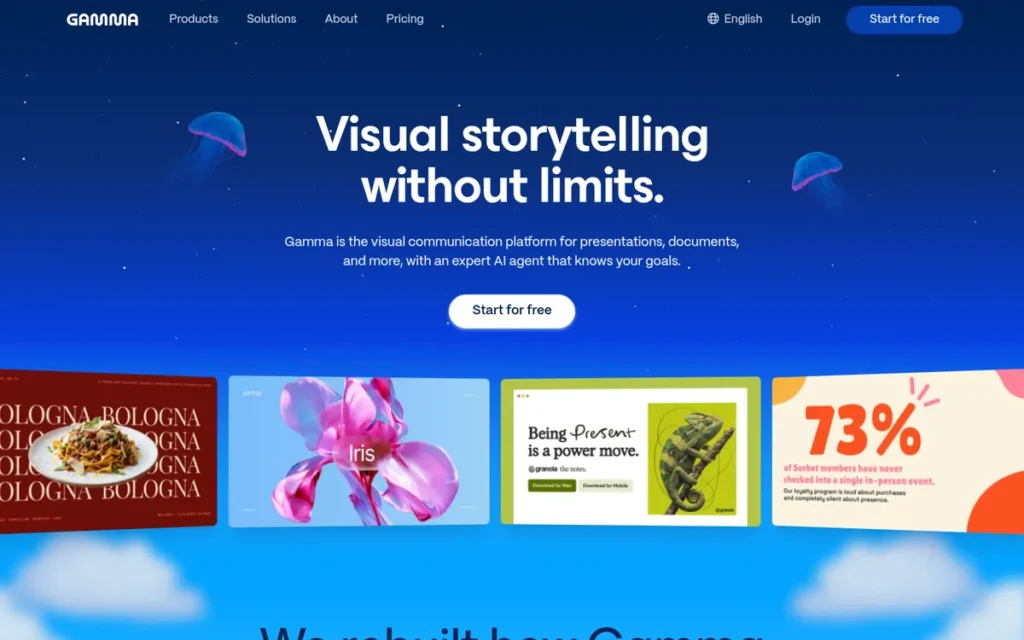
Category: AI Presentation Builder, generates adaptive card-based presentations, documents, and webpages from natural language prompts with interactive embed support and web-native publishing, designed to replace traditional slide software for digital-first professional workflows.
At a Glance
| Field | Detail |
|---|---|
| Category | AI Presentation Builder |
| Best For | Business professionals, executives, and marketing teams who create high volumes of presentations and prioritize speed-to-shareable-draft over design-professional visual polish |
| Price Range | Free (basic AI generation, limited slides) | Pro at $18/month (unlimited AI generation, up to 50 pages/presentation, custom domain, premium image models); verify at gamma.app/pricing (April 2026) |
| Primary Strength | Gamma’s outline-first generation workflow and card-based adaptive format enable web-native presentation publishing with interactive embeds (Figma, Airtable, Loom, Google Forms); a categorically different product from fixed-dimension slide formats that enables live data and multimedia within a single shareable URL |
| Biggest Limitation | Gamma’s AI image generation has documented hallucination issues acknowledged publicly by the Gamma team as of April 2026, and Gamma carries divergent review scores (Trustpilot 2.0/5; Capterra ratings reported in the 3.7–4.3/5 range across aggregation sources; per Plus.ai, 2026; not independently verified) reflecting customer service strain and inconsistent quality for design-conscious professionals |
| One-Line Summary | Gamma is an AI presentation builder with approximately 50 million claimed users (community-reported estimate, not officially confirmed by Gamma as of April 2026); generating adaptive card-based presentations from natural language at $18/month Pro; that excels at rapid business drafting for content-first professionals but produces output that design-literate audiences consistently describe as requiring significant human refinement before client-facing use |
| Last Verified | April 2026 |
Overview
Gamma is an AI-powered content creation platform that generates presentations, documents, and responsive webpages from natural language prompts, pasted text, uploaded files, or imported URLs.
Gamma uses a card-based layout system that replaces fixed-size PowerPoint slides with adaptive, content-responsive pages that scale to fit generated content and publish directly as live web URLs.
Gamma’s AI generation follows a two-step outline-first workflow: the AI creates a reviewable narrative structure before generating the full visual deck, allowing users to approve or modify the presentation framework before committing to a full render, a design insight that reduces wasted generation on structurally wrong drafts.
Gamma claims approximately 50 million users (community discussion, not officially confirmed by Gamma as of April 2026) and offers an $18/month Pro plan, the most affordable unlimited AI presentation generation price point in the evaluated category.
Key Features
- Gamma’s outline-first generation workflow creates a reviewable narrative structure before rendering the full presentation, enabling users to validate and modify the content framework in approximately 30 seconds, preventing the frustration of receiving a fully rendered deck with the wrong narrative structure (Plus.ai comparison blog).
- Gamma uses a card-based layout system where each card scales adaptively to fit its content rather than constraining content to fixed slide dimensions, enabling web-native presentations that publish as live shareable URLs accessible on any device without software installation.
- Gamma supports interactive embeds from Figma, Airtable, Google Forms, Loom, TikTok, and other platforms, transforming presentations from static files into interactive web experiences with live data connections, embedded demos, and in-presentation call-to-action forms (Saudi AT blog).
- Gamma provides presentation analytics, shareable link tracking, and custom domain publishing on Pro plans, enabling sales and marketing teams to measure audience engagement on distributed presentations rather than treating deck sharing as a black box.
- Gamma’s Pro plan ($18/month, April 2026) includes access to premium image generation models including Nano Banana Pro, ChatGPT image generation, and Flux, providing higher-quality visual generation within the unlimited plan tier (Reddit community confirmation, r/ThinkingDeeplyAI).
Best For
Gamma is best for business professionals, executives, sales teams, and marketers who generate high volumes of internal presentations, client updates, investor updates, or proposals and prioritize speed-to-shareable-draft, where content clarity and delivery speed matter more than design-professional visual polish.
Pricing
Gamma offers a free plan covering basic AI generation and limited slides.
The Pro plan is confirmed at $18/month by multiple independent community sources and review blogs (April 2026), covering unlimited AI generation, up to 50 pages per presentation, custom domain publishing, and premium image model access.
Verify current pricing at gamma.app/pricing.
Strengths
- A viral r/ThinkingDeeplyAI thread (February 2026, 29 comments) captured Gamma’s core user value: a 25-year marketing executive stated “An AI tool called Gamma gave me thousands of hours of my life back. I don’t miss PowerPoint at all”, reflecting genuine, compounding time savings for high-frequency presentation creators who previously spent significant hours on manual slide formatting.
- Gamma claims approximately 50 million users (community discussion, r/ThinkingDeeplyAI, April 2026, community-reported estimate not officially confirmed by Gamma), if accurate, representing extraordinary viral traction for an AI creative tool and confirming strong product-market fit among business professionals who prioritize presentation speed over maximum design control.
- Gamma’s outline-review-before-generation workflow differentiates Gamma from single-step AI presentation generators by allowing users to validate narrative structure in approximately 30 seconds before committing a full generation cycle, a UX insight that meaningfully reduces wasted iterations compared to tools that render complete decks before users can evaluate structure.
- Gamma’s card-based format and interactive embed support create a product categorically different from traditional slide software, enabling a single shareable Gamma URL to contain live Airtable data, embedded product demo videos, and a Google Form for next-step sign-up, in a format that PowerPoint and Google Slides cannot replicate.
Limitations
- Unresolved AI Image Hallucination: Gamma’s most consequential limitation is documented output quality inconsistency (a Gamma team member publicly acknowledged on Reddit (April 2026) that “the hallucination issue is real and honestly something we’re still working hard to improve) the tech just isn’t quite there yet for reliable academic or educational imagery,” and admitted customer service has been overwhelmed by growth (u/grantatgamma, r/ProductivityApps). This self-disclosure reveals that AI image hallucination in generated presentations is an unresolved problem as of April 2026.
- Divergent Review Scores Reflecting Operational Strain: Gamma’s ratings diverge significantly across platforms, Trustpilot 2.0/5, Microsoft Store 4.3/5 (per Plus.ai rating aggregation, 2026; not independently verified in this research cycle), with Capterra ratings reported in the 3.7–4.3/5 range across different aggregation sources (verify current score at capterra.com/p/10015023/Gamma/). The lower Trustpilot score is driven disproportionately by billing and customer service complaints, signaling subscription management and support as documented operational weak points.
- Output Quality Polarizes Professional Users: In the same Reddit thread where a marketing executive called Gamma life-changing, a design professional stated “I find it hard to believe serious professionals are using this tool, I would be embarrassed to present that” (u/TPRT, r/ThinkingDeeplyAI, March 2026). A third user described a new organizational pattern where managers create AI-generated 50+ page decks requiring significant professional refinement before use, shifting presentation labor from creation to QA, not eliminating it (u/ItzSchwifty, r/ThinkingDeeplyAI, February 2026).
“25 years in PowerPoint hell as a marketing executive. An AI tool called Gamma gave me thousands of hours of my life back. I don’t miss PowerPoint at all.” (u/Beginning-Willow-801, r/ThinkingDeeplyAI, February 2026)
Takeaway: Gamma’s strongest user advocates are high-frequency presentation creators who measure value in hours saved from manual formatting, not design professionals evaluating output against client-facing visual standards. Verify whether your primary use case is internal drafting (where Gamma excels) or design-critical client-facing work (where significant human refinement is consistently required per community evidence).
Verdict
Gamma is the most accessible AI presentation builder in 2026, with an $18/month Pro plan for unlimited generation, a claimed 50 million users (community-reported estimate, not officially confirmed), and a web-native card-based format that enables interactive embeds unavailable in traditional slide software.
Gamma scores 23 on the weighted matrix (the lowest of the seven evaluated tools) driven primarily by a Production Readiness score of 2 reflecting the acknowledged hallucination issues, divergent review scores, and customer service strain documented in April 2026 research.
Gamma is a strong tool for rapid internal drafting, async stakeholder updates, and investor pitch outlines where content speed matters more than visual polish, but buyers should verify whether the hallucination and customer service issues noted in this April 2026 research have improved before adopting Gamma for client-facing or design-critical work.
What Red Flags Should I Watch For When Evaluating Emerging AI Software?
The most critical red flags when evaluating emerging AI software are pricing opacity, constrained free tiers designed as funnels, missing enterprise security certifications, unsafe agent architectures, unacknowledged AI output failures, and context degradation under professional use. Each of the seven tools evaluated here surfaces at least one of these patterns.
Red Flag #1: Pricing Without Published Tiers
If a tool requires a sales call to get basic pricing information, treat this as a signal of pricing complexity that will affect budget predictability. Synthesia does not publicly list exact tier prices, and OpenAI Codex offers no standalone pricing, both create procurement friction for teams who need to forecast AI tool budgets before initiating vendor conversations.
Red Flag #2: Free Tiers Constrained Below Useful Function
A free tier that demonstrates capability without enabling genuine workflow evaluation is a deliberate acquisition funnel strategy, not a commitment to accessibility. This pattern repeats across Cursor (limited agent mode and codebase indexing), ElevenLabs (limited character count), Lovable (limited credits), and Gamma (limited slide count).
A reliable test: can you complete a representative workflow task (not the demo task the company showcases) on the free tier? If the answer is no, the free tier is a conversion funnel. Google NotebookLM’s free tier (50 sources, 50 daily chats) passes this test; Cursor’s free tier does not pass it for codebase indexing and agent-mode evaluation.
Red Flag #3: No Enterprise Security Certifications for Regulated Industry Buyers
For organizations in finance, healthcare, or legal, the absence of an audited security certification is a procurement disqualifier, not a negotiable preference. Of the seven tools evaluated here, only Synthesia confirmed SOC 2 Type II certification during this April 2026 research cycle.
Before purchasing any AI tool for enterprise deployment, request the specific certificate, the audit date, and the scope, and verify with your compliance team. Other tools may hold equivalent certifications not surfaced in this research; enterprise buyers should directly request current security documentation from any tool before procurement.
Red Flag #4: Agents That Write Directly to Production Repositories Without Undo
Any autonomous coding agent that makes real changes to a codebase without a change-preview or undo workflow creates genuine safety risk. OpenAI Community forum users documented this absence in early Codex releases (community.openai.com, 2025), the tool would write to repositories with no way to preview or roll back changes.
Evaluate autonomous agent safety controls and rollback procedures before deploying any coding agent in production contexts.
Red Flag #5: AI Output Failures Not Acknowledged in Marketing
Gamma’s team member publicly acknowledged AI image hallucination issues in Reddit discussions that do not appear in Gamma’s marketing materials. When evaluating AI creative tools, search for community discussions and review threads, what the company acknowledges in forums but not in marketing represents the realistic production experience, not the demo experience.
Red Flag #6: Context Degradation Under Extended Professional Use
Tools that degrade in quality after 30–60 minutes of continuous professional use represent a fundamental workflow reliability gap. Cursor’s documented Claude context degradation during extended coding sessions is a real constraint for developers whose workflow depends on multi-hour uninterrupted sessions, test the specific workflow pattern you’ll rely on most before committing to any AI development tool.
What Questions Should I Ask Before Choosing an Emerging AI Tool?
Before choosing an emerging AI tool, ask six core questions that distinguish tools worth deploying professionally from those that remain experimental. Questions #1–3 address operational viability; Questions #4–6 address workflow integration and exit risk.
Question #1: What is the production failure mode, what breaks when this tool reaches its limit under real professional conditions?
Every AI tool has a ceiling. Cursor’s Claude context degrades after 60 minutes. Lovable’s architecture cannot support custom backend requirements. Google NotebookLM cannot search the internet. OpenAI Codex generates non-compiling code during early release. Knowing the failure mode in advance prevents deploying a tool into a workflow it cannot sustain.
Question #2: Is the free tier genuinely useful, or is it a constrained demonstration designed to force paid upgrades?
Test the free tier for your actual use case, not the demo use case the company showcases. Google NotebookLM’s free tier (50 sources, 50 daily chats) is genuinely useful for individual researchers. Cursor’s free tier is intentionally restrictive for codebase indexing and agent mode. ElevenLabs’ character limits exhaust quickly at professional content volumes. The answer determines your actual trial-to-decision timeline.
Question #3: What enterprise security certifications does the tool hold, and are they audited or self-reported?
SOC 2 Type II is audited by an independent third party, self-reported security claims are not equivalent. Of the seven tools evaluated here, only Synthesia confirmed SOC 2 Type II certification as of April 2026. For regulated industry use cases, this question alone may determine whether a tool is eligible for consideration.
Question #4: How does this tool integrate with my current workflow, and what does the handoff look like when AI output meets human quality standards?
AI-generated output requires human refinement at different rates for different tools. Gamma’s presentations require significant design polish before client-facing use. Lovable’s MVPs require security hardening before production deployment. OpenAI Codex-generated PRs require human code review even at a 79.9% acceptance rate. Evaluate the full cycle time including the human polish step, not just generation speed.
Question #5: What independent benchmark evidence exists for this tool’s performance, beyond vendor-reported statistics?
For coding tools, the AIDev benchmark (arXiv:2602.08915, 2026) provides PR acceptance rates from real repositories. For voice tools, blind listening tests with named listeners provide quality evidence. For video platforms, G2 verified scores provide user-reported quality signals. Vendor-stated performance claims without independent corroboration should be treated as directional, not confirmatory.
Question #6: What are the cancellation terms, and how easy is it to export your work if you stop using the tool?
Gamma presentations export to PPT, PDF, and Google Slides. Lovable code exports to GitHub and VS Code. Google NotebookLM sources remain yours throughout. Understand the exit ramp before committing to any platform, vendor lock-in risk is highest for tools that store your data, workflows, or generated assets in proprietary formats without clean export paths.
How Did We Rank These Emerging AI Software Tools?
These seven emerging AI software tools were ranked on a five-criterion weighted scoring matrix, Verified Performance Evidence, Innovation and Technical Differentiation, and Production Readiness (each weighted 2x), plus Community and Review Sentiment and Pricing Access and Free Tier Value (each weighted 1x), with ties broken by performance on primary criteria. All five criteria, the full scoring matrix, and source verification standards are documented below.
Evaluation Process
The research process followed four phases:
Phase 1: Product Discovery: Identified seven leading emerging AI software tools across five functional categories:
- AI Coding IDE: Cursor
- Autonomous Coding Agent: OpenAI Codex
- Audio AI Platform: ElevenLabs
- Enterprise AI Video: Synthesia
- AI Research Assistant: Google NotebookLM
- AI App Builder: Lovable
- AI Presentation Builder: Gamma
Phase 2: Performance Evidence Gathering: Queried the following source types:
- Independent benchmarks: arXiv preprints (2602.08915), G2, Capterra, Trustpilot
- Analyst reports: McKinsey State of AI, Stanford HAI 2025 AI Index, ABI Research
- Independent comparative reviews: Builder.io, WaveSpeed, Tom’s Guide, Pragmatic Engineer, DataCamp, Genesys Growth
Phase 3: Community Sentiment Analysis: Analyzed Reddit communities (r/instructionaldesign, r/ThinkingDeeplyAI, r/ElevenLabs, r/NoteTaking, r/webdev), Hacker News threads (id:43959710 and id:44188839), and OpenAI Community forums for documented failure cases and power-user critiques.
Phase 4: Vendor Claim Verification: All vendor-reported statistics were cross-referenced against at least one independent source before citation. Self-reported claims without corroboration are labeled as such and discounted in scoring.
Ranking Criteria
C1, Verified Performance Evidence (Primary, 2x weight)
This criterion evaluates the presence and quality of independently published benchmark data, named adoption statistics, and documented comparative performance versus named competitors. The target audience distrusts vendor marketing and actively seeks peer-validated, quantitative evidence to distinguish genuinely differentiated tools from repackaged ChatGPT wrappers.
C2, Innovation and Technical Differentiation (Primary, 2x weight)
This criterion assesses whether the tool’s core architecture represents a genuinely new capability or paradigm, not an incremental improvement on ChatGPT. The audience has already adopted mainstream AI tools and is evaluating whether emerging platforms offer architecturally novel capabilities that create competitive advantage before mainstream adoption.
C3, Production Readiness and Enterprise Viability (Primary, 2x weight)
This criterion examines documented enterprise security certifications, verified enterprise customer adoption, community-reported reliability issues, documented failure modes under production conditions, and organizational backing signaling product longevity. Early adopters who deploy unprepared tools into professional workflows face reliability failures, compliance gaps, and reputational risk.
C4, Community and Review Platform Sentiment (Secondary, 1x weight)
This criterion analyzes verified review platform scores (G2, Capterra, Trustpilot) with context, named community discussions from Reddit and Hacker News, and practitioner testimonials from users with documented product experience. Tech-forward professionals trust peer validation from practitioner communities over editorial rankings.
C5, Pricing Access and Free Tier Value (Secondary, 1x weight)
This criterion verifies free tier functional depth, the presence of publicly published pricing without requiring sales contact, and credit or access model friction documented in community feedback. Pricing transparency signals organizational trust and reduces procurement friction for individual buyers and small teams.
Scoring Matrix
| Tool | C1 Perf. Evidence (2x) | C2 Innovation (2x) | C3 Production Readiness (2x) | C4 Community Sentiment (1x) | C5 Pricing Access (1x) | Weighted Total |
|---|---|---|---|---|---|---|
| ElevenLabs | 5 → 10 | 4 → 8 | 4 → 8 | 4 → 4 | 3 → 3 | 33 |
| Cursor | 4 → 8 | 5 → 10 | 4 → 8 | 4 → 4 | 3 → 3 | 33 |
| Google NotebookLM | 3 → 6 | 4 → 8 | 4 → 8 | 4 → 4 | 5 → 5 | 31 |
| OpenAI Codex | 5 → 10 | 5 → 10 | 3 → 6 | 3 → 3 | 2 → 2 | 31 |
| Synthesia | 4 → 8 | 3 → 6 | 5 → 10 | 3 → 3 | 2 → 2 | 29 |
| Lovable | 3 → 6 | 4 → 8 | 3 → 6 | 4 → 4 | 4 → 4 | 28 |
| Gamma | 3 → 6 | 3 → 6 | 2 → 4 | 3 → 3 | 4 → 4 | 23 |
Arrow format: raw score → weighted score. Primary criteria (C1, C2, C3) weighted 2x; secondary criteria (C4, C5) weighted 1x. Ties (ElevenLabs/Cursor at 33; NotebookLM/Codex at 31) broken by C1 (Verified Performance Evidence) performance.
Evidence Weighting
When review platform ratings conflict with Reddit sentiment, this review weights specificity and recency. A detailed 2025–2026 Reddit post documenting a specific failure mode with 50+ upvotes outweighs a generic 2023 G2 review. Divergent ratings across platforms, Gamma’s Trustpilot 2.0/5 vs. Microsoft Store 4.3/5 per Plus.ai aggregation, are analyzed for root causes rather than averaged.
Data Validation
Vendor-reported statistics are labeled as vendor-reported. Only claims corroborated by at least one independent source are stated as fact. Academic benchmarks (arXiv preprints) are cited with full attribution and version numbers. Community quotations are attributed to named users and subreddits where available. Pricing figures that could not be confirmed from official pricing pages are labeled as estimates with instructions to verify. This evaluation weights this standard consistently: a single independent confirmation is required before any claim is stated as fact.
Update Cadence
This article was last updated in April 2026. PlugRoute refreshes this review when major product updates, pricing changes, new benchmark data, or significant community sentiment shifts alter the ranking order.
Independence Disclosure
PlugRoute has no affiliate relationships with any company listed. Rankings are determined entirely by research data and objective evaluation criteria.
Frequently Asked Questions About Emerging AI Software in 2026
What is the best emerging AI software tool in 2026?
ElevenLabs is the best overall emerging AI software tool in 2026, ranking first on the PlugRoute weighted scoring matrix with the strongest independently verified performance evidence: a 4.7/5 blind listening test score and $500 million in February 2026 funding at an $11 billion valuation. For role-specific recommendations: Cursor leads for developers, Google NotebookLM for researchers, Synthesia for enterprise video in regulated industries, and Lovable for non-technical app builders.
Which emerging AI tools are free to try without a credit card?
Google NotebookLM is the only tool in this evaluation with a genuinely useful free tier requiring no credit card, 50 sources per notebook and 50 daily AI queries. ElevenLabs, Gamma, and Lovable offer free access with capability demonstrations that require upgrades for professional volumes. OpenAI Codex requires a paid ChatGPT Pro subscription with no free standalone tier as of April 2026.
How does PlugRoute determine its AI tool rankings?
PlugRoute ranks AI tools using a five-criterion weighted scoring matrix, Verified Performance Evidence (2x), Innovation and Technical Differentiation (2x), Production Readiness and Enterprise Viability (2x), Community and Review Platform Sentiment (1x), and Pricing Access and Free Tier Value (1x). Every cited statistic requires a year and a named independent source. Vendor-reported statistics without corroboration are labeled as such and discounted in scoring. PlugRoute has no affiliate relationships with any company reviewed.
What Do These AI Terms Mean? (RAG, PR Acceptance Rate, SOC 2 Type II, and More)
Retrieval-Augmented Generation (RAG): A technical architecture in which an AI model generates responses by retrieving and citing specific passages from a pre-defined document set, rather than drawing on general training knowledge. Google NotebookLM uses RAG to ensure every answer is sourced exclusively from user-uploaded materials, virtually eliminating hallucination from external AI knowledge contamination, the defining feature for source-attribution-critical research workflows.
PR Acceptance Rate: A software engineering benchmark measuring the percentage of AI-generated pull requests accepted by human engineers into a real codebase. Sourced from the AIDev dataset (arXiv:2602.08915, 2026), which evaluated 7,156 real-world GitHub pull requests: OpenAI Codex 79.9%, Cursor 74.4%, Claude Code 72.6%, Devin 68.0%. A higher rate means AI-generated code meets human engineering review standards more often.
Autonomous Coding Agent: An AI system that accepts natural language task descriptions and executes software development work independently in isolated environments, as distinct from in-IDE coding assistants like Cursor that augment a developer’s active coding session in real time. OpenAI Codex is an autonomous coding agent; Cursor is an AI Coding IDE. The paradigm difference determines which professional workflow each tool is architecturally suited for.
SOC 2 Type II: An independently audited security certification (conducted by a third-party assessor, not self-reported) that verifies an organization’s data security controls over an extended monitoring period. SOC 2 Type II is a procurement prerequisite for many regulated enterprise buyers in finance, healthcare, and legal. Synthesia is the only tool in this evaluation for which SOC 2 Type II certification was independently confirmed during this April 2026 research cycle.
Codebase Indexing: A feature of AI coding tools that enables the AI to reference an entire software repository contextually (understanding the location and relationships of every function, class, API client, and configuration file across multiple files) rather than assisting only with the single file currently open in the editor. Cursor’s codebase indexing is cited as its primary architectural advantage over plugin-based tools like GitHub Copilot for complex, multi-file codebases.
Glossary: Key Terms Used in This Comparison
Retrieval-Augmented Generation (RAG): An AI architecture in which a model generates responses by retrieving and citing passages exclusively from a pre-defined document set, rather than drawing on general training knowledge. Google NotebookLM uses RAG to ensure every answer is grounded in user-uploaded sources, virtually eliminating hallucination from external knowledge contamination.
PR Acceptance Rate: A software engineering benchmark measuring the percentage of AI-generated pull requests accepted by human engineers into a real codebase. In this comparison, PR acceptance rates are sourced from the AIDev dataset (arXiv:2602.08915, 2026), which evaluated 7,156 real-world GitHub pull requests across multiple AI coding agents.
Autonomous Coding Agent: An AI system that accepts natural language task descriptions and executes software development work independently in isolated cloud environments, returning completed pull requests without requiring a developer’s active involvement during execution. This paradigm is distinct from in-IDE coding assistants, which augment a developer’s real-time coding session.
SOC 2 Type II: An independently audited security certification (conducted by a third-party assessor, not self-reported) that verifies an organization’s data security controls over an extended monitoring period. SOC 2 Type II is a procurement prerequisite for many regulated enterprise buyers in finance, healthcare, and legal industries.
Codebase Indexing: A feature of AI coding tools that enables the AI to reference an entire software repository contextually, understanding the location and relationships of every function, class, and API client across multiple files simultaneously. This capability distinguishes AI-native editors like Cursor from plugin-based tools that assist only with the single file currently open in the editor.
Which Emerging AI Tool Is Right for You?
For developers on complex codebases, start with Cursor. For non-technical founders building MVPs, start with Lovable. For researchers with pre-identified documents, start with Google NotebookLM, genuinely free. For enterprise L&D in regulated industries, start with Synthesia. For voice content at scale, start with ElevenLabs. For rapid presentations, start with Gamma. For autonomous coding task delegation, start with OpenAI Codex.
Key Insights
- ElevenLabs is the highest independently benchmarked AI audio platform in 2026, leading the category for asynchronous content creation, but teams evaluating ElevenLabs for real-time voice bots must explicitly benchmark its ~420ms latency against their response-time requirements before production deployment.
- Cursor is the strongest AI-native code editor for professional developers working on complex, multi-file codebases, with a 74.4% real-world PR acceptance rate and VS Code compatibility that eliminates migration friction, but extended-session Claude context degradation is a documented trade-off for multi-hour coding workflows.
- Google NotebookLM is the most accessible free AI research tool among the seven evaluated platforms (no credit card required, genuinely useful at the free tier) and is the right choice for researchers, students, and analysts who need source-cited synthesis of pre-identified document sets, not open-ended internet search.
- OpenAI Codex holds the highest autonomous coding agent PR acceptance rate (79.9% on the AIDev benchmark) and has reached 1.6 million weekly users as of February 2026, but the ChatGPT Pro subscription requirement and early-release reliability issues require additional human oversight as of April 2026.
- Synthesia is the defensible enterprise AI video choice for regulated industries, with SOC 2 Type II certification and claimed Fortune 100 adoption as of late 2025, but L&D buyers should independently evaluate whether avatar-format training video produces their required learning outcomes before committing at enterprise pricing.
- Lovable delivers the fastest full-stack MVP for non-technical founders ($25/month Pro, approximately 12-minute build time, transparent pricing), with the important caveat that the 12-minute MVP is a functional prototype requiring 2–4 weeks of additional iteration before production deployment.
- Gamma is the most affordable AI presentation builder for content-first business professionals ($18/month Pro, unlimited generation), but design-conscious buyers should verify whether the documented hallucination and customer service issues noted in this April 2026 research have improved before using Gamma for client-facing work.
- The defining pattern across all seven tools is the specialization premium: each emerging platform outperforms general-purpose AI within its defined domain while carrying a harder architecture ceiling than ChatGPT, the trade-off that will determine which tools survive mainstream adoption.
Multi-tool workflow stacks produce the strongest outcomes for power users who have moved beyond single-tool AI adoption. A documented high-value combination: Google NotebookLM for deep synthesis of collected research documents → Gamma for converting that synthesis into a shareable presentation draft → ElevenLabs for recording a professional audio narration of the final content. Three specialized tools that each outperform general-purpose AI within their domain, integrated into a coherent content pipeline.
Not all seven tools are equally ready for immediate professional deployment. ElevenLabs and Synthesia are production-ready for their stated enterprise use cases. Cursor is production-ready for professional developers willing to manage the extended-session limitation. Google NotebookLM is production-ready for individual and team research workflows. Lovable and OpenAI Codex require greater iteration tolerance, genuine innovations that demand more human oversight than their marketing may suggest. Gamma is production-ready for internal and async use cases, and experimental for design-critical client-facing applications.
For more independent AI tool comparisons and our full evaluation methodology, visit PlugRoute. We update this guide quarterly. Last updated: April 2026.