EAB Navigate360 is the best overall academic advising software for campus-wide coordinated care in 2026. Civitas Learning is best for measuring intervention impact, and Stellic, which ranks seventh on evidence, leads dedicated student-facing degree planning. These platforms solve different advising problems, and nearly every outcome claim comes from the vendors themselves.
Choosing is hard because vendors overlap across degree planning, case management, early alerts and registration. Most prices are hidden, and vendors rarely document how they integrate with Ellucian, Workday or Jenzabar systems. This guide sorts seven platforms by the main problem each one solves.
PlugRoute has no affiliate relationships with any company listed. Rankings are determined entirely by research data and objective evaluation criteria.
Every entry below uses the same structure, and every figure carries a year and an evidence label. The full 45-point score table appears in the methodology section, so you can re-weight the criteria for your own priorities.
What Are the 6 Categories of Academic Advising Software?
Academic advising software falls into six categories, and each one is built around a different main advising problem. Buyers should name their institution’s main advising problem first and then shortlist vendors inside the matching category, rather than comparing every platform against every other.
As one staff member on r/studentaffairs described:
“I’ve often found that students are confused about what an academic advisor actually does. Some think that academic advisors also are experts in financial aid, campus dining, orientation, campus technology, study abroad, mental health services, campus organizations, research, etc..
I think there needs to be better messaging regarding different offices on campus and what each office actually can and can’t handle.” Posted by u/davidg910
Takeaway: Coordinated-care and referral tools in academic advising software are built to fix one problem: students don’t know which campus office handles what.
The seven ranked platforms fit the six categories as follows:
- Coordinated-Care Platform: EAB Navigate360 runs advising, outreach, referrals and case management for every support office in one shared system.
- Early-Alert & Intervention System: EAB Starfish and Watermark Student Success & Engagement let faculty and staff flag struggling students and route each flag to a tracked follow-up.
- Degree Audit & Planner: Stellic checks student progress against program requirements and maps a path to graduation across several terms.
- Analytics & Impact Platform: Civitas Learning predicts student risk from institutional data and measures whether interventions change outcomes.
- SIS-Native Suite: Ellucian Degree Works and Ellucian CRM Advise are degree audit and advising tools sold by the student information system (SIS) vendor itself.
- Lifecycle CRM: Salesforce Education Cloud manages students from recruitment through advising to alumni.
Many institutions run tools from two categories, such as a degree audit of record plus a coordinated-care platform. Running both without a plan risks duplicate advising records, so decide early which system holds each record.
How Do the Top Academic Advising Platforms Compare at a Glance?
The seven platforms differ most in workflow breadth, degree-audit capability and how much evidence they document. EAB Navigate360 leads on coordinated care, Civitas Learning on impact measurement and named SIS coverage, and Stellic on dedicated degree planning. Ellucian Degree Works leads on audits for Ellucian campuses.
| Rank | Company | Category | Best For | One-Line Summary | Key Capabilities | Primary Strength | Key Limitation |
|---|---|---|---|---|---|---|---|
| 1 | EAB Navigate360 | Coordinated-Care Platform | Large universities coordinating many support offices | EAB Navigate360 is the highest-scoring platform in PlugRoute’s 2026 evaluation and has the broadest documented coordinated-care workflow. | Appointments, notes, cases, referrals, alerts, two-way SMS, student app, AI campaigns | Broadest documented workflow; five institution-named quantified results (vendor-reported) | Names no specific SIS connectors; pricing by quote only |
| 2 | Civitas Learning | Analytics & Impact Platform | Institutions with institutional research (IR) staff who need to prove what works | Civitas Learning is the highest-scoring analytics-first student-success platform in PlugRoute’s 2026 evaluation. | Institution-specific predictive models, Impact analysis, advising and outreach, College Scheduler | Broadest named SIS coverage; public contract prices | Weaker daily advising workflow; almost no independent reviews |
| 3 | EAB Starfish | Early-Alert & Intervention System | Campuses with strong faculty participation | EAB Starfish is the best-documented faculty-driven early-alert platform in PlugRoute’s 2026 evaluation. | Flags, kudos, progress surveys, referrals, success plans, Degree Planner | Largest G2 sample among purpose-built tools (28 reviews) | Depends on faculty use; overlaps with Navigate360 on EAB’s roadmap |
| 4 | Ellucian Degree Works + CRM Advise | SIS-Native Suite | Banner and Colleague campuses needing a degree audit of record | Ellucian Degree Works with CRM Advise is the lowest-integration-risk advising stack for Banner and Colleague campuses in PlugRoute’s 2026 evaluation. | Degree audit, What-If, Transfer Equivalency, Plans, alerts, risk scoring, cases | Lowest integration risk on Ellucian SIS | Lowest G2 rating among rated products; outcome claims name no institution |
| 5 | Watermark Student Success & Engagement | Early-Alert & Intervention System | Community colleges linking retention with accreditation | Watermark Student Success & Engagement is the best fit in PlugRoute’s 2026 evaluation for community colleges connecting early alerts to accreditation data. | Alerts, intervention tracking, notes, appointments, caseloads, Predict risk scoring | Only named Jenzabar integration among the seven; links to assessment data | Thin outcome evidence; key features sold as add-ons |
| 6 | Salesforce Education Cloud | Lifecycle CRM | Institutions already standardized on Salesforce | Salesforce Education Cloud is the only lifecycle CRM in PlugRoute’s 2026 evaluation. | Appointments, care plans, cases, Agentforce AI agents, student portals | Largest G2 sample (42); only published list prices among the seven | No native degree audit; needs heavy admin work |
| 7 | Stellic | Degree Audit & Planner | Institutions helping students see a path to graduation | Stellic is the student-facing degree audit and planner that a 2026 third-party comparison rated more modern than Ellucian Degree Works. | Degree audit, planner across terms, off-track monitoring, transfer evaluation, course-demand analytics | Strongest institution-named registrar-workload results | No verified review-platform presence; smallest vendor |
Which Academic Advising Software Should I Choose for My Top Priority?
The right platform depends on your main advising problem and your current systems. EAB Navigate360 fits campus-wide coordinated care, Civitas Learning fits proving impact and EAB Starfish fits faculty-driven alerts. Ellucian Degree Works fits audits on Banner or Colleague, and Stellic fits student degree planning.
| Your #1 Priority | Recommended Tool | Why | Acceptable Alternative |
|---|---|---|---|
| Coordinating outreach across many campus offices | EAB Navigate360 | Broadest documented coordinated-care workflow | EAB Starfish |
| Proving which interventions improve persistence | Civitas Learning | Only published propensity score matching method among the seven | EAB Navigate360 (institution-named case studies, vendor-reported) |
| Faculty-driven early alerts | EAB Starfish | Faculty flags, kudos and scheduled progress surveys | Watermark Student Success & Engagement |
| Degree audit of record on Banner or Colleague | Ellucian Degree Works | Native degree audit for the Ellucian SIS | Stellic (confirm SIS support in writing) |
| Helping students see a workable path to graduation | Stellic | Planner that checks each plan against the audit | Ellucian Degree Works (Plans module) |
| Linking retention with assessment and accreditation | Watermark Student Success & Engagement | Part of Watermark’s Educational Impact Suite | No other ranked vendor documents this combination |
| Needing both an audit of record and coordinated care | Ellucian Degree Works or Stellic, plus EAB Navigate360 or Watermark Student Success & Engagement | Many institutions need both; designate one system for advising notes | Ellucian Degree Works + Ellucian CRM Advise (single vendor) |
| Already running Salesforce | Salesforce Education Cloud | Advising runs on the same CRM | Add Ellucian Degree Works or Stellic for degree audits |
| Jenzabar SIS environment | Watermark Student Success & Engagement | Only ranked vendor whose public documentation names Jenzabar (November 2026) | Civitas Learning (100+ integrations; confirm Jenzabar in writing) |
| Workday Student or PeopleSoft SIS | Civitas Learning | Names both SIS products in its documentation | Any vendor that provides a written proof of integration |
| Existing Starfish customer | EAB Starfish (stay if faculty use it widely) | Faculty adoption is the hardest part to rebuild | Re-evaluate the market at renewal, including EAB Navigate360 and Watermark Student Success & Engagement |
| Community college | Watermark Student Success & Engagement | Community-college testimonials and a named Jenzabar integration | EAB Navigate360 or EAB Starfish |
| Budgeting before a sales call | Salesforce Education Cloud | Only one of the seven ranked vendors with published list prices | Civitas Learning (public College Scheduler contracts) |
All G2 figures in this guide were verified in November 2026. Full criterion scores for every product appear in “How Did We Rank These Academic Advising Software Platforms?”
What Are the 7 Best Academic Advising Software Platforms in 2026?
PlugRoute’s 2026 ranking places EAB Navigate360 first at 34/45, Civitas Learning second at 31/45 and EAB Starfish third at 28/45. Ellucian Degree Works with CRM Advise, Watermark Student Success & Engagement, Salesforce Education Cloud and Stellic follow. Every entry uses the same structure, and every figure carries a year and an evidence label.
1. EAB Navigate360: Best Overall for Campus-Wide Coordinated Care
Category: Coordinated-Care Platform. Runs advising, outreach, referrals and case management for every support office in one shared system.
At a Glance
- Category: Coordinated-Care Platform
- Best For: Mid-size to large universities and multi-campus colleges that coordinate outreach across advising, tutoring, financial aid and support offices
- Price Range: Pricing on request (based on enrollment and scope of technology; no public figures as of November 2026)
- Primary Strength: EAB Navigate360 offers the broadest documented coordinated-care workflow of any platform PlugRoute evaluated.
- Biggest Limitation: EAB Navigate360 does not publicly name which SIS products its prebuilt integrations support, and one G2 reviewer reported delayed data sync.
- One-Line Summary: EAB Navigate360 is the highest-scoring advising platform in PlugRoute’s 2026 evaluation and suits institutions that need many campus offices working from one student record.
- Last Verified: November 2026
Overview
EAB Navigate360 is a student-success CRM for mid-size to large colleges and universities whose advising, tutoring, financial aid and support offices must coordinate outreach to at-risk students from one shared student record. EAB Navigate360 combines advising appointments, notes, early alerts, case management, referrals, two-way SMS campaigns and a student mobile app.
EAB positions EAB Navigate360 as a student success management system and sells it as an enterprise license priced by enrollment and scope. EAB says more than 850 institutions use EAB Navigate360 (EAB, 2026; Vendor-reported).
Key Features
- EAB Navigate360 provides a full student profile and a coordinated-care network, so advisors, tutors and support staff see the same notes, cases and referrals.
- EAB Navigate360 runs automated alerts, faculty progress reports and two-way SMS campaigns to flag and contact at-risk students.
- EAB Navigate360 includes appointment scheduling, surveys and a student mobile app for booking advising and receiving reminders.
- EAB Navigate360 offers AI features, including AI-assisted student context, recommendations, message drafting and AI Agent Campaigns.
- EAB Navigate360 connects to SIS, LMS, email, calendar and Common App systems through what EAB calls “a library of prebuilt integrations.”
Best For
EAB Navigate360 fits universities and larger community colleges whose main advising problem is coordination: many offices, inconsistent follow-up and no shared view of who needs help. EAB Navigate360 is a weaker fit for small offices that mainly need appointments and notes.
Strengths
- EAB Navigate360’s William Paterson University case study reports that students who attended advising appointments were retained at 9.8 points above the university average, and that 81% of app logins came from repeat users (EAB, 2024; Vendor-reported).
- EAB Navigate360’s Middle Tennessee State University case study reports a 1.5-point fall-to-spring persistence gain within 120 days of launch, retaining 390 more students in spring 2015 (EAB case study, 2015 data; Vendor-reported).
- EAB Navigate360’s Ball State case study reports an 11.4-point retention increase after the move to Navigate360 (EAB case study, year not stated; Vendor-reported).
- EAB Navigate360’s AI campaigns re-enrolled 76 students at the University of Vermont, an estimated $1.59M ROI, according to EAB (EAB Navigate360 AI page, accessed November 2026; Vendor-reported).
- EAB Navigate360 holds a 4.5/5 G2 rating, the highest among the five G2-rated products in this evaluation, though that rating rests on only 11 reviews (G2, November 2026; User review).
Limitations
EAB Navigate360 gives up transparency on integration, cost and the age of its evidence in exchange for workflow breadth.
- EAB Navigate360’s public materials do not name which SIS products (Banner, Colleague, Workday Student, PeopleSoft, Jenzabar) its prebuilt integrations cover (Not found, November 2026).
- EAB Navigate360 G2 reviewers describe information-heavy screens and extra clicks, and one reported that their system “did not communicate with EAB in real time” (G2, November 2026; User review).
- EAB Navigate360 is priced by quote only, and PlugRoute found no VPAT or SOC 2 report for it; its FERPA and GDPR compliance is self-stated (EAB, accessed November 2026).
- EAB Navigate360’s outcome figures are all vendor-reported, and its MTSU result dates from 2015, so the evidence is older than it first appears.
- EAB Navigate360 overlaps with EAB’s own Starfish product, so buyers should get the long-term roadmap in writing.
A graduate student on r/Baruch noted:
“Who should I contact if I can’t schedule an appointment through Navigate 360?
It seems like the college system hasn’t updated the course evaluation (prerequisite course waiver) yet. What should I do for course enrollment?” Posted by u/Object994
Takeaway: EAB Navigate360 can send students to appointment booking, but students still get stuck when advisor slots are full and SIS records lag behind.
Verdict
EAB Navigate360 is the strongest choice in 2026 for institutions whose main advising problem is coordinating outreach across many campus offices. EAB Navigate360 scored 34/45, three points ahead of Civitas Learning. It earned 5/5 on workflow coverage and outcome evidence but 3/5 on integration and 1/5 on pricing transparency.
EAB Navigate360’s outcome figures are all vendor-reported, and the MTSU result is from 2015. Buyers should require named SIS connectors, a data-refresh SLA, a current WCAG 2.1 AA VPAT and multi-year pricing with module scope before signing.
2. Civitas Learning: Best for Measuring Intervention Impact
Category: Analytics & Impact Platform. Predicts student risk from institutional data and measures whether interventions change outcomes.
At a Glance
- Category: Analytics & Impact Platform
- Best For: Institutions with institutional research (IR) staff that need to prove which student-success initiatives work
- Price Range: Annual subscription based on headcount, capabilities and integrations; public College Scheduler contracts of about $29K–$36K per year (2025–2027 records)
- Primary Strength: Civitas Learning is the only evaluated platform that publishes a propensity score matching method for measuring intervention impact.
- Biggest Limitation: Civitas Learning is stronger in analytics than in daily advising workflow and has almost no independent review evidence.
- One-Line Summary: Civitas Learning is the highest-scoring analytics-first student-success platform in PlugRoute’s 2026 evaluation and suits institutions that want to measure which advising interventions improve persistence.
- Last Verified: November 2026
Overview
Civitas Learning is an analytics-led student-success platform for colleges and universities with the institutional research capacity to act on its findings and a need to prove which retention initiatives actually work. Civitas Learning builds predictive risk models from each institution’s own data and measures intervention impact using propensity score matching.
Civitas Learning was founded in 2011 in Austin, Texas, and acquired the College Scheduler registration tool in January 2016 (GlobeNewswire, 2016; Third-party reported). Civitas Learning lists integrations with more than 100 systems (Civitas Learning, 2026; Vendor-reported).
Key Features
- Civitas Learning builds predictive risk models from each institution’s own historical student data rather than a generic national model.
- Civitas Learning runs Impact analysis using propensity score matching, which compares students who received an intervention with similar students who did not.
- Civitas Learning includes advising, case management and outreach tools for acting on risk signals.
- Civitas Learning offers College Scheduler and Schedule Planner, which help students build registration-ready schedules from their degree plans.
- Civitas Learning lists integrations including Banner, PeopleSoft, Colleague, Workday Student, Canvas, Blackboard, D2L, Moodle, Slate and Salesforce.
Best For
Civitas Learning fits institutions with IR or analytics staff that need evidence of which retention initiatives work before scaling them. Civitas Learning is a weaker fit for small advising offices that mainly need appointment, notes and case workflows.
Strengths
- Civitas Learning’s 2026 Student Impact Report says it has analyzed more than 220 student-success initiatives using propensity score matching, the only published impact-measurement method among the seven (Civitas Learning, 2026; Vendor-reported).
- Civitas Learning names more SIS integrations than any other evaluated vendor: Banner, PeopleSoft, Colleague and Workday Student (Civitas Learning, 2026; Vendor-reported).
- Civitas Learning has four public procurement and board records from 2025–2027, the most price evidence of any vendor that prices by quote (Public record, 2025–2027).
- Civitas Learning serves 40+ partner institutions and systems covering 1.45M+ students across 577 campuses, including the University of Cincinnati and Slippery Rock, according to an investor profile (EMCap, accessed November 2026; Third-party reported).
- Civitas Learning holds SOC 2 Type II, FERPA and VPAT documentation according to one third-party profile, which PlugRoute could not independently verify (Yardstick Research, accessed November 2026; Third-party reported).
Limitations
Civitas Learning gives up depth in daily workflow for depth in analytics, and its independent evidence is thin.
- Civitas Learning is “stronger in insight than workflow” according to a 2026 comparison, which says it assumes a student-success operation is already working (Rankite, 2026; Third-party reported).
- Civitas Learning has 2 Capterra reviews (score not captured) and 1 negative SourceForge review citing extra customization costs and support frustration, too few to generalize from (Capterra/SourceForge, November 2026; User review).
- Civitas Learning’s only quantified outcome, a 3.9% persistence lift, names no customer (Civitas Learning, accessed November 2026; Vendor-reported).
- Civitas Learning’s Henry Ford College record shows $112,500 in one-time custom development, more than the $67,475 in first-year recurring fees (Public record, 2025).
- Civitas Learning’s compliance score rests on a single third-party profile, so buyers should request the actual SOC 2 and VPAT documents (Not found, November 2026).
When Utah State University dropped College Scheduler, a student on r/usu passed along a secondhand explanation:
“I have a friend in IT, and they said that banner was upgrading to a new version that isn’t compatible with the current version of college scheduler, and they don’t want to pay to keep college scheduler.
I’m going to miss it :(” Posted by u/First_Bird_8217
Takeaway: Students can like Civitas Learning’s College Scheduler and still lose it when renewal cost and compatibility with a Banner upgrade count against it.
Verdict
Civitas Learning is the best choice in 2026 for institutions that need to measure whether their advising interventions improve persistence, not just track them. Civitas Learning scored 31/45 and ranks second mainly on integration (5/5) and pricing transparency (4/5). It scored 3/5 on workflow and 1/5 on independent reviews.
Civitas Learning would remain second even if its third-party-reported compliance score fell to 3 (30/45). Buyers without institutional research staff should pair Civitas Learning with a workflow-focused tool.
3. EAB Starfish: Best for Faculty-Driven Early Alerts
Category: Early-Alert & Intervention System. Lets faculty and staff flag struggling students and routes each flag to a tracked follow-up.
At a Glance
- Category: Early-Alert & Intervention System
- Best For: Colleges and universities, including community colleges, where faculty will raise flags and run progress surveys each term
- Price Range: Pricing on request (no public price or contract figure found as of November 2026)
- Primary Strength: EAB Starfish has the largest G2 review sample of any purpose-built advising tool evaluated, and its early-alert workflow starts with faculty.
- Biggest Limitation: EAB Starfish depends on faculty participation, and its future is uncertain because EAB also sells the overlapping Navigate360.
- One-Line Summary: EAB Starfish is the best-documented faculty-driven early-alert platform in PlugRoute’s 2026 evaluation and suits campuses where instructors will consistently raise flags and complete progress surveys.
- Last Verified: November 2026
Overview
EAB Starfish is an early-alert (early warning) and student-support platform for colleges and universities whose retention strategy depends on instructors spotting struggling students early in each term and routing them to the right office. Faculty use EAB Starfish to raise flags and kudos, complete scheduled progress surveys and route referrals to advisors.
EAB Starfish also includes appointments, notes, success plans and a Degree Planner. EAB has owned EAB Starfish since completing its acquisition from Hobsons on March 3, 2021 (EAB, 2021; Vendor-reported).
Key Features
- EAB Starfish lets faculty raise flags and kudos and complete scheduled progress surveys, such as Penn State’s surveys in weeks 3 and 7.
- EAB Starfish routes referrals through a configurable success network, so each flag reaches the right office and is tracked to closure.
- EAB Starfish includes appointment scheduling, advising notes and success plans for students on academic warning.
- EAB Starfish offers a Degree Planner that sends off-track notices when a student’s plan drifts from requirements.
- EAB Starfish gives access based on role and relationship, so instructors see only students in their current classes (Seattle Colleges, accessed November 2026; Third-party reported).
Best For
EAB Starfish fits institutions where faculty already take part in early alerts, and existing customers whose faculty already use it. EAB Starfish is a weaker fit for campuses that need reporting outside a central office or a degree audit of record.
Strengths
- EAB Starfish’s best-documented outcome comes from Ramapo College, where one-year transfer-student retention rose from 76% to 84% over five years and students continuing on academic warning fell 11% (EAB-hosted presentation, 2022; Vendor-reported).
- EAB Starfish holds a 4.1/5 G2 rating on 28 reviews, the largest sample for any purpose-built advising tool here, with praise for ease of use, progress tracking and scheduling (G2, November 2026; User review).
- EAB Starfish has 25 published case studies, including Penn State, NYU, Syracuse, Morgan State, Missouri and Toledo (EAB, accessed November 2026; Vendor-reported).
- EAB Starfish is the only evaluated platform with a public VPAT (version 2.4, February 2022), though it tests against WCAG 2.0 A/AA (Syracuse University, 2022; Public record).
Limitations
EAB Starfish’s strong faculty-alert model comes with dependence on faculty behavior and a changing roadmap.
- EAB Starfish only works as well as faculty participation allows, and one G2 reviewer reported just 60% faculty usage after launch (G2, November 2026; User review).
- EAB Starfish reviewers also describe a “clunky or dated” interface, slowness and a learning curve (G2, November 2026; User review).
- EAB Starfish faces roadmap risk because Penn State plans a phased move to Navigate360 beginning in the 2027–28 academic year, citing Starfish reporting that “had to be done centrally” (Penn State, 2026; Third-party reported).
- EAB Starfish’s only public VPAT tests WCAG 2.0, not WCAG 2.1 AA, and its SIS integrations were not documented in PlugRoute’s research (Not found, November 2026).
Verdict
EAB Starfish is the best-documented faculty-driven early-alert platform in 2026, but EAB Starfish pays off only on campuses where instructors reliably raise flags. EAB Starfish scored 28/45, one point ahead of Ellucian. It earned 4/5 on workflow, outcome evidence and reviews but 2/5 on integration.
The order of EAB Starfish and Ellucian flips for a reader who weights SIS integration above outcome evidence. New buyers should get a written Starfish roadmap, a WCAG 2.1 AA VPAT, Navigate360 comparison pricing and a competing quote from at least one non-EAB vendor.
4. Ellucian Degree Works + CRM Advise: Best for Banner and Colleague Degree Audits
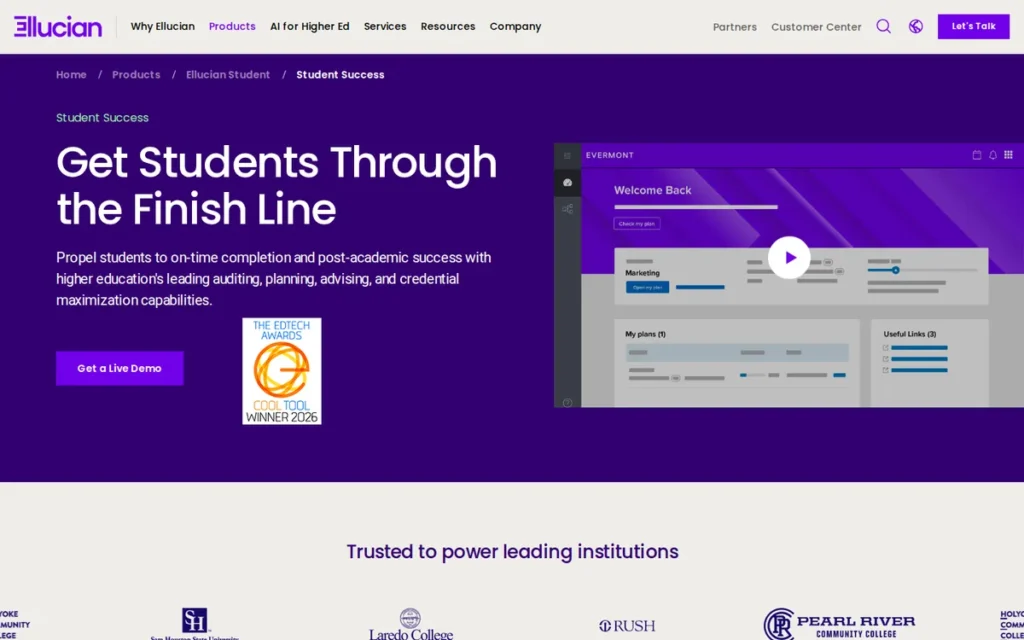
Category: SIS-Native Suite. Degree audit and advising tools sold by the student information system vendor itself.
At a Glance
- Category: SIS-Native Suite
- Best For: Banner and Colleague institutions that need an accurate degree audit of record and want early alerts from the same vendor
- Price Range: Pricing on request (Degree Works is priced by FTE; Ellucian calls its pricing method “commercially confidential”)
- Primary Strength: Ellucian Degree Works is the degree audit with the lowest integration risk for institutions already running Ellucian Banner or Colleague.
- Biggest Limitation: Ellucian CRM Advise has the lowest G2 rating among rated products in this evaluation, and its outcome claims name no institution.
- One-Line Summary: Ellucian Degree Works with CRM Advise is the lowest-integration-risk advising stack in PlugRoute’s 2026 evaluation for Banner and Colleague campuses, combining a native degree audit of record with early alerts from the SIS vendor.
- Last Verified: November 2026
Overview
Ellucian Degree Works is a degree-audit and educational-planning system for Banner and Colleague institutions that want an accurate audit of record and advising tools from the same vendor that supplies their SIS. Ellucian CRM Advise adds early alerts, risk scoring and case management on top of Ellucian Degree Works.
Ellucian Degree Works includes What-If analysis and an optional Transfer Equivalency module. Ellucian says Ellucian Degree Works integrates “with virtually any SIS” through open APIs (Ellucian, accessed November 2026; Vendor-reported).
Key Features
- Ellucian Degree Works runs degree audits against encoded program requirements, and its reporting flags students who are off-plan.
- Ellucian Degree Works includes What-If analysis, so students and advisors can test how a change of major or minor affects progress.
- Ellucian Degree Works offers an optional Transfer Equivalency module and a Plans educational planner for planning across terms.
- Ellucian CRM Advise provides early alerts, risk scoring, case management and success plans tied to SIS and degree-audit data.
- Ellucian CRM Advise runs communication plans across email, text, chat and reminder messages, with dashboards for advising leaders.
Best For
Ellucian Degree Works fits Banner and Colleague campuses whose priority is an accurate audit of record with minimal integration risk. Ellucian CRM Advise fits the same campuses if they want alerts and case management without adding a third-party vendor.
Strengths
- Ellucian Degree Works is the native audit for Banner and Colleague, and a 2026 comparison calls it the “natural option” for those institutions (Rankite, 2026; Third-party reported).
- Ellucian reports serving more than 3,000 institutions in 50 countries, the largest company-wide install base of any vendor evaluated, though the figure covers the whole company rather than Degree Works alone (Ellucian, accessed November 2026; Vendor-reported).
- Ellucian CRM Advise’s product sheet claims 35% higher persistence among proactively engaged flagged students and 260 hours saved per year on early-alert processing (Ellucian product sheet, undated, no institution named; Vendor-reported).
- Ellucian CRM Advise reviewers praise its complete view of student records and its personalized communication tools (G2, November 2026; User review, 3.9/5 on 15 reviews).
Limitations
Ellucian Degree Works and Ellucian CRM Advise give Ellucian customers low integration risk, at the cost of a dated experience and anonymous evidence.
- Ellucian Degree Works’ student interface looks dated next to Stellic’s, according to a 2026 comparison (Rankite, 2026; Third-party reported).
- Ellucian CRM Advise G2 reviewers cite complex setup and “guesswork” in finding the right module (G2, November 2026; User review).
- Ellucian CRM Advise G2 reviewers also cite limited customization, integrations that need technical expertise and slowness with large datasets (G2, November 2026; User review).
- Ellucian CRM Advise’s outcome figures are undated and name no institution, and specific Workday Student or PeopleSoft integrations were not confirmed (Not found, November 2026).
- A CUNY student reported that a Schedule Builder error retrieving the Ellucian Degree Works audit blocked registration for weeks (Reddit r/CUNY, 2024; User review).
After a Degree Works update, a student on r/gmu shared their experience:
“Not a big fan of the update. I’m a psychology major and the new update doesn’t show what classes I have completed and what classes I have left to register. The new worksheet completely wiped out my class history and it says I have 0 credits completed for my major. It really made it difficult since I was signing up for classes just now.” Posted by u/chuubuu
Takeaway: Ellucian Degree Works upgrades can garble a student’s completed-credit record right when the student needs the audit to register.
Verdict
Ellucian Degree Works is the safest degree audit of record in 2026 for Banner and Colleague institutions, but buyers should not assume Ellucian Degree Works covers every advising need. The stack scored 27/45, including 4/5 on integration, because the rubric reserves a 5 for native or named support across four or more SIS products.
Ellucian CRM Advise adds alerts and case management, but it has the weakest G2 sentiment among rated products and outcome claims that name no institution. Campuses on other SIS products should require a written proof of integration.
5. Watermark Student Success & Engagement: Best for Community College Retention and Accreditation
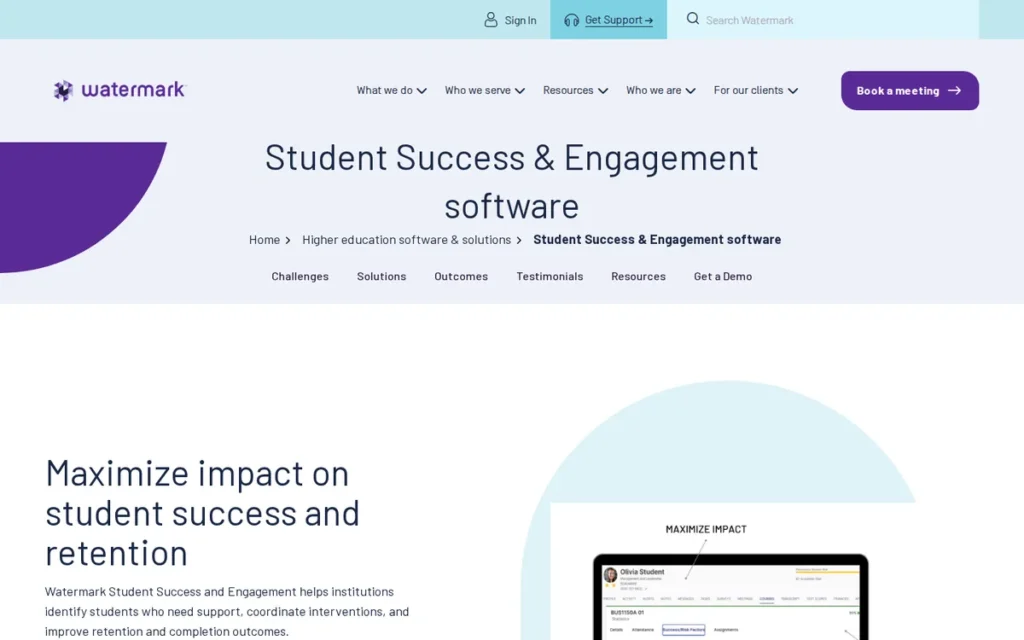
Category: Early-Alert & Intervention System. Lets faculty and staff flag struggling students and routes each flag to a tracked follow-up.
At a Glance
- Category: Early-Alert & Intervention System
- Best For: Community colleges and smaller institutions, including Jenzabar campuses, that want one vendor for retention, assessment and accreditation data
- Price Range: Pricing on request (Core subscription plus paid add-ons; SMS priced by sending staff and message volume)
- Primary Strength: Watermark Student Success & Engagement is the only evaluated platform that links advising data with assessment and accreditation in one vendor suite.
- Biggest Limitation: Watermark Student Success & Engagement has the weakest published outcome evidence among purpose-built tools and sells key features as add-ons.
- One-Line Summary: Watermark Student Success & Engagement is the best fit in PlugRoute’s 2026 evaluation for community colleges that want early alerts and caseload management connected to assessment and accreditation data from one vendor.
- Last Verified: November 2026
Overview
Watermark Student Success & Engagement is an early-alert and caseload platform, formerly Aviso Retention, for community colleges and smaller institutions that want retention data connected to assessment and accreditation in one vendor suite. Watermark Student Success & Engagement combines alerts, intervention tracking, advising notes, appointments and built-in risk prediction.
Watermark Student Success & Engagement serves as the retention software inside Watermark’s Educational Impact Suite. Aviso Retention became part of Watermark in 2021–2022 and was later renamed Watermark Student Success & Engagement (Watermark, accessed November 2026; Vendor-reported).
Key Features
- Watermark Student Success & Engagement provides early alerts, intervention tracking, advising notes, appointments and caseload management in its Core subscription.
- Watermark Student Success & Engagement includes built-in risk prediction through the Core subscription’s Predict feature.
- Watermark Student Success & Engagement sells SMS, a native student app, academic planning, a sandbox and continuing-education populations as paid add-ons.
- Watermark Student Success & Engagement connects to Watermark’s assessment, course evaluation, accreditation, curriculum and faculty-activity products through the Insights Hub.
- Watermark Student Success & Engagement names integrations with Ellucian, Jenzabar, Blackboard, Canvas, D2L, Moodle, Google Calendar and Outlook.
Best For
Watermark Student Success & Engagement fits community colleges and small institutions that already use Watermark for assessment or accreditation, and Jenzabar campuses that want a named integration. Watermark Student Success & Engagement is a weaker fit for institutions that need a degree audit or strong outcome evidence.
Strengths
- Watermark Student Success & Engagement is the only one of the seven vendors whose public documentation, as reviewed by PlugRoute in November 2026, names a Jenzabar integration (Watermark, accessed November 2026; Vendor-reported).
- Watermark Student Success & Engagement holds a 4.3/5 G2 rating on 12 reviews, with praise for ease of use, a holistic student view and better cross-campus communication (G2, November 2026; User review).
- Watermark Student Success & Engagement’s Gaston College testimonial reports that sending about 25 advisor emails went from a full day to 30–40 minutes (Watermark, accessed November 2026; Vendor-reported).
- Watermark Student Success & Engagement links advising with assessment, accreditation and course-evaluation data, a combination no other evaluated vendor documents (Watermark, accessed November 2026; Vendor-reported).
Limitations
Watermark Student Success & Engagement offers an integrated institutional-effectiveness suite, but its outcome evidence is thin and key features cost extra.
- Watermark Student Success & Engagement’s marketing promotes a “retention-rate increase within one year” but names no institution and gives no number (Watermark, accessed November 2026; Vendor-reported).
- Watermark Student Success & Engagement sells commonly needed features, including SMS, the student app and academic planning, as add-ons on top of Core (Watermark, accessed November 2026; Vendor-reported).
- Watermark Student Success & Engagement reviewers criticize confusing support documentation, and its G2 sample is only 12 reviews (G2, November 2026; User review).
- Watermark Student Success & Engagement had no native degree audit, VPAT or security certification on record, and its 2026 EdTech Breakthrough Award went to a different Watermark product (Not found, November 2026).
Verdict
Watermark Student Success & Engagement is the most logical early-alert choice in 2026 for community colleges that already rely on Watermark for assessment or accreditation. Watermark Student Success & Engagement scored 25/45. It earned 4/5 on integration, workflow and reviews but 1/5 on outcome evidence and pricing transparency.
Watermark Student Success & Engagement’s named Jenzabar and Ellucian integrations reduce fit risk, but its published outcome evidence is thin. Buyers should request itemized add-on pricing and reference institutions with retention data.
6. Salesforce Education Cloud: Best for Institutions Standardized on Salesforce
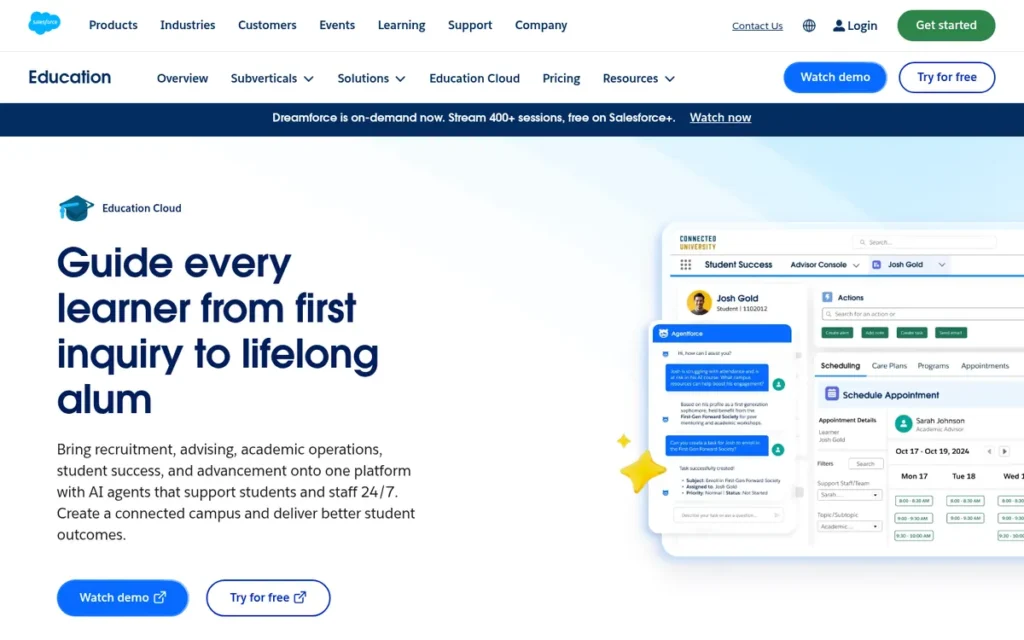
Category: Lifecycle CRM. A configurable CRM that manages students from recruitment through advising to alumni.
At a Glance
- Category: Lifecycle CRM
- Best For: Institutions already running Salesforce for admissions or advancement that have dedicated Salesforce admin staff
- Price Range: $87–$363 per user per month (education website) or $350–$725 per user per month (Commercial Pricing Guide), billed annually, plus implementation partner costs
- Primary Strength: Salesforce Education Cloud has the largest review sample and the only published list prices among the seven ranked vendors.
- Biggest Limitation: Salesforce Education Cloud has no native degree audit and needs significant admin and implementation work.
- One-Line Summary: Salesforce Education Cloud is the only lifecycle CRM in PlugRoute’s 2026 evaluation and suits institutions already standardized on Salesforce that can staff dedicated admins and pair it with a separate degree audit.
- Last Verified: November 2026
Overview
Salesforce Education Cloud is a configurable CRM spanning recruitment, admissions, advising, student success and alumni relations, built for institutions that want one CRM across the student lifecycle and have dedicated Salesforce admin staff. Salesforce Education Cloud includes appointments, care plans and case management, but it has no documented native degree audit.
Salesforce Education Cloud is now listed on G2 as Agentforce Education. Salesforce.org launched Salesforce Education Cloud in March 2018 and added Advisor Link in September 2018 (Salesforce, 2018; Vendor-reported).
Key Features
- Salesforce Education Cloud includes advising appointment scheduling, care and action plans, and case management.
- Salesforce Education Cloud offers Agentforce AI advising agents that write student summaries, look up policies and suggest next steps once Data Cloud is configured.
- Salesforce Education Cloud supports student portals through Experience Cloud, priced per login or per member.
- Salesforce Education Cloud connects to SIS and LMS systems through MuleSoft and Flow connectors, with ready-made connectors for Canvas, Moodle, Blackboard and D2L.
- Salesforce Education Cloud runs on a newer education data foundation that replaces the older Education Data Architecture (EDA).
Best For
Salesforce Education Cloud fits institutions that already use Salesforce for admissions, enrollment or advancement and want advising on the same CRM. Salesforce Education Cloud is a poor fit for offices without dedicated admin staff or offices that need a built-in degree audit.
Strengths
- Salesforce Education Cloud holds a 4.2/5 G2 rating on 42 reviews, the largest independent review sample here, with praise for customization, support and training (G2, November 2026; User review).
- Salesforce Education Cloud is the only one of the seven ranked vendors with published list prices, which allows rough budgeting before a sales call (Salesforce, verified November 2026; Public record).
- Salesforce Education Cloud publishes Experience Cloud portal prices of $3.75 per login or $8.75 per member per month, so student-portal costs can be estimated in advance (Salesforce, verified November 2026; Public record).
- Salesforce Education Cloud ships ready-made LMS connectors for Canvas, Moodle, Blackboard and D2L (Salesforce Help, accessed November 2026; Vendor-reported).
Limitations
Salesforce Education Cloud is highly configurable, but that brings complexity and leaves out advising-specific functions.
- Salesforce Education Cloud has no documented native degree audit, so institutions must keep or buy a separate audit system (Not found, November 2026).
- Salesforce Education Cloud reviewers cite a steep learning curve, and general Salesforce admin threads echo it: “I just spend hours trying to do small tasks that should take minutes” (Reddit r/salesforce, accessed November 2026; User review, not specific to higher ed).
- Salesforce Education Cloud’s connections to Banner, Workday Student and PeopleSoft are not confirmed as ready-made, and Agentforce advising requires Data Cloud configuration first (Salesforce Help, accessed November 2026; Vendor-reported).
- Salesforce Education Cloud has no verified advising outcome from a named institution, and its SOC 2 and FedRAMP documentation was not verified (Not found, November 2026).
Verdict
Salesforce Education Cloud is the right advising choice in 2026 mainly for institutions already standardized on Salesforce with in-house admin staff. Salesforce Education Cloud scored 24/45. It earned 4/5 on workflow, reviews and pricing transparency but 1/5 on outcome evidence and 2/5 on integration.
Salesforce Education Cloud offers the largest review sample and the only list prices among the seven, but no degree audit and no verified advising outcomes. Budget for implementation partners and a separate audit before comparing its per-user prices.
7. Stellic: Best for Student-Facing Degree Audit and Planning
Category: Degree Audit & Planner. Checks students’ progress against program requirements and maps a path to graduation across several terms.
At a Glance
- Category: Degree Audit & Planner
- Best For: Universities and colleges, including research universities, that need a student-facing degree audit and planner on top of their existing SIS
- Price Range: Pricing on request (charged per student per year; no ranges or public contracts found as of November 2026)
- Primary Strength: Stellic has the strongest institution-named evidence in this evaluation for cutting registrar audit workload and getting students to plan.
- Biggest Limitation: Stellic has no verified review-platform presence and is the smallest vendor in this evaluation.
- One-Line Summary: Stellic is the student-facing degree audit and planner that a 2026 third-party comparison rated more modern than Ellucian Degree Works, and it suits institutions whose main problem is helping students see a workable path to graduation.
- Last Verified: November 2026
Overview
Stellic is a degree-audit and academic-planning platform for colleges and universities whose students cannot easily see a workable path to graduation, especially where complex requirements, double majors or transfer credit are involved. Stellic combines requirement audits, a multi-term planner, off-track monitoring and automated transfer evaluations on top of an existing SIS.
Stellic was founded in 2016 by Carnegie Mellon University in Qatar alumni and is now based in San Francisco. Stellic raised an $11 million Series A led by Reach Capital in March 2022, when it reported more than 45 partner institutions (PR Newswire, 2022; Third-party reported).
Key Features
- Stellic runs degree audits and checks each student’s multi-term plan against those audits as the plan changes.
- Stellic lets registrars build degree requirements without code, and the vendor says teams can “begin building requirements in under an hour.”
- Stellic gives advisors tools to monitor students who are off track and review plans across their caseloads.
- Stellic automates transfer-credit evaluations through its Explore product.
- Stellic provides course-demand analytics drawn from students’ plans, which registrars can use to schedule course sections.
Best For
Stellic fits institutions whose main advising problem is degree progress: complex requirements, double majors, slow graduation reviews and students who cannot see their path. Stellic does not replace a coordinated-care or early-alert platform.
Strengths
- Stellic’s Duke University customer story reports that the registrar’s graduation-review preparation fell from four months to under two weeks, the most specific workload result in this evaluation (Stellic, accessed November 2026; Vendor-reported).
- Stellic’s student adoption has third-party coverage: 88% of Carnegie Mellon undergraduates had logged in to plan in 2019, and Stellic now reports more than 90% CMU adoption (EdSurge, 2019; Third-party reported; Stellic, accessed November 2026; Vendor-reported).
- Stellic grew from 45+ institutions in 2022 to 90+ institutions and more than 1M students by January 2026, with customers including Duke, Cornell, Ohio State, Columbia and Johns Hopkins (Stellic, 2026; Vendor-reported).
- Stellic’s other results include Cornell College finishing senior audit reviews six weeks earlier and Florida Polytechnic’s degree-review work going “from weeks to hours” (Stellic, accessed November 2026; Vendor-reported).
A user on r/CalPoly explained how a campus degree planner’s data is used. The comment is about Cal Poly’s own planner, not Stellic:
“Poly Planner/Degree Planner are reviewed by departments in January/February to see course demand for planning out the following academic year. Departments then base the number of sections on that data-not course times. Generally, departments don’t overlap their major required courses-but if you have courses in other planning departments, that wouldn’t be taken into consideration.” Posted by u/GoldenGreenBird
Takeaway: Course-demand data from student plans, which Stellic offers registrars, helps departments size sections but does not prevent time conflicts between courses from different departments.
Limitations
Stellic offers a focused degree-planning experience, but it has little independent validation and carries the risks of a small vendor.
- Stellic has no verified reviews on G2, Capterra or Gartner, so every user-experience claim comes from testimonials the vendor selected (Not found, November 2026).
- Stellic’s support for specific SIS products (Banner, PeopleSoft, Workday, Colleague, Jenzabar) was not confirmed (Not found, November 2026).
- Stellic is the smallest vendor evaluated, with about 90 employees and more than $13M raised by 2023, so data-export and exit terms deserve scrutiny (Carnegie Mellon University in Qatar, 2022; Stellic, 2026; Vendor-reported).
- Stellic had no public VPAT or SOC 2 report in PlugRoute’s research (Not found, November 2026).
- Stellic’s “no-code” claim does not remove the work of encoding complex rules, which one practitioner said kept their own audit project from scaling (Reddit r/UBC, 2023; User review, not about Stellic).
Verdict
Stellic is the strongest dedicated option in 2026 for institutions whose main problem is helping students see and follow a workable path to graduation. Stellic scored 22/45, with 4/5 on outcome evidence but 1/5 on reviews and pricing. The score reflects evidence gaps rather than demonstrated product weakness.
Stellic’s Duke and Carnegie Mellon results are institution-named but vendor-published or dated 2019. Buyers should demo Stellic with their own double-major and transfer cases and confirm SIS support in writing.
Which Advising Platforms Integrate With Banner, Colleague, Workday, PeopleSoft and Jenzabar?
Civitas Learning names the most SIS products, and Ellucian Degree Works is native to Banner and Colleague. Watermark Student Success & Engagement is the only one of the seven vendors whose public documentation names Jenzabar. EAB Navigate360, EAB Starfish, Salesforce Education Cloud and Stellic name no specific SIS connectors in the documentation PlugRoute reviewed.
PlugRoute’s SIS integration matrix uses four labels:
- Native: The integration is native when the advising product is made by the SIS vendor itself.
- Named: The integration is named when vendor documentation lists the specific SIS product.
- Claimed: The integration is claimed when the vendor makes a general compatibility statement without naming the SIS.
- Unconfirmed: The integration is unconfirmed when PlugRoute found no documentation of it as of November 2026.
| Product | Banner | Colleague | Workday Student | PeopleSoft | Jenzabar |
|---|---|---|---|---|---|
| EAB Navigate360 | Claimed | Claimed | Claimed | Claimed | Claimed |
| Civitas Learning | Named | Named | Named | Named | Unconfirmed |
| EAB Starfish | Unconfirmed | Unconfirmed | Unconfirmed | Unconfirmed | Unconfirmed |
| Ellucian Degree Works + CRM Advise | Native | Native | Claimed | Claimed | Claimed |
| Watermark Student Success & Engagement | Named (as Ellucian) | Named (as Ellucian) | Unconfirmed | Unconfirmed | Named |
| Salesforce Education Cloud | Unconfirmed | Unconfirmed | Unconfirmed | Unconfirmed | Unconfirmed |
| Stellic | Unconfirmed | Unconfirmed | Unconfirmed | Unconfirmed | Unconfirmed |
In PlugRoute’s SIS integration matrix, “Claimed” for EAB Navigate360 reflects EAB’s general “library of prebuilt integrations” statement. “Claimed” for Ellucian reflects its “virtually any SIS” open-API statement.
Salesforce Education Cloud connects to SIS products through MuleSoft or Flow, which usually means implementation work before data flows reliably.
How Much Does Academic Advising Software Cost?
Most academic advising software is priced by quote only. Salesforce Education Cloud is the only one of the seven ranked vendors that publishes list prices, at $87–$363 or $350–$725 per user per month depending on the official source. Civitas Learning is the only one with public contract figures, about $29,000–$36,000 a year for College Scheduler.
| Product | Pricing Model | Public Figures | Known Extra Cost Drivers |
|---|---|---|---|
| EAB Navigate360 | Enterprise license by enrollment and scope | Not found | Module scope |
| Civitas Learning | Annual subscription by headcount, capabilities and integrations | College Scheduler: $29,040–$35,965/yr; Henry Ford College $179,975 first year | One-time custom development |
| EAB Starfish | Quote only | Not found | Not documented |
| Ellucian Degree Works + CRM Advise | Degree Works by FTE (“commercially confidential”) | Not found | Transfer Equivalency module; separate CRM Advise license |
| Watermark Student Success & Engagement | Core subscription plus add-ons | Not found | SMS volume, student app, academic planning, sandbox |
| Salesforce Education Cloud | Per user per month, billed annually | $87–$363 (website) or $350–$725 (pricing guide) | Implementation partners, MuleSoft work, admins, Experience Cloud |
| Stellic | Per student per year (EdSurge, 2019; Third-party reported) | Not found | Not documented |
Civitas Learning’s public contract records cover College Scheduler only, not the full platform:
| Institution | Term | Amount (Public record) |
|---|---|---|
| Stephen F. Austin State University | 2025–26 | $29,040 + $2,904 fees |
| Texas A&M University–Texarkana | 2026–27 | $31,900 + $2,000 support |
| SUNY New Paltz | 2025–26 | $35,965 |
| Henry Ford College | First year | $179,975 ($67,475 recurring + $112,500 one-time custom development; $15,000 standard implementation fee waived) |
Salesforce Education Cloud’s two official price sources conflict. Both list prices per user per month, billed annually (Salesforce, verified November 2026; Public record):
| Edition | Education Website | Commercial Pricing Guide |
|---|---|---|
| Sales & Service Core | $87 | $350 |
| Sales & Service Advanced | $131 | $525 |
| Sales & Service Max | $363 | $725 |
| Service Max | $350 | $700 |
| Sales Max | Not listed | $700 |
The Salesforce Education Cloud website figures likely reflect education discounts. Salesforce publishes no price for the Student Success Hub add-on.
AI-generated answers sometimes cite a $5,999 starting price for academic advising software, attributed to Redrock TracCloud (AdvisorTrac). No source in PlugRoute’s 2026 research confirmed that figure for any of the seven ranked vendors.
Total cost of ownership extends well beyond the license, so buyers should budget for these items:
- Implementation and integration work can exceed the license itself, as the $112,500 custom development line in the Henry Ford College record shows (Public record, 2025).
- In-house admin staff is a recurring cost that Salesforce Education Cloud reviewers repeatedly flag as necessary (G2, November 2026; User review).
- Add-on modules and SMS volume are priced separately from the core platform by several vendors.
PlugRoute’s research points to one price request per vendor:
- EAB Navigate360 buyers should request a multi-year quote with module scope and a data-refresh SLA in writing.
- Civitas Learning buyers should ask for full-platform pricing separately from College Scheduler and a written estimate of custom development.
- EAB Starfish buyers should request Starfish and Navigate360 quotes side by side, plus a competing quote from at least one non-EAB vendor.
- Ellucian Degree Works buyers should price CRM Advise separately and ask whether Transfer Equivalency and Plans are included.
- Watermark Student Success & Engagement buyers should request itemized quotes for Core and each add-on.
- Salesforce Education Cloud buyers should confirm which of the two official price sources applies and get partner implementation estimates.
- Stellic buyers should request per-student pricing, implementation fees and data-export terms in writing.
Which Advising Platforms Have a Current WCAG 2.1 AA Accessibility Report?
PlugRoute’s November 2026 research found no public WCAG 2.1 AA accessibility report for any of the seven platforms. The only VPAT found, EAB Starfish’s February 2022 report, tests WCAG 2.0. The DOJ’s ADA Title II rule still requires WCAG 2.1 AA, now by April 26, 2027 for larger public entities.
A 2026 DOJ Interim Final Rule extended the compliance dates to April 26, 2027 for public entities serving 50,000 or more people and April 26, 2028 for smaller entities. The WCAG 2.1 AA standard itself is unchanged (U.S. DOJ, Federal Register, 2026).
| Product | VPAT/ACR Found | WCAG Version | FERPA | SOC 2 | GDPR |
|---|---|---|---|---|---|
| EAB Navigate360 | Not found | No report found | Self-stated | Not found | Self-stated |
| Civitas Learning | Third-party reported, not independently verified | Not stated | Third-party reported | Type II (third-party reported, not independently verified) | Not found |
| EAB Starfish | Yes (VPAT 2.4, Feb 2022) | WCAG 2.0 A/AA | Not found | Not found | Not found |
| Ellucian Degree Works + CRM Advise | Not found (product-specific) | No report found | Not found | Not found | Not found |
| Watermark Student Success & Engagement | Not found | No report found | Not found | Not found | Not found |
| Salesforce Education Cloud | Not verified | No report found | Not verified | Not verified | Not verified |
| Stellic | Not found | No report found | Not found | Not found | Not found |
In PlugRoute’s compliance table, “Not found” means PlugRoute found no public document, not that the vendor lacks one. Vendors may provide these reports on request.
What Do Independent User Reviews Say About Academic Advising Software?
Independent reviews of academic advising software are scarce. No product in this evaluation has more than 42 G2 reviews, and Stellic has no verified reviews on G2, Capterra or Gartner. Across platforms, reviewers praise a single view of each student and easier communication, and they criticize dated interfaces, steep learning curves and data-sync delays.
| Product | G2 Rating | G2 Reviews | Recurring Praise | Recurring Criticism |
|---|---|---|---|---|
| EAB Navigate360 | 4.5/5 | 11 | Overall usability | Information-heavy screens, extra clicks, one sync-delay report |
| Civitas Learning | Not listed on G2 | Not listed on G2 | Not captured (2 Capterra reviews) | Customization costs, support (1 SourceForge review) |
| EAB Starfish | 4.1/5 | 28 | Ease of use, scheduling, progress tracking | Clunky or dated interface, slowness, low faculty use |
| Ellucian CRM Advise | 3.9/5 | 15 | Complete student view, personalized communication | Complex setup, navigation “guesswork,” slowness with large datasets |
| Watermark Student Success & Engagement | 4.3/5 | 12 | Ease of use, holistic student view | Confusing support documentation |
| Salesforce Education Cloud | 4.2/5 | 42 | Customization, support and training | Learning curve, “overwhelming” for new users |
| Stellic | Not listed on G2 | 0 | No verified reviews found | No verified reviews found |
All G2 figures were verified in November 2026. Ellucian Degree Works itself has no G2 or Capterra listing.
Smaller review sites show conflicting Ellucian Degree Works scores (SaaSworthy 4.3/5 on 13 ratings; b2saas 3.4/5 on 4 reviews). PlugRoute treats both as low-credibility sources.
Which Other Advising Tools Did PlugRoute Consider but Not Rank?
PlugRoute also considered four tools that buyers often see in AI answers but did not rank them. None met this evaluation’s research standard for equal depth as of November 2026, mainly because each had too little review-platform presence or research depth. Each tool still fits specific use cases worth noting.
- CourseLeaf PATH is used for registration planning.
- Redrock TracCloud (AdvisorTrac) is used to run advising-center operations.
- Workday Student native advising is the SIS-native option for Workday campuses.
- CollegeSource uAchieve is a degree-audit alternative worth comparing with Ellucian Degree Works and Stellic.
PlugRoute also left out Anthology, Pathify and Oracle Student Cloud, which had less review-platform presence or a narrower advising scope.
What Red Flags Should I Watch For When Evaluating Academic Advising Software?
Seven red flags came up repeatedly in PlugRoute’s 2026 research. The most consequential are integration claims that name no SIS, accessibility reports that predate WCAG 2.1, and outcome or pricing claims buyers cannot verify. Each red flag below is numbered and named so procurement teams can cite it directly in vendor questionnaires and RFPs.
Red Flag #1: Unnamed SIS Integrations
A vendor that advertises “prebuilt integrations” without naming your SIS has not documented the connection your campus depends on. In academic advising software, an integration that is not named in writing should be treated as an integration that does not yet exist.
EAB Navigate360 and Stellic named no specific SIS products in PlugRoute’s research. Integration failures harm students directly: a CUNY student reported that a Schedule Builder error retrieving the Degree Works audit blocked registration for weeks (Reddit r/CUNY, 2024; User review).
Red Flag #2: No Current WCAG 2.1 AA VPAT
A vendor without a current WCAG 2.1 AA accessibility report leaves the buyer carrying compliance risk under the DOJ’s ADA Title II rule. The extended deadlines are April 26, 2027 for larger public entities and April 26, 2028 for smaller ones. The only VPAT PlugRoute found, EAB Starfish’s February 2022 report, tests WCAG 2.0.
Red Flag #3: Anonymous Outcome Claims
An outcome claim that names no institution, date or baseline cannot be checked and should carry little weight in procurement decisions. PlugRoute’s 2026 research found three anonymous outcome claims among the seven ranked vendors. Buyers should ask each vendor for a named, dated reference institution behind every percentage.
- Ellucian CRM Advise claims 35% higher persistence among engaged flagged students but names no institution and gives no date (Ellucian, undated; Vendor-reported).
- Civitas Learning reports a 3.9% persistence lift at an unnamed customer (Civitas Learning, accessed November 2026; Vendor-reported).
- Watermark Student Success & Engagement promotes a “retention-rate increase within one year” with no institution or figure (Watermark, accessed November 2026; Vendor-reported).
Red Flag #4: Core Features Sold as Add-Ons
A low base quote can hide paid add-ons that most advising offices will need within the first year. Buyers should ask every vendor for an itemized quote that separates the core platform from messaging, mobile apps, portals and planning modules.
- Watermark Student Success & Engagement sells SMS, the student app and academic planning separately from Core (Watermark, accessed November 2026; Vendor-reported).
- Salesforce Education Cloud prices Experience Cloud portals per login or per member (Salesforce, verified November 2026; Public record).
Red Flag #5: No Data-Export or Exit Terms
None of the seven vendors published implementation timelines, data-export terms or exit terms in the sources PlugRoute reviewed in 2026. Without written export terms, an institution may struggle to move years of advising notes, cases and referrals to a new platform when a contract ends or a product is retired.
Red Flag #6: Overlapping Products From the Same Owner
A vendor that sells two overlapping products may eventually steer customers from one to the other, which can force a costly migration. EAB owns both EAB Starfish and EAB Navigate360. Penn State plans a phased move from Starfish to Navigate360 beginning in the 2027–28 academic year, with Starfish remaining available (Penn State, 2026; Third-party reported).
Red Flag #7: Custom Development Costs Exceeding the License
One-time custom development can cost more than the recurring license and distort first-year budgets. Henry Ford College’s first year of Civitas Learning cost $179,975, about 2.7 times its $67,475 recurring fee, because of $112,500 in one-time custom development (Henry Ford College board report, 2025; Public record).
What Questions Should I Ask Before Choosing Academic Advising Software?
The seven questions below test integration, accessibility, cost, exit terms and real-world adoption before you sign. They target the gaps PlugRoute found across all seven vendors, where public documentation was thin or missing. Ask every vendor the same questions in writing and compare the answers side by side.
Question #1: Can you demo our real transfer-credit, double-major and exception cases?
Vendors should demo your hardest real cases rather than their own samples, because a degree audit is only as accurate as its encoded rules and SIS data. One UBC student reported a missing credit that “would have meant the difference between me graduating and not graduating” (Reddit r/UBC, 2023; User review).
“Degree audit was my advisor during undergrad.” (u/rijnzael, r/cuboulder (Reddit, accessed November 2026; a student comment about advising in general, not about any one vendor))
Takeaway: Students often treat the degree audit as their advisor, so audit errors directly affect graduation decisions.
Question #2: Which SIS connectors are native, and what is the data-refresh SLA?
Vendors should name each supported SIS product and commit to a data-refresh frequency in the contract, because a generic “prebuilt integrations” answer does not prove the connection works. One EAB Navigate360 G2 reviewer reported data that “did not communicate with EAB in real time” (G2, November 2026; User review).
Question #3: Can you provide a current WCAG 2.1 AA ACR and a SOC 2 Type II report?
Vendors should supply a current WCAG 2.1 AA Accessibility Conformance Report and a SOC 2 Type II report before procurement review, not after signature. PlugRoute found no public WCAG 2.1 AA report for any platform in 2026, and only one third party reported SOC 2 Type II documentation for Civitas Learning.
Question #4: What is the implementation timeline, and who owns the integration?
Vendors should commit to a dated implementation plan and name who builds and maintains each integration: the vendor, a partner or campus IT. No vendor in PlugRoute’s 2026 research published implementation timelines, and Salesforce Education Cloud deployments typically involve implementation partners plus MuleSoft or Flow connector work.
Question #5: How do we export all advising notes and records if we leave?
The contract should spell out the export format, timing and cost for every advising note, case, referral and appointment record. These terms matter most with smaller vendors such as Stellic and with products whose roadmap may change, such as EAB Starfish, because an unplanned exit is the hardest kind.
Question #6: Which named peer institutions can we call, and what retention data do they have?
Vendors should provide peer references with dated retention or workload data rather than anonymous percentages, ideally from institutions similar in size, SIS and student population. Compare those figures against benchmarks of 69.1% retention and 77.1% persistence for fall 2024 starters (National Student Clearinghouse Research Center, accessed November 2026; Third-party reported).
Question #7: What share of faculty must participate for early alerts to work?
Early-alert systems depend on faculty raising flags, so vendors should share realistic adoption figures and the training plan behind them. One EAB Starfish G2 reviewer reported only 60% faculty usage after launch (G2, November 2026; User review), which can leave students in some courses without any alert.
Before signing, buyers should get five items in writing from every vendor:
- The vendor names each supported SIS connector in the contract.
- The contract states a data-refresh SLA with a defined sync frequency.
- The vendor provides a current WCAG 2.1 AA Accessibility Conformance Report.
- The vendor provides a current SOC 2 Type II report.
- The contract defines data-export format, timing and cost.
How Did We Rank These Academic Advising Software Platforms?
PlugRoute scored each platform from 1 to 5 on six published criteria. The three primary criteria count double, for a 45-point maximum. Every product went through the same research protocol, and every fact carries an evidence label. No independent outcome study compares these platforms, so rankings reflect documented fit and evidence quality, not proven retention impact.
Ranking criteria:
- C1: Documented SIS and Degree-Audit Integration (primary, ×2) matters because integration risk is buyers’ most frequent concern. The C1 scoring levels are:
- A 5 means native or named support for four or more major SIS products.
- A 4 means native or named support for two or three SIS products.
- A 3 means a generic prebuilt-integration library with no named SIS.
- A 2 means middleware that needs implementation work, such as MuleSoft or Flow, or SIS compatibility stated without named systems.
- A 1 means no SIS compatibility information was found.
- C2: Advising Workflow Coverage (primary, ×2) matters because advisors juggle scattered tools, and more than 70% of large and public institutions are increasing caseloads (Tyton Partners, 2025; Third-party reported). C2 scores eight workflow jobs and labels add-ons as add-ons.
- C3: Quality of Outcome Evidence (primary, ×2) matters because buyers answer for retention and graduation. C3 rates named institutions, dates and metrics, not effect size, and PlugRoute never compares vendor figures numerically.
- C4: Review Platform Sentiment and Sample Size (secondary) matters because user reviews are the only counterweight to vendor marketing. A high rating on fewer than 15 reviews scores no higher than a slightly lower rating on 25+.
- C5: Pricing and Total-Cost Transparency (secondary) matters because hidden pricing blocks budget comparison. A 4–5 requires public list prices or public procurement records.
- C6: Compliance Documentation and Vendor Stability (secondary) matters because procurement reviews often stall on accessibility, FERPA and security. C6 covers VPAT version, certifications, install base and roadmap risk.
| Product | C1 (×2) | C2 (×2) | C3 (×2) | C4 | C5 | C6 | Total /45 |
|---|---|---|---|---|---|---|---|
| EAB Navigate360 | 3 | 5 | 5 | 4 | 1 | 3 | 34 |
| Civitas Learning | 5 | 3 | 3 | 1 | 4 | 4 | 31 |
| EAB Starfish | 2 | 4 | 4 | 4 | 1 | 3 | 28 |
| Ellucian Degree Works + CRM Advise | 4 | 4 | 2 | 3 | 1 | 3 | 27 |
| Watermark Student Success & Engagement | 4 | 4 | 1 | 4 | 1 | 2 | 25 |
| Salesforce Education Cloud | 2 | 4 | 1 | 4 | 4 | 2 | 24 |
| Stellic | 2 | 3 | 4 | 1 | 1 | 2 | 22 |
Readers can re-weight PlugRoute’s six-criterion academic advising software scores for their own priorities. Ranks 3–7 sit within one to two points of a neighbor, so small weighting changes can reorder them.
PlugRoute tested three scoring sensitivities:
- Watermark Student Success & Engagement’s C4 of 4 reflects its 4.3/5 G2 rating on 12 reviews, scored the same way as EAB Navigate360’s 4.5/5 on 11 reviews.
- Civitas Learning remains second even if its third-party-reported C6 score drops to 3 (30/45).
- Salesforce Education Cloud would score 26/45, and rank fifth, if middleware scored 3 rather than 2 on C1.
Evidence labels used throughout:
- Vendor-reported: A vendor-reported claim is published by the vendor, including case studies the vendor hosts.
- Third-party reported: A third-party-reported claim is published by an outside party such as a news outlet, customer institution or comparison site.
- Public record: A public-record claim comes from procurement contracts, board reports or published list prices.
- User review: A user-review claim comes from G2, Capterra, SourceForge, Gartner Peer Insights or Reddit.
- Not found: PlugRoute did not locate this information in its research as of November 2026.
Findings that apply to the whole category:
- As of November 2026, none of the seven leading academic advising platforms had a public WCAG 2.1 AA accessibility report, published data-export terms or an independent head-to-head outcome study.
- No peer-reviewed comparison of these platforms was found, and no vendor published implementation timelines.
- Missing prices or VPATs count against a vendor only under C5 and C6, never as product defects.
- Each product received two Perplexity queries and one Reddit query; retrieved Reddit data for EAB Starfish could not be reviewed in this research cycle.
PlugRoute has no affiliate relationships with any company listed. Rankings are determined entirely by research data and objective evaluation criteria.
What Do Buyers Most Often Ask About Academic Advising Software?
Buyers most often ask how overlapping products from the same vendor differ, whether any platform has independent proof of better retention, and how PlugRoute builds its rankings. The answers below are short and self-contained, and they draw on the same dated evidence used throughout this 2026 evaluation of seven platforms.
What is the difference between EAB Starfish and EAB Navigate360?
EAB Starfish is a faculty-driven early-alert system, while EAB Navigate360 is a broader coordinated-care CRM with SMS campaigns, a student app and AI features. EAB owns both products. Penn State plans a phased move from Starfish to Navigate360 beginning in 2027–28, so Starfish customers should get EAB’s roadmap in writing before renewing.
Is there independent evidence that academic advising software improves retention?
No. PlugRoute’s 2026 research found no independent head-to-head study of these platforms’ retention impact. Nearly every outcome figure is vendor-published and uses different metrics: EAB’s MTSU figure is a 2015 fall-to-spring persistence gain, while Ramapo’s is a five-year transfer-retention change. Compare vendor claims with National Student Clearinghouse benchmarks of 69.1% retention for fall 2024 starters.
How does PlugRoute determine rankings?
PlugRoute scores every platform from 1 to 5 on six published criteria. The three primary criteria, SIS integration, workflow coverage and outcome-evidence quality, count double, for a 45-point maximum. Every product gets the same research protocol, and every fact carries a dated evidence label. Rankings reflect documented fit and evidence quality, not proven retention impact.
What Do Key Academic Advising Software Terms Mean?
Academic advising software uses specialized terms for audits, alerts, analytics, pricing and compliance. Buyers will meet these terms in vendor demos, RFP responses and contracts. The definitions below explain each term in plain language and why it matters when comparing platforms, so evaluation teams can read proposals consistently.
Degree audit: A degree audit is an automated check of a student’s completed and planned courses against program requirements. Its accuracy depends largely on how correctly the institution’s rules are encoded and on clean SIS data, which is why buyers should test complex cases.
Degree audit of record: The degree audit of record is the single audit system an institution treats as official for graduation decisions. Running two audits without a designated system of record can give students conflicting answers.
What-If analysis: What-If analysis shows how changing a major, minor or program would affect a student’s progress toward graduation. What-If analysis helps students and advisors weigh options before a change becomes official.
Coordinated care: Coordinated care is an advising model in which advisors, tutors, financial aid and other offices share one student record and referral network. Coordinated care matters most to institutions whose main problem is inconsistent follow-up across offices.
Early alert: An early alert is a flag raised by faculty or staff when a student shows signs of academic trouble, routed to someone responsible for follow-up. An early-alert system works only if faculty actually raise flags.
Propensity score matching: Propensity score matching is a statistical method that compares students who received an intervention with similar students who did not. Propensity score matching gives a stronger estimate of an intervention’s effect than a simple before-and-after comparison.
Student information system (SIS): A student information system is the core system holding enrollment, course and grade records. Advising software that cannot reliably read SIS data shows stale or wrong information to advisors and students.
FTE pricing: FTE pricing is based on full-time-equivalent student enrollment. Buyers should confirm how FTE is counted, because the definition directly affects the annual cost.
Data-refresh SLA: A data-refresh SLA is a contractual commitment on how often and how reliably data syncs between systems. Without a data-refresh SLA, advisors may act on outdated student records.
VPAT/ACR: A Voluntary Product Accessibility Template, completed as an Accessibility Conformance Report, documents how a product meets accessibility standards. Buyers should check which WCAG version a VPAT/ACR actually tests.
WCAG 2.1 AA: WCAG 2.1 AA is a conformance level of the Web Content Accessibility Guidelines that the DOJ’s ADA Title II rule requires for public entities. Reports that test only WCAG 2.0 do not show conformance with WCAG 2.1 AA.
SOC 2 Type II: A SOC 2 Type II report is an independent audit of how a vendor’s security controls operated over a period of time. Many campus security and procurement reviews require a SOC 2 Type II report before approving a vendor that handles student data.
Which Academic Advising Software Is Right for You?
Key Insights
- The right academic advising software depends on your main advising problem: EAB Navigate360 ranks first overall (34/45) for coordinated care because it documents the broadest workflow and five institution-named results, all vendor-reported.
- Civitas Learning ranks second (31/45) mainly on named SIS coverage and public contract records, and it is the only ranked vendor with a published propensity score matching method.
- Watermark Student Success & Engagement ranks fifth (25/45) after PlugRoute scored its verified 4.3/5 G2 rating on 12 reviews the same way as EAB Navigate360’s 4.5/5 on 11 reviews.
- Stellic leads the dedicated degree-planning use case despite ranking seventh, because its score reflects missing review and compliance evidence rather than demonstrated product weakness.
- No independent head-to-head outcome study exists for any of the seven platforms, so buyers should treat every retention claim in this category as vendor-reported.
- Salesforce Education Cloud is the only one of the seven ranked vendors that publishes list prices, and EAB Starfish’s 2022 VPAT, the only accessibility report found, tests WCAG 2.0 rather than WCAG 2.1 AA.
Community colleges have limited evidence specific to their setting. The documented signals are:
- Watermark Student Success & Engagement publishes testimonials from Amarillo College, Central Carolina Community College and Gaston College, and names a Jenzabar integration (Watermark, accessed November 2026; Vendor-reported).
- EAB Navigate360 reports that Bunker Hill Community College retained students at 1.7 points above its cohort, worth more than $130,000 in one semester (EAB case study, year not stated; Vendor-reported).
- EAB Starfish is deployed at Seattle Colleges and Long Beach City College, according to institutional and vendor pages (accessed November 2026; Third-party reported).
- Civitas Learning’s Henry Ford College record gives community colleges a real first-year cost benchmark (Public record, 2025).
Many institutions will need two tools, such as Ellucian Degree Works or Stellic as the audit of record plus EAB Navigate360 or Watermark Student Success & Engagement for coordinated care. In that case, decide which system holds advising notes to avoid duplicate records.
A degree audit is only as accurate as the rules an institution encodes into it, and no “no-code” builder eliminates that work. Vendors are also adding AI agents and campaigns quickly, so judge AI features separately from the core platform.
To continue your evaluation, read PlugRoute’s full scoring methodology, download the vendor question checklist, or browse PlugRoute’s other independent higher-education software reviews. We update this guide quarterly. Last updated: November 12, 2026.