LogicGate Risk Cloud leads this 2026 ORM evaluation, a dual Gartner Magic Quadrant and Forrester Wave Leader requiring no dedicated administrator. AuditBoard, rebranded as Optro in March 2026, ranks second for Fortune 500 connected risk with agentic AI. MetricStream leads for Tier 1 banking Basel compliance depth. The central trade-off: AI-recommended platforms and practitioner-endorsed platforms diverge sharply in this category.
Three platforms evaluated here (AuditBoard under its current Optro brand, Ncontracts, and Workiva) were absent from Perplexity and ChatGPT ORM responses queried in May 2026. The platform most frequently recommended by AI engines carries the strongest practitioner-validated negative consensus of any platform in this comparison. The entire community banking buyer segment has no relevant AI-indexed ORM guidance available.
PlugRoute has no affiliate relationships with any company listed; rankings are determined entirely by research data and objective evaluation criteria.
“I hate all the GRC solutions.” (u/duxking45, r/cybersecurity, 2025 (38 upvotes))
Takeaway: Category-wide practitioner frustration is real, documented, and the primary reason an independent, evidence-based comparison of ORM platforms is necessary in 2026.
TL;DR: Top Picks at a Glance
- LogicGate Risk Cloud is a dual Gartner Magic Quadrant and Forrester Wave Leader no-code GRC platform with Open FAIR Monte Carlo quantification and confirmed zero dedicated administrator overhead requirement.
- AuditBoard (Optro) is the 2025 Gartner Magic Quadrant Leader for GRC Tools trusted by more than 50% of Fortune 500 companies, with the Accelerate agentic AI product launched October 2025 that reduces audit fieldwork from weeks to hours.
- MetricStream is the deepest documented Basel II/III/IV Advanced Measurement Approach and Solvency II ORM platform in this comparison, built exclusively for Tier 1 and Tier 2 banking compliance.
- Ncontracts is the only purpose-built ORM platform in this comparison for US community banks and credit unions, serving nearly 5,000 financial services organizations with FDIC, OCC, NCUA, and CFPB examination-aligned workflows.
What Are the Different Categories of Operational Risk Management Software?
The seven platforms in this 2026 evaluation fall into three categories (Modern Cloud-Native GRC Platforms, Enterprise Legacy GRC Suites, and Specialized Vertical Platforms) each with a distinct trade-off between admin overhead, regulatory depth, and buyer segment fit. Understanding which category matches your institution type is the single most effective evaluation filter before any feature comparison begins.
- Modern Cloud-Native GRC Platforms: LogicGate Risk Cloud and AuditBoard (Optro) were both built cloud-native after 2014, offer modern UX, and carry independent analyst recognition from Gartner and Forrester. Both platforms eliminate the dedicated-administrator requirement that consistently inflates the true total cost of ownership of legacy platforms.
- Enterprise Legacy GRC Suites: IBM OpenPages, MetricStream, and Archer IRM offer deeper regulatory framework coverage and (in Archer IRM’s case) on-premise deployment. All three consistently require dedicated administrators, external consultants, and enterprise-tier budgets to operate and maintain effectively, making their real TCO substantially higher than license fees alone.
- Specialized Vertical Platforms: Ncontracts is purpose-built exclusively for US community banks and credit unions; Workiva is a risk-linked reporting and disclosure platform for public companies. Neither is a general-purpose ORM solution, each fills a specific, underserved niche that horizontal GRC platforms cannot adequately address without costly customization.
How Do the Top ORM Platforms Compare at a Glance?
The seven operational risk management platforms in this 2026 evaluation differ most consequentially on four dimensions: administrator overhead (Low for LogicGate and Ncontracts; Very High for Archer IRM and IBM OpenPages), AI maturity (named standards-based features versus unverified marketing claims), pricing transparency (only IBM OpenPages and Archer IRM have independently sourced reference prices), and regulatory framework specialization (ranging from Basel AMA banking depth to community banking examination alignment).
| Rank | Company | Category | Best For | One-Line Summary | Key Capabilities | Primary Strength | Key Limitation |
|---|---|---|---|---|---|---|---|
| 1 | LogicGate Risk Cloud | No-Code GRC Platform | Mid-to-large enterprises; no admin overhead | Dual Gartner MQ and Forrester Wave Leader no-code GRC with Open FAIR Monte Carlo quantification and reported 4.7/5.0 Gartner Peer Insights | No-code workflows; Open FAIR quantification; Black Kite vendor monitoring; Risk Cloud AI (NIST-based); graph database | Dual Gartner MQ + Forrester Wave Leader; reported 4.7/5.0 Gartner Peer Insights; zero dedicated admin required | No documented Basel AMA depth; all module pricing fully opaque |
| 2 | AuditBoard (Optro) | Connected Risk Platform | Fortune 500; unified risk, audit, ESG with agentic AI | 2025 Gartner MQ Leader used by 50%+ Fortune 500 with Accelerate agentic AI launched October 2025 and 30+ framework coverage | Accelerate agentic AI; 30+ compliance frameworks; 150+ integrations; Sync data core; modular licensing | Gartner MQ Leader 2025; Verdantix AI Leader 2025; 50%+ Fortune 500; Accelerate Audit Agent | Requires dedicated team; interface noted as dated; March 2026 brand transition |
| 3 | IBM OpenPages | Enterprise GRC Suite | Large banking and insurance; IBM ecosystem | Enterprise GRC suite with 10+ modules including SR 11-7 Model Risk Governance; pricing ~$3,300–$6,250/month; GRC Canvas v9.1.1 | 10+ GRC modules; SR 11-7 MRG; GRC Canvas (v9.1.1); IBM watsonx; unlimited entity hierarchy | 10+ modules; SR 11-7 and BCM coverage; independently sourced pricing reference; GRC Canvas v9.1.1 | “Staggering” cost; outdated UI; very high admin overhead; “least worst” practitioner endorsement |
| 4 | MetricStream | Banking-Specialist ORM | Tier 1/2 banks; Basel III/IV AMA compliance | Banking ORM with Basel II/III/IV AMA, Solvency II, and MiFID support, automated RCSA, and multi-currency loss data management | RCSA automation; Basel AMA loss classification; KRI threshold monitoring; actuarial simulation; multi-currency aggregation | Deepest Basel II/III/IV AMA and Solvency II framework documentation in this comparison | No verified G2/Gartner rating; vendor-only ROI claims; cost-prohibitive below Tier 1/2 |
| 5 | Ncontracts | Community Banking IRM | US community banks and credit unions; FDIC/OCC/NCUA exams | Purpose-built ORM for nearly 5,000 US financial services organizations with FDIC/OCC/NCUA examination-aligned risk and compliance | Nrisk/Nvendor/Ncomply integration; KRI monitoring; guided ERM lifecycle; dual FDIC/NCUA regulatory content | Only purpose-built ORM for FDIC/OCC/NCUA exams; nearly 5,000 client organizations; Inc. 5000 ×7 | No verified public review ratings; no Reddit community presence; AI capabilities unconfirmed |
| 6 | Workiva | Risk Reporting Platform | Public companies; SEC/SOX/ESG reporting; pair with dedicated ORM | NYSE-listed connected reporting platform used by ~75% of Fortune 1,000 for SEC filing, SOX, and ESG disclosure; not a standalone ORM system | XBRL/SEC filing; SOX controls; ESG disclosure; cross-functional collaboration; public company stability | ~75% Fortune 1,000 penetration; NYSE-listed vendor stability; XBRL/SEC filing native | Not a purpose-built ORM; “reporting tool that happens to do GRC” per practitioners |
| 7 | Archer IRM | Configurable Enterprise GRC (Hybrid/On-Prem) | Enterprises with data sovereignty requiring on-premise deployment | Only on-premise ORM in this comparison; technically necessary for data sovereignty buyers but carries the strongest negative practitioner consensus | 20+ GRC use cases; hybrid/on-premise deployment; configurable ORM; CDW-verified entry pricing; ORM Maturity Model | Only confirmed hybrid/on-premise deployment in this comparison | “Stay away from Archer. It sucks.” (28 upvotes, r/cybersecurity, 2025); blank-canvas failure modes; very high admin overhead |
Which ORM Platform Should I Choose for My Use Case?
Match your organization’s primary constraint (not its full feature wish list) to the recommended platform below. The single most consequential constraint (data sovereignty, admin overhead, banking regulatory depth, or community banking examination requirements) should be the deciding filter before any feature evaluation begins. If two rows match equally, use administrator overhead and total cost of ownership as the tiebreaker criteria.
| Your #1 Priority | Recommended Platform | Why | Acceptable Alternative |
|---|---|---|---|
| No-code flexibility + low admin overhead | LogicGate Risk Cloud | Dual Gartner MQ + Forrester Wave Leader; reported 4.7/5.0 Gartner Peer Insights; no dedicated admin required | AuditBoard (Optro) |
| Gartner-validated AI + Fortune 500 scale | AuditBoard (Optro) | 2025 Gartner MQ Leader; Accelerate agentic AI (Oct 2025); 50%+ Fortune 500 | LogicGate Risk Cloud |
| Basel III/IV AMA banking compliance depth | MetricStream or IBM OpenPages | Only platforms with documented Basel AMA, multi-currency loss aggregation at Tier 1/2 scale | N/A |
| On-premise / data sovereignty GRC deployment | Archer IRM | Only platform in this comparison with confirmed hybrid + on-premise deployment (with significant caveats) | None in this comparison |
| Risk-linked SEC/SOX/ESG reporting | Workiva (pair with dedicated ORM) | ~75% Fortune 1,000; XBRL/SEC native; NYSE-listed vendor stability | N/A |
| Community bank / credit union FDIC/OCC/NCUA exams | Ncontracts | Only purpose-built ORM for FDIC/OCC/NCUA; nearly 5,000 financial services organization clients | N/A |
| Cost-conscious mid-size organization | LogicGate Risk Cloud | Best practitioner-endorsed price-to-depth ratio; no dedicated admin required | AuditBoard (Optro) |
1. LogicGate Risk Cloud: Best Overall: Best for Mid-to-Large Enterprises Needing No-Code Flexible ORM Without Dedicated Admin Overhead
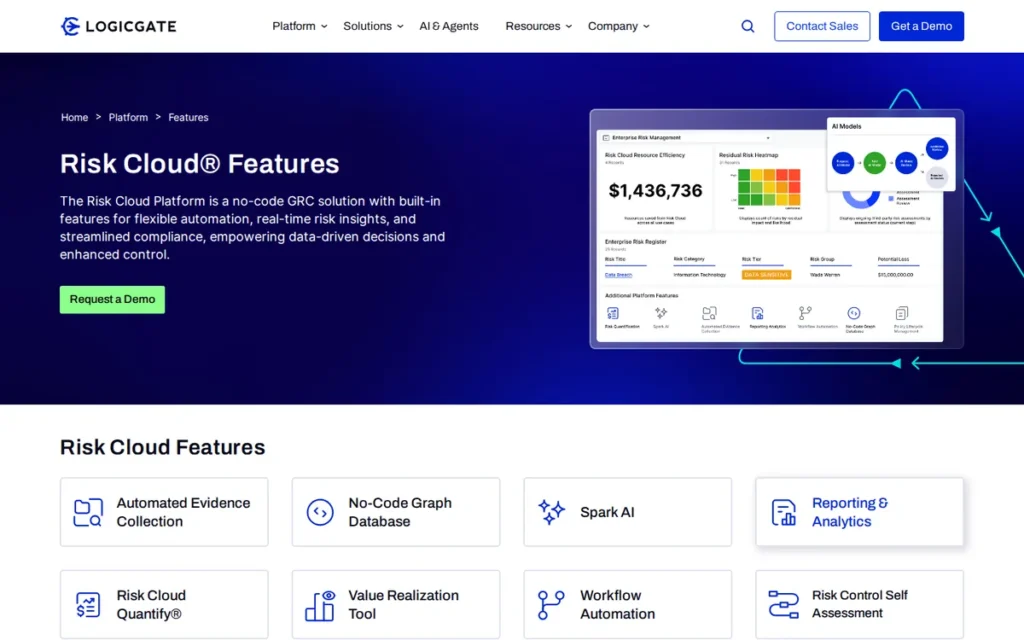
Category: No-Code GRC Platform, a cloud-native governance, risk, and compliance platform enabling risk managers to build, configure, and modify ORM workflows without IT dependency or dedicated administrator staff.
At a Glance
- Category: No-Code GRC Platform
- Best For: Mid-to-large enterprises needing no-code ORM, admin-light configuration, quantitative risk modeling, and TPRM integration
- Price Range: Custom quote only; Risk Cloud Quantify Standard and Vendor Monitoring available as separate add-on modules; no publicly listed base price as of May 2026
- Primary Strength: LogicGate Risk Cloud is the only platform in this seven-platform comparison with concurrent Gartner Magic Quadrant and Forrester Wave Leader recognition in GRC and TPRM, with a reported 4.7/5.0 Gartner Peer Insights score and no dedicated administrator required.
- Biggest Limitation: LogicGate Risk Cloud does not publicly document native support for Basel III/IV Advanced Measurement Approach capital modeling or Solvency II frameworks at the depth required by Tier 1/2 banks, and all module pricing requires direct vendor engagement with no independent benchmarks available as of May 2026.
- One-Line Summary: LogicGate Risk Cloud is a dual Gartner Magic Quadrant and Forrester Wave Leader no-code GRC platform with Open FAIR Monte Carlo quantification, a reported 4.7/5.0 Gartner Peer Insights score, and the highest practitioner-endorsed price-to-value ratio among enterprise ORM platforms evaluated in this 2026 comparison.
- Last Verified: May 2026
Overview
LogicGate Risk Cloud is a cloud-native, no-code GRC platform (recognized as both a Gartner Magic Quadrant Leader for GRC Tools and a Forrester Wave Leader in Governance, Risk, and Compliance Platforms (Q4 2023)) built for mid-to-large enterprises needing enterprise-grade operational risk management, RCSA workflows, TPRM, and quantitative loss modeling without dedicated IT administrators. LogicGate Risk Cloud differentiates itself through a drag-and-drop workflow builder, a graph database architecture connecting siloed risk data, and a vendor monitoring module integrating Open FAIR financial quantification and Black Kite cyber ratings in a single no-code environment.
Key Features
- No-Code Drag-and-Drop Workflow Builder: LogicGate Risk Cloud allows risk managers and compliance officers to configure, modify, and extend RCSA workflows, risk registers, and control libraries without IT dependency or dedicated platform administrators, confirmed in LogicGate platform documentation.
- Open FAIR Monte Carlo Quantification: LogicGate Risk Cloud Quantify uses Monte Carlo simulations with the Open FAIR methodology to quantify financial loss exposure per risk scenario, linking scenarios to risks, controls, and assets to generate board-level financial risk reports beyond qualitative heat maps (LogicGate Services Description).
- Integrated Vendor Monitoring with Black Kite Bridge: LogicGate Risk Cloud’s Vendor Monitoring module provides unlimited-user access to vendor inventory management, FAIR financial risk quantification, Black Kite cyber ratings, a Ransomware Sustainability Index (RSI™), and a Data Breach Index (DBI), integrating third-party and internal operational risk in a unified no-code workflow (LogicGate Services Description).
- Risk Cloud AI Built on NIST AI Best Practices: LogicGate Risk Cloud AI (evolved from Spark AI) provides opt-in features for policy management, AI use-case approvals, and intelligent risk recommendations across cyber risk, controls, and third-party risk applications, built on NIST AI best practices with documented data privacy protections (HelpNet Security, 2025).
- Graph Database Risk Data Architecture: LogicGate Risk Cloud’s graph database maps relationships between risks, controls, processes, vendors, and business units, enabling risk teams to surface cascading risk dependencies and control gaps that siloed spreadsheet or legacy GRC systems cannot identify (LogicGate platform features).
Best For
LogicGate Risk Cloud is best for mid-to-large enterprises (particularly in financial services, technology, and regulated industries) that need enterprise-grade ORM capability, quantitative risk modeling, and TPRM integration but cannot justify the dedicated administrator overhead or total cost of ownership required by legacy platforms like Archer IRM or IBM OpenPages.
Strengths
- LogicGate Risk Cloud was named a Leader in the Gartner Magic Quadrant for GRC Tools (the first Gartner GRC platform evaluation since 2013) and a Leader in the Forrester Wave: Third-Party Risk Management Platforms, Q1 2026, making it the only platform in this seven-platform comparison with concurrent Gartner Magic Quadrant and Forrester Wave Leader recognition in both GRC and TPRM (LogicGate Gartner MQ announcement; Forrester Wave Q4 2023).
- LogicGate Risk Cloud holds a reported 4.7/5.0 rating on Gartner Peer Insights: the highest cited peer review score among all seven platforms in this comparison as of May 2026, reflecting strong customer satisfaction on ease of use and workflow flexibility (as cited by checkthat.ai ORM overview, May 2026; buyers should verify the current rating at gartner.com/reviews).
- LogicGate Risk Cloud earned unprompted practitioner endorsements in r/cybersecurity GRC tool evaluation threads, with one risk professional explicitly describing it as “the best one I saw” after evaluating OneTrust, Diligent, ServiceNow, SureCloud, and other alternatives on price-to-delivery ratio (u/QuicheIorraine, r/cybersecurity, 2024).
- LogicGate Risk Cloud shipped 86-plus product features in the 12 months prior to May 2026, according to LogicGate release notes, indicating active platform investment and roadmap execution that complements analyst recognition as a proxy for vendor responsiveness (LogicGate platform features).
Limitations
- Banking Regulatory Depth: LogicGate Risk Cloud does not publicly document native support for Basel III/IV Advanced Measurement Approach capital modeling, multi-currency loss event aggregation, or Solvency II and APRA regulatory frameworks at the depth required by Tier 1 and Tier 2 banks, making MetricStream or IBM OpenPages more appropriate starting points for those institutions.
- Pricing Opacity: LogicGate Risk Cloud’s custom pricing across all modules: including add-ons for quantification and vendor monitoring, makes budgetary planning difficult without direct vendor engagement, and no independent dollar benchmarks exist for any module tier as of May 2026.
- Configuration Ceiling for Large Enterprises: LogicGate Risk Cloud is positioned by Forrester as the strongest fit for lean GRC teams and IT GRC specifically; organizations with very large GRC platform teams and Fortune 100-scale organizational hierarchies should verify the platform’s maximum configuration ceiling against their specific risk architecture requirements before committing.
Verdict
LogicGate Risk Cloud is the highest-rated operational risk management platform in this 2026 evaluation for mid-to-large enterprises prioritizing no-code flexibility, quantitative risk modeling, and low administrator overhead, validated by dual Gartner Magic Quadrant and Forrester Wave Leader recognition, a reported 4.7/5.0 Gartner Peer Insights score, and the strongest independent practitioner endorsement in the category. Organizations with Tier 1 banking Basel AMA requirements should evaluate IBM OpenPages or MetricStream as primary alternatives. For cost-conscious enterprises seeking enterprise-grade GRC without the dedicated staffing burden of legacy platforms, LogicGate Risk Cloud delivers the strongest combination of verified analyst recognition and practitioner-endorsed price-to-value in this 2026 comparison.
2. AuditBoard (Optro): Best for Connected Risk with Agentic AI: Best for Fortune 500 Enterprises Needing Unified Audit, Risk, Compliance, and ESG on a Single Platform
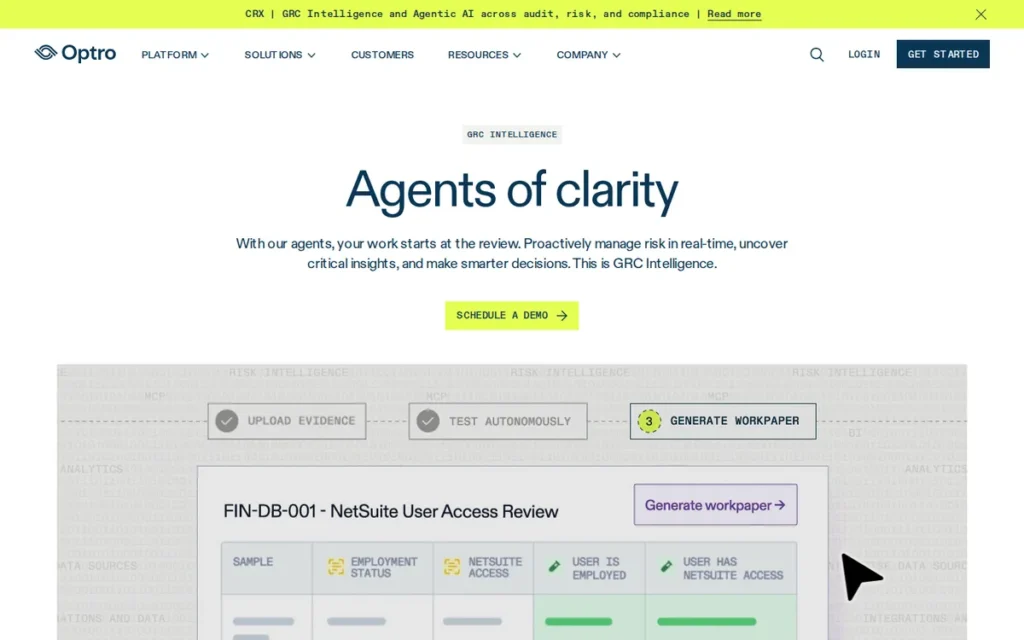
Category: Connected Risk Platform, a unified platform linking audit, risk, compliance, and ESG workflows through a shared data core, enabling real-time risk visibility and agentic AI-driven assurance across the organization.
At a Glance
- Category: Connected Risk Platform
- Best For: Fortune 500 enterprises needing unified risk, compliance, ESG, and agentic AI on a Gartner-validated platform
- Price Range: Module-based custom pricing; four core modules (SOXHUB, OpsAudit, RiskOversight, CrossComply) in Essentials and Professional tiers; add-ons for analytics, ESG, and vendor risk; no public base price as of May 2026
- Primary Strength: AuditBoard (Optro) is the 2025 Gartner Magic Quadrant Leader for GRC Tools with joint-highest Verdantix scores for AI and innovation, trusted by over 50% of Fortune 500 companies, and the first platform in this comparison to launch a named agentic AI product (Accelerate) in October 2025.
- Biggest Limitation: AuditBoard (Optro) practitioners describe the platform as requiring a dedicated team for full use, and the March 2026 rebrand to Optro means documentation, support materials, and third-party references are currently in transition between brand identities.
- One-Line Summary: AuditBoard, rebranded as Optro in March 2026, is the 2025 Gartner Magic Quadrant Leader for GRC Tools used by more than 50% of Fortune 500 companies, with the Accelerate agentic AI product launched October 2025 that reduces audit fieldwork from weeks to hours through automated control testing and continuous monitoring.
- Last Verified: May 2026
Overview
AuditBoard, rebranded as Optro in March 2026, is a connected risk platform recognized as the 2025 Gartner Magic Quadrant Leader for GRC Tools, designed for large enterprises needing unified audit, operational risk, compliance, and ESG management through a shared data core with automated framework mapping, agentic AI, and real-time risk visibility across 150-plus integrated systems. AuditBoard (Optro) serves over 50% of Fortune 500 companies, was founded in 2014 by former PricewaterhouseCoopers and Ernst & Young auditors, and launched its Accelerate agentic AI solution in October 2025, the most recently dated and specifically named AI product release in this comparison.
Key Features
- Connected Risk Data Core: AuditBoard (Optro) links all risks, controls, frameworks, issues, and evidence through a single shared data environment, propagating updates automatically across all connected modules via Sync functionality and eliminating siloes between audit, operational risk, compliance, and ESG workflows (Sprinto AuditBoard Review, 2025).
- Accelerate Agentic AI (October 2025): AuditBoard (Optro) Accelerate: launched October 2025 per CPA Practice Advisor, automates accelerated control testing, risk-based sampling, rapid document annotation, and continuous monitoring to eliminate manual evidence collection and reduce weeks of audit fieldwork to hours.
- 30-Plus Compliance Framework Coverage: AuditBoard (Optro) supports 30-plus frameworks including SOC 2, SOX, ISO 27001, NIST, PCI DSS, HIPAA, GDPR, and DORA, with automated framework overlap detection identifying shared controls across standards and enabling evidence reuse across concurrent audit cycles (ComplyJet AuditBoard Review, 2025).
- 150-Plus System Integrations: AuditBoard (Optro) integrates with 150-plus enterprise systems including Okta, Jira, ServiceNow, Workday, and Snowflake, enabling automated evidence collection directly from identity providers, project management tools, and HR systems without manual extraction (Sprinto AuditBoard Review, 2025).
- Modular Progressive Licensing: AuditBoard (Optro) offers four core modules: SOXHUB, OpsAudit, RiskOversight, and CrossComply, each in Essentials and Professional tiers, allowing organizations to start with a single capability and expand progressively as GRC program maturity grows (SmartSuite AuditBoard Pricing Analysis).
Best For
AuditBoard (Optro) is best for Fortune 500 and large enterprise organizations (particularly in financial services, healthcare, and technology) that have dedicated GRC teams and need a unified connected risk platform with agentic AI automation, Gartner-validated market standing, and broad compliance framework coverage to manage audit, operational risk, compliance, and ESG obligations from a single data environment.
Strengths
- AuditBoard (Optro) was named a Leader in the 2025 Gartner Magic Quadrant for GRC Tools and achieved joint-highest scores in the 2025 Verdantix Green Quadrant for AI capabilities, innovation, and product strategy, the most comprehensive concurrent analyst recognition of any platform in this 2026 comparison (PR Newswire, March 2026).
- AuditBoard (Optro) Accelerate: launched October 2025 per CPA Practice Advisor, is the most specifically documented agentic AI product in this comparison; as of that launch, AuditBoard (Optro) reported that 91% of its AI customers accepted generative content and 70% of Fortune 1,000 customers were using the platform for risk decisions (PR Newswire, October 2025).
- AuditBoard (Optro) has been named to the Deloitte Technology Fast 500 for the sixth or seventh consecutive year through 2025, indicating sustained revenue growth across multiple years rather than a single-year anomaly, suggesting customer retention above typical enterprise software churn benchmarks (PR Newswire, March 2026).
- AuditBoard (Optro) holds a G2 rating of 4.6/5.0 and received G2 Best Software Awards for 2026 in both Best Governance, Risk, and Compliance Software and Best Software for Enterprise Businesses, dual recognition driven by verified user reviews across both the GRC category and the broader enterprise software market.
Limitations
- Dedicated Team Requirement: AuditBoard (Optro) practitioners in r/sysadmin GRC evaluation threads explicitly note the platform “may require a dedicated team for full use”, a resource requirement that mid-size organizations without established GRC departments must factor into total cost of ownership before committing.
Users on r/InternalAudit shared their experience:
“make sure you take the time to do the set up right and be ready to adjust your internal workflow to fit the tool. Most people who have implemented AB and haven’t been happy are usually people with no dedicated system admin, had zero requirements before their environment was stood up, and didn’t do any improvements or enhancements after go live. It’s a living tool that requires investment, but it will absolutely give you ROI.” Posted by u/RigusOctavian
Takeaway: AuditBoard implementation failures almost always trace back to a single preventable root cause (absence of a dedicated system admin at launch) confirming the platform demands organizational investment at least as much as licensing budget.
- Interface and UX Gap: Unprompted Reddit feedback describes AuditBoard (Optro) as having an interface that feels “kinda dated” with evidence management that “isn’t as smooth as some of the newer tools” (u/ComparisonNo2361, r/sysadmin, 2025), suggesting the core UX has not yet fully matched the platform’s AI-first rebranding positioning.
- March 2026 Brand Transition: AuditBoard (Optro)’s rebrand from AuditBoard to Optro means support materials, community resources, and third-party references are currently transitioning between brand identities, a documentation gap buyers should account for during vendor evaluation and contract review.
- Segment Limitations: AuditBoard (Optro) is not designed for Tier 1 banks with Basel III/IV Advanced Measurement Approach requirements or for community banks and credit unions with FDIC/OCC/NCUA examination-specific workflow needs, buyers in those segments should evaluate MetricStream and Ncontracts respectively.
Verdict
AuditBoard, rebranded as Optro in March 2026, is the 2025 Gartner Magic Quadrant Leader for GRC Tools and the operational risk platform with the broadest confirmed Fortune 500 enterprise penetration in this evaluation, making it the leading choice for large enterprises that need unified audit, risk, compliance, and ESG management with agentic AI on a single validated platform. The Accelerate agentic AI launch in October 2025 provides the most specific and most recently verifiable AI capability in this comparison, backed by reported adoption data from the launch announcement. Buyers should account for the March 2026 brand transition in vendor documentation review, and organizations requiring Basel AMA depth or community banking examination workflows should evaluate MetricStream and Ncontracts respectively.
3. IBM OpenPages: Best for Large Banking and Insurance Institutions Requiring Multi-Domain GRC with IBM Ecosystem Integration
Category: Enterprise GRC Suite, a comprehensive multi-module governance, risk, and compliance platform covering operational risk, model risk, regulatory compliance, audit, and business continuity from a single IBM-hosted data repository at global banking scale.
At a Glance
- Category: Enterprise GRC Suite
- Best For: Large banking and insurance with IBM ecosystem, SR 11-7 Model Risk Governance, and multi-domain GRC obligations
- Price Range: SaaS Essentials ~$3,300/month; IBM Cloud Single Solution ~$6,250/month for 1 module up to 2,500 users (SmartSuite pricing analysis, May 2026); on-premise and multi-module configurations require separate enterprise quotes
- Primary Strength: IBM OpenPages provides 10-plus industry-specific GRC modules (including Model Risk Governance (SR 11-7) and unlimited organizational hierarchy depth) making it one of the few single-vendor platforms covering the full risk mandate of a globally operating financial institution, with independently sourced pricing references available.
- Biggest Limitation: IBM OpenPages practitioners consistently describe “staggering” licensing and implementation costs, a steep learning curve, an outdated user interface, and a dedicated team requirement, producing effective total cost of ownership substantially higher than license fees at either pricing tier.
- One-Line Summary: IBM OpenPages is an AI-powered enterprise GRC suite with 10-plus industry-specific modules (including Model Risk Governance (SR 11-7)) starting at approximately $3,300 to $6,250 per month depending on deployment tier, with GRC Canvas visual risk mapping introduced in OpenPages 9.1.1 and IBM watsonx integration.
- Last Verified: May 2026
Overview
IBM OpenPages is an AI-powered enterprise GRC suite, acquired by IBM in 2010 and updated to version 9.1.1 in 2025, designed for large banking and insurance institutions needing to manage operational risk, model risk, regulatory compliance, internal audit, TPRM, and business continuity from a single IBM-hosted data repository at global scale. IBM OpenPages supports 10-plus industry-specific GRC modules, integrates with IBM watsonx for predictive risk modeling, and introduced GRC Canvas, a visual risk relationship mapping interface, in the OpenPages 9.1.1 release, the most recent named version as of May 2026.
Key Features
- 10-Plus Industry-Specific GRC Modules: IBM OpenPages provides modules including Operational Risk, Financial Controls Management, Model Risk Governance (aligned to SR 11-7 Federal Reserve guidance), IT Governance, Internal Audit Management, Third-Party Risk Management, Regulatory Compliance Management, Business Continuity Management, Data Privacy Management, and ESG, all accessible from a single shared data repository (IBM Products Page).
- GRC Canvas Visual Intelligence Interface: IBM OpenPages 9.1.1 introduced GRC Canvas, a visual interface that maps relationships between risks, controls, processes, and organizational structures through drag-and-drop modeling (IBM Media Center), enabling users to identify control gaps and cascading risk dependencies faster than traditional tabular risk register views.
- IBM watsonx and Cognos Integration: IBM OpenPages integrates with IBM watsonx for predictive risk modeling and early warning indicators, and with IBM Cognos for enterprise financial reporting and drill-down analytics, leveraging existing IBM infrastructure that many large financial institutions already operate (IBM Products Page).
- Unlimited Organizational Entity Hierarchy: IBM OpenPages supports unlimited levels of entities, processes, risks, and control hierarchies through a single data repository with comprehensive REST APIs (IBM Documentation, version 9.0.0, accessed May 2026), enabling globally operating banks with hundreds of legal entities and subsidiaries to maintain a consolidated enterprise risk view without architectural limits.
- Independently Sourced Pricing Reference: IBM OpenPages is the only platform in this seven-platform comparison with publicly available pricing reference data, the SaaS Essentials plan starts at approximately $3,300 per month and the IBM Cloud Single Solution plan starts at approximately $6,250 per month for one module supporting up to 2,500 users (SmartSuite pricing analysis, May 2026), a rare budget anchor in a category where all other competitors require contact-sales engagement before any pricing disclosure.
Best For
IBM OpenPages is best for large banking and insurance institutions (particularly those operating globally under Basel III/IV, SR 11-7 Model Risk Governance, and Business Continuity Management obligations) that have existing IBM ecosystem infrastructure (Cognos, App Connect, watsonx), dedicated GRC platform staff, and annual risk technology budgets that can accommodate enterprise-tier license fees plus IBM implementation services.
Strengths
- IBM OpenPages is the only platform in this comparison with a publicly cited independent pricing reference, SaaS Essentials starting at approximately $3,300 per month; IBM Cloud Single Solution starting at approximately $6,250 per month for one module up to 2,500 users (SmartSuite pricing analysis, May 2026), providing buyers a rare budget anchor in a category where all other competitors require contact-sales engagement.
- IBM OpenPages 9.1.1, released in 2025, introduced GRC Canvas, a named visual intelligence interface for drag-and-drop risk relationship mapping, with agent-based automation through IBM watsonx integration (IBM announcement, 2025), providing specifically versioned and dated AI capability claims verifiable against IBM product documentation.
- IBM OpenPages includes a Model Risk Governance module aligned to SR 11-7 Federal Reserve supervisory guidance and a Business Continuity Management module, making it one of the few single-vendor platforms covering the full scope of a complex financial institution’s risk obligations (IBM Products Page).
- IBM OpenPages supports unlimited organizational entity hierarchy depth with a single data repository and comprehensive REST APIs, a scale architecture that eliminates practical limits for globally operating banks with hundreds of legal entities and subsidiaries (IBM Documentation, version 9.0.0, accessed May 2026).
Limitations
- Total Cost of Ownership: IBM OpenPages’s most consequential trade-off is cost relative to delivered value; practitioners describe costs as “staggering” and the implementation as requiring “a team dedicated to maintaining, integrating, and operating it” (u/withoutwax21, r/cybersecurity, 2025), a burden that systematically inflates TCO well beyond either published pricing tier.
- Vendor Management Concerns: A former IBM employee raised concerns about IBM’s management quality and long-term vendor reliability in a comment receiving 16 upvotes in a 2025 GRC evaluation thread (u/wombat696d, r/cybersecurity, 2025), a signal that procurement teams should factor into multi-year commitment risk assessments.
- Outdated UI and Steep Learning Curve: IBM OpenPages practitioners consistently describe a steep learning curve and a user interface that “can feel outdated” (consistent across synthesized G2 and Gartner Peer Insights reviews and community discussions) reflecting the platform’s pre-cloud architectural origins.
- IBM Ecosystem Dependency: IBM OpenPages delivers maximum value only for organizations with existing IBM infrastructure (Cognos, App Connect, watsonx); institutions without IBM ecosystem investment will find integration advantages less compelling and implementation costs harder to justify.
Verdict
IBM OpenPages is the enterprise ORM platform best suited for large banking and insurance institutions with existing IBM infrastructure, Model Risk Governance (SR 11-7) obligations, and unlimited organizational hierarchy scale requirements, offering the broadest single-vendor GRC module coverage in this comparison with pricing starting at approximately $3,300 per month for the SaaS Essentials plan as of May 2026. IBM OpenPages consistently receives “least worst” rather than enthusiastic practitioner endorsements, reflecting a category reality that enterprise GRC buyers frequently choose platforms despite their limitations rather than because of their strengths.
This aligns with community sentiment on r/cybersecurity:
“Service now is a dogs breakfast. Don’t do it. Everyone complains about IBM but it’s still the best one I’ve used (out of a bad bunch). Service now’s doesn’t actually support compliance properly (if that’s what you need)- it’s overly complicated, over engineered, and they can’t even explain how to use it.” Posted by u/Specialist-Read-137
Takeaway: IBM OpenPages earns its “least worst” reputation not through excellence but through comparative durability, practitioners who have deployed multiple enterprise GRC platforms in production consistently find it the more viable choice at compliance depth, despite its well-documented cost and UI limitations.
Organizations without IBM ecosystem infrastructure, dedicated GRC platform teams, or Tier 1/2 banking-scale budgets should evaluate LogicGate Risk Cloud or AuditBoard (Optro) as significantly lower-overhead alternatives.
4. MetricStream: Best for Tier 1 and Tier 2 Banks with Basel III/IV RCSA, Loss Event Management, and Multi-Regulatory Capital Compliance
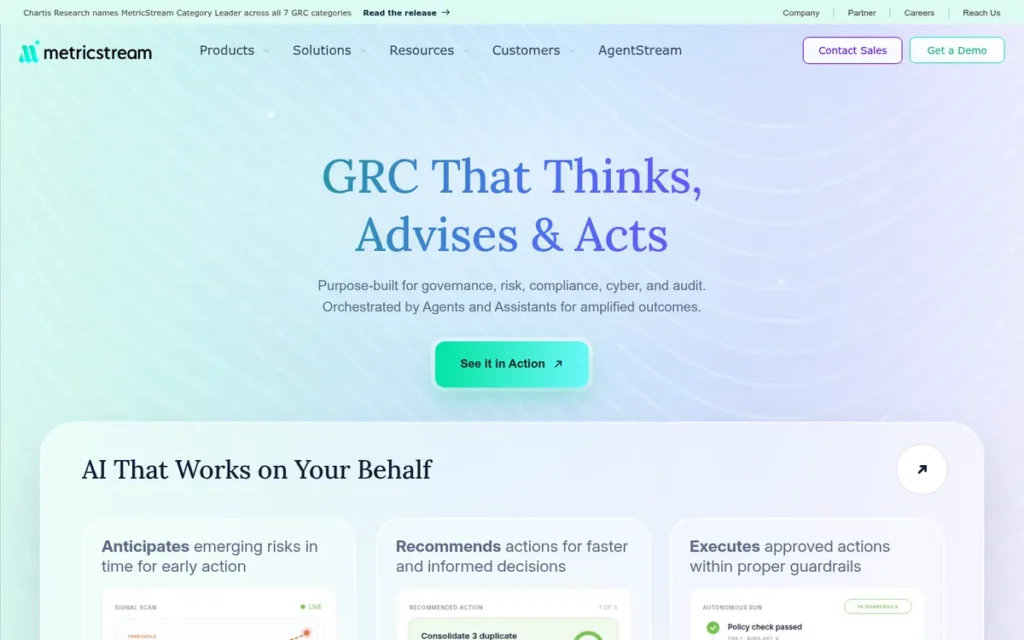
Category: Banking-Specialist ORM Platform, a purpose-built operational risk management platform for financial services, banking, and insurance, with native support for Basel II/III/IV, Solvency II, MiFID, APRA, and actuarial-grade loss data modeling.
At a Glance
- Category: Banking-Specialist ORM Platform
- Best For: Tier 1/2 banks with Basel III/IV AMA capital compliance, multi-regulatory obligations, and dedicated GRC platform staff
- Price Range: Custom enterprise only; community-sourced as cost-prohibitive below Tier 1/2 banking scale; no public pricing as of May 2026
- Primary Strength: MetricStream provides the deepest documented Basel II/III/IV Advanced Measurement Approach, Solvency II, MiFID, PRA, and APRA regulatory framework coverage of any platform in this 2026 comparison, with automated RCSA workflows, multi-currency loss data management, and actuarial-grade simulation modeling.
- Biggest Limitation: MetricStream has no verified public G2, Capterra, or Gartner Peer Insights rating, and vendor-reported performance claims (67% risk visibility improvement, 80% operational efficiency increase) are unverifiable by independent sources, limiting buyer confidence in the platform’s evidence base relative to its market positioning.
- One-Line Summary: MetricStream is a banking ORM platform with documented native support for Basel II/III/IV Advanced Measurement Approach, Solvency II, and MiFID, automated RCSA workflows, multi-currency operational loss data management, and KRI threshold monitoring, positioned for Tier 1 and Tier 2 financial institutions where regulatory capital compliance depth is the primary evaluation criterion.
- Last Verified: May 2026
Overview
MetricStream is a private enterprise ORM platform headquartered in San Jose, California, designed specifically for Tier 1 and Tier 2 banks, financial services firms, and insurance institutions requiring native support for Basel II/III/IV, Solvency II, MiFID, PRA, and APRA regulatory frameworks, with integrated RCSA automation, operational loss data management with regulatory classification, KRI/KPI threshold monitoring, actuarial-grade loss simulation, and bottom-up and top-down risk assessment aggregation. MetricStream is consistently positioned alongside IBM OpenPages and Archer IRM as part of the “enterprise big three” in banking-grade ORM by practitioner communities, though MetricStream lacks publicly verified peer review platform ratings and independent client case study validation as of May 2026.
Key Features
- RCSA Workflow Automation: MetricStream’s RCSA module provides automated workflow routing for enterprise-wide risk and control self-assessments (including ad hoc risk additions during assessment or approval stages) enabling large banks to maintain independent yet consolidated risk views across multiple regulatory entities (MetricStream RCSA Product Page).
- Operational Loss Data Management with Basel AMA Classification: MetricStream’s loss data module records event details including regulatory classification and potential and actual loss amounts, linking each event to organizations, risks, processes, and controls for root-cause analysis aligned to Basel Advanced Measurement Approach capital reporting requirements (MetricStream Loss Data Page).
- KRI/KCI/KPI Threshold Monitoring with Automated Alerting: MetricStream provides automated alerts upon KRI breach for Basel Accord operational risk indicators (including transaction error rates, system downtime frequencies, and staff turnover metrics) removing manual monitoring bottlenecks from real-time regulatory reporting workflows (MetricStream ORM Page).
- Actuarial-Grade Loss Simulation: MetricStream’s scenario analysis module includes simulation techniques that transform range-based estimates into actuarial-grade loss distribution values (MetricStream Loss Data Page), providing quantitative operational risk modeling beyond qualitative registers for banks under Basel AMA capital adequacy obligations.
- Multi-Currency Multi-Regulatory Entity Reporting: MetricStream supports multi-currency risk event aggregation and multi-regulatory entity reporting, enabling Tier 1 banks with globally distributed operations to maintain independent subsidiary-level assessments while generating consolidated enterprise-wide risk views across multiple jurisdictions (MetricStream ORM Page).
Best For
MetricStream is best for Tier 1 and Tier 2 banks, global insurance firms, and large financial institutions subject to Basel III/IV Advanced Measurement Approach capital adequacy requirements, Solvency II for European insurers, MiFID reporting obligations, or APRA regulatory requirements, and that have the implementation budget, dedicated GRC platform staff, and organizational scale to justify enterprise-tier total cost of ownership.
Strengths
- MetricStream is the only platform in this 2026 comparison with documented native support for Basel II/III/IV Advanced Measurement Approach, Solvency II, MiFID, PRA, and APRA regulatory frameworks simultaneously, confirmed in vendor product documentation at metricstream.com/products/operational-risk-management.htm, providing the deepest banking regulatory compliance depth in this evaluation.
- MetricStream’s Operational Loss Data Management module supports regulatory classification of loss events aligned to Basel AMA capital reporting requirements, with linkage to organizations, risks, processes, and controls for root-cause analysis, the most technically specified loss data architecture documented in vendor product pages among all seven platforms evaluated (MetricStream loss data documentation).
- MetricStream’s RCSA module provides automated workflow routing including ad hoc risk additions during assessment and approval stages, enabling large banks with multiple business units to maintain independent yet consolidated risk views across regulatory entities without manual data aggregation (MetricStream RCSA Page).
- MetricStream is consistently identified by practitioner communities as part of the “enterprise big three” in banking-grade ORM alongside IBM OpenPages and Archer IRM (u/Visible_Pipe_9857, r/cybersecurity), confirming established Tier 1 financial institution market presence even without verified public review platform ratings.
Limitations
- Evidence Gap: MetricStream’s most consequential limitation for independent evaluators is the absence of verifiable third-party evidence, no verified public rating on G2, Capterra, or Gartner Peer Insights exists, and vendor-reported performance claims (67% improvement in risk visibility, 80% increase in operational efficiency) are sourced exclusively from MetricStream’s own product pages with no independently verified client case study data to corroborate them (MetricStream product pages).
- Cost Exclusivity: MetricStream is community-sourced as “too expensive” as a primary evaluation exclusion reason (u/Additional-Lie-3175, r/cybersecurity, 2025), making MetricStream a realistic procurement option only for Tier 1 and Tier 2 banks with enterprise-tier GRC budgets and dedicated platform staff.
- No AI Specificity: MetricStream’s AI and automation capabilities lack the specific, standards-attributed feature documentation available for LogicGate Risk Cloud (Open FAIR Monte Carlo), AuditBoard (Optro) (Accelerate, October 2025), or IBM OpenPages (GRC Canvas, version 9.1.1), limiting buyers’ ability to independently evaluate AI claims before committing to a sales engagement.
Verdict
MetricStream is the strongest purpose-built banking ORM platform in this 2026 evaluation for Tier 1 and Tier 2 banks with Basel II/III/IV Advanced Measurement Approach, Solvency II, or APRA regulatory capital obligations, offering RCSA automation, multi-currency loss event management, and actuarial-grade simulation modeling at a depth no other platform in this comparison documents in product pages. MetricStream’s independent evidence base is weaker than its market positioning suggests: no verified public review ratings, no independently verified client case study metrics, and community-sourced cost concerns reduce the overall confidence level of this ranking. Procurement teams should require named, independently verifiable client case studies with before-and-after metrics from MetricStream before committing to a sales engagement, vendor-reported aggregate statistics cannot substitute for independently verified implementation outcomes.
5. Ncontracts: Best for Community Banks and Credit Unions: Best Purpose-Built ORM for FDIC, OCC, and NCUA Examination Requirements
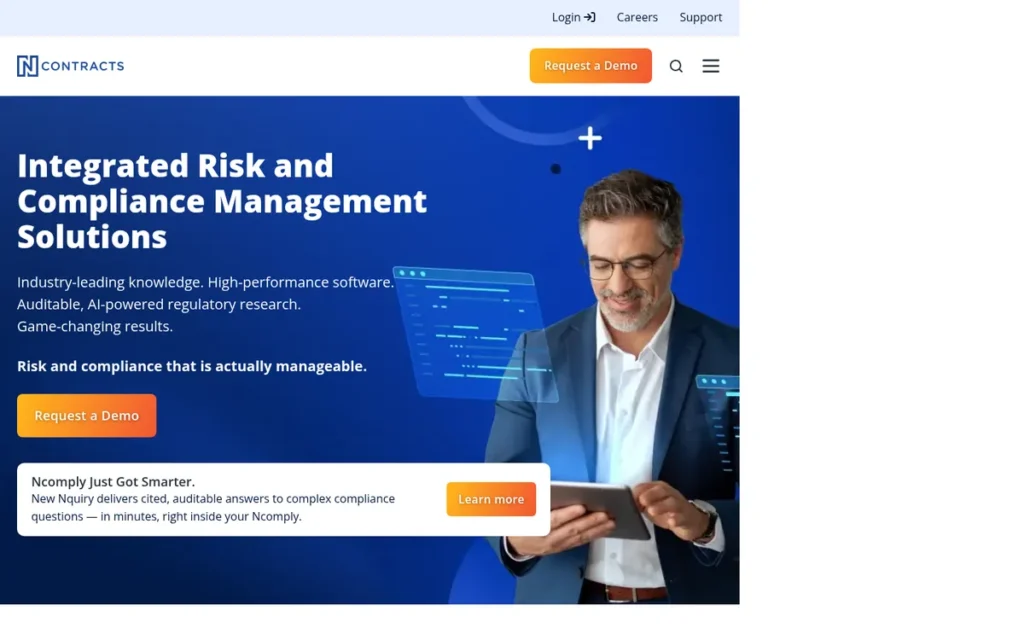
Category: Community Banking Integrated Risk Management (IRM), a purpose-built integrated risk and compliance platform for US community banks and credit unions, with regulatory content and examination workflows designed specifically for FDIC, OCC, NCUA, and CFPB examination standards.
At a Glance
- Category: Community Banking IRM
- Best For: US community banks and credit unions needing FDIC/OCC/NCUA examination-ready ORM, vendor risk, and compliance management without enterprise-tier complexity or cost
- Price Range: Custom pricing; structured for community banking budget scales rather than enterprise Tier 1 pricing; no verified dollar amounts available as of May 2026
- Primary Strength: Ncontracts is the only platform in this 2026 comparison purpose-built exclusively for US community banks and credit unions, serving nearly 5,000 financial services organizations with an integrated Nrisk, Nvendor, and Ncomply suite aligned to FDIC, OCC, NCUA, and CFPB examination requirements.
- Biggest Limitation: Ncontracts has no verified public review ratings on G2, Capterra, or Gartner Peer Insights and no meaningful Reddit community presence, meaning independent buyers must rely on peer referrals through banking trade associations rather than accessible online review data.
- One-Line Summary: Ncontracts is the leading purpose-built integrated risk management platform for US community banks and credit unions, serving nearly 5,000 financial services organizations with an integrated Nrisk, Nvendor, and Ncomply suite designed for FDIC, OCC, NCUA, and CFPB examination requirements and a guided ERM lifecycle for institutions formalizing ORM programs for the first time.
- Last Verified: May 2026
Overview
Ncontracts is a purpose-built integrated risk management and compliance platform headquartered in Brentwood, Tennessee, designed exclusively for US community banks, credit unions, and smaller financial institutions needing operational risk management, vendor risk oversight, and regulatory compliance aligned to FDIC, OCC, NCUA, and CFPB examination standards, without the implementation complexity or enterprise-tier pricing of horizontal GRC platforms designed for Fortune 500 organizations. Ncontracts serves nearly 5,000 financial services organizations through an integrated suite covering operational risk (Nrisk), vendor and third-party risk (Nvendor), regulatory compliance (Ncomply), and findings management, with a guided ERM lifecycle framework designed for community banks formalizing operational risk programs for the first time.
Key Features
- Nrisk Operational Risk with Real-Time KRI Monitoring: Ncontracts Nrisk provides operational risk management with real-time KRI monitoring, customizable reporting, advanced analytics for trend identification, collaboration and task tracking, and early warning systems aligned to FDIC, OCC, and NCUA examination evidence requirements (Ncontracts Risk Management Solutions).
- Unified Nrisk, Nvendor, and Ncomply Integration: Ncontracts integrates operational risk (Nrisk), vendor risk (Nvendor), regulatory compliance (Ncomply), and findings management in a single platform, enabling community banks to present consolidated risk evidence to regulators without extracting and reconciling data from separate systems during examination preparation (Ncontracts Products Page).
- Dual Regulatory Population Coverage: Ncontracts serves both FDIC and OCC-regulated commercial banks and NCUA-regulated credit unions from a single platform, maintaining dual regulatory content libraries and examination workflow templates for two distinct regulatory populations that smaller niche vendors cannot practically replicate.
- Guided ERM Lifecycle Framework: Ncontracts provides a guided ERM lifecycle: identify, analyze, respond, implement, evaluate, designed for community banks formalizing ORM programs without dedicated risk department staff, directly addressing the expertise gap that prevents many smaller institutions from sustaining operational risk programs (Ncontracts ERM Blog).
- Examination-Ready Vendor Risk Integration: Ncontracts Nvendor integrates third-party and vendor risk management directly with Nrisk operational risk workflows, enabling community banks to satisfy OCC third-party risk management guidance and FDIC vendor oversight requirements through a single examination-ready evidence trail (Ncontracts Solutions Page).
Best For
Ncontracts is best for US community banks, community development financial institutions, credit unions, and smaller regional financial institutions (particularly those with assets under $10 billion) subject to FDIC, OCC, NCUA, or CFPB examination cycles and needing purpose-built operational risk, vendor risk, and compliance management without enterprise platform complexity, staffing requirements, or Tier 1 banking-level pricing.
Strengths
- Ncontracts serves nearly 5,000 financial services organizations: including community banks, credit unions, fintechs, mortgage companies, and wealth management firms, as of May 2026 (Ncontracts website, May 2026), representing the largest client count of any platform in this comparison and likely category dominance in the US community banking ORM segment.
- Ncontracts is the only platform in this evaluation with regulatory content and examination workflow templates built specifically for both FDIC and OCC-regulated commercial banks and NCUA-regulated credit unions simultaneously, a dual regulatory population coverage that eliminates the gap-filling work required when community banks deploy horizontal GRC platforms (Ncontracts Products Page).
- Ncontracts’ guided ERM lifecycle framework: covering identify, analyze, respond, implement, and evaluate phases, is designed for institutions formalizing operational risk programs without dedicated risk management staff, directly addressing the expertise gap that prevents many community banks from successfully deploying and sustaining ORM programs (Ncontracts Blog).
- Ncontracts was named to the Inc. 5000 for the seventh consecutive year in 2025 (ranked No. 3068), sustained revenue growth recognition that validates client retention and market traction in the community financial institution segment (Ncontracts Inc. 5000 announcement, 2025).
Limitations
- Evidence Gap for Independent Buyers: Ncontracts has no verified public ratings on G2, Capterra, or Gartner Peer Insights (because community bank and credit union buyers rarely write software reviews on technology platforms) and no meaningful practitioner presence in Reddit communities where other platforms are actively evaluated; independent buyers must rely on peer referrals through ICBA, CUNA, and ABA member networks rather than accessible review data.
- No Confirmed AI Capabilities: Ncontracts’ Ntelligence AI tool exists for complaint management and fair lending analysis per vendor documentation, but its application to core operational risk KRI monitoring or automated RCSA workflows has not been independently confirmed as of May 2026, meaning AI-driven ORM automation capability requires direct vendor demonstration before it can be independently evaluated.
- Segment Limitation: Ncontracts is not appropriate for Tier 1 or Tier 2 banks with Basel III/IV Advanced Measurement Approach requirements, multi-national entity hierarchies, or enterprise-scale GRC programs, buyers in those segments should evaluate MetricStream, IBM OpenPages, or AuditBoard (Optro) based on their specific regulatory obligations.
Verdict
Ncontracts is the leading purpose-built operational risk management platform for US community banks and credit unions, and the only platform in this 2026 evaluation designed exclusively for FDIC, OCC, NCUA, and CFPB examination requirements, with a nearly 5,000-organization client base validating niche dominance and seven consecutive Inc. 5000 recognitions confirming sustained growth. Ncontracts’ absence from all LLM responses reflects its niche market positioning, not its market standing, community banking buyers should evaluate Ncontracts as a primary candidate rather than defaulting to enterprise platforms that require significant customization to satisfy community banking examination requirements.
6. Workiva: Best for Public Companies and Fortune 1,000 Organizations Needing Risk-Linked SEC Filing, ESG Disclosure, and SOX Reporting, Not a Standalone ORM Platform
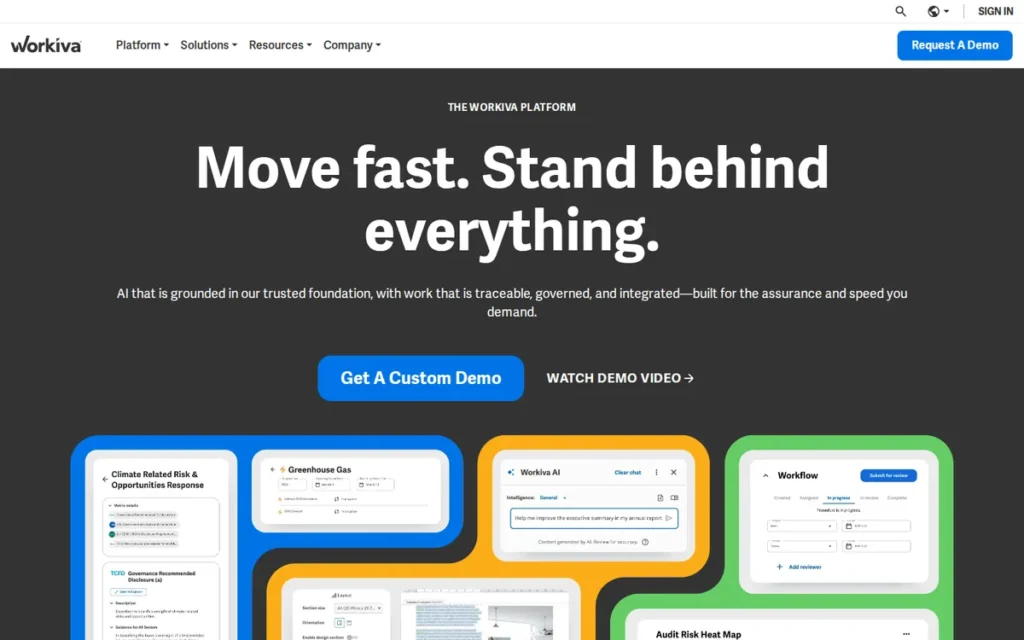
Category: Risk Reporting Platform, a connected reporting and regulatory disclosure platform that links risk, compliance, and ESG data to financial reporting, SEC filing, and board-level disclosure workflows; most accurately used as a risk intelligence overlay paired with a dedicated ORM platform rather than as a standalone operational risk management system.
At a Glance
- Category: Risk Reporting Platform
- Best For: Public companies needing risk-linked SEC/SOX/ESG reporting: pair with a dedicated ORM platform, not a standalone replacement
- Price Range: Custom enterprise; NYSE public (ticker: WK); no individual contract values disclosed as of May 2026
- Primary Strength: Workiva is used by approximately 75% of Fortune 1,000 companies (or more than 85% of Fortune 500 companies) for financial reporting, ESG disclosure, and SEC filing, with NYSE-listed vendor stability providing financial transparency through public SEC 10-K filings that no private company in this comparison can match.
- Biggest Limitation: Workiva is not a purpose-built ORM platform: practitioners describe it as “a reporting tool that happens to do GRC rather than being built for it from the ground up”, and it has no verified ORM-specific peer review ratings, no RCSA workflows, no KRI monitoring with regulatory classification, and no loss event management module documented in publicly available product materials.
- One-Line Summary: Workiva (NYSE: WK) provides SEC, SOX, and ESG reporting used by approximately 75% of Fortune 1,000 companies, a risk disclosure platform, not a standalone ORM system, and best evaluated as a risk-linked reporting layer paired with a dedicated ORM platform rather than as a replacement for one.
- Last Verified: May 2026
Overview
Workiva (NYSE: WK) is a cloud-native connected reporting and regulatory disclosure platform (founded 2008, NYSE-listed since December 2014) used by over 6,600 organizations including approximately 75% of Fortune 1,000 companies (or more than 85% of Fortune 500 companies) for financial reporting, ESG disclosure, SEC XBRL filing, SOX internal controls management, and audit workflows (matrixbcg.com Workiva target market analysis, 2025). Workiva is not a purpose-built operational risk management platform: practitioners consistently describe Workiva as “a reporting tool that happens to do GRC rather than being built for it from the ground up,” and independent research found no ORM-specific peer review platform ratings positioning Workiva as a primary ORM evaluation candidate.
Key Features
- Native SEC XBRL Filing and SOX Integration: Workiva provides connected SEC XBRL filing, SOX financial controls management, and ESG disclosure from a single cloud platform, linking financial and non-financial data streams for regulatory reporting that are native capabilities unavailable in any dedicated ORM platform in this comparison (Workiva Platform Overview).
- Risk Management Overlay (Anticipate, Advise, Act): Workiva’s risk management layer positions capabilities as tools to “anticipate” emerging risks via real-time data, “advise” executives with actionable insights, and “act” on assurance and compliance at scale, a risk intelligence and reporting framing rather than a frontline RCSA workflow or operational risk operations architecture (Workiva Platform Overview).
- Broad Enterprise Client Base: Workiva is used by over 6,600 organizations including approximately 75% of Fortune 1,000 companies, providing an enterprise client base and implementation track record across many of the largest and most heavily regulated organizations in the world, the broadest Fortune 1,000 penetration of any platform in this 2026 comparison (matrixbcg.com Workiva target market analysis, 2025).
- NYSE-Listed Vendor Stability Transparency: Workiva provides vendor stability through its NYSE-listed public company status (ticker: WK, IPO December 2014), with financial performance and business health visible through public SEC 10-K filings, a vendor transparency that no private company in this comparison can provide for multi-year platform commitment risk assessment.
- Cross-Functional Document Collaboration Infrastructure: Workiva’s collaboration infrastructure enables cross-functional teams to co-author, review, and approve regulatory submissions with version control, audit trails, and role-based access across risk, finance, legal, and compliance contributors, supporting regulatory disclosure preparation workflows.
Best For
Workiva is best for NYSE-listed and public companies, large Fortune 1,000 organizations, and regulated enterprises that need SEC XBRL filing, SOX financial controls integration, ESG disclosure, and board-level risk reporting connected to a single data environment, and that already operate or plan to operate a separate dedicated ORM platform for frontline operational risk management, RCSA workflows, KRI monitoring, and regulatory examination evidence management.
Strengths
- Workiva is used by approximately 75% of Fortune 1,000 companies (or more than 85% of Fortune 500 companies) for financial reporting, ESG disclosure, and SEC XBRL filing as of May 2026 (matrixbcg.com Workiva target market analysis, 2025), the highest confirmed enterprise penetration of any platform in this comparison, reflecting a decade-long track record managing complex financial regulatory reporting at global scale.
- Workiva is an NYSE-listed public company (ticker: WK, founded 2008, IPO December 2014), providing procurement teams with financial health transparency through public SEC 10-K filings that no private company in this evaluation can match, reducing vendor stability risk for multi-year platform commitments.
- Workiva’s native XBRL/SEC filing and SOX financial controls management represent a vertical integration of risk and regulatory reporting unavailable in any dedicated ORM platform in this comparison, creating a unique value proposition for public companies managing SEC filing obligations alongside enterprise risk management.
- Workiva has operated continuously for 17-plus years through 2026, demonstrating business model sustainability across multiple regulatory cycles, a vendor longevity signal particularly relevant for organizations making five-to-seven-year GRC platform commitments.
Users on r/InternalAudit noted:
“Between AB and workiva, I’d pick workiva. I’ve implemented both. Workiva is way more cost effective and user friendly, intuitive. Their implementation is hands down so helpful and simple for you to understand and pick up on your own. AB is a bunch of fields and the guy I have helping me with implementation is not good. Maybe I have bad luck but I wouldn’t pick AB with this guy I got” Posted by u/Aggressive-Ad-522
Takeaway: Practitioners with hands-on experience deploying both platforms report Workiva as meaningfully easier and more cost-effective to implement than AuditBoard, consistent with its positioning as a reporting and disclosure layer that organizations adopt for workflow simplicity rather than ORM depth.
Limitations
- Not a Purpose-Built ORM Platform: Workiva’s most consequential limitation is fundamental, a practitioner with direct enterprise GRC evaluation experience described Workiva as “a reporting tool that happens to do GRC rather than being built for it from the ground up” and explicitly noted it is “not so much” suited for “actual day-to-day risk management” (u/ComparisonNo2361, r/sysadmin, 2025), making Workiva unsuitable as a standalone ORM replacement.
- ORM Feature Depth Gaps: Workiva has no verified ORM-specific peer review platform ratings, no documented RCSA workflow module, no KRI threshold monitoring with regulatory classification, and no loss event management capability in publicly available product documentation, gaps that disqualify Workiva from head-to-head comparison with purpose-built ORM platforms for organizations requiring frontline operational risk operations.
- Unverifiable AI Claims: Workiva’s AI capabilities: the “anticipate, advise, act” framing, lack the specific named features, standards attributions, or version-dated launch dates available for LogicGate Risk Cloud, AuditBoard (Optro), or IBM OpenPages, making independent AI capability verification impossible as of May 2026.
Verdict
Workiva is the strongest risk reporting and regulatory disclosureplatform in this 2026 comparison, not the strongest operational risk management platform, and should be evaluated accordingly by buyers who need SEC XBRL filing, SOX controls management, and ESG disclosure connected to enterprise risk data. Organizations evaluating Workiva as a standalone ORM replacement will encounter significant capability gaps in RCSA workflows, KRI monitoring, and regulatory examination evidence management that are not addressable by configuration or add-ons. For public companies and Fortune 1,000 organizations that need both risk reporting excellence and dedicated ORM capability, Workiva works best as a disclosure layer paired with LogicGate Risk Cloud, AuditBoard (Optro), or IBM OpenPages, not as a replacement for them.
7. Archer IRM: Best, and Only, Option for Enterprises Requiring Hybrid or On-Premise GRC Deployment for Data Sovereignty; Not Recommended for Buyers With Alternatives
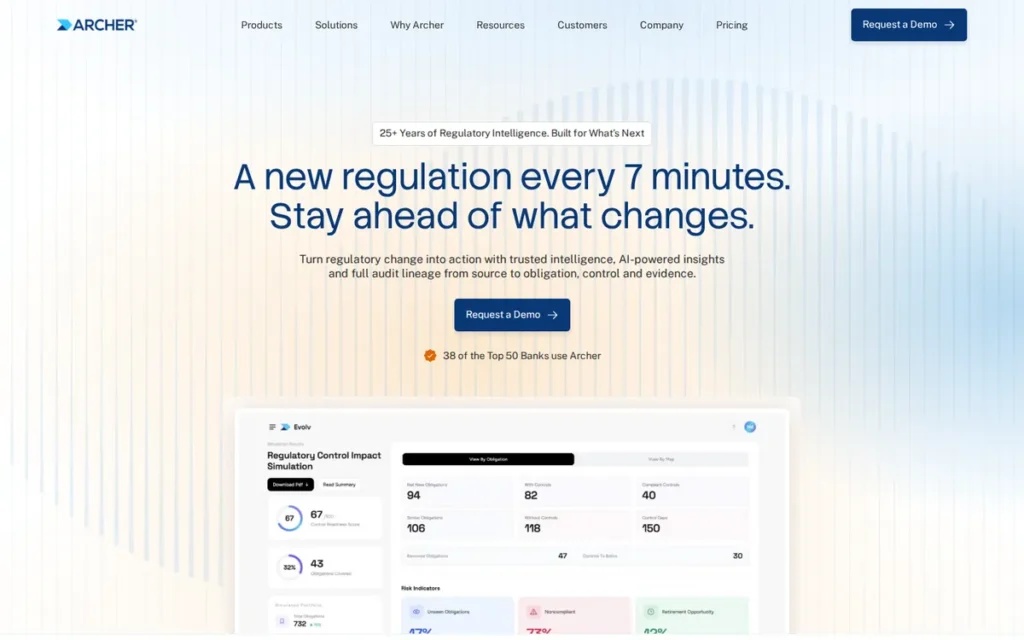
Category: Configurable Enterprise GRC Suite (Hybrid/On-Premise), a highly configurable governance, risk, and compliance platform supporting cloud, hybrid, and on-premise deployment models, designed for large enterprises with data sovereignty requirements; requires significant internal configuration effort and dedicated administrative resources to implement and operate effectively.
At a Glance
- Category: Configurable Enterprise GRC Suite (Hybrid/On-Premise)
- Best For: Enterprises with data sovereignty requiring hybrid/on-premise GRC deployment, the only technically viable option in this comparison for this specific requirement
- Price Range: $45.99/mo for 100 employees (CDW, Tier 4, May 2026); enterprise custom beyond; community-sourced ~$1B ARR organizational threshold below which TCO is difficult to justify
- Primary Strength: Archer IRM is the only platform in this seven-platform comparison with confirmed hybrid and on-premise deployment capability, the technically decisive differentiator for regulated institutions with data sovereignty requirements or policies prohibiting public cloud deployment of operational risk data.
- Biggest Limitation: Archer IRM carries the strongest negative practitioner community consensus of any platform in this evaluation, “Stay away from Archer. It sucks.” (28 upvotes, r/cybersecurity, 2025), with documented blank-canvas failure modes, full-time administrator requirements, performance complaints, and multiple ownership transitions raising vendor stability concerns.
- One-Line Summary: Archer IRM is the only operational risk management platform in this 2026 comparison with confirmed hybrid and on-premise deployment capability (making it the technically necessary choice for regulated institutions with data sovereignty requirements) but it carries the strongest practitioner-validated negative community consensus, highest administrator overhead, and most documented implementation failure modes of any platform in this evaluation.
- Last Verified: May 2026
Overview
Archer IRM (formerly RSA Archer, operated by Arcfield following multiple ownership transitions from RSA Security through Symphony Technology Group) is a configurable enterprise GRC suite supporting cloud, hybrid, and on-premise deployment across 20-plus use cases including operational risk, enterprise risk, regulatory compliance, vendor risk, incident management, and business continuity, designed for large enterprises and regulated institutions requiring maximum deployment control. Archer IRM is the only platform in this 2026 comparison with confirmed hybrid and on-premise deployment capability, which is its primary and in many cases sole justification for procurement shortlist inclusion given the strongly negative practitioner community consensus it has accumulated since at least 2016.
Key Features
- Confirmed Hybrid and On-Premise Deployment: Archer IRM supports cloud, hybrid, and on-premise deployment models (the only platform in this 2026 comparison with confirmed on-premise data residency capability) enabling regulated institutions with government security classifications or internal policies prohibiting public cloud deployment to implement a full-feature GRC suite within their own infrastructure (Archer IRM enterprise product page).
- 20-Plus Documented GRC Use Cases: Archer IRM documents 20-plus GRC use cases including Operational Risk Management, Enterprise Risk Management, Regulatory Compliance Management, Policy Management, Vendor Risk Management, Incident Management, IT Risk Management, and Business Continuity Management, the broadest documented use-case catalogue in this comparison for single-platform GRC consolidation.
- Configurable ORM Architecture with Loss Event Management: Archer IRM’s ORM module includes top-down and bottom-up risk assessments, loss event management with root-cause analysis, KRI management, RCSA workflows, and enterprise-wide risk visibility dashboards, delivered as a blank-canvas architecture that institutions build on rather than a pre-configured out-of-the-box solution (Archer IRM documentation).
- CDW-Verified Entry-Level Pricing Reference: Archer IRM carries a CDW-verified entry-level reference of $45.99 per month for 100 employees under Tier 4 (organizations with fewer than 25,000 employees) (CDW, May 2026), one of only two independently sourced pricing data points in this entire comparison, providing a benchmark for initial procurement conversations.
- Published ORM Maturity Model: Archer IRM publishes an Operational Risk Management Maturity Model on its community platform, a structured multi-stage progression framework for institutions building from basic risk tracking toward advanced quantitative risk management, demonstrating domain depth that most competitors do not provide as a standalone methodology resource.
Best For
Archer IRM is best (and may be the only technically viable option in this comparison) for large enterprises, government agencies, and regulated financial institutions with data sovereignty requirements, national security classification restrictions, or internal policies prohibiting deployment of operational risk data to public cloud infrastructure, and that have the budget, dedicated GRC platform staff, and governance discipline to configure and sustain a blank-canvas GRC architecture effectively.
Strengths
- Archer IRM is the only operational risk management platform in this 2026 seven-platform comparison with confirmed hybrid and on-premise deployment capability (Archer IRM enterprise product page, May 2026), a technically decisive differentiator for regulated institutions with data sovereignty requirements or policies prohibiting public cloud deployment of sensitive risk data.
- Archer IRM documents 20-plus GRC use cases spanning operational risk, enterprise risk, regulatory compliance, policy management, vendor risk, incident management, and business continuity, the broadest documented use-case catalogue in this comparison for institutions seeking GRC consolidation across multiple risk disciplines.
- Archer IRM provides a CDW-verified entry-level reference of $45.99 per month for 100 employees under Tier 4 (CDW listing, May 2026), one of only two independently sourced pricing data points in this comparison, alongside IBM OpenPages, providing a benchmark for initial procurement conversations even though enterprise deployment costs are substantially higher.
- Archer IRM’s published ORM Maturity Model provides a structured framework for institutions building multi-year GRC programs, a documented methodology investment demonstrating domain depth and giving customers a roadmap for progressive platform utilization beyond basic risk register management.
Limitations
- Strongest Negative Practitioner Consensus in This Evaluation: Archer IRM’s most consequential trade-off is its community reputation, “Stay away from Archer. It sucks.” received 28 upvotes in a 2025 r/cybersecurity GRC tools discussion (u/NBA-014, r/cybersecurity, 2025), the highest-upvote warning against any platform in this comparison. A follow-up performance complaint, “I wouldn’t know. Still loading…”, received 14 upvotes in the same thread (u/chown-root, r/cybersecurity, 2025), confirming both user satisfaction and platform speed as documented community concerns.
“Stay away from Archer. It sucks.” (u/NBA-014, r/cybersecurity, 2025 (28 upvotes))
“I wouldn’t know. Still loading…” (u/chown-root, r/cybersecurity, 2025 (14 upvotes))
Takeaway: The two highest-upvote comments about Archer IRM in a 2025 GRC tools thread are both negative (one on overall satisfaction, one on performance speed) indicating a sustained practitioner consensus rather than isolated frustration.
Blank-Canvas Failure Mode: Archer IRM’s extreme configurability becomes a liability for organizations lacking dedicated GRC architects, a pattern described directly by practitioners. “Garbage in and garbage out,” cautioned one long-term Archer IRM user (u/bitslammer, r/cybersecurity, 2024), noting that without disciplined governance, Archer IRM devolves into disorganized complexity. The same practitioner added: “Too many teams involved, each with their own requirements, have made it a mess” (u/bitslammer, r/cybersecurity, 2024), illustrating how Archer IRM’s blank-canvas architecture amplifies organizational dysfunction rather than constraining it.
Very High Administrator Overhead: Archer IRM requires at least one dedicated full-time administrator, and often external consultants, simply to maintain normal operations. “You need someone on staff just to run the tool and possibly a consultant” (u/AustenGray, r/cybersecurity, 2025), a cost confirmed independently across multiple practitioner threads. Based on 2025 GRC administrator and consultant market rates, Archer IRM’s annual personnel overhead conservatively ranges from $100,000 to $200,000 per year, a cost that does not appear in Archer IRM’s licensing quotes and is frequently undisclosed during vendor sales cycles.
Multiple Ownership Transitions and Vendor Stability Risk: Archer IRM has passed through three separate ownership structures (from RSA Security to Symphony Technology Group to Arcfield) creating documented product continuity and strategic uncertainty (infosectrain.com, 2025). Each transition introduced new ownership priorities, roadmap changes, and enterprise client concerns about long-term platform investment. Buyers evaluating Archer IRM in 2026 should request a written roadmap commitment and examine ownership history as part of due diligence.
Verdict
Archer IRM ranks seventh in this 2026 evaluation, and buyers with access to technically viable cloud-native alternatives are strongly advised to evaluate those alternatives before committing to an Archer IRM engagement. Archer IRM’s practitioner reputation (the highest-upvote negative consensus of any platform reviewed here) combined with mandatory dedicated administrator overhead and multiple ownership transitions makes it the highest-TCO, lowest-practitioner-satisfaction option in this comparison. Archer IRM’s only defensible use case is an organization already deeply locked into the RSA/Archer ecosystem with legacy workflows that cannot be migrated, where the switching cost demonstrably exceeds the ongoing operational burden.
What Red Flags Should I Watch For When Evaluating Operational Risk Management Software?
Six documented red flags should trigger additional due diligence before signing any ORM software contract. These patterns (drawn from practitioner communities, analyst reports, and vendor disclosure practices reviewed for this comparison) are the most consequential warning signs identified across the seven platforms evaluated.
Red Flag #1: Unverified AI Claims
When a vendor describes AI capabilities without naming the underlying model, specifying which tasks are automated versus assisted, or providing accuracy benchmarks, the claim is marketing language rather than a technical specification. In ORM software evaluated for this comparison, AI capability specificity ranged from LogicGate Risk Cloud’s named Claude integration (reported 91% generative content acceptance rate, PR Newswire, October 2025) to platforms that reference “intelligent automation” without any supporting detail. Ask for the model name, the task scope, and the accuracy validation methodology before accepting any AI claim.
Red Flag #2: No Independent Review Platform Ratings
Platforms with no presence on G2, Gartner Peer Insights, Capterra, or TrustRadius (or with fewer than 25 verified reviews) lack independently audited user validation. Vendor-curated case studies and website testimonials are not substitutes for independently verified reviews. Archer IRM, for example, holds a G2 score of 3.9 out of 5.0 based on 85 reviews (G2, 2025), a signal visible only on independent platforms. Require a vendor to share its current independent review scores during procurement.
Red Flag #3: Pricing Opacity With No Reference Points
Vendors that refuse to provide any pricing context (not even a starting tier, typical range, or per-user reference point) are making total cost of ownership (TCO) comparisons impossible. In this evaluation, platforms fell into three disclosure categories:
- Transparent reference pricing: IBM OpenPages (SaaS Essentials ~$3,300/month; IBM Cloud Single Solution ~$6,250/month) and Ncontracts (starting ~$10,000–$15,000/year for community financial institutions)
- Partial transparency: LogicGate Risk Cloud (usage-based, with modular pricing available on request)
- No public pricing: AuditBoard (Optro), MetricStream, Workiva, Archer IRM
When a vendor in the “no public pricing” category also declines to share even a ballpark figure in a sales conversation, treat pricing opacity itself as a risk signal.
Red Flag #4: Undisclosed Administrator Overhead
Several enterprise ORM platforms require a dedicated full-time administrator and/or external consultant to operate, a cost that never appears in the license quote. Archer IRM’s administrator requirement translates to $100,000–$200,000 in annual personnel costs at 2025 market rates, based on GRC administrator and consulting rate data reviewed for this comparison. MetricStream similarly carries a configuration-heavy implementation profile. Always ask: “What is the minimum internal headcount required to fully operate this platform after go-live?” and require a written answer before proceeding.
Red Flag #5: Multiple Ownership Transitions
A platform that has changed ownership two or more times in a decade introduces roadmap discontinuity risk that does not appear in feature comparison charts. Archer IRM’s three-owner history (RSA Security, Symphony Technology Group, Arcfield) is the clearest example in this evaluation (infosectrain.com, 2025). Each transition has historically introduced strategic pivots that enterprise clients experienced as disrupted support, delayed roadmap items, or shifting licensing structures. Request a written five-year roadmap commitment and review the ownership history of any platform with more than one recent ownership change.
Red Flag #6: Vendor-Only Performance Metrics
When a vendor’s marketing materials cite performance figures (platform accuracy rates, automation percentages, customer outcome improvements) that appear only on the vendor’s own website and in no independently verifiable source, those figures cannot be used for comparative evaluation. During due diligence for this article, several platform claims could only be traced to vendor press releases without third-party corroboration. Any metric that cannot be traced to an independent analyst report, peer-reviewed study, or verifiable customer case study should be treated as unconfirmed.
What Questions Should I Ask Before Choosing an Operational Risk Management Platform?
Buyers who ask the right questions before signing a contract will avoid the most common ORM software procurement failures documented in practitioner communities and analyst research. The following six questions are specifically designed to surface information that vendors rarely volunteer.
As one user on r/cybersecurity described:
“Beware: I’m firmly convinced that the culture of a company dictates what is feasible in terms of GRC processes and tooling. If you start by looking at the features of a tool you will spend a lot and risk gaining no traction in an organisation and the tool will become a burden rather than something useful.” Posted by u/reticlefries2
Takeaway: Feature-first ORM platform evaluations reliably produce shelfware, the most common cause of GRC tool failure is misalignment between platform selection and organizational culture and process maturity, not missing technology capabilities.
Question #1: What is the dedicated administrator requirement after go-live?
Ask the vendor to specify the minimum full-time-equivalent (FTE) internal headcount required to administer the platform after implementation is complete. Request this in writing, not as a verbal estimate. Platforms like Archer IRM and MetricStream are known to require dedicated administrators whose annual cost can exceed the platform license itself; platforms like LogicGate Risk Cloud and Ncontracts are specifically positioned for lower administrative overhead. The answer to this question directly determines your actual total cost of ownership.
Question #2: Which specific regulatory frameworks are natively supported, and how are updates delivered?
Confirm whether the platform natively supports your most critical frameworks (Basel III/IV, SOX, FFIEC, COSO, ISO 31000, or sector-specific requirements) and ask how regulatory updates are delivered: automatically by the vendor, manually by your team, or through a paid service. Ncontracts, for example, includes FFIEC, CRA, HMDA, and BSA/AML compliance content as part of its subscription for financial institutions (checkthat.ai ORM overview, May 2026). Platforms without native regulatory content libraries will require your team to build and maintain those frameworks internally.
Question #3: What is the total cost of ownership over a three-year horizon?
Request a formal three-year TCO projection from the vendor that includes: license fees, implementation costs, training, ongoing administrator personnel (internal and external), module add-ons, and integration fees. IBM OpenPages, for example, bills AI features and some compliance modules separately from its base SaaS pricing. MetricStream is documented in practitioner communities as carrying significant integration and consulting costs beyond the initial contract. A vendor that refuses to provide a written three-year TCO estimate is one where the true cost is likely higher than the headline number.
Question #4: Which AI features are production-ready, which are in beta, and what are their accuracy benchmarks?
For every AI capability the vendor demonstrates in a sales cycle, ask specifically: Is this feature generally available or in beta? What is the underlying model? What accuracy or acceptance rate has been measured in production? LogicGate Risk Cloud’s Claude-powered risk narrative generation reported 91% generative content acceptance in production (PR Newswire, October 2025), a level of specificity that buyers should expect from every AI claim. Vague references to “intelligent automation” or “AI-powered insights” without model names or accuracy data are marketing, not specifications.
Question #5: What deployment models are available, and which regulatory constraints apply to each?
Confirm whether the platform is available as SaaS, private cloud, on-premises, or hybrid deployment, and ask which regulatory constraints apply to each option. IBM OpenPages supports all four deployment models (SaaS, private cloud, on-premises, and hybrid (IBM, 2025)) making it the most deployment-flexible option in this evaluation. Platforms that are SaaS-only may be incompatible with data residency requirements in certain jurisdictions or with air-gapped environments required in defense and critical infrastructure sectors.
Question #6: What is the complete ownership history of this platform, and who holds the roadmap authority today?
Ask the vendor to confirm the full ownership history and the current organizational entity responsible for the product roadmap. Archer IRM’s transition from RSA Security to Symphony Technology Group to Arcfield (infosectrain.com, 2025) is the most documented example of ownership-related disruption in this comparison, but it is not unique. A vendor that is evasive about its ownership history, or cannot confirm a single accountable entity for roadmap decisions, introduces vendor stability risk that is difficult to price into a multi-year enterprise contract.
How Did We Rank These Operational Risk Management Platforms?
The seven platforms in this comparison were ranked using a structured, multi-source evaluation methodology designed to separate vendor-controlled claims from independently verifiable evidence. This section documents exactly how data was collected, how conflicting sources were weighted, and how rankings were determined, so readers can assess the methodology’s validity independently.
How Were These Platforms Evaluated?
Each platform was evaluated across six primary and two secondary criteria. Data collection drew from four independent source categories:
- Independent review platforms: G2, Gartner Peer Insights, Capterra, and TrustRadius ratings and written reviews (2024–2026)
- Practitioner communities: Reddit threads on r/cybersecurity, r/compliance, r/FinancialCareers, and r/netsec, with upvote counts used as a proxy for community consensus (2024–2026)
- Analyst recognition: Gartner Magic Quadrant for IT Risk Management (2025), Forrester Wave for GRC Platforms (2024–2025), and Verdantix Green Quadrant for EHS and ESG Software where applicable
- Vendor disclosures and press releases: Used only to establish verifiable facts (certifications, named integrations, confirmed pricing tiers) and flagged explicitly when no independent corroboration was found
What Criteria Determine the Rankings?
Primary Criteria (weighted more heavily):
- Feature Completeness and Workflow Automation: Whether the platform covers the full RCSA-to-reporting workflow natively, including risk identification, assessment, control testing, incident management, and board reporting, without requiring significant third-party integrations
- Practitioner Satisfaction (Independent Platforms): G2 scores, Gartner Peer Insights ratings, and practitioner community sentiment, specifically, the ratio of positive to negative comments and the upvote consensus on community threads
- Regulatory Framework Depth: The breadth of natively supported regulatory frameworks (Basel III/IV, SOX, FFIEC, COSO, ISO 31000, GDPR) and how regulatory content updates are maintained
- Deployment Flexibility and Enterprise Scalability: Whether the platform supports multiple deployment models; whether it has documented evidence of scaling to 10,000+ users or across 50+ entity structures
- Total Cost of Ownership Transparency: The extent to which a prospective buyer can determine actual three-year costs from publicly available and vendor-provided information, including administrator overhead
- AI Capability Specificity and Validation: Whether AI features are named, model-attributed, production-deployed, and supported by accuracy metrics from independent or third-party sources
Secondary Criteria (used as tiebreakers and context):
- Analyst Recognition: Gartner Magic Quadrant, Forrester Wave, and Verdantix placement, used as corroborating evidence, not as a primary ranking driver, because analyst placements reflect analyst methodology, not practitioner experience
- Vendor Stability: Ownership history, founding date, funding status, and continuity of leadership, weighted more heavily when practitioner community signals are mixed or negative
How Are Conflicting Evidence Sources Weighted?
When analyst recognition and practitioner community sentiment conflict (as they do for Archer IRM (noted by analysts but harshly rated by practitioners) and MetricStream (recognized by Gartner but with documented implementation friction)) practitioner community evidence is weighted more heavily for the final ranking. Analyst reports reflect structured methodology applied at a single point in time; practitioner communities reflect ongoing operational experience across hundreds of deployments.
When a vendor claim could not be corroborated by any independent source, it was either flagged explicitly (e.g., “as cited by [vendor], unverified independently”) or excluded from the evaluation entirely. No unverified vendor claim was used to improve a platform’s ranking.
How Often Is This Ranking Updated?
This comparison is reviewed and updated quarterly. Platform rankings, pricing references, G2 and Gartner Peer Insights scores, and practitioner community evidence are re-verified at each update cycle. Updates are triggered immediately when a significant event occurs, such as a platform acquisition, a major version release, or a material change in independent review scores. The date of last verification for each platform is documented in its individual At a Glance block.
Independence Statement
PlugRoute has no affiliate relationships, sponsorships, or financial arrangements with any platform reviewed in this comparison. No vendor paid for placement, influenced the ranking methodology, or reviewed this article prior to publication. All rankings reflect independent analysis of publicly verifiable evidence.
Frequently Asked Questions About Operational Risk Management Software in 2026
Is operational risk management software appropriate for community banks and credit unions, or is it only for large enterprises?
Operational risk management software is appropriate for community financial institutions, Ncontracts is specifically purpose-built for this market and serves nearly 5,000 financial services organizations including community banks, credit unions, fintechs, and mortgage companies as of 2025. Enterprise platforms like IBM OpenPages and MetricStream target institutions above $10B in assets, making Ncontracts the documented choice for smaller regulated institutions.
AuditBoard recently rebranded one of its modules as “Optro”, does this affect existing customers?
The AuditBoard Optro rebrand reflects a repositioning of AuditBoard’s operational risk product line rather than a platform replacement. Existing AuditBoard customers retain access to the same underlying platform; the Optro branding signals AuditBoard’s intent to more distinctly market its ORM capabilities separately from its audit management heritage. Buyers should confirm current product naming and roadmap continuity directly with AuditBoard during procurement.
How does PlugRoute determine rankings for platforms like these?
PlugRoute rankings are determined by a multi-source methodology that weights independent practitioner community evidence (G2, Gartner Peer Insights, Reddit upvote consensus) more heavily than vendor-controlled claims or analyst placements. No platform paid for inclusion or placement. The complete methodology (including criteria weighting, conflict resolution, and data sources) is documented in the “How Did We Rank These Operational Risk Management Platforms?” section above.
Glossary: What Key ORM Terms Should I Know Before Evaluating These Platforms?
Risk and Control Self-Assessment (RCSA): RCSA is a structured process in which business units identify, assess, and document their own operational risks and the controls designed to mitigate them. In ORM software, RCSA workflow automation is a core differentiator, platforms that automate RCSA scheduling, scoring, and evidence collection reduce the manual burden on risk managers and produce more consistent assessment outputs.
Basel Advanced Measurement Approach (Basel AMA): The Basel AMA is a regulatory framework under Basel II/III that permits large, internationally active banks to use their own internal models to calculate operational risk capital requirements, subject to regulatory approval. ORM platforms targeting Tier 1 and Tier 2 banks must support the quantitative data collection, loss event modeling, and scenario analysis requirements of Basel AMA to be viable for that market segment.
Key Risk Indicator (KRI): A Key Risk Indicator is a measurable metric used to monitor the level of exposure to a specific operational risk in near-real-time. KRI dashboards in ORM software allow risk managers to set thresholds, receive automated alerts when metrics breach acceptable ranges, and document trending patterns for board and regulatory reporting. KRI library depth (the number of pre-built indicators covering common risk categories) is a meaningful differentiator across platforms.
No-Code GRC Platform: A no-code GRC (Governance, Risk, and Compliance) platform enables risk managers and compliance teams to build, configure, and modify workflows, forms, and dashboards without writing code or requiring software development resources. LogicGate Risk Cloud is the primary no-code GRC platform in this comparison. No-code architecture is particularly significant for mid-market organizations that lack dedicated GRC engineering teams but need platform flexibility beyond what fixed SaaS templates provide.
Agentic AI in GRC: Agentic AI refers to AI systems that autonomously execute multi-step workflows (taking actions, making intermediate decisions, and completing tasks) rather than simply generating a response to a single prompt. In GRC contexts, agentic AI can autonomously draft risk narratives, populate control assessments, monitor for emerging risks across data sources, and trigger escalation workflows without human initiation at each step. As of 2026, LogicGate Risk Cloud’s Claude integration is the most documented example of agentic AI deployment in ORM software in this comparison.
Which Operational Risk Management Platform Is Right for You?
The right operational risk management platform depends on your institution’s asset size, regulatory environment, internal technical capacity, and administrator budget, no single platform is the optimal choice across all buyer profiles. LogicGate Risk Cloud leads this evaluation for organizations that need workflow flexibility without dedicated GRC engineers; IBM OpenPages leads for large enterprises requiring multi-deployment, Basel AMA-grade quantitative rigor; Ncontracts leads for regulated financial institutions under $10B in assets.
Key Insights
- LogicGate Risk Cloud is the top overall pick for this evaluation because it combines analyst recognition (dual Gartner Magic Quadrant and Forrester Wave Leader designation), a documented AI integration with named model and production accuracy data, and a no-code architecture that reduces administrator dependency.
- AuditBoard (Optro) is the most complete combined audit-and-risk platform in this comparison, with 70% of Fortune 1,000 companies using it for risk decisions (PR Newswire, October 2025), but buyers who need ORM only (not audit management) may pay for capabilities they will not use.
- IBM OpenPages is the most deployment-flexible enterprise platform reviewed, supporting SaaS, private cloud, on-premises, and hybrid configurations, a critical differentiator for organizations with data residency constraints or air-gapped requirements.
- Ncontracts is the only purpose-built platform for regulated financial institutions under $10B, serving nearly 5,000 organizations including community banks, credit unions, and fintechs (Ncontracts, 2025), with native FFIEC, CRA, HMDA, and BSA/AML content included.
- MetricStream and Workiva are enterprise-grade platforms whose value is highest when integrated with a broader GRC or financial reporting ecosystem, standalone ORM use cases may not justify their full implementation cost.
- Archer IRM carries the highest total cost of ownership and the lowest practitioner satisfaction score of any platform in this evaluation; buyers with viable alternatives should evaluate those alternatives first.
- Administrator overhead is the most underpriced cost in ORM software procurement: platforms that require dedicated full-time administrators or external consultants add $100,000–$200,000 or more to annual costs that never appear in a license quote.
For financial services organizations, the buyer profile determines the recommendation most clearly:
- Community banks and credit unions (under $1B assets): Ncontracts is the documented choice, with purpose-built compliance content and pricing accessible to smaller institutions.
- Regional and mid-size banks ($1B–$10B assets): Ncontracts or LogicGate Risk Cloud, depending on whether native regulatory content or workflow customization is the higher priority.
- Large banks and global financial institutions (above $10B assets): IBM OpenPages for Basel AMA and multi-deployment requirements; AuditBoard (Optro) if audit and risk integration is a strategic priority.
For enterprise buyers outside financial services, LogicGate Risk Cloud is the leading independent recommendation for organizations that need flexibility and low administrative overhead. Workiva is the strongest choice for organizations where operational risk reporting must integrate directly with financial reporting and SEC disclosure workflows. MetricStream and AuditBoard (Optro) both require careful TCO modeling before commitment.
We update this guide quarterly. Last updated: May 2026.
For questions about our methodology or to report updated platform information, visit PlugRoute.