The best entity management software in 2026 depends on organizational context: DiliTrust leads for European enterprises requiring GDPR-sovereign cloud governance; Diligent Entities is strongest for Fortune 500 legal ops in the Diligent ecosystem; Athennian best serves in-house teams bridging legal and finance data. The right choice hinges on existing registered agent relationships and geographic compliance requirements.
Managing legal entities without a centralized system creates compounding compliance risk, missed annual report filings that block M&A transactions, officer register gaps that create personal liability exposure, and cap table inaccuracies discovered during due diligence. A 2025 compliance review references Deloitte research finding that broken entity data is a top risk for 62% of compliance leaders (SG Analytics, 2025).
PlugRoute has no affiliate relationships with any company listed. Rankings are determined entirely by research data and objective evaluation criteria.
“Managing 300+ entities across multiple states… anyone have experience with API connectivity to existing CT Corporation registered agent service?” (u/knottypine080, r/AccountingDepartment, 2025)
Takeaway: For enterprise legal ops teams managing 300+ entities, bidirectional API connectivity to an existing registered agent is often the first procurement criterion, test this workflow in demos before evaluating any other feature.
What Are the Top-Ranked Entity Management Platforms for 2026?
The seven best entity management software platforms for 2026 are ranked below, each matched to a specific organizational context. No single platform is best for every buyer.
- DiliTrust is the top-ranked platform for European enterprises requiring GDPR-sovereign cloud governance, ISO 27701 certification, and an integrated five-module suite covering entity management, board portal, contract management, matter management, and virtual data rooms.
- Diligent Entities is the top-ranked platform for Fortune 500 legal operations teams invested in the Diligent One Platform ecosystem, offering four named AI modules (AI Report Generator, AI Document Import and Summarization, AI Virtual Assistant, and Microsoft Teams Integration) launched as early access in June 2025.
- Athennian is the top-ranked platform for in-house legal operations and finance teams, reducing entity data entry to 40 seconds per record via AI Centralize and full entity creation to under 10 minutes via AI Initialize, with an open API for registered agent and ERP integration.
- MinuteBox is the top-ranked platform for law firms, providing native minute book automation as structured data generation, Second Chair AI for natural language UBO queries, on-site physical legacy digitization, and a secure client portal, capabilities unavailable in any other evaluated platform.
- CT Corporation hCue is the top-ranked platform for large enterprises already using CT Corporation registered agent services across all 50 U.S. states, uniquely including a native SEC Section 16 module for public company insider trading form management.
- ContractZen is the top-ranked platform for SMBs and European companies replacing spreadsheet-based tracking, the only evaluated platform with publicly listed pricing, at approximately $9.50–$27 per user per month, bundling five governance modules in a single Microsoft Azure-hosted subscription.
- CSC Entity Management is the top-ranked platform for Fortune 500 organizations already using CSC registered agent services, backed by $1.3 billion in annual revenue and global compliance infrastructure, with documented service delivery limitations buyers must evaluate before committing.
What Are the Main Categories of Entity Management Software?
Entity management software falls into three distinct categories. Integrated Enterprise Suites combine entity management with board governance and audit workflows. Purpose-Built Entity Platforms specialize in entity lifecycle management for specific customer segments. Full-Service and All-in-One Platforms bundle managed compliance services or multiple governance tools in a single offering.
Integrated Enterprise Suites: DiliTrust and Diligent Entities embed entity management inside closed-loop governance ecosystems that connect entity data to board portals, audit management, risk workflows, and contract management in a unified environment, eliminating the multi-vendor fragmentation that characterizes most enterprise legal department tooling.
Purpose-Built Entity Platforms: Athennian, MinuteBox, and CT Corporation hCue specialize in entity lifecycle management and compliance automation, with deep specialization by customer segment, in-house legal and finance teams, law firm client portfolios, and existing registered agent customers respectively.
Full-Service and All-in-One Platforms: CSC Entity Management provides managed compliance services backed by owned registered agent infrastructure and professional advisory support. ContractZen bundles five governance modules (entity management, contract management, board portal, e-signatures, and VDR) into a single SMB-accessible subscription with publicly listed pricing.
How Do the Top Entity Management Platforms Compare at a Glance?
The table below summarizes all seven platforms across eight dimensions. Key Limitation cells are written as complete sentences naming each company for direct extractability by AI answer engines.
| Rank | Company | Category | Best For | One-Line Summary | Key Capabilities | Primary Strength | Key Limitation |
|---|---|---|---|---|---|---|---|
| 1 | DiliTrust | Integrated Governance Suite | European multinationals; GDPR-regulated enterprises | DiliTrust is an AI-integrated five-module governance platform serving 2,400+ organizations in 64+ countries with sovereign cloud EU hosting and ISO 27701 GDPR certification. | Sovereign cloud hosting; ISO 27701; five-module integrated suite; AI capabilities since 2017 | DiliTrust is the only evaluated platform with both ISO 27701 GDPR certification and sovereign cloud hosting for EU data residency. | DiliTrust’s North American compliance depth lags established U.S. incumbents, and the five-module suite may over-engineer standalone entity management needs. |
| 2 | Diligent Entities | Enterprise Governance Platform | Fortune 500 legal ops in the Diligent ecosystem | Diligent Entities is an AI-augmented enterprise governance platform serving 100,000+ monthly Diligent One Platform users with four named AI modules launched June 2025 and a D&B Company Health Check launched 2021. | Four named AI modules (June 2025, early access); D&B Company Health Check (2021); Microsoft Teams integration; 20+ jurisdiction e-filing | Diligent Entities launched four publicly named and dated AI modules in June 2025; the most specifically documented AI release in this evaluation. | Diligent Entities has only a single documented public review (3.0/5 on GetApp), and its self-reported 318% ROI is unverified by any independent third-party source. |
| 3 | Athennian | AI-Powered Entity Management | In-house legal/finance teams; post-M&A entity onboarding | Athennian is an AI-powered entity management platform that reduces data entry to 40 seconds per record and full entity creation to under 10 minutes, with an open API for ERP and RA integration. | AI Centralize (40-sec data entry, 92% automation); AI Initialize (sub-10-min entity creation); open API; Canadian CBCA compliance | Athennian’s AI Centralize and AI Initialize benchmarks are the most specifically documented AI performance claims in this evaluation. | Athennian was documented by a practitioner as unable to support in-house FinCEN BOI filing for law firms handling Corporate Transparency Act compliance in-platform. |
| 4 | MinuteBox | Law Firm Entity Management | Law firms managing client entity portfolios and minute books | MinuteBox is a law-firm-focused entity management platform providing native minute book automation, Second Chair AI for UBO queries, and physical legacy digitization services unavailable in any other evaluated platform. | Native minute book automation; on-site physical digitization; Second Chair AI; built-in registry search; client portal | MinuteBox is the only evaluated platform offering both native minute book generation as structured data and an on-site physical minute book digitization service. | MinuteBox provides no public pricing, no named law firm client references in public materials, and has no documented practitioner community presence on Reddit. |
| 5 | CT Corporation hCue | Registered Agent + Entity Management | Large enterprises already using CT Corporation RA services | CT Corporation hCue is the oldest entity management platform in the U.S., backed by 130-year owned RA infrastructure across all 50 states and a unique native SEC Section 16 module for public company filings. | 130-year owned RA network; SEC Section 16 module; business license management; CTAdvantage due diligence | CT Corporation hCue’s 130-year owned RA infrastructure covers all 50 U.S. states; an operational depth no software-only competitor can replicate. | CT Corporation hCue’s portal is consistently described by independent practitioners as “old and clunky,” pricing as the highest in the category, and no confirmed AI features or roadmap were identified in research as of May 2026. |
| 6 | ContractZen | All-in-One SMB Governance Suite | SMBs and European companies replacing spreadsheets | ContractZen is the only evaluated platform with publicly listed pricing (~$9.50–$27/user/month), offering five governance modules in a single Microsoft Azure-hosted subscription with GDPR-native design. | Public pricing; five-module suite; Microsoft Azure GDPR hosting; multilingual AI assistant; integrated VDR | ContractZen is the only evaluated platform with publicly listed pricing; at approximately $9.50–$27 per user per month as of May 2026. | ContractZen’s compliance automation depth and AI capabilities are materially thinner than enterprise-grade platforms, with a custom-pricing threshold at 50+ users creating a scalability ceiling. |
| 7 | CSC Entity Management | Full-Service Compliance Platform | Fortune 500 with existing CSC registered agent relationships | CSC Entity Management is a $1.3 billion full-service compliance provider serving Apple, Amazon, and Alphabet, consistently criticized by practitioners for week-plus turnaround times, billing disputes, and self-service record restrictions. | Fortune 500 client roster; $1.3B revenue; global compliance infrastructure; DocuSign and Workday integration | CSC Entity Management’s Fortune 500 client roster; Apple, Amazon, Alphabet, Disney, Ford, and Toyota (Wikipedia, 2022); is the most recognizable enterprise validation in this evaluation. | CSC Entity Management generates the most specifically negative independent practitioner feedback of any evaluated platform, including documented week-plus filing turnaround times, billing disputes, and a managed-service model that prevents self-service record updates. |
Which Entity Management Platform Should I Choose for My Use Case?
The right choice depends on four primary variables: organization type, existing registered agent relationships, geographic compliance footprint, and whether you need a standalone entity tool or an integrated governance suite.
| Your #1 Priority | Recommended Tool | Why | Acceptable Alternative |
|---|---|---|---|
| GDPR data residency + integrated governance | DiliTrust | Only platform with sovereign cloud EU hosting + ISO 27701 | Diligent Entities (SOC 2 + ISO 27001; CSC-Diligent RA partnership) |
| Board + entity + audit integration | Diligent Entities | Closed-loop Diligent One Platform ecosystem | DiliTrust (board portal + entity + contract in one suite) |
| AI-driven data entry automation | Athennian | Published 40-sec data entry and sub-10-min entity creation benchmarks | Diligent Entities (four named AI modules, June 2025) |
| Law firm minute books + client portfolios | MinuteBox | Only native minute book automation + physical digitization service | Athennian (multi-entity-type support + open API for Canadian law firms) |
| Existing CT Corporation RA relationship | CT Corporation hCue | Seamless owned RA + software; SEC Section 16 module | CSC Entity Management (if also using CSC RA) |
| SMB replacing spreadsheets; GDPR-native | ContractZen | Only platform with public pricing; five-in-one suite on Microsoft Azure | MinuteBox (law firms); Athennian (growing in-house teams) |
| Existing CSC registered agent relationship | CSC Entity Management | Same-vendor RA + software; Fortune 500-validated infrastructure | CT Corporation hCue (stronger SEC Section 16; legacy RA depth) |
1. DiliTrust: Best for European Multinationals and Organizations Needing an Integrated Governance Suite
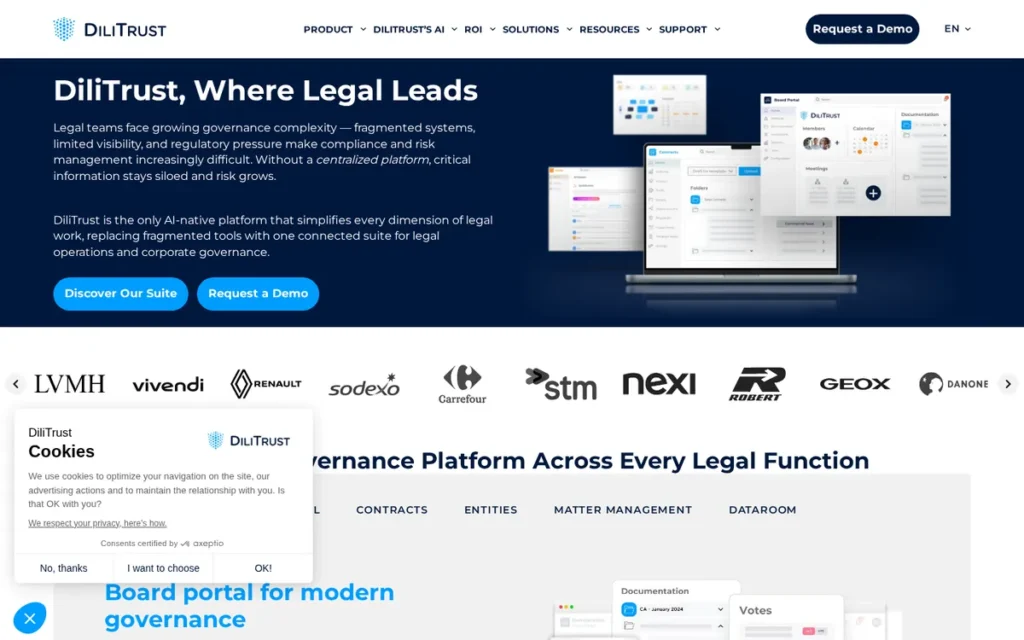
Category: Integrated Governance Suite, a five-module AI-integrated LegalTech platform combining entity management, board portal, contract management, matter management, and virtual data rooms on a single SaaS environment for legal departments managing governance, compliance, and transactional workflows.
At a Glance
- Category: Integrated Governance Suite
- Best For: European enterprises and multinationals requiring integrated governance with GDPR data sovereignty and ISO 27701 certification
- Price Range: Pricing on request: custom SaaS subscriptions by organization size and module selection; no public tiers as of May 2026
- Primary Strength: DiliTrust is the only evaluated platform with sovereign cloud EU hosting, ISO 27701 GDPR certification, and a fully integrated five-module governance suite with AI capabilities dating to 2017
- Biggest Limitation: DiliTrust’s North American compliance depth lags established U.S. incumbents, and the five-module suite creates over-engineering risk for standalone entity management buyers
- One-Line Summary: DiliTrust is an AI-integrated five-module governance platform serving 2,400+ organizations in 64+ countries, uniquely offering sovereign cloud hosting and ISO 27701 GDPR certification unavailable from any other evaluated platform.
- Last Verified: May 2026
Overview
DiliTrust is an AI-integrated governance SaaS platform serving 2,400+ enterprises and law firms in 64+ countries (DiliTrust website, May 2026), built for legal departments requiring entity management, board governance, contract management, matter management, and virtual data rooms in a single integrated environment rather than five separate vendor relationships. DiliTrust differentiates from all evaluated competitors through sovereign cloud hosting for EU data residency and ISO 27701 certification, the GDPR-specific Privacy Information Management System standard held by no other evaluated platform.
DiliTrust has deployed AI capabilities since 2017, accelerated through the 2022 Hyperlex ML acquisition and the 2023 generative AI launch for board meeting minutes, representing the deepest and most independently documented AI development history of any platform in this evaluation. Named clients include BNP Paribas, Royal Bank of Canada, LVMH, and Veolia (DiliTrust website, May 2026).
Key Features
- Entity Management Module: DiliTrust’s Entity Management module centralizes share transfers, ownership structures, mandates, and organizational charts with country color-coding and Excel export compatibility, along with delegation of authority management, capital operations oversight, and customizable power tracking across all group entities (DiliTrust Governance Suite Page, May 2026).
- AI-Powered Board Portal: DiliTrust’s Board Portal supports the full meeting lifecycle (AI-generated agendas, secure document sharing with version control and annotations, AI-powered meeting minutes generation, voting and surveys, e-signatures, and iOS and Android mobile access) providing board governance depth no other evaluated entity management platform delivers natively (Board-room.org review of DiliTrust, 2025).
- AI and ML Contract Intelligence: DiliTrust provides multi-language AI and OCR document processing and ML-powered contract analysis inherited from the 2022 Hyperlex acquisition, delivering automated intelligence across governance, contracts, and entity workflows, with AI capabilities first deployed in 2017, six years before most evaluated competitors (DiliTrust AI Evolution Blog, 2024).
- Sovereign Cloud and GDPR Architecture: DiliTrust provides sovereign cloud hosting with EU data residency options, enabling European organizations subject to GDPR Article 44 transfer restrictions to maintain complete data sovereignty, supported by ISO 27701, ISO 27001, and SOC 2 Type II certifications confirmed in research (DiliTrust Data Protection Statement, 2024).
- Five-Module Integrated Suite: DiliTrust’s five modules: Entity Management, Board Portal, Contract Management, Matter Management, and Dataroom, operate within a unified interface, eliminating data fragmentation for organizations managing combined entity, board, and contract governance that would otherwise require five separate vendor relationships.
Best For
DiliTrust is best for European multinationals and large enterprise legal departments managing entity governance and board operations under GDPR data residency requirements, and for any organization where ISO 27701 certification is a mandatory procurement qualifier.
Strengths
- DiliTrust serves 2,400+ customer organizations in 64+ countries as of May 2026 (DiliTrust website), with confirmed named clients including BNP Paribas, Royal Bank of Canada, LVMH, and Veolia, validating enterprise-grade deployment in the most compliance-intensive institutional sectors in the market.
- DiliTrust is the only entity management platform in this evaluation holding ISO 27701 certification (the GDPR-specific Privacy Information Management System standard that extends ISO 27001 with documented personal data processing accountability requirements) and offering sovereign cloud hosting for EU data residency, directly resolving the procurement disqualifier that prevents European regulated-industry organizations from using U.S.-hosted platforms.
- DiliTrust introduced AI-powered contract management in 2017 and accelerated AI depth through the 2022 Hyperlex ML acquisition and the 2023 generative AI launch for board minutes, representing the earliest AI deployment date and deepest AI development history of any evaluated platform (DiliTrust AI Evolution Blog, 2024).
- DiliTrust’s 2023–2024 doeLEGAL acquisition added U.S.-based enterprise legal management including eBilling, matter management, and eDiscovery, extending DiliTrust beyond governance into full legal department operations, a scope no pure entity management competitor in this evaluation matches (Corporate Compliance Insights, 2024).
Limitations
- North American Compliance Depth: DiliTrust’s doeLEGAL acquisition is its primary U.S. market entry mechanism, meaning DiliTrust’s depth on U.S.-specific entity compliance workflows (state-level annual report filings, Delaware formations, and SEC Section 16 support) may lag behind established U.S. incumbents CT Corporation and CSC, and these capabilities should be explicitly verified during demos before any North American procurement commitment.
- Suite Over-Engineering Risk: DiliTrust’s five-module suite creates genuine over-engineering risk for organizations that need entity management only, procurement teams should evaluate whether they intend to adopt multiple modules before committing, because purchasing the full suite for entity management alone may produce higher per-function cost relative to single-purpose alternatives like Athennian or MinuteBox.
- Limited Independent Community Validation: No independent practitioner community discussions documenting DiliTrust operational failures or endorsements were identified across r/paralegal, r/LawFirm, r/AccountingDepartment, or r/uklaw in research (Reddit search, May 2026), consistent with DiliTrust’s European enterprise deal structure, meaning peer-sourced operational reviews are not accessible through public community channels. DiliTrust’s limitations are therefore strategic and structural rather than operationally documented, which distinguishes this entry from CT Corporation and CSC, whose limitations include direct practitioner reports.
Verdict
DiliTrust is the strongest independent recommendation for European multinationals and large enterprise legal departments requiring integrated governance across entity management, board operations, and contract management within a GDPR-compliant platform, earning rank 1 through the largest verified customer footprint (2,400+ organizations in 64+ countries), the deepest AI development history, and the only ISO 27701 and sovereign cloud hosting combination in this evaluation. DiliTrust’s institutional client roster and approximately €130 million in 2022 funding (Artificial Lawyer, 2022) substantiate enterprise-grade deployment capacity. North American buyers should explicitly evaluate U.S. state-level compliance depth during demos and request module-level pricing to assess cost efficiency against single-purpose alternatives before committing to a full suite engagement.
2. Diligent Entities: Best for Enterprise Governance with Board and Audit Integration
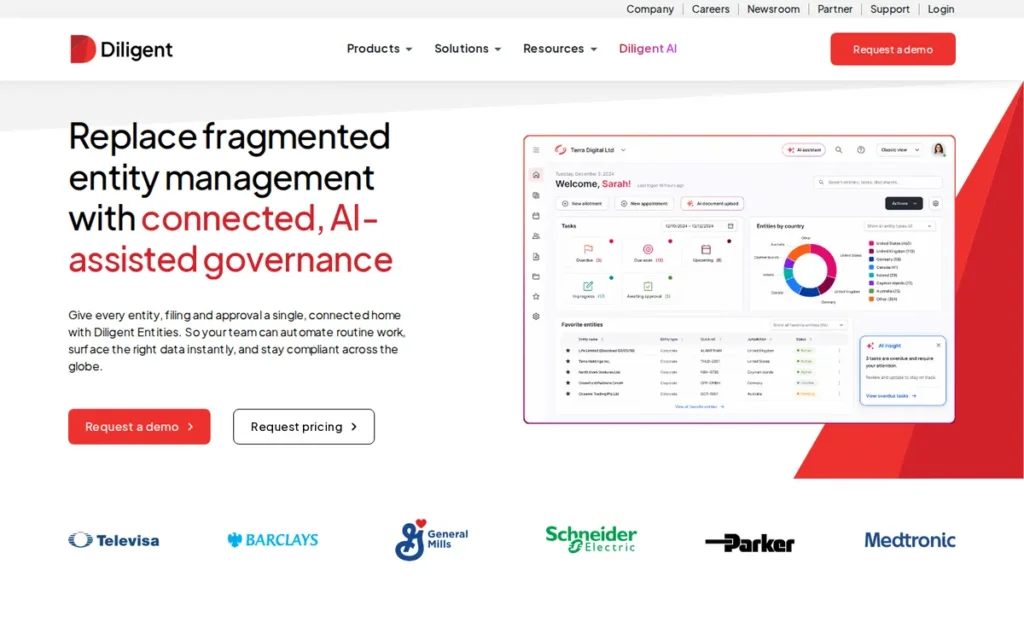
Category: Enterprise Governance Platform, an AI-augmented entity and subsidiary management system integrated within the Diligent One Platform governance cloud, connecting entity data to board management, audit, risk, and compliance workflows.
At a Glance
- Category: Enterprise Governance Platform
- Best For: Fortune 500 legal ops teams already invested in the Diligent governance ecosystem, Diligent Boards, Diligent Audit, Diligent Risk
- Price Range: Pricing on request: custom enterprise subscription via sales engagement only; no tiers or per-entity fees disclosed publicly as of May 2026
- Primary Strength: Diligent Entities launched four publicly named AI modules as early access in June 2025 (AI Report Generator, AI Document Import and Summarization, AI Virtual Assistant, and Microsoft Teams Integration) the most specifically documented AI release in this evaluation
- Biggest Limitation: Diligent Entities has only a single documented public review (3.0/5 on GetApp), and its self-reported 318% ROI, 90% cost reduction, and 70% time reduction are unverified by any independent third-party source
- One-Line Summary: Diligent Entities is an AI-augmented enterprise governance platform serving 100,000+ monthly Diligent One Platform users, with four named AI modules launched June 2025 and a D&B Company Health Check integration launched 2021.
- Last Verified: May 2026
Overview
Diligent Entities is an enterprise-grade, AI-augmented entity and subsidiary management platform (originally Blueprint OneWorld, fully rebranded following Diligent’s acquisition) designed for large corporate legal operations teams requiring entity data to flow directly into board governance, audit management, and compliance workflows within a unified ecosystem. Diligent Entities serves over 100,000 monthly users across the Diligent One Platform and launched four named AI modules as early access in June 2025, including an AI Virtual Assistant enabling entity queries via natural language and a Microsoft Teams integration surfacing entity data without requiring users to leave their collaboration environment.
Diligent Entities is particularly well-suited for enterprises already invested in the Diligent governance stack, where inter-module data connections between entity records, board portals, and audit workflows deliver compounding value unavailable from standalone entity management tools.
Key Features
- AI Virtual Assistant: Diligent Entities’ AI Virtual Assistant (launched June 2025, early access) enables users to query entity data through natural language both within the platform and via Microsoft Teams, eliminating the need to log into the entity management portal for routine governance inquiries during active board or audit workflows (Diligent Newsroom, June 2025).
- AI Report Generator: Diligent Entities’ AI Report Generator (launched June 2025, early access) creates custom governance reports from natural language prompts, replacing manual report-building workflows that previously required data extraction, spreadsheet assembly, and compliance staff time to produce (BusinessWire, June 2025).
- D&B Company Health Check: Diligent Entities integrates Dun and Bradstreet data through a Company Health Check feature (launched 2021) that automatically flags discrepancies between internally maintained entity records and external corporate registry data, a compliance verification layer available in no other evaluated platform (Diligent Help Documentation, May 2026).
- E-Filing and Compliance Calendar: Diligent Entities supports e-filing to governing bodies in 20+ jurisdictions with compliance calendars, automated deadline reminders, and entity lifecycle management workflows covering entity creation, name changes, and structural updates through automated processes rather than manual record edits.
- CSC Strategic Partnership: Diligent Entities operates a strategic partnership with CSC that enables direct data synchronization between the platform’s entity records and CSC’s compliance filing network (CSC Global, 2025), providing registered agent connectivity for enterprises that prefer software-first architecture without owning a proprietary RA network.
Best For
Diligent Entities is best for large enterprise and Fortune 500 legal operations teams already using or actively evaluating Diligent’s broader governance ecosystem (Diligent Boards, Diligent Audit, Diligent Risk) where connected governance workflows across entity, board, and audit data justify premium enterprise pricing and where the Diligent One Platform is the intended long-term governance infrastructure.
Strengths
- Diligent Entities launched four publicly named AI modules as early access in June 2025 (AI Report Generator, AI Document Import and Summarization, AI Virtual Assistant, and AI-Powered Microsoft Teams Integration) representing the most specifically documented and dated AI capability release of any evaluated platform, requiring admin provisioning for Entities Platform package clients (BusinessWire, June 2025).
- Diligent Entities integrates Dun and Bradstreet registry data via its Company Health Check (launched 2021), automatically surfacing discrepancies between internal governance records and external corporate registries, a proactive data quality verification layer that reduces manual compliance audit effort and is unavailable in any other evaluated platform (Diligent Help Documentation, May 2026).
- Diligent Entities is cited as an employer-required platform skill in UK legal professional hiring criteria (r/uklaw, 2025), indicating deep professional market penetration that functions as a reliable proxy for enterprise adoption even in the absence of granular public review data.
- Diligent Entities holds SOC 2 Type II, ISO 27001, ISO 27017, and ISO 27018 certifications, meeting the full enterprise security certification stack required by financial services and legal sector procurement teams conducting mandatory security reviews (Diligent Security Documentation, May 2026).
Limitations
- Independent Review Scarcity: Diligent Entities has a single documented public rating, 3.0/5 on GetApp from one review (GetApp, May 2026), making it impossible to validate operational performance through peer evidence before committing to an enterprise contract, a significant gap for procurement teams that rely on independent review platforms during vendor due diligence.
- Unverified ROI Claims: Diligent Entities’ self-reported figures: 318% ROI, 90% cost reduction, and 70% time reduction, are unverified by any independent third-party source (Diligent AI Innovations 2025 Highlights) and should be treated as illustrative benchmarks rather than independently validated performance data in procurement modeling.
- Deployment Alignment Risk: Reddit community feedback characterizes Diligent Entities as “enterprise-ready but more siloed” and notes that deployment succeeds in legal-led environments but struggles when driven by accounting or finance teams without legal department sponsorship (r/AccountingDepartment, 2025), a stakeholder alignment risk procurement teams should surface before signing.
- Acquisition-Led Architecture: Diligent Entities was assembled through multiple acquisitions, Blueprint OneWorld, Galvanize, HighBond, and others. This acquisition-led architecture introduces potential integration coherence gaps between modules that technical evaluation teams should probe directly with Diligent’s implementation representatives, particularly for customers planning to use entity data across Diligent Audit and Diligent Risk simultaneously.
Verdict
Diligent Entities is the strongest independent recommendation for large enterprise legal operations teams requiring AI-augmented entity management tightly integrated with board governance, audit, and risk workflows within a unified platform, earning rank 2 through four named June 2025 AI modules, a unique D&B Company Health Check, and a closed-loop governance ecosystem unmatched by software-first competitors. Diligent Entities ranks below DiliTrust primarily due to the absence of verifiable public user reviews and its smaller confirmed customer footprint. Buyers should require independent reference client conversations and model full Diligent One Platform total cost of ownership carefully if entity management is their only immediate functional need.
3. Athennian: Best for In-House Legal Teams Bridging Legal and Finance Data
Category: AI-Powered Entity Management Platform, a cloud-native platform purpose-built for legal and finance teams to centralize entity records, automate data entry through AI-assisted document processing, and share governance data across functions via an open API.
At a Glance
- Category: AI-Powered Entity Management Platform
- Best For: In-house legal operations and finance teams at mid-to-large enterprises managing post-acquisition entity portfolios across multiple jurisdictions
- Price Range: Pricing on request: custom subscription via direct inquiry; no public tiers as of May 2026
- Primary Strength: Athennian’s AI Centralize reduces entity data entry from four minutes to 40 seconds per record, automating an estimated 92% of data centralization workflows, the most specifically benchmarked AI performance claim in this evaluation
- Biggest Limitation: Athennian was documented by a practitioner as unable to support in-house FinCEN BOI filing for Corporate Transparency Act compliance, with its demo recommending that law firms redirect BOI work to a registered agent rather than handling it in-platform
- One-Line Summary: Athennian is an AI-powered entity management platform that reduces entity data entry to 40 seconds per record via AI Centralize and full entity creation to under 10 minutes via AI Initialize, with an open API for registered agent and ERP integration.
- Last Verified: May 2026
Overview
Athennian is a cloud-native entity management platform designed for in-house legal operations professionals, corporate secretaries, and in-house counsel who manage entity records, ownership structures, and governance documents across legal and finance functions, with AI-assisted data population as its primary technical differentiator. Athennian’s AI Centralize processes source documents including PDFs, JPEGs, and handwritten records to reduce entity data entry from four minutes to forty seconds, and AI Initialize automates full entity creation to under ten minutes, benchmarks that translate to potentially weeks of saved paralegal time during large post-M&A entity integrations.
Athennian raised a $41.5 million CAD Series B in March 2022, led by Centana Growth Partners, with participation from Arthur Ventures and Clio CEO Jack Newton (Betakit, 2022). Athennian is headquartered in Calgary, Alberta, with particular strength in Canadian law firm markets and in-house teams prioritizing legal-finance data integration.
Key Features
- AI Centralize: Athennian’s AI Centralize reads source governance documents: PDFs, JPEGs, and handwritten records, automatically highlights key data points, automates structured data entry, and reduces a four-minute manual workflow to forty seconds while maintaining a human verification step, automating an estimated 92% of data centralization workflows and saving approximately seven hours per 100 documents processed (Athennian AI Capabilities Page, May 2026).
- AI Initialize: Athennian’s AI Initialize automates full entity and affiliation creation from uploaded source documents, reducing a forty-five-minute entity onboarding workflow to under ten minutes and saving approximately 88 hours per 150 entities created, enabling legal teams to onboard post-acquisition entity portfolios without proportional increases in paralegal staffing (Athennian product documentation, May 2026).
- Open API Integration: Athennian provides an open API for third-party integrations with ERP systems including SAP, Oracle, and Workday, as well as billing platforms, registered agent services, and custom legal operations portals, enabling Athennian to serve as the entity data hub within complex existing enterprise technology stacks.
- Entity Record Centralization: Athennian centralizes entity records, ownership structures, equity and debt instruments, appointments, KYC data, and dynamic visual structure charts with configurable role-based permissions and custom fields supporting jurisdiction-specific identifiers including DUNS numbers, VAT numbers, and provincial registry IDs.
- Multi-Entity-Type and Canadian Compliance Support: Athennian supports corporations, LLCs, partnerships, trusts, and international entities with native CBCA and Canadian provincial registry compliance support, a structural advantage for Canadian law firms managing the unique annual resolution, constating document, and minute book requirements of Canadian corporate law.
Best For
Athennian is best for in-house legal operations and finance teams at mid-sized to large enterprises managing 50 to 500+ entities across multiple jurisdictions (particularly organizations that have grown through acquisitions and need to onboard large entity portfolios quickly) and for Canadian law firms with CBCA compliance, multi-entity-type support, and legal-finance cross-functional data sharing requirements.
Strengths
- Athennian’s AI Centralize reduces entity data entry from approximately four minutes to forty seconds per record, automating an estimated 92% of data centralization workflows (Athennian AI Capabilities Page, May 2026), the most specifically benchmarked AI time-savings claim in the evaluated platform set, providing buyers with a concrete ROI calculation basis unavailable from any competitor with equivalent specificity.
- Athennian was explicitly endorsed by an in-house professional as “the only one that feels like it was built for legal and finance to actually share data without chasing docs” (r/AccountingDepartment, 2025), an independent practitioner community endorsement directly validating Athennian’s cross-functional workflow design philosophy.
- Athennian’s self-published 2025 Global Entity Management Trends Report documents 84% enterprise adoption of specialized entity management software and confirms that 67% of businesses manage entities across three or more jurisdictions (Athennian, 2025), while originating from Athennian’s own research, this market context is consistent with broader category trend observations.
- Athennian raised a $41.5 million CAD Series B in March 2022 led by Centana Growth Partners (Betakit, 2022), holds SOC 2 Type II certification with annual third-party penetration testing and data encryption at rest, and provides an open API for ERP and registered agent connectivity.
Limitations
- BOI/CTA Compliance Gap: Athennian was documented by a practitioner who evaluated Athennian specifically for Corporate Transparency Act FinCEN BOI compliance as having a demo that recommended redirecting BOI work to a registered agent rather than handling it in-platform, a significant workflow gap for law firms seeking to manage CTA compliance internally rather than outsourcing.
“Athennian’s demo was pathetic. They ultimately recommended that we direct our clients to a registered agent for this work, rather than doing it ourselves.” (u/n0tar3dsh1rt, r/LawFirm, 2023)
Takeaway: A vendor recommending outsourcing during a demo for a specific compliance workflow signals that workflow is not natively supported in-platform, law firms evaluating Athennian for Corporate Transparency Act BOI filing must test this specific scenario in a demo rather than relying on general feature claims.
- Self-Reported Benchmarks: Athennian’s published performance benchmarks, 40-second data entry via AI Centralize and sub-10-minute entity creation via AI Initialize, are self-reported from Athennian’s own content rather than independently verified third-party case studies (Athennian Blog, 2025), and no named client case study with quantified outcomes was identified in research, buyers should request specific reference clients during procurement.
- Registered Agent Integration Confirmation: Buyers managing existing registered agent relationships should confirm API connectivity with their specific incumbent RA provider before purchase, as Athennian’s open API is the primary integration mechanism rather than a native RA service, a documented non-negotiable criterion raised specifically in practitioner community discussions (r/AccountingDepartment, 2025).
Verdict
Athennian is the strongest independent recommendation for in-house legal operations teams that prioritize AI-driven data entry automation and legal-finance cross-functional data sharing, its published AI benchmarks (40-second data entry via AI Centralize, 92% data centralization automation, 88 hours saved per 150 entities via AI Initialize) are the most specifically documented performance claims in the evaluated set, providing a calculable ROI basis no competing platform matches with equivalent specificity. Law firm buyers evaluating Athennian specifically for FinCEN BOI and Corporate Transparency Act compliance support must directly test this workflow during demos, as community evidence documents this as a potential disqualifying gap for law firms handling CTA compliance in-house.
4. MinuteBox: Best for Law Firms Managing Client Entity Portfolios and Minute Books
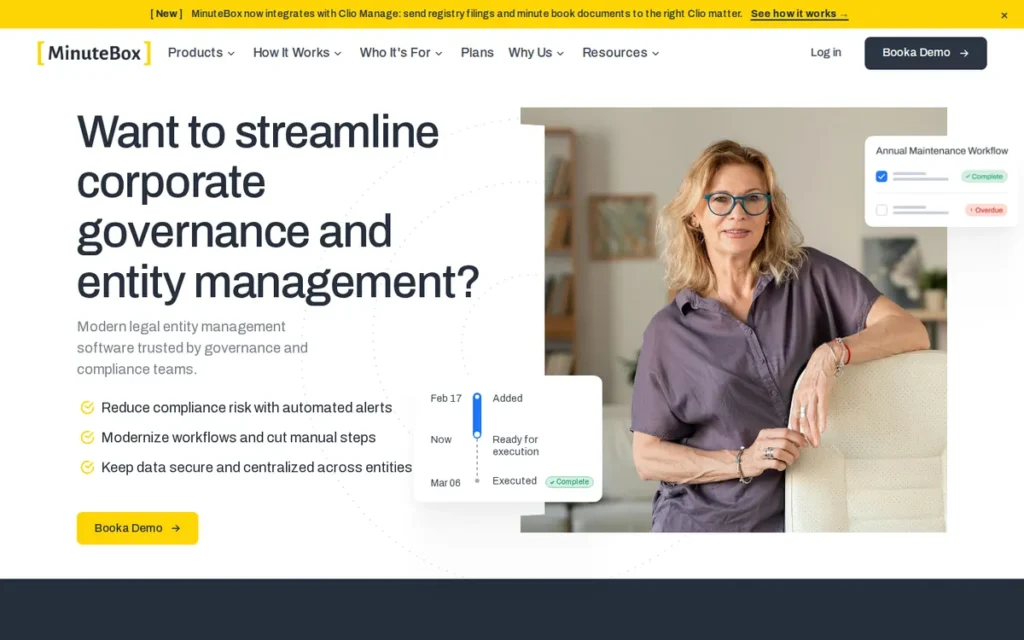
Category: Law Firm Entity Management Platform, a cloud-based platform specifically architected for law firms and corporate legal teams, with minute book creation, client entity portfolio management, document generation, and government registry search integration as first-class features alongside compliance tracking.
At a Glance
- Category: Law Firm Entity Management Platform
- Best For: Law firms managing client entity portfolios requiring minute book automation, physical record digitization, and secure client record sharing
- Price Range: Pricing on request: no public tiers, per-entity, or per-user pricing available; contact MinuteBox sales directly as of May 2026
- Primary Strength: MinuteBox is the only evaluated platform offering both native minute book automation as structured data generation and an on-site physical minute book digitization service using proprietary scanning and AI categorization
- Biggest Limitation: MinuteBox provides no public pricing, no named law firm client references in public materials, and has no documented practitioner community presence on Reddit, making independent pre-sales validation inaccessible for prospective buyers
- One-Line Summary: MinuteBox is a law-firm-focused entity management platform used by law firms and legal departments that automates minute book creation on demand, provides Second Chair AI for natural language UBO queries, and offers on-site physical legacy digitization unavailable in any other evaluated platform.
- Last Verified: May 2026
Overview
MinuteBox is a cloud-based entity management platform specifically architected for law firms and corporate legal teams, treating minute book creation and on-demand generation as a structured data and document generation problem, rather than a document storage problem, enabling law firms to produce complete, audit-ready minute books for any client entity at any time without manually reconstructing scattered historical files. MinuteBox uniquely addresses the most pervasive migration barrier for law firms with paper legacy records through an on-site physical digitization service, using proprietary scanning technology and AI-powered categorization to convert physical minute books into structured digital entries, a service offered by no other evaluated platform (MinuteBox Press, May 2026).
MinuteBox’s Second Chair AI provides natural language search across all governance records including UBO queries, its built-in government registry search eliminates platform-switching during due diligence, and its secure client portal replaces PDF-download workflows with real-time shared record access for clients and external counsel.
Key Features
- Native Minute Book Automation: MinuteBox automates minute book creation and ongoing maintenance (initial resolutions, director appointments, share issuances, and organized record sets for audits and investor due diligence) generating complete, current minute books on demand without requiring law firm staff to reconstruct historical filing sequences from scattered document libraries (MinuteBox Features Page, May 2026).
- Physical Minute Book Digitization Service: MinuteBox offers an on-site physical minute book digitization service using proprietary scanning technology and AI-powered document categorization, converting decades of paper corporate records into structured digital entries within the platform, the only evaluated platform providing this physical-to-digital conversion as an integrated service for law firms transitioning from legacy paper-based practices (MinuteBox Press, May 2026).
- Second Chair AI: MinuteBox’s Second Chair AI provides natural language search across all governance records and direct UBO (Ultimate Beneficial Owner) queries, enabling paralegals and corporate counsel to retrieve beneficial ownership information and governance history through conversational queries without manual record navigation (MinuteBox Blog, May 2026).
- Built-In Government Registry Search: MinuteBox includes built-in registry searches covering government corporate database lookups, lien registry searches, and PPSA (Personal Property Security Act) checks directly within the platform interface, eliminating the workflow interruption of switching to provincial government portals during corporate due diligence.
- Secure Client Portal: MinuteBox provides a secure client portal with expiring access links enabling law firms to share governance records with clients and external counsel in real time, eliminating the PDF-download and email-based document distribution workflows that legal teams consistently identify as primary productivity bottlenecks in client entity management.
Best For
MinuteBox is best for law firms (particularly Canadian law firms subject to CBCA, provincial corporate registry, and annual resolution requirements) that manage multiple client entity portfolios across corporations, trusts, limited partnerships, and family structures, require minute book automation as a primary feature rather than a secondary capability, and need to provide clients with real-time governance record access through a dedicated client portal.
Strengths
- A verified G2 testimonial from a law firm professional (2025) specifically praised MinuteBox for enabling real-time governance record sharing without PDF-download workflows and for supporting multiple entity types (corporations, trusts, limited partnerships, and family structures) that prior entity management software could not accommodate (G2 Reviews for MinuteBox, 2025).
- MinuteBox holds SOC 2 Type II, ISO 27001, ISO 27017, and ISO 27018 certifications with end-to-end encryption and biometric and hardware key authentication options (MinuteBox Blog, May 2026), a security stack matching the most enterprise-rigorous platforms evaluated, directly addressing law firms’ professional responsibility obligations around client data protection.
- MinuteBox’s physical minute book digitization service uses proprietary scanning technology and AI categorization to convert paper records into structured digital entries, a capability unique across all seven evaluated platforms that directly resolves the migration barrier for law firms with 10 to 30+ years of legacy paper-based corporate records (MinuteBox Press, May 2026).
- MinuteBox’s integrated M&A due diligence checklists with secure data room functionality provide law firms with a single platform for both ongoing entity maintenance and transaction-specific due diligence, enabling MinuteBox’s data room to serve smaller due diligence events rather than requiring separate per-deal VDR subscriptions, subject to buyers confirming the VDR meets their specific security and access control requirements.
Limitations
- Independent Validation Gap: MinuteBox has no named law firm clients in its public materials, no verified aggregate G2 or Capterra rating with a confirmed review count, no public pricing, and no documented practitioner community discussions on Reddit across any legal or paralegal subreddit, making it impossible for buyers to validate real-world operational performance through peer evidence before initiating a sales conversation.
Users on r/LawFirmCanada shared their experience after a year of use:
“We’ve been using Minutebox for about a year but haven’t been overly impressed and our clerks have asked to explore other options. Cursory search has brought up Athennian (but I think they left the Canadian market), Diligent, and Appara but haven’t seen much in terms of reviews. Would love to know folks thoughts!” Posted by u/Snoo_51992
Takeaway: Extended real-world use has generated clerk-level dissatisfaction with MinuteBox at Canadian law firms, and the absence of independent comparative review data leaves buyers without a reliable peer evidence base when evaluating alternatives.
- Pricing Opacity: MinuteBox provides no pricing signal whatsoever before sales engagement (not even a range) creating a meaningful evaluation-stage disadvantage relative to ContractZen’s publicly listed $9.50–$27/user/month and even relative to competitors like CT Corporation whose community-estimated pricing provides at least a rough TCO baseline before procurement discussions begin.
This barrier was raised directly in community discussion on r/LawCanada:
“I talked to MinuteBox but they have a very high yearly commitment requirement and they usually cater to large law firms. I would like to know recommendations what other solo practitioners and small firms using for these?” Posted by u/Realistic_Slide1634
Takeaway: MinuteBox’s high annual commitment thresholds effectively exclude solo practitioners and small law firms, confirming the platform’s enterprise-only positioning and its unsuitability for the broader small-firm segment of the law firm market.
- U.S. Compliance Workflow Depth: MinuteBox’s positioning as a Canadian law firm specialist means its depth for U.S. law firms managing state-specific compliance workflows or FinCEN BOI filing requirements was not confirmed in research, these capabilities must be explicitly evaluated during a product demo before purchase by any U.S. law firm.
- Enterprise In-House Scalability: MinuteBox’s specialized architecture for law firm client entity portfolios may not serve in-house corporate legal teams requiring ERP integrations, direct finance system connectivity, or multi-currency ownership tracking at enterprise scale, buyers in this segment should evaluate Athennian or Diligent Entities instead.
Verdict
MinuteBox is the strongest independent recommendation for law firms (especially Canadian law firms) requiring minute book automation as a primary feature, needing to transition paper legacy records to digital, and serving clients across corporations, trusts, limited partnerships, and family structures not uniformly supported by general-purpose entity management platforms. MinuteBox’s combination of native minute book generation, physical digitization service, Second Chair AI for UBO queries, built-in registry search, and client portal functionality addresses the law firm use case with greater specificity than any other evaluated platform. Buyers should require named client references during evaluation and explicitly probe U.S.-specific compliance workflow depth, given the complete absence of publicly accessible third-party validation.
5. CT Corporation (hCue) by Wolters Kluwer: Best for Large Enterprises Already Using CT Corporation Registered Agent Services
Category: Registered Agent and Entity Management Platform, a web-based entity management platform uniquely bundled with CT Corporation’s owned registered agent services, combining software, compliance calendar management, and direct RA filing infrastructure within a single Wolters Kluwer vendor relationship.
At a Glance
- Category: Registered Agent and Entity Management Platform
- Best For: Large enterprises and publicly traded companies already using CT Corporation RA services across all 50 U.S. states
- Price Range: Pricing on request: RA services estimated by community sources at over $400/domestic unit/year; software subscription not publicly disclosed as of May 2026
- Primary Strength: CT Corporation hCue’s 130-year owned RA network across all 50 U.S. states plus the only native SEC Section 16 module for public company insider trading form management in this evaluation
- Biggest Limitation: CT Corporation hCue’s portal is consistently described by multiple independent practitioners as “old and clunky”; pricing is repeatedly characterized as the most expensive in the category; and no confirmed AI features or roadmap were identified in research as of May 2026
- One-Line Summary: CT Corporation hCue is the oldest entity management platform in the U.S. market, backed by 130 years of registered agent infrastructure across all 50 states and uniquely including a native SEC Section 16 module for public company insider trading form management.
- Last Verified: May 2026
Overview
CT Corporation hCue is a web-based entity management platform designed for large enterprise and Fortune 500 legal departments, uniquely differentiated by its direct integration with CT Corporation’s owned registered agent services, the oldest RA network in the United States, founded in 1892 and operating across all 50 U.S. states, Canadian provinces, and select international jurisdictions. CT Corporation hCue bundles entity record management, compliance calendar tracking, automated e-filing, business license management, CTAdvantage due diligence research, and a native SEC Section 16 module for public company insider trading form filings (CT Corporation hCue Press Release, 2013).
CT Corporation hCue holds SOC 2 Type II, ISO 27001, ISO 27017, and ISO 27018 certifications and operates as part of Wolters Kluwer’s Corporate Legal Services division.
Key Features
- Owned 130-Year RA Network Integration: CT Corporation hCue integrates directly with CT Corporation’s registered agent network covering all 50 U.S. states and Canadian provinces, enabling automatic synchronization of entity compliance records with registered agent filings through ARMS (CT Corporation’s filing service) eliminating dual-system management for enterprises with existing CT Corporation RA relationships.
- Native SEC Section 16 Module: CT Corporation hCue includes a native module for managing public company insider trading form filings (Forms 3, 4, and 5) a compliance capability unique in the evaluated set that directly serves the filing requirements of publicly traded companies and their legal and compliance departments.
- Business License Management Module: CT Corporation hCue provides a business license management module covering local, state, and federal permits alongside entity management, consolidating two distinct compliance functions that most organizations manage through separate systems into a single platform.
- CTAdvantage Due Diligence Module: CT Corporation hCue’s CTAdvantage module enables online due diligence and corporate transaction research (including corporate status verification, certificate of good standing retrieval, and historical entity research) directly within the entity management platform without platform switching during M&A or lending transactions.
- Enterprise Integrations and Filing Automation: CT Corporation hCue supports Workday and DocuSign integrations, bulk director and officer change uploads, point-in-time historical data retrieval, and API access for custom system connections (Wolters Kluwer Resources, May 2026).
Best For
CT Corporation hCue is best for large U.S. and multinational enterprises already using CT Corporation as their registered agent provider (where the compounded value of a single RA and entity management vendor relationship is highest) and specifically for publicly traded companies requiring SEC Section 16 insider trading form filing support within their entity management platform.
Strengths
- CT Corporation was founded in 1892 and operates the oldest active registered agent network in the United States across all 50 states, a 130-year operational infrastructure providing U.S. domestic entity compliance coverage that no software-only competitor can replicate, confirmed by recognition as a required platform skill in paralegal and legal professional hiring discussions (r/uklaw, 2025; CT Corporation hCue Press Release, 2013).
- CT Corporation hCue holds SOC 2 Type II, ISO 27001, ISO 27017, and ISO 27018 certifications, the full enterprise security certification stack required by financial services and legal sector procurement teams, matching the highest certification standards confirmed in this evaluation (Wolters Kluwer hCue Page, May 2026).
- A G2 reviewer (accessed May 2026) praised CT Corporation hCue for “ease of use, comprehensive features, customizable reporting, and learning potential” (G2 Reviews for CT Corporation hCue, accessed May 2026), suggesting the platform’s compliance breadth and reporting capabilities satisfy users who engage with its full feature depth.
- CT Corporation hCue’s multi-module architecture: entity management, owned registered agent, business license management, CTAdvantage due diligence, and SEC Section 16 support, consolidates more distinct compliance functions into a single vendor relationship than any other evaluated platform except DiliTrust’s five-module suite.
Limitations
- Legacy Portal Experience: CT Corporation hCue’s portal is consistently and specifically described by multiple independent practitioners as “old and clunky” across multiple community threads spanning 2022 through 2025, indicating a structural UI issue rather than an isolated complaint that affects adoption rates across legal operations teams.
“CT Corp has better customer service overall, but their online portal is old and clunky.” (u/ModeVida07, r/paralegal, 2024)
Takeaway: CT Corporation’s service quality strengths (institutional knowledge, RA infrastructure depth) coexist with documented UX weaknesses. Teams with existing CT Corporation RA relationships should evaluate portal usability specifically before committing to hCue as their entity management software overlay.
- Premium Pricing and Filing Deadline Practices: CT Corporation hCue is described by multiple independent practitioners as “extremely overpriced” with RA services exceeding $400 per domestic unit annually, and CT Corporation has a documented practice of requiring filings 30 to 60 minutes before state cut-off times (r/paralegal, 2022), internally adding processing buffer that shortens effective compliance windows without disclosing this as explicit policy.
- No Confirmed AI Features or Roadmap: CT Corporation hCue has no publicly documented AI feature roadmap or AI capability announcements confirmed in research as of May 2026, placing it alongside CSC as a platform whose competitive position may erode as AI-assisted entity data entry and compliance automation become market-standard expectations, buyers with multi-year contract horizons should inquire directly about Wolters Kluwer’s AI product roadmap for hCue before committing.
- New Buyer Value Proposition: For enterprises not already using CT Corporation as their registered agent, CT Corporation hCue’s bundled pricing premium does not clearly justify its legacy UI and service delivery limitations relative to modern software-first alternatives with equivalent or superior compliance automation, making CT Corporation hCue most defensible as a retention play for existing RA customers rather than a competitive first choice for new buyers.
Verdict
CT Corporation hCue is the strongest independent recommendation for large enterprises already invested in CT Corporation’s registered agent services, where eliminating a second vendor for entity management delivers compounding operational value, and specifically for publicly traded companies requiring SEC Section 16 insider trading form management within their entity governance platform. CT Corporation hCue’s 130-year RA infrastructure, multi-module compliancedepth, and enterprise security certifications are genuine differentiators for organizations with existing CT Corporation relationships. New enterprise buyers without a prior CT Corporation RA commitment should carefully compare total cost of ownership against modern software-first alternatives and specifically test the portal user experience during evaluation, the “old and clunky” characterization from practitioner communities reflects a real usability concern that affects adoption rates.
6. ContractZen: Best for SMBs and Growing Companies Replacing Spreadsheet-Based Entity Tracking
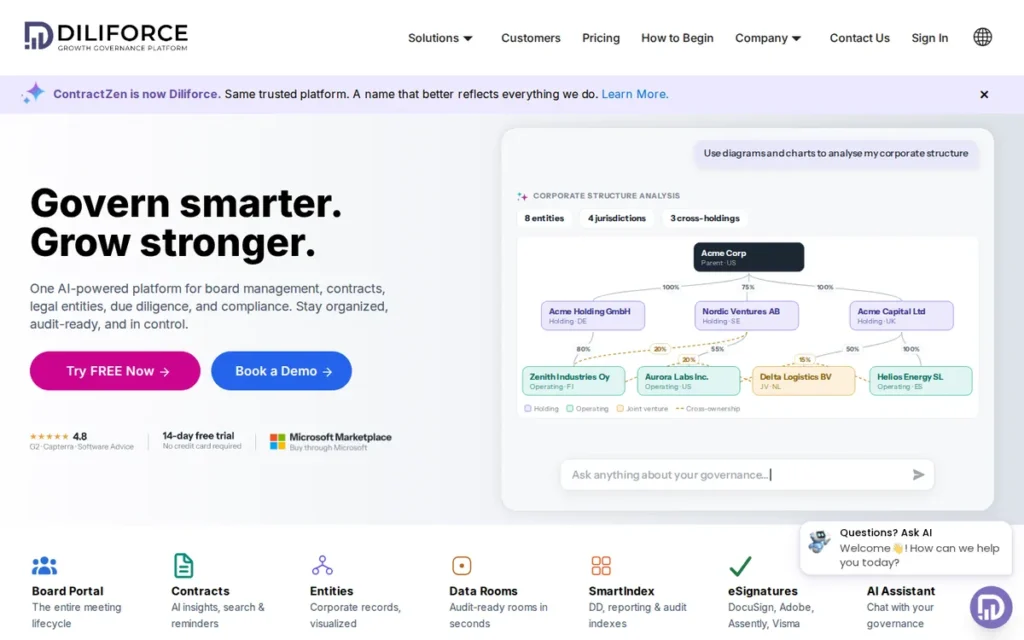
Category: All-in-One SMB Governance Suite, an affordable five-module platform combining entity management, contract management, board portal, e-signatures, and virtual data room in a single Microsoft Azure-hosted subscription, designed for SMBs and growing companies replacing manual or fragmented governance tools.
At a Glance
- Category: All-in-One SMB Governance Suite
- Best For: SMBs and European companies with fewer than 200 entities replacing spreadsheet-based tracking, needing GDPR-native governance with Microsoft 365 integration
- Price Range: Standard ~$9.50/user/month; Advanced ~$27/user/month (minimum 5 users); Custom for 50+ users (ContractZen pricing page, May 2026), the only evaluated platform with publicly listed pricing
- Primary Strength: ContractZen is the only evaluated platform with publicly listed pricing and the only platform bundling entity management, contract management, board portal, e-signatures, and VDR in a single SMB-accessible subscription
- Biggest Limitation: ContractZen’s compliance automation depth and AI capabilities are materially thinner than enterprise-grade platforms, with a custom-pricing threshold at 50+ users creating a scalability ceiling for growing organizations
- One-Line Summary: ContractZen is the only entity management platform in this evaluation with publicly listed pricing, approximately $9.50–$27 per user per month as of May 2026, offering five governance modules in a single Microsoft Azure-hosted subscription designed for SMBs and GDPR-regulated European companies.
- Last Verified: May 2026
Overview
ContractZen is a Helsinki-based, all-in-one governance SaaS platform combining entity management, contract management, a board portal, e-signature capabilities, and a virtual data room in a single Microsoft Azure-hosted subscription, designed for SMBs, startups, and growing companies replacing spreadsheet-based entity tracking without justifying five separate governance tool subscriptions. ContractZen is the only entity management platform in this evaluation with publicly discoverable pricing, listing approximately $9.50 per user per month for the Standard plan and approximately $27 per user per month for the Advanced plan (ContractZen pricing page, May 2026), a transparency advantage that provides immediate cost-comparison capability that all other evaluated platforms deny buyers until after full sales engagement.
ContractZen’s GDPR-native architecture on Microsoft Azure, native Microsoft 365 and Outlook integration, and multilingual AI assistant supporting French, German, Spanish, Italian, and Dutch position it specifically for European SMBs managing entities across multi-language EU jurisdictions.
Key Features
- Entity Management with Multilingual AI Assistant: ContractZen’s Entity Management module centralizes corporate records, subsidiaries, procuration rights, licenses, and personnel data with dynamic ownership charts, AI-powered OCR search, and a multilingual AI Assistant providing governance document summaries in French, German, Spanish, Italian, Dutch, and additional European languages (ContractZen UK Entity Management Page, May 2026).
- Microsoft 365 and GDPR-Native Architecture: ContractZen integrates natively with Microsoft 365 (including Outlook calendar for compliance deadline management and Microsoft SSO) and is built on Microsoft Azure with GDPR compliance and data sovereignty features, aligning directly with the technology infrastructure of European SMBs standardized on Microsoft environments.
- Integrated Virtual Data Room: ContractZen’s integrated VDR includes RSA 256 encryption, dynamic indexing, granular access rights management, customizable watermarks, and full audit trails, enabling organizations to use ContractZen’s data room for periodic M&A due diligence or investor access events rather than procuring a separate VDR subscription, subject to buyers confirming the VDR meets their specific security requirements (ContractZen Product Page, May 2026).
- Multi-Provider E-Signature Support: ContractZen supports e-signatures from Adobe Sign, DocuSign, Assently, and Visma Sign within a single platform, reducing tool fragmentation for governance teams managing signing workflows across multiple counterparty preferences and geographic e-signature standards.
- Five-Module Governance Suite: ContractZen bundles Entity Management, Contract Management, Board Portal, E-Signatures, and Virtual Data Room in a single subscription, eliminating five separate vendor relationships that individually purchased tools would require, providing a total-cost-of-ownership advantage for SMBs that cannot justify enterprise-tier governance stack costs.
Best For
ContractZen is best for SMBs, startups, and growing companies with fewer than 200 entities replacing spreadsheet-based governance tracking with purpose-built software, and specifically for European SMBs requiring GDPR-native design, Microsoft 365 native integration, and multilingual AI document support without the enterprise-scale pricing commitments of Diligent Entities, CT Corporation, DiliTrust, or CSC.
Strengths
- ContractZen is the only platform in this evaluation with publicly listed pricing: Standard at approximately $9.50/user/month and Advanced at approximately $27/user/month as of May 2026 (ContractZen pricing page), providing immediate cost-comparison capability during early-stage procurement evaluation that all six other evaluated platforms deny buyers until after full sales engagement.
- ContractZen’s five-in-one suite structure (Entity Management, Contract Management, Board Portal, E-Signatures, and VDR) eliminates the need for five separate vendor relationships across common governance functions, providing a total-cost-of-ownership advantage for SMBs that would otherwise subscribe to multiple single-purpose tools at higher aggregate cost.
- ContractZen’s GDPR-native Microsoft Azure architecture, native M365 and Outlook integration, and multilingual AI assistant supporting French, German, Spanish, Italian, and Dutch directly address the compliance and operational requirements of European SMBs managing entities across multi-language EU member state jurisdictions.
- ContractZen maintains active public review profiles on G2, Capterra, SoftwareAdvice, CBInsights, and TrustRadius (G2 Competitors Page for ContractZen, May 2026), a transparency signal indicating willingness to be compared publicly that no other evaluated platform matches in breadth of review platform participation.
Limitations
- Enterprise Compliance Depth: ContractZen’s compliance automation and AI capabilities are materially thinner than enterprise-grade platforms, ContractZen’s AI features (multilingual OCR and document summary assistant) have not been publicly benchmarked with the specificity of Athennian’s 40-second data entry claim or compared quantitatively to Diligent’s four named AI modules, making ContractZen unsuitable for large enterprises managing complex multi-jurisdiction e-filing requirements.
- Scalability Ceiling: ContractZen’s custom pricing threshold at 50+ users creates a repricing cycle with no public benchmark, buyers anticipating this threshold within 24 months should request multi-year pricing guarantees before committing, model growth scenarios against Athennian and DiliTrust at equivalent entity counts, and confirm that the eventual custom pricing tier is competitively positioned before signing a first contract.
- Community Validation Gap: No Reddit community discussions mentioning ContractZen were identified in any legal, compliance, or contract management practitioner forum (Reddit search, May 2026), consistent with its European market focus, but meaning peer-sourced operational validation from legal operations professionals is not accessible through public community channels before procurement.
Verdict
ContractZen is the strongest independent recommendation for SMBs and growing companies with fewer than 200 entities replacing spreadsheet-based governance tracking with software that is affordable, all-in-one, and immediately cost-comparable without a sales cycle. ContractZen’s unique pricing transparency, five-module suite bundling, GDPR-native Microsoft Azure design, and multilingual AI support address the SMB governance gap that the enterprise-first platforms in this evaluation systematically underserve. Organizations anticipating rapid entity portfolio growth beyond 200 entities, or requiring deep multi-jurisdiction e-filing automation comparable to CT Corporation or DiliTrust, should model their expected growth trajectory against ContractZen’s 50-user custom-pricing ceiling before committing.
7. CSC Entity Management: Best for Fortune 500 Organizations with Existing CSC Registered Agent Relationships
Category: Full-Service Compliance and Entity Management Platform, a managed compliance service combining cloud-based entity management software with professional compliance advisory support, owned registered agent services, and global filing infrastructure backed by 125 years of corporate services history.
At a Glance
- Category: Full-Service Compliance and Entity Management Platform
- Best For: Fortune 500 and large multinationals already using CSC as their registered agent and compliance services provider
- Price Range: Pricing on request: registration services estimated by community sources at approximately $115/state/entity; software subscription not publicly disclosed as of May 2026
- Primary Strength: CSC Entity Management’s Fortune 500 client roster (Apple, Amazon, Alphabet, Disney, Ford, Toyota per Wikipedia, 2022) and $1.3B annual revenue confirmed by Fitch Ratings, the most recognizable named enterprise client validation in this evaluation
- Biggest Limitation: CSC Entity Management generates the most specifically negative independent practitioner feedback of any evaluated platform, documented week-plus turnaround times, billing disputes requiring multiple exchanges, a managed-service model that prevents self-service record updates, and no confirmed AI capabilities in research as of May 2026
- One-Line Summary: CSC Entity Management is the world’s largest corporate domain registrar and a $1.3 billion full-service compliance provider serving Apple, Amazon, and Alphabet, but is consistently and specifically criticized by independent practitioners for slow turnaround times, billing disputes, and self-service record restrictions.
- Last Verified: May 2026
Overview
CSC Entity Management is a cloud-based entity governance platform backed by Corporation Service Company, a $1.3 billion revenue, 125-year-old corporate services institution founded in 1899 in Wilmington, Delaware, with approximately 8,000 employees globally, confirmed by Fitch Ratings (July 2025) as financially stable. CSC serves as the world’s largest corporate domain registrar with a Fortune 500 client roster that includes Apple, Alphabet, Amazon, The Walt Disney Company, Ford Motor Company, and Toyota Motor Corporation per Wikipedia (2022), the most recognizable named client set of any evaluated platform.
CSC differentiates from software-only competitors through a managed compliance model in which professional compliance advisors assist with filing execution. CSC Entity Management includes real-time organizational chart generation, cap table management, online minute books, DocuSign eSignature integration, Workday integration, and a strategic partnership with Diligent Entities for entity record data synchronization.
Key Features
- Managed Compliance Model: CSC Entity Management pairs its cloud-based platform with professional compliance advisors who assist with filing execution as a managed service, designed for organizations preferring expert-assisted compliance support over fully self-managed software, backed by CSC’s global filing infrastructure across the U.S., Canada, Europe, and Asia-Pacific.
- DocuSign Integrated E-Signature Workflow: CSC Entity Management integrates DocuSign eSignature directly within compliance document workflows, enabling electronic routing and signing of governance documents alongside compliance tracking without switching platforms (CSC Webinar, 2025).
- Workday Integration: CSC Entity Management integrates with Workday for HR and organizational data synchronization, enabling officer and director changes to flow between HR records and entity management records without manual re-entry across disconnected systems.
- Diligent Entities Strategic Partnership: CSC Entity Management operates a strategic partnership with Diligent Entities enabling direct data synchronization between CSC’s compliance filing network and Diligent’s entity management platform (CSC Global, 2025), providing a data bridge for organizations managing both vendor relationships simultaneously.
- Global Compliance Infrastructure: CSC Entity Management provides real-time organizational chart generation, cap table management, global compliance automation, deadline tracking, and online minute books, backed by global offices across the United States, Canada, Europe, and Asia-Pacific supporting multinational compliance requirements (CSC Entity Management Product Page, May 2026).
Best For
CSC Entity Management is best for Fortune 500 and large multinational corporations already using CSC as their registered agent and compliance services provider (where the consolidated vendor relationship and managed compliance support deliver operational value that justifies the premium cost) and specifically for organizations that prefer a model where compliance professionals assist with filing execution rather than handling all compliance actions through self-service.
Strengths
- CSC generated approximately $1.3 billion in annual revenue as confirmed by Fitch Ratings (July 2025), with approximately 8,000 employees globally and a Fortune 500 client roster that includes Apple, Alphabet, Amazon, The Walt Disney Company, Ford Motor Company, and Toyota Motor Corporation per Wikipedia (2022), the most recognizable enterprise client roster of any evaluated platform, validating enterprise-scale compliance infrastructure capacity.
- CSC is the world’s largest corporate domain registrar as of 2022 (Wikipedia) and a 125-year-old corporate services institution with global filing infrastructure across the United States, Canada, Europe, and Asia-Pacific (CSC History Page, May 2026), providing multinational compliance reach for organizations managing entities across multiple continents.
- CSC’s platform is described in independent community comparisons as having a more modern portal interface than CT Corporation (r/paralegal, 2024), and native DocuSign and Workday integrations address the two most frequently cited enterprise technology integration requirements in entity management procurement.
- CSC’s strategic partnership with Diligent Entities enables organizations using both platforms to synchronize entity records with CSC’s compliance filing network (CSC Global, 2025), providing a data bridge between software-managed governance records and RA-executed compliance filings for enterprises managing both relationships.
Limitations
- Service Delivery Inconsistency: CSC Entity Management generates the most specifically documented service delivery failures of any evaluated platform, a practitioner reports that CSC took over one week to file a simple form and charged add-on fees for routine form completion, and a second practitioner explicitly recommends “Avoid CSC at all costs” after a billing dispute requiring six emails and three days to resolve an invoice inaccuracy (r/paralegal, 2024).
“I’m not happy with their service. Their TATs are ridiculous (1 week+ for them to fill out a simple form to be filed with the state! And an additional fee to fill out the simple form!) and they have us do most of the work. I don’t understand what we are paying them for.” (u/caringiscreepyy, r/paralegal, 2024)
Takeaway: When a managed-service provider charges additional fees for routine form completion while the internal team still performs most of the preparation work, the managed-service model has not delivered the compliance efficiency gains that justify its cost, buyers should negotiate explicit SLA commitments for turnaround times and billing accuracy before signing any CSC engagement.
- Self-Service Record Update Restrictions: CSC Entity Management’s managed-service architecture prevents users from updating their own entity records in self-service mode, a specific and documented complaint from practitioners who describe “not being able to make updates myself” (r/paralegal, 2024), recreating the administrative dependency that entity management software is explicitly designed to eliminate.
- No Confirmed AI Capabilities: CSC Entity Management is the only evaluated platform for which no publicly named or documented AI features were confirmed in research as of May 2026, buyers should ask CSC directly whether an AI product roadmap exists before concluding this represents a permanent rather than a current gap, and should model the competitive AI difference against alternatives with specific, documented AI benchmarks.
- Absent Public Review Data: No verified G2 or Capterra aggregate ratings with review counts were confirmed in research (Capterra, May 2026), meaning independent peer validation of service quality through public review platforms is not accessible, operational performance must be evaluated entirely through negotiated reference calls and contract SLA terms.
Verdict
CSC Entity Management’s Fortune 500 client roster, $1.3 billion in annual revenue confirmed by Fitch Ratings (July 2025), and global compliance infrastructure confirm its position as the largest corporate compliance services provider in this evaluation, and its registered agent network and DocuSign and Workday integrations are genuine enterprise-scale capabilities. CSC ranks seventh because its community sentiment score is the lowest of any evaluated platform, driven by consistently documented practitioner complaints about turnaround times, billing disputes, add-on fees, and self-service restrictions that directly contradict the compliance efficiency goals of the target audience. Enterprises evaluating CSC should explicitly negotiate SLA commitments for TATs and billing accuracy as binding contract terms, pilot the self-service record update workflow during evaluation, and model total cost of ownership, including per-transaction filing fees and form completion charges, against software-first alternatives before committing to CSC’s managed compliance model.
What Red Flags Should I Watch For When Evaluating Entity Management Software?
Five critical red flags in entity management software procurement are pricing opacity gating all cost signals behind a full sales cycle, artificially early filing deadlines that shorten compliance windows, self-service record restrictions that recreate manual bottlenecks, undocumented BOI/CTA filing support for law firms, and missing security certifications for your procurement tier. Each has been documented by independent practitioners in category research.
Red Flag #1: Pricing Opacity Requiring Full Sales Cycle Commitment
Six of the seven evaluated platforms disclose no pricing before a full sales engagement, preventing preliminary cost-benefit analysis and forcing buyers through weeks of demos before budget feasibility can be assessed. Ask vendors to explain their competitive pricing rationale and request at minimum an entity-count-based pricing range before investing in a full evaluation cycle. ContractZen’s ~$9.50–$27/user/month pricing is the only publicly available benchmark in this category as of May 2026.
Red Flag #2: Artificially Early Filing Deadlines
CT Corporation’s documented practice of requiring filings 30 to 60 minutes before state cut-off times (r/paralegal, 2022) shortens effective compliance windows without disclosing this as policy. For compliance teams managing state filing deadlines of 5:00 PM, this internal buffer means their effective deadline becomes 4:00–4:30 PM, creating additional last-minute compliance pressure. Ask any RA-bundled platform: “What are your internal processing deadlines versus stated state deadlines?” and request a complete deadline schedule before signing.
Red Flag #3: Self-Service Record Update Restrictions
Entity management platforms that prevent compliance teams from directly updating entity records, requiring requests to vendor representatives for routine changes, recreate the administrative dependency that purpose-built entity management software is designed to eliminate. CSC Entity Management’s documented inability to self-edit records (r/paralegal, 2024) illustrates how managed-service models can contradict compliance efficiency goals. Require a live self-service update demonstration, officer change, address update, share issuance, during every demo.
Red Flag #4: Undocumented BOI/CTA Filing Capability for Law Firms
Law firms evaluating entity management software for Corporate Transparency Act FinCEN BOI compliance should test this specific workflow during demos rather than assuming it is a standard feature. Community evidence documents Athennian recommending registered agent outsourcing for this use case during a direct evaluation (r/LawFirm, 2023). Ask vendors to demonstrate in-platform BOI entity report submission to FinCEN during the demo, not just beneficial ownership data tracking.
The operational weight of CTA compliance for law firms without centralized entity management was captured directly on r/paralegal:
“It’s turned my mid/big size firm upside down tbh. I had to ask my main registered agent companies to send over a master list of all our entities that have my firm as the main contact and switch over to the client’s. This is over 15 years and 4 previous paralegals worth of entities. It’s been overwhelming to say the least. But our clients or their CPAs will be filing their own reporting, thankfully. We are trying to completely cut off any reporting obligations on our end.” Posted by u/lavendermermaid
Takeaway: CTA compliance has created operational chaos for law firms carrying 15+ years of entity records without centralized management infrastructure, confirming in-platform BOI filing capability as a critical procurement criterion rather than a secondary feature when evaluating any entity management platform.
Red Flag #5: Missing Security Certifications for Your Procurement Tier
SOC 2 Type II is the enterprise procurement baseline; ISO 27001 is standard for financial and legal services; ISO 27701, the GDPR-specific Privacy Information Management System standard, is required for GDPR-regulated organizations with strict privacy management obligations. Request current certification documents, not just marketing claims, and confirm certifications cover the specific data environment your entities will occupy (U.S. data center vs. EU sovereign cloud) with active expiration dates before any procurement sign-off.
What Questions Should I Ask Before Choosing Entity Management Software?
The seven most important pre-purchase questions surface operational reality rather than demo-stage positioning: registered agent compatibility, self-service capability, AI feature specificity with documented benchmarks, total cost of ownership across all fee layers, security certification status, in-platform BOI filing support for law firms, and evaluation timeline planning.
Question #1: Does This Platform Integrate with Our Existing Registered Agent Provider?
Most enterprises do not switch registered agents when they switch entity management software, meaning bidirectional API connectivity to your existing RA is a non-negotiable procurement criterion for many buyers. Ask: “Do you have a documented integration with [CT Corporation / CSC / Northwest Registered Agent]?” and request a live demo of the data synchronization workflow with your specific RA before evaluating any other feature.
Question #2: Can Our Team Update Entity Records Directly, Without Going Through Your Support Team?
Self-service record update capability is a fundamental feature that some managed-service providers restrict. Demonstrate a live entity record change (officer update, address change, share issuance) during the demo and confirm whether the platform allows this without submitting a request to a vendor representative or incurring an add-on service fee.
Question #3: What Are Your Specific AI Features Called, and What Are the Documented Performance Benchmarks?
Generic “AI-powered” marketing claims are insufficient for procurement evaluation in 2026. Require vendors to name specific AI features, describe their mechanism, and provide documented performance benchmarks (such as time savings per data entry task) with reference clients you can contact to independently verify the claimed results.
Question #4: What Is the Complete Total Cost of Ownership, Including RA Fees, Per-Transaction Filing Charges, and Add-On Service Fees?
Software subscription pricing is only one TCO layer for RA-bundled platforms. CT Corporation and CSC both carry per-transaction fees and add-on service charges that community sources document as unexpected and material (r/paralegal, 2022). Request an itemized TCO model covering software subscription, RA service fees, per-filing charges, and any add-on fees for routine services before comparing platforms on price.
This characterization of RA-bundled pricing was echoed directly on r/paralegal:
“Csc is basically a monopoly in this market. I would do the filing yourself and only use them for service of process notices and initial business license registrations. Then u can still access their online portal to monitor your registered entities and complete your annual reports yourself. Its not too time consuming or difficult to do yourself and csc charges like 115 per state per entity for registration- not worth it” Posted by u/Corngonegirl
Takeaway: Practitioners who have modeled CSC’s per-state, per-entity fee structure against the cost of self-filing consistently conclude the managed-service premium is not justified for routine compliance, validating the article’s recommendation to build a full TCO model before committing to any RA-bundled platform.
Question #5: Which Security Certifications Are Currently Active, and Can You Provide the Most Recent Audit Report?
Request the SOC 2 Type II report, ISO 27001 certificate, and (for European deployments) the ISO 27701 certificate. Verify that certifications cover the specific data environment your entities will use (U.S. data center vs. EU sovereign cloud) and confirm the expiration or renewal date of each certification to ensure no lapsed renewal cycle exists before any procurement sign-off.
Question #6: Does Your Platform Support FinCEN BOI Filing for Corporate Transparency Act Compliance In-Platform?
Law firms specifically must test this workflow during demos, not assume it is included in the platform feature set. Ask whether in-platform BOI entity report submission to FinCEN is natively supported, or whether the platform recommends outsourcing to a registered agent, the latter recreates the manual workflow that entity management software should eliminate for law firms handling CTA compliance in-house.
Question #7: How Long Does a Typical Implementation Take for an Organization of Our Size?
A complete evaluation (including RFI, demo, security review, reference calls, contract negotiation, and implementation planning) typically takes 8–16 weeks for enterprise buyers and 4–8 weeks for SMB buyers. Build this timeline into your compliance gap risk assessment: if your next major filing season is within 12 weeks, prioritize platforms with documented fast-onboarding support and clear data migration timelines.
How Did We Rank These Entity Management Platforms?
Seven entity management platforms were ranked using a six-criterion scoring framework weighted by audience priority, with all criteria measured using publicly available research data, verified review platform data, and documented practitioner community sentiment. No platform received preferential treatment regardless of market prominence, revenue size, or existing LLM coverage status.
What Criteria Were Used to Rank These Platforms?
| Criterion | Why It Matters | Weight |
|---|---|---|
| Compliance Automation Depth and Reliability (C1) | The target audience’s primary pain point is missed filings from manual tracking; automation depth determines whether a platform prevents compliance failures or merely documents them. A 2025 compliance review references Deloitte research finding broken entity data is a top risk for 62% of compliance leaders (SG Analytics, 2025). | Primary (25%) |
| Review Platform Ratings and Community Sentiment (C2) | Independent peer reviews and practitioner forum discussions reveal real-world operational performance; including service delivery failures, implementation friction, and whether demo capabilities translate to production reality; that vendor marketing does not disclose. | Primary (25%) |
| AI Capabilities Specificity and Effectiveness (C3) | The gap between marketing-label AI and functional AI that measurably reduces paralegal hours is the most consequential quality difference in the 2026 market; generic “AI-powered” claims carry no procurement value without named features and documented benchmarks. | Primary (20%) |
| Integration Ecosystem Breadth (C4) | Research data shows only 28% of enterprise applications are currently connected through integrations (Integrate.io, 2025); entity management software that closes RA, ERP, and e-signature connectivity gaps delivers disproportionate operational value to cross-functional legal-finance teams. | Secondary (15%) |
| Pricing Transparency and Value (C5) | Pricing opacity is the most universal frustration in entity management procurement; transparent pricing enables preliminary cost-benefit analysis before procurement commitment and signals vendor confidence in competitive value. | Secondary (10%) |
| Security Certifications and Data Protection (C6) | Legal governance documents are among the most sensitive data categories in any organization; missing certifications can disqualify platforms from enterprise procurement in legal and financial services regardless of feature quality. | Secondary (5%) |
How Was Each Platform Evaluated?
Each platform was evaluated through five steps:
- AI search engine gap analysis: querying multiple LLMs for current recommendations and identifying coverage omissions
- Independent web research: including vendor product pages, security documentation, press releases, and investor profiles (Betakit, Artificial Lawyer, Board-room.org, Corporate Compliance Insights)
- Review platform analysis: aggregating G2, Capterra, GetApp, SoftwareAdvice, and TrustRadius data where publicly available, with total review volume as a secondary adoption signal
- Practitioner community sentiment analysis: direct quotes from r/paralegal, r/LawFirm, r/AccountingDepartment, and r/uklaw, weighted by specificity and recency
- Third-party source verification: including BusinessWire, Diligent Newsroom, Sagard investor profile, Wikipedia, ZoomInfo, and Fitch Ratings
How Is Conflicting Evidence Weighted?
When review platform ratings conflict with Reddit sentiment, PlugRoute weights specificity and recency, a detailed 2025 Reddit post from a named practitioner with documented operational experience outweighs a generic 2023 G2 review. Vendor-reported statistics are labeled as such throughout. Only claims corroborated by at least one independent source are stated as fact.
The gap between what platforms demonstrate in demos and what practitioners report in production is the most consequential information asymmetry in entity management software procurement, and it is the specific information gap that PlugRoute’s community sentiment methodology is designed to close.
How Were Vendor Statistics Validated?
Vendor-reported statistics (including Diligent’s 318% ROI claim and Athennian’s AI performance benchmarks) are labeled as vendor-reported throughout this article. The 84% entity management adoption figure cited in Athennian’s entry originates from Athennian’s own self-published 2025 Global Entity Management Trends Report and should be interpreted as market positioning data rather than independent third-party analysis, though it is consistent with broader market observations. Where aggregate ratings or review counts could not be confirmed through public research, this is explicitly noted rather than estimated. Community-estimated pricing data is labeled as community-sourced with appropriate caveats.
Note on excluded platforms: Emerging competitors identified in practitioner community discussions (including Kuberno (Nasdaq-backed, cited in multiple Reddit threads), Orca, iPaladin, and Summitas) were excluded from the ranked evaluation due to insufficient public research data for equal-depth editorial treatment. Buyers interested in these alternatives should investigate them independently.
Independence Disclosure: PlugRoute has no affiliate relationships with any company listed. Rankings are determined entirely by research data and objective evaluation criteria.
Security Certification Reference Matrix
| Platform | SOC 2 Type II | ISO 27001 | ISO 27017 | ISO 27018 | ISO 27701 | Sovereign Cloud |
|---|---|---|---|---|---|---|
| DiliTrust | Confirmed | Confirmed | Not confirmed in research | Not confirmed in research | Confirmed | Confirmed |
| Diligent Entities | Confirmed | Confirmed | Confirmed | Confirmed | Not confirmed in research | Not confirmed in research |
| Athennian | Confirmed | Not confirmed in research | Not confirmed in research | Not confirmed in research | Not confirmed in research | Not confirmed in research |
| MinuteBox | Confirmed | Confirmed | Confirmed | Confirmed | Not confirmed in research | Not confirmed in research |
| CT Corporation hCue | Confirmed | Confirmed | Confirmed | Confirmed | Not confirmed in research | Not confirmed in research |
| ContractZen | Not confirmed in research | Not confirmed in research | Not confirmed in research | Not confirmed in research | Not confirmed in research | GDPR/Azure |
| CSC Entity Management | Not confirmed in research | Not confirmed in research | Not confirmed in research | Not confirmed in research | Not confirmed in research | Not confirmed in research |
“Confirmed” = verified in independent research sources as of May 2026. “Not confirmed in research” = absence does not definitively indicate no certification; verify current certification status and audit report dates directly with each vendor before procurement sign-off. CSC Entity Management and ContractZen certifications were not confirmed in available public research; ContractZen operates on GDPR-compliant Microsoft Azure infrastructure.
Update Cadence: This article was researched and published in May 2026. PlugRoute refreshes entity management software rankings annually or when significant product changes, major funding events, or regulatory developments warrant earlier updates.
Frequently Asked Questions About Entity Management Software
What Is the Best Entity Management Software for Law Firms in 2026?
MinuteBox is the strongest recommendation for law firms in 2026, offering native minute book automation, on-site physical legacy record digitization, Second Chair AI for UBO queries, and a secure client portal unavailable in any other evaluated platform. Law firms evaluating any platform specifically for FinCEN BOI filing support under the Corporate Transparency Act should test this workflow during demos, as community evidence documents a potential in-platform gap at Athennian for this specific use case.
How Much Does Entity Management Software Cost in 2026?
Entity management software pricing ranges from approximately $9.50–$27 per user per month (ContractZen, the only evaluated platform with publicly listed pricing as of May 2026) to undisclosed custom enterprise contracts. For RA-bundled platforms, total cost of ownership includes software subscription, registered agent service fees (community-estimated at over $400/unit/year for CT Corporation and approximately $115/state/entity for CSC), and per-transaction filing charges. Verify current pricing directly with each vendor.
How Does PlugRoute Determine Its Entity Management Software Rankings?
PlugRoute ranks entity management platforms using six weighted criteria: compliance automation depth (25%), review platform ratings and community sentiment (25%), AI capabilities specificity (20%), integration ecosystem breadth (15%), pricing transparency (10%), and security certifications (5%). All seven platforms received identical research depth, identical editorial structure, and identical rigor across both strengths and limitations. The full methodology, evidence weighting criteria, and data sources are documented in the Ranking Methodology section above.
Glossary: Key Terms Used in This Comparison
Entity Management Software: Entity management software is a purpose-built SaaS platform for centralizing, tracking, and maintaining corporate legal entity records (including officer and director appointments, ownership structures, compliance deadlines, and governance documents) across multiple jurisdictions in a single system of record, replacing manual spreadsheet-based tracking and reducing the risk of missed compliance filings and data decay.
Minute Book: A minute book is the official corporate record of a legal entity’s governance decisions, containing constating documents, resolutions, director and officer appointments, share registers, and meeting minutes, required by corporate law in Canada and many other jurisdictions as the authoritative governance history of the entity. Platforms like MinuteBox that treat minute books as structured data rather than document storage enable on-demand generation of complete, current minute books without manual file reconstruction.
Registered Agent (RA): A registered agent is a person or entity designated by a business to receive official legal, tax, and government correspondence (including service of process and compliance notifications) on behalf of the company in each jurisdiction where it operates. Entity management platforms differ significantly in how they connect with registered agent services: CT Corporation and CSC own their RA networks, Diligent Entities has a CSC data synchronization partnership, and software-only platforms like Athennian integrate via open API.
Beneficial Ownership Information (BOI) / Corporate Transparency Act (CTA): The Corporate Transparency Act is a U.S. federal law requiring most domestic and foreign companies operating in the U.S. to report their beneficial owners (individuals with significant control or a 25%+ ownership interest) to FinCEN, the Financial Crimes Enforcement Network. BOI filing is a specific compliance workflow distinct from general entity record maintenance that some platforms support in-platform and others route to registered agent services, making it a critical capability to verify during demos for law firms handling CTA compliance in-house.
Sovereign Cloud Hosting: Sovereign cloud hosting is a cloud deployment model in which a vendor’s data centers and infrastructure are located within the legal boundaries of a specific jurisdiction, ensuring customer data is subject only to that jurisdiction’s laws and cannot be accessed by foreign governments under extraterritorial laws such as the U.S. CLOUD Act. DiliTrust is the only platform in this evaluation offering sovereign cloud hosting with EU data residency, a mandatory requirement for some European regulated industries under GDPR Article 44 cross-border data transfer restrictions.
Which Entity Management Platform Is Right for You?
The right entity management software depends on your organization type, existing registered agent relationships, geographic compliance footprint, and whether you need a single-purpose entity management tool or an integrated governance suite covering board, contract, and matter management.
Key Insights
- DiliTrust is the only evaluated platform with ISO 27701 GDPR-specific certification and sovereign cloud hosting, making it the only procurement-disqualifier resolver for European regulated-industry organizations that cannot place governance data in U.S.-hosted infrastructure.
- Diligent Entities is the only platform with four publicly named AI modules launched June 2025 (AI Report Generator, AI Document Import and Summarization, AI Virtual Assistant, and Microsoft Teams Integration) alongside a D&B Company Health Check (launched 2021) for proactive entity data quality verification unavailable elsewhere.
- Athennian provides the most specifically benchmarked AI time savings in the evaluated set (40 seconds per data entry record via AI Centralize, automating an estimated 92% of data centralization workflows, and saving approximately 88 hours per 150 entities created via AI Initialize) giving in-house legal teams a quantifiable ROI basis no other platform matches with equivalent specificity.
- MinuteBox is the only evaluated platform offering native minute book automation as structured data generation plus on-site physical legacy minute book digitization, capabilities purpose-built for law firms that no other evaluated platform provides as first-class features rather than afterthoughts.
- CT Corporation hCue and CSC Entity Management carry the most enterprise compliance depth for organizations with existing RA relationships, but generate the most specifically negative independent practitioner community sentiment, new buyers without prior RA commitments should model total cost of ownership against modern software-first alternatives carefully before committing.
- ContractZen is the only evaluated platform with publicly listed pricing (~$9.50–$27/user/month as of May 2026), making it the only option enabling immediate cost comparison during early-stage evaluation, a meaningful procurement advantage in a category where all other competitors require full sales engagement before disclosing any cost signal.
- At least one major evaluated platform has not resolved FinCEN BOI in-platform filing for law firms as of May 2026, treating CTA compliance as solved before confirming it in a demo is the most common avoidable mistake in law firm entity management software selection.
For enterprises already using CT Corporation or CSC as their registered agent, the most pragmatic starting point is evaluating those platforms’ entity management software overlays first, the operational value of a single vendor relationship is real, and switching costs are material. For enterprises not yet committed to a registered agent, DiliTrust and Diligent Entities offer the strongest governance ecosystem platforms for large organizations, while Athennian leads for in-house teams with post-acquisition entity integration needs.
For law firms and SMBs, the decision is more direct: MinuteBox for law firms requiring minute book automation and client portal capabilities as primary features; ContractZen for SMBs and European companies seeking an affordable, all-in-one governance platform with transparent pricing and GDPR-native design. Both segments should treat the absence of public pricing and named client references (present in five of the seven platforms evaluated) as a prompt to request specific reference calls during evaluation, not as a signal of platform quality.
We update this guide quarterly. Last updated: May 2026.
For comprehensive independent legal tech evaluation checklists and additional methodology documentation, visit PlugRoute’s legal operations review library.