Sprinto, Vanta, and Drata lead this independent 2026 evaluation of seven best GRC tools. Sprinto ranks first with the highest G2 rating at scale, 4.8/5 from 1,500+ reviews, and 200+ compliance frameworks. Vanta leads on integration breadth; Drata leads on auditor evidence packaging quality. No platform in this comparison publishes pricing, and all carry documented renewal escalation risk that every buyer must address contractually before signing.
This guide ranks governance, risk and compliance platforms on framework coverage, integrations, auditor evidence and renewal risk, including enterprise options. If you are still deciding between security compliance automation, compliance operations and full GRC, see our Best Compliance Management guide.
Managing multiple compliance frameworks simultaneously (SOC 2, ISO 27001, HIPAA, GDPR) without a unified platform is the central pain this review addresses. Most available comparisons are produced by vendors or affiliate-funded sites structurally unable to surface renewal cost escalation data, mid-audit platform failures, or verified security incidents. This review does.
PlugRoute has no affiliate relationships with any company listed. Rankings are determined entirely by research data and objective evaluation criteria.
“I’ve found Vanta to be very helpful as a single person security team that handles both GRC and IR. It is quite pricey, but it would be very difficult to manage both sides of that coin without something like it in place.” (u/Om-Nomenclature, r/cybersecurity)
Takeaway: Even satisfied GRC platform users consistently flag pricing as a concern, making transparent cost data the most valuable thing an independent comparison can provide.
TL;DR: Top Picks at a Glance
- #1 Sprinto: Highest G2 rating at scale (4.8/5, 1,500+ reviews), 200+ frameworks, entity-level compliance management.
- #2 Vanta: $300M ARR market leader, 375–400+ integrations, AI questionnaire automation, price-lock provisions required.
- #3 Drata: Best auditor evidence packaging via the Drata Control Framework: per-framework renewal pricing escalates significantly.
- #4 Secureframe: Only platform in this comparison with FedRAMP 20x and CMMC 2.0 Level 3, required evaluation for government contractors.
What Are the Four Categories of GRC Tools?
The seven platforms in this comparison fall into four structurally different GRC tool categories: Compliance Automation, Privacy and GRC Convergence, Enterprise IRM, and Enterprise Operational Risk Suite. Understanding which category matches your organization’s profile eliminates mismatched vendors before any demo. Category mismatch is the most common cause of expensive GRC platform migrations.
- Compliance Automation Platform: Cloud-native SaaS tools: Sprinto, Vanta, Drata, Secureframe, that automate evidence collection, continuous monitoring, and audit-readiness workflows for SOC 2, ISO 27001, HIPAA, GDPR, and related standards, designed for lean compliance teams at cloud-first organizations.
- Privacy and GRC Convergence Platform: Unified platforms: OneTrust, that combine GDPR, CCPA, and regional data protection law management across global jurisdictions with enterprise GRC, third-party risk management, and ESG under a single vendor.
- Enterprise Integrated Risk Management (IRM): Platform-native GRC suites: ServiceNow GRC, tightly integrated with ITSM, ITOM, and CMDB for large enterprises already operating the parent platform, delivering highest value as an incremental addition to an existing ecosystem investment.
- Enterprise Operational Risk Suite: Legacy-origin GRC platforms, IBM OpenPages, with Watson AI integration, modular licensing, and on-premises deployment for complex operational and financial risk mandates, Basel III/IV, DORA, model risk governance, in regulated financial institutions.
Buyers evaluating category mismatches (such as a mid-market SaaS company evaluating IBM OpenPages, or a global bank evaluating Vanta as its sole GRC solution) will consistently find poor product fit that no implementation investment can fully resolve.
How Do These 7 GRC Tools Compare at a Glance?
The table below compares all seven platforms across eight dimensions using data sourced from G2, Capterra, SoftwareReviews, IDC MarketScape, and Reddit practitioner communities between January and May 2026. Sprinto leads on G2 rating at scale and framework breadth; Vanta leads on integration count and market revenue. No affiliate commissions or referral fees influence any placement.
| Rank | Company | Category | Best For | One-Line Summary | Key Capabilities | Primary Strength | Key Limitation |
|---|---|---|---|---|---|---|---|
| #1 | Sprinto | Compliance Automation | Mid-market multi-framework compliance | Highest-rated GRC platform on G2 at scale (4.8/5, 1,500+ reviews), 200+ frameworks, entity-level management | 200+ frameworks; 250–300+ integrations; entity-level compliance; no-code AI agents; 24/7 monitoring | G2 4.8/5 from 1,500+ verified reviews (2026); highest in category at scale | Task dependency visualization absent; task assignment limited to admin role |
| #2 | Vanta | Trust & Compliance Platform | Integration breadth and AI questionnaire automation | Market leader by ARR ($300M, April 2026), 375–400+ integrations, AI Agent 2.0 deflects 87% of security reviews | 35+ frameworks; 375–400+ integrations; AI Agent 2.0; Trust Center; 1,200+ hourly monitoring tests | $300M ARR (Fortune, April 2026); G2 4.6/5 from 2,000+ reviews; highest review volume in category | Documented renewal price escalation; verified May–June 2025 internal code data incident |
| #3 | Drata | Continuous Compliance | Multi-standard audits prioritizing auditor evidence | Drata Control Framework (DCF) earns independent auditor praise; 20+ frameworks; 2–3-minute embedded chat support | DCF cross-framework evidence mapping; 20+ frameworks; continuous monitoring; auditor portal; GenAI questionnaire responses | Specific independent auditor praise for evidence packaging quality (r/cybersecurity, 2025) | Per-framework add-on pricing escalated 167%+ at renewal in documented community accounts; confirmed mid-audit integration failure |
| #4 | Secureframe | Government-Ready Compliance Automation | Government contractors; FedRAMP/CMMC buyers; first-time compliance programs | Only platform in this comparison with FedRAMP 20x pilot and CMMC 2.0 Level 3; 30+ in-house compliance experts | FedRAMP 20x (pilot via Coalfire); CMMC Level 3; 150+ integrations; Comply AI; built-in security awareness training | Only FedRAMP 20x + CMMC Level 3 platform in this comparison; consistent 4.6–4.7/5 across G2, Capterra, and AWS Marketplace | Smallest integration catalog in comparison (150+); FedRAMP in pilot status as of May 2026 |
| #5 | OneTrust | Privacy & GRC Convergence | Large enterprises with privacy + GRC + TPRM + ESG needs | IDC MarketScape Leader (2025, shared with MetricStream and DigitalXForce); 50+ frameworks; 300 jurisdictions | 50+ frameworks; 300 jurisdictions; four product clouds; shared evidence framework; vendor risk workflows | IDC MarketScape Leader 2025; only platform unifying privacy (300 jurisdictions) with GRC, TPRM, and ESG | G2-verified 275% then 468% renewal increases; Trustpilot 1.5/5 vs. G2 4.4/5; $10,000/year minimum |
| #6 | ServiceNow GRC | Enterprise IRM | Large enterprises already running ServiceNow | Gartner Magic Quadrant Leader for GRC Tools (2025); optimal only for Now Platform existing deployments | 5 IRM modules; 60+ GRC Store apps; 4-level compliance scoring; 360° relationship visualization; native ITSM/CMDB integration | Gartner MQ Leader for GRC Tools 2025; 85%+ Fortune 500 Now Platform penetration | G2 4.0/5 (~40–50 reviews); $50,000+ minimum pricing; requires certified partner implementation at $150–$300/hour |
| #7 | IBM OpenPages | Enterprise Operational Risk Suite | Large financial institutions with Basel/DORA mandates | Only platform with Watson AI for Basel III/IV, DORA, and model risk governance; 74% cost-value satisfaction (SoftwareReviews, 2026) | Watson AI; Model Risk Governance module; 10 GRC modules; on-premises deployment; Basel III/IV and DORA compliance | Only platform with Watson AI for operational risk, model risk governance, and Basel/DORA compliance | G2 4.2/5 (76 reviews); 74% cost-value satisfaction; enterprise pricing commonly exceeding $200,000/year; legacy UI |
Quick Decision Framework
| Your #1 Priority | Recommended Tool | Why | Acceptable Alternative |
|---|---|---|---|
| Multi-framework compliance for mid-market | Sprinto | Highest G2 rating at scale (4.8/5, 1,500+ reviews), 200+ frameworks, bundled pricing with no per-framework add-ons | Drata; stronger auditor evidence packaging; verify G2 score before evaluating |
| Integration breadth + AI questionnaire automation | Vanta | 375–400+ integrations (most in comparison), AI Agent 2.0, $300M ARR market validation; negotiate multi-year price-lock | Sprinto; fewer integrations but more frameworks and bundled pricing |
| Auditor evidence packaging quality | Drata | Drata Control Framework (DCF) earns specific independent auditor practitioner praise; auditor portal keeps all evidence in one place | Secureframe; 30+ in-house experts provide hands-on guidance through audit submission |
| Government contracts (FedRAMP or CMMC) | Secureframe | Only platform in this comparison with FedRAMP 20x pilot and CMMC 2.0 Level 3 | No evaluated alternative; Secureframe is required evaluation for this mandate |
| Privacy + GRC convergence across jurisdictions | OneTrust | Only platform combining GDPR/CCPA (300 jurisdictions) with GRC, TPRM, and ESG; requires 3+ modules for ROI | No close alternative in this comparison for privacy-GRC convergence |
| Already running ServiceNow | ServiceNow GRC | Native ITSM/ITOM/CMDB integration eliminates integration complexity; incremental addition to existing platform | IBM OpenPages if also managing Basel/DORA mandates |
| Basel III/IV, DORA, or model risk governance | IBM OpenPages | Only platform in this comparison with Watson AI for operational risk and dedicated Model Risk Governance module | ServiceNow GRC for IRM depth without financial-institution-specific AI |
| Budget is the primary constraint (<100 employees) | Sprinto or Secureframe | Both use bundled pricing models without per-framework add-on fees; request quotes from both before engaging Vanta or Drata | Drata if auditor evidence packaging is critical to your audit timeline |
#1. Sprinto: Best Overall: Highest-Rated GRC Platform for Mid-Market Multi-Framework Compliance
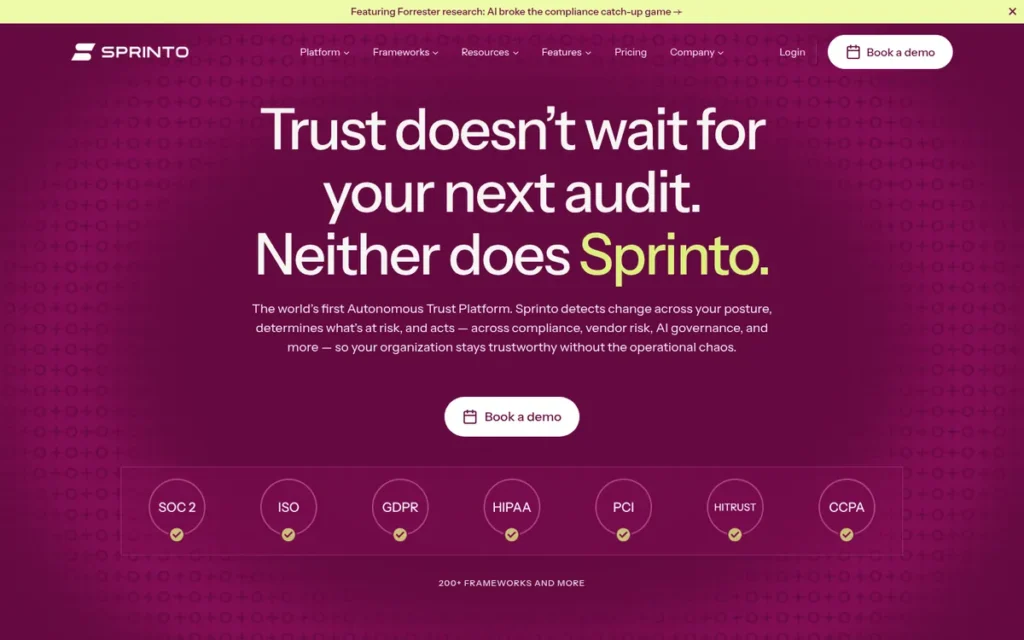
Category: Compliance Automation Platform, automates multi-framework evidence collection, continuous control monitoring, and audit-readiness workflows for cloud-native organizations across 200+ compliance standards.
At a Glance
- Category: Compliance Automation Platform
- Best For: Sprinto is best for mid-market SaaS companies and multi-entity organizations (100–5,000 employees) managing two or more simultaneous compliance frameworks with lean compliance teams and cross-jurisdictional visibility requirements.
- Price Range: Custom quote required; bundled per-framework pricing with no per-framework add-on fees at renewal; community reviews describe pricing as competitive for mid-market; no public pricing published as of May 2026.
- Primary Strength: Sprinto holds the highest G2 rating at scale in this GRC comparison, 4.8/5 from 1,500+ verified reviews as of 2026, combined with 200+ natively supported compliance frameworks and entity-level compliance management for multi-BU organizations.
- Biggest Limitation: Sprinto does not visualize task dependencies between compliance activities, and task assignment to non-admin individual contributors is limited, documented in a December 2025 practitioner account as creating navigation complexity for lean teams managing compliance without a dedicated compliance resource.
- One-Line Summary: Sprinto is the highest-rated GRC platform on G2 at scale: 4.8/5 from 1,500+ verified reviews as of 2026, supporting 200+ compliance frameworks with entity-level multi-entity management and bundled pricing that avoids per-framework renewal escalation.
- Last Verified: May 2026
Overview
Sprinto is a continuous compliance automation platform earning the highest G2 rating at scale in the GRC category, 4.8/5 from 1,500+ verified reviews as of 2026, supporting 200+ compliance frameworks with entity-level compliance management for multi-entity organizations and bundled pricing designed for mid-market teams managing simultaneous multi-framework certification programs.
Sprinto was founded in 2019, is headquartered in Bangalore, India with U.S. operations in San Francisco, and is led by CEO Raghuveer Kancherla. Sprinto has raised a Series B from Accel and employs approximately 100–200 people.
Key Features
- Framework Breadth: Sprinto supports 200+ compliance frameworks natively: the broadest library in this comparison, more than five times Vanta’s 35+ as of May 2026, including SOC 2 Type I and II, ISO 27001, ISO 42001, HIPAA, GDPR, PCI DSS, NIST CSF, CMMC 2.0, and user-uploaded custom frameworks, enabling compliance scope expansion without a platform switch.
- Continuous Monitoring: Sprinto provides 24/7 real-time monitoring with proactive alerts for control violations and configuration changes across integrated cloud infrastructure, IAM, HRMS, and DevOps environments, delivering automated evidence collection without manual screenshot uploads.
- Entity-Level Management: Sprinto’s entity-level compliance management feature enables multi-entity organizations to track and manage compliance status per subsidiary, department, or business unit from a unified centralized dashboard, directly addressing the cross-jurisdictional risk visibility gap cited as a primary pain point by multi-entity procurement teams evaluating GRC platforms.
- No-Code AI Agents: Sprinto’s no-code AI agents enable compliance teams to build automated workflows, vendor reviews, evidence collection, policy distribution, without engineering support; early adopters reported building 100+ custom agents saving 5,000+ hours annually per Sprinto official documentation (2026, vendor-reported early-adopter figures; no independent third-party corroboration confirmed in this review cycle).
- Integration Ecosystem: Sprinto provides 250–300+ integrations with cloud providers including AWS, Azure, and GCP, HRMS platforms, IAM tools, vulnerability scanners, ITSM systems, and security applications, enabling automated evidence collection from an organization’s existing technology stack.
Best For
Sprinto is best for mid-market SaaS companies, fast-scaling technology organizations, and multi-entity enterprises that need to manage two or more simultaneous compliance frameworks with lean compliance teams, particularly organizations requiring cross-entity visibility, pursuing certifications under audit deadline pressure, or seeking bundled pricing that avoids per-framework cost escalation at renewal.
Pricing
Sprinto does not publish pricing as of May 2026. All pricing is custom-quoted based on company size, number of frameworks, and entity count.
Community reviews describe Sprinto’s pricing as bundled, covering multiple frameworks without per-framework add-on fees. G2 users note that “pricing could be more accessible to smaller teams or early-stage companies.” (G2 verified reviews, 2025–2026.)
Buyers should request multi-year price-lock provisions in writing, confirm renewal terms explicitly in the contract, and request the full pricing schedule for anticipated entity count growth before signing.
Strengths
- Sprinto holds a G2 rating of 4.8/5 from 1,500+ verified reviews as of 2026: the highest statistically significant rating among all seven GRC platforms evaluated, with a Capterra rating of 4.7/5 from 80+ reviews, indicating consistent satisfaction across multiple independent review platforms rather than single-platform concentration. (G2 and Capterra, 2026)
- Sprinto earned 11 G2 badges in 2023 including “Most Implementable Software” in Security and Cloud Compliance categories, a designation driven by real user data on speed-to-value, directly relevant to organizations under audit deadline pressure with limited implementation resources. (G2 via Sprinto blog, 2023)
- Sprinto’s entity-level compliance management centralizes visibility across subsidiaries, departments, and business units in a single dashboard, directly addressing the cross-jurisdictional risk visibility gap that multi-entity procurement teams cite as a primary evaluation criterion, a capability absent from Vanta, Drata, and Secureframe at comparable price points. (Sprinto official documentation; ComplyJet, 2026)
- Multiple independent G2 reviewers confirm that “most teams get audit-ready in weeks, not months” using Sprinto, corroborated by multiple accounts rather than vendor-only claims, providing buyer-validated time-to-value evidence that is the primary ROI metric for compliance automation tool evaluation. (G2 verified reviews; ComplyJet, 2026)
Users on r/sysadmin shared their experience:
“We went from spending like 2-3 days every month just gathering evidence and updating spreadsheets to maybe 30 minutes checking that everything synced properly. the automated evidence collection from aws, okta, github etc is legit and saves so much back and forth with different teams
but you cant just flip a switch and have perfect compliance. had to spend a solid 2 weeks mapping our existing processes to their controls framework and configuring all the integrations. but once thats done its pretty smooth sailing
the real test was our audit and honestly it was a breeze compared to our manual process from before. auditor could access everything through the platform, we could track exactly what evidence was missing or outdated, and the whole thing wrapped up in like half the time” Posted by u/MoreMacaron4609
Takeaway: Sprinto’s automated evidence collection genuinely reduces recurring compliance overhead from days to minutes, but the initial integration and control-mapping phase requires two weeks of dedicated setup work that vendor demos consistently underrepresent.
Limitations
- Task Architecture Trade-Off: Sprinto does not visualize dependencies between compliance tasks, and task assignment to individual contributors outside the primary administrator role is limited, documented in a December 2025 Reddit account as creating navigation complexity for lean teams who need to distribute compliance activities across multiple stakeholders without a dedicated compliance operations function.
“We are a small company and do not have a dedicated CISO. Here is my experience with Sprinto so far: it is an ADHD nightmare… You can’t assign all specific tasks to individuals. You, as the CISO, must track those tasks as your own… Dependencies between Sprinto tasks are not visualized anywhere that I have found.” (u/PaleoSpeedwagon, r/cybersecurity (August 2025))
Takeaway: Sprinto’s task management is optimized for a single compliance administrator, not distributed task ownership across departments. Demo task delegation and cross-user dependency visualization specifically (not general evidence collection features) before committing.
- Vendor Access Trade-Off: A December 2025 Reddit account (u/scalable5432, r/cybersecurity) raised concerns about Sprinto’s team having access to customer cloud, SaaS, and tool credentials as part of the integration setup process, a security consideration that regulated-industry buyers should explicitly scope and contractually limit before onboarding; this account also raised broader concerns about bad-faith conduct by Sprinto’s finance and customer success teams, which represents a minority perspective but warrants standard contractual protections during procurement.
- Pricing Opacity Trade-Off: Sprinto publishes no pricing tiers as of May 2026, making self-service budget evaluation impossible before engaging the sales team, adding procurement friction that compounds for regulated-industry buyers with multi-stage vendor approval processes.
- Headquarters Trade-Off: Sprinto’s India-based headquarters may carry vendor due-diligence implications for U.S. regulated-industry buyers with strict data residency requirements, ITAR-related obligations, or country-of-origin vendor assessment requirements that mandate specific data handling controls.
Verdict
Sprinto is the top-rated GRC platform by peer-reviewed G2 score at scale, 4.8/5 from 1,500+ verified reviews as of 2026, and the broadest-coverage compliance automation tool in this comparison with 200+ natively supported frameworks as of May 2026, making it the strongest overall choice for mid-market organizations managing multiple simultaneous compliance frameworks. Sprinto’s entity-level compliance management and bundled pricing model make it especially well-suited to multi-entity organizations navigating cross-jurisdictional compliance obligations without the per-framework cost escalation that burdens renewals at competing platforms. Buyers with lean compliance teams should evaluate Sprinto’s task dependency visualization gaps and should contractually scope vendor credential access before signing.
#2. Vanta: Best for Integration Breadth, Market-Scale Validation, and Agentic AI Compliance Automation
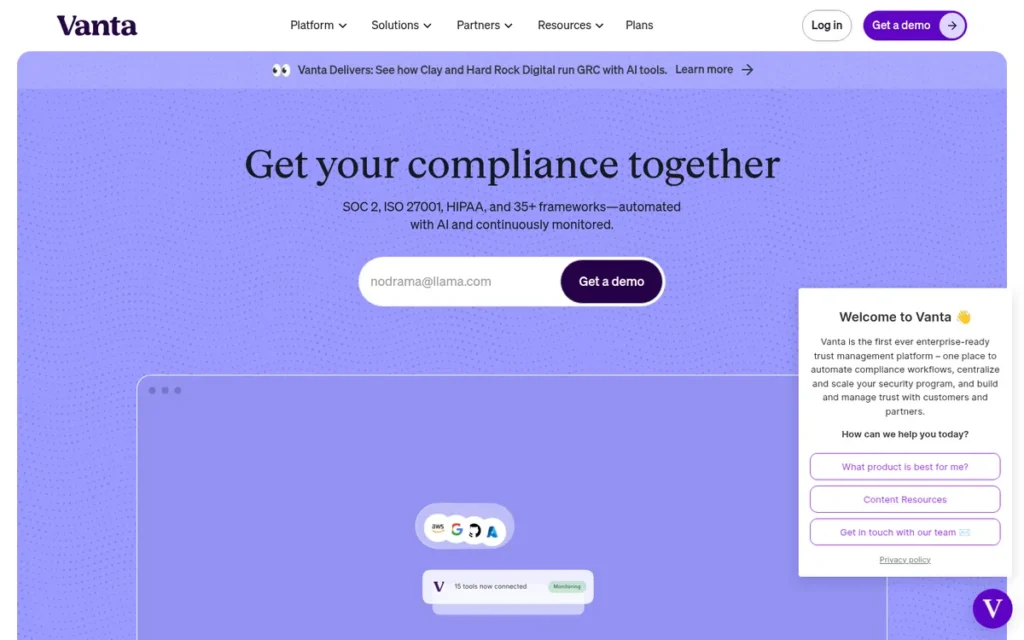
Category: Trust and Compliance Platform, unifies compliance automation, security questionnaire management, continuous control monitoring, and agentic AI workflows into a single trust intelligence system for scaling technology companies.
At a Glance
- Category: Trust and Compliance Platform
- Best For: Vanta is best for scaling technology companies (50–5,000 employees) pursuing SOC 2, ISO 27001, HIPAA, or GDPR certifications who need the broadest integration ecosystem, AI-powered questionnaire automation, and continuous compliance monitoring backed by the highest market-validated customer base in this comparison.
- Price Range: Custom quote required; community-reported ranges of $15,000–$40,000+ per year depending on employee count, frameworks, and add-ons; renewal price increases documented by multiple independent community sources; no public pricing published as of May 2026.
- Primary Strength: Vanta provides 375–400+ integrations: the most extensive catalog in this GRC comparison, paired with AI Agent 2.0 achieving a 95% questionnaire answer acceptance rate and a Trust Center deflecting 87% of inbound security reviews without human involvement, backed by $300M ARR as of April 2026 (Fortune, April 29, 2026).
- Biggest Limitation: Vanta contracts have been reported by multiple independent community sources as lacking price-lock provisions, enabling significant Year 2+ price increases (one documented case cited a 40% renewal increase) and a May 2025 internal code update exposed employee configuration data to approximately 400 customer organizations (TechCrunch, June 2, 2025; DataBreaches.net, June 3, 2025).
- One-Line Summary: Vanta is the market-leading compliance automation platform with $300M ARR as of April 2026, 375–400+ integrations, and AI Agent 2.0 capable of deflecting 87% of security reviews without human involvement, but carries documented renewal pricing escalation risk and a verified May–June 2025 internal code data exposure incident that regulated-industry buyers must evaluate.
- Last Verified: May 2026
Overview
Vanta is the highest-revenue compliance automation platform in this comparison, crossing $300 million in ARR as of April 2026 per Fortune, providing 375–400+ integrations and AI Agent 2.0 across 35+ compliance frameworks with a G2 rating of 4.6/5 from 2,000+ verified reviews, the highest review volume in this GRC category.
Vanta serves 16,000+ customers globally as of April 2026 (Vanta official, April 2026). Vanta’s 93% questionnaire automation rate is a vendor-stated figure cited on the official Vanta website as of 2026 and has not been independently corroborated by third-party research in this review cycle. Vanta was founded in 2018 by CEO Christina Cacioppo in San Francisco, has raised $500M+ in total funding including a $150M Series D led by Sequoia Capital in July 2025, and employs approximately 1,000 people.
Key Features
- Continuous Monitoring: Vanta’s 1,200+ automated hourly monitoring tests continuously verify security controls across integrated infrastructure, flagging violations in real time and maintaining an always-current compliance posture that replaces periodic point-in-time evidence snapshots with live, continuous control monitoring.
- AI Agent 2.0: Vanta’s AI Agent 2.0 functions as a context-aware compliance layer that generates policies, evaluates evidence, remediates failed control tests, and drafts security questionnaire responses with a reported 95% answer acceptance rate, reducing an average of four hours per week of manual compliance work per professional. (BusinessWire, November 18, 2025)
- Trust Center: Vanta’s Trust Center publishes a live security posture page that deflects 87% of inbound security reviews without human intervention, providing prospects and customers with always-current security documentation without requiring compliance team involvement in each assessment cycle.
- Integration Catalog: Vanta provides 375–400+ integrations spanning cloud infrastructure, identity providers, HR systems, MDM, EDR, and DevOps tools (the most extensive catalog among all seven platforms evaluated) enabling automated evidence collection from virtually any modern SaaS technology stack.
- Framework Support: Vanta supports 35+ compliance frameworks including SOC 2, ISO 27001, HIPAA, GDPR, PCI DSS, NIST CSF, and DORA, with adaptive scoping that adjusts required controls to the organization’s actual technology environment rather than applying a fixed universal control set.
Best For
Vanta is best for technology companies from early-stage startup through mid-enterprise (50–5,000 employees) that need the broadest integration ecosystem for automated evidence collection, have active inbound security questionnaire volume from enterprise prospects that creates measurable sales-cycle friction, and are pursuing SOC 2, ISO 27001, or HIPAA certifications where speed-to-certification is a primary business objective.
Pricing
Vanta does not publish pricing as of May 2026. Community-reported annual costs range from approximately $15,000 to $40,000+ depending on employee count, frameworks, and feature add-ons.
Multiple independent Reddit sources document a pattern in which Vanta Year 1 pricing is competitive but contracts are structured to permit significant Year 2+ price increases, one user reported a 40% renewal increase, another described being auto-charged $15,600 without explicit consent, and a third stated that “Vanta writes their contracts in such a way where they can jack up the price on you in future years.” (Multiple accounts, r/soc2 and r/cybersecurity, 2024–2026.)
Buyers should request explicit multi-year price-lock provisions written into the contract before signing, negotiate aggressively using competitive pressure from Drata (reported as more willing to lock in multi-year pricing), and explicitly confirm renewal pricing structure for all anticipated framework additions before committing.
Strengths
- Vanta crossed $300 million in ARR as of April 2026: tripling revenue in two years and growing customer count at 60–63% year-over-year for four consecutive quarters, a commercial validation signal reported as a Fortune exclusive on April 29, 2026 and corroborated by BusinessWire on the same date. (Fortune, April 29, 2026; BusinessWire, April 29, 2026)
- Vanta’s G2 profile holds 2,000+ verified reviews at 4.6/5 as of 2026: the highest review volume in the GRC automation category, providing the largest independent sample of practitioner experience available for pre-purchase evaluation across diverse organization types. (G2, 2026)
- Vanta’s AI Agent 2.0 reduces compliance team workload by an average of four hours per week per professional, with early adopters of no-code AI agents reporting 100+ custom workflow automations saving 5,000+ hours, announced November 18, 2025 and corroborated by G2 user testimonials. (BusinessWire, November 18, 2025)
- Vanta’s 375–400+ integrations provide the deepest connectivity across cloud providers, identity platforms, HR systems, and DevOps tools in this comparison, enabling automated evidence collection from virtually any modern SaaS technology stack without manual export processes. (Vanta official integration directory, 2026)
Limitations
- Renewal Pricing Trade-Off: Vanta’s contracts are reported by multiple independent community sources as structured to permit significant Year 2+ price increases without restriction (one documented account cited a 40% increase, another reported auto-billing without consent, and a third cited contract language specifically enabling future price increases) compounded by platform lock-in that makes migration after Year 1 expensive and disruptive. (Multiple accounts, r/soc2 and r/cybersecurity, 2024–2026)
“I was an early customer at Vanta and it was way over-promised and under-delivered… So we left Vanta for Drata. Year one was great. Low price, great service. In year two it went downhill immediately. Price went up 40% and service all but disappeared. Felt like a total bait and switch.” (u/schlegelrock, r/cybersecurity)
Takeaway: Vanta’s Year 1 pricing and service quality are not reliable indicators of Year 2 terms. The renewal negotiation is when the platform’s true multi-year cost structure is revealed. Negotiate price-lock provisions before signing, not after.
- Data Incident Trade-Off: Vanta experienced a verified customer data exposure in which a product code change identified on May 26, 2025 and fully remediated by June 4, 2025 exposed employee names, roles, tool configurations including MFA setup data from fewer than 20% of third-party integrations to other Vanta customers, affecting fewer than 4% of then-10,000+ customers (approximately 400 organizations) per Vanta CPO Jeremy Epling; the incident resulted from an internal code update, not an external cyber intrusion, and no exploitation by threat actors was reported. (TechCrunch, June 2, 2025; DataBreaches.net, June 3, 2025) Vanta has not published a detailed public post-mortem as of May 2026.
- Platform Lock-In Trade-Off: Vanta’s evidence histories, integration configurations, and audit documentation are not easily portable out of the platform, making migration after Year 1 costly and disruptive, directly compounding the financial risk of renewal pricing escalation for buyers who discover unfavorable renewal terms after full onboarding.
- UI Complexity Trade-Off: Vanta’s interface complexity has increased materially as the feature set has scaled, a February 2026 Reddit user in r/grc described tasks that once required one click now requiring ten different screens, a usability regression that disproportionately affects smaller teams without dedicated platform administrators. (u/xorredd, r/grc, February 2026)
Verdict
Vanta is the market-leading compliance automation platform by ARR ($300M as of April 2026), review volume (2,000+ G2 reviews at 4.6/5), and integration breadth (375–400+ integrations), making it the strongest choice for technology companies requiring the most extensively connected GRC ecosystem and AI-powered questionnaire automation. Vanta ranks #2 rather than #1 because its framework breadth (35+) significantly trails Sprinto (200+) as of May 2026, its renewal pricing patterns carry documented financial risk from multiple independent community sources, and its May–June 2025 customer data exposure is a material due-diligence signal for regulated-industry procurement. Buyers should negotiate explicit multi-year price-lock provisions before signing and evaluate the TechCrunch-reported incident against their specific regulatory obligations.
#3. Drata: Best for Continuous Monitoring Depth and Auditor-Ready Evidence Packaging
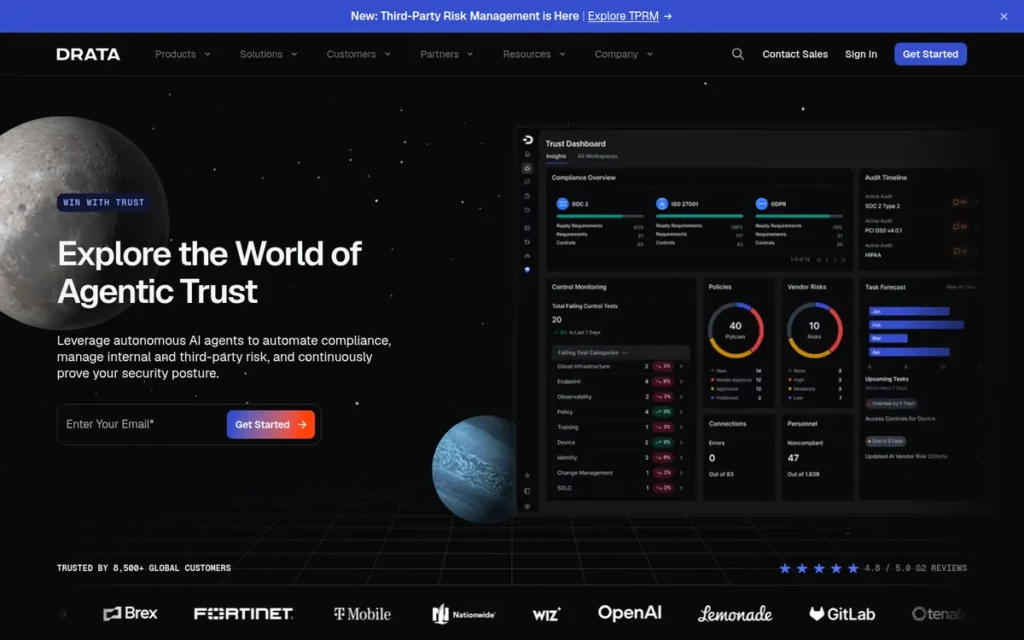
Category: Continuous Compliance Platform, provides ongoing automated control monitoring, cross-framework evidence mapping via the Drata Control Framework, and an auditor-ready evidence portal for organizations managing multiple simultaneous compliance certifications.
At a Glance
- Category: Continuous Compliance Platform
- Best For: Drata is best for organizations pursuing multiple simultaneous compliance certifications (SOC 2 plus ISO 27001 plus HIPAA) that prioritize auditor-ready evidence packaging, real-time compliance monitoring, and highly responsive human support during active audit periods, with a predominantly cloud-based technology stack.
- Price Range: Custom quote required; community-reported at approximately $26,000 per year for organizations up to 300 employees for one primary framework; per-framework add-on pricing at renewal documented, ISO 27001 and GDPR priced separately; no public pricing published as of May 2026.
- Primary Strength: Drata’s proprietary Drata Control Framework (DCF) maps shared evidence tests across multiple overlapping compliance frameworks (praised by a self-identified SOC 2 auditor on Reddit (r/cybersecurity) Drata vs. Vanta comparison thread, 2025) as the most organized auditor portal in the GRC automation category for enabling all evidence requests to remain within the platform.
- Biggest Limitation: Drata’s per-framework add-on pricing model compounds costs significantly when compliance scope expands at renewal, one documented community account reported pricing rising from $7,500 to $20,000 when adding ISO 27001 and GDPR at Year 2, representing a 167% cost increase not transparently disclosed at initial contract signing.
- One-Line Summary: Drata is a continuous compliance platform with the Drata Control Framework (DCF) earning specific independent auditor practitioner praise for evidence organization, but carries documented per-framework renewal cost escalation risk and a confirmed mid-audit integration failure that led one team to abandon the platform during an active SOC 2 audit.
- Last Verified: May 2026
Overview
Drata is a continuous compliance platform whose proprietary Drata Control Framework (DCF) maps shared evidence across 20+ compliance standards (earning specific independent auditor praise for evidence packaging quality) supporting SOC 2, ISO 27001, HIPAA, GDPR, DORA, NIS2, and PCI DSS with embedded 2–3-minute chat support on every platform page.
Drata’s G2 presence is confirmed by multiple active verified review pages indicating significant review volume as of 2026, the specific aggregate G2 score and total review count could not be independently verified at publication; confirm current peer review metrics at g2.com/products/drata/reviews before making a platform decision. Drata was founded in 2020 in San Diego, California by Adam Marcotte, Daniel Marashlian, and Troy Markowitz, and has raised approximately $250M+ in total funding (reported across multiple industry sources as of 2026; not confirmed from primary financial filings in this review cycle).
Key Features
- Drata Control Framework: Drata’s proprietary Drata Control Framework (DCF) translates compliance requirements across 20+ frameworks into shared, cross-framework control items, enabling cross-framework evidence reuse so organizations pursuing SOC 2, ISO 27001, HIPAA, and GDPR simultaneously can collect evidence once and satisfy multiple standards, directly reducing the multi-framework duplication bottleneck.
- Auditor Portal: Drata’s auditor portal allows all audit evidence requests, reviews, and communications to be managed within the Drata platform rather than through external email or file sharing (an architecture explicitly praised by a self-identified SOC 2 auditor on Reddit (r/cybersecurity) Drata vs. Vanta comparison thread, 2025) as superior to Vanta’s evidence packaging for organized, complete audit submission.
- Real-Time Monitoring: Drata provides continuous real-time monitoring of security controls with automated alerts for policy violations and configuration changes, described by G2 users as transforming compliance from “a manual, point-in-time effort into a continuous, automated process,” enabling compliance gap detection before audit periods begin. (G2 verified reviews, 2026)
- Policy Centre: Drata’s Policy Centre provides 20+ pre-built policy templates with GenAI-powered text generation, automated policy review scheduling, and version control tracking, enabling current, approved, and documented policies without manual update cycles.
- Embedded Support: Drata’s embedded chat support responds within 2–3 minutes from any platform page, documented across multiple independent community accounts as the most responsive real-time support in this GRC comparison, particularly valuable during active audit periods where vendor response speed directly affects compliance team timelines. (Multiple Reddit accounts, r/cybersecurity and r/soc2, 2025)
Best For
Drata is best for organizations with existing security processes pursuing multiple simultaneous compliance certifications (particularly SOC 2 plus ISO 27001 plus HIPAA combinations) where auditor evidence organization and continuous real-time monitoring are primary decision criteria, a dedicated compliance resource is available to manage the platform, and the organization’s technology stack is predominantly cloud-based.
Pricing
Drata does not publish pricing as of May 2026. Community-reported pricing indicates approximately $26,000 per year for organizations with up to 300 employees for a single primary framework.
Drata uses a per-framework add-on pricing model: one documented community account on r/cybersecurity (2025) described Year 1 pricing of $7,500 for SOC 2 rising to $15,000 at Year 2 when adding ISO 27001, then to $20,000 when adding GDPR, a 167% total increase not transparently disclosed at initial contract signing.
Drata has been reported as more willing than Vanta to lock in multi-year pricing under competitive pressure. Buyers should explicitly negotiate multi-year price locks and request the complete pricing schedule for all anticipated framework additions at every renewal cycle before signing. (Community-reported data, r/soc2 and r/cybersecurity, 2024–2026.)
Strengths
- A self-identified SOC 2 auditor (u/OldschoolGGthelegend, r/cybersecurity: Drata vs. Vanta comparison thread, 2025) stated independently that Drata is “much nicer, more comprehensive with their monitoring of controls” compared to Vanta, with explicit praise for the auditor portal, practitioners with professional incentive to recommend platforms that minimize their own audit work are the most consequential endorsement source for a compliance automation tool’s core value proposition. (Reddit, r/cybersecurity, 2025)
This aligns with community sentiment on r/grc:
“As Head of department I’ve implemented and used Vanta and Drata in parallel (one for an acquisition and other for parent company) and specifically for SOC 2 (and other frameworks) Drata is hands down better in terms of quality of the requirements and controls. Vanta was the better tool 2 years ago, not now and especially not with the latest improvements in Drata. Currently using it for 7 security frameworks with one more on the way, it’s a lot of work but worthwhile. Not familiar with Secureframe.” Posted by u/twinfs-reddit
Takeaway: Practitioners running Vanta and Drata in parallel (including at the head-of-department level) consistently rate Drata superior on control quality and requirements depth, with the competitive gap widening as Drata’s platform has matured since 2023.
- Drata’s embedded chat support is documented across multiple independent community reviews as responding within 2–3 minutes from any platform page, the most responsive real-time support model documented in this GRC comparison and a meaningful differentiator during high-pressure audit periods where slow vendor response directly delays compliance timelines. (Multiple Reddit accounts, r/cybersecurity and r/soc2, 2024–2026)
- Drata’s proprietary Drata Control Framework (DCF) maps shared evidence tests across overlapping compliance frameworks, enabling cross-framework evidence reuse for organizations pursuing SOC 2 plus ISO 27001 plus HIPAA simultaneously, directly reducing the primary time bottleneck in multi-certification compliance programs that the target audience consistently cites as their top pain point. (Drata help documentation; G2 verified reviews, 2026)
- Drata was founded in 2020 and reached significant market scale by 2026 with approximately $250M+ in total funding and a customer base concentrated in SaaS-first companies, demonstrating strong product-market fit in compliance automation within six years of founding, providing vendor longevity confidence for multi-year platform commitments. (Multiple industry sources, 2026)
Limitations
- Renewal Pricing Trade-Off: Drata’s per-framework add-on model compounds costs significantly when compliance scope expands, one documented community account described pricing rising from $7,500 to $20,000 when adding two frameworks at Year 2 renewal, a 167% increase not disclosed at initial signing, making Drata’s long-term pricing trajectory the most consequential renewal risk among the compliance automation platforms in this comparison.
“Drata was maybe the worst company we ever partnered with… come renewal they wanted $15,000 for SOC 2 and ISO 27001. It was $20,000 if we wanted to add GDPR. What kind of organization goes from $7,500 to $20,000 to turn on two other frameworks?” (u/Beneficial-Dust4434, r/cybersecurity (2025))
Takeaway: Drata’s per-framework add-on model means every framework added at renewal is a separate pricing negotiation. Negotiate a fixed per-framework price cap for all frameworks anticipated over a three-year horizon before signing Year 1, not after you depend on the platform.
- Integration Reliability Trade-Off: At least one user on r/cybersecurity (January 2025) reported abandoning Drata mid-audit and migrating to Vanta after integration failures held up an active SOC 2 audit, a catastrophic failure mode for a platform whose entire value proposition depends on automated evidence collection working reliably at the exact moment it is most needed. (u/security_intern, r/cybersecurity, January 2025)
- Scalability Trade-Off: Multiple community reviewers characterize Drata as insufficient for organizations with complex compliance requirements, on-premises infrastructure, or multiple business units, one Reddit user stating Drata “is good in the startup space, but customizations and visibility across multiple frameworks is very poor” for complex environments. (u/lebenohnegrenzen, r/cybersecurity, August 2024)
- Peer Review Transparency Trade-Off: Drata’s specific aggregate G2 score and verified review count could not be independently confirmed at publication, verify current peer review metrics at g2.com/products/drata/reviews, as this comparison’s #3 ranking is supported by qualitative practitioner evidence rather than a confirmed numerical G2 score.
Verdict
Drata is the strongest GRC platform in this evaluation for auditor-facing evidence packaging and cross-framework evidence architecture, with the Drata Control Framework (DCF) earning specific independent practitioner praise from a self-identified auditor that no other platform in this comparison has documented, earning its #3 ranking. Drata ranks below Sprinto and Vanta because its per-framework renewal pricing model carries the most documented community cost-escalation risk among the compliance automation platforms evaluated, its integration failures during active audits represent a critical operational reliability concern, and its G2 volume and framework breadth trail both higher-ranked platforms. Buyers pursuing SOC 2 plus ISO 27001 combinations should evaluate Drata’s auditor portal closely while negotiating explicit per-framework renewal pricing caps before committing.
#4. Secureframe: Best for Government Contractors and Compliance Newcomers Requiring Expert Human Guidance
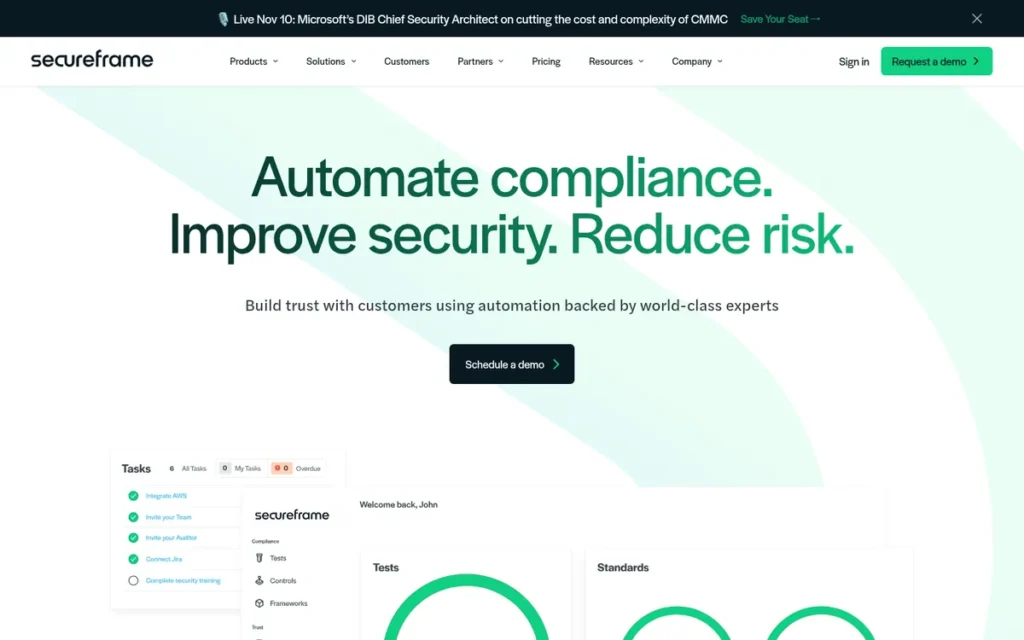
Category: Government-Ready Compliance Automation, automates multi-framework compliance including FedRAMP and CMMC Level 3 for government contractors, backed by 30+ in-house compliance experts providing human guidance alongside the software platform.
At a Glance
- Category: Government-Ready Compliance Automation
- Best For: Secureframe is best for organizations pursuing U.S. government contracts requiring FedRAMP authorization or CMMC Level 2–3 compliance, first-time compliance program builders needing human expert guidance alongside automation, and commercial organizations evaluating Vanta or Drata alternatives with embedded in-house compliance expertise.
- Price Range: Custom quote required; government framework support (FedRAMP, CMMC Level 3) likely commands premium pricing above the base commercial tier; no verified community-reported price ranges independently confirmed; no public pricing published as of May 2026.
- Primary Strength: Secureframe is the only platform in this comparison supporting FedRAMP 20x via a Coalfire partnership pilot program and CMMC 2.0 Level 3 for DoD contractors handling Controlled Unclassified Information, while maintaining consistent 4.6–4.7/5 ratings across G2 (794 verified reviews), Capterra (57 reviews), and AWS Marketplace simultaneously as of 2026.
- Biggest Limitation: Secureframe’s 150+ integration catalog is the smallest among the compliance automation platforms in this comparison (trailing Vanta (375–400+), Sprinto (250–300+), and Drata) which may create automated evidence collection gaps for organizations with non-standard technology stacks, uncommon identity providers, or specialized DevOps tooling.
- One-Line Summary: Secureframe is the only GRC automation platform in this comparison supporting FedRAMP 20x pilot capability and CMMC 2.0 Level 3 for government and defense contractors, with 30+ in-house compliance experts and consistent 4.6–4.7/5 ratings across G2, Capterra, and AWS Marketplace as of 2026.
- Last Verified: May 2026
Overview
Secureframe is the only compliance automation platform in this comparison supporting FedRAMP 20x (via a Coalfire partnership pilot program) and CMMC 2.0 Level 3 for government and defense contractors handling Controlled Unclassified Information, backed by 30+ in-house compliance experts and former auditors, with consistent 4.6–4.7/5 ratings across G2 (794 verified reviews), Capterra (57 reviews), and AWS Marketplace as of 2026, the highest cross-platform rating consistency among all seven platforms evaluated.
Secureframe was founded approximately 2020 by CEO Shrav Mehta, has raised approximately $56M in total funding including a Series B (as reported across multiple industry sources; specific round dates not confirmed from primary filings in this review cycle), and maintains a Carahsoft government procurement channel partnership for U.S. federal and state government buyers. Secureframe supports SOC 2, ISO 27001, HIPAA, GDPR, PCI DSS, NIST, StateRAMP, and dozens of additional commercial frameworks alongside its government-specific offerings.
Key Features
- Government Framework Coverage: Secureframe supports FedRAMP 20x via a Coalfire partnership pilot program and CMMC 2.0 Level 3 (the framework tier required by DoD contractors handling Controlled Unclassified Information) making Secureframe the only platform in this comparison with verified government-specific compliance coverage at the highest DoD certification tier. (Secureframe official frameworks page; Carahsoft product page, 2026)
- In-House Expert Team: Secureframe maintains 30+ in-house compliance experts and former auditors who provide direct human consultation alongside the software automation layer, a support model that no other compliance automation platform in this comparison replicates, uniquely valuable for organizations building their first formal compliance program who need expert control requirement interpretation rather than template-only guidance.
- Comply AI: Secureframe’s Comply AI feature enables AI-powered risk assessment enhancement, automated policy creation, remediation guidance, and automated RFP and security questionnaire responses, described in independent reviews as saving “hundreds of hours” on questionnaire management for sales and security teams who otherwise spend weeks on manual questionnaire completion.
- Built-In Security Training: Secureframe includes built-in employee security awareness training modules with framework-specific videos and quizzes, reducing vendor sprawl for organizations that would otherwise require separate platforms for compliance automation and security awareness training management.
- Automated Evidence Collection: Secureframe provides 150+ integrations with AWS, Azure, GCP, GitHub, Okta, Google Workspace, Slack, Jira, and BambooHR, with automated evidence collection that eliminates manual screenshot-based evidence uploads common in less mature compliance workflows.
Best For
Secureframe is best for organizations pursuing U.S. government contracts requiring FedRAMP authorization or CMMC Level 2 and Level 3 compliance, first-time compliance program builders who need human expert consultation alongside software automation, and commercial organizations evaluating Vanta or Drata alternatives who want equivalent automation with an embedded in-house compliance expert team for direct guidance through the certification process.
Pricing
Secureframe does not publish pricing as of May 2026. All pricing is custom-quoted, and independent community reviews note “strong opinions on cost and complexity” without confirming specific verified dollar amounts.
Government-specific framework support including FedRAMP 20x and CMMC Level 3 is likely priced at a premium above the base commercial compliance tier. Buyers pursuing FedRAMP or CMMC contracts should investigate the Carahsoft distribution partnership as a potential government procurement vehicle that may offer alternative pricing structures for federal and state government buyers.
No community-reported price ranges were independently verified for Secureframe in this research cycle. Request detailed pricing for your specific framework requirements and compare against Vanta and Drata quotes using competitive pressure. Explicitly confirm whether FedRAMP 20x pilot support is included in the base commercial tier or billed as a separate module add-on before signing.
Strengths
- Secureframe is the only platform in this GRC comparison to support FedRAMP 20x (via a Coalfire partnership pilot program) and CMMC 2.0 Level 3 for DoD contractors handling Controlled Unclassified Information, a differentiation with no equivalent among Vanta, Drata, Sprinto, or OneTrust for government and defense contractor buyers facing non-negotiable compliance mandates. (Secureframe official frameworks page; Carahsoft product page, 2026)
- Secureframe maintains consistent 4.6–4.7/5 ratings across three independent review platforms simultaneously (G2 from 794 verified reviews, Capterra from 57 reviews, and AWS Marketplace) indicating stable user satisfaction across diverse reviewer contexts and procurement pathways rather than ratings concentrated on a single platform. (G2; Capterra; AWS Marketplace, 2026)
- Secureframe’s 30+ in-house compliance experts and former auditors create a differentiated support model with no direct equivalent in this comparison, providing first-time compliance program builders with expert interpretation of control requirements that template-only platforms cannot substitute, directly addressing the “generic control templates misaligned with auditor expectations” problem cited as a category-wide red flag. (Secureframe blog; Carahsoft product page, 2026)
- Capterra reviewers describe Secureframe as “intuitive and well-structured, even for teams new to compliance”, independent user validation that Secureframe’s UX accessibility is genuine, making it a strong option for organizations without a dedicated experienced compliance professional. (ComplyJet citing Capterra verified reviews, 2026)
Users on r/grc noted:
“Based on what you outlined, probably Secureframe. UX and customer support are both really good for the space. They’re probably the furthest ahead in AI. Ton of integrations and a really thorough test library so you can sew things up for SOC 2 pretty quickly. You should be fine with them.” Posted by u/secretAZNman15
Takeaway: Secureframe’s UX accessibility and customer support responsiveness are its most consistently cited peer strengths, making it the default recommendation for compliance leads who lack deep GRC platform expertise and need the platform to guide them through certification, not just automate evidence collection.
Limitations
- Integration Breadth Trade-Off: Secureframe’s 150+ integration catalog is the smallest among the compliance automation platforms evaluated (trailing Vanta (375–400+), Sprinto (250–300+), and Drata) which may create automated evidence collection gaps for organizations with non-standard identity providers, specialized DevOps tooling, or uncommon cloud configurations not covered by Secureframe’s current integration library.
- FedRAMP Pilot Status Trade-Off: Secureframe’s FedRAMP 20x support operates via a Coalfire partnership pilot program as of May 2026, buyers pursuing FedRAMP Authorization to Operate should explicitly confirm whether the current pilot program supports their specific agency authorization pathway and timeline before selecting Secureframe for a government compliance program, as pilot availability and scope may change.
- Product Maturity Trade-Off: A January 2023 Reddit account on r/cybersecurity described Secureframe as “lacking too much and feeling like a new or immature product”, a characterization that predates significant product expansion including FedRAMP support, CMMC Level 3, and Comply AI, but warrants verification in a current demo for complex enterprise use cases, particularly since Secureframe remains a newer market entrant than Vanta and Drata. (u/junkaccount1999, r/cybersecurity, January 2023)
- Funding Scale Trade-Off: Secureframe’s approximately $56M in total funding is significantly smaller than Vanta ($500M+), OneTrust ($926M+), and Drata ($250M+), a vendor stability consideration for organizations entering multi-year compliance commitments requiring guaranteed long-term platform support.
Verdict
Secureframe is the only GRC automation platform among the seven evaluated in this comparison with FedRAMP 20x pilot support and CMMC 2.0 Level 3 capability as of May 2026, making it the required evaluation priority for government contractors and DoD supply chain organizations with non-negotiable government compliance mandates that commercial-only platforms cannot satisfy. Secureframe earns its #4 ranking through consistent cross-platform ratings (4.6–4.7/5 across G2, Capterra, and AWS Marketplace), a differentiated 30+ in-house expert team with no equivalent in this comparison, and built-in security training that reduces compliance-related vendor sprawl. Buyers outside the government contractor segment should evaluate Secureframe’s smaller integration catalog (150+) against their specific technology stack requirements before selecting it over higher-ranked alternatives.
#5. OneTrust: Best for Privacy-First Enterprises Requiring Unified Privacy, GRC, and Third-Party Risk Management
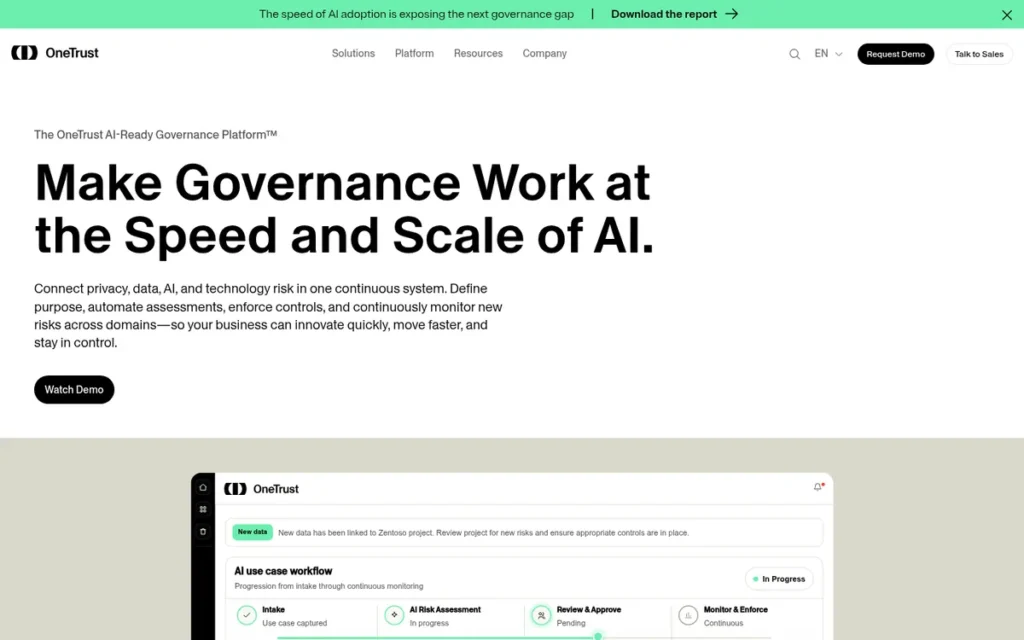
Category: Privacy and GRC Convergence Platform, unifies data privacy management across global jurisdictions, enterprise GRC, third-party risk management, and ESG under a single four-cloud platform for large regulated organizations.
At a Glance
- Category: Privacy and GRC Convergence Platform
- Best For: OneTrust is best for large enterprises with 1,000+ employees in regulated industries (finance, healthcare, global B2B SaaS) with significant GDPR, CCPA, and cross-jurisdictional privacy obligations who need a single vendor unifying privacy, GRC, TPRM, and ESG, and who are adopting three or more OneTrust product modules simultaneously.
- Price Range: $10,000 per year minimum; module-based pricing compounds with each product cloud adopted; G2-verified reviewer reported 275% followed by 468% renewal increases; no public pricing published as of May 2026.
- Primary Strength: OneTrust was named a Leader in the IDC MarketScape 2025 Worldwide GRC Software Report (doc # US53615325, June 2025) (a designation shared with MetricStream and DigitalXForce among 19 vendors evaluated) and is the only platform in this comparison unifying GDPR and CCPA privacy management across 300 jurisdictions with GRC and TPRM under one vendor.
- Biggest Limitation: OneTrust’s module-based pricing carries the most severe documented renewal escalation risk in this comparison (a G2-verified reviewer reported “very short notice for massive 275% followed by 468% price increases”) and the platform’s value proposition is significantly lower for organizations using fewer than three product modules simultaneously.
- One-Line Summary: OneTrust is an IDC MarketScape Leader in GRC (2025, with co-Leaders) unifying privacy management across 300 jurisdictions with GRC and TPRM for large regulated enterprises, but carries G2-verified renewal price escalation of 275% then 468% and a Trustpilot rating of 1.5/5 that diverges sharply from its 4.4/5 G2 score.
- Last Verified: May 2026
Overview
OneTrust is a unified Trust Intelligence Platform earning IDC MarketScape Leader designation in the 2025 Worldwide GRC Software Report (doc # US53615325, June 2025) (a designation shared with MetricStream and DigitalXForce among 19 vendors evaluated) supporting 50+ compliance frameworks across 300 jurisdictions globally and the only platform in this comparison unifying privacy management, GRC, third-party risk management, and ESG under a single vendor.
OneTrust’s GRC and Security Assurance module specifically holds a 4.6/5 G2 rating from 109 reviews, higher than the overall platform rating of 4.4/5 from 280+ reviews, indicating that GRC-specific users are measurably more satisfied than general platform reviewers, a distinction relevant to GRC-focused buyers evaluating the specific module they would deploy. (Enzuzo OneTrust review citing G2, 2025) OneTrust was founded in 2016 by CEO Kabir Barday in Atlanta, Georgia, has raised $926M+ in total funding, was last valued at $5.3 billion, and employs approximately 2,000–2,500 globally.
Key Features
- Cross-Jurisdictional Coverage: OneTrust supports 50+ compliance frameworks across 300 jurisdictions worldwide (the deepest cross-jurisdictional regulatory coverage in this comparison) providing a single platform for organizations managing GDPR, CCPA, LGPD, and PIPL simultaneously alongside SOC 2, ISO 27001, and NIST, a combination not available in any other platform evaluated here.
- Shared Evidence Framework: OneTrust’s shared evidence architecture consolidates compliance processes across all four product clouds, enabling evidence collected for one regulatory requirement to satisfy controls across privacy, GRC, vendor risk management, and ESG modules without duplication, reducing compliance team workload for enterprises managing comprehensive cross-domain regulatory programs.
- Four-Cloud Architecture: OneTrust’s four-cloud design: Privacy and Data Governance, GRC and Security Assurance, Third-Party Risk Management, and ESG and Sustainability, enables single-vendor consolidation that reduces integration complexity, eliminates cross-system data reconciliation overhead, and provides unified compliance dashboards for multi-domain regulatory programs across global geographies.
- Policy and Vendor Risk Workflows: OneTrust’s GRC module includes built-in policy approval workflows with automated leadership review routing and vendor risk assessment workflows, independently described by a Reddit practitioner (u/meapet, r/cybersecurity) as significantly streamlining approval cycles that otherwise require manual coordination across business functions.
- Analyst Validation: OneTrust earned IDC MarketScape Leader designation in the 2025 Worldwide GRC Software Report and 15 G2 badges in the Summer 2025 Grid Reports, providing the dual analyst and peer-review validation that regulated-industry enterprise procurement governance processes typically require for platform selection decisions. (OneTrust official news page; G2, 2025)
Best For
OneTrust is best for large enterprises (1,000+ employees) in regulated industries (particularly global organizations with significant GDPR, CCPA, and cross-jurisdictional privacy obligations alongside IT risk and third-party risk management requirements) who are adopting three or more OneTrust product modules, where cross-module evidence sharing creates measurable efficiency gains that justify the premium pricing.
Pricing
OneTrust does not publish pricing as of May 2026. The documented pricing floor is $10,000/year minimum, with costs compounding per product module adopted.
One G2-verified reviewer documented receiving “very short notice for massive 275% followed by 468% price increases”, the most severe renewal escalation documented across all seven platforms in this comparison. (G2 verified review; also cited in CheckThat.ai OneTrust pricing compilation, 2025.)
Buyers must require multi-year pricing caps explicitly written into contracts for each module adopted, request the full pricing schedule for all planned future module additions before signing, and include contractual provisions governing maximum renewal increase percentages. The severity of documented renewal escalation across multiple accounts makes contractual pricing protection non-optional for OneTrust procurement.
Strengths
- OneTrust was named a Leader in the IDC MarketScape 2025 Worldwide GRC Software Report (doc # US53615325, June 2025) (a designation shared with MetricStream and DigitalXForce among 19 vendors evaluated) with IDC stating that “OneTrust has the ability to manage virtually all organizational risk, audit, and privacy control programs under one platform,” providing the analyst validation most influential in regulated-industry enterprise procurement governance processes. (OneTrust official news page, IDC MarketScape, June 2025)
- OneTrust’s GRC and Security Assurance module holds a 4.6/5 G2 rating from 109 reviews as of 2026, measurably higher than the overall platform rating of 4.4/5, indicating that GRC-specific users are more satisfied than general platform reviewers, a statistically meaningful distinction for buyers evaluating the GRC module specifically. (Enzuzo OneTrust review citing G2, 2025)
- OneTrust’s support of 50+ compliance frameworks across 300 jurisdictions is the deepest cross-jurisdictional regulatory coverage in this comparison, providing multi-region data protection law compliance including GDPR, CCPA, LGPD, and PIPL alongside traditional IT risk frameworks in a single platform that no other evaluated alternative replicates at equivalent depth. (OneTrust official website; TechRepublic, 2026)
Users on r/cybersecurity shared their experience:
“I chose OneTrust for my business because it is mature in its platform- its easy to understand the flow from Policy to controls to evidence, has a 3rd party risk component, and integrations that make my evidence generation easier. Its risk register component isn’t the greatest, and there’s room for improvement, but they do listen and improve when you have meetings with them. Another reason I chose them over other solutions was the ability to grow with them- in the future if my company needs a privacy add on, or an enterprise risk add-on they have those available and easy to add to our account.” Posted by u/meapet
Takeaway: OneTrust’s multi-cloud growth path and platform maturity are its primary competitive differentiators among practitioners who have evaluated the category broadly, though the same experienced users flag the risk register as a documented weak point that buyers should test against their specific requirements before committing.
- OneTrust has raised $926M+ in total funding with a $5.3B last valuation and 14,000+ global customers, the strongest financial and market scale indicators among non-publicly traded GRC vendors in this comparison, reducing vendor longevity risk for enterprises entering multi-year platform relationships. (Multiple GRC comparison sources and discovery research, 2026)
Limitations
- Renewal Escalation Trade-Off: OneTrust’s module-based pricing carries the most extreme documented renewal escalation of any platform in this comparison (a G2-verified reviewer reported “very short notice for massive 275% followed by 468% price increases”) while the $10,000/year minimum pricing floor makes OneTrust impractical for organizations below large-enterprise scale.
“OneTrust provided very short notice for massive 275% followed by 468% price increases.”, G2 verified reviewer (cited in CheckThat.ai OneTrust pricing compilation, 2025)
Takeaway: OneTrust’s renewal escalation is the most extreme documented in this comparison. Contractual maximum annual increase clauses (not just Year 2 price locks) are the minimum acceptable protection. If the contract does not specify a maximum annual increase percentage, do not sign it.
- Multi-Module Dependency Trade-Off: OneTrust’s value proposition requires three or more product module adoption for documented ROI, meaning organizations using only GRC will consistently underutilize the platform and overpay relative to single-purpose alternatives ranked above OneTrust in this evaluation, limiting its justified buyer profile to large enterprises with concurrent privacy, GRC, TPRM, and ESG mandates simultaneously active.
- Review Divergence Trade-Off: The stark contrast between OneTrust’s 4.4/5 G2 rating from 280+ professional B2B reviewers and its 1.5/5 Trustpilot rating from 20+ general reviewers signals systemic concerns about sales experience, onboarding friction, and post-contract support quality that surface outside the G2 reviewer context, warranting direct reference calls with existing customers before committing.
- Post-Acquisition Trade-Off: OneTrust’s acquisition of TugboatLogic (a compliance automation tool) generated documented post-acquisition service degradation (Reddit users reporting increased bugs and a harder support process after integration) raising questions about OneTrust’s ability to maintain service quality as it integrates additional acquired products. (u/PeteOnThings, r/cybersecurity, 2025)
Verdict
OneTrust is the strongest GRC platform in this seven-platform comparison for large enterprises with complex, multi-jurisdictional privacy obligations requiring unified GDPR and CCPA management alongside GRC and TPRM, a combination no other platform in this comparison provides at equivalent depth, validated by IDC MarketScape Leader designation in 2025. OneTrust’s #5 ranking reflects that its G2-verified extreme renewal escalation risk, $10,000+ minimum pricing, Trustpilot divergence, and post-acquisition service concerns are buyer-protection signals that regulated-industry procurement teams cannot overlook. Buyers must negotiate multi-year renewal caps as a contractual requirement before committing to any OneTrust engagement.
#6. ServiceNow GRC: Best for Large Enterprises Already Deployed on the ServiceNow Now Platform
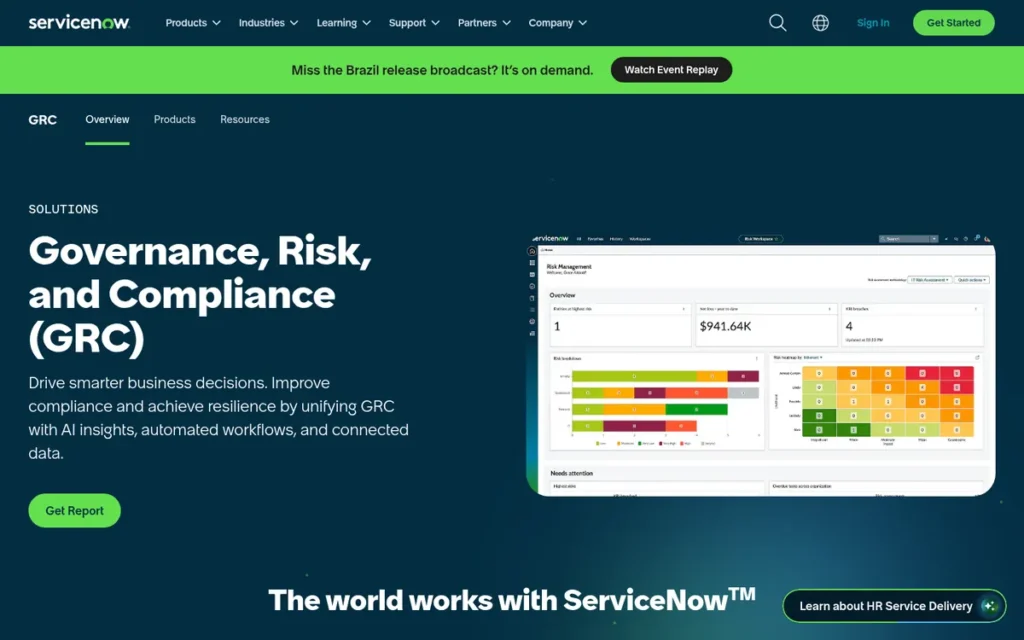
Category: Enterprise Integrated Risk Management (IRM), provides modular governance, risk, compliance, vendor risk, and business continuity management natively integrated with the ServiceNow IT operations and service management platform.
At a Glance
- Category: Enterprise Integrated Risk Management (IRM)
- Best For: ServiceNow GRC is best for large enterprises (1,000+ employees) already running ServiceNow ITSM or ITOM who want to add GRC capabilities within their existing Now Platform investment, particularly for organizations managing multiple auditable units across complex IT hierarchies where native CMDB integration creates measurable value.
- Price Range: Starting at approximately $50,000 per year for base licensing; actual enterprise deployments significantly higher depending on modules, users, and content packs; certified ServiceNow partner implementation at $150–$300 per hour adds substantially to Year 1 total cost; no public pricing published as of May 2026.
- Primary Strength: ServiceNow GRC is named a Gartner Magic Quadrant Leader for GRC Tools (2025), delivering its highest value to organizations already running the ServiceNow Now Platform (which serves 85%+ of the Fortune 500 (ServiceNow FY2024 annual report)) through native ITSM, ITOM, and CMDB integration that eliminates cross-system evidence collection complexity.
- Biggest Limitation: ServiceNow GRC’s $50,000+ pricing floor, certified-partner implementation requirement at $150–$300/hour, and dedicated-team maintenance need make it economically and operationally viable only for large enterprises already running the Now Platform, community practitioners characterize it as requiring “a team dedicated to maintaining, integrating, and operating it.”
- One-Line Summary: ServiceNow GRC is a Gartner Magic Quadrant Leader for GRC Tools (2025) delivering optimal value only for large enterprises already running the ServiceNow Now Platform, with a $50,000+ pricing floor and certified-partner implementation requirement creating total cost of ownership unjustifiable for organizations evaluating GRC platforms independently.
- Last Verified: May 2026
Overview
ServiceNow GRC is an enterprise Integrated Risk Management suite named a Gartner Magic Quadrant Leader for GRC Tools in 2025, delivering its highest value to organizations already running the ServiceNow Now Platform (which serves 85%+ of the Fortune 500 (ServiceNow FY2024 annual report)) through native ITSM, ITOM, and CMDB integration that eliminates cross-system evidence collection complexity for organizations already embedded in the ServiceNow ecosystem.
ServiceNow GRC is organized into five core application clusters (Policy and Compliance Management, Integrated Risk Management, Audit Management, Vendor Risk Management, and Business Continuity Management) with 60+ partner-built applications in the ServiceNow GRC Store extending the core platform. ServiceNow was founded in 2004, went public in 2012, exceeded $10 billion in company revenue in FY2024, serves 8,100+ enterprise customers globally, and holds a G2 score of 4.0/5 from approximately 40–50 verified reviews as of 2025–2026.
Key Features
- Platform Native Integration: ServiceNow GRC’s native integration with ServiceNow ITSM, ITOM, HRSD, and the Configuration Management Database (CMDB) allows GRC risk events to be directly linked to service tickets, change records, and configuration items, the ITSM-integrated risk management model unique to organizations already operating the Now Platform and unavailable to standalone GRC deployments.
- 4-Level Compliance Scoring: ServiceNow GRC’s 4-level Compliance Scoring engine transforms binary pass/fail control results into a business-impact-prioritized rating system where 1 = most critical and 4 = not critical, enabling risk teams to direct remediation resources toward highest-impact gaps rather than treating all control failures as equally urgent.
- 360° Relationship Visualization: ServiceNow GRC’s 360° Relationship Visualization maps dependencies between controls, risks, policies, and compliance issues across the enterprise, providing the multi-dimensional risk dependency mapping that complex financial services and healthcare organizations need to understand how individual control failures cascade into broader enterprise risk exposures.
- GRC Store Ecosystem: ServiceNow GRC’s 60+ partner-built applications in the ServiceNow GRC Store extend the core platform with regulatory-specific content packs for SOX and NIST RMF/CSF, risk quantification via Risk Lens, and specialized modules, enabling customization without core platform code modification, though each application carries separate licensing fees factored into total cost of ownership.
- Multi-Auditable-Unit Assessment: ServiceNow GRC supports assessment of compliance requirements across multiple auditable units and business units from a unified platform, cited explicitly by a practitioner on Reddit (u/snowbrick2012, r/cybersecurity, 2025) as a decisive reason to choose ServiceNow GRC over compliance automation alternatives for organizations with complex multi-BU IT hierarchies.
Best For
ServiceNow GRC is best for large enterprises (1,000+ employees) already running ServiceNow ITSM or ITOM who want to extend their Now Platform investment into GRC, and for organizations with complex IT hierarchies managing multiple auditable units across business divisions where native CMDB integration and cross-BU assessment capabilities deliver value that standalone compliance automation tools cannot replicate.
Pricing
ServiceNow GRC does not publish pricing as of May 2026. Research-identified starting pricing is approximately $50,000 per year for base licensing, with actual enterprise deployments typically running significantly higher depending on modules licensed, user count, and regulatory content packs.
Implementation requires certified ServiceNow implementation partners at $150–$300 per hour, adding substantially to first-year total cost. ServiceNow GRC platform upgrades require certified partner involvement for testing and deployment, adding recurring upgrade management costs and delays not present in self-upgrading SaaS platforms at every Now Platform release cycle.
Organizations should budget for dedicated ServiceNow-certified GRC administration resources as an ongoing operational cost, not a one-time onboarding expense. The 60+ GRC Store partner applications each carry separate licensing fees that must be factored into total cost of ownership modeling before any budget commitment.
Strengths
- ServiceNow GRC is named a Gartner Magic Quadrant Leader for GRC Tools (2025): the most influential enterprise analyst designation in IT procurement, providing the third-party validation that regulated-industry procurement governance and board-level approval processes typically require before approving large enterprise platform investments. (IBM community confirmation of 2025 Gartner GRC Tools category name; GlideFast Solutions, 2026)
- ServiceNow’s Now Platform serves more than 85% of the Fortune 500 and exceeded $10 billion in company revenue in FY2024, making ServiceNow GRC module adoption a low-incremental-risk extension of an existing vendor relationship for the majority of large enterprises already running ServiceNow ITSM or ITOM. (ServiceNow FY2024 annual report)
- ServiceNow GRC’s 4-level Compliance Scoring engine and 360° Relationship Visualization provide risk quantification and dependency-mapping depth significantly beyond SaaS compliance automation platforms, capabilities valued by practitioners managing multiple auditable units who need to understand how control failures cascade across interconnected IT systems. (ServiceNow GRC documentation; Inmorphis blog, 2026)
- An independent practitioner on Reddit (u/snowbrick2012, r/cybersecurity, 2025) specifically cited ServiceNow GRC as superior to compliance automation alternatives for organizations managing compliance “across your inventory of auditable units”, practitioner-sourced endorsement validating its positioning for complex multi-BU enterprise environments. (Reddit, r/cybersecurity, 2025)
Limitations
- Total Cost of Ownership Trade-Off: ServiceNow GRC’s $50,000+ pricing floor, certified-partner implementation at $150–$300/hour, and dedicated ongoing administration requirement create total cost of ownership that community consensus characterizes as requiring “a team dedicated to maintaining, integrating, and operating it”, making the platform economically viable only for large enterprises with existing ServiceNow investments and dedicated GRC administration staffing. (u/withoutwax21, r/cybersecurity, 2025)
Users on r/cybersecurity noted:
“Everything you mentioned are more enterprise risk focused than cyber focused. Aside from the staggering price, these require a team dedicated to maintaining, integrating, and operating it.
Give great consideration to how your LoD, risk reporting, management structure, and IT hierarchy (compared to other BUs in your business). Also a good idea to consider how well you business does transformation, as that can really introduce frictionz
From a vendor perspective, theyre all fine, but not great. Choose whatever works best commercially with a larger than expected operating budget, and try and keep the service development in-house. Its expensive in the short term, but will pay dividends in hours saved in the future.” Posted by u/withoutwax21
Takeaway: ServiceNow GRC’s total cost of ownership (staggering licensing, dedicated staffing, and certified-partner dependency) is consistently underestimated by organizations evaluating it as a standalone GRC platform rather than as an incremental module within an existing, already-funded ServiceNow deployment.
- Conditional Value Trade-Off: ServiceNow GRC’s value proposition is entirely conditional on prior ServiceNow platform investment, for organizations evaluating GRC platforms independently from scratch, every platform ranked above ServiceNow GRC in this evaluation provides superior compliance automation value at lower total cost and lower operational overhead than a fresh ServiceNow GRC deployment.
- Peer Review Gap Trade-Off: ServiceNow GRC’s G2 score of 4.0/5 from approximately 40–50 reviews is the lowest among platforms with meaningful G2 presence in this comparison, reflecting that enterprise GRC buyers typically evaluate through Gartner and Forrester analyst channels rather than peer review platforms, which reduces the crowdsourced user feedback available for pre-purchase evaluation compared to SaaS-native alternatives.
- Implementation Timeline Trade-Off: ServiceNow GRC’s implementation complexity creates long time-to-value timelines incompatible with organizations facing imminent audit deadlines or limited internal platform administration capacity, a critical mismatch for organizations whose primary trigger for GRC evaluation is an approaching compliance certification deadline.
Verdict
ServiceNow GRC is the optimal GRC solution for large enterprises already running the ServiceNow Now Platform, providing native ITSM and ITOM integration, sophisticated business-impact compliance scoring, and multi-auditable-unit visibility that standalone compliance automation tools cannot replicate within an existing ServiceNow deployment. ServiceNow GRC ranks #6 because its value proposition is entirely conditional on prior ServiceNow investment: for organizations evaluating GRC platforms independently, its $50,000+ pricing floor, certified-partner implementation requirement, and dedicated-team operational model create total cost of ownership that every platform ranked above it in this comparison cannot justify for the compliance use cases this review primarily serves.
#7. IBM OpenPages: Best (and Only Justified Choice) for Complex Operational and Financial Risk in Regulated Financial Institutions
Category: Enterprise Operational Risk Suite, a modular GRC platform with Watson AI integration for operational risk, financial controls, model risk governance, and Basel and DORA regulatory compliance in large financial institutions, with on-premises deployment capability.
At a Glance
- Category: Enterprise Operational Risk Suite
- Best For: IBM OpenPages is best for large global financial institutions: banks, insurance firms, asset managers, managing Basel III/IV operational risk capital calculations, DORA compliance, model risk governance, or SOX financial controls at enterprise scale with dedicated GRC operations teams and existing IBM ecosystem relationships.
- Price Range: Essentials edition from approximately $3,300; Standard edition from approximately $6,050; cloud-hosted enterprise from approximately $6,250/month per module; large enterprise configurations commonly exceed $200,000/year including implementation and consulting (SmartSuite, 2025); IBM-negotiated custom pricing only; no public pricing published as of May 2026.
- Primary Strength: IBM OpenPages is the only platform in this comparison with Watson AI-powered operational risk capabilities for Basel III/IV, DORA, and model risk governance, combined with a dedicated Model Risk Governance module, Financial Controls Management for SOX, and Business Continuity Management with 25+ mass notification channels, capabilities with no equivalent among SaaS compliance automation alternatives.
- Biggest Limitation: IBM OpenPages carries the highest total cost of ownership in this comparison (enterprise configurations commonly exceeding $200,000/year including implementation and consulting) with only 74% of SoftwareReviews enterprise users satisfied with cost relative to value (McLean & Company, 2026), meaning one in four enterprise customers finds insufficient value for the price paid.
- One-Line Summary: IBM OpenPages is the only GRC platform in this comparison with Watson AI-driven operational risk capabilities for Basel III/IV and model risk governance in financial institutions, but its enterprise-level pricing, legacy UI, heavy implementation requirements, and 74% cost-value satisfaction score make it appropriate exclusively for large financial institutions with regulatory mandates that SaaS alternatives cannot address.
- Last Verified: May 2026
Overview
IBM OpenPages is a modular enterprise GRC suite with Watson AI integration for operational risk (the only platform in this comparison supporting Basel III/IV capital calculations, DORA operational resilience compliance, and model risk governance for financial institutions) named a Gartner Magic Quadrant Leader for GRC Tools in 2025 (IBM official page, 2025), with both on-premises and IBM Cloud deployment options addressing regulated institutions with strict data residency requirements.
IBM OpenPages features dedicated modules for Operational Risk Management, Financial Controls Management (SOX), Policy and Compliance Management, IT Governance, Model Risk Governance, Internal Audit Management, Third-Party Risk Management, Business Continuity Management with 25+ mass notification channels, Data Privacy, and ESG Risk Management. IBM acquired OpenPages in 2010 for approximately $75 million (IBM acquisition announcement, widely reported in financial press, 2010), integrating it into IBM’s enterprise risk and data analytics portfolio serving 8,100+ global enterprise customers; the current version is 9.0.0.
Key Features
- Watson AI for Operational Risk: IBM OpenPages integrates Watson AI to generate predictive risk insights, automatically calculate risk scores from configurable scoring models, and monitor Key Risk Indicators in real time, capabilities directly applicable to Basel III/IV operational risk capital calculations, DORA operational resilience compliance, and model risk governance in financial institutions, with no equivalent capability available among the SaaS compliance automation platforms in this comparison.
- Model Risk Governance Module: IBM OpenPages includes a dedicated Model Risk Governance module for model inventory management, validation workflow tracking, and model risk exposure reporting, a capability not offered by any other platform in this comparison, directly responsive to banking and insurance regulatory requirements for AI and machine learning model risk management under SR 11-7 and equivalent regulatory frameworks.
- On-Premises Deployment: IBM OpenPages supports both on-premises and IBM Cloud deployment (the only platform in this comparison with verified on-premises deployment capability) addressing regulated financial institutions with data residency requirements, air-gapped environments, or regulatory constraints prohibiting certain multi-tenant cloud data processing arrangements that cloud-only SaaS platforms cannot accommodate.
- Modular Licensing: IBM OpenPages’ modular architecture allows organizations to license only the specific GRC domains relevant to their regulatory mandate (Operational Risk, Financial Controls (SOX), IT Governance, TPRM, BCM, or Data Privacy) rather than accepting a bundled compliance automation stack that includes frameworks not relevant to their specific financial institution risk profile.
- WalkMe-Powered Guided UI: IBM OpenPages’ WalkMe-powered guided UI provides in-platform step-by-step workflow guidance, reducing training overhead for the complex operational risk workflows that G2 reviewers acknowledge have a steep learning curve, an explicit in-product mitigation for the platform’s primary documented usability limitation.
Best For
IBM OpenPages is best for large global financial institutions (banks, insurance firms, and asset managers) managing Basel III/IV operational risk capital calculations, DORA compliance, model risk governance at enterprise scale, or SOX financial controls, where dedicated GRC operations teams, existing IBM ecosystem relationships, and on-premises or IBM Cloud deployment requirements make SaaS compliance automation alternatives structurally insufficient for the mandated risk management depth required.
Pricing
IBM OpenPages does not publish standard pricing as of May 2026. IBM OpenPages offers tiered licensing including an Essentials edition (from approximately $3,300) and Standard edition (from approximately $6,050), with cloud-hosted enterprise configurations starting at approximately $6,250 per month per module and $9,000 per month for three modules. Large enterprise configurations commonly exceed $200,000 annually when accounting for configuration, consulting services, and advanced integrations. (SmartSuite IBM OpenPages pricing analysis, 2025; IBM OpenPages pricing page.)
SoftwareReviews data shows only 74% of enterprise users satisfied with cost relative to value (McLean & Company, 2026), meaning one in four IBM OpenPages customers at enterprise scale does not find the pricing justified by value delivered, the lowest cost-value satisfaction score among all platforms with verified research data in this comparison.
Organizations must require detailed total cost of ownership modeling (including partner implementation fees, expected implementation timeline, and ongoing administration costs) before comparing IBM OpenPages against SaaS alternatives.
Strengths
- IBM OpenPages’ Watson AI integration for predictive operational risk, Basel III/IV-aligned risk scoring, Key Risk Indicator monitoring, and a dedicated Model Risk Governance module provides financial institution-specific capabilities that have no direct equivalent among the SaaS compliance automation platforms in this comparison, making it the required evaluation priority for banks and insurance companies with advanced operational risk mandates under Basel III/IV or DORA. (IBM OpenPages official product pages; itech GRC guide, 2026)
- SoftwareReviews (McLean & Company) data shows IBM OpenPages earns a 90% plan-to-renew rate and 84% likelihood-to-recommend among enterprise customers, indicating that organizations correctly matched to IBM OpenPages’ specific financial institution profile are generally satisfied with the platform even at significant pricing and operational complexity. (SoftwareReviews platform, 2026)
- IBM OpenPages supports both on-premises and IBM Cloud deployment: the only platform in this comparison with verified on-premises capability, addressing regulated financial institutions with strict data residency requirements, legacy infrastructure integration needs, or regulatory constraints not available in multi-tenant SaaS architectures. (IBM OpenPages official documentation; itech GRC guide, 2026)
- IBM OpenPages’ highly configurable dashboards, bespoke risk scoring models, and custom reporting via IBM Cognos allow enterprise risk teams to build GRC implementations precisely aligned to their organization’s specific risk appetite, regulatory framework, and reporting requirements, flexibility that G2 users consistently cite as the platform’s primary differentiating value. (G2 IBM OpenPages verified reviews, 2026)
Limitations
- Total Cost Trade-Off: IBM OpenPages requires IBM-certified implementation partners, carries enterprise-level annual licensing commonly exceeding $200,000/year at large enterprise scale (SmartSuite, 2025), demands dedicated internal GRC administration staff, and produces only 74% user satisfaction with cost relative to value according to SoftwareReviews (McLean & Company, 2026), the lowest cost-value score in this entire comparison, meaning one in four enterprise customers finds the pricing unjustified by value received.
- Legacy Architecture Trade-Off: G2 users specifically document IBM OpenPages’ legacy UI challenges (described as “not as user-friendly with layout challenges”) slow product evolution reflecting “lag in fixes,” and heavy reliance on IBM teams “leaving satisfaction diminished,” characteristics of a platform originally built before the cloud-native era and retrofitted rather than rebuilt for modern SaaS deployment. (G2 IBM OpenPages verified reviews, 2026)
“As a former IBMer, I would choose anything but them. I firmly believe if it wasn’t for mainframe business that company would have already folded due to gross incompetence (at the management level).” (u/wombat696d, r/cybersecurity (July 2025))
Takeaway: This represents a single former employee’s characterization and should be weighed accordingly. However, the concern about IBM’s organizational velocity to evolve OpenPages is corroborated by G2 enterprise users documenting slow product evolution and lag in fixes, request IBM’s committed product roadmap with delivery timelines before entering a multi-year contract.
- Exit Barrier Trade-Off: IBM OpenPages creates the highest platform exit barriers in this comparison, the combination of high fixed implementation costs, dedicated staffing requirements, and proprietary data models makes migration expensive and disruptive, meaning incorrect initial IBM OpenPages platform selection is especially costly to reverse compared to any other tool in this evaluation.
- Scope Limitation Trade-Off: IBM OpenPages is appropriate exclusively for large regulated financial institutions with Basel/DORA/model risk mandates, organizations outside this narrow buyer profile will consistently find higher value at lower cost and lower operational overhead from virtually every platform ranked above IBM OpenPages in this seven-platform comparison.
Verdict
IBM OpenPages is the only platform in this seven-platform comparison with Watson AI-powered operational risk capabilities for Basel III/IV and model risk governance, making it the primary evaluation priority for large financial institutions with these specific regulatory mandates among the tools assessed here. IBM OpenPages ranks last because of its lowest G2 rating in this comparison (4.2/5 from 76 reviews), the highest total cost of ownership, the lowest cost-value satisfaction score (74% from SoftwareReviews, McLean & Company, 2026), and consistent documentation of legacy UI limitations and heavy implementation overhead. Organizations outside large regulated financial institutions with Basel/DORA/model risk mandates will find higher value, faster time-to-compliance, and lower operational overhead from virtually every platform ranked #1 through #5 in this comparison.
What Red Flags Should I Watch For When Evaluating GRC Tools?
Every GRC platform in this comparison uses competitive Year 1 pricing followed by renewal structures that permit significant price increases, documented at approximately 40% for Vanta, 167% for Drata, and 275% then 468% for OneTrust. Four additional red flags compound this pricing risk for buyers who do not conduct adequate contractual due diligence before signing.
Red Flag #1: Renewal Pricing Escalation Not one of the seven GRC platforms evaluated here publishes pricing. Community data shows Year 1 pricing is frequently a fraction of what the same platform costs at Year 2 renewal. Treat multi-year price-lock provisions as non-optional in every GRC contract, regardless of which platform you select.
Documented escalation across three platforms:
- Vanta: Community accounts document Year 2 increases of approximately 40%; one user reported auto-billing of $15,600 without explicit consent; contracts reported as lacking price-lock provisions. (Multiple r/soc2 and r/cybersecurity accounts, 2024–2026)
- Drata: Per-framework add-on pricing drove documented cost increases from $7,500 to $20,000 (a 167% increase) when ISO 27001 and GDPR were added at Year 2 renewal, undisclosed at initial signing. (u/Beneficial-Dust4434, r/cybersecurity, 2025)
- OneTrust: A G2-verified reviewer reported “very short notice for massive 275% followed by 468% price increases”, the most extreme documented renewal escalation in this comparison. (G2 verified review; CheckThat.ai, 2025)
Red Flag #2: One-Size-Fits-All Control Templates Several platforms apply generic compliance control sets without customizing them to your organization’s technology environment, company type, or auditor expectations. Vanta has been specifically criticized for this: one practitioner noted that Vanta “applies a one-size-fits-all SOC 2 program to all companies, an approach that is inappropriate.” The gap between what a tool generates and what an auditor expects creates hidden rework during audits not disclosed in vendor materials.
Red Flag #3: Integration Failures During Active Audits A GRC platform’s entire value proposition depends on automated evidence collection working reliably. If integrations fail mid-audit, the consequences are severe: at least one team documented abandoning Drata entirely during an active SOC 2 audit after integration failures held up the process. (u/security_intern, r/cybersecurity, January 2025.) Ask each vendor specifically: what is their documented protocol when an integration fails during an active audit period?
Red Flag #4: Vendor Access to Cloud Credentials GRC platforms require deep integration access to cloud environments, HRMS, and IAM tooling to automate evidence collection. A December 2025 Reddit account raised concerns about Sprinto’s team having access to customer cloud, SaaS, and tool credentials as part of setup, a systemic concern across all compliance automation platforms, not unique to Sprinto. Contractually scope and limit vendor access before onboarding any GRC platform.
Red Flag #5: Paper Compliance vs. Actual Security Posture A SOC 2 Type II report certifies that specific controls were in place during an audit period, it does not certify that your organization is secure. GRC platforms automate the evidence of compliance; they do not enforce underlying security controls. Evaluate these platforms as audit evidence management and compliance workflow tools, which is what they are, not as security posture guarantors. Those are different products serving different buyer needs.
What Questions Should I Ask Before Choosing a GRC Platform?
Before signing any GRC platform contract, the questions below separate buyers who achieve compliance goals from those facing costly mid-term migrations, pricing shock at renewal, or audit failures. No vendor will proactively surface the answers to these questions during the sales process, buyers must ask directly and verify the responses in writing before contract execution.
Question #1: What exact renewal pricing provisions are written into this contract? Request the specific contract language governing Year 2+ pricing. Ask: Is there a maximum annual increase percentage? Is pricing locked for the contract term? What happens to pricing when you add frameworks or entities at renewal? Get these answers in the contract itself, not in a verbal sales promise.
Question #2: Will you lock in pricing for a two- or three-year term in writing? Multi-year price-lock provisions are available from some platforms under competitive pressure (Drata has been reported as willing to offer them) but are not standard. Always negotiate these in writing before signing. After onboarding, your negotiating leverage drops significantly when migration costs are factored in.
Question #3: What happens to our evidence history and data if we cancel? Platform lock-in is highest for evidence histories, integration configurations, and audit documentation. Ask: In what format is data exportable? What is the process and timeline for data return after cancellation? Is there a contractual migration assistance provision, and what does it cost?
Question #4: Which specific auditing firms have reviewed evidence packaged by your platform, and what were the outcomes? Auditor compatibility is the single most consequential real-world test of a GRC platform’s value. Request case studies with named auditing firms and ask to speak with customer references who have completed audits using the specific frameworks you are targeting, not generic customer success stories.
Question #5: What are your documented integration failure protocols during an active audit? Given the documented case of mid-audit platform abandonment (Red Flag #3), ask vendors: what is the escalation path when an integration fails during active audit periods? What is the SLA for resolution? Is there a manual evidence backup process that maintains audit timelines while integration issues are resolved?
Question #6: Who on your team has access to our cloud environment, and what contractual controls limit that scope? Explicit scoping of vendor access to cloud credentials, API tokens, and HRMS data is a security requirement. Request the specific permissions required, confirm they are documented in the contract, and verify what access audit logs are available to your security team at any time.
Question #7: How is pricing affected if our employee count or entity count doubles during the contract term? For mid-market companies in growth mode, the GRC platform cost trajectory over a three-year period is as important as Year 1 pricing. Get the pricing schedule for 2x and 3x your current employee and entity counts in writing before signing, oral representations during sales are not contractually binding.
Question #8: Which frameworks we may need in the next three years are on your product roadmap, and are they included in our current contract? Compliance scope grows over time. Confirm whether frameworks you anticipate needing (DORA, ISO 42001, FedRAMP, CMMC) are on the vendor’s product roadmap, what the delivery timeline is, and whether adding them will be included in your current contract or billed as separate add-ons at renewal.
How Did We Rank These 7 GRC Tools?
This review ranked seven GRC platforms by scoring each against six objective criteria applied equally to every entry. No company paid for placement, had editorial input, or was given advance notice of ranking decisions. Every ranking position can be traced to documented criterion scores, and every evidence source is named, dated, and independently verifiable.
Criterion 1, Peer Review Ratings and Volume (Primary Weight)
G2 aggregate star rating and verified review count as of May 2026 serve as the primary source. High ratings combined with high review volume are statistically more reliable than high ratings from small samples, a 4.8/5 from 1,500+ reviews carries meaningfully more weight than 4.8/5 from 50 reviews. Where G2 data is limited, SoftwareReviews (McLean & Company) and Capterra data supplement. This criterion directly measures real-world practitioner satisfaction at scale, the most defensible independent proxy for platform performance available without access to internal product data.
Criterion 2, Multi-Framework Coverage and Automation Depth (Primary Weight)
The primary stated pain point for the target audience is managing multiple disconnected compliance frameworks simultaneously. Platforms that support more frameworks natively (with pre-mapped controls and automated evidence collection per framework) directly address this bottleneck. Verified framework count from vendor documentation as of May 2026 is the primary metric; qualitative assessment of whether tool-generated control sets align with auditor expectations supplements the count. The 5x framework breadth advantage of Sprinto (200+) over Vanta (35+) is the decisive quantitative differentiator between the #1 and #2 ranked platforms.
Criterion 3, Continuous Monitoring and Evidence Automation (Primary Weight)
Manual audit evidence collection is the top time-consuming pain point for compliance teams evaluating GRC tools. Platforms with true continuous monitoring (real-time alerts, automated evidence pulls, no manual screenshot uploads) reduce audit preparation from weeks to days. Verified monitoring frequency from vendor documentation and documented failure modes during active audits are both weighted. Documented mid-audit integration failures are weighted as critical reliability signals because they represent the platform’s value proposition failing at its most consequential moment.
Criterion 4, Integration Breadth and Reliability (Primary Weight)
GRC tools derive their automation value from deep integration with cloud infrastructure, identity providers, HR systems, and DevOps tools. Integration failures during active audits are catastrophic. Verified integration count from vendor documentation as of 2026, plus community-reported integration reliability data from Reddit and G2 reviews, are both evaluated. Documented mid-audit failures carry disproportionate weight as they represent a concrete real-world failure mode that vendor marketing materials do not disclose.
Criterion 5, Pricing Transparency and Community-Reported Value (Secondary Weight)
No GRC platform in this evaluation publishes pricing. Community-reported pricing ranges and documented renewal escalation patterns are the most accurate budget planning data available. Year-over-year price stability and pricing model structure (per-framework add-ons versus bundled) create meaningfully different cost trajectories affecting 3-year total cost of ownership. Documented renewal escalation percentages are cited with source, username, subreddit, and year so readers can verify original context.
Criterion 6, Enterprise Scalability and Deployment Flexibility (Secondary Weight)
Platforms supporting entity-level compliance management, multi-business-unit visibility, and hybrid or on-premises deployment address organizational growth without costly platform migration. Vendor stability signals (funding, ARR, customer count) that regulated-industry procurement teams require are assessed here alongside scalability features. This criterion is weighted secondary because scalability is a tiebreaker between otherwise equivalent platforms, not a primary differentiator for most buyers in the target audience.
Evidence Weighting and Conflict Resolution
When vendor-stated claims conflict with community-reported experience, community accounts are weighted over marketing materials, particularly for pricing, renewal terms, and support quality, where structural vendor incentives prevent honest self-disclosure. Vendor-stated statistics are explicitly labeled as such in this article. Claims marked as confirmed were corroborated by independent web search conducted on May 4, 2026.
Update Cadence
This guide is updated quarterly. GRC tool pricing, feature sets, and community sentiment change regularly, verify specifics directly with vendors before making final decisions.
PlugRoute has no affiliate relationships with any company listed. Rankings are determined entirely by research data and objective evaluation criteria.
Frequently Asked Questions About GRC Tools
What is the best GRC tool for mid-market companies in 2026?
Sprinto is the strongest GRC tool for mid-market companies in 2026, earning the highest G2 rating at scale in this category, 4.8/5 from 1,500+ verified reviews, with 200+ natively supported compliance frameworks and bundled pricing that avoids per-framework add-on fees at renewal. Secureframe is the strongest alternative for mid-market companies pursuing government contracts requiring FedRAMP or CMMC compliance.
How much do GRC tools typically cost in 2026?
No GRC platform in this seven-platform comparison publishes pricing as of May 2026. Community-reported annual costs range from approximately $15,000–$40,000+ for Vanta, approximately $26,000+ for Drata, and $10,000/year minimum for OneTrust. ServiceNow GRC starts at approximately $50,000/year; IBM OpenPages commonly exceeds $200,000/year at enterprise scale. All figures are community-reported estimates, verify directly with vendors.
How does PlugRoute determine GRC tool rankings?
PlugRoute ranks GRC tools by scoring each platform against six criteria: peer review ratings and volume, multi-framework coverage and automation depth, continuous monitoring and evidence automation quality, integration breadth and reliability, pricing transparency and community-reported value, and enterprise scalability. No company pays for placement or has editorial input. Full methodology is documented in the “How Did We Rank These 7 GRC Tools?” section above.
Glossary: Key Terms Used in This Comparison
Compliance Framework: A structured set of policies, controls, and procedures an organization must implement and demonstrate to meet a specific regulatory or industry standard, such as SOC 2, ISO 27001, HIPAA, GDPR, or NIST CSF. GRC platforms automate the evidence collection and monitoring required to demonstrate ongoing adherence to one or more compliance frameworks simultaneously.
Continuous Monitoring: An approach to compliance where security controls are verified automatically and in real time (rather than through periodic manual evidence collection snapshots) through automated integrations with cloud infrastructure, IAM, HRMS, and DevOps tooling. Continuous monitoring is a core differentiating value proposition of compliance automation platforms compared to traditional point-in-time audit tools.
Evidence Automation: The process by which a GRC platform automatically collects, organizes, and maps compliance evidence (logs, configurations, policy attestations) from integrated systems to specific framework controls, eliminating the manual evidence collection that historically required weeks of compliance team effort before each audit cycle.
Control Framework Mapping: The architecture by which a GRC platform translates the requirements of multiple compliance standards (SOC 2, ISO 27001, HIPAA) into a shared set of controls, enabling evidence collected once to satisfy requirements across multiple frameworks simultaneously and eliminating duplicate evidence collection work. The Drata Control Framework (DCF) is a specific implementation of this concept.
Audit Readiness: The state in which an organization’s compliance evidence is sufficiently complete, organized, and current to begin a formal third-party audit without additional evidence collection. GRC platforms measure and accelerate audit readiness; time-to-audit-readiness is the primary ROI metric buyers use when evaluating compliance automation tools and comparing platform alternatives.
Which GRC Tool Is Right for You?
Key Insights
- Sprinto leads this evaluation with the highest G2 rating at scale (4.8/5 from 1,500+ verified reviews as of 2026) and the broadest framework library (200+ as of May 2026), the strongest overall choice for mid-market organizations managing multiple simultaneous certifications with lean compliance teams.
- Vanta leads on integration breadth (375–400+) and market validation ($300M ARR as of April 2026) but carries documented renewal pricing escalation risk from multiple independent community sources and a May–June 2025 internal code incident that exposed configuration data to approximately 400 customer organizations before remediation.
- Drata delivers the strongest auditor evidence packaging: validated by an independent practitioner on Reddit who self-identified as a SOC 2 auditor, but its per-framework renewal pricing can compound from $7,500 to $20,000 as compliance scope expands, and a documented mid-audit integration failure represents a critical operational risk for buyers whose audit timelines cannot absorb platform migration.
- Secureframe is the only platform in this comparison with FedRAMP 20x pilot support and CMMC 2.0 Level 3 coverage as of May 2026, the required evaluation for government and defense contractor buyers with non-negotiable government compliance mandates.
- OneTrust is the only option unifying privacy management across 300 jurisdictions with GRC and TPRM in a single vendor, but carries G2-verified 275% then 468% renewal escalation and requires three or more product modules for ROI to materialize, limiting its justified buyer profile to large regulated enterprises with multi-domain compliance mandates simultaneously active.
- ServiceNow GRC and IBM OpenPages are only justifiable for organizations already operating their respective parent platforms or managing Basel/DORA/model risk financial institution mandates, virtually every other buyer will find higher value at lower cost from platforms ranked #1 through #4 in this comparison.
- Regardless of which platform you select: the five most expensive words in GRC procurement are “we didn’t read the contract.” Request multi-year price-lock provisions in writing, confirm renewal terms explicitly before signing, and verify what happens to your evidence history and audit data if you cancel.
Not one of the seven GRC platforms evaluated in this comparison publishes pricing. Every buyer must request a custom quote, and community data shows that Year 1 pricing is frequently a fraction of what the same platform costs at Year 2 renewal. The renewal negotiation is where a GRC platform’s true multi-year economics are revealed, not the sales conversation. Protecting yourself requires explicit contractual provisions for maximum renewal increases, framework addition pricing, and data portability, negotiated before you depend on the platform, not after.
There is no universally correct GRC tool. The Quick Decision Framework near the top of this article routes buyers to the strongest fit for their specific profile. For organizations deciding between Sprinto, Vanta, and Drata specifically, the decisive variables are: framework breadth needed (Sprinto at 200+ leads), integration count required (Vanta at 375–400+ leads), and auditor evidence packaging quality (Drata leads with independent practitioner validation). All three are strong platforms, the right choice depends on which of these dimensions is most consequential for your compliance program and three-year cost trajectory.
We update this guide quarterly. Last updated: May 2026.