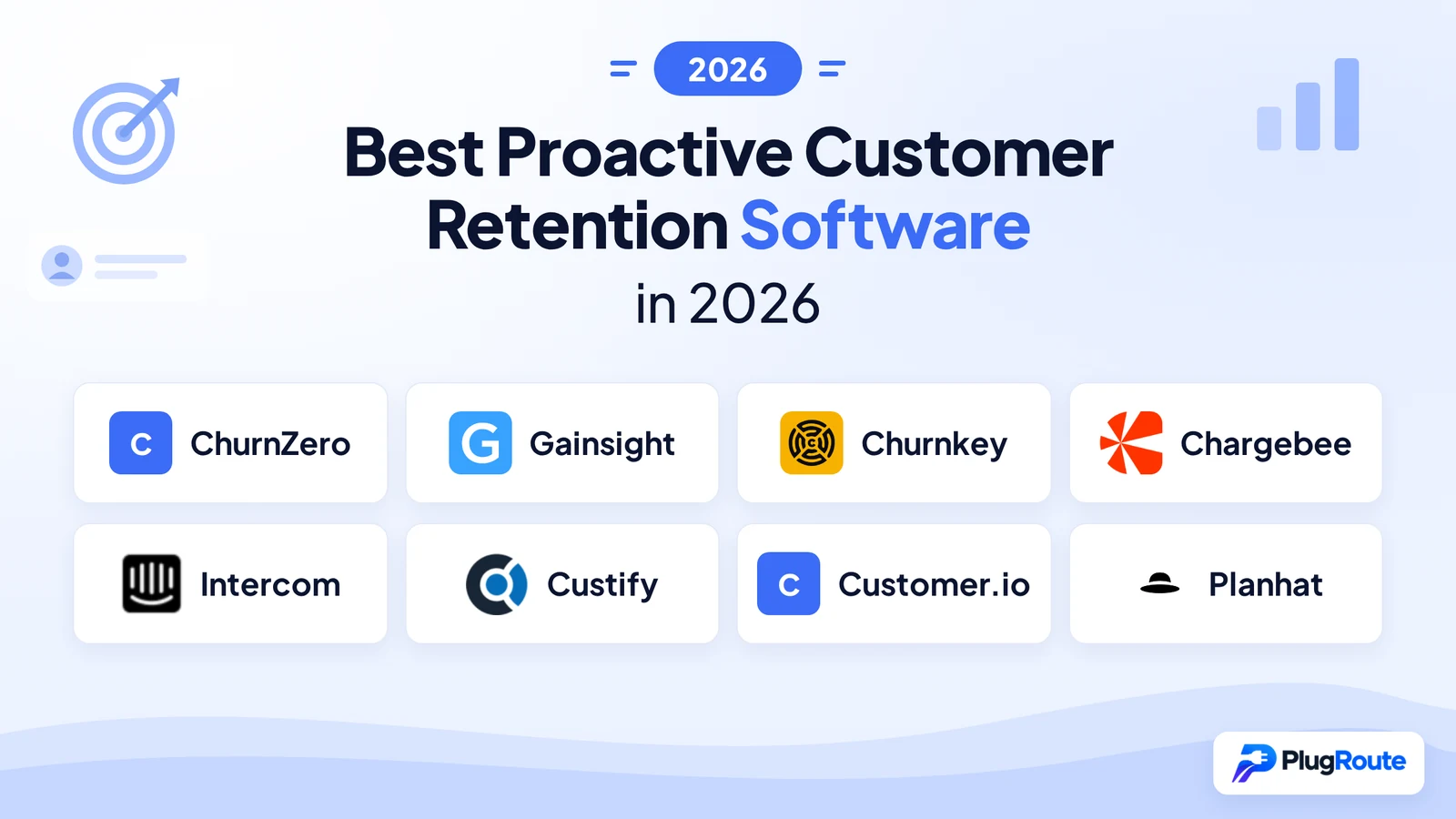
ChurnZero is the strongest proactive retention platform for mid-market SaaS teams, Gainsight leads for enterprise CS operations, and Churnkey is the top specialized tool for recovering involuntary payment churn. Most retention software comparisons miss a critical distinction: voluntary churn and involuntary churn require fundamentally different software categories, solving one without the other leaves a significant share of preventable revenue unaddressed each billing cycle.
Customer success managers evaluating this market face four distinct tool categories, each designed to address a different churn mechanism. CS Platforms tackle voluntary disengagement through health scoring and playbook automation. Payment Recovery tools address billing failures that drive an estimated 20–40% of subscription cancellations. Engagement Automation platforms and Product Analytics tools serve PLG companies managing retention at scale without dedicated CSM teams. No single platform covers all four, and category fit is the most consequential first decision in retention software selection.
PlugRoute has no affiliate relationships with any company listed. Rankings are determined entirely by research data and objective evaluation criteria.
TL;DR: Top Picks at a Glance
- ChurnZero: Strongest purpose-built CS platform for mid-market SaaS teams with 1–20 CSMs needing real-time, AI-powered churn risk visibility across all account signals
- Gainsight: Enterprise CS leader with the deepest Salesforce integration and lifecycle orchestration for mature teams managing $10M+ ARR portfolios
- Churnkey: Top specialized platform for recovering failed-payment revenue and intercepting voluntary cancellations in self-serve subscription businesses on Stripe
- Custify: Most accessible full-featured CS platform for growth-stage SaaS, with community-reported entry pricing in the $399–$899/month range and implementation in weeks
What Are the 4 Categories of Proactive Customer Retention Software?
Proactive customer retention software divides into four categories based on the churn mechanism each tool is designed to address. The right first question is not which platform has the best feature list, it is which category matches your primary revenue leak.
CS Platform: monitors account health, orchestrates proactive CSM workflows, and automates lifecycle playbooks to prevent voluntary disengagement before it becomes cancellation.
- Includes: ChurnZero (#1), Gainsight (#2), Custify (#6), Planhat (#8)
Payment Recovery: addresses involuntary churn caused by failed payments through smart retry logic, dunning sequences, Account Updater services, and cancellation flow optimization.
- Includes: Churnkey (#3), Chargebee (#4)
Engagement Automation: executes behavioral trigger-based lifecycle campaigns across email, in-app, SMS, and push channels to intercept disengagement before it escalates to cancellation.
- Includes: Intercom (#5), Customer.io (#7), MoEngage (#10)
Product Analytics: surfaces behavioral churn signals through retention curve analysis, feature adoption tracking, and predictive scoring to identify at-risk cohorts for other tools to act on.
- Includes: Amplitude (#9)
No single tool covers all four categories simultaneously. A CS platform is not designed to recover a failed payment, and a dunning tool is not designed to replace health scoring for a complex B2B account portfolio.
A company running only a CS platform addresses voluntary churn while leaving an estimated 20–40% of preventable subscription revenue loss unaddressed every billing cycle (sources: subscription platform benchmarks including Recurly churn rate research; see Methodology section for full source list).
As one user on r/SaaS put it:
“One thing worth separating is why users churn vs what happens when payments fail. Tools like ChurnKey are useful when you want to understand cancellation intent or segment churn by lifecycle. But failed payments are a different class of problem. They’re mechanical. No UX change fixes an expired card. In most Stripe-based SaaS I’ve looked at, failed payments are the fastest revenue win because you’re recovering money that users already intended to pay.” Posted by u/cheap_blanket
Takeaway: Subscription practitioners consistently recognize failed payments as a mechanically distinct revenue problem that product tools and lifecycle platforms are structurally unable to address, validating why payment recovery and CS platforms must be evaluated as separate, complementary categories.
These four categories collectively address what practitioners variously call churn prediction software, customer lifecycle management, subscription retention platforms, and at-risk account detection systems, terms describing overlapping capabilities distributed across different tool types rather than a single unified product category.
How Do the Top 10 Proactive Retention Tools Compare at a Glance?
The 10 best proactive customer retention tools in 2026 span four categories with distinct capability boundaries. ChurnZero leads for mid-market CS, Gainsight for enterprise, and Churnkey for payment recovery, while Intercom, Customer.io, and MoEngage address PLG engagement use cases that CS platforms are not designed to serve efficiently at high user volume.
| Rank | Company | Category | Best For | One-Line Summary | Key Capabilities | Primary Strength | Key Limitation |
|---|---|---|---|---|---|---|---|
| 1 | ChurnZero | CS Platform | Mid-market SaaS, 1–20 CSMs | ChurnZero is a purpose-built CS platform providing real-time, AI-powered churn risk visibility across usage, CRM, billing, and support signals; enabling CSMs to intervene before customers disengage or cancel. | Real-time health scoring / AI next-best-action / Playbook automation / In-app engagement / Renewal forecasting | AI churn risk prioritization across unified multi-signal health data | No dunning or involuntary churn recovery |
| 2 | Gainsight | CS Platform | Enterprise SaaS, $10M+ ARR, Salesforce-centric | Gainsight is the enterprise leader in CS software, offering the deepest lifecycle orchestration, AI health scoring, and Salesforce integration; purpose-built for large, high-touch CS teams managing complex account portfolios. | Journey Orchestrator / Rules Engine / Gainsight AI / Revenue Intelligence / Bidirectional Salesforce sync | Most comprehensive lifecycle orchestration with deepest Salesforce integration | $80K–$320K+ Year 1 all-in; 6–12 month implementation |
| 3 | Churnkey | Payment Recovery | Self-serve subscription SaaS on Stripe | Churnkey is a subscription retention platform that recovers failed-payment revenue through intelligent retry logic and reduces voluntary churn through adaptive cancellation flows; filling the involuntary churn gap CS platforms ignore. | Smart payment retry / Adaptive cancellation flows / Dunning sequences / Churn analytics / A/B testing | Dual coverage: payment failure recovery + voluntary cancellation interception in one platform | No health scoring or upstream lifecycle orchestration |
| 4 | Chargebee | Payment Recovery | Subscription businesses needing unified billing + recovery | Chargebee is a subscription management platform that addresses involuntary churn through built-in smart dunning, intelligent payment retry, and Account Updater services within the billing workflow. | Smart dunning / Account Updater / Chargebee Retention / Intelligent retry / Revenue analytics | Account Updater prevents payment failures before they occur | Retention features secondary to core billing function |
| 5 | Intercom | Engagement Automation | PLG SaaS, high user volumes, lean CS teams | Intercom is a customer communications platform enabling proactive PLG retention through behavioral trigger messaging, in-app engagement flows, and AI-powered support intelligence. | Behavioral trigger messaging / Fin AI agent / Product tours / Shared inbox / Series automation | Proactive messaging + support conversation intelligence in one accessible platform | No account-level health scoring or CSM workflow management |
| 6 | Custify | CS Platform | Growth-stage SaaS, Series A–B, 1–5 CSMs | Custify is a CS platform built for growth-stage SaaS companies needing professional health scoring and lifecycle automation at an accessible price point; bridging the gap between spreadsheet-based tracking and enterprise CS complexity. | Health scoring / Automated playbooks / Workflow prioritization / Journey mapping / Native integrations | Accessible entry pricing + 2–4 week implementation among full-featured CS platforms | Shallower predictive AI depth vs. enterprise CS platforms |
| 7 | Customer.io | Engagement Automation | Subscription SaaS with product event tracking + technical teams | Customer.io is a behavioral lifecycle messaging platform enabling precise, event-triggered, multi-channel retention campaigns at scale; the strongest execution layer for teams that have identified at-risk signals upstream and need automated, personalized outreach at high volume. | Behavioral event API / Visual workflow builder / Multi-channel delivery / Journeys builder / Data-in/out architecture | Most precise behavioral event trigger logic among messaging platforms | Requires upstream analytics or CS platform to identify at-risk customers |
| 8 | Planhat | CS Platform | RevOps-aligned mid-market SaaS, complex product structures | Planhat is a CS platform distinguished by pricing transparency, a flexible customer data model for complex SaaS structures, and strong portfolio-level NRR analytics; rare properties in the CS platform category. | Flexible data model / Portfolio NRR analytics / Automated playbooks / Health scoring / Native integrations | Pricing transparency + flexible data model for non-standard SaaS product structures | Configuration complexity requires dedicated CS ops investment |
| 9 | Amplitude | Product Analytics | PLG SaaS identifying behavioral predictors of retention | Amplitude is a product analytics platform identifying churn risk by revealing which product behaviors and feature adoption patterns statistically predict long-term retention. | Retention curve analysis / Behavioral cohort analysis / Funnel analysis / Predictive analytics / Native integrations | Most analytically rigorous behavioral churn signal detection in the category | Analytics layer only; does not execute retention interventions |
| 10 | MoEngage | Engagement Automation | B2C subscription, mobile-first SaaS, 50K+ MAU | MoEngage is an AI-powered omnichannel engagement platform driving proactive retention through predictive behavioral segmentation and automated campaigns across email, push, SMS, in-app, and WhatsApp. | AI predictive segmentation / Omnichannel automation / Smart triggered campaigns / No-code builder / Retention analytics | AI segmentation + broadest channel coverage including WhatsApp | Optimized for B2C/mobile-first; lacks B2B account-level health scoring and CSM workflow functionality |
Which Proactive Retention Tool Should I Choose for My Situation?
The right proactive retention tool depends on your primary churn type, team composition, and company stage, not feature count. The table below maps the most common buyer decision criteria to recommended tools and acceptable alternatives.
| Your #1 Priority | Recommended Tool | Why | Acceptable Alternative |
|---|---|---|---|
| Mid-market health scoring, 1–20 CSMs | ChurnZero | Purpose-built proactive CS; AI health scoring; validated mid-market fit | Custify if community-reported $399–$899/month entry pricing fits budget better |
| Enterprise Salesforce-integrated lifecycle orchestration | Gainsight | Deepest Salesforce integration; most comprehensive CS automation | ChurnZero for teams not yet at enterprise scale |
| Recover involuntary (failed payment) churn | Churnkey | Specialized smart retry + adaptive cancellation flow optimization | Chargebee if switching billing platform is acceptable |
| Unified billing and payment recovery in one system | Chargebee | Account Updater + smart dunning built into subscription management | Churnkey if already on Stripe and need specialized optimization |
| PLG retention via behavioral trigger messaging | Intercom | Seat-based entry pricing; support signal + proactive engagement combined | Customer.io for more developer-precise event triggering |
| Accessible full CS platform, growth-stage budget | Custify | Community-reported entry pricing ~$399/month; 2–4 weeks to implement | Planhat if data model flexibility is required |
| Precise multi-channel behavioral event messaging | Customer.io | Best behavioral event API precision in the engagement category | Intercom for simpler setup without engineering resources |
| RevOps-aligned CS with complex product data structures | Planhat | Flexible data model + pricing transparency for RevOps alignment | ChurnZero for deeper predictive AI capability |
| Identify which product behaviors predict churn | Amplitude | Best retention curve and behavioral cohort analysis in the category | MoEngage for combined analytics + omnichannel activation |
| B2C omnichannel retention at 50K+ MAU scale | MoEngage | AI segmentation + broadest channel coverage including WhatsApp | Customer.io for more precise behavioral triggering |
| No dedicated CS ops capacity; budget under $500/month | None of the above; build process first | Investing in a platform before defining health criteria and ICP delays ROI by 6–12 months | Begin with CRM lifecycle stages + Churnkey for involuntary churn recovery |
What Are the 10 Best Proactive Retention Tools in 2026?
ChurnZero is the recommended starting point for most mid-market CS teams; Churnkey and Chargebee are the starting points for subscription businesses with payment-failure-driven churn. The 10 entries below are ranked across six criteria (proactive signal detection, review platform credibility, churn type coverage, pricing accessibility, integration depth, and documented outcomes) weighted toward the target audience’s primary pain of discovering churn too late.
1. ChurnZero: Best Overall: Best for Mid-Market SaaS Proactive Churn Prevention
Category: CS Platform, a customer success platform that monitors account health, orchestrates proactive CSM workflows, and automates lifecycle interventions to prevent voluntary churn.
At a Glance
- Category: CS Platform
- Best For: Mid-market SaaS companies with 1–20 CSMs moving from spreadsheet-based tracking to automated, signal-driven proactive retention
- Price Range: ~$1,500–$3,000+/month (custom enterprise pricing above base tier; no published pricing page as of 2026, verify with vendor)
- Primary Strength: ChurnZero combines real-time multi-signal health scoring with AI-powered churn risk prioritization and a native in-app engagement module in a single platform purpose-built for proactive churn prevention
- Biggest Limitation: ChurnZero does not address involuntary churn from failed payments and requires CS ops capacity to configure health scoring models and playbooks, lean teams without dedicated CS ops may underutilize core capabilities
- One-Line Summary: ChurnZero is a purpose-built customer success platform that gives mid-market SaaS teams real-time, AI-powered visibility into churn risk across usage, support, billing, and CRM signals, enabling CSMs to intervene before customers disengage or cancel.
- Last Verified: May 2026
Overview
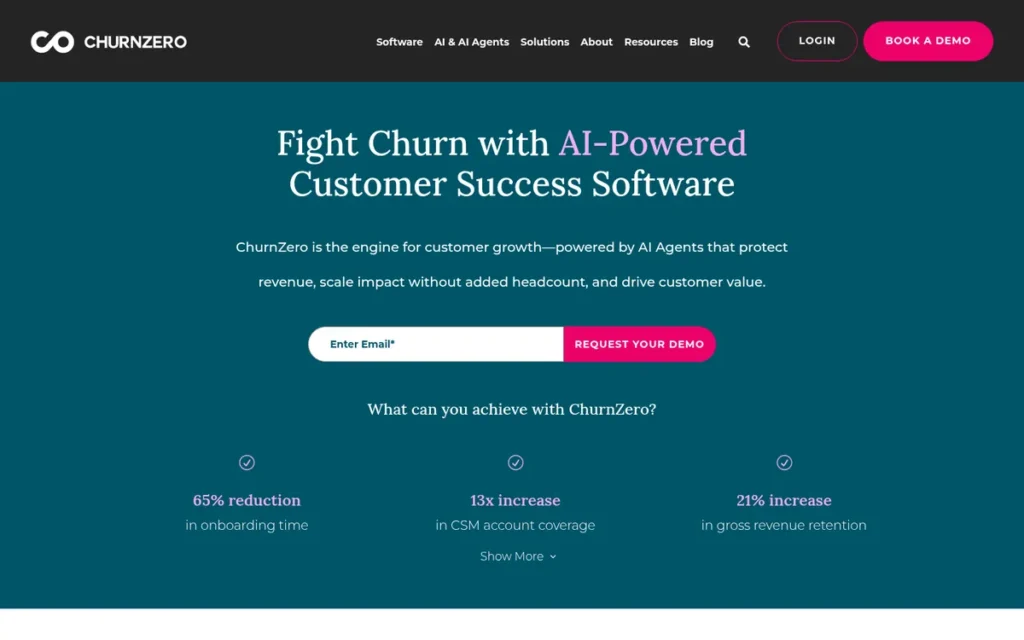
ChurnZero is a purpose-built customer success and proactive churn prevention platform designed for mid-market SaaS companies with dedicated CS teams that need to move from reactive, spreadsheet-based tracking to automated, signal-driven retention workflows. ChurnZero ranks #1 in this evaluation for combining the strongest proactive signal detection capability, the most practitioner-validated mid-market positioning, and accessible pricing relative to enterprise-only alternatives, the profile that defines the majority of this article’s target audience.
ChurnZero aggregates product usage, CRM data, support tickets, NPS scores, and billing signals into a unified health score for every account. ChurnZero then uses AI to surface prioritized churn risk alerts and recommend next-best actions for CSMs.
ChurnZero also includes a native in-app engagement module that delivers retention interventions directly inside the customer’s product experience, closing the loop between signal detection and action without requiring separate tooling.
Key Features
- ChurnZero’s real-time health scoring engine ingests data from CRM platforms (Salesforce, HubSpot), product event streams, support tools (Zendesk, Intercom), billing systems, and NPS surveys to generate a composite account health score that updates continuously, not on a periodic scheduled sync.
- ChurnZero’s AI-powered churn risk prioritization ranks at-risk accounts daily and surfaces recommended next-best actions, reducing the time CSMs spend manually triaging which accounts need attention and increasing time spent on high-probability retention interventions.
- ChurnZero’s playbook automation engine triggers behavior-based workflows in response to health score changes, usage drop-offs, milestone non-completion, and support escalation patterns, enabling proactive outreach at scale without manual monitoring of individual accounts.
- ChurnZero’s native in-app engagement module allows CS teams to deliver targeted messages, product walkthroughs, feature announcements, and NPS surveys directly inside the customer’s product without requiring engineering resources for each campaign deployment.
- ChurnZero’s renewal and expansion forecasting tools give revenue operations leaders portfolio-level visibility into renewal risk, expansion opportunity, and net revenue retention trends across the entire customer book of business.
Best For
ChurnZero is best for mid-market SaaS companies with 1–20 dedicated CSMs that have identified reactive churn management as a revenue problem, have basic product event tracking instrumented, and are ready to invest in CS ops capacity to configure health scoring models and build lifecycle playbooks. ChurnZero is particularly suited to companies moving off spreadsheet-based or CRM-native tracking for the first time.
Pricing
ChurnZero does not publish transparent pricing as of 2026. Community-reported estimates place entry-level configurations at approximately $1,500–$2,000/month, with enterprise configurations scaling significantly based on account volume and module selection. Implementation costs are additional and vary with data complexity.
Budget for a minimum 4–8 week implementation timeline. Request a detailed total cost of ownership breakdown (including onboarding, implementation support, and ongoing CS ops requirements) during the sales process before signing. Verify current pricing at churnzero.com (2026).
Strengths
- ChurnZero holds a 4.7/5 rating from 1,587 verified reviews in G2’s Customer Success category (G2, May 2026), named to G2’s 2026 Best Software Awards and recognized as a category leader in user satisfaction, the strongest third-party practitioner validation signal among mid-market CS platforms in this evaluation.
- ChurnZero’s multi-signal health scoring aggregates data sources that most CS teams currently track in silos (product usage, CRM engagement, support ticket patterns, billing history, and NPS) into a single account-level view, directly addressing the pain of lacking unified customer health visibility.
- ChurnZero is frequently cited in practitioner communities including r/CustomerSuccess, Customer Success Network forums, and CS-focused LinkedIn groups as among the most operationally validated mid-market CS platforms, the primary alternative to Gainsight for teams that need enterprise-grade functionality at accessible pricing.
- ChurnZero’s built-in in-app engagement module eliminates the need for a separate product engagement tool for retention interventions, reducing stack complexity for mid-market teams managing multiple vendor relationships on constrained CS ops budgets.
Limitations
- Involuntary Churn Gap: ChurnZero provides no dunning automation, smart payment retry, or failed payment recovery capability, subscription businesses with significant payment-failure-driven churn must pair ChurnZero with a dedicated payment recovery tool such as Churnkey or Chargebee’s dunning module to achieve complete proactive churn coverage.
- CS Ops Dependency: ChurnZero’s full value is realized only when a CS team has the operational maturity to configure and maintain health scoring models, build playbooks, and act on signals systematically, teams of one to two CSMs without dedicated CS ops support may spend two to four months in configuration before seeing meaningful proactive retention results.
This operational prerequisite is widely acknowledged in practitioner communities. As one commenter on r/CustomerSuccess observed when evaluating CS platforms including ChurnZero:
“They’re pretty much all the same thing – they centralize your customer data and let you build some automation and standardization into your CSMs’ workflows. What will make or break your success with any CS platform is: 1. Data hygiene/ availability 2. Knowing what you actually want to do with said platform” Posted by u/TheDirtyDagger
Takeaway: Across CS platforms including ChurnZero, practitioner communities consistently identify data hygiene and operational use-case clarity (not feature differences) as the primary determinants of whether a platform investment succeeds or fails.
- Pricing Opacity: ChurnZero does not publish pricing publicly, making it difficult for growth-stage buyers to assess budget fit before engaging the sales process, a practical barrier for lean teams conducting self-serve evaluations on constrained timelines who may move on to tools with visible entry pricing.
Verdict
ChurnZero is the strongest purpose-built proactive churn prevention platform for mid-market SaaS companies with dedicated CS teams, validated by 1,587 practitioner reviews at 4.7/5 on G2 (May 2026) as the leading mid-market alternative to enterprise-only platforms. ChurnZero addresses the core pain of discovering churn too late by unifying product usage, CRM, support, and billing signals into real-time health scores with AI-prioritized next-best actions. Subscription businesses with material involuntary churn exposure should pair ChurnZero with a dedicated dunning tool, as payment recovery falls entirely outside ChurnZero’s designed scope.
2. Gainsight: Best for Enterprise SaaS with Mature, High-Touch CS Operations and Salesforce Infrastructure
Category: CS Platform, a customer success platform that monitors account health, orchestrates proactive CSM workflows, and automates lifecycle interventions to prevent voluntary churn at enterprise scale.
At a Glance
- Category: CS Platform
- Best For: Enterprise SaaS companies with $10M+ ARR, dedicated CS operations staff, 10+ CSMs, and existing Salesforce CRM infrastructure
- Price Range: $80,000–$320,000+/year all-in (implementation and professional services additional; community-reported Year 1 total costs frequently exceed $150,000)
- Primary Strength: Gainsight provides the most comprehensive CS lifecycle orchestration available, with unmatched Salesforce integration depth and the broadest playbook automation capability for enterprise-scale customer portfolios
- Biggest Limitation: Gainsight’s enterprise-only pricing and 6–12 month implementation timelines make it structurally inaccessible to growth-stage and early mid-market SaaS companies, community discussions document a recurring under-utilization pattern among teams lacking dedicated CS ops staff
- One-Line Summary: Gainsight is the enterprise leader in customer success software, offering the deepest lifecycle orchestration, AI-powered health scoring, and Salesforce integration available, purpose-built for large, high-touch CS teams managing complex account portfolios at scale.
- Last Verified: May 2026
Overview
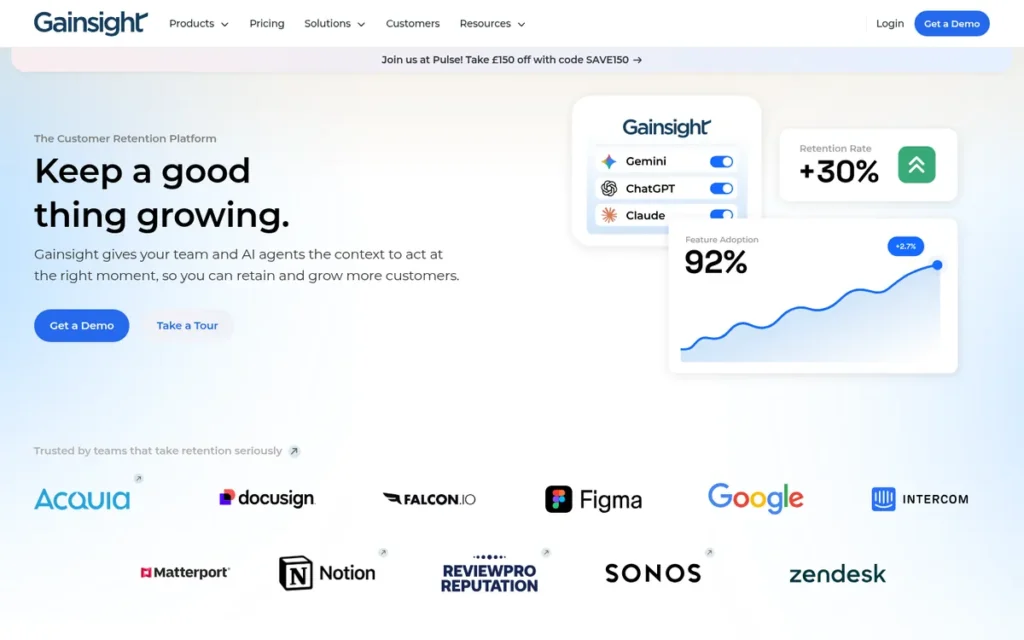
Gainsight is the enterprise customer success platform of record for large SaaS companies that need to manage complex, high-value customer portfolios at scale, offering the most comprehensive health scoring, lifecycle orchestration, playbook automation, and predictive AI capabilities in the CS software category. Gainsight ranks #2 in this evaluation, highest on feature completeness and Salesforce integration depth, but below ChurnZero on audience-weighted pricing accessibility, as its $80,000–$320,000+ Year 1 cost structurally excludes the majority of the target audience.
Gainsight integrates deeply with Salesforce CRM, ingesting product usage, support, billing, NPS, and relationship signals to generate account-level health scores and trigger proactive interventions through its Rules Engine and Journey Orchestrator.
Gainsight is the most feature-complete proactive retention platform in this evaluation, but its $80K–$320K+ Year 1 all-in cost and 6–12 month implementation timeline position it as a tool for mature CS organizations, not growth-stage teams building retention capabilities for the first time.
Key Features
- Gainsight’s health scoring engine supports highly configurable, multi-dimensional scorecards combining product usage telemetry, CRM engagement data, support ticket patterns, financial signals, and relationship strength indicators, with both rule-based and AI-driven weighting options for teams at different data maturity levels.
- Gainsight’s Journey Orchestrator automates complex, multi-stage customer lifecycle programs (onboarding sequences, renewal campaigns, expansion plays, and escalation workflows) triggered by health score changes, milestone completions, usage events, or calendar thresholds.
- Gainsight’s Rules Engine enables CS operations teams to build sophisticated automated alerts, task assignments, and playbook triggers without engineering resources, supporting large CS teams managing hundreds or thousands of accounts simultaneously.
- Gainsight AI incorporates relationship intelligence, meeting sentiment analysis, and AI-generated account summaries (drawing on capabilities from the Staircase AI acquisition (August 2024)) helping CSMs maintain situational awareness across large, complex enterprise portfolios.
- Gainsight’s Revenue Intelligence module provides renewal forecasting, expansion opportunity identification, and net revenue retention visibility for CS and revenue operations leaders managing portfolio-level churn and growth targets.
Best For
Gainsight is best for enterprise SaaS companies with $10M+ ARR, dedicated CS operations staff, 10+ CSMs, and existing Salesforce infrastructure, particularly organizations where the cost of a single high-value churn event justifies a platform investment exceeding $100,000 in Year 1. Before committing to Gainsight evaluation, read Red Flag #3 below, it describes the pattern that makes enterprise-only platforms a misaligned investment for teams below the enterprise threshold.
Pricing
Gainsight does not publish transparent pricing as of 2026. Community reports and analyst sources consistently place Year 1 total cost at $80,000–$320,000+ including license, implementation, and professional services. Ongoing license costs for established deployments are reported in the $50,000–$200,000/year range.
Implementation projects routinely run 6–12 months. CS ops staffing costs to maintain the platform are an additional operational expense. Buyers must model full total cost of ownership (including implementation, CS ops headcount, and ongoing professional services) before comparing Gainsight to alternatives. Verify current pricing with the vendor before committing.
Strengths
- Gainsight holds consistent Leader quadrant placement in G2’s Customer Success category with approximately 1,688 verified reviews and a 4.5/5 aggregate rating (G2, May 2026), verify current data at g2.com/products/gainsight-customer-success/reviews, the deepest available practitioner review base among enterprise CS platforms in this evaluation.
- Gainsight’s Salesforce integration is bidirectional and widely regarded as the most mature CRM integration in the CS platform category, enabling Gainsight to function as an operational CS layer on top of Salesforce for enterprise CS teams that have standardized on Salesforce as their system of record.
- Gainsight’s lifecycle orchestration capabilities: particularly Journey Orchestrator and the Rules Engine, are consistently cited in practitioner communities as the most powerful automated playbook tools available for managing complex, multi-stage retention programs across thousands of accounts at scale.
- Gainsight’s enterprise track record spans 10+ years with 1,000+ enterprise customers (vendor-reported; source: gainsight.com, 2026), providing buyers with an extensive reference customer base and case study library for evaluating fit across industry verticals and account complexity profiles.
Limitations
- Accessibility Barrier: Gainsight’s enterprise-only pricing of $80,000–$320,000+ in Year 1 and 6–12 month implementation timelines make it structurally inaccessible to growth-stage SaaS companies and mid-market teams with lean CS operations, a hard constraint that no feature comparison can overcome for companies below the enterprise threshold.
- Under-Utilization Risk: Community discussions on r/CustomerSuccess and LinkedIn CS practitioner groups (2024–2026) document a recurring pattern of buyers purchasing Gainsight, failing to implement it fully, and struggling to build an ROI case for renewal, a pattern that strongly indicates team readiness assessment must precede the purchase decision, not follow it. The most common cause of poor Gainsight ROI is implementation abandonment when CS teams discover the platform requires more CS ops capacity than anticipated.
This under-utilization concern is echoed directly in r/CustomerSuccess practitioner discussions:
“Useless for Enterprise CS. It just creates extra steps and work which drain productivity and adds no value. Enterprise accounts are complex and cannot be automated. Potentially useful for Scale CS where the CSM does not have a deep knowledge of every single account and needs a quick heatmap.” Posted by u/ScepticalProphet
Takeaway: Gainsight’s heavy configuration requirements and automation-first design can actively reduce CSM productivity for high-touch enterprise teams who lack the CS ops infrastructure to configure and maintain it, reinforcing why dedicated CS ops staffing is a non-negotiable prerequisite before committing to the platform.
- Involuntary Churn Gap: Gainsight, like all CS platforms in this evaluation, does not address involuntary churn from failed payments, requiring a separate dunning tool for complete churn type coverage in subscription businesses with significant payment failure exposure.
Verdict
Gainsight is the most feature-complete proactive customer retention platform for enterprise SaaS, validated by approximately 1,688 practitioner reviews at 4.5/5 on G2 (May 2026), with the deepest lifecycle orchestration, strongest Salesforce integration, and most extensive enterprise track record in the customer success software category. Gainsight is the right choice for enterprise teams with $10M+ ARR, existing Salesforce infrastructure, dedicated CS ops capacity, and a Year 1 budget exceeding $100,000, and the wrong choice for growth-stage or early mid-market teams needing faster time-to-value at accessible price points. Teams that do not match the enterprise profile should evaluate ChurnZero, Custify, or Planhat before engaging Gainsight’s sales process.
3. Churnkey: Best for Involuntary Churn Recovery and Cancellation Flow Optimization in Self-Serve Subscription Businesses
Category: Payment Recovery, a specialized retention tool that recovers revenue lost to failed payments through intelligent retry logic and prevents voluntary churn through optimized cancellation flows.
At a Glance
- Category: Payment Recovery
- Best For: Self-serve and product-led SaaS subscription businesses on Stripe billing experiencing churn from both failed payments and voluntary cancellations, particularly companies with limited CS team resources
- Price Range: $250–$750+/month (performance-based pricing tiers available; verify current pricing at churnkey.co, 2026)
- Primary Strength: Churnkey addresses both involuntary payment churn through intelligent retry logic and voluntary cancellations through adaptive flows in a single platform, with vendor-reported outcome metrics showing payment recovery rates above 80%
- Biggest Limitation: Churnkey does not provide customer health scoring, CSM workflow management, or upstream lifecycle orchestration, it addresses churn at the payment failure and cancellation decision moments only, not earlier lifecycle risk signals
- One-Line Summary: Churnkey is a subscription retention platform that recovers revenue lost to failed payments through intelligent retry logic and reduces voluntary churn through adaptive cancellation flows, addressing the involuntary churn gap that most CS platforms and product analytics tools are not designed to fill.
- Last Verified: May 2026
Overview
Churnkey is a specialized subscription retention platform designed for self-serve and product-led SaaS businesses that need to recover revenue from both involuntary churn (failed payments, soft declines, expired cards) and voluntary churn (deliberate cancellation decisions), the two moments where churn is imminent and where retention intervention has the highest immediate probability of success.
Churnkey ranks #3 in this evaluation, above Chargebee (#4) because its specialization in payment recovery and cancellation flow optimization is deeper than Chargebee’s built-in retention module, and its primary purpose is standalone dunning rather than bundled billing management. Churnkey integrates with billing platforms, primarily Stripe, to deploy intelligent payment retry sequences and adaptive cancellation flows based on the subscriber’s stated cancellation reason.
Churnkey is not a replacement for a full customer success platform. Churnkey does not provide upstream health scoring, CSM workflows, or proactive lifecycle automation, but Churnkey directly addresses the critical churn moments that CS platforms largely ignore: the payment failure event and the active cancellation decision.
Key Features
- Churnkey’s smart payment retry engine uses billing-model-specific timing logic to maximize recovery rates on soft declines and temporary bank failures, going beyond default Stripe retry schedules to recover payments that would otherwise become permanent involuntary churn.
- Churnkey’s adaptive cancellation flows present subscribers with contextually relevant alternatives (pause, downgrade, discount, or extended trial) matched to their selected cancellation reason, intercepting voluntary churn at the highest-intent moment before cancellation is finalized.
- Churnkey’s dunning email sequences automatically contact customers with failed payments through multi-touch, timed campaigns with in-email payment update links, reducing the friction that prevents customers from resolving payment issues before involuntary cancellation occurs.
- Churnkey’s churn analytics dashboard gives subscription businesses visibility into which payment failure types, cancellation reasons, and customer segments generate the most recoverable churn, enabling prioritization of retention investment.
- Churnkey’s A/B testing capability allows subscription businesses to test different cancellation flow designs, offer types, and messaging to optimize recovery rates over time based on actual subscriber behavior data.
Best For
Churnkey is best for self-serve and product-led SaaS subscription businesses on Stripe billing that have not yet built proactive payment recovery infrastructure, particularly companies that have measured their involuntary churn rate and found it exceeds 15–20% of total churn, or companies with no cancellation intervention flow that are losing subscribers at the moment of cancellation without any retention attempt.
Pricing
Churnkey offers performance-based and flat-rate pricing tiers starting at approximately $250–$750/month as of 2026. Performance-based pricing models (where cost is tied to recovered revenue) are available and allow ROI assessment before full financial commitment.
Churnkey’s implementation is self-serve and integrates with Stripe within hours, meaning time-to-value is measured in days rather than months, a meaningful contrast to CS platform onboarding timelines. Verify current pricing at churnkey.co (2026).
Strengths
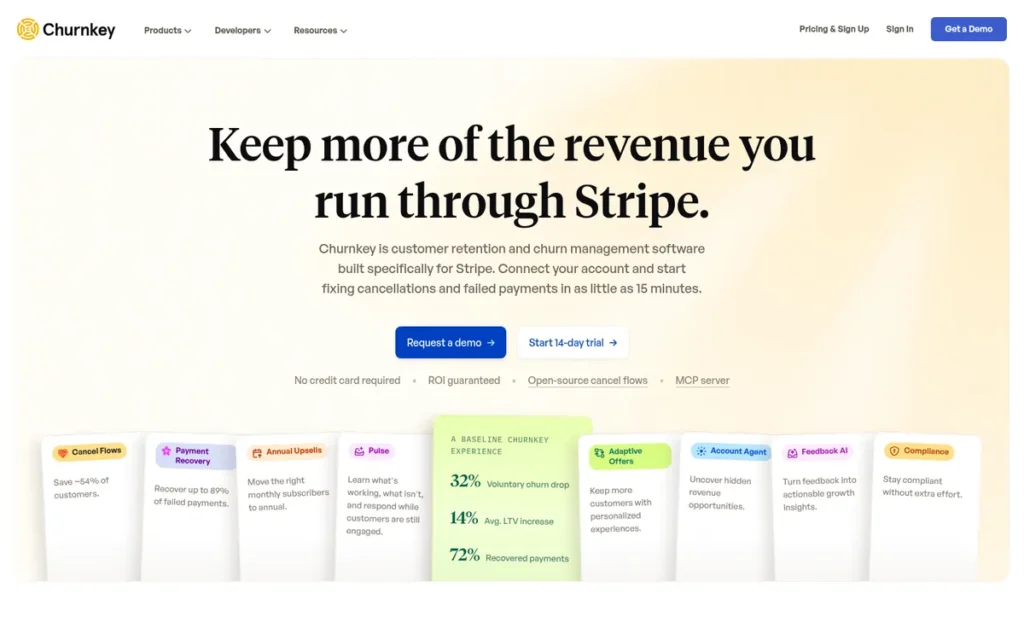
- Churnkey reports vendor-measured outcome claims on its website, including a reported 32% voluntary churn reduction, up to 89% failed payment recovery, and a 14% average LTV increase (source: churnkey.co, 2026 (vendor-reported; methodology not independently verified)) a level of self-reported outcome transparency uncommon among retention software vendors. Churnkey’s own benchmark analysis of 5.4 million failed payments across 25 million subscriptions reports 70% recovery of detected involuntary churn (source: churnkey.co, vendor-produced research, 2025). Evaluate these figures during a proof-of-concept engagement before using them for ROI projections.
- Churnkey directly addresses the involuntary churn gap: the estimated 20–40% of subscription revenue loss caused by failed payments rather than deliberate cancellation, a category that CS platforms and product analytics tools are not designed to fill, and that most retention software evaluations omit entirely.
- Churnkey’s self-serve implementation model allows subscription businesses to deploy payment recovery and cancellation flow optimization without engineering resources or multi-month onboarding projects, making Churnkey accessible to small teams that cannot afford CS platform implementation timelines.
- Churnkey’s adaptive cancellation flows respond to the subscriber’s stated cancellation reason in real time, presenting alternatives matched to the stated concern rather than serving static discount offers regardless of cancellation intent, a more contextually relevant intervention than most alternatives provide.
Limitations
- Scope Boundary: Churnkey addresses churn at the two moments of highest immediate risk (payment failure and active cancellation decision) but does not surface at-risk signals earlier in the customer lifecycle. Companies needing health scoring, CSM workflow automation, or lifecycle playbooks must pair Churnkey with a separate CS platform such as ChurnZero or Custify to achieve complete proactive coverage.
- Stripe-First Integration: Churnkey’s primary billing integration is with Stripe, businesses on Chargebee, Recurly, or other billing platforms should verify integration depth and feature parity before committing, as Stripe-native A/B testing and adaptive flow capabilities may not transfer fully to alternative billing systems. Churnkey’s documentation for non-Stripe platforms is less transparent than its Stripe integration documentation.
- No Upstream Proactive Prevention: Churnkey does not engage customers before they reach the payment failure or cancellation stage, subscription businesses with high-value accounts that benefit from relationship-based early intervention will need CS platform tooling alongside Churnkey’s transactional churn recovery.
Users on r/SaaS described their implementation experience:
“This is spot on – we went down the ChurnKey rabbit hole about 8 months ago and honestly wished we’d done the UX audit first. Our churn was like 15% monthly and we thought a tool would magically fix it. Turns out most people were bouncing because our onboarding was garbage and they never hit that ‘aha moment.’ ChurnKey just gave us fancy data about confused users leaving. Fixed the onboarding flow first, churn dropped to like 8%, then added ChurnKey for the exit surveys. Now we’re sitting around 5-6% which feels way more reasonable for our price point.” Posted by u/Relative_Spend4182
Takeaway: Churnkey delivers measurable churn reduction when deployed after core product and onboarding problems are resolved, but cannot substitute for fixing the upstream drivers of early lifecycle churn that bring customers to the cancellation page in the first place.
Verdict
Churnkey is the strongest specialized platform for recovering involuntary churn and optimizing voluntary cancellation flows in self-serve subscription businesses, addressing a critical retention gap that CS platforms and product analytics tools are not designed to fill. Churnkey’s self-serve implementation and performance-based pricing tiers make it a potentially fast-to-recover investment for subscription businesses on Stripe billing, particularly where performance-based pricing ties cost to recovered revenue. Companies should use Churnkey alongside, not instead of, a lifecycle management or CS platform if they also need upstream churn signal detection before customers reach the payment failure or cancellation decision stage.
4. Chargebee: Best Subscription Management Platform with Integrated Proactive Dunning and Involuntary Churn Recovery
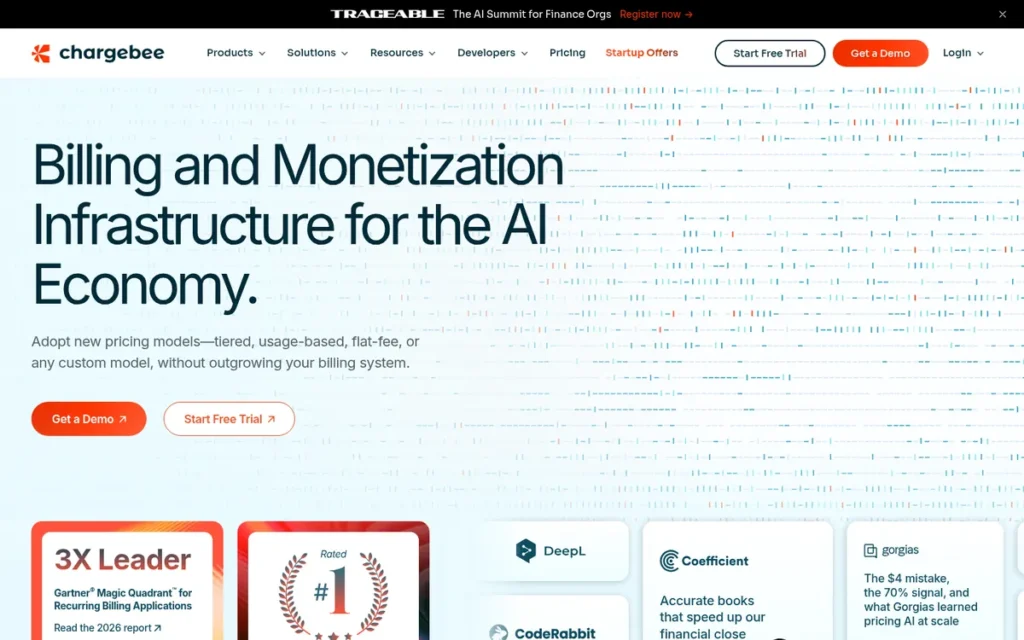
Category: Payment Recovery, a subscription management platform with integrated proactive dunning, smart payment retry, Account Updater services, and cancellation flow tools that address both involuntary and voluntary churn within the billing workflow.
At a Glance
- Category: Payment Recovery
- Best For: Subscription businesses that need unified billing management and proactive payment recovery in one platform, particularly B2B SaaS with mid-complexity billing models (tiered, usage-based, multi-currency)
- Price Range: Free Starter tier up to $250K cumulative billing; Performance at $599/month; Enterprise at custom pricing, verify at chargebee.com/pricing (2026)
- Primary Strength: Chargebee combines full subscription billing management with proactive dunning automation, smart retry logic, Account Updater services, and a cancellation flow module, the most complete unified billing-plus-payment-recovery system in this evaluation
- Biggest Limitation: Chargebee’s dunning and retention capabilities are secondary to its core billing function, subscription businesses with serious involuntary churn recovery requirements may find specialized tools like Churnkey deliver superior optimized retry logic and adaptive cancellation flows
- One-Line Summary: Chargebee is a subscription management platform that addresses involuntary churn through built-in smart dunning, intelligent payment retry, and Account Updater services, the right choice for subscription businesses that want billing operations and payment recovery managed in a single system.
- Last Verified: May 2026
Overview
Chargebee is a subscription management platform used by 6,500+ subscription businesses (vendor-reported; source: chargebee.com, verified May 2026) to handle the full billing lifecycle, from pricing and invoicing to revenue recognition, dunning, and cancellation intervention. Chargebee is one of the few platforms that treats involuntary churn recovery as a core operational function rather than a bolt-on feature.
Chargebee’s dunning suite includes multi-touch email sequences, smart payment retry with configurable decline-code-specific logic, and an Account Updater service that proactively refreshes expired payment credentials before failures occur. Chargebee also includes Chargebee Retention (acquired from Brightback (January 2022, rebranded Summer 2022)) providing voluntary cancellation flow management within the billing workflow.
Chargebee is not a customer success platform. Chargebee does not provide CS health scoring, CSM workflows, or lifecycle playbooks, but Chargebee is the strongest choice for subscription businesses that need billing and payment recovery managed in one system.
Key Features
- Chargebee’s smart dunning automation generates multi-touch email and in-product notification sequences for failed payments with configurable timing, messaging, and channel logic, maximizing payment recovery before hard involuntary cancellation.
- Chargebee’s intelligent payment retry engine configures retry timing and logic based on decline reason codes returned by payment processors, going beyond fixed retry schedules to improve recovery rates on recoverable soft declines.
- Chargebee’s Account Updater service works with major card networks to proactively update expired or replaced payment credentials in real time, preventing involuntary churn before it occurs rather than recovering it after payment failure.
- Chargebee Retention (formerly Brightback, acquired January 2022 and integrated Summer 2022) provides voluntary cancellation flow management (presenting subscribers with contextually relevant alternatives before cancellation is finalized) adding voluntary churn interception alongside Chargebee’s core involuntary churn recovery capability.
- Chargebee’s revenue and churn analytics dashboards provide MRR movement reporting, cohort-level churn analysis, and involuntary versus voluntary churn decomposition, enabling data-driven prioritization of payment recovery investment.
Best For
Chargebee is best for B2B SaaS subscription businesses with mid-complexity billing models (tiered pricing, usage-based billing, annual contracts, multi-currency requirements) that want to manage subscription billing operations and proactive payment recovery in one platform rather than maintaining separate billing and dunning tools.
Pricing
Chargebee offers a free Starter tier for businesses processing up to $250,000 in cumulative billing, the most accessible price entry point for early-stage subscription businesses in this evaluation, and one that includes meaningful dunning functionality. The Performance tier is priced at $599/month.
Chargebee Retention may be priced separately or bundled depending on tier, confirm module inclusion and pricing during the sales process. Verify current pricing and thresholds at chargebee.com/pricing (2026).
Strengths
- Chargebee is recognized as a G2 Leader in Subscription Management for 27 consecutive quarters through Winter 2026 (G2, 2026), verify current star rating and review count at g2.com/products/chargebee/reviews, providing long-tenured, third-party practitioner validation for its core billing and dunning capabilities across a wide range of subscription business types.
- Chargebee’s Account Updater service proactively prevents involuntary churn before payment failure by automatically refreshing expired or replaced payment credentials with card networks in real time, a pre-failure prevention capability that most CS platforms and standalone dunning tools do not offer.
- Chargebee Retention (formerly Brightback, integrated Summer 2022) gives Chargebee coverage of both involuntary churn (payment recovery) and voluntary churn (cancellation interception) within a single billing workflow, a coverage combination unique among billing-focused platforms in this evaluation.
- Chargebee’s free Starter tier for businesses processing up to $250K in cumulative billing provides early-stage subscription companies access to professional dunning automation without upfront financial commitment, lowering the barrier to proactive payment recovery at the stage when every prevented churn event is most financially significant.
Limitations
- Secondary Feature Depth: Chargebee’s dunning and cancellation flow features are secondary to its core billing function, subscription businesses purchasing Chargebee specifically for payment recovery optimization will find that specialized tools like Churnkey offer more sophisticated adaptive retry logic, more granular cancellation flow A/B testing, and more detailed payment recovery analytics than Chargebee’s built-in retention modules.
- Platform Switching Cost: Chargebee is the right choice when subscription billing and payment recovery must be managed in one system, if billing is already handled by Stripe or another established platform and payment recovery optimization is the sole need, a specialized dunning tool will likely deliver superior recovery rates at lower total cost than switching billing platforms.
- No CS Health Scoring: Chargebee does not provide customer health scoring, CSM workflow management, or proactive lifecycle orchestration, companies that need upstream voluntary churn prevention alongside payment recovery will need to pair Chargebee with a dedicated CS platform such as ChurnZero or Custify.
Verdict
Chargebee is the strongest subscription management platform with integrated proactive dunning for subscription businesses that want billing operations and involuntary churn recovery managed in a single system, recognized as a G2 Leader in Subscription Management for 27 consecutive quarters (G2, 2026) and adopted by 6,500+ subscription businesses globally (vendor-reported, 2026). Chargebee’s Account Updater service and Chargebee Retention module address both involuntary and voluntary churn within the billing workflow, a coverage combination that most billing and dunning tools do not replicate. Companies with established Stripe billing that need optimized recovery performance should evaluate Churnkey alongside Chargebee before switching billing platforms to gain retention features.
5. Intercom: Best for Product-Led Proactive Retention Through Behavioral Trigger Messaging and Support Intelligence
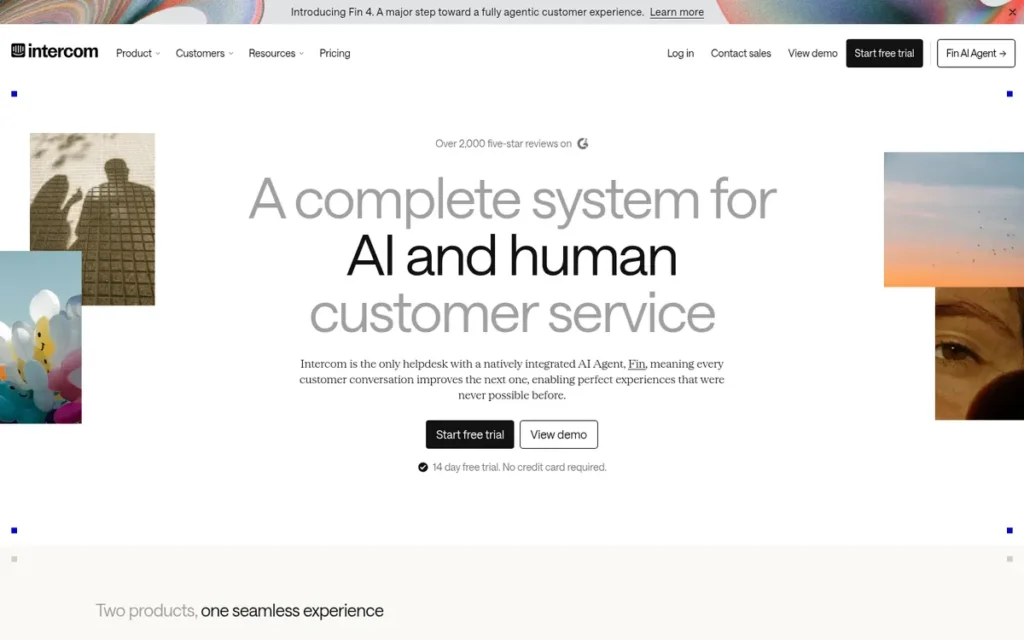
Category: Engagement Automation, a customer communications platform that enables proactive retention through behavioral trigger-based messaging, in-app engagement, and support conversation intelligence.
At a Glance
- Category: Engagement Automation
- Best For: Product-led growth SaaS companies managing retention through in-app engagement, behavioral messaging, and support conversations, particularly high-volume businesses where individual CSM relationships are not economically viable
- Price Range: Seat-based: $29/seat/month (Essential) to $132/seat/month (Expert) billed annually; Fin AI Agent at approximately $0.99/resolved conversation additional, verify at intercom.com/pricing (2026)
- Primary Strength: Intercom combines behavioral event-triggered messaging, in-app product tours, AI-powered support automation, and customer conversation intelligence in one platform, enabling proactive retention at scale without a dedicated CS platform for PLG-oriented teams
- Biggest Limitation: Intercom is not purpose-built for CS health scoring, account-level renewal management, or CSM workflow orchestration, companies managing high-value, complex accounts through dedicated CSMs will find it lacks the retention infrastructure that dedicated CS platforms provide
- One-Line Summary: Intercom is a customer communications platform that enables proactive retention for product-led growth companies through behavioral trigger-based messaging, in-app engagement flows, and AI-powered support intelligence, making it the strongest option for teams that intercept churn through product experience rather than CSM relationships.
- Last Verified: May 2026
Overview
Intercom is a customer communications platform that enables proactive retention for product-led growth companies through behavioral trigger-based messaging, in-app engagement, AI-powered support automation, and conversation intelligence, purpose-built for high-volume teams where automated product experience drives retention rather than dedicated CSM relationships.
Intercom ingests product usage events to trigger proactive outreach at specific disengagement moments (feature abandonment, login lapse, onboarding stall) enabling CS and growth teams to intervene before churn signals escalate without requiring manual monitoring of individual accounts.
Intercom is not a customer success platform and does not provide account-level health scoring, CSM workflow management, or renewal forecasting. For PLG companies managing retention at scale through automated messaging and support intelligence, Intercom provides proactive retention capability that CS platforms are not designed to replicate as efficiently.
Key Features
- Intercom’s behavioral event-triggered messaging engine fires proactive emails, in-app messages, and push notifications at specific product usage events (login lapses, feature activation failures, onboarding milestone non-completion) enabling systematic proactive intervention without CSM manual triage.
- Intercom’s Fin AI agent handles routine support queries automatically, surfacing complex or high-risk interactions for human CS attention and providing an indirect retention signal by identifying customers whose support patterns suggest elevated churn risk.
- Intercom’s product tours module enables CS and growth teams to deploy in-app guided experiences that proactively address adoption gaps and feature unfamiliarity, reducing churn from customers who disengage before reaching core product value.
- Intercom’s shared inbox provides CS teams a chronological support history for every customer, enabling account-level context that improves the quality of proactive retention outreach without requiring separate CS platform tooling.
- Intercom’s Series automation builder enables multi-step, branching lifecycle campaigns combining in-app messages, emails, and push notifications across onboarding, activation, reactivation, and renewal journeys, supporting proactive retention across the full customer lifecycle.
Best For
Intercom is best for product-led growth SaaS companies with high customer volumes, lean or non-existent dedicated CSM teams, and a retention strategy centered on product experience and behavioral messaging, particularly companies managing hundreds or thousands of subscribers where individual CSM relationships are not economically viable and automated, trigger-based retention is the primary intervention mechanism.
Pricing
Intercom uses seat-based pricing as of 2026: Essential at $29/seat/month billed annually; Advanced at $85/seat/month billed annually; Expert at $132/seat/month billed annually. A 3-seat Essential configuration costs approximately $87/month billed annually.
Fin AI Agent resolution-based pricing at approximately $0.99 per resolved conversation is additional and may add significantly to costs in high-volume support environments. Model seat counts and Fin AI usage volumes carefully before committing, as costs scale substantially. Verify current per-seat rates at intercom.com/pricing (2026).
Strengths
- Intercom holds one of the largest practitioner review bases of any software platform globally, verify current star rating and review count at g2.com/products/intercom/reviews (2026), providing high confidence in third-party practitioner validation across diverse company sizes, industries, and use cases.
- Intercom’s behavioral event-triggered messaging directly addresses the target audience pain of relying on manual, inconsistent outreach, enabling automated, trigger-based proactive retention at the specific product moments where disengagement risk is highest without CSM manual monitoring of individual accounts.
- Intercom’s combination of proactive messaging, in-app engagement, and support conversation intelligence in one platform allows PLG companies to manage retention through a single vendor relationship rather than maintaining separate tools for communication, product onboarding, and support, reducing stack complexity and data fragmentation for lean teams.
- Intercom’s Essential plan at $29/seat/month billed annually gives early-stage and growth-stage PLG companies access to professional behavioral trigger-based retention messaging, a 3-seat configuration at approximately $87/month makes proactive retention messaging accessible before companies have the scale or budget for a dedicated CS platform.
Limitations
- No CS Health Scoring: Intercom is a messaging and support platform, not a customer success platform, Intercom does not provide account-level health scoring, CSM task management and workflow orchestration, renewal forecasting, or portfolio-level churn visibility that CS-led organizations managing complex, high-value accounts require.
- Wrong Tool for High-Touch B2B: Companies managing retention through dedicated CSM relationships (with complex multi-stakeholder accounts and renewal pipelines) should evaluate ChurnZero, Custify, or Gainsight as their primary retention platform. Intercom may serve as a complementary in-app messaging channel within a CS-led stack but is not a substitute for a dedicated CS platform in high-touch B2B contexts.
- Cost Scaling at Enterprise Volume: Intercom’s pricing scales substantially with seat count and Fin AI usage volume, a 10-CSM team on the Expert plan at $132/seat/month billed annually costs approximately $1,584/month before Fin AI usage costs, comparable to Custify’s entry configuration without the health scoring and CSM workflow management that Custify provides.
Verdict
Intercom is among the most broadly deployed proactive retention platforms for product-led growth companies that manage customer retention through behavioral messaging, in-app engagement, and support intelligence rather than dedicated CSM relationships, validated by one of the largest third-party practitioner review bases in the software industry. Intercom’s strength is in automating proactive retention at scale for high-volume, lower-touch customer segments; Intercom’s limitation is that Intercom is not designed for CS health scoring, renewal management, or account-level CSM workflows. PLG companies with large user volumes and lean CS teams will find Intercom delivers more retention value per dollar than CS platforms at comparable team sizes; high-touch B2B SaaS companies managing complex accounts need a dedicated CS platform instead.
6. Custify: Best CS Platform for Growth-Stage SaaS Teams That Need Health Scoring Without Enterprise Complexity
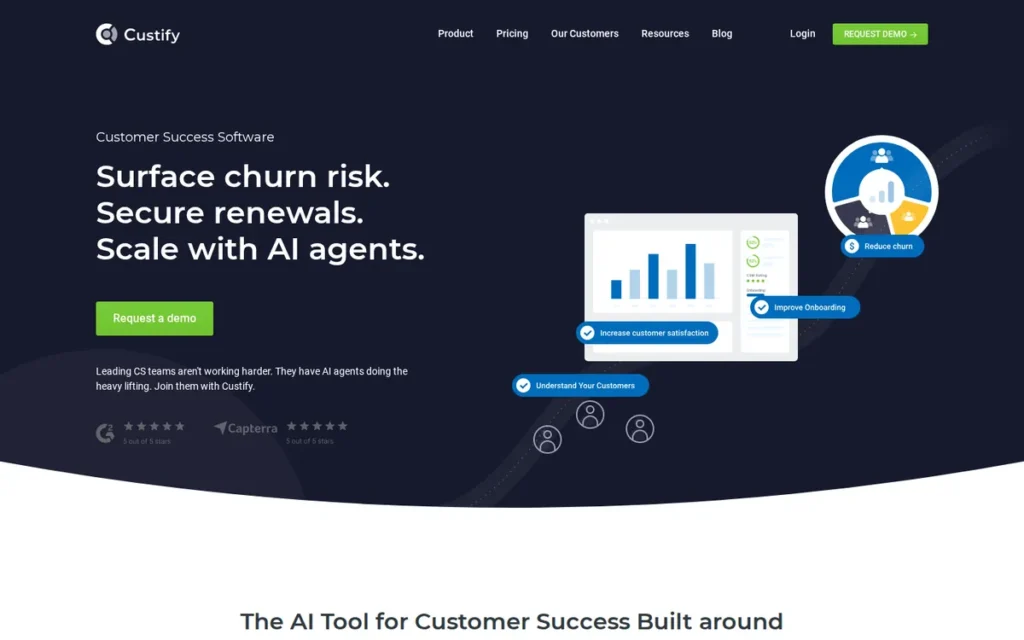
Category: CS Platform, a customer success platform that monitors account health, orchestrates proactive CSM workflows, and automates lifecycle interventions to prevent voluntary churn.
At a Glance
- Category: CS Platform
- Best For: Growth-stage SaaS companies (Series A–B, $1M–$10M ARR) with 1–5 CSMs that need health scoring and lifecycle automation without enterprise implementation complexity or six-figure annual contracts
- Price Range: Community-sourced range of $399–$1,999+/month depending on team size and configuration (custom pricing; verify at custify.com/pricing, 2026)
- Primary Strength: Custify delivers full CS platform functionality: health scoring, automated playbooks, lifecycle management, multi-signal data ingestion, with community-reported entry pricing starting in the $399–$899/month range and implementation timelines of 2–4 weeks
- Biggest Limitation: Custify’s advanced analytics depth and predictive AI sophistication are shallower than enterprise platforms like ChurnZero and Gainsight, companies scaling to 20+ CSMs or complex multi-product portfolios may outgrow Custify within 2–3 years
- One-Line Summary: Custify is a customer success platform built for growth-stage SaaS companies that need professional health scoring, lifecycle automation, and playbook management at an accessible price point, bridging the gap between spreadsheet-based tracking and enterprise CS platform complexity.
- Last Verified: May 2026
Overview
Custify is a customer success platform built specifically for growth-stage SaaS companies with lean CS teams that need professional health scoring, automated playbooks, and lifecycle management without enterprise-scale contracts or 6-month implementation timelines. Custify ranks #6 in this evaluation (below ChurnZero because its predictive AI depth and practitioner community validation volume are smaller) but Custify directly addresses the mid-market gap that practitioner research identifies as the most underserved segment in the retention software category.
Custify aggregates product usage, CRM, billing, and support data into configurable customer health scores, then automates CSM workflow prioritization and lifecycle playbooks based on health changes and milestone events.
Custify’s implementation timeline is typically 2–4 weeks. Teams with 5–20 CSMs that require ML-powered dynamic health score weighting should evaluate ChurnZero before committing to Custify.
Key Features
- Custify’s health scoring engine generates configurable composite scores from product usage, CRM engagement, billing signals, and NPS data, giving small CS teams a unified account health view without requiring a dedicated CS ops function to build and maintain scoring models from scratch.
- Custify’s automated playbook engine triggers proactive CSM tasks, emails, and in-app messages in response to health score changes, usage drop-offs, and lifecycle milestones, enabling a team of 1–3 CSMs to manage proactive retention across an account portfolio that would otherwise require manual spreadsheet tracking.
- Custify’s intelligent workflow automation prioritizes CSM daily task queues based on account health and risk signals, reducing the cognitive overhead of deciding which accounts need immediate attention and enabling more consistent proactive outreach across the full portfolio.
- Custify’s customer journey mapping tools let CS teams define lifecycle stages, success milestones, and expected engagement patterns for their ICP, creating the foundation for trigger-based playbooks that respond to deviation from expected customer progression.
- Custify integrates with Salesforce, HubSpot, Stripe, Intercom, Zendesk, and product event streams via API and native connectors, providing multi-signal health scoring without significant data engineering investment.
Best For
Custify is best for growth-stage SaaS companies with 1–5 CSMs, $1M–$10M ARR, and a clear need to move from reactive to proactive churn management, particularly companies that have tried spreadsheet-based or CRM-native tracking and need a dedicated CS platform without an enterprise-scale commitment. Note that Custify’s health score configuration still requires CSMs to define ICP health criteria and scoring weights before launch, teams that have not yet defined what a healthy customer looks like for their product may spend 4–8 weeks in configuration before proactive signals are meaningful.
Pricing
Custify does not publish standard pricing publicly. Community sources and third-party reviews as of 2026 suggest configurations for smaller teams in the $399–$899/month range, with growth configurations scaling above $1,000/month based on seat count and integration scope.
Implementation typically completes in 2–4 weeks, a meaningful time-to-value advantage over enterprise CS platforms requiring 6-month onboarding projects. Verify current pricing directly at custify.com/pricing (2026), as community-reported figures may not reflect current packaging.
Strengths
- Custify holds a positive presence in G2’s Customer Success category: verify current star rating and review count at g2.com/products/custify/reviews (2026), with practitioner reviews consistently citing implementation speed and ease of use for lean CS teams as primary strengths distinguishing Custify from enterprise platform alternatives.
- Custify’s community-reported entry pricing in the $399–$899/month range for smaller configurations is among the most accessible among full-featured CS platforms in this evaluation, significantly below ChurnZero’s ~$1,500/month community-reported entry, directly addressing the mid-market gap documented as the most underserved segment in retention software research.
This pricing and complexity advantage resonates strongly with practitioners who have evaluated the alternatives. As one user on r/CustomerSuccess explained their platform selection decision:
“Gainsight – good for large orgs that can pay someone just to maintain gainsight. I swear, you basically need someone to spend most of their week maintaining the tool, and it costs a pretty penny. Totango – just wasn’t sticky imo. Interface was lacking and for all they push their free version, it didn’t offer a ton of value. Churnzero – nice platform but a bit higher in cost. Planhat – a great platform and interface but they really lean into data. If your org is still getting their data in order, it may not be the best option. All these reasons are why we are choosing Custify. Pricing, onboarding, maintenance are all more than reasonable.” Posted by u/bookiegrime
Takeaway: Growth-stage CS teams consistently cite Gainsight’s maintenance overhead and ChurnZero’s higher entry cost as the primary factors that make Custify the more operationally viable choice for teams with 1–5 CSMs and limited CS ops bandwidth.
- Custify’s 2–4 week implementation timeline: compared to 6–12 months for enterprise CS platforms, allows growth-stage teams to demonstrate proactive retention ROI within a single fiscal quarter, reducing the internal political risk of CS platform investment for teams that need to show measurable results rapidly.
- Custify’s native integrations with Salesforce, HubSpot, Stripe, Intercom, and Zendesk provide multi-signal health scoring without significant data engineering investment, critical for growth-stage teams without dedicated data or RevOps engineering resources.
Limitations
- Analytical Depth Trade-Off: Custify’s advanced analytics capabilities, predictive AI sophistication, and enterprise-scale configuration flexibility are shallower than ChurnZero and Gainsight, companies scaling to 20+ CSMs, managing multi-product portfolios, or requiring complex ML-based dynamic health score weighting should evaluate whether Custify will meet their needs in 2–3 years before committing.
- Involuntary Churn Gap: Custify, like all CS platforms in this evaluation, addresses voluntary churn signals only (payment recovery and dunning automation fall outside Custify’s scope) and subscription businesses with significant involuntary churn exposure will need to pair Custify with a dedicated payment recovery tool such as Churnkey.
- Growth Ceiling: Custify’s growth-stage positioning means companies approaching 20+ CSMs or significant account complexity should plan for a platform re-evaluation within 2–3 years as data and CS operations mature and outgrow Custify’s analytical depth.
Verdict
Custify is the most accessible full-featured customer success platform for growth-stage SaaS companies that need proactive health scoring, lifecycle automation, and playbook management without enterprise-scale budgets or implementation timelines, directly addressing the mid-market gap that practitioner research identifies as the most underserved segment in the retention software category. Custify’s community-reported entry pricing starting in the $399–$899/month range and 2–4 week implementation timeline make Custify the recommended starting point for Series A–B SaaS companies building their first dedicated proactive retention capability. Companies approaching 20+ CSMs or significant account complexity should plan for a platform re-evaluation within 2–3 years as data and CS operations scale.
7. Customer.io: Best for Behavioral Trigger-Based Lifecycle Messaging as a Retention Execution Layer in Subscription SaaS
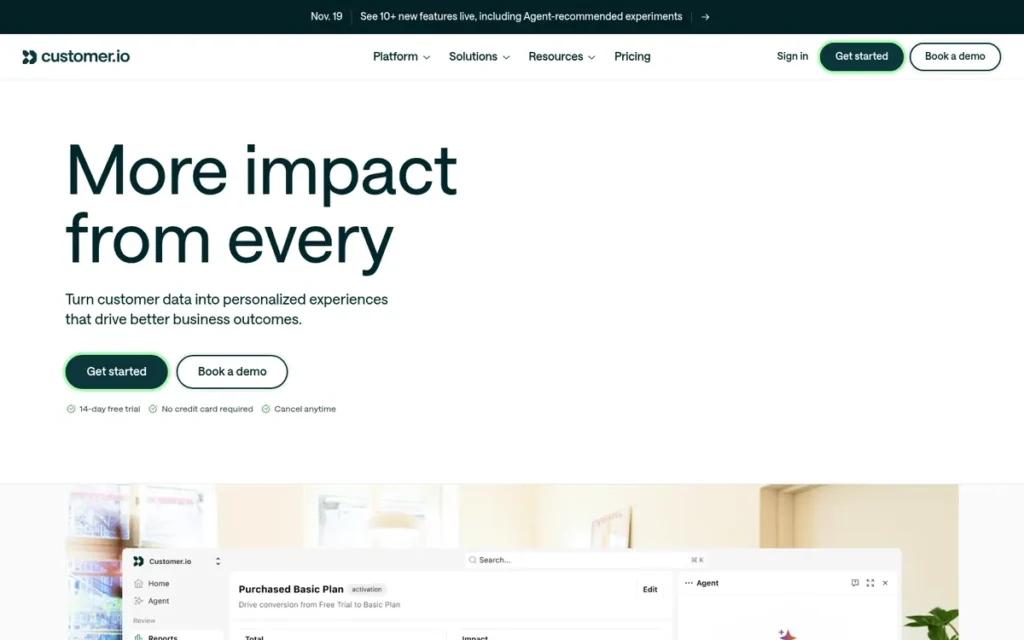
Category: Engagement Automation, a behavioral lifecycle messaging platform that executes proactive retention campaigns triggered by product usage events, subscription status changes, and behavioral signals from upstream analytics tools.
At a Glance
- Category: Engagement Automation
- Best For: Subscription SaaS businesses with established product event tracking infrastructure and technical teams that need precise behavioral trigger-based multi-channel retention messaging at scale
- Price Range: $100–$1,000+/month based on contact volume and tier (Essentials through Premium; free trial available; verify at customer.io/pricing, 2026)
- Primary Strength: Customer.io provides the most precise behavioral event-based segmentation and trigger logic among messaging platforms, enabling subscription businesses to execute highly targeted, multi-channel retention campaigns based on specific product usage events and subscription state changes
- Biggest Limitation: Customer.io does not surface churn signals independently: it requires upstream product analytics or CS platform data to identify which customers to target, functioning as a retention execution layer rather than a complete standalone proactive retention system
- One-Line Summary: Customer.io is a behavioral lifecycle messaging platform that enables subscription businesses to execute precise, event-triggered, multi-channel retention campaigns at scale, the strongest execution layer for teams that have identified at-risk signals upstream and need automated, personalized outreach at high volume.
- Last Verified: May 2026
Overview
Customer.io is a behavioral lifecycle messaging platform used by subscription and product-led SaaS businesses to execute automated, event-triggered retention campaigns across email, SMS, push notifications, and in-app channels, delivering the execution layer that converts upstream churn signals into personalized, timely outreach at scale without the constraints of pre-built template tools.
Customer.io ingests product usage events, subscription state changes, and CRM data through a flexible event API (enabling retention campaigns triggered by specific behavioral conditions such as feature abandonment, login lapse, payment failure, or onboarding milestone non-completion) with the targeting precision that generic marketing automation platforms cannot replicate.
Customer.io is not a standalone churn signal detection system. Customer.io does not surface health scores, predict churn risk, or manage CSM workflows, but for subscription businesses with established product analytics and a need for powerful messaging execution, Customer.io is the strongest platform in this evaluation for that specific function.
Key Features
- Customer.io’s behavioral event API ingests product usage events from any source: Segment, Amplitude, custom backend, or direct API, enabling retention campaigns to trigger on any product-level signal without requiring Customer.io to serve as a primary data warehouse.
- Customer.io’s visual workflow builder supports multi-step, branching lifecycle campaigns with conditional logic based on user behavior, subscription status, and profile attributes, enabling sophisticated, personalized retention sequences without custom engineering for each campaign.
- Customer.io’s multi-channel delivery supports email, SMS, mobile and web push notifications, in-app messages, and webhooks from a single campaign, with channel-level timing and fallback logic maximizing message delivery across subscriber communication preferences.
- Customer.io’s Journeys builder models the full customer lifecycle: from onboarding activation through renewal and reactivation, as a mapped set of behavioral triggers and messaging responses, creating a systematic, always-on retention program that operates without manual campaign management.
- Customer.io’s data-in and data-out architecture positions Customer.io as a central orchestration layer in a best-of-breed retention stack, receiving signals from product analytics and CS platforms and writing engagement data back to CRMs for unified customer history.
Best For
Customer.io is best for subscription SaaS businesses with technical teams and established product event tracking infrastructure that need precise, developer-configurable behavioral trigger-based messaging, particularly companies that have identified at-risk cohorts through product analytics and need a messaging execution layer capable of personalized, multi-channel retention outreach at scale without the constraints of simpler marketing automation tools.
Pricing
Customer.io pricing starts at approximately $100/month for small contact volumes on the Essentials tier, scaling based on the number of people tracked and feature requirements. Growth and Premium tiers with advanced analytics, multi-workspace support, and dedicated support are priced significantly higher.
A free trial is available, enabling meaningful evaluation of behavioral event triggering before financial commitment. Teams with large subscriber volumes should model per-contact pricing carefully as costs scale with customer base size. Verify current pricing at customer.io/pricing (2026).
Strengths
- Customer.io holds strong ratings in G2’s Email Marketing Automation and Marketing Automation categories, verify current star rating and review count at g2.com/products/customer-io/reviews (2026), with practitioner reviews consistently identifying behavioral event trigger precision as the primary differentiator over simpler marketing automation alternatives.
- Customer.io’s developer-friendly event API enables subscription businesses to trigger retention messages based on any product-level signal (not only email opens and clicks) giving technical teams flexibility to build highly precise, behavior-matched retention campaigns that generic marketing automation platforms cannot replicate.
- Customer.io’s multi-channel execution: email, SMS, push, in-app, webhooks, from a single campaign builder enables coordinated cross-channel retention sequences without managing multiple messaging vendor relationships, reducing fragmentation and improving retention campaign message coherence.
- Customer.io is widely referenced in r/SaaS and subscription SaaS practitioner communities as the developer-first alternative to Braze and Iterable for event-triggered retention messaging, providing a large practitioner reference community for subscription-specific retention campaign design patterns, onboarding activation sequences, and reactivation campaign architectures.
Limitations
- Upstream Dependency: Customer.io is a messaging execution platform, not a churn signal detection system, Customer.io has no health scoring, predictive churn modeling, CSM workflow management, or account-level retention analytics, and must be paired with an upstream analytics tool such as Amplitude or a CS platform such as ChurnZero or Custify to identify which customers need proactive outreach before any messaging value is realized.
- Technical Setup Requirement: Teams without established product event tracking infrastructure or data engineering resources to configure event schemas will find Customer.io’s setup demanding relative to simpler marketing automation tools, Customer.io’s power is directly proportional to the quality and completeness of the event data feeding it.
- Not Self-Contained: Teams that need a self-contained churn prevention platform rather than a best-of-breed execution layer should evaluate Intercom or a dedicated CS platform instead, Customer.io requires complementary tooling investment to deliver full proactive retention value.
Verdict
Customer.io is the strongest behavioral lifecycle messaging platform for subscription SaaS businesses that have established product event tracking and need precise, multi-channel retention campaign execution at scale, validated by strong G2 ratings and widespread adoption in the subscription SaaS segment as a lifecycle messaging execution layer. Customer.io functions as a retention execution complement, not a complete proactive retention system, and delivers its highest value when paired with upstream churn signal detection from a product analytics tool or CS platform. Teams without established technical event tracking infrastructure should build that foundation before deploying Customer.io, or choose a more self-contained platform like Intercom.
8. Planhat: Best for RevOps-Aligned CS Teams That Need Flexible Data Modeling and Pricing Transparency

Category: CS Platform, a customer success platform that monitors account health, orchestrates proactive CSM workflows, and automates lifecycle interventions to prevent voluntary churn.
At a Glance
- Category: CS Platform
- Best For: Mid-market SaaS companies with RevOps-aligned CS functions, complex product data structures, and a need for pricing transparency and portfolio-level NRR analytics
- Price Range: Per-workspace pricing; community reports from 2025 suggest $1,200–$2,500+/month for mid-market configurations, verify directly at planhat.com (2026)
- Primary Strength: Planhat provides a highly flexible customer data model for complex SaaS product structures, pricing transparency that allows genuine budget planning before vendor engagement, and strong portfolio-level NRR analytics, properties rare in the CS platform category
- Biggest Limitation: Planhat’s flexibility requires meaningful configuration investment, teams without CS ops capacity to build and maintain custom data models and health scoring logic may find setup more demanding than out-of-box platforms like Custify
- One-Line Summary: Planhat is a customer success platform distinguished by pricing transparency, a highly flexible customer data model for complex SaaS structures, and strong RevOps alignment, making it the most configurable and budget-plannable mid-market CS platform in the category.
- Last Verified: May 2026
Overview
Planhat is a customer success platform designed for mid-market SaaS companies with RevOps-aligned CS functions that need flexible data modeling, transparent pricing, and portfolio-level NRR analytics. Planhat differentiates through a customer data model that accommodates complex product structures (multi-product portfolios, usage-based billing, and hierarchical parent-child account hierarchies) without forcing buyers into rigid schema commitments.
Planhat aggregates product usage, CRM, billing, and support signals into configurable health scores, automates CSM workflows and playbooks based on health changes, and provides portfolio-level analytics giving CS leadership and RevOps visibility into cohort churn, expansion opportunity, and net revenue retention trends.
Planhat’s per-workspace pricing model (more transparent than most CS platforms that withhold cost information until a sales call) allows buyers to develop meaningful budget estimates before entering a vendor sales process.
Key Features
- Planhat’s flexible customer data model supports complex SaaS account structures: multi-product portfolios, usage-based billing, hierarchical parent-child accounts, custom entity types, without requiring buyers to restructure their existing data to fit a rigid pre-defined platform schema.
- Planhat’s health scoring engine allows CS teams to define composite scores from any combination of usage, CRM, billing, support, and custom signal data, with iteratively refineable weighting logic as teams learn which signals are most predictive for their specific customer base.
- Planhat’s portfolio analytics dashboard gives CS leadership and RevOps visibility into aggregate NRR trends, cohort-level churn decomposition, and expansion opportunity identification, supporting strategic retention planning alongside tactical account-level workflow management.
- Planhat’s automated playbook engine triggers CSM tasks, emails, and outreach sequences in response to health score changes, milestone events, and usage patterns, enabling proactive account management across a mid-size portfolio without manual monitoring overhead.
- Planhat integrates with Salesforce, HubSpot, Stripe, Segment, and major support platforms via native connectors, providing multi-signal health scoring without significant custom data engineering requirements.
Best For
Planhat is best for mid-market SaaS companies with 5–20 CSMs and a RevOps function requiring shared visibility into customer health, NRR trends, and portfolio performance, particularly companies with complex or non-standard product structures such as usage-based billing, multi-product portfolios, or hierarchical account hierarchies that find the rigid data models of other CS platforms limiting.
Pricing
Planhat uses per-workspace pricing rather than per-seat or per-account pricing. Community reports from 2025 suggest $1,200–$2,500+/month for mid-market configurations, verify current pricing directly at planhat.com (2026), as community-reported figures may not reflect current packaging.
Planhat’s pricing documentation provides workspace-based cost modeling that allows initial budget estimation before the sales process begins. Contact the vendor for current per-workspace rates at planhat.com (2026).
Strengths
- Planhat holds a positive G2 presence in the Customer Success category: verify current star rating and review count at g2.com/products/planhat/reviews (2026), with practitioner reviews frequently citing data modeling flexibility and portfolio-level analytics as primary differentiators from comparable mid-market CS platforms.
- Planhat’s pricing transparency: more forthcoming than most CS platforms that withhold cost information until a sales call, allows buyers to develop meaningful total cost of ownership estimates before entering any vendor negotiation, reducing the budget misalignment risk documented in practitioner communities as a frequent driver of post-purchase regret in CS platform purchases.
- Planhat’s flexible data model supports complex SaaS product structures that more rigid CS platforms cannot accommodate without costly custom development, making Planhat the strongest choice for companies with usage-based billing, multi-product portfolios, or hierarchical account hierarchies that other platforms force into ill-fitting schema designs.
- Planhat’s portfolio-level NRR analytics provide CS leadership and RevOps with strategic retention visibility (cohort churn patterns, expansion opportunity forecasting, NRR movement trends) that most CS platforms provide only through separate BI tool configurations and custom reporting builds.
Limitations
- Configuration Complexity: Planhat’s data model flexibility comes with a significant configuration complexity trade-off, the same flexibility that makes Planhat powerful for complex product structures requires meaningful CS ops investment to design, build, and maintain custom health scoring logic, playbook triggers, and data integrations. Teams of one to three CSMs without dedicated CS ops support may find Planhat’s setup more demanding than out-of-box platforms like Custify.
- Smaller Validation Volume: Planhat’s practitioner community validation volume and brand recognition are smaller than ChurnZero and Gainsight, buyers requiring an extensive enterprise reference customer base for due diligence should weight this against Planhat’s data model flexibility advantage before committing.
- Involuntary Churn Gap: Planhat, like all CS platforms in this evaluation, does not address involuntary churn from payment failures, subscription businesses with significant payment recovery needs will need to pair Planhat with a dedicated dunning tool such as Churnkey for complete churn type coverage.
Verdict
Planhat is the most configurable and budget-plannable mid-market CS platform in the category, distinguished by pricing transparency and a flexible data model that accommodates complex SaaS product structures that more rigid platforms cannot support without custom development investment. Planhat is the strongest choice for RevOps-aligned mid-market CS teams that need portfolio-level NRR visibility alongside account-level health scoring, and for buyers that require cost transparency before entering a vendor relationship. Teams without CS ops capacity to manage configuration complexity should evaluate Custify as a more immediately accessible alternative before committing to Planhat’s setup investment.
9. Amplitude: Best for Product Analytics-Driven Churn Signal Detection in Product-Led Growth Companies
Category: Product Analytics, a behavioral analytics platform that identifies churn risk signals through product usage analysis, retention curve modeling, feature adoption tracking, and predictive churn scoring on higher tiers.
At a Glance
- Category: Product Analytics
- Best For: Product-led growth SaaS companies that need to identify which product behaviors and feature adoption patterns predict long-term retention before investing in engagement or CS platform tooling
- Price Range: Free (Starter); $49/month (Plus); Growth and Enterprise at custom pricing, community estimates suggest Growth configurations in the $995–$2,000+/month range; verify at amplitude.com/pricing (2026)
- Primary Strength: Amplitude’s behavioral cohort analysis and retention curve modeling identify which specific product actions and adoption milestones statistically predict long-term customer retention, providing the most analytically rigorous churn signal detection available in this category
- Biggest Limitation: Amplitude identifies churn risk signals but does not execute retention interventions, it must be paired with an engagement platform or CS platform to complete the proactive retention workflow, making it an essential analytical foundation rather than a standalone retention solution
- One-Line Summary: Amplitude is a product analytics platform that identifies churn risk by revealing which product behaviors, feature adoption patterns, and usage milestones statistically predict long-term retention, the essential data foundation for product-led growth companies building proactive retention programs.
- Last Verified: May 2026
Overview
Amplitude is a product analytics platform used by thousands of PLG companies to understand which product behaviors, feature adoption patterns, and activation milestones statistically predict long-term user retention, providing the analytical foundation for data-driven proactive retention programs that identify at-risk cohorts before disengagement becomes cancellation.
Amplitude’s retention curves, behavioral cohort analysis, and feature adoption funnels show CS and product teams exactly where in the product experience users disengage, enabling targeted intervention at the specific moments with the highest churn risk.
Amplitude is not a retention execution tool. Amplitude does not send messages, trigger CSM workflows, or automate interventions, but Amplitude is the strongest analytical signal layer for identifying who is at risk and why, which is the prerequisite for effective proactive retention action.
Key Features
- Amplitude’s retention curve analysis charts user retention over time for any behavioral cohort, enabling product and CS teams to identify which activation milestones and feature adoption patterns separate users who retain long-term from those who churn early.
- Amplitude’s behavioral cohort analysis allows teams to segment users by any combination of product events, adoption milestones, and profile attributes, enabling precise identification of at-risk cohorts based on the specific usage behaviors that predict churn for their specific product.
- Amplitude’s funnel analysis identifies where in the onboarding and activation journey users drop off before reaching key “aha moments”, enabling product and CS teams to prioritize the specific friction points most responsible for early-lifecycle churn.
- Amplitude’s predictive analytics capabilities on Growth and Enterprise tiers apply machine learning to behavioral event data to generate individual-level churn likelihood scores, providing account-level risk prioritization that can be exported to CS platforms or engagement tools for targeted proactive outreach.
- Amplitude’s native integration ecosystem connects with Customer.io, Intercom, Salesforce, and Braze, allowing behavioral insights to feed directly into action-oriented retention tools without custom data pipeline development, enabling Amplitude to serve as the signal layer in a best-of-breed retention stack.
Best For
Amplitude is best for PLG SaaS companies with product or data engineering resources that want to understand the behavioral drivers of churn before investing in CS platform or engagement automation tooling, particularly companies that lack clarity on which product behaviors predict retention for their specific product and need the analytical foundation to build evidence-based proactive retention programs.
Pricing
Amplitude offers a free Starter tier with meaningful product analytics capability, an important evaluation and early-stage option for PLG companies not yet at scale. Paid tiers start at $49/month (Plus). Growth and Enterprise tiers are custom-priced, community estimates suggest Growth configurations in the $995–$2,000+/month range depending on event volume.
Predictive analytics and churn likelihood scoring are available on Growth and Enterprise tiers, verify feature tier placement when evaluating retention-specific use cases. Verify current pricing at amplitude.com/pricing (2026).
Strengths
- Amplitude holds a 4.5/5 rating in G2’s Product Analytics category (G2, May 2026): verify current review count and placement at g2.com/products/amplitude/reviews, with practitioner reviews consistently citing retention curve analysis and cohort segmentation as the most powerful behavioral analytics capabilities available in the category.
- Amplitude’s retention curve analysis provides a data foundation that most CS platforms cannot replicate: statistical identification of which specific product behaviors and feature adoption milestones predict long-term retention for a given product, enabling CS and product teams to build health score models grounded in actual behavioral evidence rather than intuition or industry benchmarks.
- Amplitude’s free Starter tier makes professional-grade behavioral analytics accessible to early-stage PLG companies before paid analytics tooling budget is available, enabling data-driven churn signal detection at the stage when preventing early cohort churn has the highest cumulative lifetime value impact.
- Amplitude’s predictive analytics tier generates individual-level churn likelihood scores from behavioral event data, a machine learning-powered prioritization signal that can be exported to CS platforms, engagement tools, or CSM dashboards to enable targeted proactive outreach without requiring in-house data science infrastructure.
Limitations
- Analytics-Only Scope: Amplitude identifies churn risk signals but does not act on them, teams investing in Amplitude for proactive retention must also invest in a separate engagement platform such as Customer.io or Intercom, or a CS platform such as ChurnZero or Custify, to translate behavioral insights into proactive outreach and workflow automation.
- Not Designed for Account-Level CS Workflows: Amplitude’s strength is in aggregate cohort analysis and statistical pattern identification, for account-level CSM workflows, renewal tracking, and high-touch account management, a dedicated CS platform is required alongside Amplitude. Amplitude’s Growth and Enterprise pricing also requires a sales conversation, adding friction for smaller teams evaluating retention-specific use cases.
- Insufficient as a Standalone Investment: Teams seeking a single self-contained churn prevention platform rather than a best-of-breed analytics-plus-execution stack will find Amplitude insufficient as a standalone retention investment, Amplitude is a prerequisite analytical layer, not a complete proactive retention system.
Verdict
Amplitude is the strongest product analytics platform for identifying behavioral churn signals in product-led growth companies, providing the retention curve analysis, cohort segmentation, and feature adoption tracking that distinguish data-driven proactive retention programs from intuition-based ones. Amplitude is a foundational investment, not a complete proactive retention solution, and must be paired with an engagement platform or CS platform for churn prevention execution. PLG companies that lack clarity on which product behaviors predict retention for their specific product should prioritize Amplitude as their first retention analytics investment before committing to CS platform or engagement automation tooling.
10. MoEngage: Best for Omnichannel Lifecycle Engagement and AI-Driven Proactive Retention Campaigns at High User Volume
Category: Engagement Automation, an omnichannel customer engagement platform that drives proactive retention through AI-powered predictive segmentation and automated lifecycle campaigns across all major digital channels.
At a Glance
- Category: Engagement Automation
- Best For: Subscription businesses and mobile-first SaaS companies with large user volumes (50,000+ MAU) that need AI-driven lifecycle segmentation and coordinated omnichannel proactive retention campaigns
- Price Range: $999–$5,000+/month based on monthly active user volume (custom pricing; contact for current rates at moengage.com, 2026)
- Primary Strength: MoEngage provides AI-driven predictive behavioral segmentation and automated omnichannel lifecycle campaigns (email, push, SMS, in-app, and WhatsApp) from a single platform purpose-built for proactive retention at high user volume
- Biggest Limitation: MoEngage is optimized for B2C subscription and mobile-first SaaS, B2B SaaS companies managing complex, high-value accounts through dedicated CSMs will find it lacks the account hierarchy, health scoring, and CSM workflow management of a dedicated CS platform
- One-Line Summary: MoEngage is an AI-powered omnichannel customer engagement platform that drives proactive retention for subscription businesses through predictive behavioral segmentation and automated lifecycle campaigns across email, push notifications, SMS, in-app messaging, and WhatsApp.
- Last Verified: May 2026
Overview
MoEngage is an AI-powered omnichannel customer engagement platform designed for subscription businesses and mobile-first SaaS companies that need to drive proactive retention at scale through predictive behavioral segmentation and coordinated automated campaigns across email, push notifications, SMS, in-app messages, and WhatsApp.
MoEngage analyzes cross-channel user behavior to identify churn risk signals and triggers personalized retention campaigns at the specific moments when intervention probability is highest, addressing the pain of relying on manual, inconsistent outreach by automating omnichannel lifecycle engagement for large user cohorts.
MoEngage is optimized for B2C subscription and mobile-first product contexts. B2B SaaS companies managing high-value accounts through dedicated CSMs will find a dedicated CS platform significantly better matched to their retention operating model.
Key Features
- MoEngage’s AI-powered predictive segmentation engine analyzes user behavioral patterns across all digital touchpoints to identify users at elevated churn risk, triggering automated retention campaigns before disengagement escalates to cancellation, without requiring manual segment definitions from the retention team.
- MoEngage’s omnichannel campaign builder orchestrates coordinated retention sequences across email, mobile push, web push, SMS, in-app notifications, and WhatsApp from a single canvas, enabling consistent messaging across all channels a subscriber uses from one platform.
- MoEngage’s smart triggered campaign engine fires personalized retention messages at the specific behavioral moments when intervention probability is highest (feature abandonment, login lapse, session frequency decline) with content personalized to individual usage history and segment membership.
- MoEngage’s analytics suite provides cohort-level retention dashboards, campaign conversion attribution, and funnel analysis, giving marketing and growth teams visibility into which retention campaigns drive the highest recovery rates and which user segments are most responsive to specific intervention types.
- MoEngage’s no-code campaign builder enables marketing and retention teams to build and launch complex behavioral trigger campaigns without engineering resources, a meaningful accessibility advantage for subscription businesses with limited technical capacity for campaign development.
Best For
MoEngage is best for subscription businesses and mobile-first SaaS companies with 50,000+ monthly active users that need AI-driven lifecycle segmentation and automated omnichannel retention campaigns, particularly consumer subscription services, mobile apps with subscription monetization, and B2C SaaS businesses where the primary retention mechanism is personalized, multi-channel lifecycle messaging rather than dedicated CSM account relationships.
Pricing
MoEngage does not publish pricing publicly. Pricing is based on monthly active user volume and channel selection. Community reports from 2025 suggest entry-level configurations in the $999–$2,000+/month range for smaller MAU volumes, scaling to $5,000+/month for enterprise-scale user volumes.
Request pricing with detailed MAU projections. Model channel usage carefully, as omnichannel configurations scale significantly with usage. Verify current pricing at moengage.com (2026).
Strengths
- MoEngage holds a positive G2 presence in the Customer Engagement Software category, verify current star rating and review count at g2.com/products/moengage/reviews (2026), with practitioner reviews from subscription and mobile-first businesses consistently citing omnichannel coordination and AI segmentation precision as primary strengths. MoEngage is also referenced in r/startups and mobile SaaS practitioner communities as a leading omnichannel engagement platform for consumer subscription businesses managing lifecycle campaigns at scale (r/startups, 2024–2025).
- MoEngage’s AI-driven predictive segmentation addresses the pain of inability to prioritize which accounts need human attention versus automation, automatically identifying high-churn-risk user cohorts and triggering appropriate retention sequences at scale without requiring manual segmentation work from the retention team.
- MoEngage’s omnichannel campaign orchestration across email, push, SMS, in-app, and WhatsApp from a single platform eliminates channel fragmentation that reduces retention campaign effectiveness when separate tools manage each channel, a meaningful operational efficiency for subscription businesses managing lifecycle campaigns across large user volumes.
- MoEngage’s no-code campaign builder makes sophisticated behavioral trigger campaigns accessible to marketing and retention teams without engineering resources, enabling subscription businesses to iterate rapidly on retention campaign design without queuing engineering development time for each campaign change.
Limitations
- B2B Account-Level Capability Gap: MoEngage is designed for B2C subscription businesses and mobile-first SaaS companies, MoEngage lacks account-level health scoring, CSM task management, renewal forecasting, and account hierarchy features that B2B SaaS companies with complex, multi-stakeholder accounts require for effective proactive retention. B2B SaaS companies should evaluate ChurnZero, Gainsight, Custify, or Planhat as their primary retention platform.
- AI Segmentation Data Dependency: MoEngage’s AI segmentation capabilities are dependent on rich behavioral event data across mobile and web touchpoints, subscription businesses that have not fully instrumented product event tracking will find that AI-driven predictive segmentation underperforms relative to vendor claims until the underlying data infrastructure is complete. This setup investment is rarely disclosed upfront in the sales process.
- Pricing Opacity at Scale: MoEngage does not publish pricing publicly, and enterprise configurations scaling to large MAU volumes can reach costs that significantly exceed initial community-reported estimates, buyers should model MAU growth projections carefully and stress-test pricing scenarios before committing to omnichannel configurations.
Verdict
MoEngage is the strongest omnichannel lifecycle engagement platform for subscription businesses and mobile-first SaaS companies that manage proactive retention at scale through AI-driven behavioral segmentation and coordinated cross-channel campaigns, filling a use case that CS platforms and point engagement tools do not serve as effectively at high B2C user volumes. MoEngage’s fit is strongest for consumer subscription services and mobile-first SaaS; B2B SaaS companies with account-level CS complexity and dedicated CSM teams will find more targeted retention value in a dedicated CS platform. Organizations that match MoEngage’s intended audience profile will find its omnichannel coordination and AI segmentation among the most sophisticated proactive retention capabilities in this evaluation.
What Red Flags Should I Watch For When Evaluating Proactive Customer Retention Software?
Six red flags separate successful retention software investments from expensive mistakes. Each flag below represents a pattern documented across practitioner communities, analyst research, and real-world implementations where tool selection failed to deliver expected ROI.
Red Flag #1: Pricing Without Implementation Cost Disclosure
A vendor quoting license-only pricing without disclosing implementation, professional services, and CS ops staffing costs is providing an incomplete total cost of ownership. For enterprise CS platforms, community-reported implementation and services costs frequently exceed license fees in Year 1, making a license-only quote structurally misleading. Always require a full TCO estimate including internal team hours before comparing vendors.
Red Flag #2: No Involuntary Churn Coverage
Any proactive retention software comparison that omits involuntary churn recovery is missing the tool category that addresses an estimated 20–40% of subscription revenue loss (sources: subscription platform benchmarks including Recurly churn rate research). A CS platform claiming “complete churn prevention” without acknowledging the payment recovery gap is providing an incomplete solution. Verify specifically whether a vendor addresses failed payments before accepting any complete-solution claim.
Red Flag #3: Enterprise-Only Platform Marketed to Mid-Market Buyers Without Stage Guidance
Enterprise CS platforms with $80,000–$320,000+ Year 1 total costs marketed to growth-stage buyers with 1–5 CSMs create a structural mismatch that no amount of onboarding support resolves. Community discussions on r/CustomerSuccess (2024–2026) document a recurring pattern of under-utilization and failed ROI cases for teams below the enterprise threshold. Stage-appropriate fit guidance (specifying minimum ARR, minimum CSM headcount, and CS ops requirements) is a signal of vendor honesty; its absence is a red flag.
Red Flag #4: Health Score Built on a Single Signal Type
A customer health score relying on a single data source (product usage alone, or NPS alone) has systematic blind spots that generate false positives and false negatives. Genuine proactive signal detection requires multi-signal health scoring: usage, CRM engagement, support ticket patterns, billing history, and sentiment data feeding a single composite view. Single-signal health scores are a lagging indicator dressed up as a predictive system.
Red Flag #5: No Evaluation Path Before Financial Commitment
Any tool that requires a six- or twelve-month contract commitment before offering a meaningful trial or proof-of-concept is asking buyers to accept vendor claims without independent verification. Free trials, freemium tiers, and proof-of-concept engagements are standard practice in the engagement automation and product analytics categories. Mitigate this risk by requiring a paid pilot with defined success metrics before signing any multi-year contract.
Red Flag #6: Confusion Between Analytics Layers and Execution Layers
A vendor or comparison that positions an analytics tool like Amplitude or a messaging platform like Customer.io as a complete standalone proactive retention solution is omitting a critical dependency. Amplitude identifies churn risk but does not act on it. Customer.io executes retention campaigns but does not detect churn signals independently. Buyers who purchase either expecting a self-contained solution will discover the gap only after deployment, typically after the budget for complementary tooling has already been spent.
What Questions Should I Ask Before Choosing a Proactive Retention Tool?
Seven questions surface information that feature comparison tables cannot reveal. Each question below is designed to expose vendor claims that do not survive implementation, the most common source of retention software purchase regret documented in practitioner communities.
Question #1: What percentage of our churn is involuntary, caused by failed payments rather than deliberate cancellation?
Here is a practical test: in your billing platform (Stripe, Chargebee, or Recurly), filter cancellations from the last 90 days for accounts where the final event before cancellation was a payment failure or decline rather than a deliberate cancellation action. If that number represents more than 15% of your total cancellations, your first retention investment should be Churnkey or Chargebee Retention, not a CS platform. Most buyers who run this filter for the first time are surprised by the result.
Question #2: Do we have dedicated CS ops capacity to configure and maintain this platform?
The most common cause of poor retention software ROI documented in practitioner communities is not tool selection error, it is implementation abandonment when CS teams discover that platform setup requires more CS ops capacity than anticipated. Ask vendors specifically: what does initial configuration require from your team, who maintains health score logic after launch, and what does ongoing platform management look like for a team of your size? This question is the single most protective due diligence step in this evaluation process.
Question #3: What is the realistic total cost of ownership including implementation, professional services, and CS ops staffing?
License pricing is typically 30–70% of total Year 1 cost for enterprise CS platforms when implementation, professional services, and CS ops overhead are included. Request a fully burdened TCO estimate (license, implementation, professional services, and estimated internal team hours) from every vendor before comparing options. A vendor unwilling to provide this estimate before a contract is signed is providing incomplete disclosure.
Question #4: What data sources does this tool ingest for health scoring, and are all of them bidirectional?
A health score is only as accurate as the data feeding it. Ask vendors to specify every native integration used for health scoring, confirm whether integration is bidirectional or read-only, and ask what happens to health scores when a data source is unavailable or delayed. Single-direction integrations create silent health score gaps, and incorrect signals are worse than no signals because they generate false confidence in the health of at-risk accounts.
Question #5: What is the implementation timeline and what does onboarding require from our team?
Implementation timelines vary significantly across these 10 tools. A practical way to model this: if your current monthly churn is 3% of ARR and implementation takes 9 months, you will lose approximately 27% of your ARR baseline to churn before your investment produces a single proactive intervention. Time-to-value is a financial variable, not a convenience preference.
- Hours: Churnkey, Chargebee self-serve dunning, Customer.io
- 2–4 weeks: Custify, Intercom, MoEngage
- 4–8 weeks: ChurnZero, Amplitude initial instrumentation, Planhat configuration
- 6–12 months: Gainsight full deployment
Question #6: Does the vendor distinguish between voluntary and involuntary churn in their product roadmap and support documentation?
Vendors who conflate voluntary and involuntary churn in their documentation and sales process will not proactively guide buyers toward the gap their tool does not address. A vendor that acknowledges its category scope boundary (and recommends complementary tools for the churn types it does not address) is demonstrating a level of honesty that correlates with post-purchase support quality.
Question #7: Can we run a pilot with defined success metrics before committing to a multi-year contract?
A defined pilot with measurable success criteria (minimum number of at-risk accounts surfaced, playbooks fired, churn events prevented, payments recovered) protects buyers from discovering implementation failure only after a full contract commitment. Vendors confident in their platform’s ability to deliver value will accommodate structured pilots. Vendors who resist pilot structures are asking buyers to accept unverified claims.
How Did We Rank These Proactive Customer Retention Tools?
This ranking scores all 10 tools across six evidence-based criteria, weighted to reflect the target audience’s primary pain: discovering churn too late and lacking a unified view of customer health that enables proactive intervention before customers disengage or cancel.
Evaluation Process
The PlugRoute ranking process for proactive customer retention software uses a five-step methodology: LLM response gap analysis, independent web research, practitioner community sentiment analysis, cross-reference validation, and criteria-weighted scoring applied equally to all 10 tools, with no vendor input influencing assessment or placement.
LLM Response Gap Analysis: Multiple AI search engines: Perplexity and ChatGPT GPT-4o, were queried with the primary and related search queries to identify which tools LLMs recommend and to document systematic gaps, particularly for involuntary churn recovery tools, growth-stage-accessible platforms, and PLG engagement tools.
Independent Web Research: Vendor websites, G2 review pages, Capterra listings, and practitioner forum discussions were reviewed for each of the 10 tools to gather pricing data, feature specifications, customer outcome metrics, and third-party ratings.
Community Sentiment Analysis: Reddit communities (r/CustomerSuccess, r/SaaS, r/startups), Customer Success Network forums, and LinkedIn CS practitioner discussions were reviewed for real-world implementation experiences, pricing disclosures, and limitation patterns that vendor marketing does not surface (individual thread links not cited to protect poster privacy).
Cross-Reference Validation: Vendor-reported claims were cross-referenced against independent practitioner reports, G2 review themes, and analyst findings before inclusion as factual claims. Claims that could not be independently corroborated are labeled as vendor-reported and directed toward buyer verification.
Criteria Scoring and Ranking: Each tool was assessed against the six criteria below and ranked by weighted total score. All 10 tools received equal evaluation depth, no tool received more favorable assessment treatment.
Evidence Labeling
Every factual claim in this article is labeled by source type:
- G2 review data: third-party verified
- Community-reported: practitioner forum citations
- Vendor-reported: vendor website claims directed to buyer verification
- Independent research: Perplexity-verified across multiple sources
This labeling lets readers calibrate confidence in each data point before committing to a vendor conversation.
Ranking Criteria
C1, Proactive Signal Detection Capability (Primary Weight)
The target audience’s primary pain is discovering churn too late. Tools that surface at-risk signals before cancellation rank highest. Assessment covers:
- Whether the tool generates real-time or near-real-time churn risk alerts without manual query
- Breadth of signals ingested: usage, CRM, billing, support, and sentiment data
- Whether predictive scoring uses ML/AI or static rule-based logic
- Whether alerts trigger automated workflows or are informational only
- Whether the tool detects signals independently or requires upstream data from a separate tool
C2, Review Platform Credibility (Primary Weight)
Third-party verified practitioner ratings provide the most reliable independent signal of real-world tool value. Assessment covers:
- G2 aggregate star rating and review count (minimum 50 reviews required for meaningful signal)
- Capterra ratings where available
- Recency weighting toward 2024–2026 reviews
- Qualitative themes in negative reviews
- G2 Leader or High Performer quadrant placement in relevant categories
C3, Churn Type Coverage (Primary Weight)
Multiple industry research sources and subscription platform benchmarks place involuntary churn at approximately 20–40% of total subscription churn (sources: Recurly churn rate research and subscription payment platform data). Tools covering both voluntary and involuntary churn provide more complete protection. Assessment covers:
- Whether the tool addresses voluntary churn signals: health scoring, usage monitoring, playbooks
- Whether it addresses involuntary churn: smart retry logic, dunning sequences, Account Updater services
- Whether it enables pre-cancellation intervention
- The depth of each capability as a primary versus supplementary feature
C4, Pricing Accessibility and Transparency (Secondary Weight)
Pricing transparency signals vendor trustworthiness and reduces post-purchase regret. Assessment covers: pricing publication versus sales-call-only disclosure; meaningful entry point below $2,000/month; community-reported total cost of ownership including implementation; and free trial or freemium tier availability for evaluation without financial commitment.
C5, Integration Ecosystem Depth (Secondary Weight)
A retention tool is only as good as the data it can access. Assessment covers: native CRM integrations (Salesforce, HubSpot quality and bidirectionality); billing platform integrations (Stripe, Chargebee, Recurly); product analytics integrations (Segment, Amplitude, Mixpanel, custom API); support platform integrations (Zendesk, Intercom, Freshdesk); and whether integration is bidirectional or read-only.
C6, Documented Retention Outcomes (Secondary Weight)
Self-reported vendor claims without independent corroboration are low-confidence signals. Assessment covers: named customer case studies with specific, dated outcome metrics; independent analyst recognition (G2 Leader designation); practitioner community validation; and whether outcome-based pricing is available as a signal of vendor confidence in delivering results.
Why We Distinguish Voluntary from Involuntary Churn
None of the LLM responses reviewed for this article (queried in May 2026) distinguished voluntary churn from involuntary churn in their proactive retention software recommendations. These two churn types require fundamentally different software categories.
Involuntary churn includes multiple recoverable billing failure sub-types:
- Soft declines: temporary bank-side failures recoverable through retry
- Hard declines: card closed or fraudulent; not recoverable through retry
- Card expiry: recoverable through Account Updater services before the payment attempt
- Insufficient funds: recoverable through timed retry logic
CS platforms are not designed to address any of these billing failure sub-types. Ranking criteria C1, C3, and C6 are applied within each tool’s intended category scope, Churnkey is not penalized for lacking health scoring; ChurnZero is not penalized for lacking smart retry logic. Each entry’s Limitations section explicitly discloses the churn types that tool does not address so buyers can make complete coverage decisions.
Evidence Weighting
When review platform ratings conflict with community sentiment, specificity and recency are weighted higher. A detailed 2025 practitioner post describing a specific implementation failure outweighs a generic 2023 G2 review describing general satisfaction. Vendor-reported statistics are labeled as vendor-reported and directed toward buyer verification. Only claims corroborated by at least one independent source are stated as established fact.
Update Cadence
This article was last updated in May 2026. PlugRoute reviews and updates rankings when material product changes, pricing shifts, or significant community sentiment shifts are identified. We update this guide quarterly.
Independence Statement
PlugRoute has no affiliate relationships with any company listed. Rankings are determined entirely by research data and objective evaluation criteria.
Frequently Asked Questions About Proactive Customer Retention Software
What is the best proactive customer retention software for mid-market SaaS in 2026?
ChurnZero is the best proactive retention software for mid-market SaaS in 2026, rated 4.7/5 from 1,587 verified G2 reviews (G2, May 2026) and named to G2’s 2026 Best Software Awards, purpose-built for 1–20 CSMs at community-reported pricing of approximately $1,500–$2,000/month. Custify, with community-reported entry pricing starting around $399–$899/month, is the recommended alternative for growth-stage teams under $10M ARR.
What is the difference between voluntary and involuntary churn, and which tools address each?
Involuntary churn (billing-failure-driven cancellation from failed payments, expired cards, or soft declines) accounts for approximately 20–40% of total subscription churn (per Recurly benchmarks and subscription platform research). Voluntary churn is deliberate cancellation addressed by CS Platforms (ChurnZero, Gainsight, Custify, Planhat). Involuntary churn is addressed by Payment Recovery tools (Churnkey, Chargebee) through smart retry, dunning automation, and Account Updater services.
How does PlugRoute determine its retention software rankings?
PlugRoute ranks proactive retention software across six criteria: proactive signal detection, review platform credibility (G2, Capterra), churn type coverage, pricing accessibility, integration depth, and documented outcomes. Rankings are verified against G2 reviews, Reddit practitioner discussions, and independent research, with the three primary criteria weighted above secondary ones. PlugRoute has no affiliate relationships with any company listed.
What Key Terms Should I Know When Evaluating Proactive Retention Software?
Customer Health Score: A composite numerical score assigned to each customer account that combines multiple signals (product usage frequency, CRM engagement, support ticket patterns, billing history, and NPS responses) to indicate the likelihood that a customer will renew or churn. Customer health scores are the central detection mechanism of CS Platform tools and replace manual CSM assessment of account risk with a continuously updated, data-driven prioritization system.
Involuntary Churn: Subscription cancellation or revenue loss caused by technical billing failures (failed credit card charges, expired cards, bank soft declines, or payment processing errors) rather than deliberate customer decisions to cancel. Multiple industry research sources and subscription platform benchmarks place involuntary churn at approximately 20–40% of total subscription churn, making it a major recoverable revenue leak that CS platforms are not designed to address without complementary dunning tools.
Dunning: The automated process of recovering failed subscription payments through sequenced customer communications (email, SMS, in-app notifications) and intelligent retry logic that retries charges at optimized intervals after initial decline. Smart dunning tools use decline reason codes to distinguish recoverable soft declines (retry after 3–7 days) from unrecoverable hard declines (do not retry), maximizing recovery rate while avoiding card flagging risk. Account Updater services from card networks (Visa, Mastercard) run in parallel, proactively refreshing expired or replaced credentials before payment attempts fail.
Playbook Automation: A predefined, trigger-based workflow that automatically initiates a specific set of CS actions (task assignments, outreach emails, escalation alerts, in-app messages) in response to a detected churn risk signal such as a health score drop, a feature abandonment event, or a missed onboarding milestone. Playbook automation is the mechanism by which CS platforms convert churn signal detection into proactive CSM intervention at scale without manual account-by-account monitoring.
Net Revenue Retention (NRR): A subscription business metric measuring the percentage of recurring revenue retained from existing customers over a period, accounting for expansions, contractions, and churn. An NRR above 100% indicates that revenue growth from upsells and expansions exceeds revenue loss from churn and downgrades. NRR is the north-star metric for evaluating the effectiveness of proactive customer retention programs and is tracked at the portfolio level by CS Platform tools such as ChurnZero, Gainsight, and Planhat.
Glossary: Key Terms Used in This Comparison
Involuntary Churn: Subscription cancellation or revenue loss caused by technical billing failures (failed credit card charges, expired cards, soft declines, or payment processing errors) rather than a deliberate customer decision to cancel. Industry benchmarks place involuntary churn at approximately 20–40% of total subscription churn, making it a distinct revenue leak that CS platforms are not designed to address.
Customer Health Score: A composite numerical score assigned to each customer account that combines multiple signals (product usage frequency, CRM engagement, support ticket patterns, billing history, and NPS responses) to indicate the likelihood that a customer will renew or churn. Health scores are the central detection mechanism of CS platforms and replace manual CSM risk assessment with a continuously updated, data-driven prioritization system.
Dunning: The automated process of recovering failed subscription payments through sequenced customer communications and intelligent retry logic that retries charges at optimized intervals after an initial decline. Smart dunning tools use payment decline reason codes to distinguish recoverable soft declines from unrecoverable hard declines, while Account Updater services proactively refresh expired card credentials before payment attempts fail.
Playbook Automation: A predefined, trigger-based workflow that automatically initiates a set of CS actions (task assignments, outreach emails, escalation alerts, or in-app messages) in response to a detected churn risk signal such as a health score drop or feature abandonment event. Playbook automation is the mechanism by which CS platforms convert churn signal detection into proactive CSM intervention at scale without manual account-by-account monitoring.
Net Revenue Retention (NRR): A subscription business metric measuring the percentage of recurring revenue retained from existing customers over a period, accounting for expansions, contractions, and churn. An NRR above 100% indicates that revenue growth from upsells exceeds revenue lost to churn, making it the north-star metric for evaluating the effectiveness of proactive customer retention programs.
Which Proactive Retention Tool Is Right for You?
The right proactive retention tool depends on three decisions made before any product comparison: which churn type is your primary revenue leak, what is your team’s operational capacity to configure and maintain a platform, and which company stage and budget bracket defines your viable options.
Key Insights
- ChurnZero is the strongest purpose-built proactive churn prevention platform for mid-market SaaS companies with 1–20 dedicated CSMs, validated by 1,587 practitioner reviews at 4.7/5 on G2 (May 2026) as the leading mid-market alternative to enterprise-only platforms.
- Gainsight is the correct choice only for enterprise SaaS organizations with $10M+ ARR, existing Salesforce infrastructure, and dedicated CS ops staffing, its $80,000–$320,000+ Year 1 total cost is a structural barrier, not a negotiable parameter, for most of the target audience.
- Involuntary churn from failed payments represents an estimated 20–40% of subscription revenue loss in most SaaS businesses and is addressed by zero CS platforms in this evaluation, buyers who have not measured their involuntary churn rate before selecting a retention tool are solving an incomplete version of their problem.
- Churnkey is the strongest specialized involuntary churn recovery tool for Stripe-native subscription businesses; Chargebee is the right choice for companies that want billing operations and payment recovery managed in a single subscription management system.
- Custify, with community-reported entry pricing starting in the $399–$899/month range and a 2–4 week implementation timeline, is the recommended starting point for growth-stage SaaS companies (Series A–B, $1M–$10M ARR) that need professional CS platform functionality without enterprise-scale budget commitments.
- Amplitude is the strongest analytical foundation for PLG companies building proactive retention programs, but Amplitude must be paired with Customer.io or Intercom to translate behavioral churn signals into proactive outreach; Amplitude alone does not prevent churn.
- MoEngage is the strongest choice for B2C subscription businesses and mobile-first SaaS companies with 50,000+ MAU that need AI-driven segmentation and coordinated omnichannel retention campaigns, and the wrong tool for B2B SaaS companies that manage retention through dedicated CSM account relationships.
If none of the 10 tools above matches your situation (most commonly because your team has 1–2 CSMs without CS ops support and a budget under $500/month) the highest-value first step may not be a dedicated platform. A well-configured CRM with lifecycle stage tracking plus a payment recovery tool costs under $200/month and delivers substantial value for teams that have not yet defined health criteria or playbook logic. Build the operational process before buying the platform.
Proactive retention requires both the right tool and the right operational process. Software is an enabler, not a substitute for a defined ideal customer profile, a validated health score methodology grounded in behavioral evidence, and a playbook architecture designed around your team’s actual intervention capacity. Budget 30–90 days of operational setup time before expecting measurable retention ROI from any CS platform in this evaluation, the most sophisticated platform in this list produces no measurable improvement until the first playbook fires, and playbooks do not fire until health scoring is configured, tested, and trusted by the CSMs who act on its signals.
Browse additional independent SaaS software reviews at PlugRoute, where every ranking is determined by research data and editorial rigor, with no affiliate relationships influencing placement or assessment. We update this guide quarterly. Last updated: May 2026.