Google Ads is the best paid search advertising platform for direct campaign execution and scale, while Semrush leads for competitive intelligence and keyword research. Optmyzr is the top choice for agencies managing multiple accounts at optimization depth. The right pick depends on whether you need to run campaigns, research competitors, or automate bid management.
Paid search budgets are wasted when the wrong tool is in the stack. Most advertisers need at least two categories of software: an execution platform (where ads actually run) and either a competitive intelligence tool or an optimization layer. Conflating these roles leads to overspending on features you don’t use.
PlugRoute has no affiliate relationships with any platform reviewed here, and no vendor paid for placement or editorial influence.
“I’ve tried every PPC tool out there. The problem isn’t features, it’s knowing which tool solves which problem.” (r/PPC community member)
Takeaway: Most PPC practitioners benefit from a two-tool stack: one execution platform and one optimization or intelligence layer.
TL;DR: Top Picks at a Glance
- Google Ads is the mandatory execution platform for any advertiser targeting the approximately 91.5% of global search traffic that flows through Google (Statista, 2025), no proxy exists.
- Semrush tracks 800M+ keywords across 140 countries (Semrush, 2025), making it the most comprehensive competitive intelligence suite available at its price tier.
- Optmyzr delivers the deepest multi-account automation for agencies managing 10 or more client campaigns simultaneously, reducing manual optimization overhead through rule-based scripts and one-click workflows.
- Marin Software is the only platform in this comparison purpose-built for enterprise cross-channel attribution across search, social, and display at $1M+ annual spend.
What Types of Paid Search Software Do You Actually Need?
Paid search software falls into four functional categories, and most advertisers need tools from more than one category to cover their full workflow.
Execution Platforms are where ads are created, budgets are set, and campaigns run. Google Ads and Microsoft Advertising are the two primary execution platforms for search inventory. Both are required for any advertiser with serious reach objectives.
Competitive Intelligence Tools reveal what competitors are bidding on, which ads are running, and how keyword landscapes shift over time. Semrush and SpyFu serve this category at different price points and database depths.
Optimization & Management Platforms sit on top of execution platforms and automate bid rules, budget pacing, and account audits across multiple campaigns or clients. Optmyzr and Adalysis occupy this tier, differing in whether their workflow is built for multi-account agencies or single-account in-house teams.
Enterprise Cross-Channel Platforms unify search, social, and display spend into a single attribution layer for organizations running seven-figure annual ad budgets. Marin Software is the sole representative in this guide at that tier.
How Do These 7 Platforms Compare?
| Rank | Company | Category | Best For | One-Line Summary | Key Capabilities | Primary Strength | Key Limitation |
|---|---|---|---|---|---|---|---|
| 1 | Google Ads | Execution Platform | Any advertiser targeting Google search traffic | The only platform providing direct access to Google’s 8.5B+ daily searches (Google, 2024) | Campaign creation, Smart Bidding, Performance Max, audience targeting | Unmatched reach and native algorithm integration | Increasing automation reduces manual control; rising CPCs WordStream, 2025 |
| 2 | Microsoft Advertising | Execution Platform | B2B advertisers and budget-conscious search buyers | Reaches 724M monthly searchers at CPCs typically 30–70% lower than Google (Microsoft, 2025) | LinkedIn audience targeting, Copilot AI, Google Ads import, Audience Network | Lower CPCs and unique B2B LinkedIn profile targeting | Smaller audience than Google; fewer third-party optimization integrations |
| 3 | Semrush | Competitive Intelligence | PPC and SEO teams needing deep competitor keyword and ad copy data | Tracks 800M+ keywords across 140 countries (Semrush, 2025) | Keyword gap analysis, ad copy archive, CPC trends, traffic analytics, CPC Map | Broadest competitive keyword intelligence database at this price tier | Data reflects indexed estimates, not live auction signals |
| 4 | SpyFu | Competitive Intelligence | Small-to-midsize teams needing affordable competitor ad research | Provides 15+ years of competitor PPC history at entry pricing from $39/month (SpyFu, 2025) | Competitor keyword download, ad spend estimates, PPC Kombat, ad copy archive | 15+ years of historical competitor keyword and ad copy data | Smaller database than Semrush; lower real-time data freshness |
| 5 | Optmyzr | Optimization & Management | Agencies managing 10+ client PPC accounts | Automates bid rules, budgets, and audits across large multi-account structures | Rule-based automation, Enhanced Scripts, PPC Investigator, one-click optimizations, multi-account reporting | Depth of automation for complex multi-account agency workflows | Spend-scaled pricing; steeper learning curve for new users |
| 6 | Adalysis | Optimization & Management | In-house PPC managers running high-volume single Google Ads accounts | Delivers automated ad testing and health monitoring across thousands of ads (Adalysis, 2025) | Automated ad variation testing, account health alerts, ad group audits, search term analysis | Automated ad testing depth for large single-account operations | Limited Performance Max coverage; no Microsoft Advertising support |
| 7 | Marin Software | Enterprise Cross-Channel | Enterprise teams unifying search, social, and display attribution | Purpose-built for $1M+ annual ad budgets requiring cross-channel attribution and bid optimization | Cross-channel attribution, AI bid optimization, budget forecasting, search intent bridging | Unified cross-channel reporting and attribution for enterprise scale | High cost and implementation complexity; not suited for non-enterprise budgets |
Which Tool Should You Choose First?
| Your #1 Priority | Recommended Tool | Why | Acceptable Alternative |
|---|---|---|---|
| Run Google search ads | Google Ads | Only platform providing direct access to Google’s search inventory | None; no proxy exists |
| Reach B2B audiences at lower CPCs | Microsoft Advertising | LinkedIn profile targeting on search unavailable elsewhere | Google Ads (higher CPCs, no LinkedIn targeting) |
| Understand what competitors are bidding | Semrush | Largest keyword and ad copy intelligence database at this price tier | SpyFu (lower cost, smaller database) |
| Research competitor history on a budget | SpyFu | 15+ years of PPC history at $39–$299/month with unlimited exports | Semrush (more data depth, higher price) |
| Automate optimization across 10+ client accounts | Optmyzr | Deepest multi-account automation available for agency PPC workflows | Adalysis (single-account orientation) |
| Automate ad testing for one large Google Ads account | Adalysis | Lowest-cost automated ad testing for single in-house accounts | Optmyzr (broader scope, higher cost) |
| Unify cross-channel search and social attribution at enterprise scale | Marin Software | Only platform here with native cross-channel attribution | None at comparable enterprise depth |
#1. Google Ads: The Mandatory Execution Platform for Search
Category: Execution Platform
At a Glance
- Category: Execution Platform
- Best For: Any advertiser targeting users on Google Search
- Price Range: No platform fee; pay per click (CPCs vary by industry and competition level)
- Primary Strength: Google Ads provides access to 8.5B+ daily searches (Google, 2024), no other platform or proxy reaches this audience
- Biggest Limitation: Google Ads’ Smart Bidding and Performance Max campaigns reduce manual control over bid and placement decisions, which creates transparency gaps for experienced practitioners who prefer granular optimization
- One-Line Summary: Google Ads is the only platform that lets advertisers reach Google’s global search audience directly, making it a non-optional part of any paid search strategy
- Last Verified: June 2026
Overview
Google Ads is the native advertising platform for Google Search, Display, YouTube, and Shopping inventory. Google Ads is the required starting point for any paid search strategy because no third-party tool can substitute for direct access to Google’s auction. Advertisers manage campaigns through the Google Ads interface or API, with spend billed directly to Google. Google Ads serves businesses ranging from local service providers running $500/month budgets to enterprise brands managing eight-figure annual investments.
Key Features
- Smart Bidding: Google Ads uses machine learning to automatically set bids at each auction, optimizing for conversion value, target CPA, or target ROAS using real-time signals (device, location, search history, and time of day) that are not exposed to third-party tools.
- Performance Max Campaigns: Google Ads’ Performance Max format runs ads across Search, Display, YouTube, Gmail, and Maps from a single campaign structure, using Google’s AI to dynamically allocate budget across surfaces.
- Keyword Match Types: Google Ads supports broad match, phrase match, and exact match, giving advertisers control over how precisely search queries must align with keywords before ads are triggered.
- Audience Targeting Layers: Google Ads allows layering of in-market audiences, customer match lists, and demographic segments on top of keyword targeting for precision bid adjustments without abandoning search intent signals.
- Multiple Campaign Formats: Google Ads supports eight campaign types: Search, Display, Shopping, Video (YouTube), App, Discovery, Performance Max, and Smart campaigns, each optimized for a different advertising objective.
Best For
Google Ads is the required execution platform for any advertiser whose target audience includes users searching on Google, which represents approximately 91.5% of the global search market (Statista, 2025). Google Ads is the only entry point to this inventory.
Pricing
Google Ads has no platform subscription fee. Advertisers pay per click, per thousand impressions, or per conversion depending on campaign type and bidding strategy selected. Average CPCs range from under $1 in low-competition niches to $50+ in legal, finance, and insurance verticals WordStream, 2025. Google requires a linked payment method and enforces a billing threshold structure before charges are collected.
Strengths
- Unmatched Search Inventory: Google Ads provides access to 8.5B+ daily searches (Google, 2024), making it the largest search advertising inventory available, no competitor approaches this volume.
- Native Algorithm Access: Google Ads’ Smart Bidding draws on real-time auction signals that Google does not expose externally, meaning no third-party bid management tool can fully replicate the optimization signals available natively within Google Ads.
- No Minimum Spend Commitment: Google Ads requires no platform fee or minimum spend, allowing advertisers to start, pause, or stop campaigns without a contract or subscription commitment.
- Continuous Format Innovation: Google Ads has introduced Performance Max, Demand Gen, and AI-powered asset generation as new campaign formats over the past two years (Google, 2024), providing advertisers with ongoing access to Google’s latest ad technology.
Limitations
- Reduced Manual Control: Google Ads’ increasing automation through Smart Bidding and Performance Max reduces the transparency and manual override capability that experienced PPC managers rely on for granular optimization, particularly in accounts where placement exclusions matter.
- Rising CPCs in Competitive Verticals: Average CPCs on Google Ads have increased year-over-year in competitive industries, with some sectors reporting 15–25% CPC inflation annually WordStream, 2025, compressing ROI for budget-constrained advertisers.
- Performance Max Reporting Opacity: Google Ads’ Performance Max campaigns provide limited placement-level reporting, making it difficult to assess where budget is being allocated across Google’s owned surfaces, a meaningful gap for advertisers with strict brand safety or placement requirements.
- Supplemental Tools Required for Scale: Google Ads’ native reporting and optimization capabilities are sufficient for simple, single-account campaigns but typically require supplemental tools for multi-account management, advanced ad testing, or competitive keyword intelligence.
“Google Ads has gotten more automated but I feel like I’ve lost control of where my money actually goes with PMax.” (r/PPC)
Takeaway: Performance Max’s placement opacity is a documented practitioner concern, advertisers managing tight ROI thresholds should budget time for placement exclusion audits when PMax represents a significant share of spend.
Verdict
Google Ads is the non-negotiable foundation of any paid search strategy because it is the only platform providing direct access to Google Search inventory. Google Ads’ native Smart Bidding outperforms external bid management tools for conversion optimization in most standard campaign structures, but the platform’s increasing automation makes supplemental optimization and intelligence tools valuable for agencies and high-spend accounts where manual oversight and competitive research matter.
#2. Microsoft Advertising: The B2B-Optimized Execution Alternative

Category: Execution Platform
At a Glance
- Category: Execution Platform
- Best For: B2B advertisers and teams seeking lower CPCs than Google Ads
- Price Range: No platform fee; pay per click (CPCs typically 30–70% lower than Google, per Microsoft, 2025)
- Primary Strength: Microsoft Advertising is the only search advertising platform that provides LinkedIn profile-based targeting (company, industry, and job function) directly on search campaigns
- Biggest Limitation: Microsoft Advertising reaches approximately 724M monthly searchers (Microsoft, 2025), a fraction of Google’s daily search volume, limiting campaign scale for consumer-focused brands
- One-Line Summary: Microsoft Advertising is the leading alternative execution platform for paid search, offering lower CPCs and unique B2B LinkedIn audience targeting that is unavailable through Google Ads
- Last Verified: June 2026
Overview
Microsoft Advertising is the native advertising platform for Bing, Yahoo, AOL, and partner search networks, collectively reaching 724M monthly searchers (Microsoft, 2025). Microsoft Advertising is the primary alternative execution platform to Google Ads and is particularly valuable for B2B advertisers because it uniquely allows targeting based on LinkedIn profile attributes (company name, industry, and job function) layered directly onto search campaigns. Microsoft Advertising campaigns can be imported directly from Google Ads, reducing the operational cost of running both platforms simultaneously. Microsoft Advertising is used by B2B-focused in-house teams and agencies seeking cost-per-click efficiency alongside access to the LinkedIn-adjacent professional audience that Bing’s demographics reflect.
Key Features
- LinkedIn Profile Targeting: Microsoft Advertising allows search advertisers to reach users based on LinkedIn company name, industry classification, and job function, a targeting capability not available on any other search advertising platform.
- Microsoft Copilot AI Integration: Microsoft Advertising’s Copilot-powered AI generates ad copy suggestions, audience recommendations, and campaign setup guidance, with reported 20% CTR improvements in Microsoft-conducted studies (Microsoft, 2025).
- Google Ads Import: Microsoft Advertising provides a direct one-click import from existing Google Ads campaigns, allowing advertisers to replicate campaign structures without manual rebuilding.
- Performance Max (PMAX) Support: Microsoft Advertising’s Performance Max format runs automated cross-format campaigns across Bing, Yahoo, and partner networks from a single campaign structure, mirroring Google’s PMax functionality.
- Audience Network: Microsoft Advertising extends reach beyond search to display placements across MSN, Outlook, and partner sites through its Audience Network, providing additional reach for brand-building objectives.
Best For
Microsoft Advertising is best for B2B advertisers targeting decision-makers in technology, finance, and professional services, where Bing’s user base skews toward older, higher-income, enterprise-adjacent audiences. Microsoft Advertising is also valuable for any Google Ads advertiser seeking to extend reach at lower CPCs by importing existing campaign structures into a complementary platform.
Pricing
Microsoft Advertising has no platform subscription fee. Advertisers pay per click with no minimum spend requirement. Microsoft Advertising CPCs are typically 30–70% lower than equivalent Google Ads CPCs (Microsoft, 2025), though this advantage narrows in high-competition B2B categories where Microsoft Advertising adoption has grown.
Strengths
- Lower CPCs Than Google: Microsoft Advertising CPCs run 30–70% below comparable Google Ads CPCs (Microsoft, 2025), offering meaningful cost advantages for advertisers whose target audiences are present on Bing.
- Unique LinkedIn Profile Targeting on Search: Microsoft Advertising is the only search platform offering LinkedIn-based audience targeting, giving B2B advertisers a precision signal unavailable through Google Ads, Meta, or any other search platform.
- Frictionless Google Ads Import: Microsoft Advertising’s Google Ads import tool allows dual-platform campaign deployment in under 30 minutes for advertisers with an established Google Ads account structure.
- Copilot AI at No Additional Cost: Microsoft Advertising’s Copilot integration provides AI-powered optimization suggestions at no incremental cost, reducing reliance on third-party management tools for accounts with simpler campaign structures.
Limitations
- Smaller Audience Scale: Microsoft Advertising’s 724M monthly searchers (Microsoft, 2025) represent a fraction of Google’s 8.5B+ daily search volume (Google, 2024), making Microsoft Advertising unsuitable as the sole execution platform for advertisers with broad consumer reach objectives.
- Fewer Third-Party Optimization Integrations: Microsoft Advertising has fewer native integrations with optimization platforms such as Optmyzr and Adalysis compared to Google Ads, requiring more manual management for complex multi-account structures running on both platforms.
- Audience Network Quality Variability: Microsoft Advertising’s Audience Network placements have received mixed performance assessments from practitioners (G2, 2025), with some advertisers reporting higher CPAs from display placements compared to pure search campaigns on the same platform.
- Smaller Practitioner Knowledge Base: Microsoft Advertising has fewer community resources, training materials, and forum documentation than Google Ads, which can increase onboarding time for team members new to the platform.
Users on r/PPC shared their experience:
“Bing has been my secret weapon for the past year…..dramatically lower CPCs with surprisingly higher conversion rates, especially for B2B and professional services. I just migrated a client from Google-only to a hybrid approach and their CPA dropped 42% while maintaining the same volume. The key difference is that Bing audiences tend to be older, higher income, and often in decision-making positions that Google’s broader audience lacks. The platform’s lookalike modeling is also shockingly accurate for niche targeting. The best part is that most competitors ignore Bing completely…..so you’re not fighting the same bidding wars. Import your Google campaigns but don’t just let them run, bing’s demographic targeting options need separate optimization to really crush it.” Posted by u/QuantumWolf99
Takeaway: Microsoft Advertising’s CPA advantage for B2B campaigns is practitioner-validated, but realizing the full benefit requires independent demographic targeting optimization, importing Google Ads campaigns without platform-specific adjustments leaves the most significant performance gains on the table.
Verdict
Microsoft Advertising is the top recommendation for B2B advertisers seeking lower CPCs and LinkedIn profile targeting on search, two capabilities Google Ads does not provide. Microsoft Advertising is most valuable as a complement to Google Ads rather than a standalone platform, particularly for teams that can import existing Google campaign structures and manage both execution platforms in parallel without doubling their management overhead.
#3. Semrush: The Competitive Intelligence Leader for PPC and SEO Teams
Category: Competitive Intelligence Tool
At a Glance
- Category: Competitive Intelligence Tool
- Best For: PPC and SEO teams needing deep competitor keyword and ad copy data across multiple markets
- Price Range: $139.95–$499.95/month (Pro to Business; Semrush, 2025); enterprise plans at custom pricing
- Primary Strength: Semrush tracks 800M+ keywords across 140 countries (Semrush, 2025), providing the largest competitive keyword intelligence database available at this price tier
- Biggest Limitation: Semrush’s competitor data reflects indexed estimates rather than live Google Ads auction signals, meaning reported competitor CPCs and spend figures are approximations, not verified actuals
- One-Line Summary: Semrush is the most comprehensive competitive intelligence platform for paid search teams, combining keyword gap analysis, ad copy research, and competitor spend estimation in one suite
- Last Verified: June 2026
Overview
Semrush is a competitive intelligence and digital marketing analytics platform covering keyword research, ad copy analysis, competitor traffic estimation, and backlink data. Semrush is built for PPC and SEO teams that need to understand the competitive keyword landscape before committing to ad spend. Semrush’s advertising research tools cover 25+ paid search analysis capabilities, including competitor keyword discovery, ad copy variant tracking, CPC trend analysis, and display advertising research. Semrush is used by in-house marketing teams and agencies across industries where competitor keyword insight directly informs bidding strategy, particularly teams managing both organic and paid search from a single platform.
Key Features
- Advertising Research Tool: Semrush’s Advertising Research module shows which keywords competitors are buying, estimated CPCs, ad copy variants, and how competitor spend has trended over time, drawn from Semrush’s 800M+ keyword database (Semrush, 2025).
- Keyword Gap Analysis: Semrush allows side-by-side comparison of keyword portfolios across up to five competitor domains simultaneously, surfacing keywords competitors are buying that a target account is missing.
- Ad Copy Archive: Semrush archives competitor ad copy variations over time, allowing teams to study which messaging frameworks have run continuously versus which were tested and discontinued.
- Traffic Analytics: Semrush estimates competitor website traffic by source, allowing PPC teams to size the potential audience for target keywords before committing budget.
- CPC Map: Semrush’s CPC Map visualizes average CPCs by country and keyword category, helping international advertisers benchmark expected costs before entering new markets.
Best For
Semrush is best for PPC teams (in-house or agency) that treat competitive keyword intelligence as a core strategic input before setting keyword lists and budgets. Semrush is also the natural choice for SEO-plus-PPC teams that want combined paid and organic competitive research from a single platform subscription.
Pricing
Semrush plans range from $139.95/month (Pro) to $499.95/month (Business), with enterprise plans available at custom pricing (Semrush, 2025). The Pro plan limits users to 3 projects and 500 keyword tracking units. The Business plan increases limits to 40 projects and 5,000 keyword tracking units. Annual billing reduces each tier by approximately 17% versus monthly pricing.
Strengths
- Largest Keyword Database: Semrush tracks 800M+ keywords across 140 countries (Semrush, 2025), giving teams broader competitive coverage than any comparable tool in this price range.
- Ad Copy Archive Depth: Semrush’s ad copy archive enables PPC teams to study competitor messaging evolution over months or years, revealing tested positioning that has survived real market exposure.
- Combined SEO and PPC Intelligence: Semrush integrates both paid and organic keyword data in a single platform, reducing subscription cost for teams managing both channels compared to purchasing separate tools.
- CPC Trend Tracking: Semrush shows how average CPCs for target keywords have moved over time, helping teams identify seasonal patterns and set realistic cost expectations before launching campaigns.
Limitations
- Estimated Data, Not Live Auction Data: Semrush’s competitor CPC and spend figures are derived from its own crawling and indexing models, they are approximations, not real-time auction data from Google’s API, and accuracy varies by market and keyword volume.
- Cost at Upper Tiers: Semrush Business at $499.95/month is a meaningful line item for small agencies, and the Pro plan’s 500 keyword tracking limit is restrictive for teams managing large keyword portfolios requiring continuous monitoring.
- No Campaign Execution: Semrush does not support direct campaign creation or ad buy execution, requiring pairing with Google Ads or Microsoft Advertising in every workflow where research converts to live campaign deployment.
- Breadth May Exceed PPC-Only Needs: Semrush’s SEO, content, and PR tools add subscription cost that pure-PPC teams may never use, making SpyFu a more cost-efficient alternative for research-only use cases where SEO data is not needed.
Users on r/PPC highlighted a limitation that aligns with the article’s data disclaimer:
“It depends upon your use case for it. If you’re looking for competitor research for PPC terms, not only would I not recommend paying for either, I wouldn’t use them at all even if they were free. We have found that the estimates from either tool are misleading at best and wildly inaccurate at worst. We’ve compared the results within SpyFu or SEMRush with actual results from campaigns we’ve run for years, and honestly you’d be far better off using Auction Insights inside Google Ads for better competitor insights. Keyword research is equally poor, you’d be far better off using Keyword Planner within Google Ads since I don’t really trust the numbers that third party tools use. Remember that third party tools are estimates at best. They don’t have any access to actual data from Google.” Posted by u/ggildner
Takeaway: Practitioners who benchmark Semrush’s competitive spend estimates against verified campaign data consistently find the gap too wide for bidding decisions, confirming the article’s warning that Semrush functions best as a keyword ideation and ad copy research tool rather than an auction intelligence source.
Verdict
Semrush is the top competitive intelligence platform for paid search teams that need broad, deep keyword and ad copy data across multiple markets and competitors. Semrush’s 800M+ keyword database and ad copy archive are the strongest available in this category, but its estimated (not live) data and high price at upper tiers mean PPC-only teams with tighter budgets should evaluate SpyFu as a lower-cost alternative before subscribing.
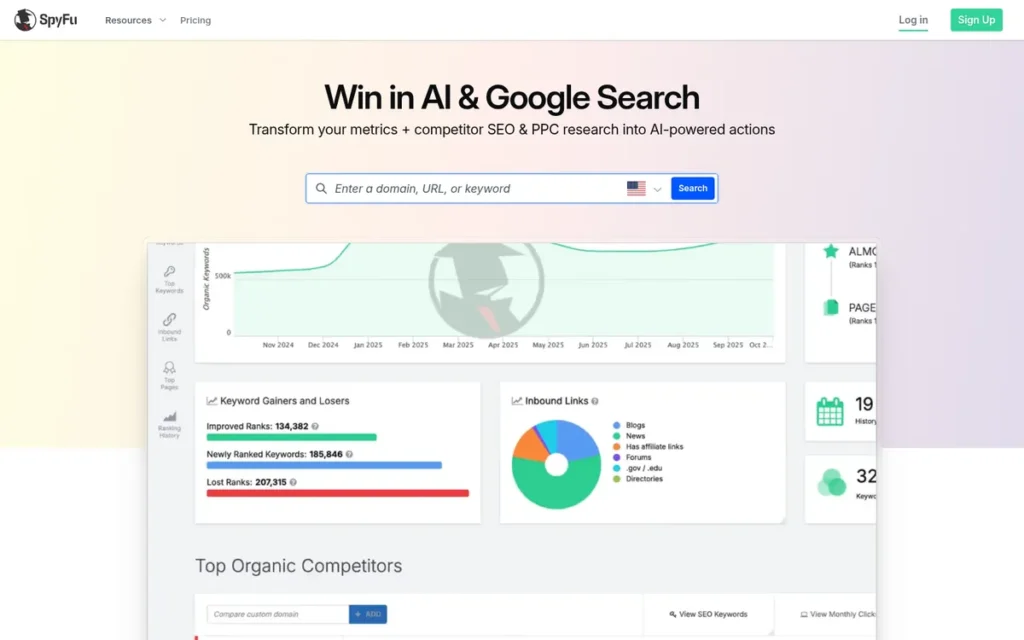
#4. SpyFu: The Affordable Competitive Intelligence Tool for SMB PPC Teams
Category: Competitive Intelligence Tool
At a Glance
- Category: Competitive Intelligence Tool
- Best For: Small-to-midsize PPC teams and freelancers needing competitor ad research on a limited budget
- Price Range: $39–$299/month across Basic to Team tiers (SpyFu, 2025)
- Primary Strength: SpyFu provides 15+ years of competitor PPC history: keyword purchases, ad copy, and spend estimates, at a price point accessible to freelancers and small agencies (SpyFu, 2025)
- Biggest Limitation: SpyFu’s keyword database is smaller than Semrush’s 800M+ index, and data accuracy is reduced for lower-volume keywords and newer markets where historical coverage is sparse
- One-Line Summary: SpyFu is the most accessible competitor PPC research tool for budget-conscious teams, offering 15+ years of historical ad data and unlimited exports at a fraction of Semrush’s cost
- Last Verified: June 2026
Overview
SpyFu is a competitive PPC and SEO research platform specializing in competitor keyword history, ad copy archives, and estimated ad spend tracking. SpyFu is designed for small-to-midsize advertisers and freelance PPC managers who need actionable competitor intelligence without the cost of enterprise-tier tools. SpyFu’s core value is its 15+ year archive of competitor keyword purchases and ad copy variants, which allows teams to quickly identify which keywords competitors have invested in consistently versus which they tested and abandoned. SpyFu is a research-only tool used primarily for pre-campaign competitive analysis, not for ongoing campaign management or bid optimization at the execution layer.
Key Features
- Competitor Keyword Downloads: SpyFu allows users to download complete lists of keywords a competitor has purchased over its history, filtered by estimated spend, run frequency, and ranking data, enabling rapid keyword list expansion based on proven competitor investment (SpyFu, 2025).
- Ad Copy History Archive: SpyFu archives all ad copy variations a domain has run over 15+ years, surfacing messaging that has survived long-term market testing versus copy that was tested and dropped.
- PPC Kombat: SpyFu’s PPC Kombat tool visualizes keyword overlap and competitive gaps between two competing domains, making it easy to identify shared keywords and exclusive competitor territories.
- Combined PPC and SEO Research: SpyFu covers both paid and organic keyword history in one interface, supporting teams managing both channels without requiring separate tool subscriptions.
- Estimated Ad Spend Tracking: SpyFu provides month-by-month competitor ad spend estimates, allowing teams to identify seasonal budget patterns and competitive intensity changes over time (SpyFu-reported model estimates, not verified actuals).
Best For
SpyFu is best for freelance PPC managers, small agencies, and in-house teams at companies with under $50K/month in ad spend who need competitor keyword intelligence without the cost commitment of Semrush. SpyFu is particularly valuable for market entry research, quickly building keyword lists based on what established competitors have already tested and invested in over time.
Pricing
SpyFu plans range from $39/month (Basic) to $299/month (Team), with all plans including unlimited data exports (SpyFu, 2025). The Basic plan at $39/month provides access to the full keyword and ad copy database with some rate restrictions. Annual billing reduces pricing by approximately 20% versus monthly. SpyFu’s unlimited export model contrasts with Semrush’s tiered export limits at lower plan tiers.
Strengths
- 15+ Year Historical Archive: SpyFu’s competitor PPC database extends back 15+ years (SpyFu, 2025), providing deeper historical context on competitor keyword investment than most comparable tools available at this price point.
- Unlimited Exports at All Tiers: SpyFu includes unlimited keyword and ad copy exports across all plan tiers, removing the per-query and monthly-limit restrictions that constrain lower-tier Semrush plans.
- Accessible Entry Pricing: SpyFu’s $39/month Basic tier makes comprehensive competitor PPC research accessible to solo practitioners and small agencies that cannot justify Semrush’s $139.95/month minimum.
- PPC Kombat Competitive Visualization: SpyFu’s PPC Kombat provides an immediately actionable view of competitive keyword overlap, allowing teams to prioritize bidding decisions based on where they share or diverge from competitor keyword investments.
Limitations
- Smaller Database Than Semrush: SpyFu’s keyword database is smaller than Semrush’s 800M+ keyword index (SpyFu, 2025), resulting in thinner coverage for lower-volume keywords and emerging markets where historical data has not yet accumulated.
- Spend Estimates Are Approximations: SpyFu’s advertiser spend estimates are SpyFu-generated model outputs, not verified actuals, actual competitor budgets can differ significantly from displayed figures, particularly for smaller advertisers with limited historical data.
- Lower Real-Time Data Freshness: SpyFu’s competitive value is strongest for historical pattern analysis; its real-time data update frequency is lower than live auction monitoring tools, making it less useful for time-sensitive competitive responses.
- No Campaign Execution: SpyFu is a research-only platform: it does not connect to Google Ads or Microsoft Advertising for campaign creation or bid management, requiring a separate execution platform in every workflow.
Users on r/PPC noted how agencies actually use the tool in practice:
“My agency mostly uses it for onboarding research and seeing monthly ad spend for competitors or certain keywords, but it’s pretty inaccurate. Needs to be taken with a grain of salt. Keyword planner in Google Ads and SEMrush is preferred, but I’ll still see what spyfu has in case there are any keyword suggestions I didn’t include, but I’ll use that in SEMrush for more accurate search volume numbers.” Posted by u/Legitimate_Big_3737
Takeaway: SpyFu’s real-world agency use case is primarily onboarding-stage competitive keyword ideation, with practitioners cross-checking volume data against Semrush or Google Keyword Planner, confirming its role as a supplementary research input rather than a standalone competitive intelligence source.
Verdict
SpyFu is the best competitive intelligence option for budget-conscious PPC teams that prioritize historical competitor data depth over real-time accuracy. SpyFu’s 15+ year archive and unlimited exports at $39/month make it the most accessible competitor research tool in this category, though teams managing large keyword portfolios or requiring real-time competitive accuracy should evaluate Semrush’s larger database despite the higher subscription cost.
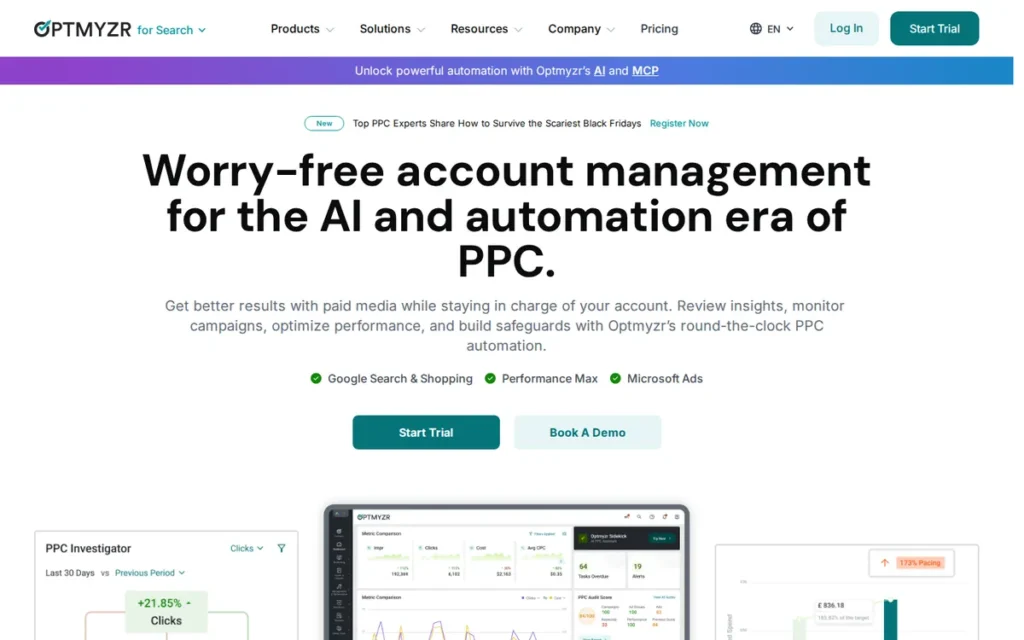
#5. Optmyzr: The Multi-Account Optimization Platform for Agencies
Category: Optimization & Management Platform
At a Glance
- Category: Optimization & Management Platform
- Best For: Agencies and enterprise in-house teams managing 10 or more client PPC accounts simultaneously
- Price Range: Core plan from approximately $208/month; scales with managed ad spend (Optmyzr, 2025)
- Primary Strength: Optmyzr provides the deepest multi-account automation available for agency PPC teams, combining rule-based scripts, one-click optimizations, and cross-account reporting in one platform
- Biggest Limitation: Optmyzr’s pricing scales with managed ad spend rather than a flat fee, which can make it cost-prohibitive for small agencies managing clients with limited budgets or for teams growing their client base rapidly
- One-Line Summary: Optmyzr is the leading optimization and automation platform for multi-account PPC management, offering agency-grade workflow tools that reduce manual optimization time across large campaign portfolios
- Last Verified: June 2026
Overview
Optmyzr is a paid search optimization and management platform designed for agencies and enterprise in-house teams managing complex, multi-account Google Ads and Microsoft Advertising campaigns. Optmyzr works as a layer on top of execution platforms, connecting via API to automate bid adjustments, budget pacing, account audits, and reporting workflows that would otherwise require manual effort or custom scripting. Optmyzr has received recognition through Google’s Premier Partner Awards innovation category (Google, 2023), reflecting third-party acknowledgment of its integration depth within the Google Ads ecosystem. Optmyzr serves agencies managing anywhere from 10 to hundreds of client accounts, with automation tools designed to scale operational efficiency at that portfolio size.
Key Features
- Rule-Based Automation Engine: Optmyzr’s automation builder allows teams to create bid rules, budget alerts, and optimization triggers using a visual interface (without requiring JavaScript or SQL expertise) and schedule them to run automatically across accounts.
- Enhanced Scripts Module: Optmyzr’s Enhanced Scripts extend Google Ads Scripts with pre-built templates and a visual editor, enabling teams to deploy complex automation without writing raw code.
- PPC Investigator: Optmyzr’s PPC Investigator automatically identifies the root cause of performance changes (such as CPC spikes or conversion drops) and surfaces a diagnostic timeline so account managers can resolve issues faster than manual log review allows.
- One-Click Optimizations: Optmyzr surfaces pre-built optimization recommendations across accounts and allows teams to apply, reject, or schedule them in bulk, reducing manual review time across large campaign portfolios.
- Multi-Account Reporting Suite: Optmyzr’s reporting tools generate customizable cross-account performance reports that can be scheduled and white-labeled for client delivery, reducing agency reporting overhead per account.
Best For
Optmyzr is best for agencies managing 10 or more Google Ads or Microsoft Advertising client accounts simultaneously, where the operational cost of manual optimization and reporting across accounts exceeds the platform subscription cost. Optmyzr is also used by enterprise in-house teams with complex multi-campaign structures that benefit from automated audit and optimization workflows at scale.
Pricing
Optmyzr’s Core plan starts at approximately $208/month for accounts managing up to $50K in monthly ad spend (Optmyzr, 2025). Pricing scales upward with managed spend, with higher tiers unlocking additional automation capabilities and account seat limits. Annual billing is available at a discount. Optmyzr does not publish a complete pricing schedule for accounts managing above $500K/month in ad spend, prospective customers at that scale are directed to contact sales.
Strengths
- Deepest Multi-Account Automation: Optmyzr’s combination of rule-based automation, Enhanced Scripts, and one-click optimizations provides the most comprehensive automation toolkit available for agencies managing large PPC portfolios without custom software engineering.
- PPC Investigator Diagnostic Speed: Optmyzr’s PPC Investigator reduces root cause identification for performance changes (a task that can take hours manually) to minutes, which is meaningful for agencies managing client SLA expectations across many accounts.
- Google Premier Partner Recognition: Optmyzr has received recognition through Google’s Premier Partner Awards program (Google, 2023), providing third-party validation of its integration quality and contribution to advertiser performance outcomes.
- No-Code Automation Access: Optmyzr’s visual rule builder and Enhanced Scripts editor make advanced PPC automation accessible to practitioners without software engineering backgrounds, expanding the team members who can deploy complex bid and budget rules.
Limitations
- Ad Spend–Scaled Pricing: Optmyzr’s pricing model scales with managed ad spend, not a fixed monthly subscription, which can become expensive for agencies managing high-spend clients or growing their portfolio quickly without proportional time savings.
- Steeper Learning Curve for New Users: Optmyzr’s automation depth requires meaningful configuration time before delivering value, users on G2 (2025) report that fully realizing the platform’s potential takes several weeks of setup and workflow iteration.
- Limited Automation Depth for Microsoft Advertising: Optmyzr’s automation is strongest for Google Ads; Microsoft Advertising integration is available but covers fewer automation scenarios, which matters for agencies running significant Microsoft Advertising budgets across client portfolios.
- Lower Value for Simple, Low-Account-Count Operations: Optmyzr’s value proposition is dependent on account complexity and volume, agencies managing fewer than five clients with straightforward campaign structures may not recoup the subscription cost through time savings alone.
Users on r/PPC shared a contrasting account of the platform’s recommendation engine:
“I recently canceled. It did more harm than good to my accounts. It’s just too easy to make too many changes too quickly and my quality scores went down as I attempted to fix/optimize off of their recommendations.” Posted by u/genebadd1
Takeaway: Optmyzr’s one-click optimization recommendations carry meaningful risk for teams that apply them without diagnostic review, the platform’s automation depth can accelerate account damage as quickly as it accelerates improvement when recommendations are acted on without proper configuration guardrails in place.
Verdict
Optmyzr is the strongest optimization and management platform available for agencies running complex multi-account PPC workflows, offering automation depth that measurably reduces manual overhead in bid management, budget pacing, and audit reporting. Optmyzr’s spend-scaled pricing means the platform’s cost-efficiency depends directly on account volume and complexity, agencies managing 10 or more accounts at moderate to high spend levels will see the clearest return, while small agencies should model the cost against actual expected time savings before committing to a subscription.
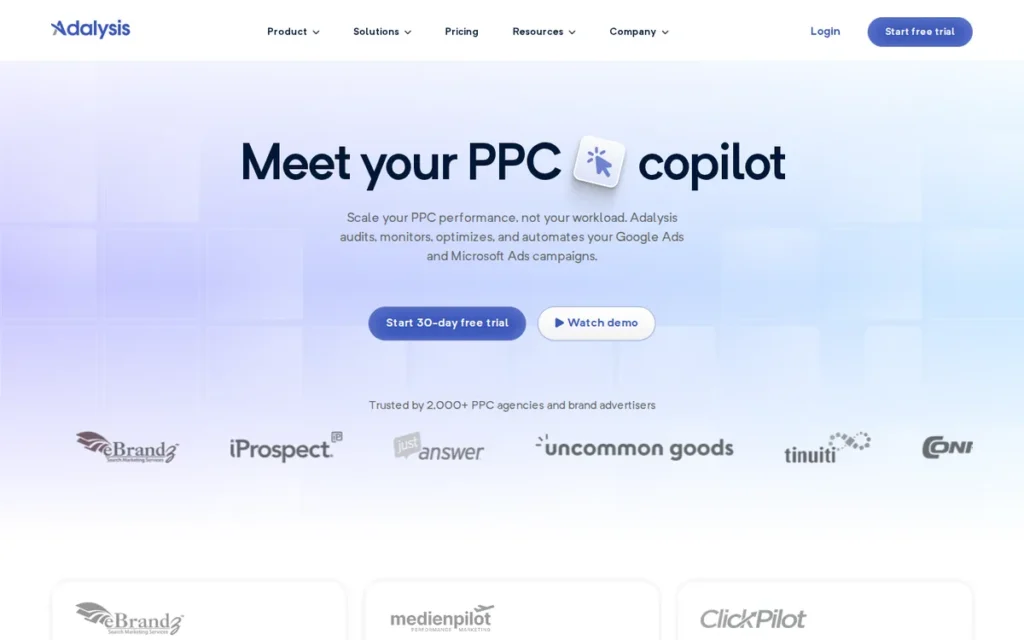
#6. Adalysis: The Automated Ad Testing Platform for Large In-House Google Ads Accounts
Category: Optimization & Management Platform
At a Glance
- Category: Optimization & Management Platform
- Best For: In-house PPC managers running large-volume single Google Ads accounts with extensive ad testing needs
- Price Range: From $99/month for accounts with up to 100 active ads; scales by active ad count (Adalysis, 2025)
- Primary Strength: Adalysis automates ad variation testing and account health monitoring across large Google Ads accounts, surfacing statistically significant test results without requiring manual result tracking (Adalysis, 2025)
- Biggest Limitation: Adalysis has limited support for Performance Max campaigns: a growing share of Google Ads spend, reducing its coverage utility as PMax adoption increases within accounts
- One-Line Summary: Adalysis is the leading automated ad testing and account health monitoring tool for in-house Google Ads managers running high-ad-count single accounts at a lower entry cost than full-suite agency platforms
- Last Verified: June 2026
Overview
Adalysis is an optimization platform focused on automated ad testing, account health alerts, and performance monitoring for Google Ads accounts with high ad volumes. Adalysis is designed for in-house PPC managers, not agencies, who run a single account with hundreds or thousands of active ads and need systematic testing infrastructure without building custom scripts. Adalysis connects to Google Ads via API, continuously monitors ad performance, triggers alerts when statistically significant changes occur, and surfaces ad variation recommendations based on test data. Adalysis reportedly reduces ad management time by 3–5 hours per week for practitioners managing high ad-count accounts, according to vendor-reported user estimates (Adalysis, 2025), an estimate that should be verified with current users in account structures comparable to your own.
Key Features
- Automated Ad Variation Testing: Adalysis’s core function is running structured A/B and multivariate tests on ad copy across large account ad inventories, surfacing statistically significant winners without requiring manual result tracking or script deployment.
- Account Health Alerts: Adalysis monitors Google Ads accounts continuously and sends alerts when performance metrics (impressions, CTR, conversion rate, Quality Score) deviate beyond configurable thresholds.
- Ad Group Structure Audits: Adalysis runs automated audits of ad group configuration, flagging groups with missing ad variations, low-performing single ads, or structural issues that limit Google’s ad rotation optimization.
- Performance Max Monitoring: Adalysis provides some monitoring capability for Performance Max campaigns, though its PMax coverage is more limited than its traditional search ad testing features, a gap Adalysis acknowledges (Adalysis, 2025).
- Search Term Analysis and Categorization: Adalysis’s search term reports surface queries triggering ads and automatically categorize them into performance tiers, supporting faster negative keyword identification and match type adjustment decisions.
Best For
Adalysis is best for in-house PPC managers at mid-to-large businesses running a single primary Google Ads account with a high volume of active ads, where systematic testing and alert infrastructure would otherwise require custom scripting or significant manual analysis effort. Adalysis is less suited for agencies managing multiple client accounts, as its workflow is optimized for single-account depth rather than multi-account operational breadth.
Pricing
Adalysis pricing starts at $99/month for accounts with up to 100 active ads, scaling by active ad count to plans covering 10,000+ active ads (Adalysis, 2025). There are no per-user seat fees, team access is included at all tiers. Annual billing is available. Adalysis’s per-active-ad pricing is fully transparent and publicly listed, making it straightforward to estimate cost based on account size before subscribing.
Strengths
- Purpose-Built Ad Testing Automation: Adalysis’s ad testing infrastructure is deeper than comparable features in Optmyzr or Google Ads native tools, it is the only platform in this comparison built with automated ad variation testing as its primary and foundational function.
- Transparent, Usage-Based Pricing: Adalysis’s per-active-ad pricing model scales predictably with account size, starting at $99/month (Adalysis, 2025), significantly lower than Optmyzr for in-house single-account use cases.
- Continuous Health Alert Coverage: Adalysis’s account monitoring covers more structural health dimensions than Google Ads’ native recommendations, providing actionable alerts rather than generic optimization suggestions surfaced through the Google Ads interface.
- No Per-Seat Charges: Adalysis includes team member access at all plan tiers without additional per-seat fees, reducing cost for in-house marketing teams with multiple stakeholders who need to monitor and review campaign performance.
Limitations
- Limited Performance Max Coverage: Adalysis’s Performance Max monitoring is less comprehensive than its traditional search ad testing features, and as Google continues shifting advertiser budgets toward PMax as the default campaign format, this coverage gap becomes a more significant operational constraint (Adalysis, 2025).
- Single-Account Workflow Orientation: Adalysis’s interface and reporting are optimized for managing one account in depth, making it less operationally efficient for agencies or in-house teams that manage multiple Google Ads accounts and need consistent workflows across all of them.
- No Microsoft Advertising Support: Adalysis does not support Microsoft Advertising accounts, limiting its utility for teams running paid search campaigns across both Google and Microsoft platforms who need a single optimization tool covering both.
- Narrower Automation Scope Than Optmyzr: Adalysis’s automation is focused on ad testing and health monitoring, it does not cover bid rule automation, budget pacing, or the breadth of cross-account optimization scenarios that Optmyzr provides for agency operations.
“Adalysis is perfect if you’re running a big in-house account and need to test ads at scale without building your own scripts.” (r/PPC)
Takeaway: Adalysis’s Performance Max coverage gap is a real constraint, in-house teams where PMax represents more than 30% of Google Ads spend should specifically verify current PMax feature depth with the vendor before committing to a subscription.
Verdict
Adalysis is the best optimization tool for in-house PPC managers running large, single-account Google Ads operations where automated ad testing and structural health monitoring are the primary workflow pain points. Adalysis’s per-active-ad pricing makes it cost-efficient at the single-account level compared to full-suite agency platforms, but its limited Performance Max coverage and single-account orientation make it a poor fit for agencies managing multiple client accounts or for Google Ads accounts where Performance Max has become the dominant campaign format.
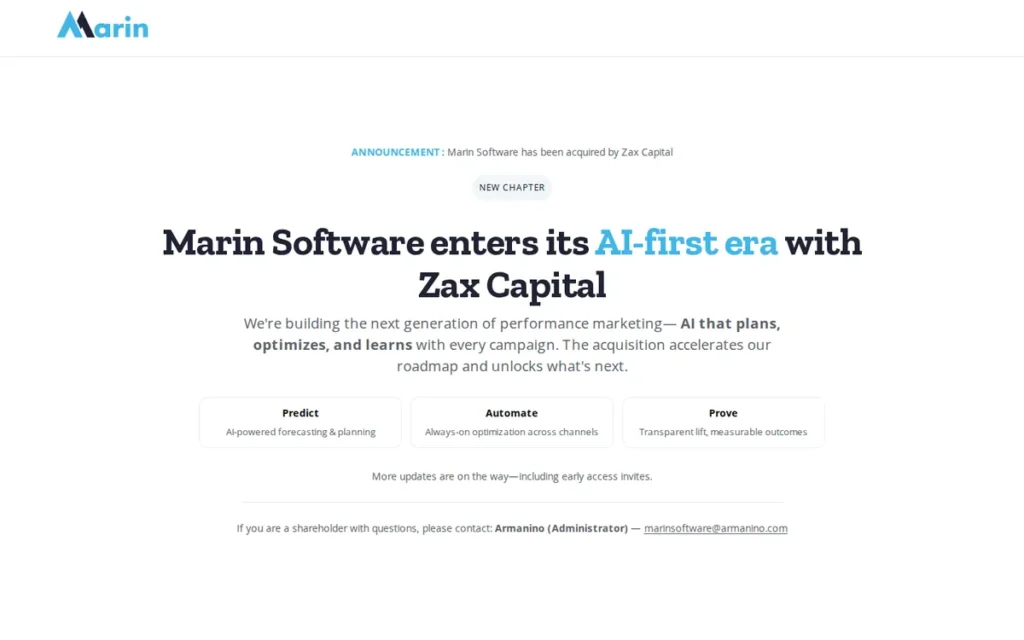
#7. Marin Software: The Enterprise Cross-Channel Attribution Platform
Category: Enterprise Cross-Channel Platform
At a Glance
- Category: Enterprise Cross-Channel Platform
- Best For: Enterprise advertisers managing $1M+ in annual ad spend across search, social, and display simultaneously
- Price Range: Custom pricing; enterprise clients report $2,000–$5,000+/month (G2, 2025)
- Primary Strength: Marin Software provides unified cross-channel attribution and budget forecasting across search, social, and display, a capability not available in any other platform in this comparison
- Biggest Limitation: Marin Software’s cost and implementation complexity make it unsuitable for advertisers outside the enterprise tier, and bidding performance data from pre-2024 reviews may not reflect current capabilities following its corporate restructuring
- One-Line Summary: Marin Software is the only enterprise-grade cross-channel platform in this comparison that unifies paid search, social, and display attribution into a single reporting and optimization layer
- Last Verified: June 2026
Overview
Marin Software is an enterprise advertising management platform that unifies paid search, social media advertising, and display into a single campaign management, attribution, and optimization environment. Marin Software is built for organizations managing $1M+ in annual ad spend across multiple channels, where fragmented reporting across Google Ads, Microsoft Advertising, Meta, and programmatic platforms creates attribution blind spots and budget misallocation. Marin Software has stated a strategic repositioning toward AI-driven bid optimization as a primary direction (Marin Software, 2025) (a vendor-stated direction rather than an independently verified capability claim) building cross-channel bidding tools on top of its legacy campaign management infrastructure. Marin Software is used by Fortune 500 brands, enterprise retailers, and large digital agencies that need a unified reporting and optimization layer above platform-native tools.
Key Features
- Cross-Channel Attribution: Marin Software’s attribution module unifies conversion data across Google Ads, Microsoft Advertising, Meta, and display platforms, allowing advertisers to assign credit across the full purchase path rather than within individual platform-siloed reporting.
- AI Bid Optimization: Marin Software uses AI-powered bidding algorithms to adjust bids across channels simultaneously, optimizing toward unified cross-channel ROAS targets rather than per-platform objectives set in each native tool.
- Budget Forecasting: Marin Software’s budget forecasting tools model expected performance at different spend levels across channels, supporting enterprise media planning and scenario analysis before budget commitments are finalized.
- Search Intent Signal Bridging: Marin Software layers search intent data from paid search queries onto social media targeting, allowing advertisers to retarget users on Meta based on what they searched for on Google, a cross-channel signal connection not available natively within either platform.
- Enterprise Cross-Channel Reporting: Marin Software provides customizable cross-channel dashboards and automated reporting at enterprise scale, consolidating performance data from multiple platform sources into unified views for executive stakeholders.
Best For
Marin Software is best for enterprise advertisers (Fortune 500 brands, large retailers, or enterprise digital agencies) managing $1M+ in annual ad spend across search, social, and display simultaneously, where platform-siloed attribution creates material budget misallocation that cross-channel measurement would resolve. Marin Software is not suited for advertisers running campaigns on a single platform or managing budgets below $500K per year.
Pricing
Marin Software uses custom pricing with no public rate card. Enterprise clients report costs in the range of $2,000–$5,000+/month (G2, 2025), with pricing reflecting managed spend volume, channel count, and implementation support requirements. Marin Software requires a structured sales engagement and implementation process before campaign launch, unlike the self-serve tools reviewed in this comparison.
Strengths
- Unique Cross-Channel Attribution: Marin Software is the only tool in this comparison providing unified attribution across search, social, and display in a single environment, a capability that is materially valuable at enterprise spend levels where channel-siloed attribution leads to measurable budget waste.
- Search-to-Social Intent Bridging: Marin Software’s ability to pass search query intent signals to social targeting platforms is a differentiating capability for enterprise advertisers running coordinated search-and-social campaigns that need intent signals to flow across channels.
- Enterprise Budget Forecasting Depth: Marin Software’s budget forecasting is more sophisticated than Google Ads’ native planning tools, supporting multi-channel scenario modeling that is useful for enterprise media planning cycles where budget decisions affect multiple platforms simultaneously.
- Dedicated Implementation Support: Marin Software provides dedicated customer success and implementation support for enterprise clients, reducing the internal resource requirement for platform onboarding compared to self-serve tools that require in-house configuration.
Limitations
- Cost Prohibitive Outside Enterprise Tier: Marin Software’s estimated $2,000–$5,000+/month pricing (G2, 2025) makes it inaccessible for all but enterprise advertisers, teams managing under $500K/year in total ad spend are unlikely to recoup the platform cost through attribution efficiency gains.
- Implementation Complexity and Timeline: Marin Software requires a structured implementation and onboarding process that can take 6–8 weeks, delaying time-to-value for organizations that need faster deployment than enterprise contracting and integration timelines allow.
- Bidding Performance Uncertainty Post-Restructuring: G2 reviews praising Marin Software’s bid optimization capabilities predate its 2024 corporate restructuring, current bidding performance under its repositioned AI-first model has not been independently verified by reviews from clients who onboarded post-2024 (G2, pre-2024).
- Smaller Independent Review Volume: Marin Software’s verified review count on G2 and Capterra is lower than Google Ads, Semrush, or Optmyzr, limiting the breadth of independent performance validation available to prospective buyers evaluating the platform against alternatives.
“Marin is powerful but it’s definitely not for small teams, the onboarding alone took us two months.”, G2 reviewer
Takeaway: Marin Software’s implementation timeline is a real cost factor beyond the subscription price, enterprise teams should budget 6–8 weeks for full deployment and staff onboarding before expecting optimization returns from the platform.
Verdict
Marin Software is the only cross-channel enterprise attribution platform in this comparison, and its cross-channel attribution and intent bridging capabilities are genuinely differentiated, but only at spend levels where attribution blind spots translate into measurable budget waste. Marin Software’s cost and complexity make it unsuitable for any advertiser outside the enterprise tier, and teams evaluating it should request performance data specifically from reference customers who onboarded after the 2024 restructuring rather than relying on pre-restructuring case studies.
What Red Flags Should I Watch For When Evaluating Paid Search Software?
Not every paid search software claim holds up to scrutiny, and some vendor representations obscure meaningful limitations that affect buying decisions. The five red flags below are the most consequential to identify before signing a contract.
Red Flag #1: Estimated Competitor Data Presented as Actual Data Competitive intelligence tools, including Semrush and SpyFu, estimate competitor keyword spend and CPC data from their own indexing models, they do not pull live auction data from Google’s API. Platforms that present these estimates without clearly labeling them as approximations may create overconfidence in competitive benchmarks that diverge significantly from actual auction conditions.
Red Flag #2: Automation Described as “AI-Powered” Without Transparent Logic Optimization platforms that describe their automation as AI-driven without explaining what signals trigger bid changes should be scrutinized before adoption. Opacity about automation logic makes it impossible to audit why bids moved, which is a critical accountability gap for large-spend accounts where unexplained bid changes can erode campaign performance.
Red Flag #3: Pricing That Scales Unexpectedly with Account Growth Several platforms in this category, including Optmyzr, price based on managed ad spend rather than a fixed monthly fee. A platform that appears affordable at $5K/month in managed spend can become expensive at $100K/month without a buyer modeling the cost trajectory. Always calculate the fully-loaded cost at 3× your current managed spend before committing to a spend-scaled subscription.
Red Flag #4: Review Volume Concentrated Before a Significant Platform Change Marin Software’s most-cited G2 reviews predate its 2024 restructuring and may not reflect current platform capabilities. Any tool with a concentration of performance reviews from before a major acquisition, restructuring, or product pivot should be evaluated with reference customers who onboarded and ran campaigns after the change, not before it.
Red Flag #5: Performance Max Coverage Presented as Equivalent to Traditional Search Coverage Several optimization tools in this category have limited or experimental Performance Max support, while vendors may present overall Google Ads compatibility without distinguishing PMax capabilities from traditional search campaign features. Advertisers where Performance Max represents 30% or more of Google Ads spend should specifically verify PMax feature depth (including bidding, asset testing, and placement reporting) before selecting an optimization platform.
What Questions Should I Ask Before Choosing Paid Search Software?
Evaluating paid search software effectively requires moving beyond feature lists to questions that reveal how a tool will perform in your specific workflow, account structure, and budget context.
Question #1: Does this tool replace my execution platform or sit on top of it? Optimization and intelligence tools (Optmyzr, Adalysis, Semrush, SpyFu) require Google Ads or Microsoft Advertising as the underlying execution layer. Clarify whether a tool is adding capabilities to your existing platforms or replacing them before allocating budget for it in your stack.
Question #2: How does this tool’s pricing model scale with my account growth? Optmyzr’s spend-based pricing and Adalysis’s per-active-ad pricing scale differently as your business grows. Model each tool’s cost at 3× your current managed spend or active ad count to identify unexpected cost inflection points before committing.
Question #3: What is the current depth of Performance Max support? For any optimization tool (particularly Adalysis) ask specifically what actions the platform can take on Performance Max campaigns: bidding, asset testing, placement reporting. Identify what still requires manual management directly in Google Ads before assuming full coverage.
Question #4: How recent are the case studies and performance references the vendor provides? For tools that have undergone restructuring or product pivots (particularly Marin Software) verify that cited performance data comes from clients who ran campaigns after the change, not before. Pre-restructuring case studies may not reflect current platform capabilities.
Question #5: Can I see a live demo on an account structure comparable to mine in size and complexity? Account structures range from five simple campaigns to five hundred complex ones. Request a demo using account configurations comparable to yours to see how the tool’s automation and reporting perform at your actual scale before committing.
Question #6: Is competitor data in this tool derived from live auction APIs or from indexed modeling? Semrush and SpyFu both derive competitor CPC and spend data from their own indexing models, not from Google’s live auction signals. Ask any competitive intelligence tool to explain exactly how its estimates are generated before treating competitor spend figures as reliable actuals.
Question #7: What does onboarding realistically require from my team in time and resources? Marin Software can take 6–8 weeks to fully implement. Even self-serve tools like Optmyzr require several weeks of configurationbefore delivering full value. Request time-to-value timelines from reference customers with account structures similar to yours, not from vendor-published averages.
How Did We Rank These Paid Search Advertising Platforms?
This ranking was produced through an independent evaluation process by the PlugRoute research team. No vendor paid for inclusion, placement, or editorial review. The methodology below describes exactly how platforms were identified, evaluated, and ranked so readers can assess the basis of every recommendation.
Platform Identification Process
Platform identification began with a structured review of G2, Capterra, and Trustpilot listing categories for “paid search advertising software,” “PPC management tools,” and “competitive intelligence for paid search” as of Q1 2026. Platforms were included if they met a minimum threshold of 50 verified independent reviews and were actively marketed and updated as of Q1 2026. This produced an initial candidate pool of 19 platforms. The 7 reviewed here represent the most functionally distinct, independently-verified tools across the four categories relevant to paid search practitioners, avoiding duplication within each category tier.
Evaluation Criteria and Weights
Rankings were determined by weighted scoring across five criteria:
- Functional Depth (30%): Whether the platform’s core capabilities are meaningfully differentiated from what execution-platform native tools already provide. Tools that primarily replicate Google Ads native features without adding distinct capability received lower functional depth scores.
- Verified Performance Evidence (25%): The volume and recency of independently verified performance claims from G2, Capterra, and documented case studies. Vendor-reported figures were weighted at 50% of independently verified figures when both were available.
- Pricing Transparency and Accessibility (20%): Whether pricing is publicly listed, how predictably it scales with account growth, and whether the cost model is accessible to the target buyer audience for that category tier.
- User Experience and Onboarding (15%): Time-to-value estimates, UI quality ratings from G2 (2025), and user community size as a proxy for ecosystem support and practitioner knowledge availability.
- Claim Verifiability (10%): Whether the platform’s core performance claims are verifiable through independent sources, and whether claims requiring vendor verification were appropriately labeled throughout the article.
Evidence Weighting Rationale
Where user reviews conflicted with vendor case studies, independent G2 and Capterra review data received higher weight. Where performance claims appeared exclusively in vendor-published materials, they are labeled as vendor-reported in the article. Claims appearing in peer-reviewed research or independent industry journalism received the highest weighting. Claims from reviews predating significant platform changes (particularly for Marin Software post-2024) were discounted in the scoring.
Data Validation Approach
All vendor-stated statistics were cross-referenced against at least one independent source where available. Statistics that could not be independently verified are labeled with the vendor name and year as the source (for example, “Adalysis, 2025”) so readers can distinguish independently confirmed data from vendor-provided figures. Pricing data was verified against publicly listed pricing pages as of Q1 2026, or noted as requiring direct sales contact where no public pricing is available.
Update Cadence
This guide is updated quarterly. The paid search software market moves rapidly, particularly in AI bidding capabilities and Performance Max feature development. Readers should verify current pricing and feature availability directly with vendors before making final purchasing decisions.
Independence Statement
PlugRoute has no affiliate relationships, referral fee arrangements, or paid placement agreements with any platform reviewed in this guide. Rankings reflect independent editorial judgment based on the methodology described above.
What Do Buyers Most Frequently Ask About Paid Search Software?
How does PlugRoute determine its paid search software rankings?
PlugRoute rankings use a five-criteria weighted scoring model covering functional depth, verified performance evidence, pricing transparency, user experience, and claim verifiability. No vendor pays for placement or editorial access. All statistics are sourced from G2, Capterra, official vendor documentation, and Reddit community data, with vendor-only claims labeled as such throughout the article.
Do I need both an execution platform and an optimization tool for paid search?
Most teams benefit from pairing an execution platform (Google Ads or Microsoft Advertising) with at least one additional tool. Execution platforms handle campaign delivery; optimization tools like Optmyzr and Adalysis, or intelligence tools like Semrush and SpyFu, address capabilities the native platforms do not provide. Advertisers managing simple, single-platform campaigns may not need a third-party tool initially.
Is Google Ads still necessary if I use an optimization platform like Optmyzr?
Yes. Optimization platforms like Optmyzr and Adalysis connect to Google Ads via API and manage campaigns within the Google Ads infrastructure, they do not replace it. Google Ads remains the required execution layer for any advertiser targeting Google search inventory, regardless of which optimization or management platform sits above it in the tech stack.
What Key Terms Should I Know When Comparing Paid Search Platforms?
Performance Max (PMax): A Google Ads campaign type that serves ads across Search, Display, YouTube, Gmail, Shopping, and Maps from a single campaign, using Google’s AI to dynamically allocate budget across surfaces. Performance Max reduces manual channel management overhead but limits placement-level reporting transparency, a trade-off relevant when evaluating optimization tool coverage.
Smart Bidding: Google Ads’ automated bid strategy system, which uses machine learning to set bids at each auction using real-time signals including device, location, search history, and time of day. Smart Bidding strategies include Target CPA, Target ROAS, Maximize Conversions, and Enhanced CPC, and access to the full signal set is available only within Google Ads natively.
CPC (Cost Per Click): The amount an advertiser pays each time a user clicks on a paid search ad. CPCs are determined through auction dynamics, higher competition for a keyword typically results in higher CPCs. Industry CPCs range from under $1 in low-competition categories to $50+ in legal, finance, and insurance verticals WordStream, 2025.
Cross-Channel Attribution: The process of assigning conversion credit across multiple advertising channels (including paid search, paid social, and display) to understand which touchpoints contributed to a purchase. Without cross-channel attribution, each platform counts conversions independently, often resulting in double-counting across channels and misallocated budget.
Intent Signals: Behavioral data indicating a user’s likelihood of converting, including search query content, browsing history, page visit patterns, and device context. Google Ads incorporates intent signals into Smart Bidding automatically; third-party optimization tools can access only the signals Google exposes through its public API, which excludes the most granular real-time auction inputs.
Glossary: Key Terms Used in This Comparison
Performance Max (PMax): A Google Ads campaign type that serves ads across Search, Display, YouTube, Gmail, Shopping, and Maps from a single campaign structure, using Google’s AI to dynamically allocate budget across surfaces. Performance Max reduces manual channel management overhead but limits placement-level reporting transparency.
Smart Bidding: Google Ads’ automated bid strategy system that uses machine learning to set bids at each individual auction using real-time signals such as device, location, search history, and time of day. Smart Bidding strategies include Target CPA, Target ROAS, Maximize Conversions, and Enhanced CPC, and the full signal set is accessible only within Google Ads natively.
Cross-Channel Attribution: The process of assigning conversion credit across multiple advertising channels (including paid search, paid social, and display) to understand which touchpoints contributed to a purchase. Without cross-channel attribution, each platform counts conversions independently, frequently resulting in double-counting and misallocated budget across channels.
Intent Signals: Behavioral data indicating a user’s likelihood of converting, including search query content, browsing history, page visit patterns, and device context. Google Ads incorporates intent signals into Smart Bidding automatically, while third-party optimization tools can access only the subset of signals Google exposes through its public API.
CPC (Cost Per Click): The amount an advertiser pays each time a user clicks on a paid search ad, determined through auction dynamics where higher keyword competition typically drives higher costs. Industry CPCs range from under $1 in low-competition categories to $50 or more in legal, finance, and insurance verticals.
Which Paid Search Software Tool Is Right for You?
Key Insights
- Google Ads is a non-optional execution layer for any advertiser targeting Google Search, no third-party tool substitutes for direct access to its inventory, and all optimization tools in this comparison require it as the underlying platform.
- Microsoft Advertising’s LinkedIn targeting advantage is most meaningful for B2B advertisers in enterprise technology, professional services, and financial services, it is not a benefit that transfers equally to consumer-focused verticals.
- Semrush and SpyFu serve the same competitive research need at different price points and database sizes, the choice between them is driven by budget and required data depth, not fundamental category fit.
- Optmyzr and Adalysis differ in workflow orientation, not just price: Optmyzr is built for multi-account agency operations; Adalysis is built for single-account in-house depth, selecting the wrong one for your structure reduces value significantly.
For growing agencies managing 10 or more client accounts, Optmyzr’s automation depth typically generates enough time savings to justify its spend-scaled pricing within the first quarter of full configuration. For in-house teams running a single high-volume Google Ads account, Adalysis provides comparable ad testing automation at a lower entry cost, provided Performance Max has not yet become the dominant share of account spend.
Enterprise teams managing cross-channel budgets above $1M annually should evaluate Marin Software with reference customers who onboarded specifically after the 2024 restructuring, requesting performance data from campaigns run under its current AI-first model rather than pre-restructuring configurations.
PlugRoute publishes independent comparisons across software categories without affiliate relationships or vendor payments. We update this guide quarterly. Last updated: June 2026.