The best user research repositories in 2026 are Dovetail for enterprise teams needing the deepest AI infrastructure, HeyMarvin for mid-size teams wanting comparable AI capability at approximately one-third the cost, UserBit for any team size needing flat-rate pricing at $199/month, and Looppanel for solo researchers running high-volume English-language moderated interviews. The right choice turns on pricing model structure and whether your workflow requires automatic data ingestion or accepts manual uploads.
Research artifacts scattered across Google Drive and Notion cannot be retrieved or reused across teams, forcing redundant research cycles that erode organizational memory. Qualitative coding is time-consuming, and per-user pricing on popular platforms can reach approximately $77,000 per year for ten enterprise users, community-verified (r/UXResearch, February 2025), making the wrong tool decision expensive to reverse.
PlugRoute has no affiliate relationships with any company listed in this article. Rankings are determined entirely by research data and objective evaluation criteria, with no payment accepted for placement or editorial treatment.
“I like Dovetail for qualitative analysis but it’s very expensive. You might want to trial a few qual tools and get pricing to compare.”, u/librariesandcake, r/UXResearch
Takeaway: Dovetail is consistently praised for qualitative analysis capability and consistently criticized for pricing, a pattern confirmed across multiple r/UXResearch threads spanning 2023 to 2026, making pricing the single most predictable decision factor when evaluating Dovetail for any team size.
TL;DR: What Are the Top User Research Repository Picks?
- Dovetail leads on AI depth: a confirmed 4.5/5 G2 rating from 167+ reviews and Amazon Bedrock + Claude infrastructure verified by an AWS case study (2025), but per-user pricing reaching ~$77,000/year for 10 enterprise users is a community-verified switching trigger.
- HeyMarvin is the strongest Dovetail alternative, community-verified by an independent healthcare enterprise buyer in January 2025 as security-compliant and approximately one-third the cost of Dovetail for a comparable team configuration.
- UserBit is the only confirmed flat-rate unlimited-user platform in this evaluation at $199/month, covering repository, personas, and journey maps with no per-seat scaling, community-verified by a switching user in February 2025.
- Great Question is the strongest choice for research ops teams combining participant recruitment from a 6M+ verified panel, study execution, incentive payments, and AI-searchable repository in a single workflow.
What Are the 7 Categories of User Research Repository Tools?
User research repositories fall into seven categories based on core architecture, pricing model, and target workflow. Identifying which category matches your team’s current research maturity and operational needs is the most direct path to shortlisting the right platform without wasting evaluation time on tools built for a different buyer profile.
The right user research repository does not just store what was found, it makes the finding retrievable when the next researcher needs it, without requiring them to know it exists.
1. Repository Platform: stores, tags, and retrieves research artifacts with AI-powered semantic search and cross-project synthesis. Platform in this category: Dovetail.
2. AI-Native Repository: continuously ingests customer data from existing tools via native integrations, building the archive automatically without researcher upload dependency. Platform in this category: HeyMarvin.
3. Insights Intelligence Platform: indexes existing research files of any format for enterprise-wide AI discovery and stakeholder delivery, without requiring new research to be conducted in-platform. Platform in this category: Stravito.
4. Research Ops Platform: combines participant recruitment, study execution, incentive management, and AI-searchable repository into a single end-to-end workflow. Platform in this category: Great Question.
5. Interview-Centric Repository: AI analysis optimized for moderated interview workflows, with discussion-guide-aware note organization as the defining differentiator. Platform in this category: Looppanel.
6. Full-Stack Research Platform: repository plus visual downstream deliverable generation (personas, journey maps) under a flat-rate unlimited-user pricing model. Platform in this category: UserBit.
7. Qual Synthesis Repository: structured observation-to-insight methodology for dedicated qualitative researchers who want formal separation between raw data and analyzed insights. Platform in this category: Aurelius.
At ten users, the annualized cost gap between the most and least expensive tools in this evaluation is approximately $74,800, the difference between Dovetail’s community-reported enterprise cost (~$77,000/year) and UserBit’s flat plan (~$2,400/year). Both are user research repositories. This single figure is why pricing model structure, not per-seat price, is the first variable to resolve before comparing any feature.
How Do the Top User Research Repositories Compare at a Glance?
The seven user research repositories below span four pricing models and multiple AI maturity levels, from Amazon Bedrock-powered enterprise platforms to manual-upload flat-rate tools. The table maps each platform across eight dimensions to help narrow a shortlist before reading full entries.
| Rank | Company | Category | Best For | One-Line Summary | Key Capabilities | Primary Strength | Key Limitation |
|---|---|---|---|---|---|---|---|
| 1 | Dovetail | Repository Platform | Enterprise teams needing the deepest AI infrastructure and broadest integrations | Dovetail is the most-reviewed pure-play user research repository in the category, with a confirmed 4.5/5 G2 rating from 167+ reviews, Amazon Bedrock + Claude AI, and the broadest native integrations ecosystem available; but its per-user pricing model scales to enterprise costs that research teams consistently cite as their primary switching trigger | Magic Search (Amazon Bedrock + Claude, source-cited), Channels continuous ingestion, 28–40-language transcription, 7 named native integrations | Deepest independently validated AI infrastructure in the category; AWS-confirmed Amazon Bedrock + Claude, with source-cited Magic Search across entire workspaces | Per-user pricing reaches ~$77K/year for 10 enterprise users (community-verified, Feb 2025); bulk data export functionally unsupported |
| 2 | HeyMarvin | AI-Native Repository | Mid-size teams needing AI depth at lower cost, including regulated industries | HeyMarvin is an AI-native research repository with 30+ native integrations for continuous data ingestion, verified by an independent healthcare enterprise buyer as security-compliant and approximately one-third the cost of Dovetail for a comparable enterprise configuration | 30+ native integrations (Gong, Slack, Pendo, Qualtrics), continuous auto-ingestion, cross-study AI synthesis, healthcare security-verified | Continuous ingestion model builds the repository automatically from 30+ existing tools; no researcher upload dependency required | No publicly listed pricing tiers; requires direct sales engagement; G2 reviewers note it becomes expensive for larger teams |
| 3 | Stravito | Insights Intelligence Platform | Multinational enterprises unifying existing research libraries across languages and geographies | Stravito is an enterprise insights intelligence platform deployed by Nestlé, Comcast, Heineken, and other global brands that unifies existing research assets under a 100-language AI assistant and pushes curated insights to decision-makers without requiring login | 100-language AI assistant (Pinecone-powered), file-agnostic ingestion, push-based stakeholder delivery, GDPR + SOC 2 compliance | Only platform in this evaluation with a confirmed 100-language AI assistant; verified by Pinecone’s published 2025 customer case study | Enterprise-only pricing and architecture; wrong fit for any team outside large-enterprise scale; limited public review evidence |
| 4 | Great Question | Research Ops Platform | Research ops teams managing full-cycle recruitment, execution, and repository in one workflow | Great Question is a Y Combinator-backed research ops platform combining a 6M+ verified participant panel, study execution, automated incentive payments, and AI-searchable repository in a single workflow; making it the strongest choice for teams whose primary pain point is multi-tool switching overhead | 6M+ participant panel (User Interviews partnership), moderated + unmoderated execution, automated incentives, cross-repo AI Q&A | Only platform in this evaluation with a 6M+ verified participant recruitment panel integrated directly within the repository | Weaker AI qualitative analysis depth than Dovetail and HeyMarvin per community consensus; ~$99/user/month entry with no free plan |
| 5 | Looppanel | Interview-Centric Repository | Solo researchers and small teams running high-volume English-language moderated interviews | Looppanel is an interview-centric research repository whose discussion-guide-aware AI Notes generate structured notes in 3–5 minutes per 30-minute session; the most time-efficient AI-assisted analysis tool for English-language moderated interview research among the platforms evaluated here, at a Starter price of approximately $30 per month | Discussion-guide-aware AI Notes (3–5 min per 30-min session), 17-language transcription, semantic cross-study search, bulk qualitative analysis | Discussion-guide-aware AI Notes reduce post-interview synthesis from 1–3 hours to 3–5 minutes; the only platform in this evaluation with a documented time-to-insight specification from official help documentation | AI Notes available in English only; no confirmed major review platform aggregate rating; brand confusion risk with unrelated tool Loop11 |
| 6 | UserBit | Full-Stack Research Platform | Cost-conscious teams needing flat-rate pricing with repository and visual deliverable generation | UserBit is the only confirmed flat-rate unlimited-user research platform identified in this evaluation as of June 2026, offering repository, qualitative synthesis, persona building, journey mapping, and a login-free Client Portal at $199/month regardless of team size | Flat-rate unlimited users/projects at $199/month, persona builder, journey mapper, card sorting, login-free Client Portal | Only confirmed flat-rate unlimited-user plan in this evaluation; $199/month covers unlimited users, unlimited projects, repository, and visual downstream deliverables | No third-party integrations; all data must be manually uploaded; basic AI (transcription only, no advanced synthesis) |
| 7 | Aurelius | Qual Synthesis Repository | Dedicated qualitative specialists needing the most structured synthesis methodology and the longest free trial | Aurelius is a researcher-built qualitative synthesis repository offering the category’s longest 30-day free trial and a formally structured nuggets methodology; with a limited but confirmed review footprint and a historically documented delivery timeline concern requiring careful due diligence before committing to it as long-term research infrastructure | Nuggets two-tier synthesis workflow, AI Assist (launched August 7, 2024), 30-day no-credit-card free trial, multi-perspective tagging | 30-day no-credit-card free trial; the most generous risk-free evaluation window of any platform in this evaluation | Statistically thin review footprint (fewer than 20 confirmed reviews across platforms as of June 2026); 2020 community delivery timeline concern documented |
Which User Research Repository Should I Choose for My Use Case?
Three self-qualification questions narrow the shortlist before reviewing every entry:
- Will more than five researchers use this tool in the next 12 months? If yes, flat-rate pricing becomes the first criterion, start with UserBit.
- Does your team need to pull insights automatically from Slack, Gong, or existing CRM tools? If yes, start with HeyMarvin.
- Are you at a large enterprise with research scattered across geographies and languages? Start with Stravito.
| Your #1 Priority | Recommended Tool | Why | Acceptable Alternative |
|---|---|---|---|
| Deepest AI infrastructure and integrations | Dovetail | Confirmed 4.5/5 G2 rating from 167+ reviews; Amazon Bedrock + Claude verified by AWS case study; 7 named native integrations | HeyMarvin |
| Dovetail-comparable AI at lower cost | HeyMarvin | Community-verified ~3x cheaper than Dovetail for enterprise; 30+ native integrations; healthcare security confirmed (January 2025) | Dovetail |
| Enterprise insights across languages and geographies | Stravito | 100-language AI (Pinecone-confirmed 2025); named deployments at Nestlé, Comcast, Heineken; push-based stakeholder delivery | Dovetail |
| Full-cycle research ops in a single platform | Great Question | 6M+ participant panel (User Interviews partnership); YC-backed; end-to-end recruitment + execution + incentives + repository | HeyMarvin |
| Interview-heavy qualitative research on a budget | Looppanel | Discussion-guide-aware AI Notes; ~$30/month Starter; 15-day free trial | UserBit |
| Flat-rate pricing with personas and journey maps | UserBit | Only confirmed $199/month unlimited plan; login-free Client Portal; no per-user scaling | Looppanel |
| Structured qualitative synthesis with the longest free trial | Aurelius | 30-day no-credit-card trial; nuggets two-tier methodology; AI Assist launched August 2024 | Looppanel |
Which Repository Fits Your Team Size?
- Solo researcher or freelancer (1–2 seats): Looppanel (~$30/month Starter) for interview-heavy workflows; UserBit ($199/month flat) becomes cost-competitive immediately when a collaborator is added.
- Small team (3–10 seats): Looppanel for high-volume moderated interview programs in English; UserBit for teams managing multiple client projects at a predictable flat cost.
- Mid-size team (11–50 seats): Dovetail (from $15/user/month, official pricing page) or HeyMarvin (custom pricing, community-verified at ~one-third Dovetail’s enterprise cost). Model per-user cost at full projected headcount before committing.
- Enterprise (50+ seats) or multi-department insight democratization: Stravito for organizations with scattered libraries across geographies and languages; Dovetail or Great Question for primary research at enterprise scale.
1. Dovetail: Best Overall: Best for Enterprise and Mid-Size Teams Needing the Deepest AI Infrastructure and Integrations Ecosystem
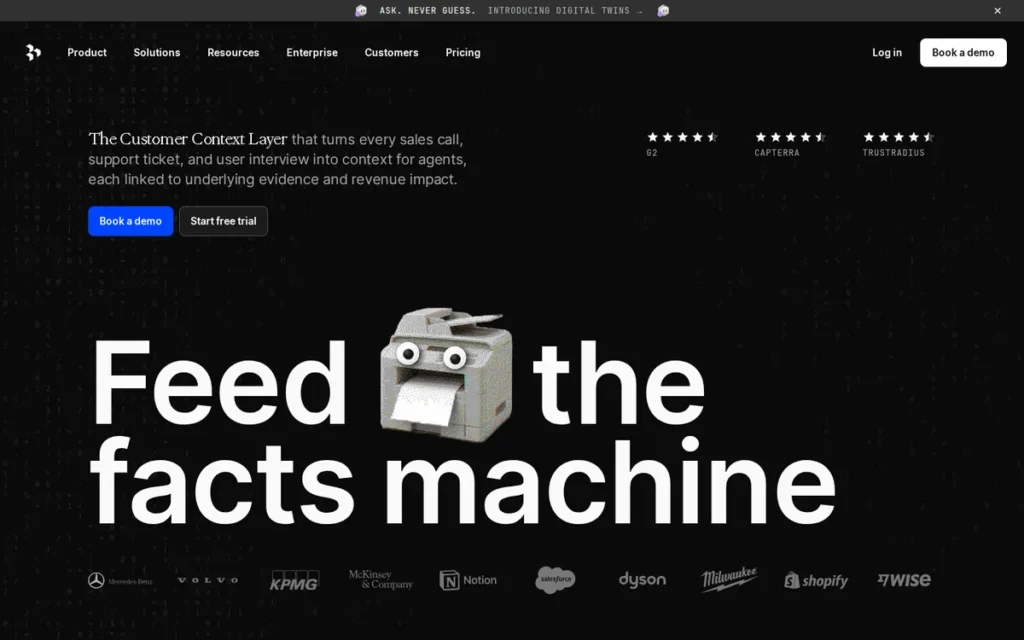
Category: Repository Platform, centralizes qualitative research artifacts with AI-powered semantic search, continuous feedback analysis, and a native integrations ecosystem spanning Zoom, Slack, Jira, Salesforce, and Zendesk.
At a Glance
- Category: Repository Platform
- Best For: Enterprise and mid-size research teams needing the deepest AI infrastructure, broadest integrations ecosystem, and continuous feedback analysis in a single workspace
- Price Range: Free tier available; Professional from $15/user/month (Dovetail pricing page, June 2026); enterprise contracts reported significantly higher, community sources cite approximately $77,000/year for 10 users (r/UXResearch, February 2025). Verify current terms at dovetail.com/pricing
- Primary Strength: Dovetail’s Magic Search uses Amazon Bedrock and Anthropic’s Claude to return source-cited answers to research questions across any project, folder, or entire workspace in natural language
- Biggest Limitation: Dovetail’s per-user pricing reaches approximately $77,000 per year for 10 enterprise users (community-verified, February 2025), and bulk data export is functionally unsupported, creating significant switching costs for teams building multi-year archives
- One-Line Summary: Dovetail is the most-reviewed pure-play user research repository in the category, with a confirmed 4.5/5 G2 rating from 167+ reviews, Amazon Bedrock-powered AI, and the broadest integrations ecosystem available, but its per-user pricing model scales to enterprise costs that research teams consistently cite as their primary switching trigger
- Last Verified: June 2026
Overview
Dovetail is a customer insights and user research repository platform built for UX teams at mid-size to enterprise organizations that need AI-powered search, continuous feedback analysis, and integrations with tools like Zoom, Jira, and Slack.
Dovetail was founded in 2017 in Sydney, Australia and has earned a confirmed 4.5/5 aggregate G2 rating from more than 167 verified reviews as of June 2026, the largest independent review footprint of any pure-play research repository in this evaluation.
Dovetail’s AI layer is built on Amazon Bedrock and powered by Anthropic’s Claude model, enabling Dovetail’s Magic Search to return source-cited answers across any project, folder, or entire workspace, per a published AWS case study (2025).
Key Features
- Magic Search: Dovetail’s Magic Search uses semantic AI built on Amazon Bedrock and Anthropic’s Claude to answer research questions by querying across transcripts, notes, and insights in any project, folder, or workspace, returning responses with traceable citations to the exact source material, distinguishing Dovetail from repositories that generate unattributed summaries.
- Channels Continuous Insights: Dovetail’s Channels feature continuously ingests and automatically classifies high-volume incoming feedback (support tickets, app store reviews, NPS and CSAT data) using LLM and machine learning to surface emerging themes in real time without requiring manual researcher review, as documented by CMSWire.
- Multilingual Transcription: Dovetail supports transcription in 28 to 40 languages (figures vary by source), with AI-generated summaries attached to each session, enabling global research teams to process multilingual recordings within a single unified Dovetail workspace.
- Native Integrations Ecosystem: Dovetail integrates natively with Zoom, Slack, Intercom, Confluence, Jira, Salesforce, and Zendesk (the broadest native integrations set of any platform in this evaluation) allowing research data to flow automatically from existing organizational tools into the Dovetail repository.
- Clip and Highlight System: Dovetail’s clip and highlight tool allows researchers to extract shareable video and audio excerpts from session recordings and embed them directly within insight cards, making qualitative evidence immediately accessible to stakeholders without requiring them to watch full-length sessions.
Best For
Dovetail is best suited for enterprise research teams and growing mid-size organizations in SaaS, technology, and consumer products, with the budget to sustain per-user pricing, a need for the broadest available integrations ecosystem, and research operations mature enough to benefit from Channels’ continuous feedback analysis across support, NPS, and product touchpoints.
Pricing
Dovetail offers a free tier and a Professional plan from $15/user/month (Dovetail pricing page, June 2026). Enterprise plans are invoiced annually via direct sales contract rather than self-serve monthly billing, meaning pricing, seat count, and included feature scope are negotiated rather than fixed.
This is why community-reported enterprise costs diverge significantly from the published Professional tier. One verified community report cited approximately $77,000 per year for a 10-user enterprise team (r/UXResearch, February 2025). Enterprise procurement intelligence platform Vendr cites $39–$49/seat/month billed annually for negotiated contracts.
Always verify current pricing at dovetail.com/pricing, per-user pricing tiers in this category change without major announcements.
Strengths
- Dovetail holds a confirmed 4.5/5 aggregate G2 rating from more than 167 verified reviews as of June 2026 (the highest independent review count and confirmed quality score for any pure-play research repository in this evaluation) providing third-party validation of widespread adoption that no other platform in this category approaches (G2, June 2026).
- Dovetail’s AI infrastructure is built on Amazon Bedrock with Anthropic’s Claude powering Magic Search, confirmed by a published AWS case study (2025) documenting Dovetail’s ability to prototype AI features in one day and ship production generative AI capabilities in approximately two weeks.
- Dovetail’s Channels product ingests and automatically themes incoming support tickets, app store reviews, and NPS data using LLM and ML as they arrive, a continuous-insights capability that moves Dovetail beyond passive archive into an always-on customer intelligence layer, as reported by CMSWire.
Limitations
Dovetail’s per-user pricing and documented bulk data export constraints together create switching costs that make it effectively a long-term infrastructure commitment rather than a trial-able tool, and both limitations are confirmed by independent community sources, not just vendor critics.
One verified Reddit user reported approximately $77,000 per year for 10 enterprise users (r/UXResearch, February 2025), which Dovetail’s co-founder did not dispute. u/wrychime documented that batch export of all research data is functionally impossible, with per-study export producing multiple incompatible file formats, a concern the co-founder acknowledged directly on Reddit as a technical challenge.
“The real catch is how difficult (nearly impossible) it is to get your data out of Dovetail… years of your research is held hostage, and when you get it back, it’s in pieces.”, u/wrychime, r/UXResearch
Takeaway: Teams building a multi-year research archive in Dovetail are making a decision that will be expensive to reverse, the data export constraint is not a hypothetical risk but a documented pattern acknowledged by the product team itself.
A Dovetail user (u/Secret-Training-1984, r/UXResearch) reported that as their Dovetail research library grew, “load times can get pretty frustrating, especially when you’re trying to access larger files or run complex searches”, a documented scalability concern for mature teams with extensive archives. Community member u/Such-Ad-5678 noted that despite Dovetail’s “one place” promise, “no one actually goes to that one place, it’s not where people work”, a category-wide adoption challenge that Dovetail’s pull-based architecture does not resolve on its own.
Verdict
Dovetail is the most comprehensively validated user research repository in this evaluation, with the category’s largest independent review footprint (4.5/5 from 167+ G2 reviews), the deepest documented AI infrastructure, and the broadest integrations ecosystem, earning its #1 ranking on the weight of evidence across five of six criteria. Teams that can justify the per-user pricing and have accepted the data portability trade-off will find Dovetail the most mature and feature-complete research repository available in 2026. Teams sensitive to budget scalability or planning for multi-year data migration optionality should evaluate HeyMarvin or UserBit before signing.
2. HeyMarvin: Best Dovetail Alternative: Best for Mid-Size Teams and Regulated Industries Needing AI Depth at Lower Cost
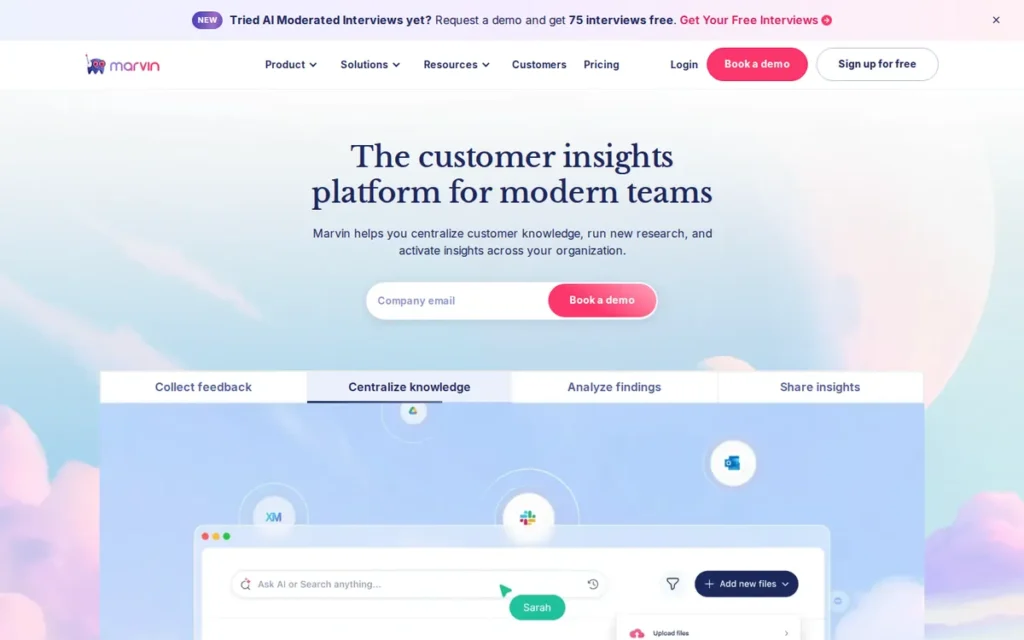
Category: AI-Native Repository, continuously ingests customer data from 30+ existing tools and applies AI transcription, tagging, and synthesis across all data types without requiring researcher upload dependency.
At a Glance
- Category: AI-Native Repository
- Best For: Mid-size research teams seeking AI analysis depth comparable to Dovetail at significantly lower cost, including regulated industries with security compliance requirements
- Price Range: 7-day free trial; custom pricing (requires sales engagement); community-verified at approximately one-third of Dovetail’s cost for comparable enterprise configurations (January 2025)
- Primary Strength: HeyMarvin’s 30+ native integrations continuously pull data from Gong, Slack, Pendo, Qualtrics, and other tools, building the repository automatically without depending on researcher upload discipline
- Biggest Limitation: HeyMarvin’s pricing requires direct sales engagement with no publicly listed tiers, and G2 reviewers note it becomes expensive for large teams, making cost benchmarking difficult without entering a sales process
- One-Line Summary: HeyMarvin is an AI-native research repository with continuous data ingestion from 30+ native integrations, verified by an independent healthcare enterprise buyer as both security-compliant and approximately one-third the cost of Dovetail for a comparable enterprise configuration
- Last Verified: June 2026
Overview
HeyMarvin is an AI-native customer insights and user research platform designed for research teams at mid-size organizations that want a repository to grow automatically by ingesting data from existing tools rather than depending on manual researcher uploads.
HeyMarvin connects to more than 30 native sources (including Gong, Slack, SurveyMonkey, Pendo, Qualtrics, TheyDo, and Notion) enabling the HeyMarvin repository to update continuously as customer touchpoints occur across an organization’s existing tool stack.
A verified enterprise healthcare buyer confirmed in January 2025 (r/UXResearch, u/coach34dw) that HeyMarvin passed security review for HIPAA-relevant environments and cost approximately one-third as much as Dovetail for a comparable team configuration.
Key Features
- Continuous Ingestion Model: HeyMarvin’s 30+ native integrations: including Gong, Slack, SurveyMonkey, Pendo, Qualtrics, Google Forms, Notion, and TheyDo, automatically pull incoming data into the HeyMarvin repository without requiring researchers to upload files, so the archive grows whenever customer touchpoints occur.
- AI Analysis Across All Data Types: HeyMarvin’s AI automatically generates notes, analyzes project data, tags emerging patterns, and surfaces source-cited answers across audio, video, text, and imported datasets from a single natural-language query interface.
- Cross-Study Synthesis: HeyMarvin enables researchers to ask cross-study questions and receive traceable answers linked to specific data sources across the entire HeyMarvin repository, supporting synthesis that eliminates redundant research cycles.
- Healthcare-Grade Security: HeyMarvin has been independently verified as meeting healthcare-grade security requirements by an enterprise buyer who selected HeyMarvin over Dovetail for a regulated-industry deployment, documented in a January 2025 r/UXResearch thread.
- Transparent Product Leadership: HeyMarvin’s CEO (u/rewolverine) is actively engaged in r/UXResearch community discussions with disclosed affiliation, and HeyMarvin’s 7-day free trial offers initial access before any sales commitment.
Best For
HeyMarvin is best suited for mid-size research teams who need Dovetail-comparable AI analysis depth without Dovetail-level per-user pricing, teams at organizations where research data flows through multiple existing tools that need to be aggregated automatically, and organizations in regulated industries like healthcare where security compliance verification is a purchase prerequisite.
Pricing
HeyMarvin offers a 7-day free trial. All paid pricing is custom and requires direct sales engagement, no tiers are publicly listed at heymarvin.com/pricing as of June 2026.
The most actionable pricing anchor: a healthcare enterprise buyer reported in January 2025 (r/UXResearch, u/coach34dw) that HeyMarvin cost approximately one-third as much as Dovetail for a comparable team configuration.
One G2 reviewer stated HeyMarvin “is very expensive for larger teams,” suggesting the custom pricing model may scale with team size in ways that reduce or eliminate the cost advantage relative to Dovetail at higher headcounts. Request pricing at your specific team size before comparing against flat-rate alternatives like UserBit’s $199/month unlimited plan.
Strengths
- A verified enterprise healthcare buyer (u/coach34dw, r/UXResearch, January 2025) confirmed that HeyMarvin passed security review sufficient for HIPAA-relevant environments and was selected over Dovetail because it cost approximately one-third as much for a comparable enterprise configuration, the clearest independent real-world price-quality comparison available for any platform in this evaluation.
- HeyMarvin’s 30+ native integrations with Gong, Slack, Pendo, Qualtrics, Google Forms, SurveyMonkey, TheyDo, and Notion enable the HeyMarvin repository to grow automatically by ingesting existing customer touchpoint data, eliminating the manual upload dependency that limits passive repository adoption, per HeyMarvin’s official integration documentation (verified June 2026).
This aligns with community sentiment on r/UXResearch:
“Love Marvin – the note taking and analysis features incentivize folks to use it and then it’s automatically populating the repository without the need for an extra step at the end of projects that everyone always forgets. The repository features haven’t been as robust but they’re adding new stuff all the time now – most recently insight templates and commenting ability.” Posted by u/raccoondetat
Takeaway: HeyMarvin’s auto-population model earns practitioner buy-in by removing the post-project upload step that kills repository adoption, though long-term users note the repository layer itself still trails the note-taking and analysis features in depth.
- HeyMarvin’s CEO (u/rewolverine) is directly engaged in r/UXResearch community discussions with disclosed affiliation, representing an unusual level of product-team transparency that supports faster feedback loops and higher accountability than platforms with no community presence.
Limitations
HeyMarvin’s pricing requires all paid plan evaluation through direct sales engagement with no publicly listed tiers, a friction point that disadvantages self-directed buyers who want to compare costs without entering a sales relationship. Teams cannot benchmark HeyMarvin’s cost against flat-rate alternatives like UserBit’s $199/month plan without initiating a sales conversation.
One G2 reviewer explicitly stated that HeyMarvin “is very expensive for larger teams,” suggesting the custom pricing model may scale with team size in ways that reduce or eliminate the cost advantage relative to Dovetail at higher headcounts. Request pricing at your specific team size rather than extrapolating from the single January 2025 healthcare buyer data point.
Community reviewers also describe HeyMarvin as “adding new features almost every other day,” which has introduced occasional interface instability and minor glitches, a trade-off teams with highly standardized research workflows should weigh before adopting HeyMarvin as core infrastructure.
Verdict
HeyMarvin is the strongest verified alternative to Dovetail in this evaluation, confirmed by an independent enterprise healthcare buyer as security-compliant and approximately one-third the cost of Dovetail for a comparable configuration in January 2025. HeyMarvin’s 30+ native integrations and continuous data ingestion model solve the manual upload dependency that limits passive repository adoption, and HeyMarvin’s AI analysis depth is consistently described by community consensus as comparable or superior to Dovetail’s for most qualitative workflows. Teams selecting HeyMarvin should enter the sales process with a specific team size, request a detailed pricing breakdown, and use UserBit’s $199/month unlimited plan as a ceiling benchmark before committing to any per-user or configuration-based pricing model.
3. Stravito: Best for Enterprise: Best for Multinational Organizations Unifying Existing Research Libraries Across Languages, Divisions, and Geographies
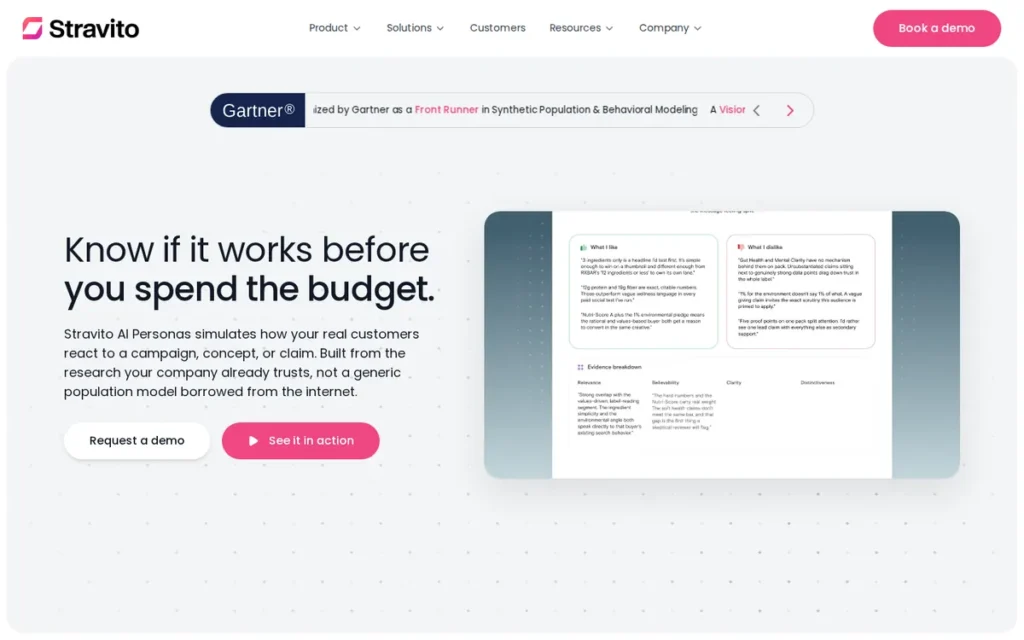
Category: Insights Intelligence Platform, enterprise-grade centralization of existing research assets with a 100-language AI assistant and a stakeholder-facing discovery architecture that pushes insights to decision-makers without requiring them to log in.
At a Glance
- Category: Insights Intelligence Platform
- Best For: Large enterprise research and insights teams with existing research libraries scattered across divisions, geographies, or languages that need to be unified and made discoverable to non-researcher stakeholders at scale
- Price Range: Enterprise custom pricing only; no public tiers; requires sales engagement, budget for a full enterprise procurement cycle
- Primary Strength: Stravito’s AI assistant queries across an organization’s entire research library in more than 100 languages and returns source-cited answers, with named deployments at Nestlé, Comcast, Heineken, and other global enterprise brands confirmed in public materials
- Biggest Limitation: Stravito’s enterprise-custom pricing, sales-required evaluation, and product architecture designed for organizations with hundreds or thousands of decision-makers make it effectively inaccessible and wrong-fit for SMB, early-stage, and most mid-market research teams
- One-Line Summary: Stravito is an enterprise insights intelligence platform deployed by Nestlé, Comcast, Heineken, and other global brands that unifies existing research assets under a 100-language AI assistant and addresses the stakeholder adoption problem by pushing curated insights toward decision-makers rather than requiring them to log in and navigate a research interface
- Last Verified: June 2026
Overview
Stravito is an enterprise Insights Intelligence Platform designed for large organizations that need to centralize and make discoverable the research assets (reports, market studies, consumer data) that already exist but are scattered across divisions, geographies, and file systems, without requiring new research to be conducted in-platform.
Stravito uses Pinecone-powered semantic search (confirmed in Pinecone’s published 2025 customer case study) and a 100-language AI assistant to surface relevant findings from the entire internal research library in response to natural-language questions.
Named customers include Nestlé, Comcast, and Heineken (confirmed on stravito.com, June 2026), and one G2 reviewer described using Stravito across an organization with approximately 3,000 decision-makers, indicating genuine enterprise-scale deployment.
Key Features
- 100-Language AI Assistant: Stravito’s AI assistant queries across an organization’s entire internal research library in more than 100 languages, returning source-cited answers that link to the exact location within a document where relevant information appears, documented on stravito.com/ai-assistant and confirmed by Pinecone’s 2025 customer case study.
- File-Agnostic Ingestion: Stravito accepts drag-and-drop file ingestion across multiple formats (reports, spreadsheets, dashboards, and videos) automatically classifying and indexing content without requiring researchers to manually categorize each file, enabling teams to bring existing archives into Stravito without restructuring them.
- Push-Based Stakeholder Delivery: Stravito’s stakeholder delivery model proactively surfaces research summaries and curated insight collections to decision-makers in their existing workflows, without requiring non-researchers to create accounts or navigate a dedicated research interface, directly addressing the documented pattern where research archives are built and maintained by researchers but never accessed by cross-functional stakeholders.
- Enterprise Compliance: Stravito maintains GDPR and SOC 2 compliance with documented enterprise deployment ease, making Stravito suitable for regulated industries and multinational organizations with data residency requirements.
- Precise Source Location: Stravito’s Pinecone-powered search surfaces the exact location within a file where a search query is answered, enabling users to verify source material before acting on any AI-generated summary.
Best For
Stravito is best suited for large enterprise research and insights functions at organizations with existing, scattered research libraries across multiple languages or geographic markets, where the primary operational failure is not building research archives but making them discoverable and actionable for thousands of non-researcher decision-makers across global divisions.
Pricing
Stravito does not publish pricing publicly. All pricing is enterprise-custom and requires direct sales engagement, no verified community pricing figures are available as of June 2026.
Teams evaluating Stravito should budget for a full enterprise procurement cycle and expect pricing scoped around organizational scale, user count, data volume, and security configuration requirements. Teams without an established enterprise procurement function or a defined enterprise SaaS budget should begin their evaluation with Dovetail or HeyMarvin instead.
Contact Stravito directly at stravito.com.
Strengths
- Stravito’s enterprise deployments at Nestlé, Comcast, Heineken, and other global brands are confirmed on Stravito’s public website and in Greenbook’s company profile (verified June 2026), providing independent evidence that Stravito performs at genuine Fortune 500 scale across complex, multilingual research operations.
- Stravito’s AI assistant supports more than 100 languages, confirmed by Stravito’s product documentation and Pinecone’s published customer case study (2025), making Stravito the only platform in this evaluation with verified multilingual AI capability, a meaningful differentiator for organizations conducting research across global markets.
- Stravito’s push-based stakeholder delivery architecture: surfacing research summaries to decision-makers without requiring them to log in, directly addresses the adoption failure documented in a May 2026 r/UXResearch thread where u/Successful_Fee_6791 described investing significant rollout effort in a previous repository only to find “people just didn’t go in and use it.”
“I recently found a tool, Stravito, that feels like it solves that gap in effectively getting people in other teams to interact with the research… It has AI powered features that help with search, querying, and guiding the user towards the insight they are looking for.”, u/Successful_Fee_6791, r/UXResearch
Takeaway: Stravito is being evaluated specifically because previous repositories required stakeholders to change where they worked, a problem Stravito’s push-based architecture is architecturally designed to solve.
Limitations
Stravito’s most significant trade-off is inaccessibility to the majority of the audience evaluating this article. The combination of enterprise-custom pricing, a sales-required evaluation process with no free trial, and a product architecture built for organizations deploying to thousands of decision-makers means Stravito is the wrong tool for any team outside large enterprise scale.
Teams at startups, small research functions, or mid-market organizations without an enterprise procurement function should not invest evaluation time in Stravito’s sales process, regardless of how impressive its AI assistant capability is.
Stravito’s limited public review presence on G2 and Capterra (a consequence of enterprise buyers rarely leaving public reviews) means prospective buyers must rely primarily on vendor-provided references and their own sales evaluations rather than independent third-party evidence. This is a higher due-diligence burden than platforms with substantial public review footprints provide.
Verdict
Stravito is the most purpose-built enterprise insights intelligence platform in this evaluation, with verified Fortune 500 deployments at Nestlé, Comcast, Heineken, and other global brands, the category’s only confirmed 100-language AI assistant, and a stakeholder delivery architecture that directly targets the adoption failure mode where research archives get built but never visited. Stravito is the most evidence-backed option in this evaluation for large enterprise organizations with multinational research libraries, but it is the wrong evaluation path for any team outside that profile. Teams not already operating at enterprise scale should evaluate Dovetail or HeyMarvin and not initiate Stravito’s procurement process.
4. Great Question: Best for Research Ops Teams: Best for Mid-Size Organizations That Recruit, Execute, Analyze, and Store Research in a Single Workflow
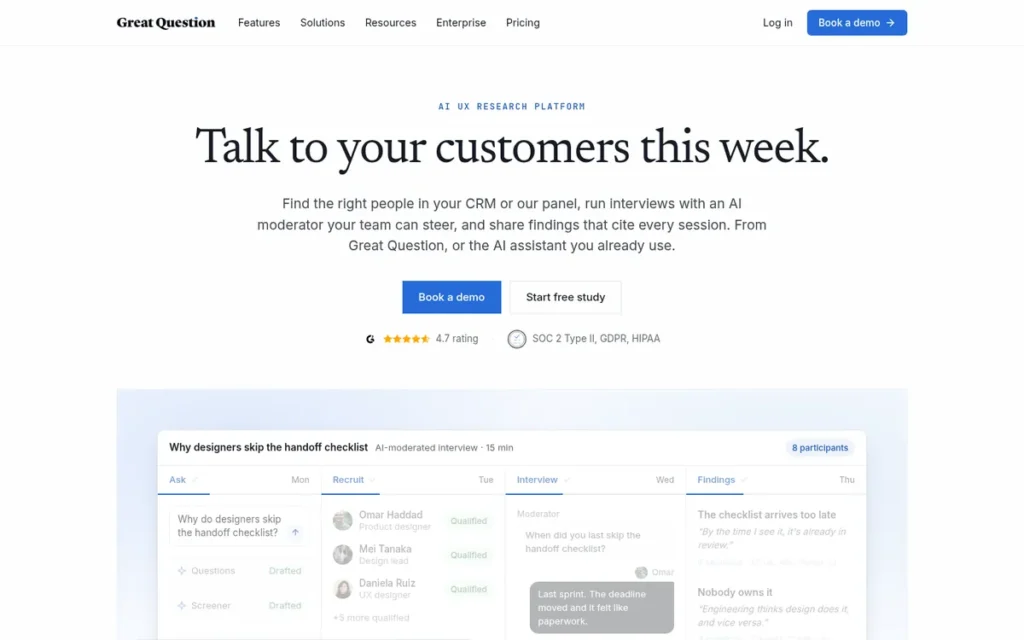
Category: Research Ops Platform, end-to-end research operations combining participant recruitment from a 6M+ verified panel, study execution, automated incentive payments, and AI-searchable repository in one continuous workflow.
At a Glance
- Category: Research Ops Platform
- Best For: Research ops managers at mid-size organizations who conduct frequent studies requiring participant recruitment and want to consolidate research tooling (recruitment, scheduling, execution, incentives, and repository) into one platform
- Price Range: No free plan; paid plans start at approximately $99/user/month (third-party reported, 2026; not publicly disclosed, verify at greatquestion.co); Enterprise custom available
- Primary Strength: Great Question integrates a 6 million+ verified participant recruitment panel directly within the same platform as the research repository, eliminating the need for a separate recruitment tool entirely
- Biggest Limitation: Great Question’s AI analysis depth is described by community consensus as weaker than dedicated repository tools like Dovetail and HeyMarvin, and the approximately $99/user/month entry price with no free plan creates a high evaluation barrier
- One-Line Summary: Great Question is a Y Combinator-backed research ops platform that combines participant recruitment from a 6 million+ verified panel, moderated and unmoderated study execution, automated incentive payments, and AI-searchable repository in a single workflow, making it the strongest choice for research teams whose primary pain point is multi-tool switching overhead across the full research cycle
- Last Verified: June 2026
Overview
Great Question is an all-in-one research operations platform that integrates participant recruitment, scheduling, moderated and unmoderated study execution, AI-powered transcription and analysis, automated incentive payments, and a searchable insights repository into a single continuous workflow for UX and product research teams.
Great Question’s partnership with User Interviews delivers a verified panel of more than 6 million research participants accessible directly within the platform (the largest built-in recruitment pipeline of any repository tool in this evaluation) documented in User Interviews’ published partnership announcement.
Great Question is backed by Y Combinator (confirmed via YC company listing, June 2026), with seed funding reported at approximately $8 million by third-party sources (not publicly disclosed on the YC company page), and named customers including Adidas Runtastic, O’Reilly Media, and MainStreet.
Key Features
- 6M+ Participant Panel: Great Question’s partnership with User Interviews gives platform users access to a verified research participant panel of more than 6 million participants for direct recruitment, eliminating the need for a separate recruitment tool or manual panel management workflow, per User Interviews’ partnership announcement.
- Automated Post-Session Processing: Great Question’s AI processes session recordings and transcripts automatically after each interview, generating summaries, chapter markers, highlights, and searchable tags without requiring manual post-session processing by the research team.
- Cross-Repository AI Q&A: Great Question enables natural-language queries across the full repository, researchers can ask questions like “what do we know about onboarding?” and receive synthesized, cited answers that aggregate findings across multiple stored studies.
- Built-In Incentive Payments: Great Question handles automated incentive payments to research participants within the platform, removing the administrative overhead of gift card fulfillment, payment logistics, and compliance tracking that typically falls on the research team.
- Multi-Mode Study Execution: Great Question supports both moderated and unmoderated study execution natively, enabling a research team to design, recruit for, run, analyze, and store findings from any study type without switching platforms.
Best For
Great Question is best suited for research ops managers and UX teams at mid-size organizations who conduct frequent studies requiring participant recruitment, need to consolidate research operations tooling into a single platform to reduce context-switching overhead, and are willing to accept somewhat shallower AI qualitative analysis in exchange for an end-to-end workflow that eliminates separate recruitment, scheduling, and incentive management tools.
Pricing
Great Question does not offer a free plan. Paid plans start at approximately $99/user/month based on third-party comparison data (2026; not publicly disclosed, verify at greatquestion.co). When evaluating cost, compare the all-in-one price against the combined cost of the separate tools Great Question replaces:
- A standalone recruitment platform (such as User Interviews at its own pricing)
- A standalone interview scheduling tool
- A research repository and analysis platform
- An incentive management system
For teams primarily needing a repository who recruit organically, approximately $99/user/month is significantly higher than Looppanel’s ~$30/month Starter or UserBit’s $199/month unlimited plan.
Strengths
- Great Question is backed by Y Combinator (confirmed via YC public company listing, June 2026), with seed funding reported at approximately $8 million by third-party sources, providing institutional product-market fit validation and financial runway for continued development that no bootstrapped competitor in this evaluation can match.
- Great Question’s partnership with User Interviews delivers a verified panel of more than 6 million research participants accessible directly within the platform (the largest built-in recruitment pipeline of any repository tool in this evaluation) documented in User Interviews’ published partnership announcement.
- The UX research community on Reddit explicitly classifies Great Question alongside Dovetail and User Interviews as a “reputable research platform” (u/natan_voitenkov, r/UXResearch, 2025), distinguishing Great Question from point-solution tools and signaling practitioner-level confidence in its standing as a serious research infrastructure investment.
Limitations
Great Question’s most significant limitation is the mismatch between its all-in-one operational scope and its AI analysis depth. Teams who invest in Great Question primarily for deep qualitative synthesis will find the repository and analysis layer falls short of what Dovetail and HeyMarvin deliver, community evaluators described this directly in a 2025 r/UXResearch tools thread: Great Question is “quite far from your needs in terms of AI support.”
The approximately $99/user/month entry point with no free plan creates a high evaluation barrier compared to Looppanel’s 15-day free trial at approximately $30/month or Dovetail’s free tier, teams cannot fully evaluate Great Question’s research operations integration without a paid commitment.
Great Question is the correct choice for teams managing the full research cycle across recruitment, execution, and repository in one workflow, but an incorrect choice for teams whose primary need is deep AI-powered qualitative analysis on a budget.
Verdict
Great Question is the most comprehensively featured research ops platform in this evaluation for teams managing full-cycle recruitment, execution, incentive payments, and repository in a single workflow, validated by Y Combinator backing and a 6 million+ participant panel. Great Question’s practitioner-level credibility as a “reputable research platform” establishes it as a serious infrastructure investment, not a lightweight point solution. Teams whose primary need is deep AI analysis of qualitative data should evaluate Dovetail or HeyMarvin first; teams primarily managing research operations at scale across all phases of the research cycle should put Great Question at the top of their shortlist.
5. Looppanel: Best for Interview-Heavy Small Teams: Best AI-Assisted Option for Solo Researchers and Small UX Teams Conducting High-Volume Moderated Interview Programs in English
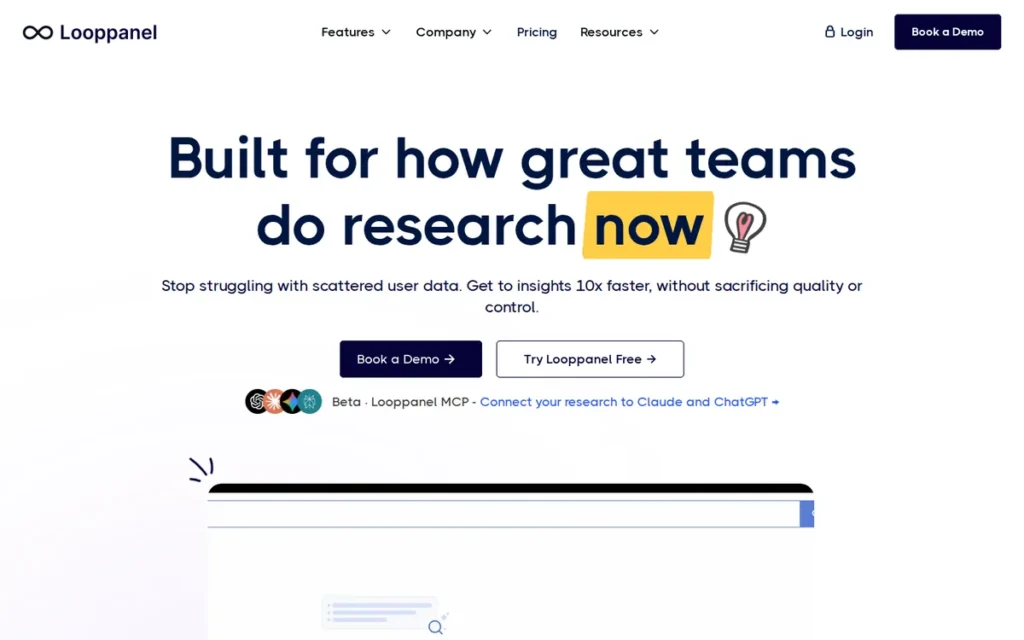
Category: Interview-Centric Repository, AI-powered note-taking and synthesis specifically designed for moderated interview workflows, with discussion-guide-aware AI Notes as the defining differentiator.
At a Glance
- Category: Interview-Centric Repository
- Best For: Solo UX researchers and small research teams conducting high-volume moderated interviews in English who want AI to reduce post-interview synthesis time from hours to minutes at an affordable monthly entry price
- Price Range: 15-day free trial (no credit card required); Starter from approximately $30/month; Enterprise custom, verify at looppanel.com
- Primary Strength: Looppanel’s discussion-guide-aware AI Notes generate structured notes organized by the researcher’s own research questions in 3–5 minutes per 30-minute interview, eliminating the most time-consuming step in moderated interview research
- Biggest Limitation: Looppanel’s AI Notes: its defining differentiator, are available in English only, meaning non-English research teams lose the platform’s primary value proposition and are left with a capable but less distinctive transcription tool
- One-Line Summary: Looppanel is an interview-centric research repository whose discussion-guide-aware AI Notes generate structured notes in 3–5 minutes per session, the most time-efficient AI-assisted analysis tool for English-language moderated interview research among the platforms evaluated here, at a Starter price of approximately $30 per month
- Last Verified: June 2026
Overview
Looppanel is an AI-assisted user research analysis and repository tool built primarily around live and recorded interview workflows, designed for solo researchers and small UX teams who want AI to automatically organize interview notes by research question rather than requiring manual post-session tagging.
Looppanel’s AI Notes generate structured notes from interview recordings in approximately 3–5 minutes for a 30-minute session and 5–10 minutes for a 60-minute session, organizing them automatically according to the researcher’s discussion guide questions, per Looppanel’s own help documentation (verified June 2026).
Looppanel supports transcription in 17 languages at 90%+ claimed accuracy, but AI Notes are currently available in English only, a gap Looppanel explicitly acknowledges in its help center. Important for evaluators: Looppanel and Loop11 are different, unrelated tools, Looppanel is a research repository and interview analysis platform; Loop11 is a moderated usability testing tool. Negative opinions about Loop11 encountered in cross-source research do not apply to Looppanel.
Key Features
- Discussion-Guide-Aware AI Notes: Looppanel’s AI Notes feature generates structured interview notes in 3–5 minutes for a 30-minute session and automatically organizes them by the researcher’s discussion guide questions, eliminating the manual post-interview synthesis step that typically requires one to three hours of researcher time per session, per Looppanel’s help documentation.
- Multilingual Transcription (English-Only AI Notes): Looppanel supports transcription at 90%+ claimed accuracy across 17 languages, enabling international research teams to process non-English recordings, though AI Notes organization is explicitly documented as available in English only as of June 2026.
- Semantic Cross-Study Search: Looppanel’s semantic search enables researchers to query across all past studies in the repository using natural-language questions, surfacing relevant findings from previous projects and enabling insight reuse across research programs.
- One-Click Deliverable Generation: Looppanel supports one-click AI-generated executive summaries, clip and highlight reel creation, and AI-assisted report generation, enabling researchers to move from raw interview data to stakeholder-ready deliverables within the same Looppanel platform.
- Bulk Qualitative Analysis: Looppanel analyzes bulk open-ended feedback including survey responses and PDFs in addition to interview recordings, extending Looppanel’s thematic analysis automation to written qualitative data sources beyond live sessions.
Best For
Looppanel is best suited for solo UX researchers and small research teams conducting high-volume moderated interview programs who work primarily in English, need AI to dramatically reduce post-session synthesis time, and want an affordable AI-assisted repository without committing to enterprise-tier pricing or complex integrations setup.
Pricing
Looppanel offers a 15-day free trial with no credit card required. The Starter plan begins at approximately $30/month (Looppanel blog, 2025), making Looppanel’s Starter the most affordable AI-assisted research repository entry point in this evaluation.
Note: third-party comparison sources cite varying price points for higher Looppanel tiers, one source lists $395/month for a team plan while another cites approximately $50/editor/month for Professional. Confirm all tier pricing at looppanel.com before budgeting above the Starter level, as startup-stage pricing changes without major announcements.
Teams evaluating Looppanel should use the 15-day trial to test AI Notes specifically on existing interview recordings before purchasing.
Strengths
- Looppanel’s official help center documentation (verified June 2026) specifies that AI Notes generate structured, discussion-guide-aware notes from a 30-minute interview in approximately 3–5 minutes, a documented time-to-insight specification that no other platform in this evaluation publishes for its primary analysis feature, and a meaningful reduction from the 1–3 hours researchers typically spend on manual post-interview synthesis (Looppanel help center).
Users on r/UXResearch shared their experience:
“My team uses Looppanel. It’s pretty good for tagging and summarization. I’m able to see the exact quotes for every insight it comes up with, which solved the hallucination problem we had with open models.” Posted by u/jellosbiafra
Takeaway: Looppanel’s source-cited insight output directly addresses the hallucination problem that disqualifies generic AI tools from qualitative research workflows.
- Looppanel’s Starter plan at approximately $30/month is the most affordable AI-assisted research repository entry point in this evaluation, with a 15-day no-credit-card free trial, enabling small teams and solo researchers to evaluate Looppanel against real research projects before committing to any paid plan.
- The Looppanel team maintains an active and transparently disclosed presence in the r/UXResearch and r/UXDesign communities (u/analyticalmonk, team affiliation disclosed, r/UXDesign), has authored methodological content on the User Interviews platform, and maintains a regularly updated product help center, signaling a community-responsive development approach.
Limitations
Looppanel’s English-only limitation on AI Notes is not a minor constraint, it is a documented gap in the platform’s defining feature, explicitly acknowledged in Looppanel’s own help documentation. Teams conducting research in any language other than English lose access to the discussion-guide-aware organization that differentiates Looppanel from generic transcription tools and are left with transcription and a manual-tagging repository at the same price point.
Looppanel has no confirmed major review platform aggregate rating on G2 or Capterra as of June 2026, meaning teams conducting standard SaaS due diligence through review platform aggregation will find no independent third-party aggregate score, a more significant gap for a platform being evaluated as long-term research infrastructure than for a point tool.
Looppanel is documented in multiple community threads as being confused with Loop11 (a different, unrelated moderated usability testing tool). Negative reviews encountered in comparison research may inadvertently describe the wrong product, evaluators should verify that any criticism is specifically directed at Looppanel before weighing it in a purchase decision.
Verdict
Looppanel is the most time-efficient AI-assisted interview analysis tool in this evaluation for English-language qualitative research among the platforms evaluated here, with discussion-guide-aware AI Notes reducing post-interview synthesis from hours to minutes at a Starter price of approximately $30/month. Looppanel is the strongest recommendation for solo researchers and small UX teams conducting high-volume moderated interview programs in English who need affordable AI assistance without enterprise-tier commitment. Teams requiring multilingual AI Notes, a major review platform presence for diligence, or a broader integrations ecosystem should evaluate Dovetail or HeyMarvin alongside Looppanel before deciding.
6. UserBit: Best Value: Best for Cost-Conscious Research Teams at Any Size That Need Both Repository and Deliverable Generation at Predictable Flat-Rate Pricing
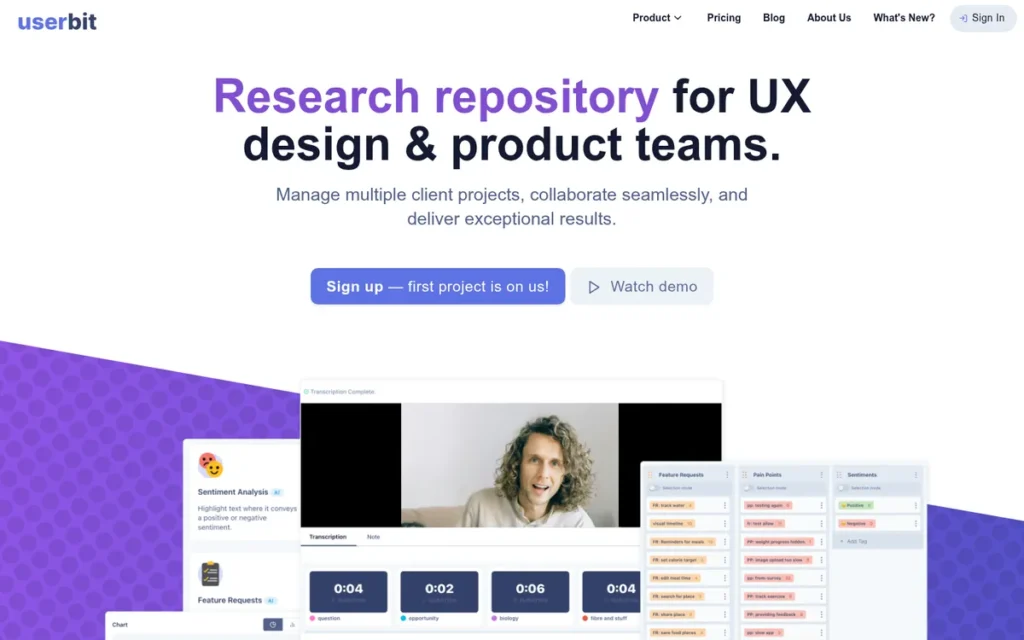
Category: Full-Stack Research Platform, repository, qualitative synthesis, and downstream research deliverable generation (personas, journey maps, user flows) under a flat-rate unlimited-user pricing model.
At a Glance
- Category: Full-Stack Research Platform
- Best For: Cost-conscious UX teams and research consultancies at any size that need both research repository capabilities and downstream deliverable generation at predictable flat-rate cost, particularly teams expecting headcount growth that would trigger per-user cost escalation on other platforms
- Price Range: Free tier available; Unlimited plan at $199/month flat for unlimited users and projects (official GetApp listing, June 2026; community sources round to $200/month), verify current terms at userbit.app
- Primary Strength: UserBit’s $199/month flat-rate unlimited plan provides repository, qualitative analysis, persona building, journey mapping, and a login-free stakeholder Client Portal for the same price regardless of whether the team has 2 or 200 users
- Biggest Limitation: UserBit has no documented third-party integrations, meaning all research data must be manually uploaded rather than automatically ingested from tools like Slack, Zoom, Jira, or Intercom
- One-Line Summary: UserBit is the only confirmed flat-rate unlimited-user research platform identified in this evaluation as of June 2026, offering repository, qualitative synthesis, persona building, journey mapping, and a login-free stakeholder Client Portal at $199 per month regardless of team size, making it the most cost-predictable research infrastructure option for growing UX teams
- Last Verified: June 2026
Overview
UserBit is a full-stack UX research platform that combines structured interview management, a centralized repository, qualitative coding and synthesis tools, persona building, customer journey mapping, and a login-free stakeholder Client Portal, all under a flat-rate pricing model that does not scale with team size.
UserBit’s Unlimited plan is priced at $199 per month covering unlimited users and unlimited projects, confirmed by a community user who switched from a per-user pricing platform and reported the figure directly on r/UXResearch in February 2025 (u/1650763point73), and corroborated by the official GetApp listing (June 2026).
UserBit is the only platform in this evaluation that natively generates visual downstream research deliverables (personas, journey maps, and user flows) in addition to maintaining the qualitative research archive.
Key Features
- Flat-Rate Unlimited Pricing: UserBit’s Unlimited plan at $199/month covers unlimited users and unlimited projects with no per-seat scaling, the only repository platform in this evaluation where adding team members or client projects does not increase the monthly cost, community-verified at this price point (r/UXResearch, February 2025).
- Login-Free Client Portal: UserBit’s Client Portal publishes research findings in a format accessible to stakeholders without requiring them to create a UserBit account or navigate a research-specific interface, directly addressing the adoption failure where research archives are built but cross-functional colleagues never visit them.
- Visual Deliverable Generation: UserBit includes native persona building, customer journey mapping, card sorting, and user flow tools, making UserBit the only repository platform in this evaluation that natively produces the visual downstream deliverables that result from qualitative research, not just the archive for raw data.
- Qualitative Synthesis Tools: UserBit provides qualitative coding and synthesis tools including affinity diagrams, word clouds, and text analysis for organizing and thematically structuring interview notes and transcripts into structured insight libraries.
- Stable Bootstrapped Pricing: UserBit’s pricing model has remained stable over multiple years, maintained by a bootstrapped team without VC revenue targets, providing cost predictability that per-user, investor-funded platforms cannot guarantee as investor revenue targets create incentive to raise per-user prices over time (community-verified, February 2025).
Best For
UserBit is best suited for UX teams, research consultancies managing multiple client projects, and individual practitioners who need cost-predictable research infrastructure at a flat rate, want both repository and visual deliverable generation in a single tool, expect their team to grow without proportional cost increases, and do not depend on automatic data ingestion from third-party tools like Slack, Zoom, or Jira.
Pricing
UserBit’s Unlimited plan is $199/month covering unlimited users and unlimited projects, confirmed by the official GetApp listing (June 2026) and by a switching user in February 2025 (r/UXResearch, u/1650763point73). A free tier is available for basic access, and journey mapping is available separately at jmap.userbit.com with a free tier.
For concrete comparison: a 10-user team on UserBit pays approximately $2,400/year versus a reported approximately $77,000/year for a comparable Dovetail enterprise team (community-verified, February 2025), a roughly 32x cost differential at that team size. Confirm current pricing at userbit.app.
Strengths
- A verified community user (u/1650763point73, r/UXResearch, February 2025) confirmed switching to UserBit’s Unlimited plan and paying $199/month for unlimited users and unlimited projects, the clearest independent pricing anchor in this entire evaluation, directly contrasted against competitors that become “insanely expensive as you scale.”
- UserBit holds a 5.0/5.0 rating on Capterra (5 verified reviews as of June 2026), with a community endorsement from u/yogoal (r/userexperience) describing UserBit as “the most comprehensive UX research tool stack we could find,” covering “repository/analysis to user flows, card sorting, personas.”
- UserBit’s bootstrapped pricing model has remained stable over multiple years: documented by community users as having “not changed for the last few years” (community-verified, February 2025), providing a cost predictability signal that VC-funded competitors cannot offer as investor revenue targets create incentive to raise prices over time.
Users on r/UXResearch noted:
“This is exactly why I love UserBit. They have always grandfathered their customers in and their pricing is the most reasonable out of all these tools. It helps that they’ll are a small bootstrapped team and have very different values than all the other vendors we had a conversation with. I’m guessing the reason for the price hikes for the likes of Dovetail, etc, is investor pressure. They aren’t making enough money so the investors are forcing them to increase pricing on existing customers. This was one of our risks when we were shopping for repository tools that had raised massive amounts of money.” Posted by u/xaksis
Takeaway: UserBit’s bootstrapped pricing stability is not just a financial advantage, it represents a structural alignment with researcher interests that VC-funded competitors with investor return targets cannot credibly match.
Limitations
UserBit’s absence of any documented third-party integrations is not a minor gap, it means every piece of research data must be manually uploaded by a researcher, eliminating the possibility of continuous automatic ingestion from Slack, Zoom, Jira, Intercom, or any other tool in the organization’s existing stack. While HeyMarvin connects to 30+ sources automatically and Dovetail integrates natively with seven major enterprise platforms, UserBit operates as a closed ecosystem that grows only when researchers actively add to it.
One third-party analysis (PlaybookUX) describes UserBit’s interface as something “some users find confusing”, consistent with a platform optimized for dedicated UX practitioners rather than casual cross-functional users.
Teams expecting non-researcher stakeholders to self-serve in UserBit rather than using the Client Portal should test this assumption explicitly during evaluation.
Verdict
UserBit is the most cost-predictable research platform in this evaluation and the only confirmed flat-rate unlimited-user option identified as of June 2026, with a $199/month plan covering unlimited users, unlimited projects, repository, persona building, journey mapping, and a login-free stakeholder Client Portal. UserBit is the strongest recommendation for cost-conscious research teams who need both repository and deliverable generation, expect headcount growth that would trigger per-user cost escalation elsewhere, and do not require automatic data ingestion from third-party tools. Teams that depend on Slack, Jira, or Zoom integrations to feed their repository automatically should evaluate HeyMarvin or Dovetail alongside UserBit and explicitly factor integration capability into their total cost comparison.
7. Aurelius: Best for Dedicated Qualitative Specialists: Best Structured Synthesis Methodology for Research Teams That Need a 30-Day Risk-Free Evaluation

Category: Qual Synthesis Repository, researcher-built platform for coding raw observations into tagged insights (“nuggets”) and organizing them into a structured, searchable qualitative library with a two-tier raw-data-to-insight methodology.
At a Glance
- Category: Qual Synthesis Repository
- Best For: Dedicated qualitative researchers and small UX teams who prefer a formally structured synthesis methodology that explicitly separates raw data from analyzed insights, and who want 30 days to evaluate against real research projects before purchasing
- Price Range: 30-day free trial (full access, no credit card required); custom pricing after trial (requires sales engagement), verify at aureliuslab.com
- Primary Strength: Aurelius’s nuggets workflow provides the most formally structured two-tier qualitative synthesis methodology in this evaluation, explicitly separating raw observations from synthesized insights to enforce research rigor across multi-researcher teams
- Biggest Limitation: Aurelius has a statistically thin review footprint (fewer than 20 confirmed reviews across platforms as of June 2026), a documented 2020 community delivery timeline concern, and community-sourced scalability questions for larger research libraries
- One-Line Summary: Aurelius is a researcher-built qualitative synthesis repository offering the category’s longest 30-day free trial and an opinionated nuggets methodology that formally separates raw observations from analyzed insights, with a limited but confirmed review footprint that requires careful due diligence before committing to it as long-term research infrastructure
- Last Verified: June 2026
Overview
Aurelius is a purpose-built UX research repository that organizes raw research observations, notes, and transcripts into tagged themes and synthesized “nuggets”, key insights that can be organized by theme, persona, product, or feature and made searchable across the entire insight library.
Aurelius launched AI Assist on August 7, 2024 (Aurelius blog) to add AI-powered theme generation and automated tagging to its previously manual synthesis workflow. Aurelius offers a 30-day free trial with full feature access and no credit card required, the longest risk-free evaluation period in this category.
Aurelius has a limited but confirmed review footprint: Capterra lists an Overall Rating of 5.0 and G2 includes Aurelius in the user research repositories category, though with fewer than 20 confirmed reviews across platforms as of June 2026, the ratings are directionally positive but carry less statistical weight than platforms with dozens or hundreds of reviews.
Key Features
- Nuggets Synthesis Workflow: Aurelius’s nuggets workflow formally separates raw research observations from synthesized higher-order insights, creating a two-tier qualitative taxonomy that enforces research rigor and makes it explicit when data has been interpreted, the most structured observation-to-insight methodology of any platform in this evaluation.
- AI Assist (August 2024): Aurelius AI Assist, launched August 7, 2024, generates key themes from qualitative research data, applies AI-powered tagging across observations, and surfaces relevant insights across the Aurelius repository, adding automation to a platform previously valued for its manual qualitative methodology.
- Multi-Perspective Tagging: Aurelius supports tagging and grouping of observations and insights by themes, personas, products, or features, enabling the research library to be queried from multiple strategic perspectives rather than through a single linear taxonomy.
- 30-Day Risk-Free Trial: Aurelius’s 30-day free trial includes full platform access with no credit card required, enabling research teams to complete one or two actual research projects inside Aurelius before making a purchase decision, the most generous risk-free evaluation window of any platform in this evaluation.
- Opinionated Methodology Positioning: Aurelius positions itself as offering a more opinionated and formalized qualitative research workflow than flexible open-structure repositories, a differentiator for researchers who find general-purpose tools insufficiently rigorous for systematic qualitative synthesis, documented on Aurelius’s self-comparison page.
Best For
Aurelius is best suited for dedicated qualitative researchers and small UX teams who want a formally structured synthesis methodology (particularly teams where multiple researchers contribute to a shared archive and consistent observation-to-insight discipline is a priority) and who want 30 days to evaluate the tool against real research projects before purchasing.
Pricing
Aurelius offers a 30-day free trial with full feature access and no credit card required. After the trial, pricing is custom and requires direct sales engagement, no public tiers are listed at aureliuslab.com.
Community discussions suggest Aurelius is priced in a mid-tier range consistent with competitors in the $100–$500/month range. In at least one documented evaluation, pricing was cited as the most significant differentiating factor when Aurelius was considered alongside Dovetail and Condens (r/UXResearch, 2025).
Use the full 30-day trial and specifically evaluate product delivery cadence and support responsiveness during that period, given historical delivery timeline concerns documented in community sources.
Strengths
- Aurelius’s AI Assist feature, launched August 7, 2024 (Aurelius blog, verified), generates key themes from UX research data and applies automated tagging across observations, adding AI-powered synthesis capability to a platform previously valued for its manual qualitative methodology, and representing the most recent documented product development milestone available for Aurelius.
- Aurelius’s 30-day free trial with full platform access and no credit card is the most generous evaluation period in this category (longer than Looppanel’s 15-day trial, HeyMarvin’s 7-day trial, and Dovetail’s free tier) enabling teams to evaluate the nuggets workflow against multiple real research projects before making any purchase decision.
- Aurelius holds confirmed listings on both Capterra (Overall Rating 5.0) and G2 (user research repositories category), with ratings of 5.0 reported by multiple aggregators as of June 2026, a thin but positive independent review signal, with direct reference checks strongly recommended alongside this data given the small review volume.
Limitations
Aurelius’s review footprint is present but statistically thin, Capterra lists a 5.0 Overall Rating and G2 includes Aurelius in the user research repositories category, but with fewer than 20 confirmed reviews across platforms as of June 2026, the ratings are directionally positive but lack the statistical weight to substitute for direct reference checks. This increases reliance on the 30-day free trial and direct customer references as verification mechanisms.
A 2020 community account documented repeated missed product update timelines that caused one team evaluating Aurelius to lose trust and choose Condens instead (u/mollymakesthings, r/userexperience, 2020). The 2020 delivery account may not reflect current practices and should be weighed against the 2024 AI Assist update as evidence of ongoing development, but the thin review footprint means there is no systematic independent source to resolve that uncertainty.
Community member u/Nathaniel_7 raised questions about whether Aurelius’s tagging and search infrastructure scales effectively for larger research libraries and multi-researcher teams, a concern prospective buyers should specifically stress-test during the 30-day free trial. Aurelius’s opinionated methodology requires teams to “go all in,” per community framing, Aurelius is not a tool that accommodates flexible or ad-hoc research workflows alongside structured ones.
Verdict
Aurelius is the best option for dedicated qualitative researchers who want the most formally structured synthesis methodology in the category and are willing to invest 30 days, the longest free trial in this evaluation, in rigorous assessment before committing. Ranking seventh in a seven-tool evaluation reflects a thinner confirmed evidence base at time of publication, not a product quality judgment, researchers who have evaluated Aurelius directly and found it effective for their qualitative synthesis workflow should weight their first-hand evaluation over this article’s evidence-based ranking. Teams with enterprise scale, aggressive timelines, or a need for third-party review validation should verify product reliability directly during the free trial and request recent customer references before proceeding.
What Red Flags Should I Watch For When Evaluating a User Research Repository?
The five most consequential red flags when evaluating a user research repository are: per-user pricing without annualized cost modeling, no bulk data export capability, AI summaries without source citation, a repository without a stakeholder adoption plan, and enterprise pricing opacity during evaluation. Each represents a category of decision error that is difficult to reverse after signing a contract.
Red Flag #1: Per-User Pricing Without Annualized Cost Modeling
Per-user pricing on research repository tools can appear reasonable at the list price and become prohibitively expensive as the team grows. One verified enterprise buyer reported approximately $77,000 per year for 10 Dovetail users (r/UXResearch, February 2025), a cost that surprises teams who evaluated based on the per-seat list price without modeling the annualized enterprise contract.
Before signing any per-user tool:
- Request the exact annualized cost at your current team size in writing.
- Model the cost at 150% and 200% of current headcount.
- Compare against flat-rate alternatives like UserBit’s $199/month unlimited plan as a concrete ceiling benchmark.
Red Flag #2: No Bulk Data Export Capability
Imagine building three years of interview transcripts, insight cards, tags, and synthesis work into a platform, and then discovering that export requires downloading each project individually, producing multiple incompatible file formats that no other tool can ingest. This is precisely what u/wrychime documented about Dovetail, with Dovetail’s co-founder acknowledging the constraint directly on Reddit. A repository that cannot export all your research data in a portable format is a long-term infrastructure commitment, not a trial-able tool.
Before signing any repository contract:
- Ask: “Can I export all of my projects and data in a single bulk operation?”
- Ask: “What file formats are exported, and can they be ingested by other tools?”
- Test the export function yourself on day one of any free trial: before investing time learning the platform, rather than relying solely on vendor assurances.
Red Flag #3: AI Summaries Without Source Citation
AI-generated research summaries that do not link to specific source material cannot be trusted for research decisions. Community members have flagged tools that “just hallucinate a summary” rather than synthesizing from real session data. When evaluating AI analysis features, ask the vendor to demonstrate AI summaries with visible citations to the specific session, transcript section, or note that informed each claim, then verify a summary against its cited source yourself.
Platforms with confirmed source citation in this evaluation:
- Dovetail: Magic Search returns Claude-powered answers with traceable citations to the exact source transcript or note (confirmed by AWS case study, 2025)
- Stravito: Pinecone-powered search surfaces the precise location within a document where a query is answered (confirmed by Pinecone case study, 2025)
- HeyMarvin: cross-study AI answers are linked to specific source data across the full repository (per official HeyMarvin product documentation, June 2026)
Red Flag #4: Repository Without a Stakeholder Adoption Plan
A researcher once described investing significant effort in a repository rollout only to find that “people just didn’t go in and use it”, not because the tool was bad, but because accessing research required stakeholders to change where they worked (u/Successful_Fee_6791, r/UXResearch, May 2026). A research repository that cross-functional stakeholders never visit is an archive, not an organizational memory system.
Before signing any repository tool:
- Ask: “Do stakeholders need to create accounts to access research findings?”
- Ask: “Can insights be pushed to stakeholders in their existing tools without requiring them to log in?”
- Prefer platforms with push-based delivery (Stravito) or login-free access (UserBit Client Portal) for cross-functional adoption at scale.
Red Flag #5: Enterprise Pricing Opacity During Evaluation
Pricing opacity (requiring a sales conversation before disclosing any cost information) is a structural disadvantage for self-directed buyers. Multiple platforms in this evaluation (Stravito, HeyMarvin, Aurelius) provide custom pricing only.
As one user on r/UXResearch described the challenge:
“In my experience, UX SAAS biz dev practices is to give you something palatable for the first contract, then increase and upsell for the next renewal. But 4x is absurd. Transparent pricing you’re not likely to get, given that these research repository tools are aimed at corporate teams that spend five and six figures. You’re likely to have to go through the sales process with multiple tools to get actual quotes.” Posted by u/sevenlabors
Takeaway: Pricing opacity is not incidental in the research repository category, it is a deliberate sales strategy targeting corporate procurement budgets, which makes community-sourced cost benchmarks the only reliable anchor available to self-directed buyers.
When encountering pricing opacity:
- Ask for a ballpark annual range before agreeing to a full sales demo.
- Request pricing at your specific team size in writing, including any volume or configuration-based variables.
- Use community-sourced anchors as negotiation benchmarks: HeyMarvin ≈ approximately one-third of Dovetail’s cost for comparable enterprise configurations (community-verified, January 2025); UserBit at $199/month flat unlimited.
What Questions Should I Ask Before Choosing a User Research Repository?
The six most critical questions to ask a user research repository vendor address pricing at real team size, data portability, AI source traceability, stakeholder accessibility, pricing model structure, and update cadence, the six dimensions where the largest and most costly decision errors occur.
Question #1: What is the annualized cost at our specific team size, including projected growth over 24 months?
Get the total cost in writing for your current team size and for 150% and 200% of current headcount. The verified community benchmark is approximately $77,000/year for 10 Dovetail enterprise users (r/UXResearch, February 2025). Compare whatever figure you receive against UserBit’s $199/month unlimited plan as the lowest verified flat-rate alternative in this evaluation.
When evaluating pricing, confirm whether the quoted rate includes or excludes:
- Transcription hours
- Data storage limits
- Integration connection counts
- Support tier access
Question #2: Can we export all our research data in a portable format if we decide to switch?
Ask specifically: “Can I export every project, transcript, note, insight, and tag in a single bulk export operation?” and “What file formats are produced, and can they be ingested by other repository tools?” Platforms that cannot answer this question clearly are signaling a data portability constraint. Test the export function yourself during the free trial period rather than relying on vendor assurances, because bulk export limitations are not typically disclosed in sales conversations.
Question #3: Do AI summaries cite the specific source material, or do they generate unattributed synthesis?
AI that synthesizes without citing sources cannot be verified and creates downstream research quality risk. Ask the vendor to demonstrate AI summaries with visible citations to the specific session, transcript section, or note that informed each AI-generated claim. Then test it yourself by verifying a summary against the source it cites before purchasing.
Question #4: Will non-researcher stakeholders need to create accounts and log in, or can findings be pushed to them?
Stakeholder adoption failure is the second most documented pain point in the category. If the answer is “stakeholders need to create an account and navigate the tool,” ask specifically what friction-reduction features exist, email digests, Slack notifications, exported report formats. Platforms with documented stakeholder access without login in this evaluation: Stravito (push-based delivery architecture) and UserBit (Client Portal with no account required).
Question #5: What is the pricing model, per-user, flat-rate, credits, or enterprise-custom?
Pricing model structure determines long-term cost trajectory more than any per-seat list price. The pricing models in this evaluation are:
- Per-user: Dovetail (from $15/user/month official), Great Question (~$99/user/month): cost scales directly with headcount.
- Flat-rate: UserBit ($199/month unlimited): cost does not scale with headcount.
- Enterprise-custom: Stravito, HeyMarvin, Aurelius: pricing negotiated per contract.
- Free tier available: Dovetail (limited features), UserBit (1 project).
A $30/user/month per-seat tool costs more than UserBit’s $199/month flat plan at seven or more users, model the annualized cost at your specific headcount before any comparison.
Question #6: What is the product’s update cadence, and can you share a changelog from the past 12 months?
For platforms with thin public review evidence (Aurelius) or fast-moving feature velocity (HeyMarvin), ask for a documented product changelog covering the past 12 months. Specifically ask: “What features were shipped in the past six months?” and “How do you communicate product changes to existing customers?” A vendor unwilling or unable to share a recent changelog during evaluation is a meaningful diligence signal worth weighing before committing.
How Did We Rank These User Research Repositories?
These seven user research repositories were ranked using six criteria, Repository and Search Depth, AI Analysis Maturity, Pricing Value and Transparency, Integrations and Workflow Compatibility, Community Validation and Independent Review Evidence, and Team Size Fit and Scalability, evaluated across verified independent community data, official product documentation, and third-party review platforms, with no vendor compensation influencing any placement.
Evaluation Process
The ranking methodology included four distinct steps:
- Product Discovery: Identified all credible user research repository tools mentioned across r/UXResearch and r/UXDesign community threads (2020–2026), third-party comparison lists, and G2/Capterra category pages, yielding seven platforms for evaluation.
- Independent Research: For each platform, gathered official product documentation, community-verified pricing from named Reddit sources with dates, third-party review platform ratings, published case studies (AWS, Pinecone, User Interviews), and relevant Reddit discussions.
- LLM Response Analysis: Queried multiple AI answer engines (Perplexity, ChatGPT) with the target search terms to identify information gaps, specifically which platforms were omitted (Looppanel, Aurelius, Stravito), which pricing realities were missing (the ~$77K/year enterprise Dovetail figure), and which decision criteria were systematically underrepresented (pricing model structure, data portability, stakeholder adoption).
- Cross-Reference Validation: Every specific claim was cross-referenced against at least one independent source. Vendor-reported statistics are labeled as such. Community-sourced figures carry named usernames, subreddits, and dates.
Ranking Criteria
The six criteria, in order of ranking weight:
- Repository and Search Depth [Primary]
- AI Analysis Maturity [Primary]
- Pricing Value and Transparency at Realistic Team Sizes [Primary]
- Integrations and Workflow Compatibility [Secondary]
- Community Validation and Independent Review Evidence [Secondary]
- Team Size Fit and Scalability [Secondary]
C1, Repository and Search Depth (Primary): Repository and Search Depth measures whether researchers can retrieve relevant insights across all past studies using semantic AI search, source-cited answers, and cross-project synthesis, because teams that cannot retrieve insights are forced into redundant research cycles, the primary pain point identified in community research. Evaluated by:
- Semantic or AI-powered search capability and natural-language query support
- Cross-project synthesis: ability to retrieve insights across multiple studies simultaneously
- Source citation in AI-generated answers: whether responses link back to specific transcripts or notes
- Structured tagging taxonomy: flexibility and depth of the qualitative coding system
C2, AI Analysis Maturity (Primary): AI Analysis Maturity measures documented AI capabilities with named infrastructure sources, because AI quality and source traceability matter more than AI feature count. Evaluated by:
- Documented AI infrastructure with named technology sources (e.g., Amazon Bedrock, Claude, Pinecone)
- Community testimonials about AI output quality and reliability from named users with dates
- Documented limitations including language support gaps, source-citation absence, and hallucination risk
C3, Pricing Value and Transparency at Realistic Team Sizes (Primary): Pricing model structure, per-user versus flat-rate versus enterprise-custom, determines whether a platform becomes more or less affordable as a team grows. Unsustainable per-user pricing is the single most-cited switching trigger in the category. Evaluated by:
- Community-verified pricing figures with named sources and verification dates
- Free tier and trial availability, scope, and duration
- Pricing model structure: per-user, flat-rate, credits, or enterprise-custom
- Evidence of pricing stability over time (bootstrapped model vs. VC-funded price pressure)
C4, Integrations and Workflow Compatibility (Secondary): Repositories that require manual uploads depend entirely on researcher discipline. C4 is evaluated by documented native integrations count, named tools from official product pages, and whether the platform supports continuous automatic ingestion versus requiring manual upload.
C5, Community Validation and Independent Review Evidence (Secondary): G2 review volume and Reddit community sentiment provide independent evidence of real-world adoption and failure modes that vendor marketing cannot substitute. C5 is evaluated by confirmed G2 review counts and ratings, Capterra ratings where available, and attributed Reddit community quotes with named usernames and dates.
C6, Team Size Fit and Scalability (Secondary): Choosing a repository platform mismatched to team size results in underutilization, budget waste, and forced migration. C6 is evaluated by documented target customer profiles, named customer evidence indicating proven scale, and pricing model implications for team growth scenarios.
Evidence Weighting
A named Reddit user reporting the specific price their team pays today carries more evidentiary weight than a 2022 G2 review of a pricing model that has since changed, specificity, recency, and attribution are the three filters applied to every evidence decision in this evaluation.
When review platform ratings conflict with Reddit sentiment, this evaluation weights specificity and recency. Vendor-reported statistics (CEO claims of user count, self-reported customer counts) are flagged as self-reported and weighted below independently verified community data. When a single source provides the only evidence for a claim, that claim is hedged appropriately rather than stated as established fact.
Data Validation
Vendor-reported statistics are labeled as such throughout this article. Only claims corroborated by at least one independent source (a named community user, a published third-party case study, or a review platform entry) are stated as fact. Pricing figures carry verification dates and source types (community-verified, third-party-reported, or official pricing page).
Update Cadence
This article was last updated in June 2026. Pricing data in this category is particularly subject to change, verify all figures at official vendor pricing pages before making any purchase decision. This guide is reviewed and updated when material pricing, feature, or market changes are identified.
Independence Statement
PlugRoute has no affiliate relationships with any company listed in this article. Rankings are determined entirely by research data and objective evaluation criteria, with no payment accepted for placement or editorial treatment.
Frequently Asked Questions About User Research Repositories
The most common questions about user research repositories center on pricing differences, platform comparisons, and evaluation criteria. The answers below address the highest-value decision points identified across r/UXResearch community research, including the EnjoyHQ acquisition status, the Looppanel vs Loop11 distinction, and the methodology behind PlugRoute’s rankings.
What is the best user research repository for small teams in 2026?
For small teams in 2026, Looppanel (approximately $30/month, 15-day free trial) is the strongest choice for interview-heavy English-language workflows, while UserBit ($199/month flat for unlimited users) is best for teams needing repository, personas, and journey maps without per-user cost escalation. Both provide free access before requiring any payment commitment.
What happened to EnjoyHQ, is it still available?
EnjoyHQ is no longer available as a standalone user research repository, it was acquired by UserTesting and integrated into the UserTesting platform. Teams that used EnjoyHQ for tagging and synthesis should evaluate Dovetail or UserBit; teams that centralized external feedback streams should evaluate HeyMarvin’s 30+ integration continuous ingestion model or Dovetail’s Channels feature for high-volume incoming feedback.
How does PlugRoute determine its user research repository rankings?
PlugRoute ranks user research repositories using six criteria (Repository and Search Depth, AI Analysis Maturity, Pricing Value and Transparency, Integrations Compatibility, Community Validation, and Team Size Fit) evaluated across verified community data from r/UXResearch, G2 and Capterra evidence with named sources and dates, official product documentation, and published third-party case studies. No vendor compensated PlugRoute for any placement or editorial treatment.
Glossary: What Do These User Research Repository Terms Mean?
The terms below are the most decision-relevant category-specific concepts in this comparison, each is defined as a standalone answer to “What is [term]?” so the definition can be read independently without article context. Terms appear in the article body and are most relevant for teams new to dedicated research repositories.
Nuggets: A nugget is a synthesized higher-order insight in Aurelius’s qualitative research workflow, derived from one or more raw research observations and explicitly separated from the raw data it was analyzed from, the two-tier distinction that prevents direct participant quotes from being conflated with researcher interpretation and enforces research rigor across multi-researcher teams.
Continuous Ingestion: Continuous ingestion is a repository architecture in which customer data flows automatically from connected tools (Slack, Gong, SurveyMonkey, Intercom, Qualtrics) into the research archive without requiring a researcher to manually upload files. HeyMarvin’s 30+ native integrations are the primary example of continuous ingestion in this evaluation: the repository grows whenever customer touchpoints occur across the organization’s existing tool stack, regardless of researcher availability.
Semantic Search: Semantic search is a search capability that retrieves results based on the meaning and intent of a query rather than exact keyword matches. Dovetail’s Magic Search and Stravito’s Pinecone-powered search are both semantic systems, querying “what do users say about checkout friction?” returns relevant session clips and notes even if participants never used those exact words. Semantic search is the technical foundation for cross-project AI Q&A in research repositories.
Research Ops (ResearchOps): Research Ops is an organizational discipline focused on the systems, processes, and infrastructure that enable research teams to operate efficiently and at scale, including participant recruitment, tool management, data governance, informed consent workflows, and insight distribution to stakeholders. Great Question is the primary Research Ops Platform in this evaluation, covering the full research lifecycle from recruitment to repository in a single workflow.
Stakeholder Adoption: Stakeholder adoption measures whether non-researcher team members, product managers, designers, engineers, executives, actively access and apply repository insights in their decisions without requiring a researcher to mediate access. Stakeholder adoption failure, where a repository is built and maintained by researchers but never visited by cross-functional colleagues, is documented as the second most common repository pain point in the category, driving the architectural distinction between push-based platforms (Stravito) that deliver insights to stakeholders and pull-based platforms (most others) that require stakeholders to log in and search.
Which User Research Repository Is Right for You?
Key Insights
- Dovetail leads on AI infrastructure, integrations breadth, and independent review volume (confirmed 4.5/5 from 167+ G2 reviews as of June 2026), but per-user pricing reaching approximately $77,000/year for 10 enterprise users and documented bulk data export constraints are verified community concerns that every buyer must weigh before committing.
- HeyMarvin is the strongest verified Dovetail alternative in this evaluation, confirmed by an independent healthcare enterprise buyer as security-compliant and approximately one-third the cost of Dovetail for a comparable configuration (r/UXResearch, January 2025), the clearest independent price-quality data point in the category.
- UserBit is the only confirmed flat-rate unlimited-user option in this evaluation at $199/month, the most cost-predictable research infrastructure choice for growing teams, and the only tool that natively generates visual downstream deliverables (personas, journey maps) alongside the repository.
- Model the annualized cost at your specific team size (and at 150% of current headcount) before comparing platforms: per-user pricing that appears affordable per seat can cost significantly more than flat-rate alternatives once team size is applied.
- Data portability is a purchase criterion, not an afterthought: ask about bulk export capability before signing any contract, and test the export function yourself on day one of the free trial period.
- EnjoyHQ is no longer available as a standalone product: any legacy content recommending it should be disregarded in favor of the purpose-built platforms evaluated here.
- Looppanel and Loop11 are different, unrelated tools: negative opinions about Loop11 in cross-source comparison research do not apply to Looppanel’s research repository and interview analysis capabilities.
The most expensive research repository decision is not the one with the highest price tag, it is the one that locks your team’s data in a format it cannot export, or scales pricing so aggressively that the tool becomes unaffordable as the team grows.
For teams at mid-size organizations primarily concerned with eliminating redundant research cycles and making past insights searchable across projects, Dovetail and HeyMarvin are the two highest-confidence starting points. The decision between them is driven primarily by whether Dovetail’s per-user pricing model is sustainable at your team’s projected headcount over a 24-month horizon.
For solo researchers and small teams with constrained budgets, Looppanel (~$30/month, interview-heavy English-language workflows) and UserBit ($199/month flat unlimited, including deliverable generation) offer the best price-to-capability ratios in the category. Looppanel’s 15-day free trial and UserBit’s free tier enable low-risk evaluation before any commitment.
For large enterprise organizations with existing, scattered research libraries across geographies and languages, Stravito is the only platform in this evaluation purpose-built for that specific problem. Teams not operating at Fortune 500 scale should not pursue Stravito’s sales process.
Recommended evaluation sequence for teams still undecided: Start with Dovetail’s free tier to calibrate what purpose-built repository search feels like versus your current tool. Then run Looppanel’s 15-day trial on your next three interview sessions specifically to test AI Notes. If Looppanel’s AI Notes save meaningful synthesis time, compare its limitations against HeyMarvin or UserBit before committing to a paid plan.
Explore PlugRoute’s full library of independently ranked UX research tool comparisons to see how research repositories fit alongside usability testing platforms, participant recruitment tools, and design research suites. We update this guide quarterly. Last updated: June 2026.
Last updated: June 2026. All pricing figures reflect community-verified or third-party-reported data current at time of publication. Verify all pricing at official vendor websites before making purchase decisions.