The best product management software in 2026 is Aha! for full-lifecycle strategy-to-delivery alignment, Linear for engineering-led SaaS teams prioritizing delivery velocity, and Jira Product Discovery for Atlassian-native teams at zero entry cost. Which tool fits your team depends on your primary workflow bottleneck, not feature count or brand recognition.
Most product teams end up managing feedback in one tool, strategy in another, and delivery in a third, using roadmapping software, feedback management platforms, and project trackers that were never designed to work together. The most common failure mode is not choosing the wrong product; it is choosing the right product for a workflow the team has not yet defined.
As one user on r/ProductManagement described:
“It gets too stupid in JIRA or productboard, there’s 40,000 dynamically linked items. I use Productboard for discovery, JIRA for delivery and a whiteboard and phone camera for the roadmap lol.” (u/Vauld150, r/ProductManagement (15 upvotes))
Takeaway: Product teams routinely resort to three separate tools for discovery, delivery, and roadmap communication, a fragmentation pattern that no single PM platform has yet fully eliminated.
PlugRoute has no affiliate relationships with any company listed. Rankings are determined entirely by research data and objective evaluation criteria.
TL;DR: Top Picks at a Glance
- Full-lifecycle PM suite: Aha! earns the top rank with the broadest strategy-to-delivery workflow coverage and an approximately 4.7/5.0 Capterra rating across 13 years of bootstrapped operation.
- Engineering-led SaaS teams: Linear reached $100M ARR backed by OpenAI, Scale AI, and Ramp, the strongest publicly documented revenue milestone in this comparison.
- Atlassian-native teams: Jira Product Discovery is free for up to 3 Creators with no new vendor contract required.
- Feedback-only or early-stage: Canny delivers the fastest setup, a genuine free tier, and 250% year-over-year ARR growth to $3.5M in 2024.
What Are the 5 Categories of Product Management Tools?
Not every PM tool is built for the same workflow stage. The category a tool belongs to determines whether it fits your team, more than any feature checklist does.
Here is why most teams end up using two or three PM tools: customer feedback lives in Zendesk, product strategy lives in a slide deck, and engineering delivery lives in Jira. No single tool in this comparison handles all three stages with equal quality. The question is not which tool covers all three (none fully does) it is which two-tool combination creates the least friction for your specific team.
The simplest test for which architecture you need:
- If your primary question is what features should I build next, you need a planning-first tool.
- If your primary question is whether users are actually using what I already built, you need an analytics-first tool like Pendo.
- Most teams ask both questions but have one that is dominant, and that dominant question should drive the primary tool selection.
The five architectural categories represented in this comparison:
- Category 1: Full-Lifecycle PM Suites: Cover strategy goals, roadmapping, feedback portals, and release tracking natively in one platform. Example: Aha! (#1).
- Category 2: Engineering-First Platforms: Optimized for delivery velocity, Git integration, and sprint management. Example: Linear (#2).
- Category 3: Atlassian-Native Discovery Tools: Embedded within the Atlassian ecosystem for teams already running engineering delivery in Jira. Example: Jira Product Discovery (#3).
- Category 4: Feedback-Driven PM Platforms: Consolidate multi-source customer feedback into a customer-weighted prioritization workflow. Examples: Productboard (#4), Canny (#7).
- Category 5: Analytics-Led PM Platforms: Instrument the live production environment to measure real user behavior. Example: Pendo (#6).
Bonus: Modular PM Platforms are configurable workspaces for teams with an established methodology who need a tool that adapts to their process. Example: airfocus by Lucid (#5).
Each tool in this comparison requires a different level of pre-existing PM process maturity:
- Linear requires almost none: it enforces its own methodology.
- Aha! requires a documented product strategy framework: it amplifies what you already have.
- Productboard requires a defined feedback taxonomy: it cannot function reliably without one.
- Jira Product Discovery requires discipline around idea scoring: without it, you recreate the backlog chaos you were trying to solve.
- Canny requires a community management plan if used publicly: without it, voting boards become noise rather than signal.
Main Comparison: How Do These 7 PM Tools Stack Up?
| Rank | Company | Category | Best For | One-Line Summary | Key Capabilities | Primary Strength | Key Limitation |
|---|---|---|---|---|---|---|---|
| #1 | Aha! | Full-Lifecycle PM Suite | Mid-market to enterprise teams needing strategy-to-delivery alignment | Bootstrapped, 13 years profitable, approx. 4.7/5.0 Capterra, most comprehensive lifecycle coverage | Goals, roadmaps, feedback portals, release planning, portfolio analytics, OKR alignment | Broadest native PM workflow + highest Capterra rating in comparison | ~$59/user/month premium pricing; steep learning curve for non-PM stakeholders |
| #2 | Linear | Engineering-First Platform | Developer-led SaaS teams prioritizing delivery velocity | $100M ARR, $1.25B valuation, used by OpenAI, Scale AI, Ramp; 4.6/5.0 G2 (approx.) | Issue tracking, roadmaps, cycles, AI triage, native GitHub/GitLab sync | Strongest publicly documented revenue + elite customer roster in comparison | No native external feedback portal or customer submission board |
| #3 | Jira Product Discovery | Atlassian-Native Discovery Tool | Teams already on Jira Software seeking zero-vendor-cost discovery layer | Only free-tier PM tool with native same-platform Jira integration; $10/Creator/month | Idea scoring, Confluence-embedded roadmaps, Creator/Contributor pricing, Jira issue linking | Zero-procurement adoption for Atlassian Cloud orgs; free for ≤3 Creators | Flat idea hierarchy confirmed; no external feedback portal without Atlassian license |
| #4 | Productboard | Feedback-Driven PM Platform | Customer-focused teams of 1–15 makers needing multi-source feedback consolidation | 5,400+ customers (Jan. 2022), $1.725B Series D valuation; 4.3/5.0 G2 (approx.) | 50+ feedback integrations, customer-weighted scoring, roadmap views, portal, delivery sync | Most structured multi-source feedback consolidation workflow in comparison | High manual metadata overhead; documented Jira sync reliability concerns |
| #5 | airfocus by Lucid | Modular PM Platform | Mid-size teams with established PM methodology needing configurable frameworks | Acquired by Lucid Software April 2025; most configurable prioritization environment; 4.3/5.0 G2 (approx.) | RICE, ICE, MoSCoW, WSJF, custom scoring, OKR alignment, feedback portal, Jira sync | Most framework-flexible prioritization in comparison; backed by Lucid’s enterprise distribution | Feedback portal reliability concerns pre-acquisition; no guardrails for teams without defined process |
| #6 | Pendo | Analytics-Led PM Platform | Growth-stage to enterprise SaaS needing behavioral analytics + in-app guidance | ~1,400+ G2 reviews at 4.4/5.0 (approx.); highest review volume in comparison; $356M raised | Product analytics, in-app guides, NPS, session replay, data warehouse export | Only instrumented behavioral analytics platform in comparison; deepest institutional validation | SDK implementation required; MAU-based pricing unpredictable at scale |
| #7 | Canny | Feedback Management Tool | Early-stage SaaS founders needing fast, embeddable feedback with changelog | Bootstrapped, profitable, 250% YoY ARR growth to $3.5M in 2024; 4.6/5.0 G2 (approx.) | Feedback boards, community voting, public roadmap, changelog, embeddable widget | Fastest setup + genuine free tier + strongest relative ARR growth in comparison | No strategic planning, RICE/MoSCoW prioritization, OKR alignment, or delivery tracking; by design |
G2 ratings are approximate, sourced from available research as of June 2026, verify current ratings at g2.com before citing.
Quick Decision Framework
| Your #1 Priority | Recommended Tool | Why | Acceptable Alternative |
|---|---|---|---|
| Full strategy-to-delivery alignment in one platform | Aha! (#1) | Broadest lifecycle coverage + highest Capterra rating; best for teams with an established PM methodology | Productboard (#4) if feedback consolidation is the primary entry point |
| Delivery velocity + native Git integration | Linear (#2) | $100M ARR, $1.25B valuation, used by OpenAI and Ramp; fastest issue tracking + roadmapping | Jira Product Discovery (#3) for Atlassian-native teams wanting the same ecosystem |
| Zero new vendor cost for Atlassian-native teams | Jira Product Discovery (#3) | Free for ≤3 Creators, same-platform Jira integration, no procurement overhead | Linear (#2) if goal is replacing Jira entirely |
| Multi-source customer feedback → prioritized roadmap | Productboard (#4) | 50+ integrations, customer-weighted scoring, 5,400+ customers (Jan. 2022) | Aha! (#1) if strategic alignment is equally important |
| Configurable prioritization frameworks (RICE, MoSCoW, WSJF) | airfocus by Lucid (#5) | Most framework-flexible platform; Lucid acquisition adds enterprise resources | Aha! (#1) if OKR alignment + portfolio planning also needed |
| Behavioral analytics + in-app guidance for live product | Pendo (#6) | Only instrumented behavioral platform in comparison; 1,400+ G2 reviews | Productboard (#4) if feedback collection outweighs analytics need |
| Simple, fast feedback collection at early stage | Canny (#7) | Free tier, embeddable widget, 250% ARR growth, minimal overhead | Jira Product Discovery (#3) if already on Atlassian |
| Unclear; primary bottleneck not yet identified | Jira Product Discovery (#3) or Canny (#7) | Both offer genuine free tiers with zero financial commitment; the evaluation itself will surface your actual bottleneck within one sprint cycle | Linear (#2) if engineering delivery friction is the suspected gap |
#1. Aha!: Best Overall: Most Comprehensive Full-Lifecycle PM Suite
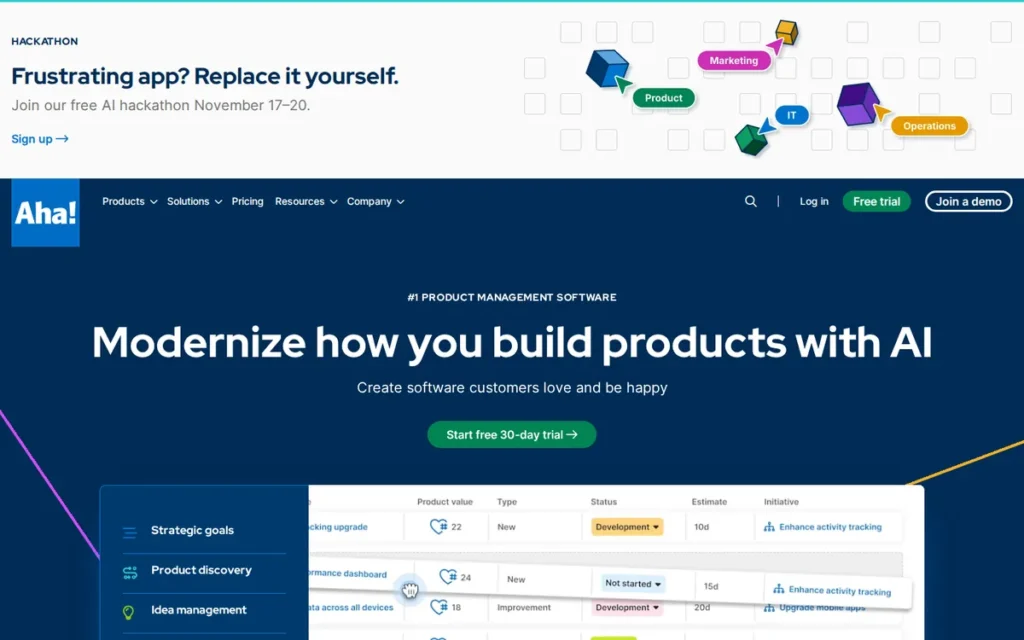
Category: Full-Lifecycle PM Suite, covers product strategy goals, visual roadmaps, customer feedback portals, release planning, and portfolio analytics in one integrated platform from OKR-setting through engineering delivery coordination.
At a Glance
- Category: Full-Lifecycle PM Suite
- Best For: Mid-market to enterprise product teams managing multi-product portfolios who need traceable strategy-to-delivery alignment, from company OKRs through roadmap communication to release coordination
- Price Range: ~$59/user/month (Roadmaps Premium, billed annually) [verified at aha.io/roadmaps/pricing, June 2026]; Startup plan for qualifying companies; Enterprise custom
- Primary Strength: Aha! covers more of the product lifecycle natively than any other tool in this comparison (strategy goals, visual roadmaps, feedback portals, release planning, and portfolio analytics) with approximately 4.7/5.0 Capterra rating and 4.4/5.0 G2 (~540 reviews) as of June 2026
- Biggest Limitation: Aha!’s premium per-seat pricing (approximately $59/user/month) and enterprise-depth complexity create prohibitive cost and onboarding overhead for teams under ten product people or teams without an established PM methodology
- One-Line Summary: Aha! is a bootstrapped, profitably operated full-lifecycle product management suite founded in 2013, rated approximately 4.7/5.0 on Capterra (the highest in this comparison) covering strategy goals through release tracking for mid-market and enterprise product teams
- Last Verified: June 2026
Overview
Aha! is a full-lifecycle product management suite for product managers and portfolio leaders at mid-market and enterprise organizations needing strategy alignment, roadmapping, customer feedback management, and release coordination in one platform. Founded in 2013 and entirely bootstrapped without external venture capital, Aha! holds a confirmed 4.4/5.0 G2 rating (~540 reviews) and approximately 4.7/5.0 on Capterra as of June 2026, the highest Capterra score in this comparison.
Aha! was co-founded by CEO Brian de Haaff and Chris Waters. The company has operated profitably without investor pressure since founding, an unusual vendor stability signal in a category where most competitors are VC-backed and subject to growth mandates. Aha! ranks first in this comparison by scoring highest on Platform Breadth and Prioritization Framework Depth, the two criteria most directly tied to the audience’s stated pain of fragmented tools and missing structured frameworks tied to business goals.
Key Features
- Strategy Cascade Layer: Aha! provides a native strategy layer where product teams define business goals, product vision, personas, and initiatives that cascade directly into feature prioritization, creating a traceable connection from company-level OKR through roadmap item to engineering delivery ticket.
- Multi-Format Visual Roadmaps: Aha! includes multiple roadmap formats: timeline, Gantt-style, now-next-later, portfolio views, and release calendars, enabling product teams to communicate strategy differently to engineering leads, executives, and external customers without maintaining separate roadmap documents.
- Native Ideas Portal: Aha! features a native Ideas Portal with crowdsourced voting, empathy sessions, and polling, allowing companies to gather structured customer feedback without a separate tool, creating a closed loop from submitted idea through prioritization decision to customer notification.
- Built-In Prioritization Frameworks: Aha! supports RICE, Value vs. Effort matrices, and fully customizable scoring models with OKR alignment, so feature scoring decisions connect to quarterly business goals rather than relying on gut instinct or spreadsheet formulas.
- Engineering Delivery Integration: Aha! integrates with Jira, GitHub, GitLab, and Azure DevOps for delivery tracking, allowing product teams to sync roadmap features to engineering backlogs and pull implementation status back into roadmap views without requiring engineering teams to change their existing tools.
Best For
Aha! is best for product teams at mid-market or enterprise organizations managing multiple products or product lines, where the primary bottleneck is strategic alignment, connecting company-level OKRs and product goals to prioritized features in a way that is visible, traceable, and communicable to both engineering teams and executive stakeholders.
Pricing
Aha! Roadmaps pricing is structured per user per month, with the Premium plan at $59/user/month billed annually [verified at aha.io/roadmaps/pricing, June 2026]. A 10-person team pays approximately $590/month, the highest entry cost in this comparison. Aha! offers a discounted Startup plan for qualifying early-stage companies and an Enterprise tier for organizations with advanced security, compliance, and dedicated support requirements. Verify current pricing at aha.io/roadmaps/pricing before purchasing.
Strengths
- Aha! holds approximately 4.7/5.0 on Capterra and a confirmed 4.4/5.0 G2 rating across approximately 540 reviews as of June 2026 (the highest Capterra score in this comparison) providing multi-platform third-party validation as a consistent quality signal across over a decade of operation.
- Aha! is the only tool in this comparison recognized by community members as combining idea management, roadmapping, and customer interview repository capabilities in a single platform, a combination that even Atlassian’s own product team requires multiple separate tools (Jira Product Discovery, Pendo, Dovetail) to replicate (u/PerformanceGlum9117, r/jira, 2024).
- Aha! has operated profitably as a bootstrapped, investor-independent company since 2013 (over 13 years without external venture pressure) providing pricing stability and roadmap independence that VC-backed competitors facing investor growth mandates structurally cannot match.
- Aha!’s built-in prioritization frameworks (RICE, Value vs. Effort, custom scoring) with native OKR alignment directly address the stated audience pain of lacking a structured framework tying feature decisions to business goals, the most complete prioritization methodology depth of any tool in this comparison.
This aligns with community sentiment on r/ProductManagement:
“At our company we started using AHA! for initiatives and roadmapping. I was skeptical of introducing an additional tool on top of Jira. But, i must say its been a blessing. It provides a much better interface for planning features and initiatives and is also integrated to corresponding Jira epics. Sounds a bit like an infomercial, but i really dig it so far after 6 months of usage. My previous company used to use powerpoints which was the most inefficient way of communicating roadmap and timeline urgency.” (u/Tiny_Yesterday_9121, r/ProductManagement (9 upvotes))
Takeaway: Aha! converts even skeptical PMs once they experience integrated initiative-to-backlog visibility, a capability that slide-based roadmapping structurally cannot replicate.
Limitations
Aha!’s most consequential trade-off is depth versus accessibility: the platform’s comprehensive feature coverage creates a steep learning curve that multiple community reviewers describe as overwhelming for smaller teams and frustrating for stakeholders being onboarded as contributors. At approximately $59/user/month, a 10-person product team pays roughly $590/month (more than seven times the equivalent cost on Linear) concentrating value only for organizations that genuinely engage the full platform workflow.
Community reviewers with hands-on Aha! experience describe the interface as not modern compared to newer tools (u/tdi, r/ProductManagement, 2024), and at least one reviewer describes onboarding the broader organization as “a nightmare” (u/tjomk, r/ProductManagement), patterns consistent across reviews spanning multiple years. Teams under ten product people, or teams without an established PM methodology, face meaningful risk of underutilization relative to the investment.
Users on r/ProductManagement noted:
“Aha didn’t make sense to me at all until I worked in a 3K+ enterprise company with lots of products (that are synergistic with each other) and roles such as PSMs, presales, CSM, AM, TAM, etc, at the same time. I think Aha/PP introduces too much overhead for a company of 10 PMs. Hopefully, they are not just 10 PMs working on random areas but part of a bigger area with enough processes to stay structured/aligned.” (u/Aektann, r/ProductManagement (5 upvotes))
Takeaway: Aha!’s value only becomes apparent at enterprise scale, experienced PMs consistently report the platform introduces prohibitive overhead for teams that haven’t yet grown into its organizational complexity.
Verdict
Aha! is the most comprehensive product management suite available in 2026, earning its #1 rank through approximately the highest Capterra rating in this comparison (approximately 4.7/5.0), the broadest native PM workflow coverage from strategy goals through release tracking, and 13 years of bootstrapped profitable operation that no VC-backed competitor can replicate. Aha! scored highest on Platform Breadth and Prioritization Framework Depth, the two criteria most directly tied to fragmented-tooling and missing-prioritization-framework pain points. The complexity and premium pricing are real trade-offs, Aha! is not the right choice for a three-person startup or a team still forming its PM methodology. For mid-market and enterprise product teams managing multiple products with a need for traceable strategy-to-delivery alignment, Aha! provides the most defensible all-in-one answer in this comparison.
#2. Linear: Best for Engineering-Led SaaS Teams: Fastest Execution with Roadmapping
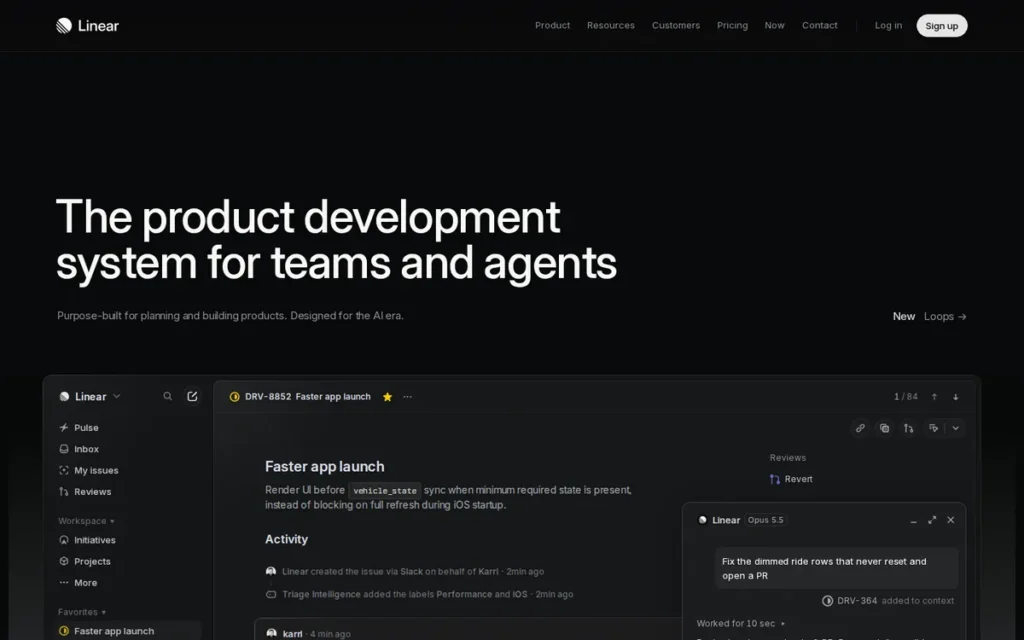
Category: Engineering-First PM Platform, combines issue tracking, roadmapping, cycles (sprints), AI-assisted triage, and native Git integration in a speed-optimized platform designed for product and engineering teams working in tight delivery cycles.
At a Glance
- Category: Engineering-First PM Platform
- Best For: Developer-forward SaaS teams where delivery velocity and Git integration are the primary workflow constraints, and where Jira’s performance or visual complexity is a documented source of team friction
- Price Range: Free / $8/user/month (Basic) / $14/user/month (Business) / Enterprise custom [verified at linear.app/pricing, June 2026]
- Primary Strength: Linear reached $100 million ARR and a $1.25 billion Series C valuation in 2025, with a confirmed customer roster including OpenAI, Scale AI, Perplexity, Cash App, and Ramp as independently verifiable adoption evidence [Source: TechCrunch, June 2025; Linear Series C announcement, June 2025]
- Biggest Limitation: Linear has no native external feedback collection or customer submission portal, making it an incomplete standalone solution for teams whose primary PM bottleneck is consolidating multi-source customer feedback before making roadmap decisions
- One-Line Summary: Linear is an engineering PM platform with $100M ARR and a $1.25 billion Series C valuation, used by OpenAI, Scale AI, Perplexity, Cash App, and Ramp as the primary issue tracking and roadmapping platform [Source: TechCrunch, June 2025]
- Last Verified: June 2026
Overview
Linear is an engineering-first product management platform for product and engineering teams at modern SaaS companies where delivery velocity, developer experience, and Git workflow integration are the primary bottlenecks. Founded in 2019 by former Airbnb and Coinbase engineers Karri Saarinen, Jori Lallo, and Tuomas Artman, Linear reached $100 million in ARR and a $1.25 billion Series C valuation in 2025, the strongest publicly documented revenue milestone of any tool in this comparison based on available disclosed figures [Source: TechCrunch, June 10, 2025].
Linear’s customer roster (OpenAI, Scale AI, Perplexity, Cash App, and Ramp) provides the most credible enterprise social proof in the category for AI-native and developer-forward organizations [Source: TechCrunch, June 2025; Linear Series C announcement, June 2025]. Linear serves over 15,000 companies as of its June 2025 Series C announcement, holding a 4.6/5.0 G2 rating (~100 reviews) and 4.5/5.0 Capterra as of June 2026.
Key Features
- Native GitHub and GitLab Integration: Linear provides native GitHub and GitLab integration that automatically links pull requests, commits, and branches to roadmap issues, creating real-time development context between product planning and engineering delivery without requiring manual status updates from engineers.
- Cycles (Sprint) Management: Linear’s Cycles give product teams structured delivery cadences with automatic scope and velocity tracking, enabling PMs to communicate progress to stakeholders directly from within the tool without maintaining separate status reporting workflows.
- AI-Assisted Issue Triage: Linear’s AI-assisted issue triage and duplicate detection routes incoming items to the correct team and surfaces related work automatically, reducing the administrative overhead that causes Jira-native teams to accumulate backlog debt over time.
- Visual Roadmapping with Backlog Sync: Linear offers visual roadmapping with timeline views, milestone tracking, and priority management that connects directly to the active engineering backlog, ensuring roadmap items and sprint delivery are synchronized rather than maintained as separate artifacts.
- PRD Management with Issue Linking: Linear includes structured Product Requirements Document management with direct issue linking, keeping product requirements and engineering execution in the same platform rather than split across separate documentation and delivery tools.
Best For
Linear is best for engineering-led SaaS teams (particularly AI companies, developer tool startups, and organizations where Jira’s performance or interface complexity is a documented source of engineering and product team friction) where the primary PM bottleneck is delivery execution quality rather than external feedback consolidation or enterprise-level portfolio planning.
Pricing
Linear pricing is publicly listed as of June 2026: Free ($0/user/month, unlimited users with limited issue history), Basic ($8/user/month billed monthly, approximately $6.67 billed annually), and Business ($14/user/month billed monthly, approximately $11.67 billed annually). Enterprise is custom. A 10-person team on Basic pays $80/month, among the lowest total costs in this comparison alongside Jira Product Discovery. Verify current pricing at linear.app/pricing before purchasing.
Strengths
- Linear reached $100 million in ARR and a $1.25 billion Series C valuation in 2025, with customers including OpenAI, Scale AI, Perplexity, Cash App, and Ramp providing independently verifiable enterprise-grade adoption evidence, the strongest publicly documented growth milestone of any tool in this comparison [Source: TechCrunch, June 10, 2025; Linear Series C announcement, June 2025].
- Linear serves over 15,000 companies as of June 2025, holds a 4.6/5.0 G2 rating and 4.5/5.0 Capterra as of June 2026, with community reviewers consistently describing Linear as “consistently better than Jira in design and performance all throughout” (u/betahaxorz, r/SaaS, 2024).
“Linear isn’t a magic bullet, it’s just consistently better than Jira in design and performance all throughout. They also have some pretty sweet integrations with third party apps, but feels less like an afterthought and more of an intentional feature.” (u/betahaxorz, r/SaaS (18 upvotes))
Takeaway: Linear’s value proposition is not revolutionary capabilities, it is consistently better execution of the fundamentals that Jira handles poorly, making the switching case straightforward for teams experiencing Jira friction.
- Linear’s transparent public pricing structure (Free / $8 / $14 per user per month) is among the two most accessible in this comparison, with no undisclosed enterprise-only feature gating that creates budget surprises after organizational commitment.
- Linear’s “Linear Method”: an opinionated product philosophy emphasizing delivery momentum over planning overhead, provides built-in process structure that helps developer-led teams avoid the scope creep and backlog chaos that make Jira installations feel unmanageable at scale.
Limitations
Linear’s most consequential trade-off is categorical scope: Linear is an engineering execution platform, not a full-lifecycle product management suite, and teams evaluating it as a Productboard or Aha! replacement will find that the absence of native external feedback collection and customer portal capabilities is a fundamental workflow gap rather than a minor feature omission. Community reviewers specifically note that Linear fits non-engineering functions (support, marketing, legal) poorly, as its opinionated workflow is optimized for software delivery cadences these teams do not operate within.
One community skeptic observed that “Linear is a new product with a minimal feature set (give it a few years and the shiny new thing syndrome will wear off” (u/Icy_Procedure2814, r/SaaS)) a real architectural maturity risk as the platform accumulates features and complexity over time. Teams whose top PM priority is consolidating multi-source customer feedback before making roadmap decisions should evaluate Productboard (#4) or supplement Linear with a dedicated feedback tool like Canny (#7).
Verdict
Linear is the highest-validated growth-stage entrant in the product management software category, reaching $100M ARR and a $1.25B Series C valuation with customers including OpenAI, Scale AI, and Ramp representing independently verifiable real-world adoption evidence as of 2025 [Source: TechCrunch, June 2025]. Linear ranks below Jira Product Discovery (#3) on Jira Integration quality (Linear provides third-party API sync, while JPD is natively the same platform) but its superior market validation and transparent pricing earn its #2 rank. Teams seeking a complete feedback-to-strategy-to-delivery PM system should consider Aha! (#1) for full lifecycle coverage, or Jira Product Discovery (#3) for zero-entry-cost Atlassian ecosystem integration.
#3. Jira Product Discovery: Best for Atlassian-Native Teams: Zero-Cost Discovery Layer
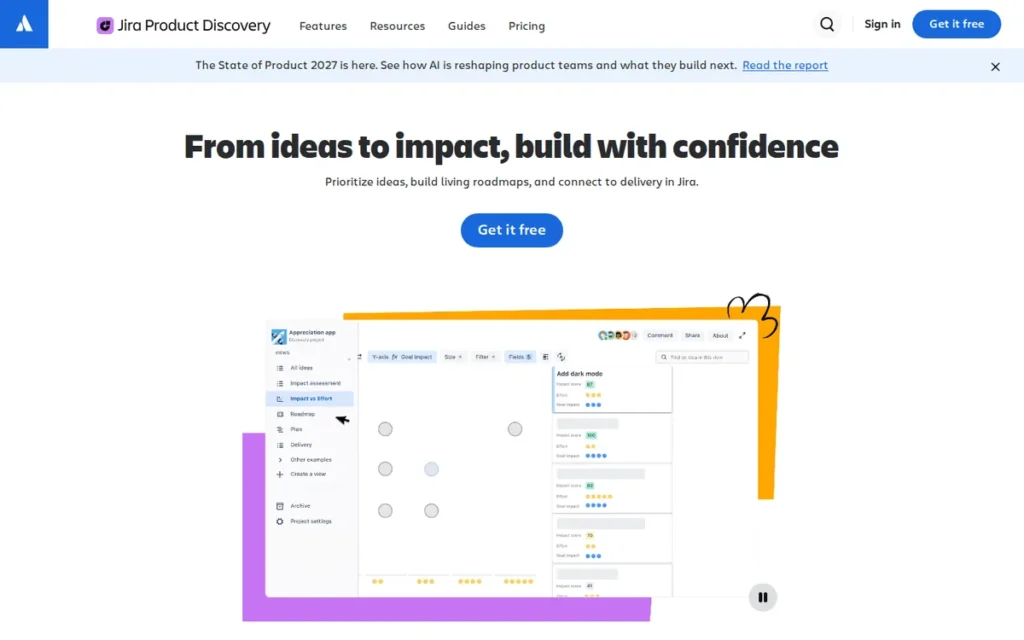
Category: Atlassian-Native Discovery Tool, manages pre-delivery idea prioritization and roadmapping within the Atlassian Cloud ecosystem as a native extension of Jira Software, covering the pre-development stage before work enters the committed engineering backlog.
At a Glance
- Category: Atlassian-Native Discovery Tool
- Best For: Product teams already using Jira Software for engineering delivery who want a structured discovery and prioritization layer without adding a new vendor, negotiating a new contract, or migrating data
- Price Range: Free (up to 3 Creators); $10/Creator/month (Standard) thereafter; Contributors always free and unlimited [verified at atlassian.com/software/jira/product-discovery/pricing, June 2026]
- Primary Strength: Jira Product Discovery offers native zero-friction integration with Jira Software, discovery ideas become linked Jira issues, roadmaps embed in Confluence, and the entire workflow lives within the existing Atlassian tenant with no migration required
- Biggest Limitation: Jira Product Discovery uses a flat idea list with no native Initiative-to-Epic hierarchy (a hard structural limitation confirmed by a self-described former Atlassian PM (r/jira, 2024)) and has no external user submission portal without an active Atlassian license for contributors
- One-Line Summary: Jira Product Discovery is Atlassian’s dedicated product discovery layer launched in 2023, offering the only free-tier PM tool with native same-platform Jira Software integration at $10/Creator/month for teams already in the Atlassian Cloud ecosystem [Source: Atlassian pricing page, June 2026]
- Last Verified: June 2026
Overview
Jira Product Discovery is Atlassian’s purpose-built product discovery and prioritization tool for product teams that use Jira Software for engineering delivery and need to manage speculative pre-development ideas, scoring, and roadmap communication within the same Atlassian ecosystem, without adding a separate vendor. Launched in 2023 as the newest product in Atlassian’s portfolio, Jira Product Discovery is available free for up to 3 Creators with unlimited free Contributors, making it the lowest-cost PM discovery tool for the large installed base of Atlassian Cloud organizations.
Jira Product Discovery ranks #3 in this comparison for unmatched native Jira integration and pricing accessibility, moderated by documented structural limitations and an early-stage review footprint that limits its validated market signal relative to older tools. Atlassian (NASDAQ: TEAM), founded in 2002 with approximately 12,000+ employees globally, provides the strongest institutional vendor stability signal in this comparison. Jira Product Discovery ranks below Linear (#2) primarily on Market Validation, Linear’s $100M ARR and $1.25B valuation represent a stronger independent evidence base than Jira Product Discovery’s 2023 launch timeline and limited G2 review volume.
Key Features
- Native Jira Issue Linking: Jira Product Discovery enables product teams to capture ideas as native Jira issues within a dedicated discovery project, score them using impact/effort matrices, and promote prioritized items directly to delivery epics in Jira Software, creating a traceable discovery-to-sprint connection without leaving the Atlassian platform.
- Confluence-Embedded Roadmaps: Jira Product Discovery supports roadmap communication through multiple view types (board, timeline, and matrix) that can be embedded directly in Confluence pages, allowing stakeholders to view product plans within the documentation environment they already use daily.
- Insights Attachment: Jira Product Discovery’s Insights feature allows team members to attach customer feedback, interview notes, support ticket references, and qualitative signals directly to discovery ideas, providing scored prioritization context without a separate research repository.
- Creator/Contributor Pricing Architecture: Jira Product Discovery’s Creator/Contributor model gives unlimited internal stakeholders the ability to comment, vote, and add insights to ideas at zero additional cost, reducing the per-seat pricing friction that limits broad organizational participation in competitor tools.
- Jira Plans Integration: Jira Product Discovery integrates natively with Jira Plans (formerly Advanced Roadmaps) for portfolio-level visibility, enabling product leaders at larger Atlassian organizations to see how discovery items align with delivery milestones across multiple Jira projects.
Best For
Jira Product Discovery is best for product teams at organizations already running engineering delivery in Jira Software, where the primary need is a structured layer for capturing, scoring, and communicating roadmap ideas without adding a new vendor, and where the secondary priority is minimizing procurement complexity, contract negotiation, and implementation cost.
Pricing
Jira Product Discovery is free for up to 3 Creators, with unlimited Contributors at no charge regardless of count. Beyond 3 Creators, the Standard plan costs $10 per Creator per month [Source: Atlassian pricing page, accessed June 2026]. A 10-person product team with 7 Creators pays approximately $70/month, significantly less than all other tools in this comparison except Linear’s Free tier. Verify current pricing at atlassian.com/software/jira/product-discovery/pricing before purchasing.
Strengths
- Jira Product Discovery is backed by Atlassian (NASDAQ: TEAM), a publicly traded company with approximately 12,000+ employees and over two decades of enterprise software operation since founding in 2002, providing the strongest institutional vendor stability signal in this comparison and eliminating new-vendor risk for organizations already on Atlassian Cloud.
- Jira Product Discovery’s native Jira Software integration receives consistent community endorsement from Jira-native teams: “having everything integrated inside Jira out of the box is just so much more convenient” compared to feature-richer alternatives (u/Own_Mix_3755, r/jira, 2024).
“ProductBoard is definitely more feature rich, but having everything integrated inside Jira out of the box is just so much more convenient.” (u/Own_Mix_3755, r/jira)
Takeaway: For Atlassian-native teams, Jira Product Discovery’s zero-migration advantage consistently outweighs the feature depth of standalone PM tools, ecosystem convenience is a real productivity multiplier, not a rationalization.
- Jira Product Discovery’s Creator/Contributor pricing architecture: unlimited free Contributors alongside $10/Creator/month, creates the lowest cost of broad organizational participation in the discovery process of any paid PM tool in this comparison.
- The zero-procurement adoption path means teams already on Atlassian Cloud can trial Jira Product Discovery in minutes without new contracts, security reviews, or data import, a material reduction in evaluation risk compared to every other tool in this comparison.
Limitations
Jira Product Discovery’s most consequential trade-off is ecosystem convenience versus structural completeness. The tool has two documented hard limitations confirmed by technical sources rather than inferred from feature lists. First, Jira Product Discovery uses a flat idea list with no native multi-tier hierarchy (a self-described former Atlassian product manager confirmed on Reddit: “Jira Product Discovery doesn’t support issue hierarchy at the moment) everything is an Idea in a flat list,” with only a field-grouping workaround available (r/jira, 2024).
Second, Jira Product Discovery has no external public feedback submission portal, users outside the organization cannot submit ideas without an active Atlassian license, requiring teams relying on community-driven feedback collection to supplement with a separate tool (Canny, Productboard, or Aha!’s Ideas Portal). The signal that Atlassian’s own product team uses Pendo and Dovetail alongside Jira Product Discovery reveals that even the platform’s builder relies on supplemental tools to cover gaps that Jira Product Discovery’s architecture does not address [Source: u/PerformanceGlum9117, r/jira, 2024, citing Atlassian handbook].
Verdict
Jira Product Discovery is the default-first evaluation option for any product team already embedded in the Atlassian ecosystem, offering the only free-tier PM discovery layer with native same-platform Jira Software integration at a $10/Creator/month cost structure. Jira Product Discovery’s two documented hard limitations (flat idea hierarchy and absence of an external feedback portal) are real structural constraints that will push some teams toward Productboard (#4) for multi-source feedback consolidation or Aha! (#1) for full-lifecycle coverage. For the large population of Jira-native teams whose primary need is structured idea management and roadmap communication within their existing Atlassian tenant, Jira Product Discovery earns its third-place rank as the most rational and lowest-risk starting evaluation in the category.
#4. Productboard: Best for Feedback-Centric SaaS Teams: Multi-Source Insights to Prioritized Roadmap
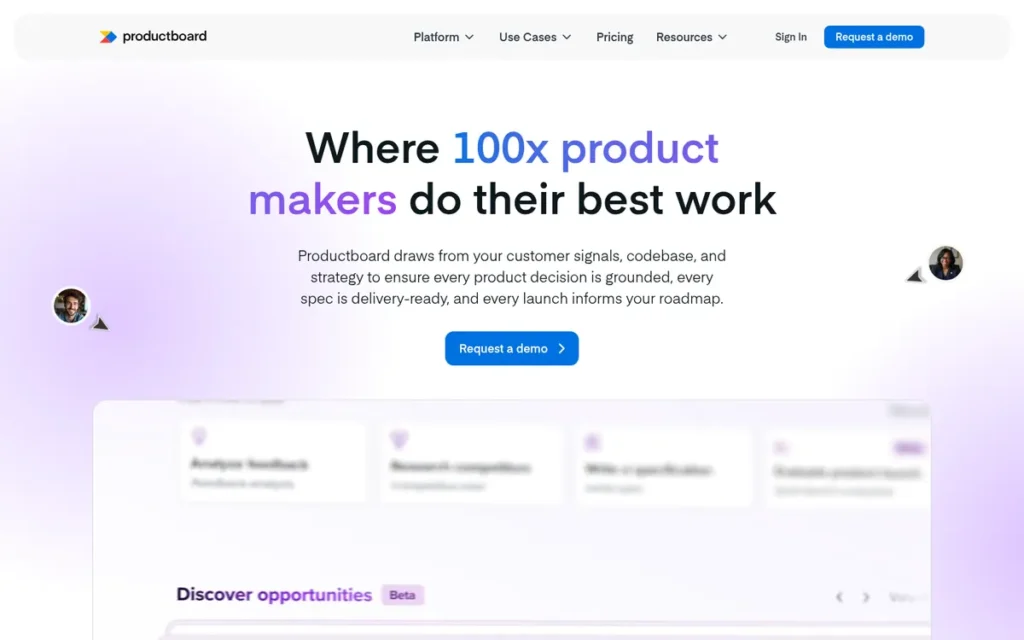
Category: Feedback-Driven PM Platform, centralizes multi-source customer feedback from 50+ integrations and connects it to structured, customer-weighted prioritization and roadmap decisions.
At a Glance
- Category: Feedback-Driven PM Platform
- Best For: Customer-focused SaaS product teams of 1–15 makers where the primary PM bottleneck is consolidating feedback from Zendesk, Slack, Salesforce, Intercom, and customer interviews into a single prioritization workflow
- Price Range: ~$19/maker/month (Essentials, billed annually: verify at productboard.com/pricing); Pro and Scale at higher tiers; Enterprise custom, dependency mapping is an Enterprise-only feature
- Primary Strength: Productboard provides the most structured multi-source customer feedback consolidation workflow in this comparison, aggregating signals from 50+ integration sources into a customer-weighted prioritization layer with objectives alignment
- Biggest Limitation: Productboard requires continuous manual metadata tagging to function as designed (a maintenance burden that triggers adoption failure in teams without dedicated product operations support) and its Jira integration has documented reliability complaints across multiple community sources
- One-Line Summary: Productboard is a feedback-to-roadmap platform used by 5,400+ companies as of its January 2022 Series D announcement, backed by lead investors Dragoneer Investment Group and Tiger Global at a $1.725 billion valuation [Source: Productboard Series D press release, January 2022]
- Last Verified: June 2026
Overview
Productboard is a customer-centric product management platform for SaaS product teams that need to consolidate feature requests and customer feedback from multiple sources (Zendesk, Intercom, Slack, Salesforce, Amplitude, Mixpanel, and customer interviews) and connect those signals to structured, customer-weighted roadmap prioritization decisions. Founded in 2014 by Hubert Palan and headquartered in San Francisco with development in Prague, Productboard raised $125 million in January 2022 at a $1.725 billion valuation, led by Dragoneer Investment Group and Tiger Global, with Kleiner Perkins (Series A lead, 2017) and Index Ventures as participating existing investors [Source: Productboard Series D press release, January 2022].
Productboard reports 5,400+ customers as of its January 2022 Series D announcement, the current count has not been independently verified as of June 2026. Productboard ranks fourth because its strong feedback consolidation capabilities are materially offset by documented Jira integration reliability issues and the highest manual maintenance overhead in this comparison, both of which represent measured adoption risks rather than minor complaints.
Key Features
- 50+ Integration Feedback Intake: Productboard aggregates customer feedback from 50+ integrations including Zendesk, Intercom, Slack, Salesforce, Amplitude, Mixpanel, and Microsoft Teams into a single insights layer, reducing the time product teams spend manually monitoring separate channels for feature requests.
- Customer-Weighted Scoring: Productboard’s customer-weighted scoring model allows teams to tie feature priority scores to specific customer segments, so a feature requested by five enterprise accounts automatically scores higher than the same feature requested by fifty free-tier users, if configured with account data.
- Multi-Format Roadmap Views: Productboard provides multiple roadmap views: timeline, now-next-later, feature board, and feature status, configurable for different stakeholder audiences and shareable externally without exposing internal scoring logic or commercial strategy.
- Native Customer Feedback Portal: Productboard includes a native customer portal where external users can submit feature requests, vote on ideas, and receive status updates when features ship, closing the feedback loop without requiring a separate community feedback tool.
- Engineering Delivery Integration: Productboard integrates with Jira, GitHub, Shortcut, and Azure DevOps for delivery status tracking, enabling product teams to push prioritized features to engineering backlogs and track implementation progress within the roadmap interface.
Best For
Productboard is best for customer-focused SaaS product teams with 1–15 product people where the primary workflow gap is the disconnect between where customer feedback is captured (support tools, sales calls, user interviews) and where roadmap decisions are actually made, and where the team has the process discipline or dedicated product operations (product ops) support to consistently maintain the metadata tagging and field hygiene the platform requires.
Pricing
Productboard’s Essentials plan is estimated at approximately $19/maker/month billed annually based on third-party sources, verify exact current pricing at productboard.com/pricing before purchasing. Productboard uses a “maker” model where only users who create and edit features count toward billable seats; stakeholders who view roadmaps or contribute feedback comments are free. Critical note: dependency mapping is available only at the Enterprise tier, teams expecting this capability should confirm tier requirements during the sales process before committing. Pricing framework verified June 2026.
Strengths
- Productboard raised $125 million at a $1.725 billion valuation in its January 2022 Series D, led by Dragoneer Investment Group and Tiger Global [Source: Productboard Series D press release, January 2022], third-party validation that multi-source feedback consolidation into structured roadmap decisions represents real, funded enterprise market demand at scale.
- Productboard holds a 4.3/5.0 G2 rating (~230 reviews) and 4.2/5.0 Capterra as of June 2026, with community reviewers describing it as “best bang for the buck for 1–15 product team members” seeking structured feedback-to-roadmap workflow at a price point below Aha! (u/ninjitsuko, r/ProductManagement).
- Productboard’s 50+ integration ecosystem: including Zendesk, Intercom, Slack, Salesforce, Amplitude, and Mixpanel, provides the broadest pre-built connectivity to external feedback sources of any tool in this comparison, eliminating manual monitoring of individual channels.
- Productboard’s customer-weighted scoring model structurally differentiates it from simpler voting tools like Canny by connecting feedback volume to customer business value, enabling prioritization decisions that reflect commercial impact rather than raw community vote count.
Limitations
Productboard’s feedback consolidation capabilities from 50+ integration sources are genuinely differentiated, the trade-off is that these capabilities require continuous manual metadata tagging to function as designed. Multiple r/ProductManagement reviewers with multi-year Productboard experience describe spending more time managing tags, fields, and filters than actually working on the roadmap.
“FWIW I’ve been forced to use Productboard for the last two years and it has got to be one of the most unintuitive tools I’ve ever used. I spend more of my time f***ing with tags, fields, and filters than I do actually working on my roadmap.” (u/average_lfc_fan, r/ProductManagement (8 upvotes))
Takeaway: Productboard’s power is real, but it demands more configuration discipline than most teams can sustain without dedicated product operations support, teams without a product ops function should trial the maintenance burden before committing.
Productboard invested in AI-assisted feedback tagging features in 2025 to address the manual overhead concern, teams evaluating in 2026 should specifically trial AI tagging against the maintenance burden described in 2023–2024 community reviews before assuming the concern applies at current product state. The Jira integration specifically receives documented reliability criticism, sync failures are mentioned across multiple community threads more frequently than for any other tool in this comparison, which is a material concern given Jira integration is the #1 stated buying criterion in PM communities. Dependency mapping is gated behind the Enterprise tier, creating a significant feature access gap for Essentials and Pro customers who discover this need after committing.
Verdict
Productboard is the most purpose-built solution for the specific workflow gap between multi-source customer feedback and structured, customer-weighted roadmap prioritization, with 5,400+ customers as of January 2022 and institutional backing from Dragoneer Investment Group and Tiger Global confirming real enterprise demand for that use case [Source: Productboard Series D press release, January 2022]. Productboard’s fourth-place rank (rather than the first-place position it receives in most AI-generated comparisons) reflects documented adoption risks: high manual overhead, Jira sync reliability concerns, and Enterprise-only feature gating. Teams where feedback consolidation is the primary PM bottleneck and who have product operations capacity to sustain the platform will find Productboard genuinely differentiated; teams without that capacity should compare Jira Product Discovery (#3) and Aha! (#1) directly.
#5. airfocus by Lucid: Best for Framework-Flexible Teams: Modular PM with Custom Prioritization
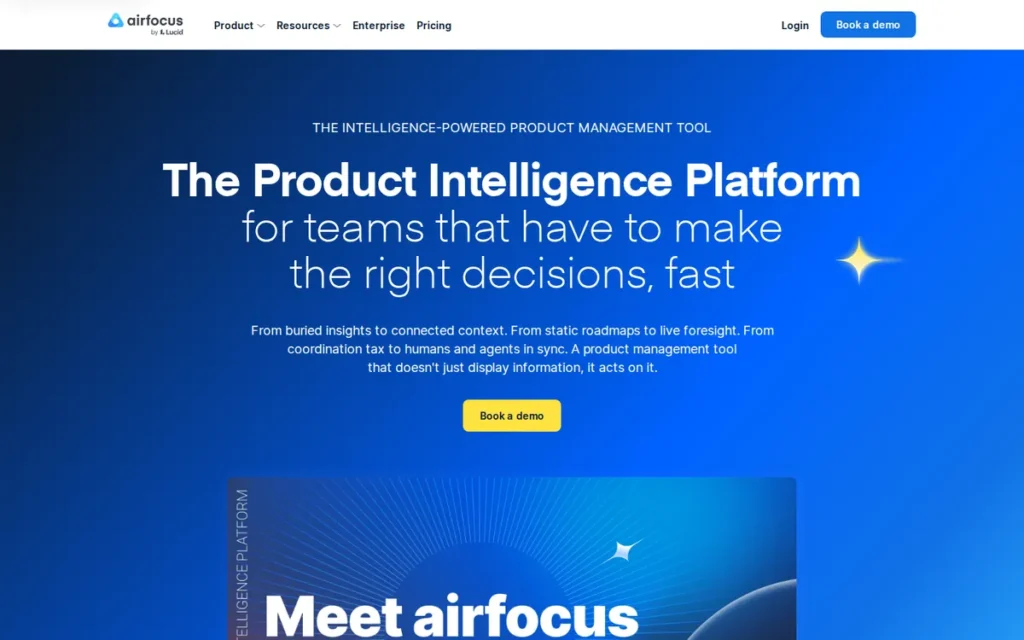
Category: Modular PM Platform, a configurable product management workspace where teams define their own prioritization frameworks, roadmap views, and workflow structures within a modular architecture, without being constrained to a prescribed methodology.
At a Glance
- Category: Modular PM Platform
- Best For: Mid-size product teams that have an established PM methodology and need a tool that adapts to their specific prioritization frameworks and workflow rather than imposing its own structure on them
- Price Range: Verify at airfocus.com/pricing: pricing may have changed following the April 2025 Lucid Software acquisition [Source: PR Newswire, April 2025]; Enterprise custom; note: community voting on feedback portals requires a higher-tier plan
- Primary Strength: airfocus by Lucid provides the most configurable prioritization framework environment in this comparison, supporting RICE, ICE, MoSCoW, WSJF, and fully custom scoring matrices within a single modular workspace
- Biggest Limitation: airfocus by Lucid provides no built-in workflow guardrails (teams without a defined PM methodology will find its flexibility a liability) and its native feedback portal had documented community complaints about reliability prior to the April 2025 Lucid acquisition (r/ProductManagement, 2023)
- One-Line Summary: airfocus by Lucid is a modular product management platform supporting RICE, ICE, MoSCoW, WSJF, and custom prioritization frameworks, acquired by Lucid Software in April 2025 [Source: PR Newswire, April 2025]
- Last Verified: June 2026
Overview
airfocus by Lucid is a modular product management platform for product teams that have established their own PM methodology and need a configurable workspace that adapts to their specific prioritization framework, roadmap structure, and workflow, rather than constraining them to a prescribed process architecture. Founded approximately 2017–2018 by Henrik Bredenberg and Malte Scholz, airfocus was acquired by Lucid Software in April 2025 [Source: PR Newswire, April 2025], makers of Lucidchart and Lucidspark, as part of Lucid’s strategy-to-execution product suite expansion.
airfocus by Lucid holds a 4.3/5.0 G2 rating (~100 reviews) and 4.5/5.0 Capterra rating as of June 2026, ranking fifth in this comparison due to strong framework flexibility and Lucid backing, offset by a smaller validation footprint and documented feedback portal limitations that predate the acquisition. airfocus ranks below Productboard (#4) on Market Validation, Productboard’s 5,400+ documented customers and $1.725B Series D valuation represent a larger independently confirmed deployment base than airfocus’s current review volume evidences, even accounting for the enterprise resources the Lucid acquisition provides.
Key Features
- Configurable Prioritization Scoring: airfocus by Lucid supports fully configurable prioritization scoring matrices (including built-in RICE, ICE, MoSCoW, and WSJF frameworks plus fully custom scoring fields) giving teams the ability to define their own value metrics and framework rather than adapting to a fixed scoring philosophy.
- Modular Workspace Architecture: airfocus’s modular workspace architecture allows teams to create custom views, filters, and boards that reflect their specific workflow structure (opportunity pipelines, initiative hierarchies, outcome-based roadmaps) without being constrained to a single opinionated layout.
- Jira Two-Way Delivery Sync: airfocus by Lucid integrates with Jira for two-way delivery tracking, enabling product teams to push prioritized features to engineering backlogs and pull delivery status back into roadmap views without requiring engineering teams to change their Jira workflow.
- OKR and Strategy Alignment: airfocus by Lucid supports OKR and strategy alignment layers where roadmap items connect to quarterly business objectives, allowing product teams to communicate how features contribute to measured outcomes rather than simply describing what is being built.
- Customer Feedback Portal: airfocus provides a customer feedback portal with public or private boards, voting functionality, and changelog communication, though community reviewers noted this module was “basic and buggy” prior to the April 2025 Lucid acquisition (r/ProductManagement, 2023); teams should trial this feature in its current 2026 post-acquisition state before committing.
Best For
airfocus by Lucid is best for mid-size product teams that already have a defined PM process and know which prioritization framework they use (whether RICE, MoSCoW, WSJF, or a custom model) and need a tool that supports and scales that existing approach rather than imposing a new one. Teams still developing their PM methodology will find better guardrails in Aha! (#1).
Pricing
airfocus entry pricing was approximately $19/user/month prior to the April 2025 Lucid Software acquisition [Source: PR Newswire, April 2025], post-acquisition pricing should be verified directly at airfocus.com/pricing, as pricing structures may have changed following the acquisition. Community feedback indicates that the voting functionality on customer feedback portals is restricted to a higher-tier plan and not available at the entry tier, teams planning to use airfocus for community feedback collection should confirm feature tier access before committing. Enterprise pricing is custom. Pricing framework verified June 2026.
Strengths
- airfocus by Lucid was acquired by Lucid Software in April 2025 [Source: PR Newswire, April 2025], adding enterprise distribution scale, increased R&D investment, and access to a visual collaboration suite that positions airfocus within a broader strategy-to-execution ecosystem no standalone PM tool in this comparison can match.
- airfocus holds a 4.3/5.0 G2 rating and 4.5/5.0 Capterra rating as of June 2026, with G2 reviewers specifically citing “improved alignment across teams,” “centralized customer insights,” and “faster product decision-making” as documented outcomes from deployment.
- airfocus supports five distinct built-in prioritization frameworks (RICE, ICE, MoSCoW, WSJF, and custom) (the most framework-flexible prioritization environment in this comparison) enabling teams with existing methodological preferences to implement their scoring model without workarounds or custom development.
- Community reviewer u/whitew0lf on r/ProductManagement (6 upvotes) specifically noted that airfocus “provides flexibility over how you can set things up (whether you want a board or a timeline, whether you want RICE, ICE, WSJF) whatever, it’s your choice,” acknowledging genuine value for experienced PMs who want configurability over prescription.
“I quite like airfocus as it provides flexibility over how you can set things up. Whether you want a board, or a timeline, whether you want RICE, ICE, WSJF, whatever, it’s your choice… Flexibility is always great, but if you have no idea what you are doing, any given tool will fail you. Process first, tool later.” (u/whitew0lf, r/ProductManagement (6 upvotes))
Takeaway: airfocus’s configurability is a genuine strength for experienced PMs, and a genuine risk for teams without an established process, making methodology maturity the most important pre-purchase criterion for airfocus evaluation.
Limitations
airfocus by Lucid’s most consequential trade-off is that its defining feature, workflow flexibility, becomes a liability for teams without an established PM methodology. Without built-in structural guardrails to guide best practice, undisciplined or immature teams risk building inconsistent, fragmented workspaces that reduce alignment rather than increasing it. This risk is explicitly identified in community discussions with the framing “process first, tool later”, and airfocus provides no safety net for teams that arrive without a clear process.
The native feedback portal was documented as “basic and buggy” by r/ProductManagement users prior to the April 2025 Lucid acquisition (r/ProductManagement, 2023), teams evaluating airfocus in 2026 should trial this module against its current post-acquisition state before relying on pre-acquisition community reviews. Advanced reporting and portfolio management are documented as less granular than Aha! for large enterprise needs, and the voting feature on feedback portals is confirmed gated behind a higher-tier plan, creating a meaningful feature access gap for entry-tier customers who assume voting is included.
Verdict
airfocus by Lucid earns its fifth-place ranking as the most configurable prioritization platform in the comparison, backed by Lucid Software’s enterprise distribution and a modular architecture that genuinely serves teams with established, non-standard PM workflows. airfocus is a stronger candidate than most AI-generated rankings acknowledge, particularly following the April 2025 Lucid acquisition that brought significantly increased enterprise resources to a previously independent vendor. For experienced product teams that know their prioritization methodology and want a tool that fits it precisely rather than constraining it, airfocus deserves a head-to-head trial against Productboard (#4) before committing.
#6. Pendo: Best for Analytics-Led Product Teams: Behavioral Data, In-App Guidance, and NPS
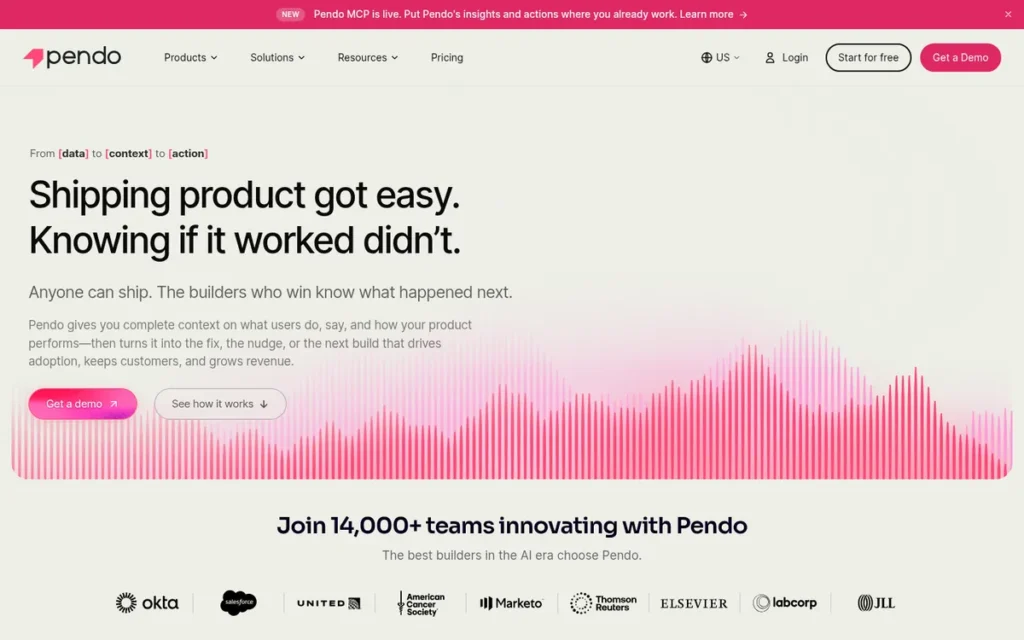
Category: Analytics-Led PM Platform, instruments live software products to capture behavioral usage data, in-app guide delivery, NPS surveys, and session replay from the production environment rather than from feedback portals or internal planning boards.
At a Glance
- Category: Analytics-Led PM Platform
- Best For: Growth-stage to enterprise SaaS companies where feature adoption measurement, in-app user onboarding, and behavioral analytics are higher priorities than traditional roadmapping or multi-source feedback consolidation from external portals
- Price Range: Free (up to 500 monthly active users); Base, Core, Ultimate tiers with custom MAU-based pricing, contact Pendo sales for a quote [verified at pendo.io/pricing, June 2026]
- Primary Strength: Pendo is the only platform in this comparison built primarily around instrumenting the live production environment to measure actual user behavior (feature adoption rates, user paths, and session replay) providing objective usage data that self-reported feedback tools structurally cannot replicate
- Biggest Limitation: Pendo requires SDK or tag-based code instrumentation for deployment, involves significant implementation overhead, and its MAU-based pricing model creates unpredictable total cost of ownership as the product user base scales
- One-Line Summary: Pendo is the most extensively reviewed product management platform in this comparison with approximately 1,400+ G2 reviews at a 4.4/5.0 rating, offering behavioral analytics, in-app guidance, NPS, and session replay in a single instrumented platform backed by $356 million in total funding [Source: PR Newswire, 2021]
- Last Verified: June 2026
Overview
Pendo is a Software Experience Management (SXM) platform for growth-stage and enterprise SaaS companies that need to understand what users actually do inside their product (through behavioral analytics, feature adoption tracking, and session replay) and influence what they do through targeted in-app guides, onboarding walkthroughs, and NPS surveys. Founded in 2013 by Todd Olson and co-founders Eric Boduch, Rahul Bhagwan, and Ansley Kilgore, Pendo has raised $356 million in total funding, with Battery Ventures (Series E) and B Capital Group (lead investor, $150M Series F, 2021) as key investors [Source: PR Newswire, 2021].
Pendo is the most reviewed product management platform in this comparison with approximately 1,400+ G2 reviews at a 4.4/5.0 rating, the highest review volume in the dataset by a factor of 2.5x, representing over a decade of validated enterprise deployment across diverse SaaS industries. Pendo employs approximately 1,000+ people globally and has operated since 2013. Pendo’s architectural distinction from every other tool in this comparison is that it instruments the production product itself, providing objective behavioral evidence for roadmap decisions that self-reported feedback portals cannot replicate.
Key Features
- Product Analytics Instrumentation: Pendo’s product analytics layer instruments live software to track feature adoption rates, user journey paths, time-on-task, and retention cohorts, providing objective behavioral evidence of how users actually use the product rather than what users say they want in feedback portals.
- In-App Guide System: Pendo’s in-app guide system allows product teams to create targeted onboarding flows, feature announcements, and contextual help tooltips that appear inside the production product for specific user segments, reducing support volume and improving feature adoption without requiring a new engineering deployment.
- Contextual NPS Workflow: Pendo’s NPS workflow collects satisfaction scores through in-app prompts, ties responses to specific user cohorts and behavioral segments, and surfaces verbatim feedback alongside quantitative ratings, providing richer, contextually grounded insight than standalone NPS survey tools.
- Session Replay: Pendo’s session replay functionality captures screen recordings of individual user sessions, enabling product teams to see exactly where users get confused, abandon flows, or accidentally discover features, providing the “why” behind behavioral analytics data that quantitative metrics alone cannot explain.
- Data Warehouse and CRM Integrations: Pendo integrates with Snowflake, Redshift, and BigQuery for data warehouse export, plus Salesforce, HubSpot, Jira, and Slack, enabling behavioral product data to flow into enterprise data stacks for analysis alongside business metrics, CRM data, and support signals.
Best For
Pendo is best for growth-stage to enterprise SaaS companies (particularly product-led growth (PLG) companies where the product drives user acquisition and expansion) where the primary questions are “which features are actually being adopted,” “where are users dropping off in onboarding,” and “which user segments should I prioritize based on real usage patterns.” Pendo requires a team with technical capacity to implement SDK or tag-based instrumentation and budget for MAU-scaled enterprise pricing.
Pricing
Pendo offers a genuinely functional free tier for products with up to 500 monthly active users, including product analytics, in-app guides, and Pendo-branded NPS surveys and roadmaps. Beyond 500 MAU, pricing is custom and usage-based across Base, Core, and Ultimate tiers, contact Pendo sales for a quote specific to your MAU volume and feature requirements. Community reviewers consistently describe Pendo as having a “steep price point” at scale. MAU-based pricing means costs increase directly as the product user base grows, model costs across multiple MAU growth scenarios before committing. Pricing verified at pendo.io/pricing, June 2026.
Strengths
- Pendo holds approximately 1,400+ G2 reviews at a 4.4/5.0 rating as of June 2026: the highest review volume in this comparison by a factor of 2.5x relative to the next highest tool (Aha! at ~540 reviews), providing the most statistically reliable third-party quality signal in the dataset, representing over a decade of validated enterprise deployment evidence.
- Pendo is the only platform in this comparison built primarily around instrumenting the live production environment to measure actual user behavior, and Atlassian’s own product team uses Pendo for product feedback management alongside Jira Product Discovery, a meaningful endorsement from the company that builds its own dedicated PM discovery tool (u/PerformanceGlum9117, r/jira, 2024, citing Atlassian handbook).
This aligns with community sentiment on r/ProductManagement:
“We just implemented the last quarter so I can share feedback on a recent convert. Setup for us on the engineering side was minimal, just a tracking tag passing some metadata. RE: having to tag everything, yes you have to put in work to tag pages, features, etc but it has helped us learn more about our product. The guides have made pendo pay for itself with the increase in feature adoption, reading release notes, and the resource center linked to our docs site to bring contextual help right into the platform. We haven’t even started using it for user feedback or NPS yet.” (u/ashgotti, r/ProductManagement (13 upvotes))
Takeaway: Pendo’s in-app guide system delivers measurable feature adoption lift quickly enough to justify the implementation investment, even before teams unlock its NPS and feedback capabilities.
- Pendo has raised $356 million in total funding from Battery Ventures (Series E) and B Capital Group (lead investor, $150M Series F, 2021) [Source: PR Newswire, 2021], employs approximately 1,000+ people globally, and has operated since 2013, providing the deepest institutional resource base in this comparison for enterprise SLAs, compliance certifications (per Pendo documentation), and customer success infrastructure.
- Pendo’s integration of behavioral analytics, in-app guidance, and NPS in a single instrumented layer provides consolidation value for enterprise teams that would otherwise run separate tools for usage analytics, in-app messaging, and satisfaction surveys, though each of those specialist tools often outperforms Pendo within its individual category.
Limitations
Pendo’s most consequential trade-off is category positioning versus implementation cost: Pendo is an analytics-first platform that includes roadmapping capabilities, not a roadmapping-first PM platform that includes analytics. Teams primarily needing structured feedback collection, strategic planning, or a Jira-connected roadmap will find Aha! (#1), Productboard (#4), or Jira Product Discovery (#3) better suited to their core PM workflow at materially lower implementation complexity and clearer pricing.
Pendo requires SDK installation or tag-based code instrumentation to deploy, creating a technical implementation barrier that separates it from every other tool in this comparison and typically demands engineering resources to instrument correctly. Its MAU-based pricing model (where costs scale directly with product user base growth) creates unpredictable total cost of ownership that fast-growing SaaS products should model carefully before committing to enterprise tiers.
Users on r/ProductManagement noted:
“I give it a 3/5. I’ve used it for two main purposes: usage analytics and in-app guides. The usage analytics can be helpful in understanding how much of ur pages customers are visiting. I agree that it takes quite a bit of effort to set up. Theres also alot of time needed to tag your pages, buttons, features. I’d recommend having 1-2 people fully own pendo integration and activity. For in-app guides, it saves your UI team time because you dont have to develop the components in-house. However, the guides are super sensitive to CSS and javascript. So let’s say you make a UI enhancement and move a button from the top of the page to the bottom, it could break the guide. Element tagging for pendo guides have been the biggest pain point for us” (u/mochalattelove, r/ProductManagement (7 upvotes))
Takeaway: Pendo’s implementation overhead is real and ongoing, UI changes routinely break guide configurations, requiring dedicated platform ownership that teams without a product ops function should factor into their evaluation before committing.
Community reviewers specifically cite the steep learning curve and implementation overhead as the primary friction points that delay time-to-value for teams without dedicated analytics engineering or product operations support.
Verdict
Pendo is the most extensively validated platform in this comparison with approximately 1,400+ G2 reviews, a 4.4/5.0 rating, and $356 million in venture backing confirming its position as the category standard for analytics-led product management at enterprise scale [Source: PR Newswire, 2021]. Pendo’s sixth-place rank reflects the categorical mismatch between traditional PM planning workflow needs and Pendo’s analytics-instrumentation architecture, not a quality deficiency in what Pendo actually does. Teams at growth-stage or enterprise SaaS companies where feature adoption data and in-app behavioral patterns are the primary inputs to roadmap decisions will find Pendo’s capabilities irreplaceable; teams earlier in their PM journey should begin with Aha! (#1) or Jira Product Discovery (#3) and evaluate adding Pendo when behavioral analytics becomes a primary decision input.
#7. Canny: Best for Simple Feedback Management: Fastest Setup, Bootstrapped Profitable, Genuine Free Tier
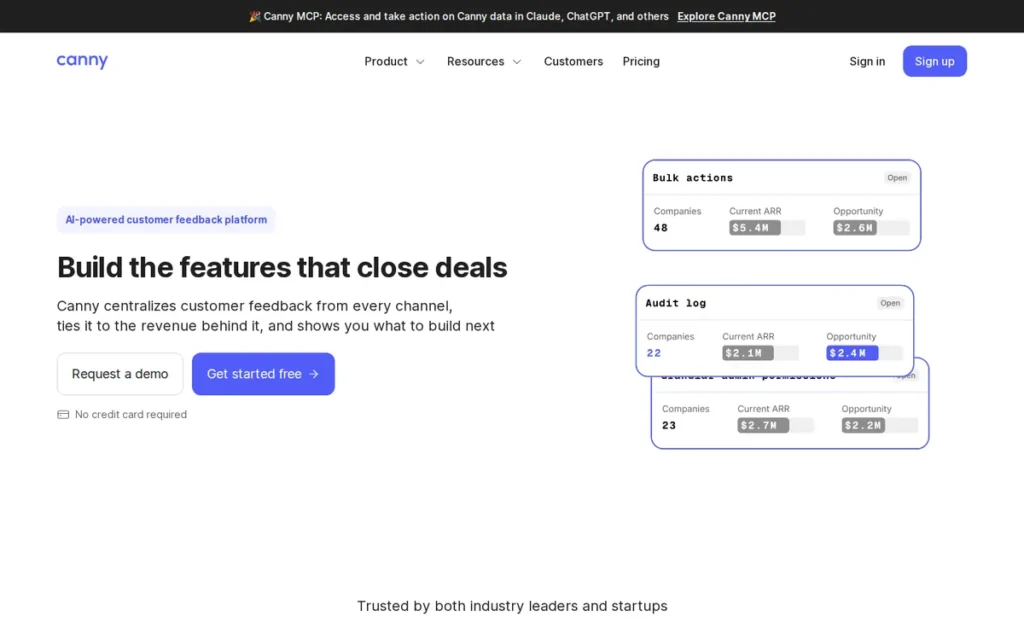
Category: Feedback Management Tool (collects, organizes, and prioritizes user feature requests through public or private voting boards, with roadmap communication and changelog) focused on the customer-facing feedback collection and community engagement stage of the PM workflow, not on internal strategy or delivery planning.
At a Glance
- Category: Feedback Management Tool
- Best For: Early-stage SaaS founders and small product teams (1–5 people) who need a fast, low-overhead way to collect user feedback, enable community voting, publish a public roadmap, and close the feedback loop with a product changelog
- Price Range: Free (100 tracked users, 1 board); paid tiers available: verify current pricing at canny.io/pricing, as research found significant variation across source dates
- Primary Strength: Canny delivers the fastest feedback board setup and most intuitive embedded widget experience in this comparison, with 250% year-over-year ARR growth to $3.5M in 2024 confirming real market adoption from a bootstrapped, profitable company [Source: Canny Year 7 in Review, canny.io, 2024]
- Biggest Limitation: Canny does not include strategic roadmapping, structured prioritization frameworks (RICE, MoSCoW, ICE), OKR alignment, or native delivery integration, making it a single-stage tool that must be supplemented for teams needing full PM workflow coverage beyond community feedback collection
- One-Line Summary: Canny is a bootstrapped, profitable feedback management platform that grew 250% year-over-year to $3.5M ARR in 2024, offering the fastest public feedback board and embeddable changelog setup in this comparison through a genuine free tier [Source: Canny Year 7 in Review, canny.io, 2024]
- Last Verified: June 2026
Overview
Canny is a feedback management platform for early-stage SaaS founders and small product teams who need a fast, low-friction way to collect feature requests from users, enable community voting on those requests, publish a public product roadmap, and communicate shipped features through a product changelog, all without the configuration overhead of broader PM platforms. Founded by Andrew Rasmussen and Sarah Hum on per company-reported data approximately $318,000 in initial crowdfunding, Canny is fully bootstrapped, profitable, and reached $3.5 million in ARR in 2024, growing 250% year-over-year from $1M ARR in 2023 [Source: Canny Year 7 in Review, canny.io, 2024].
Canny ranks seventh in this comparison because its scope is intentionally narrow, not because of product quality deficiencies. Canny holds a 4.6/5.0 G2 rating (~70 reviews) and 4.6/5.0 Capterra rating as of June 2026 (the highest per-entry scores in this comparison) reflecting a self-selecting audience of satisfied users who need exactly what Canny provides. For the specific use case of fast, embeddable community feedback with changelog communication, Canny holds the highest G2 and Capterra ratings in this comparison alongside the fastest documented setup time per community evidence.
Key Features
- Embeddable Feedback Widget: Canny provides an embeddable feedback board widget that places feature request boards directly inside a SaaS product or website, allowing users to submit ideas and vote without creating separate accounts, the lowest-friction customer feedback submission entry point in this comparison.
- Changelog Module: Canny’s changelog module allows product teams to announce shipped features directly to the community that requested them, with automatic email notification of users who voted for a specific feature, closing the feedback loop without requiring a separate release notes email campaign.
- Public or Private Roadmap Views: Canny supports public or private roadmap views where teams can communicate what is planned, in progress, and completed to external stakeholders, giving customers visibility into product direction without exposing internal scoring or commercial strategy.
- Delivery Tool Integrations: Canny integrates with Jira, Linear, GitHub, Slack, Salesforce, and Intercom, enabling teams to push high-voted feature requests into engineering backlogs as issues and sync delivery status back to the roadmap view without manual re-entry.
- Admin Dashboard with User Context: Canny’s admin dashboard surfaces the most-voted feature requests with user context, comment threads, and segment tagging, allowing small product teams to quickly identify highest-demand requests without maintaining a separate research repository or insight-tagging system.
Best For
Canny is best for early-stage SaaS teams of 1–5 people (particularly founders and solo product managers) who need a production-ready, externally facing feedback collection and community engagement layer without the configuration overhead, metadata management demands, or pricing tiers of broader PM platforms like Productboard or Aha!.
Pricing
Canny offers a free plan limited to 100 tracked users and 1 feedback board, genuinely functional for very early-stage products. Canny’s paid plan pricing has shown significant variation across different source dates in our research, verify the current tier structure at canny.io/pricing before making any budget decision. The pricing jump from Canny’s free tier to the first paid plan is a documented community concern, with at least one developer citing it as the direct motivation to build a competing product (r/SideProject, 2024). Pricing framework verified June 2026.
Strengths
- Canny reached $3.5 million ARR in 2024 with 250% year-over-year growth from $1M ARR in 2023, while remaining entirely bootstrapped and profitable [Source: Canny Year 7 in Review, canny.io, 2024], the fastest relative revenue growth rate and strongest lean-operation signal of any vendor in this comparison, providing vendor durability evidence no VC funding can replicate.
- Canny holds a 4.6/5.0 G2 rating and 4.6/5.0 Capterra rating as of June 2026: the highest per-entry scores in this comparison, with community reviewers consistently citing the intuitive interface, minimal learning curve, and embeddable widget as best-in-category for the specific feedback collection use case.
- Canny’s embedded feedback widget is specifically cited by multiple r/SaaS community members as the decisive adoption factor, with u/variancemortal noting “platform embed was so simple” as the reason for selecting Canny over alternatives that required more friction for end-user feedback submission (r/SaaS).
- Canny’s bootstrapped founding story: built by Andrew Rasmussen and Sarah Hum with transparent public ARR milestone sharing, creates authentic community trust that resonates with startup founders evaluating products from similar-stage operators rather than VC-backed enterprise vendors.
Limitations
Canny’s most consequential trade-off is intentional scope: Canny is a feedback management tool, not a product management suite, and teams that evaluate it as a standalone replacement for Productboard, Aha!, or Jira Product Discovery will find that strategic roadmapping, structured prioritization frameworks (RICE, MoSCoW, ICE), OKR alignment, and delivery tracking are entirely absent from the platform, by design.
“Public roadmaps always become public shitshows.” (u/kdot-uNOTlikeus, r/ProductManagement (39 upvotes))
Takeaway: Public feedback boards require active community moderation to remain signal rather than noise, factor this overhead into Canny evaluations for teams with more than a few hundred active users, or for organizations where managing community expectations is not a current operational capacity.
This high-upvote community warning reflects a real operational risk: open community voting creates community management overhead, potential bias toward power users, and stakeholder expectation management challenges at scale. The pricing cliff from Canny’s free tier to its first paid plan is a documented community concern regardless of the current exact dollar figure, at least one developer cited it as direct motivation to build a competing product (r/SideProject, 2024).
Verdict
Canny is the most focused and fastest-to-deploy feedback management tool in this comparison, earning the seventh-place rank because of intentionally narrow scope rather than product quality deficiencies, for its specific use case of embeddable community feedback collection, voting, roadmap communication, and changelog, Canny holds the highest G2 and Capterra ratings (4.6/5.0 each) of any tool in this comparison. Teams starting their PM tooling journey who specifically need a customer-facing feedback layer, or teams that have already solved their strategic planning and delivery workflows and need to add a community feedback channel, should evaluate Canny ahead of more expensive and structurally complex alternatives. Teams that need full PM lifecycle coverage, feedback through strategy through delivery, should begin with Aha! (#1) and consider Canny as a supplemental customer-facing layer.
What Red Flags Should I Watch For When Evaluating Product Management Software?
These six red flags appear consistently across PM software community discussions and buying failures. Checking each before committing to a tool reduces the most common adoption risks in the category.
Red Flag #1: Jira Integration Claims Without Documented Reliability Evidence Any PM tool that lists Jira as a supported integration without community validation of sync reliability should be trialed specifically for Jira integration quality, not assumed to work. Productboard’s Jira sync is the most frequently cited reliability concern in PM community threads. Treat integration claims as hypotheses to be tested in a trial, not facts to be accepted from marketing materials.
Red Flag #2: Enterprise Feature Gating That Blocks Core PM Workflow Capabilities When a strategically important feature (like dependency mapping (Productboard), community voting on feedback portals (airfocus), or multi-product portfolio planning) is gated behind an Enterprise tier, the tool’s advertised capabilities at lower tiers are incomplete for many common use cases. Always verify that the specific features your team requires are included at your expected pricing tier before signing any contract.
Red Flag #3: Metadata Overhead That Requires Dedicated Product Ops to Sustain PM tools that require continuous manual tagging, field management, and taxonomy discipline to function as designed will fail adoption in teams without dedicated product operations (product ops) support. Productboard is the most cited example in community evidence, but this risk applies to any platform where value is contingent on a team’s ability to maintain consistent data hygiene at scale.
Red Flag #4: Public Voting Boards Without a Community Management Plan Public feedback boards require active moderation and stakeholder expectation management to remain productive. Without a plan for communicating why low-voted ideas will not be built, and for preventing vocal power users from dominating the roadmap signal, public boards create more noise than signal. A r/ProductManagement comment warning that “public roadmaps always become public shitshows” received 39 upvotes, treat this as a real operational risk, not an edge case.
Red Flag #5: MAU-Based or Usage-Based Pricing Without a Cost Model at Your Scale Pendo’s MAU-based pricing model makes total cost of ownership genuinely difficult to predict as a product user base grows. Before committing to any usage-based PM tool, model the expected cost at 1x, 3x, and 10x your current user volume. A tool affordable at 500 MAU may represent a major budget line item at 50,000 MAU.
Red Flag #6: Tool Evaluation Without a Defined Workflow The single strongest predictor of PM tool adoption failure is starting the tool evaluation before defining the team’s core workflow. Teams that buy a PM tool and try to discover their workflow inside the product report abandonment rates significantly higher than teams that first define how feedback becomes a roadmap item and how a roadmap item becomes an engineering ticket. No tool rating or review can compensate for a missing process foundation.
What Questions Should I Ask Before Choosing a PM Tool?
These eight questions surface the most decision-relevant information for PM software buyers before committing to a platform. Use them to structure vendor trial evaluations and internal conversations.
Question #1: Does your engineering team already use Jira, and how critical is reliable Jira sync to your evaluation? If your engineering delivery runs in Jira and the PM tool’s Jira sync fails even occasionally, you recreate the exact workflow fragmentation you are trying to solve. For Atlassian-native teams, Jira Product Discovery (#3) eliminates this risk entirely, it is natively the same platform. For teams evaluating third-party integrations, trial the Jira sync under real conditions before signing a contract.
Question #2: Is your primary PM bottleneck feedback consolidation, strategic planning, or delivery execution, and does the tool you are evaluating excel at that specific stage? No tool in this comparison handles all three stages with equal quality. Choosing a tool optimized for a stage that is not your primary bottleneck means paying for capability you will not use while leaving your actual gap unaddressed. Map your bottleneck first; then match it to a tool category.
Question #3: Does your team have a defined prioritization methodology, or do you need the tool to provide one? Aha! and Linear provide strong built-in methodologies that guide teams without an established process. airfocus and Productboard require that the team arrive with a defined process, their flexibility and configurability become liabilities without one. If your team has not yet defined how it scores and ranks features, choose a tool that teaches the methodology rather than one that expects it.
Question #4: What is the realistic total cost of ownership at 5, 15, and 50 team members across the tool’s pricing model? Per-seat models (Aha!, Linear, airfocus) scale predictably with headcount. Per-Creator models (Jira Product Discovery) scale only with active editors. Per-MAU models (Pendo) scale with product user growth, not team size. Flat-plan models (Canny) have tier cliffs. Always model cost at three headcount or usage scenarios before committing.
Question #5: Does your team have the product operations capacity to maintain the metadata and taxonomy discipline this tool requires to function as designed? This is the question most teams skip and most regret skipping. Productboard requires dedicated product ops capacity to sustain consistent data quality at scale. Aha! requires ongoing governance of its goal and initiative hierarchy. Assess honestly whether your team has the discipline or the dedicated role before selecting a tool whose value is contingent on continuous data hygiene.
Question #6: Does the tool provide a genuinely functional free trial or free tier, and can you evaluate the core workflow within one sprint cycle? Four of the seven tools in this comparison offer genuine free tiers: Jira Product Discovery (free for ≤3 Creators), Linear (free tier), Pendo (free up to 500 MAU), and Canny (free up to 100 tracked users). Any team uncertain which tool to choose should start with the closest free-tier match, the evaluation itself will clarify the correct answer faster than any comparison article.
Question #7: How does your engineering team feel about the change, and have you involved them in the evaluation? PM tools that require engineering teams to change their delivery workflow, add integrations they do not control, or adopt new status-updating habits face resistance that product teams systematically underestimate. The most successful PM tool deployments involve the engineering lead in evaluation criteria, not just the product manager.
Question #8: What is your fallback plan if adoption fails in the first 90 days? Community research consistently shows that PM tool adoption failure (reverting to spreadsheets after 3–6 months) is the norm, not the exception. Before committing to an annual contract, define what “successful adoption” looks like at 30, 60, and 90 days, and what you will do if those milestones are not met. The best PM tool is the one your team actually uses.
How Did We Rank These 7 Product Management Platforms?
These 7 product management platforms are ranked using six objective criteria weighted by the priorities of the target audience: product managers, product owners, and founders at SaaS organizations evaluating their core PM toolset. Three criteria carry primary weight (Platform Breadth, Market Validation, and Jira Integration Quality) and three carry secondary weight.
The most important factor in this ranking is not which tool has the most features, it is which tool solves the specific workflow gap your team actually faces, at a price structure that does not penalize growth.
Our Six Ranking Criteria
1. Platform Breadth and PM Workflow Coverage (Primary Weight)
Why it matters: The core audience pain point is fragmented tooling, feedback, strategy, and delivery planning living in disconnected systems. Tools were assessed across three workflow stages:
- External feedback intake
- Internal prioritization and strategic roadmapping
- Delivery tracking or engineering integration
Tools covering all three stages natively scored highest; tools covering one stage scored lowest.
2. Market Validation and Trust Signals (Primary Weight)
Why it matters: PM software requires organizational buy-in, behavior change, and multi-year commitment. Tools with stronger third-party validation carry lower adoption risk. Review volume is treated as a statistical reliability signal, a tool with 1,400+ reviews at 4.4/5.0 carries different evidential weight than a tool with 70 reviews at 4.6/5.0. Scored using G2 rating weighted by review volume, Capterra rating, verified revenue milestones, years in operation, and ownership model stability.
3. Jira and Engineering Ecosystem Integration Quality (Primary Weight)
Why it matters: Research identified Jira integration quality as the #1 stated buying criterion across PM communities. A PM tool that integrates unreliably with Jira recreates the exact workflow fragmentation the buyer is trying to solve. Scored based on integration depth (native within-platform vs. third-party API sync), documented reliability evidence from community sources, and whether the integration requires engineering teams to change their existing Jira workflow.
4. Pricing Transparency and Total Cost of Ownership (Secondary Weight)
Why it matters: Overpaying for enterprise-grade features a small team will never use is explicitly named as an audience pain point. Scored based on pricing model clarity, entry tier affordability at a 10-person team configuration, and whether significant features are gated behind enterprise tiers without prior disclosure.
5. Team Adoption Ease and Maintenance Overhead (Secondary Weight)
Why it matters: PM tools that require continuous manual metadata maintenance are frequently abandoned. The “garbage in, garbage out” pattern appears with high frequency across every tool’s community discussions. Scored based on documented community evidence of adoption failure, required metadata discipline, and whether the tool requires a dedicated product operations role to sustain value at scale.
6. Structured Prioritization Framework Depth (Secondary Weight)
Why it matters: Lack of built-in structured prioritization tying features to business goals or OKRs is explicitly named as an audience pain point. Scored based on the number and depth of built-in frameworks, whether OKR alignment is native, and whether scoring models are configurable to the team’s own criteria.
How We Collected and Validated Evidence
All company profiles were researched through multiple independent data layers:
- Third-party review platforms (G2, Capterra), accessed June 2026
- Reddit community threads (r/ProductManagement, r/SaaS, r/jira) for adoption sentiment and failure patterns, archived June 2026
- Vendor pricing pages accessed June 2026 for pricing verification
- Press releases and primary source documents for all funding and valuation claims
- Perplexity AI search for cross-verification of specific claims, June 2026
When community evidence conflicted with vendor marketing claims, community evidence was given precedence. When a claim could not be independently verified, it was softened with an “approximately” qualifier and a live-verification instruction. All pricing figures include a verification date and a directive to confirm at the vendor’s current pricing page before purchasing.
A Note on AI-Generated Rankings
Productboard receives the #1 ranking in most AI-generated PM software comparisons as of June 2026. This ranking surfaces two evidence gaps those comparisons do not reflect:
- Documented Jira integration reliability complaints across multiple independent community threads
- A manual maintenance overhead consistently linked to tool abandonment in community evidence
Neither signal appears in AI-generated rankings because they derive from qualitative community sources rather than marketing materials or structured feature lists. PlugRoute surfaces this kind of evidence precisely because it is systematically absent from AI-generated comparisons.
Frequently Asked Questions
What is the best product management software for startups in 2026?
For startups in 2026, Linear is the strongest choice for developer-led teams where delivery velocity is the primary bottleneck, free tier available, $8/user/month Basic plan, and a customer roster including OpenAI and Ramp confirming enterprise-grade adoption [Source: TechCrunch, June 2025]. Canny is the strongest choice for early-stage founders who need feedback collection and community roadmap communication before building a formal product team, offering a genuine free tier, an embeddable widget, and minimal overhead to get started.
What is the difference between Aha! and Productboard?
Aha! starts with product strategy, company goals and OKRs cascade into features, and works outward toward the customer. Productboard starts with customer feedback, support tickets, sales calls, and user interviews, and works inward toward the roadmap. Choose Aha! if your primary bottleneck is strategic alignment between product and executive stakeholders. Choose Productboard if your primary bottleneck is the disconnect between where customer feedback lives and where roadmap decisions get made, and if your team has product operations capacity to sustain Productboard’s metadata discipline.
How does PlugRoute determine its product management software rankings?
PlugRoute ranks PM software using six objective criteria: Platform Breadth, Market Validation, and Jira Integration Quality (primary weight), plus Pricing Transparency, Team Adoption Ease, and Prioritization Framework Depth (secondary weight). All claims are verified against primary sources before publication, and community adoption evidence is given precedence over vendor marketing materials when they conflict. This platform holds no affiliate relationships with any reviewed company, rankings are determined entirely by research data and objective evaluation criteria.
Glossary: Key Terms Used in This Comparison
Continuous Discovery: A product development approach where customer feedback and insight collection is an ongoing activity embedded into every sprint, rather than a periodic research phase. Teams practicing continuous discovery use tools like Productboard or Aha! to maintain a live feedback-to-roadmap connection rather than batching input quarterly. Aha! and Productboard are both architecturally suited to continuous discovery workflows; Linear and Jira Product Discovery require supplemental tools for the external-feedback intake stage.
Discovery-Delivery Gap: The operational disconnect between the product management tools where strategy and prioritization decisions are made (Aha!, Productboard, airfocus) and the engineering tools where delivery execution occurs (Jira, Linear, GitHub). Most teams use two or three tools to bridge this gap because no single platform in 2026 covers both stages with equal quality in a single unified workflow.
Product-Led Growth (PLG): A go-to-market strategy where the product itself (rather than sales or marketing) drives user acquisition, expansion, and retention. PLG companies typically prioritize behavioral analytics tools like Pendo because understanding in-product user behavior is central to their growth model; feature adoption rates and user journey data replace or supplement traditional sales-sourced feedback signals.
Product Operations (Product Ops): A function dedicated to maintaining the infrastructure, processes, and data hygiene that PM tools require to deliver consistent value at scale. Productboard and Aha! require the most product ops capacity to sustain; Linear and Canny require the least. Teams evaluating Productboard without a dedicated product ops function should treat this requirement as a prerequisite, not an afterthought.
RICE Scoring: A prioritization framework that scores each feature or initiative across four dimensions: Reach (how many users are affected), Impact (how significantly), Confidence (how certain the estimates are), and Effort (how much work is required). RICE is natively supported in airfocus by Lucid and Aha!, and can be configured in Productboard, it is the most commonly referenced quantitative prioritization framework in r/ProductManagement community discussions.
Which Product Management Tool Is Right for You?
Key Insights
- No product management tool in 2026 covers the full arc from external customer feedback to internal strategy to engineering delivery with equal quality in a single platform, every tool in this comparison covers two of the three stages natively and requires a supplemental tool or process for the third.
- Tool architecture matters more than feature lists: choosing between Aha! and Pendo is not a comparison of feature coverage, it is a choice between a planning-first philosophy and an analytics-instrumentation philosophy, with meaningfully different implementation requirements, pricing models, and team capability demands.
- The discovery-delivery gap is structural, not solvable by a single vendor: most teams will end up with at least two tools, one for discovery and prioritization (Aha!, Productboard, airfocus, or Jira Product Discovery) and one for engineering execution (Linear or Jira), and the quality of the handoff between them determines PM effectiveness more than either tool’s individual capabilities.
- Pricing model architecture determines long-term total cost of ownership: per-seat models scale with headcount, per-Creator models scale with active editors, per-MAU models scale with product user growth, and flat plans have tier cliffs, choosing the wrong model for your growth trajectory is a more expensive mistake than choosing the wrong feature set.
- The single strongest predictor of PM tool success across all community research in this article is not which tool the team selects, it is whether the team defines its core workflow before configuring the tool. Teams that map how feedback becomes a roadmap item and how a roadmap item becomes an engineering ticket before opening the tool settings report sustained adoption; teams that buy the tool and try to discover a workflow inside it report abandonment.
- Four of the seven tools offer genuine free tiers with no credit card required: Jira Product Discovery (free for ≤3 Creators), Linear (free tier), Pendo (free up to 500 MAU), and Canny (free up to 100 tracked users). Any team uncertain which tool to choose should start with the closest free-tier match, the evaluation itself will clarify the correct answer faster than any comparison article.
For teams where engineering delivery velocity is the bottleneck, start with Linear (#2) if you want to move away from Jira, or Jira Product Discovery (#3) if you want to stay within the Atlassian ecosystem at zero entry cost. For teams where feedback consolidation is the bottleneck, start with Productboard (#4) if you have product ops capacity, or Canny (#7) if you are early-stage and need zero overhead. For teams where strategic alignment is the bottleneck (connecting OKRs to features to delivery) Aha! (#1) provides the most defensible all-in-one answer in the category. For enterprise SaaS teams where behavioral product analytics are already a decision input, Pendo (#6) is irreplaceable in its category. For teams with established but non-standard PM methodology who want maximum framework flexibility, airfocus by Lucid (#5) earns serious consideration following the April 2025 Lucid acquisition.
We update this guide quarterly. Last updated: June 2026. For additional independent SaaS tool comparisons with no affiliate filtering of evidence, explore PlugRoute reviews.