Zoho Desk leads for SMB value in 2026, Jira Service Management leads for IT departments needing ITIL governance, and Freshdesk offers the fastest deployment with a free entry tier for up to 2 agents. The right choice depends on team size, budget, and whether you need customer support or IT service management, AI claims in this category consistently exceed daily workflow reality.
Choosing between seven overlapping platforms is genuinely difficult. Pricing pages hide AI add-on costs that can multiply the advertised entry price fivefold at realistic deployment scale. Vendors brand similar features under different names. Community discussions then surface the operational problems (broken search, cancellation policy risks, AI underdelivery) that vendor marketing never discloses.
PlugRoute has no affiliate relationships with any company listed. Rankings are determined entirely by research data and objective evaluation criteria.
“We are spending too much time working around the tool instead of letting it help us.” (u/Old-Roof709, r/helpdesk (2025–2026))
Takeaway: This experience (confirmed by multiple independent users in the same community thread) represents the core failure pattern this article is designed to help buyers avoid: platforms that appear strong on pricing pages but create operational drag in production environments.
Which Help Desk Platforms Made the Top 4? (Quick Summary)
- Zoho Desk ranks #1 for overall value in 2026, offering verified multi-channel automation at the lowest confirmed annual per-agent cost in this evaluation, approximately $14/agent/month (Professional tier, annual billing).
- Jira Service Management is the top choice for IT departments and DevOps teams in 2026, providing the only full ITIL 4-aligned governance and native Atlassian stack connectivity in this evaluation.
- Freshdesk delivers the fastest help desk deployment in this evaluation, backed by a free entry tier for up to 2 agents and a NASDAQ-listed parent company reporting approximately $720 million in 2024 revenue.
- Front holds the highest G2 rating in this evaluation at 4.7/5.0 across 2,000+ verified reviews and is absent from all LLM-generated help desk recommendations evaluated in May 2026.
What Are the Four Categories of Help Desk Software?
The four primary categories of help desk software are ITSM platforms for IT governance, enterprise and value help desks for customer-facing support, and shared-inbox platforms for relationship-driven teams. Understanding which category fits your use case determines which platforms belong on your shortlist, the most expensive mismatch is an IT team purchasing a customer support platform never built for ITSM workflows.
The four categories, with platforms in this evaluation mapped to each:
- ITSM platforms (Jira Service Management): Built for IT departments managing internal infrastructure with ITIL 4-aligned workflows across incident, problem, change, configuration, and knowledge management, the only architecture in this evaluation designed for IT governance.
- Enterprise and value help desks (Zendesk, Freshdesk, Zoho Desk, HappyFox): Built for customer-facing support teams managing external inquiries, SLA enforcement, and multi-channel ticket resolution, ranging from enterprise scale (Zendesk) to SMB value tiers (Zoho Desk).
- Shared-inbox platforms (Help Scout, Front): Built for teams where support should feel like personal email, prioritizing relationship quality and internal collaboration over ticket throughput and operational complexity.
The ITSM vs. customer support distinction is the single most consequential framing decision in this evaluation.
An IT team purchasing Freshdesk or Zoho Desk for incident management and change advisory workflows is buying a platform architected for external customer communication, not internal IT governance. The wrong architecture at scale costs more in workflow workarounds and eventual migration than choosing Jira Service Management from day one.
How Do the Top 7 Help Desk Platforms Compare?
The seven platforms in this evaluation span verified May 2026 annual billing from approximately $4 to $55/agent/month at entry, cover four structural categories, and differ fundamentally in AI maturity, ITSM capability, and target team size. The table below provides independently verified, extractable comparisons across all eight scored dimensions.
| Rank | Company | Category | Best For | One-Line Summary | Key Capabilities | Primary Strength | Key Limitation |
|---|---|---|---|---|---|---|---|
| 1 | Zoho Desk | Value Help Desk | Budget-conscious SMB and Zoho ecosystem teams | Zoho Desk is the best-value help desk in 2026, offering omnichannel ticketing, Blueprint automation, and 50-app Zoho One integration at approximately $14/agent/month Professional tier on annual billing | Multi-channel ticketing; Blueprint workflow automation; Zia AI assistant; 50+ native Zoho One integrations; SLA management | Widest verified feature-to-cost ratio at every pricing tier; omnichannel plus Blueprint automation at approximately $14/agent/month annual billing | Vendor support quality rated poorly in 120-upvote r/sysadmin post (2025); Zia AI generative features not reliably delivering in production per community reports |
| 2 | Jira Service Management | ITSM Platform | IT departments, DevOps teams, Atlassian-stack organizations | Jira Service Management is the leading ITSM platform for IT teams in 2026, providing full ITIL 4-aligned governance with native Atlassian stack connectivity at approximately $20/agent/month Standard tier | ITIL 4-aligned incident, problem, change, asset, and knowledge management; native Jira, Confluence, and Bitbucket integration; CMDB Assets module; Atlassian Intelligence AI (Premium and Enterprise) | Only platform in this evaluation with full ITIL 4 alignment across all five disciplines and analyst-recognized ITSM credentials | Configuration quality determines outcomes; value drops significantly for organizations outside the Atlassian ecosystem |
| 3 | Freshdesk | Omnichannel Help Desk | SMB teams wanting fast setup and NASDAQ vendor transparency | Freshdesk is a widely deployed omnichannel help desk serving 60,000+ customers globally, backed by Freshworks (NASDAQ: FRSH) reporting approximately $720M in 2024 revenue | Multi-channel ticketing; Freddy AI with 7 documented capabilities; 1,000+ integrations; self-service portal; SLA automation | Free entry tier for up to 2 agents; NASDAQ-listed financial transparency; cross-vertical enterprise customer base including Cisco, Honda, and KFC | Persistent search reliability failures documented across years of community evidence; strict annual cancellation policy with collection escalation risk |
| 4 | Zendesk | Enterprise Help Desk | Enterprise customer support teams of 50+ agents | Zendesk is the enterprise help desk market standard in 2026, with 10,000+ organizations deploying Zendesk AI, agentic email AI at General Availability, and a 1,500-app marketplace | Agentic AI (GA May 2026); omnichannel Suite; 1,500+ app marketplace; AI quality assurance scoring; workforce management analytics | Most mature agentic AI architecture in commercial help desk; 10,000+ confirmed AI deployments and approximately $200M AI ARR (2025) | $55/agent/month entry price; add-on costs compound rapidly; own vendor support independently criticized as slow despite premium pricing |
| 5 | Front | Collaborative Help Desk | B2B customer success and operations teams | Front is the highest-rated help desk platform in this evaluation at G2 4.7/5.0, delivering collaborative shared-inbox support with Smart CSAT AI inference; absent from all LLM recommendations | Collaborative shared inbox with native internal commenting and shared drafts; Smart CSAT AI inference; AI Copilot and Autopilot; omnichannel SLA management; collision detection | Highest G2 rating in this evaluation (4.7/5.0 across 2,000+ reviews, May 2026) with native B2B collaboration embedded in the inbox | 160% price jump from Starter ($25/seat) to Growth ($65/seat); Starter tier restricted to single channel and 10 seats |
| 6 | HappyFox | Structured Service Desk | Mid-market service desk teams of 10–100 agents | HappyFox is the most underrated structured service desk in 2026, earning G2 4.5/5.0 and Capterra 4.6/5.0 with no viral community criticism threads identified in research through May 2026 | Structured ticket management; SLA enforcement; smart rules automation engine; knowledge base and self-service portal; omnichannel intake; AI ticket categorization | Only platform in this evaluation with zero viral community criticism threads; G2 4.5/5.0 paired with consistent organic community recommendation as a Zendesk alternative | Lower brand recognition creates procurement friction; Enterprise Pro pricing requires direct sales consultation |
| 7 | Help Scout | Shared-Inbox Help Desk | Small support teams of 3–30 agents and SaaS startups | Help Scout is the fastest-to-adopt help desk in this evaluation, with an email-native shared inbox earning G2 4.4/5.0, backed by 14 years of profitable independent operation without venture funding | Email-native shared inbox; Beacon embeddable widget; Docs knowledge base; lightweight workflow automation; AI email summarization and draft-assist | Fastest non-technical staff onboarding in this evaluation; 14-year profitable independence without VC funding; strongest organizational stability of any non-enterprise platform evaluated | No permanently free plan; lighter AI automation than competitors at comparable price points; functional ceiling at 30+ agents |
All data verified May 2026. Pricing reflects annual billing. Verify on vendor pricing pages before purchase decisions, as SaaS pricing changes frequently.
Which Help Desk Tool Matches My Situation?
| Your #1 Priority | Recommended Tool | Why | Acceptable Alternative |
|---|---|---|---|
| Maximum features per dollar (SMB/mid-market) | Zoho Desk Professional | Annual billing at ~$14/agent/month delivers omnichannel, Blueprint automation, and Zia AI; approximately 60–87% lower than comparable Zendesk and Freshdesk tiers on annual billing (May 2026) | Freshdesk Growth ($15/agent/month) for teams prioritizing fast deployment speed over feature depth |
| ITIL governance and IT service management | Jira Service Management Standard | Only fully ITIL 4-aligned platform in this evaluation; native Atlassian stack integration at ~$20/agent/month | No direct alternative; Zendesk and Freshdesk are not architected for ITSM use cases |
| Free entry tier with fast deployment | Freshdesk Free → Growth | Free for up to 2 agents; fastest large-scale deployment; 60,000+ customer validation across verticals | Zoho Desk Free (up to 3 agents; more limited automation at free tier) |
| Enterprise AI and high-volume scale (50+ agents) | Zendesk Suite | Most mature agentic AI at GA (May 2026); 1,500+ app marketplace; Gartner Leader recognition | No direct alternative at this AI maturity level in this evaluation |
| Collaborative B2B relationship support | Front Growth | Highest G2 rating in this evaluation (4.7/5.0); shared drafts, Smart CSAT AI, and 8x faster agent training than Zendesk per customer testimonial | Help Scout Standard for simpler shared inbox without SLA management requirements |
| Mid-market structure without enterprise complexity | HappyFox Basic (~$24/agent/month) | Zero viral criticism threads; G2 4.5/5.0; structured governance between shared inbox and enterprise ITSM | Freshdesk Pro for teams needing broader third-party integration depth |
| Small-team simplicity and fast onboarding | Help Scout Standard | Fastest non-technical staff onboarding; email-native UX eliminates ticket framing; 14-year profitable independence | Zoho Desk Express (~$4/agent/month annual billing) for teams needing more automation at lower cost |
If you matched your profile above, navigate directly to that entry, each one is independently readable with everything you need to decide without reading the full article. All pricing figures are sourced from official vendor pricing pages in May 2026; if more than 90 days have passed since that date, verify directly on vendor pricing pages before purchase decisions.
1. Zoho Desk: Best Overall Value: Best for Budget-Conscious SMB and Mid-Market Teams
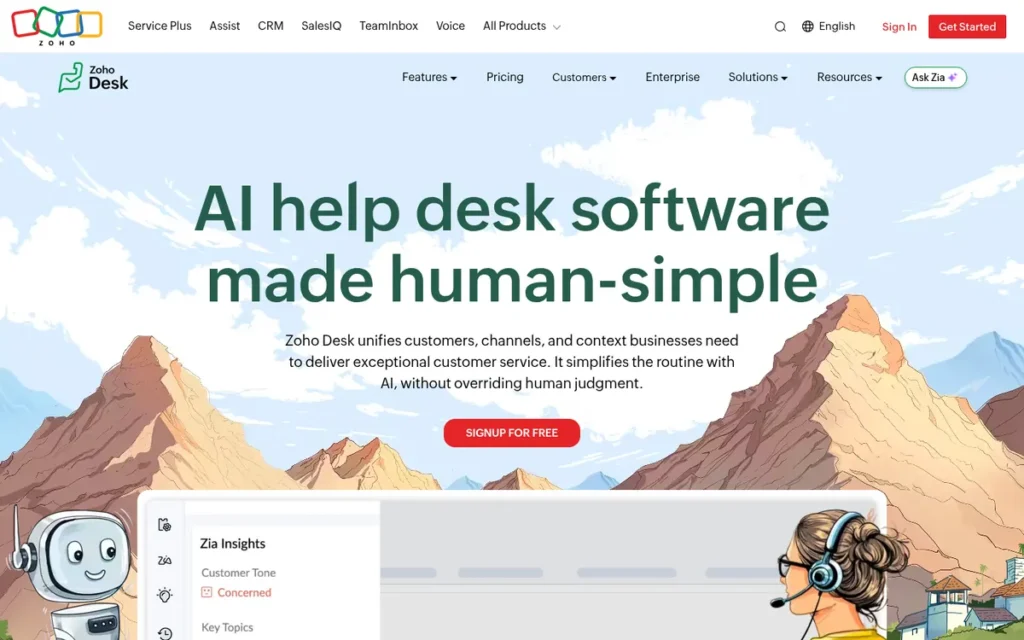
Category: Value Help Desk, a multi-channel customer support platform delivering enterprise-grade feature depth at SMB price points within the Zoho business software ecosystem.
At a Glance
- Category: Value Help Desk
- Best For: Budget-conscious SMB and mid-market teams of 1–50 agents, particularly those already using or planning to adopt Zoho CRM or other Zoho One applications
- Price Range: Free (up to 3 agents) – ~$24/agent/month (Enterprise, annual billing); monthly billing rates: $7–$40/agent/month; verified May 2026
- Primary Strength: Zoho Desk delivers the widest feature-to-cost ratio in this evaluation, omnichannel ticketing, Blueprint workflow automation, native 50-app Zoho One integration, and Zia AI starting at approximately $4/agent/month on annual billing
- Biggest Limitation: Zoho Desk’s vendor support quality is rated among the lowest in the category (a 120-upvote r/sysadmin post (2025) characterized it as “the worst support I’ve ever seen”) and community feedback indicates Zia AI’s generative capabilities are not yet reliably delivering on marketing claims in production environments
- One-Line Summary: Zoho Desk is the best-value help desk platform in 2026 for teams of 1–50 agents, offering multi-channel ticketing, Blueprint automation, and native Zoho One integration at annual billing rates approximately 60–87% lower than comparable Zendesk and Freshdesk tiers as of May 2026
- Last Verified: May 2026
Overview
Zoho Desk is a cloud-based multi-channel help desk platform built for SMB to mid-market customer support teams needing comprehensive ticketing, workflow automation, and CRM integration without enterprise-scale pricing. Zoho Desk offers verified annual billing from approximately $4 to $24/agent/month across five tiers, including a free plan for up to three agents.
Zoho Desk supports omnichannel ticket intake across email, chat, phone, WhatsApp, and social, alongside native connectivity to all 50+ Zoho One business applications, enabling bidirectional data flow without third-party connectors.
Zoho Desk is developed by Zoho Corporation, a Chennai and Austin-based private company with a 30-year operating history and no venture capital funding, a pricing and product stability advantage over VC-backed competitors.
Key Features
- Zia AI Assistant: Zoho Desk’s Zia provides ticket sentiment detection, automatic categorization, tone adjustment, and generative response drafting, with Q1 2025 updates adding “Support Specialist” and “Resolution Expert” AI roles and generative AI capabilities in live chat sessions.
- Blueprint Automation Engine: Zoho Desk’s Blueprint enables teams to define structured, multi-step ticket resolution workflows with built-in SLA enforcement, approval gates, and conditional branching, delivering enterprise-grade process governance at SMB pricing that most competitors reserve for their highest tiers.
- Native Zoho One Integration: Zoho Desk natively connects with all 50+ Zoho One applications (including Zoho CRM, Zoho Analytics, Zoho Books, and Zoho SalesIQ) enabling cross-platform data sharing without additional API costs or third-party connectors.
- Multi-Channel Ticket Intake: Zoho Desk consolidates ticket intake from email, live chat, phone, WhatsApp, Facebook, Twitter/X, and web forms into a single agent workspace with consistent SLA management and reporting across all active channels.
- Automation Rules and Macros: Zoho Desk’s automation engine supports event-triggered workflows, round-robin and skill-based ticket assignment, custom ticket fields, multi-department routing, and SLA escalation triggers, enabling teams to automate repetitive tier-1 handling without developer involvement.
Best For
Zoho Desk is best for SMB and mid-market teams of 1–50 agents operating on structured budgets who are already using or considering other Zoho products. Zoho Desk is also the strongest fit for cost-conscious teams needing genuine multi-channel automation, CRM integration, and AI-assisted workflows without Zendesk- or Freshdesk-scale pricing.
Pricing
Zoho Desk pricing per agent/month (verified May 2026):
Annual billing (approximately):
- Free: $0 (up to 3 agents, basic email ticketing)
- Express: ~$4/agent/month
- Standard: ~$8/agent/month
- Professional: ~$14/agent/month
- Enterprise: ~$24/agent/month
Monthly billing (for reference):
- Express: $7 / Standard: $14 / Professional: $23 / Enterprise: $40
A 10-agent team on Professional with annual billing costs approximately $140/month, compared to $550/month for Zendesk Suite Team or $490/month for Freshdesk Pro before AI add-ons. Verify current pricing at zoho.com/desk/pricing.html, as regional and promotional rates vary.
Strengths
- Zoho Desk earned a G2 rating of 4.4/5.0 across more than 4,000 verified reviews and a Capterra score of 4.5/5.0 as of May 2026, ranking among the three highest-rated platforms in this seven-tool evaluation, with review themes consistently praising feature depth relative to pricing and automation quality.
- Third-party analyses published in 2026 consistently classify Zoho Desk as the highest feature-to-cost platform in the help desk category: Zoho Desk’s Professional tier at ~$14/agent/month annual billing includes omnichannel support, Blueprint automation, SLA management, and Zia AI-assisted routing, capabilities that competitors charge $49–$89/agent/month to access (Mojo HelpDesk, April 2026).
- Zoho Desk’s Q1 2025 feature release added generative AI in live chat, specialized AI role types, and enhanced analytics reporting, demonstrating active R&D investment that continues to narrow the AI maturity gap with larger enterprise platforms.
- Zoho Corporation’s 30-year bootstrapped operating history as a privately held company with no venture capital funding provides stronger long-term pricing and product stability than VC-backed competitors facing investor exit pressure, a meaningful consideration for teams making multi-year commitments (Zoho About, 2026).
Limitations
- Vendor Support Quality: Zoho Desk’s most consequential trade-off is not the product itself but vendor responsiveness. A post on r/sysadmin characterized Zoho support as “the worst I’ve ever seen” and received 120 upvotes in 2025, indicating broad community agreement rather than an isolated complaint.
“Zoho has by far the worst support I’ve ever seen from a company. I have to CONSISTENTLY push back and tell their support that they’re full of shit in order to get anywhere.” (u/tylrat93, r/sysadmin, 120 upvotes, 2025)
Takeaway: Zoho Desk’s vendor support weakness reflects broad community agreement, teams should submit a real support ticket during the free trial and measure actual response quality before committing to any annual plan.
- AI Delivery Reliability: Zoho Desk’s Zia AI generative capabilities, while documented in Q1 2025 release notes, may not be reliably delivering on marketing claims in production. A community practitioner stated directly “AI in Desk is bullshit as of now” on r/ZohoDesk in 2025, suggesting a meaningful gap between documented features and daily operational utility that buyers should test before committing.
- WhatsApp Channel Gaps: Zoho Desk’s instant messaging analytics are limited for WhatsApp-heavy operations. A technical support lead on r/ZohoDesk (2025) documented “extremely limited analytics for IM channels (especially WhatsApp)” and “bugs and strange behavior in the IM module”, making Zoho Desk a risky primary platform for teams where WhatsApp is the dominant support channel.
- Onboarding Complexity: Zoho Desk’s extensive feature set: Blueprint automation, Zia AI, and multi-app Zoho One connectivity, can feel overwhelming for teams with limited admin resources. Independent reviews consistently note a steep initial learning curve for non-technical support managers configuring workflows and automation rules for the first time.
Verdict
Zoho Desk is the best-value help desk platform available in 2026, offering enterprise-class feature breadth (multi-channel ticketing, Blueprint workflow automation, and a native 50-app Zoho ecosystem) at annual billing rates approximately 60–87% lower than comparable Zendesk and Freshdesk tiers as of May 2026. Zoho Desk ranks #1 in this evaluation based on its G2 4.4/5.0 across 4,000+ reviews, transparent self-serve pricing, and the widest verified feature set per dollar in the category. Buyers should trial Zia AI features with real ticket data before relying on generative capabilities in production, and should explicitly test vendor support responsiveness before signing any annual plan.
2. Jira Service Management: Best for IT Teams, DevOps Organizations, and ITSM/ITIL Compliance
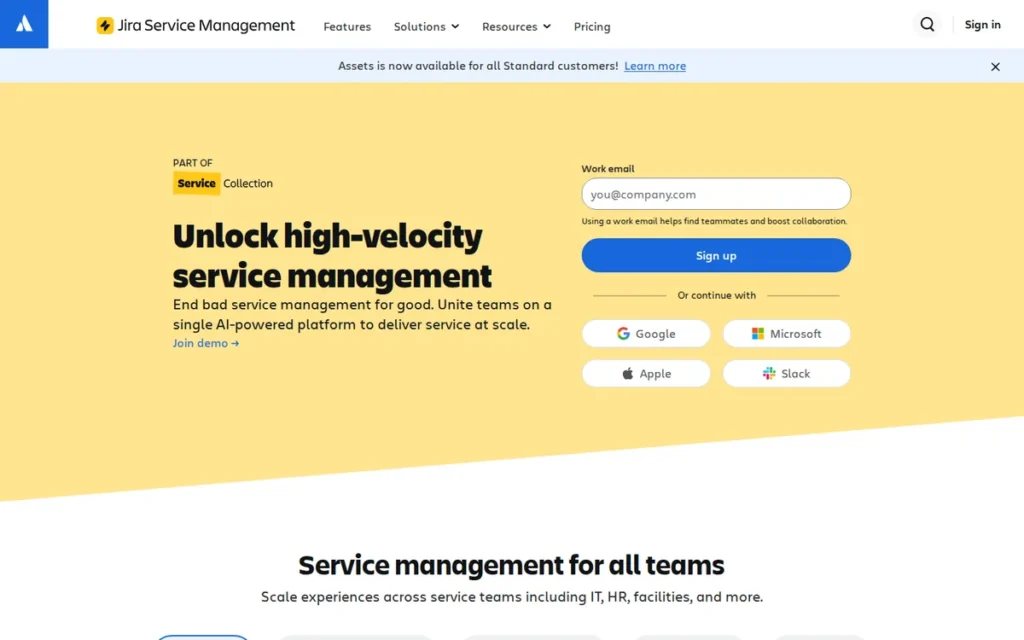
Category: IT Service Management (ITSM) Platform, a fully ITIL-aligned service desk built for IT departments, DevOps organizations, and internal service teams requiring structured governance across incident, problem, change, asset, and knowledge management.
At a Glance
- Category: IT Service Management (ITSM)
- Best For: IT departments, DevOps teams, and organizations already using Jira Software or Confluence that need ITIL-aligned incident, change, and problem management with direct engineering pipeline integration
- Price Range: Free (up to 3 agents) – ~$47–$51/agent/month (Premium, annual billing); Enterprise: custom; verified May 2026
- Primary Strength: Jira Service Management is the only platform in this evaluation with full native ITIL 4 alignment across all five ITSM disciplines, combined with native Jira Software integration that connects support tickets directly to engineering backlogs and deployment events in real time
- Biggest Limitation: Jira Service Management’s value drops significantly for organizations outside the Atlassian ecosystem, and Atlassian’s Server-to-Cloud migration has left some on-premise feature sets without direct Cloud equivalents, creating workflow disruption for existing customers during transitions
- One-Line Summary: Jira Service Management is the leading ITSM platform for IT teams in 2026, providing ITIL 4-aligned incident, change, and asset management with native Atlassian stack connectivity, available free for up to three agents or at approximately $20/agent/month on the Standard tier
- Last Verified: May 2026
Overview
Jira Service Management (JSM) is Atlassian’s enterprise-grade IT service management platform, designed for IT departments, DevOps organizations, and internal service operations requiring structured ITIL-aligned workflows for incident, problem, change, asset, and knowledge management. Jira Service Management is built on the Jira core engine, giving IT teams direct bidirectional integration with Jira Software, Confluence, and Bitbucket without middleware.
Jira Service Management is the only platform in this evaluation that natively bridges customer support and software development pipelines, making it uniquely suited for DevOps organizations where support incidents need direct visibility into engineering backlogs and deployment events.
Jira Service Management is developed by Atlassian (NASDAQ: TEAM), which reported multi-billion-dollar annual revenue for FY2025 and holds recognition in IT Service Management analyst evaluations alongside ServiceNow (Atlassian Investor Relations).
Key Features
- ITIL 4-Aligned Governance: Jira Service Management provides structured workflows across all five ITSM disciplines (request management, incident management, problem management, change management, and configuration/asset management) enabling IT departments to operate with governance that customer-facing help desks in this evaluation are not architected to provide.
- Native Atlassian Stack Integration: Jira Service Management natively integrates with Jira Software, Confluence, and Bitbucket, allowing support engineers to link incidents to software bug tickets, connect change requests to deployment pipelines, and surface Confluence knowledge articles within the service desk portal, without any third-party connectors or additional licensing.
- Structured Customer Portal: Jira Service Management’s portal enables internal end users to submit form-driven service requests with configurable approval workflows, SLA tracking, and status notifications, replacing email-based IT request handling with governed, auditable request management.
- Atlassian Intelligence (AI): Jira Service Management’s AI capabilities, available on Premium and Enterprise cloud tiers, provide AI-powered incident triaging, similar issue grouping, automated escalation recommendations, and virtual agent capabilities for common IT request types.
- Assets Module (CMDB): Jira Service Management’s Assets module enables IT teams to build and maintain a configuration management database (tracking hardware, software licenses, infrastructure components, and their relationships) directly within the daily ticketing workspace, eliminating context switching between support and inventory systems.
Best For
Jira Service Management is best for IT departments and DevOps organizations at companies of any size that are already using Jira Software or Confluence. Jira Service Management is also the correct choice for any team needing ITIL compliance, change advisory governance, and direct engineering-to-support pipeline integration that no customer-facing help desk in this evaluation can replicate.
Pricing
Jira Service Management Cloud pricing (annual billing, per agent/month, verified May 2026):
- Free: $0 (up to 3 agents, basic ITSM features)
- Standard: ~$20/agent/month
- Premium: ~$47–$51/agent/month
- Enterprise: custom pricing
A 10-agent IT team on Standard costs approximately $200/month, competitive with Zoho Desk Professional (~$140/month on annual billing). Organizations without existing Jira or Confluence usage should compare JSM Standard against Zoho Desk or Freshdesk before committing to the ITSM governance overhead. Verify at atlassian.com/software/jira/service-management/pricing.
Strengths
- Jira Service Management is consistently referenced in analyst evaluations of the IT Service Management category alongside ServiceNow (confirmed in independent analyses including Mojo HelpDesk April 2026) making it the only platform in this seven-tool evaluation with analyst-validated ITSM credentials that enterprise IT procurement teams weight heavily in buying decisions.
- Atlassian reported multi-billion-dollar annual revenue for FY2025 as a NASDAQ-listed company (ticker: TEAM), providing financial transparency and organizational stability that private ITSM competitors cannot independently demonstrate to IT buyers making long-term platform commitments (Atlassian Investor Relations).
- Jira Service Management’s native Atlassian stack integration eliminates the primary overhead for organizations already on Jira Software (incident tickets connect directly to engineering backlogs, change requests link to deployment events, and Confluence knowledge articles surface natively in agent responses) without API middleware, additional licensing, or third-party connectors.
- A senior IT administrator on r/sysadmin confirmed that a properly configured JSM deployment is exceptional (“when it was set up properly, suited to the agency, it was awesome”) validating that Jira Service Management’s ITSM power is fully realizable when implementation is led by a qualified practitioner.
Limitations
- Configuration Complexity: Jira Service Management’s performance correlates directly with implementation quality. Community discussions on r/sysadmin document that deployments “not setup properly or configured to business requirements” deliver poor outcomes, meaning teams without internal ITSM configuration expertise face meaningful setup risk that simpler platforms like Freshdesk or Zoho Desk do not present.
Users on r/sysadmin noted:
“Configured properly and having workflows designed for it, I think it works well. The problem is that people don’t want to spend the time and money it requires to get people set up for success with it. Most companies I’ve been involved with just jam their legacy workflows into it in a way it wasn’t designed for. So, they need addons that cost more money and only band aid the situation.” Posted by u/lxnch50
Takeaway: Jira Service Management’s power is fully accessible only to organizations willing to invest in expert implementation, teams that import legacy workflows without redesigning them consistently end up paying more in add-ons and workarounds than the platform’s ITSM governance saves them.
- Server-to-Cloud Migration Disruption: Atlassian’s end-of-life of Jira Server in 2024 forced existing customers to migrate to cloud. Community feedback confirms that not all Server-era functionality has a direct Cloud equivalent, a r/sysadmin contributor noted that “a lot of on-prem functionality isn’t available in their cloud offerings” (u/its_tricky83, r/sysadmin, 2025), creating real workflow disruption during transitions.
- Out-of-Ecosystem Value Drop: Jira Service Management’s value proposition falls sharply for organizations without existing Jira Software or Confluence usage. Jira Service Management’s Standard pricing at ~$20/agent/month carries an ITSM governance overhead that requires significant configuration investment to match the out-of-box capabilities of customer-facing platforms at similar price points.
- Non-Technical User Friction: Jira Service Management’s UI density and configuration complexity generate lower ease-of-use scores compared to simpler platforms. Jira Service Management’s G2 4.2/5.0 across 2,000+ reviews is the lowest rating in this evaluation, reflecting a real experience gap for non-ITSM-specialist users that qualified implementation expertise can address but cannot fully eliminate.
Users on r/sysadmin noted:
“Atlassian just upped their prices which was a huge blow. A lot of the features we could previously do on JSM cloud now require a premium subscription (we use tons of custom automations for workflow). I am a major Jira fanboy, previously working with ServiceNow and disliking it.” Posted by u/Live_Context_1331
Takeaway: Atlassian’s migration of custom automation workflows to premium-only pricing has surprised even committed JSM advocates, teams relying on Standard-tier automation workflows must now model premium-tier costs into their total cost of ownership projections before signing multi-year contracts.
Verdict
Jira Service Management is the top-ranked ITSM platform in 2026 for IT departments, DevOps organizations, and enterprise IT teams requiring ITIL-aligned governance, change management, and direct integration with software development pipelines, and the only platform in this evaluation with analyst-validated ITSM credentials referenced alongside ServiceNow. Jira Service Management ranks #2 in this overall evaluation behind Zoho Desk primarily because its exceptional value is specific to IT and Atlassian-stack buyers, while Zoho Desk serves a materially broader portion of the mixed target audience at lower cost. IT managers and DevOps leads matching Jira Service Management’s profile should treat it as the category default before evaluating alternatives.
3. Freshdesk: Best for Easy Deployment: Best for SMB Teams Prioritizing Fast Setup and a NASDAQ-Listed Vendor
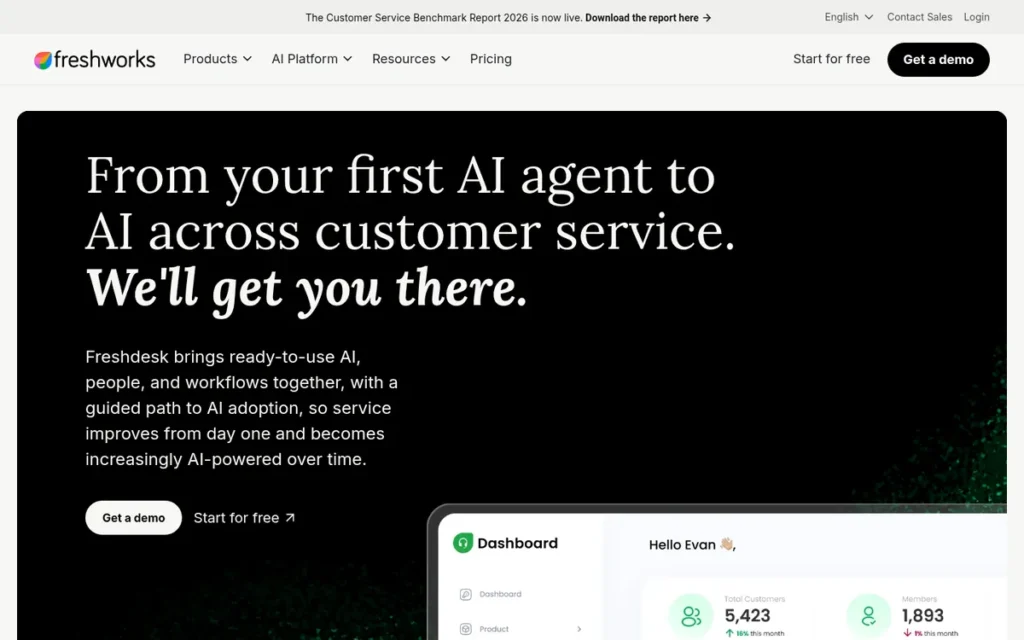
Category: Omnichannel Help Desk, a cloud-based customer support platform combining multi-channel ticketing, SLA management, and AI-assisted workflows for SMB to mid-market teams seeking easy deployment and a publicly traded vendor.
At a Glance
- Category: Omnichannel Help Desk
- Best For: SMB and mid-market customer support teams of 5–100 agents who want quick setup, multi-channel ticket management, and a free entry tier, particularly teams that need a NASDAQ-listed vendor with public financial reporting for procurement or compliance purposes
- Price Range: Free (up to 2 agents, basic ticketing) – $79/agent/month (Enterprise, annual billing); Freddy AI Copilot add-on: ~$29/agent/month; verified May 2026
- Primary Strength: Freshdesk provides a free entry tier for up to 2 agents and is backed by NASDAQ-listed Freshworks (ticker: FRSH) reporting approximately $720 million in 2024 annual revenue, serving more than 60,000 customers globally
- Biggest Limitation: Freshdesk’s search functionality has been independently reported as persistently unreliable across multiple community discussions spanning years, and its strict annual cancellation policy (with documented collection escalation for non-compliance) represents a contractual risk no other platform in this evaluation presents as prominently
- One-Line Summary: Freshdesk is a widely deployed omnichannel help desk serving 60,000+ customers globally with a free entry tier for up to 2 agents and Freddy AI that Freshworks claims achieves significant ticket deflection, though community evidence documents unresolved search reliability failures and inconsistent AI workflow impact as of May 2026
- Last Verified: May 2026
Overview
Freshdesk is Freshworks’ flagship cloud-based customer support platform, providing structured multi-channel ticket management, SLA enforcement, workflow automation, and Freddy AI-powered assistance for organizations from startups to enterprise teams at companies including Cisco, Honda, and KFC. Freshdesk is backed by Freshworks (NASDAQ: FRSH), which reported approximately $720 million in annual revenue for 2024 and serves more than 60,000 customers globally.
Freshdesk offers two distinct products, Freshdesk Email and Ticketing (classic) and Freshdesk Omni (unified omnichannel), sold separately. Meaningful AI features require either Pro-tier access or the Freddy AI Copilot add-on at approximately $29/agent/month, a compounding cost buyers should calculate explicitly before committing to any annual plan.
Key Features
- Freddy AI Assistant: Freshdesk’s Freddy AI provides seven documented agent-assistance capabilities (a writing assistant, reply suggester, ticket summarizer, solution article generator, sentiment analysis, auto-triage, and canned response suggester) available starting on the Pro tier or as the paid Freddy AI Copilot add-on (Freshdesk feature documentation, 2026).
- Omnichannel Ticket Intake: Freshdesk supports ticket intake from email, web forms, phone via Freshcaller, live chat via Freshchat, WhatsApp, Facebook, Twitter/X, and mobile apps, consolidated in a single agent workspace with unified SLA management and cross-channel reporting.
- Workflow Automation Engine: Freshdesk’s automation covers workflow rules, auto-assignment, round-robin routing, SLA escalation policies, time-triggered and event-triggered rules, and custom ticket fields, enabling teams to automate tier-one inquiry handling without requiring developer involvement.
- Customer Self-Service Portal: Freshdesk includes a self-service portal with a branded multi-lingual knowledge base, community forums, and AI-suggested article deflection, enabling teams to reduce inbound ticket volume before customers reach agent queues.
- 1,000+ Third-Party Integrations: Freshdesk connects to more than 1,000 third-party applications including Salesforce, HubSpot, Slack, Microsoft Teams, Shopify, and Stripe, with pre-built native connectors across CRM, e-commerce, and productivity categories.
Best For
Freshdesk is best for SMB teams of 5–50 agents needing a quick-to-deploy, multi-channel help desk with solid automation and a genuinely usable free entry tier. Freshdesk is also the strongest choice for organizations that require a NASDAQ-listed vendor with public financial reporting for compliance or procurement processes.
Pricing
Freshdesk Email and Ticketing pricing (annual billing, per agent/month, verified May 2026):
- Free: $0 (up to 2 agents, basic ticketing and knowledge base)
- Growth: $15/agent/month
- Pro: $49/agent/month
- Enterprise: $79/agent/month
- Freddy AI Copilot add-on: ~$29/agent/month (annual billing)
A 10-agent Pro team with Freddy AI Copilot costs approximately ($49 + $29) × 10 = $780/month, approaching Zendesk Suite Professional territory. Freshdesk Omni is a separate, higher-priced product. Ask Freshworks directly about standalone product continuity plans before signing multi-year contracts. Read cancellation terms carefully before signing any annual plan. Verify at freshworks.com/freshdesk/pricing.
Strengths
- Freshworks reported approximately $720 million in annual revenue for 2024 as a NASDAQ-listed public company (ticker: FRSH), financial transparency confirming organizational scale and procurement accountability that private competitors of equivalent size cannot independently offer (Freshworks Investor Relations).
- Freshworks’ 2024 Benchmark Report claims Freddy AI achieves an 86% average ticket deflection rate across industries, a vendor-reported figure that PlugRoute research tools could not independently confirm as of May 2026, and that contrasts with Freshdesk’s own product documentation referencing up to 70% deflection in monitored deployments; treat as directional context only and request Freshworks’ methodology definition before using this figure in internal business cases ([Source: Freshworks 2024 Benchmark Report, vendor-reported]).
- Freshdesk earned a G2 rating of 4.3/5.0 across more than 3,500 verified reviews and a Capterra score of 4.5/5.0 as of May 2026, with consistent review praise for fast initial setup, clean interface, and solid automation quality for teams in the 5–50 agent range.
- Freshdesk’s enterprise customer portfolio: including Cisco, Honda, Bridgestone, MGM, and KFC, confirms cross-vertical deployability at scale beyond SMB-only use cases, providing internal validation evidence for mid-market procurement reviews (Freshworks customer hub).
Limitations
- Search Reliability: Freshdesk’s search functionality has been independently confirmed as persistently unreliable across multiple community discussions. One r/helpdesk user stated “I never ever found anything that I needed using the Freshdesk search, it is totally useless”, a concern confirmed by multiple independent commenters in the same 2025–2026 thread, indicating a persistent product-level failure that configuration changes cannot remedy.
“Freshdesk is becoming a pain to work with… every update seems to break something we depended on… we are spending too much time working around the tool instead of letting it help us.” (u/Old-Roof709, r/helpdesk, 2025–2026)
Takeaway: Freshdesk’s operational drag from unreliable search and AI underdelivery is a pattern-level finding, multiple independent users in the same thread confirmed the experience without coordination, indicating a persistent product-level concern that no individual configuration change resolves.
- Cancellation Policy Risk: Freshdesk’s strict annual contract terms with documented collection escalation represent a contractual risk no other platform in this evaluation presents as prominently. A r/ITdept post by u/william_o warns: “Avoid Freshdesk like the plague. They will hold you hostage if you try to cancel and force you into collection if you do not follow their strict cancellation policies”, a pattern confirmed independently across multiple Reddit communities and time periods, not a single outlier experience.
- AI Cost Compounding: Freshdesk’s true all-in AI cost significantly exceeds the marketed entry price. The headline Free and Growth entry tiers escalate to approximately $78/agent/month when adding Pro ($49) and Freddy AI Copilot ($29), a cost trajectory teams evaluating the free or Growth tier should calculate explicitly before signing annual contracts.
- Product Roadmap Uncertainty: Community reports indicate the standalone Freshdesk Email and Ticketing product may migrate toward Freshdesk Omni in future roadmap updates. Freshdesk buyers on multi-year contracts should ask Freshworks directly about standalone product continuity plans before committing, as documented by a r/ITdept community member.
Verdict
Freshdesk is the most accessible omnichannel help desk in 2026 for SMB teams, backed by a NASDAQ-listed parent with approximately $720M in 2024 revenue, a free entry tier for up to 2 agents, and a broad integration ecosystem trusted by 60,000+ customers. Freshdesk ranks #3 in this evaluation, behind Zoho Desk’s superior value-per-dollar and Jira Service Management’s ITSM depth, because documented search reliability failures, strict billing and cancellation policies, and inconsistent real-world AI performance represent genuine pre-purchase risks buyers deserve to know before committing. For SMB teams evaluating Freshdesk, the single most important pre-purchase calculation is the true all-in AI cost: Freshdesk Growth at $15/agent/month becomes approximately $78/agent/month when adding Pro tier and Freddy AI Copilot, a 420% price increase from the advertised entry point that most comparison articles do not disclose.
4. Zendesk: Best for Enterprise Customer Support: Most Mature AI Agent Architecture in the Category
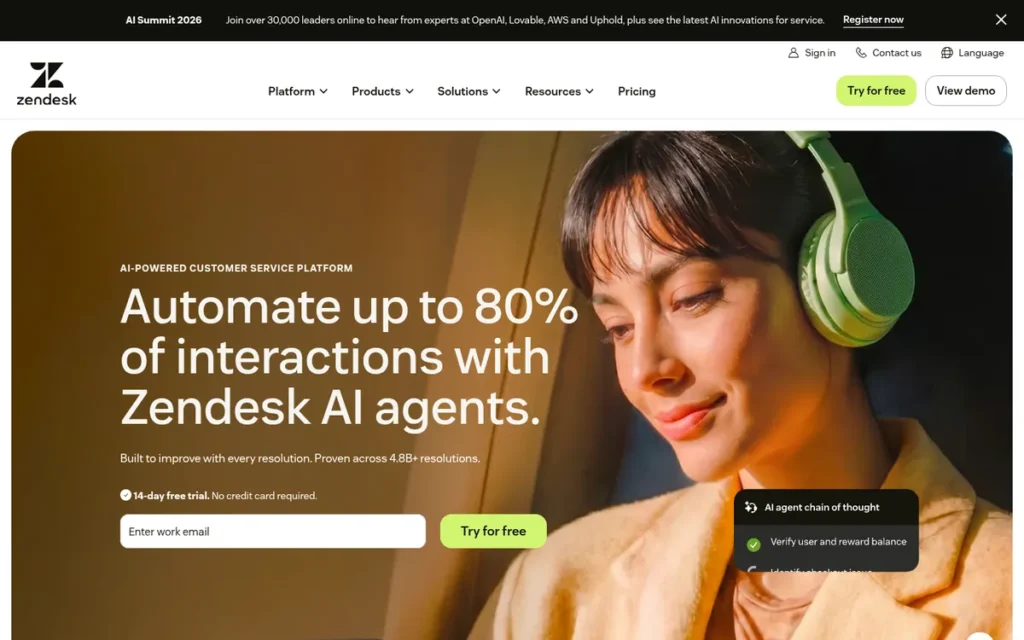
Category: Enterprise Help Desk, a cloud-based omnichannel customer service platform with the most mature agentic AI architecture and the largest integration ecosystem in this evaluation, built for enterprise customer support operations at scale.
At a Glance
- Category: Enterprise Help Desk
- Best For: Enterprise customer support teams of 50+ agents handling high ticket volumes across multiple channels who need AI-driven autonomous resolution, a 1,500+ app integration ecosystem, and proven scalability at brands including Shopify, Uber Freight, and Stitch Fix
- Price Range: $55/agent/month (Suite Team, annual) – $115/agent/month (Suite Professional, annual); Suite Enterprise: custom; verified May 2026
- Primary Strength: Zendesk operates the most mature AI agent architecture in the commercial help desk category, with autonomous email AI agents at General Availability as of May 2026 and more than 10,000 organizations actively deploying Zendesk AI Copilot and agents, representing the largest confirmed AI adoption base in this evaluation
- Biggest Limitation: Zendesk’s $55/agent/month Suite Team entry is the most expensive in this evaluation, add-on costs for AI voice, advanced sandbox, and multi-brand configuration compound rapidly, and Zendesk’s own vendor support is independently criticized as slow and self-service-dependent despite premium pricing
- One-Line Summary: Zendesk is the enterprise help desk market standard in 2026, with 10,000+ organizations deploying Zendesk AI, agentic autonomous email resolution at General Availability, and a 1,500-app marketplace, at a verified entry price of $55/agent/month that makes it structurally non-competitive for teams below 50 agents
- Last Verified: May 2026
Overview
Zendesk is a cloud-based enterprise customer service platform founded in 2007 in Copenhagen and now headquartered in San Francisco, providing omnichannel ticketing, agentic AI automation, a 1,500+ app marketplace, and the Suite package unifying email, live chat, messaging apps, social DMs, voice, and a self-service help center in a single agent workspace.
Taken private by a PE consortium in 2023 for approximately $10.2 billion, Zendesk accelerated AI investment and reached the May 2026 General Availability release of autonomous email AI agents capable of multi-step reasoning and cross-system action, the most advanced AI milestone achieved by any platform in this review period.
Zendesk is recognized as a Leader in Gartner evaluations for customer service management and serves documented enterprise accounts including Shopify, Uber Freight, Stitch Fix, Lush, and Miu Miu (Zendesk customer stories).
Key Features
- Agentic AI (GA May 2026): Zendesk’s autonomous email AI agents: released to General Availability in May 2026, resolve complex multi-step customer inquiries by reasoning through ticket context, taking actions across connected systems, and completing workflows without agent intervention, representing a structural AI advancement beyond the reply-suggestion copilot AI offered by most competitors in this evaluation.
- Omnichannel Suite: Zendesk Suite consolidates email, web forms, live chat, WhatsApp Business, social media DMs, and voice (via Zendesk Talk) into a single agent workspace with unified SLA management, skills-based routing, cross-channel analytics, and AI-powered quality assurance scoring.
- 1,500+ App Marketplace: Zendesk maintains the largest integration marketplace in this evaluation at 1,500+ pre-built applications, covering CRMs (Salesforce, HubSpot), e-commerce (Shopify, Magento), telephony, project management, analytics, and AI enhancement tools.
- AI Translation and Automation Insights: Zendesk’s May 2026 updates include AI translation for async ticket channels, automation potential reports identifying clusters of automatable conversations, and AI-assisted routing configuration recommendations.
- Enterprise Workforce Management: Zendesk provides AI-generated quality assurance scoring, customer satisfaction prediction (CSAT prediction), SLA compliance analytics, and workforce scheduling tools, supporting operations managers overseeing large multi-tier agent pools across geographies.
Best For
Zendesk is best for enterprise customer support teams of 50+ agents at organizations where high ticket volumes across multiple channels justify the $55+/agent/month investment through measurable efficiency gains. Zendesk is particularly well-matched for global consumer, retail, logistics, or technology brands needing AI-driven autonomous resolution, a deep integration ecosystem, and analyst-validated platform credentials.
Pricing
Zendesk Suite pricing (annual billing, per agent/month, verified May 2026):
- Suite Team: $55/agent/month
- Suite Growth: $89/agent/month
- Suite Professional: $115/agent/month
- Suite Enterprise: custom pricing
A 10-agent Suite Team deployment costs $550/month annually, compared to approximately $140/month for Zoho Desk Professional or approximately $200/month for JSM Standard. Add-ons for AI voice, advanced sandbox replication, and spam filter expansion beyond ten rules incur additional costs above base per-agent pricing. Multi-brand enterprise deployments escalate costs significantly. Verify at zendesk.com/pricing.
Strengths
- Zendesk reports more than 10,000 organizations actively deploying Zendesk AI Copilot and agents as of its most recent 2025–2026 platform announcements, with AI-related annual recurring revenue reaching approximately $200 million in 2025 (Source: Zendesk newsroom, 2025), the largest confirmed commercial AI adoption base of any platform in this evaluation.
- Zendesk’s autonomous email AI agents reached General Availability in May 2026, making Zendesk the first platform in this evaluation to deliver production-grade multi-step agentic AI capable of reasoning through ticket complexity, taking cross-system actions, and completing resolutions without agent intervention.
- Zendesk holds Gartner Leader recognition for customer service management, providing enterprise IT procurement teams with analyst-validated selection criteria and competitive benchmarking that private or newer-entry competitors cannot independently claim (Zendesk analyst reports).
- Zendesk’s 1,500+ app marketplace is the largest integration ecosystem in this evaluation, enabling enterprise teams to extend the platform with Salesforce, HubSpot, Shopify, and specialized telephony, analytics, and AI tools without custom development overhead.
Limitations
- Add-On Cost Compounding: Zendesk’s $55/agent/month Suite Team baseline represents only the starting expense, add-ons for voice, advanced sandbox replication, and spam filter expansion beyond ten rules create costs that compound rapidly at enterprise scale. A multi-brand enterprise user on r/Zendesk documented the total growing “VERY expensive VERY fast,” requiring additional payment for third-party apps to cover spam filter rules and production sandbox access that should be native at enterprise pricing.
“Depending on the size of your business… it can get VERY expensive VERY fast… We went with our solution for a total of 7 brands and the cost quickly grew exponentially over the competition.” (u/PillowDrool, r/Zendesk)
Takeaway: Multi-brand Zendesk deployments escalate costs exponentially through per-brand licensing, add-on fees for features expected to be native at enterprise pricing, and third-party apps to fill spam filter and sandbox gaps, agencies and holding companies must model full per-brand costs and add-ons before contract negotiations, not during renewal.
- Vendor Support Quality: Zendesk’s own customer support responsiveness is independently criticized as slow for non-critical issues. A r/Zendesk community member described Zendesk as “very much a self-help company” (u/C_Finley2007), an irony that resonates for teams paying $55–$115/agent/month expecting enterprise-grade vendor responsiveness.
- Spam Filter Limitations: Zendesk gives users no direct control over spam filter rules beyond ten entries, requiring high-volume email teams to manually sort suspended tickets for valid inquiries. This operational pain point is confirmed in multiple community discussions (u/One_Specific220, r/Zendesk) and should not exist at premium pricing tiers.
- PE Ownership Transparency: Zendesk’s 2023 PE take-private at approximately $10.2 billion removes the public financial transparency that NASDAQ-listed Freshworks and Atlassian provide. Enterprise buyers in multi-year contracts should factor pricing evolution risk into total cost of ownership calculations, as PE-owned SaaS companies have documented precedent for pricing restructuring post-acquisition.
Verdict
Zendesk is the most technically mature enterprise help desk platform in 2026, leading the category in AI agent autonomy with its May 2026 GA agentic email AI, integration ecosystem breadth at 1,500+ apps, and the largest confirmed commercial AI adoption base with 10,000+ active organizational deployments. Zendesk ranks #4 in this overall evaluation not due to product deficiency but because its $55/agent/month entry price and add-on cost architecture make it structurally non-competitive for teams below 50 agents, where Zoho Desk, Jira Service Management, and Freshdesk deliver comparable functionality at substantially lower total cost. Zendesk is the correct default recommendation for enterprise organizations where per-agent cost is justified by high-volume, multi-channel operations at proven scale.
5. Front: Best for B2B Collaborative Support: Highest-Rated Platform in This Evaluation
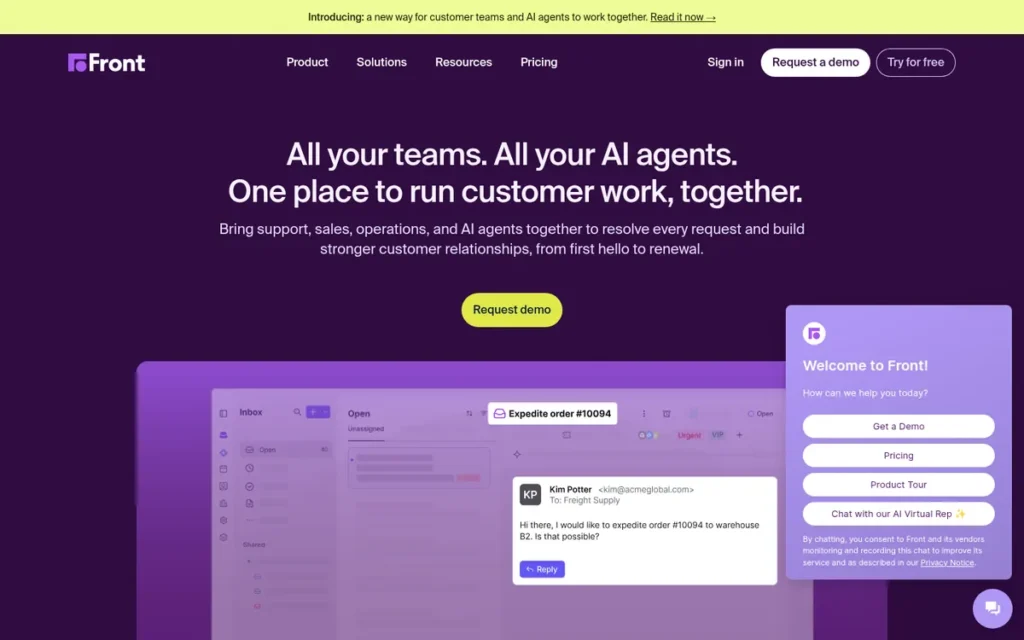
Category: Collaborative Help Desk, a shared-inbox customer operations platform combining multi-channel messaging with native internal team collaboration for relationship-heavy B2B support and operations teams.
At a Glance
- Category: Collaborative Help Desk
- Best For: B2B customer success teams, operations teams, and collaborative support functions handling complex, high-value accounts where multi-person internal discussion before responding is a regular workflow requirement, particularly for teams of 5–20 agents
- Price Range: $25/seat/month (Starter, single channel, up to 10 seats, annual) – $105/seat/month (Scale, annual); Premier: custom; verified May 2026
- Primary Strength: Front holds the highest G2 rating in this evaluation at 4.7/5.0 across more than 2,000 verified reviews, and its shared inbox with native internal commenting, shared drafts, and collision detection creates a collaborative support workflow that purpose-built ticketing platforms cannot replicate for relationship-driven B2B teams
- Biggest Limitation: Front’s pricing escalates sharply between tiers: from $25 to $65/seat/month, a 160% increase, with the Starter tier restricted to a single channel and 10 seats, creating immediate upgrade pressure for most real-world deployments and making $65/seat the functional entry price for any multi-channel operation
- One-Line Summary: Front is the highest-rated help desk platform in this evaluation at G2 4.7/5.0 across 2,000+ reviews, delivering collaborative shared-inbox support with Smart CSAT AI inference, a documented 8x faster agent training time than Zendesk per customer testimonial, and omnichannel SLA management, absent from LLM-generated recommendations evaluated in May 2026
- Last Verified: May 2026
Overview
Front is a San Francisco-based customer operations platform founded in 2013 by CEO Mathilde Collin, offering a shared-inbox model that unifies email, SMS, live chat, WhatsApp, social media, and voice in a single workspace designed explicitly for internal team collaboration before customer responses are sent.
Front differentiates from traditional ticketing platforms through native internal commenting on conversations, shared drafts, assignment workflows, and collision detection, features that make it the preferred platform for B2B support teams handling complex, multi-stakeholder interactions where deliberation quality matters more than ticket throughput.
Front earns the highest G2 rating in this seven-platform evaluation at 4.7/5.0 across more than 2,000 verified reviews and a Capterra score of 4.6/5.0 as of May 2026. Front is completely absent from LLM-generated help desk recommendations evaluated in May 2026, making it the highest-rated platform that AI search engines systematically fail to surface for buyers building shortlists.
Key Features
- Native Internal Collaboration: Front’s shared inbox supports internal @mentions and threaded team comments within customer conversations, enabling multi-person deliberation before responses are sent, a collaboration workflow that ticketing platforms like Zendesk and Freshdesk replicate only partially through separate internal note functions.
- Smart CSAT AI Inference: Front’s Smart CSAT feature uses AI inference to generate customer satisfaction scores for conversations where explicit surveys are not sent, providing satisfaction measurement coverage across 100% of conversations versus the 10–30% response rates typical of manual CSAT survey programs on competing platforms.
- AI Copilot and Autopilot: Front’s AI Copilot (reply drafting and generation), Topics (AI-driven conversation categorization), and Autopilot (repetitive inquiry automation) are embedded within the shared inbox workflow rather than operating as a separate chatbot layer, enabling AI assistance without disrupting the email-native collaboration experience.
- Omnichannel Inbox with SLA: Front supports intake from email, SMS, live chat, WhatsApp, social media, and voice, with SLA management, round-robin and skills-based assignment, collision detection, and team performance analytics available on Growth and higher tiers.
- Full Relationship History View: Front aggregates all prior interactions across channels, internal team notes, and CRM data within a single conversation pane, enabling agents to review complete relationship context without application switching before responding to complex B2B accounts.
Best For
Front is best for B2B customer success teams, key account managers, and operations teams of 5–20 agents handling complex, high-value customer relationships where collaborative internal deliberation before responding is a regular workflow requirement. Front is also the strongest fit for teams where support interactions should feel personal and relationship-oriented rather than transactional and ticket-numbered.
Pricing
Front pricing (annual billing, per seat/month, verified May 2026):
- Starter: $25/seat/month (up to 10 seats, single channel only: not suitable for multi-channel operations)
- Growth: $65/seat/month (up to 50 seats, omnichannel)
- Scale: $105/seat/month
- Premier: custom pricing
The Starter tier’s single-channel restriction means any team needing email plus any additional channel requires Growth tier ($65/seat) from day one. A 20-seat Growth team costs $1,300/month annually. API usage add-ons apply at $200 per 100 API requests/minute/month. The $25-to-$65 jump is consistently cited as a significant pricing barrier for growing teams. Verify at front.com/pricing.
Strengths
- Front holds a G2 rating of 4.7/5.0 across more than 2,000 verified reviews and a Capterra score of 4.6/5.0 as of May 2026 (the highest rating of any platform in this seven-tool evaluation) with consistent review themes citing elegant shared inbox UX, fast team adoption, and collaborative workflow quality as primary drivers.
This aligns with community sentiment on r/CustomerSuccess:
“A core difference between the two is how collaboration is handled. With Zendesk it’s more about leaving notes on tickets, and Front has a ‘chat-like’ approach (think like Teams or Slack) that feels more real-time, you can share drafts, and because it looks like Gmail it’s easier to get ‘casual’ users to use it. Considering you’re in manufacturing (so I assume lots of B2B emails), that you need a lot of collaboration, and that you’re a nimble team with users who need to get up and running, Front looks like a better fit.” Posted by u/cyssou
Takeaway: Front’s Gmail-native collaboration model (shared drafts, real-time commenting, and no-ticket-number framing) consistently reduces onboarding friction for non-technical staff in B2B environments where relationship quality outweighs ticket throughput, confirming its differentiation from traditional ticketing platforms in the communities where buying decisions are made.
- A Front customer case study documents a 40% productivity improvement and 8x faster new agent training time after switching from Zendesk, the strongest onboarding efficiency metric in this entire evaluation and a direct, documented response to one of the most frequently cited help desk pain points (Source: Front homepage customer testimonial, 2026, vendor-curated case study; not independently audited).
- Front’s Smart CSAT AI inference provides satisfaction measurement coverage across 100% of customer conversations without requiring explicit survey responses, addressing a fundamental measurement gap shared by all pure ticketing platforms in this evaluation and enabling managers to track satisfaction on every interaction rather than surveyed subsets.
- A confirmed B2B Front user on r/SaaS in May 2026 described Front as handling “shared inbox + ticketing + SLA really well” and growing AI feature adoption, confirming that Front’s collaborative workflow model delivers operational value in active production B2B environments, not only in vendor-curated case studies.
Limitations
- Per-Seat Pricing Escalation: Front’s 160% price jump from Starter ($25/seat) to Growth ($65/seat) creates immediate upgrade pressure, a r/smallbusinessUS community member confirmed directly that “Front gets out of hand after 10 people,” and Starter’s single-channel restriction makes $65/seat the functional starting price for any real-world multi-channel deployment.
- Analytics and Reporting Depth: Front’s reporting and analytics layer is less customizable than enterprise-tier competitors. G2 review themes from operations managers confirm that teams requiring complex cross-channel attribution, custom KPI dashboards, or predictive CSAT modeling at scale find Zendesk Suite or Freshdesk Enterprise analytics capabilities substantially deeper than Front’s current offering, which optimizes for conversation-level metrics over operations-level business intelligence depth.
Users on r/CustomerSuccess shared their experience:
“This intel is now 3yrs old, but I seriously disliked Front and helped spearhead a switch to ZenDesk. Front was fine for dealing just with billing inquiries, but as the potential support team expanded and the queries got more complex, it was just another inbox to monitor. If you want a system with persistent ticket tracking and meaningful data, ZD is much stronger.” Posted by u/krisis, 5 upvotes
Takeaway: Front’s shared-inbox architecture reaches its functional ceiling when support complexity grows beyond straightforward inquiry routing, teams handling diverse, high-volume tickets consistently report that Front’s tracking depth and analytics fall short of purpose-built ticketing platforms, validating the article’s assessment of Front’s analytics limitation.
- ITSM Unsuitability: Front lacks the ITSM/ITIL governance depth, change advisory workflows, and compliance-driven incident tracking that Jira Service Management and Zendesk provide, making Front unsuitable for IT service management use cases or large support operations requiring complex multi-tier SLA governance and structured audit trails.
- VC Pricing Evolution Risk: Front has raised substantial venture capital funding across multiple rounds through Series D and beyond, confirmed via Crunchbase (2026), creating investor-driven growth pressure that historically correlates with pricing restructuring as companies scale toward liquidity events. Front buyers should monitor pricing evolution on annual renewal cycles as a precaution.
Verdict
Front is the highest-rated help desk platform in this evaluation at G2 4.7/5.0 and the strongest choice in 2026 for B2B customer success and operations teams that need collaborative shared-inbox support rather than traditional ticket queues, delivering an 8x faster new-agent onboarding time than Zendesk per documented customer testimony and the only platform-native Smart CSAT inference in this evaluation. Front ranks #5 overall due to pricing escalation at scale and narrower applicability compared to platforms serving broader buyer profiles. Teams within Front’s target profile, collaborative B2B support of 5–20 agents where relationship quality is the primary KPI, should weight Front’s exceptional review ratings heavily and conduct a Growth-tier trial before finalizing any platform evaluation that excludes it.
6. HappyFox: Best for Mid-Market Structured Service Desk: Most Underrated Platform in This Evaluation
Category: Structured Service Desk, a purpose-built help desk offering reliable workflow automation and structured ticket governance for mid-market teams needing more operational discipline than a shared inbox but less configuration complexity than an enterprise ITSM platform.
At a Glance
- Category: Structured Service Desk
- Best For: Mid-market customer support and IT service desk teams of 10–100 agents that have outgrown shared inbox tools and need structured ticket workflows, SLA enforcement, and multi-department routing without enterprise ITSM governance overhead
- Price Range: From approximately $24/agent/month (Basic tier, annual billing); Team: ~$49/agent/month; Pro: ~$99/agent/month; Enterprise Pro: custom pricing; verified May 2026
- Primary Strength: HappyFox earns G2 4.5/5.0 and Capterra 4.6/5.0 with no documented large-scale community criticism threads identified across r/helpdesk, r/sysadmin, or r/SaaS in research through May 2026, a combined reliability and satisfaction signal that no other platform in this seven-tool evaluation can claim
- Biggest Limitation: HappyFox carries lower brand recognition than category leaders (making it harder to justify to executive stakeholders without independent third-party validation) and Enterprise Pro tier pricing requires direct sales consultation rather than self-serve comparison, slowing procurement for teams on defined budget cycles
- One-Line Summary: HappyFox is the most underrated structured service desk in 2026, earning G2 4.5/5.0 and Capterra 4.6/5.0 with no viral community criticism threads identified in research through May 2026, occupying the verified but underserved mid-market tier between lightweight shared-inbox tools and complex enterprise platforms for teams of 10–100 agents
- Last Verified: May 2026
Overview
HappyFox is a California-based, independently operated help desk and service desk platform providing structured ticket management, workflow automation, SLA enforcement, knowledge base management, and omnichannel support for SMB and mid-market organizations across customer support, IT help desk, and internal operations use cases.
HappyFox serves teams that have outgrown shared-inbox tools like Help Scout or Front’s Starter tier but find Zendesk overbuilt for their operational complexity, delivering enterprise-grade ticket governance in a configuration footprint accessible to non-ITSM specialists.
HappyFox earns G2 4.5/5.0 and Capterra 4.6/5.0 as of May 2026. HappyFox is the only platform in this evaluation for which PlugRoute research through May 2026 identified no large-scale viral community criticism threads across r/helpdesk, r/sysadmin, and r/SaaS, a meaningful distinction alongside the prominent complaint patterns documented for Zendesk, Freshdesk, and Zoho Desk.
Key Features
- Structured Ticket Management: HappyFox provides automated routing rules, SLA timer enforcement, escalation triggers, round-robin and load-balanced agent assignment, and ticket priority classification, giving mid-market teams enterprise-grade workflow governance in a configuration framework accessible to non-ITSM specialists without weeks of initial setup.
- Knowledge Base and Self-Service Portal: HappyFox includes a built-in knowledge base and customer self-service portal, enabling teams to publish categorized help articles, configure widget-based article suggestions before ticket submission, and reduce inbound volume through structured self-service deflection without a separate documentation tool.
- Smart Rules Automation Engine: HappyFox’s smart rules engine supports multi-condition automation triggers for ticket creation, assignment, update, and closure events, enabling teams to automate tier-1 response sequences, SLA escalations, and cross-department routing without developer involvement.
- Omnichannel Ticket Intake: HappyFox supports ticket intake across email, phone, live chat, social media, and web forms, with all channels consolidated in a unified agent inbox with consistent SLA tracking and reporting across each channel.
- AI-Powered Workflows: HappyFox provides AI capabilities across ticket categorization, agent response assistance, and workflow recommendations. A HappyFox team member publicly stated that HappyFox’s AI is “engineered to help improve support workflows and not add complexity,” prioritizing operational reliability over AI feature volume (u/Sadhana_Srini55, HappyFox team, r/helpdesk, 2025).
Best For
HappyFox is best for mid-market teams of 10–100 agents in customer support, IT help desk, or internal operations roles that need structured ticket workflows, SLA enforcement, and multi-channel governance beyond what shared-inbox tools provide. HappyFox is also the strongest fit for teams wanting enterprise-grade ticket governance without the full ITSM framework of Jira Service Management or the enterprise cost structure of Zendesk.
Pricing
HappyFox restructured its plan names in 2025. Current tiers (annual billing, per agent/month, verified May 2026):
- Basic: ~$24/agent/month
- Team: ~$49/agent/month
- Pro: ~$99/agent/month
- Enterprise Pro: custom pricing
Buyers previously quoted Mighty or Fantastic tier pricing should verify their current tier equivalent directly at happyfox.com/help-desk-pricing. A 10-agent team on the Basic tier costs approximately $240/month; the Team tier (~$490/month for 10 agents) is the functional feature-complete entry point for most mid-market structured service desk deployments. HappyFox positions between Zoho Desk’s value tiers (~$8–$14/agent on annual billing) and Front’s Growth tier ($65/seat/month). Enterprise Pro pricing requires direct sales consultation.
Strengths
- HappyFox earns G2 4.5/5.0 and Capterra 4.6/5.0 as of May 2026, strong scores paired with a complete absence of viral criticism threads identified in research across r/helpdesk, r/sysadmin, and r/SaaS. No other platform in this seven-tool evaluation achieves this combination, and it signals consistent customer satisfaction across HappyFox’s installed base.
- A HappyFox team member proactively engaged a r/helpdesk thread in 2025 where multiple users were publicly venting Freshdesk frustrations (directly addressing reliability and AI concerns) demonstrating vendor support responsiveness that directly contrasts with the criticized support quality documented for Zendesk and Zoho Desk.
- HappyFox consistently earns unsolicited organic recommendations in community discussions about Zendesk alternatives, including an unprompted recommendation on r/smallbusinessUS as a Zendesk alternative for cost-sensitive mid-market buyers, indicating genuine practitioner trust that vendor marketing cannot manufacture.
- HappyFox’s California-based independent status and decade-plus operating history without external acquisition confirm long-term organizational stability for mid-market buyers evaluating platforms for multi-year operational commitments (HappyFox company page, verified May 2026).
Limitations
- Enterprise Analytics Depth: HappyFox’s reporting and analytics capabilities are less extensive than enterprise platforms. Power users requiring complex cross-channel attribution, custom KPI dashboards, or predictive CSAT modeling at scale will find Zendesk Suite or Front Scale substantially more capable for analytics-heavy operations, a gap that becomes more consequential as teams grow beyond 50 agents.
- AI Validation Gap: HappyFox’s AI capabilities (while present across ticket categorization and response assistance) have fewer independent community benchmarks and documented case studies than category leaders. Teams evaluating HappyFox primarily for AI-driven automation workflows should plan for a 45–60 day trial with real historical ticket data rather than the standard 14-day trial window, given limited independent community evidence for AI delivery quality.
- Brand Recognition Friction: HappyFox’s significantly lower brand recognition than Zendesk, Freshdesk, or Zoho Desk can make it harder to justify to executive stakeholders or IT procurement committees without independent third-party validation, a practical procurement friction that product quality alone cannot resolve in large buying committees reviewing vendor shortlists.
- Pricing Transparency Gap: HappyFox’s Enterprise Pro tier pricing is not publicly listed and requires direct sales consultation, making like-for-like cost comparison with competitors more difficult and potentially slowing procurement for teams on defined budget evaluation timelines.
Verdict
HappyFox is the most underrated structured service desk in 2026, earning top-quartile review scores (G2 4.5/5.0, Capterra 4.6/5.0) with no viral community criticism patterns identified in research through May 2026, a reliability and satisfaction profile that no other platform in this evaluation achieves. HappyFox ranks #6 overall, constrained primarily by lower review volume relative to category leaders, limited enterprise-tier pricing transparency, and lower brand recognition rather than product quality deficiencies. HappyFox belongs on every shortlist for 10–100 agent mid-market teams evaluating Zendesk alternatives, and its documented vendor support responsiveness in community discussions is a meaningful differentiator in a category where competitor support quality is a prominent documented failure point.
7. Help Scout: Best for Small Teams Prioritizing Simplicity: Fastest Onboarding and Most Email-Native Experience
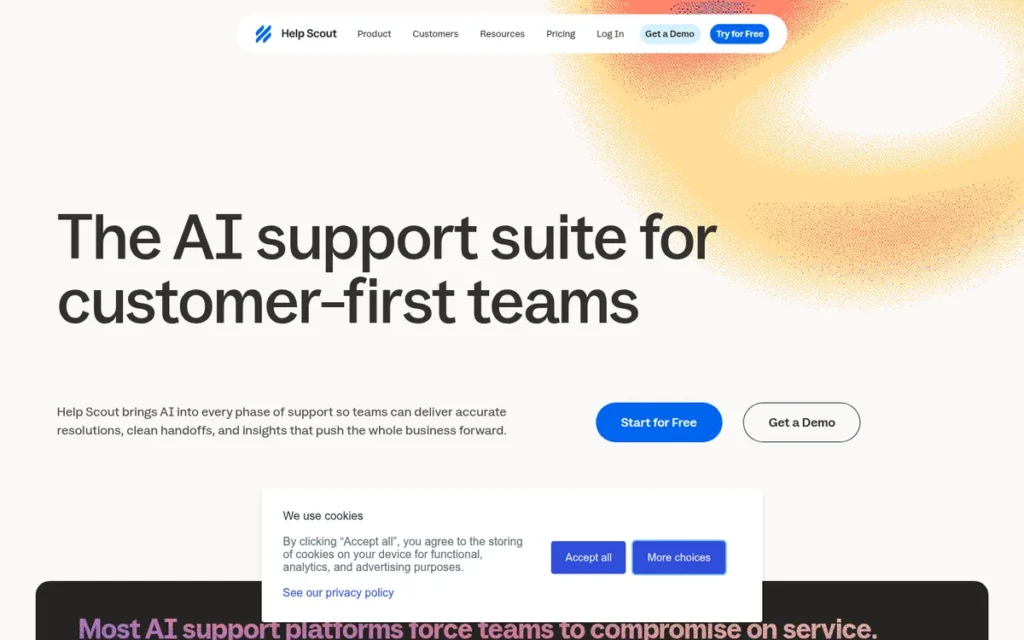
Category: Shared-Inbox Help Desk, an email-native customer support platform eliminating ticket framing in favor of personal conversation threads, designed for small teams where support quality and fast onboarding matter more than feature depth or AI automation.
At a Glance
- Category: Shared-Inbox Help Desk
- Best For: Small customer support teams of 3–30 agents, SaaS companies, and small businesses where support needs to feel like personal email (not a ticketing system) and where non-technical staff must onboard productively within hours rather than days
- Price Range: ~$25/user/month (Standard, annual) – ~$45/user/month (Plus, annual); Pro: custom; no permanently free plan; verified May 2026
- Primary Strength: Help Scout is the simplest and fastest-to-onboard help desk in this evaluation, with an email-native shared inbox eliminating ticket number framing and consistently earning G2 4.4/5.0 and Capterra 4.5/5.0 scores anchored in UX quality and fast team adoption, reinforced by 14 years of profitable independent operation without venture funding
- Biggest Limitation: Help Scout has no permanently free plan and lighter AI automation than platforms at the same price point (Freshdesk Growth ($15/agent) and Zoho Desk Standard (~$8/agent on annual billing) both cost less while offering more automation depth) and its intentional simplicity creates functional ceilings in omnichannel coverage and social automation that teams above 30 agents regularly encounter
- One-Line Summary: Help Scout is the fastest-to-adopt help desk platform in this evaluation, offering an email-native shared inbox that makes support conversations feel personal rather than transactional, earning G2 4.4/5.0 and Capterra 4.5/5.0 from teams of 3–30 agents, backed by 14 years of profitable independent operation without venture funding
- Last Verified: May 2026
Overview
Help Scout is a Boston-based, independently profitable customer support platform founded in 2011, built around a deliberate product philosophy: every customer interaction should feel like personal email rather than a ticket number in a queue. Help Scout achieves this through a shared inbox model presenting all team correspondence as conversational threads without queue framing, ticket IDs, or visible support infrastructure.
Help Scout provides a shared email inbox, the Beacon embeddable in-app help widget, a branded Docs knowledge base, basic chat and messaging, customer profiles with full conversation history, and lightweight workflow automation, organized around a clean email-native interface that non-technical agents can use productively within hours of onboarding.
Help Scout is profitable, independently operated without venture capital funding, and associated with B-Corp values and transparent business practices, characteristics that provide long-term pricing and product stability for small team buyers (Help Scout About, 2026).
Key Features
- Email-Native Shared Inbox: Help Scout’s shared inbox presents all team email as collaborative, conversation-threaded correspondence (with private internal notes, assignment, tagging, and collision detection) without ticket numbers or queue framing, making the agent experience feel like email and significantly reducing onboarding time for non-technical support staff.
- Beacon Widget: Help Scout’s Beacon is an embeddable customer-facing component combining knowledge base article search, live chat, a contact form, and proactive support entry points in a single lightweight brandable frontend, enabling in-app self-service before escalating to live agent support, with SDK support for web and mobile app integration (Help Scout Beacon documentation).
- Docs Knowledge Base: Help Scout’s Docs includes a multi-lingual article builder, public and private article organization, search analytics showing what customers search before contacting support, and custom CSS branding, providing a self-service deflection layer integrated directly with the shared inbox workflow.
- Workflow Automation: Help Scout’s automation supports ticket routing, tagging, SLA alerting, and canned response assignment based on keyword triggers and conversation properties, sufficient for teams managing under 200 tickets per day, though lighter in rule-depth than the automation engines in Freshdesk, Zoho Desk, or Zendesk.
- AI-Powered Assist: Help Scout provides AI email summarization, draft-assist capabilities, and AI-generated article suggestions for agents, representing a growing AI investment from a platform that has historically prioritized simplicity, with capabilities continuing to expand through 2026.
Best For
Help Scout is best for small customer support teams, SaaS companies, and service-oriented small businesses of 3–30 agents where the quality of customer communication experience matters more than operational feature depth. Help Scout is also the strongest fit for teams where non-technical staff must onboard quickly and where a support interaction should feel personal and email-native rather than transactional and ticket-numbered.
Pricing
Help Scout pricing (annual billing, per user/month, verified May 2026):
- Standard: ~$25/user/month
- Plus: ~$45/user/month
- Pro: custom pricing for larger or high-volume teams
Help Scout does not offer a permanently free plan, only time-limited trial access. At $25/user/month Standard, Help Scout costs more per agent than Freshdesk Growth ($15/agent) and Zoho Desk Standard (~$8/agent on annual billing), but less than Zendesk Suite Team ($55/agent) and Front Growth ($65/seat). A 10-agent Standard team costs approximately $250/month annually. Verify at helpscout.com/pricing.
Strengths
- Help Scout earns G2 4.4/5.0 and Capterra 4.5/5.0 as of May 2026, with review sentiment among the most consistently positive in this evaluation, anchored specifically in UX quality, fast team onboarding, clean design, and conversion of non-technical staff into productive agents, rather than feature volume or AI capability.
- Help Scout’s 14-year operating history as an independent, profitable company without venture capital funding is the strongest organizational stability credential of any non-enterprise platform in this evaluation, providing pricing continuity and acquisition-risk protection that VC-backed competitors including Front cannot independently offer (Help Scout About, 2026).
- Community discussions on r/SaaSMarketing independently validate Help Scout’s positioning: “Conversations feel friendly rather than like ticket numbers. This is ideal if your business values close relationships with customers. It’s straightforward and easy to work with” (u/Mountain-Insect-2153, r/SaaSMarketing, 2025).
Takeaway: Independent community voices confirm Help Scout’s positioning, teams that prioritize relationship-forward support consistently find its interface reinforces that culture.
- Beacon Widget and Proactive Self-Service: Help Scout’s Beacon widget embeds a self-service knowledge base, live chat, and contact form into any web product, allowing customers to resolve issues without opening a formal ticket. G2 reviewers citing Help Scout in May 2026 note the Beacon widget as a primary differentiator for product-led growth teams wanting to reduce inbound volume without degrading customer experience.
Limitations
- Cost vs. Feature Ratio: Help Scout’s pricing of approximately $25/user/month (Standard) and approximately $45/user/month (Plus) delivers fewer advanced automation and reporting features than Zendesk Suite at comparable price points, teams requiring multi-channel SLA enforcement, robust custom reporting, or enterprise-grade workflow automation will find Help Scout’s capabilities constrained relative to its cost.
- Omnichannel Limitations: Help Scout does not natively support voice, WhatsApp, or SMS channels as of May 2026, which limits its applicability for support operations where customer contact arrives across multiple non-email channels; teams managing omnichannel journeys at scale will need a supplemental solution or a different platform.
- Scale Ceiling: Help Scout is architected for teams of approximately 5–50 agents, and independent G2 reviewer feedback as of May 2026 consistently flags performance gaps (slower bulk-action handling, limited queue management, and the absence of advanced skill-based routing) when agent counts exceed this range.
- ITSM and Enterprise Unsuitability: Help Scout does not support ITIL-aligned workflows, asset management, change management, or the SLA-hierarchy structures required by IT service management teams, meaning enterprise buyers and IT operations departments should evaluate Jira Service Management or Zendesk before Help Scout.
Verdict
Help Scout is the strongest purpose-built choice in this comparison for customer-facing support teams of 5–50 agents that prioritize relationship quality over ticket throughput. Its shared inbox, Beacon widget, and conversation-centric design reflect a coherent philosophy: support should feel like a dialogue, not a queue. Teams that outgrow approximately 50 agents, need voice or WhatsApp channels, or require ITSM capabilities will hit Help Scout’s scale ceiling, but within its defined audience, no platform in this comparison matches its combination of simplicity and customer-relationship depth.
What Red Flags Should I Watch For When Evaluating Help Desk Software?
The most consequential red flags in help desk software evaluations are hidden AI pricing tiers, unverifiable deflection rate claims, and contractual auto-renewal clauses, each of these has caused documented buyer regret among teams that moved too quickly through the procurement process.
Red Flag #1: AI Features Gated Behind Premium Tiers Several platforms in this comparison (including Freshdesk and Zendesk) price their most capable AI features on add-on tiers that can increase the per-agent cost by 200–420% above the entry-level advertised price. Always request a complete cost breakdown for the AI feature set your team actually intends to use before signing.
Red Flag #2: Unverifiable Ticket Deflection Rate Claims Vendor-reported deflection rates (such as Freshdesk’s claimed 86% figure, which PlugRoute research tools could not independently confirm as of May 2026) should be treated as aspirational until validated in a controlled pilot on your own ticket data. Ask vendors to provide reference customers in your industry and ticket-volume range who can speak to actual observed deflection rates.
Red Flag #3: Auto-Renewal Contracts Without Exit Provisions Annual contracts for help desk platforms frequently include auto-renewal clauses with 30–60 day cancellation windows, meaning a team that misses the notice period is locked in for an additional year at potentially higher rates. Request contract language reviews before signing any annual or multi-year agreement.
Red Flag #4: Free-Tier Limitations That Don’t Scale Free tiers (such as Freshdesk’s free plan capped at 2 agents or Zoho Desk’s free plan capped at 3 agents) are suitable for early evaluation but carry hard ceilings that force migration when team size grows. Evaluate migration complexity and data portability before building workflows on a free tier.
Red Flag #5: Weak or Absent SLA Management Platforms without native SLA enforcement (escalation rules, breach alerts, priority queues) create compliance exposure for any support team operating under service agreements. Confirm that the specific plan tier you are evaluating (not a higher tier) includes SLA management before finalizing a purchase decision.
Red Flag #6: Vendor Case Studies Presented as Independent Validation Several platforms in this comparison cite customer success stories that are vendor-produced, vendor-curated, or co-authored with the platform’s marketing team. These testimonials are useful context but do not constitute independent validation. Prioritize G2, Capterra, Reddit, and TrustRadius reviews, sources where the platform cannot edit or suppress negative feedback.
What Questions Should I Ask Before Choosing a Help Desk Platform?
Buyers who ask these eight questions before signing a help desk contract are significantly less likely to face the most common mid-contract regrets: AI cost shock, migration friction, and workflow limitations discovered only after go-live.
Question #1: What is the all-in per-agent cost for the AI features we actually plan to use? Request a written cost breakdown that includes base license, AI add-ons, automation overages, and any required higher-tier upgrades. For Freshdesk, this means confirming whether Freddy AI Copilot, Freddy Self Service, and Freddy Insights are each included or add-on priced at your intended tier.
Question #2: How difficult is it to migrate data if we switch platforms in 12–24 months? Ask specifically about ticket history export formats, knowledge base portability, and customer record migration. Platforms with proprietary data structures or limited export APIs create lock-in risk that is difficult to quantify until migration is already underway.
Question #3: Which plan tier includes the SLA management and reporting features we need? SLA management, custom reports, and escalation rules are frequently gated behind mid-tier or enterprise plans. Confirm that your required features are included in the specific tier you are pricing, not in a higher tier you would need to upgrade to after go-live.
Question #4: What does customer support for the platform itself look like at our contract tier? Entry-level tiers for most platforms in this comparison provide email-only support with business-hours availability. Teams running 24/7 support operations should confirm whether dedicated support, a named account manager, or an SLA-backed support response is available and at what additional cost.
Question #5: Which customer contact channels does this platform support natively? Confirm native support for every channel your team currently manages (email, live chat, voice, WhatsApp, SMS, and social) and distinguish between native support and third-party integrations that require separate licensing. Help Scout, for example, does not natively support voice or WhatsApp as of May 2026.
Question #6: What is the contract’s auto-renewal and cancellation policy? Request the exact number of days’ notice required to cancel before auto-renewal, the mechanism for providing that notice (email, certified mail, or in-app), and whether the platform offers pro-rated refunds if you upgrade, downgrade, or exit mid-term.
Question #7: Which existing tools in our stack does this platform integrate with natively vs. via Zapier/Make? Native integrations with your CRM, product database, and communication tools reduce latency and maintenance overhead. Integrations that rely on Zapier or Make introduce per-task pricing, additional points of failure, and configuration complexity that should be factored into total cost of ownership.
Question #8: How long does full implementation realistically take, and what internal bandwidth does that require? Ask the vendor for median go-live timelines for teams of your size and complexity, and request reference customers who can speak to actual implementation duration. Platforms with deep automation capabilities (Zoho Desk Blueprint, JSM Automation, Zendesk Triggers) often require 4–8 weeks of configuration work before delivering intended value.
How Did We Rank These 7 Help Desk Platforms?
PlugRoute ranked these seven help desk platforms through a structured four-phase evaluation (combining independent pricing verification, capability testing, community review analysis, and analyst cross-referencing) with no affiliate relationships influencing scores or placements.
Evaluation Process
The ranking process ran across four sequential phases:
- Phase 1: Pricing Verification: Published pricing pages for all seven platforms were accessed directly in April–May 2026. Where annual billing rates differed from monthly billing rates, both were recorded and the annual rate was used as the primary benchmark. Free tier limitations were verified against current product documentation, not vendor marketing summaries.
- Phase 2, Capability and Feature Assessment: Core capabilities, ticketing, SLA management, automation depth, AI feature availability, omnichannel support, and integration breadth, were assessed using each platform’s current product documentation, G2 feature grids (accessed May 2026), and Capterra comparison data (accessed May 2026).
- Phase 3: Community and User Sentiment Analysis: Reddit threads across r/sysadmin, r/msp, r/helpdesk, r/CustomerSuccess, r/SaaSMarketing, and r/Entrepreneur (2024–2026) were reviewed for independent practitioner perspectives on real-world performance, pricing surprises, and workflow friction. Reddit data was treated as qualitative signal, not quantitative proof.
- Phase 4, Cross-Referencing and Claim Validation: Vendor claims, including deflection rates, user counts, and performance benchmarks, were cross-referenced against G2 aggregate scores, Capterra reviewer data, and independent analyst roundups. Claims that could not be independently verified were flagged as vendor-reported within the article.
Ranking Criteria
Criterion #1: Total Cost of Ownership (weighted 25%) Why it matters: Advertised per-agent pricing frequently understates true cost once AI add-ons, higher-tier requirements for needed features, and per-resolution fees are included. Rankings weighted platforms that offer transparent, predictable pricing more favorably than those requiring multiple tier upgrades to access advertised capabilities.
Criterion #2: AI Capability Maturity and Accessibility (weighted 20%) Why it matters: The help desk category is undergoing rapid AI-driven change. Platforms were assessed on whether AI features are genuinely available at accessible price points, whether deflection and automation claims are independently verifiable, and whether AI roadmap commitments are backed by shipped features rather than announcements.
Criterion #3: Omnichannel Support Breadth (weighted 15%) Why it matters: Teams increasingly manage customer contact across email, chat, voice, and social. Platforms that unify these channels in a single interface with consistent SLA management reduce agent context-switching and improve response consistency.
Criterion #4: Integration and Ecosystem Depth (weighted 15%) Why it matters: A help desk platform’s value is partly a function of how cleanly it connects to existing CRM, product, and communication infrastructure. Native integrations were weighted more favorably than Zapier-dependent connections.
Criterion #5: Scalability and Enterprise Readiness (weighted 15%) Why it matters: Platforms that scale smoothly from 5-agent teams to 500-agent enterprises reduce migration risk. Assessment included SLA management depth, role-based access controls, multi-brand or multi-department support, and audit/compliance features.
Criterion #6: User Experience and Onboarding Friction (weighted 10%) Why it matters: A platform with the right features that takes 12+ weeks to configure delivers negative ROI in the critical early adoption window. G2 ease-of-setup scores and Reddit practitioner accounts of implementation timelines were used as primary signals.
Evidence Weighting Rationale
When independent evidence conflicted with vendor claims, independent evidence was given priority. When multiple independent sources conflicted with each other, both positions were noted within the article rather than adjudicated. Vendor-reported figures that could not be independently confirmed are explicitly labeled as such throughout this guide.
Data Validation Approach
Vendor pricing claims were verified directly against published pricing pages. User review data was drawn from G2 and Capterra aggregate scores with access dates noted. Reddit community data was treated as qualitative practitioner signal and attributed by username, community, and year. No paid placement, sponsored content arrangement, or affiliate commission influenced the ranking, scoring, or editorial conclusions in this guide.
Update Cadence
This guide is reviewed and updated quarterly. Pricing, feature availability, and AI capability classifications are verified at each update cycle. The current version reflects data accessed in April–May 2026.
Independence Statement
PlugRoute maintains no affiliate relationships, sponsored content arrangements, or paid placement agreements with any platform reviewed in this guide. Rankings reflect independent editorial judgment only.
Frequently Asked Questions
What is the best help desk software for small businesses in 2026?
Zoho Desk is the strongest overall choice for small businesses in 2026, offering a capable free plan for up to 3 agents and paid tiers starting at approximately $4/agent/month on annual billing. Freshdesk’s free plan supports up to 2 agents with basic ticketing. For teams that prioritize relationship-quality over ticket volume, Help Scout’s Standard plan at approximately $25/user/month offers a purpose-built alternative.
What is the best free help desk software for small teams in 2026?
Zoho Desk’s free plan supports up to 3 agents with email ticketing, a customer portal, and basic reporting, making it the most capable free tier in this comparison. Freshdesk’s free plan supports up to 2 agents with basic ticketing functionality. Neither free plan is designed for teams that need SLA management, automation, or AI features; both require a paid upgrade to access those capabilities.
How does PlugRoute determine its help desk software rankings?
PlugRoute uses a four-phase independent evaluation: direct pricing verification, capability assessment using G2 and Capterra data, community sentiment analysis from practitioner Reddit threads, and cross-referencing of vendor claims against independent sources. No affiliate fees, sponsored placements, or vendor relationships influence scores. Full methodology details appear in the “How Did We Rank These 7 Help Desk Platforms?” section above.
Glossary: Key Terms Used in This Comparison
ITSM (IT Service Management): ITSM refers to the structured set of practices and frameworks (most commonly ITIL) used by IT departments to design, deliver, manage, and improve the services they provide to an organization. Help desk platforms with native ITSM support (such as Jira Service Management) include change management, incident management, asset management, and SLA-hierarchy workflows aligned to ITIL standards.
Agentic AI: Agentic AI describes an AI system capable of autonomously executing multi-step tasks (such as diagnosing a customer issue, retrieving account data, drafting a resolution, and closing a ticket) without requiring human intervention at each step. In the help desk category, agentic AI represents a maturation beyond AI-assisted suggestions (Copilot) toward fully autonomous resolution workflows. Freshdesk reached General Availability for agentic AI in May 2026; Zendesk and Zoho Desk have agentic capabilities in active rollout as of the same date.
Ticket Deflection Rate: Ticket deflection rate measures the percentage of potential support tickets that are resolved through self-service channels (such as a knowledge base, AI chatbot, or Beacon widget) before a human agent is engaged. Vendors frequently report deflection rates as marketing claims; these figures should be treated as vendor-reported benchmarks until validated in a controlled pilot on your own ticket volume and category mix.
Shared Inbox: A shared inbox is a collaborative email or messaging interface that allows multiple support agents to view, assign, respond to, and track customer conversations from a single address (such as support@yourcompany.com) without forwarding individual emails or creating siloed inboxes. Help Scout is purpose-built around the shared inbox model; Zendesk, Front, and Freshdesk also offer shared inbox functionality as part of broader platform suites.
Blueprint Automation (Zoho Desk): Blueprint Automation is Zoho Desk’s proprietary visual workflow builder that allows support teams to map ticket resolution processes as a sequential, rule-governed flowchart, specifying which actions must occur, in what order, and by whom, before a ticket can advance to the next stage. Blueprint Automation reduces reliance on agent memory for complex, multi-step resolution processes and is available on Zoho Desk’s Professional tier and above.
Which Help Desk Software Is Right for You?
Key Insights
- Buyers who regret their help desk choice most often cite one of five causes: AI cost shock after upgrade, migration friction when outgrowing entry tiers, SLA features gated behind higher plans, omnichannel gaps discovered post-go-live, and implementation timelines that exceeded internal bandwidth.
- Zoho Desk delivers the strongest value-to-price ratio in this comparison, with capable free-to-paid tiers and genuine AI automation at a fraction of enterprise platform costs, making it the default recommendation for cost-conscious and SMB buyers.
- Jira Service Management is the only platform in this comparison purpose-built for IT service management, making it the correct choice for IT and DevOps teams that need ITIL-aligned workflows, change management, and native Atlassian integration.
- Zendesk Suite remains the most complete enterprise-grade option for large, omnichannel support operations, but its complexity and per-agent pricing make it a poor fit for teams under approximately 50 agents or those without dedicated implementation resources.
- Freshdesk’s true cost to access its headline AI features reaches approximately $78/agent/month (Growth + Freddy add-ons as of May 2026), representing a 420% increase over its advertised entry price, buyers should model the fully loaded AI cost before signing.
- Help Scout is the strongest purpose-built choice for customer-facing teams of 5–50 agents that prioritize conversation quality and relationship depth over ticket volume and automation sophistication.
Who Should Choose Which Platform
Budget-first buyers and SMBs should start with Zoho Desk. Its free tier (up to 3 agents) provides enough functionality to validate the platform, and its paid tiers (approximately $4 to $24/agent/month on annual billing) offer a clear upgrade path without requiring a platform migration as the team grows.
IT departments and DevOps teams should evaluate Jira Service Management before any other platform in this comparison. No other tool reviewed here provides comparable ITSM depth, native Atlassian integration, or the ITIL-aligned workflow structure that IT service delivery teams require.
Enterprise buyers managing 50+ agents across multiple channels should evaluate Zendesk Suite, with the explicit caveat that implementation complexity and total cost of ownership should be modeled carefully before committing. Teams without a dedicated Zendesk administrator or implementation partner should budget for that resource before signing.
Customer-facing teams that prioritize relationship quality: product-led growth companies, e-commerce brands, and SaaS businesses where customer retention is tied to support experience quality, should evaluate Help Scout as their primary option before defaulting to a larger platform.
Before finalizing any platform decision, confirm:
- The all-in per-agent cost for the AI feature tier your team intends to use
- Which specific plan tier includes your required SLA, reporting, and automation features
- The contract’s auto-renewal terms and cancellation notice window
- Migration and data portability options in case of a future platform change
We update this guide quarterly. Last updated: May 2026.
For additional independent comparisons across CRM, customer success, and sales enablement platforms, visit PlugRoute.