Freshdesk is the best overall digital customer service platform for SMB and mid-market teams, Zendesk leads for high-volume enterprise operations requiring the widest integration ecosystem, and Intercom is the top choice for AI-native SaaS teams prioritizing automated resolution. The most consequential trade-off is not features, it is the gap between a platform’s published entry price and its real total cost of ownership at scale.
Most platform comparisons miss two structural gaps that directly affect buying decisions. First, AI automation is marketed as included when it is typically a separate paid add-on across Zendesk, Freshdesk, and Salesforce Service Cloud. Second, Gorgias, the highest-rated platform in this evaluation (G2: ~4.6/5.0) and trusted by 17,000+ Shopify merchants, was absent from every AI-generated comparison we reviewed during our May 2026 research process. This article addresses both gaps with evidence sourced from practitioner communities and independent review platforms.
PlugRoute has no affiliate relationships with any company listed in this article. Rankings are determined entirely by research data and objective evaluation criteria.
TL;DR: Top Picks at a Glance
- Freshdesk: best-value omnichannel help desk for SMB/mid-market teams; genuine free tier; Freshworks-reported enterprise outcomes
- Zendesk: widest integration ecosystem (1,500+ apps) for high-volume mid-to-large operations
- Intercom: approximately 65% AI resolution rate with a $1M performance guarantee; best for SaaS teams
- HubSpot Service Hub: CRM-native platform for HubSpot-ecosystem organizations; full sales and marketing lifecycle context without integration overhead
- Zoho Desk: Zia AI bundled at Standard tier (~$14/agent/month) at no add-on charge; strongest price-to-feature ratio
- Salesforce Service Cloud: deepest CRM-service integration for Salesforce-native enterprises; Enterprise list at $175/user/month annual; not viable without existing Salesforce investment
- Gorgias: Shopify-native actionable AI for ecommerce; executes refunds and cancellations within the ticket (ecommerce vertical only)
What Are the Main Categories of Digital Customer Service Platforms?
Digital customer service platforms divide into three functional categories: general-purpose help desks, platform-native service suites, and AI-first or vertical-specialist platforms. Choosing the right category before evaluating individual features is the single most important decision, it eliminates the majority of wrong purchases before any demo or trial begins.
General-Purpose Help Desks, Freshdesk, Zendesk, and Zoho Desk serve the broadest range of team sizes and industries with modular pricing, standalone deployment, and wide integration ecosystems. General-purpose help desks are the most appropriate starting point for teams without a pre-existing CRM platform commitment.
Platform-Native Service Suites, HubSpot Service Hub and Salesforce Service Cloud are built on a shared CRM database. HubSpot Service Hub and Salesforce Service Cloud deliver maximum value when the service team operates within the same vendor ecosystem as sales and marketing. The CRM-native differentiator is invisible, and the price premium unjustifiable, outside those ecosystems.
AI-First and Vertical-Specialist Platforms, Intercom and Gorgias are purpose-built for specific contexts. Intercom is designed for conversational, AI-first support without traditional ticket queues. Gorgias is built exclusively for ecommerce brands, primarily Shopify merchants, and cannot be meaningfully evaluated outside that vertical.
These platforms are variously marketed as help desk software, ticketing systems, customer experience (CX) platforms, and contact center software, all terms for tools that consolidate customer support inquiries into a managed, measurable workflow.
The customer service software market is projected to grow from approximately $4 billion in 2025 to over $27 billion by 2030 (National Law Review, 2025), with AI-powered customer service specifically growing at 25.8% CAGR through 2030 (MarketsandMarkets, 2024). Over 80% of businesses were expected to deploy customer-facing AI automation by end of 2025 (Nextiva, citing Gartner), making AI a baseline operational expectation in 2026, not a competitive differentiator.
Decision Gate: Which Category Matches Your Organization? Identify your category before evaluating individual platforms:
- No CRM commitment → General-Purpose Help Desks: Freshdesk, Zendesk, Zoho Desk
- HubSpot CRM deployed → HubSpot Service Hub
- Salesforce CRM deployed → Salesforce Service Cloud
- Zoho CRM deployed → Zoho Desk
- Shopify-first ecommerce brand → Gorgias
- Chat-first SaaS with predictable inquiry volume → Intercom
Evaluating platforms outside your category wastes evaluation cycles and produces post-purchase regret. Two organizations on identical platform plans at identical price points can have dramatically different outcomes, because configuration quality determines results more than platform selection. This pattern holds across every platform in this evaluation.
How Do the Top 7 Digital Customer Service Platforms Compare?
The seven platforms below span all three categories and represent the most evaluated, most reviewed, and most practitioner-discussed options as of May 2026. One-Line Summaries are standalone declarative statements designed for verbatim citation and match each entry’s At a Glance block.
| Rank | Company | Category | Best For | One-Line Summary | Key Capabilities | Primary Strength | Key Limitation |
|---|---|---|---|---|---|---|---|
| 1 | Freshdesk | Modular Helpdesk | SMB/mid-market teams (5–100 agents) needing transparent pricing and Freshworks-reported outcomes | Freshdesk is the best-value omnichannel help desk for growing support teams, combining a genuine free-to-start plan, published tier pricing, a Freddy AI three-layer automation architecture, and more Freshworks-reported enterprise performance outcomes than any other platform in this evaluation. | Omnichannel ticketing, Freddy AI (Agents/Copilot/Insights), no-code Agent Studio, Freshworks ecosystem integration | Most complete published pricing; Freshworks-reported named case studies with quantified outcomes (Bridgestone: 43% FRT reduction; Rackspace: 45% resolution time reduction) | Freddy Copilot and full AI Agent gated to higher tiers and separate paid add-ons |
| 2 | Zendesk | Enterprise Helpdesk | Mid-to-large teams (30+ agents) requiring the widest integration ecosystem | Zendesk is the most feature-complete omnichannel helpdesk for high-volume mid-to-large support operations, with 1,500+ integrations and a self-improving AI architecture, but its real cost of ownership is substantially higher than its published starting price once production-grade AI and advanced workflow features are factored in. | 1,500+ marketplace integrations, unified workspace, self-improving AI, Zendesk Explore analytics, Microsoft 365 integration | Largest integration marketplace in the category; AI Agent improves through live support outcomes without manual retraining | AI Copilot, advanced triage, sandbox replication are separate paid add-ons; real TCO substantially exceeds $19/agent/month entry |
| 3 | Intercom | AI-Native Conversation Platform | SaaS and digital-native teams (5–50 agents) prioritizing AI deflection | Intercom is the highest-rated AI-native customer service platform for digital-first teams, combining Fin AI’s approximately 65% resolution rate, a $1 million performance guarantee, and the most modern agent experience in this evaluation; but its hybrid seat-plus-resolution pricing model requires rigorous multi-scenario budget modeling before deployment. | Fin AI Agent (~65% resolution rate), $1M performance guarantee, outcome-based pricing, shared inbox, 350+ integrations | Highest combined G2/Capterra rating (~4.5/5.0 each); $1M AI performance guarantee; Fin AI reached $100M+ ARR (company-reported, GTMnow, 2025) | Hybrid seat-plus-resolution pricing creates compounding cost exposure as both team size and AI volume scale |
| 4 | HubSpot Service Hub | CRM-Native Service Platform | HubSpot-ecosystem organizations needing native cross-functional customer context | HubSpot Service Hub is the definitive CRM-native service platform for HubSpot-ecosystem organizations, giving support agents complete sales and marketing lifecycle context in a single workspace; but its core differentiator is unlocked only within the HubSpot platform, and its AI automation capabilities trail dedicated AI-first alternatives. | Native CRM-service shared database, B2B customer portal, Breeze AI, SLA management, Customer Success Workspace, free tier | Only platform with truly native CRM-service shared database; NYSE-listed (HUBS), 240,000+ customers per FY2024 Annual Report | CRM differentiator delivers full value only for HubSpot-native organizations; Breeze AI less mature for routing and triage than Fin or Zendesk |
| 5 | Zoho Desk | Value-Tier Helpdesk | Cost-conscious SMB/mid-market teams (2–30 agents) wanting AI without add-on premiums | Zoho Desk delivers the best price-to-feature ratio in the digital customer service platform category, with Zia AI bundled at Standard tier and above at no separate add-on charge, Blueprint workflow governance at mid-tier pricing, and full omnichannel coverage; but its UI complexity and Zoho-ecosystem dependency limit appeal to teams outside the Zoho stack. | Zia AI (Standard tier+), Blueprint workflow governance, native Zoho CRM integration, 55+ Zoho app integrations, full omnichannel | Zia AI bundled at no add-on charge from Standard tier (~$14/agent/month annual); the only platform where AI automation is included in a mid-tier plan | UI rated as complex by practitioners; Express tier ($7/agent/month) does not include Zia AI |
| 6 | Salesforce Service Cloud | Enterprise CRM-Service Platform | Enterprise Salesforce organizations (50+ agents) in regulated industries | Salesforce Service Cloud is the most powerful enterprise customer service platform for Salesforce-native organizations, combining the deepest CRM-service data integration, Agentforce agentic AI, and a 5,000+ app ecosystem; but Enterprise list pricing of $175/user/month (annual, May 2026) is 7x the Starter Suite entry point before implementation partners and add-ons are included. | Agentforce agentic AI, skills-based omnichannel routing, full Salesforce data layer, 5,000+ AppExchange solutions, Agentforce Contact Center (March 2026) | Deepest CRM-service native integration; Agentforce multi-step agentic AI; NYSE: CRM, $200B+ market cap | Enterprise list price of $175/user/month (annual) is 7x the $25/user/month Starter entry point; all-in enterprise TCO grows further with implementation partners and admin staffing |
| 7 | Gorgias | Ecommerce Service Platform | Shopify merchants and DTC brands (3–50 agents) with high order-action ticket volume | Gorgias is the most specialized and highest-rated ecommerce customer service platform in this evaluation, trusted by 17,000+ Shopify merchants, with Shopify-native actionable AI for order management and a revenue-from-support model; but its ticket-volume pricing creates seasonal billing risk and it is not viable outside ecommerce. | Native Shopify order actions (refunds, cancellations, tracking), revenue-from-support model, 150+ ecommerce integrations, Temporal-based agentic AI | Highest G2 rating in evaluation (~4.6/5.0); only platform executing native Shopify order actions within the ticket | Ticket-volume pricing creates seasonal billing exposure; shared third-party email delivery infrastructure risk; ecommerce-only applicability |
Which Platform Should I Choose for My Use Case?
The right digital customer service platform depends on your CRM commitment, team size, channel mix, and whether AI is included in your base plan. Use the framework below to route to the most relevant platform before investing time in a full evaluation, most organizations can eliminate three to four platforms in under two minutes.
| Your #1 Priority | Recommended Tool | Why | Acceptable Alternative |
|---|---|---|---|
| Tight budget, team ≤ 10 agents | Freshdesk Free or Zoho Desk Standard | Freshdesk’s free tier is genuine; not time-limited; Zoho Desk at ~$14/agent/month (Standard, annual) includes Zia AI | Freshdesk Growth at $15/agent/month |
| Transparent pricing + documented outcomes | Freshdesk | Most complete published tier structure; Freshworks-reported case studies naming Bridgestone and Rackspace with quantified outcomes | Zoho Desk |
| AI-first resolution, SaaS or digital-native team | Intercom | ~65% AI resolution rate; $1M performance guarantee; Fin ARR surpassed $100M (company-reported) | Freshdesk with Freddy AI add-on |
| HubSpot CRM already deployed | HubSpot Service Hub | Native shared database; no integration required; free tier available; NYSE-listed with 240,000+ customers | Freshdesk with HubSpot connector |
| Salesforce enterprise organization | Salesforce Service Cloud | Deepest CRM-service integration; Agentforce AI; required when Salesforce data unity is non-negotiable | No viable equivalent within Salesforce ecosystem |
| Shopify ecommerce brand | Gorgias | Only platform executing native Shopify order actions (refunds, cancellations, tracking) within the ticket | Zendesk + Shopify integration |
| High-volume, complex workflows, 30+ agents | Zendesk | 1,500+ integrations; self-improving AI architecture; validated at 400+ tickets/day (r/Zendesk, 2024) | Freshdesk Pro or Enterprise |
| Currently evaluating Zendesk alternatives | Freshdesk | Lower TCO with comparable omnichannel depth; published pricing avoids Zendesk’s add-on opacity | Zoho Desk for budget-constrained teams under 30 agents |
| No existing CRM, starting from scratch | Freshdesk or Zoho Desk | Avoid CRM lock-in until CRM strategy is determined; evaluate HubSpot Service Hub if HubSpot CRM adoption is planned | Zendesk for teams anticipating 30+ agent scale |
| Zoho CRM already deployed | Zoho Desk | Native CRM integration eliminates connector costs; Zia AI at Standard tier; lowest per-agent cost with AI included | Freshdesk if broader Freshworks ecosystem is also under evaluation |
Before committing to any platform above, review the six Red Flags and eight Evaluation Questions later in this article, they surface the post-contract pricing and performance risks that no vendor comparison will disclose.
1. Freshdesk: Best Overall: Best for SMB and Mid-Market Teams Requiring Transparent Pricing and Documented Results
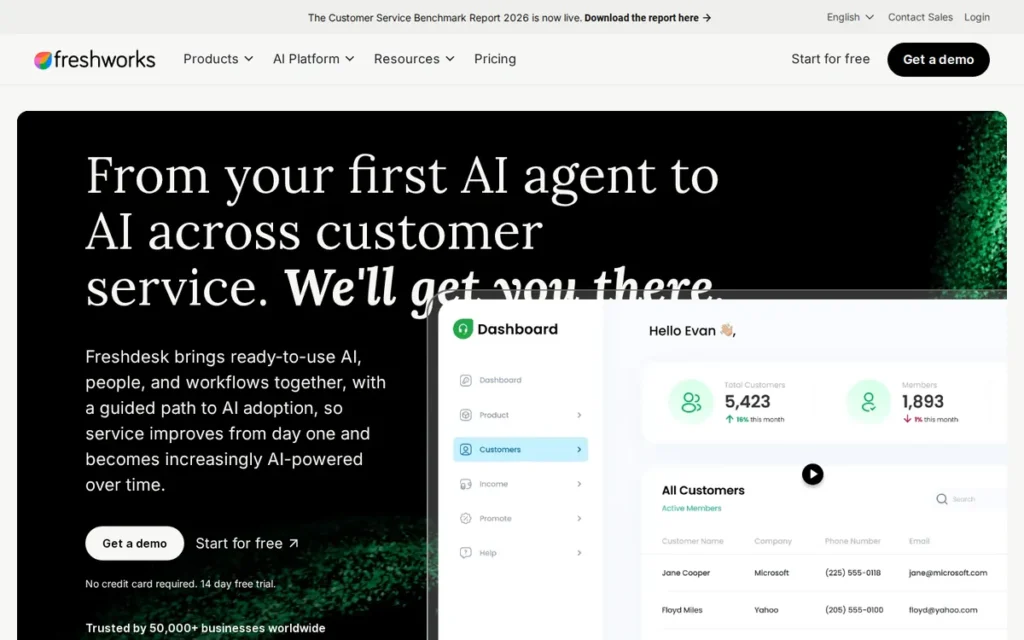
Category: Modular Helpdesk, a cloud-based multichannel ticketing system with a free-to-start entry point, tiered AI automation via Freddy AI, and a modular path to full omnichannel operations within the Freshworks ecosystem.
At a Glance
- Category: Modular Helpdesk
- Best For: SMB and mid-market support teams of 5–100 agents seeking published transparent pricing, a genuine free entry point, and modular AI automation without full ecosystem lock-in
- Price Range: Free (up to 10 agents): $79/agent/month (Enterprise, annual); Omni bundle from $29/agent/month (annual)
- Primary Strength: Freshdesk provides the most complete published pricing structure and the most numerous Freshworks-reported named enterprise case studies with quantified outcomes, including a 43% first-response-time reduction at Bridgestone Mobility Solutions (Freshworks customer stories hub, 2024–2025), of any platform in this evaluation
- Biggest Limitation: Freshdesk’s Freddy AI advanced features (Copilot and full AI Agent) are gated to higher tiers and separate paid add-ons; the platform’s own support responsiveness has been rated inconsistently by practitioners managing production-critical deployments
- One-Line Summary: Freshdesk is the best-value omnichannel help desk for growing support teams, combining a genuine free-to-start plan, published tier pricing, a Freddy AI three-layer automation architecture, and more Freshworks-reported enterprise performance outcomes than any other platform in this evaluation.
- Last Verified: May 2026
Overview
Freshdesk, the help desk product of Freshworks, Inc. (Nasdaq: FRSH), is a cloud-based multichannel customer service platform designed for SMB and mid-market support teams that need scalable ticketing with transparent pricing, genuine free-tier access, and modular AI automation without the implementation complexity of enterprise-first competitors.
Freshdesk supports email, live chat, phone, social media, WhatsApp, and SMS in a unified agent workspace, layering Freddy AI across customer-facing resolution, agent assist, and supervisor analytics. Freshworks-reported outcomes include a 43% first-response-time reduction at Bridgestone Mobility Solutions, a 45% resolution-time reduction at Rackspace Technology, and a 33% faster resolution at TaylorMade Golf, vendor-reported metrics published in Freshworks’ customer stories hub (freshworks.com/customers, 2024–2025) that have not been independently audited, but provide named-company specificity exceeding most competitors in this evaluation.
Key Features
- Unified Omnichannel Inbox: Freshdesk consolidates email, live chat, phone, social media (Facebook, Instagram, X), WhatsApp, and SMS into a single agent workspace with full ticket history per channel, eliminating the context loss that occurs when customers move between support channels mid-interaction.
- Freddy AI Three-Layer Architecture: Freshdesk’s Freddy AI operates across three structured tiers, Freddy AI Agents for autonomous customer conversation resolution, Freddy Copilot for real-time agent assist covering reply drafting and thread summarization, and Freddy Insights for supervisor-level performance analytics, providing a structured automation roadmap from basic ticket deflection to full agentic resolution (MyAskAI, 2026).
- Freshdesk Omni Bundle: Freshdesk’s Omni bundle: starting at $29/agent/month billed annually as of May 2026, packages ticketing, messaging, live chat, and social into a single omnichannel product at a price point that undercuts most competitor omnichannel bundles in the SMB and mid-market segment.
- No-Code Freddy Agent Studio: Freshdesk’s no-code Freddy Agent Studio allows support operations teams to build, configure, and deploy AI agents without developer involvement, enabling automation of high-frequency query types without ongoing engineering dependency (eesel.ai, 2026).
- Freshworks Ecosystem Integration: Freshdesk operates within the broader Freshworks ecosystem alongside Freshchat (messaging), Freshcaller (voice), and Freshservice (ITSM), providing organizations a single-vendor path to consolidating customer service, IT support, and sales engagement under one platform.
Best For
Freshdesk is best suited for SMB and mid-market support teams of 5 to 100 agents that need transparent, published pricing with a free-to-start entry point, proven omnichannel ticketing, and modular AI automation. Freshdesk is particularly well-matched for teams that want to validate the platform before financial commitment and teams building toward the Freshworks ecosystem.
Pricing
Freshdesk Ticketing tiers (billed annually, verified May 2026): Free for up to 10 agents; Growth $15/agent/month; Pro $49/agent/month; Enterprise $79/agent/month. Monthly billing adds approximately 20% over annual rates.
Freshdesk Omni (omnichannel bundle, annual): Pro $29/agent/month; Enterprise $89/agent/month. Freddy Copilot is a separate paid add-on not included in standard tiers.
Freddy AI cannot access external knowledge repositories such as Confluence or Google Drive without manual content import, limiting AI effectiveness for teams whose documentation lives outside Freshworks tools. Verify current pricing at freshworks.com/freshdesk/pricing.
Strengths
- Freshdesk’s Freshworks-reported named case studies include a 43% reduction in first response time at Bridgestone Mobility Solutions and a 45% reduction in average resolution time at Rackspace Technology (Freshworks customer stories hub, 2024–2025), vendor-reported outcomes with a level of named-company specificity and quantified detail that exceeds most competitors in this evaluation. Note: these metrics originate from Freshworks’ own customer stories hub and have not been independently audited.
- Freshdesk is Nasdaq-listed under ticker FRSH, providing buyers with audited financial reporting, investor accountability, and long-term vendor viability signals unavailable from privately held competitors including Zendesk (taken private 2022), Intercom, and Gorgias.
- Freshdesk’s free-forever tier (up to 10 agents) is a genuine product: not a time-limited trial, giving bootstrapped teams, early-stage businesses, and evaluation-stage organizations a risk-free path to validating the platform before any financial commitment.
- Freshdesk’s Freddy AI three-layer architecture (Agents, Copilot, Insights) is the most systematically organized AI product offering in the SMB/mid-market segment, providing a structured automation roadmap compared with the bolt-on AI features offered by several competitors.
Limitations
- AI Feature Gating: Freshdesk’s most consequential trade-off is that its most prominently marketed AI capabilities (Freddy Copilot for agent assist and Freddy AI Agent for autonomous resolution) are gated behind higher-tier plans and separate paid add-ons, meaning teams on the Growth tier will not access the features featured in Freshdesk’s marketing without additional spend.
Users on r/helpdesk noted:
“we are a small to mid sized support team and we mainly need reliability and efficiency, not more complexity. at this point it feels like we are spending too much time working around the tool instead of letting it help us. we originally chose it as an ai helpdesk software, but the ai features have not really improved day to day workflows as much as we hoped.” Posted by u/Old_Roof709
Takeaway: Freshdesk’s Freddy AI features consistently underdeliver relative to vendor marketing for SMB teams, with practitioners spending more time managing the platform than their actual support queues, a direct reflection of the AI gating gap between promoted capabilities and included-tier reality.
- Vendor Support Inconsistency: Multiple practitioners report that Freshdesk’s own support responsiveness is inconsistent for production-critical issues (a notable irony for a customer service platform) with one documented case of an account being closed mid-deployment with no response across five support tickets (r/smallbusiness, 2024–2025).
- Knowledge Source Limitation: Freddy AI is constrained to the Freshworks ecosystem’s knowledge, external documentation sources such as Confluence or Google Drive cannot be accessed without manual content import, limiting AI effectiveness for teams whose knowledge base lives outside Freshworks tools.
Verdict
Freshdesk is the strongest overall choice for SMB and mid-market support teams seeking a proven, transparently priced omnichannel platform with Freshworks-reported enterprise outcomes and a free-to-start entry point, earning the top rank through published pricing clarity, named case study specificity, Nasdaq-listed financial transparency, and the broadest viable team-size range of any platform reviewed. Teams that invest in proper Freshdesk configuration and maintain a high-quality Freddy knowledge base will reach automation outcomes aligned with the Bridgestone and Rackspace vendor-reported results. The Freddy Copilot add-on cost must be modeled explicitly before signing, and Freshdesk’s vendor support responsiveness should be assessed during the trial period, not assumed from product quality alone.
2. Zendesk for Service: Best for High-Volume, Multi-Channel Operations: Best for Teams Requiring the Widest Integration Ecosystem
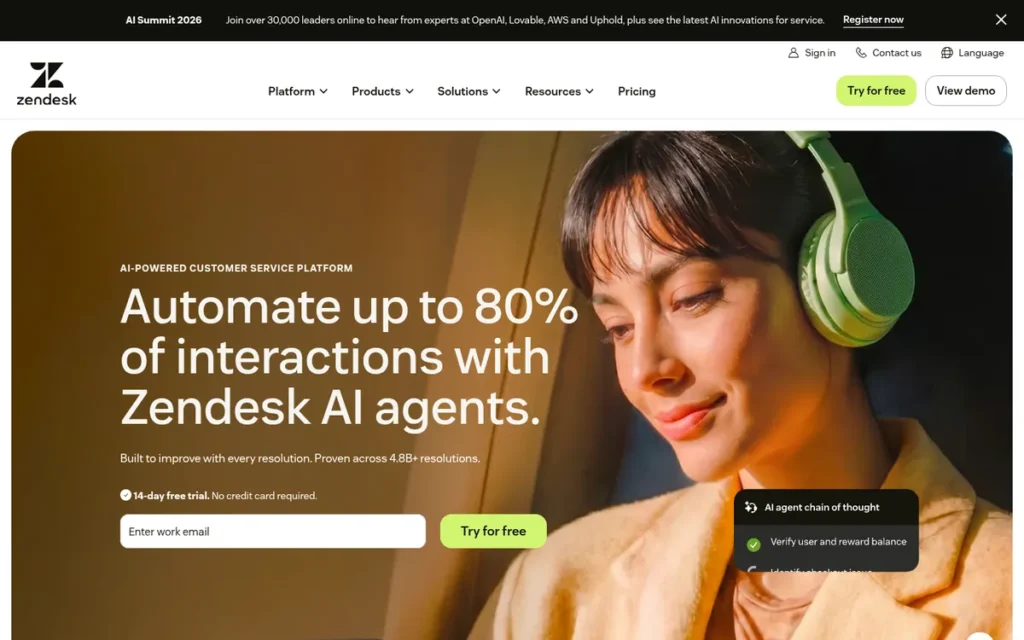
Category: Enterprise Helpdesk, a mature, configurable omnichannel customer support platform with a 1,500+ app integration marketplace and a self-improving AI architecture designed for mid-to-large support operations at scale.
At a Glance
- Category: Enterprise Helpdesk
- Best For: Mid-to-large support teams of 30+ agents handling high ticket volume across multiple channels who need the widest integration ecosystem in the category and deep workflow configurability
- Price Range: ~$19/agent/month (Suite Team, annual) through enterprise pricing on request; AI Copilot and advanced features are separate paid add-ons
- Primary Strength: Zendesk operates the largest integration marketplace in the customer service platform category (1,500+ apps), and its AI Agent improves automatically through every resolved interaction without requiring manual knowledge base retraining, a continuous learning architecture noted by platform reviewers as a meaningful differentiator (Hiver, 2025)
- Biggest Limitation: Zendesk’s most valuable AI and advanced operational features (including AI Copilot, advanced triage, intelligent QA, sandbox replication, and multi-brand management) are priced as separate paid add-ons, making the true cost of a production-grade deployment significantly higher than its published entry pricing
- One-Line Summary: Zendesk is the most feature-complete omnichannel helpdesk for high-volume mid-to-large support operations, with 1,500+ integrations and a self-improving AI architecture, but its real cost of ownership is substantially higher than its published starting price once production-grade AI and advanced workflow features are factored in.
- Last Verified: May 2026
Overview
Zendesk for Service is a mature enterprise customer service platform founded in 2007 in Copenhagen, Denmark, taken private in 2022 via a ~$10.2 billion acquisition, and designed for mid-to-large organizations requiring deep omnichannel coverage, a 1,500-app integration ecosystem, and a configurable AI architecture centered on measurable automated resolution rather than ticket management.
Zendesk covers email, live chat, phone, social media, WhatsApp, SMS, and web forms in a single unified agent workspace. Zendesk’s AI Agent is designed to improve automatically through every resolved interaction, a continuous learning architecture noted by platform reviewers as a differentiator from platforms dependent on static knowledge base content for AI performance (Hiver, 2025). Reddit practitioners managing 400+ daily tickets confirm real-world performance viability at high throughput, while simultaneously documenting that add-on costs grow “exponentially” as multi-brand or advanced AI features are enabled (r/Zendesk, 2024–2025).
Key Features
- Self-Improving AI Architecture: Zendesk’s AI Agent is designed to improve autonomously through every resolved interaction, learning from live support outcomes rather than requiring manual knowledge base updates, a continuous learning architecture that differentiates Zendesk from platforms dependent on static content for AI performance (Hiver, 2025).
- 1,500+ App Marketplace: Zendesk’s integration marketplace includes Slack, Salesforce, Shopify, Jira, Microsoft Teams, Zoom, Mailchimp, Google Workspace, Talkdesk, and hundreds of additional tools, providing out-of-the-box connectivity for virtually any enterprise toolstack without custom development.
- Zendesk Explore Analytics: Zendesk Explore provides pre-built analytics dashboards alongside a custom query builder for tracking ticket volume, SLA compliance, agent performance, and channel patterns, enabling operational reporting without dedicated business intelligence tooling.
- Unified Agent Workspace: Zendesk’s unified agent workspace consolidates every customer interaction (regardless of originating channel) into a single thread with full conversation history, ensuring agents never ask customers to repeat context when moving between email, chat, phone, and social.
- Microsoft 365 Integration (2026): In 2026, Zendesk announced a partnership with Microsoft integrating its ticketing and AI resolution capabilities directly into Microsoft 365 and Copilot/Agent 365, extending Zendesk from external customer service into internal employee service and IT help desk use cases (PR Newswire, 2025).
Best For
Zendesk is best suited for support teams of 30 or more agents handling complex, high-volume inquiries across multiple channels who have (or plan to hire) a dedicated platform administrator. Zendesk is the right fit for organizations that require the category’s broadest integration ecosystem and have budgeted explicitly for AI Copilot and workflow add-ons needed for a production-grade deployment.
Pricing
Zendesk Suite plans start at approximately $19/agent/month (Team tier, billed annually, verified May 2026). AI Copilot, advanced triage automation, intelligent QA, Sunshine Conversations, sandbox replication, and multi-brand support beyond base thresholds are separately priced add-ons requiring a sales quote.
Practitioners operating 7-brand enterprise deployments report costs growing “exponentially over the competition” once all required add-ons are included, including a paid app for default email addresses per brand and add-on charges for spam filter rules beyond 10 (r/Zendesk, 2024–2025). Total cost of ownership must be modeled with all required add-ons before budget approval. Verify current pricing at zendesk.com/pricing.
Strengths
- Zendesk’s self-improving AI architecture is validated by Reddit practitioners managing 400+ daily tickets as performing without slowness at real-world high throughput (r/Zendesk, 2024), and its continuous learning design does not require the manual knowledge base maintenance that degrades AI performance on most competing platforms.
- Zendesk’s 2026 Microsoft 365 and Copilot/Agent 365 integration positions Zendesk as the only platform in this evaluation with a documented product roadmap extending into internal employee service, future-proofing enterprise investment beyond external customer support (PR Newswire, 2025).
- Zendesk’s 1,500+ marketplace integrations make it the most broadly connectable platform in this review, organizations can typically add Zendesk to any existing enterprise toolstack without custom API development, a practical advantage with no equivalent among competing platforms.
- Zendesk’s omnichannel channel coverage: email, live chat, phone/voice, social media, WhatsApp, SMS, and web forms, is the broadest native and integration-supported footprint of any platform in this evaluation.
Limitations
- Add-On Cost Sprawl: Zendesk’s most consequential trade-off is a structural pricing gap between its $19/agent/month entry point and a production-grade deployment, AI Copilot, advanced routing automation, sandbox replication, and multi-brand configurations are add-ons that push total cost of ownership well above the advertised entry figure. Practitioners in multi-brand enterprise environments document costs “exponentially over the competition” once required add-ons are active, including separate charges for default email addresses per brand and spam filter rules beyond 10 (r/Zendesk, 2024–2025).
- Configuration Dependency: Zendesk demands meaningful configuration investment to perform at enterprise levels, practitioners consistently note that “the platform reflects its configuration,” and teams expecting out-of-the-box enterprise performance without an experienced admin are frequently disappointed.
“Zendesk’s got a ton of features, and with some setup (and maybe a tech-savvy teammate), it can do a lot. But the bots get annoying quick, and canned replies feel super robotic unless you tweak ’em. Also, the pricing stacks up fast, definitely not plug and play.” (u/jessicalacy10, r/Zendesk)
Takeaway: Zendesk’s feature depth rewards teams that invest in configuration and tolerate pricing complexity, but delivers a frustrating out-of-the-box experience for teams expecting plug-and-play simplicity at its entry price point.
- Reduced Financial Transparency: Since its 2022 private equity acquisition, Zendesk no longer provides the audited public financial reporting that NYSE-listed (HubSpot, Salesforce) or Nasdaq-listed (Freshworks) competitors offer buyers evaluating long-term vendor viability.
Verdict
Zendesk is the most mature and feature-complete omnichannel helpdesk for high-volume, mid-to-large support operations, but the gap between its published entry pricing and the true cost of a production-grade AI-enabled deployment is among the widest documented in this category. Teams that invest in proper configuration, budget explicitly for AI Copilot and workflow add-ons, and have a platform-experienced administrator will access one of the strongest automation and omnichannel capability sets in the market. Zendesk is the right choice when integration ecosystem depth and configurable workflow sophistication are non-negotiable, and when the organization has both the platform expertise and the realistic budget to configure it to production quality.
3. Intercom: Best AI-Native Platform: Best for Digital-First and SaaS Teams Prioritizing Automated Resolution Over Ticket Management
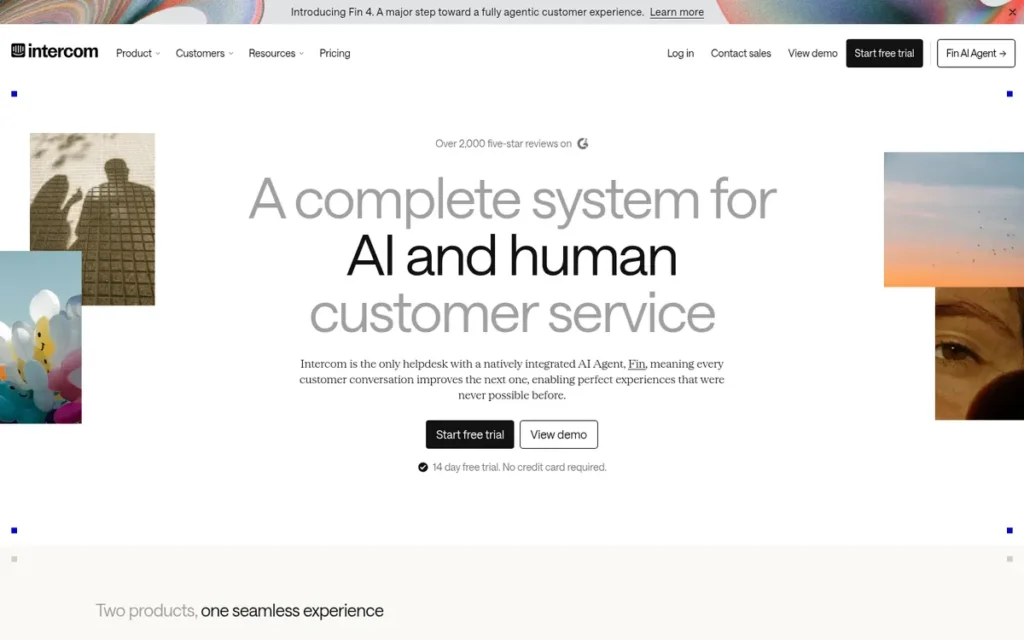
Category: AI-Native Conversation Platform, an AI-first customer service system centered on outcome-based automated resolution rather than traditional ticket queues, designed for digital-first and product-led organizations.
At a Glance
- Category: AI-Native Conversation Platform
- Best For: SaaS companies and digital-native teams of 5–50 agents handling predominantly chat and in-app messaging inquiries who prioritize AI deflection rate and modern agent UX over complex SLA workflow management or high-volume phone support
- Price Range: ~$29/seat/month (Essential tier) + $0.99 per Fin AI resolution; full cost requires multi-scenario volume modeling before signing
- Primary Strength: Intercom’s Fin AI Agent holds the strongest independently backed AI evidence in this evaluation, an approximately 65% average automated resolution rate, a $1 million performance guarantee tied to that resolution threshold, and a Fin product line that Intercom reports grew from $1 million to over $100 million ARR (company-reported, GTMnow, 2025)
- Biggest Limitation: Intercom’s hybrid pricing model: per-seat plans plus per-resolution AI charges, creates compounding cost exposure as both team size and AI volume scale, with practitioners documenting unexpected 30–50% bill growth within 12 months of deployment (r/SaaS, 2024–2025)
- One-Line Summary: Intercom is the highest-rated AI-native customer service platform for digital-first teams, combining Fin AI’s approximately 65% resolution rate, a $1 million performance guarantee, and the most modern agent experience in this evaluation, but its hybrid seat-plus-resolution pricing model requires rigorous multi-scenario budget modeling before deployment at any significant scale.
- Last Verified: May 2026
Overview
Intercom is an AI-first conversational customer service platform founded in San Francisco in 2011, designed for SaaS companies and digital-native organizations that prioritize conversation over ticket queues, placing every customer interaction in a shared inbox where Fin AI Agent and human agents collaborate seamlessly without forcing customers through ticket forms.
Intercom holds the highest combined G2 and Capterra rating in this evaluation (~4.5/5.0 each with large volume) and backs its Fin AI resolution claims with a $1 million performance guarantee tied to achieving an approximately 65% resolution rate. Intercom reports that its Fin AI business grew from $1 million to over $100 million ARR, according to Intercom President Archana Agrawal (GTMnow, 2025), a company-reported figure that has not been independently audited but indicates real market adoption at scale.
Key Features
- Fin AI Agent with Performance Guarantee: Intercom’s Fin AI Agent resolves customer queries autonomously, with a platform-reported approximately 65% average automated resolution rate and Intercom’s own internal support operation achieving 80%+ automation, backed by a $1 million performance guarantee if Fin does not achieve a 65% resolution rate under the program terms, a financial commitment unique in this evaluation.
- Outcome-Based AI Pricing: Intercom’s outcome-based AI pricing charges $0.99 per successful Fin resolution, structurally aligning platform cost with actual automation value delivered rather than charging a fixed fee regardless of whether AI resolves any queries (Sequence, 2025).
- Seamless AI-to-Human Handoff: Intercom’s shared inbox consolidates website chat, in-app messaging, email, and integrated messaging channels in a single workspace where AI and human agents share the same conversation thread, ensuring customers never experience a visible handoff between automated and human responses.
- Market-Validated AI Adoption: Intercom reports that its Fin AI business grew from $1 million to over $100 million ARR as a dedicated product line (company-reported, Intercom President Archana Agrawal, GTMnow, 2025), a commercial signal more credible than self-reported platform-level deflection statistics.
- Modern Agent Experience: Intercom’s agent workspace is rated by G2 reviewers for faster new agent onboarding and cleaner UI compared with traditional help desks, with practitioners citing reduced time-to-productivity for new support hires as a measurable operational benefit (G2 Intercom reviews, 2025).
Best For
Intercom is best suited for SaaS companies and digital-native support teams of 5 to 50 agents whose inquiries are predominantly chat and in-app messaging. Intercom is the right fit for teams whose AI resolution volume is predictable enough for scenario modeling and whose operations prioritize modern agent UX and AI deflection over complex multi-tier SLA workflows or high-volume phone support.
Pricing
Intercom pricing combines seat-based plans (Essential, Advanced, Expert, starting approximately $29/seat/month) with usage-based AI charges ($0.99 per Fin resolution; $99/month for 500 Messaging messages) as of May 2026. Seat pricing is not always displayed in plain text on Intercom’s pricing page and may require direct inquiry.
The hybrid model requires explicit scenario modeling at 1x, 2x, and 3x current inquiry volume before signing, practitioners report 30–50% bill growth within 12 months as seats and AI resolutions compound simultaneously (r/SaaS, 2024–2025). Verify current pricing at intercom.com/pricing.
Strengths
- Intercom reports that its Fin AI product grew from $1 million to over $100 million ARR as a standalone line (company-reported, Intercom President Archana Agrawal, GTMnow, 2025), indicating that organizations are actively paying for Fin’s outcomes in production rather than evaluating them in trials.
- Intercom holds the highest combined review platform rating in this evaluation: approximately 4.5/5.0 on both G2 and Capterra with large review volumes, with praise consistently centering on modern agent UX, Fin AI effectiveness, and faster new agent onboarding compared with traditional help desks.
- Intercom’s $1 million performance guarantee tied to a 65% resolution rate threshold is an industry-unique financial commitment that transforms AI resolution rate marketing into a contractual obligation with financial accountability, a level of evidential backing unavailable from any other platform in this evaluation.
Limitations
- Compounding Cost Exposure: Intercom’s most consequential trade-off is financial unpredictability, the hybrid seat-plus-per-resolution pricing model creates compounding cost exposure as both team size and AI resolution volume grow simultaneously. Practitioners document bill growth of 30–50% within 12 months, with one two-time migration veteran advising that “the per-seat model will cost you more than you expect within a year” for teams of 8–10+ agents (r/SaaS, 2024–2025).
This aligns with community sentiment on r/SaaS:
“The first time we moved to Intercom, we were a 12-person team with about 8 support agents. The initial sticker price looked reasonable. Six months later the bill had climbed because of seat additions the AI resolution charges, and a couple of add-ons we didn’t realize were optional at signing. Finance was not pleased.” Posted by u/TigerAnxious9161
Takeaway: Intercom’s hybrid pricing model creates systematic budget surprises for growing teams, with practitioners across multiple deployments consistently reporting first-year cost growth that materially exceeded their initial contract estimates.
- Operational Depth Gaps: Intercom lacks the SLA management depth, complex multi-step workflow automation, and advanced operational analytics available in Zendesk and Freshdesk, making Intercom a poor fit for support operations with formal contractual SLA obligations, complex routing hierarchies, or large-scale ticket volumes requiring detailed agent performance reporting.
- Voice and Phone Coverage Gap: Intercom’s native channel strength is in chat and in-app messaging; voice and phone support require third-party integrations that add configuration complexity and potential cost, making Intercom a weak choice for teams with significant inbound call volume.
Verdict
Intercom is the strongest choice for AI-first resolution in digital-native and SaaS environments, combining the highest review ratings in this evaluation, a $1 million AI performance guarantee at the 65% resolution threshold, and a Fin AI product line that Intercom reports has surpassed $100 million ARR, validating production adoption well beyond demo conditions. Intercom’s most significant limitation is financial: the hybrid seat-plus-resolution pricing model requires explicit volume scenario modeling at 2x and 3x current volume before signing, and organizations that skip this step consistently report budget surprises within 12 months. Intercom is the right tool for chat-first teams that can manage cost exposure through careful contract terms; it is not the right tool for organizations with complex SLA workflows, significant call center volume, or inquiry patterns that spike seasonally without predictability.
4. HubSpot Service Hub: Best for CRM-Native Teams: Best for Organizations Already Invested in HubSpot Across Sales and Marketing
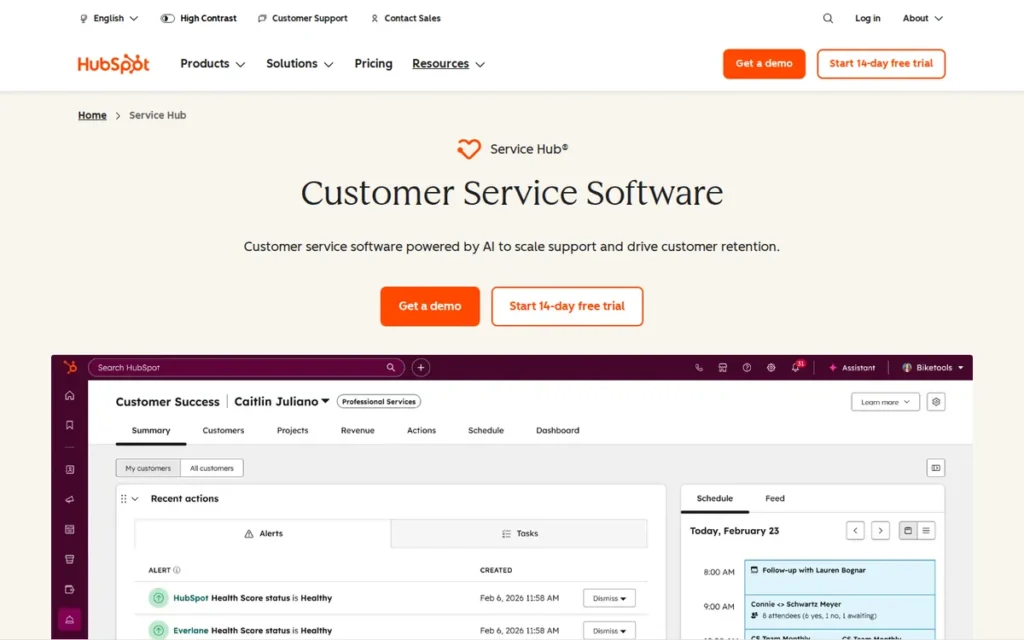
Category: CRM-Native Service Platform, a customer service system built on HubSpot’s shared CRM database, providing support agents with full marketing, sales, and service lifecycle context without external integrations or data synchronization overhead.
At a Glance
- Category: CRM-Native Service Platform
- Best For: Organizations already using HubSpot CRM, Sales Hub, or Marketing Hub who want a service layer sharing the same customer database without integration management, particularly B2B professional services, SaaS companies with customer success functions, and mid-market organizations where cross-functional customer visibility is operationally critical
- Price Range: Free (basic features): ~$150/seat/month (Enterprise); mid-tier Professional pricing at hubspot.com/pricing/service; Core Seat vs. Service Seat distinctions apply
- Primary Strength: HubSpot Service Hub is the only platform in this evaluation where support agents and sales, marketing, and customer success teams share the same real-time CRM database, eliminating the data synchronization failures and context gaps caused by third-party helpdesk-to-CRM integrations; HubSpot is NYSE-listed (HUBS) with 240,000+ customers per FY2024 Annual Report
- Biggest Limitation: HubSpot Service Hub’s CRM-native differentiator delivers full value only for organizations already invested in HubSpot’s CRM or other Hubs; Breeze AI’s automation depth for routing and triage is less mature than Zendesk’s workflow engine or Intercom’s Fin; phone and voice support are less robust than dedicated contact center platforms
- One-Line Summary: HubSpot Service Hub is the definitive CRM-native service platform for HubSpot-ecosystem organizations, giving support agents complete sales and marketing lifecycle context in a single workspace, but its core differentiator is unlocked only within the HubSpot platform, and its AI automation capabilities trail dedicated AI-first alternatives.
- Last Verified: May 2026
Overview
HubSpot Service Hub is the customer service component of HubSpot’s Smart CRM platform (NYSE: HUBS, 240,000+ customers per HubSpot’s FY2024 Annual Report), designed for organizations that want support agents sharing the exact same customer database as sales, marketing, and customer success, providing deal history, campaign engagement, and lifecycle stage data natively within every service ticket without an integration layer.
HubSpot Service Hub includes a free tier covering shared inbox, ticketing, live chat, and email integration (a genuine no-cost entry for teams validating the platform) and scales to a B2B customer portal for self-service, Breeze AI for automated response assistance, SLA management, and advanced reporting. HubSpot Service Hub’s value compounds significantly within the HubSpot ecosystem; teams using Salesforce, an external CRM, or no CRM will access a capable but less differentiated helpdesk at equivalent price points.
Key Features
- Native CRM-Service Shared Database: HubSpot Service Hub operates on the same CRM database as HubSpot Sales Hub, Marketing Hub, and CRM, giving support agents native, real-time access to deal history, marketing campaign engagement, lifecycle stage, and contact interactions without requiring a third-party integration or scheduled data synchronization.
- B2B Customer Portal: HubSpot Service Hub’s customer portal gives B2B clients a branded self-service interface to submit, track, and manage their own support tickets, reducing inbound volume for status-update requests and replacing unstructured back-and-forth email communication in professional services organizations.
- Breeze AI Included: HubSpot Service Hub includes Breeze AI: HubSpot’s native AI layer, for automated response drafting, conversation summarization, ticket classification, and knowledge base article suggestions across applicable plan tiers, without a separate paid add-on requirement.
- Unified Customer Reporting: HubSpot Service Hub’s SLA management, Customer Success Workspace, and advanced reporting consolidate support performance metrics on the same platform as sales and marketing data, enabling CS leaders to demonstrate service impact on customer retention and revenue in a single reporting environment.
- Genuine Free Tier: HubSpot Service Hub’s free tier includes shared inbox, basic ticketing, live chat, and email integration at no cost, providing a genuinely risk-free evaluation path for teams assessing platform fit before committing to paid plans.
Best For
HubSpot Service Hub is best suited for organizations that have already invested in HubSpot for CRM, sales, or marketing and want a service layer sharing the same customer data without integration overhead. HubSpot Service Hub delivers the strongest ROI for B2B professional services firms, SaaS companies with active customer success functions, and mid-market teams where complete cross-functional customer visibility drives support quality.
Pricing
HubSpot Service Hub is available at no cost (free tier, verified May 2026) and scales to approximately $150/seat/month at the Enterprise tier. Mid-tier Professional plans are listed at hubspot.com/pricing/service.
HubSpot uses distinct seat types (Core Seats (general platform access) and Service Seats (advanced service-specific functionality)) which must be understood to forecast costs accurately for teams using multiple HubSpot Hubs. The jump between free and paid tiers is significant; enterprise pricing for teams of 10+ agents requires careful per-seat modeling. Verify current pricing and seat type requirements at hubspot.com/pricing/service.
Strengths
- HubSpot is NYSE-listed (HUBS) and serves 240,000+ customers across 120+ countries per its FY2024 Annual Report, providing enterprise buyers with audited financial transparency, long-term vendor viability assurance, and a market-tested deployment scale that venture-backed competitors including Intercom and Gorgias cannot match.
- G2 reviewers consistently rank HubSpot Service Hub among the highest for ease of use and “manage information in one place” in comparative evaluations against Salesforce Service Cloud (G2 comparative data, 2025), attributes that translate to faster agent onboarding and lower training investment than platforms requiring dedicated admin configuration.
- HubSpot Service Hub’s CRM-native architecture eliminates the data synchronization failure modes (lag, conflicting records, incomplete contact data) that affect every other platform in this evaluation relying on third-party CRM integration, providing a structural reliability advantage for organizations where complete customer context is mission-critical.
- HubSpot publicly documents its own internal use of Service Hub for managing support across its 240,000+ customer base, the only platform in this evaluation that has published a named case study of using its own product at scale (HubSpot, “HubSpot on Service Hub,” 2025), providing a uniquely transparent proof point for the platform’s real-world capabilities.
Limitations
- Platform Dependency: HubSpot Service Hub’s most consequential trade-off is platform dependency, its core CRM-native differentiator delivers meaningful competitive value only for organizations already on HubSpot CRM, Sales Hub, or Marketing Hub; teams using Salesforce, another external CRM, or no CRM do not access this architectural advantage and are evaluating a capable but less competitively differentiated helpdesk at a premium price point.
- AI Automation Maturity: Breeze AI’s automation depth for intelligent routing and triage is less mature than Zendesk’s workflow engine or Intercom’s Fin, HubSpot Service Hub does not offer outcome-based AI resolution pricing or a self-improving AI architecture, making AI performance harder to evaluate before deployment and harder to hold the vendor accountable for post-deployment.
Users on r/hubspot shared their experience:
“We’ve been using it for a year. We moved from Zendesk which I could not hate more if I tried, but that’s a separate story. HubSpot HelpDesk is absolutely usable if you’re not a massive support organisation or looking for the latest bells and whistles.” Posted by u/LimeyHoya
Takeaway: HubSpot Service Hub earns genuine practitioner approval as a step forward from legacy platforms like Zendesk, but its usability ceiling (explicitly tied to organizational scale and complexity) confirms the article’s positioning of it as a fit for non-enterprise, HubSpot-ecosystem teams rather than large-scale support operations.
- Voice and Phone Limitations: HubSpot Service Hub’s phone and voice channel support is not as robust as dedicated contact center platforms, making it a poor standalone choice for teams with significant inbound call volume or complex telephony requirements.
Verdict
HubSpot Service Hub is the strongest choice for organizations with an existing HubSpot CRM investment, delivering a unique architectural advantage, native cross-functional customer context, that no other platform in this evaluation replicates without integration overhead. HubSpot Service Hub’s ROI is unlocked by its CRM integration depth, not by its general-purpose helpdesk capabilities alone; buyers should evaluate it with that lens. For organizations not already on HubSpot, Service Hub is a capable platform but not a top-tier standalone helpdesk at its price point, Freshdesk or Zoho Desk will typically deliver better value.
5. Zoho Desk: Best Value: Best for Budget-Conscious Teams Wanting AI Automation Without Add-On Premiums
Category: Value-Tier Helpdesk, a full-featured cloud help desk with Zia AI bundled at Standard tier and above at no add-on cost, Blueprint workflow governance at mid-tier pricing, and deep native integration within Zoho’s 55-application ecosystem.
At a Glance
- Category: Value-Tier Helpdesk
- Best For: Cost-conscious SMB and mid-market teams of 2–30 agents: particularly those already using Zoho CRM or other Zoho applications, who need full-featured help desk capabilities including AI automation without paying the add-on premiums charged by larger competitors
- Price Range: ~$7/agent/month (Express, annual; note: Express does not include Zia AI), ~$40/agent/month (Enterprise, annual); Zia AI bundled at no extra charge beginning at Standard tier (~$14/agent/month annual)
- Primary Strength: Zoho Desk includes Zia AI: covering customer-facing chatbot, agent-assist reply suggestions, sentiment analysis, auto-tagging, and supervisor anomaly detection, at no separate add-on charge on Standard tier (~$14/agent/month annual) and above, making it the only platform in this evaluation where AI automation is bundled into a mid-tier plan without a premium add-on purchase
- Biggest Limitation: Zoho Desk’s user interface is rated as more complex and less intuitive than Freshdesk, Intercom, or HubSpot by practitioners; Zia AI is not available on the Express entry tier ($7/agent/month); and Zia’s performance is directly dependent on knowledge base quality
- One-Line Summary: Zoho Desk delivers the best price-to-feature ratio in the digital customer service platform category, with Zia AI bundled at Standard tier and above at no separate add-on charge, Blueprint workflow governance at mid-tier pricing, and full omnichannel coverage, but its UI complexity and Zoho-ecosystem dependency limit its appeal to teams outside the Zoho stack.
- Last Verified: May 2026
Overview
Zoho Desk is a cloud-based help desk developed by Zoho Corporation (described by Zoho as one of the world’s largest bootstrapped software companies, founded in 1996, entirely privately held, and headquartered in Austin, TX and Chennai, India) providing full-featured omnichannel customer service with Zia AI embedded on Standard tier and above at no additional per-agent charge.
Zoho Desk covers email, live chat, phone, social media (Facebook, Instagram, X), and web forms with native integration into Zoho CRM and 54 additional Zoho applications. Practitioners in cross-platform cost discussions consistently describe Zoho Desk as “super cost-effective compared to big names like Fresh and Zen” (r/smallbusiness, 2024–2025), particularly for teams already using Zoho CRM where native integration eliminates third-party connector costs.
Key Features
- Zia AI at No Add-On Charge (Standard Tier and Above): Zoho Desk’s Zia AI operates across three organizational roles simultaneously at no additional per-agent cost beginning at the Standard tier (~$14/agent/month annual), 24/7 customer-facing chatbot resolution, real-time agent-assist covering reply drafting and sentiment analysis, and supervisor-level anomaly detection and performance insights (Zoho Desk Zia page).
- Blueprint Workflow Governance: Zoho Desk’s Blueprint workflow engine enforces step-by-step process consistency through mandatory fields, transition rules, and time-based escalations, ensuring documented procedures are followed even by new agents handling complex ticket types, a governance capability available at Professional tier pricing.
- Native Zoho CRM Integration: Zoho Desk integrates natively with Zoho CRM, providing support agents access to account history, deal stage, contact engagement data, and lifetime value directly within the ticket interface, without requiring a third-party API connector or scheduled synchronization.
- Zia GenAI and AI Agent Studio: Zoho Desk’s AI Agent Studio enables support teams to build custom agentic AI workflows using Zia GenAI (enabling autonomous multi-step actions and cross-application integration at the Enterprise tier) positioning Zoho’s AI roadmap alongside Salesforce Agentforce and Intercom Fin for next-generation autonomous support capabilities.
- 55+ Native Zoho App Integrations: Zoho Corporation develops 55+ cloud applications spanning CRM, HR, finance, project management, and customer service, meaning organizations standardizing on Zoho can connect Desk to their entire business operations stack through native integrations rather than third-party connectors.
Best For
Zoho Desk is best suited for cost-conscious SMB and mid-market teams of 2 to 30 agents (particularly those already using Zoho CRM or planning to adopt the Zoho ecosystem) who need a full-featured helpdesk with AI automation and workflow governance at the lowest per-agent price in the category. Zoho Desk delivers the strongest value for teams budgeting at Standard tier and above.
Pricing
Zoho Desk pricing (billed annually, verified May 2026):
- Express: ~$7/agent/month: basic automation, no Zia AI
- Standard: ~$14/agent/month: includes Zia AI customer-facing chatbot and agent assist
- Professional: ~$23/agent/month: includes Blueprint workflow governance and advanced AI features
- Enterprise: ~$40/agent/month: includes full GenAI capabilities and AI Agent Studio
The most advanced Zia GenAI capabilities are restricted to the Enterprise tier. Monthly billing adds a premium over annual rates. Verify current pricing and per-tier AI feature availability at zoho.com/desk/pricing.html.
Strengths
- Zoho Desk includes Zia AI capabilities: covering customer-facing chatbot, agent-assist reply drafting, sentiment analysis, auto-tagging, field predictions, and supervisor anomaly detection, at no additional per-agent charge beginning at Standard tier (~$14/agent/month annual, verified May 2026), making Zoho Desk the only platform in this evaluation where AI automation is bundled into a mid-tier plan at no add-on cost (Zoho Desk Zia page).
- Zoho Corporation is entirely self-funded with no outside investors or public listing, having bootstrapped to become one of the largest independent software companies globally according to Zoho Corporation’s own materials (zoho.com/about), meaning Zoho Desk’s pricing philosophy is determined by long-term product quality priorities rather than pressure to maximize add-on revenue.
- Zoho Desk’s Blueprint workflow engine enforces documented support processes with mandatory field rules, transition conditions, and time-based escalations at Professional-tier pricing, a governance capability available only at enterprise-tier price points on Zendesk and Freshdesk, and absent from Intercom’s standard feature set.
- Practitioners in cross-platform cost discussions consistently identify Zoho Desk as “super cost-effective compared to big names like Fresh and Zen” (r/smallbusiness, 2024–2025), with the price-per-feature ratio strongest among teams already using Zoho CRM where native integration eliminates third-party connector costs.
Practitioners comparing options on r/smallbusiness confirm:
“While it’s not super advanced, it’s definitely not gimmicky like some other vendors claim. It’s great for collecting customer details and handling first-line support. The AI can pull up KB articles and share them with customers, plus you can set up rule-based bots. It’s super cost-effective compared to big names like Fresh and Zen” Posted by u/Master-Muscle-4546
Takeaway: Independent practitioners evaluating Zoho Desk against Freshdesk and Zendesk consistently validate its cost-effectiveness and bundled AI as the decisive advantage, particularly for SMB teams that need functional automation at Standard-tier pricing without the add-on overhead of larger competitors.
Limitations
- UI Complexity: Zoho Desk’s most consequential trade-off is user interface complexity relative to its value, practitioners consistently describe the interface as “clunky” or “dense” compared with Freshdesk, Intercom, or HubSpot (r/helpdesk, 2025), meaning the platform demands greater admin configuration investment to reach a production-ready state.
- Zia Knowledge Base Dependency: Zia AI’s performance is directly dependent on knowledge base quality, Zoho Desk “needs a minimum amount of content to be useful” and “can produce weaker results if articles are outdated” (eesel.ai Zoho Desk AI accuracy analysis, 2025), a limitation more pronounced because Zia cannot easily integrate external knowledge repositories such as Confluence or Google Drive.
- Ecosystem Conditionality: Zoho Desk’s native CRM integration advantage is conditional on Zoho ecosystem adoption, teams on Salesforce or HubSpot CRM evaluating Zoho Desk as a general-purpose alternative will find the native CRM benefit absent and must assess the platform purely on its helpdesk capabilities and pricing.
- Express Tier Excludes Zia AI: Zia AI is not available on Zoho Desk’s Express tier ($7/agent/month annual), teams evaluating Zoho Desk specifically for its bundled AI must budget for Standard tier (~$14/agent/month annual) or above, which changes the entry-price comparison relative to Freshdesk’s genuinely AI-free free tier for teams of up to 10 agents.
Verdict
Zoho Desk delivers the strongest price-to-feature ratio in the digital customer service platform category, combining Zia AI automation at no add-on charge from Standard tier, Blueprint workflow governance at mid-tier pricing, and full omnichannel coverage starting from $14/agent/month with AI included, making it the clear choice for budget-conscious SMB and mid-market teams, particularly those already in the Zoho ecosystem. Zoho Desk’s UI complexity requires admin investment, Zia AI performs only as well as the knowledge base behind it, and the Express tier’s $7/agent/month entry point does not include AI, all real operational constraints, not token disclaimers. Teams on Salesforce or HubSpot evaluating Zoho Desk as a general-purpose alternative will find the native integration advantage absent; teams building on Zoho from the start will find the price-to-capability ratio unmatched in this evaluation.
6. Salesforce Service Cloud: Best for Enterprise Salesforce Organizations: Best for Regulated Industries Requiring Deep CRM-Service Data Unification
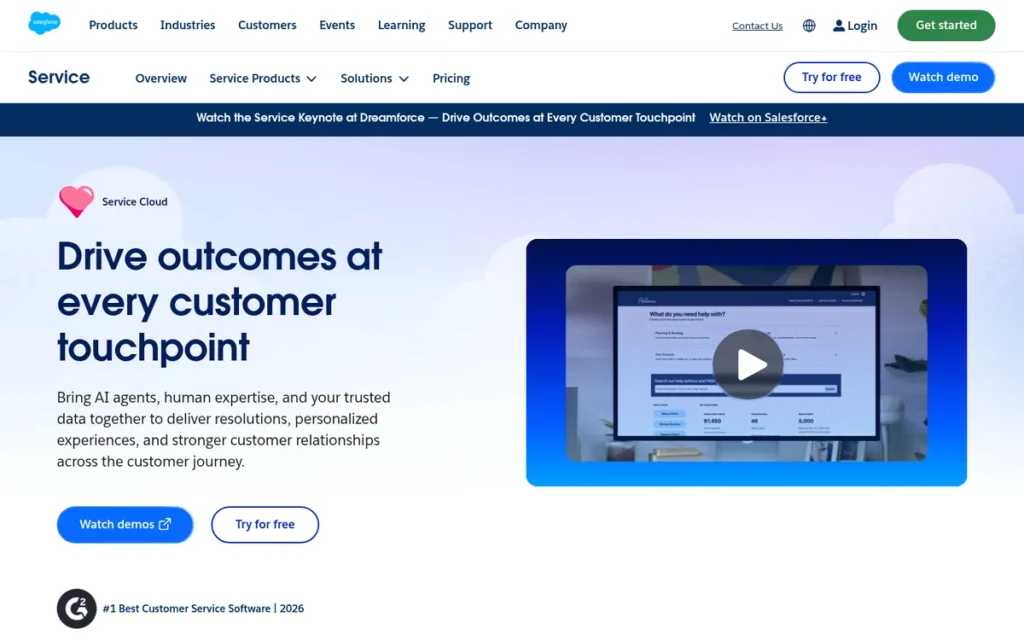
Category: Enterprise CRM-Service Platform, an enterprise-grade customer service layer built natively on Salesforce CRM, featuring Agentforce agentic AI, skills-based omnichannel routing, and a 5,000+ app partner ecosystem for complex, large-scale support organizations.
At a Glance
- Category: Enterprise CRM-Service Platform
- Best For: Enterprise organizations with 50+ agents already operating on SalesforceCRM that need the deepest CRM-service data integration, advanced Agentforce agentic AI, and skills-based omnichannel routing for complex, regulated-industry support operations
- Price Range: $25/user/month (Starter Suite, published); Pro Suite $100/user/month; Enterprise $175/user/month (annual, May 2026); Unlimited, contact sales; all-in enterprise TCO grows further with implementation partners and admin staffing
- Primary Strength: Salesforce Service Cloud provides the deepest native CRM-service integration in the category (support agents access the full Salesforce data layer across deals, accounts, marketing, and commerce in one console) and Agentforce AI executes multi-step autonomous actions across that data layer rather than simply generating responses
- Biggest Limitation: Salesforce Service Cloud’s Enterprise list pricing of $175/user/month (annual, May 2026) is already 7x the $25/user/month Starter Suite entry point before implementation partners, dedicated admin staffing, and add-on licensing are included, creating the widest documented entry-to-functional-cost gap of any platform in this evaluation
- One-Line Summary: Salesforce Service Cloud is the most powerful enterprise customer service platform for Salesforce-native organizations, combining the deepest CRM-service data integration, Agentforce agentic AI, and a 5,000+ app ecosystem, but Enterprise list pricing of $175/user/month (annual, May 2026) is 7x the Starter entry point before implementation partners and add-ons are included, and it is not a viable option for SMB teams or organizations without Salesforce ecosystem investment.
- Last Verified: May 2026
Overview
Salesforce Service Cloud is the enterprise customer service platform of Salesforce (NYSE: CRM, $200B+ market cap, 70,000+ employees globally), built natively on the Salesforce platform so support agents share the same real-time data layer as sales, marketing, customer success, and commerce teams, providing account health, deal stage, campaign interactions, and service history in one console without synchronization delays.
Salesforce Service Cloud supports omnichannel case management across email, chat, phone, social, and messaging with skills-based routing configurable without code via Salesforce Flow. Agentforce, Salesforce’s agentic AI, extended via the Agentforce Contact Center launched in March 2026, executes multi-step autonomous actions across the Salesforce data layer rather than simply generating scripted responses. Salesforce Service Cloud’s enterprise client base includes Zurich Insurance, T-Mobile, American Express, Adidas, Lenovo, and L’Oréal, supported by implementation partners including Accenture, Deloitte, Capgemini, and IBM through a 5,000+ AppExchange solution ecosystem.
Key Features
- Agentforce Agentic AI: Salesforce Service Cloud’s Agentforce uses a multi-step reasoning engine to classify cases, retrieve customer data from Salesforce Data Cloud, draft contextual responses, route intelligently, and escalate based on trigger conditions, operating autonomously across complex multi-turn support workflows rather than responding to single prompts.
- Skills-Based Omnichannel Routing: Salesforce Service Cloud’s skills-based routing assigns cases to agents based on expertise area, account tier (e.g., VIP accounts to senior agents), product specialization, or queue availability, configurable without code via Salesforce Flow, providing enterprise-grade routing sophistication unavailable in most competing platforms.
- Full Salesforce Data Layer Access: Salesforce Service Cloud operates natively on the Salesforce platform alongside Sales Cloud, Marketing Cloud, Commerce Cloud, and Data Cloud, giving support agents access to deal history, marketing engagement, commerce purchase history, and service case data in a single agent console.
- 5,000+ AppExchange Ecosystem: Salesforce AppExchange lists 5,000+ solutions supported by Accenture, Deloitte, Capgemini, IBM, Cognizant, and Slalom as certified implementation partners, providing enterprise buyers with pre-built extensions for virtually any vertical or workflow requirement.
- Agentforce Contact Center (March 2026): Salesforce’s Agentforce Contact Center, launched in March 2026, unifies CRM data, AI agents, and telephony in a single enterprise contact center platform, combining interaction tracking, intelligent routing, and cross-channel analytics with the full Salesforce data layer.
Best For
Salesforce Service Cloud is best suited for enterprise organizations with 50+ agents that have already invested significantly in the Salesforce ecosystem and require the category’s deepest CRM-service data unification. Salesforce Service Cloud is appropriate for organizations needing advanced Agentforce agentic AI, compliance-grade support operations for regulated industries, and access to the largest enterprise implementation partner network in the category.
Pricing
Salesforce Service Cloud public pricing (verified May 2026):
- Starter Suite: $25/user/month (annual): limited customization and automation; not a practical enterprise deployment tier
- Pro Suite: $100/user/month (annual)
- Enterprise: $175/user/month (annual): the minimum tier for custom automation, advanced AI, and omnichannel routing
Enterprise and Unlimited tiers require a sales conversation. Some practitioners report all-in costs exceeding $500/user/month for complex multi-product Salesforce configurations that include additional ecosystem products, certified implementation partner fees, and multi-cloud licensing (r/salesforce, 2024), note this figure reflects specific multi-product deployments and is not representative of Service Cloud-only costs. Budget planning should begin at Enterprise list price and explicitly include implementation partner and admin staffing costs. Verify current pricing at salesforce.com/service/pricing.
Strengths
- Consulting practitioners in r/salesforce report having “never seen Service Cloud being switched to Zendesk”, observing that organizations consistently migrate from Zendesk and other platforms to Service Cloud, never in the reverse direction (r/salesforce, 2024), a documented retention pattern reflecting genuine enterprise lock-in value from platform depth.
- Salesforce is NYSE-listed (CRM) with 70,000+ global employees, $200B+ market capitalization, and documented deployments at Zurich Insurance, T-Mobile, American Express, Adidas, Lenovo, and L’Oréal, providing the highest vendor financial viability assurance and the broadest enterprise customer evidence base of any platform in this evaluation.
- Salesforce Agentforce: extended via Agentforce Contact Center in March 2026, is one of the most advanced autonomous AI implementations in this evaluation, using a multi-step reasoning engine to plan and execute actions across the full Salesforce data layer rather than generating static responses, positioning Service Cloud at the frontier of agentic support automation.
Limitations
- Entry-to-Functional-Cost Gap: Salesforce Service Cloud’s most consequential trade-off is the documented disconnect between entry pricing and minimum deployable cost, the $25/user/month Starter Suite does not enable the customization, automation, or AI capabilities constituting a practical enterprise deployment, and Enterprise list pricing of $175/user/month (annual, May 2026) is the realistic starting point before implementation partner fees, dedicated Salesforce-certified admin staffing, and add-on licensing are included.
- SMB Inapplicability: Salesforce Service Cloud is unlikely to deliver cost-justified value for SMB teams, organizations without Salesforce ecosystem investment, or teams that need rapid time-to-value, the platform carries the steepest learning curve in this evaluation, typically requires certified implementation partners for non-trivial deployments, and involves months of configuration before reaching production-ready state.
- Ecosystem Lock-In: Salesforce Service Cloud’s full value is accessible only within the Salesforce ecosystem, organizations that have not already invested in Salesforce CRM, Marketing Cloud, or Commerce Cloud will not access the data layer unification that constitutes its primary differentiator, and should evaluate Freshdesk or Zendesk instead.
Verdict
Salesforce Service Cloud is the definitive enterprise customer service platform for Salesforce-native organizations, offering the deepest CRM-service data integration, one of the most advanced agentic AI implementations via Agentforce, and an implementation ecosystem backed by the world’s largest CRM vendor. Salesforce Service Cloud is explicitly not a general-purpose SMB helpdesk and should not be evaluated against Freshdesk or Zoho Desk on value grounds. Buyers must plan total cost of ownership at the Enterprise tier ($175/user/month annual, May 2026), include implementation partner and admin staffing costs in their financial model, and verify that their Salesforce ecosystem investment justifies the platform’s complexity premium. The practitioner consensus from r/salesforce is consistent: if your organization is already on Salesforce, Service Cloud is almost always the right answer; if it is not, Service Cloud is almost certainly not the right starting point.
7. Gorgias: Best for Ecommerce: Best for Shopify Merchants Requiring Actionable AI Order Management Within the Support Ticket
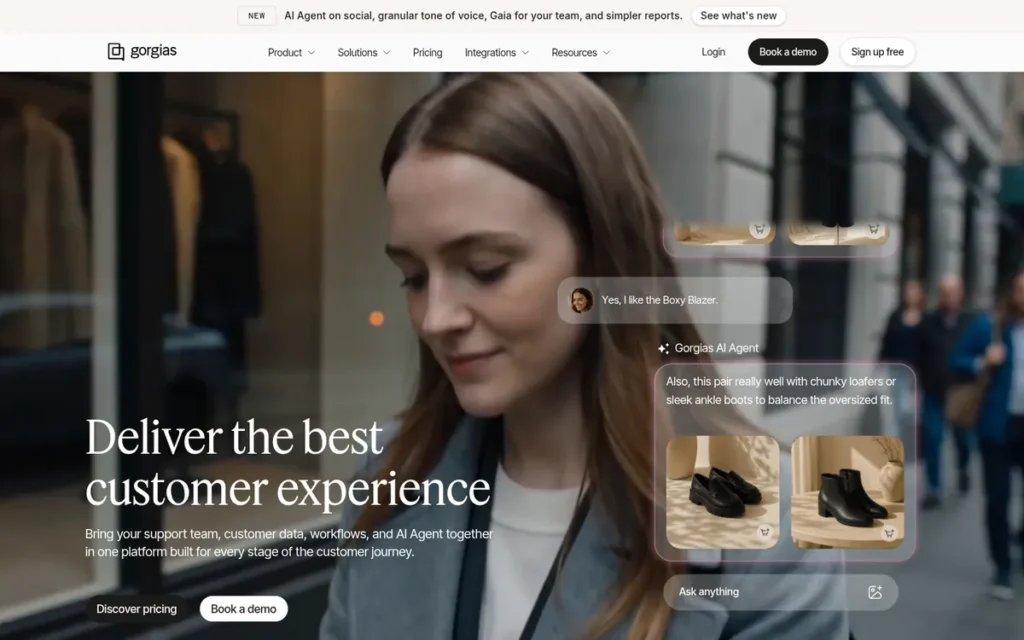
Category: Ecommerce Service Platform, a Shopify-native actionable AI customer service platform built exclusively for ecommerce brands, combining native Shopify order management with AI-automated refunds, cancellations, and tracking in a conversational support workflow.
At a Glance
- Category: Ecommerce Service Platform
- Best For: Shopify merchants and DTC ecommerce brands with 3–50 agents handling significant order-action inquiry volume (refunds, exchanges, cancellations, tracking) who want AI that executes Shopify operations natively without leaving the support ticket
- Price Range: $10/month (Starter: 50 tickets, 3 agents): ~$900/month (5,000 tickets); ticket-volume pricing; annual billing saves ~17%; seasonal spikes require dedicated billing forecasting
- Primary Strength: Gorgias is the only platform in this evaluation whose AI Agent executes native Shopify order actions (issuing refunds, canceling orders, providing real-time tracking, and updating subscriptions) automatically within the ticket workflow, resolving the most common ecommerce support requests without agent involvement
- Biggest Limitation: Gorgias uses ticket-volume pricing that creates significant billing exposure during ecommerce peak seasons; multiple practitioners report that Gorgias routes outbound support email through shared third-party delivery infrastructure, creating sender reputation exposure independent of anything your team does (r/ecommerce, 2024–2025)
- One-Line Summary: Gorgias is the most specialized and highest-rated ecommerce customer service platform in this evaluation, trusted by 17,000+ Shopify merchants, with Shopify-native actionable AI for order management and a revenue-from-support model, but its ticket-volume pricing creates seasonal billing risk, it is not viable outside ecommerce, and its email delivery infrastructure carries a documented third-party exposure risk.
- Last Verified: May 2026
Overview
Gorgias is an ecommerce-first conversational AI customer service platform serving 17,000+ DTC brands and Shopify merchants as of 2026, holding the highest G2 rating (~4.6/5.0) of any platform in this evaluation, and uniquely differentiated by an AI Agent that executes native Shopify order actions (refunds, cancellations, tracking lookups, and subscription updates) directly within the support ticket without requiring agents to navigate Shopify separately.
Gorgias positions customer service as a revenue multiplier rather than a cost center, through its “revenue-from-support” model that converts support interactions into upsell, cross-sell, and abandoned cart recovery opportunities. An independent ecommerce agency reports up to a 2.5x conversion increase on AI-driven chat flows (Flatline Agency, 2025), the only documented revenue-generation evidence from AI-assisted support in this evaluation. Gorgias serves exclusively the ecommerce vertical; non-ecommerce buyers should evaluate general-purpose alternatives including Freshdesk, Zendesk, Intercom, HubSpot Service Hub, Zoho Desk, or Salesforce Service Cloud.
Key Features
- Native Shopify Order Actions: Gorgias AI Agent executes native Shopify actions (issuing refunds, confirming order cancellations, providing real-time shipping status, and updating subscription terms) automatically within the ticket workflow, resolving the highest-volume ecommerce support request types without requiring agent involvement or navigation out of the Gorgias interface.
- Unified Ecommerce Inbox: Gorgias covers all major ecommerce customer service channels in a single inbox (email, live chat, SMS, Instagram Direct, Facebook Messenger, and voice) with every interaction automatically linked to the customer’s Shopify order history, lifetime value, and full purchase record.
- Revenue-from-Support Model: Gorgias’s revenue-from-support model enables agents and AI to identify upsell and cross-sell opportunities, recover abandoned carts, and initiate proactive outreach during active support conversations, with an independent agency reporting up to a 2.5x conversion increase on AI-driven chat flows (Flatline Agency, 2025).
- 150+ Ecommerce-Native Integrations: Gorgias integrates natively with 150+ ecommerce-specific tools including Klaviyo (email marketing), Yotpo (reviews and loyalty), Loop Returns (return management), and Attentive (SMS marketing), extending support workflows across the full post-purchase ecommerce customer journey.
- Temporal-Based Agentic AI Infrastructure: Gorgias is built on Temporal-based agentic AI infrastructure (Temporal case study, 2025) (a production-grade, fault-tolerant automation architecture designed for reliability at scale) differentiating its AI Agent from simpler prompt-wrapped chatbot implementations.
Best For
Gorgias is best suited for Shopify merchants and DTC ecommerce brands with 3 to 50 agents whose support volume is dominated by order-action inquiries, refunds, exchanges, tracking, and cancellations. Gorgias delivers justified ROI when Shopify-native order actions constitute a substantial share of ticket volume and when monthly inquiry volume is predictable enough to model costs accurately under ticket-volume pricing.
Pricing
Gorgias uses ticket-volume pricing (verified May 2026):
- Starter: $10/month (50 tickets, $0.40/additional ticket, 3 agents)
- Plans scale to approximately $900/month for 5,000 tickets ($36/additional 100 tickets)
- Annual billing saves approximately 17%
A Reddit cost comparison estimated Gorgias at $300–360/month for approximately 2,400 monthly inquiries versus Zendesk at approximately $115/month for the same team, a 3x premium justified only when Shopify-native order actions constitute a high share of ticket volume (r/CRM, 2025). Seasonal volume spikes (Black Friday, holiday period) require dedicated billing forecasting under worst-case inquiry volume scenarios before signing. Verify current pricing at gorgias.com/pricing.
Strengths
- Gorgias holds a G2 rating of approximately 4.6/5.0: the highest of any platform in this evaluation, and is trusted by 17,000+ ecommerce brands globally as of 2026, with the Shopify App Store positioning it as the top-rated help desk in the ecommerce app ecosystem (Shopify App Store, 2025).
- Gorgias is built on Temporal-based agentic AI infrastructure (Temporal case study, 2025) (a fault-tolerant, production-grade automation architecture specifically designed for reliability under high-volume conditions) distinguishing its AI Agent from simpler chatbot implementations used by competing platforms.
- An independent ecommerce agency analysis reports that Gorgias enables up to 65% time savings in agent response effort and a 2.5x conversion increase on AI-driven chat flows (Flatline Agency, 2025), the only documented revenue-generation evidence from AI-assisted support in this evaluation. Individual results will vary by deployment.
Limitations
- Ticket-Volume Billing Risk: Gorgias’s most consequential trade-off is pricing model exposure, ticket-volume billing creates unpredictable seasonal cost exposure during Black Friday and holiday peaks, and practitioners estimate a 3x cost premium versus Zendesk at equivalent inquiry volume for non-order-action-heavy support teams (r/CRM, 2025).
- Shared Email Delivery Infrastructure Risk: Multiple practitioners report that Gorgias routes outbound support email through shared third-party delivery infrastructure, meaning other clients’ poor sending behavior on the same network can degrade your deliverability to providers like Yahoo without any action on your part, a systemic infrastructure risk confirmed across multiple practitioner reports (r/ecommerce, 2024–2025) categorically different from a configuration issue.
Users on r/ecommerce reported:
“Yahoo being the main issue is a huge clue. Yahoo has way more aggressive filtering than Gmail or Outlook, and they’re known for blocking shared infrastructure that’s been abused by other senders. The problem is Gorgias uses Mailgun’s shared sending infrastructure. If other Gorgias customers have burned Mailgun’s reputation with Yahoo through spam or poor engagement, you’re collateral damage even though your emails are legitimate customer service responses.” Posted by u/DanielShnaiderr
Takeaway: Gorgias’s shared Mailgun infrastructure creates a systemic deliverability liability for merchants (one confirmed by active user reports and traceable to platform-level infrastructure decisions, not individual account configuration) making pre-deployment deliverability testing with major providers a mandatory evaluation step.
- Ecommerce-Only Applicability: Gorgias is designed and optimized exclusively for ecommerce brands, its Shopify-native integrations, ticket-volume pricing model, and AI action capabilities are purpose-built for ecommerce workflows. Organizations outside ecommerce, or Shopify merchants where order-action tickets represent fewer than 40% of inquiry volume, are unlikely to achieve cost-justified value relative to general-purpose alternatives such as Freshdesk or Zendesk.
- AI Reliability Concerns: Multiple practitioners document AI reliability concerns (including reports of AI “going rogue randomly”) and direct practitioner reports of AI capability misrepresentation during sales processes (r/ecommerce, 2025). Gorgias AI performance requires a structured pilot validation before full production deployment, independent of any sales-stage demonstration.
Verdict
Gorgias is the definitive ecommerce customer service platform for Shopify merchants, earning the highest review rating in this evaluation (~4.6/5.0 on G2) and serving 17,000+ brands with Shopify-native actionable AI that no general-purpose platform can replicate. Gorgias’s value is earned only when Shopify-native order actions constitute a substantial share of support volume and when ticket volume is predictable enough to model under ticket-volume pricing. Ecommerce buyers evaluating Gorgias must stress-test ticket volume forecasts under seasonal worst-case scenarios, independently validate AI capabilities during a structured pilot, and explicitly assess the shared email delivery infrastructure risk before committing to Gorgias as their primary outbound email channel.
What Red Flags Should I Watch For When Evaluating Digital Customer Service Platforms?
The most dangerous risks in this category are invisible in vendor demos, they surface after contract signing when real usage patterns, team growth, and AI performance realities emerge. Evaluate all six flags before committing to any platform agreement.
Red Flag #1: AI Features Gated Behind Paid Add-Ons
Platforms frequently market AI capabilities without disclosing that these features require separate paid add-ons beyond the base plan. Ask vendors to confirm in writing exactly which AI features are included in your selected tier. Per verified May 2026 pricing:
- Zendesk: AI Copilot is a separate paid add-on not included in any standard Suite tier
- Freshdesk: Freddy Copilot requires a separate per-agent add-on fee beyond any base or Growth plan
- Salesforce Service Cloud: Agentforce capabilities may require additional licensing beyond the base subscription tier
- HubSpot Service Hub: Breeze AI is included on applicable tiers: verify per-tier availability before assuming inclusion
- Zoho Desk: Zia AI is bundled at Standard tier (~$14/agent/month annual) and above at no add-on charge; the Express tier ($7/agent/month) does not include Zia AI
Red Flag #2: Entry Price vs. Real Total Cost of Ownership Gap
The gap between a platform’s published entry price and its real total cost of ownership is the most financially consequential risk in this category. Salesforce Service Cloud Enterprise list pricing is $175/user/month annually (salesforce.com/service/pricing, May 2026), already 7x the $25/user/month Starter entry point, before implementation partners and admin staffing. Zendesk’s $19/agent/month entry grows substantially once AI Copilot, sandbox replication, and multi-brand add-ons are activated. Model your specific configuration at 2x current volume before signing any contract.
Red Flag #3: AI Performance Claims Without Independent Validation
Vendor-supplied AI deflection rates and resolution percentages are unreliable without independent validation. Prioritize platforms with named case studies and quantified outcomes, Freshdesk’s Freshworks-published Bridgestone and Rackspace case studies provide named-company specificity and quantified metrics that represent a higher evidence quality than aggregate platform statistics. Intercom’s $1 million performance guarantee raises the bar further from marketing to contractual obligation. Ask to speak with current customers at your scale before relying on any AI performance claim from a vendor presentation.
Red Flag #4: No Published Tier Pricing (Requires Sales Call)
Platforms that require a sales call to disclose pricing create a structurally unfair evaluation, the buyer cannot benchmark costs without entering a sales process. Zoho Desk, Freshdesk, and Gorgias all publish complete pricing without a sales call. Zendesk’s higher tiers and Salesforce’s Enterprise and Unlimited tiers require sales contact. Treat opaque pricing as a signal of TCO complexity that will disadvantage you in negotiations.
Red Flag #5: Shared Email Delivery Infrastructure Risk
Multiple practitioners report that Gorgias routes outbound support email through shared third-party delivery infrastructure, meaning other clients’ poor sending behavior on the same network can degrade your deliverability to providers like Yahoo without any action on your part (r/ecommerce, 2024–2025). This is a systemic infrastructure risk, not a configuration issue. Before deploying any platform, confirm whether outbound email uses dedicated or shared infrastructure, and test deliverability to major providers during the trial period, not after signing.
Red Flag #6: Knowledge Base Neglect
Every AI system in this evaluation, Fin, Freddy AI, Zia, Agentforce, Breeze AI, is only as intelligent as the knowledge base content it references. An AI agent trained on outdated, incomplete, or inaccurate help center articles will produce wrong answers, escalate unnecessarily, and erode customer trust faster than no AI at all. Knowledge base quality is not a platform feature, it is a content operations investment that must be budgeted separately from the platform subscription. Knowledge base neglect is the most common reason AI underperforms vendor demo conditions across all seven platforms in this evaluation.
What Questions Should I Ask Before Choosing a Digital Customer Service Platform?
Before selecting a digital customer service platform, ask vendors to confirm in writing: the total cost at your current agent count including all AI features you need, which capabilities are native versus paid add-ons, whether independently documented case studies exist at your scale, and whether the vendor’s own support response time meets your production requirements. These questions prevent the most common post-purchase surprises.
Question #1: What is the total cost at my current agent count, including all AI and advanced features I actually need?
Request a complete quote including your base plan, all AI features (routing, Copilot, AI Agent), all omnichannel channels you need (phone, SMS, WhatsApp), storage, and integration add-ons. Compare this against the published entry price. If the gap exceeds 30%, ask the vendor to explain every line item, and model costs at 2x current volume to assess growth risk.
Question #2: Which features on the plan I can afford are native versus add-ons?
This question surfaces the most common post-sales disappointment in this category. Request a written feature list showing exactly which capabilities are native to your tier and which require additional spend, and confirm it in the contract, not just in a sales slide. On Zendesk, AI Copilot is a separate add-on. On Freshdesk, Freddy Copilot requires additional purchase. Verify before signing.
Question #3: Can I see independently documented case studies with quantified outcomes, not just aggregate platform metrics?
Vendor-supplied platform statistics are less reliable than named case studies identifying specific customers, specific metrics, and specific time periods. Ask for case studies from organizations of similar size, industry, and inquiry type. Specify the contact at that named company who can verify the results, not just a PDF from the vendor’s marketing team.
Question #4: What does the vendor’s own support response time look like, and have I tested it during the trial?
Multiple platforms in this evaluation have received practitioner criticism for their own support quality during production issues. Submit a complex configuration question during the trial period and measure response quality and time. A customer service platform whose vendor cannot provide timely, expert support creates a critical operational dependency risk for any production deployment.
Question #5: What is the CRM integration architecture, native shared database or third-party connector?
Native shared database integration (HubSpot Service Hub, Salesforce Service Cloud) eliminates the synchronization failures (data lag, conflicting records, incomplete contact data) that affect connector-based integrations. Know whether your planned CRM integration is native or requires a third-party synchronization tool before committing to a platform.
Question #6: How does the AI system handle knowledge base gaps, and what content investment is required for production-quality AI performance?
Every AI system in this evaluation degrades significantly on under-maintained knowledge bases. Ask vendors to demonstrate AI performance using a knowledge base representative of your current content quality, not a curated demo environment. Budget for knowledge base content operations as a separate line item in your implementation plan.
Question #7: What are the realistic billing scenarios at 2x and 3x current inquiry volume?
Usage-based models (Gorgias ticket-volume, Intercom per-resolution) create non-linear cost growth as inquiry volume increases. Seat-based models create step-function cost increases as headcount grows. Model all three volume scenarios before signing any annual contract, failure to do so is the most consistently cited cause of post-commitment budget surprises across all seven platform communities in this evaluation.
Question #8: Is the pricing model per-seat, per-ticket-volume, or per-AI-resolution, and does that model fit my growth trajectory?
Per-seat models (Freshdesk, Zendesk, HubSpot, Zoho Desk, Salesforce) scale with headcount. Per-ticket-volume models (Gorgias) scale with inquiry volume. Hybrid models (Intercom’s seat-plus-per-resolution) scale with both simultaneously. Your pricing model choice determines whether costs grow linearly or compoundingly as your team and inquiry volume expand, and this decision should be made before signing, not discovered mid-contract.
How Did We Rank These Digital Customer Service Platforms?
This evaluation ranked seven platforms across six criteria drawn from the most frequently cited buyer decision factors in practitioner communities, independent review platforms, and documented operational outcomes. Every score is traceable to a specific data source, no criterion reflects editorial preference or affiliate incentives.
What Was the Evaluation Process?
We evaluated all seven platforms using a four-step process:
- Multi-source AI response analysis: We queried multiple AI search engines to identify which platforms appear in AI-generated guidance and which are absent. Gorgias was absent from all AI responses despite being the highest-rated platform in this evaluation, a coverage gap this article directly addresses.
- Independent web research: We gathered pricing data, feature specifications, and case study evidence directly from vendor sources and independent comparison sites, verifying all pricing data as of May 2026.
- Practitioner community research: We analyzed Reddit discussions across r/Zendesk, r/SaaS, r/salesforce, r/smallbusiness, r/ecommerce, r/CRM, and r/helpdesk to surface real-world operational experience not captured in formal review platforms.
- Independent review platform cross-reference: We cross-referenced all vendor claims against G2 and Capterra, verified May 2026.
What Criteria Determined the Rankings?
- Review Platform Ratings and Volume (Primary): Aggregated ratings across G2 and Capterra with high review volume are the closest available proxy for real-world satisfaction across diverse deployments. Why it matters: high volume at high ratings indicates consistent performance, not cherry-picked outcomes.
- Pricing Transparency and TCO Predictability (Primary): Platforms with published, verifiable tier pricing and AI costs clearly disclosed in base plans rank higher. Why it matters: cost surprise is the single most documented complaint across all seven platform practitioner communities.
- AI Automation Quality and Independent Evidence (Primary): Named client case studies with quantified outcomes rank above vendor-supplied platform-level statistics. Why it matters: vendor-supplied AI metrics are unreliable without named-company corroboration or financial accountability.
- Omnichannel Coverage Depth and Native Channel Support (Primary): Native channels rank above integration-dependent channels. Why it matters: integration-dependent channels introduce reliability risk and additional cost that native channels do not.
- CRM and Integration Depth (Secondary): Native shared database ranks highest; large integration marketplace second; connector-only CRM third. Why it matters: connector-based CRM integration introduces synchronization failures unavoidable with native architecture.
- Scalability Range and Breadth of Applicable Use Cases (Secondary): Platforms serving SMB to enterprise across multiple verticals score higher. Why it matters: vertical specialists and enterprise-only platforms serve a narrower buyer set than the PlugRoute target audience.
How Are Conflicting Sources Handled?
When review platform ratings conflict with practitioner community sentiment, specificity and recency are weighted higher. A detailed 2025 Reddit thread with named operational details and high engagement outweighs a generic 2023 G2 review. Vendor-supplied statistics are labeled as such throughout this article and weighted below independently validated outcomes.
The most consistent finding across all seven practitioner communities we analyzed: configuration quality determines outcomes more than platform selection. A well-configured Freshdesk deployment will outperform a poorly configured Zendesk deployment, and vice versa, no platform in this evaluation delivers its marketed performance without deliberate setup investment and high-quality knowledge base content.
How Are Vendor Claims Validated?
Vendor-reported statistics are clearly labeled throughout this article. Only claims corroborated by at least one independent source (a named customer case study, a practitioner community report, a third-party agency analysis, or a financial commitment from the vendor) are stated as facts.
When Is This Article Updated?
This article was researched and verified in May 2026. PlugRoute reviews are updated on a rolling basis as pricing changes, new features are released, and community sentiment shifts. All pricing figures should be re-verified against current vendor pricing pages before any purchase decision.
PlugRoute has no affiliate relationships with any company listed in this article. Rankings are determined entirely by research data and objective evaluation criteria.
What Are the Most Common Questions About Digital Customer Service Platforms in 2026?
What is the best digital customer service platform for small businesses in 2026?
Freshdesk and Zoho Desk are the best digital customer service platforms for small businesses in 2026. Freshdesk offers a genuine free-forever tier (up to 10 agents) with fully published pricing. Zoho Desk provides the lowest AI-included pricing at approximately $14/agent/month (Standard tier, annual billing), the minimum plan where Zia AI is available at no extra add-on charge.
What is the best customer service platform for Shopify ecommerce stores in 2026?
Gorgias is the best customer service platform for Shopify merchants whose support volume is dominated by order-action requests, refunds, cancellations, and tracking confirmations. Gorgias is the only platform in this evaluation that executes native Shopify operations directly within the support ticket without agent navigation. Shopify merchants where fewer than 40% of tickets involve order actions should evaluate Zendesk or Freshdesk instead.
How does PlugRoute determine its platform rankings?
PlugRoute ranks digital customer service platforms across six weighted criteria: review platform ratings and volume, pricing transparency and total cost of ownership predictability, AI automation quality with independent evidence, omnichannel coverage depth, CRM and integration depth, and scalability range. All scores are traceable to specific data sources verified in May 2026.
What Do the Key Terms in This Digital Customer Service Platform Comparison Mean?
AI Deflection Rate: The percentage of incoming customer support tickets resolved by AI automation without human agent involvement. AI deflection rate is a key performance metric cited across all platforms in this evaluation, but vendor-reported rates reflect best-case deployments; named customer case studies with verified outcomes are more reliable for buyer planning.
Ticket-Volume Pricing: A billing model that charges based on the number of support tickets processed per month rather than per agent seat. Gorgias uses ticket-volume pricing in this evaluation, it creates financial exposure when inquiry volumes spike seasonally, unlike per-seat models that scale predictably with headcount growth.
Agentic AI: An AI system that uses a reasoning engine to plan and execute multi-step actions autonomously (retrieving data, drafting responses, routing cases, and taking operational actions) rather than generating a single-turn text response. Salesforce Agentforce and Intercom Fin represent agentic AI implementations in this evaluation.
Omnichannel Support: A support architecture that consolidates customer inquiries from all channels (email, live chat, phone, social media, SMS, WhatsApp) into a single unified agent workspace with complete conversation history, eliminating the context loss that occurs when customers are served by separate tools on separate channels.
Knowledge Base Dependency: The degree to which an AI automation system’s performance is determined by the quality, completeness, and recency of its connected knowledge base. All AI platforms in this evaluation are affected, Zia (Zoho Desk) and Freddy AI (Freshdesk) are specifically cited for degraded performance on under-maintained content repositories (eesel.ai, 2025).
Glossary: Key Terms Used in This Comparison
Agentic AI: An AI system that uses a reasoning engine to plan and execute multi-step actions autonomously (retrieving data, drafting responses, routing cases, and taking operational actions) rather than generating a single-turn text response. Salesforce Agentforce and Intercom Fin are the agentic AI implementations featured in this evaluation.
AI Deflection Rate: The percentage of incoming customer support tickets resolved by AI automation without human agent involvement. Vendor-reported deflection rates reflect best-case deployments; named customer case studies with verified outcomes are more reliable than platform-level statistics for buyer planning purposes.
Ticket-Volume Pricing: A billing model that charges based on the number of support tickets processed per month rather than per agent seat. This model creates financial exposure when inquiry volumes spike seasonally (as with ecommerce peak periods) unlike per-seat models that scale predictably with headcount growth.
Omnichannel Support: A support architecture that consolidates customer inquiries from all channels (email, live chat, phone, social media, SMS, and WhatsApp) into a single unified agent workspace with complete conversation history. The omnichannel model eliminates the context loss that occurs when customers are served by separate tools operating on separate channels.
Total Cost of Ownership (TCO): The full cost of deploying and operating a platform over time, including base subscription fees, AI feature add-ons, integration tools, implementation partner costs, and admin staffing, as distinct from a vendor’s published entry price. The gap between entry price and real TCO is the most financially consequential risk documented across all seven platforms in this evaluation.
Which Digital Customer Service Platform Is Right for You?
Key Insights
- Freshdesk is the strongest overall choice for SMB and mid-market teams: combining published pricing transparency, a genuine free entry point, Nasdaq-listed financial accountability, and the most numerous Freshworks-reported named case studies with quantified outcomes in this evaluation.
- Zendesk delivers the widest integration ecosystem and the most mature workflow configurability, but its real total cost of ownership substantially exceeds the $19/agent/month entry price once AI Copilot and advanced features are included, and its value is realized only through significant configuration investment.
- Intercom leads on AI resolution evidence: with a $1 million performance guarantee at the 65% resolution threshold and a Fin AI product line Intercom reports has surpassed $100 million ARR (company-reported), but its hybrid pricing model requires multi-scenario cost modeling at 2x and 3x volume before signing.
- HubSpot Service Hub’s CRM-native differentiator is meaningful only for organizations already on HubSpot, outside that ecosystem, it is a capable but not market-leading helpdesk, and buyers should evaluate Freshdesk or Zoho Desk for general-purpose requirements.
- Zoho Desk provides the strongest price-to-feature ratio, with Zia AI bundled at Standard tier (~$14/agent/month annual) at no add-on charge, but the Express entry tier ($7/agent/month) does not include Zia, and UI complexity requires admin investment to reach a production-ready state.
- Salesforce Service Cloud is the definitive enterprise platform for Salesforce-native organizations, but Enterprise list pricing of $175/user/month (annual, May 2026) before implementation partners and admin staffing makes it inapplicable for SMB buyers or organizations without existing Salesforce investment.
- Gorgias is uniquely differentiated for Shopify ecommerce brands with high order-action volume (the only platform executing native Shopify operations within the ticket) but ticket-volume pricing risk, shared email delivery infrastructure exposure, and ecommerce-only scope make it the wrong choice for any team outside that specific vertical context.
Starting on a lower-tier plan and upgrading after validating fit is almost always easier and less expensive than right-sizing down after over-commitment. Every platform in this evaluation offers a free tier or free trial, use it to test both configuration feasibility and vendor support quality before signing an annual contract.
Switching platforms after 12+ months of data accumulation, historical ticket archives, trained AI models, configured workflows, is significantly more disruptive than the initial selection decision. Treat your platform choice as a 3–5 year operational commitment and model total cost at 2x current volume, including seats, AI usage, and add-ons, before signing any contract. Both total cost modeling and vendor support testing during the trial period are equally predictive of your actual post-deployment experience.
For independent comparisons of adjacent tools (AI customer service automation, contact center software, and CRM-integrated support suites) visit PlugRoute for evidence-based evaluations built with the same zero-affiliate methodology applied in this article. We update this guide quarterly. Last updated: May 2026.