Cority CorityOne leads for regulated enterprises needing occupational health surveillance and industrial hygiene depth, earning six consecutive Verdantix Green Quadrant EHS Software Leader designations through 2025. VelocityEHS Accelerate is the strongest choice for North American chemical safety and OSHA process safety compliance. EHS Insight is the only non-free mid-market platform with a publicly disclosed starting price ($5,000/year as of June 2026).
Most EHS software comparisons omit pricing entirely, skip the independent analyst validation layer that enterprise procurement teams depend on, and present inspection-first mobile tools as equivalent to clinical-grade occupational health systems. EHS managers in chemicals, oil and gas, and industrial manufacturing receive structurally misleading guidance that doesn’t distinguish between platforms built for fundamentally different organization sizes, regulatory obligations, and implementation capacities, making platform selection harder than it needs to be.
PlugRoute has no affiliate relationships with any company listed in this review, rankings are determined entirely by research data, independent analyst citations, and objective evaluation criteria applied equally to all platforms.
TL;DR: Top EHS Software Picks at a Glance
- Cority earned the #1 ranking through six consecutive Verdantix Green Quadrant EHS Software Leader designations through 2025 and the highest occupational health and industrial hygiene capability scores across all 21 assessed platforms, the strongest independent-analyst-validated choice for regulated enterprises with converged EHS+ governance requirements.
- VelocityEHS is ranked #2 for the deepest combined chemical SDS management (via MSDSonline) and industrial ergonomics capability (via Humantech) among the seven evaluated platforms, recognized as a G2 2026 EHS Software Leader and claimed as trusted by one-third of the Fortune Global 1000 (vendor claim).
- EHS Insight is the only non-free EHS platform in this evaluation with a publicly disclosed starting price ($5,000/year as of June 2026), combined with two consecutive Verdantix Green Quadrant EHS Software recognitions (2024–2025) and AI-powered SIF Precursor Detection not available in comparable mid-market alternatives.
- Intelex is recognized by Verdantix among the highest-ranked EHS platforms for mobile safety capability and holds G2 Enterprise EHS Software Grid Leader status, the most configurable EHSQ platform for large multi-site manufacturers needing EHS and quality management unified under ISO standards within the Hexagon AB and Microsoft enterprise ecosystem.
- SafetyCulture holds 4.6/5 ratings on both G2 (462 verified reviews) and Capterra (354 verified reviews) as of June 2026 (the highest verified independent review volume in the evaluated EHS category) trusted by more than 70,000 organizations globally as of June 2026, per SafetyCulture’s official website, for frontline inspection digitization and mobile audit workflows.
- ETQ Reliance earned an 87/100 Likelihood to Recommend score on McLean & Company’s Info-Tech verified peer review platform and offers 40+ pre-configured quality and EHS compliance applications with FDA 21 CFR Part 11 electronic signatures, the strongest unified QMS and EHS system for life sciences and pharmaceutical manufacturers.
- Quentic holds a 2022 Verdantix Green Quadrant EHS Software Leader designation and 2026 Verdantix Sustainability Management Software inclusion, with an ENHESA-powered automated EU legal register and ISO/IEC 27001:2022 certification, the most specialized EHS platform for European organizations managing automated multi-jurisdiction regulatory compliance and mandatory CSRD reporting.
What Are the Three EHS Software Tiers in 2026?
EHS software platforms divide into three distinct tiers based on organizational scale, regulatory depth, and implementation complexity. Tier 1 enterprise platforms serve 5,000+ employee organizations with multi-site governance and clinical-grade occupational health or industrial hygiene needs. Tier 2 mid-market platforms serve 50–5,000 employee organizations needing rapid deployment at transparent pricing. Tier 3 specialized platforms address a specific use case, buyer profile, or geographic regulatory framework.
Choosing from the wrong tier is the leading cause of EHS software underperformance. A 300-person manufacturer that deploys Cority absorbs a 6-to-18-month implementation overhead for enterprise-complexity modules that may go largely unused, while EHS Insight would deliver core OSHA compliance at $5,000/year with week-scale deployment.
The reverse failure is equally costly: deploying SafetyCulture as a standalone primary compliance system at a high-risk industrial facility creates audit coverage gaps in SDS documentation, PSM procedures, and industrial hygiene exposure records that create regulatory risk and often require a platform replacement before the initial ROI is realized.
Tier 1: Enterprise EHS Platforms: for organizations with 5,000+ employees, dedicated EHS IT resources, multi-site governance obligations, and capacity for multi-year implementation:
- Cority (#1): Converged Enterprise EHS+: occupational health, industrial hygiene, environmental, quality, and ESG as co-equal first-class disciplines
- VelocityEHS (#2): Industrial EHS Platform: chemical safety, PSM compliance, ergonomics, and OSHA depth assembled through MSDSonline and Humantech acquisitions
- Intelex (#4): EHSQ Suite: unified EHS and quality management for multi-site manufacturers within Hexagon AB’s industrial ecosystem
Tier 2: Mid-Market EHS Platforms: for organizations with 50–5,000 employees needing enterprise-depth compliance at accessible pricing, deployable in weeks without dedicated IT staff:
- EHS Insight (#3): Mid-Market EHS Platform: core OSHA compliance, AI safety analytics, and the only published starting price among non-free EHS platforms evaluated
Tier 3: Specialized EHS Platforms: purpose-built for a specific use case, buyer profile, or geographic regulatory environment:
- SafetyCulture (#5): Mobile-First Operations and Inspection Platform: frontline inspection digitization for 70,000+ organizations globally as of June 2026
- ETQ Reliance (#6): Quality + EHS Compliance Platform: unified FDA quality and OSHA EHS compliance for life sciences and food safety manufacturers
- Quentic (#7): EHS and Sustainability Platform (European Specialist): automated EU regulatory compliance and CSRD sustainability reporting
How Do the Top EHS Software Platforms Compare at a Glance?
The seven platforms represent the full range of EHS software from frontline inspection tools to enterprise occupational health systems, evaluated with equal editorial depth. One counterintuitive finding: SafetyCulture holds the highest verified review volume (4.6/5, 462 G2 reviews) yet ranks #5, because review scores reflect frontline usability, not enterprise regulatory compliance depth or analyst recognition, which together account for 50% of this evaluation’s criterion weighting.
| Rank | Company | Category | Best For | One-Line Summary | Key Capabilities | Primary Strength | Key Limitation |
|---|---|---|---|---|---|---|---|
| 1 | Cority | Converged Enterprise EHS+ | Large regulated enterprises in chemicals, oil & gas, healthcare, and pharma requiring OH surveillance and IH monitoring | Cority CorityOne is the enterprise EHS platform with the highest verified occupational health and industrial hygiene scores across all 21 platforms in Verdantix’s 2025 Green Quadrant, earning its sixth consecutive Leader designation. | Occupational health surveillance, industrial hygiene monitoring, multi-site incident management, ESG reporting, CAPA workflows, ISO 45001-aligned audit architecture | Six consecutive Verdantix Green Quadrant EHS Leader designations through 2025; highest OH and IH scores across 21 assessed platforms | 6–18 month documented implementation timeline; dedicated EHS IT staff required; no public pricing |
| 2 | VelocityEHS | Industrial EHS Platform | North American manufacturers, chemical processors, energy companies requiring chemical SDS, OSHA PSM, and ergonomics depth | VelocityEHS Accelerate is the deepest North American industrial EHS platform for chemical safety, PSM compliance, and ergonomics among the seven evaluated, recognized as a G2 2026 EHS Software Leader and claimed as trusted by one-third of the Fortune Global 1000 (vendor claim). | Chemical SDS management (MSDSonline), industrial ergonomics (Humantech), AI-assisted incident management, environmental compliance, contractor safety, ESG | Most specialized SDS management and industrial ergonomics capability in the evaluated category; G2 2026 EHS Leader | McLean & Co. rates commercial terms “Less Transparent” and “Less Friendly Negotiation”; no public pricing |
| 3 | EHS Insight | Mid-Market EHS Platform | Industrial organizations 50–5,000+ employees in manufacturing, construction, energy, chemicals, and mining | EHS Insight is the strongest mid-market EHS platform for North American industrial organizations, combining two consecutive Verdantix Green Quadrant recognitions (2024–2025), AI-powered SIF Precursor Detection, and the only publicly disclosed starting price among non-free platforms ($5,000/year as of June 2026). | Incident management, audit workflows, SDS compliance, SIF Precursor Detection AI, EHS Copilot, 50,000+ training courses (OpenSesame partnership) | Only non-free platform with public $5,000/year starting price; two consecutive Verdantix Green Quadrant EHS recognitions (2024–2025) | Less comprehensive than enterprise platforms for advanced IH, ergonomics, and multi-jurisdictional global compliance |
| 4 | Intelex | EHSQ Suite | Large multi-site manufacturers and energy companies needing unified EHS and quality management under ISO standards | Intelex is the most configurable enterprise EHSQ platform for large multi-site manufacturers, recognized by Verdantix for mobile safety capability and available through the Microsoft Marketplace, enabling unified EHS and quality management under ISO standards within the Hexagon AB industrial enterprise ecosystem. | EHS + quality management, multi-site audit architecture, ISO 9001/14001/45001 alignment, Microsoft 365 and Azure integration, configurable workflow engine | Verdantix-recognized for mobile safety capability; G2 Enterprise EHS Grid Leader; Microsoft Marketplace and Azure integration | Requires dedicated long-term system administrator; Capterra documents inconsistent support responsiveness; no public pricing |
| 5 | SafetyCulture | Mobile-First Inspection Platform | Construction, field services, manufacturing, logistics prioritizing frontline adoption and mobile inspection digitization | SafetyCulture is the most widely adopted EHS platform by customer count among the seven evaluated; more than 70,000 organizations across 85 countries as of June 2026; holding 4.6/5 ratings on both G2 (462 reviews) and Capterra (354 reviews) as of June 2026, the highest verified independent review volume in the evaluated category. | Mobile-first inspection templates, offline audit capability, incident capture, AI-assisted template creation, IoT integration, training management | 4.6/5 on G2 (462 reviews) and Capterra (354 reviews) as of June 2026; free tier for up to 10 users; $24/month Premium publicly stated | Lacks chemical SDS depth, OSHA HazCom workflows, advanced CAPA, enterprise multi-site governance; absent from Verdantix Green Quadrant EHS |
| 6 | ETQ Reliance | Quality + EHS Compliance Platform | Life sciences, pharma, medical device, food safety manufacturers managing simultaneous FDA quality audit and OSHA EHS compliance | ETQ Reliance is the strongest platform for regulated manufacturers in life sciences, pharmaceuticals, and food safety needing quality management and EHS compliance unified in a single low-code system, earning an 87/100 Likelihood to Recommend on McLean & Company’s Info-Tech verified peer review platform with 40+ pre-configured compliance applications. | 40+ pre-configured compliance applications, FDA 21 CFR Part 11 electronic signatures, low-code form designer, CAPA automation, Infor Industry Cloud integration | 87/100 Likelihood to Recommend (McLean & Co. Info-Tech, 2026); 40+ pre-configured compliance apps; FDA 21 CFR Part 11 audit trail infrastructure | McLean & Co. rates “Less Transparent,” “Less Generous,” “Less Friendly Negotiation”; CSS-level developer required for UI customization; no public pricing |
| 7 | Quentic | EHS & Sustainability Platform (EU Specialist) | European organizations in DACH region and EU managing automated multi-jurisdiction HSE regulatory compliance and CSRD sustainability reporting | Quentic is the most specialized EHS platform for European organizations managing automated EU regulatory compliance and CSRD-aligned sustainability reporting, validated by a 2022 Verdantix Green Quadrant EHS Software Leader designation and 2026 Verdantix Sustainability Management Software inclusion under an ISO/IEC 27001:2022 certified platform. | ENHESA-powered EU legal register, CSRD-aligned ESG reporting, AI SDS extraction, modular architecture, ISO 9001/14001/45001/50001 alignment, hazardous chemicals management | ENHESA-powered automated EU legal register; ISO/IEC 27001:2022 certified; dual Verdantix recognition across EHS and Sustainability software categories | No verified G2 or Capterra ratings in English-language platforms; 2022 Verdantix EHS designation not confirmed for 2023–2025; geographic specialization limits North American value |
Which EHS Software Should I Choose for My Situation?
The right EHS software depends on your regulatory profile, organization size, and implementation capacity. The Quick Decision Framework below maps each primary compliance need to the platform with the strongest independent evidence, based on Verdantix analyst recognition, verified user review scores, and publicly confirmed pricing data as of June 2026. After identifying your starting platform, use Evaluation Questions #1 and #4 in your first vendor demo call before any others.
| Your #1 Priority | Recommended Tool | Why | Acceptable Alternative |
|---|---|---|---|
| Enterprise occupational health surveillance and industrial hygiene depth | Cority | Six consecutive Verdantix Green Quadrant EHS Leader designations through 2025; highest OH and IH scores across 21 assessed platforms | VelocityEHS if chemical-intensive operations are the primary compliance driver |
| North American chemical safety management and OSHA PSM compliance | VelocityEHS | Most specialized SDS management (MSDSonline acquisition) and industrial ergonomics (Humantech acquisition) in the evaluated category | Cority if OH surveillance is a co-equal priority alongside chemical safety |
| Mid-market deployment at transparent pricing | EHS Insight | Only non-free platform with public $5,000/year starting price; two consecutive Verdantix Green Quadrant recognitions; week-scale deployment timelines | SafetyCulture if mobile inspection workflows are the primary need at zero or minimal cost |
| Enterprise EHSQ; EHS and quality management unified under ISO | Intelex | Verdantix-recognized for mobile safety; Microsoft Marketplace integration; EHS and QMS as co-equal disciplines | ETQ Reliance if FDA 21 CFR Part 11 quality audit trail infrastructure is the primary driver |
| Frontline mobile inspection adoption at scale | SafetyCulture | 70,000+ customers globally as of June 2026; free tier confirmed; highest verified independent review volume in the evaluated category | EHS Insight if compliance depth alongside mobile inspections is required |
| Life sciences or pharma; FDA quality compliance and OSHA EHS unified | ETQ Reliance | 40+ compliance applications; FDA 21 CFR Part 11 electronic signatures; 87/100 Info-Tech recommendation score | Intelex for organizations where broad EHSQ configurability outweighs FDA-specific depth |
| European multi-jurisdiction EU regulatory compliance and CSRD reporting | Quentic | ENHESA-powered automated EU legal register; CSRD-aligned ESG module; ISO/IEC 27001:2022 certified | Cority or Intelex for organizations with operations in both North America and Europe |
1. Cority: Best Overall for Regulated Enterprises: Occupational Health, Industrial Hygiene, and Converged EHS+
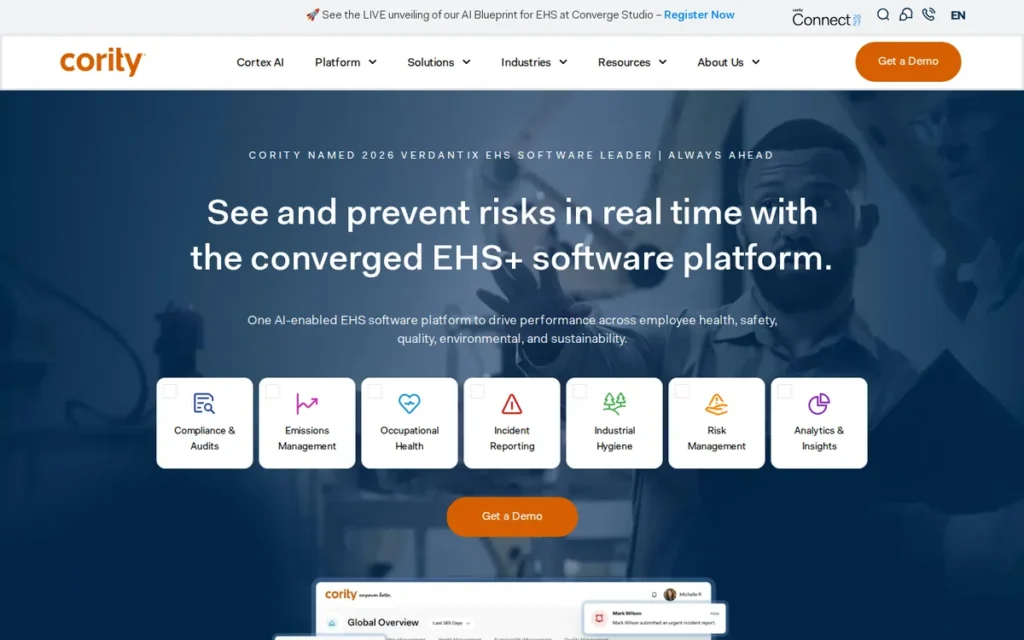
Category: Converged Enterprise EHS+, a unified platform treating occupational health, industrial hygiene, safety, environmental management, quality, and ESG as co-equal first-class disciplines in a single enterprise governed system; purpose-built for large regulated organizations where workforce health compliance carries the same regulatory weight as safety incident tracking.
At a Glance
- Category: Converged Enterprise EHS+
- Best For: Large regulated enterprises in chemicals, oil and gas, healthcare, pharmaceutical manufacturing, and construction requiring occupational health surveillance, industrial hygiene monitoring, and enterprise EHS governance as simultaneous compliance obligations
- Price Range: Pricing on request: enterprise-quoted; no public tiers; multi-year contracts expected; professional services costs substantial
- Primary Strength: Cority CorityOne has earned the highest occupational health and industrial hygiene capability scores across all 21 platforms assessed in Verdantix’s Green Quadrant EHS Software benchmark for six consecutive evaluation cycles through 2025
- Biggest Limitation: Cority implementations are documented by independent reviewers to take 6 to 18 months and require dedicated EHS IT staff, making Cority unsuitable for organizations expecting rapid deployment or those without system administration resources to sustain configuration and change management
- One-Line Summary: Cority CorityOne is the enterprise EHS platform with the highest verified occupational health and industrial hygiene scores across all 21 platforms in Verdantix’s 2025 Green Quadrant EHS Software benchmark, earning its sixth consecutive Leader designation and making it the strongest independent-analyst-validated choice for regulated enterprises with occupational health compliance obligations.
- Last Verified: June 2026
Overview
Cority CorityOne is an enterprise-grade, converged EHS and occupational health platform designed for large regulated organizations across manufacturing, chemicals, oil and gas, healthcare, and construction that require unified management of safety, health surveillance, industrial hygiene, environmental compliance, quality, and ESG reporting in a single governed system.
Cority, founded in 1985 and headquartered in Toronto, Ontario, Canada, brings four decades of occupational health specialization to a modern cloud platform trusted by enterprise institutions including Cornell University for multi-site regulatory compliance and reporting across occupational health and environmental management.
Verdantix confirmed Cority’s structural depth in 2025 by awarding Cority CorityOne the highest capability scores across all 21 assessed EHS solutions for occupational health and industrial hygiene, specifically noting that “the firm’s history as a health specialist is apparent.” Cority’s occupational health module was architected from clinical and industrial hygiene workflows, not retrofitted from a safety-first EHS platform, a structural distinction that Verdantix’s consistent six-consecutive-year OH scoring confirms.
Key Features
- Occupational Health Surveillance: Cority CorityOne provides medical surveillance case management, health screening workflows, exposure record tracking, and clinical health data management, capabilities competing platforms treat as secondary add-on modules but that Cority has built as a core enterprise discipline since its 1985 founding as an occupational health specialist.
- Industrial Hygiene Monitoring: Cority CorityOne enables quantitative exposure monitoring against OSHA Permissible Exposure Limits (PELs) and ACGIH Threshold Limit Values (TLVs), measurement data management, and longitudinal health trend analysis, confirmed by Verdantix as the deepest independently validated industrial hygiene capability across all 21 evaluated EHS platforms in 2025.
- Multi-Site Incident and Audit Management: Cority CorityOne’s incident management, ISO 45001-aligned audit management, and corrective action workflows operate on role-based permission hierarchies, enabling site-level teams to maintain operational autonomy within corporate-level taxonomy and governance standards for enterprises managing compliance across dozens or hundreds of facilities.
- ESG and Sustainability Management: Cority CorityOne integrates environmental performance data, GHG emissions tracking, and social responsibility indicators (including CSRD (Corporate Sustainability Reporting Directive)-aligned disclosures) into the same governed data model as operational EHS data, enabling auditable sustainability reporting without a separate platform.
- API Integration and Workflow Automation: Cority CorityOne’s API integration framework and configurable workflow automation connect with existing HR, ERP, and financial reporting systems, reducing cross-system data reconciliation overhead that multi-system EHS environments impose on compliance and reporting teams at large enterprises.
Best For
Cority CorityOne is best for large enterprises in chemicals, oil and gas, healthcare systems, pharmaceutical manufacturing, and regulated construction where occupational health surveillance programs, industrial hygiene monitoring, and enterprise-level safety governance are simultaneous co-equal compliance obligations, and where a 6-to-18-month implementation investment is operationally feasible given the scale of compliance infrastructure being deployed.
Strengths
- Verdantix, 2025 named Cority CorityOne a Green Quadrant EHS Software Leader for the sixth consecutive time, awarding Cority the highest scores across all 21 assessed solutions for occupational health and industrial hygiene, the most authoritative and most sustained independent analyst recognition in the EHS software category as of June 2026.
- Capterra, 2026 shows 96% of Cority reviewers rated the platform above 4 stars (an unusually strong aggregate for an enterprise platform) with most praised capabilities being centralized EHS data, configurable workflows, dashboards, role-based permissions, and corrective action automation.
- Cornell University adopted Cority CorityOne as its enterprise EHSQ system for multi-site regulatory compliance and reporting across occupational health and environmental management, as confirmed on the Cornell University IT services page, a validated institutional reference for multi-discipline EHS compliance at scale.
- Cority’s 40-year history as an occupational health specialist, predating most EHS software competitors by 10 to 20 years, means CorityOne’s OH module was built from clinical and industrial hygiene workflows first, a structural depth advantage that Verdantix’s consistent six-year OH scoring confirms and that competitors adding OH as a module to safety-first platforms cannot replicate quickly.
Limitations
- Implementation Timeline: Cority CorityOne implementations are documented by independent reviewers to take 6 to 18 months, organizations needing rapid compliance digitization will not see platform value for a significant period after contract signing, making Cority categorically unsuitable for time-sensitive or resource-constrained deployments at capterra.com/p/102848.
- Dedicated Resource Requirement: Multiple independent reviews describe the “sheer number of features and depth of customization” as initially overwhelming even for experienced EHS managers, Cority CorityOne requires designated long-term system administration that organizations without dedicated EHS IT staff cannot sustain beyond initial deployment.
Users on r/industrialhygiene shared their experience with Cority in practice:
“I had several clients use it when I was in consulting and it will depend on how they are using it. On the basic side of just using it to track sampling results it is easy. But it can also be made very complex and take awhile to fully learn.” Posted by u/travelnman85
Takeaway: Cority delivers genuine industrial hygiene depth but demands patience, practitioners with consulting-level exposure consistently describe a learning curve that scales with how complex the configuration is in real-world deployments.
- Module Utilization Risk: Cority’s depth means organizations frequently report significant licensed capability remaining unused in the first 12 to 24 months post go-live, buyers should require a phased capability utilization roadmap from Cority’s implementation team before signing to avoid absorbing enterprise-complexity costs during ramp-up before full deployment is realized.
- Pricing Opacity: Cority’s full pricing opacity means total cost of ownership cannot be estimated without direct sales engagement, organizations under 1,000 employees should carefully assess whether the implementation investment is proportionate to their compliance scope before entering a Cority evaluation, and should evaluate EHS Insight (#3) first if rapid deployment matters.
Verdict
Cority CorityOne is the strongest enterprise EHS platform for organizations where occupational health surveillance and industrial hygiene are first-class compliance disciplines alongside safety management, validated by six consecutive Verdantix Green Quadrant Leader designations and the highest independent OH and IH capability scores across all 21 evaluated platforms as of 2025. Cority ranks above VelocityEHS because six consecutive Verdantix Leader designations with the highest OH and IH scores across 21 assessed platforms represent more sustained cross-criterion independent evidence than VelocityEHS’s primarily vendor-claimed market penetration statistics, while VelocityEHS’s MSDSonline chemical depth remains the stronger choice for organizations where SDS compliance is the primary selection driver over occupational health surveillance. The most common EHS software failure mode is not selecting the wrong platform, it is selecting the right platform for the wrong organizational capacity. Organizations evaluating Cority should also consider SafetyCulture (#5) if frontline worker adoption is the primary barrier, or EHS Insight (#3) if mid-market pricing and rapid deployment are the decisive requirements.
2. VelocityEHS: Best for North American Industrial EHS: Chemical Safety, Process Safety, and Ergonomics Depth
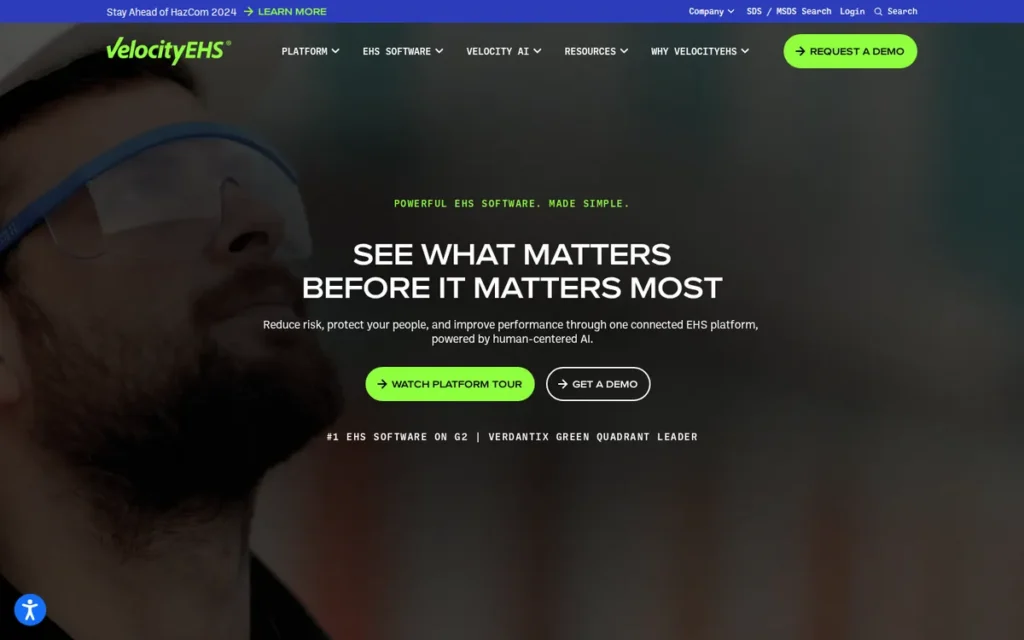
Category: Industrial EHS Platform, a unified cloud suite combining chemical safety management, process safety compliance, ergonomics, industrial hygiene, incident management, and ESG for North American manufacturers, chemical processors, and energy companies with complex OSHA and EPA regulatory obligations; assembled through strategic acquisitions of MSDSonline (chemical management) and Humantech (industrial ergonomics).
At a Glance
- Category: Industrial EHS Platform
- Best For: North American industrial manufacturers, chemical processors, oil and gas operators, and energy companies needing chemical safety management, OSHA PSM compliance, industrial ergonomics depth, and enterprise incident management in a single platform with embedded EHS regulatory expertise
- Price Range: Pricing on request: no public pricing; enterprise-quoted; McLean & Company rates commercial terms as “Less Transparent”
- Primary Strength: VelocityEHS Accelerate delivers the most specialized combined chemical safety management (via MSDSonline) and industrial ergonomics capability (via Humantech) among the seven evaluated platforms, claimed as trusted by one-third of the Fortune Global 1000 across more than 19,000 customer organizations (vendor claim) and recognized as a G2 2026 EHS Software Leader
- Biggest Limitation: VelocityEHS does not publish pricing and is rated “Less Transparent” and “Less Friendly Negotiation” by McLean & Company’s verified buyer reviews, requiring buyers to invest significant sales process time before understanding costs and to approach contract negotiations with legal review prepared in advance
- One-Line Summary: VelocityEHS Accelerate is the deepest North American industrial EHS platform for chemical safety management, process safety compliance, and ergonomics among the seven evaluated, claimed as trusted by one-third of the Fortune Global 1000 across more than 19,000 customer organizations (vendor claim) and recognized as a G2 2026 EHS Software Leader.
- Last Verified: June 2026
Overview
VelocityEHS Accelerate is a comprehensive, AI-enhanced cloud EHS platform purpose-built for industrial manufacturers, chemical processors, and energy companies in the United States and Canada facing complex OSHA 1910.1200 (HazCom 2012), EPA, and PSM regulatory compliance obligations alongside frontline workforce safety management.
VelocityEHS, founded in 2004 and headquartered in Chicago, Illinois, grew through strategic acquisitions (including MSDSonline (a market-leading SDS management platform) and Humantech (a recognized industrial ergonomics consultancy)) to assemble the broadest specialty EHS capability set among the seven evaluated platforms.
VelocityEHS launched the Accelerate Platform in January 2025, consolidating chemical management, ergonomics, safety, environmental compliance, contractor safety, industrial hygiene, and ESG into a single unified experience. VelocityEHS claims to protect more than 10 million workers across 19,000+ organizations globally as of June 2026, per VelocityEHS’s About page (vendor claim; no independent verification available).
Key Features
- Chemical SDS Management Library: VelocityEHS Accelerate’s chemical management module, inherited from the MSDSonline acquisition, provides centralized Safety Data Sheet library management, GHS-compliant secondary container label generation, and employee right-to-know compliance workflows aligned with OSHA HazCom 2012 (29 CFR 1910.1200), the most specialized SDS management capability in the evaluated category, built on MSDSonline’s heritage as a dedicated chemical management platform before its acquisition.
- AI-Assisted Incident Management: VelocityEHS Accelerate’s incident module uses AI to assist with incident descriptions, root cause identification, and corrective action recommendations (launched 2025), reducing frontline supervisor documentation burden while improving OSHA report completeness.
- Industrial Ergonomics Program: VelocityEHS Accelerate’s ergonomics module, derived from the Humantech acquisition, provides quantitative job demand analysis, ergonomic risk scoring, musculoskeletal disorder prevention workflows, and intervention prioritization, a specialty capability built on decades of consulting methodology unavailable at comparable depth in any other evaluated platform.
- Unified Accelerate Platform Architecture: VelocityEHS Accelerate, launched January 2025 and described by the company as “the industry’s first fully integrated EHS platform” (vendor claim, per ISHN, January 2025), consolidates the following disciplines into a single unified user experience:
- Safety and incident management with AI-assisted OSHA documentation
- Chemical SDS management and GHS-compliant labeling (via MSDSonline)
- Industrial ergonomics program management (via Humantech)
- Environmental compliance tracking and EPA permit management
- Contractor safety onboarding and compliance verification
- Industrial hygiene monitoring and exposure assessment
- ESG and sustainability reporting with GHG emissions tracking
- Embedded EHS Regulatory Expertise: VelocityEHS staffs what the company claims are more certified EHS subject matter experts than the next five competitors combined, providing embedded regulatory knowledge for complex OSHA, EPA, and chemical compliance scenarios (vendor claim; not independently verified).
Best For
VelocityEHS Accelerate is best for North American manufacturers, chemical processors, oil and gas operators, and industrial enterprises where chemical safety management under OSHA HazCom, process safety management compliance, and industrial ergonomics must be managed alongside incident tracking, audit management, and ESG reporting, particularly where access to embedded EHS regulatory expertise matters alongside software features.
Strengths
- VelocityEHS claims its Accelerate Platform is trusted by one-third of the Fortune Global 1000 across 19,000+ customer organizations protecting more than 10 million workers worldwide as of June 2026, per VelocityEHS’s About page, the highest stated enterprise market penetration in the evaluated EHS software category (vendor claim; no independent verification available).
- G2, 2026 named VelocityEHS a Software Leader in the EHS management software category, providing independent user-review platform validation of enterprise performance alongside the company’s self-reported market claims.
- VelocityEHS’s January 2025 Accelerate Platform launch consolidated chemical management, ergonomics, safety, environmental compliance, contractor safety, industrial hygiene, and ESG from previously separate module experiences into a single platform, an architectural integration VelocityEHS positioned as the industry’s first of its kind.
- VelocityEHS’s MSDSonline and Humantech acquisitions gave the Accelerate Platform the most specialized chemical SDS management and industrial ergonomics capabilities in the evaluated category, specialty depth that required decades to develop independently and that no other evaluated platform offers at comparable breadth for chemical-intensive and ergonomically complex manufacturing environments.
Limitations
- Commercial Transparency: McLean & Company’s verified buyer reviews (2026) rate VelocityEHS as “Less Transparent” and “Less Friendly Negotiation” on commercial terms, research shows that the same vendors rated Less Transparent on pricing are consistently rated Less Friendly in negotiations, reflecting a consistent commercial philosophy affecting the entire vendor relationship from first quote through renewal, not just an inconvenience at the evaluation stage.
- Reporting Flexibility: Capterra reviewers (2026) most commonly flag limited reporting output customization as the primary VelocityEHS limitation, the platform captures compliance data effectively but restricts output formats for leadership dashboards and regulatory submissions, creating downstream friction at the highest-visibility stage of EHS program management.
- EU Regulatory Coverage Gap: VelocityEHS’s North American regulatory architecture does not include the ENHESA-powered automated EU legal register available in Quentic or the global multi-jurisdictional compliance frameworks offered by Cority and Intelex, a meaningful consideration for organizations with material European operations alongside their North American facilities.
- Procurement Risk: The complete absence of public pricing combined with McLean & Company’s documented commercial behavior ratings means procurement teams should approach VelocityEHS negotiations with competitive alternative quotes and internal legal review budgeted as part of the procurement process cost, not as an afterthought after the sales relationship has begun.
Users on r/SafetyProfessionals described their VelocityEHS experience after contract signing:
“Maybe it’s just the way it was set up (before I joined), but it is not user friendly, it’s clunky, etc. Also, the customer service is really bad….they seem good at taking your money, but don’t care about managing the relationship once they have a contract signed.” Posted by u/NeoHeathan
Takeaway: VelocityEHS’s post-contract customer experience concern extends beyond McLean & Company’s procurement ratings into frontline practitioner frustration, safety professionals report both UX usability problems and support relationship quality issues that emerge after the contract is signed.
Verdict
VelocityEHS Accelerate is the deepest North American industrial EHS platform for chemical safety management, OSHA process safety compliance, and industrial ergonomics among the seven evaluated, a combination no competing platform delivers at equivalent breadth as of 2026. VelocityEHS ranks above EHS Insight (#3) because its MSDSonline chemical management depth, Humantech ergonomics program, and stated Fortune 1000 enterprise penetration serve large industrial enterprise complexity that EHS Insight’s mid-market architecture does not fully address, while EHS Insight’s transparent pricing and faster deployment make it the stronger choice for organizations below enterprise scale where the full VelocityEHS capability set is disproportionate to compliance scope. The platform’s G2 2026 Leadership recognition and embedded regulatory expertise create a credible enterprise case for large industrial buyers, but the commercial process requires preparation: McLean & Company’s documented ratings demand structured legal review before contract engagement. Organizations with primarily non-North-American regulatory obligations, or buyers requiring transparent pricing before sales engagement, should evaluate Cority, EHS Insight, or Intelex before committing to a VelocityEHS sales cycle.
3. EHS Insight: Best for Mid-Market Industrial EHS: Transparent Pricing, Rapid Deployment, and AI-Enhanced Compliance
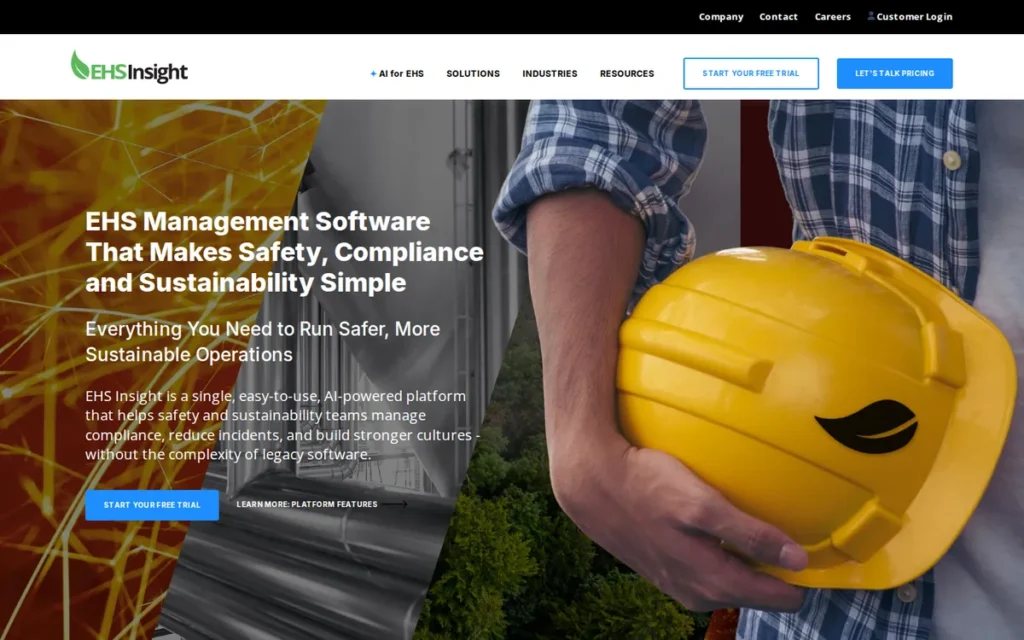
Category: Mid-Market EHS Platform, a cloud-native EHS compliance system built for industrial organizations from 50 to 5,000+ employees that need enterprise-depth incident management, audit workflows, chemical SDS compliance, and AI safety analytics deployable in weeks without dedicated IT staff or enterprise implementation budgets.
At a Glance
- Category: Mid-Market EHS Platform
- Best For: North American industrial mid-market organizations in manufacturing, construction, energy, chemicals, and mining needing core OSHA compliance, AI-enhanced incident management, and chemical SDS workflows at a transparent published price with deployment measured in weeks rather than months
- Price Range: $5,000/year starting (publicly stated as of June 2026, per the EHS Insight FAQ page; modular pricing scales by employee count and selected modules)
- Primary Strength: EHS Insight is the only non-free mid-market EHS platform in this evaluation with a publicly disclosed starting price of $5,000 per year, combined with two consecutive Verdantix Green Quadrant EHS Software recognitions (2024 and 2025) and AI-powered SIF Precursor Detection not found in comparable mid-market alternatives
- Biggest Limitation: EHS Insight is less comprehensive than enterprise platforms for advanced industrial hygiene exposure monitoring, ergonomics program management, and multi-jurisdictional global regulatory compliance, limiting applicability for large chemical manufacturers with PSM and IH obligations or multinational organizations managing simultaneous North American and European regulatory frameworks
- One-Line Summary: EHS Insight is the strongest mid-market EHS platform for North American industrial organizations, combining two consecutive Verdantix Green Quadrant recognitions (2024–2025), AI-powered SIF Precursor Detection, and the only publicly disclosed starting price among non-free mid-market EHS platforms ($5,000 per year as of June 2026).
- Last Verified: June 2026
Overview
EHS Insight is a cloud-native, mid-market EHS management platform founded in 2009 and built specifically for industrial organizations in manufacturing, construction, energy, chemicals, and mining that need enterprise-grade EHS compliance workflows deployable without extended implementation timelines or dedicated IT staff.
EHS Insight received its second consecutive Verdantix Green Quadrant EHS Software recognition in 2025, with Verdantix specifically citing the platform’s mobile-first architecture, rapid product development cadence, and strong R&D investment, notable independent analyst recognition for a mid-market platform in a report historically dominated by enterprise-tier vendors.
EHS Insight’s publicly stated starting price of $5,000 per year makes it the most price-transparent non-free EHS platform in the evaluated category. For most North American industrial mid-market organizations, EHS Insight is the point where deployment speed, pricing transparency, and compliance depth intersect, a combination no other evaluated platform matches at this price range as of June 2026.
Key Features
- SIF Precursor Detection AI: EHS Insight’s analytics module includes SIF Precursor Detection, an AI capability that identifies leading indicator patterns (near-misses, at-risk behaviors, and environmental preconditions) from operational data before events escalate to OSHA 300-log recordable injuries, moving beyond reactive incident logging toward proactive risk management unlike lagging indicator systems that count incidents only after they occur.
- Integrated Training Library: EHS Insight provides access to 50,000+ courses through an OpenSesame partnership and 150+ built-in safety courses through Marcom integration, the largest named bundled e-learning library documented in public materials among the seven evaluated EHS platforms, available without a separate LMS license or additional procurement.
- Chemical SDS Compliance Module: EHS Insight’s chemical management module provides SDS library management, GHS compliance workflows, and right-to-know documentation for industrial chemical inventories, covering core OSHA HazCom obligations that manufacturing organizations with chemical exposure risks must maintain for regulatory compliance.
- Comprehensive AI Suite: EHS Insight’s AI capabilities include an EHS Copilot assistant for compliance guidance, Field Suggestion Copilot for real-time form completion, AI Data Quality Analysis for data integrity monitoring, an AI Report Chatbot for analytics queries, and Vision AI for visual safety inspections, a broader named AI feature set than most comparable mid-market EHS platforms as of 2026.
- Mobile-First Offline Architecture: EHS Insight’s mobile-first platform with documented offline capability allows field workers, inspectors, and shift supervisors to capture incidents, conduct audits, and complete inspections without network connectivity, addressing a practical deployment requirement in manufacturing plants, construction sites, and remote energy facilities where wireless coverage is unreliable.
Best For
EHS Insight is best for North American industrial mid-market organizations (manufacturers, construction companies, energy operators, and mining companies with 50 to 5,000+ employees) that need Verdantix-recognized, AI-enhanced EHS compliance software deployable in weeks at a transparent published starting price, without the 6-to-18-month implementation timelines and dedicated IT staff requirements of enterprise-tier platforms.
Strengths
- Verdantix, 2025 included EHS Insight in its Green Quadrant EHS Software report for the second consecutive year, specifically recognizing the platform’s mobile-first architecture, rapid product development cadence, and strong R&D investment, one of very few mid-market platforms to achieve consecutive Verdantix Green Quadrant recognition in a report historically dominated by enterprise-tier vendors.
- EHS Insight’s $5,000 per year publicly stated starting price as of June 2026 makes it the only non-free EHS platform in this evaluation with confirmed public pricing, enabling procurement teams to build budget justifications without entering a sales cycle, a process advantage that all five enterprise alternatives deny buyers at the evaluation stage.
- EHS Insight’s SIF Precursor Detection AI is among the earliest implementations of predictive serious injury and fatality prevention analytics in a mid-market EHS platform, an emerging proactive risk management capability previously available primarily in enterprise-tier deployments, with no equivalent named capability documented in any other evaluated mid-market platform as of 2026.
- EHS Insight’s deployment timelines are self-reported as measurable in weeks rather than the 6-to-18-month timelines independently documented for enterprise platforms, a time-to-value advantage that mid-market organizations with limited EHS IT resources and urgent compliance digitization needs should weigh alongside platform capability comparisons.
This aligns with community sentiment on r/SafetyProfessionals:
“EHS Insight has been great to us. TX company and support team kicks ass. Use them for my incidents, near misses, osha logs, TRIR, etc. SDS and we do our BBS/work obs in there. Audits and inspections checklist designer is pretty slick too. Highly recommend.” Posted by u/NeoHeathan
Takeaway: EHS Insight earns strong practitioner endorsement specifically because its breadth (incidents, OSHA logs, SDS compliance, behavioral observations, and audits) maps directly onto the compliance stack that industrial safety professionals manage daily.
Limitations
- Specialization Depth Ceiling: EHS Insight is less comprehensive than enterprise platforms for advanced industrial hygiene exposure monitoring, quantitative ergonomics program management, and multi-jurisdictional global regulatory compliance, gaps that are material for large chemical manufacturers with PSM and IH obligations, or multinational organizations managing simultaneous North American and European regulatory frameworks.
- Chemical Management Depth Gap: EHS Insight’s chemical management module addresses core OSHA HazCom SDS compliance but lacks the SDS library depth, global GHS harmonization breadth, and automated secondary container label generation available in VelocityEHS’s dedicated MSDSonline module, a meaningful gap for chemical-intensive manufacturers where VelocityEHS’s SDS capability is the primary differentiation criterion.
- Unverified Self-Reported Credentials: EHS Insight’s self-reported G2 Leader 2026 designation and 267% first-year ROI claim are vendor-authored credentials not independently verified at the data level in this review, buyers should verify current G2 ratings directly on the G2 platform and request the underlying ROI methodology before citing these figures in internal business case documentation.
- Enterprise Scale Limitations: EHS Insight’s mid-market positioning means it may lack the enterprise governance architecture, advanced CAPA automation depth, and complex multi-site reporting rollup capabilities that large organizations with hundreds of facilities require for centralized EHS oversight at Fortune 500 complexity, organizations at that scale should evaluate Cority or VelocityEHS before finalizing on EHS Insight.
Verdict
EHS Insight is the strongest mid-market EHS platform for North American industrial organizations balancing compliance depth, rapid deployment, and pricing transparency, earning its ranking through two consecutive Verdantix Green Quadrant recognitions (2024–2025), the only published starting price among non-free mid-market platforms ($5,000 per year as of June 2026), and predictive AI capabilities including SIF Precursor Detection that distinguish it from lighter inspection-focused alternatives. EHS Insight fills the underserved gap between SafetyCulture’s inspection-first approach and the enterprise complexity of Cority or VelocityEHS, making it the default evaluation candidate for manufacturers, construction companies, and energy operators with 50 to 5,000+ employees who need genuine EHS compliance depth at accessible, predictable cost. Organizations with advanced industrial hygiene requirements, global regulatory obligations, or occupational health surveillance programs at enterprise scale should supplement their evaluation with Cority or VelocityEHS before making a final platform selection. Organizations evaluating before committing any budget should also start with SafetyCulture’s free tier (#5) to assess frontline mobile adoption independently.
4. Intelex: Best Enterprise EHSQ Suite: Unified EHS and Quality Management for Multi-Site Manufacturers
Category: EHSQ Suite, an enterprise platform unifying Environmental, Health, Safety, and Quality management as co-equal disciplines in a single auditable system; part of Hexagon AB’s industrial enterprise portfolio and available on the Microsoft Marketplace; designed for large multi-site manufacturers and energy companies with simultaneous ISO quality and occupational safety compliance obligations.
At a Glance
- Category: EHSQ Suite
- Best For: Large multi-site manufacturers, energy companies, and industrial enterprises needing unified EHS and quality management under ISO 9001, ISO 14001, and ISO 45001, particularly organizations operating within the Microsoft enterprise ecosystem or Hexagon industrial software environment with dedicated EHS IT resources
- Price Range: Pricing on request: enterprise-quoted; no public tiers; implementation professional services substantial; multi-year horizon expected
- Primary Strength: Intelex is recognized by Verdantix among the highest-ranked EHS platforms for mobile safety capability and holds G2 Enterprise EHS Software Grid Leader status, combining independent analyst and peer-review validation for large multi-site industrial organizations within the Hexagon AB industrial enterprise ecosystem
- Biggest Limitation: Intelex requires a dedicated long-term system administrator to unlock its configurability, and Capterra reviewers have documented inconsistent support responsiveness and outage handling, a meaningful operational risk for compliance-critical deployments where platform availability during audit preparation carries regulatory consequences
- One-Line Summary: Intelex is the most configurable enterprise EHSQ platform for large multi-site manufacturers, recognized by Verdantix for mobile safety capability and available through the Microsoft Marketplace, enabling unified EHS and quality management under ISO standards within the Hexagon AB industrial enterprise ecosystem.
- Last Verified: June 2026
Overview
Intelex is an enterprise-grade EHSQ cloud platform founded in 1992 in Canada and now part of Hexagon AB’s industrial enterprise portfolio, built for large multi-site manufacturers, energy companies, and industrial organizations needing environmental management, occupational health, safety incident tracking, and quality compliance in a single auditable, highly configurable system.
Intelex‘s EHSQ positioning distinguishes it from pure-EHS platforms by treating quality management as a first-class compliance discipline alongside safety and environmental obligations, enabling regulated manufacturers in automotive, aerospace, and food and beverage to consolidate EHS and ISO 9001 quality management system (QMS) requirements without dual licensing.
Intelex is available through the Microsoft Marketplace with documented native integration with Azure, Microsoft 365, and Teams environments. Intelex is recognized by Verdantix among the highest-ranked EHS platforms for mobile safety capability, alongside its G2 Enterprise EHS Software Grid Leader designation, dual independent validation that confirms Intelex’s enterprise performance across both analyst and peer-review evidence bases.
Key Features
- Highly Configurable Workflow Engine: Intelex’s workflow configuration system allows enterprise EHS and quality administrators to build custom forms, approval chains, automated notification rules, and module configurations for organization-specific compliance processes without developer involvement, delivering flexibility for complex multi-site operations where a single standardized workflow cannot accommodate diverse facility regulatory requirements.
- Integrated Quality Management Module: Intelex includes ISO 9001 document control, nonconformance management, CAPA workflows, and supplier quality tracking alongside EHS incident management and environmental reporting, enabling regulated manufacturers with simultaneous quality and safety compliance obligations to operate from a single governed auditable system without dual licensing.
- Multi-Site Audit Architecture: Intelex’s audit management module supports multi-site audit scheduling, standardized template deployment across facilities, finding management, and ISO 45001-aligned corrective action tracking, giving corporate EHS teams the governance architecture needed to maintain consistent audit standards while individual facilities retain operational autonomy within defined parameters.
- Microsoft Ecosystem Integration: Intelex’s Microsoft Marketplace availability and Azure integration create native connectivity with Microsoft 365, Teams, and Power BI, enabling enterprises standardized on Microsoft infrastructure to embed EHS and quality data into existing operational intelligence systems without custom API development.
- Environmental Compliance Tracking: Intelex’s environmental management module covers air, water, waste, and energy tracking for facilities with permit compliance obligations under EPA, EU ETS, and other regulatory frameworks, extending coverage beyond occupational safety into environmental performance management alongside quality and safety workflows.
Best For
Intelex is best for large multi-site manufacturers, energy companies, and industrial enterprises that need a single auditable system for EHS and quality management under ISO standards (particularly those operating within the Hexagon industrial ecosystem or Microsoft enterprise environment) and that have dedicated EHS IT resources to manage the platform’s configurability over a multi-year deployment and administration horizon.
Strengths
- Intelex is recognized by Verdantix among the highest-ranked EHS platforms for mobile safety capability and holds G2 Enterprise EHS Software Grid Leader status, providing dual independent validation from the leading EHS analyst firm and the most widely used B2B software review platform, confirming Intelex’s enterprise performance across both evidence bases simultaneously.
- Intelex is part of Hexagon AB’s industrial enterprise technology portfolio, providing long-term financial stability and R&D investment access that standalone EHS vendors cannot match, alongside connectivity to Hexagon’s broader industrial data intelligence infrastructure for asset-intensive manufacturing and energy environments.
- Direct Capterra reviewers (2026) specifically praised Intelex’s “robust reporting, analytics, and configurable workflow capabilities,” with one reviewer stating it is “super powerful and really worth the learning curve”, qualitative feedback aligned with Intelex’s analyst recognition for depth and configurability.
- Intelex’s Microsoft Marketplace availability and documented native integration with Azure and Microsoft 365 enable seamless deployment in enterprise IT environments where Microsoft standardization is already established, reducing integration overhead versus platforms that require custom API development for Microsoft connectivity.
Limitations
- Resource Commitment: Multiple Capterra reviewers (2026) describe Intelex as “overwhelming at first because there are so many features”, Intelex requires a designated long-term system administrator, and organizations without dedicated EHS IT staff will find the platform difficult to sustain beyond initial deployment regardless of the initial implementation investment.
- Support Responsiveness: Capterra reviewers explicitly flagged “challenges with response times and quality of responses on service and support tickets and outages” for Intelex, a material operational risk for compliance-critical deployments where platform unavailability during audit preparation or active incident investigations carries regulatory and legal consequences.
Users on r/SafetyProfessionals noted their post-implementation experience with Intelex:
“Intelex sold me a lot of bells and whistles (mainly mobile functionality) but ultimately they were not able to provide me what they promised.” Posted by u/Kirbacho
Takeaway: Intelex’s Verdantix-recognized mobile safety capabilities have not always translated into deployment success, safety professionals report a gap between the pre-sales demonstration and what the platform delivered after contract signing.
- Reporting Output Constraints: Intelex’s dashboard trend graph customization is restricted, creating friction for EHS managers who must generate leadership-facing analytics or regulatory submission reports in non-standard formats, a secondary limitation affecting the highest-visibility output stage of enterprise EHS program management.
- Pricing Opacity: Intelex does not publish pricing, requiring full sales engagement before cost can be estimated, a procurement friction point that disadvantages EHS managers building internal business cases and should be anticipated by requiring scope-specific pricing at the initial RFP stage rather than late in the evaluation process.
Verdict
Intelex is the most configurable enterprise EHSQ platform for large multi-site manufacturers and energy companies that need EHS and quality management unified in a single auditable system, validated by Verdantix’s recognition for mobile safety capability and G2 Enterprise Grid Leadership, with Microsoft Marketplace integration providing unique value for enterprises standardized on Microsoft infrastructure. Intelex rewards organizations that invest in dedicated system administration and sustained configuration: buyers who commit these resources consistently report the robust reporting and workflow configurability they required, while those who underestimate the learning curve and ongoing administration burden report frustration disproportionate to the platform’s documented capability. Organizations should enter Intelex evaluations with a clear long-term system ownership plan, realistic support responsiveness expectations, and legal review of contract terms before signing. Organizations where FDA 21 CFR Part 11 quality audit trail infrastructure is the primary driver should also evaluate ETQ Reliance (#6) before finalizing their EHSQ platform selection.
5. SafetyCulture: Best for Frontline Adoption: Mobile-First Inspection Workflows and Highest Verified Review Volume
Category: Mobile-First Operations and Inspection Platform, a frontline-first EHS platform built from inception for mobile inspection digitization, audit workflows, and incident capture at scale; used by more than 70,000 organizations globally as of June 2026 and most frequently deployed alongside enterprise EHS compliance systems as the frontline adoption layer for organizations where field worker resistance to complex interfaces is the primary EHS digitization barrier.
At a Glance
- Category: Mobile-First Operations and Inspection Platform
- Best For: Organizations across construction, field services, manufacturing, healthcare, and logistics prioritizing rapid frontline adoption and mobile-native inspection digitization, and industrial organizations needing a proven mobile inspection and audit layer to complement a separate enterprise EHS compliance system rather than replace it
- Price Range: Free (teams of up to 10 users: genuine working product, not a trial) / $24/month Premium (publicly stated, June 2026) / Enterprise pricing on request
- Primary Strength: SafetyCulture holds 4.6/5 ratings on both G2 (462 verified reviews) and Capterra (354 verified reviews) as of June 2026 (the highest independent user review volume in the evaluated EHS category) supported by 70,000+ organizational customers as of June 2026 using the platform more than 50,000 times daily
- Biggest Limitation: SafetyCulture lacks the chemical SDS management, advanced CAPA automation, enterprise governance architecture, and multi-site regulatory reporting rollup capabilities that high-risk industrial EHS managers require in a standalone compliance system, making it best deployed as a frontline inspection layer rather than a primary EHS compliance platform for complex industrial operations
- One-Line Summary: SafetyCulture is the most widely adopted EHS platform by customer count among the seven evaluated (more than 70,000 organizations across 85 countries as of June 2026) holding 4.6/5 ratings on both G2 (462 reviews) and Capterra (354 reviews) as of June 2026, the highest verified independent review volume in the evaluated category.
- Last Verified: June 2026
Overview
SafetyCulture, originally launched as iAuditor, is a mobile-first operations and EHS platform founded in 2004 in Townsville, Australia and now trusted by more than 70,000 organizations across 85+ countries as of June 2026, per SafetyCulture’s official website, with frontline teams completing more than 50,000 inspections daily.
SafetyCulture holds 4.6/5 on G2 across 462 verified reviews and 4.6/5 on Capterra across 354 verified reviews as of June 2026, the highest verified independent review volume among all seven evaluated platforms, with no rating disparity between both platforms identified by independent reviewers as an unusual signal of review authenticity. SafetyCulture raised US$34 million in 2023 at a US$2.7 billion valuation, confirming unicorn status and financial runway for continued platform development.
SafetyCulture ranks #5 despite holding the highest verified review volume in the evaluated category because SafetyCulture’s inspection-first architecture and absence from Verdantix Green Quadrant EHS Software evaluations reflect a fundamental product positioning distinction, SafetyCulture is the most widely adopted inspection digitization tool, not a primary EHS compliance system for regulated industrial environments where chemical SDS management, OSHA PSM compliance, and occupational health surveillance carry co-equal regulatory weight to incident tracking.
Key Features
- AI-Assisted Template Library: SafetyCulture’s AI template creation allows teams to generate inspection checklists from plain-language descriptions of a safety purpose, eliminating the weeks of configuration that enterprise EHS platforms require and enabling rapid deployment of digital inspection workflows across facilities without IT involvement.
- Mobile-Native Offline Capability: SafetyCulture’s iOS and Android platform, built from inception for mobile use with documented offline capability, enables frontline workers to conduct inspections, capture incidents with photo and video documentation, and complete audits without network connectivity, a practical advantage in manufacturing plants, construction sites, and remote facilities where wireless coverage is unreliable.
- Issue and Incident Capture Workflows: SafetyCulture’s issue and incident capture module provides real-time mobile documentation, corrective action assignment, follow-up tracking, and accountability notifications from field devices, giving safety managers immediate visibility into field conditions without requiring workers to leave their operational environment to file paper-based reports.
- Integrated Training Management: SafetyCulture’s training module allows organizations to assign safety courses and track completion status from the same platform used for inspections and audits, consolidating basic safety training compliance tracking without requiring a separate LMS for teams needing straightforward training administration.
- IoT Risk Integration: SafetyCulture’s IoT integration capability connects sensor data from equipment and environmental monitoring systems into inspection alert workflows and risk dashboards, extending safety monitoring from reactive incident capture toward real-time risk detection at connected industrial assets.
Best For
SafetyCulture is best for organizations across construction, field services, manufacturing, healthcare, and logistics that need rapid frontline adoption of digital inspection workflows at transparent pricing, and for industrial EHS managers who want a proven mobile-first inspection and audit digitization layer to complement a more governance-focused enterprise EHS compliance system rather than replace it.
Strengths
- G2, 2026 rates SafetyCulture at 4.6/5 across 462 verified reviews, and Capterra, 2026 rates SafetyCulture at 4.6/5 across 354 verified reviews, the highest verified independent review volume among all seven evaluated EHS platforms, with consistent ratings across both platforms identified as an unusual signal of review authenticity.
- SafetyCulture reports more than 70,000 organizational customers across 85 countries as of June 2026, per SafetyCulture’s official website, using the platform more than 50,000 times daily, the broadest stated real-world adoption in the evaluated EHS category, exceeding the next largest competitor’s stated customer count by a factor of approximately four (vendor claim).
- SafetyCulture raised US$34 million in 2023 at a US$2.7 billion valuation, confirming unicorn status and providing long-term financial runway, financial strength backed by an estimated 30% year-over-year growth trajectory (secondary LinkedIn estimate; not a verified primary company filing).
- SafetyCulture offers the most transparent pricing in the evaluated category: a functional free tier for teams of up to 10 users and a publicly listed $24/month Premium price enable self-serve evaluation and budget justification without sales engagement, a procurement advantage absent from all five enterprise alternatives evaluated.
Limitations
- Compliance Depth Gap: SafetyCulture lacks the chemical SDS library management, GHS labeling workflows, OSHA HazCom compliance infrastructure, advanced CAPA automation, occupational health surveillance, and multi-site regulatory reporting rollup capabilities that EHS managers at high-risk industrial facilities require in a standalone compliance system, making SafetyCulture unsuitable as a primary EHS platform for manufacturers with complex regulatory obligations.
- Checklist-Centric Architecture: Third-party reviewers identify checklist-centric rigidity in complex audit scenarios, limited conditional logic for multi-branch inspection workflows, and intermittent offline synchronization reliability in signal-challenged environments as specific functional gaps versus full EHS platforms, per independent comparative analysis (Field1st, 2025).
- Analyst Coverage Absence: SafetyCulture does not appear in Verdantix Green Quadrant EHS Software evaluations (the primary analyst benchmark enterprise procurement teams cite in formal shortlisting) which limits its credibility as a primary compliance system in organizations where analyst validation is a procurement requirement.
- Scalability Ceiling for Regulated Industries: SafetyCulture’s inspection-first architecture was not designed to serve as the primary system of record for OSHA PSM, EPA compliance, or occupational health surveillance at industrial scale, organizations that deploy SafetyCulture as a standalone EHS system at high-risk facilities will encounter compliance coverage gaps that require supplemental tools or platform replacement as regulatory obligations grow.
Verdict
SafetyCulture is the most widely adopted EHS platform by customer count among the seven evaluated and the highest-rated by verified independent review volume, making it the strongest starting point for organizations prioritizing frontline adoption, mobile-native inspection digitization, and pricing transparency above enterprise regulatory compliance depth. SafetyCulture leads the evaluated set on verified user review scores, 4.6/5 on both G2 and Capterra as of June 2026, but ranks #5 because review scores alone cannot substitute for the enterprise feature depth, analyst recognition, and regulatory coverage that drive EHS program compliance at scale in regulated industrial environments. EHS managers at high-risk industrial facilities with OSHA PSM obligations, chemical inventory management requirements, or multi-site governance needs should scope SafetyCulture as a frontline inspection layer alongside EHS Insight (#3), Intelex (#4), or another compliance-focused platform rather than as a standalone EHS management system.
6. ETQ Reliance: Best Quality + EHS Unified Platform: Life Sciences, Pharma, and Food Safety Compliance
Category: Quality + EHS Compliance Platform, an enterprise platform unifying quality management, EHS compliance, CAPA automation, audit workflows, and document control for regulated industries where FDA quality requirements and OSHA occupational safety obligations must be tracked in a single auditable system; part of Hexagon AB’s industrial software portfolio with an Infor Industry Cloud partnership extending reach into manufacturing ERP ecosystems.
At a Glance
- Category: Quality + EHS Compliance Platform
- Best For: Life sciences, pharmaceutical, medical device, food safety, automotive, and aerospace manufacturers managing simultaneous FDA quality audit requirements and OSHA EHS compliance in a single low-code configurable platform with FDA-grade electronic signature and audit trail infrastructure
- Price Range: Pricing on request: enterprise-quoted; no public tiers; McLean & Company rates commercial terms “Less Generous”
- Primary Strength: ETQ Reliance earned an 87/100 Likelihood to Recommend score on McLean & Company’s Info-Tech verified peer review platform and offers 40+ pre-configured compliance applications spanning quality management and EHS in a single low-code cloud architecture, the most comprehensive unified QMS-and-EHS application set in the evaluated category
- Biggest Limitation: ETQ Reliance is rated “Less Transparent,” “Less Generous,” and “Less Friendly Negotiation” on commercial terms by McLean & Company’s verified buyer reviews, and visual UI customization beyond default interfaces requires CSS-level developer involvement, two friction points that compound the cost and complexity of enterprise deployment
- One-Line Summary: ETQ Reliance is the strongest platform for regulated manufacturers in life sciences, pharmaceuticals, and food safety needing quality management and EHS compliance unified in a single low-code configurable system, earning an 87/100 Likelihood to Recommend score on McLean & Company’s Info-Tech verified peer review platform with 40+ pre-configured compliance applications.
- Last Verified: June 2026
Overview
ETQ Reliance is an enterprise-grade quality, EHS, food safety, and compliance management platform now part of Hexagon AB’s industrial software portfolio, offering 40+ pre-configured applications on a cloud-native architecture built for regulated industries where quality management and EHS compliance must coexist in a single auditable system, per ETQ.com (2026).
ETQ Reliance is specifically architected to support FDA 21 CFR Part 11 requirements (electronic signatures and complete audit trails) making it one of the most FDA-compliant platforms in the evaluated category for pharmaceutical and medical device manufacturers operating under simultaneous FDA and OSHA regulatory obligations.
ETQ Reliance earned an 87/100 Likelihood to Recommend score on McLean & Company’s Info-Tech verified peer review platform (2026), with reviewers specifically praising the low-code configuration approach and automatic database structure creation as capabilities that distinguish ETQ Reliance from competing enterprise compliance platforms. ETQ Reliance receives zero mention in any evaluated LLM response, a structural AI coverage gap this article fills for life sciences and regulated manufacturing buyers.
Key Features
- 40+ Pre-Configured Compliance Applications: ETQ Reliance’s application set spans quality management and EHS in a single cloud-native platform, as documented on ETQ.com (2026), including:
- Quality management systems (ISO 9001, ISO 13485, FDA 21 CFR Part 11)
- EHS incident tracking and OSHA recordkeeping with root cause analysis
- Audit management with standardized templates and finding tracking
- CAPA (corrective and preventive action) workflow automation with effectiveness review
- Document control with FDA-grade electronic signatures and audit trails
- Training management and competency tracking with completion verification
- Risk management and Job Safety Analysis (JSA) workflows
- Low-Code Form Designer: ETQ Reliance’s low-code form designer automatically creates database structures and data relationships when new fields are added, eliminating developer involvement in most workflow configuration tasks and enabling compliance administrators to build and modify applications independently, as specifically cited in McLean & Company’s verified reviews (2026).
- FDA 21 CFR Part 11 Compliance Infrastructure: ETQ Reliance’s audit trail and electronic signature workflows align with FDA 21 CFR Part 11 requirements, providing pharmaceutical and medical device manufacturers with regulated documentation infrastructure from the same system used for OSHA EHS compliance management, eliminating dual-system audit trail reconciliation.
- Infor Industry Cloud Integration: ETQ Reliance’s partnership with Infor embeds ETQ quality and EHS compliance applications within Infor’s Industry Cloud Platform, enabling manufacturers and distributors already using Infor ERP to access ETQ compliance workflows within their existing operational technology environment without a standalone procurement project.
- Structured CAPA Workflow Automation: ETQ Reliance’s CAPA automation provides structured corrective action tracking from incident or nonconformance identification through root cause analysis, action assignment, implementation verification, and effectiveness review, the complete governance cycle organizations must demonstrate to both ISO quality auditors and OSHA compliance inspectors.
Best For
ETQ Reliance is best for life sciences, pharmaceutical, medical device, food safety, automotive, and aerospace manufacturers currently operating separate EHS and QMS systems (incurring dual licensing costs, integration overhead, and fragmented audit trails) that want a single low-code configurable platform with FDA-grade electronic signatures, 40+ compliance applications, and an 87/100 verified peer recommendation score.
Strengths
- ETQ Reliance earned an 87/100 Likelihood to Recommend score on McLean & Company’s Info-Tech verified peer review platform (2026), a metric measuring whether actual buyers would stake their professional reputation on recommending the software, a higher-stakes signal than average star ratings, and the strongest Info-Tech recommendation score in the evaluated category.
- ETQ Reliance’s partnership with Infor embeds ETQ solutions within Infor’s Industry Cloud Platform, creating a unique distribution channel into manufacturing ERP ecosystems, enabling organizations already using Infor infrastructure to access ETQ EHS and quality compliance without launching a standalone software procurement process.
- ETQ Reliance’s low-code form designer with automatic database structure creation was specifically cited in McLean & Company verified reviews (2026) as distinguishing the platform from competitors, giving compliance administrators the ability to build sophisticated quality and EHS workflows independently without developer involvement.
- ETQ Reliance’s 40+ pre-configured applications spanning quality management and EHS in a single cloud-native platform address the dual-licensing cost and audit trail fragmentation that regulated manufacturers face when operating separate QMS and EHS systems, a total cost of ownership argument most compelling for life sciences and food safety organizations under simultaneous FDA and OSHA audit exposure.
Limitations
- Commercial Process Friction: McLean & Company’s verified buyer reviews (2026) rate ETQ Reliance as “Less Transparent,” “Less Generous,” and “Less Friendly Negotiation” on commercial terms, the procurement process itself carries documented friction risk before ETQ Reliance’s technical capabilities can be evaluated or realized, requiring buyers to plan for dedicated legal support and competitive quotes before negotiations begin.
- UI Customization Complexity: Visual interface customization for ETQ Reliance beyond default interfaces requires CSS-level developer involvement, creating a barrier for organizations that need intuitive self-service interfaces for frontline workers for whom interface complexity drives non-adoption, per McLean & Company (2026).
- Independent Review Visibility Gap: ETQ Reliance has lower independent review presence on English-language platforms (G2, Capterra) and does not appear in confirmed Verdantix Green Quadrant EHS Software evaluations, limiting its visibility in the analyst validation channels enterprise procurement teams most commonly use during shortlisting.
- Enterprise-Only Complexity: ETQ Reliance’s 40+ application breadth and enterprise architecture make it disproportionate for organizations without dedicated compliance management staff, ETQ Reliance’s value is realized only in highly regulated environments where the full compliance stack justifies the implementation investment and ongoing administration overhead.
Verdict
ETQ Reliance is the strongest platform for regulated manufacturers, particularly in life sciences, pharmaceuticals, medical devices, and food safety, that need quality management and EHS compliance unified in a single low-code configurable system with FDA-grade audit trails and an 87/100 verified peer recommendation score, addressing the dual-licensing overhead that organizations maintaining separate QMS and EHS systems currently absorb. ETQ Reliance’s Infor ERP integration and low-code workflow configurability set it apart for buyers already in the Hexagon or Infor ecosystems, and the 40+ application breadth eliminates compliance data fragmentation across multiple systems. Buyers should approach commercial negotiations with competitive quotes and dedicated legal support given McLean & Company’s documented commercial behavior ratings, “Less Transparent,” “Less Generous,” and “Less Friendly Negotiation”, and should budget for developer involvement if consumer-grade UI experience is an adoption priority for frontline users. Organizations needing broader EHSQ configurability without FDA-specific depth should also evaluate Intelex (#4) before finalizing their platform selection.
7. Quentic: Best for European Organizations: Automated EU Regulatory Compliance and CSRD Sustainability Reporting
Category: EHS and Sustainability Platform (European Specialist), a modular cloud EHS system built for European regulatory frameworks, combining occupational safety, environmental management, ENHESA-powered automated EU legal compliance tracking, and CSRD-aligned ESG reporting in a single ISO/IEC 27001:2022 certified platform; optimized for DACH-region organizations and multi-member-state EU compliance complexity.
At a Glance
- Category: EHS and Sustainability Platform (European Specialist)
- Best For: European organizations: particularly in Germany, Austria, Switzerland, and the broader EU, managing multi-jurisdiction occupational safety compliance, mandatory CSRD sustainability reporting obligations, and hazardous chemicals management under EU REACH and CLP regulations in a single ISO-certified governed system
- Price Range: Pricing on request: European enterprise-quoted through Quentic’s regional sales organization; no public tiers
- Primary Strength: Quentic’s ENHESA partnership powers an automated EU and national HSE regulatory intelligence database that identifies applicable occupational safety laws for each organization’s specific jurisdiction profile and assembles a custom legal register, a capability with no equivalent among the North American-focused EHS platforms evaluated
- Biggest Limitation: Quentic has no verified G2 or Capterra ratings in English-language review platforms and a stated customer base of 1,000+ organizations as of 2026 (significantly less independent review evidence than any competing platform) making peer review validation during shortlisting dependent on direct vendor-provided references rather than publicly available data
- One-Line Summary: Quentic is the most specialized EHS platform for European organizations managing automated EU regulatory compliance and CSRD-aligned sustainability reporting, validated by a 2022 Verdantix Green Quadrant EHS Software Leader designation and 2026 Verdantix Sustainability Management Software inclusion under an ISO/IEC 27001:2022 certified platform operated as part of AMCS Group.
- Last Verified: June 2026
Overview
Quentic is a cloud-based, modular EHS and sustainability management platform headquartered in Berlin, Germany and part of AMCS Group, specifically designed for European organizations (particularly in the DACH region) that must navigate EU and national occupational safety regulations, automated legal compliance requirements, and mandatory CSRD sustainability reporting obligations in a single governed system.
Quentic, founded in 2009, serves more than 1,000 companies worldwide as of 2026, per Quentic’s January 2026 AI capabilities press release, with its primary differentiation being an ENHESA-powered legal compliance module that automatically identifies applicable EU member state regulations for each organization’s jurisdiction profile.
Quentic received a Verdantix Green Quadrant EHS Software Leader designation in 2022 for its fully integrated platform. Quentic’s 2023–2025 positioning in Verdantix EHS Software reports has not been independently confirmed in this research, buyers should verify current Verdantix EHS standing directly before citing this credential in procurement justifications. Quentic was also included in Verdantix’s 2026 Sustainability Management Software report, reflecting its dual positioning at the intersection of operational EHS compliance and ESG disclosure obligations.
Key Features
- ENHESA-Powered EU Legal Compliance Module: Quentic’s ENHESA-powered compliance module automatically identifies EU and national occupational health and safety regulations applicable to each organization’s specific jurisdiction profiles and operational characteristics, assembling a custom legal register, eliminating the manual regulatory monitoring burden for European organizations managing compliance across multiple member states simultaneously.
- CSRD-Aligned ESG Reporting: Quentic’s ESG and sustainability reporting module integrates environmental performance data, greenhouse gas emissions tracking, and social responsibility indicators into a CSRD (Corporate Sustainability Reporting Directive)-aligned reporting framework, enabling European organizations to fulfill mandatory disclosure obligations from the same platform used for operational occupational safety compliance management.
- AI-Enhanced Safety Workflows: Quentic’s expanded AI capabilities announced in January 2026 include SDS information extraction from chemical safety documents (directly addressing chemical management obligations under EU REACH and CLP regulations), safety inspection video analysis, root cause analysis support, and EHS reporting assistance.
- ISO-Aligned Multi-Standard Management: Quentic holds ISO/IEC 27001:2022 certification for information security management and supports management systems aligned with ISO 9001, ISO 14001, ISO 27001, ISO 45001, and ISO 50001, a multi-standard compliance infrastructure aligned with the certification frameworks European regulated industries are required to maintain.
- Modular Architecture: Quentic’s modular design allows organizations to activate independently selectable compliance modules and pay only for the disciplines their specific regulatory profile requires:
- Occupational safety incident management and audit workflows
- Environmental compliance management and permit tracking
- ENHESA-powered automated legal compliance and regulatory register
- Document management and version-controlled procedure libraries
- Hazardous chemicals inventory and EU REACH-compliant SDS management
- Findings and action management with configurable escalation workflows
- CSRD-aligned ESG and sustainability reporting
Best For
Quentic is best for European organizations (particularly mid-to-large enterprises in Germany, Austria, Switzerland, and other EU member states) facing mandatory CSRD sustainability reporting, complex multi-jurisdiction EU occupational safety compliance, and hazardous chemicals management under REACH and CLP, where automated legal register assembly and ESG-EHS data integration are organizational compliance requirements rather than optional capabilities.
Strengths
- Quentic’s ENHESA partnership provides an automated EU and national regulatory intelligence database identifying applicable HSE laws for each organization’s specific jurisdiction profile, a regulatory intelligence capability with no equivalent among the North American-focused EHS platforms in this evaluation, representing unique value for European organizations managing multi-member-state occupational safety compliance obligations.
- Verdantix named Quentic a Green Quadrant EHS Software Leader in 2022 and included Quentic in its 2026 Sustainability Management Software report, the only evaluated platform to achieve independent analyst recognition across both EHS software and sustainability management software categories from Verdantix as of June 2026.
- Quentic holds ISO/IEC 27001:2022 certification for information security management, an independently verified security governance credential meaningful for European enterprises subject to GDPR data protection requirements and procurement security review processes requiring documented evidence of information security controls.
- Quentic’s January 2026 expanded AI capabilities (including SDS chemical data extraction, inspection video analysis, and root cause analysis support) signal active R&D investment at a time when CSRD and EU ESG reporting mandates are increasing the compliance complexity that Quentic’s core market faces.
Limitations
- Geographic Specialization: Quentic’s primary differentiation: automated EU legal compliance tracking, CSRD-aligned ESG reporting, and DACH-region regulatory intelligence, provides limited value for organizations whose primary regulatory obligations are OSHA, EPA, and North American chemical safety frameworks where competing platforms have deeper, longer-established coverage.
- Independent Review Evidence Gap: The complete absence of verified G2 or Capterra ratings in English-language review platforms means buyers cannot access independent peer review evidence during shortlisting and must rely more heavily on vendor-provided references, a material due diligence gap that should be addressed with direct customer reference calls from organizations in comparable EU regulatory environments before purchase.
- Analyst Continuity Uncertainty: Quentic’s 2022 Verdantix EHS Green Quadrant Leader designation has not been confirmed as maintained in 2023, 2024, or 2025 Verdantix EHS Software reports, buyers should verify current Verdantix EHS positioning directly before citing this credential in procurement justifications or formal RFP documentation.
- Customer Base Scale: Quentic’s stated customer base of 1,000+ organizations as of 2026 is significantly smaller than all competing platforms (SafetyCulture reports 70,000+, VelocityEHS reports 19,000+ (both vendor claims)) meaning the peer knowledge community for troubleshooting and configuration resources is considerably thinner, increasing dependency on Quentic’s direct support organization for implementation and ongoing system administration.
Verdict
Quentic is the most specialized EHS platform for European organizations managing automated EU regulatory compliance, mandatory CSRD sustainability reporting, and hazardous chemicals compliance under a single ISO/IEC 27001:2022 certified system, delivering ENHESA-powered regulatory intelligence capabilities that North American-focused platforms in this evaluation simply do not offer for European legal frameworks. Quentic ranks #7 because its 2022-only confirmed Verdantix EHS designation, stated customer base of 1,000+ organizations significantly smaller than all evaluated competitors, and the complete absence of English-language independent review data produce the lowest combined evidence score across the ranking criteria, not because the platform fails to deliver value for European buyers. North American organizations should evaluate Quentic only if they have material European operations with EU member state compliance obligations, and all buyers should verify current Verdantix EHS standing and request recent customer references before finalizing any procurement decision. Organizations with operations in both North America and Europe should evaluate Cority or Intelex as alternatives with stronger global coverage.
After reviewing all seven platforms in detail, three diagnostic questions sharpen the final decision. First: does this platform match your organization’s size tier? Second: does it cover your highest-regulatory-risk compliance discipline as a first-class feature, not a secondary module? Third: does its documented implementation timeline match your organization’s current bandwidth and urgency? The Red Flags and Evaluation Questions below are designed to validate (or challenge) the platform your initial review is pointing toward.
What Red Flags Should I Watch For When Evaluating EHS Software?
Five documented patterns signal that an EHS vendor’s presentation may not match real-world deployment outcomes: pricing opacity without commercial behavior data, unverified analyst recognition claims, underestimated implementation timelines, vague AI capability descriptions, and review scores cited without volume or date. Each corresponds to a verifiable evidence gap that buyers can test directly in vendor conversations and demo calls before signing.
Red Flag #1: Pricing Opacity Without Commercial Behavior Data
A vendor that refuses to provide even a ballpark price range before a discovery call withholds information needed to build a legitimate business case. McLean & Company’s verified reviews show that the same vendors rated “Less Transparent” on pricing are consistently rated “Less Friendly Negotiation” on contract terms, these are not independent data points but symptoms of a consistent commercial philosophy affecting the entire vendor relationship from first quote through renewal. Pricing opacity and difficult negotiation dynamics are predictive, not coincidental. Buyers should enter negotiations with competitive quotes and dedicated legal support prepared in advance.
Red Flag #2: Analyst Recognition Claims Without Named Reports and Dates
“Industry-leading EHS platform” and “top-rated software” are marketing assertions, not analyst designations. Legitimate analyst recognition requires specific named reports with specific years: “Verdantix Green Quadrant EHS Software Leader, 2025” or “G2 Enterprise EHS Grid Leader, 2026.” Any vendor that cannot provide the specific report name, year, and scope of their analyst recognition is making a claim that cannot be independently verified and should not be cited in a procurement justification.
Red Flag #3: Implementation Timeline Underestimated in Sales Process
Enterprise EHS implementations routinely take 6 to 18 months, independently documented for Cority at capterra.com/p/102848 and for Intelex at capterra.com/p/80803. A 12-month implementation timeline means 12 months operating on the legacy system through active regulatory reporting cycles and audit responses, a gap rarely factored into total cost of ownership. If a vendor projects “3-month implementation” for a platform with dozens of configurable modules and existing system integrations, that projection is inconsistent with the independent evidence base. Require three current customer references who can describe actual go-live timelines at comparable organizational complexity before accepting any vendor estimate.
Red Flag #4: AI Feature Claims Without Named Capability Descriptions
“AI-powered EHS platform” as a standalone claim is unverifiable. AI features require named, specific descriptions to evaluate: EHS Insight’s “SIF Precursor Detection” is a specific capability that can be scoped and tested; VelocityEHS’s AI-assisted incident documentation is referenced in a named press release with specific function descriptions. Vague AI claims not supported by named capabilities documented in product materials or independent analyst reports are marketing language rather than verifiable feature claims.
Red Flag #5: Review Scores Cited Without Volume or Date
A 4.8/5 rating from 11 reviews carries fundamentally different evidential weight than a 4.6/5 rating from 462 verified reviews. Platforms whose English-language G2 or Capterra review volume is not independently verifiable as of June 2026 (including ETQ Reliance and Quentic) require buyers to obtain current review platform star ratings, review counts, and verification dates directly from the vendor. Any EHS vendor that cites a review platform score without the review count and the year of measurement is selectively presenting data; procurement teams should require both before treating review scores as meaningful selection criteria.
What Questions Should I Ask Before Choosing EHS Software?
After reviewing seven platforms at this depth, two questions consistently reveal the largest gaps between vendor sales presentations and real-world deployment outcomes: implementation timeline (documented vs. projected) and starting price (published vs. estimated). The six questions below address the highest-risk dimensions of EHS platform selection. Use Questions #1 and #4 in your first vendor demo call before any others.
Question #1: What is your documented implementation timeline at organizations our size, and can you provide at least three customer references with actual go-live dates?
The answer should be specific and verifiable, a range with a named methodology, not a marketing projection. Cority’s independently documented 6-to-18-month range and EHS Insight’s self-reported week-scale deployments are the benchmarks for enterprise and mid-market expectations. If a vendor cannot provide references who confirm an actual go-live timeline at comparable organizational complexity, the estimate is theoretical rather than evidenced.
Question #2: What are your current G2 and Capterra star ratings and verified review counts, and when were they last updated?
Review scores without volume and date are incomplete data. Requiring vendors to provide current, dated, volume-supported review scores ensures the evidence standard applied to them matches the evidence standard used in this review. Platforms with strong feature sets and weak English-language review evidence bases reflect either limited adoption in reviewable markets or low review engagement, both are legitimate selection-stage concerns for procurement teams responsible for due diligence.
Question #3: Are you recognized in the current Verdantix Green Quadrant EHS Software report, and what is the specific year and scope of your designation?
The Verdantix Green Quadrant EHS Software is the primary independent analyst benchmark enterprise procurement teams reference in formal RFP justifications. A vendor claiming Verdantix recognition from 2022 without confirmation of 2023–2025 standing presents an outdated credential. Ask for the specific year, the report’s full name, and permission to request the relevant report excerpt from Verdantix directly to confirm the designation before citing it in your selection documentation.
Question #4: What is your published starting price, what specific modules does it include, and what are the most common modules that expand cost beyond the base?
EHS Insight’s $5,000/year public starting price represents the transparency standard buyers should request from all vendors and use as a benchmark in negotiations. For enterprise platforms this question will not yield a public answer, but the quality of the response is revealing. A vendor who provides a clear module-by-module structure and common upsell paths is more commercially trustworthy than one who deflects to “we’ll send a custom proposal.”
Question #5: How does your platform specifically handle occupational health surveillance and industrial hygiene monitoring alongside safety incident management, and can you demonstrate those workflows live?
This question separates platforms with genuine OH and IH depth from those that list these as module names without clinical-grade capability. Any platform that describes occupational health as “case tracking” without medical surveillance case management, health screening workflows, and exposure record tracking against OSHA PELs and ACGIH TLVs does not deliver OH at the depth regulated industrial environments require. Cority’s live OH demonstration is the benchmark against which to compare competing platform responses.
Question #6: What is your roadmap for ESG and CSRD reporting integration, and can you show how operational EHS data flows into your sustainability disclosure module without manual reconciliation?
ESG and sustainability reporting obligations (particularly CSRD for European organizations) are creating new compliance layers that legacy EHS systems were not built to address. Platforms with genuine ESG integration (Cority, EHS Insight, Quentic, VelocityEHS) should demonstrate this workflow live. Platforms with bolt-on ESG modules should be transparent about reconciliation steps, data gaps, and manual override requirements before this capability is counted as a selection criterion.
How Did We Rank These EHS Software Platforms?
Seven EHS platforms were evaluated using a six-criterion weighted scoring model applied equally to all entrants. Every score derives exclusively from third-party research, independent analyst reports, and verified user review platforms. Vendor-authored claims are labeled throughout and are not used as independent scoring evidence.
What Was the Evaluation Process?
EHS software evaluation for this review was conducted through four parallel research streams:
- AI search engine gap mapping: Multiple LLM systems were queried using the target search terms to identify AI recommendation coverage gaps, LLM output was used exclusively for gap mapping, not as evidence for any platform ranking
- Independent web research: Platform-specific research was conducted via structured queries against live web sources for each of the seven platforms
- Independent analyst sourcing: Verdantix Green Quadrant EHS Software reports, G2 EHS Software category data, Capterra EHS Management Software listings, and McLean & Company / Info-Tech Software Reviews were systematically referenced for each platform
- Community sentiment research: r/SafetyProfessionals and r/industrialhygiene were identified as primary community discussion sources; systematic HTTP 500 errors across all Reddit tool calls prevented retrieval of thread content during research, disclosed transparently throughout this article
What Criteria Were Used to Rank These Platforms?
Six criteria were applied with defined weights to score each platform:
Independent Analyst Recognition (25% weight): EHS managers and compliance directors at regulated enterprises rely on Verdantix Green Quadrant, G2 Enterprise Grid, and McLean & Company reviews to shortlist platforms in formal RFP processes. The Verdantix Green Quadrant EHS Software is an independent annual analyst report that evaluates enterprise EHS platforms across capability breadth and strategic vision, widely used as the benchmark for enterprise EHS procurement decisions. Consecutive multi-year Verdantix Leader status is the strongest form of sustained independent validation in this category.
Verified Review Platform Performance (20% weight): G2, Capterra, and Info-Tech verified reviews represent the collective experience of buyers similar to those in the target audience. Review volume is a co-equal signal to average rating, 462 G2 reviews at 4.6/5 provides fundamentally different evidence depth than 12 reviews at 4.8/5. Rating consistency across G2 and Capterra is a secondary authenticity signal.
Feature Breadth and Depth for High-Risk Industrial EHS (25% weight): The target audience operates in oil and gas, chemicals, construction, and industrial manufacturing. Platforms are assessed on how comprehensively they serve the full compliance stack: incident management, audit compliance, chemical SDS (OSHA HazCom 29 CFR 1910.1200), process safety, occupational health surveillance, industrial hygiene monitoring, ESG reporting, and multi-site governance.
Implementation Feasibility and Adoption Evidence (10% weight): Total cost of ownership (TCO) (including implementation professional services, change management, user training, and ongoing system administration) must be evaluated alongside license fees in all enterprise EHS platform assessments, particularly for platforms with documented 6-to-18-month go-live timelines. Platforms with week-scale deployments score higher when the criterion measured is time-to-value.
Pricing Transparency and Value Access (10% weight): EHS managers building internal business cases need cost estimates before entering sales cycles. Platforms with published pricing reduce procurement friction and signal commercial confidence. McLean & Company commercial behavior ratings score negatively regardless of platform capability scores on other criteria.
Specialized Capability Depth for Target Audience Industries (10% weight): Platforms with specific depth in chemical SDS management, OSHA PSM, occupational health surveillance, or industrial hygiene monitoring provide disproportionate value for chemicals, oil and gas, construction, and manufacturing relative to general-purpose inspection tools. Named customer references or stated market penetration data in target industries are weighted as supporting evidence.
How Were Conflicting Sources Handled?
When review platform ratings conflict with independent analyst rankings, recency and specificity are prioritized. A 2025 Verdantix Green Quadrant designation with specific OH and IH scores outweighs a 2023 G2 category listing for enterprise procurement purposes.
Vendor-stated statistics (Fortune Global 1000 customer claims, ROI percentages, customer counts) are labeled as vendor claims throughout. These serve as contextual reference signals only and are not used as independent scoring evidence.
How Were Vendor Claims Validated?
Vendor-reported statistics are labeled as vendor claims throughout this article. Only claims corroborated by at least one independent source (analyst report, review platform, institutional customer reference, or verified press coverage) are stated as fact without qualification.
McLean & Company commercial behavior ratings for VelocityEHS and ETQ Reliance appear verbatim with exact McLean label language because they represent verified third-party procurement intelligence that affects real buyer outcomes and cannot be softened without misleading readers.
When Will This Guide Be Updated?
This article was last updated and verified June 2026. PlugRoute reviews in the EHS software category are refreshed on a rolling basis as significant analyst report updates, platform capability changes, or pricing shifts occur. Readers evaluating platforms should verify current G2, Capterra, and Verdantix positioning directly from those sources before making final procurement decisions.
Independence Disclosure
PlugRoute has no affiliate relationships with any company listed in this review. Rankings are determined entirely by research data, independent analyst citations, and objective evaluation criteria applied equally to all platforms.
Frequently Asked Questions About EHS Software
What is the best EHS software for small manufacturers in 2026?
EHS Insight is the strongest EHS platform for small manufacturers in 2026, offering a publicly disclosed starting price of $5,000 per year, two consecutive Verdantix Green Quadrant EHS Software recognitions (2024–2025), and deployment timelines measured in weeks rather than months. SafetyCulture is the strongest zero-cost entry point for organizations under 10 users needing mobile inspection digitization, with a confirmed free functional tier and $24/month Premium plan publicly stated as of June 2026.
How much does EHS management software cost in 2026?
EHS management software pricing in 2026 ranges from free (SafetyCulture’s confirmed functional free tier for teams of up to 10 users) to $5,000 per year starting for mid-market platforms (EHS Insight, publicly stated June 2026), to custom enterprise quotes with no public pricing for Cority, VelocityEHS, Intelex, ETQ Reliance, and Quentic. McLean & Company independently rates VelocityEHS and ETQ Reliance as “Less Transparent” on commercial terms, meaning buyers should plan for structured procurement with legal review and competitive quotes prepared in advance.
How does PlugRoute determine its EHS software rankings?
PlugRoute ranks EHS software using a six-criterion weighted scoring model applied equally to all evaluated platforms: independent analyst recognition (25%), verified review platform performance (20%), feature breadth for high-risk industrial EHS (25%), implementation feasibility and adoption evidence (10%), pricing transparency (10%), and specialized capability depth for target industries (10%). All scores derive from third-party research and verified data sources, vendor claims are labeled throughout and are not used as independent scoring evidence. See the full methodology section above for the complete evidence standards, data sources, and weighting framework applied in this review.
Glossary: Key Terms Used in This Comparison
Verdantix Green Quadrant: An independent annual benchmark report published by Verdantix that assesses EHS software vendors across capability breadth and strategic positioning dimensions. The Verdantix Green Quadrant EHS Software report is the primary independent analyst reference that enterprise EHS procurement teams cite in formal RFP justifications, a “Leader” designation indicates a platform scored in the highest quadrant across both capability and strategy axes in a given evaluation year. Among the seven evaluated platforms, Cority (six consecutive years through 2025), EHS Insight (2024–2025), Intelex, and Quentic (2022) hold confirmed Verdantix Green Quadrant EHS Software recognition.
CSRD (Corporate Sustainability Reporting Directive): A mandatory European Union regulatory framework requiring large EU-based companies and certain non-EU companies with significant EU operations to publicly disclose detailed environmental, social, and governance (ESG) performance data in a standardized, auditable format. CSRD obligations are creating new software requirements for organizations that need to produce investor-grade ESG disclosures alongside traditional EHS compliance data from a unified, governed data model. Among the seven evaluated platforms, Quentic is purpose-built for CSRD compliance, while Cority, EHS Insight, and VelocityEHS include CSRD-aligned ESG modules.
EHSQ: An acronym for Environmental, Health, Safety, and Quality management, describing enterprise software platforms that treat ISO quality management system (QMS) requirements as a co-equal compliance discipline alongside EHS obligations. EHSQ platforms such as Intelex and ETQ Reliance are relevant for regulated manufacturers in automotive, aerospace, food safety, and pharmaceuticals that maintain simultaneous ISO quality certifications and OSHA occupational safety compliance obligations in a single auditable system.
SIF Precursor Detection: An emerging predictive safety analytics capability that uses AI or statistical modeling to identify operational conditions, behaviors, or patterns that historically precede Serious Injuries and Fatalities (SIFs), enabling safety managers to intervene before a high-consequence incident occurs rather than responding after the fact. Unlike lagging indicator systems that count OSHA 300-log recordable incidents after they occur, SIF Precursor Detection identifies leading indicator patterns in operational data before injuries happen. Among the seven evaluated platforms, EHS Insight is the only mid-market EHS platform with a named SIF Precursor Detection capability as of 2026.
Safety Data Sheet (SDS) and GHS: A Safety Data Sheet is a standardized regulatory document required by OSHA’s Hazard Communication Standard (HazCom 2012, 29 CFR 1910.1200) describing the hazards, handling requirements, and emergency response procedures for a chemical substance. The Globally Harmonized System (GHS) is the international framework standardizing hazard classification and SDS format across regulatory jurisdictions. Chemical-intensive organizations must maintain accessible, current SDS libraries for all workplace chemicals, a compliance obligation that dedicated chemical management modules in platforms such as VelocityEHS (via MSDSonline) are built to systematize, automate, and audit at scale.
Which EHS Software Platform Is Right for You?
For most regulated industrial organizations in 2026, the evidence-supported EHS software selection follows three clear paths: Cority for enterprises with occupational health and industrial hygiene as primary compliance disciplines; VelocityEHS for North American manufacturers where chemical SDS and PSM compliance drives the selection; and EHS Insight for mid-market organizations needing Verdantix-recognized EHS depth at a transparent $5,000 per year starting price. SafetyCulture is the right starting point for any organization whose primary barrier is frontline adoption rather than compliance management depth.
Key Insights
- Cority CorityOne earned six consecutive Verdantix Green Quadrant EHS Software Leader designations through 2025 and the highest occupational health and industrial hygiene capability scores across all 21 assessed platforms, the most sustained independent analyst validation in the evaluated EHS category as of June 2026.
- VelocityEHS Accelerate delivers the most specialized combined chemical SDS management (MSDSonline acquisition) and industrial ergonomics capability (Humantech acquisition) in the evaluated category, claimed as trusted by one-third of the Fortune Global 1000 across 19,000+ organizations (vendor claim) and recognized as a G2 2026 EHS Software Leader.
- EHS Insight is the only non-free EHS platform in this evaluation with a publicly disclosed starting price ($5,000/year as of June 2026), combined with two consecutive Verdantix Green Quadrant EHS Software recognitions (2024–2025) and AI-powered SIF Precursor Detection, the strongest mid-market option in the evaluated category.
- Intelex is recognized by Verdantix among the highest-ranked EHS platforms for mobile safety capability, holds G2 Enterprise EHS Grid Leader status, and is available through the Microsoft Marketplace, the strongest enterprise EHSQ option for multi-site manufacturers needing EHS and quality management unified under ISO standards.
- SafetyCulture holds 4.6/5 ratings on both G2 (462 reviews) and Capterra (354 reviews) as of June 2026, with 70,000+ organizational customers globally, the highest verified independent review volume and broadest stated customer base in the evaluated category, with the most transparent pricing including a confirmed free tier for teams up to 10 users.
- ETQ Reliance earned an 87/100 Likelihood to Recommend on McLean & Company’s Info-Tech platform and offers FDA 21 CFR Part 11 electronic signatures alongside 40+ pre-configured compliance applications, the strongest unified QMS and EHS system for life sciences, pharma, and food safety manufacturers managing simultaneous FDA and OSHA audit exposure.
- Quentic is the only evaluated platform with an ENHESA-powered automated EU regulatory legal register and dual Verdantix recognition across EHS software (2022 Leader) and sustainability management software (2026), purpose-built for European organizations managing CSRD and multi-jurisdiction EU compliance obligations.
When the choice narrows to Cority vs. VelocityEHS, the decision reduces to one question: is occupational health surveillance and industrial hygiene monitoring as important as chemical SDS management in your compliance program? Cority holds six consecutive Verdantix Leader designations with the highest OH and IH scores across 21 assessed platforms, the strongest evidence for clinical-grade occupational health depth. VelocityEHS holds the most specialized SDS library and ergonomics program in the evaluated category. If both are equally important, Cority’s broader independent evidence base across more criteria makes it the default higher-ranked selection for most procurement frameworks.
If your primary challenge is occupational health surveillance and industrial hygiene at enterprise scale, Cority is the evidence-supported selection. If you are a North American manufacturer or chemical processor where chemical SDS compliance and ergonomics are the highest-priority EHS disciplines, VelocityEHS Accelerate is the most capability-complete option. Mid-market industrial organizations needing EHS compliance deployable in weeks at a transparent price should start with EHS Insight; organizations wanting to evaluate before committing any budget should start with SafetyCulture’s free tier.
We update this guide quarterly. Last updated: June 2026. For independent reviews of additional compliance software categories (including OSHA recordkeeping tools, ESG reporting platforms, and occupational health management systems) see PlugRoute’s full EHS software buyer’s guide and methodology documentation.