Microsoft Dynamics 365 and Odoo are the only two ERP platforms in this ranking to publish complete pricing publicly, Dynamics 365 from $70/user/month for Microsoft-ecosystem companies, Odoo at $24.90/user/month for SMBs. Oracle NetSuite is the #1 G2-ranked cloud ERP for mid-market growth. No single ERP fits every company: company size, industry vertical, and budget determine the right fit.
ERP selection is one of the highest-stakes software decisions an organization makes, and one of the most frequently regretted. Decision-makers face dozens of vendors with overlapping claims, minimal pricing transparency, and the real risk of locking into a platform that creates bottlenecks at scale or requires costly migration within years. This article provides an independently researched framework to narrow a crowded vendor landscape to a defensible shortlist before a single sales call is made.
As one user on r/ERP described:
“Our company is a service-oriented firm with around 700 employees, and our systems landscape is in complete disarray. Finance relies on outdated on-premises software, HR operates on a standalone payroll SaaS, and project managers are left to rely heavily on spreadsheets. As you can imagine, reconciling everything at the end of the month becomes a daunting full-time task. We urgently require a Cloud ERP solution that integrates Finance, HR, and Project Management. The major vendors we’ve explored are far too cumbersome and intricate for our needs; what we really want is flexibility, not extensive manufacturing features. The entire situation feels like it’s all about managing personalities.” Posted by u/SakuraaaSlut
Takeaway: ERP selection pain is not theoretical, fragmented systems, vendor complexity, and internal alignment failures arrive simultaneously for real buyers, validating the need for an independent evaluation framework before any vendor engagement begins.
PlugRoute has no affiliate relationships with any company listed in this article. Rankings are determined entirely by research data and objective evaluation criteria.
A note on ERP pricing: Microsoft Dynamics 365 and Odoo publish complete pricing publicly. The remaining five vendors require sales contact for real cost figures. Community-sourced practitioner benchmarks (cited with specific URLs, dollar figures, and post dates throughout this article) are the most accurate public cost data available for those vendors. All community-sourced figures are explicitly labeled as such.
TL;DR: Top Picks at a Glance
- Microsoft Dynamics 365: one of only two ERPs with published pricing ($70–$300/user/month); best for Microsoft-ecosystem companies, SMB to enterprise
- Oracle NetSuite: G2’s #1 cloud ERP by estimated peer review volume; strongest mid-market validation for growing companies
- Acumatica Cloud ERP: the only consumption-priced ERP in this ranking; top mid-market pick for manufacturing and distribution
- Odoo: the other ERP with published pricing ($24.90/user/month, all 80+ apps); best for SMB consolidation on a constrained budget
What Are the Three Deployment Categories in This ERP Ranking?
This ranking organizes seven ERP systems into three deployment categories based on target company size, pricing accessibility, and deployment architecture. Matching your organization to the right category before engaging vendors eliminates structurally misaligned platforms before any sales cycle begins, the fastest shortlisting action available to ERP buyers in 2026.
Category 1, Cloud ERP for SMB and Mid-Market Companies
Microsoft Dynamics 365, Oracle NetSuite, Acumatica Cloud ERP, and Odoo serve companies under $500M in revenue that need cloud-first ERP without enterprise overhead. Entry points range from $0 (Odoo Community) to $300/user/month (Microsoft Dynamics 365 Supply Chain Management Premium).
Category 2, Enterprise ERP Suites
SAP S/4HANA and Oracle Fusion Cloud ERP serve complex, globally distributed organizations. Large multi-year investment, 12–36+ month implementation timelines, and quote-only pricing are structural characteristics of both platforms.
Category 3, Industry-Specific ERP
Infor CloudSuite is architected for specific industrial sectors (manufacturing, distribution, healthcare, food and beverage, fashion, and chemicals) with pre-configured vertical workflows built into the product rather than delivered through post-deployment customization.
If you feel overwhelmed by seven platforms, start with three questions:
- What is your annual revenue? Under $50M → start with Odoo or Microsoft Dynamics 365 Business Central. $10M–$250M in manufacturing or distribution → start with Acumatica Cloud ERP. Above $500M → start with SAP S/4HANA or Oracle Fusion Cloud ERP.
- Are you already using Microsoft 365? If yes → Microsoft Dynamics 365 Business Central is the evaluation default.
- Do you need complex manufacturing planning (APS, multi-mode production)? If yes → add Acumatica Cloud ERP or Infor CloudSuite to your evaluation alongside the size-based recommendation.
How Do the Top 7 ERP Systems Compare at a Glance?
Seven ERP platforms cover four distinct market positions in 2026: transparent-priced full-range platforms (Microsoft Dynamics 365 and Odoo), cloud-native mid-market platforms (Oracle NetSuite and Acumatica Cloud ERP), large-enterprise suites (SAP S/4HANA and Oracle Fusion Cloud ERP), and industry-specific verticals (Infor CloudSuite). The table below surfaces the most decision-relevant distinctions across all seven platforms.
| Rank | Company | Category | Best For | One-Line Summary | Pricing Model | Primary Strength | Key Limitation |
|---|---|---|---|---|---|---|---|
| 1 | Microsoft Dynamics 365 | Composable ERP Suite | Microsoft-ecosystem companies, SMB to enterprise | One of only two ERPs in this ranking with fully published per-module pricing ($70–$300/user/month), with native Copilot AI within Azure governance and a scalability path from SMB to full enterprise within one product family | Published per-module ($70–$300/user/month; verified June 2026 at microsoft.com) | One of only two ERPs with fully published per-module pricing (verified June 2026); only enterprise-tier ERP to do so | Business Central hits functional ceiling at multi-entity complexity; partner implementation quality varies significantly |
| 2 | Oracle NetSuite | Cloud ERP | Growing mid-market companies ($5M–$500M+ revenue) | G2 #1 cloud ERP by estimated review volume, serving 35,000+ companies across 200+ countries, with single-database architecture eliminating middleware between all ERP modules | Quote-required (~$8,000/year base + ~$20/user/month estimated; no official list price published) | G2 #1 ERP Software category; estimated 3,000+ verified reviews; 35,000+ global customers (oracle.com, 2026) | No published pricing; implementation costs frequently 2× the software license per community benchmarks |
| 3 | Acumatica Cloud ERP | Mid-Market Cloud ERP | Manufacturing, distribution, construction ($10M–$500M) | The only major cloud ERP in this ranking priced by resource consumption rather than named user count, with native Advanced Planning and Scheduling in the Manufacturing edition | Consumption-based (resource tier pricing; no per-user fee; all pricing VAR-quoted) | Only ERP in ranking with consumption-based pricing; native APS in mid-market tier; cloud-native since 2008 | VAR-only implementation model; consumption tier underestimation can trigger mid-implementation cost escalation |
| 4 | Odoo | Open-Source ERP | SMBs consolidating point solutions, under $50M revenue | The most affordable full-suite ERP in this ranking; available free (Community edition) or at $24.90/user/month (Standard, all 80+ apps, published pricing verified June 2026 at odoo.com/pricing) | Published open-source ($0 Community self-hosted; $24.90/user/month Standard, all 80+ apps) | One of only two ERPs with published pricing; free Community edition; $24.90/user/month all-apps Standard tier | Major version upgrades disruptive for customized deployments; functional ceiling ~$50M revenue for complex operations |
| 5 | SAP S/4HANA | Enterprise ERP Suite | Large enterprises $500M+, existing SAP ECC customers facing 2027 maintenance deadline | The most functionally comprehensive enterprise ERP in this ranking, built on HANA in-memory database enabling real-time financial close on live data without batch processing | Quote-required (enterprise subscription; total project costs typically $5M–$50M+; third-party estimates, June 2026) | HANA in-memory real-time analytics; widest deployment options (cloud, private cloud, on-premise); 60,000+ certified partner network | Enterprise-only TCO; 12–36+ month implementations; r/SAP community rates as unsuitable below $500M revenue |
| 6 | Oracle Fusion Cloud ERP | Enterprise Cloud ERP | Large enterprises $500M+ with complex multi-entity global financials | Oracle Corporation’s enterprise cloud ERP earning G2 4.3/5.0 from 1,200+ reviews and Capterra 4.4/5.0 from 800+ reviews as of June 2026, with Agentic AI that autonomously executes multi-step tasks on live data without human initiation | Quote-required (~$500/user/month estimated; implementations typically $500,000+; third-party analysis, June 2026) | Strongest dual review scores in ranking (G2 4.3/5.0; Capterra 4.4/5.0); Agentic AI; native EPM without separate license | ~$500/user/month estimated cost excludes SMB/mid-market buyers; usability degrades under cost-minimized implementations |
| 7 | Infor CloudSuite | Industry-Specific ERP | Industrial enterprises $100M–$5B: manufacturing, distribution, healthcare, F&B | AWS-native ERP portfolio that reportedly scored highest in 3 of 6 Gartner Critical Capabilities use-case scenarios in 2022; per third-party analysis citing Gartner; outperforming SAP, Oracle, and Microsoft in specific manufacturing and distribution criteria | Quote-required (~$150–$200/user/month estimated; $25,000–$1,000,000+/year depending on edition and scale) | 2022 Gartner outperformance of SAP, Oracle, Microsoft in manufacturing/distribution use cases (reportedly, per secondary source) | Smaller partner ecosystem than SAP/Oracle; AWS-only architecture limits multi-cloud organizations; less modern UI |
Which ERP System Should I Choose for My Use Case?
Matching an ERP platform to a company profile before entering vendor sales cycles saves months of evaluation time and reduces the risk of shortlisting platforms that are structurally misaligned with budget or operational complexity. The framework below maps documented buyer profiles to platform recommendations based on research data, and flags when to reconsider your deployment category entirely.
| Your Company Profile | Recommended ERP | Why | Acceptable Alternative |
|---|---|---|---|
| Microsoft 365 shop, SMB or mid-market | Microsoft Dynamics 365 Business Central | Microsoft Dynamics 365 is one of only two ERPs with published per-module pricing and integrates natively with Office 365 and Teams, reducing adoption friction for organizations already using Microsoft tools daily | Oracle NetSuite (if less Microsoft-dependent) |
| Growing mid-market, $5M–$100M revenue, multi-entity | Oracle NetSuite | Oracle NetSuite is G2 #1 cloud ERP with an estimated 3,000+ verified reviews and SuiteSuccess pre-configuration that reduces blank-slate implementation scope across 30+ vertical segments | Acumatica Cloud ERP (if manufacturing or distribution is primary need) |
| Manufacturing or distribution, large operational headcount | Acumatica Cloud ERP | Acumatica Cloud ERP’s consumption pricing fits shop floor and warehouse scale without per-seat fees; native APS in the mid-market Manufacturing edition matches enterprise production planning functionality | Oracle NetSuite (for less complex manufacturing requirements) |
| SMB under $50M revenue, replacing multiple disconnected tools | Odoo | Odoo publishes pricing at $24.90/user/month for all 80+ apps; or free via Community edition; eliminating separate CRM, accounting, inventory, and ecommerce subscriptions on one shared database | Microsoft Dynamics 365 Business Central (if Microsoft 365 already in use) |
| Large enterprise ($500M+), existing SAP ECC user | SAP S/4HANA | SAP’s 2027 ECC mainstream maintenance deadline makes S/4HANA migration the strategically mandated path; deepest functional coverage in this ranking with widest deployment options | Oracle Fusion Cloud ERP (if Oracle E-Business Suite legacy instead) |
| Large enterprise, complex global financials, greenfield ERP evaluation | Oracle Fusion Cloud ERP | Oracle Fusion Cloud ERP earns the strongest dual review scores in this ranking (G2 4.3/5.0; Capterra 4.4/5.0 as of June 2026); Agentic AI; native EPM and HCM without separate licensing | SAP S/4HANA |
| Industrial enterprise: F&B, healthcare, manufacturing, fashion, chemicals | Infor CloudSuite | Infor CloudSuite’s pre-configured vertical workflows reportedly outperformed SAP, Oracle, and Microsoft in 3 of 6 Gartner Critical Capabilities use cases in 2022 (per secondary analysis citing Gartner) | SAP S/4HANA with industry add-ons |
Warning, Reconsider your deployment category if:
- You are evaluating Category 1 platforms but have 5+ legal entities or operate in 10+ countries → add Oracle NetSuite’s multi-entity capabilities to your evaluation or consider Category 2
- You are evaluating Odoo but project revenue above $50M within 24 months → add Acumatica Cloud ERP to your shortlist now, before committing to Odoo’s architecture
- You are evaluating SAP S/4HANA but are below $300M revenue → r/SAP community consensus rates SAP S/4HANA as “overkill, overpriced, and over-engineered” for mid-market; seriously evaluate Category 1 platforms first
- You are evaluating Infor CloudSuite but are not in manufacturing, distribution, healthcare, F&B, fashion, or chemicals → Infor’s vertical-specific configuration becomes overhead rather than value outside these sectors
1. Microsoft Dynamics 365: Best Overall: Best for Microsoft-Ecosystem Companies with Pricing Transparency
Category: Composable ERP Suite, a modular, app-by-app enterprise platform combining ERP, CRM, and business operations in a Microsoft-native ecosystem, deployable incrementally from SMB (Business Central) to full enterprise (Finance and Supply Chain Management).
At a Glance
- Category: Composable ERP Suite
- Best For: Companies already standardized on Microsoft 365, Teams, or Azure; SMBs entering ERP via Business Central; enterprises needing Finance and Supply Chain Management with publicly published per-module pricing and native Copilot AI within Azure governance
- Price Range: $70–$300/user/month: Business Central Essentials $70, Premium $100; Finance $180; Supply Chain Management $180 (Premium: $300); Project Operations $130; Commerce $180, fully published, no sales call required (verified June 2026 at microsoft.com/dynamics365/pricing)
- Primary Strength: Microsoft Dynamics 365 is one of only two ERP platforms in this ranking to publish complete per-module pricing publicly, and the only enterprise-tier ERP to do so across all tiers from $70/user/month to $300/user/month (verified June 2026).
- Biggest Limitation: Microsoft Dynamics 365 Business Central’s native capabilities constrain organizations that grow into complex multi-entity financial consolidation or advanced manufacturing, requiring a step-up to higher-cost Finance and Supply Chain modules or additional partner-delivered customization.
- One-Line Summary: Microsoft Dynamics 365 is one of only two ERP platforms in this ranking with fully published per-module pricing, offering plans from $70/user/month (Business Central Essentials) to $300/user/month (Supply Chain Management Premium), with native Copilot AI embedded across all modules within Microsoft’s Azure governance framework.
- Last Verified: June 2026
Overview
Microsoft Dynamics 365 is a composable enterprise platform comprising distinct ERP and CRM apps (Business Central ($70/user/month) for SMBs and Finance and Supply Chain Management ($180–$300/user/month) for enterprise operations) designed for organizations whose teams already work inside Microsoft 365, Teams, and Azure.
Microsoft Dynamics 365 is one of only two ERP platforms in this ranking to publish complete per-module pricing publicly, making it the only enterprise-tier ERP where buyers can compare module costs before entering any vendor sales cycle (cargas.com, verified June 2026).
Microsoft Dynamics 365 runs on Azure, inheriting enterprise-grade security certifications (ISO 27001, SOC 1/2/3, GDPR), and extends via Power Platform for low-code workflow automation without requiring dedicated developer resources or third-party integration vendors (korcomptenz.com).
Microsoft Dynamics 365 embeds Copilot AI natively across all modules (operating within the same Azure data governance framework governing the company’s Microsoft tenant) so AI-assisted forecasting and natural-language ERP queries run on the company’s own live data without exposing it to external AI model providers (newdynamicllc.com, 2025–2026).
Key Features
- Native Microsoft 365 Integration: Microsoft Dynamics 365 Business Central integrates directly with Outlook, Excel, and Teams, enabling users to approve purchase orders, edit financial forecasts, and review invoice data without leaving tools they already use daily, eliminating the context-switching cost that is a primary driver of ERP adoption failure across organizations (tigunia.com; dynamics.folio3.com).
- Azure-Governed Copilot AI: Microsoft Dynamics 365 embeds Copilot AI natively across all modules within Microsoft’s Azure data governance framework, so AI-assisted financial forecasting, automated workflow suggestions, and natural-language ERP querying run on the company’s own live transactional data with enterprise role-based access controls, not an external AI model with uncertain data handling practices (newdynamicllc.com, 2025–2026).
- Power Platform No-Code Extensibility: Microsoft Dynamics 365’s Power Platform layer (Power BI, Power Automate, Power Apps, and Copilot Studio) enables non-developer staff to build approval workflows, department-specific dashboards, and lightweight business applications directly connected to live ERP data without writing code or engaging costly consulting engagements (inogic.com, 2023; Power Platform capabilities verified as current through 2025–2026 at microsoft.com/en-us/power-platform).
- Within-Product Scalability Path: Microsoft Dynamics 365 offers a documented growth path from Business Central Essentials ($70/user/month) for SMBs up to Finance and Supply Chain Management ($180–$300/user/month) for enterprise operations, allowing organizations to grow within the Microsoft ecosystem rather than migrating to an entirely different ERP platform as operational complexity increases (cargas.com, verified June 2026).
- Azure Enterprise Compliance Infrastructure: Microsoft Dynamics 365 Finance and Supply Chain Management deploy on Azure’s global datacenter network with 99.9%+ SLA uptime and enterprise compliance certifications (ISO 27001, SOC 1/2/3, GDPR), providing the infrastructure-level assurance required by regulated-industry buyers in healthcare, financial services, and government procurement (microsoft.com).
Best For
Microsoft Dynamics 365 Business Central is best for SMBs and mid-market companies ($10M–$250M revenue) already standardized on Microsoft 365 who want to eliminate context-switching between a standalone ERP and their daily Microsoft tools.
Microsoft Dynamics 365 Finance and Supply Chain Management is best for enterprise organizations ($250M+ revenue) requiring multi-entity financial management, advanced supply chain operations, and embedded Copilot AI at transparent, publicly published per-module pricing.
Pricing
Microsoft Dynamics 365 is one of only two ERP vendors in this ranking to publish complete pricing publicly (verified June 2026 at microsoft.com/dynamics365/pricing):
- Business Central Essentials: $70/user/month
- Business Central Premium: $100/user/month
- Finance: $180/user/month
- Supply Chain Management: $180/user/month (Premium: $300/user/month)
- Project Operations: $130/user/month
- Commerce: $180/user/month
Implementation costs are not published and vary by certified Microsoft VAR and SI partner. Mid-market Business Central implementations typically cost $50,000–$150,000+ in partner consulting fees, based on third-party market estimates (cargas.com, June 2026).
Organizations not yet standardized on Microsoft 365 should note an additional cost: Microsoft 365 Business Premium licensing runs approximately $22/user/month, a prerequisite for full Teams and Outlook ERP integration that does not appear in the Dynamics 365 per-module pricing table.
Strengths
- Pricing Transparency: Microsoft Dynamics 365 is one of only two ERP platforms in this ranking to publish complete per-module pricing publicly, the only enterprise-tier ERP to do so across all tiers (verified June 2026 at microsoft.com/dynamics365/pricing), directly addressing the pricing opacity that ERP buyers consistently identify as the single most frustrating characteristic of vendor evaluation.
- Validated Enterprise Deployments: Microsoft Dynamics 365 is deployed at publicly documented enterprise customers including Coca-Cola Beverages Africa, Heineken, Ferrari, and Alberta Gaming, Liquor and Cannabis (Microsoft partner case studies, 2025–2026), spanning manufacturing, FMCG, automotive, and regulated public enterprises across four distinct industry verticals.
- Gartner Magic Quadrant Leader: Microsoft Dynamics 365 is recognized as a Gartner Magic Quadrant Leader for Cloud ERP (erpresearch.com, 2026), the primary analyst benchmark used by enterprise CFOs and CIOs for procurement validation, alongside SAP and Oracle.
- Power Platform No-Code Extension: Microsoft Dynamics 365’s Power Platform integration enables non-developer staff to build automation workflows, dashboards, and lightweight apps connected to live ERP data without custom development or additional vendor licensing (inogic.com, 2023), expanding ERP utility across departments that would not otherwise engage the core system.
Limitations
- Business Central Functional Ceiling: Microsoft Dynamics 365 Business Central constrains organizations that grow into complex multi-entity financial consolidation or advanced manufacturing, requiring a step-up to Dynamics 365 Finance ($180+/user/month) that involves a separate implementation project and materially higher per-module licensing costs (top10erp.org, 2026). The migration from Business Central to Finance typically costs $50,000–$150,000+ in additional partner consulting fees, independent of the licensing increase, a total ownership cost that fast-growing mid-market companies should model at initial evaluation, not discover after deployment.
- Implementation Partner Dependency: Microsoft Dynamics 365 is implemented exclusively through certified VAR and SI partners rather than directly by Microsoft, making implementation quality equivalent in importance to software selection, a risk pattern documented in r/Dynamics365 community discussions including a widely-referenced thread capturing mid-market implementation failure experiences from real buyers (2022–2026).
“To anyone considering switching to D365, don’t.”, r/Dynamics365 thread title, widely referenced for documenting implementation failure patterns centered on partner quality gaps and post-go-live feature discoveries (2022–2026)
Takeaway: This r/Dynamics365 thread documents implementation failures rooted in partner quality gaps, not inherent software flaws. For buyers, Microsoft Dynamics 365 partner selection carries risk equivalent to software selection; partner vetting is as important as product evaluation.
- Microsoft Ecosystem Dependency: Microsoft Dynamics 365’s integration advantages compound most significantly for organizations already standardized on Microsoft 365 and Azure. Companies in non-Microsoft environments face meaningful migration investment and additional licensing costs before the ecosystem integration benefits this platform’s ranking depends on are fully realized (r/Dynamics365, 2025–2026).
Verdict
Microsoft Dynamics 365 earns #1 in this ranking as one of only two ERP platforms with fully published pricing and the only enterprise-tier ERP to publish per-module pricing across all tiers from $70/user/month to $300/user/month, directly addressing the most persistent buyer frustration in the ERP category. Microsoft Dynamics 365 leads on both highest-weighted primary criteria: pricing transparency (C3, 2× weight) as one of two transparent-pricing vendors in this evaluation, and scalability range (C5, 2× weight) with a documented growth path from SMB to full enterprise within one product family. While Oracle Fusion Cloud ERP earns a higher G2 rating (4.3/5.0 from 1,200+ reviews versus approximately 3.8/5.0 for Business Central), Microsoft Dynamics 365 leads on both double-weighted primary criteria simultaneously, an advantage no other vendor in this evaluation replicates. Microsoft Dynamics 365 is most defensible for organizations already operating within the Microsoft ecosystem and least defensible for organizations that have not yet standardized on Microsoft tools, where building that ecosystem dependency represents a long-term strategic commitment requiring deliberate evaluation before signing.
2. Oracle NetSuite: Best for Growing Mid-Market Companies: #1 Cloud ERP by Peer Review Volume on G2
Category: Cloud ERP, a cloud-native, unified enterprise platform built on a single database covering finance, inventory, CRM, HR, and ecommerce without bolt-on middleware between modules.
At a Glance
- Category: Cloud ERP
- Best For: Growing mid-market companies ($5M–$500M+ revenue) that have outgrown QuickBooks or Sage and need unified cloud financials, multi-entity management, inventory, CRM, and ecommerce in one platform without replatforming as they scale
- Price Range: No published pricing; community-benchmarked at approximately $8,000/year base license plus $20/user/month (minimum 5 users); real-world mid-market software approximately $94,000/year; implementation $150,000–$300,000+ (community-sourced from r/Netsuite, 2025–2026; no official list price published by Oracle)
- Primary Strength: Oracle NetSuite is ranked #1 in G2’s ERP Software category based on an estimated 3,000+ verified user reviews as of 2026, the highest peer-validated ranking position of any cloud ERP platform in this evaluation.
- Biggest Limitation: Oracle NetSuite’s total cost of ownership: when implementation ($150,000–$300,000+ for mid-market deployments), add-on module licensing, and ongoing customization are included, frequently exceeds initial budget estimates by a factor of two, per community-documented buyer experiences on r/Netsuite (2025–2026).
- One-Line Summary: Oracle NetSuite is the world’s most deployed cloud ERP by customer count, with more than 35,000 companies across 200 countries and territories and the #1 ranking in G2’s ERP Software category based on an estimated 3,000+ verified reviews in 2026.
- Last Verified: June 2026
Overview
Oracle NetSuite is a true cloud ERP built on a single unified database, serving more than 35,000 companies across more than 200 countries and territories, covering finance, inventory, order management, supply chain, CRM, HR, ecommerce, and manufacturing without bolt-on middleware between modules (oracle.com/erp/erp-finance-module, 2026).
Oracle NetSuite was acquired by Oracle Corporation in 2016 for $9.3 billion and holds the #1 G2 ranking in the ERP Software category based on an estimated 3,000+ verified user reviews in 2026 (G2 Best Software Companies: Top ERP, 2026; review count estimated, G2 volumes update continuously).
Oracle NetSuite’s SuiteSuccess implementation methodology bundles industry-specific pre-configuration, role-based KPI dashboards, and workflow templates across 30+ vertical segments, reducing the configuration scope compared to blank-slate ERP implementations (softype.com, citing Gartner 2026).
Key Features
- Single-Database Architecture: Oracle NetSuite’s single-database design means a sale recorded in the CRM instantly flows into financial reporting and inventory without a separate integration layer, eliminating the data synchronization lag that multi-system ERP suites produce and enabling real-time operational visibility across all departments (netsuite.com).
- Multi-Entity Consolidation: Oracle NetSuite enables real-time financial statement generation across multiple subsidiaries, currencies, and legal entities without batch processing delays or a separate business intelligence tool, a primary value driver for mid-market companies managing acquisition activity or international subsidiary structures (netsuite.com).
- SuiteCloud Upgrade-Safe Customization: Oracle NetSuite’s SuiteCloud platform keeps custom records, forms, and workflows in a separate extension layer above the core codebase, meaning Oracle’s twice-yearly product updates do not break existing customer customizations, avoiding the customization debt pattern that plagues on-premise ERP deployments (randgroup.com).
- SuiteSuccess Industry Pre-Configuration: Oracle NetSuite’s SuiteSuccess methodology provides pre-loaded industry-specific configurations, role-based dashboards, and workflow templates across 30+ vertical segments (including software/SaaS, wholesale distribution, manufacturing, and professional services) reducing total customization effort for standard mid-market deployments (softype.com).
- SuiteApps Certified Marketplace: Oracle NetSuite’s SuiteApps marketplace hosts thousands of certified third-party extensions vetted for compatibility with the core platform, enabling businesses to add vertical-specific functionality without forking the underlying ERP codebase or maintaining unsupported customizations in-house (netsuite.com).
Best For
Oracle NetSuite is best for growing companies in the $5M–$500M+ revenue range that have outgrown QuickBooks or Sage and need a unified cloud platform covering financials, multi-entity management, CRM, inventory, and ecommerce in a single system.
Oracle NetSuite is particularly well-matched for organizations with international subsidiaries, acquisition activity, or cross-entity financial consolidation requirements that need real-time visibility across legal entities without a separate data warehouse or BI platform.
Pricing
Oracle NetSuite does not publish standard pricing (verified June 2026 at netsuite.com). Community-sourced benchmarks from r/Netsuite (2025–2026) indicate:
- Base license: approximately $8,000/year plus $20/user/month (minimum 5 users)
- Real-world mid-market software cost: approximately $94,000/year (r/Netsuite, 2023–2024)
- Mid-market implementation alongside that software cost: approximately $165,000 (r/Netsuite)
“A good guideline is to multiply your licensing fees by two.”, r/Netsuite community rule-of-thumb for estimating total implementation costs (2025–2026)
Takeaway: Applied to the community benchmark: if your Oracle NetSuite software license is $94,000/year, budget approximately $188,000 in total first-year costs. Buyers who budget only the software license are likely to face a $94,000 implementation overage before the system goes live. Request documented implementation invoices (not estimates) from two reference customers at comparable company size before signing.
Advanced modules (WMS, Advanced Manufacturing, SuiteCommerce) are licensed separately and can substantially increase annual software costs beyond the base license.
Strengths
- G2 #1 ERP Ranking: Oracle NetSuite is ranked #1 in G2’s ERP Software category based on an estimated 3,000+ verified user reviews (G2 Best Software Companies: Top ERP, 2026), the highest peer-validated review signal in this ranking, reflecting functional satisfaction across a large and operationally diverse customer base.
- Largest Cloud ERP Customer Base: Oracle NetSuite serves more than 35,000 companies across more than 200 countries and territories (oracle.com/erp/erp-finance-module, 2026) (the largest cloud ERP customer base globally by customer count) producing a deep ecosystem of SuiteApps, certified implementation partners, and an active practitioner community that newer cloud ERPs cannot replicate.
- Gartner Magic Quadrant Leader: Oracle NetSuite is recognized as a Leader in the Gartner Magic Quadrant for Cloud ERP (softype.com, citing Gartner 2026), the analyst benchmark that enterprise procurement teams use to validate shortlist candidates at mid-market and enterprise scale.
- Upgrade-Safe SuiteCloud Architecture: Oracle NetSuite’s SuiteCloud customization framework keeps custom logic in an extension layer above the core codebase (randgroup.com), allowing Oracle to deliver twice-yearly platform updates without breaking customer implementations, a long-term maintenance advantage over on-premise ERPs and cloud ERPs with monolithic customization architectures.
Limitations
- Total Cost of Ownership Gap: Oracle NetSuite’s most consequential trade-off is the gap between sticker price and true total cost of ownership, mid-market implementations documented in r/Netsuite (2025–2026) typically run $150,000–$300,000+ in professional services before go-live (r/Netsuite), making the r/Netsuite “multiply by two” community rule a practical budget baseline, not an outlier.
- Add-On Module Cost Compounding: Oracle NetSuite licenses WMS, Advanced Manufacturing, and SuiteCommerce as separately priced modules, each compounding annual software costs significantly as businesses activate capabilities beyond the core license, a cost escalation pattern buyers operating on a base license quote will not discover until expansion is operationally required (numeric.io, 2025–2026).
- Support Quality Inconsistency: Oracle NetSuite’s support has been consistently described across Capterra reviews as “expensive, ineffective, and not worth the cost” (Capterra; abouttmc.com), indicating that buyers who underinvest in implementation partner quality or rely on Oracle’s direct support tier face a materially worse post-go-live experience than those working with high-quality certified partners.
- Cloud-Only Deployment: Oracle NetSuite operates exclusively as a cloud-hosted platform with no on-premise or private cloud deployment option, organizations in regulated industries with strict data residency requirements may face compliance constraints that SAP S/4HANA’s on-premise option resolves and Oracle NetSuite cannot accommodate within its current architecture.
Verdict
Oracle NetSuite is the most peer-validated cloud ERP in this ranking, earning #2 based on its G2 #1 ERP Software ranking from an estimated 3,000+ verified reviews, 35,000+ global customer deployments, and Gartner Leader status, making it the most credible independent third-party signal of real-world cloud ERP satisfaction available in 2026. Oracle NetSuite is a strong fit for growing mid-market companies ($5M–$500M+) needing unified financials, multi-entity management, and ecommerce in one cloud platform, but buyers must budget implementation at a minimum of twice the software license cost, evaluate implementation partner credentials rigorously before signing, and account for add-on module licensing that compounds annual software costs as operational needs expand.
3. Acumatica Cloud ERP: Best for Mid-Market Manufacturing and Distribution: Consumption-Priced Cloud ERP
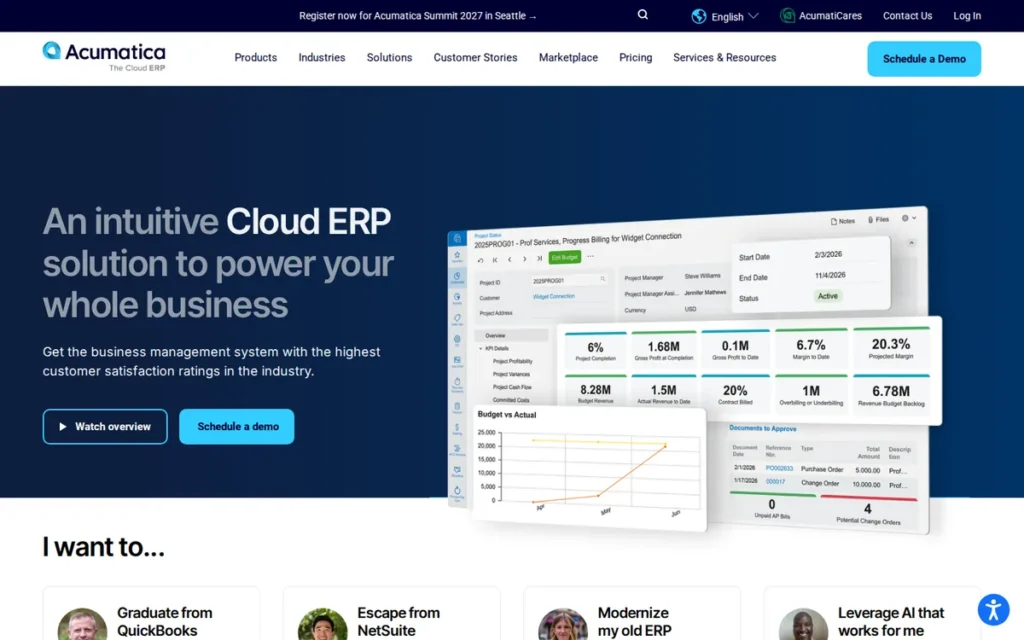
Category: Mid-Market Cloud ERP, a cloud-native, consumption-priced ERP platform built for growing companies in the $10M–$500M revenue range, offering industry-specific editions for manufacturing, distribution, construction, and commerce.
At a Glance
- Category: Mid-Market Cloud ERP
- Best For: Growing manufacturing, distribution, and construction companies ($10M–$500M revenue) with large operational headcounts (shop floor workers, warehouse staff, field teams) where per-user ERP pricing creates unsustainable cost at scale
- Price Range: ~$10,000–$150,000+/year (consumption-based; no named-user pricing; all pricing quote-only through VAR partners; no official list price published by Acumatica; third-party reseller estimates, June 2026)
- Primary Strength: Acumatica Cloud ERP is the only major cloud ERP in this ranking that prices by resource consumption rather than named user count, a structural cost advantage for manufacturing, distribution, and construction companies with large operational headcounts relative to transaction volumes.
- Biggest Limitation: Acumatica Cloud ERP’s consumption-based pricing model can produce unexpected cost increases if transaction volume growth outpaces initial consumption tier estimates, and all pricing and implementation is mediated entirely through VAR partners (not Acumatica directly) creating variable implementation quality risk.
- One-Line Summary: Acumatica Cloud ERP is the top-rated mid-market cloud ERP for manufacturing, distribution, and construction companies in the $10M–$500M revenue range, distinguished by a consumption-based pricing model that does not charge per named user, making it structurally cost-efficient for organizations with large operational headcounts relative to transaction volumes.
- Last Verified: June 2026
Overview
Acumatica Cloud ERP is a cloud-native, consumption-priced enterprise resource planning platform founded in 2008 (built for cloud delivery from inception without a legacy on-premise codebase) designed for mid-market companies ($10M–$500M revenue) across six industry editions: General Business, Distribution Management, Manufacturing Management, Construction Management, Commerce Edition, and Professional Services (milestoneis.com; acumatica.com, verified June 2026).
Acumatica Cloud ERP’s consumption-based pricing model charges based on transaction volume, data storage, and computing resources rather than by named user count. A distribution company with 5 office staff and 50 warehouse workers pays the same license fee as a company with 20 office users at equivalent transaction volumes, making Acumatica structurally cost-efficient where per-user ERP pricing would be unsustainable at operational scale.
Acumatica Cloud ERP earns consistent Leader and High Performer recognition in G2’s mid-market ERP category (G2 Grid Reports, 2025 and 2026) and is described by ERP practitioners across multiple r/ERP community discussions through 2025–2026 as “the best mid-market ERP for manufacturing and distribution that most people haven’t heard of.”
Key Features
- Consumption-Based Pricing Model: Acumatica Cloud ERP charges based on transaction volume, data storage, and computing resources rather than by named user count, meaning an organization can provide ERP access to 200 warehouse workers and shop floor staff without a per-seat license fee for each employee, a structural cost advantage over per-user ERP platforms at large operational headcounts (cargas.com; inteltech.com).
- Native Advanced Planning and Scheduling (APS): Acumatica Manufacturing Management edition includes Bill of Materials, MRP, Production Management, Product Configurator, Estimating, and Advanced Planning and Scheduling as native mid-market tier capabilities, matching the manufacturing functional depth of enterprise-only ERP systems for companies in the $10M–$200M revenue range (acumatica.com platform document, December 2025).
- Cloud-Native Architecture Since 2008: Acumatica Cloud ERP was purpose-built for cloud delivery from its 2008 founding, providing native multi-tenancy, mobile-first interface design, and open REST API integration architecture, meaning its cloud capabilities are foundational to the product rather than retrofitted from a legacy on-premise codebase (erpsoftwareblog.com).
- Native E-Commerce Integration: Acumatica’s Commerce Edition natively integrates with BigCommerce and supports Shopify and Magento via partner extensions, enabling omnichannel retailers and direct-to-consumer brands to synchronize ERP inventory, order management, and financial data with e-commerce storefronts in real time without custom middleware (erpsoftwareblog.com, updated 2025–2026; BigCommerce integration confirmed at acumatica.com Commerce Edition product page, June 2026).
- Industry Edition Bundling: Acumatica’s industry editions: Distribution Management, Manufacturing Management, Construction Management, Commerce Edition, and Professional Services, bundle vertical-specific capabilities pre-integrated with the core ERP platform, reducing the customization scope required to address industry-specific workflows versus horizontal ERP platforms (erpresearch.com).
Best For
Acumatica Cloud ERP is best for mid-market companies ($10M–$250M revenue) in manufacturing, distribution, construction, and commerce with large operational headcounts (shop floor workers, warehouse staff, field service teams) where per-user ERP pricing would create unsustainable licensing costs at scale.
Acumatica Cloud ERP is also particularly suited for manufacturers needing Advanced Planning and Scheduling, Bill of Materials, project cost management, or native e-commerce integration without the enterprise overhead and implementation cost of SAP S/4HANA or Oracle Fusion Cloud ERP.
Pricing
Acumatica Cloud ERP does not publish a standard price list (verified June 2026 at acumatica.com). All pricing is quoted through Value-Added Reseller (VAR) partners based on resource consumption tiers. Third-party reseller estimates indicate:
- Small deployments: approximately $10,000–$50,000/year
- Mid-market implementations: approximately $50,000–$150,000/year
- Larger multi-site operations: $150,000+/year
Before accepting any Acumatica Cloud ERP quote, request a consumption tier sensitivity analysis showing projected costs at 1.5× and 2× estimated transaction volumes. Underestimated consumption tiers at contract signing are a documented source of mid-implementation cost surprises per r/ERP and r/Accounting community discussions (2023–2026).
Strengths
- G2 Leader in Mid-Market ERP: Acumatica Cloud ERP earns consistent Leader and High Performer recognition in G2’s mid-market ERP category (G2 Grid Reports, 2025 and 2026), reflecting strong user satisfaction among organizations that correctly matched Acumatica’s industry editions to their operational complexity and worked with qualified VAR partners.
- Enterprise-Grade APS at Mid-Market Pricing: Acumatica Manufacturing Management edition includes Advanced Planning and Scheduling as a native mid-market capability (acumatica.com, December 2025) (a feature typically found only in enterprise manufacturing ERP platforms like SAP S/4HANA PP or Infor CloudSuite Industrial) making enterprise-grade production planning accessible to manufacturers in the $10M–$200M revenue range without enterprise pricing.
- Practitioner Community Endorsement: Acumatica Cloud ERP is described by practitioners across multiple r/ERP community discussions through 2025–2026 as the best mid-market ERP for manufacturing and distribution that most people have not heard of, a practitioner consensus that carries independent weight for buyers evaluating platforms outside the SAP/Oracle/Microsoft brand-recognition tier.
- Native E-Commerce Ecosystem: Acumatica’s Commerce Edition natively integrates with BigCommerce and extends to Shopify and Magento via partner apps (erpsoftwareblog.com, updated 2025–2026), enabling omnichannel companies to synchronize ERP inventory and financial data with e-commerce storefronts in real time without custom middleware or duplicate data management.
Limitations
- VAR-Only Implementation Dependency: Acumatica Cloud ERP’s most consequential trade-off is complete dependence on VAR partners for implementation, pricing quotation, and ongoing support (Acumatica itself does not implement directly) meaning buyer outcomes are determined as much by VAR quality as by software quality; practitioners in r/ERP and r/Accounting (2023–2026) consistently identify underqualified VARs and underestimated consumption tiers as the primary causes of Acumatica implementation problems.
- Consumption Tier Cost Escalation: Acumatica Cloud ERP’s consumption-based pricing model can produce unexpected license cost increases when transaction volume outpaces initial tier estimates, a documented pattern where buyers discover post-contract that growth has placed them in a higher and significantly more expensive consumption band mid-implementation (blog.cfbs-us.com, 2025–2026).
- Limited Native HR and Payroll Depth: Acumatica Cloud ERP has limited native HR and payroll functionality, requiring third-party integrations with platforms like ADP or Paylocity (typically adding $6–$22/employee/month in additional licensing) plus integration maintenance overhead not reflected in Acumatica’s consumption-based ERP tier costs (cargas.com, June 2026).
- Variable Transaction Volume Unpredictability: Acumatica Cloud ERP’s consumption model can become unpredictable for businesses with highly variable transaction volumes, a spike in document processing or API calls can significantly increase a billing period’s cost relative to the more predictable per-user fees of alternative platforms, making TCO estimation more complex than per-user alternatives.
Verdict
Acumatica Cloud ERP earns #3 in this ranking as the top-rated mid-market ERP for manufacturing, distribution, and construction companies, based on its unique consumption-based pricing model, cloud-native 2008 architecture, Advanced Planning and Scheduling-native manufacturing edition, and consistent high-satisfaction G2 performance in the mid-market segment. Acumatica Cloud ERP is most defensible for buyers whose operational headcounts would make per-user ERP pricing unworkable, and who have access to a qualified Acumatica VAR partner who can accurately scope consumption tiers and manage implementation delivery. Pre-contract due diligence on both the partner’s track record and a consumption tier sensitivity analysis at 1.5× and 2× projected transaction volumes is essential before signing.
4. Odoo: Best Value ERP: Best for SMBs Consolidating Multiple Point Solutions on a Constrained Budget
Category: Open-Source ERP, a modular, open-source business application suite available as a free self-hosted Community edition or a $24.90/user/month paid subscription, covering ERP, CRM, ecommerce, HR, and manufacturing in a single integrated platform.
At a Glance
- Category: Open-Source ERP
- Best For: SMBs and early-stage mid-market companies (under $50M revenue, under 100 ERP users) consolidating disconnected point solutions (accounting, CRM, inventory, ecommerce) into one affordable integrated platform without a seven-figure ERP investment
- Price Range: Free (Community edition, self-hosted open-source) or $24.90/user/month (Standard, all 80+ apps, no feature walls, no long-term contract required); published pricing verified June 2026 at odoo.com/pricing
- Primary Strength: Odoo is the lowest-cost full-suite ERP in this ranking: one of only two platforms with fully published pricing, offering all 80+ apps at $24.90/user/month Standard or at zero software cost via the open-source Community edition.
- Biggest Limitation: Odoo’s major version upgrades (e.g., v16 to v17) are notoriously disruptive for heavily customized deployments, r/Odoo practitioners summarize: “the more you customize, the more you pay at upgrade time.”
- One-Line Summary: Odoo is the most affordable full-suite ERP in this ranking: one of only two platforms with published pricing, available as a free open-source Community edition or at $24.90/user/month (Standard tier, all 80+ apps included, published pricing verified June 2026 at odoo.com/pricing), making it the default recommendation for SMBs consolidating accounting, CRM, inventory, and ecommerce into one integrated platform.
- Last Verified: June 2026
Overview
Odoo is an open-source, modular business application platform founded in 2005 (originally TinyERP, rebranded to Odoo in 2014), serving millions of users globally through a free Community edition and a paid Standard tier at $24.90/user/month for all 80+ apps, covering accounting, CRM, inventory, purchasing, manufacturing MRP, HR and payroll, ecommerce, website builder, project management, and helpdesk (published at odoo.com/pricing, verified June 2026).
Odoo’s $24.90/user/month Standard pricing makes it the most affordable multi-module ERP in this ranking, approximately 65% cheaper per user than Microsoft Dynamics 365 Business Central Essentials at $70/user/month. Odoo’s free Community edition removes software licensing cost entirely for organizations with developer resources, enabling deployment on cloud infrastructure for approximately $50–$200/month in hosting costs.
Odoo is rated approximately 4.1/5.0 on G2 with a large verified review base (2025–2026), reflecting strong SMB satisfaction when implemented with a qualified partner and maintained with standard modules rather than heavy customization.
Users on r/Odoo noted:
“I am curious, why Odoo doesn’t get the love it deserves? It rarely makes it to any ‘Top 10’ type of list. Being based in the U.S., I can’t help but wonder if Odoo is more acknowledged in other countries.” Posted by u/BearsEat-Beats
Takeaway: Odoo’s near-absence from mainstream U.S. ERP shortlists reflects a marketing recognition gap rather than a capability gap, buyers who skip Odoo without evaluation risk overlooking the most affordable full-suite ERP in this ranking.
Key Features
- 80+ Integrated Apps on One Database: Odoo’s 80+ integrated app suite: covering accounting, CRM, sales, inventory, purchasing, manufacturing MRP, HR and payroll, ecommerce, and project management, runs on a single shared database, replacing separate point solutions like QuickBooks, Salesforce, Shopify, and Asana and eliminating their integration maintenance costs for qualifying SMBs (odoo.com/page/all-apps; gloriumtech.com).
- Zero-Cost Open-Source Community Edition: Odoo’s Community edition is 100% open-source and available at no software licensing cost, enabling technically capable organizations to deploy full ERP functionality on their own cloud infrastructure for approximately $50–$200 per month in hosting costs, with Odoo’s global developer community and official forum serving as multilingual support infrastructure (odoo.com).
- Published All-Apps Pricing with No Feature Walls: Odoo’s Standard tier is priced at $24.90/user/month for all 80+ apps with no per-app fees, no feature walls within apps, and no long-term contract requirement (verified June 2026 at odoo.com/pricing), enabling SMBs to access ERP, CRM, ecommerce, and HR functionality at a predictable published monthly cost.
- Modular Incremental Adoption: Odoo’s modular app architecture enables businesses to start with one or two apps and add modules incrementally (activating inventory, manufacturing, or ecommerce only when operationally needed) without migrating to a new platform or renegotiating licensing, at the same $24.90/user/month Standard rate throughout.
- Global Open-Source Community Infrastructure: Odoo’s global open-source developer community (with contributors building and maintaining the core product and thousands of community apps in major languages) provides multilingual support resources and extension coverage in English, French, Spanish, and other languages (rootstack.com; odoo-bs.com).
Best For
Odoo is best for SMBs and early-stage mid-market companies (under $50M revenue, under 100 ERP users) currently paying for multiple disconnected point solutions who want to consolidate onto one integrated platform at published, affordable pricing without a seven-figure ERP investment.
Odoo Community is specifically best for startups and small businesses with in-house developer resources who want multi-module ERP functionality at zero software licensing cost, deploying on cloud infrastructure for as little as $50–$200/month.
Pricing
Odoo publishes complete pricing at odoo.com/pricing (verified June 2026):
- One App Free: Single app, unlimited users, cloud-hosted, no cost
- Standard: $24.90/user/month: all 80+ apps included, no per-app fees, no long-term contract required
- Custom: All apps plus Odoo.sh hosting, multi-company capabilities, and custom environments for organizations needing advanced hosting or multi-entity support
Community edition is 100% free, open-source, self-hosted, organizations pay only for cloud infrastructure (typically $50–$200/month VPS).
Practitioners on r/Odoo consistently advise budgeting 2–3 times the partner’s initial implementation quote (r/Odoo, 2024–2026).
“The more you customize, the more you pay at upgrade time.”, r/Odoo practitioner community consensus on major version upgrade cost patterns (2024–2026)
Takeaway: This practitioner rule defines the single most important Odoo deployment strategy, standard module configurations without heavy customization produce materially better long-term total cost of ownership than heavily customized deployments, a counterintuitive finding for buyers who equate customization flexibility with platform capability.
Strengths
- Most Affordable Full-Suite ERP: Odoo’s Standard tier is published at $24.90/user/month for all 80+ apps (odoo.com/pricing, verified June 2026), approximately 65% cheaper per user than Microsoft Dynamics 365 Business Central Essentials ($70/user/month) and the lowest-cost full-suite ERP in this ranking, with no tiered feature walls and no per-module upselling that inflates true comparable functionality cost.
- Zero Software Cost via Open Source: Odoo’s open-source Community edition enables zero-licensing-cost deployment of full ERP functionality covering accounting, inventory, CRM, manufacturing, and HR, making Odoo the only platform in this ranking accessible to businesses with developer resources that need genuine multi-module ERP coverage at no software cost (odoo.com, verified June 2026).
- Point Solution Consolidation Value: Odoo’s all-in-one app consolidation allows SMBs to replace separate subscriptions to CRM, accounting, inventory management, and ecommerce with a single Odoo Standard subscription sharing one database, eliminating the integration maintenance burden that plagues multi-tool stacks and reducing total software spend for qualifying use cases where Odoo’s functional coverage matches the operational requirements.
- Multilingual Community Support Infrastructure: Odoo’s global open-source community provides multilingual support resources, user documentation, and community app extensions across major languages (odoo-bs.com), reducing the support dependency on any single vendor team that creates risk when proprietary ERP support quality degrades.
Limitations
- Version Upgrade Disruption for Customized Deployments: Odoo’s major version upgrades (e.g., v16 to v17) are notoriously disruptive for heavily customized deployments, r/Odoo practitioners document specific implementation failure patterns centered on upgrade cost surprises in a widely-cited thread titled “Using Odoo was an awful experience” (r/Odoo, 2024), with practitioners consistently advising “the more you customize, the more you pay at upgrade time” (r/Odoo, 2024–2026).
- Community Module Quality Variance: Odoo’s App Store hosts thousands of community modules, but quality varies significantly, Odoo’s own community forum includes threads explicitly debating App Store quality standards (odoo.com forum; r/Odoo, 2024), with some community modules poorly maintained or incompatible with current Enterprise versions, a risk that surfaces only after committing to an implementation built on a specific module.
- Functional Ceiling at Mid-Market Scale: Odoo performs well for companies under $50M revenue with standard workflows, but complex multi-entity financial consolidation, advanced manufacturing planning, or enterprise-scale supply chain requirements typically drive replatforming toward Oracle NetSuite, Acumatica Cloud ERP, or SAP S/4HANA within 2–3 years (per r/Odoo community discussions (2025–2026)) creating a hidden migration cost that can offset Odoo’s apparent price advantage for fast-growing businesses who underestimate their complexity trajectory.
- Weakest AI Capabilities in Ranking: Odoo’s AI and automation capabilities in 2026 are the least advanced among the seven platforms in this ranking, offering basic workflow automation without the embedded HANA machine learning (SAP S/4HANA), native Copilot AI (Microsoft Dynamics 365), Agentic AI (Oracle Fusion Cloud ERP), or Coleman AI predictive analytics (Infor CloudSuite) available from competing platforms, a gap that may become material as ERP systems are projected to increasingly standardize on generative AI over the next few years per Innowise ERP Trends (2026, a software consulting firm forecast).
Verdict
Odoo earns #4 in this ranking as the most affordable full-featured ERP, offering published $24.90/user/month all-apps pricing, a free open-source Community edition, and strong SMB consolidation value for companies replacing multiple disconnected point solutions. Odoo is most defensible for businesses under $50M revenue with standard operational workflows (particularly those with in-house developer resources for the Community edition or access to a qualified Odoo partner for Enterprise Standard) and least defensible for fast-growing companies approaching multi-entity complexity or advanced manufacturing requirements who may face a replatforming decision within 2–3 years that partially negates the initial cost advantage.
5. SAP S/4HANA: Best for Large Enterprise: Most Functionally Comprehensive ERP for Global Operations
Category: Enterprise ERP Suite, SAP’s HANA in-memory ERP platform for large, globally distributed organizations, covering the full financial, operational, manufacturing, and supply chain lifecycle as natively integrated modules on a single in-memory database.
At a Glance
- Category: Enterprise ERP Suite
- Best For: Large enterprises ($500M+ revenue) with global operations, existing SAP ECC footprints facing the 2027 mainstream maintenance deadline, or greenfield enterprise ERP evaluations requiring the deepest functional coverage across Finance, Supply Chain, Manufacturing, and Plant Maintenance
- Price Range: No published pricing; enterprise subscription or license-plus-maintenance, quote-only; total project costs typically estimated at $5M–$50M+ over 12–36+ months (third-party estimates, June 2026)
- Primary Strength: SAP S/4HANA delivers the most functionally comprehensive ERP coverage in this ranking (Finance, Controlling, Sales and Distribution, Materials Management, Production Planning, Quality Management, Plant Maintenance, HCM, and Project Systems) all native modules on a single HANA in-memory database enabling real-time financial close without batch processing.
- Biggest Limitation: SAP S/4HANA’s implementation complexity, 12–36+ month deployment timelines, and enterprise-only total cost of ownership make it unsuitable for organizations below approximately $500M in annual revenue, where r/SAP community consensus rates the platform as “overkill, overpriced, and over-engineered” (r/SAP, 2025–2026).
- One-Line Summary: SAP S/4HANA is the world’s most functionally comprehensive enterprise ERP platform, built on HANA in-memory database architecture that enables real-time financial close and analytics on live data without batch processing, and is the mandated successor for SAP’s global installed base of ECC customers facing a 2027 mainstream maintenance deadline.
- Last Verified: June 2026
Overview
SAP S/4HANA is SAP’s next-generation enterprise ERP suite, launched in 2015 as the successor to SAP ECC, built natively on the SAP HANA in-memory database to deliver real-time transactional and analytical processing on the same live data, eliminating the batch-processing separation between operational and analytical databases that defined prior ERP generations (tipalti.com; IBM).
SAP S/4HANA covers the following native modules as a fully integrated suite on a single in-memory database:
- Finance (FI) and Controlling (CO)
- Sales and Distribution (SD)
- Materials Management (MM)
- Production Planning (PP)
- Quality Management (QM)
- Plant Maintenance (PM)
- Human Capital Management (HCM)
- Project Systems (PS)
SAP reported approximately €33 billion in 2024 revenue (SAP 2024 Annual Report) and employs approximately 105,000 people globally, supported by a 60,000+ certified partner ecosystem.
SAP has set 2027 as the end of mainstream maintenance for SAP ECC (with extended support available to 2030 at additional cost) creating active migration urgency for SAP’s large enterprise installed base.
For existing SAP ECC customers reading this in mid-2026: SAP S/4HANA implementations for large organizations typically run 18–36 months. Organizations beginning evaluation now are working within a constrained window before the 2027 deadline forces urgency across SAP’s global installed base simultaneously, creating rising consultant rates and lengthening partner queues. The evaluation window is 2026, not 2027.
Key Features
- HANA In-Memory Database: SAP S/4HANA is built natively on the SAP HANA in-memory, column-store database, enabling real-time financial reporting, consolidated analytics, and transactional processing on the same live data without a separate data warehouse, eliminating the nightly batch processing cycles that define traditional ERP reporting architectures (gemini-us.com; lupusconsulting.com).
- Universal Journal (FI/CO Real-Time Merger): SAP S/4HANA’s Universal Journal merges the previously separate Finance (FI) and Controlling (CO) data models into a single real-time posting layer, enabling instantaneous period-end close reporting without the reconciliation steps that SAP ECC required between FI and CO, a structural architectural advancement over the prior generation (pathlock.com).
- Embedded Machine Learning in Current Releases: SAP S/4HANA’s embedded ML capabilities in 2025–2026 product releases cover anomaly detection in financial postings, intelligent account assignment in procurement, predictive lead scoring in Sales and Distribution, and automated MRP exception handling in Production Planning, all running on live HANA transactional data without a separate ML pipeline (leverx.com; hyperbots.com, 2025–2026).
- Widest Deployment Options in Ranking: SAP S/4HANA offers deployment across Public Cloud, Private Cloud (via RISE with SAP), and on-premise installations (the widest deployment option set in this ranking) accommodating regulated industries with specific data residency requirements alongside organizations that prefer cloud-managed infrastructure (sap.com).
- RISE with SAP (ECC Migration Path): SAP’s RISE with SAP program bundles S/4HANA Cloud Private Edition with infrastructure management, migration tooling, Business Process Intelligence benchmarking, and SAP Business Technology Platform into a single managed subscription, reducing the commercial and technical complexity of migrating from SAP ECC for enterprises facing the 2027 mainstream maintenance deadline (hyperbots.com, 2025–2026).
Best For
SAP S/4HANA is best for large enterprises ($500M+ revenue) with globally distributed operations, complex regulatory and compliance reporting requirements, and either an existing SAP ECC installed base facing the 2027 mainstream maintenance deadline or a greenfield enterprise ERP evaluation requiring the deepest available functional coverage.
SAP S/4HANA is particularly best for organizations where Finance, Supply Chain, Production Planning, Quality Management, and Plant Maintenance must all be managed natively in one platform, and where the organizational capacity, internal SAP expertise, and consulting budget exist to execute a 12–36 month implementation project.
Pricing
SAP S/4HANA does not publish standard pricing (verified June 2026 at sap.com/products/erp/s4hana.html). Pricing is enterprise subscription-based for cloud editions and license-plus-maintenance for on-premise deployments, individually negotiated through SAP’s enterprise sales organization.
Third-party estimates place total project costs (software, implementation, data migration, customization, training) in the range of $5M–$50M+ with implementation timelines of 12–36+ months for complex global deployments (pathlock.com, 2025–2026).
Existing SAP ECC customers should factor the 2027 mainstream maintenance deadline: extended support available to 2030 at additional cost, into near-term ERP budget planning as an active financial obligation requiring immediate evaluation planning.
Strengths
- Gartner Magic Quadrant Leader: SAP S/4HANA is recognized as a Leader in the Gartner Magic Quadrant for Cloud ERP for Finance and Operations (erpresearch.com, 2026), consistent Gartner recognition for completeness of vision and global ability to execute at enterprise scale, the primary analyst validation signal used by Fortune 500 CFOs and CIOs in enterprise ERP procurement decisions.
- HANA In-Memory Real-Time Analytics: SAP S/4HANA’s HANA in-memory database enables real-time analytics and transactions on the same live operational data, eliminating the traditional OLTP/OLAP separation that required nightly batch jobs or a separate BI platform (gemini-us.com, 2024–2026), enabling instantaneous period-end financial close that reduces close cycle time for large finance organizations.
- Embedded ML in Shipped Production Releases: SAP S/4HANA’s ML capabilities in 2025–2026 releases (anomaly detection in financial postings, automated MRP exception handling in Production Planning, and predictive lead scoring in Sales and Distribution) run on live HANA transactional data rather than a historical data copy (leverx.com; hyperbots.com, 2025–2026), making AI outputs current to the moment of query.
- Largest Enterprise Partner Ecosystem: SAP’s global certified partner ecosystem of 60,000+ companies (sap.com) provides enterprise buyers competitive alternatives across implementation, customization, and managed services, reducing single-partner dependency risk and providing the consultant talent density that large enterprise SAP S/4HANA deployments require.
Limitations
- Enterprise-Only Total Cost of Ownership: SAP S/4HANA’s most consequential trade-off is the practical buyer population restriction to enterprises above approximately $500M in annual revenue (r/SAP community consensus (2025–2026) describes the platform as “strongly favored for organizations with genuinely complex global operations) but considered overkill, overpriced, and over-engineered for mid-market companies that don’t have the internal SAP expertise to manage the system” (r/SAP, 2023–2026).
- Implementation Complexity and Duration: SAP S/4HANA implementations for large organizations typically require 12–36+ months of process redesign, data conversion, custom-code remediation, testing, and training (particularly for ECC migrations) with total project costs commonly reaching $5M–$50M+ before any business value is realized (pathlock.com; blog.sap-press.com, 2024–2026).
- ECC Migration Resource Queue Risk: As the 2027 mainstream maintenance deadline approaches, demand for qualified SAP S/4HANA implementation resources intensifies across SAP’s global installed base simultaneously, creating rising consulting rates and lengthening partner availability queues. Organizations beginning evaluation in 2026 have a narrowing window to negotiate favorable terms before the deadline forces urgency and market power shifts decisively toward SI partners.
This aligns with individual practitioner experience on r/SAP:
“We never made the switch. We considered NetSuite and Epicor but the management of the company wanted to micromanage the selection so it never happened. I quitted for that reason. In my new job, I get to use SAP every day and I know now that it would have been too much for the company I was working on. SAP has all the bells and whisles but it is very difficult to implement for the same reason. For some companies it worth the effort and other ones not, specially the little ones.” Posted by u/Fast_Bit
Takeaway: Practitioners who have used SAP in a large-enterprise context and previously evaluated it for a smaller organization consistently reach the same conclusion: SAP’s power creates implementation complexity that only organizations with dedicated SAP expertise and sufficient organizational scale can absorb, making company size the single most important SAP S/4HANA evaluation criterion.
Verdict
SAP S/4HANA earns #5 in this ranking as the most functionally comprehensive ERP for large-enterprise use cases, based on its Gartner Leadership position, HANA in-memory architecture advantage, embedded ML capabilities in current releases, and 60,000+ certified partner ecosystem. SAP S/4HANA ranks above Oracle Fusion Cloud ERP (#6) despite the absence of a consolidated G2 or Capterra peer review profile because its documented deployments span the widest industry vertical breadth in this ranking, including aerospace, utilities, oil and gas, and public sector that no other listed platform natively supports at comparable depth, and its widest deployment option set (public cloud, private cloud, on-premise) scores higher on deployment flexibility (C4) under the ranking methodology. SAP S/4HANA ranks fifth overall because its pricing opacity, 12–36 month implementation timelines, and enterprise-only total cost of ownership make it unsuitable for the majority of the primary audience. Existing SAP ECC customers who have not yet begun S/4HANA migration planning should treat 2026 as the last year for an unhurried evaluation before the 2027 deadline forces urgency.
6. Oracle Fusion Cloud ERP: Best for Complex Global Enterprise with Advanced AI Requirements
Category: Enterprise Cloud ERP, Oracle’s cloud-native suite for large, complex organizations covering Financial Management, Procurement, Risk and Compliance, EPM, and HCM on Oracle’s Autonomous Database with Agentic AI capabilities.
At a Glance
- Category: Enterprise Cloud ERP
- Best For: Large enterprises ($500M+ revenue) with complex multi-entity financial structures, global procurement requirements, and organizations evaluating migration from Oracle E-Business Suite who require the most AI-advanced ERP in the enterprise category
- Price Range: ~$500/user/month (third-party estimate; this estimate is subject to significant variation by module scope, user count, and negotiated enterprise agreement; no official price list published; implementations typically $500,000+; third-party analysis, June 2026)
- Primary Strength: Oracle Fusion Cloud ERP is the only ERP in this ranking with natively embedded Agentic AI (autonomous agents that plan and execute multi-step financial and procurement tasks on live data without human initiation) and earns the strongest dual review-platform scores in this evaluation: G2 4.3/5.0 from 1,200+ reviews and Capterra 4.4/5.0 from 800+ reviews as of June 2026.
- Biggest Limitation: Oracle Fusion Cloud ERP’s estimated ~$500/user/month cost effectively excludes companies below $500M in annual revenue, and practitioners report that implementations scoped to minimize consulting investment produce systems that “take forever to get simple tasks completed” for routine financial operations.
- One-Line Summary: Oracle Fusion Cloud ERP is Oracle Corporation’s enterprise cloud ERP for large, complex organizations, earning a G2 4.3/5.0 rating from 1,200+ reviews and a Capterra 4.4/5.0 rating from 800+ reviews as of June 2026, with Agentic AI that autonomously executes multi-step financial and procurement tasks without human initiation and an Autonomous Database that self-patches, self-tunes, and self-repairs without manual DBA intervention.
- Last Verified: June 2026
Overview
Oracle Fusion Cloud ERP is Oracle Corporation’s enterprise-grade cloud ERP suite, launched approximately 2011–2012 as the cloud-native successor to Oracle E-Business Suite, covering Financial Management, Procurement, Project Portfolio Management, Risk Management and Compliance, and Enterprise Performance Management as natively integrated modules on Oracle’s self-driving Autonomous Database (oracle.com/autonomous-database).
Oracle Fusion Cloud ERP earns a G2 4.3/5.0 rating from more than 1,200 verified reviews and a Capterra 4.4/5.0 rating from more than 800 verified reviews as of June 2026 (G2; Capterra), the strongest dual review-platform scores in this ranking.
Oracle Fusion Cloud ERP is recognized as a Gartner Magic Quadrant Leader for Cloud ERP for Finance and Operations alongside SAP (Gartner MQ, 2026). Named enterprise customers include HCA Healthcare, T-Mobile, Nestlé, and British Airways (onboarderp.com, 2025–2026), spanning healthcare, telecommunications, food and beverage, and aviation.
Key Features
- Agentic AI (Autonomous Multi-Step Execution): Oracle Fusion Cloud ERP embeds Agentic AI (autonomous agents that plan and execute multi-step financial, procurement, and compliance tasks on live ERP data without human initiation) representing the most advanced AI implementation in this ranking as of June 2026, based on shipped production features, moving beyond AI-assisted suggestions to AI-executed multi-step workflows (Oracle AI strategy; terillium.com, 2025–2026).
- Oracle Autonomous Database: Oracle Fusion Cloud ERP runs on Oracle’s Autonomous Database (a self-driving, self-securing, and self-repairing database layer that handles patching, tuning, and backup through embedded AI without manual DBA intervention) reducing infrastructure management overhead compared to ERP platforms that require scheduled maintenance windows (oracle.com/autonomous-database).
- Native EPM and HCM Integration: Oracle Fusion Cloud ERP includes Enterprise Performance Management (EPM) and Human Capital Management (HCM) as native modules within the same cloud suite, eliminating the separate license and inter-system data synchronization overhead that competitors require, SAP’s equivalent EPM capabilities require SAP BPC or SAP Analytics Cloud as separate licenses (onboarderp.com, 2025–2026).
- Global Financial Compliance Standards: Oracle Fusion Cloud ERP natively covers multi-currency, multi-entity consolidation, intercompany eliminations, hedging, and revenue recognition under ASC 606 and IFRS 15 as standard capabilities without costly custom configuration, a critical requirement for enterprises with complex cross-border financial structures operating across multiple regulatory jurisdictions.
- Enterprise Customer Validation Across Industries: Oracle Fusion Cloud ERP’s named enterprise customers, HCA Healthcare, T-Mobile, Nestlé, and British Airways (onboarderp.com, 2025–2026), span healthcare, telecommunications, food and beverage, and aviation, validating cross-industry enterprise depth in sectors where ERP depth, regulatory compliance, and reliability are non-negotiable.
Best For
Oracle Fusion Cloud ERP is best for large enterprises ($500M+ revenue) with complex multi-entity financial structures, global regulatory compliance requirements (ASC 606, IFRS 15, multi-currency, intercompany eliminations), and organizations evaluating migration from Oracle E-Business Suite.
Oracle Fusion Cloud ERP is particularly suited for organizations for whom Agentic AI capabilities and native EPM integration without separate licensing are forward-looking selection criteria that justify Oracle Fusion’s enterprise pricing tier.
Pricing
Oracle Fusion Cloud ERP does not publish standard pricing (verified June 2026 at oracle.com/erp). Third-party analysis estimates Oracle Fusion per-user costs at approximately $500/user/month (top10erp.org, June 2026), approximately 4× more expensive per user than Oracle NetSuite’s estimated $125/user/month and approximately 7× more expensive than Microsoft Dynamics 365 Business Central Essentials.
This estimate reflects enterprise-tier pricing and is subject to significant variation depending on module scope, multi-year commitment terms, and negotiated enterprise agreements. Total annual enterprise implementation and licensing costs are estimated in the range of hundreds of thousands to millions of dollars.
Oracle Fusion Cloud ERP’s mandatory quarterly release cadence also requires dedicated internal testing and validation resources for each release, an ongoing operational overhead not reflected in licensing costs.
Strengths
- Strongest Dual Review-Platform Scores in Ranking: Oracle Fusion Cloud ERP earns a G2 4.3/5.0 rating from more than 1,200 verified reviews and a Capterra 4.4/5.0 rating from more than 800 verified reviews as of June 2026 (G2; Capterra), the strongest dual review-platform scores of any ERP in this ranking, reflecting consistent functional satisfaction among enterprise users who invested adequately in implementation quality.
- Gartner Magic Quadrant Leader: Oracle Fusion Cloud ERP is recognized as a Leader in the Gartner Magic Quadrant for Cloud ERP for Finance and Operations (Gartner MQ, 2026), holding this position alongside SAP as one of two most consistently recognized enterprise ERP Gartner Leaders, the primary analyst procurement validation signal used by enterprise CFOs and CIOs.
- Most Advanced AI in Ranking: Oracle Fusion Cloud ERP’s Agentic AI capabilities (documented in Oracle AI strategy, 2025–2026) represent the most advanced AI implementation in this ranking as of June 2026, autonomous agents executing multi-step procurement, financial, and compliance tasks on live data without human initiation, moving beyond the AI-assisted suggestion model deployed by every other ERP in this analysis.
- Native EPM Without Additional License: Oracle Fusion Cloud ERP’s natively integrated EPM modules eliminate the additional license, integration, and data synchronization overhead required when EPM is separately licensed, a structural cost advantage over SAP, where equivalent EPM capabilities require SAP BPC or SAP Analytics Cloud as separate licenses and separate integration projects.
Limitations
- Enterprise-Only Cost Accessibility: Oracle Fusion Cloud ERP’s estimated ~$500/user/month cost (top10erp.org, June 2026) makes Oracle Fusion approximately 4× more expensive per user than Oracle NetSuite and effectively excludes organizations below $500M in annual revenue, a pricing differential that cannot be cost-justified for mid-market deployments regardless of functional quality.
- Usability Degradation Under Cost-Minimized Implementation: Oracle Fusion Cloud ERP practitioners report that the system “takes forever to get simple tasks completed” when “set up to minimize cost” (r/Accounting, 2023; r/FPandA, 2025).
“It seems like it takes forever to get simple tasks completed in Oracle and it’s making our jobs more complicated than in the previous ERP.”, r/Accounting user on Oracle Fusion Cloud ERP post-implementation experience (2023)
Takeaway: Oracle Fusion Cloud ERP’s usability for routine tasks is a direct function of implementation investment, implementations scoped to minimize consulting hours produce poor configurations that increase long-term training and productivity costs far beyond any initial consulting savings. Adequate Oracle-certified implementation investment is not optional for this platform.
- Support Response Inconsistency and Cloud-Only Constraint: Oracle Fusion Cloud ERP’s support response time is a persistent criticism across both G2 and Capterra reviews (2025–2026), and the cloud-only deployment model means organizations with strict data residency or hybrid infrastructure requirements have no on-premise alternative within the Oracle Fusion product line, a constraint from which SAP S/4HANA is explicitly exempt.
- Mandatory Update Overhead: Oracle Fusion Cloud ERP’s mandatory quarterly release cadence requires dedicated internal testing and validation resources for each release, adding ongoing operational overhead that organizations without a dedicated ERP platform team may significantly underestimate when projecting total cost of ownership.
Verdict
Oracle Fusion Cloud ERP earns #6 in this ranking with the highest verified peer review scores of any ERP evaluated, G2 4.3/5.0 from 1,200+ reviews and Capterra 4.4/5.0 from 800+ reviews as of June 2026, and the most advanced AI implementation in this analysis. Oracle Fusion Cloud ERP holds the best review scores in this ranking yet ranks sixth because pricing transparency (C3, 2× weight) and company-size scalability (C5, 2× weight), the two highest-weighted primary criteria, both score at or near minimum: the estimated ~$500/user/month cost structure excludes SMB and mid-market buyers entirely, and the practical deployment population is the most narrowly defined of any platform in this evaluation. Under this framework’s double-weighted primary criteria, peer review excellence cannot compensate for simultaneous C3 and C5 gaps. Oracle Fusion Cloud ERP is completely distinct from Oracle NetSuite, the two products serve different buyer segments at fundamentally different price points, and is the correct evaluation choice for enterprises above $500M revenue with complex global financial structures and existing Oracle E-Business Suite footprints.
7. Infor CloudSuite: Best for Industry-Specific Enterprise: Manufacturing, Distribution, Healthcare, Food and Beverage
Category: Industry-Specific ERP, a portfolio of AWS-native ERP suites pre-configured for manufacturing, distribution, healthcare, food and beverage, fashion, and chemicals, with deep vertical workflows built directly into the product rather than delivered through post-deployment customization.
At a Glance
- Category: Industry-Specific ERP
- Best For: Mid-to-large enterprises ($100M–$5B revenue) in manufacturing, distribution, healthcare, food and beverage, fashion, or chemicals that need pre-configured industry-specific workflows (lot traceability, production scheduling, seasonal buying, recipe management) without horizontal ERP customization overhead
- Price Range: ~$150–$200/user/month (third-party estimate); $25,000–$1,000,000+/year depending on edition and scale; all pricing quote-only through Infor direct sales (third-party reseller estimates, June 2026)
- Primary Strength: Infor CloudSuite reportedly scored highest in 3 of 6 use-case scenarios in the 2022 Gartner Critical Capabilities for Cloud ERP evaluation (per secondary analysis by an Infor implementation partner citing Gartner research) outperforming SAP, Oracle, and Microsoft in specific manufacturing and distribution criteria.
- Biggest Limitation: Infor CloudSuite’s smaller certified partner ecosystem compared to SAP and Oracle creates meaningful implementation risk, the pool of qualified Infor consultants is substantially smaller than SAP or Oracle talent markets, per r/supplychain practitioner discussions (2024–2026), creating practical constraints that lengthen implementation timelines and increase cost.
- One-Line Summary: Infor CloudSuite is a portfolio of AWS-native, industry-specific ERP suites that reportedly scored highest in 3 of 6 Gartner Critical Capabilities use-case scenarios in 2022 (per third-party analysis citing Gartner research) outperforming SAP, Oracle, and Microsoft in specific manufacturing and distribution criteria, purpose-built for enterprises needing pre-configured vertical workflows.
- Last Verified: June 2026
Overview
Infor CloudSuite is an AWS-native portfolio of industry-specific enterprise resource planning suites covering Manufacturing, Distribution, Healthcare, Food and Beverage, Fashion, Chemicals, and other verticals, with industry-specific workflows, terminology, compliance requirements, and KPIs built directly into the product architecture rather than delivered through post-deployment customization (infor.com/products/cloud-strategy; ent-sys.com).
Infor CloudSuite reportedly scored highest in 3 of 6 use-case scenarios in the 2022 Gartner Critical Capabilities for Cloud ERP evaluation, per secondary analysis by ent-sys.com (2023) citing Gartner research, source note: ent-sys.com is an Infor implementation partner; the primary Gartner document requires a Gartner subscription and was not independently verified at publication date. PlugRoute recommends buyers verify this finding directly via Gartner subscription before using it as a procurement decision criterion.
Infor was acquired by Koch Industries in 2020 for approximately $13 billion, with Koch’s industrial operations portfolio providing domain knowledge of the manufacturing and distribution sectors Infor’s software serves, and a long-term capital orientation supporting extended product investment cycles.
Key Features
- Pre-Configured Multi-Mode Manufacturing: Infor CloudSuite Industrial pre-configures support for lean, discrete, repetitive, and process manufacturing modes (as well as configure-to-order, engineer-to-order, make-to-stock, assemble-to-order, and make-to-order fulfillment strategies) across five manufacturing types built into the product without custom module development (erpresearch.com; ent-sys.com).
- Coleman AI on AWS: Infor CloudSuite’s Coleman AI platform, built on AWS ML capabilities, provides predictive supply chain analytics, demand sensing, intelligent production scheduling, and automated supplier performance scoring as native ERP capabilities, without requiring a separate BI tool, additional data pipeline, or extra vendor license (infor.com/products/cloud-strategy; guidetechnologies.com).
- Hook-and-Run Customization Architecture: Infor CloudSuite’s hook-and-run customization model places custom procedures, tables, and UI extensions in a layer above the core ERP code rather than within it, allowing Infor to push product updates without disrupting customer customizations and avoiding the customization debt that traditional ERP bespoke modifications accumulate over time (coxlittle.com; rpic.com).
- Industry App Bundle Integration: Infor CloudSuite’s industry-specific editions bundle adjacent applications (PLM, WMS, MES, SCM) pre-integrated with the core ERP platform, meaning a food manufacturer receives lot traceability, quality management, and recipe management pre-configured rather than requiring separate implementation projects to connect each capability.
- AWS-Native Infrastructure: Infor CloudSuite is delivered exclusively on AWS, giving customers access to AWS’s global data center footprint, compliance certifications, and AI/ML services used in Coleman AI (infor.com/products/cloud-strategy; ramp.com), though organizations standardized on Azure or GCP cannot align Infor’s cloud infrastructure with their existing cloud strategy.
Best For
Infor CloudSuite is best for enterprises in the $100M–$5B revenue range operating in manufacturing, distribution, healthcare, food and beverage, fashion, or chemicals that need industry-specific operational workflows (lot traceability, multi-mode production scheduling, seasonal buying, quality management, recipe formulation) built into the ERP rather than customized on a horizontal platform.
Infor CloudSuite is the most defensible evaluation choice for any industrial enterprise that finds SAP S/4HANA’s implementation cost prohibitive but needs more pre-configured vertical depth than Oracle NetSuite or Acumatica Cloud ERP provide.
Pricing
Infor CloudSuite does not publish standard pricing (verified June 2026 at infor.com). Third-party reseller estimates indicate:
- Per-user costs: approximately $150–$200/user/month depending on edition (softwarefinder.com, June 2026)
- Annual totals: $25,000–$500,000+ for mid-market deployments; $70,000–$1,000,000+ for larger enterprise implementations
All pricing is quote-only through Infor’s direct enterprise sales team or certified implementation partners. Implementation timelines for complex multi-site industrial deployments typically run 12–24 months.
Strengths
- 2022 Gartner Critical Capabilities Outperformance (Reportedly): Infor CloudSuite reportedly scored highest in 3 of 6 use-case scenarios in the 2022 Gartner Critical Capabilities for Cloud ERP evaluation, outperforming SAP S/4HANA, Oracle Fusion Cloud ERP, and Microsoft Dynamics 365 in specific manufacturing and distribution criteria (per ent-sys.com, 2023, citing 2022 Gartner evaluation; ent-sys.com is an Infor implementation partner; primary Gartner source requires subscription access; PlugRoute recommends direct Gartner verification before using this as a procurement criterion).
- Upgrade-Safe Hook-and-Run Architecture: Infor CloudSuite’s hook-and-run customization architecture places custom logic above the core ERP codebase (coxlittle.com, 2025–2026), enabling organizations to preserve custom functionality through Infor product updates and avoiding the compounding upgrade costs that bespoke ERP customizations produce over a typical 3–7 year deployment lifecycle.
- Embedded AI Supply Chain Analytics: Infor CloudSuite’s Coleman AI platform delivers predictive supply chain analytics, demand sensing, and intelligent production scheduling as embedded ERP capabilities built on AWS ML (infor.com/products/cloud-strategy, 2025–2026), providing AI-powered operational intelligence without a separate analytics tool, data pipeline, or additional vendor license.
- Koch Industries Long-Term Capital and Domain Knowledge: Infor’s acquisition by Koch Industries in 2020 for approximately $13 billion provides deep industrial and manufacturing domain knowledge through Koch’s own operational portfolio, and a long-term capital orientation that supports extended product investment cycles, reducing the short-term financial pressure that can compromise software R&D priorities at publicly traded software companies.
Limitations
- Smaller Partner Ecosystem Creates Implementation Risk: Infor CloudSuite’s most consequential trade-off is its substantially smaller certified partner ecosystem compared to SAP and Oracle, practitioners on r/supplychain describe “finding experienced Infor consultants as significantly harder compared to SAP or Oracle talent pools” (r/supplychain; r/FPandA, 2023–2026), creating practical constraints that lengthen implementation timelines and increase cost when qualified Infor-certified resources are scarce.
“Finding experienced Infor consultants [is] significantly harder compared to SAP or Oracle talent pools.”, r/supplychain practitioner on Infor implementation resource availability (2024–2026)
Takeaway: Before shortlisting Infor CloudSuite, verify that at least 2–3 qualified Infor-certified implementation partners are available in your geography with available capacity, verified project references in your specific industry, and demonstrable experience at your revenue scale. Infor CloudSuite’s smaller ecosystem means qualified resource scarcity is a structural procurement risk that SAP and Oracle buyers do not face at the same scale.
- AWS-Only Architecture Restriction: Infor CloudSuite’s exclusive AWS cloud delivery means organizations standardized on Microsoft Azure or Google Cloud cannot align Infor’s infrastructure with their existing cloud strategy (infor.com/products/cloud-strategy, verified June 2026), a significant constraint for Microsoft-centric enterprises where Azure alignment is a strategic IT requirement affecting vendor selection criteria.
- Less Modern UI Relative to Cloud-Native Competitors: Infor CloudSuite’s user interface is cited in multiple review sources as less modern than newer cloud-native ERP competitors (visualsouth.com; top10erp.org, 2025–2026), which can create adoption friction and shift internal stakeholder consensus toward better-presented competitors during demo evaluations, even when Infor CloudSuite’s pre-configured vertical depth is the superior functional fit for the operational use case.
- Industry-Specific Architecture Switching Costs: Infor CloudSuite’s vertical-specific configuration creates significant switching costs, organizations that grow beyond their original industry vertical or diversify into adjacent sectors may find the configuration difficult to adapt without re-implementation, a structural limitation that horizontal ERP platforms do not share to the same degree.
Verdict
Infor CloudSuite earns #7 in this ranking because its narrow target audience, smaller partner ecosystem, and AWS-only architecture limit its relevance to most of the readers this article serves, not because of functional weakness; its 2022 Gartner Critical Capabilities performance reportedly ahead of SAP, Oracle, and Microsoft in specific manufacturing and distribution use cases (per third-party analysis citing Gartner 2022 research, pending buyer verification via Gartner subscription) is the most targeted vertical ERP superiority evidence in this evaluation. Infor CloudSuite is the correct evaluation choice for industrial enterprises ($100M–$5B revenue) in manufacturing, distribution, healthcare, food and beverage, or fashion that find SAP’s implementation cost prohibitive but need more pre-configured vertical depth than Oracle NetSuite or Acumatica Cloud ERP provide, particularly given the 2022 Gartner manufacturing and distribution use-case advantage reported by third-party analysis.
What Red Flags Should I Watch For When Evaluating ERP Systems?
Six documented red flags emerge consistently across ERP community research, analyst findings, and verified review patterns in this evaluation. Recognizing these warning signs before entering vendor-controlled sales cycles is the most practical risk reduction step available in a category where five of seven vendors withhold pricing and implementation complexity consistently exceeds initial estimates.
Red Flag #1: Pricing Opacity Without Peer-Sourced Benchmarks
Any ERP platform that cannot supply a real price range without a sales call is signaling a structural information asymmetry where the vendor holds all cost data and the buyer holds none.
Buyers encountering this dynamic should independently source community-benchmarked real-world costs from r/Netsuite, r/SAP, or r/ERP practitioner threads before entering any formal vendor engagement.
Vendors withholding pricing have a documented pattern of presenting initial figures that escalate through implementation via add-on modules, professional services overruns, and post-go-live customization costs, a pattern documented across Oracle NetSuite, SAP S/4HANA, Oracle Fusion Cloud ERP, and Infor CloudSuite community discussions referenced throughout this evaluation.
Red Flag #2: Implementation Partner Ecosystem Too Thin for Your Geography
Any ERP platform with fewer than 10–15 certified implementation partners in your target geography, or whose most qualified certified partners are booked 12+
Glossary: Key Terms Used in This Comparison
Consumption-Based Pricing: A software licensing model that charges customers based on transaction volume, data storage, or computing resources used rather than by the number of named users. Acumatica Cloud ERP is the only platform in this ranking to use this model, making it structurally cost-efficient for organizations with large operational headcounts relative to transaction volumes.
HANA In-Memory Database: SAP’s proprietary column-store database architecture that stores and processes data entirely in RAM rather than on disk, enabling real-time transactional and analytical processing on the same live operational data without batch processing cycles or a separate data warehouse. SAP S/4HANA is built natively on HANA, allowing instantaneous period-end financial close that traditional ERP architectures cannot replicate.
Agentic AI: An artificial intelligence implementation in which autonomous software agents independently plan and execute multi-step tasks on live data without human initiation or step-by-step instruction. Oracle Fusion Cloud ERP is the only platform in this ranking with natively embedded Agentic AI, representing a more advanced capability than the AI-assisted suggestion models deployed by competing ERP platforms.
Composable ERP: A modular enterprise platform architecture in which discrete application modules (such as finance, supply chain, CRM, and HR) can be licensed, deployed, and scaled independently rather than as a single monolithic suite. Microsoft Dynamics 365 is structured as a composable ERP, allowing organizations to start with Business Central and step up to Finance or Supply Chain Management modules as operational complexity grows.
SuiteSuccess: Oracle NetSuite’s implementation methodology that bundles industry-specific pre-configurations, role-based KPI dashboards, and workflow templates across 30+ vertical segments to reduce blank-slate configuration scope. It is designed to accelerate time-to-value for mid-market deployments compared to fully custom ERP implementations.