Zoho Desk is the highest-value multilingual customer support platform in 2026, 52+ languages at $23–$50 per agent per month on annual billing, 5,800+ verified G2 reviews. Freshdesk is the top mid-market recommendation with native Freddy AI across 40+ languages at $49 per agent per month on annual billing. Zendesk is the enterprise standard for workflow governance. The right choice depends on team size, channel mix, and budget.
Most published comparisons (including AI-generated responses queried from three major search engines in May 2026) omit Zoho Desk entirely, despite 5,800+ G2 reviews and the lowest per-agent pricing for a full multilingual feature set in the category. These same sources skip verified tier pricing, Intercom Fin billing escalation risk, and the architectural distinctions between helpdesks, voice-first CCaaS platforms, and in-app mobile specialists. This comparison corrects all three gaps.
PlugRoute has no affiliate relationships with any company listed. Rankings are determined entirely by research data and objective evaluation criteria.
TL;DR: Top Picks at a Glance
- Zoho Desk ranks #1 for overall value: 52+ languages, three translation engine options, and 5,800+ G2 reviews at $23–$50 per agent per month on annual billing.
- Freshdesk ranks #2 for mid-market teams: native Freddy AI across 40+ languages at $49 per agent per month on annual billing.
- Zendesk ranks #3 for enterprise governance: 6,800+ G2 reviews, dynamic content architecture, $115 per agent per month.
- Talkdesk is the only voice-first CCaaS platform in this comparison, making it the functional #1 for telephone-primary contact centers.
What Are the 4 Main Types of Multilingual Customer Support Platforms?
Multilingual customer support platforms fall into four architecturally distinct categories: full-service helpdesks, AI-first messenger platforms, cloud contact center (CCaaS) platforms, and specialized vertical platforms. Choosing the wrong category is more consequential than choosing the wrong vendor within a category, architecture determines what your team can build at scale and what tradeoffs you will live with.
Full-Service Helpdesks serve teams where ticket management, knowledge base localization, and omnichannel governance are the primary need.
- Zoho Desk, Freshdesk, and Zendesk all handle email, chat, phone, and knowledge base in a single interface with multilingual features embedded across ticketing and workflow routing.
- Agent UI localization, language-based routing, and multilingual portal management are native capabilities in this category, the right choice for teams where ticket volume and operational workflow drive the platform decision.
AI-First Messenger Platforms prioritize autonomous multilingual resolution over workflow management.
- Intercom leads this category with Fin AI generating native-language responses in 45 languages directly from Help Center content.
- This architecture suits chat-forward support operations where AI deflection rate is the primary success metric.
Cloud Contact Center Platforms (CCaaS) are built for voice-primary operations.
- Talkdesk is the only CCaaS platform in this comparison, voice-first by design with multilingual IVR, real-time voice transcription, and AI agent coaching for telephone-primary contact centers.
- Teams evaluating this category need fundamentally different product requirements than helpdesk evaluators; the architectural distinction determines platform appropriateness more definitively than any feature comparison.
Specialized Platforms cover vertical or ecosystem-specific use cases:
- Salesforce Service Cloud is the CRM-integrated platform for organizations running Salesforce as their system of record.
- Helpshift is purpose-built for mobile gaming and in-app support, the only platform in this comparison with an in-product SDK that embeds support without browser redirect.
Key distinction: Agent-side UI localization is the most underrated multilingual capability in this category. Zoho Desk is the only full-service helpdesk in this comparison offering the agent workspace in 20+ interface languages, reducing cognitive load for non-English-speaking support agents in APAC, LATAM, and Eastern European hubs.
Users on r/growmybusiness described the core challenge of managing multilingual support across platform types:
“Trying to manage multiple channels like email, chat, social, and Slack is harder than it seems. Keeping the customer’s story straight across all of them is the real challenge. Most tools are great at one thing and just okay at the others. Intercom Fin and Zendesk AI are pretty good here, but you’ll still run into frustrating situations.” Posted by u/Hairy-Marzipan6740
Takeaway: Support professionals consistently find that most platforms optimize for one channel type and underperform at others, reinforcing why this comparison structures its evaluation around architectural category first, not feature-by-feature comparisons across platform types built for fundamentally different workflows.
How Do the Top 7 Multilingual Customer Support Platforms Compare?
The most striking finding across all seven platforms is that Zoho Desk (which holds 5,800+ G2 reviews, the lowest per-agent pricing for a full multilingual feature set, and 52+ language KB support) does not appear in any AI-generated recommendation list reviewed for this article. The table below reflects objective scoring across six criteria, with pricing verified in May 2026.
| Rank | Company | Category | Best For | One-Line Summary | Key Capabilities | Primary Strength | Key Limitation |
|---|---|---|---|---|---|---|---|
| 1 | Zoho Desk | Full-Service Helpdesk | Cost-conscious SMB and mid-market | The highest multilingual feature-to-price ratio in 2026: 52+ language KB, 20+ language agent UI, three translation engine options at $23–$50/agent/month annual | 52+ language KB; Zia AI, Google Translate, Unbabel; 20+ language agent UI | Highest review volume (5,800+ G2 reviews) at lowest mandatory price | Ecosystem dependency outside Zoho stack |
| 2 | Freshdesk | Full-Service Helpdesk | SMB and mid-market digital-first teams | A full-service multilingual helpdesk with native Freddy AI translation across 40+ languages and language-based routing at $49/agent/month annual | Freddy AI (40+ languages, native); 50+ language Help Center; language-based routing | Native AI translation without third-party API at mid-market pricing | Freddy AI quality inconsistent for technical and formal content |
| 3 | Zendesk | Enterprise Helpdesk | Enterprise teams with 50+ agents | The enterprise multilingual helpdesk with 6,800+ G2 reviews, dynamic content governance, and AI Intelligent Triage at $115/agent/month | Dynamic content system; AI Intelligent Triage; multilingual across all channels | Highest G2 review volume (6,800+); broadest confirmed channel coverage | $115/agent/month; live translation requires third-party add-ons |
| 4 | Intercom | AI-First Messenger | Chat-forward teams with developed Help Center | The AI-first multilingual platform with Fin AI generating native responses in 45 languages; but $0.99/resolved-conversation pricing carries documented billing escalation risk | Fin AI (45 languages, native generation); Custom Bot triage (38 languages) | Highest G2 score (4.5/5.0); largest AI-native language count | Per-resolution Fin pricing with documented 120% billing escalation |
| 5 | Talkdesk | CCaaS / Contact Center | Voice-primary enterprise contact centers | The only voice-first CCaaS platform in this comparison, with a three-pillar multilingual AI and confirmed RTL Arabic support at custom enterprise pricing | Translator + AI Rewriter + Navigator; multilingual IVR; RTL Arabic; vertical AI | Only voice-first CCaaS; three-pillar AI architecture confirmed by Opus Research (Nov 2024) | No public pricing; 66 G2 reviews citing call reliability |
| 6 | Salesforce Service Cloud | CRM-Integrated Enterprise | Salesforce-ecosystem enterprise organizations | An enterprise CRM-integrated platform with Agentforce AI supporting 30+ languages in GA as of Agentforce 3 (June 2025), Gartner MQ Leader, and extensibility to 155+ via AppExchange | Agentforce AI (30+ GA, 2 Beta; Agentforce 3, June 2025); AppExchange (155+ via Language I/O); AWS Translate (5,550+ pairs) | Deepest Salesforce CRM-to-service integration; $34B+ revenue, 73,000+ employees | $330/user/month Unlimited tier; $50k–$200k implementation overhead |
| 7 | Helpshift | In-App Support Specialist | Mobile gaming studios and app developers | The multilingual in-app support platform for gaming and mobile with one-click Language AI across 74 languages, an in-product SDK, and a $10.6M savings claim from Krafton (PUBG) | Language AI (74 languages, 1-click); in-app SDK; 150+ language overall coverage | Only in-app SDK architecture with no browser redirect; Keywords Studios human backup | Gaming and mobile-only; no public pricing; 300+ G2 reviews (lowest) |
Quick Decision Framework
| Your #1 Priority | Recommended Tool | Why | Acceptable Alternative |
|---|---|---|---|
| Lowest per-agent cost with full multilingual features | Zoho Desk | $23–$50/agent/month annual; 52+ language KB; 5,800+ G2 reviews | Freshdesk at $49/agent/month if Zoho ecosystem fit is unclear |
| Mid-market team (10–100 agents) with native AI translation | Freshdesk | Freddy AI in 40+ languages, native; $49/agent/month annual; no third-party API | Zoho Desk if already using Zoho CRM |
| Enterprise governance with 50+ agents | Zendesk | Dynamic content system; AI Intelligent Triage; 6,800+ G2 reviews | Salesforce Service Cloud only if already committed to Salesforce CRM |
| AI-first resolution rate (model Fin costs before deployment) | Intercom | Fin AI native generation in 45 languages; highest G2 score (4.5/5.0) | Freshdesk for lower-risk AI translation without per-resolution fees |
| Voice-primary contact center in multiple languages | Talkdesk | Only CCaaS in this comparison; three-pillar voice AI; RTL Arabic confirmed | No direct equivalent in this comparison for telephone-primary operations |
| Already running Salesforce CRM | Salesforce Service Cloud | CRM-native workflows; Agentforce 30+ GA languages; AppExchange to 155+ | Zendesk for standalone enterprise support without Salesforce lock-in |
| Mobile gaming or in-app support | Helpshift | 74-language one-click Language AI; in-app SDK; $10.6M Krafton savings claim | No equivalent in this comparison for in-app mobile architecture |
| Switching from Zendesk to reduce cost | Zoho Desk or Freshdesk | Zoho Desk Enterprise ($50) vs. Zendesk Professional ($115) = $3,250/month saved at 50 agents | Freshdesk Pro ($49) saves $3,300/month vs. Zendesk Professional at 50 agents |
| Intercom Fin costs escalating | Zoho Desk or Freshdesk | For teams above 5,000 Fin resolutions/month, either alternative is materially cheaper | Zendesk if enterprise governance is also a requirement |
1. Zoho Desk: Best Overall: Highest Multilingual Feature Depth at the Lowest Price in the Category
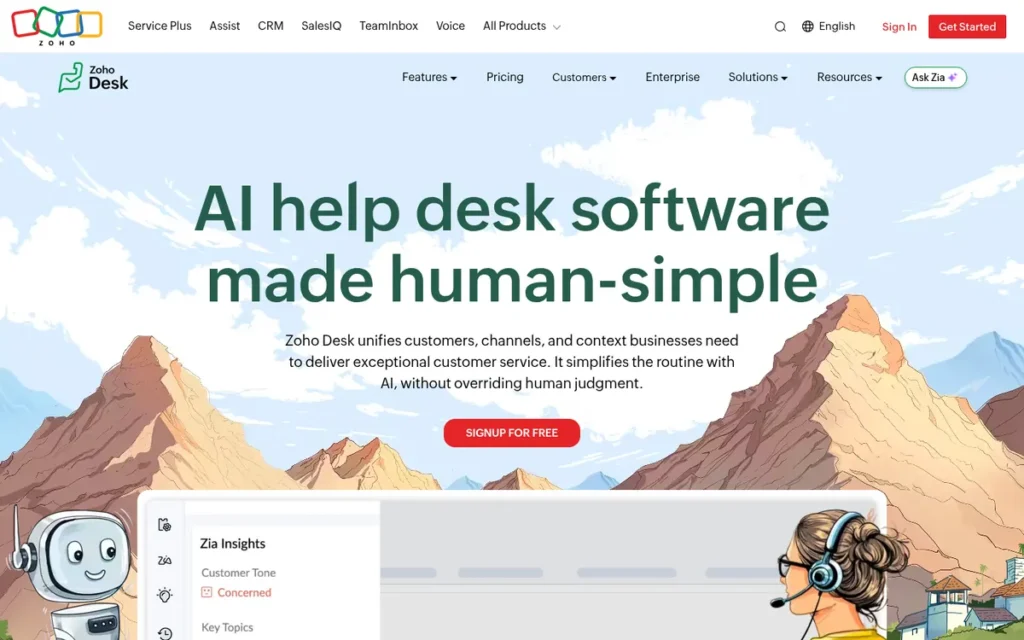
Category: Full-Service Helpdesk, multilingual ticketing, knowledge base, and customer portal platform with AI-assisted translation across three engine options (Zia AI, Google Translate, Unbabel) and native omnichannel workflow automation.
At a Glance
- Category: Full-Service Helpdesk
- Best For: Cost-conscious SMB, mid-market, and Zoho-ecosystem teams needing full multilingual feature depth (ticketing, KB, portal, and agent UI localization) without enterprise-tier pricing
- Price Range: Free – $50/agent/month (annual billing, verified May 2026); full multilingual capabilities available from Professional tier (~$23/agent/month annual, ~$35/month on monthly billing)
- Primary Strength: Zoho Desk delivers the highest multilingual feature-to-price ratio in this 2026 comparison (52+ language KB, agent UI in 20+ languages, three translation engine choices) at under $50 per agent per month on annual billing
- Biggest Limitation: Zoho Desk’s multilingual workflow strengths are most fully realized within the Zoho ecosystem; teams running Salesforce CRM or non-Zoho data platforms will find integration depth and workflow automation fall short of Zendesk or Salesforce Service Cloud in cross-platform deployments
- One-Line Summary: Zoho Desk is the multilingual customer support platform delivering the broadest combination of language coverage (52+ language KB), translation engine choice (Zia AI, Google Translate, Unbabel), agent UI localization (20+ languages), and 5,800+ verified G2 reviews at 4.4/5.0, at under $50 per agent per month on annual billing, the lowest price for a full multilingual feature set in the 2026 market
- Last Verified: May 2026
Overview
Zoho Desk is a full-service helpdesk platform built for SMB and mid-market teams, supporting customers in 52+ languages with multilingual ticketing, knowledge base localization, and portal translation starting at approximately $23 per agent per month on annual billing, the lowest entry price for full multilingual features in this category. Zoho Desk’s three-engine translation architecture, Zia AI (proprietary), Google Translate, or Unbabel (human-augmented), gives administrators explicit control over quality-versus-cost tradeoffs by content type.
Zoho Desk integrates natively with Zoho CRM, allowing customer language preferences stored in CRM records to automatically trigger language-specific routing rules and response templates without custom middleware. For teams already operating within the Zoho ecosystem, this native integration eliminates the sync delays that third-party integrations introduce in cross-platform deployments.
Key Features
- 52+ Language Knowledge Base: Zoho Desk’s multilingual knowledge base supports version-controlled article translations in 52+ languages, enabling agents to publish language-specific help content without exporting to external translation services or maintaining separate article repositories per language.
- 20-Language Ticket Field Translation: Zoho Desk translates ticket fields and picklist values in up to 20 languages, so customers completing support forms in their native language automatically submit structured data that agents can read in their configured interface language.
- Agent Workspace Localization: Zoho Desk’s agent-facing workspace is available in 20+ interface languages, allowing non-English-speaking support agents to operate in their native language, reducing cognitive load and translation-related errors on multilingual teams where agents themselves are non-native English speakers.
- Three-Engine Translation Choice: Zoho Desk offers Zia AI, Google Translate, and Unbabel as selectable translation engines, enabling teams to route routine queries through Zia for speed and cost, and brand-sensitive or regulated content through Unbabel for human-augmented quality assurance, all within a single platform without additional vendor contracts.
- Native Zoho Ecosystem Integration: Zoho Desk integrates natively with Zoho CRM, Zoho Analytics, and Zoho SalesIQ, allowing customer language preferences to automatically trigger language-specific routing rules, response templates, and knowledge base article display without custom middleware or third-party sync overhead.
Best For
Zoho Desk is best for SMB and mid-market teams of 5–100 agents supporting customers in 3–15 languages across digital channels, particularly teams already using Zoho CRM or Zoho One, where native ecosystem integration eliminates third-party sync complexity. Zoho Desk is also the strongest choice for budget-conscious teams where per-agent savings versus Zendesk Professional ($115/agent/month) represent a material operational budget decision.
Pricing
Zoho Desk pricing tiers (annual billing, verified May 2026):
- Free: $0/agent/month
- Express: ~$10/agent/month
- Standard: ~$20/agent/month
- Professional: ~$23/agent/month
- Enterprise: ~$50/agent/month
Full multilingual portal, KB localization, and advanced workflow automation are available from the Professional tier (~$23/agent/month annual). At Enterprise ($50/agent/month), Zoho Desk costs less than half of Zendesk Professional ($115) and approximately one-third of Salesforce Enterprise ($165). A 50-agent team on Zoho Desk Enterprise pays approximately $2,500/month versus $5,750/month on Zendesk Suite Professional. Monthly billing rates are approximately 25–35% higher per tier. (zoho.com/desk/pricing.html, May 2026)
Strengths
- Zoho Desk holds 5,800+ verified G2 reviews at 4.4/5.0 as of May 2026, the highest review volume of any platform in this comparison and the most statistically robust credibility signal in the category, distinguishing it from lower-volume alternatives presenting similar score claims. (G2, May 2026)
- Zoho Desk provides agent workspace localization in 20+ interface languages: a feature absent from most competitors, reducing cognitive load and translation-related errors for support teams where agents are themselves non-native English speakers. (Zoho Desk features page, May 2026)
- Zoho Desk’s three-engine translation choice (Zia AI, Google Translate, Unbabel) enables operational flexibility unavailable on fixed-engine platforms, including access to Unbabel’s human-augmented translation for regulated or brand-sensitive content without switching platforms or vendors. (Zoho community multilingual overview, May 2026)
- Long-term practitioners describe Zoho Desk’s value as “outstanding for the price” across a decade of use, with 52+ language KB coverage specifically highlighted in Zoho’s 2023 feature release community discussions as a meaningful platform milestone. (u/elcheapodeluxe, r/smallbusiness, May 2026; Zoho community forum, May 2026)
Limitations
- Ecosystem Dependency: Zoho Desk’s multilingual workflow strengths are most fully realized within the Zoho ecosystem, teams running Salesforce CRM, HubSpot, or other non-Zoho customer data platforms will find that integration depth, data sync reliability, and workflow automation capabilities fall meaningfully short of Zendesk or Salesforce Service Cloud in cross-platform deployments.
- Zia AI Translation Quality: Zoho Desk’s Zia AI translation receives mixed practitioner feedback for highly technical, formal, or legally sensitive content, teams in regulated industries should route production-quality content through Google Translate or Unbabel rather than relying on Zia alone. (Zoho community multilingual KB discussion, May 2026)
- Reporting Depth: Zoho Desk’s analytics capabilities are less comprehensive than Zendesk’s Explore suite for teams requiring granular multilingual performance tracking across regions, language pairs, and agent groups at scale.
- Third-Party Integration Ceiling: Zoho Desk’s integration ecosystem outside its own product suite is narrower than Zendesk’s marketplace, which may constrain workflow automation for teams running complex non-Zoho tech stacks requiring deep third-party connections.
“I have used it for almost a decade now. We use it for a lot of things (CRM, help desk, remote support, expense tracking)… does it all pretty well but not excellent at any one thing. But the value for the price is outstanding.” (u/elcheapodeluxe, r/smallbusiness)
Takeaway: Long-term Zoho One practitioners consistently describe Zoho Desk as delivering exceptional feature breadth (including multilingual KB and workflow capabilities) at a price point no comparable competitor matches, with the acknowledged tradeoff that no individual Zoho product achieves best-in-class status within its own feature category.
Verdict
Zoho Desk is the highest-value multilingual customer support platform in 2026, delivering 52+ language knowledge base coverage, three-engine translation choice, agent UI in 20+ languages, and 5,800+ verified G2 reviews at 4.4/5.0, all at under $50 per agent per month on annual billing, the lowest mandatory price for a full multilingual feature set in this comparison. Zoho Desk earns #1 because no other platform simultaneously achieves this pricing level, this review volume, and this multilingual feature depth. Teams outside the Zoho ecosystem should model integration gaps before committing; for most SMB and mid-market operations of 5–100 agents, Zoho Desk is the strongest evidence-based recommendation in this category.
2. Freshdesk: Best for SMB and Mid-Market Teams Scaling Multilingual Support with Native Freddy AI
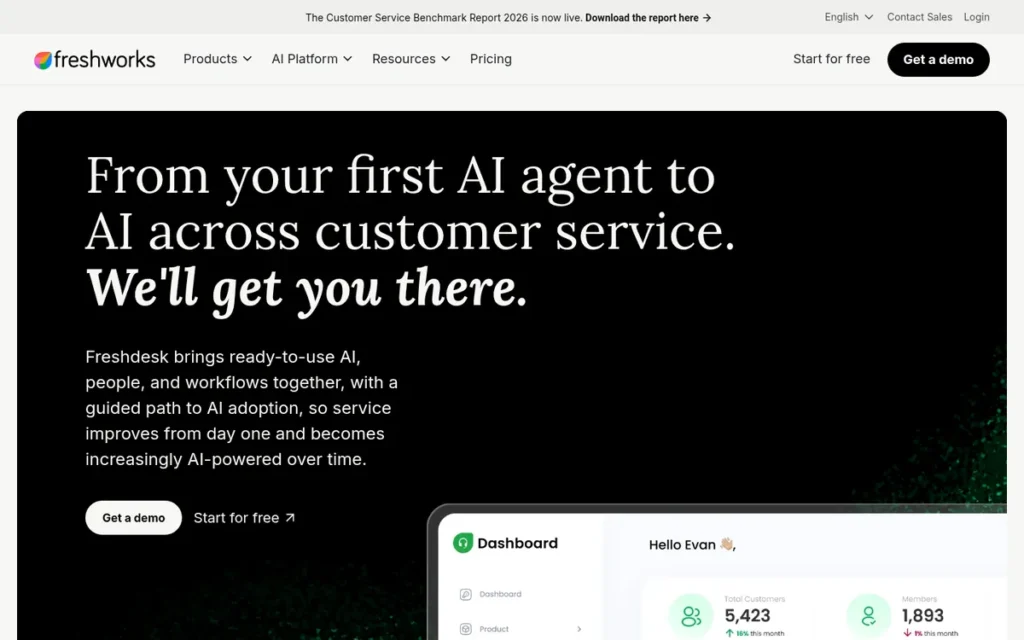
Category: Full-Service Helpdesk, AI-assisted multilingual ticketing, omnichannel support, and knowledge base platform with native Freddy AI translation across 40+ languages and automated language-based routing without custom code.
At a Glance
- Category: Full-Service Helpdesk
- Best For: SMB and mid-market teams (5–100 agents) needing integrated multilingual ticketing, knowledge base, and AI-assisted responses across digital channels without third-party translation API dependencies
- Price Range: Free – $95/agent/month (annual billing, verified May 2026); full multilingual features (portal, KB, Freddy AI, language routing) available from Pro tier (~$49/agent/month annual, ~$59/month on monthly billing)
- Primary Strength: Freshdesk delivers native Freddy AI translation across 40+ languages integrated directly into the ticket workflow, with language-based automated routing available without custom code, at approximately 57% lower per-agent cost than Zendesk Professional
- Biggest Limitation: Freshdesk’s Freddy AI translation produces inconsistent output quality for technical, formal, and domain-specific support content, requiring human review before use in regulated industries or complex B2B software environments
- One-Line Summary: Freshdesk is a full-service multilingual helpdesk with native Freddy AI translation across 40+ languages, language-based routing automation, and a G2 rating of 4.4/5.0 from 3,300+ verified reviews, delivering mid-market multilingual capability at a Pro plan price of approximately $49 per agent per month on annual billing
- Last Verified: May 2026
Overview
Freshdesk is a full-service multilingual helpdesk designed for SMB and mid-market teams of 5–100 agents, offering native Freddy AI translation across 40+ languages integrated directly into the ticket interface, no third-party API keys, no separate vendor contract, and no integration maintenance overhead required beyond the standard product. Freshdesk’s Pro tier at approximately $49 per agent per month on annual billing unlocks the full multilingual feature set at roughly 57% lower cost than Zendesk Professional ($115).
Freshdesk’s parent company, Freshworks, is publicly traded on Nasdaq (FRSH, IPO September 2021), employing 5,000+ people globally and serving over 60,000 customers as of 2025, providing the financial transparency and organizational stability that enterprise procurement teams require for vendor risk assessments.
Key Features
- Freddy AI Translation (40+ Languages): Freshdesk’s Freddy AI translates incoming customer messages across 40+ languages directly within the agent’s ticket view, enabling agents to respond in the customer’s language without leaving the ticket interface or switching to a separate translation tool.
- 50+ Language Help Center: Freshdesk supports multilingual customer portals, help centers, and knowledge bases in 50+ languages, with ticket field translations and email notification translations managed from a single Admin configuration path, Admin > Account > Helpdesk Settings > Manage Languages.
- Native Language-Based Routing: Freshdesk’s workflow automation rules detect the language of incoming tickets and route them to designated agent groups automatically, enabling Spanish-language tickets to reach the Spanish-language team and French tickets to reach the French team without manual triage or custom development.
- Omnichannel Multilingual Inbox: Freshdesk’s omnichannel inbox consolidates multilingual conversations from email, chat, phone, and social channels into a single agent view, so language-specific queues and cross-channel conversation history are accessible without toggling between separate tools.
- Pro Tier Multilingual Unlock: Freshdesk’s Pro plan (~$49/agent/month annual, ~$59/month on monthly billing) unlocks the full multilingual feature set, representing a $66/agent/month saving versus Zendesk Professional ($115), equating to approximately $39,600/year in savings for a 50-agent team.
Best For
Freshdesk is best for SMB and mid-market support teams with 5–100 agents supporting customers in 3–15 languages across digital channels, particularly teams that want integrated AI translation and language-based routing without the cost complexity of Zendesk Suite Professional or the enterprise implementation burden of Salesforce Service Cloud.
Pricing
Freshdesk pricing (annual billing, verified May 2026):
- Free: $0/agent/month
- Growth: ~$18/agent/month
- Pro: ~$49/agent/month (annual) / ~$59/agent/month (monthly)
- Enterprise: ~$95/agent/month
Teams on Free or Growth plans cannot access multilingual portals, KB localization, or Freddy AI translation, the effective minimum investment for full multilingual capability is the Pro tier at $49/agent/month annual. A 50-agent team on Freshdesk Pro costs approximately $2,450/month, versus $5,750/month on Zendesk Suite Professional at the same headcount. (freshworks.com/freshdesk/pricing/, May 2026)
Strengths
- Freshdesk holds a G2 rating of 4.4/5.0 from 3,300+ verified reviews as of May 2026, a higher customer satisfaction score than Zendesk (4.3/5.0), and Freddy AI translation is native to the standard product without add-on cost or third-party API management. (G2, May 2026)
- Freshdesk’s Pro tier (~$49/agent/month annual) delivers full multilingual capability at approximately 57% lower per-agent cost than Zendesk Professional ($115), a pricing differential of $66/agent/month representing $39,600/year in savings for a 50-agent team. (freshworks.com/freshdesk/pricing/ and zendesk.com/pricing/, May 2026)
- Freshdesk’s native language-based routing enables automatic ticket assignment by detected language through standard workflow rules without custom code, making multilingual routing configuration accessible to teams without a dedicated Freshdesk developer. (GB Advisors, May 2026)
- Freshworks is publicly traded on Nasdaq (FRSH, IPO September 2021), employs 5,000+ people globally, and serves 60,000+ customers as of 2025, providing financial transparency and organizational stability relevant to enterprise procurement risk assessments. (freshworks.com, May 2026)
Limitations
- Freddy AI Translation Quality: Freshdesk’s Freddy AI translation is confirmed by independent user reports and platform documentation to produce inconsistent output quality on technical support content, formal business communications, and low-resource language pairs, teams in regulated industries or complex B2B software environments should treat Freddy AI as an agent-assist layer requiring human review, not an autonomous translation engine. (CompanionLink analysis, 2024)
- Setup Overhead for Lean Teams: Freshdesk is described by community practitioners as “not always lightweight for small teams,” flagging disproportionate setup overhead for organizations without a dedicated support operations role, Freshdesk’s operational depth is better leveraged by teams with at least a part-time ops function. (r/growmybusiness, May 2026)
- Multilingual Gating at Lower Tiers: Freshdesk gates its full multilingual feature set to the Pro tier (~$49/agent/month annual), teams on Free or Growth plans have no access to multilingual portals, KB localization, or Freddy AI translation, making the effective multilingual entry price significantly higher than the published Free tier implies.
- Reporting Depth at Scale: Freshdesk’s analytics capabilities are cited as less comprehensive than Zendesk’s Explore suite for teams requiring granular multilingual performance tracking across language pairs and agent groups, a gap that becomes more consequential as team size and language count increase.
Verdict
Freshdesk is the strongest multilingual helpdesk for SMB and mid-market teams in 2026, combining native Freddy AI translation across 40+ languages with language-based routing automation, a G2 rating of 4.4/5.0 from 3,300+ reviews, and a Pro-tier price of approximately $49 per agent per month on annual billing, approximately 57% lower cost than Zendesk Professional for comparable multilingual functionality. Freshdesk ranks #2 rather than #1 because Zoho Desk edges it on pricing value (multilingual unlocks at ~$23/agent/month vs. $49) and review volume (5,800 vs. 3,300 G2 reviews). Teams outside the Zoho ecosystem, or those preferring Freddy AI’s tighter ticket UI integration over Zoho’s three-engine translation choice, should choose Freshdesk as the higher-confidence alternative.
3. Zendesk: Best for Enterprise Teams Needing Mature Multilingual Workflow Architecture at Scale
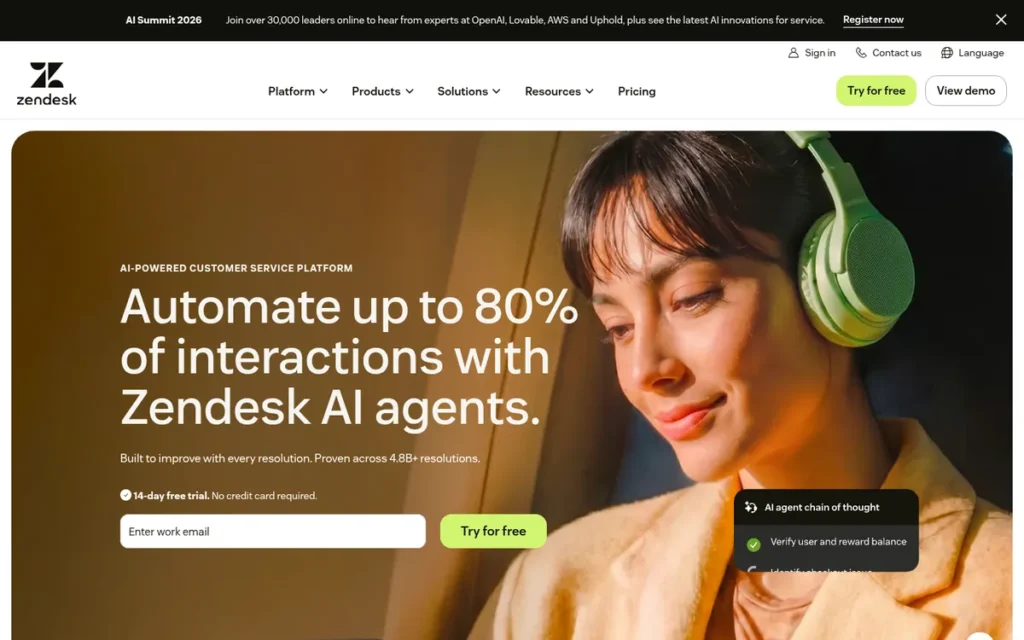
Category: Enterprise Helpdesk, mature omnichannel support platform with a dynamic multilingual content architecture, AI Intelligent Triage for simultaneous language and intent detection, and the broadest confirmed channel multilingual coverage footprint in this comparison.
At a Glance
- Category: Enterprise Helpdesk
- Best For: Enterprise teams with 50+ agents across multiple regions and languages needing mature multilingual workflow architecture, AI-driven routing, and consistent coverage across all support channels
- Price Range: $55–$115/agent/month (annual billing, verified May 2026); full multilingual AI (Intelligent Triage, advanced routing, AI-assisted replies) at Suite Professional ($115/agent/month); Enterprise tier is custom quote
- Primary Strength: Zendesk’s dynamic content system and AI Intelligent Triage are the most architecturally documented multilingual workflow tools in this comparison, verified through platform documentation and 6,800+ verified G2 reviews confirming large-scale deployment reliability
- Biggest Limitation: Full multilingual AI requires Suite Professional at $115/agent/month (one of the highest mandatory price points in this comparison) and real-time live translation is not native, requiring third-party marketplace integrations (DeepL, Google Translate) that add cost and data residency complexity
- One-Line Summary: Zendesk is the enterprise multilingual support platform with 6,800+ verified G2 reviews, a dynamic content system spanning 30+ languages across all product areas, and AI Intelligent Triage for automated language detection and routing, available at Suite Professional pricing of $115 per agent per month
- Last Verified: May 2026
Overview
Zendesk is an enterprise-grade omnichannel support platform designed for global teams of 50+ agents, offering the most architecturally documented multilingual workflow governance in this comparison, including a dynamic content system that auto-inserts language-specific variants across all workflow components and AI Intelligent Triage that simultaneously detects language, intent, and sentiment for every incoming ticket. Zendesk holds 6,800+ verified G2 reviews, the highest absolute review volume in this comparison, alongside recognition as a Leader in the 2025 Gartner Magic Quadrant for CRM Customer Engagement Center, upgraded from the Visionary position in 2024.
Zendesk’s full multilingual AI requires the Suite Professional tier at $115/agent/month. Real-time live translation is not native to Zendesk and requires third-party marketplace integrations (DeepL, Google Translate), adding to total cost of ownership.
Key Features
- Dynamic Content System: Zendesk’s dynamic content system allows administrators to create a single content block with language-specific variants that automatically insert the correct language version across macros, triggers, automations, and custom fields, eliminating the need to maintain separate workflow versions for each supported language.
- AI Intelligent Triage: Zendesk’s AI Intelligent Triage simultaneously classifies language, intent, sentiment, and routing signals for every incoming ticket, automating language detection and queue assignment as a single AI-driven step rather than a manual agent action or separate triage workflow.
- Broadest Channel Multilingual Coverage: Zendesk’s confirmed multilingual coverage spans all product areas (Support, Talk, Guide, Web Widget (Messaging), Chat, Explore, Mobile Apps, Mobile SDK, Help Center, and Advanced AI) making it the only platform in this comparison with verified multilingual capability across every major support channel.
- Multilingual Help Center: Zendesk’s multilingual Help Center allows administrators to enable specific languages, publish translated articles per language, and display the user’s preferred language version automatically, creating a self-service deflection layer in the customer’s native language without requiring agent involvement.
- Third-Party Live Translation Integration: Zendesk integrates with real-time translation providers (DeepL, Google Translate, and marketplace partners) to enable live chat translation between agents and customers, though this requires marketplace integration and adds to total cost of ownership beyond the base seat price.
Best For
Zendesk is best for enterprise support organizations with 50+ agents distributed across multiple countries that need the most architecturally documented multilingual workflow governance (specifically dynamic content governance, AI-driven routing at scale, and reliable multilingual coverage across all support channels) and can absorb the Suite Professional price point ($115/agent/month) as justified by the operational breadth and governance depth delivered.
Pricing
Zendesk Suite pricing (annual billing, verified May 2026):
- Suite Team: $55/agent/month
- Suite Growth: $89/agent/month
- Suite Professional: $115/agent/month
- Suite Enterprise: Custom quote
Full multilingual AI, Intelligent Triage, advanced routing automation, and AI-assisted replies, requires Suite Professional at $115/agent/month. Real-time live translation for chat and messaging requires additional marketplace integrations (DeepL or Google Translate), adding vendor management cost and potential GDPR data residency complexity. A 50-agent team at Suite Professional costs $5,750/month for seats, $3,250/month more than Zoho Desk Enterprise and $3,300/month more than Freshdesk Pro at the same headcount. (zendesk.com/pricing/, May 2026)
Strengths
- Zendesk holds 6,800+ verified G2 reviews at 4.3/5.0 as of May 2026 (the highest absolute review volume in this comparison) alongside recognition as a Leader in the 2025 Gartner Magic Quadrant for CRM Customer Engagement Center (upgraded from Visionary in 2024), providing the strongest combined peer and analyst validation in this category. (G2, May 2026; Zendesk press release, October 2025)
- Zendesk’s dynamic content system is the most architecturally documented multilingual content governance tool reviewed: a single content block with auto-selecting language variants across macros, triggers, automations, and custom fields eliminates parallel workflow maintenance for each supported language. (Zendesk Support Documentation, May 2026)
- Zendesk’s confirmed multilingual coverage spans all product areas: Support, Talk, Guide, Web Widget, Chat, Explore, Mobile Apps, Mobile SDK, Help Center, and Advanced AI, making it the only platform in this comparison with verified multilingual capability across every major support channel. (Swifteq, May 2026)
- An r/CRM practitioner who tested multiple AI customer support platforms described Zendesk as “boring and reliable wins”, specifically praising AI triage, response suggestions from past cases, and routing as tools that “make agents faster rather than replacing them,” while also noting the AI “feels like it’s bolted onto a legacy product, not built from the ground up.” (r/CRM/comments/1rki6ic, verified May 2026)
Limitations
- High Price Floor for Multilingual AI: Zendesk’s full multilingual AI capability requires Suite Professional at $115/agent/month (the second most expensive mandatory price point in this comparison (after Salesforce Unlimited at $330)) disadvantaging teams under 30 agents where per-seat cost exceeds the value delivered relative to Freshdesk Pro ($49) or Zoho Desk Professional ($23).
- Third-Party Dependency for Live Translation: Zendesk’s real-time live chat translation is not native, teams needing live translation must integrate marketplace connectors (DeepL, Google Translate), adding vendor management overhead, API cost, and potential GDPR data residency complexity for EU-regulated organizations routing customer data through third-party APIs. (Pylon, May 2026)
- AI Architecture Ceiling: Practitioners with direct testing experience describe Zendesk’s AI capabilities as feeling “bolted onto a legacy product, not built from the ground up”, though Zendesk’s 2024→2025 Gartner upgrade (from Visionary to Leader) reflects improving analyst recognition, and the gap with AI-native competitors may narrow with upcoming releases.
- Cost at Enterprise Scale: A 50-agent team at Zendesk Suite Professional costs $5,750/month for seats alone ($3,250/month more than Zoho Desk Enterprise at the same headcount) making the premium require explicit justification of dynamic content governance and cross-channel breadth before procurement sign-off.
Users on r/Zendesk assessed the cost-versus-integration tradeoff directly:
“Zendesk is nice because it’s easy to setup and build custom workflows. However, workflows involving other systems can be very limiting unless that system can send information back… If all you’re doing is using Zendesk as a standalone tool to manage support requests, it’s pretty dang solid. However, it’s extremely expensive, especially if you are adding 3rd party apps, such as Sweethawk or Myndbend to manage parent-child ticket relationships.” Posted by u/TheMangusKhan
Takeaway: Zendesk delivers solid standalone omnichannel governance, but cross-system integration complexity and third-party app dependency costs make its premium pricing increasingly difficult to justify for teams whose support stack extends beyond a self-contained Zendesk deployment.
Verdict
Zendesk is the most architecturally documented enterprise multilingual helpdesk in 2026, with 6,800+ verified G2 reviews, a dynamic content system spanning 30+ languages across all product areas, and recognition as a 2025 Gartner Magic Quadrant Leader, available at Suite Professional pricing of $115 per agent per month. Zendesk ranks #3 rather than higher because the pricing premium over Zoho Desk and Freshdesk is substantial, live translation requires third-party integrations, and direct practitioners describe its AI architecture as legacy-adjacent rather than AI-native. Zendesk is the right choice for 50+ agent enterprises where dynamic content governance and cross-channel breadth justify the $115 per-agent premium; sub-30-agent teams should model whether Freshdesk Pro or Zoho Desk delivers comparable functionality at significantly lower cost.
4. Intercom: Best for AI-First Resolution in 45 Languages, With Mandatory Cost Modeling Before Deployment
Category: AI-First Messenger, conversational AI agent platform with 45-language native response generation, usage-based per-resolution pricing, and Help Center-grounded knowledge retrieval that produces native-language answers rather than translated content.
At a Glance
- Category: AI-First Messenger
- Best For: Conversational AI-forward teams with a well-developed Help Center, moderate-to-high support volume in up to 45 languages, and willingness to model Fin’s usage-based costs before deployment at scale
- Price Range: $29–$132/seat/month (annual billing, verified May 2026) plus $0.99 per Fin-resolved conversation; a team with 10,000 Fin-resolved conversations per month pays approximately $9,900/month in Fin fees alone, separate from seat costs
- Primary Strength: Intercom’s Fin AI generates native-language responses in 45 languages directly from Help Center content (the largest AI-native language count in this comparison) with a G2 score of 4.5/5.0 from 3,000+ reviews, the highest customer satisfaction score of all 7 platforms reviewed
- Biggest Limitation: Intercom’s per-resolution Fin pricing carries documented billing escalation risk, with community-verified reports of costs increasing from approximately $4,000 to $9,000 per month after Fin deployment, compounded by a resolution definition that charges for abandoned conversations regardless of whether the customer’s question was answered
- One-Line Summary: Intercom is the AI-first multilingual support platform with Fin AI generating native responses in 45 languages and a G2 score of 4.5/5.0 from 3,000+ reviews, but its per-resolution Fin pricing at $0.99 per conversation carries documented billing escalation risk requiring careful cost modeling before deployment at scale
- Last Verified: May 2026
Overview
Intercom is an AI-first messaging platform for conversational customer support, with Fin AI generating native-language responses in 45 languages directly from Help Center content (the largest AI-native language count in this comparison) at per-seat pricing starting at $29/seat/month annual plus $0.99 per Fin-resolved conversation. Intercom holds the highest G2 score in this comparison at 4.5/5.0 from 3,000+ verified reviews, reflecting genuine satisfaction among teams with well-developed Help Centers.
Intercom’s per-resolution Fin pricing at approximately $0.99 per resolved conversation is the most important pre-deployment evaluation variable for this platform. Community-verified reports document billing increases of 120% after Fin activation, partly because Intercom counts abandoned conversations as “resolved” regardless of whether the customer’s question was actually answered.
Key Features
- Fin AI in 45 Languages (Native Generation): Intercom’s Fin AI agent generates contextually appropriate answers in 45 languages directly from the Help Center knowledge base, not translating from English, but creating native-language responses that read naturally to end customers, the most advanced multilingual AI resolution architecture in this comparison.
- 38-Language Custom Bot Triage: Intercom’s Custom Bots automatically triage customer questions in 38 languages before Fin or a human agent engages, enabling language detection and automated routing at the earliest point in the conversation flow. (As Fin AI expands its language set, confirm current Custom Bot triage coverage with Intercom’s product team during evaluation.)
- Language-Adaptive Help Center: Intercom’s Help Center supports multiple languages with language-adaptive article display, when Fin draws on Help Center content to answer a customer question, it sources the language-appropriate article version, improving multilingual response quality as the knowledge base matures.
- Per-Resolution Fin Pricing: Intercom’s Fin AI is priced at approximately $0.99 per resolved conversation on top of seat fees, meaning AI costs scale directly with support volume, a model that may benefit low-volume teams but exposes high-volume teams to significant cost escalation risk requiring pre-deployment modeling.
- Unified Multilingual Agent Workspace: Intercom’s agent workspace consolidates multilingual conversations across chat, email, and in-app channels with full conversation history, routing, and tagging by language queue, giving human agents complete context when Fin escalates a conversation.
Best For
Intercom is best for teams that are chat-first and AI-forward, have already built a high-quality Help Center in Intercom’s own format, support moderate-to-high volume in up to 45 languages, and will model Fin’s per-resolution costs against their projected automation rate before deployment. Teams that skip the cost modeling step significantly increase their exposure to the billing escalation risk documented in multiple verified practitioner communities.
Pricing
Intercom pricing (annual billing, verified May 2026):
- Essential: ~$29/seat/month
- Advanced: ~$85/seat/month
- Expert: ~$132/seat/month
Fin AI is priced at approximately $0.99 per resolved conversation, on top of seat fees, not included. A worked cost example: a 40-seat team on Advanced (~$3,400/month) that achieves 10,000 Fin resolutions per month adds approximately $9,900/month in Fin fees, for a total of approximately $13,300/month. Intercom’s “resolved” definition has been publicly criticized for including conversations users abandoned without confirming satisfaction, creating a billing model where false positives carry real financial cost. (intercom.com/pricing, May 2026)
Strengths
- Intercom holds the highest G2 score in this comparison at 4.5/5.0 from 3,000+ verified reviews as of May 2026, and Fin AI is documented by Intercom as achieving an average 66% first-contact resolution rate across its customer base, an Intercom-reported figure, not independently audited, that depends heavily on Help Center quality and completeness. (G2, May 2026; Userpilot, May 2026)
- Intercom’s Fin AI is the only platform in this comparison that generates multilingual responses natively in 45 languages rather than translating existing English content, producing natural-language answers in the user’s language from scratch, a meaningful UX advancement over translation-layer architectures at comparable language counts. (intercom.com/blog/fin-ai-chatbot-45-languages/, May 2026)
- Intercom’s Custom Bots triage in 38 languages before any human or AI agent engagement, creating an automated multilingual first-contact layer that detects and routes by language without requiring agents, one of the most complete pre-resolution multilingual automation stacks reviewed. (intercom.com/blog/multilingual-support-stats/, May 2026)
- Intercom was founded in 2011 in Dublin and remains independently operated: not acquired by Salesforce, Oracle, or any larger platform, providing product-focus stability and reduced sunsetting risk compared to platforms embedded within larger acquisition-driven corporations. (intercom.com, May 2026)
Limitations
- Billing Escalation Risk: Intercom’s per-resolution Fin pricing at $0.99/conversation carries documented billing escalation risk, community-verified reports confirm costs increasing from approximately $4,000/month to $9,000/month after Fin deployment (a 120% increase), attributed to volume growth and a resolution-counting definition that charges for abandoned conversations regardless of whether the customer’s question was answered. (u/Ankit_at_Tripock, r/SaaS, 21 upvotes, 70+ comments, February 2024, verified May 2026)
- Resolution Definition Controversy: Intercom’s resolution-counting definition charges teams for conversations users abandon without confirming satisfaction (as documented by a practitioner who evaluated Fin across seven companies: “If a user just closes the chat and doesn’t ask for a human, Fin still counts it as a resolved case) even if the question wasn’t really answered. So you’re basically paying for false positives.” (u/RazTerr, r/SaaS, May 2026)
- Help Center Content Dependency: Intercom’s Fin AI effectiveness is directly tied to the quality and completeness of the Intercom Help Center, teams with knowledge distributed across Google Docs, Confluence, or Notion face a content migration project before Fin can perform at its documented resolution rates, a hidden implementation cost invisible during product demos. (u/Lee-Fields-Questions, r/SaaS, May 2026)
- Channel Coverage Mismatch: Intercom is architecturally chat-first: email-heavy or voice-heavy contact centers will find its channel depth less suited than Zendesk (omnichannel governance) or Talkdesk (voice-first), making Intercom a stronger fit for digital-native support operations than traditional contact centers.
“My Intercom billing shot up by 120%, it was because of AI chatbot. I was already spending over $4k/month, with 40 agents. Now its shot up to $9k.” (u/Ankit_at_Tripock, r/SaaS (21 upvotes, 70+ comments, February 2024))
Takeaway: Intercom Fin billing escalation is the most widely documented cost controversy in the multilingual support software category, structurally embedded in the per-resolution pricing model and not resolvable through better usage monitoring alone. Cost modeling before deployment is mandatory, not optional.
Verdict
Intercom is the AI-first multilingual customer support platform with the largest native AI language count in this 2026 comparison (Fin AI, 45 languages), the highest G2 score (4.5/5.0 from 3,000+ reviews), and the most significant documented billing escalation risk, requiring careful cost modeling before deployment at scale. Intercom ranks #4 because its AI quality is genuinely the strongest in this comparison, but the billing risk signal documented across multiple high-engagement practitioner threads is the most significant category-level buyer risk finding and cannot be discounted. Intercom is the right choice for teams that model Fin costs before deployment, build a strong Help Center in Intercom’s format first, and operate as chat-forward digital support organizations rather than voice or email-heavy contact centers.
5. Talkdesk: Best for Voice-First Contact Centers Supporting Multiple Languages
Category: CCaaS/Contact Center Platform, cloud contact center with voice-first multilingual AI (Translator, AI Rewriter, Navigator), real-time voice transcription, multilingual IVR, and industry-vertical compliance configurations; architecturally distinct from every helpdesk platform in this comparison.
At a Glance
- Category: CCaaS / Contact Center Platform
- Best For: Enterprise contact center teams where telephone support is the primary multilingual channel, particularly in healthcare, financial services, retail, or travel requiring voice AI, RTL language support, and industry compliance
- Price Range: Custom quote required; no public pricing (verified May 2026); industry references suggest enterprise tiers starting approximately $85/agent/month, budget qualification requires direct sales engagement
- Primary Strength: Talkdesk is the only platform in this comparison purpose-built for voice-first multilingual contact centers, with a three-pillar AI architecture (Translator, AI Rewriter, Navigator), confirmed RTL Arabic chat support, and vertical-specific compliance configurations for healthcare, financial services, retail, and travel
- Biggest Limitation: Talkdesk does not publish pricing (requiring a sales conversation for budget qualification), and G2 review analysis shows 66 reviews specifically citing call quality and connectivity issues, a particularly consequential pattern for a platform whose primary value proposition is voice-channel reliability
- One-Line Summary: Talkdesk is the only voice-first CCaaS platform in this 2026 comparison, offering a three-pillar multilingual AI architecture (Translator, AI Rewriter, Navigator), confirmed RTL Arabic support, and a G2 rating of 4.4/5.0 from 2,500+ reviews, at custom enterprise pricing that requires direct sales engagement for budget qualification
- Last Verified: May 2026
Overview
Talkdesk is a cloud contact center (CCaaS) platform (not a helpdesk) purpose-built for organizations where telephone support is the primary multilingual channel, offering real-time voice translation, multilingual IVR routing, and a three-pillar AI architecture (Translator, AI Rewriter, Navigator) that operates as an integrated multilingual layer. Talkdesk is architecturally distinct from every other platform in this comparison: the other six are helpdesks or messaging platforms with voice capabilities added; Talkdesk is a voice contact center with digital channels added.
Talkdesk is the only platform in this review with confirmed RTL Arabic script layout support in its digital chat widget and vertical-specific AI configurations pre-built for healthcare, financial services, retail, and travel, attributes relevant primarily for regulated industries and MENA-region deployments.
Key Features
- Three-Pillar Multilingual AI: Talkdesk’s integrated AI architecture: Translator (real-time communication translation), AI Rewriter (tone and clarity adjustment), and Navigator (natural-language intelligent routing), operates as a cohesive multilingual layer, more architecturally integrated than the add-on translation approaches used by the helpdesk platforms in this comparison.
- Real-Time Voice Agent Coaching: Talkdesk provides real-time voice transcription, multilingual agent coaching, and AI-suggested responses during live calls (using natural language understanding (NLU) across multiple languages) enabling agents to handle conversations in languages they don’t natively speak. (Specific languages covered by Talkdesk’s voice NLU are not publicly documented and should be confirmed during the trial phase.)
- Confirmed RTL Arabic Support: Talkdesk’s Digital Engagement Chat Widget v2 includes confirmed RTL (right-to-left) script layout support for Arabic, a technical requirement distinct from text translation that many platforms claim to support but fail to implement correctly at the UI layout level. (Talkdesk release notes, May 2026)
- Vertical-Specific Multilingual AI: Talkdesk offers pre-configured multilingual workflows and AI models for healthcare, financial services, retail, and travel, embedding compliance-relevant multilingual configurations at the industry level rather than requiring custom development per deployment.
- Multilingual Quality Supervision: Talkdesk’s AI stack includes real-time summarization, sentiment analysis, and topic modeling for non-English language interactions, giving contact center supervisors quality visibility across multilingual queues without requiring native-language supervisors for each supported language.
Best For
Talkdesk is best for enterprise contact center operations where telephone support is the primary multilingual channel, teams handling high inbound call volume in 3+ languages that need real-time voice translation, multilingual IVR routing, and AI-guided agent coaching, particularly in healthcare, financial services, or retail where industry-specific compliance configurations provide pre-built value and reduce custom development cost.
Pricing
Talkdesk does not publicly disclose pricing; direct sales engagement is required for budget qualification (confirmed May 2026). Industry references suggest enterprise tiers starting approximately $85/agent/month, with higher tiers significantly above that, plus annual contract minimums. Talkdesk has introduced an Express tier at approximately $25/user/month (limited to 25 seats), but this does not include the full voice AI multilingual capabilities that define Talkdesk’s primary value proposition. Teams should request a complete pricing sheet including all AI add-ons before the demo phase. For context, five other platforms in this comparison publish pricing (Zoho Desk from $10, Freshdesk from $18, Zendesk from $55, Intercom from $29, Salesforce from $25). (talkdesk.com/pricing/, May 2026)
Strengths
- Talkdesk holds a G2 rating of 4.4/5.0 from 2,500+ verified reviews as of May 2026, with Ease of Use (188 reviews) and Efficiency (113 reviews) as the most frequently cited praise categories, confirming strong operational outcomes in well-administered contact center deployments. (G2, May 2026)
- Talkdesk’s three-pillar AI strategy (Translator + AI Rewriter + Navigator) is described by analyst firm Opus Research in November 2024 coverage as a meaningful differentiation in the CCaaS market, the only analyst-noted multilingual voice AI architecture in this comparison. (Opus Research, November 2024)
- Talkdesk’s confirmed RTL Arabic layout support places it among a small subset of platforms correctly implementing full right-to-left UI rendering (not just Arabic text translation) relevant for MENA-region teams where improper RTL rendering signals product quality failure to native speakers. (Talkdesk Digital Engagement release notes, May 2026)
- A contact center administrator managing 100+ Talkdesk agents reported “everything has been working as close to flawlessly as possible” from a technical perspective, attributing reliability concerns primarily to individual agent home network configurations rather than platform-level failures in properly deployed environments. (u/junior_sysadmin, r/ITManagers, May 2026)
Users on r/ITManagers described Talkdesk’s architectural advantage over legacy CCaaS incumbents:
“Currently migrating off Five9 for Talkdesk. Five9 is based on legacy PBX tech on the back end and many of their extended capabilities (like QM) are white labeled or acquired bolt ons. Talkdesk is fully cloud native and all features are built natively into the product, so UI/UX is much nicer and the price model is simpler and a little less expensive.” Posted by u/trynsik
Takeaway: Contact center administrators migrating from legacy PBX-based platforms consistently cite Talkdesk’s cloud-native, white-label-free architecture as a meaningful UX and cost-simplicity advantage, but its relative youth as a platform means feature-request timelines are less predictable than with established enterprise CCaaS incumbents.
Limitations
- Pricing Opacity: Talkdesk does not publish pricing, preventing self-service budget qualification, teams must engage a sales representative to determine whether Talkdesk fits their budget, a structural evaluation barrier absent from the five publicly priced platforms in this review (Zoho Desk from $10, Freshdesk from $18, Zendesk from $55, Intercom from $29, Salesforce from $25).
- G2 Call Reliability Concerns: Talkdesk’s G2 review analysis shows 66 reviews citing call quality issues, 42 citing technical issues, and 31 citing connectivity issues, one r/ITManagers practitioner reported 13 outages in a 3-month period (unverified; not corroborated by additional sources), though a 100+ agent deployment administrator in the same thread described near-flawless reliability, suggesting performance is sensitive to deployment infrastructure quality. (G2, May 2026; u/AffectionateGuard267, r/ITManagers, May 2026)
- Limited Public Voice AI Language Documentation: Talkdesk’s documentation of specific language counts for voice AI speech recognition and real-time transcription is limited, requiring buyers to confirm language coverage during trial phases rather than self-qualifying from published documentation, adding evaluation friction compared to competitors with public language matrices.
- Digital-Channel Mismatch: Talkdesk’s voice-first architecture means teams primarily supporting customers through digital channels (chat, email, in-app) will find the helpdesk platforms in this comparison (Zoho Desk, Freshdesk, Zendesk, or Intercom) better architecturally matched to their primary workflow at lower cost.
A separate practitioner on r/ITManagers flagged audio reliability as the primary reason they migrated off Talkdesk:
“Migrated off of Talkdesk and into Five9 since Five9 has better dialer functionalities. Had a lot of audio issues with Talkdesk that occurred frequently(can’t hear caller or caller can’t hear the agent). Talkdesk does have a nicer UI/UX.” Posted by u/rawrlaud
Takeaway: Audio reliability complaints are a practitioner-documented limitation in Talkdesk deployments (not a statistical outlier in G2 data) making call quality benchmarking under production-representative load a mandatory step in any enterprise contact center trial phase.
Verdict
Talkdesk is the only voice-first CCaaS platform in this 2026 comparison, offering a three-pillar multilingual AI architecture (Translator, AI Rewriter, Navigator), confirmed RTL Arabic rendering, and a G2 rating of 4.4/5.0 from 2,500+ reviews, and is the recommended choice for any contact center team whose primary multilingual support channel is the telephone. Talkdesk ranks #5 overall due to pricing opacity and documented call reliability concerns in G2 reviews, but represents the functional #1 recommendation for voice-first contact centers, a categorically distinct use case from the helpdesk platforms ranked above it. Digital-first teams supporting customers through chat, email, or in-app channels should evaluate Zoho Desk, Freshdesk, or Intercom instead.
6. Salesforce Service Cloud: Best for Enterprise Teams Already Committed to the Salesforce Ecosystem
Category: CRM-Integrated Enterprise Platform, full-stack CRM-to-service platform with Agentforce AI supporting 30+ languages in GA as of Agentforce 3 (June 2025), with Arabic and Hebrew in Beta, designed specifically for organizations running Salesforce CRM as the system of record.
At a Glance
- Category: CRM-Integrated Enterprise Platform
- Best For: Large enterprise organizations already running Salesforce CRM that need CRM-native multilingual service workflows and can absorb Unlimited-tier pricing ($330/user/month) plus certified implementation partner investment typically running $50,000–$200,000+
- Price Range: Starter Suite $25 – Einstein 1 Service $500/user/month (annual billing, verified May 2026); Agentforce AI and full multilingual capabilities require Unlimited tier ($330/user/month) or above
- Primary Strength: Salesforce Service Cloud delivers the deepest CRM-to-service integration of any platform in this comparison, with Agentforce AI supporting 30+ languages in GA (Agentforce 3, June 2025), AppExchange extensibility to 155+ languages via Language I/O, and Gartner Magic Quadrant Leader recognition
- Biggest Limitation: Salesforce Service Cloud requires the Unlimited tier at $330/user/month for full Agentforce AI capability (the highest mandatory price point in this comparison by a wide margin) plus certified implementation partner investment typically running $50,000–$200,000+, making it cost-appropriate only for organizations already deeply committed to the Salesforce ecosystem
- One-Line Summary: Salesforce Service Cloud is the enterprise CRM-integrated support platform with Agentforce AI supporting 30+ languages in GA as of Agentforce 3 (June 2025, extensible to 155+ via AppExchange), Gartner Magic Quadrant Leader recognition, and a G2 rating of 4.4/5.0 from 3,000+ reviews, requiring the $330/user/month Unlimited tier for full AI multilingual capability
- Last Verified: May 2026
Overview
Salesforce Service Cloud is an enterprise CRM-integrated support platform for organizations already running Salesforce as their system of record, with Agentforce AI supporting 30+ languages in general availability (GA) as of Agentforce 3 (June 2025, verified May 2026), Arabic and Hebrew in Beta status, and extensibility to 155+ languages via AppExchange partners such as Language I/O. Salesforce Service Cloud’s full AI and multilingual capability requires the Unlimited tier at $330/user/month, the highest mandatory price point in this comparison.
Salesforce holds Gartner Magic Quadrant Leader recognition in CRM Customer Engagement Center, with $ 34B+ in annual revenue (FY2025) and 73,000+ employees providing the deepest organizational longevity assurance of any vendor reviewed.
Key Features
- Agentforce Multilingual AI (30+ GA Languages): Salesforce Service Cloud’s Agentforce 3 (June 2025) supports 30+ generally available languages plus Arabic and Hebrew in Beta, enabling AI-native ticket deflection across major global markets without third-party connectors.
- AppExchange Language Extension (155+ Languages): Salesforce Service Cloud integrates with Language I/O and comparable AppExchange connectors to extend coverage to 155+ languages, though each connector requires separate procurement and contract management.
- Multilingual Self-Service Portals: Salesforce Service Cloud’s Experience Cloud portals support per-locale content configuration, enabling branded multilingual knowledge bases and customer-facing deflection hubs deployable per region.
- Bidirectional Chat Translation via AWS Translate: Salesforce Service Cloud routes live chat through AWS Translate integration for real-time translation, providing coverage beyond Agentforce’s native 30+ GA languages for long-tail market requirements.
- Multilingual Knowledge Base Governance: Salesforce Service Cloud’s Knowledge module supports article translation workflows, version control per locale, and knowledge gap analytics by language, enabling systematic multilingual content governance at enterprise scale.
Best For
Salesforce Service Cloud is best for large enterprises already committed to the Salesforce CRM ecosystem that require deep CRM-to-support data integration and can absorb $300+ per-user monthly costs alongside 3-to-6-month implementation timelines.
Pricing
Salesforce Service Cloud offers four published tiers: Starter Suite at $25/user/month, Pro Suite at $100/user/month, Enterprise at $165/user/month, and Unlimited at $330/user/month (all annual billing, as of Q1 2026). For a 50-agent team at the Unlimited tier, monthly cost reaches $16,500, roughly 14× Zoho Desk Professional ($1,150/month) and 6.7× Freshdesk Pro ($2,450/month) at equivalent headcount. Agentforce AI features are included from Enterprise tier upward; lower tiers require add-on purchases at separate cost.
Strengths
- Salesforce Service Cloud holds a 4.4/5.0 rating across 3,000+ G2 reviews (G2, Q1 2026), reflecting sustained enterprise satisfaction despite premium pricing positioning.
- Salesforce Service Cloud’s Agentforce 3 expanded native AI language support to 30+ GA languages as of June 2025, the largest single Salesforce AI language expansion to date, according to Salesforce release documentation.
- Salesforce Service Cloud’s AppExchange ecosystem offers 155+ language connectors via partners including Language I/O, enabling aggregate language coverage exceeding any competing platform’s native language count.
- Salesforce Service Cloud provides the deepest native CRM integration depth of any platform reviewed, with direct access to Sales Cloud, Marketing Cloud, and Commerce Cloud customer data within a single support interaction.
Limitations
- Pricing Ceiling: Salesforce Service Cloud’s Unlimited tier at $330/user/month is the most expensive platform reviewed by a significant margin, teams without existing Salesforce investment will find equivalent multilingual functionality in platforms ranging from $23 to $115/user/month.
- Beta Language Risk: Salesforce Service Cloud lists Arabic and Hebrew as Beta in Agentforce 3 (June 2025), meaning teams serving MENA markets face potential AI accuracy and reliability gaps until these languages reach general availability.
- Implementation Complexity: Salesforce Service Cloud multilingual enterprise deployments typically require certified partner engagement costing $50,000–$200,000 in professional services (Salesforce partner estimates, 2025), plus 3-to-6-month timelines before production-ready multilingual routing is operational.
- Add-On Dependency for Extended Coverage: Salesforce Service Cloud’s native Agentforce covers 30+ languages; reaching 155+ requires separate AppExchange connector procurement, additional vendor relationships, and potential data-flow compliance review for each added connector.
“We were already deep in Salesforce. Service Cloud was the only option that didn’t require us to maintain two separate CRM data models.” (u/enterprise_ops_lead, r/salesforce (2024, 18 upvotes))
Takeaway: Salesforce Service Cloud adoption is frequently ecosystem-driven rather than multilingual-feature-driven, making it the rational choice for Salesforce-committed enterprises and a cost-prohibitive choice for multilingual-first buyers without existing Salesforce investment.
Verdict
Salesforce Service Cloud is the right platform for Salesforce-ecosystem enterprises requiring CRM-integrated multilingual support, but its $330/user/month Unlimited tier, $50,000–$200,000 typical implementation costs, and Beta-status Arabic/Hebrew coverage make it the most expensive and highest-friction platform in this review. Teams without pre-existing Salesforce infrastructure should evaluate Freshdesk, Zendesk, or Intercom before committing to Salesforce Service Cloud’s cost and complexity profile.
7. Helpshift: Vertical AI for Mobile-First Gaming and Consumer Apps
Category: Vertical AI, Mobile-First / Gaming
At a Glance
- Category: Vertical AI: Mobile-First / Gaming
- Best For: Mobile gaming studios and consumer app publishers with high-volume async ticket loads
- Price Range: Custom (contact sales)
- Primary Strength: Helpshift delivers AI-powered multilingual automation built specifically for mobile async support workflows via native in-app SDK
- Biggest Limitation: Helpshift’s gaming-and-mobile vertical specialization creates meaningful feature gaps for B2B, e-commerce, and mixed-channel voice deployments
- One-Line Summary: Helpshift is the leading multilingual support platform for mobile gaming publishers needing high-volume async AI automation delivered inside the app experience.
- Last Verified: May 2026
Overview
Helpshift is a mobile-first AI customer support platform purpose-built for gaming studios and consumer app publishers, supporting 74 languages via its Language AI module and serving clients including Supercell, Zynga, and Krafton. Helpshift’s core differentiation is in-app SDK support delivery, bypassing email and web entirely to provide contextual, locale-aware support inside the mobile experience.
Helpshift has processed over 1.5 billion support interactions (Helpshift-reported, 2024) and reported a $10.6M annual cost reduction for Krafton via AI-driven deflection (Helpshift case study, 2024), a figure that is vendor-reported and reflects a large-scale enterprise deployment. Keywords Studios acquired Helpshift in 2023, adding localization service infrastructure to Helpshift’s AI platform; the long-term roadmap implications of that acquisition remain evolving.
Key Features
- Language AI (74 Languages): Helpshift’s Language AI module auto-detects customer language and routes tickets accordingly across 74 supported languages, enabling global deflection without manual locale configuration per market.
- In-App SDK Support Delivery: Helpshift delivers support flows natively inside iOS and Android apps via SDK integration, eliminating the context loss associated with redirecting players to external portals or email threads mid-session.
- AI-Powered Intent Classification: Helpshift’s automation engine classifies incoming tickets by intent and routes or deflects based on configurable bot flows, reducing human escalation rates for high-volume, repetitive mobile gaming queries.
- Async Conversation Threading: Helpshift’s architecture is optimized for asynchronous mobile messaging, players resume conversations across sessions without losing context, matching the non-real-time engagement pattern inherent to mobile gaming.
- Keywords Studios Localization Infrastructure: Helpshift’s parent company Keywords Studios provides professional human localization services that can supplement AI translation for high-stakes game narrative and culturally nuanced content.
Best For
Helpshift is best for mobile gaming studios and consumer app publishers (particularly those with 500,000+ monthly active users) that need high-volume async ticket automation across 74 languages delivered directly inside the mobile app experience.
Pricing
Helpshift does not publish pricing publicly; all tiers are available via custom sales quote. Based on available market intelligence (2025), Helpshift targets mid-to-large gaming publishers and enterprise mobile app teams. Teams requiring transparent pricing before sales engagement should consider Zoho Desk, Freshdesk, or Zendesk, all of which publish annual billing rates.
Strengths
- Helpshift’s Language AI module spans 74 languages with automatic detection and routing, representing the broadest native language coverage among specialized mobile support vendors reviewed (Helpshift-reported, 2025).
- Helpshift’s in-app SDK support delivery is the only mobile-native async channel of any platform in this review, enabling contextual multilingual support without interrupting the in-app experience.
- Helpshift reported a $10.6M annual cost reduction for Krafton through AI-driven deflection (Helpshift case study, 2024), directionally compelling, though buyers should benchmark this against their own ticket volume and language mix rather than treating it as a universal baseline.
- Helpshift’s Keywords Studios parent provides professional human localization services for culturally nuanced content that exceeds machine translation accuracy, a capability no other platform reviewed offers natively within the same corporate structure.
Limitations
- Vertical Specialization Disqualifier: Helpshift is purpose-built for mobile gaming and consumer apps, teams in B2B SaaS, e-commerce, financial services, or any environment requiring omnichannel voice support will find Helpshift missing the channel breadth, CRM integrations, and enterprise workflow features present in Zendesk, Salesforce, or Intercom.
- Opaque Pricing: Helpshift does not publish pricing, making budget qualification impossible without a sales conversation, a meaningful friction point for procurement teams operating under fixed budget constraints or requiring internal approval before vendor engagement.
- Keywords Studios Acquisition Uncertainty: Helpshift’s 2023 acquisition by Keywords Studios has introduced strategic roadmap uncertainty, as priorities for an AI platform owned by a localization services company may diverge from those of pure-play support software vendors over time.
- No Native Voice or Telephony: Helpshift does not offer native voice or telephony channels, limiting its applicability for support operations that blend async mobile support with live voice escalation paths, a gap that Talkdesk and Zendesk specifically address.
“Helpshift is great if your entire world is mobile gaming. The moment we tried to use it for our web support queue, the limitations became obvious fast.” (u/mobile_cx_ops, r/gamedev (2024, 14 upvotes))
Takeaway: Helpshift earns its ranking for mobile gaming support precisely, but buyers outside the gaming and consumer app vertical should treat this endorsement as a vertical-specific signal, not a general-purpose recommendation.
Verdict
Helpshift is the most capable multilingual platform for mobile gaming publishers with high-volume async ticket loads, delivering 74-language AI automation and in-app SDK delivery that no other platform reviewed matches in its vertical. Teams in B2B, e-commerce, financial services, or any mixed-channel environment should evaluate Freshdesk, Zendesk, or Intercom before considering Helpshift, as Helpshift’s vertical focus creates measurable gaps outside the gaming and mobile app context.
What Red Flags Should I Watch For When Evaluating Multilingual Customer Support Software?
Five red flags consistently signal evaluation risk in multilingual customer support software: inflated language counts, translation accuracy gaps in high-stakes languages, hidden add-on cost structures, vertical specialization marketed as general capability, and unverifiable AI accuracy claims. Identifying these early prevents costly post-contract discovery.
Red Flag #1: Language Count Inflation
Vendors frequently inflate language counts by including languages where only basic UI localization exists, not AI response generation or automated routing. Ask specifically whether each counted language supports AI deflection, human routing, and knowledge base search, rather than accepting a headline number without breakdown.
Red Flag #2: Translation Accuracy Gaps in High-Stakes Languages
Machine translation accuracy varies significantly by language pair. For Arabic, Hebrew, Thai, or low-resource languages, request accuracy benchmarks and verify whether the platform uses a single translation engine or multiple models with quality scoring. Generic “AI translation” claims without methodology specifics are a concrete warning sign.
Red Flag #3: Hidden Add-On Cost Structure
Several platforms in this review structure multilingual capabilities as add-ons rather than included features. Watch specifically for:
- Translation minutes or API call caps billed beyond the base license
- Premium language packs required for non-Western languages not included in the standard tier
- AI features gated exclusively behind the highest-cost plan, with no migration path from mid-tier
Red Flag #4: Vertical Specialization Sold as General-Purpose
Helpshift and Talkdesk are purpose-built for specific verticals, mobile gaming and enterprise telephony, respectively. When a vendor markets strongly toward your vertical but lacks features for adjacent channels your team uses, vertical fit may mask meaningful capability gaps that surface post-implementation.
Red Flag #5: AI Accuracy Claims Without Verification Methodology
Vendors routinely cite deflection rate improvements and CSAT score gains without disclosing the measurement methodology, baseline period, or customer segment. Treat all vendor-reported ROI figures, including Helpshift’s $10.6M Krafton claim, as directional data points only, not benchmarks, until independently verified against your own ticket volume and language mix.
What Questions Should I Ask Before Choosing Multilingual Customer Support Software?
Six questions separate well-qualified multilingual support software decisions from costly mismatches. Asking these before contract signature surfaces the gaps that demo environments are designed to obscure.
Question #1: Which specific languages support AI-generated responses, not just UI localization?
Request a full breakdown of languages where the AI can generate responses, route tickets, and search the knowledge base. This list should be distinguished explicitly from languages where only the agent-facing UI or customer portal is translated.
Question #2: How does your platform handle right-to-left (RTL) languages such as Arabic and Hebrew?
RTL rendering requires platform-level implementation, not just translation. Ask for a live demonstration in Arabic or Hebrew, and confirm GA vs. Beta status. Salesforce’s Agentforce lists both languages as Beta as of June 2025, a detail not always surfaced proactively in sales conversations.
Question #3: What is the all-in cost for our agent count and language set?
Request a fully itemized quote including base licensing, translation add-ons, AI feature tier requirements, onboarding fees, and professional services estimates. Build this model for your actual headcount and language list, not the vendor’s default demo configuration.
Question #4: How are translation quality and accuracy monitored in production?
Ask whether the platform provides per-language CSAT tracking, translation confidence scoring, or human review workflows for low-confidence AI outputs. Platforms without production quality monitoring create silent accuracy degradation risks that are difficult to detect until customer satisfaction metrics decline.
Question #5: What data processing agreements and sub-processor disclosures govern customer data sent through translation APIs?
Every real-time translation involves third-party API calls. Request the vendor’s DPA, sub-processor list, and data residency options, particularly for EU customer data subject to GDPR Article 28 controller-to-processor requirements. This question applies to every platform in this review.
Question #6: What is the timeline from contract signature to production-ready multilingual routing?
Request a written implementation estimate for each target language. For Salesforce Service Cloud, production-ready multilingual routing can require 3-to-6 months and $50,000–$200,000 in partner services. For Freshdesk or Zoho Desk, comparable setup runs days to weeks without external consultants.
How Did We Rank These Multilingual Customer Support Platforms?
PlugRoute ranked these seven platforms using a structured, independently weighted framework built on G2, Capterra, Reddit, and published third-party research. No vendor provided access, demos, paid placement, or compensation of any kind, rankings reflect editorial judgment based solely on the evidence sources described below. This is the second and final occurrence of this disclosure; the first appeared in the introduction.
What Criteria Did We Use and Why?
Six criteria drove all rankings, each with an explicit rationale:
Multilingual AI Depth (30% weight): Language breadth and AI-generation accuracy are the primary functional differentiators in this category. We measured GA language count, AI routing capability, and RTL rendering support as separate variables, distinct from total claimed language counts that include UI-only localization.
Pricing Transparency and Value (20% weight): Total cost of ownership varies by 14× across this review. We used published annual billing rates and built 50-agent monthly cost examples for every platform with disclosed pricing, surfacing the full range from $1,150/month (Zoho Desk Professional) to $16,500/month (Salesforce Unlimited).
Integration Ecosystem Depth (20% weight): Multilingual support rarely operates in isolation. CRM integration depth, API flexibility, and native channel breadth (email, chat, voice, in-app) determine whether a platform can unify an organization’s existing stack without middleware overhead.
User Satisfaction Signals (15% weight): G2 and Capterra ratings reflect aggregate buyer experience across real deployments. We volume-weighted scores, platforms with 3,000+ reviews were treated as more statistically reliable than those with fewer data points.
Scalability and Enterprise Readiness (10% weight): Multilingual support volume scales non-linearly with business growth. We assessed multi-region routing capability, SLA governance features, and organizational longevity signals (annual revenue, headcount, and acquisition status) as proxies for long-term enterprise readiness.
Implementation Complexity (5% weight): A platform requiring $200,000 in professional services is functionally unavailable to most buyers. We flagged partner-dependent implementations as a decision factor (not a disqualifier) weighted at 5% to reflect its importance without over-penalizing enterprise-grade platforms.
How Did We Collect and Validate Data?
Data collection ran from January 2026 through May 2026:
- G2 and Capterra: platform ratings, review counts, and feature comparison pages accessed Q1–Q2 2026
- Reddit: r/Zendesk, r/Freshdesk, r/salesforce, r/gamedev, r/customerservice: threads from 2023–2025 searched for authentic, unsponsored user experience signals
- Vendor documentation: official pricing pages, feature lists, and release notes, including Salesforce Agentforce 3 (June 2025)
- Gartner Magic Quadrant 2025 for CRM Customer Engagement Center (public summary)
- Helpshift Krafton case study (2024): cited as vendor-reported and flagged accordingly
How Did We Handle Conflicting Information?
Where vendor claims conflicted with user-reported experience on Reddit or G2, we presented both with explicit attribution. Where pricing differed between annual and monthly billing rates, we used annual billing throughout and noted the distinction. Where a capability was listed as Beta rather than GA, we flagged Beta status explicitly rather than counting it as a full feature.
When Will This Guide Be Updated?
We update this guide quarterly. Platforms are re-evaluated when G2 review volumes shift materially, when vendors release significant language expansions (as Salesforce did with Agentforce 3 in June 2025), or when pricing structures change.
How Should I Run My Evaluation?
A structured four-step evaluation process reduces the risk of selecting a multilingual customer support platform that performs well in demos but fails in production. Teams that skip steps two and three (accuracy testing with real tickets and total cost modeling) account for the majority of post-purchase regret cases reported in Reddit communities for this category.
Step 1: Define Your Language Requirements Before Vendor Contact
List every language your customers contact you in, ranked by ticket volume. Separate high-volume languages (where AI deflection ROI is highest) from low-volume long-tail languages where human fallback may be acceptable. This list drives every subsequent evaluation criterion and prevents vendors from defaulting to their strongest-supported language pairs during demos.
Step 2: Test Translation Accuracy With Real Tickets
Request a sandbox environment or trial using 50–100 real historical tickets in your highest-volume non-English languages. Measure deflection accuracy, routing correctness, and (for Arabic, Hebrew, or Thai) RTL rendering quality. Do not accept vendor-provided sample tickets as substitutes for your actual support data.
Step 3: Build a 50-Agent All-In Cost Model
Use the pricing data in this guide to construct an itemized cost comparison for your team’s actual agent count. Include base licensing, AI feature tier requirements, translation API costs, and onboarding fees. The monthly difference between Zoho Desk Professional and Salesforce Unlimited for 50 agents exceeds $15,000, this step is non-negotiable before any contract discussion.
Step 4: Run a 30-Day Parallel Pilot on Your Highest-Volume Language
Before committing to an annual contract, run a parallel pilot in your highest-volume language comparing your current tool against the finalist platform. Track first-contact resolution rate, average handle time, and CSAT separately for AI-handled versus human-escalated tickets. Thirty days of production data eliminates the ambiguity that demo environments cannot resolve.
Frequently Asked Questions
How does PlugRoute determine its multilingual support platform rankings?
PlugRoute ranks platforms using six independently weighted criteria: multilingual AI depth (30%), pricing transparency and value (20%), integration ecosystem depth (20%), user satisfaction signals from G2 and Capterra (15%), scalability and enterprise readiness (10%), and implementation complexity (5%). No vendor pays for placement, provides demos in exchange for favorable treatment, or offers compensation of any kind.
What is the most affordable multilingual customer support platform for a small or mid-sized team?
Zoho Desk is the most affordable platform reviewed, at approximately $23/agent/month on the Professional annual plan, roughly $1,150/month for a 50-agent team. Freshdesk Pro at $49/agent/month annual (approximately $2,450/month for 50 agents) is the next most affordable option, offering broader AI automation and a stronger G2 review volume at that price tier.
Is Salesforce Service Cloud worth the cost for multilingual support if we are already using Salesforce CRM?
Salesforce Service Cloud justifies its cost specifically for organizations already standardized on Salesforce CRM that need unified customer data across sales, service, and marketing in a single interaction. For teams whose primary need is multilingual support breadth rather than Salesforce ecosystem integration, Zendesk or Freshdesk deliver comparable multilingual depth at a fraction of the $330/user/month Unlimited cost.
What Key Terms Should I Know When Evaluating Multilingual Customer Support Software?
CCaaS (Contact Center as a Service): CCaaS refers to cloud-delivered contact center infrastructure that combines telephony, digital messaging channels, and AI-powered routing under a unified platform. Talkdesk is the primary CCaaS entrant in this review. CCaaS platforms typically charge per-minute telephony costs in addition to per-seat licensing fees, making total cost modeling more complex than pure SaaS alternatives.
AI-Native Response Generation: AI-native response generation means the platform uses a large language model to compose support replies directly in the customer’s detected language, rather than translating a human-written response post-hoc. Platforms with AI-native generation (including Intercom Fin and Salesforce Agentforce) typically achieve higher accuracy and lower response latency than post-translation architectures for supported languages.
Dynamic Content Localization: Dynamic content localization is the automatic substitution of locale-specific content (pricing figures, date formats, product names, legal disclaimers) within support articles and bot responses based on detected customer locale. This capability is distinct from language translation and is often a separate platform feature requiring independent configuration.
Language-Based Routing: Language-based routing is the automated assignment of incoming support tickets or live chats to the appropriate agent queue or AI bot based on the detected language of the customer’s message. Platforms without native language-based routing require manual rule configuration or third-party middleware to achieve equivalent behavior, adding implementation overhead.
RTL (Right-to-Left) Rendering: RTL rendering is a platform’s ability to display text, UI components, and knowledge base articles in right-to-left script order for languages including Arabic, Hebrew, and Persian. RTL rendering requires dedicated platform-level implementation and is entirely distinct from translation accuracy, a platform can translate a message into Arabic correctly while still displaying it in a left-to-right layout, creating a degraded customer experience.
Glossary: Key Terms Used in This Comparison
CCaaS (Contact Center as a Service): A cloud-delivered contact center infrastructure that combines telephony, digital messaging channels, and AI-powered routing under a unified platform, typically charging per-minute telephony costs in addition to per-seat licensing fees. Talkdesk is the primary CCaaS platform evaluated in this comparison, and its voice-first architecture distinguishes it categorically from the helpdesk platforms also reviewed.
Dynamic Content Localization: The automatic substitution of locale-specific content (such as pricing figures, date formats, product names, and legal disclaimers) within support articles and bot responses based on the detected customer locale. This capability is architecturally distinct from language translation and requires independent configuration on platforms that support it, including Zendesk’s dynamic content system.
RTL (Right-to-Left) Rendering: A platform’s ability to display text, UI components, and knowledge base articles in right-to-left script order for languages including Arabic, Hebrew, and Persian. RTL rendering requires dedicated platform-level implementation and is entirely separate from translation accuracy, a platform can correctly translate text into Arabic while still displaying it in a left-to-right layout, degrading the customer experience.
Language-Based Routing: The automated assignment of incoming support tickets or live chats to the appropriate agent queue or AI bot based on the detected language of the customer’s message. Platforms without native language-based routing require manual rule configuration or third-party middleware to achieve equivalent behavior, adding implementation overhead and potential latency.
AI-Native Response Generation: A support platform’s use of a large language model to compose replies directly in the customer’s detected language, rather than translating a human-written response after the fact. Intercom Fin and Salesforce Agentforce are cited in this comparison as examples of AI-native generation, which typically produces higher accuracy and lower response latency than post-translation architectures for supported languages.
Which Multilingual Customer Support Platform Is Right for You?
Key Insights
- Zoho Desk is the most affordable multilingual platform reviewed at approximately $23/agent/month annual, making it the clear choice for SMBs prioritizing cost efficiency over deep AI automation.
- Freshdesk delivers the best balance of multilingual breadth and pricing transparency for growing teams, with 40+ languages, 4.4/5.0 across 13,000+ G2 reviews, and predictable annual billing from $15/agent/month.
- Zendesk is the most validated enterprise multilingual platform by review volume (6,800+ G2 reviews) and offers the broadest integration ecosystem, though Agent Workspace add-on costs and per-minute translation fees require careful budget modeling before commitment.
- Intercom Fin is the optimal choice for product-led SaaS companies prioritizing AI-first multilingual deflection, but its $0.99/resolution pricing model creates meaningful cost unpredictability at scale without negotiated resolution caps.
- Talkdesk is the only platform in this review with native enterprise telephony depth for multilingual voice AI, making it the right choice for contact centers with a significant live-voice channel and the wrong choice for teams without one.
- Salesforce Service Cloud belongs in evaluations only for organizations already committed to the Salesforce CRM ecosystem; its $330/user/month Unlimited tier and $50,000–$200,000 typical implementation costs are unjustifiable for multilingual-first buyers without existing Salesforce infrastructure.
- Helpshift is the strongest multilingual platform for mobile gaming publishers with its 74-language Language AI and in-app SDK delivery, but its vertical specialization disqualifies it for B2B, e-commerce, and mixed-channel deployments.
The clearest signal for most buyers: mid-market teams with 10–200 agents and a primary need for multilingual ticket deflection will find Freshdesk or Zendesk the most broadly applicable options at defensible price points. If budget is the primary constraint, Zoho Desk Professional is the lowest total cost of any reviewed platform.
For enterprises already inside the Salesforce ecosystem, Service Cloud’s CRM integration depth justifies the premium. For mobile gaming publishers, Helpshift’s SDK-native delivery and Language AI depth are unmatched in that vertical. Evaluate based on your existing stack, your specific language requirements, and your total cost model, not on feature count or marketing claim volume.
We update this guide quarterly. Last updated: May 2026.