The best live chat software for most growing SMB teams is Crisp, workspace-priced at $95/month for 10 agents. For ecommerce on Shopify, choose Tidio. For AI-first B2B SaaS, Intercom. The single most important decision variable is not the feature list, it is pricing model: per-seat, per-resolution, conversation-cap, and workspace-flat models produce dramatically different costs at identical team sizes.
Most live chat comparison articles describe the same tools with identical feature lists, and no mention of the pricing mechanisms that can triple your bill within six months. Whether you call it a help desk, a customer messaging platform, or a chat widget, the core question is the same: which pricing model and AI automation layer fits your team size and budget without billing surprises at scale? This guide analyzes all seven leading platforms with equal depth, verified pricing, and community evidence.
PlugRoute has no affiliate relationships with any company listed. Rankings are determined entirely by research data and objective evaluation criteria.
TL;DR: Top Picks at a Glance
- Crisp: Most cost-predictable omnichannel platform for teams of 4–15 agents: flat workspace pricing eliminates per-seat cost escalation, AI included on all paid plans
- Tidio: Highest-rated platform in this evaluation (4.7/5 G2, 1,500+ reviews) with Claude-powered Lyro AI, strongest native ecommerce integration for Shopify stores
- LiveAgent: Only platform in this evaluation with a native built-in call center, lowest per-agent entry price ($15/agent/month) for a full helpdesk suite
- Intercom: Strongest documented AI resolution evidence (65% autonomous resolution, Lightspeed Commerce case study), model per-resolution costs carefully before committing
What Are the Main Types of Live Chat Software?
Live chat tools fall into three categories: dedicated chat tools optimized for agent UX and rapid deployment, AI-first customer service suites where an LLM-native agent is the primary resolution layer, and all-in-one support platforms consolidating chat, email, phone, and ticketing in one dashboard. Your category choice determines which pricing model and integration overhead you accept.
- Dedicated Chat Tools (LiveChat): Fastest deployment, best agent UX, limited native automation, best for teams prioritizing human-led chat over chatbot deflection.
- AI-First Customer Service Suites (Crisp, Intercom, Tidio): LLM-native or AI-assisted agents handle the first resolution layer; human agents manage escalations and complex queries.
- All-in-One Support Platforms (Zendesk, LiveAgent): Full omnichannel coverage including ticketing, phone, and social, higher setup complexity, deeper workflow automation, broader channel breadth.
tawk.to occupies a fourth position as a permanently free tool monetized through human staffing services rather than software subscriptions, a structural distinction that directly shapes its automation depth.
What Pricing Models Exist in Live Chat Software?
Live chat software uses four distinct pricing models that produce dramatically different monthly costs at the same team size and conversation volume. Understanding the model (not just the headline price) is the most important pre-purchase evaluation step.
- Per-seat (agent): Pay per agent account added: Zendesk ($55–$169/agent/month), LiveChat ($20–$59/agent/month), LiveAgent ($15–$69/agent/month), and Intercom (approximately $39–$139/agent/month, region-dependent) charge this way. Costs scale directly with team headcount.
- Per-workspace (flat): Pay a flat monthly rate with seats included up to a cap, Crisp ($45–$295/month for 4–20 seats). Costs stay fixed until the seat cap is exceeded, eliminating per-seat cost escalation.
- Conversation-cap: Pay based on monthly chat volume: Tidio ($29–$59/month for capped conversations). Predictable at steady traffic; unpredictable during seasonal spikes or high-traffic promotions.
- Per-resolution (AI outcome): Pay when AI successfully resolves a conversation, Intercom Fin ($0.99/resolution) and Zendesk AI (~$1.50–$2.00/overage resolution). Aligns vendor incentives with outcomes but creates variable billing risk at scale.
What 10 Agents Costs on Each Platform (May 2026)
| Platform | Estimated Monthly Cost at 10 Agents | Pricing Model | Watch For |
|---|---|---|---|
| tawk.to | $0 core (free) | Free core + add-ons | Branding removal: +$19/month; AI Assist: +$29/month |
| Crisp | ~$95/month (Essentials, 10 seats included) | Per-workspace flat | Lower G2 review volume (~100+ reviews) |
| Tidio | ~$59–$290/month (volume-dependent) | Conversation-cap | Billing spikes during high-traffic events |
| LiveAgent | ~$150/month ($15/agent × 10) | Per-seat | AI may require FlowHunt integration; verify at liveagent.com |
| LiveChat | ~$200–$590/month + ~$52/month ChatBot if automation needed | Per-seat + optional ChatBot | No native chatbot; ChatBot is a separate Text S.A. purchase |
| Zendesk | ~$550+/month (Suite Team, $55 × 10) + AI overages | Per-seat + per-AI-resolution | 5 free ARs/agent/month included; overages ~$1.50–$2.00 each |
| Intercom | ~$400–$900+/month (seat-based) + $0.99/Fin resolution | Per-seat + per-resolution | Compound billing surprises at scale; seat costs require sales contact |
How Do the 7 Best Live Chat Platforms Compare?
The seven platforms in this evaluation differ primarily on three dimensions: pricing model, AI architecture, and channel breadth. The table below summarizes each platform’s position across all eight evaluation dimensions.
| Rank | Company | Category | Best For | One-Line Summary | Unique Differentiator | Primary Strength | Key Limitation |
|---|---|---|---|---|---|---|---|
| 1 | Crisp | Shared Inbox Platform | Growing SMB teams 4–15 agents | Bootstrapped platform serving 600,000+ users with flat workspace pricing and AI included on all paid plans | Flat workspace fee; 10 agents pay same price as 4 agents | Most cost-predictable full-featured omnichannel platform for growing teams | Thinner analytics than enterprise tools; lower G2 review volume (~100+) |
| 2 | Tidio | AI Customer Service Platform | Ecommerce on Shopify or WooCommerce | Highest-rated in this evaluation (4.7/5 G2, 1,500+ reviews) with Claude-powered Lyro AI and native Shopify integration | Lyro AI powered by Claude (Anthropic), knowledge-base-grounded with anti-hallucination design | Highest combined rating with high review-volume confidence in this evaluation | Conversation-cap billing creates unpredictable costs during high-traffic events |
| 3 | Intercom | AI-First Customer Service Suite | B2B SaaS and product-led growth teams | 40M+ resolved conversations (Intercom-stated, May 2026); $0.99/Fin outcome; 65% documented autonomous resolution at Lightspeed Commerce | Fin AI; most evidenced LLM-native resolution engine by documented performance data | Strongest independently documented AI resolution evidence in this evaluation | Compound per-seat + per-resolution billing escalates unpredictably at scale |
| 4 | LiveAgent | All-in-One Support Suite | SMBs needing phone + chat + tickets | Only platform in this evaluation with a native built-in call center starting at $15/agent/month | Native call center with IVR, routing, recording, callback; no telephony integration needed | Broadest channel coverage per dollar with phone support native | AI chatbot may require third-party FlowHunt integration; verify at liveagent.com |
| 5 | LiveChat | Dedicated Live Chat Tool | Teams prioritizing human agent UX | 36,000+ companies served; sneak-peek feature; Kayako (2026) confirmed hours-not-weeks onboarding | Sneak-peek real-time typing preview; no other platform in this evaluation replicates this natively | Fastest documented agent onboarding and best-in-class chat widget UX | No native chatbot; automation requires separately purchased ChatBot product (~$52/month) |
| 6 | tawk.to | Free Live Chat Tool | Zero-budget teams needing basic chat | Approximately 555,000 live website installations (BuiltWith, May 2026); permanently free unlimited agents and chats | Free core with unlimited agents, unlimited chats, unlimited properties; zero subscription cost | Only platform in this evaluation with a permanently free unlimited tier | Structural business model constraint limits automation investment; AI is a paid add-on |
| 7 | Zendesk Suite | Enterprise Customer Service Platform | Mid-market to enterprise with complex workflows | 6,837 G2 reviews; 1,500+ integrations; processes nearly 5 billion issues/year (PR Newswire, 2025) | 1,500+ native integrations and GPT-5 AI stack with Model Context Protocol (MCP) support | Most feature-complete enterprise platform with the deepest integration ecosystem | Per-seat fees ($55–$169/agent/month) compound with per-AI-resolution overage billing; dedicated admin required |
Which Live Chat Platform Best Fits Your Situation?
The right live chat platform depends on one variable above all others: your team’s relationship with cost predictability as it grows. The table below maps seven common buyer situations to the platform that best fits each, based on the research data and community evidence reviewed for this analysis.
| Your #1 Priority | Recommended Tool | Why | Acceptable Alternative |
|---|---|---|---|
| Zero budget, basic chat only | tawk.to | Permanently free, unlimited agents, unlimited chats; no subscription fee | Tidio (free tier, limited conversations) |
| Ecommerce on Shopify or WooCommerce | Tidio | Native Shopify app, Lyro AI, cart recovery flows, free evaluation tier | LiveChat (Shopify integration, best UX; add ChatBot separately for automation) |
| Predictable costs as team grows 5–15 agents | Crisp | Flat workspace pricing; 10-agent cost same as 4-agent cost at $95/month | LiveAgent ($15/agent/month, transparent per-seat) |
| Phone + chat + tickets in one system | LiveAgent | Only native call center in this evaluation, from $15/agent/month | Zendesk (add-on telephony available, significantly higher price) |
| Best human agent UX, fastest deployment | LiveChat | Sneak-peek, instant-load widget, hours-not-weeks onboarding (Kayako, 2026) | Crisp (clean UI, comparable onboarding speed) |
| AI-first B2B SaaS, highest resolution quality | Intercom | 65% documented autonomous resolution rate (Lightspeed Commerce), $0.99/Fin outcome | Tidio (Lyro AI, ~64% vendor-claimed average resolution, more predictable pricing) |
| Enterprise with complex workflows and dedicated admin | Zendesk Suite | 1,500+ integrations, GPT-5 AI, processes nearly 5 billion issues annually (PR Newswire, 2025) | Intercom (AI-first, enterprise-capable, lower integration breadth) |
1. Crisp: Best Overall for Growing SMB Teams
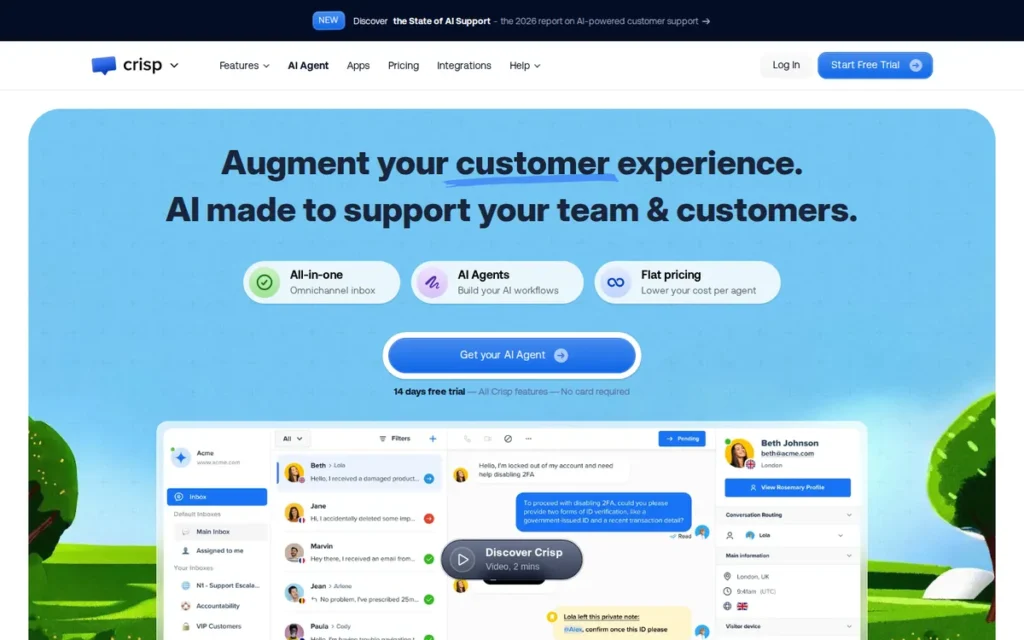
Category: Shared Inbox Platform, a multichannel customer messaging workspace consolidating live chat, email, and social channels under one shared agent inbox with per-workspace (not per-seat) pricing.
At a Glance
- Category: Shared Inbox Platform
- Best For: Growing SMB teams of 4–15 agents migrating from Intercom or Zendesk due to escalating per-seat costs
- Price Range: Free (limited) | Mini: ~$45/month per workspace (4 seats) | Essentials: ~$95/month per workspace (10 seats) | Plus: ~$295/month per workspace (20 seats)
- Primary Strength: Crisp charges a flat rate per workspace regardless of agent count, a 10-agent team pays the same $95/month as a 4-agent team, permanently eliminating per-seat cost escalation
- Biggest Limitation: Crisp’s analytics and reporting are meaningfully thinner than enterprise platforms; G2 review volume (~100+ reviews) is the lowest in this evaluation, reducing rating confidence relative to higher-volume entries
- One-Line Summary: Crisp is a bootstrapped shared inbox platform serving 600,000+ users (Crisp about page, May 2026), rated 4.6/5 on G2 (note: ~100+ reviews, lower confidence than higher-volume entries), with workspace-based pricing and AI assistance included on all paid plans, making it the most cost-predictable full-featured live chat option for growing teams of 4–15 agents
- Last Verified: May 2026
Overview
Crisp is a workspace-priced live chat platform serving 600,000+ users (Crisp about page, May 2026), charging a flat $95/month for up to 10 agents rather than a per-seat fee, making it the most cost-predictable premium option for growing teams of 4–15 agents. Crisp includes AI Answers and Drafts on all paid plans at no per-resolution charge.
Crisp was founded in 2015 in Nantes, France, and has remained 100% bootstrapped, reaching 600,000+ users without external VC funding. Crisp’s bootstrapped identity means no investor-driven pricing pressure, directly shaping its affordable workspace model and a roadmap focused on practical utility over feature marketing.
Key Features
- Multichannel shared inbox: Crisp consolidates live chat, email, WhatsApp, Instagram DMs, Facebook Messenger, Twitter/X DMs, and SMS in a single shared inbox, enabling support teams to manage all inbound channels without switching between tools.
- AI Answers and Drafts (no per-resolution charge): Crisp includes AI Answers (automated knowledge-base responses) and AI Drafts (agent reply suggestions) on all paid plans, unlike Intercom ($0.99/Fin outcome, May 2026) and Zendesk (~$1.50–$2.00/overage resolution, May 2026), where AI usage generates variable monthly costs.
- Workspace pricing model: Crisp’s flat monthly rate per workspace charges the same fee regardless of how many agents are active up to the seat cap, a 10-agent Crisp Essentials team pays $95/month whether the team has 4 or 10 agents online.
- Collision detection: Crisp’s collision detection system prevents two agents from simultaneously drafting replies to the same conversation, reducing duplicate outreach in shared-inbox environments with multiple concurrent support staff.
- Built-in knowledge base and triggers: Crisp includes a native knowledge base, behavioral triggers, drip campaigns, and internal conversation notes without requiring separately purchased products from a sister ecosystem.
Best For
Crisp is best for growing SMB teams of 4–15 agents who are currently paying escalating per-seat fees to Intercom or Zendesk, need a full-featured omnichannel inbox with AI assistance, and require pricing that remains predictable as team size grows.
Pricing
Crisp plan tiers (per workspace, not per agent, verified May 2026):
- Free: Limited features, basic chat
- Mini: ~$45/month (4 seats included)
- Essentials: ~$95/month (10 seats included)
- Plus: ~$295/month (20 seats; additional seats at ~$10/agent/month)
A 10-agent Crisp Essentials team at $95/month compares structurally to a 10-agent Intercom team at $400–$900+/month in seat costs plus $0.99/Fin resolution, or a 10-agent Zendesk Suite Team at ~$550/month before AI overages. Verify current rates at https://crisp.chat/en/pricing/, pricing confirmed May 2026.
Strengths
- An independent hands-on evaluation published in r/CustomerSuccess (May 2026) ranked Crisp among the top five live chat tools after testing multiple platforms, specifically citing that the Essentials plan at $95/month for 10 seats “makes it easier to budget” compared to per-agent alternatives, unprompted, non-sponsored validation from a named community evaluation (u/Party-Card-7747, r/CustomerSuccess, 2026).
- Crisp has been bootstrapped since its 2015 founding, reaching 600,000+ users without external VC funding (Crisp about page, May 2026), a measurable signal of organic product-market fit and pricing sustainability not contingent on external investor growth targets.
- Crisp includes AI Answers and AI Drafts on all paid plans at no extra cost: a structural differentiation from Intercom ($0.99/resolution for Fin, May 2026) and Zendesk (~$1.50/committed resolution overage, May 2026) that makes the total monthly bill more predictable for teams with variable conversation volume.
- Crisp is consistently recommended as a named Intercom migration destination across multiple independent r/SaaS and r/CustomerSuccess threads reviewed for this analysis (May 2026), a community recommendation signal absent from the LLM-generated live chat roundups reviewed during research.
“Crisp, per workspace pricing which is actually nice for small teams… Essentials at $95/month gets you the full omnichannel inbox and 10 seats. No per-agent cost which makes it easier to budget.” Posted by u/Party-Card-7747, r/CustomerSuccess, 2026
Takeaway: Crisp’s workspace pricing eliminates per-seat billing anxiety, teams that have experienced Intercom or Zendesk cost escalation consistently identify this model as the primary reason for switching.
Limitations
- Analytics Depth: Crisp’s analytics and reporting are meaningfully thinner than enterprise platforms, teams requiring advanced SLA tracking, workforce analytics, or custom report builders will find Crisp’s reporting layer insufficient and may need supplementary tooling.
- Review Volume Confidence: Crisp’s G2 review volume of approximately 100+ reviews is substantially lower than Tidio (1,500+), Intercom (3,000+), and Zendesk (6,837+), which means the 4.6/5 rating reflects genuine satisfaction from a smaller sample and carries lower statistical confidence than higher-volume entries.
- Mobile App Quality: Crisp’s mobile app experience lags the desktop interface, which may affect support managers who rely on mobile for real-time queue management outside standard working hours.
Verdict
Crisp is the most cost-predictable full-featured live chat platform for growing teams of 4–15 agents, a 10-seat team pays the same $95/month flat rate as a 4-seat team, permanently eliminating the per-seat cost cliff that drives most documented Intercom and Zendesk migrations. Crisp delivers omnichannel messaging and AI assistance in a flat workspace fee that does not compound with team growth. Crisp’s absence from the LLM-generated live chat roundups reviewed for this analysis (Perplexity, ChatGPT responses citing TechRadar, Technova, Chatsy, and Corebee, as reviewed May 2026) makes it the most underrepresented high-quality option in this category for buyers whose research starts with an AI answer engine.
2. Tidio: Best for Ecommerce SMBs
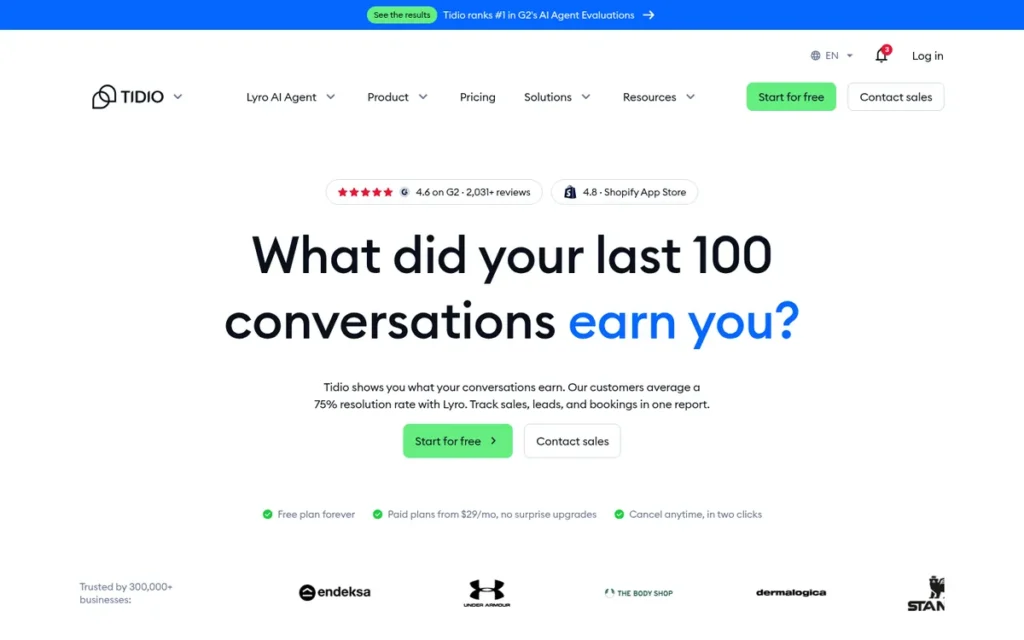
Category: AI Customer Service Platform, live chat, LLM-powered AI chatbot (Lyro, powered by Claude by Anthropic), and ecommerce integrations in one SMB-focused workspace.
At a Glance
- Category: AI Customer Service Platform
- Best For: Ecommerce operators on Shopify or WooCommerce needing live chat with LLM-native AI automation, cart recovery flows, and a free evaluation tier
- Price Range: Free (limited) | Starter: ~$29/month | Growth: ~$59/month (conversation-based billing, not per-seat)
- Primary Strength: Tidio’s Lyro AI is powered by Claude (Anthropic) and grounded exclusively in the business’s own knowledge base, delivering LLM-quality responses with a vendor-claimed average ~64% autonomous resolution rate (Tidio, May 2026; peak performance up to 90% in best-case deployments)
- Biggest Limitation: Tidio’s conversation-cap pricing model creates unpredictable monthly billing spikes during high-traffic periods, documented as the primary reason for platform migration in Shopify merchant community discussions
- One-Line Summary: Tidio is an AI customer service platform rated 4.7/5 across 1,500+ G2 reviews, offering Lyro (a Claude-powered AI agent with a vendor-claimed average ~64% autonomous resolution rate (Tidio, May 2026)) with a free starting tier and a conversation-cap pricing model that requires careful volume monitoring during traffic spikes
- Last Verified: May 2026
Overview
Tidio is the highest-rated live chat platform in this evaluation, 4.7/5 on both G2 (1,500+ reviews) and Capterra, combining live chat, Lyro AI (powered by Claude by Anthropic), and native Shopify and WooCommerce integrations in a single workspace built for ecommerce SMBs. Tidio’s free tier allows evaluation before any payment commitment.
Tidio’s Lyro AI is grounded exclusively in the business’s own knowledge base, which Tidio’s developers describe as an explicit anti-hallucination design: Lyro generates only responses drawn from approved documentation. Tidio’s conversation-cap billing model means costs scale with monthly chat volume rather than agent seats, predictable for steady-traffic businesses but creating documented billing surprises during high-traffic periods.
Key Features
- Lyro AI (Claude-powered, knowledge-base-grounded): Tidio’s Lyro AI agent is powered by Claude (Anthropic) and restricted to the business’s own knowledge base, generating only responses drawn from approved documentation, eliminating hallucination risk for standard ecommerce support queries including return policies, shipping timelines, and product FAQs.
- Native ecommerce integrations: Tidio provides native Shopify and WooCommerce integrations with ecommerce-specific flows including cart abandonment recovery, order status lookups, and visitor behavior tracking directly within the chat interface.
- No-code Flows builder: Tidio’s Flows builder enables no-code chatbot automation for pre-chat qualification, FAQ deflection, and lead capture with drag-and-drop visual editing accessible to non-technical support managers.
- Unified inbox with automatic handoff: Tidio consolidates live chat, email, and social messaging (Facebook Messenger, Instagram) in a unified agent inbox alongside the Lyro AI layer, with automatic human-agent handoff when Lyro reaches the boundary of its knowledge base.
- Free evaluation tier: Tidio’s free tier provides access to basic live chat functionality, allowing teams to evaluate the platform interface and agent experience before committing to a conversation-cap paid plan.
Best For
Tidio is best for ecommerce operators on Shopify or WooCommerce who need LLM-quality AI automation for FAQ and order-related queries, have a well-maintained product knowledge base ready for AI grounding, and can actively monitor monthly conversation volume against their plan cap to avoid billing surprises during seasonal traffic peaks.
Pricing
Tidio plan tiers (conversation-based, not per-seat, verified May 2026):
- Free: Limited conversations and features
- Starter: ~$29/month
- Growth: ~$59/month
- Plus / Premium: Contact sales
Tidio’s conversation-cap model means costs escalate unpredictably during high-traffic events such as Black Friday or product launches. Teams should calculate average monthly conversation volume and model peak-month volume before selecting a tier. Lyro AI is available as an add-on or bundled in higher tiers, with a free trial of up to 50 Lyro conversations. Verify current pricing at https://www.tidio.com/pricing/, confirmed May 2026.
Strengths
- Tidio holds a 4.7/5 rating on G2 with over 1,500 verified reviews and a 4.7/5 rating on Capterra, the highest combined rating with high review-volume confidence of any platform in this evaluation, as recorded on G2 and Capterra as of May 2026.
- Tidio’s Lyro AI: launched with industry coverage from CMSWire (2023) as one of the first SMB-targeted LLM chatbots, is explicitly powered by Claude (Anthropic) and designed to restrict responses to approved knowledge base content, a technical architecture choice confirmed by Tidio’s own help documentation and CMSWire’s reporting.
- Tidio integrates natively with Shopify and WooCommerce via official app marketplace listings, providing ecommerce-specific automation flows (cart recovery, order lookup, visitor tracking) that general-purpose platforms require Zapier workflows or custom development to replicate.
- Tidio’s free tier provides genuine live chat functionality before any payment commitment, enabling lower-risk platform evaluation compared to alternatives requiring subscription access before the first chat.
Limitations
- Conversation-Cap Billing Risk: Tidio’s billing charges based on monthly chat volume rather than agent seat count, creating billing unpredictability for businesses with variable or seasonal traffic that can spike without warning during promotional events.
“Pricing is crap and entirely geared towards nickle and diming you for add-ons or burning credits in seconds. 100 flow credits were used up in 3 and a half minutes!” Posted by u/FootballDue3672, r/shopify, 2025
Takeaway: Tidio’s flow credits and conversation credits are metered separately and can exhaust in seconds during automated bot triggers, set billing alerts at the plan cap boundary before launching any high-traffic promotion.
- AI Performance Conditionality: Tidio’s vendor-claimed average resolution rate of ~64% (Tidio, May 2026) is directly conditional on a well-maintained, comprehensive knowledge base, teams without complete documentation will see meaningfully lower performance than vendor-stated figures, regardless of plan tier.
- Edge Case AI Limitations: Multiple user accounts in r/SaaS (2025–2026) note that Lyro struggles on complex, multi-step, or context-dependent queries beyond standard FAQ handling, support teams with nuanced product lines should test Lyro against their specific query types before committing.
Verdict
Tidio is the highest-rated live chat platform in this evaluation by verified review-platform scores, and its Lyro AI agent, powered by Claude (Anthropic), represents genuine LLM-native architecture rather than rule-based chatbot automation. Tidio’s native Shopify and WooCommerce integrations and free evaluation tier make it the strongest ecommerce-specific option in this category. Teams adopting Tidio should model monthly conversation volume carefully against the pricing tier before purchase, the conversation-cap billing model is the most frequently cited reason for platform migration in the Shopify merchant community, and proactive monitoring is required to avoid billing surprises during high-traffic periods.
3. Intercom: Best for AI-First B2B SaaS
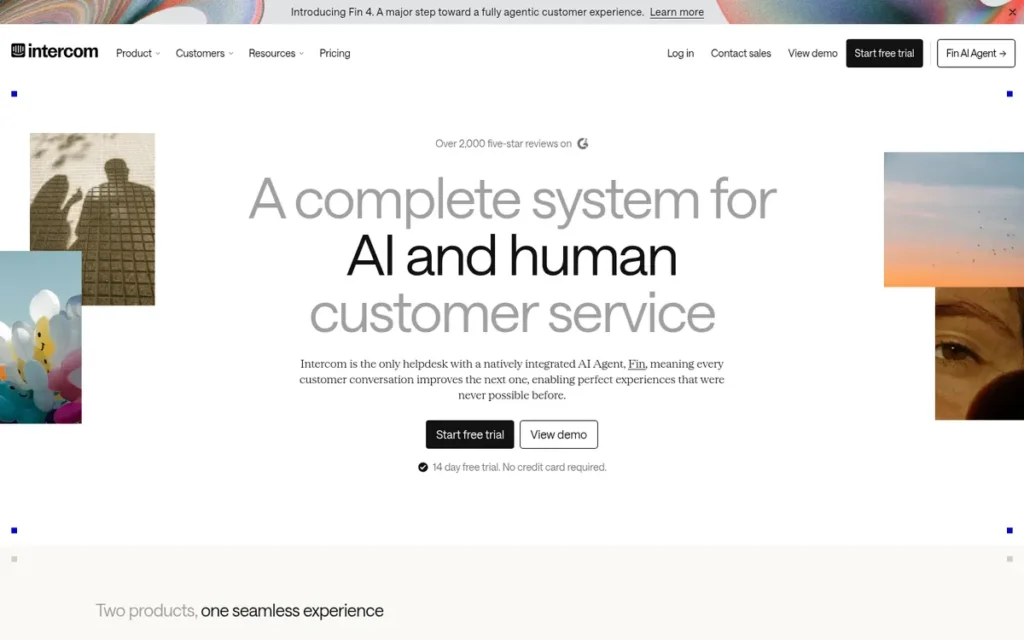
Category: AI-First Customer Service Suite, a conversational support platform where an LLM-native AI agent (Fin) serves as the primary resolution layer before human agent involvement.
At a Glance
- Category: AI-First Customer Service Suite
- Best For: B2B SaaS and product-led growth teams that prioritize AI resolution quality above all other criteria, have predictable monthly conversation volume, and can model per-resolution costs before committing
- Price Range: Seat-based plans (Essential, Advanced, Expert: approximately $39–$139/agent/month depending on tier and region; verify at intercom.com/pricing) + $0.99 per Fin AI outcome per resolved conversation
- Primary Strength: Intercom’s Fin AI agent has resolved over 40 million conversations (Intercom-stated, May 2026 (no independent corroboration found) and delivers 65% autonomous resolution in documented deployments) the most independently evidenced AI performance record in this evaluation
- Biggest Limitation: Intercom’s compound per-seat plus per-resolution billing model escalates unpredictably as teams grow and AI usage scales, documented in community testimony as a primary driver of migration away from the platform at 6+ months
- One-Line Summary: Intercom is an AI-first customer service suite whose Fin AI agent has resolved over 40 million conversations (Intercom-stated, May 2026) at $0.99 per outcome, making it the highest-evidence AI platform in this evaluation, but requiring careful pre-purchase cost modeling given its compound per-seat and per-resolution billing structure
- Last Verified: May 2026
Overview
Intercom is the strongest AI-first live chat platform in this evaluation (its Fin AI agent has resolved over 40 million conversations (Intercom-stated, May 2026) no independent corroboration found) and delivers 65% autonomous resolution in documented deployments, at $0.99 per resolved conversation. Intercom charges per seat plus per Fin resolution, making pre-purchase cost modeling essential.
Intercom was founded in 2011 in Dublin, Ireland, and positions itself as “the only helpdesk designed for the AI Agent era,” serving B2B SaaS companies and product-led growth teams through a polished omnichannel inbox. Intercom’s per-seat plus $0.99/Fin-resolution pricing model is the platform’s defining trade-off, it aligns vendor incentives with outcomes but compounds in ways that generate documented billing surprise when teams grow and AI usage scales.
Key Features
- Fin AI agent (outcome-based pricing): Intercom’s Fin AI agent is an LLM-native resolution engine that autonomously answers customer questions, performs multi-step tasks (Procedures), understands images (Fin Vision), detects knowledge gaps, and runs A/B tests on answer quality, charged at $0.99 per successful outcome, not per conversation initiated.
- Copilot for agent assist: Intercom Copilot provides AI-drafted replies, conversation summaries, and next-step suggestions, helping human agents close more conversations daily, with a documented 31% increase in daily conversations closed in the Lightspeed Commerce deployment (per Faye Digital’s summary of Intercom case study data, 2024–2025).
- Omnichannel unified inbox: Intercom consolidates web chat, email, WhatsApp, Instagram, Facebook Messenger, Twitter/X, SMS, Slack, and voice in a unified inbox with intelligent routing, SLA tracking, and conversation assignment rules.
- Proactive messaging and PLG support: Intercom’s proactive messaging enables targeted in-app messages, product tours, and behavior-triggered outreach, extending the platform beyond reactive support into customer success and product adoption use cases for SaaS teams.
- Built-in Help Center and ticketing: Intercom includes a native Help Center (knowledge base), ticket management, and a customer data platform storing interaction history and behavioral data across the customer lifecycle in a single unified view.
Best For
Intercom is best for B2B SaaS companies and product-led growth teams with a well-maintained knowledge base, predictable monthly conversation volume, budget to model per-seat plus per-resolution costs accurately before committing, and for whom AI resolution quality is the overriding priority over pricing predictability.
Pricing
Intercom plan tiers (verified structure, May 2026):
- Essential, Advanced, Expert tiers: approximately $39–$139/agent/month depending on tier and region (verify at https://www.intercom.com/pricing, as Intercom does not publish fixed seat prices in all markets)
- Fin AI Agent: $0.99 per outcome (per conversation resolved autonomously; charged at most once per conversation regardless of steps taken)
Billing compounding illustration:
- Month 1 (3 seats at ~$130/month each): ~$390/month in seats
- Month 3 (2 new agents added): ~$650/month in seats alone
- Month 4 (800 Fin resolutions at $0.99): $792 in Fin charges; total Month 4: approximately $1,442/month
Teams should model total monthly cost at 1x and 2x current conversation volume before signing. Verify current seat pricing at https://www.intercom.com/pricing, pricing structure confirmed May 2026.
Strengths
- Intercom’s Lightspeed Commerce deployment demonstrates Fin participating in 99% of conversations and autonomously resolving up to 65%, one of the only peer-published named case studies with specific, independently documented resolution rate data in this product category (per Faye Digital’s summary of Intercom case study data, 2024–2025).
- Fin AI has resolved over 40 million conversations (Intercom-stated, May 2026: no independent corroboration found), one of the highest publicly disclosed LLM-native resolution agent usage figures in this product category.
- An independent reviewer in r/CRM described Intercom as having “the most stable conversational quality I tested… a polished product” (u/Far_Character4888, r/CRM, 2026), unprompted community validation of UX quality aligning with its approximately 4.5/5 G2 rating across 3,000+ reviews.
- Intercom’s $0.99/outcome pricing for Fin structurally aligns vendor incentives with customer results, Intercom charges only for conversations Fin actually resolves, not for conversations it participates in without resolution.
Limitations
- Compound Billing Escalation: Intercom’s combination of per-seat platform fees and per-resolution Fin charges compounds significantly as teams grow and AI usage scales, making accurate total cost forecasting impossible without modeling both variables simultaneously at projected 6-month growth levels.
“The first time we moved to Intercom… Six months later the bill had climbed because of seat additions, the AI resolution charges, and a couple of add-ons we didn’t realize were optional at signing. Finance was not pleased.” Posted by u/TigerAnxious9161, r/SaaS, 2026
Takeaway: Intercom’s compound billing model (seats + AI resolutions + add-ons) can triple the initial contract price within six months, model total cost at 2x agent count and 2x AI resolution volume before signing.
- Workflow Depth Versus Zendesk: Intercom is described as feeling “limited compared to Zendesk/Freshdesk” for teams with complex workflows, detailed reporting needs, or very large ticket volumes (u/GetNachoNacho, r/SaaS, 2026), making it a less suitable choice for enterprise-tier support operations requiring deep workflow automation.
- Ecosystem Lock-In: Intercom’s strongest features are designed to function within the Intercom ecosystem, teams integrating outside tools should expect meaningful friction, as noted by an independent reviewer in r/CRM: “if you’re stitching together outside tools, expect friction” (u/Far_Character4888, r/CRM, 2026).
“Oh god, we just got rid of Fin. Cost way too much and didn’t even work the way we needed it to. Now we’re paying almost half as much with Lyro (Tidio’s equivalent) and it’s way better.” Posted by u/Dull-Acanthaceae4601, r/customerexperience, 2026
Takeaway: Teams with variable AI resolution volume should compare Intercom’s compound model against Crisp (flat workspace pricing, AI included) or Tidio (conversation-cap, Lyro native) before committing to the per-resolution model.
Verdict
Intercom is the strongest AI-first live chat platform in this evaluation by independently documented evidence, Fin AI’s 40 million+ resolved conversations (Intercom-stated, May 2026) and named case study data (65% autonomous resolution rate at Lightspeed Commerce, per Faye Digital, 2024–2025) represent the most verified AI performance record in the category. Intercom is the correct choice for B2B SaaS teams that prioritize AI resolution quality as the primary criterion and have the capacity to model and monitor per-resolution billing accurately before committing. Teams that cannot forecast monthly AI resolution volume with confidence should evaluate Crisp (flat workspace pricing, AI included) or Tidio (conversation-cap with LLM-native Lyro) as structurally more predictable alternatives.
4. LiveAgent: Best All-in-One Value
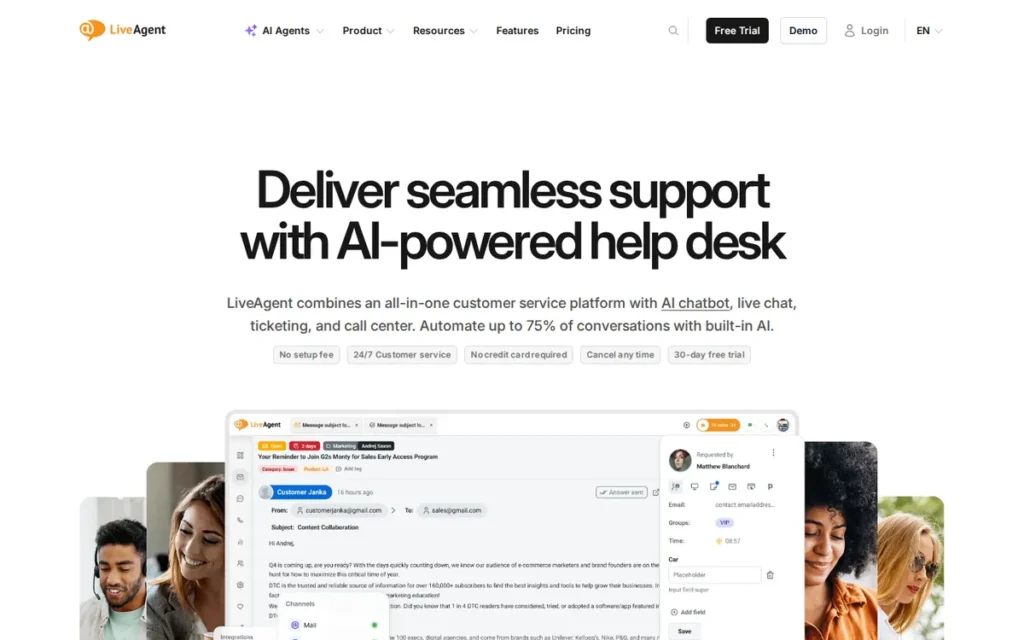
Category: All-in-One Support Suite, a unified customer service platform combining live chat, a native call center, email ticketing, and social media inbox in a single dashboard without requiring third-party telephony.
At a Glance
- Category: All-in-One Support Suite
- Best For: SMBs and mid-market teams currently managing phone and chat support in separate tools who need to consolidate at a lower per-agent cost than enterprise platforms
- Price Range: Free (limited) | Small Business: ~$15/agent/month | Medium: ~$29/agent/month | Large: ~$49/agent/month | Enterprise: ~$69/agent/month (all billed annually)
- Primary Strength: LiveAgent is the only platform in this seven-tool evaluation with a native built-in call center (including IVR, routing, recording, callback, and browser-to-browser calling) with no third-party telephony integration required
- Biggest Limitation: LiveAgent’s AI chatbot may require a third-party FlowHunt integration for full functionality (per Comm100, a competing vendor, verify current AI setup requirements directly at liveagent.com before purchase)
- One-Line Summary: LiveAgent is an all-in-one support suite starting at $15/agent/month that uniquely includes a native call center alongside live chat, email ticketing, and social inbox, the highest-value platform for SMB teams needing phone and chat support in one system without enterprise pricing
- Last Verified: May 2026
Overview
LiveAgent is the only platform in this seven-tool evaluation with a native built-in call center (including IVR, routing, recording, and callback) starting at $15/agent/month, the lowest per-agent entry price of any full-featured helpdesk suite reviewed here. LiveAgent consolidates phone, chat, email, and social support in one dashboard without requiring a separate telephony service.
LiveAgent is developed by Quality Unit, s.r.o. in Bratislava, Slovakia, serving thousands of businesses globally across SMB and mid-market segments. LiveAgent’s competitive per-agent pricing and breadth-first product philosophy make it the strongest value option for teams consolidating multiple support channels, provided they are prepared for a more utilitarian interface than Intercom or Crisp.
Key Features
- Native call center with IVR and recording: LiveAgent’s native call center includes IVR routing, automatic call recording, callback requests, browser-to-browser calling, and call queuing, all built into the platform without requiring a third-party telephony integration such as Twilio or RingCentral.
- Real-time typing preview: LiveAgent consolidates live chat, email, WhatsApp, Facebook, Twitter/X, Instagram, Viber, and Telegram in a unified ticket dashboard with a real-time typing preview feature, agents see what customers are typing before the message is sent, enabling faster and more prepared responses.
- Affordable per-agent pricing structure: LiveAgent’s per-agent pricing starts at approximately $15/agent/month, providing full helpdesk suite functionality (chat, phone, tickets, social, knowledge base) at approximately one-third the per-seat cost of Zendesk’s entry-level Suite Team plan ($55/agent/month, May 2026).
- Google Analytics integration: LiveAgent’s Google Analytics integration tracks every chat interaction as an event, enabling support teams to connect chat volume and resolution data to site traffic and conversion analytics without third-party middleware.
- Proactive chat and offline conversion: LiveAgent includes proactive chat invitations triggered by visitor behavior and automatic ticket conversion for chats initiated outside business hours, maintaining conversation continuity without 24/7 staffing requirements.
Best For
LiveAgent is best for SMBs and mid-market teams that currently run phone and chat support in separate systems, need to consolidate at a lower per-agent cost than enterprise platforms, and prioritize native multi-channel coverage (including phone) over cutting-edge AI automation depth.
Pricing
LiveAgent plan tiers (per agent/month, billed annually, verified May 2026):
- Free: Limited features
- Small Business: ~$15/agent/month
- Medium Business: ~$29/agent/month
- Large Business: ~$49/agent/month
- Enterprise: ~$69/agent/month
Note: AI chatbot functionality may require the FlowHunt integration (source: Comm100 competitor comparison, May 2026, verify independently at liveagent.com), which may carry additional licensing costs not reflected in the plan tiers above. Include this in total cost modeling before purchase. Verify at https://www.liveagent.com/pricing/, confirmed May 2026.
Strengths
- LiveAgent’s Capterra rating of approximately 4.7/5 across 1,700+ verified reviews confirms strong user satisfaction at a per-agent price point ($15–$49/month) significantly below Zendesk ($55–$169/month) for comparable helpdesk suite functionality, as recorded on Capterra as of May 2026.
- LiveAgent is the only platform in this seven-tool evaluation with a native built-in call center (IVR, routing, recording, and callback included without third-party telephony) directly addressing the segment of SMBs managing phone and chat support who cannot absorb enterprise platform pricing.
- LiveAgent’s vendor documentation states AI chatbot responses in 100+ languages: a multilingual capability not documented for any other platform in this evaluation, though independent case study verification was not found during May 2026 research.
- SupportYourApp’s independent review identified LiveAgent as providing exceptional value for money relative to its feature set, specifically noting the call center inclusion as a differentiator for teams transitioning from multi-tool setups.
Limitations
- AI Setup Complexity: LiveAgent’s AI chatbot may require a third-party FlowHunt integration for full functionality (per Comm100’s product comparison, a competing vendor, May 2026; verify current AI setup requirements directly at liveagent.com before purchase), adding configuration dependency absent from tools with native AI agents such as Tidio (Lyro native), Crisp (AI Answers native), and Intercom (Fin native).
- Unverified AI Performance Claims: LiveAgent’s vendor-stated AI performance figures (75% conversation automation rate and 28% first-contact resolution improvement (LiveAgent homepage, May 2026)) are not supported by named third-party case studies in this evaluation’s research data, limiting independent pre-purchase validation compared to Intercom’s Lightspeed Commerce case study and Tidio’s documented Lyro architecture.
- Interface Complexity: Reviewers on G2 and SalesGroup.ai consistently describe LiveAgent’s interface as utilitarian and prone to feature bloat, with teams migrating from Intercom or Crisp’s cleaner UX often experiencing a noticeable interface downgrade, and the absence of a dedicated LiveAgent community on Reddit (no significant user discussion threads found during May 2026 research) makes peer validation of long-term operational reliability harder to confirm than for platforms with active community followings.
Verdict
LiveAgent is the best value all-in-one support platform in this evaluation for SMB and mid-market teams that need phone and chat support in one system, starting at $15/agent/month with a native call center that no other platform in this seven-tool evaluation includes. LiveAgent’s combination of channel breadth and per-agent pricing makes it the correct choice when consolidation and cost efficiency are the primary criteria. Teams that prioritize AI automation quality should evaluate Tidio or Intercom; teams prioritizing pricing predictability as team size grows should evaluate Crisp’s workspace model.
5. LiveChat: Best Pure Chat UX
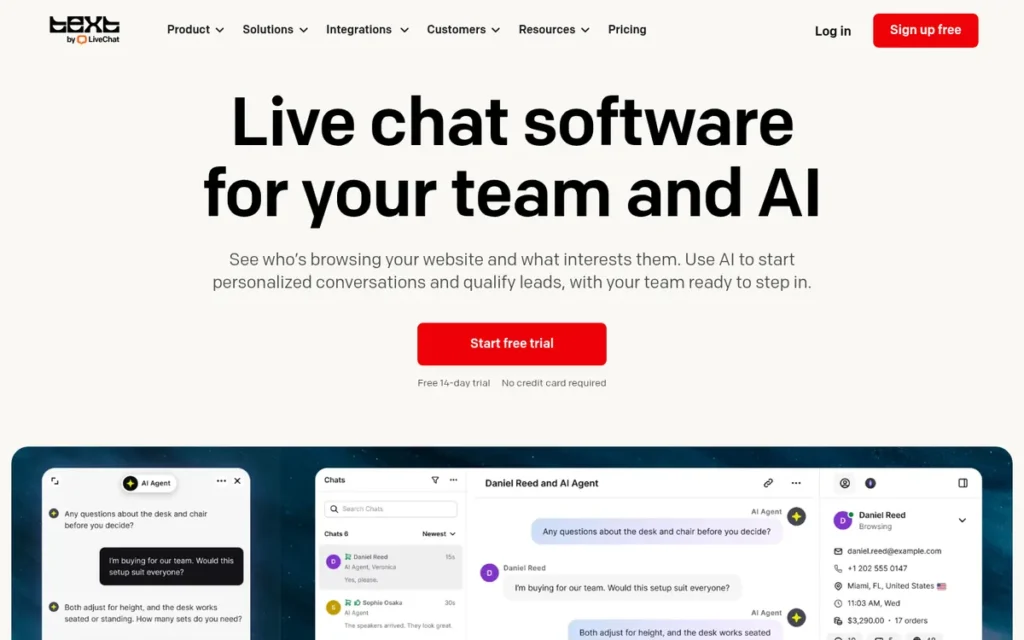
Category: Dedicated Live Chat Tool, a focused chat widget platform optimized for agent UX quality and rapid deployment, without a built-in full helpdesk suite or native chatbot automation.
At a Glance
- Category: Dedicated Live Chat Tool
- Best For: Ecommerce and service businesses that want the fastest-deploying, best-UX human agent chat experience and whose automation needs are limited or handled through a separately purchased chatbot product
- Price Range: Starter: ~$20/agent/month | Team: ~$41/agent/month | Business: ~$59/agent/month | Enterprise: custom pricing (no free plan; billed annually, monthly billing adds ~25–40%; add ~$52/month per ChatBot instance if automation required)
- Primary Strength: LiveChat’s sneak-peek feature (real-time customer typing preview), instant-load widget, and agent-first UX design deliver the fastest and most responsive chat experience in the category, with deployment measured in hours, not weeks (Kayako, 2026)
- Biggest Limitation: LiveChat does not include a native chatbot: teams wanting AI-powered automation must purchase the separate ChatBot product from Text S.A. at approximately $52/month per chatbot instance, adding cost not reflected in LiveChat’s headline per-seat price
- One-Line Summary: LiveChat is a dedicated live chat platform serving 36,000+ companies with a best-in-class agent UX (including real-time sneak peek, an instant-load widget, and 200+ integrations) but requires a separately purchased ChatBot product for automation, making it the strongest choice for teams where human agent chat is the primary support channel
- Last Verified: May 2026
Overview
LiveChat is a dedicated live chat platform serving 36,000+ companies with the fastest documented agent onboarding in this evaluation (independent reviewer Kayako (2026) confirmed “onboarding takes hours, not weeks”) and a sneak-peek feature that shows agents customer keystrokes in real time before the message is sent. LiveChat does not include a native chatbot; automation requires the separately purchased ChatBot product from Text S.A.
LiveChat was developed by Text S.A. in Wrocław, Poland, and founded in 2002, one of the longest-running companies in live chat software, serving 36,000+ companies across 200+ integrations. LiveChat’s 20+ year market presence provides institutional reliability and ecosystem depth for enterprise-grade IT environments that newer platforms cannot yet match by tenure.
Key Features
- Sneak-peek real-time typing preview: LiveChat’s sneak-peek feature displays customer keystrokes in real time before the message is sent, giving agents preparation time that reduces average response latency and improves first-message accuracy, a UX capability with no direct equivalent among the other six platforms in this evaluation.
- Instant-load widget performance: LiveChat’s chat widget is independently confirmed by Kayako (2026) as having “lightning-fast performance: the chat widget loads instantly”, minimizing the delay between visitor intent and chat availability that causes abandonment on slower-loading tools.
- In-chat ecommerce elements: LiveChat supports in-chat ecommerce elements including product cards, quick-reply buttons, and carousels, enabling agents to present product recommendations and purchase options directly within the chat window for Shopify and WooCommerce stores.
- Built-in AI agent-assist features: LiveChat includes AI-powered reply suggestions, conversation summaries, customer intent recognition, and smart routing as built-in platform features, without requiring a separate add-on for these agent-assist capabilities (note: full chatbot automation requires the separate ChatBot product, approximately $52/month).
- 200+ pre-built integrations: LiveChat’s 200+ pre-built integrations cover Salesforce, HubSpot, Shopify, WordPress, Slack, and Microsoft Dynamics 365, alongside Zapier for custom workflow connections, one of the broadest integration ecosystems of any standalone chat tool in this evaluation.
Best For
LiveChat is best for ecommerce stores and service businesses that prioritize agent response quality and speed, need rapid deployment without extensive configuration overhead, and either do not require chatbot automation or are prepared to add the separately purchased Text S.A. ChatBot product and factor its cost into the total price comparison.
Pricing
LiveChat plan tiers (per agent/month, billed annually, verified May 2026):
- Starter: ~$20/agent/month
- Team: ~$41/agent/month
- Business: ~$59/agent/month
- Enterprise: Custom pricing
Note: No free plan. Monthly billing adds approximately 25–40% to these rates. If chatbot automation is required, the separately purchased ChatBot product costs approximately $52/month per chatbot instance (as of May 2026, verify at chatbot.com/pricing).
Combined cost example: A 10-agent LiveChat Starter team ($200/month) plus one ChatBot ($52/month) totals approximately $252/month at entry tier, rising to approximately $642/month at Business tier ($590 + $52). Compare this combined figure against Tidio Growth ($59/month, AI native) and Crisp Essentials ($95/month, AI native, 10 seats) before finalizing. Verify at https://www.livechat.com/pricing/, confirmed May 2026.
Strengths
- Independent reviewer Kayako (2026) described LiveChat as having “lightning-fast performance: the chat widget loads instantly” and “minimal learning curve: both agents and admins find it intuitive (onboarding takes hours, not weeks”) a specific, dated, named-source endorsement of deployment speed not found in equivalent form for other platforms in this evaluation.
- LiveChat holds a Capterra rating of approximately 4.7/5: the joint-highest Capterra rating in this evaluation alongside LiveAgent and Tidio, reflecting strong satisfaction across 36,000+ customers at a platform with over 20 years of deployment history since 2002.
- LiveChat’s sneak-peek feature is a genuine, documented UX differentiator: real-time customer typing preview allows agents to begin composing replies before customers finish typing, directly reducing first-response time in ways no other platform in this evaluation replicates natively.
- LiveChat integrates with 200+ platforms including Salesforce, HubSpot, Shopify, and Microsoft Dynamics 365, and its 20+ year market presence (founded 2002) provides institutional reliability and ecosystem depth that newer platforms cannot yet match for enterprise-grade IT environments.
Limitations
- Automation Architecture Gap: LiveChat does not include a native chatbot: teams requiring AI-powered automated responses must purchase the ChatBot product from Text S.A.’s separate product ecosystem at approximately $52/month per chatbot instance (May 2026), making the total cost meaningfully higher than the headline per-seat price when automation is part of the support workflow.
- Combined Cost Premium: Independent reviewers Brevo and Nextiva both confirmed that “LiveChat’s automation features leave something to be desired” and that chatbot use requires “adding another app”, a combined LiveChat plus ChatBot deployment costs $252–$642/month at 10 agents versus $59–$95/month for all-in-one alternatives at the same team size (May 2026 pricing).
- No Free Evaluation Tier: LiveChat offers no free plan, requiring a financial commitment before teams can evaluate the agent UX, a barrier compared to Tidio (free tier available), Crisp (free tier available), and tawk.to (permanently free core product).
Verdict
LiveChat is the strongest pure chat UX platform in this evaluation, its sneak-peek feature, instant-load widget, and hours-not-weeks onboarding make it the fastest path to a high-quality human agent chat experience for ecommerce and service businesses. LiveChat’s 36,000+ customers, 20+ year track record, and 200+ integrations confirm enterprise-grade stability and integration breadth. Teams should factor in the additional ChatBot product cost (~$52/month) if automation is part of their support strategy, and compare the combined LiveChat plus ChatBot price against Tidio and Crisp before finalizing, as the all-in cost differential can be material at comparable agent counts.
6. tawk.to: Best Free Option
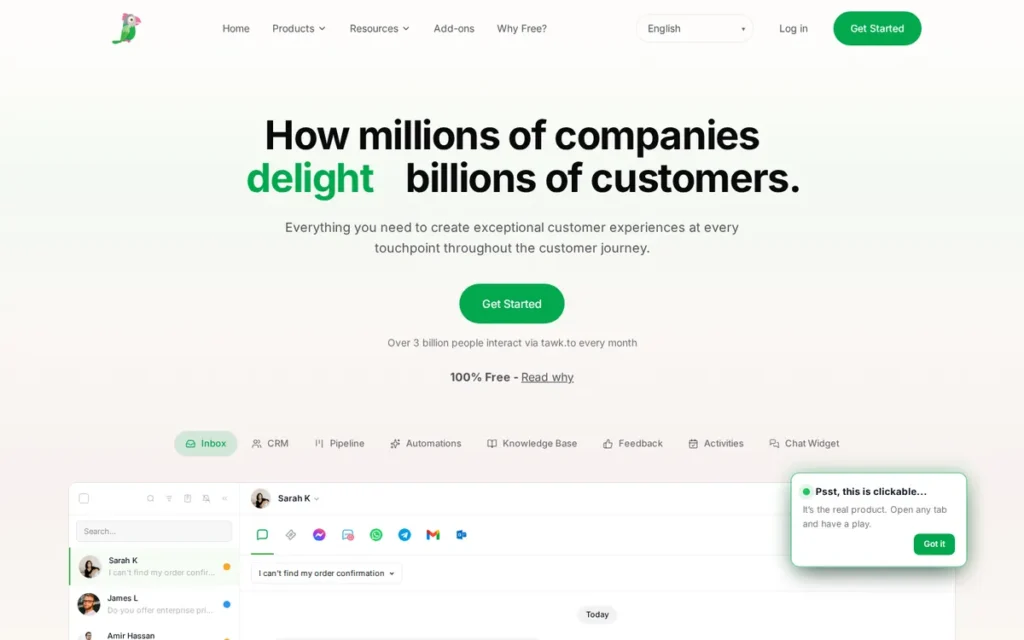
Category: Free Live Chat Tool, a permanently free live chat platform monetized through optional paid add-ons and human staffing services rather than software subscriptions.
At a Glance
- Category: Free Live Chat Tool
- Best For: Budget-constrained small businesses and solopreneurs needing functional website live chat at zero monthly cost, whose support model relies on human agents being online during business hours rather than automated chatbot coverage
- Price Range: Free core (unlimited agents, unlimited chats) | Branding removal: $19/month | AI Assist: $29/month | Dedicated Support: $1/month | VA staffing: $1/hour
- Primary Strength: tawk.to is the only platform in this seven-tool evaluation with a permanently free tier that includes unlimited agents and unlimited chats, no subscription, no per-seat fee, and no monthly chat volume cap
- Biggest Limitation: tawk.to’s AI and automation capabilities are structurally limited by a business model built on $1/hour human VA staffing revenue, the company has a structural disincentive to build automation that would reduce demand for its human staffing services
- One-Line Summary: tawk.to is the only permanently free live chat platform in this evaluation, serving approximately 555,000 active websites (BuiltWith, May 2026) with unlimited agents and unlimited chats at no subscription cost, but its automation and AI depth are structurally constrained by a business model that monetizes human staffing services rather than software subscriptions
- Last Verified: May 2026
Overview
tawk.to is the only platform in this seven-tool evaluation with a permanently free tier that includes unlimited agents and unlimited chats (no subscription fee, no per-seat charge, and no monthly chat volume cap) serving approximately 555,000 active websites globally (BuiltWith, May 2026). tawk.to monetizes through optional add-ons and $1/hour human staffing services, which creates a structural incentive against investing in automation features.
tawk.to was founded in 2013 and is headquartered in Dallas, Texas. tawk.to has achieved massive adoption through the free model, making it one of the most widely deployed live chat solutions by website installation count. tawk.to’s free plan displays a “Powered by tawk.to” label in the chat widget; branding removal costs $19/month.
Key Features
- Permanently free unlimited core plan: tawk.to’s free core plan includes unlimited agent accounts, unlimited concurrent chats, unlimited website properties, and real-time visitor monitoring, with no subscription fee, no per-seat charge, and no monthly chat volume cap.
- Whisper Mode for agent collaboration: tawk.to’s Whisper Mode allows agents to leave private internal notes during live conversations without the customer seeing them, enabling supervisor coaching and cross-agent context sharing in real time without disrupting the customer experience.
- Built-in ticketing and knowledge base: tawk.to includes built-in ticket management, a help center and knowledge base builder, and an offline contact form, providing basic multi-channel support coverage at zero cost without requiring separate tool subscriptions.
- Proactive chat triggers: tawk.to’s proactive chat triggers fire automatically based on visitor behavior (time on page, pages visited, return visitor status) without requiring chatbot configuration, enabling proactive engagement at zero additional cost.
- Virtual assistant staffing service: tawk.to’s $1/hour virtual assistant service provides outsourced human agent staffing, trained operators who respond to customer chats using the tawk.to platform, as the primary upgrade path for businesses needing chat coverage beyond in-house team hours.
Best For
tawk.to is best for budget-constrained small businesses, solopreneurs, and early-stage startups that need a functional, reliable website live chat tool at zero monthly cost and whose support model relies on human agents being actively available during business hours, not on automated chatbot coverage or AI-powered FAQ deflection.
Pricing
tawk.to pricing (verified May 2026):
- Core product: Free (unlimited agents, unlimited chats: displays “Powered by tawk.to” branding)
- Branding removal: $19/month
- AI Assist: $29/month
- Dedicated Support: $1/month
- Virtual Assistant staffing: $1/hour
Note: The free plan requires “Powered by tawk.to” branding in the widget, factor branding removal cost ($19/month) into any “free” calculation for businesses with brand requirements. Total cost with branding removal and AI Assist is $48/month, still below Tidio’s Growth tier ($59/month) and most competitor entry plans. Verify at https://www.tawk.to/pricing/, confirmed May 2026.
Strengths
- tawk.to is active on approximately 555,000 live websites per BuiltWith data (May 2026), one of the largest deployment footprints of any live chat tool in this evaluation by installation count, confirming that the free model drives adoption at scale across diverse business types globally.
- tawk.to’s Capterra rating of approximately 4.6/5 reflects consistent satisfaction among businesses using the platform for its intended purpose (basic live chat at zero cost) with users in the WordPress and small business community describing it as reliable, easy to deploy, and low-maintenance.
- tawk.to’s multi-property management feature allows a single account to manage live chat across unlimited website domains at no extra cost, a structural advantage for agencies, multi-brand businesses, and developers managing live chat for multiple client sites simultaneously.
- tawk.to’s $1/hour virtual assistant model provides outsourced human coverage beyond in-house team hours at a cost no software-only platform in this evaluation can match, directly enabling after-hours chat presence without full-time staffing overhead.
“Tawk.to has never let me down. Free and easy to use. Also integrates with Slack if you use that. Phone app if need be. Does what we need.” Posted by u/yourdeadbeatmom, r/Wordpress, 2020
Takeaway: tawk.to delivers on its core promise (reliable, zero-cost live chat) for teams whose support model depends on agents being actively available, not on automated coverage.
Limitations
- Structural Automation Constraint: tawk.to’s business model depends on revenue from $1/hour virtual assistant staffing services, which creates a structural disincentive to build the chatbot and AI automation features that would reduce demand for those services, making automation depth a deliberate strategic choice, not a product gap waiting to be filled.
“It depends on whether you want to automate your conversations with chatbots or not. Tawk.to is great but their business model encourages you to hire their chat operators. That’s why they are not so big on AI, chatbots, automation, automatic messages, etc.” Posted by u/KazRainer, r/Wordpress, 2020
Takeaway: tawk.to’s revenue model (not its product capabilities) explains its automation gap. Teams expecting AI deflection without additional monthly spend should choose a platform whose business model depends on software subscriptions, not staffing services.
- Chat Prioritization Limitations: tawk.to lacks clean ways to prioritize or filter urgent chats for teams that are not monitoring 24/7, documented in r/SaaS community discussions as a practical operational limitation for teams with variable availability, not resolved by the AI Assist add-on.
- Documentation Accessibility: tawk.to’s free-tier setup documentation is increasingly difficult to find as the company emphasizes paid add-on marketing in its tutorials and help content, creating a practical friction point for new users attempting to configure the free version without engaging paid services.
Verdict
tawk.to is the only genuinely free live chat platform in this evaluation, and its approximately 555,000 website installation footprint (BuiltWith, May 2026) confirms that the free model works at scale for businesses with basic live chat needs. tawk.to is the correct starting point for zero-budget teams evaluating live chat for the first time, and a reasonable permanent choice for businesses whose support model relies on in-hours human agent coverage without automation requirements. Teams that expect AI chatbot deflection, automated FAQ handling, or 24/7 coverage without human staffing costs will hit structural limits that are a deliberate consequence of tawk.to’s business model, and should evaluate Tidio or Crisp as alternatives.
7. Zendesk Suite: Best for Enterprise
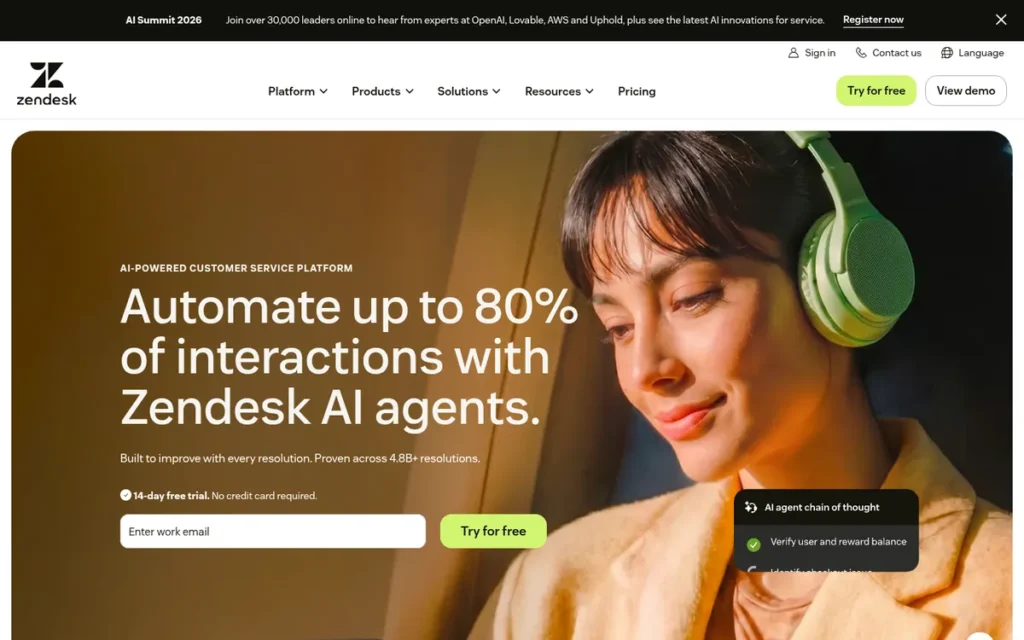
Category: Enterprise Customer Service Platform, a full-scale omnichannel support and workflow automation suite designed for complex, high-volume support operations with dedicated administrative resources and enterprise-level integration requirements.
At a Glance
- Category: Enterprise Customer Service Platform
- Best For: Mid-market to enterprise teams with complex multi-channel support workflows, high ticket volumes, dedicated admin resources, and budget for a full customer service technology investment
- Price Range: Suite Team: $55/agent/month | Suite Professional: $115/agent/month | Suite Enterprise: $169/agent/month (billed annually) | Copilot add-on: $50/agent/month | AI resolution overages: ~$1.50–$2.00 each (each plan includes free AR allowances: 5/agent/month for Suite Team, 10 for Professional, 15 for Enterprise)
- Primary Strength: Zendesk has the deepest integration ecosystem in this evaluation (1,500+ integrations) and processes nearly 5 billion customer issues annually (PR Newswire, 2025), the most proven enterprise-scale customer service platform by breadth, volume, and AI stack sophistication
- Biggest Limitation: Zendesk’s compound pricing: per-seat fees starting at $55/agent/month plus per-AI-resolution overages plus add-ons for features competitors include by default, escalates rapidly for growing teams and requires dedicated administrative resources to configure and maintain at full capability
- One-Line Summary: Zendesk is the most feature-complete enterprise customer service platform in this evaluation, processing nearly 5 billion annual issues (PR Newswire, 2025) with 1,500+ integrations and a full AI stack including GPT-5 and Model Context Protocol support, but its per-seat pricing ($55–$169/agent/month), per-AI-resolution overage billing, and steep administrative learning curve make it a structural mismatch for SMB teams without dedicated support operations staff
- Last Verified: May 2026
Overview
Zendesk is the most feature-complete enterprise customer service platform in this evaluation, processing nearly 5 billion customer issues annually (PR Newswire, 2025) with 1,500+ integrations and a full AI stack including GPT-5 and Model Context Protocol support as of 2025. Zendesk Suite starts at $55/agent/month with per-AI-resolution overage charges on top; the platform requires dedicated admin resources to configure and maintain at full capability.
Zendesk was founded in 2007 in Copenhagen, Denmark, now headquartered in San Francisco and operating as a private company following a $10.2 billion buyout in 2022. Zendesk has evolved from a ticketing system into what it calls a “Resolution Platform”, though users in r/CRM note the AI layer “feels like AI bolted onto a legacy product, not built from the ground up” (u/Far_Character4888, r/CRM, 2026).
Key Features
- Zendesk Messaging (unified omnichannel inbox): Zendesk Messaging unifies live chat, email, social channels, and voice in a single agent workspace with intelligent routing, SLA management, and macro-based workflow automation for complex support operation configurations.
- Full AI stack (GPT-5 + MCP): Zendesk’s AI capabilities include four distinct layers:
- AI Agents: autonomous resolution engine handling queries without human involvement
- Copilot: agent-assist for reply drafting, conversation summarization, and next-step suggestions
- Knowledge Builder: automated help center content generation from resolved conversation data
- Action Builder: workflow automation for routing, escalation, and third-party system actions via Model Context Protocol (MCP) for live data access as of 2025
- 1,500+ native integrations: Zendesk’s 1,500+ pre-built integrations cover Salesforce, HubSpot, Slack, Shopify, Jira, Workday, and enterprise data systems, the deepest third-party connectivity of any platform in this evaluation.
- Outcome-based AI pricing with free allowances: Zendesk’s AI pricing charges approximately $1.50–$2.00 per overage resolution, but each plan includes free monthly AR allowances before overages apply, which meaningfully affects the modeled cost at lower AI usage volumes.
- Enterprise reporting and analytics: Zendesk’s reporting suite includes pre-built and custom dashboards, agent performance tracking, SLA compliance monitoring, CSAT measurement, and workforce analytics, the most comprehensive reporting layer in this evaluation.
Best For
Zendesk is best for mid-market and enterprise teams with high ticket volumes, multi-channel support operations spanning email, chat, phone, and social, dedicated admin or IT resources for platform configuration and maintenance, and budget to invest in Suite Professional or Enterprise, where workflow automation depth, integration breadth, and analytics sophistication deliver ROI at scale.
Pricing
Zendesk Suite plan tiers (per agent/month, billed annually, verified May 2026):
- Suite Team: $55/agent/month (5 free ARs per agent per month included)
- Suite Professional: $115/agent/month (10 free ARs per agent per month included)
- Suite Enterprise: $169/agent/month (15 free ARs per agent per month included)
- Copilot add-on: $50/agent/month additionally
AI resolution overages cost approximately $1.50–$2.00 per resolution beyond the free monthly allowance.
Revised cost scenario at 10 agents on Suite Team: $550 (10 seats × $55/month) + $150 (100 overage ARs × $1.50, after 50 free ARs included) = approximately $700/month for 150 total monthly AI resolutions. For comparison: Crisp Essentials for 10 agents costs $95/month flat. Verify current free allowances and overage rates at https://www.zendesk.com/pricing/, confirmed May 2026.
Strengths
- Zendesk’s G2 profile shows 6,837 verified reviews as of May 2026: the highest review volume of any platform in this evaluation, providing the most statistically reliable aggregate satisfaction signal, with a 4.3/5 rating reflecting the consistent experience of a large and diverse global enterprise customer base.
- Zendesk processes nearly 5 billion customer issues annually across its platform (PR Newswire, 2025), a scale metric confirming infrastructure reliability at enterprise-grade conversation volumes that smaller platforms have not demonstrated.
- Zendesk’s AI stack supports GPT-5 and Model Context Protocol (MCP) for live data access (as of 2025), enabling AI agents to connect to external data systems during resolution workflows, a technical AI capability depth that exceeds the AI architectures of SMB-focused competitors in this evaluation.
- Zendesk’s 1,500+ native integrations and 20+ year deployment history (founded 2007) provide institutional reliability and ecosystem depth that enterprises with complex, multi-system tech stacks cannot replicate with newer platforms, and its $10.2 billion 2022 buyout valuation confirms continued enterprise-level investment capacity.
Limitations
- Compound Pricing Escalation: Zendesk combines per-seat fees ($55–$169/agent/month) with per-AI-resolution overage billing and add-on requirements for features that competitors include by default, producing total costs that escalate rapidly for growing teams and are difficult to forecast accurately without modeling AI usage volume against plan allowances.
“Depending on the size of your business, it can get VERY expensive VERY fast… you have to pay more money for any add-on you want to use in most cases.” Posted by u/PillowDrool, r/Zendesk, 2021
Takeaway: Zendesk’s add-on model means the headline per-seat price is a floor, not a ceiling, audit which features your team needs before purchase and add their cost to the base plan for an accurate total cost of ownership.
- Dedicated Admin Requirement: A G2 reviewer noted that using Zendesk properly requires “somebody who understands your internal processes” as a dedicated platform admin, an overhead that SMB teams without dedicated IT resources should factor explicitly into total cost of ownership calculations before comparing Zendesk against simpler alternatives.
- Lowest Rating in This Evaluation: Zendesk’s 4.3/5 G2 rating: the lowest of any platform in this evaluation, across 6,837 reviews (the highest volume) represents the most statistically reliable satisfaction signal in this comparison and reflects consistent pain points around pricing complexity, spam filter limitations, and administrative overhead rather than isolated edge cases.
Verdict
Zendesk is the most feature-complete enterprise customer service platform in this evaluation, its 1,500+ integrations, nearly 5 billion annual issues processed (PR Newswire, 2025), and GPT-5-powered AI stack are objectively best-in-class for complex, high-volume support operations. Zendesk is the correct choice for mid-market and enterprise teams with dedicated admin resources, multi-channel workflow complexity, and budget for the full Suite investment at $55–$169/agent/month. SMB teams evaluating Zendesk should model total cost at 10 agents including AI resolution overages, after free AR allowances, and add-ons before comparing against Crisp ($95/month flat for 10 agents), LiveAgent ($150/month at $15/agent), or Tidio ($59/month), the all-in cost differential at SMB scale is typically the decisive evaluation factor.
What Red Flags Should I Watch For When Evaluating Live Chat Software?
Six patterns consistently predict live chat software regret: per-resolution AI billing without volume context, conversation-cap billing during high-traffic periods, AI chatbots requiring third-party integration, automation requiring a separately purchased product, free plans that require paid add-ons for basic branding, and deploying AI without a complete knowledge base. Identifying these before purchase prevents the billing surprises documented across community discussions.
Red Flag #1: Per-Resolution AI Billing Without Volume Caps Intercom ($0.99/Fin resolution) and Zendesk (~$1.50–$2.00/overage resolution) charge per AI-resolved conversation, a model that aligns incentives but creates unpredictable monthly bills when AI usage scales unexpectedly. Teams should model expected AI resolution volume at current and 2x current levels before signing any per-resolution agreement, and should note Zendesk’s free monthly AR allowances when modeling overage costs.
Red Flag #2: Conversation-Cap Plans During High-Traffic Periods Tidio’s conversation-cap billing charges based on monthly chat volume rather than agent seats. During high-traffic events such as Black Friday or product launches, conversation credits can exhaust in minutes, one Shopify merchant documented 100 flow credits consumed in three and a half minutes (u/FootballDue3672, r/shopify, 2025). Always set billing alerts at the plan cap boundary before launching any promotion with significant traffic expectations.
Red Flag #3: AI Chatbot Requiring Third-Party Integration to Function LiveAgent’s AI chatbot may require a FlowHunt third-party integration before it can fully answer customer questions (per Comm100, a competing vendor, May 2026, verify at liveagent.com). Unlike Tidio (Lyro native), Crisp (AI Answers native), and Intercom (Fin native), a third-party-dependent AI layer adds configuration complexity and a vendor dependency that should be confirmed before purchase.
Red Flag #4: Automation Requiring a Separately Purchased Product LiveChat does not include a native chatbot. Teams needing AI-powered automated responses must purchase the separate ChatBot product from Text S.A. at approximately $52/month per chatbot instance (May 2026). LiveChat’s headline per-seat price does not reflect the total cost for automation-enabled deployments, always calculate the combined cost before comparing against all-in-one alternatives such as Tidio or Crisp.
Red Flag #5: Free Plan with Mandatory Branding Requiring Paid Removal tawk.to’s free plan displays a “Powered by tawk.to” label in the chat widget. Removing this branding costs $19/month, a cost easy to overlook when evaluating the “free” tier. Any business with brand requirements should factor in the branding removal cost from the outset, making the effective minimum cost $19/month rather than $0.
Red Flag #6: AI Resolution Rate Claims Without Knowledge Base Prerequisites Every vendor-stated AI resolution rate (Lyro’s vendor-claimed ~64% average, Fin’s 65%, LiveAgent’s vendor-claimed 75%) is conditional on having a well-maintained, comprehensive knowledge base. A team deploying AI chatbot automation with incomplete documentation will experience resolution rates dramatically below these figures, regardless of which platform is selected. Before evaluating AI tools, audit your current knowledge base: if it does not cover at least 80% of your inbound query types, AI resolution rates will underperform vendor claims across every platform in this evaluation.
What Questions Should I Ask Before Choosing a Live Chat Platform?
Eight questions separate buyers who match the right platform to their situation from those who discover a mismatch at invoice time. The most important question (projected conversation volume at 2x current scale) determines whether a per-seat, per-workspace, conversation-cap, or per-resolution pricing model will remain affordable as your team grows.
Question #1: What is my projected monthly conversation volume at 2x current team size? Model expected monthly chat volume at both current scale and 2x scale. Conversation-cap tools (Tidio) become expensive if volume doubles without plan upgrade. Per-resolution tools (Intercom, Zendesk overages) become expensive if AI usage scales. Workspace-priced tools (Crisp) absorb team growth at a fixed monthly rate until the seat cap is exceeded.
Question #2: Do I need chatbot automation, human agent experience, or both? If human-led chat is the primary support model, LiveChat’s UX and deployment speed are best-in-class. If AI-first deflection is the goal, Intercom Fin or Tidio Lyro are the strongest options. If both are needed on a budget, Crisp or Tidio provide a combined AI-plus-live-chat experience without requiring separate product purchases.
Question #3: How many channels do I need in one inbox, web chat, email, phone, social? LiveAgent is the only platform in this evaluation with a native call center. Crisp and Intercom have the broadest social channel coverage. If phone support is required in addition to chat, LiveAgent’s channel breadth at $15/agent/month is the most cost-efficient consolidation path available in this evaluation.
Question #4: Does the pricing model stay predictable as my team grows from 5 to 15 agents? Per-seat models (Zendesk, Intercom, LiveChat, LiveAgent) multiply costs linearly with headcount additions. Crisp’s workspace model ($95/month for 10 seats, $295/month for 20 seats) contains costs at growth increments. Calculate the total cost at current size and at 15 agents before committing to any per-seat platform.
Question #5: How complete is my knowledge base before I deploy AI automation? AI resolution rates are directly proportional to knowledge base completeness, a sparse or outdated knowledge base will produce performance dramatically below vendor-stated resolution rates regardless of which AI platform is selected. Audit your current documentation before evaluating AI tools, and treat any vendor resolution rate claim as a ceiling, not a floor.
Question #6: What is the vendor’s own customer support quality like? One of the most frequently mentioned pain points in live chat community discussions is that live chat software companies often have poor customer support of their own. Check G2 reviews specifically for support-response quality, not just overall platform rating, before signing any contract.
Question #7: Do I need a free evaluation tier before committing? tawk.to (free, unlimited), Tidio (free, limited conversations), LiveAgent (free, limited), and Crisp (free, limited) all offer no-cost evaluation access. LiveChat, Intercom, and Zendesk require paid access before a meaningful evaluation of agent UX and platform behavior, a meaningful barrier for teams with limited evaluation budgets.
Question #8: Will my team’s IT resources support the platform’s configuration complexity? Zendesk requires a dedicated admin to function properly at full capability, confirmed across multiple G2 reviews. LiveAgent’s feature breadth can feel overwhelming for small teams. Crisp and Tidio are designed for non-technical deployment in hours. Match the platform’s configuration complexity to your team’s available IT support capacity before selecting a tier.
How Did We Rank These 7 Live Chat Platforms?
These seven live chat platforms were ranked by applying six weighted criteria identically to all entries: review platform ratings and volume, pricing transparency and total cost predictability, AI capability depth and reliability, feature completeness and omnichannel coverage, deployment ease and agent experience, and community sentiment from peer discussions. No affiliate relationships influenced any ranking position.
PlugRoute has no affiliate relationships with any company listed. Rankings are determined entirely by research data and objective evaluation criteria.
Evaluation Process
Research for this ranking included direct review of all seven vendor pricing pages, G2 and Capterra review platforms, Reddit community discussions across six subreddits, and named independent review sources. All data was collected in May 2026. Vendor claims were cross-referenced against independent sources before being included as evidence.
The Six Ranking Criteria
Criterion 1: Review Platform Ratings and Volume (primary weight)
G2 and Capterra ratings were averaged and weighted by review volume confidence: 100–499 reviews (base confidence); 500–1,499 reviews (moderate confidence); 1,500+ reviews (high confidence); 3,000+ reviews (very high confidence). All ratings were verified against live review platform pages as of May 2026.
Why it matters: Review volume determines statistical reliability. Crisp’s 4.6/5 from ~100+ reviews and Tidio’s 4.7/5 from 1,500+ reviews are both genuine ratings, but the confidence interval is meaningfully different, and this distinction is disclosed explicitly in each entry’s At a Glance block.
Criterion 2: Pricing Transparency and Total Cost Predictability (primary weight)
Pricing was assessed on four dimensions: model clarity (per-seat, workspace-flat, conversation-cap, per-resolution); presence of billing-surprise mechanisms; modeled total cost at a 10-agent team; and whether pricing is publicly published or requires sales contact.
Why it matters: Pricing surprise is the single most cited pain point across live chat community discussions. The pricing model (not the feature list) determines your actual monthly bill six months from now.
Criterion 3: AI Capability Depth and Reliability (primary weight)
AI was assessed on architecture tier (rule-based vs. intent-matching vs. LLM-native vs. autonomous agent), independently documented performance evidence with named case studies, whether AI is included in base plans or requires add-on purchase, and disclosed knowledge-base prerequisites. Vendor-stated metrics without independent case study corroboration were labeled as such.
Why it matters: Buyers must distinguish between rule-based chatbots and LLM-native agents to set realistic performance expectations, and must understand that AI resolution rates depend directly on knowledge base quality.
Criterion 4: Feature Completeness and Omnichannel Coverage (secondary weight)
Scored on number of natively supported channels, presence of built-in ticketing, native call center capability, knowledge base, and integration depth with major CRMs and ecommerce platforms. Native features were weighted higher than third-party integrations to reflect real deployment complexity.
Why it matters: Teams managing multiple support channels need to know which tool handles their actual channel mix natively versus requiring integration overhead and additional vendor relationships.
Criterion 5: Deployment Ease and Agent Experience (secondary weight)
Assessed from independent reviews citing setup time (hours vs. days vs. weeks), admin complexity, mobile app quality, and agent-facing UX feedback across G2, Capterra, and community discussions. Named independent reviewer assessments of onboarding speed were prioritized over vendor claims.
Why it matters: Setup time and agent UX quality directly determine time-to-value and team adoption, a platform requiring weeks of configuration delays ROI and creates internal resistance, especially for SMB teams without dedicated IT resources.
Criterion 6: Community Sentiment and Real-World Validation (secondary weight)
Analyzed from Reddit discussions across r/SaaS, r/shopify, r/CustomerSuccess, r/Zendesk, r/customerexperience, and r/Wordpress for: frequency of unprompted positive mentions; frequency as a named migration destination; documented billing shock or negative switching accounts; and specificity of use-case recommendations versus generic name-drops.
Why it matters: Organic peer recommendations represent actual buying decisions and post-purchase experiences that vendor documentation and affiliate review sites cannot provide, especially migration stories and billing shock accounts that only surface after purchase.
Evidence Weighting and Validation
When vendor claims conflicted with community evidence, named community evidence took precedence. When a claim originated solely from a competing vendor (e.g., the LiveAgent FlowHunt dependency sourced from Comm100), it was presented as attributed and unconfirmed with a reader verification instruction. Vendor-stated performance metrics without named case study corroboration are labeled “vendor-stated, no independent case study verification found.”
All Reddit quotes include username, subreddit, and year of posting. Vendor pricing claims were verified at official pricing pages in May 2026. AI resolution rate claims were cross-referenced against primary source documentation and Perplexity research (May 2026).
Update Cadence
We update this guide quarterly. Last updated: May 2026. Pricing in this category changes frequently, verify all figures at each vendor’s official pricing page before any purchase decision.
Is tawk.to actually free, or are there hidden costs?
tawk.to’s core product is genuinely free, unlimited agents, unlimited chats, and unlimited website properties at no subscription cost. However, the free plan displays a “Powered by tawk.to” widget label; branding removal costs $19/month. AI Assist adds $29/month. Businesses with brand requirements or automation needs should factor these add-ons into total cost calculations before treating tawk.to as a zero-cost solution. (Pricing verified May 2026.)
What is the difference between per-seat pricing and workspace pricing in live chat software?
Per-seat pricing charges a monthly fee per agent account, Zendesk and Intercom use this model, so growing from 5 to 10 agents doubles seat costs. Workspace pricing (Crisp) charges a flat monthly rate for the entire team up to a seat cap: 10 agents pay the same $95/month as 4 agents. For teams growing beyond five agents, the workspace model is significantly more cost-predictable.
How does PlugRoute determine its live chat software rankings?
PlugRoute applies six criteria identically to every platform: review ratings and volume, pricing transparency, AI capability depth, feature completeness, deployment ease, and community sentiment. No affiliate relationships exist, Crisp, ranked #1, generates zero revenue for this platform. Full methodology details, evidence weighting, and data sources are disclosed in the “How Did We Rank” section above.
Glossary: Key Terms Used in This Comparison
Autonomous Resolution Rate: The percentage of customer conversations an AI agent resolves completely without human agent involvement. Autonomous resolution rates vary directly with knowledge base completeness, a sparse or outdated knowledge base will produce significantly lower rates than vendor-stated figures, regardless of which platform is deployed.
Conversation Cap: A billing mechanism used by some live chat platforms (notably Tidio) where the monthly plan includes a fixed number of conversations; exceeding the cap triggers additional charges or plan upgrades. Conversation-cap models are predictable at steady traffic volumes but create billing risk during seasonal spikes or promotional events.
Per-Resolution (Outcome-Based) Pricing: A billing model where the platform charges a fee each time AI successfully resolves a customer conversation autonomously, Intercom Fin charges $0.99 per outcome and Zendesk charges approximately $1.50–$2.00 per overage resolution. Unlike per-seat pricing, per-resolution billing creates a variable monthly cost that scales with AI usage volume rather than team headcount.
Workspace Pricing: A flat-rate billing model where an organization pays a single monthly fee for the entire team up to a seat cap, regardless of how many individual agent accounts are active. Crisp uses workspace pricing, a 10-agent team pays the same $95/month as a 4-agent team on the Essentials plan, making costs structurally predictable as teams grow.
Knowledge Base Grounding: An AI architecture technique where an LLM-native chatbot is restricted to generating responses only from a pre-approved documentation set, preventing AI hallucination by limiting the model’s answer space to confirmed business information. Tidio’s Lyro (Claude-powered) and Intercom’s Fin both use knowledge base grounding as a core design principle, and both require a well-maintained knowledge base to achieve vendor-stated resolution rates.
Which Live Chat Software Is Right for You?
The right live chat software depends on one primary variable: whether cost predictability or AI resolution quality matters more at your current stage. Crisp resolves the cost predictability question. Intercom resolves the AI resolution quality question. Every other platform in this evaluation serves a specific use case that sits between these two positions on that spectrum.
Key Insights
- Crisp is the most cost-predictable full-featured live chat platform for teams of 4–15 agents, its $95/month flat workspace pricing does not compound with headcount growth and includes AI on all paid plans at no extra charge.
- Tidio is the highest-rated live chat platform in this evaluation by verified G2 review volume (4.7/5, 1,500+ reviews), and its Lyro AI (powered by Claude (Anthropic)) is the strongest LLM-native AI option at the SMB price point, contingent on a well-maintained knowledge base.
- Intercom delivers the most evidenced AI resolution quality in the category (65% documented autonomous resolution rate at Lightspeed Commerce, per Faye Digital, 2024–2025) but requires careful cost modeling before commitment, the per-seat plus $0.99/Fin-resolution compound billing model has driven significant documented migration away from the platform.
- LiveAgent is the only platform in this seven-tool evaluation with a native built-in call center, making it the unique choice for SMBs that currently manage phone and chat in separate systems and need to consolidate without enterprise pricing.
- tawk.to’s permanently free unlimited tier is the correct starting point for zero-budget teams, and a reasonable permanent solution for businesses whose support model relies on in-hours human agent coverage, not automated deflection.
- AI resolution rate claims from all vendors are conditional on knowledge base completeness, never evaluate an AI chatbot without first auditing whether your documentation covers at least 80% of your inbound query types.
- The pricing model: not the feature list, is the single most important decision variable: per-seat, per-resolution, conversation-cap, and workspace-flat models produce dramatically different real-world costs at the same team size and conversation volume.
If you are deciding between Crisp and Intercom, ask one question: is AI resolution quality or cost predictability the primary criterion? Crisp wins on cost predictability; Intercom wins on documented AI performance. If deciding between Tidio and LiveChat, ask whether you need a native chatbot (Tidio, included) or the best pure human agent UX (LiveChat, best-in-class, add ChatBot separately for automation at ~$52/month).
Pricing in this category changes quarterly, verify all figures at each vendor’s official pricing page before signing any contract. We update this guide quarterly. Last updated: May 2026.
For more independent SaaS reviews applying the same evidence-based, no-affiliate methodology, visit PlugRoute.