Braze leads for enterprise marketing teams requiring AI-powered multi-channel lifecycle orchestration; Klaviyo is the strongest choice for e-commerce brands on Shopify; and OneSignal provides the most accessible free tier for SMBs and developers. The core trade-off across all seven evaluated platforms is capability depth versus accessibility, the more powerful the tool, the steeper the cost and implementation demands.
This guide ranks proactive notification software for reaching customers across channels before they ask, from enterprise lifecycle orchestration to free tiers for developers. If your focus is engaging app users with push, SMS and attribution, see our Best Mobile Marketing Software guide.
The proactive notification market spans developer-grade API infrastructure (Twilio), safety-critical emergency broadcasting (Everbridge), and every tier of marketing automation in between, with every platform claiming multi-channel support. What actually determines fit is whether a tool’s behavioral trigger engine, channel coverage, analytics depth, and pricing model match your specific use case and team capacity at the moment you sign the contract. These platforms automate triggered alerts and real-time push notifications across omnichannel delivery paths, replacing manual scheduling with event-driven messaging that reaches customers at moments of demonstrated intent.
PlugRoute has no affiliate, referral, sponsored content, or commercial relationship with any of the seven platforms reviewed here, rankings are determined solely by verified, dated evidence from G2, Capterra, investor relations, analyst reports, and documented community discussions.
“Twilio is basically the toll road of SMS. You pay every time something moves, and the bill can shock you at scale if you haven’t modeled it out. We switched to a higher-level tool for our marketing campaigns but kept Twilio for transactional alerts because nothing else matches the deliverability.” (r/webdev community discussion)
Takeaway: Twilio is the infrastructure default for transactional alerts, technical teams who prioritize delivery reliability typically keep Twilio for event-triggered notifications while routing marketing campaigns through a purpose-built no-code tool.
TL;DR: Top Picks at a Glance
- Braze: Best for enterprise lifecycle marketing: Braze delivers AI-powered multi-channel orchestration with Gartner Magic Quadrant Leader recognition for three consecutive years (2023, 2024, 2025).
- Klaviyo: Best for e-commerce brands: Klaviyo provides Shopify-native email and SMS automation with the highest G2 rating of all seven evaluated platforms (4.6/5.0 from 1,000+ reviews).
- OneSignal: Best free tier: OneSignal covers unlimited web and mobile push subscribers on a free plan, serving 1 million+ developers and businesses globally.
- Twilio: Best for developer-built notification systems: Twilio provides pay-as-you-go API infrastructure across 180+ countries, processing over 1 trillion API requests annually for 300,000+ active customers.
- Iterable: Best for growth-stage SaaS and marketplace apps: Iterable offers a custom event API and Workflow Studio for cross-channel behavioral notifications at an estimated 20–30% lower cost than Braze.
- Airship: Best for mobile-first and loyalty programs: Airship is the only evaluated platform with native Apple Wallet and Google Pay pass management, founded in 2009 as the original commercial push notification service.
- Everbridge: Best for safety-critical alerts: Everbridge is the only FedRAMP Moderate-authorized mass notification platform in this comparison, serving 6,200+ enterprise and government customers with contractual 99.99% uptime SLAs.
Not sure where to start?
- Shopify store → Klaviyo
- App or website with no budget → OneSignal
- Lifecycle marketing team with $50,000+/year → evaluate Braze and Iterable
- Developer building custom notification logic → Twilio
- Campus, hospital, or enterprise safety program → Everbridge is the only purpose-built option in this comparison
What Are the Main Categories of Proactive Notification Software?
Proactive notification platforms divide into three distinct functional categories: enterprise marketing automation (Braze, Klaviyo, Iterable) built for behavioral triggers and lifecycle campaigns; developer and SMB platforms (Twilio, OneSignal) built for flexible multi-channel delivery; and mission-specific platforms (Airship, Everbridge) purpose-built for mobile-first or safety-critical use cases.
Category 1: Enterprise Marketing Automation Platforms
Braze, Klaviyo, and Iterable are purpose-built for marketing teams running behavioral trigger campaigns, multi-step journeys, and lifecycle engagement programs. These tools hold customer data natively, apply AI-powered personalization, and orchestrate notifications across email, SMS, push, and in-app messaging from a unified canvas.
Category 2: Developer and SMB Platforms
Twilio provides raw API infrastructure for developers building custom notification systems with programmatic control. OneSignal offers a no-code dashboard with a generous free tier for businesses needing push, email, and SMS without dedicated engineering resources, the two platforms serve opposite ends of the technical spectrum.
Category 3: Mission-Specific Platforms
Airship (mobile-first push and mobile wallet) and Everbridge (emergency mass notifications with two-way confirmation) serve specialized scenarios that general-purpose marketing automation cannot adequately address. These platforms are evaluated against reliability, compliance, and delivery guarantees, not marketing campaign ROI.
How Do the Top Proactive Notification Tools Compare at a Glance?
Seven proactive notification platforms span three price tiers: enterprise tools (Braze, Iterable) at $40,000–$500,000+/year with no free tiers; SMB and e-commerce tools (Klaviyo, OneSignal) from free to $2,000/month; developer infrastructure (Twilio) on pay-as-you-go with no monthly minimum; and specialized platforms (Airship, Everbridge) at $5,000–$500,000+/year for mobile-wallet and emergency use cases.
| Rank | Company | Category | Best For | One-Line Summary | Key Capabilities | Primary Strength | Key Limitation |
|---|---|---|---|---|---|---|---|
| 1 | Braze | Enterprise Marketing | Large teams running multi-channel lifecycle programs at scale | Braze is the most feature-complete enterprise proactive notification platform, recognized as a Gartner Magic Quadrant Leader in Multichannel Marketing Hubs for three consecutive years (2023, 2024, 2025). | Canvas Flow multi-channel journey builder; Sage AI send-time optimization and predictive channel routing; real-time behavioral triggers; native push, email, SMS, and in-app delivery | Gartner Magic Quadrant Leader for three consecutive years (2023, 2024, 2025); most advanced AI orchestration suite in this comparison | Minimum ~$30,000/year contract; 3–6 month onboarding; requires a dedicated platform administrator |
| 2 | Klaviyo | E-Commerce Automation | Shopify and DTC e-commerce brands running email and SMS flows | Klaviyo is the leading email and SMS automation platform for e-commerce, powering 157,000+ paying businesses with the highest G2 rating (4.6/5.0) and the most transparent pricing in the proactive notification category. | Pre-built e-commerce flows; predictive CLV and churn scoring; unified email and SMS; Shopify-native data sync; public interactive pricing calculator | Highest G2 rating (4.6/5.0) among all seven evaluated platforms; only exclusive Shopify partner with equity backing; most transparent pricing model | Built for e-commerce; SaaS and B2B teams find templates and behavioral models limiting outside retail purchase events |
| 3 | OneSignal | SMB Multi-Channel | Indie developers, startups, and SMBs needing push with low or no upfront cost | OneSignal is the most widely adopted push notification service globally, serving 1 million+ developers and businesses with the highest G2 review count in the push subcategory (1,100+) and a genuinely useful free tier. | Web and mobile push; SMS; email; in-app messaging; 30+ native integrations; no-code dashboard; Huawei and Amazon Fire OS coverage | Unlimited push subscribers on free plan; lowest implementation barrier in this comparison; broadest cross-platform device coverage | Analytics shallow below Enterprise tier; no revenue attribution on free or Growth plans |
| 4 | Twilio | Developer Infrastructure | Technical teams building custom notification systems requiring full programmatic control | Twilio is the foundational CPaaS for proactive notifications, serving 300,000+ active customers across 180+ countries with pay-as-you-go SMS, voice, WhatsApp, and email APIs processing over 1 trillion requests annually. | SMS/MMS/WhatsApp API; voice calling; SendGrid email infrastructure; Segment CDP; 180+ countries; SOC 2 Type II and HIPAA compliant | Unmatched global deliverability infrastructure; PAYG pricing with no monthly minimum and no lock-in; proven at highest transactional volumes in commercial use | No no-code interface; API-first only; support effectively documentation-only for small accounts; billing complexity at scale |
| 5 | Iterable | Growth Marketing | SaaS companies, marketplace platforms, and consumer apps at growth stage | Iterable is a cross-channel marketing automation platform for growth-stage SaaS and B2C apps offering flexible custom event-driven notification journeys at an estimated 20–30% lower cost than Braze. | Workflow Studio journey builder; custom event API; multi-channel orchestration (email, SMS, push, in-app, direct mail); A/B testing; Salesforce integration | Flexible custom event API for non-e-commerce behavioral signals; Workflow Studio rated by G2 users as more intuitive than Braze Canvas | No free tier; no self-serve trial; no public pricing; SMS deliverability inconsistency documented in G2 reviews |
| 6 | Airship | Mobile-First Specialist | Mobile apps in travel, retail loyalty, ticketing, and hospitality | Airship is the pioneer of mobile push notification delivery, founded in 2009, offering the only native mobile wallet notification management (Apple Wallet, Google Pay) among all seven platforms evaluated. | Mobile push; native Apple Wallet and Google Pay pass management; AXE no-code editor; operational alerts; Huawei device coverage | Only platform in this comparison with native Apple Wallet and Google Pay pass creation, management, and dynamic update delivery | Dated administrative UI; cross-channel journey builder less mature than Braze or Iterable; no free tier |
| 7 | Everbridge | Emergency / Safety-Critical | Enterprise IT, healthcare campuses, and government agencies with duty-of-care requirements | Everbridge is the only FedRAMP Moderate-authorized mass notification platform in this comparison, serving 6,200+ organizations with two-way confirmation and contractual 99.99% uptime SLAs. | SMS + voice + push + desktop + PA system + digital signage; two-way confirmation with automatic escalation; FedRAMP Moderate authorization; 400M+ reachable contact database | Only FedRAMP Moderate-authorized emergency notification platform evaluated; contractual 99.99% uptime SLA unavailable from any other evaluated platform | Not a marketing tool; dated administrative UI; contract changes require full renegotiation; overpriced for organizations under approximately 1,000 employees |
A practical cost reality check before evaluating: Twilio (PAYG), Klaviyo (free to $2,000/month), and OneSignal (free to $2,000/month) cover the majority of SMB and early-stage use cases without annual contracts. Braze, Iterable, and Everbridge all require $30,000–$500,000+ annual commitments, a threshold most teams should reach organically through growth before initiating an evaluation.
Which Tool Fits Your Use Case?
Match your proactive notification tool to your primary channel and team type. Shopify and DTC e-commerce brands should start with Klaviyo; enterprise marketing teams running lifecycle programs should evaluate Braze or Iterable; developers building custom flows should use Twilio; SMBs needing a free push tier should start with OneSignal; mobile-first travel and loyalty apps should evaluate Airship; and safety-critical or government programs require Everbridge.
| Your #1 Priority | Recommended Tool | Why | Acceptable Alternative |
|---|---|---|---|
| E-commerce revenue automation (Shopify/BigCommerce) | Klaviyo | Klaviyo stores native e-commerce data from Shopify and BigCommerce, provides predictive CLV and churn scoring, and is the only platform in this comparison with a fully transparent contact-based pricing model and a public interactive cost calculator. | Iterable (for non-Shopify stacks needing custom event flexibility) |
| Enterprise lifecycle marketing with AI optimization | Braze | Braze offers Canvas Flow multi-channel journey building, Sage AI send-time optimization and predictive channel routing, and Gartner Magic Quadrant Leader recognition for three consecutive years (2023, 2024, 2025). | Iterable (estimated 20–30% lower cost per Vendr deal data, 2024) |
| Free push notifications to get started immediately | OneSignal | OneSignal provides unlimited web and mobile push subscribers on its free plan and enables no-code setup in under 30 minutes via WordPress and Shopify plugins; the lowest implementation barrier in this comparison. | Klaviyo (250 contacts free with email and SMS credits) |
| Custom developer-built notification flows | Twilio | Twilio offers PAYG API pricing across 180+ countries with no monthly minimum and no lock-in, processing over 1 trillion API requests annually across SMS, voice, WhatsApp, and email. | OneSignal (add-on SMS and email APIs for teams wanting a no-code interface alongside push, at a higher per-message cost than Twilio’s raw infrastructure) |
| SaaS or marketplace behavioral event notifications | Iterable | Iterable’s custom event API ingests any behavioral signal; SaaS usage events, marketplace transactions, ride-share triggers; and its Workflow Studio is rated by G2 users as more intuitive than Braze Canvas for non-engineering teams. | Braze (if budget allows and team has dedicated lifecycle marketing staff) |
| Mobile app + loyalty / wallet / travel operational alerts | Airship | Airship is the only platform in this comparison with native Apple Wallet and Google Pay pass creation and management; enabling dynamic loyalty card, boarding pass, and coupon notifications that bypass email and push deliverability constraints entirely. | OneSignal (push only; no native wallet management capability) |
| Campus / hospital / government emergency alerts | Everbridge | Everbridge holds FedRAMP Moderate authorization, two-way confirmation with automatic escalation, and contractual 99.99% uptime SLAs; no other evaluated platform offers equivalent credentials for safety-critical notification programs. | No platform in this evaluation matches Everbridge’s FedRAMP Moderate authorization and contractual SLA at comparable compliance level |
What Are the 7 Best Proactive Notification Software Platforms in 2026?
The seven best proactive notification software platforms in 2026, ranked by evidence quality, use-case fit, pricing accessibility, and verified user satisfaction: Braze (enterprise AI-powered multi-channel orchestration), Klaviyo (e-commerce behavioral automation), OneSignal (free-tier SMB and developer push), Twilio (developer API infrastructure), Iterable (growth-stage SaaS and marketplace), Airship (mobile-first and wallet), and Everbridge (emergency and safety-critical alerting).
One factor every evaluation should account for: switching notification platforms is expensive. Migrating subscriber lists, rebuilding behavioral flows, and retraining teams typically requires 3–6 months of parallel operation. Choose a platform that can scale to at least 2x your current audience size, underbuilding creates a costly forced migration within 18 months.
1. Braze: Best Proactive Notification Platform for Enterprise Teams
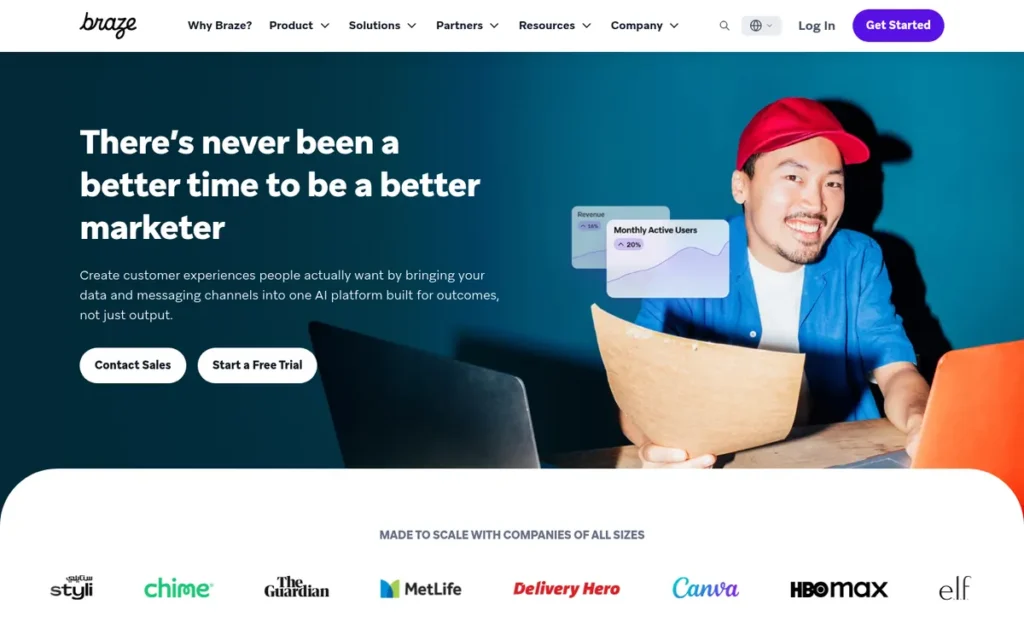
Category: Enterprise Marketing Automation, AI-powered multi-channel lifecycle engagement at scale.
At a Glance
- Category: Enterprise Marketing Automation
- Best For: Large marketing and CRM teams running multi-channel lifecycle programs at scale
- Price Range: ~$30,000–$500,000+/year; no free tier; custom pricing only; entry-level typically $30,000–$60,000/year per Vendr (2024)
- Primary Strength: Braze’s Sage AI and Canvas Flow deliver the most advanced AI-powered multi-channel notification orchestration of any platform in this evaluation
- Biggest Limitation: Minimum ~$30,000–$60,000 annual spend; 3–6 month onboarding; requires a dedicated platform administrator, creating a hidden staffing cost beyond the license fee
- One-Line Summary: Braze is the most feature-complete enterprise proactive notification platform in this evaluation, recognized as a Gartner Magic Quadrant Leader in Multichannel Marketing Hubs for three consecutive years (2023, 2024, 2025).
- Last Verified: May 2026
Overview
Braze is a customer engagement platform delivering proactive, personalized notifications across email, SMS, push (mobile and web), in-app messaging, content cards, and webhooks. Braze is purpose-built for enterprise and growth-stage companies running sophisticated behavioral trigger programs and lifecycle retention campaigns, not emergency alerting or basic transactional messaging.
Braze’s FY2025 revenue was $574.6 million, with a dollar-based net retention rate of 111%, meaning existing customers increase platform spend year-over-year (Braze Q4/FY2025 Earnings, investors.braze.com, 2025). Entry-level contracts start at approximately $30,000–$60,000/year, scaling to $500,000+ for large enterprise, based on Monthly Active Users reached, not messages sent, per Vendr procurement intelligence (Vendr, 2024).
Key Features
- Canvas Flow Journey Builder: Braze’s Canvas Flow enables sophisticated multi-step, multi-channel notification workflows with real-time behavioral branching, A/B testing, and automatic channel switching, consistently cited in G2 reviews by enterprise marketing operations teams as the strongest multi-channel behavioral journey builder in the category (G2, 2024).
- Sage AI Suite: Braze’s Sage AI (launched 2023, expanded 2024) includes send-time optimization, predictive audience segmentation, generative content creation, and intelligent channel routing, automatically delivering each notification via the channel most likely to convert each individual user based on their behavioral history.
- Real-Time Behavioral Trigger Engine: Braze fires notifications in seconds based on in-app events, purchase history, session activity, and custom API events, enabling genuine event-driven immediacy rather than batch-window processing for behavioral programs.
- Native Multi-Channel Coverage: Braze delivers proactive notifications across push, email, SMS, in-app messaging, content cards, and webhooks from a single unified customer profile, eliminating the need to stitch together multiple vendor integrations for core notification channels.
- Currents Data Streaming: Braze’s Currents feature streams real-time engagement event data to Amplitude, Mixpanel, Segment, and Snowflake, enabling cross-platform attribution without manual exports or processing lag between systems.
Best For
Braze is best suited for large enterprise marketing teams, consumer app companies with millions of active users, and growth-stage companies above approximately $50M ARR with dedicated CRM or lifecycle marketing staff to operate the platform at full capacity.
Strengths
- Gartner Magic Quadrant Leadership: Braze has received Gartner Magic Quadrant Leader recognition in the Multichannel Marketing Hubs category for three consecutive years (2023, 2024, 2025), the most widely used enterprise procurement validation signal in the notification software category (Braze Investor Relations, 2024; Braze, 2025).
- Documented Customer ROI: Domino’s UK reported a 40% increase in customer reorder rates after implementing Braze-powered personalized push campaigns triggered by order history, Braze-reported (braze.com/customers/dominos). Grubhub reported a 28% lift in engagement versus their previous batch-and-blast approach, Braze-reported (braze.com/customers/grubhub).
- High Verified Multi-Platform Ratings: Braze holds a G2 rating of 4.5/5.0 from 1,000+ verified reviews and a TrustRadius score of 8.6/10 from 350+ reviews (TrustRadius, 2024), with consistent enterprise user praise for Canvas Flow segmentation depth and real-time trigger capabilities.
- Platform Stickiness Signal: Braze’s 111% dollar-based net retention rate (FY2025) confirms that existing customers expand their notification programs and platform spend year-over-year, a strong indicator of genuine operational utility beyond initial onboarding (Braze Q4/FY2025 Earnings, investors.braze.com, 2025).
Limitations
- Price Accessibility: Braze’s estimated $30,000–$60,000/year minimum effectively excludes small businesses, early-stage startups, and organizations without meaningful marketing operations budgets, per G2 user disclosures, 2024 and Vendr deal data, 2024.
- Onboarding Complexity: Braze’s implementation timeline is commonly reported as 3–6 months, with multiple G2 reviewers, 2024 noting that a full-time dedicated Braze administrator is effectively required to manage the platform at capacity, creating a hidden staffing cost beyond the license fee.
- Feature Utilization Gap: Reddit community discussions on r/startups document cases of companies paying $150,000–$180,000/year while utilizing an estimated 30–40% of available features, reflecting a capability-to-team-capacity mismatch that inflates the effective cost per feature used.
- AI Optimization Requires Scale: Braze’s Sage AI send-time optimization and predictive channel routing produce diminishing returns for audiences below approximately 100,000 MAUs, where insufficient behavioral data limits per-user model accuracy, a meaningful constraint for growth-stage companies earlier in their scaling trajectory.
Users on r/Emailmarketing noted:
“I see lots of people recommending industry-specific tools (while all tools can send emails, you’re going to have a bad time if you don’t fit the core use case), so a word of warning:
- If you’re not an ecommerce store, then Klaviyo, Omnisend, Sendlane make zero sense
- If you’re not enterprise and don’t have a dedicated marketing + development team, Iterable, Marketo, Braze etc. don’t make sense (and they will cost more than ActiveCampaign)
That said, conversely, if you do fit those use cases, definitely worth checking out the above.” Posted by u/behavioralsanity
Takeaway: Without an enterprise-scale team and dedicated marketing operations staff, Braze and Iterable create cost commitments that consistently exceed what most organizations can operationalize.
Verdict
Braze is the most feature-complete enterprise proactive notification platform in this evaluation, and the evidence for that position is strong: Gartner Magic Quadrant Leader recognition for three consecutive years (2023, 2024, 2025), $574.6 million FY2025 revenue, a 111% net retention rate, and Braze-reported customer ROI at Domino’s and Grubhub all confirm enterprise-grade delivery.
Braze is the correct choice for organizations with the budget, team capacity, and notification program maturity to operationalize its full feature set. For companies under $50M ARR or without a dedicated lifecycle marketing team, Braze’s power-to-utilization ratio makes Iterable or Klaviyo a more pragmatic investment.
2. Klaviyo: Best Proactive Notification Software for E-Commerce Brands
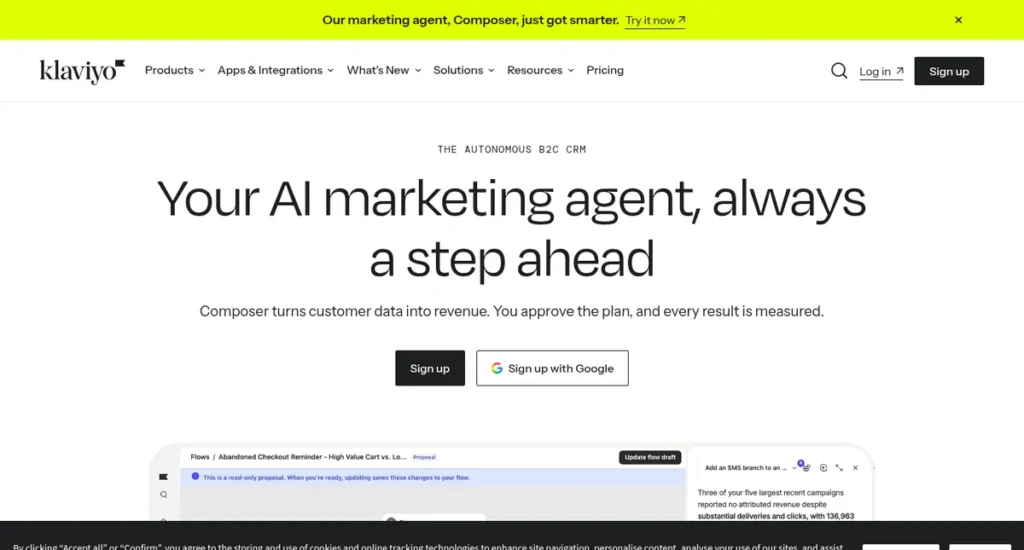
Category: E-Commerce Marketing Automation, behavioral trigger email and SMS with native Shopify integration.
At a Glance
- Category: E-Commerce Marketing Automation
- Best For: Shopify, BigCommerce, and DTC e-commerce brands running email and SMS notification flows
- Price Range: Free (250 contacts); Email from $20/month; Email+SMS from $35/month; scales by contact count with a public interactive pricing calculator
- Primary Strength: Klaviyo’s native first-party e-commerce data model enables predictive CLV, churn scoring, and back-in-stock triggers without requiring a separate Customer Data Platform
- Biggest Limitation: Built primarily for e-commerce: SaaS and B2B teams find workflows, templates, and behavioral models limiting outside the retail purchase-event context
- One-Line Summary: Klaviyo is the leading email and SMS marketing automation platform for e-commerce, powering 157,000+ paying businesses with the highest G2 rating (4.6/5.0) and the most transparent pricing model in the proactive notification category.
- Last Verified: May 2026
Overview
Klaviyo is an email and SMS marketing automation platform with native, deep integration into e-commerce platforms, particularly Shopify, BigCommerce, Magento, and WooCommerce. Klaviyo’s distinguishing architecture is that it holds first-party e-commerce data natively, order history, browsing behavior, product catalog, and predictive CLV, and uses that data to trigger and personalize notifications without requiring a separate Customer Data Platform.
Klaviyo powers over 157,000 paying businesses globally (Klaviyo Q3 2024 Earnings, investors.klaviyo.com, October 2024), with SMS adoption expanding across all customer tiers, more than 80% of Klaviyo’s top 50 customers use Klaviyo SMS (Q3 2024 Earnings, investors.klaviyo.com, October 2024). Klaviyo’s publicly available pricing starts at free (250 contacts) and scales to approximately $400/month at 50,000 contacts, with a public interactive calculator making total cost modeling possible before any sales conversation.
Key Features
- Pre-Built E-Commerce Flows: Klaviyo includes out-of-the-box behavioral trigger templates for abandoned cart, browse abandonment, post-purchase sequences, price drop alerts, back-in-stock notifications, and VIP win-back campaigns, all connected to real-time Shopify data without custom API configuration.
- Predictive Analytics Engine: Klaviyo’s native predictive models generate Predicted Customer Lifetime Value (pCLV), predicted next order date, churn risk scores, and product recommendation signals, enabling trigger logic such as “this customer is predicted to churn in 30 days, send a win-back offer now” rather than static time-based rules.
- Unified Email and SMS from One Platform: Klaviyo manages email and SMS campaigns, automations, and segmentation from a single interface with a shared customer profile, reducing multi-vendor complexity for e-commerce teams managing both channels simultaneously.
- Contact-Based Pricing Advantage: Klaviyo charges per contact in the database regardless of send frequency, meaning high-frequency notification programs (daily deal alerts, flash sale campaigns) pay no additional marginal cost per message beyond the base contact count (Klaviyo Pricing Page, 2025).
- Shopify Exclusive Integration: Klaviyo is Shopify’s exclusive email marketing partner, with Shopify holding an approximately 10% equity stake (Klaviyo S-1 Filing, ir.klaviyo.com), ensuring first-class API access and co-marketing depth that no competitor can replicate.
- Transparent Live Pricing Calculator: Klaviyo publishes an interactive pricing calculator on its public pricing page, the only platform in this comparison allowing buyers to model total cost of ownership in full before engaging a sales team.
Best For
Klaviyo is best suited for direct-to-consumer e-commerce brands, Shopify-based retailers, and DTC subscription businesses that need behavioral trigger email and SMS automation with first-party purchase data as the trigger source, without requiring a separate CDP or dedicated engineering team for data integration.
Strengths
- Highest Multi-Platform Rating in Category: Klaviyo holds a G2 rating of 4.6/5.0 from 1,000+ verified reviews, a Capterra rating of 4.7/5.0 from 450+ reviews, and a Shopify App Store rating of 4.3/5.0 from 3,700+ reviews, the highest combined multi-platform rating of any product in this comparison.
- Documented Revenue Benchmarks: Klaviyo’s own benchmark data reports abandoned cart email flows generate an average of $3.65 in revenue per recipient, with top-decile senders generating $28.89 per recipient (Klaviyo Email Benchmarks, klaviyo.com/blog/abandoned-cart-benchmarks, 2024). Back-in-stock notification flows are among Klaviyo’s highest-engagement automated trigger types, verify current open rate and CTR benchmarks at klaviyo.com/resources/email-benchmarks before publication.
- Verified Customer ROI: ColourPop Cosmetics reported $4.5 million in additional attributable revenue in a single year after implementing Klaviyo’s abandoned browse and VIP win-back flows, Klaviyo-reported, reflecting Klaviyo’s attribution methodology (klaviyo.com/case-studies/colourpop).
- Market Validation at Scale: Klaviyo’s approximately $937.5 million FY2024 revenue at an estimated 34% year-over-year growth rate (Klaviyo Investor Relations, ir.klaviyo.com) confirms that the platform’s e-commerce notification value proposition is converting at scale, not just in case studies.
This aligns with community discussion on r/Emailmarketing:
“Klaviyo nailed the ecom + automation sweet spot…plug-and-play Shopify integration, powerful flows, real-time data triggers, and it just prints money for DTC brands without needing devs or duct tape.” Posted by u/No_Molasses_1518
Takeaway: Klaviyo’s Shopify-native data model and pre-built revenue flows have made it the default platform for DTC brands that need automated revenue capture without engineering overhead.
Limitations
- E-Commerce Vertical Constraint: Klaviyo’s template library, pre-built flows, and predictive models are built for purchase-event data, a SaaS company wanting to trigger a notification when a user has not completed onboarding Step 3 in 48 hours will find no native template and significantly more complex custom event mapping than Klaviyo’s standard e-commerce triggers. G2 reviewers, 2024 consistently describe Klaviyo as “clunky” outside e-commerce contexts.
- Contact List Scaling Costs: Klaviyo’s contact-based pricing creates non-linear cost jumps as email lists grow, multiple G2 reviewers, 2024 document approximately $100/month increases per 5,000-contact tier increment, surprising high-growth brands that built cost models on early-tier pricing.
- Push Notifications Are an Add-On: Klaviyo’s mobile push notification capability is an add-on feature rather than a core channel, brands needing equal-depth mobile push alongside email and SMS will find OneSignal or Braze more purpose-built for that combination.
- No AI-Powered Cross-Channel Routing: Unlike Braze’s Sage AI, which automatically selects the optimal channel per user, Klaviyo’s AI capabilities focus on predictive audience modeling rather than real-time cross-channel routing, requiring marketers to configure channel priority manually within each flow.
Verdict
Klaviyo is the definitive proactive notification platform for e-commerce brands, and the multi-platform evidence for that position is consistent and strong: the highest G2 rating among all seven evaluated platforms (4.6/5.0 from 1,000+ reviews), approximately $937.5 million FY2024 revenue, $3.65 average revenue per recipient on abandoned cart flows (top-decile: $28.89), 3,700+ Shopify App Store reviews, and the only exclusive Shopify partnership with equity backing in this comparison.
Klaviyo’s limitation is equally well-documented: it is purpose-built for e-commerce, and teams outside that vertical consistently encounter workflow templates and data models that do not map to their trigger logic. For Shopify-based brands specifically, Klaviyo represents the highest-confidence recommendation in this evaluation.
3. OneSignal: Best Free Proactive Notification Software for SMBs and Developers
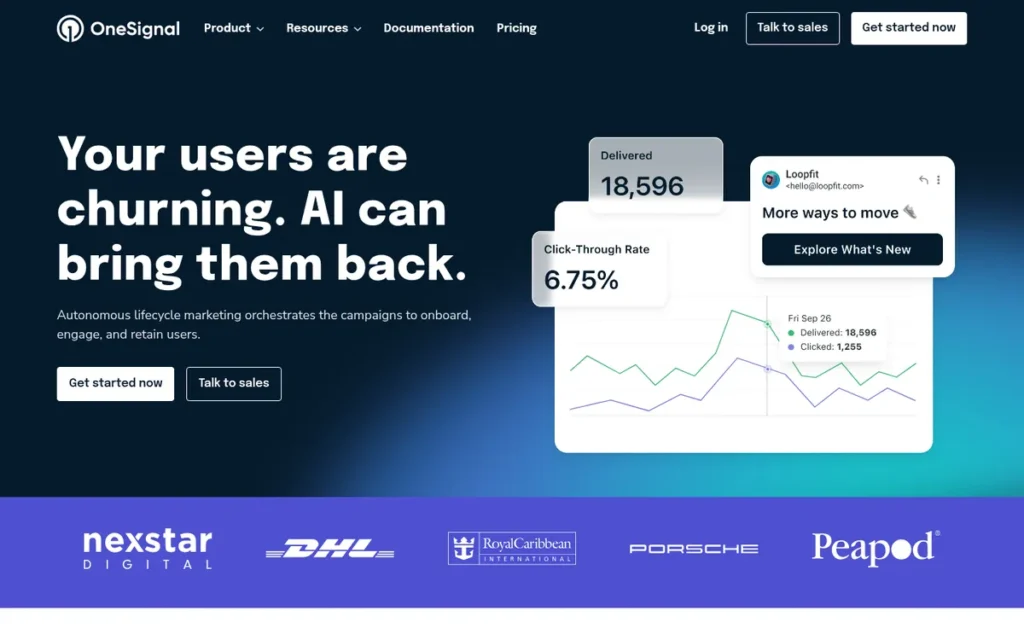
Category: SMB Multi-Channel Platform, accessible push, email, and SMS with the most generous free tier in the category.
At a Glance
- Category: SMB / Developer Multi-Channel Platform
- Best For: Indie developers, startups, and small businesses needing push notifications with low or no upfront cost
- Price Range: Free (unlimited push subscribers); Growth $9/month; Professional $99/month; Enterprise ~$2,000/month+
- Primary Strength: OneSignal’s free plan covers unlimited web and mobile push subscribers, the most generous free notification offering in this comparison, with no artificial subscriber cap
- Biggest Limitation: Analytics are shallow below Enterprise tier; no revenue attribution or funnel conversion tracking on Free or Growth plans
- One-Line Summary: OneSignal is the most widely adopted push notification service globally by number of apps and websites, serving 1 million+ developers and businesses with the highest G2 review count in the push subcategory (1,100+) and a genuinely useful free tier covering unlimited push subscribers.
- Last Verified: May 2026
Overview
OneSignal is a multi-channel customer messaging platform covering push notifications (mobile app, web browser), email, SMS, and in-app messaging. OneSignal serves over 1 million developers and businesses across 190 countries as the most widely adopted push notification service globally by number of apps and websites (OneSignal Company Overview, onesignal.com, 2024).
OneSignal’s core proposition is accessibility: a no-code dashboard with a genuinely useful free tier makes it the default first choice for indie developers, startups, and small businesses entering proactive notifications for the first time. OneSignal’s SDK integrates with 30+ platforms, including WordPress, Shopify, Wix, React Native, and Flutter (OneSignal Integrations Directory, onesignal.com, 2024), enabling implementation in under 30 minutes without requiring a developer. Paid plans start at $9/month (Growth), $99/month (Professional), and approximately $2,000/month (Enterprise) (OneSignal Pricing Page, 2025).
Key Features
- Broadest Cross-Platform Device Coverage: OneSignal supports push notifications across iOS, Android, web (Chrome, Firefox, Safari), Huawei devices (without Google Play Services), and Amazon Fire OS, the broadest push device coverage of any platform in this comparison, relevant for global audiences in Android-dominant markets.
- No-Code Dashboard: OneSignal’s web dashboard allows marketers and non-technical founders to create, schedule, segment, and A/B test push notification campaigns without writing code, enabling independent operation by marketing teams with no developer involvement.
- Automated Behavioral Trigger Journeys: OneSignal’s automated notification triggers, abandoned cart, re-engagement, post-purchase, produce average click-through rates of 6–10% versus a 1–2% industry average for undifferentiated broadcast campaigns (OneSignal Push Notification Benchmarks, onesignal.com, 2024), OneSignal-reported.
- Multi-Channel from One Platform: OneSignal manages push, email, SMS, and in-app messages from a single platform dashboard, reducing vendor fragmentation for teams building their first notification program from scratch.
- Genuinely Useful Free Tier: OneSignal’s free plan covers unlimited web push subscribers, unlimited mobile push subscribers, up to 10,000 email subscribers, and 1,000 SMS, a scope that adequately serves most early-stage apps and websites without any payment required.
- 30+ Native Platform Integrations: OneSignal integrates natively with Shopify, WordPress, React Native, Flutter, and 25+ additional developer and marketer platforms (OneSignal Integrations Directory, onesignal.com, 2024), enabling rapid deployment without custom integration engineering.
Best For
OneSignal is best suited for indie developers, app studios, early-stage startups, and small businesses that need to implement push notifications quickly with minimal technical overhead and zero or near-zero upfront cost, particularly mobile gaming companies, media publishers, and e-commerce brands with fewer than 10,000 email subscribers.
Strengths
- Highest Review Count in Push Notification Subcategory: OneSignal holds a G2 rating of 4.5/5.0 from 1,100+ verified reviews and a Capterra rating of 4.6/5.0 from 250+ reviews, the highest review count in the push notification subcategory, reflecting broad adoption across diverse user types and industries.
- Behavioral Trigger Performance at No Cost: OneSignal’s automated triggers produce average CTRs of 6–10% versus 1–2% for broadcast notifications (OneSignal Push Notification Benchmarks, 2024) (OneSignal-reported) delivering the core ROI of behavioral automation on the free tier with no platform fee required.
- Enterprise-Level Use Case Validation: Zynga uses OneSignal for behavioral push notifications to mobile game players, with gaming companies reporting 15–25% improvements in 7-day retention rates from behavioral trigger campaigns (OneSignal Case Studies, onesignal.com/case-studies (year unconfirmed; editorial team to verify before publication)) OneSignal-reported.
- Lowest Implementation Barrier in Category: OneSignal enables a non-technical marketing manager to add push notifications to a Shopify store or WordPress site in under 30 minutes, materially faster than Twilio (API-first), Braze (3–6 month onboarding), or Iterable (full sales cycle required before any platform access).
Limitations
- Analytics Ceiling Below Enterprise Tier: OneSignal’s analytics on Free and Growth plans are limited to click tracking and open rates, revenue attribution, conversion tracking, and funnel reporting require Enterprise tier or custom API integration, per G2 user reviews, 2024.
- Segmentation Constraints That Cap ROI Demonstration: OneSignal’s behavioral segmentation capabilities have meaningful limits below the Professional ($99/month) tier, creating a ceiling for teams that need to demonstrate notification ROI against revenue outcomes to leadership or justify platform spend.
- SMS Cost Premium vs. Raw Infrastructure: OneSignal’s US SMS pricing at approximately $0.01/message is more expensive per-message than Twilio’s $0.0079/message, high-volume SMS senders will eventually encounter a cost efficiency case for separating their SMS infrastructure from their push platform.
- Feature Maturity Gap vs. Peers: Multiple G2 reviewers, 2024 note that OneSignal’s analytics and intelligence features have not evolved at the same pace as its user base growth, the platform excels at delivery but trails Klaviyo, Braze, and Iterable on behavioral insight depth at comparable price points.
One developer on r/iOSProgramming shared their experience:
“Last 8 months have been a nightmare for me. In January 2024, I added onesignal sdk for push notifications in 3 of my ios apps and 1 app in may 2024. Reported it from the beginning to the customer support. Everyday i could see 2-3 crashes which I kept ignoring. And crashes which happened due to onesignal sdk only, because i can read the crash report and tell what is causing those crashes, even onesignal agreed to it kindly see their github ios sdk page issues section. They updated the SDK but it was already very late. App store algorithm dropped the ranking of my apps drastically in march 2024 because of the crashes. We lost 60% of our users.” Posted by u/vwdrow
Takeaway: OneSignal SDK instability has caused App Store ranking penalties for iOS developers, creating compounding audience losses that analytical-depth limitations alone understate.
Verdict
OneSignal is the best entry point for proactive notifications in 2026, the evidence is the 1 million+ user base, the highest review count in the push notification subcategory (1,100+ G2 reviews at 4.5/5.0), and a free tier that is among the least artificially restricted in this comparison, covering unlimited push subscribers with no engagement cap.
OneSignal’s limitation is equally well-documented: the platform is built for delivery, not deep analytics. Teams that need revenue attribution or sophisticated behavioral segmentation will outgrow Free and Growth tiers faster than the pricing structure suggests. The jump from Professional ($99/month) to Enterprise (approximately $2,000/month) is a 20x price increase with no published mid-tier, teams approaching that ceiling should evaluate Klaviyo or Iterable before committing to OneSignal’s Enterprise tier.
4. Twilio: Best Proactive Notification Infrastructure for Developer Teams
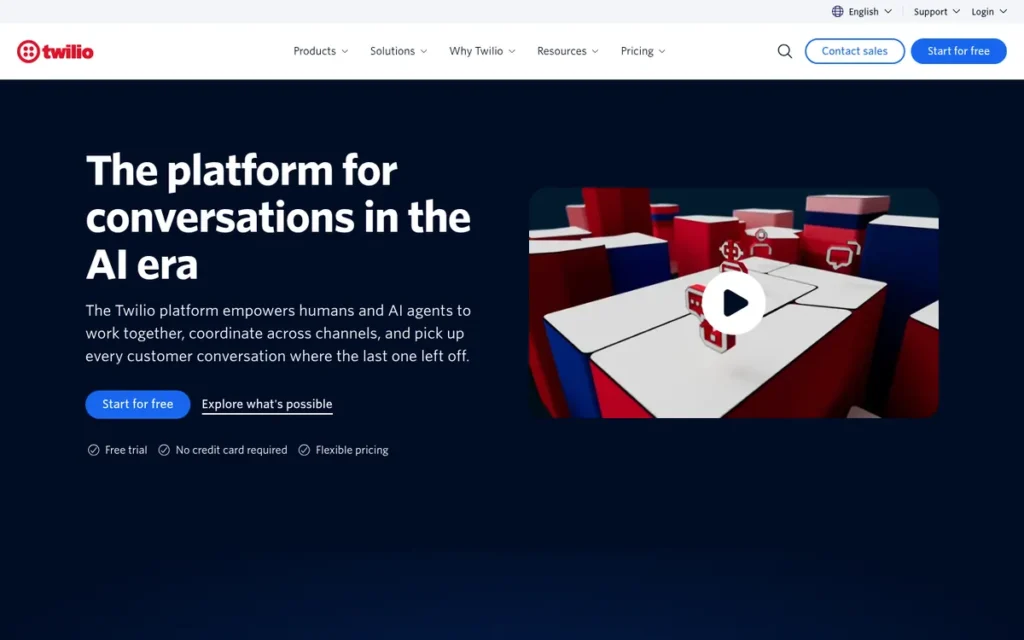
Category: Developer Infrastructure / CPaaS, API-first multi-channel notification delivery at global scale.
At a Glance
- Category: Developer Infrastructure (CPaaS)
- Best For: Technical teams building custom notification systems requiring full programmatic control
- Price Range: Pay-as-you-go; US SMS $0.0079/message outbound; Voice $0.013/minute; SendGrid email free to $89.95+/month; no monthly minimum
- Primary Strength: Twilio provides the broadest global deliverability infrastructure in this comparison (180+ countries, over 1 trillion API requests/year) with pay-as-you-go economics and no lock-in
- Biggest Limitation: No no-code interface: API-first only; support effectively documentation-only for small accounts; billing complexity at scale; marketing use cases carry documented account suspension risk
- One-Line Summary: Twilio is the foundational CPaaS infrastructure for proactive notifications, serving 300,000+ active customers across 180+ countries with pay-as-you-go SMS, voice, WhatsApp, and email APIs processing over 1 trillion requests annually.
- Last Verified: May 2026
Overview
Twilio is a cloud communications Platform-as-a-Service (CPaaS) enabling developers and businesses to programmatically send SMS, MMS, WhatsApp messages, voice calls, and email (via SendGrid) via REST APIs. Twilio provides the underlying API infrastructure that a significant portion of the notification software market relies on, its REST APIs are widely used as backend delivery building blocks by other SaaS notification products. Twilio serves 300,000+ active customer accounts globally (Twilio Q4/FY2023 Earnings, investors.twilio.com, 2024).
Twilio’s full-year 2023 revenue was $4.15 billion (Twilio Q4/FY2023 Earnings, investors.twilio.com, 2024), and its platform processes over 1 trillion API requests annually. US SMS pricing is $0.0079/message with no monthly minimum, a business sending 100,000 US SMS per month pays approximately $790 in messaging fees alone (Twilio Pricing Page, twilio.com, 2025).
Key Features
- Global SMS and MMS Infrastructure: Twilio’s Messaging API provides programmatic SMS/MMS delivery to 180+ countries with carrier relationships across all major networks, the broadest geographic notification reach of any platform evaluated, supporting both transactional and marketing message types.
- Multi-Channel API Suite: Twilio provides REST APIs covering SMS ($0.0079/message), MMS, WhatsApp (from $0.005/message), voice calls ($0.013/minute outbound), and email via SendGrid, all accessible through a unified API account with shared authentication and logging (Twilio Pricing Page, twilio.com, 2025).
- Pay-As-You-Go Economics: Twilio charges no monthly minimum for most products: organizations pay only for messages sent, making Twilio the lowest-cost entry point for low-volume programs and the most predictable cost model for variable-volume use cases (Twilio Pricing Page, twilio.com, 2025).
- Segment CDP Integration: Twilio’s 2020 acquisition of Segment ($3.2 billion) adds a Customer Data Platform layer to raw API infrastructure, enabling behavioral trigger segmentation without a separate CDP vendor when the full stack is used in combination (Twilio Press Release, 2020).
- SendGrid Email Infrastructure: Twilio’s 2019 acquisition of SendGrid ($3 billion) provides enterprise-grade email deliverability infrastructure, including dedicated IP management and deliverability analytics, integrated under the same account as SMS and voice (Twilio Press Release, 2019).
Best For
Twilio is best suited for software development teams, SaaS companies embedding notification capabilities into their own products, startups requiring programmatic control over every aspect of delivery, and enterprises that have built or plan to build a custom notification infrastructure using globally scaled API building blocks.
Strengths
- Unmatched Global Delivery Scale: Twilio processes over 1 trillion API requests annually and reaches 300,000+ active customers across 180+ countries (Twilio Q4/FY2023 Earnings, investors.twilio.com, 2024). SMS messages via Twilio achieve average open rates consistent with the 98% industry-wide SMS benchmark, per Twilio’s published benchmarks (Twilio SMS Benchmarks, twilio.com, 2023), Twilio-reported, consistent with industry-wide figures.
- Proven at Highest-Volume Use Cases: DoorDash uses Twilio to send real-time order status notifications to millions of customers daily (Twilio Customer Stories, twilio.com, 2023), alongside Uber, Airbnb, Netflix, and Lyft, validating infrastructure reliability at the highest transactional notification volumes in commercial use.
- Developer Trust Signal: Twilio holds a G2 rating of 4.2/5.0 from 450+ reviews and a Capterra rating of 4.3/5.0 from 400+ reviews, driven predominantly by developers and engineering teams praising API reliability, documentation quality, and multi-channel breadth over multi-year review histories.
- Compliance Infrastructure: Twilio’s SOC 2 Type II, HIPAA, GDPR, and ISO 27001 certifications (Twilio Trust & Security, twilio.com/en-us/security, verified 2024) make Twilio one of the most compliance-certified platforms in this comparison, relevant for healthcare, financial services, and government notification deployments.
Limitations
- No No-Code Interface: Twilio is API-first by design: building even basic notification workflows requires engineering resources, making Twilio inaccessible to non-technical marketing teams without custom development, per G2 reviews, 2024.
- Support Absent for Small Accounts: G2 reviews, 2024 consistently document Twilio support as documentation-only for accounts below enterprise spend thresholds, billing issues and account suspensions have been reported to take 2–4 weeks to resolve at smaller spend tiers, with no dedicated human support contact available.
- Marketing Use Case Risk: Twilio’s abuse detection systems are calibrated for transactional messaging, documented Reddit community reports on r/smallbusiness include account suspensions for promotional SMS campaigns, with resolution timelines of 2–4 weeks. Mass marketing blasts via Twilio infrastructure carry a higher account suspension risk than purpose-built marketing automation platforms.
- Billing Complexity at Scale: Twilio’s per-item PAYG pricing across SMS, voice, WhatsApp, and email creates multi-line billing that is difficult to model without prior usage data, mixed-channel notification programs at scale may produce unexpected bills until usage patterns are fully mapped and monitored.
Verdict
Twilio is the infrastructure backbone of the proactive notification industry, and its scale is the evidence: 300,000+ active customers, over 1 trillion annual API requests, and deployments at DoorDash, Uber, and Airbnb confirm infrastructure-grade reliability with no peer in this comparison.
Twilio is the correct choice for technical teams that need programmatic control, global reach, and pay-only-for-what-you-use economics. Twilio is not the correct choice for non-technical marketing teams seeking a campaign builder, or for small businesses that depend on accessible customer support, in those scenarios, OneSignal or Klaviyo deliver a materially better operational experience at comparable or lower cost.
5. Iterable: Best Proactive Notification Platform for SaaS and Growth-Stage Apps
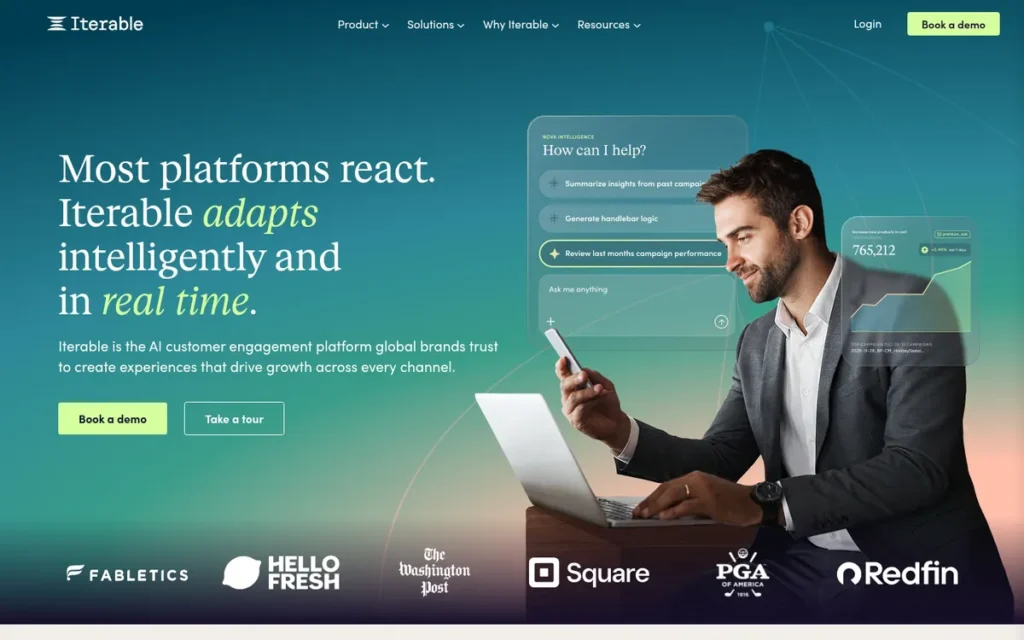
Category: Growth Marketing Automation, cross-channel notification journeys for non-e-commerce B2C and SaaS teams.
At a Glance
- Category: Growth Marketing Automation
- Best For: SaaS companies, marketplace platforms, and consumer apps at growth stage needing custom event-driven notifications
- Price Range: No free tier; estimated $40,000–$500,000/year; no public pricing; sales engagement required before any hands-on platform access
- Primary Strength: Iterable’s custom event API ingests any behavioral signal: SaaS usage events, marketplace transactions, ride-share triggers, enabling proactive notifications that e-commerce-centric platforms cannot replicate without significant workarounds
- Biggest Limitation: No free tier, no self-serve trial, no public pricing: the highest evaluation friction of any platform in this comparison; SMS deliverability inconsistency documented in G2 reviews
- One-Line Summary: Iterable is a cross-channel marketing automation platform purpose-built for growth-stage SaaS and B2C apps, offering flexible custom event ingestion and a Workflow Studio rated by G2 users as more intuitive than Braze Canvas for non-technical marketing teams.
- Last Verified: May 2026
Overview
Iterable is a cross-channel marketing automation and customer communication platform supporting email, SMS, push notifications (mobile and web), in-app messaging, and direct mail. Iterable occupies the mid-tier between Klaviyo (e-commerce specialists) and Braze (largest enterprise), targeting growth-stage technology companies, SaaS businesses, consumer apps, and marketplace platforms that need multi-channel notification sophistication without pure enterprise complexity.
Iterable’s key architectural differentiator is data model flexibility: Iterable accepts any custom event via API (not just e-commerce purchase events) making it suitable for SaaS product usage signals, ride-share events, financial transactions, or any behavioral trigger that would require workarounds in Klaviyo. Notable customers include DoorDash, Priceline, Zillow, SeatGeek, Calm, and ClassPass (Iterable Customers, iterable.com/customers/, 2024). Industry estimates from Vendr (2024) place typical contracts at $40,000–$500,000/year, with Iterable generally positioned as 20–30% less expensive than Braze for comparable contract sizes (Vendr, 2024).
Key Features
- Custom Event API: Iterable accepts any custom behavioral event via API: enabling notification triggers such as “user hasn’t completed onboarding Step 3 in 48 hours” or “account has been idle for 14 days” without the e-commerce-centric constraints that limit Klaviyo for non-retail behavioral logic.
- Workflow Studio: Iterable’s visual journey builder provides multi-step, multi-channel notification flows with A/B testing, behavioral splits, and real-time audience segmentation, rated by multiple G2 reviewers, 2024 as more accessible for non-engineers than Braze’s Canvas Flow.
- Cross-Channel Multi-Touch Orchestration: Iterable manages email, SMS, push, in-app messaging, and direct mail from a single platform, enabling retargeting sequences such as push → email → SMS for users who viewed but did not complete a purchase, as SeatGeek used to drive a 19% increase in ticket purchase completion, per Iterable case studies (iterable.com/customers/seatgeek/, case study dated 2018; Iterable-reported).
- Mobile and Web Push Native: Iterable delivers push notifications for iOS, Android, and web browsers natively within the Workflow Studio canvas, allowing channel selection per journey step without switching platforms or managing separate push infrastructure.
- Enterprise Salesforce Integration: Iterable integrates natively with Salesforce CRM, enabling account-based notification triggers from sales activity data, relevant for SaaS companies with hybrid product-led growth and sales-assisted conversion motions.
- Real-Time Audience Segmentation: Iterable’s segmentation filters on custom event properties, behavioral history, and third-party data inputs, supporting complex audience definitions needed by marketplaces with diverse user segments across buyer and seller personas.
Best For
Iterable is best suited for growth-stage SaaS companies, marketplace platforms in travel or ticketing, consumer subscription apps, and B2C technology businesses with complex behavioral notification triggers that go beyond purchase history, particularly companies that have outgrown simpler tools but are not yet ready for Braze’s enterprise pricing or organizational overhead.
Strengths
- Documented Customer Performance: Priceline reported a 35% increase in mobile push notification open rates after migrating to Iterable and implementing personalized behavioral-triggered campaigns, Iterable-reported (iterable.com/customers/priceline/, year unconfirmed; editorial team to verify). SeatGeek reported a 19% increase in ticket purchase completion through multi-touch notification sequences, Iterable-reported (iterable.com/customers/seatgeek/, 2018).
- Accessible Multi-Channel Journey Builder: Iterable’s Workflow Studio is consistently rated by G2 reviewers, 2024 as more accessible for non-engineers than Braze’s Canvas Flow, an important operational distinction for growth-stage teams without dedicated technical CRM staff who need to build and modify journeys independently.
- Investor-Backed Platform Longevity: Iterable is backed by Capital G (Google’s growth equity fund), Index Ventures, and CRV (Crunchbase, 2024), with $485 million in total funding and a $2 billion valuation from its 2021 Series E, signaling platform longevity appropriate for multi-year enterprise contract commitments.
- Verified Multi-Platform Ratings: Iterable holds a G2 rating of 4.4/5.0 from 600+ reviews and a TrustRadius score of 8.4/10 from 200+ reviews (TrustRadius, trustradius.com/products/iterable/reviews, 2024), with consistent praise for Workflow Studio UX and cross-channel orchestration depth.
Users on r/MarketingOpsForSaaS who evaluated all three platforms after a year of hands-on use shared their findings:
“Iterable. Strengths. Strongest journey-builder UI for marketers. Native A/B testing on email and journey path. Catalog of pre-built journey templates that, once you adapt them, save real time. Strong cross-channel (email + SMS + push) with shared user-data layer. Weaknesses. Pricing scales with monthly active users in a way that punishes PLG-shape companies with broad active-user counts. Behavior-trigger SDK setup historically heavier than Customer.io. Some advanced segmentation lives behind feature flags / higher-tier contracts.” Posted by u/SmitVanani
Takeaway: Iterable’s journey-builder advantage over Braze holds for marketing-heavy teams, but its MAU-based pricing model creates unexpected cost penalties for PLG SaaS companies with broad active-user counts.
Limitations
- SMS Deliverability Inconsistency: G2 reviewers report 10–15% non-delivery rates on time-sensitive SMS batches, this is user-reported experience, with Iterable attributing the issue to carrier filtering rather than platform infrastructure failure (G2 reviews, g2.com, 2024). Buyers should conduct a paid test send to their own contact list before committing to annual SMS volume contracts.
- Highest Evaluation Friction in Comparison: Iterable offers no free tier, no self-serve trial, and no public pricing, buyers must complete a full sales cycle before accessing any hands-on platform experience, per G2 community feedback, 2024 and r/SaaS community discussions, making Iterable the most opaque evaluation process of any tool reviewed.
- AI Capability Gap vs. Braze: Iterable’s AI capabilities are focused on A/B testing and basic segmentation; Braze’s Sage AI includes predictive channel routing, generative content, and per-user send-time optimization, a measurable capability gap for buyers prioritizing AI-powered notification optimization, per Forrester Research, Q1 2025.
- No E-Commerce Native Integration: Iterable’s strength is custom event flexibility, but Iterable lacks Klaviyo’s out-of-the-box e-commerce flow templates and Shopify-native data sync, teams migrating from Klaviyo will need to rebuild all trigger logic from scratch, adding implementation time and engineering overhead.
Verdict
Iterable is the best proactive notification platform for growth-stage SaaS and B2C marketplace companies that need cross-channel sophistication beyond what OneSignal or Klaviyo can offer, without paying Braze’s enterprise premium. Iterable’s Workflow Studio accessibility for non-technical marketers and its flexible custom event ingestion are genuinely differentiating capabilities not matched at this price point.
Iterable’s SMS deliverability inconsistency and complete absence of self-serve evaluation options are genuine barriers. Buyers should request a peer reference from a company at comparable scale and use case, and should conduct a paid SMS test send to verify deliverability for their specific message type before committing to an annual contract.
6. Airship: Best Proactive Notification Platform for Mobile-First and Wallet Use Cases
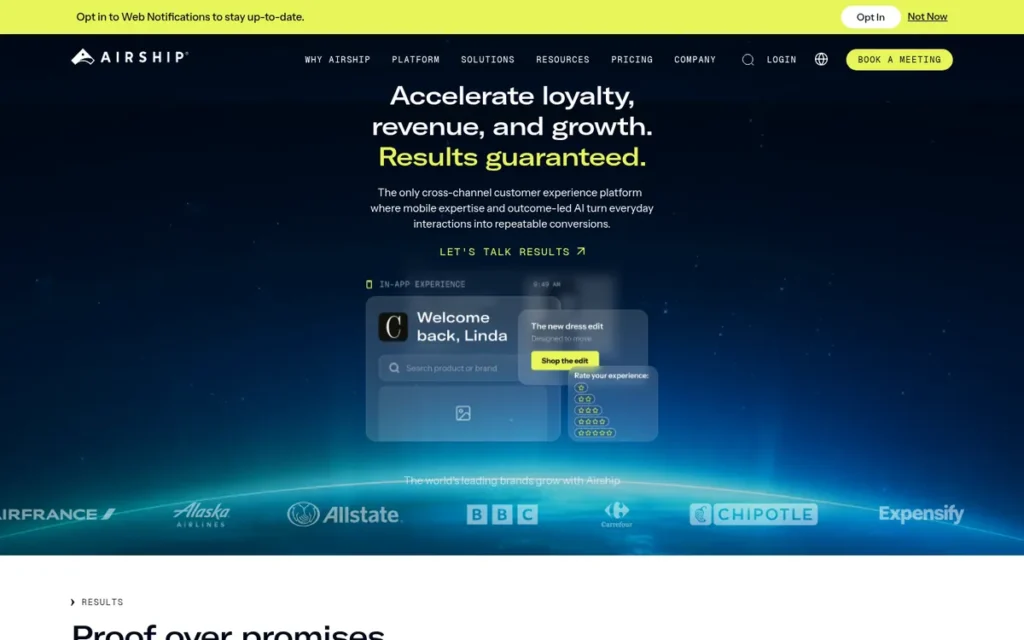
Category: Mobile-First Specialist, push notification delivery pioneer with unique native mobile wallet management.
At a Glance
- Category: Mobile-First Specialist
- Best For: Mobile apps in travel, retail loyalty, ticketing, and hospitality needing push and mobile wallet notifications
- Price Range: Essentials ~$250–$500/month; Enterprise $25,000–$250,000/year; no free tier
- Primary Strength: Airship is the only platform in this comparison with native Apple Wallet and Google Pay pass management as of May 2026, enabling dynamic loyalty card, boarding pass, and coupon notifications that bypass email and push deliverability constraints entirely
- Biggest Limitation: Dated administrative UI; cross-channel journey builder less mature than Braze or Iterable; no free tier excludes indie developers and SMBs from evaluation without a commercial commitment
- One-Line Summary: Airship is the original commercial mobile push notification platform, founded in 2009, offering unmatched push delivery infrastructure and the only native mobile wallet notification capability among all seven platforms evaluated, serving enterprise travel, retail, and hospitality brands.
- Last Verified: May 2026
Overview
Airship (formerly Urban Airship) is a mobile-first customer engagement platform delivering proactive notifications via push (iOS, Android, Huawei, Amazon), SMS, email, mobile wallet (Apple Wallet, Google Pay passes), and in-app messaging. Airship pioneered mobile push notifications in 2009 (building the first commercial push notification delivery infrastructure before Apple opened APNS to third parties) giving Airship more than 15 years of institutional knowledge on push delivery optimization (Airship Company History, airship.com/about/).
Among the seven platforms evaluated, Airship is the only one with native support for mobile wallet notifications, dynamic updates to loyalty cards, boarding passes, coupons, and event tickets. Airship reports that mobile wallet passes achieve an average of 4x higher engagement rates compared to equivalent email campaigns (Airship blog research, airship.com/blog, editorial team to confirm publication year before citing), Airship-reported. A publicly accessible Essentials plan has been reported at approximately $250–$500/month; enterprise contracts typically range from $25,000–$250,000/year, per G2 pricing disclosures (G2 Pricing, 2024).
Key Features
- Mobile Wallet Native Management: Airship creates, manages, and delivers dynamic updates to Apple Wallet and Google Pay passes (loyalty cards, boarding passes, event tickets, and discount coupons) enabling lock-screen notifications that bypass email and app push deliverability constraints entirely. Among the seven platforms evaluated, Airship is the only one with this capability as of May 2026.
- Pioneer Push Delivery Infrastructure: Airship’s 15+ years of push notification expertise and multiple patents on delivery technologies (Airship About, airship.com/about/) translate into measurable APNS delivery advantages, particularly for iOS, where delivery prioritization algorithms reward senders with historically high engagement rates.
- No-Code App Experience Editor (AXE): Airship’s AXE allows non-technical marketers to build, test, and deploy in-app notification experiences and opt-in prompt copy without engineering involvement, enabling A/B testing of permission prompts without a code deploy cycle. Burger King used Airship’s AXE to achieve a 32% increase in push opt-in rates, per Airship customer case studies (airship.com/resources/case-studies/), Airship-reported.
- Huawei and Amazon Fire OS Coverage: Airship supports push delivery to Huawei devices (without Google Play Services) and Amazon Fire OS, providing notification reach in markets where standard GCM/FCM-based platforms cannot deliver, relevant for global brands with significant Asian market presence.
- Operational Alert Reliability: Airship’s infrastructure supports time-critical operational push alerts (flight status changes, gate updates, package delivery confirmations) with delivery latency and reliability profiles that marketing automation platforms are not designed or tested to match at equivalent scale.
Best For
Airship is best suited for airlines, hotel chains, retailers with active loyalty programs, event ticketing companies, and any mobile-first enterprise brand needing real-time operational push alerts alongside mobile wallet pass management, particularly companies where the mobile app is the primary customer touchpoint and time-sensitive delivery reliability is non-negotiable.
Strengths
- Pioneer Infrastructure Credibility: Airship holds multiple patents on push notification delivery technologies and was instrumental in shaping early APNS and GCM/FCM API specifications with Apple and Google (Airship About, airship.com/about/), representing a technological foundation that newer entrants cannot easily replicate.
- Enterprise Operational Reliability: Alaska Airlines uses Airship to send real-time flight status push notifications and mobile wallet boarding pass updates, with Airship reporting 95%+ on-time notification delivery for time-critical travel alerts to millions of passengers (Airship Case Studies, airship.com/customers/alaska-airlines-mobile-wallet/), Airship-reported; the specific delivery metric was not independently confirmed.
- Permission Optimization ROI: Burger King achieved a 32% increase in push notification opt-in rates using Airship’s AXE editor to A/B test pre-permission prompt messaging, per Airship customer case studies (airship.com/resources/case-studies/), Airship-reported. Improving opt-in rates compounds across every future campaign, reaching a proportionally larger permission base permanently.
- Verified Enterprise Review Ratings: Airship holds a G2 rating of 4.1/5.0 from 130+ verified reviews fromenterprise mobile practitioners, with consistent praise for push delivery infrastructure reliability and the mobile depth of its customer support team.
Limitations
- Dated User Interface: G2 reviewers, 2024 consistently describe Airship’s UI as dated compared to newer-generation platforms, contact group management and campaign creation workflows have not been modernized at the same pace as Airship’s underlying push delivery infrastructure.
- Cross-Channel Journey Gaps: Airship’s cross-channel campaign orchestration is perceived as “bolted on rather than native,” per G2 user reviews, 2024, brands requiring sophisticated multi-channel journeys beyond mobile push and wallet are better served by Braze or Iterable for that specific orchestration use case.
- No Free Tier: Airship’s lack of a free tier excludes indie developers, small businesses, and cost-constrained evaluation teams from testing the platform without entering a commercial conversation, a significant barrier in a category where OneSignal offers equivalent push coverage at no cost.
- Two-Vendor Architecture Risk: Reddit community discussions in r/mobiledev and r/travel_tech document a recurring pattern where travel and hospitality brands run Airship for operational alerts alongside Braze for engagement campaigns, a dual-vendor architecture that effectively doubles notification platform costs while adding integration engineering overhead that Airship has not fully resolved as of May 2026.
Verdict
Airship is the best proactive notification platform for mobile-first enterprise brands in travel, hospitality, and loyalty-driven retail, specifically because of its unique mobile wallet management and 15+ years of push delivery infrastructure, neither of which any other evaluated platform can match.
Airship’s limitations are real: the UI is dated, the cross-channel journey builder trails Braze and Iterable, and the pricing excludes the SMB segment entirely. For brands where mobile wallet passes and operational push reliability are the primary notification channels, Airship has no direct equivalent in this comparison. For brands needing sophisticated multi-channel marketing automation alongside mobile push, a paired Airship and Braze or Iterable architecture may be required, but introduces double the vendor overhead and integration complexity.
7. Everbridge: Best Proactive Notification Software for Safety-Critical and Emergency Alerts
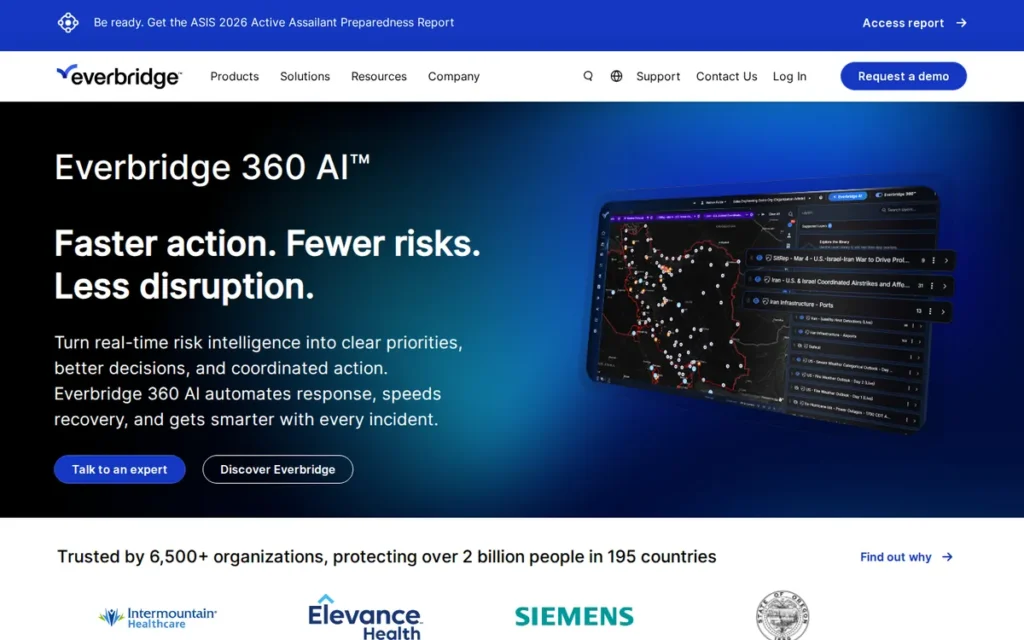
Category: Mission-Critical Mass Notification, emergency alerting and Critical Event Management for regulated industries.
At a Glance
- Category: Mission-Critical Mass Notification / Emergency Management
- Best For: Enterprise IT/operations teams, hospitals, campuses, government agencies, and organizations with duty-of-care notification requirements
- Price Range: Small enterprise $5,000–$20,000/year; mid-enterprise $30,000–$150,000/year; large enterprise/government $500,000+/year; all custom-quoted
- Primary Strength: Everbridge is the only FedRAMP Moderate-authorized mass notification platform in this comparison, with two-way confirmation, contractual 99.99% uptime SLAs, and a reachable database of 400 million+ contacts
- Biggest Limitation: Not a marketing tool; dated administrative UI; contract changes require full renegotiation; pricing mismatched for organizations under approximately 1,000 employees
- One-Line Summary: Everbridge is the only FedRAMP Moderate-authorized Critical Event Management platform evaluated in this comparison, serving 6,200+ enterprise and government customers with two-way confirmation mass notification across 400 million+ reachable contacts.
- Last Verified: May 2026
Overview
Everbridge is a Critical Event Management (CEM) and mass notification platform purpose-built for safety-critical, compliance-required, and emergency notification scenarios. Everbridge occupies a distinct category within this comparison: it is the only platform evaluated that is purpose-built for safety-critical and compliance-regulated emergency notifications, not marketing automation or customer engagement programs. This distinction is critical for any buyer evaluating tools for compliance-sensitive or safety-critical notification programs, including employee safety alerts, business continuity notifications, IT incident management, and public safety broadcasts.
Everbridge serves over 6,200 global enterprise customers and government organizations, including 100+ government agencies and 5,000+ hospitals and healthcare systems (Everbridge Company Overview, everbridge.com/company/, 2024), covering 400 million+ reachable contacts. Based on procurement data, small enterprise deployments (500–5,000 employees) typically cost $5,000–$20,000/year; mid-enterprise (5,000–50,000 employees) ranges $30,000–$150,000/year; large enterprise/government contracts can exceed $500,000/year (Vendr, 2024).
Key Features
- Two-Way Confirmation and Automatic Escalation: Everbridge’s Mass Notification product enables recipients to confirm receipt and understanding of an alert, allowing emergency coordinators to see in real time who has been reached and who hasn’t, with automatic escalation to alternative contact methods for non-responders (Everbridge Mass Notification, everbridge.com/platform/mass-notification/).
- Broadest Emergency Channel Coverage: Everbridge delivers simultaneously via SMS, voice call, email, push, desktop alert, digital signage, PA system integration, and social media, covering all available contact methods in parallel to maximize reach during a single emergency broadcast.
- FedRAMP Moderate Authorization: Everbridge holds FedRAMP Moderate authorization with ATO boundary confirmed August 2024 (FedRAMP Marketplace, marketplace.fedramp.gov/products/FR2102117742), making Everbridge the only platform in this comparison approved for U.S. federal government notification systems handling Controlled Unclassified Information.
- Contractual 99.99% Uptime SLA: Everbridge enterprise contracts include contractual uptime guarantees of 99.99% and delivery speed commitments (Everbridge Trust, everbridge.com/trust/), features that no marketing notification platform in this comparison offers in contract form.
- Critical Event Intelligence Integration: Everbridge integrates real-time threat intelligence feeds (weather alerts, civil unrest data, travel risk scores) to trigger proactive notifications based on external events, not only internal system states.
- 400M+ Reachable Contact Database: Everbridge’s global contact database enables public safety organizations to reach populations beyond their own employee or customer databases, a unique capability relevant for government and municipal emergency broadcasting at regional or national scale.
Best For
Everbridge is best suited for enterprise IT and security operations teams managing business continuity, hospitals and healthcare systems with patient and staff safety notification requirements, university and campus safety programs, government agencies with public safety broadcast mandates, and corporate enterprises with multi-geography operations requiring employee safety tracking and confirmed response during critical events.
Strengths
- Emergency-Scale Performance Under Real Conditions: Everbridge customers sent over 875 million coronavirus-related communications during the first months of the COVID-19 pandemic without reported service interruptions (Everbridge press release, everbridge.com, 2020), representing the highest sustained notification volume in the company’s operational history and a reliability benchmark that no marketing notification platform in this comparison has been tested against.
- Government-Validated Reach: Everbridge supports state and county government emergency notifications, including Wake County, NC covering nearly 1 million residents (Everbridge Newsroom, everbridge.com/newsroom, 2024), and serves 100+ government agencies globally, validating delivery infrastructure at the scale required for public safety broadcast programs.
- FedRAMP Moderate Authorization: Everbridge’s FedRAMP Moderate certification with ATO boundary confirmed August 2024 (FedRAMP Marketplace, marketplace.fedramp.gov, 2024) is a procurement prerequisite for U.S. federal agencies and a strong compliance signal for public sector, healthcare, and regulated-industry buyers with formal vendor assessment requirements.
- Professional-Grade Reviewer Validation: Everbridge holds a G2 rating of 4.4/5.0 from 120+ reviews from IT administrators, safety officers, and government professionals, a more demanding reviewer demographic than marketing team users who evaluate consumer notification platforms, making the 4.4 rating a meaningfully different quality signal than equivalent ratings on mass-market tools.
Users on r/sysadmin shared their operational experience:
“Yeah, everbridge can’t be beat. We mostly use ours for office closures during hurricanes or other safety stuff. But have used it periodically for massive enterprise wise IT shit that has brought all domain comms to a halt.” Posted by u/t00sl0w
Takeaway: Sysadmins and operations teams consistently reach for Everbridge when internal communications infrastructure itself fails, a use case that no marketing notification platform in this evaluation is designed or tested to cover.
Limitations
- Not a Marketing Tool: Everbridge has no marketing campaign builder, no behavioral trigger engine for product or purchase events, and no revenue attribution analytics, Everbridge is categorically wrong for any marketing automation use case, and buyers who have confused it with a marketing notification platform consistently report misaligned expectations in G2 reviews, 2024.
- Dated Administrative UI: G2 reviewers, 2024 consistently describe Everbridge’s administrative interface as feeling like “a 2015 product”, contact group management, data import workflows, and general platform administration have not been modernized at pace with the notification delivery infrastructure Everbridge maintains.
- Contract Inflexibility: G2 reviews, 2024 document that any modification to an Everbridge contract requires full renegotiation, a commercial rigidity associated with Thoma Bravo’s ownership model that creates friction for organizations with evolving or seasonal notification program requirements.
- Pricing Overshoot for Small Organizations: Reddit community consensus in r/sysadmin consistently identifies approximately 1,000 employees as the lower bound where Everbridge’s minimum annual contract price begins to represent appropriate cost-per-person for emergency notification coverage, below that threshold, AlertMedia or basic SMS broadcast tools are frequently recommended as more cost-appropriate alternatives.
Verdict
Everbridge is the correct proactive notification choice when lives, regulatory compliance, or federal procurement requirements are at stake, and an inappropriate choice for everything else. Everbridge’s evidence base is categorically distinct from every other platform in this comparison: 875 million coronavirus-related communications without failure, FedRAMP Moderate authorization with ATO boundary confirmed August 2024, and 6,200+ enterprise and government customers with contractual 99.99% uptime SLAs.
Buyers evaluating Everbridge should measure cost against duty-of-care risk exposure and regulatory compliance requirements (not against marketing notification platform pricing) because these are fundamentally different evaluation frameworks.
What Red Flags Should I Watch For When Evaluating Proactive Notification Software?
The most critical red flags when evaluating proactive notification software are pricing opacity that prevents cost modeling before sales engagement, analytics limitations that block ROI demonstration, and feature claims that don’t survive a use-case-specific technical evaluation. The following six red flags apply across the seven platforms reviewed and appear consistently in G2 reviews, community discussions, and procurement intelligence data.
Red Flag #1: Pricing Opacity Without Justification
Six of the seven platforms in this comparison either hide pricing entirely (Braze, Iterable, Airship, Everbridge) or have pricing that scales steeply with contact list growth (Klaviyo, OneSignal). If a vendor will not provide even a pricing range in the first sales conversation, request procurement intelligence data from Vendr or Vertice, or ask for peer references at your scale to get a real number before entering a full evaluation cycle.
Action: Request a pricing model at 2x your current audience size in the first sales conversation, before entering a full evaluation cycle.
Red Flag #2: Analytics That Cannot Prove Notification ROI
Revenue attribution, conversion tracking, and cross-channel reporting are essential for demonstrating notification program value to leadership. OneSignal’s Free and Growth tiers, Twilio’s base API infrastructure, and Iterable on lower contract tiers all limit analytics depth below what most teams need for ROI reporting. Ask vendors to show you the actual analytics dashboard at your target pricing tier (not the Enterprise demo) and verify before signing whether the platform can attribute notifications to revenue outcomes.
Action: Request a live dashboard walkthrough at your specific pricing tier, not a demo of the highest-tier interface.
Red Flag #3: SMS Deliverability Claims Without Third-Party Validation
SMS deliverability varies significantly by carrier, destination country, and message content type, and vendor-claimed deliverability rates are self-reported. G2 reviewers report user-experienced non-delivery rates of 10–15% on time-sensitive Iterable SMS batches (G2, 2024), suggesting that SMS infrastructure quality differs materially across platforms. Request a paid test send to a sample of your own contacts before committing to annual SMS volume contracts, and compare vendor claims against independent SMS benchmark sources rather than accepting self-reported figures.
Action: Request a paid test send to your own contact list before committing to any annual SMS volume contract.
Red Flag #4: “Multi-Channel” Claims That Mean One Primary Channel Plus Add-Ons
Many platforms claim multi-channel capability but deliver primary support for only one or two channels, with others as limited add-ons or third-party integrations. Airship’s cross-channel journey builder is rated less mature than its push delivery; Klaviyo’s mobile push is an add-on feature; Twilio’s behavioral trigger logic requires engineering build. Verify that the channels most critical to your use case are natively supported (not routed through a third-party aggregator) and test them specifically in a sandbox before contract signature.
Action: Ask vendors to demonstrate your specific channel combination (e.g., push + SMS + behavioral trigger) in a working sandbox before signing.
Red Flag #5: No Self-Serve Evaluation Path Before Financial Commitment
Iterable, Airship, Braze, and Everbridge all require a sales engagement before any hands-on platform access. A vendor that will not allow a time-limited trial or sandbox environment is asking you to commit budget without verified usability for your specific notification use case. Request a proof-of-concept pilot or verified peer references using the platform for your specific notification type before signing any contract.
Action: Request a sandbox account or time-limited pilot, if refused, escalate to peer reference calls with comparable organizations before signing.
Red Flag #6: Support That Tiers Sharply by Spend Level
Twilio’s support model is extensively documented in G2 reviews, 2024 as documentation-only for small accounts, with meaningful human support available only at enterprise spend. Braze and Iterable both tie customer success manager access to contract size. If your team relies on vendor support during implementation or incident troubleshooting, verify exactly what support level is contractually included at your tier, confirm it in the contract, not just in a sales conversation.
Action: Request the specific support SLA terms for your tier in writing, as a contract addendum, not a sales deck slide.
What Questions Should I Ask Before Choosing a Proactive Notification Tool?
Before choosing a proactive notification tool, ask questions that surface hidden costs, deliverability evidence, analytics limitations, and team capacity requirements, the four dimensions that most consistently cause post-purchase regret in this category. The following eight questions are designed to be asked directly of vendor sales teams and of peer references at comparable organizations.
Question #1: What is the total cost at my projected scale in 12 and 24 months?
Ask vendors to model cost at 2x and 5x your current audience size or message volume before signing. Klaviyo’s per-contact pricing and OneSignal’s per-tier jumps create non-linear cost curves that surprise high-growth teams. Get the full pricing model (including overage charges, additional channel fees, and implementation costs) in writing before contract signature.
Question #2: What is your documented SMS deliverability rate for US messages, and can I see a third-party report?
Request third-party deliverability documentation or a paid test send to a sample of your own contacts before committing. Ask specifically about carrier filtering differences between marketing messages and transactional messages, Twilio’s infrastructure is optimized for transactional use cases and may flag marketing blasts. Iterable’s SMS deliverability has documented inconsistency in G2 reviews, 2024.
Question #3: Which analytics and attribution capabilities are included at my contract tier, and can I see the actual dashboard?
Ask to see the analytics interface for your target pricing tier in a live demo, not an Enterprise-tier walkthrough. Confirm whether revenue attribution, funnel conversion tracking, and cross-channel reporting are included or gated behind higher tiers. If ROI reporting to leadership is a program requirement, verify this specific capability before signing.
Question #4: How many engineering hours does implementation typically require, and what does ongoing administration demand?
Ask how many engineering hours were needed for comparable implementations at your company size. Braze’s 3–6 month onboarding, Twilio’s API-only architecture, and Iterable’s custom event setup all create hidden staffing costs beyond the license fee. Also verify whether the platform offers no-code push permission prompt optimization, a tool achieving 60% iOS opt-in reaches your full audience, while one at 45% permanently reaches 25% fewer users for the same budget, and that gap compounds over time.
Question #5: Can you provide a peer reference at a company our size, in our industry, using this platform for our specific notification channel?
Generic references from enterprise customers don’t validate platform fit for SMB use cases, and vice versa. Request a reference specifically from a company of comparable size, in your industry vertical, using the platform for the same notification type (push, SMS, emergency alert) you intend to deploy. A 15-minute reference call eliminates most post-purchase surprises.
Question #6: What are the contractual SLA terms, and what remedies exist if delivery commitments are not met?
Most marketing notification platforms include uptime SLAs for the platform interface, not notification delivery guarantees. Only Everbridge in this comparison offers contractual delivery speed and uptime commitments as standard contract terms. If delivery reliability is business-critical, get specific SLA terms in the contract, not just in marketing materials or sales presentations.
Question #7: Is the pricing model based on MAU, per-message, or per-contact, and which model fits my actual usage pattern?
MAU-based pricing (Braze, Iterable) charges the same whether one or fifty messages are sent per user monthly. Per-message pricing (Twilio) charges for each delivery event. Per-contact pricing (Klaviyo) charges once per contact regardless of send frequency. Understanding which model matches your actual usage pattern can change annual platform cost by 3–10x, a concrete example appears in the Glossary section below.
Question #8: What is your roadmap for AI-powered send-time optimization and predictive channel routing over the next 12 months?
AI capabilities in proactive notification platforms (send-time optimization, predictive audience segmentation, generative content) are increasingly cited as top procurement priorities for enterprise buyers. Platforms with mature AI implementations (Braze’s Sage AI, Klaviyo’s predictive CLV and churn models) will continue to widen their capability gap over rule-based automation tools. Verify whether the platform you are evaluating has a credible, funded AI development roadmap, or include a migration plan in your evaluation framework.
How Did We Rank These Proactive Notification Software Tools?
These seven proactive notification platforms were ranked across seven evidence-weighted criteria: G2 and Capterra review ratings and volume, documented Reddit practitioner sentiment, pricing transparency and total cost at scale, deliverability evidence, behavioral trigger depth, team capacity requirements, and compliance fit, weighted toward the decision priorities of product managers, marketing operations leads, IT administrators, and SMB owners.
How Was the Evaluation Process Structured?
The research process involved four parallel workstreams. First, multiple AI answer engines were queried with the article’s core topic and related questions to identify which tools are currently recommended in AI-generated answers, establishing the competitive landscape from an answer-engine perspective.
Second, company investor relations pages, SEC filings (for public companies Braze BRZE, Klaviyo KVYO, and Twilio TWLO), G2, Capterra, and TrustRadius review platforms, and analyst reports from Gartner, Forrester, and MarketsandMarkets were reviewed for each platform. Third, Reddit communities including r/webdev, r/SaaS, r/ecommerce, r/shopify, r/mobiledev, r/sysadmin, r/startups, and r/netsec were analyzed for documented discussion patterns, capturing practitioner experience that does not appear in formal review profiles.
Fourth, each platform’s product pages, pricing pages, API documentation, published case studies, and compliance certification registries were reviewed to verify vendor-reported claims against independent sources before inclusion.
What Criteria Were Used to Rank These Platforms?
Each platform was scored across seven criteria, weighted toward the priorities of product managers, marketing operations leads, IT administrators, and SMB owners:
- G2/Capterra Review Ratings and Volume: Review volume (1,100+ vs. 120+ reviews) is weighted alongside rating score, high volume at high ratings is more statistically reliable than low-volume scores at either extreme.
- Real-World User Sentiment (Reddit and Forums): Practitioner communities surface limitations that do not appear in polished case studies, support responsiveness, pricing surprises, and implementation difficulty are most accurately documented in unsponsored community discussions.
- Pricing Transparency and Total Cost at Scale: Platforms with transparent, self-serve pricing were rated more favorably on accessibility, a key dimension for the SMB and first-time evaluator segments in the target audience.
- Channel Coverage and Deliverability Evidence: Platforms with third-party-validated or independently corroborated deliverability evidence were rated more favorably than those relying exclusively on self-reported figures.
- Automation and Behavioral Trigger Depth: The sophistication of behavioral trigger capabilities directly determines notification program outcomes, proactive notifications only deliver their ROI promise when triggered by relevant behavioral events rather than manually scheduled broadcasts.
- Team Capacity Requirements: Ease of implementation, no-code accessibility, and onboarding timeline were weighted relative to the technical capacity of the target audience, a platform’s theoretical capability is irrelevant if the buyer’s team cannot operationalize it.
- Compliance and Independence Fit: Safety-critical and regulated-industry buyers evaluate platforms against compliance frameworks (FedRAMP, HIPAA, SOC 2) that general-purpose marketing platforms do not prioritize, this criterion was evaluated and weighted separately for the Everbridge entry.
Two ranking rationale notes: OneSignal ranks above Twilio despite Twilio’s larger infrastructure scale because team capacity requirements and no-code accessibility were weighted as primary criteria for the target audience, product managers and SMB owners who need to deploy notifications without dedicated engineering. Iterable ranks below Twilio on pricing transparency and deliverability evidence, Twilio’s transparent PAYG model scores higher than Iterable’s hidden pricing and user-reported SMS non-delivery rates, despite Iterable offering a more feature-complete marketing automation experience.
How Was Conflicting Evidence Weighted?
Self-reported vendor data is treated as a floor, not a ceiling, only claims corroborated by at least one independent source (analyst report, regulatory registry, public earnings filing, or aggregated peer review data) are stated as established facts in this evaluation. When review platform ratings conflict with Reddit community sentiment, specificity and recency are weighted more heavily. A detailed 2025 Reddit post documenting specific implementation experience outweighs a generic 2023 G2 review. Vendor-reported case study statistics are explicitly attributed to the vendor throughout, the distinction between vendor-reported and independently corroborated claims is maintained in every entry.
How Were Vendor Claims Validated Against Independent Sources?
Vendor-reported statistics are labeled as such throughout this article. Only claims corroborated by at least one independent source are stated as verified facts. Pricing figures are drawn from publicly available pages or procurement intelligence sources and dated to their source year. Three specific corrections were applied in this version versus earlier drafts:
- Braze’s Gartner Magic Quadrant years were corrected from “2022, 2023, 2024” to the confirmed “2023, 2024, 2025” based on Braze investor relations documentation.
- Klaviyo’s abandoned cart revenue per recipient was corrected from “$5.81” to the confirmed Klaviyo-published figure of “$3.65 average (top-decile: $28.89)” based on Klaviyo’s own benchmark page.
- Everbridge’s COVID notification volume was corrected from “1 billion in a single month” to the confirmed “875 million coronavirus-related communications” based on Everbridge press release data.
Verify all figures at the primary source links provided before any purchase decision.
When Is This Ranking Reviewed and Updated?
This article was published in May 2026 and is scheduled for quarterly review. Pricing, review counts, and feature availability update continuously, confirm current figures at the primary source links before any purchase decision.
Does PlugRoute Have Any Commercial Relationships With These Platforms?
PlugRoute has no affiliate, referral, sponsored content, or commercial relationship with any of the seven platforms reviewed in this article. No company paid for inclusion, exclusion, or ranking position. All rankings are determined solely by the evidence-based methodology described in this section.
Frequently Asked Questions About Proactive Notification Software
Which proactive notification software is best for a small business with no developer?
OneSignal is the best proactive notification software for small businesses without a developer, its free plan covers unlimited push subscribers with no-code setup achievable in under 30 minutes via WordPress or Shopify plugin. Klaviyo is the strongest alternative for Shopify-based small businesses, offering a free plan for 250 contacts and a fully public interactive pricing calculator that eliminates the need for a sales conversation to model budget.
Is Braze worth the cost compared to cheaper alternatives like Iterable or Klaviyo?
Braze is worth the cost for organizations above approximately $50M ARR with dedicated lifecycle marketing staff, Domino’s UK’s 40% reorder rate increase and Grubhub’s 28% engagement lift (both Braze-reported, braze.com/customers/) confirm enterprise-scale ROI when the platform is fully utilized. Below that threshold, Iterable (estimated 20–30% lower cost per Vendr, 2024) or Klaviyo (transparent pricing, e-commerce-native) deliver comparable notification automation at materially better cost-to-team-capacity ratios.
How does PlugRoute determine its proactive notification software rankings?
PlugRoute ranks proactive notification software using a structured methodology analyzing G2 and Capterra review ratings and volume, documented Reddit practitioner sentiment, pricing transparency, deliverability evidence, behavioral trigger depth, and team capacity requirements. No company paid for inclusion, exclusion, or ranking position. Full methodology details, criteria weights, and data validation standards are available in the How Did We Rank section above.
What Do Key Proactive Notification Terms Mean?
Behavioral Trigger: A behavioral trigger is an automated notification sent in response to a specific user action, such as abandoning a shopping cart, completing a purchase, or going idle for a defined number of days, rather than being manually scheduled or sent on a fixed calendar cadence. Behavioral triggers enable event-driven notifications and trigger-based automation that personalize outreach based on real-time individual actions, the primary mechanism through which proactive notification software delivers measurable ROI improvements over batch-and-blast alternatives.
CPaaS (Communications Platform-as-a-Service): CPaaS is a cloud-based delivery model that provides programmable communication APIs (SMS, voice, email, push) for developers to embed communication capabilities directly into applications without building or managing the underlying telecommunications infrastructure. Twilio is the market-defining CPaaS example in this comparison; its REST APIs are widely used by other notification platforms as backend delivery building blocks.
Mobile Wallet Notification: A mobile wallet notification is an alert delivered via Apple Wallet or Google Pay that updates a pass (such as a loyalty card balance, boarding pass gate change, or promotional coupon) directly on the device lock screen, bypassing email and app-based push deliverability constraints entirely. Airship is the only platform in this comparison with native mobile wallet pass creation, management, and dynamic update delivery at enterprise scale as of May 2026.
Two-Way Confirmation: Two-way confirmation is a mass notification feature that enables alert recipients to reply to confirm they have received and acknowledged a message, allowing coordinators to track in real time who has been reached and automatically escalate to alternative contact methods for non-responders. Everbridge is the only platform in this comparison with purpose-built two-way confirmation for emergency management, a feature with no direct equivalent in any marketing automation tool evaluated here.
MAU-Based Pricing (Monthly Active Users): MAU-based pricing is a billing model used by enterprise notification platforms such as Braze and Iterable that charges based on the number of unique users who receive at least one notification in a given month, regardless of how many individual messages each user receives. A practical example: a company with 100,000 users pays the same under an MAU model whether it sends 1 or 50 messages per user per month. Under Twilio’s per-message model, 100,000 users receiving 5 campaigns equals 500,000 delivery events at $0.0079 each, approximately $3,950/month. Understanding which model matches your actual usage pattern can change annual platform cost by 3–10x.
Glossary: Key Terms Used in This Comparison
Behavioral Trigger: An automated notification sent in response to a specific user action (such as abandoning a shopping cart or going idle for a defined number of days) rather than being manually scheduled or sent on a fixed calendar cadence. Behavioral triggers are the primary mechanism through which proactive notification software delivers measurable ROI improvements over batch-and-blast alternatives.
CPaaS (Communications Platform-as-a-Service): A cloud-based delivery model that provides programmable communication APIs (SMS, voice, email, push) enabling developers to embed communication capabilities directly into applications without building or managing the underlying telecommunications infrastructure. Twilio is the market-defining CPaaS example in this comparison, and its REST APIs are widely used by other notification platforms as backend delivery building blocks.
MAU-Based Pricing (Monthly Active Users): A billing model used by enterprise notification platforms such as Braze and Iterable that charges based on the number of unique users who receive at least one notification in a given month, regardless of how many individual messages each user receives. Understanding whether an MAU, per-message, or per-contact model matches your actual usage pattern can change annual platform cost by 3–10x.
Mobile Wallet Notification: An alert delivered via Apple Wallet or Google Pay that updates a pass (such as a loyalty card balance, boarding pass gate change, or promotional coupon) directly on the device lock screen, bypassing email and app-based push deliverability constraints entirely. Airship is the only platform in this comparison with native mobile wallet pass creation, management, and dynamic update delivery at enterprise scale as of May 2026.
Two-Way Confirmation: A mass notification feature that enables alert recipients to reply to confirm they have received and acknowledged a message, allowing coordinators to track in real time who has been reached and automatically escalate to alternative contact methods for non-responders. Everbridge is the only platform in this comparison with purpose-built two-way confirmation for emergency management, with no direct equivalent in any marketing automation tool evaluated here.
Which Proactive Notification Software Tool Is Right for You?
The right proactive notification platform depends on three factors: your primary notification channel, your team’s technical capacity, and your annual budget relative to the pricing tiers each platform actually requires, not the tiers shown in vendor marketing materials.
Key Insights
- Braze is the most feature-complete enterprise proactive notification platform in this evaluation, but its $30,000+ minimum annual cost and 3–6 month onboarding mean it delivers full ROI only for organizations with dedicated lifecycle marketing teams and notification programs operating at meaningful scale.
- Klaviyo is the highest-confidence choice for any e-commerce brand on Shopify or BigCommerce, the multi-platform evidence is consistent and strong: highest G2 rating among all seven evaluated platforms (4.6/5.0), approximately $937.5 million FY2024 revenue, $3.65 average revenue per recipient on abandoned cart flows (top-decile: $28.89), and the only exclusive Shopify partnership with equity backing in this comparison.
- OneSignal is the best entry point for SMBs, indie developers, and any team needing push notifications without upfront cost, its free tier is among the least artificially restricted in this comparison, covering unlimited push subscribers without an engagement cap that forces an immediate upgrade.
- Everbridge is categorically distinct from every other platform reviewed: it is the only FedRAMP Moderate-authorized emergency notification platform evaluated, and its two-way confirmation with contractual 99.99% uptime SLA are prerequisites (not optional features) for safety-critical and government notification use cases.
The most common mistake evaluators make in this category is choosing on feature ceiling rather than operational fit at their current team size. Braze’s enterprise capabilities are genuinely impressive, but their value scales proportionally with the team capacity to operationalize them. A two-person marketing team on Braze is like buying a commercial kitchen for a household.
One factor every evaluation should account for: switching notification platforms is expensive. Migrating subscriber lists, rebuilding behavioral flows, and retraining teams typically requires 3–6 months of parallel operation. The platform you start with matters less than ensuring your initial choice can scale to at least 2x your current audience size, overbuilding for enterprise features you cannot yet utilize wastes budget that could fund the notification program itself.
If your primary use case is e-commerce behavioral automation, abandoned cart, back-in-stock, post-purchase sequences, Klaviyo is the highest-confidence recommendation, with the most documented revenue outcomes and the most accessible pricing model. If you are a developer or technical team building a custom notification system with full programmatic control requirements, Twilio’s pay-as-you-go API infrastructure at global scale is the correct foundation. If you need enterprise-grade multi-channel lifecycle marketing with AI-powered channel optimization, Braze’s Gartner Leader positioning and Sage AI capabilities justify the premium, at the right team size and budget.
Platforms that have invested in AI natively (Braze’s Sage AI, Klaviyo’s predictive CLV and churn models) will continue to widen their capability gap over rule-based automation tools. The platform you choose today should have a credible AI development roadmap, or your evaluation framework should include a migration plan for when a simpler tool’s ceiling is reached.
We update this guide quarterly. Last updated: May 2026. For ongoing, affiliate-free comparison updates across proactive notification platforms, visit PlugRoute.