Zocks ranks first among AI assistants for financial services in 2026 and suits advisory firms that prohibit meeting recordings. Jump ranks second for advisors who want recording choice and onboarding add-ons, and AlphaSense ranks third for cited investment research. No single assistant fits every financial services job, so choose a category first and treat compliance as a pass/fail test.
Advisors lose hours to meeting notes, follow-ups and manual CRM updates. Contact centers need automation that still hands customers to a human cleanly. Analysts need answers they can trace back to a filing or transcript. Every buyer also needs proof that holds up in compliance, IT and model-risk review, not just a good demo.
PlugRoute has no affiliate relationships with any company listed. Rankings are determined entirely by research data and objective evaluation criteria.
This guide ranks seven assistants across four job categories. Every cited strength and limitation has an evidence label, and every price and rating was re-checked on November 12, 2026.
What Are the 4 Categories of AI Assistants for Financial Services?
AI assistants for financial services fall into four categories: Advisor Workflow Assistants, Research Intelligence Assistants, Enterprise Knowledge and CRM Agents, and Contact-Center Automation Assistants. Each category does a different job, so choose the category first and the product second. The overall rank shows how strong the evidence is. It does not mean the tools can replace each other.
- Advisor Workflow Assistant: An Advisor Workflow Assistant turns client meetings into notes, follow-up tasks and field-level CRM updates for wealth advisors. Zocks and Jump are in this category.
- Research Intelligence Assistant: A Research Intelligence Assistant answers investment and market questions from filings, transcripts, broker research and news, and cites its sources. AlphaSense is in this category.
- Enterprise Knowledge and CRM Agent: An Enterprise Knowledge and CRM Agent works inside a firm’s existing CRM or productivity system of record. Microsoft 365 Copilot and Salesforce Agentforce for Financial Services are in this category.
- Contact-Center Automation Assistant: A Contact-Center Automation Assistant automates routine banking calls and chats and hands customers off to human agents. interface.ai and Kasisto are in this category.
A plain transcription notetaker is not the same as an advisor workflow tool. One practitioner who still had to copy action items and update the CRM by hand explained the gap:
“The notetaker was solving half the problem.” [Source: Reddit r/TechImpact, accessed 2026]
Takeaway: A transcript alone is not a workflow. Advisors save time only when the assistant also writes the CRM update and the follow-up.
Capture mode decides how supervision works. Suppose a client later disputes what an advisor said about fees. With a recording-based tool, a supervisor can replay the exact words. With a no-recording tool, the supervisor has only the archived transcript and summary. Compliance should choose the capture mode before the first client meeting.
The system you already use to keep records should narrow your shortlist:
- Firms that keep records, email and meetings in Microsoft 365 should start with Microsoft 365 Copilot.
- Firms that run Salesforce Financial Services Cloud should start with Salesforce Agentforce for Financial Services.
- Advisory firms on Wealthbox, Redtail or Salesforce should compare Zocks and Jump.
- Credit unions and community banks on a supported core banking system should evaluate interface.ai.
How Do the Top AI Assistants for Financial Services Compare at a Glance?
Zocks ranks first overall (4.55/5) and Jump second (4.10/5). Both are advisor tools. AlphaSense ranks third (3.73/5). Microsoft 365 Copilot (3.38/5) and Salesforce Agentforce for Financial Services (3.20/5) are close to tied. interface.ai and Kasisto rank sixth and seventh, mainly because their evidence is vendor-published or out of date.
| Rank | Company | Category | Best For | One-Line Summary | Key Capabilities | Primary Strength | Key Limitation |
|---|---|---|---|---|---|---|---|
| 1 (4.55) | Zocks | Advisor Workflow Assistant | Firms that prohibit meeting recordings | Zocks captures meeting details without recording audio or video and pushes field-level CRM updates. | No-recording capture, document extraction, Salesforce/Wealthbox/Redtail sync | G2 4.7/5 from 679 reviews (2026); SOC 2 Type II since Nov 2023; fully published pricing | No audio playback for supervisors; its comparisons against competitors are self-published |
| 2 (4.10) | Jump | Advisor Workflow Assistant | RIAs wanting recording choice and onboarding modules | Jump turns advisor meetings into notes, follow-up tasks and CRM updates, with or without recording. | Meeting prep, notes, follow-ups, CRM sync, Onboard and Grow add-ons | G2 4.6/5 from 182 reviews and the top adoption share in the 2026 T3 survey (Jump is a survey sponsor) | No independent accuracy test; SSO, SCIM and compliance dashboard only on Enterprise |
| 3 (3.73) | AlphaSense | Research Intelligence Assistant | Research teams needing cited answers | AlphaSense searches 500M+ financial documents and cites the exact supporting snippet for each answer. | Generative Search, Deep Research, broker and expert-call content | Licensed broker and expert-call content with snippet-level citations; G2 4.6/5 (368 reviews, 2026) | No published pricing; not shown to replace market-data terminals |
| 4 (3.38) | Microsoft 365 Copilot | Enterprise Knowledge and CRM Agent | Firms standardized on Microsoft 365 | Microsoft 365 Copilot answers questions and drafts content from a firm’s own Microsoft 365 data. | Graph grounding, Teams recaps, Purview eDiscovery, Copilot Studio | Uses existing Microsoft 365 permissions and Purview tools | In a June 2024 Gartner survey, only 6% of firms had finished pilots and planned large-scale rollouts |
| 5 (3.20) | Salesforce Agentforce for Financial Services | Enterprise Knowledge and CRM Agent | Firms already on Salesforce FSC | Salesforce Agentforce for Financial Services runs prebuilt AI agents on Salesforce’s financial services data model. | Role-based templates, FS data model, Einstein Trust Layer | Agents act directly on CRM client records; G2 4.3/5 (227 reviews, 2026) | High, partly unpublished total cost of ownership (TCO) and heavy configuration |
| 6 (2.98) | interface.ai | Contact-Center Automation Assistant | Credit unions and community banks | interface.ai is a voice-first AI that verifies callers, completes routine transactions and escalates to staff. | Replaces or supports the phone menu (IVR), voice biometrics, transactions, agent assist | Six named credit union case studies; SOC 2 Type II and ISO 27001 listed on its trust center | All outcome figures are vendor-published; no public pricing; PCI DSS not listed |
| 7 (2.00) | Kasisto (KAI) | Contact-Center Automation Assistant | Large banks needing a banking-trained model | Kasisto’s KAI platform powers branded banking assistants across mobile, web, messaging and voice. | KAI-GPT, KAI Answers, custom intents | Banking-trained language model with reported private deployment | Evidence dates from 2017–2020; now sold within Backbase (acquired June 2026) |
Which AI Assistant Should I Choose for My Use Case?
Choose based on your main job and the system where you keep records. Zocks suits advisors who can’t record meetings, and Jump suits advisors who want the choice to record. AlphaSense fits research teams. Microsoft 365 Copilot fits Microsoft firms, and Agentforce fits Salesforce firms. interface.ai fits credit unions, and Kasisto fits large banks on Backbase.
| Your #1 Priority | Recommended Tool | Why | Acceptable Alternative |
|---|---|---|---|
| Advisor meetings, no recordings allowed | Zocks | Does not record audio or video, according to Zocks; largest G2 review base among advisor tools | Jump (no-recording mode) |
| Advisor meetings to CRM, recording acceptable or onboarding needed | Jump | Supports both recording and no-recording capture, plus onboarding modules | Zocks |
| Cited research from filings, calls and broker notes | AlphaSense | Licensed broker and expert-call content with snippet citations | Microsoft 365 Copilot for internal documents only |
| Already on Microsoft 365, internal knowledge | Microsoft 365 Copilot | Uses existing Microsoft 365 permissions and Purview retention tools | AlphaSense Enterprise Intelligence |
| Already on Salesforce FSC | Salesforce Agentforce for Financial Services | Agents act directly on existing client records | Zocks or Jump with Salesforce sync |
| Credit union or community bank phone automation | interface.ai | Voice-first, with named credit union case studies | Kasisto |
| Large bank, banking-trained model, private deployment | Kasisto (now part of Backbase) | KAI-GPT reportedly deploys on-premises or in a private cloud | interface.ai (unproven at large banks) |
What Are the Best AI Assistants for Financial Services in 2026?
The seven assistants below are ranked by weighted score across six criteria. Compliance and governance controls carry the most weight. Every entry uses the same structure, dated sources and evidence labels, so you can compare them side by side and defend a shortlist to compliance, IT and procurement teams.
1. Zocks: Best Overall and Best for Firms That Prohibit Meeting Recordings
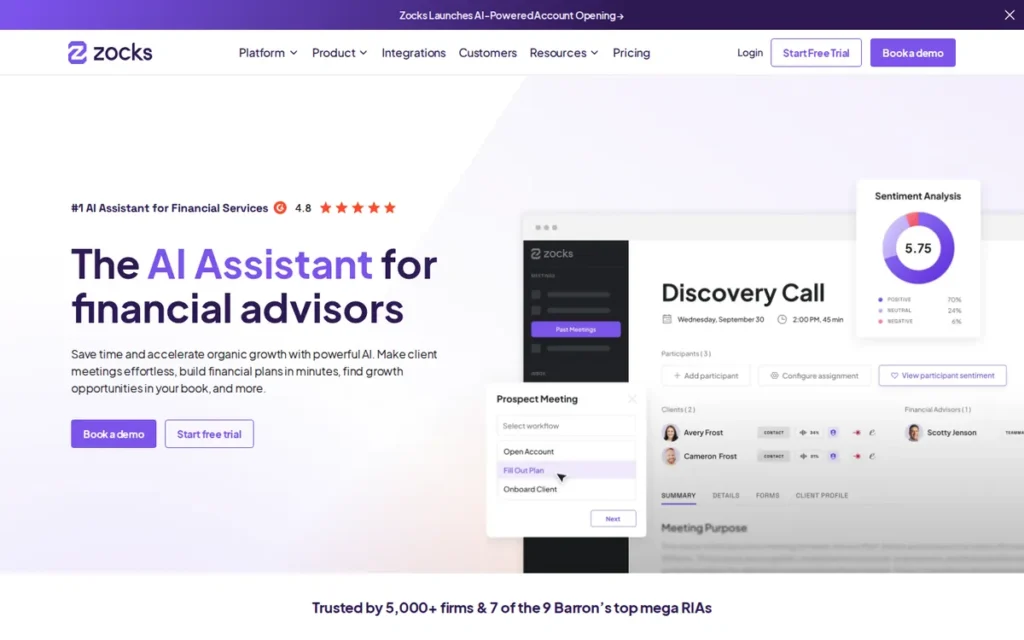
Category: Advisor Workflow Assistant, turns client meetings into notes, follow-ups and CRM updates for wealth advisors.
At a Glance
- Category: Advisor Workflow Assistant
- Best For: Advisory firms whose compliance policy prohibits or discourages meeting recordings and that need field-level CRM updates.
- Price Range: $67–$184/user/month billed annually ($80–$220 monthly); Enterprise custom; $25 admin-assistant seat
- Primary Strength: Zocks has the largest verified G2 review base among advisor tools (4.7/5, 679 reviews), SOC 2 Type II certification since November 2023 and fully published pricing.
- Biggest Limitation: Zocks does not record audio, so supervisors cannot replay meetings, and its comparisons against Jump are published on its own website.
- One-Line Summary: Zocks is a privacy-first AI assistant for financial advisors that captures meeting details without recording audio or video and pushes structured updates to Salesforce, Wealthbox and Redtail, with published pricing from $67 per user per month.
- Last Verified: November 2026
Overview
Zocks is an AI assistant for financial advisors that captures virtual, in-person and phone meetings without recording audio or video. It extracts structured client data and updates CRM, planning and portfolio systems for advisory firms with strict privacy or recording policies.
Zocks also extracts data from client documents such as PDFs and scans. Zocks connects account opening to Schwab Advisor Services on its Ultimate plan [Source: Zocks, 2026].
Key Features
- Zocks takes meeting notes without recording audio or video, but transcripts and meeting outputs can still be archived.
- Zocks extracts structured data and pushes field-level updates to Salesforce, Wealthbox, Redtail, planning systems and compliance archives.
- Zocks pulls client data from PDFs, Word files, scans and photos to cut manual data entry.
- Zocks connects account opening to Schwab Advisor Services on its Ultimate plan.
- Zocks offers U.S. data storage, MFA, SSO/SAML and configurable retention, and commits not to train LLMs on customer data.
Best For
Zocks is best for advisory firms whose compliance teams prefer no recordings, and for small RIAs that need predictable, published per-seat pricing. Zocks is a weaker fit for firms whose supervisors rely on replaying meeting audio.
Strengths
- Zocks holds a 4.7/5 rating on G2 from 679 reviews and is listed as the #1 Leader in G2’s AI Assistants for Financial Services category as of November 2026. Evidence: Third-party. [Source: G2, 2026]
- Zocks has held SOC 2 Type II certification since November 2023 and reports HIPAA compliance. Zocks’ SOC 2 date is the most specific security date among the advisor tools evaluated. Evidence: Vendor-reported; ask for the report. [Source: Zocks, 2026]
- Zocks received an 8.35/10 average rating and a 10.22% share among AI notetaker users in the 2026 T3/Inside Information Software Survey, and the survey named it a Software All-Star. Evidence: Third-party. [Source: T3/Inside Information, 2026]
- Zocks says it serves 5,000+ firms, including 7 of Barron’s top 9 mega-RIAs. A Pioneer Wealth Management paraplanner says work that took 3–4 hours now takes about 30 minutes. Evidence: Vendor-reported. [Source: Zocks, 2026]
Limitations
Zocks’ central trade-off is that it cannot play back audio. If a client disputes what an advisor said, supervisors have only the archived transcript and summary to check, with no recording to replay.
- Some G2 reviewers report occasional errors in captured meeting details. Errors matter more for Zocks because there is no audio to check against. Evidence: Third-party. [Source: G2, 2026]
- Zocks hosts its own comparisons against Jump and FinMate, including the LOTUS Financial Partners switching story, so treat those claims as biased. Evidence: Vendor-reported. [Source: Zocks, 2026]
- Zocks’ Schwab account-opening integration requires the $184–$220 Ultimate tier, and no independent test has measured how accurate Zocks’ notes are without audio.
Users on r/techsales shared their experience with AI notetakers in general:
“Every note taker I’ve used, including gong, fucks up. It doesn’t hear accents right and fills in the wrong words for important details, which is really bad if you’re just blind trusting it. I will go back and fix these details while listening to the recording though, which works really well. But I wouldn’t blind trust it every time, especially when there’s like 5 people talking and some have accents.” Posted by u/its_raining_scotch
Takeaway: Notetaker users rely on the recording to catch transcription errors, and Zocks’ no-audio design removes that safety net, so accuracy has to be checked during the pilot.
Verdict
Zocks ranks first in PlugRoute’s 2026 evaluation of AI assistants for financial services and best fits advisory firms that prohibit audio or video recordings. Zocks’ case rests on a 4.7/5 G2 rating from 679 reviews and SOC 2 Type II certification since November 2023.
Zocks scored 4.55/5, leading on compliance controls, pricing transparency and review evidence. Buyers should pilot Zocks against Jump on the same meetings and CRM fields, and confirm retention and archive settings with compliance.
2. Jump: Best for Advisors Who Want Recording Flexibility and Onboarding Add-Ons
Category: Advisor Workflow Assistant, turns client meetings into notes, follow-ups and CRM updates for wealth advisors.
At a Glance
- Category: Advisor Workflow Assistant
- Best For: RIAs and advisory practices that want notes, follow-ups and CRM sync in one tool, with the choice to record or not record.
- Price Range: $100–$200/advisor/month list; Enterprise custom; up to 20% off annually
- Primary Strength: Jump pairs a 4.6/5 G2 rating from 182 reviews with the top adoption share among AI notetaker users in the 2026 T3/Inside Information survey, which Jump sponsors.
- Biggest Limitation: Jump’s adoption figures come from its own materials or a survey it sponsors, and no independent accuracy test exists.
- One-Line Summary: Jump is an AI assistant for financial advisors that turns client meetings into notes, follow-up tasks and CRM updates, supports both recording and no-recording capture, and holds a 4.6/5 G2 rating from 182 reviews.
- Last Verified: November 2026
Overview
Jump is an AI meeting and workflow assistant for financial advisors. It prepares meetings, writes notes, drafts follow-up emails and tasks, and syncs results to CRM and planning tools. Jump is aimed at RIAs and advisory practices that want to cut manual post-meeting admin.
Jump’s Onboard and Grow add-ons extend the product into account opening and practice analytics. Every Jump plan includes 40+ integrations and MCP support [Source: Jump, 2026].
Key Features
- Jump’s Meet plan includes AI meeting notes, pre-meeting prep, follow-up emails and tasks, unlimited meetings, scheduling, and sync to CRM and financial-planning tools.
- Every Jump plan includes client profiles, an “AI Associate,” automations and an email assistant.
- Jump’s Onboard add-on handles account opening, document intake, auto-filled forms and CRM field mapping.
- Jump’s Grow add-on provides meeting analytics, trend monitoring, advisor coaching and spotting of revenue opportunities.
- Jump offers audit-ready records, data redaction and a no-recording option, and Jump’s Enterprise plan adds SSO, SCIM/SAML, custom disclosures and a compliance dashboard.
Best For
Jump is best for advisory practices whose main bottleneck is post-meeting admin, and for firms whose compliance teams have not yet chosen between recording and no-recording capture. Jump is a weaker fit for small firms that need SSO or a compliance dashboard but can’t take on custom Enterprise pricing.
Strengths
- Jump holds a 4.6/5 rating on G2 from 182 reviews as of November 2026, the second-largest verified review base among the advisor tools evaluated. Evidence: Third-party. [Source: G2, 2026]
- Jump held a 22.68% share and an 8.55/10 average rating among AI notetaker users in the 2026 T3/Inside Information Software Survey, the category’s first year, and was named a Software All-Star. Jump is listed as a survey sponsor. Evidence: Third-party. [Source: T3/Inside Information, 2026]
- Jump won Best in Show at the WealthStack demos and three WealthManagement.com Industry Awards. WealthManagement.com reported the awards alongside Jump’s $20M Series A in February 2025. Evidence: Third-party. [Source: WealthManagement.com, 2025]
- Jump says it supports 50,000+ financial professionals and names LPL, Osaic and Cetera as firms using it, without saying how broadly each firm uses it. Evidence: Vendor-reported. [Source: Jump, 2026]
Limitations
Jump’s biggest trade-off is that no independent test has measured its transcription or CRM-field accuracy. Its strongest adoption evidence comes from its own materials or from a survey Jump sponsors.
- Jump has about one-quarter of Zocks’ G2 review volume (182 vs 679 reviews as of November 2026). Evidence: Third-party. [Source: G2, 2026]
- A Cetera advisor quoted on a competitor’s site (Zocks) said Jump sometimes credited speech to the wrong speaker, an error known as speaker diarization. Treat this as a claim to test in a pilot. Evidence: Competitor-published. [Source: Zocks, 2026]
- Jump puts SSO, SCIM and its compliance dashboard on custom Enterprise pricing, so the published $100–$200 range may understate the cost for larger firms.
- Jump buyers need compliance to approve the capture mode for each meeting type. Some advisors are still unsure how meeting tools “fit” a regulated advice process [Source: Reddit r/cii, accessed 2026].
Verdict
Jump is a well-evidenced AI assistant for financial advisors in 2026. It combines a 4.6/5 G2 rating from 182 reviews with the top adoption share in the sponsor-disclosed 2026 T3/Inside Information survey and support for both recording and no-recording capture.
Jump scored 4.10/5. Jump leads on evidence quality, but Zocks’ larger G2 review base, dated SOC 2 credential and fully published pricing put Zocks 0.45 points ahead. Pilot both on the same meetings before committing.
3. AlphaSense: Best for Investment Research With Source-Traceable Answers
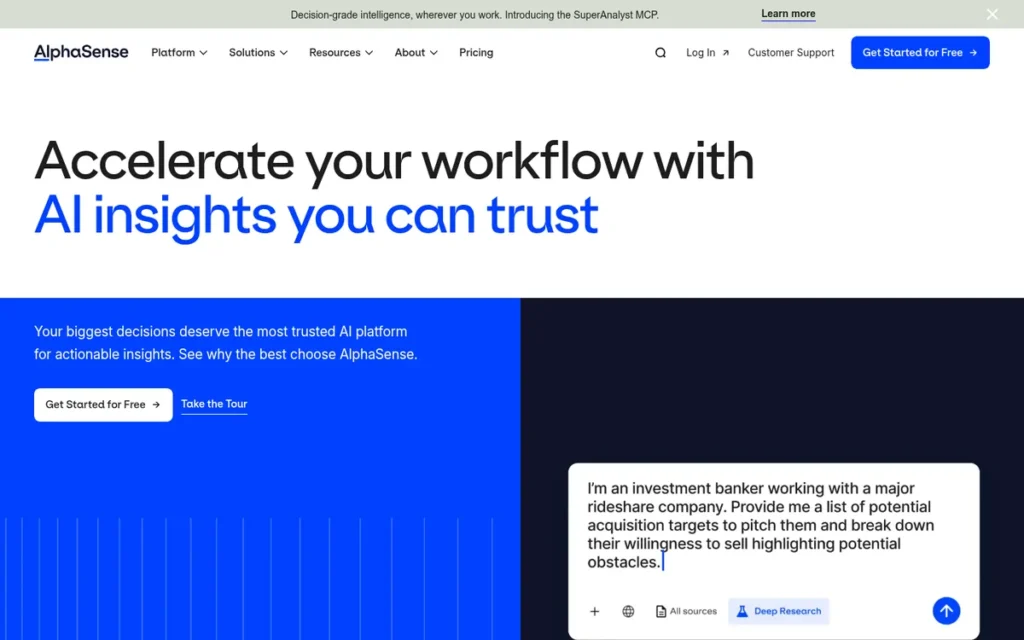
Category: Research Intelligence Assistant, answers investment and market questions from filings, transcripts, broker research and news, with cited sources.
At a Glance
- Category: Research Intelligence Assistant
- Best For: Buy-side, sell-side, corporate development and strategy teams that need cited answers from filings, calls, broker research and expert calls.
- Price Range: Pricing on request; third-party benchmarks of $18,750 median annual spend and $10K–$20K per seat per year
- Primary Strength: AlphaSense pairs snippet-level citations with licensed broker research and expert-call transcripts that general-purpose assistants can’t access.
- Biggest Limitation: AlphaSense publishes no pricing and has not been shown to replace market-data terminals for structured data, modeling or screening.
- One-Line Summary: AlphaSense is an AI research platform for financial professionals that searches 500M+ documents, including filings, earnings transcripts, broker research and expert calls, and cites the exact supporting snippet for each generated answer.
- Last Verified: November 2026
Overview
AlphaSense is an AI market-intelligence and research platform for investment analysts, research teams and corporate strategists. Users can query filings, earnings calls, broker research, expert-call transcripts and news, and each answer cites the source text it draws on.
AlphaSense also offers Deep Research agents and Smart Summaries of earnings calls. AlphaSense Enterprise Intelligence searches internal memos, notes and emails alongside external content [Source: AlphaSense, 2026].
Key Features
- AlphaSense Generative Search cites the exact supporting snippet for each answer, so analysts can check generated claims against their cited sources.
- AlphaSense Deep Research runs multi-step research tasks, and AlphaSense Smart Summaries pull out the key points from earnings calls.
- AlphaSense’s library covers 500M+ documents, including sell-side research from 1,700+ sources and 300,000+ expert-call transcripts.
- AlphaSense Enterprise Intelligence searches a firm’s internal content next to external sources.
- AlphaSense connects to SharePoint/Microsoft 365, Box, Google Drive, Amazon S3 and Egnyte.
Best For
AlphaSense is best for research teams that mostly read qualitative documents and need cited answers they can defend. AlphaSense is a poor substitute for Bloomberg, FactSet or CapIQ when the job is structured data, modeling or screening.
Strengths
- AlphaSense raised $350M at a $7.5B valuation in June 2026 and passed $600M in annual recurring revenue in Q1 2026, as Reuters reported. Evidence: Independent. [Source: Reuters, 2026]
- AlphaSense holds a 4.6/5 rating on G2 from 368 reviews as of November 2026. Evidence: Third-party. [Source: G2, 2026]
- AlphaSense completed its $930M acquisition of Tegus on July 8, 2024, adding 300,000+ expert-call transcripts to its library. Evidence: Third-party. [Source: PR Newswire, 2024]
- AlphaSense says 92% of S&P 100 companies use its platform and reports SOC 2 Type II and ISO/IEC 27001 certifications. Evidence: Vendor-reported. [Source: AlphaSense, 2026]
Limitations
AlphaSense’s main trade-off is deep licensed content in exchange for premium pricing that isn’t published. Third-party benchmarks put typical spend around $18,750 a year [Source: Vendr, 2026], or $10,000–$20,000 per seat [Source: Sacra, 2026].
- AlphaSense is strongest on document-based research. A buyer who asked on r/quantfinance how AlphaSense compares with terminals got no replies [Source: Reddit r/quantfinance, accessed 2026].
- AlphaSense citations make answers checkable but don’t prove the answers are error-free, and PlugRoute found no independent accuracy benchmark.
- G2 reviewers commonly say new AlphaSense users face a learning curve. Evidence: Third-party. [Source: G2, 2026]
Users on r/private_equity noted:
“Nice research tool but lacks the financials/Excel plug in of an Eikon or a Cap IQ. If you are strictly looking for research reports, it’s the Rolls Royce” Posted by u/Reasonable_Tune_2258
Takeaway: Practitioners call AlphaSense best-in-class for research reports, but it does not replace the structured financials and Excel workflows of a market-data terminal.
Verdict
AlphaSense is the only Research Intelligence Assistant in this evaluation. It pairs snippet-level citations with scale that Reuters reported in 2026: more than $600M in annual recurring revenue and a $7.5B valuation.
AlphaSense scored 3.73/5, 0.35 points ahead of #4. Budget around the third-party spend benchmarks, ask which content packages are included, and pilot it against the broker and expert content your analysts actually use.
4. Microsoft 365 Copilot: Best for Internal Knowledge in Microsoft 365 Firms
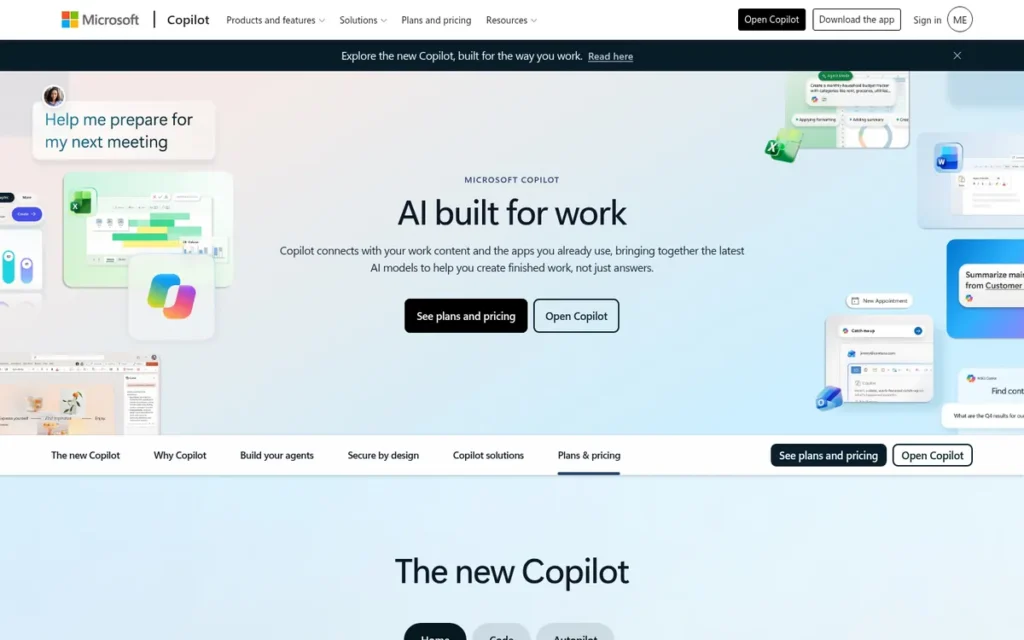
Category: Enterprise Knowledge and CRM Agent, embeds AI agents in a firm’s existing CRM or productivity system of record.
At a Glance
- Category: Enterprise Knowledge and CRM Agent
- Best For: Banks, broker-dealers and advisory firms whose records, email and meetings already live in Microsoft 365.
- Price Range: $30/user/month enterprise add-on; $18–$21/user/month Copilot Business; Copilot Studio $200/month per 25,000 credits
- Primary Strength: Microsoft 365 Copilot uses a firm’s existing Microsoft 365 permissions and Purview retention tools, which compliance teams already know.
- Biggest Limitation: Microsoft 365 Copilot has weak independent evidence of results: in a June 2024 Gartner survey, only 6% of firms had finished pilots and planned large-scale rollouts.
- One-Line Summary: Microsoft 365 Copilot is a general-purpose AI assistant that works from a firm’s Microsoft 365 email, documents and Teams meetings, best suited to financial firms already standardized on Microsoft that can clean up permissions before rollout.
- Last Verified: November 2026
Overview
Microsoft 365 Copilot is an AI assistant built into Word, Excel, Outlook and Teams. It answers questions and drafts content using a firm’s own Microsoft 365 data, and suits financial firms on Microsoft that need internal knowledge search, drafting and meeting recaps.
Microsoft 365 Copilot customers can build custom agents in Copilot Studio. Microsoft 365 Copilot is a separate product from Microsoft Copilot for Finance, which launched in October 2026 [Source: Microsoft, 2026].
Key Features
- Microsoft 365 Copilot grounds its answers in documents, email and chats through Microsoft Graph, using only content the user already has permission to see.
- Microsoft 365 Copilot keeps prompts and responses inside the Microsoft 365 service boundary and does not use them to train foundation models, according to Microsoft.
- Microsoft 365 Copilot Teams transcripts can be placed under Purview eDiscovery and legal hold, and exported to outside archives through the Teams Export API.
- Microsoft 365 Copilot licenses include some internal agent building in Copilot Studio at no extra cost.
- Microsoft 365 Copilot recaps Teams meetings, which practitioners describe as useful when the meetings are recorded.
Best For
Microsoft 365 Copilot is best for firms whose records already sit in Microsoft 365 and whose IT teams can audit file sharing before rollout. Microsoft 365 Copilot is not a replacement for an advisor workflow tool or a contact-center platform.
Strengths
- G2 lists Microsoft Copilot at 4.3/5 from 872 reviews as of November 2026, though the listing may cover Microsoft’s broader Copilot product rather than the Microsoft 365 Copilot add-on alone. Evidence: Third-party. [Source: G2, 2026]
- Commercial Bank of Dubai reports saving 39,000 hours a year with Microsoft 365 Copilot, with 85% adoption among 300 early adopters. Evidence: Vendor-reported. [Source: Microsoft, 2025]
- Microsoft 365 Copilot respects existing Microsoft 365 permissions and keeps data inside the Microsoft 365 service boundary. Evidence: Vendor-reported. [Source: Microsoft, 2026]
- Microsoft 365 Copilot transcripts can be held under Purview eDiscovery and exported to outside archives, which supports supervision workflows. Evidence: Vendor-reported. [Source: Microsoft, 2026]
Limitations
Microsoft 365 Copilot’s biggest trade-off is easy licensing but hard deployment. In a June 2024 Gartner survey of 132 IT leaders, only 6% had finished pilots and planned large-scale rollouts. Adoption may have changed since then [Source: Gartner via Computerworld, 2024].
- In the same June 2024 Gartner survey, 64% of IT leaders said governance and security took significant effort, and 40% said over-sharing concerns delayed rollout by at least three months.
- Microsoft 365 Copilot shows users anything they can technically open, so over-shared files must be cleaned up first. Purview alone, without controls such as Preservation Lock, may not meet SEC Rule 17a-4 immutability requirements [Source: Copilot Consulting, accessed 2026].
- G2 reviewers report inconsistent or generic Microsoft Copilot answers that need checking, though the listing may cover more than Microsoft 365 Copilot. Evidence: Third-party. [Source: G2, 2026]
Users on r/microsoft_365_copilot shared their experience:
“Company is currently doing a limited deployment of co-pilot and the feedback is pretty bad. I have had a similar experience as what you describe. My primary use cases should be pretty simple and co-pilot routinely indicates its inability to actually perform the actions. My feedback is that it seems like a glorified help menu and provides less than I would get if I just googled my request / question.” Posted by u/mattortom
Takeaway: Microsoft 365 Copilot pilots can earn poor user feedback when it explains tasks instead of doing them, so firms need concrete success criteria before scaling past a limited deployment.
Verdict
Microsoft 365 Copilot has the lowest published per-seat license price in this evaluation ($18–$30 per user per month, November 2026). However, a June 2024 Gartner survey found that only 6% of IT leaders had finished pilots and planned large-scale rollouts.
Microsoft 365 Copilot scored 3.38/5, 0.18 points ahead of Agentforce. Budget for permissions cleanup and compliant archiving, and set measurable pilot success criteria before buying seats firm-wide.
5. Salesforce Agentforce for Financial Services: Best for Salesforce FSC Firms
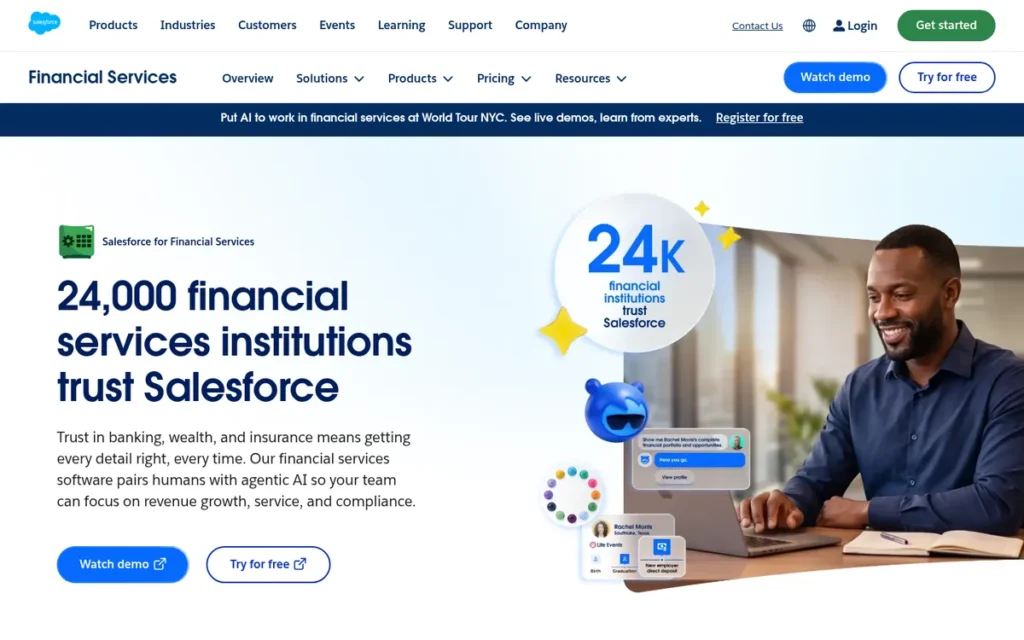
Category: Enterprise Knowledge and CRM Agent, embeds AI agents in a firm’s existing CRM or productivity system of record.
At a Glance
- Category: Enterprise Knowledge and CRM Agent
- Best For: Banks, wealth managers and insurers already running Salesforce Financial Services Cloud.
- Price Range: $325–$700/user/month (FSC editions) or add-on from $150/user/month, plus unverified usage and implementation costs
- Primary Strength: Salesforce Agentforce for Financial Services acts directly on Salesforce client records through a financial services data model and prebuilt templates.
- Biggest Limitation: Agentforce for Financial Services has a high, partly unpublished total cost and, according to practitioners, needs substantial configuration.
- One-Line Summary: Salesforce Agentforce for Financial Services is an AI agent platform built into Salesforce’s CRM for banks, wealth managers and insurers, running prebuilt agent templates on Salesforce’s financial services data model, best suited to firms where Salesforce is already the system of record.
- Last Verified: November 2026
Overview
Salesforce Agentforce for Financial Services is an AI agent platform built into Salesforce’s financial services CRM. Banks, wealth managers and insurers can use it to deploy prebuilt agents for advisor prep, banking service and lending tasks on their existing client records.
Agentforce for Financial Services relies on the Atlas reasoning engine and the Einstein Trust Layer. Agentforce for Financial Services is the new name for the product formerly sold as Financial Services Cloud [Source: Salesforce, 2026].
Key Features
- Salesforce Agentforce for Financial Services provides prebuilt, role-based agent templates for tasks such as preparing investment reviews, replacing lost cards and surfacing loan options.
- Agentforce for Financial Services uses a data model that covers relationship structures, account hierarchies and regulatory context.
- Agentforce’s Atlas reasoning engine combines fixed business rules with language-model reasoning.
- Agentforce’s Einstein Trust Layer adds data masking, zero-retention agreements with model providers and audit logging, according to a secondary source, so buyers should check the contract scope.
- Agentforce for Financial Services is included in the FSC Sales Max edition and is sold as an add-on to the Core and Advanced editions.
Best For
Salesforce Agentforce for Financial Services is best for firms where Salesforce Financial Services Cloud is already the system of record and data quality is high. Agentforce for Financial Services is a poor fit for firms not already on Salesforce, given the licensing and implementation costs.
Strengths
- Salesforce Agentforce for Financial Services holds a 4.3/5 rating on G2 from 227 reviews as of November 2026. Evidence: Third-party. [Source: G2, 2026]
- Nexo reports that Agentforce for Financial Services freed 400 staff hours in Q1 2025 and raised chat deflection by 20%, and BCU reports handling escalated cases 27% faster. Evidence: Vendor-reported. [Source: Salesforce, 2025]
- Agentforce for Financial Services ships a financial services data model and templates, which reduce domain modeling work but don’t remove it. Evidence: Vendor-reported. [Source: Salesforce, 2026]
- Practitioners say Agentforce’s biggest advantage is that “it’s right there where reps work.” Evidence: Third-party. [Source: Reddit r/SalesforceDeveloper, 2026]
Limitations
Salesforce Agentforce for Financial Services’ biggest trade-off is native CRM access in exchange for high total cost. One practitioner wrote that “TCO is very high even for small solutions” [Source: Reddit r/SalesforceDeveloper, 2026].
- Agentforce for Financial Services needs complex design of topics and actions plus ongoing tuning, according to secondary reviews [Source: Lucid Labs, accessed 2026].
- Agentforce for Financial Services can give wrong answers or take wrong actions when CRM data quality is poor. One practitioner decided against recommending it because of limits on file formats and sizes [Source: Reddit r/SalesforceDeveloper, 2026].
- All named Agentforce for Financial Services customer results are vendor-published, and its IDC MarketScape recognition covers the broader Salesforce platform. A 2025 comment from someone in sales called the product “as mature as a newborn” [Source: Reddit r/techsales, 2025], but Salesforce has shipped more than a year of releases since.
Verdict
Salesforce Agentforce for Financial Services is the CRM-native option for firms already running Salesforce Financial Services Cloud, because its agents act directly on existing client records. Its usage-based costs and configuration effort make it hard to justify outside that ecosystem.
Salesforce Agentforce for Financial Services scored 3.20/5. Clean your CRM data first, get a written quote that covers usage and Data Cloud, and pilot one limited workflow.
6. interface.ai: Best for Credit Union and Community Bank Voice Automation
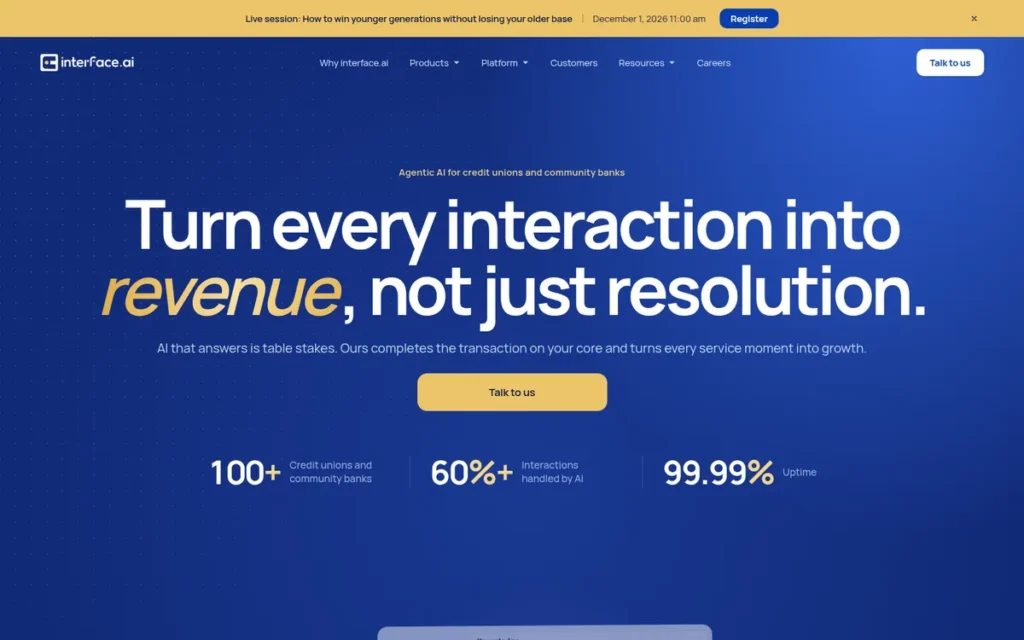
Category: Contact-Center Automation Assistant, automates routine banking calls and chats while handing off to human agents.
At a Glance
- Category: Contact-Center Automation Assistant
- Best For: Credit unions and community banks that want to automate routine phone and chat requests, with escalation to staff.
- Price Range: Pricing on request; no published price or third-party benchmark found
- Primary Strength: interface.ai publishes the most named, quantified contact-center case studies of any product PlugRoute evaluated, covering six credit unions.
- Biggest Limitation: interface.ai’s outcome figures are all vendor-published, its pricing is undisclosed, and its fit for large banks is unproven.
- One-Line Summary: interface.ai is a voice-first AI platform for credit unions and community banks that verifies callers’ identity, completes routine transactions such as transfers and card blocks, and escalates to staff, with vendor-reported call automation rates of 40% to 90%.
- Last Verified: November 2026
Overview
interface.ai is a voice and chat AI platform for credit unions and community banks. It answers member calls, verifies callers, completes routine transactions and escalates to human staff. It is aimed at contact-center leaders who want shorter waits without trapping members in a bot.
interface.ai also offers agent-assist tools for employees, plus fraud and collections tools. interface.ai says it serves 100+ institutions [Source: interface.ai, 2026].
Key Features
- interface.ai’s voice AI replaces or supports the IVR phone menu and handles routine member requests in natural language.
- interface.ai verifies members’ identity using AI, voice biometrics and caller-ID forensics.
- interface.ai completes transfers, payments and card blocks, and makes a warm transfer to a live agent when needed.
- interface.ai provides chat AI, agent assist, fraud tools and collections tools alongside voice.
- interface.ai reportedly integrates with core processors including Symitar, Corelation, Fiserv, Jack Henry, CSI, Finxact, COCC and CU*Answers, so buyers should check how deep each integration goes [Source: Lorikeet, 2026].
Best For
interface.ai is best for credit unions and community banks with high routine call volume, especially after hours, whose core banking system appears on its reported integration list. interface.ai is unproven for large national banks, which should also evaluate enterprise conversational platforms.
Strengths
- Neighborhood Credit Union reports that interface.ai automated 90% of calls with 98% accuracy, saving $4.4M and 43,000+ hours of caller wait time. Evidence: Vendor-reported. [Source: interface.ai, accessed 2026]
- interface.ai publishes six named credit union case studies, including Dupaco (46% of calls automated, $350K net annual savings) and Dover FCU (40%+ automated on day one). Evidence: Vendor-reported. [Source: interface.ai, accessed 2026]
- Credit Union of America reports that agent turnover fell from 90% to 24% after deploying interface.ai. Evidence: Vendor-reported. [Source: interface.ai, accessed 2026]
- interface.ai’s trust center lists SOC 2 Type II (2025 report, with CSA STAR) and ISO/IEC 27001:2022 (2026 surveillance audit). Evidence: Vendor-reported; request the reports. [Source: interface.ai Trust Center, 2026]
Limitations
interface.ai’s central trade-off is deep credit union specialization in exchange for unproven fit at large banks. Its outcome evidence rests entirely on case studies interface.ai publishes itself.
- interface.ai’s case studies define “automated” in ways that may not match your own metrics.
- interface.ai’s trust center does not list PCI DSS, so buyers taking card payments by voice should confirm PCI scope in writing [Source: interface.ai Trust Center, 2026].
- interface.ai’s only review rating is 4.46/5 from 57 reviews on Cuspera, which is not a major review platform. Evidence: Third-party. [Source: Cuspera, 2026]
- interface.ai buyers should test escalation paths directly. The CFPB found that consumers are harmed when they can’t reach a human [Source: CFPB, 2023], and practitioners warn that full-replacement deployments “usually roll it back within months” [Source: Reddit r/SaaS, accessed 2026].
Verdict
interface.ai publishes the most named, quantified case studies of any contact-center product PlugRoute evaluated, with vendor-reported call automation of 40% to 90% across six credit unions.
interface.ai scored 2.98/5 because its pricing isn’t published and none of its results are independently verified, not because of any documented underperformance. Confirm PCI scope and measure how well it hands calls to staff in a pilot.
7. Kasisto (KAI): Best for Large Banks Wanting a Banking-Trained Model Within Backbase
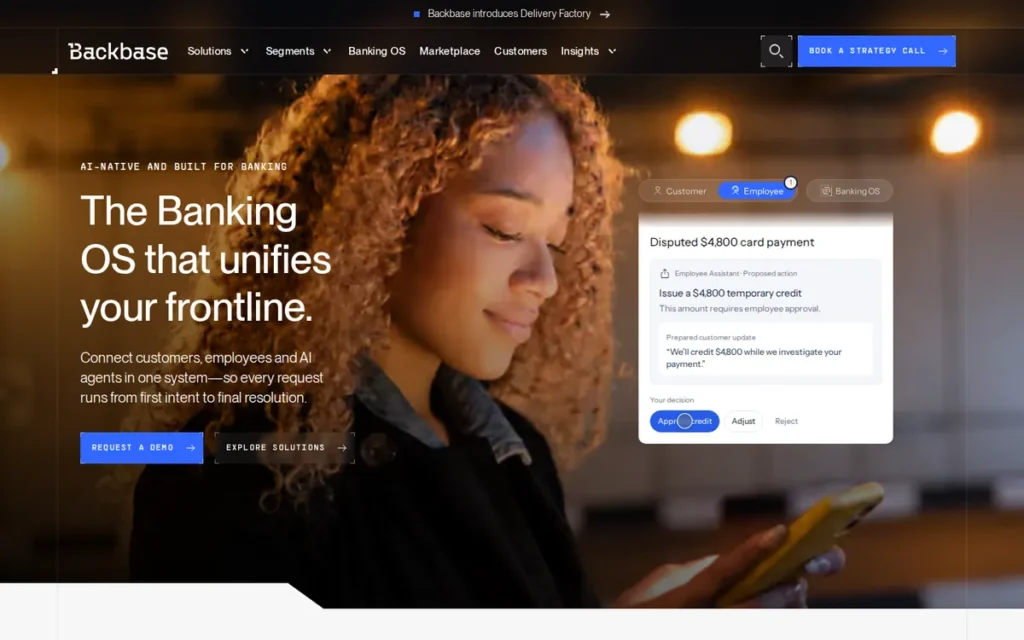
Category: Contact-Center Automation Assistant, automates routine banking calls and chats while handing off to human agents.
At a Glance
- Category: Contact-Center Automation Assistant
- Best For: Large enterprise banks that want a branded, banking-trained digital assistant with private deployment options.
- Price Range: Pricing on request; quote-based cloud subscription
- Primary Strength: Kasisto offers KAI-GPT, a banking-trained language model that can reportedly be deployed in a bank’s own cloud or on-premises.
- Biggest Limitation: Kasisto’s performance evidence dates from 2017–2020, and standalone purchase terms are unclear since Backbase acquired Kasisto in June 2026.
- One-Line Summary: Kasisto is a conversational AI provider for enterprise banks whose KAI platform and banking-trained KAI-GPT model power branded digital assistants across mobile, web, messaging and voice, and which became part of Backbase’s Agentic Banking suite in June 2026.
- Last Verified: November 2026
Overview
Kasisto is a conversational AI company whose KAI platform gives large banks a branded virtual assistant for mobile, web, messaging and voice. KAI is built on a banking-trained language model and is aimed at enterprise digital-banking and service teams.
Kasisto also offers KAI Answers for internal staff Q&A. Backbase acquired Kasisto on June 23, 2026 and folded KAI into Backbase’s Agentic Banking suite. Financial terms were not disclosed [Source: Backbase, 2026].
Key Features
- Kasisto’s KAI Consumer Banking is a branded virtual assistant trained for banking, available on mobile, web, messaging and voice.
- Kasisto lets banks build and edit their own intents (customer request types).
- Kasisto’s KAI-GPT can reportedly be deployed in a bank’s own cloud or on-premises, according to secondary sources.
- Kasisto’s KAI Answers gives bank staff Q&A over internal knowledge, and “KAIgentic” is Kasisto’s line of agentic products.
- Kasisto is listed on the Microsoft Marketplace as a SaaS offering for consumer banking.
Best For
Kasisto is best for large banks that put a banking-trained model and private deployment first, especially banks already on Backbase. Kasisto is a harder fit for buyers who need current, independently verified performance data or a quick standalone purchase.
Strengths
- Backbase acquired Kasisto on June 23, 2026 and says the combined Agentic Banking suite is available immediately to current and future customers. Evidence: Vendor-reported (acquirer press release). [Source: Backbase, 2026]
- DBS digibank’s Kasisto-powered assistant handled 82% of requests without a human and expanded from India to Indonesia and Singapore. Evidence: Vendor-reported. [Source: PR Newswire, 2017]
- Kasisto’s platform brochure reports 40M users in 16 countries, and Kasisto names JPMorgan as a customer. Secondary sources cite 85% containment for the JPMorgan deployment, but that figure is dated and came from the vendor. Evidence: Vendor-reported. [Source: Kasisto, 2020]
- Kasisto’s KAI-GPT reportedly supports private deployment, which may help with data-residency and model-risk reviews. Evidence: Third-party. [Source: Lorikeet, 2026]
Limitations
Kasisto’s biggest trade-off is long banking-specific experience but stale current evidence: Kasisto’s strongest performance figures date from 2017 and 2020.
- PlugRoute found no G2, Capterra, Gartner or Reddit presence for Kasisto as of November 2026.
- Since Backbase acquired Kasisto in June 2026, KAI is sold as part of Backbase’s Agentic Banking suite, so buyers not on Backbase should confirm whether standalone terms exist.
- Kasisto’s pricing, implementation timelines and analyst recognition could not be verified, and Kasisto competes with general agent platforms and banks’ in-house builds.
Verdict
Kasisto offers a banking-trained conversational AI platform with enterprise deployments documented since 2017 (DBS digibank). Its 2017–2020 performance evidence and unclear standalone terms after the June 2026 Backbase acquisition make it the hardest product on this list to verify.
Kasisto scored 2.00/5. Ask Backbase for current customer references, recent containment and escalation data, and written standalone purchase terms before you shortlist it.
How Much Do AI Assistants for Financial Services Cost?
Published prices run from $18 per user per month (the Microsoft 365 Copilot Business promotion) to $700 per user per month (Salesforce FSC Sales Max). AlphaSense, interface.ai and Kasisto quote on request. Per-seat, per-credit and quote-only pricing can’t be compared directly, so total cost of ownership matters more than list price.
| Product | Licensing Model | Published Price or Benchmark (Nov 2026) | Known Costs Outside the License |
|---|---|---|---|
| Zocks | Per user, tiered | $67–$184 annual or $80–$220 monthly; $25 admin seat | Schwab integration requires Ultimate |
| Jump | Per advisor + add-ons | $100–$200/advisor/month; Enterprise custom | SSO, SCIM and compliance dashboard only on Enterprise |
| AlphaSense | Quote-only | $18,750 median annual spend (Vendr, 2026); $10K–$20K/seat (Sacra, 2026) | Content packages drive the price |
| Microsoft 365 Copilot | Per user + credits | $18–$30/user/month; Studio $200/25,000 credits | Permissions cleanup, compliant archiving, change management |
| Salesforce Agentforce for Financial Services | Per user + usage | $325–$700/user/month or $150 add-on | Usage credits, Data Cloud, implementation partners |
| interface.ai | Quote-only | No price or benchmark found | Implementation and core-integration fees |
| Kasisto | Quote-only | No price or benchmark found | Backbase platform terms |
License price is only a small part of the real cost. Here is a worked example from published list prices:
- Fifty Salesforce FSC Sales Advanced seats at $500 per user per month cost $300,000 a year before usage credits, Data Cloud or partner fees.
- Fifty Microsoft 365 Copilot add-on seats at $30 per user per month cost $18,000 a year before permissions cleanup and archiving.
- One practitioner reported paying $0.08–$0.50 per document for Agentforce, a 2–4× markup over calling model APIs directly [Source: Reddit r/SalesforceDeveloper, 2026].
The $18 Microsoft 365 Copilot Business promotion ends December 31, 2026, so budgets for 2027 should use the standard $21 rate.
Put these requests in writing when you ask for a quote:
- Ask each vendor for per-conversation, per-credit or per-document usage rates, and what happens when usage goes over the estimate.
- Ask each vendor which security features (SSO, SCIM, audit dashboards) require a higher tier.
- Ask each vendor for one-time implementation, core-system integration and partner fees for year one.
- Ask each vendor which content packages or data platforms are bundled and which cost extra.
- Ask each vendor for renewal terms and any early-exit option.
What Compliance Requirements Apply to AI Assistants in Financial Services?
Existing FINRA rules on supervision, communications, recordkeeping and fair dealing are technology-neutral, so they already apply to generative AI, including third-party tools. FINRA Regulatory Notice 24-09 (2024) makes clear that the firm, not the vendor, stays responsible. Firms should assess any AI assistant before deploying it and document how they supervise it.
The main compliance considerations are:
- Supervision: Supervision obligations under FINRA Rule 3110 extend to AI outputs, and firms should run third-party vendor due diligence before deployment [Source: FINRA, 2024].
- AI agent risks: FINRA’s 2026 observations flag agents that act without human validation, go beyond their intended authority, make multi-step decisions that are hard to trace, or expose sensitive data [Source: FINRA, 2026].
- AI agent controls: FINRA suggests monitoring access, tracking agent actions, defining human review points and setting guardrails [Source: FINRA, 2026].
- Books and records: AI notes, transcripts, prompts and outputs may count as required records. PlugRoute did not retrieve the primary SEC rule text for this review, so confirm the scope with counsel.
- Archive immutability: The archiving built into a platform may not, on its own, meet requirements to keep records in a form that can’t be changed (WORM storage) [Source: Copilot Consulting, accessed 2026].
- Off-channel risk: In PlugRoute’s analysis, notetakers that compliance hasn’t approved can capture client communications outside the systems the firm supervises.
- Human escalation: The CFPB found that chatbots do poorly on complex problems and that institutions keep full legal responsibility, so escalation to a qualified human is expected [Source: CFPB, 2023].
- Model risk: Firms with model-risk programs should decide whether an assistant that materially informs decisions falls within scope. PlugRoute did not retrieve the primary supervisory guidance.
This aligns with community sentiment on r/CRM:
“You’re not alone in this, a lot of firms hit friction here once meeting volume increases faster than admin capacity. What usually matters more than the AI itself is how well it fits your compliance posture, data retention rules, and note ownership expectations. In practice, teams get the most stability when they’re clear on what the system is allowed to capture, where those notes live, and who is accountable for review before anything becomes a client record.” Posted by u/DFSautomations
Takeaway: For wealth firms choosing an AI meeting assistant, clear rules on what gets captured, where notes live and who reviews them matter more than the AI features themselves.
Also Considered, Not Ranked
AI answer engines name several other financial services assistants that PlugRoute did not research as deeply as the seven ranked products. They are listed without scores so that every ranked product gets the same depth of coverage. Only facts tied to a named source appear below.
- Bloomberg ASKB: Bloomberg ASKB is described by Bloomberg as being in beta.
- Wealthbox AI Assistant: Wealthbox AI Assistant requires approval before some advisors affiliated with a broker-dealer can use it, according to Wealthbox.
- Visa AI Financial Assistant: Visa AI Financial Assistant was announced by Visa with a U.S. pilot starting August 2026.
- Kore.ai, Cresta and ASAPP: Kore.ai, Cresta and ASAPP are named by AI answer engines (Perplexity and ChatGPT, November 2026) as contact-center options.
- Claude for Financial Advisors: Claude for Financial Advisors is named by AI answer engines (Perplexity and ChatGPT, November 2026) as an advisor productivity option.
- FinMate: FinMate appears in Zocks’ competitor comparisons as an advisor meeting tool.
What Red Flags Should I Watch For When Evaluating AI Assistants for Financial Services?
The most serious red flag is a contact-center assistant with no clear path to a human agent, because institutions keep full liability for what the bot does. The six other red flags below each expose a firm to regulatory, customer or budget risk that vendor demos rarely show. Check every shortlisted tool against all seven.
Red Flag #1: No Clear Path to a Human Agent A contact-center AI assistant without a fast, reliable path to a human agent is a red flag. The CFPB’s 2023 chatbot report found consumers were harmed when they couldn’t reach a person, and institutions keep full liability [Source: CFPB, 2023]. A high containment rate is a compliance risk, not a win, if callers can’t reach a human. Test the handoff yourself, including after-hours calls.
Red Flag #2: Vendor-Only Proof of ROI Proof of ROI that only the vendor has published is a red flag, because PlugRoute found no independent accuracy benchmarks for any of the seven products evaluated in November 2026. Treat vendor case studies as hypotheses to test in your own pilot, and measure results on your own calls, meetings and documents.
Red Flag #3: Recording or Archiving Your Compliance Team Hasn’t Approved A meeting or call capture mode that compliance hasn’t approved can leave gaps in recordkeeping and supervision. Whether the tool records audio determines whether supervisors can replay client conversations later. Confirm the capture mode for each meeting type and the archive destination in writing before the first client meeting.
Red Flag #4: Opaque Usage-Based Pricing Pricing by credit, conversation or document can push real costs far above the license price. One practitioner reported a 2–4× markup over direct model API calls on Salesforce Agentforce [Source: Reddit r/SalesforceDeveloper, 2026]. Ask for a written usage estimate and the rates that apply when usage goes over it.
Red Flag #5: Over-Shared Files Surfaced by Assistants That Inherit Permissions An assistant that inherits existing permissions will show users every over-shared file they can technically open. In a June 2024 Gartner survey of 132 IT leaders, 40% said over-sharing concerns delayed Microsoft 365 Copilot rollouts by three or more months [Source: Gartner via Computerworld, 2024]. Audit file sharing before launch.
Red Flag #6: Beta, Pilot or Acquisition-Related Status Changes A product in beta, in a limited pilot or recently acquired may not be ready to deploy, or may change its purchase terms. Backbase’s June 2026 acquisition of Kasisto shows how a change of ownership can change how a product is sold [Source: Backbase, 2026]. Confirm the product is generally available and get the terms in writing.
Red Flag #7: AI Agents That Act Without Human Validation An AI agent that completes transactions or updates records without human review raises the traceability and authority risks FINRA flagged in its 2026 observations on AI agents [Source: FINRA, 2026]. Define where a human must approve each action, and confirm that every agent action is logged and can be reviewed.
What Questions Should I Ask Before Choosing an AI Assistant for Financial Services?
Before choosing an AI assistant, ask vendors six questions covering:
- auditability
- integration depth
- containment definitions
- total cost
- availability
- data handling
The answers show whether a tool can pass compliance, IT and model-risk review, not just whether it demos well. Weak or vague answers belong in your scoring.
Question #1: Can you show me audit logs for every AI-generated note, prompt and action? Ask every AI assistant vendor for exportable, timestamped audit logs covering each AI-generated note, prompt and action. FINRA expects firms to supervise AI outputs [Source: FINRA, 2024]. Logs that are only available on request make supervision harder and count as a weak answer.
Question #2: Which of my systems do you integrate with natively, and how deep is each integration? Ask every vendor for a live demo on your own CRM, core processor or productivity suite, not a slide listing integrations. Integration lists published by third parties often overstate depth. Confirm which fields sync, which way data flows, and whether the integration needs a higher pricing tier.
Question #3: How do you define and measure containment or automation? A credible contact-center vendor defines containment precisely and separates calls that were resolved from calls that were simply abandoned. Ask how escalations, repeat calls and hang-ups are counted. Then ask for first-contact resolution figures alongside the containment rate.
Here is a hypothetical example. If 1,000 calls reach a voice bot and 600 never reach an agent, a vendor might report 60% containment even if 150 of those callers simply hung up. The resolved rate would then be closer to 45%.
Question #4: What will I pay in usage, implementation and data-platform fees beyond the license? Ask every vendor for a written, line-item first-year estimate covering licenses, usage credits, implementation, integration and any required data platform. Vendors that only discuss seat price are leaving out a large share of total cost. Compare first-year totals, not per-seat rates.
Question #5: Is this product generally available today, and who owns the roadmap? Ask every vendor to confirm in writing that the product is generally available, not in beta or a limited pilot. Ask about any recent or pending acquisition, as with Kasisto and Backbase in 2026. Ask who will support the product in three years and on what terms.
Question #6: Is customer data used to train models, and where is it stored? Ask every vendor for a written commitment not to train models on your data, a clear data storage location and configurable retention settings. Ask for current SOC 2 Type II reports, ISO 27001 certificates and PCI DSS scope where card data is involved. Don’t rely on claims made only on the vendor’s website.
How should you pilot an AI assistant before committing? Run a structured pilot with two or three shortlisted tools on the same real tasks before signing a multi-year contract. Score each tool on these measures:
- Score each assistant on factual accuracy and on how accurately it fills CRM fields.
- Score each assistant on whether its sources can be traced and whether it respects permissions.
- Score each assistant on how it escalates to humans and whether its actions can be audited.
- Score each assistant on integration effort and projected total cost.
- Involve compliance, legal, security and model-risk teams before any client-facing deployment.
Expect very different ramp-up times. Dover FCU reports 40%+ call automation with interface.ai on day one [Source: interface.ai, accessed 2026]. Meanwhile, 40% of IT leaders in a June 2024 Gartner survey said over-sharing delayed Microsoft 365 Copilot rollouts by three or more months [Source: Gartner via Computerworld, 2024].
Bring these items to your compliance and model-risk review:
- The vendor’s current SOC 2 Type II report and any ISO 27001 certificate.
- The vendor’s written commitments on data retention and model training.
- A sample audit log export from the pilot.
- The approved capture mode (recording or no recording) for each meeting type and the archive destination.
- The escalation design for any client-facing agent.
How Did We Rank These AI Assistants for Financial Services?
PlugRoute scored every product from 1 to 5 on six weighted criteria using dated research. Compliance and governance controls carry the most weight (25%), followed by quality of evidence (20%). Rankings measure fit and evidence quality, not tested accuracy, because no product had an independent accuracy benchmark.
The six criteria and their weights are:
- Compliance and Governance Controls (25%): This criterion matters because firms stay fully responsible for supervision and recordkeeping when they use third-party AI [Source: FINRA, 2024].
- Quality of Evidence for Results and Adoption (20%): This criterion matters because buyers need proof that holds up with procurement and boards.
- Review Platform Ratings and Volume (15%): This criterion matters because peer ratings are the closest available stand-in for real-world satisfaction.
- Pricing Transparency and TCO Predictability (15%): This criterion matters because buyers need indicative figures to get budget approval.
- Integration Fit and Deployment Readiness (15%): This criterion matters because tools must work with Salesforce, Microsoft 365, advisor CRMs or core banking systems.
- Depth of Fit for a Financial Services Job (10%): This criterion matters because tools built for a specific job usually need less custom building.
Every cited strength and limitation carries one of four evidence labels:
- Independent: Independent evidence comes from regulators, Gartner or Reuters.
- Third-party: Third-party evidence comes from review platforms, surveys, trade press, spend benchmarks, secondary reviews or practitioner posts.
- Vendor-reported: Vendor-reported evidence comes from the vendor’s own pages, documentation, pricing pages, case studies or an acquirer’s press release.
- Competitor-published: Competitor-published evidence comes from a rival vendor’s website.
| Rank | Product | Compliance | Evidence | Reviews | Pricing | Integration | Job Fit | Weighted Total |
|---|---|---|---|---|---|---|---|---|
| 1 | Zocks | 5.0 | 3.5 | 5.0 | 5.0 | 4.0 | 5.0 | 4.55 |
| 2 | Jump | 4.0 | 4.0 | 4.0 | 4.0 | 4.0 | 5.0 | 4.10 |
| 3 | AlphaSense | 3.5 | 3.5 | 4.5 | 2.5 | 4.0 | 5.0 | 3.73 |
| 4 | Microsoft 365 Copilot | 4.0 | 2.5 | 3.0 | 4.0 | 3.5 | 3.0 | 3.38 |
| 5 | Salesforce Agentforce for Financial Services | 3.5 | 2.5 | 4.0 | 2.5 | 3.0 | 4.0 | 3.20 |
| 6 | interface.ai | 3.5 | 3.0 | 2.5 | 1.5 | 3.0 | 4.5 | 2.98 |
| 7 | Kasisto (KAI) | 2.5 | 1.5 | 1.0 | 1.5 | 2.0 | 4.0 | 2.00 |
PlugRoute’s ranking changed during final verification on November 12, 2026. G2 ratings found for Zocks, AlphaSense, Microsoft Copilot and Agentforce raised their review scores, and Zocks moved to #1. Confirmed certifications and the Backbase acquisition raised interface.ai’s and Kasisto’s scores.
Microsoft 365 Copilot (3.38) and Salesforce Agentforce for Financial Services (3.20) are within 0.18 points of each other, which is close to a tie. Your system of record should decide between them.
Microsoft 365 Copilot earned partial review credit because its G2 listing may cover Microsoft’s broader Copilot product. Its evidence score reflects an independent Gartner survey that shows weak results. Missing data lowers a score but is never treated as negative sentiment.
A review rating is not an accuracy test. As of November 2026, none of the seven AI assistants PlugRoute evaluated had been independently benchmarked for accuracy. G2 figures change weekly, so confirm them before citing them internally.
PlugRoute has no affiliate relationships with any company listed. Rankings are determined entirely by research data and objective evaluation criteria.
What Do Buyers Most Often Ask About AI Assistants for Financial Services?
Buyers most often ask which assistant is best for financial advisors, which is best for banking customer service, and how PlugRoute decides its rankings. The short answers are Zocks or Jump for advisors, interface.ai for credit union contact centers, and six weighted, evidence-labeled criteria. Each question is answered in more detail below.
What is the best AI assistant for financial advisors in 2026?
Zocks ranks first for financial advisors in 2026 at 4.55/5, with a 4.7/5 G2 rating from 679 reviews and capture that doesn’t record audio or video. Jump ranks second at 4.10/5, with a 4.6/5 G2 rating from 182 reviews, a choice of recording modes and onboarding add-ons. PlugRoute recommends piloting both on the same meetings.
What is the best AI assistant for banking customer service?
interface.ai is the best-documented AI assistant for credit union and community bank customer service, with six named case studies reporting 40% to 90% call automation [Source: interface.ai, accessed 2026]. Large banks that want a banking-trained model can evaluate Kasisto, now part of Backbase’s Agentic Banking suite. Either way, test the human handoff directly, as the CFPB expects.
How does PlugRoute determine rankings?
PlugRoute scores every product from 1 to 5 on six weighted criteria, with compliance and governance controls weighted highest at 25%. Every cited strength and limitation is dated and labeled Independent, Third-party, Vendor-reported or Competitor-published. No product had an independent accuracy benchmark as of November 2026, so rankings measure evidence quality and job fit.
What Do Key AI Assistant for Financial Services Terms Mean?
These are the terms buyers run into most often when comparing AI assistants for financial services. They cover compliance, contact-center metrics, security and pricing. Knowing them helps you read vendor claims critically and ask sharper questions during procurement and pilots.
Containment Rate: The share of customer conversations an AI handles fully without a human agent. Vendors define containment differently, so a high number may hide calls that were abandoned rather than resolved.
Chat Deflection: The share of chat inquiries resolved without reaching a live agent. Ask how deflection is measured before you compare figures across vendors.
IVR (Interactive Voice Response): The automated phone menu callers move through by pressing keys or speaking. Voice AI can replace or support an IVR, which changes how members reach staff.
Books and Records: Business records that regulated firms must create, keep and produce on request. AI notes, transcripts and outputs may fall into this category, so plan for retention.
Off-Channel Communication: Business communication that happens outside the systems a firm supervises and archives. Unapproved AI notetakers can create this risk.
Permission Inheritance: An assistant design that only shows content a user can already access. With permission inheritance, poorly configured file sharing becomes a data exposure risk.
Legal Hold: A setting that stops data from being deleted while it may be relevant to litigation or an investigation. Buyers should confirm that AI-generated content can be placed on hold.
Immutable (WORM) Storage: Write-once, read-many storage that keeps records from being changed or deleted. Some recordkeeping obligations require records in a form that can’t be altered.
SOC 2 Type II: An independent audit report on how well a service provider’s security controls worked over a period of time. Ask for the actual report, not just a claim on a website.
SSO and SCIM: Single sign-on lets users log in through the firm’s identity provider. SCIM automates creating and removing user accounts, which matters for removing access quickly when someone leaves.
Usage-Based Credits: A pricing unit charged per AI action, conversation or document instead of per user. Credits make costs harder to predict, so ask for usage estimates in writing.
Model Risk Management: A firm’s process for validating, documenting and monitoring models that inform decisions. An AI assistant that materially influences decisions may fall within its scope.
Which AI Assistant for Financial Services Is Right for You?
Key Insights
The right AI assistant for a financial services firm depends on the job and the system of record. Zocks and Jump lead advisor workflows, and AlphaSense leads cited research. Microsoft 365 Copilot and Agentforce for Financial Services fit their own ecosystems, and interface.ai fits credit union contact centers. No product has an independent accuracy benchmark.
- Zocks ranks first overall (4.55/5), with the largest verified G2 review base among advisor tools at 4.7/5 from 679 reviews as of November 2026.
- Jump ranks second (4.10/5) and held the top adoption share (22.68%) among AI notetaker users in the 2026 T3/Inside Information survey, which Jump sponsors.
- Microsoft 365 Copilot (3.38) and Salesforce Agentforce for Financial Services (3.20) are close to tied, so a firm’s system of record should decide between them.
- A June 2024 Gartner survey found only 6% of IT leaders had finished Microsoft 365 Copilot pilots and planned large-scale rollouts, a sign that deployment readiness matters as much as licensing.
- PlugRoute found no independent accuracy benchmarks for any of the seven products evaluated in November 2026, so structured pilots are essential.
If you need advisor meetings turned into CRM updates, start with Zocks or Jump depending on your recording policy. If you need cited research from filings and expert calls, consider AlphaSense. Firms on Microsoft 365 or Salesforce should start with the assistant built into that platform.
Credit unions and community banks should pilot interface.ai and test the human handoff directly. Large banks should ask Backbase for current Kasisto references and standalone purchase terms before engaging.
Read our full methodology, or browse PlugRoute’s other independent reviews of financial services software. We update this guide quarterly. Last updated: November 12, 2026.