Column ranks #1 in PlugRoute’s 2026 evaluation of BaaS software for US developer teams that want to contract directly with a chartered bank. Swan leads for European programs, and Stripe Treasury fits B2B platforms already on Stripe Connect. No provider suits every team: license structure, region, and compliance capacity decide the fit.
Choosing a BaaS vendor is hard because providers market overlapping features while hiding the details that matter most: who holds the license, which bank backs the program, and what it really costs. Many founders also assume FDIC insurance covers every end-user balance automatically, and it does not.
As one user on r/fintech described:
“Too many options out there and no clue which one is better. At the same time, I often need to make good amount of effort in order to onboard those services.” Posted by u/hukid23
Takeaway: Fintech buyers face too many look-alike financial-infrastructure options and costly onboarding for each one, which is why an evidence-based BaaS comparison has to come before any vendor conversation.
PlugRoute has no affiliate relationships with any company listed. Rankings are determined entirely by research data and objective evaluation criteria.
PlugRoute scored seven providers on six weighted criteria using dated primary sources, and every fact was verified in November 2026. The full score matrix appears in the methodology section, and each entry shows its own score.
What Are the 6 Categories of BaaS Providers?
BaaS providers fall into six categories: chartered bank APIs, European e-money institutions, payments-platform add-ons, managed full-stack platforms, bank-direct software, and card-issuing specialists. The categories differ in who holds the license and how much compliance work the buyer owns. Managed platforms take on the most operational work. Chartered banks and bank-direct software leave most compliance with the buyer.
- Chartered Bank API: In this model, the provider is itself the licensed bank, and the buyer owns most of the compliance and product build. Column is the entry in this category.
- European EMI Platform: In this model, a licensed e-money institution offers accounts and payments across the EEA and safeguards customer funds instead of holding bank deposits. Swan is the entry in this category.
- Payments-Platform Add-On: In this model, embedded accounts and cards extend an existing payments platform, and partner banks hold the license. Stripe Treasury and Stripe Issuing are the entry in this category.
- Managed Full-Stack: In this model, a nonbank program manager bundles accounts, cards, payments, a ledger, and operations on top of partner banks, which lowers the buyer’s operational load. Unit and Synctera are the entries in this category.
- Bank-Direct Software: In this model, the vendor sells software to chartered banks, and those banks choose and contract with fintech partners directly. Treasury Prime is the entry in this category.
- Card-Issuing Specialist: In this model, an issuing processor issues and processes cards but does not provide a full deposit-and-ledger stack. Marqeta is the entry in this category.
Who Does the Work in Each Category?
Compliance and operational duties shift sharply by category. The matrix below shows who handles each duty based on documented features as of November 2026. It is not a contract term, so it cannot replace a written responsibility matrix from your provider.
| Duty | Chartered Bank API | European EMI Platform | Payments-Platform Add-On | Managed Full-Stack | Bank-Direct Software | Card-Issuing Specialist |
|---|---|---|---|---|---|---|
| KYC/AML | Buyer | Provider (regulated onboarding) | Provider (Stripe states) | Provider or shared | Buyer | Not documented |
| Fraud monitoring | Buyer | Not documented | Not documented | Provider or shared | Buyer | Shared (Gateway JIT decisions) |
| Disputes | Buyer | Not documented | Not documented | Provider or shared | Buyer | Not documented |
| Reconciliation | Provider (bank core) | Provider (own ledger) | Provider (Stripe states) | Provider (automated or supported) | Shared (Prime Data) | Not applicable (no deposit ledger) |
| Front-end UI | Buyer | Shared (ready-made interfaces) | Not documented | Shared (white-label components) | Buyer | Shared (UX Toolkit) |
Every buyer should ask each shortlisted provider to confirm this split in a signed responsibility matrix before contracting.
How Do the Top BaaS Providers Compare at a Glance?
Column ranks first overall (3.80/5) on license clarity and product breadth. Swan (3.58), Stripe (3.50), and Unit (3.43) are separated by 0.15 points. Synctera (3.35), Treasury Prime (2.85), and Marqeta (2.78) follow. For US-only readers who exclude Swan, the effective order is Column, Stripe, Unit, Synctera, Treasury Prime, Marqeta.
| Rank (Score) | Company | Category | Best For | One-Line Summary | Key Capabilities | Primary Strength | Key Limitation |
|---|---|---|---|---|---|---|---|
| 1 (3.80) | Column | Chartered Bank API | Developer-led US teams with compliance staff | Column is a nationally chartered US bank offering direct API access to accounts, payments, cards, and lending. | Accounts, ACH, wires, checks, cards, lending | Holds its own national bank charter | No turnkey compliance program or white-label UI |
| 2 (3.58) | Swan | European EMI Platform | European and EEA platforms | Swan is an ACPR-licensed e-money institution offering IBAN accounts, SEPA Instant, and Mastercard cards across the EEA. | IBAN accounts, SEPA, SEPA Instant, cards | Own licence plus named safeguarding banks | EEA only, with no US coverage and no lending |
| 3 (3.50) | Stripe Treasury + Issuing | Payments-Platform Add-On | B2B platforms on Stripe Connect | Stripe Treasury and Stripe Issuing let Connect platforms embed business accounts and cards with published pay-as-you-go pricing. | Business accounts, ACH, RTP, Fedwire, cards | Most itemized public pricing | Requires Connect; B2B only |
| 4 (3.43) | Unit | Managed Full-Stack | US startups with small compliance teams | Unit is a managed US platform bundling accounts, cards, money movement, and program operations on partner banks. | Accounts, debit cards, ACH, wires, ledger, ops support | Highest compliance and operational-load score (C3 = 4.5) | Pricing not verified; limited bank choice |
| 5 (3.35) | Synctera | Managed Full-Stack | US and Canada programs needing built-in compliance | Synctera is a managed BaaS platform that matches US and Canadian programs with partner banks and bundles compliance tooling. | Ledger, accounts, cards, ACH, KYC/AML, reconciliation | Automated reconciliation and compliance tools | Program bank confirmed only at onboarding; slower integration |
| 6 (2.85) | Treasury Prime | Bank-Direct Software | Compliance-mature fintechs choosing their own bank | Treasury Prime is bank-direct software sold to a network of 20+ chartered banks that choose their own fintech partners. | Core Direct or virtual ledger, FedLine wires, FedNow via select banks | Ledger choice and the widest documented bank network | 2024 pivot and layoffs; bank-mediated buying |
| 7 (2.78) | Marqeta | Card-Issuing Specialist | Card-led programs needing real-time authorization | Marqeta is a publicly listed card-issuing platform whose JIT funding lets programs approve each transaction in real time. | Card issuing and processing, JIT, credit, BNPL | Only SEC-filed audited financials in this evaluation | Cards only; pricing fully quoted |
Which BaaS Provider Should I Choose for My Use Case?
Choose a BaaS provider by eligibility and region first, then by how much compliance work your team can own. Stripe fits B2B platforms on Connect, Column fits US teams with compliance staff, and Unit fits managed US launches. Swan fits European programs, and Marqeta fits card-led programs that need custom authorization.
| Your #1 Priority | Recommended Tool | Why | Acceptable Alternative |
|---|---|---|---|
| Already on Stripe Connect and serving businesses | Stripe Treasury + Issuing | Published fees, no minimums, existing integration | Unit |
| Developer-heavy US team with in-house compliance | Column | Direct contract with the chartered bank | Treasury Prime |
| Managed US launch with a small compliance team | Unit | Bundled compliance, fraud, disputes, reconciliation | Synctera |
| Built-in compliance tooling or Canada coverage | Synctera | KYC/AML, fraud monitoring, automated reconciliation, Canada | Unit |
| Choose your own sponsor bank with compliance staff | Treasury Prime | 20+ bank network, core or virtual ledger | Column |
| Card-led program with custom authorization | Marqeta | Gateway JIT real-time funding and decisioning | Stripe Issuing |
| European or EEA program | Swan | Own ACPR licence, published entry price | Marqeta (cards via TransactPay) |
| Deposits and cards in both the US and Europe | Stripe Treasury + Issuing (B2B on Connect only) | Only provider spanning US, UK, and EU, partly in preview | Pair a US provider (Unit or Column) with Swan |
What Are the Best BaaS Providers in 2026?
The best BaaS providers in 2026, in PlugRoute’s ranked order, are Column, Swan, Stripe Treasury, Unit, Synctera, Treasury Prime, and Marqeta. PlugRoute scored each one on license transparency, product breadth, operational load, stability, pricing transparency, and region coverage. Every entry below uses the same structure so the providers can be compared fairly.
1. Column: Best Overall for License-Holder Clarity
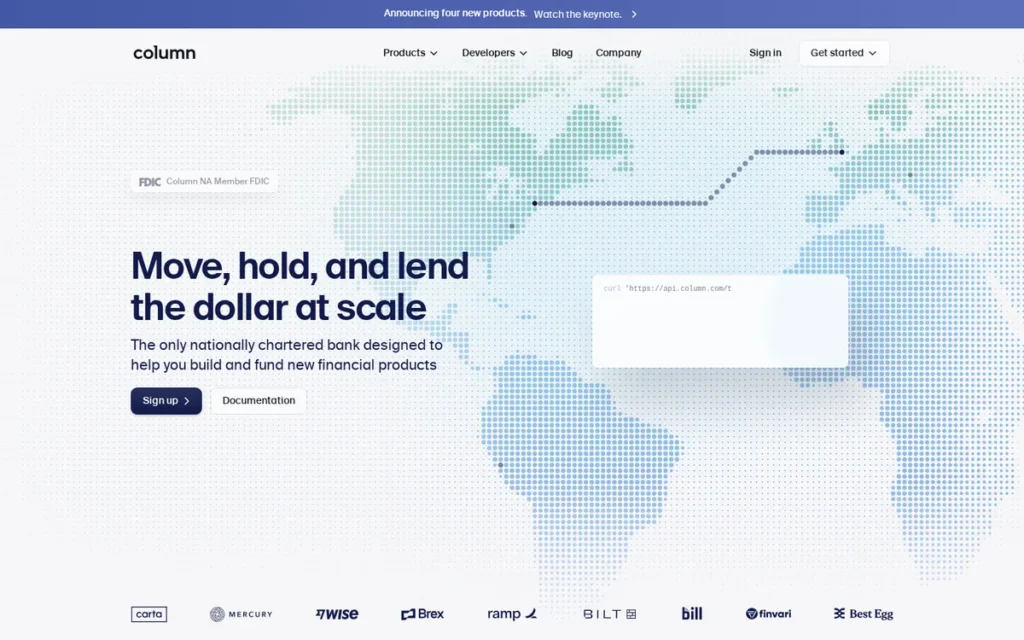
Category: Chartered Bank API, a licensed bank that offers its own accounts, payment rails, and lending directly through APIs, with no middleware layer.
PlugRoute Score: 3.80/5 (License 5 · Breadth 4.5 · Ops Load 2 · Stability 4 · Pricing 4 · Region 2.5)
At a Glance
- Category: Chartered Bank API
- Best For: Developer-heavy US fintechs, lenders, and platforms with in-house compliance staff
- Price Range: Published per-transaction fees (for example, $0.50 standard ACH); the monthly minimum is not published
- Primary Strength: Column N.A. holds its own national bank charter, so there is no ambiguity about who holds the license.
- Biggest Limitation: Column does not provide a turnkey compliance program or white-label interface.
- One-Line Summary: Column is a nationally chartered US bank offering direct API access to accounts, payments, cards, and lending for teams that can own their compliance and product build.
- Last Verified: November 2026
Overview
Column N.A. is a nationally chartered US bank that offers accounts, ACH, wires, checks, card programs, and lending partnerships directly through its own APIs and core system. Column is built for developer-heavy fintech and platform teams that have in-house compliance staff.
Column N.A. was formed when Plaid co-founder William Hockey acquired Northern California National Bank in 2021, and Column launched publicly in April 2022 (TechCrunch, 2022). Column contracts with fintechs directly and underwrites them at bank level during onboarding.
Key Features
- Column offers individual, FBO, sweep, clearing, and customer account types on its own core banking system, which serves as the system of record.
- Column supports standard and same-day ACH, incoming wires, book transfers, and check issuance, and publishes a fee for each.
- Column offers card programs alongside its account and payment APIs.
- Column documents lending partnerships, warehouse financing, and loan purchases.
- Column underwrites each fintech at bank level because the fintech contracts directly with the chartered bank.
Best For
Column is best for developer-led US fintechs, lenders, and platforms that already employ compliance staff and want to contract directly with the license holder. Column is a weaker fit for early-stage teams that need a managed compliance program or prebuilt interfaces.
Strengths
- Column N.A. is itself a nationally chartered bank (Column, 2026), so buyers contract with the license holder instead of going through a middleware vendor and a separate sponsor bank.
- Column ties with Stripe for the lowest disclosed standard ACH fee ($0.50) and has the lowest disclosed wire fee ($5.00 after 10 free incoming wires) in PlugRoute’s 2026 evaluation (Column, 2026).
- Column runs its own core system and connects directly to payment rails, so accounts are recorded at the regulated bank rather than on a separate vendor ledger.
- Column N.A. is supervised by the OCC as a national bank and files public quarterly Call Reports with the FFIEC. A third-party check found no OCC enforcement action against Column (Noizz.io, 2026).
Limitations
Column trades turnkey support for direct control. Column offers no managed compliance program or white-label interface like those at Unit or Synctera, so the buyer owns KYC/AML operations and the product build.
- Column underwrites each fintech at bank level, so approval is not guaranteed, and the onboarding timeline depends on Column’s own credit and compliance review.
- Column’s monthly minimum is not published, so Column’s total cost cannot be reliably compared without a quote.
- Column’s RTP and FedNow availability was not verified in PlugRoute’s research.
- Column serves the US only.
Evidence gaps: PlugRoute found no verified review-platform presence for Column, no Reddit discussion of Column, and no confirmed Column customer list, so there is no independent evidence on Column’s support quality.
Verdict
Column is the strongest choice in PlugRoute’s 2026 BaaS evaluation for US teams that want certainty about who holds the banking license, because Column N.A. is the bank.
Column’s highest scores are License (5) and Breadth (4.5). Column documents six product lines: accounts, ACH and wires, checks, cards, lending and loan purchases, and book transfers. Column’s lowest score is Ops Load (2), so teams without compliance staff should compare Column with a managed platform first.
2. Swan: Best for European and EEA Embedded Banking
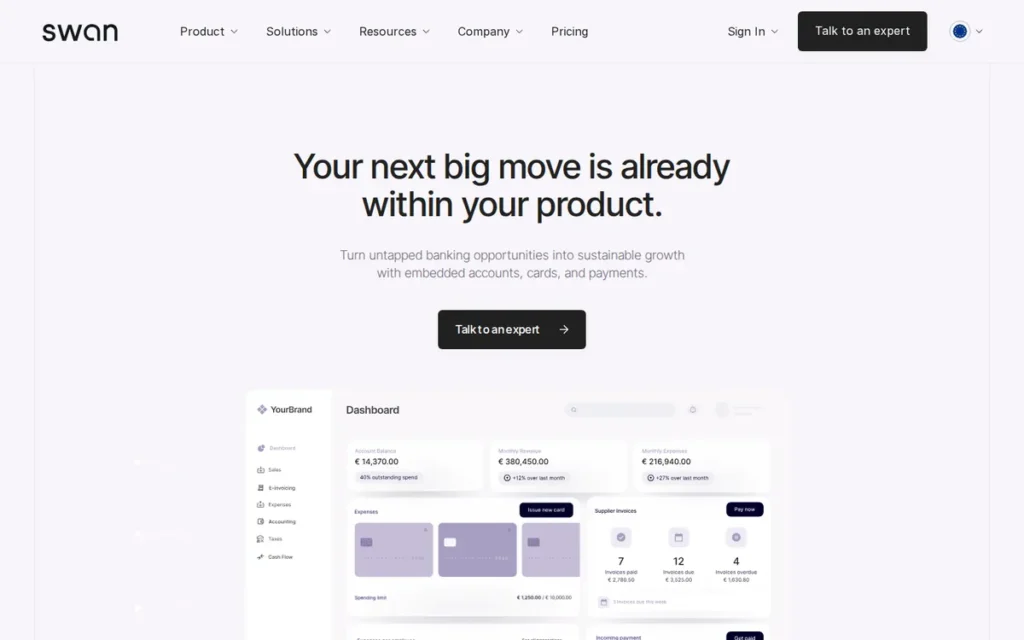
Category: European EMI Platform, a licensed e-money institution offering white-label accounts, SEPA payments, and cards across the EEA.
PlugRoute Score: 3.58/5 (License 4.5 · Breadth 3.5 · Ops Load 3.5 · Stability 3 · Pricing 4 · Region 2)
At a Glance
- Category: European EMI Platform
- Best For: EEA-focused platforms, SaaS companies, and marketplaces embedding IBAN accounts and cards
- Price Range: From €2,990/month plus revenue share; per-account and per-card fees
- Primary Strength: Swan holds its own ACPR e-money licence and names its safeguarding banks, BNP Paribas and Natixis.
- Biggest Limitation: Swan covers 30 EEA countries only, with no US coverage and no documented lending product.
- One-Line Summary: Swan is a French ACPR-licensed e-money institution that lets European platforms embed IBAN accounts, SEPA Instant transfers, and Mastercard cards from €2,990 per month.
- Last Verified: November 2026
Overview
Swan is a French e-money institution, licensed by the ACPR and passported across the EEA. Swan provides white-label IBAN accounts, SEPA and SEPA Instant transfers, and Mastercard cards for European platforms, SaaS companies, and marketplaces.
Swan is registered in Paris, with Nicolas Benady as president (Swan, 2026). Swan is not a bank. Swan safeguards customer funds at BNP Paribas and Natixis (Groupe BPCE) and does not take bank deposits.
Key Features
- Swan issues white-label IBAN accounts from its own core banking system, ledger, and BIC.
- Swan supports SEPA transfers, SEPA Instant transfers, and direct debit across the EEA.
- Swan issues virtual and physical Mastercard cards as a Mastercard principal member.
- Swan provides a GraphQL API plus ready-made, partly open-source interfaces that reduce front-end build work.
- Swan includes regulated end-user onboarding as part of its licensed program.
Best For
Swan is best for EEA-focused platforms that want accounts, SEPA payments, and cards from one licensed provider with a published price. Swan is not suitable for US programs or for programs that need lending.
Strengths
- Swan is authorized by France’s ACPR as an e-money institution (REGAFI 86245, authorized 4 June 2020), with funds safeguarded at BNP Paribas and Natixis (Swan, 2026).
- Swan is the only full-stack provider in PlugRoute’s 2026 evaluation with a published entry price of €2,990 per month plus revenue share (Swan, 2026).
- Swan runs its own core banking system, ledger, and BIC, so account records sit with the licensed institution.
- Swan powers Pennylane’s three-tier premium card offer (Swan, 2026), although Swan publishes no quantified outcome data for it.
Limitations
Swan trades US reach for European depth. Swan covers only the EEA, offers no US accounts or rails, and documents no lending product, so US or cross-border programs need a second provider.
- Swan holds safeguarded e-money, not bank deposits. Swan states that its safeguarding accounts at BNP Paribas and Natixis are covered by France’s FGDR up to €100,000 per customer at each bank, subject to FGDR rules (Swan, 2026).
- Swan partners should describe that protection exactly as Swan documents it, not as ordinary deposit insurance.
- Swan’s documentation confirms that accounts can be suspended during compliance or KYC reviews, and some end-user Trustpilot reviews complain about frozen accounts (Trustpilot, 2026).
- Swan’s ISO 27001 and PCI DSS claims come only from a third-party directory, not from Swan’s primary documentation.
Evidence gaps: Swan’s G2 rating is 4.5/5 from one review (G2, 2026), too small a sample, and PlugRoute’s Reddit fetch for Swan failed.
Verdict
Swan is the only Europe-focused provider in PlugRoute’s 2026 evaluation, and Swan pairs its own ACPR e-money licence with named safeguarding banks and a published €2,990-per-month entry price.
Swan’s highest scores are License (4.5) and Pricing (4). Swan’s lowest is Region (2) because Swan has no US coverage. For US-only readers, removing Swan moves Stripe to #2 and Unit to #3. European teams should plan for account freezes during compliance reviews.
3. Stripe Treasury + Stripe Issuing: Best for B2B Platforms on Stripe Connect
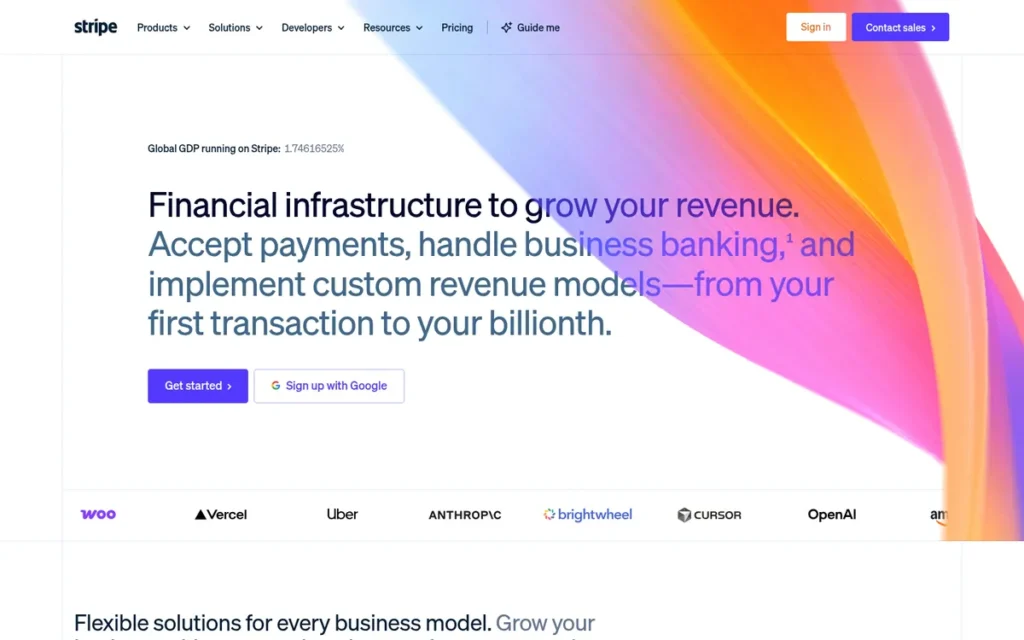
Category: Payments-Platform Add-On, embedded accounts and card issuing offered as extensions of an existing payments platform.
PlugRoute Score: 3.50/5 (License 3 · Breadth 3 · Ops Load 3.5 · Stability 4 · Pricing 5 · Region 3.5)
At a Glance
- Category: Payments-Platform Add-On
- Best For: B2B platforms and marketplaces already running on Stripe Connect
- Price Range: No monthly fees or minimums on Stripe’s published US Treasury pricing (for example, $0.50 next-day ACH and $0.10 per virtual card); confirm the schedule applies to your platform contract
- Primary Strength: Stripe Treasury and Stripe Issuing publish the most itemized pricing in this evaluation.
- Biggest Limitation: Stripe Treasury requires Stripe Connect, serves businesses only, and does not name its platform bank partners.
- One-Line Summary: Stripe Treasury and Stripe Issuing let B2B platforms on Stripe Connect embed business accounts, payouts, and cards with fully published, pay-as-you-go pricing.
- Last Verified: November 2026
Overview
Stripe Treasury (Financial Accounts for platforms) and Stripe Issuing let B2B platforms on Stripe Connect give business customers accounts to hold, receive, and send funds. Stripe Issuing adds virtual and physical cards. Both carry published pay-as-you-go fees and no monthly minimum.
Stripe was co-founded by Patrick Collison (CEO) and John Collison (President), and Stripe ran an employee tender offer at a $91.5 billion valuation in February 2025 (Stripe, 2025). Stripe Issuing through Connect requires Custom connected accounts.
Key Features
- Stripe Treasury lets connected business accounts hold balances, receive funds, pay bills, and send payouts.
- Stripe Treasury supports ACH, same-day ACH, RTP, Fedwire, UK local payouts, SWIFT, and currency conversion.
- Stripe Issuing creates virtual and physical cards, and platforms can earn a share of interchange at a rate Stripe does not publish.
- Stripe Issuing supports real-time authorization decisions, so platforms can approve or decline card transactions as they happen (Stripe, 2026).
- Stripe Issuing is available in the US, UK, and many EEA countries, while Stripe Treasury for platforms is in preview in the US, UK, and select EU countries (Stripe, 2026).
Best For
Stripe Treasury and Stripe Issuing are best for B2B platforms already built on Stripe Connect that want business accounts and cards with no minimums. Stripe Treasury does not serve consumer programs or platforms that do not use Connect.
Strengths
- Stripe reported $1.4 trillion in 2024 total payment volume, up 38% year over year (Stripe, 2024). This is a company-wide figure, not a Treasury-specific one.
- Stripe publishes the most complete pricing in PlugRoute’s 2026 evaluation, with no minimums or monthly fees (Stripe, 2026). That matches the pay-as-you-go pricing startups ask for on r/fintech.
- Stripe names Fifth Third Bank, N.A. as the exclusive checking-account provider for its direct business Treasury product (Stripe, 2026).
- Stripe states that it manages bank partnerships, compliance, KYC, and reconciliation behind Stripe Treasury (Stripe, 2026), which reduces operational load for platform teams.
Limitations
Stripe Treasury trades low setup friction for platform dependency. Stripe Treasury requires Stripe Connect and supports business accounts only, so many startups and all consumer programs are ineligible by design.
- Stripe does not name the “multiple bank partners” behind its platform Treasury product.
- Stripe states it may restrict businesses or disable integrations that create unacceptable regulatory, reputational, or financial risk (Stripe, 2026).
- One Stripe user in a 2021 r/fintech thread said a dispute over a separate Stripe product cut off their Stripe Issuing access. It is a single dated anecdote, but it shows the concentration risk.
- Stripe lists Treasury for platforms as private preview in the US, while Stripe’s standalone Treasury product is in public preview (Stripe, 2026). A platform reading the wrong page could assume it has access it does not.
- Stripe’s quoted fees come from its US Treasury pricing page, so platforms should confirm in writing that the same schedule applies to Treasury for platforms.
Users on r/fintech shared their experience:
“Due to a conflict with Stripe over something separate I cannot issue cards (virtual and physical) on stripe issuing. I am just starting to use these cards to it is a huge setback. Does anyone know a good equivalent product?” Posted by u/jsavo20
Takeaway: Stripe Issuing’s place inside the wider Stripe account relationship means a dispute over an unrelated Stripe product can cut off card issuing entirely, a real concentration risk for platforms building their whole program on Stripe.
Evidence gaps: PlugRoute verified no G2, Capterra, or Trustpilot data specific to Stripe Treasury or Stripe Issuing, and found no quantified Stripe Treasury case studies.
Verdict
Stripe Treasury and Stripe Issuing are the most transparently priced BaaS option in PlugRoute’s 2026 evaluation for B2B platforms already on Stripe Connect.
Stripe’s highest score is Pricing (5). Stripe’s lowest are License (3) and Breadth (3) because the platform bank partners are unnamed and accounts are B2B only. Stripe sits 0.08 points behind Swan and 0.07 ahead of Unit. Teams not on Connect should look elsewhere.
4. Unit: Best for Managed US Launches With Limited Compliance Staff
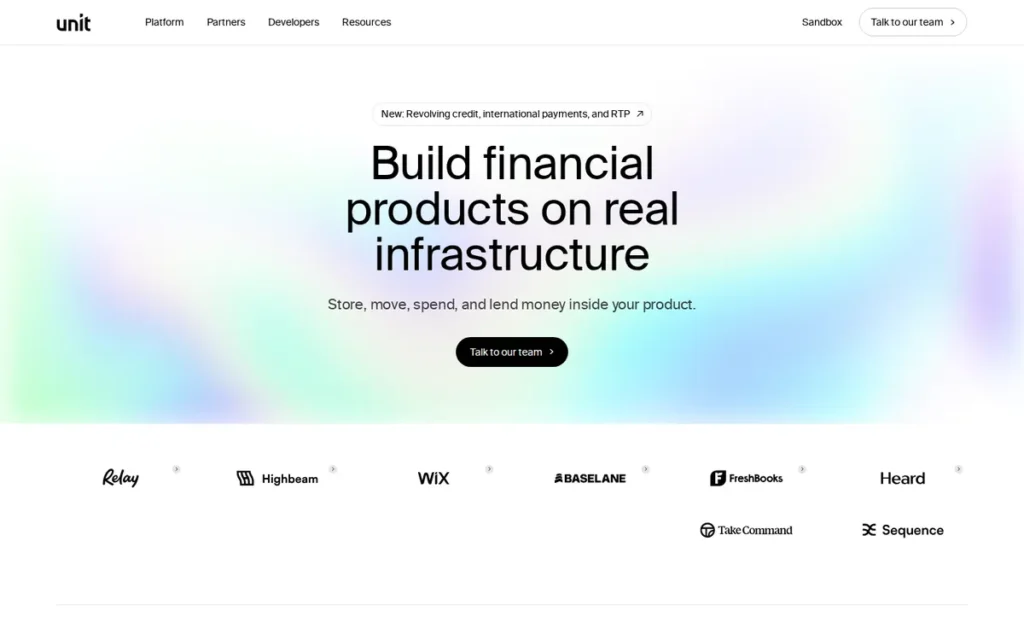
Category: Managed Full-Stack, a nonbank platform that bundles accounts, cards, payments, a ledger, and program operations on top of partner banks.
PlugRoute Score: 3.43/5 (License 3.5 · Breadth 4 · Ops Load 4.5 · Stability 3 · Pricing 1.5 · Region 2.5)
At a Glance
- Category: Managed Full-Stack
- Best For: US vertical SaaS companies and startups with limited in-house compliance staff
- Price Range: Pricing on request (public pricing not verified as of November 2026)
- Primary Strength: Unit bundles accounts, debit cards, ACH, wires, a ledger, and operational support in one managed program.
- Biggest Limitation: Unit’s pricing could not be verified, and Unit offers less sponsor-bank choice than network-style providers.
- One-Line Summary: Unit is a US managed embedded-finance platform that bundles accounts, debit cards, ACH, wires, a ledger, and program operations on top of partner banks such as Thread Bank and i3 Bank.
- Last Verified: November 2026
Overview
Unit is a US financial technology company, not a bank. Unit provides a managed embedded-finance platform with deposit accounts, wallets, Visa debit cards, ACH, wires, a ledger, and a dashboard for vertical SaaS companies and startups that want program operations handled for them.
Unit acts as a program manager, while Unit’s partner banks provide the underlying banking services. PlugRoute could not verify Unit’s founding date, founders, or funding as of November 2026.
Key Features
- Unit provides deposit accounts and wallets held at partner banks, with Visa debit cards issued by those banks.
- Unit supports ACH and wire transfers through its API and dashboard.
- Unit includes a ledger and dashboard for tracking end-user balances and transactions.
- Unit offers operational support covering compliance, fraud, disputes, and reconciliation.
- Unit offers a Ready-to-Launch path and a custom API path, reported at about 3 and 6 weeks respectively (Noizz.io, 2026).
Best For
Unit is best for US vertical SaaS companies and startups that want accounts, cards, and money movement in one platform without a large compliance team. Unit is a weaker fit for teams that need to choose their own sponsor bank.
Strengths
- Unit names Thread Bank and i3 Bank as partner banks in its Relay, Covercy, Crowded, and Heard case studies (Unit, 2026).
- Unit states that pass-through FDIC insurance applies only when FDIC rules and record-keeping conditions are met (Unit, 2026), so Unit does not overstate coverage.
- Unit’s Ready-to-Launch path is reported at about 3 weeks (Noizz.io, 2026). That is a third-party figure, not a Unit service commitment.
- Unit’s case studies cite outcomes such as 4× higher lifetime value for Stessa/Roofstock cash-management users and 50% lower acquisition cost at Baselane (Unit, 2026). These figures are vendor-reported.
Limitations
Unit trades bank choice and price visibility for a managed experience. Unit is described as less flexible on sponsor-bank selection than network-style providers (FintechSpecs, 2026), and Unit’s pricing could not be verified.
- Unit states that RTP availability and pricing depend on the partner bank (Unit, 2026), so rail access varies by Unit program.
- Thread Bank, a Unit partner bank, appears on Banking Dive’s running list of BaaS banks with consent orders (Banking Dive, 2024). This is a bank-level action, not a finding against Unit, and the partner bank varies by program.
- Unit’s SOC 2 Type 2 and PCI DSS status is reported only by a third party (Kurums, 2026).
- Unit serves the US only.
Evidence gaps: Unit’s G2 rating is 3.5/5 from three reviews (G2, 2026), too few to judge. PlugRoute retrieved Reddit discussion of Unit but did not analyze it this cycle, so this entry contains no community evidence on Unit.
Verdict
Unit is the strongest managed option in PlugRoute’s 2026 evaluation for US teams that want accounts, cards, and money movement launched with the least in-house compliance work.
Unit’s highest score is Ops Load (4.5), the top score on that criterion. Unit’s lowest is Pricing (1.5), and with published pricing at Stripe’s level Unit would score 3.78. Readers should get a full Unit fee schedule and their program’s bank name in writing.
5. Synctera: Best for Built-In Compliance Tooling and US-Plus-Canada Programs
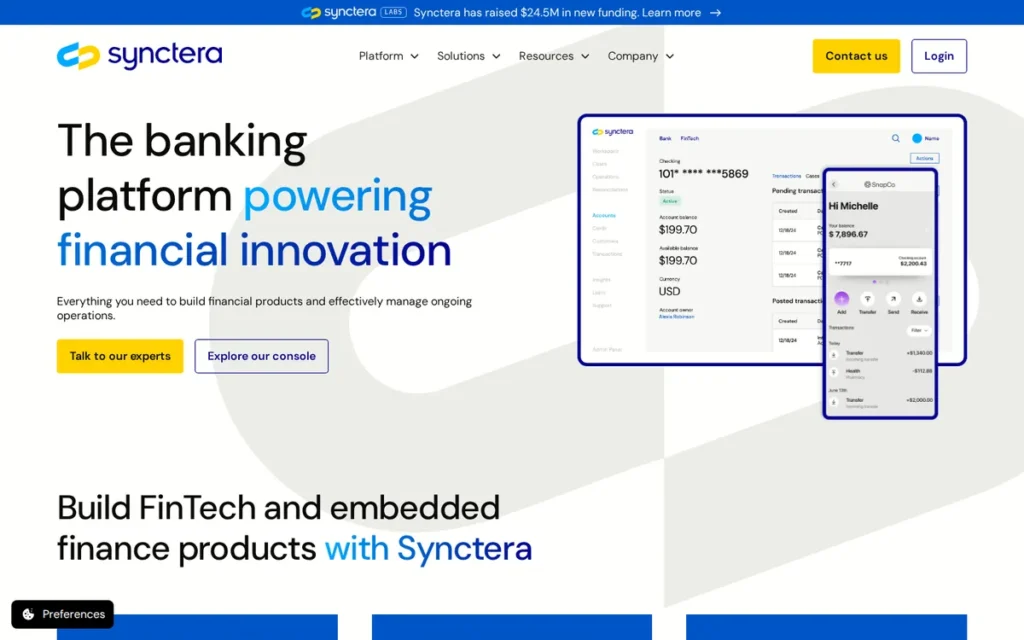
Category: Managed Full-Stack, a nonbank platform that bundles accounts, cards, payments, a ledger, and compliance operations on top of partner banks.
PlugRoute Score: 3.35/5 (License 3 · Breadth 4 · Ops Load 4 · Stability 3 · Pricing 2.5 · Region 3)
At a Glance
- Category: Managed Full-Stack
- Best For: US and Canadian fintechs wanting built-in KYC/AML, fraud monitoring, and reconciliation
- Price Range: Pricing on request; published structure of implementation, platform, and usage fees (no amounts)
- Primary Strength: Synctera includes connected KYC/KYB/AML providers, fraud monitoring, case management, and automated reconciliation.
- Biggest Limitation: Synctera confirms the sponsor bank for a specific program only during onboarding, and Synctera’s integration is reported as slower than Unit or Column.
- One-Line Summary: Synctera is a managed BaaS platform that matches US and Canadian fintech programs with partner banks and bundles a ledger, cards, ACH, compliance tooling, and automated reconciliation.
- Last Verified: November 2026
Overview
Synctera is a managed banking-as-a-service platform and program manager that matches fintech programs with partner banks. Synctera provides a ledger, accounts, card issuing and processing, ACH, mobile check deposit, and built-in compliance tooling for programs launching in the US or Canada.
Synctera is led by co-founder and CEO Peter Hazlehurst (Synctera, 2026). Synctera also runs a shared console used by both the fintech and its partner bank.
Key Features
- Synctera provides a ledger, deposit accounts, card issuing and processing, ACH, and mobile check deposit.
- Synctera connects KYC, KYB, and AML providers and includes transaction monitoring, fraud monitoring, and case management.
- Synctera automates reconciliation across its ledger, the partner bank, and payment rails.
- Synctera matches programs with partner banks and gives both parties a shared console.
- Synctera markets program launches in Canada in addition to the US.
Best For
Synctera is best for fintechs that want compliance and reconciliation tooling built in, and for programs that need Canada alongside the US. Synctera is a weaker fit for teams that must launch quickly.
Strengths
- Synctera has publicly named sponsor-bank partners, including Veritex Community Bank, Midland States Bank, and Emigrant Bank in the US, and National Bank of Canada (Fintech.Global, 2023; TechCrunch, 2023).
- Synctera automates reconciliation across ledger, bank, and rails (Synctera, 2026). That is the control whose absence the 2024 Synapse bankruptcy exposed.
- Synctera is the only provider in this evaluation that PlugRoute found marketing Canadian program launches, backed by its National Bank of Canada partnership (TechCrunch, 2023).
- Synctera announced a $24.5 million round on November 6, 2026, bringing its total funding to $126.7 million (Synctera, 2026).
Limitations
Synctera trades speed for a consultative, hands-on model. Synctera is described as slower to integrate than Unit or Column, with thinner API documentation than Column (FintechSpecs, 2026).
- Synctera confirms the sponsor bank for a specific program only during onboarding. Banks shown on Synctera’s customer page should not be assumed to sponsor any given program.
- Synctera publishes no pricing amounts, and Synctera’s wire, RTP, and FedNow support was not verified.
- Synctera’s only G2 review (3.0/5) criticizes dependence on the partner bank and limited customization (G2, 2026).
Evidence gaps: Synctera’s single G2 reviewer also praised its banking access and compliance support, but one review is far too small a sample. PlugRoute found no substantive independent Reddit discussion of Synctera, and the one Reddit mention came from a possibly vendor-affiliated username.
Verdict
Synctera is the strongest choice in PlugRoute’s 2026 evaluation for teams that want compliance, fraud, and reconciliation tooling built into a managed platform across the US and Canada.
Synctera’s highest scores are Breadth (4) and Ops Load (4). Synctera’s lowest is Pricing (2.5) because no amounts are published. PlugRoute raised Synctera’s License score from 2.5 to 3 in November 2026 after confirming its 2023 sponsor-bank announcements. Expect a longer, consultative onboarding.
6. Treasury Prime: Best for Fintechs That Want to Choose Their Own Sponsor Bank
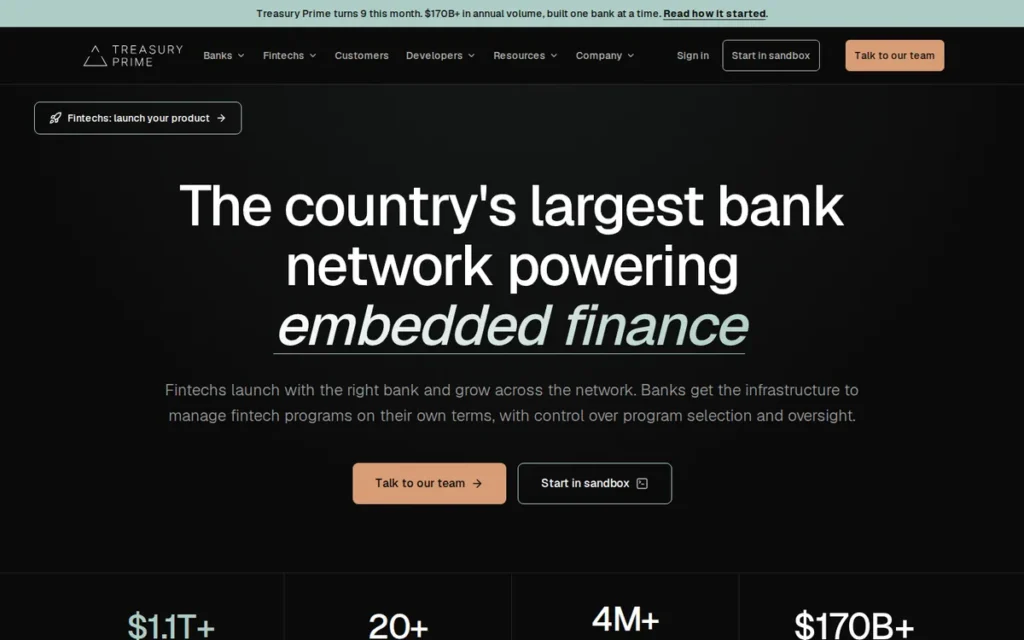
Category: Bank-Direct Software, technology sold to chartered banks, which select and contract with their own fintech partners.
PlugRoute Score: 2.85/5 (License 4 · Breadth 3.5 · Ops Load 2 · Stability 2 · Pricing 1.5 · Region 3)
At a Glance
- Category: Bank-Direct Software
- Best For: Fintechs with established compliance teams wanting a direct contract with a chosen sponsor bank
- Price Range: Pricing on request; fintech terms increasingly set by the partner bank
- Primary Strength: Treasury Prime lets programs keep accounts on the bank’s own core or on its FBO-backed virtual ledger.
- Biggest Limitation: Treasury Prime pivoted to selling to banks in February 2024 and cut roughly half its staff.
- One-Line Summary: Treasury Prime is bank-direct embedded-banking software sold to a network of 20+ chartered banks that choose their own fintech partners, with core or virtual-ledger account options.
- Last Verified: November 2026
Overview
Treasury Prime is embedded-banking software sold to a network of 20+ chartered banks, which choose and contract with their own fintech partners. Treasury Prime serves banks running fintech programs and compliance-mature fintechs that want a direct contract with a sponsor bank.
Since February 2024, fintechs reach Treasury Prime through a partner bank, and accounts can sit on the bank’s core or on Treasury Prime’s FBO-backed ledger. Treasury Prime is led by CEO Chris Dean (Banking Dive, 2024).
Key Features
- Treasury Prime’s Core Direct option keeps accounts on the partner bank’s own core system, so the bank is the system of record.
- Treasury Prime’s Virtual Ledger and Prime Core options keep accounts on Treasury Prime’s ledger, backed by FBO or omnibus accounts.
- Treasury Prime’s Prime Data puts ledger, FBO, payment, and check records into a queryable data warehouse.
- Treasury Prime sends domestic wires over a direct FedLine connection and offers FedNow through select partner banks.
- Treasury Prime describes its network as 20+ banks with more than $1.1 trillion in combined assets, and KeyBank joined in March 2024 (Treasury Prime, 2024).
Best For
Treasury Prime is best for fintechs with in-house compliance teams that want to contract directly with a chosen sponsor bank, and for banks building embedded programs. Treasury Prime is a weaker fit for first-time founders.
Strengths
- Treasury Prime grew from 15+ banks in March 2024 to 20+ banks (Treasury Prime, 2024), the widest documented sponsor-bank choice in this evaluation.
- Treasury Prime lets the bank remain the system of record through Core Direct accounts.
- Treasury Prime documents that FedNow is available only through select partner banks, subject to approval (Treasury Prime, 2026). Few other providers in this evaluation document which rails depend on the bank.
- Treasury Prime reports that Grasshopper Bank cut small-business account opening from days to under 10 minutes (Treasury Prime, 2026). This result is vendor-reported.
Limitations
Treasury Prime trades vendor-managed convenience for bank choice. Treasury Prime sells to banks, so fintechs must win bank approval, contract directly, and carry a high compliance load suited to teams that already have compliance staff (Trio, 2026).
- Treasury Prime cut about 40–50 employees in February 2024 (Banking Dive, 2024), roughly half its staff (Finextra, 2024).
- Treasury Prime’s fintech-facing sales and marketing teams were the main targets of those layoffs (Banking Dive, 2024), so fintechs may get less direct support than a managed model offers.
- Treasury Prime publishes no pricing, and Treasury Prime’s RTP support was not verified.
- Treasury Prime serves the US only.
Evidence gaps: PlugRoute could not verify Treasury Prime’s review ratings because secondary claims of 4.4–4.5/5 conflict, and PlugRoute found no Reddit discussion of Treasury Prime.
Verdict
Treasury Prime is the strongest option in PlugRoute’s 2026 evaluation for fintechs that want to choose and contract directly with their own sponsor bank from a 20+ bank network.
Treasury Prime’s highest score is License (4). Treasury Prime’s Stability score (2) is the lowest in the evaluation, driven by the February 2024 layoff of about half its staff. Treasury Prime’s 2024 pivot makes Treasury Prime a better fit for compliance-mature teams than for first-time founders.
7. Marqeta: Best for Card-Led Programs Needing Real-Time Authorization
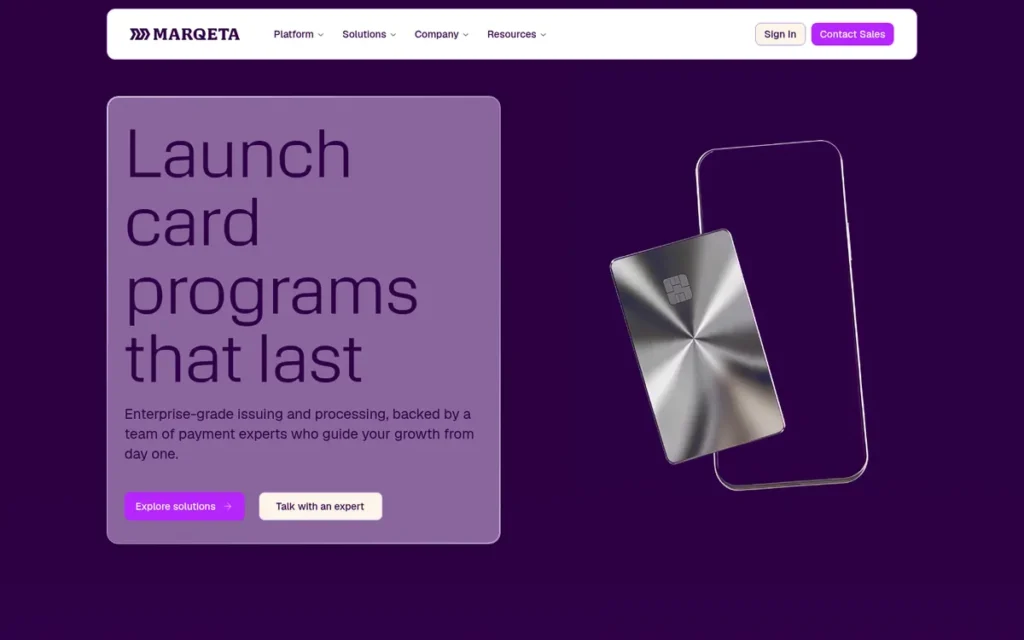
Category: Card-Issuing Specialist, an API platform for issuing and processing cards, not a full deposit-and-ledger banking stack.
PlugRoute Score: 2.78/5 (License 2.5 · Breadth 2.5 · Ops Load 2.5 · Stability 4 · Pricing 1.5 · Region 4)
At a Glance
- Category: Card-Issuing Specialist
- Best For: Larger card-led programs needing custom authorization, credit or BNPL features, or US plus UK/EEA issuing
- Price Range: Pricing on request (no fees published as of November 2026)
- Primary Strength: Marqeta is the only company in this evaluation with SEC-filed audited financials.
- Biggest Limitation: Marqeta is a card specialist, so teams needing deposit accounts or broad money movement must add another provider.
- One-Line Summary: Marqeta is a publicly listed card-issuing and processing platform whose Just-in-Time funding lets card-led programs approve or decline each transaction in real time.
- Last Verified: November 2026
Overview
Marqeta is a publicly listed issuing processor for card-led fintechs and platforms. Marqeta’s Just-in-Time funding gives programs real-time control over each authorization, and Marqeta’s TransactPay acquisition adds UK and EEA program management.
Marqeta is not a full banking stack and does not replace deposit accounts or a ledger. Marqeta files with the SEC, but PlugRoute could not verify Marqeta’s founding, IPO, or CEO details as of November 2026.
Key Features
- Marqeta’s Gateway JIT funding sends each transaction to the customer’s own system, which approves or declines funding in real time.
- Marqeta’s Managed JIT funding applies preset Marqeta rules for customers that do not want to build a decision endpoint.
- Marqeta provides credit program tools, and Marqeta Flex adds buy-now-pay-later and installments.
- Marqeta offers tokenization and program management alongside issuing and processing.
- Marqeta’s TransactPay subsidiary is a UK/EEA e-money institution and BIN sponsor, live in 25 countries and 16 currencies (Marqeta Investor Relations, 2025).
Best For
Marqeta is best for larger card-led programs that need custom authorization logic, credit or BNPL card features, or issuing across the US and Europe. Marqeta should not be the only vendor for programs needing deposit accounts.
Strengths
- Marqeta reported $382.5 billion in 2025 total processing volume (up 31%) and $624.9 million in 2025 net revenue (up 23%) (Marqeta FY2025 Form 10-K, 2026). These are the only SEC-filed audited financials in this evaluation, although Column N.A. files regulatory Call Reports as a national bank.
- Marqeta completed its TransactPay acquisition on August 6, 2025 (Marqeta Investor Relations, 2025), adding a UK/EEA e-money licence and BIN sponsorship.
- Marqeta’s Gateway JIT funding lets the customer’s own system fund and approve each card transaction in real time, the most granular authorization-and-funding control documented in this evaluation. Stripe Issuing also supports real-time authorization decisions.
- Marqeta’s developer docs describe its card-management UX Toolkit as PCI Level 1 compliant (Marqeta, 2026).
Limitations
Marqeta trades banking breadth for card depth. Marqeta does not provide deposit accounts, a full ledger, or broad money movement, so most embedded-banking programs need a second provider.
- Marqeta’s Gateway JIT requires the buyer to build and run a real-time decision endpoint, which adds engineering load.
- Marqeta’s 10-K shows Block accounted for 45% of 2025 net revenue, down from 47% in 2024 (Marqeta FY2025 Form 10-K, 2026). That is a high level of customer concentration.
- Marqeta’s pricing is fully quoted per program, and one 2021 r/fintech comment suggests Marqeta’s sales process favors larger programs.
Users on r/fintech noted:
“For the actual BIN sponsorship, look at Marqueta if you can get through their onboarding process. They’re expensive as hell but they handle complex compliance scenarios. Stripe Issuing might work for some use cases but they’re pretty conservative on risk profiles.” Posted by u/whatwilly0ubuild
Takeaway: Marqeta handles complex compliance scenarios that more conservative issuers avoid, but its demanding onboarding and high cost make it a better fit for well-funded card programs than for early-stage startups.
Evidence gaps: PlugRoute did not verify Marqeta’s US issuing banks or G2 rating. The only community evidence on Marqeta is a 2021 r/fintech comment saying its “sales & support was less than ideal,” which is one dated data point.
Verdict
Marqeta is the only card-issuing specialist in PlugRoute’s 2026 evaluation and the only provider with SEC-filed audited financials, reporting $382.5 billion in 2025 total processing volume.
Marqeta ranks #7 mainly because PlugRoute’s criteria reward full-stack banking breadth (Breadth 2.5) and because Marqeta’s pricing is fully quoted (Pricing 1.5). Marqeta’s highest scores are Stability (4) and Region (4). Card-led programs should treat Marqeta as a primary candidate and pair it with an accounts provider.
Who Holds the Banking License in Each BaaS Program?
Column N.A. holds its own bank charter, and Swan holds its own ACPR e-money licence. Stripe, Unit, Synctera, and Marqeta rely on partner or issuing banks, and Treasury Prime lets you contract directly with a chosen bank. Column, Swan, and Treasury Prime’s bank-direct model give buyers full license-holder clarity at contract.
| Provider | License Holder | Named Banks | Disclosure Level | Region | Documented Rails |
|---|---|---|---|---|---|
| Column | Column N.A. (itself) | Not applicable | Full | US | ACH, same-day ACH, wires, book transfers, checks (RTP/FedNow not verified) |
| Swan | Swan (ACPR EMI) | BNP Paribas, Natixis (safeguarding) | Full | 30 EEA countries | SEPA, SEPA Instant, direct debit |
| Stripe | Partner banks | Fifth Third (direct product only); platform banks unnamed | Partial | US, UK, select EU (Treasury in preview) | ACH, same-day ACH, RTP, Fedwire, UK local, SWIFT |
| Unit | Partner banks | Thread Bank, i3 Bank; varies by program | Partial | US | ACH, wires; RTP depends on bank (FedNow not verified) |
| Synctera | Partner banks | Veritex, Midland States, Emigrant (US); National Bank of Canada (2023 announcements) | Partial (program bank confirmed at onboarding) | US, Canada | ACH, mobile check deposit (wires/RTP/FedNow not verified) |
| Treasury Prime | Your chosen partner bank | 20+ network incl. KeyBank, OMB Bank | Full at contract | US | FedLine wires; FedNow at select banks (RTP not verified) |
| Marqeta | Issuing banks; TransactPay EMI in UK/EEA | US issuing banks not verified | Partial | US + 25 countries | Card issuing and processing |
Is My Customers’ Money Actually FDIC-Insured?
End-user money held through a BaaS program is not automatically FDIC-insured. Pass-through coverage applies only when ownership, custodial deposit account records, and identifiable beneficial-owner shares meet FDIC rules. FDIC pass-through insurance protects records, not promises: if the bank’s records cannot show who owns each dollar, the coverage may not apply.
This aligns with community sentiment on r/yotta:
“There really needs to be more stringent requirements around disclosures and enforcement. I suspect a lot of yotta customers didn’t know their money was being commingled with fintech thinking the FDIC claims of yotta was keeping their money secure.” Posted by u/desert_jim
Takeaway: End users of Synapse-linked apps took FDIC marketing as a guarantee, which shows why BaaS programs must never present pass-through coverage as automatic.
- Synapse collapse: Synapse filed for bankruptcy in April 2024, and a CFPB complaint estimates a $60–90 million shortfall between recorded end-user balances and funds held at partner banks (CFPB, 2025).
- Pass-through condition one: The end user must actually own the funds under 12 CFR 330.5 and 330.7 (FDIC, 2025).
- Pass-through condition two: Account records must show that the bank holds the funds in a custodial deposit account on the owner’s behalf.
- Pass-through condition three: Each beneficial owner’s share must be identifiable from records, usually through an accurate sub-ledger.
- Pass-through condition four: Standard limits apply, combined with the person’s other deposits at the same bank.
- Part 328 rule: The FDIC rule bans misrepresenting insurance status, with compliance required by January 1, 2025, and official-sign provisions by May 1, 2025 (FDIC 12 CFR Part 328, 2023).
- Proposed recordkeeping rule: The FDIC’s September 2024 proposal for daily reconciliation and beneficial-owner records is not final, and sources disagree about whether it was withdrawn or shelved (FDIC, 2024).
- Consent orders: Seven sponsor banks received consent orders from 2022 to 2025: Blue Ridge, Lineage, Sutton, Piermont, Thread, Evolve, and Cross River (Banking Dive, 2024; National Law Review, 2025). These are bank-level actions, so readers should check whether each order remains in effect.
- European difference: EEA e-money such as Swan’s is safeguarded at banks rather than held as deposits, and Swan states its safeguarding accounts carry FGDR protection under FGDR rules (Swan, 2026).
How Does BaaS Differ in the US vs. Europe?
US BaaS programs typically run through sponsor banks, and pass-through FDIC insurance depends on records. European programs often run through licensed e-money institutions that safeguard funds rather than take deposits. US programs use ACH, wires, RTP, and FedNow, while European programs use SEPA and SEPA Instant.
- US license model: US programs rely on a chartered bank, which is either the provider itself (Column) or a sponsor bank (Unit, Synctera, Treasury Prime, Stripe).
- European license model: European programs can use an EMI licence passported across the EEA, as Swan does under its ACPR authorization.
- US fund protection: US end-user funds may qualify for pass-through FDIC coverage only when all of its conditions are met.
- European fund protection: EEA e-money funds are safeguarded at partner banks, such as BNP Paribas and Natixis for Swan.
- Cross-border options: Stripe covers the US, UK, and select EU countries with Treasury in preview, and Marqeta covers card issuing in the US plus 25 countries through TransactPay.
- EU regulatory direction: PSD3 and the Payment Services Regulation are tightening EU payment oversight, but their timeline had not been confirmed as of November 2026.
Take a Swan end user with €50,000 in a segregated safeguarding account at BNP Paribas or Natixis. Swan states that this account carries FGDR protection up to €100,000 per customer at each bank, under FGDR rules (Swan, 2026). That protection works differently from a deposit the user holds directly at a bank.
How Much Does Banking as a Service Cost?
Most BaaS pricing is not public. Only Stripe and Column publish itemized per-transaction fees, and only Swan publishes an entry price (€2,990 per month). Synctera publishes its fee structure without amounts. Unit, Treasury Prime, and Marqeta quote privately, so you need a written all-in quote to know total cost.
| Transparency Tier | Providers | Published Figures (as of November 2026) |
|---|---|---|
| Itemized public fees, no minimums | Stripe (US Treasury pricing page) | $0.50 next-day ACH, $2.50 RTP, $0.10 virtual card |
| Itemized public fees, undisclosed minimum | Column | $0.50 ACH, $5.00 wires after 10 free, $1.00 checks |
| Published entry price | Swan | From €2,990/month + revenue share; €5 cards |
| Structure only | Synctera | Implementation, platform, and usage fees (no amounts) |
| Fully quoted | Unit, Treasury Prime, Marqeta | None verified |
Column’s published fees (Column, 2026):
| Item | Fee |
|---|---|
| ACH, standard | $0.50 |
| Same-day ACH surcharge | +$0.50 |
| Administrative return | $2.00 |
| Unauthorized return | $10.00 |
| Incoming wires | First 10 free, then $5.00 each |
| Book transfers | Free |
| Checks issued | $1.00 |
Column applies a monthly minimum that varies by use case and publishes no amount for it. PlugRoute did not capture Column’s RTP, FedNow, or SWIFT pricing.
Stripe’s published US Treasury and Issuing fees (Stripe, 2026):
| Item | Fee |
|---|---|
| ACH, next day | $0.50 |
| ACH, same day | $1.00 |
| RTP | $2.50 |
| Fedwire / SWIFT | $25.00 |
| UK local payouts | From £0.50 |
| Currency conversion | From 0.5% |
| Virtual card | $0.10 |
| Physical card | $3.50 + shipping |
| Cross-border transaction | 1% + $0.30 (+1% if converted) |
Stripe includes the first 50 domestic payouts each month and charges no account-opening, holding, or monthly fees. Platforms should confirm in writing that this schedule applies to Treasury for platforms. Stripe quotes custom and high-volume programs separately.
Other providers’ pricing:
- Swan’s plans start at €2,990 per month plus revenue sharing, combining a flat monthly fee with per-account and per-card fees (Swan, 2026).
- Swan charges €5 per card for off-the-shelf designs, with shipping at cost, and Swan’s full per-account schedule requires a quote.
- Synctera charges a one-time implementation fee based on program complexity (Synctera, 2026).
- Synctera charges a platform fee that includes access to its Console, plus usage fees for KYC checks, card transactions, and external account verification.
- Treasury Prime’s fintech terms are increasingly set by the partner bank, so buyers should request pricing from both Treasury Prime and the bank.
- Buyers of the fully quoted providers (Unit, Treasury Prime, and Marqeta) should request partner-bank pass-through fees, minimums, reserves, and exit terms in writing.
Worked example: At 1,000 ACH payouts a month, Stripe costs about $475 (950 × $0.50 after 50 free) and Column about $500 (1,000 × $0.50) before its minimum. The per-item fees are nearly equal, so Column’s unpublished monthly minimum decides which is cheaper.
Which BaaS Providers Were Mentioned but Not Ranked?
PlugRoute did not rank Increase, Solaris, or Airwallex. AI answer engines mention all three, but PlugRoute did not verify them to the same evidence standard as the seven ranked providers. PlugRoute repeats no feature claims about these three providers. Readers evaluating them should ask the same core checks:
- Ask each unranked provider which bank or licensed entity holds the license for your program.
- Ask each unranked provider who keeps the system-of-record ledger and how often it is reconciled.
- Ask each unranked provider for the all-in fee schedule, including minimums, reserves, and exit fees.
What Red Flags Should I Watch For When Evaluating BaaS Providers?
The most important BaaS red flags are an unnamed sponsor bank, unqualified “FDIC-insured” claims, a vendor-only ledger, and a sponsor bank under an active consent order. Hidden minimums, recent vendor pivots, and broad termination rights also matter. Each red flag below signals risk to end-user funds or to program continuity.
Red Flag #1: No Named Sponsor Bank If a provider will not name the bank backing your specific program, you cannot check that bank’s regulator status or enforcement history. Seven sponsor banks received consent orders from 2022 to 2025 (Banking Dive, 2024; National Law Review, 2025). Ask for the bank’s name and regulator in writing before signing.
Red Flag #2: “FDIC-Insured” Claims Without Pass-Through Conditions Marketing that calls balances “FDIC-insured” without stating the pass-through conditions may conflict with the FDIC’s Part 328 rule, which required compliance by January 1, 2025 (FDIC 12 CFR Part 328, 2023). Coverage depends on ownership and custodial records. Ask the provider for its exact insurance disclosure language.
Red Flag #3: Ledger Held Only by the Vendor With No Daily Reconciliation A ledger held only by a middleware vendor, with no daily reconciliation to the bank’s records, is the weakness behind the Synapse collapse. Synapse’s April 2024 bankruptcy left an estimated $60–90 million gap between recorded end-user balances and funds at partner banks (CFPB, 2025). Ask how often the vendor’s ledger is reconciled.
Red Flag #4: Sponsor Bank Under an Active Consent Order A sponsor bank under a consent order may restrict new fintech onboarding, require compliance remediation, or off-board existing programs. Thread Bank and Evolve Bank & Trust are among the seven sponsor banks with 2022–2025 orders (Banking Dive, 2024). Check the current status of any order directly with the regulator that issued it.
Red Flag #5: Undisclosed Minimums, Reserves, or Exit Fees Low per-transaction fees can hide monthly minimums, fraud reserves, or exit costs that end up driving total cost. Column, for example, publishes $0.50 ACH fees but no monthly minimum amount (Column, 2026). Request the full fee schedule, including minimums and reserves, from every provider before comparing them.
Red Flag #6: Vendor Pivot or Major Layoffs A strategic pivot or major layoff can reduce support capacity and shift a vendor’s product focus away from your use case. Treasury Prime cut about 40–50 employees, roughly half its staff, during its February 2024 pivot to selling to banks (Banking Dive, 2024). Ask every provider about recent restructuring and support staffing.
Red Flag #7: Broad Termination or Integration-Disable Rights Contract terms that let a provider disable your integration for broadly defined risk create concentration risk, because one dispute can halt your whole program. Stripe documents such rights (Stripe, 2026). Ask every provider for its termination and suspension clauses, because PlugRoute did not review the contracts of the other providers.
What Questions Should I Ask Before Choosing a BaaS Provider?
Before choosing a BaaS provider, ask which bank sponsors your program, who keeps the system-of-record ledger, and which duties your team owns. Also confirm which rails your bank supports, the all-in fee schedule, your exit rights, and how compliance freezes are handled. Get every answer in writing before signing.
Question #1: Which specific bank will sponsor our program? A strong answer names the bank, its primary regulator, and whether it is under a current consent order. A weak answer refers only to a “network of partner banks.” Several providers in this evaluation confirm the program bank only during onboarding, so ask for it in writing before you sign.
Question #2: Who keeps the system-of-record ledger, and how often is it reconciled? Look for daily reconciliation between the vendor’s ledger and the bank’s records, or for accounts held directly on the bank’s own core. The Synapse bankruptcy showed what weak reconciliation can cost: an estimated $60–90 million shortfall (CFPB, 2025). Ask who can access the ledger if the vendor fails.
Users on r/yotta noted:
“It is worse than that. The FDIC chair said, at today’s meeting, even if a bank fails the FDIC cannot pay depositors if they can’t identify the depositors and how much they deposited. So hoping Evolve fails is not a good idea at this point in time.” Posted by u/BatterEarl
Takeaway: Synapse-era end users learned that deposit insurance is only as strong as the ledger records behind it, so a BaaS program’s beneficial-owner records matter as much as its bank’s FDIC membership.
Question #3: Which compliance and operational duties do we own? Ask for a written responsibility matrix covering KYC/AML, fraud monitoring, disputes, reconciliation, and customer support. Duties vary sharply by category. A chartered bank API leaves most compliance with the buyer, while a managed full-stack platform runs more of it. The matrix also tells you how much compliance and operations staff you need.
Question #4: Which rails are available at our specific bank? Confirm which rails (ACH, wires, RTP, FedNow, or SEPA Instant) are live at your specific sponsor bank, not just on the vendor’s platform. Treasury Prime offers FedNow only through select banks (Treasury Prime, 2026), and Unit states that RTP depends on the partner bank (Unit, 2026). Get rail availability confirmed in writing.
Question #5: What is the all-in fee schedule? The all-in fee schedule should list per-transaction fees, monthly minimums, fraud reserves, partner-bank pass-through fees, card production costs, and exit fees. Only Stripe and Column publish itemized fees, and Column’s minimum is unpublished. Every provider in this evaluation therefore needs a written all-in quote before costs can be compared.
Question #6: What are our migration and exit rights if the bank off-boards us? Look for contract rights to export ledger and transaction data, a defined notice period before off-boarding, and support for moving accounts to a new bank. Enforcement action against a sponsor bank can trigger off-boarding with little warning. Get these terms written into the contract, not just stated in a sales email.
Question #7: How are end-user accounts handled during KYC or compliance freezes? Ask how long KYC or compliance freezes typically last, whether end users can see their balances, and how they are notified. Swan, for example, documents that funds are unusable during reviews (Swan, 2026). Your support team will field these complaints, so the freeze process must be written down before launch.
How Did We Rank These BaaS Providers?
PlugRoute scored each of seven BaaS providers from 1 to 5 on six weighted criteria. License and fund-safety transparency carries the most weight, at 25%. Scores rely only on documented, dated primary sources and clearly labeled third-party sources. PlugRoute did no hands-on testing of uptime, support quality, or integration speed for any provider.
PlugRoute has no affiliate relationships with any company listed. Rankings are determined entirely by research data and objective evaluation criteria.
Ranking criteria:
- License and Fund-Safety Transparency (25%): This criterion matters because unclear license holders and vendor-only ledgers drove the Synapse shortfall (CFPB, 2025).
- Product Breadth (20%): This criterion matters because buyers want to avoid stitching together several vendors for accounts, cards, and money movement.
- Compliance and Operational Load (20%): This criterion matters because teams must know how much KYC/AML and operations staff they will need.
- Vendor and Counterparty Stability (15%): This criterion matters because sponsor-bank consent orders and vendor pivots can disrupt programs.
- Pricing Transparency (10%): This criterion matters because hidden pricing makes total cost hard to compare.
- Region and Payment-Rail Coverage (10%): This criterion matters because buyers need specific countries and rails. PlugRoute weighted it toward a US-majority audience, which lowers Swan’s score.
| Provider | C1 (25%) | C2 (20%) | C3 (20%) | C4 (15%) | C5 (10%) | C6 (10%) | Weighted |
|---|---|---|---|---|---|---|---|
| Column | 5 | 4.5 | 2 | 4 | 4 | 2.5 | 3.80 |
| Swan | 4.5 | 3.5 | 3.5 | 3 | 4 | 2 | 3.58 |
| Stripe | 3 | 3 | 3.5 | 4 | 5 | 3.5 | 3.50 |
| Unit | 3.5 | 4 | 4.5 | 3 | 1.5 | 2.5 | 3.43 |
| Synctera | 3 | 4 | 4 | 3 | 2.5 | 3 | 3.35 |
| Treasury Prime | 4 | 3.5 | 2 | 2 | 1.5 | 3 | 2.85 |
| Marqeta | 2.5 | 2.5 | 2.5 | 4 | 1.5 | 4 | 2.78 |
Scoring caveats:
- Close ranks: Swan (#2, 3.58), Stripe (#3, 3.50), and Unit (#4, 3.43) are separated by 0.15 points. US-only readers who exclude Swan should read the order as Column, Stripe, Unit, Synctera, Treasury Prime, Marqeta.
- Sensitivity: Lowering Stripe’s Region score to 3 to reflect preview availability gives Stripe 3.45, which still ranks #3. Unit would score 3.78 with published pricing at Stripe’s level.
- Re-scoring: PlugRoute raised Synctera’s C1 score from 2.5 to 3 in November 2026 after confirming Synctera’s 2023 sponsor-bank announcements (TechCrunch, 2023). Synctera remains #5.
- Review ratings excluded: No provider has more than three verified G2 reviews as of November 2026 (G2, 2026). Marqeta’s count was not verified. Column and Stripe’s BaaS products have no verified profile.
- Conflicting ratings: Unit shows 3.5/5 from three reviews on G2 (G2, 2026), while one roundup claims 4.6/5 from 120 without explaining its method (Zendikt, 2026).
- Case studies not scored: PlugRoute reported vendor case-study metrics but did not score them, because the vendors publish those metrics themselves.
What Else Do Buyers Ask About BaaS Software?
What is the best BaaS platform for fintech startups in 2026?
No single BaaS platform is best for every fintech startup; the right one depends on eligibility and compliance capacity. Unit suits US startups with small compliance teams, and Stripe Treasury suits B2B platforms already on Stripe Connect. Column suits developer-led teams with compliance staff, and Swan suits European startups. Confirm your sponsor bank and all-in pricing before signing.
How long does it take to launch on a BaaS platform?
No independent benchmark of BaaS implementation time or staffing exists as of November 2026. The only figures come from third parties or vendors, such as Unit’s reported 3-week Ready-to-Launch path and 6-week custom API path (Noizz.io, 2026). Synctera is described as slower to integrate (FintechSpecs, 2026), and Column requires bank-level underwriting first.
How does PlugRoute determine rankings?
PlugRoute ranks BaaS providers by a weighted 1–5 score across six criteria, with license and fund-safety transparency weighted highest at 25%. Review ratings were excluded because samples are tiny and conflicting. Vendor case-study metrics were reported but not scored because the vendors publish them themselves. The six criteria carry these weights:
- License and fund-safety transparency carries a 25% weight.
- Product breadth carries a 20% weight.
- Compliance and operational load carries a 20% weight.
- Vendor and counterparty stability carries a 15% weight.
- Pricing transparency carries a 10% weight.
- Region and payment-rail coverage carries a 10% weight.
What Do Key BaaS Terms Mean?
Key BaaS terms describe who holds the license, how funds are recorded, and how money moves. Buyers who understand terms such as sponsor bank, FBO account, pass-through insurance, and safeguarding can compare vendors more accurately. They can also spot risky claims in contracts and marketing before signing.
Sponsor Bank: A sponsor bank is the chartered bank that holds the license and the deposits behind a fintech’s program. A sponsor bank’s regulatory standing directly affects whether your program can keep operating.
FBO Account: An FBO (for-benefit-of) account is a pooled bank account that holds funds on behalf of many end users. An FBO account needs accurate sub-ledger records so that each user’s balance can be identified.
Pass-Through Deposit Insurance: Pass-through insurance extends FDIC coverage to the individual owners of pooled funds, but only when ownership and records meet FDIC conditions. Buyers should never assume pass-through coverage applies automatically.
System-of-Record Ledger: The system-of-record ledger is the authoritative record of each end user’s balance. Whether the ledger sits at the bank or at a vendor affects how easily funds can be recovered if a vendor fails.
Reconciliation: Reconciliation is the process of matching ledger balances to the funds actually held at the bank. Frequent reconciliation catches shortfalls like the one that surfaced in the Synapse bankruptcy.
E-Money Institution (EMI): An EMI is a European-licensed firm that can issue electronic money and payment accounts but is not a bank. EMI balances are safeguarded rather than held as bank deposits.
Safeguarding: Safeguarding is the European requirement that EMIs keep customer funds separate, at banks or in protected assets. Safeguarding accounts may carry national guarantee-scheme protection, such as France’s FGDR, under that scheme’s rules, which differ from a direct bank deposit.
Consent Order: A consent order is a formal enforcement agreement between a regulator and a bank that requires the bank to fix compliance weaknesses. A consent order can restrict a sponsor bank’s onboarding of new fintech programs.
BIN Sponsor: A BIN sponsor is the licensed institution that sponsors a card program’s bank identification number on a card network. A card program cannot issue cards without a BIN sponsor.
Just-in-Time (JIT) Funding: JIT funding moves money to a card at the moment of authorization, so the program can approve or decline each transaction. JIT funding requires real-time decision infrastructure.
Interchange: Interchange is the fee merchants pay on card transactions, and part of it can be shared with the card program. Interchange is often a key revenue source for embedded card programs.
Instant Payment Rails: Instant payment rails such as RTP, FedNow, and SEPA Instant settle payments within seconds. Instant rail availability can depend on the specific sponsor bank, not just on the BaaS vendor.
Which BaaS Provider Is Right for You?
Key Insights
PlugRoute’s 2026 evaluation shows that no single BaaS provider wins on every criterion. Column leads on license clarity, Stripe on pricing transparency, Unit on managed operations, and Swan in Europe. The insights below summarize where each of the seven ranked providers fits.
- Column ranks first in PlugRoute’s 2026 evaluation because Column N.A. is itself the chartered bank, which removes any ambiguity about who holds the license.
- Stripe Treasury publishes the most complete pricing with no minimums, but Stripe Treasury requires Stripe Connect and serves businesses only.
- Unit provides the most managed operational support for US teams, while Synctera adds built-in compliance tooling and Canada coverage.
- Swan is the European pick, Treasury Prime suits compliance-mature teams that want to choose their own bank, and Marqeta suits card-led programs.
- None of the seven providers PlugRoute reviewed was found to publish RTP and FedNow availability bank by bank as of November 2026, so buyers must confirm rails at their specific sponsor bank.
Where should you start?
- B2B platforms on Stripe Connect should start with Stripe Treasury and Stripe Issuing.
- US teams that need a managed launch should compare Unit and Synctera.
- Teams with compliance staff that want direct bank control should compare Column and Treasury Prime.
- European programs should start with Swan, and card-led programs should start with Marqeta.
Your next three steps:
- Shortlist two providers from the Quick Decision Framework table above.
- Send all seven evaluation questions to both providers in writing.
- Confirm your sponsor bank’s regulator and any consent-order status before signing.
In BaaS, the license holder matters more than the API. The bank behind your program decides whether you can keep operating when regulators step in.
For more help, read PlugRoute’s full BaaS methodology, see PlugRoute’s guide to FDIC pass-through insurance, and browse PlugRoute’s other independent fintech infrastructure reviews.
We update this guide quarterly. Last updated: November 12, 2026.