Google Ad Manager is the best publisher ad server for programmatic scale and Google demand access; AdButler is the best multi-channel independent option with transparent pricing starting at $179/month; and Equativ is the strongest fully integrated non-Google stack for premium publishers. The defining trade-off across this category is access to proprietary programmatic demand versus pricing transparency and ecosystem independence.
Publishers face a documented mid-market gap: Google Ad Manager’s free tier excludes Open Bidding and Programmatic Guaranteed, while the enterprise 360 edition requires approximately 90 million monthly impressions to qualify in the US, Canada, Australia, and New Zealand. Mid-scale publishers and those with specific channel needs are left without a clear, unbiased recommendation from most comparison sources.
PlugRoute has no affiliate relationships with any company listed. Rankings are determined entirely by research data and objective evaluation criteria.
“Google Ad Manager holds a very strong monopoly on ad serving. If you want to monetize your inventory, you have no choice. No one comes close.” (u/mgm_2016, r/adops, December 2024)
Takeaway: The r/adops practitioner community consistently characterizes Google Ad Manager not as a preferred choice but as unavoidable infrastructure, a signal that its 81% adoption rate reflects structural necessity as much as product quality.
TL;DR: Top Picks at a Glance
- Google Ad Manager provides the most widely documented programmatic demand access in this comparison through a free standard tier with AdSense and AdX, used by approximately 81% of surveyed publishers with no platform licensing fee.
- AdButler is an independent multi-channel publisher ad server at $179/month (Essentials tier) that natively delivers ads across web display, email newsletters, video, digital out-of-home, and mobile SDK from one platform.
- Equativ is the strongest fully integrated non-Google publisher stack in this comparison, combining an ad server, SSP, native Prebid.js header bidding, CTV via Nowtilus, and a cookieless addressability platform in one independent product.
- Broadstreet is purpose-built for direct-sold local news, newsletter operators, and niche publishers who sell advertising directly to advertisers, with a 100+ HTML5 format library and native newsletter delivery requiring no dedicated ad ops staff.
What Are the Seven Categories of Publisher Ad Server Software?
Publisher ad server software falls into seven architecture categories: Platform Ad Server (Google Ad Manager), Integrated Publisher Stack (Equativ), Independent Multi-Channel SaaS (AdButler), Direct-Sold Ad Server (Broadstreet), Open-Source Self-Hosted (Revive Adserver), Enterprise Programmatic Platform (Xandr), and API-First Ad Infrastructure (Kevel). Each category maps to a distinct publisher profile, revenue model, and technical resource requirement.
- A Platform Ad Server bundles proprietary programmatic demand directly with ad serving infrastructure, eliminating the need for a separate SSP relationship, Google Ad Manager is the Platform Ad Server in this comparison.
- An Integrated Publisher Stack combines an ad server and SSP in one platform with built-in programmatic demand, native Prebid.js header bidding, and additional monetization channels including CTV and native advertising, Equativ is the Integrated Publisher Stack in this comparison.
- An Independent Multi-Channel SaaS Ad Server is a commercially hosted platform supporting multiple delivery channels, including web, email, video, and digital out-of-home, with transparent pricing and no built-in demand marketplace, AdButler is the Independent Multi-Channel SaaS Ad Server in this comparison.
- A Direct-Sold Publisher Ad Server is purpose-built for publishers who sell advertising directly to advertisers, prioritizing ease of use, rich format libraries, and direct relationship workflows over programmatic capability, Broadstreet is the Direct-Sold Ad Server in this comparison.
- An Open-Source Self-Hosted Ad Server is a free, community-maintained ad server deployed on publisher-controlled infrastructure, providing complete data ownership at zero software licensing cost, Revive Adserver is the Open-Source Self-Hosted Ad Server in this comparison.
- An Enterprise Programmatic Platform is enterprise-grade publisher monetization infrastructure requiring a formal sales process, designed for large media companies with dedicated ad tech teams, Xandr (Microsoft Monetize) is the Enterprise Programmatic Platform in this comparison.
- An API-First Ad Infrastructure platform is server-side, API-driven ad decisioning for engineering teams building custom ad experiences including retail media networks, Kevel is the API-First Ad Infrastructure in this comparison.
Understanding these categories before evaluating vendors prevents mismatch between platform architecture and actual publishing needs. This is particularly important for publishers considering API-first or self-hosted options that require engineering resources most editorial teams cannot provide.
How Do the Top Publisher Ad Server Platforms Compare?
| Rank | Company | Category | Best For | One-Line Summary | Key Capabilities | Primary Strength | Key Limitation |
|---|---|---|---|---|---|---|---|
| 1 | Google Ad Manager | Platform Ad Server | Mid-to-large publishers needing Google demand access | Industry-standard ad server used by ~81% of publishers, offering free AdSense/AdX access with an enterprise 360 tier for publishers exceeding ~90M monthly impressions (US/CA/AU/NZ). | Unified dynamic auction, AdSense + AdX, Open Bidding (360), Prebid bridge via yield groups, PPID identity (360) | Free tier with the most widely documented Google demand access; no platform licensing fee for standard tier | Open Bidding, Programmatic Guaranteed, PPID, and Data Transfer locked behind 360 enterprise tier requiring ~90M impressions in US/CA/AU/NZ |
| 2 | AdButler | Independent Multi-Channel SaaS | Multi-channel publishers running web, email, video, and DOOH | Independent multi-channel ad server with 25 years of operating history, $179/month published pricing, and native delivery across web, email, video, DOOH, and mobile. | Web, email, video, DOOH, mobile SDK; white-label self-serve advertiser portal; multi-deal-type campaign management | Only platform natively supporting all five delivery channels at published $179/month entry pricing | No built-in programmatic demand; limited header bidding support; Essentials tier capped at 10 advertisers and 1M impressions |
| 3 | Equativ | Integrated Publisher Stack | Premium publishers needing a full non-Google SSP + ad server | Independent publisher ad server and SSP founded in 2001, with native Prebid.js, CTV via Nowtilus SSAI, and an ID-agnostic cookieless addressability platform. | Native Prebid.js, SSP programmatic marketplace, Nowtilus CTV/SSAI, Sharethrough native (June 2024 merger), Curation | Most complete non-Google independent publisher stack with native Prebid.js and full integrated SSP demand | No public pricing; enterprise-only access; limited North American footprint |
| 4 | Broadstreet | Direct-Sold Ad Server | Local news, newsletters, independent direct-sold publishers | Direct-sold publisher ad server serving 600+ independent publishers with a 100+ HTML5 format library, native newsletter delivery, and the lowest technical barrier in this comparison. | 100+ HTML5 formats, native email/newsletter delivery, CMS integrations (WordPress, Newspack, MetroPublisher, TownNews) | Lowest technical barrier in this comparison; purpose-built for direct-sold local and independent publishers | No programmatic advertising; no upgrade path to programmatic within the Broadstreet platform |
| 5 | Xandr (Microsoft Monetize) | Enterprise Programmatic Platform | Large media companies needing enterprise video, CTV, and Microsoft demand | Enterprise publisher ad server and SSP built on AppNexus infrastructure, providing access to Microsoft’s global programmatic marketplace and a leading video solution per LiveRamp. | Microsoft global programmatic marketplace, Prebid.js, Curation, enterprise video/CTV, holistic yield analytics | Microsoft Advertising demand access not available through any competing SSP in this comparison | Custom enterprise pricing; documented Microsoft strategic shift away from legacy ad tech (AI Digital, 2025); two ownership changes in seven years |
| 6 | Revive Adserver | Open-Source Self-Hosted | Technical publishers prioritizing data ownership and zero platform fees | Leading free, open-source, self-hosted publisher ad server available at no software cost or managed hosting at $10/month, providing complete data ownership at the lowest verified cost. | Zone-based targeting, frequency capping, geo/URL/browser/language targeting, website/app/video delivery; active GitHub maintenance (v6.0.7, June 3, 2026) | $0 software cost (self-hosted) or $10/month managed; complete publisher data sovereignty with no vendor dependency | Documented r/adops support failures; aging OpenX-era architecture; paid module gating undermines “free open source” positioning |
| 7 | Kevel | API-First Ad Infrastructure | Commerce operators and retail media network builders with engineering teams | API-first retail media cloud platform; not a traditional publisher ad server; serving commerce operators including Klarna and Yelp who build custom sponsored listing experiences. | Server-side API decisioning, Kevel Audience (first-party targeting), Kevel Console (self-serve advertiser portal), ad-blocking-resistant delivery | Only server-side API-first platform in this comparison; inherent ad-blocking resistance via server-to-server decisioning | Requires dedicated engineering team; not suitable for standard web display or newsletter ad serving; no built-in programmatic demand |
Which Publisher Ad Server Should I Choose for My Use Case?
| Your #1 Priority | Recommended Tool | Why | Acceptable Alternative |
|---|---|---|---|
| Maximum programmatic yield and Google demand access | Google Ad Manager | Free standard tier; AdSense + AdX dynamic allocation unreplicable on any other platform | Equativ (full SSP without Google dependency) |
| Multi-channel delivery (web + email + video + DOOH) with transparent pricing | AdButler | Only platform natively supporting all 5 channels at published $179/month entry pricing | Broadstreet (web + email only, direct-sold) |
| Full non-Google integrated stack (ad server + SSP + CTV) | Equativ | Native Prebid.js, Nowtilus CTV, Sharethrough native; complete independent programmatic stack | Xandr (Microsoft Monetize) (enterprise only, with roadmap risk) |
| Direct-sold local or newsletter publisher, no programmatic needed | Broadstreet | Purpose-built for direct advertiser relationships; 100+ format library; native newsletter delivery | AdButler (if multi-channel SaaS at $179/month fits better) |
| Enterprise programmatic video and CTV at scale | Xandr (Microsoft Monetize) | AppNexus infrastructure; Microsoft Advertising demand; rated “leading video solution” by LiveRamp | Equativ (for publishers avoiding Microsoft ecosystem) |
| Complete data ownership at lowest possible cost | Revive Adserver | Free self-hosted or $10/month managed; no vendor data dependency | None at this price point; nearest SaaS alternative is AdButler at $179/month |
| Retail media network or custom sponsored listings | Kevel | Only API-first server-side platform in this comparison; independently confirmed customers include Klarna and Yelp | None in this comparison; Kevel occupies a unique category |
| Mid-market publishers (5M–90M impressions, US/CA/AU/NZ) who’ve outgrown free GAM but don’t qualify for GAM 360 | AdButler | Transparent $179/month entry; multi-channel; no impression threshold for full feature access | Equativ (for publishers needing an integrated SSP alongside ad serving) |
| Currently using Google Ad Manager and evaluating alternatives | Start with the mid-market row above if scale is the driver; start with AdButler (#2) for transparent multi-channel pricing; start with Broadstreet (#4) if you are direct-sold only | Switch motivation determines which alternative fits best | See individual entries for detailed comparison |
1. Google Ad Manager: Best Overall: Dominant Programmatic Platform for Mid-to-Large Publishers
Category: Platform Ad Server, an ad serving platform bundled with proprietary programmatic demand access through AdSense, Google Ad Exchange (AdX), and Open Bidding, providing a unified auction environment that eliminates the need for a separate SSP connection to activate programmatic monetization.
At a Glance
| Field | Detail |
|---|---|
| Category | Platform Ad Server |
| Best For | Mid-to-large publishers prioritizing programmatic yield and access to Google’s demand ecosystem (AdSense, AdX) who have or can hire dedicated ad ops resources to manage the platform’s complexity |
| Price Range | Free (standard tier, no platform fee) / Custom enterprise pricing (Google Ad Manager 360, requires approximately 90 million monthly impressions in the US, Canada, Australia, and New Zealand; approximately 200 million in Europe; pricing not publicly disclosed) |
| Primary Strength | Google Ad Manager provides the most widely documented programmatic demand access of any platform in this comparison through the only system combining AdSense and Google Ad Exchange demand in a dynamic real-time allocation alongside third-party demand |
| Biggest Limitation | Google Ad Manager’s most valuable yield features; Open Bidding, Programmatic Guaranteed, Data Transfer files, and PPID identity tools; are locked behind the Google Ad Manager 360 enterprise tier, requiring approximately 90 million monthly impressions to access in the US and Canada and carrying custom pricing that publishers cannot forecast without a sales conversation |
| One-Line Summary | Google Ad Manager is the industry-standard publisher ad server used by approximately 81% of surveyed publishers, offering widely documented programmatic demand access through a free standard tier and an enterprise 360 edition for publishers exceeding approximately 90 million monthly impressions in the US, Canada, Australia, and New Zealand. |
| Last Verified | June 2026 |
Overview
Google Ad Manager is a dual-tier publisher ad server used by approximately 81% of surveyed publishers, offering a free standard edition for general-scale publishers and a custom-priced Google Ad Manager 360 enterprise edition for large media companies qualifying by exceeding approximately 90 million monthly impressions in the US, Canada, Australia, and New Zealand, with higher thresholds applying in Europe and other regions.
Google Ad Manager’s standard tier enables direct-sold campaign trafficking, header bidding via yield groups, and access to Google demand through AdSense and AdX. The 360 tier unlocks Open Bidding, Data Transfer files, Programmatic Guaranteed deals, dynamic ad insertion, and publisher-provided identifier (PPID) support for cookieless audience activation.
Google Ad Manager evolved from DoubleClick for Publishers following Google’s DoubleClick acquisition and today holds approximately 60% preferred-partner share per Advertiser Perceptions data cited by AdExchanger, making Google Ad Manager effectively the default infrastructure decision for publishers operating at meaningful programmatic volume.
Key Features
- Unified Auction with Dynamic Allocation: Google Ad Manager combines AdSense, Google Ad Exchange (AdX), and third-party programmatic demand through dynamic allocation, enabling real-time yield competition in a single auction environment that no independent ad server in this comparison can replicate without building an equivalent demand ecosystem.
- Prebid.js Yield Groups Integration: Google Ad Manager’s yield groups workflow integrates Prebid.js header bidding demand directly into the platform interface, allowing publishers to manage header bidding alongside direct-sold and Open Bidding demand, though AdExchanger’s 2024 analysis describes this Prebid bridge as asymmetrical rather than a fully two-way integration.
- Google Ad Manager 360 Enterprise Features: Google Ad Manager 360 includes Data Transfer files, Google Analytics 360 integration, Programmatic Guaranteed deal activation, and advanced video rules including dynamic ad insertion (DAI), features exclusively available to publishers meeting the approximately 90 million monthly impression eligibility threshold in the US, Canada, Australia, and New Zealand, per premiumads.net’s tier comparison (2024).
- Privacy Sandbox and PPID Support: Google Ad Manager supports publisher-provided identifiers (PPIDs) and Google Privacy Sandbox integration on the 360 tier, providing a first-mover infrastructure advantage for publishers transitioning to cookieless audience targeting as third-party cookie deprecation continues.
- Granular Reporting and Forecasting: Google Ad Manager’s reporting suite includes impression-level analytics, forecasting tools for direct-sold inventory, and unified cross-channel reporting across web, mobile app, and video, providing publishers the operational visibility needed to manage complex multi-advertiser campaigns at scale.
Best For
Google Ad Manager is best for mid-to-large publishers generating sufficient programmatic impressions to benefit from AdX and AdSense dynamic allocation, particularly publishers running display, mobile, and video advertising who have dedicated ad ops resources to manage the platform’s significant learning curve.
Strengths
- Google Ad Manager is used by approximately 81% of surveyed publishers, with approximately 60% naming it their top partner in Advertiser Perceptions data reported by AdExchanger, the strongest documented adoption evidence of any platform in this comparison by a significant margin.
- Google Ad Manager’s dynamic allocation mechanism combines AdSense and AdX demand in real-time alongside third-party demand, a structural monetization advantage that r/adops practitioners describe as “the single feature that makes GAM so useful and nobody will be able to match it” (u/Sypheix, r/adops, December 2024).
- Google Ad Manager’s free standard tier provides meaningful programmatic infrastructure (including header bidding support, direct campaign trafficking, and AdX access) at zero platform licensing cost, making it the only enterprise-adjacent ad server in this comparison accessible without upfront fees.
- Google Ad Manager 360 offers PPID identity tools and Google Privacy Sandbox integration, providing a documented first-mover advantage in cookieless targeting continuity for publishers managing audiences through third-party cookie deprecation, per confirmed GAM 360 product documentation.
Limitations
- Mid-Market Publisher Gap: Google Ad Manager’s most consequential trade-off is a two-class feature structure that creates a documented mid-market gap, the free standard tier excludes Open Bidding, Programmatic Guaranteed, Data Transfer files, and PPID tools, while the enterprise 360 tier requires approximately 90 million monthly impressions in the US and Canada (approximately 200 million in Europe), making these features inaccessible to publishers who need them but do not meet the eligibility threshold, per premiumads.net (2024).
- Publisher Transparency and Support Gap: Google Ad Manager’s user interface is consistently rated as confusing with challenging setup and limited ongoing campaign support per publisher review data cited by Broadstreet’s alternatives analysis, while Google Ad Manager’s revenue-share terms for AdX access are not publicly disclosed, a dual opacity that complicates both daily operations and budget forecasting for publishers without dedicated ad ops staff.
- Ecosystem Lock-In: Google Ad Manager’s deep integration with Google’s advertising ecosystem creates the strongest platform lock-in in this category, the same structural dominance that validates its demand advantage also limits publisher negotiating leverage, with practitioners noting that “nobody comes close” to GAM’s demand access in a way that effectively eliminates competitive alternatives for publishers who depend on it (u/mgm_2016, r/adops, December 2024).
Verdict
Google Ad Manager is the most widely deployed publisher ad server in this comparison and the only platform offering a free tier with genuine access to Google’s AdSense and AdX demand ecosystem, a combination of documented adoption scale and structural demand advantage that earns it the #1 ranking.
Google Ad Manager’s 81% market adoption rate is supported by the structural demand advantage its dynamic allocation creates, a combination that the r/adops practitioner community describes as the primary reason alternatives have not displaced it despite widespread frustration with the platform’s complexity.
Publishers choosing Google Ad Manager should enter with clear awareness of two structural limitations. The capability gap between the free standard tier and Google Ad Manager 360 creates a documented mid-market gap for publishers between approximately 5 million and 90 million monthly impressions in the US and Canada. The platform’s complexity demands dedicated ad ops resources that many smaller publishers cannot sustain, making AdButler at #2 and Broadstreet at #4 more appropriate choices for those segments.
2. AdButler: Best Multi-Channel Independent Ad Server: Transparent Pricing Across Web, Email, Video, and DOOH
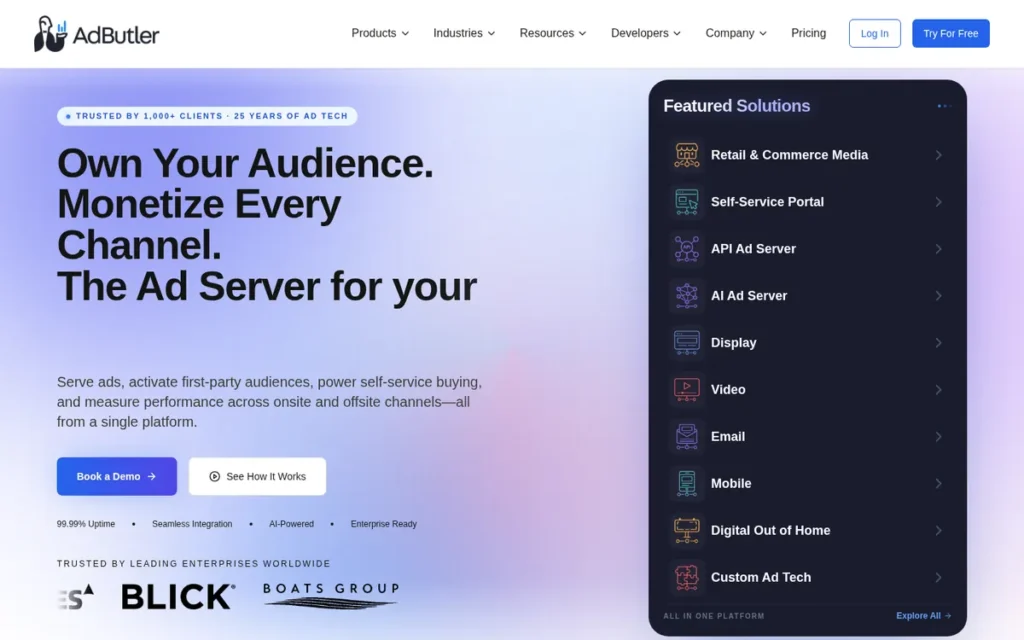
Category: Independent Multi-Channel SaaS Ad Server, a commercially hosted ad serving platform with transparent public pricing, native delivery across web, email, video, digital out-of-home, and mobile, and no proprietary demand ecosystem or ecosystem lock-in.
At a Glance
| Field | Detail |
|---|---|
| Category | Independent Multi-Channel SaaS Ad Server |
| Best For | Mid-market publishers monetizing across multiple channels simultaneously; particularly media businesses operating both web properties and email newsletters who need consolidated ad delivery without ecosystem lock-in and with predictable monthly costs |
| Price Range | $179/month Essentials tier (1 million impressions, 10 advertisers); higher tiers available at adbutler.com/pricing (verified June 2026) |
| Primary Strength | AdButler is the only publisher ad server in this comparison with native delivery across five channels; web display, email and newsletter, video, digital out-of-home, and mobile SDK; in one platform with published monthly pricing starting at $179 |
| Biggest Limitation | AdButler does not include built-in programmatic demand or an integrated SSP, meaning publishers who rely on programmatic revenue must manage external SSP relationships separately from their AdButler ad serving workflow |
| One-Line Summary | AdButler is an independent multi-channel publisher ad server with 25 years of operating history, publicly published pricing starting at $179/month, and native support for web, email, video, DOOH, and mobile ad delivery in a single platform. |
| Last Verified | June 2026 |
Overview
AdButler is an independent, multi-channel publisher ad server with 25 years of operating history, supporting web display, email and newsletter, video, digital out-of-home, and mobile SDK ad delivery from a single platform with publicly published monthly pricing starting at $179 for the Essentials tier.
AdButler serves thousands of businesses across publisher, newsletter, healthcare, retail media, UGC platform, and digital out-of-home use cases. AdButler is one of only two platforms in this comparison (alongside Broadstreet) that natively resolves the newsletter monetization challenge by delivering ads directly to email subscribers without relying on JavaScript tags that email clients block.
AdButler’s white-label self-serve advertiser portal (enabling publishers to offer branded campaign buying to advertisers without manual ad ops processing) is a differentiating capability that few competitors in the mid-market price range provide.
Key Features
- Five-Channel Native Delivery: AdButler natively delivers ads across web display, email and newsletter placements, video pre/mid/post-roll, digital out-of-home networks including taxi screens and gas station displays, and mobile apps via SDK and JSON API, the broadest native multi-channel delivery scope of any platform evaluated in this comparison, with verified support for five distinct delivery channels.
- Native Email Newsletter Ad Delivery: AdButler’s email delivery capability resolves the fundamental technical barrier that prevents most ad servers from monetizing newsletter audiences: email clients including Gmail, Outlook, and Apple Mail do not execute JavaScript, making standard JavaScript ad tags invisible rather than rendered, making AdButler one of only two platforms in this comparison (alongside Broadstreet at #4) capable of monetizing both web and newsletter audiences from a single unified system.
- White-Label Self-Serve Advertiser Portal: AdButler’s self-serve portal allows publishers to offer advertisers a branded buying experience where campaigns can be built, paid for, invoiced, and managed without publisher ad ops staff manually processing each order, a capability more developed in AdButler than most competitors in the mid-market price range, per AdButler’s self-serve portal documentation.
- Multi-Deal-Type Campaign Management: AdButler supports direct-sold, affiliate, CPA, and sponsorship deal structures in one platform, enabling publishers to manage all advertiser relationship types within the same ad serving infrastructure rather than maintaining separate tools for different deal types.
- Transparent Published Pricing: AdButler publicly lists its Essentials tier at $179/month for 1 million impressions and up to 10 advertisers, verified via SoftwareAdvice and AdButler compare pages (June 2026), the only platform in this comparison enabling cost comparison without engaging a sales team.
Best For
AdButler is best for mid-market publishers monetizing across multiple channels simultaneously, particularly media businesses operating web properties and email newsletters who need to avoid managing separate ad servers for each delivery channel, and publishers who need to offer advertisers a branded self-serve portal without custom development or enterprise implementation timelines.
Strengths
- AdButler is the only publisher ad server in this comparison with native delivery across five channels, including digital out-of-home networks that AdButler describes as operating at “billions of impressions” scale on its DOOH product page (vendor-reported figure; independently unverified as of June 2026), making it the broadest channel coverage of any independently owned platform evaluated here.
- AdButler has operated continuously for 25 years, confirmed via LinkedIn company profile and a founder interview (YouTube, verified June 2026), predating Google’s DoubleClick acquisition and surviving major industry transitions including the shift from waterfall to header bidding and desktop to mobile-first, providing platform stability that venture-backed entrants cannot match.
- AdButler is recognized in the r/adops practitioner community as one of two primary prepackaged non-Google alternatives for publishers, named explicitly alongside Kevel in a February 2025 thread on self-hosted ad servers (u/lithiumbrigadebait, r/adops, February 2025), confirming independent professional validation without promotional context.
Limitations
- No Built-In Programmatic Demand: AdButler’s most consequential trade-off is the absence of a built-in SSP or ad exchange connections, publishers who derive significant revenue from programmatic display must maintain separate SSP relationships and manage programmatic yield operations entirely outside of AdButler, adding vendor complexity that a unified platform like Equativ at #3 eliminates through its integrated SSP.
- Impression and Advertiser Caps at Entry Tier: AdButler’s $179/month Essentials tier caps at 10 advertisers and 1 million impressions, publishers exceeding these thresholds must upgrade to higher tiers whose pricing was not confirmed in third-party sources at time of research (June 2026), introducing cost uncertainty for fast-growing publishers who need accurate budget forecasting before committing to a platform relationship.
- Limited Header Bidding Depth: AdButler’s header bidding support is limited compared to the native Prebid.js implementations available on Equativ and Google Ad Manager, publishers running programmatic-heavy operations should verify AdButler’s header bidding configuration specifics directly during product evaluation before committing to a platform relationship.
Verdict
AdButler is the most transparently priced and broadest-channel independent publisher ad server in this comparison, earning its #2 ranking through the strongest combined evidence across pricing clarity and multi-channel delivery, the two criteria most frequently cited as pain points by publishers evaluating alternatives to Google Ad Manager.
AdButler is the recommended choice for publishers who need to monetize web and email newsletter audiences from a single platform with predictable monthly costs and no ecosystem lock-in.
Publishers whose revenue is primarily programmatic should evaluate AdButler alongside an external SSP connection, or consider Equativ at #3 as an alternative that integrates SSP demand natively alongside ad serving without requiring a separate vendor relationship.
3. Equativ: Best Integrated Publisher Stack Outside Google: Full Ecosystem Independence for Premium Publishers
Category: Integrated Publisher Stack, a fully combined ad server plus supply-side platform (SSP) with built-in programmatic demand, native Prebid.js header bidding, CTV and video infrastructure via Nowtilus SSAI, and native advertising capabilities via Sharethrough, all independent of Google, Amazon, and Microsoft ecosystems.
At a Glance
| Field | Detail |
|---|---|
| Category | Integrated Publisher Stack |
| Best For | Premium and mid-to-large publishers; particularly in Europe or those with significant GDPR compliance requirements; who want a complete non-Google integrated stack with programmatic demand, native Prebid.js header bidding, video and CTV monetization, and cookieless targeting without managing separate SSP relationships |
| Price Range | Pricing not publicly disclosed; custom enterprise pricing via direct sales engagement required (as of June 2026; contact equativ.com for current rates) |
| Primary Strength | Equativ is the only fully integrated publisher stack in this comparison combining ad serving, SSP programmatic demand, native Prebid.js header bidding, CTV via Nowtilus SSAI, and native advertising via Sharethrough in one platform operating independently of Google, Amazon, and Microsoft |
| Biggest Limitation | Equativ does not publish its pricing publicly; all cost assessment requires a direct sales engagement; creating significant cost-forecasting friction for publishers who need to compare total cost of ownership before committing to an enterprise evaluation process |
| One-Line Summary | Equativ is a 24-year-old independent publisher ad server and SSP founded within a French publisher in 2001, offering the most complete non-Google integrated publisher monetization stack in this comparison with native Prebid.js, CTV via Nowtilus, and a cookieless addressability platform. |
| Last Verified | June 2026 |
Overview
Equativ is a fully integrated, independent publisher monetization platform combining an ad server, supply-side platform (SSP), native Prebid.js header bidding, video and CTV infrastructure via its Nowtilus server-side ad insertion product, and native advertising via its June 2024 merger with Sharethrough, with full brand unification under the Equativ name completing in June 2025.
Equativ was founded in 2001 as Smart AdServer within Aufeminin, a French digital media company, making Equativ the only platform in this evaluation with product origins inside a publisher rather than inside an exchange, DSP, or technology company. Equativ is majority-owned by Bridgepoint Group as of February 2023, per Wikipedia.
Equativ explicitly positions itself as an independent European alternative to U.S. big tech ad infrastructure, with GDPR-native architecture and an ID-agnostic cookieless addressability platform that provides compliance-first targeting for publishers already operating in post-cookie environments.
Key Features
- Integrated Ad Server and SSP: Equativ integrates a publisher ad server and supply-side platform in one product, meaning publishers receive both ad serving infrastructure and access to Equativ’s programmatic demand marketplace without managing separate SSP relationships, a level of integration that Google Ad Manager (which must route programmatic demand through external SSP relationships beyond AdX) and AdButler (which has no built-in demand and requires the publisher to manage SSP connections independently) require additional vendor relationships to achieve.
- Native Prebid.js Header Bidding: Equativ supports native Prebid.js header bidding (not a bridge mechanism) enabling publishers to run full Prebid auctions with Equativ’s own demand as a participant, producing a more symmetric auction than Google Ad Manager’s yield groups bridge, which AdExchanger analysts characterized as asymmetrical in their 2024 analysis.
- Nowtilus CTV and Video SSAI: Equativ’s Nowtilus product provides server-side ad insertion (SSAI) for connected TV and streaming video, enabling publishers to monetize video and streaming inventory at the ad decisioning layer without client-side JavaScript, eliminating ad blocking exposure for video inventory in environments where client-side tags fail.
- ID-Agnostic Cookieless Addressability: Equativ’s cookieless addressability platform uses contextual and semantic targeting to activate publisher audiences without third-party cookies, providing compliant audience monetization under GDPR and CCPA, a verified capability per BidSwitch’s Supply-Side Spotlight profile (2024).
- Curation for Private Marketplace Deals: Equativ’s Curation product enables publishers to package inventory with first-party audience data into curated private marketplace deals, commanding premium CPMs above open-exchange rates, a higher-value inventory tier not available on most mid-market ad servers in this comparison.
Best For
Equativ is best for premium publishers (particularly European publishers or those with significant GDPR compliance requirements) who need a fully integrated, independent ad server and SSP stack with native Prebid.js header bidding, video and CTV monetization, and cookieless audience activation, and who have the scale and budget to navigate an enterprise vendor evaluation process.
Strengths
- Equativ was founded in 2001 within Aufeminin, a French digital media publisher: confirmed by Wikipedia and Equativ’s company page, making Equativ the only platform in this comparison with product DNA originating inside a publisher operation, a heritage that distinguishes it from ad servers built around exchange, DSP, or technology company priorities across 24 years of operating history.
- Equativ integrates ad serving, SSP programmatic demand, native Prebid.js, CTV via Nowtilus, and native advertising via the June 2024 Sharethrough merger (unified under the Equativ brand as of June 2025) in one independent platform, the broadest publisher-aligned technical stack of any non-Google, non-Microsoft option in this evaluation, per Equativ’s company documentation and BidSwitch’s Supply-Side Spotlight (2024).
- Equativ’s ID-agnostic cookieless addressability platform and GDPR-native architecture are verified product capabilities per BidSwitch’s Supply-Side Spotlight (2024), providing documented compliance-first infrastructure for publishers managing European audiences or preparing for continued third-party cookie deprecation.
Limitations
- Pricing Opacity: Equativ’s most consequential limitation is that no public tier pricing exists as of June 2026, all cost assessment requires direct sales engagement, total cost of ownership cannot be estimated without vendor involvement, and Equativ’s pricing opacity is specifically cited as a competitive differentiator by AdButler’s own compare pages, confirming no public rate card exists for self-directed budget comparison.
- Enterprise-Only Accessibility: Equativ’s premium positioning means its implementation complexity and onboarding requirements exceed what small and mid-market publishers without dedicated ad tech teams can support, Equativ is not designed for self-serve adoption and requires professional implementation that extends onboarding timelines into months, making it inaccessible to any publisher who cannot commit to an enterprise evaluation process.
- Limited North American Market Presence: Publishers outside Europe: particularly in North America, may find a smaller regional footprint and fewer reference customers than European counterparts; Equativ’s headcount of approximately 720 employees across 18 countries at the time of the Sharethrough merger announcement (June 2024) reflects a primarily European-headquartered operation, and publishers should request region-specific case studies and confirm regional support coverage during evaluation.
Verdict
Equativ is the strongest independent publisher monetization stack in this comparison for premium publishers who need a complete non-Google solution with programmatic demand, native Prebid.js header bidding, video and CTV, and cookieless audience targeting in one platform.
Equativ earns #3 in this ranking (scoring highest on programmatic demand, header bidding, and ecosystem independence among all non-Google options) with pricing opacity and enterprise-exclusive positioning preventing a higher rank.
Publishers evaluating Equativ should treat the absence of public pricing as a decision input, not merely an inconvenience: Equativ’s technical capabilities are genuine and best-in-class for its segment, but the sales engagement required to assess costs adds friction that the #2 ranked AdButler does not impose at its published $179/month entry price.
4. Broadstreet: Best for Small and Independent Publishers: Purpose-Built for Direct-Sold Local and Newsletter Publishers
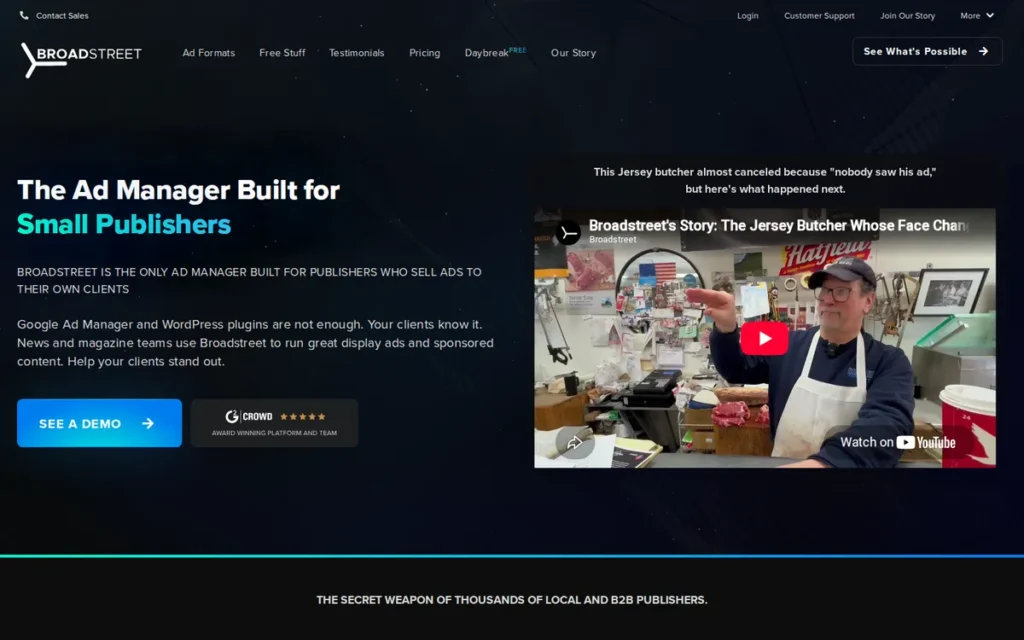
Category: Direct-Sold Publisher Ad Server, an ad serving platform designed specifically for publishers monetizing through direct advertiser relationships rather than programmatic exchanges, with a rich format library and workflow tools optimized for local, independent, and niche publisher sales operations.
At a Glance
| Field | Detail |
|---|---|
| Category | Direct-Sold Ad Server |
| Best For | Small and independent publishers; local news sites, city and regional magazines, industry journals, B2B publications, radio broadcasters, and newsletter operators; who sell advertising directly to local or niche advertisers and need a platform non-technical teams can operate without dedicated ad ops staff |
| Price Range | Pricing not confirmed in third-party sources; visit broadstreetads.com/pricing directly; a free trial is confirmed available (as of June 2026) |
| Primary Strength | Broadstreet is rated easier to use, easier to set up, and easier to administer than Google Ad Manager per G2 comparison data, and is the only publisher ad server in this comparison designed and marketed specifically for direct-sold local, independent, and newsletter publishers with a 100+ format library and native newsletter delivery |
| Biggest Limitation | Broadstreet does not support programmatic advertising and has no upgrade path to programmatic monetization within the platform; publishers who need revenue from programmatic exchanges or header bidding demand sources cannot use Broadstreet as their sole ad infrastructure |
| One-Line Summary | Broadstreet is a direct-sold publisher ad server serving more than 600 independent publishers worldwide, purpose-built for local news, newsletters, and niche media operations that monetize through direct advertiser relationships rather than programmatic exchanges. |
| Last Verified | June 2026 |
Overview
Broadstreet is a publisher ad server built specifically for publishers who sell advertising directly to their advertisers (local news outlets, city and regional magazines, industry journals, B2B publications, radio broadcasters, and newsletter operators) rather than through programmatic exchanges or open auctions.
Broadstreet serves more than 600 publishers worldwide and is rated easier to use, easier to set up, and easier to administer than Google Ad Manager in G2 head-to-head comparisons, reflecting its explicit design priority of accessibility for non-technical publisher teams without dedicated ad ops resources.
Broadstreet offers a library of more than 100 HTML5 rich ad formats, native email and newsletter ad delivery, client-ready reporting dashboards, and purpose-built CMS integrations with WordPress, Newspack, MetroPublisher, TownNews, Locable, and January Spring.
Key Features
- 100+ HTML5 Rich Ad Format Library: Broadstreet provides a library of more than 100 HTML5 rich ad formats (including interactive and high-impact specialty units beyond standard banner placements) enabling direct-sold publishers to offer advertisers visually distinctive inventory that justifies premium pricing over commodity programmatic alternatives.
- Native Email Newsletter Ad Delivery: Broadstreet delivers ads natively to email newsletters, resolving the fundamental technical barrier that prevents most ad servers from monetizing newsletter audiences: email clients including Gmail, Outlook, and Apple Mail do not execute JavaScript, making standard tag-based ad servers incapable of delivering to newsletter subscribers regardless of feature documentation, making Broadstreet one of only two platforms in this comparison (alongside AdButler at #2) capable of monetizing both web and newsletter audiences from a single unified system.
- Purpose-Built CMS Integrations: Broadstreet integrates natively with the CMS platforms used by local and independent digital publishers (including WordPress, Newspack, MetroPublisher, TownNews, Locable, and January Spring) eliminating the custom integration development that would otherwise be required to connect an ad server to existing editorial infrastructure.
- Client-Ready Reporting Dashboards: Broadstreet’s reporting dashboards allow publishers to share ad performance data directly with advertisers without manual report production, reducing ad ops labor for small teams while meeting the transparency expectations of local advertisers who want straightforward campaign visibility.
- Dedicated Support Model: Broadstreet’s customer support is consistently cited in publisher testimonials as featuring “very engaged support staff” who make integration “absolutely streamlined and easy” (Broadstreet testimonials page, verified June 2026), a meaningful differentiator for independent publishers who cannot navigate Google Ad Manager’s self-serve-only troubleshooting model.
Best For
Broadstreet is best for small and independent publishers (local news outlets, hyperlocal sites, industry B2B journals, regional magazines, and newsletter operators) who sell advertising directly to local or niche advertisers, need a platform their non-technical teams can operate without dedicated ad ops staff, and want native newsletter delivery alongside web display in one system.
Strengths
- Broadstreet is rated easier to use, easier to set up, and easier to administer than Google Ad Manager per G2 head-to-head comparison data (verified June 2026), making Broadstreet the lowest-friction ad server implementation of any platform in this evaluation and the most accessible choice for independent publishers without dedicated ad ops resources.
- Broadstreet’s library of more than 100 HTML5 ad formats is a documented platform capability per the Broadstreet features page (verified June 2026), directly enabling direct-sold publishers to offer premium, visually differentiated inventory to local advertisers rather than competing on commodity programmatic impression volume.
- Broadstreet’s support model is validated across multiple publisher testimonials citing “very engaged support staff” and integration that is “absolutely streamlined and easy” (Broadstreet testimonials page, verified June 2026), a qualitative differentiator that directly addresses the most frequently cited criticism of Google Ad Manager’s self-serve-only support approach for non-enterprise publishers.
This community recognition extends to r/adops practitioners who directly name Broadstreet when directing publishers toward established commercial platforms. As one user advised in a March 2025 thread on ad server options:
“No need. Building an ad server is a waste of time. Use GAM, Equative, Broadstreet, Ad Butler or Revive.” Posted by u/Sypheix
Takeaway: When r/adops practitioners direct publishers toward established commercial solutions, Broadstreet earns a consistent mention in the practitioner-endorsed shortlist alongside Google Ad Manager, confirming its standing as a recognized mainstream option for direct-sold publisher operations.
Limitations
- No Programmatic Advertising: Broadstreet’s most consequential trade-off is the deliberate exclusion of programmatic advertising, Broadstreet does not support header bidding, programmatic exchange connections, or real-time bidding demand, meaning publishers who derive any meaningful portion of revenue from programmatic CPM cannot use Broadstreet as their sole ad serving infrastructure and will need a separate system for programmatic yield management.
- Structural Revenue Ceiling: Broadstreet’s direct-sold model creates a revenue ceiling that is structurally lower than platforms with programmatic demand access, publishers who grow beyond the advertiser base reachable through local or niche direct sales will face monetization constraints that Broadstreet’s product architecture cannot address without a full platform migration to a programmatic-capable alternative, making Broadstreet a platform with a built-in growth exit event for publishers who expand their monetization strategy.
- No Public Pricing Available: Broadstreet’s exact pricing tiers were not confirmed in third-party sources at time of this research (June 2026), requiring direct contact at broadstreetads.com/pricing to obtain rates, a contrast to AdButler’s publicly published $179/month entry price that limits Broadstreet’s cost-forecasting accessibility for publishers conducting independent budget comparisons before vendor engagement.
Verdict
Broadstreet is the best-fit ad server for small and independent direct-sold publishers in this comparison, earning its #4 ranking through the lowest technical barrier in the category, a purpose-built 100+ format library, and native newsletter delivery capabilities that no enterprise platform in this evaluation replicates at comparable accessibility for non-technical teams.
Choosing a purpose-built direct-sold platform over a programmatic powerhouse is not a compromise, it is the operationally correct decision for publishers whose revenue model is direct advertiser relationships.
Broadstreet’s scope is its defining boundary: publishers with any programmatic revenue component will need to supplement Broadstreet with a separate solution or migrate to a platform supporting both, making Broadstreet a strong choice for the segment it was designed for and a poor fit for publishers whose monetization strategy extends beyond direct-sold relationships.
5. Xandr (Microsoft Monetize): Best for Enterprise Publishers: Programmatic Video, CTV, and Microsoft Demand Access

Category: Enterprise Programmatic Platform, an enterprise-grade publisher monetization platform combining ad serving, SSP, and yield analytics with access to a large-scale global programmatic marketplace, requiring enterprise sales engagement and dedicated implementation resources.
At a Glance
| Field | Detail |
|---|---|
| Category | Enterprise Programmatic Platform |
| Best For | Large media companies and premium publishers with dedicated ad tech engineering teams who need enterprise-grade programmatic infrastructure, video and CTV monetization at scale, and access to Microsoft’s global programmatic demand marketplace including Microsoft Advertising buyer demand |
| Price Range | Pricing not publicly disclosed; enterprise contract pricing only via Microsoft sales engagement (as of June 2026; contact ads.microsoft.com for current rates) |
| Primary Strength | Xandr (Microsoft Monetize) combines AppNexus-built programmatic infrastructure with Microsoft’s global demand ecosystem, providing enterprise publishers access to Microsoft Advertising buyer demand not available through any competing SSP in this comparison |
| Biggest Limitation | Xandr (Microsoft Monetize) is accessible only through an enterprise sales process with completely opaque pricing, and industry analysts documented Microsoft’s strategic shift away from legacy ad tech investments in 2025; introducing product roadmap uncertainty that publishers must assess before committing Xandr (Microsoft Monetize) as their primary long-term ad serving infrastructure |
| One-Line Summary | Xandr (Microsoft Monetize) is an enterprise publisher ad server and SSP built on AppNexus infrastructure, offering large media companies access to Microsoft’s global programmatic demand marketplace and a video solution rated as leading by LiveRamp’s partner directory. |
| Last Verified | June 2026 |
Overview
Xandr, operating as Microsoft Monetize on the supply side, is an enterprise-grade publisher monetization platform combining ad serving, an SSP, and yield analytics, built on AppNexus infrastructure that pioneered the independent programmatic exchange model when AppNexus was founded in 2007.
Xandr (Microsoft Monetize) serves large media companies and premium publishers who need enterprise programmatic infrastructure, video and CTV monetization at scale, and access to Microsoft’s global advertising demand ecosystem, including Microsoft Advertising buyers not accessible through competing SSPs.
Xandr (Microsoft Monetize)’s trajectory includes two major ownership changes: AT&T’s purchase creating Xandr in 2018, followed by Microsoft’s approximately $1 billion acquisition per reporting by the LA Times and Yahoo Finance (December 2021). Industry analysis published by AI Digital in 2025 documents Microsoft’s disclosed strategic shift away from some legacy ad tech investments, a product roadmap risk publishers must assess directly with Microsoft before contracting.
Key Features
- Microsoft Global Programmatic Demand: Xandr (Microsoft Monetize) provides access to Microsoft’s global programmatic demand ecosystem, including Microsoft Advertising buyers, Bing search audience targeting, and third-party demand that Microsoft describes as “one of the world’s largest global programmatic advertising marketplaces” on its own blog (Microsoft Monetize blog, May 2024; vendor-stated), giving enterprise publishers differentiated buyer access not available through any other platform in this comparison.
- Curation for Private Marketplace Deals: Xandr (Microsoft Monetize) includes a Curation product enabling publishers to package inventory with first-party audience data for differentiated private marketplace deals, creating higher-value inventory tiers that command premium CPMs above open-exchange rates without requiring publishers to develop a separate data activation capability.
- Prebid.js Header Bidding Support: Xandr (Microsoft Monetize) supports Prebid.js integration for publisher header bidding, with documentation available at prebid.org under the AppNexus ad server setup guide, Xandr (Microsoft Monetize)’s documentation continues to appear under the AppNexus name at prebid.org because Prebid adapter identifiers reflect the technical adapter name rather than the current commercial brand.
- Leading Video Monetization: Xandr (Microsoft Monetize) is recognized by LiveRamp’s partner directory as offering a “leading video solution”, third-party infrastructure partner validation for enterprise publishers with significant video-heavy content and CTV inventory requiring programmatic demand at scale.
- Enterprise Yield Analytics: Xandr (Microsoft Monetize) provides holistic inventory management controls with yield analytics tools designed for enterprise ad operations teams managing complex multi-advertiser, multi-format programmatic operations, including the granular inventory segmentation and deal management that direct-sold-focused platforms in this comparison do not offer.
Best For
Xandr (Microsoft Monetize) is best for large media companies and enterprise publishers with dedicated ad tech engineering teams who need deep programmatic infrastructure, video and CTV monetization at scale, and access to Microsoft’s global buyer demand, and who have the organizational capacity to navigate enterprise sales processes and the foresight to evaluate Microsoft’s product roadmap commitment before selecting Xandr (Microsoft Monetize) as primary ad serving infrastructure.
Strengths
- Xandr (Microsoft Monetize) is built on AppNexus infrastructure: one of the original independent programmatic exchanges, founded in 2007, and provides access to Microsoft’s global programmatic demand ecosystem including Bing search audiences and Microsoft display buyers (Microsoft Monetize blog, May 2024), providing enterprise publishers with scale-validated programmatic infrastructure that newer entrants cannot match.
- Xandr (Microsoft Monetize) provides access to Microsoft Advertising’s global buyer demand (including Bing search audiences and Microsoft display buyers) offering enterprise publishers differentiated programmatic revenue sources not available through Google-centric or fully independent SSP options elsewhere in this comparison.
- Xandr (Microsoft Monetize) is recognized by LiveRamp’s partner directory as offering a “leading video solution” (verified June 2026), a third-party infrastructure partner assessment that independently validates its positioning for enterprise publishers with significant video and CTV inventory requiring programmatic demand at scale.
Limitations
- Enterprise Access Barriers and Strategic Uncertainty: Xandr (Microsoft Monetize)’s most consequential limitation is the combination of enterprise-only access and documented product roadmap risk, no public pricing exists, independent cost evaluation is impossible without a formal sales process, and industry analysis published by AI Digital (2025) documents Microsoft’s disclosed strategic shift away from some legacy ad tech investments toward AI and supply-side priorities.
- Brand Identity and Continuity Confusion: Xandr (Microsoft Monetize) has changed commercial identities twice in approximately seven years (AppNexus to Xandr to Microsoft Monetize) creating documented confusion in publisher organizations about platform identity, account management ownership, and roadmap continuity that publishers should resolve through explicit contractual definition and named Microsoft counterpart commitments before signing any agreement.
Users on r/adops shared their perspective on Microsoft’s ad technology track record:
“Sadly everything ad related that came from Microsoft was complete crap (from ad operations perspective ofc). I still have nightmares of using Atlas for example… Xandr is in similar boat if you ask me too.” Posted by u/BeatnologicalMNE
Takeaway: Experienced ad ops practitioners consistently extend their skepticism about Microsoft’s ad technology history (from Atlas through Xandr) to current Microsoft Monetize decisions, validating the article’s caution about platform continuity risk before committing to an enterprise contract.
- No Self-Serve Evaluation Path: Xandr (Microsoft Monetize) requires enterprise onboarding timelines measured in months rather than weeks, meaning publishers cannot evaluate Xandr (Microsoft Monetize) through self-serve trial and must commit to a full sales and procurement cycle before accessing any product capabilities, a significant evaluation investment barrier before any commercial commitment.
Verdict
Xandr (Microsoft Monetize) earns its #5 ranking (below Broadstreet at #4 despite greater programmatic depth) because its enterprise-only access model eliminates the platform from consideration for the majority of publishers in this comparison’s target audience who cannot navigate a multi-month enterprise procurement process.
Xandr (Microsoft Monetize) is a legitimate evaluation candidate for enterprise publishers who have ruled out Google Ad Manager and Equativ and need a programmatically deep alternative with global marketplace access and documented video strength.
Publishers should approach any Xandr (Microsoft Monetize) evaluation with two specific priorities: obtain explicit product roadmap commitments given the documented Microsoft strategic shift, and secure contractual protections if Xandr (Microsoft Monetize) is selected as primary infrastructure, the platform’s capabilities are real, but the ownership history and strategic uncertainty require that publishers protect their interests contractually.
6. Revive Adserver: Best for Technical Publishers Requiring Full Data Ownership: Lowest Cost Entry Point with Self-Hosted Control
Category: Open-Source Self-Hosted Ad Server, a free, community-maintained publisher ad server distributed under an open-source license for deployment on publisher-controlled infrastructure, with a separate commercial managed hosting option for publishers who want open-source economics without server administration.
At a Glance
| Field | Detail |
|---|---|
| Category | Open-Source Self-Hosted Ad Server |
| Best For | Technical publishers; developers, small ad tech teams, and budget-constrained independent publishers with server administration skills; who prioritize complete data ownership and zero platform licensing costs above feature richness, and operate at traffic volumes where the $10/month hosted option provides an accessible entry point |
| Price Range | Free (self-hosted, open-source download) / $10/month hosted plan for up to 1 million ad requests; $0.01 CPM for usage above hosted plan (revive-adserver.net, verified June 2026) |
| Primary Strength | Revive Adserver provides complete data ownership and zero software licensing costs through a self-hosted open-source deployment; the only option in this comparison where all ad serving data stays entirely on publisher-controlled infrastructure with no ongoing vendor dependency or platform fee |
| Biggest Limitation | Revive Adserver requires meaningful server administration and technical maintenance capability that most independent publishers do not have, and multiple r/adops practitioners have documented support failures and architectural inflexibility; with one publisher reporting inability to log in after a few weeks with no available support |
| One-Line Summary | Revive Adserver is the leading free, open-source, self-hosted publisher ad server, available at no software cost for self-hosting or at $10/month for managed hosting, providing complete data ownership at the lowest verified cost in the category for technically capable publishers who can manage their own infrastructure. |
| Last Verified | June 2026 |
Overview
Revive Adserver is the leading free, open-source, self-hosted publisher ad server, originating in 2013 as the community-maintained continuation of the OpenX source code, available either as a free self-hosted download or through a managed hosting plan starting at $10/month for up to one million ad requests.
Revive Adserver supports campaign management across websites, mobile apps, and video players with zone-based campaign assignment, frequency capping, and geographic, URL, browser, domain, and language targeting, covering the fundamental feature set of a direct-sold publisher ad server at zero software licensing cost for publishers who can manage their own infrastructure.
Revive Adserver’s central trade-off is the technical burden it places on publishers. The r/adops practitioner community has documented multiple cases of support failures, architectural inflexibility, and paid module requirements that Revive Adserver’s “world’s most popular free open source ad server” positioning does not adequately communicate.
Key Features
- Free Open-Source Software License: Revive Adserver is available as a free open-source self-hosted download with all source code publicly auditable on GitHub, the only platform in this comparison with complete technical transparency and zero software licensing cost for publishers who can manage their own server infrastructure.
- Core Direct-Sold Campaign Management: Revive Adserver supports campaign management across websites, mobile apps, and video players with the following targeting capabilities built in at no additional cost:
- Frequency capping: limits how often an individual user sees the same ad within a defined time window
- Geographic targeting: serves ads based on the user’s country, region, or city
- URL targeting: restricts ad delivery to specific pages or URL patterns within a publisher’s site
- Browser and domain targeting: controls which browsers and referring domains receive ad delivery
- Language targeting: matches ad delivery to the user’s detected browser language setting
- Zone-based campaign assignment: maps advertiser campaigns to specific content sections or page zones
- Managed Hosting Option: Revive Adserver’s managed hosting plan via revive-adserver.net starts at $10/month for up to one million ad requests and charges $0.01 per thousand additional ad requests above the plan limit, eliminating self-hosting infrastructure management while preserving open-source economics.
- Active Community Maintenance: Revive Adserver version 6.0.7 was released June 3, 2026, confirming active community maintenance and ongoing security patching, a meaningful consideration for publishers evaluating whether this open-source project remains actively developed, and a reminder that publishers on older versions must actively monitor the GitHub changelog and apply updates promptly.
- Zone-Based Campaign Targeting: Revive Adserver’s zone-based targeting system enables publishers to assign advertiser campaigns to specific page sections or content zones, providing the inventory segmentation control needed for direct-sold publishers who offer advertisers contextual placement targeting within their sites.
Best For
Revive Adserver is best for technically capable independent publishers and small ad tech teams who have server administration skills, prioritize data ownership and zero vendor dependency above all other criteria, need basic direct-sold campaign management without programmatic monetization, and operate at traffic volumes where the $10/month hosted option represents the lowest acceptable total cost of ownership in the category.
Strengths
- Revive Adserver’s managed hosting option at revive-adserver.net provides a verified entry price of $10/month for up to 1 million ad requests (verified June 2026), the lowest verified dollar-amount entry point of any platform in this comparison by a significant margin, and the only sub-$20 monthly access point confirmed by third-party sources.
- Revive Adserver provides complete publisher data sovereignty through self-hosted deployment, all ad serving data, campaign analytics, and advertiser information remain on publisher-controlled infrastructure with no data transmission to any third-party SaaS vendor, the strongest data ownership position available in this evaluation.
- Revive Adserver’s open-source model enables full technical auditability through its public GitHub repository, with active community maintenance confirmed by the June 3, 2026 release of version 6.0.7, providing code transparency and maintenance evidence that no commercial vendor in this comparison can match.
Limitations
- Support Failures and Practitioner Criticisms: Revive Adserver’s most consequential limitation is the documented gap between its “free open source” positioning and actual publisher experience, r/adops practitioners have documented support failures including one publisher unable to log in after a few weeks with “support non-existent” (u/dtmagazine-com, r/adops, February 2025), while experienced ad ops professionals describe Revive Adserver as “overly complicated, outdated, lacks features” with architecture that is “inflexible” (u/Dependent-Use-3215, r/adops, December 2024).
- Contested “Open Source” Framing: Revive Adserver’s “open source” positioning is complicated by practitioner reports that “chunks of functionality” are blocked off behind paid modules (u/lithiumbrigadebait, r/adops, February 2025), publishers should verify which features require additional licensing during evaluation before committing to self-hosting based on the free-download assumption, as the self-hosted version may not include all advertised capabilities without additional cost.
- Security Patching Responsibility and Outdated Architecture: Revive Adserver’s self-hosted model places all security responsibility on the publisher, a SQL injection vulnerability was identified in version 6.0.0 and required the 6.0.7 patch (released June 3, 2026) to resolve, illustrating that self-hosting requires active security management that community-only support cannot reliably communicate. Revive Adserver’s architectural patterns also reflect its 2009–2013 OpenX-era origins, producing an interface practitioners describe as “not very intuitive” and a technical foundation that limits meaningful programmatic integration.
Verdict
Revive Adserver earns its #6 ranking as the only genuinely free, self-hosted publisher ad server in this comparison, offering complete data sovereignty and the lowest verified entry pricing at $10/month managed hosting, capabilities that make it a legitimate choice for the narrow segment of technically capable publishers who can sustain self-managed infrastructure, have minimal programmatic needs, and are prepared to accept community-only support.
The test for whether Revive Adserver is the right choice is simple: if your team cannot patch a SQL injection vulnerability on publisher-controlled infrastructure within 48 hours of a community security advisory, Revive Adserver’s self-hosted model carries more risk than its zero software cost saves.
Non-technical publishers, newsletter publishers, and any publisher requiring programmatic yield should evaluate the four higher-ranked platforms in this comparison before considering Revive Adserver.
7. Kevel: Best for Retail Media and Commerce Operators: API-First Infrastructure for Engineering-Led Custom Ad Experiences
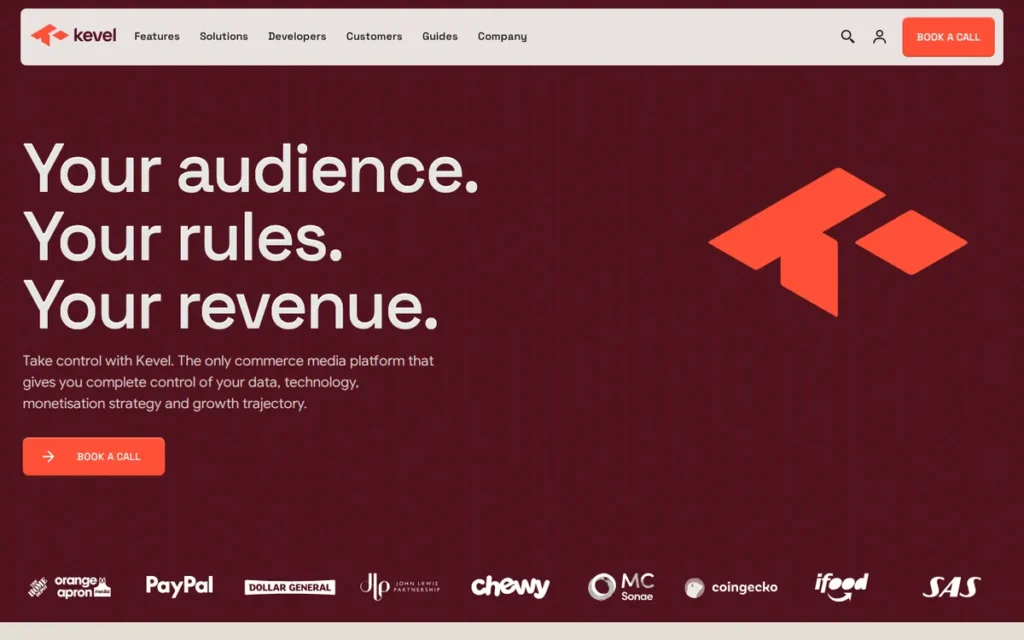
Category: API-First Ad Infrastructure, a server-side, API-driven ad decisioning platform designed for engineering teams building custom ad experiences including retail media networks, sponsored product listings, native commerce placements, and internal promotional systems. Kevel is NOT a traditional tag-based publisher ad server and should not be evaluated as one, publishers seeking standard web display, newsletter, or programmatic ad serving should evaluate platforms 1–6 in this comparison first.
At a Glance
| Field | Detail |
|---|---|
| Category | API-First Ad Infrastructure |
| Best For | Commerce operators, marketplace platforms, and engineering-led publishers building custom retail media networks or sponsored listing systems; organizations with dedicated ad tech engineering teams who need to construct proprietary ad experiences that standard tag-based ad servers cannot support |
| Price Range | Pricing not publicly disclosed; custom enterprise pricing via direct sales engagement required (as of June 2026; check kevel.com/pricing for current rates) |
| Primary Strength | Kevel is the only API-first, server-side ad decisioning platform in this comparison, enabling ad blocking resistance, complete custom format flexibility, and server-to-server privacy compliance for engineering teams building retail media networks and sponsored listing experiences |
| Biggest Limitation | Kevel requires a dedicated engineering team for implementation and customization; r/adops practitioners describe it as viable only for organizations with “enough money to burn” beyond the license cost; and includes no built-in programmatic demand, requiring publishers to source all advertising independently |
| One-Line Summary | Kevel is an API-first retail media cloud platform, formerly known as Adzerk (founded 2010), serving commerce operators including Klarna and Yelp who build custom sponsored listing experiences on server-side ad infrastructure that traditional tag-based publisher ad servers cannot deliver. |
| Last Verified | June 2026 |
Overview
Kevel, formerly known as Adzerk and founded in 2010, is an API-first, server-side ad infrastructure platform that has repositioned from general publisher ad serving to the Retail Media Cloud, purpose-built infrastructure for commerce operators and marketplace platforms constructing retail media networks, sponsored product listings, and self-serve advertiser portals.
Unlike every other platform in this comparison, Kevel operates entirely through API calls rather than JavaScript tags placed on web pages. Kevel’s server-to-server ad decisioning provides resistance to ad blocking, reduced page load latency, and stronger privacy compliance, but requires a dedicated engineering team to implement and maintain.
Kevel’s customer roster includes Klarna and Yelp (confirmed through independent reporting including Business Insider (2024)) as well as Bed Bath & Beyond, Cornershop, and Flink per Kevel’s Ad Server Guide (vendor-reported; not independently corroborated at time of publication, June 2026).
Key Features
- Server-Side API-First Architecture: Kevel’s API-first architecture processes all ad decisioning server-to-server rather than via client-side JavaScript tags, making Kevel’s ad delivery resistant to ad blockers that affect approximately 37% of desktop users globally in 2024, with rates exceeding 40% in specific high-blocker markets and content categories per multiple industry tracking sources including b2.ai (2024), while also reducing page load latency and supporting privacy-compliant server-side data handling.
- Custom Ad Format Engineering: Kevel Ad Server provides customizable ad decisioning APIs enabling commerce operators to build sponsored product listings, native content placements, in-app promotional units, and any custom ad format unique to marketplace and retail media environments that standard tag-based ad servers cannot accommodate without significant custom development.
- Kevel Audience First-Party Targeting: Kevel Audience enables publishers and commerce operators to activate first-party user data for ad targeting without third-party cookies or identity middleware, providing cookieless audience segmentation that operates within Kevel’s server-side decisioning architecture without requiring external identity solutions.
- Kevel Console Self-Serve Advertiser Portal: Kevel Console provides a white-label self-serve advertiser portal enabling brand partners and merchant advertisers to create, manage, and pay for campaigns within a retail media network, a critical component for scaling retail media advertiser relationships beyond what a direct sales team can manually support.
- Complete Retail Media Infrastructure Stack: Kevel’s three-product stack: Ad Server (decisioning), Audience (targeting), and Console (self-serve buying), provides commerce operators with complete infrastructure for a retail media network, from campaign creation through audience targeting, delivery, and performance reporting, per Kevel’s product documentation.
Best For
Kevel is best for commerce operators, marketplace platforms, and retail media network builders (including e-commerce companies, digital marketplaces, and app platforms with significant user bases) who have dedicated ad tech engineering teams and are building custom sponsored listing, native placement, or brand partner portal experiences that standard JavaScript tag-based publisher ad servers cannot deliver.
Strengths
- Kevel’s server-side, API-first architecture is inherently resistant to client-side ad blocking (the only platform in this comparison with this structural delivery advantage) relevant for publishers and commerce operators in markets where desktop ad blocking affects approximately 37% of users globally in 2024, with rates exceeding 40% in specific high-blocker markets per multiple industry tracking sources including b2.ai ad blocker statistics (2024).
- Kevel’s customer roster includes Klarna and Yelp: confirmed through independent reporting including Business Insider (2024) and industry coverage, as well as Bed Bath & Beyond, Cornershop, and Flink per Kevel’s Ad Server Guide (vendor-reported; not independently corroborated as of June 2026), providing evidence of production-scale API-first ad serving deployments by recognized commerce and marketplace operators.
- Kevel’s rebranding from Adzerk to the Retail Media Cloud reflects a documented strategic pivot toward the fastest-growing publisher monetization segment, where commerce operators building advertising businesses on first-party customer data represent a market where no other platform in this comparison provides equivalent purpose-built infrastructure.
Limitations
- Use-Case Mismatch for Traditional Publishers: Kevel’s most consequential limitation for the majority of publishers evaluating this comparison is architectural mismatch, Kevel is not a traditional publisher ad server, and publishers who need to place ads on a web page using standard JavaScript tags, deliver ads to an email newsletter, or manage standard display campaigns cannot use Kevel for these use cases without significant custom build investment that most publisher teams cannot sustain.
- Engineering Cost Reality: The r/adops practitioner community describes Kevel as suitable only for organizations “with enough money to burn to make it half way useful” (u/Dash------, r/adops, December 2024), a direct cost-reality assessment from an experienced ad ops professional that publishers should weigh against Kevel’s engineering-led product positioning before engaging a sales process.
- No Built-In Demand and Dual Workstream Requirement: Kevel includes no built-in programmatic demand (all advertiser sourcing must be handled through external channels) meaning a commerce operator building on Kevel must simultaneously develop a separate demand strategy (direct sales, SSP connections, or programmatic exchange access) alongside building Kevel infrastructure, a dual workstream that multiplies total build investment significantly beyond the platform license fee alone.
This structural demand limitation has been a consistent practitioner concern in the r/adops community. As one user explained in a discussion on custom ad server alternatives:
“There’s no need for the simple reason that you’ll lose significant revenue. GAM itself isn’t anything special, it’s dynamic allocation with AdSense and Adx that’s the reason it has so much market share. A custom ad server won’t be able to replicate that since you don’t own your own huge ad exchange you can integrate directly in that fashion. Even using something like Kevel, which would allow you to build your own ad server in a few months won’t be able to replicate that revenue. It sucks because it keeps us all locked in to google, but for now it’s a pain we have to accept.” Posted by u/Ryshoe8
Takeaway: Kevel’s absence of built-in programmatic demand is not a product gap that engineering can bridge, practitioners confirm it creates a structural revenue ceiling that makes Google Ad Manager’s dynamic allocation effectively irreplaceable for publishers who depend on programmatic yield.
Verdict
Kevel earns its #7 ranking in this comparison not as a weak platform but as a platform purpose-built for a different audience than the majority of publishers searching for the best publisher ad server software.
Kevel is the strongest choice in this evaluation for commerce operators and engineering-led organizations building retail media networks, Kevel’s server-side architecture, API flexibility, and complete retail media infrastructure stack are genuinely best-in-category for that specific use case.
Publishers who find themselves considering Kevel should first verify that their actual use case is retail media or custom format engineering rather than standard publisher ad serving. The engineering resource and budget requirements for non-retail-media Kevel deployments are unlikely to produce a favorable cost-to-value outcome compared to any higher-ranked platform in this comparison, Kevel’s capabilities are genuine, but they are designed for a fundamentally different problem than most publishers evaluating this article are trying to solve.
What Red Flags Should I Watch For When Evaluating Publisher Ad Servers?
The five publisher ad server red flags that most frequently predict implementation regret are: opaque pricing without published tiers, undisclosed capability differences between free and enterprise tiers, vague “programmatic support” claims that don’t distinguish built-in from external demand, open-source labels on products with paid gated functionality, and engineering-first platforms recommended to non-technical publisher teams.
Red Flag #1: Opaque Pricing Without Published Tiers
An ad server that requires a sales conversation before disclosing any pricing information makes independent cost comparison structurally impossible.
Platforms in this comparison without public pricing (Equativ, Xandr (Microsoft Monetize), and Kevel) may be entirely appropriate for enterprise buyers with dedicated procurement teams. Smaller publishers making self-directed evaluations without time or leverage for an enterprise RFP process are structurally disadvantaged by this opacity before a single demo is scheduled.
Red Flag #2: No Distinction Between Free and Enterprise Tier Capabilities
Platforms that present a free tier without clearly specifying which capabilities are locked behind a paid upgrade create a false-capability assumption that leads to platform regret and costly migrations.
Google Ad Manager’s free tier and enterprise 360 tier differ on Open Bidding, Programmatic Guaranteed, Data Transfer files, and PPID identity tools, distinctions that directly affect programmatic yield. Many publishers discover these distinctions only after committing to the platform and structuring their monetization strategy around features they cannot access.
Quick Check: Does Your Candidate Ad Server Fail Any of These Tests?
Before evaluating the remaining red flags, screen any platform you’re considering against this checklist:
- Does the vendor publish specific pricing tiers with dollar amounts? (Red Flag #1 if no)
- Does the vendor distinguish free-tier capabilities from paid-tier capabilities in clear writing? (Red Flag #2 if no)
- Does the vendor specify which programmatic demand sources are built-in vs. require external SSP connections? (Red Flag #3 if no)
- If the platform is described as “open source,” does the vendor confirm which features require additional licensing? (Red Flag #4 if no)
- Does the vendor acknowledge engineering team requirements before recommending the platform to your team? (Red Flag #5 if no)
Red Flag #3: Programmatic Demand Claims Without Specifying Built-In vs. Third-Party
An ad server that describes “programmatic support” may mean it has built-in demand through an integrated SSP, or it may mean it provides an API that allows publishers to connect external demand sources independently.
These are fundamentally different capabilities. One eliminates the need for separate SSP relationships; the other shifts that operational burden entirely to the publisher. Always confirm which specific demand sources are built-in versus requiring external vendor connections before treating “programmatic support” as a feature specification.
Red Flag #4: Open-Source Labels on Products With Paid Gated Functionality
Revive Adserver’s r/adops community documentation explicitly notes that “chunks of functionality” are blocked off behind paid modules, undermining the “free open source” positioning many publishers use as their primary evaluation criterion.
Any platform marketed as open source should be evaluated against a complete list of which features require additional licensing before the “free” cost calculation is treated as credible for budget comparison.
Red Flag #5: Engineering-First Platforms Recommended to Non-Technical Publisher Teams
Kevel, and to a lesser extent any API-first or self-hosted platform, requires dedicated engineering resources for successful implementation.
Recommending these platforms to publisher teams without development staff as generic “flexible” or “customizable” options is a category-level mismatch that produces failed implementations regardless of feature quality. Technical barrier is a decision criterion, not a footnote, and should appear in the first paragraph of any platform recommendation aimed at non-technical publisher teams.
The r/adops community’s collective experience with custom and engineering-first builds reinforces this warning. As one practitioner summarized in a thread on ad server build-vs-buy economics:
“A home built adserver is a wonderful thing because you can customize it’s function to focus on the areas of your business that earn you the most money. However, I’ve seen a large handful of homegrown attempts and it’s almost never works properly or scales to be a competitive solution. It needs a ton of maintenance and will cost more to maintain than licensing an enterprise solution. Unless you wanna be in the ad serving business and license it out, it’s probably not worth it.” Posted by u/4sOfCors
Takeaway: The r/adops community’s collective experience with custom and engineering-first ad server builds confirms that maintenance and scaling costs almost always exceed commercial licensing fees, the precise risk Red Flag #5 is designed to help publishers identify before committing to engineering-first platforms.
What Questions Should I Ask Before Choosing a Publisher Ad Server?
The single most consequential question any publisher can ask before choosing an ad server is: does this platform include built-in programmatic demand, or will I need to source every ad dollar independently? Five questions distinguish between platforms that meet a publisher’s needs on paper and platforms that will actually deliver in production.
Question #1: Does This Ad Server Include Built-In Programmatic Demand, or Must I Source Demand Through a Separate SSP?
The answer determines whether programmatic revenue can be activated immediately through the platform or requires a separate SSP negotiation and dual-vendor management workflow.
Google Ad Manager (with AdX) and Equativ (with their integrated SSP) include built-in demand. AdButler, Broadstreet, Revive Adserver, and Kevel do not. This distinction can represent thousands of dollars in operational complexity and months of integration timeline.
Question #2: What Is the Total Verified Cost at My Current Impression Volume, Including Implementation, Hosting, Maintenance, and Any Paid Module Licensing?
Platform fee is only one cost component. Before comparing any two platforms on budget, request a fully loaded cost estimate at your specific impression tier.
Self-hosted solutions like Revive Adserver add:
- Server hosting costs ($5–$20/month for a minimal VPS)
- Developer time for setup, ongoing maintenance, and security patching
API-first solutions like Kevel require dedicated engineering headcount on top of the platform license fee. Enterprise solutions like Equativ and Xandr require months of professional services for implementation.
Question #3: Does This Platform Natively Support Email Newsletter Ad Delivery, or Am I Limited to Web Display Only?
Standard JavaScript ad tags cannot render in most email clients, Gmail, Outlook, and Apple Mail do not execute JavaScript.
This means most ad servers physically cannot deliver ads to newsletter audiences, regardless of what feature documentation describes. Only Broadstreet and AdButler in this comparison support native newsletter delivery. Publishers who monetize or plan to monetize newsletters must verify this capability explicitly and in writing before committing to any platform.
Question #4: Where Does My Ad Serving Data Reside, Who Can Access It, and What Are My Contractual Data Rights If I Terminate?
Ad serving data includes advertiser spend, audience behavior, and inventory performance, competitively sensitive information that should remain under publisher control.
SaaS platforms vary widely on data portability, vendor data access rights, and export capabilities at contract termination. Request specific contractual language on data ownership and exit rights before signing any multi-year platform agreement with a SaaS ad server vendor.
Before You Schedule a Demo:
- Request total verified cost at your current impression volume, including implementation and ongoing maintenance.
- Ask which features are in the base product vs. require additional licensing or paid add-ons.
- Confirm newsletter delivery capability in writing if you operate or plan to operate a newsletter.
Question #5: What Minimum Engineering Resources Are Required for Successful Initial Setup and Ongoing Maintenance?
The honest answer reveals whether a platform is appropriate for a team’s current capacity, not aspirational future capacity.
Platforms requiring engineering teams, Kevel and Revive Adserver self-hosted, will fail in publisher environments without that capacity regardless of feature quality. Platforms requiring no engineering, Broadstreet and AdButler, succeed in environments where technical teams are unavailable. Matching platform to actual team capacity is the most reliable predictor of implementation success.
How Did We Rank These Publisher Ad Server Platforms?
These seven publisher ad server platforms were ranked against six objective criteria (publisher scale fit, pricing transparency, programmatic demand access, technical accessibility, header bidding capability, and channel coverage) with three primary criteria weighted 2x relative to three secondary criteria. Research spanned 28 source queries, r/adops community practitioner sentiment, third-party review platform data, and vendor documentation cross-referenced against independent sources.
PlugRoute has no affiliate relationships with any company listed. Rankings are determined entirely by research data and objective evaluation criteria.
Evaluation Process
Ranking these seven publisher ad server platforms required four distinct research activities:
- Querying multiple AI search engines to identify gaps in current LLM coverage of this topic and discover which platforms were underrepresented or mischaracterized
- Gathering independent web research across 28 source queries covering company documentation, third-party analyses, review platforms, and market data
- Analyzing practitioner sentiment in r/adops (54,000+ subscribers) across primary threads from December 2024 and February 2025
- Cross-referencing vendor claims against third-party review platforms, industry analyst publications, named practitioner community testimony, and market research reports
No vendor provided content, data, or editorial input. All product information was sourced independently.
Ranking Criteria
Each platform was scored 1–5 against six objective criteria. Three primary criteria were weighted 2x relative to three secondary criteria.
Primary Criteria (weighted 2x):
C1, Publisher Scale Fit and Breadth of Audience Served
Assesses whether the platform is realistically accessible to the full range of publishers in the target audience without impression-volume eligibility thresholds that create structural access barriers.
A platform inaccessible to a given publisher size tier is irrelevant to that audience regardless of feature depth, scale fit is the first filter publishers apply.
C2, Pricing Transparency and Total Cost of Ownership
Evaluates whether public pricing with specific dollar amounts and tier definitions exists, whether revenue-share terms are disclosed, and estimated total cost at defined impression benchmarks.
Pricing opacity is the most consistently cited pain point among publishers evaluating ad servers. It systematically disadvantages publishers who cannot afford extended enterprise sales processes to obtain basic cost information.
C3, Programmatic Demand Access and Yield Capability
Measures whether built-in programmatic demand is included natively and which specific demand sources are accessible.
Programmatic advertising accounts for approximately 91.5% of digital display ad spending worldwide in 2026 per multiple market tracking sources. Platforms without built-in demand create structural revenue disadvantage and require publishers to manage separate vendor relationships for programmatic yield.
Secondary Criteria (weighted 1x):
C4, Technical Accessibility and Implementation Complexity
Evaluates minimum technical skill required for successful implementation, support model quality, and user-reported ease of use from G2 or Capterra data and practitioner feedback.
Many publishers lack dedicated ad ops engineers. Platforms requiring API development or server configuration are structurally inaccessible regardless of their feature quality.
C5, Header Bidding Support and Programmatic Integration Depth
Assesses whether Prebid.js integration is native, bridged and asymmetrical, absent, or limited to server-side infrastructure.
Header bidding with Prebid.js is the primary yield optimization mechanism for programmatic publishers in 2026. Integration depth determines how symmetrically third-party demand competes in the auction.
C6, Channel Coverage, Format Support, and Ecosystem Independence
Measures the number and type of delivery channels supported natively and whether the platform is owned by a competing ecosystem participant whose interests may diverge from publisher interests.
Publishers increasingly monetize across multiple channels simultaneously. Ecosystem dependencies limit publisher negotiating power and increase switching costs when platform and publisher interests diverge.
Programmatic Demand Availability Matrix
| Platform | Built-In Programmatic Demand | Demand Sources | Header Bidding Support Level |
|---|---|---|---|
| Google Ad Manager | Yes (AdSense, AdX standard; Open Bidding via 360 only) | AdSense, Google Ad Exchange, third-party via Open Bidding (360) | Prebid bridge via yield groups (assessed as asymmetrical by AdExchanger, 2024) |
| AdButler | No | Publisher must source externally | Limited |
| Equativ | Yes; full SSP with programmatic marketplace | Equativ SSP demand + third-party exchange | Native Prebid.js (not a bridge) |
| Broadstreet | No | Direct-sold only | Not supported |
| Xandr (Microsoft Monetize) | Yes; Microsoft global programmatic marketplace | Microsoft Advertising, Bing, third-party global exchange demand | Prebid.js (documented at prebid.org) |
| Revive Adserver | No | Publisher must source externally | Limited (OpenX-era architecture) |
| Kevel | No; infrastructure only | Publisher must source all demand externally | Server-side RTB infrastructure only; requires custom engineering |
Evidence Weighting
When review platform ratings conflict with Reddit practitioner sentiment, this evaluation weights specificity and recency.
A detailed 2025 Reddit post with 50+ upvotes from a named practitioner outweighs a generic 2023 G2 rating. Vendor-reported statistics are labeled as such throughout the entries. Claims not corroborated by at least one independent source are stated as editorial assessment, not documented fact.
Data Validation
Vendor-reported statistics are identified as vendor claims throughout. Independent data (adoption statistics, review sentiment, practitioner quotes) is attributed to named sources with publication dates and URLs where available.
Pricing data is verified from third-party sources (SoftwareAdvice for AdButler; revive-adserver.net for Revive Adserver) rather than vendor-only claims wherever possible. Where no third-party data was available (for example, Broadstreet’s pricing or Equativ’s pricing) this report states absence of data explicitly rather than substituting speculation.
Update Cadence
This article was researched and published in June 2026. PlugRoute reviews are updated when material platform changes (including pricing tier modifications, feature additions or removals, ownership changes, or significant community sentiment shifts) are detected through ongoing monitoring. Readers should verify pricing and feature availability directly with vendors before making purchasing decisions.
Frequently Asked Questions
What Is the Best Publisher Ad Server Software for Small Publishers in 2026?
Broadstreet is the best publisher ad server for small publishers who sell advertising directly to advertisers, rated easier to use than Google Ad Manager per G2 comparison data, serving 600+ independent publishers with a 100+ format library and native newsletter delivery requiring no dedicated ad ops staff. Small publishers who need programmatic revenue should use Google Ad Manager’s free standard tier instead, accepting the complexity trade-off for zero-cost AdSense and Google Ad Exchange demand access.
What Is the Difference Between Google Ad Manager Free and Google Ad Manager 360?
Google Ad Manager 360 requires approximately 90 million monthly impressions to qualify in the US and Canada, with the European threshold approximately double at 200 million monthly impressions. The free standard tier provides AdSense and AdX access with no platform fee; the 360 enterprise edition adds Open Bidding, Programmatic Guaranteed, Data Transfer files, and PPID identity tools. Publishers generating between 5 million and 90 million monthly impressions fall into a documented mid-market gap between these two tiers, per premiumads.net (2024).
How Does PlugRoute Determine Publisher Ad Server Rankings?
PlugRoute ranks publisher ad server platforms against six criteria (publisher scale fit, pricing transparency, programmatic demand access, technical accessibility, header bidding capability, and channel coverage) with three primary criteria weighted 2x relative to secondary criteria. No platform paid for inclusion and no affiliate relationships influenced any ranking. Full methodology, evidence sources, and scoring rationale are detailed in the “How Did We Rank These Publisher Ad Server Platforms?” section above.
Glossary: Key Terms Used in This Comparison
Header Bidding: Header bidding is a programmatic advertising technique where multiple demand sources (ad exchanges, SSPs, and DSPs) compete simultaneously for a publisher’s ad impression in real time before the ad server makes its final decision. Header bidding is typically implemented via a JavaScript wrapper like Prebid.js that runs in the browser before page content loads. Header bidding replaced the older waterfall model and is the primary yield optimization mechanism for programmatic publishers in 2026.
Supply-Side Platform (SSP): A supply-side platform is a technology platform that enables publishers to manage, sell, and optimize their advertising inventory programmatically by connecting publisher inventory to multiple demand sources (ad exchanges, DSPs, and trading desks) in real-time auctions. An SSP differs from a publisher ad server in that an ad server manages ad delivery and campaign logic, while an SSP specifically manages access to and competition among programmatic buyers. Equativ is one of the few platforms in this comparison that combines both functions natively in one product.
Open Bidding: Open Bidding is a Google Ad Manager 360 feature that allows third-party exchanges (including Magnite, OpenX, PubMatic, and Index Exchange) to compete in real-time unified auctions alongside Google’s own demand within the Google Ad Manager interface. Open Bidding is available exclusively on the Google Ad Manager 360 enterprise tier and is not included in the free standard Google Ad Manager product.
Server-Side Ad Insertion (SSAI): Server-side ad insertion is a video ad delivery technique where ads are stitched into video content at the server level before the stream reaches the viewer’s device (rather than relying on client-side JavaScript during playback) eliminating ad blocking for video inventory and reducing buffering caused by client-side ad calls. Equativ’s Nowtilus product is the SSAI capability referenced in this comparison for CTV and streaming video monetization.
Retail Media Network: A retail media network is an advertising platform operated by a retailer, marketplace, or commerce operator that allows brands and merchants to purchase ad placements within the operator’s own digital properties (including sponsored product listings, display placements, and brand pages) using the operator’s first-party purchase and browsing data for targeting. Kevel is the platform in this comparison purpose-built for constructing retail media networks, and its use case is distinct from traditional content publisher ad serving.
Which Publisher Ad Server Is Right for You?
The right publisher ad server depends on two primary decisions: whether you need built-in programmatic demand, and whether your team has engineering resources for implementation. Google Ad Manager leads for programmatic scale; AdButler for transparent multi-channel pricing; Equativ for premium non-Google integration; Broadstreet for direct-sold independent publishers; and Revive Adserver for budget-constrained technical teams with data ownership priorities.
Key Insights
- Google Ad Manager leads this comparison by market evidence: approximately 81% of surveyed publishers use it per Advertiser Perceptions data cited by AdExchanger, and its AdSense/AdX dynamic allocation is a structural moat no competitor can replicate, but its two-tier structure creates a documented mid-market gap for publishers generating between approximately 5 million and 90 million monthly impressions in the US and Canada who have outgrown the free tier’s capabilities but cannot qualify for the enterprise 360 edition.
- AdButler is the most transparently priced multi-channel independent option, with verified $179/month entry pricing and the only native five-channel delivery (web, email, video, DOOH, mobile) of any platform in this comparison, the clear recommendation for publishers who need predictable costs and multi-channel delivery without ecosystem lock-in.
- Equativ is the strongest non-Google integrated publisher stack, with native Prebid.js, CTV via Nowtilus, and a cookieless addressability platform, particularly well-suited for European publishers and those with GDPR compliance requirements who need a complete independent monetization stack without managing separate SSP relationships.
- Broadstreet is the only purpose-built platform for direct-sold independent publishers and newsletter operators, with the lowest technical barrier in the category, a 100+ format library designed specifically for local and niche publisher sales operations, and a dedicated support model that directly addresses Google Ad Manager’s most frequently cited weakness for non-enterprise publishers.
- Xandr (Microsoft Monetize) is a legitimate enterprise alternative for programmatic video and CTV at scale, but publishers must secure explicit contractual product roadmap commitments from Microsoft before selecting Xandr (Microsoft Monetize) as primary infrastructure given the documented strategic shifts away from legacy ad tech investments reported by AI Digital (2025).
- Revive Adserver’s free and open-source positioning requires critical scrutiny from non-technical publishers: practitioner community documentation of support failures, contested open-source framing due to paid module gating, and an aging architecture narrow its viable segment to technically capable publishers with server administration skills and minimal programmatic needs.
- Kevel is retail media infrastructure, not a traditional publisher ad server: publishers evaluating Kevel for standard web display, email, or programmatic ad serving are evaluating the wrong tool for their use case and should engage platforms 1–6 in this comparison before Kevel’s sales process.
For small or independent publishers running entirely on direct advertiser relationships, Broadstreet delivers the fastest path to a working ad operation with the least technical friction and a dedicated support team, evaluate Broadstreet first before considering any programmatic-capable platform that will introduce complexity your team cannot sustain.
For mid-market publishers needing multi-channel delivery with predictable costs, AdButler’s $179/month entry tier provides documented capability across all five delivery channels without locking you into any platform ecosystem, the most direct answer to the mid-market publisher gap that free Google Ad Manager and enterprise Google Ad Manager 360 collectively leave unserved.
For premium publishers needing a complete non-Google stack, Equativ offers the deepest independent publisher infrastructure in this comparison, evaluate Equativ alongside AdButler based on your programmatic revenue dependency, and treat the absence of public pricing as an evaluation step, not a disqualifier.
The most important outcome of this evaluation process is choosing a platform you can actually implement with your current team capacity. A feature-rich platform that exceeds your team’s technical or budget constraints will underperform a simpler platform you can operate confidently, let your actual resources, not aspirational future capacity, drive the final decision.
For independent publisher ad server comparisons across additional categories (including newsletter monetization platforms, video ad servers, and programmatic yield optimization tools) visit PlugRoute for evidence-based reviews built on the same transparent, affiliate-free methodology. We update this guide quarterly. Last updated: June 2026.