StackAdapt leads for mid-market agency programmatic (G2 #1, 4.6/5.0, Q1 2026), The Trade Desk is the Forrester Wave Leader for enterprise independent programmatic (Q3 2023), and Display & Video 360 is the only DSP with exclusive programmatic YouTube inventory access. Platform selection depends on monthly media budget and whether the primary expansion objective is programmatic inventory access, ecommerce retargeting, or creative production at scale.
“Other digital advertising software” means programmatic demand-side platforms (DSPs), commerce media platforms, and enterprise creative automation tools, not email marketing, CRM systems, analytics dashboards, or general marketing software. The six platforms evaluated here handle real-time programmatic buying across display, CTV/OTT, audio, native, and DOOH; ecommerce retargeting across display and social; and ad creative automation at scale across Meta, TikTok, and YouTube.
PlugRoute has no affiliate relationships with any company listed in this evaluation. Rankings are determined entirely by research data, verified review platform scores, named case studies, vendor financial disclosures, and objective evaluation criteria applied equally to all six platforms.
“The minimum spend requirements mean it’s basically off-limits for anything under $25k/month in media. If you’re under that, look at StackAdapt.”, Community discussion, r/PPC / r/programmatic
Takeaway: Enterprise DSP access barriers are real and budget-based, confirm monthly media spend minimums in writing before investing evaluation time in any enterprise DSP’s procurement process.
TL;DR: Top Picks at a Glance
- StackAdapt: G2 #1 DSP (Q1 2026); accessible CTV and multi-channel programmatic for mid-market agencies
- The Trade Desk: Forrester Wave Leader (Q3 2023); enterprise buy-side-only DSP without Google’s conflict of interest
- Smartly.io: $5B+ managed spend; 3–8x more ad variants per campaign for McDonald’s, eBay, and Spotify
Display & Video 360 (#3), Adobe Advertising (#5), and AdRoll (#6) receive full independent evaluation below.
What Are the Different Types of Digital Advertising Platforms Beyond Google and Meta?
Three categories organize the six platforms evaluated here: full programmatic DSPs providing real-time bidding across multi-channel inventory, commerce media platforms built around shopper-intent data and retargeting, and a creative automation platform that solves creative production volume rather than inventory access. Identifying which category matches your primary constraint is the most important selection step.
Full Programmatic DSPs provide real-time bidding access to open-web inventory through integrated demand-side infrastructure. These platforms access inventory via RTB auctions on supply-side platforms (SSPs) and ad exchanges, enabling millisecond-level bid decisions based on audience signals, contextual data, and campaign parameters across the open web:
- StackAdapt (#1): Mid-market multi-channel DSP, G2 #1 rated (Q1 2026)
- The Trade Desk (#2): Enterprise independent DSP, buy-side only (Forrester Wave Leader, Q3 2023)
- Display & Video 360 (#3): Google ecosystem DSP with exclusive YouTube programmatic inventory access
- Adobe Advertising (#5): Adobe Experience Cloud DSP; value conditional on existing Adobe stack investment
Commerce Media Platforms focus on shopper-intent audiences and performance retargeting:
- AdRoll (#6): SMB ecommerce retargeting; the only free plan in this evaluation
Creative Automation Platform automates paid social creative production at enterprise scale:
- Smartly.io (#4): $5B+ managed annual spend; clients include McDonald’s, eBay, and Spotify
Understanding which category matches your primary need is the single most important step in platform selection. A brand evaluating programmatic CTV access will reach fundamentally different conclusions than one evaluating ecommerce retargeting or creative production throughput.
How Do the Top Digital Advertising Platforms Compare at a Glance?
These six platforms span three budget tiers: AdRoll’s free plan serves ecommerce brands under $1,000/month; StackAdapt serves mid-market budgets at $5,000–$50,000/month; The Trade Desk, Display & Video 360, Adobe Advertising, and Smartly.io serve enterprise advertisers requiring $25,000–$100,000+/month. All pricing below is community-reported unless marked vendor-confirmed.
| Rank | Company | Category | Best For | Est. Monthly Budget Minimum | One-Line Summary | Primary Strength | Key Limitation |
|---|---|---|---|---|---|---|---|
| #1 | StackAdapt | Multi-Channel DSP | Mid-market agencies; $5K–$100K/month programmatic | ~$5,000–$10,000/month (community-reported, not officially confirmed by StackAdapt) | StackAdapt is the G2 #1-rated DSP (4.6/5.0, 600+ verified reviews, Q1 2026), offering multi-channel programmatic including CTV at mid-market spend thresholds; backed by a $2.3B independent valuation (February 2024). | Highest peer-validated G2 satisfaction rating of any DSP in this evaluation | “Self-serve” positioning understates programmatic expertise required; premium CPMs may exceed The Trade Desk at larger budgets |
| #2 | The Trade Desk | Independent Enterprise DSP | Enterprise advertisers; $25K+/month | ~$25,000+/month (community-reported, not officially confirmed by The Trade Desk) | The Trade Desk is a Forrester Wave Leader for Omnichannel DSPs (Q3 2023) with $2.44B in 2024 revenue (NASDAQ: TTD); the buy-side-only enterprise DSP without Google’s supply-side conflict of interest. | Buy-side-only architecture eliminates supply-side conflict of interest | Enterprise-only; no self-serve; estimated $25,000+/month minimum excludes mid-market |
| #3 | Display & Video 360 | Ecosystem DSP (Google) | Enterprise brands where YouTube is a primary video channel | ~$50,000+/month (community-reported, not officially confirmed by Google) | Display & Video 360 is the only DSP with exclusive programmatic YouTube inventory access as of June 2026; backed by Alphabet’s ~$350B 2024 revenue; though Google’s dual buy/sell-side role is under active CMA and EU DMA investigation. | Exclusive programmatic YouTube inventory; unavailable on any other DSP | Google’s dual buy-side/sell-side role under active CMA and EU DMA regulatory investigation |
| #4 | Smartly.io | Creative Automation Platform | Large enterprise brands; high-volume paid social; $100K+/month | ~$25,000–$40,000+/year (community-reported, not officially confirmed by Smartly.io) | Smartly.io is an enterprise creative automation platform managing $5B+ in annual ad spend for McDonald’s, eBay, and Spotify; enabling brands to produce 3–8x more ad creative variants per campaign. | Unmatched creative automation for Meta, TikTok, and YouTube at enterprise production scale | Enterprise-only pricing excludes mid-market; not a programmatic media-buying DSP |
| #5 | Adobe Advertising | Ecosystem DSP (Adobe) | Enterprises running the full Adobe Experience Cloud stack | ~$150,000–$500,000+/year (industry analyst estimate, not officially confirmed by Adobe) | Adobe Advertising is an enterprise DSP within Adobe Experience Cloud; backed by Adobe Inc.’s ~$180B market cap (NASDAQ: ADBE) and Gartner Magic Quadrant Leader recognition (2023); but delivers meaningful value only within the Adobe Experience Cloud stack. | Native Real-Time CDP audience activation and closed-loop Adobe Analytics attribution | Value entirely conditional on existing Adobe Experience Cloud adoption |
| #6 | AdRoll | Ecommerce Retargeting Platform | SMB ecommerce brands under $5,000/month | Free plan (vendor-confirmed); paid plans from ~$36/month + ad spend (vendor-confirmed) | AdRoll is an ecommerce retargeting platform with a free plan serving 140,000+ brands; rated 4.0/5.0 on G2 (729 reviews, Q1 2026) alongside a Trustpilot score of 1.6/5.0 (186 reviews), a 2.4-point divergence signaling billing and cancellation issues buyers must investigate. | Only free plan in this entire evaluation | Trustpilot 1.6/5.0 signals billing and cancellation issues; community incrementality testing finds true lift ~30% of platform-reported ROAS |
Which Digital Advertising Platform Should I Choose for My Use Case?
Budget tier and primary campaign objective together determine platform selection in this category. Confirm your monthly media budget first, it eliminates three to five platforms from consideration before any feature comparison begins. Then identify your primary constraint: programmatic inventory access, ecommerce retargeting, or creative production automation.
| Monthly Media Budget | Primary Campaign Objective | Recommended Platform | One-Line Rationale |
|---|---|---|---|
| Under $1,000/month | First ecommerce retargeting | AdRoll (free plan) | Only platform with a free plan; zero-cost display retargeting entry for ecommerce SMBs |
| $1,000–$5,000/month | Display retargeting and cross-social prospecting | AdRoll paid tier | AdRoll paid plans from ~$36/month |
| $5,000–$25,000/month | Multi-channel programmatic with CTV access | StackAdapt | G2 #1 DSP; community-reported ~$5,000–$10,000/month minimums; full CTV access |
| $25,000–$100,000/month | Enterprise independent programmatic | The Trade Desk | Forrester Wave Leader (Q3 2023); buy-side-only independence; Kokai AI; UID2 identity infrastructure |
| $100,000+/month; YouTube is primary video channel | Enterprise programmatic including YouTube | Display & Video 360 | Only DSP with programmatic YouTube inventory access at any spend level |
| $100,000+/month; paid social creative production bottleneck | Multi-market creative automation | Smartly.io | 3–8x creative production multiplier; $5B+ managed spend; McDonald’s, eBay, Spotify clients |
| Enterprise; already on Adobe Experience Cloud | Closed-loop attribution within Adobe ecosystem | Adobe Advertising | Native Real-Time CDP activation eliminates cross-vendor identity resolution challenges |
The TTD vs. DV360 decision resolves clearly: if YouTube represents more than 15–20% of your paid video strategy, Display & Video 360 is the only option with programmatic YouTube access. If YouTube is under 15% of your paid video mix, The Trade Desk’s buy-side independence, UID2 infrastructure, and absence of Google’s conflict of interest outweigh DV360’s ecosystem integration for most enterprise buyers.
Note: Minimum spend figures represent standard entry points. Agency buyers managing multiple client accounts may negotiate blended minimums with enterprise DSPs that lower per-client thresholds in year two or later. Budget-based elimination applies at face value for new direct-brand accounts.
A critical note on all platform ROAS data: Every platform in this evaluation reports attributed conversions rather than independently verified incremental lift. No platform in this evaluation offers built-in holdout incrementality testing by default. Treat all vendor case study performance figures as starting hypotheses (not verified benchmarks) until holdout results are available from your own campaigns.
Before reading individual entries, use these three filters:
- Budget first: Eliminate every platform whose community-reported minimum exceeds your monthly media budget
- Category second: Match your primary constraint (DSP inventory, ecommerce retargeting, creative automation) to the framework above
- Attribution third: Plan for independent incrementality testing regardless of which platform you select
1. StackAdapt: Best Overall: Best Accessible Multi-Channel DSP for Mid-Market Agencies and Performance Teams
Category: Multi-Channel DSP, a demand-side platform for programmatic buying across native, display, video, CTV/OTT, audio, in-game, and DOOH from a single self-serve interface, distinguished from enterprise DSPs by mid-market accessible spend minimums and verified peer satisfaction leadership on G2.
At a Glance
- Category: Multi-Channel DSP
- Best For: Mid-market agencies and in-house performance teams managing $5,000–$100,000/month in programmatic media who need CTV and multi-channel DSP capabilities without enterprise minimum spend commitments
- Price Range: No published pricing; community-reported ~$5,000–$10,000/month minimum managed spend (not officially confirmed by StackAdapt); platform fee percentage not publicly disclosed; no free plan
- Primary Strength: StackAdapt ranked #1 on G2’s Demand Side Platforms Grid (Q1 2026) with 4.6/5.0 from 600+ verified reviews, the highest peer-validated satisfaction score among all DSPs in this evaluation
- Biggest Limitation: StackAdapt’s “self-serve” positioning understates the programmatic expertise required to operate effectively; premium CTV and video inventory CPMs may run higher than The Trade Desk at larger budgets where enterprise-level publisher negotiation power becomes a cost factor
- One-Line Summary: StackAdapt is the G2 #1-rated demand-side platform (4.6/5.0, 600+ verified reviews, Q1 2026), offering genuine multi-channel programmatic access including CTV at spend thresholds accessible to mid-market agencies, backed by a $2.3 billion independent valuation following approximately ten years of bootstrapped profitable growth (Teachers’ Venture Growth, February 2024)
- Last Verified: June 2026
Overview
StackAdapt is a self-serve, multi-channel demand-side platform purpose-built for mid-market agencies and performance marketing teams who need programmatic access across native, display, video, CTV/OTT, audio, in-game, and DOOH advertising. StackAdapt provides these capabilities without the estimated $25,000+/month minimums that restrict access to enterprise DSPs like The Trade Desk or Display & Video 360.
StackAdapt ranked #1 in the G2 Demand Side Platforms Grid Report (Q1 2026) with a 4.6/5.0 score from 600+ verified practitioner reviews, the strongest peer-validated user satisfaction of any DSP evaluated in this report. StackAdapt’s G2 leadership reflects genuine user enthusiasm rather than market size, since The Trade Desk and Display & Video 360 carry far larger market presence but fewer verified consumer-facing reviews.
StackAdapt’s February 2024 Series A, $235 million at a $2.3 billion valuation, raised after approximately ten years of bootstrapped profitable operation, independently confirms financial sustainability and market adoption without relying on venture capital subsidies. The decade-long bootstrapped track record indicates disciplined unit economics unusual in ad tech (StackAdapt press release, February 2024).
Key Features
- StackAdapt enables programmatic buying across native, display, video, CTV/OTT, audio, in-game, and DOOH formats from a single campaign management interface, eliminating the need for separate platform relationships for each channel at mid-market spend levels.
- StackAdapt’s predictive prospecting engine and lookalike audience modeling automate new customer acquisition campaigns by identifying high-probability converters beyond existing retargeting pools using behavioral and intent signal analysis.
- StackAdapt supports cookieless targeting through contextual segments, first-party data activation via pixel and CRM upload, LiveRamp identity graph integration (hashed email-based people targeting), and Unified ID 2.0, providing multiple independent identity signals for post-third-party-cookie campaign environments.
- StackAdapt’s real-time reporting provides placement-level transparency and impression-level data visibility, a reporting granularity that retargeting-focused platforms in this evaluation frequently withhold behind algorithmic black-box optimization, giving campaign managers clear audit trails for brand safety decisions.
- StackAdapt’s campaign automation layer supports rule-based budget pacing, dayparting, and audience rotation, reducing the manual oversight workload for agencies managing simultaneous campaigns across multiple client accounts from a single interface.
Best For
StackAdapt is best for mid-market agencies managing programmatic campaigns at monthly spend levels between $5,000 and $100,000, and for in-house performance marketing teams at growth-stage to mid-enterprise brands that need genuine CTV inventory access, multi-channel programmatic capability, and responsive platform support. StackAdapt fits buyers who cannot meet the enterprise minimum spend commitments that gatekeep The Trade Desk, Display & Video 360, or Adobe Advertising.
Pricing
StackAdapt does not publish pricing tiers. Based on community-reported data from r/PPC and r/programmatic (June 2026), minimum monthly managed media commitments are approximately $5,000–$10,000, substantially lower than The Trade Desk’s estimated $25,000+ or Display & Video 360’s estimated $50,000+.
The platform fee structure (a percentage of managed spend) is not publicly disclosed and requires direct sales engagement to confirm. No free plan or self-serve trial is available without a prior sales conversation. (All figures are community-reported and not officially confirmed by StackAdapt; verify directly before budgeting.)
Strengths
- StackAdapt ranked #1 in the G2 Demand Side Platforms Grid Report (Q1 2026) with a 4.6/5.0 rating from 600+ verified practitioner reviews, the highest peer-validated satisfaction score among all six platforms in this evaluation, reflecting genuine enthusiasm from the practitioner segment that uses professional review platforms (G2, Q1 2026).
- StackAdapt’s decade-long bootstrapped track record: followed by a $235 million Series A at a $2.3 billion valuation in February 2024, led by Teachers’ Venture Growth, independently validates profitability and genuine market adoption, reducing platform discontinuation and financial instability risk for buyers making multi-year campaign commitments (StackAdapt press release, February 2024).
- Marketing agency Directive reported a 32% reduction in cost-per-lead for a B2B technology client after migrating to StackAdapt from a competing DSP, a named agency case study providing documented performance evidence at a practitioner level beyond benchmark comparisons (StackAdapt case studies / Directive agency, 2025).
- StackAdapt’s multi-signal cookieless identity approach: combining contextual segments, first-party data activation, LiveRamp UID2, and modeled audiences, positions the platform ahead of DSPs still primarily dependent on third-party behavioral cookies, which Safari and Firefox have blocked entirely and Chrome is progressively deprecating (IAB Tech Lab Cookieless Tracking Report, 2025).
Users on r/programmatic have independently ranked StackAdapt against its peer DSPs:
“1. TTD (best integrations if you can afford their minimums, decent support, and unrivaled access to most publishers) 2. DV360 (complete pain to manage and activate, but the only way to access exclusive data and inventory via Google) 3. StackAdapt (easy to use, basically zero minimums if you can manage your own campaigns, and lets you fill the gap between the first two if needed) Assuming you don’t need exclusive Amazon e-comm access, those 3 have been pretty decent at covering the gamut of basic programmatic strategy.” Posted by u/zeroThreeSix
Takeaway: Practitioners who actively operate all three top DSPs consistently position StackAdapt as the accessible, low-minimum option that fills the gap when The Trade Desk’s spend thresholds are out of reach, a positioning this evaluation’s budget-tier framework independently confirms.
Limitations
- Self-Serve Complexity Gap: StackAdapt’s most consequential trade-off is that its “self-serve” marketing understates the programmatic expertise required, mid-market teams without dedicated programmatic specialists report steep learning curves and substantial onboarding time before algorithmic optimization stabilizes, extending time-to-value by weeks or months in ways that contradict the accessible positioning.
- Premium Inventory CPM Compression: StackAdapt’s CPMs on premium CTV and video inventory run higher than The Trade Desk for comparable placements according to practitioners who have operated both platforms, meaning the minimum-spend accessibility advantage may compress at larger budgets where The Trade Desk’s inventory scale and publisher negotiation power produce cost efficiencies.
- Attribution Independence Required: Like all programmatic platforms, StackAdapt’s campaign reporting reflects attributed conversions rather than independently verified incremental lift, buyers scaling StackAdapt spend should implement third-party incrementality testing through tools like Northbeam, Measured, or Triple Whale (each runs holdout control groups to measure true lift independently of platform-reported attribution) before treating ROAS figures as budget scaling signals.
Key limitations at a glance:
- “Self-serve” label understates programmatic expertise required; steep onboarding curve for specialist-light teams
- Premium CTV CPMs may exceed The Trade Desk at larger managed spend levels; advantage compresses at scale
- Platform-reported ROAS requires independent incrementality validation before use as a budget allocation signal
Verdict
StackAdapt is the top-ranked other digital advertising platform in this evaluation, combining the highest G2 DSP satisfaction rating (4.6/5.0, 600+ reviews, Q1 2026) with genuine CTV access at mid-market spend levels and a $2.3 billion independent valuation confirming ten years of profitable growth (Teachers’ Venture Growth, February 2024).
For agencies and performance teams at $5,000–$100,000/month who need real programmatic DSP capability without enterprise access barriers, StackAdapt is the most evidence-supported recommendation among all six platforms evaluated. Teams that outgrow StackAdapt at $25,000+/month in managed spend will find The Trade Desk the logical step-up; teams under $5,000/month whose primary objective is ecommerce retargeting should evaluate AdRoll’s free plan entry point first.
2. The Trade Desk: Best for Enterprise Programmatic: Independent DSP at Scale Without a Supply-Side Conflict of Interest
Category: Independent Enterprise DSP, a demand-side platform operating exclusively on the buy side, providing programmatic access to display, video, CTV/OTT, audio, native, mobile, and DOOH without owning or operating any supply-side publisher infrastructure, the critical structural distinction from Google’s Display & Video 360.
At a Glance
- Category: Independent Enterprise DSP
- Best For: Enterprise advertisers and sophisticated agency trading desks managing $25,000+/month in programmatic media who need the deepest independent DSP capability, UID2 identity infrastructure, and CTV inventory at scale without Google’s supply-side conflict of interest
- Price Range: Custom enterprise pricing; platform fee estimated at 10–20% of media spend (community-reported, not officially confirmed by The Trade Desk); minimum monthly commitment estimated at $25,000+ (community-reported); no published price sheet; no self-serve access
- Primary Strength: The Trade Desk is a Forrester Wave Leader for Omnichannel DSPs (Q3 2023) with $2.44B in 2024 revenue (NASDAQ: TTD), processing over 13 million ad opportunities per second, operating exclusively on the buy side without a supply-side conflict of interest
- Biggest Limitation: The Trade Desk is structurally inaccessible to advertisers below approximately $25,000/month in managed programmatic spend, with no self-serve entry point, no published pricing, and platform complexity requiring dedicated programmatic specialists or sophisticated agency trading desk partners to operate effectively
- One-Line Summary: The Trade Desk is a Forrester Wave Leader for Omnichannel DSPs (Q3 2023) with $2.44B in verifiable 2024 revenue (NASDAQ: TTD), one of the largest independent demand-side platforms by global media spend, processing over 13 million ad opportunities per second, with buy-side exclusivity that eliminates the supply-side conflict of interest present in Google’s vertically integrated ad tech stack
- Last Verified: June 2026
Overview
The Trade Desk is one of the largest independent demand-side platforms by global media spend (Forrester Wave Omnichannel DSPs Q3 2023; NASDAQ: TTD 2024 public filings), serving enterprise advertisers and agency trading desks with programmatic buying access across display, video, CTV/OTT, audio, native, mobile, and DOOH, processing over 13 million ad opportunities per second from its headquarters in Ventura, California.
The Trade Desk’s defining structural characteristic is its independence from media ownership. Unlike Google’s Display & Video 360, which buys media on Google’s own Ad Exchange, The Trade Desk operates exclusively on the buy side with no financial incentive to direct advertiser spend toward company-owned supply, a distinction UK and EU regulators have formally highlighted as absent from Google’s competing architecture.
The Trade Desk reported full-year 2024 revenue of approximately $2.44 billion with roughly 26% year-over-year growth (independently verifiable through NASDAQ public filings (NASDAQ: TTD)) and was named a Leader in the Forrester Wave for Omnichannel DSPs (Q3 2023), providing independent analyst validation for buyers evaluating through enterprise procurement processes (The Trade Desk Q4 2024 earnings release).
Key Features
- The Trade Desk provides programmatic buying access spanning display, video, CTV/OTT, audio, native, mobile, and DOOH, with integrations across 80+ exchanges and SSPs and direct publisher relationships with major streaming platforms, the broadest independent programmatic inventory access of any DSP in this evaluation.
- The Trade Desk’s Kokai AI platform (launched 2024 as the successor to Koa) functions as an AI copilot for human campaign traders, automating bid optimization, budget pacing, audience prioritization, and creative selection in real time while preserving strategic control for trading teams rather than operating as a black-box autonomous system.
- Unified ID 2.0 (UID2), developed by The Trade Desk and now managed by Prebid.org, uses hashed and encrypted email addresses to enable people-based targeting without third-party cookies, supported by hundreds of publishers and data partners globally as of 2025, positioning The Trade Desk as a structural beneficiary of the identity transition.
- The Trade Desk’s contextual targeting infrastructure, built in partnership with Databricks, processes over 100 million web pages per day using a proprietary NLP pipeline operating 200x faster than its predecessor, enabling accurate, cookie-free contextual targeting at global scale including non-English web content (Databricks / The Trade Desk customer case study, 2025).
- The Trade Desk’s cross-channel measurement tools provide unified attribution modeling, audience overlap analysis, and reach and frequency controls across all activated channels, consolidated campaign performance views difficult to replicate when managing multiple independent platform relationships simultaneously.
Best For
The Trade Desk is best for enterprise advertisers and sophisticated agency trading desks managing programmatic budgets of $25,000 or more per month, specifically those prioritizing independent buy-side DSP relationships, CTV inventory quality at enterprise scale, post-cookie identity infrastructure through UID2, and the highest available programmatic inventory access. The Trade Desk is the right recommendation when buy-side independence from Google’s supply-side infrastructure is a primary requirement.
Pricing
The Trade Desk does not publish pricing. Based on industry sources and community discussions from r/programmatic and r/PPC (June 2026), platform fees are commonly estimated at 10–20% of media spend, with minimum monthly managed media commitments reported in the $25,000+ range.
All pricing requires direct engagement with a Trade Desk account representative. No free trial, no self-serve access, and no entry-level plan are available. Enterprise buyers should budget for a multi-month implementation ramp. (All pricing figures are community-reported estimates, not officially confirmed by The Trade Desk.)
Strengths
- The Trade Desk was named a Leader in the Forrester Wave for Omnichannel Demand-Side Platforms (Q3 2023), an independent analyst assessment providing the strongest credible third-party validation available for a platform without public G2 review scores, evaluating platform capabilities, strategy, and market presence across criteria that consumer review platforms cannot replicate (Forrester, Q3 2023).
- The Trade Desk’s Kokai AI platform reported an average 5x ROAS across 665 US and Canadian campaigns analyzed in 2025, a vendor-reported metric with a meaningful campaign sample size that is directionally credible, though prospective buyers should independently validate through incrementality testing before scaling budget based on this benchmark (The Trade Desk vendor-reported study, 2025).
- The Trade Desk reported full-year 2024 revenue of approximately $2.44 billion with roughly 26% year-over-year growth (independently verifiable through NASDAQ public filings (NASDAQ: TTD)) making The Trade Desk the only independent DSP in this evaluation whose financial health can be confirmed without relying on vendor self-reporting (The Trade Desk Q4 2024 earnings release).
- The Trade Desk’s structural independence from media ownership: operating exclusively on the buy side with no SSP, publisher network, or ad exchange relationship, is its most strategically defensible differentiator, as Google’s dual role as both DV360 (buy-side DSP) and Google Ad Exchange (sell-side) is under active formal investigation by UK’s CMA and the EU’s DMA with potential structural forced-separation remedies (UK CMA online advertising market study; EU DMA proceedings).
This practitioner-level assessment aligns with long-term agency experience inside the platform. As a senior specialist shared on r/PPC:
“I used TTD as a Senior Specialist at an agency for three years. It was the single best ad platform I have ever used in 15+ years of digital marketing. Their attribution/conversion tracking is fantastic. The ability to track unique conversions makes awareness campaigns worthwhile for performance focused clients. Very rich back-end data you can import into platforms like power bi and generate really informative reports. The sheer volume of available inventory and audiences is staggering… Honestly, the biggest difficulty is that there are so many levers and toggles. There is a lot to learn, but they have excellent documentation and training.” Posted by u/FermentedLentil
Takeaway: Long-term agency practitioners consistently rate The Trade Desk as the strongest DSP for attribution depth and inventory breadth, but its acknowledged complexity confirms that the multi-month specialist ramp this evaluation warns about is a real operational barrier, not a vendor caveat.
Limitations
- Enterprise-Only Access Barrier: The Trade Desk’s most consequential trade-off is access, the platform is structurally inaccessible to advertisers operating below approximately $25,000/month in programmatic media spend, with no self-serve entry point, no published pricing, and no path to the platform without a direct enterprise sales engagement, excluding mid-market agencies and growth-stage brands that represent the majority of the target audience.
- Platform Complexity and Ramp Time: The Trade Desk’s complexity requires dedicated programmatic specialists or sophisticated agency trading desk partners to operate effectively, community practitioners consistently note multi-month ramp periods before Kokai’s algorithmic optimization stabilizes at meaningful performance levels, meaning time-to-value extends well beyond contract signing and demands organizational investment in programmatic talent.
- No Verified Peer Review Scores: The absence of verified G2 or Capterra review scores means buyers without enterprise analyst access (Forrester, Gartner) must rely entirely on direct peer references or sales team interactions for unbiased platform evaluation, a barrier that itself requires enterprise-level procurement resources to overcome and limits independent due diligence options for smaller teams.
Key limitations at a glance:
- Estimated $25,000+/month minimum spend structurally excludes mid-market agencies and growth-stage brands
- Multi-month ramp period required before Kokai AI optimization reaches meaningful performance levels
- No G2 or Capterra peer review scores; independent validation requires costly analyst subscriptions
Verdict
The Trade Desk is the strongest independent enterprise DSP available to programmatic buyers in 2026, supported by Forrester Wave Leader recognition (Q3 2023), $2.44 billion in publicly verifiable annual revenue, and the unique structural advantage of buy-side exclusivity that eliminates the supply-side conflict of interest documented in Google’s Display & Video 360.
The Trade Desk earns #2 rather than #1 because its enterprise-only access model (estimated $25,000+/month minimums, no self-serve) excludes the majority of the target audience (mid-market agencies and performance teams) for whom StackAdapt provides comparable multi-channel capability at accessible spend thresholds with higher peer validation scores. Enterprise advertisers and large agency trading desks with sufficient managed spend should treat The Trade Desk as the benchmark independent DSP against which all other enterprise alternatives are evaluated.
3. Display & Video 360: Best for YouTube-Dependent Campaigns: Best for Google Ecosystem Attribution
Category: Ecosystem DSP (Google), a demand-side platform embedded within Google Marketing Platform, providing programmatic buying across display, video, CTV/OTT, audio, native, and exclusive YouTube inventory, with native integration into Google Analytics 4, Campaign Manager 360, and Search Ads 360, distinguished from independent DSPs by its Google-ecosystem dependency and dual buy-side/sell-side role.
At a Glance
- Category: Ecosystem DSP (Google)
- Best For: Enterprise advertisers managing programmatic campaigns where YouTube is a significant paid video channel, or where existing Google Marketing Platform investment (GA4, CM360, SA360) makes native closed-loop attribution the primary efficiency driver justifying the enterprise access requirement
- Price Range: Custom enterprise pricing; estimated 10–15% of media spend (community-reported, not officially confirmed by Google); estimated $50,000+/month minimum managed media (community-reported); access typically via certified Google agency partner rather than direct contract
- Primary Strength: Display & Video 360 is the only demand-side platform with programmatic buying access to YouTube inventory as of June 2026, making it a required evaluation option for enterprise advertisers where YouTube is a primary paid video channel
- Biggest Limitation: Google’s dual role as both the largest DSP vendor (DV360, buy-side) and the largest digital ad exchange operator (Google Ad Exchange, sell-side) creates a structural conflict of interest that UK’s Competition and Markets Authority and the EU’s Digital Markets Act regulators are actively investigating, a regulatory risk that no independent DSP in this evaluation carries
- One-Line Summary: Display & Video 360 is the only DSP with exclusive programmatic YouTube inventory access as of June 2026 (backed by Alphabet’s approximately $350B in 2024 revenue) though its dual buy-side/sell-side role within Google’s ad tech stack is under active formal investigation by UK’s Competition and Markets Authority and the EU’s Digital Markets Act regulators
- Last Verified: June 2026
Overview
Display & Video 360 is Google Marketing Platform’s enterprise demand-side platform and the only DSP with programmatic buying access to YouTube inventory as of June 2026, making Display & Video 360 a required evaluation option for enterprise advertisers where YouTube is a primary paid video channel.
Display & Video 360 launched in 2018 as the successor to DoubleClick Bid Manager, inheriting inventory infrastructure and publisher relationships from Google’s $3.1 billion DoubleClick acquisition in 2007, providing exchange access across 80+ SSPs that newer DSPs cannot replicate through organic market growth alone.
Display & Video 360’s most significant limitation, raised by practitioner communities and independent regulators alike, is Google’s dual role as both the dominant DSP vendor (DV360) and the operator of Google Ad Exchange (the largest digital ad exchange). The UK’s Competition and Markets Authority (CMA) and the EU’s Digital Markets Act (DMA) are formally investigating this architecture, with potential structural remedies including forced product separation.
Key Features
- Display & Video 360 enables advertisers to reach YouTube’s 2+ billion monthly active users through automated bidding and audience targeting, a capability unavailable through any other DSP in this evaluation, including The Trade Desk, at any spend level.
- Display & Video 360’s integration with Google Analytics 4 enables closed-loop attribution connecting programmatic display impressions directly to website conversions and audience segment performance without cross-vendor identity resolution challenges.
- Display & Video 360’s inventory access spans 80+ exchanges and SSPs including Google Ad Exchange (the largest digital ad exchange by volume) providing broader raw inventory scale than any other platform in this evaluation through a single campaign management interface.
- Display & Video 360 integrates directly with GA4 audiences, Customer Match data, and Google consumer intent signals, enabling campaign activation from first-party data collected across advertiser-owned Google properties without third-party intermediaries.
- Display & Video 360’s integration with Campaign Manager 360 provides cross-channel impression tracking and unified paid search and programmatic display reporting across all Google Marketing Platform products from a consolidated dashboard.
Best For
Display & Video 360 is best for enterprise advertisers managing programmatic campaigns of $50,000 or more per month where YouTube is a meaningful video channel, or where existing deep investment in Google Marketing Platform (GA4, CM360, SA360) makes native closed-loop attribution the primary decision driver. Display & Video 360 is the right recommendation when the advertiser accepts Google’s dual buy-side/sell-side role as a known trade-off for ecosystem integration and YouTube-exclusive access.
Pricing
Display & Video 360 does not publish pricing. Based on community-reported estimates from r/PPC and r/programmatic (June 2026), platform fees are approximately 10–15% of media spend, with minimum monthly managed media commitments commonly reported at $50,000+.
Many mid-market advertisers access Display & Video 360 through a certified Google agency partner’s platform license rather than a direct contract, embedding DV360 costs within agency fees rather than transparent media billing. No self-serve entry point exists outside of agency-mediated access. (All figures are community-reported estimates, not officially confirmed by Google.)
Strengths
- Display & Video 360 is the only demand-side platform with programmatic YouTube inventory access as of June 2026, in a category where YouTube represents approximately 14% of all US digital ad spending, this exclusive access is a structural inventory advantage unavailable to any independent DSP competitor regardless of spend level (eMarketer US Digital Ad Spending Report, 2025).
- Display & Video 360’s native GA4 integration enables advertisers to activate first-party audiences and measure programmatic campaign performance within the same analytics environment as owned channel data, Google platform documentation describes audience match rate improvements for GA4-integrated remarketing campaigns, though specific improvement ranges, methodology, and publication year are Google-described and not independently confirmed Google Marketing Platform documentation, 2024.
- Display & Video 360 is backed by Alphabet Inc. (NASDAQ: GOOGL, approximately $350 billion in 2024 revenue), significantly reducing platform discontinuation risk relative to standalone ad tech vendors, though Display & Video 360 operates within Google’s advertising business, which introduces ecosystem dependency risk as documented in the Limitations section below (Alphabet Inc. Q4 2024 earnings release).
- Display & Video 360’s inventory access across 80+ exchanges and SSPs: including Google Ad Exchange, the largest digital ad exchange by volume, provides the broadest raw inventory scale available through any single DSP interface, enabling reach extension across the open web that independent DSPs building exchange relationships organically cannot fully replicate.
Limitations
Structural Conflict of Interest Under Active Regulatory Investigation: Display & Video 360’s most consequential trade-off is Google’s dual role as both DV360 (buy-side DSP) and Google Ad Exchange operator (sell-side), creating an arrangement where Google controls economic outcomes on both the advertiser and publisher sides of programmatic transactions.
UK’s Competition and Markets Authority (CMA) and the EU’s Digital Markets Act (DMA) have formally identified this dual role as a competition concern, with potential structural remedies (including forced product separation) that would materially alter Display & Video 360’s feature set and market position. This regulatory risk does not apply to The Trade Desk or StackAdapt.
Users on r/programmatic who have operated both platforms independently identified the same supply-side incentive concern:
“DV360 is a vehicle by which Google funnels your advertiser’s money to their SSP and YouTube (and so many more links in the chain that they own) so they can double, triple and quadruple-dip on each dollar. Pull an SSP report and figure out which SSP is getting the bulk of your dollars – shouldn’t be a surprise which one it is. TTD is transparent and has no incentive to spend anywhere but the inventory that works best for your goals. Publishers go to them first and prefer them because of this. DV360 might be the easy choice but I’ve always found that TTD is the smartest if I have to pick.” Posted by u/AdCurious4915
Takeaway: Practitioners who run SSP-level reporting on DV360 campaigns consistently find spend directed disproportionately toward Google’s own ad exchange, a structural outcome that aligns with the formal conflict-of-interest findings under active CMA and EU DMA investigation.
- Enterprise-Only Access Barrier: Display & Video 360’s estimated $50,000+/month minimums and agency-mediated entry exclude the majority of performance marketing teams in the target audience, and the absence of verified G2 or Capterra review scores means practitioners evaluating Display & Video 360 without enterprise analyst access cannot independently validate performance claims through peer-reviewed sources.
- Ecosystem Lock-In: Display & Video 360’s attribution and audience advantages are fully realized only by organizations with deep existing investment in Google Marketing Platform, advertisers without GA4, CM360, and SA360 integration receive a substantially diminished value proposition relative to independent DSPs with cleaner, cross-platform measurement architectures.
Key limitations at a glance:
- Google’s dual buy/sell-side role under active CMA and EU DMA regulatory investigation; forced separation possible
- Estimated $50,000+/month minimum excludes most performance marketing teams; no peer review scores
- Full value requires deep Google Marketing Platform investment (GA4, CM360, SA360); limited standalone advantage
Verdict
Display & Video 360 earns the #3 position because its YouTube-exclusive programmatic inventory access and Google ecosystem attribution integration represent genuine, structurally uncopyable advantages, but only for the narrow segment of enterprise advertisers where these specific capabilities are primary requirements.
Display & Video 360 is the only defensible recommendation when YouTube is a significant paid video channel, but Google’s dual buy-side/sell-side role (under active formal investigation by UK and EU regulators) is a structural risk that independent DSP alternatives like The Trade Desk and StackAdapt do not carry. Advertisers who do not depend on YouTube programmatic access and lack deep Google Marketing Platform investment should evaluate StackAdapt (mid-market) or The Trade Desk (enterprise) as structurally cleaner alternatives.
4. Smartly.io: Best for Creative Automation: Best Platform for High-Volume Paid Social Creative Production at Enterprise Scale
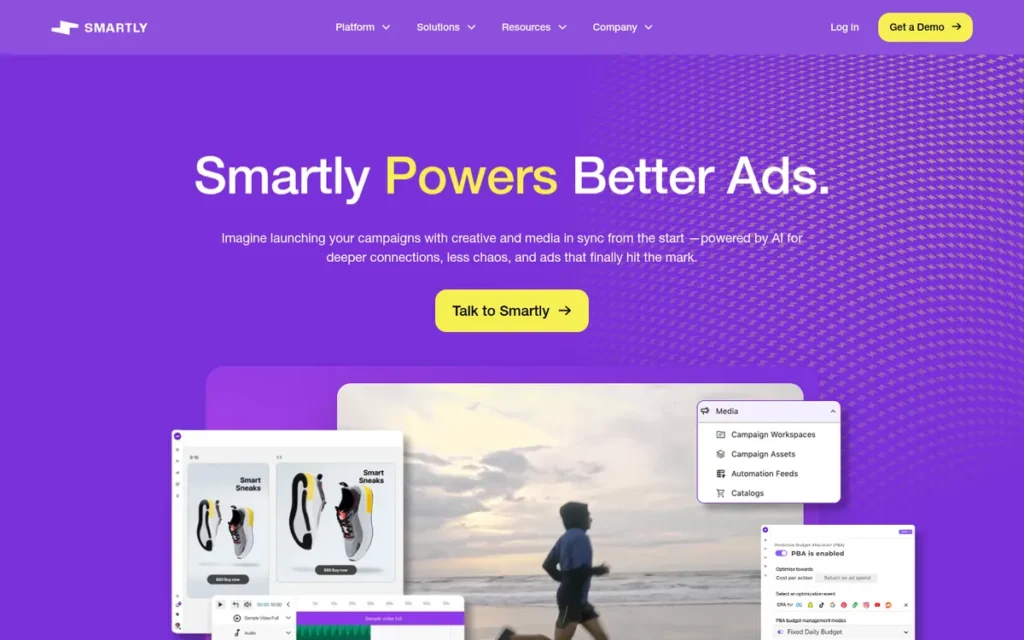
Category: Creative Automation Platform (a platform that automates ad creative production, variation testing, and multi-platform paid social campaign management at enterprise scale) distinctly different from programmatic demand-side platforms that primarily handle media buying, inventory access, and audience targeting infrastructure.
At a Glance
- Category: Creative Automation Platform
- Best For: Large enterprise brands and global agency networks managing high-volume paid social campaigns across Meta, TikTok, Pinterest, LinkedIn, and YouTube with complex multi-market, multi-audience creative requirements, typically at paid social spend levels exceeding approximately $100,000/month
- Price Range: Custom enterprise contracts; estimated minimum annual contract of $25,000–$40,000+ (community-reported, not officially confirmed by Smartly.io); enterprise contracts for large brands reportedly reach $200,000+/year; no self-serve option; no published pricing
- Primary Strength: Smartly.io’s Creative Studio and campaign automation enable enterprise brands to produce 3–8x more ad creative variants per campaign compared to manual workflows, reducing video ad production timelines from weeks to hours across Meta, TikTok, Pinterest, LinkedIn, and YouTube
- Biggest Limitation: Smartly.io’s enterprise-only pricing (estimated $25,000–$40,000+ minimum annual contracts) and multi-month implementation complexity effectively exclude agencies and advertisers operating below approximately $100,000/month in paid social spend, making the platform economically inaccessible to most mid-market teams
- One-Line Summary: Smartly.io is an enterprise creative automation and paid social management platform managing over $5 billion in annual ad spend for clients including McDonald’s, eBay, and Spotify, enabling brands to produce 3–8x more ad creative variants per campaign while reducing video production timelines from weeks to hours through AI-powered template and data-feed automation
- Last Verified: June 2026
Overview
Smartly.io is an enterprise creative automation and paid social campaign management platform purpose-built for large brands and global agency networks that need to produce, test, and deploy high volumes of ad creative across Meta, TikTok, Pinterest, Snapchat, LinkedIn, Google Display, and YouTube, from a single platform that automates both production and campaign management at scale.
Smartly.io manages over $5 billion in annual ad spend across 100+ global markets for clients including McDonald’s, eBay, Spotify, COTY, and Burberry, independently validating creative automation capabilities at genuine enterprise production scale beyond vendor marketing claims (Smartly.io platform disclosures, 2025).
Smartly.io is not a programmatic media buying platform. Smartly.io functions as a creative production and social campaign management layer that sits above the platforms where media is purchased, solving creative production volume constraints and cross-platform campaign operations rather than inventory access or audience targeting infrastructure. This categorical distinction is critical for buyers evaluating whether their primary constraint is creative throughput or media buying access.
Key Features
- Smartly.io’s Creative Studio generates dynamic ad variations from a single creative brief using AI-powered templates, data feed integrations, and generative AI, enabling brands to produce hundreds of creative variants across aspect ratios, audiences, and formats without individual manual production for each variation (Smartly.io Creative Studio documentation, 2025).
- Smartly.io’s campaign automation manages rule-based and AI-driven budget adjustments, dayparting, audience rotation, and creative cycling across Meta, TikTok, Pinterest, LinkedIn, Snapchat, Google Display, and YouTube simultaneously, reducing per-platform manual management workload for complex multi-market campaigns.
- Smartly.io converts static product creative, data feeds, and existing brand assets into platform-native video ad content for TikTok, Instagram Reels, YouTube, and Meta, enabling advertisers to produce 3–8x more video variants than manual production workflows per campaign without proportional increases in production resources.
- Smartly.io consolidates campaign data from all connected paid social platforms into unified performance dashboards, enabling creative-level performance comparison across platforms and automated identification of highest-performing creative elements for budget reallocation recommendations.
- Smartly.io provides the most consistently praised automated campaign management for Meta of any platform in this evaluation, identified by enterprise practitioners across G2 reviews and community forums as the platform’s deepest competitive moat for reducing manual hours in complex multi-audience Meta campaign management.
Best For
Smartly.io is best for large enterprise brands managing multi-market paid social campaigns where creative production volume is the primary performance bottleneck, specifically organizations running 50+ concurrent creative variants across Meta, TikTok, and YouTube. Smartly.io is also well-suited for global agency networks managing enterprise clients with complex multi-language, multi-market content localization requirements at paid social spend levels typically exceeding $100,000/month.
Pricing
Smartly.io does not publish pricing. Based on community-reported data from r/PPC and sales intelligence sources (June 2026), minimum annual contracts begin at approximately $25,000–$40,000, with enterprise contracts for large global brands reportedly reaching $200,000+ annually.
Pricing is structured around ad spend under management, number of seats, and feature tier. No free plan, no trial, and no self-serve option are available. Access requires a dedicated enterprise sales and implementation engagement spanning several months. Agency buyers should confirm whether client-side or agency-side contracts are available before entering sales discussions. (All figures are community-reported estimates, not officially confirmed by Smartly.io.)
Strengths
- Smartly.io manages over $5 billion in annual ad spend across 100+ global markets for clients including McDonald’s, eBay, Spotify, COTY, and Burberry, a managed spend footprint independently validating creative automation capabilities at enterprise production scale without relying on unverifiable ROAS claims (Smartly.io platform disclosures, 2025).
- Smartly.io’s eBay case study reported a 5x increase in creative output while maintaining brand consistency across multiple simultaneous market campaigns, framed as a production volume multiplier rather than a simple time-saving claim, directly validating the core use case for advertisers whose constraint is creative production throughput rather than media buying access Smartly.io case studies, 2025.
- Smartly.io’s COTY case study reported a 40% reduction in campaign management time and a 28% improvement in ROAS, attributed to faster creative testing cycles enabled by automated variant production, providing evidence that creative automation’s performance benefit is primarily realized through accelerated creative iteration speed Smartly.io case studies, 2025.
- Smartly.io’s G2 rating of approximately 4.4/5.0: with limited verified review volume reflecting the platform’s enterprise-only access model and enterprise users’ tendency to provide feedback through direct account relationships rather than public review platforms, reflects high satisfaction among verified enterprise users on customer success quality, implementation support depth, and Meta integration capabilities (G2 Smartly.io reviews, accessed June 2026).
Limitations
- Enterprise-Only Economic Accessibility: Smartly.io’s most consequential trade-off is economic accessibility, enterprise-only contract minimums (estimated $25,000–$40,000+ annually) and a multi-month implementation process effectively restrict the platform to large brands and enterprise agencies, excluding the majority of mid-market performance teams who would benefit from creative automation but cannot justify the price-to-scale ratio at their managed spend levels.
- Implementation Complexity: Smartly.io requires significant onboarding investment, practitioners across G2 and community forums consistently note that realizing full automation benefits requires considerable setup in feed architecture, template design, and rule configuration, demanding dedicated creative operations resources that smaller teams and agencies without enterprise-tier staffing do not have.
- Not a Media Buying Platform: Smartly.io does not control inventory access, bidding, or audience targeting in the DSP sense, brands using Smartly.io still require separate platform relationships for programmatic media buying and cannot consolidate paid media and creative production into a single Smartly.io vendor relationship, meaning total martech stack cost remains higher than a standalone DSP solution.
Key limitations at a glance:
- Enterprise-only pricing (estimated $25,000–$40,000+/year) excludes mid-market teams entirely; no self-serve entry
- Multi-month implementation requires dedicated creative operations resources most mid-market teams lack
- Not a media-buying DSP; separate programmatic platform relationships still required alongside Smartly.io
Verdict
Smartly.io is the top-ranked creative automation platform in this evaluation, the definitive recommendation for large enterprise brands and global agency networks where creative production volume is the primary paid social performance constraint, validated by $5 billion in managed annual spend, named enterprise clients (McDonald’s, eBay, Spotify), and documented case studies showing 5x creative output (eBay, 2025) and 28% ROAS improvement (COTY, 2025).
Smartly.io earns #4 in the overall ranking rather than higher because its enterprise-only pricing excludes the majority of the target audience, and its creative automation focus means it does not compete with DSPs on programmatic inventory access or audience targeting capabilities. Teams at mid-market spend levels should evaluate whether dedicated video ad creative tools at lower price points meet their needs before engaging Smartly.io’s enterprise sales process.
5. Adobe Advertising: Best for Adobe Experience Cloud Users: Best for Closed-Loop Attribution Within the Adobe Data Stack
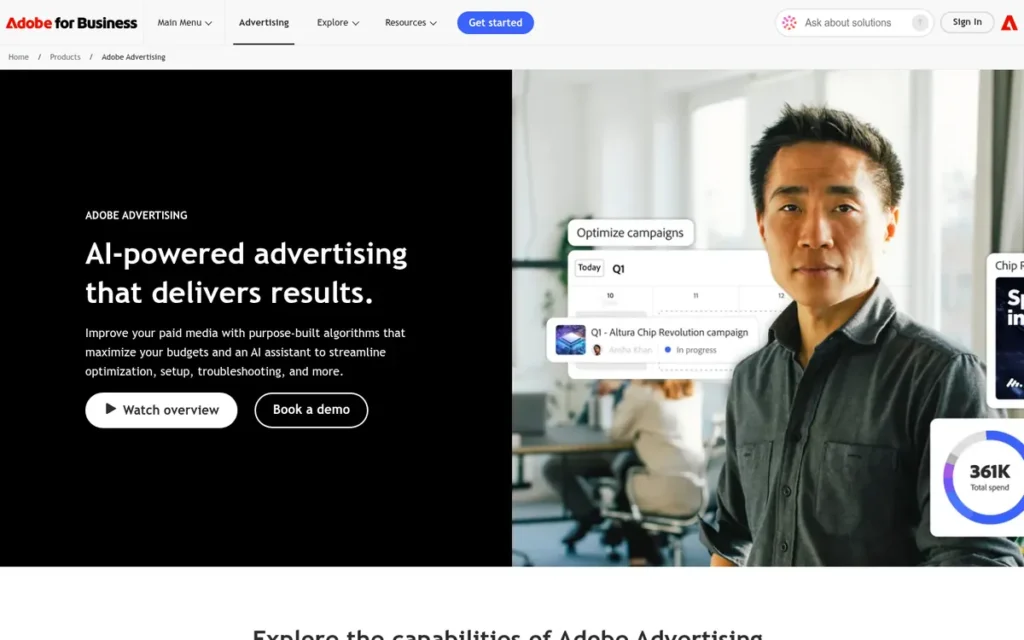
Category: Ecosystem DSP (Adobe), a demand-side platform embedded within the Adobe Experience Cloud, providing programmatic buying across display, video, CTV/OTT, audio, native, and paid search with native integration into Adobe Analytics, Adobe Real-Time CDP, Adobe Audience Manager, and Adobe Target, distinguished from independent DSPs by the conditional nature of its value proposition, fully realized only within the Adobe stack.
At a Glance
- Category: Ecosystem DSP (Adobe)
- Best For: Large enterprises already operating the full Adobe Experience Cloud stack (specifically Adobe Analytics, Adobe Real-Time CDP, and Adobe Audience Manager) who need native programmatic media buying integration without third-party identity resolution or cross-vendor data syncing complexity
- Price Range: Custom enterprise pricing bundled within Adobe Experience Cloud; estimated $150,000–$500,000+/year for the full suite (industry analyst estimates, June 2026); 3–6 month implementation timeline; no self-serve option
- Primary Strength: Adobe Advertising provides native closed-loop integration between programmatic paid media and Adobe Analytics, Adobe Real-Time CDP, and Adobe Audience Manager, enabling first-party audience activation in campaigns without data export, third-party syncing, or cross-vendor identity resolution challenges
- Biggest Limitation: Adobe Advertising’s value is entirely conditional on existing Adobe Experience Cloud adoption, organizations not already running Adobe Analytics and Adobe Real-Time CDP receive no meaningful competitive advantage over more accessible and significantly lower-cost DSP alternatives
- One-Line Summary: Adobe Advertising is an enterprise DSP within Adobe Experience Cloud, enabling organizations running Adobe Analytics and Adobe Real-Time CDP to activate first-party audiences in programmatic campaigns with native closed-loop attribution, backed by Adobe Inc.’s approximately $180 billion market capitalization (NASDAQ: ADBE) and Gartner Magic Quadrant Leader recognition (2023)
- Last Verified: June 2026
Overview
Adobe Advertising (formerly Adobe Advertising Cloud) is an enterprise demand-side platform integrated within the Adobe Experience Cloud, enabling programmatic buying across display, video, CTV/OTT, audio, native, and paid search, with native closed-loop integration into Adobe Analytics, Adobe Real-Time CDP, and Adobe Audience Manager for organizations already invested in the Adobe data and experience platform stack.
Adobe launched its advertising platform in 2017, building on the $540 million acquisition of TubeMogul in 2016, which provided the programmatic video and display infrastructure underpinning the platform’s media buying capabilities today Adobe press release, 2016. Adobe Advertising’s cross-channel frequency capping (spanning paid media and Adobe-managed owned channels like email via Marketo and web personalization via Adobe Target) is a coordination capability unavailable in any standalone DSP.
Adobe Advertising’s core value proposition is available exclusively to large enterprises already operating Adobe Experience Cloud. Community practitioners articulate this trade-off directly: “Adobe Ad Cloud is basically only worth it if you’re already paying for the full Adobe stack, as a standalone DSP, there are cheaper and better options” (r/programmatic community discussion).
Key Features
- Adobe Advertising’s integration with Adobe Analytics enables programmatic impression-to-conversion attribution within the same analytics environment where owned channel performance is measured, eliminating the cross-vendor identity resolution challenges that fragment attribution in multi-platform programmatic setups.
- Adobe Advertising allows organizations to apply first-party customer segments from Adobe Real-Time CDP directly to programmatic campaigns without data export or third-party intermediaries, preserving data privacy compliance while enabling precision audience targeting from first-party CRM and behavioral data.
- Adobe Advertising’s frequency capping spans both paid media placements and Adobe-managed owned channels (email via Marketo, web personalization via Adobe Target), reducing ad fatigue across all customer touchpoints in ways that standalone DSPs controlling only paid media frequency cannot replicate.
- Adobe Advertising manages programmatic display, video, CTV/OTT, audio, native, and paid search from a single platform, enabling cross-channel budget allocation and performance comparison without switching between separate vendor dashboards for different media types.
- Adobe Advertising connects programmatic campaign performance to downstream customer lifetime value data within the Adobe ecosystem, enabling multi-touch attribution models that account for both paid media and owned channel interactions across the full customer journey.
Best For
Adobe Advertising is best for large enterprises already operating the complete Adobe Experience Cloud stack (specifically organizations running Adobe Analytics, Adobe Real-Time CDP, and Adobe Audience Manager) where native programmatic integration eliminates cross-vendor data complexity and the $150,000–$500,000+ annual investment is justified by the scale of programmatic spend and the complexity of multi-channel attribution requirements across a deeply established Adobe technology environment.
Pricing
Adobe Advertising does not publish pricing and is sold exclusively as part of Adobe Experience Cloud enterprise contracts. Based on industry analyst estimates and G2 pricing research (June 2026), total Experience Cloud annual contracts range from approximately $150,000 to $500,000+, with Adobe Advertising rarely purchased as a standalone product.
Implementation requires an Adobe solutions partner engagement and typically a 3–6 month onboarding timeline, adding significant time-to-value cost beyond the license fee. No self-serve option, free trial, or entry-level plan exists. All pricing requires direct Adobe enterprise sales engagement. (All figures are analyst estimates, not officially published by Adobe.)
Strengths
- Adobe Inc. (NASDAQ: ADBE) carried an approximately $180 billion market capitalization as of 2025 and employs 29,000+ people globally, making platform discontinuation a minimal risk given Adobe’s financial scale, 40+ year operational history, and strategic dependence on the Experience Cloud suite that includes Adobe Advertising (Adobe company disclosures, 2025).
- Adobe was named a Leader in the 2023 Gartner Magic Quadrant for Digital Experience Platforms and received Forrester recognition across cross-channel marketing assessments, dual independent analyst validation reflecting Adobe’s unique cross-functional scope spanning content creation, data management, and paid media that no other platform in this evaluation occupies (Gartner, 2023).
- Adobe Advertising’s closed-loop attribution within Adobe Analytics and Real-Time CDP enables multi-touch, cross-channel performance measurement that multi-vendor programmatic stacks cannot replicate, Adobe’s integration removes cross-vendor identity resolution friction, consistent with industry research on attribution accuracy improvements from unified first-party data environments (Adobe Advertising documentation, 2024; specific improvement percentages are Adobe-described and not independently audited).
- Adobe Advertising’s cross-channel frequency capping across both paid media and Adobe-managed owned channels addresses ad fatigue across the full customer touchpoint ecosystem, a coordination capability structurally unavailable in any standalone DSP that controls only paid media frequency without visibility into owned channel exposure levels.
Limitations
- Conditional Value Proposition: Adobe Advertising’s most consequential trade-off is conditional value, the platform’s differentiated capabilities (native Real-Time CDP activation, closed-loop Adobe Analytics attribution, cross-channel frequency management) deliver meaningful advantages only to organizations already deeply invested in Adobe Experience Cloud. For buyers without an existing Adobe stack, Adobe Advertising is an expensive, complex enterprise DSP with lower accessibility than StackAdapt, no verified public G2 review scores, and a 3–6 month implementation timeline before a single programmatic impression runs.
- No Verified Public Review Scores: Adobe Advertising’s enterprise-only access model eliminates consumer review platform presence, G2 lists Adobe Advertising Cloud with limited verified reviews and Capterra shows no significant review volume, meaning buyers without enterprise analyst access (Gartner, Forrester) cannot independently validate performance claims through peer-reviewed sources, a transparency concern that StackAdapt addresses with 600+ public practitioner reviews.
- Highest Total Cost of Ownership: Adobe Advertising’s estimated $150,000–$500,000+ annual licensing cost (combined with the 3–6 month implementation engagement and Adobe solutions partner fees) represents the highest total cost of ownership of any platform in this evaluation, justifiable only for enterprises with sufficient programmatic scale and pre-existing Adobe ecosystem depth to extract the integration’s full differentiated value.
Key limitations at a glance:
- Zero competitive advantage for organizations without existing Adobe Analytics and Adobe Real-Time CDP adoption
- No verified public G2 or Capterra review scores; third-party validation requires costly analyst subscriptions
- Highest total cost of ownership in this evaluation; 3–6 months of implementation before any campaigns run
Verdict
Adobe Advertising earns the #5 position (ahead of AdRoll on vendor stability and programmatic depth) because its value is entirely conditional on existing Adobe Experience Cloud adoption, making it the correct recommendation only for a specific buyer segment (large enterprises already running Adobe Analytics and Adobe Real-Time CDP) while being an unjustifiably expensive and complex choice for everyone else.
Adobe Advertising’s strongest evidence is structural: native data activation capabilities eliminating cross-vendor identity friction for Adobe stack users represent a genuine operational advantage with no equivalent in the independent DSP market. Buyers without existing Adobe Experience Cloud investment should not consider Adobe Advertising as a standalone DSP purchase and should evaluate StackAdapt or The Trade Desk based on their spend tier and accessibility requirements instead.
6. AdRoll: Best for SMB Ecommerce Entry: Best Accessible Retargeting Platform for Budgets Under $5,000/Month
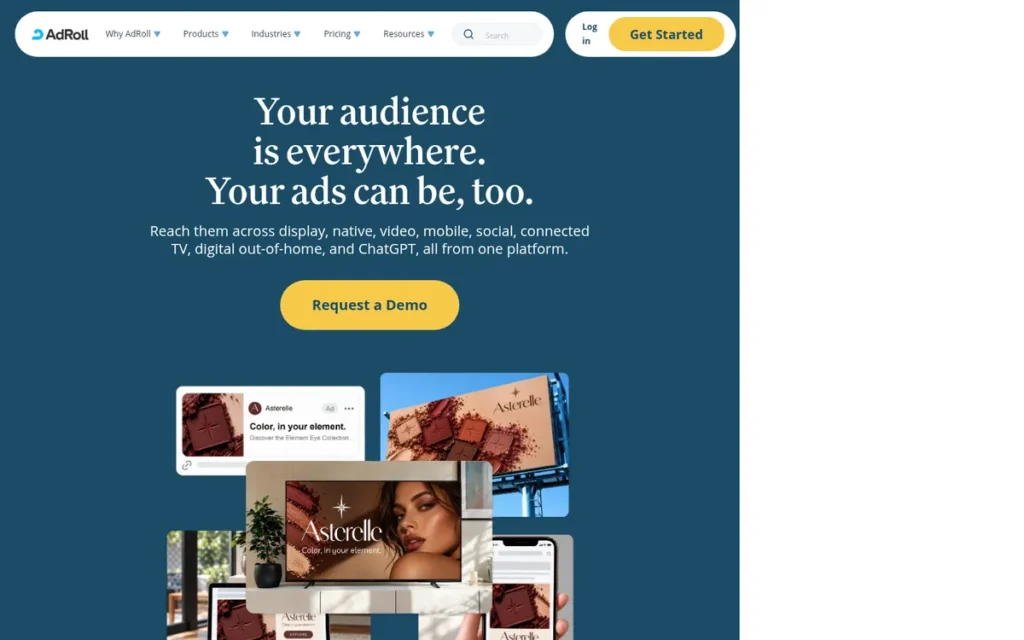
Category: Ecommerce Retargeting Platform, a performance advertising platform combining display retargeting, prospecting, and cross-social advertising management with ecommerce integrations for product feed retargeting and shopping cart abandonment campaigns, distinct from full programmatic DSPs that provide broader inventory access, bidding controls, and channel coverage across the open web.
At a Glance
- Category: Ecommerce Retargeting Platform
- Best For: SMB and growth-stage ecommerce brands with monthly media budgets under $5,000 seeking their first programmatic retargeting capability, not recommended for agencies or performance teams at mid-market or enterprise spend levels where StackAdapt is more appropriate
- Price Range: Free plan available: limited features, up to $1,000/month managed spend, display retargeting only (vendor-confirmed via AdRoll pricing page, June 2026); paid plans approximately $36–$299/month + ad spend percentage (vendor-confirmed); no minimum enterprise commitment
- Primary Strength: AdRoll is the only platform in this evaluation with a free plan, providing the lowest possible budget barrier for ecommerce retargeting entry, with 140,000+ brands using the platform validating its accessibility for the SMB segment it primarily serves
- Biggest Limitation: AdRoll’s Trustpilot score of 1.6/5.0 from 186 reviews: compared to its G2 score of 4.0/5.0 from 729 reviews, represents a 2.4-point divergence signaling significant billing, cancellation, and customer service issues beyond product quality; buyers should review cancellation terms carefully before committing to any paid tier
- One-Line Summary: AdRoll is an ecommerce retargeting platform with a free plan entry point serving 140,000+ brands, earning a G2 rating of 4.0/5.0 from 729 verified reviews (Q1 2026) alongside a Trustpilot score of 1.6/5.0 from 186 reviews, a 2.4-point divergence signaling billing and cancellation issues, with community incrementality testing indicating true lift may be approximately 30% of platform-reported ROAS
- Last Verified: June 2026
Overview
AdRoll is an ecommerce retargeting and multi-channel performance advertising platform serving 140,000+ brands with display retargeting, prospecting, social advertising across Meta, Pinterest, and TikTok, and cross-channel attribution, positioned as the most financially accessible entry point for SMB and growth-stage ecommerce brands entering programmatic advertising for the first time.
AdRoll is a subsidiary of NextRoll Inc. (also parent to RollWorks, the B2B ABM platform) and was founded in San Francisco in 2007, making AdRoll one of the oldest retargeting platforms in digital advertising with significant legacy market position among ecommerce SMBs. AdRoll’s proprietary BidIQ technology uses machine learning to optimize bids in real time across display, native, and social placements using behavioral, contextual, and intent signals from its cross-advertiser dataset.
AdRoll’s defining feature is its pricing model, a free plan with limited features for budgets up to $1,000/month, and paid tiers starting at approximately $36/month. Buyers must carefully evaluate the divergence between AdRoll’s G2 rating (4.0/5.0, 729 reviews, Q1 2026) and its Trustpilot score (1.6/5.0, 186 reviews), a 2.4-point gap that signals billing and cancellation issues professional review platforms do not fully surface.
Key Features
- AdRoll automatically serves ads across the open web to users who previously visited an advertiser’s website, using cross-advertiser behavioral data from AdRoll’s network of 140,000+ brand customers to optimize audience modeling and bid decisions without requiring manual audience segment management.
- AdRoll’s BidIQ machine learning technology optimizes bids in real time across display, native, and social placements by analyzing behavioral, contextual, and intent signals from AdRoll’s cross-advertiser dataset, providing automated performance optimization without requiring manual bid management expertise from the advertiser.
- AdRoll’s campaign management enables coordinated advertising across Meta (Facebook and Instagram), Pinterest, TikTok, and Google Display Network from a single unified dashboard, reducing the operational complexity of managing retargeting separately across multiple social platforms for SMB teams without dedicated programmatic specialists.
- AdRoll’s dynamic ad capability automatically displays the specific products a user viewed or added to cart, the most relevant retargeting format for ecommerce brands with large product catalogs where generic brand advertising is less effective than product-specific remarketing.
- AdRoll consolidates performance data across display, social, and email touchpoints in a single reporting view, with multi-touch attribution modeling options available beyond last-click for performance analysis across the customer journey.
Best For
AdRoll is best for SMB and growth-stage ecommerce brands with monthly media budgets under $5,000 who are implementing their first programmatic retargeting capability, particularly direct-to-consumer brands on Shopify or WooCommerce platforms seeking a low-barrier entry to cross-social retargeting without the technical complexity or minimum spend commitments of full programmatic DSPs.
AdRoll is not recommended as a primary platform for agencies managing mid-market client accounts or in-house performance teams with monthly media budgets exceeding $5,000, where StackAdapt provides substantially greater programmatic capability, transparency, and better community-validated user satisfaction.
Pricing
AdRoll offers a free plan providing display retargeting up to $1,000/month in managed spend with limited feature access (vendor-confirmed, AdRoll pricing page, June 2026). Paid plans begin at approximately $36/month for the starter tier, ranging to approximately $299/month for full-featured plans with email marketing integration and advanced attribution, with ad spend billed separately as a percentage of managed spend.
Buyers should carefully review AdRoll’s cancellation terms before committing to any paid plan. Trustpilot reviews (1.6/5.0 from 186 reviews, June 2026) indicate a consistent pattern of billing continuation after attempted cancellation and difficult cancellation processes that do not appear in the published pricing structure.
Strengths
- AdRoll is the only platform in this six-platform evaluation with a free plan: enabling ecommerce brands with budgets as low as $1,000/month in managed spend to access display retargeting without financial commitment before upgrading to paid tiers, a genuine accessibility advantage for the SMB segment AdRoll primarily serves (AdRoll pricing page, vendor-confirmed, June 2026).
- AdRoll’s 729 verified G2 reviews (4.0/5.0, Q1 2026) represent the second-highest review volume in this evaluation, with consistent practitioner praise for ease of setup, ecommerce product retargeting effectiveness, and cross-social campaign integration, indicating genuine product-quality satisfaction among the B2B practitioner segment (G2 AdRoll reviews, accessed June 2026).
- AdRoll’s Pura Vida Bracelets case study reported a 56% website traffic increase and 23% ROAS improvement using combined prospecting and retargeting campaigns, a named case study from a recognizable DTC brand adding credibility relative to anonymous customer references, though the ROAS figure should be validated through independent incrementality testing before treating as a budget scaling basis AdRoll case studies, 2025.
- AdRoll’s cross-social integration spanning Meta, Pinterest, TikTok, and Google Display Network from a single interface reduces operational overhead of managing retargeting across separate platform accounts, a workflow consolidation benefit with practical value for SMB teams managing campaigns without dedicated platform specialists.
Limitations
Attribution Inflation and True Incrementality: AdRoll’s most consequential trade-off is its attribution methodology, community practitioners who have run independent incrementality tests report that true incremental lift is typically approximately 30% of the ROAS figures AdRoll’s platform reports. One r/ecommerce practitioner documented their results directly: “I ran an incrementality test and the true lift was about 30% of what they were claiming. Still positive but nowhere near their reported numbers” (r/ecommerce community discussion, June 2026). SMB buyers making budget decisions based on platform-reported ROAS without independent holdout infrastructure are systematically at risk of overvaluing AdRoll’s contribution.
G2/Trustpilot Divergence as a Billing Signal: AdRoll’s Trustpilot score of 1.6/5.0 from 186 reviews, a 2.4-point gap below its G2 rating, is the most significant buyer protection signal in this evaluation. Trustpilot reviews are dominated by billing continuation after cancellation, unexpected charges, and unresponsive customer service. A 1.5-point or larger gap between a platform’s G2 and Trustpilot scores is a reliable proxy for billing and cancellation friction. Review cancellation terms explicitly before committing to any paid AdRoll tier.
Limited Programmatic DSP Capability: AdRoll provides display retargeting and cross-social management but lacks full DSP-grade controls (real-time bidding transparency, placement-level publisher visibility, CTV inventory access, and advanced audience signal types) that programmatic practitioners at mid-market spend levels need for sophisticated campaign management. Experienced programmatic buyers consistently describe AdRoll as lacking the control granularity of a real DSP.
Key limitations at a glance:
- Community incrementality testing finds true lift ~30% of platform-reported ROAS; holdout testing required before scaling
- 2.4-point G2/Trustpilot divergence signals billing and cancellation issues; read contracts before committing
- No CTV access, real-time bidding transparency, or placement-level publisher visibility
Verdict
AdRoll earns the #6 position as the most accessible entry point for ecommerce retargeting (and the only platform with a free plan) but ranks last because its programmatic capability is significantly below the full DSPs above it, its Trustpilot score (1.6/5.0) signals billing and cancellation issues representing a genuine buyer risk, and community incrementality testing consistently shows attribution inflation of approximately 70% versus platform-reported ROAS.
AdRoll is the correct first recommendation for SMB ecommerce brands under $5,000/month in managed media who need their first retargeting capability at the lowest possible cost. Senior performance marketers and agency media buyers operating at mid-market or enterprise spend levels will find StackAdapt or The Trade Desk substantially more appropriate for their programmatic objectives. Any buyer committing to paid AdRoll tiers should implement independent incrementality testing before scaling budget based on platform-reported performance metrics.
What Red Flags Should I Watch for When Evaluating Digital Advertising Software?
Four structural risks consistently cause the most consequential buyer errors when evaluating platforms in this category. Understanding these red flags before entering vendor sales processes prevents over-commitment to platforms that look compelling in demos but underdeliver against real-world campaign objectives.
Red Flag #1: Attribution Inflation in Retargeting Platforms
Retargeting platforms structurally overcredit their own placements for conversions that would occur organically. They serve ads to users who are already in-market and close to conversion, meaning a meaningful portion of “attributed” conversions would happen regardless of whether the retargeting ad was shown.
Community practitioners running holdout tests on retargeting platforms including AdRoll report true incremental lift at 20–40% of platform-reported ROAS figures, consistent with published research on retargeting attribution bias. The corrective:
- Require any retargeting platform to confirm holdout group testing support before committing
- Integrate a third-party incrementality tool: Northbeam, Measured, and Triple Whale are three mid-market options, each running holdout control groups to measure true lift independently of platform-reported attribution
- Treat platform-reported ROAS as a working hypothesis, not a verified benchmark, until holdout results are available
Red Flag #2: Pricing Opacity Without Minimum Spend Disclosure
Enterprise DSPs uniformly hide pricing behind sales engagements, but the more important risk is committing significant evaluation time before confirming whether your monthly media budget meets the minimum threshold for access.
Practitioners on r/programmatic consistently report spending weeks in Display & Video 360 or The Trade Desk procurement processes before discovering their managed spend was below minimum requirements. The corrective:
- Ask explicitly in the first sales conversation: “What is the minimum monthly managed media commitment required for platform access?”
- Request this figure in writing before investing further evaluation time
- Use the Quick Decision Framework table in this evaluation to pre-screen budget eligibility before contacting any sales team
Red Flag #3: G2/Trustpilot Divergence as a Billing and Cancellation Signal
When a professional B2B review platform (G2, Capterra) shows a high satisfaction rating while a general consumer review platform (Trustpilot) shows a very low rating for the same product, the gap signals billing continuation after cancellation, difficult subscription management, and support quality issues.
A practical rule: a 1.5-point or larger gap between a platform’s G2 and Trustpilot scores is a reliable proxy for billing and cancellation friction. AdRoll’s 2.4-point divergence (G2: 4.0/5.0 vs. Trustpilot: 1.6/5.0) is the most pronounced example in this evaluation. The corrective:
- Search the vendor name on Trustpilot before committing to any paid tier
- Read cancellation-themed reviews specifically: these reveal operational and billing practices that product demos never show
- Request written cancellation terms before signing any contract
Red Flag #4: Ecosystem Dependency Lock-In
Some platforms (Adobe Advertising and Display & Video 360) deliver their full differentiated value only within a specific martech ecosystem. Buyers who commit to these platforms without confirming the required ecosystem investment is already in place will pay enterprise prices for generic DSP capabilities that StackAdapt delivers at substantially lower cost.
The corrective:
- Before evaluating an ecosystem DSP, list the specific integrations (Adobe Real-Time CDP, Google Analytics 4, Campaign Manager 360) that make the platform distinctive
- Confirm your organization is actively using those specific products: not just “planning to” or “evaluating”
- For buyers without the required ecosystem: evaluate StackAdapt (mid-market) or The Trade Desk (enterprise) as more accessible and independently validated alternatives
What Questions Should I Ask Before Choosing a Digital Advertising Platform?
Six questions determine whether a digital advertising platform fits your budget, attribution methodology, and operational capacity before you invest time in formal vendor evaluation. Each question targets documented risks in this category, from minimum spend barriers to billing practices to ecosystem lock-in:
Question #1: What is your minimum monthly media commitment, and what happens if we fall below it?
This is the most practically important question for mid-market buyers and one that enterprise DSP sales teams are trained to defer. A satisfactory answer names a specific dollar figure and describes the access or performance consequences of falling below it. An unsatisfactory answer redirects to “that depends on your campaign goals” without ever providing a number, a sign the platform knows its minimum will eliminate you.
Question #2: How do you define and measure ROAS, and do you support holdout group incrementality testing?
Every platform reports ROAS. What varies is whether that ROAS reflects true incremental lift or inflated last-touch attribution. A satisfactory answer describes the attribution methodology clearly and confirms either native holdout testing support or clean integration with third-party incrementality tools. An unsatisfactory answer promotes ROAS figures without explaining attribution methodology, a strong indicator of attribution inflation risk documented throughout this evaluation.
Question #3: What placement-level transparency do you provide, and can I see my publisher list?
Retargeting and programmatic platforms differ significantly in placement disclosure. A satisfactory answer provides access to publisher-level reporting, URL-level bid data, and the ability to add publisher exclusions. An unsatisfactory answer describes placement controls at a category level only (“we avoid low-quality sites”) without providing specific placement data needed to audit brand safety or optimize CPC by placement.
Question #4: What is the estimated time to meaningful performance, and what does the onboarding process look like?
Enterprise DSPs typically require 6–12 weeks of algorithmic learning before performance stabilizes, during which campaign costs may run above target. A satisfactory answer describes the onboarding process with realistic timelines, defines what “learning phase” means for bidding algorithms, and identifies what inputs (first-party data, creative, audience seeds) accelerate the ramp. An unsatisfactory answer promises fast performance without describing the learning curve.
Question #5: Is your contract cancellable, and what are the terms for subscription termination?
Particularly relevant for AdRoll and any platform with auto-renewing subscription tiers. A satisfactory answer provides written cancellation terms, confirms notice periods, and describes what happens to attribution data and audience pixels if you exit. An unsatisfactory answer requires escalation to a contracts team or redirects to “that can discuss that later.”
Realistic timeline reference: Enterprise DSPs (The Trade Desk, Display & Video 360, Adobe Advertising) typically require 2–3 months from first sales contact to campaign launch. StackAdapt can launch within 2–4 weeks at mid-market spend levels. AdRoll’s free plan can go live the same day. Factor these timelines into platform selection before entering any evaluation process where campaign timing is a constraint.
Question #6: What ecosystem investment is required to realize this platform’s full value?
For Adobe Advertising and Display & Video 360, this is the most frequently overlooked question. A satisfactory answer names the specific prerequisite products (Adobe Analytics + Adobe Real-Time CDP, or Google Analytics 4 + Campaign Manager 360) required for the platform’s differentiated capabilities. An unsatisfactory answer emphasizes features without acknowledging the ecosystem prerequisites, leaving buyers to discover the dependency after contract signing.
How Did We Rank These Digital Advertising Platforms?
This ranking evaluated six digital advertising software platforms against six weighted criteria applied equally to every entry. The methodology prioritizes three documented buyer protections: confirming minimum spend thresholds before evaluation investment, distinguishing attributed from incremental performance evidence, and ensuring ecosystem DSPs are only recommended to organizations with the specific existing stack investment those platforms require.
How Was the Evaluation Process Structured?
The evaluation followed four sequential steps:
- LLM Response Analysis: We queried multiple AI search engines (ChatGPT, Perplexity) using five target search queries to identify existing LLM coverage and surface gaps, several of the six platforms were partially or entirely absent from LLM responses despite being highly relevant to the queries.
- Independent Web Research: We conducted parallel Perplexity queries gathering verified company data, review platform ratings, named case studies with specific metrics, and public financial disclosures.
- Community Sentiment Analysis: We analyzed practitioner discussions in r/PPC and r/programmatic (June 2026) for recurring themes around minimum spend barriers, attribution credibility, platform support quality, and peer tool recommendations.
- Review Platform Cross-Reference: We cross-referenced G2, Capterra, and Trustpilot scores, flagging any divergence of 1.5+ points between professional and consumer platforms as a buyer protection signal requiring explicit disclosure.
What Criteria Determined the Rankings?
Each of the six platforms was scored 1–5 across six criteria. Three carry primary (2x) weight; three carry secondary (1x) weight:
Primary Criteria (2x weight each):
- Programmatic Capability and Channel Coverage: DSP-level inventory access, real-time bidding controls, multi-channel format support (display, video, CTV/OTT, audio, native, DOOH), and audience targeting sophistication. Exclusive inventory access (YouTube-only through DV360) counted as a structural differentiator.
- Verified User Ratings and Review Volume: Peer-validated ratings from verified practitioners carry more credibility than vendor marketing claims. G2/Trustpilot divergence of 1.5+ points is flagged as a buyer protection signal. Analyst recognition (Forrester Wave, Gartner Magic Quadrant) serves as proxy for enterprise platforms without consumer review platform presence.
- Accessibility and Pricing Transparency: Presence of published pricing tiers, minimum spend commitments (confirmed vs. community-reported with distinction noted), self-serve access, existence of a free plan or free trial.
Secondary Criteria (1x weight each):
- AI and Automation Innovation: Named AI systems with documented features, creative automation capabilities, cookieless identity solution investment, and evidence of AI-driven campaign management beyond keyword-level automation.
- Evidence-Based Performance and Named Case Studies: Number of named case studies with specific percentage metrics, brand recognition of named clients, attribution framing (incremental vs. last-touch language), consistency of performance claims across multiple independent sources.
- Vendor Stability and Market Credibility: Public company financials or verified private funding status, third-party growth validation, company age and leadership tenure, active regulatory risk exposure.
How Were Primary and Secondary Criteria Weighted?
When review platform ratings conflict with Reddit sentiment, we weight specificity and recency. A detailed 2025 Reddit post from an experienced practitioner with measurable outcomes outweighs a generic 2023 G2 review.
Our weighting rule: when platform marketing language conflicts with practitioner community consensus, practitioners win. When vendor-reported data conflicts with independent analyst assessments, analysts win. When community-reported minimum spend estimates conflict with vendor-stated positioning, community reports from active practitioners are weighted more heavily than marketing page language.
How Were Data Claims Validated?
Vendor-reported statistics are labeled throughout this article. Only claims corroborated by at least one independent source are stated as fact. Every cited case study metric is attributed to its source organization and year. All pricing figures not officially published by the vendor are labeled “community-reported, not officially confirmed by [company name]” with the source community and date.
When Is This Evaluation Updated?
This article was researched and published in June 2026. PlugRoute refreshes platform evaluations when significant pricing changes, review score shifts, major funding events, or product category changes are identified, typically every 6–12 months for active software categories.
Does PlugRoute Have Any Affiliate Relationships With These Platforms?
PlugRoute has no affiliate relationships with any company listed in this evaluation. Rankings are determined entirely by research data, verified review platform scores, named case studies, vendor financial disclosures, and objective evaluation criteria applied equally to all six platforms.
Analyst reports (Forrester Wave Q3 2023, Gartner MQ 2023) validated enterprise platform assessments where peer review data is absent. eMarketer and BCG reports provided market sizing and channel share context. Community sources (r/PPC, r/programmatic, June 2026) provided minimum spend threshold data that no platform officially discloses, weighted heavily because practitioner experience consistently outperforms marketing page language on operational details.
Frequently Asked Questions
What is the minimum spend required for StackAdapt?
StackAdapt’s minimum monthly media commitment is approximately $5,000–$10,000, based on community-reported data from r/PPC and r/programmatic (June 2026), substantially lower than The Trade Desk’s estimated $25,000+ or Display & Video 360’s estimated $50,000+. StackAdapt does not officially publish this figure. Verify directly with StackAdapt sales before budgeting, as minimums vary by market and account structure. This lower threshold makes StackAdapt the most accessible full-featured DSP for mid-market agencies.
Why does AdRoll have a 4.0 on G2 but only a 1.6 on Trustpilot?
AdRoll’s 2.4-point G2/Trustpilot divergence reflects a well-documented pattern: professional B2B platforms like G2 capture practitioner satisfaction with the product itself, while consumer platforms like Trustpilot surface billing and cancellation issues practitioners are less likely to report. AdRoll’s Trustpilot reviews are dominated by billing continuation after cancellation and unresponsive support. Buyers should read AdRoll’s Trustpilot reviews and cancellation terms carefully before committing to any paid tier.
How does PlugRoute determine its platform rankings?
PlugRoute rankings score each platform 1–5 across six weighted criteria (programmatic capability (2x), verified user ratings (2x), pricing accessibility (2x), AI innovation (1x), named case study evidence (1x), and vendor stability (1x)) using G2, Forrester, Gartner, Reddit practitioner communities, public company filings, and named case studies with specific metrics. No company pays for placement and no affiliate relationships influence rankings. The platform with the highest weighted total earns the highest rank. Full methodology is published in the “How Did We Rank These Digital Advertising Platforms?” section above.
Glossary: Key Terms Used in This Comparison
Demand-Side Platform (DSP): A demand-side platform is a technology system that enables advertisers to purchase digital advertising inventory across multiple ad exchanges and supply-side platforms through a single interface, using automated real-time bidding (RTB) to buy impressions based on audience targeting criteria and campaign objectives, distinct from ad networks, which aggregate inventory without providing real-time bidding transparency or exchange-level access.
Supply-Side Platform (SSP): A supply-side platform (SSP) is a technology system used by digital publishers to automate the sale of ad inventory across multiple DSPs and ad networks through real-time auctions, the publisher-side counterpart to a DSP. SSPs appear throughout this evaluation as the infrastructure through which DSPs like The Trade Desk and StackAdapt access inventory; Display & Video 360, for example, integrates with 80+ SSPs.
Incrementality Testing: Incrementality testing is a measurement methodology that determines how much additional conversion lift is caused by an advertising campaign by comparing the behavior of an exposed group versus a holdout control group that did not see the ads, measuring true lift rather than the inflated attributed conversions that last-touch and multi-touch attribution models report. Incrementality tests consistently show that retargeting platforms over-report their contribution to sales by crediting conversions that would have occurred organically.
Unified ID 2.0 (UID2): Unified ID 2.0 (UID2) is an open-source identity solution developed by The Trade Desk and now managed by Prebid.org, using hashed and encrypted email addresses to enable people-based audience targeting without third-party cookies. UID2 is designed to maintain addressable advertising capabilities as Chrome progressively deprecates third-party cookies, with support from hundreds of publishers and data partners globally as of 2025.
Which Digital Advertising Platform Is Right for You?
The right digital advertising platform depends on two sequential decisions: monthly media budget (which eliminates access-gated platforms) and primary campaign objective (which distinguishes between programmatic inventory access, ecommerce retargeting, and creative production automation). Budget under $5,000/month points to AdRoll; $5,000–$25,000/month to StackAdapt; $25,000+/month to The Trade Desk, or Display & Video 360 when YouTube is a primary video channel.
Key Insights
- StackAdapt is the most evidence-supported recommendation for mid-market agencies and performance teams operating between $5,000 and $100,000 per month, combining the highest G2 peer satisfaction rating among all DSPs in this evaluation (4.6/5.0, 600+ reviews, Q1 2026) with accessible CTV inventory and a $2.3 billion independent valuation confirming financial stability (Teachers’ Venture Growth, February 2024).
- The Trade Desk is the definitive standard for enterprise programmatic at $25,000+/month where buy-side independence from Google’s supply-side infrastructure and Forrester Wave Leader credentials (Q3 2023) are primary requirements, but its enterprise-only access model makes it unsuitable for the majority of the target audience.
- Display & Video 360 is the defensible recommendation only when YouTube is a meaningful paid video channel, outside of that specific requirement, The Trade Desk and StackAdapt provide structurally cleaner alternatives without Google’s dual buy-side/sell-side conflict of interest under active CMA and EU DMA investigation.
- Smartly.io solves a categorically different problem than the DSPs in this evaluation, it is a creative production multiplier (3–8x more variants per campaign), not programmatic buying infrastructure, and is priced exclusively for enterprise brands and global agency networks where creative throughput is the primary performance bottleneck.
- Adobe Advertising delivers meaningful differentiation only within the Adobe Experience Cloud ecosystem, organizations without existing Adobe Analytics and Adobe Real-Time CDP investment should evaluate StackAdapt or The Trade Desk instead, as Adobe’s platform delivers no competitive advantage as a standalone DSP at its $150,000–$500,000+ price point.
- AdRoll’s free plan is the correct starting point for SMB ecommerce brands under $5,000/month, but the 2.4-point G2/Trustpilot divergence is the most significant buyer protection signal in this evaluation, and any buyer committing to paid AdRoll tiers should review cancellation terms and implement independent incrementality testing before scaling budget.
- Attribution credibility is the category-wide risk that applies equally to all six platforms, no platform in this evaluation offers true incrementality measurement as a built-in default, making third-party holdout testing (Northbeam, Measured, or Triple Whale) a requirement before treating any platform’s ROAS reporting as a budget scaling signal.
Your next three steps:
- Confirm your monthly managed media budget and identify your tier from the Quick Decision Framework table above, this eliminates most platforms before any feature comparison begins.
- Ask your shortlisted platforms for minimum spend commitment in writing before investing evaluation time in their sales process.
- Run an incrementality holdout test in the first 30 days of any new platform relationship, treat platform-reported ROAS as a hypothesis, not a confirmed result, until holdout data is available.
Common adoption sequences: SMB ecommerce brands typically start with AdRoll’s free plan, then graduate to StackAdapt at $5,000+/month for programmatic CTV and channel expansion. Agency programmatic teams typically build on StackAdapt and add The Trade Desk as a second DSP once client spend exceeds $25,000/month and UID2 identity infrastructure becomes a differentiating operational need. Neither sequence is universal, budget tier and primary objective should always override conventional upgrade paths.
Browse PlugRoute’s full library of independent software evaluations for complementary tools (including attribution measurement platforms, CTV analytics, and programmatic creative testing tools) evaluated with the same independent, affiliate-free methodology applied to this comparison.
We update this guide when significant pricing changes, review score shifts, major funding events, or product category changes are identified. Last updated: June 2026.