HighRadius is the top-ranked deduction management platform for large enterprise AI-driven automation in 2026. SPS Commerce Revenue Recovery leads for retail suppliers with existing SPS EDI infrastructure. Esker is strongest for multi-national O2C teams. The right choice depends on deduction volume, ERP environment, retailer channel mix, and compliance requirements, no single platform fits every buyer.
Unresolved deductions are silent revenue leaks, short-paid invoices that go unchallenged accumulate as permanent cash losses that rarely appear on operational cost reviews, making deduction management automation one of the highest-return finance investments for AR teams processing significant deduction volumes.
This evaluation routes four buyer segments to distinct platforms: large enterprise CPG suppliers managing Amazon and Walmart chargebacks, compliance-driven controllers at SOX-regulated organizations, global enterprises with multi-country O2C operations, and mid-market B2B manufacturers replacing spreadsheet-based deduction tracking.
PlugRoute has no affiliate relationships with any company listed in this evaluation. Rankings are determined entirely by research data and objective evaluation criteria applied equally to all platforms.
Which Platforms Are the Top-Ranked Deduction Management Tools in 2026?
- HighRadius is the top-ranked deduction management platform in this 2026 independent evaluation for large enterprise AI-driven autonomous deduction resolution, combining 190+ autonomous AI agents, 37 U.S. patents, and 245 G2 reviews with a 4.3/5.0 aggregate rating.
- SPS Commerce Revenue Recovery is the best-ranked option for retail suppliers already connected to the SPS Commerce EDI trading network, operated by NASDAQ-listed SPS Commerce (SPSC) with $192.1 million in Q1 2026 revenue and more than $1 billion in documented customer recoveries.
- Esker is the strongest evaluated option for multi-national O2C teams across 40+ countries, backed by a 40-year operating history since 1985 and the GB Foods named case study documenting near-zero dispute ratios after Esker AR automation deployment.
- Emagia is the strongest evaluated option for global enterprises needing autonomous AI order-to-cash integration, with confirmed native PeopleSoft support and reported processing of more than $1 trillion in accounts receivable across its Gia AI platform.
- BlackLine is the highest-ranked evaluated option for compliance-driven SOX-regulated and publicly traded organizations, earning Forrester recognition in AI Explainability and Transparency (2025) and providing independently audited financial accountability as a NASDAQ-listed company (BL).
- iNymbus DeductionXchange is the most targeted evaluated option for CPG brands whose primary bottleneck is Amazon Vendor Central and Walmart Retail Link portal automation, with a Capterra reviewer documenting a 73% recovery rate within four months of implementation.
- Gaviti is the most accessible modular entry point in this evaluation for mid-market B2B manufacturers, offering deduction management as a standalone purchasable module with no-code configuration, with G2 reviewers praising ease of use while flagging slow performance, limited customization, and inadequate reporting as functional ceilings.
What Are the Main Categories of Deduction Management Software?
Deduction management platforms fall into three functional archetypes: AI Resolution Engines, EDI and Portal Automation Platforms, and AR Workflow Suites (PlugRoute editorial classification framework, these archetypes organize evaluated platforms by primary operating model and are not industry-standard analyst category designations). Choosing the wrong archetype means paying for capability your team cannot deploy, or underpowering your operation for the deduction complexity you actually face.
AI Resolution Engines: HighRadius and Emagia, deploy machine learning agents to autonomously identify, classify, validate, and resolve deductions.
AI Resolution Engines target enterprises requiring touchless processing at scale, with ML-based pre-filing validity prediction and multi-step autonomous resolution without human intervention.
EDI and Portal Automation Platforms: SPS Commerce Revenue Recovery and iNymbus DeductionXchange, leverage either existing trading network data (SPS Commerce) or robotic process automation (iNymbus) to validate and submit disputes.
EDI and Portal Automation Platforms best serve supplier teams whose primary bottleneck is portal navigation labor or supply chain data cross-referencing.
AR Workflow Suites: Esker, BlackLine, and Gaviti, embed deduction management within broader order-to-cash or financial governance platforms.
AR Workflow Suites (Esker, BlackLine, and Gaviti) prioritize integration breadth over deduction-native depth, and are strongest when deductions are one of several AR automation requirements rather than the singular operational priority.
How Do the Top 7 Deduction Management Platforms Compare at a Glance?
All seven evaluated deduction management platforms are compared below across category, use case, primary strength, and key limitation, use the table to identify candidates, then consult the Quick Decision Framework to confirm your best-fit option based on your specific deduction volume, ERP environment, and compliance requirements.
| Rank | Company | Category | Best For | One-Line Summary | Key Capabilities | Primary Strength | Key Limitation |
|---|---|---|---|---|---|---|---|
| 1 | HighRadius | AI Resolution Engine | Large enterprise CPG, manufacturing, and distribution with high deduction volumes | HighRadius is the most technically differentiated deduction management platform among the seven independently evaluated options in this 2026 assessment, combining Agentic AI with 37 patents, 50+ ERP integrations, and a G2-verified track record across 600+ client organizations | 190+ autonomous AI agents | 37 U.S. patents | 50+ ERP integrations | ML pre-filing validity prediction | 3-way matching | 245 G2 reviews (4.3/5.0); G2 Leader designation in credit and collections automation | Enterprise-only; opaque pricing; high implementation complexity |
| 2 | SPS Commerce Revenue Recovery | EDI-Native Prevention Platform | Retail suppliers with existing SPS Commerce EDI connectivity to Walmart, Amazon, or major U.S. retailers | SPS Commerce Revenue Recovery is the only platform among the seven evaluated that is embedded within an active 300,000-trading-partner EDI network, operated by NASDAQ-listed SPS Commerce (SPSC) reporting $192.1 million in Q1 2026 revenue with more than $1 billion in documented customer recoveries | 300,000-partner EDI network | Pre-mapped retailer rules | Proactive prevention model | NASDAQ-listed (SPSC) | Nombé case study | NASDAQ-audited financials; Nombé case study (50%+ chargeback reduction, combined EDI + Recovery deployment) | Requires existing SPS EDI connectivity |
| 3 | Esker | Multi-Channel AR Workflow Suite | Multi-national consumer goods and manufacturing teams across 40+ countries | Esker is a 40-year-old enterprise document automation platform founded in 1985 that delivers AI-powered deduction management within a globally deployed O2C suite covering 40+ countries, 300+ invoicing portals, and 135+ currencies; with GB Foods as a named client achieving near-zero dispute ratios | Synergy AI (NLP | LLMs | RPA | OCR) | 300+ portals | 40+ countries | 135+ currencies | Trade and non-trade coverage | GB Foods named case study (near-zero dispute ratios); 40-year track record | No retailer portal dispute submission; significant IT implementation requirements |
| 4 | Emagia | Autonomous O2C Orchestrator | Global enterprises with legacy PeopleSoft or complex multi-ERP environments | Emagia is an autonomous order-to-cash platform founded in 2004 that embeds AI-driven deduction management within a connected Gia AI agent framework supporting SAP, Oracle, NetSuite, PeopleSoft, and Microsoft Dynamics; with reported processing of more than $1 trillion in accounts receivable | Gia AI agents | SAP + Oracle + NetSuite + PeopleSoft + Dynamics | $1T+ AR processed | Multi-entity dashboards | Cross-module O2C | PeopleSoft integration (unique among the seven evaluated); $1T+ AR processed | Limited public deduction-specific case studies; enterprise implementation complexity |
| 5 | BlackLine | Finance Control and AR Intelligence Platform | Compliance-driven SOX-regulated, PE-backed, and publicly traded organizations | BlackLine is a NASDAQ-listed financial controls platform founded in 2001 whose AR Intelligence module is Forrester-recognized for AI Explainability and Transparency (2025), making it the highest-ranked evaluated option for compliance-driven organizations requiring audit-defensible deduction management integrated with financial close governance | AR Intelligence module | Forrester AI Explainability (2025) | Financial close integration | ML payment forecasting | SEC Form 10-K | Forrester AI Explainability recognition (2025); NASDAQ-listed (BL); 25-year track record | Close-governance heritage, not deduction-native; no deduction-specific public case studies |
| 6 | iNymbus DeductionXchange | Retailer Portal Automation Engine | CPG brands with concentrated Amazon Vendor Central and Walmart Retail Link deduction volumes | iNymbus DeductionXchange is a cloud RPA platform that automates deduction dispute filing across 40+ retailer portals including Amazon Vendor Central and Walmart Retail Link, with a Capterra reviewer documenting a 73% recovery rate within four months of implementation | 40+ retailer portals | Amazon Vendor Central | Walmart Retail Link | Target-specific workflows | Pre-built RPA sequences | Capterra reviewer: 73% recovery rate within 4 months (one verified implementation outcome) | RPA cannot interpret nuanced claims; no cash application module |
| 7 | Gaviti | Modular Mid-Market AR Automator | Mid-market B2B manufacturers and distributors with 50–500 employees replacing spreadsheet tracking | Gaviti is a modular mid-market AR automation platform launched in 2018 that provides deduction management as a standalone purchasable module with no-code configuration and ERP-agnostic integration across SAP, Oracle, Infor, Plex, and QAD; with G2 reviewers praising ease of use but flagging reporting and performance gaps | 6 purchasable modules | Per-customer pricing | No-code configuration | SAP + Oracle + Infor + Plex + QAD | AI Assistant module | Modular subscription; most accessible entry point for mid-market | G2-documented: slow performance, limited customization, missing features, inadequate reporting |
Which Deduction Management Platform Should I Choose for My Use Case?
Match your primary evaluation criterion to the recommended platform below, each recommendation includes an acceptable alternative for buyers whose situation partially overlaps multiple categories.
| Your #1 Priority | Recommended Tool | Why | Acceptable Alternative |
|---|---|---|---|
| Enterprise AI autonomous resolution (190+ agents, 37 patents, 50+ ERP integrations) | HighRadius (#1) | Deepest AI architecture; 245 G2 reviews (4.3/5.0); G2 Leader designation in credit and collections automation | Emagia (#4) for end-to-end autonomous O2C |
| Retail supplier with existing SPS EDI to Walmart, Amazon, or Target | SPS Commerce Revenue Recovery (#2) | Proactive prevention within 300,000-partner EDI network; NASDAQ-listed; Nombé case study (50%+ chargeback reduction) | iNymbus (#6) if no SPS EDI connectivity exists |
| Global multi-national O2C with deductions across 40+ countries | Esker (#3) | 40-year track record; 300+ portals; 135+ currencies; Synergy AI multi-modal stack | HighRadius (#1) if autonomous resolution depth is also required |
| End-to-end autonomous O2C including legacy PeopleSoft integration | Emagia (#4) | Only platform among the seven evaluated explicitly confirming PeopleSoft native integration; $1T+ AR processed | HighRadius (#1) for SAP/Oracle-primary environments |
| Compliance, audit trail governance, and Forrester-validated AI explainability | BlackLine (#5) | Only platform with Forrester AI Explainability recognition (2025); NASDAQ-listed; 25-year financial controls heritage | Esker (#3) for global compliance with broader O2C scope |
| Primary bottleneck is Amazon Vendor Central and Walmart Retail Link portal labor | iNymbus DeductionXchange (#6) | 40+ retailer portals; Capterra reviewer: 73% recovery rate in 4 months (one verified implementation) | SPS Commerce (#2) if SPS EDI is already deployed |
| Mid-market B2B manufacturer replacing spreadsheet-based deduction tracking | Gaviti (#7) | Modular subscription; standalone purchasable; no-code setup; Infor + Plex + QAD coverage | iNymbus (#6) if retailer portal automation is also needed |
How to Use This Article Efficiently
- Use the Quick Decision Framework above to identify your highest-ranked platform match by primary evaluation criterion.
- Jump directly to that entry and read the At a Glance block and Limitations section before scheduling a demo, these two blocks contain the most decision-relevant information in the entry.
- Use the Evaluation Questions section below the ranked entries to structure your vendor conversation, and the Red Flags section to identify procurement risks your sales team will not raise proactively.
1. HighRadius: Best Overall: Large Enterprise AI-Driven Deduction Automation
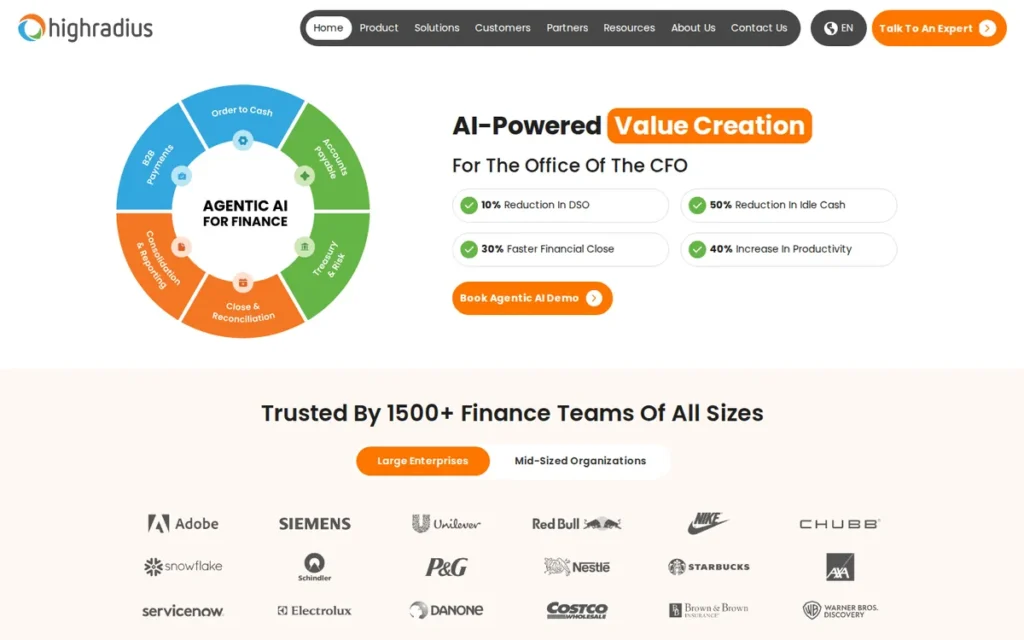
Category: AI Resolution Engine, autonomously identifies, classifies, validates, and resolves deductions using machine learning agents that perform 3-way matching and retrieve dispute documents from carrier portals without human login or manual document assembly
At a Glance
- Category: AI Resolution Engine
- Best For: Large enterprise CPG, manufacturing, distribution, and retail supplier organizations with high deduction volumes, dedicated AR teams, and existing ERP infrastructure across SAP, Oracle, and 48+ additional systems
- Price Range: Custom enterprise pricing: no public rates; category benchmarks place large enterprise deduction management at $100,000+ annually (Slashdot software directory, 2026, directory-level benchmarks; treat as directional orientation rather than verified market rates)
- Primary Strength: HighRadius deploys 190+ autonomous AI agents that execute 3-way matching, retrieve proof-of-delivery documents from carrier portals, and resolve deductions without human login, a capability protected by 37 issued and pending U.S. patents including an ML document intelligence patent awarded December 31, 2024
- Biggest Limitation: HighRadius is explicitly documented by third-party assessors as not suitable for small businesses or organizations with low deduction volumes, requiring enterprise ERP infrastructure and multi-phase implementation that create genuine adoption barriers below the large enterprise threshold
- One-Line Summary: HighRadius is the most technically differentiated deduction management platform among the seven independently evaluated options in this 2026 assessment, combining Agentic AI with 37 patents, 50+ ERP integrations, and a G2-verified track record across 600+ client organizations, earning it the #1 position in this independent evaluation
- Last Verified: June 2026
Overview
HighRadius is an enterprise AI-driven order-to-cash platform serving large CPG, manufacturing, distribution, and retail organizations that need autonomous deduction resolution across complex, multi-ERP environments, deploying 190+ autonomous AI agents to log into carrier portals, perform 3-way matching, and resolve deductions without human login. HighRadius integrates natively with 50+ ERP systems and holds 37 issued and pending U.S. patents in the document intelligence and automation layer, representing the most technically differentiated deduction management solution among the seven platforms in this independent evaluation.
Key Features
- Agentic AI with 190+ Autonomous Agents: HighRadius deploys 190+ autonomous agents that log into carrier portals, retrieve proof-of-delivery documentation, perform 3-way invoice-order-receipt matching, and build complete claim packets, without requiring analyst login or manual document assembly at any step in the workflow (HighRadius product page, 2026).
- ML-Based Pre-Filing Validity Prediction: HighRadius analyzes 20+ variables: including dispute type, dispute amount, ship-to location, and 12 months of historical resolution outcomes, to predict deduction validity before a dispute is filed, enabling AI-driven prioritization of high-recovery claims over reactive processing of all submitted short-payments equally.
- 50+ Confirmed ERP Integrations: HighRadius integrates natively with 50+ ERP systems, with SAP and Oracle explicitly confirmed in product documentation, enabling bidirectional data flow for deduction matching, ERP archiving, and period-end reconciliation without dual data entry or manual file transfer.
- Patent-Protected Document Intelligence: HighRadius generates audit trails using image data correction capabilities protected by a U.S. patent awarded December 31, 2024, producing defensible, timestamped dispute packages that satisfy both AR review standards and compliance documentation requirements (BusinessWire, November 2023).
- Cross-Module O2C Intelligence: HighRadius embeds deduction management within a broader order-to-cash platform including cash application, collections, and credit management, enabling deduction trends to directly inform credit risk scoring and collections prioritization without manual data sharing between systems.
Best For
HighRadius is best for large enterprise CPG, manufacturing, distribution, and retail supplier organizations with substantial deduction volumes, dedicated AR analyst teams, and existing ERP infrastructure, specifically those that need autonomous AI-driven deduction resolution at scale rather than workflow-assisted manual review with partial automation.
Pricing
HighRadius uses custom enterprise pricing with no published tiers or dollar amounts (verified June 2026). Category-level benchmarks from software directory analysis place large enterprise deduction management deployments at $100,000+ annually (Slashdot software directory, 2026, directory-level benchmarks; treat as directional orientation rather than verified market rates). Buyers should request client references at comparable deduction volumes before committing to a demo cycle, and should ask for implementation timeline and total cost of ownership estimates alongside platform licensing figures.
Strengths
- HighRadius holds 37 issued and pending U.S. patents, including an ML-based image data correction patent awarded December 31, 2024, a documented R&D investment in document intelligence that creates a technical barrier competitors using rule-based or generic RPA automation cannot quickly replicate (BusinessWire, November 2023; USPTO, December 2024).
- HighRadius has accumulated 245 verified reviews on G2 with a 4.3/5.0 aggregate rating and a G2 Leader designation in credit and collections automation categories, the largest independent review footprint of any platform in this evaluation, providing statistically meaningful external validation of real-world deployment experience (G2, June 2026).
- HighRadius claims recognition in related AR automation categories based on public announcements, enterprise buyers requiring confirmed Gartner Magic Quadrant placement for internal procurement approvals should request the specific quadrant name, year, and tier directly from HighRadius during evaluation, as the publicly available source confirmed for this evaluation documents G2 designation (HighRadius news, 2026).
- HighRadius vendor-stated performance benchmarks include 60% improvement in Net Recovery Rate, 40%+ analyst productivity improvement, and 20% reduction in Days Deductions Outstanding across 600+ client organizations, the most detailed category-specific outcome metrics published by any evaluated platform (source: HighRadius product resources, 2026; note: vendor-stated, not independently audited; buyers should request named client references to validate).
Limitations
- Enterprise-Only Suitability: HighRadius is explicitly documented by third-party assessors as not suitable for small businesses or organizations with low deduction volumes, enterprise pricing, multi-phase implementation timelines (assessment, configuration, ERP integration, training, testing), and requirements for existing multi-ERP infrastructure create genuine adoption barriers below the large enterprise threshold (Dynamics Communities, 2026).
- Implementation Complexity: HighRadius deployments require multi-phase commitment covering assessment, configuration, ERP integration, analyst training, and testing, adding meaningful total cost of ownership beyond platform licensing that buyers without dedicated implementation teams must fully account for before procurement.
- AI Decision Auditability Gap: HighRadius’s 190+ autonomous agents operate as a proprietary system, the degree to which individual AI decisions are logged, explained, and presentable to compliance auditors is not publicly documented; buyers at regulated organizations should ask specifically how agent decisions are recorded before comparing HighRadius against BlackLine, which holds Forrester recognition in AI Explainability and Transparency (2025).
- Unverified Performance Benchmarks: HighRadius primary performance metrics: including 80%+ touchless deduction resolution (vendor-stated, from HighRadius marketing comparison content, not independently verified), are directional benchmarks from marketing materials, not independently audited case study outcomes; buyers should request live demonstrations of autonomous portal login and 3-way matching rather than relying on aggregate statistics as implementation guarantees.
Verdict
HighRadius is the highest-scoring deduction management platform in this independent evaluation, earning the top position based on the deepest AI automation architecture (190+ autonomous agents, 37 patents), the broadest ERP integration footprint (50+ confirmed systems), the largest independent review base (245 G2 reviews, 4.3/5.0 aggregate rating), and a G2 Leader designation in credit and collections automation, a combination of technical depth and third-party validation no other evaluated platform simultaneously achieves. HighRadius is the defensible #1 choice for large enterprises with high deduction volumes, complex ERP environments, and dedicated AR teams prepared for enterprise-grade deployment. Organizations below the large enterprise threshold should evaluate SPS Commerce Revenue Recovery (#2) if they operate within retail supplier EDI networks, Esker (#3) for global multi-national O2C operations, or Gaviti (#7) for mid-market B2B deduction tracking without enterprise platform commitment.
2. SPS Commerce Revenue Recovery: Best for Retail Suppliers: EDI-Integrated Proactive Deduction Prevention
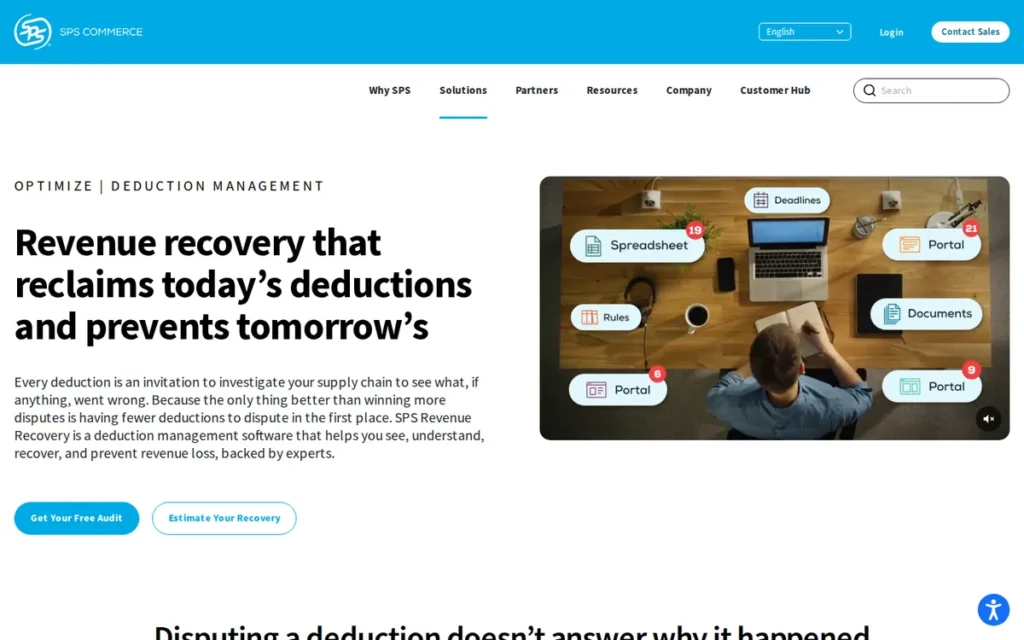
Category: EDI-Native Prevention Platform, proactively validates deductions against real-time supply chain transaction data within an existing 300,000-partner EDI trading network, enabling upstream dispute prevention rather than reactive claim filing after short-payment
At a Glance
- Category: EDI-Native Prevention Platform
- Best For: Retail brands and suppliers already using SPS Commerce Fulfillment EDI who sell into Walmart, Amazon, Target, Kroger, or CVS and need deduction recovery embedded within existing supply chain data infrastructure
- Price Range: Custom subscription pricing: no public rates; sales quote required; SPS Commerce is transitioning toward platform subscription fees per Q1 2026 earnings; EDI connectivity fees may apply separately
- Primary Strength: SPS Commerce Revenue Recovery operates within a live 300,000-trading-partner EDI network, cross-referencing deduction claims against real-time purchase order, ASN, and invoice data before disputes are filed, a proactive prevention model unavailable in standalone deduction platforms that process claims reactively after short-payment
- Biggest Limitation: SPS Commerce Revenue Recovery requires existing SPS Commerce Fulfillment EDI connectivity to deliver full intelligence value, suppliers without established EDI infrastructure or those primarily serving regional retailers outside the 300,000-partner network will see diminished deduction validation capability
- One-Line Summary: SPS Commerce Revenue Recovery is the only platform among the seven evaluated that is embedded within an active 300,000-trading-partner EDI network, operated by NASDAQ-listed SPS Commerce (SPSC) reporting $192.1 million in Q1 2026 revenue with more than $1 billion in documented customer recoveries
- Last Verified: June 2026
Overview
SPS Commerce Revenue Recovery is an EDI-integrated deduction recovery platform for retail brands and suppliers already operating within the SPS Commerce 300,000-partner trading network, automatically identifying, validating, and disputing deduction-related revenue loss by cross-referencing claims against real-time supply chain transaction data. SPS Commerce Revenue Recovery is operated by SPS Commerce, Inc. (NASDAQ: SPSC), reporting $192.1 million in Q1 2026 revenue, providing enterprise buyers independently audited financial accountability that is uniquely verifiable among deduction management vendors in this evaluation.
The key structural difference: most deduction management platforms process disputes after a short-payment arrives. SPS Commerce Revenue Recovery validates against live supply chain transaction data before the deduction becomes a dispute, turning reactive recovery into proactive prevention. For suppliers already inside the SPS Commerce EDI network, this is a fundamentally different operating model, not just a faster workflow.
Key Features
- 300,000-Partner EDI Network Cross-Reference: SPS Commerce Revenue Recovery automatically validates deduction claims against real-time purchase orders, advance shipping notices, and invoices within the SPS Commerce 300,000-partner EDI network, eliminating the manual document gathering step required by standalone deduction platforms that lack access to live supply chain transaction data (SPS Commerce product page, 2026).
- Pre-Mapped Trading-Partner Business Rules: SPS Commerce applies business rules specific to each major trading partner (Walmart, Amazon, Target, Kroger, CVS, and others) to validate which deductions are invalid based on documented supply chain compliance events, enabling data-driven dispute prioritization before any claim is submitted.
- First-Party Supplier Workflow Support: SPS Commerce Revenue Recovery provides dedicated 1P product documentation for proactive dispute management with Amazon and Walmart trading partners, addressing the two highest-volume deduction sources for most CPG and retail supplier AR teams (SPS Commerce 1P page, 2026).
- Centralized Claims Dashboard with Real-Time Visibility: SPS Commerce Revenue Recovery consolidates multi-retailer chargeback tracking into a single dashboard connected to live EDI transaction data, providing real-time visibility into dispute status, recovery progress, and deduction aging across all covered trading partners.
- NASDAQ-Listed Corporate Accountability: SPS Commerce, as a NASDAQ-listed public company (ticker: SPSC) reporting Q1 2026 revenue of $192.1 million with 6% year-over-year growth and full-year 2026 guidance of $798.5M–$806.9M, provides enterprise buyers independently audited financial stability uniquely verifiable in this category (SPS Commerce Q1 2026 earnings, April 2026).
Best For
SPS Commerce Revenue Recovery is best for retail brands and suppliers already connected to the SPS Commerce Fulfillment EDI network who sell into major U.S. retail channels, particularly those with Walmart, Amazon, Target, or Kroger as primary trading partners.
SPS Commerce Revenue Recovery’s 300,000-partner network and trading-partner-native business rules deliver deduction validation intelligence unavailable from standalone dispute management platforms that process claims reactively after short-payment without EDI transaction data cross-reference.
Pricing
SPS Commerce Revenue Recovery does not publish pricing publicly (verified June 2026). Per Q1 2026 earnings, SPS Commerce is transitioning some customers toward platform subscription fees rather than transaction-based pricing (Yahoo Finance, Q1 2026). Suppliers using SPS Fulfillment for EDI connectivity may incur separate EDI provider fees outside the Revenue Recovery subscription. Buyers should request a bundled vs. unbundled cost breakdown and clarify whether EDI connectivity is included before comparing total cost against standalone deduction platforms.
Strengths
- SPS Commerce is a NASDAQ-listed public company (ticker: SPSC) reporting Q1 2026 revenue of $192.1 million, up 6% year-over-year, with full-year 2026 guidance of $798.5M–$806.9M, the strongest independently audited corporate financial accountability profile in this evaluation, providing enterprise buyers verifiable vendor stability assurance unavailable from privately held competitors (SPS Commerce Q1 2026 earnings press release, April 2026).
- The Nombé case study documents a 50%+ reduction in chargebacks after deploying SPS Commerce Fulfillment EDI connected to Revenue Recovery, the most specifically sourced named client outcome available in SPS Commerce’s public materials; note that this reduction is attributed to the combined SPS Commerce EDI and Revenue Recovery deployment, not Revenue Recovery in isolation (SPS Commerce case study, 2026).
- SPS Commerce Revenue Recovery has recovered more than $1 billion for customers through its platform, the largest aggregate recovery headline metric of any vendor in this evaluation, reflecting the scale impact of deduction validation embedded within a live 300,000-partner trading network (source: SPS Commerce product video, 2026; note: vendor-stated aggregate figure, not tied to specific client breakdown).
- SPS Commerce Revenue Recovery’s EDI-native proactive prevention model transforms deduction management from reactive dispute processing into upstream supply chain compliance enforcement, a structurally distinct operating philosophy that no standalone deduction tool among the seven evaluated platforms replicates.
Limitations
- EDI Infrastructure Dependency: SPS Commerce Revenue Recovery’s deduction intelligence is structurally tied to SPS Commerce Fulfillment EDI connectivity, suppliers without established SPS EDI must complete additional setup and may need to perform manual invoice file uploads for some retailer transmission workflows before Revenue Recovery functions at full effectiveness (SPS Help via SupplyPike, 2026).
- Network Coverage Boundaries: SPS Commerce Revenue Recovery delivers strongest results for suppliers whose primary customers are within the SPS Commerce 300,000-partner network, suppliers primarily serving small or regional retailers outside this network will find limited trading-partner-specific rule coverage and diminished deduction validation capability.
- Narrow Platform Scope: SPS Commerce Revenue Recovery is a deduction-focused product within the SPS Commerce ecosystem, not a broad AR automation or financial close platform, organizations needing deduction management integrated with general cash application, credit risk analysis, or CFO-level working capital reporting will require additional tooling.
- Opaque Total Cost: SPS Commerce Revenue Recovery requires sales engagement for any cost information, and the interaction of platform subscription fees with existing EDI connectivity fees creates pricing complexity that buyers should specifically request to have unbundled before evaluation.
Verdict
SPS Commerce Revenue Recovery is the highest-credibility deduction management platform in this evaluation from a corporate accountability standpoint, a NASDAQ-listed company with audited financials, $192.1 million in Q1 2026 revenue, and a named client case study documenting 50%+ chargeback reduction (attributed to the combined SPS EDI and Revenue Recovery deployment) that privately held competitors cannot independently verify. SPS Commerce Revenue Recovery’s structural advantage, embedding deduction recovery within a live 300,000-trading-partner EDI network, creates a proactive prevention model that outperforms reactive dispute platforms for retail suppliers already inside the SPS ecosystem. Buyers should confirm existing SPS Commerce Fulfillment EDI connectivity before procurement; suppliers without established EDI connectivity should evaluate HighRadius (#1) or Esker (#3) as alternatives suited to standalone deduction automation without EDI prerequisites.
3. Esker: Best for Global Enterprise: Multi-National O2C Deduction Management Across 40+ Countries
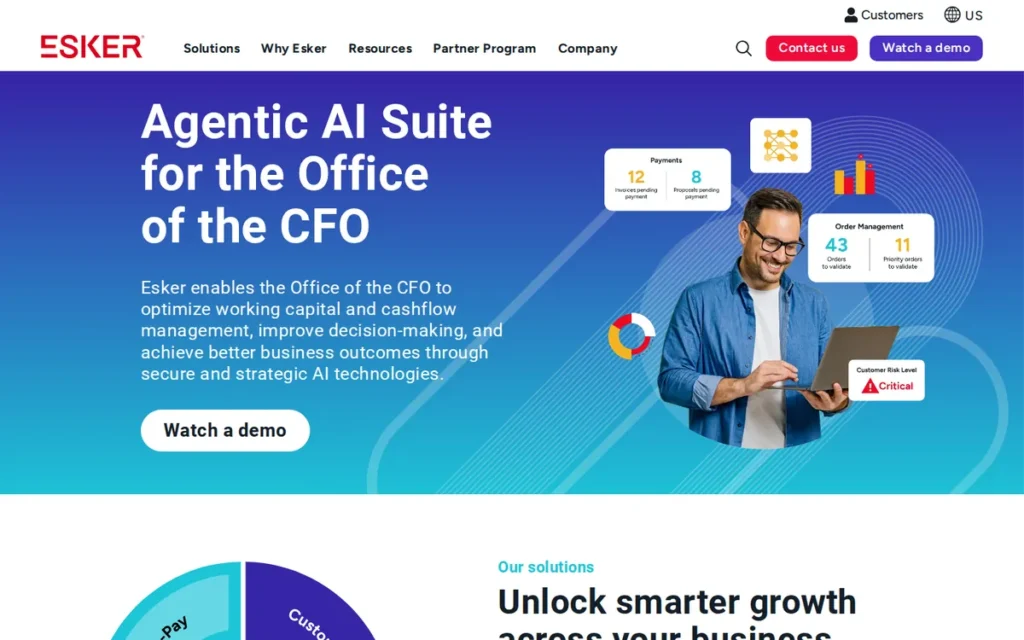
Category: Multi-Channel AR Workflow Suite, processes deduction inputs from emails, portals, and PDFs using a multi-modal AI stack (NLP, LLMs, generative AI, RPA, OCR) within a globally deployed order-to-cash platform covering 40+ countries and 135+ currencies
At a Glance
- Category: Multi-Channel AR Workflow Suite
- Best For: Multi-national enterprises in consumer goods, manufacturing, and retail needing AI-powered deduction management within a unified O2C platform across global operations
- Price Range: Custom pricing: no public rates; free demo available but pricing requires direct sales contact; pricing opacity is a documented user concern in third-party review sources (verified June 2026)
- Primary Strength: Esker Synergy AI processes deduction inputs across emails, portals, and PDFs using deep learning, NLP, LLMs, generative AI, RPA, and OCR, supporting 300+ invoicing portals in 40+ countries and 135+ currencies within a platform with a 40-year operating history since 1985
- Biggest Limitation: Esker does not provide direct retailer portal automation for dispute submission into Amazon Vendor Central or Walmart Retail Link, limiting its effectiveness for CPG suppliers whose primary bottleneck is portal-based dispute execution volume rather than document processing
- One-Line Summary: Esker is a 40-year-old enterprise document automation platform founded in 1985 that delivers AI-powered deduction management within a globally deployed O2C suite covering 40+ countries, 300+ invoicing portals, and 135+ currencies, with GB Foods as a named client achieving near-zero dispute ratios
- Last Verified: June 2026
Overview
Esker is a 40-year-old enterprise document automation company founded in 1985 and headquartered in Lyon, France, serving global consumer goods, manufacturing, and retail organizations that need AI-powered deduction and dispute management within a comprehensive order-to-cash platform across 40+ countries and 135+ currencies. Esker’s Synergy AI platform combines deep learning, NLP, large language models, generative AI, RPA, and OCR to process deduction inputs from emails, EDI transmissions, and PDFs across 300+ invoicing portals, with GB Foods as a named client achieving 98% order delivery satisfaction and near-zero dispute ratios after Esker AR automation deployment (Esker YouTube case study, 2026; buyers should request the formal written case study from Esker during evaluation to independently verify these metrics and confirm which AR module components generated the dispute reduction outcome).
Key Features
- Esker Synergy AI Multi-Modal Intake: Esker automatically captures deduction claim data from emails, EDI transmissions, and PDFs using a multi-modal AI stack combining deep learning, NLP, large language models, generative AI, robotic process automation, and OCR, eliminating manual intake bottlenecks across diverse deduction input channels without requiring standardized document formats (Esker product page, 2026).
- Trade and Non-Trade Deduction Coverage: Esker handles both trade deductions (promotional allowances, marketing contributions) and non-trade deductions (shortages, damaged goods, invoice price discrepancies) within a single workflow engine, providing broader deduction type coverage than retailer-portal-focused automation specialists that address only portal-submitted chargebacks.
- Self-Service Customer Portal in 40+ Countries: Esker provides a self-service customer portal available in 40+ countries and 135+ currencies, enabling B2B customers to view, submit, and track dispute resolution directly, reducing AR team workload for international customer relationships without AR analyst involvement for straightforward claims.
- 300+ Invoicing Portals with Global Compliance Infrastructure: Esker supports 300+ supplier invoicing portals with multi-ERP integration, SLA tracking, real-time team collaboration, and audit trail documentation, providing governance infrastructure required for finance teams operating under regulatory review across multiple jurisdictions (Agicap AR software comparison, 2026).
- Cross-Module O2C Visibility: Esker integrates deduction management within its broader O2C suite alongside collections, cash application, and credit management, enabling CFO-level dashboards on deduction aging, past-due trends, and cash flow impact without requiring separate data integration.
Best For
Esker is best for multi-national enterprises in consumer goods, manufacturing, or retail with AR teams operating across multiple countries and currencies that need unified O2C automation (including AI-powered deduction management) as part of a holistic, globally deployed workflow rather than a standalone deduction tool bolted onto existing ERP processes.
Pricing
Esker does not publish pricing publicly (verified June 2026). Esker offers a free demo but requires direct sales contact for all pricing information. Pricing opacity is documented as a user concern in third-party review sources (Agicap AR software comparison, 2026). Finance teams building budget cases should request directional pricing at the demo stage, specifying anticipated deduction volume, ERP environment, required country coverage, and whether they need the full O2C suite or deductions as a standalone module.
Finance teams at organizations with IT resources fully allocated to ERP migration projects should add an estimated 60–90 days to implementation timelines for Esker compared to lighter-deployment portal automation tools, and should request Esker’s implementation project plan documentation before signing a contract.
Strengths
- GB Foods, a named consumer goods manufacturer, achieved 98% order delivery satisfaction with “almost zero dispute ratios” after deploying Esker AR automation, the most specifically documented named dispute outcome from a named consumer goods manufacturer in this evaluation, validating Esker’s value in food and consumer goods environments where dispute prevention is the strategic goal (Esker YouTube case study, 2026; buyers should request the formal written case study to independently verify these metrics).
- Esker was founded in 1985 and operates across 60+ countries with approximately 1,000 employees, a 40-year institutional track record that surpasses every other evaluated platform in operating longevity and provides a stability signal for organizations entering long-term enterprise software commitments (Agicap AR software comparison, 2026).
- Esker’s claim of 60% touchless processing for deduction claims: enabled by Synergy AI’s multi-modal document intelligence, indicates meaningful automation depth across the intake-to-resolution workflow for organizations with diverse document input channels (source: Agicap AR software comparison, 2026; note: vendor-stated; buyers should verify against their specific deduction type and input channel profile during evaluation).
- Esker documented a 71% reduction in past-due payments for one unnamed client and DSO reduction of up to 10 days in available product materials, providing directional evidence of AR cash flow impact beyond deduction-specific metrics (Esker product materials via Agicap, 2026; note: vendor-stated; buyers should request deduction-specific outcome metrics during evaluation).
Limitations
- No Retailer Portal Dispute Submission: Esker does not provide direct retailer portal automation for dispute submission into Amazon Vendor Central or Walmart Retail Link, a limitation consistent with Esker’s own product positioning as a document-processing workflow platform, limiting effectiveness for CPG suppliers whose primary bottleneck is portal-based dispute execution volume (HighRadius Esker alternatives article, 2026; note: competitor-authored source; limitation cross-referenced against Esker’s own product documentation).
- Significant IT Implementation Requirements: Esker requires significant IT resources per third-party assessments, a realistic total cost of ownership factor that buyers must include when comparing against lighter-deployment standalone deduction tools, particularly at organizations with IT capacity already allocated to ERP migrations.
- Workflow-Focused Automation Ceiling: Esker’s automation focuses on intelligent document intake, claim routing, and workflow processing rather than autonomous resolution, its claimed 60% touchless processing rate indicates meaningful efficiency but does not reach the autonomous agentic resolution level documented at HighRadius, making it less specialized for buyers requiring maximum touchless dispute throughput.
- Pricing Opacity: Esker does not publish any pricing information and requires a full demo engagement before providing cost estimates, a documented user frustration that creates difficulty for finance teams needing budget estimates during early evaluation stages.
Verdict
Esker is the strongest evaluated option for multi-national enterprises that need AI-powered deduction management embedded within a globally deployed, 40-year-old O2C platform, a combination of institutional stability, global infrastructure (40+ countries, 300+ portals, 135+ currencies), and broad AI modality that no newer fintech entrant in this category can match. Esker’s GB Foods case study documenting near-zero dispute ratios is the most specifically documented named client outcome in this evaluation for a consumer goods dispute management context and directly validates Esker’s value where dispute prevention is the strategic goal. Buyers whose primary requirement is automated retailer portal dispute submission into Amazon Vendor Central or Walmart Retail Link, or autonomous AI resolution without workflow-assisted review, will find more targeted capability at HighRadius (#1) or iNymbus (#6).
4. Emagia: Best for Autonomous AI O2C: Legacy Multi-ERP Environments Including PeopleSoft
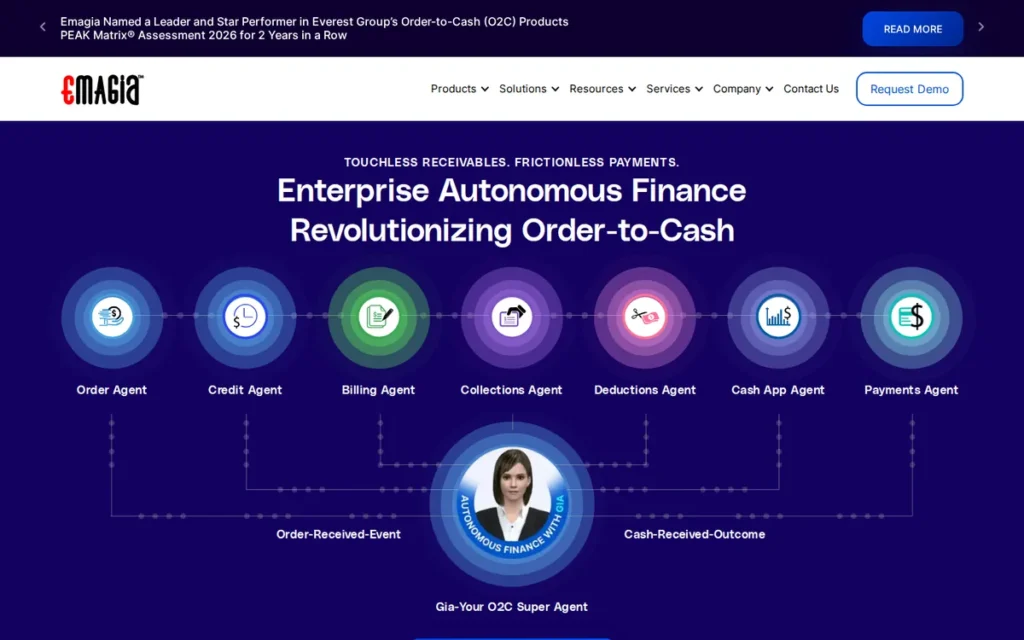
Category: Autonomous O2C Orchestrator, embeds AI-driven deduction management within a connected order-to-cash agent framework (Gia AI) alongside cash application and collections, supporting SAP, Oracle, NetSuite, PeopleSoft, and Microsoft Dynamics in global multi-ERP environments
At a Glance
- Category: Autonomous O2C Orchestrator
- Best For: Global enterprises running complex multi-ERP environments: including legacy PeopleSoft installations, that need deduction management embedded in an end-to-end AI-driven O2C platform
- Price Range: Custom enterprise pricing: no public rates; expected in the upper category tier ($60,000–$100,000+ annually) based on platform sophistication (verified June 2026)
- Primary Strength: Emagia’s Gia AI agent framework connects deduction management with GiaCASH (cash application) and GiaCOLLECT (collections) in a unified autonomous finance architecture, with confirmed native integrations for SAP, Oracle, NetSuite, PeopleSoft, and Microsoft Dynamics
- Biggest Limitation: Emagia’s sophisticated Gia AI architecture implies enterprise-grade implementation complexity, and publicly available deduction-specific client case studies with named companies and quantified outcomes are limited compared to evaluated alternatives
- One-Line Summary: Emagia is an autonomous order-to-cash platform founded in 2004 that embeds AI-driven deduction management within a connected Gia AI agent framework supporting SAP, Oracle, NetSuite, PeopleSoft, and Microsoft Dynamics, with reported processing of more than $1 trillion in accounts receivable
- Last Verified: June 2026
Overview
Emagia is a US-based autonomous order-to-cash platform founded in 2004 that serves global enterprises needing deduction management embedded within an AI agent framework alongside cash application and collections across multi-ERP environments including SAP, Oracle, NetSuite, PeopleSoft, and Microsoft Dynamics. Emagia’s Gia AI framework positions deduction management as a component of a connected autonomous finance architecture (enabling cross-module intelligence between deduction resolution, GiaCASH cash application, and GiaCOLLECT collections without manual data transfer) and has processed more than $1 trillion in accounts receivable across its platform (Emagia AR automation blog, 2026).
Key Features
- Gia AI Autonomous Deduction Agent Framework: Emagia’s Gia AI deploys autonomous finance agents across the deduction management workflow (identifying, validating, categorizing, and resolving customer deductions with document intelligence and ERP-integrated workflow orchestration) as an interconnected component of a broader autonomous O2C operating model (Emagia deductions product page, 2026).
- PeopleSoft and Multi-ERP Native Integration: Emagia integrates natively with SAP, Oracle, NetSuite, PeopleSoft, and Microsoft Dynamics, with PeopleSoft support serving as a documented differentiator for enterprises running legacy Oracle PeopleSoft ERP environments that most newer deduction management platforms do not explicitly confirm integration support for (Emagia AR automation blog, 2026).
- Multi-Entity CFO-Level Executive Dashboards: Emagia provides real-time executive dashboards covering DSO, CEI, dispute aging, cash forecasting, and enterprise receivables visibility across multi-entity, multi-currency global deployments, enabling CFO-level working capital reporting that connects unresolved deduction aging directly to balance sheet impact.
- Cross-Module Autonomous Finance Architecture: Emagia embeds deduction management within a connected AI agent ecosystem alongside GiaCASH (cash application) and GiaCOLLECT (collections), enabling cross-module intelligence where deduction resolution outcomes inform GiaCASH matching accuracy and GiaCOLLECT prioritization without manual data transfer between systems.
- $1 Trillion+ AR Processing Scale: Emagia has reported processing more than $1 trillion in accounts receivable across its platform, an enterprise volume scale metric signaling high-transaction-count handling capacity for organizations with large AR operations across multiple entities and currencies (Emagia AR automation blog, 2026).
Best For
Emagia is best for global enterprise organizations (particularly those running SAP, Oracle, NetSuite, PeopleSoft, or Microsoft Dynamics in multi-entity, multi-currency environments) that want deduction management as an integrated component of an end-to-end autonomous order-to-cash platform rather than a standalone dispute tool requiring separate integration with cash application and collections workflows.
Pricing
Emagia does not publish pricing publicly (verified June 2026). Enterprise custom pricing is standard for this platform tier. Based on comparable enterprise O2C platforms in this evaluation, deployments at Emagia’s sophistication level are expected to price in the $60,000–$100,000+ annual range as a directional orientation. Buyers should request a scoped quote specifying ERP count, deduction volume, module requirements, and geographic scope before benchmarking against alternatives.
Strengths
- Emagia has processed more than $1 trillion in accounts receivable across its platform, a scale metric establishing enterprise-grade volume handling capacity and two decades of operational depth in high-transaction-count finance environments, comparable in scale signal to the largest enterprise AR platforms in this evaluation (Emagia AR automation blog, 2026).
- Emagia explicitly confirms native integration with PeopleSoft alongside SAP, Oracle, NetSuite, and Microsoft Dynamics, a documented ERP coverage advantage for enterprises running legacy Oracle PeopleSoft installations that none of the other six evaluated platforms explicitly confirm support for in public documentation (Emagia AR automation blog, 2026).
- Emagia’s autonomous finance architecture positions deduction management within a connected Gia AI agent ecosystem alongside cash application and collections, a cross-module integration model where resolved deduction outcomes directly inform GiaCASH matching and GiaCOLLECT prioritization, avoiding manual handoffs between siloed AR tools.
- Emagia’s vendor-stated platform benchmarks include a 90–95% straight-through cash application rate and up to 30% DSO reduction, directional evidence of significant automation impact at the O2C level (source: Emagia product materials, 2026; note: vendor-stated, platform-level metrics, not deduction-module-specific; buyers should request deduction-specific outcomes during evaluation).
Limitations
- Limited Public Deduction-Specific Case Studies: Emagia’s deduction-specific evidence base is the thinnest among enterprise platforms in this evaluation, publicly accessible, named client case studies with quantified deduction outcomes are not available, a transparency gap relative to HighRadius (245 G2 reviews), Esker (GB Foods named case study), and iNymbus (Capterra user metrics); buyers should request a minimum of two named reference clients at comparable deduction volumes with deduction-specific outcome metrics (DDO reduction percentage, recovery rate pre/post-deployment) before proceeding past initial vendor contact.
- Enterprise Implementation Complexity: Emagia’s “autonomous finance” positioning is a genuine architectural differentiator but also a deployment commitment, buyers must invest in enterprise-grade implementation work, ERP integration, change management, and process redesign to realize Gia AI’s deduction capabilities, making it unsuitable for teams needing fast time-to-value or operating without dedicated implementation resources.
- Platform-Level vs. Deduction-Specific Metrics: Available G2 review data covers Emagia’s cash application product rather than its deduction management module specifically, and vendor-stated performance benchmarks are platform-level rather than deduction-module-specific, making independent pre-engagement validation of deduction outcomes more difficult than for HighRadius or Esker.
- Limited Public Review Depth: Emagia’s aggregate G2 star rating and deduction-module review count were not returned in public data as of June 2026, reducing the quantity of external validation available before engaging the vendor for a demo.
Verdict
Emagia is the strongest evaluated option for global enterprises that need deduction management embedded within an end-to-end AI-driven order-to-cash architecture, particularly those running legacy PeopleSoft or complex multi-ERP environments where Emagia’s explicit integration support provides a technical advantage no other evaluated platform documents. Emagia’s $1 trillion+ in AR processed and 20-year track record signal enterprise-grade maturity. Buyers should request deduction-specific client references and live demonstrations of Gia AI deduction workflows during evaluation, the limited public case study base for the deduction module means due diligence requires direct vendor engagement to compensate for the gap in independently available third-party validation.
5. BlackLine: Best for Compliance: Finance Governance-Integrated Deduction Management
Category: Finance Control and AR Intelligence Platform, integrates deduction and dispute management within a financial close governance framework with Forrester-validated explainable AI, audit-ready documentation, and CFO-level working capital reporting for compliance-driven organizations
At a Glance
- Category: Finance Control and AR Intelligence Platform
- Best For: Compliance-driven SOX-regulated, PE-backed, and publicly traded organizations where deduction management must integrate with financial close and produce AI-decision documentation defensible under regulatory review
- Price Range: Custom enterprise pricing: no public rates; multi-phase implementation required; total cost of ownership should include assessment, configuration, ERP integration, and training (verified June 2026)
- Primary Strength: BlackLine AR Intelligence is Forrester-recognized in AI Explainability and Transparency (2025), the only evaluated platform with independent analyst validation confirming that its AI-driven AR decisions are documented, interpretable, and auditable for organizations under regulatory scrutiny
- Biggest Limitation: BlackLine’s design heritage is financial close and controls rather than AR-native deduction workflow execution, buyers whose primary requirement is deep deduction dispute automation, retailer portal submission, or autonomous AI resolution will find it less specialized than purpose-built deduction platforms ranked above it
- One-Line Summary: BlackLine is a NASDAQ-listed financial controls platform founded in 2001 whose AR Intelligence module is Forrester-recognized for AI Explainability and Transparency (2025), making it the highest-ranked evaluated option for compliance-driven organizations that need audit-defensible deduction management integrated with financial close governance
- Last Verified: June 2026
Overview
BlackLine is a NASDAQ-listed financial controls platform founded in 2001 and headquartered in Woodland Hills, CA, that serves compliance-driven enterprises needing deduction and dispute management integrated within a financial close governance framework, with Forrester-validated explainable AI specifically for organizations under regulatory scrutiny. BlackLine’s AR Intelligence module combines Disputes and Deductions Management, cash application automation, ML-powered payment forecasting, and credit and risk analysis, and was recognized by Forrester in three AI use cases in 2025, including AI Explainability and Transparency.
Note: Forrester’s recognition covers BlackLine AR Intelligence as an integrated platform category, Forrester has not evaluated deduction management as a separate standalone category within this report; buyers should not interpret this as a Forrester deduction management ranking.
Key Features
- Disputes and Deductions Management within Financial Close Governance: BlackLine AR Intelligence includes a Disputes and Deductions Management module providing automated workflows for accelerated dispute resolution, cashflow impact visibility, and audit-ready documentation, positioning deduction management within the same governance framework as financial close, reconciliation, and period-end controls (Microsoft Marketplace, 2026).
- Forrester-Validated AI Explainability and Transparency: BlackLine AR Intelligence is Forrester-recognized in three AI use cases (2025) (Collection Management, AI Explainability and Transparency, and Model Bias and Inaccuracy) providing independently validated assurance that BlackLine’s AI-driven AR decisions can be explained, documented, and defended under external regulatory or internal audit review (BlackLine press release, 2025).
- Cash Application Automation with Up to 85% Manual Effort Reduction: BlackLine AR Intelligence automates cash application payment posting with up to 85% reduction in manual effort (vendor-stated), this metric applies specifically to payment posting automation, not deduction resolution; buyers should not apply this figure to deduction volume estimates when building ROI models.
- ML-Powered Payment Forecasting and Credit Risk Analysis: BlackLine AR Intelligence includes ML-powered payment forecasting and credit and risk analysis alongside disputes and deductions, enabling CFO-level dashboards that connect unresolved deduction aging to working capital impact and forward cash flow projections in ways that standalone deduction tools require additional integration architecture to replicate.
- SEC-Audited Corporate Accountability: BlackLine is a NASDAQ-listed public company (ticker: BL) with a 2025 Form 10-K filed with the SEC and 59,542,335 shares outstanding as of February 19, 2026, providing enterprise buyers independently audited financial statements verifiable in a way that privately held deduction management vendors cannot replicate (BlackLine 2025 Form 10-K, SEC filing).
Best For
BlackLine is best for compliance-driven controllers, CFOs, and finance leaders at SOX-regulated, PE-backed, or publicly traded organizations where deduction management must satisfy internal audit standards, produce AI-decision documentation defensible under external regulatory review, and integrate with financial close and period-end reconciliation.
BlackLine is particularly well-suited for organizations seeking a single platform that connects deduction workflows, cash application, collections, and close governance without bolting multiple systems together.
Pricing
BlackLine uses enterprise custom pricing with no published tiers or dollar amounts for AR Intelligence or the deductions and disputes module (verified June 2026). Implementation involves multiple phases (assessment, process standardization, system configuration, ERP integration, user training, and ongoing optimization) with implementation costs that buyers should request as a separate estimate alongside platform licensing. As a public company, BlackLine discloses revenue and operating cost data in SEC filings, providing more transparent vendor financial assessment than privately held alternatives.
Strengths
- Forrester Research recognized BlackLine AR Intelligence in three AI use cases in 2025 (including AI Explainability and Transparency and Model Bias and Inaccuracy) making BlackLine the only evaluated platform with independent analyst validation specifically for the auditability of its AI-driven AR decisions, a critical signal for finance teams under regulatory scrutiny who must defend automated decisions to internal and external auditors (BlackLine press release and CfoTech.co.uk, 2025).
- BlackLine is a NASDAQ-listed public company (ticker: BL) with 59,542,335 shares outstanding as of February 19, 2026, a 2025 Form 10-K on file with the SEC, and a 25-year operating history since founding in 2001, providing the most independently verifiable corporate accountability and financial stability profile of any comparable evaluated platform (BlackLine 2025 Form 10-K, SEC filing).
- BlackLine’s financial close heritage creates an architectural integration between deduction dispute workflows and period-end reconciliation that purpose-built deduction tools cannot replicate, enabling organizations to link unresolved dispute aging directly to balance sheet accuracy assessments and close sign-off processes within a single governance platform.
- BlackLine AR Intelligence’s ML-powered payment forecasting and cash application automation create a unified working capital management environment where deduction outcomes are reflected in cash forecasts and AR aging reports, a closed-loop capability standalone deduction tools require additional integration architecture to achieve (note: the 85% manual effort reduction figure applies to cash application payment posting only; do not apply this metric to deduction ROI projections).
Limitations
- Close-Governance Heritage, Not Deduction-Native: BlackLine was built for financial close and controls, not AR-native deduction dispute workflow execution, public product documentation does not expose a dedicated deduction case management interface, retailer portal automation, or deduction-type-specific ML classification at the granularity offered by HighRadius (Agentic AI, 37 patents) or iNymbus (40+ retailer portal RPA).
- Cash Application Metric Misapplication Risk: BlackLine’s 85% manual effort reduction claim applies specifically to cash application payment posting, not deduction resolution, if a vendor demo uses this figure to project deduction resolution savings for a team processing 500 deductions monthly, the projected savings would be calculated on the wrong metric; buyersmust request a deduction-specific automation rate estimate from BlackLine sales before using any percentage figure in a deduction ROI model.
- No Publicly Available Deduction-Specific Case Studies: No publicly available named case studies with specific deduction recovery rates, DDO reduction, or dispute cycle time metrics were found during research (June 2026), making independent pre-engagement validation of deduction outcomes more difficult than for HighRadius (245 G2 reviews) or Esker (GB Foods case study).
- Wrong Fit for Volume Throughput Priority: BlackLine is not the right choice for buyers whose primary requirement is maximizing deduction dispute volume throughput, retailer portal filing automation, or autonomous AI resolution speed, its deduction capabilities are part of a controls-first architecture, not a specialist dispute execution engine.
Verdict
BlackLine is the highest-ranked deduction management option in this evaluation for compliance-driven organizations where Forrester-validated AI explainability, SEC-audited vendor accountability, and financial close integration are non-negotiable evaluation criteria, requirements that no other evaluated platform simultaneously satisfies. BlackLine’s NASDAQ listing, 25-year operating history, and 2025 Forrester recognition in AI Explainability and Transparency position it as the governance-first deduction management option for SOX-regulated, PE-backed, and publicly traded enterprises. Buyers whose primary driver is deduction dispute volume throughput, retailer portal automation, or autonomous AI resolution speed should evaluate HighRadius (#1) for enterprise AI depth or iNymbus (#6) for targeted portal automation, BlackLine’s deduction capabilities are part of a controls-first architecture, not a specialist dispute execution engine.
6. iNymbus DeductionXchange: Best for Portal Automation: Amazon and Walmart Chargeback Filing
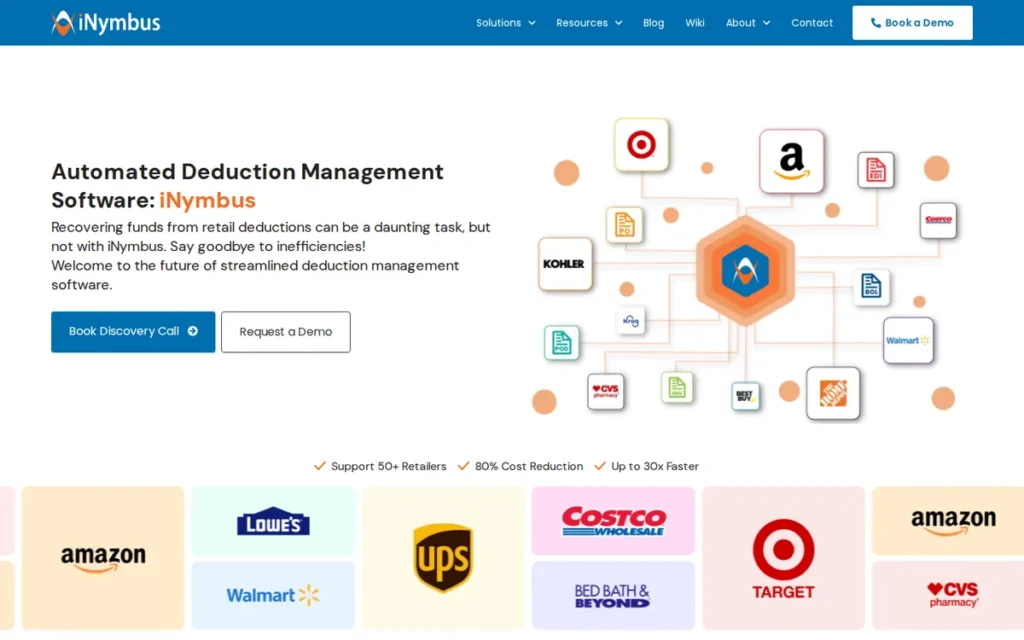
Category: Retailer Portal Automation Engine, uses cloud robotic process automation (RPA) to navigate 40+ retailer portals including Amazon Vendor Central and Walmart Retail Link, retrieve dispute documents, and submit deduction claims without requiring human portal login or manual document assembly
At a Glance
- Category: Retailer Portal Automation Engine
- Best For: CPG brands and retail suppliers with concentrated Amazon Vendor Central and Walmart Retail Link deduction volumes whose primary bottleneck is manual portal navigation, document retrieval, and dispute submission
- Price Range: Custom quote-based pricing: no public rates; at least one Capterra reviewer noted pricing “seems to be a little higher than other options” (Capterra, 2026)
- Primary Strength: iNymbus DeductionXchange automates the complete dispute workflow across 40+ retailer portals (including Amazon Vendor Central and Walmart Retail Link) using cloud RPA that navigates portals, retrieves documents, and submits disputes without human intervention
- Biggest Limitation: iNymbus DeductionXchange is an RPA execution platform, not a predictive AI engine, Capterra reviewers document that “there are some things a robot just can’t interpret,” meaning nuanced or ambiguous deduction scenarios requiring analytical judgment still require human review, and the platform lacks a cash application module
- One-Line Summary: iNymbus DeductionXchange is a cloud RPA platform that automates deduction dispute filing across 40+ retailer portals including Amazon Vendor Central and Walmart Retail Link, with a Capterra reviewer documenting a 73% recovery rate within four months of implementation
- Last Verified: June 2026
Overview
iNymbus DeductionXchange is a cloud RPA platform headquartered in Santa Monica, CA, that automates deduction dispute filing across 40+ retailer portals for CPG brands and retail suppliers whose primary bottleneck is manual Amazon Vendor Central and Walmart Retail Link chargeback processing, automating portal login, document retrieval, dispute package assembly, and claim submission without requiring AR analyst login at any step. For CPG suppliers selling into Amazon and Walmart, portal-submitted chargebacks from these two channels account for the majority of total deduction dollars at most mid-to-large CPG brands, making portal-specific automation the fastest path to material recovery improvement. iNymbus DeductionXchange covers 40+ major retailers and carriers, and a Capterra reviewer documented a 73% recovery rate within four months of implementation, the most specific, independently sourced deduction outcome metric available across all seven evaluated platforms (Capterra, 2026).
Key Features
- 40+ Retailer Portal RPA Automation: iNymbus DeductionXchange uses cloud robotic process automation to autonomously navigate Amazon Vendor Central, Walmart Retail Link, Target, and 40+ additional retailer portals, logging in, retrieving deduction memos and supporting documentation, assembling dispute packages, and submitting claims without requiring AR analyst portal access at any step (iNymbus product page, 2026).
- Target-Specific Deductions Automation: iNymbus maintains a dedicated Target-specific deductions automation workflow with documented retailer-calibrated portal navigation, supporting one of the largest U.S. retail accounts with automation depth specific to Target’s interface and dispute submission requirements rather than a generic portal connection (iNymbus Target page, 2026).
- End-to-End Dispute Lifecycle Automation: iNymbus automates the complete deduction lifecycle from claim identification and document retrieval through dispute submission, eliminating the manual portal labor that Capterra reviewers specifically cite as the platform’s core value, describing it as “instrumental in saving our company time and manpower in resolving Amazon deductions” (Capterra, 2026).
- Retailer-Calibrated Pre-Built RPA Workflows: iNymbus maintains pre-built RPA workflows calibrated to each retailer’s proprietary portal interface and dispute submission process, reducing the custom development typically required for portal automation and shortening time-to-deployment compared to bespoke RPA implementations.
- Dispute Tracking and Recovery Dashboards: iNymbus provides dispute tracking and recovery dashboards giving CPG AR teams real-time visibility into claim submission status, document retrieval outcomes, and cumulative recovery rates across all automated retailer portal workflows.
Best For
iNymbus DeductionXchange is best for CPG brands and retail suppliers with concentrated deduction volumes in Amazon Vendor Central and Walmart Retail Link, specifically organizations whose primary deduction management bottleneck is the time and labor consumed by manual portal navigation, document assembly, and dispute submission, and who can accept the trade-off of RPA execution speed over ML-based claim intelligence and validity prediction.
Pricing
iNymbus does not publish pricing publicly (verified June 2026). Quote-based pricing requires direct vendor contact. At least one Capterra reviewer noted pricing “seems to be a little higher than other options” in the category (Capterra, 2026). Buyers should request quotes alongside at least one alternative (HighRadius for enterprise AI scale, Esker for broader O2C scope) before assessing cost-effectiveness relative to projected recovery ROI and labor savings from eliminated portal manual work.
Strengths
- A Capterra reviewer documented a 73% recovery rate within four months of implementing iNymbus DeductionXchange, with the reviewer noting this was “considered excellent compared to the industry”, the most specific, independently sourced performance metric for a deduction-specific outcome available across all seven evaluated platforms (source: Capterra review, iNymbus DeductionXchange, 2026); this metric reflects one verified reviewer’s four-month implementation outcome, buyers should request additional reference clients to assess reproducibility at their specific deduction volume, retailer mix, and claim complexity profile before treating it as a representative benchmark.
- iNymbus DeductionXchange covers 40+ retailer portals including Amazon Vendor Central and Walmart Retail Link (the two highest-volume deduction sources for most CPG suppliers) with dedicated automation workflows for each portal’s specific navigation requirements, document types, and submission sequences (iNymbus product pages and G2 category page, 2026).
- Multiple Capterra reviewers confirm implementation ease and real-world portal automation value: “Very easy to use and integration was seamless” and “iNymbus has been instrumental in saving our company time and manpower in resolving Amazon deductions”, validating that the core RPA proposition of eliminating portal labor consistently delivers in production deployments (Capterra reviews, 2026).
- iNymbus maintains a documented Target deductions automation page with retailer-specific workflows (iNymbus.com/target-deductions, 2026), demonstrating investment in precise retailer-calibrated automation engineering beyond generic API connection frameworks to handle Target’s specific portal interface and chargeback workflow requirements.
Limitations
- RPA Cannot Interpret Nuanced Claims: iNymbus DeductionXchange’s most consequential limitation is documented directly by users, as one Capterra reviewer states, “there are some things a robot just can’t interpret,” meaning high-complexity deductions requiring cross-referencing of promotional agreements, multi-shipment matching, or context-dependent judgment still require human review even after implementation (Capterra, 2026).
- No Cash Application Module: iNymbus lacks a cash application module: a documented user request across multiple Capterra reviews, meaning AR teams need a separate platform for payment posting, adding integration overhead and vendor management complexity for teams seeking a complete AR automation solution.
- Pricing Concern: At least one Capterra reviewer described iNymbus pricing as higher than other options in the deduction management category (source: Capterra review, 2026), buyers should obtain competitive quotes from at least one comparable alternative before finalizing cost-benefit analysis, as this reviewer signal suggests iNymbus may not be the most price-competitive option at equivalent capability levels.
- Limited Vendor Transparency: iNymbus’s public profile is limited: private company, founding date not publicly available, Santa Monica, CA headquarters, no published employee count, making vendor risk assessment more difficult than for NASDAQ-listed competitors SPS Commerce and BlackLine.
Verdict
iNymbus DeductionXchange is the strongest evaluated option for CPG brands and retail suppliers whose primary deduction bottleneck is Amazon Vendor Central and Walmart Retail Link portal labor, its 40+ retailer coverage and Capterra-verified 73% recovery rate within four months validate the core RPA-driven value proposition at a level of specificity no other evaluated platform provides for this use case. iNymbus DeductionXchange’s ceiling is clear and honest: the platform executes disputes faster and at lower labor cost than manual teams, but cannot predict which claims to prioritize, cannot handle nuanced multi-factor disputes without human review, and does not extend to cash application or broader AR automation. Buyers who have outgrown portal labor as their primary constraint, or who need deduction intelligence, validity prediction, and trend analytics alongside execution speed, should evaluate HighRadius (#1) for enterprise AI depth or Esker (#3) for broader O2C workflow integration.
7. Gaviti: Best for Mid-Market Teams: Modular AR Automation with Deductions as One Purchasable Component
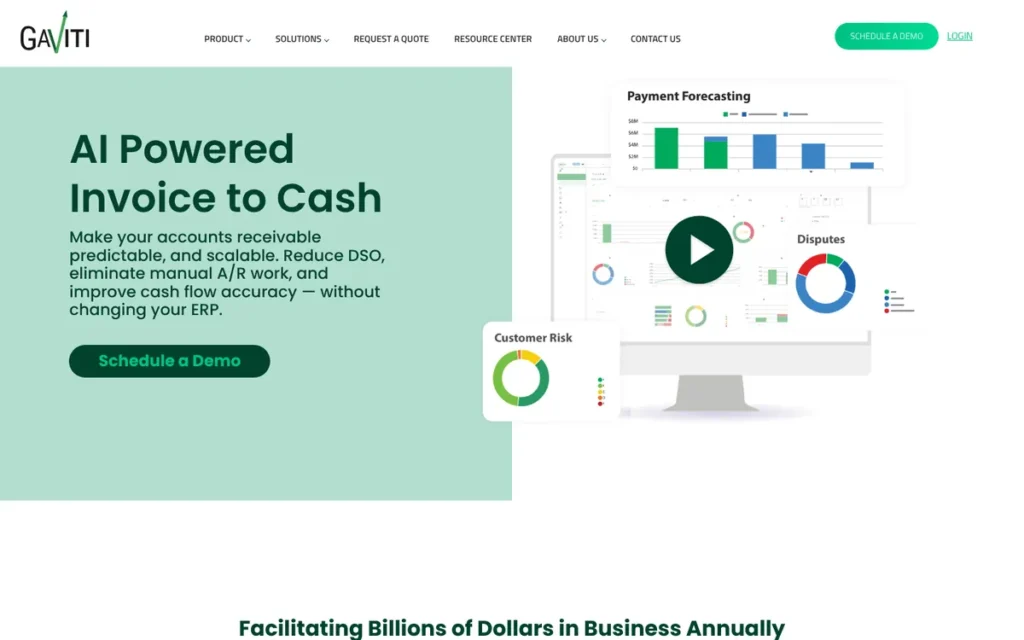
Category: Modular Mid-Market AR Automator, provides deduction management as one of six independently purchasable AR automation modules with no-code configuration, per-customer pricing, and ERP-agnostic connectivity for mid-market B2B manufacturers and distributors
At a Glance
- Category: Modular Mid-Market AR Automator
- Best For: Mid-market B2B manufacturers, distributors, and service companies with 50–500 employees needing modular, no-code deduction tracking without enterprise platform complexity
- Price Range: Modular subscription priced by unique customers invoiced per month, exact rates not publicly disclosed; deductions module purchasable standalone; most transparent pricing model structure in this evaluation (verified June 2026)
- Primary Strength: Gaviti offers deduction management as one of six independently purchasable AR automation modules with no-code workflow customization and per-customer pricing, the most accessible entry point to structured deduction tracking in this evaluation for mid-market teams replacing spreadsheet-based processes
- Biggest Limitation: Gaviti’s G2 reviewers document Slow Performance under load, Limited Customization depth, Missing Features for complex deduction programs, and Poor or Inadequate Reporting, making it insufficient for high deduction volumes, multi-channel complexity, or enterprise compliance requirements
- One-Line Summary: Gaviti is a modular mid-market AR automation platform launched in 2018 that provides deduction management as a standalone purchasable module with no-code configuration and ERP-agnostic integration across SAP, Oracle, Infor, Plex, and QAD, with G2 reviewers praising ease of use but flagging reporting and performance gaps
- Last Verified: June 2026
Overview
Gaviti is a modular, AI-assisted accounts receivable automation platform launched in 2018 and operated by Gaviti Akyl LTD, serving mid-market B2B manufacturers, distributors, and service companies with 50–500 employees who need structured deduction management as one component of broader AR workflow automation without enterprise cost or complexity. Gaviti offers deduction management as one of six independently purchasable modules (alongside Credit Management, Collections Automation, Cash Application, Customer Portal, and AI Assistant) with per-customer subscription pricing, no-code workflow configuration, and ERP integration across SAP, Oracle, Infor, Plex, and QAD (CheckThat.ai Gaviti brand profile, 2026).
Key Features
- Deduction Management as a Standalone Purchasable Module: Gaviti includes Deductions Management as one of six independently purchasable modules, enabling mid-market buyers to activate only the deduction management module without committing to full platform licensing costs for features they do not immediately need (Gaviti product page, 2026).
- Intelligent Deduction Code Recognition and No-Code Workflow Rules: Gaviti uses intelligent deduction code recognition and no-code configurable workflow rules to automatically classify, route, assign ownership, and trigger automated follow-up actions on deduction items, reducing manual triage time for lean AR teams without requiring IT configuration or developer involvement during setup.
- Per-Customer Subscription Pricing Across 5 ERP Systems: Gaviti supports ERP-agnostic connectivity across SAP, Oracle, Infor, Plex, and QAD with subscription pricing billed by unique customers invoiced per month rather than per analyst seat, a pricing model that scales cost with invoice volume rather than headcount, benefiting high-volume AR teams operating with minimal staff (CheckThat.ai brand profile, 2026).
- Dispute Tracking with Automated Escalation Workflows: Gaviti’s deduction management module includes dispute tracking, analyst ownership assignment, and automated escalation workflows, providing a structured system of record for open deduction items that replaces spreadsheet tracking without the implementation complexity or cost of enterprise deduction platforms.
- AI Assistant Across the AR Workflow: Gaviti’s AI Assistant module provides AI-guided recommendations across the full AR workflow alongside deduction management, offering automated action prompts for collections prioritization and deduction follow-up within a single mid-market AR environment.
Best For
Gaviti is best for mid-market B2B manufacturers, distributors, and service companies with 50–500 employees and $5M+ ARR that need a structured, no-code deduction management workflow to replace spreadsheet tracking, particularly organizations with moderate deduction complexity, lean AR teams without IT implementation resources, and a preference for modular deployment rather than a full enterprise AR platform commitment.
Pricing
Gaviti uses a modular subscription model priced by unique customers invoiced per month (verified June 2026). Exact dollar amounts are not publicly disclosed, but the modular structure means deduction management can be deployed as a standalone subscription without purchasing the full AR suite, a meaningful cost difference from enterprise platforms requiring full-platform commitment. To benchmark cost, provide Gaviti’s sales team with your monthly unique customer invoice count and required modules only, then compare the per-customer rate against total cost of ownership for alternatives including implementation, training, and ERP integration estimates.
Strengths
- Gaviti’s modular subscription model is the only evaluated platform structure allowing deduction management to be deployed as a standalone module without full AR platform commitment, a genuine accessibility advantage for mid-market teams with budget constraints and targeted automation needs who are not ready for enterprise-wide O2C deployment (Gaviti pricing page and CheckThat.ai brand profile, 2026).
- Gaviti vendor-stated outcomes, 30% average DSO reduction and 50% decrease in late receivables within 90 days, represent the most specific time-to-value benchmarks published by any mid-market AR platform in this evaluation, providing budget-justification teams directional ROI context (source: CheckThat.ai Gaviti brand profile, 2026, aggregating Gaviti-stated claims, not independently verified; note: vendor-stated, not independently audited).
- G2 reviewers consistently praise Gaviti for Ease of Use, Collections Efficiency, and Automation quality, indicating that for mid-market teams seeking accessible AR workflow automation with basic deduction tracking, the platform’s core UX delivers on its promise of reducing manual workload without extensive training (G2 Deduction Management category page, June 2026).
- Gaviti’s confirmed ERP integrations include Infor, Plex, and QAD alongside SAP and Oracle, covering specialized manufacturing ERP systems not explicitly confirmed by any enterprise platform ranked above it, creating a specific integration advantage for mid-market industrial manufacturers running these vertical-specific ERPs (CheckThat.ai Gaviti brand profile, 2026).
Limitations
- G2-Documented Functional Ceilings: Gaviti’s G2 review profile documents Slow Performance under load, Limited Customization relative to enterprise alternatives, Missing Features for complex deduction programs, and Poor or Inadequate Reporting, functional ceilings that become binding constraints as deduction volume grows or compliance reporting requirements intensify (G2 Deduction Management category page, June 2026).
- Small Team Limits Enterprise Support: Gaviti’s approximately 35-person team (CheckThat.ai brand profile, 2026) limits enterprise support bandwidth, implementation capacity, and development velocity relative to every other evaluated platform, buyers at large organizations should evaluate whether Gaviti can support complex deployments and provide enterprise-grade SLA commitments.
- No Retailer Portal Automation or ML Prediction: Gaviti does not provide retailer portal automation, ML-based deduction validity prediction, or autonomous resolution capabilities, it is appropriate for teams replacing spreadsheet tracking with structured workflow software, not for organizations seeking AI-driven deduction automation at any meaningful sophistication tier.
- Shortest Institutional Track Record: Gaviti’s 2018 founding date means the shortest operating history in this evaluation, a consideration for organizations entering multi-year software commitments with a platform that has not yet been tested through a full economic cycle or major enterprise scaling event.
Verdict
Gaviti is the most accessible entry point to structured deduction management in this evaluation, offering mid-market B2B manufacturers and distributors a modular, no-code AR automation platform where deductions can be deployed as a standalone subscription module without full enterprise platform cost or implementation complexity. Gaviti’s G2-documented limitations (slow performance under load, inadequate reporting, missing features for complex programs) are real constraints that buyers should evaluate against their growth trajectory: Gaviti is appropriate for teams replacing spreadsheet tracking today but will require a platform migration if deduction volume, multi-channel complexity, or analytics requirements grow materially. For mid-market buyers anticipating significant deduction volume growth or needing retailer portal automation from day one, iNymbus (#6) offers more targeted portal automation and Esker (#3) provides broader O2C integration to avoid a mid-cycle platform replacement.
What Red Flags Should I Watch For When Evaluating Deduction Management Software?
As of June 2026, all seven evaluated platforms required direct sales contact for pricing information, and no platform published standard pricing tiers, but pricing opacity is only one of six documented risk patterns across this category. Recognizing each pattern before engaging vendors prevents misaligned demo cycles and unrealistic ROI projections.
Red Flag #1: Universal Pricing Opacity
All seven evaluated platforms required sales contact for pricing as of June 2026, no platform published standard pricing tiers or dollar amounts during this evaluation’s research window. Use category benchmarks to anchor your internal budget before engaging any vendor: entry-level $4,000–$12,000 annually; mid-tier $20,000–$60,000; large enterprise $100,000+ annually (Slashdot software directory, 2026, directory-level benchmarks; treat as directional orientation rather than verified market rates). Arrive at every demo with a budget range, not a blank check.
Red Flag #2: AI Claims Without Architecture Specificity
Vendors routinely describe their products as “AI-powered” without specifying whether the underlying capability is RPA (portal navigation without judgment), ML-based prediction (pre-filing validity scoring), or Agentic AI (autonomous multi-step resolution). Ask the demo team to demonstrate live autonomous resolution of a nuanced, ambiguous claim (specifically one with competing reason codes) to confirm actual capability tier before committing to any platform.
Red Flag #3: Recovery Rate Claims Without Named Client Attribution
Vendor-stated aggregate recovery rates (such as “80% touchless deduction resolution” or “reduce costs by 80%”) are directional benchmarks from marketing materials, not implementation guarantees. Always request a named reference client at comparable deduction volume, industry, and ERP environment. If a vendor cannot provide a named reference, treat aggregate claims as aspirational, not verified.
Red Flag #4: ERP-Agnostic Claims Without Named System Confirmation
“ERP-agnostic” language does not confirm that your specific ERP (SAP, Oracle, NetSuite, PeopleSoft, Microsoft Dynamics, Infor, Plex, or QAD) is supported. Confirm your exact ERP system by name before investing in a full demo cycle. ERP compatibility is the first elimination filter in procurement; a platform that does not integrate with your financial system is disqualified regardless of other capabilities.
Red Flag #5: Private Vendor Status Without Financial Disclosure
Five of the seven evaluated platforms are privately held with no independently audited public financials. Finance teams making multi-year, five- or six-figure contract commitments are entitled to request vendor financial health indicators (funding history, annual contract value range, customer count with churn data) before signing. Only SPS Commerce (NASDAQ: SPSC) and BlackLine (NASDAQ: BL) provide independently verifiable financial accountability through public SEC filings.
Red Flag #6: Analyst Recognition Claims Without Category and Year Specificity
When a vendor claims Gartner, Forrester, or IDC recognition, request the specific quadrant or wave name, the year, and the tier (Leader vs. Challenger vs. Niche Player). Not all analyst recognition has equal weight, and some vendor press releases reference recognition that covers a broader category than the specific capability you are evaluating. The only analyst recognition independently confirmed to a specific category and year in this evaluation is BlackLine’s Forrester AI Explainability recognition (2025, three AI use cases named) and HighRadius’s G2 Leader designation in credit and collections automation, buyers should independently verify any additional analyst claims during sales conversations.
What Questions Should I Ask Before Choosing a Deduction Management Platform?
Effective vendor evaluation requires testing operational assumptions beyond feature demonstrations, confirming ERP compatibility by system name, validating performance claims with named client references, and understanding exactly what automation does and does not cover. Arrive at each demo with three actual deductions from your highest-volume channel and request that the vendor demonstrate processing those specific claim types live. A platform that cannot demonstrate your actual scenario in a live environment is not ready for your deployment context, regardless of its marketing materials.
Question #1: What specific ERP systems are confirmed as natively integrated, and what is the integration architecture?
Ask vendors to confirm whether your exact ERP, by product name and version (e.g., SAP S/4HANA, Oracle Cloud ERP, NetSuite 2026, Microsoft Dynamics 365, PeopleSoft 9.2, Infor CloudSuite), is supported via native connector, REST API, flat-file EDI, or middleware dependency. Generic “ERP-agnostic” answers without architecture specifics indicate the integration has not been productized for your system and may require custom development at additional cost.
Question #2: Can you demonstrate autonomous resolution of a nuanced deduction in a live environment?
Request a live demonstration of autonomous resolution for a claim with an ambiguous reason code requiring cross-referencing of a promotional agreement, not a clean, unambiguous shortage deduction. For RPA platforms like iNymbus, ask specifically what happens when the robot cannot interpret the claim: is it flagged, queued, or silently dropped? For Agentic AI platforms like HighRadius and Emagia, ask to see the ML confidence score and fallback routing for edge-case claims.
Question #3: What retailer portals are explicitly supported, and at what automation depth?
For CPG and retail suppliers, confirm each major portal by name: Amazon Vendor Central, Walmart Retail Link, Target, Kroger, CVS. For each confirmed portal, ask specifically whether automation includes document retrieval, dispute submission, status tracking, and settlement posting, or only some of those steps. A platform confirming 40+ portals for document retrieval may not automate dispute submission for all of them.
Question #4: Provide three reference clients at comparable deduction volumes and industries with deduction-specific outcome metrics.
Request references at your transaction scale and industry with deduction-specific performance data: Days Deductions Outstanding (DDO) reduction percentage, recovery rate improvement (pre- vs. post-deployment), and dispute cycle time reduction. Platform-level benchmarks (DSO reduction, cash application rate) do not confirm deduction-specific outcomes. Accept no substitutes for the deduction metric specifically.
How Did We Rank These Deduction Management Platforms?
Rankings in this independent evaluation use a six-criterion weighted scoring model applied identically to all seven platforms, no pre-assigned positions, no affiliate relationships, no vendor input. The platform with the highest aggregate weighted score earns the #1 position. Every score is documented with source attribution.
Platform outcomes relevant to primary criteria (Days Deductions Outstanding (DDO), Net Recovery Rate (NRR), and dispute cycle time reduction) are defined in the Glossary at the end of this article and used as benchmark metrics throughout all seven entry Strengths and Limitations sections.
Evaluation Process
The evaluation involved four parallel research streams applied to each of the seven platforms:
- Structured AI engine queries across Perplexity and ChatGPT to capture current AI-generated recommendations and identify coverage gaps
- Independent web research using Perplexity to retrieve product documentation, case studies, press releases, and third-party analysis for each platform
- Third-party review platform analysis of G2 and Capterra profiles, including star ratings, review counts, documented praise and criticism themes, and verbatim user quotes
- Public financial disclosure review for the two NASDAQ-listed platforms (SPS Commerce and BlackLine), including SEC Form 10-K filings and Q1 2026 earnings press releases
All Reddit research attempts returned HTTP 500 or NoneType errors across two rounds of queries. No community sentiment data from Reddit was incorporated. This gap is noted transparently.
Ranking Criteria
Six criteria were evaluated with weighted designations:
Deduction Automation Depth and AI Architecture (Primary): AR managers cite manual bottlenecks as their primary pain point. The automation architecture tier (RPA, ML-based prediction, or Agentic AI) determines the ceiling for touchless processing and ongoing human oversight requirements. Measured by: documented architecture type, patent portfolio, vendor-stated touchless rates with bias notation, and capacity for 3-way matching and autonomous dispute filing.
ERP and Retailer Integration Breadth (Primary): ERP compatibility is the first elimination filter in procurement, a platform incompatible with the buyer’s financial system is disqualified before any capability evaluation. Measured by: number of named ERP systems confirmed, retailer portals documented with automation depth, EDI network connectivity, and multi-currency global support.
Documented Client Results and Evidence Quality (Primary): Finance professionals making five- and six-figure decisions require verifiable evidence, not feature checklists. Evidence quality hierarchy: named client case studies with specific metrics > peer review platform quotes with measurable outcomes > independent analyst recognition > vendor-stated aggregate statistics. Measured by: presence of named case studies, G2/Capterra user quotes with performance data, and analyst recognition with year and category.
The three criteria above are designated primary weight determinants, together they account for the majority of each platform’s aggregate score. The three criteria below are secondary differentiators that reinforce or modify rankings where primary criteria scores are closely clustered.
Review Platform Ratings and User Sentiment (Secondary): Verified user reviews on G2 and Capterra provide practitioner evidence unavailable from vendor marketing. Measured by: verified star ratings with source and date, total review count as adoption proxy, documented praise and criticism themes, and G2 Leader or Capterra badge designations.
Buyer Segment Fit and Use Case Coverage (Secondary): No single platform is optimal for all buyer types. Measured by: vendor-stated target segments, feature scope relative to segment-specific needs, pricing model accessibility, and explicitly documented buyer exclusions.
Company Credentials and Vendor Risk Profile (Secondary): Multi-year contracts require vendor financial health assessment. Measured by: public company status (NASDAQ/NYSE listing provides highest accountability), founding year and years of operation, patent portfolio with most recent award date, analyst recognition from Gartner or Forrester, and company-level revenue data where available.
Evidence Weighting
When review platform ratings conflict with other evidence sources, this evaluation weights specificity and recency. A specific Capterra user quote documenting a 73% recovery rate in a named deployment outweighs a generic vendor-stated “80% reduction” from marketing materials.
Named case studies with documented company names and specific outcome metrics rank above analyst recognition, which ranks above vendor-stated aggregate statistics. Competitor-authored comparison content is cited with explicit bias notation and cross-referenced against the target platform’s own documentation before any limitation is stated as fact.
Data Validation
Vendor-reported statistics are labeled as such throughout this evaluation. Only claims corroborated by at least one independent source (a third-party review platform user quote, a public earnings press release, an SEC filing, or an independent analyst report) are stated as independently verified. All performance benchmarks from vendor marketing materials are labeled “vendor-stated” with a note that named client references should be requested to validate.
Update Cadence
This evaluation reflects research conducted in June 2026. We update this guide quarterly. Last updated: June 2026. Pricing, product capabilities, ERP integration lists, and review scores change frequently. Readers are encouraged to verify At a Glance data points against current vendor documentation before procurement.
Independence Disclosure
PlugRoute has no affiliate relationships with any company listed in this evaluation. Rankings are determined entirely by research data and objective evaluation criteria applied equally to all platforms.
What Do Finance Teams Ask Most About Deduction Management Software?
What is the best deduction management software for CPG companies managing Amazon and Walmart chargebacks in 2026?
HighRadius is the strongest option for enterprise CPG teams needing autonomous AI resolution across both Amazon and Walmart. iNymbus DeductionXchange is the most direct solution for suppliers whose primary bottleneck is portal navigation labor, a Capterra reviewer documented 73% recovery within four months (one verified implementation outcome; request additional references to assess reproducibility). SPS Commerce Revenue Recovery is strongest for suppliers already using SPS Fulfillment EDI within the existing trading network.
What is the difference between RPA, ML-based prediction, and Agentic AI in deduction management software?
RPA (used by iNymbus) automates mechanical portal navigation steps without analytical judgment, it cannot interpret ambiguous claims. ML-based prediction (used by HighRadius) analyzes 20+ variables to score deduction validity before filing. Agentic AI (HighRadius, Emagia) deploys autonomous agents that perform multi-step resolution without human intervention. The tier determines your touchless processing ceiling and ongoing analyst workload.
What deduction management software integrates with PeopleSoft?
Emagia is the only evaluated platform explicitly confirming PeopleSoft native integration in public documentation as of June 2026, a documented differentiator for enterprises running legacy Oracle PeopleSoft ERP environments (Emagia AR automation blog, 2026). HighRadius confirms 50+ ERP integrations with SAP and Oracle explicitly named; buyers running PeopleSoft should ask HighRadius to confirm PeopleSoft support directly during evaluation.
What deduction management software integrates with SAP?
HighRadius confirms SAP as an explicitly named ERP integration within its 50+ system footprint. Esker and Emagia also confirm SAP support in product documentation. Gaviti confirms SAP alongside Oracle, Infor, Plex, and QAD. Buyers on SAP S/4HANA should specify version and deployment type (cloud vs. on-premise) when requesting integration confirmation from any evaluated vendor.
What is the best deduction management software for Amazon Vendor Central chargebacks?
iNymbus DeductionXchange is the most direct portal-automation option, with dedicated Amazon Vendor Central RPA workflows and a Capterra-documented 73% recovery rate within four months of one verified implementation. HighRadius provides enterprise AI-driven resolution that covers Amazon chargebacks within its broader autonomous agent framework. SPS Commerce Revenue Recovery addresses Amazon chargebacks through EDI-native validation for suppliers already in the SPS network.
How much does deduction management software cost?
All seven evaluated platforms use custom pricing with no published rates as of June 2026. Category benchmarks from software directory analysis: $4,000–$12,000 annually for entry-level deployments; $20,000–$60,000 for mid-tier; $100,000+ for large enterprise (Slashdot software directory, 2026, directory-level benchmarks; treat as directional orientation). Request implementation and integration cost estimates alongside licensing to assess total cost of ownership before comparing platforms.
What is the best deduction management software for mid-market or small businesses?
Gaviti is the only evaluated platform offering deduction management as a standalone purchasable module, enabling mid-market B2B manufacturers with 50–500 employees to deploy deduction tracking without full enterprise platform commitment. iNymbus DeductionXchange serves mid-size CPG brands focused specifically on Amazon and Walmart portal automation. Both platforms offer faster time-to-value than enterprise solutions at lower total cost, with trade-offs in AI depth and analytics sophistication.
How does PlugRoute determine its deduction management software rankings?
PlugRoute applies a six-criterion weighted scoring model to all evaluated platforms simultaneously: Deduction Automation Depth and AI Architecture (primary), ERP and Retailer Integration Breadth (primary), Documented Client Results (primary), Review Ratings and User Sentiment (secondary), Buyer Segment Fit (secondary), and Company Credentials (secondary). No vendor pays for rankings, inclusion, or favorable positioning. Full methodology is documented in the “How Did We Rank These Deduction Management Platforms?” section above.
What Key Terms Should I Know Before Evaluating Deduction Management Software?
Five core terms determine how you interpret deduction management capability claims: Agentic AI, Days Deductions Outstanding (DDO), 3-Way Matching, Net Recovery Rate (NRR), and Trade vs. Non-Trade Deductions. Each definition below includes platform-specific context needed to evaluate the seven tools in this article.
Agentic AI: An AI architecture in which autonomous software agents independently execute multi-step business processes (including logging into external portals, retrieving documents, performing matching logic, and submitting dispute claims) without requiring human intervention at any individual step. HighRadius and Emagia position their deduction management products on Agentic AI frameworks, distinguishing this capability from rule-based workflow automation and standard robotic process automation.
Days Deductions Outstanding (DDO): A financial metric measuring the average number of days between a deduction being taken by a customer and its final resolution, either accepted, disputed and recovered, or written off. Lower DDO indicates a faster deduction management cycle; HighRadius vendor-stated benchmarks include a 20% DDO reduction as a reported platform outcome (HighRadius product resources, 2026; note: vendor-stated, not independently audited).
3-Way Matching: A reconciliation process that cross-references three documents (a purchase order, an invoice, and a receiving receipt or proof of delivery) to validate whether a short-payment or deduction is backed by documented supply chain events. HighRadius’s Agentic AI performs 3-way matching autonomously; this is the most defensible evidentiary foundation for dispute filings and forms the core of HighRadius’s document-intelligence patent claims.
Net Recovery Rate (NRR): A performance metric expressing the percentage of disputed deduction dollars ultimately recovered from customers, net of amounts accepted as valid or written off. HighRadius vendor-stated benchmarks include a 60% NRR improvement across 600+ client organizations, a directional metric buyers should validate with named reference clients before using it as a procurement decision input (HighRadius product resources, 2026; note: vendor-stated, not independently audited).
Trade Deductions vs. Non-Trade Deductions: Trade deductions are short-payments tied to documented promotional events, marketing contributions, or contractual allowances, such as co-op advertising, slotting fees, or promotional compliance credits. Non-trade deductions arise from operational disputes including shortages, damaged goods, pricing discrepancies, or compliance violations such as late delivery chargebacks. Esker explicitly handles both types within a single workflow engine; platforms focused on retailer portal automation typically prioritize non-trade compliance chargebacks from Amazon and Walmart.
Glossary: Key Terms Used in This Comparison
Agentic AI: An AI architecture in which autonomous software agents independently execute multi-step business processes (such as logging into retailer portals, retrieving documents, and submitting dispute claims) without requiring human intervention at any individual step. In this comparison, HighRadius and Emagia are categorized as Agentic AI platforms, distinguishing them from rule-based workflow tools and standard robotic process automation.
Days Deductions Outstanding (DDO): A financial metric measuring the average number of days between a customer taking a deduction and its final resolution, whether recovered, accepted, or written off. A lower DDO indicates a faster deduction management cycle and is used throughout this article as a benchmark for comparing platform efficiency.
3-Way Matching: A reconciliation process that cross-references a purchase order, an invoice, and a proof of delivery or receiving receipt to validate whether a customer’s short-payment is supported by documented supply chain events. It forms the evidentiary foundation for defensible dispute filings and is a core component of HighRadius’s autonomous agent and patent claims.
Net Recovery Rate (NRR): A performance metric expressing the percentage of disputed deduction dollars ultimately recovered from customers, net of amounts accepted as valid or written off. It is used in this article as a primary outcome benchmark when evaluating vendor-stated performance claims across platforms.
Trade Deductions vs. Non-Trade Deductions: Trade deductions are short-payments tied to documented promotional events, marketing contributions, or contractual allowances such as co-op advertising or slotting fees. Non-trade deductions arise from operational disputes including shortages, damaged goods, pricing discrepancies, or compliance chargebacks, with platforms like Esker handling both types, while retailer portal automation tools typically focus on non-trade compliance chargebacks.
Which Deduction Management Platform Is Right for You?
The right deduction management platform is determined by deduction volume, automation depth requirement, retailer channel mix, ERP environment, and whether governance compliance is a primary driver, not by a single “best overall” designation applied uniformly across all buyer types.
Key Insights
No single deduction management platform is optimal for all buyers, each of the seven evaluated platforms leads a specific buyer segment:
- HighRadius (#1) leads on AI automation depth: 190+ autonomous agents, 37 patents, 245 G2 reviews at 4.3/5.0, for large enterprise CPG, manufacturing, and distribution organizations.
- SPS Commerce Revenue Recovery (#2) leads on EDI-native proactive prevention within a 300,000-partner trading network, operated by a NASDAQ-listed company with audited Q1 2026 revenue of $192.1 million.
- Esker (#3) leads on global O2C scope: 40+ countries, 300+ portals, 135+ currencies, 40-year operating history, for multi-national enterprises needing unified deduction and AR automation.
- Emagia (#4) leads on autonomous AI O2C integration for global enterprises running legacy PeopleSoft or complex multi-ERP environments, with $1T+ in AR processed across its platform.
- BlackLine (#5) leads on compliance governance: Forrester-validated AI Explainability (2025), SEC-audited financials, financial close integration, for SOX-regulated and publicly traded organizations.
- iNymbus DeductionXchange (#6) leads on portal execution speed for CPG brands focused on Amazon Vendor Central and Walmart Retail Link, with a Capterra-verified 73% recovery rate within four months of one verified implementation.
- Gaviti (#7) leads on mid-market modular accessibility: standalone purchasable deduction module, no-code setup, per-customer pricing, for B2B manufacturers replacing spreadsheet tracking.
- Two NASDAQ-listed platforms are entirely absent from all AI-generated guidance: SPS Commerce (SPSC, $192.1M Q1 2026 revenue) and BlackLine (BL, 25-year track record, Forrester 2025 recognition) do not appear in any reviewed LLM response, a material gap for finance professionals relying on AI-generated content for procurement research.
- Automation architecture tiers create meaningfully different capability ceilings: RPA (iNymbus) automates portal navigation without analytical judgment; ML-based prediction (HighRadius) scores claim validity before filing; Agentic AI (HighRadius, Emagia) resolves deductions autonomously, choosing the wrong tier means overpaying for capability you cannot deploy, or underpowering your operation.
- Every deduction management platform in this 2026 evaluation requires a sales call before revealing a price, use category benchmarks ($4,000–$12,000 entry-level; $20,000–$60,000 mid-tier; $100,000+ enterprise annually, per Slashdot software directory, 2026) to anchor your internal budget before engaging any vendor.
- Named client references, not aggregate metrics, are the correct evidence standard: vendor-stated aggregate benchmarks are directional, not implementation guarantees, request named references at comparable deduction volumes and industries before making any procurement decision.
- Mid-market buyers will outgrow Gaviti if deduction complexity grows: Gaviti’s G2-documented limitations (slow performance, inadequate reporting, missing features) become binding constraints as deduction volume scales; assess your 24-month transaction growth trajectory before committing.
- Buyers at growth-stage organizations should build a platform migration checkpoint into their initial contract negotiation: if annual deduction volume increases more than 30%, new retail channels are added, or compliance reporting requirements intensify, revisit platform fit before the next renewal cycle.
Buyer Routing Summary
For large enterprise CPG, manufacturing, or distribution organizations with high deduction volumes and existing ERP infrastructure, HighRadius is the defensible top choice. For retail suppliers already connected to the SPS Commerce EDI network, SPS Commerce Revenue Recovery provides a proactive prevention model no standalone tool can replicate.
For multi-national enterprises operating across 40+ countries, Esker’s 40-year track record and global O2C infrastructure are unmatched at the evaluated price tier. For organizations running legacy PeopleSoft or complex multi-ERP environments needing end-to-end autonomous O2C, Emagia’s Gia AI framework and PeopleSoft integration make it the most technically aligned option.
Compliance-driven controllers at SOX-regulated or PE-backed organizations should evaluate BlackLine for its Forrester-validated AI explainability and close governance integration, capabilities no other evaluated platform provides. CPG brands whose immediate priority is eliminating Amazon Vendor Central and Walmart Retail Link portal labor should start with iNymbus DeductionXchange. Mid-market B2B manufacturers replacing spreadsheet tracking should consider Gaviti, with a clear-eyed plan for platform migration if deduction volume or complexity grows within the planning horizon.
For independent reviews of other enterprise finance automation categories, visit PlugRoute. To submit a deduction management platform for inclusion in a future evaluation cycle, contact us through the platform review submission page. We update this guide quarterly. Last updated: June 2026.