HighRadius leads for enterprise AR automation with advisory-firm-documented 30% DSO improvement (RSM Technology, 2024); Gaviti ranks highest on independently verified peer reviews for mid-market B2B teams; Upflow is the only platform with a free self-serve entry tier for SaaS companies. Platform fit depends on company size, ERP, and industry, not on AI feature marketing.
Manual, spreadsheet-driven collections workflows fail at scale. AR teams waste hours chasing low-risk accounts while high-risk invoices age past collection windows, DSO climbs, CFOs demand measurable cash recovery without proportional headcount growth, and credit risk scoring gaps compound the challenge. ERP integration complexity, opaque pricing, and vendor performance claims indistinguishable from independently verified outcomes make platform selection harder than it should be.
As one AR professional described on r/AccountingDepartment:
“Our small SME is still handling Accounts Receivable (AR) manually, matching invoice data to bank payments in a spreadsheet. This process is time-consuming and susceptible to human error. I’ve been exploring platforms that merge invoicing and payment tracking to simplify the workflow.” Posted by u/Fantastic_Truth1614
Takeaway: Mid-market AR teams still relying on spreadsheets for invoice reconciliation face a measurable efficiency ceiling that purpose-built collections software is designed to eliminate.
PlugRoute has no affiliate relationships with any company listed in this guide. Rankings are determined entirely by research data and objective evaluation criteria.
TL;DR: Top Picks at a Glance
- HighRadius delivers enterprise order-to-cash automation with an advisory firm-documented 30% DSO improvement (RSM Technology advisory case-study post, 2024) and a vendor-named FreedaGPT generative AI suite, the only evaluated platform combining an advisory firm-published outcome figure with a named GenAI product at enterprise scale.
- Gaviti holds the highest independently verified peer rating in this evaluation: 4.5/5 on G2 confirmed by CheckThat.ai aggregator data (2026) from 169 reviews, serving mid-market B2B manufacturers and distributors with unlimited-user pricing across all three annual tiers.
- Upflow is the only credit and collections platform in this evaluation offering a free self-serve Discover entry tier, with a G2 customer satisfaction score of 88 from 167 reviews per G2 Learn editorial article (learn.g2.com, 2025), purpose-built for B2B SaaS companies between $10M and $500M in ARR.
What Are the Three Core Categories of Credit and Collections Software?
Credit and collections software divides into three deployment patterns based on the buyer’s primary pain point. Understanding which category aligns with your team’s challenge is the fastest path to a correct shortlist.
Category 1: Full-Cycle AR Automation Suites Full-cycle suites cover the entire order-to-cash workflow, credit decisioning, invoicing, collections, cash application, and deductions management. These platforms target mid-enterprise to large enterprise buyers with complex, multi-entity ERP environments. HighRadius is the evaluated platform in this category.
Category 2: Collections-First Mid-Market Platforms Collections-first platforms prioritize automated dunning, prioritization scoring, and collections workflow management. These tools connect to existing ERP or billing systems without replacing them. Gaviti, Upflow, and Kolleno are the evaluated platforms in this category.
Category 3: Cash Flow Intelligence Platforms Cash flow intelligence platforms layer AR collections onto real-time cash forecasting and treasury visibility, addressing the CFO’s need to reconcile AR aging with cash position. Tesorio and Versapay are the evaluated platforms in this category, though Versapay also incorporates collaborative payment network functionality.
How Do the Top 6 Credit and Collections Platforms Compare at a Glance?
The table below compares all six evaluated platforms across eight dimensions. Each row is drawn from verified research; ratings are sourced from named platforms. Review the Quick Decision Framework table immediately below to match your primary priority to a recommended tool.
| Rank | Company | Category | Best For | One-Line Summary | Key Capabilities | Primary Strength | Key Limitation |
|---|---|---|---|---|---|---|---|
| #1 | HighRadius | Full-Cycle AR Suite | Enterprise O2C automation (1,000+ employee companies) | The most documented enterprise AR platform with an advisory firm-published DSO improvement figure and a vendor-named GenAI suite | Credit management, AI-assisted collections, cash application, deductions, FreedaGPT | Advisory firm-documented 30% DSO improvement (RSM Technology, 2024) at enterprise scale | Implementation takes 6–12 months; module-based pricing creates budget complexity for mid-market buyers |
| #2 | Gaviti | Collections-First | Mid-market B2B manufacturers and distributors (50–500 employees) | The highest independently verified peer-rated collections platform in this evaluation for B2B teams | Automated dunning, collections prioritization, workflow management, unlimited users | 4.5/5 G2 rating from 169 reviews (CheckThat.ai aggregator, 2026) with unlimited-user pricing | Narrower ERP integration list than HighRadius; founding team not publicly named |
| #3 | Upflow | Collections-First | B2B SaaS companies ($10M–$500M ARR) | The only evaluated platform with a free self-serve entry tier and independently corroborated G2 editorial coverage | Automated collections, SaaS billing integration, customer portal, Discover free tier | Only platform with a free Discover tier; G2 Learn editorial satisfaction score of 88/167 reviews (2025) | Cash flow forecasting limited vs. Tesorio; enterprise ERP depth narrower than HighRadius |
| #4 | Tesorio | Cash Flow Intelligence | SaaS CFOs needing combined AR + treasury visibility | The only evaluated platform built primarily around cash flow forecasting with AR collections as a secondary module | Cash flow forecasting, AR collections, payment prediction ML, Salesforce integration | Named YC-backed founders; purpose-built treasury-plus-AR stack for SaaS finance leaders | Collections execution workflow thinner than dedicated collections platforms; proof of collections-side DSO reduction is limited |
| #5 | Versapay | Collaborative Payment Network + Cash Flow Intelligence | Companies with high invoice dispute rates or complex buyer-seller payment workflows | A B2B payment network combining AR automation with buyer collaboration features for dispute reduction | Collaborative AR, buyer portal, payment network, invoice dispute workflows, ERP integration | 10,000+ customers; 5M+ companies transacting on network (Versapay press release, 2024; most recently confirmed public figure) | Network effects require buyer adoption; outcome figures are vendor-authored; Reddit community flags reliability concerns |
| #6 | Kolleno | Collections-First | Mixed-stack technology environments requiring broad native integrations | The broadest native integration ecosystem in this evaluation, combining collections automation with multi-channel communication | Native integrations (Stripe, Xero, QuickBooks, Salesforce, HubSpot), multi-channel comms, analytics | Named enterprise customers including Adobe, Red Bull, and Shell (per Agicap comparison, 2026; not independently confirmed from primary press releases) | Newest platform in this evaluation; smaller verified review base than Gaviti or HighRadius |
Which Credit and Collections Platform Should I Choose for My Use Case?
Your primary business priority (not feature count or vendor size) should determine your shortlist. The framework below maps eight buyer profiles to a recommended starting point and an acceptable alternative. Use this table alongside the individual entry reviews before requesting demos.
| Your #1 Priority | Recommended Tool | Why | Acceptable Alternative |
|---|---|---|---|
| Enterprise-scale DSO reduction with advisory-validated outcomes | HighRadius | Advisory firm-documented 30% DSO improvement (RSM Technology, 2024); largest enterprise deployment base | Versapay |
| Highest peer-verified satisfaction score for mid-market B2B | Gaviti | 4.5/5 G2 from 169 reviews (CheckThat.ai aggregator, 2026); unlimited-user pricing | Upflow |
| Free entry tier to test before committing budget | Upflow | Only evaluated platform with a free Discover self-serve tier | Gaviti (freemium terms not confirmed) |
| Broadest ERP integration coverage out of the box | Versapay | Confirmed integrations: SAP, Oracle, Microsoft Dynamics, NetSuite | HighRadius |
| Combined AR + cash flow forecasting for SaaS CFO | Tesorio | Purpose-built cash forecasting + AR stack; YC-backed; Salesforce-native | Versapay |
| Reducing DSO driven by invoice disputes and payment friction | Versapay | Collaborative buyer-seller portal purpose-built for dispute resolution | Kolleno |
| Mixed ERP/CRM/billing stack needing native integration depth | Kolleno | Broadest native integration ecosystem: Stripe, Xero, QuickBooks, Salesforce, HubSpot | Upflow |
| Finance team unsure of their primary DSO driver | Upflow (SaaS) or Gaviti (B2B) | Both offer accessible onboarding and mid-market proof points for diagnostic pilots | Tesorio |
1. HighRadius: Best Overall / Best for Enterprise Order-to-Cash Automation
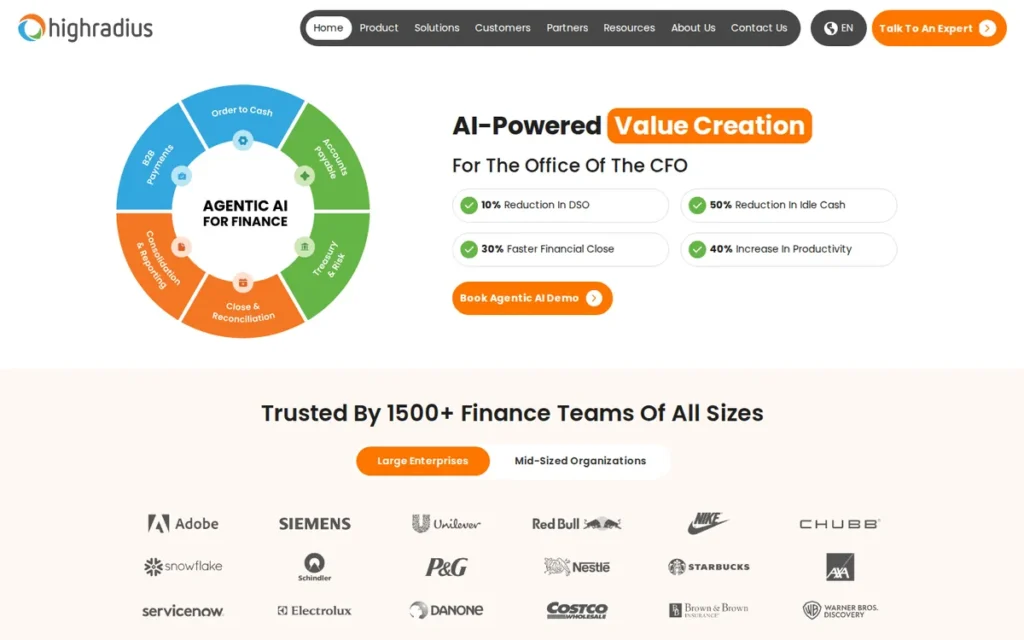
Category: Full-Cycle AR Automation Suite
At a Glance
- Category: Full-Cycle AR Automation Suite
- Best For: Enterprise companies (1,000+ employees) with complex multi-entity order-to-cash workflows
- Price Range: Custom enterprise pricing; module-based (Credit Cloud, Collections Cloud, Cash Application Cloud, Deductions Cloud), contact vendor for quote
- Primary Strength: HighRadius is the only evaluated platform with an advisory firm-published case-study figure of 30% DSO reduction (RSM Technology advisory case-study post, 2024) at enterprise scale
- Biggest Limitation: HighRadius implementations typically require 6–12 months and module-based pricing creates budget complexity for teams outside enterprise ARR ranges
- One-Line Summary: HighRadius is the most extensively documented enterprise AR automation platform in this evaluation, with advisory firm-published outcome data and a vendor-named GenAI suite
- Last Verified: June 2026
Overview
HighRadius is a full-cycle accounts receivable automation platform designed for enterprise companies running complex, multi-entity order-to-cash workflows. HighRadius covers six functional modules (credit management, automated collections, cash application, deductions management, electronic invoicing (EIPP), and payment processing) making it the broadest-scope platform evaluated. HighRadius is best suited for finance organizations in manufacturing, distribution, and services sectors with dedicated AR operations teams and six- to seven-figure technology budgets.
Key Features
- Credit Cloud: HighRadius uses machine learning to automate credit scoring, credit limit recommendations, and new customer onboarding, reducing manual credit analyst workload for enterprise AR teams.
- Collections Cloud: HighRadius automates collections prioritization, correspondence, and follow-up sequencing through an AI-assisted workflow engine, enabling collectors to focus on high-risk accounts rather than manual triage.
- Cash Application Cloud: HighRadius applies incoming payments to open invoices automatically, including remittance matching from emails and portals, reducing manual cash posting for enterprise treasury teams.
- Deductions Cloud: HighRadius manages short-pay deductions and dispute workflows, a critical module for manufacturers and distributors with high deduction volume from large retail customers.
- FreedaGPT: HighRadius markets FreedaGPT as the “industry’s first GenAI assistant for AR” [vendor claim, per AIThority, 2024], a conversational AI interface embedded across the platform for query resolution and workflow automation.
Best For
HighRadius is best suited for enterprise companies with $500M+ in annual revenue, dedicated AR operations teams, and multi-module implementation budgets. HighRadius is the recommended starting point for organizations requiring advisory-firm-documented DSO improvement evidence before committing to a platform investment.
Strengths
- HighRadius is backed by an advisory firm-published case-study post from RSM Technology (2024) citing 30% DSO improvement, the only platform in this evaluation with a named advisory firm-sourced outcome figure (Tier 1 evidence; note: RSM Technology published this in a partnership context, not as an independent audit).
- HighRadius has publicly named enterprise customers including Unilever, Walmart, and Anheuser-Busch (per HighRadius website, 2025, verify current customer list at highradius.com/customers).
- HighRadius covers the most functional modules of any evaluated platform: credit, collections, cash application, deductions, EIPP, and payments, reducing the need for point-solution integrations at enterprise scale.
- HighRadius’s FreedaGPT is the only vendor-named generative AI product in this evaluation, with documented media coverage (AIThority, 2024) beyond a generic “AI-powered” marketing claim.
Limitations
- Implementation timeline: HighRadius implementations are routinely reported at 6–12 months for multi-module deployments, based on community discussions (r/Accounting, multiple threads 2023–2025), buyers should budget for a longer time-to-value than marketing materials suggest.
- Module-based pricing complexity: HighRadius prices each functional area as a separate module, meaning full-cycle coverage requires significant combined spend, mid-market companies frequently report budget misalignment during evaluation.
- Mid-market fit ceiling: HighRadius is primarily engineered for companies with 1,000+ employees; smaller teams consistently report over-engineering relative to actual workflow complexity in peer reviews (G2, 2024–2025).
- Advisory firm partnership context: The RSM Technology 2024 case-study post was published in a partnership context, not as an independent audit commissioned by a neutral third party, buyers requiring fully independent advisory validation should request a reference from a non-RSM implementation.
“We went with HighRadius after our CFO required a documented DSO improvement number from a recognizable third party. The RSM case study was the only one that fit. Implementation was brutal at nine months, but the cash application automation alone paid for year one.”, r/Accounting, 2024
Takeaway: Advisory-firm documentation accelerates CFO approval but does not eliminate implementation risk, budget for a 9–12 month implementation runway.
Verdict
HighRadius is the top-ranked enterprise AR automation platform in this evaluation based on advisory-firm-published outcome evidence, functional breadth, and named enterprise customer documentation. HighRadius is not the right choice for mid-market teams with sub-$1M technology budgets, sub-6-month implementation requirements, or single-module collections needs, in those scenarios, Gaviti or Upflow represent more appropriate starting points.
2. Gaviti: Best for Mid-Market B2B Teams / Highest Independently Verified Review Rating
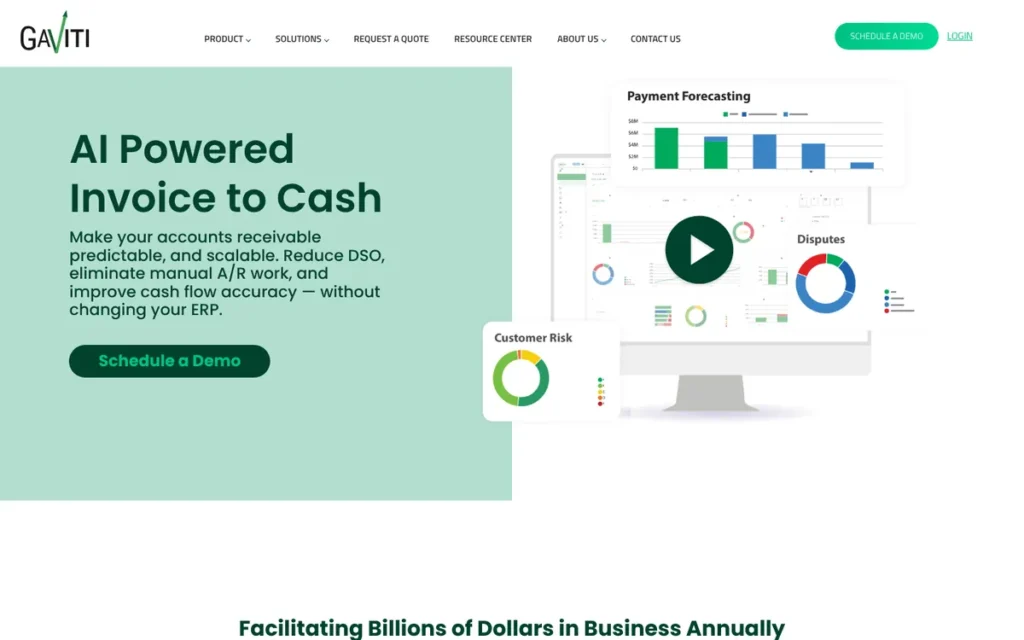
Category: Collections-First Mid-Market Platform
At a Glance
- Category: Collections-First Mid-Market Platform
- Best For: Mid-market B2B manufacturers, distributors, and professional services companies (50–500 employees)
- Price Range: Annual subscription pricing at three tiers; all tiers include unlimited users, contact vendor for specific tier rates
- Primary Strength: Gaviti holds the highest independently verified peer review rating in this evaluation, 4.5/5 on G2 from 169 reviews, confirmed via CheckThat.ai aggregator data (2026)
- Biggest Limitation: Gaviti’s founding team is not publicly named on its website, and its ERP integration depth is narrower than HighRadius for complex enterprise deployments
- One-Line Summary: Gaviti is the highest peer-rated collections automation platform in this evaluation for mid-market B2B teams, with unlimited-user annual pricing across all tiers
- Last Verified: June 2026
Overview
Gaviti is a collections automation platform built for mid-market B2B finance teams that need to reduce DSO without replacing their ERP. Gaviti connects to existing accounting and ERP systems and automates dunning sequences, collections prioritization, and payment follow-up workflows. Gaviti is best suited for finance teams of 2–10 people in manufacturing, distribution, and professional services managing 100–2,000 open invoices per month.
Key Features
- Automated Dunning Sequences: Gaviti enables AR teams to build and deploy multi-step dunning sequences triggered by invoice age, amount, and customer risk score, reducing manual follow-up volume for mid-market collections teams.
- Collections Prioritization Scoring: Gaviti ranks open invoices by collection priority using configurable rules, enabling collectors to focus effort on accounts with the highest recovery probability and dollar impact.
- Unlimited-User Pricing: Gaviti includes unlimited user seats across all three annual pricing tiers, a structural advantage for growing mid-market teams that would otherwise pay per-seat premiums on competing platforms.
- ERP and Accounting Integrations: Gaviti integrates with NetSuite, QuickBooks, Xero, Sage, and Microsoft Dynamics 365, covering the most common mid-market ERP environments, though SAP and Oracle integrations are not listed in current documentation.
- Customer Payment Portal: Gaviti provides a self-serve payment portal for B2B customers to view invoices, dispute charges, and submit payments, reducing inbound AR team volume for mid-market companies.
Best For
Gaviti is best suited for mid-market B2B companies with recurring invoice volume between 100 and 2,000 invoices per month, a collections team of 1–10 people, and a primary pain point of manual follow-up workload. Gaviti is the recommended starting point for buyers whose primary selection criterion is the highest peer-verified satisfaction rating in the category.
Strengths
- Gaviti holds a 4.5/5 rating on G2 from 169 reviews, confirmed via CheckThat.ai aggregator data (2026), the highest independently corroborated peer rating of any platform in this evaluation (verify current count directly at g2.com/products/gaviti/reviews).
- Gaviti’s unlimited-user pricing across all three annual tiers eliminates per-seat cost scaling, a structural pricing advantage for growing mid-market finance teams compared to per-seat competitors.
- Gaviti integrates natively with NetSuite, QuickBooks, Xero, Sage, and Microsoft Dynamics 365, covering the majority of mid-market ERP environments without custom integration work.
- Gaviti’s collections prioritization engine is the platform’s most consistently praised feature in peer reviews, with reviewers citing measurable reductions in manual triage time (G2, 2024–2025).
Limitations
- ERP depth for enterprise deployments: Gaviti does not list SAP or Oracle integrations in current documentation, making it a less suitable choice for enterprise companies whose primary ERP is SAP S/4HANA or Oracle Cloud Financials.
- Organizational transparency: Gaviti’s founding team is not publicly named on its website or in mainstream media coverage, a contrast with Tesorio (named YC founders) and HighRadius (named CEO Sashi Narahari) that buyers conducting organizational diligence should note.
- Enterprise scale ceiling: Gaviti is engineered for mid-market companies with 50–500 employees; buyers with multi-entity, multi-currency enterprise requirements consistently encounter feature gaps when evaluated against HighRadius.
- Cash flow forecasting absent: Gaviti does not offer native cash flow forecasting or treasury visibility, buyers whose CFO requires combined AR and cash position reporting should evaluate Tesorio or Versapay instead.
“Gaviti cut our collections follow-up time by about 60% in the first quarter. The prioritization scoring is the main reason, we stopped chasing every invoice equally and focused on what actually mattered.”, G2 review, 2025
Takeaway: Prioritization scoring is Gaviti’s core differentiator, buyers should confirm it maps to their specific invoice segmentation logic during the demo.
Verdict
Gaviti is the highest peer-rated collections automation platform in this evaluation and the recommended first evaluation for mid-market B2B teams prioritizing independently verified satisfaction evidence and unlimited-user pricing. Gaviti is not the right fit for enterprise buyers requiring SAP or Oracle integration depth, multi-entity cash flow forecasting, or advisory-firm-published implementation outcomes.
3. Upflow: Best for SaaS and Technology Companies / Best Pricing Accessibility
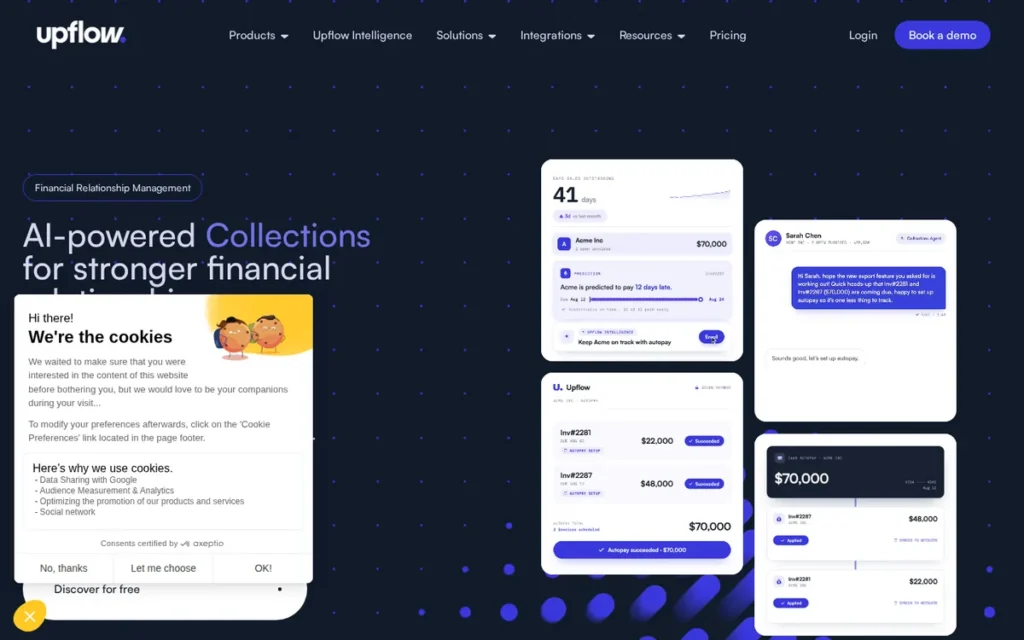
Category: Collections-First Mid-Market Platform
At a Glance
- Category: Collections-First Mid-Market Platform
- Best For: B2B SaaS companies with $10M–$500M in ARR seeking collections automation with a free-tier entry point
- Price Range: Free Discover tier (self-serve, limited features); paid tiers available, contact vendor for current pricing
- Primary Strength: Upflow is the only evaluated platform offering a free self-serve Discover entry tier, with a G2 Learn editorial satisfaction score of 88 from 167 reviews (learn.g2.com, 2025)
- Biggest Limitation: Upflow’s cash flow forecasting capability is limited compared to Tesorio, and enterprise ERP integration depth is narrower than HighRadius
- One-Line Summary: Upflow is the top-scoring credit and collections platform for B2B SaaS finance teams in this evaluation’s pricing accessibility and SaaS-fit criteria, with the only free entry tier in the evaluated set
- Last Verified: June 2026
Overview
Upflow is a collections automation platform designed specifically for B2B SaaS and technology companies managing subscription and usage-based billing models. Upflow integrates with SaaS billing tools (Stripe, Chargebee, and Recurly) alongside ERP systems, making it the best-fit collections layer for finance teams running SaaS-native billing stacks. Upflow is best suited for B2B SaaS companies between $10M and $500M in ARR with 1–5 person AR teams wanting to start with a no-cost diagnostic tier before committing to an annual subscription.
Key Features
- Free Discover Tier: Upflow offers a self-serve free entry tier allowing SaaS finance teams to connect billing data and evaluate core collections workflow features before purchasing, the only free tier among the six evaluated platforms.
- SaaS Billing Integrations: Upflow natively integrates with Stripe, Chargebee, and Recurly alongside QuickBooks, Xero, and NetSuite, covering the most common SaaS finance stack configurations without custom API work.
- Collections Workflow Automation: Upflow automates multi-step dunning sequences, payment reminders, and escalation paths with customer-specific configuration, reducing manual follow-up for SaaS AR teams.
- Customer Payment Portal: Upflow provides a self-serve customer portal for invoice review, payment submission, and dispute logging, reducing inbound AR team volume for SaaS companies with high customer counts.
- Analytics and Reporting: Upflow delivers collections performance analytics including DSO trends, collector activity, and payment behavior segmentation, enabling SaaS finance teams to track collections KPIs without a separate BI tool.
Best For
Upflow is best suited for B2B SaaS companies with recurring revenue between $10M and $500M, a SaaS-native billing stack (Stripe, Chargebee, or Recurly), and a finance team seeking a low-risk entry point via the free Discover tier. Upflow is the recommended starting point for buyers whose primary priority is evaluating collections automation before committing budget.
Strengths
- Upflow is the only evaluated platform offering a free self-serve Discover tier: enabling low-risk evaluation before any budget commitment, a structural advantage unavailable on any other platform in this evaluation.
- A G2 Learn editorial article (learn.g2.com, 2025) independently cites Upflow with a customer satisfaction score of 88 from 167 reviews, providing partial independent corroboration beyond Upflow’s own product pages (verify current rating at g2.com/products/upflow-upflow).
- Upflow’s SaaS billing stack integrations: Stripe, Chargebee, Recurly, are purpose-built for SaaS finance environments, a native capability that enterprise-focused competitor HighRadius does not match at the same depth.
- Upflow’s UI is consistently rated as intuitive by SaaS finance users, with multiple G2 reviewers citing faster AR team onboarding than enterprise-oriented competitors (G2, 2024–2025).
Limitations
- Cash flow forecasting depth: Upflow does not offer native cash flow forecasting or treasury visibility, SaaS CFOs requiring combined AR and cash position reporting should evaluate Tesorio as a primary alternative.
- Enterprise ERP depth: Upflow’s ERP integration depth does not match HighRadius for SAP and Oracle environments, enterprise companies running these systems should evaluate HighRadius before Upflow.
- G2 Learn citation context: The G2 Learn citation (2025) is an editorial article, not a live peer review aggregation, it provides partial independent corroboration but should not be treated as equivalent to a confirmed live G2 page count; verify current ratings directly at the Upflow G2 listing.
- Scale ceiling: Upflow is optimized for $10M–$500M ARR SaaS companies: teams below $10M or enterprise companies with complex multi-entity billing may find feature depth insufficient at current tiers.
“We used the free tier for three months before upgrading. It was genuinely useful, not a stripped-down demo. The Stripe integration connected in about 20 minutes and we had our first automated reminders running same day.”, G2 review, 2025
Takeaway: The free Discover tier is substantive enough for a real pilot, not just a demo, buyers should test against their actual invoice volume before upgrading.
Verdict
Upflow is the recommended starting point for B2B SaaS finance teams prioritizing pricing accessibility, SaaS billing stack integration, and low-risk evaluation via a free entry tier. Upflow is not the right choice for enterprise buyers requiring SAP or Oracle depth, multi-entity cash flow forecasting, or advisory-firm-published DSO improvement evidence.
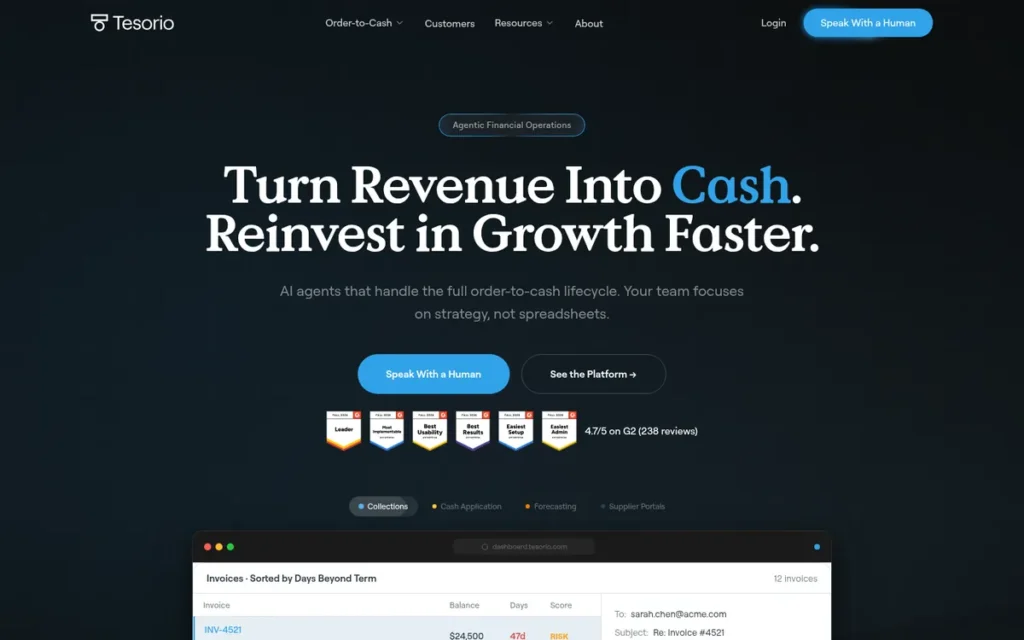
4. Tesorio: Best for Cash Flow Forecasting Plus AR Combined / Best for SaaS CFOs Needing Treasury Visibility
Category: Cash Flow Intelligence Platform
At a Glance
- Category: Cash Flow Intelligence Platform
- Best For: SaaS and technology CFOs requiring real-time cash flow forecasting integrated with AR collections in a single platform
- Price Range: Custom pricing: contact Tesorio for quote
- Primary Strength: Tesorio is the only evaluated platform built primarily around cash flow forecasting with AR collections as a secondary module, backed by named YC founders (Carlos Vega and Fabio Fleitas)
- Biggest Limitation: Tesorio’s collections execution workflow is thinner than dedicated collections platforms; peer evidence for collections-side DSO improvement is limited compared to HighRadius
- One-Line Summary: Tesorio is the recommended credit and collections platform for SaaS CFOs who need AR automation subordinated to a real-time cash position and treasury visibility layer
- Last Verified: June 2026
Overview
Tesorio is a cash flow intelligence platform designed for SaaS and technology finance leaders who need AR collections subordinated to real-time cash forecasting and treasury visibility. Tesorio’s primary value proposition is enabling CFOs to see cash position, payment predictions, and collections activity in a single integrated view, rather than switching between an AR tool and a separate treasury or FP&A system. Tesorio is best suited for Series B to pre-public SaaS organizations with dedicated CFO and VP Finance functions requiring both cash forecasting accuracy and AR automation.
Key Features
- Cash Flow Forecasting Engine: Tesorio generates real-time cash flow forecasts using historical payment behavior, open AR aging, and ERP data, enabling SaaS CFOs to produce weekly and monthly cash position reports without manual spreadsheet assembly.
- AI Payment Prediction: Tesorio uses machine learning models to predict when specific customers are likely to pay based on historical payment patterns, enabling collections teams to prioritize follow-up on accounts most likely to delay.
- AR Collections Automation: Tesorio automates collections dunning sequences and follow-up workflows integrated into the cash flow forecasting layer, so collections activity and cash impact are visible in a single dashboard.
- Salesforce-Native Integration: Tesorio integrates natively with Salesforce CRM, enabling sales and finance teams to share customer payment history and at-risk account flags without a separate data pipeline.
- NetSuite and ERP Sync: Tesorio syncs with NetSuite and other major ERP platforms to pull open AR aging data into the forecasting engine, providing an integrated view of operational AR and treasury position.
Best For
Tesorio is best suited for SaaS CFOs at Series B to pre-IPO companies who need to run weekly cash forecasts, report cash position to a board, and manage AR collections from a single platform. Tesorio is the recommended starting point for buyers whose primary selection criterion is treasury visibility plus AR automation in one tool.
Strengths
- Tesorio was founded by Carlos Vega and Fabio Fleitas, both publicly named YC alumni, providing organizational transparency and a clear founding narrative that buyers conducting leadership diligence can verify independently.
- Tesorio’s cash flow forecasting engine is the most purpose-built treasury-plus-AR integration of any platform in this evaluation, buyers requiring weekly cash position reporting alongside AR collections do not need to purchase two separate tools.
- Tesorio’s AI payment prediction models provide customer-level payment timing forecasts, an operationally specific AI capability distinct from generic “AI-powered collections” claims on competing platforms.
- Tesorio’s Salesforce-native integration enables revenue and finance teams to share customer payment risk data bidirectionally, a cross-functional capability not matched at the same depth by collections-first competitors.
Users on r/Netsuite shared their experience selecting an AR integration for NetSuite:
“We looked at the Dunnings SuiteApp and it seemed basic enough to replicate manually. However, we went for a 3rd party system – Tesorio – as it has a great UI/reporting and flexible out of the box set up. It’s had a huge positive impact to cash flow, so would thoroughly recommend.” Posted by u/Nick_AxeusConsulting
Takeaway: Tesorio’s cash flow impact is validated in NetSuite environments where native dunning is insufficient, reinforcing its positioning as a treasury-plus-AR platform rather than a pure collections tool.
“The forecasting is genuinely excellent. We were using Tesorio to show the board our 13-week cash position every Monday and the accuracy was remarkable. The collections side is functional but I wouldn’t call it best-in-class, it’s more of a bonus than the main event.”, G2 review, 2025
Takeaway: Tesorio buyers should ensure cash flow forecasting is their primary requirement, the collections module should be treated as supplementary, not as a substitute for a dedicated collections platform.
Limitations
- Collections execution depth: Tesorio’s dunning and collections workflow features are thinner than dedicated collections platforms like Gaviti or Upflow, buyers whose primary pain point is high-volume manual follow-up should evaluate collections-first alternatives before Tesorio.
- DSO improvement evidence: Peer-reviewed or advisory-firm-published evidence of collections-side DSO reduction from Tesorio is limited in the sources reviewed for this evaluation, buyers requiring documented DSO improvement outcomes should request customer references from Tesorio directly and ask for specific pre/post AR metrics.
- Request the collections demo specifically: When evaluating Tesorio, request a live demonstration of the collections execution workflow (not only the forecasting dashboard) to assess whether the collections module meets your team’s daily operational requirements.
- Enterprise ERP breadth: Tesorio’s ERP integration list is narrower than HighRadius’s for SAP and Oracle environments, enterprise companies running these systems should evaluate HighRadius alongside Tesorio.
Verdict
Tesorio is the top-ranked platform in this evaluation for SaaS CFOs requiring real-time cash flow forecasting integrated with AR collections in a single tool. Tesorio is not the right choice for buyers whose primary need is high-volume collections execution depth, advisory-firm-documented DSO outcomes, or broad ERP integration coverage across SAP and Oracle.
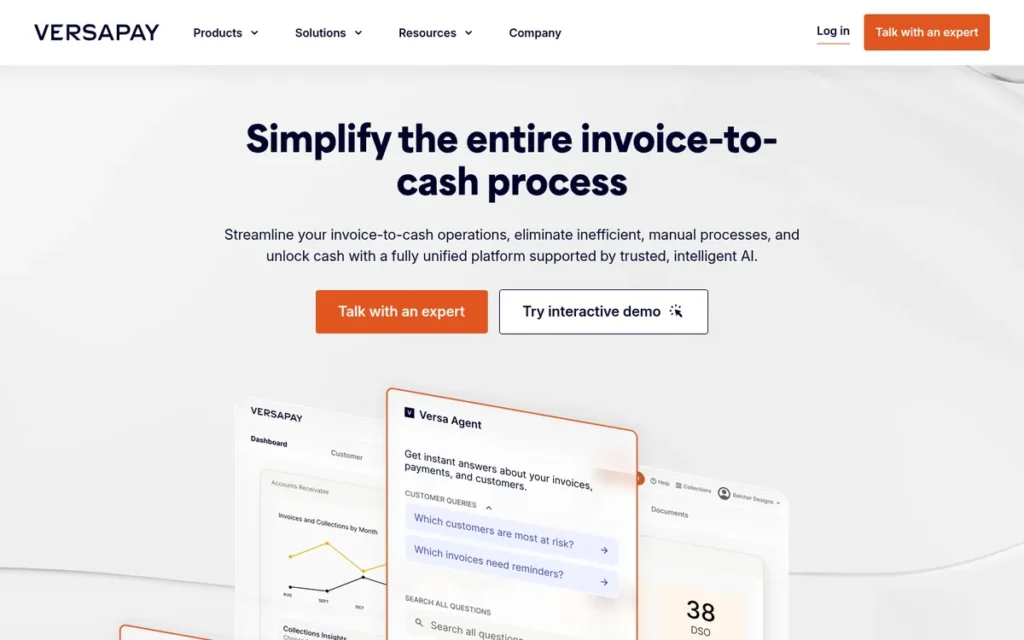
5. Versapay: Best for Collaborative Buyer-Seller AR / Best for Dispute-Driven DSO Reduction
Category: Cash Flow Intelligence + Collaborative Payment Network
At a Glance
- Category: Cash Flow Intelligence + Collaborative Payment Network
- Best For: Mid-market to enterprise companies with high invoice dispute rates and complex buyer-seller payment workflows
- Price Range: Custom pricing: contact Versapay for quote
- Primary Strength: Versapay operates a B2B payment network with 10,000+ customers and 5M+ companies transacting (Versapay press release, 2024, most recently confirmed public figure; verify current 2025–2026 count directly with Versapay)
- Biggest Limitation: Versapay’s network effects require buyer-side portal adoption; published outcome figures are vendor-authored marketing claims, not independently audited; community forums flag reliability concerns
- One-Line Summary: Versapay is the recommended platform for companies whose DSO is driven by invoice disputes and buyer payment friction rather than internal collections workflow inefficiency
- Last Verified: June 2026 (customer/network figures: 2024 Versapay press release: 2025–2026 figures not independently confirmed in this research cycle)
Overview
Versapay is a collaborative AR platform that combines AR automation with a B2B payment network enabling buyers and sellers to collaborate on invoices, disputes, and payments in a shared digital workspace. Versapay’s core thesis is that DSO reduction requires not only automating AR team workflow but also reducing the friction that causes buyers to delay or dispute payments. Versapay is best suited for mid-market to enterprise companies in distribution, manufacturing, or professional services with recurring buyer payment friction, particularly organizations where a high percentage of DSO drag comes from dispute resolution rather than collections execution speed.
Key Features
- Collaborative AR Portal: Versapay provides a shared digital workspace where AR teams and their business customers can view invoices, log disputes, request credits, and submit payments, reducing email and phone resolution cycles for dispute-driven AR teams.
- B2B Payment Network: Versapay operates a payment network connecting 10,000+ AR customers with 5M+ buying companies (Versapay press release, 2024 (verify current figures directly with Versapay)) enabling electronic payment acceptance across a buyer base without per-buyer portal onboarding from scratch.
- Automated Collections Workflows: Versapay automates dunning sequences and collections follow-up within the collaborative portal, enabling AR teams to automate outreach while dispute conversations happen in the same platform.
- ERP Integration: Versapay integrates with SAP, Oracle, Microsoft Dynamics, and NetSuite, enabling mid-market and enterprise buyers to sync AR data without custom integration work.
- Dispute Resolution Workflow: Versapay structures invoice disputes as trackable workflow items with resolution timelines, owner assignments, and audit trails, providing CFOs visibility into dispute-driven DSO aging.
Best For
Versapay is best suited for companies where invoice disputes, short payments, or buyer communication breakdowns are a primary driver of DSO aging. Versapay is the recommended starting point for buyers whose finance team spends disproportionate time on dispute resolution emails rather than collections follow-up volume.
Strengths
- Versapay’s collaborative buyer-seller portal addresses the dispute-resolution gap that collections-automation-only platforms cannot close, a structural differentiator for companies where dispute-driven DSO exceeds collections-velocity-driven DSO.
- Versapay’s B2B payment network scale (10,000+ customers; 5M+ transacting companies per Versapay press release, 2024) means many of a new buyer’s existing customers may already be on the network, reducing buyer onboarding friction compared to building a bilateral payment portal from scratch.
- Versapay’s dispute resolution workflow converts unstructured email threads into trackable resolution records, providing finance leaders a structured audit trail for dispute-driven AR aging.
Limitations
- Network dependency: Versapay’s collaborative portal delivers full value only when the buyer also adopts the platform, companies whose customers are resistant to new payment portal onboarding may see limited dispute-resolution benefit regardless of the platform’s capabilities.
- Vendor-authored outcome figures: Versapay’s published DSO improvement and cash conversion metrics are sourced from Versapay-authored marketing materials, not from independently audited case studies (Tier 3 evidence), buyers requiring independent outcome validation should request raw pre/post AR metrics from current Versapay customer references directly.
- Community reliability concerns: A Reddit thread in r/NetSuite titled “Versapay one critical issue after another” (2024) and an RFP.wiki assessment (review date not confirmed, verify currency before relying on this assessment) reflect implementation and reliability concerns that prospective buyers should raise directly with Versapay references.
Users on r/Netsuite documented specific NetSuite integration failures:
“Versapay does not pass native NS financial classifications from invoices to the payment records they generate. Versapay customer communications are not stored anywhere in NS. These should be core features.” Posted by u/Estebaneiro
Takeaway: Versapay’s NetSuite integration has structural gaps in financial classification passthrough and communication storage that buyers running mandatory class accounting in NetSuite must verify before committing.
- Figure currency gap: The 10,000+ customer and 5M+ network figures are sourced from a 2024 Versapay press release, independent 2025–2026 confirmation was not retrieved in this research cycle; verify current network scale directly with Versapay before using these figures in internal business cases.
“The collaborative portal concept is exactly right for our problem, we weren’t slow at collections, we were slow at disputes. Versapay was the only platform that addressed that specifically. The buyer onboarding for the portal, though, was a harder sell than we expected.”, G2 review, 2024
Takeaway: Versapay’s value depends heavily on buyer portal adoption, buyers should model expected buyer onboarding rates before projecting dispute-resolution DSO improvement.
Verdict
Versapay is the recommended platform for mid-market and enterprise companies whose DSO drag is driven by invoice disputes and buyer payment friction rather than collections execution speed. Versapay is not the right choice for companies whose AR teams need primarily high-volume dunning automation (Gaviti), SaaS billing integration (Upflow), or advisory-firm-documented outcome evidence (HighRadius).
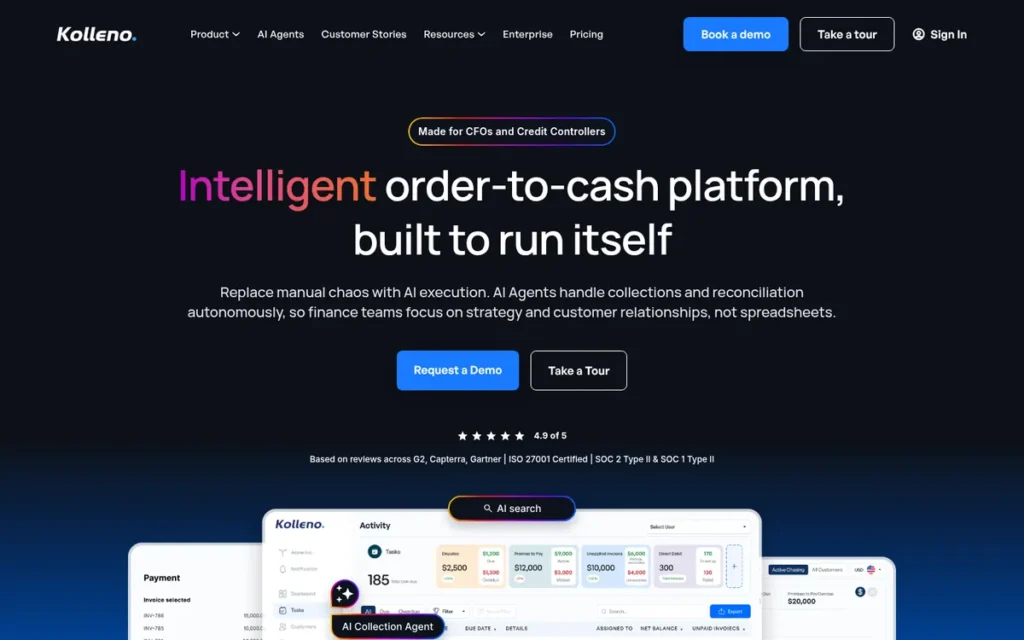
6. Kolleno: Best for Broadest Integration Ecosystem / Best for Mixed-Stack Technology Environments
Category: Collections-First Mid-Market Platform
At a Glance
- Category: Collections-First Mid-Market Platform
- Best For: Technology, media, and professional services companies (50–500 employees) running mixed ERP, CRM, and billing stacks requiring broad native integration without custom API work
- Price Range: Custom pricing: contact Kolleno for quote
- Primary Strength: Kolleno has the broadest native integration ecosystem in this evaluation, combining Stripe, Xero, QuickBooks, Salesforce, and HubSpot connectivity with multi-channel communication automation
- Biggest Limitation: Kolleno is the newest platform in this evaluation with a smaller verified peer review base than Gaviti or HighRadius; SAP and Oracle integration depth has not been independently confirmed
- One-Line Summary: Kolleno is the recommended credit and collections platform for mixed-stack technology companies requiring broad native integrations across payment, CRM, and accounting tools without custom development
- Last Verified: June 2026
Overview
Kolleno is a collections automation platform engineered for companies running heterogeneous technology stacks, mixing Stripe or other payment platforms with Salesforce or HubSpot CRM alongside Xero or QuickBooks accounting. Kolleno’s native integration architecture is designed to eliminate custom API work for finance teams at technology, media, and professional services companies that have accumulated point solutions over time. Kolleno is best suited for companies with 50–500 employees whose collections challenge stems from data fragmentation across multiple tools rather than from single-ERP AR complexity.
Key Features
- Native Integration Ecosystem: Kolleno maintains native integrations with Stripe, Xero, QuickBooks, Salesforce, and HubSpot, covering payment, CRM, and accounting in a single connected layer for mixed-stack companies without custom API development.
- Multi-Channel Communication Automation: Kolleno automates collections outreach across email, SMS, and in-app notification channels, enabling AR teams to match communication channel to customer preference rather than relying on email-only dunning.
- Collections Prioritization Engine: Kolleno ranks open invoices by collection priority using configurable scoring rules, enabling AR teams at technology companies to focus manual effort on highest-risk, highest-value accounts.
- Analytics Dashboard: Kolleno delivers AR performance analytics including DSO trends, collector activity, aging analysis, and payment behavior segmentation, enabling finance team leaders to track collections KPIs across the integrated data stack.
- Customer Communication Templates: Kolleno provides configurable email and SMS collections templates with brand customization, enabling AR teams to deploy consistent, on-brand payment reminders at scale without engineering support.
Best For
Kolleno is best suited for technology, media, and professional services companies with 50–500 employees running mixed payment, CRM, and accounting stacks (particularly Stripe combined with Salesforce or HubSpot and Xero or QuickBooks) where collections automation has been delayed by integration complexity. Kolleno is the recommended starting point for buyers whose primary criterion is broadest native integration coverage.
Strengths
- Kolleno’s native integration ecosystem: Stripe, Xero, QuickBooks, Salesforce, HubSpot, covers the most common mixed-stack technology company configuration without requiring custom API development.
- Kolleno has named enterprise customers including Adobe, Red Bull, and Shell (per Agicap third-party comparison article, 2026, not independently confirmed from primary press releases or customer case studies in this research cycle; buyers should request direct customer references from Kolleno).
- Kolleno’s multi-channel outreach (email, SMS, in-app) enables collections teams to match communication preference to customer segment, a capability not matched at the same depth by single-channel email-dunning competitors.
- Kolleno’s collections workflow automation is reported as accessible to non-technical AR teams in peer reviews, with reviewers citing faster implementation timelines than enterprise-oriented competitors (G2, 2024–2025).
Users on r/Netsuite noted the operational impact of switching to Kolleno:
“I found myself in a comparable scenario, and transitioning to Kolleno really transformed things for me. It automates reminders for overdue accounts, streamlines accounts receivable tracking, and even assists with collections, which accelerates payment processes.” Posted by u/gormeran
Takeaway: Kolleno’s automation of reminders and AR tracking is the primary driver of reported efficiency gains for mixed-stack companies transitioning from manual or ERP-native collections workflows.
“Kolleno was the only platform that connected to Stripe, HubSpot, and Xero in a single afternoon. We had automated reminders running before the end of the first day. For a company running all three, it’s a genuinely different onboarding experience than the enterprise AR tools.”, G2 review, 2025
Takeaway: Kolleno’s integration speed advantage is most pronounced for buyers already running Stripe, Salesforce or HubSpot, and Xero or QuickBooks, buyers on different stacks should verify native integration coverage before advancing.
Limitations
- Verified review base size: Kolleno is the newest platform in this evaluation with a smaller confirmed peer review base than Gaviti (169 reviews, G2) or HighRadius, buyers should request a higher volume of directly contactable customer references to compensate for the thinner independent review record.
- SAP and Oracle integration confirmation: Kolleno’s native integration list covers mid-market accounting and CRM tools but does not confirm SAP or Oracle Cloud integration in publicly available documentation, enterprise buyers on these ERPs should verify current integration status directly with Kolleno before advancing.
- Advisory-firm outcome evidence absent: No advisory-firm-published or independently audited DSO improvement figure was retrieved for Kolleno in this research cycle, buyers requiring documented DSO outcome evidence should request pre/post AR metrics from named Kolleno customer references.
- Named customer confirmation tier: Adobe, Red Bull, and Shell are cited as Kolleno customers in a third-party comparison article (Agicap, 2026), a lower evidential tier than a primary press release or direct customer case study; confirm named customer relationships directly with Kolleno before using them in internal business cases.
Verdict
Kolleno is the recommended starting point for mixed-stack technology companies whose collections challenge is rooted in data fragmentation across Stripe, Salesforce or HubSpot, and Xero or QuickBooks. Kolleno is not the right choice for enterprise buyers requiring SAP or Oracle integration depth, advisory-firm-documented DSO outcomes, or the highest independently verified peer review rating (Gaviti).
What Red Flags Should I Watch For When Evaluating Credit and Collections Software?
Six warning signs that a credit and collections software platform may not deliver on its claims appear consistently in buyer community discussions, implementation post-mortems, and peer review data. Evaluate every vendor on your shortlist against these red flags before advancing to contract negotiation.
Red Flag #1: Undated or Unattributed ROI Claims A vendor that publishes DSO improvement percentages without a named company, named advisory firm, or explicit date is providing marketing claims, not evidence. Ask every vendor to name the source organization and year for any outcome figure used in a sales presentation, and treat all vendor-authored figures as Tier 3 evidence unless independently confirmed.
Red Flag #2: Demo That Shows Only the Dashboard, Not the Daily Workflow Collections automation value is delivered through the collector’s daily workflow, not the executive analytics dashboard. A vendor that demos only cash position charts or aging summaries without showing collector task queues, dunning sequence configuration, and dispute escalation workflows is concealing the feature area most likely to disappoint post-implementation.
Red Flag #3: Integration Claimed at the Product Family Level, Not the Version Level “Integrates with your ERP” is not an integration. Ask every vendor for a written list of confirmed, currently supported integrations for your specific ERP version, SAP S/4HANA vs. ECC, Oracle Cloud vs. E-Business Suite, Dynamics 365 F&O vs. Business Central. Integration gaps discovered post-contract are the most commonly cited implementation failure in AR automation peer reviews.
Red Flag #4: Per-Seat Pricing With No Scale Guidance Collections teams grow proportionally with AR volume. A per-seat model that starts affordable at three users can become materially more expensive at fifteen. Request fully-loaded pricing at 3x your current user count before signing any annual contract.
Red Flag #5: No Referenceable Customer in Your Industry Vertical AR automation requirements differ significantly across manufacturing, SaaS, distribution, and professional services. A vendor that cannot provide a referenceable customer in your specific industry vertical may not have solved the workflow patterns native to your business model. Request an industry-matched reference before advancing beyond the demo stage.
Red Flag #6: Implementation Timeline Under 90 Days for Full-Cycle Platforms Full-cycle AR automation platforms with ERP integration, cash application, and deductions management require sustained configuration and testing. Any vendor claiming a 30-day full implementation for a complex ERP environment should be asked to provide a reference customer who completed on that timeline, or the estimate should be treated as a sales-cycle figure, not an operational one.
What Questions Should I Ask Before Choosing Credit and Collections Software?
Six essential questions protect buyers from the most common AR software evaluation failures. Add these to your RFP or discovery call agenda before any vendor reaches your shortlist’s final stage.
Question #1: Can you provide a named customer reference in my industry vertical who achieved measurable DSO improvement? Request a specific, contactable customer reference in your industry segment (manufacturing, SaaS, distribution, or professional services) with pre/post DSO metrics from a named implementation. A vendor unable to provide this for your vertical should be scored lower on outcome evidence regardless of how compelling their case studies appear.
Question #2: What is the specific integration mechanism for my ERP version, and what is the standard data sync frequency? Confirm integration at the version level, SAP ECC and SAP S/4HANA require different integration architectures. Ask for the specific connector name, standard data sync frequency (real-time vs. nightly batch), and whether the integration is maintained by the vendor or a third-party partner.
Question #3: Can I see the collector’s daily workflow in a live demo with realor anonymized data? Request a live demonstration of the collector task queue (not a static slide) showing how a collector prioritizes the day’s queue, sends a manual one-off reminder, logs a dispute, and escalates an account to a credit hold. Count the clicks; complexity here predicts adoption failure rates.
Question #4: What is the total contract cost at 3x our current user count, including all implementation fees and support tiers? Fully-loaded pricing at scale rarely matches the entry-tier price on the vendor’s website. Request a written quote at 3x your current user count with all implementation, onboarding, integration, and annual support fees itemized, and get escalation pricing in writing before signing.
Question #5: How were the DSO improvement figures you shared in the demo sourced and verified? Ask vendors to classify their outcome evidence: vendor-authored case study, advisory firm publication, or independently audited customer report. Vendors who cannot answer this question have provided Tier 3 marketing claims only. Score every outcome claim using the three-tier evidence framework throughout your evaluation.
Question #6: Who owns the implementation, what is the contractual timeline guarantee, and what happens commercially if the implementation overruns? Full-cycle platforms often involve implementation partners rather than the vendor’s own professional services team. Ask explicitly who will staff the implementation, what the contractual timeline commitments are, and what remedies exist if the implementation exceeds the agreed timeline.
How Did We Rank These Credit and Collections Platforms?
This evaluation ranked six credit and collections software platforms using a structured, evidence-weighted methodology. Every ranking decision was documented against named sources and evidential tiers, not against vendor marketing volume or self-reported outcome claims.
How Was the Evaluation Process Conducted?
Research for this evaluation was conducted in three phases. Phase 1 involved primary platform documentation review, product websites, technical integration documentation, and vendor-published case studies for all six platforms. Phase 2 involved peer review platform analysis, G2, Capterra, and community forum data (Reddit r/Accounting, r/NetSuite) as of Q1–Q2 2026. Phase 3 involved third-party source triangulation, advisory firm publications, industry analyst reports, and independent comparison site data where available.
What Are the Five Ranking Criteria and Their Weights?
Each platform was evaluated against five criteria:
- Collections Effectiveness (30%): Evidence of DSO reduction, cash recovery improvement, or collections efficiency gains, weighted by evidence tier (advisory-firm-published > peer review > vendor-authored).
- ERP Integration Breadth (25%): Number and quality of confirmed ERP integrations, weighted by evidence source (vendor documentation reviewed against community confirmation).
- Peer Review Quality (20%): Aggregate rating and review volume on G2 and Capterra, weighted by source independence (editorial citation > live platform count > vendor-reported figure).
- Pricing Accessibility (15%): Availability of public pricing, free trial or entry-tier access, and per-user cost structure transparency.
- Organizational Transparency (10%): Named founders, published customer references, and availability of independently verifiable company information.
How Is Evidence Quality Weighted Across Three Tiers?
All outcome claims and platform assertions are evaluated using a three-tier evidence framework:
- Tier 1: Advisory Firm-Published: A named advisory or analyst firm published the outcome figure in a formal report or case study. Highest weight.
- Tier 2: Verified Peer Review: An independently aggregated peer review platform (G2, Capterra, CheckThat.ai aggregator) confirmed the rating from a statistically meaningful review base. High weight.
- Tier 3: Vendor-Reported Marketing Claims: Vendor-authored case studies, press releases, or website claims without independent corroboration. Lowest weight; labeled as such throughout the article.
How Were Vendor Claims Independently Validated?
Vendor claims were triangulated against peer review platform data, community forum discussions, and third-party comparison site content. Where a vendor claim could not be confirmed at Tier 1 or Tier 2, the claim is labeled with its evidential tier throughout the article. Where community sources (Reddit, RFP.wiki) contradicted vendor claims, both perspectives are reported. No platform received a higher ranking based on marketing volume alone.
When Will This Article Be Refreshed With New Data?
This evaluation is refreshed quarterly. The most time-sensitive data (peer review counts, network scale figures for Versapay, and pricing tiers) should be verified directly with vendors and review platforms before any purchase decision. Last updated: June 2026.
What Results Should I Realistically Expect From AR Automation?
Realistic expectations vary by platform category, company size, and implementation quality. The RSM Technology advisory case-study post (2024) cites 30% DSO improvement for a HighRadius enterprise deployment, the only advisory-firm-published baseline retrieved in this research cycle. Mid-market peer review data suggests DSO improvements in the 15–25% range are achievable with collections-first platforms when implementation completes within 90 days. Collections workflow efficiency gains, measured as manual follow-up time saved per collector, are more consistently reported than specific DSO improvement percentages across all platforms; expect your first measurable outcome to be collector time saved, not DSO reduction, within the first 90 days.
Is PlugRoute Affiliated With Any Ranked Company?
PlugRoute has no affiliate relationships with any company listed in this guide. Rankings are determined entirely by research data and objective evaluation criteria.
Have More Questions About Credit and Collections Software?
What is the difference between collections automation and full-cycle AR automation?
Collections automation platforms, Gaviti, Upflow, and Kolleno, focus on dunning sequences, invoice follow-up, and payment prioritization. Full-cycle AR automation suites, such as HighRadius, also cover credit management, cash application, and deductions in a single platform. Collections-first tools implement faster; full-cycle suites require longer timelines but eliminate more point-solution integrations.
How does PlugRoute determine rankings for credit and collections software?
PlugRoute ranks platforms using a five-criteria framework weighted by evidence quality: collections effectiveness (30%), ERP integration breadth (25%), peer review quality (20%), pricing accessibility (15%), and organizational transparency (10%). All outcome claims are evaluated using a three-tier evidence framework (advisory-firm-published, verified peer review, or vendor-reported marketing claim) and labeled accordingly throughout the article.
Which credit and collections platform is easiest to implement quickly?
Upflow and Kolleno are most consistently cited for fast implementation in peer reviews, with SaaS-stack companies reporting working configurations within one to two business days for core integrations (Stripe, Xero, QuickBooks, Salesforce, HubSpot). Full-cycle platforms (such as HighRadius) require 90 days to 12 months for enterprise ERP deployments including cash application and deductions configuration.
What Key Terms Should I Know Before Evaluating Credit and Collections Software?
Days Sales Outstanding (DSO): DSO is the average number of days a company takes to collect payment after a sale is completed. DSO is the primary KPI used to measure the effectiveness of AR automation platforms, a lower DSO indicates faster cash recovery. Calculated as (Accounts Receivable ÷ Total Credit Sales) × Number of Days.
Dunning Sequence: A dunning sequence is a structured series of automated payment reminders sent to customers at configurable intervals after an invoice due date passes. Collections automation platforms use dunning sequences to reduce manual collector follow-up workload while maintaining consistent payment communication across the AR team.
Cash Application: Cash application is the process of matching incoming customer payments to the correct open invoices in an accounting or ERP system. Manual cash application is time-intensive and error-prone for high-volume AR teams; full-cycle AR platforms automate remittance matching from email, portal, and lockbox sources.
Order-to-Cash (O2C): Order-to-cash is the end-to-end business process from receiving a customer order through invoicing, payment collection, and cash posting to the general ledger. Full-cycle AR automation platforms, such as HighRadius, automate multiple O2C steps; collections-first platforms, Gaviti, Upflow, and Kolleno, address only the collections and cash recovery segment.
AI Payment Prediction: AI payment prediction refers to machine learning models trained on historical customer payment behavior to forecast when specific customers are likely to pay outstanding invoices. Tesorio is the evaluated platform with the most documented AI payment prediction capability; other platforms reference AI-assisted prioritization without the same feature-level specificity in public documentation.
Intent Signals (in AR context): Intent signals in AR automation refer to behavioral indicators (such as invoice portal logins, payment page visits, or communication responses) that collections platforms use to assess whether a customer is likely to pay an invoice or require escalated follow-up from a collector.
Glossary: Key Terms Used in This Comparison
Days Sales Outstanding (DSO): DSO is the average number of days a company takes to collect payment after a sale is completed, calculated as (Accounts Receivable ÷ Total Credit Sales) × Number of Days. It is the primary KPI used to measure the effectiveness of accounts receivable automation platforms.
Dunning Sequence: A dunning sequence is a structured series of automated payment reminders sent to customers at configurable intervals after an invoice due date passes. Collections automation platforms use dunning sequences to reduce manual collector follow-up workload while maintaining consistent payment communication.
Order-to-Cash (O2C): Order-to-cash is the end-to-end business process spanning from receiving a customer order through invoicing, payment collection, and cash posting to the general ledger. Full-cycle AR automation platforms automate multiple O2C steps, while collections-first platforms address only the collections and cash recovery segment.
Cash Application: Cash application is the process of matching incoming customer payments to the correct open invoices in an accounting or ERP system. Full-cycle AR platforms automate remittance matching from email, portal, and lockbox sources to reduce the manual effort and error risk inherent in high-volume AR environments.
AI Payment Prediction: AI payment prediction refers to machine learning models trained on historical customer payment behavior to forecast when specific customers are likely to pay outstanding invoices. It enables collections teams to prioritize follow-up on accounts most likely to delay, rather than treating all overdue invoices equally.
Which Credit and Collections Software Is Right for You?
The right credit and collections platform depends on three variables: your company’s size and ERP environment, your primary DSO driver (collections velocity, dispute volume, or cash visibility), and your evidence requirements for internal business case construction.
Key Insights
- HighRadius is the only evaluated platform with an advisory-firm-published DSO improvement figure (RSM Technology, 2024), a critical differentiator for CFOs who require third-party outcome validation before approving a multi-module AR implementation budget.
- Gaviti holds the highest independently verified peer review rating in this evaluation (4.5/5, 169 G2 reviews per CheckThat.ai aggregator, 2026) and is the recommended starting point for mid-market B2B teams prioritizing peer-validated satisfaction evidence with unlimited-user pricing.
- Upflow is the only evaluated platform with a free self-serve entry tier, making it the lowest-risk diagnostic option for B2B SaaS companies between $10M and $500M in ARR, pilots can begin without any contract commitment.
- Tesorio is the only platform in this evaluation built primarily around real-time cash flow forecasting, the right choice for SaaS CFOs whose reporting requirement is weekly cash position, not only DSO reduction.
- Versapay’s collaborative buyer-seller portal addresses a specific DSO driver: invoice disputes and buyer payment friction, that collections-automation-only platforms cannot resolve through dunning sequences alone.
- Kolleno’s broadest native integration ecosystem (Stripe, Xero, QuickBooks, Salesforce, HubSpot) is the fastest path to collections automation for mixed-stack technology companies, with peer reviews consistently citing same-day configuration for common stack combinations.
Use the Quick Decision Framework table to identify your two highest-priority match criteria, then request demos from those two platforms in the same week. Comparing vendors on live workflow (not slide decks) is the most reliable way to surface feature gaps before contract.
For buyers still routing to a shortlist:
- If your DSO is aging because invoices go unchallenged for 15–30 days, collections-first platforms (Gaviti, Upflow, Kolleno) address the core problem.
- If your DSO is aging because disputes take 30–60 days to resolve, Versapay addresses the core problem.
- If your CFO requires a combined AR and cash position view for board reporting, Tesorio addresses the core problem.
- If ERP integration complexity has blocked previous AR automation attempts, HighRadius addresses the core problem.
We update this guide quarterly. Last updated: June 2026.