BlackLine is the best-evidenced financial close software for high-volume reconciliation and enterprise controls, FloQast is the most consistently reviewed close tool for Excel-centric mid-market teams, and Trintech is the strongest compliance-focused alternative with a mid-market tier. Because financial close covers several jobs, the right pick depends on your bottleneck, ERP, and entity count.
Most controllers shopping for close software want to get away from a close run on spreadsheets and email. In that setup no one clearly owns each task, and reconciliations stop scaling as volume grows. Comparison pages run by vendors, and ratings built on a handful of reviews, make it hard to tell which tool actually fits.
As one user on r/Accounting described:
“One reconciliation was slightly delayed then that pushed something else then suddenly leases needed updates and fixed assets had adjustments that no one flagged earlier. By the end it felt like we were just holding everything together with workarounds and late nights.” Posted by u/RasheedaDeals
Takeaway: In a month-end close without clear task ownership, one small delay spreads into late nights and workarounds, which is the core problem financial close software exists to solve.
PlugRoute has no affiliate relationships with any company listed, and rankings are determined entirely by research data and objective evaluation criteria.
This guide scores seven tools against a published 45-point rubric. It then matches each tool to the buyer it fits best, so a lower-ranked tool can still be the right choice for your ERP, size, and close bottleneck.
What Are the 4 Categories of Financial Close Software?
Financial close software falls into four categories, each doing a different close job: reconciliation and matching engines (BlackLine, Trintech), close orchestrators (FloQast, Numeric), consolidation platforms (OneStream, Nominal), and reporting and compliance platforms (Workiva). Identify which job is your bottleneck before shortlisting, because no category covers all six close jobs equally well.
- Reconciliation & Matching Engine: The Reconciliation & Matching Engine category automates high-volume balance-sheet reconciliation, transaction matching, and journal-entry controls. BlackLine and Trintech (Cadency and Adra) are its members.
- Close Orchestrator: The Close Orchestrator category organizes the close checklist, task owners, reconciliations, and flux review around your existing ERP. FloQast and Numeric are its members.
- Consolidation Platform: The Consolidation Platform category rolls up multiple entities. It handles account mapping, FX translation, intercompany matching, and eliminations. OneStream and Nominal are its members.
- Reporting & Compliance Platform: The Reporting & Compliance Platform category links close data to SEC filings, XBRL tagging, and SOX controls. Workiva is its member.
Is your bottleneck organizing the close or doing the reconciliation work? Most close software organizes reconciliation work, but fewer tools reduce it. A checklist shows you that 2,000 bank lines are still unreconciled. A matching engine clears most of them before anyone has to look.
Brex’s auto-match rate on bank transactions rose from about 30% to 90%+ after it adopted Numeric Cash Management (PR Newswire, 2025; vendor-published). That is the difference between a team checking 700 of every 1,000 lines by hand and checking fewer than 100.
These close-speed benchmarks help you set targets:
- The median close takes about 6.4 calendar days. The top quartile closes in 4.8 days or fewer, and laggards take 10+ days (APQC via BPR Global, accessed 2026).
- A different APQC summary reports an 8.0-day median because it used a different sample (APQC via Island Waters, accessed 2026).
- In 2024, 78% of finance teams still tracked the close in spreadsheets and email (AFP via Emergen, 2025; second-hand citation).
“70% of the actual process lives in excel / sharepoint.”, A 17-person finance team running NetSuite (r/Accounting, 2025)
Takeaway: Even NetSuite teams with dedicated finance staff often run most of the close outside the ERP. A spreadsheet-driven close is common and does not mean your team is unusually broken.
How Do the 7 Best Financial Close Software Tools Compare?
The seven best financial close software tools in 2026 are BlackLine, FloQast, Trintech, OneStream, Workiva, Numeric, and Nominal, ranked by a weighted 45-point evidence score. BlackLine leads for enterprise reconciliation, FloQast for mid-market close management, and OneStream for consolidation. Each entry below follows the same structure and uses dated, source-labeled evidence.
Weighted scores out of 45 (October 2026 research snapshot):
- BlackLine scored 37/45 and ranks #1.
- FloQast scored 36/45 and ranks #2 on the pre-declared tiebreaker, which favors the higher review-evidence score.
- Trintech scored 36/45 and ranks #3.
- OneStream scored 35/45 and ranks #4.
- Workiva scored 29/45 and ranks #5.
- Numeric scored 26/45 and ranks #6.
- Nominal scored 20/45 and ranks #7.
Every rating, price, and outcome figure in the entries below carries a dated, source-labeled citation.
| Rank | Company | Category | Best For | One-Line Summary | Key Capabilities | Primary Strength | Key Limitation |
|---|---|---|---|---|---|---|---|
| 1 | BlackLine | Reconciliation & Matching Engine | Enterprises with high volume, multiple ERPs, and SOX | BlackLine is the best-evidenced close platform for high-volume reconciliation and journal-entry controls. | Reconciliations, matching, journals, tasks, intercompany | Matching depth comparable to Trintech Cadency, plus 7 certified ERP connectors | 3–6 month implementation; reported 5–8% escalators |
| 2 | FloQast | Close Orchestrator | Excel-centric mid-market teams | FloQast is the most consistently reviewed close management tool for mid-market teams that keep Excel. | Checklists, AutoRec, flux, SOX, AI matching | Ratings of 4.6–4.9 across four review platforms | No native consolidation; peak-close slowdowns |
| 3 | Trintech | Reconciliation & Matching Engine | Compliance-driven enterprises (Cadency); budget mid-market (Adra) | Trintech offers enterprise-scale reconciliation in Cadency and a lower-cost mid-market tier in Adra. | Reconciliations, matching, journals, risk-ranked review | Most specific named scale examples (vendor-published) | Dated UI; moving from Adra to Cadency may require reimplementation |
| 4 | OneStream | Consolidation Platform | Multinational enterprises; HFM replacement | OneStream is the most mature consolidation-first platform for complex multinational enterprises. | Consolidation, FX, eliminations, reconciliations, planning | 2026 Gartner Peer Insights Customers’ Choice | $250K–$2M+ implementation; VB.NET administration |
| 5 | Workiva | Reporting & Compliance Platform | Public and pre-IPO companies | Workiva is the most widely adopted SEC and XBRL reporting platform here, usually paired with a close tool. | 10-K/10-Q, inline XBRL, SOX/GRC, newer close module | 97.2% gross revenue retention (2025) | Close modules less mature than dedicated tools |
| 6 | Numeric | Close Orchestrator | Lean NetSuite teams | Numeric is the most cost-transparent AI-native close tool for lean NetSuite teams. | Checklist, AI flux, monitors, cash matching | Transaction-level drill-down into NetSuite | ~65 G2 reviews; no Dynamics, SAP, or Oracle EBS support |
| 7 | Nominal | Consolidation Platform | Multi-entity NetSuite mid-market companies | Nominal is an early-stage AI consolidation tool that needs a proof of concept before purchase. | Consolidation, FX, intercompany eliminations, flux | Targets the mid-market consolidation gap directly | 1 G2 review; SOC 1 Type 2 vendor-stated, SOC 2 unverified |
Quick Decision Framework
| Your #1 Priority | Recommended Tool | Why | Acceptable Alternative |
|---|---|---|---|
| Replace an email-and-spreadsheet close with clear ownership and visibility | FloQast | FloQast wraps sign-offs and audit trails around Excel and has the most consistent review base. | Numeric (lean NetSuite teams) |
| High-volume reconciliation, matching, and journal controls across multiple ERPs | BlackLine | BlackLine pairs matching depth comparable to Trintech Cadency with the widest certified ERP connector set. | Trintech Cadency |
| Matching plus close tasks on a constrained mid-market budget | Trintech Adra | Trintech Adra bundles Task Manager, Matcher, and Balancer at a lower estimated cost than enterprise suites (Bluecopa, 2026; competitor-published). | FloQast |
| Complex multinational consolidation or replacing Hyperion HFM | OneStream | OneStream is the most mature consolidation-first platform among the seven. | None at equal maturity in this list |
| NetSuite or QuickBooks multi-entity setup with heavy intercompany, not ready for enterprise CPM | Nominal (validate with a proof of concept) | Nominal targets the mid-market consolidation gap between orchestrators and OneStream. | Numeric or FloQast plus a separate consolidation tool |
| SEC, XBRL, and SOX reporting at a public company | Workiva (alongside a close tool) | Workiva links source data to filings and retained 97.2% of gross revenue in 2025. | BlackLine or FloQast for the close itself |
| Lowest published entry price and quick time to value | Numeric | Numeric is the only vendor here with a published per-seat starting price. | FloQast |
Size check (community rules of thumb, r/Accounting, 2025–2026):
- Teams under about 150 employees on NetSuite should start their shortlist with Numeric.
- Teams of 150+ employees with 1–25 entities and Excel-centric workflows should compare FloQast and Trintech Adra.
- Companies with many entities or about $100M+ in revenue across multiple ERPs should compare BlackLine and Trintech Cadency.
1. BlackLine: Best Overall for High-Volume Reconciliation, Matching, and Close Controls

Category: Reconciliation & Matching Engine, automates high-volume balance-sheet reconciliation, transaction matching, and journal-entry controls.
At a Glance
- Category: Reconciliation & Matching Engine
- Best For: Enterprises and complex upper-mid-market companies with high transaction volume, multiple ERPs, and SOX 404 obligations
- Price Range: Quote-only; median ~$40,125/yr, range ~$13,200–$101,000/yr (Vendr, 2026; third-party contract data)
- Primary Strength: BlackLine offers some of the deepest transaction-matching and journal-entry controls in this comparison, comparable to Trintech Cadency, backed by certified connectors for seven ERPs.
- Biggest Limitation: BlackLine has a high total cost of ownership, with 3–6 month implementations and reported 5–8% annual renewal escalators.
- One-Line Summary: BlackLine is the best-evidenced financial close platform for high-volume reconciliation and journal-entry controls, but its cost and implementation effort usually make sense only at enterprise scale.
- Last Verified: October 2026
Overview
BlackLine is a modular enterprise financial close platform that automates month-end close work such as account reconciliation, transaction matching, and journal-entry controls. BlackLine is built for large or multi-ERP organizations with SOX obligations.
BlackLine was founded in 2001 and has traded on NASDAQ (BL) since 2016. BlackLine runs its modules on the Studio360 data platform with a Verity AI layer (BlackLine, 2026).
Key Features
- BlackLine Account Reconciliations standardizes balance-sheet substantiation with preparer and reviewer sign-offs and a full audit trail.
- BlackLine Transaction Matching uses configurable rules to auto-match high volumes of bank, subledger, and payout lines against the general ledger.
- BlackLine Journal Entry manages journal creation, approval, and posting with controls designed for SOX 404 environments.
- BlackLine Intercompany Hub and Consolidation Integrity Manager support intercompany reconciliation and consolidation tie-outs, although BlackLine is not a consolidation-first engine.
- BlackLine provides certified connectors for SAP, Oracle ERP Cloud, Oracle PeopleSoft, Microsoft Dynamics, Workday, NetSuite, and Infor, which makes seven when the two Oracle products are counted separately (Vendr, 2026).
Best For
BlackLine is best for enterprise and complex upper-mid-market finance teams with high transaction volumes, several ERPs or entities, and formal SOX controls. It fits best when the bottleneck is matching and journal automation rather than checklist visibility.
Strengths
- BlackLine holds a G2 rating of 4.5/5 from about 1,070 reviews and a TrustRadius rating of 8.9/10 from 430+ verified reviews (G2 and TrustRadius, 2025–2026). That is one of the largest review bases in the category.
- BlackLine is named a Leader in the IDC MarketScape for Worldwide Office of the CFO Record-to-Report (IDC via Dilynx, 2025; report year not confirmed in our research).
- BlackLine’s transaction matching is rated ahead of FloQast’s and Numeric’s by an independent buyer guide (Dilynx, 2025). One r/Accounting user said BlackLine cleared 80% of Shopify payout lines before human review (r/Accounting, 2025). That is a single anecdote, and the same commenter also promoted a competitor.
- BlackLine reviewers consistently praise its auditability and controls in SOX-regulated environments (TrustRadius, 2025).
Limitations
BlackLine’s control depth comes with a heavy cost and effort profile. BlackLine implementations typically take 3–6 months, and for mid-market buyers the implementation fees often equal or exceed the first-year subscription (Coefficient, 2026).
- BlackLine reviewers report a steep learning curve, reliance on professional services, and sync delays of up to a day before ERP changes appear (Coefficient, 2026).
- BlackLine is a Challenger, not a Leader, in the March 2025 Gartner Magic Quadrant for Financial Close & Consolidation, which reflects that consolidation is not its core (Business Wire, 2025).
- BlackLine is called “very good but pricey” on r/Accounting and described as hard to justify below many entities or about $100M in revenue (r/Accounting, 2026; community rule of thumb).
- BlackLine has no independently verified named-customer close-day reductions in our research. BlackLine’s leadership is also changing: a new CEO took over in October 2025, BlackLine acquired WiseLayer in December 2025, and activist investor Engaged Capital is reportedly pressing for change (CNBC, 2026).
Users on r/Accounting noted:
“We started using blackline, I’m just a user so I didn’t handle implementation. I do know it wasn’t the easiest implementation and my AM had to be on quite a few meetings with people in India to get it working.
I wouldn’t say it makes anything faster, if anything it adds an extra step but it is good from a controls perspective.” Posted by u/fiddlerontheroof1925
Takeaway: BlackLine pays off in control and auditability, not in speed, and teams should plan for an implementation that leans heavily on outside support.
Verdict
BlackLine is the best-evidenced financial close platform in 2026 for enterprises that need high-volume reconciliation, transaction matching, and journal-entry controls across multiple ERPs.
BlackLine scored 37/45, the highest total, with maximum scores on close-job coverage and ERP integration. BlackLine lost points on review-platform breadth (4/5), documented outcomes (2/5), and TCO burden (3/5).
Mid-market teams whose main problem is checklist visibility will likely find BlackLine’s cost hard to justify. Buyers should ask for references that match their ERP and entity count and negotiate multi-year price protections.
2. FloQast: Best for Mid-Market Close Management and Excel-Centric Accounting Teams
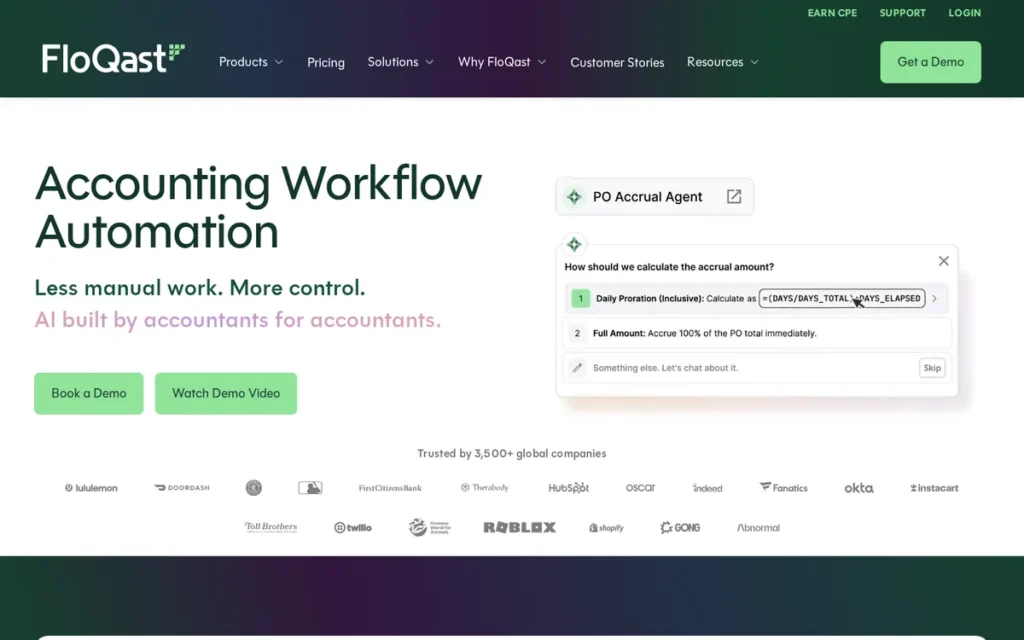
Category: Close Orchestrator, organizes the close checklist, ownership, reconciliations, and flux review around an existing ERP.
At a Glance
- Category: Close Orchestrator
- Best For: Mid-market accounting teams (roughly 150+ employees, 1–25 entities) replacing spreadsheet-and-email closes while keeping Excel reconciliations
- Price Range: Custom quote with no per-user fees; median ~$24,481/yr across ~314 purchases (Vendr, October 2026; third-party contract data); Capterra lists a $999/month starting price
- Primary Strength: FloQast has the most consistent independent review ratings in this comparison, and users praise its ease of use and Excel-native workflow.
- Biggest Limitation: FloQast has no native consolidation engine, and reviewers report peak-close slowdowns and sync gaps that force manual uploads.
- One-Line Summary: FloQast is the most widely and consistently reviewed close management tool for mid-market teams that want structure, sign-offs, and audit trails without abandoning Excel.
- Last Verified: October 2026
Overview
FloQast is a close management platform that wraps month-end close checklists, reconciliations, flux analysis, and SOX workflows around the Excel and Google Sheets files accountants already use. FloQast is built for mid-market teams replacing closes run over email.
FloQast also sells AI Transaction Matching and Transform AI agents, usually as add-ons or higher-tier features. FloQast claims 3,000+ customers (FloQast, 2026; vendor-reported).
Key Features
- FloQast Close Management assigns checklist owners, dependencies, due dates, and overdue alerts, with dashboards that show close progress.
- FloQast AutoRec pulls GL balances from the ERP into reconciliation workpapers and supports preparer and reviewer sign-off.
- FloQast Flux Analysis and Compliance Management support variance review and SOX 404 control documentation in one platform.
- FloQast AI Transaction Matching and Transform provide AI-assisted matching and plain-language agents for tasks such as PO accruals and credit-card reviews.
- FloQast integrates with NetSuite, Sage Intacct, QuickBooks, Microsoft Dynamics, and SAP (Vendr, 2026).
Best For
FloQast is best for Excel-centric mid-market accounting teams that are SOX-light or SOX-ready. It fits teams whose main bottleneck is task ownership, progress visibility, and reconciliation sign-off rather than high-volume matching or consolidation.
Strengths
- FloQast holds G2 4.6/5 (about 1,417 reviews), Capterra 4.9/5 (106), Gartner Peer Insights 4.7/5 (115), and TrustRadius 8.9/10 (261) (2025–2026 snapshot). No other product in this comparison has a more consistent rating profile across platforms.
- FloQast has the largest public third-party contract dataset in the category, with about 314 purchases on record (Vendr, October 2026). That gives buyers unusually concrete budget expectations.
- FloQast reviewers consistently praise its ease of use, Excel integration, checklist structure, and overdue-task alerts (G2, 2025–2026).
- FloQast holds G2 Leader badges in financial close and markets both SOC 1 and SOC 2 reports, which buyers can request (G2, 2026).
This aligns with community sentiment on r/Accounting:
“I use Floqast and it has some cool features like checklist, reconciliation in the app (it reads the accounting software GL balances), sign offs with preparer and reviewer in the app, note/comments for evidence of review and the best past is that it rolls the folders and reconciliation files forward every month.” Posted by u/Cheeky_Star
Takeaway: FloQast users value most its in-app sign-offs, its GL-linked reconciliations, and the monthly roll-forward of workpapers, which together take over the admin work of a spreadsheet close.
Limitations
FloQast offers spreadsheet familiarity at the cost of processing depth. FloQast organizes the close well, but it has no native consolidation engine, and some reviewers question how well it handles high transaction volumes (SoftwareFinder, 2025).
- FloQast reviewers report slow refreshes at peak close, occasional disconnections, and sync gaps that require manual uploads (G2 and Capterra, 2025–2026).
- FloQast’s documented outcomes are limited to two items. One is a testimonial of a close cut from 10 to 8 days (FloQast, 2026; vendor-published). The other is a vendor-attributed survey (StealthAgents compilation, 2026; methodology unverified).
- FloQast is repeatedly called “very expensive” on r/Accounting. One user who later switched to Numeric was “disappointed with their AI features,” and another said FloQast is “not as great” below about 150 employees (r/Accounting, 2025–2026; community rules of thumb).
Verdict
FloQast is the most consistently well-reviewed close management tool for mid-market accounting teams that want to replace email-and-spreadsheet closes without abandoning Excel.
FloQast scored 36/45, tied with Trintech, and placed #2 on the pre-declared tiebreaker because its independent review evidence is stronger (C1 5 vs. 4). FloQast’s ratings of 4.6–4.9 and its ~314-purchase Vendr dataset make it the lowest-uncertainty mid-market choice here.
Teams with heavy transaction matching, multi-entity consolidation, or a very small headcount should test FloQast against BlackLine, Trintech Adra, or Numeric before committing.
3. Trintech (Cadency + Adra): Best for Compliance-Driven Reconciliation at Scale, with a Mid-Market Entry Tier

Category: Reconciliation & Matching Engine, automates high-volume balance-sheet reconciliation, transaction matching, and journal-entry controls.
At a Glance
- Category: Reconciliation & Matching Engine
- Best For: Compliance-driven enterprises with multiple ERPs (Cadency) and budget-conscious mid-market teams that need tasks plus matching (Adra)
- Price Range: Quote-only; Adra ~$30K–$100K/yr and Cadency ~$300K–$1M+/yr plus implementation (Bluecopa, 2026; competitor-published estimate)
- Primary Strength: Trintech Cadency combines high-volume matching, reconciliation, journals, and intercompany with risk-ranked review, backed by the most specific named scale examples in this comparison (vendor-published).
- Biggest Limitation: Trintech reviewers cite a dated interface and rigid reporting, and moving from Adra to Cadency can require a full reimplementation.
- One-Line Summary: Trintech offers enterprise-scale reconciliation through Cadency, supported by vendor-published customer examples such as HPE, and a lower-cost mid-market tier through Adra, but buyers must plan for a dated interface and a difficult upgrade path between the two.
- Last Verified: October 2026
Overview
Trintech is a record-to-report (R2R) software vendor that sells two month-end close products for compliance-driven finance teams. Trintech Cadency handles enterprise reconciliation across multiple ERPs, and Trintech Adra handles mid-market task management and matching.
Trintech has sold reconciliation software since 1987, is headquartered in Dallas, and is owned by private equity (Trintech and Altss, 2026).
Key Features
- Trintech Cadency automates balance-sheet reconciliation, high-volume transaction matching, journal entries, close task management, and intercompany reconciliation.
- Trintech Cadency Risk Intelligence ranks reconciliations and journals by risk, so SOX 404 reviewers can focus on the highest-exposure items first.
- Trintech Adra packages Task Manager, Matcher, Balancer (reconciliations), and journal workflows for mid-market finance teams.
- Trintech Cadency supports companies running several ERPs at once, and one G2 reviewer’s company ran three (G2, 2025–2026).
- Trintech integrates with SAP, Oracle, Microsoft Dynamics, and NetSuite, although its NetSuite connector is described as less mature (CFO Shortlist, 2025).
Best For
Trintech Cadency is best for compliance-heavy enterprises reconciling tens of thousands of accounts across several ERPs. Trintech Adra is best for mid-market teams that want close tasks and transaction matching in one lower-cost suite.
Strengths
- Trintech’s vendor-published Cadency customers include HPE, which reconciles about 25,000 balance-sheet accounts and $1.5B a month. They also include Boston Scientific, which runs Cadency Close across 93 entities and Cadency reconciliation across 86 entities in 53 countries (Trintech, 2024–2025; vendor-published).
- Trintech was named a Leader in the 2024 IDC MarketScape for Worldwide Office of the CFO Record-to-Report (Trintech, 2024) and reports earning 20+ G2 badges in Fall 2025 (Trintech, 2025).
- Trintech holds a G2 rating of 4.5/5 from about 558–649 reviews, depending on the listing. Reviewers praise its scale, its visibility across multiple ERPs, and its customizable reminders (G2, 2025–2026).
- Trintech’s named mid-size results include Serco saving about 500 hours a month, ProShop cutting bank reconciliation from 4–5 hours to about 10 minutes, and Utah Community Credit Union closing at least 2 days faster (Trintech, 2024–2025; vendor-published).
Limitations
Trintech gives up modern usability in exchange for scale and control. Trintech reviewers cite a dated interface, rigid reporting that pushes users to Excel or Power BI, and configuration changes that need vendor help (G2, 2025–2026).
- Trintech’s NetSuite connector is described as less mature than its SAP and Oracle integrations and reportedly runs on Boomi (CFO Shortlist, 2025).
- One Trintech Adra user reported that the matcher still could not handle bank reconciliations and that “Adra does not push entries to oracle” (r/Accounting, 2025; single first-hand account).
- Moving from Trintech Adra to Trintech Cadency can require a full reimplementation, which is a growth risk (CFO Shortlist, 2025).
- Trintech holds a Gartner Peer Insights rating of 4.4/5 from 116 ratings, and it is unclear whether that covers Cadency, Adra, or both. Its Cadency TrustRadius sample of 8 reviews is too small to compare with confidence (Gartner Peer Insights and TrustRadius, 2025–2026).
Users on r/Accounting shared their experience:
“We went with Adra, which as been……Fine. We got the task manager up and running quickly, which is to be expected, but everything else is dragging. We still can’t get matcher to handle our bank recs and until that’s done, we’re holding on getting balancer (reconciliations) going.” Posted by u/KidGorgeous19
Takeaway: Trintech Adra’s task manager goes live quickly, but its matching and reconciliation modules can stall, so buyers should test Matcher on their own bank data before signing.
Verdict
Trintech is the strongest alternative to BlackLine for compliance-driven reconciliation at enterprise scale, and its Adra tier combines a dedicated matcher with close tasks in one mid-market suite.
Trintech scored 36/45, tied with FloQast. It scored highest of the seven on documented outcomes (4/5) but placed #3 on the tiebreaker because its review base is smaller and its Gartner Peer Insights rating is 4.4/5.
Buyers should run a proof of concept on NetSuite write-back and map out three years of growth before choosing Trintech Adra.
4. OneStream: Best for Complex Multinational Consolidation and Unified CPM
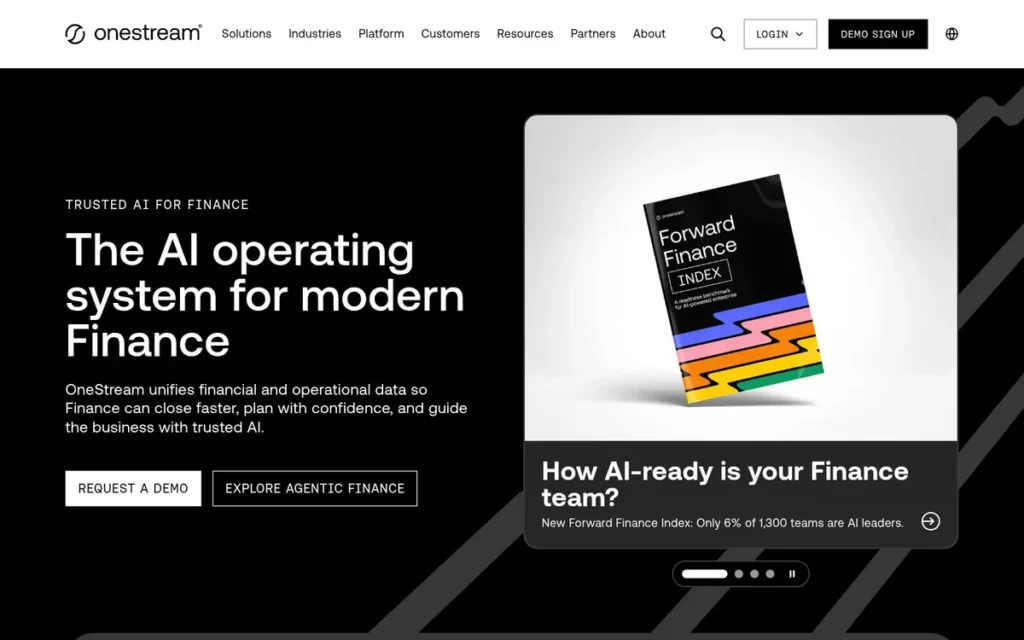
Category: Consolidation Platform, rolls up multiple entities with account mapping, FX translation, intercompany matching, and eliminations.
At a Glance
- Category: Consolidation Platform
- Best For: Multinational enterprises with many entities and currencies, heavy intercompany activity, or a legacy Hyperion HFM to replace
- Price Range: Quote-only; reported average ~$178,000/yr, with narrower deployments at ~$50K–$100K/yr (Vendr, 2025–2026; not re-confirmed in October 2026), plus an estimated $250K–$2M+ implementation (AuditFriendly, 2026)
- Primary Strength: OneStream delivers native consolidation, intercompany eliminations, and currency translation alongside reconciliation and planning on one platform.
- Biggest Limitation: OneStream has the heaviest implementation profile here: consolidation projects typically take 6–9 months, and business rules often require VB.NET skills.
- One-Line Summary: OneStream is the most mature consolidation-first platform for complex multinational enterprises, but its cost, VB.NET administration, and multi-month implementation make it too large for most single-ERP mid-market teams.
- Last Verified: October 2026
Overview
OneStream is a unified corporate performance management (CPM) platform built around multi-entity consolidation, intercompany eliminations, and currency translation. OneStream is designed for multinational enterprises replacing legacy consolidation tools such as Oracle Hyperion HFM.
OneStream was founded in 2010, listed on Nasdaq in July 2024, and reports 1,900+ customers (OneStream, 2026; vendor-reported).
Key Features
- OneStream financial consolidation handles intercompany eliminations, currency translation, and multi-entity roll-ups natively.
- OneStream includes account reconciliation, transaction matching, and close task management on the same platform as consolidation.
- OneStream Extensible Dimensionality lets teams add operational detail without redesigning the corporate consolidation model.
- OneStream adds reporting, planning, “Sensible AI,” and a MarketPlace of add-on solutions on the same data model.
- OneStream supports frequent ERP data loads, and at least one Gartner reviewer describes hourly pulls into the platform (Gartner Peer Insights, 2026).
Best For
OneStream is best for multinational enterprises whose close bottleneck is consolidation, intercompany activity, and currency translation across many entities. That is especially true for teams consolidating in Excel or replacing Oracle Hyperion HFM.
Strengths
- OneStream was named the only Customers’ Choice in the 2026 Gartner Peer Insights Voice of the Customer for Financial Close & Consolidation, with 4.8/5 from 171 reviews and 98% willing to recommend, as of June 30, 2026 (PR Newswire, 2026).
- OneStream holds Gartner Peer Insights 4.7/5 (957 ratings), G2 4.6/5 (161), and Capterra 4.8/5 (84), about 1,200 reviews across three platforms (Gartner Peer Insights, G2, and Capterra, 2025–2026).
- OneStream is listed among top performers in the ISG Buyers Guide for Financial Close (ISG, 2025). OneStream also reports Leader status in the 2025 Gartner Magic Quadrant for Financial Close & Consolidation (OneStream, 2025; vendor-reported).
- OneStream reviewers describe moving from “100% of consolidation in Excel” to automated consolidation (Gartner Peer Insights, 2026).
Limitations
OneStream’s consolidation depth comes with a lot of weight. OneStream implementation is estimated at $250K–$2M+. That is about 1.5–2× the annual license for moderate projects and 3–5× for complex ones, and consolidation alone typically takes 6–9 months (AuditFriendly, 2026).
- OneStream business rules are commonly written in VB.NET, so teams need a technical administrator or ongoing partner support (BARC, 2025).
- OneStream reviewers cite a steep learning curve and product issues that “can take considerable time to validate, prioritize… and resolve in a future release” (Gartner Peer Insights, 2026).
- OneStream has no independently verified named-customer close metrics in our research. OneStream also rarely comes up in r/Accounting close discussions, which suggests single-ERP mid-market teams seldom evaluate it.
Users on r/FPandA noted:
“OneStream has a solid suite of tools. They will claim that administration of the tools are finance owned and operated, but this is simply untrue. If you try to do something that is not pre-configured you will definitely be coding.” Posted by u/Much_Advance_5505
Takeaway: OneStream’s tools are strong, but any work beyond the pre-configured setup needs coding, so finance teams should budget for technical administration instead of expecting to run it themselves.
Verdict
OneStream is the most mature consolidation-first financial close platform in 2026 for multinational enterprises with complex entity, currency, and intercompany structures.
OneStream scored 35/45. It matched BlackLine on close-job coverage and earned a 5 on review evidence, but it tied with Nominal for the lowest score on TCO burden (1/5) because of its $250K–$2M+ implementations.
Mid-market buyers should read OneStream’s cost, VB.NET administration, and 6–9 month timeline as clear signs it is too large for them unless consolidation is the primary bottleneck.
5. Workiva: Best for SEC, XBRL, and SOX Reporting (Usually Paired With a Close Tool)
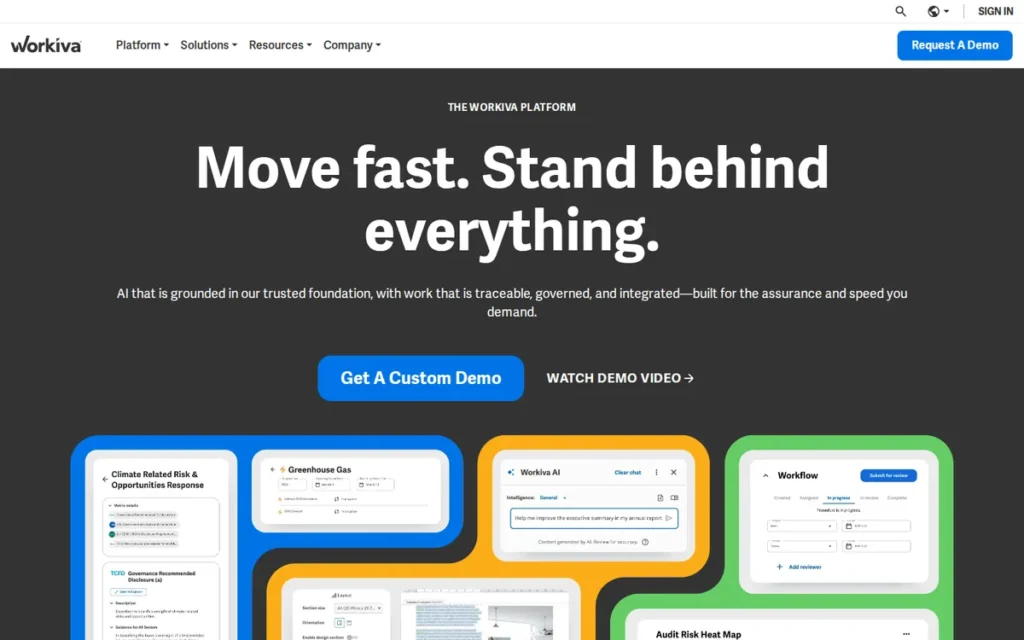
Category: Reporting & Compliance Platform, links close data to SEC filings, XBRL tagging, and SOX controls.
At a Glance
- Category: Reporting & Compliance Platform
- Best For: Public and pre-IPO companies with SEC 10-K/10-Q, XBRL, and SOX 404 obligations, typically alongside a dedicated close tool
- Price Range: Quote-only, solution-based licensing (Workiva 10-K, 2025); annual contracts described as running from tens to hundreds of thousands of dollars (Softwr, 2026; third-party characterization)
- Primary Strength: Workiva links source data to SEC filings, XBRL tagging, and SOX documentation, and its 97.2% gross revenue retention in 2025 shows customers rarely move their filing process off it.
- Biggest Limitation: Workiva’s newer financial close and reconciliation modules are described as less mature than BlackLine’s or FloQast’s.
- One-Line Summary: Workiva is the most widely adopted SEC and XBRL reporting platform in this comparison (6,624 customers, 2025), but most teams use it alongside a dedicated close tool rather than as their primary close software.
- Last Verified: October 2026
Overview
Workiva is a cloud reporting and compliance platform that links source data to SEC filings, XBRL tagging, SOX controls, and ESG reports. Workiva is built for public and pre-IPO finance teams whose month-end close ends in regulatory reporting.
Workiva has added a newer Financial Close solution covering close management, reconciliations, and consolidation reporting (Workiva 10-K, 2025).
Key Features
- Workiva produces 10-K and 10-Q filings with inline XBRL tagging inside one collaborative platform.
- Workiva links data across spreadsheets, documents, and presentations, so changing a source number updates every connected report.
- Workiva supports SOX 404 and GRC workflows, including internal-control documentation and testing.
- Workiva Financial Close adds close management, reconciliations, and consolidation reporting as a newer set of modules.
- Workiva AI and real-time collaboration let multiple preparers and reviewers work on the same filing at once.
Best For
Workiva is best for public and IPO-track companies whose biggest close pain is producing accurate SEC filings, XBRL tagging, and SOX evidence. Those teams typically still run checklists and reconciliations in a separate close tool.
Strengths
- Workiva reported 6,624 customers, 97.2% gross revenue retention, and about 112.8% net retention in its 2025 public-company results (Workiva FY2025 results, 2026). These retention figures are the strongest independently disclosed data of their kind in this comparison.
- Workiva holds a G2 rating of 4.5/5 from about 2,267 reviews, the largest single-platform review base of the seven, and reviewers praise its linking, collaboration, and SEC workflow (G2, 2025–2026).
- Workiva reported 2025 revenue of $884.6M, up from $738.7M in 2024, with subscription and support revenue of about $812.9M, up about 22% (Workiva FY2025 results, 2026).
- Workiva reportedly serves 85%+ of the Fortune 1,000 (StockTitan 10-K summary, 2026; reported), and its 2024 10-K cites “Best of Breed” GRC recognition from an independent research firm (Workiva 10-K, 2024).
Limitations
Workiva is stronger at reporting than at running the close itself. Workiva’s close, reconciliation, and consolidation modules are newer and described as less mature than dedicated close tools (RFP.wiki, 2025).
- Workiva reviewers report lag with large or heavily linked documents at peak filing periods, links that break when documents are restructured, and self-implementations that take longer than expected (G2 and Airframe, 2025–2026).
- Workiva can add extra fees for document setup and XBRL tagging (Workiva 10-K, 2025), and third-party reviewers warn about the vendor’s leverage at renewal (Softwr, 2026).
- Workiva is described as “overkill for small businesses and startups” that have no SEC or SOX obligations (AIToolsAtlas, 2026).
- Workiva’s Capterra, Gartner, and TrustRadius ratings were not found in our research, and Reddit discussion is very limited (r/Accounting, 2023).
Verdict
Workiva is the best fit in this comparison for connecting the financial close to SEC filings, XBRL, and SOX controls, but it is rarely the right primary close tool on its own.
Workiva scored 29/45. It earned the top vendor-maturity score (5/5) but scored 3/5 on close-job coverage, because SEC reporting comes after the close, and 2/5 on documented outcomes.
Private companies without SEC or SOX obligations should skip Workiva. Public companies should budget for Workiva alongside a close orchestrator or reconciliation engine.
6. Numeric: Best for Lean, Fast-Growing NetSuite Teams Wanting AI-Native Close

Category: Close Orchestrator, organizes the close checklist, ownership, reconciliations, and flux review around an existing ERP.
At a Glance
- Category: Close Orchestrator
- Best For: Startups and scale-ups on NetSuite with mostly single-entity closes and a need for fast time to value
- Price Range: From $30/user/month (Numeric, 2026; vendor-published on its blog rather than its pricing page); Growth and Enterprise tiers custom-quoted
- Primary Strength: Numeric gives NetSuite teams transaction-level drill-down inside the app, AI-drafted flux explanations, and bank-feed cash matching without exporting data from the ERP.
- Biggest Limitation: Numeric lacks mature SAP, Oracle EBS, and Microsoft Dynamics support and has documented gaps in SOX control testing, consolidation, and intercompany.
- One-Line Summary: Numeric is the most cost-transparent AI-native close tool for lean NetSuite finance teams, but its small review base and gaps in consolidation and SOX testing limit it for complex or regulated companies.
- Last Verified: October 2026
Overview
Numeric is an AI-native close management platform that brings transaction-level ERP data into one workspace for month-end close checklists, flux explanations, reconciliations, and cash matching. Numeric is built for lean, fast-growing finance teams on NetSuite.
Numeric raised a $51M Series B in November 2025, led by IVP, bringing its total funding to $89M. Former BlackLine CEO Marc Huffman and former NetSuite CFO Ron Gill invested as angels (PR Newswire, 2025).
Key Features
- Numeric provides a close checklist with assignments and due dates tied to reconciliations that stay synced with the ERP.
- Numeric uses AI to draft flux (variance) explanations down to the vendor and customer level.
- Numeric Monitors flag anomalies, such as expenses recorded without a vendor, before the close starts.
- Numeric Cash Management matches bank-feed transactions and creates and posts journal entries on the Enterprise tier.
- Numeric integrates with NetSuite at the transaction-line level and with QuickBooks, Sage Intacct, Xero, and Workday at the trial-balance level (Numeric, 2026).
Best For
Numeric is best for lean, fast-growing NetSuite finance teams that want in-app transaction drill-down, AI help with flux review, and quick implementation. It suits teams that do not yet need native consolidation or formal SOX control testing.
Strengths
- Numeric reported that Brex’s auto-match rate rose from about 30% to 90%+ after it adopted Cash Management, cutting a process that took days down to a few hours (PR Newswire, 2025; vendor-published).
- Numeric holds a G2 rating of 4.8/5 from about 65 reviews (G2 via CFO Shortlist, September 2026), and Numeric is the only vendor of the seven with a published per-seat starting price.
- Numeric holds a SOC 1 Type 2 report and claims SOC 2 (AuditFriendly, 2026). Reviewers praise its fast implementation and responsive support (G2, 2025–2026).
- Numeric users who switched from FloQast cite being able to see transactions in the app instead of exporting them from NetSuite (r/Accounting, 2024). One G2 reviewer reported the close shrinking from 9 days to 6 (G2, 2025–2026).
Limitations
Numeric goes deep on NetSuite at the expense of ERP breadth. Numeric has no mature SAP, Oracle EBS, or Microsoft Dynamics support, and a Reddit user confirmed “they don’t support Dynamics” (r/Accounting, 2024).
- Numeric has documented gaps in SOX control testing, consolidation, and intercompany functionality (AuditFriendly, 2026).
- Numeric’s G2 base of about 65 reviews is too small to weigh equally against FloQast’s or BlackLine’s 1,000+, so its 4.8/5 rating carries less statistical weight (G2 via CFO Shortlist, September 2026).
- Numeric reviewers report performance problems at peak close, integration errors with task assignments and due dates, and a rigid rule that every assigned flux line must be signed off (G2, 2025–2026).
Verdict
Numeric is the most cost-transparent and NetSuite-native close tool in this comparison, and it suits lean finance teams that value in-app transaction drill-down and quick time to value.
Numeric scored 26/45. Its roughly 65 G2 reviews and its gaps in consolidation, intercompany, and SOX testing explain its #6 rank despite strong practitioner enthusiasm.
Companies with multiple entities, Dynamics, SAP, or SOX testing requirements should look at FloQast, Trintech Adra, or BlackLine instead of Numeric.
7. Nominal: Emerging Pick for NetSuite Multi-Entity Consolidation and Intercompany

Category: Consolidation Platform, rolls up multiple entities with account mapping, FX translation, intercompany matching, and eliminations.
At a Glance
- Category: Consolidation Platform
- Best For: NetSuite-centric mid-market companies with many legal entities and heavy intercompany activity that are not ready for an enterprise CPM implementation
- Price Range: Pricing on request; no public pricing on Nominal’s site, G2, or Capterra (verified October 2026)
- Primary Strength: Nominal directly automates multi-entity consolidation, FX translation, and intercompany eliminations for mid-market ERPs, a job most close orchestrators do not cover natively.
- Biggest Limitation: Nominal has the thinnest evidence base in this comparison, with one G2 review and zero Capterra reviews; Nominal states it holds SOC 1 Type 2, but its SOC 2 status is unverified.
- One-Line Summary: Nominal is an early-stage AI consolidation and intercompany tool aimed at multi-entity NetSuite companies, and it should be evaluated with a proof of concept because independent evidence is minimal.
- Last Verified: October 2026
Overview
Nominal is an AI agent layer that sits on top of an existing ERP to automate multi-entity consolidation, intercompany eliminations, reconciliations, and flux analysis for the month-end close. Nominal is built for NetSuite-centric mid-market companies with many legal entities.
Nominal was founded in April 2023 by Guy Leibovitz and Golan Kopichinsky, who previously sold Cognigo to NetApp (Nominal, 2025).
Key Features
- Nominal automates multi-entity consolidation, including account mapping, FX translation, and eliminations.
- Nominal matches intercompany transactions and auto-proposes elimination entries through what it calls “Agentic Performance Management.”
- Nominal includes reconciliations, close management, and flux analysis alongside its consolidation agents.
- Nominal integrates with NetSuite as its primary ERP and also lists Sage Intacct, QuickBooks, Xero, and Microsoft Dynamics (Nominal, 2025).
Best For
Nominal is best for mid-market companies running NetSuite or QuickBooks across many entities that have outgrown both Excel consolidation and orchestrators like FloQast or Numeric but cannot justify an enterprise CPM implementation such as OneStream.
Strengths
- Nominal reports that Green Street Power Partners (GSPP) saves 60+ hours a month. GSPP is a solar developer with 280+ entities and 115+ leases under ASC 842. Nominal also reports that Leanpay closes at least 2 days (20–25%) faster (Nominal case studies, 2025–2026; vendor-published).
- Nominal has raised about $30M, including a $20M Series A led by Next47 with Workday Ventures participating, and claims more than $1B in book value managed (Nominal, 2025; vendor-reported).
- Nominal reports that Kunai cut 1 day from its close and saved 80–90 hours during acquisition prep, avoiding up to $20K in temporary staffing (Nominal case studies, 2025–2026; vendor-published).
- Nominal is named by r/Accounting practitioners specifically in threads about consolidating multiple QuickBooks Online entities, which matches its positioning (r/Accounting, 2025).
Limitations
Nominal has the right focus but little proof of maturity yet. Nominal targets the mid-market consolidation gap directly, but its independent evidence amounts to one G2 review, zero Capterra reviews, and vendor-published case studies (G2 and Capterra, 2026).
- Nominal states it holds a SOC 1 Type 2 report (Nominal, 2025; vendor-reported), but its SOC 2 status was not verified in our research, so buyers should request both reports before sharing GL data.
- Nominal’s single G2 reviewer said the product “requires advanced accounting knowledge,” and another G2 comment calls its reporting “somewhat inflexible” (G2, 2026).
- Nominal is described on Reddit as “starting to build” a consolidation tool, and practitioner wariness of “AI agents” handling sensitive close data is a real adoption barrier (r/Accounting, 2025).
Verdict
Nominal is the only emerging tool in this comparison built specifically for mid-market multi-entity consolidation and intercompany, but it has too few reviews to recommend without a proof of concept.
Nominal scored 20/45, the lowest total. That score mainly reflects thin independent evidence (1 G2 review, no public pricing), not documented product failures.
Buyers should verify Nominal’s SOC reports, ask for references with comparable entity counts, and run their own intercompany data through Nominal before committing.
Which Financial Close Software Works Best With NetSuite, QuickBooks, SAP, and Dynamics?
Numeric offers the deepest NetSuite integration in this comparison. BlackLine, Trintech Cadency, and OneStream fit SAP and Oracle environments best. QuickBooks users should look at FloQast, Numeric, or Nominal. Microsoft Dynamics users should rule out Numeric, which does not support Dynamics (r/Accounting, 2024).
- NetSuite users get the deepest transaction-level integration from Numeric, and FloQast, BlackLine, and Nominal also connect to NetSuite.
- SAP and Oracle users should compare BlackLine, Trintech Cadency, and OneStream, with Workiva covering reporting on top.
- QuickBooks users should compare FloQast, Numeric, and Nominal, because the other tools are generally too large for QuickBooks environments.
- Microsoft Dynamics users should compare FloQast, BlackLine, Trintech, and OneStream.
| Vendor | NetSuite | QuickBooks | Sage Intacct | SAP / Oracle | Microsoft Dynamics | Depth Notes |
|---|---|---|---|---|---|---|
| BlackLine | Certified (Vendr, 2026) | Not found in our research | Not found in our research | Certified (Vendr, 2026) | Certified (Vendr, 2026) | Sync delays of up to a day (Coefficient, 2026) |
| FloQast | Yes | Yes | Yes | SAP: Yes; Oracle: Not found in our research | Yes | Manual uploads when a sync misses data (Capterra, 2025–2026) |
| Trintech | Less mature, Boomi-based (CFO Shortlist, 2025) | Not found in our research | Not found in our research | Yes | Yes | No Adra write-back to Oracle, per one user (r/Accounting, 2025) |
| OneStream | Not found in our research | Not found in our research | Not found in our research | Yes | Yes | Hourly data pulls reported (Gartner Peer Insights, 2026) |
| Workiva | Not found in our research | Not found in our research | Not found in our research | Yes (research synthesis, 2026) | Not found in our research | Integrations focus on linking reporting data |
| Numeric | Transaction-level | Trial-balance | Trial-balance | No mature support (AuditFriendly, 2026) | Not supported (r/Accounting, 2024) | Deepest NetSuite drill-down in this set |
| Nominal | Primary | Yes | Yes | Not found in our research | Listed (Nominal, 2025; vendor-stated) | Integration depth unverified |
Sources: vendor sites, Vendr, G2, CFO Shortlist, AuditFriendly, and r/Accounting (2024–2026). Verified October 2026. “Not found in our research” means the integration could not be confirmed, not that it is definitely missing.
How Much Does Financial Close Software Cost, and How Long Does Implementation Take?
Mid-market close and reconciliation tools typically cost about $10K–$100K per year. Enterprise reconciliation and consolidation platforms run about $178K to $1M+ per year (Vendr, 2026; Bluecopa, 2026). Implementation adds roughly 1–5× the annual license and takes 8 weeks to 9+ months, so first-year total cost of ownership varies more than subscription price does.
Per-vendor contract benchmarks, labeled by source type:
- BlackLine’s median annual contract is about $40,125 across 74 purchases, with a range of about $13,200–$101,000 (Vendr, 2026; third-party contract data).
- BlackLine spend averages about $46,318/yr at companies with 50–1,000 employees and about $541,209/yr above 1,000 employees (Coefficient summary of Vendr data, 2026).
- BlackLine add-on modules are priced separately, and some BlackLine contracts reportedly carry 5–8% annual renewal increases (Numeric and AuditFriendly, 2026; Numeric is a competitor).
- FloQast’s median annual contract is about $24,481 across ~314 purchases, with a range of $10,147–$68,727 (Vendr, October 2026; third-party contract data).
- FloQast deployments with 1–5 entities reportedly cost about $30K–$40K/yr, and those with 25+ entities $120K+/yr. FloQast implementation runs about $5K–$15K for smaller deployments (Numeric and Bluecopa, 2026; competitor-published).
- Trintech Adra is estimated at about $30K–$100K/yr, and Trintech Cadency at about $300K–$1M+/yr plus $100K–$500K+ for implementation (Bluecopa, 2026; competitor-published).
- OneStream’s average annual contract is reported at about $178,000, with narrower deployments at $50K–$100K/yr (Vendr, 2025–2026; not re-confirmed in October 2026).
- Workiva uses solution-based licensing priced on expected usage, with possible extra fees for document setup and XBRL tagging (Workiva 10-K, 2025).
- Numeric lists a $30/user/month starting price on its blog. Its Growth and Enterprise tiers are quoted by transaction count, seats, and number of entities (Numeric, 2026; vendor-published).
- Nominal publishes no pricing, so buyers should request an itemized quote covering subscription, implementation, and how costs scale per entity (Nominal, G2, and Capterra, October 2026).
Implementation timelines by vendor:
- BlackLine implementations typically take 3–6 months, and mid-market BlackLine implementation fees often equal or exceed the first-year subscription (Coefficient, 2026).
- OneStream consolidation projects alone typically take 6–9 months (AuditFriendly, 2026).
- Trintech implementations reportedly range from about 30 days to 6 months, and one Trintech Adra reviewer went live in 1–2 months (Bluecopa, 2026; competitor-published).
- Numeric reviewers praise its fast implementation, although our research found no duration figure for Numeric (G2, 2025–2026).
- FloQast, Workiva, and Nominal implementation durations were not found in our research, although Workiva reviewers report self-implementations taking longer than expected (G2 and Airframe, 2025–2026).
Implementation can cost more than the license. On a $178K/yr OneStream license, a 1.5–2× implementation adds about $267K–$356K before the first close runs (AuditFriendly, 2026).
| Buyer Profile | Typical Timeline | Directional First-Year TCO |
|---|---|---|
| Mid-market, one ERP, close and reconciliation | 8–16 weeks | $75K–$300K |
| Mid-market, multi-entity, matching or intercompany | 4–8 months | $200K–$700K |
| Enterprise global close and reconciliation | 6–12 months | $750K–$2.5M |
| Enterprise consolidation plus disclosure | 12–24 months | $1.5M–$5M+ |
Source: directional research synthesis (Perplexity, 2026). These are not vendor list prices. Verified October 2026.
Smaller single-entity deployments of close orchestrators can come in well below the $75K floor. FloQast’s Vendr median plus its reported small-deployment implementation cost implies roughly $30K–$40K in year one (Vendr and Bluecopa, 2026).
What Red Flags Should I Watch For When Evaluating Financial Close Software?
The six red flags below can each turn a promising demo into an expensive replacement project, and most of them are hidden behind polished vendor marketing. Check every finalist against all six before you sign.
Red Flag #1: Logo-Only ERP Integrations A logo on an integrations page does not prove transaction-level access or journal write-back, and those two things decide how much manual work disappears. FloQast reviewers reported sync gaps that forced manual uploads (G2 and Capterra, 2025–2026), and one Trintech Adra user reported no write-back to Oracle (r/Accounting, 2025).
Red Flag #2: Ratings From Tiny Review Samples A 5.0 rating from one review, or an 8.0/10 from eight, is not reliable evidence of satisfaction, because a single customer can swing it. In this comparison, Nominal has 1 G2 review and Trintech Cadency has 8 TrustRadius reviews, so compare review counts across G2, Capterra, Gartner Peer Insights, and TrustRadius first.
Red Flag #3: Vendor-Authored Comparison Pages Posing as Independent Reviews Many “best close software” pages in this category are run by competing vendors such as Numeric, Bluecopa, Prophix, and HighRadius (research review, October 2026). These pages often publish estimates of rivals’ prices, so check who owns the domain before relying on any pricing figure or ranking.
Red Flag #4: Quotes That Hide Implementation, Add-Ons, and Escalators A subscription quote alone can badly understate first-year cost once implementation, add-on modules, and renewal escalators are added. Third-party sources report that implementation fees equal the first-year subscription for some BlackLine mid-market deals (Coefficient, 2026). In those deals, the subscription quote covers only half of year-one cost.
Red Flag #5: A Lite Tier With No Clean Upgrade Path A vendor’s mid-market tier may not migrate cleanly to its enterprise product. A team that picks Trintech Adra at 10 entities and grows to 40 may have to rebuild its configuration in Trintech Cadency and pay for implementation twice (CFO Shortlist, 2025). Map out three years of growth before signing.
Red Flag #6: AI Agents Without an Audit Trail or SOC Reports An AI agent that posts or proposes journal entries without an explainable audit trail creates SOX 404 risk and complicates external audits. Practitioners cite data security as a primary concern with AI agents in the close (r/Accounting, 2025), so request SOC reports and agent-level audit logs.
What Questions Should I Ask Before Choosing Financial Close Software?
Before choosing financial close software, make each vendor prove its claims on your own data, including ERP sync, auto-match rate, references, SOC reports, itemized three-year cost, and tier upgrade path. The seven questions below turn vendor answers into evidence you can compare side by side.
Question #1: Can you sync our actual trial balance and drill to transaction lines in the demo? A strong answer is a live sync of your own trial balance, with drill-down to individual transaction lines during the demo. Be cautious if the vendor can only show a pre-loaded sandbox. A sandbox hides the account-mapping and data-cleanup work that a certified connector does not remove.
Question #2: Do journal entries write back to our ERP, and how often does data sync? Ask for the sync frequency and journal write-back behavior in writing, not just a list of supported ERPs. BlackLine reviewers reported sync delays of up to a day (Coefficient, 2026), and one Trintech Adra user reported that entries do not push back to Oracle (r/Accounting, 2025).
Question #3: What auto-match rate do you achieve on our own sample data? Insist on a match rate measured on your own bank and subledger files, not a headline figure from a case study. The answer shows whether the tool reduces reconciliation work or only organizes it. Brex’s vendor-published rate of 90%+ started from about 30% (PR Newswire, 2025).
Question #4: Can you provide references matched to our ERP and entity count? Independent named-customer outcome data is thin across this category. Our research found none verified for BlackLine, OneStream, or Workiva, and the challengers’ outcomes come from vendor case studies. References with your ERP, a similar entity count, and comparable transaction volume are the best substitute available.
Question #5: Will you share current SOC 1 and SOC 2 reports? Expect both reports under NDA before any general ledger data leaves your ERP. Treat a vendor that cannot provide at least a current SOC 1 Type 2 report under NDA as high-risk for general ledger data. Also ask whether the reports cover the vendor’s AI features.
Question #6: What are the itemized first-year and three-year costs, including implementation, add-ons, and renewal escalators? Ask for subscription, implementation, add-on modules, professional services, and renewal escalator caps as separate line items. Directional first-year TCO runs about $75K–$300K for a single-ERP mid-market project and $750K+ for enterprise global close (research synthesis, 2026).
Question #7: What happens to our configuration if we outgrow this tier? Ask whether your configuration migrates to the next tier or must be rebuilt, and get the answer written into the contract. Map your expected entity count and transaction volume for the next three years, because moving from Trintech Adra to Cadency can require full reimplementation (CFO Shortlist, 2025).
Score each demo on Questions #1–#3 using your own trial balance. A vendor that cannot sync your data during the evaluation is unlikely to sync it cleanly in production.
How Did We Rank These Financial Close Software Tools?
We scored every vendor from 1 to 5 on six criteria, using our October 2026 research snapshot. Review evidence, close-job coverage, and ERP integration counted double. Documented outcomes, pricing and TCO, and vendor maturity counted once, for a maximum of 45 points. The overall rank measures the strength of the evidence, not fit for every buyer.
These are the criteria, why each one matters, and the scoring anchors for each:
- C1 – Independent Review Evidence (2×): Large, consistent review bases are the best independent signal of satisfaction. 5 = 4.5+ ratings across 3+ platforms with 1,000+ total reviews; 3 = ratings near 4.5 with fewer than ~500 total reviews; 1 = fewer than 5 reviews.
- C2 – Close-Job Coverage Depth (2×): The close spans six jobs: tasks, reconciliation, matching, journals, consolidation, and SOX/SEC reporting. 5 = 5–6 jobs with mature depth; 3 = 3–4 jobs or notable gaps; 1 = a single job.
- C3 – ERP Integration Breadth and Verified Depth (2×): ERP fit decides how much manual work actually disappears. 5 = broad certified multi-ERP coverage; 3 = deep on a narrow ERP set, or broad but shallow; 1 = one ERP at trial-balance level only.
- C4 – Documented Customer Outcomes (1×): Named metrics beat marketing claims. 5 = independently verified named-customer metrics; 3 = several named, vendor-published metrics; 2 = anecdotes, single testimonials, or retention data without named close outcomes; 1 = no outcome evidence.
- C5 – Pricing Transparency and TCO Burden (1×): Implementation can cost 1–5× the license. 5 = published pricing plus fast implementation; 3 = substantial third-party contract data with moderate implementation; 1 = no pricing data plus 6+ months or $250K+ implementation.
- C6 – Vendor Maturity and Recognition (1×): Close software is an audit-critical, multi-year commitment. 5 = long market history, audited disclosures, SOC reports, and analyst recognition; 3 = well funded with SOC reports but newer; 1 = early-stage with no verified SOC reports.
| Company | C1 | C2 | C3 | C4 | C5 | C6 | Weighted Total (/45) |
|---|---|---|---|---|---|---|---|
| BlackLine | 4 | 5 | 5 | 2 | 3 | 4 | 37 |
| FloQast | 5 | 4 | 4 | 2 | 4 | 4 | 36 |
| Trintech | 4 | 5 | 4 | 4 | 2 | 4 | 36 |
| OneStream | 5 | 5 | 4 | 2 | 1 | 4 | 35 |
| Workiva | 4 | 3 | 3 | 2 | 2 | 5 | 29 |
| Numeric | 2 | 3 | 3 | 3 | 4 | 3 | 26 |
| Nominal | 1 | 3 | 3 | 3 | 1 | 2 | 20 |
Weighted total = 2 × (C1 + C2 + C3) + (C4 + C5 + C6). The pre-declared tiebreaker is the higher C1 score. It was applied once: FloQast (C1 = 5) placed above Trintech (C1 = 4) at 36/45 each.
BlackLine scores 4 on C1 because its large review base sits on two platforms, not the three the top anchor requires. BlackLine therefore holds #1 by one point.
A #1 ranking measures the strength of the evidence, not fit for your company: Numeric, ranked #6, can be the right choice for a lean NetSuite team.
We applied these evidence-handling rules to every vendor:
- Every pricing figure is labeled as third-party contract data, a competitor-published estimate, or vendor-published.
- Reddit comments that appeared promotional, or that came from users accused of vendor affiliation, were excluded or flagged.
- The Gartner Magic Quadrant for Financial Close & Consolidation (March 2025) was used only as context, because it weights consolidation heavily and did not evaluate FloQast, Trintech, Workiva, Numeric, or Nominal.
- Unconfirmed rumors about acquisitions or take-private deals were excluded from scoring.
PlugRoute has no affiliate relationships with any company listed, and rankings are determined entirely by research data and objective evaluation criteria.
Why Aren’t Other Tools on This List?
We left out other well-known tools for one of four reasons: they are ERPs rather than close software, they focus mainly on planning (FP&A) or CPM, they fell outside our evidence scope, or they had low review volume and mostly promotional mentions. Leaving a tool out does not imply a ranking, and several excluded tools may suit specific buyers.
- SAP S/4HANA is an ERP, not dedicated close software.
- Vena and Planful are FP&A- and CPM-first platforms, and Vena is a Niche Player in the 2025 Gartner Magic Quadrant (Business Wire, 2025).
- CCH Tagetik is a 2025 Gartner Magic Quadrant Leader (Wolters Kluwer, 2025), but CCH Tagetik is a consolidation and regulatory CPM platform outside our evidence scope and worth considering as a consolidation alternative.
- Prophix One is a CPM platform with close and consolidation features that we did not research in equal depth.
- HighRadius, Datarails, Ledge, and DualEntry had lower review volume or mostly promotional mentions in our research.
- Netgain NetClose is a NetSuite-native option with frequent but promotional-looking Reddit mentions and thin review data.
What Do Buyers Most Often Ask About Financial Close Software?
Buyers most often ask which tool fits a mid-market company, which tools handle reconciliations and consolidation, and how independent rankings are produced. The short answers are FloQast for most mid-market teams, BlackLine or Trintech Cadency for reconciliation, OneStream or Nominal for consolidation, and a published, weighted six-criterion scoring matrix for the rankings.
What is the best financial close software for mid-market companies in 2026?
FloQast is the best-evidenced financial close software for mid-market companies in 2026, especially Excel-centric teams. It has ratings of 4.6–4.9 across four review platforms and a median contract of about $24,481/yr (Vendr, October 2026). Budget-constrained teams that need transaction matching should also evaluate Trintech Adra. Lean NetSuite teams should compare Numeric.
What is the best financial close software for reconciliations and consolidation?
For high-volume reconciliations, BlackLine and Trintech Cadency are the strongest fits. For multi-entity consolidation, OneStream is the most mature option, and Nominal is an emerging mid-market alternative. Few tools do both well, so companies with heavy reconciliation and consolidation needs often pair a reconciliation engine with a consolidation platform. Validate Nominal with a proof of concept first.
How does PlugRoute determine rankings?
PlugRoute scores every vendor from 1 to 5 on six criteria, with review evidence, close-job coverage, and ERP integration weighted double, for a maximum of 45 points. The full scoring matrix, the rubric anchors, and the tiebreaker rule are published in our methodology section. Small review samples are discounted, and promotional Reddit comments are excluded.
Which Financial Close Software Is Right for You?
Key Insights
The right financial close software depends on your bottleneck. BlackLine fits enterprise reconciliation and journal controls, FloQast fits Excel-centric mid-market close management, and OneStream fits multinational consolidation. SEC filers should add Workiva alongside a close tool. Numeric and Nominal suit NetSuite teams willing to check thinner evidence with a proof of concept.
- BlackLine leads this comparison at 37 of 45 and holds #1 by one point, on the strength of maximum scores for close-job coverage and ERP integration.
- FloQast is the lowest-uncertainty close orchestrator for Excel-centric mid-market teams, with consistent ratings on four platforms and about 314 Vendr contract data points (Vendr, October 2026).
- Trintech pairs enterprise-scale reconciliation in Cadency with a mid-market Adra tier, but moving from Trintech Adra to Cadency can require full reimplementation.
- OneStream is the consolidation-first choice for multinational enterprises, with implementation estimated at $250K–$2M+ (AuditFriendly, 2026).
- Workiva complements dedicated close tools rather than replacing them, and Workiva is mainly relevant to SEC filers and pre-IPO companies.
- Numeric and Nominal are promising options for NetSuite teams, but both have thin independent review evidence that buyers should offset with proofs of concept.
Choose close software by the job that slows your close (checklists, matching, consolidation, or SEC reporting), not by the vendor’s rank.
- Teams whose close runs on email and spreadsheets should start with FloQast or Numeric.
- Teams whose bottleneck is matching volume should compare BlackLine and Trintech Cadency.
- Teams with many entities to consolidate should choose OneStream at enterprise scale or Nominal at mid-market scale, after a proof of concept.
Close ownership and a documented process should come before tool selection. As one practitioner put it, “The tools work fine. It’s the workflow around them that’s usually broken” (r/Accounting, 2026).
This aligns with community sentiment on r/Accounting:
“Floqast but alignment/communication between the teams are still critical. Software can help you manage to oversee tasks but wouldn’t work if those using it are not aligned” Posted by u/PirateCharacter1924
Takeaway: Financial close software can only enforce a process that the team has already agreed on, so aligning owners and handoffs is the step that decides whether any tool on this list pays off.
Your next 30 days:
- Write down who owns each close task and document your current close process before any demo.
- Pick the category that matches your bottleneck: orchestrator, reconciliation engine, consolidation platform, or reporting platform.
- Shortlist two vendors from that category using the Quick Decision Framework and the size check above.
- Run Questions #1–#3 on your own trial balance and bank files with both vendors.
- Compare itemized three-year quotes that include implementation, add-ons, and renewal escalator caps.
AI agents are moving quickly into the close, so check audit trails and SOC reports again at every renewal. Read our full scoring methodology and browse more independent finance software reviews on PlugRoute. We update this guide quarterly. Last updated: October 2026.