Optro (formerly AuditBoard) is the best-evidenced choice for internal audit and SOX. Workiva fits SOX programs tied to SEC reporting. Caseware leads for CPA-firm engagement audits. No single tool is best for everyone, because audit software comes in four types that do different jobs. Pick your type before comparing vendors.
Most “best audit software” lists put engagement workpapers, SOX platforms, analytics engines and Excel add-ins side by side as if they compete. That mix misleads CPA firms and internal audit teams alike, because each type solves a different problem.
Most vendors also keep prices private, and review scores are hard to verify. This guide sorts seven tools by type and ranks them on dated evidence you can check. For every rank, it publishes the pricing, the security attestations and the six-criterion score behind it.
PlugRoute has no affiliate relationships with any company listed. Rankings are determined entirely by research data and objective evaluation criteria.
What Are the 4 Categories of Financial Audit Software?
Financial audit software comes in four types:
- external-audit engagement platforms
- internal audit and SOX platforms
- audit data analytics tools
- evidence and tie-out tools
Each type does a different job, so products in different types do not compete like for like. Most teams need one core platform. Some add an analytics or tie-out tool on top.
The four types, with the ranked products in each:
- Type A: External-Audit Engagement Platform (“Engagement”): Engagement platforms hold the CPA firm’s audit file, trial balance, methodology, workpapers and financial statements. Caseware and Inflo are the ranked products in this type.
- Type B: Internal Audit & SOX Platform (“Controls”): Controls platforms handle audit planning, control testing, issue tracking and board reporting inside a company. Optro (formerly AuditBoard), Workiva and TeamMate+ are the ranked products in this type.
- Type C: Audit Data Analytics (“Analytics”): Analytics tools score every journal entry and transaction for risk, so journal-entry testing can replace sampling or run alongside it. MindBridge is the only standalone tool ranked here. Caseware IDEA, TeamMate Analytics and Inflo Detect are analytics modules inside other platforms.
- Type D: Evidence & Tie-Out Automation (“Evidence”): Evidence tools match source documents to Excel, extract figures and cross-reference them on top of any core platform. DataSnipper is the ranked product in this type.
Each common problem points to one type:
- Manual Excel tie-outs and cross-referencing that eat up staff hours point to Type D (DataSnipper).
- Worry that sample-based journal-entry testing misses anomalies points to Type C (MindBridge, Caseware IDEA or Inflo Detect).
- Slow client document (PBC) chasing points to Inflo Collaborate inside a Type A platform, or to the evidence-request features inside Optro and Workiva.
- A need for engagement files points to Type A for external audits, and a need for controls testing points to Type B for internal audit and SOX.
Few firms use analytics tools yet. In the CPA.com/AICPA 2025 Audit Transformation Report, 89% of 54 surveyed US CPA firms were not yet using technology for substantive analytics (CPA.com, December 2025).
New audit standards raise the stakes. The PCAOB’s amendments to AS 1105 and AS 2301 were approved by the SEC on 20 August 2024. They apply to audits of fiscal years beginning on or after 15 December 2025 (SEC, August 2024). Auditors using technology-assisted analysis must document:
- Auditors must document how complete the data they analysed was.
- Auditors must document the parameters of each test they ran.
- Auditors must document how they followed up on each exception.
Sampling covers very little of a large ledger. Take a hypothetical ledger of 250,000 journal entries: a sample of 60 reviews 0.024% of the population. A full-population tool scores all 250,000 entries and puts the riskiest first.
How Do the Top Financial Audit Software Tools Compare at a Glance?
Optro scores highest (41/50), followed by Workiva (38), Caseware (32), DataSnipper (32), TeamMate+ (29), MindBridge (27) and Inflo (22). The scores measure how strong and checkable each product’s evidence is. They do not say whether one type of software beats another, so compare products within your own type first.
| Rank | Company | Category | Best For | One-Line Summary | Key Capabilities | Primary Strength | Key Limitation |
|---|---|---|---|---|---|---|---|
| 1 (41/50) | Optro (formerly AuditBoard) | Controls (Type B) | Mid-to-large SOX and internal audit programs | Optro (formerly AuditBoard) has the most independent validation of any internal audit and SOX platform in this comparison. | SOX 404, internal audit, ERM, IT risk and ESG on one data model; free stakeholder users (reported) | Largest verified review base (~1,600 G2 reviews, October 2026) | Premium price; ~0.5 FTE of admin time in year one (practitioner-reported) |
| 2 (38/50) | Workiva | Controls (Type B) | SOX programs linked to SEC/XBRL reporting | Workiva has the strongest evidence in this comparison for SOX work that must connect directly to SEC and XBRL reporting. | Linked data across 10-K/10-Q, SOX 404, audit and ESG; built-in AI | Only vendor in this set with FedRAMP Moderate authorisation of its own (since October 2019) | Complex interface; slow on large documents |
| 3 (32/50) | Caseware | Engagement (Type A) | Small and midsize CPA firms | Caseware is the best-evidenced engagement platform for small and midsize CPA firms in this comparison. It pairs AICPA/CPA.com methodology with built-in IDEA analytics. | Working Papers, Cloud Audit, IDEA analytics, SmartSync | AICPA/CPA.com methodology plus IDEA analytics from one vendor | Steep learning curve; one G2 reviewer reports some Working Papers features missing in the cloud version |
| 4 (32/50) | DataSnipper | Evidence (Type D) | Teams buried in Excel tie-outs | DataSnipper reports the largest user base in this comparison and works as an Excel add-in on top of an existing audit platform. | Document matching, AI extraction, source-linked snips | 600,000+ reported users; 4.8/5 from 221 G2 reviews | Windows-first Excel add-in (Mac needs virtualisation); reported five-licence minimum |
| 5 (29/50) | TeamMate+ | Controls (Type B) | Budget-conscious and public-sector internal audit teams | TeamMate+ has the most transparent pricing of any internal audit platform reviewed. | Audit, Controls, Excel-based Analytics, AI Editor; cloud or on-premise | Itemised public quote: $21,781 required in year one for 2 users (February 2025) | Most negative practitioner feedback in its type |
| 6 (27/50) | MindBridge | Analytics (Type C) | High-volume full-population testing | MindBridge is the only standalone AI full-population risk-scoring tool in this comparison. KPMG deploys it as KPMG Clara Transaction Scoring. | Scores 100% of GL, AP, AR and payroll transactions for risk | KPMG alliance (April 2023); SOC 2 Type II and ISO 27001:2022 confirmed by the vendor | Hard to load and map data; false positives when client data is messy |
| 7 (22/50) | Inflo | Engagement (Type A) | CPA firms ready to redesign around client data | Inflo is the only engagement platform reviewed that builds the audit around client-ledger data loaded into the platform, with built-in document requests and quality management. | Workpapers, PBC requests, ledger analytics, ISQM 1 quality module | Only engagement platform with built-in PBC requests and an ISQM 1 quality module; ISO 27001:2022 and SOC 2 Type II | Only 4 G2 reviews; harsh practitioner feedback |
Which Financial Audit Software Should I Choose for My Use Case?
Choose based on your team and your main job:
- CPA firms should start with Caseware.
- Internal audit teams running SOX should start with Optro, or with Workiva if SEC reporting is part of the work.
- Budget-limited and public-sector teams should look at TeamMate+.
- Add DataSnipper to cut tie-out time, and MindBridge for full-population journal-entry testing.
| Your #1 Priority | Recommended Tool | Why | Acceptable Alternative |
|---|---|---|---|
| Small CPA firm (<20 staff) | Caseware | Standardised engagement files and AICPA-aligned methodology | CCH Axcess Engagement if you already use Wolters Kluwer (not ranked); add DataSnipper if you can use 5+ licences |
| Midsize CPA firm | Caseware Cloud + IDEA | Engagement files and analytics from one vendor | Inflo for data-first audits; add DataSnipper for tie-outs |
| Small internal audit team, no SOX | TeamMate+ | Documented, lower entry price | Microsoft 365/SharePoint until your needs get more complex (practitioner consensus) |
| Mid-to-large SOX program | Optro (formerly AuditBoard) | Strongest user validation for multi-module programs | Workiva |
| SOX plus SEC/XBRL reporting | Workiva | SOX and reporting share the same linked data | Optro |
| Workiva already licensed in another department | Workiva | Lower incremental cost (practitioner report, 2026) | Optro |
| Public sector or FedRAMP needs | Workiva | Only vendor here with FedRAMP Moderate authorisation of its own | TeamMate+ (on-premise option; SOC 2 Type II at the TeamCloud hosting level) |
| Full-population anomaly detection | MindBridge, alongside a core platform | Scores 100% of journal entries for risk; KPMG deploys it as KPMG Clara Transaction Scoring | Caseware IDEA or Inflo Detect modules |
As one user on r/InternalAudit described:
“We use Microsoft 365 applications for this purpose. We are currently working on better integration from the ERM team to the Audit team to enhance our ability to form the audit plan. We then use this audit plan to create automated burndown charts for executive reporting. Look into SharePoint, Microsoft lists, power Bi, power automate, and power apps if your company has a M365 subscription.
It has been a game changer for our company that has a small enough team to not want to spend for an audit software” Posted by u/EnderTheXenophobe
Takeaway: Small internal audit teams can get real value from a well-built Microsoft 365 setup before they pay for dedicated audit software.
What Are the Best Financial Audit Software Tools, Ranked?
These are the seven best financial audit software tools in 2026, ranked by evidence score:
- Optro (41/50)
- Workiva (38)
- Caseware (32)
- DataSnipper (32)
- TeamMate+ (29)
- MindBridge (27)
- Inflo (22)
Each entry shows its rank within its type, so compare engagement platforms with each other and SOX platforms with each other.
Every entry follows the same structure. Each opens with a Category line and an At a Glance block and shows its C1–C6 scorecard. Reviews, Results, Sentiment and Security count double. Pricing and Ecosystem count once.
1. Optro (formerly AuditBoard): Best for Mid-to-Large Internal Audit and SOX Programs Combining Multiple Modules
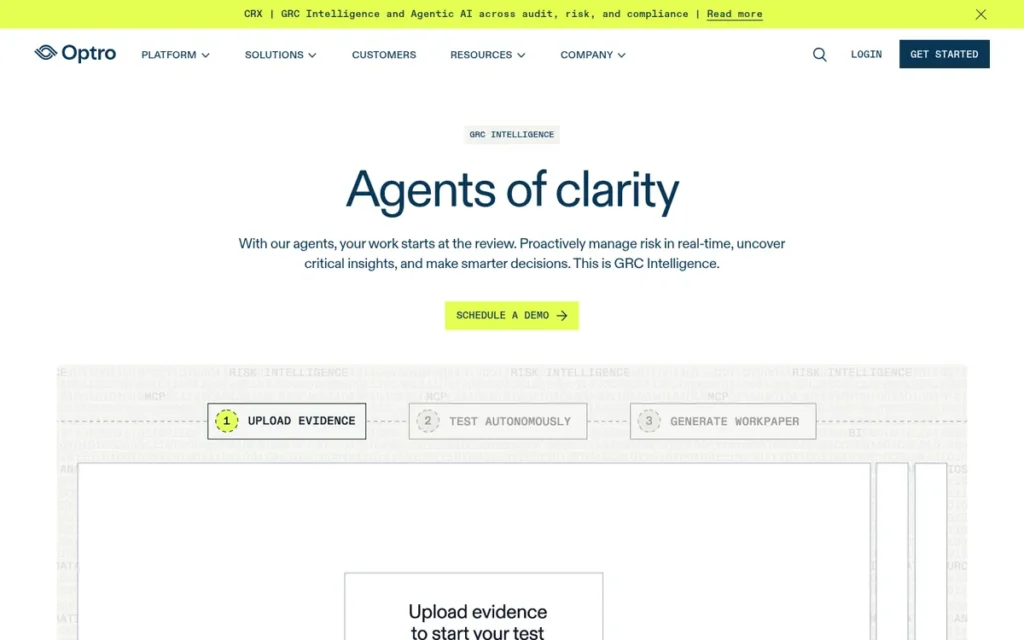
#1 of 3 Internal Audit & SOX Platforms · Evidence score 41/50
Scores: Reviews 5 · Results 3 · Sentiment 5 · Security 4 · Pricing 4 · Ecosystem 3 = 41/50 (primary criteria ×2)
Optro outscored Workiva on verified review volume and practitioner sentiment. It scored lower on documented numeric results and on security.
Category: Internal Audit & SOX Platform, manages audit planning, control testing, issues and board reporting inside companies.
At a Glance
- Category: Internal Audit & SOX Platform (Type B)
- Best For: Internal audit and SOX teams at mid-size to large companies running several modules with many control owners
- Price Range: Quote-based. ~$6,560 per core user per year in one public-sector bid. Practitioner-reported contracts of ~$80k–$250k+ per year (2022–2024)
- Primary Strength: Optro (formerly AuditBoard) has the most independent validation in its category: ~4.6/5 from ~1,600 reviews on G2 and 4.5/5 from 890 audit-management reviews on Gartner Peer Insights (October 2026).
- Biggest Limitation: Optro is the most expensive option in its category, and practitioners report that multi-module rollouts need about half an FTE of admin time in year one.
- One-Line Summary: Optro (formerly AuditBoard) is the most widely validated internal audit and SOX platform in this 2026 comparison. It suits mid-to-large companies that can absorb a premium price and first-year admin effort.
- Last Verified: October 2026
Overview
Optro (formerly AuditBoard) is a cloud platform for internal audit, SOX and connected risk. It is built for internal audit directors, SOX managers and controllers at mid-size to large companies running multi-module programs. Optro keeps controls, audits, risks and evidence on one shared data model.
AuditBoard rebranded as Optro on 9 March 2026 and announced the change at the IIA’s Great Audit Minds conference (CPA Practice Advisor, March 2026). Many review sites, including G2 and Capterra, still list Optro under the AuditBoard or SOXHUB name.
Key Features
- Optro runs SOX 404 controls testing, internal audit, enterprise risk, IT risk, compliance, ESG and AI governance on one shared data model.
- Optro reportedly lets control owners, auditees and executives use the platform as free, unlimited stakeholder users, so only auditors, testers and admins need paid core licences (Internal Audit Guide, 2026).
- Optro lists ERP integrations with SAP, Oracle NetSuite and Workday and claims 200+ integrations in total (ERP Research; SOC2Auditors.org, 2026).
- Optro automates control-owner questionnaires, document requests and status dashboards, which replace paper-based quarterly certification work (Flowers Foods case study, vendor-published, accessed October 2026).
- Optro holds SOC 1 Type 2, SOC 2 Type 2, ISO 27001 and TX-RAMP attestations, according to third-party security directories (SOC2Auditors.org, 2026).
Best For
Optro (formerly AuditBoard) is best for mid-size to large companies that want one platform for internal audit and SOX and have many control owners outside the audit team.
Optro also works below enterprise scale: one practitioner runs it in a 15-person department and reports it works well (r/InternalAudit, 2026). Practitioners add that small teams without SOX may find Microsoft 365 or SharePoint enough.
Strengths
- Optro (as AuditBoard) has ~4.6/5 from ~1,600 reviews on G2 and 4.7/5 from 414 reviews on Capterra. That is the largest verified review base in this comparison (October 2026).
- Optro holds 4.5/5 from 890 reviews in Gartner Peer Insights’ Audit Management Solutions market (October 2026). Optro (as AuditBoard) was named a 2024 Customers’ Choice, and 89% of the 296 reviewers in that report said they would recommend it (BusinessWire, March 2024).
- Optro users describe it replacing both TeamMate+ and Workiva. One user says control tracking and design time fell to 10% of what it was before (r/InternalAudit, 2024, self-reported).
- Optro customer Ulterra went live in “a few weeks.” Another vendor it considered had quoted about 90 days (Optro/Protiviti case study, vendor-published, accessed October 2026).
Users on r/InternalAudit shared their experience:
“With auditboard, in the first 3-6 months they do all the initial customization and loading up front (e.g., you send them all audit procedures and they organize and load), make sure you are comfortable with it, and train you and your team. Once that’s done, it is very easy to maintain: adding procedures, reviewing users, etc. is all intuitive.
Pros of AB vs. TM+: literally everything about the software and platform
Cons: more expensive, so I get that it’s not for every company” Posted by u/dinoman55555
Takeaway: Optro (formerly AuditBoard) users praise its vendor-led setup and easy upkeep, but its premium price puts it out of reach for some companies.
Limitations
Optro trades breadth for cost and admin effort. One practitioner called it “a LARGE tool to admin” that needs at least half an FTE in year one when several modules are deployed (r/InternalAudit, 2024).
- Optro’s reported contracts of $80k–$250k+ a year put it out of reach for many smaller teams, and one user said it “caters to mega corp shops” (r/Accounting, 2026).
- Optro’s per-control pricing can hurt control-heavy companies, one Capterra reviewer warned (Capterra reviewer, accessed October 2026).
- Optro reports and dashboards offer limited customisation, according to reviewers (G2 reviewer themes, October 2026).
- Optro can be slow with large files, and its complex modules, such as IT risk and ESG, require training (G2 reviewer themes, October 2026).
- Optro runs on infrastructure that meets FedRAMP Moderate requirements, but no FedRAMP authorisation of Optro’s own was found (third-party directories, 2026).
Verdict
Optro (formerly AuditBoard) is the best-validated internal audit and SOX platform in this 2026 comparison. It has the largest verified review base and the most consistently positive practitioner sentiment in its category.
Optro suits mid-to-large programs that combine SOX, internal audit and risk modules. Budget for premium pricing and first-year admin time. Smaller or non-SOX teams should compare Optro with TeamMate+ or a Microsoft 365 setup first.
2. Workiva: Best for SOX Programs That Sit Alongside SEC/XBRL and Connected Financial Reporting
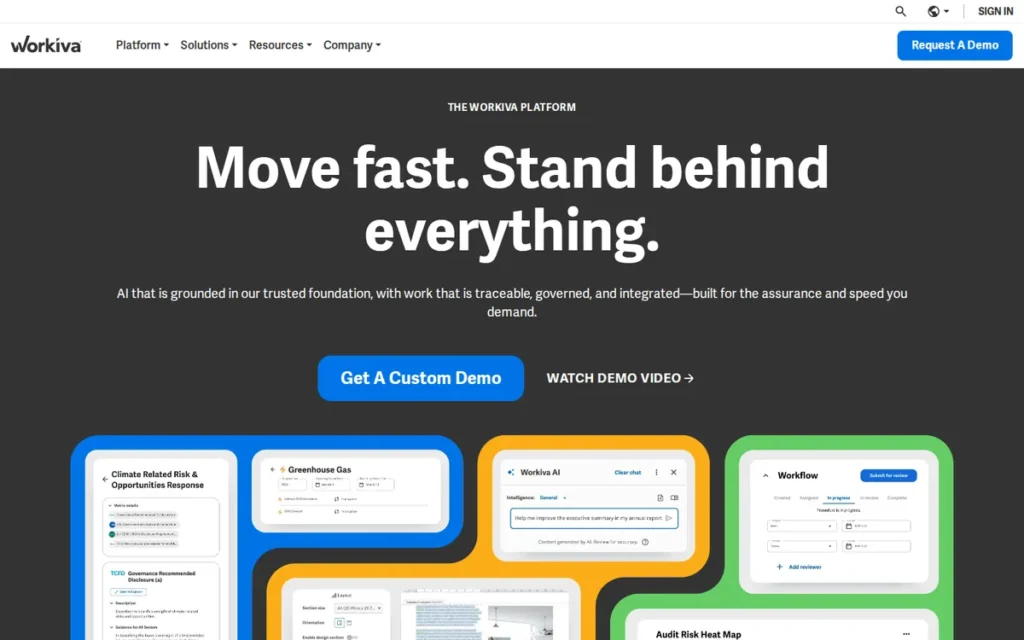
#2 of 3 Internal Audit & SOX Platforms · Evidence score 38/50
Scores: Reviews 4 · Results 4 · Sentiment 3 · Security 5 · Pricing 3 · Ecosystem 3 = 38/50 (primary criteria ×2)
Workiva has the top security score and ties for the top results score. It ranks second because its G2 and Capterra figures conflict and practitioner views are split.
Category: Internal Audit & SOX Platform, manages audit planning, control testing, issues and board reporting inside companies.
At a Glance
- Category: Internal Audit & SOX Platform (Type B)
- Best For: Public companies whose SOX program sits alongside SEC, XBRL and management reporting
- Price Range: Quote-based. Secondary-source median contract of ~$49,420 per year (Internal Audit Guide, 2026)
- Primary Strength: Workiva has the strongest documented SOX result in this comparison: Cornerstone Building Brands cut time per control by 77% (vendor-published customer story covering FY2019–FY2020).
- Biggest Limitation: Workiva is reported to be complex and slow on large documents, and practitioners disagree on whether it is easier or harder to use than Optro.
- One-Line Summary: Workiva has the strongest evidence in this 2026 comparison for companies whose SOX work must connect directly to SEC, XBRL and financial reporting on one linked-data platform.
- Last Verified: October 2026
Overview
Workiva is a cloud platform that links SOX controls testing, internal audit, SEC reporting (10-K, 10-Q, XBRL) and ESG reporting through a shared data layer. It is built for public-company controllers, SOX managers and audit teams whose controls work sits alongside external financial reporting.
Workiva was founded in 2008 in Ames, Iowa, and trades on the NYSE as WK. Unlike the audit-first tools here, Workiva was built around reporting first, so a number changed once updates in every linked document.
Key Features
- Workiva covers the SOX 404 cycle with risk and control matrices (RCMs), narratives, walkthroughs, testing, control-owner certifications, evidence requests and deficiency tracking.
- Workiva links data across SEC filings, SOX documentation, internal audit and ESG reporting, so a change made once updates everywhere it appears.
- Workiva has built-in AI for drafting, summarising, extracting data and spotting inconsistencies across documents (Workiva customer materials, accessed October 2026).
- Workiva uses an unlimited-user model priced by entities, controls and scope, which helps companies with many control owners (Internal Audit Guide, 2026).
- Workiva has held FedRAMP Moderate authorisation since October 2019 and holds ISO 27001 certification since August 2021, plus SOC 1 Type 2 and SOC 2 Type 2 reports (Workiva newsroom, October 2019; Workiva security statement, 2026).
Best For
Workiva is best for public companies where the SOX team, financial reporting team and disclosure committee need to work from the same linked numbers.
Workiva is also a practical choice when other departments already license it. One practitioner’s team moved to Workiva because Risk and other groups already used it (r/InternalAudit, 2026).
Strengths
- Workiva customer Cornerstone Building Brands cut average time per control from about 30 hours to 7, a 77% reduction. Cornerstone also cut SOX consultant spend from $1.5M in FY2019 to $0 in FY2020 (Workiva customer story covering FY2019–FY2020, vendor-published).
- Workiva is the only vendor in this comparison whose FedRAMP Moderate authorisation is confirmed by both its own security statement and a FedRAMP Marketplace listing (FedRAMP.gov, accessed October 2026).
- Workiva holds 4.5/5 from 666 reviews on Gartner Peer Insights across its markets (October 2026).
- Workiva customers Webster Bank and Playa Hotels report further time savings. Webster Bank cut quarterly certification from almost two weeks to a few days, and Playa cut its financial close from 10 days to 4 (Workiva customer stories, vendor-published, accessed October 2026).
Limitations
Workiva gives up some audit-first usability in exchange for reporting breadth. Users disagree sharply: one said Workiva “takes 10+ more click” than AuditBoard for the same task, while another found it “way less complicated” (r/InternalAudit, 2024).
- Workiva’s interface is complex and has a learning curve (G2 and Capterra reviewer themes via RFP.wiki and Copla, 2026).
- Workiva slows on large documents, lags between pages and sometimes logs users out without warning (G2 and Capterra reviewer themes, 2026).
- Workiva custom reports are hard to build, reviewers say, even though one practitioner felt Workiva has “the better reporting platform” (r/InternalAudit, 2024).
- Workiva price and renewal increases are a recurring reviewer complaint (reviewer themes, RFP.wiki, 2026).
- Workiva’s G2 and Capterra figures (roughly 4.5–4.7/5 and 4.4/5) come from third-party sources that conflict, and they were not checked on the platforms.
Users on r/InternalAudit noted:
“How did it compare with Workiva? They seem to have the better reporting platform but AB seems more intuitive.” Posted by u/PuhLeazeOfficer
Takeaway: Practitioners give Workiva the edge on reporting but see AuditBoard (now Optro) as more intuitive for day-to-day audit work.
Verdict
Workiva has the strongest evidence in this 2026 comparison for companies whose SOX program must connect directly to SEC and XBRL reporting.
Workiva is also the only reviewed vendor with FedRAMP Moderate authorisation of its own. Workiva’s SOX time savings are the strongest numbers here, but they are vendor-published. Audit-first teams without SEC reporting needs should compare Workiva with Optro.
3. Caseware: Best for Small and Midsize CPA Firms Wanting Standardized Engagement Files and AICPA-Aligned Methodology

#1 of 2 External-Audit Engagement Platforms · Evidence score 32/50
Scores: Reviews 3 · Results 3 · Sentiment 4 · Security 4 · Pricing 1 · Ecosystem 3 = 32/50 (primary criteria ×2)
Caseware ties DataSnipper at 32/50 and ranks higher on the tie-break criterion, practitioner sentiment (4 vs 2).
Category: External-Audit Engagement Platform, holds CPA-firm audit files, trial balance, methodology, workpapers and financial statements.
At a Glance
- Category: External-Audit Engagement Platform (Type A), plus IDEA for Audit Data Analytics (Type C)
- Best For: Small and midsize CPA firms that want standardised engagement files, detailed trial-balance grouping and AICPA-aligned methodology
- Price Range: Quote-based. No dollar figures verified (October 2026)
- Primary Strength: Caseware offers engagement workpapers, AICPA/CPA.com methodology and IDEA full-population analytics from one vendor, with ISO 27001:2022 and SOC 2 Type 2 on Caseware Cloud.
- Biggest Limitation: Caseware has a steep learning curve, and one G2 reviewer reports that some Working Papers features were not available after moving to the cloud.
- One-Line Summary: Caseware is the best-evidenced engagement platform for small and midsize CPA firms in this 2026 comparison. It pairs AICPA/CPA.com methodology with built-in IDEA analytics at the cost of a steep learning curve.
- Last Verified: October 2026
Overview
Caseware is a family of external-audit engagement products for small and midsize CPA firms. It keeps the trial balance, workpapers, methodology and financial statements in one engagement file, and its optional IDEA analytics handle full-population testing.
Caseware is the only vendor in this comparison that offers both engagement files and analytics under one brand. The Caseware family includes:
- Caseware Working Papers handles desktop engagement files.
- Caseware Cloud Audit runs engagements in the cloud with AICPA/CPA.com methodology built in.
- Caseware IDEA runs data analytics on client data.
- Caseware SmartSync lets several users work on one engagement file at once.
- Caseware AiDA provides an AI assistant inside the product family.
Key Features
- Caseware Working Papers and Caseware Cloud Audit run the whole engagement in one file, from engagement letter and trial balance to financial statements.
- Caseware Cloud Audit has AICPA/CPA.com-developed methodology built in. One reviewer said this gave confidence that the work matched professional standards (G2 reviewer, accessed October 2026).
- Caseware IDEA performs full-population testing, and its Claims & Assistance app automates standardised audit tests.
- Caseware Working Papers allows detailed trial-balance grouping, which practitioners value for standardising files across a firm (r/auditing, 2024).
- Caseware Cloud holds ISO 27001:2022 and SOC 2 Type 2, and customers in some markets can choose where their data is hosted (Caseware security certifications page, accessed October 2026).
Best For
Caseware is best for small and midsize CPA firms that value standardised files, detailed trial-balance grouping and methodology aligned to professional standards. It also suits firms that can spend time early learning the system.
Caseware also suits firms that want analytics built in through IDEA rather than bought from a separate analytics vendor.
Strengths
- Caseware IDEA’s Claims & Assistance app helped Allianz Partners complete 37 standardised audit tests in under one hour, down from between three days and two weeks (Caseware/Audicon case study, vendor-published, accessed October 2026).
- Caseware Cloud’s ISO 27001:2022 and SOC 2 Type 2 certifications are confirmed on Caseware’s own security-certifications page (accessed October 2026).
- Caseware Working Papers was called a “favorite” among midsize firms for its standardised files and detailed trial-balance grouping (r/auditing, 2024). Users who moved to Inflo say they miss Caseware’s 1–2-click navigation (r/Accounting, 2026).
- Caseware Cloud Audit is the only engagement product reviewed with AICPA/CPA.com-developed methodology built in, which gives firms a starting point aligned to professional standards.
Limitations
Caseware is detailed and controllable, but complex. Practitioners say firms must “spend time early to learn how to use the system” (r/auditing, 2024).
- Caseware holds 4.0/5 from 70 reviews on G2, the lowest verified G2 average in this comparison (G2, October 2026).
- Caseware’s Capterra reviewers report slow syncing on large files, freezing, crashes and unclear help documentation. Ease of use scores 4.1/5 from 36 reviews, on a listing that appears to be IDEA (Capterra, October 2026).
- Caseware may lose features in a desktop-to-cloud move: one reviewer reports that some Working Papers features were missing after moving to the cloud (G2 reviewer, accessed October 2026).
- Caseware’s newer cloud products drew mention of “horror stories” from one Reddit user (r/Accounting, 2026).
- Caseware publishes no verified dollar pricing, and reviewers call its licences “expensive,” which makes total cost hard to compare (October 2026).
Verdict
Caseware is the best-evidenced external-audit engagement platform for small and midsize CPA firms in this 2026 comparison.
Caseware is the only engagement platform reviewed that pairs AICPA-aligned methodology with built-in IDEA analytics. Expect a learning curve, and test desktop-to-cloud feature parity before migrating. Firms on Wolters Kluwer or Thomson Reuters should demo those vendors’ engagement products alongside Caseware.
4. DataSnipper: Best for Automating Excel Tie-Outs, Document Matching and Cross-Referencing on Top of Any Audit Platform
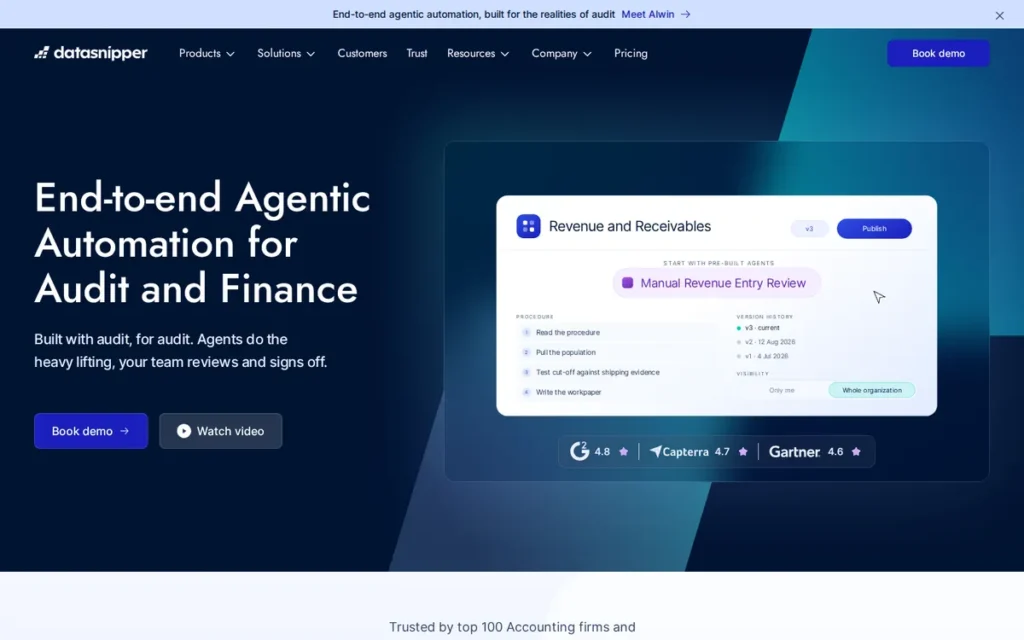
#1 of 1 Evidence & Tie-Out Automation Tools · Evidence score 32/50
Scores: Reviews 4 · Results 4 · Sentiment 2 · Security 3 · Pricing 2 · Ecosystem 4 = 32/50 (primary criteria ×2)
DataSnipper’s low sentiment score (2) reflects a lack of Reddit discussion, not negative discussion. That score decides the tie-break with Caseware.
Category: Evidence & Tie-Out Automation, matches documents to Excel, extracts evidence and cross-references it on top of any core audit platform.
At a Glance
- Category: Evidence & Tie-Out Automation (Type D)
- Best For: External and internal audit teams whose biggest time cost is manual Excel tie-outs, document matching and cross-referencing
- Price Range: Quote-based. No dollar figures verified; five-licence minimum reported (Capterra reviewer, October 2026)
- Primary Strength: DataSnipper reports the largest user base in this comparison, with 600,000+ users and all Big Four firms as customers (EU-Startups, October 2025; Fortune, 2026).
- Biggest Limitation: DataSnipper is a Windows-first Excel add-in that slows down with very large or poorly scanned PDFs, and it reportedly requires at least five licences.
- One-Line Summary: DataSnipper reports the largest user base of any product in this 2026 comparison. It works as an Excel add-in on top of an existing audit platform, not as a replacement for one.
- Last Verified: October 2026
Overview
DataSnipper is a Windows-first Excel add-in that pulls figures from PDFs, invoices and bank statements into Excel, with a live link back to each source. It is built for external and internal auditors who spend hours on manual tie-outs, document matching and cross-referencing.
DataSnipper does not manage the audit from planning to sign-off, and it does not test full populations for anomalies. DataSnipper works alongside your core engagement or internal audit platform.
Key Features
- DataSnipper lets users “snip” values from PDFs, invoices and bank statements into Excel, and each value keeps a link back to its source document.
- DataSnipper’s Document Matching automates vouching and tie-outs against supporting documents.
- DataSnipper’s pricing page lists AI Extractions, Version Comparison, Excel Agents, Disclosure Agents, DocuMine and Agent Builder among plan features (DataSnipper, accessed October 2026).
- DataSnipper supports single sign-on and lists integrations, but integrations with CCH Engagement and Caseware were not confirmed.
- DataSnipper runs mainly on Windows, so Mac users may need virtualisation.
Best For
DataSnipper is best for audit teams with five or more licensed users who already run an engagement or internal audit platform. It lets them cut Excel tie-out and cross-referencing time without replacing their core system.
Strengths
- DataSnipper reports 600,000+ users in 175 countries and 2,000+ customers, including all Big Four firms plus RSM, BDO, Baker Tilly, Grant Thornton and Crowe (EU-Startups, October 2025; Fortune, 2026).
- DataSnipper holds 4.8/5 from 221 reviews on G2, the highest verified G2 average in this comparison (G2, October 2026).
- DataSnipper raised a $100M Series B led by Index Ventures at a $1B valuation (Tech.eu, February 2024).
- DataSnipper users call snipping from PDF into Excel with a permanent link “a game changer for review” (Capterra reviewer, accessed October 2026).
Limitations
DataSnipper does one job well, but only one. DataSnipper does not manage the audit or test full populations, so firms still need a core platform.
- DataSnipper’s plug-in can be “glitchy,” and Excel slows or stops responding when many documents or poorly scanned PDFs are imported (Capterra and G2 reviewer themes, October 2026).
- DataSnipper’s reported five-licence minimum and Windows-first design limit very small firms and Mac-based firms (Capterra reviewer, accessed October 2026).
- DataSnipper’s claim of automating “up to 90% of menial audit tasks” comes from the vendor, with no named case study behind it (Silicon Republic, vendor CEO interview).
- DataSnipper states SOC 2 Type II on its security page, but its ISO 27001 compliance claim was not backed by a certificate we could confirm (DataSnipper security page, accessed October 2026).
- DataSnipper drew no substantive Reddit discussion in our searches, so independent practitioner evidence is thin.
Verdict
DataSnipper has the most reported users of any evidence and tie-out tool in this 2026 comparison, and it is the least disruptive fix for manual Excel cross-referencing.
DataSnipper adds to a core platform rather than replacing one. Confirm the licence minimum, the ISO 27001 certificate and compatibility with your engagement platform. Treat the vendor’s time-savings figures as marketing claims.
5. TeamMate+ (Wolters Kluwer): Best for Budget-Conscious and Public-Sector Internal Audit Teams in the Wolters Kluwer Ecosystem
#3 of 3 Internal Audit & SOX Platforms · Evidence score 29/50
Scores: Reviews 4 · Results 2 · Sentiment 2 · Security 3 · Pricing 5 · Ecosystem 2 = 29/50 (primary criteria ×2)
TeamMate+ ranks above MindBridge mainly on pricing transparency (5 vs 1) and verified review volume.
Category: Internal Audit & SOX Platform, manages audit planning, control testing, issues and board reporting inside companies.
At a Glance
- Category: Internal Audit & SOX Platform (Type B)
- Best For: Small-to-mid internal audit teams and public-sector audit offices with tight budgets or an existing Wolters Kluwer relationship
- Price Range: ~$3,075 per user per year. $21,781 required in year one for 2 users, including implementation (City of Norman statement of work, February 2025)
- Primary Strength: TeamMate+ has the most transparent pricing in its category: an itemised public quote shows $21,781 required in year one for 2 users, or $26,396 with optional services.
- Biggest Limitation: TeamMate+ gets the most negative practitioner feedback in its category, including reports of unstable updates, clunky hyperlinking and no prior-year roll-forward after migration.
- One-Line Summary: TeamMate+ is the most price-transparent internal audit platform in this 2026 comparison. It suits budget-conscious and public-sector teams willing to accept a dated interface and a long implementation.
- Last Verified: October 2026
Overview
TeamMate+ is Wolters Kluwer’s internal audit management suite and runs in the cloud or on-premise. It is built for internal audit and public-sector audit teams that want detailed workpapers, multi-level sign-off chains and IIA-aligned methodology.
TeamMate+ replaced the older on-premise TeamMate AM, and teams already using Wolters Kluwer products such as CCH may find it familiar. The TeamMate+ suite includes:
- TeamMate+ Audit manages internal audits from planning through follow-up.
- TeamMate Controls handles SOX testing.
- TeamMate Analytics runs analytics inside Excel.
- TeamMate AI Editor drafts and summarises audit text with generative AI.
Key Features
- TeamMate+ Audit provides multi-level review and sign-off chains across the audit lifecycle.
- TeamMate Controls handles SOX 404 controls testing within the same TeamMate+ suite.
- TeamMate Analytics works inside Excel on data the team exports and loads. It does not pull directly from source systems or test continuously (DSG.ai, 2026).
- TeamMate AI Editor’s text generation and summarising scored 7.5/10 from 244 reviewers on G2 (G2, October 2026).
- TeamMate+ runs in the cloud through TeamCloud or on-premise, and reviewers mention Power BI integration (G2 reviewer themes, October 2026).
Best For
TeamMate+ is best for internal audit teams and public-sector audit offices that need predictable, documented pricing, an on-premise option, or a fit with existing Wolters Kluwer tools. TeamMate+ fits less well for teams that put modern usability first.
Strengths
- TeamMate+ has the clearest public pricing of any internal audit platform reviewed: $6,150.88 a year for 2 users plus $15,630 implementation, for a required first year of $21,780.88 (City of Norman statement of work, 28 February 2025).
- TeamMate+ has ratings checked on three platforms: 4.3/5 from 597 reviews on G2, 4.3/5 from 117 on Capterra and 4.2/5 from 120 on Gartner Peer Insights (October 2026).
- TeamMate+ serves named customers including Aviva (since 2012), Nissan, Ferrero, Singapore Airlines, the Tennessee Comptroller and the North Dakota State Auditor (Wolters Kluwer, accessed October 2026).
- TeamMate+ has practitioner fans. One user said it makes their workpaper organisation and workflow efficient (r/InternalAudit, 2025).
Limitations
TeamMate+ costs less and publishes its price, but users report weaker usability and stability. The top comment in a 2025 TeamMate+ thread says “every time they fix something they break something else” (r/InternalAudit, 2025).
- TeamMate+ migration caused problems at one state agency running about 4,000 audits a year. After leaving TeamMate AM, the agency reported no prior-year workpaper roll-forward, one-at-a-time downloads and broken PDF links (r/InternalAudit, 2025).
- TeamMate+ is hard for second-level reviewers, one practitioner said, and another reviewer reported “a couple of years to become fully operational” (r/InternalAudit, 2025; Capterra reviewer, accessed October 2026).
- TeamMate+ charges extra for analytics and API access, reviewers report (G2 reviewer themes, October 2026).
- TeamMate+ SOC 2 Type II coverage applies at the TeamCloud hosting level, so ask Wolters Kluwer to confirm the report also covers the TeamMate+ application itself.
- TeamMate+ case studies retrieved for this guide contained no numeric customer results.
This aligns with community sentiment on r/InternalAudit:
“I implemented TeamMate+ at my prior employer and we found it clunky to use and not nearly as customizable as they made it sound.” Posted by u/GetRidOf_TheSeaward
Takeaway: TeamMate+ implementers report that the product falls short of its sales pitch on usability and customisation.
Verdict
TeamMate+ is the most price-transparent internal audit platform in this 2026 comparison, with a public quote of about $21,800 for a required first year including implementation.
TeamMate+ suits budget-conscious, public-sector and Wolters Kluwer-aligned teams. Test prior-year roll-forward and the reviewer workflow in a sandbox. Before signing, get written confirmation that the SOC 2 report covers the application itself.
6. MindBridge: Best for Full-Population AI Anomaly Detection in High-Volume Audit Practices
#1 of 1 Standalone Audit Data Analytics Tools · Evidence score 27/50
Scores: Reviews 3 · Results 3 · Sentiment 2 · Security 4 · Pricing 1 · Ecosystem 2 = 27/50 (primary criteria ×2)
MindBridge ranks above Inflo on verified review volume and practitioner sentiment, and below TeamMate+ on pricing transparency.
Category: Audit Data Analytics, scores every journal entry and transaction for risk instead of relying on a sample.
At a Glance
- Category: Audit Data Analytics (Type C)
- Best For: High-volume audit firms and large internal audit teams that want AI-driven testing of every journal entry
- Price Range: Quote-based, priced by transaction volume, engagements and firm size. No dollar figures verified (October 2026)
- Primary Strength: MindBridge scores 100% of journal entries for risk, and KPMG reports deploying the technology in nearly 3,000 audits across more than 60 member firms (KPMG Audit Quality Report, 2023).
- Biggest Limitation: MindBridge is reported to be hard to load and map data into, it produces false positives when client data is messy, and no named time-saved case studies were found.
- One-Line Summary: MindBridge is the only standalone AI full-population risk-scoring tool in this 2026 comparison. It suits high-volume practices that can invest in data preparation.
- Last Verified: October 2026
Overview
MindBridge is a cloud AI analytics platform that scores 100% of journal entries and transactions for risk across the general ledger, payables, receivables and payroll. It is built for audit firms and internal audit teams that want to find anomalies across the whole population instead of relying on samples alone.
MindBridge is not a workpaper system and works alongside a core engagement or internal audit platform. MindBridge was founded in 2015 in Ottawa and had about 150 staff in 2025 (Ottawa Business Journal, 2025).
Key Features
- MindBridge analyses every journal entry and transaction across the general ledger, accounts payable, accounts receivable and payroll.
- MindBridge combines rule-based tests, statistical methods and machine learning to give each transaction a risk score.
- MindBridge ranks transactions by risk so auditors review the riskiest first, which lets journal-entry testing replace sampling or run alongside it.
- MindBridge works alongside rule-based analytics tools such as IDEA or ACL rather than replacing them (LedgerBrief, 2026).
- MindBridge technology runs inside KPMG’s audit platform as KPMG Clara Transaction Scoring, under an alliance announced in April 2023 (KPMG, April 2023).
Best For
MindBridge is best for larger audit firms and internal audit teams with enough volume to justify an enterprise contract and enough data-preparation skill to map client ledgers that don’t follow a standard layout. Secondary reviews of its pricing say MindBridge fits small practices less well (LedgerBrief and Tooliverse, 2026).
Strengths
- MindBridge entered a global alliance with KPMG, announced in April 2023. KPMG reports that the resulting KPMG Clara Transaction Scoring was deployed in nearly 3,000 audits across more than 60 member firms (KPMG Audit Quality Report, 2023).
- MindBridge holds a SOC 2 Type II report covering all five Trust Services Criteria and ISO/IEC 27001:2022 certification, both audited by A-LIGN (MindBridge, 2024).
- MindBridge holds 4.4/5 from 62 reviews on G2, listed as “MindBridge AI Auditor,” and users praise its full-population coverage and risk ranking (G2, October 2026).
- MindBridge supports full-population testing directly, which matters more now that the PCAOB amendments to AS 1105 and AS 2301 apply to fiscal years beginning on or after 15 December 2025 (SEC, August 2024).
Limitations
MindBridge covers the full population but needs heavy data preparation. Reviewers say loading and mapping client data is hard, especially for staff-level users (TechReviewer, 2026).
- MindBridge produces false positives when client data is messy, reviewers report (TechReviewer; LedgerBrief, 2026).
- MindBridge risk scores can be hard to turn into audit conclusions you can defend, reviewers say, which matters under PCAOB documentation requirements (LedgerBrief, 2026).
- MindBridge has no named client case studies with time-saved figures, and our searches found no substantive Reddit discussion of the product.
- MindBridge has had leadership turnover, with Bill Hewitt named interim CEO in 2025. Buyers signing multi-year contracts may want to ask about this (Ottawa Business Journal, 2025).
- MindBridge publishes no pricing, so budgeting requires a custom quote.
Verdict
MindBridge is the only standalone AI full-population risk-scoring tool in this 2026 comparison, and KPMG has deployed it as KPMG Clara Transaction Scoring.
MindBridge has less community and outcome evidence than most products reviewed: no named time-saved case studies and no substantive Reddit discussion were found. Pair MindBridge with a core platform and pilot it on a real, messy client ledger. Check that its results can be explained well enough for PCAOB documentation.
7. Inflo: Best for CPA Firms Ready to Redesign Their Audit Process Around Client Data and Built-In Document Requests
#2 of 2 External-Audit Engagement Platforms · Evidence score 22/50
Scores: Reviews 1 · Results 3 · Sentiment 1 · Security 4 · Pricing 2 · Ecosystem 2 = 22/50 (primary criteria ×2)
Inflo ranks seventh because two primary-weighted criteria pull it down: it has only 4 G2 reviews, and practitioner sentiment is mostly negative.
Category: External-Audit Engagement Platform, holds CPA-firm audit files, trial balance, methodology, workpapers and financial statements.
At a Glance
- Category: External-Audit Engagement Platform (Type A), with built-in analytics and document requests
- Best For: CPA firms willing to redesign their audit process around client data, built-in PBC requests and quality management
- Price Range: Quote-based. Analytics priced per client with unlimited data extractions; no dollar figures verified (ICAEW, 2026)
- Primary Strength: Inflo puts workpapers, client document requests, full-population analytics and SQMS 1/ISQM 1 quality management in one platform, with ISO 27001:2022 and SOC 2 Type II.
- Biggest Limitation: Inflo has the thinnest review evidence in this comparison (4 G2 reviews) and the harshest practitioner feedback among engagement platforms.
- One-Line Summary: Inflo is the only engagement platform in this 2026 comparison that builds the audit around client-ledger data loaded into the platform. Its review evidence is thin, and users report serious adoption problems.
- Last Verified: October 2026
Overview
Inflo is a data-first cloud audit platform that combines engagement workpapers with client document requests, ledger analytics and quality management. It is built for CPA firms willing to redesign their audit process around client data.
Inflo calls its approach “AI-in-the-loop,” meaning the auditor keeps the judgment calls. Inflo was founded in 2016 by former PwC accountants Mark Edmondson and Graham Clark (Deloitte UK Fast 50, 2021).
Key Features
- Inflo Audit provides engagement workflow, workpapers and methodology on a cloud platform.
- Inflo Collaborate manages the client PBC list and document requests inside the engagement.
- Inflo Ingest, Detect, Flux, Revenue Cascade and Explore load client ledgers directly and run full-population analytics.
- Inflo Quality supports SQMS 1/ISQM 1 quality-management requirements.
- Inflo is hosted on Azure, with ISO/IEC 27001:2022 and SOC 2 Type II confirmed by the vendor, plus SSO and APIs (Inflo security page, accessed October 2026).
Best For
Inflo is best for CPA firms that want document requests, analytics and quality management built into one engagement platform and are prepared to redesign their process and run a hands-on pilot. Inflo fits less well for firms that want a familiar workpaper tool with few clicks per task.
Strengths
- Inflo reported 430,000+ users in 113 countries, $25.2M in contracted annual recurring revenue (ARR), 254% US revenue growth and its largest contract to date with a Top 20 US firm (Inflo Annual Report, 2024).
- Inflo’s US customers made up 44% of contracted ARR in 2024, up from 8% in 2023. The company reported 118% net revenue retention (Inflo Annual Report, 2024).
- Inflo is the only engagement platform reviewed with built-in client document requests and an SQMS 1/ISQM 1 quality module, which address PBC chasing and quality-management requirements directly.
- Inflo customer Duncan & Toplis found the preparer-to-reviewer workflow intuitive and the support good (Inflo case study, vendor-published, accessed October 2026).
Limitations
Inflo’s integrated, data-first design is costly to adopt. Users switching from CCH or Caseware called it “half baked” and “not intuitive at all” (r/Accounting, 2025).
- Inflo takes more clicks for everyday tasks, according to one user: “What used to be 1 or two clicks in Caseware’s to open something now take 6-7 clicks in inflo” (r/Accounting, 2026).
- Inflo adopters report chaotic training, and one firm kept financial-statement prep in its legacy system, which split its work across two platforms (r/Accounting, 2025).
- Inflo updates and bug fixes “sometimes lagged,” even according to Inflo’s own Duncan & Toplis case study (vendor-published, accessed October 2026).
- Inflo’s G2 rating of 4.4/5 rests on only 4 reviews, and no Inflo-specific Capterra listing was found (G2, October 2026).
- Inflo billing was inconvenient for one reviewer, who found paying a non-US vendor awkward and said recurring payment was not offered (G2 reviewer, accessed October 2026).
Users on r/Accounting noted:
“Depends on the niches honestly, we switched in June and for NFP it’s been okay, for construction and banks it’s been a nightmare.
Not only can you not tick and tie, there is no way to reference other work papers, at least not effectively. Plus the whole trial balance portion isn’t user friendly and they push the client to do it themselves.” Posted by u/SeparatePair4288
Takeaway: How well Inflo works depends on the firm’s niche: it’s workable for nonprofit audits, but firms that switched from Caseware call it a nightmare for complex industries because of weak tick-and-tie, cross-referencing and trial-balance tools.
Verdict
Inflo is the only engagement platform in this 2026 comparison with built-in document requests, analytics and quality modules, but its thin review base and negative practitioner feedback make a sandbox pilot essential.
Before committing to Inflo, confirm it can produce your financial statements so work isn’t split across systems. Also ask for reference calls with US firms of a similar size.
Which Other Audit Tools Are Worth Considering?
Five other audit tools are worth considering, though they are not ranked here:
- CCH Axcess Engagement
- Thomson Reuters Cloud Audit Suite
- Diligent HighBond/One
- AuditFile
- Suralink
We left them unranked because we did not gather verified evidence on them comparable to the seven ranked products. That says nothing for or against their quality.
- CCH Axcess Engagement / ProSystem fx Engagement (Wolters Kluwer): CCH Engagement is widely used by small US firms and matters most to firms already on Wolters Kluwer tax tools.
- Thomson Reuters Cloud Audit Suite: The Thomson Reuters suite includes Guided Assurance and AdvanceFlow for CPA-firm audits.
- Diligent HighBond / Diligent One: Diligent sells audit, risk and compliance platforms for companies.
- AuditFile: AuditFile is a cloud engagement tool for smaller firms, and its pricing comes from a single unverified source.
- Suralink: Suralink is a tool for managing client document requests during audits.
Which Audit Software Vendors Publish Prices and Hold SOC 2 Type II, ISO 27001 or FedRAMP?
Workiva is the only vendor here with FedRAMP Moderate authorisation of its own, and TeamMate+ is the only one with an itemised public quote. Four vendors confirm both SOC 2 Type II and ISO 27001 on their own pages: Workiva, Caseware, Inflo and MindBridge. Optro’s attestations come from third-party directories, and DataSnipper’s and TeamMate+’s come with caveats about what they cover.
| Company | Pricing Unit and Best Public Price Evidence | Security Attestations | Deployment | Review Score (Count, How Obtained) |
|---|---|---|---|---|
| Optro | Quoted by modules, users and controls. ~$6,560 per core user per year in one public-sector bid (Internal Audit Guide, 2026). $80k–$250k+ per year practitioner-reported (Reddit, 2022–2024) | SOC 2 Type II: yes (third-party directories, 2026); ISO 27001: yes (third-party directories); FedRAMP: no authorisation of its own found (its hosting meets FedRAMP Moderate) | Cloud | G2 ~4.6/5 (~1,600); Capterra 4.7/5 (414); Gartner 4.5/5 (890). All checked on the platforms, October 2026 |
| Workiva | Quoted by entities, controls and scope. ~$49,420 median annual contract (secondary source, 2026) | SOC 2 Type II: yes (confirmed by vendor); ISO 27001: yes (since August 2021); FedRAMP Moderate: yes (authorised October 2019, listed on FedRAMP Marketplace) | Cloud | Gartner 4.5/5 (666, all Workiva markets), checked on the platform. G2/Capterra figures conflict and were not checked |
| Caseware | Quote-based. No dollar figures verified (October 2026) | SOC 2 Type II: yes for Caseware Cloud (confirmed by vendor); ISO 27001:2022: yes (confirmed by vendor); FedRAMP: not confirmed | Desktop and cloud | G2 4.0/5 (70), checked on the platform; Capterra 4.4/5 (36, listing appears to be IDEA) |
| DataSnipper | Five-licence minimum reported. No dollar figures verified | SOC 2 Type II: yes (stated by vendor); ISO 27001: compliance claimed, certificate not confirmed; FedRAMP: not confirmed | Windows-first Excel add-in | G2 4.8/5 (221), checked on the platform, October 2026 |
| TeamMate+ | Per user. $6,150.88 a year for 2 users; $21,780.88 required in year one ($26,395.88 with optional services) (public-sector statement of work, February 2025) | SOC 2 Type II: yes at the TeamCloud hosting level (coverage of the application to be confirmed); ISO 27001: listed by Wolters Kluwer; FedRAMP: not confirmed | Cloud (TeamCloud) or on-premise | G2 4.3/5 (597); Capterra 4.3/5 (117); Gartner 4.2/5 (120). All checked on the platforms |
| MindBridge | Quoted by transaction volume, engagements and firm size. No dollar figures verified | SOC 2 Type II: yes (confirmed by vendor, A-LIGN, 2024); ISO 27001:2022: yes (confirmed by vendor); FedRAMP: not confirmed | Cloud | G2 4.4/5 (62, listed as “MindBridge AI Auditor”), checked on the platform, October 2026 |
| Inflo | Analytics priced per client, with unlimited data extractions. No dollar figures verified | SOC 2 Type II: yes (confirmed by vendor); ISO 27001:2022: yes (confirmed by vendor); FedRAMP: not confirmed | Cloud (Azure) | G2 4.4/5 (4), checked on the platform; no Capterra listing found |
How Much Does Financial Audit Software Actually Cost?
None of the seven vendors publishes complete dollar pricing. The verified public evidence ranges from a required first year of $21,781 for a two-user TeamMate+ team (public-sector quote, February 2025) to practitioner-reported Optro contracts of $80k–$250k+ a year (Reddit, 2022–2024). The pricing unit changes total cost more than the headline rate does.
Verified price points, labelled by source type:
- TeamMate+ cost $6,150.88 a year for 2 users (about $3,075 per user) plus $15,630 implementation after a $6,000 discount, for a required first year of $21,780.88 (City of Norman statement of work, 28 February 2025).
- TeamMate+ optional eLearning ($1,071.20) and Expert on Demand ($4,078.80) services brought the same quote to $26,395.88 (City of Norman statement of work, 28 February 2025).
- TeamMate+’s $0.01 “starting price” on Capterra is a placeholder, not a real price.
- Optro’s public-sector bid showed about $6,560 per core user per year for the first 25 users and $5,400 per additional user, before discounts (Internal Audit Guide, 2026).
- Optro contracts reported by three practitioners were ~$80k a year for 15 users, $150k then $120k a year for three modules, and ~$250k for four modules (r/InternalAudit, 2022–2024).
- Workiva’s median annual contract is reported at about $49,420, which is a rough secondary-source guide (Internal Audit Guide, 2026).
- Caseware, DataSnipper, MindBridge and Inflo had no verified dollar figures as of October 2026, so request a written all-in quote from each (see Question #1).
The two documented price points show how far apart costs can be. A two-user TeamMate+ team paid $21,781 in its first year including implementation (2025 public quote). Practitioners report Optro multi-module contracts starting near $80,000 a year. The gap reflects team shape and scope more than vendor quality.
How each pricing unit changes total cost:
- Per user: TeamMate+ charges per user, which is cheapest for small teams and grows with headcount.
- Per control or module: Optro reportedly prices by controls and modules, and one reviewer warned this can hurt control-heavy companies (Capterra reviewer, accessed October 2026).
- Many-user models: Optro reportedly gives control owners free stakeholder access, and Workiva uses an unlimited-user model priced by entities, controls and scope. Both help when many control owners take part.
- Per client: Inflo prices analytics per client, with unlimited data extractions (ICAEW, 2026).
- Per volume: MindBridge quotes by transaction volume, engagements and firm size (LedgerBrief, 2026).
- Licence minimums: DataSnipper reportedly requires at least five licences.
Ask each vendor to quote for both your user count and your control count. Under per-control pricing, a hypothetical 3-person team testing 400 controls could pay more than a 10-person team testing 80 controls.
Hidden costs to budget for:
- Optro multi-module rollouts reportedly need about 0.5 FTE of admin time in year one (r/InternalAudit, 2024).
- TeamMate+ implementation added $15,630 to the City of Norman quote, more than twice the annual licence cost (February 2025).
- Template conversion and data migration add cost when moving off a legacy system, as Caseware reviewers note.
- Renewal increases are a reported complaint for Workiva, and Optro practitioners recommend multi-year terms with renewal caps in writing.
Do Add-On Tools Replace a Core Audit Platform?
No. DataSnipper and MindBridge add to a core audit platform; they do not replace one, because neither manages engagement files, audit planning or sign-offs. Most firms combine tools. Common pairings are Caseware plus DataSnipper for external audits, or Optro plus MindBridge for internal audit with full-population testing.
None of the seven vendors reviewed covers all four types well. Caseware comes closest by pairing engagement files with IDEA analytics.
Common combinations:
- A CPA firm on Caseware can add DataSnipper for tie-outs and use Caseware IDEA for analytics, which keeps the number of vendors down.
- A CPA firm on Inflo gets analytics (Detect) and document requests (Collaborate) inside the platform, but should confirm that Inflo can also produce the financial statements.
- An internal audit team on Optro or Workiva can add MindBridge for journal-entry testing and DataSnipper for evidence matching.
- A TeamMate+ user gets TeamMate Analytics in Excel, but TeamMate Analytics works only on exported data and does not pull from source systems.
Can I Trust G2 and Capterra Scores for Audit Software?
Only partly. Verified G2 averages for the seven products span only 4.0 to 4.8, but review counts span 4 to roughly 1,600. A buyer learns more from the review count, how each rating was obtained and practitioner discussion than from the star rating itself.
Three checks before you trust a score:
- Check the review count. Inflo’s 4.4/5 on G2 comes from 4 reviews, while Optro’s ~4.6/5 comes from about 1,600 (G2, October 2026).
- Check where the number came from. Workiva’s G2 and Capterra figures conflict across third-party sources, so check the live listings rather than trusting comparison articles.
- Check practitioner discussion. Reddit threads from 2022 to 2026 clearly favour Optro and clearly criticise TeamMate+ and Inflo, a split that review scores alone don’t show.
What Red Flags Should I Watch For When Evaluating Financial Audit Software?
These are the six biggest red flags when evaluating financial audit software:
- a vendor that can’t produce its own SOC 2 Type II report
- an evaluation done only through demos
- prior-year workpapers that won’t roll forward
- account reps who keep changing
- training that lags behind the rollout
- financial statements left in a legacy system
Each comes from documented practitioner reports.
Red Flag #1: No SOC 2 Type II Report on Request
A vendor that cannot produce its own SOC 2 Type II report should not make your shortlist, because your audit files hold confidential client data. One practitioner wrote, “I’d never hand over my audit documents to a SaaS org than can’t produce a SOC 2 Type 2” (r/auditing, 2026).
Takeaway: Ask for the vendor’s own SOC 2 Type II report before any demo.
Red Flag #2: Demo-Only Evaluation With No Sandbox on a Real Engagement
Vendor demos use clean sample data that hides roll-forward, data-mapping and performance problems. Practitioners advise loading one real prior-year engagement into a sandbox and testing it with the staff who will use it daily. Do this before signing, so problems show up before the contract does (r/InternalAudit, 2026).
Red Flag #3: No Prior-Year Workpaper Roll-Forward After Migration
If prior-year workpapers don’t roll forward, every new audit means rebuilding files by hand. One state agency running about 4,000 audits a year moved from TeamMate AM to TeamMate+. It then reported no roll-forward, one-at-a-time downloads and broken PDF links (r/InternalAudit, 2025).
Red Flag #4: Rotating Account Representatives
An account team that keeps changing suggests weak post-sale support, which matters during a multi-year rollout. One practitioner described getting “3 emails a month, each one from someone else claiming to be my executive” from Thomson Reuters Guided Assurance, a product not ranked here (Reddit practitioner report, date not confirmed).
Red Flag #5: Training That Lags Behind Rollout
If software rolls out before staff are trained, adoption suffers and efficiency gains never arrive. One Inflo adopter described the training as “just a mess” (r/Accounting, 2025). CPA.com lists poor usability and no gain in staff efficiency among common reasons implementations fail (CPA.com, 2025).
Red Flag #6: Financial-Statement Prep Left in the Legacy System
If the new tool can’t produce financial statements, work gets split across two systems and review trails break. One firm adopting Inflo reported keeping financial-statement prep in its legacy system (r/Accounting, 2025). Confirm the tool can produce financial statements end to end in the sandbox before signing.
What Questions Should I Ask Before Choosing Financial Audit Software?
Before choosing financial audit software, ask seven questions:
- What is the all-in first-year cost?
- Will prior-year files roll forward in a sandbox?
- Which certifications does the vendor hold itself?
- How deep do the integrations go?
- How much admin staffing does year one need?
- What renewal caps will the vendor put in writing?
- Can the tool’s results be explained for PCAOB documentation?
Each question targets a hidden cost or a known failure point.
Question #1: Is pricing per user, per control or per client, and what is the all-in first-year cost including implementation and training?
Ask for a written quote that lists licences, implementation, training and add-on modules separately. For scale, TeamMate+’s February 2025 public quote added $15,630 of implementation to $6,150.88 in annual licences. Optional services raised its total from $21,781 to $26,396.
Question #2: Can you show my prior-year files rolling forward in a sandbox?
Ask the vendor to load a real prior-year engagement and roll it forward while you watch. In the practitioner discussions reviewed for this guide, prior-year roll-forward is among the most-reported migration failures, including the move from TeamMate AM to TeamMate+ (r/InternalAudit, 2025).
Question #3: Which certifications do you hold yourselves, as opposed to your hosting provider?
Ask for the vendor’s own SOC 2 Type II report, ISO 27001 certificate and any FedRAMP package ID. An app hosted on a FedRAMP-authorised cloud is no more authorised than a tenant owns the building’s security certificate. Workiva holds its own FedRAMP Moderate authorisation, but no Optro authorisation was found.
Ask about data-residency options as well. Caseware Cloud, for example, lets customers in some markets choose where their data is hosted.
Question #4: How deep is the integration with our accounting system, trial balance and existing Wolters Kluwer or Thomson Reuters tools?
Ask for a live demo of the integration using your own trial balance, not a slide of partner logos. Optro, for example, claims 200+ integrations, while DataSnipper’s integrations with CCH Engagement and Caseware were not confirmed in this research. Firms on Wolters Kluwer tax tools should also demo CCH Axcess Engagement.
Question #5: How much admin staffing does year one require?
Ask reference customers how many staff hours setup and ongoing admin took in year one. One Optro practitioner estimated about half an FTE in the first year for a multi-module rollout (r/InternalAudit, 2024). One TeamMate+ reviewer reported a couple of years to become fully operational.
Question #6: What renewal caps will you commit to in writing?
Get caps on renewal increases into the contract before signing, ideally alongside a multi-year term. Reviewers name renewal increases as a complaint for Workiva (RFP.wiki, 2026). Optro practitioners recommend multi-year terms with renewal caps to hold down cost (r/InternalAudit, 2024).
Question #7: Can your tool’s results be explained well enough for PCAOB documentation?
Ask how the tool documents data completeness, test parameters and exception follow-up. The PCAOB amendments to AS 1105 and AS 2301 require all three for fiscal years beginning on or after 15 December 2025. Pilot the tool on a messy real client ledger to see how many false positives appear.
How Did We Rank These Financial Audit Software Tools?
We scored all seven products from 1 to 5 on six criteria. Four primary criteria count double and two secondary criteria count once, for a maximum of 50 points. The overall rank shows how strong and checkable each product’s evidence is, not which type of software is better, so compare within your type first.
Ranking criteria, why each matters and what earns a 5 or a 1:
- C1: Review Platform Ratings and Volume (primary): Ratings checked on G2, Capterra or Gartner Peer Insights are the most widely available signal from real users. A 5 means 4.5+ on two or more platforms with hundreds of reviews. A 1 means fewer than 10 reviews or no listing.
- C2: Documented Results and Adoption (primary): Named results with numbers help buyers justify the purchase. A 5 means several named case studies with numbers. A 1 means no outcomes were found. Vendor-published results are capped at 4 unless corroborated.
- C3: Practitioner Sentiment (primary): Community discussion separates products more clearly than review scores. A 5 means clearly positive across several threads. A 1 means mostly negative. A lack of discussion scores 2.
- C4: Verified Security and Compliance (primary): SOC 2 Type II and ISO 27001 are minimum buyer requirements. A 5 means SOC 2 Type II, ISO 27001 and FedRAMP Moderate, all confirmed by the vendor. A 1 means not confirmed.
- C5: Pricing Transparency (secondary): Dated public figures make budgeting realistic. A 5 means an itemised public quote including implementation. A 1 means no verified pricing.
- C6: Ecosystem Fit and Implementation Risk (secondary): Integration depth and migration risk decide whether rollouts succeed. A 5 means documented integrations and a short go-live. A 1 means failed migrations dominate.
Final evidence scores (C1–C6):
- Optro (formerly AuditBoard) scored 41/50 (5, 3, 5, 4, 4, 3).
- Workiva scored 38/50 (4, 4, 3, 5, 3, 3).
- Caseware scored 32/50 (3, 3, 4, 4, 1, 3).
- DataSnipper scored 32/50 (4, 4, 2, 3, 2, 4).
- TeamMate+ scored 29/50 (4, 2, 2, 3, 5, 2).
- MindBridge scored 27/50 (3, 3, 2, 4, 1, 2).
- Inflo scored 22/50 (1, 3, 1, 4, 2, 2).
Ties are broken by practitioner sentiment (C3), then by verified review volume (C1). Caseware and DataSnipper both scored 32, and Caseware ranks higher on C3 (4 vs 2). Missing data is marked “not confirmed” and scored low rather than filled in with assumptions.
Verification notes (October 2026): we re-checked the following against vendor and platform pages, then updated the scores:
- MindBridge’s security attestations and G2 rating
- DataSnipper’s G2 review count
- Caseware’s G2 rating
- TeamMate+’s hosting attestations
PlugRoute has no affiliate relationships with any company listed. Rankings are determined entirely by research data and objective evaluation criteria.
What Do Buyers Most Often Ask About Financial Audit Software?
Buyers most often ask which tool suits a small CPA firm, whether AuditBoard and Optro are the same product, and how PlugRoute decides its rankings. Each answer below opens with a direct reply, then gives the evidence behind it, so every answer stands on its own.
What is the best financial audit software for a small CPA firm?
Caseware is the best-evidenced engagement platform for small CPA firms in this comparison. Caseware offers standardised files, AICPA/CPA.com methodology and IDEA analytics, though it has a steep learning curve. Firms already on Wolters Kluwer tax tools should also demo CCH Axcess Engagement (not ranked). Add DataSnipper for tie-outs only if your firm can use at least five licences.
Is AuditBoard the same as Optro?
Yes. AuditBoard rebranded as Optro on 9 March 2026, and the platform covers the same internal audit, SOX and risk modules (CPA Practice Advisor, March 2026). Many review sites, including G2 and Capterra, still list the product as AuditBoard or SOXHUB. Search under both names when checking Optro reviews, case studies and procurement records.
How does PlugRoute determine its rankings?
PlugRoute scores each product from 1 to 5 on six criteria: verified ratings, documented results, practitioner sentiment, security, pricing transparency and ecosystem fit. The four primary criteria count double, for a maximum of 50 points. Missing data is marked “not confirmed” and scored low. Ties go to practitioner sentiment, and every statistic carries a dated source.
Which Financial Audit Software Is Right for You?
Key Insights
- Your first decision is which type of audit software you need (engagement, internal audit and SOX, analytics, or evidence), because products in different types do not compete like for like.
- None of the seven vendors reviewed covers all four types well, so most firms will pair a core platform with an add-on such as DataSnipper or MindBridge.
- Verified G2 averages for these seven products span only 4.0 to 4.8, while review counts span 4 to roughly 1,600, so review counts and practitioner evidence tell buyers more than the headline rating.
- Nearly all audit software pricing is private, so buyers should request written all-in quotes that include implementation, training, admin staffing and renewal caps.
- Most migration failures documented here appear in prior-year roll-forward, features lost between desktop and cloud, and work split across old and new systems, so buyers should test all three in a sandbox.
- For fiscal years beginning on or after 15 December 2025, PCAOB auditors using technology-assisted analysis must document data completeness, test parameters and exception follow-up, which makes explainability a core buying criterion.
Situational guidance by team:
- CPA firms should start with Caseware, consider Inflo only after a thorough pilot, and add DataSnipper if Excel tie-outs are their biggest time cost.
- Internal audit and SOX teams should shortlist Optro for multi-module programs, Workiva if SEC reporting is in scope, and TeamMate+ if a documented, lower budget matters most.
Your next step takes three moves: pick your type, shortlist two products within it, and run a sandbox on one real prior-year engagement before signing anything.
For more independent research, see PlugRoute’s guides to audit software pricing and migration risk, and our full scoring methodology. We update this guide quarterly. Last updated: October 2026.