Thomson Reuters ONESOURCE leads for large in-house corporate tax departments managing income tax compliance, ASC 740 provision, and indirect tax in one suite. CSC Corptax ranks second for U.S. provision plus compliance in a single data model. CCH Axcess Tax is the CPA firm standard. Choosing the wrong category (not the wrong vendor) is the costliest mistake in this evaluation.
Corporate tax software divides into five structurally distinct categories (Enterprise Income Tax Suite, Provision Specialist, Professional Tax Preparer, Indirect Tax Engine, and Global Compliance Cloud) each solving a different compliance obligation for a different buyer workflow. If you have received a mixed-category search result listing consumer tools alongside enterprise provision platforms, this evaluation is designed to resolve that confusion.
PlugRoute has no affiliate relationships with any company listed, rankings are determined entirely by research data and objective evaluation criteria.
“I prefer Thomson over CCH in general. They seem to be less expensive… their products integrate better with each other.”, Practitioner in r/taxpros comparing enterprise tax platforms
Takeaway: A practitioner who evaluated both platforms found ONESOURCE more competitively priced and internally integrated than CCH, a real-world signal that ecosystem cohesion matters more than individual feature specs for in-house teams comparing the two dominant enterprise choices.
What Are the Top Corporate Tax Software Picks for 2026?
The top corporate tax software picks for 2026 divide by category rather than overall quality ranking, the right platform depends entirely on whether your team manages income tax compliance, ASC 740 provision, CPA firm client returns, indirect tax, or global e-invoicing mandates.
- Thomson Reuters ONESOURCE is the best overall enterprise corporate tax suite for large in-house departments, covering income tax compliance, ASC 740 provision, indirect tax determination, and transfer pricing in a single cloud-native platform recognized by IDC as a SaaS tax automation Leader.
- CSC Corptax is the best single-system platform for large in-house corporate tax departments managing U.S. income tax compliance and ASC 740 provision in one unified data model, with Fortune 10 deployments at Ford Motor Company and AIG confirming capability at the highest enterprise complexity tier.
- CCH Axcess Tax is the best cloud-native, AI-embedded platform for CPA firms managing complex corporate client returns, with Expert AI launched October 2025 and the strongest available vendor-family peer validation (CCH ProSystem fx: G2 4.1/5, 130 reviews) of any platform in this evaluation.
- Bloomberg Tax Provision is the best dedicated ASC 740 tax provision specialist for in-house corporate tax departments at public companies, with vendor-stated Excel-native audit workpaper outputs with formulas and a vendor-stated implementation timeline measured in weeks rather than months.
- Vertex O Series is the best enterprise indirect tax engine for SAP and Oracle environments, validated by a KPMG-published capability whitepaper (2023) and certified on the SAP product partner marketplace, with approximately 45 years of enterprise indirect tax content development.
- Sovos Compliance Cloud is the best global tax compliance platform for multinationals managing mandatory e-invoicing and continuous transaction controls across 185+ countries, processing 16 billion+ transactions per year and holding the only fully confirmed G2 rating in this evaluation (4.2/5, 87 reviews).
- Avalara AvaTax offers the broadest pre-built connector ecosystem in indirect tax software (1,200+ integrations for real-time sales and use tax across 12,000+ U.S. jurisdictions), buyers must independently verify post-Vista Equity acquisition (2022) pricing trajectory and service quality before committing to a multi-year contract.
What Are the Five Categories of Corporate Tax Software?
Corporate tax software falls into five structurally distinct categories. Each category serves a different tax obligation and buyer workflow. Selecting the correct category before evaluating individual platforms is the single most important step in any corporate tax software evaluation.
The five categories are:
- Enterprise Income Tax Suite: for large in-house corporate tax departments managing multi-entity income tax compliance and ASC 740 provision across 50–500+ legal entities (platforms #1 and #2 in this evaluation)
- Provision Specialist: for in-house teams automating quarterly and annual ASC 740 income tax provision, including current and deferred tax calculations, effective tax rate (ETR) reconciliation, uncertain tax position (UTP) assessment, and valuation allowance analysis (platform #4)
- Professional Tax Preparer: for CPA firms managing high-volume corporate client returns through a client-throughput, per-authorization-billing workflow (platform #3)
- Indirect Tax Engine: for real-time sales/use tax, VAT, and global tax determination at the transaction level, including economic nexus tracking across U.S. states following South Dakota v. Wayfair (2018) (platforms #5 and #7)
- Global Compliance Cloud: for government-mandated continuous transaction controls (CTC) and mandatory e-invoicing compliance across multiple countries (platform #6)
What goes wrong without category alignment?
An organization that deploys an Indirect Tax Engine expecting ASC 740 provision automation faces a manual spreadsheet gap every quarterly close, the exact pain the software was purchased to eliminate.
A Professional Tax Preparer platform deployed in an in-house department creates per-authorization billing friction and review controls designed for external client engagements, not internal entity management. These are structural mismatches that no workaround resolves.
Enterprise Income Tax Suite
Platforms: Thomson Reuters ONESOURCE (#1), CSC Corptax (#2). Designed for large in-house corporate tax departments managing multi-entity federal and state income tax compliance, ASC 740 provision, and intercompany eliminations across 50 to 500+ legal entities. Enterprise Income Tax Suites may also cover indirect tax and transfer pricing as native modules.
Provision Specialist
Platform: Bloomberg Tax Provision (#4). Designed specifically for quarterly and annual ASC 740 provision automation, including AETR interim reporting, deferred tax calculations, and audit-ready workpaper output. Provision Specialists do not prepare compliance returns and are best paired with existing compliance software already in place.
Professional Tax Preparer
Platform: CCH Axcess Tax (#3). Designed for CPA firms managing high-volume corporate client returns, optimized for client throughput, collaborative review, and per-authorization billing. Professional Tax Preparer platforms are not architected for in-house enterprise department provision automation or ERP integration.
Indirect Tax Engine
Platforms: Vertex O Series (#5), Avalara AvaTax (#7). Designed for real-time sales and use tax, VAT, and global tax determination at the transaction level. Indirect Tax Engines do not address corporate income tax compliance or ASC 740 provision.
Global Compliance Cloud
Platform: Sovos Compliance Cloud (#6). Designed for government-mandated continuous transaction controls, mandatory e-invoicing, and VAT compliance across 185+ countries. Sovos Compliance Cloud is purpose-built for the fastest-growing cross-border compliance challenge facing global multinationals.
30-Second Orientation: Managing an internal corporate tax department for a public company → read Entries #1–2 first. Running a CPA firm → start with Entry #3. Need ASC 740 provision only and already have compliance software → Entry #4. Enterprise SAP or Oracle indirect tax → Entry #5. Global mandatory e-invoicing mandates → Entry #6. High-volume U.S. e-commerce indirect tax → Entry #7 (with the caveats in that entry). Use the Quick Decision Framework below for the full routing guide.
Which Corporate Tax Software Should I Choose for My Use Case?
Match your primary tax obligation to a first-evaluation platform using this framework, not vendor marketing materials. Each row maps a specific compliance obligation to the platform best suited to address it, based on this evaluation’s six weighted criteria and the category taxonomy above.
| Your Primary Tax Obligation | Start Your Evaluation With | Why | Consider Also |
|---|---|---|---|
| U.S. multi-entity income tax compliance + ASC 740 provision (full suite) | Thomson Reuters ONESOURCE | Single cloud-native architecture covering income tax, provision, indirect tax determination, and transfer pricing; IDC recognition as a SaaS tax automation Leader | CSC Corptax (if indirect tax and transfer pricing are not required) |
| U.S. income tax compliance + provision in a single data model (no indirect tax needed) | CSC Corptax | Single-tax-system architecture eliminates provision-to-compliance reconciliation; Fortune 10 references at Ford Motor Company and AIG | Thomson Reuters ONESOURCE (if indirect tax determination or transfer pricing is also required) |
| Corporate client return preparation; CPA firm | CCH Axcess Tax | Cloud-native; Expert AI embedded October 2025; strongest available vendor-family peer validation in this evaluation | No direct alternative in this evaluation for CPA firm client-throughput workflows |
| Dedicated ASC 740 provision only; team already has compliance software | Bloomberg Tax Provision | Vendor-stated Excel-native audit output with formulas; vendor-stated implementation in weeks rather than months; Bloomberg Tax Research integration | Thomson Reuters ONESOURCE Tax Provision module (if also replacing compliance software simultaneously) |
| Enterprise SAP or Oracle indirect tax automation | Vertex O Series | KPMG-published capability whitepaper (2023); SAP product partner marketplace certified; approximately 45 years of enterprise indirect tax content | Sovos Compliance Cloud (if mandatory e-invoicing also required) |
| Global mandatory e-invoicing + CTC compliance | Sovos Compliance Cloud | Only platform in this evaluation purpose-built for CTC mandates; 185+ countries; 16 billion+ transactions/year; G2 4.2/5 (87 reviews) | Vertex O Series (for SAP/Oracle ERP-centric environments alongside CTC) |
| Multi-platform e-commerce U.S. indirect tax; broadest connector compatibility* | Avalara AvaTax | 1,200+ pre-built connectors; broadest documented ecosystem in indirect tax software | Vertex O Series (for SAP/Oracle enterprise environments specifically) |
*Avalara buyers must independently verify post-2022 pricing trajectory and service quality through references from customers acquired after the Vista Equity Partners acquisition before signing any multi-year contract.
How Do the Top Corporate Tax Platforms Compare?
These seven corporate tax platforms span all five categories and do not compete as substitutes, they solve different tax obligations for different buyer profiles. The table below compares each platform on rank, category, best-fit audience, one-line summary, key capabilities, primary strength, and key limitation.
| Rank | Platform | Category | Best For | One-Line Summary | Key Capabilities | Primary Strength | Key Limitation |
|---|---|---|---|---|---|---|---|
| 1 | Thomson Reuters ONESOURCE | Enterprise Suite | Large in-house tax departments: income tax, provision, indirect tax | Thomson Reuters ONESOURCE is the enterprise corporate tax suite for large in-house tax departments that need income tax compliance, ASC 740 provision, indirect tax determination, and transfer pricing unified in a single cloud-native platform. | Income tax compliance; ASC 740 provision; indirect tax determination; transfer pricing | IDC recognition as SaaS tax automation Leader; official provision-to-compliance integration | No public pricing; no published quantified named client outcomes |
| 2 | CSC Corptax | Enterprise Suite | In-house teams: U.S. income tax + ASC 740 provision, one data model | CSC Corptax is the enterprise single-system corporate tax platform for large in-house departments needing U.S. income tax compliance and ASC 740 provision in one unified data model, with Fortune 10 deployments at Ford Motor Company and AIG. | U.S. income tax compliance; ASC 740 provision; entity management; Power Automate integration | Single-tax-system architecture; Fortune 10 client references (Ford, AIG) | U.S. income tax scope only; no indirect tax, VAT, or transfer pricing |
| 3 | CCH Axcess Tax | Professional Preparer | CPA firms managing complex corporate client returns at scale | CCH Axcess Tax is the cloud-native, AI-embedded professional tax preparation platform from Wolters Kluwer for CPA firms managing complex corporate client returns, with Expert AI launched October 2025. | Cloud-native tax prep; Expert AI embedded; OCR document extraction; tiered authorization billing | Expert AI in core architecture; EURONEXT-listed parent; vendor-family G2 4.1/5 (130 reviews) | No native ASC 740 provision module; CPA-firm architecture not optimized for in-house use |
| 4 | Bloomberg Tax Provision | Provision Specialist | In-house public company teams needing dedicated ASC 740 provision | Bloomberg Tax Provision is the dedicated ASC 740 provision specialist for public company tax departments, offering vendor-stated Excel-native audit workpaper outputs with formulas and AETR automation. | ASC 740 provision; AETR interim reporting; vendor-stated Excel-native output; Bloomberg Tax Research integration | Vendor-stated Excel-native audit output with formulas; vendor-stated faster implementation | Provision only; no compliance returns; all primary evidence is vendor-stated |
| 5 | Vertex O Series | Indirect Tax Engine | Enterprise SAP/Oracle environments needing certified indirect tax | Vertex O Series is the enterprise indirect tax engine for SAP and Oracle environments, validated by a KPMG-published capability whitepaper (2023) and certified on the SAP product partner marketplace. | Real-time tax determination; ECM; 300+ country coverage; SAP/Oracle ERP integration | KPMG-published whitepaper (2023); SAP product partner certified; ISG One analyst coverage | Enterprise SAP implementation complexity; no income tax or provision coverage |
| 6 | Sovos Compliance Cloud | Global Compliance Cloud | Multinationals with CTC and mandatory e-invoicing obligations | Sovos Compliance Cloud is the global tax compliance platform for multinationals managing mandatory e-invoicing and continuous transaction controls across 185+ countries. | Mandatory e-invoicing; CTC compliance; 185+ countries; VAT; SAP BTP integration | Only CTC-purpose-built platform in evaluation; only confirmed G2 rating (4.2/5, 87 reviews) | Heavier configuration vs. Avalara; not optimized for U.S.-only indirect tax |
| 7 | Avalara AvaTax | Indirect Tax Engine | Multi-platform U.S. indirect tax; post-2022 due diligence required | Avalara AvaTax is the indirect tax platform with 1,200+ pre-built connectors for real-time sales and use tax across 12,000+ U.S. jurisdictions; with documented post-Vista Equity acquisition pricing increases and community-level concerns buyers must independently verify. | Real-time tax calculation; 1,200+ connectors; Returns filing; CertCapture; agentic AI announced (2026) | 1,200+ pre-built connectors; broadest documented ecosystem in category | Post-Vista Equity (2022) pricing increases verified; documented community negative sentiment |
1. Thomson Reuters ONESOURCE: Best Overall: End-to-End Enterprise Corporate Tax Suite
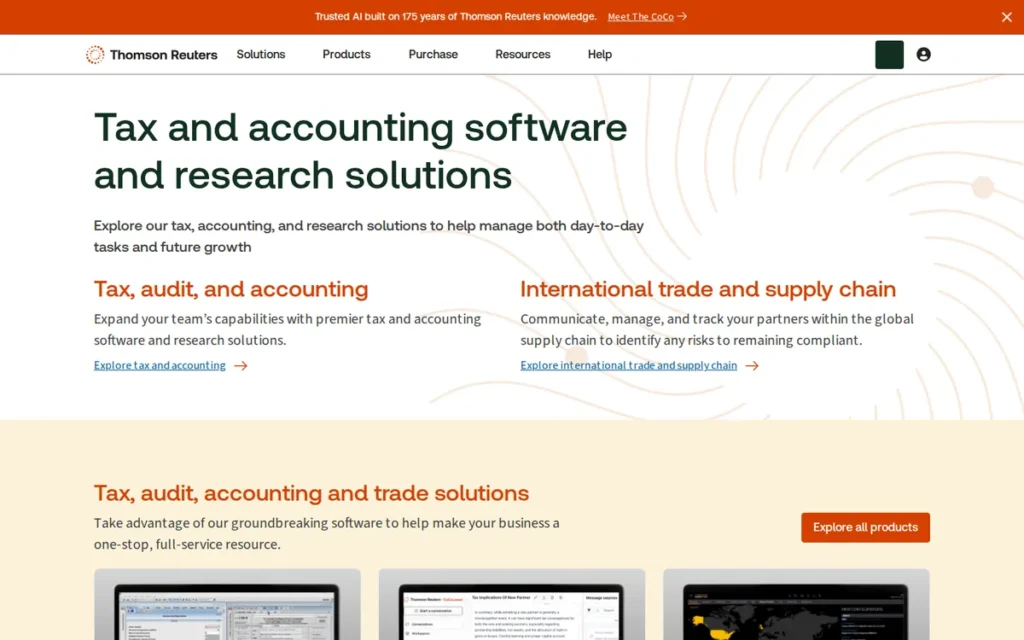
Category: Enterprise Income Tax Suite, a cloud-native platform covering income tax compliance, ASC 740 provision, indirect tax determination, and transfer pricing in a unified data architecture for large in-house corporate tax departments; not optimized for CPA firm client-throughput workflows or standalone e-invoicing mandate compliance.
At a Glance
- Category: Enterprise Income Tax Suite
- Best For: Large in-house corporate tax departments at public companies managing multi-entity consolidated returns, ASC 740 provision, multi-state and international compliance, and indirect tax in a single platform
- Price Range: Pricing on request: enterprise contract, module-based; not publicly disclosed
- Primary Strength: Broadest corporate tax lifecycle in this evaluation: income tax compliance, ASC 740 provision, indirect tax determination, and transfer pricing in one cloud-native platform with IDC recognition as a SaaS tax automation Leader
- Biggest Limitation: No public pricing structure, per-entity rates, or contract range benchmarks, buyers cannot estimate total cost of ownership before initiating a full enterprise sales process
- One-Line Summary: Thomson Reuters ONESOURCE is the enterprise corporate tax suite for large in-house tax departments that need income tax compliance, ASC 740 provision, indirect tax determination, and transfer pricing unified in a single cloud-native platform recognized by IDC as a SaaS tax automation Leader.
- Last Verified: June 2026
Overview
Thomson Reuters ONESOURCE is a cloud-native, end-to-end enterprise tax automation suite for large corporations and their in-house tax departments, covering income tax compliance, ASC 740 provision, indirect tax determination, and transfer pricing in a single shared data architecture, meaning data entered once flows automatically across provision, compliance, and indirect tax workstreams without redundant re-entry.
Thomson Reuters explicitly positions ONESOURCE for larger organizations, distinguishing it from the other six platforms in this evaluation and making it the most directly vendor-marketed solution for enterprise in-house corporate tax departments managing 50 or more legal entities (Thomson Reuters, June 2026).
ONESOURCE Income Tax supports automated trial balance management, consolidated group returns with intercompany eliminations, state return propagation from federal changes, multi-jurisdiction calculations, and IRS MeF e-filing, all within a unified cloud workflow connected to the same data layer as provision and indirect tax.
Key Features
- Unified Tax Data Architecture: Thomson Reuters ONESOURCE operates on a single shared data layer where information entered once for provision flows automatically into compliance returns and indirect tax workflows, eliminating the redundant data entry and manual reconciliation that define multi-tool tax department operations.
- Multi-Entity Income Tax Compliance: Thomson Reuters ONESOURCE Income Tax automates the complete federal and multi-state return workflow (HouseBlend, 2025), including: trial balance management; federal and multi-state return preparation; state return propagation automatically from federal changes; consolidated group handling with intercompany eliminations; and IRS MeF e-filing across all entities.
- Officially Integrated ASC 740 Provision: Thomson Reuters ONESOURCE Tax Provision (TaxStream) is officially integrated with ONESOURCE Income Tax, enabling automated current and deferred tax calculations, ASC 740-270 AETR interim reporting, journal entry generation, and audit trails in a unified provision-to-compliance workflow (Thomson Reuters press release, confirmed June 2026).
- Indirect Tax Determination: Thomson Reuters ONESOURCE Determination automates indirect tax calculations for sales/use tax, VAT, and customs duty across jurisdictions, delivering real-time tax decisions connected to existing business systems and reducing calculation errors (Thomson Reuters ONESOURCE Determination features page, June 2026).
- Transfer Pricing Coverage: Thomson Reuters ONESOURCE includes transfer pricing documentation, country-by-country reporting, and benchmarking analysis, the only platform in this evaluation offering transfer pricing as a native module within the same data architecture as compliance and provision.
Best For
Thomson Reuters ONESOURCE is best for large in-house corporate tax departments at public companies managing 50 or more legal entities across multiple states and jurisdictions, particularly teams currently running provision and compliance in separate tools who want to eliminate manual reconciliation from quarterly and annual close cycles.
Pricing
Thomson Reuters ONESOURCE does not publish pricing publicly. All pricing is negotiated through enterprise sales based on module selection, entity count, user count, and deployment scope.
One community signal from r/taxpros suggests ONESOURCE may be priced competitively against CCH Axcess, verify directly with Thomson Reuters sales. Budget for a formal RFP process and multi-year contract negotiation.
Enterprise corporate tax software at this tier typically involves total first-year costs well into six figures for mid-market deployments and into seven figures for large-enterprise implementations. Scope implementation services costs separately from software subscription fees in every evaluation scenario. (Verified: June 2026)
Strengths
- IDC Recognition as SaaS Tax Automation Leader: Thomson Reuters has been recognized as a Leader for SaaS tax automation by IDC, per HouseBlend’s independent ONESOURCE evaluation guide (2025), providing third-party validation that distinguishes ONESOURCE from every other evaluated platform lacking a published analyst designation. Buyers requiring the primary IDC research document should request it through Thomson Reuters enterprise sales or IDC’s research portal directly (HouseBlend ONESOURCE guide citing IDC research, 2025).
- Official Provision-to-Compliance Integration: Thomson Reuters officially announced the integration of ONESOURCE Tax Provision (TaxStream) and ONESOURCE Income Tax, enabling automated interim reporting, state provisions, journal entry generation, user controls, and audit trails, directly solving the most cited operational pain point for in-house tax directors at public companies (Thomson Reuters press release, confirmed June 2026).
- Verified Peer Comparison Advantage: A verified TrustRadius user who evaluated both Bloomberg Tax and Thomson Reuters ONESOURCE stated “I think it is a superior product with more features”, providing documented direct side-by-side evaluation evidence where ONESOURCE was selected based on feature breadth (TrustRadius, Bloomberg Tax vs. Thomson Reuters ONESOURCE comparison, accessed June 2026).
- Public-Company Governance and Vendor Stability: Thomson Reuters’ public-company governance structure (NYSE/TSX: TRI) means ONESOURCE customers benefit from regulatory compliance continuity investment, long-term product development commitment, and professional services infrastructure at a scale that private and PE-backed vendors cannot match, a vendor stability factor material for 3-to-7-year enterprise contract commitments.
Limitations
- Pricing Opacity: Thomson Reuters ONESOURCE discloses no pricing structure, per-entity rates, or contract range benchmarks, buyers cannot estimate total cost of ownership before entering a full enterprise sales process, requiring budget allocation for a multi-month RFP cycle before receiving actionable numbers.
- No Published Quantified Case Studies: Thomson Reuters ONESOURCE does not publicly release named enterprise case studies with quantified outcome data, limiting buyers’ ability to benchmark expected ROI without directly requesting reference customer conversations through enterprise sales.
- Enterprise Scale Threshold: Thomson Reuters ONESOURCE is architected for organizations at a complexity and entity-count scale where the platform’s implementation timeline, contract structure, and professional services investment are proportionate, buyers should assess whether their current entity count and jurisdictional complexity justify a full ONESOURCE implementation before initiating the enterprise procurement process.
Verdict
Thomson Reuters ONESOURCE is the broadest enterprise corporate tax suite in this evaluation, covering income tax compliance, ASC 740 provision, indirect tax determination, and transfer pricing in a single cloud-native platform with IDC recognition as a SaaS tax automation Leader.
For large in-house corporate tax departments currently managing provision and compliance in separate tools, ONESOURCE’s officially documented provision-to-compliance integration represents the most direct path to eliminating manual reconciliation from the quarterly close cycle.
ONESOURCE’s ranking above CSC Corptax reflects its broader scope, indirect tax determination and transfer pricing in addition to income tax and provision. Buyers whose sole requirement is U.S. income tax and provision should evaluate both platforms before committing, as Corptax’s single-system architecture may be operationally superior for that specific, narrower use case.
2. CSC Corptax: Best Single-System Platform for U.S. Income Tax Compliance + ASC 740 Provision
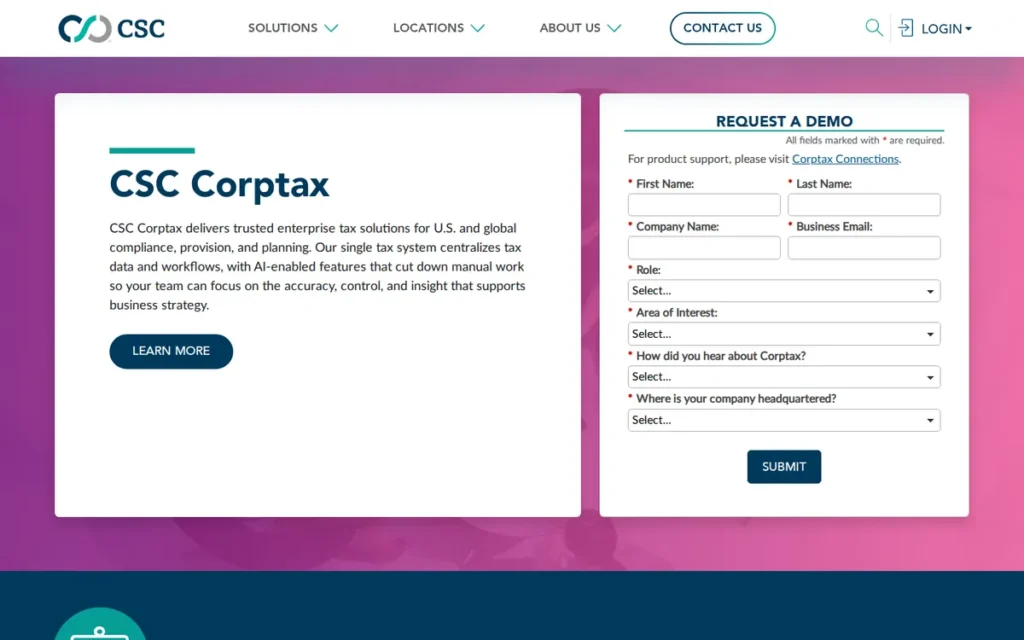
Category: Enterprise Income Tax Suite, a single-system platform unifying U.S. income tax compliance and ASC 740 provision in one shared data model for large in-house corporate tax departments; does not include an indirect tax module, VAT capability, or transfer pricing functionality.
At a Glance
- Category: Enterprise Income Tax Suite
- Best For: Large in-house corporate tax departments at public companies managing U.S. income tax compliance and ASC 740 provision together, with 50–500+ entities who want to eliminate provision-to-compliance manual reconciliation
- Price Range: Pricing on request: enterprise contract, module-based; not publicly disclosed
- Primary Strength: Single-tax-system architecture: U.S. compliance, ASC 740 provision, and entity management share one unified data model, eliminating multi-tool reconciliation
- Biggest Limitation: U.S. income tax scope only: no indirect tax module, no VAT, no transfer pricing; separate platform required for those obligations
- One-Line Summary: CSC Corptax is the enterprise single-system corporate tax platform for large in-house departments needing U.S. income tax compliance and ASC 740 provision in one unified data model, with documented Fortune 10 deployments at Ford Motor Company and AIG confirming capability at the highest enterprise complexity tier.
- Last Verified: June 2026
Overview
CSC Corptax is a purpose-built enterprise tax platform for large public and private corporations that need U.S. income tax compliance, ASC 740 provision, and entity management unified in a single tax system, designed explicitly to eliminate the duplicate data entry and manual reconciliation that occur when provision and compliance workflows run in separate tools.
CSC Corptax U.S. Compliance automates federal-to-state adjustments, multi-state apportionment calculations, MeF and state gateway e-filing, and collaborative multi-entity review workflows with built-in audit trails and review status tracking across all entities (CSC Corptax U.S. Compliance Info Sheet, confirmed June 2026).
CSC Corptax’s “one tax system” design philosophy is validated by documented deployments at Fortune 10 organizations including Ford Motor Company and AIG, the highest-complexity publicly documented deployments of any provision plus compliance platform in this evaluation.
Key Features
- Single-Tax-System Architecture: CSC Corptax operates on one unified data model where U.S. income tax compliance, ASC 740 provision, and entity management share the same underlying data, eliminating the file transfers and reconciliation steps required when provision and compliance run on separate platforms.
- U.S. Compliance Automation with Apportionment: CSC Corptax U.S. Compliance centralizes data, automates federal-to-state adjustments and multi-state apportionment calculations with built-in logic, supports MeF and state gateway e-filing, and tracks calculation changes, review status, and audit trails across all entities in one collaborative workflow.
- ASC 740 Provision on Shared Data Model: CSC Corptax Provision calculates current and deferred taxes under ASC 740 using a web-based platform supporting parallel preparation, review, and collaboration across entities and jurisdictions, sharing the same data model as Corptax Compliance to eliminate provision-to-compliance reconciliation (CSC Corptax provision page, June 2026).
- AI-Informed Analytics Within One System: CSC Corptax incorporates AI-informed automation and analytics within its Single Solution architecture, enabling tax departments to mine data at any level needed within one tax system, per CSC product documentation (CSC Corptax main product page, June 2026).
- Microsoft Power Automate Integration: CSC Corptax has a published Microsoft Power Automate connector (Corptax Cart) enabling automated data loading, streamlined exports from compliance, provision, entity, and international modules, and workflow automation via external business process tools, documented on official Microsoft connector documentation (Microsoft Power Automate connector documentation, June 2026).
Best For
CSC Corptax is best for large in-house corporate tax departments at public or complex private companies managing U.S. multi-entity income tax compliance and ASC 740 provision simultaneously, particularly teams currently running provision and compliance in separate systems who want to consolidate onto a single data model without sacrificing audit trail depth or collaborative review cycle controls.
Pricing
CSC Corptax pricing is not publicly disclosed. Enterprise pricing is quote-based, scoped by module selection, entity count, user count, and implementation services engagement.
Buyers should expect multi-year SaaS contracts with professional services investment for implementation on top of software fees. No public pricing benchmarks were found in this research.
Enterprise corporate tax software at this tier typically involves total first-year costs well into six figures for mid-market deployments, scope implementation services separately from subscription fees before committing. (Verified: June 2026)
Strengths
- Fortune 10 Enterprise Reference at the Highest Complexity Tier: Ford Motor Company is documented in Tax Executive journal as a CSC Corptax client that addressed “a significant filing methodology issue”, the highest-complexity publicly documented deployment credential of any provision plus compliance platform in this evaluation, validating CSC Corptax’s capability at the Fortune 10 tier (Tax Executive journal, accessed June 2026).
- AIG Case Study (2017) Documents Multi-Tool Pain Resolved: The CSC Corptax AIG case study (2017) documents resolution of inadequate security around tax-sensitive data, duplicative data input, and manual reconciliation back to Corptax Compliance, confirming that CSC Corptax’s single-system architecture directly addresses the multi-tool fragmentation problems most commonly cited by enterprise tax directors. While this engagement predates this evaluation’s research window, the architectural pain points it documents remain active challenges in enterprise tax departments today (CSC Corptax AIG Case Study PDF, 2017, referenced June 2026).
- Highest Absolute Third-Party Rating in Evaluation: GetApp rates CSC Corptax 4.5/5, the highest absolute confirmed third-party rating of any platform in this evaluation with a documented score. The four-review count reflects the enterprise-only buyer base that evaluates through RFP processes and professional peer referrals rather than public review platforms, not a lack of market presence (GetApp, accessed June 2026).
- Most Established Vendor Parent in Evaluation: CSC, Corptax’s parent company, was founded in 1899 and remains a stable private company, the most historically established vendor parent in this seven-product cohort, providing organizational continuity and long-term platform commitment that no recently acquired, PE-backed, or recently IPO’d competitor in this evaluation can match.
Limitations
- U.S. Income Tax Scope Only: CSC Corptax focuses exclusively on U.S. income tax compliance and ASC 740 provision, with no indirect tax module, no VAT capability, and no transfer pricing functionality, organizations managing sales/use tax, e-invoicing mandates, or global indirect tax must deploy a separate platform alongside Corptax, reintroducing integration complexity for those tax types.
- No International Tax or Transfer Pricing Coverage: CSC Corptax does not include transfer pricing documentation, country-by-country reporting, or international provision modules, multinational organizations managing both U.S. and non-U.S. provision requirements must deploy a separate platform for international tax workstreams even if their U.S. operations run entirely on CSC Corptax, creating a two-system integration requirement for any non-U.S. entities in the consolidated group.
- Minimal Public Review Presence: CSC Corptax has only four reviews on GetApp and no confirmed G2 or Capterra ratings, reflecting its enterprise-only buyer base, prospective buyers should plan for RFP-driven evaluation through formal enterprise sales channels and professional peer referrals (Tax Executives Institute, Big 4 implementation partners) rather than public review platforms.
Verdict
CSC Corptax is the leading single-system corporate tax platform for large in-house departments managing U.S. income tax compliance and ASC 740 provision together, with documented Fortune 10 deployments at Ford Motor Company and AIG and a design philosophy built explicitly to eliminate duplicate data entry and manual reconciliation from multi-tool tax workflows.
CSC Corptax ranks below Thomson Reuters ONESOURCE because its scope is limited to U.S. income tax, it does not address indirect tax or transfer pricing, whereas ONESOURCE covers the full enterprise tax lifecycle.
For in-house tax departments whose primary complexity is U.S. federal and multi-state income tax with ASC 740 provision requirements, CSC Corptax’s single-system architecture may be the more operationally focused choice over a broader suite.
3. CCH Axcess Tax: Best for CPA Firms and Accounting Practices Managing Corporate Client Returns

Category: Professional Tax Preparer, a cloud-native, AI-embedded platform for CPA firms and accounting practices managing high-volume corporate client returns, optimized for client throughput, collaborative review workflows, and per-authorization billing; not optimized for in-house corporate department provision automation, ERP integration, or indirect tax determination.
At a Glance
- Category: Professional Tax Preparer
- Best For: CPA firms managing complex corporate client returns including C-corps, S-corps, partnerships, trusts, and nonprofits requiring cloud-native collaboration, AI document extraction, and scalable per-authorization pricing
- Price Range: Tiered: Essentials (up to 100 authorizations/year), Pro, Complete, dollar amounts not publicly disclosed; practitioner communities consistently describe CCH Axcess Tax as among the higher-priced professional tax platforms
- Primary Strength: Expert AI embedded directly in CCH Axcess Tax’s core platform architecture (not a third-party bolt-on) with embedded OCR extraction of K-1s, W-2s, and 1099s in high-volume document environments
- Biggest Limitation: No native ASC 740 provision module; in-house corporate tax departments requiring integrated provision should evaluate Thomson Reuters ONESOURCE or CSC Corptax first
- One-Line Summary: CCH Axcess Tax is the cloud-native, AI-embedded professional tax preparation platform from Wolters Kluwer for CPA firms managing complex corporate client returns, with Expert AI launched October 2025, a unified open-API firm ecosystem, and tiered per-authorization pricing for firms of all sizes.
- Last Verified: June 2026
Overview
CCH Axcess Tax is a cloud-native, AI-embedded professional tax preparation and compliance platform developed by Wolters Kluwer for CPA firms and accounting practices managing complex corporate client returns, developed as the cloud-native successor to the legacy CCH ProSystem fx desktop platform, with a decade-long investment in the cloud migration.
CCH Axcess Tax supports thousands of automatically calculating forms and schedules across federal, state, county, and city returns for corporations, partnerships, trusts, and nonprofits, with Expert AI (launched October 2025) providing document extraction and workflow intelligence embedded directly in the platform’s core architecture.
CCH Axcess Tax’s “unified, cloud-native platform” design integrates tax preparation, audit, workflow, document management, practice management, and client collaboration under a single open API, positioning CCH Axcess Tax as a firm operating ecosystem rather than a standalone tax preparation tool (Wolters Kluwer CCH Axcess Tax product page, June 2026).
Key Features
- Extensive Cloud-Native Form Library: CCH Axcess Tax provides a fully cloud-native tax preparation and compliance workflow supporting thousands of automatically calculating forms and schedules across federal, state, county, and city returns for corporations, partnerships, trusts, and nonprofits in a single platform.
- Expert AI Embedded in Core Architecture: CCH Axcess Expert AI, launched October 2025, is embedded directly into the platform’s digital core with explainable, auditable, and secure outputs under human oversight (not a third-party bolt-on) as independently covered by CPA Practice Advisor (October 15, 2025) and International Accounting Bulletin (2025).
- CCH Axcess Intelligence OCR Extraction: CCH Axcess Intelligence uses embedded OCR and tax-specific AI models to automatically extract, summarize, and flag issues in K-1s, W-2s, 1099s, and other source documents, reducing manual data entry during high-volume client document workflows during peak tax season.
- Tiered Per-Authorization Billing: CCH Axcess Tax is structured with Essentials (up to 100 federal/state authorizations per year), Pro, and Complete tiers, allowing CPA firms to right-size platform investment and scale authorization counts as client volume grows without switching platforms.
- Expert AI Workflow Scheduling Intelligence: CCH Axcess Workflow received Expert AI-powered scheduling intelligence enhancements addressing staffing and resource utilization across firms during peak tax season, the most recently confirmed platform development in the CPA firm workflow management category in this evaluation (BusinessWire, May 5, 2026).
Best For
CCH Axcess Tax is best for CPA firms and accounting practices of all sizes managing complex corporate client returns, especially firms currently operating on the CCH ProSystem fx desktop platform seeking a cloud-native migration path, or firms with remote or hybrid teams requiring cloud-based collaboration on complex multi-entity client engagements.
Pricing
CCH Axcess Tax pricing is not disclosed publicly in dollar amounts. The platform is structured into Essentials, Pro, and Complete tiers with per-authorization billing scaling with firm return volume.
Practitioner communities in r/taxpros and r/Accounting consistently identify CCH Axcess Tax as among the more expensive professional tax platforms relative to alternatives such as UltraTax CS. Buyers should request a formal per-authorization quote and compare total annual cost against competing platforms before committing to a multi-year agreement. (Verified: June 2026)
Strengths
- Strongest Available Vendor-Family Peer Validation: CCH ProSystem fx Tax: the Wolters Kluwer legacy desktop platform in the same product family as CCH Axcess, holds a G2 rating of 4.1/5 based on 130 reviews (G2 corporate tax category, accessed June 2026), providing the strongest available vendor-family peer validation signal of any platform in this evaluation. Buyers should verify the CCH Axcess Tax cloud-specific G2 listing for cloud-platform ratings before using this figure in direct vendor comparisons, as these 130 reviews reflect CCH ProSystem fx, not CCH Axcess Tax specifically.
- Independently Validated AI Launch: CCH Axcess Expert AI launched in October 2025 and received independent trade press coverage from CPA Practice Advisor (October 15, 2025) and International Accounting Bulletin (2025) without documented paid placement, the most externally validated AI launch of any platform in this evaluation.
- EURONEXT-Listed Parent with Long-Term Investment: Wolters Kluwer has been publicly traded on EURONEXT (ticker: WKL) with corporate origins tracing to 1836, providing vendor stability and long-term product investment commitment that no PE-backed or recently IPO’d competitor in this evaluation can demonstrate (Wolters Kluwer corporate information, confirmed June 2026).
- Most Recently Documented Product Development: CCH Axcess Workflow received Expert AI-powered scheduling intelligence enhancements in May 2026 addressing staffing and resource utilization during peak tax season, the most recently confirmed platform development announcement in the CPA firm workflow category in this evaluation (BusinessWire, May 5, 2026).
Limitations
- No Native ASC 740 Provision Module: CCH Axcess Tax does not include a native ASC 740 provision module, in-house corporate tax departments requiring integrated provision and compliance in a single data model must evaluate Thomson Reuters ONESOURCE or CSC Corptax rather than relying on CCH Axcess Tax for that combined workflow.
- CPA Firm Architecture Creates In-House Friction: CCH Axcess Tax is architected for client-facing CPA firm workflows (client throughput, multi-client collaborative review, per-authorization billing) in ways that create genuine operational friction for in-house departments managing their own entities rather than external client returns; in-house teams should assess ONESOURCE or Corptax architectures before selecting CCH Axcess Tax for internal department use.
- Premium Pricing Without Public Benchmarks: While dollar amounts are not publicly disclosed, practitioner communities in r/taxpros and r/Accounting consistently characterize CCH Axcess Tax as among the more expensive professional tax platforms. Firms should specifically request a per-authorization cost comparison against UltraTax CS before finalizing a multi-year CCH Axcess commitment, as the authorization-volume cost model can produce significant year-over-year escalation during firm growth phases.
Verdict
CCH Axcess Tax is the cloud-native, AI-embedded professional tax preparation platform in this evaluation for CPA firms managing complex corporate client returns, with Expert AI embedded in the platform’s core architecture and independently validated by CPA Practice Advisor and International Accounting Bulletin at its October 2025 launch.
CCH Axcess Tax ranks third because the primary audience includes both CPA firm managers and in-house corporate tax directors, for in-house teams, Thomson Reuters ONESOURCE and CSC Corptax provide better-fitted architectures.
CPA firms evaluating their tax preparation platform (particularly those seeking a migration path from CCH ProSystem fx) should treat CCH Axcess Tax as the reference standard against which other firm-focused alternatives are measured.
4. Bloomberg Tax Provision: Best Dedicated ASC 740 Provision Specialist: Excel-Native Output, Faster Deployment

Category: Provision Specialist, a cloud-based ASC 740 income tax provision platform for corporate tax departments at public companies, focused exclusively on automating provision calculations, AETR interim reporting, and producing vendor-stated Excel-native audit-ready workpapers; does not handle income tax compliance return preparation.
At a Glance
- Category: Provision Specialist
- Best For: In-house corporate tax departments at public companies responsible for quarterly ASC 740 provision workpapers who already have compliance software in place and need a dedicated provision specialist with faster deployment and Excel-native audit outputs
- Price Range: Pricing on request: enterprise contract; not publicly disclosed
- Primary Strength: Vendor-stated Excel-native workpaper output with formulas included (Bloomberg’s own documentation states competitors do not offer this) enabling direct auditor review without additional workpaper preparation
- Biggest Limitation: Provision only: does not prepare income tax compliance returns; all primary evidence in this entry is vendor-stated and should be independently verified through Bloomberg Tax reference calls
- One-Line Summary: Bloomberg Tax Provision is the dedicated ASC 740 tax provision specialist for in-house corporate tax departments at public companies, offering vendor-stated Excel-native audit-ready workpaper outputs with formulas, AETR interim reporting automation, Bloomberg Tax Research integration, and a vendor-stated implementation timeline measured in weeks rather than months.
- Last Verified: June 2026
Overview
Bloomberg Tax Provision is a cloud-based ASC 740 tax provision specialist for corporate tax departments at public companies, designed to automate the complete income tax provision calculation (current tax provision, deferred income tax provision, valuation allowances, and total ASC 740 provision) using a balance sheet approach with deferred tax assets (DTA) and deferred tax liabilities (DTL).
Bloomberg Tax Provision distinguishes itself through two capabilities Bloomberg contrasts against competitors: a vendor-stated Excel-native workpaper output with formulas included, and a vendor-stated implementation timeline measured in weeks rather than months.
Bloomberg Tax Provision’s embedded integration with Bloomberg Tax Research connects state-by-state legal analysis directly to provision calculations, a research-to-calculation integration not documented for any other platform in this seven-product evaluation. Buyers should verify whether competing provision tools offer comparable research database integration before treating this as a Bloomberg-unique capability.
Key Features
- Complete ASC 740 Provision Automation: Bloomberg Tax Provision automates the full income tax provision calculation including current tax provision, deferred tax provision, valuation allowances, and total provision under the balance sheet approach with deferred tax assets and liabilities (including uncertain tax position (UTP) analysis under ASC 740-10, GILTI, FDII, and Section 163(j) limitations (Bloomberg Tax) How to Calculate the ASC 740 Tax Provision, 2025).
- ASC 740-270 AETR Interim Reporting: Bloomberg Tax Provision supports quarterly reporting requirements by automatically calculating the Estimated Annual Effective Tax Rate (AETR) and applying it to year-to-date ordinary income (reducing the manual calculation burden of quarterly provision close cycles (Bloomberg Tax) ASC 740 Interim Reporting guidance, 2025).
- Vendor-Stated Excel-Native Audit Workpaper Output: Bloomberg Tax Provision produces Excel-native audit workpapers with formulas included, a capability Bloomberg states its competitors do not offer, enabling auditors to review and trace provision calculations directly in a format accessible without proprietary software (Bloomberg Tax, Reduce Risk and Simplify Reporting, 2025).
- Bloomberg Tax Research Integration: Bloomberg Tax Provision integrates with Bloomberg Tax Research, connecting the same legal and technical research platform used for state-by-state analysis directly to provision calculations in the same workflow, a research-to-calculation connection not documented for any other platform in this evaluation (Bloomberg Tax content library, 2025–2026).
- Rate Reconciliation Design: Bloomberg Tax Provision is designed so the rate reconciliation “always ties out”, a vendor-stated design goal that buyers should verify specifically in product demonstrations using their organization’s own trial balance data before treating it as a contractual commitment (Bloomberg Tax provision software marketing, 2025).
Best For
Bloomberg Tax Provision is best for in-house corporate tax departments at public companies that already have compliance software in place and specifically need to add or replace a dedicated ASC 740 provision tool, particularly teams that value a faster vendor-stated deployment path and require Excel-native audit workpaper outputs for auditor review.
Pricing
Bloomberg Tax Provision pricing is not publicly disclosed. The platform is sold through direct enterprise sales without published pricing tiers or fee ranges.
Bloomberg’s vendor-stated “weeks not months” implementation claim may translate to lower total implementation services cost compared to full-suite provision modules, buyers should request explicit quotes for both software and implementation and compare against ONESOURCE and Corptax provision module costs.
Enterprise corporate tax software at this tier typically involves total first-year costs well into six figures, scope implementation services separately from subscription fees. (Verified: June 2026)
Strengths
- Vendor-Stated Excel-Native Workpaper Output: Bloomberg Tax Provision states its Excel-native workpaper output with formulas is “a feature our competitors don’t do”, a vendor-stated differentiator that, if accurate, directly reduces audit response time by enabling auditors to trace calculations without additional workpaper preparation. Buyers should specifically ask competing provision platforms whether their workpaper outputs include Excel files with formulas intact before treating this as a Bloomberg-unique market differentiator (Bloomberg Tax, Reduce Risk and Simplify Reporting, 2025).
- Vendor-Stated Faster Deployment Timeline: Bloomberg Tax Provision states an implementation target of “up and running in weeks rather than months or years”, a vendor-stated claim that, if commercially realized, would represent a faster deployment path than ONESOURCE or Corptax provision modules. Buyers should request specific deployment timelines for their entity count and complexity during the sales process rather than treating this marketing claim as a contractual benchmark (Bloomberg Tax Provision product page, 2025).
- Research-to-Calculation Integration: Bloomberg Tax Provision’s integration with Bloomberg Tax Research connects state-by-state legal and technical analysis directly into provision calculations, a research-to-calculation workflow not documented for any other platform in this seven-product evaluation, addressing technical accuracy requirements for ASC 740 provision across jurisdictions (Bloomberg Tax content library, 2025–2026).
- Stable Private Ownership: Bloomberg L.P.’s private ownership removes both PE acquisition pressure and public-market quarterly earnings constraints, providing a product investment environment that contrasts with Vista Equity-backed Avalara and supports longer-term platform development commitments for enterprise provision buyers.
Evidence note: All four Bloomberg Tax Provision Strengths above are sourced from Bloomberg’s own product pages and content library (2025). This evaluation found no independent analyst designation, third-party case study with quantified client outcomes, or published peer review rating to corroborate these specific capability claims. Treat as vendor-stated capabilities and request direct reference customer conversations through Bloomberg Tax sales before committing.
Limitations
- Provision Only: No Compliance Returns: Bloomberg Tax Provision’s specialist focus on ASC 740 is simultaneously its greatest strength and its most consequential structural limitation, organizations needing both provision and compliance in a single data model must either pair Bloomberg Tax Provision with a separate compliance tool, reintroducing the integration complexity that ONESOURCE and Corptax eliminate, or evaluate those platforms instead.
- Limited Public Review Presence: Bloomberg Tax Provision has no confirmed G2, Capterra, or TrustRadius ratings in this research, making peer validation harder to access than platforms with established review footprints, buyers should request direct reference customer conversations through Bloomberg Tax sales to compensate for the absence of public peer data.
- All Primary Evidence Is Vendor-Stated, No Independent Validation: Bloomberg Tax Provision’s key differentiating claims, Excel-native output uniqueness among competitors, weeks-not-months implementation, and the rate reconciliation guarantee, are sourced exclusively from Bloomberg’s own product pages. Unlike Vertex O Series (KPMG-published capability whitepaper, 2023), Sovos Compliance Cloud (G2 4.2/5, 87 reviews), or CSC Corptax (Fortune 10 client references in Tax Executive journal), Bloomberg Tax Provision has no independent third-party validation of these specific claims in publicly available sources reviewed in this evaluation.
Verdict
Bloomberg Tax Provision is the dedicated ASC 740 provision specialist in this evaluation, distinguished by its vendor-stated Excel-native audit output with formulas included and a vendor-stated faster implementation timeline measured in weeks rather than months.
Bloomberg Tax Provision ranks #4 not due to quality limitations but due to scope, the platform addresses provision only, and organizations needing full provision-to-compliance integration in a single data model should evaluate Thomson Reuters ONESOURCE or CSC Corptax first.
Bloomberg Tax Provision ranks above Vertex O Series and Sovos Compliance Cloud because this evaluation weights ASC 740 provision capability as a primary criterion (directly serving in-house tax directors at public companies) while indirect tax automation is weighted secondary. Vertex O Series has substantially stronger independent third-party validation, but serves a secondary criterion for the majority of this evaluation’s audience.
For in-house corporate tax departments at public companies with compliance software already in place and specifically seeking a dedicated provision specialist, Bloomberg Tax Provision is a direct evaluation candidate, subject to verifying its key claims through Bloomberg Tax reference customer conversations.
5. Vertex O Series: Best Enterprise Indirect Tax Engine: KPMG-Published Whitepaper, SAP Product Partner Certified
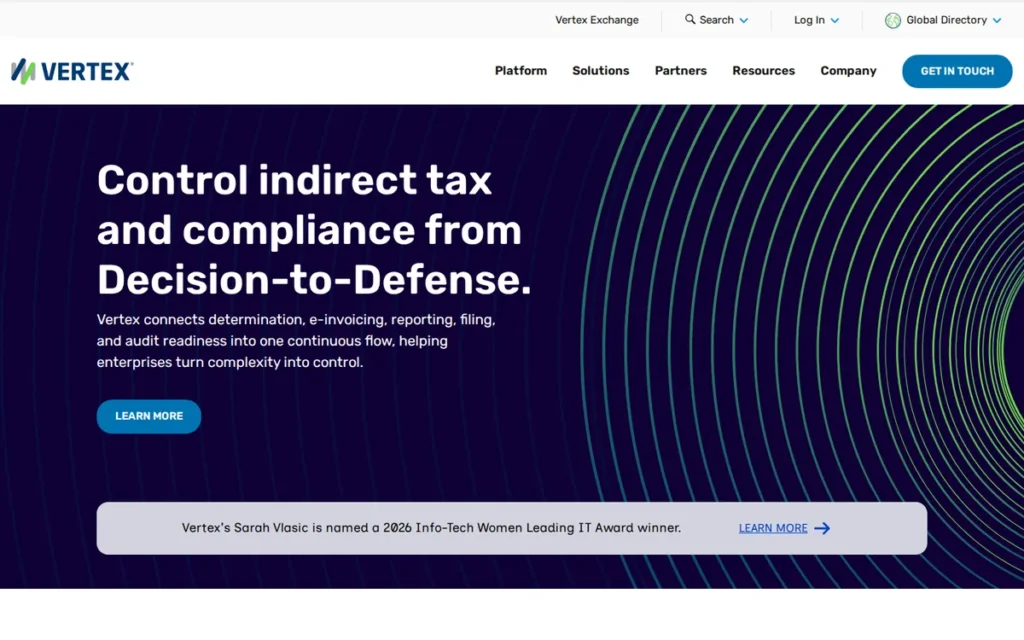
Category: Indirect Tax Engine, an enterprise transaction-level indirect tax calculation platform for sales/use tax, VAT, and global tax determination, designed to integrate with SAP, Oracle, and other major ERPs to apply real-time tax decisions at the transaction level across 300+ countries; does not address corporate income tax compliance, ASC 740 provision, or mandatory e-invoicing CTC mandates as primary functions.
At a Glance
- Category: Indirect Tax Engine
- Best For: Large enterprises running SAP S/4HANA or Oracle ERPs needing certified, transaction-level indirect tax determination across U.S. and global jurisdictions with a KPMG-published capability whitepaper and formal ERP marketplace certification
- Price Range: Pricing on request: enterprise contract; third-party estimates suggest mid-market deployments start in the tens of thousands annually, scaling significantly for large SAP enterprise environments (TaxCloud, 2025)
- Primary Strength: Only indirect tax engine in this evaluation with both a KPMG-published capability whitepaper (2023) and formal SAP product partner marketplace certification, two simultaneous independent validations no other platform in this cohort has achieved
- Biggest Limitation: Enterprise SAP implementation complexity; r/SAP community includes “alternatives for Vertex” threads indicating cost and configuration friction for some buyers
- One-Line Summary: Vertex O Series is the enterprise indirect tax engine for SAP and Oracle environments, validated by a KPMG-published capability whitepaper (2023) and certified on the SAP product partner marketplace, with approximately 45 years of enterprise indirect tax content built into a 300+ country coverage database.
- Last Verified: June 2026
Overview
Vertex O Series is an enterprise indirect tax engine for sales and use tax, VAT, and global tax determination, designed primarily for organizations running SAP, Oracle, or other major ERPs that need certified, transaction-level tax calculations across more than 300 countries and 12,000+ U.S. jurisdictions.
Vertex O Series covers the full indirect tax lifecycle (real-time tax determination at the transaction level, Exemption Certificate Manager (ECM) for automated certificate collection and validation, returns and reporting, and global place-of-supply rules) with formal SAP product partner marketplace certification confirming integration at the ERP architecture level.
Vertex O Series, founded in the late 1970s (per third-party market analyses; founding year not confirmed from official Vertex corporate materials reviewed in this June 2026 research) and NASDAQ-listed since 2020 (ticker: VERX), is the longest-established dedicated tax technology company in this evaluation. A KPMG-published capability whitepaper (2023) provides the strongest Big 4 consulting firm published documentation of any indirect tax platform in this cohort (KPMG, “What Indirect Tax Groups Need from Tax Automation: Vertex,” 2023).
Key Features
- Transaction-Level Global Tax Determination: Vertex O Series provides real-time, transaction-level indirect tax determination across 300+ countries, including U.S. street-address-level validation, economic nexus threshold tracking across U.S. states following South Dakota v. Wayfair (2018), and global place-of-supply rules applied directly within ERP and billing transaction workflows.
- Exemption Certificate Manager (ECM): Vertex O Series ECM automates the collection, validation, and maintenance of exemption certificates, resale certificates, and direct pay permits, directly reducing audit exposure from certificate compliance gaps in B2B-heavy enterprise environments and addressing product taxability matrix management for industry-specific exemption categories.
- SAP, Oracle, and Multi-ERP Integration with Marketplace Certification: Vertex O Series integrates with SAP, Oracle, NetSuite, Microsoft, Workday, and other ERPs, with formal SAP product partner marketplace certification for SAP S/4HANA indirect tax determination confirmed on the SAP partner page (SAP product partner page, confirmed June 2026).
- Automatic Global Tax Content Updates: Vertex O Series applies jurisdiction-specific rate and rule changes automatically without manual intervention, a capability independently validated in the KPMG-published capability whitepaper on Vertex O Series (2023).
- Flexible Cloud and On-Premise Deployment: Vertex O Series supports cloud and on-premise deployment options, a deployment flexibility documented in KPMG’s 2023 capability whitepaper as a validated strength for enterprises with legacy infrastructure or data residency requirements.
Best For
Vertex O Series is best for large enterprises with SAP S/4HANA or Oracle ERP deployments that need certified, transaction-level indirect tax automation across U.S. and global jurisdictions, particularly organizations in manufacturing, distribution, and technology sectors with significant B2B sales where exemption certificate management is an ongoing audit risk.
Pricing
Vertex O Series pricing is not publicly disclosed. Enterprise pricing is quote-based by transaction volume, module selection, deploymentoption (cloud or on-premise), and ERP integration complexity.
Third-party pricing analyses estimate mid-market deployments starting in the tens of thousands of dollars annually, with large enterprise SAP deployments scaling significantly higher (TaxCloud pricing analysis, 2025). Buyers should request quotes and compare Vertex O Series directly against Avalara AvaTax for the specific ERP and connector combination relevant to their environment.
Enterprise corporate tax software at this tier typically involves total first-year costs well into six figures, scope implementation and ERP integration services separately from software fees. (Verified: June 2026)
Strengths
- KPMG-Published Capability Whitepaper (2023): KPMG published a capability whitepaper in 2023 validating Vertex O Series on scalability, interoperability, automatic global content updates, multiple deployment options, and industry-specific content, the only Big 4 consulting firm-published capability document for any indirect tax engine in this evaluation, providing a credibility signal enterprise buyers can reference in formal RFP processes (KPMG, “What Indirect Tax Groups Need from Tax Automation: Vertex,” 2023).
- Formal SAP Product Partner Marketplace Certification: Vertex O Series is listed on the SAP product partner marketplace for SAP S/4HANA indirect tax determination, a certification requiring SAP’s partner integration standards to be met, formally distinguishing Vertex O Series from indirect tax vendors without ERP-level marketplace credentials (SAP product partner page, confirmed June 2026).
- ISG One Independent Analyst Coverage: ISG One independently confirmed that Vertex O Series “manages end-to-end indirect tax compliance worldwide”, providing a second independent analyst firm confirmation alongside the KPMG-published whitepaper, making Vertex O Series the most multiply-validated platform in the indirect tax segment of this evaluation (ISG One analyst research, confirmed June 2026).
- Longest-Established Dedicated Tax Technology Company: Vertex O Series, founded in the late 1970s (per third-party market analyses; founding year not confirmed from official Vertex materials reviewed in this research) and NASDAQ-listed since 2020 (ticker: VERX), is the longest-established dedicated tax technology company in this evaluation, with approximately 45 years of enterprise indirect tax content development providing jurisdictional accuracy depth no recently founded or recently acquired competitor can replicate.
Limitations
- Enterprise SAP Implementation Complexity: Vertex O Series is designed for SAP and Oracle enterprise environments, and its sophistication translates directly to a corresponding implementation burden, configuration in complex ERP deployments requires significant professional services investment, and SAP community discussions in r/SAP include “alternatives for Vertex tax software” threads indicating that cost and configuration complexity are genuine friction points for some buyers evaluating Vertex O Series in SAP environments.
- On-Premise Version Maintenance Burden: Vertex O Series supports both cloud and on-premise deployment options, but on-premise implementations require internal IT resources for version update management, ERP integration patch maintenance when SAP or Oracle releases platform updates, and infrastructure upkeep that cloud deployments avoid, organizations without dedicated tax technology staff should explicitly evaluate the operational overhead of on-premise deployment against cloud costs before selecting a deployment model.
- Indirect Tax Scope Only: Vertex O Series addresses indirect tax determination exclusively and does not cover corporate income tax compliance, ASC 740 provision, or mandatory e-invoicing CTC mandates, organizations with those additional obligations still require separate platforms alongside Vertex O Series.
Verdict
Vertex O Series is the most independently validated enterprise indirect tax engine in this evaluation, with a KPMG-published capability whitepaper (2023) and ISG One analyst research both confirming its end-to-end capabilities, and formal SAP product partner certification distinguishing it from competitors without ERP-level marketplace credentials.
Vertex O Series ranks #5 in this overall evaluation because indirect tax capability, while critical, is a secondary criterion for the broader audience of in-house corporate income tax directors and CPA firm managers.
Vertex O Series’s ranking above Avalara AvaTax reflects its independent analyst validation, formal ERP marketplace certification, and absence of documented post-acquisition customer experience concerns, not a deficiency in Avalara’s connector breadth, which remains the best reason to select Avalara AvaTax for high-volume, multi-platform e-commerce deployments.
6. Sovos Compliance Cloud: Best for Global E-Invoicing Mandates and Continuous Transaction Controls (185+ Countries)
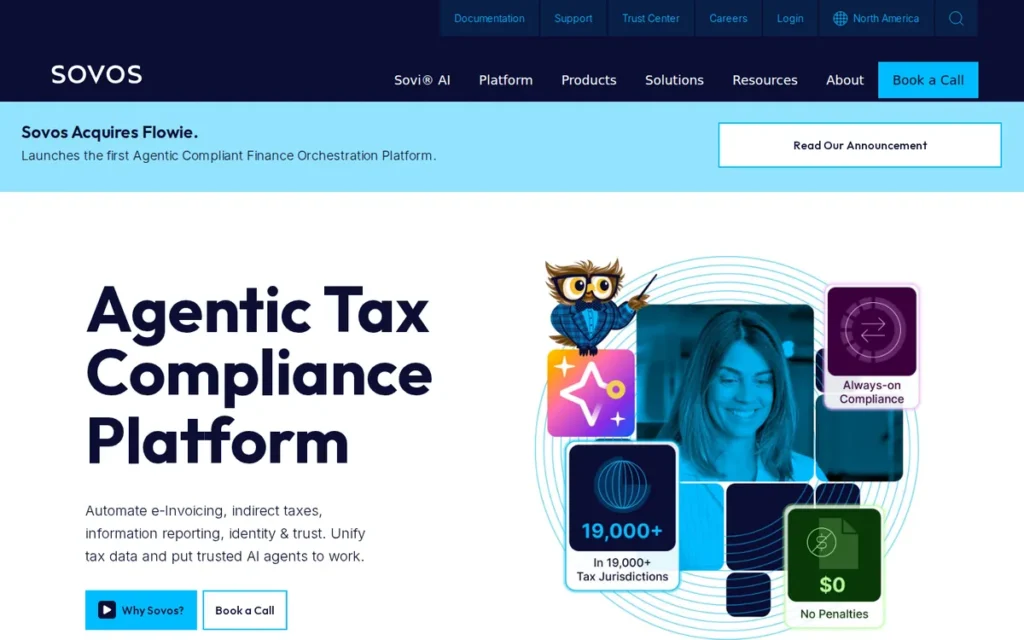
Category: Global Compliance Cloud, a five-pillar platform for multinational corporations managing mandatory e-invoicing, VAT reporting, and continuous transaction controls (CTC) across 185+ countries; does not address corporate income tax compliance, ASC 740 provision, or U.S.-only indirect tax calculation as primary design objectives.
At a Glance
- Category: Global Compliance Cloud
- Best For: Multinational corporations managing mandatory e-invoicing requirements and continuous transaction controls in multiple countries, particularly those with active CTC mandates in Brazil, Italy, Saudi Arabia, Mexico, or India
- Price Range: Pricing on request: enterprise contract; not publicly disclosed; third-party sources note heavier configuration translates to higher professional services investment vs. Avalara (GetSphere, TaxCloud, 2026)
- Primary Strength: Only platform in this evaluation purpose-built for government-mandated CTC and mandatory e-invoicing across 185+ countries; 16 billion+ transactions/year processed; half the Fortune 500 served across Sovos’s full product portfolio
- Biggest Limitation: Heavier configuration and longer onboarding than Avalara per multiple independent comparisons; suboptimal for U.S.-only indirect tax needs prioritizing faster deployment
- One-Line Summary: Sovos Compliance Cloud is the global tax compliance platform for multinationals managing mandatory e-invoicing, VAT, and continuous transaction controls across 185+ countries, with the only confirmed G2 rating in this seven-product evaluation (4.2/5, 87 reviews), 16 billion+ annual transactions processed, and half the Fortune 500 as customers across its full product portfolio.
- Last Verified: June 2026
Overview
Sovos Compliance Cloud is a global tax compliance platform for multinational corporations managing mandatory e-invoicing, VAT reporting, and continuous transaction controls (CTC) in more than 185 countries, serving over 100,000 customers through a five-pillar unified compliance architecture.
Sovos Compliance Cloud is uniquely positioned around the fastest-growing compliance challenge in global tax: government-to-business mandatory CTC requirements, where countries including Brazil, Italy, Saudi Arabia, Mexico, and India now require real-time or near-real-time transaction reporting directly to tax authorities. These include country-specific mandate frameworks such as Brazil’s NF-e/SPED system, Italy’s FatturaPA/SDI transmission network, Mexico’s CFDI regime, India’s GST e-invoicing portal, and expanding Peppol-aligned mandates across additional jurisdictions.
Founded in 1979 and privately owned by Hg Capital and TA Associates, Sovos Compliance Cloud processes 16 billion+ transactions per year, a documented scale validated by Hg Capital’s portfolio documentation confirming enterprise-infrastructure reliability (Hg Capital portfolio page, June 2026). Sovos Compliance Cloud holds the only fully confirmed G2 rating in this seven-product research cohort: 4.2/5 from 87 reviews (G2, accessed June 2026).
Key Features
- Five-Pillar Unified Compliance Architecture: Sovos Compliance Cloud unifies the full global tax compliance lifecycle across five functional pillars (Sovos Compliance Cloud product page, June 2026):
- Connect: Integration with data sources and tax authorities via the Sovos Compliance Network
- Identify: Transaction party identification for all taxable transaction parties
- Determine: Tax accuracy via VAT, SUT, mandatory e-invoicing, and shipping determination
- Report: Tax information reporting and multi-jurisdiction filing
- Analyze: Sovos Intelligence analytics for compliance monitoring and trend analysis
- Mandatory E-Invoicing and CTC Compliance Across 185+ Countries: Sovos Compliance Cloud supports mandatory e-invoicing and continuous transaction control compliance across more than 185 countries (the broadest documented country coverage in this evaluation) including active CTC mandates where real-time government reporting is legally required.
- SAP BTP Product Partner Certification: Sovos is formally listed on the SAP Business Technology Platform (BTP) product partner marketplace for Sovos US Tax Determination, confirming SAP S/4HANA integration certification for organizations running Sovos alongside their ERP (SAP product partner page, confirmed June 2026).
- Enterprise-Scale Transaction Processing: Sovos Compliance Cloud processes 16 billion+ transactions per year per Hg Capital portfolio documentation, the highest documented annual transaction volume of any platform in this evaluation, validating enterprise-scale infrastructure reliability for the largest global multinational deployments (Hg Capital portfolio page, June 2026).
- Fortune 500 Enterprise Customer Base: Sovos reports serving more than 100,000 customers including half the Fortune 500 across its full product portfolio, per Hg Capital and Sovos press release documentation, buyers should verify which specific Sovos products are deployed at Fortune 500 companies when assessing the Compliance Cloud platform specifically, as this figure encompasses Sovos’s complete historical product suite dating to 1979 (Hg Capital portfolio page; Sovos press release, confirmed June 2026).
Best For
Sovos Compliance Cloud is best for global multinationals with active or upcoming mandatory e-invoicing and continuous transaction control compliance obligations across multiple countries, particularly organizations with operations in Brazil, Italy, Saudi Arabia, Mexico, or India where real-time government reporting is legally mandated and no other evaluated platform provides equivalent CTC-native coverage.
Pricing
Sovos Compliance Cloud pricing is not publicly disclosed. Pricing is custom-scoped based on country coverage, transaction volume, module selection, and managed services level.
Multiple third-party comparison sources consistently note that Sovos requires heavier configuration than Avalara, typically translating to higher professional services investment alongside software fees (GetSphere, TaxCloud, Numeral, accessed June 2026).
Organizations with simpler U.S.-only indirect tax needs should compare Sovos against Vertex O Series and Avalara AvaTax before including Sovos in their formal evaluation. (Verified: June 2026)
Strengths
- Only Confirmed G2 Rating Across All Seven Platforms: Sovos holds a G2 rating of 4.2/5 from 87 reviews (the only fully confirmed G2 rating in this seven-product research cohort) providing the most accessible independent peer validation of any platform in this evaluation (G2, accessed June 2026).
- Highest Documented Transaction Volume in Evaluation: Sovos Compliance Cloud processes 16 billion+ transactions per year and reports serving more than 100,000 customers across its full product portfolio per Hg Capital portfolio documentation and Sovos press release, the highest documented transaction volume of any platform in the indirect and global tax segment of this evaluation (Hg Capital portfolio page; Sovos press release, confirmed June 2026).
- Only CTC-Purpose-Built Platform in Evaluation: Sovos Compliance Cloud is the only platform in this evaluation specifically architected for government-mandated continuous transaction controls and mandatory e-invoicing compliance, directly serving global multinationals facing active regulatory deadlines in countries where no other evaluated platform provides equivalent native CTC coverage.
- Long-Duration Private Equity Stability: Hg Capital is documented for long-duration private equity holds in B2B software (contrasting structurally with Vista Equity’s Avalara ownership cycle of acquisition and planned relist) providing a more stable long-term platform investment environment for organizations committing to multi-year global compliance contracts (Hg Capital portfolio documentation, June 2026).
Limitations
- Heavier Configuration and Longer Onboarding: Multiple independent third-party comparison sources (GetSphere, TaxCloud, and Numeral (all accessed June 2026)) consistently identify Sovos Compliance Cloud as requiring heavier configuration and longer onboarding than Avalara, making it a suboptimal choice for organizations with simpler U.S.-only indirect tax needs who prioritize faster deployment timelines.
- Support SLA and Pricing Transparency Gaps: TrustRadius comparison data identifies support response quality and pricing opacity as common friction dimensions in Sovos buyer evaluations, buyers should negotiate specific support response-time SLAs into contract terms and request a country-by-country pricing breakdown for their specific CTC mandate footprint rather than accepting a single global contract price that may obscure per-country cost variation (TrustRadius, Sovos vs. Vertex comparison, accessed June 2026).
- No Income Tax or Provision Coverage: Sovos Compliance Cloud does not address corporate income tax compliance or ASC 740 provision, organizations requiring those workflows must deploy separate platforms alongside Sovos Compliance Cloud, adding integration management complexity to the income tax portion of their overall compliance program.
Verdict
Sovos Compliance Cloud is the only platform in this evaluation specifically architected for government-mandated continuous transaction controls and mandatory e-invoicing compliance across more than 185 countries, processing 16 billion+ transactions per year, and it holds the only fully confirmed G2 rating in this seven-product research cohort.
Sovos Compliance Cloud ranks #6 because mandatory e-invoicing mandate compliance, while critical for global multinationals, is a secondary evaluation criterion for the broader audience of in-house corporate income tax teams and CPA firms.
Global multinationals evaluating their indirect tax and e-invoicing compliance infrastructure should treat Sovos Compliance Cloud as the reference standard for CTC mandate coverage, evaluated alongside Vertex O Series for ERP integration depth.
7. Avalara AvaTax: Widest Pre-Built Connector Ecosystem for Indirect Tax: With Documented Post-Acquisition Caveats Buyers Must Evaluate Independently

Category: Indirect Tax Engine, a real-time sales and use tax calculation platform for businesses across 12,000+ U.S. jurisdictions, applying 100,000+ taxability rules via 1,200+ pre-built connectors; post-Vista Equity Partners acquisition (2022) community sentiment and verified pricing increases documented in this research require independent buyer due diligence before any multi-year contract commitment.
At a Glance
- Category: Indirect Tax Engine
- Best For: E-commerce businesses and multi-platform organizations with complex U.S. indirect tax across many systems needing the broadest pre-built connector ecosystem, subject to independently verifying post-2022 pricing trajectory and service quality through references from customers acquired after the Vista Equity Partners acquisition
- Price Range: Volume-tier subscription (0–500, 501–2,500, 2,501–10,000 transactions/month; custom above), dollar amounts not disclosed. Add-on fees (2026): registration $403/location (up $54 vs. 2025); business licenses $119+/location (up $20+ vs. 2025); single-state filing $42–$65; Managed Returns overage $80+/return; late filing fees $340–$600+ (TaxCloud, 2026)
- Primary Strength: 1,200+ pre-built connectors: broadest documented integration ecosystem in indirect tax software, enabling real-time tax across 12,000+ U.S. jurisdictions without custom development
- Biggest Limitation: Post-Vista Equity (2022) pricing increases verified year-over-year; high-volume community negative sentiment documented across multiple subreddits; PE-backed IPO-cycle ownership uncertainty
- One-Line Summary: Avalara AvaTax is the indirect tax platform with the broadest pre-built connector ecosystem (1,200+ integrations) for real-time sales and use tax across 12,000+ U.S. jurisdictions, with post-Vista Equity acquisition pricing increases and community-documented service quality concerns that independent evaluation requires to be stated explicitly before buyers commit.
- Last Verified: June 2026
Overview
Avalara AvaTax is a real-time sales and use tax calculation platform for businesses operating across 12,000+ U.S. tax jurisdictions, applying over 100,000 taxability rules via 1,200+ pre-built connectors to e-commerce, ERP, and billing systems, with the broadest documented connector ecosystem of any indirect tax platform in this evaluation.
Avalara’s three-module suite covers AvaTax (real-time calculation), Avalara Returns (automated filing and remittance), and CertCapture (exemption certificate management), enabling a land-and-expand adoption model from a single-use-case start to full indirect tax lifecycle management.
Since Avalara AvaTax’s acquisition by Vista Equity Partners in 2022 for approximately $8.4 billion (Avalara corporate history; acquisition confirmed per TaxCloud pricing analysis, 2026) and Avalara’s 2026 IPO re-filing, Avalara has announced agentic AI capabilities while simultaneously experiencing documented pricing increases and community-level negative sentiment. PlugRoute’s editorial independence requires this mixed evidence environment to be stated transparently for buyers evaluating a multi-year enterprise contract.
Key Features
- Real-Time Sales and Use Tax Across 12,000+ Jurisdictions: Avalara AvaTax delivers real-time sales and use tax decisions across 12,000+ U.S. tax jurisdictions using accurate geolocation, applying over 100,000 taxability rules to transactions as they occur, integrated into e-commerce, ERP, and billing systems via 1,200+ pre-built connectors.
- Broadest Pre-Built Connector Ecosystem: Avalara AvaTax’s 1,200+ pre-built connectors include documented integrations with SAP S/4HANA, BigCommerce, Recurly, NetSuite, Accounting Seed, and hundreds of additional platforms, the broadest documented connector list in the indirect tax software category, confirmed across multiple integration partner documentation sources (confirmed June 2026).
- Avalara Returns: Automated Multi-Jurisdiction Filing: Avalara Returns automates sales tax filing and remittance across multiple jurisdictions, covering the full indirect tax lifecycle from real-time calculation through filing and payment without manual returns preparation.
- CertCapture: Exemption Certificate Automation: Avalara CertCapture automates exemption certificate management including collection, validation, and maintenance of exemption and resale certificates for B2B transactions.
- Agentic AI Announced May 2026: Avalara announced agentic AI integration in May 2026, describing AI agents calculating, filing, classifying, and resolving tax compliance issues in real time with “onboarding taking minutes, not months” as a stated objective, a direction that, if commercially realized, would reduce mid-market implementation barriers (Avalara Product Pulse, May 2026).
Best For
Avalara AvaTax is best for e-commerce businesses and multi-platform organizations with complex U.S. indirect tax obligations across many technology systems who need the widest available pre-built connector ecosystem, subject to conducting due diligence on post-2022 pricing increases and service quality through references specifically from customers acquired after the Vista Equity Partners acquisition.
Connector Breadth Threshold Check
If your organization runs 10 or more separate platforms that all need to calculate and remit sales tax (ERP plus multiple e-commerce storefronts plus billing plus marketplace plus subscription management) Avalara AvaTax’s 1,200+ pre-built connectors may reduce total integration cost enough to justify inclusion in your evaluation despite the documented post-acquisition concerns.
The Avalara evaluation question is not whether to include it, it is whether you can verify, through post-2022 customer references in your specific industry segment, that the documented concerns are not present in your use case.
Pricing
Avalara AvaTax base subscription is volume-tiered but not disclosed in dollar amounts. Add-on service fees documented by TaxCloud’s 2026 pricing analysis:
- Sales tax registration: $403/location (up from $349 in 2025: a $54/location increase)
- Business licenses: $119+/location (up from $99 in 2025: a $20+/location increase)
- Single-state filing: $42–$65/filing plus activation fee
- Managed Returns overage: $80+/return
- Late filing fees: $340–$600+
(Source: TaxCloud pricing analysis, 2026. Note: TaxCloud operates a competing sales tax compliance service, these add-on fee figures should be independently verified with Avalara’s sales team before use in contract negotiations or budget models.)
These year-over-year increases are independently documented and must be incorporated into total contract cost modeling before signing. Transaction volume overage fees apply above contracted monthly limits. (Verified: June 2026)
Strengths
- Broadest Pre-Built Connector Ecosystem in Category: Avalara AvaTax has 1,200+ documented pre-built connectors (the broadest integration ecosystem in the indirect tax software category by a significant margin) enabling real-time tax calculation across 12,000+ U.S. jurisdictions in multi-platform environments without custom integration development, confirmed across Recurly, BigCommerce, and multiple ERP partner documentation sources (confirmed June 2026).
- Agentic AI Strategic Direction: Avalara announced agentic AI capabilities in May 2026 with AI agents “calculating, filing, classifying, and resolving tax compliance issues in real time” targeting “onboarding taking minutes, not months”, a strategic direction that, if commercially realized, would represent the most significant implementation timeline reduction in the indirect tax category (Avalara Product Pulse, May 2026).
- Land-and-Expand Module Structure: Avalara’s three-module structure (AvaTax, Returns, CertCapture) allows organizations to start with calculation-only and expand to returns automation and certificate management as their compliance program matures, a lower-entry-cost model not available from Vertex O Series or Sovos Compliance Cloud.
- Two Decades of Connector Development: Avalara was founded in 2004 and built the indirect tax category’s largest pre-built connector library over two decades, the connector depth represents genuine accumulated integration work that constitutes a meaningful competitive moat independent of ownership changes.
Limitations
- Post-Acquisition Customer Experience Pattern: Avalara AvaTax’s post-Vista Equity Partners acquisition trajectory (2022) is the most consequential limitation in this evaluation. Confirmed Reddit community thread titles from 2023–2025 document a pattern of customer experience concerns: “I am done with Avalara” (r/ecommerce, 2025) and “Avalara tax calc issues mostly horrible customer service” (r/Netsuite, 2023) are examples from multiple subreddits. Note: full Reddit thread content was not retrievable during June 2026 research due to API errors, thread titles are cited as directional sentiment indicators; access r/ecommerce, r/SalesTax, and r/Netsuite directly for current community discussion.
- Verified Year-Over-Year Pricing Increases: Avalara AvaTax’s documented add-on service fees show registration rising $54/location (2025 to 2026) and business licenses rising $20+/location over the same period, a verified pricing trajectory buyers must model into long-term total contract cost before signing (TaxCloud pricing analysis, 2026).
- PE Ownership Cycle Uncertainty and Known Integration Edge Case: Vista Equity Partners’ planned 2026 re-IPO introduces strategic and pricing uncertainty during a value-extraction and relisting phase, buyers should assess this ownership trajectory when evaluating multi-year contract risk. Additionally, a documented r/Netsuite community discussion (2023) identified that Avalara AvaTax cannot selectively filter which imported invoice transactions are sent to AvaTax in certain NetSuite configurations, buyers running NetSuite with imported AP invoices should verify this scenario in their specific setup before committing.
Verdict
Avalara AvaTax offers the broadest pre-built connector ecosystem in indirect tax software (1,200+ integrations documented in 2026) making it the de facto evaluation candidate for e-commerce and multi-platform businesses that cannot afford custom integration development and need the widest out-of-the-box platform compatibility.
Avalara AvaTax ranks #7 in this independent evaluation not due to product capability gaps but because the documented post-Vista Equity acquisition evidence (verified pricing increases, high-volume community negative sentiment across multiple subreddits, and PE-backed IPO-cycle ownership uncertainty) creates a buyer risk profile that an affiliate-free independent platform must state explicitly rather than omit.
Buyers with genuine connector complexity should include Avalara AvaTax in their evaluation, conduct due diligence on post-2022 service quality through direct customer references, and model worst-case overage and year-over-year fee-increase scenarios before signing any multi-year contract.
Avalara’s connector breadth remains the best reason to select Avalara AvaTax; Avalara’s post-Vista Equity ownership trajectory remains the best reason to verify it carefully before signing.
What Red Flags Should I Watch For When Evaluating Corporate Tax Software?
Four red flags consistently appear in enterprise corporate tax software evaluations: (1) undisclosed pricing with no implementation cost transparency, (2) post-acquisition customer experience degradation since the most recent ownership change, (3) AI claims without embedded-vs-bolted-on architecture proof, and (4) category conflation in vendor comparisons where different-category tools are positioned as direct substitutes.
Every platform in this evaluation has a genuine weakness that matters for certain buyer profiles. None is without risk. An evaluation that presents only strengths is either affiliate-motivated or insufficiently researched, neither of which is this evaluation’s condition.
Red Flag #1: Undisclosed Pricing With No Implementation Cost Transparency
All seven platforms in this evaluation decline to publish pricing publicly, a universal characteristic of enterprise-only software. Treat any vendor that also refuses to provide implementation cost estimates during the evaluation process as a risk.
Software costs are only one component. Professional services for large multi-entity deployments can equal or exceed the annual software fee. Always scope implementation costs separately before contract signing.
Red Flag #2: Post-Acquisition Customer Experience Degradation
Avalara AvaTax’s documented post-Vista Equity acquisition pattern (verified pricing increases and high-volume community negative sentiment across multiple subreddits) demonstrates how ownership changes affect enterprise buyers mid-contract.
Always request references specifically from customers acquired after any ownership change in the past three years. Pre-acquisition references may reflect a company and support organization that no longer exists operationally.
Red Flag #3: AI Claims Without Embedded Architecture Proof
Wolters Kluwer explicitly positioned CCH Axcess Expert AI as “embedded directly into the platform’s digital core, not bolted on”, because the architectural distinction determines auditability, explainability, and security of AI outputs.
Ask any vendor directly: “Is your AI functionality embedded in the platform’s core architecture or integrated via a third-party API?” The answer determines whether AI outputs are explainable, auditable, and stable across platform updates.
Red Flag #4: Category Conflation in Vendor Comparisons
A vendor that positions an indirect tax engine against an ASC 740 provision tool, or compares a CPA firm platform against an enterprise in-house suite, may be obscuring genuine competitive weaknesses.
If vendor sales materials present mixed-category comparisons, ask directly: “Is your tool designed for corporate income tax compliance, for ASC 740 provision, or for indirect tax determination?” The five categories in this evaluation serve different tax obligations and are not substitutes.
What Questions Should I Ask Before Choosing a Corporate Tax Software Platform?
Seven questions (asked directly in vendor conversations and post-acquisition reference calls) will reveal more about a platform’s real-world fit than any feature checklist. Each targets a high-risk evaluation gap identified in this June 2026 research.
Question #1: Does this platform handle both ASC 740 provision and income tax compliance returns in a single data model, or are those separate systems requiring manual reconciliation?
A “single data model” answer means data flows automatically between provision and compliance without re-entry or reconciliation steps. A “separate systems with integration” answer means reconciliation steps still exist, model the annual staff time cost of that reconciliation before committing to a multi-tool architecture.
Question #2: Which specific ERPs does this platform integrate with, and are those integrations certified on the ERP vendor’s own product marketplace?
ERP marketplace certification means the integration has met the ERP vendor’s own technical standards, not just the tax software vendor’s claims. Uncertified integrations may function initially but can break when ERP updates are released, a material risk over the life of a 3–7 year enterprise contract.
Question #3: What has happened to pricing and customer support quality since any ownership change in the past three years, and can you provide references from customers acquired after that change?
This question specifically targets the Avalara pattern. PE acquisitions frequently change pricing trajectories and support investment levels. Post-acquisition references are the only accurate signal of current platform and support experience.
Question #4: What is the full implementation timeline for our entity count, and what professional services cost is included versus billed separately?
Vendor-stated “weeks not months” (Bloomberg Tax Provision) and multi-month enterprise implementation timelines (ONESOURCE, Corptax) represent materially different total cost-of-ownership profiles. Professional services fees should be explicitly scoped and quoted before contract execution.
Question #5: What is the platform’s update cadence for regulatory changes, and who is responsible for applying those updates, the vendor or our internal IT team?
Tax rules change continuously across jurisdictions. Cloud deployments that push automatic updates remove a maintenance burden your internal team would otherwise absorb. On-premise deployments typically require IT resources for update management, explicitly scope this before selecting a deployment model.
Question #6: Does the platform’s AI functionality produce explainable, auditable outputs, and can your team review and override AI-generated entries before filing?
Auditable AI outputs are required for corporate tax workpapers. Platforms where AI suggestions are embedded in calculations without human-review checkpoints introduce audit risk. The answer should describe a specific review workflow, not a general assurance about AI quality.
Question #7: What is the total cost of ownership for the first three years, including software subscription, implementation services, training, annual renewal increases, and anticipated module expansions?
Year-one cost is rarely the most predictive number. Annual renewal escalators, add-on module fees, and expanded entity count pricing often materially increase total three-year cost above the initial contract value, model all of these before signing.
How Did We Rank These Corporate Tax Software Platforms?
These seven corporate tax platforms are ranked using six weighted criteria, enterprise income tax scope, provision-to-compliance integration architecture, and ERP connectivity (all primary); third-party validation, audit-readiness, and global compliance coverage (all secondary), evaluated through parallel multi-platform research, analyst and trade press review, peer rating platform analysis, and community sentiment scanning completed in June 2026.
How Did We Evaluate These Seven Corporate Tax Platforms?
The evaluation followed this structured approach:
Product discovery: Multi-query analysis across AI search engines (Perplexity, ChatGPT) identified enterprise-relevant corporate tax software. SMB-skewed tools were excluded from the final cohort.
Parallel platform research: All seven platforms were researched simultaneously using identical query frameworks covering product features, pricing signals, differentiators, limitations, and enterprise client evidence.
Market research: Independent market sizing, trend analysis, and vendor landscape data were collected from Fortune Business Insights (Gartner Magic Quadrant reports where available, Grand View Research, and IBISWorld industry analyses to contextualize vendor positioning within the broader corporate tax technology landscape.
Community sentiment analysis. Reddit communities including r/taxpros, r/accounting, and r/CFO were reviewed for practitioner-reported friction points, implementation complaints, and unsolicited product endorsements. Only threads with substantive technical detail were used; generic “which is best?” posts were excluded. Sentiment patterns across multiple independent threads were weighted more heavily than isolated comments.
Third-party validation review. G2, Capterra, and TrustRadius profiles were reviewed for review volume, recency distribution, and qualitative themes. Where a vendor had fewer than 50 current reviews (2023–2025), that product’s peer validation tier was downgraded and noted in its entry. Vendor-published case studies were accepted only as evidence of capability claims, not as independent validation of outcomes.
What Criteria Determine Each Platform’s Ranking Position?
Six criteria determine ranking position in this evaluation. Each criterion is weighted by its impact on the total cost of a mis-evaluation decision.
C1: Provision-to-Compliance Data Architecture (Weight: High) This criterion evaluates whether a platform manages income tax provision and compliance in one shared data model, or requires data export, manual reconciliation, and re-entry between systems. A single data model eliminates the most common source of material misstatement risk in ASC 740 reporting. Platforms without a shared data model receive a structural penalty regardless of individual module quality. As a concrete example: if closing journal entries from the compliance return do not automatically update the provision’s deferred balance sheet without human intervention, that is a data-architecture gap, not a workflow gap.
C2: Regulatory Update Cadence and Coverage Depth (Weight: High) This criterion measures how quickly and comprehensively a platform deploys updated tax content in response to legislative and regulatory changes, including federal tax law changes, state apportionment rule updates, and international indirect tax mandate changes (VAT, GST, CTC). Platforms are evaluated on their published update Service Level Agreements where available, and on community-reported update lag where SLAs are absent.
C3: ERP and Accounting System Integration (Weight: Medium-High) This criterion evaluates the quality, breadth, and certification status of integrations with SAP S/4HANA, Oracle ERP Cloud, Microsoft Dynamics 365, and NetSuite. Certified marketplace partnerships (e.g., SAP product partner certification) are weighted above vendor-stated integration claims, which are in turn weighted above community-reported workarounds. Implementation complexity and ongoing maintenance burden are included in this assessment.
C4: Scalability and Entity Management (Weight: Medium-High) This criterion evaluates how well a platform handles multi-entity, multi-jurisdiction corporate structures, including consolidated returns, state apportionment across 50+ jurisdictions, and international subsidiaries. Platforms are evaluated on documented entity count limits where available, and on community-reported performance degradation at scale where limits are unpublished.
C5: Peer Review Volume, Recency, and Independence (Weight: Medium) This criterion evaluates the quality of publicly available peer review evidence, not raw review count. A platform with 2,000 reviews from 2019 scores lower than a platform with 400 reviews from 2023–2025. Review independence is assessed by examining review text for specificity, detail, and absence of vendor-scripted language.
C6: Total Ownership Transparency (Weight: Medium) This criterion evaluates whether buyers can construct a realistic 3-year total cost of ownership model based on publicly available information. Platforms with fully opaque pricing that also have documented post-acquisition price increases (see Avalara, #7) receive the lowest transparency scores. Published implementation cost ranges and per-entity pricing structures receive the highest scores.
How Is Evidence Quality Weighted When Sources Conflict?
When sources conflict, this evaluation applies a four-tier evidence hierarchy.
- Tier 1 (Highest): Independent analyst designations (Gartner, Forrester), published peer-reviewed academic studies, and Big 4 firm whitepapers that disclose their research methodology. Note: the KPMG capability whitepaper referenced in this evaluation is a KPMG-published document, it is Tier 1 in authoritativeness but not independently commissioned; weight accordingly.
- Tier 2: Verified G2/Capterra/TrustRadius reviews from 2023–2025 with substantive qualitative detail, named case studies with quantified client outcomes from named enterprise clients.
- Tier 3: Reddit and practitioner forum sentiment where multiple independent users corroborate the same pattern across separate threads. Single-comment anecdotes are excluded.
- Tier 4 (Lowest): Vendor-stated capabilities from product pages, sales decks, and vendor-published content libraries. Bloomberg Tax Provision’s strengths section relies primarily on Tier 4 evidence; that limitation is disclosed in the entry.
When a vendor claim appears only in Tier 4 and no Tier 1–3 source corroborates it, the claim is labeled “vendor-stated” and buyers are advised to verify through reference customer conversations before committing.
How Is the Data in This Evaluation Independently Verified?
Vendor claims are verified through a three-step process.
First, capability claims are cross-referenced against independent sources (Tier 1–3 above) before being included as strengths. Claims that cannot be corroborated appear only with explicit “vendor-stated” attribution.
Second, pricing data is verified against publicly available sources where possible. Where pricing is exclusively enterprise-quoted, this evaluation notes that fact and provides community-sourced implementation cost context. The Avalara add-on fee structure in this evaluation is sourced from TaxCloud (a competing service), that source conflict is disclosed in the entry.
Third, founding dates, acquisition histories, and ownership structures are verified against publicly available corporate records, press releases, and SEC filings where applicable. The Vertex founding year is listed as “late 1970s” because the specific year could not be confirmed from official Vertex corporate materials reviewed in this research.
When Is This Evaluation Updated?
This evaluation is reviewed and updated quarterly. Trigger events for off-cycle updates include: announced platform acquisitions, documented pricing structure changes, major regulatory changes affecting platform coverage requirements, and significant shifts in peer review sentiment (defined as a 0.5-point or greater movement in G2 composite score within a 90-day window). Last updated: June 2026.
Is PlugRoute Independent of the Companies Reviewed?
PlugRoute has no affiliate relationships, referral fee arrangements, sponsored placement agreements, or equity stakes in any of the seven companies evaluated in this article. No vendor paid to be included, ranked higher, or reviewed more favorably. Rankings are determined solely by the criteria and evidence framework described above.
What Do Corporate Tax Buyers Most Often Ask About These Platforms?
What Is the Best Corporate Tax Software for Large Multi-Entity Businesses in 2026?
Thomson Reuters ONESOURCE ranks as the most comprehensive option for large multi-entity corporate tax departments in 2026, covering income tax compliance, ASC 740 provision, and indirect tax in one platform. CSC Corptax is the strongest alternative for U.S.-focused provision and compliance integration. The right choice depends on whether your entity structure is primarily U.S. domestic or globally distributed.
What Is ASC 740 Tax Provision Software, and Which Platforms Automate It?
ASC 740 tax provision software automates the quarterly and annual income tax expense calculation required under U.S. GAAP for public companies. Thomson Reuters ONESOURCE and CSC Corptax both offer native ASC 740 provision modules with compliance integration. Bloomberg Tax Provision is the category-specific option focused solely on ASC 740 automation, but its capabilities rest primarily on vendor-stated evidence pending independent validation.
How Does PlugRoute Determine Its Corporate Tax Software Rankings?
PlugRoute ranks corporate tax platforms using six criteria weighted by their impact on enterprise mis-evaluation risk: provision-to-compliance data architecture, regulatory update cadence, ERP integration quality, entity-scale handling, peer review independence, and total ownership transparency. No vendor pays for placement. Rankings reflect evidence quality tiers (Tier 1 (independent analyst) through Tier 4 (vendor-stated)) disclosed transparently for each entry.
Glossary: Key Terms Used in This Comparison
ASC 740 Tax Provision: The U.S. GAAP accounting standard (Accounting Standards Codification Topic 740) that requires public companies to calculate and disclose their current and deferred income tax expense on a quarterly and annual basis. ASC 740 compliance is one of the most technically complex areas of corporate accounting, requiring software to model deferred tax assets, deferred tax liabilities, and uncertain tax positions simultaneously.
Continuous Transaction Control (CTC): A government-mandated real-time or near-real-time transaction reporting framework in which businesses must submit invoice or transaction data directly to a tax authority’s system before or immediately after a sale is completed. Brazil’s NF-e, Italy’s Sistema di Interscambio, Saudi Arabia’s FATOORAH, and Mexico’s CFDI are major CTC mandates. CTC compliance requires platform-level API integration with country-specific tax authority systems.
State Apportionment: The formulary method by which a multi-state corporation allocates its total taxable income across U.S. states for corporate income tax purposes. Most states use a combination of property, payroll, and sales factors (or a single-sales-factor formula) to determine what share of a company’s income is taxable within their jurisdiction. Corporate tax software must track and update apportionment rules across all 50 states and the District of Columbia.
Deferred Tax Asset / Deferred Tax Liability (DTA/DTL): Deferred tax assets (DTAs) represent future tax benefits, temporary differences where a company has already paid tax or recognized a loss that will reduce future taxable income. Deferred tax liabilities (DTLs) represent future tax obligations, temporary differences where income has been recognized for accounting purposes but not yet taxed. Both appear on the corporate balance sheet and must be calculated as part of ASC 740 tax provision.
Estimated Annual Effective Tax Rate (AETR): The projected full-year effective tax rate used in interim (quarterly) ASC 740 calculations under ASC 740-270. Under the AETR method, companies apply their best estimate of the annual effective tax rate to year-to-date ordinary income to compute quarterly tax expense. Errors in AETR estimation can create material restatement risk in quarterly earnings releases.
Which Corporate Tax Software Is Right for You?
The right corporate tax software is determined by one question before any other: which tax obligation is your primary operational risk, income tax compliance and provision, indirect tax transaction accuracy, or global cross-border VAT and CTC mandates? Misidentifying the category produces a mis-evaluation regardless of which vendor wins.
Key Insights
- Thomson Reuters ONESOURCE is the most comprehensive enterprise option in this evaluation, covering income tax compliance, ASC 740 provision, and indirect tax in a single vendor relationship, but it is enterprise-priced and enterprise-resourced, and is not the right fit for mid-market companies or CPA firms.
- CSC Corptax’s defining advantage over ONESOURCE is its single-data-model provision-to-compliance architecture, which eliminates the reconciliation step that creates the majority of ASC 740 material misstatement risk; if that specific risk is your primary concern, Corptax warrants equal evaluation time.
- CCH Axcess Tax is the category-appropriate choice for CPA firms and professional preparers managing high client volume, it is not designed for in-house corporate tax departments and should not be evaluated against ONESOURCE or Corptax on capability breadth.
- Bloomberg Tax Provision is a plausible evaluation candidate for in-house teams focused solely on ASC 740 automation, but all primary evidence supporting its capabilities is vendor-stated as of June 2026, request independent reference conversations before committing.
- Vertex O Series is the right indirect tax engine for SAP-certified environments requiring precise product taxability determination at the line-item level; its approximately 45-year regulatory content library is a defensible differentiator in the category.
- Sovos Compliance Cloud is the correct evaluation choice for multinationals with active CTC obligations in Brazil, Italy, Saudi Arabia, or Mexico, its real-time government API integrations are the differentiating capability that neither ONESOURCE nor Vertex replicates natively at the same depth.
- Avalara AvaTax ranks seventh not because of functional inadequacy but because of post-acquisition customer experience signals and pricing opacity that reduce buyer confidence relative to alternatives with equivalent connector reach; evaluate it when connector breadth to e-commerce and marketplace platforms is the primary selection criterion.
- Prioritize asking every finalist: “Does your platform share one data model between provision and compliance, or does data move between modules?”, the answer to this question eliminates more wrong decisions than any other in this evaluation.
For in-house corporate tax departments managing both income tax and indirect tax obligations under a single controller, ONESOURCE or Corptax should anchor the evaluation. For CPA and accounting firms serving multiple corporate clients, CCH Axcess Tax is the natural starting point. For multinationals with active CTC mandates, evaluate Sovos Compliance Cloud before any indirect tax alternative.
PlugRoute publishes independent software evaluations for finance and tax decision-makers without affiliate relationships or sponsored placements. We update this guide quarterly. Last updated: June 2026.