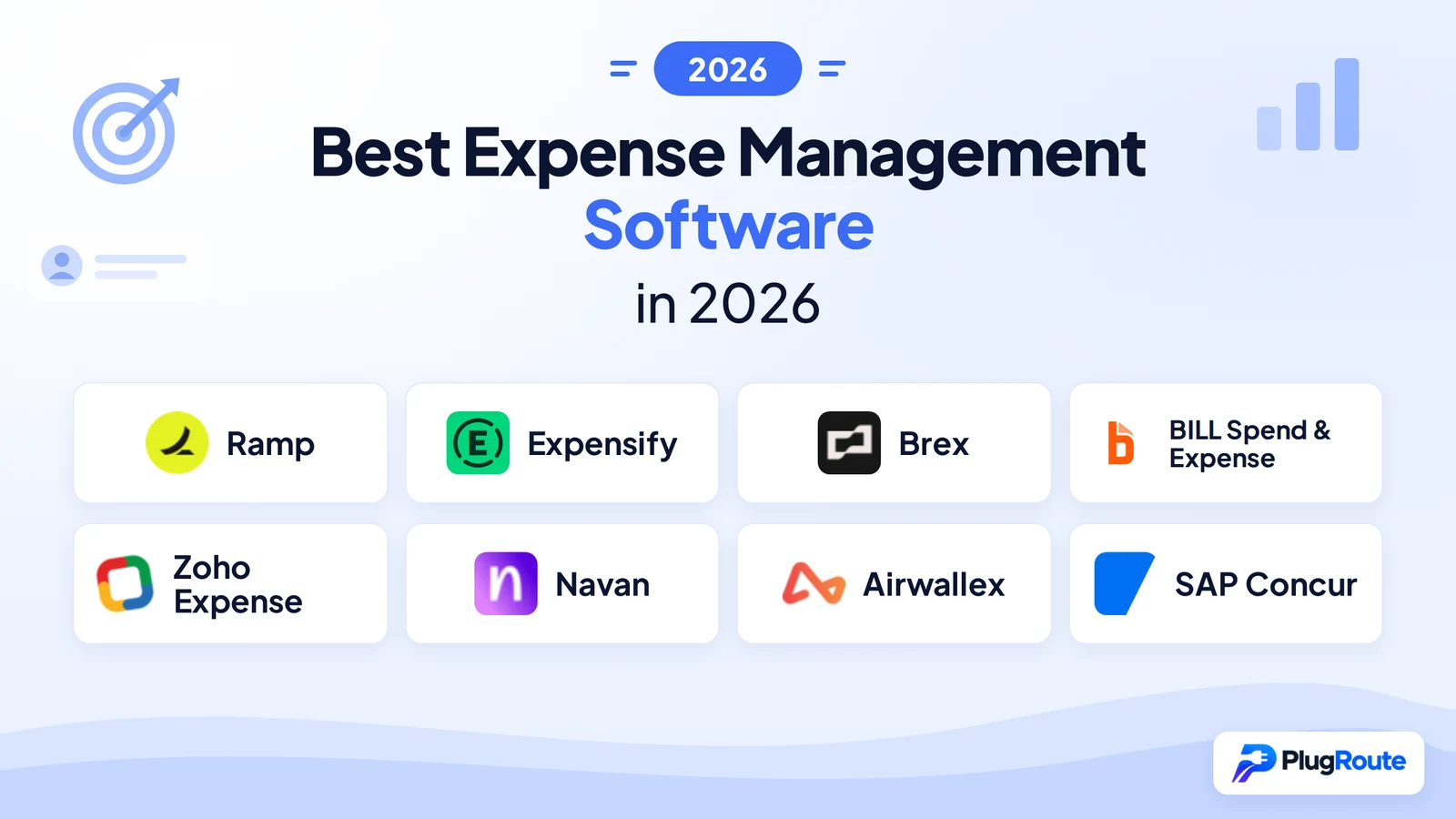
Ramp is the best expense management software for U.S. businesses willing to adopt corporate cards, offering the most feature-complete free plan in the category. Expensify is the strongest choice for businesses keeping existing cards, and Zoho Expense is the most affordable option for small teams. The right platform depends on whether you need pre-purchase card controls or post-purchase expense automation.
Manual expense workflows (spreadsheet trackers, shoeboxes of receipts, month-end reimbursement scrambles) waste finance hours and obscure real spending patterns. Purpose-built expense tracking software eliminates these problems, but choosing the wrong platform creates new friction: forced card adoption, hidden fees, or enterprise complexity your team does not need.
PlugRoute has no affiliate relationships with any company listed. Rankings are determined entirely by research data and objective evaluation criteria.
“We were spending 15+ hours a month chasing receipts and reconciling credit card statements in spreadsheets. Switching to actual expense software cut that to under 2 hours.”, Small business owner, r/smallbusiness (2024)
Takeaway: Manual expense tracking commonly consumes 10–20 hours per month at small businesses, purpose-built software typically reduces this to under 2 hours by automating receipt capture and reconciliation.
What Are the 5 Categories of Expense Management Software?
Expense management platforms fall into five categories: Card-Led Spend Platforms (Ramp, Brex, BILL), Expense Reporting & Reimbursement (Expensify, Zoho Expense), Travel-Integrated Expense (Navan), Multi-Currency Spend Platforms (Airwallex), and Enterprise Expense Suites (SAP Concur). Choosing the wrong category is the most common buying mistake, picking a card-led platform when you need reimbursement flexibility, or a budget tool when you need travel integration.
Card-Led Spend Platforms issue corporate cards as the primary expense mechanism, with software controls, receipt matching, and accounting sync built around card transactions.
- Ramp (#1 in this comparison) is a card-led spend platform offering free corporate cards with real-time spend controls.
- Brex (#3) is a card-led spend platform for startups, issuing corporate cards without personal guarantees.
- BILL Spend & Expense (#4) is a card-led spend platform that uniquely combines expense management with accounts payable.
Expense Reporting & Reimbursement Platforms focus on capturing expenses after purchase, automating receipt collection, managing approval workflows, and processing employee reimbursements, with or without a vendor-issued corporate card.
- Expensify (#2) is an expense reporting platform that automates receipt scanning and reimbursements with any card.
- Zoho Expense (#5) is a low-cost expense reporting tool with receipt scanning, mileage tracking, and approval workflows.
Travel-Integrated Expense Platforms combine corporate travel booking with expense management, enforcing travel policies at the point of booking and automatically generating expense entries from booked trips.
- Navan (#6) is a travel-first expense platform that unifies corporate travel booking with expense tracking.
Multi-Currency Spend Platforms provide global business accounts, local-currency corporate cards, and expense tracking designed for internationally distributed teams operating across multiple currencies.
- Airwallex (#7) is a multi-currency spend platform providing local-currency cards in 40+ markets with competitive FX rates.
Enterprise Expense Suites serve large organizations that need global travel management, expense reporting, invoice processing, compliance enforcement, and deep ERP integration across complex organizational structures.
- SAP Concur (#8) is an enterprise expense suite with global compliance enforcement used by over 75% of Fortune 500 companies (SAP, 2025).
Should You Use a Corporate Card or Keep Your Existing Cards?
Most growing businesses should adopt a hybrid model: corporate cards for recurring spending and high-frequency transactions, reimbursements for occasional out-of-pocket expenses, and virtual cards for subscriptions. The “card vs. reimbursement” decision is a spectrum, not a binary choice, and the right mix depends on your spending patterns.
Card-led platforms (Ramp, Brex, BILL) generate revenue through interchange fees on card transactions. This is why they can offer free software, the business pays nothing for the platform but routes spending through the vendor’s cards.
- Card-led platforms provide pre-purchase controls that prevent unauthorized spending before it occurs.
- Card-led platforms offer automatic receipt matching that reduces manual expense entry work.
- Card-led platforms include real-time dashboards that show spending as it happens.
- Card-led platforms require forfeiting existing bank card rewards programs in exchange for their software capabilities.
As one user on r/Accounting described:
“I have used Expensify & Brex – I absolutely hate Expensify and Brex and some others (Divvy, etc) seem like you need to use their credit card/credit line. My client needs $1m+ in credit line and gets tons of CC rewards so I am not advising them to switch to a new credit provider.” Posted by u/Glittering_Pomelo262
Takeaway: Businesses generating significant credit card rewards face a real financial penalty when card-led expense platforms require switching to vendor-issued cards, the convenience of free software does not automatically outweigh forfeited rewards.
Reimbursement-first platforms (Expensify, Zoho Expense) charge per-user subscription fees and work with any card.
- Reimbursement-first platforms impose no card-adoption requirement, preserving existing banking relationships.
- Reimbursement-first platforms offer flexibility for employees who prefer using personal cards for business expenses.
- Reimbursement-first platforms are simpler to adopt for businesses that already have existing corporate card programs.
- Reimbursement-first platforms capture spending after purchase rather than controlling it before, reducing real-time visibility.
The hybrid approach is what most 10–300 employee businesses actually need. Issue corporate cards for the 60–80% of spending that is predictable (subscriptions, office supplies, travel), and maintain reimbursement workflows for the 20–40% that is not (client dinners, conference expenses, emergency purchases).
The question is not “card or reimbursement”, it is “what percentage of each.” Here is how each platform supports the hybrid model:
- Ramp supports hybrid workflows with corporate cards plus out-of-pocket reimbursements.
- Brex supports hybrid workflows with corporate cards plus reimbursements.
- Expensify supports hybrid workflows with any card plus reimbursements in 160+ currencies.
- BILL Spend & Expense supports corporate cards plus free reimbursement processing.
- Zoho Expense supports reimbursements only: no native corporate card offering.
- Navan supports corporate cards plus reimbursements with a travel-first focus.
- Airwallex supports multi-currency corporate cards plus reimbursements in 60+ currencies.
- SAP Concur supports corporate cards plus reimbursements with enterprise compliance controls.
How Do the Top 8 Expense Management Platforms Compare at a Glance?
The eight platforms ranked below span five categories, from free card-led platforms to enterprise compliance suites. This table summarizes each platform’s positioning, core strengths, and most significant trade-off so you can quickly narrow your shortlist before reading the full entries.
| Rank | Company | Category | Best For | One-Line Summary | Key Capabilities | Primary Strength | Key Limitation |
|---|---|---|---|---|---|---|---|
| 1 | Ramp | Card-Led Spend Platform | U.S. businesses wanting card-led spend control with a free plan | Ramp is a card-led spend management platform that provides free corporate cards, automated expense tracking, bill pay, and real-time spend controls for U.S. businesses seeking to consolidate and reduce company spending. | Corporate cards, receipt matching, bill pay, travel, procurement, reimbursements, real-time dashboards | Most feature-complete free plan in the category | Requires adoption of Ramp’s Visa cards; U.S.-only |
| 2 | Expensify | Expense Reporting & Reimbursement | Businesses keeping existing cards | Expensify is a card-agnostic expense reporting platform that automates receipt scanning, approval workflows, and employee reimbursements for businesses that want expense management without mandatory corporate card adoption. | SmartScan OCR, approval workflows, reimbursements in 160+ currencies, travel booking, any-card support | Full functionality without requiring vendor’s corporate card | Card-free Control plan costs $18/member/month; recent platform redesign caused user friction |
| 3 | Brex | Card-Led Spend Platform | Funded startups and high-growth companies | Brex is a financial platform for startups and scaling companies that bundles corporate cards, expense management, travel booking, and bill pay with credit limits based on company cash rather than personal guarantees. | No-personal-guarantee cards, travel, bill pay, virtual cards, multi-entity support | Corporate cards without personal guarantees | Credit limits tied to cash balances; free plan less comprehensive than Ramp |
| 4 | BILL Spend & Expense | Card-Led Spend Platform | SMBs combining AP and expense management | BILL Spend & Expense is a zero-subscription-cost expense platform that combines corporate cards, employee spending controls, and reimbursements with BILL’s accounts payable tools for small and midsize businesses. | Corporate cards, virtual cards, budgets, reimbursements, AP integration | Unique AP + expense management integration | Newer product with less mature expense features |
| 5 | Zoho Expense | Expense Reporting & Reimbursement | Budget-conscious small teams | Zoho Expense is a low-cost expense reporting tool that provides receipt scanning, mileage tracking, approval workflows, and accounting integrations for small teams that prioritize affordability over card-based spend controls. | Receipt OCR, mileage tracking, per diem, multi-level approvals, Zoho ecosystem integration | Lowest per-user pricing with transparent tier structure | No native corporate cards or pre-purchase controls |
| 6 | Navan | Travel-Integrated Expense | Travel-heavy organizations | Navan is a travel-first expense management platform that combines corporate travel booking, expense tracking, and corporate cards for businesses where employee travel is a significant portion of company spending. | Travel booking, travel policy enforcement, corporate cards, receipt capture, reimbursements | Only platform with fully native travel booking engine | Expensive for non-travel expense management; weaker for general expenses |
| 7 | Airwallex | Multi-Currency Spend Platform | International and multi-currency teams | Airwallex is a multi-currency spend management platform that provides global business accounts, local-currency corporate cards, and expense tracking for internationally distributed teams operating across multiple currencies. | 60+ currencies, local-currency cards in 40+ markets, global accounts, FX at interbank+ rates | Broadest international and multi-currency coverage | Less mature expense features; FX fees add variable costs |
| 8 | SAP Concur | Enterprise Expense Suite | Large organizations with complex compliance | SAP Concur is an enterprise expense management suite that provides global travel booking, expense reporting, invoice processing, and compliance enforcement for large organizations with complex regulatory and audit requirements. | Global compliance, travel management, invoice processing, SAP ERP integration | Most comprehensive compliance and audit capabilities | Per-report pricing is expensive for SMBs; dated UI; long implementation |
Which Expense Management Tool Should I Choose for My Use Case?
The best expense management platform depends on your primary operational priority, not on which product has the longest feature list. Use this decision framework to match your most pressing need to the right tool, then read the full entry for your top choice.
| Your #1 Priority | Recommended Tool | Why | Acceptable Alternative |
|---|---|---|---|
| Free card-led spend control | Ramp | Most comprehensive free plan with cards, receipt matching, bill pay, travel, and accounting integrations | BILL Spend & Expense (also free with cards, plus AP integration) |
| Keep existing corporate cards | Expensify | Full expense automation without card-adoption requirement; supports any card | Zoho Expense (lower cost, but no card infrastructure) |
| Funded startup, no personal guarantee | Brex | Credit limits based on company cash, not founder credit; unified cards + travel + bill pay | Ramp (requires card adoption but more features at free tier) |
| Combined AP + expense management | BILL Spend & Expense | Only platform merging employee expense tracking with established AP workflows | Ramp (strong bill pay, but AP is not BILL-level) |
| Lowest possible cost | Zoho Expense | $3–$5/user/month with no card requirements or interchange economics | Expensify Collect at $5/member/month (more features, same price tier) |
| Heavy business travel | Navan | Native travel booking engine with policy enforcement at point of booking | Brex (integrated travel, but travel is not the core product) |
| Multi-currency / international teams | Airwallex | 60+ currencies, local-currency cards in 40+ markets, competitive FX rates | Expensify (reimbursements in 160+ currencies, but no local card issuance) |
| Enterprise compliance and SAP ERP | SAP Concur | Deepest compliance engine, audit trails across 200+ countries, SAP integration | Navan (enterprise travel management, but less compliance depth) |
1. Ramp: Best Overall for U.S. Businesses Wanting Card-Led Spend Control
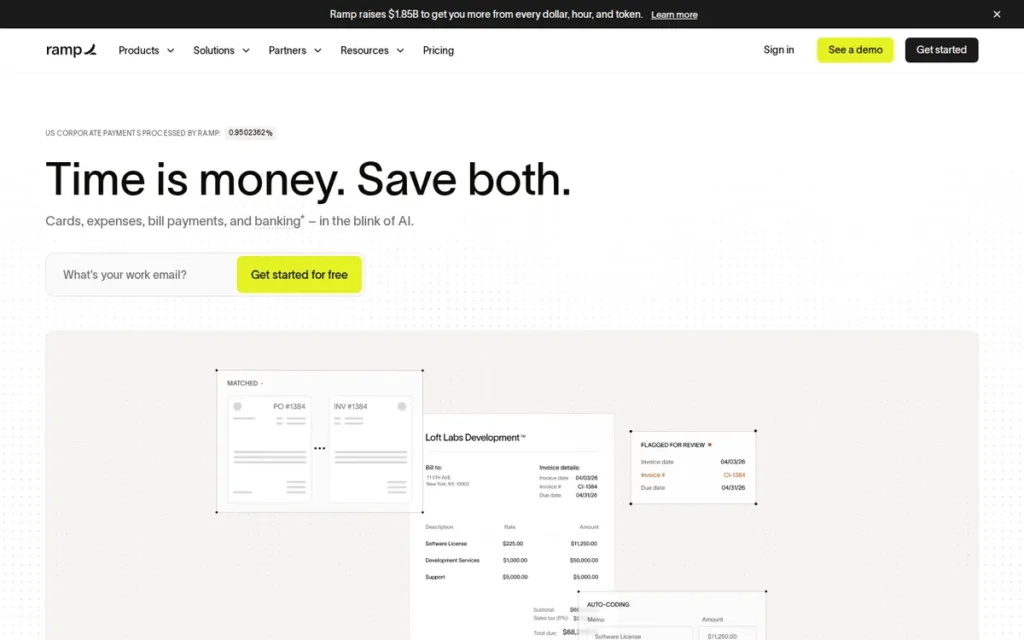
Category: Card-Led Spend Platform, provides corporate cards as the primary expense mechanism, with software controls, automated receipt matching, and accounting sync built around card transactions.
At a Glance
- Category: Card-Led Spend Platform
- Best For: U.S. businesses (10–300 employees) seeking real-time spend controls, automated expense workflows, and a comprehensive free plan tied to corporate cards
- Price Range: Free (card-based plan); Plus from $15/user/month + annual platform fee (October 2026 pricing)
- Primary Strength: Ramp offers the most feature-complete free plan in the expense management category, bundling corporate cards, receipt matching, bill pay, travel, and real-time dashboards at no software subscription cost.
- Biggest Limitation: Ramp requires businesses to adopt its corporate Visa cards to access most features, which means forfeiting rewards on existing bank cards and committing to a single-issuer card program.
- One-Line Summary: Ramp is a card-led spend management platform that provides free corporate cards, automated expense tracking, bill pay, and real-time spend controls for U.S. businesses seeking to consolidate and reduce company spending.
- Last Verified: October 2026
Overview
Ramp is an all-in-one spend management platform built for U.S. businesses that want to issue corporate cards, automate expense tracking, manage bill payments, and gain real-time visibility into company spending from a single dashboard.
Ramp serves teams from startups to mid-market companies, with a free plan that includes more functionality than most competitors’ paid tiers. Ramp’s approach centers on pre-purchase spend controls rather than post-purchase expense reporting.
Key Features
- Ramp provides unlimited physical and virtual corporate Visa cards with per-card spending limits, merchant category restrictions, and automatic expiration dates for project-based spending.
- Ramp’s receipt matching engine uses OCR and machine learning to automatically match uploaded receipts to card transactions, flagging mismatches and policy violations in real time.
- Ramp integrates natively with QuickBooks Online, Xero, NetSuite, and Sage Intacct, with real-time or daily sync options that map expenses to the correct chart-of-accounts categories.
- Ramp includes a built-in travel booking tool that enforces company travel policies at the point of booking and automatically creates expense entries for booked trips.
- Ramp’s automated savings engine identifies duplicate software subscriptions, unused licenses, and vendor price increases, surfacing cost-reduction opportunities beyond expense tracking.
Best For
Ramp is best for U.S. businesses with 10–300 employees that are willing to adopt Ramp’s corporate Visa cards in exchange for a comprehensive, free spend management platform with real-time controls, automated receipt matching, and deep accounting integrations.
Pricing
Ramp’s free plan includes corporate cards, expense management, bill pay, travel booking, and accounting integrations at no software subscription cost. Ramp generates revenue through interchange fees on card transactions.
- Free plan: Corporate cards, automated receipt matching, bill pay, travel, and QuickBooks/Xero/NetSuite integrations
- Plus plan: $15/user/month plus an annual platform fee for advanced features including custom approval workflows, advanced analytics, and priority support
- Enterprise: Custom pricing
Scenario-based cost estimates:
- 25 employees: $0/month (free plan)
- 50 employees: $0/month (free plan) or $750/month + platform fee (Plus)
- 150 employees: $0/month (free plan) or $2,250/month + platform fee (Plus)
Ramp requires a credit evaluation for card approval, which may include minimum bank balance or revenue requirements. All pricing verified October 2026.
Strengths
- Ramp holds a 4.8/5 average rating on G2 with over 2,500 verified reviews (G2, 2026), tied with Brex for the highest user-satisfaction score among the eight platforms evaluated in this comparison.
- Ramp’s free plan includes corporate cards, automated receipt matching, bill pay, travel booking, and QuickBooks/Xero/NetSuite integrations, functionality that competitors like Brex and Expensify gate behind paid tiers (verified October 2026).
- Ramp’s real-time spend dashboards provide instant visibility into spending by employee, department, vendor, and category, with automated alerts when spending approaches budget thresholds.
- Ramp reports that its automated savings engine has helped customers identify over $10 billion in cumulative savings by flagging duplicate subscriptions, price increases, and renegotiation opportunities (Ramp, August 2025, company-reported figure, not independently audited).
Limitations
Ramp’s card-centric model is both its greatest strength and most significant constraint: businesses must route spending through Ramp’s Visa cards to access full capabilities, forfeiting existing bank card rewards and creating dependency on a single card issuer.
Ramp does support out-of-pocket reimbursements, but the platform is designed primarily around card-based transactions. Ramp currently serves only U.S.-based businesses, ruling it out for companies needing local-currency card issuance outside the United States.
Users on r/Accounting shared their perspective on the sustainability of Ramp’s free model:
“Ramp was always a little bit too good to be true, they definitely went after market share and improving their platform as the primary focus with an eye on revenue and sales later. Sure, they make money off your CC transactions but if you managed 1.5% cash back it’s not that much when you consider their overhead costs for their platform and so on. When I heard they would do checks for free I questioned the sales rep pretty aggressively because my company at the time did mainly checks and ramp probably lost money on us. The platform fee was ridiculously cheap at the time for the extra features and I imagine they’ll be eyeing raising that after customers are comfortable enough.” Posted by u/Eigo
Takeaway: Ramp’s industry-leading free plan was designed to capture market share, and experienced users recognize that pricing will evolve as the company shifts toward revenue, a trade-off worth monitoring for businesses building workflows around the free tier.
Verdict
Ramp is the strongest overall expense management platform for U.S. businesses with 10–300 employees willing to adopt its corporate cards.
Ramp’s combination of a genuinely free plan, category-leading user satisfaction (4.8/5 G2, tied with Brex), automated spend controls, and comprehensive accounting integrations creates a value proposition that no other free plan in this comparison currently equals in feature breadth.
The trade-off is real (committing to Ramp’s cards means giving up existing bank card rewards and accepting single-issuer dependency) but for most U.S. businesses evaluating expense management software, Ramp’s feature breadth at zero software cost makes it the strongest starting point based on feature breadth and cost.
2. Expensify: Best for Businesses That Want to Keep Existing Cards
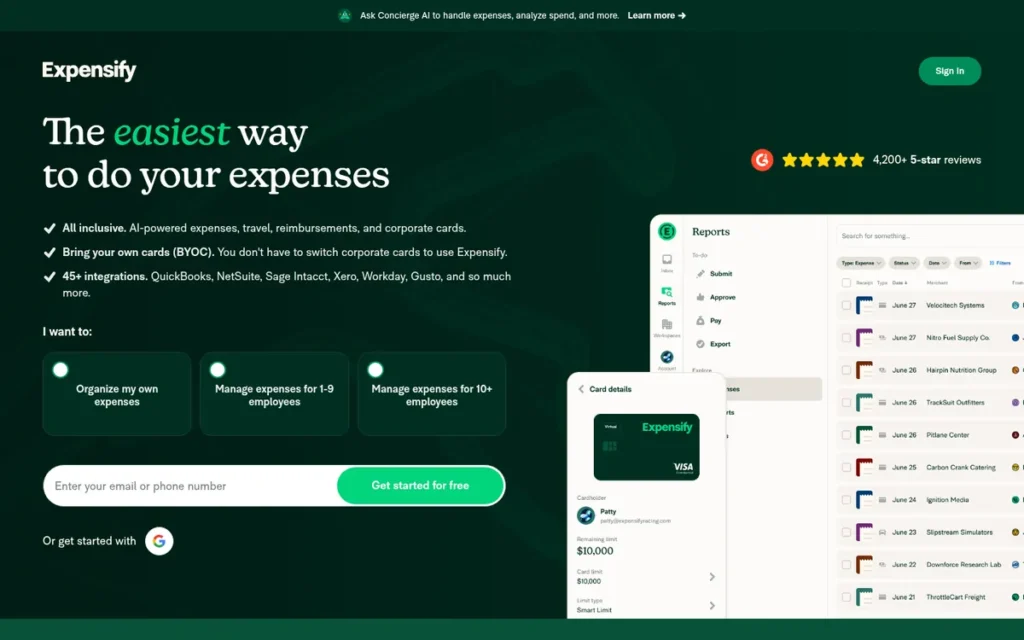
Category: Expense Reporting & Reimbursement, focuses on capturing expenses after purchase, automating receipt collection, managing approval workflows, and processing employee reimbursements, with or without the vendor’s own corporate card.
At a Glance
- Category: Expense Reporting & Reimbursement
- Best For: Businesses that want to automate expense reports and reimbursements while keeping their existing corporate or personal cards
- Price Range: Free (individual Submit plan); Collect from $5/member/month; Control from $18/member/month annual, or as low as $9/member/month with Expensify Card adoption (October 2026 pricing)
- Primary Strength: Expensify is the only platform ranked in the top three of this comparison that provides full functionality (receipt scanning, approval workflows, reimbursements, and accounting sync) without requiring businesses to adopt the vendor’s corporate card.
- Biggest Limitation: Expensify’s Control plan costs $18/member/month at the standard annual rate, the $9 rate requires Expensify Card adoption, creating tension with the platform’s card-agnostic positioning. The 2023–2024 platform redesign (New Expensify) also drew polarized reviews from long-time users.
- One-Line Summary: Expensify is a card-agnostic expense reporting platform that automates receipt scanning, approval workflows, and employee reimbursements for businesses that want expense management without mandatory corporate card adoption.
- Last Verified: October 2026
Overview
Expensify is an expense reporting and reimbursement platform that automates receipt capture, approval workflows, and employee expense reimbursements for businesses of all sizes that want to manage expenses without being locked into a specific corporate card program.
Expensify supports any credit or debit card alongside its optional Expensify Card, making it the most flexible option for businesses transitioning from manual spreadsheets. Expensify also includes travel booking features and international reimbursement capabilities covering 160+ currencies.
Key Features
- Expensify’s SmartScan technology automatically extracts merchant, date, amount, and category data from photographed receipts, with one of the longest-running OCR engines in the expense management category.
- Expensify supports expense submission from any credit card, debit card, or cash transaction, giving businesses full flexibility to keep existing banking relationships while automating expense workflows.
- Expensify processes employee reimbursements via ACH or international transfer in 160+ currencies across 190+ countries, making it viable for companies with globally distributed employees.
- Expensify includes built-in travel booking that allows employees to search and book flights, hotels, and rental cars within the platform, with expenses automatically captured.
- Expensify integrates with QuickBooks Online, QuickBooks Desktop, Xero, NetSuite, and Sage Intacct, with configurable export mappings for chart-of-accounts alignment.
Best For
Expensify is best for businesses that prioritize keeping their existing corporate or personal cards while automating expense reports, receipt capture, and reimbursements, particularly companies with distributed or international employees who need reimbursement in local currencies.
Pricing
Expensify offers a tier structure with no platform fees beyond the per-member subscription, though pricing varies significantly based on Expensify Card adoption.
- Free Submit plan: Individual use only: limited business features
- Collect plan: $5/member/month: includes expense reports, approvals, reimbursements, and accounting integrations
- Control plan: $18/member/month billed annually (standard rate): adds advanced policy controls, multi-level approvals, and custom reporting. With Expensify Card adoption, the rate drops to as low as $9/member/month.
Scenario-based cost estimates (Collect plan):
- 25 employees: $125/month
- 50 employees: $250/month
- 150 employees: $750/month
Note: businesses wanting Control plan features without the Expensify Card will pay $18/member/month, $900/month for 50 employees rather than the $450 the card-discounted rate suggests. All pricing verified October 2026.
Strengths
- Expensify has served over 15 million members since its 2008 founding, giving it the longest operational track record and most refined OCR engine among the platforms in this comparison (Expensify 2025 annual filing).
- Expensify is the only top-tier platform that provides full expense management functionality (receipt scanning, approval workflows, reimbursements, and accounting sync) without requiring adoption of the vendor’s corporate card, earning a 4.5/5 G2 rating (G2, 2026).
- Expensify’s international reimbursement infrastructure covers 160+ currencies across 190+ countries, the broadest geographic reach among the eight platforms evaluated.
- Expensify’s Collect plan at $5/member/month offers a transparent, predictable cost structure that includes reimbursements and accounting integrations, no card adoption required to access core features (October 2026 pricing).
Limitations
Expensify’s transition to its redesigned platform (New Expensify) between 2023 and 2025 generated significant user friction, with long-time customers reporting workflow disruptions, feature relocations, and a learning curve that temporarily reduced productivity.
This aligns with community sentiment on r/Accounting:
“I had the misfortune of integrating Expensify for a small US/CAD business. Everything seemed fine during the on-boarding but the lack of customer support and mid-integration software update made the program impossible to deal with. Both me and my operations manager agreed to dump Expensify and cancelled our credit card to avoid the recurring billing. It’s been 4 months since our CC expired and no one has reached out to follow up.” Posted by u/ProTorque
Takeaway: Expensify’s mid-cycle platform updates have disrupted active implementations, leaving some businesses unable to complete onboarding and receiving little follow-up support.
Expensify’s pricing structure also introduces a subtle incentive: while the platform works without the Expensify Card, the Control plan costs $18/member/month at the standard annual rate versus $9 with the card, which may gradually pull card-agnostic users toward card dependency. Expensify’s pre-purchase spend controls are also less robust than card-led platforms like Ramp and Brex.
Verdict
Expensify is the best expense management platform for businesses that want to automate receipt scanning, expense approvals, and reimbursements without being required to adopt a new corporate card.
Expensify’s card-agnostic flexibility, international reimbursement reach, and transparent Collect plan pricing make it the strongest choice for companies that value banking independence over the pre-purchase spend controls that card-led platforms provide.
The recent platform redesign introduced real friction, but for businesses evaluating in 2026, the transition is complete and the modernized platform is the baseline experience.
3. Brex: Best for Funded Startups and High-Growth Companies
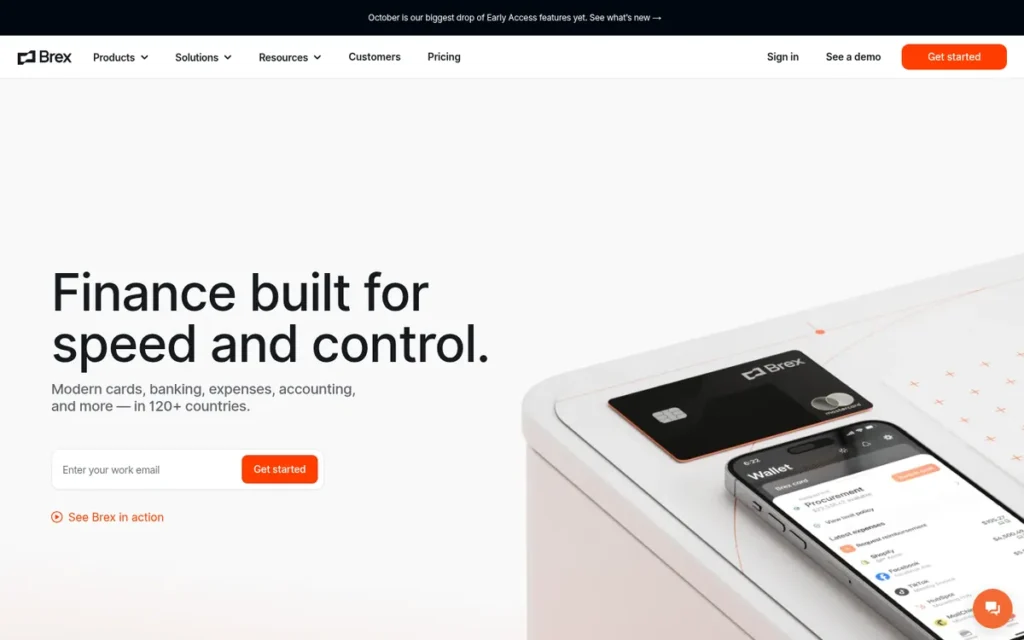
Category: Card-Led Spend Platform, provides corporate cards as the primary expense mechanism, with software controls, automated receipt matching, and accounting sync built around card transactions.
At a Glance
- Category: Card-Led Spend Platform
- Best For: Funded startups and high-growth companies wanting corporate cards without personal guarantees, plus integrated expense management and travel
- Price Range: Free (Essentials); Premium from $12/user/month (October 2026 pricing)
- Primary Strength: Brex issues corporate cards with credit limits based on company cash balances rather than personal credit, eliminating the personal guarantee that traditional corporate card programs require from founders.
- Biggest Limitation: Brex’s credit limits are directly tied to a company’s bank balance and revenue, which can restrict available card spending for bootstrapped or pre-revenue businesses without substantial cash reserves.
- One-Line Summary: Brex is a financial platform for startups and scaling companies that bundles corporate cards, expense management, travel booking, and bill pay with credit limits based on company cash rather than personal guarantees.
- Last Verified: October 2026
Overview
Brex is a corporate card and spend management platform designed for startups and high-growth companies that want to issue corporate cards, manage expenses, book travel, and pay bills without requiring founders to sign personal guarantees.
Brex determines credit limits based on a company’s cash balances and revenue rather than individual credit scores, making it accessible to venture-backed startups that may not qualify for traditional corporate cards. Brex serves companies from seed stage through mid-market.
Key Features
- Brex issues corporate cards with credit limits determined by company bank balances and revenue, requiring no personal guarantee from founders or executives.
- Brex provides automated receipt matching that pairs uploaded receipts with card transactions and flags missing receipts with configurable escalation rules.
- Brex includes integrated travel booking that allows employees to search and book flights, hotels, and rental cars within the platform, with travel policies enforced at the point of booking.
- Brex offers virtual card creation for subscription management, vendor payments, and project-based spending with per-card limits and automatic expiration.
- Brex integrates with QuickBooks Online, NetSuite, Xero, and Sage Intacct, with automated categorization and export capabilities.
Best For
Brex is best for venture-backed startups and high-growth companies with adequate cash reserves that want a unified platform for corporate cards, expense management, travel, and bill pay without the personal credit exposure that traditional corporate card programs require.
Pricing
Brex offers two tiers with clear feature separation.
- Essentials plan (free): Corporate cards, basic expense management, and accounting integrations
- Premium plan: $12/user/month: adds advanced controls, custom approval workflows, and enhanced integrations
- Enterprise: Custom pricing
Brex’s credit limits are tied to company cash balances, businesses should verify minimum requirements during onboarding. Scenario-based cost estimates (Premium plan):
- 25 employees: $300/month
- 50 employees: $600/month
- 150 employees: $1,800/month
All pricing verified October 2026.
Strengths
- Brex holds a 4.8/5 G2 rating with over 1,600 verified reviews (G2, 2026), tied with Ramp for the highest user-satisfaction score among the eight platforms in this comparison.
- Brex has processed over $100 billion in total payment volume across its platform since its 2017 founding, establishing it as one of the most widely adopted corporate financial platforms among U.S. startups (Brex, 2025, figure includes all payment types, not card spend alone).
- Brex’s no-personal-guarantee card model eliminates the founder liability that traditional corporate cards require, a critical differentiator for early-stage companies where founder credit and company finances are intertwined.
- Brex’s virtual card capabilities allow finance teams to create purpose-specific cards with custom limits and expiration dates for subscriptions, vendor payments, and one-time purchases.
Limitations
Brex’s credit-limit model is a double-edged sword: while it eliminates personal guarantees, it ties available spending directly to company bank balances and revenue, meaning bootstrapped or pre-revenue businesses may receive lower credit limits than they need.
Brex has also historically adjusted its target customer profile, in 2022, Brex moved away from serving smaller businesses to focus on mid-market and enterprise. Brex’s free Essentials plan offers fewer features than Ramp’s free plan, meaning businesses wanting advanced controls must commit to the $12/user/month Premium tier.
Verdict
Brex is the best expense management platform for funded startups and high-growth companies that want corporate cards without personal guarantees alongside integrated expense management, travel, and bill pay.
Brex’s cash-balance-based credit model solves a genuine pain point for venture-backed founders, and its unified platform reduces tool sprawl. Brex’s G2 rating ties Ramp at 4.8/5, Brex ranks #3 rather than #1 because its free plan is less feature-complete.
Bootstrapped businesses and cost-conscious SMBs should compare Brex Premium at $12/user/month against Ramp’s more comprehensive free plan before committing.
4. BILL Spend & Expense: Best Free Option for Businesses That Also Need Accounts Payable
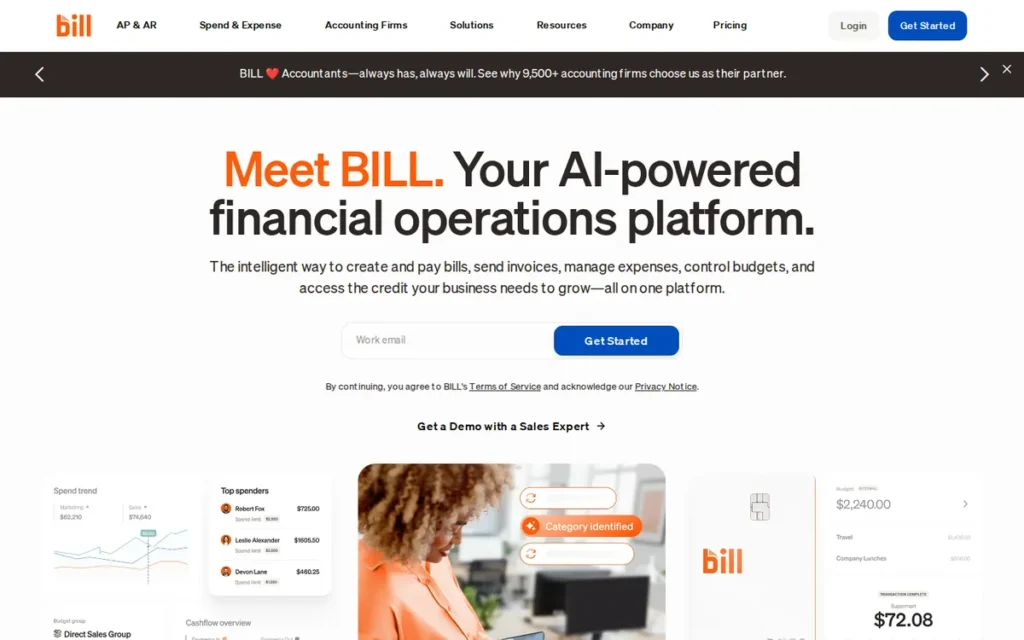
Category: Card-Led Spend Platform, provides corporate cards as the primary expense mechanism, with software controls, automated receipt matching, and accounting sync built around card transactions.
At a Glance
- Category: Card-Led Spend Platform
- Best For: SMBs that want free card-based expense management combined with accounts payable in a single platform
- Price Range: $0/user/month for Spend & Expense (card-based); BILL AP plans priced separately (October 2026 pricing)
- Primary Strength: BILL Spend & Expense charges no per-user software fee when businesses adopt its corporate cards, and uniquely integrates employee expense management with BILL’s established accounts payable workflow.
- Biggest Limitation: BILL Spend & Expense is a newer product than Ramp and Brex, with less mature expense automation features, a smaller user-review base, and fewer independent assessments of its expense-specific capabilities.
- One-Line Summary: BILL Spend & Expense is a zero-subscription-cost expense platform that combines corporate cards, employee spending controls, and reimbursements with BILL’s accounts payable tools for small and midsize businesses.
- Last Verified: October 2026
Overview
BILL Spend & Expense is a card-based expense management platform that provides corporate cards, virtual cards, budget controls, expense tracking, and employee reimbursements at no per-user software cost for businesses that adopt BILL’s card program.
BILL Spend & Expense is part of BILL’s broader financial operations platform, which includes one of the most widely used accounts payable solutions for U.S. small businesses. BILL Spend & Expense is designed for SMBs that want to manage employee spending and vendor bill payments within a single ecosystem.
Key Features
- BILL Spend & Expense provides corporate and virtual cards with per-card spending limits, merchant restrictions, and department-level budget controls at no software subscription cost.
- BILL Spend & Expense integrates directly with BILL’s accounts payable platform, allowing finance teams to manage employee expense tracking and vendor bill payments from the same dashboard.
- BILL Spend & Expense includes free reimbursement processing for out-of-pocket employee expenses, eliminating the need for a separate reimbursement tool.
- BILL Spend & Expense supports automated receipt capture and matching for card transactions, with configurable approval workflows for expense review.
- BILL Spend & Expense integrates with QuickBooks Online, Xero, and NetSuite, leveraging BILL’s established accounting integration infrastructure.
Best For
BILL Spend & Expense is best for small and midsize businesses that already use or plan to use BILL for accounts payable and want to add employee expense management and corporate cards without paying an additional software subscription.
Pricing
BILL Spend & Expense charges no per-user software fee for its expense management module. Like Ramp and Brex, BILL generates revenue through interchange fees on card transactions.
- Spend & Expense module: $0/user/month with BILL corporate card adoption
- BILL AP plans: Priced separately starting at approximately $45/user/month (verify current tiers at bill.com/pricing)
- Free reimbursement processing for out-of-pocket expenses
Key pricing consideration: “free” refers specifically to the Spend & Expense module, not to all BILL products. Businesses adopting multiple BILL modules will pay separate subscription fees for non-expense features.
Scenario-based cost estimates (Spend & Expense only):
- 25 employees: $0/month
- 50 employees: $0/month
- 150 employees: $0/month
All pricing verified October 2026.
Strengths
- BILL serves approximately 494,000 businesses through its broader financial operations platform (BILL fiscal year 2025 earnings, June 2025), providing established accounting integration infrastructure that benefits the Spend & Expense module.
- BILL Spend & Expense charges no per-user software fee for its expense management module, making it one of only two platforms in this comparison (alongside Ramp) that offer genuinely free expense management with corporate cards (October 2026 pricing).
- BILL Spend & Expense uniquely combines employee expense management with accounts payable in a single ecosystem, no other platform in this comparison offers this combination.
- BILL Spend & Expense’s accounting integrations leverage BILL’s long-established connections with QuickBooks, Xero, and NetSuite, which have been refined across millions of transactions.
Limitations
BILL Spend & Expense is a newer addition to BILL’s product suite, and its expense management features are less mature than those of Ramp, Brex, and Expensify, with fewer automation capabilities, a smaller body of user reviews, and less independent evaluation of its expense-specific workflows.
BILL’s strength is its AP integration, but businesses that do not need accounts payable may find Ramp offers a more complete expense management experience at the same zero subscription cost. BILL’s broader platform pricing can also be confusing: the Spend & Expense module is free, but AP and invoicing have separate fees.
Verdict
BILL Spend & Expense is the best choice for SMBs that want free card-based expense management combined with accounts payable in a single platform.
BILL’s unique AP integration makes it a genuine differentiator for businesses that manage significant vendor payments alongside employee expenses. However, businesses that primarily need standalone expense management should compare BILL’s less mature expense features against Ramp’s more comprehensive free offering before committing.
5. Zoho Expense: Best Budget Option for Small Teams

Category: Expense Reporting & Reimbursement, focuses on capturing expenses after purchase, automating receipt collection, managing approval workflows, and processing employee reimbursements, without a native corporate card program.
At a Glance
- Category: Expense Reporting & Reimbursement
- Best For: Budget-conscious small teams (under 50 employees) that need affordable receipt capture, expense reports, mileage tracking, and approval workflows
- Price Range: Free (up to 3 users); Standard $3/user/month; Premium $5/user/month billed annually (October 2026 pricing)
- Primary Strength: Zoho Expense offers the lowest per-user pricing in the expense management category, with a transparent tier structure and no hidden fees, making it the most accessible option for very small teams.
- Biggest Limitation: Zoho Expense does not offer native corporate cards or pre-purchase spend controls, limiting it to post-purchase expense capture and reimbursement, businesses that outgrow this model will need to migrate to a different platform.
- One-Line Summary: Zoho Expense is a low-cost expense reporting tool that provides receipt scanning, mileage tracking, approval workflows, and accounting integrations for small teams that prioritize affordability over card-based spend controls.
- Last Verified: October 2026
Overview
Zoho Expense is a dedicated expense reporting tool for small businesses that need to automate receipt capture, mileage tracking, expense approvals, and employee reimbursements at the lowest possible per-user cost without requiring corporate card adoption.
Zoho Expense is part of the broader Zoho ecosystem, offering native integrations with Zoho Books, Zoho CRM, and Zoho People, alongside third-party connections to QuickBooks and Xero. Zoho Expense is designed for teams that need straightforward expense workflows rather than comprehensive spend management.
Key Features
- Zoho Expense provides receipt OCR that extracts merchant, date, amount, and category data from photographed or emailed receipts for automated expense entry.
- Zoho Expense includes GPS-based mileage tracking that automatically calculates reimbursable travel distances using configurable per-mile rates.
- Zoho Expense supports multi-level approval workflows with configurable rules based on amount thresholds, departments, and expense categories.
- Zoho Expense offers per diem management for business travel, with configurable daily allowance rates by destination.
- Zoho Expense integrates natively with Zoho Books and connects to QuickBooks Online and Xero for automated expense data export.
Best For
Zoho Expense is best for small businesses with fewer than 50 employees that need a dedicated, affordable expense reporting tool and do not require corporate cards or pre-purchase spend controls, particularly businesses already using Zoho products, where the native ecosystem integration creates additional value.
Pricing
Zoho Expense offers the most transparent and lowest-cost tier structure in this comparison.
- Free plan: Up to 3 users with basic receipt scanning, mileage tracking, and expense reports
- Standard plan: $3/user/month billed annually: adds auto-scan, multi-level approvals, and advanced analytics
- Premium plan: $5/user/month billed annually: adds custom analytics, per diem management, and advanced policy controls
- Enterprise plan: Available for larger teams (verify current pricing)
Monthly billing is available at higher rates. Scenario-based cost estimates (Premium plan):
- 25 employees: $125/month
- 50 employees: $250/month
- 150 employees: $750/month
Zoho Expense’s Premium plan at $5/user/month is 55–67% less expensive than Brex Premium ($12/user/month) and Ramp Plus ($15/user/month) for businesses that do not need corporate cards (October 2026 pricing).
Strengths
- Zoho Expense’s Premium plan at $5/user/month billed annually is 55–67% less expensive than Brex Premium ($12/user/month) and Ramp Plus ($15/user/month) for businesses that do not need corporate cards (verified October 2026).
- Zoho Expense provides a genuinely functional free tier for up to 3 users: not a time-limited trial, making it the most accessible entry point for micro-businesses and freelancers.
- Zoho Expense’s native integration with Zoho Books, Zoho CRM, and Zoho People creates a unified workflow for businesses already invested in the Zoho ecosystem, eliminating the third-party integration layer.
- Zoho Expense includes mileage tracking and per diem management features that several higher-priced competitors either lack or gate behind premium tiers.
Limitations
Zoho Expense’s greatest trade-off is the absence of native corporate cards and pre-purchase spend controls, Zoho Expense captures and processes expenses after they occur rather than preventing unauthorized spending before it happens. Businesses needing real-time spend visibility will eventually outgrow Zoho Expense and face a platform migration.
The free tier’s 3-user cap is genuinely limiting: even a small business with 5 employees immediately needs a paid plan. Zoho Expense’s third-party integrations with QuickBooks and Xero are functional but not as deeply embedded as the native integrations offered by Ramp and Expensify.
Verdict
Zoho Expense is the best expense management option for budget-conscious small teams that need affordable receipt capture, mileage tracking, and reimbursement workflows without the complexity or cost of a card-led spend platform.
Zoho Expense’s pricing transparency is a genuine strength, what you see on the pricing page is what you pay, with no interchange economics or card-adoption incentives complicating the cost picture.
The trade-off is clear: Zoho Expense manages expenses after they happen, while card-led platforms like Ramp manage spending before it happens. Businesses that need real-time spend control will outgrow Zoho Expense.
6. Navan: Best for Travel-Heavy Organizations
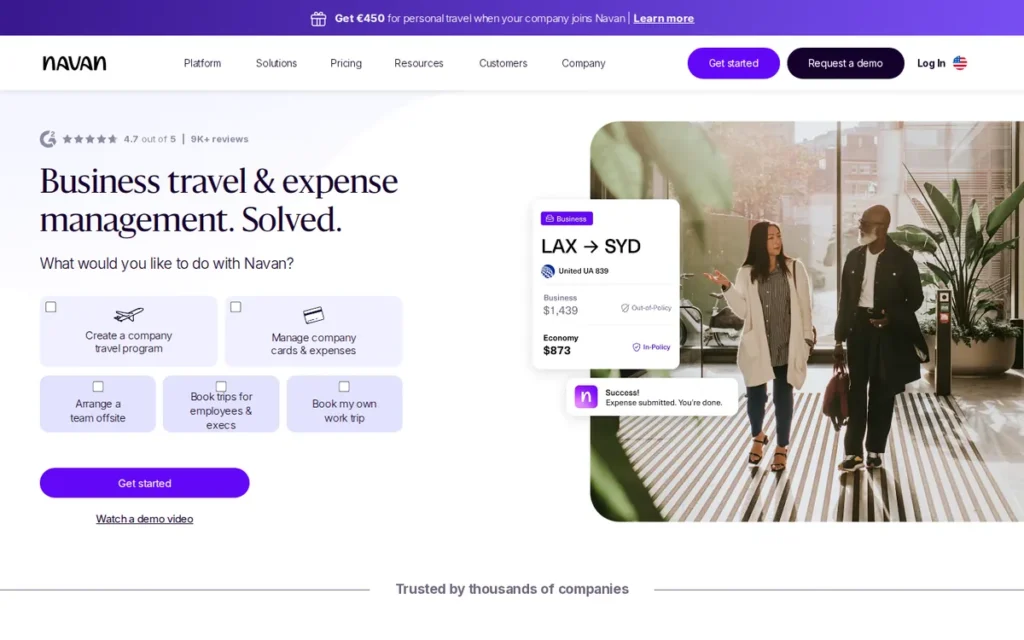
Category: Travel-Integrated Expense, combines corporate travel booking with expense management in a single platform, enforcing travel policies at the point of booking and automatically generating expense entries from booked trips.
At a Glance
- Category: Travel-Integrated Expense
- Best For: Companies with frequent business travel that want unified travel booking and expense management in a single platform
- Price Range: Free travel (up to 300 employees); Expense from $15/user/month after first 5 users (October 2026 pricing)
- Primary Strength: Navan is the only platform in this comparison that provides a fully native travel booking engine alongside expense management, allowing travel policy enforcement at the moment of booking rather than after the trip.
- Biggest Limitation: Navan’s expense management capabilities are weaker than dedicated expense platforms when used without its travel features, and its $15/user/month expense pricing is expensive for businesses where travel is not a primary spending category.
- One-Line Summary: Navan is a travel-first expense management platform that combines corporate travel booking, expense tracking, and corporate cards for businesses where employee travel is a significant portion of company spending.
- Last Verified: October 2026
Overview
Navan is a corporate travel and expense management platform that combines a full-featured travel booking engine with expense tracking, corporate cards, and reimbursement workflows for businesses where employee travel represents a significant spending category.
Navan enables companies to enforce travel policies at the point of booking (before money is spent) and automatically generates expense entries from booked trips. Navan serves businesses from small teams to large enterprises, with a free travel tier for up to 300 employees.
Key Features
- Navan provides a native travel booking engine for flights, hotels, rental cars, and rail, with corporate negotiated rates and travel policy enforcement at the point of booking.
- Navan automatically generates expense entries from booked travel, eliminating manual receipt collection and expense report creation for trip-related spending.
- Navan offers corporate cards with real-time spend controls that can be configured to auto-approve within-policy travel and flag out-of-policy bookings for manager review.
- Navan includes non-travel expense management with receipt capture, approval workflows, and reimbursements for out-of-pocket spending.
- Navan integrates with QuickBooks Online, Xero, NetSuite, and Sage Intacct for automated expense data export to accounting systems.
Best For
Navan is best for businesses with 25–300 employees where business travel is a significant and recurring spending category and where the organization wants travel booking and expense management unified in a single platform to eliminate the gap between booking and expensing.
Pricing
Navan’s pricing structure splits travel booking from expense management.
- Travel booking: Free for companies with up to 300 employees
- Expense management: Free for the first 5 monthly expense users; $15/user/month after 5 users
- Premium and Enterprise tiers: Companies with more than 300 employees should request a custom Enterprise quote from Navan
Key pricing consideration: the cost depends on how many employees submit non-travel expenses. A 50-person company where 30 travel but only 20 submit non-travel expenses would pay differently than a company where all 50 need expense management.
Scenario-based cost estimates (expense management):
- 25 employees: $300/month (20 paid users after free 5)
- 50 employees: $675/month (45 paid users after free 5)
- 150 employees: $2,175/month (145 paid users after free 5)
All pricing verified October 2026.
Strengths
- Navan reports that mid-market customers using its unified platform have reduced manual travel expense reports by over 90% (Navan, 2024, vendor case study, not independently verified), eliminating the gap between booking and expensing.
- Navan’s free travel booking tier for up to 300 employees is the most generous travel-specific offering in this comparison, enabling small businesses to access corporate-grade travel management without software fees.
- Navan enforces travel policies at the point of booking: before money is spent, which is structurally different from expense platforms that review travel spending after the trip, when out-of-policy costs have already been incurred.
- Navan’s corporate card program integrates with its travel engine, automatically reconciling card transactions with booked trips and reducing the receipt-matching burden.
Limitations
Navan’s fundamental trade-off is that its value proposition depends heavily on travel being a significant spending category. For businesses where most expenses are office supplies, subscriptions, and non-travel purchases, Navan’s expense management capabilities are less robust than Ramp, Expensify, or Zoho Expense.
Navan’s $15/user/month expense pricing makes it one of the more expensive options for general expense management. Navan’s non-travel expense features (receipt scanning, approval workflows, reimbursements) are adequate but not category-leading, and businesses may need a supplementary tool for non-travel workflows as they scale.
Verdict
Navan is the best expense management platform for businesses where employee travel is a major spending category and where the inefficiency of managing travel booking and expense reporting in separate systems is a concrete operational pain point.
Navan’s unified travel-plus-expense architecture and free travel tier for up to 300 employees make it uniquely compelling for travel-heavy organizations. For businesses where travel is occasional rather than central, Ramp or Expensify will provide stronger overall expense management at a lower cost.
7. Airwallex: Best for International and Multi-Currency Teams
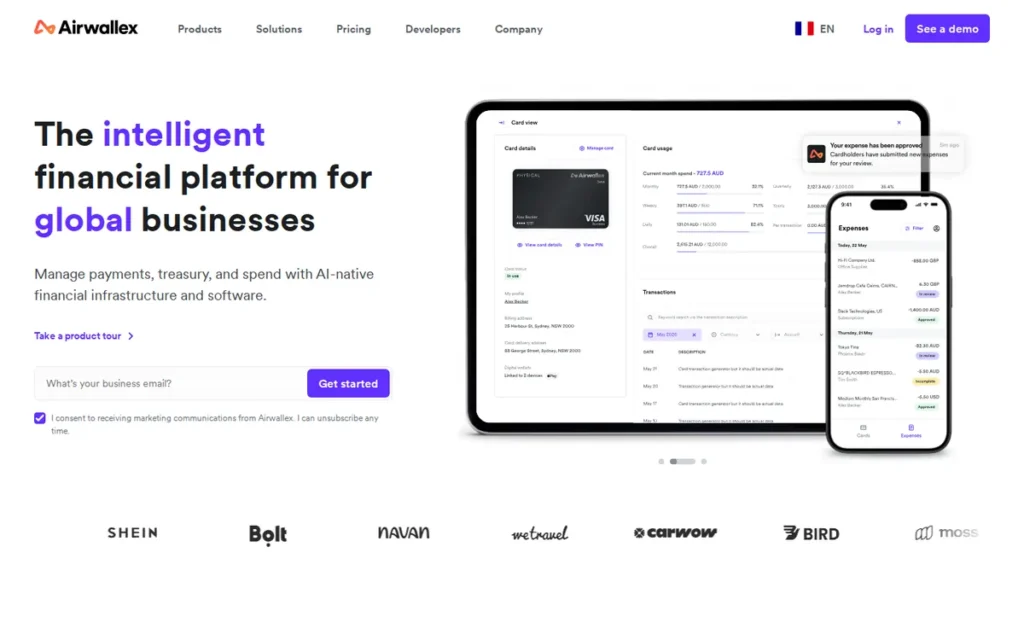
Category: Multi-Currency Spend Platform, provides global business accounts, local-currency corporate cards, and expense tracking designed for internationally distributed teams operating across multiple currencies.
At a Glance
- Category: Multi-Currency Spend Platform
- Best For: Internationally distributed teams that manage expenses across multiple currencies and need local-currency card issuance in multiple markets
- Price Range: Free (up to 10 spend users); paid from $12/user/month + FX markup fees (October 2026 pricing)
- Primary Strength: Airwallex supports 60+ currencies with local-currency corporate card issuance in 40+ markets, making it the most internationally capable spend management platform in this comparison.
- Biggest Limitation: Airwallex’s expense reporting and receipt management features are less mature than dedicated expense platforms, and its FX markup fees add variable costs that are not reflected in the headline subscription price.
- One-Line Summary: Airwallex is a multi-currency spend management platform that provides global business accounts, local-currency corporate cards, and expense tracking for internationally distributed teams operating across multiple currencies.
- Last Verified: October 2026
Overview
Airwallex is a global financial platform that provides multi-currency business accounts, local-currency corporate cards, and spend management tools for businesses with internationally distributed employees or significant cross-border spending.
Airwallex enables companies to hold, receive, and send money in 60+ currencies, issue corporate cards in local currencies across 40+ markets, and manage employee expenses without the inflated FX rates that traditional corporate card programs charge. Airwallex is designed for businesses that have outgrown domestic-only expense platforms.
Key Features
- Airwallex provides local-currency corporate card issuance in 40+ markets, allowing employees to make purchases in their local currency without cross-border transaction fees.
- Airwallex supports global business accounts that hold balances in 60+ currencies, enabling businesses to receive payments and manage expenses in multiple currencies without forced conversions.
- Airwallex offers FX conversions at interbank rates plus a transparent markup, which is typically lower than the exchange rates applied by traditional banks and card programs.
- Airwallex includes expense tracking with receipt capture, approval workflows, and budget controls for managing employee spending across multiple countries and currencies.
- Airwallex integrates with Xero, QuickBooks Online, and NetSuite for automated expense data export with multi-currency mapping.
Best For
Airwallex is best for businesses with employees in multiple countries that need to issue local-currency corporate cards, manage multi-currency expenses, and avoid the inflated FX rates that domestic-focused expense platforms charge on international transactions.
Pricing
Airwallex’s pricing combines a per-user subscription with variable FX fees that depend on conversion volume and currency pairs.
- Free plan: Up to 10 spend users
- Paid plans: From $12/user/month for additional spend users
- FX markup fees: Airwallex advertises rates at 0.5–1.0% above interbank (verify current rates for your currency pairs)
Key pricing consideration: a business converting $100,000/month in foreign currency will pay significantly more in total than the $12/user headline suggests. The true cost depends heavily on FX volume and conversion frequency.
Scenario-based cost estimates (subscription only, excluding FX fees):
- 25 employees: $180/month (15 paid users after free 10)
- 50 employees: $480/month (40 paid users after free 10)
- 150 employees: $1,680/month (140 paid users after free 10)
All pricing verified October 2026.
Strengths
- Airwallex processed over $266 billion in annual transaction volume across its global platform by end of 2025 (Airwallex, 2025, company-reported figure), demonstrating enterprise-grade infrastructure for multi-currency financial operations.
- Airwallex’s local-currency card issuance in 40+ markets is the broadest in this comparison, Ramp and Brex are U.S.-only, Expensify supports international reimbursements but not local card issuance, and SAP Concur requires separate card partnerships for local issuance.
- Airwallex advertises FX rates at 0.5–1.0% above interbank, which independent comparisons generally find to be lower than the 2–3% markups charged by traditional banks and most corporate card programs on international transactions (industry rate comparisons, 2025, verify current spreads before relying on this range).
- Airwallex’s multi-currency business accounts eliminate the need for separate bank accounts in each operating country, reducing banking overhead for internationally distributed businesses.
Limitations
Airwallex’s expense management features (receipt scanning, approval workflows, and expense reporting) are functional but less mature than those of Expensify, Ramp, or Zoho Expense, reflecting Airwallex’s origins as a payments and FX platform that added expense management capabilities.
For businesses operating entirely within the U.S., Airwallex offers little advantage over Ramp or Expensify and adds FX-oriented complexity that is irrelevant. Airwallex’s true cost is harder to predict than competitors’ because FX markup fees fluctuate with conversion volume, currency pairs, and market conditions.
Verdict
Airwallex is the best expense management platform for businesses with internationally distributed teams that need multi-currency accounts, local-currency card issuance, and competitive FX rates as core requirements rather than add-on features.
Airwallex’s 60+ currency support and 40+ market card issuance capability is unmatched in this comparison. However, businesses operating primarily within the U.S. should not choose Airwallex, its domestic expense management features do not compete with Ramp, Expensify, or Zoho Expense.
8. SAP Concur: Best for Large Organizations with Complex Compliance Requirements
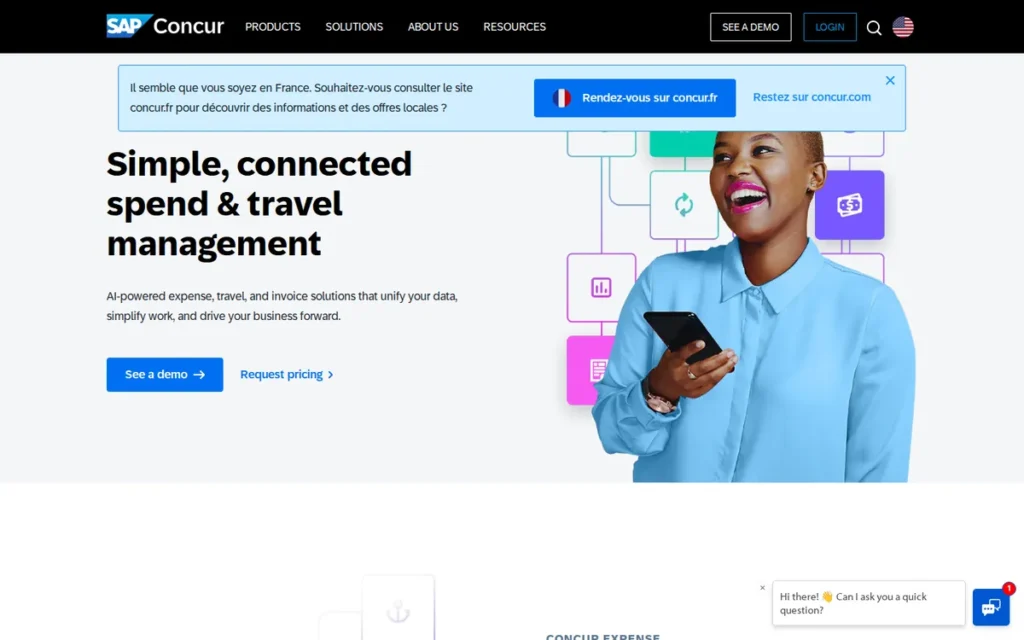
Category: Enterprise Expense Suite, a comprehensive platform for large organizations that need global travel management, expense reporting, invoice processing, compliance enforcement, and deep ERP integration across complex organizational structures.
At a Glance
- Category: Enterprise Expense Suite
- Best For: Large organizations (typically 300+ employees) with complex global travel policies, multi-country compliance requirements, and existing SAP infrastructure
- Price Range: From $7/report (Base); $11/report (Plus); custom pricing (Premium) (October 2026 pricing)
- Primary Strength: SAP Concur offers the most comprehensive compliance, audit trail, and global travel policy enforcement capabilities in the expense management market, with the deepest ERP integration for businesses running SAP.
- Biggest Limitation: SAP Concur’s per-report pricing model, complex implementation process (weeks to months), and dated user interface make it disproportionately expensive and burdensome for small and midsize businesses that lack dedicated finance IT staff.
- One-Line Summary: SAP Concur is an enterprise expense management suite that provides global travel booking, expense reporting, invoice processing, and compliance enforcement for large organizations with complex regulatory and audit requirements.
- Last Verified: October 2026
Overview
SAP Concur is an enterprise-grade expense management suite that combines global travel booking, expense reporting, invoice processing, and compliance enforcement for large organizations with complex regulatory requirements, multi-country operations, and established SAP infrastructure.
SAP Concur is one of the most widely deployed enterprise expense management platforms globally, with decades of market presence and the broadest supplier network for negotiated corporate travel rates. SAP Concur is designed for organizations where compliance, audit trails, and global policy enforcement justify higher cost and implementation complexity.
Key Features
- SAP Concur provides automated compliance checks against company travel and expense policies, tax regulations, and industry-specific rules, with configurable audit triggers and exception workflows.
- SAP Concur includes a global travel booking engine with access to negotiated corporate rates across airlines, hotels, and rental car companies, enforcing travel policies at the point of booking.
- SAP Concur offers deep two-way integration with SAP’s ERP ecosystem (S/4HANA, ECC), as well as connections to Oracle, Microsoft Dynamics, and other enterprise ERPs.
- SAP Concur supports multi-country expense management with localized tax calculations, per diem rates, and compliance rules for 200+ countries and territories.
- SAP Concur provides invoice processing and accounts payable automation alongside expense management, creating a unified procure-to-pay workflow for enterprise finance teams.
Best For
SAP Concur is best for large organizations with 300+ employees that have complex global travel policies, multi-country compliance requirements, and existing SAP ERP infrastructure where deep integration is a priority, specifically where audit trail completeness and regulatory compliance justify the higher cost and longer implementation timeline.
Pricing
SAP Concur uses a per-report pricing model fundamentally different from the per-user models used by every other platform in this comparison.
- Concur Expense Base: Approximately $7 per expense report
- Concur Expense Plus: Approximately $11 per expense report
- Premium tier: Custom pricing
- Travel module: Priced separately
Per-report pricing is a volume tax disguised as a per-use fee, the more your employees use the software, the more it costs. A 50-person company submitting an average of 4 expense reports per employee per month would pay approximately:
- 50 employees (Base): ~$1,400/month ($7 × 200 reports)
- 50 employees (Plus): ~$2,200/month ($11 × 200 reports)
- 150 employees (Base): ~$4,200/month ($7 × 600 reports)
For comparison, Ramp serves 50 employees for $0/month and Expensify serves 50 employees for $250/month. Implementation may involve additional professional services fees. All pricing verified October 2026.
Strengths
- SAP Concur is used by over 75% of Fortune 500 companies for travel and expense management (SAP, 2025, company-reported figure), making it the most widely deployed enterprise expense platform globally.
- SAP Concur’s compliance engine supports automated policy checks across 200+ countries and territories, with localized tax calculations, per diem rates, and regulatory rules, the broadest compliance coverage in this comparison.
- SAP Concur’s integration with SAP S/4HANA and ECC provides the deepest ERP connection available for businesses running SAP, with two-way data flow that eliminates manual reconciliation between expense management and enterprise resource planning.
- SAP Concur’s global travel booking engine provides access to the largest network of negotiated corporate travel rates, potentially reducing per-trip costs for organizations with significant travel volume.
Limitations
SAP Concur’s per-report pricing model is its most significant drawback for the target audience of this article: a 50-person company submitting 4 expense reports per employee per month pays approximately $1,400–$2,200/month, significantly more than $0/month on Ramp or $250/month on Expensify.
SAP Concur’s user interface consistently receives lower satisfaction scores on G2 and Capterra compared to modern platforms like Ramp and Brex (G2, 2026).
Users on r/Vent described the day-to-day experience:
“Every trip means I’m fronting a large amount of my own money. Then after I get back (when I’m already exhausted) I have to sit down and upload every single receipt, categorize everything perfectly, fix the random things that get flagged, resubmit stuff that gets kicked back for tiny reasons… it just never ends. It’s not even just the time. It’s the mental drain.” Posted by u/idgaf12345678901
Takeaway: SAP Concur’s expense report workflow imposes a significant time and cognitive burden on frequent travelers, particularly at organizations that do not issue corporate cards to offset out-of-pocket spending.
SAP Concur’s implementation timelines are measured in weeks to months rather than the same-day setup offered by Ramp, Zoho Expense, and Expensify. For a 10–300 person U.S. business without dedicated finance IT staff, SAP Concur’s enterprise capabilities are likely to impose more overhead than they resolve.
Verdict
SAP Concur is the most comprehensive enterprise expense management suite available, and for large organizations with global compliance requirements, complex travel policies, and existing SAP infrastructure, SAP Concur remains the category standard.
However, SAP Concur is not recommended as a primary option for the small and midsize businesses this article targets. SAP Concur’s per-report pricing, implementation complexity, and dated user experience make it a poor fit for teams with 10–300 employees that can achieve better outcomes at lower cost with Ramp, Expensify, or Brex.
Include SAP Concur in your evaluation only if your organization is above 300 employees or has compliance requirements that simpler platforms cannot meet.
What Red Flags Should I Watch For When Evaluating Expense Management Software?
Watch for five red flags when evaluating expense management software: hidden card-adoption requirements, per-report pricing without volume estimates, free-tier feature gating, minimum balance or revenue requirements for card approval, and integration claims that lack edition and sync-direction specifics. Each can lock you into a platform that costs more than expected.
Red Flag #1: Hidden Card-Adoption Requirements
Some platforms advertise low per-user prices but require adoption of the vendor’s corporate card to access the advertised rate, or gate core features behind card usage. Ask every vendor: “What functionality do I lose if I do not adopt your corporate card?” If the answer is “most of it,” the platform is a card program with expense software attached.
Red Flag #2: Per-Report Pricing Without Volume Estimates
SAP Concur’s per-report model and similar structures tie costs to submission frequency, not team size. A 50-person team submitting 4 reports per employee per month pays for 200 reports, not 50 users. Always model your expected monthly report volume before comparing per-report pricing against per-user pricing.
Red Flag #3: Free Tier Feature Gating
Free tiers that lock multi-level approvals, ERP integrations, or custom policies behind paid plans create an inevitable upgrade trigger. A 30-person company on Ramp’s free plan may discover that custom approval workflows require the Plus plan at $15/user/month, a jump from $0 to $450/month plus a platform fee overnight. Map free-tier features against your actual workflow requirements before investing in onboarding.
Red Flag #4: Minimum Balance or Revenue Requirements
Card-based platforms like Ramp and Brex require credit evaluations that may include minimum bank balance or revenue thresholds. A platform is not truly “free” if your company cannot qualify for the cards that make the free tier functional. Verify eligibility requirements before investing time in onboarding.
Red Flag #5: Integration Depth Claims Without Specifics
Vendors that list “QuickBooks integration” without specifying supported editions, sync frequency, sync direction, or tier-gating are hiding material details. Ask for specifics:
- Which QuickBooks editions are supported (Online, Desktop, Self-Employed)?
- Is sync real-time or batch?
- Is the integration two-way or export-only?
- Is the integration available on free tiers or gated behind paid plans?
What Questions Should I Ask Before Choosing Expense Management Software?
Before choosing expense management software, ask five questions: Do you need pre-purchase spend controls or post-purchase automation? What is your monthly expense report volume? Which QuickBooks or Xero edition do you use? What percentage of expenses are travel-related? Do you have employees in multiple countries? Each question exposes trade-offs that feature lists and pricing pages hide.
Question #1: Do you need pre-purchase spend controls or post-purchase expense automation?
Card-led platforms (Ramp, Brex, BILL) control spending before it happens by setting card limits and restrictions. Reimbursement platforms (Expensify, Zoho Expense) automate capturing and approving expenses after they occur. Most growing businesses need both, identify which is your primary pain point and choose accordingly.
Question #2: What is your monthly expense report volume, and how does per-report pricing compare to per-user pricing for your team?
Model your actual monthly expense volume before comparing vendors. A 50-person team averaging 4 reports per employee per month generates 200 reports, at SAP Concur’s $7–$11/report, that is $1,400–$2,200/month versus $250/month on Expensify Collect or $0/month on Ramp’s free plan.
Question #3: Which QuickBooks or Xero edition do you use, and does this platform support two-way sync with it?
Not all QuickBooks editions are supported equally. Verify whether your specific edition (QuickBooks Online, QuickBooks Desktop, QuickBooks Self-Employed) is supported, whether sync is real-time or batch, and whether the integration is two-way or export-only. Ask whether the integration is available on the free tier.
Question #4: What percentage of your expenses are travel-related, and do you need booking integrated with expense management?
If travel represents 30%+ of your company spending, a travel-integrated platform like Navan may save more through policy enforcement at booking than a general expense tool saves through receipt automation. If travel is under 10%, a general platform with basic travel features (Ramp, Expensify) is more cost-effective.
Question #5: Do you have employees in multiple countries who need local-currency cards or reimbursement?
Ramp and Brex serve only U.S.-based businesses. Expensify handles international reimbursements but not local card issuance. Airwallex provides local-currency cards in 40+ markets. SAP Concur supports global compliance but requires separate card partnerships. Match your international footprint to the platform’s actual geographic capabilities.
How Did We Rank These Expense Management Platforms?
These rankings are determined by weighted scoring across six objective criteria, using aggregated review platform data, published pricing, vendor documentation, and community sentiment. The best expense management software is the one your employees actually use, which is why real-world user satisfaction, not feature count, carries the highest weight.
No company was given favorable or unfavorable treatment based on brand recognition, market share, or advertising spend, every product was scored against every criterion using the same data sources and evaluation process.
Primary Criteria (Higher Weight)
Real-World User Satisfaction
Aggregated user ratings across G2, Capterra, and app stores are the most reliable proxy for whether a platform works in daily practice. User satisfaction captures mobile app quality, OCR reliability, UI intuitiveness, and support responsiveness that feature lists cannot convey.
Measurement: weighted average of G2, Capterra, and app store ratings; review volume; directional trend in recent reviews; prevalence of specific complaints.
Feature Completeness for SMBs
A 10–300 person business needs core expense capabilities without the compliance overhead of enterprise suites. Feature completeness is scored on the presence and quality of:
- Receipt scanning and OCR
- Expense report creation and submission
- Employee reimbursement processing
- Approval workflows
- Corporate and virtual cards (where applicable)
- Travel booking integration (where applicable)
Each capability is scored 0–3 (absent, basic, good, excellent) using vendor documentation and user reviews.
Pricing Transparency and Total Cost of Ownership
Headline per-user prices obscure the true cost. Platform fees, card-eligibility requirements, minimum balance thresholds, interchange economics, and tier-gating mean actual annual cost can differ dramatically from advertised price.
Measurement: clarity of published pricing; hidden fees; scenario-based cost modeling at 25, 50, and 150 employees; free-tier generosity.
Spend Control and Real-Time Visibility
The shift from spreadsheets to software is driven by the need to see and control spending before it becomes a line item on a bank statement.
Measurement: real-time dashboards, pre-purchase controls, automated policy enforcement, budget tracking, virtual card management, alerts.
Secondary Criteria (Lower Weight)
Accounting Integration Depth
The #1 reason SMBs adopt expense software is to eliminate double-entry. Integration quality (which editions are supported, sync type, direction) determines whether software reduces overhead or moves it.
Measurement: supported platforms, sync type, direction, tier-gating, user-reported reliability.
Scalability and Deployment Flexibility
A growing business needs software that scales from 10 to 300 employees without a disruptive platform migration.
Measurement: free-to-paid transition smoothness, hybrid card + reimbursement support, multi-currency capabilities, implementation timeline.
Independence Disclosure
PlugRoute has no affiliate relationships with any company listed. Rankings are determined entirely by research data and objective evaluation criteria.
What Do Buyers Most Often Ask About Expense Management Software?
What is the best expense management software for a small business with 10–50 employees?
Ramp is the best option for most U.S. small businesses willing to adopt corporate cards, its free plan includes cards, receipt matching, bill pay, and accounting integrations. Expensify Collect at $5/member/month is the strongest alternative for businesses keeping existing cards. Zoho Expense starts at $3/user/month for the lowest cost (October 2026 pricing).
How much does expense management software actually cost in 2026?
Costs range from $0 to over $2,000 per month for a 50-person team. Ramp and BILL Spend & Expense charge $0 with card adoption. Expensify Collect costs $250/month for 50 users. SAP Concur costs $1,400–$2,200/month at 4 reports per employee. Always model total cost including platform fees, FX markups, and feature-gating (October 2026 pricing).
How does PlugRoute determine its rankings?
Rankings use weighted scoring across six criteria: real-world user satisfaction, feature completeness for SMBs, pricing transparency, accounting integration depth, spend control and visibility, and scalability. Every product is evaluated with identical rigor using aggregated review data from G2 and Capterra, published pricing, vendor documentation, Reddit community sentiment, and app store ratings.
Which Expense Management Platform Is Right for You?
Ramp is the best overall expense management software for U.S. businesses willing to adopt corporate cards, Expensify is best for keeping existing cards, and Zoho Expense is the lowest-cost option for small teams. The right choice depends on your card strategy, spending patterns, and geographic footprint, here are the key insights from this comparison.
Key Insights
- Ramp is the strongest overall expense management platform for U.S. businesses willing to adopt corporate cards, offering the most feature-complete free plan in the category with real-time spend controls and a 4.8/5 G2 rating (G2, 2026).
- Expensify is the best choice for businesses that want to automate expense management without changing their banking relationships, providing full functionality with any credit or debit card at $5/member/month on the Collect plan (October 2026 pricing).
- Most growing businesses should adopt a hybrid card + reimbursement model rather than choosing one approach exclusively, using corporate cards for recurring spending and reimbursements for occasional out-of-pocket expenses.
- Headline pricing is misleading across the category: model true total cost at your actual team size and expense volume before committing, paying particular attention to per-report pricing, FX markups, platform fees, and feature-gating.
- Implementation speed and employee adoption matter more than feature lists: the best expense management tool is the one your team will actually use consistently, and platforms with steep learning curves create the same spreadsheet reversion they were meant to prevent.
If you need pre-purchase spend controls and your team is U.S.-based, start with Ramp’s free plan. If you want to keep your existing cards or have international employees who need local-currency reimbursements, Expensify is the strongest starting point. If your company has significant travel spending, evaluate Navan’s unified travel-plus-expense architecture.
For funded startups, Brex eliminates the personal-guarantee barrier. For micro-teams on tight budgets, Zoho Expense provides genuine expense automation at $3–$5/user/month. For businesses with employees in multiple countries, Airwallex solves the multi-currency problem that domestic platforms cannot.
Every platform in this comparison offers a free tier or free trial. Test your top two candidates with a small team for two weeks before committing, evaluate three things:
- How many receipts does the OCR scan correctly on the first try?
- How many steps does the approval workflow require?
- Does the accounting sync match your chart of accounts without manual adjustment?
We update this guide quarterly. Last updated: October 2026.
Read our full ranking methodology or explore our other independent SaaS reviews at PlugRoute.