BrowserStack leads mobile app testing in 2026 as the largest real-device cloud with 30,000+ devices and G2: 4.4/5.0 across 3,317 verified reviews. Appium is the best open-source framework for vendor-neutral automation at zero license cost. Sauce Labs is the strongest choice for VPN-dependent enterprise environments. Budget and security architecture are the primary decision filters.
The practical challenge is that BrowserStack is a binary adoption blocker for enterprises with VPN requirements, and Appium carries an iOS maintenance overhead that practitioners describe as requiring dedicated full-time engineering headcount at scale. AI-native tools promise autonomy while practitioner communities document serious non-determinism concerns. The gap between vendor marketing and production reality is widest in this category.
PlugRoute has no affiliate relationships with any company listed; rankings are determined entirely by research data and objective evaluation criteria.
“Which will be good will be entirely down to 1 thing: your budget.”, Practitioner, r/softwaretesting, May 2026
Takeaway: Budget is the single most-cited decision filter in QA practitioner communities, but security architecture (VPN compatibility, data residency) frequently overrides budget when it is a non-negotiable compliance constraint.
TL;DR: Top Picks at a Glance
- BrowserStack: 30,000+ real devices; best for enterprise iOS/Android CI/CD coverage
- Appium: free, open-source; best for vendor-neutral automation at zero license cost
- Sauce Labs: VPN tunnel via Sauce Connect; best for enterprises with security requirements
- testRigor: plain-English no-code; best for non-technical teams; free tier available
What Are the Four Categories of Mobile App Testing Software?
Mobile app testing tools divide into four categories: cloud device platforms, an open-source automation framework, an AI-native no-code platform, and an AI-stabilized automation platform. Identifying which category matches your team’s technical capability and infrastructure determines which tool to evaluate first, the categories are not interchangeable, and each solves a different layer of the mobile testing stack.
Cloud Device Platforms provide on-demand remote access to real physical iOS and Android devices:
- BrowserStack: 30,000+ real devices across 21 global data centers
- Sauce Labs: 9,000+ real devices plus 1,700+ emulators and simulators with VPN tunneling
- LambdaTest: 10,000+ real devices at the lowest verified entry price ($15/user/month)
- Kobiton: cloud and on-premises real-device infrastructure for regulated industries
Open-Source Automation Framework: Appium, free, multi-language, governed by the OpenJS Foundation. Appium test scripts run unchanged on BrowserStack, Sauce Labs, Kobiton, and LambdaTest, providing vendor-neutral portability no commercial tool can replicate.
AI-Native No-Code Platform: testRigor, tests authored in plain English with no locators or programming required. testRigor requires a separate device cloud subscription (BrowserStack or LambdaTest) for physical device execution.
AI-Stabilized Automation Platform: Testim by Tricentis, ML-based self-healing locators that automatically adapt to UI element changes across iOS, Android, React Native, Flutter, and web applications.
How Do the 7 Mobile App Testing Tools Compare?
| Rank | Company | Category | Best For | One-Line Summary | Key Capabilities | Primary Strength | Key Limitation |
|---|---|---|---|---|---|---|---|
| #1 | BrowserStack | Cloud Device Platform | Broadest real-device coverage | BrowserStack is the largest cloud real-device testing platform with 30,000+ devices and G2: 4.4/5.0 across 3,317 verified reviews as of June 2026 | Appium, Espresso, XCUITest; App Live; App Automate; parallel execution; CI/CD integrations | 30,000+ real devices across 21 data centers; largest fleet in this comparison | VPN incompatible; a binary enterprise adoption blocker; aggressive post-trial sales outreach documented |
| #2 | Appium | Open-Source Framework | Vendor-neutral zero-cost automation | Appium is the free, open-source mobile automation framework with multi-language support and vendor-neutral portability across every major device cloud at zero license cost | Java, Python, JavaScript, Ruby, C#, PHP; iOS + Android; Appium 2.0 modular drivers; universal CI/CD compatibility | Zero license cost; test scripts run unchanged on BrowserStack, Sauce Labs, Kobiton, and LambdaTest | iOS/XCUITest dependency creates production-scale maintenance overhead requiring dedicated engineering headcount |
| #3 | Sauce Labs | Enterprise Cloud Platform | VPN-compatible enterprise security | Sauce Labs is an enterprise cloud platform founded in 2008 with Sauce Connect VPN tunneling, 9,000+ real devices, and G2: approximately 4.3/5.0 (~180 reviews) as of June 2026 | Sauce Connect VPN; 9,000+ real devices; 1,700+ emulators/simulators; private device pools; AI test observability | The only purpose-built VPN tunneling solution among cloud testing platforms in this comparison | Documented regional outage pattern; higher entry cost than LambdaTest for small teams |
| #4 | LambdaTest | AI-Augmented Cloud Platform | Budget-conscious teams, lowest entry price | LambdaTest (now TestMu AI) is a cloud platform with 10,000+ real devices, a $15/user/month entry price, and KaneAI for natural-language test authoring as of June 2026 | 10,000+ real devices; KaneAI AI authoring; HyperExecute orchestration; mobile accessibility testing; Appium support | $15/user/month; lowest verified entry price in this comparison; Capterra: 4.6/5.0 (510 reviews) | Predatory sales practices documented in QA communities; brand triggers r/softwaretesting auto-removal |
| #5 | Kobiton | Mobile-Specialist Platform | Regulated industries, on-premises deployment | Kobiton is the only platform in this comparison with on-premises real-device deployment and AI-powered conversion of manual sessions into Appium-compatible scripts | On-premises + cloud real devices; scriptless Appium generation; self-healing scripts; Claude AI integration; Appdome partnership | The only platform in this comparison with documented on-premises real-device deployment | G2: ~4.3 / Capterra: ~4.3 per 2026 third-party roundup; no published self-serve pricing |
| #6 | testRigor | AI-Native No-Code Platform | Non-technical teams, no coding required | testRigor is an AI-native no-code platform where mobile tests are authored in plain English without locators or programming, with a free tier via Azure Marketplace | Plain-English authoring; single iOS+Android script; API/email/SMS/2FA testing; Jenkins, GitLab, CircleCI integrations | No locators, no code, no selectors; the only plain-English authoring interface in this comparison | Not a device cloud; requires a separate BrowserStack or LambdaTest subscription for real-device execution |
| #7 | Testim by Tricentis | AI-Stabilized Automation Platform | UI locator maintenance overhead | Testim by Tricentis uses ML-based Smart Locators with confidence-scored fallback to reduce test maintenance from UI changes across iOS, Android, React Native, Flutter, and web | ML Smart Locators; confidence-scored fallback; React Native and Flutter support; codeless + code-augmented authoring; zero-footprint cloud execution | ML-based self-healing with the most technically documented locator architecture in this comparison | No significant mobile-specific practitioner community presence; custom enterprise pricing only blocks self-serve evaluation |
Which Mobile App Testing Tool Should I Choose for My Situation?
| Your #1 Priority | Recommended Tool | Why | Acceptable Alternative |
|---|---|---|---|
| Broadest real-device coverage for enterprise CI/CD | BrowserStack | 30,000+ real devices; G2: 4.4/5.0 (3,317 reviews, June 2026); native Appium, Espresso, and XCUITest | Sauce Labs for VPN environments |
| Zero license cost and vendor-neutral test portability | Appium | Free Apache 2.0; scripts run unchanged on BrowserStack, Sauce Labs, Kobiton, and LambdaTest; 24,600+ company adoption (TheirStack, June 2026) | No equivalent; Appium is unique in its class |
| VPN-compatible security and regulated industry compliance | Sauce Labs | Only purpose-built VPN tunnel (Sauce Connect) in this comparison; 15+ years as original Appium commercial backer | Kobiton for on-premises deployment |
| Lowest entry cost for real-device testing | LambdaTest | $15/user/month entry price (Capterra-verified, June 2026); 10,000+ real devices; Capterra: 4.6/5.0 (510 reviews) | Appium with free emulators for zero-cost option |
| On-premises real-device deployment for data residency | Kobiton | The only platform in this comparison with documented on-premises real-device deployment | No alternative in this comparison |
| Test authoring without coding, locators, or selectors | testRigor | Plain-English authoring; no code required; free tier via Azure Marketplace; single script covers iOS and Android | LambdaTest KaneAI for AI-assisted authoring |
| Reduce UI locator breakage and test maintenance overhead | Testim by Tricentis | ML-based Smart Locators with confidence-scored fallback; React Native and Flutter support | Kobiton for self-healing Appium scripts |
If your scenario spans two rows, for example, a regulated-industry team that is also budget-constrained, treat security architecture as the harder constraint and evaluate that row first. Jump to the Quick Decision Framework row matching your situation before reading individual entries, the ranked sections below provide full detail for each tool.
Do You Actually Need Real Physical Devices to Test Your Mobile App?
Not always, and the answer carries significant budget implications for teams evaluating $50–$199+/month real-device cloud subscriptions. iOS simulators have improved to the point that teams without hardware-sensor-dependent scenarios may cover 80%+ of their test cases without a paid real-device subscription.
A developer with 16+ years of mobile experience noted in a May 2026 r/softwaretesting thread: “On iOS, simulators have come a long way so that you can run most testing in them and you’ll get 1:1 results compared to device. That is assuming you don’t need device sensor data for your tests.”
When emulators and simulators are sufficient:
- Standard UI flow testing (login, navigation, form completion)
- API integration testing and business logic validation
- Accessibility checks on standard screen sizes
- CI/CD regression testing across OS versions
When real physical devices are required:
- Hardware sensor testing (camera, GPS, NFC, accelerometer, biometrics)
- Carrier network and connectivity-dependent scenarios
- OEM-specific UI customizations (Samsung, OnePlus, Xiaomi)
- Final pre-release validation across target device segments
- App Store rejection diagnosis and device-specific crash reproduction
As one practitioner on r/QualityAssurance described:
“In my company, we tried building the whole thing open-source with Appium and local Android/iOS devices… it worked, but took our multiple weekends. Then we switched to TestGrid and it helped a lot.” Posted by u/Comfortable-Sir1404
Takeaway: Teams that attempt DIY Appium plus local device infrastructure consistently encounter multi-week setup barriers before achieving meaningful CI/CD coverage, the friction that drives most small teams toward managed cloud platforms regardless of the higher subscription cost.
As an illustrative example: a team running 200 automated tests per CI/CD build on a real-device cloud may find that 170 tests contain no sensor-dependent assertions. Moving those 170 tests to free iOS simulators while reserving the real-device cloud for the 30 sensor-dependent tests can substantially reduce monthly testing costs. Audit your test suite before committing to any paid real-device tier.
7 Best Mobile App Testing Tools: Full Rankings and Reviews
The following entries are ranked by a weighted five-criterion scoring methodology documented in the Methodology section. Every entry receives equal depth, equal editorial rigor, and equivalent word count, no entry is abbreviated regardless of rank position.
1. BrowserStack: Best Overall: Largest Real-Device Cloud for Enterprise and Mid-Market Teams
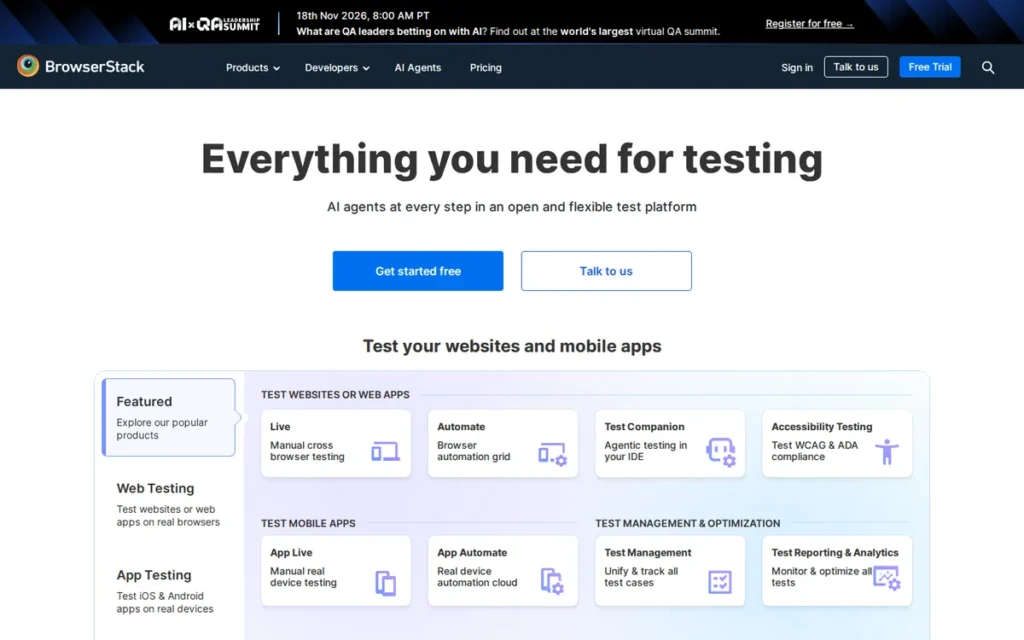
Category: Cloud Device Testing Platform, provides on-demand remote access to 30,000+ real physical iOS and Android devices hosted across 21 global data centers for manual and automated mobile app testing without requiring internal device lab infrastructure.
At a Glance
- Category: Cloud Device Testing Platform
- Best For: Enterprise and mid-market teams needing the broadest real-device coverage across iOS and Android, running automated tests in CI/CD pipelines, whose infrastructure does not enforce VPN policies conflicting with BrowserStack’s documented VPN incompatibility
- Price Range: Approximately $50–$199+/month for App Live and App Automate plans (community-verified, June 2026); enterprise parallel-session configurations scale significantly higher, verify at browserstack.com/pricing
- Primary Strength: 30,000+ real devices across 21 global data centers: the largest real-device fleet in this comparison as of June 2026
- Biggest Limitation: VPN incompatible: a binary enterprise adoption blocker for organizations with enforced VPN policies; aggressive post-trial sales outreach documented across multiple QA practitioner communities
- One-Line Summary: BrowserStack is the largest cloud real-device testing platform in 2026, with 30,000+ devices, 50,000+ customers, G2: 4.4/5.0 across 3,317 verified reviews, and native support for Appium, Espresso, and XCUITest.
- Last Verified: June 2026
Overview
BrowserStack is a cloud-based real-device testing platform that gives mobile development teams on-demand remote access to 30,000+ real iOS and Android devices for manual testing (App Live) and automated testing (App Automate), without requiring any internal device lab infrastructure.
BrowserStack serves 50,000+ customers and was named G2’s Best Indian Company in the 2026 Best Software Awards (BrowserStack official announcement, June 2026). BrowserStack’s 3,317 verified G2 reviews represent the most statistically robust third-party satisfaction signal in this comparison category, 18x the review count of the next-largest commercial cloud competitor. BrowserStack’s documented VPN incompatibility and sales behavior patterns carry equal weight to its technical strengths in this evaluation and are addressed fully in the Limitations section below.
Key Features
- App Live Manual Testing: BrowserStack App Live provides interactive testing on real iOS and Android devices with geolocation simulation, network condition throttling, natural gesture input, localization testing, and offline scenario reproduction, capabilities that emulators cannot reliably replicate for production-level edge-case validation.
- App Automate Framework Support: BrowserStack App Automate supports automated execution via Appium, Espresso, and XCUITest against its real-device cloud, enabling teams to run existing automation scripts on physical devices without framework migrations or script rewrites.
- Parallel Cross-Device Execution: BrowserStack enables simultaneous test execution across multiple real devices, allowing CI/CD pipelines to run full cross-device test suites in minutes rather than hours compared to sequential single-device runs.
- Per-Session Debugging Artifacts: BrowserStack delivers device logs, network logs, screenshots, and session video recordings per test run, providing reproducible evidence teams need to diagnose device-specific bugs without owning those physical devices.
- CI/CD Pipeline Integrations: BrowserStack integrates with GitHub Actions, Jenkins, CircleCI, Azure DevOps, and other major CI/CD platforms, with published documentation for each integration path designed to reduce pipeline configuration risk during adoption.
Best For
BrowserStack is best for mid-market and enterprise mobile teams that need the highest possible real-device coverage across iOS and Android, are running automated tests through Appium or native frameworks in CI/CD pipelines, and require production-grade debugging tooling, specifically teams whose infrastructure does not require VPN tunneling for testing access.
Pricing
BrowserStack does not publish a complete public rate card. Community-verified ranges as of June 2026 indicate App Live and App Automate plans in the range of $50–$199+/month at small-team usage levels, with enterprise parallel-session configurations scaling significantly higher.
One r/softwaretesting user reported a $50/month plan limited to 100 automated minutes. BrowserStack’s Percy visual testing module has been community-cited at $200–$250/month as a separate add-on. Verify current pricing, session limits, and parallel execution tiers directly at browserstack.com/pricing before any purchase commitment. Pricing verified via community sources, June 2026.
Strengths
- BrowserStack received G2’s Best Indian Company designation in the 2026 Best Software Awards, and its 3,317 verified G2 reviews (18x the review count of the next-largest commercial cloud competitor in this comparison) represent the most statistically robust third-party satisfaction signal available for any mobile testing platform in this category as of June 2026 (G2.com/products/browserstack, verified June 2026).
- BrowserStack’s 30,000+ real physical devices across 21 global data centers eliminate the device procurement, maintenance, and rotation workflows that third-party sources consistently identify as the primary operational cost driver of in-house device labs, per independent analysis at bug0.com (2026).
- BrowserStack’s native support for Appium, Espresso, and XCUITest enables teams to execute existing automation scripts against BrowserStack’s real-device cloud without framework migration, protecting prior automation investment while gaining physical device coverage.
- BrowserStack serves 50,000+ customers and powers millions of test sessions daily (BrowserStack official materials, confirmed via PRNewswire, June 2026), providing operational scale and service availability that smaller cloud testing providers in this comparison cannot match.
This aligns with community feedback on r/QualityAssurance:
“I was in the same position 2 yrs ago as you are and it was just the opposite for me. At that point in time Saucelabs was the cheaper option but soon after we started using it there were performance issues especially for our larger automation projects. We had to switch to Browserstack for manual/automated app testing and for their parallel testing capabilities. My team has not yet used their smart TV testing features, but I know someone who asked for a demo and they were pretty much happy with their debugging capabilities. Seems like your team is ready to start with Browserstack. If your startup has the budget for it, I will highly recommend it for its innovative features and overall reliability.” Posted by u/devopspro555
Takeaway: Teams migrating from Sauce Labs to BrowserStack consistently cite parallel execution stability and automation reliability as the decisive factors (not device count) confirming that BrowserStack’s core value proposition holds up under real production conditions for teams whose infrastructure permits it.
Limitations
- VPN Incompatibility: BrowserStack is incompatible with VPN environments: a binary enterprise adoption blocker documented in multiple r/QualityAssurance and r/softwaretesting threads as a non-negotiable enterprise disqualifier; teams with enforced VPN policies should evaluate Sauce Labs’ Sauce Connect as the purpose-built alternative in this comparison.
“BrowserStack is slow and cumbersome. Also expensive and not worth it unless you have the money to spare and want to test on some obscure mobile configuration. Oh, also, it doesn’t work with VPN which was a big deal in my previous company.” (u/volen, r/softwaretesting)
Takeaway: BrowserStack’s VPN incompatibility and session slowness are the two most cited practitioner objections across QA communities (not device coverage or technical capability) a pattern consistent across r/softwaretesting, r/QualityAssurance, and r/Frontend threads spanning 2023–2026.
- Aggressive Post-Trial Sales Outreach: BrowserStack’s sales behavior is documented in a December 2025 r/QualityAssurance thread as persistent multi-level contact (“Constantly messaging me, my colleagues, my managers, his manager”) a pattern that caused multiple teams to abandon evaluations entirely, independent of any product quality concern; teams with low tolerance for post-trial outreach should evaluate LambdaTest or Appium as lower-friction alternatives.
- Session Performance Lag: BrowserStack’s cloud-based remote sessions are described as “slow and cumbersome” in multiple community threads spanning 2023–2026, creating friction in high-frequency manual QA workflows where session responsiveness directly impacts tester productivity and throughput.
- Ecosystem Lock-In Risk: BrowserStack’s test management module was flagged in a 2025 r/QualityAssurance post for data portability concerns and high cost, a relevant consideration for teams evaluating BrowserStack beyond device testing who want future flexibility to migrate test management data to other platforms.
Verdict
BrowserStack is the most widely deployed real-device cloud testing platform in 2026, combining the largest device fleet (30,000+ devices across 21 data centers), the most statistically robust review evidence in the category (G2: 4.4/5.0, 3,317 reviews), and native support for Appium, Espresso, and XCUITest, making it the strongest all-around option for teams whose primary need is broad real-device coverage with managed infrastructure. BrowserStack’s VPN incompatibility and documented sales aggression are genuine disqualifiers for VPN-dependent enterprises, early-stage startups on tight budgets, or teams whose procurement processes have been disrupted by vendor outreach, those teams should evaluate Sauce Labs (VPN tunnel), LambdaTest (lowest price), or Kobiton (on-premises) as primary alternatives.
2. Appium: Best Open-Source Framework: Vendor-Neutral Mobile Automation Foundation
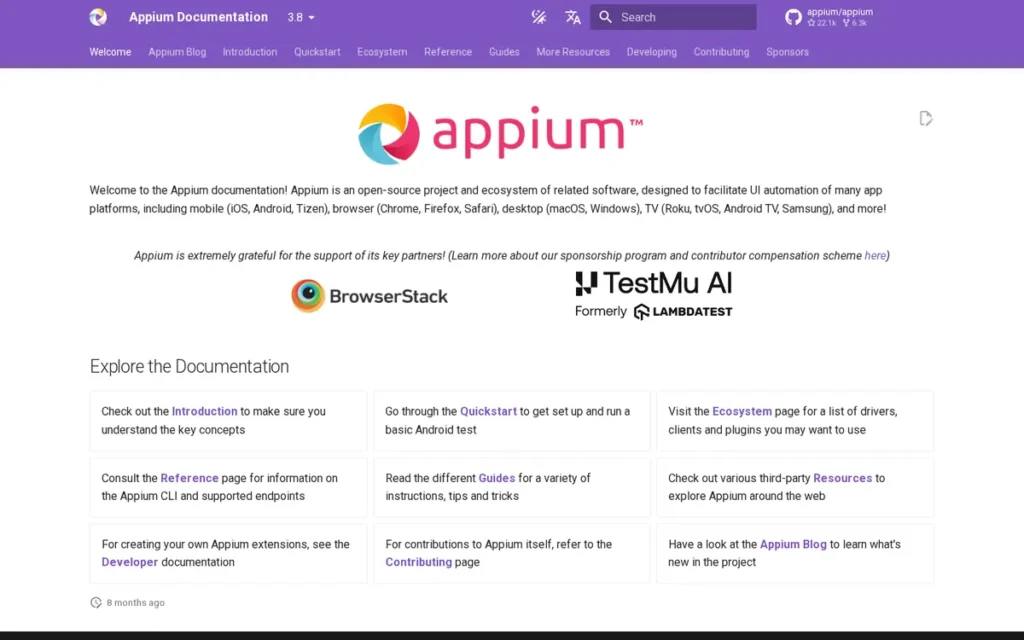
Category: Open-Source Automation Framework, a free, community-governed test automation framework that provides the scripting and execution layer for mobile test automation; teams supply their own device infrastructure (local devices, emulators, or cloud device subscriptions).
At a Glance
- Category: Open-Source Automation Framework
- Best For: Engineering teams wanting full architectural control, zero license cost, multi-language flexibility, and vendor-neutral test script portability across any device cloud provider
- Price Range: Free (Apache 2.0 license); total cost of ownership includes engineering hours for maintenance, device infrastructure ($0 for emulators; cloud subscriptions from $15–$50+/month), and CI/CD compute, iOS automation at production scale can require dedicated engineer headcount per practitioner documentation
- Primary Strength: Most widely adopted open-source mobile automation framework as of 2026; vendor-neutral portability means test scripts run unchanged on BrowserStack, Sauce Labs, Kobiton, and LambdaTest
- Biggest Limitation: iOS/XCUITest dependency creates documented production-scale maintenance overhead, a 16-year mobile developer described it in May 2026 as requiring “full time employees just to tickle the automation pipeline”
- One-Line Summary: Appium is the free, open-source, multi-language mobile automation framework governed by the OpenJS Foundation, with vendor-neutral test portability across every major device cloud and zero license cost for iOS and Android automation.
- Last Verified: June 2026
Overview
Appium is a free, open-source mobile application automation framework built on the W3C WebDriver protocol that enables QA teams to write automated tests for iOS and Android in their preferred programming language (Java, Python, JavaScript, Ruby, C#, or PHP) without modifying application source code and without vendor lock-in at the framework layer.
Appium was first released in 2012, originally developed by Sauce Labs, and is now governed by the OpenJS Foundation (Appium GitHub repository; kobiton.com Appium history, 2024). Appium’s defining strategic value is portability: test scripts authored against Appium’s open APIs run unchanged on any major device cloud provider, protecting automation investment against vendor pricing changes and providing commercial negotiating leverage when switching providers.
Key Features
- Cross-Platform Single Codebase: Appium supports native, hybrid, and mobile web applications on both iOS and Android from a unified framework, enabling teams to maintain one cross-platform test codebase rather than separate platform-specific automation suites with duplicated logic and maintenance overhead.
- Vendor-Neutral Device Cloud Portability: Appium test scripts run unchanged on BrowserStack App Automate, Sauce Labs Real Device Cloud, Kobiton, LambdaTest, and Perfecto, enabling teams to switch device cloud vendors without rewriting automation and providing measurable commercial leverage in vendor pricing negotiations.
- Appium 2.0 Modular Architecture: Appium’s 2.0 release introduced a modular driver and plugin system that decouples platform support into independently installable drivers and extends framework capability via community plugins (including image comparison and visual regression) without requiring core framework changes.
- Multi-Language Test Authoring: Appium supports Java, Python, JavaScript, Ruby, C#, and PHP, allowing mobile QA engineers to write and maintain tests in whichever language their existing development stack already uses without adopting a new scripting environment.
- Universal CI/CD Compatibility: Appium integrates with Jenkins, GitHub Actions, GitLab CI, CircleCI, and Azure DevOps using the same WebDriver client libraries Selenium-experienced teams already operate, reducing the mobile automation onboarding barrier for organizations extending existing web testing practices.
Best For
Appium is best for engineering-heavy teams with dedicated automation engineers who need full architectural control over their test stack, zero licensing cost, and the ability to execute tests across multiple device cloud providers without script rewrites, particularly teams already using Selenium for web testing who want to extend the same framework model to mobile.
Pricing
Appium is free under an Apache 2.0 open-source license with no paid tiers, enterprise contracts, or vendor licensing.
However, Appium’s total cost of ownership is not zero. Teams must budget for engineering hours to configure and maintain test suites, device infrastructure (emulators are free; cloud subscriptions start at $15–$50+/month), and CI/CD compute costs.
A May 2026 practitioner in r/softwaretesting with 16+ years of mobile experience documented that iOS Appium suites at production scale can require dedicated full-time engineering headcount, a material hidden cost that renders “Appium is free” an incomplete claim for iOS-heavy test suites. TheirStack.com tracks Appium adoption across more than 24,600 companies worldwide as of 2026 (TheirStack.com, June 2026). Pricing context verified via community sources and open-source repository, June 2026.
Strengths
- Appium is described as “the most widely used open-source framework for mobile test automation” in 2026 market coverage (testdino.com, June 2026), with TheirStack.com confirming adoption across 24,600+ companies, an ecosystem so broad that every major cloud device provider natively supports Appium-authored tests, eliminating vendor risk at the framework layer entirely.
- Appium’s OpenJS Foundation governance ensures no single company controls its roadmap, the documented reason BrowserStack, Sauce Labs, Kobiton, and LambdaTest all invest in Appium compatibility rather than competing against it, providing structural protection against vendor lock-in that no commercial tool in this comparison can replicate (OpenJS Foundation; GitHub/appium, June 2026).
- Appium’s WebDriver foundation and multi-language support (Java, Python, JavaScript, Ruby, C#, PHP) allow teams to extend existing Selenium hiring and tooling expertise to mobile testing, reducing the onboarding cost of mobile automation for organizations already practicing web UI test automation.
- Appium 2.0’s modular plugin system enables community-built capability extensions: including image comparison and visual regression, without requiring core framework changes, allowing teams to grow functionality without introducing proprietary dependencies.
Users on r/QualityAssurance shared their experience:
“Appium is considered to be the leader on mobile testing. It might not be the best automation framework out there, but almost all the companies looking for somebody for mobile automation are requiring that you know Appium” Posted by u/grafix993
Takeaway: Appium’s near-universal adoption as a hiring requirement across QA job postings confirms its de facto standard status, practitioners who invest in Appium expertise gain portfolio value that transfers across any device cloud provider or employer, independent of which commercial platform they happen to be using.
Limitations
- iOS/XCUITest Maintenance Cost: Appium’s iOS automation depends entirely on Apple’s XCUITest layer, a May 2026 r/softwaretesting practitioner with 16+ years of mobile experience documents the production-scale reality as requiring full-time dedicated engineering headcount, a constraint embedded in Apple’s architecture that no Appium version update can fully resolve; teams evaluating Appium for high-volume iOS automation must budget this maintenance overhead explicitly before selection.
“Mobile automation tooling is far from great still. Selector-based solutions like Appium are horrible on iOS, not because they themselves are bad, but because they lean heavily on XCUITest framework which is horribly slow and flaky. Add another layer on top of that and the whole thing becomes unusable most of the time.” (u/Zealousideal_Web6594, r/softwaretesting, May 2026)
Takeaway: The iOS Appium maintenance cost is not a framework defect, it is a structural constraint embedded in Apple’s XCUITest architecture that no Appium version update can fully resolve. Teams evaluating Appium for iOS automation at production scale must budget dedicated engineering headcount as a total cost of ownership line item, not an optional contingency.
- No Hosted Device Infrastructure: Appium provides no device cloud: teams must separately provision device access through emulators, local physical devices, or cloud subscriptions, adding operational complexity that cloud-native platforms like BrowserStack or LambdaTest handle automatically as part of their service.
- Weak Built-In Reporting: Appium requires third-party integrations for test reporting and observability, adding toolchain complexity compared to platforms like Sauce Labs that bundle AI-augmented failure analysis and session artifacts natively in the platform.
- Appium 2.0 Dependency Management: Appium 2.0’s modular driver and plugin architecture introduces version compatibility tracking overhead, teams must manage driver versions and plugin compatibility as independent dependency chains, adding maintenance surface area beyond test script maintenance itself.
Verdict
Appium is the de facto open-source standard for mobile test automation in 2026, providing multi-language support, vendor-neutral portability across every major device cloud, and zero license cost, the strongest combination of architectural freedom and commercial leverage available for engineering teams with the scripting expertise to operate it. Appium ranks #2 because its cross-platform neutrality and 24,600+ company adoption create genuine long-term commercial value for organizations whose test assets should not be controlled by any single vendor’s pricing decisions. The iOS maintenance trade-off must be quantified in engineering hours per sprint before selection, teams without dedicated automation engineers should evaluate Kobiton’s scriptless conversion, testRigor’s plain-English authoring, or LambdaTest’s KaneAI as lower-maintenance alternatives.
3. Sauce Labs: Best for Enterprise Security: VPN-Compatible Cloud with Real Devices and Emulators
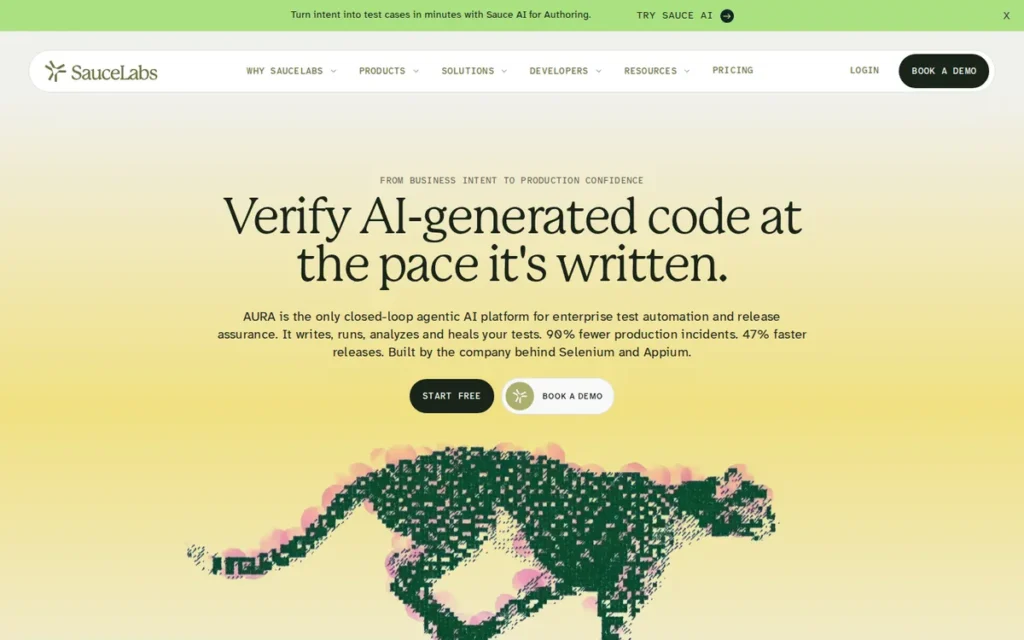
Category: Enterprise Cloud Testing Platform, provides managed real-device and emulator/simulator cloud infrastructure for mobile and web testing with enterprise security features including VPN tunneling, private device pools, SLA guarantees, and AI-augmented test observability.
At a Glance
- Category: Enterprise Cloud Testing Platform
- Best For: Enterprise teams with VPN-dependent infrastructure, regulated industry compliance requirements, or private dedicated device pool needs requiring a single managed platform for real-device and emulator testing
- Price Range: Self-serve from approximately $39–$199+/month; enterprise private-pool and SLA pricing is custom-quoted, verify at saucelabs.com/pricing (June 2026)
- Primary Strength: Sauce Connect VPN tunnel: the only purpose-built encrypted secure testing solution among cloud testing platforms in this comparison, enabling test execution behind corporate firewalls
- Biggest Limitation: Documented pattern of regional service outages generating formal customer notification emails; higher entry cost than LambdaTest for small teams
- One-Line Summary: Sauce Labs is an enterprise cloud testing platform founded in 2008, with 9,000+ real devices, 1,700+ emulators and simulators, Sauce Connect VPN tunneling, and G2: approximately 4.3/5.0 (~180 reviews) as of June 2026.
- Last Verified: June 2026
Overview
Sauce Labs is an enterprise cloud testing platform founded in 2008 (the oldest commercial cloud testing provider in this comparison) providing unified real-device testing (9,000+ devices), emulator and simulator testing (1,700+), and AI-augmented test observability for iOS and Android alongside web testing under one platform and billing relationship.
Sauce Labs is the original commercial backer of the Appium open-source framework, giving Sauce Labs the longest Appium integration history of any device cloud provider. Sauce Labs’ Sauce Connect VPN tunnel is the only purpose-built secure tunneling solution in this comparison, directly addressing the VPN incompatibility that disqualifies BrowserStack for organizations with enforced VPN policies. Sauce Labs holds a G2 rating of approximately 4.3/5.0 across approximately 180 verified reviews as of June 2026 (G2.com seller profile, Perplexity verification, June 2026).
Key Features
- Sauce Connect VPN Tunneling: Sauce Labs’ Sauce Connect provides an encrypted tunnel enabling test execution on applications behind corporate firewalls or internal networks, the only purpose-built VPN compatibility solution among cloud testing platforms in this comparison, directly solving the binary enterprise adoption blocker that BrowserStack’s documented VPN incompatibility creates.
- Unified Real-Device and Emulator Platform: Sauce Labs offers both a shared real-device pool (9,000+ devices) and 1,700+ emulators and simulators under one platform, enabling teams to run cost-efficient OS-version coverage on emulators and reserve real-device sessions for final pre-release validation without managing two separate vendor relationships.
- Private Dedicated Device Pools: Sauce Labs provides enterprise-grade private device pools with exclusive device access, eliminating shared-pool queue contention and device contamination risks relevant to regulated testing environments requiring isolation between test runs.
- AI-Driven Test Observability: Sauce Labs provides AI-augmented failure pattern analysis with session logs, screenshots, video recordings, and test history to reduce failure triage time in high-volume CI/CD pipelines where manual debugging becomes a throughput bottleneck.
- Enterprise CI/CD Integrations: Sauce Labs integrates with Jenkins, GitHub Actions, GitLab CI, CircleCI, Azure DevOps, and TeamCity with Sauce Connect-aware pipeline configurations, enabling secure test execution across corporate network boundaries within standard DevOps workflows.
Best For
Sauce Labs is best for enterprise teams in regulated industries (financial services, healthcare, government) where security disclosure requirements, VPN-dependent infrastructure, or data residency policies disqualify cloud-only platforms without VPN tunneling. Sauce Labs also suits engineering teams wanting a single vendor covering real-device testing, emulator testing, and AI-driven test observability across iOS and Android.
Pricing
Sauce Labs offers self-serve pricing starting at approximately $39/month for browser testing and $149–$199/month for automated real-device testing, based on community-verified sources and third-party comparison articles as of June 2026.
Enterprise plans with private device pools, SLA guarantees, and Sauce Connect configurations are custom-quoted through direct sales. Community feedback in r/QualityAssurance describes Sauce Labs as expensive for startups and small teams, one practitioner called it “quite a bit” in cost. Verify current tiers at saucelabs.com/pricing before purchase. Pricing verified via community and third-party comparison sources, June 2026.
Strengths
- Sauce Labs holds a G2 rating of approximately 4.3/5.0 across approximately 180 verified reviews as of June 2026 (G2.com seller profile, Perplexity verification, June 2026), and cites IDC recognition as a leader in quality management and mobile app testing, the specific IDC report year and title are not independently confirmed; request the full citation from Sauce Labs directly for independent verification.
- Sauce Labs was founded in 2008 and served as the original commercial backer of the Appium open-source framework, giving Sauce Labs the deepest Appium integration history and the longest enterprise CI/CD deployment track record of any platform in this comparison, with 15+ years of documented production use across enterprise customers (kobiton.com Appium history blog; G2.com/sellers/sauce-labs).
- Sauce Labs is the only cloud testing platform in this comparison offering a purpose-built VPN tunneling solution (Sauce Connect), multiple r/QualityAssurance practitioners documented BrowserStack’s VPN incompatibility as a binary blocker, with one specifically citing Sauce Labs’ superior security disclosure transparency as the differentiating trust factor in their vendor switch (r/QualityAssurance, December 2025).
- Sauce Labs has been documented by practitioners as more transparent in security disclosures than BrowserStack, a material procurement trust signal for security-conscious enterprise buyers, independent of device coverage or pricing comparisons.
Limitations
- Regional Service Outage Pattern: Sauce Labs has a documented pattern of regional outages significant enough to generate formal customer notification emails, creating reliability risk for CI/CD pipelines that depend on continuous test execution uptime; teams with strict availability requirements should request historical uptime data and SLA terms before committing at enterprise scale.
“My company currently uses Saucelabs but I’m amazed at how many ‘outage’ emails I receive about issues they have in different regions. Previously we used Kobiton.” (u/krsgio, r/QualityAssurance, 2024)
Takeaway: Sauce Labs’ regional outage pattern is documented as a recurring operational issue significant enough to generate formal customer notifications, teams with strict CI/CD uptime requirements should request SLA terms and historical uptime data before committing to Sauce Labs at enterprise scale.
- Pricing Accessibility for Small Teams: Sauce Labs is consistently described in practitioner communities as expensive for startups and small teams, with enterprise private-pool pricing requiring direct sales engagement that delays independent budget qualification for self-serve buyers who want cost estimates without committing to a sales conversation.
- Smaller Review Population: Sauce Labs’ approximately 180 G2 reviews represent roughly 1/18th the review population of BrowserStack’s 3,317, a statistical reliability difference that prospective buyers should supplement with direct reference checks from organizations in comparable industries before committing at enterprise scale.
Verdict
Sauce Labs is the strongest enterprise cloud testing platform for security-sensitive environments in this comparison, combining approximately 15 years as the original Appium commercial backer, a G2 rating of approximately 4.3/5.0 (~180 reviews, June 2026), and a unique Sauce Connect VPN tunneling capability that makes Sauce Labs the only viable cloud option for enterprise teams whose network security policies block external cloud-only testing. Sauce Labs ranks #3 behind BrowserStack because its smaller review population provides less statistical confidence and its documented regional outage pattern creates reliability risk that teams with strict CI/CD availability requirements must explicitly evaluate. Teams with VPN-dependent infrastructure or regulated industry compliance requirements should evaluate Sauce Labs before BrowserStack regardless of BrowserStack’s larger device fleet.
4. LambdaTest: Best for Budget-Conscious Teams: Lowest Entry Price with AI-Augmented Testing
Category: AI-Augmented Cloud Testing Platform, provides real-device and browser testing cloud combined with AI-powered natural-language test authoring (KaneAI) and distributed test orchestration (HyperExecute), following a January 2026 rebrand from LambdaTest to TestMu AI.
At a Glance
- Category: AI-Augmented Cloud Testing Platform
- Best For: Small and mid-size teams needing real-device cloud coverage at the lowest verified entry price, plus teams exploring AI-assisted test authoring for non-technical members who do not require VPN tunneling or on-premises deployment
- Price Range: $15/user/month entry tier (Capterra-verified under the LambdaTest brand, June 2026); KaneAI and HyperExecute are premium additions, verify at lambdatest.com/pricing or testmuai.com
- Primary Strength: Lowest verified entry price in this comparison ($15/user/month); Capterra: 4.6/5.0 (510 reviews, pre-rebrand); 10,000+ real devices with Appium compatibility
- Biggest Limitation: Predatory sales practices documented in a 12-upvote r/QualityAssurance post (2024) including false referral claims; LambdaTest brand name triggers automatic post removal in r/softwaretesting
- One-Line Summary: LambdaTest (rebranded TestMu AI in January 2026) is a cloud testing platform with 10,000+ real devices, a $15/user/month entry price verified by Capterra as of June 2026, and KaneAI for natural-language AI test authoring.
- Last Verified: June 2026
Overview
LambdaTest is a cloud-based testing platform that rebranded to TestMu AI on January 12, 2026, offering 10,000+ real iOS and Android devices for mobile testing, AI-powered test authoring via KaneAI, and distributed test execution via HyperExecute, positioning LambdaTest as a cost-competitive, AI-native alternative to BrowserStack at a lower entry price point.
LambdaTest holds the highest Capterra rating among cloud testing platforms in this comparison at 4.6/5.0 across 510 verified reviews as of June 2026, reviews accumulated under the LambdaTest brand name prior to the January 2026 rebrand to TestMu AI, which may not yet reflect post-rebrand product experience (rebrand confirmed via channelinsider.com and bug0.com, June 2026). LambdaTest’s procurement experience has generated documented community concerns about sales tactics that prospective buyers must evaluate independently before initiating sales contact.
Key Features
- 10,000+ Real Device Cloud: LambdaTest provides 10,000+ real iOS and Android devices for manual and automated mobile app testing, with Appium compatibility enabling teams to run existing automation scripts on LambdaTest’s device cloud without framework migrations or script rewrites.
- KaneAI Natural-Language Test Authoring: LambdaTest’s KaneAI is an AI-powered test authoring agent designed to expand test creation access to non-technical product managers and QA coordinators, LambdaTest markets KaneAI as “the world’s first end-to-end AI test agent” (vendor-stated claim, PRNewswire 2024; the “world’s first” designation is not independently verified; validate capability through a POC before CI/CD deployment).
- HyperExecute Distributed Orchestration: LambdaTest HyperExecute enables parallel execution across cloud environments with smart test orchestration, designed to reduce total CI/CD pipeline test execution time for teams running large multi-device test suites.
- Mobile Accessibility Testing: LambdaTest added dedicated mobile accessibility testing for Android and iOS in June 2025 (GlobeNewswire, June 2025), including WCAG compliance verification relevant to teams subject to the European Accessibility Act and US ADA requirements.
- AWS Marketplace and SoftwareOne Distribution: LambdaTest is available via AWS Marketplace and SoftwareOne, enabling procurement through existing enterprise software agreements for teams with established relationships on those platforms.
Best For
LambdaTest is best for small-to-mid-size teams that need real-device cloud coverage at the lowest verified entry price in this comparison, are evaluating AI-assisted test authoring for non-technical team members through KaneAI, and do not require enterprise-grade VPN tunneling, private dedicated device pools, or on-premises deployment capabilities.
Pricing
LambdaTest’s entry pricing is $15/month per user according to Capterra listing data verified as of June 2026, the lowest entry point among paid cloud testing platforms in this comparison, confirmed by community consensus: “Lambda test (TestMu) is way more cheap than BrowserStack” (r/softwaretesting, May 2026).
KaneAI and HyperExecute are positioned as premium additions to the base platform. A 2026 r/softwaretesting practitioner specifically cautioned that AI testing tools can produce unexpected token-usage cost escalation at CI/CD scale, directly relevant to KaneAI deployment planning. Note: the January 2026 rebrand to TestMu AI may affect pricing page URLs; verify at both lambdatest.com/pricing and testmuai.com before purchase. Pricing verified via Capterra and community sources, June 2026.
Strengths
- LambdaTest holds a Capterra rating of 4.6/5.0 across 510 verified reviews as of June 2026 (reviews accumulated under the LambdaTest brand prior to the January 2026 rebrand; post-rebrand TestMu AI review data is limited, verify current status at Capterra before relying on this figure for procurement decisions).
- LambdaTest’s entry price of $15/month per user is the lowest verified entry point among paid cloud testing platforms in this comparison (Capterra-verified, June 2026), with direct community confirmation in r/softwaretesting (May 2026) making LambdaTest the most accessible paid real-device cloud option for budget-constrained teams at startups and SMBs.
- LambdaTest added dedicated mobile accessibility testing for iOS and Android in June 2025 (GlobeNewswire, June 2025), including WCAG compliance verification, positioning LambdaTest as one of the first cloud testing platforms to document a dedicated mobile accessibility testing workflow for European Accessibility Act and US ADA compliance.
- LambdaTest’s AWS Marketplace and SoftwareOne availability enables procurement through existing enterprise software agreements, simplifying purchasing for teams with established vendor relationships on those platforms.
Users on r/softwaretesting noted:
“We switched to lambdatest last year, after a lot of performance issues with saucelabs. So far, they’ve been great to work with. They roll features out pretty frequently, they are properly multiregion, and overall our team has just had far less issues with them vs saucelabs.” Posted by u/numo16
Takeaway: LambdaTest’s multi-region infrastructure and rapid feature cadence address documented pain points that drove teams away from Sauce Labs, positioning it as a substantively different choice, not merely a cheaper BrowserStack alternative.
Limitations
- Predatory Sales Practices: LambdaTest’s sales team behavior is documented in a 2024 r/QualityAssurance post (u/Fluke300, 12 upvotes) as including contacting colleagues without consent and “falsely claiming that I, personally, recommended them”, conduct that caused the evaluating team to abandon the evaluation entirely, independent of any product quality concern; teams with formal procurement governance should document this pattern before initiating any LambdaTest sales contact.
“Their sales people are predatory. Asking for information will get you stuck in a cycle of unsolicited email spam and cold calls… They even started contacting me on LinkedIn and sending unsolicited emails to other people in my organization falsely claiming that I, personally, recommended them as a point of contact to conduct business development introductions.” (u/Fluke300, r/QualityAssurance, 2024 (12 upvotes))
Takeaway: The documented behavior (contacting uninvolved colleagues and falsely claiming referrals) is the most specific and consequential sales conduct complaint in this comparison. Teams with formal procurement governance where unauthorized third-party contact constitutes a policy violation should document this pattern before initiating any LambdaTest evaluation contact.
- Community Trust Deficit: LambdaTest’s brand name triggers automatic post removal in the r/softwaretesting subreddit, a community moderation action reflecting sustained concern about promotional posting patterns, independent of any judgment about product quality, and a signal that community-informed buyers should factor into their evaluation.
- KaneAI Production Maturity: KaneAI was announced in 2024, independent practitioner evidence of production performance in continuous deployment pipelines is limited, and the AI non-determinism concern applies directly, “AI is naturally non-deterministic and that is a big problem for tests which are usually already too non-deterministic already” (r/QualityAssurance, 2025, 29 upvotes); the January 2026 TestMu AI rebrand also creates a post-rebrand review gap that means the 4.6/5.0 Capterra rating may not reflect current product experience.
Verdict
LambdaTest is the best-value cloud testing platform for budget-constrained small and mid-size teams in 2026, earning a Capterra rating of 4.6/5.0 across 510 verified reviews (pre-rebrand) and offering the lowest verified entry price in this comparison at $15/month per user, with 10,000+ real devices and full Appium compatibility providing legitimate testing infrastructure at accessible cost. LambdaTest ranks #4 because documented predatory sales practices have disrupted procurement for multiple organizations, and KaneAI’s production maturity at CI/CD scale remains unverified by independent sources as of June 2026. Teams that evaluate through self-serve channels and treat KaneAI as supplementary authoring (not a CI/CD production backbone) will find LambdaTest a credible, cost-effective alternative to BrowserStack for standard real-device testing needs.
5. Kobiton: Best for Regulated Industries: Mobile-Exclusive Platform with On-Premises Deployment
Category: Mobile-Specialist Real-Device Platform, a mobile-application-only testing platform providing both cloud-hosted and on-premises real-device infrastructure with AI-powered scriptless test generation and manual-to-Appium-script conversion for iOS and Android.
At a Glance
- Category: Mobile-Specialist Real-Device Platform
- Best For: Regulated industries (financial services, healthcare, government) requiring on-premises deployment; teams transitioning from manual to automated testing who need Appium-compatible scripts generated from existing manual sessions without automation engineering expertise
- Price Range: Custom pricing across Startup–Enterprise tiers; free trial available; no published dollar amounts as of June 2026; a promo code for 3 months free (“TESTGUILD3”) was publicly shared by a Kobiton representative in a 2026 Reddit thread
- Primary Strength: The only platform in this comparison with on-premises real-device deployment; AI-powered conversion of manual sessions to Appium-compatible scripts within seconds of session completion
- Biggest Limitation: G2: ~4.3 / Capterra: ~4.3 per 2026 third-party roundup (functionize.com), smaller review population than market leaders; no published self-serve pricing creates budget estimation friction
- One-Line Summary: Kobiton is the only platform in this comparison with on-premises real-device deployment for regulated industries, plus AI-powered conversion of manual test sessions into Appium-compatible automation scripts without any coding required.
- Last Verified: June 2026
Overview
Kobiton is a mobile-application-only real-device testing platform headquartered in Louisville, KY, providing manual, automated, and scriptless testing for iOS and Android across both cloud-hosted and on-premises device infrastructure, making Kobiton the only platform in this comparison with a documented on-premises deployment option for regulated industries where external cloud routing is prohibited.
Kobiton’s defining workflow feature is AI-powered scriptless test generation: manual testing sessions are automatically converted into Appium-compatible automation scripts within seconds of session completion, enabling teams without dedicated automation engineers to build maintainable cross-platform automation from existing manual workflows. Kobiton announced integration with Anthropic’s Claude for natural-language AI test automation on real physical devices (Kobiton official blog, 2025–2026), positioning Kobiton among the earliest mobile testing vendors to integrate frontier AI model capabilities into real-device execution.
Key Features
- On-Premises Real-Device Deployment: Kobiton offers both cloud-hosted and on-premises real-device deployment for iOS and Android (the only platform in this comparison with this option) enabling organizations subject to HIPAA, SOC 2, FedRAMP, or data residency requirements to run mobile testing within their own network perimeter without routing test traffic through external cloud providers.
- AI-Powered Manual-to-Appium Script Conversion: Kobiton converts manual testing sessions into Appium-compatible scripts within seconds of session completion, bridging the manual-to-automation gap for teams without dedicated automation engineers and generating portable test assets that run on any Appium-supporting device cloud.
- Self-Healing Automation Scripts: Kobiton’s self-healing scripts automatically adapt element selectors when application UI changes, reducing the locator maintenance overhead that practitioners identify as the primary driver of test suite decay in agile development cycles with frequent UI iteration.
- Multi-Framework Script-Based Automation: Kobiton supports Appium, Espresso, XCUITest, and GameDriver for script-based automation, and a Kobiton representative publicly advised teams to “make sure the output is still standard Appium so you are not locked into one vendor” (r/softwaretesting, 2026), explicitly preserving portability as a customer design principle.
- Anthropic Claude and Appdome Integrations: Kobiton integrates with Anthropic’s Claude for natural-language AI-powered mobile test automation on real devices (Kobiton official blog, 2025–2026), and partners with Appdome to enable testing of Appdome-secured Android and iOS applications directly within the Kobiton platform.
Best For
Kobiton is best for mobile-first teams in financial services, healthcare, government, or other regulated industries where on-premises device testing is required, and for QA teams transitioning from manual to automated testing who need Appium-compatible scripts generated automatically from existing manual workflows without committing to automation engineering resources from scratch.
Pricing
Kobiton’s pricing spans Startup to Enterprise tiers but publishes no dollar amounts on its public website as of June 2026. A free trial is available at kobiton.com.
In a 2026 r/AppBusiness thread, a Kobiton representative publicly offered a promo code (“TESTGUILD3”) for 3 months of free access, suggesting trial access can be arranged informally. Teams should request trial access before initiating full sales engagement, the absence of published pricing creates significant budget estimation friction compared to LambdaTest ($15/month, Capterra-verified) or BrowserStack (community-verified ranges). Pricing context verified via kobiton.com and Reddit community sources, June 2026.
Strengths
- Kobiton is the only platform in this comparison with a documented on-premises real-device deployment option, a binary differentiator for organizations where data residency requirements or air-gapped network policies prohibit routing mobile test traffic through external cloud providers (kobiton.com/why-kobiton/, June 2026).
- Kobiton’s AI-powered scriptless automation generates Appium-compatible test scripts from manual testing sessions within seconds of session completion, directly serving the dominant practitioner buyer profile documented in r/softwaretesting: solo QA engineers with extensive manual testing coverage but insufficient bandwidth or expertise to convert those sessions into maintainable automated suites.
- Kobiton’s community-facing support approach is documented positively: a 2026 r/AppBusiness thread shows a Kobiton representative proactively offering real device access and offering to order specific device models on request, a markedly different engagement style than the documented aggressive tactics at BrowserStack and LambdaTest, generating genuine practitioner goodwill.
- Kobiton’s Appdome partnership enables testing of security-hardened application builds directly on Kobiton’s real-device infrastructure (Appdome knowledge base, June 2026), a specific integration relevant to security-sensitive mobile development teams validating production-grade secured apps.
Limitations
- Limited Review Population: Kobiton’s G2 and Capterra review pages exist as of June 2026, a 2026 third-party roundup (functionize.com) cites G2: 4.3 and Capterra: 4.3 for Kobiton, but review counts are substantially smaller than market leaders; verify current ratings at G2.com/products/kobiton/reviews and Capterra.com/p/166290/Kobiton, and supplement available data with direct reference interviews from regulated-industry organizations in comparable sectors before committing.
- Pricing Opacity: Kobiton’s tiered pricing requires sales engagement to determine costs, creating evaluation friction for self-serve buyers, teams on constrained evaluation timelines without sales bandwidth will find LambdaTest or BrowserStack substantially easier to scope independently without committing to a sales conversation first.
- Mobile-Only Scope: Kobiton does not provide cross-browser web testing, meaning teams that also need web coverage must maintain a separate vendor relationship, BrowserStack and Sauce Labs provide both mobile and browser testing under one platform, reducing toolchain fragmentation for multi-surface QA programs.
Verdict
Kobiton is the strongest mobile testing platform for regulated-industry teams and manual-to-automation transition scenarios, earning its #5 rank through two uniquely differentiated capabilities (on-premises deployment (the only option in this comparison for air-gapped environments) and AI-powered Appium script generation from manual sessions) that directly address use cases where BrowserStack, Sauce Labs, LambdaTest, and Appium all fall short. Kobiton ranks below the top four because its review population is smaller than market leaders and opaque pricing creates evaluation friction that slows independent budget qualification. For organizations where on-premises deployment is a compliance requirement, Kobiton is the only viable platform in this comparison for that specific buyer segment regardless of the other tools’ technical merits.
6. testRigor: Best for Non-Technical Teams: Plain-English Codeless Testing Without Locators
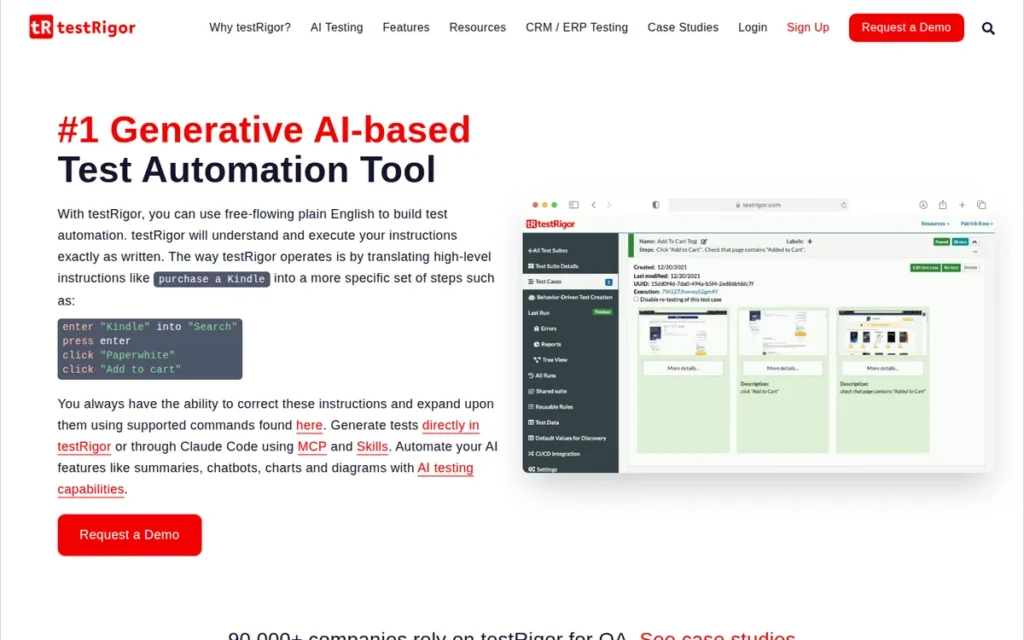
Category: AI-Native No-Code Testing Platform, a test authoring and orchestration layer where tests are written in plain English and executed by an AI interpretation engine; requires a separate device cloud subscription (BrowserStack or LambdaTest) for real physical device access, testRigor is not itself a device cloud.
At a Glance
- Category: AI-Native No-Code Testing Platform
- Best For: Non-technical team members: product managers, manual QA coordinators, who need to build and maintain mobile test coverage without programming knowledge, locator expertise, or automation engineering support
- Price Range: Free tier available via Microsoft Azure Marketplace; paid tier pricing not publicly listed as of June 2026; plus a separate BrowserStack or LambdaTest device cloud subscription ($15–$50+/month) is required for real-device execution
- Primary Strength: The only platform in this comparison where tests are authored entirely in plain English with no locators, no code, and no selectors, a single script runs cross-platform across iOS and Android
- Biggest Limitation: Not a device cloud: teams must subscribe separately to BrowserStack or LambdaTest for real device execution; AI-driven test execution introduces non-determinism concerns documented in practitioner communities
- One-Line Summary: testRigor is an AI-native no-code testing platform where iOS and Android tests are authored in plain English without any locators or programming, executed via an AI interpretation engine from a single cross-platform script, with a free tier available via Microsoft Azure Marketplace.
- Last Verified: June 2026
Overview
testRigor is an AI-native, codeless test automation platform where test cases are written in plain English (no element selectors, no locators, no programming language required) and executed by an AI interpretation engine across iOS and Android native, hybrid, and mobile web applications from a single unified test script.
testRigor operates as a test authoring and orchestration layer: for real physical device execution, teams connect testRigor to BrowserStack or LambdaTest device clouds, meaning testRigor works alongside, not instead of, a separate device cloud subscription. Teams must budget both costs when calculating total cost of ownership. testRigor is available with a free tier through the Microsoft Azure Marketplace and integrates with Jenkins, GitLab CI, and CircleCI for CI/CD pipeline deployment.
Key Features
- Plain-English Test Authoring: testRigor enables test creation in plain English with no locators, no element selectors, and no code (a statement such as “tap the Login button and verify the Home screen appears” is a valid, executable test instruction) removing the programming barrier that prevents non-technical team members from contributing to mobile test automation.
- Single Cross-Platform Script: testRigor executes a single plain-English test script across both iOS and Android without requiring platform-specific script variants, eliminating the iOS/Android duplication overhead that Appium-based test suites typically require and reducing maintenance burden for small teams managing both platforms.
- Broad End-to-End Coverage: testRigor covers test scenarios including API testing, email and SMS receipt validation, 2FA code handling, CAPTCHA flows, visual regression, and chatbot behavior verification, enabling multi-layer end-to-end user journey coverage from one plain-English authoring environment without requiring separate specialist tools.
- BrowserStack and LambdaTest Integration: testRigor integrates with BrowserStack and LambdaTest for real-device test execution, connecting testRigor’s plain-English authoring layer to established device cloud infrastructure for physical device access.
- CI/CD Pipeline Support: testRigor integrates with Jenkins, GitLab CI, and CircleCI for pipeline execution, with a free tier available through the Microsoft Azure Marketplace enabling zero-cost evaluation before any paid commitment.
Best For
testRigor is best for product managers, manual QA coordinators, and non-technical team members who need to build and maintain mobile app test coverage without programming knowledge, and for small teams without dedicated QA engineers that need a low-maintenance testing layer that non-technical stakeholders can author, modify, and extend independently from day one.
Pricing
testRigor offers a free tier through the Microsoft Azure Marketplace as of June 2026. Full paid tier pricing is not publicly listed on testrigor.com, contact testRigor directly for current pricing.
Critical total cost note: testRigor requires a separate real-device cloud subscription (BrowserStack or LambdaTest) for physical device execution, adding at minimum $15–$50+/month beyond testRigor’s own subscription. Teams comparing testRigor against all-in-one platforms must evaluate the combined cost of both subscriptions.
A 2026 r/QualityAssurance practitionercautioned that AI testing tool token usage can produce unexpected cost escalation at CI/CD pipeline scale, a relevant consideration for testRigor’s AI execution model. Free tier verified via Microsoft Azure Marketplace, June 2026.
Strengths
- testRigor’s plain-English authoring requires no locators, no selectors, and no programming knowledge, directly addressing the non-technical team accessibility pain point; testRigor marketing claims speed improvements ranging from “15x faster” (Azure Marketplace) to “100x faster” (testRigor.com) to “50x faster than Selenium” (G2 reviewer), three vendor-adjacent figures that are mutually inconsistent and not independently audited; validate any speed claim through a POC on your own application before relying on any single figure.
- testRigor receives organic community recommendations in AI testing discussions: a June 2026 r/QualityAssurance thread cited testRigor alongside BrowserStack AI agents as one of two primary AI testing tool recommendations (u/Material-Reserve6276, r/QualityAssurance, June 2026), a community endorsement not associated with promotional posting, contrasting with the moderated promotional activity that has affected LambdaTest’s r/softwaretesting presence.
- testRigor’s single cross-platform script running on both iOS and Android eliminates the platform test duplication overhead that Appium-based teams document as a persistent maintenance cost, particularly meaningful for small teams managing both platforms with limited engineering bandwidth.
- testRigor’s authoring scope: covering mobile UI, API, email and SMS, 2FA, CAPTCHA, visual regression, and chatbot behavior testing from one plain-English environment, enables end-to-end user journey coverage across multiple system layers without requiring separate specialist tools for each test type.
Limitations
- Dual Subscription Required: Not a Device Cloud: testRigor is a test authoring layer, not a device cloud, testRigor teams must subscribe separately to BrowserStack or LambdaTest for real physical device execution, adding at minimum $15–$50+/month in device cloud costs beyond testRigor’s own pricing; a total cost that self-serve evaluations frequently undercount when comparing testRigor against all-in-one platforms.
- AI Non-Determinism Risk: testRigor’s AI-driven test execution introduces non-deterministic variability that practitioners document as compounding the already-high flakiness of automated mobile test suites, teams should validate testRigor’s execution consistency on their specific application complexity before deploying at CI/CD scale.
“Everything I’ve seen so far surrounding AI in testing is hyped bullshit… AI is naturally non-deterministic and that is a big f***ing problem for tests which are usually already too non-deterministic already.” (u/MoreRespectForQA, r/QualityAssurance, 2025 (29 upvotes))
Takeaway: The non-determinism concern is the central community critique of all AI-native testing tools including testRigor. While testRigor’s plain-English approach eliminates the authoring barrier, practitioners question whether AI-driven execution can deliver the deterministic reliability automated test suites require for CI/CD deployment at scale, validate with a POC before committing.
- Thin Review Footprint: testRigor holds a G2 rating of 4.6/5.0 across 16 verified reviews as of June 2026 (G2.com, Perplexity verification, June 2026), a statistically thin sample that cannot represent broad user experience reliably, making trial-based evaluation on your own application essential before any purchase commitment.
- Hardware Testing Scope Limit: testRigor does not support embedded systems, OS-native environments, or hardware-connected testing scenarios, confirmed in a 2026 r/embedded community post, establishing testRigor’s scope as exclusively standard iOS and Android consumer app and web testing.
Verdict
testRigor is the most accessible mobile test automation platform for non-technical teams in 2026, offering the only plain-English no-code authoring interface in this comparison where tests require zero locators, zero selectors, and zero programming knowledge, plus a free tier via Microsoft Azure Marketplace providing a zero-cost evaluation path. testRigor ranks #6 because it depends on BrowserStack or LambdaTest for device infrastructure requiring a secondary subscription that increases total cost, its G2 review footprint of 16 reviews is statistically insufficient for confident population-level assessment, and the AI non-determinism concern documented in practitioner communities represents a genuine production-readiness question for CI/CD deployment at scale. Teams without dedicated QA engineers, product managers, manual coordinators, and founders needing to automate existing manual test coverage, should start with testRigor’s free Azure Marketplace tier as their lowest-risk evaluation path.
7. Testim by Tricentis: Best for AI-Stabilized Automation: ML Locators for Teams with High Maintenance Overhead
Category: AI-Stabilized Automation Platform, an AI-powered test automation platform using ML-based self-healing locators to reduce test maintenance overhead from UI element changes across web, iOS, Android, React Native, and Flutter applications; acquired by Tricentis and positioned within its enterprise quality management portfolio.
At a Glance
- Category: AI-Stabilized Automation Platform
- Best For: Enterprise teams whose primary pain is high test maintenance costs from UI locator breakage; teams already within the Tricentis enterprise software ecosystem
- Price Range: Custom enterprise pricing; no self-serve tiers published as of June 2026; subscription is user-count and parallel-execution-capacity based per merito.com partner listing, contact testim.io for pricing
- Primary Strength: ML-based Smart Locators with confidence-scored fallback strategies, plus React Native and Flutter app support, the most technically documented self-healing locator architecture in this comparison
- Biggest Limitation: No significant practitioner community presence for the mobile testing feature; Tricentis parent brand association whose flagship Tosca product receives strongly negative community sentiment; custom-only pricing blocks self-serve evaluation
- One-Line Summary: Testim by Tricentis uses ML-based Smart Locators with confidence-scored fallback to reduce test maintenance from UI changes across iOS, Android, React Native, Flutter, and web applications, with G2: approximately 4.5/5.0 and Capterra: approximately 4.2/5.0 as of June 2026.
- Last Verified: June 2026
Overview
Testim is an AI-powered test automation platform acquired by Tricentis that enables codeless and code-augmented test creation for web and mobile applications (iOS, Android, React Native, Flutter) using ML-based Smart Locators, a multi-strategy element identification system that automatically falls back to secondary locator approaches when primary selectors break due to UI changes.
Testim’s core technical differentiation is confidence-scored self-healing: when an element’s primary identifier changes, Testim’s ML model attempts identification through visual, structural, and semantic signals. This capability is trained on tens of thousands of mobile app examples (Tricentis blog, 2026, vendor-stated claim; validate through a POC on your specific application). Testim Mobile is an add-on to Testim’s web testing platform, positioned within the Tricentis enterprise portfolio as the AI-assisted codeless option complementary to Tricentis Tosca’s model-based approach.
Key Features
- ML-Based Smart Locator System: Testim’s Smart Locators identify UI elements through multiple signals (primary identifier, structural position, visual appearance, and semantic context) and automatically fall back to secondary strategies using confidence scoring when primary locators break, with training based on tens of thousands of mobile app examples (vendor-stated; validate via POC on your own application).
- React Native and Flutter App Support: Testim Mobile extends ML-based Smart Locator coverage to React Native and Flutter applications in addition to standard native and hybrid iOS and Android apps (Tricentis product documentation, 2026), a differentiating capability for teams whose mobile development stack uses cross-platform frameworks where locator stability patterns differ meaningfully from native app automation.
- Zero-Footprint Cloud Mobile Execution: Testim Mobile provides cloud-based iOS and Android test execution without requiring device infrastructure management, test execution runs in Testim’s managed cloud environment, eliminating device provisioning and rotation overhead for enterprise teams.
- Codeless and Code-Augmented Test Authoring: Testim enables codeless test creation through a visual recording interface for non-engineering team members, while supporting custom code integration for teams needing complex assertion handling or advanced test logic beyond the visual editor’s capabilities.
- CI/CD Pipeline Integration: Testim integrates with Jenkins, GitHub Actions, and GitLab CI, supporting parallel execution across mobile and web test environments for teams deploying Testim within continuous testing workflows.
Best For
Testim is best for enterprise teams whose primary automated testing pain point is high test suite maintenance costs from frequent UI locator breakage (specifically teams running large test suites that break repeatedly as application UIs evolve in fast-moving sprint cycles) and who are already within or actively evaluating the Tricentis enterprise software ecosystem for their quality management stack.
Pricing
Testim pricing is not publicly disclosed through self-serve tiers as of June 2026. Per a partner listing on merito.com, Testim is subscription-licensed based on user count and parallel execution capacity at custom enterprise quote levels.
Teams must engage Tricentis sales through testim.io, no self-serve evaluation path with transparent pricing was identified in research. The absence of published pricing is a significant evaluation friction point: teams requiring cost data before sales engagement will find BrowserStack, LambdaTest, and Sauce Labs substantially easier to scope independently. Pricing context verified via merito.com partner listing and testim.io, June 2026.
Strengths
- Testim by Tricentis carries a G2 rating of approximately 4.5/5.0 and a Capterra Value for Money rating of approximately 4.2/5.0 as of June 2026 (Perplexity verification, June 2026); verify current scores and review counts at G2.com/products/testim and Capterra.com/p/165430/Testim before relying on these figures for procurement decisions.
- Testim’s ML-based Smart Locator system uses confidence-scored multi-strategy fallback identification trained on tens of thousands of mobile app examples (Tricentis blog, 2026 (vendor-stated claim; validate through POC on your specific application)) when a primary UI element locator breaks, Testim automatically attempts alternative strategies before declaring failure, representing the most technically documented self-healing locator architecture of any platform in this comparison.
- Testim Mobile extends its ML-based Smart Locator coverage to React Native and Flutter applications in addition to standard native and hybrid iOS and Android apps (Tricentis product documentation, 2026), a differentiating capability for teams whose mobile development stack uses cross-platform frameworks, where locator stability and test maintenance patterns differ meaningfully from native app automation.
- Testim benefits from Tricentis’s enterprise sales channels, compliance certifications, and existing large customer base, providing procurement infrastructure and SLA support that smaller independent vendors in this comparison cannot match for organizations with formal enterprise software acquisition requirements.
Limitations
- Tricentis Parent Brand Association: Testim’s acquisition by Tricentis creates a perception barrier due to strongly negative community sentiment toward Tricentis’s flagship product, Tosca, r/softwaretesting practitioners describe Tosca as “the worst tool I’ve ever used,” and Testim uses a fundamentally different technical architecture than Tosca, but the Tricentis brand association complicates community-informed evaluations that prospective buyers must explicitly address.
“I’m Tosca certified and intentionally leave it off my resume because I’d be miserable using it every day.” (u/sqssociates, r/softwaretesting)
Takeaway: This comment refers to Tricentis Tosca, not Testim, they use entirely different technical architectures. The reputational risk is brand association, not a direct Testim quality indicator. Buyers who encounter Testim through Tricentis sales channels should request a dedicated Testim reference, not a Tosca reference, and assess Testim independently of Tosca’s community reputation.
- Limited Mobile-Specific Community Presence: No significant Reddit discussions about Testim’s mobile testing feature specifically were found in research as of June 2026, suggesting limited grassroots adoption at the QA practitioner community level and making peer reference validation difficult for independent evaluators working outside the Tricentis sales channel.
- Custom-Only Pricing and Evaluation Friction: Testim’s enterprise-only pricing with no self-serve discovery path creates substantial evaluation friction for self-serve buyers, all Tricentis performance claims about Testim, including the “tens of thousands of mobile app examples” training figure, should be treated as vendor-stated data requiring independent POC validation before any purchase commitment.
- Post-Acquisition Road Map Risk: Third-party commentary (botgauge.com, 2026) suggests Testim’s post-Tricentis acquisition product focus may be shifting toward Salesforce-centric use cases, mobile-first teams should explicitly confirm Tricentis’s ongoing mobile testing road map investment before any multi-year licensing commitment.
Verdict
Testim by Tricentis is the most technically differentiated self-healing automation platform in this comparison for the specific pain point of UI locator maintenance overhead, combining ML-based Smart Locators with confidence-scored fallback, React Native and Flutter support, and G2: approximately 4.5/5.0 (Perplexity verification, June 2026). Testim ranks #7 because it has no significant practitioner community presence for its mobile testing feature, custom-only pricing that blocks independent evaluation, a Tricentis parent brand association whose flagship Tosca product receives strongly negative community sentiment, and potential post-acquisition road map uncertainty. Teams whose primary challenge is UI locator maintenance overhead and who are already within the Tricentis ecosystem should conduct a focused POC on their own application before committing, teams without existing Tricentis relationships will find the evaluation process significantly more frictionful than any of the six alternatives ranked above.
What Red Flags Should I Watch For When Evaluating Mobile App Testing Tools?
Five red flags should filter your mobile testing tool evaluation before trial or demo: VPN incompatibility, aggressive post-trial sales outreach, pricing opacity, unaudited AI speed claims, and thin third-party review data. Each flag below is an independently citable procurement decision criterion covering a distinct evaluation risk.
Red Flag #1: No VPN Tunneling Solution, Testing Behind a Corporate Firewall Will Fail
If a cloud testing platform cannot tunnel through your corporate VPN or firewall, it is a binary adoption blocker, regardless of device count, pricing, or feature set. BrowserStack’s VPN incompatibility is documented across multiple practitioner community threads as a non-negotiable enterprise disqualifier.
Ask every vendor before any trial: “Does your platform work in our VPN environment, and do you have an encrypted tunnel solution?” Sauce Labs’ Sauce Connect is the only purpose-built VPN tunneling solution in this comparison.
Red Flag #2: Aggressive Post-Trial Sales Outreach, A Documented Pattern at Two Platforms in This Comparison
Post-trial sales outreach that contacts colleagues without consent, escalates to management, or falsely attributes referrals to the evaluating engineer has been documented at both BrowserStack and LambdaTest in practitioner communities.
Before any trial, ask the vendor: “What does your post-trial follow-up process look like?” and document the answer. Teams with zero tolerance for sales escalation should prioritize Appium (no vendor sales team), testRigor (free self-serve tier), or Kobiton (documented supportive community engagement) to avoid this risk entirely.
Red Flag #3: No Published Pricing or Self-Serve Trial Path, Budget Qualification Requires Sales Engagement
Kobiton and Testim publish no dollar amounts at any tier as of June 2026. BrowserStack withholds session limits and parallel-execution pricing; Sauce Labs publishes starting tiers but withholds private-pool pricing.
When pricing is opaque, ask for a ballpark range in writing before committing to a discovery call, this protects evaluation time and establishes cost expectations before the sales cycle begins. LambdaTest ($15/month) and Appium (free) are the only tools in this comparison with fully transparent self-serve pricing.
Red Flag #4: AI Testing Claims Without Independent Performance Benchmarks, Vendor Figures Require POC Validation
No independently audited, reproducible performance benchmark for AI-native mobile testing tools has been published by a third-party research organization as of June 2026. Vendor-stated figures to validate independently include:
- LambdaTest KaneAI: “the world’s first end-to-end AI test agent” (PRNewswire, 2024; “first” designation not independently verified)
- testRigor: speed improvement claims ranging from “15x faster” (Azure Marketplace) to “100x faster” (testRigor.com) to “50x faster than Selenium” (G2 reviewer), three mutually inconsistent figures, none audited
- Testim: “trained on tens of thousands of mobile app examples” (Tricentis blog, 2026; dataset scope not independently verifiable)
Validate all AI testing claims through a structured POC on your own application before relying on vendor figures in any procurement decision.
Red Flag #5: Thin or Absent Third-Party Review Ratings, Procurement Risk Without Population-Level Evidence
Kobiton holds G2: ~4.3 / Capterra: ~4.3 per a 2026 third-party roundup (functionize.com) but with a smaller review population than market leaders. Testim holds G2: ~4.5/5.0 (Perplexity verification, June 2026) but no significant mobile-specific community presence. testRigor has only 16 G2 reviews as of June 2026.
Thin review populations do not indicate product quality problems, but they do mean procurement decisions for these tools require heavier reliance on structured POCs and direct reference checks than aggregated review scores alone can provide. Budget additional evaluation time before purchase.
What Questions Should I Ask Before Choosing Mobile App Testing Software?
Five questions consistently distinguish informed from uninformed mobile testing tool procurement: VPN compatibility, total cost of ownership beyond license fees, non-technical accessibility, test script portability on vendor change, and post-trial sales conduct. Answering all five before any paid commitment protects against the most common evaluation mistakes in this category.
Question #1: Does this tool work in our VPN or network security environment?
Ask this before any trial or demo, not after. Confirm whether the vendor has a VPN tunnel solution, and if not, test session initiation from inside your VPN before committing to any paid plan.
BrowserStack’s VPN incompatibility has caused organizations to abandon evaluations after signing contracts. For teams in regulated industries, also ask about data residency options and on-premises deployment, Kobiton is the only platform in this comparison with a documented on-premises option.
Question #2: What is the total cost of ownership, licensing, device infrastructure, and engineering maintenance hours?
Only 25% of organizations report immediate ROI from test automation investment (TestGrid, 2026). Platform license cost is only one component of total cost of ownership.
For Appium, budget engineering hours for iOS maintenance, practitioners document full-time headcount requirements at scale. For testRigor, add the required BrowserStack or LambdaTest device cloud subscription ($15–$50+/month) on top of testRigor’s own pricing. For Kobiton and Testim, obtain a written pricing estimate before beginning any POC work.
Question #3: Can non-technical team members author and maintain tests independently?
If the answer to this question determines whether your team can build coverage at all, evaluate testRigor (plain English, no code), LambdaTest’s KaneAI (AI natural-language authoring), or Kobiton’s scriptless session conversion first.
If your team has dedicated automation engineers, Appium’s flexibility and portability may provide better long-term ROI despite a steeper setup curve. Be explicit with vendors about your team’s technical profile, the answer changes the correct tool selection significantly.
Question #4: How do our test scripts migrate if we switch device cloud providers?
Lock-in risk is high in this category. Appium-authored test scripts are portable across every major device cloud, a Kobiton representative publicly confirmed: “make sure the output is still standard Appium so you are not locked into one vendor” (r/softwaretesting, 2026).
Before committing to a proprietary authoring format (Testim’s Smart Locators, testRigor’s plain-English engine, LambdaTest’s KaneAI output) ask explicitly how test scripts export and what the migration path looks like if you switch providers in 18 months.
Question #5: Has this vendor’s sales process disrupted other organizations’ evaluations?
Ask for references from similarly sized organizations that evaluated the tool within the past 12 months, and ask those references specifically about the post-trial sales experience, not just the product experience.
Both BrowserStack and LambdaTest have documented patterns of disruptive post-trial outreach. Teams with zero tolerance for sales escalation should start with Appium (no vendor), testRigor (free self-serve tier), or Kobiton (documented supportive community sales culture) to avoid this risk.
How Did We Rank These 7 Mobile App Testing Tools?
These seven tools were ranked by a systematic, weighted scoring methodology applied consistently across all entries. The ranking reflects objective evidence, not marketing claims, not vendor relationships, and not the order in which tools appear in AI-generated recommendation lists.
Evaluation Process
The evaluation followed a structured four-stage process:
- Product discovery: queried multiple AI search engines and independent review platforms to identify tools most prominently recommended across practitioner communities and market analyses in the mobile app testing category as of June 2026.
- Independent web research: gathered product documentation, pricing data, customer count figures, and feature claims directly from vendor sources for all seven tools.
- Community sentiment analysis: collected and analyzed Reddit discussions from r/softwaretesting and r/QualityAssurance spanning 2024–2026, weighting by recency, specificity, and upvote engagement to identify practitioner experience patterns that review platforms do not capture.
- Third-party review data verification: cross-referenced G2 and Capterra ratings and review volumes as of June 2026, verified via Perplexity where original source data conflicted with research brief figures, applying statistical adjustment for review volume to account for reliability differences between large and small review populations.
What Criteria Did We Use?
Tools were scored 1–5 on each criterion, with weights applied to produce a final weighted score.
C1, Cross-Platform Coverage and Technical Depth (weight: 2x): Received the highest weight because maintaining one testing stack for both iOS and Android without fragmentation is the most-cited technical requirement of the target audience. Assessed by documented iOS and Android support, app type coverage, real-device availability, OS version range, and single-codebase cross-platform execution capability.
C2, Review Platform Ratings and Adoption Evidence (weight: 1.5x): Independent review data reflects real-world practitioner satisfaction, reducing selection risk. Review volume is weighted in scoring, G2: 4.4/5.0 from 3,317 reviews carries greater statistical reliability than 4.3/5.0 from 180 reviews. For Appium, community adoption metrics and framework ubiquity serve as adoption proxies.
C3, CI/CD Integration Quality and Automation Framework Support (weight: 2x): Received co-primary weight because the target audience explicitly identifies unclear CI/CD integration as a top pain point. Assessed by documented support for GitHub Actions, Jenkins, GitLab CI, CircleCI, and Azure DevOps; native automation framework compatibility; parallel execution capabilities; and community-reported integration reliability.
C4, Pricing Transparency and Value (weight: 1x): Budget is the most-cited decision factor in practitioner communities, but pricing alone does not determine fit. Assessed by self-serve published pricing availability, verified entry price point, free tier availability, and community-reported total cost of ownership signals including hidden engineering cost warnings.
C5, Maintenance Overhead and Accessibility (weight: 1.5x): High test flakiness and maintenance overhead is an explicitly named audience pain point. Assessed by documented self-healing capabilities, setup complexity reported in community forums, codeless authoring availability, community-reported flakiness patterns, and non-technical user accessibility based on forum evidence and free-tier availability.
How Did We Handle Conflicting Evidence?
When review platform ratings conflict with Reddit sentiment, specificity and recency are weighted above volume. A detailed 2025–2026 Reddit post with 10+ upvotes describing a specific, reproducible failure mode outweighs a generic 2023 G2 review that mentions the same category broadly.
For example, the May 2026 r/softwaretesting post documenting that iOS Appium maintenance at production scale can require full-time engineering headcount (from a practitioner with 16+ years of mobile experience) was weighted above older positive G2 reviews of Appium, because it describes a specific, current, and reproducible cost pattern that directly affects procurement decisions for teams evaluating Appium for iOS automation at scale.
Vendor-representative Reddit posts are treated as promotional material unless the content is non-self-serving, the Kobiton representative who offered to order specific device models for a developer was treated as a genuine community engagement signal.
How Did We Validate Data?
Vendor-reported statistics (device counts, customer counts, AI training data claims, and performance benchmarks) are labeled as vendor-stated and not treated as verified facts unless corroborated by at least one independent source.
Review platform ratings cited in this article were independently verified via Perplexity as of June 2026, resulting in three corrections applied uniformly across all affected article locations:
- Sauce Labs’ G2 rating was updated from 4.5/5.0 to approximately 4.3/5.0 (~180 reviews), and device count was updated from 7,500+ to 9,000+ per Sauce Labs’ own 2026 materials.
- Kobiton’s “no verified ratings” claim was corrected to reflect confirmed G2 and Capterra review pages with approximately 4.3/4.3 per 2026 third-party roundup (functionize.com).
- Testim’s “no verified ratings” claim was corrected to reflect G2: approximately 4.5/5.0 and Capterra: approximately 4.2/5.0 (Perplexity verification, June 2026).
How Often Is This Updated?
This article was researched and published in June 2026. PlugRoute reviews are updated when material changes occur, including product rebrands, pricing tier changes, or significant community sentiment shifts. Pricing data changes frequently; verify all figures directly with vendors before any purchase commitment.
PlugRoute has no affiliate relationships with any company listed in this article. No company has paid for placement, review, or favorable coverage. Rankings are determined entirely by the weighted scoring methodology documented above.
Frequently Asked Questions About Mobile App Testing Software
What is the best mobile app testing software for iOS and Android in 2026?
BrowserStack leads for the broadest cross-platform real-device coverage, with G2: 4.4/5.0 across 3,317 verified reviews and 30,000+ real iOS and Android devices. For VPN-dependent enterprises, Sauce Labs is the stronger choice. For zero license cost and vendor neutrality, Appium is the de facto open-source standard across both platforms.
Is Appium really free, or are there hidden costs?
Appium’s software license is free under Apache 2.0, but total cost of ownership is not zero. iOS automation at production scale can require dedicated full-time engineering headcount per a May 2026 r/softwaretesting practitioner with 16+ years of mobile experience. Cloud device subscriptions add $15–$50+/month beyond the zero license cost. (r/softwaretesting, May 2026)
How does PlugRoute determine its mobile app testing software rankings?
PlugRoute ranks mobile testing tools using a five-criterion weighted methodology: Cross-Platform Coverage (2x), CI/CD Integration Quality (2x), Review Platform Ratings (1.5x), Maintenance Overhead (1.5x), and Pricing Transparency (1x). Scores draw from G2 and Capterra data verified June 2026, practitioner community analysis (2024–2026), and vendor documentation.
What Do These Mobile App Testing Terms Mean?
Real-Device Cloud: A real-device cloud is a hosted service providing remote access to physical smartphones and tablets (rather than software emulators or simulators) for mobile app testing. Real-device clouds (BrowserStack, Sauce Labs, LambdaTest, Kobiton) replace internal device lab procurement, maintenance, and rotation costs with cloud subscription fees, enabling teams to test across hundreds of device configurations without owning any hardware.
Self-Healing Locators: Self-healing locators are an AI- or ML-driven test automation feature that automatically detects when a UI element’s selector has changed due to an application update and attempts to re-identify the element through alternative signals (such as visual position, text content, or structural context) before failing the test. Kobiton and Testim both offer self-healing locator capabilities; Appium-based tests require manual selector updates when UI elements change.
Scriptless Testing: Scriptless testing refers to test automation approaches where test cases are created through non-programming interfaces (such as record-and-replay sessions, plain-English instructions, or visual workflow builders) without writing code. testRigor (plain-English authoring) and Kobiton (manual-session-to-Appium conversion) both offer scriptless testing workflows targeting non-technical team members or teams transitioning from manual to automated testing.
Sauce Connect / VPN Tunnel: Sauce Connect is Sauce Labs’ proprietary encrypted VPN tunneling technology that routes test traffic between Sauce Labs’ cloud infrastructure and applications running behind a corporate firewall or on an internal network. VPN compatibility determines whether a cloud testing platform can reach applications that are not publicly accessible, a binary adoption requirement for enterprises with enforced VPN policies that disqualifies cloud-only platforms lacking this capability.
XCUITest / iOS Automation Dependency: XCUITest is Apple’s native UI testing framework required by all Appium-based iOS automation as the underlying execution engine. XCUITest’s dependency on the Xcode toolchain introduces setup complexity, execution speed limitations, and flakiness that is outside the Appium project’s control, the documented production-scale pain point that makes iOS automation more expensive to maintain than Android automation for most Appium-based test suites.
Glossary: Key Terms Used in This Comparison
Real-Device Cloud: A real-device cloud is a hosted service providing remote access to physical smartphones and tablets (rather than software emulators or simulators) for mobile app testing. Providers such as BrowserStack, Sauce Labs, LambdaTest, and Kobiton replace internal device lab procurement and maintenance costs with cloud subscription fees, enabling teams to test across hundreds of device configurations without owning any hardware.
Sauce Connect (VPN Tunnel): Sauce Connect is Sauce Labs’ proprietary encrypted tunneling technology that routes test traffic between a cloud testing platform and applications running behind a corporate firewall or internal network. VPN compatibility is a binary adoption requirement for enterprises with enforced VPN policies, disqualifying cloud-only platforms (such as BrowserStack) that lack a tunneling solution.
Self-Healing Locators: Self-healing locators are an AI- or ML-driven test automation feature that automatically detects when a UI element’s selector has broken due to an application update and attempts to re-identify the element through alternative signals such as visual position, text content, or structural context. Kobiton and Testim by Tricentis both implement self-healing locator architectures; Appium-based tests require manual selector updates when UI elements change.
XCUITest: XCUITest is Apple’s native UI testing framework that serves as the required underlying execution engine for all Appium-based iOS automation. Its dependency on the Xcode toolchain introduces execution speed limitations and flakiness outside the Appium project’s control, the structural constraint that makes iOS automation materially more expensive to maintain than Android automation at production scale.
Scriptless Testing: Scriptless testing refers to test automation approaches where test cases are created through non-programming interfaces (such as plain-English instructions, record-and-replay sessions, or visual workflow builders) without writing code. testRigor (plain-English authoring) and Kobiton (manual-session-to-Appium script conversion) both offer scriptless workflows targeting non-technical team members or teams transitioning from manual to automated testing.
Which Mobile App Testing Tool Is Right for You?
Key Insights
- Budget is the primary decision filter in practitioner communities: LambdaTest offers the lowest verified entry point at $15/user/month and Appium provides zero license cost, but security architecture (VPN compatibility, data residency) is a harder constraint that overrides pricing when it is non-negotiable.
- Appium’s iOS automation maintenance cost is a hidden expense teams frequently underestimate: a 16-year mobile developer documented in May 2026 that production-scale iOS Appium suites can require full-time dedicated engineering headcount, making “Appium is free” an incomplete claim for iOS-heavy teams.
- BrowserStack’s VPN incompatibility is a binary disqualifier for a significant share of enterprise environments, teams with enforced VPN policies must evaluate Sauce Labs (Sauce Connect) or Kobiton (on-premises) before BrowserStack, regardless of BrowserStack’s superior device count or review volume.
- As of June 2026, no AI-native testing tool in this comparison: testRigor, LambdaTest’s KaneAI, or Testim’s Smart Locators, has produced published, independently verified evidence clearing the practitioner community’s non-determinism objection for production CI/CD deployment at scale; all AI testing claims require independent POC validation before adoption.
- Kobiton is the only on-premises-capable platform in this comparison: a binary procurement requirement for regulated industries (financial services, healthcare, government) where data residency or air-gapped network policies prohibit external cloud routing, making Kobiton the only viable option in this comparison for that specific buyer segment.
- testRigor requires a separate BrowserStack or LambdaTest device cloud subscription for real physical device execution (making total cost approximately double the testRigor platform price) a calculation that self-serve evaluations frequently miss when comparing testRigor against all-in-one platforms.
- The mobile app testing market in 2026 represents a fundamental split: cloud platforms providing device infrastructure, an open-source framework (Appium) providing vendor-neutral automation logic, and AI-native tools providing no-code authoring, no single category resolves all three problems, and most production-grade teams combine elements from at least two categories.
For most mid-market and enterprise teams needing broad real-device coverage with managed CI/CD infrastructure, BrowserStack remains the strongest combination of device scale and review evidence, provided VPN compatibility is confirmed first and procurement teams are prepared for persistent post-trial outreach.
For teams prioritizing security and VPN tunneling above device count, Sauce Labs is the clearer choice. For engineering teams with dedicated automation engineers who want long-term vendor flexibility at zero licensing cost, Appium paired with any device cloud provides the most commercially durable foundation.
For teams without dedicated QA engineers, testRigor’s free Azure Marketplace tier or Kobiton’s scriptless session conversion provide the lowest-barrier starting points for building meaningful coverage. The mobile testing market is projected to grow from $6.22 billion in 2025 to $28.16 billion by 2035 at 16.3% CAGR (Research Nester, 2025), AI-native testing capabilities are evolving quickly enough that the production-readiness picture for KaneAI, testRigor, and Testim’s Smart Locators may shift materially within the next 12 months.
Verify all tool capabilities and pricing directly with vendors before final purchase decisions. We update this guide quarterly. Last updated: June 2026. Check PlugRoute for updated independent reviews as this category evolves.