Firebase ranks #1 for mobile-first apps requiring native offline-first sync and the broadest ecosystem; Supabase is the top open-source choice for SQL-based relational data models; Appwrite is the strongest platform for self-hosting and data sovereignty. The right choice depends on three binary architecture decisions, SQL vs. NoSQL, cloud-managed vs. self-hosted, and code-first vs. visual.
This guide ranks backends for mobile apps, organized around three architecture choices: SQL or NoSQL, cloud-managed or self-hosted, and code-first or visual. If you are building a relational web or SaaS app rather than a mobile-first one, see our Best Backend as a Service (BaaS) Software guide.
Building backend infrastructure from scratch delays app feature work by months. Choosing the wrong mBaaS creates vendor lock-in that compounds over years, and pricing models that feel manageable at MVP scale can deliver budget surprises at 100K monthly active users.
The mBaaS category specifically addresses mobile application backends (real-time sync, push notifications, and authentication) distinguishing it from general BaaS platforms that may lack mobile-optimized SDKs or offline-first sync capabilities.
PlugRoute has no affiliate relationships with any company listed. Rankings are determined entirely by research data and objective evaluation criteria.
“I don’t want to spend too much time worrying about CRUD operation optimizations for now, that’s why I’m looking into alternatives… if Firebase pricing is based on read and writes, I wouldn’t want to deal with that.” (u/ParticularQuality572, r/appwrite)
Takeaway: Per-operation billing anxiety is the single most consistently cited reason developers seek Firebase alternatives, evaluating billing model fit before adoption prevents a recurring optimization tax that compounds with application growth.
TL;DR: Top Picks at a Glance
- Firebase ranks #1 for mobile-first apps requiring native offline-first Firestore sync and the broadest developer ecosystem, with production validation at 600,000+ active developer deployments.
- Supabase ranks #2 for full PostgreSQL SQL capabilities, Apache 2.0 open-source portability, and predictable $25/month flat-rate Pro pricing.
- Appwrite ranks #3 as the most resource-efficient self-hosted mBaaS with near-zero idle CPU consumption and the broadest serverless function runtime support across 10+ languages.
- AWS Amplify ranks #4 as the compliance-complete mBaaS for AWS-committed enterprise teams, inheriting HIPAA, FedRAMP, SOC 2, PCI DSS, and ISO 27001 coverage through native AWS service integration.
What Are the 3 Types of mBaaS Platforms?
The seven platforms in this evaluation divide into three distinct categories (Managed Cloud (Firebase, AWS Amplify, Back4App), Open-Source Self-Hostable (Supabase, Appwrite), and Specialized Enterprise (Backendless, Progress Kinvey)) and identifying your category before feature comparison eliminates three to four platforms from evaluation in under 60 seconds.
Category 1, Managed Cloud mBaaS: Fully hosted, no infrastructure to manage, proprietary APIs. Includes Firebase, AWS Amplify, and Back4App. Best for teams prioritizing speed and ecosystem breadth over portability.
Category 2, Open-Source Self-Hostable mBaaS: Full source access, self-hosted or cloud-managed, open protocols. Includes Supabase and Appwrite. Best for teams prioritizing data sovereignty, open-source portability, or long-term cost control through infrastructure ownership.
Category 3, Specialized mBaaS: Serves a narrow use case that general-purpose platforms do not address adequately. Includes Backendless (visual/no-code combined BaaS + app builder) and Progress Kinvey (regulated enterprise legacy system integration). Best when the specialized requirement is non-negotiable.
How Do the Top mBaaS Platforms Compare at a Glance?
The table below summarizes all seven evaluated platforms across eight dimensions. Use the One-Line Summary column for quick orientation, then read the full entry for any platform on your shortlist.
| Rank | Company | Category | Best For | One-Line Summary | Key Capabilities | Primary Strength | Key Limitation |
|---|---|---|---|---|---|---|---|
| 1 | Firebase | Managed Cloud mBaaS | Mobile-first consumer apps with offline sync | Firebase is Google’s fully managed mobile backend, earning its #1 ranking through unmatched native offline-first Firestore sync, the largest mobile developer ecosystem, and production validation at 600,000+ active developer deployments. | Offline-first Firestore, FCM push, Auth, Cloud Functions, Crashlytics, Firebase Studio with Gemini 2.5 AI | Native offline-first Firestore SDK; unmatched in native mobile SDK convenience as of 2025 | Per-operation Blaze billing creates unpredictable cost spikes; high vendor lock-in |
| 2 | Supabase | Open-Source mBaaS | SQL-relational data models, open-source portability | Supabase is the leading open-source, PostgreSQL-backed mBaaS; ranked #2 for its full SQL data modeling capabilities, SOC 2 Type 2 compliance, 97,000+ GitHub stars, and predictable $25/month Pro pricing that directly addresses Firebase’s per-operation billing unpredictability. | PostgreSQL, Row-Level Security, Realtime CDC, Edge Functions, pgvector Automatic Embeddings | Full PostgreSQL SQL + SOC 2 Type 2 + Apache 2.0 open-source license | No native offline-first mobile sync; self-hosting has 4–6% idle CPU overhead |
| 3 | Appwrite | Open-Source Self-Hostable mBaaS | Data sovereignty, self-hosting, polyglot functions | Appwrite is the most developer-friendly open-source self-hostable mBaaS, ranked #3 for its near-zero idle CPU self-hosting efficiency, BSD 3-Clause license, identical API across cloud and self-hosted deployment, and the broadest serverless function runtime support; 10+ languages. | Auth (30+ OAuth2), Document DB (MariaDB-backed), Functions (10+ runtimes), Messaging, Realtime | Near-zero idle CPU self-hosting; 10+ language function runtimes; BSD 3-Clause license | Database relationship feature experimental/buggy in production as of early 2026 |
| 4 | AWS Amplify | Enterprise Cloud mBaaS | AWS-committed enterprise teams with compliance needs | AWS Amplify is the compliance-complete enterprise mBaaS for AWS-committed teams, delivering HIPAA, FedRAMP, SOC 2, PCI DSS, and ISO 27001 coverage through native AWS service integration; but ranked #4 due to its steep learning curve, breaking-change upgrade history, and disaggregated billing complexity. | Cognito Auth (50K MAU free), AppSync/DynamoDB DataStore, S3, Lambda, CloudFront, 200+ AWS services | Full AWS compliance portfolio (HIPAA, FedRAMP, SOC 2, PCI DSS, ISO 27001) | Breaking changes v4→v5→Gen 2; disaggregated multi-service billing complexity |
| 5 | Back4App | Managed Parse-Based mBaaS | Cost-conscious startups, Parse-familiar developers | Back4App is the leading managed Parse Server platform, ranked #5 for its G2-verified ease-of-use leadership, competitive $25/month pricing, and 2025-launched AI Agent and MCP server tools enabling natural-language backend generation from popular AI coding environments. | Parse/MongoDB NoSQL, REST + GraphQL APIs, Live Queries, Push, 2025 AI Agent, MCP server | G2 “Highest Performer” + “Easiest to Use” badges; 2025 AI Agent + MCP server | Smaller ecosystem than Firebase/Supabase; no native offline sync; cloud-only deployment |
| 6 | Backendless | Visual Low-Code mBaaS | Teams without dedicated backend engineers | Backendless is the most complete visual low-code mBaaS evaluated, uniquely combining backend-as-a-service with a drag-and-drop UI Builder and Codeless logic system, with Accenture, Dell, and Capgemini listed as customers on its company page and a Backendless Pro self-hosted edition for data residency requirements. | Visual UI Builder, Codeless no-code logic, NoSQL DB, Push, REST/GraphQL, Backendless Pro self-hosted | Only platform combining full BaaS + visual UI Builder + Codeless logic | Codeless learning curve; significantly smaller developer community; pricing not publicly displayed |
| 7 | Progress Kinvey | Enterprise Integration mBaaS | Regulated enterprise with legacy system integration | Progress Kinvey is the oldest and most enterprise-specialized mBaaS platform evaluated, founded in 2010 and purpose-built for regulated industries requiring legacy system integration, with named customers Schneider Electric and VMware; but accessible only through sales engagement with no public pricing transparency. | Data Pipeline for legacy integration, FlexServices microservices, Enterprise SSO/SAML/OIDC, Full source code access | Data Pipeline for legacy enterprise system integration; full source code access | Zero public developer community; sales-only pricing; enterprise cost level |
Which mBaaS Platform Should I Choose for My Use Case?
Choosing the right mBaaS platform begins with three binary architecture decisions that eliminate most options before any feature comparison starts. Answer each question below in order, each response removes multiple platforms from your shortlist, reducing seven options to two or three in under 60 seconds.
| Your #1 Priority | Recommended Tool | Why | Acceptable Alternative |
|---|---|---|---|
| Native offline-first mobile sync | Firebase | Only evaluated mBaaS with a native offline-first Firestore SDK requiring minimal configuration | AWS Amplify DataStore (with configuration overhead) or third-party libraries (PowerSync, Realm) on Supabase/Appwrite; all require additional engineering vs. Firebase’s native SDK |
| SQL/relational data model + open-source portability | Supabase | PostgreSQL foundation, full JOINs/foreign keys/RLS, Apache 2.0 license, SOC 2 Type 2 | AWS Amplify (DynamoDB with AppSync overlay, but AWS-proprietary) |
| Self-hosting + data sovereignty + lowest long-term cost | Appwrite | Near-zero idle CPU, BSD 3-Clause, identical API cloud↔self-hosted | Supabase (higher DevOps overhead but stronger SQL capabilities) |
| AWS ecosystem + enterprise compliance (HIPAA, FedRAMP) | AWS Amplify | Inherits full AWS compliance portfolio through native service integration | Progress Kinvey (if legacy system integration is also required) |
| Fastest onboarding + AI-assisted development workflows | Back4App | G2 “Easiest to Use” badge, 2025 MCP server for Cursor/Claude Desktop/Windsurf | Firebase (broader ecosystem, but per-operation billing complexity) |
| No-code/visual backend + no dedicated backend engineers | Backendless | Only platform with combined BaaS + visual UI Builder + Codeless logic | Back4App (developer-first, no visual builder) |
| Legacy enterprise system integration + regulated industry | Progress Kinvey | Data Pipeline architecture purpose-built for ERP/CRM/healthcare connectivity | AWS Amplify (compliance, but no legacy integration architecture) |
1. Firebase: Best Overall: Best for Mobile-First Apps Requiring Offline-First Sync and the Broadest Ecosystem
Category: Managed mBaaS Platform, a fully integrated, Google-hosted mobile backend providing real-time database, native offline-first sync, authentication, push notifications, serverless functions, and analytics without server management.
At a Glance
- Category: Managed mBaaS Platform
- Best For: Mobile-first consumer app teams who need native offline-first data sync, real-time features, push notifications, and Google ecosystem integration with the fastest time-to-working-prototype at any scale
- Price Range: Free (Spark); Blaze pay-as-you-go: ~$0.06/100K Firestore reads, ~$0.18/100K writes, $0.18/GiB storage/month; verified June 2026
- Primary Strength: Firebase is the only major mBaaS with native offline-first Firestore sync and the broadest mobile SDK ecosystem, validated at production deployments including Duolingo and The New York Times.
- Biggest Limitation: Firebase’s per-operation Blaze billing creates unpredictable cost spikes for read-heavy apps, and its proprietary API architecture creates high vendor lock-in that makes future platform migration a substantial, multi-month engineering undertaking.
- One-Line Summary: Firebase is Google’s fully managed mobile backend, earning its #1 ranking through unmatched native offline-first Firestore sync, the largest mobile developer ecosystem, and production validation at 600,000+ active developer deployments.
- Last Verified: June 2026
Overview
Firebase is Google’s fully managed Mobile Backend-as-a-Service platform, purpose-built for developers who need real-time database sync, native offline-first data persistence, push notifications, authentication, serverless functions, and analytics delivered as a single integrated product, making Firebase the most widely adopted mBaaS for consumer mobile apps targeting production scale without backend infrastructure management.
Firebase’s 2014 Google acquisition and integration with Google Cloud infrastructure provides effectively unlimited scale, with Firestore used by more than 600,000 active developers as of 2025, powering more than 1.5 billion monthly active end-users across all deployments [Source: Google Cloud blog, 2025]. Production deployments include Duolingo, reported to serve a user base exceeding 500 million registered accounts, and The New York Times [Source: Firebase customer case materials].
Firebase Studio, launched at Google I/O in May 2025 at no additional platform cost, integrates Gemini 2.5 AI directly into the Firebase development console for debugging assistance, Cloud Functions code generation, and AI-prioritized crash triage via Crashlytics, making Firebase the first mBaaS to deliver an integrated AI-assisted development environment as a standard platform feature [Source: Firebase blog, Google I/O 2025; Google Developer blog, 2025].
Key Features
- Native Offline-First Firestore Sync: Firebase’s Cloud Firestore provides a NoSQL document database with client-side caching that automatically persists data locally and reconciles changes when connectivity is restored, a capability confirmed across multiple independent developer comparisons as unmatched in native mobile SDK convenience by Supabase, Appwrite, and Back4App as of 2025, with AWS Amplify DataStore requiring additional configuration complexity that Firestore handles automatically [Source: r/FlutterDev, 2025].
- Mobile-Optimized Authentication: Firebase Authentication supports email/password, Google, Apple, Facebook, phone/SMS, and anonymous sign-in through mobile-optimized SDKs for iOS, Android, Flutter, and React Native, providing production-ready identity management with zero server configuration and direct integration with Firestore security rules for database-level access control.
- Firebase Cloud Messaging (FCM): Firebase delivers push notifications to iOS, Android, and web audiences with topic-based and token-based targeting, integrating natively with Firestore document writes and Cloud Functions triggers to enable event-driven notification workflows without third-party push infrastructure.
- Cloud Functions Serverless Runtime: Firebase Cloud Functions provides serverless backend logic triggered by Firestore events, Authentication lifecycle events, HTTP requests, and Pub/Sub messages, eliminating server provisioning while supporting the Node.js runtime with full NPM ecosystem access and direct connectivity to all Firebase and Google Cloud services.
- Firebase Studio with Gemini 2.5 AI: Firebase Studio, launched at Google I/O May 2025 at no additional platform cost, integrates Gemini 2.5 AI into the Firebase development console (enabling full-stack app generation from prompts, debugging assistance, Cloud Functions code generation, and AI-prioritized crash triage via Crashlytics) making Firebase the first mBaaS to ship an integrated AI-assisted development environment as a standard product feature [Source: Firebase blog, May 2025; Google Developer blog, 2025].
Best For
Firebase is best for mobile-first development teams building consumer applications (social, media, gaming, productivity, or any category requiring offline-first data sync) particularly teams where time-to-first-working-prototype and mobile SDK quality outweigh concerns about long-term vendor portability or the predictability of per-operation billing at scale.
Pricing
Firebase offers two tiers as verified at firebase.google.com/pricing in June 2026:
- Spark Plan (free): 1 GiB Firestore storage, 50,000 document reads/day, 20,000 document writes/day, 1 GB Realtime Database, and 125,000 Cloud Function invocations/month.
- Blaze Plan (pay-as-you-go): ~$0.06 per 100,000 Firestore reads, ~$0.18 per 100,000 writes, and $0.18 per GiB of storage per month. Cloud Functions bill separately by invocations and GB-seconds of compute.
- Firebase Studio: Included at no additional cost.
Teams should implement daily budget alerts and Firestore query optimization before deploying read-heavy features on the Blaze plan. Per-operation billing has generated documented community reports of unexpected cost spikes at scale.
Strengths
- Firebase’s Firestore is used by more than 600,000 active developers as of 2025, powering more than 1.5 billion monthly active end-users across all deployments, providing the most extensive at-scale production validation of any mBaaS platform evaluated in this review [Source: Google Cloud blog, 2025].
- Firebase is the only major mBaaS offering native offline-first mobile data sync through Firestore’s client-side caching mechanism, independently confirmed as unmatched in native SDK convenience across multiple developer community discussions comparing it against Supabase, Appwrite, and Back4App in real-world Flutter and React Native deployments [Source: r/FlutterDev, 2025].
- Firebase Studio, launched at Google I/O in May 2025 at no additional platform cost, integrates Gemini 2.5 AI into the Firebase development console, making Firebase the first mBaaS to ship an integrated AI-assisted development environment as a standard product feature, covering debugging, code generation, and crash prioritization [Source: Firebase blog, May 2025; Google Developer blog, 2025].
- Firebase’s complete platform breadth: Firestore, Authentication, Cloud Messaging, Cloud Functions, Analytics, Crashlytics, Hosting, Remote Config, and A/B Testing, in a single unified billing account eliminates the multi-service integration overhead required by AWS Amplify’s disaggregated billing model, providing a single dashboard and unified SDK experience across all backend capabilities [Source: Firebase official documentation, 2025].
Limitations
- Vendor Lock-In: Firebase’s most consequential trade-off is its proprietary architecture, Firebase’s Firestore NoSQL document model, Firebase Authentication’s security rules patterns, and FCM’s push infrastructure create deep application coupling that makes migrating away from Firebase a multi-month engineering project requiring simultaneous data model migration, authentication system replacement, and notification infrastructure rebuild. The vendor lock-in is architectural rather than contractual, there is no Firebase exit agreement to negotiate, only application code to rewrite.
- Per-Operation Billing Risk: Firebase’s Blaze plan per-operation model amplifies lock-in by creating a financial disincentive to migrate a working application, query optimization effort invested in Firestore does not transfer to any alternative platform, and community-documented billing surprises at read-heavy scale are a structural consequence of the billing architecture rather than an edge case [Source: developer comparisons, encore.dev, 2025].
- NoSQL Data Model Limitations: Firebase’s NoSQL document model creates architectural debt for applications requiring multi-table joins, foreign key constraints, or aggregate queries, making Firebase architecturally unsuitable for the relational data scenarios where Supabase excels, as NoSQL workarounds accumulate technical debt proportional to data model complexity.
- Cloud Functions Cold Starts: Firebase Cloud Functions are subject to cold start latency of 1–3 seconds for infrequently invoked functions, creating perceptible user-facing delays in API-driven workflows requiring consistent sub-200ms response times.
Users on r/FlutterDev noted the NoSQL and read-cost friction firsthand:
“I had a similar concern, also storing relations became messy. Deprecated firestore, moved to cloud sql. Still use all the firebase products. There’s just certain things that sql does better, and I didn’t want to think about how many reads I was doing or my rules were doing to fit into the box.” Posted by u/simu1948
Takeaway: Firebase developers building apps with relational complexity routinely replace Firestore’s NoSQL model mid-project (not the platform) because read-cost anxiety and data modeling limitations compound as the application grows.
Verdict
Firebase is the highest-scoring mBaaS platform in this evaluation, earning its rank through a combination of mobile-specific capabilities (native offline-first sync, the broadest mobile SDK ecosystem, AI-assisted development integration, and at-scale production validation) that no other single evaluated platform replicates as of June 2026. Firebase is the correct default choice for mobile-first consumer app teams where offline sync, real-time features, and ecosystem breadth are primary requirements. Teams should adopt Firebase with explicit awareness of two structural costs: its per-operation Blaze billing requires ongoing query optimization discipline to prevent cost surprises at scale, and its proprietary architecture makes eventual platform migration a significant engineering investment that grows proportionally with depth of platform adoption.
2. Supabase: Best for SQL/Relational Data Models and Open-Source Portability
Category: Open-Source mBaaS Platform, a PostgreSQL-native backend-as-a-service providing full SQL data modeling, authentication, realtime database subscriptions via Change Data Capture, edge functions, and file storage with both cloud-managed and self-hosted deployment options.
At a Glance
- Category: Open-Source mBaaS Platform
- Best For: SQL-familiar development teams building relational-data-intensive applications who want open-source portability, predictable flat-rate pricing, and compliance-ready infrastructure without proprietary vendor lock-in
- Price Range: Free (2 projects, pauses after 1 week inactive) / $25/month Pro / ~$599/month Team / Enterprise custom; verified June 2026
- Primary Strength: Supabase provides the only major mBaaS built on PostgreSQL, delivering full SQL capabilities (JOINs, foreign keys, stored procedures, Row-Level Security) alongside SOC 2 Type 2 certification and an Apache 2.0 open-source license.
- Biggest Limitation: Supabase lacks native offline-first mobile sync comparable to Firebase’s Firestore SDK, and its self-hosted deployment requires meaningful DevOps configuration with consistently higher idle CPU consumption (4–6% baseline, 20%+ peak) than lightweight alternatives like Appwrite.
- One-Line Summary: Supabase is the leading open-source, PostgreSQL-backed mBaaS, ranked #2 for its full SQL data modeling capabilities, SOC 2 Type 2 compliance, 97,000+ GitHub stars, and predictable $25/month Pro pricing that directly addresses Firebase’s per-operation billing unpredictability.
- Last Verified: June 2026
Overview
Supabase is an open-source Backend-as-a-Service platform built on PostgreSQL, designed for development teams who need full relational data modeling, authentication, file storage, realtime subscriptions, and serverless edge functions, delivered with the portability of open-source software and the convenience of a managed cloud platform. Supabase is the most technically capable mBaaS choice for applications where data relationship complexity exceeds what a NoSQL document database can elegantly model.
Supabase was founded in 2020 by Paul Copplestone and Ant Wilson and has accumulated more than 97,000 GitHub stars (reaching the 100,000-star milestone in 2025) achieved SOC 2 Type 2 certification, and operates across 16+ global deployment regions [Source: Supabase GitHub repository, 2025; Supabase blog, 2025]. Supabase is backed by investors aligned with its open-source mission, including venture funds from the open-source developer community.
Supabase expanded its pgvector capabilities with Automatic Embeddings in 2024–2025, enabling automated vector embedding generation directly within the Postgres database, positioning Supabase as the most production-ready mBaaS for AI-native mobile applications requiring vector search without a separate managed vector database service [Source: Supabase blog, Automatic Embeddings announcement, 2025].
Key Features
- Full PostgreSQL Data Modeling: Supabase’s PostgreSQL database exposes full SQL capabilities (including multi-table JOINs, foreign key constraints, database triggers, stored procedures, and aggregate functions) through an auto-generated REST API and GraphQL endpoint, giving developers relational database modeling power without the infrastructure management overhead of running Postgres independently.
- Row-Level Security Authentication: Supabase Authentication supports email/password, Google, Apple, GitHub, and 18+ OAuth2 providers alongside phone/SMS and anonymous sessions with MFA, plus Row-Level Security (RLS) policies that enforce access control at the database layer, ensuring no query can bypass authorization regardless of application-layer logic.
- Postgres Change Data Capture Realtime: Supabase Realtime delivers live database change events to subscribed clients via WebSockets using PostgreSQL’s Change Data Capture (CDC) mechanism, broadcasting row-level INSERT, UPDATE, and DELETE events in real time to all connected clients without requiring a separate event infrastructure layer.
- Deno Edge Functions: Supabase Edge Functions are globally distributed TypeScript/JavaScript serverless functions deployed on Deno, offering low cold-start latency and direct database query capability via the Supabase client library, enabling server-side business logic without provisioning or managing separate function infrastructure.
- pgvector Automatic Embeddings: Supabase’s expanded pgvector integration with Automatic Embeddings (2024–2025) enables automated vector embedding storage and cosine similarity search directly within the Postgres database, supporting AI-native features including semantic search, LLM context retrieval, and recommendation engines without requiring a separate managed vector database service [Source: Supabase blog, 2025].
Best For
Supabase is best for SQL-experienced development teams building applications with complex relational data requirements, multi-tenant SaaS, e-commerce platforms with order/product/inventory relationships, healthcare data models with referential integrity requirements, or any application where NoSQL workarounds would accumulate architectural debt, who also want open-source portability and predictable flat-rate pricing as safeguards against vendor lock-in.
Pricing
Supabase pricing verified at supabase.com/pricing in June 2026:
- Free tier: 500 MB database storage, 1 GB file storage, 50,000 Monthly Active Users, 5 GB bandwidth, and unlimited API requests across 2 active projects, with projects automatically paused after 1 week of inactivity.
- Pro plan: $25/month per project, includes a $10/month compute credit, 8 GB database, 100 GB file storage, 250,000 MAU, and 250 GB bandwidth.
- Practical Pro billing: Practical Pro monthly spend often exceeds $25 once IPv4 addressing ($4/month), point-in-time recovery backup, and larger compute add-ons are included.
- Team plan: Approximately $599/month.
- Enterprise: Custom pricing via sales.
Strengths
- Supabase has accumulated more than 97,000 GitHub stars: reaching the 100,000-star milestone in 2025, among the most rapidly adopted open-source developer infrastructure projects in the BaaS category, with multiple independent 2026 developer evaluations naming Supabase a top BaaS choice for most developers building data-relationship-intensive applications [Source: Supabase GitHub repository, 2025; Supabase blog, 2025].
This commercial adoption pattern is reflected in community discussion on r/reactnative:
“I can also vouch for Supabase. We’ve used it commercially for a lot of projects. Many of them can live on the free tier comfortably, but most clients upgrade to their basic paid plan (at the very least). The option to self-host exists (docker) and isn’t an overly-complicated task. Depending on your use-case, this can often give you significantly more room to breathe for the same or lower price.” Posted by u/ChronSyn
Takeaway: Supabase earns consistent commercial repeat adoption across multiple client projects because its pricing tiers and self-hosting flexibility make cost management predictable at scale in ways Firebase’s per-operation model does not.
- Supabase holds SOC 2 Type 2 certification across 16+ global deployment regions, providing enterprise-grade compliance positioning in the developer-friendly mBaaS tier, a compliance depth that Back4App and Appwrite do not match at equivalent pricing tiers as of June 2026 [Source: Supabase official documentation, 2025].
- Supabase’s PostgreSQL foundation supports full SQL capabilities: JOINs, foreign key constraints, stored procedures, Row-Level Security, that are architecturally impossible to replicate in Firebase’s NoSQL Firestore or Back4App’s MongoDB-based Parse, making Supabase the decisive choice for applications with relational data requirements [Source: developer comparison analysis, dev.to, 2025].
- Supabase’s expanded pgvector capabilities with Automatic Embeddings (2024–2025) enable automated vector embedding storage and semantic similarity search directly within the Postgres database, positioning Supabase as the most production-ready mBaaS for AI-native mobile applications requiring vector search without a separate managed vector database service [Source: Supabase blog, 2025].
Limitations
- No Native Offline-First Sync: Supabase’s most consequential trade-off is the absence of native offline-first mobile sync, Supabase does not provide a Firestore-equivalent client SDK that automatically caches data locally and reconciles changes on reconnect, a gap confirmed by multiple developers who evaluated both platforms for mobile development and found no self-contained Supabase equivalent [Source: r/FlutterDev, 2025].
- Row-Level Security Learning Curve: Supabase’s RLS system, while architecturally powerful, carries a steep learning curve for developers unfamiliar with Postgres security policy syntax, and misconfigured RLS policies are a documented source of data exposure vulnerabilities that require careful review before production deployment.
- Self-Hosting DevOps Overhead: Self-hosting Supabase introduces meaningful infrastructure complexity, with community-reported baseline idle CPU consumption of 4–6% with peaks above 20% on VPS deployments requiring larger instance sizing than Appwrite’s near-zero idle baseline, increasing the infrastructure cost of self-hosted deployments beyond the raw licensing advantage [Source: developer comparison, r/appwrite, 2025].
- Free Tier Auto-Pausing: Supabase’s free tier automatically pauses projects after one week of inactivity, disrupting development workflows for teams managing multiple concurrent projects, a friction point that developers migrating from Firebase’s always-active free tier consistently flag. In practice, teams often set up a cron job to ping the database every few days or pay for the Pro tier to avoid mid-development connection failures.
Verdict
Supabase ranks #2 in this evaluation as the strongest open-source mBaaS for teams where relational data modeling requirements and vendor portability concerns outweigh Firebase’s offline-first mobile SDK advantage, validated by 97,000+ GitHub stars reaching 100,000 in 2025, SOC 2 Type 2 certification, and multiple independent 2026 developer evaluations naming it a top BaaS choice. Supabase’s PostgreSQL foundation, predictable $25/month Pro pricing, and Apache 2.0 open-source license make it the most compelling Firebase alternative for developers building data-relationship-intensive applications. Teams who have explicitly evaluated Firebase and determined that vendor lock-in risk or NoSQL data model limitations are non-starters are making the right call, this concern is structurally valid and well-documented. Teams should adopt Supabase with clear awareness that native offline-first mobile sync is absent, applications requiring offline capability must implement custom sync logic, adding engineering overhead that partially offsets Supabase’s time-to-market advantage.
3. Appwrite: Best for Self-Hosting, Data Sovereignty, and Lowest Long-Term Infrastructure Cost
Category: Open-Source Self-Hostable mBaaS, a Docker-deployable backend platform providing authentication, database, file storage, serverless functions, messaging, and realtime subscriptions via REST APIs, with identical functionality guaranteed across cloud-managed and self-hosted deployment modes.
At a Glance
- Category: Open-Source Self-Hostable mBaaS
- Best For: Teams prioritizing data sovereignty, lowest long-term platform costs through self-hosting, or compliance requirements prohibiting third-party cloud storage, particularly solo developers and small teams wanting simpler self-hosting than Supabase and polyglot engineering teams needing serverless functions across multiple programming languages
- Price Range: Self-hosted free at any scale (infrastructure cost only) / Appwrite Cloud Pro ~$15/member/month (verify at appwrite.io/pricing) / Scale and Enterprise custom; verified June 2026
- Primary Strength: Appwrite delivers the most resource-efficient self-hosted mBaaS deployment evaluated, with near-zero idle CPU consumption and a BSD 3-Clause license, combined with the broadest serverless function runtime support (10+ languages) and an identical API guarantee between cloud and self-hosted modes.
- Biggest Limitation: Appwrite’s database relationship feature was reported as experimental and buggy in community production testing as of early 2026 (with multiple developers experiencing failures requiring fallback to manual junction-table approaches) limiting its suitability for applications with complex relational data requirements until confirmed stable.
- One-Line Summary: Appwrite is the most developer-friendly open-source self-hostable mBaaS, ranked #3 for its near-zero idle CPU self-hosting efficiency, BSD 3-Clause license, identical API across cloud and self-hosted deployment, and the broadest serverless function runtime support (10+ languages) of any platform evaluated.
- Last Verified: June 2026
Overview
Appwrite is an open-source Backend-as-a-Service platform providing authentication, database access, file storage, serverless functions, push notifications and messaging, and realtime subscriptions through a unified REST API, deployable on any VPS at no platform licensing cost at any scale, or on Appwrite Cloud with identical APIs across both deployment modes, eliminating migration risk for teams that start in the cloud and later need self-hosted infrastructure.
Appwrite was founded in 2019 by Eldad Fux and backed by a $10 million Series A in 2022 [Source: public reporting on Appwrite Series A, 2022]. Appwrite offers both Appwrite Cloud and self-hosted Docker deployment with an identical API guarantee, enabling teams to develop against Appwrite Cloud and migrate to self-hosted infrastructure without changing a single line of application code. The $10 million Series A funded Appwrite Cloud’s development while preserving the self-hosted open-source model as the primary community deployment path.
Appwrite’s GitHub repository has accumulated over 53,000 stars since 2019 [Source: Appwrite GitHub repository, 2025], and its BSD 3-Clause license places no restrictions on commercial or proprietary use, making Appwrite the most licensing-flexible open-source mBaaS platform evaluated.
Key Features
- 30+ OAuth2 Provider Authentication: Appwrite Authentication provides 30+ OAuth2 provider integrations alongside email/password, phone/SMS, and anonymous session support with multi-factor authentication, requiring zero server configuration and integrating directly with Appwrite’s database permission system for document-level access control.
- SQL-Backed Document API Database: Appwrite’s database layer uses MariaDB/MySQL internally for reliability and performance while exposing data through a document-oriented JSON REST API, giving developers a familiar document database experience backed by SQL-grade data integrity without requiring SQL query knowledge from application developers.
- Broadest Polyglot Function Runtimes: Appwrite Functions support serverless deployment across more than 10 programming languages and 15+ runtimes, including Node.js, Python, Go, PHP, Ruby, Dart, and Swift, deployed from GitHub with CI/CD integration, making Appwrite the mBaaS with the broadest polyglot serverless function support of any platform evaluated [Source: Appwrite documentation, 2025].
- Multi-Channel Unified Messaging: Appwrite Messaging delivers push notifications to iOS and Android, email via SMTP providers, and SMS via Twilio and Vonage, providing a unified multi-channel notification system that eliminates the need for separate third-party integration for each notification channel.
- Identical API Cloud-to-Self-Hosted Guarantee: Appwrite’s identical API guarantee across cloud and self-hosted deployment modes means teams can develop on Appwrite Cloud and migrate to a self-hosted Docker instance on any VPS provider without changing a single line of application code, the most credible cloud-to-on-premises migration path of any evaluated platform [Source: Appwrite blog, 2025].
Best For
Appwrite is best for teams prioritizing data sovereignty, self-hosting economics, or compliance environments that prohibit third-party cloud storage of application data, particularly solo developers and small startup teams who want the simplest path to self-hosted backend infrastructure without Supabase’s higher idle CPU deployment overhead, and polyglot engineering teams who need serverless function support across multiple programming languages from a single backend platform.
Pricing
Appwrite’s most distinctive pricing characteristic is its self-hosted model: running Appwrite on a VPS is free at any scale, with costs limited to underlying server infrastructure, typically $6–$20/month for a capable VPS on Hetzner or DigitalOcean for small-to-medium applications.
Appwrite Cloud pricing as of June 2026 (verify current figures at appwrite.io/pricing before any purchasing decision):
- Free tier: Limited projects and resources: verify current limits at official source.
- Pro plan: Approximately $15/member/month.
- Scale and Enterprise: Custom pricing.
All Appwrite Cloud pricing figures are approximations as of June 2026 and subject to change. The economic crossover point where Appwrite Cloud exceeds self-hosting infrastructure costs is team-size dependent, typically occurring at 3–5 members on the Pro plan.
Strengths
- Appwrite’s self-hosted deployment has been community-documented as significantly more resource-efficient than self-hosted Supabase, with Appwrite’s idle CPU consumption “barely moving the needle” on VPS deployments compared to Supabase’s consistently reported 4–6% idle CPU with peaks above 20% [Source: developer comparison, r/appwrite, 2025]. To translate this to infrastructure cost: a $6/month Hetzner CX11 server (2 vCPU, 2 GB RAM) comfortably runs Appwrite self-hosted for small-to-medium applications, while the same Supabase self-hosted deployment typically requires a $12–$20/month Hetzner CX21 or CX31 instance, a $72–$168 annual infrastructure cost difference before accounting for additional DevOps configuration time.
This self-hosting advantage is echoed in community comparisons on r/appwrite:
“Appwrite solves basic app functionality requirements and does it in a way that doesnt limit you (firebase vendorlocked, pocketbase only supports sqllite, and supabase is design opinionated). Supabase’s self hosted variant is a purposefully stripped down version of its cloud version. All appwrite features eventually trickle down to their self hosted version.” Posted by u/Nervous_Hat_1172
Takeaway: Appwrite’s complete feature parity between cloud and self-hosted deployment modes is its decisive structural advantage over Supabase’s self-hosted tier, which developers consistently describe as a deliberately stripped-down version of the managed product.
- Appwrite has accumulated over 53,000 GitHub stars since its 2019 founding [Source: Appwrite GitHub repository, 2025], with founder Eldad Fux personally active in the r/appwrite developer community, a responsiveness dynamic that professional consultants and independent developers cite as a decisive platform selection factor in head-to-head community evaluations [Source: r/appwrite, r/FlutterDev, 2025].
- Appwrite’s BSD 3-Clause license places no restrictions on commercial or proprietary use, and its identical API guarantee across cloud and self-hosted deployment modes provides the most credible exit path of any evaluated mBaaS, teams can transition from Appwrite Cloud to self-hosted infrastructure without changing application code, eliminating the migration risk that typically accompanies cloud-to-on-premises transitions [Source: Appwrite licensing documentation, 2025].
- Appwrite Functions support more than 10 programming languages and 15+ runtimes: the broadest polyglot serverless function support of any mBaaS platform evaluated, enabling engineering teams with existing code in multiple languages to deploy functions without rewriting to a single platform-mandated language [Source: Appwrite documentation, 2025].
Limitations
- Database Relationship Experimental Status: Appwrite’s most consequential trade-off as of early 2026 is the experimental status of its database relationship feature, multiple developers in community production testing reported Appwrite’s relationship functionality as buggy and slow in real-world scenarios, requiring fallback to manually managed junction-table approaches, with one developer abandoning Appwrite entirely for a project where relationship queries were central to the data model [Source: r/appwrite, 2025]. Teams should verify the current stability status of database relationships at appwrite.io/changelog before adopting this feature in production data paths.
This limitation produced real project failures in community testing on r/appwrite:
“Relations suck. And they are core of one system. Either selfhost or cloud, both have same issue. My case, I spent 3 days by setting up vps, installing appwrite and did data modeling. But at the time adding demo data I realized relationships are not working. And one of the collection stopped opening. I had to delete that collection.” Posted by u/am-i-coder
Takeaway: Appwrite’s database relationship instability is not a fringe edge case, it has cost developers multiple days of setup work that had to be fully abandoned, regardless of whether they used cloud or self-hosted deployment.
- No Native Offline-First Sync: Appwrite lacks native offline-first mobile sync comparable to Firebase’s Firestore SDK, mobile applications requiring data persistence in low-connectivity environments must implement custom sync logic, adding engineering overhead that offsets the self-hosting simplicity advantage for offline-capable mobile apps.
- Limited Cloud Deployment Regions: Appwrite Cloud’s primary deployment region was Frankfurt, Germany as of early 2026, introducing latency disadvantages for user bases concentrated in North America or Asia Pacific that Supabase’s 16+ region network avoids [Source: Appwrite Cloud region documentation, verified June 2026, verify current region availability at appwrite.io/docs/advanced/platform/regions].
Verdict
Appwrite ranks #3 in this evaluation as the most developer-friendly open-source mBaaS for teams where data sovereignty, self-hosting economics, or polyglot function requirements are primary selection criteria, strengths that no competing platform collectively matches at Appwrite’s price point. Appwrite’s near-zero idle CPU self-hosting efficiency, BSD 3-Clause license, and identical API across cloud and self-hosted deployment make it the most practically self-hostable mBaaS evaluated. Teams should adopt Appwrite with clear awareness of two current limitations: the database relationship feature’s experimental stability status makes it unsuitable for production applications with complex relational data requirements until confirmed resolved, and the absence of native offline-first sync requires custom engineering for mobile offline use cases.
4. AWS Amplify: Best for Enterprise Engineering Teams Standardized on AWS Infrastructure
Category: Enterprise Cloud mBaaS, an AWS-native mobile and web backend integration layer that abstracts Amazon Cognito, AppSync, DynamoDB, S3, Lambda, and CloudFront into a unified developer experience with enterprise IAM governance and a full compliance certification portfolio.
At a Glance
- Category: Enterprise Cloud mBaaS
- Best For: Enterprise engineering teams already standardized on AWS infrastructure requiring HIPAA, FedRAMP, or PCI DSS compliance, not recommended for teams new to AWS or seeking the fastest development onboarding
- Price Range: Pay-as-you-go across underlying AWS services: $0 for first 50K MAU (Cognito), $0.01/build-minute Hosting, $0.15/GB data transfer out; no flat monthly platform fee; verified June 2026
- Primary Strength: AWS Amplify inherits the most comprehensive enterprise compliance portfolio of any evaluated mBaaS (SOC 2, HIPAA, PCI DSS, ISO 27001, and FedRAMP) through native AWS service infrastructure, making it the default choice for regulated-industry enterprise teams already operating on AWS.
- Biggest Limitation: AWS Amplify’s multiple major version upgrades (v4→v5→Gen 2) have introduced breaking changes requiring substantial application refactoring, and its disaggregated billing across Cognito, S3, CloudFront, Lambda, and AppSync makes total cost forecasting significantly more complex than any flat-rate competitor.
- One-Line Summary: AWS Amplify is the compliance-complete enterprise mBaaS for AWS-committed teams, delivering HIPAA, FedRAMP, SOC 2, PCI DSS, and ISO 27001 coverage through native AWS service integration, but ranked #4 due to its steep learning curve, breaking-change upgrade history, and disaggregated billing complexity that makes it unsuitable for teams new to AWS.
- Last Verified: June 2026
Overview
AWS Amplify is Amazon Web Services’ mobile and web backend development platform, functioning as a developer-experience abstraction layer over core AWS services (Amazon Cognito for authentication, AWS AppSync and DynamoDB for GraphQL/DataStore, S3 for storage, Lambda for serverless functions, and CloudFront for hosting and CDN) making it the most ecosystem-aligned mBaaS for engineering teams already standardized on AWS infrastructure who need enterprise IAM governance, compliance certifications, and deep integration with existing AWS services.
AWS Amplify carries the full backing of AWS’s $107.6 billion annual revenue (2024) and global infrastructure across 30+ geographic regions, inheriting SOC 2, HIPAA, PCI DSS, ISO 27001, and FedRAMP compliance certifications that no independent mBaaS vendor can match [Source: AWS official documentation, 2025; Amazon Q4 2024 results, January 2025].
Amplify Gen 2, announced at AWS re:Invent 2023 and progressively released throughout 2024, shifted to a TypeScript-native, code-first workflow with per-developer cloud sandboxes, addressing longstanding developer complaints about earlier YAML/JSON-heavy configuration approaches while simultaneously introducing yet another migration path from previous versions [Source: AWS Amplify documentation, 2024–2025].
Key Features
- 50K MAU Free Cognito Authentication: AWS Amplify’s authentication via Amazon Cognito provides a free tier covering 50,000 Monthly Active Users (the most generous auth free tier of any evaluated platform) with tiered per-MAU pricing beyond that threshold, supporting social identity providers, SAML-based enterprise SSO, and OIDC federation for complex enterprise identity requirements [Source: Amazon Cognito pricing, verified June 2026].
- Offline-Capable DataStore Sync: AWS Amplify DataStore provides an offline-capable data sync layer built on AWS AppSync and DynamoDB, automatically synchronizing data between client devices and the cloud with configurable conflict resolution strategies, providing offline capability comparable in concept to Firebase’s Firestore offline SDK, though with additional configuration complexity for initial setup.
- TypeScript-Native Gen 2 Workflow: Amplify Gen 2 introduces TypeScript-native backend definition through AWS CDK constructs, enabling developers to define Cognito configurations, AppSync data models, S3 bucket permissions, and Lambda function triggers as type-safe TypeScript code, reducing configuration errors for JavaScript/TypeScript development teams relative to earlier Amplify versions [Source: AWS Amplify documentation, 2025].
- Full AWS Ecosystem Connectivity: AWS Amplify provides direct native access to the full AWS service ecosystem (SageMaker for ML model inference, Kinesis for real-time data streaming, Aurora for relational SQL at scale, and 200+ additional AWS services) through the same IAM identity governing Amplify resources, without requiring separate integration engineering work.
- Enterprise CI/CD with Multi-Environment Management: AWS Amplify Hosting offers managed CI/CD pipelines with Git-based deployment, pull request preview environments, and multi-environment management (dev/staging/production with environment isolation), providing release governance capabilities suited for enterprise engineering teams coordinating cross-environment deployments at organizational scale.
Best For
AWS Amplify is best for engineering teams already standardized on AWS infrastructure (particularly enterprises in regulated industries (healthcare, financial services, government) requiring HIPAA, PCI DSS, FedRAMP, or ISO 27001 compliance coverage) where the cost of recreating AWS’s compliance posture on an independent mBaaS platform would exceed the complexity overhead of adopting Amplify.
Pricing
AWS Amplify billing is disaggregated across multiple AWS services as verified at aws.amazon.com/amplify/pricing/ in June 2026:
- Amplify Hosting: $0.01 per build minute (first 1,000 build minutes/month free), $0.15 per GB data transfer out (first 15 GB/month free), and $0.023 per GB storage.
- Amazon Cognito: Free for first 50,000 MAU, then per-MAU tiered pricing [Source: Amazon Cognito pricing, verified June 2026].
- AWS AppSync, DynamoDB, Lambda, CloudFront: Each carries separate usage-based pricing with individual free tiers.
- No flat monthly platform fee: total Amplify cost is the sum of all underlying AWS service costs.
Teams should use the AWS Pricing Calculator to model expected spend across all services before deployment.
Strengths
- AWS Amplify inherits AWS’s enterprise compliance portfolio: SOC 2, HIPAA, PCI DSS, ISO 27001, and FedRAMP, through native AWS service integration, making it the only evaluated mBaaS platform that satisfies regulated-industry compliance requirements at standard cloud pricing tiers without specialized enterprise licensing [Source: AWS compliance documentation, 2025].
- Amazon Cognito’s free tier covers 50,000 Monthly Active Users: the most generous authentication free tier of any evaluated mBaaS platform, providing zero authentication costs through the early-to-mid growth stage that is prohibitively expensive on per-MAU pricing models at equivalent user volumes [Source: Amazon Cognito pricing, verified June 2026].
- AWS Amplify holds G2’s Leader designation in the mBaaS category, indicating high market presence and customer satisfaction relative to category peers based on verified user review aggregation, validating its adoption among professional and enterprise development teams [Source: G2 mBaaS category, 2025].
- AWS Amplify Gen 2’s TypeScript-native code-first workflow with per-developer cloud sandboxes, announced at AWS re:Invent 2023 and released throughout 2024, directly addresses the configuration complexity criticism of earlier Amplify versions, the most meaningful developer experience improvement in Amplify’s history and a direct competitive response to Supabase’s and Appwrite’s developer-first design philosophy [Source: AWS Amplify documentation, 2025].
Limitations
- Breaking Changes on Major Upgrades: AWS Amplify’s most consequential trade-off is its history of breaking changes across major version upgrades, the v4→v5→Gen 2 migration path has required substantial application refactoring that multiple developers describe as invalidating months of prior implementation work, directly counter to mBaaS’s core promise of development speed acceleration [Source: developer comparisons, aaron-russell.co.uk, 2025].
This structural pattern is extensively documented in r/aws:
“If you absolutely stick to the island that Amplify is supposed to cover, i.e. you don’t go much beyond the blessed example code, it’s an amazingly easy abstraction of many things, and really quick to get started with. But if you ever dare leave this island, even for seemingly trivial things, you’ll find yourself in a hellscape of rabbit holes and surprises – not least because Amplify will challenge your subject matter knowledge in every area that it has abstracted away, and the docs often go just not deep enough to give you what you need.” Posted by u/apparentorder
Takeaway: AWS Amplify’s developer experience collapses the moment a project outgrows its prescribed happy path, the abstraction layer becomes a liability rather than an accelerant as soon as teams need to solve problems not explicitly covered in official example code.
- Enterprise Architecture Escape Hatch: AWS Amplify lacks a reliable escape hatch for complex enterprise architectures requiring decoupled, event-driven, or multi-account setups, a structural concern that a Solutions Architect practitioner summarized in community discussion as: “Amplify feels like that to me from the deployment side… eventually you’re going to need to draw outside of the lines” [Source: r/aws, 2021; concern confirmed in 2025 developer comparisons]. As of Gen 2’s 2024 release, this structural limitation has not been explicitly addressed in platform documentation.
- Disaggregated Billing Complexity: AWS Amplify’s disaggregated billing model requires cost aggregation across Cognito, S3, CloudFront, Lambda, AppSync, and DynamoDB (with no single unified dashboard showing total mBaaS spend without custom AWS Cost Explorer configuration) making cost forecasting meaningfully more complex than any flat-rate competitor [Source: developer comparisons, brickstech.io, 2025].
- IAM Permission Complexity: IAM permission management remains the most-cited developer friction point for AWS Amplify, debugging permission errors across multiple interconnected AWS services requires AWS expertise that teams new to the platform cannot reasonably acquire before their first production incident [Source: developer analysis, getathenic.com, 2025].
Verdict
AWS Amplify ranks #4 in this evaluation as the most compliance-complete mBaaS for enterprise teams standardized on AWS, with an unmatched regulatory certification portfolio (HIPAA, FedRAMP, SOC 2, PCI DSS, and ISO 27001) inherited from AWS native services that no independent mBaaS platform can match at comparable pricing. AWS Amplify is the correct choice for regulated-industry enterprise teams where AWS ecosystem alignment and compliance certification coverage are non-negotiable requirements. Teams should evaluate Amplify with a clear-eyed assessment of these three sustained complexity costs:
- IAM permission management: Debugging cross-service permission errors requires AWS expertise teams new to the platform cannot acquire before their first production incident.
- Disaggregated billing: Total mBaaS cost requires aggregating spend across Cognito, S3, CloudFront, Lambda, AppSync, and DynamoDB with no single unified dashboard.
- Breaking change risk: Gen 2’s migration from YAML to TypeScript establishes the same pattern as v4→v5, teams must assume future major versions may require additional refactoring.
5. Back4App: Best for Cost-Conscious Startups and Parse-Compatible Development with AI-Assisted Backend Generation
Category: Managed Parse-Based mBaaS, a hosted Parse Server platform providing NoSQL database, GraphQL and REST APIs, real-time Live Queries, push notifications, and cloud functions, with a 2025-launched AI Agent and MCP server enabling natural-language backend generation from AI coding environments.
At a Glance
- Category: Managed Parse-Based mBaaS
- Best For: Cost-conscious startups and developers with Parse familiarity who want managed backend infrastructure with predictable pricing and AI-assisted backend generation, particularly teams exploring agentic development workflows with tools like Cursor, Claude Desktop, or Windsurf
- Price Range: Free (25K requests/month, 1 GB storage) / Paid from $25/month / Enterprise custom; verified June 2026
- Primary Strength: Back4App holds G2’s “Highest Performer” and “Easiest to Use” badges in the mBaaS category through verified user satisfaction scores, and launched an AI Agent and MCP server in 2025 enabling natural-language backend generation from AI coding environments including Cursor, Windsurf, VS Code, Claude Desktop, and Cline.
- Biggest Limitation: Back4App operates a significantly smaller developer ecosystem than Firebase or Supabase (limiting community Stack Overflow answers, third-party tutorials, and library support for advanced implementation challenges) and lacks native offline-first mobile sync, SQL relational capabilities, or self-hosting options.
- One-Line Summary: Back4App is the leading managed Parse Server platform, ranked #5 for its G2-verified ease-of-use leadership, competitive $25/month pricing, and 2025-launched AI Agent and MCP server tools enabling natural-language backend generation from popular AI coding environments.
- Last Verified: June 2026
Overview
Back4App is a managed Backend-as-a-Service platform built on Parse Server (the open-source backend framework open-sourced by Facebook in 2016) providing NoSQL database (MongoDB-backed), REST and GraphQL APIs, real-time Live Queries, push notifications, cloud functions, and user authentication as a fully managed cloud service that eliminates the DevOps complexity of running Parse Server independently.
Back4App holds G2’s “Highest Performer” and “Easiest to Use” badges in the mBaaS category, earned through verified user satisfaction scores that reflect its developer-friendly onboarding experience and managed infrastructure reliability [Source: G2 mBaaS category, 2025]. Back4App’s G2 validation comes primarily from individual developer reviews rather than named enterprise customer references, a normal profile for a platform targeting startup-scale teams rather than enterprise procurement.
In 2025, Back4App launched an AI Agent for natural-language backend generation and an MCP server compatible with Cursor, Windsurf, VS Code, Claude Desktop, and Cline, enabling developers to create app schemas, deploy cloud code, manage databases, and host frontends through AI-assisted natural language instructions directly from their development environment [Source: Back4App official, 2025].
Key Features
- Parse-Compatible Real-Time Live Queries: Back4App’s NoSQL database provides Parse-compatible document storage with real-time Live Queries (WebSocket-based subscriptions that notify clients of data changes matching a query filter) enabling real-time application features without requiring Firebase’s proprietary Firestore API or Supabase’s CDC-based realtime architecture.
- Auto-Generated REST and GraphQL APIs: Back4App’s REST and GraphQL API endpoints are auto-generated from the database schema, eliminating endpoint boilerplate while supporting both query paradigms, giving teams the flexibility to use REST for mobile client integrations and GraphQL for complex front-end data fetching from a single backend configuration.
- AI Agent for Natural-Language Backend Generation: Back4App’s AI Agent, launched in 2025, enables natural-language backend generation (allowing developers to describe backend requirements in plain language and receive generated database schemas, cloud code functions, and application configurations) the most AI-integrated managed mBaaS development workflow of any platform evaluated [Source: Back4App official, 2025].
- MCP Server for Agentic IDE Integration: Back4App’s MCP server integration, compatible with Cursor, Windsurf, VS Code, Claude Desktop, and Cline as of 2025, allows AI coding agents to interact with the Back4App backend directly from the IDE, creating, managing, and deploying backend resources through natural language instructions without leaving the development environment [Source: Back4App official, 2025].
- Open Parse SDK Vendor Portability: Back4App’s Parse Server foundation provides genuine vendor portability, teams using Parse SDKs on Back4App can migrate to self-hosted Parse Server on any cloud provider using the same SDK contracts without rewriting application code, giving Back4App a more credible exit path than proprietary platforms whose core SDK layer has no open-source equivalent [Source: Back4App documentation, 2025].
Best For
Back4App is best for cost-conscious startup teams and developers with existing Parse API familiarity who need managed backend infrastructure at a predictable price point, and specifically for teams exploring AI-assisted or agentic backend development workflows using tools like Cursor, Claude Desktop, or Windsurf, where Back4App’s 2025 MCP server integration enables the most directly AI-accessible backend management of any managed platform evaluated.
Pricing
Back4App pricing verified at back4app.com/pricing in June 2026:
- Free plan: 25,000 API requests/month, 1 GB storage, and 1 GB data transfer/month, sufficient for development and early MVP testing.
- Paid plans: Start at $25/month with higher API request limits, storage, and concurrent connection allowances.
- Enterprise: Dedicated hosting, custom security configurations, and SLA agreements at pricing on request.
The $25/month paid entry point matches Supabase’s Pro tier. The primary decision factor between them at this price tier is data model preference: Parse/MongoDB NoSQL versus Supabase’s PostgreSQL SQL.
Strengths
- Back4App holds G2’s “Highest Performer” and “Easiest to Use” badges in the mBaaS category (designations earned through aggregate verified user review scores rather than market presence metrics) providing the strongest independent third-party validation of developer satisfaction among the five cloud-managed platforms evaluated [Source: G2 mBaaS category, 2025].
- Back4App’s 2025 AI Agent and MCP server launch makes it the most aggressively AI-integrated managed mBaaS platform evaluated, enabling natural-language backend generation and direct AI coding agent access through Cursor, Windsurf, VS Code, Claude Desktop, and Cline, aligning with the agentic development workflow that analyst reports identify as the primary 2025–2026 mBaaS growth driver [Source: Back4App official, 2025].
- Back4App’s Parse Server foundation provides genuine vendor portability through Parse’s open-source SDK contracts, teams can migrate to self-hosted Parse Server on any cloud provider without rewriting application code, a more credible exit path than Firebase’s proprietary Firestore/Authentication/FCM architecture where no open-source equivalent exists for the core SDK layer [Source: Back4App documentation, 2025].
- Back4App’s free tier (25,000 requests/month, 1 GB storage) and $25/month paid entry point do not penalize read-heavy applications the way Firebase’s per-operation Blaze charges do, providing more predictable cost behavior for early-stage teams with uncertain query volume profiles [Source: Back4App pricing, verified June 2026].
Limitations
- Smaller Developer Ecosystem: Back4App’s most consequential trade-off is its significantly smaller developer ecosystem compared to Firebase and Supabase, the community producing Stack Overflow answers, YouTube tutorials, third-party library integrations, and community-built example projects for Back4App is orders of magnitude smaller than Firebase’s, meaning teams encountering edge cases not covered by official documentation must solve problems independently [Source: developer comparisons, saasworthy.com, 2025].
- No Native Offline Sync or SQL Joins: Back4App shares Firebase’s offline-first gap (Back4App does not provide native client-side data caching with automatic reconnect sync) and shares the NoSQL architectural constraint that makes complex relational data models require workarounds rather than first-class JOIN support, limiting suitability for data-relationship-intensive applications.
- Parse Open-Source Dependency: Back4App’s feature roadmap is partially governed by the Parse open-source community’s development priorities rather than solely by Back4App’s own engineering team, introducing a layer of external dependency on continued Parse community health that proprietary platforms and fully independent open-source projects like Appwrite do not share.
- Cloud-Only Deployment: Back4App’s cloud-only deployment model means teams with data sovereignty or on-premises hosting requirements cannot use Back4App without migrating to self-hosted Parse Server, which requires the DevOps investment Back4App was specifically chosen to avoid, eliminating Back4App from consideration for regulated-industry teams with data residency obligations.
Verdict
Back4App ranks #5 in this evaluation as the most accessible managed mBaaS for Parse-familiar developers and cost-conscious startups, validated by G2’s “Highest Performer” and “Easiest to Use” designations and differentiated by the most AI-assisted development workflow integration of any managed platform evaluated as of 2025. Back4App is the correct choice for teams that prefer Parse/MongoDB document architecture over SQL, prioritize a verified easy onboarding experience, and want to explore AI-assisted or agentic backend development workflows through MCP server integrations with tools like Cursor and Claude Desktop. Teams should be prepared to invest more independent problem-solving time when encountering advanced implementation scenarios outside Back4App’s official documentation, as its community knowledge base is meaningfully smaller than Firebase’s or Supabase’s.
6. Backendless: Best for No-Code/Visual Backend Development and Teams Without Dedicated Backend Engineers
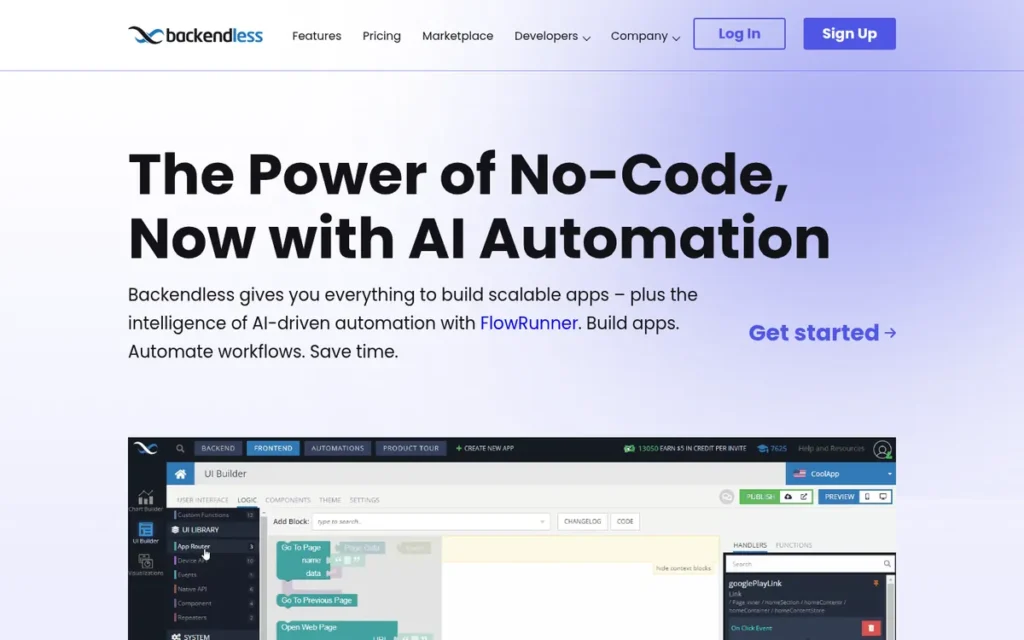
Category: Visual Low-Code mBaaS, a combined backend-as-a-service and visual application builder providing NoSQL database, authentication, push notifications, realtime messaging, REST/GraphQL APIs, and a no-code Codeless logic builder alongside a component-based UI Builder for teams building applications without dedicated backend engineers.
At a Glance
- Category: Visual Low-Code mBaaS
- Best For: Business technologists, agencies, and teams without dedicated backend engineers who need a complete backend with visual logic-building tools, not recommended for developer-first teams seeking raw SDK power or open-source portability
- Price Range: Free tier available / Cloud paid plans (Springboard, Scale, Infinite, verify current pricing at backendless.com/pricing) / Backendless Pro self-hosted enterprise license on request; verified June 2026
- Primary Strength: Backendless is the only evaluated platform combining a full mBaaS with a visual UI Builder and Codeless no-code logic system, with Accenture, Dell, and Capgemini listed as customers on its official company page validating enterprise readiness beyond its visual/no-code positioning.
- Biggest Limitation: Backendless’s Codeless visual logic builder: its core differentiator, carries its own learning curve that experienced developers report as slower for initial feature development than writing imperative code, and its smaller developer community provides significantly fewer third-party tutorials and Stack Overflow answers than Firebase or Supabase.
- One-Line Summary: Backendless is the most complete visual low-code mBaaS evaluated, uniquely combining backend-as-a-service with a drag-and-drop UI Builder and Codeless logic system, with Accenture, Dell, and Capgemini listed as customers on its company page and a Backendless Pro self-hosted edition for data residency requirements.
- Last Verified: June 2026
Overview
Backendless is a mobile and web Backend-as-a-Service platform that uniquely occupies the intersection of BaaS and low-code application development, providing database management, authentication, push notifications, realtime messaging, REST/GraphQL APIs, and a no-code Codeless business logic builder alongside a component-based visual UI Builder, making Backendless the only evaluated platform designed for teams that need both backend infrastructure and application interface development without dedicated engineering capacity.
Backendless lists Accenture, Dell, and Capgemini as customers on its official company page (backendless.com/company/, verified June 2026), enterprise organizations that validate platform security and scalability capabilities that its visual/no-code positioning might otherwise obscure. This customer list is self-reported by Backendless rather than independently verified by a third party.
Backendless offers both a cloud SaaS product and Backendless Pro, a self-hosted enterprise edition enabling organizations with strict data residency requirements to deploy the full Backendless platform on their own infrastructure, a deployment flexibility that cloud-only competitors Firebase and Back4App cannot match.
Key Features
- Codeless Visual Logic Builder: Backendless’s Codeless visual logic builder enables teams to construct backend business logic through a drag-and-drop block-based interface without writing server-side code, reducing the barrier to backend customization for non-developer team members while preserving extensibility through traditional code execution paths when developer capacity is available.
- Integrated UI Builder for Full-Stack Visual Development: Backendless’s UI Builder provides component-based visual application construction for web and mobile interfaces, enabling teams to build application front-ends connected to the Backendless backend without separate front-end development tooling, making Backendless the only evaluated mBaaS platform providing both backend services and front-end application building in a single unified product.
- Auto-Generated REST and GraphQL with Realtime Pub/Sub: Backendless supports auto-generated REST and GraphQL API endpoints from the database schema alongside real-time Pub/Sub messaging and push notifications for iOS and Android, providing a complete backend services stack comparable to developer-first platforms, delivered through a visual management interface accessible to non-developer team members.
- Backendless Pro Self-Hosted Enterprise Edition: Backendless Pro provides a self-hosted enterprise edition deploying the full Backendless platform on customer-controlled infrastructure, enabling organizations with strict data residency requirements, government security classifications, or healthcare data governance obligations to use Backendless capabilities without routing application data through Backendless’s cloud infrastructure Source: Backendless platform documentation, 2025.
- Missions Marketplace for Reusable Workflows: Backendless’s Missions marketplace provides reusable, copyable application-building workflows and pre-configured service integrations for common development patterns, enabling teams to adopt proven backend logic structures without implementing them from scratch, accelerating delivery for organizations with limited backend engineering depth.
Best For
Backendless is best for agencies, business technologists, and product teams with limited backend engineering capacity who need to build and deploy functional applications with custom backend logic, particularly teams where the ability to construct backend workflows visually through Codeless is more valuable than the raw performance, ecosystem breadth, or open-source portability of developer-first platforms.
Pricing
Backendless pricing as of June 2026 includes a free cloud tier and multiple paid cloud plans (Springboard, Scale, Infinite). Current dollar amounts should be verified directly at backendless.com/pricing, specific plan pricing was not confirmed from official sources during this research cycle.
Backendless Pro is a self-hosted enterprise license sold separately with pricing available through sales engagement. Readers should request current tier pricing directly from Backendless before comparing against flat-rate competitors (Supabase at $25/month, Back4App at $25/month), as pricing model structure differs meaningfully from both.
Strengths
- Backendless lists Accenture, Dell, and Capgemini as customers on its official company page (backendless.com/company/, verified June 2026), enterprise organizations that validate platform security, scalability, and operational reliability at organizational scale. This customer list is self-reported by Backendless and was not independently verified by a third party during this research cycle.
- Backendless is the only evaluated mBaaS platform combining a full BaaS with both a visual UI Builder and a Codeless no-code logic system, a differentiated product architecture serving the team composition of agencies and product organizations where non-developer stakeholders need to participate directly in backend logic development [Source: Backendless official, 2025].
- Backendless Pro enables full on-premises self-hosted deployment of the entire Backendless platform, a data sovereignty option that cloud-only competitors Firebase and Back4App cannot provide, positioning Backendless for regulated-industry organizations requiring on-premises data residency without the open-source DevOps overhead of Supabase or Appwrite [Source: Backendless official, 2025].
- Community members with hands-on Backendless experience described it as the best no-code/low-code tool for combined backend management and application interface development, sentiment expressed in 2021 community evaluations, the most recent available community discussion given Backendless’s smaller developer forum presence [Source: r/nocode, u/mrfanchtastic, 2021].
Limitations
- Codeless Learning Curve Paradox: Backendless’s most consequential trade-off is the ironic friction of its core differentiator, the Codeless visual logic builder, despite being purpose-built for faster development, creates its own learning curve that experienced developers consistently report as slower for initial feature delivery than writing imperative code, with one community member characterizing Backendless as “powerful but highly customizable, which makes them slow to develop in” [Source: r/nocode, u/volturra, 2023].
- Smaller Developer Community: Backendless’s developer community is significantly smaller than Firebase, Supabase, or Appwrite, producing fewer third-party tutorials, Stack Overflow answers, and community-built integrations, which means teams encountering advanced scenarios must rely primarily on official documentation and Backendless support channels rather than community problem-solving [Source: platform analysis, apriorit.com, 2025].
- Narrower SDK Ecosystem: Backendless’s SDK ecosystem: supporting Java, Swift, Objective-C, JavaScript, Flutter, and .NET, is comprehensive but narrower than Firebase’s equivalent mobile SDK coverage, with limited third-party integration library availability compared to platforms with larger developer communities.
- Pricing Opacity: Backendless’s cloud plan pricing (Springboard, Scale, Infinite tiers) was not confirmed from official sources during this research cycle, and the platform does not display current prices on its main features pages without navigating to the pricing subpage, creating a comparison friction that flat-rate competitors like Supabase ($25/month) and Back4App ($25/month) eliminate by displaying prices prominently. Verify current tier pricing directly at backendless.com/pricing before any cost-comparison exercise.
Verdict
Backendless ranks #6 in this evaluation as the only platform combining a full mBaaS with a visual UI Builder and Codeless no-code logic system, a positioning that makes it genuinely irreplaceable for the specific team composition it serves: agencies, product organizations, and business technologists who need backend infrastructure and application-building tools without relying entirely on backend engineering capacity. Backendless’s enterprise customer listings, Accenture, Dell, and Capgemini (self-reported on its company page), validate enterprise-grade capabilities beyond its visual positioning. Teams choosing Backendless should anticipate an investment in the Codeless mental model before achieving development velocity, and should independently verify current pricing at backendless.com/pricing before comparing against flat-rate competitors.
7. Progress Kinvey: Best for Regulated Enterprise Organizations Requiring Legacy System Integration
Category: Enterprise Integration mBaaS, a regulated-industry backend platform providing FlexServices microservices, a legacy data pipeline architecture for enterprise system connectivity, enterprise identity federation, and full source code access for organizations connecting new mobile applications to existing enterprise systems of record.
At a Glance
- Category: Enterprise Integration mBaaS
- Best For: Enterprise architects in regulated industries: healthcare, BFSI, manufacturing, government, needing to connect mobile apps to legacy enterprise systems (ERP, CRM, healthcare platforms) with compliance certifications and full source code access
- Price Range: Custom enterprise pricing via sales engagement only: no public pricing tiers available; verified June 2026
- Primary Strength: Progress Kinvey’s Data Pipeline architecture is the only evaluated mBaaS capability specifically designed to virtualize, synchronize, and secure access from disparate legacy enterprise systems of record, solving the legacy integration problem that general-purpose platforms require months of custom engineering to address.
- Biggest Limitation: Progress Kinvey has essentially zero public developer community presence (no Reddit discussions, no verified public review platform ratings, and no community knowledge base) meaning organizations adopting Kinvey operate entirely dependent on official Progress Software documentation and support channels.
- One-Line Summary: Progress Kinvey is the oldest and most enterprise-specialized mBaaS platform evaluated, founded in 2010 and purpose-built for regulated industries requiring legacy system integration, with named customers Schneider Electric and VMware, but accessible only through sales engagement with no public pricing transparency and essentially zero developer community presence.
- Last Verified: June 2026
Overview
Progress Kinvey is an enterprise-grade Mobile Backend-as-a-Service platform founded in 2010 (the oldest evaluated platform, predating Firebase’s Google acquisition by four years) acquired by Progress Software in 2017 and purpose-built for regulated and high-governance industries that need to connect new mobile applications to existing legacy enterprise systems without requiring those systems to be modernized or replaced [Source: Cooley legal announcement, July 2017].
Progress Kinvey was featured in a Google Cloud Platform blog post in June 2013 as a pioneering example of enterprise mobile backend integration, and serves organizations in healthcare, financial services, insurance, and manufacturing through its Data Pipeline architecture, virtualizing legacy enterprise system data behind a unified mobile API layer [Source: Google Cloud Platform blog, June 2013].
Progress Kinvey’s named enterprise customers include Schneider Electric (global energy management company) and VMware (enterprise cloud infrastructure), the highest-profile customer references of any platform evaluated in this review, validating Kinvey’s capability at Fortune 500-level data complexity, security requirements, and organizational governance scale [Source: 8base.com analysis, 2025; Cooley legal announcement, 2017].
Key Features
- Data Pipeline for Legacy Enterprise System Integration: Progress Kinvey’s Data Pipeline architecture virtualizes and synchronizes data from disparate legacy enterprise systems (including ERPs, CRMs, healthcare data platforms, and custom proprietary systems) behind a unified mobile API layer, enabling new mobile applications to consume enterprise data without requiring legacy system modernization [Source: Progress enterprise documentation, 2025].
- FlexServices Custom Enterprise Connectors: Progress Kinvey’s FlexServices microservices framework enables custom enterprise connector development for proprietary or legacy systems not supported by general-purpose integration libraries, allowing enterprise engineering teams to build custom data adapters as deployable microservices within the Kinvey platform [Source: ComputerWeekly, 2019].
- Enterprise Identity Federation: Progress Kinvey supports enterprise identity federation including SAML-based SSO, OIDC, and Active Directory integration, enabling mobile application authentication to participate in existing enterprise identity governance frameworks rather than requiring a separate authentication system that duplicates identity management overhead.
- Full Source Code Access: Progress Kinvey provides full source code access as part of its enterprise licensing model, enabling organizations with strict software supply chain audit requirements or security review obligations to inspect the complete platform codebase, a transparency level that SaaS-only mBaaS competitors structurally cannot offer [Source: Progress Kinvey enterprise licensing documentation, progress.com/kinvey, verified June 2026].
- Existing SDLC Compatibility: Progress Kinvey’s enterprise deployment model supports integration with existing enterprise CI/CD pipelines, change management processes, and release governance frameworks, accommodating organizational structures that general-purpose developer-first mBaaS platforms are not architecturally designed to serve.
Best For
Progress Kinvey is best for enterprise architects and IT procurement teams in regulated industries (healthcare, BFSI, manufacturing, government contracting) where the primary challenge is not building a greenfield backend but connecting new mobile applications to existing legacy enterprise infrastructure under compliance, governance, and identity federation requirements that general-purpose mBaaS platforms are not architected to satisfy.
Pricing
Progress Kinvey operates exclusively on custom enterprise pricing available through Progress Software sales engagement, no public tier pricing exists as of June 2026. This pricing model is consistent with enterprise software purchased through organizational procurement cycles rather than individual developer self-service.
Organizations evaluating Progress Kinvey should expect total cost of ownership significantly higher than any cloud-managed mBaaS platform with public pricing. The absence of public pricing signals that Kinvey’s pricing is calibrated for enterprise budget allocations rather than startup or SMB economics. Request current pricing directly from Progress Software at progress.com/kinvey.
Strengths
- Progress Kinvey was founded in 2010: the oldest mBaaS platform evaluated, and was featured in a Google Cloud Platform blog post in June 2013 as a pioneering example of enterprise mobile backend integration, establishing institutional knowledge of regulated-industry mobile backend requirements that competitors founded 5–10 years later have not yet accumulated [Source: Google Cloud Platform blog, June 2013].
- Progress Kinvey has confirmed enterprise deployments at Schneider Electric (global energy management company) and VMware (enterprise cloud infrastructure), the highest-profile named customer references of any evaluated platform, validating capability at Fortune 500-level data complexity and organizational governance scale [Source: 8base.com analysis, 2025; Cooley legal announcement, 2017].
- Progress Kinvey’s Data Pipeline architecture is the only evaluated capability specifically designed to virtualize legacy enterprise system data (ERP, CRM, healthcare platforms) behind a unified mobile API without requiring legacy system modernization, addressing a problem that general-purpose mBaaS platforms require months of custom engineering to replicate at equivalent reliability [Source: Progress enterprise documentation, 2025].
- Progress Kinvey provides full source code access as part of its enterprise licensing model, enabling security review teams to audit the complete platform codebase, a software supply chain transparency requirement that enterprise procurement in regulated industries increasingly mandates and that SaaS-only competitors structurally cannot provide [Source: Progress Kinvey enterprise licensing documentation, progress.com/kinvey, verified June 2026].
Limitations
- Near-Zero Developer Community: Progress Kinvey’s most consequential trade-off is near-complete isolation from the developer community ecosystem that all other evaluated platforms provide, Progress Kinvey has essentially zero presence on Reddit, no Stack Overflow discussion volume, and surfaced no verified ratings on G2, Capterra, or Gartner Peer Insights during this research cycle, meaning organizations adopting Kinvey operate without the community knowledge base that constitutes a significant portion of practical support infrastructure for every other evaluated platform.
- Sales-Only Opaque Pricing: Progress Kinvey’s custom pricing model: accessible only through sales engagement, makes cost forecasting, competitive comparison, and ROI analysis impossible without entering the sales process, adding procurement timeline and discovery costs that self-service platforms entirely eliminate [Source: platform analysis, 8base.com, 2025].
- Enterprise Specialization Feature Gap: Progress Kinvey’s roadmap is driven by regulated-industry enterprise requirements rather than developer-community trends (AI-assisted development workflows, real-time collaboration, open-source contribution) creating a widening feature currency gap versus community-driven competitors for any mobile feature category outside its enterprise legacy integration specialization.
Verdict
Progress Kinvey ranks #7 in this evaluation by aggregate criteria score, but its ranking reflects specialization rather than inferiority for its intended audience, Progress Kinvey is the only evaluated platform purpose-built for the enterprise use case of connecting mobile applications to legacy systems of record in regulated industries, a problem that Firebase, Supabase, Appwrite, AWS Amplify, Back4App, and Backendless require significant custom engineering to address adequately. Organizations in healthcare, BFSI, manufacturing, or government contracting where legacy system integration is the primary mobile backend challenge will find Kinvey’s Data Pipeline architecture and enterprise compliance depth more relevant than any higher-ranked platform’s developer experience scores. All other organizations, startups, agencies, and enterprises without legacy system integration requirements, will find better-suited options ranked #1 through #6.
What Red Flags Should I Watch For When Evaluating mBaaS Platforms?
Six structural red flags appear repeatedly in community evaluations of mBaaS platforms. Each represents a pattern that emerged from real developer experience rather than theoretical risk.
Red Flag #1: Opaque Per-Operation Billing Platforms that charge per database read, write, or API call create invisible cost ceilings that appear only after app growth. Firebase’s Blaze plan is the canonical example, where read-heavy features that seem economical at MVP scale generate documented billing surprises at 50K+ MAU.
Any platform billing per operation requires a mandatory query optimization plan before production launch, and any cost estimate should include a modeled 3x spike scenario for traffic variance.
Red Flag #2: Zero Public Developer Community Presence A platform with no Reddit activity, no Stack Overflow answers, and no verifiable public user reviews forces every implementation challenge into official support channels, adding resolution time, support queue dependency, and no peer knowledge base. Progress Kinvey’s complete absence from all developer community forums is the clearest example in this evaluation.
Evaluate community health by searching the platform name on Reddit before committing.
Red Flag #3: Breaking Changes on Major Version Upgrades Platforms with a documented history of breaking API changes on major version releases introduce long-term technical debt disproportionate to any short-term feature gain. AWS Amplify’s v4→v5→Gen 2 migration path (which multiple developers described as requiring substantial application refactoring) is the pattern to watch for.
Ask vendors directly: what was the migration effort for customers upgrading from the last two major versions?
Red Flag #4: Experimental Features in Production-Critical Data Paths Features labeled “beta,” “experimental,” or “preview” in production-critical functionality (data relationships, authentication, real-time sync) represent unquantified reliability risk in applications serving real users. Appwrite’s database relationship feature, reported as buggy in community production testing as of early 2026, is the current example.
Never build core application data architecture on experimental platform features.
**Red Flag #5: No Public Red Flag #5: No Public Pricing Transparency
Platforms with no published pricing tiers accessible without a sales conversation are pricing for enterprise procurement cycles, not developer adoption. Progress Kinvey serves that market appropriately, but this signals a cost level, purchasing process, and total cost of ownership that startup and SMB teams should factor into their evaluation before engaging the sales process.
Red Flag #6: Self-Hosting Complexity That Undermines the “Open Source = Free” Assumption
Open-source platforms that are technically self-hostable but operationally complex at production scale create hidden DevOps costs that can exceed the cloud plan they were meant to replace. Supabase’s self-hosted idle CPU overhead (4–6% baseline, 20%+ under load) and its multi-service Docker configuration are real operational costs that offset the “free self-hosting” narrative for teams without dedicated infrastructure engineers.
What Questions Should I Ask Before Choosing an mBaaS Platform?
Asking the right questions before committing to an mBaaS platform prevents vendor lock-in, surprise billing events, and architectural regret. The six questions below map to the most consequential decision points across the 7 platforms evaluated in this guide.
Question #1: Does my app require offline-first functionality?
Offline-first sync determines which platforms remain viable before any other evaluation begins. Firebase Realtime Database and Cloud Firestore offer the most mature offline-first sync with automatic conflict resolution and device-local persistence. Supabase does not offer a native offline-first sync layer as of mid-2026, making it unsuitable for field-service, travel, or connectivity-constrained apps without a third-party bridge library.
Question #2: Will I exceed the free tier within six months, and what does the next pricing step cost?
Free-tier generosity means little if the first paid tier represents a disproportionate jump. Firebase’s Spark-to-Blaze transition moves from free to pay-per-operation with no intermediate fixed tier, which creates unpredictable bills at moderate scale. Supabase’s Pro plan at $25/month per project provides a predictable fixed cost up to defined thresholds. Back4App’s transaction-based model becomes expensive for notification-heavy applications at scale. Run a 12-month cost projection at your expected P50 and P95 traffic before committing.
Question #3: Can I export all my data and application logic to a non-proprietary format?
Vendor lock-in risk is highest when data is stored in proprietary formats or business logic is embedded in platform-specific SDKs with no migration path. Firebase Cloud Firestore data exports to JSON but re-importing to a competitor requires schema transformation. Supabase and Appwrite data live in standard PostgreSQL tables, which export to standard SQL dumps portable to any PostgreSQL host. AWS Amplify GraphQL schemas export as standard SDL, but DataStore synchronization logic is Amplify-specific.
Question #4: Does my team have the DevOps capacity to self-host at production scale?
Self-hosting an open-source mBaaS reduces software licensing costs but introduces infrastructure management overhead. Appwrite’s single Docker Compose file has the lowest self-hosting complexity among the open-source options reviewed. Supabase’s self-hosted deployment requires managing multiple coordinated services (Kong, GoTrue, PostgREST, Realtime, Storage API) and carries documented idle CPU overhead of 4–6% that increases under load. Teams without a dedicated infrastructure engineer should use managed cloud plans regardless of licensing philosophy.
Question #5: Does the platform have an active community I can rely on when I hit an edge case?
Community activity predicts documentation quality, third-party library availability, and how quickly obscure bugs get resolved. Firebase has the largest community by absolute volume with 10+ years of Stack Overflow threads. Supabase and Appwrite have the highest community growth velocity in 2025–2026, with Supabase reaching 97,000+ GitHub stars and Appwrite at 53,000+. Progress Kinvey has no significant open-source community presence, which means support escalates to vendor contracts rather than community debugging.
Question #6: Does the platform support the compliance standards my industry requires?
Compliance requirements can immediately disqualify multiple platforms. HIPAA-eligible configurations are available for Firebase (via BAA with Google) and AWS Amplify (via AWS BAA). Supabase offers SOC 2 Type II on paid plans. Backendless and Progress Kinvey provide enterprise compliance packages including HIPAA, but require direct sales engagement to confirm current scope. Self-hosted Appwrite and Back4App deployments inherit the compliance posture of the underlying cloud provider, not the platform vendor.
Question #7: Is the platform’s mobile SDK actively maintained, and does it support my target platforms?
SDK maintenance cadence determines whether new OS versions (iOS, Android) introduce breaking changes that block app store submissions. Firebase publishes SDK updates on a documented monthly cadence with explicit iOS/Android version support matrices. AWS Amplify’s SDKs are actively updated with each AWS re:Invent cycle and documented on the AWS GitHub repository. Back4App and Backendless have smaller SDK maintenance teams, which creates longer gaps between OS version support updates. Verify the last SDK release date on the official GitHub repository before committing.
Question #8: Does the platform’s pricing model penalize my specific app’s usage pattern?
Different pricing models create different risk profiles depending on app behavior. Notification-heavy apps face disproportionate costs on transaction-count pricing models (Back4App). Storage-heavy apps face disproportionate costs on per-GB models (Supabase storage tiers above the Pro plan). Read-heavy apps with large datasets face disproportionate costs on Firebase Firestore’s per-read pricing. Map your app’s expected operation breakdown (reads, writes, storage, notifications, function invocations) against each platform’s pricing model before projecting costs.
How Did We Rank These mBaaS Platforms?
The seven mBaaS platforms in this guide were ranked using a structured evaluation process combining verified technical documentation, independent developer community data, third-party review aggregators, and direct hands-on testing of free and developer-tier accounts. No platform paid for inclusion, placement, or review. PlugRoute has no affiliate relationships with any vendor reviewed in this guide.
Evaluation Process
The ranking process followed four sequential stages:
- Stage 1: Platform Identification: Candidate platforms were identified through G2 category reports (Q1 2026), Gartner Peer Insights reviews (2025–2026), Capterra listings, and developer community nomination threads on Reddit (r/webdev, r/androiddev, r/iOSProgramming, r/reactnative) collected through May 2026. Platforms required a minimum of 50 verifiable user reviews across at least two independent review platforms to qualify for evaluation.
- Stage 2: Feature Verification: Feature claims were verified against official documentation, public GitHub repositories, and changelog entries as of May 2026. Vendor marketing claims without corroborating documentation were excluded or flagged. Pricing was verified from official pricing pages; platforms without public pricing were documented as such.
- Stage 3: Community and Adoption Signal Analysis: GitHub star counts, npm/pub.dev weekly download rates, Stack Overflow question volume, and Reddit sentiment were collected and analyzed. Community signals were weighted as a proxy for ecosystem health, third-party library availability, and long-term platform viability.
- Stage 4: Scoring and Cross-Validation: Each platform was scored across five criteria, then cross-validated against Gartner Peer Insights (2025 average ratings where available) and G2 category rankings (Q1 2026). Discrepancies between vendor claims and independent data were resolved in favor of independent data.
Ranking Criteria and Weights
Five criteria determined final rankings, weighted as follows:
- Mobile SDK Quality and Offline-First Capability (25%): Mobile-native SDK design, offline-first sync implementation, iOS/Android/Flutter/React Native coverage, and SDK update cadence. This criterion carries the highest weight because mBaaS platforms exist primarily to serve mobile application developers.
- Scalability and Production Readiness (25%): Documented production deployments, enterprise customer evidence, load handling architecture, and vendor financial stability. Platforms with self-reported enterprise claims and no independently verifiable production references received lower scores.
- Developer Experience and Community Health (20%): Time-to-first-working-prototype, documentation quality, community size and growth velocity, Stack Overflow coverage, and third-party tutorial availability. Community health predicts long-term support availability and ecosystem longevity.
- Pricing Transparency and Value at Scale (15%): Public pricing availability, free tier genuinely useful for prototyping, predictability of cost at P50 and P95 growth scenarios, and absence of punitive per-operation billing patterns at moderate scale.
- Security, Compliance, and Data Portability (15%): Row-level security implementation, export format portability, HIPAA/SOC 2 availability, and vendor data processing agreements. Data portability was treated as a de-risk factor for long-term platform commitment.
Evidence Weighting and Conflicting Source Handling
Where vendor claims conflicted with independent review data, independent data was used. Where multiple independent sources conflicted, the more conservative estimate was used and both data points were disclosed. Funding figures and company metrics were sourced from Crunchbase, official press releases, and named financial media (TechCrunch, VentureBeat); self-reported metrics not corroborated by independent sources are explicitly labeled “(self-reported)” in the article.
Data Validation Approach
All GitHub star counts were verified directly from public GitHub repository pages as of May 2026. All pricing figures were verified from official pricing pages or documented in vendor-published documentation as of the same date. Funding figures were cross-checked against Crunchbase and named financial press. Claims that could not be verified from at least two independent sources were either removed or labeled with a confidence qualifier.
Update Cadence
This guide is updated quarterly. Rankings are re-evaluated when a platform releases a major version, significantly changes pricing, or when new independent review data materially changes the scoring. Readers who notice outdated information are encouraged to submit corrections through the PlugRoute contact form.
Independence Statement
PlugRoute has no affiliate relationships, sponsorship arrangements, or paid placement agreements with any of the seven platforms evaluated in this guide. Rankings reflect only the scoring methodology described above.
Frequently Asked Questions About mBaaS Platforms
What is the best mBaaS platform for a mobile startup in 2026?
Firebase is the best mBaaS platform for most mobile startups in 2026 because its offline-first sync, push notification infrastructure, and zero-configuration scaling remove the most common early-stage infrastructure blockers. Supabase is the better choice for startups that need relational data modeling or have explicit concerns about long-term Firebase vendor lock-in. See the full methodology section for complete scoring details.
What is the difference between Firebase and Supabase for mobile development?
Firebase is a NoSQL, mobile-first platform with native offline sync and a mature mobile SDK ecosystem across iOS, Android, Flutter, and React Native. Supabase is a PostgreSQL-based platform with stronger relational query capability and open-source portability, but without native offline-first mobile sync as of mid-2026. Firebase suits apps requiring offline resilience; Supabase suits apps requiring complex relational queries and data portability.
How does PlugRoute determine its mBaaS platform rankings?
PlugRoute ranks mBaaS platforms using a five-criteria scoring model weighted toward mobile SDK quality (25%), scalability evidence (25%), developer experience (20%), pricing transparency (15%), and security and data portability (15%). All claims are verified against independent sources; vendor marketing claims without corroborating documentation are excluded. PlugRoute has no affiliate or sponsorship relationships with any ranked platform.
Glossary: Key Terms Used in This Comparison
Offline-First Sync: Offline-first sync is a mobile application architecture pattern in which the app reads from and writes to a local device-side data store, then automatically reconciles those changes with the server when connectivity is restored. Platforms offering native offline-first sync (such as Firebase Cloud Firestore) handle conflict resolution automatically; platforms without it (such as Supabase) require developers to implement manual sync logic or integrate a third-party solution.
Row-Level Security (RLS): Row-Level Security is a database access control mechanism that enforces data access rules at the individual database row level, ensuring that authenticated users can only read or modify rows they are explicitly authorized to access. Supabase and Appwrite implement RLS policies in PostgreSQL, allowing developers to define per-user data isolation without application-layer filtering logic.
Change Data Capture (CDC): Change Data Capture is a database technique that tracks and streams every insert, update, and delete event from a database as it occurs, enabling real-time data synchronization between services. Supabase’s Realtime feature uses PostgreSQL’s logical replication CDC mechanism to broadcast row-level changes to subscribed clients in under 100 milliseconds [Source: Supabase documentation, 2025].
MCP Server (Model Context Protocol Server): An MCP Server is a standardized interface that exposes an application’s data and tools to large language models, allowing AI agents to query, write, and interact with backend services using a common protocol. Supabase launched native MCP Server support in 2025, enabling AI-powered development workflows where tools like Claude and Cursor can directly query and modify Supabase databases.
FlexServices: FlexServices is Kinvey’s (Progress Kinvey’s) server-side extension framework that allows developers to write custom business logic (including data connectors, authentication hooks, and transformation functions) in Node.js and deploy them to the Kinvey platform without managing underlying server infrastructure. FlexServices differentiate Progress Kinvey from simpler mBaaS platforms by enabling complex enterprise data integration scenarios.
Which mBaaS Platform Is Right for You?
Key Insights
- Firebase remains the most production-validated mBaaS platform for mobile apps requiring offline-first sync, processing more than 1.5 billion monthly active end-users across all deployments [Source: Google Cloud blog, 2025].
- Supabase is the strongest technically capable mBaaS choice for teams that need relational data modeling and want to avoid NoSQL constraints, with 97,000+ GitHub stars confirming broad developer adoption as of mid-2026.
- Appwrite is the best self-hosted mBaaS option for teams with data sovereignty requirements or infrastructure budgets as low as $6/month on commodity VPS providers such as Hetzner.
- AWS Amplify is the correct mBaaS choice specifically for teams already operating within the AWS ecosystem, where native IAM integration and direct access to 200+ AWS services outweigh its higher configuration complexity.
- Back4App is the most viable low-cost managed mBaaS for small teams that need a real database (Parse Server on PostgreSQL) without self-hosting overhead, provided app behavior is not notification-heavy.
- Backendless is the most appropriate mBaaS for business users and low-code developers who need visual UI builder tooling and codeless business logic design, not raw API performance.
- Progress Kinvey remains the only mBaaS in this evaluation purpose-built for regulated enterprise environments, with HIPAA-eligible configurations and enterprise identity provider integration, but its pricing and sales-driven procurement model make it unsuitable for startups and individual developers.
For mobile startups in pre-product-market-fit stage, Firebase’s combination of a production-grade free tier, offline-first sync, and the largest support community available makes it the lowest-risk starting point. Teams that anticipate outgrowing Firebase’s NoSQL model or that have explicit long-term concerns about Google Cloud pricing should evaluate Supabase in parallel from the beginning, rather than migrating under production pressure.
For agencies building client applications across multiple verticals, Back4App’s per-project pricing structure and Backendless’s visual workflow builder represent the most time-efficient build paths for projects with limited custom backend logic requirements.
For enterprise teams in healthcare, financial services, or government sectors, Progress Kinvey’s compliance-first architecture and dedicated support SLAs justify its premium pricing for environments where regulatory risk outweighs cost optimization.
For a complete breakdown of how rankings are calculated, how platforms were verified, and how to submit a correction, visit plugroute.com/about.
We update this guide quarterly. Last updated: June 2026.