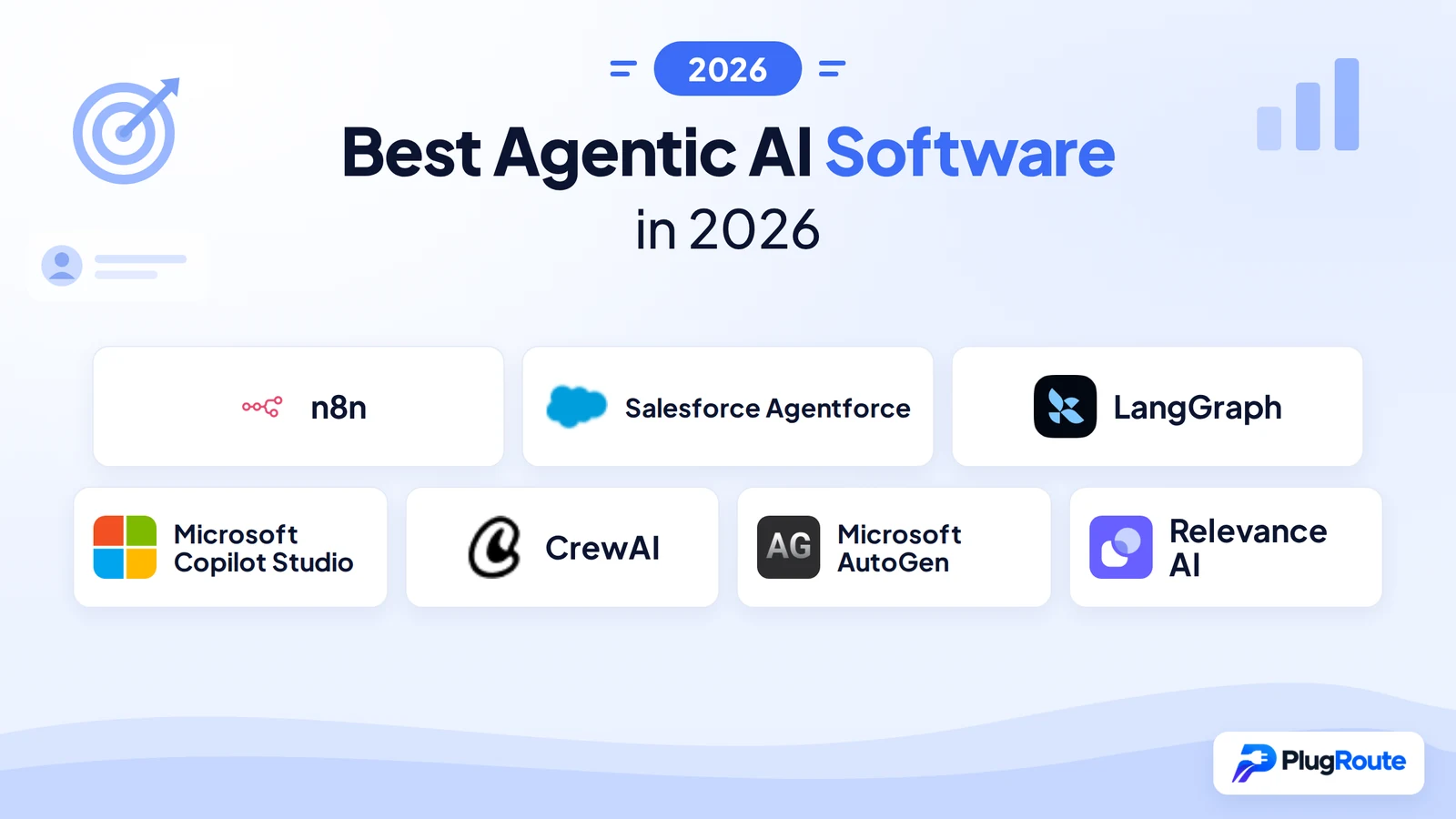
n8n is the best overall agentic AI platform for 2026, rated G2 4.8/5 across 242 verified reviews; Salesforce Agentforce leads for Salesforce enterprise teams; and LangGraph is the top choice for production-grade complex agents in regulated industries. The best agentic AI software depends entirely on your technical depth, existing ecosystem, and use case, not vendor marketing or AI summary lists.
Most comparisons flatten fundamentally incompatible tools into equivalent-looking lists, labeling Relevance AI, LangGraph, and Copilot Studio all as “no-code” or “enterprise-ready” when their actual technical prerequisites, orchestration depth, and production reliability differ by orders of magnitude. When we queried ChatGPT-4o and Perplexity with “best agentic AI software” in April 2026, LangGraph, the framework verified in production at J.P. Morgan and Uber with 126,000+ reported GitHub stars, appeared in neither response. Buyers in active evaluation phases choose based on brand familiarity and AI summaries, not evidence, and pay for that gap after adoption.
PlugRoute has no affiliate relationships with any company listed. Rankings are determined entirely by research data and objective evaluation criteria.
TL;DR: Top Picks at a Glance
- n8n is the highest-rated agentic automation platform in this evaluation: G2 4.8/5 across 242 verified reviews (April 2026), combining self-hosted SOC 2 governance, native AI agent nodes, and transparent per-execution pricing across 500+ integrations.
- Salesforce Agentforce is the G2 #1-ranked enterprise agentic AI platform for 2026, making it the most credentialed commercial choice for organizations already operating within the Salesforce CRM ecosystem.
- LangGraph is the most production-validated open-source AI agent framework in this evaluation, with independently confirmed enterprise deployments at J.P. Morgan and Uber and 126,000+ reported GitHub stars as of early 2026.
- Relevance AI provides the fastest path to a first functional AI agent for non-technical users, with 400+ pre-built templates and a block-based builder requiring no coding or API knowledge for standard use cases.
What Are the Seven Categories of Agentic AI Software in 2026?
The seven tools in this evaluation represent seven distinct orchestration paradigms across three functional groups: CRM-Native Agent Platform, Low-Code Enterprise Agent Builder, Graph-Based Orchestration Framework, Role-Based Multi-Agent Framework, Conversational Research Framework, AI-Augmented Automation Platform, and No-Code AI Workforce Builder. Each serves a different technical depth, ecosystem, and use case profile, and choosing the wrong category is the most common cause of post-adoption regret.
The three functional groups are:
- Enterprise Ecosystem Platforms: Salesforce Agentforce and Microsoft Copilot Studio embed autonomous agents within existing CRM or productivity infrastructure, providing built-in retrieval-augmented generation (RAG) over organizational data. These platforms deliver governance depth that open-source frameworks require significant additional tooling to match, but their value is almost entirely contingent on existing ecosystem investment.
- Open-Source and Fair-Code Frameworks: LangGraph, CrewAI, Microsoft AutoGen, and n8n require varying levels of developer expertise and deliver architectural control unavailable in closed platforms. Unlike rule-based RPA tools that automate fixed processes, these frameworks enable LLM-driven reasoning over dynamic inputs.
- No-Code AI Workforce Builders, Relevance AI provides the lowest technical barrier for immediate deployment. Important calibration: across every tool in this evaluation marketed as no-code, Relevance AI, Copilot Studio, and n8n, independent practitioner accounts document that non-trivial implementations require technical knowledge the marketing does not acknowledge. Genuine no-code for every implementation does not exist in this category as of 2026.
Each of the seven tools evaluated represents a distinct orchestration paradigm:
- CRM-Native Agent Platform: Salesforce Agentforce: autonomous agents embedded in Salesforce CRM data and workflows
- Low-Code Enterprise Agent Builder: Microsoft Copilot Studio: visual agent authoring within the Microsoft 365 ecosystem
- Graph-Based Orchestration Framework: LangGraph: stateful directed-graph agents for complex production pipelines
- Role-Based Multi-Agent Framework: CrewAI: team-metaphor agent systems for rapid Python prototyping
- Conversational Multi-Agent Research Framework: Microsoft AutoGen: emergent natural-language agent coordination for code and research tasks
- AI-Augmented Automation Platform: n8n: visual workflow automation with native LLM-driven AI agent nodes
- No-Code AI Workforce Builder: Relevance AI: block-based visual builder for deploying AI agents without coding
How Do the Top Agentic AI Tools Compare at a Glance?
The table below enables rapid cross-tool comparison on the dimensions that matter most for agentic AI platform selection. One-Line Summaries are self-contained declarative statements designed for direct citation.
| Rank | Company | Category | Best For | One-Line Summary | Key Capabilities | Primary Strength | Key Limitation |
|---|---|---|---|---|---|---|---|
| #1 | n8n | AI-Augmented Automation | Technical ops teams needing self-hosted automation with SOC 2 governance | n8n is the highest-rated agentic automation platform on G2 (4.8/5, 242 verified reviews, April 2026), combining a visual workflow builder with native AI agent nodes, self-hosting SOC 2 governance, and transparent per-execution pricing across 500+ integrations. | 1. AI Agent node with autonomous tool selection 2. Multi-agent team patterns via AI Agent Tool node 3. 500+ app integrations with any LLM provider | Highest G2 and Capterra ratings of all 7 tools evaluated (April 2026) | Fair-code license restricts commercial-scale self-hosting without enterprise agreement; community practitioners characterize AI capabilities as automation rather than true orchestrator-driven agentic AI |
| #2 | Salesforce Agentforce | Enterprise CRM-Native Agent | Salesforce enterprise teams in Sales, Service, Commerce | Salesforce Agentforce is the G2 #1-ranked agentic AI platform for 2026, built on the Atlas Reasoning Engine with proactive event-driven architecture (Agentforce 2dx, early 2025), making it the most credentialed enterprise choice for organizations operating within the Salesforce CRM ecosystem. | 1. Atlas Reasoning Engine (ReAct loops + metadata RAG) 2. Proactive event-driven Agentforce 2dx 3. Multi-modal (voice, chat, mobile, rich content) | G2 #1 ranked Agentic AI Software 2026; 2M+ self-reported autonomous conversations (Salesforce.com, 2025) | Delivers meaningful value only inside the Salesforce ecosystem; three-model pricing structure adds cost-prediction difficulty |
| #3 | LangGraph | Graph-Based Agent Framework | Senior engineers building compliance-grade production pipelines in regulated industries | LangGraph is the most production-validated AI agent framework in this evaluation, with independently confirmed enterprise deployments at J.P. Morgan and Uber, 126,000+ reported GitHub stars as of early 2026, and a stateful graph architecture that is the established standard for complex, compliance-grade multi-agent systems in regulated industries. | 1. Persistent stateful graph with checkpoint and rollback 2. Human-in-the-loop interrupts at any edge 3. Parallel node execution | Only framework with named independently confirmed deployments at J.P. Morgan and Uber; 126,000+ reported GitHub stars | Steepest learning curve in evaluation; maintenance burden in production; LangSmith required as paid add-on for enterprise observability |
| #4 | Microsoft Copilot Studio | Low-Code Enterprise Agent Builder | M365 enterprise teams automating HR, IT helpdesk, and support workflows | Microsoft Copilot Studio is a G2 4.4/5-rated low-code enterprise agent builder uniquely suited for Microsoft 365 organizations, providing native access to live organizational data across SharePoint, Teams, and Outlook via 1,400+ MCP connectors, with autonomous agent capability generally available since March 2025. | 1. Native M365 Graph access (SharePoint, Teams, Outlook, OneDrive) 2. 1,400+ MCP connectors 3. Autonomous agents (GA March 2025) | Native Microsoft Graph access for live org data; bundled into M365 Copilot at $30/user/month | Documented production bugs in r/copilotstudio community; no-code marketing overstates accessibility; full value contingent on M365 investment |
| #5 | CrewAI | Open-Source Multi-Agent Framework | Python developers prototyping multi-agent systems without graph theory prerequisites | CrewAI is the fastest open-source framework for building multi-agent AI systems in 2026, with 100,000+ certified developers globally and a role-based design that mirrors real workplace team structures; making it the top recommendation for rapid multi-agent prototyping without graph theory prerequisites. | 1. Role-based agents (Crews, Agents, Tasks) 2. Sequential and hierarchical task execution 3. AWS Bedrock integration | Fastest time-to-functional multi-agent prototype; 100,000+ certified developers (self-reported) | Coordination debugging opacity in 5+ agent pipelines; Fortune 500 adoption claims are self-reported and unverified; enterprise pricing not publicly disclosed |
| #6 | Microsoft AutoGen | Conversational Multi-Agent Research Framework | ML researchers and Azure-native code automation engineers | Microsoft AutoGen is a free MIT-licensed multi-agent framework from Microsoft Research with 50,000+ GitHub stars (confirmed 50,400 as of mid-2025) and an event-driven AG2 architecture (January 2025), best suited for ML researchers and Azure-native engineering teams building automated coding, CI/CD, and research workflows. | 1. Conversational multi-agent coordination 2. Sandboxed Docker code execution 3. Event-driven AG2 runtime with OpenTelemetry | Microsoft Research origin; free MIT license; strongest framework for automated code generation and CI/CD | Documented agent loop and runaway API cost risk; documentation described as “quite hard to read” with known gaps; high learning curve |
| #7 | Relevance AI | No-Code AI Workforce Builder | Non-technical business users deploying agents for specific well-defined tasks | Relevance AI is a no-code AI workforce builder founded in 2020 with SOC 2 Type II certification and 400+ agent templates, providing the fastest path to a functional AI agent for non-technical business users; with the community-validated caveat that complex enterprise orchestration will require technical resources beyond the platform’s no-code ceiling. | 1. 400+ pre-built agent templates 2. AI Workforce multi-agent coordination 3. LLM-agnostic deployment (OpenAI, Anthropic, Gemini) | Lowest technical barrier to first functional AI agent; 400+ templates; SOC 2 Type II certified | No verified G2 or Capterra ratings; no publicly named enterprise case studies with quantified outcomes; official pricing not confirmed in research |
Which Agentic AI Tool Should I Choose for My Use Case?
The right agentic AI platform is determined by your technical resources, existing technology ecosystem, and whether you need rapid first deployment or production-grade architectural control. Use this framework as your starting recommendation before reading the full entries below.
| Your #1 Priority | Recommended Tool | Why | Acceptable Alternative |
|---|---|---|---|
| Immediate deployment, no coding required | Relevance AI | Relevance AI provides 400+ pre-built templates requiring no coding, API knowledge, or variable logic for standard use cases. Non-technical users report deploying first functional agents in hours without developer support. | Microsoft Copilot Studio for M365 users |
| M365 enterprise data integration | Microsoft Copilot Studio | Microsoft Copilot Studio provides native Microsoft Graph access to live SharePoint, Teams, and Outlook data without custom pipelines. For M365 Copilot subscribers, it adds no incremental license cost at $30/user/month. | Salesforce Agentforce for Salesforce-native orgs |
| Salesforce CRM-native automation | Salesforce Agentforce | Salesforce Agentforce is the G2 #1-ranked platform for 2026, with the Atlas Reasoning Engine, 2M+ self-reported autonomous conversations, and proactive event-driven Agentforce 2dx. | Microsoft Copilot Studio for non-Salesforce enterprises |
| Rapid Python multi-agent prototyping | CrewAI | CrewAI is the fastest framework to first functional multi-agent prototype. Its role-based design requires no graph theory and maps directly to how development teams already think about division of labor. | Microsoft AutoGen for Azure-native teams |
| Production-grade complex agents | LangGraph | LangGraph has independently confirmed production deployments at J.P. Morgan and Uber. Its stateful graph architecture with checkpoint recovery and human-in-the-loop controls meets regulated-industry compliance requirements. | CrewAI for lower-complexity multi-agent workflows |
| ML research and code automation | Microsoft AutoGen | Microsoft AutoGen provides Microsoft Research academic credibility, sandboxed Docker code execution, and a free MIT license with no commercial restrictions. | LangGraph for production deployment |
| Best overall ratings plus self-hosting governance | n8n | n8n earns G2 4.8/5 (242 verified reviews, April 2026); the highest formal rating in this evaluation; with SOC 2 compliance, transparent per-execution pricing, and 500+ integrations. | LangGraph for complex orchestration |
| Evaluating without a clear use case yet | n8n | n8n’s free community self-hosted tier, 6,274+ workflow templates, and 231,000-member r/n8n community provide the lowest-cost evaluation environment across the broadest range of use cases. Build your first AI workflow in n8n to clarify requirements before committing to a specialized platform. | Relevance AI for non-technical teams |
Not sure which row describes you? Answer three questions: (1) Can you write a basic Python function? If no → Relevance AI or Copilot Studio. (2) Is your organization’s primary platform Microsoft 365 or Salesforce? If yes → match your ecosystem. (3) Are you building for production in a regulated industry with 3+ agents? If yes → LangGraph.
1. n8n: Best Overall: Top-Rated Agentic Automation Platform with Self-Hosting Control
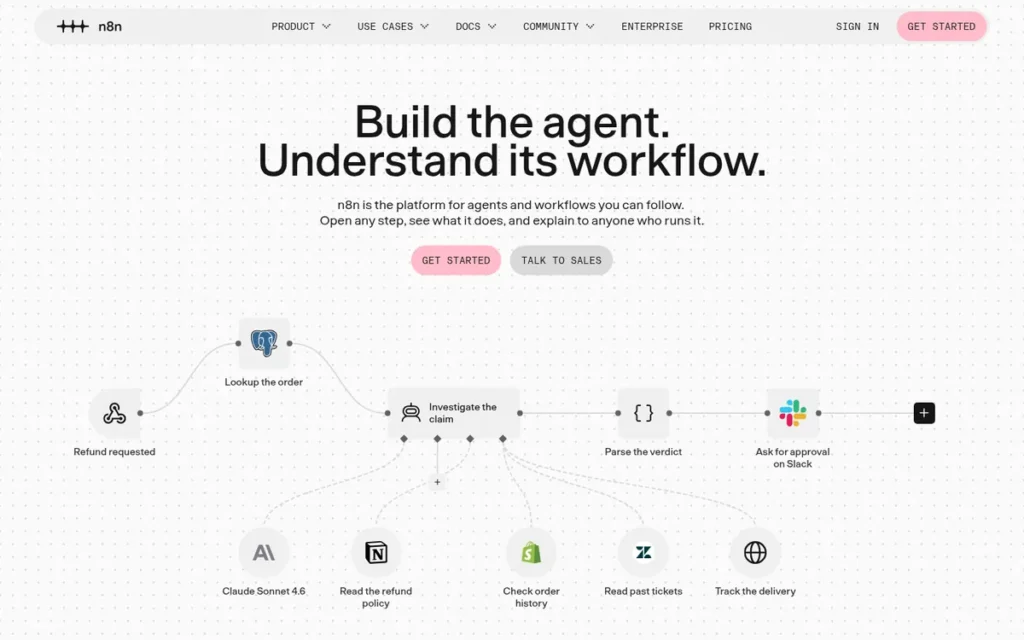
Category: AI-Augmented Automation Platform, a visual workflow automation tool with native AI agent nodes that execute multi-step, LLM-driven tasks across 500+ business applications.
At a Glance
- Category: AI-Augmented Automation Platform
- Best For: Technical operations teams and developers who need self-hosted automation with transparent pricing, SOC 2 governance, and genuine AI agent capabilities without full framework complexity
- Price Range: Free (self-hosted, fair-code license for internal use) | ~$24/month Starter | ~$60/month Pro | Enterprise custom, confirmed from n8n.io/pricing and community discussion, April 2026
- Primary Strength: n8n holds the highest combined G2 and Capterra ratings of any platform in this evaluation, G2 4.8/5 (242 verified reviews) and Capterra 4.6/5 (40+ reviews) as of April 2026
- Biggest Limitation: n8n’s fair-code license restricts commercial-scale self-hosting without a paid enterprise agreement, and community practitioners describe its AI capabilities as AI-augmented automation rather than true orchestrator-driven agentic AI where an LLM dynamically determines workflow paths
- One-Line Summary: n8n is the highest-rated agentic automation platform on G2 (4.8/5, 242 verified reviews, April 2026), combining a visual workflow builder with native AI agent nodes, self-hosting SOC 2 governance, and transparent per-execution pricing across 500+ integrations.
- Last Verified: April 2026
Overview
n8n is a fair-code visual workflow automation platform with native AI agent capabilities, best suited for technical operations teams, developers, and IT-forward organizations that need flexible, self-hostable automation with LLM-driven decision-making. n8n’s AI Agent node enables autonomous tool selection and multi-step reasoning using any LLM provider, and 6,274+ AI-specific workflow templates accelerate deployment across sales, support, data processing, and content automation use cases.
n8n occupies a capable middle ground between enterprise platforms like Salesforce Agentforce and pure developer frameworks like LangGraph, more governance-ready and transparently priced than Relevance AI, more accessible and cost-efficient than Copilot Studio at high deployment volumes.
Key Features
- AI Agent Node with Autonomous Tool Selection: n8n’s AI Agent node supports an autonomous Tools Agent pattern in which an LLM selects from a configured tool library, executes multi-step actions, and incorporates memory and context, enabling genuine LLM-driven decision-making within visual workflows.
- Multi-Agent Team Architectures: n8n supports multi-agent team patterns within a single canvas via the AI Agent Tool node, allowing one orchestrating agent to invoke specialized sub-agents as tools for research-analysis-writing-review pipeline patterns without custom orchestration code.
- LLM-Agnostic Integration Across 500+ Apps: n8n integrates with 500+ business applications and any major LLM provider (including OpenAI, Anthropic, Google Gemini, Hugging Face, and local models via Ollama) maintaining full vendor flexibility rather than locking users into a single model provider.
- Self-Hosted Enterprise Governance: n8n’s self-hosted enterprise tier provides SOC 2 compliance, RBAC, SSO, encrypted secrets management, and EU-region hosting options, enabling organizations with data sovereignty requirements to deploy within their own infrastructure.
- Per-Execution Pricing Efficiency: n8n charges for workflow runs rather than individual task operations, so a complex 50-step AI workflow costs the same as a 2-step trigger, a structure documented by community benchmarks as delivering up to 10x lower cost versus per-action SaaS platforms at high volumes ([n8n AI agents page, n8n.io/ai, accessed April 2026, vendor-published benchmark, not independent third-party audit]).
Best For
n8n is best for technical operations teams, developers, and IT-forward organizations that need production-grade automation with self-hosting control and SOC 2 compliance, particularly organizations in data-sensitive industries where cloud-only SaaS platforms create compliance risk, or those running high-volume workflows where per-action pricing compounds at scale.
Pricing
n8n’s self-hosted Community edition is free under the fair-code license for internal use. Cloud tiers are approximately $24/month (Starter) and $60/month (Pro), billed by execution volume, with Enterprise at custom pricing including SOC 2, SSO, RBAC, and advanced governance.
A new AI Agent Builder (prompt-to-workflow generator) is cloud-only: 20 credits (trial), 50 credits (Starter), 150 credits (Pro). Commercial-at-scale self-hosting requires a paid enterprise agreement, review fair-code terms before committing. Pricing confirmed from n8n.io/pricing and community discussion, April 2026.
Strengths
- n8n holds the highest verified review ratings of all seven tools in this evaluation, G2 4.8/5 (242 verified reviews, G2.com, April 2026) and Capterra 4.6/5 (40+ reviews), representing the strongest dual-platform objective satisfaction evidence of any tool in the agentic AI category.
- n8n’s 140,000–175,000+ GitHub stars as of early 2026 (n8n.io/ai-agents) place it among the top 100 most-starred developer tools on GitHub, with a 231,000-member r/n8n subreddit community [Reddit.com/r/n8n, accessed April 2026] that reduces hidden platform adoption costs through active peer support.
- n8n’s self-hosted enterprise tier includes SOC 2 compliance, RBAC, SSO, encrypted secrets, and EU-region data residency, making n8n the most governance-capable open-source option in this evaluation for organizations with strict data sovereignty requirements.
- n8n’s per-execution pricing model delivers approximately 10x cost efficiency on high-volume AI workflows compared to per-action SaaS alternatives, based on vendor-published benchmarks ([n8n.io/ai, 2025]), an economic advantage that compounds at enterprise scale.
Limitations
- Agentic AI Authenticity: n8n routes tasks through predefined node graphs rather than allowing an LLM orchestrator to dynamically determine workflow paths. A technically sophisticated community practitioner states this directly:
“n8n is not an agentic AI platform; it’s simply an AI-assisted automation platform. Prove me wrong! Hint: No AI orchestrator is driving the conversation/task completion.” (u/macromind, r/n8n (2025))
Takeaway: n8n uses LLMs within predefined node graphs, a powerful automation capability that falls short of the dynamic path-determination required for true agentic orchestration.
- No-Code Accessibility Gap: n8n’s self-reported no-code positioning does not match practitioner experience for non-trivial implementations, a representative community review describes n8n as “somewhere between a full developer tool and a no-code automation platform,” requiring understanding of variables, conditional logic, and basic API concepts beyond the template level (r/n8n, u/MeanSwing2, 2025).
- Fair-Code License Risk: n8n’s fair-code license restricts organizations building client-facing commercial products on top of n8n at scale from doing so without a paid enterprise agreement, a restriction that catches commercial builders by surprise after significant platform investment (r/n8n, u/hello5346, 2025).
Verdict
n8n is the highest-rated agentic automation platform in this independent evaluation, earning G2’s top score of 4.8/5 across 242 verified reviews and Capterra’s 4.6/5 as of April 2026, the strongest dual-platform objective satisfaction evidence of any tool in the agentic AI category. n8n delivers the best combination of transparent pricing, self-hosting governance, community scale, and AI agent capability available in a single platform, making it the top recommendation for technical operations teams and IT-forward organizations that need production-ready automation with genuine data control. Buyers evaluating n8n specifically for complex autonomous multi-agent orchestration requiring emergent, non-predefined reasoning paths should assess whether n8n’s node-graph architecture meets their requirements or whether a purpose-built framework like LangGraph is more appropriate.
2. Salesforce Agentforce: Best for Salesforce Ecosystem: G2 #1-Ranked Enterprise Agentic AI Platform
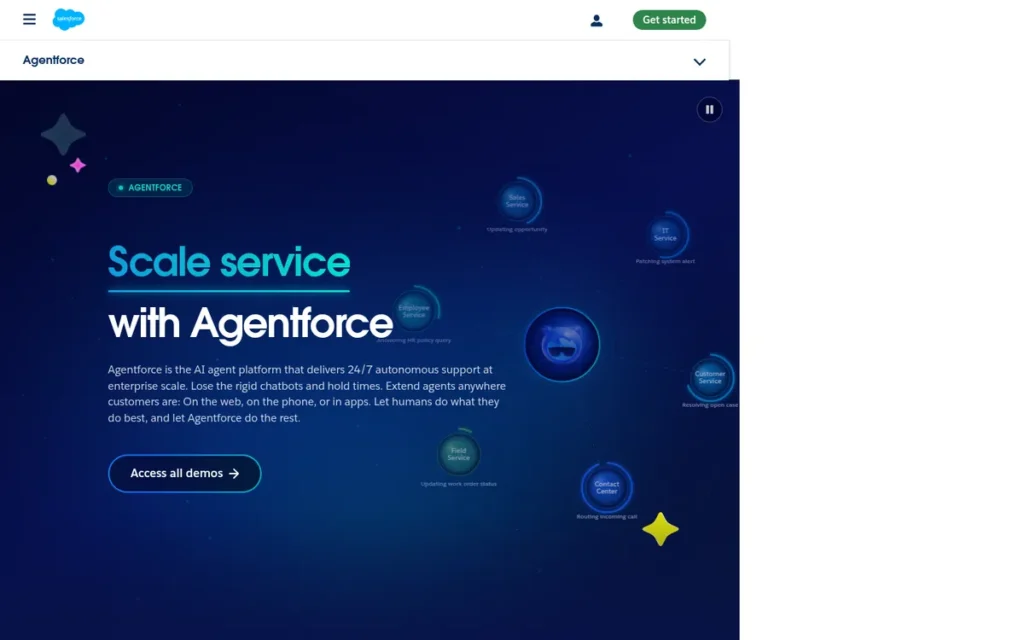
Category: Enterprise CRM-Native Agent Platform, an agentic AI platform built on Salesforce’s CRM infrastructure, enabling autonomous agents to reason over live CRM data and execute multi-step actions across Sales, Service, Commerce, and Marketing workflows.
At a Glance
- Category: Enterprise CRM-Native Agent Platform
- Best For: Enterprise organizations already operating on Salesforce CRM that need autonomous AI agents embedded directly into their Sales, Service, or Commerce workflows with enterprise-grade governance
- Price Range: $2/conversation OR Flex Credits at ~$0.005/credit OR $550/user/month (Agentforce 1 Edition); 100,000 free Flex Credits for Enterprise Edition+ customers, confirmed from Salesforce.com/agentforce/pricing, April 2026
- Primary Strength: Salesforce Agentforce is the only platform in this evaluation ranked #1 by G2 in the Agentic AI Software category (2026 Tech Signals), combining verified enterprise review leadership with the only documented deployment surpassing 2 million autonomous conversations in a single production environment (Salesforce.com blog, 2025)
- Biggest Limitation: Salesforce Agentforce delivers meaningful value only to organizations already invested in the Salesforce ecosystem, deploying agents across non-Salesforce systems requires significant configuration, and three distinct pricing models make cost prediction difficult without deep platform knowledge
- One-Line Summary: Salesforce Agentforce is the G2 #1-ranked agentic AI platform for 2026, built on the Atlas Reasoning Engine with proactive event-driven architecture (Agentforce 2dx, early 2025), making it the most credentialed enterprise choice for organizations operating within the Salesforce CRM ecosystem.
- Last Verified: April 2026
Overview
Salesforce Agentforce is an enterprise agentic AI platform built natively on Salesforce’s CRM infrastructure, best suited for mid-to-large enterprises already operating on Salesforce that need autonomous AI agents reasoning over live CRM data and executing multi-step workflows across Sales, Service, Commerce, and Marketing without human intervention. Salesforce Agentforce is powered by the Atlas Reasoning Engine (a hybrid system combining LLM creativity with structured business logic and metadata-enriched RAG) and became proactive with the Agentforce 2dx release in early 2025, enabling agents triggered by CRM data events rather than user prompts alone.
Salesforce Agentforce’s deep integration within the Salesforce CRM ecosystem, reinforced by 150,000+ enterprise customers [Validity.com Agentforce overview, 2024] and native Data Cloud connectivity, creates a competitive position that no purpose-built agentic AI startup currently replicates at equivalent scale within Salesforce environments. That same depth is also its primary limitation outside the ecosystem.
Key Features
- Atlas Reasoning Engine: Salesforce Agentforce’s Atlas Reasoning Engine uses iterative ReAct loops (reason-act-observe-reflect) with metadata-enriched retrieval-augmented generation, enabling nuanced domain queries while enforcing Salesforce governance rules and audit trails across documented agent action types within the Salesforce platform (Salesforceben.com, 2025).
- Proactive Event-Driven Architecture (Agentforce 2dx): Salesforce Agentforce 2dx enables proactive background agentic AI triggered by CRM data changes (not user prompts) allowing agents to initiate workflows autonomously when business events occur such as deal stage changes, case escalations, or customer data updates (Salesforce investor press release, early 2025).
- Multi-Modal Agent Experiences: Salesforce Agentforce supports voice (Agentforce Voice with transcription), chat, mobile, and rich content interfaces, enabling consistent agentic AI across every customer-facing and employee-facing channel within the Salesforce platform.
- Model-Agnostic Atlas Engine: Salesforce Agentforce’s Atlas engine supports OpenAI, Anthropic Claude, and other LLM providers while maintaining Salesforce’s trust layer, enabling model flexibility without sacrificing governance, data masking, and audit controls required by enterprise procurement teams.
- Native Data Cloud and Workflow Integration: Salesforce Agentforce integrates natively with Salesforce Data Cloud, MuleSoft, Apex, and Flow, enabling agents to access real-time CRM data, execute business logic, and trigger cross-system workflows without requiring separate data pipeline configuration.
Best For
Salesforce Agentforce is best for mid-to-large enterprises already operating on Salesforce CRM, particularly organizations in Sales, Service, and Commerce that need autonomous agents embedded directly in existing Salesforce workflows, with enterprise-grade governance, audit trails, and the ability to trigger proactive automation from CRM data events rather than manual prompts.
Pricing
Salesforce Agentforce offers three distinct pricing models, buyers must select one per deployment:
- Model 1: $2 per conversation (any interaction within a 24-hour window): best for predictable customer-facing chatbot volumes
- Model 2: Flex Credits at $500 per 100,000 credits ($0.005/credit; approximately $0.10 per agent action at 20 credits/action), best for high-action-volume deployments
- Model 3: Agentforce 1 Edition at $550/user/month including 1 million Flex Credits annually
Salesforce Enterprise Edition+ customers receive 100,000 free Flex Credits via Salesforce Foundations. Community analysis documents scenarios where Flex Credits are 3x cheaper than conversation-based pricing at equivalent workloads (SaaStr; eesel.ai, 2025), careful modeling is required before selecting a model. Confirmed from Salesforce.com/agentforce/pricing, April 2026.
Strengths
- Salesforce Agentforce is ranked #1 in G2’s Agentic AI Software category for 2026 (G2 Tech Signals report, learn.g2.com, April 2026), the highest formal enterprise buyer recognition available in the agentic AI platform category.
- Salesforce Agentforce’s internal deployment surpassed 2 million autonomous conversations with an 85% autonomous resolution rate (Salesforce.com blog, 2025; independently reported by Fortune, July 2025), making it the largest single-organization publicly documented agentic AI production deployment in this evaluation.
- Agentforce 2dx’s proactive event-driven architecture (launched early 2025, Salesforce investor press release) enables agents to initiate workflows based on CRM data changes rather than user prompts, fundamentally distinguishing Salesforce Agentforce from reactive copilots.
- Salesforce Agentforce’s 150,000+ enterprise customer base [Validity.com Agentforce overview, 2024] provides the largest built-in distribution channel of any platform in this evaluation, with an implementation ecosystem more mature than any purpose-built agentic AI startup can offer.
Limitations
- Ecosystem Lock-In: Salesforce Agentforce’s value proposition is almost entirely contingent on existing Salesforce CRM investment, a Salesforce professional who attended the Agentforce World Tour NYC noted that Salesforce Agentforce “extends existing Salesforce tooling (Apex, Flow, prompt templates) rather than providing a standalone autonomous agent capability,” meaning organizations without seasoned Salesforce developers struggle to deploy beyond basic templates (r/salesforce, u/SeriouslyImKidding, 2024).
- Pricing Complexity: Salesforce Agentforce’s three distinct pricing models require careful cost modeling before commitment, multiple community members report unexpected cost overruns when workload patterns do not match the selected pricing model (r/salesforce, multiple accounts, 2024).
- Non-Salesforce Viability: Salesforce Agentforce is not a viable option for the majority of organizations that are not already on Salesforce, per-user and per-conversation costs rank among the highest in this evaluation for organizations attempting to use it as a general-purpose platform outside the Salesforce context.
- Non-Template Deployment Complexity: Salesforce Agentforce’s proactive event-driven capability requires Salesforce developers to configure custom triggers and background job logic, a non-trivial technical overhead that the platform’s marketing undersells. The community consistently notes that meaningful deployments beyond basic chat templates require existing Salesforce development expertise (r/salesforce, multiple accounts, 2024).
Users on r/salesforce shared their practical experience deploying Agentforce in day-to-day business operations:
“I have seen two decent use cases: 1) Internal knowledge search. You put your internal documents in a library and new employees can search it. Key thing is documents have to be consistent – the agent doesn’t know what to do with two documents that give a different answer to the same question. Also the assumption is they will learn the process and not ask the same questions over and over leading to cost. 2) Summarizing long email threads. On cases if there’s a lot of back and forth via email over a long time, the agent can give a quick summary of what’s transpired and bring the Customer Service Rep up to speed quicker. The rest of the stuff I have seen is just people using AI to solve either poor implementations or confusing AI with automation – it could be done with a flow vs using an agent. It’s great for making sense of unstructured data – it wastes money/flex credits on looking at structured data.” Posted by u/MindCompetitive6475
Takeaway: Agentforce delivers tangible ROI on unstructured data tasks like knowledge retrieval and email summarization, but practitioners report it burns Flex Credits on structured-data automations that Salesforce Flow could handle at no additional cost.
Verdict
Salesforce Agentforce is the G2 #1-ranked enterprise agentic AI platform for 2026, making it the most credentialed commercial choice for organizations already embedded in the Salesforce ecosystem. Salesforce Agentforce delivers the deepest documented CRM integration, enterprise governance controls, and production deployment evidence of any platform evaluated for Salesforce-native enterprises in Sales, Service, and Commerce. Organizations without significant Salesforce infrastructure should evaluate the ecosystem dependency and three-model pricing complexity carefully, as the value case deteriorates substantially outside the Salesforce environment.
3. LangGraph: Best for Production-Grade Complex Agents: Enterprise-Proven Graph-Based Orchestration
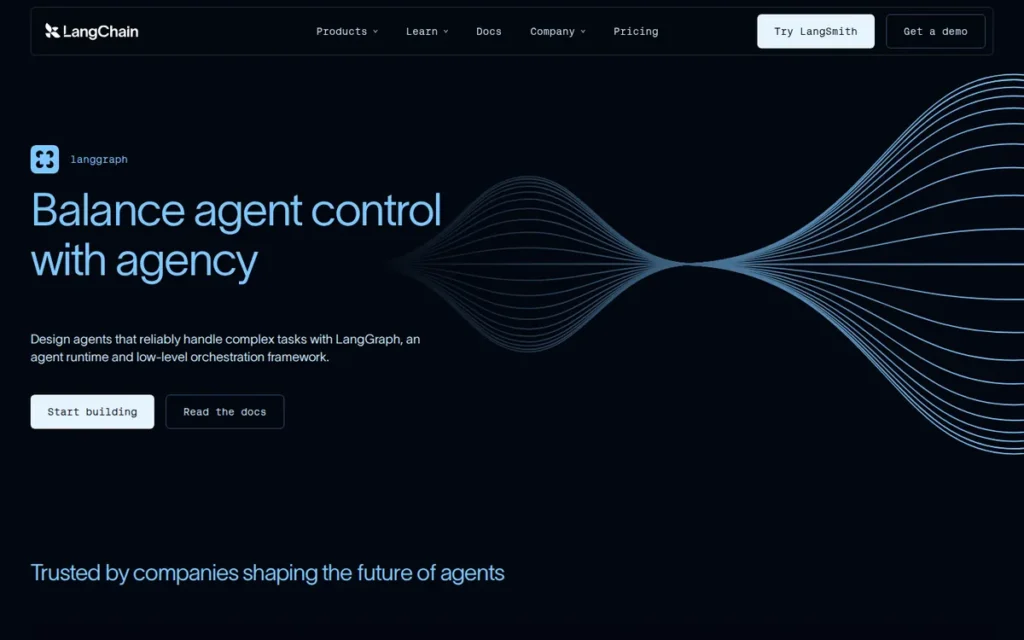
Category: Graph-Based Agent Orchestration Framework, an open-source Python framework that models agentic workflows as stateful directed graphs, enabling complex multi-agent pipelines with checkpointing, conditional branching, parallel execution, and human-in-the-loop controls.
At a Glance
- Category: Graph-Based Agent Orchestration Framework
- Best For: Senior AI/ML engineers and enterprise development teams building complex, production-grade multi-agent systems in regulated industries requiring stateful execution, audit trails, and human-in-the-loop controls
- Price Range: Free (MIT open-source framework) | LangSmith Developer tier free with limits | LangSmith Plus ~$39/month per seat (community-reported, not confirmed from official source) | Enterprise custom, April 2026
- Primary Strength: LangGraph is the only AI agent framework in this evaluation with independently confirmed named production deployments at J.P. Morgan (Ask D.A.V.I.D. multi-agent system) and Uber, providing the strongest independently verifiable enterprise production validation evidence in the category
- Biggest Limitation: LangGraph requires advanced Python expertise and graph architecture knowledge, has been described as “an absolute maintenance nightmare” in production by community practitioners (r/LangChain, 2024), and requires LangSmith (a paid add-on) for enterprise-grade observability, shifting the total cost from free to a commercial relationship
- One-Line Summary: LangGraph is the most production-validated AI agent framework in this evaluation, with independently confirmed enterprise deployments at J.P. Morgan and Uber, 126,000+ reported GitHub stars as of early 2026, and a stateful graph architecture that is the established standard for complex, compliance-grade multi-agent systems in regulated industries.
- Last Verified: April 2026
Overview
LangGraph is an open-source graph-based AI agent orchestration framework from LangChain Inc., best suited for senior AI/ML engineers and enterprise development teams building complex, stateful, multi-agent production systems, particularly in regulated industries where audit trails, human-in-the-loop controls, and workflow reliability under failure are non-negotiable requirements. LangGraph models agentic workflows as directed graphs where Nodes (functions, LLM calls, or sub-agents) read and update a shared typed State object, and Edges define sequential or conditional transitions, enabling cyclical self-correction loops, parallel execution, full state rollback to any checkpoint, and recoverable partial failures that simpler sequential frameworks cannot support.
LangGraph’s production credentials distinguish it from every other framework in this evaluation. Named deployments at J.P. Morgan (Ask D.A.V.I.D. multi-agent system) and Uber are independently confirmed via the LangChain Interrupt 2025 blog recap, providing verifiable evidence that LangGraph meets production reliability and compliance standards in globally regulated industries. Additional enterprise deployments including Klarna, Cisco, LinkedIn, and BlackRock are disclosed on langchain.com/langgraph and referenced in the LangChain Interrupt 2025 recap (blog.langchain.com, 2025), though not all were independently confirmed in research as of April 2026.
Key Features
- Persistent Stateful Graph Architecture: LangGraph’s graph-based design persists a typed State object across all workflow nodes, enabling agents to pause mid-workflow, checkpoint state to durable storage, recover from partial failures without full restarts, and retry specific failed nodes, capabilities that become critical for long-running production workflows at enterprise scale.
- Human-in-the-Loop Interrupts: LangGraph supports human-in-the-loop interrupts at any graph edge, enabling workflow architects to define exact points where human review, approval, or intervention is required before autonomous execution continues, a governance capability that enterprise compliance teams specifically require for high-stakes agent actions.
- Parallel Node Execution: LangGraph enables parallel node execution within a single graph, allowing multiple independent agent tasks to run concurrently and merge results, reducing total workflow execution time without requiring custom concurrency infrastructure.
- LangSmith Native Observability: LangGraph integrates natively with LangSmith, providing full execution tracing, prompt evaluation, A/B testing, and production monitoring, giving enterprise teams the debugging and audit infrastructure required to diagnose failures in complex multi-agent pipelines.
- MIT Open-Source License: LangGraph’s MIT license permits commercial deployment at any scale without licensing fees or vendor negotiations, making it viable for organizations building client-facing AI products or multi-tenant SaaS applications.
Best For
LangGraph is best for senior AI/ML engineers and enterprise development teams at organizations in finance, logistics, healthcare, and other regulated industries that need to build complex, production-grade multi-agent systems with stateful execution, audit trails, and human-in-the-loop checkpoints, and that have the Python expertise and engineering resources to absorb the framework’s steep learning curve and ongoing maintenance requirements.
Pricing
LangGraph is free and open-source under the MIT license with no licensing fees at any deployment scale. Production observability effectively requires LangSmith: the Developer tier is free with usage limits; the Plus tier is approximately $39/month per seat (community-reported, not confirmed from official LangChain pricing page in research; verify at langchain.com/pricing before publication).
LangGraph Platform is LangChain Inc.’s managed cloud hosting service for LangGraph agents, providing 1-click deployment, autoscaling, and uptime SLAs without requiring organizations to manage their own infrastructure, the alternative to self-hosting on AWS, GCP, or Azure. LangGraph Platform requires a LangSmith subscription; Enterprise tier pricing is custom. Total cost of ownership for production deployments includes LangSmith costs, infrastructure, and significant developer time. LangGraph framework, confirmed free (MIT). LangSmith Plus, community-reported only. April 2026.
Strengths
- LangGraph is the only AI agent framework in this evaluation with independently confirmed named production deployments at J.P. Morgan (Ask D.A.V.I.D. multi-agent system, LangChain Interrupt 2025 recap) and Uber (LangChain Interrupt 2025 recap), providing independently verifiable evidence that LangGraph meets production reliability and compliance standards in globally regulated industries.
- LangGraph’s GitHub repository has accumulated 126,000+ reported GitHub stars as of early 2026 (Towards AI production comparison; AlphaMatch.ai framework comparison, 2026, not directly confirmed from GitHub.com in research as of April 2026), exceeding AutoGen and CrewAI by significant margins among dedicated AI agent frameworks.
- LangGraph’s graph-based stateful architecture with persistent checkpointing is the only solution in this evaluation that natively supports state rollback to any prior checkpoint, partial failure recovery, and human-in-the-loop interrupts at arbitrary workflow edges, capabilities that become requirements rather than preferences for complex enterprise production deployments.
- LangGraph’s MIT license imposes no commercial restrictions at any deployment scale, making it suitable for organizations building multi-tenant SaaS products or client-facing AI services without vendor licensing negotiations or revenue-sharing obligations.
This architectural value is validated by experienced practitioners on r/LangChain:
“Speaking specifically to LangGraph/LangSmith, I’ve found a graph based state machine is perfectly complimentary for multi agent orchestration. If you only have 1-3 agents you may not need it but it keeps things organized and easy to reason about for anything larger. It also helps formalize solutions for subgraphs, parallelization and many other things. Sure you could cowboy all this yourself but that’s a lot of extra developer effort and guaranteed your code won’t come with good documentation, observability, consistency, evals, etc for free.” Posted by u/SustainedSuspense
Takeaway: LangGraph’s complexity pays for itself at scale, engineers who have worked through the learning curve consistently report its graph architecture outperforms hand-rolled alternatives for multi-agent systems beyond three agents, particularly for subgraph parallelization and built-in observability.
Limitations
- Steep Learning Curve: LangGraph’s graph-based architecture creates one of the steepest learning curves in the category, a senior developer with production experience reported abandoning the framework because “lots of abstraction” made it “faster to build my own” for state management and tool-calling flows (r/AI_Agents, u/dmart89, 2024).
Users on r/LangChain described the real-world onboarding experience:
“I’ve heard langgraph constantly pop up everywhere as the Go To multi agent framework so I took the chance to do an entire hackathon with it and walked away with mixed feelings. It felt super powerful but if felt so overly complex with hard to navigate docs. I do have to say using the langgraph studio was a lifesaver to quickly test. I just felt there was a way to achieve the power of that orchestration with persistence and human in the loop mechanisms in a simpler way.” Posted by u/wait-a-minut
Takeaway: LangGraph’s power-to-complexity trade-off is the defining first-contact practitioner experience, the orchestration capability is consistently validated, but the documentation barrier and abstraction overhead are equally real and not marketing-mitigated.
- Production Maintenance Burden: LangGraph has been described as “an absolute maintenance nightmare” by a practitioner with direct production deployment experience (r/LangChain, u/wavehnter, 2024), updating graphs, debugging state issues, and managing version migrations creates significant ongoing operational overhead.
- LangSmith Cost Dependency: Production-grade deployment effectively requires LangSmith as a paid add-on, shifting LangGraph’s cost model from “free” to an ongoing commercial relationship, a hidden cost that the “free framework” positioning obscures for buyers planning initial budgets.
- Non-Technical Inaccessibility: LangGraph is entirely unsuitable for non-technical users, small teams without ML engineering resources, or organizations needing rapid no-code deployment, buyers in these profiles should evaluate n8n, Copilot Studio, or Relevance AI instead.
Verdict
LangGraph is the most production-validated AI agent framework in this independent evaluation, backed by independently confirmed enterprise deployments at J.P. Morgan and Uber and the highest reported GitHub star count of any dedicated agent framework in this evaluation, 126,000+ as of early 2026. LangGraph is the strongest choice for senior engineering teams building complex, stateful, compliance-grade multi-agent systems in regulated industries, provided they can absorb the significant learning curve, ongoing maintenance burden, and the effective cost of LangSmith for production observability. Organizations without experienced Python and ML engineers, or those prioritizing rapid deployment, should evaluate n8n, Copilot Studio, or CrewAI as alternatives.
4. Microsoft Copilot Studio: Best for Microsoft 365 Enterprises: Low-Code Agent Builder for M365-Native Organizations
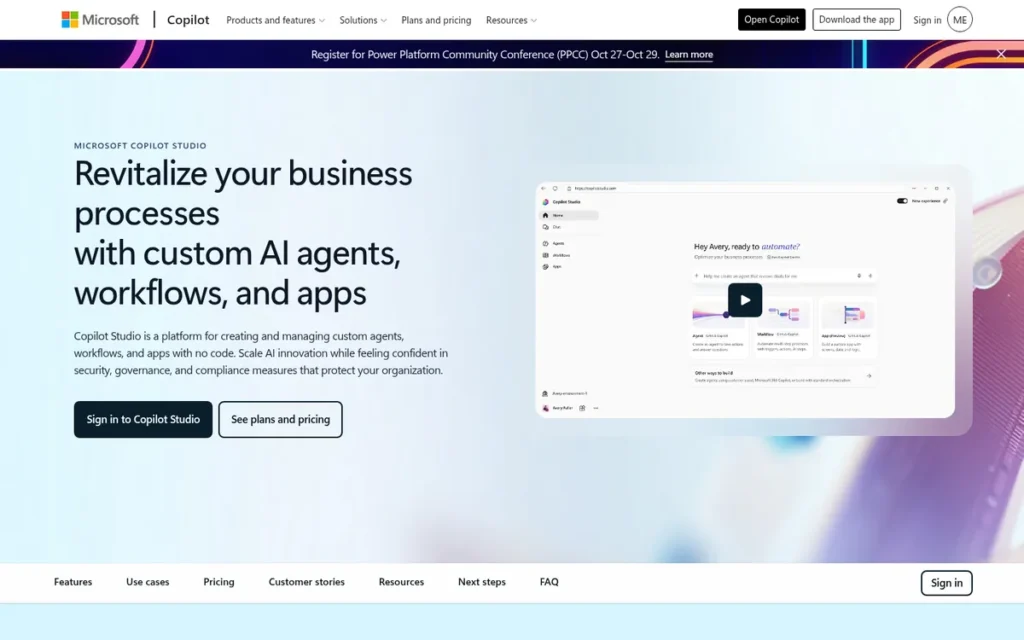
Category: Low-Code Enterprise Agent Builder, a Microsoft platform for building AI agents and automating multi-step workflows within the Microsoft 365 ecosystem, using a visual low-code interface with 1,400+ cross-system MCP connectors.
At a Glance
- Category: Low-Code Enterprise Agent Builder
- Best For: Enterprise organizations operating in the Microsoft 365 ecosystem that need AI agents accessing live organizational data (SharePoint, Teams, Outlook) and automating workflows across Microsoft and third-party systems with enterprise governance
- Price Range: $200/month per 25,000-credit capacity pack (billed annually) | $0.01/Copilot Credit pay-as-you-go | Bundled with Microsoft 365 Copilot at $30/user/month, confirmed from Microsoft.com, April 2026
- Primary Strength: Microsoft Copilot Studio provides native Microsoft Graph access enabling agents to read and act on live SharePoint, Teams, Outlook, and OneDrive data, a contextual integration depth backed by Microsoft’s existing Azure AD, conditional access, and M365 compliance certifications that non-Microsoft platforms cannot replicate without significant custom configuration
- Biggest Limitation: Microsoft Copilot Studio has documented production bug complaints across the r/copilotstudio community (2025) and a gap between its no-code marketing and actual technical prerequisites (requiring understanding of variables and basic IT concepts for non-trivial implementations) that consistently frustrates non-technical buyers
- One-Line Summary: Microsoft Copilot Studio is a G2 4.4/5-rated low-code enterprise agent builder uniquely suited for Microsoft 365 organizations, providing native access to live organizational data across SharePoint, Teams, and Outlook via 1,400+ MCP connectors, with autonomous agent capability generally available since March 2025.
- Last Verified: April 2026
Overview
Microsoft Copilot Studio is a low-code enterprise AI agent builder best suited for organizations already operating on Microsoft 365, offering autonomous agents that access live organizational data across SharePoint, Teams, Outlook, and OneDrive without manual data pipeline configuration, a capability depth that Microsoft’s Graph API integration makes uniquely accessible in the M365 ecosystem. Microsoft Copilot Studio supports four agent types (Q&A, Workflow, Autonomous, and Cross-system agents) and connects to 1,400+ systems via Model Context Protocol, with autonomous agents reaching General Availability in March 2025.
Microsoft Copilot Studio’s primary limitation is a well-documented gap between its no-code marketing and actual technical prerequisites. Community practitioners consistently report that non-trivial implementations require IT knowledge beyond the template level.
Key Features
- Native Microsoft Graph Integration: Microsoft Copilot Studio integrates natively with Microsoft Graph, giving deployed agents real-time access to SharePoint documents, Teams conversations, Outlook emails, and OneDrive files, enabling organizational-context-aware agents that non-Microsoft platforms can only approximate through manual data pipeline configuration.
- Autonomous Agent Type (GA March 2025): Microsoft Copilot Studio’s Autonomous agent type enables agents to execute multi-step workflows without user prompting, monitoring triggers across connected systems and initiating actions proactively, moving beyond reactive chatbot patterns toward genuine process automation (Microsoft documentation, 2025).
- 1,400+ Model Context Protocol Connectors: Microsoft Copilot Studio connects to 1,400+ systems via MCP, including Dynamics 365, SAP, Salesforce, and custom APIs, enabling agents to read from and act on data across an enterprise’s full technology stack from a single authoring interface.
- M365 Copilot Bundle Value: Microsoft Copilot Studio is bundled within the Microsoft 365 Copilot subscription ($30/user/month), for organizations already on M365 Copilot, Copilot Studio is the primary agent-building interface at no additional license cost, delivering the lowest incremental cost entry point of any enterprise agent builder for Microsoft-native organizations.
- Inherited Microsoft Compliance Infrastructure: Microsoft Copilot Studio’s enterprise security model inherits Microsoft’s compliance infrastructure (including Azure Active Directory, conditional access, data loss prevention policies, and Microsoft 365 compliance certifications) providing governance depth backed by Microsoft’s existing certified infrastructure that purpose-built agentic AI startups typically require 12–24 months of enterprise security investment to approximate.
Best For
Microsoft Copilot Studio is best for enterprise IT teams, operations managers, and business unit leaders in organizations deeply invested in Microsoft 365, who need AI agents that can access live organizational data and automate HR, IT helpdesk, customer support, and sales workflows, particularly where the M365 Copilot subscription is already in place.
Pricing
Microsoft Copilot Studio operates on a Copilot Credit consumption model: $200/month per 25,000-credit capacity pack billed annually, scalable by adding packs. A pay-as-you-go alternative charges $0.01 per Copilot Credit via Azure subscription. For organizations on Microsoft 365 Copilot ($30/user/month, requires qualifying M365 E3/E5 or Business plan), Copilot Studio is bundled at no additional license cost. No standalone free tier exists.
The credit consumption model measures individual agent operations, a high-action workflow can consume credits significantly faster than buyers anticipate without usage benchmarking before commitment. Confirmed from Microsoft.com and Adoptify.ai licensing guide, April 2026.
Strengths
- Microsoft Copilot Studio holds a G2 rating of 4.4/5 (144 verified reviews, G2.com, April 2026) (indicating strong enterprise buyer satisfaction in the competitive agentic AI category) and was recognized in G2’s newly created Agentic AI Software categories introduced March 2026 (company.g2.com); specific placement within those categories was not independently confirmed in research as of April 2026.
- Microsoft Copilot Studio’s native Microsoft Graph integration provides agents with live access to SharePoint, Teams, Outlook, and OneDrive data without custom data pipelines, a contextual depth that distinguishes Microsoft Copilot Studio from any non-Microsoft platform attempting equivalent M365 integration.
- Microsoft Copilot Studio’s Power Virtual Agents heritage means the platform has been deployed across tens of thousands of enterprise organizations since 2019, giving it a maturity and organizational familiarity track record that purpose-built agentic AI startups cannot claim.
- For Microsoft 365 Copilot subscribers, Microsoft Copilot Studio is the primary agent-building interface at no additional license cost, delivering the lowest incremental cost enterprise agent builder for organizations already paying $30/user/month for M365 Copilot.
Limitations
- No-Code Marketing Gap: Microsoft Copilot Studio’s most consequential limitation is the gap between marketed accessibility and practitioner reality, a widely-engaged community post states: “Microsoft claims that you can easily and quickly create your own agent with Studio. Sure, it’s easy if you use a pre-made agent template… but that’s a very basic use case… In my opinion, it’s definitely not easy and requires at least some IT knowledge (e.g., understanding what a variable is)” (r/copilotstudio, original poster, 2025).
“My experience is that it feels like Microsoft released the program too early, and it’s full of bugs or things that haven’t been fully thought through. Many times, I’ve run into a technical issue and started looking for a solution, only to find that there isn’t one.”, Original poster, r/copilotstudio (2025)
Takeaway: Non-trivial Copilot Studio implementations require basic programming concepts such as variables and conditional logic, a prerequisite the no-code marketing does not communicate.
- Documented Production Bugs: Microsoft Copilot Studio’s r/copilotstudio community consistently documents production bugs without official workarounds, an “early release” pattern representing meaningful deployment risk for organizations building mission-critical workflows on the platform (r/copilotstudio, multiple accounts, 2025).
- Ecosystem Lock-In: Microsoft Copilot Studio’s full value is contingent on Microsoft 365 investment, organizations without M365 Copilot face per-credit costs that can be significantly higher than competing alternatives, and cross-platform deployments remain constrained by the Microsoft ecosystem boundary.
- Credit Consumption Unpredictability: Microsoft Copilot Studio’s per-credit pricing measures individual agent operations, unlike n8n’s per-execution model, a high-action workflow can consume credits significantly faster than buyers anticipate without careful pre-deployment usage benchmarking, making cost prediction difficult for variable-volume deployments.
Verdict
Microsoft Copilot Studio is a G2 4.4/5-rated enterprise agent builder that provides unmatched depth for Microsoft 365 organizations, combining native Graph access, 1,400+ MCP connectors, and enterprise security governance in a single low-code authoring environment. Microsoft Copilot Studio is the top recommendation for M365 Copilot subscribers who need organizational-context-aware agents embedded across Teams, SharePoint, and Outlook workflows at no additional license cost. Organizations expecting genuine no-code accessibility for non-technical users (or organizations outside the Microsoft ecosystem) should carefully evaluate the documented gap between marketing claims and practitioner-reported complexity before committing.
5. CrewAI: Best for Developer Multi-Agent Prototyping: Fastest Path to Functional Multi-Agent Systems
Category: Open-Source Multi-Agent Framework, a Python framework for building role-based multi-agent AI systems structured around collaborative agent teams, with a commercial enterprise platform (CrewAI AMP) adding no-code orchestration and observability.
At a Glance
- Category: Open-Source Multi-Agent Framework
- Best For: Python developers and development teams needing the fastest path to a functional multi-agent system for prototyping, proof-of-concept development, or SMB AI product building without graph theory prerequisites
- Price Range: Free (open-source MIT-compatible framework) | CrewAI Enterprise/AMP pricing: not publicly disclosed, requires direct contact, April 2026
- Primary Strength: CrewAI’s role-based agent design enables the fastest time-to-functional multi-agent prototype of any framework in this evaluation, consistently recognized across independent 2026 technical comparisons as the plug-and-play choice for rapid multi-agent development
- Biggest Limitation: CrewAI’s role-based coordination becomes opaque when debugging complex 5+ agent pipelines; self-reported Fortune 500 adoption figures vary across CrewAI sources and are not independently verified; and enterprise tier pricing is not publicly disclosed, requiring a sales call before basic budget planning is possible
- One-Line Summary: CrewAI is the fastest open-source framework for building multi-agent AI systems in 2026, with 100,000+ certified developers globally and a role-based design that mirrors real workplace team structures, making it the top recommendation for rapid multi-agent prototyping without graph theory prerequisites.
- Last Verified: April 2026
Overview
CrewAI is an open-source Python framework for building role-based multi-agent AI systems, best suited for developers and development teams that need the fastest path to a functional multi-agent prototype without graph theory knowledge, complex state machine design, or extensive orchestration framework expertise. CrewAI structures agent systems around the metaphor of real workplace teams: Crews (collaborative agent teams with a shared goal), Agents (LLM-powered specialists defined by role, goal, backstory, tools, and memory), and Tasks (assignable work items with defined expected outputs), a design that maps directly to how builders already think about division of labor.
CrewAI’s commercial platform (CrewAI AMP and CrewAI Studio) extends the open-source framework with no-code controls, observability, and enterprise integrations, including pre-built connectors for Gmail, Teams, Notion, HubSpot, Salesforce, and Slack. Enterprise pricing is not publicly disclosed and requires a direct sales conversation.
Key Features
- Role-Based Agent Design: CrewAI allows builders to define AI agents using natural language role descriptions, goals, and backstories rather than explicit graph nodes, enabling team onboarding on multi-agent concepts in days rather than weeks, without prior knowledge of graph theory or formal state machine design (consistently noted across independent 2026 framework comparisons, Towards AI; AlphaMatch.ai).
- Hierarchical Task Execution: CrewAI supports both sequential and hierarchical task execution, in hierarchical mode, a manager agent dynamically delegates tasks to specialized sub-agents based on defined roles, enabling multi-agent coordination without hard-coded routing logic (AWS Machine Learning blog, 2025).
- Inter-Agent Memory Sharing: CrewAI supports inter-agent memory at the crew level, enabling agents to share context, research findings, and task outputs, allowing workflows like market research, analysis, writing, and review to pass enriched context between specialist agents without explicit data plumbing.
- AWS Bedrock Integration: CrewAI integrates with AWS Bedrock for enterprise-grade LLM infrastructure (AWS Machine Learning blog, 2025), enabling CrewAI-based multi-agent systems to run within AWS VPC, IAM, and compliance controls.
- CrewAI Enterprise Platform (AMP): CrewAI Enterprise via CrewAI AMP adds a no-code agent control plane with real-time observability, event-driven triggers, and pre-built integrations across major business tools, extending the open-source framework toward a managed enterprise platform, though enterprise pricing is not publicly disclosed.
Best For
CrewAI is best for Python developers and small-to-mid-sized development teams who need to build functional multi-agent AI systems quickly (for prototyping, proof-of-concept projects, SMB AI product development, or internal automation tools) and who value role-based design clarity over the maximum orchestration control of graph-based frameworks like LangGraph.
Pricing
The CrewAI open-source framework is free under MIT-compatible licensing with no feature gating. CrewAI Enterprise (CrewAI AMP and CrewAI Studio) pricing is not publicly disclosed, enterprise tiers require direct contact with CrewAI’s sales team. No confirmed dollar amounts for enterprise tiers are available in public sources as of April 2026.
This pricing opacity means organizations requiring enterprise features (observability, SSO, SLA commitments) must enter a sales process before basic budget planning is possible. This is a meaningful friction point relative to platforms like n8n with fully published pricing. Open-source free confirmed from crewai.com. Enterprise pricing unconfirmed. April 2026.
Strengths
- Independent technical comparisons from Towards AI and AlphaMatch.ai (early 2026) consistently rate CrewAI as providing the fastest time-to-functional multi-agent prototype of any Python framework, corroborated by the dominant community framing: “LangChain = power user, CrewAI = plug-and-play” (r/AI_Agents, u/Playful_Pen_3920, 2025).
- CrewAI reports a certified developer community of 100,000+ globally (self-reported per OpenAgents.org framework comparison, February 2026), the largest organized developer certification program of any open-source agent framework in this evaluation, suggesting structured enterprise evaluation activity beyond pure open-source experimentation.
- CrewAI has self-reported significant Fortune 500 adoption in official materials, citing customers including DocuSign, IBM, and PwC (per rywalker.com analysis referencing CrewAI sources, 2025), specific adoption percentages vary across CrewAI sources and none have been independently verified as of April 2026.
- CrewAI’s official AWS Bedrock integration (AWS Machine Learning blog, 2025) provides enterprise-grade LLM infrastructure access, enabling organizations to deploy multi-agent systems within AWS VPC, IAM governance, and compliance boundaries.
Limitations
- Coordination Opacity in Complex Pipelines: CrewAI’s most consequential limitation is the opacity of its coordination logic in complex systems, because agent delegation is inferred from role descriptions rather than explicitly defined graph edges, debugging failures in pipelines with 5+ agents “becomes opaque for failures in complex setups” (FutureAGI Substack, 2025). Unlike LangGraph, which enforces explicit conditional edges for every agent transition, CrewAI’s inferred role-based delegation has no hard-coded fallback when role ambiguity causes task mis-routing.
This production friction is documented directly by engineering teams on r/AI_Agents:
“My non technical boss keeps insisting on using crewAI for our new multi agent system. The whole of last week l was building with crewai at work. The .venv file was like 1gb. How do I even deploy this? It’s soo restrictive. No observability. I don’t even know whats happening underneath. I don’t know what final prompts are being passed to the LLM. Agents keep calling tools 6times in row. Complete execution of a crew takes 10mins. The community q and a’s more helpful than docs. I don’t see one company saying they are using crewAI for our agents in production. On the other hand there is Langchain Interrupt and soo many companies are there. Langchain website got company case studies.” Posted by u/Standard_Region_8928
Takeaway: CrewAI’s production friction (bloated dependencies, zero prompt visibility, and opaque tool calls) consistently drives engineering teams to migrate toward LangGraph once they attempt to scale beyond a proof of concept.
- Unverified Adoption Claims: CrewAI’s Fortune 500 adoption claims are self-reported and vary across sources, ranging from significant adoption claims to specific named customers (DocuSign, IBM, PwC per rywalker.com analysis, 2025), with no figure independently verified in research. Buyers should treat all adoption percentage claims as unaudited marketing rather than confirmed procurement data.
- Enterprise Pricing Opacity: CrewAI enterprise pricing is not publiclydisclosed, meaning organizations requiring features like observability, SSO, and SLA commitments must enter a sales process before basic budget planning, a meaningful friction point relative to platforms with published pricing.
- Production Reliability Ceiling: CrewAI’s role-based coordination is optimized for prototyping and accessible multi-agent development; for production deployments in regulated industries requiring stateful checkpointing, human-in-the-loop audit trails, and partial failure recovery, LangGraph’s explicit graph architecture provides substantially stronger production reliability guarantees than CrewAI’s inferred orchestration model.
Verdict
CrewAI is the fastest open-source path to a functional multi-agent AI system in 2026, with 100,000+ certified developers globally and a role-based design that makes multi-agent development accessible without graph theory prerequisites. CrewAI is the top recommendation for Python developers, rapid prototyping teams, and SMBs building AI products that need multi-agent coordination without the engineering overhead of LangGraph. Organizations planning production deployments in regulated industries or requiring complex stateful orchestration should stress-test CrewAI’s coordination opacity at scale and confirm enterprise tier pricing and governance capabilities before committing.
6. Microsoft AutoGen: Best for AI Research and Code Automation: Microsoft Research-Backed Conversational Multi-Agent Framework
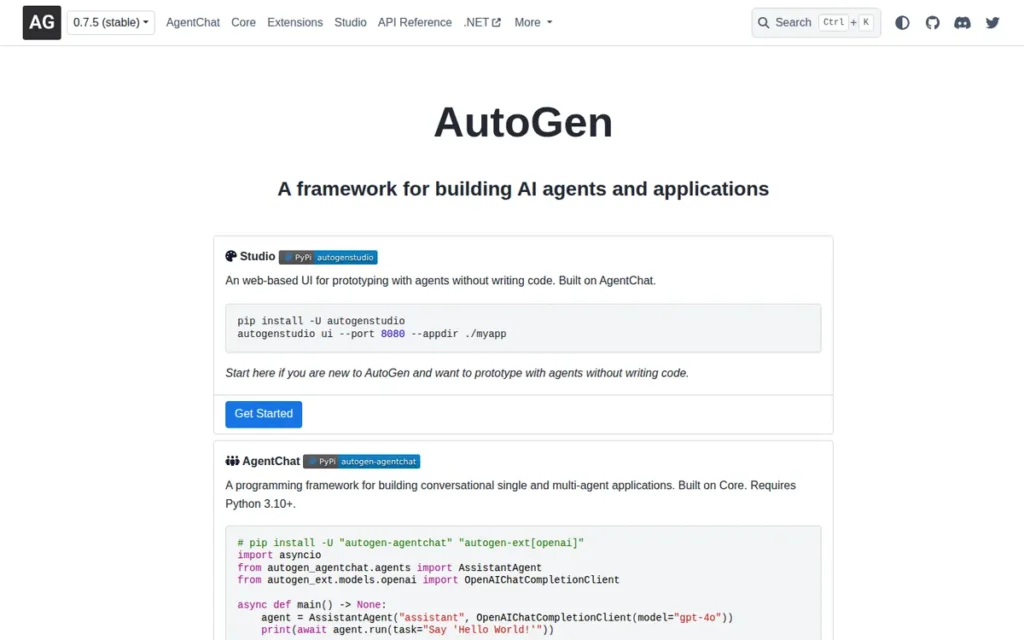
Category: Conversational Multi-Agent Research Framework, a Microsoft Research-originated open-source Python and .NET framework for building multi-agent systems where LLM-powered agents collaborate through natural language conversations, best suited for research-grade and engineering-heavy use cases.
At a Glance
- Category: Conversational Multi-Agent Research Framework
- Best For: ML researchers, enterprise AI/ML engineers, and Microsoft Azure-native development teams building automated code generation, CI/CD automation, multi-agent research tasks, and engineering workflows requiring emergent conversational agent coordination
- Price Range: Free (MIT open-source license, no paid tiers) | Azure OpenAI consumption charges apply separately at standard Azure pay-per-token pricing, confirmed April 2026
- Primary Strength: Microsoft AutoGen is the only AI agent framework in this evaluation originating from peer-reviewed Microsoft Research, with an event-driven AG2 architecture (January 2025) and sandboxed code execution capability that makes it the strongest framework for automated software development use cases
- Biggest Limitation: Microsoft AutoGen has documented production failures where agents enter infinite reasoning loops generating runaway API costs with no useful output, compounded by documentation that the community consistently describes as “quite hard to read, with not enough examples, and there are some things that flat out don’t work” (r/AutoGenAI, u/Z_daybrker426, 2025)
- One-Line Summary: Microsoft AutoGen is a free MIT-licensed multi-agent framework from Microsoft Research with 50,000+ GitHub stars (confirmed 50,400 as of mid-2025) and an event-driven AG2 architecture (January 2025), best suited for ML researchers and Azure-native engineering teams building automated coding, CI/CD, and research workflows where conversational agent coordination produces emergent behaviors that structured frameworks cannot achieve.
- Last Verified: April 2026
Overview
Microsoft AutoGen is an open-source Python and .NET multi-agent framework from Microsoft Research, best suited for ML researchers, enterprise AI/ML engineers, and Microsoft Azure-native development teams that need multi-agent systems characterized by emergent conversational coordination, particularly for automated software development, CI/CD automation, code generation, and research tasks. AutoGen agents coordinate through unstructured natural language exchanges, with AutoGen 0.4’s event-driven asynchronous runtime (released January 2025) adding distributed execution at scale and built-in OpenTelemetry observability.
Microsoft AutoGen’s combination of research pedigree, MIT licensing, and Azure ecosystem integration gives it a distinctive positioning as “the PyTorch of agentic AI” (python.plainenglish.io, 2025), architecturally advanced and academically credible, but operationally demanding.
Key Features
- Conversational Agent Coordination: Microsoft AutoGen enables LLM-powered agents to coordinate through unstructured natural language exchanges (without predefined roles as in CrewAI or explicit graph edges as in LangGraph) allowing emergent multi-agent behaviors effective for open-ended research, automated code review, and multi-expert reasoning workflows.
- Event-Driven AG2 Runtime (January 2025): Microsoft AutoGen 0.4’s event-driven asynchronous runtime supports distributed multi-agent networks where agents communicate via message-passing across separate processes, with built-in OpenTelemetry distributed tracing (Microsoft Research WEF 2025 documentation).
- Sandboxed Code Execution: Microsoft AutoGen supports sandboxed code execution through its UserProxyAgent and Docker integration, enabling agents to autonomously write, execute, and debug Python in isolated environments, the strongest automated software development capability of any framework in this evaluation.
- Azure Ecosystem Integration: Microsoft AutoGen integrates natively with Azure OpenAI Service, Azure Container Apps, and the Microsoft 365 ecosystem, providing Azure-native organizations with a framework that operates within existing IAM, VPC, and compliance infrastructure (AWS prescriptive guidance, 2025).
- MIT License with Research-Funded Development: Microsoft AutoGen’s MIT license and Microsoft Research funding mean architectural decisions prioritize technical correctness and long-term design integrity over short-term commercial feature demands, a governance model that research-intensive organizations specifically value.
Best For
Microsoft AutoGen is best for ML research teams, senior AI/ML engineers, and enterprise development teams deeply embedded in the Microsoft Azure ecosystem that need to build complex automated coding, CI/CD automation, multi-agent research, or engineering workflows, and where teams have the Python expertise and operational tolerance to manage AutoGen’s documentation gaps and production loop risks.
Pricing
Microsoft AutoGen is completely free and open-source under the MIT license with no paid tiers, enterprise subscriptions, or feature gates at any deployment scale. Azure OpenAI integration uses standard Azure pay-per-token pricing, but any LLM provider can be substituted at no additional framework cost. Total cost of ownership is driven almost entirely by developer time (high), infrastructure, and LLM API consumption. Confirmed free (MIT) from Microsoft Research AutoGen documentation, April 2026.
Strengths
- Microsoft AutoGen originated as a Microsoft Research project with peer-reviewed academic publication (2023), and its lead developer publicly states AutoGen 0.4 is “the most forward-looking agent framework out there in terms of architecture” (r/AutoGenAI, u/eri2zhu (confirmed as AutoGen lead developer via subreddit flair, 2025)) providing academic credibility that enterprise teams in regulated sectors specifically value.
- Microsoft AutoGen has accumulated 50,000+ GitHub stars (confirmed 50,400 as of mid-2025, github.com/microsoft/autogen; April 2026 live count not directly confirmed in research) and is completely free under the MIT license with no paid tiers or commercial restrictions at any deployment scale.
- Microsoft AutoGen 0.4’s event-driven asynchronous runtime with built-in OpenTelemetry observability (Microsoft Research WEF 2025, January 2025) enables distributed multi-agent deployments at production scale with native tracing, addressing a significant observability gap present in earlier AutoGen versions.
- Microsoft AutoGen’s sandboxed Docker code execution capability enables agents to autonomously write, run, and debug Python in isolated environments, making Microsoft AutoGen the strongest framework in this evaluation for automated software development and CI/CD use cases where code-generating agents must safely validate their own output.
Limitations
- Agent Loop and Runaway API Cost Risk: Microsoft AutoGen’s most consequential production failure mode involves agents entering infinite reasoning loops that continue consuming API tokens without producing useful output, a risk reported by multiple community practitioners describing “racking up API costs” while the system loops on a single task:
“I would love to have it ‘create a Python module from this jupyter notebook with documentation’… But it usually just gets stuck in a loop, racking up API costs.” (u/tdyo, r/AutoGenAI (2024))
Takeaway: AutoGen deployments must implement explicit turn limits and API spending caps before connecting to any live LLM endpoint, loop risk is a known production failure mode, not an edge case. Specifically: set max_turns limits on all ConversableAgent GroupChat configurations and implement per-session API spending caps in your Azure OpenAI or OpenAI account before testing in any environment with real API credentials.
- Documentation Quality: Microsoft AutoGen’s documentation is consistently described as “quite hard to read, with not enough examples, and there are some things that flat out don’t work” (including structured outputs) amplifying the operational risk of the loop failure mode for teams relying on documentation to configure safeguards (r/AutoGenAI, u/Z_daybrker426, 2025).
- Version Naming Confusion: Microsoft AutoGen’s naming divergence creates meaningful adoption friction: AutoGen 0.2 is the original version most tutorials reference; AutoGen 0.4 is the complete January 2025 architectural rewrite (event-driven, asynchronous); AG2 is the community-driven fork that diverged from the Microsoft Research main branch; and AutoGen Studio is a separate GUI wrapper, four incompatible references that require version-checking before following any tutorial or documentation.
- Non-Technical Inaccessibility: Microsoft AutoGen is the least accessible platform in this evaluation for non-technical users and teams without dedicated ML engineering resources, buyers in these profiles should evaluate n8n, Copilot Studio, or Relevance AI instead.
Verdict
Microsoft AutoGen is a free MIT-licensed multi-agent framework with Microsoft Research credibility and an architecturally advanced event-driven runtime that makes it uniquely suitable for ML researchers and Azure-native engineering teams building complex automated coding and research workflows. Microsoft AutoGen is the strongest choice in this evaluation for automated software development, CI/CD generation, and multi-agent research use cases, provided teams implement strict loop termination conditions and accept the documentation quality and operational complexity that accompany the platform’s research-first design philosophy. Organizations without experienced ML engineering teams, or those needing reliable production deployments without significant operational overhead, should evaluate LangGraph, n8n, or CrewAI instead.
7. Relevance AI: Best for Non-Technical Users: Fastest Time-to-First-Agent No-Code AI Workforce Builder
Category: No-Code AI Workforce Builder, a visual drag-and-drop platform for building and deploying AI agents and multi-agent teams (called AI Workforces) that autonomously handle business tasks, requiring no programming knowledge for standard deployment patterns.
At a Glance
- Category: No-Code AI Workforce Builder
- Best For: Non-technical business users: operations managers, sales and marketing teams, and individual contributors, who need to deploy AI agents for specific well-defined tasks without any developer dependency
- Price Range: Free tier available (credit-limited) | Paid tiers: community-estimated ~$19–$199+/month range, not confirmed from official source | Enterprise: custom pricing, verify at relevanceai.com/pricing before publication. April 2026
- Primary Strength: Relevance AI provides the lowest technical barrier to a first functional AI agent of any platform in this evaluation, its block-based no-code builder, 400+ templates, and AI Workforce coordination require no coding, API knowledge, or variable logic for standard use cases
- Biggest Limitation: Relevance AI lacks verified G2 or Capterra ratings, has no publicly named enterprise case studies with quantified outcomes, does not support self-hosted deployment, and community practitioners consistently describe it as a “stepping stone” rather than a platform for complex enterprise-scale multi-agent orchestration
- One-Line Summary: Relevance AI is a no-code AI workforce builder founded in 2020 with SOC 2 Type II certification and 400+ agent templates, providing the fastest path to a functional AI agent for non-technical business users, with the community-validated caveat that complex enterprise orchestration will require technical resources beyond the platform’s no-code ceiling.
- Last Verified: April 2026
Overview
Relevance AI is a no-code AI workforce builder founded in 2020, best suited for non-technical business users (operations managers, sales teams, marketing professionals, and individual contributors) who need to deploy AI agents that autonomously handle tasks like sales outreach, competitive research, lead qualification, and customer support without any engineering resources. Relevance AI’s block-based visual builder, 400+ pre-built agent templates, and AI Workforce multi-agent coordination layer allow non-technical users to move from concept to functional agent faster than any other platform in this evaluation.
Relevance AI’s community-validated limitation is a capability ceiling. Practitioners consistently describe Relevance AI as “a stepping stone” for organizations that eventually need complex, customized enterprise-scale orchestration beyond what the no-code interface can support (r/AI_Agents, multiple accounts, 2025).
Key Features
- Block-Based No-Code Visual Builder: Relevance AI’s drag-and-drop builder enables non-technical users to create AI agents that perform multi-step autonomous tasks (research, outreach, data processing, content generation) without writing code, configuring APIs, or understanding variable logic for standard use cases.
- 400+ Pre-Built Agent Templates: Relevance AI’s 400+ pre-built agent templates provide deployment-ready starting points for BDR sales outreach, competitive review analysis, lead qualification, and meeting summarization, significantly accelerating time-to-first-working-agent for non-technical teams.
- AI Workforce Multi-Agent Coordination: Relevance AI’s AI Workforce layer enables non-technical users to build teams of specialized agents that collaborate on complex business tasks (assigning one agent to research, another to draft, and another to review) without writing orchestration code or understanding multi-agent architecture patterns.
- LLM-Agnostic Deployment: Relevance AI supports OpenAI, Anthropic Claude, Google Gemini, and other model providers from a single no-code interface, giving users model flexibility without requiring separate API key management or infrastructure configuration per provider.
- SOC 2 Type II and GDPR Compliance: Relevance AI holds SOC 2 Type II certification and GDPR compliance documentation (relevanceai.com/enterprise), with enterprise features including bulk user management and audit logging, and voice calling and meeting agents available starting from the Team plan.
Best For
Relevance AI is best for non-technical business users (sales development representatives, marketing managers, operations leads, and individual contributors) who need to deploy AI agents for specific well-defined business tasks without any developer dependency, and who prioritize speed-to-deployment over the architectural flexibility to scale into complex enterprise orchestration.
Pricing
Relevance AI offers a freemium model with a credit-limited free tier. Paid tiers have been referenced in community discussion at approximately $19–$199+/month range, but specific tier names and dollar amounts could not be confirmed from the official pricing page in research. A community member characterized pricing at the $199+ level as “focused on individual work tasks… too expensive for scale” (r/nocode, 2024). Enterprise tier pricing is custom and requires direct contact. Freemium free tier confirmed. Specific paid tier amounts, community-estimated only; verify at relevanceai.com/pricing before publication. April 2026.
Strengths
- Community practitioners confirm Relevance AI delivers the fastest time-to-first-functional-agent for non-technical users, a representative account describes building a competitor review analysis agent successfully, explicitly attributing the choice to “just wanted to get something up and running quick” (r/AI_Agents, u/Thepeebandit, 2025).
- Relevance AI holds SOC 2 Type II certification and GDPR compliance documentation (relevanceai.com/enterprise), providing third-party security credentialing that enterprise information security teams require for vendor approval, regardless of the deploying team’s technical sophistication.
- Relevance AI has been reported to have completed a Series B VC funding round (per eesel.ai analysis, 2025); specific funding amount, investors, and date could not be independently confirmed from official Relevance AI sources or public databases in research as of April 2026, if confirmed, this would indicate institutional investor validation of the company’s market thesis.
- Relevance AI’s LLM-agnostic architecture supporting OpenAI, Anthropic, Gemini, and others in a single no-code interface provides model flexibility at the no-code level, allowing non-technical users to switch or compare LLM providers without any developer involvement.
Limitations
- Enterprise Scale Ceiling: Relevance AI’s most consequential limitation is the gap between its no-code accessibility and enterprise scale requirements, a representative community assessment states: “Relevance is a stepping stone, but if you want truly capable agentic systems, you need to either do things manually (code) or use a platform like n8n” (r/AI_Agents, u/demiurg_ai, 2025).
“Relevance AI looks solid for automating tasks, but it might require more technical know-how than advertised. If you’re a beginner, it could be a bit tricky to monetize ideas right away.” (u/bubbless__16, r/AI_Agents (2025))
Takeaway: Relevance AI’s no-code accessibility holds for standard template-based tasks, custom logic, complex multi-agent coordination, and API integrations beyond pre-built connectors consistently require technical support that the platform’s marketing does not acknowledge.
- Weakest Independent Evidence Base: Relevance AI has no verified G2 or Capterra ratings, no publicly named enterprise case studies with quantified outcomes, and a reported (but unconfirmed) funding history, making independent buyer verification more difficult than for any other platform in this evaluation. This evidence gap extends to funding information: buyers cannot independently verify the company’s financial runway without direct contact with the vendor.
- No Self-Hosted Deployment Option: Relevance AI does not support self-hosted deployment, all agent data passes through Relevance AI’s cloud infrastructure. Organizations with strict data residency requirements (HIPAA-regulated healthcare, EU data localization mandates) cannot deploy Relevance AI on-premises, limiting its viability in data-sensitive enterprise environments where n8n’s self-hosting or Salesforce’s Data Cloud governance would be required.
- Unconfirmed Pricing: Relevance AI’s official pricing tiers could not be confirmed from the official pricing page during research (April 2026), requiring buyers to contact the company directly before budget planning, adding friction relative to platforms with fully published pricing.
Verdict
Relevance AI is the most accessible no-code AI agent deployment platform in this evaluation, offering the fastest path from concept to functional AI agent for non-technical business users via 400+ templates and a block-based builder requiring no coding or API knowledge. Relevance AI is the top recommendation for non-technical teams in sales, marketing, and operations who need immediate AI agent deployment for specific well-defined tasks without developer dependency. Buyers should enter with clear expectations about the no-code ceiling, the absence of self-hosting options, and the absence of verified G2 or Capterra reviews, request a live demo and confirm current pricing directly before committing.
What Red Flags Should I Watch For When Evaluating Agentic AI Software?
Five critical red flags distinguish credible agentic AI platforms from tools that generate post-adoption regret, the no-code authenticity gap, ecosystem lock-in depth, unverified adoption claims, production loop risk, and pricing opacity before budgeting. All five are directly documented across the seven tools evaluated in this article.
Red Flag #1: The No-Code Authenticity Gap
Platforms marketed as no-code that require understanding of variables, API concepts, or conditional logic for non-trivial implementations create a systematic expectation gap. Both Microsoft Copilot Studio and n8n are documented in practitioner accounts as requiring technical knowledge exceeding their marketing claims, Copilot Studio practitioners specifically name “understanding what a variable is” as a barrier (r/copilotstudio, 2025), while n8n users describe the platform as “somewhere between a full developer tool and a no-code automation platform” (r/n8n, 2025). Before committing to any platform marketed as no-code, require your vendor to point to practitioner community accounts, not the marketing page, of users building non-trivial agents.
Red Flag #2: Ecosystem Lock-In Depth
Platforms whose ROI depends almost entirely on existing ecosystem investment deliver dramatically diminished value outside that ecosystem. Salesforce Agentforce’s value case deteriorates substantially for organizations not already on Salesforce CRM, and Microsoft Copilot Studio’s bundled pricing model is only favorable for existing M365 Copilot subscribers.
Before committing to either platform, calculate:
- Agent automation value independent of the CRM or M365 anchor
- Migration cost to a neutral platform after three years
- Whether equivalent governance is achievable on a non-ecosystem-native platform at comparable cost
Red Flag #3: Unverified Adoption Claims
Fortune 500 adoption percentages or market share figures that are vendor-self-reported without independent verification should be treated as marketing rather than evidence. CrewAI has self-reported significant Fortune 500 adoption citing customers including DocuSign, IBM, and PwC, specific percentages vary across CrewAI sources and none have been independently verified as of April 2026. Buyers should not include unverified vendor-reported adoption figures in procurement justifications without independent corroboration.
Red Flag #4: Production Loop Risk
Conversational agent frameworks lacking hard termination conditions expose organizations to runaway API costs with no useful output. Microsoft AutoGen’s conversational paradigm (where agents coordinate through open-ended LLM-to-LLM exchanges) has produced documented instances of agents entering infinite reasoning loops that consume API budget without resolution (r/AutoGenAI, multiple accounts, 2024). Any deployment on conversational frameworks must implement explicit termination conditions and API cost safeguards before production. This is a known failure mode, not an edge case.
Red Flag #5: Pricing Opacity Before Budgeting
Enterprise tiers requiring a sales call before basic budget planning is possible add procurement friction and signal potential post-adoption cost surprises. CrewAI Enterprise, Relevance AI enterprise, and LangGraph Platform enterprise all have pricing that could not be confirmed from official public sources during research in April 2026. Pricing opacity is not just a friction point, in community discussions, platforms with opaque pricing are also the platforms where buyers most commonly report unexpected cost escalation after commitment. Transparent pricing is itself a signal of vendor maturity and buyer-friendly commercial intent. Request written pricing commitments, and confirm what happens at contract renewal, before completing a full enterprise procurement cycle.
What Questions Should I Ask Before Choosing an Agentic AI Platform?
Six pre-commitment questions surface the information gaps that most vendor sales processes are designed to obscure: minimum technical skill required, specific compliance certifications held, failure and recovery behavior, total cost of ownership beyond license fees, ecosystem dependency risk, and data residency constraints. Getting written answers to all six before signing prevents the most common sources of post-adoption regret.
Question #1: The Skills Reality Check (What is the minimum technical skill required to build a non-trivial agent on this platform) and where is that documented by actual users, not the vendor?
Require your vendor to point to practitioner community discussions where users describe building functional agents for realistic use cases. If the community says “you need to understand variables” or “you need Python,” that is the real answer regardless of what the marketing page says. The skill gap between the 80% template use case and the 20% custom use case is where the majority of adoption projects encounter unplanned costs.
Question #2: The Compliance Confirmation, Which specific compliance certifications does this platform hold, when were they last audited, and are they available in my deployment tier?
SOC 2 Type II certification is a minimum threshold for enterprise deployment in data-sensitive environments. Confirm that compliance certifications apply to your specific deployment tier, not just the enterprise tier you haven’t purchased. Verify the most recent audit date. HIPAA and GDPR alignment require separate confirmation beyond general SOC 2 scope.
Question #3: The Failure Recovery Test (What happens when an agent fails mid-workflow) does the platform support state recovery and retry, or does it require a full restart?
Workflow failure recovery is the clearest differentiator between production-grade and development-grade platforms. LangGraph’s stateful checkpointing enables state rollback and partial retry without full workflow restarts. Most simpler frameworks require manual intervention or full restarts on failure. The answer reveals more about production readiness than any feature checklist.
Question #4: The Total Cost Reality (What is the total cost of ownership including required add-ons, infrastructure, and developer time) not just the headline license fee?
LangGraph is “free” but requires LangSmith (~$39/seat/month, community-reported) for production observability. n8n is “free” self-hosted but requires an enterprise license for SOC 2 governance. Agentforce’s per-conversation pricing can be 3x more expensive than Flex Credits for the same workload. Map out all required components (framework license, observability tools, LLM API costs, infrastructure, and developer time) before comparing headline pricing across platforms.
Question #5: The Ecosystem Dependency Test, Is this platform’s value proposition contingent on a technology ecosystem I am already invested in, and what happens to that value if I migrate away?
Salesforce Agentforce and Microsoft Copilot Studio both have ROI models deeply contingent on existing ecosystem investment. Before committing to either, calculate the agent automation value independently of the ecosystem anchor, if the value disappears without Salesforce or M365, treat the platform cost as ecosystem lock-in cost rather than standalone agentic AI infrastructure value.
Question #6: The Data Residency Test, Does this platform support self-hosted or on-premises deployment, and is that required for my compliance environment?
Relevance AI and several other SaaS-only platforms route all agent data through vendor cloud infrastructure. Organizations with HIPAA, EU data localization, or government compliance requirements cannot use cloud-only platforms without significant legal risk. Confirm whether self-hosted deployment is available in your target tier before investing in platform evaluation, n8n, LangGraph, and AutoGen support on-premises deployment; Relevance AI and Copilot Studio do not offer self-hosted options.
How Did We Rank These Agentic AI Tools?
PlugRoute ranked these seven agentic AI tools using six criteria: Verified Production Evidence, Review Platform Ratings, Agentic Capability Breadth, Pricing Transparency, Accessibility Authenticity, and Enterprise Governance. The first three criteria carry primary weighting in the aggregate score. Every score is based on independent research from March–April 2026 with no vendor input into the evaluation.
Evaluation Process
Our ranking followed four sequential steps:
- LLM Coverage Analysis: We queried ChatGPT-4o and Perplexity (April 2026) with the five target search queries to identify which tools appear in AI-generated recommendations and which are entirely absent, establishing gap coverage as a key editorial objective.
- Independent Web Research: We gathered current data from official vendor pricing pages, investor press releases, official documentation, and third-party analysis including MarketsandMarkets, Mordor Intelligence, BCG, Deloitte, and Gartner-citing sources.
- Review Platform Data Collection: We collected G2 star ratings, review volumes, and category placements from G2 (learn.g2.com) and Capterra as of March–April 2026. Absence of review data was recorded as a meaningful signal, not an omission.
- Community Sentiment Analysis: We analyzed Reddit threads across r/n8n, r/salesforce, r/copilotstudio, r/AI_Agents, r/AutoGenAI, r/LangChain, and r/nocode, prioritizing accounts from practitioners with documented deployment experience over casual speculation.
Ranking Criteria
Primary Criteria (highest weighting in aggregate scoring):
C1: Verified Production Evidence and Adoption: Named production deployments disclosed by the company or independently reported; GitHub star counts for open-source tools with date and source; certified developer and user community size; G2 and Capterra review volume as a proxy for paid enterprise adoption; self-reported metrics flagged explicitly as unverified.
Why it matters: Tools with documented production deployments reduce the risk that a platform collapses under production load, the highest signal for reducing post-adoption regret.
C2: Review Platform Ratings and Volume: G2 star rating with review count and date; Capterra rating with review count and date; absence of formal review platform listing noted explicitly as a data gap.
Why it matters: G2 and Capterra ratings represent verified enterprise buyer experiences, the most objective available signal of consistent real-world user satisfaction.
C3: Breadth and Depth of Agentic Capabilities: Architecture analysis against four dimensions:
- Autonomous multi-step reasoning capability: LLM-driven decision-making, not predefined rule execution
- Multi-agent coordination capability: role-based (CrewAI), graph-based (LangGraph), or conversational (AutoGen) paradigms
- Proactive or event-driven triggering: agents initiate on data events, not only on user prompts
- State persistence and checkpointing: workflow recovery without full restart after partial failure
Why it matters: The category contains tools ranging from genuine multi-agent orchestration to rule-based automation with LLM add-ons, architectural depth determines whether a tool can handle the use cases buyers claim to need.
Secondary Criteria (supporting evidence in aggregate scoring):
C4: Pricing Transparency and Total Value: Is pricing published on the official website? Total cost of ownership analysis covering required add-ons, infrastructure, and developer time. Why it matters: Pricing opacity forces buyers into sales call cycles before basic budgeting, a friction that systematically disadvantages buyers.
C5: Accessibility and No-Code Authenticity: Minimum technical prerequisite assessment, community-validated against practitioner accounts; time-to-first-functional-agent cited where benchmarks exist. Why it matters: Accurate accessibility assessment prevents non-technical buyers from committing to platforms requiring developer support for non-trivial implementations.
C6: Enterprise Governance, Security, and Compliance: Publicly documented compliance certifications (SOC 2 Type II, GDPR, HIPAA) with verification date; availability of RBAC, audit logging, SSO; on-premises deployment options. Why it matters: MarketsandMarkets (AI Agents Market Report, 2025) documents that 60% of enterprises cite compliance concerns as a primary adoption barrier.
Evidence Weighting
When review platform ratings conflict with Reddit sentiment, we weight specificity and recency, a detailed 2025 Reddit post from a practitioner with documented deployment experience outweighs a generic 2023 G2 review. Self-reported vendor statistics are labeled explicitly as self-reported and not used as primary ranking evidence.
Absent review platform data for LangGraph, AutoGen, Relevance AI, and CrewAI is treated as a meaningful signal of enterprise procurement immaturity, not evidence of poor quality.
Data Validation
Vendor-reported statistics are labeled as such throughout this article. Claims corroborated by at least one independent source are stated as fact; claims with only vendor attribution are explicitly flagged. GitHub star counts include a source and date. All community quotes include subreddit, username, and approximate date to enable independent verification.
Update Cadence
Pricing data was last verified in April 2026. Agentic AI platform pricing changes frequently, readers are advised to confirm current pricing directly with vendors before making procurement decisions. This article is scheduled for quarterly pricing review and annual full feature reassessment.
Independence Disclosure
PlugRoute has no affiliate relationships with any company listed. Rankings are determined entirely by research data and objective evaluation criteria.
Frequently Asked Questions
What is the best agentic AI software for non-technical users in 2026?
Relevance AI is the best agentic AI software for non-technical users in 2026, offering a block-based no-code builder with 400+ pre-built agent templates requiring no coding, API configuration, or developer knowledge for standard use cases. For non-technical users who anticipate needing more complex customization over time, n8n’s visual interface provides a capable middle ground, though it requires basic technical literacy, including understanding of variables and conditional logic, beyond template-level deployment.
What is the difference between agentic AI and workflow automation tools like Zapier?
Agentic AI platforms use LLMs to dynamically determine workflow paths, make autonomous decisions, and adapt to unexpected conditions without predefined routing logic. Traditional workflow tools execute fixed trigger-action rules and cannot reason about context or modify behavior mid-execution. The practical distinction is architectural, not cosmetic.
The boundary is contested for n8n: n8n’s AI Agent node uses LLMs within a predefined node-graph structure, which community practitioners debate qualifies as genuinely agentic (r/n8n, u/macromind, 2025). For most buyers, the functional test is: can the platform adapt its next action based on unexpected output from the prior step, without a human updating the workflow map?
Is CrewAI or LangGraph better for enterprise production deployments in 2026?
LangGraph is stronger for production deployments in regulated industries, independently confirmed at J.P. Morgan and Uber, with stateful checkpointing and human-in-the-loop controls that meet compliance audit requirements. CrewAI is faster for prototyping and SMB AI products but lacks graph-based state persistence and explicit edge control. Choose CrewAI if time-to-prototype is the primary constraint; choose LangGraph if production reliability, partial failure recovery, and compliance audit trails are non-negotiable.
What does Salesforce Agentforce cost per month in 2026?
Salesforce Agentforce offers three pricing models: $2 per conversation (24-hour window), Flex Credits at $0.005 per credit (~$0.10 per agent action), or $550/user/month (Agentforce 1 Edition, includes 1M annual Flex Credits). Enterprise Edition+ customers receive 100,000 free Flex Credits via Salesforce Foundations. Community analysis documents Flex Credits as up to 3x cheaper than conversation-based pricing at high-action volumes. Confirmed from Salesforce.com/agentforce/pricing, April 2026.
Can open-source agentic AI frameworks like LangGraph or AutoGen meet enterprise compliance requirements?
LangGraph (MIT license) and AutoGen (MIT license) are frameworks, compliance depends on your infrastructure choices, not the framework itself. Both can be deployed within SOC 2-compliant, HIPAA-eligible cloud environments (AWS, Azure, GCP) when configured correctly. LangGraph’s checkpointing enables the audit trails enterprise compliance teams require. Neither provides compliance certifications out of the box, that responsibility falls on the deploying organization’s infrastructure and security team.
What is n8n’s fair-code license and does it restrict commercial use?
n8n’s fair-code license permits free self-hosting for internal business use without restriction. The restriction applies to commercial use at scale: organizations building a competing workflow automation product or SaaS service on top of n8n for external customers require a paid commercial license. Internal automation (even at high volume) is generally unrestricted. The key question is whether n8n is core infrastructure for your team’s own work (permitted) or a platform you are embedding in a commercial product for others (requires license review). Confirm current terms at n8n.io/fair-code before committing.
Which agentic AI platforms are SOC 2 Type II certified in 2026?
Among the seven platforms evaluated, SOC 2 Type II certification is confirmed for Relevance AI (trust.relevanceai.com, April 2026) and n8n’s enterprise self-hosted tier. Salesforce Agentforce and Microsoft Copilot Studio inherit enterprise compliance certifications from their parent platforms (Salesforce Trust and Microsoft Azure compliance frameworks respectively), which include SOC 2 Type II among broader portfolios. LangGraph, CrewAI, and Microsoft AutoGen are frameworks, SOC 2 compliance depends on the deploying organization’s infrastructure choices.
How does PlugRoute determine its agentic AI software rankings?
PlugRoute ranks agentic AI software using six criteria (Verified Production Evidence (C1), Review Platform Ratings (C2), Agentic Capability Breadth (C3), Pricing Transparency (C4), Accessibility Authenticity (C5), and Enterprise Governance (C6)) with C1 through C3 weighted as primary evidence and C4 through C6 as secondary evidence. No company pays for inclusion, ranking position, or editorial treatment. All rankings are determined by independent research data gathered in March–April 2026, as described in full in the methodology section above.
What Do the Key Technical Terms in This Agentic AI Comparison Mean?
Five technical terms used throughout this evaluation distinguish genuine agentic AI capabilities from marketing labels. Each definition is written to be independently cited as a standalone answer.
ReAct Loop: A multi-step AI agent reasoning pattern (short for Reason-Act-Observe-Reflect) in which an agent iteratively plans an action, executes it, observes the result, and updates its reasoning before the next step. ReAct loops enable agents to handle multi-step tasks without requiring every possible scenario to be pre-programmed; Salesforce Agentforce’s Atlas Reasoning Engine is built on this pattern.
State Persistence and Checkpointing: The capability of an agent framework to save the current state of a workflow at defined points, enabling the workflow to pause, resume, or roll back to a prior checkpoint after a failure. LangGraph is the primary framework in this evaluation with native state persistence and rollback, a capability that separates production-grade systems from development-grade frameworks that require full restarts on failure.
Multi-Agent Orchestration: The coordination of multiple specialized AI agents working together toward a shared goal, where one agent may delegate tasks to others, share context, or review outputs. True multi-agent orchestration (as in LangGraph, CrewAI, and AutoGen) allows agents to dynamically determine how work is divided, rather than following fixed predefined routing rules. This differs from single-agent automation extended with multiple tools.
Fair-Code License: A software licensing model used by n8n that permits free self-hosting for internal use but restricts commercial use of the software as a competing service at scale without a paid enterprise agreement. Fair-code differs from fully permissive open-source licenses (MIT/Apache) in that it limits commercial derivative use, a distinction that catches some commercial builders by surprise after significant platform investment.
Model Context Protocol (MCP): An open standard for connecting AI agents to external data sources and tools, enabling agents to read from and write to connected systems without requiring custom API integrations for each data source. Microsoft Copilot Studio uses MCP to connect to 1,400+ enterprise systems including Dynamics 365, SAP, and Salesforce, giving agents access to cross-system data from a single authoring interface.
Glossary: Key Terms Used in This Comparison
ReAct Loop: A multi-step AI agent reasoning pattern (short for Reason-Act-Observe-Reflect) in which an agent iteratively plans an action, executes it, observes the result, and updates its reasoning before the next step. Salesforce Agentforce’s Atlas Reasoning Engine is built on this pattern to handle complex domain queries without pre-programming every possible scenario.
State Persistence and Checkpointing: The capability of an agent framework to save the current state of a workflow at defined points, enabling it to pause, resume, or roll back to a prior checkpoint after a failure. LangGraph is the primary framework in this evaluation offering native checkpointing, a capability that separates production-grade systems from frameworks requiring full restarts on failure.
Multi-Agent Orchestration: The coordination of multiple specialized AI agents working together toward a shared goal, where agents may dynamically delegate tasks, share context, and review each other’s outputs. This differs from single-agent automation extended with multiple tools, and is the core architectural paradigm of LangGraph, CrewAI, and Microsoft AutoGen.
Fair-Code License: A software licensing model used by n8n that permits free self-hosting for internal business use but restricts commercial deployment of the software as a competing service at scale without a paid enterprise agreement. Fair-code differs from fully permissive open-source licenses such as MIT in that it limits commercial derivative use, a distinction that can catch builders by surprise after significant platform investment.
Model Context Protocol (MCP): An open standard for connecting AI agents to external data sources and tools, enabling agents to read from and write to connected systems without requiring custom API integrations for each source. Microsoft Copilot Studio uses MCP to connect to 1,400+ enterprise systems (including Dynamics 365, SAP, and Salesforce) from a single agent authoring interface.
Which Agentic AI Software Is Right for You?
The right agentic AI software in 2026 depends on technical depth, existing ecosystem, and deployment urgency, no single tool leads on all dimensions. n8n leads for verified overall satisfaction, LangGraph for production-grade complex agents, and Relevance AI for non-technical users. The insights below summarize the cross-tool findings that matter most before committing.
Key Insights
- n8n earns the highest formal review ratings of any tool evaluated: G2 4.8/5 (242 verified reviews) and Capterra 4.6/5 (40+ reviews) as of April 2026, making it the strongest evidence-backed recommendation for technical operations teams that need self-hosted governance, transparent pricing, and production-grade automation capabilities.
- LangGraph is the most production-validated AI agent framework in this evaluation and the most underrepresented in AI-generated summaries: absent from both ChatGPT-4o and Perplexity responses queried in April 2026 despite independently confirmed production deployments at J.P. Morgan and Uber and 126,000+ reported GitHub stars, the single largest gap between AI-generated recommendations and evidence-based rankings in this evaluation.
- Microsoft Copilot Studio’s no-code marketing overstates its actual accessibility: community practitioners consistently document that non-trivial implementations require IT knowledge beyond what the platform’s marketing implies, creating a systematic expectation gap for non-technical buyers.
- Relevance AI’s capability ceiling is validated by multiple independent practitioners who frame it explicitly as a “stepping stone” rather than an enterprise-grade orchestration platform, buyers should plan for when they will outgrow the no-code interface before committing long-term.
- Microsoft AutoGen’s agent loop risk is a production-critical concern, not a theoretical edge case, organizations deploying AutoGen must implement explicit
max_turnslimits and API cost safeguards before production, as documented loop failures are a known failure mode of its conversational coordination paradigm. - Pricing transparency varies dramatically across this category: n8n, Agentforce, and Copilot Studio publish specific pricing; CrewAI Enterprise, Relevance AI enterprise, and LangGraph Platform all require sales conversations before budget planning is possible.
- No single tool simultaneously delivers the best accessibility AND the best production-grade control: the most accessible platforms (Relevance AI, Copilot Studio) sacrifice architectural depth; the most capable platforms (LangGraph, AutoGen) sacrifice accessibility and require significant engineering investment.
- Enterprise governance is mature in only three platforms in this evaluation: Salesforce Agentforce, Microsoft Copilot Studio, and n8n enterprise provide the SOC 2, RBAC, SSO, and audit logging combination that enterprise IT teams require, while open-source frameworks require significant additional tooling to reach equivalent governance maturity.
If you have identified your best match, the next step is to request a live demo (for Relevance AI, Copilot Studio, Agentforce, and CrewAI Enterprise) or run a self-hosted trial (for n8n, LangGraph, and AutoGen) using a low-stakes internal workflow before committing organizational resources.
For Salesforce and Microsoft enterprises, the ecosystem-native options deliver the strongest integrated value within those environments. For technical teams wanting the best combination of verified ratings, governance, and pricing transparency, n8n is the evidence-backed overall recommendation. For senior engineering teams in regulated industries building production systems, LangGraph’s confirmed deployments at J.P. Morgan and Uber make it the framework with the strongest independent production credibility, despite its absence from most AI-generated comparison lists.
Pricing and features in this category change frequently. All data in this article was verified in April 2026. We update this guide quarterly. Last updated: April 2026. Visit PlugRoute for our full independent software review methodology and the most current evaluation criteria.