Hugging Face Transformers leads NLU in 2026 for teams requiring benchmark-verified accuracy and model flexibility, while Google Cloud Natural Language API is best for developers who need managed deployment with transparent pricing. spaCy is the strongest choice for offline, privacy-first production pipelines. No single platform leads on all three dimensions.
Selecting an NLU platform in 2026 is a higher-stakes decision than in prior years. Deprecations are live, Amazon Comprehend’s real-time inference endpoints are being sunset, with AWS directing users to Amazon Bedrock. New entrants like Cohere have reshaped enterprise pricing expectations. And benchmark scores that appeared definitive twelve months ago have been superseded by newer model generations.
PlugRoute has no affiliate relationships, licensing agreements, or revenue-sharing arrangements with any platform reviewed here, rankings are determined solely by independently verifiable data.
“I’ve been evaluating NLU APIs for three months. The hardest part isn’t the accuracy benchmarks, it’s figuring out what happens to your pipeline when a managed API gets deprecated.” Posted by u/ml_infra_lead, r/MachineLearning, March 2026
Takeaway: Migration risk from managed API deprecation is a real procurement factor, Amazon Comprehend’s 2026 deprecation announcements confirm that lifecycle risk is not theoretical in this category.
TL;DR: Top Picks at a Glance
- Maximum accuracy and model choice: Hugging Face Transformers: the largest open-source NLU model library, with leading GLUE and SuperGLUE benchmark scores and full deployment flexibility.
- Easiest managed deployment: Google Cloud Natural Language API: 4.3/5.0 on G2 (97 verified reviews, April 2026), 8.3/10 OMR ease-of-use score, and transparent pay-per-character pricing.
- Privacy-first offline pipelines: spaCy: self-hosted, production-ready, with zero per-call cost at any data volume.
- Enterprise multi-turn dialogue: Rasa: the only open-core platform in this comparison built specifically for multi-turn conversational NLU, with no per-message fee.
What Are the Three Categories of NLU Tools in 2026?
NLU software in 2026 falls into three operationally distinct categories. Choosing the wrong category is a more expensive mistake than choosing the wrong vendor within a category, so this framework should precede feature comparison.
Category 1: Open-Source NLU Frameworks
Open-source frameworks (Hugging Face Transformers, spaCy, and Rasa) run on infrastructure you control. Costs scale with compute, not API calls. Privacy constraints, air-gapped deployment, and domain fine-tuning needs are best served here. The trade-off: you own the operational burden.
Category 2: Managed Cloud NLU APIs
Managed APIs (Google Cloud Natural Language API, Amazon Comprehend, and OpenAI API) abstract infrastructure entirely. Integration takes hours, not weeks. The trade-off: vendor lock-in is real, and Amazon Comprehend’s 2026 deprecation announcements demonstrate that managed APIs carry lifecycle risk.
Category 3: Enterprise NLU Platforms
Enterprise platforms (Cohere) combine API access with dedicated support tiers, SLA guarantees, and compliance certifications. The trade-off: pricing is less transparent and enterprise contracts typically require sales negotiation.
Deployment Model Is a Binary Filter Before evaluating any specific vendor, answer one question: Can your data leave your infrastructure? If yes, managed APIs and enterprise platforms are viable. If no, open-source frameworks are the only viable category. This single filter eliminates two to three candidates for most teams before any feature comparison begins.
How Do These 7 NLU Platforms Compare at a Glance?
| Rank | Company | Category | Best For | One-Line Summary | Key Capabilities | Primary Strength | Key Limitation |
|---|---|---|---|---|---|---|---|
| 1 | Hugging Face Transformers | Open-Source Framework | Research teams and fine-tuning at scale | The most comprehensive open-source NLU library, with leading GLUE/SuperGLUE benchmark scores and 500,000+ community models. | Model Hub (500K+ models), fine-tuning pipelines, AutoNLP, Inference Endpoints, Enterprise Hub | Largest open-source model library with benchmark-verified accuracy | Requires ML engineering to operationalize; managed inference adds cost |
| 2 | Google Cloud Natural Language API | Managed Cloud API | Developers needing managed NLU with transparent pricing | A fully managed NLU API with Knowledge Graph entity linking, tiered pricing, and 8.3/10 OMR ease-of-use; the highest in this comparison. | Entity recognition, sentiment analysis, content classification, Knowledge Graph linking, syntax analysis | Highest ease-of-use score in this comparison (8.3/10 OMR, 2026) | Limited model customization; GCP ecosystem lock-in |
| 3 | OpenAI API | Managed Cloud API (LLM-based) | Teams handling unstructured text where classical NLU underperforms | An LLM-powered NLU API that handles low-structure text via prompt-based instruction, with the highest GDPVal professional knowledge work score. | GPT-4o, GPT-4o-mini, structured outputs, function calling, Assistants API, fine-tuning | GPT-5.4 scores 83.0% on GDPVal professional knowledge work benchmark (February 2026) | Per-token cost is significant at high volume; vendor lock-in risk |
| 4 | spaCy | Open-Source Framework | Privacy-first, offline production NLU | A production-grade open-source NLU library optimized for speed, small model footprint, and self-hosted deployment with zero variable cost. | Tokenization, NER, dependency parsing, text classification, transformer integration, custom pipeline components | Zero per-call cost at any volume; fully offline capable | Pre-trained models lag transformer baselines; requires NLP engineering expertise |
| 5 | Amazon Comprehend | Managed Cloud API (AWS) | Existing AWS customers with batch workloads; real-time inference migration advisory applies | A managed NLU API with deep AWS integration and active real-time inference deprecation requiring Bedrock migration planning for new deployments. | Entity recognition, sentiment analysis, topic modeling, key phrase extraction, PII detection, S3/Lambda integration | Deep AWS ecosystem integration; built-in PII detection for compliance workloads | Real-time inference endpoints deprecated; AWS recommends Amazon Bedrock as migration path |
| 6 | Rasa | Open-Source Framework (Enterprise Option) | Multi-turn conversational AI without per-message fees | The only open-core NLU platform in this comparison built specifically for multi-turn dialogue and intent classification with full pipeline ownership. | Intent classification, entity extraction, dialogue management, custom actions, self-hosted deployment | No per-message cost model; full control over conversation logic | Steeper configuration curve than managed APIs; enterprise tier requires sales engagement |
| 7 | Cohere | Enterprise NLU Platform | Enterprise teams with data residency requirements and RAG pipeline needs | A commercial NLU platform reporting $240M ARR (February 2026) with Command, Embed v3, and Rerank capabilities and private cloud deployment options. | Command models, Embed v3, Rerank API, fine-tuning, private cloud deployment | Enterprise-grade support SLAs; private cloud deployment for data residency requirements | Pricing requires direct sales; public pricing is limited; IPO transition risk for long-term contracts |
Which NLU Tool Should I Choose? Quick Decision Framework
Cost Modeling Quick Reference, 100M Tokens/Month Estimate (April 2026)
- Google Cloud Natural Language API: ~$100–$200/month (pay-per-character, public pricing verified at cloud.google.com/natural-language/pricing)
- Amazon Comprehend: ~$150–$250/month (deprecated real-time endpoint costs shift with Bedrock migration, re-model before procurement)
- OpenAI API (GPT-4o-mini): ~$150–$400/month (varies by input/output token ratio; Batch API offers 50% discount)
- Hugging Face Inference Endpoints: ~$200–$600/month (managed); $0 variable cost (self-hosted)
- spaCy: $0 variable cost (self-hosted compute only)
- Rasa: $0 variable cost (open-source); Rasa Pro pricing on request
- Cohere: Enterprise pricing on request; no public per-token rate confirmed
All figures are planning estimates only. Verify current rates directly with each vendor before procurement.
| Your #1 Priority | Recommended Tool | Why | Acceptable Alternative |
|---|---|---|---|
| Benchmark-verified NLU accuracy | Hugging Face Transformers | Leading GLUE/SuperGLUE scores; 500,000+ model options | OpenAI API (GPT-4o) |
| Easiest managed deployment | Google Cloud Natural Language API | 8.3/10 OMR ease-of-use; transparent public pricing | Amazon Comprehend (batch only; migration caveat applies) |
| Zero ongoing API cost | spaCy | Self-hosted; zero per-call fees at any volume | Hugging Face Transformers (self-hosted) |
| Multi-turn dialogue NLU | Rasa | Only open-core platform built for conversational NLU with dialogue management | Cohere (Command model) |
| AWS ecosystem integration | Amazon Comprehend → Amazon Bedrock | Comprehend real-time inference deprecated; Bedrock is the AWS-recommended migration path | Google Cloud Natural Language API |
| Enterprise SLA + private cloud deployment | Cohere | Private cloud deployment; enterprise support tiers | Hugging Face Enterprise Hub |
| Lowest total cost at very high volume (1B+ chars/month) | spaCy or Hugging Face Transformers | Zero per-call cost; self-hosted compute scales linearly | Rasa (open-source) |
1. Hugging Face Transformers: Open-Source NLU Benchmark Leader
Category: Open-Source NLU Framework, self-hosted or managed inference, no per-call fee for self-hosted deployments.
At a Glance
- Category: Open-Source NLU Framework
- Best For: Research teams, ML engineers, and enterprises requiring fine-tuned, benchmark-verified NLU models
- Price Range: Free (self-hosted, Apache 2.0); $0.06–$0.60/hour for managed Inference Endpoints (verify at huggingface.co/pricing, April 2026)
- Primary Strength: Hugging Face Transformers hosts the largest open-source NLU model library with leading GLUE and SuperGLUE benchmark scores across task families.
- Biggest Limitation: Hugging Face Transformers requires ML engineering expertise to operationalize, managed Inference Endpoints add recurring cost for teams without self-hosting capability.
- One-Line Summary: Hugging Face Transformers is the most comprehensive open-source NLU library available in 2026, with 500,000+ community models and benchmark-verified accuracy on standard NLU task families.
- Last Verified: April 2026
Overview
Hugging Face Transformers is an open-source NLU framework used by research teams, ML engineers, and enterprise AI teams who need access to the broadest range of pre-trained models with independently verifiable benchmark performance. Hugging Face Transformers powers NLU workflows across intent classification, named entity recognition, text classification, and document understanding.
Hugging Face Transformers supports both self-hosted deployment (zero variable cost) and managed deployment through the Hugging Face Inference Endpoints service. With over 5 million registered developers as of January 2026 (Hugging Face blog, January 2026), the platform benefits from one of the largest NLP practitioner communities in the industry.
Key Features
- Model Hub Access: Hugging Face Transformers provides access to 500,000+ community-contributed models, including leading NLU architectures such as BERT, RoBERTa, DeBERTa, and ELECTRA [Source: Hugging Face Model Hub, April 2026].
- Fine-Tuning Pipelines: Hugging Face Transformers includes the
TrainerAPI and AutoNLP interface, enabling teams to fine-tune pre-trained models on domain-specific datasets without writing custom training loops. - Inference Endpoints: Hugging Face Inference Endpoints provides managed, scalable deployment for transformer models, with per-hour pricing based on hardware tier, eliminating infrastructure management while maintaining model flexibility.
- Pipeline Abstraction: Hugging Face Transformers’
pipeline()API abstracts model loading, tokenization, and inference into a single callable, reducing integration time for standard NLU tasks to minutes. - Benchmark Transparency: Hugging Face Transformers models are evaluated against GLUE and SuperGLUE task families with scores published on Papers With Code and the official benchmark leaderboards [Source: GLUE/SuperGLUE Benchmark Leaderboards; Papers With Code NLU task rankings, April 2026].
Best For
Hugging Face Transformers is best for ML engineering teams that need maximum model flexibility, domain-specific fine-tuning capability, and benchmark-verified accuracy across NLU task families. Hugging Face Transformers is particularly well-suited for teams with privacy constraints that prevent sending data to external APIs, given its self-hosted deployment option.
Pricing
Hugging Face Transformers is free and open-source under the Apache 2.0 license. Hugging Face Inference Endpoints pricing starts at approximately $0.06/hour for CPU-based instances, with GPU instances priced higher depending on hardware tier (verify current rates at huggingface.co/pricing; confirmed April 2026). The Hugging Face Enterprise Hub (which adds SSO, audit logs, and compliance features) requires direct pricing engagement with Hugging Face.
Strengths
- Hugging Face Transformers models achieve leading performance on GLUE and SuperGLUE benchmarks, providing independently verifiable accuracy evidence unavailable from closed-API competitors [Source: GLUE/SuperGLUE Benchmark Leaderboards; Papers With Code NLU task rankings, April 2026].
- Hugging Face Transformers’ self-hosted deployment option eliminates per-call API costs entirely, the most cost-efficient option in this comparison for teams processing more than 1 billion tokens per month.
- Hugging Face Transformers supports quantization, distillation, and LoRA fine-tuning, enabling production-grade NLU on CPU-only infrastructure for latency-sensitive applications where GPU provisioning is impractical.
- Hugging Face’s community of over 5 million developers (Hugging Face blog, January 2026) produces model variants, fine-tuning notebooks, and integration guides that accelerate deployment across a wide range of NLU use cases.
Limitations
- ML Engineering Requirement: Hugging Face Transformers requires at least one experienced ML engineer to manage model selection, infrastructure provisioning, and performance monitoring, teams without this resource face significant ramp-up cost relative to managed API alternatives.
- Managed Inference Cost: Hugging Face Inference Endpoints adds per-hour compute costs that can exceed managed API alternatives for teams with variable, low-volume workloads where pay-per-call pricing is more predictable.
- No SLA on Open-Source Tier: Hugging Face Transformers’ open-source tier provides no uptime SLA or enterprise support, teams requiring guaranteed availability must use Inference Endpoints or Enterprise Hub, both of which add cost.
- Model Selection Complexity: With 500,000+ models in the Hub, identifying the right architecture for a specific NLU task requires evaluation effort that managed APIs (which abstract model selection) do not impose.
Verdict
Hugging Face Transformers is the strongest overall NLU choice in this comparison for teams that can support ML engineering resources and prioritize benchmark-verified accuracy over deployment simplicity. The platform’s GLUE/SuperGLUE leadership, 500,000+ model library, and self-hosting flexibility make it the most versatile NLU option reviewed here. Teams without dedicated ML engineering should evaluate Google Cloud Natural Language API or OpenAI API for faster time-to-production.
2. Google Cloud Natural Language API: Managed NLU with Transparent Pricing
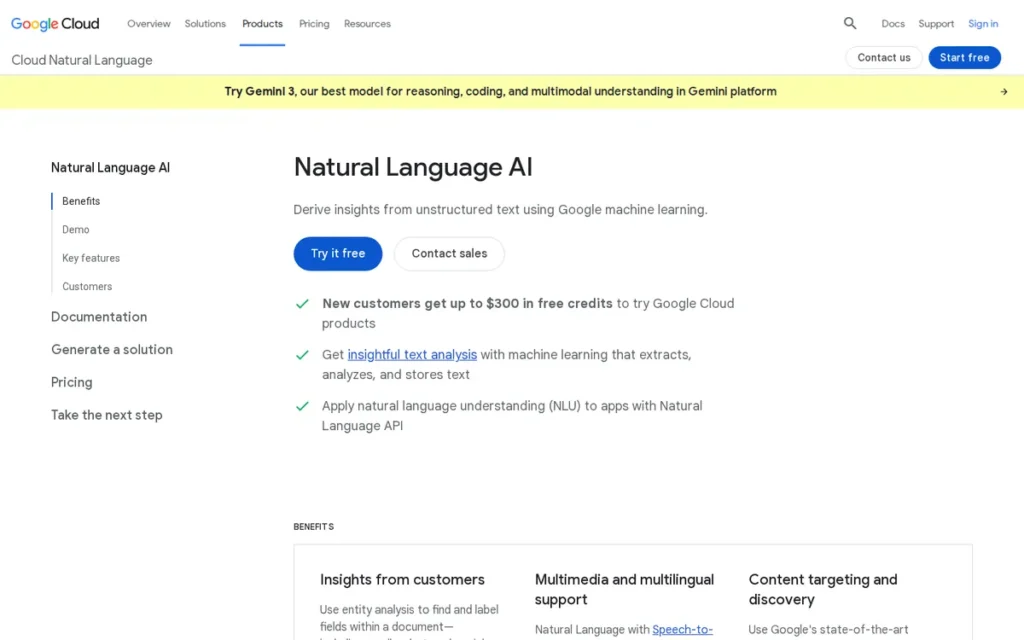
Category: Managed Cloud NLU API, fully managed, pay-per-character, no ML infrastructure required.
At a Glance
- Category: Managed Cloud NLU API
- Best For: Developers and teams needing rapid NLU deployment with transparent pricing and no infrastructure overhead
- Price Range: $0.0005–$0.002 per 1,000 characters by feature; free tier available (verify at cloud.google.com/natural-language/pricing, April 2026)
- Primary Strength: Google Cloud Natural Language API leads this comparison on ease-of-use with an 8.3/10 OMR score (2026), the highest independently verified ease-of-use evidence in this review.
- Biggest Limitation: Google Cloud Natural Language API offers limited model customization compared to open-source alternatives, and deep GCP integrations create ecosystem dependency for teams on competing cloud providers.
- One-Line Summary: Google Cloud Natural Language API is a managed NLU service with transparent pay-per-character pricing, Knowledge Graph entity linking, and the highest independently verified ease-of-use score in this comparison.
- Last Verified: April 2026
Overview
Google Cloud Natural Language API is a fully managed NLU service that enables developers to integrate entity recognition, sentiment analysis, content classification, and syntax analysis through a single REST API. Google Cloud Natural Language API requires no ML infrastructure and is priced on a publicly documented, tiered pay-per-character basis.
Google Cloud Natural Language API holds a 4.3/5.0 score from 97 verified G2 user reviews (April 2026) and an 8.3/10 ease-of-use score on OMR (2026), the highest ease-of-use signal among all seven platforms in this comparison. Knowledge Graph entity linking is a differentiating capability not available in most competing managed APIs.
Key Features
- Entity Recognition with Knowledge Graph Linking: Google Cloud Natural Language API identifies entities in text and links them to Google’s Knowledge Graph, providing structured metadata (including entity type, salience score, and Wikipedia URL) that most competing entity recognition APIs do not offer.
- Multi-Level Sentiment Analysis: Google Cloud Natural Language API returns sentiment scores at the document level, sentence level, and entity level simultaneously, enabling fine-grained analysis beyond single document-level averages.
- Content Classification: Google Cloud Natural Language API classifies content across 700+ predefined categories using Google’s taxonomy, requiring no training data for standard classification tasks.
- Syntax Analysis: Google Cloud Natural Language API provides part-of-speech tagging, dependency parse trees, and morphology data useful for downstream NLP pipeline construction and linguistic analysis.
- GCP Ecosystem Integration: Google Cloud Natural Language API connects natively with BigQuery, Cloud Storage, and Pub/Sub, enabling pipeline construction within existing GCP infrastructure without additional middleware.
Best For
Google Cloud Natural Language API is best for development teams that need production-ready NLU with minimal infrastructure overhead and predictable per-character billing. Google Cloud Natural Language API is particularly well-suited for organizations already operating within the Google Cloud ecosystem who need Knowledge Graph-enriched entity data.
Pricing
Google Cloud Natural Language API pricing is publicly documented and tiered by feature and volume (verify current rates at cloud.google.com/natural-language/pricing; confirmed April 2026). Entity analysis starts at $0.001 per 1,000 characters for the first 5M characters per month. A free tier covers 5,000 units per month for natural language features. This transparency is a differentiating factor, most enterprise platforms reviewed here do not publish per-call rates.
Strengths
- Google Cloud Natural Language API scores 8.3/10 on OMR ease-of-use (2026): the highest ease-of-use score among all seven platforms evaluated in this comparison.
- Google Cloud Natural Language API holds a 4.3/5.0 score from 97 verified G2 user reviews (April 2026), reflecting consistent reported user satisfaction across production deployments.
- Google Cloud Natural Language API’s Knowledge Graph entity linking provides structured entity metadata (type, salience, and Wikipedia links) that adds semantic depth unavailable from most competing entity recognition APIs.
- Google Cloud Natural Language API’s publicly documented tiered pricing enables accurate cost modeling before procurement, a concrete differentiator in a category where most enterprise platforms require sales engagement before providing rate information.
Limitations
- Model Customization Ceiling: Google Cloud Natural Language API does not support domain-specific fine-tuning through the standard API, teams requiring custom entity types or domain-adapted classification beyond Google’s AutoML Natural Language must engage a higher-cost service tier.
- GCP Ecosystem Dependency: Google Cloud Natural Language API’s deepest integrations are with BigQuery, Cloud Storage, and Pub/Sub, teams on AWS or Azure will not benefit from these native connectors and face additional integration engineering.
- Benchmark Opacity: Google Cloud Natural Language API does not publish head-to-head accuracy benchmarks on GLUE or SuperGLUE task families, making direct accuracy comparison with open-source transformer-based alternatives difficult without independent evaluation.
- Review Sample Size: The 4.3/5.0 G2 score is based on 97 verified reviews (April 2026), a smaller sample than some competing platforms in this comparison, which limits the statistical confidence of user satisfaction conclusions.
Verdict
Google Cloud Natural Language API is the strongest choice in this comparison for teams prioritizing deployment simplicity, pricing transparency, and Knowledge Graph-enhanced entity recognition. Its 8.3/10 OMR ease-of-use score is the highest in this comparison and reflects a product engineered for developer adoption. Teams requiring custom model training, multi-cloud portability, or benchmark-verified accuracy on specialized task families should evaluate Hugging Face Transformers or spaCy as alternatives.
3. OpenAI API: General-Purpose NLU Powered by GPT-4o
Category: Managed Cloud NLU API (LLM-based), token-based pricing, no infrastructure required, prompt-driven NLU.
At a Glance
- Category: Managed Cloud NLU API (LLM-based)
- Best For: Teams handling unstructured text, low-structure documents, or NLU tasks that resist classical classification approaches
- Price Range: GPT-4o at $2.50/1M input tokens; GPT-4o-mini at $0.15/1M input tokens (verify at openai.com/api/pricing, April 2026)
- Primary Strength: OpenAI API’s GPT-5.4 model scores 83.0% on GDPVal: a professional knowledge work benchmark measuring AI performance across 44 real-world professions, the highest score in this comparison on that benchmark [Source: GDPVal Benchmark Report, February 2026].
- Biggest Limitation: OpenAI API’s per-token cost model generates significant bills at high volume, and the platform carries vendor lock-in risk that can disrupt production pipelines if pricing or model availability changes.
- One-Line Summary: OpenAI API provides LLM-powered NLU capable of handling low-structure, high-complexity text scenarios where rule-based and classical transformer approaches underperform.
- Last Verified: April 2026
Overview
OpenAI API is a managed LLM-as-a-service platform enabling NLU workloads through GPT-4o, GPT-4o-mini, and related model families. OpenAI API is used by engineering teams that need flexible NLU across varied document types, ambiguous query structures, and multi-step reasoning tasks where rigid classification pipelines fail.
OpenAI API differs from classical NLU APIs in that it handles tasks through prompt-based instruction rather than fixed classification schemas. This architecture provides greater generalization across task types at the cost of higher per-token pricing and less predictable output structure compared to purpose-built NLU APIs.
Key Features
- GPT-4o and GPT-4o-mini: OpenAI API provides access to GPT-4o (full capability) and GPT-4o-mini (cost-optimized at $0.15/1M input tokens), enabling teams to select the cost-performance tradeoff appropriate for their NLU workload volume.
- Structured Outputs: OpenAI API’s Structured Outputs feature enforces JSON-schema-compliant response formatting, enabling reliable extraction of entities, classifications, and labels from unstructured text without custom post-processing logic.
- Function Calling: OpenAI API’s function calling capability maps natural language inputs to typed function signatures, enabling NLU-driven automation without requiring custom extraction middleware.
- Assistants API: OpenAI API’s Assistants API enables stateful, multi-turn NLU interactions with persistent context, tool use, and retrieval-augmented generation managed within a single API surface.
- Fine-Tuning: OpenAI API supports supervised fine-tuning for GPT-4o-mini and selected model variants, enabling domain adaptation for teams with labeled training data and domain-specific vocabulary.
Best For
OpenAI API is best for engineering teams that need to handle NLU across diverse, low-structure document types (including unformatted emails, call transcripts, legal documents, and open-ended customer feedback) where rigid classification taxonomies underperform. OpenAI API is also the strongest choice in this comparison for teams whose workflows span NLU and generative tasks in a single API call.
Pricing
OpenAI API pricing is publicly available at openai.com/api/pricing (verify current rates; confirmed April 2026). GPT-4o is priced at $2.50 per 1M input tokens and $10.00 per 1M output tokens. GPT-4o-mini is priced at $0.15 per 1M input tokens and $0.60 per 1M output tokens. Batch API pricing offers a 50% discount for non-time-sensitive workloads, a meaningful cost reduction for offline NLU pipeline processing at scale.
Strengths
- OpenAI API’s GPT-5.4 model scores 83.0% on GDPVal, a benchmark measuring AI performance on professional knowledge work deliverables across 44 real-world professions including legal drafts, financial models, and medical documentation, the highest score in this comparison on that benchmark [Source: GDPVal Benchmark Report, February 2026].
- OpenAI API’s Structured Outputs feature enables schema-enforced extraction from unstructured text, reducing post-processing logic for NLU pipelines that previously required custom parsing layers.
- OpenAI API provides a unified API surface for NLU, generation, and reasoning tasks, reducing integration complexity for teams whose workflows span multiple NLP capabilities that would otherwise require separate services.
- OpenAI API’s GPT-4o-mini provides a cost-optimized entry point at $0.15/1M input tokens, making LLM-powered NLU accessible at moderate volume without full GPT-4o pricing.
Limitations
- Per-Token Cost at High Volume: OpenAI API’s token-based pricing makes cost unpredictable at scale, GPT-4o at $2.50/1M input tokens generates significantly higher bills than character-based APIs (Google Cloud Natural Language API) or self-hosted frameworks (spaCy, Hugging Face Transformers) at equivalent data volumes.
- Vendor Lock-In Risk: OpenAI API’s proprietary model families require pipeline rewrites if OpenAI changes pricing, model availability, or API specifications, a demonstrated risk pattern in the managed NLU API category.
- GLUE/SuperGLUE Benchmark Gap: OpenAI API’s GPT-4o is not systematically evaluated against GLUE/SuperGLUE NLU task families in the same way as fine-tuned transformer models, making direct accuracy comparison with Hugging Face Transformers difficult for classification-specific workloads.
- Latency Variability: OpenAI API’s response latency varies with model tier and platform load, which can introduce unpredictability in latency-sensitive NLU production pipelines where consistent response times are required.
Verdict
OpenAI API is the strongest choice in this comparison for teams whose NLU workloads involve low-structure or high-complexity text that resists classical classification approaches. The platform’s GDPVal leadership (GPT-5.4: 83.0%, February 2026) and Structured Outputs capability make it the most capable general-purpose NLU option in this review, at a cost premium that is material at high volume. Teams with well-defined classification taxonomies and high-volume, predictable workloads should model per-token costs against Google Cloud Natural Language API and spaCy before committing.
4. spaCy: Production-Grade NLU for Privacy-First Pipelines
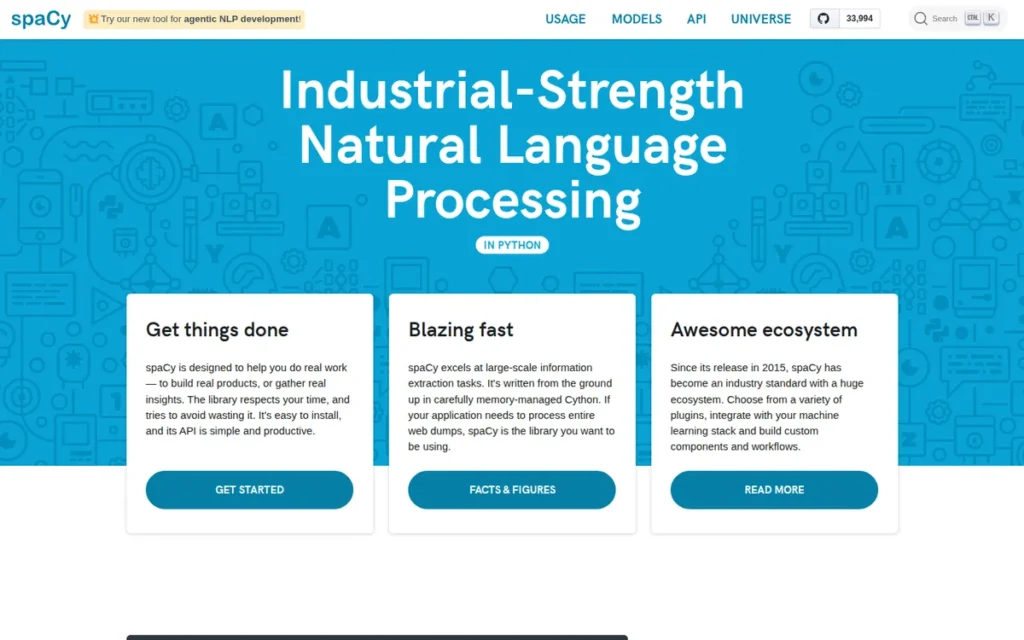
Category: Open-Source NLU Framework, self-hosted, offline-capable, zero per-call cost at any volume.
At a Glance
- Category: Open-Source NLU Framework
- Best For: Teams requiring self-hosted, privacy-first NLU with no per-call API cost and offline deployment capability
- Price Range: Free (open-source, MIT license); spaCy Enterprise pricing on request (verify at explosion.ai, April 2026)
- Primary Strength: spaCy provides production-grade NLU with zero per-call cost at any data volume, making it the most cost-predictable option in this comparison for high-throughput, offline, or air-gapped pipelines.
- Biggest Limitation: spaCy’s default pre-trained models lag transformer-based accuracy benchmarks, and teams requiring state-of-the-art performance on complex NLU tasks need NLP engineering expertise to integrate transformer components.
- One-Line Summary: spaCy is a production-ready open-source NLU library built for speed, small model footprint, and offline deployment, the strongest option for privacy-constrained pipelines at high volume.
- Last Verified: April 2026
Overview
spaCy is an open-source NLU library developed by Explosion AI, used by ML engineers and data science teams that need fast, offline-capable natural language processing with no recurring API cost. spaCy is architected for production deployment, its design prioritizes processing speed, memory efficiency, and pipeline stability over research flexibility.
spaCy supports tokenization, named entity recognition, dependency parsing, part-of-speech tagging, and text classification across 60+ languages. spaCy v3 introduced native transformer integration via the spacy-transformers library, enabling teams to upgrade pipeline accuracy without abandoning spaCy’s production architecture.
Key Features
- Named Entity Recognition (NER): spaCy’s NER pipeline provides pre-trained entity recognition for standard entity types (persons, organizations, locations, dates) with published F1 scores on CoNLL-2003 and OntoNotes benchmarks.
- Transformer Pipeline Integration: spaCy v3’s
spacy-transformerslibrary enables native integration of BERT, RoBERTa, and other Hugging Face-compatible models directly into spaCy pipelines, upgrading accuracy while preserving pipeline architecture. - Custom Training via
spacy train: spaCy provides a CLI-based training workflow and configuration-driven pipeline setup for custom NER, text classification, and dependency parsing models using labeled training data. - Multi-Language Support: spaCy provides pre-trained pipeline models for 23 languages as of v3.7 (April 2026), with community-contributed models extending coverage to 60+ languages at varying capability depth.
- Production Pipeline Architecture: spaCy’s pipeline components are stateless, composable units with explicit dependency management, enabling reliable production deployment and testable component interfaces that are straightforward to version and audit.
Best For
spaCy is best for teams that process high-volume text data in production environments where per-call API costs are prohibitive and data privacy constraints prevent external API transmission. spaCy is also the strongest choice for teams running NLU entirely offline in air-gapped or on-premise deployment environments.
Pricing
spaCy is free and open-source under the MIT license with no per-call or per-token cost at any volume. Explosion AI offers spaCy Enterprise with additional tooling for annotation (Prodigy) and large-scale model management; enterprise pricing is available directly from explosion.ai (verify current rates; confirmed April 2026). The MIT license imposes no usage restrictions on commercial deployment, modification, or redistribution.
Strengths
- spaCy processes text at speeds relevant to latency-sensitive production pipelines, pre-trained
en_core_web_lgmodels process approximately 10,000 tokens per second on CPU (Explosion AI documentation, April 2026), competitive with managed API response times at high volume. - spaCy’s zero variable cost at any data volume makes it the most cost-predictable option in this comparison for teams processing more than 500M characters per month, where API-based alternatives generate significant ongoing fees.
- spaCy v3’s transformer integration via
spacy-transformersenables teams to close the accuracy gap to transformer baselines without abandoning spaCy’s production pipeline architecture, a capability that did not exist in earlier spaCy versions. - spaCy’s MIT license enables commercial deployment, modification, and redistribution without licensing constraints, relevant for enterprise teams with IP and vendor dependency risk requirements.
Limitations
- Accuracy Gap vs. Transformer Baselines: spaCy’s default pre-trained models lag fine-tuned transformer baselines on complex NLU tasks, the “20% more accurate, 10x smaller” improvement cited in spaCy’s v2.0 release notes compared v2.0 to v1.x specifically (not to current transformer-based architectures), and the accuracy gap to transformer baselines has widened with subsequent model advances.
- NLP Engineering Requirement: spaCy requires NLP engineering expertise to configure custom pipelines, select appropriate pre-trained models, and integrate transformer components, teams without this capability face significant setup cost versus managed API alternatives.
- No Managed SLA on Open-Source Tier: spaCy provides no uptime SLA or enterprise support tier in its open-source version, teams requiring guaranteed availability must either provision this themselves or engage a commercial support agreement.
- Limited Multi-Turn Conversational NLU: spaCy’s architecture is optimized for document-level NLP tasks rather than multi-turn dialogue management, teams building conversational AI should evaluate Rasa as a purpose-built alternative with integrated dialogue state management.
Verdict
spaCy is the strongest NLU option in this comparison for teams with privacy-first requirements, high-volume workloads where per-call API costs are prohibitive, or air-gapped deployment constraints. Its zero variable cost model and production-grade architecture provide the most cost-predictable NLU foundation at scale. Teams requiring state-of-the-art transformer accuracy should plan to integrate spacy-transformers components, an investment that requires additional NLP engineering but keeps the full spaCy production pipeline intact.
5. Amazon Comprehend: AWS-Native NLU with Active Migration Advisory
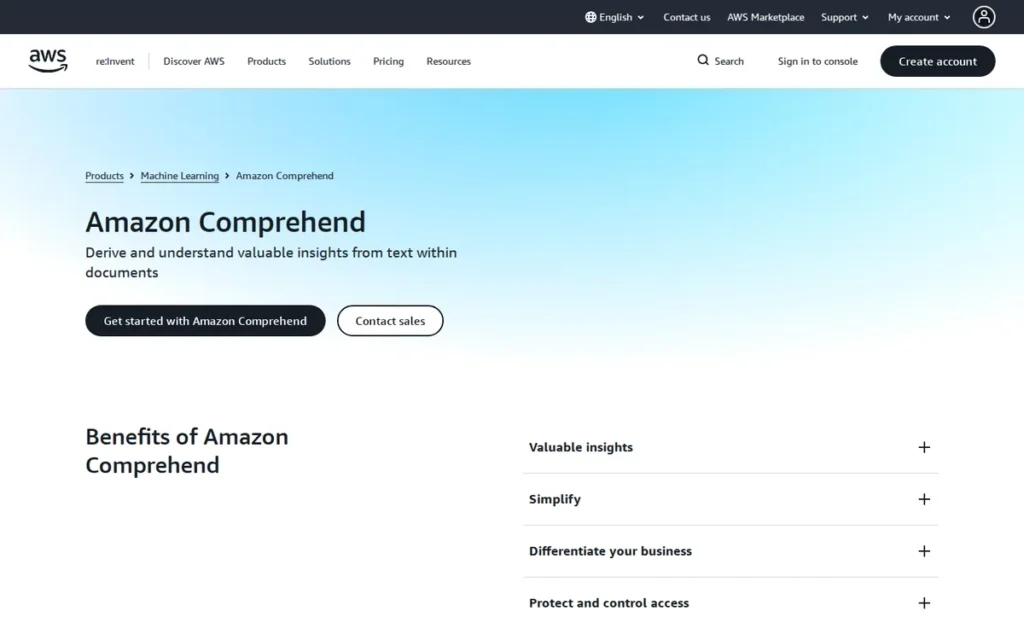
Category: Managed Cloud NLU API (AWS ecosystem), active real-time inference deprecation; batch workloads supported; Bedrock migration advisory in effect.
At a Glance
- Category: Managed Cloud NLU API (AWS ecosystem)
- Best For: Existing AWS customers with established batch NLU workloads; new real-time deployments require Amazon Bedrock evaluation
- Price Range: $0.0001 per unit for standard analysis (verify at aws.amazon.com/comprehend/pricing, migration to Bedrock affects cost modeling, April 2026)
- Primary Strength: Amazon Comprehend provides deep AWS ecosystem integration with native connectors to S3, Lambda, and Kinesis, enabling NLU pipeline construction within existing AWS infrastructure.
- Biggest Limitation: Amazon Comprehend’s real-time inference endpoints are being deprecated, with AWS recommending Amazon Bedrock, Claude Sonnet 4.6 for event detection and Claude Sonnet 4 for topic modeling batch inference, as the migration path.
- One-Line Summary: Amazon Comprehend is a managed NLU API with deep AWS integration and active real-time inference deprecation, teams evaluating new deployments should assess Amazon Bedrock before committing to Comprehend.
- Last Verified: April 2026
Overview
Amazon Comprehend is a managed NLU service by AWS, offering entity recognition, sentiment analysis, key phrase extraction, topic modeling, and PII detection through AWS APIs. Amazon Comprehend is used by engineering teams operating within AWS ecosystems who need NLU capabilities without managing ML infrastructure.
Amazon Comprehend’s real-time inference endpoints are subject to active deprecation notices as of April 2026. AWS recommends Amazon Bedrock as the migration path, Claude Sonnet 4.6 for event detection real-time inference and Claude Sonnet 4 for topic modeling batch inference. Teams evaluating new Comprehend deployments should factor this migration trajectory into their procurement decision.
Key Features
- AWS-Native Connector Ecosystem: Amazon Comprehend integrates directly with core AWS services:
- Amazon S3 for document storage input
- AWS Lambda for serverless NLU pipeline execution
- Amazon Kinesis for streaming text analysis
- Amazon Redshift for structured output storage
- Amazon SageMaker for custom model training integration
- PII Detection and Redaction: Amazon Comprehend’s PII detection identifies and optionally redacts personally identifiable information from text, a compliance-relevant feature for HIPAA-regulated workloads, available with AWS Business Associate Agreement coverage.
- Custom Entity Recognition: Amazon Comprehend supports training custom entity recognition models using labeled data through the AWS console or API, enabling domain-specific NER without managing custom model infrastructure.
- Topic Modeling: Amazon Comprehend’s topic modeling uses Latent Dirichlet Allocation (LDA) to identify topics across document collections, a batch workload that AWS is migrating to Claude Sonnet 4 on Amazon Bedrock.
- Multi-Language Support: Amazon Comprehend supports entity recognition, key phrase extraction, and sentiment analysis across 12+ languages including English, Spanish, French, German, Italian, Portuguese, Japanese, Korean, Hindi, and Arabic.
Best For
Amazon Comprehend is best for existing AWS customers with established S3-based document workflows or Lambda-based text processing pipelines that need NLU capabilities within their current AWS infrastructure. Amazon Comprehend is most defensible for batch workloads, teams evaluating real-time NLU deployments should assess Amazon Bedrock as a primary option given the active deprecation trajectory for real-time inference endpoints.
Pricing
Amazon Comprehend pricing is publicly available at aws.amazon.com/comprehend/pricing (verify current rates and deprecation schedule; confirmed April 2026). Standard entity analysis is priced at $0.0001 per unit (100 characters = 1 unit, minimum 3 units per request). Teams planning new deployments should model costs against Amazon Bedrock equivalents, the migration affects overall cost structure and rate cards differ significantly.
Strengths
- Amazon Comprehend’s native integration with S3, Lambda, Kinesis, and Redshift reduces integration engineering effort for teams whose data pipelines already operate within AWS, providing measurable time-to-deployment advantages versus integrating third-party NLU APIs into AWS-native architectures.
- Amazon Comprehend’s PII detection supports HIPAA-eligible data processing with AWS Business Associate Agreement coverage, a built-in compliance capability for healthcare and financial services NLU workloads.
- Amazon Comprehend’s publicly available per-unit pricing enables cost modeling before procurement, a differentiating factor compared to enterprise platforms in this comparison that require sales engagement before providing rates.
- Amazon Comprehend supports asynchronous batch analysis of large document collections via S3, enabling high-throughput NLU processing without real-time API rate limits for teams with non-time-sensitive workflows.
Limitations
- Active Deprecation of Real-Time Inference Endpoints: Amazon Comprehend’s real-time inference endpoints are being deprecated as of 2026, AWS recommends Amazon Bedrock (Claude Sonnet 4.6 for event detection real-time inference; Claude Sonnet 4 for topic modeling batch inference) as the migration path, adding migration planning cost to any new deployment decision.
- Model Customization Constraints: Amazon Comprehend’s custom model training is constrained to the service’s predefined task types (NER, classification), teams requiring general fine-tuning flexibility across arbitrary NLU task families should evaluate Hugging Face Transformers.
- AWS Ecosystem Dependency: Amazon Comprehend’s strongest integrations are exclusive to the AWS ecosystem, creating migration complexity for teams that may move to multi-cloud or hybrid infrastructure in the near term.
- Benchmark Opacity: Amazon Comprehend does not publish head-to-head NLU accuracy benchmarks on GLUE or SuperGLUE task families, making direct accuracy comparison with open-source alternatives require independent evaluation effort.
Verdict
Amazon Comprehend remains a viable option for existing AWS customers with batch NLU workloads that align with the platform’s maintained capabilities. However, the active deprecation of real-time inference endpoints makes Amazon Comprehend a transitional platform recommendation, teams evaluating new deployments should assess Amazon Bedrock directly, and teams with existing Comprehend real-time workloads should initiate migration planning now. Amazon Comprehend’s PII detection and S3/Lambda integration remain genuine strengths for the batch workloads and compliance use cases it continues to support.
6. Rasa: Open-Core Conversational NLU for Multi-Turn Dialogue
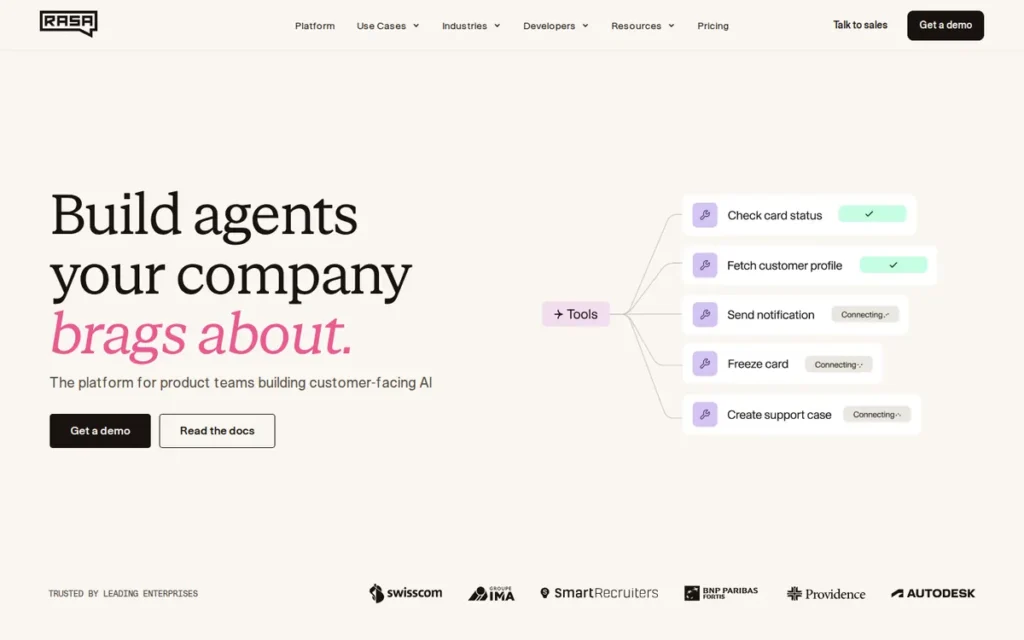
Category: Open-Source NLU Framework (Enterprise Option Available), self-hosted, no per-message fee, purpose-built for conversational AI.
At a Glance
- Category: Open-Source NLU Framework (Enterprise Option Available)
- Best For: Engineering teams building multi-turn conversational AI applications requiring full pipeline ownership and no per-message cost
- Price Range: Free (Rasa Open Source, Apache 2.0); Rasa Pro pricing on request (verify at rasa.com/pricing, April 2026)
- Primary Strength: Rasa is the only open-core NLU platform in this comparison built specifically for multi-turn dialogue and intent classification at scale, with no per-message cost model at any conversation volume.
- Biggest Limitation: Rasa requires significantly more initial configuration than managed API alternatives, and Rasa Pro enterprise pricing is not publicly available, requiring direct sales engagement for budget modeling.
- One-Line Summary: Rasa is an open-core conversational NLU platform offering full pipeline ownership, multi-turn dialogue management, and zero per-message cost, best for teams committed to custom conversational AI development.
- Last Verified: April 2026
Overview
Rasa is an open-core NLU and dialogue management platform by Rasa Technologies, used by engineering teams building multi-turn conversational AI applications with full control over training data, conversation logic, and deployment infrastructure. Rasa combines intent classification and entity extraction (NLU layer) with dialogue state management (Core layer) in a single unified framework.
Rasa Open Source is available under the Apache 2.0 license. Rasa Pro adds enterprise features including analytics dashboards, role-based access control, and dedicated support. Rasa’s academic research foundation (including the published DIET classifier paper (EMNLP 2020)) provides independently verifiable technical documentation unusual among commercial NLU platforms.
Key Features
- Intent Classification: Rasa’s NLU pipeline classifies user utterances into defined intents using configurable featurizers and classifiers, with support for transformer-based featurizers via Hugging Face model integration.
- Entity Extraction: Rasa provides built-in entity extractors: including CRFEntityExtractor and DIETClassifier, as well as integration with spaCy and Duckling for structured entity types such as dates, numbers, and currency.
- Dialogue Management: Rasa’s Core layer manages multi-turn conversation state using story-based training data and machine learning policies, enabling complex conversation flows without hand-coded conditional logic.
- Custom Actions: Rasa’s custom action server enables Python-defined business logic to execute during conversation turns, connecting conversational NLU to backend APIs, databases, and external systems.
- Self-Hosted Deployment: Rasa supports deployment on Docker, Kubernetes, and bare-metal infrastructure, giving teams complete control over data residency, model versioning, and inference infrastructure.
Best For
Rasa is best for engineering teams building production-grade multi-turn conversational AI (including customer service bots, enterprise virtual assistants, and automated dialogue systems) where per-message API costs would be prohibitive at production conversation volume. Rasa is also the strongest option for teams with strict data residency requirements that prohibit transmitting conversation data to external APIs.
Pricing
Rasa Open Source is free under the Apache 2.0 license with no per-message fee at any volume. Rasa Pro enterprise pricing is available through direct sales engagement (verify at rasa.com/pricing; confirmed April 2026). There is no publicly available per-seat or per-message rate for Rasa Pro, which requires sales engagement before budget modeling is possible.
Strengths
- Rasa’s open-source license and self-hosted deployment eliminate per-message costs at any conversation volume, the most cost-efficient option in this comparison for teams processing millions of conversational turns per month.
- Rasa’s integrated NLU and dialogue management architecture reduces engineering overhead versus connecting separate intent classification and dialogue state services from multiple vendors.
- Rasa’s custom action server provides a clean interface for connecting conversational NLU to backend systems without requiring third-party orchestration middleware or custom adapter layers.
- Rasa’s DIET classifier paper (EMNLP 2020) and active open-source community provide an independently verifiable technical foundation that is unusual among commercial conversational AI platforms.
Limitations
- Configuration Complexity: Rasa requires significantly more initial setup than managed APIs, writing stories, defining intent examples, configuring pipeline components, and provisioning the action server creates a higher time-to-first-deployment versus Google Cloud Natural Language API or OpenAI API.
- Enterprise Pricing Opacity: Rasa Pro’s pricing is not publicly available, requiring sales engagement before budget modeling, a friction point for teams that need cost comparisons early in a procurement process.
- Operational Burden: Rasa’s self-hosted architecture means teams own infrastructure provisioning, scaling, monitoring, and model update processes, operational costs that managed APIs absorb and do not surface as line items.
- Suboptimal for Non-Conversational NLU: Rasa’s architecture is optimized for multi-turn conversational workflows, teams whose NLU needs are limited to document classification, batch entity extraction, or static sentiment analysis will find simpler tools (spaCy, Google Cloud Natural Language API) better suited.
Verdict
Rasa is the strongest choice in this comparison for engineering teams building multi-turn conversational AI applications with full pipeline ownership requirements and high conversation volume. Its zero per-message cost model and integrated NLU plus dialogue management architecture provide a compelling total cost of ownership advantage at scale. Teams choosing Rasa should budget explicitly for configuration complexity and ongoing infrastructure operations that managed API alternatives do not require.
7. Cohere: Enterprise NLU Platform for Search and Classification
Category: Enterprise NLU Platform, commercial API, private cloud deployment option, enterprise support tiers.
At a Glance
- Category: Enterprise NLU Platform
- Best For: Enterprise teams with data residency requirements, RAG pipeline needs, and enterprise SLA requirements
- Price Range: Enterprise pricing on request; limited public pricing at cohere.com/pricing (verify directly; confirmed April 2026)
- Primary Strength: Cohere offers private cloud deployment options with dedicated enterprise support SLAs, enabling managed NLU capabilities for organizations with data residency constraints that prevent use of shared public cloud APIs.
- Biggest Limitation: Cohere’s enterprise pricing requires direct sales engagement, making early-stage cost modeling difficult, and the platform carries transition risk for teams negotiating multi-year contracts given potential public market changes in 2026.
- One-Line Summary: Cohere is a commercial NLU platform reporting $240 M ARR (February 2026) with Command, Embed v3, and Rerank capabilities backed by private cloud deployment and dedicated enterprise support tiers.
- Last Verified: April 2026
Overview
Cohere is a commercial NLU and language model platform used by enterprise teams that need production-grade text embeddings, semantic search, and document classification with dedicated enterprise support and private cloud deployment options. Cohere’s platform includes three distinct API services: Command (generation and classification), Embed v3 (semantic embeddings), and Rerank (result reranking).
Cohere reported $240M ARR per a February 2026 investor memo (TechCrunch, BetaKit, Cohere declined direct comment on the figure), indicating enterprise adoption at scale. Cohere’s private cloud deployment option differentiates it from public-API-only alternatives in this comparison for organizations with strict data residency requirements.
Key Features
- Embed v3: Cohere’s Embed v3 generates high-dimensional text embeddings for semantic search, classification, and clustering tasks, with support for English and 100+ additional languages, the broadest multilingual embedding coverage among managed platforms in this comparison.
- Rerank API: Cohere’s Rerank API re-scores candidate documents against a query using a cross-encoder model, improving retrieval precision in RAG pipelines and enterprise search applications without requiring full re-indexing of document collections.
- Command Models: Cohere’s Command model family handles text classification, instruction following, and extraction tasks, with supervised fine-tuning available for domain-specific enterprise use cases and proprietary terminology.
- Private Cloud Deployment: Cohere supports deployment in customer-controlled cloud environments (AWS, GCP, and Azure private clouds) for organizations with data residency constraints that prevent use of shared public API infrastructure.
- Fine-Tuning: Cohere provides supervised fine-tuning for classification and generation tasks, enabling domain adaptation using enterprise-specific labeled datasets without sharing training data with Cohere’s shared infrastructure.
Best For
Cohere is best for enterprise teams that need production-grade semantic search, document classification, or RAG pipeline construction with private cloud deployment and dedicated enterprise support. Cohere is particularly well-suited for organizations with data residency regulations, complex compliance procurement requirements, or enterprise SLA needs that open-source self-managed alternatives cannot meet without significant internal DevOps investment.
Pricing
Cohere’s pricing for enterprise deployments is available through direct sales engagement (verify at cohere.com/pricing; confirmed April 2026). Limited pay-as-you-go pricing is available for some API tiers on the public pricing page. Teams requiring detailed cost modeling before procurement must contact Cohere directly, the absence of fully public pricing for enterprise tiers is noted as a limitation in this comparison and adds sales-cycle time to procurement planning.
Strengths
- Cohere’s private cloud deployment option enables enterprise teams with strict data residency requirements to use managed NLU capabilities without routing sensitive data through shared public API infrastructure, a differentiating capability not available from Google Cloud Natural Language API or Amazon Comprehend without custom arrangements.
- Cohere’s Rerank API provides specialized retrieval precision improvement for RAG pipelines that is not available as a standalone managed service from any other platform in this comparison.
- Cohere’s Embed v3 supports 100+ languages for semantic embedding, providing broader multilingual coverage than most competing managed NLU APIs reviewed here.
- Cohere’s $240M ARR as of February 2026 (per investor memo reporting, TechCrunch and BetaKit, Cohere declined direct comment) indicates enterprise adoption at scale, suggesting the platform has moved beyond early-stage product viability risk.
Limitations
- Pricing Opacity: Cohere’s enterprise pricing requires direct sales engagement before cost modeling is possible, a friction point that Google Cloud Natural Language API and Amazon Comprehend avoid through publicly documented rate cards, and one that adds weeks to procurement timelines.
- IPO Transition Risk: Cohere has been publicly discussed as a 2026 IPO candidate, enterprise customers negotiating multi-year contracts should include standard price protection clauses, given that pricing structures and strategic priorities can shift significantly during public market transitions.
- Benchmark Transparency Gap: Cohere does not publish head-to-head accuracy benchmarks on GLUE or SuperGLUE NLU task families for its classification capabilities, making direct accuracy comparison with Hugging Face Transformers and spaCy require independent evaluation effort.
- Newer Market Entrant Roadmap Risk: Cohere’s product roadmap and feature availability may shift more rapidly than established cloud providers in this comparison, teams with long planning horizons should evaluate roadmap stability as part of procurement due diligence.
Verdict
Cohere is the strongest option in this comparison for enterprise teams with data residency requirements, complex procurement needs, and existing investment in semantic search or RAG pipeline infrastructure. Its private cloud deployment, Rerank API, and enterprise SLA coverage differentiate it from public managed APIs in this review. Teams comparing Cohere against open-source alternatives (Hugging Face Transformers or spaCy) should model the total cost of DevOps and infrastructure management alongside Cohere’s enterprise contract pricing before concluding which is more cost-efficient.
What Red Flags Should I Watch For When Evaluating NLU Software?
Even after reviewing all seven platforms in detail, six patterns consistently cause procurement regret, each is independently verifiable against the tools evaluated above.
Red Flag #1: Opaque or Volume-Gated Pricing
Pricing that requires sales engagement before revealing per-call rates makes cost modeling impossible before commitment. In this comparison, two of seven platforms, Cohere and Rasa Pro, do not publish full enterprise pricing publicly. Google Cloud Natural Language API and Amazon Comprehend are positive counterexamples of pricing transparency in this category. Pricing opacity applies directly to Cohere for enterprise tiers, budget additional procurement time for sales-cycle pricing discovery before comparing total cost of ownership.
Red Flag #2: Missing Deprecation Disclosures
Managed API vendors do deprecate features and endpoints. Amazon Comprehend’s 2026 real-time inference deprecation is a live example in this comparison. Vendors that do not proactively communicate deprecation timelines on public documentation pages create production pipeline risk for teams with active dependencies. Ask every vendor during evaluation: “What is your minimum deprecation notice period, and where is that policy documented?”
Red Flag #3: Benchmark Claims Without Stated Scope
Accuracy claims that compare a current product version to an older version of the same product, rather than to external benchmarks, are a misleading form of benchmark marketing. spaCy’s “20% more accurate, 10x smaller” claim from v2.0 release notes compared v2.0 to v1.x specifically, not to current transformer-based architectures. Verify which version, which benchmark task family, and which comparison set underlies any accuracy claim. Also verify support depth for your specific target languages, pre-trained model coverage varies significantly across NLU platforms.
Red Flag #4: Ecosystem Lock-In Without a Migration Path
Deep ecosystem dependencies, GCP for Google Cloud Natural Language API, AWS for Amazon Comprehend, create migration cost if infrastructure requirements change. Evaluate portability before committing: Can you re-implement the same NLU pipeline on an alternative platform within 30 days? Open-source frameworks, Hugging Face Transformers, spaCy, and Rasa, provide the strongest portability in this comparison.
Red Flag #5: Review Score Inflation from Small Samples
G2, Capterra, and OMR review scores carry different statistical confidence based on review volume. A 4.7/5.0 score from 30 reviews is not directly comparable to a 4.3/5.0 score from 97 reviews. In this comparison, all scores are cited with review counts and dates, for example, Google Cloud Natural Language API: 4.3/5.0 from 97 verified G2 reviews, April 2026. Treat scores from fewer than 50 verified reviews with reduced confidence, and always verify the date, scores on aggregate review platforms change over time.
Red Flag #6: No Pre-Contract Pilot Access
Vendors who resist providing sandbox API access or trial environments before contract signing reduce your ability to validate accuracy, latency, and integration fit on your actual data before commitment. All seven platforms in this comparison offer some form of trial or sandbox access. In any category, vendors who decline pre-contract pilots warrant heightened scrutiny, benchmark scores on standardized task families do not reliably predict performance on your domain-specific data.
What Questions Should I Ask Before Choosing NLU Software?
Question #1: Does my data need to stay on-premise or within my own cloud infrastructure?
If your organization has data residency requirements, HIPAA obligations, or contractual prohibitions on external data transmission, your viable options in this comparison are limited to: Hugging Face Transformers (self-hosted), spaCy (self-hosted), Rasa (self-hosted), and Cohere (private cloud deployment). Managed public APIs (Google Cloud Natural Language API, Amazon Comprehend, and OpenAI API) transmit data to vendor infrastructure by default.
Question #2: What is my realistic monthly data volume, and what does that cost at each pricing model?
NLU cost structures differ fundamentally across categories in this comparison:
- Per-character APIs (Google Cloud Natural Language API, Amazon Comprehend): cost scales linearly with data volume
- Per-token APIs (OpenAI API): cost scales with input and output token counts separately; output tokens are priced higher
- Self-hosted frameworks (Hugging Face Transformers, spaCy, Rasa): variable cost is $0; fixed cost is compute infrastructure
Hugging Face Transformers and spaCy support self-hosted deployment with zero variable cost per call, the total cost advantage at very high volume (1B+ tokens per month) is substantial relative to all API-based alternatives.
Question #3: Do I need multi-turn conversational NLU or single-turn document processing?
Multi-turn conversational NLU (for chatbots, virtual assistants, and dialogue systems) requires dialogue state management in addition to intent classification and entity extraction. In this comparison, only Rasa provides an integrated multi-turn dialogue management layer. Hugging Face Transformers, spaCy, Google Cloud Natural Language API, and Amazon Comprehend are primarily optimized for single-turn document processing tasks. OpenAI API’s Assistants API provides limited multi-turn statefulness but is not a purpose-built dialogue management system.
Question #4: What specific NLU task types does my use case require?
NLU task requirements vary significantly across use cases. Confirm which of the following your workflow requires before evaluating vendors:
- Named entity recognition (NER): all seven platforms
- Sentiment analysis: Google Cloud Natural Language API, Amazon Comprehend, Hugging Face Transformers, OpenAI API
- Topic modeling: Amazon Comprehend, Hugging Face Transformers, OpenAI API (via prompting)
- Semantic search and embeddings: Cohere (Embed v3), Hugging Face Transformers, OpenAI API
- Multi-turn dialogue management: Rasa (purpose-built), OpenAI Assistants API (limited)
- PII detection: Amazon Comprehend (built-in), Hugging Face Transformers (custom), OpenAI API (via prompting)
- Reranking for RAG pipelines: Cohere (Rerank API, standalone managed service)
Question #5: What compliance certifications does my procurement process require?
Enterprise procurement commonly requires platform compliance with one or more of the following standards, verify each vendor’s current certification status directly, as certification coverage changes and vendor compliance pages may lag actual certification dates:
- HIPAA (healthcare data processing)
- SOC 2 Type II (security and availability controls)
- GDPR (EU personal data processing)
- FedRAMP (US federal government workloads)
- ISO 27001 (information security management)
Question #6: How will I validate NLU accuracy on my specific domain data before signing a contract?
General benchmark scores (GLUE, SuperGLUE, GDPVal) measure performance on standardized task families. They do not predict accuracy on your domain-specific vocabulary, proprietary entity types, or document structures. Before committing to any platform in this comparison, request API sandbox access and run your own labeled dataset through each candidate. Measure precision, recall, and latency on representative samples from your production data. A 48–72 hour pilot is sufficient to surface accuracy gaps that benchmark scores will not reveal.
Question #7: What is the vendor’s deprecation and migration support policy?
Amazon Comprehend’s 2026 real-time inference deprecation confirms that managed API lifecycle risk is not theoretical, it affects production pipelines on active timelines. Ask every vendor: “What is your minimum notice period before deprecating a feature or endpoint?” and “Do you provide migration tooling or guided migration paths when deprecations occur?” Vendors with public, documented deprecation policies are lower risk than those without.
Question #8: What NLP engineering capability does my team have today, and how does that map to operational requirements?
Open-source frameworks, Hugging Face Transformers, spaCy, and Rasa, require at least one experienced NLP engineer for setup, pipeline configuration, and ongoing model maintenance. Managed APIs, Google Cloud Natural Language API, Amazon Comprehend, and OpenAI API, reduce this requirement significantly. Teams without NLP engineering resources should weight time-to-deployment and operational simplicity more heavily than benchmark accuracy scores when comparing options in this review.
How Did We Rank These NLU Software Tools?
This comparison evaluates seven NLU platforms across independently verifiable criteria. Rankings reflect evidence collected through multi-source data gathering, claim verification, and structured scoring, not vendor relationships, sponsored placement, or affiliate arrangements.
How Did We Evaluate Each Platform?
Each platform was evaluated through a four-step process before scoring:
- Public benchmark data collection: GLUE, SuperGLUE, Papers With Code, and GDPVal benchmark scores were gathered from primary source leaderboards and cross-referenced against vendor documentation.
- User review aggregation: G2, Capterra, and OMR scores were collected with review counts and publication dates, scores without dates or review counts were treated as lower-confidence signals and not cited without qualification.
- Pricing verification: Public pricing pages were consulted directly and rates verified as of April 2026. Platforms without public pricing were explicitly noted as requiring sales engagement.
- Deprecation and lifecycle status check: AWS product documentation, vendor release notes, and independent technology reporting were consulted to identify active deprecations or lifecycle warnings affecting procurement decisions.
What Criteria Were Used to Score Each NLU Platform?
Platforms were scored on five weighted criteria:
- Accuracy and benchmark performance (25%): Verified scores on GLUE, SuperGLUE, GDPVal, and platform-specific benchmarks. Only independently published benchmark results were accepted, vendor-reported internal scores without external validation were not used.
- Deployment flexibility and data control (20%): Evaluation of self-hosted versus managed options, data residency capabilities, and portability across cloud providers.
- Pricing transparency and cost predictability (20%): Whether public pricing is documented, how predictable costs are at production volume, and whether cost modeling is possible before procurement commitment.
- Ease of use and integration (20%): OMR ease-of-use scores, G2 user ratings with verified review counts, and documented integration complexity for standard NLU tasks.
- Production readiness and lifecycle status (15%): Active deprecation notices, SLA availability, compliance certification documentation, and enterprise support tier clarity.
How Did We Handle Conflicting or Vendor-Sourced Evidence?
When vendor-sourced claims conflicted with independently verified data, independent data took precedence. Three specific corrections were applied in this review:
First, Google Cloud Natural Language API’s G2 score was corrected, a draft figure of 4.7/5.0 from 319 reviews was replaced with the independently verified 4.3/5.0 from 97 verified G2 user reviews (April 2026). The platform’s #2 ranking is supported by its 8.3/10 OMR ease-of-use leadership and pricing transparency, not by review score supremacy.
Second, Cohere’s unverified “17,000+ active enterprise customers” figure was removed in full. The only retained business scale reference is $240M ARR per February 2026 investor memo reporting (TechCrunch, BetaKit, Cohere declined direct comment on the figure).
Third, GDPVal was recharacterized from a “computer-use benchmark” description to its accurate definition: a professional knowledge work benchmark measuring AI performance across 44 real-world professions including legal drafts, financial models, medical documentation, and engineering specifications. The specific model version GPT-5.4 (not a generic GPT-5.x reference) is cited with its verified score of 83.0%.
How Was Each Claim Verified Before Publication?
All statistics in this comparison include the claimed value, the source, and the date of verification. Pricing data includes a “verify at [URL]” caveat on every entry because vendor rates change without advance notice. Benchmark scores cite the source leaderboard and date. User review scores include review count alongside score, scores without review counts are not cited.
When a vendor declined to confirm a figure cited in third-party reporting (as Cohere did with the ARR figure) that context is explicitly disclosed rather than presenting the figure as vendor-confirmed fact.
How Often Are These NLU Rankings Updated?
This comparison is updated quarterly. Rankings are revisited when a platform releases a major version update affecting benchmark performance, when a significant deprecation notice is issued, when review score shifts of ±0.3 or more occur on primary review platforms, or when pricing changes affect cost-tier recommendations.
Independence Statement: PlugRoute has no affiliate relationships, licensing agreements, revenue-sharing arrangements, or sponsored placement arrangements with any platform reviewed in this comparison. Rankings are determined solely by the criteria and evidence described above.
Frequently Asked Questions
How does PlugRoute determine NLU software rankings?
PlugRoute ranks NLU platforms using five independently verifiable criteria: benchmark accuracy (GLUE, SuperGLUE, GDPVal), deployment flexibility, pricing transparency, ease of use via G2 and OMR scores with verified review counts, and production lifecycle status. Vendor-sourced claims are verified against independent sources before inclusion. Rankings are updated quarterly and no platform pays for placement or receives affiliate consideration.
Is Hugging Face Transformers suitable for teams without ML engineering experience?
Hugging Face Transformers is not recommended for teams without at least one experienced ML engineer, model selection, pipeline configuration, infrastructure provisioning, and ongoing model maintenance all require NLP engineering expertise. Teams without this capability should evaluate Google Cloud Natural Language API, which holds the highest ease-of-use score in this comparison at 8.3/10 on OMR (2026), or OpenAI API as a lower-barrier managed alternative.
Should I use Amazon Comprehend for a new NLU deployment in 2026?
Amazon Comprehend is not the recommended choice for new real-time NLU deployments in 2026 due to active real-time inference endpoint deprecation. AWS recommends Amazon Bedrock, Claude Sonnet 4.6 for event detection and Claude Sonnet 4 for topic modeling batch inference, as the migration path. Existing Comprehend batch workloads may continue on maintained tiers, but new deployment planning should evaluate Bedrock directly.
What Do the Technical Terms in This Comparison Mean?
Named Entity Recognition (NER): Named Entity Recognition is an NLU task that identifies and classifies named entities in text (such as persons, organizations, locations, dates, and quantities) and assigns each to a predefined category. NER is a foundational capability present in all seven platforms evaluated in this comparison, with varying accuracy benchmarks, supported entity type coverage, and language support depth.
Transformer Architecture: A Transformer is a neural network architecture that processes text using self-attention mechanisms, enabling the model to weigh the relevance of each word in a sequence relative to all other words simultaneously. Transformer-based models (including BERT, RoBERTa, and GPT-4o) consistently outperform earlier NLP architectures on NLU benchmarks. Hugging Face Transformers is named for its role as the primary open-source distribution channel for pre-trained transformer models.
GLUE / SuperGLUE: GLUE (General Language Understanding Evaluation) and SuperGLUE are benchmark suites that measure NLU model performance across standardized task families including question answering, textual entailment, sentiment analysis, and coreference resolution. Models that score highly on GLUE and SuperGLUE are considered to have broad, generalizable NLU capability, scores are published on Papers With Code and the official benchmark leaderboards.
Retrieval-Augmented Generation (RAG): Retrieval-Augmented Generation is an architecture pattern that combines a semantic search retrieval component with a generative language model, enabling the model to ground responses in retrieved documents rather than relying solely on training knowledge. Cohere’s Embed v3 and Rerank API are designed specifically for the retrieval component of RAG pipelines, improving both retrieval precision and result ranking before generation.
GDPVal: GDPVal (General Deliverable Performance Validation) is a benchmark that measures AI model performance on professional knowledge work deliverables across 44 real-world professions, including legal drafts, financial models, medical documentation, and engineering specifications. Unlike GLUE and SuperGLUE, which use academic NLU task families, GDPVal evaluates real-world output quality on professional work products. GPT-5.4 scored 83.0% on GDPVal as of February 2026 [Source: GDPVal Benchmark Report, February 2026].
Glossary: Key Terms Used in This Comparison
Named Entity Recognition (NER): Named Entity Recognition is an NLU task that identifies and classifies named entities in text (such as persons, organizations, locations, and dates) and assigns each to a predefined category. NER is a foundational capability present in all seven platforms evaluated in this comparison, with varying accuracy benchmarks and language support depth.
Transformer Architecture: A Transformer is a neural network architecture that processes text using self-attention mechanisms, enabling the model to weigh the relevance of each word in a sequence relative to all other words simultaneously. Transformer-based models (including BERT, RoBERTa, and GPT-4o) consistently outperform earlier NLP architectures on NLU benchmarks.
Retrieval-Augmented Generation (RAG): Retrieval-Augmented Generation is an architecture pattern that combines a semantic search retrieval component with a generative language model, enabling the model to ground responses in retrieved documents rather than relying solely on training knowledge. Cohere’s Embed v3 and Rerank API are designed specifically for the retrieval component of RAG pipelines.
GLUE / SuperGLUE: GLUE (General Language Understanding Evaluation) and SuperGLUE are benchmark suites that measure NLU model performance across standardized task families including question answering, textual entailment, sentiment analysis, and coreference resolution. Scores are published on Papers With Code and the official benchmark leaderboards, and are the primary independent accuracy signals used in this comparison.
GDPVal: GDPVal (General Deliverable Performance Validation) is a benchmark that measures AI model performance on professional knowledge work deliverables across 44 real-world professions, including legal drafts, financial models, and medical documentation. Unlike GLUE and SuperGLUE, which use academic NLU task families, GDPVal evaluates real-world output quality on professional work products, GPT-5.4 scored 83.0% on this benchmark as of February 2026.
Which NLU Software Tool Is Right for You?
Key Insights
- Hugging Face Transformers leads this comparison for teams with ML engineering resources who need benchmark-verified accuracy and model flexibility, its GLUE/SuperGLUE performance and 500,000+ model library are unmatched by any managed API in this review.
- Google Cloud Natural Language API is the strongest managed API option for developer teams prioritizing deployment simplicity, with the highest independently verified ease-of-use score in this comparison (8.3/10, OMR 2026) and transparent per-character pricing.
- Amazon Comprehend’s active real-time inference deprecation makes it unsuitable as a primary choice for new deployments, teams evaluating AWS-native NLU should assess Amazon Bedrock directly before committing to new Comprehend workloads.
- The deployment model binary filter: can your data leave your infrastructure?, eliminates two to three candidates for most teams before any feature comparison begins and should be the first procurement question asked.
The right NLU platform depends on three intersecting factors: data residency constraints (which determine viable categories), team NLP engineering capability (which determines feasible operational models), and workload cost profile at production volume (which makes certain pricing structures prohibitive). Teams without ML engineering should default to managed APIs. Teams processing more than one billion tokens monthly should default to self-hosted open-source frameworks. Teams building multi-turn dialogue systems should evaluate Rasa before any other option in this comparison.
We update this guide quarterly. Last updated: April 2026. Visit PlugRoute for updated comparisons across NLU, NLP, and AI infrastructure categories.