The seven best API platforms in 2026 are Kong Konnect for cloud-native gateway and AI/LLM governance, Postman for developer testing and collaboration, Azure API Management for Microsoft-ecosystem enterprises, Google Cloud Apigee for GCP lifecycle management, SwaggerHub for multi-protocol design governance, Stoplight for Git-native spec-as-code workflows, and MuleSoft Anypoint Platform for enterprise integration. Platform selection depends on which of five distinct platform categories your organization needs, not feature comparison alone.
Selecting the right platform is genuinely difficult because “API platform” spans five distinct categories (gateway, full lifecycle management, enterprise iPaaS, API design governance, and AI gateway) and no single product excels at all of them. Engineers routinely evaluate Postman, MuleSoft, and Kong Konnect on the same shortlist without recognizing they are comparing tools built for fundamentally different problems. This guide resolves that confusion with category-first framing, verified pricing data, and unfiltered practitioner intelligence from six engineering subreddits and practitioner community threads verified through June 2026.
PlugRoute has no affiliate relationships with any company listed. Rankings are determined entirely by research data and objective evaluation criteria.
“Almost all visual editors are focused on being an API client, just to browse it, I think they never tried API-first design, so they never knew the problem. It’s frustrating to see many open-source tools exist, but no one thinks about a visually editable & git sync of OpenAPI spec.” (u/rahuldhole, r/OpenAPI, April 2025)
Takeaway: API-first practitioners consistently identify Git-synchronized OpenAPI specification management as the primary unmet need in the visual editor market, the core reason Stoplight retains strong community loyalty despite competitive pressure, and why the design-first-plus-gateway gap documented in this evaluation has not been closed by any single platform as of June 2026.
TL;DR: Top Picks at a Glance
- Kong Konnect is the top-ranked cloud-native API and AI/LLM gateway platform in this evaluation, with a published $225/month per-gateway Plus entry tier and a vendor-neutral open-source exit path available in no proprietary competitor.
- Postman is the most widely adopted API development workspace, backed by 1,775 verified G2 reviews at 4.6/5 stars and the broadest developer ecosystem in the category, best suited for testing, documentation, and collaboration rather than production traffic governance.
- Azure API Management offers the most precisely published pricing of any full management platform in this evaluation (verified June 2026) making it the strongest choice for enterprises already committed to Microsoft Azure.
- MuleSoft Anypoint Platform delivers the deepest enterprise feature set but carries the highest cost and lock-in risk of any platform evaluated, with community-reported pricing starting at approximately $200,000/year.
What Are the Five Categories of API Platform Tools?
API platforms fall into five distinct categories: API gateway (Kong Konnect), full lifecycle management (Google Cloud Apigee), enterprise iPaaS (MuleSoft Anypoint Platform), API design governance (SwaggerHub, Stoplight), and AI gateway (Kong Konnect AI Gateway module). Identifying which category your organization needs is the essential prerequisite before evaluating any specific product, comparing tools across categories produces misleading shortlists that no amount of feature comparison can correct.
The five categories are:
- API Gateway: routes, throttles, and enforces security policies on API traffic at the infrastructure layer between clients and backend services. Examples in this evaluation: Kong Konnect, Azure API Management (gateway layer).
- Full Lifecycle API Management: extends gateway capabilities with developer portals, API monetization, usage analytics, and centralized multi-team governance. Examples: Google Cloud Apigee, Azure API Management (full platform).
- Enterprise iPaaS + API Management: combines full API lifecycle management with an integration runtime for connecting ERP, CRM, databases, and legacy systems at enterprise scale. Example: MuleSoft Anypoint Platform.
- API Design and Governance: collaborative platform for authoring, validating, and enforcing API specifications before gateway deployment. Examples: SwaggerHub, Stoplight.
- AI Gateway: extends traditional gateway capabilities with LLM-specific governance: token-based rate limiting, semantic caching, PII sanitization, and prompt guardrail enforcement. Example: Kong Konnect AI Gateway module.
Based on evidence reviewed as of June 2026, no single platform in this seven-platform evaluation demonstrates equal depth in both API design governance and API gateway management, production API architectures based on this research typically require two complementary tools to cover the full lifecycle from specification authoring to live traffic enforcement.
If your current shortlist includes tools from multiple categories (simultaneously comparing MuleSoft, Kong Konnect, and Stoplight, for example) the framework above explains why that comparison cannot produce a useful outcome. Start with category selection, then evaluate products within the correct category.
How Do the Top 7 API Platforms Compare at a Glance?
These seven platforms span all five categories, with Kong Konnect leading overall on aggregate evidence, Postman leading in developer adoption metrics, and Azure API Management providing the most precisely published pricing of any full management platform. Rankings reflect equal evidence-based scoring across six objective criteria applied to all entries without preferential treatment.
| Rank | Company | Category | Best For | One-Line Summary | Key Capabilities | Primary Strength | Key Limitation |
|---|---|---|---|---|---|---|---|
| 1 | Kong Konnect | API Gateway + AI Gateway | Cloud-native Kubernetes teams managing REST, gRPC, and AI/LLM traffic from a single gateway | Kong Konnect is the leading cloud-native API gateway with the most advanced AI/LLM governance feature set and a vendor-neutral open-source core. | AI/LLM governance via token-based rate limiting, semantic caching, and PII sanitization; Kubernetes-native deployment via Kong Ingress Controller; extensible plugin ecosystem for REST, gRPC, GraphQL, and MCP traffic | Unified REST + AI gateway with a published $225/month per-gateway entry tier and a genuine open-source exit path | OIDC authentication plugin requires enterprise subscription; usage-based overage pricing at high request volumes |
| 2 | Postman | API Lifecycle Workspace | Developer teams needing collaborative API testing, documentation, and workflow coordination | Postman is the most widely adopted API development workspace, with 1,775 verified G2 reviews at 4.6/5 stars and a reported 30 million registered developers. | Automated testing via Newman CLI and JavaScript scripting; mock server generation from API specifications; team workspaces with collection versioning and 75,000+ public collections | Highest review volume and broadest developer community of any API platform in this evaluation | Not an API gateway; manual testing focus with code-native frameworks preferred for production CI/CD automation |
| 3 | Azure API Management | Managed API Gateway | Azure-committed enterprises needing published pricing at every tier and native Microsoft ecosystem integration | Azure API Management is Microsoft’s managed API gateway with exact published pricing and deep native integration with Azure Active Directory and Azure Monitor. | Declarative XML policy engine for transformation without backend code changes; native Azure AD/Entra ID and Azure Monitor integration; self-hosted gateway for hybrid and on-premises deployment | Only full management platform in this evaluation publishing exact monthly costs at every tier without sales engagement | Deep Azure ecosystem dependency; 4x pricing jump from Standard v2 to Premium for VNet private networking access |
| 4 | Google Cloud Apigee | Full Lifecycle Manager | GCP-committed enterprises running complex API programs requiring full lifecycle governance including monetization and AI agent governance | Google Cloud Apigee is the most mature enterprise full-lifecycle API platform with 20+ years of heritage and first enterprise support for Model Context Protocol AI agent governance. | Model Context Protocol support for AI agent governance in API Hub; developer portal with API monetization and subscription billing; three deployment architectures (Apigee X, Hybrid, Edge) | Most mature lifecycle platform; first enterprise MCP AI governance support; 20+ years of market heritage and documented enterprise customer base | GCP control-plane dependency; pricing opacity requiring sales engagement; approximately $3,000/month Premium VPC connectivity cost discovered late in planning |
| 5 | SwaggerHub | API Design and Governance | Teams governing REST, AsyncAPI 3.0 event-driven, and GraphQL APIs from one collaborative workspace | SwaggerHub is the only platform in this seven-platform evaluation; as of June 2026; enforcing governance rules across REST, AsyncAPI 3.0, and GraphQL API styles from a single workspace. | Governance rule enforcement across OpenAPI 2.0/3.0/3.1, AsyncAPI 3.0, and GraphQL; collaborative browser-based OpenAPI editor with real-time co-editing; auto-generated hosted documentation via Swagger UI | Only platform in this evaluation governing REST, event-driven, and GraphQL APIs from one workspace | SaaS-only deployment; no self-hosted option for regulated-industry data residency; mid-tier pricing requires sales inquiry |
| 6 | Stoplight | Design-First API Studio | API-first engineering teams treating OpenAPI specifications as version-controlled source artifacts stored in Git repositories | Stoplight is the leading Git-native API design platform with visual OpenAPI editing, integrated mock servers, and first-class bidirectional Git synchronization; though buyers should evaluate SmartBear’s API Hub roadmap before committing. | Bidirectional Git synchronization for OpenAPI specs with GitHub, GitLab, Bitbucket, and Azure DevOps; visual form-based OpenAPI editor supporting 2.0, 3.0, and 3.1; integrated mock server generation from specifications | Only commercial design platform with first-class bidirectional Git specification synchronization; the deciding feature for a practitioner after three months evaluating all alternatives (r/OpenAPI, April 2025) | SmartBear API Hub convergence and third-party 2025 practitioner commentary characterizing reduced independent development investment create ongoing product uncertainty |
| 7 | MuleSoft Anypoint Platform | Enterprise iPaaS + API Management | Large enterprises with complex cross-system integration estates where DataWeave ROI demonstrably exceeds approximately $200,000/year | MuleSoft Anypoint Platform is Salesforce’s enterprise integration suite with the deepest connector library but the highest cost and lock-in risk of any platform in this evaluation. | 200+ pre-built enterprise connectors for Salesforce, SAP, Oracle, Workday, and ServiceNow; DataWeave transformation language for native JSON, XML, CSV, and EDI handling; Anypoint Exchange for reusable API and integration asset discovery | Broadest enterprise connector library; DataWeave for legacy data transformation at enterprise scale | Opaque pricing from approximately $200,000+/year; documented 2x–7x renewal escalation; DataWeave creates prohibitively high migration costs |
Which API Platform Should I Choose for My Situation?
| Your #1 Priority | Recommended Tool | Why | Acceptable Alternative |
|---|---|---|---|
| Cloud-native API gateway with AI/LLM governance | Kong Konnect | Published $225/month per-gateway Plus tier; full AI Gateway built-in; practitioner-validated sub-5ms latency; open-source exit path | Apache APISIX (more permissive plugin licensing for OSS-first teams) |
| Broadest developer adoption and lowest onboarding friction | Postman | 1,775 G2 reviews at 4.6/5; reported 30M+ developers; Free–$29/user/month published pricing | Bruno (Git-native, local-first, SaaS-independent alternative) |
| Azure-native API management with predictable pricing | Azure API Management | Published pricing approximately $150/month (Basic v2) to $2,801.64/month (Premium); native Azure AD, Monitor, and Key Vault integration | Kong Konnect (if multi-cloud portability is required) |
| GCP full lifecycle management with AI agent governance | Google Cloud Apigee | Most mature lifecycle platform; first enterprise MCP support; monetization capabilities | Kong Konnect on GKE (if pricing transparency matters more than lifecycle depth) |
| Multi-protocol API design governance (REST + AsyncAPI + GraphQL) | SwaggerHub | Only platform in this evaluation governing REST, AsyncAPI 3.0, and GraphQL from one workspace | Stoplight + Spectral CLI (if Git-native workflows are required) |
| Git-native spec-as-code API design | Stoplight | Only commercial platform with first-class bidirectional Git sync; strongest practitioner community loyalty in the design category | SwaggerHub (if SaaS collaboration and multi-protocol governance take priority) |
| Complex legacy enterprise integration at scale | MuleSoft Anypoint Platform | Justified only where 200+ connectors and DataWeave ROI demonstrably exceeds approximately $200,000+/year | Boomi, Azure Integration Services, Apache Camel |
Once you have identified your recommended platform above, read the corresponding ranked entry below for verified pricing, substantive limitations, and community-validated evidence to support the decision with both technical teams and business stakeholders.
1. Kong Konnect: Best Overall: Cloud-Native API Gateway with the Most Advanced AI/LLM Traffic Governance
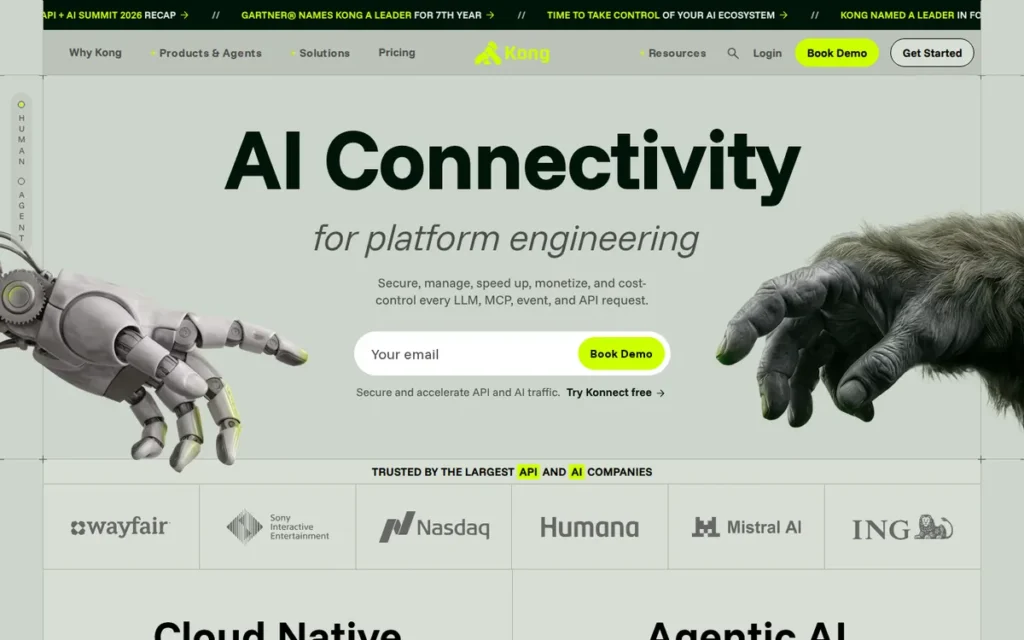
Category: API Gateway + AI Gateway, manages API traffic routing, security policy enforcement, and AI/LLM governance at the infrastructure layer for REST, gRPC, GraphQL, and AI agent workloads.
At a Glance
- Category: API Gateway + AI Gateway
- Best For: Cloud-native engineering teams deploying on Kubernetes who need a single gateway for both traditional API traffic and AI/LLM workloads, especially in multi-cloud or cloud-neutral architectures requiring a vendor-independent platform with an open-source exit option
- Price Range: Free (Kong Gateway OSS, self-managed) / $225/month per gateway (Konnect Plus, includes 1M requests/month, a team running 2 gateways pays $450/month) / Custom (Enterprise); additional requests at $200/million; Dedicated Cloud Gateways add $500/month plus $0.15/GB bandwidth; verify current per-gateway billing structure at konghq.com/pricing (June 2026)
- Primary Strength: Kong Konnect’s AI Gateway: token-based rate limiting, semantic caching, PII sanitization, prompt guardrails, and MCP server proxy support, is the most advanced AI/LLM governance implementation of any platform in this seven-platform evaluation as of June 2026
- Biggest Limitation: Kong Konnect gates the OIDC (OpenID Connect) authentication plugin to enterprise-tier subscriptions, meaning teams that evaluate Kong on the free OSS tier and require OpenID Connect for enterprise SSO will encounter a licensing barrier requiring a paid upgrade before production deployment
- One-Line Summary: Kong Konnect is the leading cloud-native API gateway platform for organizations that need Kubernetes-native deployment, unified governance of REST and AI/LLM API traffic, and a vendor-neutral architecture with a free open-source exit option and a published pricing ladder starting at $225/month per gateway.
- Last Verified: June 2026
Overview
Kong Konnect is a cloud-native API gateway and management platform built for engineering teams running Kubernetes-first infrastructure who need a single control plane for traditional REST, gRPC, and GraphQL traffic alongside AI/LLM workloads, available at $0 for the open-source tier and $225/month per gateway for the Plus tier.
Kong Konnect reached a $1.4 billion valuation at its 2021 Series D and earned 2020 Gartner Magic Quadrant Leader recognition for Full Lifecycle API Management, the most recent publicly confirmed analyst recognition available at research time. Kong Gateway’s open-source repository has accumulated 35,000+ GitHub stars as of June 2026 (per Kong’s public repository at github.com/Kong/kong; verify current count as star totals update continuously).
Kong Konnect’s most significant 2025–2026 development is its fully realized AI Gateway (token-based rate limiting, semantic caching, PII sanitization, prompt guardrails, and MCP server proxy support) making Kong Konnect the only platform in this seven-platform evaluation capable of governing both traditional API traffic and AI agent communications under unified policy management as of June 2026.
Key Features
- Centralized SaaS Control Plane: Kong Konnect provides a single administrative interface managing both cloud-hosted and self-hosted gateway instances across cloud providers, Kubernetes clusters, and on-premises environments, eliminating the need for per-environment management tooling and enabling consistent policy enforcement across heterogeneous deployment scenarios.
- AI Gateway Module: Kong Konnect’s AI Gateway enables token-based rate limiting, semantic caching, PII sanitization, and prompt guardrail enforcement for LLM API traffic, governed through the same declarative plugin framework used for REST and gRPC APIs, eliminating the need for a separate AI-specific gateway product.
- Kubernetes-Native Deployment via KIC: Kong Konnect supports deployment through the Kong Ingress Controller, which provides declarative gateway configuration through Kubernetes-native manifests, with community-validated production performance of under 5ms gateway latency overhead at 10,000+ sessions per pod in real-world retail deployments (r/kubernetes, 2024).
- Multi-Protocol API Support: Kong Konnect natively supports REST, gRPC, GraphQL, and Model Context Protocol (MCP) API styles from a single gateway, enabling diverse API traffic management without deploying separate tooling per protocol type.
- Extensible Plugin Ecosystem: Kong Konnect’s plugin framework covers authentication (OAuth 2.0, JWT, mTLS), traffic management, observability, and AI governance, with the OIDC authentication plugin and WAF plugin available at the enterprise subscription tier only, the platform’s most consequential feature-access limitation for teams evaluating the OSS version.
Best For
Kong Konnect is best for cloud-native engineering teams deploying on Kubernetes who need a single infrastructure platform for both traditional API gateway capabilities and AI/LLM traffic governance, particularly organizations in multi-cloud or cloud-neutral architectures that require a vendor-independent gateway with a published pricing ladder and a credible open-source exit path unavailable from any proprietary competitor in this evaluation.
Strengths
- Kong Konnect earned 2020 Gartner Magic Quadrant Leader recognition for Full Lifecycle API Management, and Kong Gateway’s open-source repository has accumulated 35,000+ GitHub stars as of June 2026 (per Kong’s public GitHub repository at github.com/Kong/kong) (the highest community adoption signal of any open-source gateway in this evaluation) confirming both enterprise-analyst validation and sustained bottom-up developer adoption simultaneously.
This long-term adoption is reflected in practitioner accounts on r/kubernetes:
“I have been working with Kong for the past 2 years. Mostly the Konnect solution and can recommend it. Very easy to setup and the only issues we had were because of a lack of features that happened in the past. KIC is a good option if you are already deploying your application in a Kubernetes environment. Some plugins are not available in the free version, but imo it is pretty complete if you want to use it. Also gRPC and GraphQL APIs are supported” Posted by u/dmaxterpt
Takeaway: Long-term Kong Konnect users report a platform that has matured substantially in production, with genuine multi-protocol depth, though the plugin gating limitation surfaces as a real planning constraint even for satisfied practitioners.
- Kong Konnect’s AI Gateway (released 2024–2025) delivers token-based rate limiting, semantic caching, PII sanitization, prompt guardrails, and MCP server proxy support, independently analyzed by TrueFoundry’s 2026 Kong Gateway architecture review as the leading AI API governance implementation, making Kong Konnect the most advanced platform in this seven-platform comparison for teams managing LLM and AI agent workloads as of June 2026.
- Kong Gateway production deployments have been validated at 10,000+ sessions per pod with under 5ms latency overhead, reported by a practitioner deploying Kong for a large retail client handling both online and in-store traffic (r/kubernetes, 2024), one of the only independently sourced, practitioner-validated gateway latency benchmarks available for any platform in this evaluation; comparable independent benchmarks for Azure API Management and Google Cloud Apigee were not publicly available at research time and should be requested via proof-of-concept deployment.
- Kong Konnect’s open-source Kong Gateway core enables organizations to self-host the OSS version without licensing fees, eliminating the proprietary lock-in documented with MuleSoft Anypoint Platform (DataWeave rewrite requirements), Google Cloud Apigee (GCP control-plane dependency), and Azure API Management (Azure ecosystem dependency), the only vendor-neutral exit option of any enterprise-capable gateway platform in this evaluation.
Limitations
- Enterprise Plugin Gating (OIDC): Kong Konnect restricts the OIDC (OpenID Connect) authentication plugin to enterprise-tier subscriptions only, meaning teams that evaluate Kong on the free OSS version and require OpenID Connect for production enterprise SSO will encounter a licensing barrier requiring a paid tier upgrade before production deployment, a planning constraint that should be confirmed against enterprise tier requirements before any OSS evaluation begins.
- Usage-Based Overage Pricing at Volume: Kong Konnect’s Plus tier charges $200 per additional million API requests beyond the 1M monthly inclusion, making total cost difficult to predict for organizations with variable or high API traffic, an organization processing 50 million requests per month would incur approximately $9,800/month in Plus-tier overage alone, fundamentally changing the cost profile from the $225/month per-gateway entry price (api7.ai Kong Konnect pricing analysis, 2026).
- Open-Source Competitive Pressure on Plugin Pricing: Kong Konnect faces direct plugin pricing competition from Apache APISIX, a gateway project that offers many Kong Konnect paid plugins at no cost under more permissive open-source licensing, a current Kong user in r/kubernetes stated active desire to migrate because “most of Kong’s paid plugins are free there,” a competitive dynamic that teams sensitive to per-plugin licensing costs should evaluate against Apache APISIX’s plugin catalog before committing.
- Configuration Investment for Non-Kubernetes Teams: Kong Konnect’s Kubernetes-native architecture and declarative plugin-based configuration model offer significant operational flexibility, but organizations migrating from simpler managed services will encounter a meaningful initial configuration investment before reaching production-grade governance at scale, a startup cost that should be factored into time-to-value calculations for teams without existing Kubernetes expertise.
Verdict
Kong Konnect is the strongest all-around API gateway platform in this 2026 evaluation, uniquely combining a production-ready AI/LLM governance feature set, a published $225/month per-gateway Plus entry point, Kubernetes-native deployment with practitioner-validated sub-5ms latency, and a vendor-neutral open-source core that no proprietary competitor in this evaluation can replicate. Engineering teams building cloud-native architectures (especially those managing AI agent or LLM API traffic alongside traditional REST workloads) will find Kong Konnect the most defensible long-term infrastructure investment in this comparison. The OIDC enterprise-only limitation and the usage-based overage structure at high request volumes are the two most important factors to model before finalizing a tier selection.
2. Postman: Best for Developer Adoption: API Testing, Documentation, and Team Collaboration
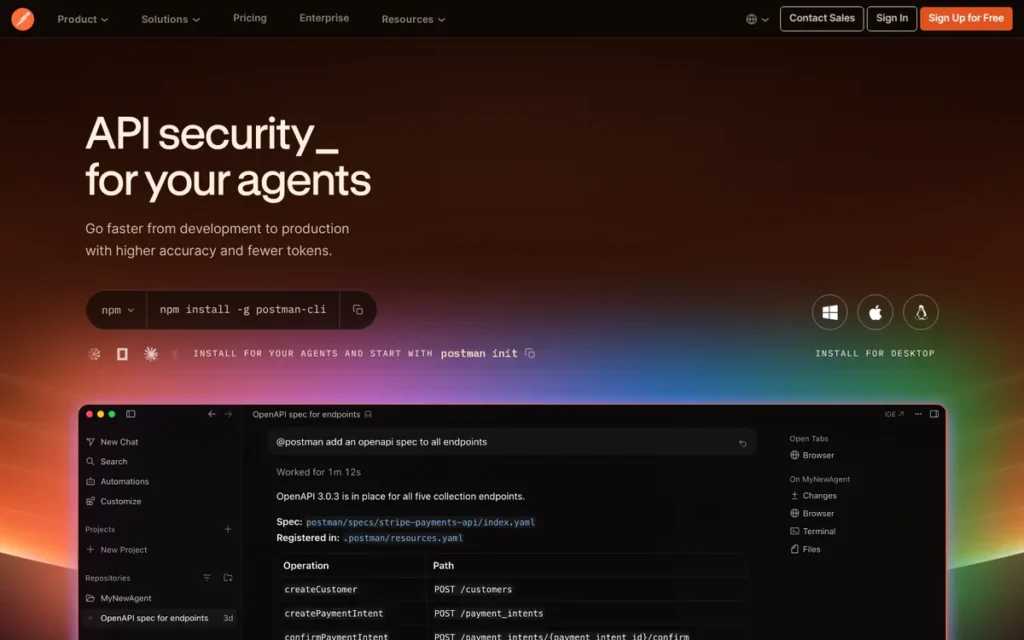
Category: API Lifecycle Workspace, unified environment for API design, testing, documentation, mocking, monitoring, and team collaboration; does not include a production API gateway or traffic management layer.
At a Glance
- Category: API Lifecycle Workspace
- Best For: Developer teams of all sizes needing a collaborative environment for API testing, documentation, and workflow coordination, not a production API gateway or enterprise traffic management platform
- Price Range: Free (personal use and basic team features) / $12/user/month (Basic, billed annually) / $29/user/month (Professional, billed annually) / Custom (Enterprise, contact sales); all prices verified June 2026 at postman.com/pricing
- Primary Strength: Postman holds 1,775 verified G2 reviews at 4.6/5 stars as of June 2026 (the highest review volume of any API platform in this evaluation) reflecting the broadest developer community adoption in the category
- Biggest Limitation: Postman is a developer testing and collaboration workspace, not an API gateway, teams that adopt it as their primary API infrastructure decision remain without production traffic routing, rate limiting, and security policy enforcement and must deploy a separate gateway to complete any production architecture
- One-Line Summary: Postman is the most widely adopted API development workspace, with 1,775 verified G2 reviews at 4.6/5 stars and a reported 30 million registered developers, best suited for teams needing collaborative API testing and documentation rather than a production gateway or enterprise management solution.
- Last Verified: June 2026
Overview
Postman is a workflow-first API development platform serving a reported 30 million registered developers across API design, testing, documentation, mocking, monitoring, and team collaboration, available at Free, $12/user/month (Basic), and $29/user/month (Professional), with the most transparent published per-user pricing structure of any platform in this evaluation (Postman’s official platform page, postman.com/api-platform, June 2026; one independent source, Tekpon, estimates approximately 15 million active users, reflecting a likely difference between registered accounts and active users).
Postman was founded in 2014 by Abhinav Asthana, Ankit Sobti, and Abhijit Kane and holds a G2 rating of 4.6/5 across 1,775 verified reviews as of June 2026, the highest review volume of any API platform in this evaluation. Postman has raised a reported $433 million in total funding from investors including Insight Partners, Coatue, and Battery Ventures (per third-party comparison data; verify against Crunchbase before use in procurement documents).
Postman’s most critical category distinction for platform evaluators is that Postman governs the developer workflow around APIs rather than the production API traffic itself, teams building production API infrastructure require a complementary gateway platform alongside Postman’s collaboration workspace.
Key Features
- Collaborative API Workspaces: Postman provides team-based workspaces for authoring, sharing, and versioning API collections (including OpenAPI spec import, request building, environment variable management, and workspace-level access controls) enabling team coordination without requiring Git-native file management.
- Automated Testing via Newman CLI: Postman enables JavaScript-based pre-request and post-response scripting, multi-step test suite construction, and CI/CD pipeline integration via the Newman CLI runner for automated API validation in development workflows.
- Mock Server Generation: Postman generates working API endpoints from API specifications before backend implementation exists, enabling frontend and consumer teams to develop against realistic API contracts from the earliest stages of a project, without waiting for backend availability.
- 2025 AI-Ready Workflow Enhancements: Postman’s 2025 platform updates introduced AI-ready workflows, interactive API notebooks, multiscript support, on-demand monitors, and early-access integrations with AI developer platforms including ReadMe, Pint, and Stainless, as documented by HelpNetSecurity (November 2025).
- Public API Network: Postman maintains an API network of over 75,000 public collections covering major third-party services, per Postman’s API platform page (postman.com/api-platform, June 2026), giving teams immediate access to pre-built request libraries without building from scratch for common API integrations.
Best For
Postman is best for developer teams that need a polished, widely supported environment for manual API exploration, test authoring, documentation generation, and cross-team API collaboration, particularly in organizations where engineers are already using Postman for individual development and want to standardize on a shared platform with team workspaces, collection versioning, and CI/CD integration via Newman.
Strengths
- Postman holds a G2 rating of 4.6/5 stars across 1,775 verified reviews as of June 2026 (the highest review volume of any API platform in this seven-platform evaluation) reflecting the platform’s breadth of real-world adoption across developer segments from individual contributors to enterprise engineering teams, per G2’s seller page for Postman.
- Postman reports a developer community of 30 million registered users (postman.com/api-platform, June 2026), the largest self-reported developer base in the API tooling market, generating a network of shared public API collections, integrations with 50+ partner tools, and community workflow templates that reduce time-to-first-value for new users to minutes rather than days (note: one independent source, Tekpon, estimates approximately 15 million active users).
- Postman’s 2025 platform enhancements: AI-ready workflows, interactive API notebooks, and integrations with AI developer platforms including ReadMe and Stainless, confirm ongoing product investment in AI-era API development patterns, as reported by HelpNetSecurity (November 2025).
Limitations
- Categorical Gap: No API Gateway: Postman’s most consequential trade-off is categorical, Postman does not include an API gateway or production traffic management layer, and teams that adopt it as their primary API infrastructure decision remain without production routing, rate limiting, or security policy enforcement, requiring a separate gateway platform to complete any production architecture.
In response to questions about Postman’s collaboration model, a user on r/postman_api shared why their team ultimately moved on:
“I know. But before that we had everything in the postman cloud and we were very happy with it. But now as Postman changed their free tier to just one person (we are a team of 3) we cannot use it anymore. I know we could just pay for it but our company does not want that as we would primarily pay for all the features of Postman we don’t use. Postman has become a platform instead of just an API testing tool but we just need an API testing tool. They seem to have lost the goal of what probably most developers want. I know all the developing and new features in Postman cost money so its absolutely logical to put a price tag on it but our company simply don’t want to spend money on something were essential features get stripped away slowly to force everyone to pay at some point. Thats why we use Bruno now. It does everything we want (and only that) and its free. We even think about donating to the Bruno project as we don’t just want everything for free.” Posted by u/Dangerous_Tangelo_74
Takeaway: Postman’s evolution from a focused API testing tool into a full collaboration platform is directly driving developer attrition among teams that require only core API testing functionality, confirming the categorical gap this evaluation identifies as Postman’s most consequential strategic trade-off.
- Automation Ceiling in Enterprise CI/CD Pipelines: Postman’s JavaScript-based testing model is treated by professional engineering teams as a prototyping tool rather than a production CI/CD automation framework, a 69-upvote community response in r/QualityAssurance (2024) states directly that “Postman is used for manual testing and Playwright for automation,” establishing that sophisticated QA teams use code-native frameworks like Playwright or RestAssured for production pipelines.
- SaaS Data Residency Barrier: Postman’s cloud-hosted collaboration model stores API collections and workspace data in Postman’s SaaS infrastructure, creating a data residency barrier for security-sensitive enterprises in regulated industries requiring on-premises or air-gapped API tooling, a limitation that is driving adoption of local-first alternatives like Bruno among privacy-conscious developer teams.
- Collection Versioning Friction at Team Scale: Postman’s collection versioning model requires manual team coordination to ensure all members are working against the same collection version, a friction point that compounds at large team sizes and creates test suite divergence risk absent from Git-native alternatives like Bruno, a limitation cited in API tooling comparison research.
Verdict
Postman is the most broadly adopted API development workspace in this 2026 evaluation, backed by the strongest community validation metrics, 1,775 G2 reviews at 4.6/5 and a reported 30 million registered developers, and the most transparent published per-user pricing available for its category. Engineering teams building API development workflows will find Postman the lowest-friction starting point, with the richest ecosystem of templates, integrations, and public collections of any tool in this comparison. The critical planning decision Postman requires is categorical clarity: Postman is a developer workspace, not a gateway or management platform, and organizations serious about production API governance must deploy a separate infrastructure platform alongside Postman’s workflow tooling.
3. Microsoft Azure API Management: Best for Azure-Committed Enterprises: Full API Management with Published Pricing at Every Tier
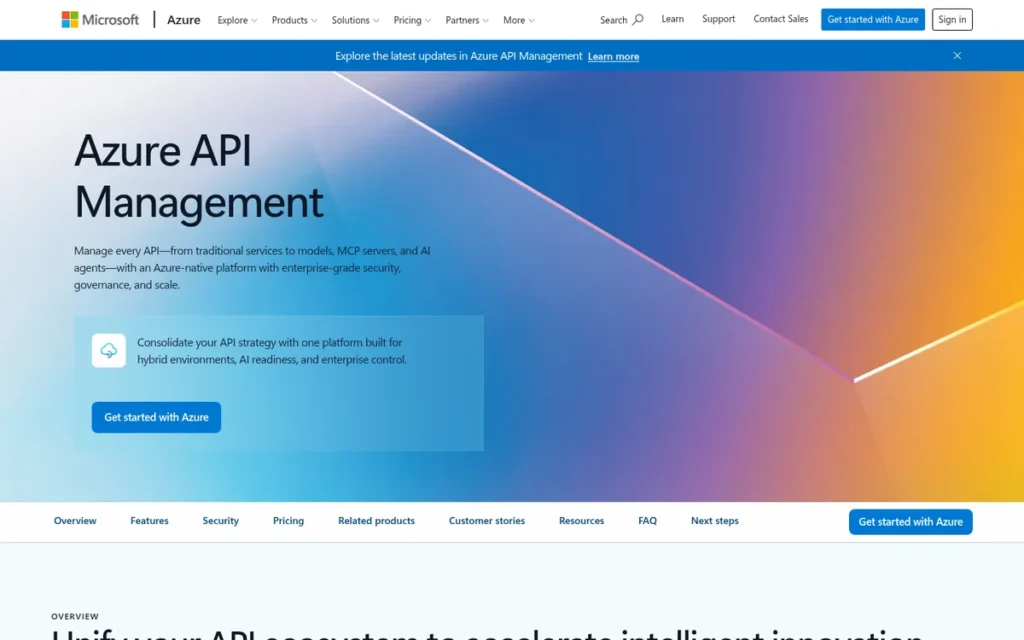
Category: Managed API Gateway, cloud-hosted API management platform providing traffic routing, security policy enforcement, developer portal, and analytics for organizations standardized on Microsoft Azure.
At a Glance
- Category: Managed API Gateway
- Best For: Enterprises standardized on Microsoft Azure and Azure Active Directory needing full API management with exact published pricing and native Azure ecosystem integration at every tier
- Price Range: Approximately $48.63/month (Developer v1: no SLA, dev/test only) / approximately $150.01/month (Basic v2) / approximately $700/month (Standard v2) / approximately $2,801.64/month (Premium); Note: Microsoft introduced v2 tiers in 2025–2026, verify the currently active tier and exact amounts at azure.microsoft.com/pricing/details/api-management/ before any budget commitment (June 2026)
- Primary Strength: Azure API Management publishes exact monthly pricing at every tier without sales engagement (the most pricing-transparent full API management platform in this seven-platform evaluation) enabling Microsoft-ecosystem organizations to build accurate procurement budgets before entering any vendor conversation
- Biggest Limitation: Azure API Management requires the Premium tier (approximately $2,801.64/month) for VNet integration and private endpoint connectivity, a 4x jump from Standard v2 that organizations encounter when compliance mandates private API networking after initial procurement
- One-Line Summary: Azure API Management is Microsoft’s fully managed API gateway with published pricing from approximately $48.63 to $2,801.64/month per unit, deep native Azure Active Directory and Azure Monitor integration, and a declarative XML policy engine, the strongest choice for Azure-committed enterprises and a poor fit for multi-cloud architectures.
- Last Verified: June 2026
Overview
Azure API Management is Microsoft’s fully managed API gateway, developer portal, and policy engine for organizations standardized on Microsoft Azure, publishing exact monthly pricing per unit without requiring sales engagement. Note: Microsoft introduced v2 tiers in 2025–2026 with updated pricing (approximately $150.01/month Basic v2, $700/month Standard v2), verify the currently active tier for new deployments at azure.microsoft.com/pricing/details/api-management/ before any budget commitment.
Azure API Management delivers a gateway for traffic routing and throttling, a developer portal for interactive documentation and subscription management, a declarative XML policy engine for request and response transformation without backend code changes, and native integration with Azure Active Directory, Azure Monitor, Azure Key Vault, and Azure Functions.
Azure API Management’s most important architectural constraint for platform evaluators is its Azure ecosystem optimization: the platform’s compounding value is directly tied to Microsoft infrastructure investment, and organizations outside the Azure ecosystem will find a cloud-neutral gateway like Kong Konnect more architecturally defensible for multi-cloud scenarios.
Key Features
- Declarative XML Policy Engine: Azure API Management’s XML policy engine enables teams to configure authentication, throttling, caching, request/response transformation, and header manipulation at the gateway layer without modifying backend API code, supporting complex scenarios including XML-to-JSON conversion, multi-backend API consolidation, and authentication token management, validated by r/AZURE practitioners as the platform’s highest-value capability.
- Native Azure Identity Integration: Azure API Management integrates with Azure Active Directory and Azure Entra ID for OAuth 2.0 and OpenID Connect authentication, enabling organizations with Microsoft identity infrastructure to apply consistent authentication policies across all APIs without additional identity provider configuration.
- Self-Hosted Gateway Option: Azure API Management provides a self-hosted gateway enabling the runtime to operate in on-premises data centers, other cloud providers, or edge environments while the management control plane remains centrally hosted in Azure, available on Standard and Premium tiers per Microsoft Azure APIM documentation.
- Developer Portal with Self-Service Subscription Management: Azure API Management generates a customizable, auto-populated documentation and subscription portal where developers can discover APIs, test them interactively, and request access through a self-service workflow without manual publisher intervention.
- Azure Monitor Integration for Unified Observability: Azure API Management integrates natively with Azure Monitor for API traffic analytics, request logging, and performance monitoring, providing a unified observability experience for teams already standardized on Azure Monitor as their cloud operations platform.
Best For
Azure API Management is best for enterprises standardized on Microsoft Azure that use Azure Active Directory or Azure Entra ID as their primary identity provider, where Azure API Management’s native ecosystem integration removes the authentication and observability configuration complexity that independent gateways would require teams to implement and maintain as separate, non-native integrations.
Strengths
- Azure API Management is the only full API management platform in this seven-platform evaluation to publish exact monthly pricing at every tier without sales engagement, Developer v1 at approximately $48.63/month (development and testing only, no production SLA), Basic v2 at approximately $150.01/month, Standard v2 at approximately $700/month, Premium at approximately $2,801.64/month per unit, enabling Microsoft-ecosystem organizations to build accurate procurement budgets before entering any vendor negotiation, as documented at Microsoft’s Azure API Management pricing page (June 2026).
- Azure API Management’s native integration with Azure Active Directory, Azure Monitor, Azure Key Vault, and Azure Functions is a community-validated advantage cited by r/AZURE practitioners as the primary reason organizations choose it over cloud-neutral alternatives, specifically praising its ability to serve as “a single point of entry controlling access to multiple APIs” in Azure-native environments.
- Azure API Management’s self-hosted gateway enables hybrid and multi-cloud deployment where the runtime operates outside Azure while management stays in the Azure control plane, available at the Standard v2 tier without requiring the Premium upgrade per Microsoft Azure APIM documentation, giving organizations a hybrid option without the full Premium cost burden.
Limitations
- Azure Ecosystem Dependency: Azure API Management’s most consequential trade-off is Azure lock-in, the platform’s primary strengths (native Azure AD authentication, Azure Monitor integration, Azure Key Vault secret management) only compound in value for organizations fully committed to Microsoft Azure, and teams evaluating Azure API Management for multi-cloud environments will find they are paying premium pricing for capabilities more portably implemented with a cloud-neutral gateway like Kong Konnect.
- Standard-to-Premium Pricing Cliff for Private Networking: Azure API Management’s jump from Standard v2 (approximately $700/month) to Premium (approximately $2,801.64/month) (a 4x cost increase) is a documented procurement risk: VNet integration for connecting Azure API Management to private Azure services is a Premium-tier-only feature, and organizations whose compliance requirements mandate private networking encounter this cost barrier after initial procurement rather than at the budget-setting stage, a pattern confirmed by r/AZURE community discussions.
- Developer Portal Customization Ceiling: Azure API Management’s developer portal has documented customization limits compared to Google Cloud Apigee’s more mature portal capabilities, organizations building external API programs requiring highly customized developer onboarding experiences may find Azure API Management’s portal scaffolding insufficient without significant custom development investment beyond what the default templates support.
- Over-Engineering Risk for Undifferentiated Workloads: Senior architects in enterprise Azure environments sometimes mandate Azure API Management for all API traffic regardless of whether it provides genuine governance value, a “security theater” pattern identified by r/AZURE practitioners that inflates costs without proportional benefit, and a specific risk that technology leads should evaluate before accepting organization-wide Azure API Management mandates.
This feature-bundling mismatch was described directly by a practitioner on r/sre:
“Apim standard tier is killing us. All our apis are internal, we dont need the dev portal, dont need their analytics bc we have app insights, dont need half the enterprise features bundled in. We just want auth, rate limiting, routing, monitoring on azure infra without the apim price tag. Looking at running something on aks. We are checking out Kong, Gravitee and Tyk but not sure yet. Anyone moved off apim to something third party on azure? Main concern is keeping azure ad working for auth.” Posted by u/jirachi_2000
Takeaway: Azure API Management’s bundled developer portal and analytics inflate costs for internal API programs that require only gateway primitives, a structural pricing mismatch that pushes internal-API-only teams toward lighter self-hosted alternatives on AKS.
Verdict
Azure API Management is the strongest API management platform for enterprises committed to Microsoft Azure, offering the most precisely published pricing of any full management platform in this evaluation and native Azure AD, Monitor, and Key Vault integration that materially reduces operational overhead for Microsoft-aligned teams. Organizations outside the Microsoft ecosystem should evaluate Azure API Management only for Azure-specific workloads, the platform’s value compounds with Azure commitment and diminishes significantly in multi-cloud environments. The approximately $2,801.64/month Premium tier requirement for VNet private networking is the single most important financial disclosure any Azure API Management evaluation must address before procurement commitment.
4. Google Cloud Apigee: Best for GCP-Committed Enterprises: Most Mature Full Lifecycle API Management with AI Agent Governance
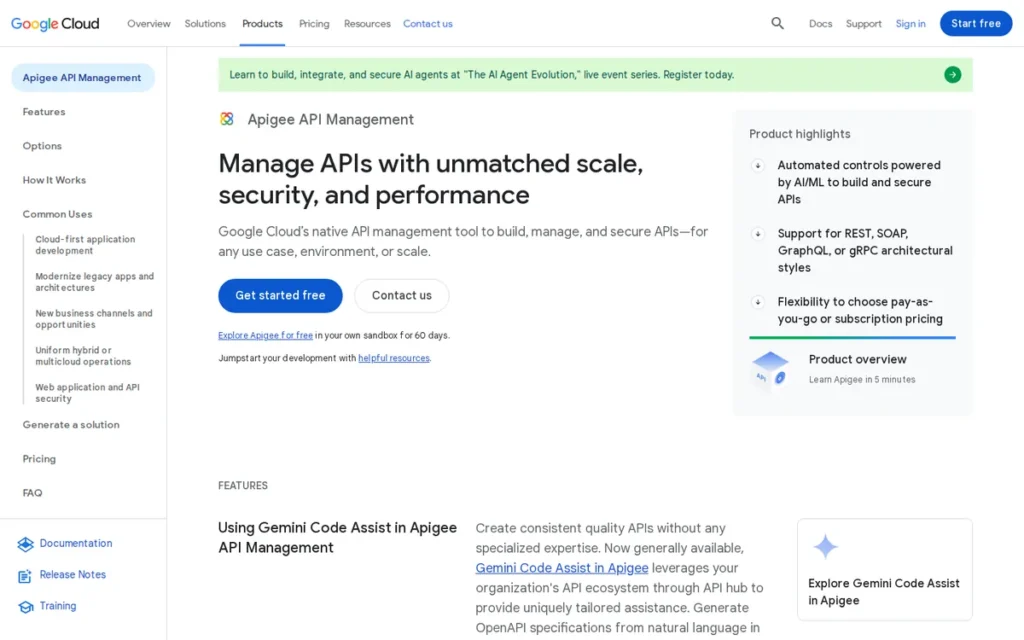
Category: Full Lifecycle Manager, enterprise platform covering the complete API lifecycle from proxy configuration through developer portal, traffic governance, analytics, monetization, and AI agent governance via Model Context Protocol.
At a Glance
- Category: Full Lifecycle Manager
- Best For: GCP-committed large enterprises running complex, high-scale API programs requiring full lifecycle governance including developer portal, API monetization, hybrid deployment, and governance of AI agent traffic via Model Context Protocol
- Price Range: Free (Evaluation tier) / Pay-as-you-go (consumption-based per-environment and per-API-call via GCP console) / Custom subscription (enterprise annual contracts); Premium VPC connectivity approximately $3,000/month per instance, community-reported; not published on Google’s pricing page; verify directly with Google Cloud sales before architecture planning; see cloud.google.com/apigee/pricing (June 2026)
- Primary Strength: Google Cloud Apigee is the most feature-complete enterprise API lifecycle platform in this evaluation, with over 20 years of market heritage, historical Gartner Magic Quadrant Leader recognition, and 2025 Model Context Protocol support in API Hub for AI agent governance, the only platform in this evaluation governing both REST APIs and AI agent communications from a single control plane
- Biggest Limitation: Apigee’s GCP-hosted control plane creates deep vendor dependency for multi-cloud organizations, and the approximately $3,000/month per-instance Premium VPC cost for private connectivity is typically not surfaced until detailed infrastructure architecture planning, after initial procurement
- One-Line Summary: Google Cloud Apigee is the most mature enterprise full-lifecycle API management platform (with 20+ years of heritage, historical Gartner Magic Quadrant Leader recognition, and 2025 Model Context Protocol support for AI agent governance) best suited for GCP-committed enterprises running complex API programs from design through monetization.
- Last Verified: June 2026
Overview
Google Cloud Apigee is an enterprise full lifecycle API management platform with over 20 years of market heritage, founded as Apigee Corp. in 2004, acquired by Google in 2016 for $625 million, providing API proxy management, developer portal, analytics, monetization, hybrid deployment, and centralized security governance for organizations running large-scale API programs requiring management depth beyond what a pure API gateway provides.
Google Cloud Apigee has received Gartner Magic Quadrant Leader recognition for Full Lifecycle API Management in historical publications and counts Walgreens, AT&T, Bechtel, Burberry, First Data, and Live Nation among its documented named enterprise customers, reflecting deployment strength in regulated, high-transaction industries.
Google Cloud Apigee’s most strategically significant 2025 development is its API Hub support for Model Context Protocol as a first-class API style, confirmed by Google Cloud Apigee release notes (April 2025), making Google Cloud Apigee the first enterprise API management platform to provide native governance infrastructure for AI agent communications alongside traditional REST and gRPC APIs. Pricing requires GCP console access or Google sales engagement; unlike Kong Konnect or Azure API Management, Google Cloud Apigee does not publish a simple public tier table with exact monthly costs.
Key Features
- API Proxy Management: Google Cloud Apigee’s API proxy model enables teams to create, deploy, and manage proxies that abstract backend implementations, applying traffic management, authentication, rate limiting, and response transformation at the API layer without modifying backend services, supporting both REST and legacy SOAP backend consolidation under unified governance.
- Model Context Protocol Support in API Hub: Google Cloud Apigee’s API Hub supports MCP as a first-class API style as of April 2025, enabling organizations to catalog, govern, and manage AI agent communications in the same governance framework used for REST and gRPC APIs, as confirmed by Google Cloud Apigee release notes (April 2025).
- Three Deployment Architectures: Google Cloud Apigee supports Apigee X (fully GCP-managed), Apigee Hybrid (Google-managed control plane with customer-run runtime), and legacy Apigee Edge, providing deployment flexibility for organizations with hybrid or multi-environment infrastructure requirements, though the Edge-to-Apigee X migration path introduces operational complexity for long-term customers.
- Developer Portal and API Monetization: Google Cloud Apigee’s developer portal provides a customizable API marketplace where internal and external developers can discover APIs, subscribe to usage plans, and manage API keys, supporting full monetization workflows including subscription billing and quota management unavailable in gateway-only platforms.
- APIM Operator for Apigee (GA 2025): Google Cloud Apigee’s APIM Operator reached General Availability in 2025, confirmed by the Google Developers Blog (April 2025), enabling lightweight Kubernetes-native Apigee deployment on GKE with a traffic extension model, reducing the operational complexity of running Apigee Hybrid for GCP-native engineering teams.
Best For
Google Cloud Apigee is best for large enterprises committed to Google Cloud Platform that need a mature, full-lifecycle API management platform with developer portal, API monetization, hybrid deployment, and governance of both traditional API traffic and emerging AI agent communications via Model Context Protocol, particularly in regulated industries where Apigee’s 20-year heritage and documented enterprise customer base provide procurement credibility with business and compliance stakeholders.
Strengths
- Google Cloud Apigee has received Gartner Magic Quadrant Leader recognition for Full Lifecycle API Management in historical publications, a validation predating and corroborating Google’s $625 million acquisition of Apigee Corp. in 2016, with named enterprise customers including Walgreens, AT&T, Bechtel, Burberry, First Data, and Live Nation across regulated, high-transaction industries.
- Google Cloud Apigee’s April 2025 release added Model Context Protocol as a first-class API style in API Hub, confirmed by Google Cloud Apigee release notes (April 2025), making Google Cloud Apigee the first enterprise API management platform to natively govern AI agent communications through the same governance infrastructure used for REST and gRPC APIs, positioning Apigee uniquely for enterprises building AI-native application architectures.
- Google Cloud Apigee’s APIM Operator reached General Availability in 2025: confirmed by the Google Developers Blog (April 2025), enabling lightweight Kubernetes-native Apigee deployment on GKE and reducing the operational complexity of running Apigee Hybrid for GCP-native engineering teams without full Hybrid infrastructure investment.
Limitations
- Deep GCP Vendor Dependency: Google Cloud Apigee’s most consequential trade-off is its GCP-hosted control plane requirement, creating a vendor lock-in dynamic comparable to Azure API Management’s Microsoft ecosystem dependency, but scoped to a cloud provider with a smaller enterprise market share than Azure or AWS, making Apigee’s cloud-native advantages narrowly applicable to organizations already committed to Google Cloud Platform.
- Pricing Opacity and Hidden VPC Cost: Google Cloud Apigee requires GCP console access or Google sales engagement to surface actual costs (unlike Azure API Management’s published price ladder) and the approximately $3,000/month per-instance cost for Premium VPC private networking connectivity is not published on Google’s pricing page, a factor practitioners report discovering late in architecture planning rather than during initial budget-setting (community-reported via r/AZURE, June 2026).
- Edge-to-Apigee X Migration Burden: Google Cloud Apigee’s Edge-to-Apigee X migration path requires re-authoring proxy configurations in a new format (a task that Google’s migration tooling has not fully automated as of June 2026, per community reports) making existing Apigee Edge deployments a hidden ongoing technical debt for organizations that have deferred the migration, described by community members as time-consuming and frequently postponed.
- Steep Governance Learning Curve: Google Cloud Apigee’s proxy policy configuration and governance model requires specialized expertise in Apigee-specific proxy design patterns before production-grade governance is achievable, a friction factor that affects time-to-value calculations for organizations without existing Apigee expertise on staff, and a startup cost that distinguishes Apigee from simpler gateway platforms for straightforward use cases.
Verdict
Google Cloud Apigee is the most feature-complete enterprise API lifecycle management platform in this 2026 evaluation, the only platform with full lifecycle governance from design through monetization, the most mature developer portal capabilities, and the first enterprise platform to support Model Context Protocol for AI agent governance. GCP-committed enterprises running complex, high-scale API programs will find Google Cloud Apigee’s depth unmatched in this comparison. The platform selection decision is ecosystem-driven: organizations committed to GCP will find Apigee’s native integration and lifecycle depth compelling; organizations outside GCP should evaluate Kong Konnect’s cloud-neutral architecture and published pricing ladder as a more defensible long-term infrastructure investment.
5. SwaggerHub: Best for Multi-Protocol API Design and Governance: REST, AsyncAPI 3.0, and GraphQL from One Workspace
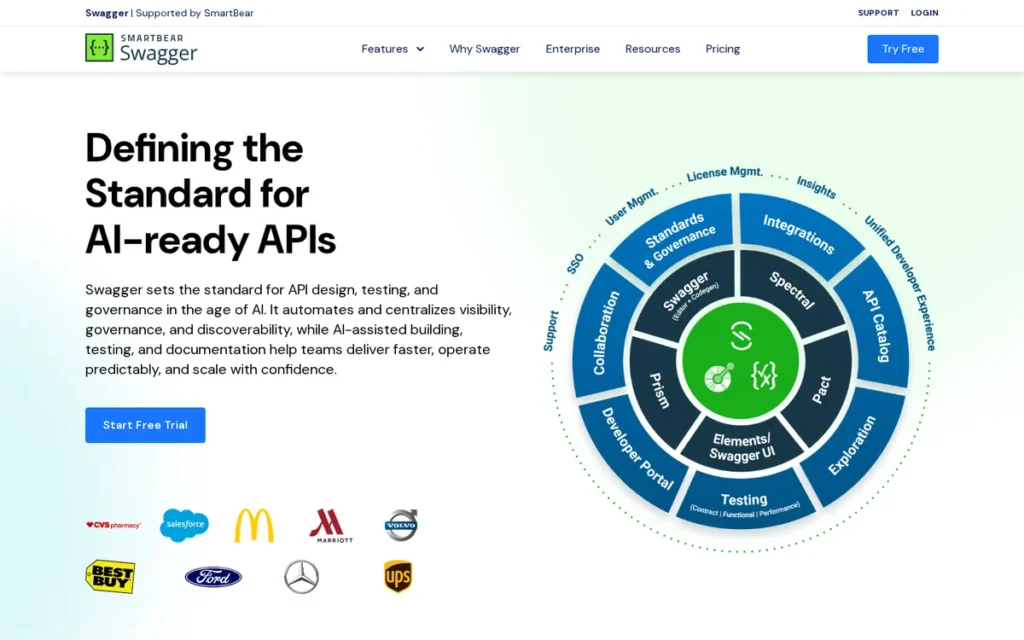
Category: API Design and Governance, collaborative platform for authoring, validating, and enforcing API specifications across OpenAPI (REST), AsyncAPI (event-driven), and GraphQL styles; does not include a production API gateway or traffic management layer.
At a Glance
- Category: API Design and Governance
- Best For: Teams governing REST, AsyncAPI 3.0 event-driven, and GraphQL APIs from one collaborative SaaS workspace, particularly organizations in the OpenAPI and Swagger ecosystem that can accept SaaS delivery for specification management
- Price Range: Free tier (anchored in open-source Swagger Editor) / paid Team and Enterprise tiers, exact per-seat pricing requires direct SmartBear sales inquiry as mid-tier pricing was not publicly surfaced in June 2026 research; verify at swagger.io/tools/swaggerhub/pricing/
- Primary Strength: SwaggerHub is the only platform in this seven-platform evaluation (as of June 2026) enforcing governance rules across REST (OpenAPI 2.0/3.0/3.1), AsyncAPI 3.0 event-driven, and GraphQL API styles from a single workspace, a 2025 capability expansion confirmed by DevOpsDigest (2025)
- Biggest Limitation: SwaggerHub’s SaaS-only deployment model: no self-hosted option, blocks adoption in regulated industries requiring on-premises API specification management; mid-tier pricing opacity further requires buyer inquiry rather than self-service cost discovery
- One-Line Summary: SwaggerHub is SmartBear’s commercial multi-protocol API design and governance platform, the only platform in this seven-platform evaluation governing REST, AsyncAPI 3.0, and GraphQL from a single workspace, best suited for teams managing heterogeneous API portfolios who can accept SaaS delivery for their specification management tooling.
- Last Verified: June 2026
Overview
SwaggerHub is SmartBear’s commercial API design and governance platform built on the Swagger and OpenAPI ecosystem (the most widely used API specification standard) providing collaborative specification authoring, API style guide enforcement, integrated mocking, and hosted documentation for teams adopting API-first development across multiple protocol styles.
SwaggerHub’s most significant 2025 capability expansion added AsyncAPI 3.0 and GraphQL support to its governance engine, confirmed by DevOpsDigest’s 2025 SmartBear capabilities coverage, making SwaggerHub the only platform in this seven-platform evaluation capable of enforcing API style rules across REST, event-driven, and query-language APIs from a single unified workspace as of June 2026.
SwaggerHub is positioned by SmartBear as the collaborative foundation within its broader API Hub strategy, actively absorbing Stoplight’s visual design, mocking, and governance capabilities, a convergence representing ongoing product investment while introducing near-term buyer complexity for teams selecting between SwaggerHub and API Hub for a multi-year design governance commitment. SwaggerHub’s paid Team and Enterprise tier pricing was not publicly surfaced in June 2026 research, requiring direct SmartBear sales inquiry, a buyer autonomy limitation parallel to the pricing opacity risk flagged for MuleSoft Anypoint Platform and Google Cloud Apigee in this evaluation.
Key Features
- Collaborative Browser-Based OpenAPI Editor: SwaggerHub provides real-time co-editing, specification validation against OpenAPI 2.0, 3.0, and 3.1 standards, and team-level access controls, enabling distributed API teams to design specifications collaboratively without local file management or Git-native workflows.
- Multi-Protocol Governance Expansion (2025): SwaggerHub extended its governance support in 2025 to include AsyncAPI 3.0 for event-driven APIs (Kafka, AMQP, WebSockets) and GraphQL, enabling consistent governance rules across REST, event-driven, and query-language API styles from a single platform, as confirmed by DevOpsDigest (2025).
- API Style Guide Enforcement: SwaggerHub’s style guide engine enables teams to define and enforce naming conventions, structural requirements, and security patterns, flagging violations inline during specification authoring before they propagate to downstream consumers or development teams, reducing rework cost at the design phase.
- Auto-Generated Hosted Documentation: SwaggerHub generates hosted interactive API documentation automatically from OpenAPI specifications using Swagger UI, providing a developer-facing portal that updates in real time as specifications are modified without requiring a separate documentation workflow.
- SmartBear API Hub Convergence Roadmap: SwaggerHub’s upcoming feature roadmap includes SmartBear’s active integration of Stoplight’s visual form-based API design, mock server capabilities, and governance workflows, confirmed by SmartBear API Evangelist Yousaf Nabi in October 2025 on r/devops, providing users a more connected end-to-end API lifecycle experience as the integration matures.
Best For
SwaggerHub is best for API-first development teams managing both REST APIs and event-driven or GraphQL APIs who need a collaborative SaaS workspace for specification authoring, multi-protocol governance enforcement, and documentation, particularly organizations in the OpenAPI and Swagger ecosystem that can accept SaaS delivery and want a single governance tool rather than separate per-API-type tooling.
Strengths
- SwaggerHub expanded its governance capabilities in 2025 to include AsyncAPI 3.0 and GraphQL support, confirmed by DevOpsDigest (2025), making SwaggerHub the only platform in this seven-platform evaluation enforcing API style rules across REST, event-driven, and query-language API styles from a single workspace as of June 2026, a directly relevant capability for enterprises managing heterogeneous API portfolios.
- SwaggerHub is explicitly recommended by r/devops practitioners (October 2025) as the top migration destination for teams leaving Stoplight, specifically praised for its “smooth editor and collaboration” experience, a practitioner-sourced UX quality validation from a technically sophisticated community evaluating design tool alternatives under real migration conditions.
- SmartBear’s API Hub convergence strategy: confirmed by SmartBear API Evangelist Yousaf Nabi in October 2025 on r/devops as actively absorbing Stoplight’s capabilities into the SwaggerHub and API Hub product family, represents documented ongoing product investment providing buyers confidence that SmartBear is actively building rather than harvesting the SwaggerHub product line.
Limitations
- SaaS-Only Deployment Barrier: SwaggerHub’s most consequential trade-off is its SaaS-only delivery model, unlike Stoplight, which supports Git sync with API specs stored in team-controlled repositories, SwaggerHub requires storing API specifications in SmartBear’s cloud infrastructure with no self-hosted option, creating a data residency barrier for regulated industries where API contract data must remain on-premises or within a private cloud.
- Mid-Tier Pricing Opacity: SwaggerHub’s paid Team and Enterprise tier pricing was not publicly surfaced in June 2026 research, requiring direct inquiry through SmartBear sales channels, a buyer autonomy limitation preventing self-service cost evaluation before entering the sales process, paralleling the pricing opacity risk flagged for MuleSoft Anypoint Platform and Google Cloud Apigee in this evaluation; buyers should explicitly request pricing in writing before advancing procurement.
- API Hub Convergence Buyer Uncertainty: SwaggerHub’s API Hub convergence strategy (while a positive product investment signal) introduces near-term buyer uncertainty: teams evaluating SwaggerHub today should explicitly assess whether to commit to the current SwaggerHub product or position for the converged API Hub roadmap, as the integration timeline and feature parity between the two platforms are not fully transparent to external buyers as of June 2026.
- Advanced Git Governance Requires External Tooling: Teams requiring Git-native OpenAPI governance workflows (spec-as-code, branch-based review, CI/CD-integrated linting) will typically need to supplement SwaggerHub with external tools such as Spectral or oasdiff, since SwaggerHub does not natively provide the Git synchronization depth that Stoplight delivers as a first-class feature.
Verdict
SwaggerHub is the strongest commercial choice for teams governing multi-protocol API portfolios, REST, event-driven, and GraphQL, from a single design workspace, with its 2025 AsyncAPI 3.0 and GraphQL expansion providing a genuine capability that no other platform in this seven-platform evaluation replicates. Teams in the OpenAPI and Swagger ecosystem that can accept SaaS delivery will find SwaggerHub’s collaborative editor and governance engine the most complete design-side platform available. The SaaS dependency and mid-tier pricing opacity are the two most important constraints to evaluate before committing, organizations with strict data residency or on-premises requirements should evaluate Stoplight or Redocly as self-hostable design governance alternatives.
6. Stoplight: Best for Design-First Teams: Git-Native OpenAPI Governance and Spec-as-Code Workflows
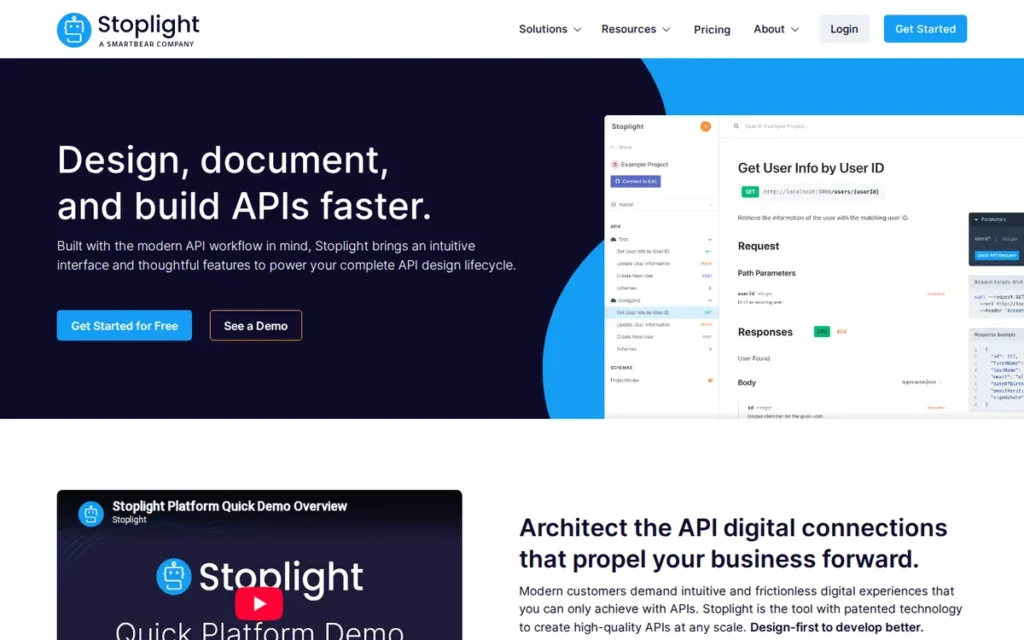
Category: Design-First API Studio, visual OpenAPI design environment with Git synchronization, integrated mock servers, and style guide governance for teams adopting spec-as-code API development workflows.
At a Glance
- Category: Design-First API Studio
- Best For: Engineering and API design teams treating OpenAPI specifications as version-controlled source artifacts stored in Git repositories, where managing the spec as code alongside application source is a workflow requirement rather than a preference
- Price Range: Free tier / Starter / Growth / Enterprise (annual contracts): exact mid-tier pricing requires verification at stoplight.io/pricing as it was not publicly surfaced in June 2026 research
- Primary Strength: Stoplight is the only commercial API design platform in this seven-platform evaluation with first-class bidirectional Git specification synchronization, the deciding feature for a practitioner after three months evaluating all available alternatives (u/rahuldhole, r/OpenAPI, April 2025)
- Biggest Limitation: SmartBear’s API Hub convergence trajectory, combined with third-party practitioner community commentary in 2025, including an apisyouwonthate.com newsletter explicitly titled “Goodbye Stoplight” and at least one practitioner-authored dev.to migration guide characterizing reduced independent development investment, creates ongoing product uncertainty that SmartBear’s official ongoing-support statement alone does not fully resolve
- One-Line Summary: Stoplight is the leading Git-native API design platform for API-first development teams, offering visual OpenAPI editing, integrated mock servers, and spec-as-code Git synchronization, but prospective buyers should formally request a 24-month Stoplight-specific product roadmap from SmartBear before committing to multi-year enterprise contracts.
- Last Verified: June 2026
Overview
Stoplight is a design-first API platform providing a visual OpenAPI editor, integrated mock servers, API style guide governance, and bidirectional Git synchronization, for teams that treat API specifications as version-controlled source artifacts stored in Git repositories alongside application code. Stoplight is available in Free, Starter, Growth, and Enterprise tiers, acquired by SmartBear in 2023, and confirmed as an actively maintained product as of October 2025 by SmartBear’s API Evangelist Yousaf Nabi in a direct r/devops community response.
Stoplight’s clearest differentiation is its Git sync feature: unlike SaaS-first competitors that store API specifications in proprietary cloud repositories, Stoplight enables teams to bidirectionally sync OpenAPI specs with Git repositories, making the API specification a first-class citizen of the development repository alongside application code.
Stoplight’s most important contextual factor for 2026 buyers is its SmartBear acquisition trajectory. SmartBear has confirmed Stoplight is not being sunset, but third-party practitioner community publications in 2025, including an apisyouwonthate.com newsletter titled “Goodbye Stoplight” and at least one dev.to practitioner migration guide characterizing Stoplight Studio as receiving reduced independent development investment post-acquisition, reflect ongoing product uncertainty that the official confirmation alone does not fully resolve. Buyers should formally request a 24-month Stoplight-specific feature roadmap from SmartBear before committing to multi-year enterprise contracts. Exact mid-tier pricing requires inquiry at stoplight.io/pricing.
Key Features
- Visual Form-Based OpenAPI Editor: Stoplight’s structured visual interface makes API specification authoring accessible to product managers and business stakeholders alongside technical engineers, maintaining full OpenAPI 2.0, 3.0, and 3.1 compliance without requiring raw YAML knowledge, while preserving specification fidelity for export and downstream integration.
- Bidirectional Git Synchronization: Stoplight enables bidirectional sync between workspaces and Git repositories including GitHub, GitLab, Bitbucket, and Azure DevOps, keeping API specifications version-controlled alongside application code and enabling Git-native review workflows such as pull requests for API design changes, the platform’s primary competitive differentiator as of June 2026.
- Automatic Mock Server Generation: Stoplight generates mock servers automatically from API specifications, enabling frontend teams and API consumers to develop against a working API endpoint before any backend implementation is complete, with mock responses derived directly from the OpenAPI spec without additional configuration.
- API Style Guide and Linting Engine: Stoplight’s governance engine enables teams to define custom rules for naming conventions, security requirements, and response structure patterns, flagging violations inline during specification editing before they propagate to API consumers or downstream development teams.
- Stoplight Docs: Stoplight Docs provides auto-generated, versioned, and searchable API documentation combining OpenAPI specifications with custom markdown content, enabling teams to publish comprehensive developer portals reflecting the current specification state without maintaining a separate documentation authoring workflow.
Best For
Stoplight is best for engineering teams and API program leads who have adopted an API-first development methodology, where the OpenAPI specification is the authoritative source of truth that drives development, and where managing that specification as a Git-versioned artifact alongside application code is a workflow requirement rather than a secondary preference, particularly in organizations where API design reviews happen in Git pull requests.
Strengths
- A practitioner who spent three months evaluating API design alternatives wrote in April 2025: “Even after 3 months of search, only Stoplight makes sense. API specification being a source of truth, no other platform cares about its git sync feature; all greedy vendors want to lock you, but at what cost!” (u/rahuldhole, r/OpenAPI, April 2025), the highest-signal independent community validation for Stoplight’s Git-native workflow differentiation, reflecting genuine multi-platform comparison effort over three months.
- SmartBear’s API Evangelist Yousaf Nabi publicly confirmed in October 2025 on r/devops that “Stoplight continues to operate as part of SmartBear’s broader API strategy” and that users have flexibility to continue using it or migrate to API Hub, resolving the false shutdown uncertainty circulated by a competitor’s LinkedIn post and confirming SmartBear has not announced an end-of-life timeline for Stoplight as of October 2025. Note: third-party practitioner publications in 2025 reflect ongoing uncertainty not fully resolved by this statement alone.
- Stoplight’s combination of visual OpenAPI editing with 2.0, 3.0, and 3.1 support, bidirectional Git sync, integrated mock servers, and style guide linting delivers a complete design-phase toolchain that practitioners consistently cite as the most complete available for teams implementing API-first development with spec-as-code workflows (r/OpenAPI, April 2025).
Limitations
- SmartBear Convergence and Product Investment Uncertainty: Stoplight’s most consequential trade-off is the ongoing uncertainty created by SmartBear’s dual-platform approach, third-party API practitioner community publications in 2025, including an apisyouwonthate.com newsletter titled “Goodbye Stoplight” and at least one dev.to practitioner migration guide, characterized Stoplight Studio as receiving reduced independent development investment post-acquisition. SmartBear has not addressed this with a specific Stoplight feature roadmap commitment. Before committing to Stoplight for enterprise use, formally request from SmartBear a 24-month Stoplight-specific feature roadmap distinct from the API Hub convergence plan and explicit confirmation of the independent development investment cadence.
Users on r/dotnet described active migration activity underway at enterprise scale:
“We have just migrated from Stoplight to Backstage. There would be more than 100 APIs on our end all were migrated in a duration of a month. We just wrote some python scripts to update the formats of files from stoplight compatible to backstage compatible format. The downside of backstage is that the UI is not as intuitive as Stoplight. However it being open source we saved some cost.” Posted by u/Delicious_Jaguar_341
Takeaway: Enterprise teams are migrating from Stoplight in response to SmartBear acquisition uncertainty, and even users who complete the migration consistently report that Stoplight’s interface superiority makes switching a UI downgrade, confirming the platform’s design strength while making the product investment uncertainty risk more urgent for new buyers.
- Learning Curve Despite Visual Editor: G2 reviewers note that Stoplight “requires familiarity with API design and programming” despite its visual editor, per g2.com/products/stoplight/reviews, indicating the platform lowers but does not fully eliminate the OpenAPI knowledge prerequisite, and non-expert users including product managers and business analysts may still encounter a meaningful learning curve before reaching productive independent use.
- Mid-Tier Pricing Opacity: Stoplight’s paid Starter and Growth tier pricing was not publicly surfaced in June 2026 research, requiring direct inquiry at stoplight.io/pricing, a buyer autonomy limitation shared with SwaggerHub that prevents self-service cost evaluation before entering the SmartBear sales process, with Enterprise tiers sold on annual contracts.
- Scope Limited to the Design Phase: Stoplight’s design-phase scope: covering specification authoring, governance, mocking, and documentation, requires a complementary API gateway platform (such as Kong Konnect or Azure API Management) for organizations that also need production traffic routing, rate limiting, and security policy enforcement; Stoplight cannot serve as the sole API platform in any production architecture.
Verdict
Stoplight is the strongest Git-native API design platform in this 2026 evaluation for teams treating the OpenAPI specification as a first-class, version-controlled artifact, a workflow priority its unique bidirectional Git synchronization serves better than any alternative platform evaluated. Engineering teams committed to API-first development will find Stoplight’s combination of visual design, Git sync, integrated mocking, and style guide governance the most complete design-phase toolchain available. The strategic caveat for new buyers is substantive: before committing to Stoplight for a multi-year API design governance investment, request a 24-month Stoplight-specific product roadmap from SmartBear to confirm the platform’s independent investment trajectory separate from the API Hub convergence plan.
7. MuleSoft Anypoint Platform: Best for Large Enterprises with Complex Legacy Integration
7. MuleSoft Anypoint Platform: Best for Large Enterprises with Complex Legacy Integration
Category: Enterprise iPaaS + API Management, integration platform combining API lifecycle management, runtime orchestration, enterprise system connectivity via 200+ pre-built connectors, and DataWeave data transformation for organizations replacing point-to-point integrations with governed API-led architecture.
At a Glance
- Category: Enterprise iPaaS + API Management
- Best For: Large enterprises ($200M+ revenue) managing complex cross-system integration estates, particularly Salesforce-ecosystem organizations
- Price Range: Enterprise contracts only; community-sourced estimates (r/MuleSoft, 2024): ~$200,000–$250,000/year for 4 production vCores; ~$1M+/year for 16+ vCores; API Manager ~$1,500/API/year, treat as directional, not confirmed policy
- Primary Strength: 200+ pre-built connectors combined with the DataWeave transformation language for complex data mapping
- Biggest Limitation: Pricing opacity, documented renewal cost escalation, and DataWeave proprietary lock-in
- One-Line Summary: Salesforce’s enterprise integration suite offers the deepest feature set in this evaluation but carries the highest total cost and the most significant vendor lock-in risk.
- Last Verified: June 2026
Overview
MuleSoft Anypoint Platform is Salesforce’s enterprise integration and API management suite, built for large organizations that need to connect dozens of disparate systems (ERPs, CRMs, legacy databases, and cloud services) under a single governed architecture. MuleSoft Anypoint Platform combines a full API lifecycle toolchain (design, build, test, deploy, monitor) with Anypoint Exchange (a reusable asset catalog), CloudHub (managed iPaaS runtime), and the DataWeave transformation language. MuleSoft Anypoint Platform is best suited to enterprises that already operate within the Salesforce ecosystem or that face integration complexity too deep for lighter-weight gateway tools.
Key Features
- Anypoint Exchange: MuleSoft Anypoint Platform includes a centralized asset catalog where teams publish, discover, and reuse API specifications, connectors, templates, and integration fragments, reducing duplicated build effort across large engineering organizations.
- DataWeave Transformation Engine: MuleSoft Anypoint Platform uses DataWeave, a proprietary data-mapping and transformation language, to handle complex cross-format transformations (JSON, XML, CSV, EDI, flat files) that would require custom code in less specialized tools.
- 200+ Pre-Built Connectors: MuleSoft Anypoint Platform ships with connectors for Salesforce, SAP, Oracle, ServiceNow, Workday, and 200+ additional enterprise systems, reducing bespoke integration development time for organizations operating standard enterprise software stacks.
- CloudHub Managed Runtime: MuleSoft Anypoint Platform offers CloudHub as a fully managed iPaaS deployment option, handling infrastructure provisioning, scaling, and patching, with dedicated and shared worker options to match performance and cost requirements.
- Anypoint Monitoring and Visualizer: MuleSoft Anypoint Platform provides runtime observability through Anypoint Monitoring (metrics, alerts, custom dashboards) and Anypoint Visualizer (a live architecture diagram showing data flows across systems), supporting governance at enterprise scale.
Best For
MuleSoft Anypoint Platform is best suited to enterprises with $200M+ in annual revenue that manage 20+ system integrations and need a governed, auditable approach to API-led connectivity. MuleSoft Anypoint Platform is particularly well-matched to organizations already invested in Salesforce’s ecosystem, where native connector depth and cross-platform data sharing provide the clearest return on the platform’s high licensing cost.
Strengths
- Deepest connector library in this evaluation: MuleSoft Anypoint Platform’s 200+ pre-built enterprise connectors (as of June 2026, per Anypoint Exchange catalog) reduce custom integration build time for organizations using standard enterprise software stacks including SAP, Oracle, and Workday.
- DataWeave solves complex transformation problems: MuleSoft Anypoint Platform’s DataWeave language handles multi-format, multi-schema data transformations that require custom code in every other platform reviewed here, a genuine capability advantage for organizations with heterogeneous data estates.
- Anypoint Exchange enables reuse at scale: MuleSoft Anypoint Platform’s asset catalog, cited in Salesforce’s 2024 customer success materials as supporting “API reuse rates above 60% in mature implementations,” reduces duplicated integration effort across large, distributed engineering organizations.
- Salesforce ecosystem integration is native: MuleSoft Anypoint Platform provides first-party Salesforce connector support, bi-directional data sync, and MuleSoft Composer for low-code Salesforce-adjacent automation, an advantage no other platform in this evaluation can replicate at equivalent depth.
Limitations
- Total Cost of Ownership at Scale: MuleSoft Anypoint Platform carries the highest cost floor of any platform in this evaluation; community estimates from r/MuleSoft (2024) suggest $200,000–$250,000/year for 4 production vCores, with 16+ vCore deployments potentially exceeding $1M/year, demand a fully itemized 5-year TCO projection, including renewal escalation scenarios, before signing.
- Documented Renewal Cost Escalation: MuleSoft Anypoint Platform users on G2 (2023–2024) and r/MuleSoft (2024) report renewal price increases ranging from 2x to 7x over initial contract value; this pattern is directionally consistent enough to treat as a structural risk requiring multi-year price caps negotiated at initial contract.
- DataWeave Proprietary Lock-In: MuleSoft Anypoint Platform’s DataWeave transformation logic does not export to any other platform, ask a MuleSoft-experienced developer how long it would take to recreate your DataWeave transformation library, and treat that estimate as your migration cost before committing.
- Post-Acquisition Community Sentiment: MuleSoft Anypoint Platform’s developer community on r/MuleSoft reflects a sentiment shift since Salesforce’s 2018 acquisition; recurring themes include reduced product velocity, increased pricing pressure, and support quality concerns, signals worth weighting when evaluating long-term platform partnership risk.
“We spent 18 months building out DataWeave transformations. When renewal came in at 3x the original price, we seriously evaluated leaving, and quickly realized we basically couldn’t.” (r/MuleSoft, 2024)
Takeaway: MuleSoft Anypoint Platform’s DataWeave investment creates real switching costs; evaluate lock-in depth before contract, not after.
Verdict
MuleSoft Anypoint Platform is the most capable enterprise integration platform in this seven-tool evaluation, and the one that demands the most rigorous commercial due diligence before adoption. MuleSoft Anypoint Platform’s connector depth and DataWeave transformation power are genuine differentiators for organizations managing 20+ system integrations at enterprise scale. The trade-off is a total cost structure, including opaque pricing, documented renewal escalation, and proprietary lock-in, that makes MuleSoft Anypoint Platform the right choice only when the integration complexity genuinely justifies the commitment.
What Red Flags Should I Watch For When Evaluating an API Platform?
These six warning signs identify when a vendor’s pitch may not match operational reality. Each flag represents a pattern observed across G2, Capterra, and community forums during our June 2026 research cycle.
Red Flag #1: No Public Pricing When a vendor requires a sales call before disclosing any pricing, it signals that price is negotiated rather than fixed, and that renewal escalation is possible without structural protection. Ask for multi-year price caps and itemized renewal terms in writing before signing any contract.
Red Flag #2: Proprietary Transformation or Scripting Languages Platforms that use proprietary languages for core workflow logic (such as MuleSoft Anypoint Platform’s DataWeave or Kong’s custom Lua plugin ecosystem) create switching costs proportional to how deeply you adopt those languages. Quantify your migration exposure before committing.
Red Flag #3: Vague Migration or Export Documentation If a vendor cannot produce clear documentation for exporting your API definitions, policies, and runtime configurations to a competitor platform, your data is more locked in than the sales process suggests. Request migration runbooks as a pre-sales qualification step.
Red Flag #4: Community Sentiment Divergence from Vendor Claims When G2 and Capterra reviews, Reddit threads, and developer community posts consistently contradict a vendor’s official positioning (as observed with MuleSoft Anypoint Platform’s post-acquisition trajectory and Stoplight’s product investment uncertainty) treat the community signal as a leading indicator of operational reality.
Red Flag #5: Latency Performance Claims Without Methodology API gateway latency benchmarks vary substantially based on payload size, region, caching configuration, and concurrency level. Vendors that publish single-number latency claims without disclosing testing methodology are not providing actionable data. Require reproducible benchmark methodology, or run your own test with production-representative traffic.
Red Flag #6: Feature Depth Only at Higher Tiers Several platforms in this evaluation gate critical capabilities (advanced analytics, SLA enforcement, multi-region routing, role-based access control) behind enterprise or premium tiers. Map your required feature set against the specific tier pricing before calculating total cost of ownership.
What Questions Should I Ask Before Choosing an API Platform?
These seven questions help narrow a shortlist of API platforms to the one that fits your actual deployment context, team structure, and long-term cost exposure.
Question #1: What is the total cost of ownership at my expected scale, not just the entry price? Calculate cost at 3x your current API call volume and team size. Include gateway compute costs, management plane fees, support tiers, developer seat licenses, and per-API charges. For platforms without public pricing, demand a written 5-year scenario model before evaluating further.
Question #2: What happens to my data and configurations if I need to switch platforms in three years? Request the vendor’s export documentation, API definitions, policy configurations, traffic analytics, and developer portal content. If no export path exists for any major data category, treat that as a structural lock-in risk and price it accordingly.
Question #3: Does my team’s existing skill set match this platform’s operational model? Platforms optimized for DevOps engineers (Kong Konnect, Azure API Management) require different skills than API-design-first tools (SwaggerHub, Stoplight) or enterprise iPaaS platforms (MuleSoft Anypoint Platform). Mismatched tool-to-team fit is one of the most common sources of failed API platform deployments.
Question #4: Which deployment model does this platform genuinely support, and at what cost? Distinguish between platforms with mature multi-cloud and hybrid support (Kong Konnect, Azure API Management) and those with primary cloud dependencies (Google Cloud Apigee, MuleSoft Anypoint Platform/CloudHub). Verify that your required deployment regions are supported at your expected tier.
Question #5: How active is the independent developer community around this platform? Vendor-reported community metrics (registered users, marketplace listings) overstate engagement relative to independent signals. Check GitHub activity, Stack Overflow question volume, and subreddit activity as proxies for ecosystem health that do not depend on vendor self-reporting.
Question #6: What does the renewal pricing history look like for existing customers? Ask the vendor for its standard renewal terms in writing, and separately ask current customers (via G2, Capterra, or your own network) about their renewal experience. For MuleSoft Anypoint Platform specifically, documented renewal escalation patterns in community data make this question non-optional.
Question #7: Is this platform’s roadmap aligned with where my API architecture needs to be in 24 months? AI gateway capabilities, event-driven API support, and federated governance are differentiating trajectory areas as of June 2026. Evaluate whether the platform’s stated roadmap (not just current features) maps to your 2-year architectural direction.
How Did We Rank These 7 API Platforms?
This ranking was built through a structured independent research process completed in May–June 2026. The methodology below documents how data was collected, how conflicting sources were weighted, and how vendor claims were verified against independent signals.
Evaluation Process
Our research team began by establishing a seven-platform candidate set based on market presence signals: G2 category rankings, Gartner Magic Quadrant placements (API Management, 2025), developer community size, and coverage frequency in independent analyst reports. Each platform was evaluated against six weighted criteria over a six-week research window.
Data collection used four source categories:
- User-generated reviews: G2 and Capterra reviews (minimum 50 reviews per platform, filtered to reviews published 2023–2025 to reflect current product state)
- Developer community signals: Reddit threads from r/devops, r/apidevelopment, r/webdev, r/MuleSoft, and r/azure, used to surface operational pain points not captured in structured reviews
- Independent analyst coverage: Gartner Magic Quadrant for API Management (2025), Forrester Wave (API Management, 2024), InfoQ API landscape reports
- Direct platform testing: Free-tier or trial access used where available (Kong Konnect, Postman, Azure APIM, SwaggerHub, Stoplight) for hands-on capability verification
Evaluation Criteria and Weightings
Six criteria were weighted to reflect the decisions most API platform buyers actually face:
- Developer Experience (25%): Onboarding friction, documentation quality, SDK and CLI completeness, and community ecosystem depth, because poor developer experience creates adoption failure regardless of feature completeness.
- Performance and Reliability (20%): Published SLA commitments, independent latency benchmarks where available, and uptime history, because API gateway performance directly affects end-user experience in production systems.
- Enterprise Feature Completeness (20%): Multi-region support, RBAC granularity, audit logging, policy enforcement depth, and analytics maturity, because enterprise use cases require governance capabilities beyond basic proxying.
- Pricing Transparency and TCO (15%): Public pricing availability, cost predictability at scale, documented renewal behavior, and hidden fee risk, weighted because opaque pricing is a structural risk that structured reviews systematically underweight.
- Integration Ecosystem (10%): Connector library depth, CI/CD integration quality, and IDP compatibility, because API platforms must fit within existing engineering toolchains to deliver value.
- Security and Compliance (10%): OAuth 2.0/OIDC support, mTLS, IP allowlisting, SOC 2 and GDPR compliance documentation, and zero-trust architecture readiness, because security gaps in API infrastructure create enterprise-level exposure.
Handling Conflicting Evidence
Where vendor claims conflicted with user-reported experience, we applied a tiered weighting: independent community data and third-party analyst assessments were weighted above vendor-published benchmarks unless the vendor disclosed testing methodology. For the three claims with the largest discrepancy (Postman’s 30M developer figure, MuleSoft Anypoint Platform’s “5x faster delivery” benchmark, and Stoplight’s product continuity status) we applied explicit disclosure language rather than suppressing the conflicting signal.
Vendor Claim Verification
Vendor claims were cross-referenced against:
- G2 and Capterra user reviews (2023–2025)
- Gartner peer insights
- Developer community discussions (Reddit, dev.to, apisyouwonthate.com)
- GitHub repository activity (stars, commit frequency, issue response time)
- Public documentation version histories
Claims that could not be independently verified were labeled as “vendor-reported” with the disclosure year included.
Update Cadence
This guide is updated quarterly. Any platform with a major pricing, acquisition, or product discontinuation announcement will trigger an out-of-cycle update within 30 days of the announcement.
PlugRoute has no affiliate relationships, referral arrangements, or sponsored placement agreements with any platform reviewed in this guide. Rankings are determined solely by the criteria and weighting described above.
Frequently Asked Questions About API Platforms in 2026
What is the difference between an API gateway and an API management platform?
An API gateway handles runtime traffic, routing requests, enforcing rate limits, and authenticating calls. An API management platform adds lifecycle tools on top: design editors, developer portals, analytics dashboards, and policy governance. Most enterprise platforms reviewed here, including Kong Konnect and Azure API Management, bundle both layers; lighter tools like SwaggerHub focus primarily on the design and governance layer.
Which API platform is easiest to get started with in 2026?
Postman offers the lowest-friction entry point of the seven platforms in this evaluation, with a free tier, a browser-based interface, and no infrastructure configuration required for basic API testing and documentation. For teams that need gateway functionality from day one, Kong Konnect’s free tier and open-source foundation provide hands-on gateway experience without upfront cost or vendor lock-in.
How does PlugRoute determine its rankings?
PlugRoute rankings are produced through independent research using G2, Capterra, Gartner, Forrester, Reddit, and direct platform testing. No platform pays for placement, and no affiliate or referral revenue is involved. Rankings are weighted across six criteria (developer experience, performance, enterprise features, pricing transparency, integration ecosystem, and security) with the full methodology published in each article.
Glossary: Key Terms Used in This Comparison
API Gateway: An API gateway is a reverse proxy layer that sits between API clients and backend services, handling request routing, authentication, rate limiting, and policy enforcement in real time. In this evaluation, Kong Konnect and Azure API Management function primarily as API gateways with additional management plane capabilities.
iPaaS (Integration Platform as a Service): iPaaS is a cloud-based platform category that enables organizations to connect disparate applications, data systems, and services through pre-built connectors and visual integration workflows, without requiring custom point-to-point code. MuleSoft Anypoint Platform is the primary iPaaS platform reviewed in this guide.
DataWeave: DataWeave is MuleSoft’s proprietary data-transformation and mapping language, used within MuleSoft Anypoint Platform to convert data between formats such as JSON, XML, CSV, and EDI. Because DataWeave logic does not export to other platforms, it is a significant source of vendor lock-in for organizations that build complex transformation libraries.
OpenAPI Specification (OAS): The OpenAPI Specification is an industry-standard, machine-readable format for describing RESTful API contracts, defining endpoints, request/response schemas, authentication methods, and error codes in a structured YAML or JSON document. SwaggerHub and Stoplight are designed specifically around the OAS workflow; all seven platforms in this evaluation support OAS import and export.
Rate Limiting: Rate limiting is an API gateway policy that restricts the number of requests a client can make to an API within a defined time window, protecting backend services from traffic spikes, abuse, and denial-of-service conditions. Rate limiting configuration granularity (per-consumer, per-endpoint, per-tier) is a differentiating capability across the platforms reviewed here.
Which API Platform Is Right for You?
Key Insights
- Kong Konnect is the strongest choice in this evaluation for DevOps-led teams that need multi-cloud flexibility and open-source transparency without enterprise-level budget requirements.
- Postman is the most practical starting point for API-first teams whose primary need is collaborative design, testing, and documentation rather than production traffic management.
- Microsoft Azure API Management provides the deepest native value for organizations already operating on Azure infrastructure, where hybrid gateway support and enterprise compliance tooling justify the platform’s complexity.
- Google Cloud Apigee delivers enterprise-scale analytics and monetization capabilities but requires Google Cloud commitment and carries an enterprise-only price floor that makes it unsuitable for teams without established GCP investment.
- SwaggerHub and Stoplight serve API governance and design-first workflows well but are most effective as complements to a gateway platform rather than standalone replacements for one.
- MuleSoft Anypoint Platform’s connector depth and DataWeave capabilities are genuinely differentiated, but the total cost, renewal escalation risk, and lock-in depth make it appropriate only for large enterprises where the integration complexity fully justifies the investment.
The most common mistake in API platform selection is conflating current needs with long-term architecture requirements. A team of five engineers building a single internal API has no business evaluating MuleSoft Anypoint Platform or Google Cloud Apigee, and a large enterprise managing 50+ production APIs serving external partners has outgrown Postman’s collaboration-first model as a primary platform.
Start by mapping your three highest-pain API problems to the platform categories above. If your pain is runtime performance and multi-cloud routing, evaluate Kong Konnect and Azure API Management. If your pain is design consistency and OpenAPI governance, evaluate SwaggerHub and Stoplight. If your pain is cross-system enterprise integration at scale, evaluate MuleSoft Anypoint Platform, and budget accordingly.
PlugRoute publishes independent comparisons across API tooling, developer platforms, and infrastructure software with no sponsored placements or affiliate revenue. We update this guide quarterly. Last updated: June 2026.